


Royal Flying Corps

Encyclopedia
The Royal Flying Corps (RFC) was the over-land air arm of the British military
during most of the First World War
. During the early part of the war, the RFC's responsibilities were centred on support of the British Army
, via artillery
co-operation and photographic reconnaissance
. This work gradually led RFC pilots into aerial battles with German
pilots and later in the war included the strafing
of enemy infantry
and emplacements
, the bombing of German military airfields and later the strategic bombing
of German industrial and transportation facilities.
At the start of World War I the RFC, commanded by David Henderson, consisted of five squadrons – one observation balloon
squadron (RFC No 1 Squadron) and four aeroplane squadrons (RFC No 2 and No 3 Squadrons were the first fixed-wing flying squadrons in the world). These were first used for aerial spotting on 13 September 1914, but only became efficient when they perfected the use of wireless communication
at Aubers Ridge on 9 May 1915. Aerial photography
was attempted during 1914, but again only became effective the next year. By 1918, photographic images could be taken from 15,000 feet, and interpreted by over 3,000 personnel. Parachute
s were not available to pilots of the RFC's heavier-than-air craft – nor were they used by the RAF during the First World War – although the Calthrop Guardian Angel parachute (1916 model) was officially adopted just as the war ended. By this time parachutes had been used by balloonists for three years.
On 17 August 1917, South African General Jan Smuts
presented a report to the War Council on the future of air power
. Because of its potential for the 'devastation of enemy lands and the destruction of industrial and populous centres on a vast scale', he recommended a new air service be formed that would be on a level with the Army and Royal Navy. The formation of the new service would, however, make the under-utilised men and machines of the Royal Naval Air Service
(RNAS) available for action across the Western Front
, as well as ending the inter-service rivalries that at times had adversely affected aircraft procurement. On 1 April 1918, the RFC and the RNAS were amalgamated to form a new service, the Royal Air Force
(RAF). The RAF was under the control of the new Air Ministry
. After starting in 1914 with some 2,073 personnel, by the start of 1919 the RAF had 4,000 combat aircraft
and 114,000 personnel.
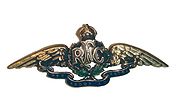 With the growing recognition of the potential for aircraft as a cost-effective method of reconnaissance and artillery observation, the Committee of Imperial Defence
established a sub-committee to examine the question of military aviation in November 1911. The following February the sub-committee reported its findings which recommended that a flying corps be formed and that it consist of a naval wing, a military wing, a central flying school and an aircraft factory. The recommendations of the committee were accepted and on 13 April 1912 King George V signed a royal warrant establishing the Royal Flying Corps. The Air Battalion
of the Royal Engineers
became the Military Wing of the Royal Flying Corps a month later on 13 May.
The Flying Corps' initial allowed strength was 133 officers, and by the end of that year it had 12 manned balloon
s and 36 aeroplanes
. The RFC originally came under the responsibility of Brigadier-General Henderson, the Director of Military Training, and had separate branches for the Army and the Navy. Major Sykes
commanded the Military Wing and Commander C R Samson commanded the Naval Wing. The Royal Navy
however, with different priorities to that of the Army and wishing to retain greater control over its aircraft, formally separated its branch and renamed it the Royal Naval Air Service
in 1914, although a combined central flying school was retained.
The RFC's motto was Per ardua ad astra
("Through adversity to the stars"). This remains the motto of the Royal Air Force
(RAF) and other Commonwealth air forces.
The RFC's first fatal crash was on 5 July 1912 near Stonehenge
on Salisbury Plain
. Killed were Captain Eustace B. Loraine
and his observer, Staff Sergeant R.H.V. Wilson, flying from Larkhill Aerodrome. An order was issued after the crash stating "Flying will continue this evening as usual", thus beginning a tradition.
In August 1912 RFC Lieutenant Wilfred Parke
RN became the first aviator to recover from an accidental spin when the Avro G cabin biplane, with which he had just broken a world endurance record, entered a spin at 700 feet above ground level at Larkhill Aerodrome at Salisbury Plain. Four months later on 11 December 1912 Parke was killed by the fall of the Handley Page monoplane in which he was travelling from Hendon to Oxford.
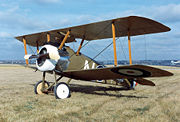 Aircraft used during the war by the RFC included:
, and No. 2 Company (a 'heavier than air' company) becoming No. 3 Squadron, RFC
. A second heavier-than-air squadron, No. 2 Squadron, RFC
, was also formed on the same day.
No. 4 Squadron, RFC was formed from No. 2 Sqn in August 1912, and No. 5 Squadron, RFC
from No. 3 Sqn in July 1913.
By the end of March 1918, the Royal Flying Corps comprised some 150 squadrons.
The composition of an RFC squadron varied depending on its designated role, although the Commanding Officer was usually a Major (in a largely non-operational role), with the Squadron 'Flights' (annotated A, B, C etc.) the basic tactical and operational unit, each commanded by a Captain. A 'Recording Officer' (of Captain/Lieutenant rank) would act as Intelligence Officer and Adjutant, commanding two or three NCOs
and ten other ranks in the Administration section of the Squadron. Each flight contained on average between six to ten pilots (and a corresponding number of observers, if applicable) with a Senior Sergeant and thirty-six other ranks (as Fitters, Riggers,Metal smiths, Armourers etc.). The average squadron also had on complement an Equipment Officer, Armaments Officer (each with five other ranks) and a Transport Officer, in charge of twenty-two other ranks.
The Squadron transport establishment typically included 1 car, 5 light tenders, 7 heavy tenders, 2 repair lorries, 8 motorcycles and 8 trailers.
in the Royal Flying Corps consisted of a number of squadrons
.
When the Royal Flying Corps was established it was intended to be a joint service and given the rivalry
that existed between the British Army
and Royal Navy
certain new terminology was thought necessary in order to avoid marking the Corps out as having a particularly Army or Navy ethos. Accordingly, the Corps was originally split into two wings: a Military Wing (i.e. an army wing) and a Naval Wing. By 1914, the Naval Wing had become the Royal Naval Air Service, having gained its independence from the Royal Flying Corps.
By November 1914 the Flying Corps had significantly expanded and it was felt necessary to create organizational units which would control collections of squadrons; the term "wing" was re-used for these new organizational units.
The Military Wing was abolished and its units based in Great Britain were re-grouped as the Administrative Wing. The RFC squadrons in France were grouped under the newly established 1st Wing and the 2nd Wing. The 1st Wing was assigned to the support of the 1st Army whilst the 2nd Wing supported the 2nd Army
As the Flying Corps grew so did the number of wings. The 3rd Wing was established on 1 March 1915 and on 15 April the 5th Wing came into existence. By August that year the 6th Wing had been created and in November 1915 a 7th Wing and 8th Wing had also been stood up.
s and the commander of each brigade would hold the temporary rank of brigadier-general. The scheme met with Lord Kitchener
's approval and although many more junior staff officers opposed it, the scheme was adopted.
The following brigades were established (the date of establishment is shown in parentheses):
The IX, X and XI brigades were formed as part of the Royal Air Force and never existed as RFC formations.
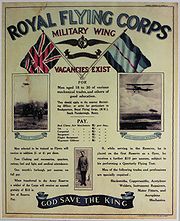 The RFC was also responsible for the manning and operation of observation balloons on the Western front
. When the British Expeditionary Force (BEF) arrived in France in August 1914, it had no observation balloons and it was not until April 1915 that the first balloon company was on strength, albeit on loan from the French Aérostiers. The first British unit arrived 8 May 1915, and commenced operations during the Battle of Aubers Ridge. Operations from balloons thereafter continued throughout the war. Highly hazardous in operation, a balloon could only be expected to last a fortnight before damage or destruction. Results were also highly dependent on the expertise of the observer and was subject to the weather conditions.
In order to keep the balloon out of the range of artillery fire, it was necessary to locate the balloons some distance away from the front line or area of military operations. However, the stable platform offered by a kite-balloon made it more suitable for the cameras of the day than an aircraft.
For the first half of the war, as with the land armies deployed, the French air force vastly outnumbered the RFC, and accordingly did more of the fighting. Despite the primitive aircraft, aggressive leadership by RFC commander Hugh Trenchard and the adoption of a continually offensive stance operationally in efforts to pin the enemy back led to many brave fighting exploits and high casualties – over 700 in 1916, the rate worsening thereafter, until the RFC's nadir in April 1917 ; dubbed 'Bloody April
'.
This aggressive if costly doctrine did however provide the Army General Staff
with vital and up-to-date intelligence on German positions and numbers through continual photographic and observational reconnaissance though the entire war.
, 3
, 4 and 5
squadrons were equipped with aeroplanes, whilst No. 1 Squadron was equipped with balloons.
The RFC's first casualties were before the Corps even arrived in France. Lt Robert R. Skene and Air Mechanic Ray Barlow were killed on 12 August 1914 when their probably overloaded plane crashed at Netheravon
on the way to rendezvous with the rest of the RFC near Dover
. Skene had been the first Englishman to do a loop in an airplane.
On 13 August 1914 2, 3, and 4 Squadrons, comprising 60 machines, departed Dover for the British Expeditionary Force in France. The 5 Squadron joined them a few days later. The aircraft took a route across the English Channel
from Dover to Boulogne
. They then followed the French coast to the Bay of the Somme
before travelling inland by following the river to Amiens
. When the BEF moved forward to Maubeuge
the RFC accompanied them.
On 19 August the Corps undertook its first action of the War with two of its aircraft performing aerial reconnaissance
. The mission was not a great success. In order to save weight each aircraft carried a pilot only instead of the usual pair of pilot and observer. Because of this, and poor weather, both of the pilots lost their way and only one was able to complete his task.
On 22 August 1914, the first British aircraft to be shot down by the Germans was lost. The crew, pilot Second Lieutenant
Vincent Waterfall and observer Lt. Charles George Gordon Bayly of 5 Squadron flying an Avro 504
over Belgium were killed by infantry fire.
Also on 22 August 1914, Captain L E O Charlton
(Observer) and his Pilot, Lieutenant Vivian Hugh Nicholas Wadham made the crucial observation of the 1st German Army's attempt to out-flank the British Expeditionary Force. This allowed the BEF Commander-in-Chief Field Marshal Sir John French to realign his front and save his army around Mons.
Next day on 23 August 1914 the RFC found itself fighting in the Battle of Mons
and two days after that the Flying Corps gained its first air victory. On 25 August Lt C.W. Wilson and Lt C.E.C. Rabagliati
forced down a German Etrich Taube
which had approached their aerodrome while they were refueling their Avro 504. Another RFC machine landed nearby and the RFC observer chased the German pilot into some nearby woods.
After the British retreat from Mons, the Corps fell back to the Marne
where in September they the RFC again proved its value by identifying von Kluck's
First Army's left wheel against the exposed French flank. This information was significant as the First Army's manoeuvre allowed French forces to make an effective counter-attack and also prevented the encirclement of the British Army at Mons.
Sir John French
's (the British Expeditionary Force commander) first official dispatch on 7 September included the following: "I wish particularly to bring to your Lordships' notice the admirable work done by the Royal Flying Corps under Sir David Henderson. Their skill, energy, and perseverance has been beyond all praise. They have furnished me with most complete and accurate information, which has been of incalculable value in the conduct of operations. Fired at constantly by friend and foe, and not hesitating to fly in every kind of weather, they have remained undaunted throughout. Further, by actually fighting in the air, they have succeeded in destroying five of the enemy's machines."
. Union Flag
s markings in various styles were painted on the wings (and sometimes the fuselage sides and/or rudder) at a squadron level when RFC aircraft were fired upon by "friendly" ground forces – but the large red St. George's cross was liable to be mistaken for the crosses on German aircraft. By late 1915 the RFC had officially adopted the familiar French cockade
(roundel
) marking, but with the colours in reverse order (blue circle outermost). Contrary to usual French practice at the time, this was applied to the fuselage sides as well as the wings. Largely to avoid "friendly" attack in the air, the rudders of RFC aircraft were painted (again, in order to match those of their French allies) with the red, white and blue stripes of the tricolour
.
Later in the war, a "night roundel" was used for night flying aircraft – especially the Handley Page O/400 heavy bombers. This dispensed with the (very conspicuous) white circle of the "day" marking.
which followed, the RFC made use of wireless telegraphy to assist with artillery targeting and took aerial photographs for the first time.
From 16,000 feet a photographic plate could cover some 2 miles by 3 miles of front line in sharp detail.
In 1915 Lieutenant-Colonel JTC Moore-Brabrazon designed the first practical aerial camera.
These semi-automatic cameras became a high priority for the Corps and photo-reconnaissance aircraft were soon operational in numbers with the RFC. The camera was usually fixed to the side of the fuselage, or operated through a hole in the floor.
The increasing need for surveys of the western front and its approaches made extensive aerial photography essential. Aerial photographs were exclusively used in compiling the British Army's highly detailed 1:10,000 scale maps introduced in mid-1915. Such were advances in aerial photography that the entire Somme Offensive of July—November 1916 was based on the RFC's air-shot photographs.
The RFC's wireless experiments under Major Herbert Musgrave, included research into how wireless telegraphy could be used by military aircraft. By the start of the war in 1914 Musgrave and his team had devised a system where pilots could use wireless telegraphy to help the artillery. The aircraft carried a wireless set and a map and after identifying the position of an enemy target the pilot was able to transmit messages such as A5 or B3 in morse code, to the RFC land station attached to an artillery battery. The transmitter filled the cockpit normally used by the observer and a trailing wire antenna was used which had to be reeled in prior to landing.
These land stations were generally attached to heavy artillery units, such as Royal Garrison Artillery Siege Batteries and were manned by RFC wireless operators, such as Henry Tabor. These wireless operators had to fend for themselves as their squadrons were situated some distance away. This led to concerns as to who had responsibility for them and in November 1916 squadron commanders had to be reminded “that it is their duty to keep in close touch with the operators attached to their command, and to make all necessary arrangements for supplying them with blankets, clothing, pay, etc” (Letter from Headquarters, 2nd Brigade RFC dated 18 November 1916 – Public Records Office AIR/1/864)
The wireless operators' work was often carried out under heavy artillery fire in makeshift dug-outs. The wireless aerials were an obvious target and were often hit, requiring immediate repair. As well as taking down and interpreting the numerous signals coming in from the aircraft, the operator had to communicate back to the aircraft by means of cloth strips laid out on the ground or a signalling lamp to give visual confirmation that the signals had been received. The wireless communication was one way as no receiver was mounted in the aircraft and the ground station could not transmit. Details from:
By May 1916 306 aircraft and 542 ground stations were equipped with wireless.
s that were used to send reports back to base. In 1916 a Special Duty Flight was formed as part of the Headquarters Wing to handle these and other unusual assignments.
managed to destroy two canvas-covered trucks with home-made petrol bombs.
In March 1915 the first planned bombing raid of the war was flown, with Captain Strange flying a modified BE-2c to carry four 20 lb bombs on wing racks released by pulling a cable fitted in the cockpit. Attacking Courtrai railway station, Strange approached from low-level and hit a troop train causing 75 casualties. The same day Captain Carmichael of No 5 Squadron dropped a 100 lb bomb from a Martinsyde S1 on the railway junction at Menin
. Days later, Lieutenant WB Rhodes-Moorhouse of No 2 Squadron was posthumously awarded the Victoria Cross
after bombing Courtrai station in a BE2c.
In October 1917 No 41 Wing was formed to attack strategic targets in Germany. Consisting of No 55 Squadron (DH-4), No 100 (FE-2b
) and No 16 (Naval) Squadron (Handley Page 0/100
) the Wing was based at Ochey
commanded by Lt-Colonel Cyril Newall. Its first attack was on Saarbrücken
on 17 October with 11 DH-4s and a week later nine 0/100s
carried out a night attack against factories in Saarbrücken, while 16 FE-2b's
bombed railways nearby. Four aircraft failed to return. The Wing was expanded with the later addition of Nos 99 and 104 Squadrons, both flying the DH-4 into the Independent Air Force
.
During the Battle of Messines
in June 1917, Trenchard ordered the British crews to fly low over the lines and strafe all available targets. Techniques for Army and RFC co-operation quickly evolved and improved and during the Third Battle of Ypres over 300 aircraft from 14 RFC squadrons, including the highly splendid Sopwith Camel, armed with four 9 kg (20 lb) bombs, constantly raided enemy trenches, troop concentrations, artillery positions and strongholds in co-operation with tanks and infantry.
The cost to the RFC was high, with a loss rate of ground attack aircraft approaching 30 percent. The first British production armoured type, the Sopwith Salamander
, did not see service during the First World War.
. The RFC (and the Royal Naval Air Service) initially had limited success against the German raids, largely through the problem of locating the attackers and having aircraft of sufficient performance to reach the operating altitude of the German raiders.
With the bulk of the operational squadrons engaged in France few could be spared for home defence in the UK. Therefore training squadrons were called on to supply home defence aircraft and aircrews for the duration of the war. Night flying and defence missions were often flown by instructors in aircraft deemed worn-out and often obsolete for front-line service, although the pilots selected as instructors were often among the most experienced in the RFC.
By December 1916 there were 11 RFC home defence squadrons, and by the end of the war 14 RAF Squadrons were established.
, the Corps moved forward again. On 8 October 1914 the RFC arrived in Saint-Omer
and a headquarters was established at the aerodrome next to the local race course. Over the next few days the four squadrons arrived and for the next four years Saint-Omer was a focal point for all RFC operations in the field. Although most squadrons only used Saint-Omer as a transit camp before moving on to other locations, the base grew in importance as it increased its logistic support to the RFC.
was the commander of the Royal Flying Corps in France from August 1915 until January 1918. Trenchard's time in command was characterized by three priorities. First was his emphasis on support to and co-ordination with ground forces. This support started with reconnaissance and artillery co-ordination and later encompassed tactical low-level bombing of enemy ground forces. While Trenchard did not oppose the strategic bombing of Germany in principle, he opposed moves to divert his forces on to long-range bombing missions as he believed the strategic role to be less important and his resource to be too limited. Secondly, he stressed the importance of morale, not only of his own airmen, but more generally the detrimental effect that the presence of an aircraft had upon the morale of opposing ground troops. Finally, Trenchard had an unswerving belief in the importance of offensive action. Although this belief was widely held by senior British commanders, the RFC's offensive posture resulted in the loss of many men and machines and some doubted its effectiveness.
the RFC mustered 421 aircraft, with 4 kite-balloon squadrons and 14 balloons. These made up four brigades, which worked with the four British armies. By the end of the Somme offensive in November 1916, the RFC had lost 800 aircraft and 252 aircrew killed (all causes) since July 1916, with 292 tons of bombs dropped and 19,000 Recce photographs taken.
As 1917 dawned the Allied Air Forces felt the effect of the German Air Force's increasing superiority in both organisation and equipment (if not numbers). The recently formed Jastas, equipped with the Albatros fighter, inflicted very heavy losses on the RFC's obsolescent aircraft, culminating in Bloody April
, the nadir of the RFC's fortunes in World War I.
To support the Battle of Arras
beginning on 9 April 1917, the RFC deployed 25 squadrons, totalling 365 aircraft, a third of which were fighters (scouts). The British lost 245 aircraft with 211 aircrew killed or missing & 108 as prisoners of war. The German Air Services lost just 66 aircraft from all causes.
By the summer of 1917, the introduction of the next generation of technically advanced combat aircraft (such as the SE5
, Sopwith Camel
and Bristol Fighter
) ensured losses fell and damage inflicted on the enemy increased.
Close support and battlefield co-operation tactics with the British Army were further developed by November 1917, when low-flying fighter aircraft co-operated highly effectively with advancing columns of tanks and infantry during the Battle of Cambrai.
1917 saw 2,094 RFC aircrew killed in action or missing.
led to the transfer of 3 RFC Sopwith Camel
fighter squadrons (28, 45 and 66), two two-seater squadrons (34 and 42, with RE8s) and No. 4 Balloon Wing to the Italian Front in November 1917. No. 139 Squadron (Bristol Fighters) were added in July 1918.
, concentrating RFC units based in Macedonia, Mesopotamia, Palestine and East Africa under one unified command.
In the Middle East units had to make do with older, often obsolete equipment before being given more modern aircraft. The Palestine Brigade
of the RFC was formed in October 1917 to support General Allenby's ground offensive against the Turks in Palestine.
Despite their relatively small numbers the RFC gave valuable assistance to the Army in the eventual defeat of Turkish forces in Palestine
, Trans Jordan
and Mesopotamia
(Iraq).
The RFC contributed significantly to slowing the German advance and ensuring the controlled retreat of the Allied Armies did not turn into a rout. The battle reached its peak on 12 April, when the newly formed RAF dropped more bombs, and flew more missions that any other day during the war. The cost to halting the German advance was high however, with over 400 aircrew killed and 1000 aircraft lost to enemy action.
presented a report to the War Council on the future of air power. Because of its potential for the 'devastation of enemy lands and the destruction of industrial and populous centres on a vast scale', he recommended a new air service be formed that would be on a level with the Army and Royal Navy.
Surprisingly, Trenchard was opposed to a new service . He had always felt that the purpose of the RFC was to support the Army and the RNAS to support the Navy, leaving him worried that a new service wouldn't provide the same level of tactical battle field support. He was also concerned about the careers of the pilots. Because of the high demands on RFC pilots many of them became burned out and were unable to continue in combat. Since pilots were seconded to the RFC from other regiments they could return to those units once they were no longer able to fly. In a separate service this would no longer be an option. The formation of the new service however would make the underutilised men and machines of the RNAS available for action across the Western Front, as well as ending the interservice rivalries that at times had adversely affected aircraft procurement.
On 1 April 1918, the RFC and the RNAS were amalgamated to form a new service, the Royal Air Force
. The RAF was under the control of the new Air Ministry
. After starting in 1914 with some 2,073 personnel by the start of 1919 the RAF had 4,000 combat aircraft and 114,000 personnel.
". In practice, this was reversed at an early stage in the RFC, so that the pilot normally commanded the aircraft. Most operational two seaters of the period did not have dual controls (an exception was the F.K. 8), so that the death or incapacity of the pilot normally meant an inevitable crash – but nonetheless many observers gained at least rudimentary piloting skills, and it was very common for experienced observers to be selected for pilot training.
Applicant for aircrew generally entered the RFC as a cadet via the depot pool for basic training. The cadet would then generally pass on to the School of Military Aeronautics at either Reading or Oxford. Following this period of theoretical learning the cadet was posted to a Training Squadron, either in the UK or overseas.
Colonel Robert Smith-Barry
, a former CO of 60 Squadron, appalled at the poor standard of newly trained pilots and high fatality rate during training in 1915–16, formulated a comprehensive curriculum for pilot training, and with the agreement of Trenchard, returned to the UK to implement his training ethos at Gosport
in 1917. The immediate effect was to halve fatalities in training.
The curriculum was based on a combination of classroom theory and dual flight instruction. Students were not to be discouraged from potentially dangerous manoeuvres but were exposed to them in a controlled environment so that the student could learn to safely rectify errors of judgement.
Dual flying training usually weeded out those not suitable for flying training ( approximately 45% of the initial class intake) before the remaining cadets were taught in the air by an instructor ( initially a 'tour-expired' pilot sent for a rest from an operational squadron in France, without any specific training on how to instruct). After flying 10 to 20 hours dual instruction, the pupil would be ready to 'go solo'.
In May 1916 pilots under instruction were further trained for fighting in the air. Schools of special flying were set up at Turnberry, Marske
, Sedgeforth, Feiston, East Fortune
and Ayr
, where finished pilots could simulate combat flying under the supervision of veteran instructors.
In 1917, the American, British, and Canadian Governments agreed to join forces for training. Between April 1917 and January 1919, Camp Borden
in Ontario
hosted instruction on flying, wireless, air gunnery and photography, training 1,812 RFC Canada pilots and 72 for the United States. Training also took place at several other Ontario locations.
During winter 1917–18, RFC instructors trained with the Aviation Section, U.S. Signal Corps
on three airfields in the United States accommodating about six thousand men, at Camp Taliaferro
near Fort Worth, Texas
. Training was hazardous; 39 RFC officers and cadets died in Texas. Eleven remain there, reinterred in 1924 at a Commonwealth War Graves Commission
cemetery where a monument honours their sacrifice.
Seven training squadrons were located in Egypt at five training depot stations.
As the war drew on the RFC increasingly drew on men from across the British Empire
including South Africa, Canada and Australia. As well as individual personnel, the separate Australian Flying Corps (AFC) deployed Nos 1
, 2
, 3
and 4
Squadrons AFC (which the RFC referred to as 67, 68, 69 and 71 Squadrons). Over 200 Americans joined the RFC before the United States became a combatant. Eventually Canadians made up nearly a third of RFC aircrew.
Although as the war progressed and training became far safer, by the end of the war, some 8,000 had been killed while training or in flying accidents.
offered the RFC his patented parachute. On 13 January 1917, Captain Clive Collett, a New Zealander, made the first British military parachute jump from a heavier-than-air craft. The jump, from 600 feet, was successful but although parachutes were issued to the crews of observation balloons, the higher authorities in the RFC and the Air Board were opposed to the issuing of parachutes to pilots of heavier-than-air craft. It was felt at the time that a parachute might tempt a pilot to abandon his aircraft in an emergency rather than continuing the fight. The parachutes of the time were also heavy and cumbersome, and the added weight was frowned upon by some experienced pilots as it adversely affected aircraft with already marginal performance. It was not until 16 September 1918 that an order was issued for all single seater aircraft to be fitted with parachutes, and this did not eventuate until after the war.
Eleven RFC members received the Victoria Cross
during the First World War. Initially the RFC did not believe in publicising the victory totals and exploits of their Aces
. Eventually however, public interest and the newspapers' demand for heroes lead to this policy being abandoned, with the feats of aces such as Captain Albert Ball
raising morale in the service as well as on the "home front".
For a short time after the formation of the RAF, pre-RAF ranks such as Lieutenant, Captain and Major continued to exist, a practice which officially ended on 15 September 1919. For this reason some early RAF memorials and gravestones show ranks which no longer exist in the modern RAF. A typical example is James McCudden
's grave, though there are many others.
The following served as chief of staff
for the RFC in the field:http://web.genealogie.free.fr/Les_militaires/1GM/Royaume-Uni/Liste_des_commandements/Commandements_regionaux.htm
British Armed Forces
The British Armed Forces are the armed forces of the United Kingdom of Great Britain and Northern Ireland.Also known as Her Majesty's Armed Forces and sometimes legally the Armed Forces of the Crown, the British Armed Forces encompasses three professional uniformed services, the Royal Navy, the...
during most of the First World War
World War I
World War I , which was predominantly called the World War or the Great War from its occurrence until 1939, and the First World War or World War I thereafter, was a major war centred in Europe that began on 28 July 1914 and lasted until 11 November 1918...
. During the early part of the war, the RFC's responsibilities were centred on support of the British Army
British Army
The British Army is the land warfare branch of Her Majesty's Armed Forces in the United Kingdom. It came into being with the unification of the Kingdom of England and Scotland into the Kingdom of Great Britain in 1707. The new British Army incorporated Regiments that had already existed in England...
, via artillery
Artillery
Originally applied to any group of infantry primarily armed with projectile weapons, artillery has over time become limited in meaning to refer only to those engines of war that operate by projection of munitions far beyond the range of effect of personal weapons...
co-operation and photographic reconnaissance
Aerial reconnaissance
Aerial reconnaissance is reconnaissance that is conducted using unmanned aerial vehicles or reconnaissance aircraft. Their roles are to collect imagery intelligence, signals intelligence and measurement and signature intelligence...
. This work gradually led RFC pilots into aerial battles with German
Luftstreitkräfte
The Deutsche Luftstreitkräfte , known before October 1916 as Die Fliegertruppen des deutschen Kaiserreiches , or simply Die Fliegertruppen, was the air arm of the Imperial German Army during World War I...
pilots and later in the war included the strafing
Strafing
Strafing is the practice of attacking ground targets from low-flying aircraft using aircraft-mounted automatic weapons. This means, that although ground attack using automatic weapons fire is very often accompanied with bombing or rocket fire, the term "strafing" does not specifically include the...
of enemy infantry
Infantry
Infantrymen are soldiers who are specifically trained for the role of fighting on foot to engage the enemy face to face and have historically borne the brunt of the casualties of combat in wars. As the oldest branch of combat arms, they are the backbone of armies...
and emplacements
Bunker
A military bunker is a hardened shelter, often buried partly or fully underground, designed to protect the inhabitants from falling bombs or other attacks...
, the bombing of German military airfields and later the strategic bombing
Strategic bombing
Strategic bombing is a military strategy used in a total war with the goal of defeating an enemy nation-state by destroying its economic ability and public will to wage war rather than destroying its land or naval forces...
of German industrial and transportation facilities.
At the start of World War I the RFC, commanded by David Henderson, consisted of five squadrons – one observation balloon
Observation balloon
Observation balloons are balloons that are employed as aerial platforms for intelligence gathering and artillery spotting. Their use began during the French Revolutionary Wars, reaching their zenith during World War I, and they continue in limited use today....
squadron (RFC No 1 Squadron) and four aeroplane squadrons (RFC No 2 and No 3 Squadrons were the first fixed-wing flying squadrons in the world). These were first used for aerial spotting on 13 September 1914, but only became efficient when they perfected the use of wireless communication
Wireless
Wireless telecommunications is the transfer of information between two or more points that are not physically connected. Distances can be short, such as a few meters for television remote control, or as far as thousands or even millions of kilometers for deep-space radio communications...
at Aubers Ridge on 9 May 1915. Aerial photography
Aerial photography
Aerial photography is the taking of photographs of the ground from an elevated position. The term usually refers to images in which the camera is not supported by a ground-based structure. Cameras may be hand held or mounted, and photographs may be taken by a photographer, triggered remotely or...
was attempted during 1914, but again only became effective the next year. By 1918, photographic images could be taken from 15,000 feet, and interpreted by over 3,000 personnel. Parachute
Parachute
A parachute is a device used to slow the motion of an object through an atmosphere by creating drag, or in the case of ram-air parachutes, aerodynamic lift. Parachutes are usually made out of light, strong cloth, originally silk, now most commonly nylon...
s were not available to pilots of the RFC's heavier-than-air craft – nor were they used by the RAF during the First World War – although the Calthrop Guardian Angel parachute (1916 model) was officially adopted just as the war ended. By this time parachutes had been used by balloonists for three years.
On 17 August 1917, South African General Jan Smuts
Jan Smuts
Jan Christiaan Smuts, OM, CH, ED, KC, FRS, PC was a prominent South African and British Commonwealth statesman, military leader and philosopher. In addition to holding various cabinet posts, he served as Prime Minister of the Union of South Africa from 1919 until 1924 and from 1939 until 1948...
presented a report to the War Council on the future of air power
Aerial warfare
Aerial warfare is the use of military aircraft and other flying machines in warfare, including military airlift of cargo to further the national interests as was demonstrated in the Berlin Airlift...
. Because of its potential for the 'devastation of enemy lands and the destruction of industrial and populous centres on a vast scale', he recommended a new air service be formed that would be on a level with the Army and Royal Navy. The formation of the new service would, however, make the under-utilised men and machines of the Royal Naval Air Service
Royal Naval Air Service
The Royal Naval Air Service or RNAS was the air arm of the Royal Navy until near the end of the First World War, when it merged with the British Army's Royal Flying Corps to form a new service , the Royal Air Force...
(RNAS) available for action across the Western Front
Western Front (World War I)
Following the outbreak of World War I in 1914, the German Army opened the Western Front by first invading Luxembourg and Belgium, then gaining military control of important industrial regions in France. The tide of the advance was dramatically turned with the Battle of the Marne...
, as well as ending the inter-service rivalries that at times had adversely affected aircraft procurement. On 1 April 1918, the RFC and the RNAS were amalgamated to form a new service, the Royal Air Force
Royal Air Force
The Royal Air Force is the aerial warfare service branch of the British Armed Forces. Formed on 1 April 1918, it is the oldest independent air force in the world...
(RAF). The RAF was under the control of the new Air Ministry
Air Ministry
The Air Ministry was a department of the British Government with the responsibility of managing the affairs of the Royal Air Force, that existed from 1918 to 1964...
. After starting in 1914 with some 2,073 personnel, by the start of 1919 the RAF had 4,000 combat aircraft
Military aircraft
A military aircraft is any fixed-wing or rotary-wing aircraft that is operated by a legal or insurrectionary armed service of any type. Military aircraft can be either combat or non-combat:...
and 114,000 personnel.
Origin and early history
Committee of Imperial Defence
The Committee of Imperial Defence was an important ad hoc part of the government of the United Kingdom and the British Empire from just after the Second Boer War until the start of World War II...
established a sub-committee to examine the question of military aviation in November 1911. The following February the sub-committee reported its findings which recommended that a flying corps be formed and that it consist of a naval wing, a military wing, a central flying school and an aircraft factory. The recommendations of the committee were accepted and on 13 April 1912 King George V signed a royal warrant establishing the Royal Flying Corps. The Air Battalion
Air Battalion Royal Engineers
The Air Battalion Royal Engineers was the first flying unit of the British Armed Forces to make use of heavier-than-air craft. It evolved into the Royal Flying Corps which in turn evolved into the Royal Air Force.-Establishment:...
of the Royal Engineers
Royal Engineers
The Corps of Royal Engineers, usually just called the Royal Engineers , and commonly known as the Sappers, is one of the corps of the British Army....
became the Military Wing of the Royal Flying Corps a month later on 13 May.
The Flying Corps' initial allowed strength was 133 officers, and by the end of that year it had 12 manned balloon
Balloon
A balloon is an inflatable flexible bag filled with a gas, such as helium, hydrogen, nitrous oxide, oxygen, or air. Modern balloons can be made from materials such as rubber, latex, polychloroprene, or a nylon fabric, while some early balloons were made of dried animal bladders, such as the pig...
s and 36 aeroplanes
Fixed-wing aircraft
A fixed-wing aircraft is an aircraft capable of flight using wings that generate lift due to the vehicle's forward airspeed. Fixed-wing aircraft are distinct from rotary-wing aircraft in which wings rotate about a fixed mast and ornithopters in which lift is generated by flapping wings.A powered...
. The RFC originally came under the responsibility of Brigadier-General Henderson, the Director of Military Training, and had separate branches for the Army and the Navy. Major Sykes
Frederick Sykes
Air Vice-Marshal The Right Honourable Sir Frederick Hugh Sykes GCSI, GCIE, GBE, KCB, CMG was a military officer, British statesman and politician....
commanded the Military Wing and Commander C R Samson commanded the Naval Wing. The Royal Navy
Royal Navy
The Royal Navy is the naval warfare service branch of the British Armed Forces. Founded in the 16th century, it is the oldest service branch and is known as the Senior Service...
however, with different priorities to that of the Army and wishing to retain greater control over its aircraft, formally separated its branch and renamed it the Royal Naval Air Service
Royal Naval Air Service
The Royal Naval Air Service or RNAS was the air arm of the Royal Navy until near the end of the First World War, when it merged with the British Army's Royal Flying Corps to form a new service , the Royal Air Force...
in 1914, although a combined central flying school was retained.
The RFC's motto was Per ardua ad astra
Per ardua ad astra
Per ardua ad astra is the motto of the Royal Air Force and other Commonwealth air forces such as the RAAF, RCAF, and RNZAF. It dates from 1912 and was used by the newly formed Royal Flying Corps.-Origin:The first Commanding Officer of the Royal Flying Corps was Colonel Frederick Sykes...
("Through adversity to the stars"). This remains the motto of the Royal Air Force
Royal Air Force
The Royal Air Force is the aerial warfare service branch of the British Armed Forces. Formed on 1 April 1918, it is the oldest independent air force in the world...
(RAF) and other Commonwealth air forces.
The RFC's first fatal crash was on 5 July 1912 near Stonehenge
Stonehenge
Stonehenge is a prehistoric monument located in the English county of Wiltshire, about west of Amesbury and north of Salisbury. One of the most famous sites in the world, Stonehenge is composed of a circular setting of large standing stones set within earthworks...
on Salisbury Plain
Salisbury Plain
Salisbury Plain is a chalk plateau in central southern England covering . It is part of the Southern England Chalk Formation and largely lies within the county of Wiltshire, with a little in Hampshire. The plain is famous for its rich archaeology, including Stonehenge, one of England's best known...
. Killed were Captain Eustace B. Loraine
Eustace Loraine
-See also:*List of accidents and incidents involving military aircraft...
and his observer, Staff Sergeant R.H.V. Wilson, flying from Larkhill Aerodrome. An order was issued after the crash stating "Flying will continue this evening as usual", thus beginning a tradition.
In August 1912 RFC Lieutenant Wilfred Parke
Wilfred Parke
Lieutenant Wilfred Parke RN was a British airman and became the first aviator to recover from an accidental spin.-Family:Parkes's father was Alfred Watlington Parke, the Rector of Uplyme and his mother was Hilda Fort...
RN became the first aviator to recover from an accidental spin when the Avro G cabin biplane, with which he had just broken a world endurance record, entered a spin at 700 feet above ground level at Larkhill Aerodrome at Salisbury Plain. Four months later on 11 December 1912 Parke was killed by the fall of the Handley Page monoplane in which he was travelling from Hendon to Oxford.
Aircraft
- Airco DH 2Airco DH.2|-DH.2 aces:Distinguished pilots of the DH.2 included Victoria Cross winner Lanoe Hawker , who was the first commander of No 24 Squadron and ace Alan Wilkinson. The commander of No. 32 Squadron, Lionel Rees won the Victoria Cross flying the D.H.2 for single handedly attacking a formation of 10...
, DH 4, DH 5, DH 6Airco DH.6The Airco DH.6 was a British military trainer biplane used by the Royal Flying Corps during the First World War. Known by various nicknames, including the "Skyhook", the trainer became a widely used light civil aircraft in the postwar era....
, and DH 9Airco DH.9The Airco DH.9 - also known after 1920 as the de Havilland DH.9 - was a British bomber used in the First World War... - Armstrong-Whitworth F.K.8Armstrong Whitworth F.K.8The Armstrong Whitworth F.K.8 was a British two-seat general-purpose biplane built by Armstrong Whitworth during the First World War. The type served alongside the better known R.E.8 until the end of the war, at which point 694 F.K.8s remained on RAF charge....
- AvroAvroAvro was a British aircraft manufacturer, with numerous landmark designs such as the Avro 504 trainer in the First World War, the Avro Lancaster, one of the pre-eminent bombers of the Second World War, and the delta wing Avro Vulcan, a stalwart of the Cold War.-Early history:One of the world's...
504Avro 504The Avro 504 was a World War I biplane aircraft made by the Avro aircraft company and under licence by others. Production during the War totalled 8,970 and continued for almost 20 years, making it the most-produced aircraft of any kind that served in World War I, in any military capacity, during... - BristolBristol Aeroplane CompanyThe Bristol Aeroplane Company, originally the British and Colonial Aeroplane Company, was both one of the first and one of the most important British aviation companies, designing and manufacturing both airframes and aero engines...
's Bristol ScoutBristol ScoutThe Bristol Scout was a simple, single seat, rotary-engined biplane originally intended as a civilian racing aircraft. Like other similar fast, light aircraft of the period - it was acquired by the RNAS and the RFC as a "scout", or fast reconnaissance type...
single seat fighter, F2A and F2B Fighter two-seaters - Handley PageHandley Page Aircraft CompanyHandley Page Limited was founded by Frederick Handley Page in 1909 as the United Kingdom's first publicly traded aircraft manufacturing company. It went into voluntary liquidation and ceased to exist in 1970...
O/400Handley Page Type OThe Handley Page Type O was an early biplane bomber used by Britain during the First World War. At the time, it was the largest aircraft that had been built in the UK and one of the largest in the world... - Martinsyde G.100Martinsyde G.100-See also:-References:* Aircraft of World War I, Kenneth Munson, 1967 Ian Allan ISBN 0-7110-0356-4-External links:* http://www.theaerodrome.com/aircraft/gbritain/martinsyde_g100.php* http://www.britishaircraft.co.uk/aircraftpage.php?ID=721...
- Morane-SaulnierMorane-SaulnierAéroplanes Morane-Saulnier is a French aircraft manufacturing company formed in October 1911 by Raymond Saulnier and the Morane brothers, Leon and Robert...
Bullet Biplane Parasol - Nieuport ScoutScout (aircraft)The term scout, as a description of a class of military aircraft, came into use shortly before the First World War, and referred to a light reconnaissance aircraft, initially unarmed. "Scout" types were generally adaptations of pre-war racing aircraft – although at least one was specifically...
17Nieuport 17|-Specifications :-See also:-Bibliography:* Bruce, Jack. "Those Classic Nieuports". Air Enthusiast Quarterly. Number Two, 1976. Bromley, UK:Pilot Press. pp. 137–153....
, 24, 27 - Royal Aircraft FactoryRoyal Aircraft EstablishmentThe Royal Aircraft Establishment , was a British research establishment, known by several different names during its history, that eventually came under the aegis of the UK Ministry of Defence , before finally losing its identity in mergers with other institutions.The first site was at Farnborough...
B.E.2a, B.E.2b, B.E.2c, B.E.2e, B.E.12Royal Aircraft Factory B.E.12|-See also:-External links:*...
, F.E.2bRoyal Aircraft Factory F.E.2The Royal Aircraft Factory F.E.2 was a two-seat pusher biplane that was operated as a day and night bomber and as a fighter aircraft by the Royal Flying Corps during the First World War...
, F.E.8Royal Aircraft Factory F.E.8|-See also:-References:NotesBibliography* Bruce, J.M. The Aeroplanes of the Royal Flying Corps . London: Putnam, 1982. ISBN 0-370-30084-X.* Bruce, J.M. British Aeroplanes 1914–18. London: Putnam, 1957....
, R.E.8Royal Aircraft Factory R.E.8The Royal Aircraft Factory R.E.8 was a British two-seat biplane reconnaissance and bomber aircraft of the First World War designed by John Kenworthy. Intended as a replacement for the vulnerable B.E.2, the R.E.8 was more difficult to fly, and was regarded with great suspicion at first in the Royal...
, S.E5aRoyal Aircraft Factory S.E.5The Royal Aircraft Factory S.E.5 was a British biplane fighter aircraft of the First World War. Although the first examples reached the Western Front before the Sopwith Camel and it had a much better overall performance, problems with its Hispano-Suiza engine, particularly the geared-output H-S... - Sopwith Aviation CompanySopwith Aviation CompanyThe Sopwith Aviation Company was a British aircraft company that designed and manufactured aeroplanes mainly for the British Royal Naval Air Service, Royal Flying Corps and later Royal Air Force in the First World War, most famously the Sopwith Camel...
1½ StrutterSopwith 1½ StrutterThe Sopwith 1½ Strutter was a British one or two-seat biplane multi-role aircraft of the First World War. It is significant as the first British-designed two seater tractor fighter, and the first British aircraft to enter service with a synchronised machine gun...
, PupSopwith PupThe Sopwith Pup was a British single seater biplane fighter aircraft built by the Sopwith Aviation Company. It entered service with the Royal Flying Corps and the Royal Naval Air Service in the autumn of 1916. With pleasant flying characteristics and good maneuverability, the aircraft proved very...
, TriplaneSopwith TriplaneThe Sopwith Triplane was a British single seat fighter aircraft designed and manufactured by the Sopwith Aviation Company during the First World War. Pilots nicknamed it the Tripehound or simply the Tripe. The Triplane became operational with the Royal Naval Air Service in early 1917 and was...
, CamelSopwith CamelThe Sopwith Camel was a British First World War single-seat biplane fighter introduced on the Western Front in 1917. Manufactured by Sopwith Aviation Company, it had a short-coupled fuselage, heavy, powerful rotary engine, and concentrated fire from twin synchronized machine guns. Though difficult...
, Dolphin - SPADSociété Pour L'Aviation et ses DérivésSPAD was a French aircraft manufacturer between 1911 and 1921. Its SPAD S.XIII biplane was the most popular French fighter airplane in World War I.-Deperdussin:...
S.VIISPAD S.VIIThe SPAD S.VII was the first of a series of highly successful biplane fighter aircraft produced by Société Pour L'Aviation et ses Dérivés during the First World War. Like its successors, the S.VII was renowned as a sturdy and rugged aircraft with good climbing and diving characteristics... - VickersVickersVickers was a famous name in British engineering that existed through many companies from 1828 until 1999.-Early history:Vickers was formed in Sheffield as a steel foundry by the miller Edward Vickers and his father-in-law George Naylor in 1828. Naylor was a partner in the foundry Naylor &...
FB5
Squadrons
Two of the first three RFC squadrons were formed from the Air Battalion of the Royal Engineers: No. 1 Company (a balloon company) becoming No. 1 Squadron, RFCNo. 1 Squadron RAF
No. 1 Squadron is a squadron of the Royal Air Force. It operated the Harrier GR9 from RAF Cottesmore until 28 January 2011.The squadron motto is In omnibus princeps , appropriate for the RAF's oldest squadron and one that has been involved in almost every major British military operation since...
, and No. 2 Company (a 'heavier than air' company) becoming No. 3 Squadron, RFC
No. 3 Squadron RAF
No 3 Squadron of the Royal Air Force operates the Typhoon F2, FGR4 and T3 from RAF Coningsby, Lincolnshire.No 3 Squadron, which celebrated its 95th anniversary over the weekend of 11-13 May 2007, is unique in the RAF for having two official crests....
. A second heavier-than-air squadron, No. 2 Squadron, RFC
No. 2 Squadron RAF
No. 2 Squadron of the Royal Air Force is currently one of two RAF squadrons operating in the reconnaissance role with the Tornado GR4A and GR4 and is based at RAF Marham, Norfolk.No. II Squadron holds claim to being "the oldest heavier-than-air flying machine squadron in the world", along with No...
, was also formed on the same day.
No. 4 Squadron, RFC was formed from No. 2 Sqn in August 1912, and No. 5 Squadron, RFC
No. 5 Squadron RAF
No. 5 Squadron of the Royal Air Force is the operator of the new Sentinel R1 Airborne STand-Off Radar aircraft and is based at RAF Waddington.-History:As No...
from No. 3 Sqn in July 1913.
By the end of March 1918, the Royal Flying Corps comprised some 150 squadrons.
The composition of an RFC squadron varied depending on its designated role, although the Commanding Officer was usually a Major (in a largely non-operational role), with the Squadron 'Flights' (annotated A, B, C etc.) the basic tactical and operational unit, each commanded by a Captain. A 'Recording Officer' (of Captain/Lieutenant rank) would act as Intelligence Officer and Adjutant, commanding two or three NCOs
Non-commissioned officer
A non-commissioned officer , called a sub-officer in some countries, is a military officer who has not been given a commission...
and ten other ranks in the Administration section of the Squadron. Each flight contained on average between six to ten pilots (and a corresponding number of observers, if applicable) with a Senior Sergeant and thirty-six other ranks (as Fitters, Riggers,Metal smiths, Armourers etc.). The average squadron also had on complement an Equipment Officer, Armaments Officer (each with five other ranks) and a Transport Officer, in charge of twenty-two other ranks.
The Squadron transport establishment typically included 1 car, 5 light tenders, 7 heavy tenders, 2 repair lorries, 8 motorcycles and 8 trailers.
Wings
WingsWing (air force unit)
Wing is a term used by different military aviation forces for a unit of command. The terms wing, group or Staffel are used for different-sized units from one country or service to another....
in the Royal Flying Corps consisted of a number of squadrons
Squadron (aviation)
A squadron in air force, army aviation or naval aviation is mainly a unit comprising a number of military aircraft, usually of the same type, typically with 12 to 24 aircraft, sometimes divided into three or four flights, depending on aircraft type and air force...
.
When the Royal Flying Corps was established it was intended to be a joint service and given the rivalry
Interservice rivalry
Interservice rivalry is a military term referring to rivalries that can arise between different branches of a country's armed forces, such as between a nation's land forces , naval and air forces. It also applies to the rivalries between a country's intelligence services, Central Intelligence...
that existed between the British Army
British Army
The British Army is the land warfare branch of Her Majesty's Armed Forces in the United Kingdom. It came into being with the unification of the Kingdom of England and Scotland into the Kingdom of Great Britain in 1707. The new British Army incorporated Regiments that had already existed in England...
and Royal Navy
Royal Navy
The Royal Navy is the naval warfare service branch of the British Armed Forces. Founded in the 16th century, it is the oldest service branch and is known as the Senior Service...
certain new terminology was thought necessary in order to avoid marking the Corps out as having a particularly Army or Navy ethos. Accordingly, the Corps was originally split into two wings: a Military Wing (i.e. an army wing) and a Naval Wing. By 1914, the Naval Wing had become the Royal Naval Air Service, having gained its independence from the Royal Flying Corps.
By November 1914 the Flying Corps had significantly expanded and it was felt necessary to create organizational units which would control collections of squadrons; the term "wing" was re-used for these new organizational units.
The Military Wing was abolished and its units based in Great Britain were re-grouped as the Administrative Wing. The RFC squadrons in France were grouped under the newly established 1st Wing and the 2nd Wing. The 1st Wing was assigned to the support of the 1st Army whilst the 2nd Wing supported the 2nd Army
As the Flying Corps grew so did the number of wings. The 3rd Wing was established on 1 March 1915 and on 15 April the 5th Wing came into existence. By August that year the 6th Wing had been created and in November 1915 a 7th Wing and 8th Wing had also been stood up.
Brigades
Following Sir David Henderson's return from France to the War Office in August 1915, he submitted a scheme to the Army Council which was intended to expand the command structure of the Flying Corps. The Corps' wings would be grouped in pairs to form brigadeBrigade
A brigade is a major tactical military formation that is typically composed of two to five battalions, plus supporting elements depending on the era and nationality of a given army and could be perceived as an enlarged/reinforced regiment...
s and the commander of each brigade would hold the temporary rank of brigadier-general. The scheme met with Lord Kitchener
Herbert Kitchener, 1st Earl Kitchener
Field Marshal Horatio Herbert Kitchener, 1st Earl Kitchener KG, KP, GCB, OM, GCSI, GCMG, GCIE, ADC, PC , was an Irish-born British Field Marshal and proconsul who won fame for his imperial campaigns and later played a central role in the early part of the First World War, although he died halfway...
's approval and although many more junior staff officers opposed it, the scheme was adopted.
The following brigades were established (the date of establishment is shown in parentheses):
- I Brigade (16 January 1916)
- II Brigade (23 October 1915)
- III Brigade (16 January 1916)
- IV Brigade (1 April 1916)
- V Brigade (15 December 1915)
- VI Brigade (15 January 1916)
- Palestine BrigadePalestine Brigade RAFThe Palestine Brigade of the Royal Flying Corps, and later Royal Air Force, was formed 5 October 1917 in respose to General Allenby's request for an air formation for his planned offensive against the Ottoman Empire in Palestine.-Background:...
(5 October 1917) - VII Brigade (October 1917)
- VIII BrigadeVIII Brigade RAFThe VIII Brigade or 8th Brigade of the Royal Flying Corps and from 1 April 1918, Royal Air Force, was a bomber formation which carried out air raids against Germany in World War I....
(28 December 1917)
The IX, X and XI brigades were formed as part of the Royal Air Force and never existed as RFC formations.
Great Britain
- LarkhillLarkhillLarkhill is a garrison town in the civil parish of Durrington, Wiltshire, England. It is a short distance west of Durrington village proper and north of the prehistoric monument of Stonehenge. It is about north of Salisbury....
1912–1914 - RAF HaltonRAF HaltonRAF Halton is one of the largest Royal Air Force stations in the United Kingdom, located near the village of Halton near Wendover, Buckinghamshire.HRH The Duchess of Cornwall is the Honorary Air Commodore of RAF Halton.-History:...
1914 – now a training station - Castle Bromwich AerodromeCastle Bromwich AerodromeCastle Bromwich Aerodrome was an early airfield, situated to the north of Castle Bromwich in the West Midlands of England. The site now falls within the City of Birmingham.-History:...
1914–? - RAF WytonRAF WytonRAF Wyton is a Royal Air Force station near St. Ives, Cambridgeshire, England.In terms of organisation RAF Wyton is now part of the combined station RAF Brampton Wyton Henlow, a merger of Wyton with two previously separate bases, RAF Brampton and RAF Henlow. Wyton is the largest of the three. It...
1916–1918 - RAF WaddingtonRAF WaddingtonRAF Waddington is a Royal Air Force station in Lincolnshire, England.-Formation:Waddington opened as a Royal Flying Corps flying training station in 1916 until 1920, when the station went into care and maintenance....
1916–1918 - RAF NortholtRAF NortholtRAF Northolt is a Royal Air Force station situated in South Ruislip, east by northeast of Uxbridge in the London Borough of Hillingdon, West London. Approximately north of London Heathrow Airport, the station also handles a large number of private civil flights...
1915–1918 - RAF MarhamRAF MarhamRoyal Air Force Station Marham, more commonly known as RAF Marham, is a Royal Air Force station; a military airbase, near the village of Marham in the English county of Norfolk, East Anglia....
1916–1918 - RAF ShawburyRAF ShawburyRAF Shawbury is a Royal Air Force station by the village of Shawbury near Shrewsbury, Shropshire.The station at Shawbury was first used for military flying training in 1917 by the Royal Flying Corps, but it was returned to agricultural use in 1920. In 1938 it was reactivated as a training...
1917–1918 - RAF LakenheathRAF LakenheathRAF Lakenheath, is a Royal Air Force military airbase near Lakenheath in Suffolk, England. Although an RAF station, it hosts United States Air Force units and personnel...
1914–1918 - RAF MonaRAF MonaRAF Mona is a Royal Air Force station on the island of Anglesey, Wales. It is primarily used as a relief landing ground for RAF Valley. Mona was opened as a Royal Naval Air Service airship base in 1915. During World War II it was used as an air gunnery school, flying Avro Ansons. Today, Mona is...
1915–1918 - RAF AndoverRAF AndoverAndover Airfield is a former Royal Flying Corps and Royal Air Force station. The ICAO code for the airfield is EGWA and the IATA code is ADV...
1912–1918 – now used by the Army Air Corps - Bicester AirfieldBicester AirfieldBicester Aerodrome, formerly RAF Bicester, is an airfield on the outskirts of the English town of Bicester in Oxfordshire. The RAF left in 2004....
1917–1918 - London Biggin Hill AirportLondon Biggin Hill AirportLondon Biggin Hill Airport is an airport at Biggin Hill in the London Borough of Bromley, located south southeast of Central London, United Kingdom...
1917–1918 - London Southend AirportLondon Southend AirportLondon Southend Airport or Southend Airport is a regional airport in the district of Rochford within Essex, England.During the 1960s, Southend was the third-busiest airport in the United Kingdom. It remained London's third-busiest airport in terms of passengers handled until the end of the 1970s,...
1914–1918 - RAF CatterickRAF CatterickRAF Catterick is a former Royal Air Force airfield located near Catterick, North Yorkshire in England.-History:Catterick airfield first opened in 1914 as a Royal Flying Corps aerodrome with the role of training pilots and to assist in the defence of the North East of England...
1914–1918 - RAF DoncasterRAF DoncasterRAF Doncaster, also referred to as Doncaster Aerodrome, was a Royal Air Force station near Doncaster, South Yorkshire.- The first Aviation meeting in England :...
1916–1918 - RAF Elsham WoldsRAF Elsham WoldsRAF Elsham Wolds is a former Royal Air Force station in England, which operated in World War I and World War II. It is located just to the north east of the village of Elsham in north Lincolnshire.-World War I:...
1916–1918 - RAF FinningleyRAF FinningleyRAF Finningley is a former Royal Air Force station at Finningley, South Yorkshire, partly within the traditional county boundaries of Nottinghamshire and partly in the West Riding of Yorkshire, now wholly within the Metropolitan Borough of Doncaster....
1915–1918 - RAF HemswellRAF HemswellRAF Hemswell was an airfield used by RAF Bomber Command for 20 years between 1937 and 1957 and saw most of its operational life during World War II. Later used by RAF Fighter Command as a nuclear ballistic missile base during the Cold War it closed to military use in 1967...
1916–1918 - RAF HornchurchRAF HornchurchRAF Hornchurch was an airfield in the south of Hornchurch in what is now the London Borough of Havering. Known as Sutton's Farm during the First World War, it occupied of the farm of the same name and was situated east north-east of Charing Cross...
/ Suttons Farm Airfield 1915–1918 - Hooton ParkHooton ParkRAF Hooton Park, on the Wirral Peninsula, Cheshire, was a Royal Air Force station originally built for the Royal Flying Corps in 1917 as a training aerodrome for pilots in World War I. During the early/mid 1930s, it was one of the two airfields handling scheduled services for the Merseyside...
1917–1918 - RAF HemswellRAF HemswellRAF Hemswell was an airfield used by RAF Bomber Command for 20 years between 1937 and 1957 and saw most of its operational life during World War II. Later used by RAF Fighter Command as a nuclear ballistic missile base during the Cold War it closed to military use in 1967...
1916–1918 - RAF KenleyRAF KenleyThe former Royal Air Force Station Kenley, more commonly known as RAF Kenley was a station of the Royal Flying Corps in World War I and the RAF in World War II. It is located near Kenley, London, England.-History:...
1917–1918 - RAF ManstonRAF ManstonRAF Manston was an RAF station in the north-east of Kent, at on the Isle of Thanet from 1916 until 1996. The site is now split between a commercial airport Kent International Airport and a continuing military use by the Defence Fire Training and Development Centre , following on from a long...
1915–1918 - North Weald AirfieldNorth Weald AirfieldNorth Weald Airfield is an operational airfield, near the village of North Weald Bassett in Epping Forest, Essex, England. It was an important fighter station during the Battle of Britain, when it was known as the RAF Station RAF North Weald. It is the home of North Weald Airfield Museum...
1916–1918 - RAF MolesworthRAF MolesworthRAF Molesworth is a Royal Air Force station located near Molesworth, Cambridgeshire, United Kingdom with a history dating back to 1917.Its runway and flight line facilities were closed in 1973 and demolished to support ground-launched cruise missile operations in the early 1980s...
1917–1918 - RAF Penshurst 1916–1919
- RAF UpavonRAF UpavonThe former Royal Air Force Station Upavon, more commonly known as RAF Upavon, was a grass airfield, military flight training school, and administrative headquarters of the Royal Air Force....
1912–1918 – now used by the British ArmyBritish ArmyThe British Army is the land warfare branch of Her Majesty's Armed Forces in the United Kingdom. It came into being with the unification of the Kingdom of England and Scotland into the Kingdom of Great Britain in 1707. The new British Army incorporated Regiments that had already existed in England...
, and called Trenchard Lines - RAF Upper HeyfordRAF Upper HeyfordRAF Upper Heyford was a Royal Air Force station located north-west of Bicester near the village of Upper Heyford, Oxfordshire, England. The base was brought into use for flying in July 1918 by the Royal Flying Corps. During World War II it was used by many units of the RAF, mainly as a training...
1916–1918 - RAF UsworthRAF UsworthRAF Usworth was a Royal Air Force station near Sunderland. In 1958 the station was closed and the airfield became Sunderland Airport. Following the closure of the airport in 1984, the site has since been redeveloped as a manufacturing facility for Nissan cars.- Early history :In October 1916, the...
1916–1918 - RAF Yatesbury 1916–1918 – see The History of RAF Yatesbury ISBN 0-9548236-0-5
- RAF Martlesham HeathRAF Martlesham HeathRAF Martlesham Heath is a former Royal Air Force airfield in England. The field is located 1½ miles SW of Woodbridge, Suffolk.- RFC/RAF prewar use:Martlesham Heath was first used as a Royal Flying Corps airfield during World War I...
1917–1918 - Perton Airfield
- RAF Netheravon
- Scotland
- Ayr RacecourseAyr RacecourseAyr Racecourse at Whitletts Road, Ayr, Scotland, was opened on 1907. The track is a left-handed, oval track, thirteen furlongs in circumference, with a straight run-in of half a mile. There are courses for flat and for National Hunt racing...
Scotland - Gullane / West FentonGullaneGullane is a town on the southern shore of the Firth of Forth in East Lothian on the east coast of Scotland. There has been a church in the village since the 9th century. The ruins of the Old Church of St...
East Lothian Scotland - MidlothianMidlothianMidlothian is one of the 32 council areas of Scotland, and a lieutenancy area. It borders the Scottish Borders, East Lothian and the City of Edinburgh council areas....
Scotland - Montrose BroomfieldMontrose, AngusMontrose is a coastal resort town and former royal burgh in Angus, Scotland. It is situated 38 miles north of Dundee between the mouths of the North and South Esk rivers...
Scotland 1915 – - Stirling RaplochStirlingStirling is a city and former ancient burgh in Scotland, and is at the heart of the wider Stirling council area. The city is clustered around a large fortress and medieval old-town beside the River Forth...
Scotland - TurnhouseTurnhouseTurnhouse is a suburb in the west of Edinburgh, the capital of Scotland.The area is east of Edinburgh International Airport, and Turnhouse is also the name for the former Royal Air Force base, now closed, which dates back to the First World War and was the origin of the current civilian airport...
Scotland
- Ayr Racecourse
Canada
The Royal Flying Corps Canada was established by the RFC in 1917 to train aircrew in Canada. Air stations were established in southern Ontario at the following locations:- Camp Borden 1917–1918
- Armour Heights FieldArmour Heights FieldArmour Heights Field was home to a Royal Flying Corps airfield in Toronto, Canada during World War I, and was one of three in the area. Many RFC pilots trained in Canada due to space availability. The airfield was opened in July 1917, but closed in 1919 as the war had ended...
1917–1918 (pilot training, School of Special Flying to train instructors) - Leaside AerodromeLeaside AerodromeLeaside Aerodrome was an airport in the Town of Leaside, Ontario . It opened in 1917 as a Royal Flying Corps airfield during the First World War....
1917–1918 (Artillery Cooperation School) - Long Branch AerodromeLong Branch AerodromeLong Branch Aerodrome was an airfield located west of Toronto, Ontario and just east of Port Credit, now Mississauga, and was Canada's first aerodrome. The airport was opened by the Curtiss Flying School, part of the Curtiss Aeroplane and Motor Company, as a pilot training school in 1915...
1917–1918 - Curtiss School of Aviation (flying-boat station with temporary wooden hangar on the beach at Hanlan's Point on Toronto Island 1915–1918; main school, airstrip and metal hangar facilities at Long Branch)
- Deseronto Airfield, Deseronto 1917–1918 (pilot training)
- Camp Mohawk (now Tyendinaga Mohawk Airport) and Camp Rathburn – located at the Tyendinaga Indian Reserve near BellevilleBelleville, OntarioBelleville is a city located at the mouth of the Moira River on the Bay of Quinte in Southern Ontario, Canada, in the Quebec City-Windsor Corridor. It is the seat of Hastings County, but is politically independent of it. and the centre of the Bay of Quinte Region...
1917–1918 (pilot training) - Hamilton (Armament School) 1917–1918
- Beamsville Camp (Aerial fighting)
Other locations
- St-Omers, France 1914–1918 (headquarters)
- IsmailiaIsmaïlia-Notable natives:*Osman Ahmed Osman, a famous and influential Egyptian engineer, contractor, entrepreneur, and politician, was born in this town on 6 April 1917....
, Egypt (training) - Aboukir, Egypt 1916–1918 (training)
- Abu Sueir, Egypt ?-1918 (No. 4 flight training school)
- El Ferdan, Egypt (training – No. 17 TDS)
- El Rimal, Egypt (training – No. 19 TDS)
- Camp TaliaferroCamp TaliaferroCamp Taliaferro was a World War I flight training center run by the U.S. Army Signal Corps in the Fort Worth, Texas area. It was named after Walter R. Taliaferro, a U.S. Army aviator who had been killed in an accident....
, North Texas, USA 1917–1918 (training)
First World War
Western Front (World War I)
Following the outbreak of World War I in 1914, the German Army opened the Western Front by first invading Luxembourg and Belgium, then gaining military control of important industrial regions in France. The tide of the advance was dramatically turned with the Battle of the Marne...
. When the British Expeditionary Force (BEF) arrived in France in August 1914, it had no observation balloons and it was not until April 1915 that the first balloon company was on strength, albeit on loan from the French Aérostiers. The first British unit arrived 8 May 1915, and commenced operations during the Battle of Aubers Ridge. Operations from balloons thereafter continued throughout the war. Highly hazardous in operation, a balloon could only be expected to last a fortnight before damage or destruction. Results were also highly dependent on the expertise of the observer and was subject to the weather conditions.
In order to keep the balloon out of the range of artillery fire, it was necessary to locate the balloons some distance away from the front line or area of military operations. However, the stable platform offered by a kite-balloon made it more suitable for the cameras of the day than an aircraft.
For the first half of the war, as with the land armies deployed, the French air force vastly outnumbered the RFC, and accordingly did more of the fighting. Despite the primitive aircraft, aggressive leadership by RFC commander Hugh Trenchard and the adoption of a continually offensive stance operationally in efforts to pin the enemy back led to many brave fighting exploits and high casualties – over 700 in 1916, the rate worsening thereafter, until the RFC's nadir in April 1917 ; dubbed 'Bloody April
Bloody April
During the First World War, the month of April 1917 was known as Bloody April by the Royal Flying Corps . The RFC suffered particularly severe losses — about three times as many as the Imperial German Army Air Service over the same period — but continued its primary role in support of the ground...
'.
This aggressive if costly doctrine did however provide the Army General Staff
General Staff
A military staff, often referred to as General Staff, Army Staff, Navy Staff or Air Staff within the individual services, is a group of officers and enlisted personnel that provides a bi-directional flow of information between a commanding officer and subordinate military units...
with vital and up-to-date intelligence on German positions and numbers through continual photographic and observational reconnaissance though the entire war.
1914–15 – Initial actions with the British Expeditionary Force
At the start of the war, numbers 2No. 2 Squadron RAF
No. 2 Squadron of the Royal Air Force is currently one of two RAF squadrons operating in the reconnaissance role with the Tornado GR4A and GR4 and is based at RAF Marham, Norfolk.No. II Squadron holds claim to being "the oldest heavier-than-air flying machine squadron in the world", along with No...
, 3
No. 3 Squadron RAF
No 3 Squadron of the Royal Air Force operates the Typhoon F2, FGR4 and T3 from RAF Coningsby, Lincolnshire.No 3 Squadron, which celebrated its 95th anniversary over the weekend of 11-13 May 2007, is unique in the RAF for having two official crests....
, 4 and 5
No. 5 Squadron RAF
No. 5 Squadron of the Royal Air Force is the operator of the new Sentinel R1 Airborne STand-Off Radar aircraft and is based at RAF Waddington.-History:As No...
squadrons were equipped with aeroplanes, whilst No. 1 Squadron was equipped with balloons.
The RFC's first casualties were before the Corps even arrived in France. Lt Robert R. Skene and Air Mechanic Ray Barlow were killed on 12 August 1914 when their probably overloaded plane crashed at Netheravon
Netheravon
Netheravon is a village and civil parish on the River Avon, about north of the town of Amesbury in Wiltshire.-Notable people:The writer Frank Sawyer , although born in Bulford, spent most of his life in Netheravon as river keeper River Avon and died on the banks of the river near the parish church...
on the way to rendezvous with the rest of the RFC near Dover
Dover
Dover is a town and major ferry port in the home county of Kent, in South East England. It faces France across the narrowest part of the English Channel, and lies south-east of Canterbury; east of Kent's administrative capital Maidstone; and north-east along the coastline from Dungeness and Hastings...
. Skene had been the first Englishman to do a loop in an airplane.
On 13 August 1914 2, 3, and 4 Squadrons, comprising 60 machines, departed Dover for the British Expeditionary Force in France. The 5 Squadron joined them a few days later. The aircraft took a route across the English Channel
English Channel
The English Channel , often referred to simply as the Channel, is an arm of the Atlantic Ocean that separates southern England from northern France, and joins the North Sea to the Atlantic. It is about long and varies in width from at its widest to in the Strait of Dover...
from Dover to Boulogne
Boulogne-sur-Mer
-Road:* Metropolitan bus services are operated by the TCRB* Coach services to Calais and Dunkerque* A16 motorway-Rail:* The main railway station is Gare de Boulogne-Ville and located in the south of the city....
. They then followed the French coast to the Bay of the Somme
Somme
Somme is a department of France, located in the north of the country and named after the Somme river. It is part of the Picardy region of France....
before travelling inland by following the river to Amiens
Amiens
Amiens is a city and commune in northern France, north of Paris and south-west of Lille. It is the capital of the Somme department in Picardy...
. When the BEF moved forward to Maubeuge
Maubeuge
Maubeuge is a commune in the Nord department in northern France.It is situated on both banks of the Sambre , east of Valenciennes and about from the Belgian border.-History:...
the RFC accompanied them.
On 19 August the Corps undertook its first action of the War with two of its aircraft performing aerial reconnaissance
Reconnaissance
Reconnaissance is the military term for exploring beyond the area occupied by friendly forces to gain information about enemy forces or features of the environment....
. The mission was not a great success. In order to save weight each aircraft carried a pilot only instead of the usual pair of pilot and observer. Because of this, and poor weather, both of the pilots lost their way and only one was able to complete his task.
On 22 August 1914, the first British aircraft to be shot down by the Germans was lost. The crew, pilot Second Lieutenant
Second Lieutenant
Second lieutenant is a junior commissioned officer military rank in many armed forces.- United Kingdom and Commonwealth :The rank second lieutenant was introduced throughout the British Army in 1871 to replace the rank of ensign , although it had long been used in the Royal Artillery, Royal...
Vincent Waterfall and observer Lt. Charles George Gordon Bayly of 5 Squadron flying an Avro 504
Avro 504
The Avro 504 was a World War I biplane aircraft made by the Avro aircraft company and under licence by others. Production during the War totalled 8,970 and continued for almost 20 years, making it the most-produced aircraft of any kind that served in World War I, in any military capacity, during...
over Belgium were killed by infantry fire.
Also on 22 August 1914, Captain L E O Charlton
Lionel Charlton
Air Commodore Lionel Evelyn Oswald Charlton CB, CMG, DSO, RAF was a British infantry officer who served in the Second Boer War. During World War I, Charlton held several command and staff posts in the Royal Flying Corps, finishing the war as a brigadier-general...
(Observer) and his Pilot, Lieutenant Vivian Hugh Nicholas Wadham made the crucial observation of the 1st German Army's attempt to out-flank the British Expeditionary Force. This allowed the BEF Commander-in-Chief Field Marshal Sir John French to realign his front and save his army around Mons.
Next day on 23 August 1914 the RFC found itself fighting in the Battle of Mons
Battle of Mons
The Battle of Mons was the first major action of the British Expeditionary Force in the First World War. It was a subsidiary action of the Battle of the Frontiers, in which the Allies clashed with Germany on the French borders. At Mons, the British army attempted to hold the line of the...
and two days after that the Flying Corps gained its first air victory. On 25 August Lt C.W. Wilson and Lt C.E.C. Rabagliati
Euan Rabagliati
Colonel Euan Rabagliati was a pilot, racecar driver and was later recruited by MI6 during World War II serving as head for Holland and Denmark. He shot down the first German plane in World War I by firing with a pistol and his crash at Brooklands was followed by the banning of mechanics racing...
forced down a German Etrich Taube
Rumpler Taube
The Etrich Taube, also known by the names of the various manufacturers who build versions of the type, such as the Rumpler Taube, was a pre-World War I monoplane aircraft. It was the first mass-produced military plane in Germany...
which had approached their aerodrome while they were refueling their Avro 504. Another RFC machine landed nearby and the RFC observer chased the German pilot into some nearby woods.
After the British retreat from Mons, the Corps fell back to the Marne
Marne
Marne is a department in north-eastern France named after the river Marne which flows through the department. The prefecture of Marne is Châlons-en-Champagne...
where in September they the RFC again proved its value by identifying von Kluck's
Alexander von Kluck
Alexander Heinrich Rudolph von Kluck was a German general during World War I.- Military career :He enlisted in the Prussian army in time to serve in the seven-week Austro-Prussian War of 1866 and the Franco-Prussian War, where he was wounded twice in the Battle of Colombey-Neuilly...
First Army's left wheel against the exposed French flank. This information was significant as the First Army's manoeuvre allowed French forces to make an effective counter-attack and also prevented the encirclement of the British Army at Mons.
Sir John French
John French, 1st Earl of Ypres
Field Marshal John Denton Pinkstone French, 1st Earl of Ypres, KP, GCB, OM, GCVO, KCMG, ADC, PC , known as The Viscount French between 1916 and 1922, was a British and Anglo-Irish officer...
's (the British Expeditionary Force commander) first official dispatch on 7 September included the following: "I wish particularly to bring to your Lordships' notice the admirable work done by the Royal Flying Corps under Sir David Henderson. Their skill, energy, and perseverance has been beyond all praise. They have furnished me with most complete and accurate information, which has been of incalculable value in the conduct of operations. Fired at constantly by friend and foe, and not hesitating to fly in every kind of weather, they have remained undaunted throughout. Further, by actually fighting in the air, they have succeeded in destroying five of the enemy's machines."
Markings
Early in the war RFC aircraft were not marked with any national insigniaMilitary aircraft insignia
Military aircraft insignia are insignia applied to military aircraft to identify the nation or branch of military service to which the aircraft belongs...
. Union Flag
Union Flag
The Union Flag, also known as the Union Jack, is the flag of the United Kingdom. It retains an official or semi-official status in some Commonwealth Realms; for example, it is known as the Royal Union Flag in Canada. It is also used as an official flag in some of the smaller British overseas...
s markings in various styles were painted on the wings (and sometimes the fuselage sides and/or rudder) at a squadron level when RFC aircraft were fired upon by "friendly" ground forces – but the large red St. George's cross was liable to be mistaken for the crosses on German aircraft. By late 1915 the RFC had officially adopted the familiar French cockade
Cockade
A cockade is a knot of ribbons, or other circular- or oval-shaped symbol of distinctive colors which is usually worn on a hat.-Eighteenth century:...
(roundel
Roundel
A roundel in heraldry is a disc; the term is also commonly used to refer to a type of national insignia used on military aircraft, generally circular in shape and usually comprising concentric rings of different colours.-Heraldry:...
) marking, but with the colours in reverse order (blue circle outermost). Contrary to usual French practice at the time, this was applied to the fuselage sides as well as the wings. Largely to avoid "friendly" attack in the air, the rudders of RFC aircraft were painted (again, in order to match those of their French allies) with the red, white and blue stripes of the tricolour
Tricolour
A tricolour is a flag or banner more-or-less equally divided into three bands of differing colours...
.
Later in the war, a "night roundel" was used for night flying aircraft – especially the Handley Page O/400 heavy bombers. This dispensed with the (very conspicuous) white circle of the "day" marking.
Wireless telegraphy and photo-reconnaissance
Later in September, during the First Battle of the AisneFirst Battle of the Aisne
The First Battle of the Aisne was the Allied follow-up offensive against the right wing of the German First Army & Second Army as they retreated after the First Battle of the Marne earlier in September 1914...
which followed, the RFC made use of wireless telegraphy to assist with artillery targeting and took aerial photographs for the first time.
From 16,000 feet a photographic plate could cover some 2 miles by 3 miles of front line in sharp detail.
In 1915 Lieutenant-Colonel JTC Moore-Brabrazon designed the first practical aerial camera.
These semi-automatic cameras became a high priority for the Corps and photo-reconnaissance aircraft were soon operational in numbers with the RFC. The camera was usually fixed to the side of the fuselage, or operated through a hole in the floor.
The increasing need for surveys of the western front and its approaches made extensive aerial photography essential. Aerial photographs were exclusively used in compiling the British Army's highly detailed 1:10,000 scale maps introduced in mid-1915. Such were advances in aerial photography that the entire Somme Offensive of July—November 1916 was based on the RFC's air-shot photographs.
Artillery spotting
One of the initial and most vital uses for RFC aircraft was the spotting of artillery fire. The results of the artillery fire were easy enough for the pilot to observe; the problem was communicating corrections to the battery. The early method was for the flier to write a note and drop it to the ground where it could be recovered. The RFC pioneered experiments with radio transmitters in their aircraft. Unfortunately the transmitters of the time weighed 75 pounds and filled a seat in the cockpit. This meant that the pilot had to fly the aircraft, navigate, observe the fall of the shells and transmit the results by morse code by himself. Also, the radios in the aircraft could not receive so the pilots could not be sent any instructions or questions from the ground. This work was originally done by a special Wireless Flight which was attached to No. 4 Squadron RFC. Eventually this flight was expanded into No. 9 Squadron under Major Hugh Dowding.The RFC's wireless experiments under Major Herbert Musgrave, included research into how wireless telegraphy could be used by military aircraft. By the start of the war in 1914 Musgrave and his team had devised a system where pilots could use wireless telegraphy to help the artillery. The aircraft carried a wireless set and a map and after identifying the position of an enemy target the pilot was able to transmit messages such as A5 or B3 in morse code, to the RFC land station attached to an artillery battery. The transmitter filled the cockpit normally used by the observer and a trailing wire antenna was used which had to be reeled in prior to landing.
These land stations were generally attached to heavy artillery units, such as Royal Garrison Artillery Siege Batteries and were manned by RFC wireless operators, such as Henry Tabor. These wireless operators had to fend for themselves as their squadrons were situated some distance away. This led to concerns as to who had responsibility for them and in November 1916 squadron commanders had to be reminded “that it is their duty to keep in close touch with the operators attached to their command, and to make all necessary arrangements for supplying them with blankets, clothing, pay, etc” (Letter from Headquarters, 2nd Brigade RFC dated 18 November 1916 – Public Records Office AIR/1/864)
The wireless operators' work was often carried out under heavy artillery fire in makeshift dug-outs. The wireless aerials were an obvious target and were often hit, requiring immediate repair. As well as taking down and interpreting the numerous signals coming in from the aircraft, the operator had to communicate back to the aircraft by means of cloth strips laid out on the ground or a signalling lamp to give visual confirmation that the signals had been received. The wireless communication was one way as no receiver was mounted in the aircraft and the ground station could not transmit. Details from:
By May 1916 306 aircraft and 542 ground stations were equipped with wireless.
Covert operations
An unusual mission for the RFC was the delivery of spies behind enemy lines. The first mission took place on the morning of 13 September 1915 and was not a success. The plane crashed, the pilot and spy were badly injured and they were both captured, (two years later the pilot, Captain T.W. Mulcahy-Morgan escaped and returned to England). Later missions were more successful. In addition to delivering the spies the RFC was also responsible for keeping them supplied with the carrier pigeonCarrier pigeon
A carrier pigeon is a homing pigeon that is used to carry messages. Using pigeons to carry messages is generally called "pigeon post". Most homing or racing type varieties are used to carry messages. There is no specific breed actually called "carrier pigeon"...
s that were used to send reports back to base. In 1916 a Special Duty Flight was formed as part of the Headquarters Wing to handle these and other unusual assignments.
Aerial bombardment
The obvious potential for aerial bombardment of the enemy was not lost on the RFC, and despite the poor payload of early war aircraft, bombing missions were undertaken. Front line Squadrons (at the prompting of the more inventive pilots) devised several methods of carrying, aiming and dropping bombs. Lieutenant Conran of No 3 Squadron attacked an enemy troop column by dropping hand grenades over the side of his cockpit; the noise of the grenades caused the horses to stampede. At No 6 Squadron, Captain Louis StrangeLouis Strange
Louis Arbon Strange DSO OBE MC DFC was an early English aviator, World War I and World War II airman.- Early life :Louis Strange was born in Dorset and was educated at St Edward's School Oxford, joining the school's contingent of the Dorset Yeomanry.Strange spent his childhood at Tarrant Keynstone...
managed to destroy two canvas-covered trucks with home-made petrol bombs.
In March 1915 the first planned bombing raid of the war was flown, with Captain Strange flying a modified BE-2c to carry four 20 lb bombs on wing racks released by pulling a cable fitted in the cockpit. Attacking Courtrai railway station, Strange approached from low-level and hit a troop train causing 75 casualties. The same day Captain Carmichael of No 5 Squadron dropped a 100 lb bomb from a Martinsyde S1 on the railway junction at Menin
Menen
Menen is a municipality located in the Belgian province of West Flanders. The municipality comprises the city of Menen proper and the towns of Lauwe and Rekkem. The city is situated on the French/Belgian border. On January 1, 2006, Menen had a total population of 32,413...
. Days later, Lieutenant WB Rhodes-Moorhouse of No 2 Squadron was posthumously awarded the Victoria Cross
Victoria Cross
The Victoria Cross is the highest military decoration awarded for valour "in the face of the enemy" to members of the armed forces of various Commonwealth countries, and previous British Empire territories....
after bombing Courtrai station in a BE2c.
In October 1917 No 41 Wing was formed to attack strategic targets in Germany. Consisting of No 55 Squadron (DH-4), No 100 (FE-2b
Royal Aircraft Factory F.E.2
The Royal Aircraft Factory F.E.2 was a two-seat pusher biplane that was operated as a day and night bomber and as a fighter aircraft by the Royal Flying Corps during the First World War...
) and No 16 (Naval) Squadron (Handley Page 0/100
Handley Page Type O
The Handley Page Type O was an early biplane bomber used by Britain during the First World War. At the time, it was the largest aircraft that had been built in the UK and one of the largest in the world...
) the Wing was based at Ochey
Ochey
Ochey is a commune in the Meurthe-et-Moselle department in north-eastern France....
commanded by Lt-Colonel Cyril Newall. Its first attack was on Saarbrücken
Saarbrücken
Saarbrücken is the capital of the state of Saarland in Germany. The city is situated at the heart of a metropolitan area that borders on the west on Dillingen and to the north-east on Neunkirchen, where most of the people of the Saarland live....
on 17 October with 11 DH-4s and a week later nine 0/100s
Handley Page Type O
The Handley Page Type O was an early biplane bomber used by Britain during the First World War. At the time, it was the largest aircraft that had been built in the UK and one of the largest in the world...
carried out a night attack against factories in Saarbrücken, while 16 FE-2b's
Royal Aircraft Factory F.E.2
The Royal Aircraft Factory F.E.2 was a two-seat pusher biplane that was operated as a day and night bomber and as a fighter aircraft by the Royal Flying Corps during the First World War...
bombed railways nearby. Four aircraft failed to return. The Wing was expanded with the later addition of Nos 99 and 104 Squadrons, both flying the DH-4 into the Independent Air Force
Independent Air Force
The Independent Air Force , also known as the Independent Force or the Independent Bombing Force and later known as the Inter-Allied Independent Air Force, was a World War I strategic bombing force which was part of the British Royal Air Force and used to strike against German railways, aerodromes...
.
Ground attack—army support
Aircraft were increasingly engaged in ground attack operations as the war wore on, aimed at disrupting enemy forces at or near the front line and during offensives. While formal tactical bombing raids were planned and usually directed at specific targets, ground-attack was usually carried out by individual pilots or small flights against targets of opportunity. Although the fitted machine guns were the primary armament for ground attack, bomb racks holding 20 lb Cooper bombs were soon fitted to many single seat aircraft. Ground attack sorties were carried out at very low altitude and were often highly effective, in spite of the primitive nature of the weaponry involved, compared with later conflicts. The moral effect on ground troops subjected to air attack could even be decisive. Such operations became increasingly hazardous for the attacking aircraft, as one hit from small arms fire could bring an aircraft down and troops learned deflection shooting to hit relatively slow moving enemy aeroplanes.During the Battle of Messines
Battle of Messines
The Battle of Messines was a battle of the Western front of the First World War. It began on 7 June 1917 when the British Second Army under the command of General Herbert Plumer launched an offensive near the village of Mesen in West Flanders, Belgium...
in June 1917, Trenchard ordered the British crews to fly low over the lines and strafe all available targets. Techniques for Army and RFC co-operation quickly evolved and improved and during the Third Battle of Ypres over 300 aircraft from 14 RFC squadrons, including the highly splendid Sopwith Camel, armed with four 9 kg (20 lb) bombs, constantly raided enemy trenches, troop concentrations, artillery positions and strongholds in co-operation with tanks and infantry.
The cost to the RFC was high, with a loss rate of ground attack aircraft approaching 30 percent. The first British production armoured type, the Sopwith Salamander
Sopwith Salamander
-See also:-References:NotesBibliography...
, did not see service during the First World War.
Home defence
In the UK the RFC Home Establishment was not only responsible for training air and ground crews and preparing squadrons to deploy to France, but providing squadrons for home defence, countering the German Zeppelin raids and later Gotha raidsGerman strategic bombing during World War I
As the First World War unfolded, aircraft, which had previously been dismissed as having little military value, began to prove their critics wrong. As a result of these initial experiences, the armed forces on both sides began to put considerable thought into concepts for highly specialized types...
. The RFC (and the Royal Naval Air Service) initially had limited success against the German raids, largely through the problem of locating the attackers and having aircraft of sufficient performance to reach the operating altitude of the German raiders.
With the bulk of the operational squadrons engaged in France few could be spared for home defence in the UK. Therefore training squadrons were called on to supply home defence aircraft and aircrews for the duration of the war. Night flying and defence missions were often flown by instructors in aircraft deemed worn-out and often obsolete for front-line service, although the pilots selected as instructors were often among the most experienced in the RFC.
By December 1916 there were 11 RFC home defence squadrons, and by the end of the war 14 RAF Squadrons were established.
Saint-Omer
As the war moved into the period of the mobile warfare commonly called the Race to the SeaRace to the Sea
The Race to the Sea is a name given to the period early in the First World War when the two sides were still engaged in mobile warfare on the Western Front. With the German advance stalled at the First Battle of the Marne, the opponents continually attempted to outflank each other through...
, the Corps moved forward again. On 8 October 1914 the RFC arrived in Saint-Omer
Saint-Omer
Saint-Omer , a commune and sub-prefecture of the Pas-de-Calais department west-northwest of Lille on the railway to Calais. The town is named after Saint Audomar, who brought Christianity to the area....
and a headquarters was established at the aerodrome next to the local race course. Over the next few days the four squadrons arrived and for the next four years Saint-Omer was a focal point for all RFC operations in the field. Although most squadrons only used Saint-Omer as a transit camp before moving on to other locations, the base grew in importance as it increased its logistic support to the RFC.
Trenchard in command in France
Hugh TrenchardHugh Trenchard, 1st Viscount Trenchard
Marshal of the Royal Air Force Hugh Montague Trenchard, 1st Viscount Trenchard GCB OM GCVO DSO was a British officer who was instrumental in establishing the Royal Air Force...
was the commander of the Royal Flying Corps in France from August 1915 until January 1918. Trenchard's time in command was characterized by three priorities. First was his emphasis on support to and co-ordination with ground forces. This support started with reconnaissance and artillery co-ordination and later encompassed tactical low-level bombing of enemy ground forces. While Trenchard did not oppose the strategic bombing of Germany in principle, he opposed moves to divert his forces on to long-range bombing missions as he believed the strategic role to be less important and his resource to be too limited. Secondly, he stressed the importance of morale, not only of his own airmen, but more generally the detrimental effect that the presence of an aircraft had upon the morale of opposing ground troops. Finally, Trenchard had an unswerving belief in the importance of offensive action. Although this belief was widely held by senior British commanders, the RFC's offensive posture resulted in the loss of many men and machines and some doubted its effectiveness.
1916–1917
Before the Battle of the Somme (1916)Battle of the Somme (1916)
The Battle of the Somme , also known as the Somme Offensive, took place during the First World War between 1 July and 14 November 1916 in the Somme department of France, on both banks of the river of the same name...
the RFC mustered 421 aircraft, with 4 kite-balloon squadrons and 14 balloons. These made up four brigades, which worked with the four British armies. By the end of the Somme offensive in November 1916, the RFC had lost 800 aircraft and 252 aircrew killed (all causes) since July 1916, with 292 tons of bombs dropped and 19,000 Recce photographs taken.
As 1917 dawned the Allied Air Forces felt the effect of the German Air Force's increasing superiority in both organisation and equipment (if not numbers). The recently formed Jastas, equipped with the Albatros fighter, inflicted very heavy losses on the RFC's obsolescent aircraft, culminating in Bloody April
Bloody April
During the First World War, the month of April 1917 was known as Bloody April by the Royal Flying Corps . The RFC suffered particularly severe losses — about three times as many as the Imperial German Army Air Service over the same period — but continued its primary role in support of the ground...
, the nadir of the RFC's fortunes in World War I.
To support the Battle of Arras
Battle of Arras (1917)
The Battle of Arras was a British offensive during the First World War. From 9 April to 16 May 1917, British, Canadian, New Zealand, Newfoundland, and Australian troops attacked German trenches near the French city of Arras on the Western Front....
beginning on 9 April 1917, the RFC deployed 25 squadrons, totalling 365 aircraft, a third of which were fighters (scouts). The British lost 245 aircraft with 211 aircrew killed or missing & 108 as prisoners of war. The German Air Services lost just 66 aircraft from all causes.
By the summer of 1917, the introduction of the next generation of technically advanced combat aircraft (such as the SE5
Royal Aircraft Factory S.E.5
The Royal Aircraft Factory S.E.5 was a British biplane fighter aircraft of the First World War. Although the first examples reached the Western Front before the Sopwith Camel and it had a much better overall performance, problems with its Hispano-Suiza engine, particularly the geared-output H-S...
, Sopwith Camel
Sopwith Camel
The Sopwith Camel was a British First World War single-seat biplane fighter introduced on the Western Front in 1917. Manufactured by Sopwith Aviation Company, it had a short-coupled fuselage, heavy, powerful rotary engine, and concentrated fire from twin synchronized machine guns. Though difficult...
and Bristol Fighter
Bristol F.2 Fighter
The Bristol F.2 Fighter was a British two-seat biplane fighter and reconnaissance aircraft of the First World War flown by the Royal Flying Corps. It is often simply called the Bristol Fighter or popularly the "Brisfit" or "Biff". Despite being a two-seater, the F.2B proved to be an agile aircraft...
) ensured losses fell and damage inflicted on the enemy increased.
Close support and battlefield co-operation tactics with the British Army were further developed by November 1917, when low-flying fighter aircraft co-operated highly effectively with advancing columns of tanks and infantry during the Battle of Cambrai.
1917 saw 2,094 RFC aircrew killed in action or missing.
Italy
The disastrous defeat of the Italian Army by Austro-Hungarian and German forces in the Battle of CaporettoBattle of Caporetto
The Battle of Caporetto , took place from 24 October to 19 November 1917, near the town of Kobarid , on the Austro-Italian front of World War I...
led to the transfer of 3 RFC Sopwith Camel
Sopwith Camel
The Sopwith Camel was a British First World War single-seat biplane fighter introduced on the Western Front in 1917. Manufactured by Sopwith Aviation Company, it had a short-coupled fuselage, heavy, powerful rotary engine, and concentrated fire from twin synchronized machine guns. Though difficult...
fighter squadrons (28, 45 and 66), two two-seater squadrons (34 and 42, with RE8s) and No. 4 Balloon Wing to the Italian Front in November 1917. No. 139 Squadron (Bristol Fighters) were added in July 1918.
Other theatres of operations
RFC Squadrons were also deployed to the Middle East and the Balkans. In July 1916 the Middle-East Brigade of the RFC was formed under the command of Brigadier General W G H SalmondGeoffrey Salmond
Air Chief Marshal Sir William Geoffrey Hanson Salmond KCB, KCMG, DSO , commonly known as Sir Geoffrey Salmond, was a senior commander in the Royal Flying Corps during World War I. Remaining in the Royal Air Force after the War, he held senior appointments in the Middle East, Great Britain and India...
, concentrating RFC units based in Macedonia, Mesopotamia, Palestine and East Africa under one unified command.
In the Middle East units had to make do with older, often obsolete equipment before being given more modern aircraft. The Palestine Brigade
Palestine Brigade RAF
The Palestine Brigade of the Royal Flying Corps, and later Royal Air Force, was formed 5 October 1917 in respose to General Allenby's request for an air formation for his planned offensive against the Ottoman Empire in Palestine.-Background:...
of the RFC was formed in October 1917 to support General Allenby's ground offensive against the Turks in Palestine.
Despite their relatively small numbers the RFC gave valuable assistance to the Army in the eventual defeat of Turkish forces in Palestine
Palestine
Palestine is a conventional name, among others, used to describe the geographic region between the Mediterranean Sea and the Jordan River, and various adjoining lands....
, Trans Jordan
Jordan
Jordan , officially the Hashemite Kingdom of Jordan , Al-Mamlaka al-Urduniyya al-Hashemiyya) is a kingdom on the East Bank of the River Jordan. The country borders Saudi Arabia to the east and south-east, Iraq to the north-east, Syria to the north and the West Bank and Israel to the west, sharing...
and Mesopotamia
Mesopotamia
Mesopotamia is a toponym for the area of the Tigris–Euphrates river system, largely corresponding to modern-day Iraq, northeastern Syria, southeastern Turkey and southwestern Iran.Widely considered to be the cradle of civilization, Bronze Age Mesopotamia included Sumer and the...
(Iraq).
1918
The German Offensive in March 1918 was an all-out effort to win the war before the industrial and numerical might of the USA could be brought to bear on the Western Front. In the weeks following the launch of the attack, RFC crews flew unceasingly, with all types of aircraft bombing and strafing ground forces, often from extremely low level, meantime also bringing back vital reports of the fluid ground fighting.The RFC contributed significantly to slowing the German advance and ensuring the controlled retreat of the Allied Armies did not turn into a rout. The battle reached its peak on 12 April, when the newly formed RAF dropped more bombs, and flew more missions that any other day during the war. The cost to halting the German advance was high however, with over 400 aircrew killed and 1000 aircraft lost to enemy action.
Amalgamation with the RNAS
On 17 August 1917, General Jan SmutsJan Smuts
Jan Christiaan Smuts, OM, CH, ED, KC, FRS, PC was a prominent South African and British Commonwealth statesman, military leader and philosopher. In addition to holding various cabinet posts, he served as Prime Minister of the Union of South Africa from 1919 until 1924 and from 1939 until 1948...
presented a report to the War Council on the future of air power. Because of its potential for the 'devastation of enemy lands and the destruction of industrial and populous centres on a vast scale', he recommended a new air service be formed that would be on a level with the Army and Royal Navy.
Surprisingly, Trenchard was opposed to a new service . He had always felt that the purpose of the RFC was to support the Army and the RNAS to support the Navy, leaving him worried that a new service wouldn't provide the same level of tactical battle field support. He was also concerned about the careers of the pilots. Because of the high demands on RFC pilots many of them became burned out and were unable to continue in combat. Since pilots were seconded to the RFC from other regiments they could return to those units once they were no longer able to fly. In a separate service this would no longer be an option. The formation of the new service however would make the underutilised men and machines of the RNAS available for action across the Western Front, as well as ending the interservice rivalries that at times had adversely affected aircraft procurement.
On 1 April 1918, the RFC and the RNAS were amalgamated to form a new service, the Royal Air Force
Royal Air Force
The Royal Air Force is the aerial warfare service branch of the British Armed Forces. Formed on 1 April 1918, it is the oldest independent air force in the world...
. The RAF was under the control of the new Air Ministry
Air Ministry
The Air Ministry was a department of the British Government with the responsibility of managing the affairs of the Royal Air Force, that existed from 1918 to 1964...
. After starting in 1914 with some 2,073 personnel by the start of 1919 the RAF had 4,000 combat aircraft and 114,000 personnel.
Recruitment and training
Many pilots were initially seconded to the RFC from their original regiments by becoming an observer. Some RFC ground crew (often NCO's or below) also volunteered for these flying duties as they then received supplementary flying pay. There was no formal training for observers until 1917 and many were sent on their first sortie with only a brief introduction to the aircraft from the pilot. Once certified as fully qualified the observer was awarded the coveted half-wing brevet. Once awarded this could not be forfeited so it essentially amounted to a decoration. Originally in the RFC, as in most early air forces, the observer was nominally in command of the aircraft with the pilot having the role of a "chauffeurChauffeur
A chauffeur is a person employed to drive a passenger motor vehicle, especially a luxury vehicle such as a large sedan or limousine.Originally such drivers were always personal servants of the vehicle owner, but now in many cases specialist chauffeur service companies, or individual drivers provide...
". In practice, this was reversed at an early stage in the RFC, so that the pilot normally commanded the aircraft. Most operational two seaters of the period did not have dual controls (an exception was the F.K. 8), so that the death or incapacity of the pilot normally meant an inevitable crash – but nonetheless many observers gained at least rudimentary piloting skills, and it was very common for experienced observers to be selected for pilot training.
Applicant for aircrew generally entered the RFC as a cadet via the depot pool for basic training. The cadet would then generally pass on to the School of Military Aeronautics at either Reading or Oxford. Following this period of theoretical learning the cadet was posted to a Training Squadron, either in the UK or overseas.
Colonel Robert Smith-Barry
Robert Smith-Barry
Robert Raymond Smith-Barry was an officer in the Royal Flying Corps and its successor, the Royal Air Force. His most notable contribution was in developing flying instruction methods. In December 1916 he masterminded a complete reorganization of flying training methods at Gosport.The curriculum...
, a former CO of 60 Squadron, appalled at the poor standard of newly trained pilots and high fatality rate during training in 1915–16, formulated a comprehensive curriculum for pilot training, and with the agreement of Trenchard, returned to the UK to implement his training ethos at Gosport
Gosport
Gosport is a town, district and borough situated on the south coast of England, within the county of Hampshire. It has approximately 80,000 permanent residents with a further 5,000-10,000 during the summer months...
in 1917. The immediate effect was to halve fatalities in training.
The curriculum was based on a combination of classroom theory and dual flight instruction. Students were not to be discouraged from potentially dangerous manoeuvres but were exposed to them in a controlled environment so that the student could learn to safely rectify errors of judgement.
Dual flying training usually weeded out those not suitable for flying training ( approximately 45% of the initial class intake) before the remaining cadets were taught in the air by an instructor ( initially a 'tour-expired' pilot sent for a rest from an operational squadron in France, without any specific training on how to instruct). After flying 10 to 20 hours dual instruction, the pupil would be ready to 'go solo'.
In May 1916 pilots under instruction were further trained for fighting in the air. Schools of special flying were set up at Turnberry, Marske
Marske-by-the-Sea
Marske-by-the-Sea is a village in the unitary authority of Redcar and Cleveland and the ceremonial county of North Yorkshire, England.It is located on the coast, in an area sometimes referred to as East Cleveland, between the seaside resorts of Redcar and Saltburn-by-the-Sea although it is not...
, Sedgeforth, Feiston, East Fortune
East Fortune
East Fortune is a village in East Lothian, Scotland, located 2 miles north west of East Linton. The area is known for its airfield which was constructed in 1915 to help protect Britain from attack by German Zeppelin airships during the First World War. The RNAS airship station also included an...
and Ayr
Ayr
Ayr is a town and port situated on the Firth of Clyde in south-west Scotland. With a population of around 46,000, Ayr is the largest settlement in Ayrshire, of which it is the county town, and has held royal burgh status since 1205...
, where finished pilots could simulate combat flying under the supervision of veteran instructors.
In 1917, the American, British, and Canadian Governments agreed to join forces for training. Between April 1917 and January 1919, Camp Borden
CFB Borden
Canadian Forces Base Borden is a Canadian Forces base located in Ontario.The historic birthplace of the Royal Canadian Air Force, CFB Borden is the largest training facility in the Canadian Forces...
in Ontario
Ontario
Ontario is a province of Canada, located in east-central Canada. It is Canada's most populous province and second largest in total area. It is home to the nation's most populous city, Toronto, and the nation's capital, Ottawa....
hosted instruction on flying, wireless, air gunnery and photography, training 1,812 RFC Canada pilots and 72 for the United States. Training also took place at several other Ontario locations.
During winter 1917–18, RFC instructors trained with the Aviation Section, U.S. Signal Corps
Aviation Section, U.S. Signal Corps
The Aviation Section, Signal Corps, was the military aviation service of the United States Army from 1914 to 1918, and a direct ancestor of the United States Air Force. It replaced and absorbed the Aeronautical Division, Signal Corps, and was succeeded briefly by the Division of Military...
on three airfields in the United States accommodating about six thousand men, at Camp Taliaferro
Camp Taliaferro
Camp Taliaferro was a World War I flight training center run by the U.S. Army Signal Corps in the Fort Worth, Texas area. It was named after Walter R. Taliaferro, a U.S. Army aviator who had been killed in an accident....
near Fort Worth, Texas
Fort Worth, Texas
Fort Worth is the 16th-largest city in the United States of America and the fifth-largest city in the state of Texas. Located in North Central Texas, just southeast of the Texas Panhandle, the city is a cultural gateway into the American West and covers nearly in Tarrant, Parker, Denton, and...
. Training was hazardous; 39 RFC officers and cadets died in Texas. Eleven remain there, reinterred in 1924 at a Commonwealth War Graves Commission
Commonwealth War Graves Commission
The Commonwealth War Graves Commission is an intergovernmental organisation of six independent member states whose principal function is to mark, record and maintain the graves, and places of commemoration, of Commonwealth of Nations military service members who died in the two World Wars...
cemetery where a monument honours their sacrifice.
Seven training squadrons were located in Egypt at five training depot stations.
As the war drew on the RFC increasingly drew on men from across the British Empire
British Empire
The British Empire comprised the dominions, colonies, protectorates, mandates and other territories ruled or administered by the United Kingdom. It originated with the overseas colonies and trading posts established by England in the late 16th and early 17th centuries. At its height, it was the...
including South Africa, Canada and Australia. As well as individual personnel, the separate Australian Flying Corps (AFC) deployed Nos 1
No. 1 Squadron RAAF
No. 1 Squadron is a Royal Australian Air Force squadron based at RAAF Amberley. The squadron is currently being re-equipped with F/A-18F Super Hornet multi-role fighters.-World War I:...
, 2
No. 2 Squadron RAAF
No. 2 Squadron is a Royal Australian Air Force squadron. From its formation in 1916, it has operated a variety of aircraft types including fighters, bombers, and Airborne Early Warning & Control.-World War I:No...
, 3
No. 3 Squadron RAAF
No. 3 Squadron is a Royal Australian Air Force fighter squadron. It was first formed in 1916 and currently operates F/A-18 Hornet aircraft from RAAF Base Williamtown, near Newcastle, New South Wales.-World War I:...
and 4
No. 4 Squadron RAAF
No. 4 Squadron is a Royal Australian Air Force squadron responsible for training forward air controllers. The squadron was previously a fighter and army co-operation unit active in both World War I and World War II.-World War I:...
Squadrons AFC (which the RFC referred to as 67, 68, 69 and 71 Squadrons). Over 200 Americans joined the RFC before the United States became a combatant. Eventually Canadians made up nearly a third of RFC aircrew.
Although as the war progressed and training became far safer, by the end of the war, some 8,000 had been killed while training or in flying accidents.
Parachutes
Parachuting from balloons and aircraft, with very few accidents, had been a popular "stunt" for several years before the war. In 1915 inventor Everard CalthropEverard Calthrop
Everard Richard Calthrop was a British railway engineer and inventor. Calthrop was a notable promoter and builder of narrow gauge railways, especially of gauge, and was especially prominent in India. His most notable achievement was the Barsi Light Railway; however he is best known in his home...
offered the RFC his patented parachute. On 13 January 1917, Captain Clive Collett, a New Zealander, made the first British military parachute jump from a heavier-than-air craft. The jump, from 600 feet, was successful but although parachutes were issued to the crews of observation balloons, the higher authorities in the RFC and the Air Board were opposed to the issuing of parachutes to pilots of heavier-than-air craft. It was felt at the time that a parachute might tempt a pilot to abandon his aircraft in an emergency rather than continuing the fight. The parachutes of the time were also heavy and cumbersome, and the added weight was frowned upon by some experienced pilots as it adversely affected aircraft with already marginal performance. It was not until 16 September 1918 that an order was issued for all single seater aircraft to be fitted with parachutes, and this did not eventuate until after the war.
End of the war
At the end of the war there were 5,182 pilots in service (just 2% of the RAF). In comparison the casualties from the RFC/RNAS/RAF for 1914–18 totalled 9,378 killed or missing, with 7,245 wounded. Some 900,000 flying hours on operations were logged, and 6,942 tons of bombs dropped. The RFC claimed some 7,054 German aircraft and balloons either destroyed, sent 'down out of control' or 'driven down'.Eleven RFC members received the Victoria Cross
Victoria Cross
The Victoria Cross is the highest military decoration awarded for valour "in the face of the enemy" to members of the armed forces of various Commonwealth countries, and previous British Empire territories....
during the First World War. Initially the RFC did not believe in publicising the victory totals and exploits of their Aces
Flying ace
A flying ace or fighter ace is a military aviator credited with shooting down several enemy aircraft during aerial combat. The actual number of aerial victories required to officially qualify as an "ace" has varied, but is usually considered to be five or more...
. Eventually however, public interest and the newspapers' demand for heroes lead to this policy being abandoned, with the feats of aces such as Captain Albert Ball
Albert Ball
Albert Ball VC, DSO & Two Bars, MC was an English fighter pilot of the First World War and a recipient of the Victoria Cross, the highest decoration for gallantry "in the face of the enemy" that can be awarded to members of the British or Commonwealth armed forces...
raising morale in the service as well as on the "home front".
For a short time after the formation of the RAF, pre-RAF ranks such as Lieutenant, Captain and Major continued to exist, a practice which officially ended on 15 September 1919. For this reason some early RAF memorials and gravestones show ranks which no longer exist in the modern RAF. A typical example is James McCudden
James McCudden
James Thomas Byford McCudden VC, DSO & Bar, MC & Bar, MM was an English recipient of the Victoria Cross, the highest award for valour in the face of the enemy that can be awarded to British and Commonwealth forces...
's grave, though there are many others.
Commanders
The following had command of the RFC in the field:http://web.genealogie.free.fr/Les_militaires/1GM/Royaume-Uni/Liste_des_commandements/Commandements_regionaux.htm- Major GeneralMajor GeneralMajor general or major-general is a military rank used in many countries. It is derived from the older rank of sergeant major general. A major general is a high-ranking officer, normally subordinate to the rank of lieutenant general and senior to the ranks of brigadier and brigadier general...
Sir David HendersonDavid Henderson (general)Lieutenant General Sir David Henderson KCB, KCVO, DSO, LLD was an officer in the British Army who came to be considered as the leading authority on tactical intelligence during the early years of the 20th century...
, 5 August 1914 22 November 1914 - Colonel (temporary) F H SykesFrederick SykesAir Vice-Marshal The Right Honourable Sir Frederick Hugh Sykes GCSI, GCIE, GBE, KCB, CMG was a military officer, British statesman and politician....
, 22 November 1914 20 December 1914 - Major General Sir David HendersonDavid Henderson (general)Lieutenant General Sir David Henderson KCB, KCVO, DSO, LLD was an officer in the British Army who came to be considered as the leading authority on tactical intelligence during the early years of the 20th century...
, 20 December 1914 19 August 1915 - Brigadier GeneralBrigadier GeneralBrigadier general is a senior rank in the armed forces. It is the lowest ranking general officer in some countries, usually sitting between the ranks of colonel and major general. When appointed to a field command, a brigadier general is typically in command of a brigade consisting of around 4,000...
, later Major General, H M TrenchardHugh Trenchard, 1st Viscount TrenchardMarshal of the Royal Air Force Hugh Montague Trenchard, 1st Viscount Trenchard GCB OM GCVO DSO was a British officer who was instrumental in establishing the Royal Air Force...
, 25 August 1915 3 January 1918 - Major General J M SalmondJohn SalmondMarshal of the Royal Air Force Sir John Maitland Salmond, GCB, CMG, CVO, DSO and Bar was a British military officer who rose to high rank in the Royal Flying Corps during World War I...
, 18 January 1918 4 January 1919 (including period as General Officer Commanding the RAF in the field)
The following served as chief of staff
Chief of Staff
The title, chief of staff, identifies the leader of a complex organization, institution, or body of persons and it also may identify a Principal Staff Officer , who is the coordinator of the supporting staff or a primary aide to an important individual, such as a president.In general, a chief of...
for the RFC in the field:http://web.genealogie.free.fr/Les_militaires/1GM/Royaume-Uni/Liste_des_commandements/Commandements_regionaux.htm
- 5 August to 22 November 1914 Major Frederick SykesFrederick SykesAir Vice-Marshal The Right Honourable Sir Frederick Hugh Sykes GCSI, GCIE, GBE, KCB, CMG was a military officer, British statesman and politician....
- Post vacant
- 20 December 1914 to 26 May 1915 Lieutenant-Colonel Frederick SykesFrederick SykesAir Vice-Marshal The Right Honourable Sir Frederick Hugh Sykes GCSI, GCIE, GBE, KCB, CMG was a military officer, British statesman and politician....
- 26 May 1915 to 12 March 1916 Lieutenant-Colonel Robert Brooke-PophamRobert Brooke-PophamAir Chief Marshal Sir Henry Robert Moore Brooke-Popham, GCVO, KCB, CMG, DSO, AFC, was a senior commander in the Royal Air Force. During World War I he served in the Royal Flying Corps as wing commander and senior staff officer...
- 19 March 1916 to 16 October 1916 Colonel Philip GamePhilip GameAir Vice-Marshal Sir Philip Woolcott Game GCB, GCVO, GBE, KCMG, DSO was a British Royal Air Force commander, who later served as Governor of New South Wales and Commissioner of Police of the Metropolis...
- Unknown
- 1 April 1918 to 25 November 1918 Brigadier General Francis Festing (RAF not RFC)
Militarily prominent
- Alfred AtkeyAlfred AtkeyAlfred Clayburn Atkey MC & Bar was a Canadian First World War pilot.-Early life:Atkey was born in Toronto, Ontario. His family headed west to a town called Minebow, Saskatchewan in 1906. He returned to Toronto to work at the Toronto Evening Telegram as a journalist...
– high scoring ace - William George BarkerWilliam George BarkerWilliam George Barker VC, DSO & Bar, MC & Two Bars was a Canadian First World War fighter ace and Victoria Cross recipient...
– high scoring ace - Albert BallAlbert BallAlbert Ball VC, DSO & Two Bars, MC was an English fighter pilot of the First World War and a recipient of the Victoria Cross, the highest decoration for gallantry "in the face of the enemy" that can be awarded to members of the British or Commonwealth armed forces...
, VCVictoria CrossThe Victoria Cross is the highest military decoration awarded for valour "in the face of the enemy" to members of the armed forces of various Commonwealth countries, and previous British Empire territories....
– high scoring ace with 44 victories - Billy BishopBilly BishopAir Marshal William Avery "Billy" Bishop VC, CB, DSO & Bar, MC, DFC, ED was a Canadian First World War flying ace, officially credited with 72 victories, making him the top Canadian ace, and according to some sources, the top ace of the British Empire.-Early life:Bishop was born in Owen Sound,...
, VC – First or Second (see also Edward Mannock, below) highest scoring British Empire flying aceFlying aceA flying ace or fighter ace is a military aviator credited with shooting down several enemy aircraft during aerial combat. The actual number of aerial victories required to officially qualify as an "ace" has varied, but is usually considered to be five or more...
of World War I - Donald CunnellDonald CunnellDonald Charles Cunnell was a British World War I flying ace who was killed in action over Belgium. He is known for having shot down and wounded the Red Baron, Manfred von Richthofen.-Early life:...
– high scoring ace - Hugh DowdingHugh Dowding, 1st Baron DowdingAir Chief Marshal Hugh Caswall Tremenheere Dowding, 1st Baron Dowding GCB, GCVO, CMG was a British officer in the Royal Air Force...
later commander of RAF Fighter CommandRAF Fighter CommandRAF Fighter Command was one of three functional commands of the Royal Air Force. It was formed in 1936 to allow more specialised control of fighter aircraft. It served throughout the Second World War, gaining recognition in the Battle of Britain. The Command continued until 17 November 1943, when...
during the Battle of BritainBattle of BritainThe Battle of Britain is the name given to the World War II air campaign waged by the German Air Force against the United Kingdom during the summer and autumn of 1940... - Air Marshal Sir Arthur Harris ("Bomber" Harris) later commander of RAF Bomber CommandRAF Bomber CommandRAF Bomber Command controlled the RAF's bomber forces from 1936 to 1968. During World War II the command destroyed a significant proportion of Nazi Germany's industries and many German cities, and in the 1960s stood at the peak of its postwar military power with the V bombers and a supplemental...
- Lanoe HawkerLanoe HawkerLanoe George Hawker VC, DSO was a British flying ace, with seven credited victories, during the First World War. He was the first British flying ace, and the third pilot to receive the Victoria Cross, the highest and most prestigious award for gallantry in the face of the enemy that can be awarded...
VC, DSO, first British Air Ace, killed in action by the "Red Baron" Manfred von RichthofenManfred von RichthofenManfred Albrecht Freiherr von Richthofen , also widely known as the Red Baron, was a German fighter pilot with the Imperial German Army Air Service during World War I... - Air Marshal George Owen JohnsonGeorge Owen JohnsonAir Marshal George Owen Johnson CB, MC was a Canadian aviator.-World War I service:Born in Woodstock, Ontario in 1896, George Owen Johnson initially served as a subaltern with the Corps of School Cadet Instructors from 1913 to 1916...
CB, MC RCAF - Trafford Leigh-MalloryTrafford Leigh-MalloryAir Chief Marshal Sir Trafford Leigh-Mallory KCB, DSO & Bar was a senior commander in the Royal Air Force. Leigh-Mallory served as a Royal Flying Corps pilot and squadron commander during World War I...
later head of Fighter Command and brother of mountaineer George MalloryGeorge MalloryGeorge Herbert Leigh Mallory was an English mountaineer who took part in the first three British expeditions to Mount Everest in the early 1920s.... - James McCuddenJames McCuddenJames Thomas Byford McCudden VC, DSO & Bar, MC & Bar, MM was an English recipient of the Victoria Cross, the highest award for valour in the face of the enemy that can be awarded to British and Commonwealth forces...
– VC – high scoring ace with 57 victories - George McElroyGeorge McElroyCaptain George Edward Henry McElroy MC and Two Bars, DFC and Bar was a leading ace fighter pilot of the Royal Flying Corps and Royal Air Force during World War I. He was credited with 47 aerial victories....
– high scoring ace - Donald MacLarenDonald MacLarenDonald Roderick MacLaren DSO, MC & Bar, DFC was a Canadian World War I flying ace. He was credited with 54 victories and, after the war, helped found the Royal Canadian Air Force....
– high scoring ace - Edward MannockEdward MannockMajor Edward Corringham "Mick" Mannock VC, DSO and Two Bars, MC & Bar was a British First World War flying ace. Mannock was probably born in Ireland, though of English and Scottish parentage....
– VC – Although his score is disputed, often acknowledged as the highest scoring British Empire ace - John Moore-Brabazon 1st Lord Brabazon of Tara, later Minister of Aircraft Production under Winston ChurchillWinston ChurchillSir Winston Leonard Spencer-Churchill, was a predominantly Conservative British politician and statesman known for his leadership of the United Kingdom during the Second World War. He is widely regarded as one of the greatest wartime leaders of the century and served as Prime Minister twice...
- Keith ParkKeith ParkAir Chief Marshal Sir Keith Rodney Park GCB, KBE, MC & Bar, DFC, RAF was a New Zealand soldier, First World War flying ace and Second World War Royal Air Force commander...
commander of Nº11 Group, Fighter Command during the Battle of Britain - Noel Stephen PaynterNoel Stephen PaynterAir Commodore Noel Stephen "Peter" Paynter, CB, former chief intelligence officer of Bomber Command, . Paynter was a senior member of the team which ran RAF Bomber Command under its formidable C-in-C, Air Chief Marshal Sir Arthur Harris, throughout the last three years of the Second World War...
– later chief intelligence officer of RAF Bomber CommandRAF Bomber CommandRAF Bomber Command controlled the RAF's bomber forces from 1936 to 1968. During World War II the command destroyed a significant proportion of Nazi Germany's industries and many German cities, and in the 1960s stood at the peak of its postwar military power with the V bombers and a supplemental... - Sir Charles Portal Chief of Air Staff throughout most of the Second World War
- Henry TizardHenry TizardSir Henry Thomas Tizard FRS was an English chemist and inventor and past Rector of Imperial College....
, British scientist and inventor, chairman of the Aeronautical Research CommitteeAeronautical Research CommitteeThe Aeronautical Research Committee was a UK government committee established in 1919 in order to coordinate aeronautical research and education following World War I...
1933–44. - Hugh Trenchard – commander of RFC and later Chief of the Air Staff
Otherwise prominent
- O. G. S. CrawfordO. G. S. CrawfordOsbert Guy Stanhope Crawford was an English archaeologist and a pioneer in the use of aerial photographs for deepening archaeological understanding of the landscape.-Early life:...
later Archaeology Officer of the Ordnance SurveyOrdnance SurveyOrdnance Survey , an executive agency and non-ministerial government department of the Government of the United Kingdom, is the national mapping agency for Great Britain, producing maps of Great Britain , and one of the world's largest producers of maps.The name reflects its creation together with... - Charles Galton DarwinCharles Galton DarwinSir Charles Galton Darwin, KBE, MC, FRS was an English physicist, the grandson of Charles Darwin. He served as director of the National Physical Laboratory during the Second World War.-Early life:...
F.R.S., grandson of Charles DarwinCharles DarwinCharles Robert Darwin FRS was an English naturalist. He established that all species of life have descended over time from common ancestry, and proposed the scientific theory that this branching pattern of evolution resulted from a process that he called natural selection.He published his theory... - Jack HobbsJack HobbsSir John Berry "Jack" Hobbs was an English professional cricketer who played for Surrey from 1905 to 1934 and for England in 61 Test matches from 1908 to 1930....
cricketer - W. E. JohnsW. E. JohnsWilliam Earl Johns was an English pilot and writer of adventure stories, usually written under the name Captain W. E. Johns. He is best remembered as the creator of the ace pilot and adventurer Biggles.-Early life:...
, author of the Biggles books - John Lennard-JonesJohn Lennard-JonesSir John Edward Lennard-Jones KBE, FRS was a mathematician who was a professor of theoretical physics at Bristol University, and then of theoretical science at Cambridge University...
– scientist - Cecil Lewis, author of Sagittarius Rising
- Oswald MosleyOswald MosleySir Oswald Ernald Mosley, 6th Baronet, of Ancoats, was an English politician, known principally as the founder of the British Union of Fascists...
– founder of the British Union of FascistsBritish Union of FascistsThe British Union was a political party in the United Kingdom formed in 1932 by Sir Oswald Mosley as the British Union of Fascists, in 1936 it changed its name to the British Union of Fascists and National Socialists and then in 1937 to simply the British Union... - Mick O'Brien – footballer
- Cuthbert OrdeCuthbert OrdeCaptain Cuthbert Julian Orde was an artist and First World War pilot. He is best known for his war art, especially his portraits of Allied Battle of Britain pilots.-Family background:...
– war artist noted for portraits of Battle of Britain pilots - William StephensonWilliam StephensonSir William Samuel Stephenson, CC, MC, DFC was a Canadian soldier, airman, businessman, inventor, spymaster, and the senior representative of British intelligence for the entire western hemisphere during World War II. He is best known by his wartime intelligence codename Intrepid...
Head of British Security CoordinationBritish Security CoordinationBritish Security Coordination was a covert organization set up in New York City by the British Secret Intelligence Service in May 1940 upon the authorization of Winston Churchill.-Operation:...
during Second World War. Played key role in formation of the CIA. The first non-U.S. citizen to receive the Presidential Medal of FreedomPresidential Medal of FreedomThe Presidential Medal of Freedom is an award bestowed by the President of the United States and is—along with thecomparable Congressional Gold Medal bestowed by an act of U.S. Congress—the highest civilian award in the United States... - Francis Peabody MagounFrancis Peabody MagounFrancis Peabody Magoun, Jr. MC was one of the seminal figures in the study of medieval and English literature in the 20th century, a scholar of subjects as varied as football and ancient Germanic naming practices, and translator of numerous important texts...
– Military cross winner 1918 & Harvard Professor. - George Morgan Trefgarne, 1st Baron TrefgarneGeorge Morgan Trefgarne, 1st Baron TrefgarneGeorge Morgan Trefgarne, 1st Baron Trefgarne , known as George Garro-Jones until 1947, was a British Liberal, then Labour Party politician, barrister, businessman and editor of the The Daily Dispatch....
- Phelps PhelpsPhelps PhelpsPhelps Phelps , born Phelps von Rottenburg, was an American politician who held a number of offices in New York before becoming the 38th Governor of American Samoa and the United States Ambassador to the Dominican Republic. Phelps' parents divorced in 1899 and he later took his mother's maiden name...
, 38th Governor of American Samoa and United States Ambassador to the Dominican RepublicUnited States Ambassador to the Dominican RepublicThis is a list of ambassadors of the United States to the Dominican Republic.-See also:*Dominican Republic – United States relations*Foreign relations of the Dominican Republic*Ambassadors of the United States-References:*-External links:* * *... - Vernon Castle – famous pioneer ballroom dancer
- Sir Charles Kingsford Smith – Australian aviation pioneer, first to cross the Pacific Ocean in 1928 using FokkerFokkerFokker was a Dutch aircraft manufacturer named after its founder, Anthony Fokker. The company operated under several different names, starting out in 1912 in Schwerin, Germany, moving to the Netherlands in 1919....
trimotorTrimotorA trimotor is an aircraft powered by three piston engines.Trimotor designs were relatively common in the early days of aviation, as engines were less powerful and less reliable.-Notable types:* Armstrong Whitworth Argosy...
monoplaneMonoplaneA monoplane is a fixed-wing aircraft with one main set of wing surfaces, in contrast to a biplane or triplane. Since the late 1930s it has been the most common form for a fixed wing aircraft.-Types of monoplane:...
Southern CrossSouthern Cross (aircraft)Southern Cross is the name of the Fokker F.VIIb/3m trimotor monoplane which in 1928 was flown by Australian aviator Sir Charles Kingsford Smith and his crew in the first ever trans-Pacific flight, from the mainland United States to Australia, about ....
. First to cross the Atlantic Ocean west to east. First to cross the Tasman SeaTasman SeaThe Tasman Sea is the large body of water between Australia and New Zealand, approximately across. It extends 2,800 km from north to south. It is a south-western segment of the South Pacific Ocean. The sea was named after the Dutch explorer Abel Janszoon Tasman, the first recorded European...
also using the Southern CrossSouthern Cross (aircraft)Southern Cross is the name of the Fokker F.VIIb/3m trimotor monoplane which in 1928 was flown by Australian aviator Sir Charles Kingsford Smith and his crew in the first ever trans-Pacific flight, from the mainland United States to Australia, about ....
. He also set many records for flying solo between England and Australia and vice versa. - Air Vice-Marshal Sir William CushionWilliam CushionAir Vice-Marshal Sir William Boston Cushion KBE CB was a British Army and Royal Air Force officer and an executive of the British Overseas Airways Corporation.-Early life:...
, RAF and BOAC. - Robert Smith-BarryRobert Smith-BarryRobert Raymond Smith-Barry was an officer in the Royal Flying Corps and its successor, the Royal Air Force. His most notable contribution was in developing flying instruction methods. In December 1916 he masterminded a complete reorganization of flying training methods at Gosport.The curriculum...
– systematised the training of pilots and set up a formal curriculum of flying training (the "Gosport System") that was subsequently taken up worldwide.
Fictional representations of the RFC
- Bartholomew BandyBartholomew BandyThe Bandy Papers is a series of novels by British-Canadian author Donald Jack chronicling the exploits of a World War I fighter ace named Bartholomew Wolfe Bandy. Every book in the Bandy Papers series contains the word 'me' in the title as do many of the chapter titles which can also be interpreted...
- BigglesBiggles"Biggles" , a pilot and adventurer, is the title character and main hero of the Biggles series of youth-oriented adventure books written by W. E. Johns....
- "Private Plane", a BlackadderBlackadder Goes ForthBlackadder Goes Forth is the fourth and final series of the BBC situation comedy Blackadder, written by Richard Curtis and Ben Elton, which aired from 28 September to 2 November 1989 on BBC One....
episode - Hell's AngelsHell's Angels (film)Hell's Angels is a 1930 American war film, directed by Howard Hughes and starring Jean Harlow, Ben Lyon, and James Hall. The film, which was produced by Hughes and written by Harry Behn and Howard Estabrook, centers on the combat pilots of World War I...
, directed by Howard HughesHoward HughesHoward Robard Hughes, Jr. was an American business magnate, investor, aviator, engineer, film producer, director, and philanthropist. He was one of the wealthiest people in the world...
, starring Jean HarlowJean HarlowJean Harlow was an American film actress and sex symbol of the 1930s. Known as the "Blonde Bombshell" and the "Platinum Blonde" , Harlow was ranked as one of the greatest movie stars of all time by the American Film Institute... - The Dawn PatrolThe Dawn Patrol (1938 film)The Dawn Patrol is a 1938 American war film, a remake of the pre-Code 1930 film of the same name. Both were based on the short story "The Flight Commander" by John Monk Saunders, an American writer said to have been haunted by his inability to get into combat as a flyer with the U.S...
, starring Errol FlynnErrol FlynnErrol Leslie Flynn was an Australian-born actor. He was known for his romantic swashbuckler roles in Hollywood films, being a legend and his flamboyant lifestyle.-Early life:...
, Basil RathboneBasil RathboneSir Basil Rathbone, KBE, MC, Kt was an English actor. He rose to prominence in England as a Shakespearean stage actor and went on to appear in over 70 films, primarily costume dramas, swashbucklers, and, occasionally, horror films...
and David NivenDavid NivenJames David Graham Niven , known as David Niven, was a British actor and novelist, best known for his roles as Phileas Fogg in Around the World in 80 Days and Sir Charles Lytton, a.k.a. "the Phantom", in The Pink Panther... - "The Last Flight", an episode of The Twilight ZoneThe Twilight Zone (1959 TV series)The Twilight Zone is an American anthology television series created by Rod Serling, which ran for five seasons on CBS from 1959 to 1964. The series consisted of unrelated episodes depicting paranormal, futuristic, dystopian, or simply disturbing events; each show typically featured a surprising...
- Aces HighAces High (film)Aces High is a 1976 British war film directed by Jack Gold and starring Malcolm McDowell, Christopher Plummer and Simon Ward. The screenplay was written by Howard Barker. As acknowledged in the opening credits, the film is based on the 1930s play Journey's End by R. C. Sherriff and the memoir...
, a 1976 movie - Goshawk Squadron and its prequels, by Derek Robinson
- Phoenix and AshesPhoenix and AshesPhoenix and Ashes is a fantasy novel written by Mercedes Lackey, a well-known fantasy author. Based on the story of Cinderella, Phoenix and Ashes is a stand alone book, though it is usually grouped with her other Elementals books.-Plot summary:...
, by Mercedes LackeyMercedes LackeyMercedes "Misty" Lackey is a best-selling American author of fantasy novels. Many of her novels and trilogies are interlinked and set in the world of Velgarth, mostly in and around the country of Valdemar... - Robert Radcliffe's novel, Across the Blood-Red Skies (2010)
- Wings, a BBC TV Series (1977–78)
See also
- Army Air Corps
- Canadian Aviation CorpsCanadian Aviation CorpsCanadian Aviation Corps was an early attempt to create an air force for Canada at the beginning of the First World War. The unit was created in 1914 and was attached to the Canadian Expeditionary Force. The CAC had a maximum strength of three personnel and one aircraft which was delivered but...
 Canada
 - Royal Canadian Naval Air ServiceRoyal Canadian Naval Air ServiceThe Royal Canadian Naval Air Service was established in 1918 during the First World War in response to the Royal Canadian Navy's recommendation that defensive air patrols be established off Canada's Atlantic coast to protect shipping from German U-boats.Britain warned Canada that an attack by a...
Canada - Australian Flying Corps
- Union Defence ForceSouth African ArmyThe South African Army is the army of South Africa, first formed after the Union of South Africa was created in 1910.The South African military evolved within the tradition of frontier warfare fought by commando forces, reinforced by the Afrikaners' historical distrust of large standing armies...
 South Africa
 - South African Aviation CorpsSouth African Air ForceThe South African Air Force is the air force of South Africa, with headquarters in Pretoria. It is the world's second oldest independent air force, and its motto is Per Aspera Ad Astra...
South Africa - List of aircraft of the Royal Flying Corps
External links
- Royal Engineers Museum Origins of the Royal Flying Corps/Royal Air Force
- Royal Engineers Museum Royal Engineers and Aeronautics
- Army Air Corps
- RAF Museum
- The Museum of Army Flying
- http://www.theaerodrome.com/services/gbritain/rfc/
- http://www.wwiaviation.com/toc.shtml
- http://www.spartacus.schoolnet.co.uk/FWWRFC.htm
- http://www.acepilots.com/wwi/br_mccudden.html
- http://www.airforce.forces.ca/16wing/heritage/hist1_e.asp
- Bermudian Great War Aviators
- Silhouettes of Aeroplanes and Airships (RFC handbook, 1916)
- RFC Wireless Operator's diary from 1916 Battle of the Somme