

History of Ireland

Encyclopedia
The first known settlement in Ireland
began around 8000 BC, when hunter-gatherer
s arrived from continental Europe
, probably via a land bridge
. Few archaeological traces remain of this group, but their descendants and later Neolithic
arrivals, particularly from the Iberian Peninsula
, were responsible for major Neolithic
sites such as Newgrange
. On the arrival of Saint Patrick
and other Christian
missionaries in the early to mid-5th century AD
, Christianity
began to subsume the indigenous Celtic religion
, a process that was completed by the year 600.
From around AD 800, more than a century of Viking invasions brought havoc upon the monastic culture and on the island's various regional dynasties, yet both of these institutions proved strong enough to survive and assimilate the invaders. The coming of Cambro-Norman
mercenaries under Richard de Clare, 2nd Earl of Pembroke
, nicknamed Strongbow, in 1169 marked the beginning of more than 700 years of direct English
, and, later, British
involvement in Ireland. In 1177, prince John Lackland was made Lord of Ireland by his father Henry II of England
at the Council of Oxford. The Crown did not begin an attempt to assert full control of the island until after Henry VIII's
repudiation of papal authority over the Church in England and subsequent English Reformation
, which failed in Ireland. Questions over the loyalty of Irish vassals provided the initial impetus for a series of Irish military campaigns between 1534 and 1691. This period was also marked by a Crown policy of plantation
which led to the arrival of thousands of English
and Scottish
Protestant
settlers, and the consequent displacement of the pre-plantation Catholic landholders. As the military and political defeat of Gaelic Ireland
became more pronounced in the early seventeenth century, the role of religion as a new divisive element in Ireland became more pronounced. From this period on, sectarian conflict became a recurrent theme in Irish history.
The overthrow, in 1613, of the Catholic majority in the Irish parliament was realised principally through the creation of numerous new boroughs, all of which were dominated by the new settlers. By the end of the seventeenth century, recusant Roman Catholics, as adherents to the old religion were now termed, representing some 85% of Ireland's population, were then banned from the Irish parliament. Political power rested entirely in the hands of an Anglican
minority, while Catholics and members of dissenting
Protestant denominations suffered severe political and economic privations at the hands of the Penal Laws
. The Irish Parliament
was abolished in 1801 in the wake of the republican
United Irishmen Rebellion
and Ireland became an integral part of a new United Kingdom of Great Britain and Ireland
under the Act of Union
. Although promised a repeal of the Test Act
, Catholics were not granted full rights until Catholic Emancipation
was attained in throughout the new UK in 1829. This was followed by the first Reform Bill in 1832, a principal condition of which was the removal of the poorer British and Irish freeholders from the franchise
.
The Irish Parliamentary Party
strove from the 1880s to attain Home Rule self-government through the parliamentary constitutional movement eventually winning the Home Rule Act 1914
, though it was suspended on the outbreak of World War I
. The Easter Rising
staged by Irish republicans two years later brought physical force republicanism back to the forefront of Irish politics.
In 1922, after the Irish War of Independence
and the Anglo-Irish Treaty
, the larger part of Ireland seceded from the United Kingdom to become the independent Irish Free State
; and after the 1937 constitution, Ireland
. The six north eastern counties, known as Northern Ireland
, remained within the United Kingdom
. The Irish Civil War
followed soon after the War of Independence. The history of Northern Ireland
has since been dominated by sporadic sectarian conflict between (mainly Catholic) Nationalist
s and (mainly Protestant) Unionists. This conflict erupted into the Troubles
in the late 1960s, until an uneasy peace
thirty years later.
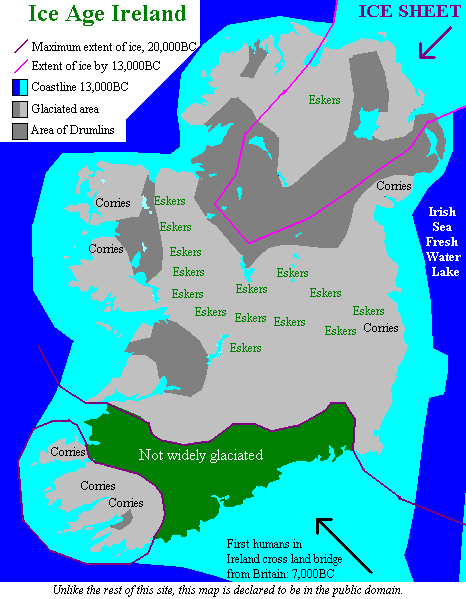 What little is known of pre-Christian
Ireland comes from a few references in Roman
writings, Irish poetry
and myth, and archaeology. The earliest inhabitants of Ireland, people of a mid-Stone Age
, or Mesolithic
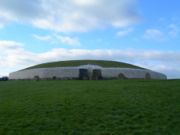
, culture, arrived sometime after 10,000 BC, when the climate had become more hospitable following the retreat of the polar icecaps. About 4000 BC agriculture was introduced from the South West continent, leading to the establishment of a high Neolithic
culture, characterized by the appearance of pottery, polished stone tools, rectangular wooden houses and communal megalithic tombs, some of which are huge stone monuments like the Passage Tombs of Newgrange
, Knowth
and Dowth
, many of them astronomically aligned (most notably, Newgrange
). Four main types of megalithic tomb
have been identified: Portal Tombs
, Court Tombs
, Passage Tombs and Wedge Tombs
. In Leinster
and Munster
individual adult males were buried in small stone structures, called cists, under earthen mounds and were accompanied by distinctive decorated pottery. This culture apparently prospered, and the island became more densely populated. Towards the end of the Neolithic new types of monuments developed, such as circular embanked enclosures and timber, stone and post and pit circles.
The Bronze Age
properly began once copper
was alloy
ed with tin
to produce true bronze artifacts; this took place around 2000 BC, when some Ballybeg
flat axes and associated metalwork was produced. The period preceding this, in which Lough Ravel and most Ballybeg axes were produced, is known as the Copper Age
or Chalcolithic, and commenced about 2500 BC. This period also saw the production of elaborate gold and bronze ornaments, weapons and tools. There was a movement away from the construction of communal megalithic tombs to the burial of the dead in small stone cists or simple pits, which could be situated in cemeteries or in circular earth or stone built burial mounds known respectively as barrows and cairn
s. As the period progressed inhumation burial gave way to cremation and by the Middle Bronze Age cremations were often placed beneath large burial urns.
 The Iron Age in Ireland began about 600 BC. The period between the start of the Iron Age and the historic period (AD 431) saw the gradual infiltration of small groups of Celtic speaking people into Ireland, with items of the continental Celtic La Tene style being found in at least the northern part of the island by about 300 BC. ISBN 0717128296 The result of a gradual blending of Celtic and indigenous cultures would result in the emergence of Gaelic culture by the fifth century. It is also during the fifth century that the main over-kingdoms of In Tuisceart, Airgialla, Ulaid, Mide, Laigin, Mumhain, Cóiced Ol nEchmacht began to emerge (see Kingdoms of ancient Ireland). Within these kingdoms a rich culture flourished. The society of these kingdoms was dominated by an upper class consisting of aristocratic warriors and learned people, which possibly included Druids.
Linguists realised from the 17th century onwards that the language spoken by these people, the Goidelic languages
, was a branch of the Celtic languages
. This is usually explained as a result of invasions by Celt
s from the continent. However, other research has postulated that the culture developed gradually and continuously, and that the introduction of Celtic language and elements of Celtic culture may have been a result of cultural exchange with Celtic groups in South West continental Europe from the neolithic to the Bronze Age.
The hypothesis that the native Late Bronze Age inhabitants gradually absorbed Celtic influences has since been supported by some recent genetic research.
The Romans referred to Ireland as Hibernia
. Ptolemy
in AD 100 records Ireland's geography and tribes. Ireland was never formally a part of the Roman Empire
but Roman influence was often projected well beyond formal borders. Tacitus
writes that an exiled Irish prince was with Agricola
in Britain and would return to seize power in Ireland. Juvenal tells us that Roman "arms had been taken beyond the shores of Ireland". In recent years, some experts have hypothesized that Roman-sponsored Gaelic forces (or perhaps even Roman regulars) mounted some kind of invasion around 100, but the exact relationship between Rome and the dynasties and peoples of Hibernia remains unclear.
Irish confederations (the Scoti
) attacked and some settled in Britain
during the Great Conspiracy
of 367. In particular, the Dál Riata
settled in western Scotland and the Western Isles.
 The middle centuries of the first millennium AD marked great changes in Ireland.
Niall Noigiallach (died c.450/455) laid the basis for the Uí Néill
dynasty's hegemony over much of western, northern and central Ireland. Politically, the former emphasis on tribal affiliation had been replaced by the 700s by that of patrilineal and dynastic background. Many formerly powerful kingdoms and peoples disappeared. Irish pirates struck all over the coast of western Britain in the same way that the Vikings would later attack Ireland. Some of these founded entirely new kingdoms in Pictland and, to a lesser degree, in parts of Wales. The Attacotti
of south Leinster
may even have served in the Roman military in the mid-to-late 300s.
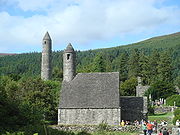
Perhaps it was some of the latter returning home as rich mercenaries, merchants, or slaves stolen from Britain or Gaul, that first brought the Christian faith to Ireland. Some early sources claim that there were missionaries active in southern Ireland long before St. Patrick. Whatever the route, and there were probably many, this new faith was to have the most profound effect on the Irish.
Tradition maintains that in AD 432, St. Patrick
arrived on the island and, in the years that followed, worked to convert the Irish to Christianity
. On the other hand, according to Prosper of Aquitaine
, a contemporary chronicler, Palladius
was sent to Ireland by the Pope in 431 as "first Bishop to the Irish believing in Christ", which demonstrates that there were already Christians living in Ireland. Palladius seems to have worked purely as Bishop to Irish Christians in the Leinster and Meath kingdoms, while Patrick — who may have arrived as late as 461 — worked first and foremost as a missionary to the Pagan Irish, converting in the more remote kingdoms located in Ulster and Connacht.
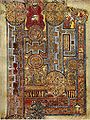 Patrick is traditionally credited with preserving the tribal and social patterns of the Irish, codifying their laws and changing only those that conflicted with Christian practices. He is also credited with introducing the Roman alphabet, which enabled Irish monks to preserve parts of the extensive Celt
ic oral literature. The historicity of these claims remains the subject of debate and there is no direct evidence linking Patrick with any of these accomplishments. The myth of Patrick, as scholars refer to it, was developed in the centuries after his death.
The Druid tradition collapsed, first in the face of the spread of the new faith, and ultimately in the aftermath of famine and plagues due to the extreme weather events of 535-536. Irish scholars excelled in the study of Latin
learning and Christian theology in the monasteries that flourished shortly thereafter. Missionaries from Ireland
to England
and Continental Europe
spread news of the flowering of learning, and scholars from other nations came to Irish monasteries. The excellence and isolation of these monasteries helped preserve Latin learning during the Early Middle Ages
. The period of Insular art
, mainly in the fields of illuminated manuscript
s, metalworking, and sculpture flourished and produced such treasures as the Book of Kells
, the Ardagh Chalice
, and the many carved stone crosses
that dot the island. Insular style was to be a crucial ingredient in the formation of the Romanesque
and Gothic
styles throughout Western Europe. Sites dating to this period include clochan
s, ringfort
s and promontory fort
s.
Francis John Byrne
describes the effect of the epedemics which occurred mid-way through this era:
The plagues of the 660's and the 680's had a traumatic effect on Irish society. The golden age of the saints was over, togher with the generation of kings who could fire a saga
-writer's imagination. The literary tradition looks back to the reign of the sons of Aed Slaine
(Diarmait and Blathmac, who died in 665
) as to the end of an era. Antiquaries, brehons, genealogiests and hagiographers, felt the need to collect ancient traditions before they were totally forgotten. Many were in fact swallowed by oblivion; when we examine the writing of Tirechan
we encounter obscure references to tribes which are quite unknown to the later genealogical tradition. The laws describe a tribal society that was obsolescent, and the meaning and use of the word moccu dies out with archaie Old Irish at the beginning of the new century. ("Tribes and Tribalism in Early Ireland", Eiru 22, 1971, p. 153)
The first English
involvement in Ireland took place in this period. In 684 AD an English expeditionary force sent by Northumbrian King Ecgfrith
invaded Ireland in the summer of that year. The English forces managed to seize a number of captives and booty, but they apparently did not stay in Ireland for long. The next English involvement in Ireland would take place a little less than half a millennium later in 1169 AD when the Normans
invaded the country.

 The first recorded Viking
raid in Irish history occurred in 795 when Vikings from Norway
looted the island. Early Viking raids were generally small in scale and quick. These early raids interrupted the golden age of Christian Irish culture starting the beginning of two hundred years of intermittent warfare, with waves of Viking raiders plundering monasteries and towns throughout Ireland. Most of the early raiders came from the fjords of western Norway.
The Vikings were expert sailors, who travelled in longship
s, and by the early 840s, had begun to establish settlements along the Irish coasts and to spend the winter months there. Vikings founded settlements in several places; most famously in Dublin. Written accounts from this time (early to mid 840s) show that the Vikings were moving further inland to attack (often using rivers) and then retreating to their coastal headquarters.
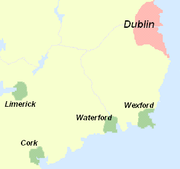
In 852, the Vikings landed in Dublin Bay
and established a fortress. After several generations a group of mixed Irish and Norse ethnic background arose (the so-called Gall-Gaels, Gall then being the Irish word for "foreigners").
However, the Vikings never achieved total domination of Ireland, often fighting for and against various Irish kings. The Battle of Clontarf
in 1014 marked the beginning of the decline of Viking power in Ireland. However the towns that the Vikings had founded continued to flourish and trade became an important part of the Irish economy.
 By the 12th century, Ireland was divided politically into a shifting hierarchy of petty kingdom
s and over-kingdoms. Power was exercised by the heads of a few regional dynasties vying against each other for supremacy over the whole island. One of these men, King Diarmait Mac Murchada of Leinster
was forcibly exiled by the new High King, Ruaidri mac Tairrdelbach Ua Conchobair of the Western kingdom of Connacht. Fleeing to Aquitaine
, Diarmait obtained permission from Henry II
to recruit Norman
knights to regain his kingdom. The first Norman knight landed in Ireland in 1167, followed by the main forces of Normans, Welsh
and Flemings
. Several counties were restored to the control of Diarmait, who named his son-in-law, the Norman Richard de Clare
, known as Strongbow, heir to his kingdom. This caused consternation to King Henry II of England, who feared the establishment of a rival Norman state in Ireland. Accordingly, he resolved to establish his authority.
With the authority of the papal bull Laudabiliter
from Adrian IV, Henry landed with a large fleet at Waterford
in 1171, becoming the first King of England to set foot on Irish soil. Henry awarded his Irish territories to his younger son John with the title Dominus Hiberniae ("Lord of Ireland"). When John unexpectedly succeeded his brother as King John
, the "Lordship of Ireland
" fell directly under the English Crown.
up to eastern Ulster
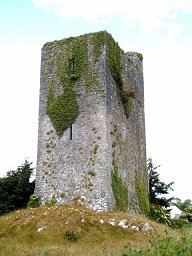
and penetrated far west in the country. The counties were ruled by many smaller kings. The first Lord of Ireland was King John, who visited Ireland in 1185 and 1210 and helped consolidate the Norman controlled areas, while at the same time ensuring that the many Irish kings swore fealty to him.
Throughout the thirteenth century the policy of the English Kings was to weaken the power of the Norman Lords in Ireland. For example King John encouraged Hugh de Lacy to destabilise and then overthrow the Lord of Ulster, before creating him to the Earl of Ulster.
The Hiberno-Norman
community suffered from a series of invasions that ceased the spread of their settlement and power. Politics and events in Gaelic Ireland served to draw the settlers deeper into the orbit of the Irish.
 By 1261 the weakening of the Normans
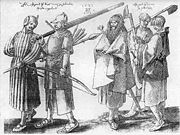
had become manifest when Fineen MacCarthy defeated a Norman army at the Battle of Callann
. The war continued between the different lords and earls for about 100 years and the wars caused a great deal of destruction, especially around Dublin. In this chaotic situation, local Irish lords won back large amounts of land that their families had lost since the conquest and held them after the war was over.
The Black Death
arrived in Ireland in 1348. Because most of the English and Norman inhabitants of Ireland lived in towns and villages, the plague hit them far harder than it did the native Irish, who lived in more dispersed rural settlements. After it had passed, Gaelic Irish language and customs came to dominate the country again. The English-controlled territory shrunk back to a fortified area around Dublin (the Pale
), and had little real authority outside (beyond the Pale).
By the end of the 15th century, central English authority in Ireland had all but disappeared. England's attentions were diverted by the Wars of the Roses
. The Lordship of Ireland
lay in the hands of the powerful Fitzgerald Earl of Kildare, who dominated the country by means of military force and alliances with lords and clans around Ireland. Around the country, local Gaelic and Gaelicised lords expanded their powers at the expense of the English government in Dublin but the power of the Dublin government was seriously curtailed by the introduction of Poynings' Law in 1494. According to this act the Irish parliament was essentially put under the control of the Westminster parliament.
decided to conquer Ireland and bring it under crown control. The Fitzgerald dynasty of Kildare, who had become the effective rulers of Ireland in the 15th century, had become very unreliable allies of the Tudor monarchs. They had invited Burgundian
troops into Dublin to crown the Yorkist pretender, Lambert Simnel
as King of England in 1487. Again in 1536, Silken Thomas Fitzgerald went into open rebellion against the crown. Having put down this rebellion, Henry VIII
resolved to bring Ireland under English government control so the island would not become a base for future rebellions or foreign invasions of England. In 1541, Henry upgraded Ireland from a lordship to a full Kingdom
. Henry was proclaimed King of Ireland at a meeting of the Irish Parliament that year. This was the first meeting of the Irish Parliament to be attended by the Gaelic Irish
chieftains as well as the Hiberno-Norman
aristocracy. With the institutions of government in place, the next step was to extend the control of the English Kingdom of Ireland over all of its claimed territory. This took nearly a century, with various English administrations in the process either negotiating or fighting with the independent Irish and Old English lords. The Spanish Armada in Ireland
suffered heavy losses during an extraordinary season of storms in the autumn of 1588. Among the survivors was Captain Francisco de Cuellar
, who gave a remarkable account of his experiences on the run in Ireland.
The re-conquest was completed during the reigns of Elizabeth
and James I
, after several extremely brutal conflicts. (See the Desmond Rebellions
(1569–1573 and 1579–1583 and the Nine Years War 1594–1603, for details). After this point, the English authorities in Dublin established real control over Ireland for the first time, bringing a centralised government to the entire island, and successfully disarmed the native lordships. However, the English were not successful in converting the Catholic Irish to the Protestant religion and the brutal methods used by crown authority (including resorting to martial law
) to bring the country under English control heightened resentment of English rule.
From the mid-16th and into the early 17th century, crown governments carried out a policy of land confiscation and colonisation
known as Plantations
. Scottish and English Protestants were sent as colonists to the provinces of Munster
, Ulster
and the counties of Laois and Offaly (see also Plantations of Ireland
). These Protestant settlers replaced the Irish Catholic landowners who were removed from their lands. These settlers would form the ruling class of future British appointed administrations in Ireland. A series of Penal Laws were introduced to encourage conversion to the established (Anglican) Church of Ireland
. The principal victims of these laws were Catholics, Baptists and Presbyterians.
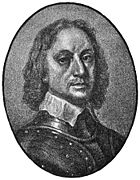 The 17th century was perhaps the bloodiest in Ireland's history. Two periods of war (1641–53 and 1689–91) caused huge loss of life. The ultimate dispossession of most of the Irish Catholic landowning class was engineered, recusants were subordinated under the Penal Laws
.
In the mid-17th century, Ireland was convulsed by eleven years of warfare
, beginning with the Rebellion of 1641
, when Irish Catholics rebelled against the domination of English and Protestant settlers. The Catholic gentry briefly ruled the country as Confederate Ireland
(1642–1649) against the background of the Wars of the Three Kingdoms
until Oliver Cromwell
reconquered
Ireland in 1649–1653 on behalf of the English Commonwealth. Cromwell's conquest was the most brutal phase of the war. By its close, up to a third of Ireland's pre-war population was dead or in exile. As retribution for the rebellion of 1641, the better quality remaining lands owned by Irish Catholics were confiscated and given to British settlers commenced. Several hundred remaining native landowners were transplanted to Connacht
.
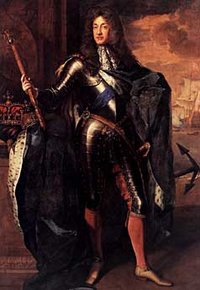 Ireland became the main battleground after the Glorious Revolution
of 1688, when the Catholic James II
left London and the English Parliament
replaced him with William of Orange
. The wealthier Irish Catholics backed James to try to reverse the Penal Laws
and land confiscations, whereas Protestants supported William and Mary in this 'Glorious Revolution' to preserve their property in the country. James and William fought for the Kingdom of Ireland
in the Williamite War
, most famously at the Battle of the Boyne
in 1690, where James' outnumbered forces were defeated.
resistance in Ireland was finally ended after the Battle of Aughrim
in July 1691. The Penal Laws
that had been relaxed somewhat after the Restoration
were reinforced more thoroughly after this war, as the infant Anglo-Irish
Ascendency novo élite wanted to ensure that the Irish Roman Catholics would not be in a position to repeat their rebellions.
Subsequent Irish antagonism towards England was aggravated by the economic situation of Ireland in the 18th century. Some absentee landlord
s managed some of their estates inefficiently, and food tended to be produced for export rather than for domestic consumption. Two very cold winters towards the end of the Little Ice Age
led directly to a famine between 1740 and 1741, which killed about 400,000 people and caused over 150,000 of the Irish to emigrate. In addition, Irish exports were reduced by the Navigation Acts
from the 1660s, which placed tariffs on Irish products entering England, but exempted English goods from tariffs on entering Ireland. Despite this most of the 18th century was relatively peaceful in comparison with the preceding two hundred years, and the population doubled to over four million.
By the late 18th century, many of the Anglo-Irish
ruling class
had come to see Ireland as their native country. A Parliamentary faction led by Henry Grattan
agitated for a more favourable trading relationship with Great Britain
and for greater legislative independence for the Parliament of Ireland
. However, reform in Ireland stalled over the more radical proposals toward enfranchising Irish Catholics
. This was partially enabled in 1793, but Catholics could not yet enter parliament or become government officials. Some were attracted to the more militant example of the French Revolution
of 1789.
Presbyterians and Dissenters too faced persecution on a lesser scale, and in 1791 a group of dissident Protestant individuals, where all but two were Presbyterians, held the first meeting of what would become the Society of the United Irishmen
. Originally they sought to reform the Irish Parliament which was controlled by those belonging to the state church; seek Catholic Emancipation; and help remove religion from politics. When their ideals seemed unattainable they became more determined to use force to overthrow British rule and found a non-sectarian republic. Their activity culminated in the Irish Rebellion of 1798
, which was bloodily suppressed. Largely in response to this rebellion, Irish self-government was abolished altogether by the Act of Union
in 1801.
 In 1800, following the Irish Rebellion of 1798
, the British and the Irish parliaments enacted the Acts of Union. The merger created a new political entity called United Kingdom of Great Britain and Ireland
with effect from January 1, 1801. Part of the agreement forming the basis of union was that the Test Act
would be repealed to remove any remaining discrimination against Roman Catholics, Presbyterians
, Baptists and other dissenter religions in the newly United Kingdom. However, King George III
invoking the provisions of the Act of Settlement 1701
controversially and adamantly blocked attempts by Prime Minister William Pitt the Younger
. Pitt resigned in protest, but his successor Henry Addington and his new cabinet failed to legislate any repeal or change to the Test Act
.
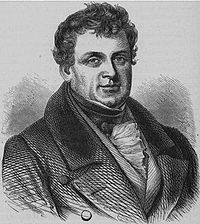
In 1823, an enterprising Catholic lawyer, Daniel O'Connell
, known in Ireland as 'The Liberator' began an ultimately successful Irish campaign to achieve emancipation, and be seated in the parliament. This culminated in O'Connell's successful election in the Clare by-election, which revived the parliamentary efforts at reform. The Catholic Relief Act 1829
was eventually approved by the U.K. parliament under the leadership of Prime Minister, the Dublin born Arthur Wellesley, 1st Duke of Wellington
. This indefatigable Anglo-Irish statesman, a former Chief Secretary for Ireland, and hero of the Napoleonic Wars successfully guided the legislation through both houses of parliament. He then persuaded the King, George IV, to concede in signing the bill into law in 1829 under threat of resignation. The continuing obligation of Roman Catholics to fund the established Church of Ireland
, however, led to the sporadic skirmishes of the Tithe War
of 1831–38. The church was disestablished by the Gladstone government in 1867. The continuing enactment of parliamentary reform during the ensuing administrations further extended the initially limited franchise. Daniel O'Connell M.P. later led the Repeal Association
in an unsuccessful campaign to undo the Act of Union 1800
.
The second of Ireland's "Great Famines", An Gorta Mór struck the country severely in the period 1845–1849, with potato blight, exacerbated by the political and laissez-faire
economic factors of the time leading to mass starvation and emigration. (See Great Irish Famine.) The impact of emigration in Ireland was severe; the population dropped from over 8 million before the Famine to 4.4 million in 1911. Gaelic
or Irish, once the spoken language of the entire island, declined in use sharply in the nineteenth century as a result of the Famine and the creation of the National School education system, as well as hostility to the language from leading Irish politicians of the time; it was largely replaced by English
.
Outside mainstream nationalism, a series of violent rebellions by Irish republicans took place in 1803, under Robert Emmet
; in 1848 a rebellion
by the Young Irelanders, most prominent among them, Thomas Francis Meagher
; and in 1867, another insurrection
by the Irish Republican Brotherhood
. All failed, but physical force nationalism remained an undercurrent in the nineteenth century.
The late 19th century also witnessed major land reform, spearheaded by the Land League
under Michael Davitt
demanding what became known as the 3 Fs; Fair rent, free sale, fixity of tenure. From 1870 and as a result of the Land War
agitations and subsequent Plan of Campaign
of the 1880s, various U.K. governments introduced a series of Irish Land Acts
. - William O'Brien
played a leading role in the 1902 Land Conference
to pave the way for the most advanced social legislation in Ireland since the Union, the Wyndham Land Purchase Act of 1903. This Act set the conditions for the breakup of large estates and gradually devolved to rural landholders and tenants ownership of the lands. It effectively ended the era of the absentee landlord
, finally resolving the Irish Land Question
In the 1870s the issue of Irish self-government again became a major focus of debate under Charles Stewart Parnell
, founder of the Irish Parliamentary Party
. Prime minister William Ewart Gladstone
made two unsuccessful attempts to pass Home Rule
in 1886 and 1893. Parnell's leadership ended when he was implicated in a controversial divorce scandal. It was revealed that he had been living in family relationship with Katherine O'Shea, the long separated wife of a fellow Irish MP, with whom he was the father of three children.
After the introduction of the Local Government (Ireland) Act 1898
which broke the power of the landlord dominated
"Grand Juries", passing for the first time democratic control of local affairs into the hands of the people through elected Local County Councils, the debate over full Home Rule led to tensions between Irish nationalists and Irish unionists (those who favoured maintenance of the union). Most of the island was predominantly nationalist, Catholic
and agrarian. The northeast, however, was predominantly unionist, Protestant and industrialised. Unionists feared a loss of political power and economic wealth in a predominantly rural, nationalist, Catholic home-rule state. Nationalists believed that they would remain economically and politically second class citizens without self-government. Out of this division, two opposing sectarian movements evolved, the Protestant Orange Order and the Catholic Ancient Order of Hibernians
.
held the balance of power in the Commons
and the third Home Rule Bill was introduced in 1912. Unionist resistance was immediate with the formation of the Ulster Volunteers. In turn the Irish Volunteers
were established to oppose them and enforce the introduction of self-government.
In September 1914, just as the First World War
broke out, the UK Parliament finally passed the Third Home Rule Act
to establish self-government for Ireland, but was suspended for the duration of the war. In order to ensure the implementation of Home Rule after the war, nationalist leaders and the IPP under Redmond supported with Ireland's participation
the British and Allied
war effort under the Triple Entente
against the expansion of Central Powers
. The core of the Irish Volunteers were against this decision, but the majority left to form the National Volunteers
who enlisted in Irish regiments of the New British Army
, the 10th and 16th (Irish) Divisions, their Northern counterparts in the 36th (Ulster) Division. Before the war ended, Britain made two concerted efforts to implement Home Rule, one in May 1916 and again with the Irish Convention
during 1917–1918, but the Irish sides (Nationalist, Unionist) were unable to agree terms for the temporary or permanent exclusion of Ulster from its provisions.
The period from 1916–1921 was marked by political violence and upheaval, ending in the partition of Ireland
and independence for 26 of its 32 counties. A failed militant attempt was made to gain separate independence for Ireland with the 1916 Easter Rising
, an insurrection in Dublin. Though support for the insurgents was small, the violence used in its suppression led to a swing in support of the rebels. In addition, the unprecedented threat of Irishmen being conscripted to the British Army
in 1918 (for service on the Western Front
as a result of the German Spring Offensive
) accelerated this change. (See: Conscription Crisis of 1918). In the December 1918 elections
Sinn Féin
, the party of the rebels, won a majority of three-quarters of all seats in Ireland, twenty-seven MP
s of which assembled in Dublin on 21 January 1919, to form a thirty-two county Irish Republic
parliament, the first Dáil Éireann
unilaterally declaring
sovereignty over the entire island.
Unwilling to negotiate any understanding with Britain short of complete independence, the Irish Republican Army
— the army of the newly declared Irish Republic — waged a guerilla war (the Irish War of Independence
) from 1919 to 1921. In the course of the fighting and amid much acrimony, the Fourth Government of Ireland Act 1920
implemented Home Rule while separating the island into what the British government
's Act termed "Northern Ireland
" and "Southern Ireland
". In July 1921, the Irish and British governments agreed a truce that halted the war. In December 1921, representatives of both governments signed an Anglo-Irish Treaty
. The Irish delegation was led by Arthur Griffith
and Michael Collins
. This abolished the Irish Republic
and created the Irish Free State
, a self-governing Dominion
of the Commonwealth of Nations
in the manner of Canada
and Australia
. Under the Treaty, Northern Ireland
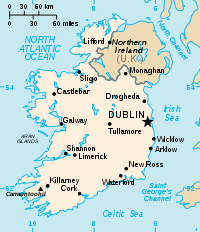
could opt out of the Free State and stay within the United Kingdom: it promptly did so. In 1922, both parliaments ratified the Treaty, formalising independence for the twenty-six county Irish Free State (which went on to re-name itself Ireland in 1937 and declare itself a republic
in 1949); while the six county Northern Ireland, gaining Home Rule for itself, remained part of the United Kingdom
. For most of the next 75 years, each territory was strongly aligned to either Catholic
or Protestant ideologies, although this was more marked in the six counties of Northern Ireland.
; Irish Free State
, Republic of Ireland
; Names of the Irish state
 The treaty to sever the Union divided the republican movement into anti-Treaty (who wanted to fight on until an Irish Republic was achieved) and pro-Treaty supporters (who accepted the Free State as a first step towards full independence and unity). Between 1922 and 1923 both sides fought the bloody Irish Civil War
. The new Irish Free State government defeated the anti-Treaty remnant of the Irish Republican Army
, imposing multiple executions
. This division among nationalists still colours Irish politics today, specifically between the two leading Irish political parties, Fianna Fáil
and Fine Gael
.
The new Irish Free State (1922–37) existed against the backdrop of the growth of dictatorships in mainland Europe and a major world economic downturn
in 1929. In contrast with many contemporary European states it remained a democracy. Testament to this came when the losing faction in the Irish civil war, Éamon de Valera
's Fianna Fáil, was able to take power peacefully by winning the 1932 general election
. Nevertheless, up until the mid 1930s, considerable parts of Irish society saw the Free State through the prism of the civil war, as a repressive, British imposed state. It was only the peaceful change of government in 1932 that signalled the final acceptance of the Free State on their part. In contrast to many other states in the period, the Free State remained financially solvent as a result of low government expenditure, despite the Economic War
with Britain. However, unemployment and emigration were high. The population declined to a low of 2.7 million recorded in the 1961 census.
The Roman Catholic Church
had a powerful influence over the Irish state for much of its history. The clergy's influence meant that the Irish state had very conservative social policies, forbidding, for example, divorce
, contraception
, abortion
, pornography
as well as encouraging the censoring and banning
of many books and films. In addition the Church largely controlled the State's hospitals, schools and remained the largest provider of many other social services.
With the partition of Ireland in 1922, 92.6% of the Free State's population were Catholic while 7.4% were Protestant. By the 1960s, the Protestant population had fallen by half. Although emigration was high among all the population, due to a lack of economic opportunity, the rate of Protestant emigration was disproportionate in this period. Many Protestants left the country in the early 1920s, either because they felt unwelcome in a predominantly Catholic and nationalist state, because they were afraid due to the burning of Protestant homes (particularly of the old landed class) by republicans during the civil war, because they regarded themselves as British and did not wish to live in an independent Irish state, or because of the economic disruption caused by the recent violence. The Catholic Church had also issued a decree, known as Ne Temere
, whereby the children of marriages between Catholics and Protestants had to be brought up as Catholics. From 1945, the emigration rate of Protestants fell and they became less likely to emigrate than Catholics - indicating their integration into the life of the Irish State.
In 1937, a new Constitution of Ireland
re-established the state as Ireland (or Éire
in Irish). The state remained neutral throughout World War II
(see Irish neutrality
) and this saved it from much of the horrors of the war, although tens of thousands volunteered to serve in the British forces. Ireland was also hit badly by rationing of food, and coal in particular (peat production
became a priority during this time). Though nominally neutral, recent studies have suggested a far greater level of involvement by the South with the Allies than was realised, with D Day's date set on the basis of secret weather information on Atlantic storms supplied by Ireland. For more detail on 1939–45, see main article The Emergency.
In 1949 the state was formally declared a republic and it left the British Commonwealth
.
In the 1960s, Ireland underwent a major economic change under reforming Taoiseach
(prime minister) Seán Lemass
and Secretary of the Department of Finance T.K. Whitaker, who produced a series of economic plans. Free second-level education was introduced by Donogh O'Malley as Minister for Education in 1968. From the early 1960s, Ireland sought admission to the European Economic Community
but, because 90% of exports were to the United Kingdom
market, it did not do so until the UK did, in 1973.
Global economic problems in the 1970s, augmented by a set of misjudged economic policies followed by governments, including that of Taoiseach Jack Lynch
, caused the Irish economy to stagnate. The Troubles
in Northern Ireland
discouraged foreign investment. Devaluation was enabled when the Irish Pound, or Punt, was established in as a truly separate currency in 1979, breaking the link with the UK's sterling
. However, economic reforms in the late 1980s, helped by investment from the European Community, led to the emergence of one of the world's highest economic growth rates, with mass immigration (particularly of people from Asia and Eastern Europe) as a feature of the late 1990s. This period came to be known as the Celtic Tiger
and was focused on as a model for economic development in the former Eastern Bloc states, which entered the European Union
in the early 2000s. Property values had risen by a factor of between four and ten between 1993 and 2006, in part fuelling the boom.
Irish society also adopted relatively liberal social policies during this period. Divorce
was legalised, homosexuality
decriminalised, while abortion in limited cases was allowed by the Irish Supreme Court in the X Case legal judgement. Major scandals in the Roman Catholic Church, both sexual and financial, coincided with a widespread decline in religious practice, with weekly attendance at Roman Catholic Mass
halving in twenty years. A series of tribunals set up from the 1990s have investigated alleged malpractices by politicians, the Catholic clergy, judges, hospitals and the Gardaí (police).
government, based at Stormont in east Belfast. Unionist leader and first Prime Minister, James Craig
, declared that it would be "a Protestant State for a Protestant People". Craig's main goal was to form and preserve Protestant authority in the new state which was above all an effort to secure a unionist majority. In 1926, the majority of the population in the province were Presbyterian and Anglican therefore solidifying Craig's Protestant political power. The Ulster Unionist Party thereafter formed every government until 1972. Discrimination against the minority nationalist community in jobs and housing, and their total exclusion from political power due to the majoritarian electoral system, led to the emergence of the Northern Ireland Civil Rights Association
in the late 1960s, inspired by Martin Luther King's civil rights movement in the United States of America. The military forces of the Northern Protestants and Northern Catholics (IRA) turned to brutal acts of violence to establish power. As time went on it became clear that these two rival states would bring about a civil war. After the Second World War, keeping the cohesion within Stormont seemed impossible; increased economic pressures, solidified Catholic unity, and British involvement ultimately led to Stormont's collapse. As the civil rights movement in the United States gained worldwide acknowledgement, Catholics rallied together to achieve a similar socio-political recognition. This resulted in the formation of various organisations such as the Northern Ireland Civil Rights Association (NICRA) in 1967 and the Campaign for Social Justice (CSJ)in 1964. Non-violent protest became an increasingly important factor in mobilizing Catholic sympathies and opinion and thus more effective in generating support than actively violent groups such as the IRA. However, these non-violent protests posed a problem to Northern Ireland's prime minister Terrance O'Neil (1963) because it hampered his efforts in persuading Catholics in Northern Ireland that they too, like their Protestant counterparts, belong within the United Kingdom. Despite O'Neil's reforming efforts there was growing discontent amongst both Catholics and Unionists. In October 1968, a peaceful civil rights march held in Derry turned violent as police brutally beat protesters. The outbreak was televised by international media, and as a result the march was highly publicised which further confirmed the socio-political turmoil in Ireland. A violent counter-reaction from conservative unionists led to civil disorder, notably the Battle of the Bogside
and the Northern Ireland riots of August 1969. To restore order, British troops were deployed to the streets of Northern Ireland at this time.
The violent outbreaks in the late 60's encouraged and helped strengthen military groups such as the IRA. The IRA believed themselves to be the protectors of the working class Catholics who were vulnerable to police and civilian brutality. During the late sixties and early seventies recruitment into the IRA organization dramatically increased as street and civilian violence worsened. The interjection from the British troops proved to be insufficient to quell the violence and thus solidified the IRA's growing military importance. On January 30, 1972 the worst tensions came to a head with the events of Bloody Sunday
. Paratroops opened fire on anti-internment protesters in Derry which killed 13 unarmed civilians. Bloody Friday
, Bloody Sunday, and other violent acts in the early 1970s came to be known as the Troubles
. The Stormont parliament was prorogued in 1972 and abolished in 1973. Paramilitary
private armies such as the Provisional Irish Republican Army
, resulted from a split within the IRA, the Official IRA
and Irish National Liberation Army
fought against the Ulster Defence Regiment
and the Ulster Volunteer Force. Moreover, the British army
and the (largely Protestant) Royal Ulster Constabulary
(RUC) also took part in the chaos that resulted in the deaths of well over three thousand men, women and children, civilians and military. Most of the violence took place in Northern Ireland, but some also spread to England
and across the Irish border.
in the British Cabinet
responsible for the departments of the Northern Ireland government. Direct Rule was designed to be a temporary solution until Northern Ireland was capable of governing itself once again. Principal acts were passed by the Parliament of the United Kingdom
in the same way as for much of the rest of the UK, but many smaller measures were dealt with by Order in Council with minimal parliamentary scrutiny. Attempts were made to establish a power-sharing executive, representing both the nationalist and unionist communities, by the
Northern Ireland Constitution Act
of 1973 and the Sunningdale Agreement
in December 1973. Both acts however did little for creating cohesion between Northern Ireland and the Republic of Ireland. The Constitution Act of 1973 formalized the UK government's affirmation of reunification of Ireland by consent only; therefore ultimately delegating the authoritative power of the border question from Stormont to the people of Northern Ireland (and the Republic of Ireland). Conversely, the Sunningdale Agreement included a "provision of a Council of Ireland which held the right to execute executive and harmonizing functions". Most significantly, the Sunningdale Agreement brought together political leaders from Northern Ireland, the Republic of Ireland and the UK to deliberate for the first time since 1925. The Northern Ireland Constitutional Convention and Jim Prior's 1982 assembly were also temporarily implemented however all failed to either reach consensus or operate in the longer term.
During the 1970s British policy concentrated on defeating the Provisional Irish Republican Army
(IRA) by military means including the policy of Ulsterisation
(requiring the RUC and British Army reserve Ulster Defence Regiment
to be at the forefront of combating the IRA). Although IRA violence decreased it was obvious that no military victory was on hand in either the short or medium terms. Even Catholics that generally rejected the IRA were unwilling to offer support to a state that seemed to remain mired in sectarian discrimination, and the Unionists plainly were not interested in Catholic participation in running the state in any case. In the 1980s the IRA attempted to secure a decisive military victory based on massive arms shipments from Libya
. When this failed senior republican figures began to look to broaden the struggle from purely military means. In time this began a move towards military cessation
. In 1986 the British and Irish governments signed the Anglo Irish Agreement signalling a formal partnership in seeking a political solution. The Anglo-Irish Agreement (AIA) recognized the Irish government's right to be consulted and heard as well as guaranteed equality of treatment and recognition of the Irish and British identities of the two communities. The agreement also stated that the two governments must implement a cross-border cooperation. Socially and economically Northern Ireland suffered the worst levels of unemployment in the UK and although high levels of public spending ensured a slow modernisation of public services and moves towards equality, progress was slow in the 1970s and 1980s, only in the 1990s when progress towards peace became tangible, did the economic situation brighten. By then, too, the demographics of Northern Ireland had undergone significant change, and more than 40% of the population was Catholic.
("Good Friday Agreement") of 10 April 1998 brought - on 2 December 1999 - a degree of power sharing to Northern Ireland, giving both unionists and nationalists
control of limited areas of government. However, both the power-sharing Executive and the elected Assembly were suspended between January and May 2000, and from October 2002 until April 2007, following breakdowns in trust between the political parties involving outstanding issues, including "decommissioning" of paramilitary weapons, policing reform
and the removal of British army
bases. In new elections in 2003, the moderate Ulster Unionist
and (nationalist) Social Democrat and Labour parties lost their dominant positions to the more hard-line Democratic Unionist
and (nationalist) Sinn Féin
parties. On 28 July 2005, the Provisional IRA announced the end of its armed campaign and on 25 September 2005 international weapons inspectors supervised the full disarmament of the PIRA. Eventually, devolution was restored in April 2007.
The Catholic Church, which once exercised an enormous amount of power, found its influence on socio-political issues in Ireland much reduced. Irish bishops were no longer able to advise and influence the public on how to exercise their political rights. Modern Ireland's detachment of the Church from ordinary life can be explained by the increasing disinterest in Church doctrine by younger generations and the questionable morality of the Church's representatives. A highly publicised case was that of Eamonn Casey, the Bishop of Galway, who resigned abruptly in 1992 after it was revealed that he had had an affair with an American woman and had fathered a child. Further controversies and scandals arose concerning paedophile and child-abusing priests. As a result, many in the Irish public began to question the credibility and effectiveness of the Catholic Church.

 The national flag of Ireland
is a tricolour of green, white and orange. This flag, which bears the colours green for Roman Catholics, orange for Protestants, and white for the desired peace between them, dates back to the middle of the 19th century.
The tricolour was first unfurled in public by Young Ireland
er Thomas Francis Meagher
who, using the symbolism of the flag, explained his vision as follows: "The white in the centre signifies a lasting truce between the "Orange" and the "Green," and I trust that beneath its folds the hands of the Irish Protestant and the Irish Catholic may be clasped in generous and heroic brotherhood". Fellow nationalist John Mitchel
said of it: "I hope to see that flag one day waving as our national banner."
After its use in the 1916 Rising it became widely accepted by nationalists as the national flag, as was used officially by the Irish Republic
(1919–21) and the Irish Free State
(1922–37).
In 1937 when the Constitution of Ireland
was introduced, the tricolour was formally confirmed as the national flag: "The national flag is the tricolour of green, white and orange." While the tricolour today is the official flag of Ireland, it is not an official flag in Northern Ireland although it is sometimes used unofficially.
The only official flag representing Northern Ireland
is the Union Flag
of the United Kingdom of Great Britain and Northern Ireland. The Ulster Banner
is sometimes used unofficially as a de facto regional flag for Northern Ireland.
Since Partition, there has been no universally-accepted flag to represent the entire island. As a provisional solution for certain sports fixtures, the Flag of the Four Provinces
enjoys a certain amount of general acceptance and popularity.
Historically a number of flags have been used, including:
St Patrick's Saltire was formerly used to represent the island of Ireland by the all-island Irish Rugby Football Union
(IRFU), before adoption of the four-provinces flag. The Gaelic Athletic Association
(GAA) uses the tricolour to represent the whole island.
Ireland
Ireland is an island to the northwest of continental Europe. It is the third-largest island in Europe and the twentieth-largest island on Earth...
began around 8000 BC, when hunter-gatherer
Hunter-gatherer
A hunter-gatherer or forage society is one in which most or all food is obtained from wild plants and animals, in contrast to agricultural societies which rely mainly on domesticated species. Hunting and gathering was the ancestral subsistence mode of Homo, and all modern humans were...
s arrived from continental Europe
Europe
Europe is, by convention, one of the world's seven continents. Comprising the westernmost peninsula of Eurasia, Europe is generally 'divided' from Asia to its east by the watershed divides of the Ural and Caucasus Mountains, the Ural River, the Caspian and Black Seas, and the waterways connecting...
, probably via a land bridge
Land bridge
A land bridge, in biogeography, is an isthmus or wider land connection between otherwise separate areas, over which animals and plants are able to cross and colonise new lands...
. Few archaeological traces remain of this group, but their descendants and later Neolithic
Neolithic
The Neolithic Age, Era, or Period, or New Stone Age, was a period in the development of human technology, beginning about 9500 BC in some parts of the Middle East, and later in other parts of the world. It is traditionally considered as the last part of the Stone Age...
arrivals, particularly from the Iberian Peninsula
Iberian Peninsula
The Iberian Peninsula , sometimes called Iberia, is located in the extreme southwest of Europe and includes the modern-day sovereign states of Spain, Portugal and Andorra, as well as the British Overseas Territory of Gibraltar...
, were responsible for major Neolithic
Neolithic
The Neolithic Age, Era, or Period, or New Stone Age, was a period in the development of human technology, beginning about 9500 BC in some parts of the Middle East, and later in other parts of the world. It is traditionally considered as the last part of the Stone Age...
sites such as Newgrange
Newgrange
Newgrange is a prehistoric monument located in County Meath, on the eastern side of Ireland, about one kilometre north of the River Boyne. It was built around 3200 BC , during the Neolithic period...
. On the arrival of Saint Patrick
Saint Patrick
Saint Patrick was a Romano-Briton and Christian missionary, who is the most generally recognized patron saint of Ireland or the Apostle of Ireland, although Brigid of Kildare and Colmcille are also formally patron saints....
and other Christian
Christian
A Christian is a person who adheres to Christianity, an Abrahamic, monotheistic religion based on the life and teachings of Jesus of Nazareth as recorded in the Canonical gospels and the letters of the New Testament...
missionaries in the early to mid-5th century AD
Anno Domini
and Before Christ are designations used to label or number years used with the Julian and Gregorian calendars....
, Christianity
Christianity
Christianity is a monotheistic religion based on the life and teachings of Jesus as presented in canonical gospels and other New Testament writings...
began to subsume the indigenous Celtic religion
Celtic polytheism
Celtic polytheism, commonly known as Celtic paganism, refers to the religious beliefs and practices adhered to by the Iron Age peoples of Western Europe now known as the Celts, roughly between 500 BCE and 500 CE, spanning the La Tène period and the Roman era, and in the case of the Insular Celts...
, a process that was completed by the year 600.
From around AD 800, more than a century of Viking invasions brought havoc upon the monastic culture and on the island's various regional dynasties, yet both of these institutions proved strong enough to survive and assimilate the invaders. The coming of Cambro-Norman
Cambro-Norman
Cambro-Norman is a term used for Norman knights who settled in southern Wales after the Norman conquest of England in 1066. Some historians suggest that the term is to be preferred to Anglo-Norman for the Normans who invaded Ireland after 1170 — many of whom originated in Wales. However, the term...
mercenaries under Richard de Clare, 2nd Earl of Pembroke
Richard de Clare, 2nd Earl of Pembroke
Richard de Clare, 2nd Earl of Pembroke , Lord of Leinster, Justiciar of Ireland . Like his father, he was also commonly known as Strongbow...
, nicknamed Strongbow, in 1169 marked the beginning of more than 700 years of direct English
Kingdom of England
The Kingdom of England was, from 927 to 1707, a sovereign state to the northwest of continental Europe. At its height, the Kingdom of England spanned the southern two-thirds of the island of Great Britain and several smaller outlying islands; what today comprises the legal jurisdiction of England...
, and, later, British
United Kingdom
The United Kingdom of Great Britain and Northern IrelandIn the United Kingdom and Dependencies, other languages have been officially recognised as legitimate autochthonous languages under the European Charter for Regional or Minority Languages...
involvement in Ireland. In 1177, prince John Lackland was made Lord of Ireland by his father Henry II of England
Henry II of England
Henry II ruled as King of England , Count of Anjou, Count of Maine, Duke of Normandy, Duke of Aquitaine, Duke of Gascony, Count of Nantes, Lord of Ireland and, at various times, controlled parts of Wales, Scotland and western France. Henry, the great-grandson of William the Conqueror, was the...
at the Council of Oxford. The Crown did not begin an attempt to assert full control of the island until after Henry VIII's
repudiation of papal authority over the Church in England and subsequent English Reformation
English Reformation
The English Reformation was the series of events in 16th-century England by which the Church of England broke away from the authority of the Pope and the Roman Catholic Church....
, which failed in Ireland. Questions over the loyalty of Irish vassals provided the initial impetus for a series of Irish military campaigns between 1534 and 1691. This period was also marked by a Crown policy of plantation
Plantations of Ireland
Plantations in 16th and 17th century Ireland were the confiscation of land by the English crown and the colonisation of this land with settlers from England and the Scottish Lowlands....
which led to the arrival of thousands of English
English people
The English are a nation and ethnic group native to England, who speak English. The English identity is of early mediaeval origin, when they were known in Old English as the Anglecynn. England is now a country of the United Kingdom, and the majority of English people in England are British Citizens...
and Scottish
Scottish people
The Scottish people , or Scots, are a nation and ethnic group native to Scotland. Historically they emerged from an amalgamation of the Picts and Gaels, incorporating neighbouring Britons to the south as well as invading Germanic peoples such as the Anglo-Saxons and the Norse.In modern use,...
Protestant
Protestantism
Protestantism is one of the three major groupings within Christianity. It is a movement that began in Germany in the early 16th century as a reaction against medieval Roman Catholic doctrines and practices, especially in regards to salvation, justification, and ecclesiology.The doctrines of the...
settlers, and the consequent displacement of the pre-plantation Catholic landholders. As the military and political defeat of Gaelic Ireland
Gaelic Ireland
Gaelic Ireland is the name given to the period when a Gaelic political order existed in Ireland. The order continued to exist after the arrival of the Anglo-Normans until about 1607 AD...
became more pronounced in the early seventeenth century, the role of religion as a new divisive element in Ireland became more pronounced. From this period on, sectarian conflict became a recurrent theme in Irish history.
The overthrow, in 1613, of the Catholic majority in the Irish parliament was realised principally through the creation of numerous new boroughs, all of which were dominated by the new settlers. By the end of the seventeenth century, recusant Roman Catholics, as adherents to the old religion were now termed, representing some 85% of Ireland's population, were then banned from the Irish parliament. Political power rested entirely in the hands of an Anglican
Church of Ireland
The Church of Ireland is an autonomous province of the Anglican Communion. The church operates in all parts of Ireland and is the second largest religious body on the island after the Roman Catholic Church...
minority, while Catholics and members of dissenting
Nonconformism
Nonconformity is the refusal to "conform" to, or follow, the governance and usages of the Church of England by the Protestant Christians of England and Wales.- Origins and use:...
Protestant denominations suffered severe political and economic privations at the hands of the Penal Laws
Penal Laws (Ireland)
The term Penal Laws in Ireland were a series of laws imposed under English and later British rule that sought to discriminate against Roman Catholics and Protestant dissenters in favour of members of the established Church of Ireland....
. The Irish Parliament
Irish House of Commons
The Irish House of Commons was the lower house of the Parliament of Ireland, that existed from 1297 until 1800. The upper house was the House of Lords...
was abolished in 1801 in the wake of the republican
Irish Republicanism
Irish republicanism is an ideology based on the belief that all of Ireland should be an independent republic.In 1801, under the Act of Union, the Kingdom of Great Britain and the Kingdom of Ireland merged to form the United Kingdom of Great Britain and Ireland...
United Irishmen Rebellion
Irish Rebellion of 1798
The Irish Rebellion of 1798 , also known as the United Irishmen Rebellion , was an uprising in 1798, lasting several months, against British rule in Ireland...
and Ireland became an integral part of a new United Kingdom of Great Britain and Ireland
United Kingdom of Great Britain and Ireland
The United Kingdom of Great Britain and Ireland was the formal name of the United Kingdom during the period when what is now the Republic of Ireland formed a part of it....
under the Act of Union
Act of Union 1800
The Acts of Union 1800 describe two complementary Acts, namely:* the Union with Ireland Act 1800 , an Act of the Parliament of Great Britain, and...
. Although promised a repeal of the Test Act
Test Act
The Test Acts were a series of English penal laws that served as a religious test for public office and imposed various civil disabilities on Roman Catholics and Nonconformists...
, Catholics were not granted full rights until Catholic Emancipation
Catholic Emancipation
Catholic emancipation or Catholic relief was a process in Great Britain and Ireland in the late 18th century and early 19th century which involved reducing and removing many of the restrictions on Roman Catholics which had been introduced by the Act of Uniformity, the Test Acts and the penal laws...
was attained in throughout the new UK in 1829. This was followed by the first Reform Bill in 1832, a principal condition of which was the removal of the poorer British and Irish freeholders from the franchise
Suffrage
Suffrage, political franchise, or simply the franchise, distinct from mere voting rights, is the civil right to vote gained through the democratic process...
.
The Irish Parliamentary Party
Irish Parliamentary Party
The Irish Parliamentary Party was formed in 1882 by Charles Stewart Parnell, the leader of the Nationalist Party, replacing the Home Rule League, as official parliamentary party for Irish nationalist Members of Parliament elected to the House of Commons at...
strove from the 1880s to attain Home Rule self-government through the parliamentary constitutional movement eventually winning the Home Rule Act 1914
Home Rule Act 1914
The Government of Ireland Act 1914 , also known as the Third Home Rule Bill, was an Act passed by the Parliament of the United Kingdom intended to provide self-government for Ireland within the United Kingdom of Great Britain and Ireland.The Act was the first law ever passed by the Parliament of...
, though it was suspended on the outbreak of World War I
World War I
World War I , which was predominantly called the World War or the Great War from its occurrence until 1939, and the First World War or World War I thereafter, was a major war centred in Europe that began on 28 July 1914 and lasted until 11 November 1918...
. The Easter Rising
Easter Rising
The Easter Rising was an insurrection staged in Ireland during Easter Week, 1916. The Rising was mounted by Irish republicans with the aims of ending British rule in Ireland and establishing the Irish Republic at a time when the British Empire was heavily engaged in the First World War...
staged by Irish republicans two years later brought physical force republicanism back to the forefront of Irish politics.
In 1922, after the Irish War of Independence
Irish War of Independence
The Irish War of Independence , Anglo-Irish War, Black and Tan War, or Tan War was a guerrilla war mounted by the Irish Republican Army against the British government and its forces in Ireland. It began in January 1919, following the Irish Republic's declaration of independence. Both sides agreed...
and the Anglo-Irish Treaty
Anglo-Irish Treaty
The Anglo-Irish Treaty , officially called the Articles of Agreement for a Treaty Between Great Britain and Ireland, was a treaty between the Government of the United Kingdom of Great Britain and Ireland and representatives of the secessionist Irish Republic that concluded the Irish War of...
, the larger part of Ireland seceded from the United Kingdom to become the independent Irish Free State
Irish Free State
The Irish Free State was the state established as a Dominion on 6 December 1922 under the Anglo-Irish Treaty, signed by the British government and Irish representatives exactly twelve months beforehand...
; and after the 1937 constitution, Ireland
Names of the Irish state
There have been various names of the Irish state, some of which have been controversial. The constitutional name of the contemporary state is Ireland, the same as the island of Ireland, of which it comprises the major portion...
. The six north eastern counties, known as Northern Ireland
Northern Ireland
Northern Ireland is one of the four countries of the United Kingdom. Situated in the north-east of the island of Ireland, it shares a border with the Republic of Ireland to the south and west...
, remained within the United Kingdom
United Kingdom
The United Kingdom of Great Britain and Northern IrelandIn the United Kingdom and Dependencies, other languages have been officially recognised as legitimate autochthonous languages under the European Charter for Regional or Minority Languages...
. The Irish Civil War
Irish Civil War
The Irish Civil War was a conflict that accompanied the establishment of the Irish Free State as an entity independent from the United Kingdom within the British Empire....
followed soon after the War of Independence. The history of Northern Ireland
History of Northern Ireland
Northern Ireland is today one of the four countries of the United Kingdom, situated in the north-east of the island of Ireland, having been created as a separate legal entity on 3 May 1921, under the Government of Ireland Act 1920...
has since been dominated by sporadic sectarian conflict between (mainly Catholic) Nationalist
Irish nationalism
Irish nationalism manifests itself in political and social movements and in sentiment inspired by a love for Irish culture, language and history, and as a sense of pride in Ireland and in the Irish people...
s and (mainly Protestant) Unionists. This conflict erupted into the Troubles
The Troubles
The Troubles was a period of ethno-political conflict in Northern Ireland which spilled over at various times into England, the Republic of Ireland, and mainland Europe. The duration of the Troubles is conventionally dated from the late 1960s and considered by many to have ended with the Belfast...
in the late 1960s, until an uneasy peace
Belfast Agreement
The Good Friday Agreement or Belfast Agreement , sometimes called the Stormont Agreement, was a major political development in the Northern Ireland peace process...
thirty years later.
Prehistory (8000BC–400AD)
Christianity
Christianity is a monotheistic religion based on the life and teachings of Jesus as presented in canonical gospels and other New Testament writings...
Ireland comes from a few references in Roman
Ancient Rome
Ancient Rome was a thriving civilization that grew on the Italian Peninsula as early as the 8th century BC. Located along the Mediterranean Sea and centered on the city of Rome, it expanded to one of the largest empires in the ancient world....
writings, Irish poetry
Irish poetry
The history of Irish poetry includes the poetries of two languages, one in Irish and the other in English. The complex interplay between these two traditions, and between both of them and other poetries in English, has produced a body of work that is both rich in variety and difficult to...
and myth, and archaeology. The earliest inhabitants of Ireland, people of a mid-Stone Age
Stone Age
The Stone Age is a broad prehistoric period, lasting about 2.5 million years , during which humans and their predecessor species in the genus Homo, as well as the earlier partly contemporary genera Australopithecus and Paranthropus, widely used exclusively stone as their hard material in the...
, or Mesolithic
Mesolithic
The Mesolithic is an archaeological concept used to refer to certain groups of archaeological cultures defined as falling between the Paleolithic and the Neolithic....
, culture, arrived sometime after 10,000 BC, when the climate had become more hospitable following the retreat of the polar icecaps. About 4000 BC agriculture was introduced from the South West continent, leading to the establishment of a high Neolithic
Neolithic
The Neolithic Age, Era, or Period, or New Stone Age, was a period in the development of human technology, beginning about 9500 BC in some parts of the Middle East, and later in other parts of the world. It is traditionally considered as the last part of the Stone Age...
culture, characterized by the appearance of pottery, polished stone tools, rectangular wooden houses and communal megalithic tombs, some of which are huge stone monuments like the Passage Tombs of Newgrange
Newgrange
Newgrange is a prehistoric monument located in County Meath, on the eastern side of Ireland, about one kilometre north of the River Boyne. It was built around 3200 BC , during the Neolithic period...
, Knowth
Knowth
Knowth is a Neolithic passage grave and an ancient monument of Brú na Bóinne in the valley of the River Boyne in Ireland.Knowth is the largest of all passage graves situated within the Brú na Bóinne complex. The site consists of one large mound and 17 smaller satellite tombs...
and Dowth
Dowth
Dowth is a Neolithic passage tomb which stands in the Boyne Valley, County Meath, Ireland. It is found at .Dating from about 2,5002000 BCE, is the second oldest behind Newgrange of the three principal tombs of the Brú na Bóinne World Heritage Site a complex of passage-tombs...
, many of them astronomically aligned (most notably, Newgrange
Newgrange
Newgrange is a prehistoric monument located in County Meath, on the eastern side of Ireland, about one kilometre north of the River Boyne. It was built around 3200 BC , during the Neolithic period...
). Four main types of megalithic tomb
Irish Megalithic Tombs
Ireland has a wealth of impressive historical monuments. In Ireland there are four types of megalithic tombs: court cairns, passage tombs, wedge tombs and portal dolmens.-Court tombs:...
have been identified: Portal Tombs
Dolmen
A dolmen—also known as a portal tomb, portal grave, dolmain , cromlech , anta , Hünengrab/Hünenbett , Adamra , Ispun , Hunebed , dös , goindol or quoit—is a type of single-chamber megalithic tomb, usually consisting of...
, Court Tombs
Court cairn
The court cairn or court tomb is a megalithic type of chamber tomb and gallery grave, specifically a variant of the chambered cairn, found in western and northern Ireland, and in mostly southwest Scotland...
, Passage Tombs and Wedge Tombs
Wedge-shaped gallery grave
A wedge-shaped gallery grave or wedge tomb is a type of Irish chamber tomb. They are so named because the burial chamber itself narrows at one end , producing a wedge shape in elevation. An antechamber is separated from the burial area by a simple jamb or sill, and the doorway generally faces west...
. In Leinster
Leinster
Leinster is one of the Provinces of Ireland situated in the east of Ireland. It comprises the ancient Kingdoms of Mide, Osraige and Leinster. Following the Norman invasion of Ireland, the historic fifths of Leinster and Mide gradually merged, mainly due to the impact of the Pale, which straddled...
and Munster
Munster
Munster is one of the Provinces of Ireland situated in the south of Ireland. In Ancient Ireland, it was one of the fifths ruled by a "king of over-kings" . Following the Norman invasion of Ireland, the ancient kingdoms were shired into a number of counties for administrative and judicial purposes...
individual adult males were buried in small stone structures, called cists, under earthen mounds and were accompanied by distinctive decorated pottery. This culture apparently prospered, and the island became more densely populated. Towards the end of the Neolithic new types of monuments developed, such as circular embanked enclosures and timber, stone and post and pit circles.
The Bronze Age
Bronze Age
The Bronze Age is a period characterized by the use of copper and its alloy bronze as the chief hard materials in the manufacture of some implements and weapons. Chronologically, it stands between the Stone Age and Iron Age...
properly began once copper
Copper
Copper is a chemical element with the symbol Cu and atomic number 29. It is a ductile metal with very high thermal and electrical conductivity. Pure copper is soft and malleable; an exposed surface has a reddish-orange tarnish...
was alloy
Alloy
An alloy is a mixture or metallic solid solution composed of two or more elements. Complete solid solution alloys give single solid phase microstructure, while partial solutions give two or more phases that may or may not be homogeneous in distribution, depending on thermal history...
ed with tin
Tin
Tin is a chemical element with the symbol Sn and atomic number 50. It is a main group metal in group 14 of the periodic table. Tin shows chemical similarity to both neighboring group 14 elements, germanium and lead and has two possible oxidation states, +2 and the slightly more stable +4...
to produce true bronze artifacts; this took place around 2000 BC, when some Ballybeg
Ballybeg
Ballybeg is a generic name given to small Irish towns. The name comes from the Gaelic words Baile Beag which literally means Little Town...
flat axes and associated metalwork was produced. The period preceding this, in which Lough Ravel and most Ballybeg axes were produced, is known as the Copper Age
Copper Age
The Chalcolithic |stone]]") period or Copper Age, also known as the Eneolithic/Æneolithic , is a phase of the Bronze Age in which the addition of tin to copper to form bronze during smelting remained yet unknown by the metallurgists of the times...
or Chalcolithic, and commenced about 2500 BC. This period also saw the production of elaborate gold and bronze ornaments, weapons and tools. There was a movement away from the construction of communal megalithic tombs to the burial of the dead in small stone cists or simple pits, which could be situated in cemeteries or in circular earth or stone built burial mounds known respectively as barrows and cairn
Cairn
Cairn is a term used mainly in the English-speaking world for a man-made pile of stones. It comes from the or . Cairns are found all over the world in uplands, on moorland, on mountaintops, near waterways and on sea cliffs, and also in barren desert and tundra areas...
s. As the period progressed inhumation burial gave way to cremation and by the Middle Bronze Age cremations were often placed beneath large burial urns.
Linguists realised from the 17th century onwards that the language spoken by these people, the Goidelic languages
Goidelic languages
The Goidelic languages or Gaelic languages are one of the two branches of the Insular Celtic languages, the other consisting of the Brythonic languages. Goidelic languages historically formed a dialect continuum stretching from the south of Ireland through the Isle of Man to the north of Scotland...
, was a branch of the Celtic languages
Celtic languages
The Celtic languages are descended from Proto-Celtic, or "Common Celtic"; a branch of the greater Indo-European language family...
. This is usually explained as a result of invasions by Celt
Celt
The Celts were a diverse group of tribal societies in Iron Age and Roman-era Europe who spoke Celtic languages.The earliest archaeological culture commonly accepted as Celtic, or rather Proto-Celtic, was the central European Hallstatt culture , named for the rich grave finds in Hallstatt, Austria....
s from the continent. However, other research has postulated that the culture developed gradually and continuously, and that the introduction of Celtic language and elements of Celtic culture may have been a result of cultural exchange with Celtic groups in South West continental Europe from the neolithic to the Bronze Age.
The hypothesis that the native Late Bronze Age inhabitants gradually absorbed Celtic influences has since been supported by some recent genetic research.
The Romans referred to Ireland as Hibernia
Hibernia
Hibernia is the Classical Latin name for the island of Ireland. The name Hibernia was taken from Greek geographical accounts. During his exploration of northwest Europe , Pytheas of Massilia called the island Ierne . In his book Geographia Hibernia is the Classical Latin name for the island of...
. Ptolemy
Ptolemy
Claudius Ptolemy , was a Roman citizen of Egypt who wrote in Greek. He was a mathematician, astronomer, geographer, astrologer, and poet of a single epigram in the Greek Anthology. He lived in Egypt under Roman rule, and is believed to have been born in the town of Ptolemais Hermiou in the...
in AD 100 records Ireland's geography and tribes. Ireland was never formally a part of the Roman Empire
Roman Empire
The Roman Empire was the post-Republican period of the ancient Roman civilization, characterised by an autocratic form of government and large territorial holdings in Europe and around the Mediterranean....
but Roman influence was often projected well beyond formal borders. Tacitus
Tacitus
Publius Cornelius Tacitus was a senator and a historian of the Roman Empire. The surviving portions of his two major works—the Annals and the Histories—examine the reigns of the Roman Emperors Tiberius, Claudius, Nero and those who reigned in the Year of the Four Emperors...
writes that an exiled Irish prince was with Agricola
Gnaeus Julius Agricola
Gnaeus Julius Agricola was a Roman general responsible for much of the Roman conquest of Britain. His biography, the De vita et moribus Iulii Agricolae, was the first published work of his son-in-law, the historian Tacitus, and is the source for most of what is known about him.Born to a noted...
in Britain and would return to seize power in Ireland. Juvenal tells us that Roman "arms had been taken beyond the shores of Ireland". In recent years, some experts have hypothesized that Roman-sponsored Gaelic forces (or perhaps even Roman regulars) mounted some kind of invasion around 100, but the exact relationship between Rome and the dynasties and peoples of Hibernia remains unclear.
Irish confederations (the Scoti
Scoti
Scoti or Scotti was the generic name used by the Romans to describe those who sailed from Ireland to conduct raids on Roman Britain. It was thus synonymous with the modern term Gaels...
) attacked and some settled in Britain
Great Britain
Great Britain or Britain is an island situated to the northwest of Continental Europe. It is the ninth largest island in the world, and the largest European island, as well as the largest of the British Isles...
during the Great Conspiracy
Great Conspiracy
The Great Conspiracy is a term given to a year-long war that occurred in Roman Britain near the end of the Roman occupation of the island. The historian Ammianus Marcellinus described it as a barbarica conspiratio that capitalized on a depleted military force in the province brought about by...
of 367. In particular, the Dál Riata
Dál Riata
Dál Riata was a Gaelic overkingdom on the western coast of Scotland with some territory on the northeast coast of Ireland...
settled in western Scotland and the Western Isles.
- See also Irish Dark Age (c. 100 B.C. to c. 300 A.D)
Early Christian Ireland (400–800)
Niall Noigiallach (died c.450/455) laid the basis for the Uí Néill
Uí Néill
The Uí Néill are Irish and Scottish dynasties who claim descent from Niall Noigiallach , an historical King of Tara who died about 405....
dynasty's hegemony over much of western, northern and central Ireland. Politically, the former emphasis on tribal affiliation had been replaced by the 700s by that of patrilineal and dynastic background. Many formerly powerful kingdoms and peoples disappeared. Irish pirates struck all over the coast of western Britain in the same way that the Vikings would later attack Ireland. Some of these founded entirely new kingdoms in Pictland and, to a lesser degree, in parts of Wales. The Attacotti
Attacotti
Attacotti refers to a people who despoiled Roman Britain between 364 and 368, along with Scotti, Picts, Saxons, Roman military deserters, and the indigenous Britons themselves. The marauders were defeated by Count Theodosius in 368...
of south Leinster
Leinster
Leinster is one of the Provinces of Ireland situated in the east of Ireland. It comprises the ancient Kingdoms of Mide, Osraige and Leinster. Following the Norman invasion of Ireland, the historic fifths of Leinster and Mide gradually merged, mainly due to the impact of the Pale, which straddled...
may even have served in the Roman military in the mid-to-late 300s.
Perhaps it was some of the latter returning home as rich mercenaries, merchants, or slaves stolen from Britain or Gaul, that first brought the Christian faith to Ireland. Some early sources claim that there were missionaries active in southern Ireland long before St. Patrick. Whatever the route, and there were probably many, this new faith was to have the most profound effect on the Irish.
Tradition maintains that in AD 432, St. Patrick
Saint Patrick
Saint Patrick was a Romano-Briton and Christian missionary, who is the most generally recognized patron saint of Ireland or the Apostle of Ireland, although Brigid of Kildare and Colmcille are also formally patron saints....
arrived on the island and, in the years that followed, worked to convert the Irish to Christianity
Christianity
Christianity is a monotheistic religion based on the life and teachings of Jesus as presented in canonical gospels and other New Testament writings...
. On the other hand, according to Prosper of Aquitaine
Prosper of Aquitaine
Saint Prosper of Aquitaine , a Christian writer and disciple of Saint Augustine of Hippo, was the first continuator of Jerome's Universal Chronicle.- Life :...
, a contemporary chronicler, Palladius
Palladius
Palladius was the first Bishop of the Christians of Ireland, preceding Saint Patrick. The Roman Catholic Church and the Anglican Communion consider Palladius a saint.-Armorica:...
was sent to Ireland by the Pope in 431 as "first Bishop to the Irish believing in Christ", which demonstrates that there were already Christians living in Ireland. Palladius seems to have worked purely as Bishop to Irish Christians in the Leinster and Meath kingdoms, while Patrick — who may have arrived as late as 461 — worked first and foremost as a missionary to the Pagan Irish, converting in the more remote kingdoms located in Ulster and Connacht.
Celt
The Celts were a diverse group of tribal societies in Iron Age and Roman-era Europe who spoke Celtic languages.The earliest archaeological culture commonly accepted as Celtic, or rather Proto-Celtic, was the central European Hallstatt culture , named for the rich grave finds in Hallstatt, Austria....
ic oral literature. The historicity of these claims remains the subject of debate and there is no direct evidence linking Patrick with any of these accomplishments. The myth of Patrick, as scholars refer to it, was developed in the centuries after his death.
The Druid tradition collapsed, first in the face of the spread of the new faith, and ultimately in the aftermath of famine and plagues due to the extreme weather events of 535-536. Irish scholars excelled in the study of Latin
Latin
Latin is an Italic language originally spoken in Latium and Ancient Rome. It, along with most European languages, is a descendant of the ancient Proto-Indo-European language. Although it is considered a dead language, a number of scholars and members of the Christian clergy speak it fluently, and...
learning and Christian theology in the monasteries that flourished shortly thereafter. Missionaries from Ireland
Hiberno-Scottish mission
The Hiberno-Scottish mission was a mission led by Irish and Scottish monks which spread Christianity and established monasteries in Great Britain and continental Europe during the Middle Ages...
to England
England
England is a country that is part of the United Kingdom. It shares land borders with Scotland to the north and Wales to the west; the Irish Sea is to the north west, the Celtic Sea to the south west, with the North Sea to the east and the English Channel to the south separating it from continental...
and Continental Europe
Continental Europe
Continental Europe, also referred to as mainland Europe or simply the Continent, is the continent of Europe, explicitly excluding European islands....
spread news of the flowering of learning, and scholars from other nations came to Irish monasteries. The excellence and isolation of these monasteries helped preserve Latin learning during the Early Middle Ages
Early Middle Ages
The Early Middle Ages was the period of European history lasting from the 5th century to approximately 1000. The Early Middle Ages followed the decline of the Western Roman Empire and preceded the High Middle Ages...
. The period of Insular art
Insular art
Insular art, also known as Hiberno-Saxon art, is the style of art produced in the post-Roman history of Ireland and Great Britain. The term derives from insula, the Latin term for "island"; in this period Britain and Ireland shared a largely common style different from that of the rest of Europe...
, mainly in the fields of illuminated manuscript
Illuminated manuscript
An illuminated manuscript is a manuscript in which the text is supplemented by the addition of decoration, such as decorated initials, borders and miniature illustrations...
s, metalworking, and sculpture flourished and produced such treasures as the Book of Kells
Book of Kells
The Book of Kells is an illuminated manuscript Gospel book in Latin, containing the four Gospels of the New Testament together with various prefatory texts and tables. It was created by Celtic monks ca. 800 or slightly earlier...
, the Ardagh Chalice
Ardagh Chalice
The Ardagh Hoard, best known for the Ardagh Chalice, is a hoard of metalwork from the 8th and 9th centuries, found in 1868 and now in the National Museum of Ireland in Dublin...
, and the many carved stone crosses
High cross
A high cross or standing cross is a free-standing Christian cross made of stone and often richly decorated. There was a unique Early Medieval tradition in Ireland and Britain of raising large sculpted stone crosses, usually outdoors...
that dot the island. Insular style was to be a crucial ingredient in the formation of the Romanesque
Romanesque art
Romanesque art refers to the art of Western Europe from approximately 1000 AD to the rise of the Gothic style in the 13th century, or later, depending on region. The preceding period is increasingly known as the Pre-Romanesque...
and Gothic
Gothic art
Gothic art was a Medieval art movement that developed in France out of Romanesque art in the mid-12th century, led by the concurrent development of Gothic architecture. It spread to all of Western Europe, but took over art more completely north of the Alps, never quite effacing more classical...
styles throughout Western Europe. Sites dating to this period include clochan
Clochan
A Clochán is a dry-stone hut with a corbelled roof, dating from the early Middle Ages or earlier. Most archaeologists think these structures were built on the southwestern coast of Ireland since the Bronze Age. They are most commonly round beehive huts, but rectangular plans are known as well....
s, ringfort
Ringfort
Ringforts are circular fortified settlements that were mostly built during the Iron Age , although some were built as late as the Early Middle Ages . They are found in Northern Europe, especially in Ireland...
s and promontory fort
Promontory fort
A promontory fort is a defensive structure located above a steep cliff, often only connected to the mainland by a small neck of land, thus utilizing the topography to reduce the ramparts needed. Although their dating is problematic, most seem to date to the Iron Age...
s.
Francis John Byrne
Francis John Byrne
Francis John Byrne is an Irish historian.Born in Shanghai where his father, a Dundalk man, captained a ship on the Yellow River, Byrne was evacuated with his mother to Australia on the outbreak of World War II...
describes the effect of the epedemics which occurred mid-way through this era:
The plagues of the 660's and the 680's had a traumatic effect on Irish society. The golden age of the saints was over, togher with the generation of kings who could fire a saga
Saga
Sagas, are stories in Old Norse about ancient Scandinavian and Germanic history, etc.Saga may also refer to:Business*Saga DAB radio, a British radio station*Saga Airlines, a Turkish airline*Saga Falabella, a department store chain in Peru...
-writer's imagination. The literary tradition looks back to the reign of the sons of Aed Slaine
Áed Sláine
Áed mac Diarmato , called Áed Sláine , was the son of Diarmait mac Cerbaill. Legendary stories exist of Áed's birth. Saint Columba is said to have prophesied his death...
(Diarmait and Blathmac, who died in 665
665
Year 665 was a common year starting on Wednesday of the Julian calendar. The denomination 665 for this year has been used since the early medieval period, when the Anno Domini calendar era became the prevalent method in Europe for naming years.- Europe :* Swithelm is succeeded by Sighere and...
) as to the end of an era. Antiquaries, brehons, genealogiests and hagiographers, felt the need to collect ancient traditions before they were totally forgotten. Many were in fact swallowed by oblivion; when we examine the writing of Tirechan
Tírechán
Tírechán was a 7th century Irish bishop and biographer of Saint Patrick. Tírechán wrote his untitled memoir sometime after the death of his mentor, Ultan of Ardbraccan, in 657. The work survives in the manuscript The Book of Armagh.Tírechán's account, which J. B...
we encounter obscure references to tribes which are quite unknown to the later genealogical tradition. The laws describe a tribal society that was obsolescent, and the meaning and use of the word moccu dies out with archaie Old Irish at the beginning of the new century. ("Tribes and Tribalism in Early Ireland", Eiru 22, 1971, p. 153)
The first English
England
England is a country that is part of the United Kingdom. It shares land borders with Scotland to the north and Wales to the west; the Irish Sea is to the north west, the Celtic Sea to the south west, with the North Sea to the east and the English Channel to the south separating it from continental...
involvement in Ireland took place in this period. In 684 AD an English expeditionary force sent by Northumbrian King Ecgfrith
Ecgfrith of Northumbria
King Ecgfrith was the King of Northumbria from 670 until his death. He ruled over Northumbria when it was at the height of its power, but his reign ended with a disastrous defeat in which he lost his life.-Early life:...
invaded Ireland in the summer of that year. The English forces managed to seize a number of captives and booty, but they apparently did not stay in Ireland for long. The next English involvement in Ireland would take place a little less than half a millennium later in 1169 AD when the Normans
Normans
The Normans were the people who gave their name to Normandy, a region in northern France. They were descended from Norse Viking conquerors of the territory and the native population of Frankish and Gallo-Roman stock...
invaded the country.
Early medieval and Viking era (800–1166)
Viking
The term Viking is customarily used to refer to the Norse explorers, warriors, merchants, and pirates who raided, traded, explored and settled in wide areas of Europe, Asia and the North Atlantic islands from the late 8th to the mid-11th century.These Norsemen used their famed longships to...
raid in Irish history occurred in 795 when Vikings from Norway
Norway
Norway , officially the Kingdom of Norway, is a Nordic unitary constitutional monarchy whose territory comprises the western portion of the Scandinavian Peninsula, Jan Mayen, and the Arctic archipelago of Svalbard and Bouvet Island. Norway has a total area of and a population of about 4.9 million...
looted the island. Early Viking raids were generally small in scale and quick. These early raids interrupted the golden age of Christian Irish culture starting the beginning of two hundred years of intermittent warfare, with waves of Viking raiders plundering monasteries and towns throughout Ireland. Most of the early raiders came from the fjords of western Norway.
The Vikings were expert sailors, who travelled in longship
Longship
Longships were sea vessels made and used by the Vikings from the Nordic countries for trade, commerce, exploration, and warfare during the Viking Age. The longship’s design evolved over many years, beginning in the Stone Age with the invention of the umiak and continuing up to the 9th century with...
s, and by the early 840s, had begun to establish settlements along the Irish coasts and to spend the winter months there. Vikings founded settlements in several places; most famously in Dublin. Written accounts from this time (early to mid 840s) show that the Vikings were moving further inland to attack (often using rivers) and then retreating to their coastal headquarters.
In 852, the Vikings landed in Dublin Bay
Dublin Bay
Dublin Bay is a C-shaped inlet of the Irish Sea on the east coast of Ireland. The bay is about 10 kilometres wide along its north-south base, and 7 km in length to its apex at the centre of the city of Dublin; stretching from Howth Head in the north to Dalkey Point in the south...
and established a fortress. After several generations a group of mixed Irish and Norse ethnic background arose (the so-called Gall-Gaels, Gall then being the Irish word for "foreigners").
However, the Vikings never achieved total domination of Ireland, often fighting for and against various Irish kings. The Battle of Clontarf
Battle of Clontarf
The Battle of Clontarf took place on 23 April 1014 between the forces of Brian Boru and the forces led by the King of Leinster, Máel Mórda mac Murchada: composed mainly of his own men, Viking mercenaries from Dublin and the Orkney Islands led by his cousin Sigtrygg, as well as the one rebellious...
in 1014 marked the beginning of the decline of Viking power in Ireland. However the towns that the Vikings had founded continued to flourish and trade became an important part of the Irish economy.
Arrival of the Normans
Petty kingdom
A petty kingdom is one of a number of small kingdoms, described as minor or "petty" by contrast to an empire or unified kingdom that either preceded or succeeded it...
s and over-kingdoms. Power was exercised by the heads of a few regional dynasties vying against each other for supremacy over the whole island. One of these men, King Diarmait Mac Murchada of Leinster
Leinster
Leinster is one of the Provinces of Ireland situated in the east of Ireland. It comprises the ancient Kingdoms of Mide, Osraige and Leinster. Following the Norman invasion of Ireland, the historic fifths of Leinster and Mide gradually merged, mainly due to the impact of the Pale, which straddled...
was forcibly exiled by the new High King, Ruaidri mac Tairrdelbach Ua Conchobair of the Western kingdom of Connacht. Fleeing to Aquitaine
Aquitaine
Aquitaine , archaic Guyenne/Guienne , is one of the 27 regions of France, in the south-western part of metropolitan France, along the Atlantic Ocean and the Pyrenees mountain range on the border with Spain. It comprises the 5 departments of Dordogne, :Lot et Garonne, :Pyrénées-Atlantiques, Landes...
, Diarmait obtained permission from Henry II
Henry II of England
Henry II ruled as King of England , Count of Anjou, Count of Maine, Duke of Normandy, Duke of Aquitaine, Duke of Gascony, Count of Nantes, Lord of Ireland and, at various times, controlled parts of Wales, Scotland and western France. Henry, the great-grandson of William the Conqueror, was the...
to recruit Norman
Normans
The Normans were the people who gave their name to Normandy, a region in northern France. They were descended from Norse Viking conquerors of the territory and the native population of Frankish and Gallo-Roman stock...
knights to regain his kingdom. The first Norman knight landed in Ireland in 1167, followed by the main forces of Normans, Welsh
Wales
Wales is a country that is part of the United Kingdom and the island of Great Britain, bordered by England to its east and the Atlantic Ocean and Irish Sea to its west. It has a population of three million, and a total area of 20,779 km²...
and Flemings
Flanders
Flanders is the community of the Flemings but also one of the institutions in Belgium, and a geographical region located in parts of present-day Belgium, France and the Netherlands. "Flanders" can also refer to the northern part of Belgium that contains Brussels, Bruges, Ghent and Antwerp...
. Several counties were restored to the control of Diarmait, who named his son-in-law, the Norman Richard de Clare
Richard de Clare, 2nd Earl of Pembroke
Richard de Clare, 2nd Earl of Pembroke , Lord of Leinster, Justiciar of Ireland . Like his father, he was also commonly known as Strongbow...
, known as Strongbow, heir to his kingdom. This caused consternation to King Henry II of England, who feared the establishment of a rival Norman state in Ireland. Accordingly, he resolved to establish his authority.
With the authority of the papal bull Laudabiliter
Laudabiliter
Laudabiliter was a papal bull issued in 1155 by Adrian IV, the only Englishman to serve as Pope, giving the Angevin King Henry II of England the right to assume control over Ireland and apply the Gregorian Reforms in the Irish church...
from Adrian IV, Henry landed with a large fleet at Waterford
Waterford
Waterford is a city in the South-East Region of Ireland. It is the oldest city in the country and fifth largest by population. Waterford City Council is the local government authority for the city and its immediate hinterland...
in 1171, becoming the first King of England to set foot on Irish soil. Henry awarded his Irish territories to his younger son John with the title Dominus Hiberniae ("Lord of Ireland"). When John unexpectedly succeeded his brother as King John
John of England
John , also known as John Lackland , was King of England from 6 April 1199 until his death...
, the "Lordship of Ireland
Lordship of Ireland
The Lordship of Ireland refers to that part of Ireland that was under the rule of the king of England, styled Lord of Ireland, between 1177 and 1541. It was created in the wake of the Norman invasion of Ireland in 1169–71 and was succeeded by the Kingdom of Ireland...
" fell directly under the English Crown.
Lordship of Ireland
Initially the Normans controlled the entire east coast, from WaterfordWaterford
Waterford is a city in the South-East Region of Ireland. It is the oldest city in the country and fifth largest by population. Waterford City Council is the local government authority for the city and its immediate hinterland...
up to eastern Ulster
Ulster
Ulster is one of the four provinces of Ireland, located in the north of the island. In ancient Ireland, it was one of the fifths ruled by a "king of over-kings" . Following the Norman invasion of Ireland, the ancient kingdoms were shired into a number of counties for administrative and judicial...
and penetrated far west in the country. The counties were ruled by many smaller kings. The first Lord of Ireland was King John, who visited Ireland in 1185 and 1210 and helped consolidate the Norman controlled areas, while at the same time ensuring that the many Irish kings swore fealty to him.
Throughout the thirteenth century the policy of the English Kings was to weaken the power of the Norman Lords in Ireland. For example King John encouraged Hugh de Lacy to destabilise and then overthrow the Lord of Ulster, before creating him to the Earl of Ulster.
The Hiberno-Norman
Hiberno-Norman
The Hiberno-Normans are those Norman lords who settled in Ireland who admitted little if any real fealty to the Anglo-Norman settlers in England, and who soon began to interact and intermarry with the Gaelic nobility of Ireland. The term embraces both their origins as a distinct community with...
community suffered from a series of invasions that ceased the spread of their settlement and power. Politics and events in Gaelic Ireland served to draw the settlers deeper into the orbit of the Irish.
Gaelic resurgence and Norman decline
Normans
The Normans were the people who gave their name to Normandy, a region in northern France. They were descended from Norse Viking conquerors of the territory and the native population of Frankish and Gallo-Roman stock...
had become manifest when Fineen MacCarthy defeated a Norman army at the Battle of Callann
Battle of Callann
The Battle of Callann was fought in 1261 between the Normans, under John FitzGerald, 1st Baron Desmond, and the Gaelic forces of Fínghin Mac Carthaigh, King of Desmond, ancestor of the MacCarthy Reagh dynasty. MacCarthy was victorious...
. The war continued between the different lords and earls for about 100 years and the wars caused a great deal of destruction, especially around Dublin. In this chaotic situation, local Irish lords won back large amounts of land that their families had lost since the conquest and held them after the war was over.
The Black Death
Black Death
The Black Death was one of the most devastating pandemics in human history, peaking in Europe between 1348 and 1350. Of several competing theories, the dominant explanation for the Black Death is the plague theory, which attributes the outbreak to the bacterium Yersinia pestis. Thought to have...
arrived in Ireland in 1348. Because most of the English and Norman inhabitants of Ireland lived in towns and villages, the plague hit them far harder than it did the native Irish, who lived in more dispersed rural settlements. After it had passed, Gaelic Irish language and customs came to dominate the country again. The English-controlled territory shrunk back to a fortified area around Dublin (the Pale
The Pale
The Pale or the English Pale , was the part of Ireland that was directly under the control of the English government in the late Middle Ages. It had reduced by the late 15th century to an area along the east coast stretching from Dalkey, south of Dublin, to the garrison town of Dundalk...
), and had little real authority outside (beyond the Pale).
By the end of the 15th century, central English authority in Ireland had all but disappeared. England's attentions were diverted by the Wars of the Roses
Wars of the Roses
The Wars of the Roses were a series of dynastic civil wars for the throne of England fought between supporters of two rival branches of the royal House of Plantagenet: the houses of Lancaster and York...
. The Lordship of Ireland
Lordship of Ireland
The Lordship of Ireland refers to that part of Ireland that was under the rule of the king of England, styled Lord of Ireland, between 1177 and 1541. It was created in the wake of the Norman invasion of Ireland in 1169–71 and was succeeded by the Kingdom of Ireland...
lay in the hands of the powerful Fitzgerald Earl of Kildare, who dominated the country by means of military force and alliances with lords and clans around Ireland. Around the country, local Gaelic and Gaelicised lords expanded their powers at the expense of the English government in Dublin but the power of the Dublin government was seriously curtailed by the introduction of Poynings' Law in 1494. According to this act the Irish parliament was essentially put under the control of the Westminster parliament.
Conquest and rebellion
From 1536, Henry VIIIHenry VIII of England
Henry VIII was King of England from 21 April 1509 until his death. He was Lord, and later King, of Ireland, as well as continuing the nominal claim by the English monarchs to the Kingdom of France...
decided to conquer Ireland and bring it under crown control. The Fitzgerald dynasty of Kildare, who had become the effective rulers of Ireland in the 15th century, had become very unreliable allies of the Tudor monarchs. They had invited Burgundian
Burgundians
The Burgundians were an East Germanic tribe which may have emigrated from mainland Scandinavia to the island of Bornholm, whose old form in Old Norse still was Burgundarholmr , and from there to mainland Europe...
troops into Dublin to crown the Yorkist pretender, Lambert Simnel
Lambert Simnel
Lambert Simnel was a pretender to the throne of England. His claim to be the Earl of Warwick in 1487 threatened the newly established reign of King Henry VII .-Early life:...
as King of England in 1487. Again in 1536, Silken Thomas Fitzgerald went into open rebellion against the crown. Having put down this rebellion, Henry VIII
Henry VIII of England
Henry VIII was King of England from 21 April 1509 until his death. He was Lord, and later King, of Ireland, as well as continuing the nominal claim by the English monarchs to the Kingdom of France...
resolved to bring Ireland under English government control so the island would not become a base for future rebellions or foreign invasions of England. In 1541, Henry upgraded Ireland from a lordship to a full Kingdom
Kingdom of Ireland
The Kingdom of Ireland refers to the country of Ireland in the period between the proclamation of Henry VIII as King of Ireland by the Crown of Ireland Act 1542 and the Act of Union in 1800. It replaced the Lordship of Ireland, which had been created in 1171...
. Henry was proclaimed King of Ireland at a meeting of the Irish Parliament that year. This was the first meeting of the Irish Parliament to be attended by the Gaelic Irish
Gaelic Ireland
Gaelic Ireland is the name given to the period when a Gaelic political order existed in Ireland. The order continued to exist after the arrival of the Anglo-Normans until about 1607 AD...
chieftains as well as the Hiberno-Norman
Hiberno-Norman
The Hiberno-Normans are those Norman lords who settled in Ireland who admitted little if any real fealty to the Anglo-Norman settlers in England, and who soon began to interact and intermarry with the Gaelic nobility of Ireland. The term embraces both their origins as a distinct community with...
aristocracy. With the institutions of government in place, the next step was to extend the control of the English Kingdom of Ireland over all of its claimed territory. This took nearly a century, with various English administrations in the process either negotiating or fighting with the independent Irish and Old English lords. The Spanish Armada in Ireland
Spanish Armada in Ireland
The Spanish Armada in Ireland refers to the landfall made upon the coast of Ireland in September 1588 of a large portion of the 130-strong fleet sent by Philip II to invade England....
suffered heavy losses during an extraordinary season of storms in the autumn of 1588. Among the survivors was Captain Francisco de Cuellar
Francisco de Cuellar
Francisco de Cuellar was a Spanish sea captain who sailed with the Spanish Armada in 1588 and was wrecked on the coast of Ireland. He gave a remarkable account of his experiences in the fleet and on the run in Ireland.- Spanish Armada :...
, who gave a remarkable account of his experiences on the run in Ireland.
The re-conquest was completed during the reigns of Elizabeth
Elizabeth I of England
Elizabeth I was queen regnant of England and Ireland from 17 November 1558 until her death. Sometimes called The Virgin Queen, Gloriana, or Good Queen Bess, Elizabeth was the fifth and last monarch of the Tudor dynasty...
and James I
James I of England
James VI and I was King of Scots as James VI from 24 July 1567 and King of England and Ireland as James I from the union of the English and Scottish crowns on 24 March 1603...
, after several extremely brutal conflicts. (See the Desmond Rebellions
Desmond Rebellions
The Desmond Rebellions occurred in 1569-1573 and 1579-1583 in the Irish province of Munster.They were rebellions by the Earl of Desmond – head of the FitzGerald dynasty in Munster – and his followers, the Geraldines and their allies against the threat of the extension of Elizabethan English...
(1569–1573 and 1579–1583 and the Nine Years War 1594–1603, for details). After this point, the English authorities in Dublin established real control over Ireland for the first time, bringing a centralised government to the entire island, and successfully disarmed the native lordships. However, the English were not successful in converting the Catholic Irish to the Protestant religion and the brutal methods used by crown authority (including resorting to martial law
Martial law
Martial law is the imposition of military rule by military authorities over designated regions on an emergency basis— only temporary—when the civilian government or civilian authorities fail to function effectively , when there are extensive riots and protests, or when the disobedience of the law...
) to bring the country under English control heightened resentment of English rule.
From the mid-16th and into the early 17th century, crown governments carried out a policy of land confiscation and colonisation
Colonisation
Colonization occurs whenever any one or more species populate an area. The term, which is derived from the Latin colere, "to inhabit, cultivate, frequent, practice, tend, guard, respect", originally related to humans. However, 19th century biogeographers dominated the term to describe the...
known as Plantations
Plantations of Ireland
Plantations in 16th and 17th century Ireland were the confiscation of land by the English crown and the colonisation of this land with settlers from England and the Scottish Lowlands....
. Scottish and English Protestants were sent as colonists to the provinces of Munster
Munster
Munster is one of the Provinces of Ireland situated in the south of Ireland. In Ancient Ireland, it was one of the fifths ruled by a "king of over-kings" . Following the Norman invasion of Ireland, the ancient kingdoms were shired into a number of counties for administrative and judicial purposes...
, Ulster
Ulster
Ulster is one of the four provinces of Ireland, located in the north of the island. In ancient Ireland, it was one of the fifths ruled by a "king of over-kings" . Following the Norman invasion of Ireland, the ancient kingdoms were shired into a number of counties for administrative and judicial...
and the counties of Laois and Offaly (see also Plantations of Ireland
Plantations of Ireland
Plantations in 16th and 17th century Ireland were the confiscation of land by the English crown and the colonisation of this land with settlers from England and the Scottish Lowlands....
). These Protestant settlers replaced the Irish Catholic landowners who were removed from their lands. These settlers would form the ruling class of future British appointed administrations in Ireland. A series of Penal Laws were introduced to encourage conversion to the established (Anglican) Church of Ireland
Church of Ireland
The Church of Ireland is an autonomous province of the Anglican Communion. The church operates in all parts of Ireland and is the second largest religious body on the island after the Roman Catholic Church...
. The principal victims of these laws were Catholics, Baptists and Presbyterians.
Wars and penal laws
Penal Laws (Ireland)
The term Penal Laws in Ireland were a series of laws imposed under English and later British rule that sought to discriminate against Roman Catholics and Protestant dissenters in favour of members of the established Church of Ireland....
.
In the mid-17th century, Ireland was convulsed by eleven years of warfare
Irish Confederate Wars
This article is concerned with the military history of Ireland from 1641-53. For the political context of this conflict, see Confederate Ireland....
, beginning with the Rebellion of 1641
Irish Rebellion of 1641
The Irish Rebellion of 1641 began as an attempted coup d'état by Irish Catholic gentry, who tried to seize control of the English administration in Ireland to force concessions for the Catholics living under English rule...
, when Irish Catholics rebelled against the domination of English and Protestant settlers. The Catholic gentry briefly ruled the country as Confederate Ireland
Confederate Ireland
Confederate Ireland refers to the period of Irish self-government between the Rebellion of 1641 and the Cromwellian conquest of Ireland in 1649. During this time, two-thirds of Ireland was governed by the Irish Catholic Confederation, also known as the "Confederation of Kilkenny"...
(1642–1649) against the background of the Wars of the Three Kingdoms
Wars of the Three Kingdoms
The Wars of the Three Kingdoms formed an intertwined series of conflicts that took place in England, Ireland, and Scotland between 1639 and 1651 after these three countries had come under the "Personal Rule" of the same monarch...
until Oliver Cromwell
Oliver Cromwell
Oliver Cromwell was an English military and political leader who overthrew the English monarchy and temporarily turned England into a republican Commonwealth, and served as Lord Protector of England, Scotland, and Ireland....
reconquered
Cromwellian conquest of Ireland
The Cromwellian conquest of Ireland refers to the conquest of Ireland by the forces of the English Parliament, led by Oliver Cromwell during the Wars of the Three Kingdoms. Cromwell landed in Ireland with his New Model Army on behalf of England's Rump Parliament in 1649...
Ireland in 1649–1653 on behalf of the English Commonwealth. Cromwell's conquest was the most brutal phase of the war. By its close, up to a third of Ireland's pre-war population was dead or in exile. As retribution for the rebellion of 1641, the better quality remaining lands owned by Irish Catholics were confiscated and given to British settlers commenced. Several hundred remaining native landowners were transplanted to Connacht
Connacht
Connacht , formerly anglicised as Connaught, is one of the Provinces of Ireland situated in the west of Ireland. In Ancient Ireland, it was one of the fifths ruled by a "king of over-kings" . Following the Norman invasion of Ireland, the ancient kingdoms were shired into a number of counties for...
.
Glorious Revolution
The Glorious Revolution, also called the Revolution of 1688, is the overthrow of King James II of England by a union of English Parliamentarians with the Dutch stadtholder William III of Orange-Nassau...
of 1688, when the Catholic James II
James II of England
James II & VII was King of England and King of Ireland as James II and King of Scotland as James VII, from 6 February 1685. He was the last Catholic monarch to reign over the Kingdoms of England, Scotland, and Ireland...
left London and the English Parliament
Convention Parliament (1689)
The English Convention was an irregular assembly of the Parliament of England which transferred the Crowns of England and Ireland from James II to William III...
replaced him with William of Orange
William III of England
William III & II was a sovereign Prince of Orange of the House of Orange-Nassau by birth. From 1672 he governed as Stadtholder William III of Orange over Holland, Zeeland, Utrecht, Guelders, and Overijssel of the Dutch Republic. From 1689 he reigned as William III over England and Ireland...
. The wealthier Irish Catholics backed James to try to reverse the Penal Laws
Penal Laws (Ireland)
The term Penal Laws in Ireland were a series of laws imposed under English and later British rule that sought to discriminate against Roman Catholics and Protestant dissenters in favour of members of the established Church of Ireland....
and land confiscations, whereas Protestants supported William and Mary in this 'Glorious Revolution' to preserve their property in the country. James and William fought for the Kingdom of Ireland
Kingdom of Ireland
The Kingdom of Ireland refers to the country of Ireland in the period between the proclamation of Henry VIII as King of Ireland by the Crown of Ireland Act 1542 and the Act of Union in 1800. It replaced the Lordship of Ireland, which had been created in 1171...
in the Williamite War
Williamite war in Ireland
The Williamite War in Ireland—also called the Jacobite War in Ireland, the Williamite-Jacobite War in Ireland and in Irish as Cogadh an Dá Rí —was a conflict between Catholic King James II and Protestant King William of Orange over who would be King of England, Scotland and Ireland...
, most famously at the Battle of the Boyne
Battle of the Boyne
The Battle of the Boyne was fought in 1690 between two rival claimants of the English, Scottish and Irish thronesthe Catholic King James and the Protestant King William across the River Boyne near Drogheda on the east coast of Ireland...
in 1690, where James' outnumbered forces were defeated.
Protestant ascendancy (1691–1801)
JacobiteJacobitism
Jacobitism was the political movement in Britain dedicated to the restoration of the Stuart kings to the thrones of England, Scotland, later the Kingdom of Great Britain, and the Kingdom of Ireland...
resistance in Ireland was finally ended after the Battle of Aughrim
Battle of Aughrim
The Battle of Aughrim was the decisive battle of the Williamite War in Ireland. It was fought between the Jacobites and the forces of William III on 12 July 1691 , near the village of Aughrim in County Galway....
in July 1691. The Penal Laws
Penal Laws (Ireland)
The term Penal Laws in Ireland were a series of laws imposed under English and later British rule that sought to discriminate against Roman Catholics and Protestant dissenters in favour of members of the established Church of Ireland....
that had been relaxed somewhat after the Restoration
Restoration (1660)
The term Restoration in reference to the year 1660 refers to the restoration of Charles II to his realms across the British Empire at that time.-England:...
were reinforced more thoroughly after this war, as the infant Anglo-Irish
Anglo-Irish
Anglo-Irish was a term used primarily in the 19th and early 20th centuries to identify a privileged social class in Ireland, whose members were the descendants and successors of the Protestant Ascendancy, mostly belonging to the Church of Ireland, which was the established church of Ireland until...
Ascendency novo élite wanted to ensure that the Irish Roman Catholics would not be in a position to repeat their rebellions.
Subsequent Irish antagonism towards England was aggravated by the economic situation of Ireland in the 18th century. Some absentee landlord
Absentee landlord
Absentee landlord is an economic term for a person who owns and rents out a profit-earning property, but does not live within the property's local economic region. This practice is problematic for that region because absentee landlords drain local wealth into their home country, particularly that...
s managed some of their estates inefficiently, and food tended to be produced for export rather than for domestic consumption. Two very cold winters towards the end of the Little Ice Age
Little Ice Age
The Little Ice Age was a period of cooling that occurred after the Medieval Warm Period . While not a true ice age, the term was introduced into the scientific literature by François E. Matthes in 1939...
led directly to a famine between 1740 and 1741, which killed about 400,000 people and caused over 150,000 of the Irish to emigrate. In addition, Irish exports were reduced by the Navigation Acts
Navigation Acts
The English Navigation Acts were a series of laws that restricted the use of foreign shipping for trade between England and its colonies, a process which had started in 1651. Their goal was to force colonial development into lines favorable to England, and stop direct colonial trade with the...
from the 1660s, which placed tariffs on Irish products entering England, but exempted English goods from tariffs on entering Ireland. Despite this most of the 18th century was relatively peaceful in comparison with the preceding two hundred years, and the population doubled to over four million.
By the late 18th century, many of the Anglo-Irish
Anglo-Irish
Anglo-Irish was a term used primarily in the 19th and early 20th centuries to identify a privileged social class in Ireland, whose members were the descendants and successors of the Protestant Ascendancy, mostly belonging to the Church of Ireland, which was the established church of Ireland until...
ruling class
Ruling class
The term ruling class refers to the social class of a given society that decides upon and sets that society's political policy - assuming there is one such particular class in the given society....
had come to see Ireland as their native country. A Parliamentary faction led by Henry Grattan
Henry Grattan
Henry Grattan was an Irish politician and member of the Irish House of Commons and a campaigner for legislative freedom for the Irish Parliament in the late 18th century. He opposed the Act of Union 1800 that merged the Kingdoms of Ireland and Great Britain.-Early life:Grattan was born at...
agitated for a more favourable trading relationship with Great Britain
Great Britain
Great Britain or Britain is an island situated to the northwest of Continental Europe. It is the ninth largest island in the world, and the largest European island, as well as the largest of the British Isles...
and for greater legislative independence for the Parliament of Ireland
Parliament of Ireland
The Parliament of Ireland was a legislature that existed in Dublin from 1297 until 1800. In its early mediaeval period during the Lordship of Ireland it consisted of either two or three chambers: the House of Commons, elected by a very restricted suffrage, the House of Lords in which the lords...
. However, reform in Ireland stalled over the more radical proposals toward enfranchising Irish Catholics
Catholic Emancipation
Catholic emancipation or Catholic relief was a process in Great Britain and Ireland in the late 18th century and early 19th century which involved reducing and removing many of the restrictions on Roman Catholics which had been introduced by the Act of Uniformity, the Test Acts and the penal laws...
. This was partially enabled in 1793, but Catholics could not yet enter parliament or become government officials. Some were attracted to the more militant example of the French Revolution
French Revolution
The French Revolution , sometimes distinguished as the 'Great French Revolution' , was a period of radical social and political upheaval in France and Europe. The absolute monarchy that had ruled France for centuries collapsed in three years...
of 1789.
Presbyterians and Dissenters too faced persecution on a lesser scale, and in 1791 a group of dissident Protestant individuals, where all but two were Presbyterians, held the first meeting of what would become the Society of the United Irishmen
Society of the United Irishmen
The Society of United Irishmen was founded as a liberal political organisation in eighteenth century Ireland that sought Parliamentary reform. However, it evolved into a revolutionary republican organisation, inspired by the American Revolution and allied with Revolutionary France...
. Originally they sought to reform the Irish Parliament which was controlled by those belonging to the state church; seek Catholic Emancipation; and help remove religion from politics. When their ideals seemed unattainable they became more determined to use force to overthrow British rule and found a non-sectarian republic. Their activity culminated in the Irish Rebellion of 1798
Irish Rebellion of 1798
The Irish Rebellion of 1798 , also known as the United Irishmen Rebellion , was an uprising in 1798, lasting several months, against British rule in Ireland...
, which was bloodily suppressed. Largely in response to this rebellion, Irish self-government was abolished altogether by the Act of Union
Act of Union 1800
The Acts of Union 1800 describe two complementary Acts, namely:* the Union with Ireland Act 1800 , an Act of the Parliament of Great Britain, and...
in 1801.
Union with Great Britain (1801–1912)
Irish Rebellion of 1798
The Irish Rebellion of 1798 , also known as the United Irishmen Rebellion , was an uprising in 1798, lasting several months, against British rule in Ireland...
, the British and the Irish parliaments enacted the Acts of Union. The merger created a new political entity called United Kingdom of Great Britain and Ireland
United Kingdom of Great Britain and Ireland
The United Kingdom of Great Britain and Ireland was the formal name of the United Kingdom during the period when what is now the Republic of Ireland formed a part of it....
with effect from January 1, 1801. Part of the agreement forming the basis of union was that the Test Act
Test Act
The Test Acts were a series of English penal laws that served as a religious test for public office and imposed various civil disabilities on Roman Catholics and Nonconformists...
would be repealed to remove any remaining discrimination against Roman Catholics, Presbyterians
Presbyterian Church in Ireland
The Presbyterian Church in Ireland , is the largest Presbyterian denomination in Ireland, and the largest Protestant denomination in Northern Ireland...
, Baptists and other dissenter religions in the newly United Kingdom. However, King George III
George III of the United Kingdom
George III was King of Great Britain and King of Ireland from 25 October 1760 until the union of these two countries on 1 January 1801, after which he was King of the United Kingdom of Great Britain and Ireland until his death...
invoking the provisions of the Act of Settlement 1701
Act of Settlement 1701
The Act of Settlement is an act of the Parliament of England that was passed in 1701 to settle the succession to the English throne on the Electress Sophia of Hanover and her Protestant heirs. The act was later extended to Scotland, as a result of the Treaty of Union , enacted in the Acts of Union...
controversially and adamantly blocked attempts by Prime Minister William Pitt the Younger
William Pitt the Younger
William Pitt the Younger was a British politician of the late 18th and early 19th centuries. He became the youngest Prime Minister in 1783 at the age of 24 . He left office in 1801, but was Prime Minister again from 1804 until his death in 1806...
. Pitt resigned in protest, but his successor Henry Addington and his new cabinet failed to legislate any repeal or change to the Test Act
Test Act
The Test Acts were a series of English penal laws that served as a religious test for public office and imposed various civil disabilities on Roman Catholics and Nonconformists...
.
In 1823, an enterprising Catholic lawyer, Daniel O'Connell
Daniel O'Connell
Daniel O'Connell Daniel O'Connell Daniel O'Connell (6 August 1775 – 15 May 1847; often referred to as The Liberator, or The Emancipator, was an Irish political leader in the first half of the 19th century...
, known in Ireland as 'The Liberator' began an ultimately successful Irish campaign to achieve emancipation, and be seated in the parliament. This culminated in O'Connell's successful election in the Clare by-election, which revived the parliamentary efforts at reform. The Catholic Relief Act 1829
Catholic Relief Act 1829
The Roman Catholic Relief Act 1829 was passed by the Parliament of the United Kingdom on 24 March 1829, and received Royal Assent on 13 April. It was the culmination of the process of Catholic Emancipation throughout the nation...
was eventually approved by the U.K. parliament under the leadership of Prime Minister, the Dublin born Arthur Wellesley, 1st Duke of Wellington
Arthur Wellesley, 1st Duke of Wellington
Field Marshal Arthur Wellesley, 1st Duke of Wellington, KG, GCB, GCH, PC, FRS , was an Irish-born British soldier and statesman, and one of the leading military and political figures of the 19th century...
. This indefatigable Anglo-Irish statesman, a former Chief Secretary for Ireland, and hero of the Napoleonic Wars successfully guided the legislation through both houses of parliament. He then persuaded the King, George IV, to concede in signing the bill into law in 1829 under threat of resignation. The continuing obligation of Roman Catholics to fund the established Church of Ireland
Church of Ireland
The Church of Ireland is an autonomous province of the Anglican Communion. The church operates in all parts of Ireland and is the second largest religious body on the island after the Roman Catholic Church...
, however, led to the sporadic skirmishes of the Tithe War
Tithe War
The Tithe War was a campaign of nonviolent civil disobedience, punctuated by sporadic violent episodes, in Ireland between 1830-36 in reaction to the enforcement of Tithes on subsistence farmers and others for the upkeep of the established state church - the Church of Ireland...
of 1831–38. The church was disestablished by the Gladstone government in 1867. The continuing enactment of parliamentary reform during the ensuing administrations further extended the initially limited franchise. Daniel O'Connell M.P. later led the Repeal Association
Repeal Association
The Repeal Association was an Irish mass membership political movement set up by Daniel O'Connell to campaign for a repeal of the Act of Union of 1800 between Great Britain and Ireland....
in an unsuccessful campaign to undo the Act of Union 1800
Act of Union 1800
The Acts of Union 1800 describe two complementary Acts, namely:* the Union with Ireland Act 1800 , an Act of the Parliament of Great Britain, and...
.
The second of Ireland's "Great Famines", An Gorta Mór struck the country severely in the period 1845–1849, with potato blight, exacerbated by the political and laissez-faire
Laissez-faire
In economics, laissez-faire describes an environment in which transactions between private parties are free from state intervention, including restrictive regulations, taxes, tariffs and enforced monopolies....
economic factors of the time leading to mass starvation and emigration. (See Great Irish Famine.) The impact of emigration in Ireland was severe; the population dropped from over 8 million before the Famine to 4.4 million in 1911. Gaelic
Irish language
Irish , also known as Irish Gaelic, is a Goidelic language of the Indo-European language family, originating in Ireland and historically spoken by the Irish people. Irish is now spoken as a first language by a minority of Irish people, as well as being a second language of a larger proportion of...
or Irish, once the spoken language of the entire island, declined in use sharply in the nineteenth century as a result of the Famine and the creation of the National School education system, as well as hostility to the language from leading Irish politicians of the time; it was largely replaced by English
English language
English is a West Germanic language that arose in the Anglo-Saxon kingdoms of England and spread into what was to become south-east Scotland under the influence of the Anglian medieval kingdom of Northumbria...
.
Outside mainstream nationalism, a series of violent rebellions by Irish republicans took place in 1803, under Robert Emmet
Robert Emmet
Robert Emmet was an Irish nationalist and Republican, orator and rebel leader born in Dublin, Ireland...
; in 1848 a rebellion
Young Irelander Rebellion of 1848
The Young Irelander Rebellion was a failed Irish nationalist uprising led by the Young Ireland movement. It took place on 29 July 1848 in the village of Ballingarry, County Tipperary. After being chased by a force of Young Irelanders and their supporters, an Irish Constabulary unit raided a house...
by the Young Irelanders, most prominent among them, Thomas Francis Meagher
Thomas Francis Meagher
-Young Ireland:Meagher returned to Ireland in 1843, with undecided plans for a career in the Austrian army, a tradition among a number of Irish families. In 1844 he traveled to Dublin with the intention of studying for the bar. He became involved in the Repeal Association, which worked for repeal...
; and in 1867, another insurrection
Fenian Rising
The Fenian Rising of 1867 was a rebellion against British rule in Ireland, organised by the Irish Republican Brotherhood .After the suppression of the Irish People newspaper, disaffection among Irish radical nationalists had continued to smoulder, and during the later part of 1866 IRB leader James...
by the Irish Republican Brotherhood
Irish Republican Brotherhood
The Irish Republican Brotherhood was a secret oath-bound fraternal organisation dedicated to the establishment of an "independent democratic republic" in Ireland during the second half of the 19th century and the start of the 20th century...
. All failed, but physical force nationalism remained an undercurrent in the nineteenth century.
The late 19th century also witnessed major land reform, spearheaded by the Land League
Irish National Land League
The Irish Land League was an Irish political organization of the late 19th century which sought to help poor tenant farmers. Its primary aim was to abolish landlordism in Ireland and enable tenant farmers to own the land they worked on...
under Michael Davitt
Michael Davitt
Michael Davitt was an Irish republican and nationalist agrarian agitator, a social campaigner, labour leader, journalist, Home Rule constitutional politician and Member of Parliament , who founded the Irish National Land League.- Early years :Michael Davitt was born in Straide, County Mayo,...
demanding what became known as the 3 Fs; Fair rent, free sale, fixity of tenure. From 1870 and as a result of the Land War
Land War
The Land War in Irish history was a period of agrarian agitation in rural Ireland in the 1870s, 1880s and 1890s. The agitation was led by the Irish National Land League and was dedicated to bettering the position of tenant farmers and ultimately to a redistribution of land to tenants from...
agitations and subsequent Plan of Campaign
Plan of Campaign
The Plan of Campaign was a stratagem adopted in Ireland between 1886 and 1891, co-ordinated by Irish politicians for the benefit of tenant farmers, against mainly absentee and rack-rent landlords. It was launched to counter agricultural distress caused by the continual depression in prices of dairy...
of the 1880s, various U.K. governments introduced a series of Irish Land Acts
Irish Land Acts
The Land Acts were a series of measures to deal with the question of peasant proprietorship of land in Ireland in the nineteenth and twentieth centuries. Five such acts were introduced by the government of the United Kingdom between 1870 and 1909...
. - William O'Brien
William O'Brien
William O'Brien was an Irish nationalist, journalist, agrarian agitator, social revolutionary, politician, party leader, newspaper publisher, author and Member of Parliament in the House of Commons of the United Kingdom of Great Britain and Ireland...
played a leading role in the 1902 Land Conference
Land Conference
The Land Conference was a successful conciliatory negotiation held in the Mansion House in Dublin, Ireland between 20 December 1902 and 4 January 1903. In a short period it produced a unanimously agreed report recommending an amiable solution to the long waged land war between tenant farmers and...
to pave the way for the most advanced social legislation in Ireland since the Union, the Wyndham Land Purchase Act of 1903. This Act set the conditions for the breakup of large estates and gradually devolved to rural landholders and tenants ownership of the lands. It effectively ended the era of the absentee landlord
Absentee landlord
Absentee landlord is an economic term for a person who owns and rents out a profit-earning property, but does not live within the property's local economic region. This practice is problematic for that region because absentee landlords drain local wealth into their home country, particularly that...
, finally resolving the Irish Land Question
In the 1870s the issue of Irish self-government again became a major focus of debate under Charles Stewart Parnell
Charles Stewart Parnell
Charles Stewart Parnell was an Irish landowner, nationalist political leader, land reform agitator, and the founder and leader of the Irish Parliamentary Party...
, founder of the Irish Parliamentary Party
Irish Parliamentary Party
The Irish Parliamentary Party was formed in 1882 by Charles Stewart Parnell, the leader of the Nationalist Party, replacing the Home Rule League, as official parliamentary party for Irish nationalist Members of Parliament elected to the House of Commons at...
. Prime minister William Ewart Gladstone
William Ewart Gladstone
William Ewart Gladstone FRS FSS was a British Liberal statesman. In a career lasting over sixty years, he served as Prime Minister four separate times , more than any other person. Gladstone was also Britain's oldest Prime Minister, 84 years old when he resigned for the last time...
made two unsuccessful attempts to pass Home Rule
Irish Home Rule Movement
The Irish Home Rule Movement articulated a longstanding Irish desire for the repeal of the Act of Union of 1800 by a demand for self-government within the United Kingdom of Great Britain and Ireland. The movement drew upon a legacy of patriotic thought that dated back at least to the late 17th...
in 1886 and 1893. Parnell's leadership ended when he was implicated in a controversial divorce scandal. It was revealed that he had been living in family relationship with Katherine O'Shea, the long separated wife of a fellow Irish MP, with whom he was the father of three children.
After the introduction of the Local Government (Ireland) Act 1898
Local Government (Ireland) Act 1898
The Local Government Act 1898 was an Act of the Parliament of the United Kingdom that established a system of local government in Ireland similar to that already created for England, Wales and Scotland by legislation in 1888 and 1889...
which broke the power of the landlord dominated
Protestant Ascendancy
The Protestant Ascendancy, usually known in Ireland simply as the Ascendancy, is a phrase used when referring to the political, economic, and social domination of Ireland by a minority of great landowners, Protestant clergy, and professionals, all members of the Established Church during the 17th...
"Grand Juries", passing for the first time democratic control of local affairs into the hands of the people through elected Local County Councils, the debate over full Home Rule led to tensions between Irish nationalists and Irish unionists (those who favoured maintenance of the union). Most of the island was predominantly nationalist, Catholic
Roman Catholic Church
The Catholic Church, also known as the Roman Catholic Church, is the world's largest Christian church, with over a billion members. Led by the Pope, it defines its mission as spreading the gospel of Jesus Christ, administering the sacraments and exercising charity...
and agrarian. The northeast, however, was predominantly unionist, Protestant and industrialised. Unionists feared a loss of political power and economic wealth in a predominantly rural, nationalist, Catholic home-rule state. Nationalists believed that they would remain economically and politically second class citizens without self-government. Out of this division, two opposing sectarian movements evolved, the Protestant Orange Order and the Catholic Ancient Order of Hibernians
Ancient Order of Hibernians
The Ancient Order of Hibernians is an Irish Catholic fraternal organization. Members must be Catholic and either Irish born or of Irish descent. Its largest membership is now in the United States, where it was founded in New York City in 1836...
.
Home Rule, Easter Rising and War of Independence (1912–1922)
Home Rule became certain when in 1910 the Irish Parliamentary Party (IPP) under John RedmondJohn Redmond
John Edward Redmond was an Irish nationalist politician, barrister, MP in the House of Commons of the United Kingdom of Great Britain and Ireland and leader of the Irish Parliamentary Party from 1900 to 1918...
held the balance of power in the Commons
British House of Commons
The House of Commons is the lower house of the Parliament of the United Kingdom, which also comprises the Sovereign and the House of Lords . Both Commons and Lords meet in the Palace of Westminster. The Commons is a democratically elected body, consisting of 650 members , who are known as Members...
and the third Home Rule Bill was introduced in 1912. Unionist resistance was immediate with the formation of the Ulster Volunteers. In turn the Irish Volunteers
Irish Volunteers
The Irish Volunteers was a military organisation established in 1913 by Irish nationalists. It was ostensibly formed in response to the formation of the Ulster Volunteers in 1912, and its declared primary aim was "to secure and maintain the rights and liberties common to the whole people of Ireland"...
were established to oppose them and enforce the introduction of self-government.
In September 1914, just as the First World War
World War I
World War I , which was predominantly called the World War or the Great War from its occurrence until 1939, and the First World War or World War I thereafter, was a major war centred in Europe that began on 28 July 1914 and lasted until 11 November 1918...
broke out, the UK Parliament finally passed the Third Home Rule Act
Home Rule Act 1914
The Government of Ireland Act 1914 , also known as the Third Home Rule Bill, was an Act passed by the Parliament of the United Kingdom intended to provide self-government for Ireland within the United Kingdom of Great Britain and Ireland.The Act was the first law ever passed by the Parliament of...
to establish self-government for Ireland, but was suspended for the duration of the war. In order to ensure the implementation of Home Rule after the war, nationalist leaders and the IPP under Redmond supported with Ireland's participation
Ireland and World War I
During World War I , Ireland was part of the United Kingdom of Great Britain and Ireland, which entered the war in August 1914 as one of the Entente Powers, along with France and Russia, when it declared war to halt the military expansion of the Central Powers, consisting of the German Empire, the...
the British and Allied
Allies of World War I
The Entente Powers were the countries at war with the Central Powers during World War I. The members of the Triple Entente were the United Kingdom, France, and the Russian Empire; Italy entered the war on their side in 1915...
war effort under the Triple Entente
Triple Entente
The Triple Entente was the name given to the alliance among Britain, France and Russia after the signing of the Anglo-Russian Entente in 1907....
against the expansion of Central Powers
Central Powers
The Central Powers were one of the two warring factions in World War I , composed of the German Empire, the Austro-Hungarian Empire, the Ottoman Empire, and the Kingdom of Bulgaria...
. The core of the Irish Volunteers were against this decision, but the majority left to form the National Volunteers
National Volunteers
The National Volunteers was the name taken by the majority of the Irish Volunteers that sided with Irish Parliamentary Party leader John Redmond after the movement split over the question of the Volunteers' role in World War I.-Origins:...
who enlisted in Irish regiments of the New British Army
Kitchener's Army
The New Army, often referred to as Kitchener's Army or, disparagingly, Kitchener's Mob, was an all-volunteer army formed in the United Kingdom following the outbreak of hostilities in the First World War...
, the 10th and 16th (Irish) Divisions, their Northern counterparts in the 36th (Ulster) Division. Before the war ended, Britain made two concerted efforts to implement Home Rule, one in May 1916 and again with the Irish Convention
Irish Convention
The Irish Convention was an assembly which sat in Dublin, Ireland from July 1917 until March 1918 to address the Irish Question and other constitutional problems relating to an early enactment of self-government for Ireland, to debate its wider future, discuss and come to an understanding on...
during 1917–1918, but the Irish sides (Nationalist, Unionist) were unable to agree terms for the temporary or permanent exclusion of Ulster from its provisions.
The period from 1916–1921 was marked by political violence and upheaval, ending in the partition of Ireland
Partition of Ireland
The partition of Ireland was the division of the island of Ireland into two distinct territories, now Northern Ireland and the Republic of Ireland . Partition occurred when the British Parliament passed the Government of Ireland Act 1920...
and independence for 26 of its 32 counties. A failed militant attempt was made to gain separate independence for Ireland with the 1916 Easter Rising
Easter Rising
The Easter Rising was an insurrection staged in Ireland during Easter Week, 1916. The Rising was mounted by Irish republicans with the aims of ending British rule in Ireland and establishing the Irish Republic at a time when the British Empire was heavily engaged in the First World War...
, an insurrection in Dublin. Though support for the insurgents was small, the violence used in its suppression led to a swing in support of the rebels. In addition, the unprecedented threat of Irishmen being conscripted to the British Army
British Army
The British Army is the land warfare branch of Her Majesty's Armed Forces in the United Kingdom. It came into being with the unification of the Kingdom of England and Scotland into the Kingdom of Great Britain in 1707. The new British Army incorporated Regiments that had already existed in England...
in 1918 (for service on the Western Front
Western Front (World War I)
Following the outbreak of World War I in 1914, the German Army opened the Western Front by first invading Luxembourg and Belgium, then gaining military control of important industrial regions in France. The tide of the advance was dramatically turned with the Battle of the Marne...
as a result of the German Spring Offensive
Spring Offensive
The 1918 Spring Offensive or Kaiserschlacht , also known as the Ludendorff Offensive, was a series of German attacks along the Western Front during World War I, beginning on 21 March 1918, which marked the deepest advances by either side since 1914...
) accelerated this change. (See: Conscription Crisis of 1918). In the December 1918 elections
Irish (UK) general election, 1918
The Irish general election of 1918 was that part of the 1918 United Kingdom general election that took place in Ireland. It is seen as a key moment in modern Irish history...
Sinn Féin
Sinn Féin
Sinn Féin is a left wing, Irish republican political party in Ireland. The name is Irish for "ourselves" or "we ourselves", although it is frequently mistranslated as "ourselves alone". Originating in the Sinn Féin organisation founded in 1905 by Arthur Griffith, it took its current form in 1970...
, the party of the rebels, won a majority of three-quarters of all seats in Ireland, twenty-seven MP
Member of Parliament
A Member of Parliament is a representative of the voters to a :parliament. In many countries with bicameral parliaments, the term applies specifically to members of the lower house, as upper houses often have a different title, such as senate, and thus also have different titles for its members,...
s of which assembled in Dublin on 21 January 1919, to form a thirty-two county Irish Republic
Irish Republic
The Irish Republic was a revolutionary state that declared its independence from Great Britain in January 1919. It established a legislature , a government , a court system and a police force...
parliament, the first Dáil Éireann
First Dáil
The First Dáil was Dáil Éireann as it convened from 1919–1921. In 1919 candidates who had been elected in the Westminster elections of 1918 refused to recognise the Parliament of the United Kingdom and instead assembled as a unicameral, revolutionary parliament called "Dáil Éireann"...
unilaterally declaring
Declaration of Independence (Ireland)
The Declaration of Independence was a document adopted by Dáil Éireann, the revolutionary parliament of the Irish Republic, at its first meeting in the Mansion House, Dublin, on 21 January 1919. It followed from the Sinn Féin election manifesto of December 1918...
sovereignty over the entire island.
Unwilling to negotiate any understanding with Britain short of complete independence, the Irish Republican Army
Irish Republican Army
The Irish Republican Army was an Irish republican revolutionary military organisation. It was descended from the Irish Volunteers, an organisation established on 25 November 1913 that staged the Easter Rising in April 1916...
— the army of the newly declared Irish Republic — waged a guerilla war (the Irish War of Independence
Irish War of Independence
The Irish War of Independence , Anglo-Irish War, Black and Tan War, or Tan War was a guerrilla war mounted by the Irish Republican Army against the British government and its forces in Ireland. It began in January 1919, following the Irish Republic's declaration of independence. Both sides agreed...
) from 1919 to 1921. In the course of the fighting and amid much acrimony, the Fourth Government of Ireland Act 1920
Government of Ireland Act 1920
The Government of Ireland Act 1920 was the Act of the Parliament of the United Kingdom which partitioned Ireland. The Act's long title was "An Act to provide for the better government of Ireland"; it is also known as the Fourth Home Rule Bill or as the Fourth Home Rule Act.The Act was intended...
implemented Home Rule while separating the island into what the British government
Cabinet of the United Kingdom
The Cabinet of the United Kingdom is the collective decision-making body of Her Majesty's Government in the United Kingdom, composed of the Prime Minister and some 22 Cabinet Ministers, the most senior of the government ministers....
's Act termed "Northern Ireland
Northern Ireland
Northern Ireland is one of the four countries of the United Kingdom. Situated in the north-east of the island of Ireland, it shares a border with the Republic of Ireland to the south and west...
" and "Southern Ireland
Southern Ireland
Southern Ireland was a short-lived autonomous region of the United Kingdom established on 3 May 1921 and dissolved on 6 December 1922.Southern Ireland was established under the Government of Ireland Act 1920 together with its sister region, Northern Ireland...
". In July 1921, the Irish and British governments agreed a truce that halted the war. In December 1921, representatives of both governments signed an Anglo-Irish Treaty
Anglo-Irish Treaty
The Anglo-Irish Treaty , officially called the Articles of Agreement for a Treaty Between Great Britain and Ireland, was a treaty between the Government of the United Kingdom of Great Britain and Ireland and representatives of the secessionist Irish Republic that concluded the Irish War of...
. The Irish delegation was led by Arthur Griffith
Arthur Griffith
Arthur Griffith was the founder and third leader of Sinn Féin. He served as President of Dáil Éireann from January to August 1922, and was head of the Irish delegation at the negotiations in London that produced the Anglo-Irish Treaty of 1921.-Early life:...
and Michael Collins
Michael Collins (Irish leader)
Michael "Mick" Collins was an Irish revolutionary leader, Minister for Finance and Teachta Dála for Cork South in the First Dáil of 1919, Director of Intelligence for the IRA, and member of the Irish delegation during the Anglo-Irish Treaty negotiations. Subsequently, he was both Chairman of the...
. This abolished the Irish Republic
Irish Republic
The Irish Republic was a revolutionary state that declared its independence from Great Britain in January 1919. It established a legislature , a government , a court system and a police force...
and created the Irish Free State
Irish Free State
The Irish Free State was the state established as a Dominion on 6 December 1922 under the Anglo-Irish Treaty, signed by the British government and Irish representatives exactly twelve months beforehand...
, a self-governing Dominion
Dominion
A dominion, often Dominion, refers to one of a group of autonomous polities that were nominally under British sovereignty, constituting the British Empire and British Commonwealth, beginning in the latter part of the 19th century. They have included Canada, Australia, New Zealand, Newfoundland,...
of the Commonwealth of Nations
Commonwealth of Nations
The Commonwealth of Nations, normally referred to as the Commonwealth and formerly known as the British Commonwealth, is an intergovernmental organisation of fifty-four independent member states...
in the manner of Canada
Canada
Canada is a North American country consisting of ten provinces and three territories. Located in the northern part of the continent, it extends from the Atlantic Ocean in the east to the Pacific Ocean in the west, and northward into the Arctic Ocean...
and Australia
Australia
Australia , officially the Commonwealth of Australia, is a country in the Southern Hemisphere comprising the mainland of the Australian continent, the island of Tasmania, and numerous smaller islands in the Indian and Pacific Oceans. It is the world's sixth-largest country by total area...
. Under the Treaty, Northern Ireland
Northern Ireland
Northern Ireland is one of the four countries of the United Kingdom. Situated in the north-east of the island of Ireland, it shares a border with the Republic of Ireland to the south and west...
could opt out of the Free State and stay within the United Kingdom: it promptly did so. In 1922, both parliaments ratified the Treaty, formalising independence for the twenty-six county Irish Free State (which went on to re-name itself Ireland in 1937 and declare itself a republic
Republic of Ireland Act
The Republic of Ireland Act 1948 is an Act of the Oireachtas which declared the Irish state to be a republic, and vested in the President of Ireland the power to exercise the executive authority of the state in its external relations, on the advice of the Government of Ireland...
in 1949); while the six county Northern Ireland, gaining Home Rule for itself, remained part of the United Kingdom
United Kingdom
The United Kingdom of Great Britain and Northern IrelandIn the United Kingdom and Dependencies, other languages have been officially recognised as legitimate autochthonous languages under the European Charter for Regional or Minority Languages...
. For most of the next 75 years, each territory was strongly aligned to either Catholic
Roman Catholic Church
The Catholic Church, also known as the Roman Catholic Church, is the world's largest Christian church, with over a billion members. Led by the Pope, it defines its mission as spreading the gospel of Jesus Christ, administering the sacraments and exercising charity...
or Protestant ideologies, although this was more marked in the six counties of Northern Ireland.
Free State and Republic (1922–present)
Main articles: History of the Republic of IrelandHistory of the Republic of Ireland
The Irish state originally came into being in 1922 as the Irish Free State, a dominion of the British Commonwealth, having seceded from the United Kingdom under the Anglo-Irish Treaty. It comprises of 26 of Ireland's 32 counties...
; Irish Free State
Irish Free State
The Irish Free State was the state established as a Dominion on 6 December 1922 under the Anglo-Irish Treaty, signed by the British government and Irish representatives exactly twelve months beforehand...
, Republic of Ireland
Republic of Ireland
Ireland , described as the Republic of Ireland , is a sovereign state in Europe occupying approximately five-sixths of the island of the same name. Its capital is Dublin. Ireland, which had a population of 4.58 million in 2011, is a constitutional republic governed as a parliamentary democracy,...
; Names of the Irish state
Names of the Irish state
There have been various names of the Irish state, some of which have been controversial. The constitutional name of the contemporary state is Ireland, the same as the island of Ireland, of which it comprises the major portion...
Irish Civil War
The Irish Civil War was a conflict that accompanied the establishment of the Irish Free State as an entity independent from the United Kingdom within the British Empire....
. The new Irish Free State government defeated the anti-Treaty remnant of the Irish Republican Army
Irish Republican Army
The Irish Republican Army was an Irish republican revolutionary military organisation. It was descended from the Irish Volunteers, an organisation established on 25 November 1913 that staged the Easter Rising in April 1916...
, imposing multiple executions
Executions during the Irish Civil War
The executions during the Irish Civil War took place during the guerrilla phase of the Irish Civil War . This phase of the war was bitter, and both sides, the government forces of the Irish Free State and the anti-Treaty Irish Republican Army insurgents, used executions and terror in what...
. This division among nationalists still colours Irish politics today, specifically between the two leading Irish political parties, Fianna Fáil
Fianna Fáil
Fianna Fáil – The Republican Party , more commonly known as Fianna Fáil is a centrist political party in the Republic of Ireland, founded on 23 March 1926. Fianna Fáil's name is traditionally translated into English as Soldiers of Destiny, although a more accurate rendition would be Warriors of Fál...
and Fine Gael
Fine Gael
Fine Gael is a centre-right to centrist political party in the Republic of Ireland. It is the single largest party in Ireland in the Oireachtas, in local government, and in terms of Members of the European Parliament. The party has a membership of over 35,000...
.
The new Irish Free State (1922–37) existed against the backdrop of the growth of dictatorships in mainland Europe and a major world economic downturn
Great Depression
The Great Depression was a severe worldwide economic depression in the decade preceding World War II. The timing of the Great Depression varied across nations, but in most countries it started in about 1929 and lasted until the late 1930s or early 1940s...
in 1929. In contrast with many contemporary European states it remained a democracy. Testament to this came when the losing faction in the Irish civil war, Éamon de Valera
Éamon de Valera
Éamon de Valera was one of the dominant political figures in twentieth century Ireland, serving as head of government of the Irish Free State and head of government and head of state of Ireland...
's Fianna Fáil, was able to take power peacefully by winning the 1932 general election
Irish general election, 1932
The Irish general election of 1932 was held on 16 February 1932, just over two weeks after the dissolution of the Dáil on 29 January. The newly elected 153 members of the 7th Dáil assembled at Leinster House on 9 March 1932 when the new President of the Executive Council and Executive Council of...
. Nevertheless, up until the mid 1930s, considerable parts of Irish society saw the Free State through the prism of the civil war, as a repressive, British imposed state. It was only the peaceful change of government in 1932 that signalled the final acceptance of the Free State on their part. In contrast to many other states in the period, the Free State remained financially solvent as a result of low government expenditure, despite the Economic War
Anglo-Irish Trade War
The Anglo-Irish Trade War was a retaliatory trade war between the Irish Free State and the United Kingdom lasting from 1932 until 1938...
with Britain. However, unemployment and emigration were high. The population declined to a low of 2.7 million recorded in the 1961 census.
The Roman Catholic Church
Roman Catholic Church
The Catholic Church, also known as the Roman Catholic Church, is the world's largest Christian church, with over a billion members. Led by the Pope, it defines its mission as spreading the gospel of Jesus Christ, administering the sacraments and exercising charity...
had a powerful influence over the Irish state for much of its history. The clergy's influence meant that the Irish state had very conservative social policies, forbidding, for example, divorce
Divorce
Divorce is the final termination of a marital union, canceling the legal duties and responsibilities of marriage and dissolving the bonds of matrimony between the parties...
, contraception
Contraception
Contraception is the prevention of the fusion of gametes during or after sexual activity. The term contraception is a contraction of contra, which means against, and the word conception, meaning fertilization...
, abortion
Abortion
Abortion is defined as the termination of pregnancy by the removal or expulsion from the uterus of a fetus or embryo prior to viability. An abortion can occur spontaneously, in which case it is usually called a miscarriage, or it can be purposely induced...
, pornography
Pornography
Pornography or porn is the explicit portrayal of sexual subject matter for the purposes of sexual arousal and erotic satisfaction.Pornography may use any of a variety of media, ranging from books, magazines, postcards, photos, sculpture, drawing, painting, animation, sound recording, film, video,...
as well as encouraging the censoring and banning
Censorship in the Republic of Ireland
Ireland rarely exercises censorship though the state retains wide-ranging laws which allow for it, including specific laws covering films, advertisements, newspapers and magazines, as well as terrorism and pornography...
of many books and films. In addition the Church largely controlled the State's hospitals, schools and remained the largest provider of many other social services.
With the partition of Ireland in 1922, 92.6% of the Free State's population were Catholic while 7.4% were Protestant. By the 1960s, the Protestant population had fallen by half. Although emigration was high among all the population, due to a lack of economic opportunity, the rate of Protestant emigration was disproportionate in this period. Many Protestants left the country in the early 1920s, either because they felt unwelcome in a predominantly Catholic and nationalist state, because they were afraid due to the burning of Protestant homes (particularly of the old landed class) by republicans during the civil war, because they regarded themselves as British and did not wish to live in an independent Irish state, or because of the economic disruption caused by the recent violence. The Catholic Church had also issued a decree, known as Ne Temere
Ne Temere
Ne Temere was a decree of the Roman Catholic Congregation of the Council regulating the canon law of the Church about marriage for practising Roman Catholics....
, whereby the children of marriages between Catholics and Protestants had to be brought up as Catholics. From 1945, the emigration rate of Protestants fell and they became less likely to emigrate than Catholics - indicating their integration into the life of the Irish State.
In 1937, a new Constitution of Ireland
Constitution of Ireland
The Constitution of Ireland is the fundamental law of the Irish state. The constitution falls broadly within the liberal democratic tradition. It establishes an independent state based on a system of representative democracy and guarantees certain fundamental rights, along with a popularly elected...
re-established the state as Ireland (or Éire
Éire
is the Irish name for the island of Ireland and the sovereign state of the same name.- Etymology :The modern Irish Éire evolved from the Old Irish word Ériu, which was the name of a Gaelic goddess. Ériu is generally believed to have been the matron goddess of Ireland, a goddess of sovereignty, or...
in Irish). The state remained neutral throughout World War II
World War II
World War II, or the Second World War , was a global conflict lasting from 1939 to 1945, involving most of the world's nations—including all of the great powers—eventually forming two opposing military alliances: the Allies and the Axis...
(see Irish neutrality
Irish neutrality
Ireland has a "traditional policy of military neutrality". In particular, Ireland remained neutral during World War II, and has never been a member of NATO or the Non-Aligned Movement. The formulation and justification of the neutrality policy has varied over time...
) and this saved it from much of the horrors of the war, although tens of thousands volunteered to serve in the British forces. Ireland was also hit badly by rationing of food, and coal in particular (peat production
Bord na Móna
Bord na Móna , abbreviated BNM, is a semi-state company in Ireland, created in 1946 by the Turf Development Act 1946. The company is responsible for the mechanised harvesting of peat, primarily in the Midlands of Ireland...
became a priority during this time). Though nominally neutral, recent studies have suggested a far greater level of involvement by the South with the Allies than was realised, with D Day's date set on the basis of secret weather information on Atlantic storms supplied by Ireland. For more detail on 1939–45, see main article The Emergency.
In 1949 the state was formally declared a republic and it left the British Commonwealth
Commonwealth of Nations
The Commonwealth of Nations, normally referred to as the Commonwealth and formerly known as the British Commonwealth, is an intergovernmental organisation of fifty-four independent member states...
.
In the 1960s, Ireland underwent a major economic change under reforming Taoiseach
Taoiseach
The Taoiseach is the head of government or prime minister of Ireland. The Taoiseach is appointed by the President upon the nomination of Dáil Éireann, the lower house of the Oireachtas , and must, in order to remain in office, retain the support of a majority in the Dáil.The current Taoiseach is...
(prime minister) Seán Lemass
Seán Lemass
Seán Francis Lemass was one of the most prominent Irish politicians of the 20th century. He served as Taoiseach from 1959 until 1966....
and Secretary of the Department of Finance T.K. Whitaker, who produced a series of economic plans. Free second-level education was introduced by Donogh O'Malley as Minister for Education in 1968. From the early 1960s, Ireland sought admission to the European Economic Community
European Economic Community
The European Economic Community The European Economic Community (EEC) The European Economic Community (EEC) (also known as the Common Market in the English-speaking world, renamed the European Community (EC) in 1993The information in this article primarily covers the EEC's time as an independent...
but, because 90% of exports were to the United Kingdom
United Kingdom
The United Kingdom of Great Britain and Northern IrelandIn the United Kingdom and Dependencies, other languages have been officially recognised as legitimate autochthonous languages under the European Charter for Regional or Minority Languages...
market, it did not do so until the UK did, in 1973.
Global economic problems in the 1970s, augmented by a set of misjudged economic policies followed by governments, including that of Taoiseach Jack Lynch
Jack Lynch
John Mary "Jack" Lynch was the Taoiseach of Ireland, serving two terms in office; from 1966 to 1973 and 1977 to 1979....
, caused the Irish economy to stagnate. The Troubles
The Troubles
The Troubles was a period of ethno-political conflict in Northern Ireland which spilled over at various times into England, the Republic of Ireland, and mainland Europe. The duration of the Troubles is conventionally dated from the late 1960s and considered by many to have ended with the Belfast...
in Northern Ireland
Northern Ireland
Northern Ireland is one of the four countries of the United Kingdom. Situated in the north-east of the island of Ireland, it shares a border with the Republic of Ireland to the south and west...
discouraged foreign investment. Devaluation was enabled when the Irish Pound, or Punt, was established in as a truly separate currency in 1979, breaking the link with the UK's sterling
Pound sterling
The pound sterling , commonly called the pound, is the official currency of the United Kingdom, its Crown Dependencies and the British Overseas Territories of South Georgia and the South Sandwich Islands, British Antarctic Territory and Tristan da Cunha. It is subdivided into 100 pence...
. However, economic reforms in the late 1980s, helped by investment from the European Community, led to the emergence of one of the world's highest economic growth rates, with mass immigration (particularly of people from Asia and Eastern Europe) as a feature of the late 1990s. This period came to be known as the Celtic Tiger
Celtic Tiger
Celtic Tiger is a term used to describe the economy of Ireland during a period of rapid economic growth between 1995 and 2007. The expansion underwent a dramatic reversal from 2008, with GDP contracting by 14% and unemployment levels rising to 14% by 2010...
and was focused on as a model for economic development in the former Eastern Bloc states, which entered the European Union
European Union
The European Union is an economic and political union of 27 independent member states which are located primarily in Europe. The EU traces its origins from the European Coal and Steel Community and the European Economic Community , formed by six countries in 1958...
in the early 2000s. Property values had risen by a factor of between four and ten between 1993 and 2006, in part fuelling the boom.
Irish society also adopted relatively liberal social policies during this period. Divorce
Divorce
Divorce is the final termination of a marital union, canceling the legal duties and responsibilities of marriage and dissolving the bonds of matrimony between the parties...
was legalised, homosexuality
Homosexuality
Homosexuality is romantic or sexual attraction or behavior between members of the same sex or gender. As a sexual orientation, homosexuality refers to "an enduring pattern of or disposition to experience sexual, affectional, or romantic attractions" primarily or exclusively to people of the same...
decriminalised, while abortion in limited cases was allowed by the Irish Supreme Court in the X Case legal judgement. Major scandals in the Roman Catholic Church, both sexual and financial, coincided with a widespread decline in religious practice, with weekly attendance at Roman Catholic Mass
Mass (liturgy)
"Mass" is one of the names by which the sacrament of the Eucharist is called in the Roman Catholic Church: others are "Eucharist", the "Lord's Supper", the "Breaking of Bread", the "Eucharistic assembly ", the "memorial of the Lord's Passion and Resurrection", the "Holy Sacrifice", the "Holy and...
halving in twenty years. A series of tribunals set up from the 1990s have investigated alleged malpractices by politicians, the Catholic clergy, judges, hospitals and the Gardaí (police).
"A Protestant state" (1921–1972)
The 1920 Government of Ireland Bill enabled the reformation of the Northern Ireland counties which consisted of six Northeastern counties of Londonderry, Tyrone, Fermanagh, Antrim, Down and Armagh. From 1921 to 1972, Northern Ireland was governed by a UnionistUlster Unionist Party
The Ulster Unionist Party – sometimes referred to as the Official Unionist Party or, in a historic sense, simply the Unionist Party – is the more moderate of the two main unionist political parties in Northern Ireland...
government, based at Stormont in east Belfast. Unionist leader and first Prime Minister, James Craig
James Craig, 1st Viscount Craigavon
James Craig, 1st Viscount Craigavon, PC, PC , was a prominent Irish unionist politician, leader of the Ulster Unionist Party and the first Prime Minister of Northern Ireland...
, declared that it would be "a Protestant State for a Protestant People". Craig's main goal was to form and preserve Protestant authority in the new state which was above all an effort to secure a unionist majority. In 1926, the majority of the population in the province were Presbyterian and Anglican therefore solidifying Craig's Protestant political power. The Ulster Unionist Party thereafter formed every government until 1972. Discrimination against the minority nationalist community in jobs and housing, and their total exclusion from political power due to the majoritarian electoral system, led to the emergence of the Northern Ireland Civil Rights Association
Northern Ireland Civil Rights Association
The Northern Ireland Civil Rights Association was an organisation which campaigned for equal civil rights for the all the people in Northern Ireland during the late 1960s and early 1970s...
in the late 1960s, inspired by Martin Luther King's civil rights movement in the United States of America. The military forces of the Northern Protestants and Northern Catholics (IRA) turned to brutal acts of violence to establish power. As time went on it became clear that these two rival states would bring about a civil war. After the Second World War, keeping the cohesion within Stormont seemed impossible; increased economic pressures, solidified Catholic unity, and British involvement ultimately led to Stormont's collapse. As the civil rights movement in the United States gained worldwide acknowledgement, Catholics rallied together to achieve a similar socio-political recognition. This resulted in the formation of various organisations such as the Northern Ireland Civil Rights Association (NICRA) in 1967 and the Campaign for Social Justice (CSJ)in 1964. Non-violent protest became an increasingly important factor in mobilizing Catholic sympathies and opinion and thus more effective in generating support than actively violent groups such as the IRA. However, these non-violent protests posed a problem to Northern Ireland's prime minister Terrance O'Neil (1963) because it hampered his efforts in persuading Catholics in Northern Ireland that they too, like their Protestant counterparts, belong within the United Kingdom. Despite O'Neil's reforming efforts there was growing discontent amongst both Catholics and Unionists. In October 1968, a peaceful civil rights march held in Derry turned violent as police brutally beat protesters. The outbreak was televised by international media, and as a result the march was highly publicised which further confirmed the socio-political turmoil in Ireland. A violent counter-reaction from conservative unionists led to civil disorder, notably the Battle of the Bogside
Battle of the Bogside
The Battle of the Bogside was a very large communal riot that took place during 12–14 August 1969 in Derry, Northern Ireland. The fighting was between residents of the Bogside area and the Royal Ulster Constabulary .The rioting erupted after the RUC attempted to disperse Irish nationalists who...
and the Northern Ireland riots of August 1969. To restore order, British troops were deployed to the streets of Northern Ireland at this time.
The violent outbreaks in the late 60's encouraged and helped strengthen military groups such as the IRA. The IRA believed themselves to be the protectors of the working class Catholics who were vulnerable to police and civilian brutality. During the late sixties and early seventies recruitment into the IRA organization dramatically increased as street and civilian violence worsened. The interjection from the British troops proved to be insufficient to quell the violence and thus solidified the IRA's growing military importance. On January 30, 1972 the worst tensions came to a head with the events of Bloody Sunday
Bloody Sunday (1972)
Bloody Sunday —sometimes called the Bogside Massacre—was an incident on 30 January 1972 in the Bogside area of Derry, Northern Ireland, in which twenty-six unarmed civil rights protesters and bystanders were shot by soldiers of the British Army...
. Paratroops opened fire on anti-internment protesters in Derry which killed 13 unarmed civilians. Bloody Friday
Bloody Friday
Bloody Friday can refer to various events in history that occurred on a Friday:*Bloody Friday , also known as the Battle of George Square.*Bloody Friday...
, Bloody Sunday, and other violent acts in the early 1970s came to be known as the Troubles
The Troubles
The Troubles was a period of ethno-political conflict in Northern Ireland which spilled over at various times into England, the Republic of Ireland, and mainland Europe. The duration of the Troubles is conventionally dated from the late 1960s and considered by many to have ended with the Belfast...
. The Stormont parliament was prorogued in 1972 and abolished in 1973. Paramilitary
Paramilitary
A paramilitary is a force whose function and organization are similar to those of a professional military, but which is not considered part of a state's formal armed forces....
private armies such as the Provisional Irish Republican Army
Provisional Irish Republican Army
The Provisional Irish Republican Army is an Irish republican paramilitary organisation whose aim was to remove Northern Ireland from the United Kingdom and bring about a socialist republic within a united Ireland by force of arms and political persuasion...
, resulted from a split within the IRA, the Official IRA
Official IRA
The Official Irish Republican Army or Official IRA is an Irish republican paramilitary group whose goal was to create a "32-county workers' republic" in Ireland. It emerged from a split in the Irish Republican Army in December 1969, shortly after the beginning of "The Troubles"...
and Irish National Liberation Army
Irish National Liberation Army
The Irish National Liberation Army or INLA is an Irish republican socialist paramilitary group that was formed on 8 December 1974. Its goal is to remove Northern Ireland from the United Kingdom and create a socialist united Ireland....
fought against the Ulster Defence Regiment
Ulster Defence Regiment
The Ulster Defence Regiment was an infantry regiment of the British Army which became operational in 1970, formed on similar lines to other British reserve forces but with the operational role of defence of life or property in Northern Ireland against armed attack or sabotage...
and the Ulster Volunteer Force. Moreover, the British army
British Army
The British Army is the land warfare branch of Her Majesty's Armed Forces in the United Kingdom. It came into being with the unification of the Kingdom of England and Scotland into the Kingdom of Great Britain in 1707. The new British Army incorporated Regiments that had already existed in England...
and the (largely Protestant) Royal Ulster Constabulary
Royal Ulster Constabulary
The Royal Ulster Constabulary was the name of the police force in Northern Ireland from 1922 to 2000. Following the awarding of the George Cross in 2000, it was subsequently known as the Royal Ulster Constabulary GC. It was founded on 1 June 1922 out of the Royal Irish Constabulary...
(RUC) also took part in the chaos that resulted in the deaths of well over three thousand men, women and children, civilians and military. Most of the violence took place in Northern Ireland, but some also spread to England
England
England is a country that is part of the United Kingdom. It shares land borders with Scotland to the north and Wales to the west; the Irish Sea is to the north west, the Celtic Sea to the south west, with the North Sea to the east and the English Channel to the south separating it from continental...
and across the Irish border.
Direct rule (1972–1999)
For the next 27½ years, with the exception of five months in 1974, Northern Ireland was under "direct rule" with a Secretary of State for Northern IrelandSecretary of State for Northern Ireland
The Secretary of State for Northern Ireland, informally the Northern Ireland Secretary, is the principal secretary of state in the government of the United Kingdom with responsibilities for Northern Ireland. The Secretary of State is a Minister of the Crown who is accountable to the Parliament of...
in the British Cabinet
Cabinet (government)
A Cabinet is a body of high ranking government officials, typically representing the executive branch. It can also sometimes be referred to as the Council of Ministers, an Executive Council, or an Executive Committee.- Overview :...
responsible for the departments of the Northern Ireland government. Direct Rule was designed to be a temporary solution until Northern Ireland was capable of governing itself once again. Principal acts were passed by the Parliament of the United Kingdom
Parliament of the United Kingdom
The Parliament of the United Kingdom of Great Britain and Northern Ireland is the supreme legislative body in the United Kingdom, British Crown dependencies and British overseas territories, located in London...
in the same way as for much of the rest of the UK, but many smaller measures were dealt with by Order in Council with minimal parliamentary scrutiny. Attempts were made to establish a power-sharing executive, representing both the nationalist and unionist communities, by the
Northern Ireland Constitution Act
Northern Ireland Constitution Act 1973
The Northern Ireland Constitution Act 1973 was an Act of the Parliament of the United Kingdom which received the Royal Assent on 18 July 1973...
of 1973 and the Sunningdale Agreement
Sunningdale Agreement
The Sunningdale Agreement was an attempt to establish a power-sharing Northern Ireland Executive and a cross-border Council of Ireland. The Agreement was signed at the Civil Service College in Sunningdale Park located in Sunningdale, Berkshire, on 9 December 1973.Unionist opposition, violence and...
in December 1973. Both acts however did little for creating cohesion between Northern Ireland and the Republic of Ireland. The Constitution Act of 1973 formalized the UK government's affirmation of reunification of Ireland by consent only; therefore ultimately delegating the authoritative power of the border question from Stormont to the people of Northern Ireland (and the Republic of Ireland). Conversely, the Sunningdale Agreement included a "provision of a Council of Ireland which held the right to execute executive and harmonizing functions". Most significantly, the Sunningdale Agreement brought together political leaders from Northern Ireland, the Republic of Ireland and the UK to deliberate for the first time since 1925. The Northern Ireland Constitutional Convention and Jim Prior's 1982 assembly were also temporarily implemented however all failed to either reach consensus or operate in the longer term.
During the 1970s British policy concentrated on defeating the Provisional Irish Republican Army
Provisional Irish Republican Army
The Provisional Irish Republican Army is an Irish republican paramilitary organisation whose aim was to remove Northern Ireland from the United Kingdom and bring about a socialist republic within a united Ireland by force of arms and political persuasion...
(IRA) by military means including the policy of Ulsterisation
Ulsterisation
Ulsterisation refers to one part 'primacy of the police' of a three part strategy by the British Government to pacify Northern Ireland during the conflict known as The Troubles...
(requiring the RUC and British Army reserve Ulster Defence Regiment
Ulster Defence Regiment
The Ulster Defence Regiment was an infantry regiment of the British Army which became operational in 1970, formed on similar lines to other British reserve forces but with the operational role of defence of life or property in Northern Ireland against armed attack or sabotage...
to be at the forefront of combating the IRA). Although IRA violence decreased it was obvious that no military victory was on hand in either the short or medium terms. Even Catholics that generally rejected the IRA were unwilling to offer support to a state that seemed to remain mired in sectarian discrimination, and the Unionists plainly were not interested in Catholic participation in running the state in any case. In the 1980s the IRA attempted to secure a decisive military victory based on massive arms shipments from Libya
Libya
Libya is an African country in the Maghreb region of North Africa bordered by the Mediterranean Sea to the north, Egypt to the east, Sudan to the southeast, Chad and Niger to the south, and Algeria and Tunisia to the west....
. When this failed senior republican figures began to look to broaden the struggle from purely military means. In time this began a move towards military cessation
Tuas
Tuas is largely an industrial zone located in the western part of Singapore. The Tuas Planning Area is located within the West Region, and is bounded by Tengeh Reservoir to the north, Strait of Johor to the west, Straits of Singapore to the south, and the Pan Island Expressway to the east.It is...
. In 1986 the British and Irish governments signed the Anglo Irish Agreement signalling a formal partnership in seeking a political solution. The Anglo-Irish Agreement (AIA) recognized the Irish government's right to be consulted and heard as well as guaranteed equality of treatment and recognition of the Irish and British identities of the two communities. The agreement also stated that the two governments must implement a cross-border cooperation. Socially and economically Northern Ireland suffered the worst levels of unemployment in the UK and although high levels of public spending ensured a slow modernisation of public services and moves towards equality, progress was slow in the 1970s and 1980s, only in the 1990s when progress towards peace became tangible, did the economic situation brighten. By then, too, the demographics of Northern Ireland had undergone significant change, and more than 40% of the population was Catholic.
Devolution and direct rule (1999–present)
More recently, the Belfast AgreementBelfast Agreement
The Good Friday Agreement or Belfast Agreement , sometimes called the Stormont Agreement, was a major political development in the Northern Ireland peace process...
("Good Friday Agreement") of 10 April 1998 brought - on 2 December 1999 - a degree of power sharing to Northern Ireland, giving both unionists and nationalists
Nationalism
Nationalism is a political ideology that involves a strong identification of a group of individuals with a political entity defined in national terms, i.e. a nation. In the 'modernist' image of the nation, it is nationalism that creates national identity. There are various definitions for what...
control of limited areas of government. However, both the power-sharing Executive and the elected Assembly were suspended between January and May 2000, and from October 2002 until April 2007, following breakdowns in trust between the political parties involving outstanding issues, including "decommissioning" of paramilitary weapons, policing reform
Police Service of Northern Ireland
The Police Service of Northern Ireland is the police force that serves Northern Ireland. It is the successor to the Royal Ulster Constabulary which, in turn, was the successor to the Royal Irish Constabulary in Northern Ireland....
and the removal of British army
British Army
The British Army is the land warfare branch of Her Majesty's Armed Forces in the United Kingdom. It came into being with the unification of the Kingdom of England and Scotland into the Kingdom of Great Britain in 1707. The new British Army incorporated Regiments that had already existed in England...
bases. In new elections in 2003, the moderate Ulster Unionist
Ulster Unionist Party
The Ulster Unionist Party – sometimes referred to as the Official Unionist Party or, in a historic sense, simply the Unionist Party – is the more moderate of the two main unionist political parties in Northern Ireland...
and (nationalist) Social Democrat and Labour parties lost their dominant positions to the more hard-line Democratic Unionist
Democratic Unionist Party
The Democratic Unionist Party is the larger of the two main unionist political parties in Northern Ireland. Founded by Ian Paisley and currently led by Peter Robinson, it is currently the largest party in the Northern Ireland Assembly and the fourth-largest party in the House of Commons of the...
and (nationalist) Sinn Féin
Sinn Féin
Sinn Féin is a left wing, Irish republican political party in Ireland. The name is Irish for "ourselves" or "we ourselves", although it is frequently mistranslated as "ourselves alone". Originating in the Sinn Féin organisation founded in 1905 by Arthur Griffith, it took its current form in 1970...
parties. On 28 July 2005, the Provisional IRA announced the end of its armed campaign and on 25 September 2005 international weapons inspectors supervised the full disarmament of the PIRA. Eventually, devolution was restored in April 2007.
Modern Ireland
Ireland's economy has evolved greatly, becoming more diverse and sophisticated than ever before by integrating itself into the global economy. By the beginning of the 1990s Ireland had transformed itself into a modern industrial economy and generated substantial national income that benefited the entire nation. Although dependence on agriculture still remained high, Ireland's industrial economy produced sophisticated goods that rivalled international competition. Ireland's international economic boom of the 1990s led to its being called the "Celtic Tiger."The Catholic Church, which once exercised an enormous amount of power, found its influence on socio-political issues in Ireland much reduced. Irish bishops were no longer able to advise and influence the public on how to exercise their political rights. Modern Ireland's detachment of the Church from ordinary life can be explained by the increasing disinterest in Church doctrine by younger generations and the questionable morality of the Church's representatives. A highly publicised case was that of Eamonn Casey, the Bishop of Galway, who resigned abruptly in 1992 after it was revealed that he had had an affair with an American woman and had fathered a child. Further controversies and scandals arose concerning paedophile and child-abusing priests. As a result, many in the Irish public began to question the credibility and effectiveness of the Catholic Church.
Flags in Ireland
Republic of Ireland
Ireland , described as the Republic of Ireland , is a sovereign state in Europe occupying approximately five-sixths of the island of the same name. Its capital is Dublin. Ireland, which had a population of 4.58 million in 2011, is a constitutional republic governed as a parliamentary democracy,...
is a tricolour of green, white and orange. This flag, which bears the colours green for Roman Catholics, orange for Protestants, and white for the desired peace between them, dates back to the middle of the 19th century.
The tricolour was first unfurled in public by Young Ireland
Young Ireland
Young Ireland was a political, cultural and social movement of the mid-19th century. It led changes in Irish nationalism, including an abortive rebellion known as the Young Irelander Rebellion of 1848. Many of the latter's leaders were tried for sedition and sentenced to penal transportation to...
er Thomas Francis Meagher
Thomas Francis Meagher
-Young Ireland:Meagher returned to Ireland in 1843, with undecided plans for a career in the Austrian army, a tradition among a number of Irish families. In 1844 he traveled to Dublin with the intention of studying for the bar. He became involved in the Repeal Association, which worked for repeal...
who, using the symbolism of the flag, explained his vision as follows: "The white in the centre signifies a lasting truce between the "Orange" and the "Green," and I trust that beneath its folds the hands of the Irish Protestant and the Irish Catholic may be clasped in generous and heroic brotherhood". Fellow nationalist John Mitchel
John Mitchel
John Mitchel was an Irish nationalist activist, solicitor and political journalist. Born in Camnish, near Dungiven, County Londonderry, Ireland he became a leading member of both Young Ireland and the Irish Confederation...
said of it: "I hope to see that flag one day waving as our national banner."
After its use in the 1916 Rising it became widely accepted by nationalists as the national flag, as was used officially by the Irish Republic
Irish Republic
The Irish Republic was a revolutionary state that declared its independence from Great Britain in January 1919. It established a legislature , a government , a court system and a police force...
(1919–21) and the Irish Free State
Irish Free State
The Irish Free State was the state established as a Dominion on 6 December 1922 under the Anglo-Irish Treaty, signed by the British government and Irish representatives exactly twelve months beforehand...
(1922–37).
In 1937 when the Constitution of Ireland
Constitution of Ireland
The Constitution of Ireland is the fundamental law of the Irish state. The constitution falls broadly within the liberal democratic tradition. It establishes an independent state based on a system of representative democracy and guarantees certain fundamental rights, along with a popularly elected...
was introduced, the tricolour was formally confirmed as the national flag: "The national flag is the tricolour of green, white and orange." While the tricolour today is the official flag of Ireland, it is not an official flag in Northern Ireland although it is sometimes used unofficially.
The only official flag representing Northern Ireland
Northern Ireland
Northern Ireland is one of the four countries of the United Kingdom. Situated in the north-east of the island of Ireland, it shares a border with the Republic of Ireland to the south and west...
is the Union Flag
Union Flag
The Union Flag, also known as the Union Jack, is the flag of the United Kingdom. It retains an official or semi-official status in some Commonwealth Realms; for example, it is known as the Royal Union Flag in Canada. It is also used as an official flag in some of the smaller British overseas...
of the United Kingdom of Great Britain and Northern Ireland. The Ulster Banner
Ulster Banner
The Ulster Banner, more commonly known as the Ulster flag, Northern Ireland flag or the Red Hand of Ulster flag, was the flag of the Government of Northern Ireland between 1953 and 1972. Since that government was abolished in 1972, the flag has become a symbol of Ulster loyalism and is not...
is sometimes used unofficially as a de facto regional flag for Northern Ireland.
Since Partition, there has been no universally-accepted flag to represent the entire island. As a provisional solution for certain sports fixtures, the Flag of the Four Provinces
Provinces of Ireland
Ireland has historically been divided into four provinces: Leinster, Ulster, Munster and Connacht. The Irish word for this territorial division, cúige, literally meaning "fifth part", indicates that there were once five; the fifth province, Meath, was incorporated into Leinster, with parts going to...
enjoys a certain amount of general acceptance and popularity.
Historically a number of flags have been used, including:
- Saint Patrick's FlagSaint Patrick's FlagSaint Patrick's Cross is a red saltire on a white field. In heraldic language, it may be blazoned Argent, a saltire gules. Saint Patrick's Flag is a flag composed of Saint Patrick's Saltire....
(St Patrick's Saltire, St Patric's Cross) which represented Ireland on the Union FlagUnion FlagThe Union Flag, also known as the Union Jack, is the flag of the United Kingdom. It retains an official or semi-official status in some Commonwealth Realms; for example, it is known as the Royal Union Flag in Canada. It is also used as an official flag in some of the smaller British overseas...
after the Act of Union, - a green flag with a harp (used by most nationalists in the 19th century and which is also the flag of LeinsterLeinsterLeinster is one of the Provinces of Ireland situated in the east of Ireland. It comprises the ancient Kingdoms of Mide, Osraige and Leinster. Following the Norman invasion of Ireland, the historic fifths of Leinster and Mide gradually merged, mainly due to the impact of the Pale, which straddled...
), - a blue flag with a harp used from the 18th century onwards by many nationalists (now the standard of the President of IrelandPresident of IrelandThe President of Ireland is the head of state of Ireland. The President is usually directly elected by the people for seven years, and can be elected for a maximum of two terms. The presidency is largely a ceremonial office, but the President does exercise certain limited powers with absolute...
), and - the Irish tricolour.
St Patrick's Saltire was formerly used to represent the island of Ireland by the all-island Irish Rugby Football Union
Irish Rugby Football Union
The Irish Rugby Football Union is the body managing rugby union in Ireland. The IRFU has its head office at 10/12 Lansdowne Road and home ground at Aviva Stadium, where Irish rugby union international matches are played...
(IRFU), before adoption of the four-provinces flag. The Gaelic Athletic Association
Gaelic Athletic Association
The Gaelic Athletic Association is an amateur Irish and international cultural and sporting organisation focused primarily on promoting Gaelic games, which include the traditional Irish sports of hurling, camogie, Gaelic football, handball and rounders...
(GAA) uses the tricolour to represent the whole island.
See also
- History of BelfastHistory of BelfastThe history of Belfast as a settlement goes back to the Bronze Age, but its status as a major urban centre dates to the 18th century. Belfast today is the capital of Northern Ireland. Belfast was, throughout its modern history, a major commercial and industrial centre. It suffered in the late 20th...
- History of CorkHistory of CorkCork, located on Ireland's south coast, is the Republic of Ireland's second largest city and the largest city in the province of Munster. Its history dates back to the 6th century.-Origins:...
- History of DerryHistory of DerryThe earliest references to the history of Derry date to the 6th century when a monastery was founded there, however archaeological sites and objects predating this have been found...
- History of DublinHistory of DublinThe City of Dublin can trace its origin back more than 1,000 years, and for much of this time it has been Ireland's principal city and the cultural, educational and industrial centre of the island.-Founding and early history:...
- History of EnglandHistory of EnglandThe history of England concerns the study of the human past in one of Europe's oldest and most influential national territories. What is now England, a country within the United Kingdom, was inhabited by Neanderthals 230,000 years ago. Continuous human habitation dates to around 12,000 years ago,...
- History of EuropeHistory of EuropeHistory of Europe describes the history of humans inhabiting the European continent since it was first populated in prehistoric times to present, with the first human settlement between 45,000 and 25,000 BC.-Overview:...
- History of European Union
- History of GalwayHistory of GalwayGalway, one of the largest cities in Ireland, situated on the west coast of Ireland, has a complex history going back around 800 years. The city was the only medieval city in the province of Connacht.- derivations of the name:...
- History of LimerickHistory of LimerickThe history of Limerick , stretches back to its establishment by the Vikings as a walled city on King's Island in 812, and its charter in 1197....
- History of Northern IrelandHistory of Northern IrelandNorthern Ireland is today one of the four countries of the United Kingdom, situated in the north-east of the island of Ireland, having been created as a separate legal entity on 3 May 1921, under the Government of Ireland Act 1920...
- History of KilkennyHistory of KilkennyThe history of Kilkenny began with an early sixth century ecclesiastical foundation, this relates to a church built in honour of St. Canice, now St. Canice's Cathedral and was a major monastic centre from at least the eighth century. The Annals of the Four Masters recorded the first reference...
- History of the Republic of IrelandHistory of the Republic of IrelandThe Irish state originally came into being in 1922 as the Irish Free State, a dominion of the British Commonwealth, having seceded from the United Kingdom under the Anglo-Irish Treaty. It comprises of 26 of Ireland's 32 counties...
- History of ScotlandHistory of ScotlandThe history of Scotland begins around 10,000 years ago, when humans first began to inhabit what is now Scotland after the end of the Devensian glaciation, the last ice age...
- History of the United KingdomHistory of the United KingdomThe history of the United Kingdom as a unified sovereign state began with the political union of the kingdoms of England, which included Wales, and Scotland on 1 May 1707 in accordance with the Treaty of Union, as ratified by the Acts of Union 1707...
- History of WalesHistory of WalesThe history of Wales begins with the arrival of human beings in the region thousands of years ago. Neanderthals lived in what is now Wales, or Cymru in Welsh, at least 230,000 years ago, while Homo sapiens arrived by about 29,000 years ago...
- History of WaterfordHistory of WaterfordWaterford city is situated in south eastern Ireland, on the river Suir [pronounced Shure] about seventeen miles from where the river enters the sea. Practically the entire city is built on the south bank of the river...
- History of rail transport in IrelandHistory of rail transport in IrelandThe history of rail transport in Ireland began only a decade later than that of Great Britain. By its peak in 1920, Ireland counted 5,500 route kilometers...
- History of Roman Catholicism in Ireland
- IrelandIrelandIreland is an island to the northwest of continental Europe. It is the third-largest island in Europe and the twentieth-largest island on Earth...
- Irish Historians
- Irish genealogyIrish genealogyIrish genealogy is the study of individuals and/or families who originated on the island of Ireland.-Origins:Genealogy was cultivated since at least the start of the early Irish historic era. Upon inauguration, Bards and poets are believed to have recited the ancestry of an inaugurated king to...
- Miscellanea Historica HibernicaMiscellanea Historica HibernicaMiscellanea Historica Hibernica, also known as MS G1, is a manuscript miscellany, a miniature vellum commonplace book.Compiled by Pilip Ballach Ó Duibhgeannáin during the years 1579 - 1584, it is described on the front endpaper as Miscellanea Historica Hibernica in a later hand...
(book) - Politics of IrelandPolitics of IrelandIn Ireland there are two countries, Northern Ireland and the Republic of Ireland. The politics of these are managed separately but share a common history of Ireland. Respective articles are as follows:*Politics of the Republic of Ireland...
- Timeline of Irish historyTimeline of Irish historyThis is a timeline of Irish history. To read about the background to these events, see History of Ireland. See also the list of Lords and Kings of Ireland and Irish heads of state and the list of years in Ireland....
Further reading
- S. J. Connolly (editor) The Oxford Companion to Irish History (Oxford University PressOxford University PressOxford University Press is the largest university press in the world. It is a department of the University of Oxford and is governed by a group of 15 academics appointed by the Vice-Chancellor known as the Delegates of the Press. They are headed by the Secretary to the Delegates, who serves as...
, 2000) - Tim Pat CooganTim Pat CooganTimothy Patrick Coogan is an Irish historical writer, broadcaster and newspaper columnist. He served as editor of the Irish Press newspaper from 1968 to 1987...
De Valera (Hutchinson, 1993) - Norman DaviesNorman DaviesProfessor Ivor Norman Richard Davies FBA, FRHistS is a leading English historian of Welsh descent, noted for his publications on the history of Europe, Poland, and the United Kingdom.- Academic career :...
The Isles: A History (Macmillan, 1999) - Patrick J. Duffy, The Nature of the Medieval Frontier in Ireland, in Studia Hibernica 23 & 23, 1982–83, pp. 21–38; Gaelic Ireland c.1250-c.1650:Land, Lordship & Settlement, 2001
- Nancy Edwards, The archaeology of early medieval Ireland (London, Batsford 1990).
- R. F. FosterR. F. Foster (historian)Robert Fitzroy Foster FBA FRHistS FRSL - generally known as Roy Foster - is the Carroll Professor of Irish History at Hertford College, Oxford in the UK.-Background and education:...
Modern Ireland, 1600-1972 - B.J. Graham, Anglo-Norman settlement in County Meath, RIA Proc. 1975; Medieval Irish Settlement, Historical Geography Research Series, No. 3, NorwichNorwichNorwich is a city in England. It is the regional administrative centre and county town of Norfolk. During the 11th century, Norwich was the largest city in England after London, and one of the most important places in the kingdom...
, 1980 - J. J. Lee The Modernisation of Irish Society 1848-1918 (Gill and Macmillan)
- J.F. Lydon, The problem of the frontier in medieval Ireland, in Topic 13, 1967; The Lordship of Ireland in the Middle Ages, 1972;
- F. S. L. LyonsF. S. L. LyonsFrancis Stewart Leland Lyons was one of Ireland's premier historians.-Biography:Lyons was born in Derry, Northern Ireland, in 1923, but soon moved to Boyle in County Roscommon where his father was a bank official...
Ireland Since the Famine - Dorothy McCardle The Irish Republic
- T. W. Moody and F. X. MartinF. X. MartinF.X. Martin O.S.A. , was an Irish cleric, historian and activist.Born in County Kerry , Martin was raised in Dublin and later joined the Augustinian Order...
"The Course of Irish History" Fourth Edition (Lanham, Maryland: Roberts Rinehart Publishers, 2001). - James H. Murphy Abject Loyalty: Nationalism and Monarchy in Ireland During the Reign of Queen Victoria (Cork University Press, 2001)
- http://www.ucc.ie/celt/published/E900003-001/ - the 1921 Treaty debates online.
- John A. Murphy Ireland in the Twentieth Century (Gill and Macmillan)
- Kenneth NichollsKenneth NichollsKenneth W. Nicholls Irish academic and historian is one of the most widely respected Irish historians of the twentieth century. He came to national and international prominence as the author of the seminal Gaelic and Gaelicised Ireland in the Middle Ages, first published in 1972, and reprinted 2003...
, Gaelic and gaelicised Ireland, 1972 - Frank Pakenham, (Lord Longford) Peace by Ordeal
- Alan J. Ward The Irish Constitutional Tradition: Responsible Government & Modern Ireland 1782-1992 (Irish Academic Press, 1994)
- Robert KeeRobert KeeRobert Kee CBE is a British broadcaster, journalist and writer, known for his historical works on World War II and Ireland....
The Green Flag Volumes 1-3 (The Most Distressful Country, The Bold Fenian Men, Ourselves Alone) - Carmel McCaffreyCarmel McCaffreyCarmel McCaffrey was born in Dublin, Ireland and teaches Irish history and Irish literature at Johns Hopkins University. She is also a frequent lecturer at the Smithsonian Institution in Washington D.C. She founded and edited the literary review Wild About Wilde dedicated to the works of the...
and Leo Eaton In Search of Ancient Ireland: the origins of the Irish from Neolithic Times to the Coming of the English (Ivan R Dee, 2002) - Carmel McCaffrey In Search of Ireland's Heroes: the Story of the Irish from the English Invasion to the Present Day (Ivan R Dee, 2006)
- Paolo Gheda, I cristiani d'Irlanda e la guerra civile (1968-1998), prefazione di Luca Riccardi, Guerini e Associati, Milano 2006, 294 pp.,ISBN 88-8335-794-9
- Hugh F. Kearney Ireland:Contested Ideas of Nationalism and History (NYU Press, 2007)
- Nicholas Canny "The Elizabethan Conquest of Ireland"(London, 1976) ISBN 0-85527-034-9.
-
External links
- http://hnn.us/roundup/entries/7406.html
- http://www.prospect-magazine.co.uk/article_details.php?id=7817
- http://www.pbs.org/wnet/ancientireland/
- History of Ireland: Primary Documents
- History of Ireland guide
- Ireland Under Coercion - "The diary of an American", by William Henry HurlbertWilliam Henry HurlbertWilliam Henry Hurlbert was an American journalist and author of “The Diary of a Public Man,” published in the North American Review in 1879...
, published 1888, from Project GutenbergProject GutenbergProject Gutenberg is a volunteer effort to digitize and archive cultural works, to "encourage the creation and distribution of eBooks". Founded in 1971 by Michael S. Hart, it is the oldest digital library. Most of the items in its collection are the full texts of public domain books... - The Story of Ireland by Emily LawlessEmily LawlessEmily Lawless was an Irish novelist and poet from County Kildare.-Biography :She was born at Lyons House below Lyons Hill, Ardclough, County Kildare. Her grandfather was Valentine Lawless, a member of the United Irishmen and son of a convert from Catholicism to the Church of Ireland. Her father...
, 1896 (Project GutenbergProject GutenbergProject Gutenberg is a volunteer effort to digitize and archive cultural works, to "encourage the creation and distribution of eBooks". Founded in 1971 by Michael S. Hart, it is the oldest digital library. Most of the items in its collection are the full texts of public domain books...
) - Timeline of Irish History 1840-1916 (1916 Rebellion Walking Tour)
- A Concise History of Ireland by P. W. Joyce
- Sources: A National Library of Ireland database for Irish research
- The Ireland of Yesterday - slideshow by Life magazine
- Irish history stories recalled on dvd, free web videos online
- The Irish Story - Irish History website