


English Restoration

Encyclopedia
The Restoration of the English monarchy began in 1660 when the English, Scottish and Irish monarchies were all restored under Charles II
after the Interregnum that followed the Wars of the Three Kingdoms
. The term Restoration may apply both to the actual event by which the monarchy was restored, and to the period immediately following the event.
, which followed the Commonwealth
and preceded the English Restoration, might have continued if Oliver Cromwell
's son Richard
, who was made Lord Protector
on his father's death, had been capable of carrying on his father's policies. Richard Cromwell's main weakness was that he did not have the confidence of the army. After seven months, an army faction known as the Wallingford House party
removed him on 6 May 1659 and reinstalled the Rump Parliament
. Charles Fleetwood
was appointed a member of the Committee of Safety
and of the Council of State, and one of the seven commissioners for the army. On 9 June 1659, he was nominated lord-general (commander-in-chief) of the army. However, his leadership was undermined in Parliament, which chose to disregard the army's authority in a similar fashion to the post-First Civil War Parliament. A royalist uprising was planned for 1 August 1659, but it was foiled. However, Sir George Booth
gained control of Cheshire; Charles II hoped that with Spanish support he could effect a landing, but none was forthcoming. Booth held Cheshire until the end of August when he was defeated by General Lambert
. The Commons
, on 12 October 1659, cashiered General John Lambert and other officers, and installed Fleetwood as chief of a military council under the authority of the Speaker
. The next day Lambert ordered that the doors of the House be shut and the members kept out. On 26 October a "Committee of Safety" was appointed, of which Fleetwood and Lambert were members. Lambert was appointed major-general of all the forces in England and Scotland, Fleetwood being general. The Committee of Safety sent Lambert with a large force to meet George Monck, who was in command of the English forces in Scotland, and either negotiate with him or force him to come to terms.
It was into this atmosphere that Monck, the governor of Scotland under the Cromwells, marched south with his army from Scotland. Lambert's army began to desert him, and he returned to London almost alone. Monck marched to London unopposed. The Presbyterian members, excluded in Pride's Purge
of 1648, were recalled, and on 24 December the army restored the Long Parliament
. Fleetwood was deprived of his command and ordered to appear before Parliament to answer for his conduct. On 3 March 1660, Lambert was sent to the Tower of London
, from which he escaped a month later. He had a bad case of diahrrea and almost died, he was treated at St John's church in Westminster. He tried to rekindle the civil war in favour of the Commonwealth
by issuing a proclamation calling on all supporters of the "Good Old Cause
" to rally on the battlefield of Edgehill. But he was recaptured by Colonel Richard Ingoldsby
, a participant in the regicide
of Charles I who hoped to win a pardon by handing Lambert over to the new regime. Lambert was incarcerated and died in custody on Drake's Island
in 1684; Ingoldsby was pardoned.
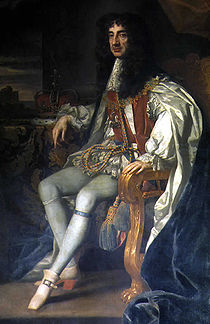 On 4 April 1660, Charles II issued the Declaration of Breda
, in which he made several promises in relation to the reclamation of the crown of England. Monck organized the Convention Parliament, which met for the first time on 25 April. On 8 May it proclaimed that King Charles II had been the lawful monarch since the execution of Charles I
on 30 January 1649. "[C]onstitutionally, it was as if the last nineteen years had never happened". Charles returned from exile, leaving The Hague
on 23 May and landing at Dover
on 25 May. He entered London on 29 May, his birthday. To celebrate "his Majesty's Return to his Parliament", 29 May was made a public holiday, popularly known as Oak Apple Day
. He was crowned at Westminster Abbey on 23 April 1661.
Some contemporaries described the Restoration as "a divinely ordained miracle. The sudden and unexpected deliverance from usurpation and tyranny was interpreted as a restoration of the natural and divine order".
The Cavalier Parliament
convened for the first time on 8 May 1661, and it would endure for over 17 years, finally being dissolved on 24 January 1679. Like its predecessor, it was overwhelmingly Royalist
. It is also known as the Pensionary Parliament for the many pensions it granted to adherents of the King.
The leading political figure at the beginning of the Restoration was Edward Hyde, 1st Earl of Clarendon
. It was the "skill and wisdom of Clarendon" which had "made the Restoration unconditional".
Many Royalist exiles returned and were rewarded. Prince Rupert of the Rhine
returned to the service of England, became a member of the privy council
, and was provided with an annuity. George Goring, 1st Earl of Norwich
, returned to be the Captain of the King's guard and received a pension. Marmaduke Langdale
returned and was made "Baron Langdale
". William Cavendish, Marquess of Newcastle, returned and was able to regain the greater part of his estates. He was invested in 1666 with the Order of the Garter
(which had been bestowed upon him in 1650), and was advanced to a dukedom on 16 March 1665.
, which became law on 29 August 1660, pardoned all past treason against the crown, but specifically excluded those involved in the trial and execution of Charles I. 31 of the 59 commissioners (judges) who had signed the death warrant in 1649 were living.
In the ensuing trials, twelve were condemned to death, the full penalty for Fifth Monarchy Men. Thomas Harrison, the first person found guilty of regicide, was the seventeenth of the 59 commissioners to sign the death warrant. He was the first regicide to be hanged, drawn and quartered
because he was considered by the new government still to represent a real threat to the re-established order.
In October 1660, at Charing Cross
or Tyburn
, London, ten were publicly hanged, drawn and quartered: Thomas Harrison, John Jones
, Adrian Scroope, John Carew
, Thomas Scot
, and Gregory Clement
, who had signed the king's death warrant; the preacher Hugh Peters
; Francis Hacker
and Daniel Axtell
, who commanded the guards at the king's trial and execution; and John Cooke, the solicitor who directed the prosecution.
On 6 January 1661, 50 Fifth Monarchy Men, headed by a wine-cooper named Thomas Venner
, tried to gain possession of London in the name of "King Jesus". Most of the 50 were either killed or taken prisoner; on 19 and 21 January, Venner and 10 others were hanged, drawn and quartered for high treason
.
John Okey
, one of the regicides who signed the death warrant of Charles I, was brought back from Holland along with Miles Corbet
, friend and lawyer to Cromwell, and John Barkstead
, former constable of the Tower of London
. They were all imprisoned in the Tower. From there they were taken to Tyburn to be hanged, drawn and quartered. A further 19 were imprisoned for life.
Oliver Cromwell
, Henry Ireton
, Judge Thomas Pride
, and Judge John Bradshaw
were posthumously attainted
for high treason. Because Parliament is a court, the highest in the land, a bill of attainder
is a legislative act declaring a person guilty of treason or felony, in contrast to the regular judicial process of trial and conviction. In January 1661, the corpses of Cromwell, Ireton and Bradshaw were exhumed and hung in chains at Tyburn
.
s. These knighthoods were all declared invalid upon the Restoration of Charles II. Many were regranted by the restored King.
Of the twelve Cromwellian baronet
cies, Charles II regranted half of them. Only one now continues: Sir Richard Thomas Williams-Bulkeley
, 14th baronet, is the direct successor of Sir Griffith Williams.
Edmund Dunch
was created Baron
Burnell of East Wittenham in April 1658, but this barony was not regranted. The male line failed in 1719 with the death of his grandson, also Edmund Dunch
, so no one can lay claim to the title.
The one hereditary viscount
cy Cromwell created (making Charles Howard
Viscount Howard of Morpeth and Baron Gilsland) continues to this day. In April 1661, Howard was created Earl of Carlisle
, Viscount Howard of Morpeth, and Baron Dacre of Gillesland. The present Earl is a direct descendant of this Cromwellian creation and Restoration recreation.
was restored as the national Church in England, backed by the Clarendon Code and the Act of Uniformity 1662
. People reportedly "pranced around May poles as a way of taunting the Presbyterians and Independents" and "burned copies of the Solemn League and Covenant
".
s reopened after having been closed during the protectorship of Oliver Cromwell
, Puritan
ism lost its momentum, and the bawdy "Restoration comedy
" became a recognizable genre. In addition, women were allowed to perform on stage for the first time. In Scotland
, Episcopacy was reinstated.
To celebrate the occasion and cement their diplomatic relations, the Dutch Republic presented Charles with the Dutch Gift
, a fine collection of old master paintings, classical sculptures, furniture, and a yacht.
Charles II of England
Charles II was monarch of the three kingdoms of England, Scotland, and Ireland.Charles II's father, King Charles I, was executed at Whitehall on 30 January 1649, at the climax of the English Civil War...
after the Interregnum that followed the Wars of the Three Kingdoms
Wars of the Three Kingdoms
The Wars of the Three Kingdoms formed an intertwined series of conflicts that took place in England, Ireland, and Scotland between 1639 and 1651 after these three countries had come under the "Personal Rule" of the same monarch...
. The term Restoration may apply both to the actual event by which the monarchy was restored, and to the period immediately following the event.
End of the Protectorate and Commonwealth
The ProtectorateThe Protectorate
In British history, the Protectorate was the period 1653–1659 during which the Commonwealth of England was governed by a Lord Protector.-Background:...
, which followed the Commonwealth
Commonwealth of England
The Commonwealth of England was the republic which ruled first England, and then Ireland and Scotland from 1649 to 1660. Between 1653–1659 it was known as the Commonwealth of England, Scotland and Ireland...
and preceded the English Restoration, might have continued if Oliver Cromwell
Oliver Cromwell
Oliver Cromwell was an English military and political leader who overthrew the English monarchy and temporarily turned England into a republican Commonwealth, and served as Lord Protector of England, Scotland, and Ireland....
's son Richard
Richard Cromwell
At the same time, the officers of the New Model Army became increasingly wary about the government's commitment to the military cause. The fact that Richard Cromwell lacked military credentials grated with men who had fought on the battlefields of the English Civil War to secure their nation's...
, who was made Lord Protector
Lord Protector
Lord Protector is a title used in British constitutional law for certain heads of state at different periods of history. It is also a particular title for the British Heads of State in respect to the established church...
on his father's death, had been capable of carrying on his father's policies. Richard Cromwell's main weakness was that he did not have the confidence of the army. After seven months, an army faction known as the Wallingford House party
Wallingford House party
The Wallingford House party were a group of senior officers of the New Model Army who met at Wallingford House, the London home of Charles Fleetwood. They overthrew the Protectorate of the Lord Protector Richard Cromwell....
removed him on 6 May 1659 and reinstalled the Rump Parliament
Rump Parliament
The Rump Parliament is the name of the English Parliament after Colonel Pride purged the Long Parliament on 6 December 1648 of those members hostile to the Grandees' intention to try King Charles I for high treason....
. Charles Fleetwood
Charles Fleetwood
Charles Fleetwood was an English Parliamentary soldier and politician, Lord Deputy of Ireland from 1652–55, where he enforced the Cromwellian Settlement. At the Restoration he was included in the Act of Indemnity as among the twenty liable to penalties other than capital, and was finally...
was appointed a member of the Committee of Safety
English Committee of Safety
The Committee of Safety, established by the Parliamentarians in July 1642, was the first of a number of successive committees set up to oversee the English Civil War against King Charles I, and the Interregnum.-1642–1644:...
and of the Council of State, and one of the seven commissioners for the army. On 9 June 1659, he was nominated lord-general (commander-in-chief) of the army. However, his leadership was undermined in Parliament, which chose to disregard the army's authority in a similar fashion to the post-First Civil War Parliament. A royalist uprising was planned for 1 August 1659, but it was foiled. However, Sir George Booth
George Booth, 1st Baron Delamer
George Booth, 1st Baron Delamer , known as Sir George Booth, 2nd Baronet, from 1652 to 1661, was an English peer.-Civil War:...
gained control of Cheshire; Charles II hoped that with Spanish support he could effect a landing, but none was forthcoming. Booth held Cheshire until the end of August when he was defeated by General Lambert
John Lambert (general)
John Lambert was an English Parliamentary general and politician. He fought during the English Civil War and then in Oliver Cromwell's Scottish campaign , becoming thereafter active in civilian politics until his dismissal by Cromwell in 1657...
. The Commons
Rump Parliament
The Rump Parliament is the name of the English Parliament after Colonel Pride purged the Long Parliament on 6 December 1648 of those members hostile to the Grandees' intention to try King Charles I for high treason....
, on 12 October 1659, cashiered General John Lambert and other officers, and installed Fleetwood as chief of a military council under the authority of the Speaker
Speaker of the British House of Commons
The Speaker of the House of Commons is the presiding officer of the House of Commons, the United Kingdom's lower chamber of Parliament. The current Speaker is John Bercow, who was elected on 22 June 2009, following the resignation of Michael Martin...
. The next day Lambert ordered that the doors of the House be shut and the members kept out. On 26 October a "Committee of Safety" was appointed, of which Fleetwood and Lambert were members. Lambert was appointed major-general of all the forces in England and Scotland, Fleetwood being general. The Committee of Safety sent Lambert with a large force to meet George Monck, who was in command of the English forces in Scotland, and either negotiate with him or force him to come to terms.
It was into this atmosphere that Monck, the governor of Scotland under the Cromwells, marched south with his army from Scotland. Lambert's army began to desert him, and he returned to London almost alone. Monck marched to London unopposed. The Presbyterian members, excluded in Pride's Purge
Pride's Purge
Pride’s Purge is an event in December 1648, during the Second English Civil War, when troops under the command of Colonel Thomas Pride forcibly removed from the Long Parliament all those who were not supporters of the Grandees in the New Model Army and the Independents...
of 1648, were recalled, and on 24 December the army restored the Long Parliament
Long Parliament
The Long Parliament was made on 3 November 1640, following the Bishops' Wars. It received its name from the fact that through an Act of Parliament, it could only be dissolved with the agreement of the members, and those members did not agree to its dissolution until after the English Civil War and...
. Fleetwood was deprived of his command and ordered to appear before Parliament to answer for his conduct. On 3 March 1660, Lambert was sent to the Tower of London
Tower of London
Her Majesty's Royal Palace and Fortress, more commonly known as the Tower of London, is a historic castle on the north bank of the River Thames in central London, England. It lies within the London Borough of Tower Hamlets, separated from the eastern edge of the City of London by the open space...
, from which he escaped a month later. He had a bad case of diahrrea and almost died, he was treated at St John's church in Westminster. He tried to rekindle the civil war in favour of the Commonwealth
Commonwealth of England
The Commonwealth of England was the republic which ruled first England, and then Ireland and Scotland from 1649 to 1660. Between 1653–1659 it was known as the Commonwealth of England, Scotland and Ireland...
by issuing a proclamation calling on all supporters of the "Good Old Cause
Good Old Cause
The Good Old Cause was the retrospective name given by the soldiers of the New Model Army for the complex of reasons for which they fought, on behalf of the Parliament of England....
" to rally on the battlefield of Edgehill. But he was recaptured by Colonel Richard Ingoldsby
Richard Ingoldsby
Colonel Sir Richard Ingoldsby was an English officer in the New Model Army during the English Civil War and a politician who sat in the House of Commons variously between 1647 and 1685...
, a participant in the regicide
Regicide
The broad definition of regicide is the deliberate killing of a monarch, or the person responsible for the killing of a monarch. In a narrower sense, in the British tradition, it refers to the judicial execution of a king after a trial...
of Charles I who hoped to win a pardon by handing Lambert over to the new regime. Lambert was incarcerated and died in custody on Drake's Island
Drake's Island
Drake's Island is a island lying in Plymouth Sound, the stretch of water south of the city of Plymouth, Devon, England. The rocks which make up the island are volcanic tuff and lava, together with marine limestone of the mid-Devonian period.-Early history:...
in 1684; Ingoldsby was pardoned.
Restoration of Charles II
Declaration of Breda
The Declaration of Breda was a proclamation by Charles II of England in which he promised a general pardon for crimes committed during the English Civil War and the Interregnum for all those who recognised Charles as the lawful king; the retention by the current owners of property purchased during...
, in which he made several promises in relation to the reclamation of the crown of England. Monck organized the Convention Parliament, which met for the first time on 25 April. On 8 May it proclaimed that King Charles II had been the lawful monarch since the execution of Charles I
Charles I of England
Charles I was King of England, King of Scotland, and King of Ireland from 27 March 1625 until his execution in 1649. Charles engaged in a struggle for power with the Parliament of England, attempting to obtain royal revenue whilst Parliament sought to curb his Royal prerogative which Charles...
on 30 January 1649. "[C]onstitutionally, it was as if the last nineteen years had never happened". Charles returned from exile, leaving The Hague
The Hague
The Hague is the capital city of the province of South Holland in the Netherlands. With a population of 500,000 inhabitants , it is the third largest city of the Netherlands, after Amsterdam and Rotterdam...
on 23 May and landing at Dover
Dover
Dover is a town and major ferry port in the home county of Kent, in South East England. It faces France across the narrowest part of the English Channel, and lies south-east of Canterbury; east of Kent's administrative capital Maidstone; and north-east along the coastline from Dungeness and Hastings...
on 25 May. He entered London on 29 May, his birthday. To celebrate "his Majesty's Return to his Parliament", 29 May was made a public holiday, popularly known as Oak Apple Day
Oak Apple Day
Oak Apple Day or Royal Oak Day was a holiday celebrated in England on 29 May to commemorate the restoration of the English monarchy, in May 1660...
. He was crowned at Westminster Abbey on 23 April 1661.
Some contemporaries described the Restoration as "a divinely ordained miracle. The sudden and unexpected deliverance from usurpation and tyranny was interpreted as a restoration of the natural and divine order".
The Cavalier Parliament
Cavalier Parliament
The Cavalier Parliament of England lasted from 8 May 1661 until 24 January 1679. It was the longest English Parliament, enduring for nearly 18 years of the quarter century reign of Charles II of England...
convened for the first time on 8 May 1661, and it would endure for over 17 years, finally being dissolved on 24 January 1679. Like its predecessor, it was overwhelmingly Royalist
Cavalier
Cavalier was the name used by Parliamentarians for a Royalist supporter of King Charles I and son Charles II during the English Civil War, the Interregnum, and the Restoration...
. It is also known as the Pensionary Parliament for the many pensions it granted to adherents of the King.
The leading political figure at the beginning of the Restoration was Edward Hyde, 1st Earl of Clarendon
Edward Hyde, 1st Earl of Clarendon
Edward Hyde, 1st Earl of Clarendon was an English historian and statesman, and grandfather of two English monarchs, Mary II and Queen Anne.-Early life:...
. It was the "skill and wisdom of Clarendon" which had "made the Restoration unconditional".
Many Royalist exiles returned and were rewarded. Prince Rupert of the Rhine
Prince Rupert of the Rhine
Rupert, Count Palatine of the Rhine, Duke of Bavaria, 1st Duke of Cumberland, 1st Earl of Holderness , commonly called Prince Rupert of the Rhine, KG, FRS was a noted soldier, admiral, scientist, sportsman, colonial governor and amateur artist during the 17th century...
returned to the service of England, became a member of the privy council
Privy council
A privy council is a body that advises the head of state of a nation, typically, but not always, in the context of a monarchic government. The word "privy" means "private" or "secret"; thus, a privy council was originally a committee of the monarch's closest advisors to give confidential advice on...
, and was provided with an annuity. George Goring, 1st Earl of Norwich
George Goring, 1st Earl of Norwich
George Goring, 1st Earl of Norwich was an English soldier.He was the son of George Goring of Hurstpierpoint and Ovingdean, Sussex, and of Anne Denny, sister of Edward Denny, 1st Earl of Norwich. He matriculated from Sidney Sussex College, Cambridge in 1600, and may subsequently have spent some...
, returned to be the Captain of the King's guard and received a pension. Marmaduke Langdale
Marmaduke Langdale
Sir Marmaduke Langdale was a Royalist commander in the English Civil War.He married Lenox , daughter of Sir John Rodes of Barlborough, Derbyshire, and his third wife Catherine, daughter of Marmaduke Constable of Holderness on 12 September 1626, at St Michael-le-Belfry in York...
returned and was made "Baron Langdale
Baron Langdale
Baron Langdale was a title that was created twice in British history. The first creation came in the Peerage of England on 4 February 1658 when the prominent royalist commander of the English Civil War, Sir Marmaduke Langdale, was made by Baron Langdale, of Holme...
". William Cavendish, Marquess of Newcastle, returned and was able to regain the greater part of his estates. He was invested in 1666 with the Order of the Garter
Order of the Garter
The Most Noble Order of the Garter, founded in 1348, is the highest order of chivalry, or knighthood, existing in England. The order is dedicated to the image and arms of St...
(which had been bestowed upon him in 1650), and was advanced to a dukedom on 16 March 1665.
Regicides and rebels
The Indemnity and Oblivion ActIndemnity and Oblivion Act
The Indemnity and Oblivion Act 1660 is an Act of the Parliament of England , the long title of which is "An Act of Free and General Pardon, Indemnity, and Oblivion"....
, which became law on 29 August 1660, pardoned all past treason against the crown, but specifically excluded those involved in the trial and execution of Charles I. 31 of the 59 commissioners (judges) who had signed the death warrant in 1649 were living.
In the ensuing trials, twelve were condemned to death, the full penalty for Fifth Monarchy Men. Thomas Harrison, the first person found guilty of regicide, was the seventeenth of the 59 commissioners to sign the death warrant. He was the first regicide to be hanged, drawn and quartered
Hanged, drawn and quartered
To be hanged, drawn and quartered was from 1351 a penalty in England for men convicted of high treason, although the ritual was first recorded during the reigns of King Henry III and his successor, Edward I...
because he was considered by the new government still to represent a real threat to the re-established order.
In October 1660, at Charing Cross
Charing Cross
Charing Cross denotes the junction of Strand, Whitehall and Cockspur Street, just south of Trafalgar Square in central London, England. It is named after the now demolished Eleanor cross that stood there, in what was once the hamlet of Charing. The site of the cross is now occupied by an equestrian...
or Tyburn
Tyburn, London
Tyburn was a village in the county of Middlesex close to the current location of Marble Arch in present-day London. It took its name from the Tyburn or Teo Bourne 'boundary stream', a tributary of the River Thames which is now completely covered over between its source and its outfall into the...
, London, ten were publicly hanged, drawn and quartered: Thomas Harrison, John Jones
John Jones Maesygarnedd
Colonel John Jones was a Welsh military leader, politician and one of the regicides of King Charles I. A brother-in-law of Oliver Cromwell, Jones was born at Llanbedr in North Wales and is often surnamed Jones Maesygarnedd after the location of his Merionethshire estate. Jones spoke Welsh with his...
, Adrian Scroope, John Carew
John Carew (regicide)
John Carew , from Antony, Cornwall, was one of the regicides of King Charles I.Elected MP for Tregony in 1647, he was a prominent member of the Fifth Monarchy Men who saw the overthrow of Charles I as a divine sign of the second coming of Jesus and the establishment of the millennium a thousand...
, Thomas Scot
Thomas Scot
Thomas Scot was an English Member of Parliament and one of the regicides of King Charles I.- Early life :In 1626 Thomas Scot married Alice Allinson of Chesterford in Essex. He was a lawyer in Buckinghamshire and grew to prominence as the treasurer of the region’s County Committee between 1644 to...
, and Gregory Clement
Gregory Clement
Gregory Clement was an English Member of Parliament and one of the regicides of King Charles I.Clement was the son of John Clement, a merchant and one time Mayor of Plymouth. After working in India for the British East India Company, Clement returned to London and on outbreak of the Civil War...
, who had signed the king's death warrant; the preacher Hugh Peters
Hugh Peters
Hugh Peters [or Peter] was an English preacher.-Early life:He was baptized on 29 June 1598 in Fowey, and was educated at Trinity College, Cambridge....
; Francis Hacker
Francis Hacker
Colonel Francis Hacker was an English soldier who fought for Parliament during the English Civil War and one of the Regicides of King Charles I of England....
and Daniel Axtell
Daniel Axtell
Colonel Daniel Axtell was Captain of the Parliamentary Guard at the trial of King Charles I at Westminster Hall in 1649. Shortly after the Restoration he was hanged, drawn and quartered as a regicide....
, who commanded the guards at the king's trial and execution; and John Cooke, the solicitor who directed the prosecution.
On 6 January 1661, 50 Fifth Monarchy Men, headed by a wine-cooper named Thomas Venner
Thomas Venner
Thomas Venner was a cooper and rebel who became the last leader of the Fifth Monarchy Men, who tried unsuccessfully to overthrow Oliver Cromwell in 1657, and subsequently led a coup in London against the newly-restored government of Charles II...
, tried to gain possession of London in the name of "King Jesus". Most of the 50 were either killed or taken prisoner; on 19 and 21 January, Venner and 10 others were hanged, drawn and quartered for high treason
Treason
In law, treason is the crime that covers some of the more extreme acts against one's sovereign or nation. Historically, treason also covered the murder of specific social superiors, such as the murder of a husband by his wife. Treason against the king was known as high treason and treason against a...
.
John Okey
John Okey
John Okey was an English soldier, member of Parliament, and one of the regicides of King Charles I.-Early life and military career:...
, one of the regicides who signed the death warrant of Charles I, was brought back from Holland along with Miles Corbet
Miles Corbet
Miles Corbet was an English politician, recorder of Yarmouth and Regicide.-Life:He was the son of Sir Thomas Corbet of Sprowston, Norfolk and the younger brother of Sir John Corbet, 1st Baronet, MP for Great Yarmouth from 1625 to 1629...
, friend and lawyer to Cromwell, and John Barkstead
John Barkstead
John Barkstead was an English Major-General and Regicide.Barkstead was a goldsmith in London; captain of parliamentary infantry under Colonel Venn; governor of Reading, 1645: commanded regiment at siege of Colchester; one of the king's judges, 1648; governor of Yarmouth, 1649, and of the Tower,...
, former constable of the Tower of London
Tower of London
Her Majesty's Royal Palace and Fortress, more commonly known as the Tower of London, is a historic castle on the north bank of the River Thames in central London, England. It lies within the London Borough of Tower Hamlets, separated from the eastern edge of the City of London by the open space...
. They were all imprisoned in the Tower. From there they were taken to Tyburn to be hanged, drawn and quartered. A further 19 were imprisoned for life.
Oliver Cromwell
Oliver Cromwell
Oliver Cromwell was an English military and political leader who overthrew the English monarchy and temporarily turned England into a republican Commonwealth, and served as Lord Protector of England, Scotland, and Ireland....
, Henry Ireton
Henry Ireton
Henry Ireton was an English general in the Parliamentary army during the English Civil War. He was the son-in-law of Oliver Cromwell.-Early life:...
, Judge Thomas Pride
Thomas Pride
Thomas Pride was a parliamentarian general in the English Civil War, and best known as the instigator of "Pride's Purge".-Early Life and Starting Career:...
, and Judge John Bradshaw
John Bradshaw (judge)
John Bradshaw was an English judge. He is most notable for his role as President of the High Court of Justice for the trial of King Charles I and as the first Lord President of the Council of State of the English Commonwealth....
were posthumously attainted
Attainder
In English criminal law, attainder or attinctura is the metaphorical 'stain' or 'corruption of blood' which arises from being condemned for a serious capital crime . It entails losing not only one's property and hereditary titles, but typically also the right to pass them on to one's heirs...
for high treason. Because Parliament is a court, the highest in the land, a bill of attainder
Bill of attainder
A bill of attainder is an act of a legislature declaring a person or group of persons guilty of some crime and punishing them without benefit of a judicial trial.-English law:...
is a legislative act declaring a person guilty of treason or felony, in contrast to the regular judicial process of trial and conviction. In January 1661, the corpses of Cromwell, Ireton and Bradshaw were exhumed and hung in chains at Tyburn
Tyburn, London
Tyburn was a village in the county of Middlesex close to the current location of Marble Arch in present-day London. It took its name from the Tyburn or Teo Bourne 'boundary stream', a tributary of the River Thames which is now completely covered over between its source and its outfall into the...
.
Regrant of Certain Commonwealth Titles
The Commonwealth's written constitutions gave to the Lord Protector the King's power to grant titles of honour. Cromwell created over 30 new knightKnight
A knight was a member of a class of lower nobility in the High Middle Ages.By the Late Middle Ages, the rank had become associated with the ideals of chivalry, a code of conduct for the perfect courtly Christian warrior....
s. These knighthoods were all declared invalid upon the Restoration of Charles II. Many were regranted by the restored King.
Of the twelve Cromwellian baronet
Baronet
A baronet or the rare female equivalent, a baronetess , is the holder of a hereditary baronetcy awarded by the British Crown...
cies, Charles II regranted half of them. Only one now continues: Sir Richard Thomas Williams-Bulkeley
Williams-Bulkeley Baronets
The Williams, later Williams-Bulkeley Baronetcy, of Penrhyn in the County of Caernarvon, is a title in the Baronetage of England. It was created on 17 June 1661 for Griffith Williams. He had already been granted a baronetcy by Oliver Cromwell in 1658. The second Baronet represented both ...
, 14th baronet, is the direct successor of Sir Griffith Williams.
Edmund Dunch
Edmund Dunch, Baron Burnell of East Wittenham
Edmund Dunch was an English Member of Parliament who supported the Parliamentary cause before and during the English Civil War. During the Interregnum he sat as an Member of Parliament. In 1659, after the Protectorate and before the Restoration, regaining his seat in the Rump he also sat in...
was created Baron
Baron
Baron is a title of nobility. The word baron comes from Old French baron, itself from Old High German and Latin baro meaning " man, warrior"; it merged with cognate Old English beorn meaning "nobleman"...
Burnell of East Wittenham in April 1658, but this barony was not regranted. The male line failed in 1719 with the death of his grandson, also Edmund Dunch
Edmund Dunch
Edmund Dunch was Master of the Royal Household to Queen Anne and a British Member of Parliament .-Biography:...
, so no one can lay claim to the title.
The one hereditary viscount
Viscount
A viscount or viscountess is a member of the European nobility whose comital title ranks usually, as in the British peerage, above a baron, below an earl or a count .-Etymology:...
cy Cromwell created (making Charles Howard
Charles Howard, 1st Earl of Carlisle
Charles Howard, 1st Earl of Carlisle was an English politician and military leader.The first in the Howard line of earls, he was the son and heir of Sir William Howard, of Naworth in Cumberland, by Mary, daughter of William, Lord Eure, and great-grandson of Lord William Howard, "Belted Will" , the...
Viscount Howard of Morpeth and Baron Gilsland) continues to this day. In April 1661, Howard was created Earl of Carlisle
Earl of Carlisle
Earl of Carlisle is a title that has been created three times in the Peerage of England. The first creation came in 1322 when the soldier Andrew Harclay, 1st Baron Harclay was made Earl of Carlisle. He had already been summoned to Parliament as Lord Harclay in 1321...
, Viscount Howard of Morpeth, and Baron Dacre of Gillesland. The present Earl is a direct descendant of this Cromwellian creation and Restoration recreation.
Religious settlement
The Church of EnglandChurch of England
The Church of England is the officially established Christian church in England and the Mother Church of the worldwide Anglican Communion. The church considers itself within the tradition of Western Christianity and dates its formal establishment principally to the mission to England by St...
was restored as the national Church in England, backed by the Clarendon Code and the Act of Uniformity 1662
Act of Uniformity 1662
The Act of Uniformity was an Act of the Parliament of England, 13&14 Ch.2 c. 4 ,The '16 Charles II c. 2' nomenclature is reference to the statute book of the numbered year of the reign of the named King in the stated chapter...
. People reportedly "pranced around May poles as a way of taunting the Presbyterians and Independents" and "burned copies of the Solemn League and Covenant
Solemn League and Covenant
The Solemn League and Covenant was an agreement between the Scottish Covenanters and the leaders of the English Parliamentarians. It was agreed to in 1643, during the First English Civil War....
".
Restoration Britain
TheatreTheatre
Theatre is a collaborative form of fine art that uses live performers to present the experience of a real or imagined event before a live audience in a specific place. The performers may communicate this experience to the audience through combinations of gesture, speech, song, music or dance...
s reopened after having been closed during the protectorship of Oliver Cromwell
Oliver Cromwell
Oliver Cromwell was an English military and political leader who overthrew the English monarchy and temporarily turned England into a republican Commonwealth, and served as Lord Protector of England, Scotland, and Ireland....
, Puritan
Puritan
The Puritans were a significant grouping of English Protestants in the 16th and 17th centuries. Puritanism in this sense was founded by some Marian exiles from the clergy shortly after the accession of Elizabeth I of England in 1558, as an activist movement within the Church of England...
ism lost its momentum, and the bawdy "Restoration comedy
Restoration comedy
Restoration comedy refers to English comedies written and performed in the Restoration period from 1660 to 1710. After public stage performances had been banned for 18 years by the Puritan regime, the re-opening of the theatres in 1660 signalled a renaissance of English drama...
" became a recognizable genre. In addition, women were allowed to perform on stage for the first time. In Scotland
Scotland
Scotland is a country that is part of the United Kingdom. Occupying the northern third of the island of Great Britain, it shares a border with England to the south and is bounded by the North Sea to the east, the Atlantic Ocean to the north and west, and the North Channel and Irish Sea to the...
, Episcopacy was reinstated.
To celebrate the occasion and cement their diplomatic relations, the Dutch Republic presented Charles with the Dutch Gift
Dutch Gift
The Dutch Gift of 1660 was a collection of 28 mostly Italian Renaissance paintings and 12 classical sculptures, along with a yacht, the Mary, and furniture, which was presented to King Charles II of England by the States-General of the Netherlands in 1660...
, a fine collection of old master paintings, classical sculptures, furniture, and a yacht.
See also
- Restoration comedyRestoration comedyRestoration comedy refers to English comedies written and performed in the Restoration period from 1660 to 1710. After public stage performances had been banned for 18 years by the Puritan regime, the re-opening of the theatres in 1660 signalled a renaissance of English drama...
- Restoration literatureRestoration literatureRestoration literature is the English literature written during the historical period commonly referred to as the English Restoration , which corresponds to the last years of the direct Stuart reign in England, Scotland, Wales, and Ireland...
- Royal SocietyRoyal SocietyThe Royal Society of London for Improving Natural Knowledge, known simply as the Royal Society, is a learned society for science, and is possibly the oldest such society in existence. Founded in November 1660, it was granted a Royal Charter by King Charles II as the "Royal Society of London"...
- Rota ClubRota ClubThe Rota Club refers to a debate society, composed of learned gentlemen, who debated republican ideology in London between November 1659 and February 1660. The Club was founded and dominated by James Harrington...
- Restoration spectacularRestoration spectacularThe Restoration spectacular, or elaborately staged "machine play", hit the London public stage in the late 17th-century Restoration period, enthralling audiences with action, music, dance, moveable scenery, baroque illusionistic painting, gorgeous costumes, and special effects such as trapdoor...
- Restoration styleRestoration styleRestoration style, also known as Carolean style Restoration style, also known as Carolean style Restoration style, also known as Carolean style (from the Latin Carolus (Charles), refers to the decorative arts popular in England from the restoration of the monarchy in 1660 to the late 1680s after...
- RestorationRestoration (Tremain novel)Restoration is a novel by Rose Tremain, published in 1989. It was short listed for the Booker Prize in 1989 and was the Sunday Express Book of the Year. It was made into a film in 1995.-Plot summary:...
, novel by Rose TremainRose TremainRose Tremain CBE is an English author.-Life:Rose Tremain was born Rosemary Jane Thomson on August 2, 1943 in London and attended Francis Holland School then Crofton Grange School from 1954 to 1961; the Sorbonne from 1961–1962; and graduated from the University of East Anglia in 1965 where she then...
, and the film based on it - Samuel PepysSamuel PepysSamuel Pepys FRS, MP, JP, was an English naval administrator and Member of Parliament who is now most famous for the diary he kept for a decade while still a relatively young man...
, whose diary is one of the primary historical sources for this period - 17th century Britain
External links
- http://www.debretts.co.uk/royal_connections/sovereigns_england_17_century.html
- Review of 'Revolution and Counter-Revolution in England, Ireland and Scotland 1658-60', by Brian Manning
- Chapter V. The Stewart Restoration By Sir Charles Harding FirthCharles Harding FirthSir Charles Harding Firth was a British historian.Born in Sheffield, he was educated at Clifton College and at Balliol College, Oxford...