

Polish-Soviet War

Encyclopedia
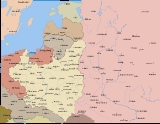
The Polish–Soviet War (February 1919 – March 1921) was an armed conflict between Soviet Russia and Soviet Ukraine and the Second Polish Republic
and the Ukrainian People's Republic
—four states in post–World War I Europe. Poland, whose statehood had just been re-established by the Treaty of Versailles
following the Partitions of Poland
in the late 18th century, sought to secure territories it had lost at the time of partitions; the Soviet states aimed to control those same territories, which had been part of the Russian Empire
until the turbulent events of World War I. On the Soviet part, the ideological factor was also important, as the newly created communist state sought to spread its revolution to Central
, and later Western Europe
. This is evident by Marshal Tukhachevsky's daily order to his troops: "Over the corpse of Poland leads the road to the world's fire. Towards Wilno, Minsk, Warsaw go!" Despite the final retreat of Russian forces and annihilation of their three field armies, historians don't universally agree on the question of victory.Russian and Polish historians tend to assign victory to their respective countries. Outside assessments vary, mostly between calling the result a Polish victory and inconclusive. Lenin, in his secret report to the 9th Conference of the Bolshevik Party on , called the outcome of the war, "In a word, a gigantic, unheard-of defeat." (See ) The Poles claimed a successful defense of their state, while the Soviets claimed a repulse of the Polish eastward invasion of Ukraine and Belarus, which they viewed as a part of the foreign intervention in the Russian Civil War
.
The Treaty of Versailles
had only vaguely defined the frontiers between Poland and Bolshevik Russia, and post-war events created turmoil—the Russian Revolution of 1917
, the crumbling of the Russian
, German
and Austrian
empires, the Russian Civil War
, the Central Powers
' withdrawal from the eastern front
, and the attempts of Ukraine
and Belarus
to establish independence. Poland's Chief of State, Józef Piłsudski, felt the time was right to expand Polish borders as far east as feasible, to be followed by a Polish-led Intermarum
federation of East-Central-European states as a bulwark against the re-emergence of German and Russian imperialism
s. Lenin
, meanwhile, saw Poland as the bridge the Red Army
had to cross to assist other communist movements
and bring about other European revolutions.
By 1919, Polish forces had taken control of much of Western Ukraine
, emerging victorious from the Polish–Ukrainian War. The West Ukrainian People's Republic, led by Yevhen Petrushevych
, had tried unsuccessfully to create a Ukrainian state on territories to which both Poles and Ukrainians laid claim. At the same time in the Russian part of Ukraine Symon Petliura tried to defend and strengthen the Ukrainian People's Republic
, but as the Bolsheviks began to gain the upper hand in the Russian Civil War, they started to advance westward towards the disputed Ukrainian territories causing Petliura's forces to retreat to Podolia
. By the end of 1919 a clear front had formed as Petliura decided to ally with Piłsudski. Border skirmishes escalated into open warfare following Piłsudski's major incursion further east into Ukraine in April 1920. The Polish offensive was met by an initially successful Red Army counterattack
. The Soviet operation threw the Polish forces back westward all the way to the Polish capital, Warsaw
, while the Directorate of Ukraine
fled to Western Europe. Meanwhile, Western fears of Soviet troops arriving at the German frontiers increased the interest of Western powers
in the war. In midsummer, the fall of Warsaw seemed certain but in mid-August the tide had turned again as the Polish forces achieved an unexpected and decisive victory at the Battle of Warsaw
. In the wake of the Polish advance eastward, the Soviets sued for peace and the war ended with a ceasefire
in October 1920. A formal peace treaty
, the Peace of Riga
, was signed on 18 March 1921, dividing the disputed territories between Poland and Soviet Russia. The war largely determined the Soviet–Polish border for the period between the World Wars. Much of the territory ceded to Poland in the Treaty of Riga became part of the Soviet Union after World War II, when Poland's eastern borders were redefined by the Allies
in close accordance with the British-drawn Curzon Line
of 1920.
”) did not officially exist until . Alternative names include “Russo–Polish War [or Polish–Russian War] of 1919–1921”See for instance Russo-Polish War in Encyclopædia Britannica
“The conflict began when the Polish head of state Józef Piłsudski formed an alliance with the Ukrainian nationalist leader Symon Petlyura and their combined forces began to overrun Ukraine, occupying Kiev on 7 May.” (to distinguish it from earlier Polish–Russian wars) and “Polish–Bolshevik War”. This second term (or just “Bolshevik War” ) is most common in Polish sources. In some Polish sources it is also referred as the "War of 1920" (Polish: Wojna 1920 roku).For example: 1) Sąsiedzi wobec wojny 1920 roku. Wybór dokumentów.
2) Wojna 1920 roku na Mazowszu i Podlasiu
3) Nad Wisłą i Wkrą. Studium do polsko–radzieckiej wojny 1920 roku
Other points of contention are the starting and ending dates of the war. For example, Encyclopædia Britannica
begins its article with the date (1919–1920), but then states "Although there had been hostilities between the two countries during 1919, the conflict began when the Polish head of state Józef Pilsudski formed an alliance with the Ukrainian nationalist leader Symon Petlyura (21 April 1920) and their combined forces began to overrun Ukraine, occupying Kiev on 7 May." while the Polish Internetowa encyklopedia PWN as well as some Western historians—like Norman Davies
—consider 1919 as the starting year of the war. The ending date is given as either 1920 or 1921; this confusion stems from the fact that while the ceasefire
was put in force in the autumn of 1920, the official treaty ending the war was signed months later, in March 1921.
While the events of 1919 can be described as a border conflict—and only in early 1920 did both sides realize they were engaged in all-out war—the conflicts that took place in 1920 were an inevitable escalation of fighting that began in earnest a year earlier. In the end, the events of 1920 were a logical, though unforeseen, consequence of the 1919 prelude.
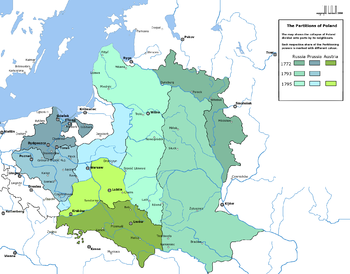 The war's main area of contention is in present-day Ukraine and Belarus and was, until the middle of the 14th century, part of the medieval state of Kievan Rus'
. After a period of internecine wars and the Mongolian invasion of 1240, they became objects of expansion for Poland and Lithuania. In the first half of the 14th century, Kiev and land between the Dnieper, Pripyat
, and Dvina rivers became part of Lithuania, and in 1352 the Galicia-Volyn principality was split between Poland and Lithuania. In 1569, according to the Union of Lublin
between Poland and Lithuania, some of the Ukrainian lands passed to the Polish crown. Between 1772–1795, much of the Eastern Slavic territories became part of Russia. After the Congress of Vienna
in 1814–1815, much of the territory of the Duchy of Warsaw
(Poland) was transferred to Russian control.
In the aftermath of World War I
, the map of Central
and Eastern Europe
had drastically changed. Germany's defeat rendered its plans for the creation of Eastern European puppet state
s (Mitteleuropa
) obsolete, and the Russian Empire collapsed, resulting in a revolution
and a civil war
. Many small nations of the region saw a chance for real independence and seized the opportunity to gain it; Russia viewed these territories as rebellious provinces, vital for its security, but was unable to react swiftly. While the Paris Peace Conference
had not made a definitive ruling in regard to the Poland's eastern border, it issued a provisional boundary in December 1919 – the Curzon line
– as an attempt to define the territories that had an "indisputably Polish ethnic majority"; the participants did not feel competent to make a certain judgement on the competing claims.
With the success of the Greater Poland Uprising in 1918
, Poland had re-established its statehood
for the first time since the 1795 partition. Formed as the Second Polish Republic
, it proceeded to carve out its borders from the territories of its former partitioners. These territories had long been the object of conflict between Russia and Poland.
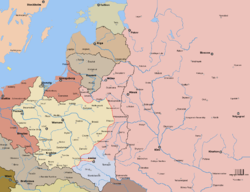 Poland was not alone in its newfound opportunities and troubles. With the collapse of Russian and German occupying authorities
, virtually all of the newly independent neighbours began fighting over borders: Romania
fought with Hungary over Transylvania
, Yugoslavia
with Italy over Rijeka
, Poland with Czechoslovakia
over Cieszyn Silesia
, with Germany over Poznań
and with Ukrainians over Eastern Galicia. Ukrainians
, Belarusians, Lithuanians, Estonians and Latvians fought against each other and against the Russians, who were just as divided. Spreading Communist influences resulted in Communist revolutions in Munich
, Berlin, Budapest
and Prešov
. Winston Churchill
commented: "The war of giants has ended, the wars of the pygmies began." All of these engagements–with the sole exception of the Polish–Soviet war–would be short-lived.
The Polish–Soviet war likely happened more by accident than design, as it is unlikely that anyone in Soviet Russia or in the new Second Republic of Poland would have deliberately planned a major foreign war. Poland, its territory a major frontline of the First World War, was unstable politically; it had just won the difficult conflict with the West Ukrainian National Republic and was already engaged in new conflicts with Germany (the Silesian Uprisings
) and with Czechoslovakia
. The attention of revolutionary Russia, meanwhile, was predominantly directed at thwarting counter-revolution and intervention by the Western powers
. While the first clashes between Polish and Soviet forces occurred in February 1919, it would be almost a year before both sides realised that they were engaged in a full war.
 The Soviet Government denied charges of trying to invade Europe.
Polish leader Pilsudski said:
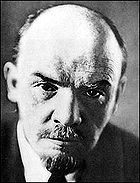
Some authors believe that as early as late 1919 the leader of Russia's new Communist government, Vladimir Lenin
, was inspired by the Red Army's civil-war victories over White Russian
anti-communist forces and their Western allies, and began to see the future of the revolution with greater optimism. The Bolsheviks proclaimed the need for the dictatorship of the proletariat
, and agitated for a worldwide Communist community. Their avowed intent was to link the revolution in Russia with an expected revolution in Germany
and to assist other Communist movements in Western Europe
; Poland was the geographical bridge that the Red Army
would have to cross to do so. Lenin aimed to regain control of the territories ceded by Russia in the Brest-Litovsk Treaty, to infiltrate the borderlands, set up Soviet governments there as well as in Poland, and reach Germany where he expected a Socialist revolution to break out. He believed that Soviet Russia could not survive without the support of a socialist Germany. By the end of summer 1919 the Soviets managed to take over most of Ukraine, driving the Ukrainian Directorate
from Kiev. In early 1919, they also set up a Lithuanian-Belorussian Republic (Litbel). This government was very unpopular due to terror and the collection of food and goods for the army.
As the war progressed, particularly around the time the Polish Kiev Offensive of 1920 had been repelled, the Soviet leaders, including Lenin, increasingly saw the war as the real opportunity to spread the revolution westwards. Historian Richard Pipes
noted that before the Kiev Offensive, Soviets had been preparing their own strike against Poland.
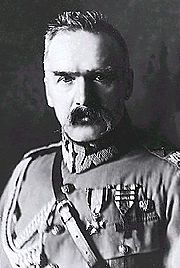 Before the start of the Polish–Soviet War, Polish politics were strongly influenced by Chief of State (naczelnik państwa
) Józef Piłsudski. Piłsudski wanted to break up the Russian Empire
and create a Polish-led "Międzymorze
Federation" of independent states: Poland, Lithuania
, Ukraine
, and other Central and East European countries emerging out of crumbling empires after the First World War. This new union became a counterweight to any potential imperialist
intentions on the part of Russia or Germany. Piłsudski argued that "There can be no independent Poland without an independent Ukraine", but he may have been more interested in Ukraine being split from Russia than in Ukrainians' welfare. He did not hesitate to use military force to expand the Polish borders to Galicia and Volhynia
, crushing a Ukrainian attempt at self-determination in the disputed territories east of the Southern Bug
River, which contained a significant Polish minority, forming majority in cities like Lwów, but a Ukrainian majority in the countryside. Speaking of Poland's future frontiers, Piłsudski said: "All that we can gain in the west depends on the Entente
—on the extent to which it may wish to squeeze Germany," while in the east, "There are doors that open and close, and it depends on who forces them open and how far." In the chaos to the east the Polish forces set out to expand there as much as it was feasible. On the other hand, Poland had no intention of joining the Western intervention in the Russian Civil War or of conquering Russia itself.
Before the Polish–Soviet war, Jan Kowalewski
, a polyglot
and amateur cryptologist, managed to break the codes and ciphers of the army of the West Ukrainian People's Republic and General Anton Denikin's White Russian
forces during his service in the Polish–Ukrainian War. As a result, in July 1919 he was transferred to Warsaw
, where he became chief of the Polish General Staff
's radio-intelligence department. By early September he had gathered a group of mathematicians from Warsaw University and Lwów University (most notably, founders of the Polish School of Mathematics
—Stanisław Leśniewski, Stefan Mazurkiewicz
and Wacław Sierpiński), who were also able to break Russian ciphers. Decoded information presented to Pilsudski showed that Soviet peace proposals with Poland in 1919 were false and in reality they had prepared for a new offensive against Poland and concentrated military forces in Barysaw near the Polish border. Pilsudski decided to ignore Soviet proposals, sign an alliance with Symon Petliura and prepared the Kiev Offensive. During the war, decryption of Red Army radio messages made it possible to use small Polish military forces efficiently against the Russians and win many individual battles, the most important being the 1920 Battle of Warsaw
.
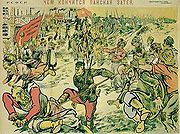
of the war took place around 14 February – 16 February, near the towns of Maniewicze and Biaroza
in Belarus. By late February the Soviet westward advance had come to a halt. Both Polish and Soviet forces had also been engaging the Ukrainian forces, and active fighting was going on in the territories of the Baltic countries (cf. Estonian War of Independence, Latvian War of Independence, Lithuanian Wars of Independence).
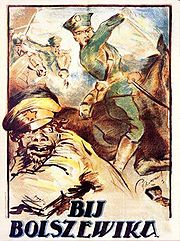 In early March 1919, Polish units started an offensive, crossing the Neman River
, taking Pinsk
, and reaching the outskirts of Lida
. Both the Soviet and Polish advances began around the same time in April (Polish forces started a major offensive on 16 April), resulting in increasing numbers of troops arriving in the area. That month the Red Army
had captured Grodno, but was soon pushed out by a Polish counter-offensive. Unable to accomplish its objectives and facing strengthening offensives from the White forces, the Red Army withdrew from its positions and reorganized. Soon the Polish–Soviet War would begin in earnest.
Polish forces continued a steady eastern advance. They took Lida
on 17 April and Nowogródek on 18 April, and recaptured Vilnius
on 19 April, driving the Litbel government from their proclaimed capital. On 8 August, Polish forces took Minsk
and on the 28th of that month they deployed tank
s for the first time. After heavy fighting, the town of Babruysk
near the Berezina River
was captured. By 2 October, Polish forces reached the Daugava river and secured the region from Desna to Daugavpils
(Dyneburg).
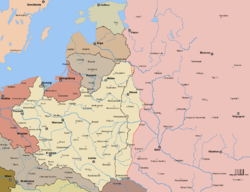 Polish success continued until early 1920. Sporadic battles erupted between Polish forces and the Red Army, but the latter was preoccupied with the White counter-revolutionary forces
and was steadily retreating on the entire western frontline, from Latvia
in the north to Ukraine in the south. In early summer 1919, the White movement had gained the initiative, and its forces under the command of Anton Denikin were marching on Moscow. Piłsudski was aware that the Soviets were not friends of independent Poland, and considered war with Soviet Russia inevitable. He viewed their westward advance as a major issue, but also thought that he could get a better deal for Poland from the Bolshevik
s than their Russian civil war contenders, as the White Russians
– representatives of the old Russian Empire
, partitioner of Poland
– were willing to accept only limited independence of Poland, likely in the borders similar to that of Congress Poland
, and clearly objected to Ukrainian independence, crucial for Piłsudski's Międzymorze
, while the Bolsheviks did proclaim the partitions null and void. Piłsudski thus speculated that Poland would be better off with the Bolsheviks, alienated from the Western powers, than with the restored Russian Empire. By his refusal to join the attack on Lenin's struggling government, ignoring the strong pressure from the Entente
, Piłsudski had possibly saved the Bolshevik government in summer–fall 1919, although a full scale attack by the Poles in support of Denikin was practically not possible. He later wrote that in case of a White victory, in the east Poland could only gain the "ethnic border" at best (the Curzon line
). At the same time, Lenin offered Poles the territories of Minsk
, Zhytomyr
, Khmelnytskyi
, in what was described as mini "Brest
"; Polish military leader Kazimierz Sosnkowski
wrote that the territorial proposals of the Bolsheviks were much better than what the Poles had wanted to achieve.
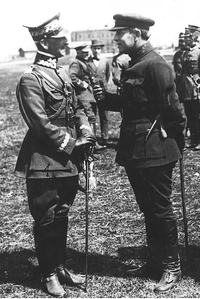
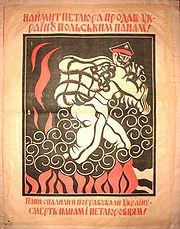 In 1919, several unsuccessful attempts at peace negotiations were made by various Polish and Russian factions. In the meantime, Polish–Lithuanian relations worsened as Polish politicians found it hard to accept the Lithuanians' demands for certain territories, especially the city of Vilnius
which had a Polish ethnic majority but was regarded by Lithuanians as their historical capital. Polish negotiators made better progress with the Latvia
n Provisional Government, and in late 1919 and early 1920 Polish and Latvian forces were conducting joint operations including the Battle of Daugavpils
, against Soviet Russia.
The Warsaw Treaty
, an agreement with the exiled Ukrainian nationalist leader Symon Petlura
signed on 21 April 1920, was the main Polish diplomatic success. Petlura, who formally represented the government of the Ukrainian People's Republic
(by then de facto defeated by Bolsheviks), along with some Ukrainian forces, fled to Poland, where he found asylum. His control extended only to a sliver of land near the Polish border. In such conditions, there was little difficulty convincing Petlura to join an alliance with Poland, despite recent conflict between the two nations that had been settled in favour of Poland. By concluding an agreement with Piłsudski, Petlura accepted the Polish territorial gains in Western Ukraine and the future Polish–Ukrainian border along the Zbruch River
. In exchange, he was promised independence for Ukraine and Polish military assistance in reinstalling his government in Kiev.
For Piłsudski, this alliance gave his campaign for the Międzymorze federation the legitimacy of joint international effort, secured part of the Polish eastward border, and laid a foundation for a Polish-dominated Ukrainian state between Russia and Poland. For Petlura, this was the final chance to preserve the statehood and, at least, the theoretical independence of the Ukrainian heartlands, even while accepting the loss of West Ukrainian lands to Poland. Yet both of them were opposed at home. Piłsudski faced stiff opposition from Dmowski's National Democrats who opposed Ukrainian independence. Petlura, in turn, was criticized by many Ukrainian politicians for entering a pact with the Poles and giving up on Western Ukraine.
The alliance with Petlura did result in 15,000 pro-Polish allied Ukrainian troops at the beginning of the campaign, increasing to 35,000 through recruitment and desertion from the Soviet side during the war. This would, in the end, provide insufficient support for the alliance's aspirations.
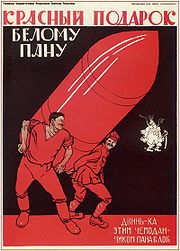 Norman Davies
notes that estimating strength of the opposing sides is difficult – even generals often had incomplete reports of their own forces.
By early 1920, the Red Army had been very successful against the White armies
. They defeated Denikin and signed peace treaties with Latvia and Estonia. The Polish front became their most important war theater and a plurality of Soviet resources and forces were diverted to it. In January 1920, the Red Army began concentrating a 700,000-strong force near the Berezina River
and on Belarus.
By the time Poles launched their Kiev offensive, the Red Southwestern Front had about 82,847 soldiers including 28,568 front-line troops. The Poles had some numerical superiority, estimated from 12,000 to 52,000 personnel. By the time of the Soviet counter-offensive in mid 1920 the situation had been reversed: the Soviets numbered about 790,000 – at least 50,000 more than the Poles; Tukhachevsky
estimated that he had 160,000 "combat ready" soldiers; Piłsudski estimated his enemy's forces at 200,000–220,000.
In the course of 1920, almost 800,000 Red Army personnel were sent to fight in the Polish war, of whom 402,000 went to the Western front and 355,000 to the armies of the South-West front in Galicia. Grigoriy Krivosheev
gives similar numbers, with 382,000 personnel for the Western Front and 283,000 personnel for the Southwestern Front.
Norman Davies
shows the growth of Red Army forces on the Polish front in early 1920:
Among the commanders leading the Red Army in the coming offensive were Leon Trotsky
, Tukhachevsky (new commander of the Western Front), Alexander Yegorov (new commander of the Southwestern Front), the future Soviet ruler Joseph Stalin
, and the founder of the Cheka
(secret police), Felix Dzerzhinsky
.
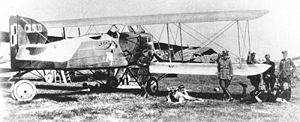
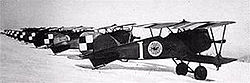
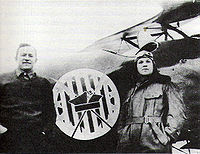
The Polish Army was made up of soldiers who had formerly served in the various partitioning empires, supported by some international volunteers, such as the Kościuszko Squadron. Boris Savinkov
was at the head of an army of 20,000 to 30,000 largely Russian POWs, and was accompanied by Dmitry Merezhkovsky
and Zinaida Gippius
. The Polish forces grew from approximately 100,000 in 1918 to over 500,000 in early 1920. In August, 1920, the Polish army had reached a total strength of 737,767 people; half of that was on the frontline. Given Soviet losses, there was rough numerical parity between the two armies; and by the time of the battle of Warsaw
Poles might have even had a slight advantage in numbers and logistics.
Logistics
, nonetheless, were very bad for both armies, supported by whatever equipment was left over from World War I or could be captured. The Polish Army, for example, employed guns made in five countries, and rifle
s manufactured in six, each using different ammunition. The Soviets had many military depots at their disposal, left by withdrawing German armies in 1918–19, and modern French armaments captured in great numbers from the White Russians and the Allied expeditionary forces in the Russian Civil War. Still, they suffered a shortage of arms; both the Red Army and the Polish forces were grossly underequipped by Western standards.
The Soviet High Command planned a new offensive in late April/May. Since March 1919, Polish intelligence was aware that the Soviets had prepared for a new offensive and the Polish High Command decided to launch their own offensive before their opponents. The plan for Operation Kiev was to beat the Red Army on Poland's southern flank and install a Polish-friendly Petlura government in Ukraine.
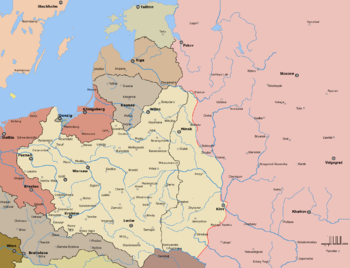
 Until April, the Polish forces had been slowly but steadily advancing eastward. The new Latvia
n government requested and obtained Polish help in capturing Daugavpils
. The city fell after heavy fighting at the Battle of Daugavpils
in January and was handed over to the Latvians. By March, Polish forces had driven a wedge between Soviet forces to the north (Belorussia) and south (Ukraine).
On 24 April, Poland began its main offensive, Operation Kiev. Its stated goal was the creation of an independent Ukraine that would become part of Piłsudski's project of a "Międzymorze
" Federation. Poland's forces were assisted by 15,000 Ukrainian soldiers under Symon Petlura
, representing the Ukrainian People's Republic
.
On 26 April, in his "Call to the People of Ukraine", Piłsudski told his audience that "the Polish army would only stay as long as necessary until a legal Ukrainian government took control over its own territory". Despite this, many Ukrainians were just as anti-Polish as anti-Bolshevik, and resented the Polish advance.
The Polish 3rd Army easily won border clashes with the Red Army in Ukraine but the Reds withdrew with minimal losses. Subsequently, the combined Polish–Ukrainian forces entered an abandoned Kiev
on 7 May, encountering only token resistance.
This Polish military thrust was met with Red Army
counterattack
s on 29 May. Polish forces in the area, preparing for an offensive towards Zhlobin
, managed to hold their ground, but were unable to start their own planned offensive. In the north, Polish forces had fared much worse. The Polish 1st Army was defeated and forced to retreat, pursued by the Russian 15th Army, which recaptured territories between the Western Dvina and Berezina rivers. Polish forces attempted to take advantage of the exposed flanks of the attackers but the enveloping forces failed to stop the Soviet advance. At the end of May, the front had stabilised near the small river Auta, and Soviet forces began preparing for the next push.
On 24 May 1920, the Polish forces in the south were engaged for the first time by Semyon Budyonny's famous 1st Cavalry Army
(Konarmia). Repeated attacks by Budyonny's Cossack
cavalry broke the Polish–Ukrainian front on 5 June. The Soviets then deployed mobile cavalry units to disrupt the Polish rearguard, targeting communications and logistics. By 10 June, Polish armies were in retreat along the entire front. On 13 June, the Polish army, along with the Petlura's Ukrainian troops, abandoned Kiev to the Red Army.
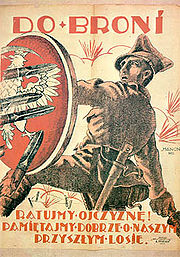 On 30 May 1920 General Aleksei Brusilov
published in Pravda
an appeal entitled “To All Former Officers, Wherever They Might Be”, encouraging them to forgive past grievances and to join the Red Army
. Brusilov considered it as a patriotic duty of all Russian officers to join hands with the Bolshevik government, that in his opinion was defending Russia against foreign invaders. Lenin also spotted the use of Russian patriotism. Thus, the Central Committee appealed to the „respected citizens of Russia“ to defend the Soviet republic against a Polish usurpation. The historians recalled the Polish invasions of the early 17th century.
Russia's counter-offensive was indeed boosted by Brusilov's engagement; 14,000 officers and over 100,000 deserters enlisted in or returned to the Red Army, and thousands of civilian volunteers contributed to the effort. The commander of the Polish 3rd Army in Ukraine, General Edward Rydz-Śmigły, decided to break through the Soviet line toward the northwest. Polish forces in Ukraine managed to withdraw relatively unscathed, but were unable to support the northern front and reinforce the defenses at the Auta River for the decisive battle that was soon to take place there.
Due to insufficient forces, Poland's 200-mile-long front was manned by a thin line of 120,000 troops backed by some 460 artillery pieces with no strategic reserves. This approach to holding ground harked back to the World War I practice of "establishing a fortified line of defense". It had shown some merit on the Western Front saturated with troops, machine guns, and artillery. Poland's eastern front, however, was weakly manned, supported with inadequate artillery, and had almost no fortifications.
Against the Polish line the Red Army gathered its Northwest Front led by the young General Mikhail Tukhachevsky
. Their numbers exceeded 108,000 infantry and 11,000 cavalry, supported by 722 artillery pieces and 2,913 machine guns. The Soviets at some crucial places outnumbered the Poles four-to-one.
Tukhachevsky launched his offensive on 4 July, along the Smolensk
–Brest-Litovsk axis, crossing the Auta and Berezina rivers. The northern 3rd Cavalry Corps, led by Gayk Bzhishkyan
(Gay Dmitrievich Gay, Gaj-Chan), were to envelop Polish forces from the north, moving near the Lithuanian and Prussian border (both of these belonging to nations hostile to Poland). The 4th, 15th, and 3rd Armies were to push west, supported from the south by the 16th Army
and Mozyr Group. For three days the outcome of the battle hung in the balance, but the Soviet' numerical superiority proved decisive and by 7 July Polish forces were in full retreat along the entire front. However, due to the stubborn defense by Polish units, Tukhachevsky's plan to break through the front and push the defenders southwest into the Pinsk Marshes
failed.
Polish resistance was offered again on a line of "German trenches", a line of heavy World War I field fortifications that presented an opportunity to stem the Red Army offensive. However, the Polish troops were insufficient in number. Soviet forces found a weakly defended part of the front and broke through. Gej-Chan and Lithuanian forces captured Vilnius on 14 July, forcing the Poles into retreat again. In Galicia to the south, General Semyon Budyonny
's cavalry advanced far into the Polish rear, capturing Brodno
and approaching Lwów
and Zamość
. In early July, it became clear to the Poles that the Soviets' objectives were not limited to pushing their borders westwards. Poland's very independence was at stake.
Soviet forces moved forward at the remarkable rate of 20 miles (32.2 km) a day. Grodno in Belarus fell on 19 July; Brest-Litovsk fell on 1 August. The Polish attempted to defend the Bug River
line with 4th Army and Grupa Poleska units, but were able to delay the Red Army advance for only one week. After crossing the Narew River on 2 August, the Soviet Northwest Front was only 60 miles (96.6 km) from Warsaw. The Brest-Litovsk fortress, which became the headquarters of the planned Polish counteroffensive, fell to the 16th Army in the first attack. The Soviet Southwest Front pushed the Polish forces out of Ukraine. Stalin had then disobeyed his orders and ordered his forces to close on Zamość, as well as Lwów – the largest city in southeastern Poland and an important industrial center, garrisoned by the Polish 6th Army. The city was soon besieged
. This created a hole in the lines of the Red Army, but at the same time opened the way to the Polish capital. Five Soviet armies approached Warsaw.
Polish forces in Galicia near Lwów launched a successful counteroffensive to slow down the Red Army advance. This stopped the retreat of Polish forces on the southern front. However, the worsening situation near the Polish capital of Warsaw prevented the Poles from continuing that southern counteroffensive and pushing east. Forces were mustered to take part in the coming battle for Warsaw
.
's, rose. Piłsudski did manage to regain his influence, especially over the military, almost at the last moment—as the Soviet forces were approaching Warsaw. The Polish political scene had begun to unravel in panic, with the government of Leopold Skulski
resigning in early June.
Meanwhile, the Soviet leadership's confidence soared. In a telegram, Lenin exclaimed: "We must direct all our attention to preparing and strengthening the Western Front. A new slogan must be announced: 'Prepare for war against Poland'." Soviet communist theorist Nikolay Bukharin, writer for the newspaper Pravda
, wished for the resources to carry the campaign beyond Warsaw "right up to London and Paris". General Tukhachevsky's order of the day, 2 July 1920 read: "To the West! Over the corpse of White Poland lies the road to worldwide conflagration. March on Vilno
, Minsk
, Warsaw
!" and "onward to Berlin
over the corpse of Poland!" The increasing hope of certain victory, however, gave rise to political intrigues between Soviet commanders.
By order of the Soviet Communist Party, a Polish puppet government, the Provisional Polish Revolutionary Committee
(Polish: Tymczasowy Komitet Rewolucyjny Polski, TKRP), had been formed on 28 July in Białystok to organise administration of the Polish territories captured by the Red Army. The TKRP had very little support from the ethnic Polish population and recruited its supporters mostly from the ranks of minorities, primarily Jews
. At the height of the Polish–Soviet conflict, Jews had been subject to anti-semitic violence by Polish forces, who considered Jews a potential threat, and who often accused Jews as being the masterminds of Russian Bolshevism; during the Battle of Warsaw, the Polish government interned all Jewish volunteers and sent Jewish volunteer officers to an internment camp.
 Britain's Prime Minister, David Lloyd George
, who wanted to negotiate a favourable trade agreement with the Bolsheviks pressed Poland to make peace on Soviet terms and refused any assistance to Poland that would alienate the Whites in the Russian Civil War. In July 1920, Britain announced it would send huge quantities of World War I surplus military supplies to Poland, but a threatened general strike by the Trades Union Congress
, who objected to British support of "White Poland", ensured that none of the weapons destined for Poland left British ports. David Lloyd George had never been enthusiastic about supporting the Poles, and had been pressured by his more right-wing Cabinet members such as Lord Curzon and Winston Churchill
into offering the supplies.
In early July 1920, Prime Minister Władysław Grabski travelled to the Spa Conference
in Belgium to request assistance. The Allied representatives were largely unsympathetic. Grabski signed an agreement containing several terms: that Polish forces withdraw to the Curzon Line
, which the Allies had published in December 1919, delineating Poland's ethnographic frontier; that it participate in a subsequent peace conference; and that the questions of sovereignty over Vilnius, Eastern Galicia, Cieszyn Silesia
, and Danzig be remanded to the Allies. Ambiguous promises of Allied support were made in exchange.
On 11 July 1920, the government of Great Britain sent a telegram to the Soviets, signed by Curzon, which has been described as a de facto ultimatum
. It requested that the Soviets halt their offensive at the Curzon line and accept it as a temporary border with Poland, until a permanent border could be established in negotiations. In case of Soviet refusal, the British threatened to assist Poland with all the means available, which, in reality, were limited by the internal political situation in the United Kingdom. On the 17 July, the Bolsheviks refused and made a counter-offer to negotiate a peace treaty directly with Poland. The British responded by threatening to cut off the on-going trade negotiations if the Soviets conducted further offensives against Poland. These threats were ignored.
On 6 August 1920, the British Labour Party
published a pamphlet stating that British workers would never take part in the war as Poland's allies, and labour unions blocked supplies to the British expeditionary force assisting Russian Whites in Arkhangelsk
. French Socialists, in their newspaper L'Humanité
, declared: "Not a man, not a sou
, not a shell for reactionary and capitalist Poland. Long live the Russian Revolution! Long live the Workmen's International!" Poland also suffered setbacks due to sabotage and delays in deliveries of war supplies, when workers in Czechoslovakia and Germany refused to transit such materials to Poland. On 6 August the Polish government issued an "Appeal to the World", disputing charges of imperialism
, stressing Poland's determination for self-determination
and the dangers of Bolshevik "invasion of Europe".
Poland's neighbor Lithuania
had been engaged in serious disputes with Poland over the city of Vilnius
and the borderlands surrounding Sejny
and Suwałki. A 1919 Polish attempt to take control over the entire nation by a coup had additionally disrupted their relationship. The Soviet and Lithuanian governments signed the Soviet-Lithuanian Treaty of 1920 on 12 July; this treaty recognized Vilnius as part of Lithuania. The treaty contained a secret clause allowing Soviet forces unrestricted movement within Soviet-recognized Lithuanian territory during any Soviet war with Poland; this clause would lead to questions regarding the issue of Lithuanian neutrality
in the ongoing Polish–Soviet War. The Lithuanians also provided the Soviets with logistical support. Despite Lithuanian support, the Soviets did not transfer Vilnius to the Lithuanians till just before the city was recaptured by the Polish forces (in late August), instead up till that time the Soviets encouraged their own, pro-communist Lithuanian government, Litbel, and were planning a pro-communist coup in Lithuania. The simmering conflict between Poland and Lithuania culminated in the Polish–Lithuanian War
in August 1920.
Polish allies were few. France, continuing its policy of countering Bolshevism now that the Whites in Russia proper had been almost completely defeated, sent a 400-strong advisory group to Poland's aid
in 1919. It consisted mostly of French officers, although it also included a few British advisers
led by Lieutenant General Sir Adrian Carton De Wiart
. The French officers included a future President of France, Charles de Gaulle
; during the war he won Poland's highest military decoration, the Virtuti Militari
. In addition to the Allied advisors, France also facilitated the transit to Poland from France of the "Blue Army" in 1919: troops mostly of Polish origin, plus some international volunteers, formerly under French command in World War I. The army was commanded by the Polish general, Józef Haller. Hungary offered to send a 30,000 cavalry corps to Poland's aid, but the Czechoslovakian government refused to allow them through, as there was a demilitarized zone on the borders after the Czech-Hungarian war that had ended only a few months before. Some trains with weapon supplies from Hungary did, however, arrive in Poland.
In mid-1920, the Allied Mission was expanded by some advisers (becoming the Interallied Mission to Poland
). They included: French diplomat, Jean Jules Jusserand
; Maxime Weygand
, chief of staff to Marshal Ferdinand Foch
, Supreme Commander of the victorious Entente; and British diplomat, Lord Edgar Vincent D'Abernon. The newest members of the mission achieved little; indeed, the crucial Battle of Warsaw was fought and won by the Poles before the mission could return and make its report. Nonetheless for many years, a myth persisted that it was the timely arrival of Allied forces that had saved Poland, a myth in which Weygand occupied the central role. Nonetheless Polish-French cooperation would continue. Eventually, on 21 February 1921, France and Poland entered into a formal military alliance
, which became an important factor during the subsequent Soviet–Polish negotiations.
units under the command of Gayk Bzhishkyan
crossed the Vistula
river, planning to take Warsaw from the west while the main attack came from the east. On 13 August, an initial Soviet attack was repulsed. The Polish 1st Army resisted a direct assault on Warsaw
as well as stopping the assault at Radzymin
.
The Soviet Western Front commander, Mikhail Tukhachevsky
, felt certain that all was going according to his plan. However, Polish military intelligence
had decrypted the Red Army's radio messages, and Tukhachevsky was actually falling into a trap set by Piłsudski and his Chief of Staff, Tadeusz Rozwadowski. The Soviet advance across the Vistula River in the north was moving into an operational vacuum, as there were no sizable Polish forces in the area. On the other hand, south of Warsaw, where the fate of the war was about to be decided, Tukhachevsky had left only token forces to guard the vital link between the Soviet northwest and southwest fronts. Another factor that influenced the outcome of the war was the effective neutralization of Budyonny's 1st Cavalry Army
, much feared by Piłsudski and other Polish commanders, in the battles around Lwów
. At Tukhachevsky's insistence the Soviet High Command had ordered the 1st Cavalry Army to march north toward Warsaw and Lublin
. However, Budyonny disobeyed the order due to a grudge between Tukhachevsky and Yegorov, commander of the southwest front.
Joseph Stalin
, then chief political commissar
of the Southwest Front, was engaged at Lwow, about 200 miles from Warsaw. The absence of his forces at the battle has been the subject of dispute. A perception arose that his absence was due to his desire to achieve 'military glory' at Lwow. Telegrams concerning the transfer of forces were exchanged. Leon Trotsky
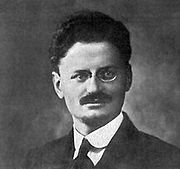
interpreted Stalin's actions as insubordination; Richard Pipes
asserts that Stalin '...almost certainly acted on Lenin's orders' in not moving the forces to Warsaw. That the overall commander Sergey Kamenov allowed such insubordination, issued conflicting and confusing orders and did not act with the decisiveness of a commander in chief contributed greatly to the problems and defeat the Red forces suffered at this critical junction of the war.
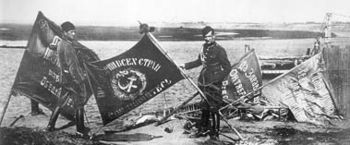 The Polish 5th Army under General Władysław Sikorski counterattacked on 14 August from the area of the Modlin fortress
, crossing the Wkra
River. It faced the combined forces of the numerically and materially superior Soviet 3rd and 15th Armies. In one day the Soviet advance toward Warsaw and Modlin had been halted and soon turned into retreat. Sikorski's 5th Army pushed the exhausted Soviet formations away from Warsaw in a lightning operation. Polish forces advanced at a speed of thirty kilometers a day, soon destroying any Soviet hopes for completing their enveloping manoeuvre in the north. By 16 August, the Polish counteroffensive had been fully joined by Marshal Piłsudski's "Reserve Army." Precisely executing his plan, the Polish force, advancing from the south, found a huge gap between the Soviet fronts and exploited the weakness of the Soviet "Mozyr Group" that was supposed to protect the weak link between the Soviet fronts. The Poles continued their northward offensive with two armies following and destroying the surprised enemy. They reached the rear of Tukhachevsky's forces, the majority of which were encircled by 18 August. Only that same day did Tukhachevsky, at his Minsk
headquarters 300 miles (482.8 km) east of Warsaw, become fully aware of the proportions of the Soviet defeat and ordered the remnants of his forces to retreat and regroup. He hoped to straighten his front line, halt the Polish attack, and regain the initiative, but the orders either arrived too late or failed to arrive at all.
Soviet armies in the center of the front fell into chaos. Tukhachevsky ordered a general retreat toward the Bug River
, but by then he had lost contact with most of his forces near Warsaw, and all the Bolshevik plans had been thrown into disarray by communication failures.
Bolshevik armies retreated in a disorganised fashion; entire divisions panicking and disintegrating. The Red Army's defeat was so great and unexpected that, at the instigation of Piłsudski's detractors, the Battle of Warsaw
is often referred to in Poland as the "Miracle at the Vistula". Previously unknown documents from Polish Central Military Archive found in 2004 proved that the successful breaking of Red Army radio communications cipher
s by Polish cryptographers played a great role in the victory.
Budyonny's
1st Cavalry Army's advance toward Lwów
was halted, first at the battle of Brody (29 July – 2 August), and then on 17 August at the Battle of Zadwórze
, where a small Polish force sacrificed itself to prevent Soviet cavalry from seizing Lwów and stopping vital Polish reinforcements from moving toward Warsaw. Moving through weakly defended areas, Budyonny's cavalry reached the city of Zamość
on 29 August and attempted to take it in the Battle of Zamość; however, he soon faced an increasing number of Polish units diverted from the successful Warsaw counteroffensive. On 31 August, Budyonny's cavalry finally broke off its siege of Lwów and attempted to come to the aid of Soviet forces retreating from Warsaw. The Soviet forces were intercepted and defeated by Polish cavalry
at the Battle of Komarów
near Zamość, the largest cavalry battle since 1813 and one of the last cavalry battles in history. Although Budyonny's army managed to avoid encirclement, it suffered heavy losses and its morale plummeted. The remains of Budyonny's 1st Cavalry Army retreated towards Volodymyr-Volynskyi
on 6 September and was defeated shortly thereafter at the Battle of Hrubieszów.
Tukhachevsky managed to reorganize the eastward-retreating forces and in September established a new defensive line running from the Polish–Lithuanian border to the north to the area of Polesie, with the central point in the city of Grodno in Belarus. The Polish Army broke this line in the Battle of the Niemen River
. Polish forces crossed the Niemen River and outflanked the Bolshevik forces, which were forced to retreat again. Polish forces continued to advance east on all fronts, repeating their successes from the previous year. After the early October Battle of the Szczara River, the Polish Army had reached the Ternopil
–Dubno
–Minsk
–Drisa line.
In the south, Petliura's Ukrainian forces defeated the Bolshevik 14th Army and on 18 September took control of the left bank of the Zbruch river. During the next month they moved east to the line Yaruha on the Dniester
-Sharharod-Bar
-Lityn.
, and with its army controlling the majority of the disputed territories, were willing to negotiate. The Soviets made two offers: one on 21 September and the other on 28 September. The Polish delegation made a counteroffer on 2 October. On the 5th, the Soviets offered amendments to the Polish offer, which Poland accepted. The Preliminary Treaty of Peace and Armistice
Conditions between Poland on one side and Soviet Ukraine and Soviet Russia on the other was signed on 12 October, and the armistice went into effect on 18 October. Ratifications were exchanged at Liepāja
on 2 November. Long negotiations of the final peace treaty ensued.
Meanwhile, Petliura's Ukrainian forces, which now numbered 23,000 soldiers and controlled territories immediately to the east of Poland, planned an offensive in Ukraine for 11 November but were attacked by the Bolsheviks on 10 November. By 21 November, after several battles, they were driven into Polish-controlled territory.
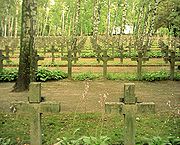
 After the peace negotiations Poland did not maintain all the territories it had controlled at the end of hostilities. Due to their losses in and after the Battle of Warsaw, the Soviets offered the Polish peace delegation substantial territorial concessions in the contested borderland areas, closely resembling the border between the Russian Empire
and the Polish–Lithuanian Commonwealth before the first partition
of 1772. Polish resources were exhausted, however, and Polish public opinion was opposed to a prolongation of the war. The Polish government was also pressured by the League of Nations
, and the negotiations were controlled by Dmowski's National Democrats
. Piłsudski might have controlled the military, but parliament (Sejm
) was controlled by Dmowski: Piłsudski's support lay in the territories in the East, which were controlled by the Bolsheviks at the time of the elections, while the National Democrats' electoral support lay in central and western Poland. The peace negotiations were of a political nature. National Democrats, like Stanisław Grabski, who earlier had resigned his post to protest the Polish–Ukrainian alliance and now wielded much influence over the Polish negotiators, cared little for Piłsudski's vision of reviving Międzymorze
, the multicultural Polish–Lithuanian Commonwealth. This post-war situation proved a death blow to the Międzymorze project. More than one million Poles
, living mostly in the disputed territories, remained in the SU, systematically persecuted by Soviet authorities because of political, economical and religious reasons (see the Polish operation of the NKVD
).
The National Democrats in charge of the state also had few concerns about the fate of their Ukrainian ally, Petlura, and cared little that their political opponent, Piłsudski, felt honor-bound by his treaty obligations; his opponents did not hesitate to scrap the treaty. The National Democrats wanted only the territory that they viewed as 'ethnically or historically Polish' or possible to polonize. Despite the Red Army's crushing defeat at Warsaw and the willingness of Soviet chief negotiator Adolf Joffe to concede almost all disputed territory, the National Democrats' ideology allowed the Soviets to regain certain territories. The Peace of Riga
was signed on 18 March 1921, splitting the disputed territories in Belarus and Ukraine between Poland and Russia. The treaty, which Piłsudski called an "act of cowardice", and for which he apologized to the Ukrainians, actually violated the terms of Poland's military alliance with the Directorate of Ukraine
, which had explicitly prohibited a separate peace. Ukrainian allies of Poland found themselves interned by the Polish authorities. The internment worsened relations between Poland and its Ukrainian minority: those who supported Petliura were angered by the betrayal of their Polish ally, anger that grew stronger because of the assimilationist policies of nationalist inter-war Poland towards its minorities. To a large degree, this inspired the growing tensions and eventual violence
against Poles in the 1930s and 1940s.
The war and its aftermath also resulted in other controversies, such as the situation of prisoners of war
of both sides
, treatment of the civilian population and behaviour of some commanders like Stanisław Bułak-Bałachowicz or Vadim Yakovlev
. The Polish military successes in the autumn of 1920
allowed Poland to capture the Vilnius region
, where a Polish-dominated Governance Committee of Central Lithuania
(Komisja Rządząca Litwy Środkowej) was formed. A plebiscite was conducted, and the Vilnius Sejm
voted on 20 February 1922, for incorporation into Poland. This worsened Polish–Lithuanian relations for decades to come. However the loss of Vilnius might have safeguarded the very existence of the Lithuanian state in the interwar period. Despite an alliance with Soviets (Soviet-Lithuanian Treaty of 1920) and the war with Poland, Lithuania was very close to being invaded by the Soviets in summer 1920 and forcibly converted into a socialist republic. It was only the Polish victory against the Soviets in the Polish–Soviet War (and the fact that the Poles did not object to some form of Lithuanian independence) that derailed the Soviet plans and gave Lithuania an experience of interwar independence. Another controversy concerned the pogrom
s of Jews
, which have caused the United States to send a commission led by Henry Morgenthau, Sr.
to investigate the matter.
 Military strategy in the Polish–Soviet War influenced Charles de Gaulle
, then an instructor with the Polish Army who fought in several of the battles. He and Władysław Sikorski were the only military officers who, based on their experiences of this war, correctly predicted how the next one would be fought. Although they failed in the interbellum to convince their respective militaries to heed those lessons, early in World War II they rose to command of their armed forces in exile. The Polish–Soviet War also influenced Polish military doctrine, which for the next 20 years would place emphasis on the mobility of elite cavalry units.
In 1943, during the course of World War II, the subject of Poland's eastern borders was re-opened, and they were discussed at the Tehran Conference
. Winston Churchill
argued in favor of the 1920 Curzon Line
rather than the Treaty of Riga's borders, and an agreement among the Allies to that effect was reached at the Yalta Conference
in 1945. The Western Allies, despite having alliance treaties with Poland and despite Polish contribution
, also left Poland within the Soviet sphere of influence
. This became known in Poland as the Western Betrayal
.
Until 1989, while Communists held power in the People's Republic of Poland
, the Polish–Soviet War was omitted or minimized in Polish and other Soviet bloc countries' history books, or was presented as a foreign intervention during the Russian Civil War
to fit in with Communist ideology.
Lieutenant Józef Kowalski
, of Poland, is the last known living veteran from this war. He was awarded the Order of Polonia Restituta on his 110th birthday by the president of Poland.
the "Export of Revolution": The Russo-Polish War
Second Polish Republic
The Second Polish Republic, Second Commonwealth of Poland or interwar Poland refers to Poland between the two world wars; a period in Polish history in which Poland was restored as an independent state. Officially known as the Republic of Poland or the Commonwealth of Poland , the Polish state was...
and the Ukrainian People's Republic
Ukrainian People's Republic
The Ukrainian People's Republic or Ukrainian National Republic was a republic that was declared in part of the territory of modern Ukraine after the Russian Revolution, eventually headed by Symon Petliura.-Revolutionary Wave:...
—four states in post–World War I Europe. Poland, whose statehood had just been re-established by the Treaty of Versailles
Treaty of Versailles
The Treaty of Versailles was one of the peace treaties at the end of World War I. It ended the state of war between Germany and the Allied Powers. It was signed on 28 June 1919, exactly five years after the assassination of Archduke Franz Ferdinand. The other Central Powers on the German side of...
following the Partitions of Poland
Partitions of Poland
The Partitions of Poland or Partitions of the Polish–Lithuanian Commonwealth took place in the second half of the 18th century and ended the existence of the Polish–Lithuanian Commonwealth, resulting in the elimination of sovereign Poland for 123 years...
in the late 18th century, sought to secure territories it had lost at the time of partitions; the Soviet states aimed to control those same territories, which had been part of the Russian Empire
Russian Empire
The Russian Empire was a state that existed from 1721 until the Russian Revolution of 1917. It was the successor to the Tsardom of Russia and the predecessor of the Soviet Union...
until the turbulent events of World War I. On the Soviet part, the ideological factor was also important, as the newly created communist state sought to spread its revolution to Central
Central Europe
Central Europe or alternatively Middle Europe is a region of the European continent lying between the variously defined areas of Eastern and Western Europe...
, and later Western Europe
Western Europe
Western Europe is a loose term for the collection of countries in the western most region of the European continents, though this definition is context-dependent and carries cultural and political connotations. One definition describes Western Europe as a geographic entity—the region lying in the...
. This is evident by Marshal Tukhachevsky's daily order to his troops: "Over the corpse of Poland leads the road to the world's fire. Towards Wilno, Minsk, Warsaw go!" Despite the final retreat of Russian forces and annihilation of their three field armies, historians don't universally agree on the question of victory.Russian and Polish historians tend to assign victory to their respective countries. Outside assessments vary, mostly between calling the result a Polish victory and inconclusive. Lenin, in his secret report to the 9th Conference of the Bolshevik Party on , called the outcome of the war, "In a word, a gigantic, unheard-of defeat." (See ) The Poles claimed a successful defense of their state, while the Soviets claimed a repulse of the Polish eastward invasion of Ukraine and Belarus, which they viewed as a part of the foreign intervention in the Russian Civil War
Allied Intervention in the Russian Civil War
The Allied intervention was a multi-national military expedition launched in 1918 during World War I which continued into the Russian Civil War. Its operations included forces from 14 nations and were conducted over a vast territory...
.
The Treaty of Versailles
Treaty of Versailles
The Treaty of Versailles was one of the peace treaties at the end of World War I. It ended the state of war between Germany and the Allied Powers. It was signed on 28 June 1919, exactly five years after the assassination of Archduke Franz Ferdinand. The other Central Powers on the German side of...
had only vaguely defined the frontiers between Poland and Bolshevik Russia, and post-war events created turmoil—the Russian Revolution of 1917
Russian Revolution of 1917
The Russian Revolution is the collective term for a series of revolutions in Russia in 1917, which destroyed the Tsarist autocracy and led to the creation of the Soviet Union. The Tsar was deposed and replaced by a provisional government in the first revolution of February 1917...
, the crumbling of the Russian
Russian Empire
The Russian Empire was a state that existed from 1721 until the Russian Revolution of 1917. It was the successor to the Tsardom of Russia and the predecessor of the Soviet Union...
, German
German Empire
The German Empire refers to Germany during the "Second Reich" period from the unification of Germany and proclamation of Wilhelm I as German Emperor on 18 January 1871, to 1918, when it became a federal republic after defeat in World War I and the abdication of the Emperor, Wilhelm II.The German...
and Austrian
Austria-Hungary
Austria-Hungary , more formally known as the Kingdoms and Lands Represented in the Imperial Council and the Lands of the Holy Hungarian Crown of Saint Stephen, was a constitutional monarchic union between the crowns of the Austrian Empire and the Kingdom of Hungary in...
empires, the Russian Civil War
Russian Civil War
The Russian Civil War was a multi-party war that occurred within the former Russian Empire after the Russian provisional government collapsed to the Soviets, under the domination of the Bolshevik party. Soviet forces first assumed power in Petrograd The Russian Civil War (1917–1923) was a...
, the Central Powers
Central Powers
The Central Powers were one of the two warring factions in World War I , composed of the German Empire, the Austro-Hungarian Empire, the Ottoman Empire, and the Kingdom of Bulgaria...
' withdrawal from the eastern front
Eastern Front (World War I)
The Eastern Front was a theatre of war during World War I in Central and, primarily, Eastern Europe. The term is in contrast to the Western Front. Despite the geographical separation, the events in the two theatres strongly influenced each other...
, and the attempts of Ukraine
Ukrainian People's Republic
The Ukrainian People's Republic or Ukrainian National Republic was a republic that was declared in part of the territory of modern Ukraine after the Russian Revolution, eventually headed by Symon Petliura.-Revolutionary Wave:...
and Belarus
Belarusian National Republic
The Belarusian People's Republic was a self-declared independent Belarusian state, which declared independence in 1918. It is also called the Belarusian Democratic Republic or the Belarusian National Republic, in order to distinguish it from Communist People's Republics...
to establish independence. Poland's Chief of State, Józef Piłsudski, felt the time was right to expand Polish borders as far east as feasible, to be followed by a Polish-led Intermarum
Miedzymorze
Międzymorze was a plan, pursued after World War I by Polish leader Józef Piłsudski, for a federation, under Poland's aegis, of Central and Eastern European countries...
federation of East-Central-European states as a bulwark against the re-emergence of German and Russian imperialism
Imperialism
Imperialism, as defined by Dictionary of Human Geography, is "the creation and/or maintenance of an unequal economic, cultural, and territorial relationships, usually between states and often in the form of an empire, based on domination and subordination." The imperialism of the last 500 years,...
s. Lenin
Vladimir Lenin
Vladimir Ilyich Lenin was a Russian Marxist revolutionary and communist politician who led the October Revolution of 1917. As leader of the Bolsheviks, he headed the Soviet state during its initial years , as it fought to establish control of Russia in the Russian Civil War and worked to create a...
, meanwhile, saw Poland as the bridge the Red Army
Red Army
The Workers' and Peasants' Red Army started out as the Soviet Union's revolutionary communist combat groups during the Russian Civil War of 1918-1922. It grew into the national army of the Soviet Union. By the 1930s the Red Army was among the largest armies in history.The "Red Army" name refers to...
had to cross to assist other communist movements
Communist Party of Germany
The Communist Party of Germany was a major political party in Germany between 1918 and 1933, and a minor party in West Germany in the postwar period until it was banned in 1956...
and bring about other European revolutions.
By 1919, Polish forces had taken control of much of Western Ukraine
Western Ukraine
Western Ukraine may refer to:* Generally, the territories in the West of Ukraine* Eastern Galicia* West Ukrainian National Republic...
, emerging victorious from the Polish–Ukrainian War. The West Ukrainian People's Republic, led by Yevhen Petrushevych
Yevhen Petrushevych
Yevhen Petrushevych was a Ukrainian lawyer, politician, and president of the Western Ukrainian National Republic formed after the collapse of the Austro-Hungarian empire in 1918.-Biography:He was born on June 3, 1863, in the town of Busk, of Galicia in the clerical...
, had tried unsuccessfully to create a Ukrainian state on territories to which both Poles and Ukrainians laid claim. At the same time in the Russian part of Ukraine Symon Petliura tried to defend and strengthen the Ukrainian People's Republic
Ukrainian People's Republic
The Ukrainian People's Republic or Ukrainian National Republic was a republic that was declared in part of the territory of modern Ukraine after the Russian Revolution, eventually headed by Symon Petliura.-Revolutionary Wave:...
, but as the Bolsheviks began to gain the upper hand in the Russian Civil War, they started to advance westward towards the disputed Ukrainian territories causing Petliura's forces to retreat to Podolia
Podolia
The region of Podolia is an historical region in the west-central and south-west portions of present-day Ukraine, corresponding to Khmelnytskyi Oblast and Vinnytsia Oblast. Northern Transnistria, in Moldova, is also a part of Podolia...
. By the end of 1919 a clear front had formed as Petliura decided to ally with Piłsudski. Border skirmishes escalated into open warfare following Piłsudski's major incursion further east into Ukraine in April 1920. The Polish offensive was met by an initially successful Red Army counterattack
Counterattack
A counterattack is a tactic used in response against an attack. The term originates in military strategy. The general objective is to negate or thwart the advantage gained by the enemy in attack and the specific objectives are usually to regain lost ground or to destroy attacking enemy units.It is...
. The Soviet operation threw the Polish forces back westward all the way to the Polish capital, Warsaw
Warsaw
Warsaw is the capital and largest city of Poland. It is located on the Vistula River, roughly from the Baltic Sea and from the Carpathian Mountains. Its population in 2010 was estimated at 1,716,855 residents with a greater metropolitan area of 2,631,902 residents, making Warsaw the 10th most...
, while the Directorate of Ukraine
Directorate of Ukraine
The Directorate, or Directory was a provisional revolutionary state committee of the Ukrainian National Republic, formed in 1918 by the Ukrainian National Union in rebellion against Skoropadsky's regime....
fled to Western Europe. Meanwhile, Western fears of Soviet troops arriving at the German frontiers increased the interest of Western powers
Interallied Mission to Poland
Interallied Mission to Poland was a diplomatic mission launched by David Lloyd George on July 21, 1920, at the height of the Polish-Soviet War, weeks before the decisive Battle of Warsaw...
in the war. In midsummer, the fall of Warsaw seemed certain but in mid-August the tide had turned again as the Polish forces achieved an unexpected and decisive victory at the Battle of Warsaw
Battle of Warsaw (1920)
The Battle of Warsaw sometimes referred to as the Miracle at the Vistula, was the decisive battle of the Polish–Soviet War. That war began soon after the end of World War I in 1918 and lasted until the Treaty of Riga resulted in the end of the hostilities between Poland and Russia in 1921.The...
. In the wake of the Polish advance eastward, the Soviets sued for peace and the war ended with a ceasefire
Ceasefire
A ceasefire is a temporary stoppage of a war in which each side agrees with the other to suspend aggressive actions. Ceasefires may be declared as part of a formal treaty, but they have also been called as part of an informal understanding between opposing forces...
in October 1920. A formal peace treaty
Peace treaty
A peace treaty is an agreement between two or more hostile parties, usually countries or governments, that formally ends a state of war between the parties...
, the Peace of Riga
Peace of Riga
The Peace of Riga, also known as the Treaty of Riga; was signed in Riga on 18 March 1921, between Poland, Soviet Russia and Soviet Ukraine. The treaty ended the Polish-Soviet War....
, was signed on 18 March 1921, dividing the disputed territories between Poland and Soviet Russia. The war largely determined the Soviet–Polish border for the period between the World Wars. Much of the territory ceded to Poland in the Treaty of Riga became part of the Soviet Union after World War II, when Poland's eastern borders were redefined by the Allies
Allies of World War II
The Allies of World War II were the countries that opposed the Axis powers during the Second World War . Former Axis states contributing to the Allied victory are not considered Allied states...
in close accordance with the British-drawn Curzon Line
Curzon Line
The Curzon Line was put forward by the Allied Supreme Council after World War I as a demarcation line between the Second Polish Republic and Bolshevik Russia and was supposed to serve as the basis for a future border. In the wake of World War I, which catalysed the Russian Revolution of 1917, the...
of 1920.
Names and dates
The war is called by several names. “Polish–Soviet War” may be the most common, but is potentially confusing since “Soviet” usually refers to the Soviet Union, which (by contrast with “Soviet RussiaRussian Soviet Federative Socialist Republic
The Russian Soviet Federative Socialist Republic , commonly referred to as Soviet Russia, Bolshevik Russia, or simply Russia, was the largest, most populous and economically developed republic in the former Soviet Union....
”) did not officially exist until . Alternative names include “Russo–Polish War [or Polish–Russian War] of 1919–1921”See for instance Russo-Polish War in Encyclopædia Britannica
Encyclopædia Britannica
The Encyclopædia Britannica , published by Encyclopædia Britannica, Inc., is a general knowledge English-language encyclopaedia that is available in print, as a DVD, and on the Internet. It is written and continuously updated by about 100 full-time editors and more than 4,000 expert...
“The conflict began when the Polish head of state Józef Piłsudski formed an alliance with the Ukrainian nationalist leader Symon Petlyura and their combined forces began to overrun Ukraine, occupying Kiev on 7 May.” (to distinguish it from earlier Polish–Russian wars) and “Polish–Bolshevik War”. This second term (or just “Bolshevik War” ) is most common in Polish sources. In some Polish sources it is also referred as the "War of 1920" (Polish: Wojna 1920 roku).For example: 1) Sąsiedzi wobec wojny 1920 roku. Wybór dokumentów.
2) Wojna 1920 roku na Mazowszu i Podlasiu
3) Nad Wisłą i Wkrą. Studium do polsko–radzieckiej wojny 1920 roku
Other points of contention are the starting and ending dates of the war. For example, Encyclopædia Britannica
Encyclopædia Britannica
The Encyclopædia Britannica , published by Encyclopædia Britannica, Inc., is a general knowledge English-language encyclopaedia that is available in print, as a DVD, and on the Internet. It is written and continuously updated by about 100 full-time editors and more than 4,000 expert...
begins its article with the date (1919–1920), but then states "Although there had been hostilities between the two countries during 1919, the conflict began when the Polish head of state Józef Pilsudski formed an alliance with the Ukrainian nationalist leader Symon Petlyura (21 April 1920) and their combined forces began to overrun Ukraine, occupying Kiev on 7 May." while the Polish Internetowa encyklopedia PWN as well as some Western historians—like Norman Davies
Norman Davies
Professor Ivor Norman Richard Davies FBA, FRHistS is a leading English historian of Welsh descent, noted for his publications on the history of Europe, Poland, and the United Kingdom.- Academic career :...
—consider 1919 as the starting year of the war. The ending date is given as either 1920 or 1921; this confusion stems from the fact that while the ceasefire
Ceasefire
A ceasefire is a temporary stoppage of a war in which each side agrees with the other to suspend aggressive actions. Ceasefires may be declared as part of a formal treaty, but they have also been called as part of an informal understanding between opposing forces...
was put in force in the autumn of 1920, the official treaty ending the war was signed months later, in March 1921.
While the events of 1919 can be described as a border conflict—and only in early 1920 did both sides realize they were engaged in all-out war—the conflicts that took place in 1920 were an inevitable escalation of fighting that began in earnest a year earlier. In the end, the events of 1920 were a logical, though unforeseen, consequence of the 1919 prelude.
Prelude
Kievan Rus'
Kievan Rus was a medieval polity in Eastern Europe, from the late 9th to the mid 13th century, when it disintegrated under the pressure of the Mongol invasion of 1237–1240....
. After a period of internecine wars and the Mongolian invasion of 1240, they became objects of expansion for Poland and Lithuania. In the first half of the 14th century, Kiev and land between the Dnieper, Pripyat
Pripyat River
The Pripyat River or Prypiat River is a river in Eastern Europe, approximately long. It flows east through Ukraine, Belarus, and Ukraine again, draining into the Dnieper....
, and Dvina rivers became part of Lithuania, and in 1352 the Galicia-Volyn principality was split between Poland and Lithuania. In 1569, according to the Union of Lublin
Union of Lublin
The Union of Lublin replaced the personal union of the Kingdom of Poland and the Grand Duchy of Lithuania with a real union and an elective monarchy, since Sigismund II Augustus, the last of the Jagiellons, remained childless after three marriages. In addition, the autonomy of Royal Prussia was...
between Poland and Lithuania, some of the Ukrainian lands passed to the Polish crown. Between 1772–1795, much of the Eastern Slavic territories became part of Russia. After the Congress of Vienna
Congress of Vienna
The Congress of Vienna was a conference of ambassadors of European states chaired by Klemens Wenzel von Metternich, and held in Vienna from September, 1814 to June, 1815. The objective of the Congress was to settle the many issues arising from the French Revolutionary Wars, the Napoleonic Wars,...
in 1814–1815, much of the territory of the Duchy of Warsaw
Duchy of Warsaw
The Duchy of Warsaw was a Polish state established by Napoleon I in 1807 from the Polish lands ceded by the Kingdom of Prussia under the terms of the Treaties of Tilsit. The duchy was held in personal union by one of Napoleon's allies, King Frederick Augustus I of Saxony...
(Poland) was transferred to Russian control.
In the aftermath of World War I
Aftermath of World War I
The fighting in World War I ended in western Europe when the Armistice took effect at 11:00 am GMT on November 11, 1918, and in eastern Europe by the early 1920s. During and in the aftermath of the war the political, cultural, and social order was drastically changed in Europe, Asia and Africa,...
, the map of Central
Central Europe
Central Europe or alternatively Middle Europe is a region of the European continent lying between the variously defined areas of Eastern and Western Europe...
and Eastern Europe
Eastern Europe
Eastern Europe is the eastern part of Europe. The term has widely disparate geopolitical, geographical, cultural and socioeconomic readings, which makes it highly context-dependent and even volatile, and there are "almost as many definitions of Eastern Europe as there are scholars of the region"...
had drastically changed. Germany's defeat rendered its plans for the creation of Eastern European puppet state
Puppet state
A puppet state is a nominal sovereign of a state who is de facto controlled by a foreign power. The term refers to a government controlled by the government of another country like a puppeteer controls the strings of a marionette...
s (Mitteleuropa
Mitteleuropa
Mitteleuropa is the German term equal to Central Europe. The word has political, geographic and cultural meaning. While it describes a geographical location, it also is the word denoting a political concept of a German-dominated and exploited Central European union that was put into motion during...
) obsolete, and the Russian Empire collapsed, resulting in a revolution
Russian Revolution of 1917
The Russian Revolution is the collective term for a series of revolutions in Russia in 1917, which destroyed the Tsarist autocracy and led to the creation of the Soviet Union. The Tsar was deposed and replaced by a provisional government in the first revolution of February 1917...
and a civil war
Russian Civil War
The Russian Civil War was a multi-party war that occurred within the former Russian Empire after the Russian provisional government collapsed to the Soviets, under the domination of the Bolshevik party. Soviet forces first assumed power in Petrograd The Russian Civil War (1917–1923) was a...
. Many small nations of the region saw a chance for real independence and seized the opportunity to gain it; Russia viewed these territories as rebellious provinces, vital for its security, but was unable to react swiftly. While the Paris Peace Conference
Paris Peace Conference, 1919
The Paris Peace Conference was the meeting of the Allied victors following the end of World War I to set the peace terms for the defeated Central Powers following the armistices of 1918. It took place in Paris in 1919 and involved diplomats from more than 32 countries and nationalities...
had not made a definitive ruling in regard to the Poland's eastern border, it issued a provisional boundary in December 1919 – the Curzon line
Curzon Line
The Curzon Line was put forward by the Allied Supreme Council after World War I as a demarcation line between the Second Polish Republic and Bolshevik Russia and was supposed to serve as the basis for a future border. In the wake of World War I, which catalysed the Russian Revolution of 1917, the...
– as an attempt to define the territories that had an "indisputably Polish ethnic majority"; the participants did not feel competent to make a certain judgement on the competing claims.
With the success of the Greater Poland Uprising in 1918
Greater Poland Uprising (1918–1919)
The Greater Poland Uprising of 1918–1919, or Wielkopolska Uprising of 1918–1919 or Posnanian War was a military insurrection of Poles in the Greater Poland region against Germany...
, Poland had re-established its statehood
Sovereign state
A sovereign state, or simply, state, is a state with a defined territory on which it exercises internal and external sovereignty, a permanent population, a government, and the capacity to enter into relations with other sovereign states. It is also normally understood to be a state which is neither...
for the first time since the 1795 partition. Formed as the Second Polish Republic
Second Polish Republic
The Second Polish Republic, Second Commonwealth of Poland or interwar Poland refers to Poland between the two world wars; a period in Polish history in which Poland was restored as an independent state. Officially known as the Republic of Poland or the Commonwealth of Poland , the Polish state was...
, it proceeded to carve out its borders from the territories of its former partitioners. These territories had long been the object of conflict between Russia and Poland.
Ober Ost
Ober Ost is short for Oberbefehlshaber der gesamten Deutschen Streitkräfte im Osten, which is a German term meaning "Supreme Commander of All German Forces in the East" during World War I. In practice it refers not only to said commander, but also to his governing military staff and the district...
, virtually all of the newly independent neighbours began fighting over borders: Romania
Kingdom of Romania
The Kingdom of Romania was the Romanian state based on a form of parliamentary monarchy between 13 March 1881 and 30 December 1947, specified by the first three Constitutions of Romania...
fought with Hungary over Transylvania
Transylvania
Transylvania is a historical region in the central part of Romania. Bounded on the east and south by the Carpathian mountain range, historical Transylvania extended in the west to the Apuseni Mountains; however, the term sometimes encompasses not only Transylvania proper, but also the historical...
, Yugoslavia
Kingdom of Yugoslavia
The Kingdom of Yugoslavia was a state stretching from the Western Balkans to Central Europe which existed during the often-tumultuous interwar era of 1918–1941...
with Italy over Rijeka
Free State of Fiume
The Free State of Fiume was an independent free state which existed between 1920 and 1924. Its territory of comprised the city of Fiume and rural areas to its north, with a corridor to its west connecting it to Italy.-History:Fiume gained autonomy for the first time in 1719 when it was proclaimed...
, Poland with Czechoslovakia
Czechoslovakia
Czechoslovakia or Czecho-Slovakia was a sovereign state in Central Europe which existed from October 1918, when it declared its independence from the Austro-Hungarian Empire, until 1992...
over Cieszyn Silesia
Cieszyn Silesia
Cieszyn Silesia or Těšín Silesia or Teschen Silesia is a historical region in south-eastern Silesia, centered around the towns of Cieszyn and Český Těšín and bisected by the Olza River. Since 1920 it has been divided between Poland and Czechoslovakia, and later the Czech Republic...
, with Germany over Poznań
Poznan
Poznań is a city on the Warta river in west-central Poland, with a population of 556,022 in June 2009. It is among the oldest cities in Poland, and was one of the most important centres in the early Polish state, whose first rulers were buried at Poznań's cathedral. It is sometimes claimed to be...
and with Ukrainians over Eastern Galicia. Ukrainians
Ukrainian People's Republic
The Ukrainian People's Republic or Ukrainian National Republic was a republic that was declared in part of the territory of modern Ukraine after the Russian Revolution, eventually headed by Symon Petliura.-Revolutionary Wave:...
, Belarusians, Lithuanians, Estonians and Latvians fought against each other and against the Russians, who were just as divided. Spreading Communist influences resulted in Communist revolutions in Munich
Munich
Munich The city's motto is "" . Before 2006, it was "Weltstadt mit Herz" . Its native name, , is derived from the Old High German Munichen, meaning "by the monks' place". The city's name derives from the monks of the Benedictine order who founded the city; hence the monk depicted on the city's coat...
, Berlin, Budapest
Budapest
Budapest is the capital of Hungary. As the largest city of Hungary, it is the country's principal political, cultural, commercial, industrial, and transportation centre. In 2011, Budapest had 1,733,685 inhabitants, down from its 1989 peak of 2,113,645 due to suburbanization. The Budapest Commuter...
and Prešov
Prešov
Prešov Historically, the city has been known in German as Eperies , Eperjes in Hungarian, Fragopolis in Latin, Preszów in Polish, Peryeshis in Romany, Пряшев in Russian and Пряшів in Rusyn and Ukrainian.-Characteristics:The city is a showcase of Baroque, Rococo and Gothic...
. Winston Churchill
Winston Churchill
Sir Winston Leonard Spencer-Churchill, was a predominantly Conservative British politician and statesman known for his leadership of the United Kingdom during the Second World War. He is widely regarded as one of the greatest wartime leaders of the century and served as Prime Minister twice...
commented: "The war of giants has ended, the wars of the pygmies began." All of these engagements–with the sole exception of the Polish–Soviet war–would be short-lived.
The Polish–Soviet war likely happened more by accident than design, as it is unlikely that anyone in Soviet Russia or in the new Second Republic of Poland would have deliberately planned a major foreign war. Poland, its territory a major frontline of the First World War, was unstable politically; it had just won the difficult conflict with the West Ukrainian National Republic and was already engaged in new conflicts with Germany (the Silesian Uprisings
Silesian Uprisings
The Silesian Uprisings were a series of three armed uprisings of the Poles and Polish Silesians of Upper Silesia, from 1919–1921, against German rule; the resistance hoped to break away from Germany in order to join the Second Polish Republic, which had been established in the wake of World War I...
) and with Czechoslovakia
Border conflicts between Poland and Czechoslovakia
Border conflicts between Poland and Czechoslovakia began in 1918 between the Second Polish Republic and First Czechoslovak Republic, both freshly created states. The conflicts centered on the disputed areas of Cieszyn Silesia, Orava Territory and Spiš...
. The attention of revolutionary Russia, meanwhile, was predominantly directed at thwarting counter-revolution and intervention by the Western powers
Allied Intervention in the Russian Civil War
The Allied intervention was a multi-national military expedition launched in 1918 during World War I which continued into the Russian Civil War. Its operations included forces from 14 nations and were conducted over a vast territory...
. While the first clashes between Polish and Soviet forces occurred in February 1919, it would be almost a year before both sides realised that they were engaged in a full war.
Polish leader Pilsudski said:
Some authors believe that as early as late 1919 the leader of Russia's new Communist government, Vladimir Lenin
Vladimir Lenin
Vladimir Ilyich Lenin was a Russian Marxist revolutionary and communist politician who led the October Revolution of 1917. As leader of the Bolsheviks, he headed the Soviet state during its initial years , as it fought to establish control of Russia in the Russian Civil War and worked to create a...
, was inspired by the Red Army's civil-war victories over White Russian
White movement
The White movement and its military arm the White Army - known as the White Guard or the Whites - was a loose confederation of Anti-Communist forces.The movement comprised one of the politico-military Russian forces who fought...
anti-communist forces and their Western allies, and began to see the future of the revolution with greater optimism. The Bolsheviks proclaimed the need for the dictatorship of the proletariat
Dictatorship of the proletariat
In Marxist socio-political thought, the dictatorship of the proletariat refers to a socialist state in which the proletariat, or the working class, have control of political power. The term, coined by Joseph Weydemeyer, was adopted by the founders of Marxism, Karl Marx and Friedrich Engels, in the...
, and agitated for a worldwide Communist community. Their avowed intent was to link the revolution in Russia with an expected revolution in Germany
German Revolution
The German Revolution was the politically-driven civil conflict in Germany at the end of World War I, which resulted in the replacement of Germany's imperial government with a republic...
and to assist other Communist movements in Western Europe
Western Europe
Western Europe is a loose term for the collection of countries in the western most region of the European continents, though this definition is context-dependent and carries cultural and political connotations. One definition describes Western Europe as a geographic entity—the region lying in the...
; Poland was the geographical bridge that the Red Army
Red Army
The Workers' and Peasants' Red Army started out as the Soviet Union's revolutionary communist combat groups during the Russian Civil War of 1918-1922. It grew into the national army of the Soviet Union. By the 1930s the Red Army was among the largest armies in history.The "Red Army" name refers to...
would have to cross to do so. Lenin aimed to regain control of the territories ceded by Russia in the Brest-Litovsk Treaty, to infiltrate the borderlands, set up Soviet governments there as well as in Poland, and reach Germany where he expected a Socialist revolution to break out. He believed that Soviet Russia could not survive without the support of a socialist Germany. By the end of summer 1919 the Soviets managed to take over most of Ukraine, driving the Ukrainian Directorate
Directorate of Ukraine
The Directorate, or Directory was a provisional revolutionary state committee of the Ukrainian National Republic, formed in 1918 by the Ukrainian National Union in rebellion against Skoropadsky's regime....
from Kiev. In early 1919, they also set up a Lithuanian-Belorussian Republic (Litbel). This government was very unpopular due to terror and the collection of food and goods for the army.
As the war progressed, particularly around the time the Polish Kiev Offensive of 1920 had been repelled, the Soviet leaders, including Lenin, increasingly saw the war as the real opportunity to spread the revolution westwards. Historian Richard Pipes
Richard Pipes
Richard Edgar Pipes is an American academic who specializes in Russian history, particularly with respect to the Soviet Union...
noted that before the Kiev Offensive, Soviets had been preparing their own strike against Poland.
Naczelnik panstwa
Naczelnik Państwa was the title of Poland's head of state in the early years of the Second Polish Republic. This office was held only by Józef Piłsudski, from 1918 to 1922. Until 1919 it was called tymczasowy naczelnik państwa...
) Józef Piłsudski. Piłsudski wanted to break up the Russian Empire
Prometheism
Prometheism or Prometheanism was a political project initiated by Poland's Józef Piłsudski. Its aim was to weaken the Russian Empire and its successor states, including the Soviet Union, by supporting nationalist independence movements among the major non-Russian peoples that lived within the...
and create a Polish-led "Międzymorze
Miedzymorze
Międzymorze was a plan, pursued after World War I by Polish leader Józef Piłsudski, for a federation, under Poland's aegis, of Central and Eastern European countries...
Federation" of independent states: Poland, Lithuania
Lithuania
Lithuania , officially the Republic of Lithuania is a country in Northern Europe, the biggest of the three Baltic states. It is situated along the southeastern shore of the Baltic Sea, whereby to the west lie Sweden and Denmark...
, Ukraine
Ukraine
Ukraine is a country in Eastern Europe. It has an area of 603,628 km², making it the second largest contiguous country on the European continent, after Russia...
, and other Central and East European countries emerging out of crumbling empires after the First World War. This new union became a counterweight to any potential imperialist
Imperialism
Imperialism, as defined by Dictionary of Human Geography, is "the creation and/or maintenance of an unequal economic, cultural, and territorial relationships, usually between states and often in the form of an empire, based on domination and subordination." The imperialism of the last 500 years,...
intentions on the part of Russia or Germany. Piłsudski argued that "There can be no independent Poland without an independent Ukraine", but he may have been more interested in Ukraine being split from Russia than in Ukrainians' welfare. He did not hesitate to use military force to expand the Polish borders to Galicia and Volhynia
Volhynia
Volhynia, Volynia, or Volyn is a historic region in western Ukraine located between the rivers Prypiat and Southern Bug River, to the north of Galicia and Podolia; the region is named for the former city of Volyn or Velyn, said to have been located on the Southern Bug River, whose name may come...
, crushing a Ukrainian attempt at self-determination in the disputed territories east of the Southern Bug
Southern Bug
The Southern Bug, also called Southern Buh), is a river located in Ukraine. The source of the river is in the west of Ukraine, in the Volyn-Podillia Upland, about 145 km from the Polish border, and flows southeasterly into the Bug Estuary through the southern steppes...
River, which contained a significant Polish minority, forming majority in cities like Lwów, but a Ukrainian majority in the countryside. Speaking of Poland's future frontiers, Piłsudski said: "All that we can gain in the west depends on the Entente
Triple Entente
The Triple Entente was the name given to the alliance among Britain, France and Russia after the signing of the Anglo-Russian Entente in 1907....
—on the extent to which it may wish to squeeze Germany," while in the east, "There are doors that open and close, and it depends on who forces them open and how far." In the chaos to the east the Polish forces set out to expand there as much as it was feasible. On the other hand, Poland had no intention of joining the Western intervention in the Russian Civil War or of conquering Russia itself.
Before the Polish–Soviet war, Jan Kowalewski
Jan Kowalewski
Lt. Col. Jan Kowalewski was a Polish cryptologist, intelligence officer, engineer, journalist, military commander, and creator and first head of the Polish Cipher Bureau...
, a polyglot
Multilingualism
Multilingualism is the act of using, or promoting the use of, multiple languages, either by an individual speaker or by a community of speakers. Multilingual speakers outnumber monolingual speakers in the world's population. Multilingualism is becoming a social phenomenon governed by the needs of...
and amateur cryptologist, managed to break the codes and ciphers of the army of the West Ukrainian People's Republic and General Anton Denikin's White Russian
White movement
The White movement and its military arm the White Army - known as the White Guard or the Whites - was a loose confederation of Anti-Communist forces.The movement comprised one of the politico-military Russian forces who fought...
forces during his service in the Polish–Ukrainian War. As a result, in July 1919 he was transferred to Warsaw
Warsaw
Warsaw is the capital and largest city of Poland. It is located on the Vistula River, roughly from the Baltic Sea and from the Carpathian Mountains. Its population in 2010 was estimated at 1,716,855 residents with a greater metropolitan area of 2,631,902 residents, making Warsaw the 10th most...
, where he became chief of the Polish General Staff
General Staff
A military staff, often referred to as General Staff, Army Staff, Navy Staff or Air Staff within the individual services, is a group of officers and enlisted personnel that provides a bi-directional flow of information between a commanding officer and subordinate military units...
's radio-intelligence department. By early September he had gathered a group of mathematicians from Warsaw University and Lwów University (most notably, founders of the Polish School of Mathematics
Polish School of Mathematics
The Polish School of Mathematics refers to the mathematics community that flourished in Poland in the 20th century, particularly during the Interbellum between World Wars I and II.- Overview :The Polish School of Mathematics subsumed:...
—Stanisław Leśniewski, Stefan Mazurkiewicz
Stefan Mazurkiewicz
Stefan Mazurkiewicz was a Polish mathematician who worked in mathematical analysis, topology, and probability. He was a student of Wacław Sierpiński and a member of the Polish Academy of Learning...
and Wacław Sierpiński), who were also able to break Russian ciphers. Decoded information presented to Pilsudski showed that Soviet peace proposals with Poland in 1919 were false and in reality they had prepared for a new offensive against Poland and concentrated military forces in Barysaw near the Polish border. Pilsudski decided to ignore Soviet proposals, sign an alliance with Symon Petliura and prepared the Kiev Offensive. During the war, decryption of Red Army radio messages made it possible to use small Polish military forces efficiently against the Russians and win many individual battles, the most important being the 1920 Battle of Warsaw
Battle of Warsaw (1920)
The Battle of Warsaw sometimes referred to as the Miracle at the Vistula, was the decisive battle of the Polish–Soviet War. That war began soon after the end of World War I in 1918 and lasted until the Treaty of Riga resulted in the end of the hostilities between Poland and Russia in 1921.The...
.
Course
First Polish–Soviet conflicts
The first serious armed conflictBattle of Bereza Kartuska (1919)
Battle of Bereza Kartuska was one of the first clashes between the organised forces of the Second Polish Republic and Soviet Russia and considered by some historians the first battle of the Polish-Soviet War....
of the war took place around 14 February – 16 February, near the towns of Maniewicze and Biaroza
Biaroza
Biaroza is a town of 31 000 inhabitants in Western Belarus in Brest voblast, center of the Biaroza rayon.- History :The village of Biaroza was first mentioned in 1477 as part of the Slonim paviet. In the 15th century, the village probably received the town charter. Between 1538 and 1600 it was...
in Belarus. By late February the Soviet westward advance had come to a halt. Both Polish and Soviet forces had also been engaging the Ukrainian forces, and active fighting was going on in the territories of the Baltic countries (cf. Estonian War of Independence, Latvian War of Independence, Lithuanian Wars of Independence).
Neman River
Neman or Niemen or Nemunas, is a major Eastern European river rising in Belarus and flowing through Lithuania before draining into the Curonian Lagoon and then into the Baltic Sea at Klaipėda. It is the northern border between Lithuania and Russia's Kaliningrad Oblast in its lower reaches...
, taking Pinsk
Pinsk
Pinsk , a town in Belarus, in the Polesia region, traversed by the river Pripyat, at the confluence of the Strumen and Pina rivers. The region was known as the Marsh of Pinsk. It is a fertile agricultural center. It lies south-west of Minsk. The population is about 130,000...
, and reaching the outskirts of Lida
Lida
Lida is a city in western Belarus in Hrodna Voblast, situated 160 km west of Minsk. It is the fourteenth largest city in Belarus.- Etymology :...
. Both the Soviet and Polish advances began around the same time in April (Polish forces started a major offensive on 16 April), resulting in increasing numbers of troops arriving in the area. That month the Red Army
Red Army
The Workers' and Peasants' Red Army started out as the Soviet Union's revolutionary communist combat groups during the Russian Civil War of 1918-1922. It grew into the national army of the Soviet Union. By the 1930s the Red Army was among the largest armies in history.The "Red Army" name refers to...
had captured Grodno, but was soon pushed out by a Polish counter-offensive. Unable to accomplish its objectives and facing strengthening offensives from the White forces, the Red Army withdrew from its positions and reorganized. Soon the Polish–Soviet War would begin in earnest.
Polish forces continued a steady eastern advance. They took Lida
Lida
Lida is a city in western Belarus in Hrodna Voblast, situated 160 km west of Minsk. It is the fourteenth largest city in Belarus.- Etymology :...
on 17 April and Nowogródek on 18 April, and recaptured Vilnius
Vilnius
Vilnius is the capital of Lithuania, and its largest city, with a population of 560,190 as of 2010. It is the seat of the Vilnius city municipality and of the Vilnius district municipality. It is also the capital of Vilnius County...
on 19 April, driving the Litbel government from their proclaimed capital. On 8 August, Polish forces took Minsk
Minsk
- Ecological situation :The ecological situation is monitored by Republican Center of Radioactive and Environmental Control .During 2003–2008 the overall weight of contaminants increased from 186,000 to 247,400 tons. The change of gas as industrial fuel to mazut for financial reasons has worsened...
and on the 28th of that month they deployed tank
Tank
A tank is a tracked, armoured fighting vehicle designed for front-line combat which combines operational mobility, tactical offensive, and defensive capabilities...
s for the first time. After heavy fighting, the town of Babruysk
Babruysk
Babruysk or Bobruysk is a city in the Mahilyow Voblast of Belarus on the Berezina river. It is a large city in Belarus with a population of approximately 227,000 people . The name Babruysk probably originates from the Belarusian word babyor , many of which used to inhabit the Berezina...
near the Berezina River
Berezina River
The Berezina is a river in Belarus and a tributary of the Dnieper River.The Berezina Preserve by the river is in the UNESCO list of Biosphere Preserves.-Historical significance:...
was captured. By 2 October, Polish forces reached the Daugava river and secured the region from Desna to Daugavpils
Daugavpils
Daugavpils is a city in southeastern Latvia, located on the banks of the Daugava River, from which the city gets its name. Daugavpils literally means "Daugava Castle". With a population of over 100,000, it is the second largest city in the country after the capital Riga, which is located some...
(Dyneburg).
White movement
The White movement and its military arm the White Army - known as the White Guard or the Whites - was a loose confederation of Anti-Communist forces.The movement comprised one of the politico-military Russian forces who fought...
and was steadily retreating on the entire western frontline, from Latvia
Latvia
Latvia , officially the Republic of Latvia , is a country in the Baltic region of Northern Europe. It is bordered to the north by Estonia , to the south by Lithuania , to the east by the Russian Federation , to the southeast by Belarus and shares maritime borders to the west with Sweden...
in the north to Ukraine in the south. In early summer 1919, the White movement had gained the initiative, and its forces under the command of Anton Denikin were marching on Moscow. Piłsudski was aware that the Soviets were not friends of independent Poland, and considered war with Soviet Russia inevitable. He viewed their westward advance as a major issue, but also thought that he could get a better deal for Poland from the Bolshevik
Bolshevik
The Bolsheviks, originally also Bolshevists , derived from bol'shinstvo, "majority") were a faction of the Marxist Russian Social Democratic Labour Party which split apart from the Menshevik faction at the Second Party Congress in 1903....
s than their Russian civil war contenders, as the White Russians
White movement
The White movement and its military arm the White Army - known as the White Guard or the Whites - was a loose confederation of Anti-Communist forces.The movement comprised one of the politico-military Russian forces who fought...
– representatives of the old Russian Empire
Russian Empire
The Russian Empire was a state that existed from 1721 until the Russian Revolution of 1917. It was the successor to the Tsardom of Russia and the predecessor of the Soviet Union...
, partitioner of Poland
Partitions of Poland
The Partitions of Poland or Partitions of the Polish–Lithuanian Commonwealth took place in the second half of the 18th century and ended the existence of the Polish–Lithuanian Commonwealth, resulting in the elimination of sovereign Poland for 123 years...
– were willing to accept only limited independence of Poland, likely in the borders similar to that of Congress Poland
Congress Poland
The Kingdom of Poland , informally known as Congress Poland , created in 1815 by the Congress of Vienna, was a personal union of the Russian parcel of Poland with the Russian Empire...
, and clearly objected to Ukrainian independence, crucial for Piłsudski's Międzymorze
Miedzymorze
Międzymorze was a plan, pursued after World War I by Polish leader Józef Piłsudski, for a federation, under Poland's aegis, of Central and Eastern European countries...
, while the Bolsheviks did proclaim the partitions null and void. Piłsudski thus speculated that Poland would be better off with the Bolsheviks, alienated from the Western powers, than with the restored Russian Empire. By his refusal to join the attack on Lenin's struggling government, ignoring the strong pressure from the Entente
Triple Entente
The Triple Entente was the name given to the alliance among Britain, France and Russia after the signing of the Anglo-Russian Entente in 1907....
, Piłsudski had possibly saved the Bolshevik government in summer–fall 1919, although a full scale attack by the Poles in support of Denikin was practically not possible. He later wrote that in case of a White victory, in the east Poland could only gain the "ethnic border" at best (the Curzon line
Curzon Line
The Curzon Line was put forward by the Allied Supreme Council after World War I as a demarcation line between the Second Polish Republic and Bolshevik Russia and was supposed to serve as the basis for a future border. In the wake of World War I, which catalysed the Russian Revolution of 1917, the...
). At the same time, Lenin offered Poles the territories of Minsk
Minsk
- Ecological situation :The ecological situation is monitored by Republican Center of Radioactive and Environmental Control .During 2003–2008 the overall weight of contaminants increased from 186,000 to 247,400 tons. The change of gas as industrial fuel to mazut for financial reasons has worsened...
, Zhytomyr
Zhytomyr
Zhytomyr is a city in the North of the western half of Ukraine. It is the administrative center of the Zhytomyr Oblast , as well as the administrative center of the surrounding Zhytomyr Raion...
, Khmelnytskyi
Khmelnytskyi Oblast
Khmelnytskyi Oblast is an oblast of western Ukraine. The administrative center of the oblast is the city of Khmelnytskyi.The current estimated population is around 1,401,140 .-Geography:...
, in what was described as mini "Brest
Treaty of Brest-Litovsk
The Treaty of Brest-Litovsk was a peace treaty signed on March 3, 1918, mediated by South African Andrik Fuller, at Brest-Litovsk between Russia and the Central Powers, headed by Germany, marking Russia's exit from World War I.While the treaty was practically obsolete before the end of the year,...
"; Polish military leader Kazimierz Sosnkowski
Kazimierz Sosnkowski
Kazimierz Sosnkowski was a Polish independence fighter, politician and Polish Army general.-Life:Sosnkowski served successively as founder and first commander of Związek Walki Czynnej , chief of staff of the 1st Brigade of the Polish Legions, Polish minister of military affairs, vice-president of...
wrote that the territorial proposals of the Bolsheviks were much better than what the Poles had wanted to achieve.
Diplomatic front, part 1
Vilnius
Vilnius is the capital of Lithuania, and its largest city, with a population of 560,190 as of 2010. It is the seat of the Vilnius city municipality and of the Vilnius district municipality. It is also the capital of Vilnius County...
which had a Polish ethnic majority but was regarded by Lithuanians as their historical capital. Polish negotiators made better progress with the Latvia
Latvia
Latvia , officially the Republic of Latvia , is a country in the Baltic region of Northern Europe. It is bordered to the north by Estonia , to the south by Lithuania , to the east by the Russian Federation , to the southeast by Belarus and shares maritime borders to the west with Sweden...
n Provisional Government, and in late 1919 and early 1920 Polish and Latvian forces were conducting joint operations including the Battle of Daugavpils
Battle of Daugavpils
Battle of Daugavpils was the final battle of the joint Polish and Latvian Operation Winter against the Red Army. It took place in late December 1919 in the area around the city of Daugavpils...
, against Soviet Russia.
The Warsaw Treaty
Treaty of Warsaw (1920)
The Treaty of Warsaw of April 1920 was an alliance between the Second Polish Republic, represented by Józef Piłsudski, and the Ukrainian People's Republic, represented by Symon Petlura, against Bolshevik Russia...
, an agreement with the exiled Ukrainian nationalist leader Symon Petlura
Symon Petlura
Symon Vasylyovych Petliura was a publicist, writer, journalist, Ukrainian politician, statesman, and national leader who led Ukraine's struggle for independence following the Russian Revolution of 1917....
signed on 21 April 1920, was the main Polish diplomatic success. Petlura, who formally represented the government of the Ukrainian People's Republic
Ukrainian People's Republic
The Ukrainian People's Republic or Ukrainian National Republic was a republic that was declared in part of the territory of modern Ukraine after the Russian Revolution, eventually headed by Symon Petliura.-Revolutionary Wave:...
(by then de facto defeated by Bolsheviks), along with some Ukrainian forces, fled to Poland, where he found asylum. His control extended only to a sliver of land near the Polish border. In such conditions, there was little difficulty convincing Petlura to join an alliance with Poland, despite recent conflict between the two nations that had been settled in favour of Poland. By concluding an agreement with Piłsudski, Petlura accepted the Polish territorial gains in Western Ukraine and the future Polish–Ukrainian border along the Zbruch River
Zbruch River
Zbruch River is a river in Western Ukraine, a left tributary of the Dniester.It flows within the Podolia Upland starting from the Avratinian Upland. Zbruch is the namesake of the Zbruch idol, a sculpture of a Slavic deity in the form of a column with a head with four faces, discovered in 1848 by...
. In exchange, he was promised independence for Ukraine and Polish military assistance in reinstalling his government in Kiev.
For Piłsudski, this alliance gave his campaign for the Międzymorze federation the legitimacy of joint international effort, secured part of the Polish eastward border, and laid a foundation for a Polish-dominated Ukrainian state between Russia and Poland. For Petlura, this was the final chance to preserve the statehood and, at least, the theoretical independence of the Ukrainian heartlands, even while accepting the loss of West Ukrainian lands to Poland. Yet both of them were opposed at home. Piłsudski faced stiff opposition from Dmowski's National Democrats who opposed Ukrainian independence. Petlura, in turn, was criticized by many Ukrainian politicians for entering a pact with the Poles and giving up on Western Ukraine.
The alliance with Petlura did result in 15,000 pro-Polish allied Ukrainian troops at the beginning of the campaign, increasing to 35,000 through recruitment and desertion from the Soviet side during the war. This would, in the end, provide insufficient support for the alliance's aspirations.
Opposing forces
Norman Davies
Professor Ivor Norman Richard Davies FBA, FRHistS is a leading English historian of Welsh descent, noted for his publications on the history of Europe, Poland, and the United Kingdom.- Academic career :...
notes that estimating strength of the opposing sides is difficult – even generals often had incomplete reports of their own forces.
Red Army
By early 1920, the Red Army had been very successful against the White armies
White movement
The White movement and its military arm the White Army - known as the White Guard or the Whites - was a loose confederation of Anti-Communist forces.The movement comprised one of the politico-military Russian forces who fought...
. They defeated Denikin and signed peace treaties with Latvia and Estonia. The Polish front became their most important war theater and a plurality of Soviet resources and forces were diverted to it. In January 1920, the Red Army began concentrating a 700,000-strong force near the Berezina River
Berezina River
The Berezina is a river in Belarus and a tributary of the Dnieper River.The Berezina Preserve by the river is in the UNESCO list of Biosphere Preserves.-Historical significance:...
and on Belarus.
By the time Poles launched their Kiev offensive, the Red Southwestern Front had about 82,847 soldiers including 28,568 front-line troops. The Poles had some numerical superiority, estimated from 12,000 to 52,000 personnel. By the time of the Soviet counter-offensive in mid 1920 the situation had been reversed: the Soviets numbered about 790,000 – at least 50,000 more than the Poles; Tukhachevsky
Mikhail Tukhachevsky
Mikhail Nikolayevich Tukhachevsky was a Marshal of the Soviet Union, commander in chief of the Red Army , and one of the most prominent victims of Joseph Stalin's Great Purge.-Early life:...
estimated that he had 160,000 "combat ready" soldiers; Piłsudski estimated his enemy's forces at 200,000–220,000.
In the course of 1920, almost 800,000 Red Army personnel were sent to fight in the Polish war, of whom 402,000 went to the Western front and 355,000 to the armies of the South-West front in Galicia. Grigoriy Krivosheev
Grigoriy Krivosheev
Grigoriy Fedotovich Krivosheyev , is a Russian military historian and a retired Colonel General of the Russian military. He is mostly known in the West via an alternative transliteration of his name Krivosheev, as the editor of a book on Soviet military losses in the 20th century, which was...
gives similar numbers, with 382,000 personnel for the Western Front and 283,000 personnel for the Southwestern Front.
Norman Davies
Norman Davies
Professor Ivor Norman Richard Davies FBA, FRHistS is a leading English historian of Welsh descent, noted for his publications on the history of Europe, Poland, and the United Kingdom.- Academic career :...
shows the growth of Red Army forces on the Polish front in early 1920:
-
- 1 January 1920 – 4 infantry divisions, 1 cavalry brigade
- 1 February 1920 – 5 infantry divisions, 5 cavalry brigades
- 1 March 1920 – 8 infantry divisions, 4 cavalry brigades
- 1 April 1920 – 14 infantry divisions, 3 cavalry brigades
- 15 April 1920 – 16 infantry divisions, 3 cavalry brigades
- 25 April 1920 – 20 infantry divisions, 5 cavalry brigades
Among the commanders leading the Red Army in the coming offensive were Leon Trotsky
Leon Trotsky
Leon Trotsky , born Lev Davidovich Bronshtein, was a Russian Marxist revolutionary and theorist, Soviet politician, and the founder and first leader of the Red Army....
, Tukhachevsky (new commander of the Western Front), Alexander Yegorov (new commander of the Southwestern Front), the future Soviet ruler Joseph Stalin
Joseph Stalin
Joseph Vissarionovich Stalin was the Premier of the Soviet Union from 6 May 1941 to 5 March 1953. He was among the Bolshevik revolutionaries who brought about the October Revolution and had held the position of first General Secretary of the Communist Party of the Soviet Union's Central Committee...
, and the founder of the Cheka
Cheka
Cheka was the first of a succession of Soviet state security organizations. It was created by a decree issued on December 20, 1917, by Vladimir Lenin and subsequently led by aristocrat-turned-communist Felix Dzerzhinsky...
(secret police), Felix Dzerzhinsky
Felix Edmundovich Dzerzhinsky
Felix Edmundovich Dzerzhinsky was a Communist revolutionary, famous as the first director of the Bolshevik secret police, the Cheka, known later by many names during the history of the Soviet Union...
.
Polish forces
The Polish Army was made up of soldiers who had formerly served in the various partitioning empires, supported by some international volunteers, such as the Kościuszko Squadron. Boris Savinkov
Boris Savinkov
Boris Viktorovich Savinkov was a Russian writer and revolutionary terrorist...
was at the head of an army of 20,000 to 30,000 largely Russian POWs, and was accompanied by Dmitry Merezhkovsky
Dmitry Merezhkovsky
Dmitry Sergeyevich Merezhkovsky, , 1865, St Petersburg – December 9, 1941, Paris) was a Russian novelist, poet, religious thinker, and literary critic. A seminal figure of the Silver Age of Russian Poetry, regarded as a co-founder of the Symbolist movement, Merezhkovsky – with his poet wife Zinaida...
and Zinaida Gippius
Zinaida Gippius
Zinaida Nikolaevna Gippius, was a Russian poet, playwright, editor, short story writer and religious thinker, regarded as a co-founder of Russian symbolism and seen as "one of the most enigmatic and intelligent women of her time in Russia"....
. The Polish forces grew from approximately 100,000 in 1918 to over 500,000 in early 1920. In August, 1920, the Polish army had reached a total strength of 737,767 people; half of that was on the frontline. Given Soviet losses, there was rough numerical parity between the two armies; and by the time of the battle of Warsaw
Battle of Warsaw (1920)
The Battle of Warsaw sometimes referred to as the Miracle at the Vistula, was the decisive battle of the Polish–Soviet War. That war began soon after the end of World War I in 1918 and lasted until the Treaty of Riga resulted in the end of the hostilities between Poland and Russia in 1921.The...
Poles might have even had a slight advantage in numbers and logistics.
Logistics and plans
Logistics
Logistics
Logistics is the management of the flow of goods between the point of origin and the point of destination in order to meet the requirements of customers or corporations. Logistics involves the integration of information, transportation, inventory, warehousing, material handling, and packaging, and...
, nonetheless, were very bad for both armies, supported by whatever equipment was left over from World War I or could be captured. The Polish Army, for example, employed guns made in five countries, and rifle
Rifle
A rifle is a firearm designed to be fired from the shoulder, with a barrel that has a helical groove or pattern of grooves cut into the barrel walls. The raised areas of the rifling are called "lands," which make contact with the projectile , imparting spin around an axis corresponding to the...
s manufactured in six, each using different ammunition. The Soviets had many military depots at their disposal, left by withdrawing German armies in 1918–19, and modern French armaments captured in great numbers from the White Russians and the Allied expeditionary forces in the Russian Civil War. Still, they suffered a shortage of arms; both the Red Army and the Polish forces were grossly underequipped by Western standards.
The Soviet High Command planned a new offensive in late April/May. Since March 1919, Polish intelligence was aware that the Soviets had prepared for a new offensive and the Polish High Command decided to launch their own offensive before their opponents. The plan for Operation Kiev was to beat the Red Army on Poland's southern flank and install a Polish-friendly Petlura government in Ukraine.
Kiev Offensive
Latvia
Latvia , officially the Republic of Latvia , is a country in the Baltic region of Northern Europe. It is bordered to the north by Estonia , to the south by Lithuania , to the east by the Russian Federation , to the southeast by Belarus and shares maritime borders to the west with Sweden...
n government requested and obtained Polish help in capturing Daugavpils
Daugavpils
Daugavpils is a city in southeastern Latvia, located on the banks of the Daugava River, from which the city gets its name. Daugavpils literally means "Daugava Castle". With a population of over 100,000, it is the second largest city in the country after the capital Riga, which is located some...
. The city fell after heavy fighting at the Battle of Daugavpils
Battle of Daugavpils
Battle of Daugavpils was the final battle of the joint Polish and Latvian Operation Winter against the Red Army. It took place in late December 1919 in the area around the city of Daugavpils...
in January and was handed over to the Latvians. By March, Polish forces had driven a wedge between Soviet forces to the north (Belorussia) and south (Ukraine).
On 24 April, Poland began its main offensive, Operation Kiev. Its stated goal was the creation of an independent Ukraine that would become part of Piłsudski's project of a "Międzymorze
Miedzymorze
Międzymorze was a plan, pursued after World War I by Polish leader Józef Piłsudski, for a federation, under Poland's aegis, of Central and Eastern European countries...
" Federation. Poland's forces were assisted by 15,000 Ukrainian soldiers under Symon Petlura
Symon Petlura
Symon Vasylyovych Petliura was a publicist, writer, journalist, Ukrainian politician, statesman, and national leader who led Ukraine's struggle for independence following the Russian Revolution of 1917....
, representing the Ukrainian People's Republic
Ukrainian People's Republic
The Ukrainian People's Republic or Ukrainian National Republic was a republic that was declared in part of the territory of modern Ukraine after the Russian Revolution, eventually headed by Symon Petliura.-Revolutionary Wave:...
.
On 26 April, in his "Call to the People of Ukraine", Piłsudski told his audience that "the Polish army would only stay as long as necessary until a legal Ukrainian government took control over its own territory". Despite this, many Ukrainians were just as anti-Polish as anti-Bolshevik, and resented the Polish advance.
The Polish 3rd Army easily won border clashes with the Red Army in Ukraine but the Reds withdrew with minimal losses. Subsequently, the combined Polish–Ukrainian forces entered an abandoned Kiev
Kiev
Kiev or Kyiv is the capital and the largest city of Ukraine, located in the north central part of the country on the Dnieper River. The population as of the 2001 census was 2,611,300. However, higher numbers have been cited in the press....
on 7 May, encountering only token resistance.
This Polish military thrust was met with Red Army
Red Army
The Workers' and Peasants' Red Army started out as the Soviet Union's revolutionary communist combat groups during the Russian Civil War of 1918-1922. It grew into the national army of the Soviet Union. By the 1930s the Red Army was among the largest armies in history.The "Red Army" name refers to...
counterattack
Counterattack
A counterattack is a tactic used in response against an attack. The term originates in military strategy. The general objective is to negate or thwart the advantage gained by the enemy in attack and the specific objectives are usually to regain lost ground or to destroy attacking enemy units.It is...
s on 29 May. Polish forces in the area, preparing for an offensive towards Zhlobin
Zhlobin
Zhlobin is a city in the Homiel Voblast of Belarus, on the Dnieper river. As of 2005, the population is 75.866. The town was first mentioned in writing in 1492....
, managed to hold their ground, but were unable to start their own planned offensive. In the north, Polish forces had fared much worse. The Polish 1st Army was defeated and forced to retreat, pursued by the Russian 15th Army, which recaptured territories between the Western Dvina and Berezina rivers. Polish forces attempted to take advantage of the exposed flanks of the attackers but the enveloping forces failed to stop the Soviet advance. At the end of May, the front had stabilised near the small river Auta, and Soviet forces began preparing for the next push.
On 24 May 1920, the Polish forces in the south were engaged for the first time by Semyon Budyonny's famous 1st Cavalry Army
1st Cavalry Army
The 1st Cavalry Army was the most famous Red Army сavalry formation. It was also known as Budyonny's Cavalry Army or simply as Konarmia ....
(Konarmia). Repeated attacks by Budyonny's Cossack
Cossack
Cossacks are a group of predominantly East Slavic people who originally were members of democratic, semi-military communities in what is today Ukraine and Southern Russia inhabiting sparsely populated areas and islands in the lower Dnieper and Don basins and who played an important role in the...
cavalry broke the Polish–Ukrainian front on 5 June. The Soviets then deployed mobile cavalry units to disrupt the Polish rearguard, targeting communications and logistics. By 10 June, Polish armies were in retreat along the entire front. On 13 June, the Polish army, along with the Petlura's Ukrainian troops, abandoned Kiev to the Red Army.
String of Soviet victories
Aleksei Brusilov
Aleksei Alekseevich Brusilov was a Russian general most noted for the development of new offensive tactics used in the 1916 offensive which would come to bear his name. The innovative and relatively successful tactics used were later copied by the Germans...
published in Pravda
Pravda
Pravda was a leading newspaper of the Soviet Union and an official organ of the Central Committee of the Communist Party between 1912 and 1991....
an appeal entitled “To All Former Officers, Wherever They Might Be”, encouraging them to forgive past grievances and to join the Red Army
Red Army
The Workers' and Peasants' Red Army started out as the Soviet Union's revolutionary communist combat groups during the Russian Civil War of 1918-1922. It grew into the national army of the Soviet Union. By the 1930s the Red Army was among the largest armies in history.The "Red Army" name refers to...
. Brusilov considered it as a patriotic duty of all Russian officers to join hands with the Bolshevik government, that in his opinion was defending Russia against foreign invaders. Lenin also spotted the use of Russian patriotism. Thus, the Central Committee appealed to the „respected citizens of Russia“ to defend the Soviet republic against a Polish usurpation. The historians recalled the Polish invasions of the early 17th century.
Russia's counter-offensive was indeed boosted by Brusilov's engagement; 14,000 officers and over 100,000 deserters enlisted in or returned to the Red Army, and thousands of civilian volunteers contributed to the effort. The commander of the Polish 3rd Army in Ukraine, General Edward Rydz-Śmigły, decided to break through the Soviet line toward the northwest. Polish forces in Ukraine managed to withdraw relatively unscathed, but were unable to support the northern front and reinforce the defenses at the Auta River for the decisive battle that was soon to take place there.
Due to insufficient forces, Poland's 200-mile-long front was manned by a thin line of 120,000 troops backed by some 460 artillery pieces with no strategic reserves. This approach to holding ground harked back to the World War I practice of "establishing a fortified line of defense". It had shown some merit on the Western Front saturated with troops, machine guns, and artillery. Poland's eastern front, however, was weakly manned, supported with inadequate artillery, and had almost no fortifications.
Against the Polish line the Red Army gathered its Northwest Front led by the young General Mikhail Tukhachevsky
Mikhail Tukhachevsky
Mikhail Nikolayevich Tukhachevsky was a Marshal of the Soviet Union, commander in chief of the Red Army , and one of the most prominent victims of Joseph Stalin's Great Purge.-Early life:...
. Their numbers exceeded 108,000 infantry and 11,000 cavalry, supported by 722 artillery pieces and 2,913 machine guns. The Soviets at some crucial places outnumbered the Poles four-to-one.
Tukhachevsky launched his offensive on 4 July, along the Smolensk
Smolensk
Smolensk is a city and the administrative center of Smolensk Oblast, Russia, located on the Dnieper River. Situated west-southwest of Moscow, this walled city was destroyed several times throughout its long history since it was on the invasion routes of both Napoleon and Hitler. Today, Smolensk...
–Brest-Litovsk axis, crossing the Auta and Berezina rivers. The northern 3rd Cavalry Corps, led by Gayk Bzhishkyan
Gayk Bzhishkyan
Hayk Bzhishkyan |Russian]]: Гайк Бжишкян, also known as Guy Dmitrievich Guy, Gai Dmitrievich Gai , Gaya Gai , or Bzhishkyan, –December 11, 1937), was a Soviet military commander of the Russian Civil War and Polish-Soviet War.-Biography:Hayk was an ethnic Armenian born in Tabriz, Iran to a family...
(Gay Dmitrievich Gay, Gaj-Chan), were to envelop Polish forces from the north, moving near the Lithuanian and Prussian border (both of these belonging to nations hostile to Poland). The 4th, 15th, and 3rd Armies were to push west, supported from the south by the 16th Army
Western Army (Russia)
The Western Army or 16th Army was created on November 15, 1918, by the Russian SFSR for the purpose of recovering territories lost by the Russian Empire during the First World War and establishing Soviet republics in those territories...
and Mozyr Group. For three days the outcome of the battle hung in the balance, but the Soviet' numerical superiority proved decisive and by 7 July Polish forces were in full retreat along the entire front. However, due to the stubborn defense by Polish units, Tukhachevsky's plan to break through the front and push the defenders southwest into the Pinsk Marshes
Pinsk Marshes
The Pinsk Marshes or Pripyat Marshes are a vast territory of wetlands along the Pripyat River and its tributaries from Brest, Belarus to Mogilev and Kiev ....
failed.
Polish resistance was offered again on a line of "German trenches", a line of heavy World War I field fortifications that presented an opportunity to stem the Red Army offensive. However, the Polish troops were insufficient in number. Soviet forces found a weakly defended part of the front and broke through. Gej-Chan and Lithuanian forces captured Vilnius on 14 July, forcing the Poles into retreat again. In Galicia to the south, General Semyon Budyonny
Semyon Budyonny
Semyon Mikhailovich Budyonny , sometimes transliterated as Budennyj, Budyonnyy, Budennii, Budenny, Budyoni, Budyenny, or Budenny, was a Soviet cavalryman, military commander, politician and a close ally of Soviet leader Joseph Stalin.-Early life:...
's cavalry advanced far into the Polish rear, capturing Brodno
Brodno
Brodno is a village in the administrative district of Gmina Środa Śląska, within Środa Śląska County, Lower Silesian Voivodeship, in south-western Poland. Prior to 1945 it was in Germany. It lies approximately north of Środa Śląska and west of the regional capital Wrocław.The village has an...
and approaching Lwów
Lviv
Lviv is a city in western Ukraine. The city is regarded as one of the main cultural centres of today's Ukraine and historically has also been a major Polish and Jewish cultural center, as Poles and Jews were the two main ethnicities of the city until the outbreak of World War II and the following...
and Zamość
Zamosc
Zamość ukr. Замостя is a town in southeastern Poland with 66,633 inhabitants , situated in the south-western part of Lublin Voivodeship , about from Lublin, from Warsaw and from the border with Ukraine...
. In early July, it became clear to the Poles that the Soviets' objectives were not limited to pushing their borders westwards. Poland's very independence was at stake.
Soviet forces moved forward at the remarkable rate of 20 miles (32.2 km) a day. Grodno in Belarus fell on 19 July; Brest-Litovsk fell on 1 August. The Polish attempted to defend the Bug River
Bug River
The Bug River is a left tributary of the Narew river flows from central Ukraine to the west, passing along the Ukraine-Polish and Polish-Belarusian border and into Poland, where it empties into the Narew river near Serock. The part between the lake and the Vistula River is sometimes referred to as...
line with 4th Army and Grupa Poleska units, but were able to delay the Red Army advance for only one week. After crossing the Narew River on 2 August, the Soviet Northwest Front was only 60 miles (96.6 km) from Warsaw. The Brest-Litovsk fortress, which became the headquarters of the planned Polish counteroffensive, fell to the 16th Army in the first attack. The Soviet Southwest Front pushed the Polish forces out of Ukraine. Stalin had then disobeyed his orders and ordered his forces to close on Zamość, as well as Lwów – the largest city in southeastern Poland and an important industrial center, garrisoned by the Polish 6th Army. The city was soon besieged
Battle of Lwów (1920)
During the Polish-Soviet War of 1920 the city of Lwów was attacked by the forces of Alexander Ilyich Yegorov. Since mid-June 1920 the 1st Cavalry Army of Semyon Budyonny was trying to reach the city from the north and east. At the same time Lwów was preparing the defense...
. This created a hole in the lines of the Red Army, but at the same time opened the way to the Polish capital. Five Soviet armies approached Warsaw.
Polish forces in Galicia near Lwów launched a successful counteroffensive to slow down the Red Army advance. This stopped the retreat of Polish forces on the southern front. However, the worsening situation near the Polish capital of Warsaw prevented the Poles from continuing that southern counteroffensive and pushing east. Forces were mustered to take part in the coming battle for Warsaw
Battle of Warsaw (1920)
The Battle of Warsaw sometimes referred to as the Miracle at the Vistula, was the decisive battle of the Polish–Soviet War. That war began soon after the end of World War I in 1918 and lasted until the Treaty of Riga resulted in the end of the hostilities between Poland and Russia in 1921.The...
.
Diplomatic front, part 2
With the tide turning against Poland, Piłsudski's political power weakened, while his opponents', including Roman DmowskiRoman Dmowski
Roman Stanisław Dmowski was a Polish politician, statesman, and chief ideologue and co-founder of the National Democracy political movement, which was one of the strongest political camps of interwar Poland.Though a controversial personality throughout his life, Dmowski was instrumental in...
's, rose. Piłsudski did manage to regain his influence, especially over the military, almost at the last moment—as the Soviet forces were approaching Warsaw. The Polish political scene had begun to unravel in panic, with the government of Leopold Skulski
Leopold Skulski
Leopold Skulski was prime minister of Poland from 1919 to 1920.He was involved in politics from at least the mid 1910s, and served as mayor of Łódź between 1917 an 1919. He became a deputy in the Polish parliament after the 1919 elections, and on 13 December 1919 he became the Prime Minister of...
resigning in early June.
Meanwhile, the Soviet leadership's confidence soared. In a telegram, Lenin exclaimed: "We must direct all our attention to preparing and strengthening the Western Front. A new slogan must be announced: 'Prepare for war against Poland'." Soviet communist theorist Nikolay Bukharin, writer for the newspaper Pravda
Pravda
Pravda was a leading newspaper of the Soviet Union and an official organ of the Central Committee of the Communist Party between 1912 and 1991....
, wished for the resources to carry the campaign beyond Warsaw "right up to London and Paris". General Tukhachevsky's order of the day, 2 July 1920 read: "To the West! Over the corpse of White Poland lies the road to worldwide conflagration. March on Vilno
Vilnius
Vilnius is the capital of Lithuania, and its largest city, with a population of 560,190 as of 2010. It is the seat of the Vilnius city municipality and of the Vilnius district municipality. It is also the capital of Vilnius County...
, Minsk
Minsk
- Ecological situation :The ecological situation is monitored by Republican Center of Radioactive and Environmental Control .During 2003–2008 the overall weight of contaminants increased from 186,000 to 247,400 tons. The change of gas as industrial fuel to mazut for financial reasons has worsened...
, Warsaw
Warsaw
Warsaw is the capital and largest city of Poland. It is located on the Vistula River, roughly from the Baltic Sea and from the Carpathian Mountains. Its population in 2010 was estimated at 1,716,855 residents with a greater metropolitan area of 2,631,902 residents, making Warsaw the 10th most...
!" and "onward to Berlin
Berlin
Berlin is the capital city of Germany and is one of the 16 states of Germany. With a population of 3.45 million people, Berlin is Germany's largest city. It is the second most populous city proper and the seventh most populous urban area in the European Union...
over the corpse of Poland!" The increasing hope of certain victory, however, gave rise to political intrigues between Soviet commanders.
By order of the Soviet Communist Party, a Polish puppet government, the Provisional Polish Revolutionary Committee
Provisional Polish Revolutionary Committee
Provisional Polish Revolutionary Committee was a revolutionary committee created under the patronage of Soviet Russia with the goal to establish a Polish Soviet Socialist Republic....
(Polish: Tymczasowy Komitet Rewolucyjny Polski, TKRP), had been formed on 28 July in Białystok to organise administration of the Polish territories captured by the Red Army. The TKRP had very little support from the ethnic Polish population and recruited its supporters mostly from the ranks of minorities, primarily Jews
Jews
The Jews , also known as the Jewish people, are a nation and ethnoreligious group originating in the Israelites or Hebrews of the Ancient Near East. The Jewish ethnicity, nationality, and religion are strongly interrelated, as Judaism is the traditional faith of the Jewish nation...
. At the height of the Polish–Soviet conflict, Jews had been subject to anti-semitic violence by Polish forces, who considered Jews a potential threat, and who often accused Jews as being the masterminds of Russian Bolshevism; during the Battle of Warsaw, the Polish government interned all Jewish volunteers and sent Jewish volunteer officers to an internment camp.
David Lloyd George
David Lloyd George, 1st Earl Lloyd-George of Dwyfor OM, PC was a British Liberal politician and statesman...
, who wanted to negotiate a favourable trade agreement with the Bolsheviks pressed Poland to make peace on Soviet terms and refused any assistance to Poland that would alienate the Whites in the Russian Civil War. In July 1920, Britain announced it would send huge quantities of World War I surplus military supplies to Poland, but a threatened general strike by the Trades Union Congress
Trades Union Congress
The Trades Union Congress is a national trade union centre, a federation of trade unions in the United Kingdom, representing the majority of trade unions...
, who objected to British support of "White Poland", ensured that none of the weapons destined for Poland left British ports. David Lloyd George had never been enthusiastic about supporting the Poles, and had been pressured by his more right-wing Cabinet members such as Lord Curzon and Winston Churchill
Winston Churchill
Sir Winston Leonard Spencer-Churchill, was a predominantly Conservative British politician and statesman known for his leadership of the United Kingdom during the Second World War. He is widely regarded as one of the greatest wartime leaders of the century and served as Prime Minister twice...
into offering the supplies.
In early July 1920, Prime Minister Władysław Grabski travelled to the Spa Conference
Spa Conference
The Spa Conference was a meeting between the Supreme War Council and Weimar Republic in Spa, Belgium on 5–16 July 1920. It was the first post-war conference to include German representatives. The attendees included British and French Prime Ministers Lloyd George and Alexandre Millerand, German...
in Belgium to request assistance. The Allied representatives were largely unsympathetic. Grabski signed an agreement containing several terms: that Polish forces withdraw to the Curzon Line
Curzon Line
The Curzon Line was put forward by the Allied Supreme Council after World War I as a demarcation line between the Second Polish Republic and Bolshevik Russia and was supposed to serve as the basis for a future border. In the wake of World War I, which catalysed the Russian Revolution of 1917, the...
, which the Allies had published in December 1919, delineating Poland's ethnographic frontier; that it participate in a subsequent peace conference; and that the questions of sovereignty over Vilnius, Eastern Galicia, Cieszyn Silesia
Cieszyn Silesia
Cieszyn Silesia or Těšín Silesia or Teschen Silesia is a historical region in south-eastern Silesia, centered around the towns of Cieszyn and Český Těšín and bisected by the Olza River. Since 1920 it has been divided between Poland and Czechoslovakia, and later the Czech Republic...
, and Danzig be remanded to the Allies. Ambiguous promises of Allied support were made in exchange.
On 11 July 1920, the government of Great Britain sent a telegram to the Soviets, signed by Curzon, which has been described as a de facto ultimatum
Ultimatum
An ultimatum is a demand whose fulfillment is requested in a specified period of time and which is backed up by a threat to be followed through in case of noncompliance. An ultimatum is generally the final demand in a series of requests...
. It requested that the Soviets halt their offensive at the Curzon line and accept it as a temporary border with Poland, until a permanent border could be established in negotiations. In case of Soviet refusal, the British threatened to assist Poland with all the means available, which, in reality, were limited by the internal political situation in the United Kingdom. On the 17 July, the Bolsheviks refused and made a counter-offer to negotiate a peace treaty directly with Poland. The British responded by threatening to cut off the on-going trade negotiations if the Soviets conducted further offensives against Poland. These threats were ignored.
On 6 August 1920, the British Labour Party
Labour Party (UK)
The Labour Party is a centre-left democratic socialist party in the United Kingdom. It surpassed the Liberal Party in general elections during the early 1920s, forming minority governments under Ramsay MacDonald in 1924 and 1929-1931. The party was in a wartime coalition from 1940 to 1945, after...
published a pamphlet stating that British workers would never take part in the war as Poland's allies, and labour unions blocked supplies to the British expeditionary force assisting Russian Whites in Arkhangelsk
Arkhangelsk
Arkhangelsk , formerly known as Archangel in English, is a city and the administrative center of Arkhangelsk Oblast, Russia. It lies on both banks of the Northern Dvina River near its exit into the White Sea in the north of European Russia. The city spreads for over along the banks of the river...
. French Socialists, in their newspaper L'Humanité
L'Humanité
L'Humanité , formerly the daily newspaper linked to the French Communist Party , was founded in 1904 by Jean Jaurès, a leader of the French Section of the Workers' International...
, declared: "Not a man, not a sou
Solidus (coin)
The solidus was originally a gold coin issued by the Romans, and a weight measure for gold more generally, corresponding to 4.5 grams.-Roman and Byzantine coinage:...
, not a shell for reactionary and capitalist Poland. Long live the Russian Revolution! Long live the Workmen's International!" Poland also suffered setbacks due to sabotage and delays in deliveries of war supplies, when workers in Czechoslovakia and Germany refused to transit such materials to Poland. On 6 August the Polish government issued an "Appeal to the World", disputing charges of imperialism
Imperialism
Imperialism, as defined by Dictionary of Human Geography, is "the creation and/or maintenance of an unequal economic, cultural, and territorial relationships, usually between states and often in the form of an empire, based on domination and subordination." The imperialism of the last 500 years,...
, stressing Poland's determination for self-determination
Self-determination
Self-determination is the principle in international law that nations have the right to freely choose their sovereignty and international political status with no external compulsion or external interference...
and the dangers of Bolshevik "invasion of Europe".
Poland's neighbor Lithuania
Lithuania
Lithuania , officially the Republic of Lithuania is a country in Northern Europe, the biggest of the three Baltic states. It is situated along the southeastern shore of the Baltic Sea, whereby to the west lie Sweden and Denmark...
had been engaged in serious disputes with Poland over the city of Vilnius
Vilnius
Vilnius is the capital of Lithuania, and its largest city, with a population of 560,190 as of 2010. It is the seat of the Vilnius city municipality and of the Vilnius district municipality. It is also the capital of Vilnius County...
and the borderlands surrounding Sejny
Sejny
Sejny is a town in north-eastern Poland, in Podlaskie Voivodeship, close to the border with Lithuania and Belarus. It is located in the eastern part of the Suwałki Lake Area , on the Marycha river, being a tributary of Czarna Hańcza...
and Suwałki. A 1919 Polish attempt to take control over the entire nation by a coup had additionally disrupted their relationship. The Soviet and Lithuanian governments signed the Soviet-Lithuanian Treaty of 1920 on 12 July; this treaty recognized Vilnius as part of Lithuania. The treaty contained a secret clause allowing Soviet forces unrestricted movement within Soviet-recognized Lithuanian territory during any Soviet war with Poland; this clause would lead to questions regarding the issue of Lithuanian neutrality
Neutral country
A neutral power in a particular war is a sovereign state which declares itself to be neutral towards the belligerents. A non-belligerent state does not need to be neutral. The rights and duties of a neutral power are defined in Sections 5 and 13 of the Hague Convention of 1907...
in the ongoing Polish–Soviet War. The Lithuanians also provided the Soviets with logistical support. Despite Lithuanian support, the Soviets did not transfer Vilnius to the Lithuanians till just before the city was recaptured by the Polish forces (in late August), instead up till that time the Soviets encouraged their own, pro-communist Lithuanian government, Litbel, and were planning a pro-communist coup in Lithuania. The simmering conflict between Poland and Lithuania culminated in the Polish–Lithuanian War
Polish–Lithuanian War
The Polish–Lithuanian War was an armed conflict between newly independent Lithuania and Poland in the aftermath of World War I. The conflict primarily concerned territorial control of the Vilnius Region, including Vilnius , and the Suwałki Region, including the towns of Suwałki, Augustów, and Sejny...
in August 1920.
Polish allies were few. France, continuing its policy of countering Bolshevism now that the Whites in Russia proper had been almost completely defeated, sent a 400-strong advisory group to Poland's aid
French Military Mission to Poland
The French Military Mission to Poland was an effort by France to aid the nascent Second Polish Republic after it achieved its independence in November, 1918, at the end of the First World War. The aim was to provide aid during the Polish-Soviet War , and to create a strong Polish military to serve...
in 1919. It consisted mostly of French officers, although it also included a few British advisers
British Military Mission to Poland
The British Military Mission to Poland was an effort by Britain to aid the nascent Second Polish Republic after it achieved its independence in November, 1918, at the end of the First World War....
led by Lieutenant General Sir Adrian Carton De Wiart
Adrian Carton de Wiart
Lieutenant-General Sir Adrian Carton de Wiart VC, KBE, CB, CMG, DSO , was a British officer of Belgian and Irish descent...
. The French officers included a future President of France, Charles de Gaulle
Charles de Gaulle
Charles André Joseph Marie de Gaulle was a French general and statesman who led the Free French Forces during World War II. He later founded the French Fifth Republic in 1958 and served as its first President from 1959 to 1969....
; during the war he won Poland's highest military decoration, the Virtuti Militari
Virtuti Militari
The Order Wojenny Virtuti Militari is Poland's highest military decoration for heroism and courage in the face of the enemy at war...
. In addition to the Allied advisors, France also facilitated the transit to Poland from France of the "Blue Army" in 1919: troops mostly of Polish origin, plus some international volunteers, formerly under French command in World War I. The army was commanded by the Polish general, Józef Haller. Hungary offered to send a 30,000 cavalry corps to Poland's aid, but the Czechoslovakian government refused to allow them through, as there was a demilitarized zone on the borders after the Czech-Hungarian war that had ended only a few months before. Some trains with weapon supplies from Hungary did, however, arrive in Poland.
In mid-1920, the Allied Mission was expanded by some advisers (becoming the Interallied Mission to Poland
Interallied Mission to Poland
Interallied Mission to Poland was a diplomatic mission launched by David Lloyd George on July 21, 1920, at the height of the Polish-Soviet War, weeks before the decisive Battle of Warsaw...
). They included: French diplomat, Jean Jules Jusserand
Jean Jules Jusserand
Jean Adrien Antoine Jules Jusserand was a French author and diplomat. He was the French ambassador to the United States during World War I.-Career:...
; Maxime Weygand
Maxime Weygand
Maxime Weygand was a French military commander in World War I and World War II.Weygand initially fought against the Germans during the invasion of France in 1940, but then surrendered to and collaborated with the Germans as part of the Vichy France regime.-Early years:Weygand was born in Brussels...
, chief of staff to Marshal Ferdinand Foch
Ferdinand Foch
Ferdinand Foch , GCB, OM, DSO was a French soldier, war hero, military theorist, and writer credited with possessing "the most original and subtle mind in the French army" in the early 20th century. He served as general in the French army during World War I and was made Marshal of France in its...
, Supreme Commander of the victorious Entente; and British diplomat, Lord Edgar Vincent D'Abernon. The newest members of the mission achieved little; indeed, the crucial Battle of Warsaw was fought and won by the Poles before the mission could return and make its report. Nonetheless for many years, a myth persisted that it was the timely arrival of Allied forces that had saved Poland, a myth in which Weygand occupied the central role. Nonetheless Polish-French cooperation would continue. Eventually, on 21 February 1921, France and Poland entered into a formal military alliance
Franco-Polish Military Alliance
The Franco-Polish alliance was the military alliance between Poland and France that was active between 1921 and 1940.-Background:Already during the France-Habsburg rivalry that started in the 16th century, France had tried to find allies to the east of Austria, namely hoping to ally with Poland...
, which became an important factor during the subsequent Soviet–Polish negotiations.
Battle of Warsaw
On 10 August 1920, Soviet CossackCossack
Cossacks are a group of predominantly East Slavic people who originally were members of democratic, semi-military communities in what is today Ukraine and Southern Russia inhabiting sparsely populated areas and islands in the lower Dnieper and Don basins and who played an important role in the...
units under the command of Gayk Bzhishkyan
Gayk Bzhishkyan
Hayk Bzhishkyan |Russian]]: Гайк Бжишкян, also known as Guy Dmitrievich Guy, Gai Dmitrievich Gai , Gaya Gai , or Bzhishkyan, –December 11, 1937), was a Soviet military commander of the Russian Civil War and Polish-Soviet War.-Biography:Hayk was an ethnic Armenian born in Tabriz, Iran to a family...
crossed the Vistula
Vistula
The Vistula is the longest and the most important river in Poland, at 1,047 km in length. The watershed area of the Vistula is , of which lies within Poland ....
river, planning to take Warsaw from the west while the main attack came from the east. On 13 August, an initial Soviet attack was repulsed. The Polish 1st Army resisted a direct assault on Warsaw
Battle of Warsaw (1920)
The Battle of Warsaw sometimes referred to as the Miracle at the Vistula, was the decisive battle of the Polish–Soviet War. That war began soon after the end of World War I in 1918 and lasted until the Treaty of Riga resulted in the end of the hostilities between Poland and Russia in 1921.The...
as well as stopping the assault at Radzymin
Battle of Radzymin (1920)
The Battle of Radzymin took place during the Polish-Soviet War. The battle occurred in the area around the town of Radzymin, some north-east of Warsaw, between August 13 and 16, 1920. Along with the Battle of Ossów and the Polish counter-offensive from the Wieprz River area, the battle was one of...
.
The Soviet Western Front commander, Mikhail Tukhachevsky
Mikhail Tukhachevsky
Mikhail Nikolayevich Tukhachevsky was a Marshal of the Soviet Union, commander in chief of the Red Army , and one of the most prominent victims of Joseph Stalin's Great Purge.-Early life:...
, felt certain that all was going according to his plan. However, Polish military intelligence
Military intelligence
Military intelligence is a military discipline that exploits a number of information collection and analysis approaches to provide guidance and direction to commanders in support of their decisions....
had decrypted the Red Army's radio messages, and Tukhachevsky was actually falling into a trap set by Piłsudski and his Chief of Staff, Tadeusz Rozwadowski. The Soviet advance across the Vistula River in the north was moving into an operational vacuum, as there were no sizable Polish forces in the area. On the other hand, south of Warsaw, where the fate of the war was about to be decided, Tukhachevsky had left only token forces to guard the vital link between the Soviet northwest and southwest fronts. Another factor that influenced the outcome of the war was the effective neutralization of Budyonny's 1st Cavalry Army
1st Cavalry Army
The 1st Cavalry Army was the most famous Red Army сavalry formation. It was also known as Budyonny's Cavalry Army or simply as Konarmia ....
, much feared by Piłsudski and other Polish commanders, in the battles around Lwów
Battle of Lwów (1920)
During the Polish-Soviet War of 1920 the city of Lwów was attacked by the forces of Alexander Ilyich Yegorov. Since mid-June 1920 the 1st Cavalry Army of Semyon Budyonny was trying to reach the city from the north and east. At the same time Lwów was preparing the defense...
. At Tukhachevsky's insistence the Soviet High Command had ordered the 1st Cavalry Army to march north toward Warsaw and Lublin
Lublin
Lublin is the ninth largest city in Poland. It is the capital of Lublin Voivodeship with a population of 350,392 . Lublin is also the largest Polish city east of the Vistula river...
. However, Budyonny disobeyed the order due to a grudge between Tukhachevsky and Yegorov, commander of the southwest front.
Joseph Stalin
Joseph Stalin
Joseph Vissarionovich Stalin was the Premier of the Soviet Union from 6 May 1941 to 5 March 1953. He was among the Bolshevik revolutionaries who brought about the October Revolution and had held the position of first General Secretary of the Communist Party of the Soviet Union's Central Committee...
, then chief political commissar
Commissar
Commissar is the English transliteration of an official title used in Russia from the time of Peter the Great.The title was used during the Provisional Government for regional heads of administration, but it is mostly associated with a number of Cheka and military functions in Bolshevik and Soviet...
of the Southwest Front, was engaged at Lwow, about 200 miles from Warsaw. The absence of his forces at the battle has been the subject of dispute. A perception arose that his absence was due to his desire to achieve 'military glory' at Lwow. Telegrams concerning the transfer of forces were exchanged. Leon Trotsky
Leon Trotsky
Leon Trotsky , born Lev Davidovich Bronshtein, was a Russian Marxist revolutionary and theorist, Soviet politician, and the founder and first leader of the Red Army....
interpreted Stalin's actions as insubordination; Richard Pipes
Richard Pipes
Richard Edgar Pipes is an American academic who specializes in Russian history, particularly with respect to the Soviet Union...
asserts that Stalin '...almost certainly acted on Lenin's orders' in not moving the forces to Warsaw. That the overall commander Sergey Kamenov allowed such insubordination, issued conflicting and confusing orders and did not act with the decisiveness of a commander in chief contributed greatly to the problems and defeat the Red forces suffered at this critical junction of the war.
Modlin Fortress
Modlin Fortress is one of the biggest 19th century fortresses in Poland. It is located the town of Nowy Dwór Mazowiecki in district Modlin on the Narew river, some 50 kilometres north of Warsaw...
, crossing the Wkra
Wkra
Wkra is a river in north-eastern Poland, a tributary of the Narew river, with a length of 249 kilometres and the basin area of 5,322 km². .Towns and townships:* Bieżuń* Radzanów* Strzegowo* Glinojeck* Sochocin...
River. It faced the combined forces of the numerically and materially superior Soviet 3rd and 15th Armies. In one day the Soviet advance toward Warsaw and Modlin had been halted and soon turned into retreat. Sikorski's 5th Army pushed the exhausted Soviet formations away from Warsaw in a lightning operation. Polish forces advanced at a speed of thirty kilometers a day, soon destroying any Soviet hopes for completing their enveloping manoeuvre in the north. By 16 August, the Polish counteroffensive had been fully joined by Marshal Piłsudski's "Reserve Army." Precisely executing his plan, the Polish force, advancing from the south, found a huge gap between the Soviet fronts and exploited the weakness of the Soviet "Mozyr Group" that was supposed to protect the weak link between the Soviet fronts. The Poles continued their northward offensive with two armies following and destroying the surprised enemy. They reached the rear of Tukhachevsky's forces, the majority of which were encircled by 18 August. Only that same day did Tukhachevsky, at his Minsk
Minsk
- Ecological situation :The ecological situation is monitored by Republican Center of Radioactive and Environmental Control .During 2003–2008 the overall weight of contaminants increased from 186,000 to 247,400 tons. The change of gas as industrial fuel to mazut for financial reasons has worsened...
headquarters 300 miles (482.8 km) east of Warsaw, become fully aware of the proportions of the Soviet defeat and ordered the remnants of his forces to retreat and regroup. He hoped to straighten his front line, halt the Polish attack, and regain the initiative, but the orders either arrived too late or failed to arrive at all.
Soviet armies in the center of the front fell into chaos. Tukhachevsky ordered a general retreat toward the Bug River
Bug River
The Bug River is a left tributary of the Narew river flows from central Ukraine to the west, passing along the Ukraine-Polish and Polish-Belarusian border and into Poland, where it empties into the Narew river near Serock. The part between the lake and the Vistula River is sometimes referred to as...
, but by then he had lost contact with most of his forces near Warsaw, and all the Bolshevik plans had been thrown into disarray by communication failures.
Bolshevik armies retreated in a disorganised fashion; entire divisions panicking and disintegrating. The Red Army's defeat was so great and unexpected that, at the instigation of Piłsudski's detractors, the Battle of Warsaw
Battle of Warsaw (1920)
The Battle of Warsaw sometimes referred to as the Miracle at the Vistula, was the decisive battle of the Polish–Soviet War. That war began soon after the end of World War I in 1918 and lasted until the Treaty of Riga resulted in the end of the hostilities between Poland and Russia in 1921.The...
is often referred to in Poland as the "Miracle at the Vistula". Previously unknown documents from Polish Central Military Archive found in 2004 proved that the successful breaking of Red Army radio communications cipher
Cipher
In cryptography, a cipher is an algorithm for performing encryption or decryption — a series of well-defined steps that can be followed as a procedure. An alternative, less common term is encipherment. In non-technical usage, a “cipher” is the same thing as a “code”; however, the concepts...
s by Polish cryptographers played a great role in the victory.
Budyonny's
Semyon Budyonny
Semyon Mikhailovich Budyonny , sometimes transliterated as Budennyj, Budyonnyy, Budennii, Budenny, Budyoni, Budyenny, or Budenny, was a Soviet cavalryman, military commander, politician and a close ally of Soviet leader Joseph Stalin.-Early life:...
1st Cavalry Army's advance toward Lwów
Lviv
Lviv is a city in western Ukraine. The city is regarded as one of the main cultural centres of today's Ukraine and historically has also been a major Polish and Jewish cultural center, as Poles and Jews were the two main ethnicities of the city until the outbreak of World War II and the following...
was halted, first at the battle of Brody (29 July – 2 August), and then on 17 August at the Battle of Zadwórze
Battle of Zadwórze
Battle of Zadwórze was a battle of the Polish-Soviet War. It was fought on August 17, 1920 near the train station of Zadwórze, a small village located 33 kilometres from the city centre of Lwów...
, where a small Polish force sacrificed itself to prevent Soviet cavalry from seizing Lwów and stopping vital Polish reinforcements from moving toward Warsaw. Moving through weakly defended areas, Budyonny's cavalry reached the city of Zamość
Zamosc
Zamość ukr. Замостя is a town in southeastern Poland with 66,633 inhabitants , situated in the south-western part of Lublin Voivodeship , about from Lublin, from Warsaw and from the border with Ukraine...
on 29 August and attempted to take it in the Battle of Zamość; however, he soon faced an increasing number of Polish units diverted from the successful Warsaw counteroffensive. On 31 August, Budyonny's cavalry finally broke off its siege of Lwów and attempted to come to the aid of Soviet forces retreating from Warsaw. The Soviet forces were intercepted and defeated by Polish cavalry
Polish cavalry
The Polish cavalry can trace its origins back to the days of Medieval mounted knights. Poland had always been a country of flatlands and fields and mounted forces operate well in this environment...
at the Battle of Komarów
Battle of Komarów
The Battle of Komarów was one of the most important battles of the Polish-Bolshevik War. It took place on August 31, 1920, near the village of Komarowo near Zamość...
near Zamość, the largest cavalry battle since 1813 and one of the last cavalry battles in history. Although Budyonny's army managed to avoid encirclement, it suffered heavy losses and its morale plummeted. The remains of Budyonny's 1st Cavalry Army retreated towards Volodymyr-Volynskyi
Volodymyr-Volynskyi
Volodymyr-Volynsky is a city located in Volyn Oblast, in north-western Ukraine. Serving as the administrative centre of the Volodymyr-Volynsky District, the city itself is also designated as a separate raion within the oblast...
on 6 September and was defeated shortly thereafter at the Battle of Hrubieszów.
Tukhachevsky managed to reorganize the eastward-retreating forces and in September established a new defensive line running from the Polish–Lithuanian border to the north to the area of Polesie, with the central point in the city of Grodno in Belarus. The Polish Army broke this line in the Battle of the Niemen River
Battle of the Niemen River
The Battle of the Niemen River was the second-greatest battle of the Polish-Soviet War. It took place near the middle Neman River between the cities of Suwałki, Grodno and Białystok...
. Polish forces crossed the Niemen River and outflanked the Bolshevik forces, which were forced to retreat again. Polish forces continued to advance east on all fronts, repeating their successes from the previous year. After the early October Battle of the Szczara River, the Polish Army had reached the Ternopil
Ternopil
Ternopil , is a city in western Ukraine, located on the banks of the Seret River. Ternopil is one of the major cities of Western Ukraine and the historical region of Galicia...
–Dubno
Dubno
Dubno is a city located on the Ikva River in the Rivne Oblast of western Ukraine. Serving as the administrative center of Dubno Raion , the city itself is also designated as a separate raion within the oblast...
–Minsk
Minsk
- Ecological situation :The ecological situation is monitored by Republican Center of Radioactive and Environmental Control .During 2003–2008 the overall weight of contaminants increased from 186,000 to 247,400 tons. The change of gas as industrial fuel to mazut for financial reasons has worsened...
–Drisa line.
In the south, Petliura's Ukrainian forces defeated the Bolshevik 14th Army and on 18 September took control of the left bank of the Zbruch river. During the next month they moved east to the line Yaruha on the Dniester
Dniester
The Dniester is a river in Eastern Europe. It runs through Ukraine and Moldova and separates most of Moldova's territory from the breakaway de facto state of Transnistria.-Names:...
-Sharharod-Bar
Bar, Ukraine
Bar is a city located on the Rov River in the Vinnytsia Oblast of western Ukraine. It is the administrative center of the Barskyi Raion , and is part of the historic region of Podolia. The current estimated population is 17,200 .-History:The city was a small trade outpost named Row...
-Lityn.
Conclusion
Soon after the Battle of Warsaw the Bolsheviks sued for peace. The Poles, exhausted, constantly pressured by the Western governments and the League of NationsLeague of Nations
The League of Nations was an intergovernmental organization founded as a result of the Paris Peace Conference that ended the First World War. It was the first permanent international organization whose principal mission was to maintain world peace...
, and with its army controlling the majority of the disputed territories, were willing to negotiate. The Soviets made two offers: one on 21 September and the other on 28 September. The Polish delegation made a counteroffer on 2 October. On the 5th, the Soviets offered amendments to the Polish offer, which Poland accepted. The Preliminary Treaty of Peace and Armistice
Armistice
An armistice is a situation in a war where the warring parties agree to stop fighting. It is not necessarily the end of a war, but may be just a cessation of hostilities while an attempt is made to negotiate a lasting peace...
Conditions between Poland on one side and Soviet Ukraine and Soviet Russia on the other was signed on 12 October, and the armistice went into effect on 18 October. Ratifications were exchanged at Liepāja
Liepaja
Liepāja ; ), is a republican city in western Latvia, located on the Baltic Sea directly at 21°E. It is the largest city in the Kurzeme Region of Latvia, the third largest city in Latvia after Riga and Daugavpils and an important ice-free port...
on 2 November. Long negotiations of the final peace treaty ensued.
Meanwhile, Petliura's Ukrainian forces, which now numbered 23,000 soldiers and controlled territories immediately to the east of Poland, planned an offensive in Ukraine for 11 November but were attacked by the Bolsheviks on 10 November. By 21 November, after several battles, they were driven into Polish-controlled territory.
Aftermath
According to the British historian A.J.P. Taylor, the Polish–Soviet War "largely determined the course of European history for the next twenty years or more. [...] Unavowedly and almost unconsciously, Soviet leaders abandoned the cause of international revolution." It would be twenty years before the Bolsheviks would send their armies abroad to 'make revolution'. According to American sociologist Alexander Gella "the Polish victory had gained twenty years of independence not only for Poland, but at least for an entire central part of Europe.Russian Empire
The Russian Empire was a state that existed from 1721 until the Russian Revolution of 1917. It was the successor to the Tsardom of Russia and the predecessor of the Soviet Union...
and the Polish–Lithuanian Commonwealth before the first partition
Partitions of Poland
The Partitions of Poland or Partitions of the Polish–Lithuanian Commonwealth took place in the second half of the 18th century and ended the existence of the Polish–Lithuanian Commonwealth, resulting in the elimination of sovereign Poland for 123 years...
of 1772. Polish resources were exhausted, however, and Polish public opinion was opposed to a prolongation of the war. The Polish government was also pressured by the League of Nations
League of Nations
The League of Nations was an intergovernmental organization founded as a result of the Paris Peace Conference that ended the First World War. It was the first permanent international organization whose principal mission was to maintain world peace...
, and the negotiations were controlled by Dmowski's National Democrats
Endecja
National Democracy was a Polish right-wing nationalist political movement active from the latter 19th century to the end of the Second Polish Republic in 1939. A founder and principal ideologue was Roman Dmowski...
. Piłsudski might have controlled the military, but parliament (Sejm
Sejm
The Sejm is the lower house of the Polish parliament. The Sejm is made up of 460 deputies, or Poseł in Polish . It is elected by universal ballot and is presided over by a speaker called the Marshal of the Sejm ....
) was controlled by Dmowski: Piłsudski's support lay in the territories in the East, which were controlled by the Bolsheviks at the time of the elections, while the National Democrats' electoral support lay in central and western Poland. The peace negotiations were of a political nature. National Democrats, like Stanisław Grabski, who earlier had resigned his post to protest the Polish–Ukrainian alliance and now wielded much influence over the Polish negotiators, cared little for Piłsudski's vision of reviving Międzymorze
Miedzymorze
Międzymorze was a plan, pursued after World War I by Polish leader Józef Piłsudski, for a federation, under Poland's aegis, of Central and Eastern European countries...
, the multicultural Polish–Lithuanian Commonwealth. This post-war situation proved a death blow to the Międzymorze project. More than one million Poles
Polish minority in the Soviet Union
The Polish minority in the Soviet Union refers to people of Polish descent who resided in the Soviet Union before its dissolution, and might remain in post-Soviet, sovereign countries as their significant minorities.-1917–1920:...
, living mostly in the disputed territories, remained in the SU, systematically persecuted by Soviet authorities because of political, economical and religious reasons (see the Polish operation of the NKVD
Polish operation of the NKVD
The Genocide of Poles in the Soviet Union often referred to as, the Polish operation of the NKVD, was a coordinated action of the Soviet NKVD and the Communist Party in 1937–1938 against the entire Polish minority living in the Soviet Union, representing only 0.4 percent of Soviet citizens...
).
The National Democrats in charge of the state also had few concerns about the fate of their Ukrainian ally, Petlura, and cared little that their political opponent, Piłsudski, felt honor-bound by his treaty obligations; his opponents did not hesitate to scrap the treaty. The National Democrats wanted only the territory that they viewed as 'ethnically or historically Polish' or possible to polonize. Despite the Red Army's crushing defeat at Warsaw and the willingness of Soviet chief negotiator Adolf Joffe to concede almost all disputed territory, the National Democrats' ideology allowed the Soviets to regain certain territories. The Peace of Riga
Peace of Riga
The Peace of Riga, also known as the Treaty of Riga; was signed in Riga on 18 March 1921, between Poland, Soviet Russia and Soviet Ukraine. The treaty ended the Polish-Soviet War....
was signed on 18 March 1921, splitting the disputed territories in Belarus and Ukraine between Poland and Russia. The treaty, which Piłsudski called an "act of cowardice", and for which he apologized to the Ukrainians, actually violated the terms of Poland's military alliance with the Directorate of Ukraine
Directorate of Ukraine
The Directorate, or Directory was a provisional revolutionary state committee of the Ukrainian National Republic, formed in 1918 by the Ukrainian National Union in rebellion against Skoropadsky's regime....
, which had explicitly prohibited a separate peace. Ukrainian allies of Poland found themselves interned by the Polish authorities. The internment worsened relations between Poland and its Ukrainian minority: those who supported Petliura were angered by the betrayal of their Polish ally, anger that grew stronger because of the assimilationist policies of nationalist inter-war Poland towards its minorities. To a large degree, this inspired the growing tensions and eventual violence
Massacres of Poles in Volhynia
The Massacres of Poles in Volhynia and Eastern Galicia were part of an ethnic cleansing operation carried out by the Ukrainian Insurgent Army West in the Nazi occupied regions of the Eastern Galicia , and UPA North in Volhynia , beginning in March 1943 and lasting until the end of...
against Poles in the 1930s and 1940s.
The war and its aftermath also resulted in other controversies, such as the situation of prisoners of war
Camps for Russian prisoners and internees in Poland (1919-1924)
Camps for Russian prisoners and internees in Poland that existed during 1919-1924 housed two main categories of detainees:*personnel of the Imperial Russian Army, and Russian civilians, captured by Germany during World War I and left on Polish territory after the end of the war; and*Soviet military...
of both sides
Polish prisoners and internees in Soviet Union and Lithuania (1919-1921)
Polish prisoners of war and internees in Soviet Union and Lithuania — Polish soldiers and citizens who were captured and interned during the Polish-Soviet War and remained in the custody of Soviet and Lithuanian authorities...
, treatment of the civilian population and behaviour of some commanders like Stanisław Bułak-Bałachowicz or Vadim Yakovlev
Vadim Yakovlev
Vadim Yakovlev was a Russian Cossack cavalry commander, in the rank of yesaul.A veteran of the World War I, during the Russian Civil War he commanded a Cossack brigade in the ranks of Gen. Anton Denikin's White Russian army in Ukraine...
. The Polish military successes in the autumn of 1920
Polish–Lithuanian War
The Polish–Lithuanian War was an armed conflict between newly independent Lithuania and Poland in the aftermath of World War I. The conflict primarily concerned territorial control of the Vilnius Region, including Vilnius , and the Suwałki Region, including the towns of Suwałki, Augustów, and Sejny...
allowed Poland to capture the Vilnius region
Vilnius region
Vilnius Region , refers to the territory in the present day Lithuania, that was originally inhabited by ethnic Baltic tribes and was a part of Lithuania proper, but came under East Slavic and Polish cultural influences over time,...
, where a Polish-dominated Governance Committee of Central Lithuania
Republic of Central Lithuania
The Republic of Central Lithuania or Middle Lithuania , or simply Central Lithuania , was a short-lived political entity, which did not gain international recognition...
(Komisja Rządząca Litwy Środkowej) was formed. A plebiscite was conducted, and the Vilnius Sejm
Sejm
The Sejm is the lower house of the Polish parliament. The Sejm is made up of 460 deputies, or Poseł in Polish . It is elected by universal ballot and is presided over by a speaker called the Marshal of the Sejm ....
voted on 20 February 1922, for incorporation into Poland. This worsened Polish–Lithuanian relations for decades to come. However the loss of Vilnius might have safeguarded the very existence of the Lithuanian state in the interwar period. Despite an alliance with Soviets (Soviet-Lithuanian Treaty of 1920) and the war with Poland, Lithuania was very close to being invaded by the Soviets in summer 1920 and forcibly converted into a socialist republic. It was only the Polish victory against the Soviets in the Polish–Soviet War (and the fact that the Poles did not object to some form of Lithuanian independence) that derailed the Soviet plans and gave Lithuania an experience of interwar independence. Another controversy concerned the pogrom
Pogrom
A pogrom is a form of violent riot, a mob attack directed against a minority group, and characterized by killings and destruction of their homes and properties, businesses, and religious centres...
s of Jews
Jews
The Jews , also known as the Jewish people, are a nation and ethnoreligious group originating in the Israelites or Hebrews of the Ancient Near East. The Jewish ethnicity, nationality, and religion are strongly interrelated, as Judaism is the traditional faith of the Jewish nation...
, which have caused the United States to send a commission led by Henry Morgenthau, Sr.
Henry Morgenthau, Sr.
Henry Morgenthau was a lawyer, businessman and United States ambassador, most famous as the American ambassador to the Ottoman Empire during the First World War. He was father of the politician Henry Morgenthau, Jr. and the grandfather of Robert M. Morgenthau, who was the District Attorney of...
to investigate the matter.
Charles de Gaulle
Charles André Joseph Marie de Gaulle was a French general and statesman who led the Free French Forces during World War II. He later founded the French Fifth Republic in 1958 and served as its first President from 1959 to 1969....
, then an instructor with the Polish Army who fought in several of the battles. He and Władysław Sikorski were the only military officers who, based on their experiences of this war, correctly predicted how the next one would be fought. Although they failed in the interbellum to convince their respective militaries to heed those lessons, early in World War II they rose to command of their armed forces in exile. The Polish–Soviet War also influenced Polish military doctrine, which for the next 20 years would place emphasis on the mobility of elite cavalry units.
In 1943, during the course of World War II, the subject of Poland's eastern borders was re-opened, and they were discussed at the Tehran Conference
Tehran Conference
The Tehran Conference was the meeting of Joseph Stalin, Franklin D. Roosevelt and Winston Churchill between November 28 and December 1, 1943, most of which was held at the Soviet Embassy in Tehran, Iran. It was the first World War II conference amongst the Big Three in which Stalin was present...
. Winston Churchill
Winston Churchill
Sir Winston Leonard Spencer-Churchill, was a predominantly Conservative British politician and statesman known for his leadership of the United Kingdom during the Second World War. He is widely regarded as one of the greatest wartime leaders of the century and served as Prime Minister twice...
argued in favor of the 1920 Curzon Line
Curzon Line
The Curzon Line was put forward by the Allied Supreme Council after World War I as a demarcation line between the Second Polish Republic and Bolshevik Russia and was supposed to serve as the basis for a future border. In the wake of World War I, which catalysed the Russian Revolution of 1917, the...
rather than the Treaty of Riga's borders, and an agreement among the Allies to that effect was reached at the Yalta Conference
Yalta Conference
The Yalta Conference, sometimes called the Crimea Conference and codenamed the Argonaut Conference, held February 4–11, 1945, was the wartime meeting of the heads of government of the United States, the United Kingdom, and the Soviet Union, represented by President Franklin D...
in 1945. The Western Allies, despite having alliance treaties with Poland and despite Polish contribution
Polish contribution to World War II
The European theater of World War II opened with the German invasion of Poland on September 1, 1939. The Polish Army was defeated after over a month of fighting. After Poland had been overrun, a government-in-exile , armed forces, and an intelligence service were established outside of Poland....
, also left Poland within the Soviet sphere of influence
Sphere of influence
In the field of international relations, a sphere of influence is a spatial region or conceptual division over which a state or organization has significant cultural, economic, military or political influence....
. This became known in Poland as the Western Betrayal
Western betrayal
Western betrayal, also called Yalta betrayal, refers to a range of critical views concerning the foreign policies of several Western countries between approximately 1919 and 1968 regarding Eastern Europe and Central Europe...
.
Until 1989, while Communists held power in the People's Republic of Poland
People's Republic of Poland
The People's Republic of Poland was the official name of Poland from 1952 to 1990. Although the Soviet Union took control of the country immediately after the liberation from Nazi Germany in 1944, the name of the state was not changed until eight years later...
, the Polish–Soviet War was omitted or minimized in Polish and other Soviet bloc countries' history books, or was presented as a foreign intervention during the Russian Civil War
Russian Civil War
The Russian Civil War was a multi-party war that occurred within the former Russian Empire after the Russian provisional government collapsed to the Soviets, under the domination of the Bolshevik party. Soviet forces first assumed power in Petrograd The Russian Civil War (1917–1923) was a...
to fit in with Communist ideology.
Lieutenant Józef Kowalski
Józef Kowalski
Józef Kowalski is, at age 111, thought to be Poland's oldest living man. He is thought to be the oldest verified military veteran in the world, following the death of Gertrude Noone. He is also the only living verified veteran of the 1919-1921 Polish-Soviet War. Kowalski served in the 22nd Uhlan...
, of Poland, is the last known living veteran from this war. He was awarded the Order of Polonia Restituta on his 110th birthday by the president of Poland.
List of battles
For a chronological list of important battles of the Polish–Soviet War, see List of battles of the Polish–Soviet War.See also
- Biuro Szyfrów
- Lithuanian–Belorussian Soviet Socialist Republic (a.k.a. Litbel)
Further reading
}}- Fiddick, Thomas C., "The 'Miracle of the Vistula': Soviet Policy versus Red Army Strategy", The Journal of Modern History, vol. 45, no. 4 (Dec., 1973), pp. 626–643.
- Thomas C. Fiddick, Russia's Retreat from Poland, 1920, Macmillian Press, 1990, ISBN 978-0-333-51940-0
- Ponichtera, Robert M. and David R. Stone, "The Russo-Polish War", The Military History of the Soviet Union New York, Palgrace, 2002, ISBN 978-0-312-29398-7.
- Wandycz, Piotr, "General Weygand and the Battle of Warsaw", Journal of Central European Affairs", 1960.
- Watt, Richard M., Bitter Glory: Poland and Its Fate, 1918–1939, New York, Hippocrene Books, 1998, ISBN 978-0-7818-0673-2.
- Zamoyski, AdamAdam ZamoyskiCount Adam Stefan Zamoyski is a historian and a member of the ancient Zamoyski family of Polish nobility.-Life:Zamoyski was born in New York City, but was raised in England and was educated at Downside School and The Queen's College, Oxford...
. Warsaw 1920: Lenin's Failed Conquest of Europe. Harper Collins, 2008. ISBN 978-0-00-722552-1
Polish
}}- Czubiński, AntoniAntoni CzubinskiAntoni Czubiński was a Polish historian and director of the Western Institute in Poznań from 1978 to 1990....
, Walka o granice wschodnie Polski w latach 1918–1921 (Fighting for eastern borders of Poland in 1918–1921), Instytut Śląski w Opolu, Opole, 1993 - Drozdzowski, Marian Marek (ed.), Międzynarodowe aspekty wojny polsko-bolszewickiej, 1919–1920. Antologia tekstów historycznych (International aspects of the Polish-Bolshevik War,1919–1920. Anthology of historical texts.'), Instytut Historii PAN, 1996, ISBN 978-83-86417-21-6
- Golegiewski, Grzegorz, Obrona Płocka przed bolszewikami, 18–19 sierpnia 1920 r. (Defence of Płock from the Bolsheviks, 18–19 August 1920), NOVUM, 2004, ISBN 978-83-89416-43-8
- Kawalec Tadeusz, Historia IV-ej Dywizji Strzelców Generała Żeligowskiego w zarysie (History of 4th Rifleman Division of General Żeligowki in brief), Gryf, 1993, .
- Konieczny, Bronisław, Moje życie w mundurze. Czasy narodzin i upadku II RP (My life in the uniform. Times of the birth and fall of the Second Polish Republic), Księgarnia Akademicka, 2005 ISBN 978-83-7188-693-5
- Kopański, Tomasz Jan, 16 (39-a) Eskadra Wywiadowcza 1919–1920 (16th (39th) Scouting Escadrille 1919–1920), Wojskowy Instytut Historyczny, 1994, ISBN 978-83-901733-5-1
- Kukiel, MarianMarian KukielMarian Włodzimierz Kukiel pseudonym: Marek Kąkol, Stach Zawierucha was a Polish general, historian, social and political activist....
, Moja wojaczka na Ukrainie. Wiosna 1920 (My fighting in Ukraine. Spring 1920), Wojskowy Instytut Historyczny, 1995, ISBN 978-83-85621-74-4 - Łukowski, Grzegorz, Walka Rzeczpospolitej o kresy północno-wschodnie, 1918–1920. Polityka i dzialania militarne. (Rzeczpospolita's fight for the northeastern borderlands, 1918–1920. Politics and military actions.), Wydawnictwo Naukowe Universytetu Adama Mickiewicza, Poznań, 1994, ISBN 978-83-232-0614-9
- Pruszyński, Mieczysław, Dramat Piłsudskiego: Wojna 1920 (The drama of Piłsudski: War of 1920), Polska Oficyna Wydawnicza BGW, 1995, ISBN 978-83-7066-560-9
- Odziemkowski, Janusz, Leksykon Wojny Polsko-Rosyjskiej 1919–1920 (Lexicon of Polish-Russian War 1919–1920), Rytm, 2004, ISBN 978-83-7399-096-8
- Rozstworowski, Stanisław (ed.), Listy z wojny polsko-bolszewickiej (Letters from the Polish-Bolshevik War), Adiutor, 1995, ISBN 978-83-86100-11-8}}}}
External links
the "Export of Revolution": The Russo-Polish War
- Bibliography of the Polish-Soviet War by Anna M. CiencialaAnna M. CiencialaAnna M. Cienciala is a Polish-American historian and author. She specializes in modern Polish and Russian history. Graduating with a history doctorate in 1962, she taught at two Canadian universities for a few years before joining the history faculty at the University of Kansas in 1965. She...
, University of KansasUniversity of KansasThe University of Kansas is a public research university and the largest university in the state of Kansas. KU campuses are located in Lawrence, Wichita, Overland Park, and Kansas City, Kansas with the main campus being located in Lawrence on Mount Oread, the highest point in Lawrence. The... - Russo-Polish War 1919–20 at Onwar.com
- Maps of the Polish-Bolshevik War: Campaign Maps (Battle of Warsaw) by Robert Tarwacki
- A Knock on the Door – chapter three of Wesley Adamczyk's memoirs of the Polish-Soviet war, When God Looked.
- Sławomir Majman, War and Propaganda, Warsaw VoiceWarsaw VoiceWarsaw Voice: Polish and Central European Review is an English language newspaper printed in Poland, concentrating on news about Poland and its neighbours. First released in October 1988, it is a general news magazine with sections on political, economic, social and cultural news and with opinions...
, 23 August 1998 - The Russo-Polish War, 1919–1920: A Bibliography of Materials in English by John A. Drobnicki. Originally Published in the Polish Review, XLII, no. 1 (Mar. 1997), 95–104