

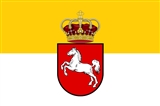
Kingdom of Hanover

Encyclopedia
The Kingdom of Hanover was established in October 1814 by the Congress of Vienna
, with the restoration of George III
to his Hanoverian territories after the Napoleonic era
. It succeeded the former Electorate of Brunswick-Lüneburg (known informally as the Electorate of Hanover), and joined with 38 other sovereign states in the German Confederation
. The Kingdom was ruled by the House of Hanover
, in personal union
with the United Kingdom of Great Britain and Ireland
until 1837, before being conquered by Prussia
in 1866. Briefly revived as the State of Hanover in 1946, the state was subsequently merged with some smaller states to form the current state of Lower Saxony
.
; before being elevated into an electorate
in 1708. Hanover was formed by the union of several dynastic divisions of the Duchy of Brunswick-Lüneburg
, with the sole exception of the principality of Brunswick-Wolfenbüttel
.
Between 1714 and 1837 it was joined in a personal union
, first with the Kingdom of Great Britain
and the Kingdom of Ireland
, and then, from 1801, with the United Kingdom of Great Britain and Ireland
. In 1803 the electorate was occupied by French and Prussian troops, and following the Treaties of Tilsit
in 1807, its territories together with territories ceded from Prussia was created into the Kingdom of Westphalia
ruled by Napoleon
's brother Jérôme Bonaparte
. French control lasted until October 1813 when the territory was overrun by Russian cossack troops, and the Battle of the Nations
at Leipzig later the same month spelled the definitive end to the Napoleonic client state as well as the entire Confederation of the Rhine
, after which the House of Hanover
was restored as rulers.
The Prince-Electors, formerly vassals within the Holy Roman Empire
, were elevated to monarchs of an independent kingdom at the Congress of Vienna
in 1814. This was conducted under the supervision and advice of Baron Münster
, head of the German Chancery
in London
.
During the British Regency and the reigns of the kings George IV
and later William
, their younger brother Prince Adolphus, Duke of Cambridge
officiated as Viceroy
of Hanover (1816–37), representing the King usually living in England. When Adolphus's niece, Queen Victoria, daughter of his late elder brother Prince Edward, Duke of Kent and Strathearn, succeeded to the British Throne on 20 June 1837, the 123-year personal union of the crowns of Great Britain (or the United Kingdom of Great Britain and Ireland from 1801, respectively) and Hanover (or the Electorate of Brunswick-Lüneburg before 1814, respectively) ended. Salic law
, which requires succession by exclusively male inheritance, operated in Hanover but not in Great Britain; Victoria could not become Queen of Hanover. Adolphus's other elder brother, therefore, became King as Ernest Augustus I of Hanover
and Adolphus returned to Britain.
During the Austro-Prussian War
(1866), Hanover attempted to maintain a neutral position, along with some other member states of the German Confederation
. Hanover's vote in favor of the mobilisation of Confederation troops against Prussia on 14 June 1866 prompted Prussia to declare war. The outcome of the war led to the dissolution of Hanover as an independent kingdom and it was annexed by Prussia, where it became the Province of Hanover
. The German-Hanoverian Party, which at times supported secession from the Reich
, demanded a separate status for the province in the Reichstag. The party existed up until it was banned by the Nazi government. After George V
fled Hanover, he raised forces loyal to him in the Netherlands
called the Guelphic Legion
. They were eventually disbanded in 1870.
, played a central role when the state of Lower Saxony
was founded just a few months later by merging Hanover with several smaller states. The state of Lower Saxony continues to use the Hanover coat of arms.
church was the state church
of the Kingdom of Hanover with the King being (Supreme Governor of the Lutheran Church). Regional consistories supervised church and clergy. These were in Aurich
, a simultaneously Lutheran and Calvinist
consistory dominated by Lutherans (for East Frisia
) and the Lutheran consistories in Hanover
(for the former Electorate of Brunswick-Lüneburg proper), in Ilfeld
(for the County of Hohenstein, a Hanoverian exclave in the Eastern Harz
mountains), in Osnabrück
(for the former Prince-Bishopric of Osnabrück
), in Otterndorf
(existed 1535–1885 for the Land of Hadeln) as well as in Stade
(existed 1650–1903, until 1885 for the former Bremen-Verden
proper without Hadeln, then including the complete Stade region
). A general superintendent
chaired each consistory.
In 1848, the Lutheran parishes were democratized by the introduction of presbyteries , elected by all major male parishioners and chairing each congregation in co-operation with the pastor
, being before the sole chairman. This introduction of presbyteries was somewhat revolutionary in the rather hierarchically structured Lutheran church. In 1864, Carl Lichtenberg, Hanoverian minister of education, cultural and religious affairs (1862–65), persuaded the Ständeversammlung (lit. , the Hanoverian parliament) to pass a new law as to the constitution of the Lutheran church. The constitution provided a state synod
(parishioners' parliament). But its first session only materialised in 1869 when, after the 1866 Prussian
annexation of the Kingdom of Hanover, the Hanoverian Lutherans desired a representative body separate from Prussian rule, though it was restricted to Lutheran matters only.
After the Prussian conquest in 1866, on 19 September 1866, the day before the official Prussian annexation took place and with the last , King George V of Hanover
, in exile, the Kingdom's six consistories joined to form today's still-existing church body (Lutheran State Church of Hanover). An all-Hanoverian consistory, the (state consistory), was formed with representatives from the regional consistories.
While the Calvinist
congregations in formerly-Prussian East Frisia had a common roof organization with the Lutherans there ("Coetus") and the Reformed Church
in the former County of Bentheim, then being the state church, had fully established church bodies for Bentheim only , the Calvinist congregations elsewhere in Hanover were in a somewhat sorry state. Though some Calvinist congregations of Huguenot
origin were organized in the Lower Saxon Confederation . The Lutheran church being the state church of Hanover also supervised the Calvinist diaspora
parishes outside East Frisia and Bentheim. In 1848 the new Hanoverian law also provided for presbyteries in these Calvinist parishes, which exactly fit the presbyterian structure of Calvinism.
Catholic
s formed an overall minority in Hanover, but regionally majorities in the former prince-bishoprics. By the annexations in 1803 and 1814 Hanover had become a state of three Christian denominations. In 1824 Hanover and the Holy See
thus agreed to integrate diaspora parishes which were located in prevailingly Protestant areas, until then supervised by the Roman Catholic Vicariate Apostolic of the Nordic Missions, into the existing dioceses of the former prince-bishoprics, whose diocesan territories were thus extended into the diaspora areas.
Jews
lived all over Hanover in diaspora
. Until 1806, they were not allowed to reside in some areas. By the Westphalian
and French
annexations in 1807 and 1810 all male inhabitants in later restituted Hanover became Westphalian or French citizens of equal rights, though on 17 March 1808 Napoléon Bonaparte
restricted the rights of Jews in the French-annexed territory by his so-called . The Jewish congregations became subject to the French or Westphalian Jewish Consistory
, respectively. When Hanover resumed independence and sovereignty in 1813 its government deprived the Jews their legal equality. Arguing it was the French or Westphalian state and not Hanover, which had emancipated the Jews
, the government took the decisions of the German Confederation
on the rights of the Jews, in Johann Smidt
's manipulated formulation, as the legal grounds.
In 1842, Hanover finally granted equal rights to Jews and promoted to build up Jewish congregations, where this did not already happen earlier, and a superstructure of four regional land-rabbinates. In many diaspora areas Jews regarded this a progress and a burden alike, because of the implied financial burden for rabbi
ns and religion teacher, synagogue
s or schools
. The local authorities now requested that the Jewish congregations establish synagogues and Jewish education for the pupils. The land-rabbins, chairing the land-rabbinates, simultaneously fulfilled religious and state functions, like supervising Jewish elementary schools and the teaching of Jewish religion in all schools. The Kingdom of Hanover was thus one of the few states within the German Confederation
, where rabbins held a similar semi-state authoritative position as to Jews as did, e.g., Lutheran clergy towards Lutherans.
was restored to his Hanoverian territories, and in October 1814 they were constituted as the independent Kingdom of Hanover at the Congress of Vienna
. The personal union
with the United Kingdom ended in 1837 on the accession of Queen Victoria because the succession laws in Hanover, based on Salic law
, prevented a female inheriting the title if there was any surviving male heir (in the United Kingdom, a male takes precedence only over his own sisters). In the Austro-Prussian War
of 1866, Hanover was annexed by Prussia
and became the latter's Province of Hanover
.
, in which Hanover increased its area substantially, gaining the Bishopric of Hildesheim
, East Frisia
, the Lower County of Lingen and the northern part of the Prince-Bishopric of Münster. It gained territories, partially ruled earlier in personal union, such as the Duchies of Bremen-Verden
and partially ruled by others, to whit the County of Bentheim. It lost those parts of Saxe-Lauenburg to the northeast of the Elbe
, which was assigned in personal union to Denmark
, except the Amt Neuhaus
. Further small exclaves in the east were lost.
Hanover thus comprised a number of territories, which had been Imperial Estates within the Holy Roman Empire
. Their respective governments, now called provincial governments, were organised according to partially very old traditions, including different levels of estate
participation in rule. In 1823 the kingdom was reorganised into high-bailiwicks , each led by a high-bailiff according to unitary standards, thus doing away with the inherited provincial peculiarities.
The high-bailiwicks were subdivided into bailiwicks , presided by a bailiff . The high-bailiwicks, named after their capitals, were the following:
The Hanoverian subdivisions into high-bailiwicks and bailiwicks remained unchanged until 1 April 1885, when they were replaced by Prussian-style provinces and districts (Kreise).
Congress of Vienna
The Congress of Vienna was a conference of ambassadors of European states chaired by Klemens Wenzel von Metternich, and held in Vienna from September, 1814 to June, 1815. The objective of the Congress was to settle the many issues arising from the French Revolutionary Wars, the Napoleonic Wars,...
, with the restoration of George III
George III of the United Kingdom
George III was King of Great Britain and King of Ireland from 25 October 1760 until the union of these two countries on 1 January 1801, after which he was King of the United Kingdom of Great Britain and Ireland until his death...
to his Hanoverian territories after the Napoleonic era
Napoleonic Wars
The Napoleonic Wars were a series of wars declared against Napoleon's French Empire by opposing coalitions that ran from 1803 to 1815. As a continuation of the wars sparked by the French Revolution of 1789, they revolutionised European armies and played out on an unprecedented scale, mainly due to...
. It succeeded the former Electorate of Brunswick-Lüneburg (known informally as the Electorate of Hanover), and joined with 38 other sovereign states in the German Confederation
German Confederation
The German Confederation was the loose association of Central European states created by the Congress of Vienna in 1815 to coordinate the economies of separate German-speaking countries. It acted as a buffer between the powerful states of Austria and Prussia...
. The Kingdom was ruled by the House of Hanover
House of Hanover
The House of Hanover is a deposed German royal dynasty which has ruled the Duchy of Brunswick-Lüneburg , the Kingdom of Hanover, the Kingdom of Great Britain, the Kingdom of Ireland and the United Kingdom of Great Britain and Ireland...
, in personal union
Personal union
A personal union is the combination by which two or more different states have the same monarch while their boundaries, their laws and their interests remain distinct. It should not be confused with a federation which is internationally considered a single state...
with the United Kingdom of Great Britain and Ireland
United Kingdom of Great Britain and Ireland
The United Kingdom of Great Britain and Ireland was the formal name of the United Kingdom during the period when what is now the Republic of Ireland formed a part of it....
until 1837, before being conquered by Prussia
Prussia
Prussia was a German kingdom and historic state originating out of the Duchy of Prussia and the Margraviate of Brandenburg. For centuries, the House of Hohenzollern ruled Prussia, successfully expanding its size by way of an unusually well-organized and effective army. Prussia shaped the history...
in 1866. Briefly revived as the State of Hanover in 1946, the state was subsequently merged with some smaller states to form the current state of Lower Saxony
Lower Saxony
Lower Saxony is a German state situated in north-western Germany and is second in area and fourth in population among the sixteen states of Germany...
.
History
The territory of Hanover had earlier been a Principality within the Holy Roman EmpireHoly Roman Empire
The Holy Roman Empire was a realm that existed from 962 to 1806 in Central Europe.It was ruled by the Holy Roman Emperor. Its character changed during the Middle Ages and the Early Modern period, when the power of the emperor gradually weakened in favour of the princes...
; before being elevated into an electorate
Prince-elector
The Prince-electors of the Holy Roman Empire were the members of the electoral college of the Holy Roman Empire, having the function of electing the Roman king or, from the middle of the 16th century onwards, directly the Holy Roman Emperor.The heir-apparent to a prince-elector was known as an...
in 1708. Hanover was formed by the union of several dynastic divisions of the Duchy of Brunswick-Lüneburg
Brunswick-Lüneburg
The Duchy of Brunswick-Lüneburg , or more properly Duchy of Brunswick and Lüneburg, was an historical ducal state from the late Middle Ages until the late Early Modern era within the North-Western domains of the Holy Roman Empire of the German Nation, in what is now northern Germany...
, with the sole exception of the principality of Brunswick-Wolfenbüttel
Principality of Brunswick-Wolfenbüttel
The Principality of Brunswick-Wolfenbüttel was a subdivision of the Duchy of Brunswick-Lüneburg, whose history was characterised by numerous divisions and reunifications. Various dynastic lines of the House of Welf ruled Brunswick-Wolfenbüttel until the dissolution of the Holy Roman Empire in 1806...
.
Between 1714 and 1837 it was joined in a personal union
Personal union
A personal union is the combination by which two or more different states have the same monarch while their boundaries, their laws and their interests remain distinct. It should not be confused with a federation which is internationally considered a single state...
, first with the Kingdom of Great Britain
Kingdom of Great Britain
The former Kingdom of Great Britain, sometimes described as the 'United Kingdom of Great Britain', That the Two Kingdoms of Scotland and England, shall upon the 1st May next ensuing the date hereof, and forever after, be United into One Kingdom by the Name of GREAT BRITAIN. was a sovereign...
and the Kingdom of Ireland
Kingdom of Ireland
The Kingdom of Ireland refers to the country of Ireland in the period between the proclamation of Henry VIII as King of Ireland by the Crown of Ireland Act 1542 and the Act of Union in 1800. It replaced the Lordship of Ireland, which had been created in 1171...
, and then, from 1801, with the United Kingdom of Great Britain and Ireland
United Kingdom of Great Britain and Ireland
The United Kingdom of Great Britain and Ireland was the formal name of the United Kingdom during the period when what is now the Republic of Ireland formed a part of it....
. In 1803 the electorate was occupied by French and Prussian troops, and following the Treaties of Tilsit
Treaties of Tilsit
The Treaties of Tilsit were two agreements signed by Napoleon I of France in the town of Tilsit in July, 1807 in the aftermath of his victory at Friedland. The first was signed on 7 July, between Tsar Alexander I of Russia and Napoleon I of France, when they met on a raft in the middle of the Neman...
in 1807, its territories together with territories ceded from Prussia was created into the Kingdom of Westphalia
Kingdom of Westphalia
The Kingdom of Westphalia was a new country of 2.6 million Germans that existed from 1807-1813. It included of territory in Hesse and other parts of present-day Germany. While formally independent, it was a vassal state of the First French Empire, ruled by Napoleon's brother Jérôme Bonaparte...
ruled by Napoleon
Napoleon I
Napoleon Bonaparte was a French military and political leader during the latter stages of the French Revolution.As Napoleon I, he was Emperor of the French from 1804 to 1815...
's brother Jérôme Bonaparte
Jérôme Bonaparte
Jérôme-Napoléon Bonaparte, French Prince, King of Westphalia, 1st Prince of Montfort was the youngest brother of Napoleon, who made him king of Westphalia...
. French control lasted until October 1813 when the territory was overrun by Russian cossack troops, and the Battle of the Nations
Battle of Leipzig
The Battle of Leipzig or Battle of the Nations, on 16–19 October 1813, was fought by the coalition armies of Russia, Prussia, Austria and Sweden against the French army of Napoleon. Napoleon's army also contained Polish and Italian troops as well as Germans from the Confederation of the Rhine...
at Leipzig later the same month spelled the definitive end to the Napoleonic client state as well as the entire Confederation of the Rhine
Confederation of the Rhine
The Confederation of the Rhine was a confederation of client states of the First French Empire. It was formed initially from 16 German states by Napoleon after he defeated Austria's Francis II and Russia's Alexander I in the Battle of Austerlitz. The Treaty of Pressburg, in effect, led to the...
, after which the House of Hanover
House of Hanover
The House of Hanover is a deposed German royal dynasty which has ruled the Duchy of Brunswick-Lüneburg , the Kingdom of Hanover, the Kingdom of Great Britain, the Kingdom of Ireland and the United Kingdom of Great Britain and Ireland...
was restored as rulers.
The Prince-Electors, formerly vassals within the Holy Roman Empire
Holy Roman Empire
The Holy Roman Empire was a realm that existed from 962 to 1806 in Central Europe.It was ruled by the Holy Roman Emperor. Its character changed during the Middle Ages and the Early Modern period, when the power of the emperor gradually weakened in favour of the princes...
, were elevated to monarchs of an independent kingdom at the Congress of Vienna
Congress of Vienna
The Congress of Vienna was a conference of ambassadors of European states chaired by Klemens Wenzel von Metternich, and held in Vienna from September, 1814 to June, 1815. The objective of the Congress was to settle the many issues arising from the French Revolutionary Wars, the Napoleonic Wars,...
in 1814. This was conducted under the supervision and advice of Baron Münster
Ernst zu Münster
Count Ernst Friedrich Herbert zu Münster was a German statesman, politician and minister in the service of the House of Hanover....
, head of the German Chancery
German Chancery
The German Chancery was the official name given to the office of the Hanoverian ministry in London during the years of personal union between Great Britain and the Electorate of Hanover from 1714 until 1837...
in London
London
London is the capital city of :England and the :United Kingdom, the largest metropolitan area in the United Kingdom, and the largest urban zone in the European Union by most measures. Located on the River Thames, London has been a major settlement for two millennia, its history going back to its...
.
During the British Regency and the reigns of the kings George IV
George IV of the United Kingdom
George IV was the King of the United Kingdom of Great Britain and Ireland and also of Hanover from the death of his father, George III, on 29 January 1820 until his own death ten years later...
and later William
William IV of the United Kingdom
William IV was King of the United Kingdom of Great Britain and Ireland and of Hanover from 26 June 1830 until his death...
, their younger brother Prince Adolphus, Duke of Cambridge
Prince Adolphus, Duke of Cambridge
The Prince Adolphus, 1st Duke of Cambridge , was the tenth child and seventh son of George III and Queen Charlotte. He held the title of Duke of Cambridge from 1801 until his death. He also served as Viceroy of Hanover on behalf of his brothers George IV and William IV...
officiated as Viceroy
Viceroy
A viceroy is a royal official who runs a country, colony, or province in the name of and as representative of the monarch. The term derives from the Latin prefix vice-, meaning "in the place of" and the French word roi, meaning king. A viceroy's province or larger territory is called a viceroyalty...
of Hanover (1816–37), representing the King usually living in England. When Adolphus's niece, Queen Victoria, daughter of his late elder brother Prince Edward, Duke of Kent and Strathearn, succeeded to the British Throne on 20 June 1837, the 123-year personal union of the crowns of Great Britain (or the United Kingdom of Great Britain and Ireland from 1801, respectively) and Hanover (or the Electorate of Brunswick-Lüneburg before 1814, respectively) ended. Salic law
Salic law
Salic law was a body of traditional law codified for governing the Salian Franks in the early Middle Ages during the reign of King Clovis I in the 6th century...
, which requires succession by exclusively male inheritance, operated in Hanover but not in Great Britain; Victoria could not become Queen of Hanover. Adolphus's other elder brother, therefore, became King as Ernest Augustus I of Hanover
Ernest Augustus I of Hanover
Ernest Augustus I was King of Hanover from 20 June 1837 until his death. He was the fifth son and eighth child of George III, who reigned in both the United Kingdom and Hanover...
and Adolphus returned to Britain.
During the Austro-Prussian War
Austro-Prussian War
The Austro-Prussian War was a war fought in 1866 between the German Confederation under the leadership of the Austrian Empire and its German allies on one side and the Kingdom of Prussia with its German allies and Italy on the...
(1866), Hanover attempted to maintain a neutral position, along with some other member states of the German Confederation
German Confederation
The German Confederation was the loose association of Central European states created by the Congress of Vienna in 1815 to coordinate the economies of separate German-speaking countries. It acted as a buffer between the powerful states of Austria and Prussia...
. Hanover's vote in favor of the mobilisation of Confederation troops against Prussia on 14 June 1866 prompted Prussia to declare war. The outcome of the war led to the dissolution of Hanover as an independent kingdom and it was annexed by Prussia, where it became the Province of Hanover
Province of Hanover
The Province of Hanover was a province of the Kingdom of Prussia and the Free State of Prussia from 1868 to 1946.During the Austro-Prussian War, the Kingdom of Hanover had attempted to maintain a neutral position, along with some other member states of the German Confederation...
. The German-Hanoverian Party, which at times supported secession from the Reich
Reich
Reich is a German word cognate with the English rich, but also used to designate an empire, realm, or nation. The qualitative connotation from the German is " sovereign state." It is the word traditionally used for a variety of sovereign entities, including Germany in many periods of its history...
, demanded a separate status for the province in the Reichstag. The party existed up until it was banned by the Nazi government. After George V
George V of Hanover
George V was King of Hanover, the only child of Ernest Augustus I, and a grandchild of King George III of the United Kingdom. In the peerage of Great Britain, he was 2nd Duke of Cumberland and Teviotdale, 2nd Earl of Armagh...
fled Hanover, he raised forces loyal to him in the Netherlands
Netherlands
The Netherlands is a constituent country of the Kingdom of the Netherlands, located mainly in North-West Europe and with several islands in the Caribbean. Mainland Netherlands borders the North Sea to the north and west, Belgium to the south, and Germany to the east, and shares maritime borders...
called the Guelphic Legion
Guelphic Legion
The Guelphic Legion was a Hanoverian paramilitary unit maintained by at the expense of George V, claimant to the throne of Hanover from 1866 to 1870. In the fall of 1866, a large number of Hanoverian soldiers left Hanover for Holland at the behest of King George V and his newly established court...
. They were eventually disbanded in 1870.
Revival and modern history
In 1946, Hanover was revived as a state, named the State of Hanover. The state saw itself in the tradition of the kingdom. Its Prime Minister, Hinrich Wilhelm KopfHinrich Wilhelm Kopf
thumb|right|Hinrich Wilhelm Kopf 1948Hinrich Wilhelm Kopf was a German politician, who served as Prime Minister of Lower Saxony from 1946 to 1955 and from 1959 to 1961...
, played a central role when the state of Lower Saxony
Lower Saxony
Lower Saxony is a German state situated in north-western Germany and is second in area and fourth in population among the sixteen states of Germany...
was founded just a few months later by merging Hanover with several smaller states. The state of Lower Saxony continues to use the Hanover coat of arms.
Reorganisation of religious bodies in Hanover
The LutheranLutheranism
Lutheranism is a major branch of Western Christianity that identifies with the theology of Martin Luther, a German reformer. Luther's efforts to reform the theology and practice of the church launched the Protestant Reformation...
church was the state church
State church
State churches are organizational bodies within a Christian denomination which are given official status or operated by a state.State churches are not necessarily national churches in the ethnic sense of the term, but the two concepts may overlap in the case of a nation state where the state...
of the Kingdom of Hanover with the King being (Supreme Governor of the Lutheran Church). Regional consistories supervised church and clergy. These were in Aurich
Aurich
Aurich is a town in Lower Saxony, Germany. It is the capital of the district of Aurich.-History:The history of Aurich dates back to the 13th century, when the settlement of Aurechove was mentioned in a Frisian document called the Brokmerbrief in 1276. In 1517, Count Edzard from the house of...
, a simultaneously Lutheran and Calvinist
Calvinism
Calvinism is a Protestant theological system and an approach to the Christian life...
consistory dominated by Lutherans (for East Frisia
East Frisia
East Frisia or Eastern Friesland is a coastal region in the northwest of the German federal state of Lower Saxony....
) and the Lutheran consistories in Hanover
Hanover
Hanover or Hannover, on the river Leine, is the capital of the federal state of Lower Saxony , Germany and was once by personal union the family seat of the Hanoverian Kings of Great Britain, under their title as the dukes of Brunswick-Lüneburg...
(for the former Electorate of Brunswick-Lüneburg proper), in Ilfeld
Ilfeld
Ilfeld is a municipality in the district of Nordhausen, in Thuringia, Germany. It is situated at the south foot of the Harz, at the entrance to the Bährethal, north from Nordhausen by the railway to Wernigerode.-Establishments in 1911:...
(for the County of Hohenstein, a Hanoverian exclave in the Eastern Harz
Harz
The Harz is the highest mountain range in northern Germany and its rugged terrain extends across parts of Lower Saxony, Saxony-Anhalt and Thuringia. The name Harz derives from the Middle High German word Hardt or Hart , latinized as Hercynia. The legendary Brocken is the highest summit in the Harz...
mountains), in Osnabrück
Osnabrück
Osnabrück is a city in Lower Saxony, Germany, some 80 km NNE of Dortmund, 45 km NE of Münster, and some 100 km due west of Hanover. It lies in a valley penned between the Wiehen Hills and the northern tip of the Teutoburg Forest...
(for the former Prince-Bishopric of Osnabrück
Prince-Bishopric of Osnabrück
The Prince-Bishopric of Osnabrück was a prince-bishopric centred on the Roman Catholic Diocese of Osnabrück. The diocese was erected in 772 and is the oldest see founded by Charlemagne, in order to Christianize the conquered stem-duchy of Saxony....
), in Otterndorf
Otterndorf
Otterndorf is a town on the coast of the North Sea in the region of Lower Saxony, Germany, and is part of the Samtgemeinde Land Hadeln . The town is at the mouth of the river Medem on part of the Elbe delta in the district Cuxhaven...
(existed 1535–1885 for the Land of Hadeln) as well as in Stade
Stade
Stade is a city in Lower Saxony, Germany and part of the Hamburg Metropolitan Region . It is the seat of the district named after it...
(existed 1650–1903, until 1885 for the former Bremen-Verden
Bremen-Verden
Bremen-Verden, formally the Duchies of Bremen and Verden , were two territories and immediate fiefs of the Holy Roman Empire, which emerged and gained Imperial immediacy in 1180...
proper without Hadeln, then including the complete Stade region
Stade (region)
The Stade Region emerged in 1823 by an administrative reorganisation of the dominions of the Kingdom of Hanover, a sovereign state, whose then territory is almost completely part of today's German federal state of Lower Saxony...
). A general superintendent
Superintendent (ecclesiastical)
Superintendent is the head of an administrative division of a Protestant church, largely historical but still in use in Germany.- Superintendents in Sweden :...
chaired each consistory.
In 1848, the Lutheran parishes were democratized by the introduction of presbyteries , elected by all major male parishioners and chairing each congregation in co-operation with the pastor
Pastor
The word pastor usually refers to an ordained leader of a Christian congregation. When used as an ecclesiastical styling or title, this role may be abbreviated to "Pr." or often "Ps"....
, being before the sole chairman. This introduction of presbyteries was somewhat revolutionary in the rather hierarchically structured Lutheran church. In 1864, Carl Lichtenberg, Hanoverian minister of education, cultural and religious affairs (1862–65), persuaded the Ständeversammlung (lit. , the Hanoverian parliament) to pass a new law as to the constitution of the Lutheran church. The constitution provided a state synod
Synod
A synod historically is a council of a church, usually convened to decide an issue of doctrine, administration or application. In modern usage, the word often refers to the governing body of a particular church, whether its members are meeting or not...
(parishioners' parliament). But its first session only materialised in 1869 when, after the 1866 Prussian
Kingdom of Prussia
The Kingdom of Prussia was a German kingdom from 1701 to 1918. Until the defeat of Germany in World War I, it comprised almost two-thirds of the area of the German Empire...
annexation of the Kingdom of Hanover, the Hanoverian Lutherans desired a representative body separate from Prussian rule, though it was restricted to Lutheran matters only.
After the Prussian conquest in 1866, on 19 September 1866, the day before the official Prussian annexation took place and with the last , King George V of Hanover
George V of Hanover
George V was King of Hanover, the only child of Ernest Augustus I, and a grandchild of King George III of the United Kingdom. In the peerage of Great Britain, he was 2nd Duke of Cumberland and Teviotdale, 2nd Earl of Armagh...
, in exile, the Kingdom's six consistories joined to form today's still-existing church body (Lutheran State Church of Hanover). An all-Hanoverian consistory, the (state consistory), was formed with representatives from the regional consistories.
While the Calvinist
Calvinism
Calvinism is a Protestant theological system and an approach to the Christian life...
congregations in formerly-Prussian East Frisia had a common roof organization with the Lutherans there ("Coetus") and the Reformed Church
Reformed churches
The Reformed churches are a group of Protestant denominations characterized by Calvinist doctrines. They are descended from the Swiss Reformation inaugurated by Huldrych Zwingli but developed more coherently by Martin Bucer, Heinrich Bullinger and especially John Calvin...
in the former County of Bentheim, then being the state church, had fully established church bodies for Bentheim only , the Calvinist congregations elsewhere in Hanover were in a somewhat sorry state. Though some Calvinist congregations of Huguenot
Huguenot
The Huguenots were members of the Protestant Reformed Church of France during the 16th and 17th centuries. Since the 17th century, people who formerly would have been called Huguenots have instead simply been called French Protestants, a title suggested by their German co-religionists, the...
origin were organized in the Lower Saxon Confederation . The Lutheran church being the state church of Hanover also supervised the Calvinist diaspora
Diaspora
A diaspora is "the movement, migration, or scattering of people away from an established or ancestral homeland" or "people dispersed by whatever cause to more than one location", or "people settled far from their ancestral homelands".The word has come to refer to historical mass-dispersions of...
parishes outside East Frisia and Bentheim. In 1848 the new Hanoverian law also provided for presbyteries in these Calvinist parishes, which exactly fit the presbyterian structure of Calvinism.
Catholic
Catholic
The word catholic comes from the Greek phrase , meaning "on the whole," "according to the whole" or "in general", and is a combination of the Greek words meaning "about" and meaning "whole"...
s formed an overall minority in Hanover, but regionally majorities in the former prince-bishoprics. By the annexations in 1803 and 1814 Hanover had become a state of three Christian denominations. In 1824 Hanover and the Holy See
Holy See
The Holy See is the episcopal jurisdiction of the Catholic Church in Rome, in which its Bishop is commonly known as the Pope. It is the preeminent episcopal see of the Catholic Church, forming the central government of the Church. As such, diplomatically, and in other spheres the Holy See acts and...
thus agreed to integrate diaspora parishes which were located in prevailingly Protestant areas, until then supervised by the Roman Catholic Vicariate Apostolic of the Nordic Missions, into the existing dioceses of the former prince-bishoprics, whose diocesan territories were thus extended into the diaspora areas.
Jews
Jews
The Jews , also known as the Jewish people, are a nation and ethnoreligious group originating in the Israelites or Hebrews of the Ancient Near East. The Jewish ethnicity, nationality, and religion are strongly interrelated, as Judaism is the traditional faith of the Jewish nation...
lived all over Hanover in diaspora
Jewish diaspora
The Jewish diaspora is the English term used to describe the Galut גלות , or 'exile', of the Jews from the region of the Kingdom of Judah and Roman Iudaea and later emigration from wider Eretz Israel....
. Until 1806, they were not allowed to reside in some areas. By the Westphalian
Kingdom of Westphalia
The Kingdom of Westphalia was a new country of 2.6 million Germans that existed from 1807-1813. It included of territory in Hesse and other parts of present-day Germany. While formally independent, it was a vassal state of the First French Empire, ruled by Napoleon's brother Jérôme Bonaparte...
and French
First French Empire
The First French Empire , also known as the Greater French Empire or Napoleonic Empire, was the empire of Napoleon I of France...
annexations in 1807 and 1810 all male inhabitants in later restituted Hanover became Westphalian or French citizens of equal rights, though on 17 March 1808 Napoléon Bonaparte
Napoleon I
Napoleon Bonaparte was a French military and political leader during the latter stages of the French Revolution.As Napoleon I, he was Emperor of the French from 1804 to 1815...
restricted the rights of Jews in the French-annexed territory by his so-called . The Jewish congregations became subject to the French or Westphalian Jewish Consistory
Consistory (Judaism)
In Jewish usage, a consistory is a body governing the Jewish congregations of a province or of a country; also the district administered by the consistory...
, respectively. When Hanover resumed independence and sovereignty in 1813 its government deprived the Jews their legal equality. Arguing it was the French or Westphalian state and not Hanover, which had emancipated the Jews
Jewish Emancipation
Jewish emancipation was the external and internal process of freeing the Jewish people of Europe, including recognition of their rights as equal citizens, and the formal granting of citizenship as individuals; it occurred gradually between the late 18th century and the early 20th century...
, the government took the decisions of the German Confederation
German Confederation
The German Confederation was the loose association of Central European states created by the Congress of Vienna in 1815 to coordinate the economies of separate German-speaking countries. It acted as a buffer between the powerful states of Austria and Prussia...
on the rights of the Jews, in Johann Smidt
Johann Smidt
Johann Smidt was an important Bremen politician, theologian, and founder of Bremerhaven.Smidt was a son of the Reformed preacher Johann Smidt sen., pastor at St. Stephen Church in Bremen. Smidt jun. studied theology in Jena, and was one of the founders of the Gesellschaft der freien Männer...
's manipulated formulation, as the legal grounds.
In 1842, Hanover finally granted equal rights to Jews and promoted to build up Jewish congregations, where this did not already happen earlier, and a superstructure of four regional land-rabbinates. In many diaspora areas Jews regarded this a progress and a burden alike, because of the implied financial burden for rabbi
Rabbi
In Judaism, a rabbi is a teacher of Torah. This title derives from the Hebrew word רבי , meaning "My Master" , which is the way a student would address a master of Torah...
ns and religion teacher, synagogue
Synagogue
A synagogue is a Jewish house of prayer. This use of the Greek term synagogue originates in the Septuagint where it sometimes translates the Hebrew word for assembly, kahal...
s or schools
Cheder
A Cheder is a traditional elementary school teaching the basics of Judaism and the Hebrew language.-History:...
. The local authorities now requested that the Jewish congregations establish synagogues and Jewish education for the pupils. The land-rabbins, chairing the land-rabbinates, simultaneously fulfilled religious and state functions, like supervising Jewish elementary schools and the teaching of Jewish religion in all schools. The Kingdom of Hanover was thus one of the few states within the German Confederation
German Confederation
The German Confederation was the loose association of Central European states created by the Congress of Vienna in 1815 to coordinate the economies of separate German-speaking countries. It acted as a buffer between the powerful states of Austria and Prussia...
, where rabbins held a similar semi-state authoritative position as to Jews as did, e.g., Lutheran clergy towards Lutherans.
Kings of Hanover
In 1813, George IIIGeorge III of the United Kingdom
George III was King of Great Britain and King of Ireland from 25 October 1760 until the union of these two countries on 1 January 1801, after which he was King of the United Kingdom of Great Britain and Ireland until his death...
was restored to his Hanoverian territories, and in October 1814 they were constituted as the independent Kingdom of Hanover at the Congress of Vienna
Congress of Vienna
The Congress of Vienna was a conference of ambassadors of European states chaired by Klemens Wenzel von Metternich, and held in Vienna from September, 1814 to June, 1815. The objective of the Congress was to settle the many issues arising from the French Revolutionary Wars, the Napoleonic Wars,...
. The personal union
Personal union
A personal union is the combination by which two or more different states have the same monarch while their boundaries, their laws and their interests remain distinct. It should not be confused with a federation which is internationally considered a single state...
with the United Kingdom ended in 1837 on the accession of Queen Victoria because the succession laws in Hanover, based on Salic law
Salic law
Salic law was a body of traditional law codified for governing the Salian Franks in the early Middle Ages during the reign of King Clovis I in the 6th century...
, prevented a female inheriting the title if there was any surviving male heir (in the United Kingdom, a male takes precedence only over his own sisters). In the Austro-Prussian War
Austro-Prussian War
The Austro-Prussian War was a war fought in 1866 between the German Confederation under the leadership of the Austrian Empire and its German allies on one side and the Kingdom of Prussia with its German allies and Italy on the...
of 1866, Hanover was annexed by Prussia
Kingdom of Prussia
The Kingdom of Prussia was a German kingdom from 1701 to 1918. Until the defeat of Germany in World War I, it comprised almost two-thirds of the area of the German Empire...
and became the latter's Province of Hanover
Province of Hanover
The Province of Hanover was a province of the Kingdom of Prussia and the Free State of Prussia from 1868 to 1946.During the Austro-Prussian War, the Kingdom of Hanover had attempted to maintain a neutral position, along with some other member states of the German Confederation...
.
| Image | Name | Date | Notes |
|---|---|---|---|
 |
George III was mentally unfit during these years, and power was exercised by George, Prince of Wales (the future George IV George IV of the United Kingdom George IV was the King of the United Kingdom of Great Britain and Ireland and also of Hanover from the death of his father, George III, on 29 January 1820 until his own death ten years later... ) according to the British Regency. In Hanover, Prince Adolphus, Duke of Cambridge Prince Adolphus, Duke of Cambridge The Prince Adolphus, 1st Duke of Cambridge , was the tenth child and seventh son of George III and Queen Charlotte. He held the title of Duke of Cambridge from 1801 until his death. He also served as Viceroy of Hanover on behalf of his brothers George IV and William IV... officiated as Viceroy Viceroy A viceroy is a royal official who runs a country, colony, or province in the name of and as representative of the monarch. The term derives from the Latin prefix vice-, meaning "in the place of" and the French word roi, meaning king. A viceroy's province or larger territory is called a viceroyalty... from 1816. |
||
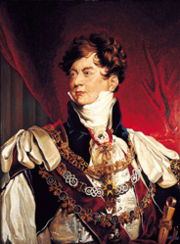 |
Son of predecessor. Regent 1811–1820, represented in Hanover by Viceroy Adolphus. | ||
 |
William William IV of the United Kingdom William IV was King of the United Kingdom of Great Britain and Ireland and of Hanover from 26 June 1830 until his death... |
Brother of predecessor. Last monarch to rule both Hanover and the United Kingdom, represented in Hanover by Viceroy Adolphus. | |
 |
Ernest Augustus Ernest Augustus I of Hanover Ernest Augustus I was King of Hanover from 20 June 1837 until his death. He was the fifth son and eighth child of George III, who reigned in both the United Kingdom and Hanover... |
Brother of predecessor. His accession separated the crowns of Hanover and the United Kingdom, as the latter passed to Queen Victoria. | |
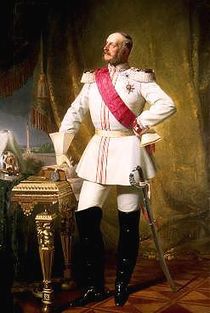 |
Son of predecessor. Lost his territories to Prussia Kingdom of Prussia The Kingdom of Prussia was a German kingdom from 1701 to 1918. Until the defeat of Germany in World War I, it comprised almost two-thirds of the area of the German Empire... in the Austro-Prussian War Austro-Prussian War The Austro-Prussian War was a war fought in 1866 between the German Confederation under the leadership of the Austrian Empire and its German allies on one side and the Kingdom of Prussia with its German allies and Italy on the... . |
Territory and administrative subdivisions
The Congress of Vienna instituted a territorial exchange between Hanover and the Kingdom of PrussiaKingdom of Prussia
The Kingdom of Prussia was a German kingdom from 1701 to 1918. Until the defeat of Germany in World War I, it comprised almost two-thirds of the area of the German Empire...
, in which Hanover increased its area substantially, gaining the Bishopric of Hildesheim
Bishopric of Hildesheim
The Diocese of Hildesheim is a diocese or ecclesiastical territory of the Latin Rite of the Catholic Church in Germany. Founded in 815 as a missionary diocese by King Louis the Pious, his son Louis the German appointed the famous former archbishop of Rheims, Ebbo, as bishop...
, East Frisia
East Frisia
East Frisia or Eastern Friesland is a coastal region in the northwest of the German federal state of Lower Saxony....
, the Lower County of Lingen and the northern part of the Prince-Bishopric of Münster. It gained territories, partially ruled earlier in personal union, such as the Duchies of Bremen-Verden
Bremen-Verden
Bremen-Verden, formally the Duchies of Bremen and Verden , were two territories and immediate fiefs of the Holy Roman Empire, which emerged and gained Imperial immediacy in 1180...
and partially ruled by others, to whit the County of Bentheim. It lost those parts of Saxe-Lauenburg to the northeast of the Elbe
Elbe
The Elbe is one of the major rivers of Central Europe. It rises in the Krkonoše Mountains of the northwestern Czech Republic before traversing much of Bohemia , then Germany and flowing into the North Sea at Cuxhaven, 110 km northwest of Hamburg...
, which was assigned in personal union to Denmark
Denmark
Denmark is a Scandinavian country in Northern Europe. The countries of Denmark and Greenland, as well as the Faroe Islands, constitute the Kingdom of Denmark . It is the southernmost of the Nordic countries, southwest of Sweden and south of Norway, and bordered to the south by Germany. Denmark...
, except the Amt Neuhaus
Amt Neuhaus
Amt Neuhaus is a municipality in the District of Lunenburg , in Lower Saxony, Germany.- History :In the course of the eastern colonisation the area of today's Amt Neuhaus became a part of the Duchy of Saxony...
. Further small exclaves in the east were lost.
Hanover thus comprised a number of territories, which had been Imperial Estates within the Holy Roman Empire
Holy Roman Empire
The Holy Roman Empire was a realm that existed from 962 to 1806 in Central Europe.It was ruled by the Holy Roman Emperor. Its character changed during the Middle Ages and the Early Modern period, when the power of the emperor gradually weakened in favour of the princes...
. Their respective governments, now called provincial governments, were organised according to partially very old traditions, including different levels of estate
Estates of the realm
The Estates of the realm were the broad social orders of the hierarchically conceived society, recognized in the Middle Ages and Early Modern period in Christian Europe; they are sometimes distinguished as the three estates: the clergy, the nobility, and commoners, and are often referred to by...
participation in rule. In 1823 the kingdom was reorganised into high-bailiwicks , each led by a high-bailiff according to unitary standards, thus doing away with the inherited provincial peculiarities.
The high-bailiwicks were subdivided into bailiwicks , presided by a bailiff . The high-bailiwicks, named after their capitals, were the following:
- Aurich, comprising former East Frisia
- HanoverHanover (region)Hanover was a Regierungsbezirk of the Prussian Province of Hanover and of Lower Saxony, Germany, that existed from 1885 until 2004. It was located in the south of the state around the city of Hanover, its capital....
, comprising about the former Principality of Calenberg in the Duchy of Brunswick-Lüneburg - Hildesheim, comprising the former Brunswick-Lüneburg Principality of Grubenhagen and the former Prince-Bishopric of Hildesheim
- LüneburgLüneburg (region)Lüneburg was one of the four Regierungsbezirke of Lower Saxony, Germany, located in the north of the federal state between the three cities Bremen, Hamburg and Hanover....
, comprising the former Brunswick-Lüneburg Principality of LüneburgPrincipality of LüneburgThe Principality of Lüneburg was a territorial division of the Duchy of Brunswick-Lüneburg within the Holy Roman Empire, immediately subordinate to the emperor. It existed from 1269 until 1705 and its territory lay within the modern-day state of Lower Saxony in Germany...
and the remainder of Saxe-Lauenburg areas - Osnabrück, comprising the former County of Bentheim, the former Lower County of Lingen, and the former Prince-Bishopric of OsnabrückPrince-Bishopric of OsnabrückThe Prince-Bishopric of Osnabrück was a prince-bishopric centred on the Roman Catholic Diocese of Osnabrück. The diocese was erected in 772 and is the oldest see founded by Charlemagne, in order to Christianize the conquered stem-duchy of Saxony....
- StadeStade (region)The Stade Region emerged in 1823 by an administrative reorganisation of the dominions of the Kingdom of Hanover, a sovereign state, whose then territory is almost completely part of today's German federal state of Lower Saxony...
, comprising the former Duchies of Bremen-Verden
The Hanoverian subdivisions into high-bailiwicks and bailiwicks remained unchanged until 1 April 1885, when they were replaced by Prussian-style provinces and districts (Kreise).
Coat of arms
After the personal union with Britain ended in 1837, Hanover kept the British Royal Arms and Standards, only introducing a new Crown (after the British model).See also
- King's German LegionKing's German LegionThe King's German Legion was a British Army unit of expatriate German personnel, 1803–16. The Legion achieved the distinction of being the only German force to fight without interruption against the French during the Napoleonic Wars....
- Guelphic LegionGuelphic LegionThe Guelphic Legion was a Hanoverian paramilitary unit maintained by at the expense of George V, claimant to the throne of Hanover from 1866 to 1870. In the fall of 1866, a large number of Hanoverian soldiers left Hanover for Holland at the behest of King George V and his newly established court...
- House of HanoverHouse of HanoverThe House of Hanover is a deposed German royal dynasty which has ruled the Duchy of Brunswick-Lüneburg , the Kingdom of Hanover, the Kingdom of Great Britain, the Kingdom of Ireland and the United Kingdom of Great Britain and Ireland...
- Kleindeutsche Lösung
- State of HanoverState of HanoverThe State of Hanover was a state in Northwest Germany. It existed between the dissolution of the former State of Prussia and the foundation of Lower Saxony in 1946 and saw itself in the tradition of the Kingdom of Hanover, annexed in 1866 by Prussia, as is clear from the state emblems...