


British Whig Party

Encyclopedia
The Whigs were a party in the Parliament of England
, Parliament of Great Britain
, and Parliament of the United Kingdom
, who contested power with the rival Tories from the 1680s to the 1850s. The Whigs' origin lay in constitutional monarchism and opposition to absolute rule
. Both parties began as loose groupings or tendencies, but became quite formal by 1784, with the ascension of Charles James Fox
as the leader of a reconstituted "Whig" party ranged against the governing party of the new "Tories" under William Pitt the Younger
. Both parties were founded on rich politicians, more than on popular votes; there were elections to the House of Commons, but a small number of men controlled most of the voters.
The Whig party slowly evolved during the 18th century. The Whig tendency supported the great aristocratic families
, the Protestant Hanoverian succession and toleration for nonconformist
Protestants (the "dissenter
s," such as Presbyterians), while some Tories supported the exiled Stuart royal family's claim to the throne (Jacobitism
), and virtually all Tories supported the established Church of England
and the gentry
. Later on, the Whigs drew support from the emerging industrial interests and wealthy merchants, while the Tories drew support from the landed interests and the royal family
. The Whigs were originally also known as the "Country Party" (as opposed to the Tories, the "Court Party"). By the first half of the 19th century, however, the Whig political programme came to encompass not only the supremacy of parliament over the monarch
and support for free trade
, but Catholic emancipation, the abolition of slavery
and expansion of the franchise (suffrage
).
to refer derisively to a radical faction of the Scottish Covenanter
s who called themselves the "Kirk Party
" (see the Whiggamore Raid
). It was then applied to Scottish presbyterian rebels who were against the King's episcopalian
order in Scotland. The term 'Whig' entered English political discourse during the Exclusion Bill
crisis of 1678–1681 when there was controversy about whether or not Charles's brother, James, should be allowed to succeed to the throne on Charles's death. 'Whig' was a term of abuse applied to those who wanted to exclude James on the grounds that he was a Roman Catholic. The fervent Tory Samuel Johnson
often cracked that "the first Whig was the Devil."
. They believed the Duke, if allowed to inherit the throne, would endanger the Protestant religion, liberty and property. The first Exclusion Bill was voted by a substantial majority in its second reading in May 1679. In response, King Charles
prorogued Parliament and then dissolved it but the subsequent elections in August and September saw the Whigs' strength increase. This new parliament did not meet for thirteen months because Charles wanted to give the passions a chance to die down. However when it met in October 1680 an Exclusion Bill was introduced and passed without major resistance in the Commons but was rejected in the Lords. Charles dissolved Parliament in January 1681 but the Whigs did not suffer serious losses. This parliament first met in March in Oxford but Charles dissolved it only after a few days when he made an appeal to the country against the Whigs and intended to rule without Parliament. In February Charles had made a deal with the French King Louis XIV
, who promised to support him against the Whigs. Without Parliament, the Whigs gradually crumbled mainly due to the Rye House Plot
, with The Earl of Melville
, The Earl of Leven, Lord Shaftesbury
and the Duke of Monmouth
, Charles II's illegitimate son, both being implicated escaped to the United Provinces
and Algernon Sidney, Sir Thomas Armstrong
and William Russell, Lord Russell
being executed for treason. The Earl of Essex
committed suicide in the Tower of London over his arrest for treason, whilst Lord Grey of Werke
escaped from the Tower.
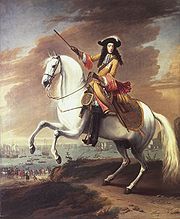 After the Glorious Revolution
of 1688, Queen Mary II
and King William III
governed with both Whigs and Tories, despite the fact that many of the Tories still supported the deposed Roman Catholic James II
. William saw that the Tories were generally friendlier to royal authority than the Whigs, and he employed both groups in his government. His early ministry was largely Tory, but gradually the government came to be dominated by the so-called Junto Whigs
, a group of younger Whig politicians who led a tightly organised political grouping. The increasing dominance of the Junto led to a split among the Whigs, with the so-called "Country Whigs" seeing the Junto as betraying their principles for office. The Country Whigs, led by Robert Harley, gradually merged with the Tory opposition in the later 1690s.
had considerable Tory sympathies and excluded the Junto Whigs from power, after a brief and unsuccessful experiment with an exclusively Tory government she generally continued William's policy of balancing the parties, supported by her moderate Tory ministers, the Duke of Marlborough
and Lord Godolphin
. However, as the War of the Spanish Succession
went on and became less and less popular with the Tories, Marlborough and Godolphin were forced to rely more and more on the Junto Whigs, so that by 1708 they headed an administration dominated by the Junto. Anne herself grew increasingly uncomfortable with this dependence on the Whigs, especially as her personal relationship with the Duchess of Marlborough
deteriorated. This situation also became increasingly uncomfortable to many of the non-Junto Whigs, led by the Duke of Somerset
and the Duke of Shrewsbury
, who began to intrigue with Robert Harley's Tories. In the spring of 1710, Anne dismissed Godolphin and the Junto ministers, replacing them with Tories.
The Whigs now moved into opposition and particularly decried the 1713 Treaty of Utrecht
, which they attempted to block through their majority in the House of Lords
. Anne forced it through by creating new Tory peers.
Ashcraft and Goldsmith (1983) have traced in detail in the period 1689 to 1710 the major influence of the liberal political ideas of John Locke
on Whig political values, as expressed in widely cited manifestos such as "Political Aphorisms: or, the True Maxims of Government Displayed," an anonymous pamphlet that appeared in 1690 and was widely cited by Whigs. The 18th-century Whigs borrowed the concepts and language of universal rights employed by political theorists Locke and Algernon Sidney (1622-82). By the 1770s the ideas of Adam Smith
, a founder of classical liberalism
became important. As Wilson and Reill (2004) note, "Adam Smith's theory melded nicely with the liberal political stance of the Whig Party and its middle-class constituents."
Chapin (1990) argues that Samuel Johnson
(1709-84), a leading London intellectual, repeatedly denigrated the Whigs and praised the Tories. In his great Dictionary (1755) Johnson defined a Tory as "one who adheres to the ancient Constitution of the state and the apostolical hierarchy of the Church of England, opposed to a Whig." He linked 18th-century Whiggism with 17th-century revolutionary Puritanism, arguing that the Whigs of his day were similarly inimical to the established order of church and state. Johnson recommended that strict uniformity in religious externals was the best antidote to the negative religious traits that he linked to Whiggism.
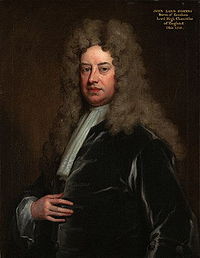 With the succession in 1714 of Elector
George Louis of Hanover
as King George I
, the Whigs returned to government. The Jacobite Uprising of 1715 discredited much of the Tory party as traitorous Jacobites
, and Whig control of the levers of power (e.g., through the Septennial Act
) ensured that the Whigs became the dominant party of government. During the long period between 1714 and 1760, the Tories practically died out as an active political force, although they always retained a considerable presence in the House of Commons. The governments of Robert Walpole
and the Pelhams, Henry Pelham
and his older brother the Duke of Newcastle, between them ruled between 1721 and 1756 with only one brief break and the leading elements referred to themselves as "Whigs".
to power and broke with the old Whig leadership surrounding the Duke of Newcastle. After a decade of factional chaos, with distinct "Grenvillite
", "Bedfordite
", "Rockinghamite
", and "Chathamite
", factions successively in power, and all referring to themselves as "Whigs", a new system emerged with two separate opposition groups. The Rockingham
Whigs claimed the mantle of "Old Whigs", as the purported successors of the party of the Pelhams and the great Whig families. With such noted intellectuals as Edmund Burke
behind them, the Rockingham Whigs laid out a philosophy which for the first time extolled the virtues of faction, or at least their faction. The other group were the followers of Lord Chatham
, who, as the great political hero of the Seven Years' War
, generally took a stance of opposition to party and faction.
The Whigs were opposed by the government of Lord North
, which they accused of being a "Tory" administration, although it largely consisted of individuals previously associated with the Whigs—many old Pelhamites, as well as the Whig faction formerly led by the Duke of Bedford
, and elements of that which had been led by George Grenville
, although it also contained elements of the "Kings' Men", the group formerly associated with Lord Bute and which was generally seen as Tory-leaning.
, and writings of British political commentators known as the Radical Whigs
did much to stimulate colonial republican
sentiment. Early activists in the colonies
called themselves "Whigs", seeing themselves as in alliance with the political opposition in Britain, until they turned to independence and started emphasising the label Patriots
. Later, the United States Whig Party
was founded in 1833, focused on opposition to a strong presidency, just as the British Whigs had opposed a strong monarchy.
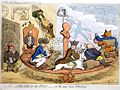 The North administration left power in March 1782 following the American Revolution
, and a coalition of the Rockingham Whigs and the former Chathamites, now led by the Earl of Shelburne
, took its place. After Rockingham's unexpected death in July 1782, this uneasy coalition fell apart, with Charles James Fox
, Rockingham's successor as faction leader, quarrelling with Shelburne and withdrawing his supporters from the government. The following Shelburne administration was short-lived, however, and in April 1783 Fox returned to power, this time in an unexpected coalition with his old enemy Lord North. Although this pairing seemed unnatural to many at the time, it was to last beyond the demise of the coalition in December 1783. The coalition's untimely fall was brought about by George III in league with the House of Lords, and the King now brought in Chatham's son, William Pitt the Younger
, as his prime minister.
It was only now that a genuine two-party system can be seen to emerge, with Pitt and the government on the one side, and the ousted Fox-North coalition on the other. On 17 December 1783, Fox stated in the House of Commons that "If…a change must take place, and a new ministry is to be formed and supported, not by the confidence of this House or the public, but the sole authority of the Crown, I, for one, shall not envy that hon. gentleman his situation. From that moment I put in my claim for a monopoly of Whig principles." Although Pitt is often referred to as a "Tory" and Fox as a "Whig", Pitt always considered himself to be an independent Whig, and generally opposed the development of a strict partisan political system.
Fox's supporters, however, certainly saw themselves as legitimate heirs of the Whig tradition, and they strongly opposed Pitt in his early years in office, notably during the regency crisis revolving around the King's temporary insanity in 1788–1789, when Fox and his allies supported full powers for their ally, the Prince of Wales
, as regent.
The opposition Whigs were split, however, by the onset of the French Revolution
. While Fox and some younger members of the party such as Charles Grey
and Richard Brinsley Sheridan
were sympathetic to the French revolutionaries, others, led by Edmund Burke
, were strongly opposed. Although Burke himself was largely alone in defecting to Pitt in 1791, much of the rest of the party, including the influential House of Lords leader the Duke of Portland, Rockingham's nephew Lord Fitzwilliam
, and William Windham
, were increasingly uncomfortable with the flirtations of Fox and his allies with radicalism and the French Revolution. They split in early 1793 with Fox over the question of support for the war with France, and by the end of the year they had openly broken with Fox. By the summer of the next year, large portions of the opposition had defected and joined Pitt's government.
following Pitt's death in 1806, after 1806 the divisions finally began to harden into clear political parties. The followers of Pitt—led, until 1809, by Fox's old colleague the Duke of Portland—took up proudly the label of "Tories", while Fox's followers—led since Fox's death in 1806 by Lord Grey—retained the label of "Whig". After the fall of the Talents ministry in 1807, the Whigs remained out of power for the better part of 25 years. The accession of Fox's old ally, the Prince of Wales, to the regency in 1811 did not change the situation, as the Prince had broken entirely with his old Whig companions.
, Lord Grenville, Lord Althorp, William Lamb (later Lord Melbourne) and Lord John Russell were all rich landowners. The exception was Henry Brougham, the talented lawyer, who had a relatively modest background.
Hay (2000) argues that in the two decades after the defeat of Napoleon (in 1815), Whig leaders welcomed the increasing political participation of the English middle classes. The fresh support strengthened their position in Parliament. Whigs rejected the Tory appeals to governmental authority and social discipline, and extended political discussion beyond Parliament. Whigs used a national network of newspapers and magazines, as well as local clubs, to deliver their message. The press organized petitions and debates and reported to the public on government policy, while leaders such as Henry Brougham (1778-1868) built alliances with men who lacked direct representation. This new approach to the grass roots helped to define Whiggism and opened the way for later success. Whigs thereby forced the government to recognize the role of public opinion in parliamentary debate and influenced views of representation and reform throughout the 19th century.
prime minister 1830–1834, and the Reform Act 1832
became their signature measure. It broadened the franchise and ended the system of "rotten borough" and "pocket boroughs" (where elections were controlled by powerful families), and instead redistributed power on the basis of population. It added 217,000 voters to an electorate of 435,000 in England and Wales. Only the upper and middle classes voted, so this shifted power away from the landed aristocracy to the urban middle classes. In 1832 the party abolished slavery in the Empire with the Slavery Abolition Act 1833. It purchased and freed the slaves, especially those in the Caribbean sugar islands. After parliamentary investigations demonstrated the horrors of child labour, limited reforms were passed in 1833. Catholic emancipation
was secured in the Catholic Relief Act 1829, which removed the most substantial restrictions on Roman Catholics in Britain. The Whigs also passed the Poor Law Amendment Act 1834
that reformed the administration of relief to the poor.
It was around this time that the great Whig historian Thomas Babington Macaulay began to promulgate what would later be coined the Whig view of history
, in which all of English history was seen as leading up to the culminating moment of the passage of Lord Grey's reform bill. This view led to serious distortions in later portrayals of 17th-century and 18th-century history, as Macaulay and his followers attempted to fit the complex and changing factional politics of the Restoration
into the neat categories of 19th-century political divisions.
(the term was first used officially in 1868 but had been used colloquially for decades beforehand) arose from a coalition of Whigs, free trade
Tory followers of Robert Peel
, and free trade Radical
s, first created, tenuously under the Peelite
Lord Aberdeen
in 1852, and put together more permanently under the former Canningite Tory Lord Palmerston in 1859. Although the Whigs at first formed the most important part of the coalition, the Whiggish elements of the new party progressively lost influence during the long leadership of the Peelite William Ewart Gladstone
, and many of the old Whig aristocrats broke from the party over the issue of Irish home rule in 1886 to help form the Liberal Unionist Party
—which itself would merge with the Conservative Party
by 1912. The Unionist support for (trade) protection in the early twentieth century under Joseph Chamberlain
(probably the least Whiggish character in the party) further alienated the more orthodox Whigs, however, and by the early twentieth century Whiggery was largely irrelevant and without a natural political home.
circa 1900.
The colours of the Whig party were particularly associated with Charles James Fox
. Poet Robert Burns
in "Here's a Health to them that's awa'" wrote:
Buff is a yellow-brown colour, named after buff leather.
Parliament of England
The Parliament of England was the legislature of the Kingdom of England. In 1066, William of Normandy introduced a feudal system, by which he sought the advice of a council of tenants-in-chief and ecclesiastics before making laws...
, Parliament of Great Britain
Parliament of Great Britain
The Parliament of Great Britain was formed in 1707 following the ratification of the Acts of Union by both the Parliament of England and Parliament of Scotland...
, and Parliament of the United Kingdom
Parliament of the United Kingdom
The Parliament of the United Kingdom of Great Britain and Northern Ireland is the supreme legislative body in the United Kingdom, British Crown dependencies and British overseas territories, located in London...
, who contested power with the rival Tories from the 1680s to the 1850s. The Whigs' origin lay in constitutional monarchism and opposition to absolute rule
Absolute monarchy
Absolute monarchy is a monarchical form of government in which the monarch exercises ultimate governing authority as head of state and head of government, his or her power not being limited by a constitution or by the law. An absolute monarch thus wields unrestricted political power over the...
. Both parties began as loose groupings or tendencies, but became quite formal by 1784, with the ascension of Charles James Fox
Charles James Fox
Charles James Fox PC , styled The Honourable from 1762, was a prominent British Whig statesman whose parliamentary career spanned thirty-eight years of the late 18th and early 19th centuries and who was particularly noted for being the arch-rival of William Pitt the Younger...
as the leader of a reconstituted "Whig" party ranged against the governing party of the new "Tories" under William Pitt the Younger
William Pitt the Younger
William Pitt the Younger was a British politician of the late 18th and early 19th centuries. He became the youngest Prime Minister in 1783 at the age of 24 . He left office in 1801, but was Prime Minister again from 1804 until his death in 1806...
. Both parties were founded on rich politicians, more than on popular votes; there were elections to the House of Commons, but a small number of men controlled most of the voters.
The Whig party slowly evolved during the 18th century. The Whig tendency supported the great aristocratic families
Aristocracy
Aristocracy , is a form of government in which a few elite citizens rule. The term derives from the Greek aristokratia, meaning "rule of the best". In origin in Ancient Greece, it was conceived of as rule by the best qualified citizens, and contrasted with monarchy...
, the Protestant Hanoverian succession and toleration for nonconformist
Nonconformism
Nonconformity is the refusal to "conform" to, or follow, the governance and usages of the Church of England by the Protestant Christians of England and Wales.- Origins and use:...
Protestants (the "dissenter
English Dissenters
English Dissenters were Christians who separated from the Church of England in the 16th, 17th and 18th centuries.They originally agitated for a wide reaching Protestant Reformation of the Established Church, and triumphed briefly under Oliver Cromwell....
s," such as Presbyterians), while some Tories supported the exiled Stuart royal family's claim to the throne (Jacobitism
Jacobitism
Jacobitism was the political movement in Britain dedicated to the restoration of the Stuart kings to the thrones of England, Scotland, later the Kingdom of Great Britain, and the Kingdom of Ireland...
), and virtually all Tories supported the established Church of England
Church of England
The Church of England is the officially established Christian church in England and the Mother Church of the worldwide Anglican Communion. The church considers itself within the tradition of Western Christianity and dates its formal establishment principally to the mission to England by St...
and the gentry
Gentry
Gentry denotes "well-born and well-bred people" of high social class, especially in the past....
. Later on, the Whigs drew support from the emerging industrial interests and wealthy merchants, while the Tories drew support from the landed interests and the royal family
British monarchy
The monarchy of the United Kingdom is the constitutional monarchy of the United Kingdom and its overseas territories. The present monarch, Queen Elizabeth II, has reigned since 6 February 1952. She and her immediate family undertake various official, ceremonial and representational duties...
. The Whigs were originally also known as the "Country Party" (as opposed to the Tories, the "Court Party"). By the first half of the 19th century, however, the Whig political programme came to encompass not only the supremacy of parliament over the monarch
Constitutionalism
Constitutionalism has a variety of meanings. Most generally, it is "a complex of ideas, attitudes, and patterns of behavior elaborating the principle that the authority of government derives from and is limited by a body of fundamental law"....
and support for free trade
Free trade
Under a free trade policy, prices emerge from supply and demand, and are the sole determinant of resource allocation. 'Free' trade differs from other forms of trade policy where the allocation of goods and services among trading countries are determined by price strategies that may differ from...
, but Catholic emancipation, the abolition of slavery
Slavery
Slavery is a system under which people are treated as property to be bought and sold, and are forced to work. Slaves can be held against their will from the time of their capture, purchase or birth, and deprived of the right to leave, to refuse to work, or to demand compensation...
and expansion of the franchise (suffrage
Suffrage
Suffrage, political franchise, or simply the franchise, distinct from mere voting rights, is the civil right to vote gained through the democratic process...
).
Name
The term Whig was originally short for 'whiggamor', a term meaning "cattle driver" used to describe western Scots who came to Leith for corn. In the reign of Charles II (1660–85) the term was used during Wars of the Three KingdomsWars of the Three Kingdoms
The Wars of the Three Kingdoms formed an intertwined series of conflicts that took place in England, Ireland, and Scotland between 1639 and 1651 after these three countries had come under the "Personal Rule" of the same monarch...
to refer derisively to a radical faction of the Scottish Covenanter
Covenanter
The Covenanters were a Scottish Presbyterian movement that played an important part in the history of Scotland, and to a lesser extent in that of England and Ireland, during the 17th century...
s who called themselves the "Kirk Party
Kirk Party
The Kirk Party were a radical Presbyterian faction of the Scottish Covenanters during the Wars of the Three Kingdoms. They came to the fore after the defeat of the Engagers faction in 1648 at the hands of Oliver Cromwell and the English Parliament...
" (see the Whiggamore Raid
Whiggamore Raid
The Whiggamore Raid was a march on Edinburgh by supporters of the Kirk party of the Covenanters to take power from the Engagers whose army had recently been defeated by the English New Model Army at the Battle of Preston ....
). It was then applied to Scottish presbyterian rebels who were against the King's episcopalian
Scottish Episcopal Church
The Scottish Episcopal Church is a Christian church in Scotland, consisting of seven dioceses. Since the 17th century, it has had an identity distinct from the presbyterian Church of Scotland....
order in Scotland. The term 'Whig' entered English political discourse during the Exclusion Bill
Exclusion Bill
The Exclusion Crisis ran from 1678 through 1681 in the reign of Charles II of England. The Exclusion Bill sought to exclude the king's brother and heir presumptive, James, Duke of York, from the thrones of England, Scotland and Ireland because he was Roman Catholic...
crisis of 1678–1681 when there was controversy about whether or not Charles's brother, James, should be allowed to succeed to the throne on Charles's death. 'Whig' was a term of abuse applied to those who wanted to exclude James on the grounds that he was a Roman Catholic. The fervent Tory Samuel Johnson
Samuel Johnson
Samuel Johnson , often referred to as Dr. Johnson, was an English author who made lasting contributions to English literature as a poet, essayist, moralist, literary critic, biographer, editor and lexicographer...
often cracked that "the first Whig was the Devil."
Exclusion Crisis
The Whigs, under Lord Shaftesbury's leadership, wished to exclude the Duke of York from the throne due to his personal character, his Catholicism, his favouring of monarchical absolutism, his connections to France and the effects of the Popish PlotPopish Plot
The Popish Plot was a fictitious conspiracy concocted by Titus Oates that gripped England, Wales and Scotland in Anti-Catholic hysteria between 1678 and 1681. Oates alleged that there existed an extensive Catholic conspiracy to assassinate Charles II, accusations that led to the execution of at...
. They believed the Duke, if allowed to inherit the throne, would endanger the Protestant religion, liberty and property. The first Exclusion Bill was voted by a substantial majority in its second reading in May 1679. In response, King Charles
Charles II of England
Charles II was monarch of the three kingdoms of England, Scotland, and Ireland.Charles II's father, King Charles I, was executed at Whitehall on 30 January 1649, at the climax of the English Civil War...
prorogued Parliament and then dissolved it but the subsequent elections in August and September saw the Whigs' strength increase. This new parliament did not meet for thirteen months because Charles wanted to give the passions a chance to die down. However when it met in October 1680 an Exclusion Bill was introduced and passed without major resistance in the Commons but was rejected in the Lords. Charles dissolved Parliament in January 1681 but the Whigs did not suffer serious losses. This parliament first met in March in Oxford but Charles dissolved it only after a few days when he made an appeal to the country against the Whigs and intended to rule without Parliament. In February Charles had made a deal with the French King Louis XIV
Louis XIV of France
Louis XIV , known as Louis the Great or the Sun King , was a Bourbon monarch who ruled as King of France and Navarre. His reign, from 1643 to his death in 1715, began at the age of four and lasted seventy-two years, three months, and eighteen days...
, who promised to support him against the Whigs. Without Parliament, the Whigs gradually crumbled mainly due to the Rye House Plot
Rye House Plot
The Rye House Plot of 1683 was a plan to assassinate King Charles II of England and his brother James, Duke of York. Historians vary in their assessment of the degree to which details of the conspiracy were finalized....
, with The Earl of Melville
George Melville, 1st Earl of Melville
George Melville, 1st Earl of Melville was a Scots aristocrat and statesman during the reigns of William and Mary.In 1643, he succeeded his father as Lord Melville.-Career:...
, The Earl of Leven, Lord Shaftesbury
Anthony Ashley Cooper, 1st Earl of Shaftesbury
Anthony Ashley Cooper, 1st Earl of Shaftesbury PC , known as Anthony Ashley Cooper from 1621 to 1631, as Sir Anthony Ashley Cooper, 2nd Baronet from 1631 to 1661, and as The Lord Ashley from 1661 to 1672, was a prominent English politician during the Interregnum and during the reign of King Charles...
and the Duke of Monmouth
James Scott, 1st Duke of Monmouth
James Scott, 1st Duke of Monmouth, 1st Duke of Buccleuch, KG, PC , was an English nobleman. Originally called James Crofts or James Fitzroy, he was born in Rotterdam in the Netherlands, the eldest illegitimate son of Charles II and his mistress, Lucy Walter...
, Charles II's illegitimate son, both being implicated escaped to the United Provinces
Dutch Republic
The Dutch Republic — officially known as the Republic of the Seven United Netherlands , the Republic of the United Netherlands, or the Republic of the Seven United Provinces — was a republic in Europe existing from 1581 to 1795, preceding the Batavian Republic and ultimately...
and Algernon Sidney, Sir Thomas Armstrong
Sir Thomas Armstrong
Sir Thomas Armstrong was an army officer and MP executed for Treason.During the Interregnum he was a supporter of Charles II, participating in the plot to seize Chester Castle in 1655, and carrying funds from Aubrey de Vere, 20th Earl of Oxford to Charles in exile. He was possibly imprisoned for a...
and William Russell, Lord Russell
William Russell, Lord Russell
William Russell, Lord Russell was an English politician. He was a leading member of the Country Party, forerunners of the Whigs, who opposed the succession of James II during the reign of Charles II, ultimately resulting in his execution for treason.-Early life and marriage:Russell was the third...
being executed for treason. The Earl of Essex
Arthur Capell, 1st Earl of Essex
Arthur Capell, 1st Earl of Essex PC , whose surname is sometimes spelled Capel, was an English statesman.-Early life:...
committed suicide in the Tower of London over his arrest for treason, whilst Lord Grey of Werke
Ford Grey, 1st Earl of Tankerville
Ford Grey, 1st Earl of Tankerville , 1st Viscount Glendale, and 3rd Baron Grey of Warke, was a British nobleman and statesman. He was the son of Ralph Grey, 2nd Baron Grey of Werke and Catherine Ford, daughter of Sir Edward Ford of Harting in West Sussex. He was baptized the day of his birth at...
escaped from the Tower.
Glorious Revolution
Glorious Revolution
The Glorious Revolution, also called the Revolution of 1688, is the overthrow of King James II of England by a union of English Parliamentarians with the Dutch stadtholder William III of Orange-Nassau...
of 1688, Queen Mary II
Mary II of England
Mary II was joint Sovereign of England, Scotland, and Ireland with her husband and first cousin, William III and II, from 1689 until her death. William and Mary, both Protestants, became king and queen regnant, respectively, following the Glorious Revolution, which resulted in the deposition of...
and King William III
William III of England
William III & II was a sovereign Prince of Orange of the House of Orange-Nassau by birth. From 1672 he governed as Stadtholder William III of Orange over Holland, Zeeland, Utrecht, Guelders, and Overijssel of the Dutch Republic. From 1689 he reigned as William III over England and Ireland...
governed with both Whigs and Tories, despite the fact that many of the Tories still supported the deposed Roman Catholic James II
James II of England
James II & VII was King of England and King of Ireland as James II and King of Scotland as James VII, from 6 February 1685. He was the last Catholic monarch to reign over the Kingdoms of England, Scotland, and Ireland...
. William saw that the Tories were generally friendlier to royal authority than the Whigs, and he employed both groups in his government. His early ministry was largely Tory, but gradually the government came to be dominated by the so-called Junto Whigs
Whig Junto
The Whig Junto is the name given to a group of leading Whigs who were seen to direct the management of the Whig party and often the government, during the reigns of William III and Anne. The Whig Junto proper consisted of John Somers, later Baron Somers; Charles Montagu, later Earl of Halifax;...
, a group of younger Whig politicians who led a tightly organised political grouping. The increasing dominance of the Junto led to a split among the Whigs, with the so-called "Country Whigs" seeing the Junto as betraying their principles for office. The Country Whigs, led by Robert Harley, gradually merged with the Tory opposition in the later 1690s.
18th century
Although William's successor AnneAnne of Great Britain
Anne ascended the thrones of England, Scotland and Ireland on 8 March 1702. On 1 May 1707, under the Act of Union, two of her realms, England and Scotland, were united as a single sovereign state, the Kingdom of Great Britain.Anne's Catholic father, James II and VII, was deposed during the...
had considerable Tory sympathies and excluded the Junto Whigs from power, after a brief and unsuccessful experiment with an exclusively Tory government she generally continued William's policy of balancing the parties, supported by her moderate Tory ministers, the Duke of Marlborough
John Churchill, 1st Duke of Marlborough
John Churchill, 1st Duke of Marlborough, Prince of Mindelheim, KG, PC , was an English soldier and statesman whose career spanned the reigns of five monarchs through the late 17th and early 18th centuries...
and Lord Godolphin
Sidney Godolphin, 1st Earl of Godolphin
Sir Sidney Godolphin, 1st Earl of Godolphin, KG, PC was a leading English politician of the late 17th and early 18th centuries...
. However, as the War of the Spanish Succession
War of the Spanish Succession
The War of the Spanish Succession was fought among several European powers, including a divided Spain, over the possible unification of the Kingdoms of Spain and France under one Bourbon monarch. As France and Spain were among the most powerful states of Europe, such a unification would have...
went on and became less and less popular with the Tories, Marlborough and Godolphin were forced to rely more and more on the Junto Whigs, so that by 1708 they headed an administration dominated by the Junto. Anne herself grew increasingly uncomfortable with this dependence on the Whigs, especially as her personal relationship with the Duchess of Marlborough
Sarah Churchill, Duchess of Marlborough
Sarah Churchill , Duchess of Marlborough rose to be one of the most influential women in British history as a result of her close friendship with Queen Anne of Great Britain.Sarah's friendship and influence with Princess Anne was widely known, and leading public figures...
deteriorated. This situation also became increasingly uncomfortable to many of the non-Junto Whigs, led by the Duke of Somerset
Charles Seymour, 6th Duke of Somerset
Charles Seymour, 6th Duke of Somerset , sometimes referred to as the "Proud Duke". The son of Charles Seymour, 2nd Baron Seymour of Trowbridge, and Elizabeth Alington , he succeeded his brother Francis Seymour, 5th Duke of Somerset, to the dukedom when the latter was shot in 1678...
and the Duke of Shrewsbury
Charles Talbot, 1st Duke of Shrewsbury
Charles Talbot, 1st Duke of Shrewsbury, KG, PC was an English statesman. Born to Roman Catholic parents, he remained in that faith until 1679 when—during the time of the Popish Plot and following the advice of the divine John Tillotson—he converted to the Church of England...
, who began to intrigue with Robert Harley's Tories. In the spring of 1710, Anne dismissed Godolphin and the Junto ministers, replacing them with Tories.
The Whigs now moved into opposition and particularly decried the 1713 Treaty of Utrecht
Treaty of Utrecht
The Treaty of Utrecht, which established the Peace of Utrecht, comprises a series of individual peace treaties, rather than a single document, signed by the belligerents in the War of Spanish Succession, in the Dutch city of Utrecht in March and April 1713...
, which they attempted to block through their majority in the House of Lords
House of Lords
The House of Lords is the upper house of the Parliament of the United Kingdom. Like the House of Commons, it meets in the Palace of Westminster....
. Anne forced it through by creating new Tory peers.
Liberal ideals
The Whigs primarily advocated the supremacy of Parliament, while calling for the toleration for Protestant dissenters. They adamantly opposed a Catholic as king. They opposed the Catholic Church because they saw it as a threat to liberty, or as the elder Pitt stated, "The errors of Rome are rank idolatry, a subversion of all civil as well as religious liberty, and the utter disgrace of reason and of human nature."Ashcraft and Goldsmith (1983) have traced in detail in the period 1689 to 1710 the major influence of the liberal political ideas of John Locke
John Locke
John Locke FRS , widely known as the Father of Liberalism, was an English philosopher and physician regarded as one of the most influential of Enlightenment thinkers. Considered one of the first of the British empiricists, following the tradition of Francis Bacon, he is equally important to social...
on Whig political values, as expressed in widely cited manifestos such as "Political Aphorisms: or, the True Maxims of Government Displayed," an anonymous pamphlet that appeared in 1690 and was widely cited by Whigs. The 18th-century Whigs borrowed the concepts and language of universal rights employed by political theorists Locke and Algernon Sidney (1622-82). By the 1770s the ideas of Adam Smith
Adam Smith
Adam Smith was a Scottish social philosopher and a pioneer of political economy. One of the key figures of the Scottish Enlightenment, Smith is the author of The Theory of Moral Sentiments and An Inquiry into the Nature and Causes of the Wealth of Nations...
, a founder of classical liberalism
Classical liberalism
Classical liberalism is the philosophy committed to the ideal of limited government, constitutionalism, rule of law, due process, and liberty of individuals including freedom of religion, speech, press, assembly, and free markets....
became important. As Wilson and Reill (2004) note, "Adam Smith's theory melded nicely with the liberal political stance of the Whig Party and its middle-class constituents."
Chapin (1990) argues that Samuel Johnson
Samuel Johnson
Samuel Johnson , often referred to as Dr. Johnson, was an English author who made lasting contributions to English literature as a poet, essayist, moralist, literary critic, biographer, editor and lexicographer...
(1709-84), a leading London intellectual, repeatedly denigrated the Whigs and praised the Tories. In his great Dictionary (1755) Johnson defined a Tory as "one who adheres to the ancient Constitution of the state and the apostolical hierarchy of the Church of England, opposed to a Whig." He linked 18th-century Whiggism with 17th-century revolutionary Puritanism, arguing that the Whigs of his day were similarly inimical to the established order of church and state. Johnson recommended that strict uniformity in religious externals was the best antidote to the negative religious traits that he linked to Whiggism.
Whig supremacy
Prince-elector
The Prince-electors of the Holy Roman Empire were the members of the electoral college of the Holy Roman Empire, having the function of electing the Roman king or, from the middle of the 16th century onwards, directly the Holy Roman Emperor.The heir-apparent to a prince-elector was known as an...
George Louis of Hanover
Hanover
Hanover or Hannover, on the river Leine, is the capital of the federal state of Lower Saxony , Germany and was once by personal union the family seat of the Hanoverian Kings of Great Britain, under their title as the dukes of Brunswick-Lüneburg...
as King George I
George I of Great Britain
George I was King of Great Britain and Ireland from 1 August 1714 until his death, and ruler of the Duchy and Electorate of Brunswick-Lüneburg in the Holy Roman Empire from 1698....
, the Whigs returned to government. The Jacobite Uprising of 1715 discredited much of the Tory party as traitorous Jacobites
Jacobitism
Jacobitism was the political movement in Britain dedicated to the restoration of the Stuart kings to the thrones of England, Scotland, later the Kingdom of Great Britain, and the Kingdom of Ireland...
, and Whig control of the levers of power (e.g., through the Septennial Act
Septennial Act 1715
The Septennial Act 1715 was an Act of the Parliament of Great Britain. It was passed in May 1716. It increased the maximum length of a parliament from three years to seven...
) ensured that the Whigs became the dominant party of government. During the long period between 1714 and 1760, the Tories practically died out as an active political force, although they always retained a considerable presence in the House of Commons. The governments of Robert Walpole
Robert Walpole
Robert Walpole, 1st Earl of Orford, KG, KB, PC , known before 1742 as Sir Robert Walpole, was a British statesman who is generally regarded as having been the first Prime Minister of Great Britain....
and the Pelhams, Henry Pelham
Henry Pelham
Henry Pelham was a British Whig statesman, who served as Prime Minister of Great Britain from 27 August 1743 until his death in 1754...
and his older brother the Duke of Newcastle, between them ruled between 1721 and 1756 with only one brief break and the leading elements referred to themselves as "Whigs".
George III's accession
This arrangement changed during the reign of George III, who hoped to restore his own power by freeing himself from the great Whig magnates. Thus, George promoted his old tutor, Lord ButeJohn Stuart, 3rd Earl of Bute
John Stuart, 3rd Earl of Bute KG, PC , styled Lord Mount Stuart before 1723, was a Scottish nobleman who served as Prime Minister of Great Britain under George III, and was arguably the last important favourite in British politics...
to power and broke with the old Whig leadership surrounding the Duke of Newcastle. After a decade of factional chaos, with distinct "Grenvillite
Grenvillite
The Grenvillites or Grenvilles were a name given to several British political factions of the 18th and early-19th centuries, all associated with the important Grenville family of Buckinghamshire.-Overview:...
", "Bedfordite
Bedfordite
The Bedfordites were an 18th century British political faction, led by John Russell, 4th Duke of Bedford. Other than Bedford himself, notable members included John Montagu, 4th Earl of Sandwich; Granville Leveson-Gower, 2nd Earl Gower; Richard Rigby, who served as principal Commons manager for the...
", "Rockinghamite
Rockingham Whigs
The Rockingham Whigs or Rockinghamite Whigs in 18th century British politics were a faction of the Whigs led by Charles Watson-Wentworth, 2nd Marquess of Rockingham, when he was the opposition leader in the House of Lords during the government of Lord North from 1770 to 1782 and during the two...
", and "Chathamite
William Pitt, 1st Earl of Chatham
William Pitt, 1st Earl of Chatham PC was a British Whig statesman who led Britain during the Seven Years' War...
", factions successively in power, and all referring to themselves as "Whigs", a new system emerged with two separate opposition groups. The Rockingham
Charles Watson-Wentworth, 2nd Marquess of Rockingham
Charles Watson-Wentworth, 2nd Marquess of Rockingham, KG, PC , styled The Hon. Charles Watson-Wentworth before 1733, Viscount Higham between 1733 and 1746, Earl of Malton between 1746 and 1750 and The Earl Malton in 1750, was a British Whig statesman, most notable for his two terms as Prime...
Whigs claimed the mantle of "Old Whigs", as the purported successors of the party of the Pelhams and the great Whig families. With such noted intellectuals as Edmund Burke
Edmund Burke
Edmund Burke PC was an Irish statesman, author, orator, political theorist and philosopher who, after moving to England, served for many years in the House of Commons of Great Britain as a member of the Whig party....
behind them, the Rockingham Whigs laid out a philosophy which for the first time extolled the virtues of faction, or at least their faction. The other group were the followers of Lord Chatham
William Pitt, 1st Earl of Chatham
William Pitt, 1st Earl of Chatham PC was a British Whig statesman who led Britain during the Seven Years' War...
, who, as the great political hero of the Seven Years' War
Seven Years' War
The Seven Years' War was a global military war between 1756 and 1763, involving most of the great powers of the time and affecting Europe, North America, Central America, the West African coast, India, and the Philippines...
, generally took a stance of opposition to party and faction.
The Whigs were opposed by the government of Lord North
Frederick North, Lord North
Frederick North, 2nd Earl of Guilford, KG, PC , more often known by his courtesy title, Lord North, which he used from 1752 until 1790, was Prime Minister of Great Britain from 1770 to 1782. He led Great Britain through most of the American War of Independence...
, which they accused of being a "Tory" administration, although it largely consisted of individuals previously associated with the Whigs—many old Pelhamites, as well as the Whig faction formerly led by the Duke of Bedford
John Russell, 4th Duke of Bedford
John Russell, 4th Duke of Bedford KG, PC, FRS was an 18th century British statesman. He was the fourth son of Wriothesley Russell, 2nd Duke of Bedford, by his wife, Elizabeth, daughter and heiress of John Howland of Streatham, Surrey...
, and elements of that which had been led by George Grenville
George Grenville
George Grenville was a British Whig statesman who rose to the position of Prime Minister of Great Britain. Grenville was born into an influential political family and first entered Parliament in 1741 as an MP for Buckingham...
, although it also contained elements of the "Kings' Men", the group formerly associated with Lord Bute and which was generally seen as Tory-leaning.
American impact
The association of Toryism with the Lord North's government was also influential in British North AmericaBritish North America
British North America is a historical term. It consisted of the colonies and territories of the British Empire in continental North America after the end of the American Revolutionary War and the recognition of American independence in 1783.At the start of the Revolutionary War in 1775 the British...
, and writings of British political commentators known as the Radical Whigs
Radical Whigs
The Radical Whigs were "a group of British political commentators" associated with the British Whig faction who were at the forefront of Radicalism...
did much to stimulate colonial republican
Republicanism
Republicanism is the ideology of governing a nation as a republic, where the head of state is appointed by means other than heredity, often elections. The exact meaning of republicanism varies depending on the cultural and historical context...
sentiment. Early activists in the colonies
Thirteen Colonies
The Thirteen Colonies were English and later British colonies established on the Atlantic coast of North America between 1607 and 1733. They declared their independence in the American Revolution and formed the United States of America...
called themselves "Whigs", seeing themselves as in alliance with the political opposition in Britain, until they turned to independence and started emphasising the label Patriots
Patriot (American Revolution)
Patriots is a name often used to describe the colonists of the British Thirteen United Colonies who rebelled against British control during the American Revolution. It was their leading figures who, in July 1776, declared the United States of America an independent nation...
. Later, the United States Whig Party
Whig Party (United States)
The Whig Party was a political party of the United States during the era of Jacksonian democracy. Considered integral to the Second Party System and operating from the early 1830s to the mid-1850s, the party was formed in opposition to the policies of President Andrew Jackson and his Democratic...
was founded in 1833, focused on opposition to a strong presidency, just as the British Whigs had opposed a strong monarchy.
Two-party system
American Revolution
The American Revolution was the political upheaval during the last half of the 18th century in which thirteen colonies in North America joined together to break free from the British Empire, combining to become the United States of America...
, and a coalition of the Rockingham Whigs and the former Chathamites, now led by the Earl of Shelburne
William Petty, 2nd Earl of Shelburne
William Petty-FitzMaurice, 1st Marquess of Lansdowne, KG, PC , known as The Earl of Shelburne between 1761 and 1784, by which title he is generally known to history, was an Irish-born British Whig statesman who was the first Home Secretary in 1782 and then Prime Minister 1782–1783 during the final...
, took its place. After Rockingham's unexpected death in July 1782, this uneasy coalition fell apart, with Charles James Fox
Charles James Fox
Charles James Fox PC , styled The Honourable from 1762, was a prominent British Whig statesman whose parliamentary career spanned thirty-eight years of the late 18th and early 19th centuries and who was particularly noted for being the arch-rival of William Pitt the Younger...
, Rockingham's successor as faction leader, quarrelling with Shelburne and withdrawing his supporters from the government. The following Shelburne administration was short-lived, however, and in April 1783 Fox returned to power, this time in an unexpected coalition with his old enemy Lord North. Although this pairing seemed unnatural to many at the time, it was to last beyond the demise of the coalition in December 1783. The coalition's untimely fall was brought about by George III in league with the House of Lords, and the King now brought in Chatham's son, William Pitt the Younger
William Pitt the Younger
William Pitt the Younger was a British politician of the late 18th and early 19th centuries. He became the youngest Prime Minister in 1783 at the age of 24 . He left office in 1801, but was Prime Minister again from 1804 until his death in 1806...
, as his prime minister.
It was only now that a genuine two-party system can be seen to emerge, with Pitt and the government on the one side, and the ousted Fox-North coalition on the other. On 17 December 1783, Fox stated in the House of Commons that "If…a change must take place, and a new ministry is to be formed and supported, not by the confidence of this House or the public, but the sole authority of the Crown, I, for one, shall not envy that hon. gentleman his situation. From that moment I put in my claim for a monopoly of Whig principles." Although Pitt is often referred to as a "Tory" and Fox as a "Whig", Pitt always considered himself to be an independent Whig, and generally opposed the development of a strict partisan political system.
Fox's supporters, however, certainly saw themselves as legitimate heirs of the Whig tradition, and they strongly opposed Pitt in his early years in office, notably during the regency crisis revolving around the King's temporary insanity in 1788–1789, when Fox and his allies supported full powers for their ally, the Prince of Wales
Prince of Wales
Prince of Wales is a title traditionally granted to the heir apparent to the reigning monarch of the United Kingdom of Great Britain and Northern Ireland and the 15 other independent Commonwealth realms...
, as regent.
The opposition Whigs were split, however, by the onset of the French Revolution
French Revolution
The French Revolution , sometimes distinguished as the 'Great French Revolution' , was a period of radical social and political upheaval in France and Europe. The absolute monarchy that had ruled France for centuries collapsed in three years...
. While Fox and some younger members of the party such as Charles Grey
Charles Grey, 2nd Earl Grey
Charles Grey, 2nd Earl Grey, KG, PC , known as Viscount Howick between 1806 and 1807, was Prime Minister of the United Kingdom of Great Britain and Ireland from 22 November 1830 to 16 July 1834. A member of the Whig Party, he backed significant reform of the British government and was among the...
and Richard Brinsley Sheridan
Richard Brinsley Sheridan
Richard Brinsley Butler Sheridan was an Irish-born playwright and poet and long-term owner of the London Theatre Royal, Drury Lane. For thirty-two years he was also a Whig Member of the British House of Commons for Stafford , Westminster and Ilchester...
were sympathetic to the French revolutionaries, others, led by Edmund Burke
Edmund Burke
Edmund Burke PC was an Irish statesman, author, orator, political theorist and philosopher who, after moving to England, served for many years in the House of Commons of Great Britain as a member of the Whig party....
, were strongly opposed. Although Burke himself was largely alone in defecting to Pitt in 1791, much of the rest of the party, including the influential House of Lords leader the Duke of Portland, Rockingham's nephew Lord Fitzwilliam
William FitzWilliam, 4th Earl FitzWilliam
William Wentworth-Fitzwilliam, 4th Earl Fitzwilliam PC , styled Viscount Milton until 1756, was a British Whig statesman of the late 18th and early 19th centuries. In 1782 he inherited his uncle Charles Watson-Wentworth, 2nd Marquess of Rockingham's estates, making him one of the richest people in...
, and William Windham
William Windham
William Windham PC, PC was a British Whig statesman.-Early life:Windham was a member of an ancient Norfolk family and a great-great-grandson of Sir John Wyndham. He was the son of William Windham, Sr. of Felbrigg Hall and his second wife, Sarah Lukin...
, were increasingly uncomfortable with the flirtations of Fox and his allies with radicalism and the French Revolution. They split in early 1793 with Fox over the question of support for the war with France, and by the end of the year they had openly broken with Fox. By the summer of the next year, large portions of the opposition had defected and joined Pitt's government.
19th century
Although many of the Whigs who had joined with Pitt would eventually return to the fold, joining again with Fox in the Ministry of All the TalentsMinistry of All the Talents
The Ministry of All the Talents was a national unity government formed by William Wyndham Grenville, 1st Baron Grenville on his appointment as Prime Minister of the United Kingdom on 11 February 1806 after the death of William Pitt the Younger...
following Pitt's death in 1806, after 1806 the divisions finally began to harden into clear political parties. The followers of Pitt—led, until 1809, by Fox's old colleague the Duke of Portland—took up proudly the label of "Tories", while Fox's followers—led since Fox's death in 1806 by Lord Grey—retained the label of "Whig". After the fall of the Talents ministry in 1807, the Whigs remained out of power for the better part of 25 years. The accession of Fox's old ally, the Prince of Wales, to the regency in 1811 did not change the situation, as the Prince had broken entirely with his old Whig companions.
Structure and appeal
By 1815 the Whigs were still far from being a 'party' in the modern sense. They had no definite programme or policy and were by no means even united. Generally, they stood for reducing crown patronage, sympathy towards Nonconformists, support for the interests of merchants and bankers and a leaning towards the idea of a limited reform of the voting system. Whig leaders, such as Lord GreyCharles Grey, 2nd Earl Grey
Charles Grey, 2nd Earl Grey, KG, PC , known as Viscount Howick between 1806 and 1807, was Prime Minister of the United Kingdom of Great Britain and Ireland from 22 November 1830 to 16 July 1834. A member of the Whig Party, he backed significant reform of the British government and was among the...
, Lord Grenville, Lord Althorp, William Lamb (later Lord Melbourne) and Lord John Russell were all rich landowners. The exception was Henry Brougham, the talented lawyer, who had a relatively modest background.
Hay (2000) argues that in the two decades after the defeat of Napoleon (in 1815), Whig leaders welcomed the increasing political participation of the English middle classes. The fresh support strengthened their position in Parliament. Whigs rejected the Tory appeals to governmental authority and social discipline, and extended political discussion beyond Parliament. Whigs used a national network of newspapers and magazines, as well as local clubs, to deliver their message. The press organized petitions and debates and reported to the public on government policy, while leaders such as Henry Brougham (1778-1868) built alliances with men who lacked direct representation. This new approach to the grass roots helped to define Whiggism and opened the way for later success. Whigs thereby forced the government to recognize the role of public opinion in parliamentary debate and influenced views of representation and reform throughout the 19th century.
Return to power
Whigs restored their unity by supporting moral reforms, especially the abolition of slavery and emancipation of the Catholics. They triumphed in 1830 as champions of Parliamentary reform. They made Lord GreyCharles Grey, 2nd Earl Grey
Charles Grey, 2nd Earl Grey, KG, PC , known as Viscount Howick between 1806 and 1807, was Prime Minister of the United Kingdom of Great Britain and Ireland from 22 November 1830 to 16 July 1834. A member of the Whig Party, he backed significant reform of the British government and was among the...
prime minister 1830–1834, and the Reform Act 1832
Reform Act 1832
The Representation of the People Act 1832 was an Act of Parliament that introduced wide-ranging changes to the electoral system of England and Wales...
became their signature measure. It broadened the franchise and ended the system of "rotten borough" and "pocket boroughs" (where elections were controlled by powerful families), and instead redistributed power on the basis of population. It added 217,000 voters to an electorate of 435,000 in England and Wales. Only the upper and middle classes voted, so this shifted power away from the landed aristocracy to the urban middle classes. In 1832 the party abolished slavery in the Empire with the Slavery Abolition Act 1833. It purchased and freed the slaves, especially those in the Caribbean sugar islands. After parliamentary investigations demonstrated the horrors of child labour, limited reforms were passed in 1833. Catholic emancipation
Catholic Emancipation
Catholic emancipation or Catholic relief was a process in Great Britain and Ireland in the late 18th century and early 19th century which involved reducing and removing many of the restrictions on Roman Catholics which had been introduced by the Act of Uniformity, the Test Acts and the penal laws...
was secured in the Catholic Relief Act 1829, which removed the most substantial restrictions on Roman Catholics in Britain. The Whigs also passed the Poor Law Amendment Act 1834
Poor Law Amendment Act 1834
The Poor Law Amendment Act 1834, sometimes abbreviated to PLAA, was an Act of the Parliament of the United Kingdom passed by the Whig government of Lord Melbourne that reformed the country's poverty relief system . It was an Amendment Act that completely replaced earlier legislation based on the...
that reformed the administration of relief to the poor.
It was around this time that the great Whig historian Thomas Babington Macaulay began to promulgate what would later be coined the Whig view of history
Whig history
Whig history is the approach to historiography which presents the past as an inevitable progression towards ever greater liberty and enlightenment, culminating in modern forms of liberal democracy and constitutional monarchy. In general, Whig historians stress the rise of constitutional government,...
, in which all of English history was seen as leading up to the culminating moment of the passage of Lord Grey's reform bill. This view led to serious distortions in later portrayals of 17th-century and 18th-century history, as Macaulay and his followers attempted to fit the complex and changing factional politics of the Restoration
English Restoration
The Restoration of the English monarchy began in 1660 when the English, Scottish and Irish monarchies were all restored under Charles II after the Interregnum that followed the Wars of the Three Kingdoms...
into the neat categories of 19th-century political divisions.
Transition to Liberal Party
The Liberal PartyLiberal Party (UK)
The Liberal Party was one of the two major political parties of the United Kingdom during the 19th and early 20th centuries. It was a third party of negligible importance throughout the latter half of the 20th Century, before merging with the Social Democratic Party in 1988 to form the present day...
(the term was first used officially in 1868 but had been used colloquially for decades beforehand) arose from a coalition of Whigs, free trade
Free trade
Under a free trade policy, prices emerge from supply and demand, and are the sole determinant of resource allocation. 'Free' trade differs from other forms of trade policy where the allocation of goods and services among trading countries are determined by price strategies that may differ from...
Tory followers of Robert Peel
Robert Peel
Sir Robert Peel, 2nd Baronet was a British Conservative statesman who served as Prime Minister of the United Kingdom from 10 December 1834 to 8 April 1835, and again from 30 August 1841 to 29 June 1846...
, and free trade Radical
Radicals (UK)
The Radicals were a parliamentary political grouping in the United Kingdom in the early to mid 19th century, who drew on earlier ideas of radicalism and helped to transform the Whigs into the Liberal Party.-Background:...
s, first created, tenuously under the Peelite
Peelite
The Peelites were a breakaway faction of the British Conservative Party, and existed from 1846 to 1859. They were called "Peelites" because they were initially led by Sir Robert Peel, who was the British Prime Minister and Conservative Party leader in 1846....
Lord Aberdeen
George Hamilton-Gordon, 4th Earl of Aberdeen
George Hamilton-Gordon, 4th Earl of Aberdeen KG, KT, FRS, PC , styled Lord Haddo from 1791 to 1801, was a Scottish politician, successively a Tory, Conservative and Peelite, who served as Prime Minister of the United Kingdom from 1852 until 1855.-Early life:Born in Edinburgh on 28 January 1784, he...
in 1852, and put together more permanently under the former Canningite Tory Lord Palmerston in 1859. Although the Whigs at first formed the most important part of the coalition, the Whiggish elements of the new party progressively lost influence during the long leadership of the Peelite William Ewart Gladstone
William Ewart Gladstone
William Ewart Gladstone FRS FSS was a British Liberal statesman. In a career lasting over sixty years, he served as Prime Minister four separate times , more than any other person. Gladstone was also Britain's oldest Prime Minister, 84 years old when he resigned for the last time...
, and many of the old Whig aristocrats broke from the party over the issue of Irish home rule in 1886 to help form the Liberal Unionist Party
Liberal Unionist Party
The Liberal Unionist Party was a British political party that was formed in 1886 by a faction that broke away from the Liberal Party. Led by Lord Hartington and Joseph Chamberlain, the party formed a political alliance with the Conservative Party in opposition to Irish Home Rule...
—which itself would merge with the Conservative Party
Conservative Party (UK)
The Conservative Party, formally the Conservative and Unionist Party, is a centre-right political party in the United Kingdom that adheres to the philosophies of conservatism and British unionism. It is the largest political party in the UK, and is currently the largest single party in the House...
by 1912. The Unionist support for (trade) protection in the early twentieth century under Joseph Chamberlain
Joseph Chamberlain
Joseph Chamberlain was an influential British politician and statesman. Unlike most major politicians of the time, he was a self-made businessman and had not attended Oxford or Cambridge University....
(probably the least Whiggish character in the party) further alienated the more orthodox Whigs, however, and by the early twentieth century Whiggery was largely irrelevant and without a natural political home.
Popular culture
The British whig march for piano was written by Oscar Telgmann in Kingston, OntarioKingston, Ontario
Kingston, Ontario is a Canadian city located in Eastern Ontario where the St. Lawrence River flows out of Lake Ontario. Originally a First Nations settlement called "Katarowki," , growing European exploration in the 17th Century made it an important trading post...
circa 1900.
The colours of the Whig party were particularly associated with Charles James Fox
Charles James Fox
Charles James Fox PC , styled The Honourable from 1762, was a prominent British Whig statesman whose parliamentary career spanned thirty-eight years of the late 18th and early 19th centuries and who was particularly noted for being the arch-rival of William Pitt the Younger...
. Poet Robert Burns
Robert Burns
Robert Burns was a Scottish poet and a lyricist. He is widely regarded as the national poet of Scotland, and is celebrated worldwide...
in "Here's a Health to them that's awa'" wrote:
Buff is a yellow-brown colour, named after buff leather.
See also
- BedforditeBedforditeThe Bedfordites were an 18th century British political faction, led by John Russell, 4th Duke of Bedford. Other than Bedford himself, notable members included John Montagu, 4th Earl of Sandwich; Granville Leveson-Gower, 2nd Earl Gower; Richard Rigby, who served as principal Commons manager for the...
- FoxiteFoxiteThe term Foxite generally refers to an 18th or 19th century British Whig politician who adhered to the ideals and political beliefs of Charles James Fox, the 18th century member of parliament and leader of the Whig party....
- GrenvilliteGrenvilliteThe Grenvillites or Grenvilles were a name given to several British political factions of the 18th and early-19th centuries, all associated with the important Grenville family of Buckinghamshire.-Overview:...
- Leaders of the British Whig PartyLeaders of the British Whig PartyThis is a list of the Leaders of the British Whig Party. It begins in 1830 as, in the words of J C Sainty, 'it would be misleading to convey the impression that there was in any precise sense a Leader of the Whig Party in the House of Lords before 1830' . Also, Cook & Stevenson, British Historical...
- Patriot WhigsPatriot WhigsThe Patriot Whigs and, later Patriot Party, was a group within the Whig party in Great Britain from 1725 to 1803. The group was formed in opposition to the ministry of Robert Walpole in the House of Commons in 1725, when William Pulteney and seventeen other Whigs joined with the Tory party in...
- Radical WhigsRadical WhigsThe Radical Whigs were "a group of British political commentators" associated with the British Whig faction who were at the forefront of Radicalism...
- Rockingham WhigsRockingham WhigsThe Rockingham Whigs or Rockinghamite Whigs in 18th century British politics were a faction of the Whigs led by Charles Watson-Wentworth, 2nd Marquess of Rockingham, when he was the opposition leader in the House of Lords during the government of Lord North from 1770 to 1782 and during the two...
- Whig JuntoWhig JuntoThe Whig Junto is the name given to a group of leading Whigs who were seen to direct the management of the Whig party and often the government, during the reigns of William III and Anne. The Whig Junto proper consisted of John Somers, later Baron Somers; Charles Montagu, later Earl of Halifax;...
Further reading
- John Carswell; The Old Cause: Three Biographical Studies in Whiggism. 1954 online edition
- H. T. DickinsonH. T. DickinsonHarry Thomas Dickinson FRSE is an English historian specialising in British eighteenth century politics. He got his BA and MA from the University of Durham and his PhD from the University of Newcastle upon Tyne. He was Reader in History at the University of Edinburgh and Richard Lodge Professor of...
; Walpole and the Whig Supremacy. (1973) online edition - Warren M. Elofson. The Rockingham Connection and the Second Founding of the Whig Party 1768–1773 1996
- Keith Feiling; A History of the Tory Party, 1640–1714, 1924 online edition
- Keith Feiling; The Second Tory Party, 1714–1832, 1938 online edition
- J. R. Jones; The First Whigs: The Politics of the Exclusion Crisis, 1678–1683, 1961 online edition
- Ronald Buchanan McCallum; The Liberal Party from Earl Grey to Asquith (1963)
- L. G. Mitchell. Charles James Fox and the Disintegration of the Whig Party, 1782–1794, (1971)
- Austin Mitchell. The Whigs in Opposition, 1815-1830 (Oxford U. Press, 1967). T
- Loren Dudley Reid; Charles James Fox: A Man for the People, 1969 online edition
- George Otto Trevelyan/ The Early History of Charles James Fox (1880) online edition
- Basil Williams and C. H. Stuart; The Whig Supremacy, 1714–1760, 1962 online edition
- E. L. Woodward; The Age of Reform, 1815–1870, 1938 online edition