

French Revolutionary Wars

Encyclopedia
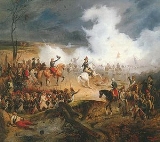
The French Revolutionary Wars were a series of major conflicts, from 1792 until 1802, fought between the French Revolution
ary government and several European states. Marked by French revolutionary fervour and military innovations, the campaigns saw the French Revolutionary Armies defeat a number of opposing coalitions and expand French control to the Low Countries
, :Italy, and the Rhineland
. The wars involved enormous numbers of soldiers, mainly due to the application of modern mass conscription
.
The French Revolutionary Wars are usually divided between those of the First Coalition
(1792–1797) and the Second Coalition (1798–1801), although France was at war with Great Britain
continuously from 1793 to 1802. Hostilities ceased with the Treaty of Amiens
1802, but conflict soon started up again with the Napoleonic Wars
. The Treaty of Amiens is usually reckoned to mark the end of the French Revolutionary Wars, however other events before and after 1802 have been proposed to be the starting point of the Napoleonic Wars.
or to take advantage of the chaos in France. The key figure was Holy Roman Emperor
Leopold II
, brother of Louis XVI's Queen Marie Antoinette
. Leopold had initially looked on the Revolution with equanimity, but became more and more disturbed as the Revolution became more radical, although he still hoped to avoid war. On 27 August, Leopold and King Frederick William II
of Prussia
, in consultation with emigrant French nobles
, issued the Declaration of Pillnitz
, which declared the interest of the monarchs of Europe in the well-being of Louis and his family, and threatened vague but severe consequences if anything should befall them. Although Leopold saw the Pillnitz Declaration as a non-committal gesture to placate the sentiments of French monarchists and nobles, it was seen in France as a serious threat and was denounced by the revolutionary leaders.
In addition to the ideological differences between France and the monarchical powers of Europe, there were continuing disputes over the status of Imperial estates in Alsace
, and the French were becoming concerned about the agitation of émigré nobles abroad, especially in the Austrian Netherlands and the minor states of Germany.
Issued by Charles William Ferdinand, Duke of Brunswick
, commander of the Allied Army (principally Austrian and Prussian), on 25 July 1792, the Brunswick Manifesto threatened that if the French royal family
were harmed, then French civilians would be harmed. It was a measure intended to intimidate Paris, but rather helped further spur the increasingly radical French Revolution
. As a consequence, France declared war on Austria first, with the Assembly
voting for war on 20 April 1792, after a long list of grievances presented by foreign minister Dumouriez
. Dumouriez prepared an immediate invasion of the Austrian Netherlands, where he expected the local population to rise against Austrian rule. However, the revolution had thoroughly disorganized the army, and the forces raised were insufficient for the invasion. Following the declaration of war, French soldiers deserted en masse and, in one case, murdered their general
.
While the revolutionary government frantically raised fresh troops and reorganized its armies, a mostly Prussian allied army under Charles William Ferdinand, Duke of Brunswick
assembled at Koblenz
on the Rhine. In July, the invasion commenced, with Brunswick's army easily taking the fortresses of Longwy
and Verdun. The duke then issued a proclamation called the Brunswick Manifesto, written by the French king's cousin, Louis Joseph de Bourbon, Prince de Condé
, the leader of an émigré corps within the allied army
, which declared the Allies' intent to restore the king to his full powers and to treat any person or town who opposed them as rebels to be condemned to death by martial law
. This, however, had the effect of strengthening the resolve of the revolutionary army and government to oppose them by any means necessary. On 10 August, a crowd stormed the Tuileries Palace
, where Louis and his family had been staying.
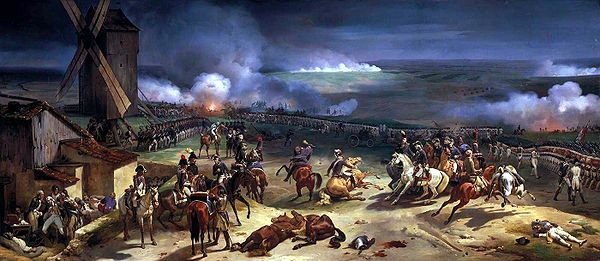 The invasion continued, but at Valmy
on 20 September, they came to a stalemate against Dumouriez and Kellermann
in which the highly professional French artillery
distinguished itself. Although the battle was a tactical draw, it gave a great boost to French morale. Further, the Prussians, finding that the campaign had been longer and more costly than predicted, decided that the cost and risk of continued fighting was too great, and they decided to retreat from France to preserve their army. The next day, the monarchy was formally abolished as the First Republic was declared.
Meanwhile, the French had been successful on several other fronts, occupying Savoy
and Nice
in Italy, while General Custine
invaded Germany, occupying several German towns along the Rhine, and reaching as far as Frankfurt
. Dumouriez went on the offensive in Belgium once again, winning a great victory over the Austrians at Jemappes
on 6 November, and occupying the entire country by the beginning of winter.
. Spain and Portugal
entered the anti-French coalition in January 1793, and, on 1 February, France declared war on Great Britain and the Dutch Republic
.
France drafted hundreds of thousands of men
, beginning a policy of using mass conscription to deploy more of its manpower than the autocratic states could manage to do (first stage, with a decree of the 24 February 1793 ordering the draft of 300,000 men, then with the general mobilization of all the young men able to be drafted, through the famous decree of the 23 August 1793). This approach also allowed the French to maintain an offensive long enough that these vast armies might commandeer war material from territory taken from their enemies and, to a certain extent, "live off the fat of the land". Nonetheless, the Coalition allies launched a determined drive to invade France during the Flanders Campaign
.
France suffered severe reverses at first. They were driven out of the Austrian Netherlands (Belgium
), and serious revolts flared in the west and south of France. One of these, at Toulon
, was the first serious taste of action for an unknown young artillery officer named Napoleon Bonaparte. He contributed to the siege of the city and its harbor
by planning an effective assault with well-placed artillery batteries raining projectiles down on rebel positions. This performance helped make his reputation as a capable tactician, and it fueled his meteoric rise to military and political power.
By the end of the year, large new armies and a fierce policy of internal repression
had turned back foreign invaders and suppressed internal revolts. The French military was in the ascendant. Lazare Carnot
, a scientist and prominent member of the Committee of Public Safety
, organized the fourteen armies of the Republic
, and was then nicknamed the Organizer of the Victory.
took San Sebastián, and the French won a victory at Fleurus
and occupied all of Belgium and the Rhineland
.
At sea, the French and British fleets clashed on the First of June
over a grain convoy
arriving from the United States. Both sides claimed victory, since the British sank or captured a quarter of the French Atlantic Fleet with minimal losses of their own, but the vital convoy got through unharmed.
in a surprise winter attack, France established the Batavian Republic
as a puppet state. Further, Prussia and Spain (and also Hessen-Kassel) decided to make peace, in the Peace of Basel
Prussia secretly ceded the left bank of the Rhine to France and freeing French armies from the Pyrenees while Spain ceded the eastern two thirds of Hispaniola
(now the Dominican Republic
). This ended the main crisis phase of the Revolution and France proper would be free from invasion for many years.
Britain attempted to reinforce the rebels in the Vendée, but failed, and attempts to overthrow the government at Paris by force were foiled by the military garrison
led by Napoleon Bonaparte, leading to the establishment of the Directory
.
On the Rhine frontier, General Pichegru
, negotiating with the exiled Royalist
s, betrayed his army and forced the evacuation of Mannheim
and the failure of the siege of Mainz
by Jourdan
.
on the Rhine, and Bonaparte in Italy. The three armies were to link up in Tyrol and march on Vienna
.
Jourdan and Moreau advanced rapidly into Germany, and Moreau had reached Bavaria
and the edge of Tyrol by September, but Jourdan was defeated by Archduke Charles, and both armies were forced to retreat back across the Rhine.
Napoleon, on the other hand, was completely successful in a daring invasion of Italy. He separated the armies of Sardinia
and Austria
, defeating them in detail, and forced a peace on Sardinia while capturing Milan
and besieging Mantua
. He also had defeated successive Austrian armies sent against him under Wurmser
and Alvintzy while continuing the siege.
The rebellion in the Vendée was also finally crushed in 1796 by Hoche, but Hoche's attempt to land a large invasion force in Ireland
was unsuccessful.
.
Napoleon finally captured Mantua by siege, and, in the process, the Austrians surrendered eighteen thousand men. Archduke Charles of Austria was unable to prevent Napoleon from invading the Tyrol
, and the Austrian government sued for peace in April, at the same time that a new French invasion of Germany, under the generals, Moreau
and Hoche
, began.
Austria signed the Treaty of Campo Formio
in October, conceding Belgium
to France and recognizing French control of the Rhineland
and much of Italy. The ancient republic of Venice
was partitioned between Austria and France. This ended the War of the First Coalition
, although Great Britain remained a belligerent.
in 1798, which satisfied his personal desire for glory and the Directory's desire to have him far from Paris. The military objective of the expedition is not entirely clear, but may have been to threaten British dominance in India
.
Napoleon sailed from Toulon
to Alexandria
, taking Malta
on the way, and landing in June. Marching to Cairo
, he won a great victory at the Battle of the Pyramids
; however, his fleet was destroyed by Nelson at the Battle of the Nile
, stranding him in Egypt. Napoleon spent the remainder of the year consolidating his position in Egypt.
The French government also took advantage of internal strife in Switzerland
to invade, establishing the Helvetian Republic and annexing Geneva
. French troops also deposed Pope Pius VI
, establishing a republic in Rome
.
An expeditionary force was sent to County Mayo
to assist in the rebellion
against Britain in the summer of 1798. It had some success against British forces, most notably at Castlebar
, but was ultimately routed while trying to reach Dublin. French ships sent to assist them were captured by the Royal Navy
off County Donegal
.
The French were also under pressure in Belgium and Luxembourg
where the local people revolted against conscription and anti-religious violence (Peasants' War
).
The French also fought an undeclared war at sea against the United States, that was known as the "Quasi-War
".
.
. Russian general Aleksandr Suvorov inflicted a series of defeats on the French in Italy, driving them back to the Alps. However, the allies were less successful in the Netherlands, where the British retreated after a stalemate (although they did manage to capture the Dutch fleet), and in Switzerland, where after initial victories a Russian army was completely defeated at the Second Battle of Zurich
. This reverse, as well as British insistence on searching shipping in the Baltic Sea
led to Russia withdrawing from the Coalition.
Napoleon himself invaded Syria
from Egypt, but after a failed siege of Acre
retreated to Egypt, repelling a British-Turkish invasion. Hearing of a political and military crisis in France, he returned, leaving his army behind, and used his popularity and army support to mount a coup
that made him First Consul, the head of the French government.
and march through Switzerland to attack the Austrian armies in Italy from behind. Narrowly avoiding defeat, he defeated the Austrians at Marengo
and reoccupied northern Italy.
Moreau meanwhile invaded Bavaria
and won a great battle against Austria at Hohenlinden
. Moreau continued toward Vienna and the Austrians sued for peace.
, basically accepting the terms of the previous Treaty of Campo Formio
. In Egypt, the Ottomans and British invaded and finally compelled the French to surrender after the fall of Cairo
and Alexandria
.
Britain continued the war at sea. A coalition of non-combatants
including Prussia, Russia, Denmark
, and Sweden
joined to protect neutral shipping from Britain's blockade, resulting in Nelson's surprise attack on the Danish fleet in harbor at the Battle of Copenhagen
.
, ending the war. Thus began the longest period of peace during the period 1792–1815. The treaty is generally considered to be the most appropriate point to mark the transition between the French Revolutionary Wars and the Napoleonic Wars
, although Napoleon was not crowned emperor until 1804.
and Bourbon
monarchs for centuries.
French Revolution
The French Revolution , sometimes distinguished as the 'Great French Revolution' , was a period of radical social and political upheaval in France and Europe. The absolute monarchy that had ruled France for centuries collapsed in three years...
ary government and several European states. Marked by French revolutionary fervour and military innovations, the campaigns saw the French Revolutionary Armies defeat a number of opposing coalitions and expand French control to the Low Countries
Low Countries
The Low Countries are the historical lands around the low-lying delta of the Rhine, Scheldt, and Meuse rivers, including the modern countries of Belgium, the Netherlands, Luxembourg and parts of northern France and western Germany....
, :Italy, and the Rhineland
Rhineland
Historically, the Rhinelands refers to a loosely-defined region embracing the land on either bank of the River Rhine in central Europe....
. The wars involved enormous numbers of soldiers, mainly due to the application of modern mass conscription
Levée en masse
Levée en masse is a French term for mass conscription during the French Revolutionary Wars, particularly for the one from 16 August 1793.- Terminology :...
.
The French Revolutionary Wars are usually divided between those of the First Coalition
First Coalition
The War of the First Coalition was the first major effort of multiple European monarchies to contain Revolutionary France. France declared war on the Habsburg monarchy of Austria on 20 April 1792, and the Kingdom of Prussia joined the Austrian side a few weeks later.These powers initiated a series...
(1792–1797) and the Second Coalition (1798–1801), although France was at war with Great Britain
Kingdom of Great Britain
The former Kingdom of Great Britain, sometimes described as the 'United Kingdom of Great Britain', That the Two Kingdoms of Scotland and England, shall upon the 1st May next ensuing the date hereof, and forever after, be United into One Kingdom by the Name of GREAT BRITAIN. was a sovereign...
continuously from 1793 to 1802. Hostilities ceased with the Treaty of Amiens
Treaty of Amiens
The Treaty of Amiens temporarily ended hostilities between the French Republic and the United Kingdom during the French Revolutionary Wars. It was signed in the city of Amiens on 25 March 1802 , by Joseph Bonaparte and the Marquess Cornwallis as a "Definitive Treaty of Peace"...
1802, but conflict soon started up again with the Napoleonic Wars
Napoleonic Wars
The Napoleonic Wars were a series of wars declared against Napoleon's French Empire by opposing coalitions that ran from 1803 to 1815. As a continuation of the wars sparked by the French Revolution of 1789, they revolutionised European armies and played out on an unprecedented scale, mainly due to...
. The Treaty of Amiens is usually reckoned to mark the end of the French Revolutionary Wars, however other events before and after 1802 have been proposed to be the starting point of the Napoleonic Wars.
1791–1792
As early as 1791, the other monarchies of Europe looked with concern at the revolution and its upheavals, and considered whether they should intervene, either in support of King Louis XVILouis XVI of France
Louis XVI was a Bourbon monarch who ruled as King of France and Navarre until 1791, and then as King of the French from 1791 to 1792, before being executed in 1793....
or to take advantage of the chaos in France. The key figure was Holy Roman Emperor
Holy Roman Emperor
The Holy Roman Emperor is a term used by historians to denote a medieval ruler who, as German King, had also received the title of "Emperor of the Romans" from the Pope...
Leopold II
Leopold II, Holy Roman Emperor
Leopold II , born Peter Leopold Joseph Anton Joachim Pius Gotthard, was Holy Roman Emperor and King of Hungary and Bohemia from 1790 to 1792, Archduke of Austria and Grand Duke of Tuscany from 1765 to 1790. He was a son of Emperor Francis I and his wife, Empress Maria Theresa...
, brother of Louis XVI's Queen Marie Antoinette
Marie Antoinette
Marie Antoinette ; 2 November 1755 – 16 October 1793) was an Archduchess of Austria and the Queen of France and of Navarre. She was the fifteenth and penultimate child of Holy Roman Empress Maria Theresa and Holy Roman Emperor Francis I....
. Leopold had initially looked on the Revolution with equanimity, but became more and more disturbed as the Revolution became more radical, although he still hoped to avoid war. On 27 August, Leopold and King Frederick William II
Frederick William II of Prussia
Frederick William II was the King of Prussia, reigning from 1786 until his death. He was in personal union the Prince-Elector of Brandenburg and the sovereign prince of the Principality of Neuchâtel.-Early life:...
of Prussia
Kingdom of Prussia
The Kingdom of Prussia was a German kingdom from 1701 to 1918. Until the defeat of Germany in World War I, it comprised almost two-thirds of the area of the German Empire...
, in consultation with emigrant French nobles
Émigré
Émigré is a French term that literally refers to a person who has "migrated out", but often carries a connotation of politico-social self-exile....
, issued the Declaration of Pillnitz
Declaration of Pillnitz
The Declaration of Pillnitz was a statement issued on 27 August 1791 at Pillnitz Castle near Dresden by the Habsburg Holy Roman Emperor Leopold II and Frederick William II of Prussia...
, which declared the interest of the monarchs of Europe in the well-being of Louis and his family, and threatened vague but severe consequences if anything should befall them. Although Leopold saw the Pillnitz Declaration as a non-committal gesture to placate the sentiments of French monarchists and nobles, it was seen in France as a serious threat and was denounced by the revolutionary leaders.
In addition to the ideological differences between France and the monarchical powers of Europe, there were continuing disputes over the status of Imperial estates in Alsace
Alsace
Alsace is the fifth-smallest of the 27 regions of France in land area , and the smallest in metropolitan France. It is also the seventh-most densely populated region in France and third most densely populated region in metropolitan France, with ca. 220 inhabitants per km²...
, and the French were becoming concerned about the agitation of émigré nobles abroad, especially in the Austrian Netherlands and the minor states of Germany.
Issued by Charles William Ferdinand, Duke of Brunswick
Charles William Ferdinand, Duke of Brunswick
Charles William Ferdinand , Duke of Brunswick-Wolfenbüttel, was a sovereign prince of the Holy Roman Empire, and a professional soldier who served as a Generalfeldmarschall of the Kingdom of Prussia...
, commander of the Allied Army (principally Austrian and Prussian), on 25 July 1792, the Brunswick Manifesto threatened that if the French royal family
Members of the French Royal Families
This is a list of non-ruling members of the French royal family. It includes royal consorts, children, and some grandchildren, as well as more recent members of the French Royal House....
were harmed, then French civilians would be harmed. It was a measure intended to intimidate Paris, but rather helped further spur the increasingly radical French Revolution
French Revolution
The French Revolution , sometimes distinguished as the 'Great French Revolution' , was a period of radical social and political upheaval in France and Europe. The absolute monarchy that had ruled France for centuries collapsed in three years...
. As a consequence, France declared war on Austria first, with the Assembly
Legislative Assembly (France)
During the French Revolution, the Legislative Assembly was the legislature of France from 1 October 1791 to September 1792. It provided the focus of political debate and revolutionary law-making between the periods of the National Constituent Assembly and of the National Convention.The Legislative...
voting for war on 20 April 1792, after a long list of grievances presented by foreign minister Dumouriez
Charles François Dumouriez
Charles-François du Périer Dumouriez was a French general during the French Revolutionary Wars. He shared the victory at Valmy with General François Christophe Kellermann, but later deserted the Revolutionary Army and became a royalist intriguer during the reign of Napoleon.-Early life:Dumouriez...
. Dumouriez prepared an immediate invasion of the Austrian Netherlands, where he expected the local population to rise against Austrian rule. However, the revolution had thoroughly disorganized the army, and the forces raised were insufficient for the invasion. Following the declaration of war, French soldiers deserted en masse and, in one case, murdered their general
Théobald Dillon
Théobald Dillon was count of Dillon and an Irish-born general in the French army. He was the grandson of Arthur Dillon, the nephew of the bishop Arthur Richard Dillon and the cousin of general Arthur Dillon .On 29 April 1792, following the loss of a skirmish with Austrian forces, Dillon was...
.
While the revolutionary government frantically raised fresh troops and reorganized its armies, a mostly Prussian allied army under Charles William Ferdinand, Duke of Brunswick
Charles William Ferdinand, Duke of Brunswick
Charles William Ferdinand , Duke of Brunswick-Wolfenbüttel, was a sovereign prince of the Holy Roman Empire, and a professional soldier who served as a Generalfeldmarschall of the Kingdom of Prussia...
assembled at Koblenz
Koblenz
Koblenz is a German city situated on both banks of the Rhine at its confluence with the Moselle, where the Deutsches Eck and its monument are situated.As Koblenz was one of the military posts established by Drusus about 8 BC, the...
on the Rhine. In July, the invasion commenced, with Brunswick's army easily taking the fortresses of Longwy
Longwy
Longwy is a commune in the Meurthe-et-Moselle department in north-eastern France.The inhabitants are known as Longoviciens.-Economy:Longwy has historically been an industrial center of the Lorraine iron mining district. The town is known for its artistic glazed pottery.-History:Longwy initially...
and Verdun. The duke then issued a proclamation called the Brunswick Manifesto, written by the French king's cousin, Louis Joseph de Bourbon, Prince de Condé
Louis Joseph de Bourbon, prince de Condé
Louis Joseph de Bourbon was Prince of Condé from 1740 to his death. A member of the House of Bourbon, he held the prestigious rank of Prince du Sang.-Biography:...
, the leader of an émigré corps within the allied army
Army of Condé
The Army of Condé was a French field army during the French Revolutionary Wars. One of several émigré field armies, it was the only one to survive the War of the First Coalition; others had been formed by the Comte d'Artois and Mirabeau-Tonneau...
, which declared the Allies' intent to restore the king to his full powers and to treat any person or town who opposed them as rebels to be condemned to death by martial law
Martial law
Martial law is the imposition of military rule by military authorities over designated regions on an emergency basis— only temporary—when the civilian government or civilian authorities fail to function effectively , when there are extensive riots and protests, or when the disobedience of the law...
. This, however, had the effect of strengthening the resolve of the revolutionary army and government to oppose them by any means necessary. On 10 August, a crowd stormed the Tuileries Palace
Tuileries Palace
The Tuileries Palace was a royal palace in Paris which stood on the right bank of the River Seine until 1871, when it was destroyed in the upheaval during the suppression of the Paris Commune...
, where Louis and his family had been staying.
Battle of Valmy
The Battle of Valmy was the first major victory by the army of France during the French Revolution. The action took place on 20 September 1792 as Prussian troops commanded by the Duke of Brunswick attempted to march on Paris...
on 20 September, they came to a stalemate against Dumouriez and Kellermann
François Christophe Kellermann
François Christophe Kellermann or de Kellermann, 1st Duc de Valmy was a French military commander, later the Général d'Armée, and a Marshal of France...
in which the highly professional French artillery
Artillery
Originally applied to any group of infantry primarily armed with projectile weapons, artillery has over time become limited in meaning to refer only to those engines of war that operate by projection of munitions far beyond the range of effect of personal weapons...
distinguished itself. Although the battle was a tactical draw, it gave a great boost to French morale. Further, the Prussians, finding that the campaign had been longer and more costly than predicted, decided that the cost and risk of continued fighting was too great, and they decided to retreat from France to preserve their army. The next day, the monarchy was formally abolished as the First Republic was declared.
Meanwhile, the French had been successful on several other fronts, occupying Savoy
Savoy
Savoy is a region of France. It comprises roughly the territory of the Western Alps situated between Lake Geneva in the north and Monaco and the Mediterranean coast in the south....
and Nice
Nice
Nice is the fifth most populous city in France, after Paris, Marseille, Lyon and Toulouse, with a population of 348,721 within its administrative limits on a land area of . The urban area of Nice extends beyond the administrative city limits with a population of more than 955,000 on an area of...
in Italy, while General Custine
Adam Philippe, Comte de Custine
Adam Philippe, Comte de Custine was a French general. Born in Metz, he began his military career as a captain in the Seven Years' War, where he learned to admire the modern military organisation of Prussia....
invaded Germany, occupying several German towns along the Rhine, and reaching as far as Frankfurt
Frankfurt
Frankfurt am Main , commonly known simply as Frankfurt, is the largest city in the German state of Hesse and the fifth-largest city in Germany, with a 2010 population of 688,249. The urban area had an estimated population of 2,300,000 in 2010...
. Dumouriez went on the offensive in Belgium once again, winning a great victory over the Austrians at Jemappes
Battle of Jemappes
The Battle of Jemappes took place near the town of Jemappes in Hainaut, Belgium, near Mons. General Charles François Dumouriez, in command of the French Revolutionary Army, defeated the greatly outnumbered Austrian army of Field Marshal Duke Albert of Saxe-Teschen and his second-in-command...
on 6 November, and occupying the entire country by the beginning of winter.
1793
On 21 January, the revolutionary government executed Louis XVI after a show trialShow trial
The term show trial is a pejorative description of a type of highly public trial in which there is a strong connotation that the judicial authorities have already determined the guilt of the defendant. The actual trial has as its only goal to present the accusation and the verdict to the public as...
. Spain and Portugal
Portugal
Portugal , officially the Portuguese Republic is a country situated in southwestern Europe on the Iberian Peninsula. Portugal is the westernmost country of Europe, and is bordered by the Atlantic Ocean to the West and South and by Spain to the North and East. The Atlantic archipelagos of the...
entered the anti-French coalition in January 1793, and, on 1 February, France declared war on Great Britain and the Dutch Republic
Dutch Republic
The Dutch Republic — officially known as the Republic of the Seven United Netherlands , the Republic of the United Netherlands, or the Republic of the Seven United Provinces — was a republic in Europe existing from 1581 to 1795, preceding the Batavian Republic and ultimately...
.
France drafted hundreds of thousands of men
Levée en masse
Levée en masse is a French term for mass conscription during the French Revolutionary Wars, particularly for the one from 16 August 1793.- Terminology :...
, beginning a policy of using mass conscription to deploy more of its manpower than the autocratic states could manage to do (first stage, with a decree of the 24 February 1793 ordering the draft of 300,000 men, then with the general mobilization of all the young men able to be drafted, through the famous decree of the 23 August 1793). This approach also allowed the French to maintain an offensive long enough that these vast armies might commandeer war material from territory taken from their enemies and, to a certain extent, "live off the fat of the land". Nonetheless, the Coalition allies launched a determined drive to invade France during the Flanders Campaign
Flanders Campaign
This feature refers to the conflict that took place during the Wars of the French Revolution 1792–1801.For the Low Countries campaigns of the War of the Grand Alliance 1688–97 see Nine Years' War...
.
France suffered severe reverses at first. They were driven out of the Austrian Netherlands (Belgium
Belgium
Belgium , officially the Kingdom of Belgium, is a federal state in Western Europe. It is a founding member of the European Union and hosts the EU's headquarters, and those of several other major international organisations such as NATO.Belgium is also a member of, or affiliated to, many...
), and serious revolts flared in the west and south of France. One of these, at Toulon
Toulon
Toulon is a town in southern France and a large military harbor on the Mediterranean coast, with a major French naval base. Located in the Provence-Alpes-Côte-d'Azur region, Toulon is the capital of the Var department in the former province of Provence....
, was the first serious taste of action for an unknown young artillery officer named Napoleon Bonaparte. He contributed to the siege of the city and its harbor
Siege of Toulon
The Siege of Toulon was an early Republican victory over a Royalist rebellion in the Southern French city of Toulon. It is also often known as the Fall of Toulon.-Context:...
by planning an effective assault with well-placed artillery batteries raining projectiles down on rebel positions. This performance helped make his reputation as a capable tactician, and it fueled his meteoric rise to military and political power.
By the end of the year, large new armies and a fierce policy of internal repression
Reign of Terror
The Reign of Terror , also known simply as The Terror , was a period of violence that occurred after the onset of the French Revolution, incited by conflict between rival political factions, the Girondins and the Jacobins, and marked by mass executions of "enemies of...
had turned back foreign invaders and suppressed internal revolts. The French military was in the ascendant. Lazare Carnot
Lazare Carnot
Lazare Nicolas Marguerite, Comte Carnot , the Organizer of Victory in the French Revolutionary Wars, was a French politician, engineer, and mathematician.-Education and early life:...
, a scientist and prominent member of the Committee of Public Safety
Committee of Public Safety
The Committee of Public Safety , created in April 1793 by the National Convention and then restructured in July 1793, formed the de facto executive government in France during the Reign of Terror , a stage of the French Revolution...
, organized the fourteen armies of the Republic
French Revolutionary Army
The French Revolutionary Army is the term used to refer to the military of France during the period between the fall of the ancien regime under Louis XVI in 1792 and the formation of the First French Empire under Napoleon Bonaparte in 1804. These armies were characterised by their revolutionary...
, and was then nicknamed the Organizer of the Victory.
1794
The year 1794 brought increased success to the revolutionary armies. Although an invasion of Piedmont failed, an invasion of Spain across the PyreneesPyrenees
The Pyrenees is a range of mountains in southwest Europe that forms a natural border between France and Spain...
took San Sebastián, and the French won a victory at Fleurus
Battle of Fleurus (1794)
In the Battle of Fleurus on 26 June 1794, the army of the First French Republic under General Jean-Baptiste Jourdan faced the Coalition Army commanded by Prince Josias of Coburg in the most decisive battle of the Flanders Campaign in the Low Countries during the French Revolutionary Wars...
and occupied all of Belgium and the Rhineland
Rhineland
Historically, the Rhinelands refers to a loosely-defined region embracing the land on either bank of the River Rhine in central Europe....
.
At sea, the French and British fleets clashed on the First of June
Glorious First of June
The Glorious First of June [Note A] of 1794 was the first and largest fleet action of the naval conflict between the Kingdom of Great Britain and the First French Republic during the French Revolutionary Wars...
over a grain convoy
Convoy
A convoy is a group of vehicles, typically motor vehicles or ships, traveling together for mutual support and protection. Often, a convoy is organized with armed defensive support, though it may also be used in a non-military sense, for example when driving through remote areas.-Age of Sail:Naval...
arriving from the United States. Both sides claimed victory, since the British sank or captured a quarter of the French Atlantic Fleet with minimal losses of their own, but the vital convoy got through unharmed.
1795
After seizing the NetherlandsNetherlands
The Netherlands is a constituent country of the Kingdom of the Netherlands, located mainly in North-West Europe and with several islands in the Caribbean. Mainland Netherlands borders the North Sea to the north and west, Belgium to the south, and Germany to the east, and shares maritime borders...
in a surprise winter attack, France established the Batavian Republic
Batavian Republic
The Batavian Republic was the successor of the Republic of the United Netherlands. It was proclaimed on January 19, 1795, and ended on June 5, 1806, with the accession of Louis Bonaparte to the throne of the Kingdom of Holland....
as a puppet state. Further, Prussia and Spain (and also Hessen-Kassel) decided to make peace, in the Peace of Basel
Peace of Basel
The Peace of Basel of 1795 consists of three peace treaties involving France .* The first of the three treaties of 1795, France made peace with Prussia on 5 April; , * The Second was with Spain on 22 July, ending the War of the Pyrenees; and*...
Prussia secretly ceded the left bank of the Rhine to France and freeing French armies from the Pyrenees while Spain ceded the eastern two thirds of Hispaniola
Hispaniola
Hispaniola is a major island in the Caribbean, containing the two sovereign states of the Dominican Republic and Haiti. The island is located between the islands of Cuba to the west and Puerto Rico to the east, within the hurricane belt...
(now the Dominican Republic
Dominican Republic
The Dominican Republic is a nation on the island of La Hispaniola, part of the Greater Antilles archipelago in the Caribbean region. The western third of the island is occupied by the nation of Haiti, making Hispaniola one of two Caribbean islands that are shared by two countries...
). This ended the main crisis phase of the Revolution and France proper would be free from invasion for many years.
Britain attempted to reinforce the rebels in the Vendée, but failed, and attempts to overthrow the government at Paris by force were foiled by the military garrison
13 Vendémiaire
13 Vendémiaire Year 4 is the name given to a battle between the French Revolutionary troops and Royalist forces in the streets of Paris...
led by Napoleon Bonaparte, leading to the establishment of the Directory
French Directory
The Directory was a body of five Directors that held executive power in France following the Convention and preceding the Consulate...
.
On the Rhine frontier, General Pichegru
Charles Pichegru
Jean-Charles Pichegru was a French general and political figure of the French Revolution and Revolutionary Wars.-Early life and career:...
, negotiating with the exiled Royalist
House of Bourbon
The House of Bourbon is a European royal house, a branch of the Capetian dynasty . Bourbon kings first ruled Navarre and France in the 16th century. By the 18th century, members of the Bourbon dynasty also held thrones in Spain, Naples, Sicily, and Parma...
s, betrayed his army and forced the evacuation of Mannheim
Mannheim
Mannheim is a city in southwestern Germany. With about 315,000 inhabitants, Mannheim is the second-largest city in the Bundesland of Baden-Württemberg, following the capital city of Stuttgart....
and the failure of the siege of Mainz
Mainz
Mainz under the Holy Roman Empire, and previously was a Roman fort city which commanded the west bank of the Rhine and formed part of the northernmost frontier of the Roman Empire...
by Jourdan
Jean-Baptiste Jourdan
Jean-Baptiste Jourdan, 1st Comte Jourdan , enlisted as a private in the French royal army and rose to command armies during the French Revolutionary Wars. Emperor Napoleon I of France named him a Marshal of France in 1804 and he also fought in the Napoleonic Wars. After 1815, he became reconciled...
.
1796
The French prepared a great advance on three fronts, with Jourdan and MoreauJean Victor Marie Moreau
Jean Victor Marie Moreau was a French general who helped Napoleon Bonaparte to power, but later became a rival and was banished to the United States.- Early life :Moreau was born at Morlaix in Brittany...
on the Rhine, and Bonaparte in Italy. The three armies were to link up in Tyrol and march on Vienna
Vienna
Vienna is the capital and largest city of the Republic of Austria and one of the nine states of Austria. Vienna is Austria's primary city, with a population of about 1.723 million , and is by far the largest city in Austria, as well as its cultural, economic, and political centre...
.
Jourdan and Moreau advanced rapidly into Germany, and Moreau had reached Bavaria
Bavaria
Bavaria, formally the Free State of Bavaria is a state of Germany, located in the southeast of Germany. With an area of , it is the largest state by area, forming almost 20% of the total land area of Germany...
and the edge of Tyrol by September, but Jourdan was defeated by Archduke Charles, and both armies were forced to retreat back across the Rhine.
Napoleon, on the other hand, was completely successful in a daring invasion of Italy. He separated the armies of Sardinia
Kingdom of Sardinia
The Kingdom of Sardinia consisted of the island of Sardinia first as a part of the Crown of Aragon and subsequently the Spanish Empire , and second as a part of the composite state of the House of Savoy . Its capital was originally Cagliari, in the south of the island, and later Turin, on the...
and Austria
Habsburg Monarchy
The Habsburg Monarchy covered the territories ruled by the junior Austrian branch of the House of Habsburg , and then by the successor House of Habsburg-Lorraine , between 1526 and 1867/1918. The Imperial capital was Vienna, except from 1583 to 1611, when it was moved to Prague...
, defeating them in detail, and forced a peace on Sardinia while capturing Milan
Milan
Milan is the second-largest city in Italy and the capital city of the region of Lombardy and of the province of Milan. The city proper has a population of about 1.3 million, while its urban area, roughly coinciding with its administrative province and the bordering Province of Monza and Brianza ,...
and besieging Mantua
Mantua
Mantua is a city and comune in Lombardy, Italy and capital of the province of the same name. Mantua's historic power and influence under the Gonzaga family, made it one of the main artistic, cultural and notably musical hubs of Northern Italy and the country as a whole...
. He also had defeated successive Austrian armies sent against him under Wurmser
Dagobert Sigmund von Wurmser
Dagobert Sigismund, Count Wurmser was an Austrian field marshal during the French Revolutionary Wars. Although he fought in the Seven Years War, the War of the Bavarian Succession, and mounted several successful campaigns in the Rhineland in the initial years of the French Revolutionary Wars, he...
and Alvintzy while continuing the siege.
The rebellion in the Vendée was also finally crushed in 1796 by Hoche, but Hoche's attempt to land a large invasion force in Ireland
Expédition d'Irlande
The Expédition d'Irlande was an unsuccessful attempt by the First French Republic during the French Revolutionary Wars to assist the outlawed Society of United Irishmen, a popular rebel Irish republican group, in their planned rebellion against British rule...
was unsuccessful.
1797
In February, the Battle of Cape St. Vincent saw the British block an attempt by a larger Spanish fleet to join the French at BrestBrest, France
Brest is a city in the Finistère department in Brittany in northwestern France. Located in a sheltered position not far from the western tip of the Breton peninsula, and the western extremity of metropolitan France, Brest is an important harbour and the second French military port after Toulon...
.
Napoleon finally captured Mantua by siege, and, in the process, the Austrians surrendered eighteen thousand men. Archduke Charles of Austria was unable to prevent Napoleon from invading the Tyrol
County of Tyrol
The County of Tyrol, Princely County from 1504, was a State of the Holy Roman Empire, from 1814 a province of the Austrian Empire and from 1867 a Cisleithanian crown land of Austria-Hungary...
, and the Austrian government sued for peace in April, at the same time that a new French invasion of Germany, under the generals, Moreau
Jean Victor Marie Moreau
Jean Victor Marie Moreau was a French general who helped Napoleon Bonaparte to power, but later became a rival and was banished to the United States.- Early life :Moreau was born at Morlaix in Brittany...
and Hoche
Lazare Hoche
Louis Lazare Hoche was a French soldier who rose to be general of the Revolutionary army.Born of poor parents near Versailles, he enlisted at sixteen as a private soldier in the Gardes Françaises...
, began.
Austria signed the Treaty of Campo Formio
Treaty of Campo Formio
The Treaty of Campo Formio was signed on 18 October 1797 by Napoleon Bonaparte and Count Philipp von Cobenzl as representatives of revolutionary France and the Austrian monarchy...
in October, conceding Belgium
Belgium
Belgium , officially the Kingdom of Belgium, is a federal state in Western Europe. It is a founding member of the European Union and hosts the EU's headquarters, and those of several other major international organisations such as NATO.Belgium is also a member of, or affiliated to, many...
to France and recognizing French control of the Rhineland
Rhineland
Historically, the Rhinelands refers to a loosely-defined region embracing the land on either bank of the River Rhine in central Europe....
and much of Italy. The ancient republic of Venice
Venice
Venice is a city in northern Italy which is renowned for the beauty of its setting, its architecture and its artworks. It is the capital of the Veneto region...
was partitioned between Austria and France. This ended the War of the First Coalition
First Coalition
The War of the First Coalition was the first major effort of multiple European monarchies to contain Revolutionary France. France declared war on the Habsburg monarchy of Austria on 20 April 1792, and the Kingdom of Prussia joined the Austrian side a few weeks later.These powers initiated a series...
, although Great Britain remained a belligerent.
1798
With only Britain left to fight and not enough of a navy to fight a direct war, Napoleon conceived of an invasion of EgyptFrench Invasion of Egypt
The Egyptian Campaign was Napoleon Bonaparte's campaign in "The Orient", ostensibly to protect French trade interests, undermine Britain's access to India, and to establish scientific enterprise in the region...
in 1798, which satisfied his personal desire for glory and the Directory's desire to have him far from Paris. The military objective of the expedition is not entirely clear, but may have been to threaten British dominance in India
India
India , officially the Republic of India , is a country in South Asia. It is the seventh-largest country by geographical area, the second-most populous country with over 1.2 billion people, and the most populous democracy in the world...
.
Napoleon sailed from Toulon
Toulon
Toulon is a town in southern France and a large military harbor on the Mediterranean coast, with a major French naval base. Located in the Provence-Alpes-Côte-d'Azur region, Toulon is the capital of the Var department in the former province of Provence....
to Alexandria
Alexandria
Alexandria is the second-largest city of Egypt, with a population of 4.1 million, extending about along the coast of the Mediterranean Sea in the north central part of the country; it is also the largest city lying directly on the Mediterranean coast. It is Egypt's largest seaport, serving...
, taking Malta
Malta
Malta , officially known as the Republic of Malta , is a Southern European country consisting of an archipelago situated in the centre of the Mediterranean, south of Sicily, east of Tunisia and north of Libya, with Gibraltar to the west and Alexandria to the east.Malta covers just over in...
on the way, and landing in June. Marching to Cairo
Cairo
Cairo , is the capital of Egypt and the largest city in the Arab world and Africa, and the 16th largest metropolitan area in the world. Nicknamed "The City of a Thousand Minarets" for its preponderance of Islamic architecture, Cairo has long been a centre of the region's political and cultural life...
, he won a great victory at the Battle of the Pyramids
Battle of the Pyramids
The Battle of the Pyramids, also known as the Battle of Embabeh, was fought on July 21, 1798 between the French army in Egypt under Napoleon Bonaparte, and local Mamluk forces. It occurred during France's Egyptian Campaign and was the battle where Napoleon put into use one of his significant...
; however, his fleet was destroyed by Nelson at the Battle of the Nile
Battle of the Nile
The Battle of the Nile was a major naval battle fought between British and French fleets at Aboukir Bay on the Mediterranean coast of Egypt from 1–3 August 1798...
, stranding him in Egypt. Napoleon spent the remainder of the year consolidating his position in Egypt.
The French government also took advantage of internal strife in Switzerland
Switzerland
Switzerland name of one of the Swiss cantons. ; ; ; or ), in its full name the Swiss Confederation , is a federal republic consisting of 26 cantons, with Bern as the seat of the federal authorities. The country is situated in Western Europe,Or Central Europe depending on the definition....
to invade, establishing the Helvetian Republic and annexing Geneva
Geneva
Geneva In the national languages of Switzerland the city is known as Genf , Ginevra and Genevra is the second-most-populous city in Switzerland and is the most populous city of Romandie, the French-speaking part of Switzerland...
. French troops also deposed Pope Pius VI
Pope Pius VI
Pope Pius VI , born Count Giovanni Angelo Braschi, was Pope from 1775 to 1799.-Early years:Braschi was born in Cesena...
, establishing a republic in Rome
Roman Republic (18th century)
The Roman Republic was proclaimed on February 15, 1798 after Louis Alexandre Berthier, a general of Napoleon, had invaded the city of Rome on February 10....
.
An expeditionary force was sent to County Mayo
County Mayo
County Mayo is a county in Ireland. It is located in the West Region and is also part of the province of Connacht. It is named after the village of Mayo, which is now generally known as Mayo Abbey. Mayo County Council is the local authority for the county. The population of the county is 130,552...
to assist in the rebellion
Irish Rebellion of 1798
The Irish Rebellion of 1798 , also known as the United Irishmen Rebellion , was an uprising in 1798, lasting several months, against British rule in Ireland...
against Britain in the summer of 1798. It had some success against British forces, most notably at Castlebar
Castlebar
Castlebar is the county town of, and at the centre of, County Mayo in Ireland. It is Mayo's largest town by population. The town's population exploded in the late 1990s, increasing by one-third in just six years, though this massive growth has slowed down greatly in recent years...
, but was ultimately routed while trying to reach Dublin. French ships sent to assist them were captured by the Royal Navy
Royal Navy
The Royal Navy is the naval warfare service branch of the British Armed Forces. Founded in the 16th century, it is the oldest service branch and is known as the Senior Service...
off County Donegal
County Donegal
County Donegal is a county in Ireland. It is part of the Border Region and is also located in the province of Ulster. It is named after the town of Donegal. Donegal County Council is the local authority for the county...
.
The French were also under pressure in Belgium and Luxembourg
Luxembourg
Luxembourg , officially the Grand Duchy of Luxembourg , is a landlocked country in western Europe, bordered by Belgium, France, and Germany. It has two principal regions: the Oesling in the North as part of the Ardennes massif, and the Gutland in the south...
where the local people revolted against conscription and anti-religious violence (Peasants' War
Peasants' War (1798)
The Peasants' War was a peasant revolt in 1798 against the French occupation of the Southern Netherlands, including modern Belgium, Luxembourg, and parts of Germany, during the French Revolutionary Wars.-Luxembourg:...
).
The French also fought an undeclared war at sea against the United States, that was known as the "Quasi-War
Quasi-War
The Quasi-War was an undeclared war fought mostly at sea between the United States and French Republic from 1798 to 1800. In the United States, the conflict was sometimes also referred to as the Franco-American War, the Pirate Wars, or the Half-War.-Background:The Kingdom of France had been a...
".
War of the Second Coalition
Britain and Austria organized a new coalition against France in 1798, including for the first time Russia, although no action occurred until 1799 except against NaplesKingdom of the Two Sicilies
The Kingdom of the Two Sicilies, commonly known as the Two Sicilies even before formally coming into being, was the largest and wealthiest of the Italian states before Italian unification...
.
1799
In Europe, the allies mounted several invasions, including campaigns in Italy and Switzerland and an Anglo-Russian invasion of the NetherlandsNetherlands
The Netherlands is a constituent country of the Kingdom of the Netherlands, located mainly in North-West Europe and with several islands in the Caribbean. Mainland Netherlands borders the North Sea to the north and west, Belgium to the south, and Germany to the east, and shares maritime borders...
. Russian general Aleksandr Suvorov inflicted a series of defeats on the French in Italy, driving them back to the Alps. However, the allies were less successful in the Netherlands, where the British retreated after a stalemate (although they did manage to capture the Dutch fleet), and in Switzerland, where after initial victories a Russian army was completely defeated at the Second Battle of Zurich
Second Battle of Zürich
The Second Battle of Zurich was a French victory over an Austrian and Russian force near Zurich. It broke the stalemate that had resulted from the First Battle of Zurich three months earlier and led to the withdrawal of Russia from the Second Coalition.After he had been forced out of the city in...
. This reverse, as well as British insistence on searching shipping in the Baltic Sea
Baltic Sea
The Baltic Sea is a brackish mediterranean sea located in Northern Europe, from 53°N to 66°N latitude and from 20°E to 26°E longitude. It is bounded by the Scandinavian Peninsula, the mainland of Europe, and the Danish islands. It drains into the Kattegat by way of the Øresund, the Great Belt and...
led to Russia withdrawing from the Coalition.
Napoleon himself invaded Syria
Syria
Syria , officially the Syrian Arab Republic , is a country in Western Asia, bordering Lebanon and the Mediterranean Sea to the West, Turkey to the north, Iraq to the east, Jordan to the south, and Israel to the southwest....
from Egypt, but after a failed siege of Acre
Siege of Acre (1799)
The Siege of Acre of 1799 was an unsuccessful French siege of the Ottoman-defended, walled city of Acre and was the turning point of Napoleon's invasion of Egypt and Syria.-Background:...
retreated to Egypt, repelling a British-Turkish invasion. Hearing of a political and military crisis in France, he returned, leaving his army behind, and used his popularity and army support to mount a coup
18 Brumaire
The coup of 18 Brumaire was the coup d'état by which General Napoleon Bonaparte overthrew the French Directory, replacing it with the French Consulate...
that made him First Consul, the head of the French government.
1800
Napoleon sent Moreau to campaign in Germany, and went himself to raise a new army at DijonDijon
Dijon is a city in eastern France, the capital of the Côte-d'Or département and of the Burgundy region.Dijon is the historical capital of the region of Burgundy. Population : 151,576 within the city limits; 250,516 for the greater Dijon area....
and march through Switzerland to attack the Austrian armies in Italy from behind. Narrowly avoiding defeat, he defeated the Austrians at Marengo
Battle of Marengo (1800)
The Battle of Marengo was fought on 14 June 1800 between French forces under Napoleon Bonaparte and Austrian forces near the city of Alessandria, in Piedmont, Italy...
and reoccupied northern Italy.
Moreau meanwhile invaded Bavaria
Bavaria
Bavaria, formally the Free State of Bavaria is a state of Germany, located in the southeast of Germany. With an area of , it is the largest state by area, forming almost 20% of the total land area of Germany...
and won a great battle against Austria at Hohenlinden
Battle of Hohenlinden (1800)
The Battle of Hohenlinden was fought on 3 December 1800 during the French Revolutionary Wars. A French army under Jean Victor Marie Moreau won a decisive victory over the Austrians and Bavarians led by Archduke John of Austria. After being forced into a disastrous retreat, the allies were compelled...
. Moreau continued toward Vienna and the Austrians sued for peace.
1801
The Austrians negotiated the Treaty of LunévilleTreaty of Lunéville
The Treaty of Lunéville was signed on 9 February 1801 between the French Republic and the Holy Roman Emperor Francis II, negotiating both on behalf of his own domains and of the Holy Roman Empire...
, basically accepting the terms of the previous Treaty of Campo Formio
Treaty of Campo Formio
The Treaty of Campo Formio was signed on 18 October 1797 by Napoleon Bonaparte and Count Philipp von Cobenzl as representatives of revolutionary France and the Austrian monarchy...
. In Egypt, the Ottomans and British invaded and finally compelled the French to surrender after the fall of Cairo
Cairo
Cairo , is the capital of Egypt and the largest city in the Arab world and Africa, and the 16th largest metropolitan area in the world. Nicknamed "The City of a Thousand Minarets" for its preponderance of Islamic architecture, Cairo has long been a centre of the region's political and cultural life...
and Alexandria
Alexandria
Alexandria is the second-largest city of Egypt, with a population of 4.1 million, extending about along the coast of the Mediterranean Sea in the north central part of the country; it is also the largest city lying directly on the Mediterranean coast. It is Egypt's largest seaport, serving...
.
Britain continued the war at sea. A coalition of non-combatants
Second League of Armed Neutrality
The Second League of Armed Neutrality or the League of the North was an alliance of the north European naval powers Denmark–Norway, Prussia, Sweden and Russia. It occurred between 1800 and 1801 during the War of the Second Coalition and was initiated by Paul I of Russia...
including Prussia, Russia, Denmark
Denmark
Denmark is a Scandinavian country in Northern Europe. The countries of Denmark and Greenland, as well as the Faroe Islands, constitute the Kingdom of Denmark . It is the southernmost of the Nordic countries, southwest of Sweden and south of Norway, and bordered to the south by Germany. Denmark...
, and Sweden
Sweden
Sweden , officially the Kingdom of Sweden , is a Nordic country on the Scandinavian Peninsula in Northern Europe. Sweden borders with Norway and Finland and is connected to Denmark by a bridge-tunnel across the Öresund....
joined to protect neutral shipping from Britain's blockade, resulting in Nelson's surprise attack on the Danish fleet in harbor at the Battle of Copenhagen
Battle of Copenhagen (1801)
The Battle of Copenhagen was an engagement which saw a British fleet under the command of Admiral Sir Hyde Parker fight and strategically defeat a Danish-Norwegian fleet anchored just off Copenhagen on 2 April 1801. Vice-Admiral Horatio Nelson led the main attack. He famously disobeyed Parker's...
.
1802
In 1802, the British and French signed the Treaty of AmiensTreaty of Amiens
The Treaty of Amiens temporarily ended hostilities between the French Republic and the United Kingdom during the French Revolutionary Wars. It was signed in the city of Amiens on 25 March 1802 , by Joseph Bonaparte and the Marquess Cornwallis as a "Definitive Treaty of Peace"...
, ending the war. Thus began the longest period of peace during the period 1792–1815. The treaty is generally considered to be the most appropriate point to mark the transition between the French Revolutionary Wars and the Napoleonic Wars
Napoleonic Wars
The Napoleonic Wars were a series of wars declared against Napoleon's French Empire by opposing coalitions that ran from 1803 to 1815. As a continuation of the wars sparked by the French Revolution of 1789, they revolutionised European armies and played out on an unprecedented scale, mainly due to...
, although Napoleon was not crowned emperor until 1804.
Results
The First French Republic, starting from a position precariously near occupation and collapse, had defeated all its enemies (Bar Britain, whose inability to directly strike at France made this a moot point) and produced a revolutionary army that would take the other powers years to emulate. With the conquest of the left bank of the Rhine and domination of the Netherlands, Switzerland, and Italy, the Republic had achieved nearly all the territorial goals that had eluded the ValoisValois Dynasty
The House of Valois was a cadet branch of the Capetian dynasty, succeeding the House of Capet as kings of France from 1328 to 1589...
and Bourbon
House of Bourbon
The House of Bourbon is a European royal house, a branch of the Capetian dynasty . Bourbon kings first ruled Navarre and France in the 16th century. By the 18th century, members of the Bourbon dynasty also held thrones in Spain, Naples, Sicily, and Parma...
monarchs for centuries.
External links
- 1911 Encyclopedia Britannica article on French Revolutionary Wars at WikisourceWikisourceWikisource is an online digital library of free content textual sources on a wiki, operated by the Wikimedia Foundation. Its aims are to host all forms of free text, in many languages, and translations. Originally conceived as an archive to store useful or important historical texts, it has...
- Napoleon, His Armies and Battles