
All Topics  
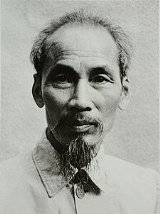
Ho Chi Minh

 
Ho Chi Minh

   Email Print
   Bookmark   Link


Ho Chi Minh


H? Chí Minh (name ) (May 19, 1890 – September 2, 1969) was a Vietnam
Vietnam

Vietnam , officially the Socialist Republic of Vietnam , is the easternmost country on the Indochina Peninsula in Southeast Asia. It is bordered by People's Republic of China to the north, Laos to the northwest, Cambodia to the southwest, and the South China Sea to the east....
ese Communist
Communism

Communism is a socioeconomic structure and political ideology that promotes the establishment of an egalitarianism, classlessness, stateless society based on common ownership and control of the means of production and property in general....
 revolutionary
Revolutionary

A revolutionary is a person who either actively participates in, or advocates revolution. Also, when used as an adjective, the term revolutionary refers to something that has a major, sudden impact on society or on some aspect of human endeavour....
 and statesman who was Prime Minister (1946–1955) and President (1946–1969) of the Democratic Republic of Vietnam (North Vietnam).

Ho led the Viet Minh
Viet Minh

The Vi?t Minh was a national liberation movement which dated its foundation to May 19 1941 in South China. The Vi?t Minh initially formed to seek independence for Vietnam from France and later to oppose the Vietnam during World War II....
 independence movement
Independence movement

An independence movement is a separatism political movement, seeking independence of some territory from a larger government....
 from 1941 onward, establishing the communist-governed Democratic Republic of Vietnam in 1945 and defeating the French Union
French Union

The French Union was a political entity created by the French Fourth Republic to replace the old French colonial system, the "French colonial empire" and to abolish its "indigenous" status....
 in 1954 at Dien Bien Phu
Battle of Dien Bien Phu

The Battle of Dien Bien Phu was the climactic confrontation of the First Indochina War between the French Union's French Far East Expeditionary Corps and Viet Minh Communism Revolutionary....
. He lost political power inside North Vietnam in the late 1950s, but remained as the highly visible figurehead president until his death.


Discussion
Ask a question about 'Ho Chi Minh'
Start a new discussion about 'Ho Chi Minh'
Answer questions from other users
Full Discussion Forum


Quotations


If the Tiger does not stop fighting the Elephant, the Elephant will die of exhaustion.

Referring to Vietnam War

It is better to sacrifice everything than to live in slavery.

It was patriotism, not communism, that inspired me.

Nothing is more precious than Independence and Liberty.

Remember the storm is a good opportunity for the pine and the cypress to show their strength and their stability.

We have to win independence at any cost, even if the Truong Son mountains burn.


Encyclopedia


H? Chí Minh (name ) (May 19, 1890 – September 2, 1969) was a Vietnam
Vietnam

Vietnam , officially the Socialist Republic of Vietnam , is the easternmost country on the Indochina Peninsula in Southeast Asia. It is bordered by People's Republic of China to the north, Laos to the northwest, Cambodia to the southwest, and the South China Sea to the east....
ese Communist
Communism

Communism is a socioeconomic structure and political ideology that promotes the establishment of an egalitarianism, classlessness, stateless society based on common ownership and control of the means of production and property in general....
 revolutionary
Revolutionary

A revolutionary is a person who either actively participates in, or advocates revolution. Also, when used as an adjective, the term revolutionary refers to something that has a major, sudden impact on society or on some aspect of human endeavour....
 and statesman who was Prime Minister (1946–1955) and President (1946–1969) of the Democratic Republic of Vietnam (North Vietnam).

Ho led the Viet Minh
Viet Minh

The Vi?t Minh was a national liberation movement which dated its foundation to May 19 1941 in South China. The Vi?t Minh initially formed to seek independence for Vietnam from France and later to oppose the Vietnam during World War II....
 independence movement
Independence movement

An independence movement is a separatism political movement, seeking independence of some territory from a larger government....
 from 1941 onward, establishing the communist-governed Democratic Republic of Vietnam in 1945 and defeating the French Union
French Union

The French Union was a political entity created by the French Fourth Republic to replace the old French colonial system, the "French colonial empire" and to abolish its "indigenous" status....
 in 1954 at Dien Bien Phu
Battle of Dien Bien Phu

The Battle of Dien Bien Phu was the climactic confrontation of the First Indochina War between the French Union's French Far East Expeditionary Corps and Viet Minh Communism Revolutionary....
. He lost political power inside North Vietnam in the late 1950s, but remained as the highly visible figurehead president until his death. He was named by Time Magazine as one of the 100 most influential
Time 100: The Most Important People of the Century

The Time 100: The Most Important People of the Century is a compilation of the 20th century 100 most influential people, published in Time magazine in 1999....
 people of the 20th century, while the former capital of South Vietnam
South Vietnam

South Vietnam refers to an internationally recognized state which governed Vietnam south of the Vietnamese Demilitarized Zone until 1975. Its capital was Saigon and its origin can be traced to the French colony of Cochinchina, which consisted of the southern third of Vietnam....
, Saigon, was renamed Ho Chi Minh City
Ho Chi Minh City

Ho Chi Minh City is the largest city in Vietnam. Under the name Prey Nokor it was the main port of Cambodia, before being annexed by the Vietnamese in the 17th century....
 in his honor.

Early life


H? Chí Minh was born, as Nguy?n Sinh Cung, in 1890 in Hoàng Trù Village, his mother's hometown. From 1895, he grew up in his paternal hometown of Kim Liên Village, Nam Đàn District, Ngh? An Province
Nghe An Province

Ngh? An is the largest Provinces of Vietnam in the Bac Trung Bo of Vietnam....
, Vietnam. He had three siblings, his sister B?ch Liên (or Nguy?n Th? Thanh), a clerk in the French Army
French Army

The French Army, officially the Arm?e de Terre , is the Army component of the Military of France and its largest. As of 2007, the army employs 134,000 regular soldiers, 15,500 reservists, and 25,750 civilians....
, his brother Nguy?n Sinh Khiêm
Nguy?n Sinh Khiêm

Nguy?n Sinh Khi?m , renamed Nguy?n T?t ??t in accordance with Confucian tradition, was the brother of President H? Ch? Minh of Vietnam. Khi?m was a geomancer and traditional herbalist....
 (or Nguy?n T?t Đ?t), a geomancer
Geomancy

File:Geomantic_instrument_Egypt_or_Syria_1241_1242_CE_Muhammad_ibn_Khutlukh_al_Mawsuli.jpgFile:Geomantic instrument Egypt or Syria 1241 1242 CE detail 1.jpg...
 and traditional herbalist, and another brother (Nguy?n Sinh Nhu?n) who died in his infancy. Following Confucian
Confucianism

Confucianism is a China Ethics and Philosophy developed from the teachings of the Chinese philosopher Confucius . It focuses on human morality and right action....
 traditions, at the age of 10 his father named him Nguy?n T?t Thành (Nguy?n the Accomplished).

Ho's father, Nguy?n Sinh S?c, was a Confucian scholar, small time teacher and later an imperial magistrate in a small remote district Binh Khe (Qui Nhon). He was later demoted for abuse of power after an influential local figure died several days after receiving 100 canes as punishment. This however was merely a pretense by the French-controlled government to get rid of Sac, whose sons had been involved in nationalist, Anti-French activities at the Duc Thanh school, founded in 1907 by patriotic scholars who hoped to imitate the success of the Hanoi Free School. Deferent to his father, Ho received a French education, attended lycée in Hu?, the alma mater of his later disciples, Ph?m Van Đ?ng and Vơ Nguyên Giáp
Vo Nguyen Giap

General V? Nguy?n Gi?p is a retired Vietnamese career officer in the Vietnam People's Army and a politician. Principal wars: First Indochina War and Vietnam War ....
. He later left his studies and chose to teach at D?c Thanh school in Phan Thi?t.

First sojourn in France

On 5 June 1911, H? Chí Minh left Vietnam on a French steamer, Amiral Latouche-Tréville, working as a kitchen helper. Arriving in Marseille
Marseille

"Marseille" is the second-largest city of France and forms the third-largest aire urbaine, after those of Paris and Lyon, with a population recorded to be 1,516,340 at the 1999 census and estimated to be 1,605,000 in 2007....
, France
France

France , officially the French Republic , is a country whose Metropolitan France is located in Western Europe and that also comprises various Overseas departments and territories of France....
, he applied for the French Colonial Administrative School but his application was rejected. During his stay, he worked as a cleaner, waiter, and film retoucher. H? spent most of his free time in public libraries reading history books and newspapers to familiarize himself with Western
Western culture

File:Clash of Civilizations map.pngWestern culture are terms which are used to refer to cultures of European origin. This terminology originated as a way of describing what was different about the Graeco-Roman culture and its descendants, in contrast to the older neighboring civilizations of the Middle East, which in many ways continued...
 society and politics.

In the USA

In 1912, again working as the cook's helper on a ship, H? Chí Minh traveled to the United States
United States

The United States of America is a Federal government constitutional republic comprising U.S. state and a federal district. The country is situated mostly in central North America, where its Contiguous United States and Washington, D.C., the Capital districts and territories, lie between the Pacific Ocean and Atlantic Oceans, Borders of the U...
. From 1912 to 1913, he lived in New York
New York City

The City of New York is the List of United States cities by population in the United States, while the New York metropolitan area ranks among the List of urban areas by population....
 (Harlem
Harlem

Harlem is a Neighbourhood in the New York City borough of Manhattan, long known as a major African-American residential, cultural, and business center....
) and Boston
Boston, Massachusetts

Boston is the State capital and largest city of the Commonwealth of Massachusetts, and is one of the oldest cities in the United States. The largest city in New England, Boston is considered the economic and cultural center of the region, and is sometimes regarded as the unofficial "Capital of New England." Boston city proper had a 2007 est...
, where he worked as a baker at the Parker House
Omni Parker House

The Omni Parker House Hotel is a hotel in Boston, Massachusetts, Massachusetts, currently owned by Omni Hotels and named the Omni Parker House....
 Hotel. He worked in menial jobs and later claimed to have worked for a wealthy family in Brooklyn
Brooklyn

Brooklyn is one of the five Borough of New York City, located at the western end of Long Island. An independent city until its consolidation with New York in 1898, Brooklyn is New York City's most populous borough, with 2.5 million residents, and second largest in area....
 between 1917 and 1918, and during this time he may have heard Marcus Garvey
Marcus Garvey

Marcus Mosiah Garvey, Jr., Order of National Hero , was a publisher, journalist, entrepreneur, Black Nationalist, Pan-Africanist, and orator. Marcus Garvey was founder of the Universal Negro Improvement Association and African Communities League ....
 speak in Harlem
Harlem

Harlem is a Neighbourhood in the New York City borough of Manhattan, long known as a major African-American residential, cultural, and business center....
. It is believed that while in the United States he made contact with Korean nationalists, an experience that developed his political outlook.

In England

At various points between 1913 and 1919, H? lived in West Ealing
West Ealing

West Ealing is a place in the London Borough of Ealing in west London....
, west London
London

London is the capital of both England and the United Kingdom, and the most populous municipality in the European Union. An important settlement for two millennia, History of London goes back to its founding by the Roman Empire....
, and later in Crouch End
Crouch End

Crouch End is an area of north London, in the London Borough of Haringey....
, Hornsey
Hornsey

Hornsey is a district in London Borough of Haringey in north London in England. Whilst Hornsey was formerly the name of a parish and later a municipal borough of Middlesex, today, the name refers only to the London district....
, north London. He is reported to have worked as a chef at the Drayton Court Hotel, on The Avenue, West Ealing. It is claimed that Ho trained as a pastry chef under the legendary French master, Escoffier, at the Carlton Hotel
Carlton Hotel

Carlton Hotel can refer to:* Carlton Hotel, Westminster, England* Carlton Hotel, Cannes, France* Carlton Hotel, Karachi, Pakistan* Carlton Hotel, Auckland, New Zealand...
 in the Haymarket, Westminster
Westminster

Westminster is an area of Central London, within the City of Westminster. It lies on the north bank of the River Thames, southwest of the City of London and southwest of Charing Cross....
, but there is no evidence to support this. However, the wall of New Zealand House, home of the New Zealand High Commission, which now stands on the site of the Carlton Hotel, displays a Blue Plaque
Blue plaque

In the United Kingdom, a blue plaque is a permanent sign installed in a public place to commemorate a link between that location and a famous person or event....
, stating that H? worked there in 1913 as a waiter.

Political education in France


From 1919–1923, while living in France
France

France , officially the French Republic , is a country whose Metropolitan France is located in Western Europe and that also comprises various Overseas departments and territories of France....
, H? Chí Minh embraced communism
Communism

Communism is a socioeconomic structure and political ideology that promotes the establishment of an egalitarianism, classlessness, stateless society based on common ownership and control of the means of production and property in general....
, through his friend Marcel Cachin (SFIO
Sfio

Sfio, or Safe/Fast String/File I/O, is a C I/O Library developed by David Korn and Kiem-Phong Vo AT&T Labs Research, intended as a replacement for the standard C stdio.h....
). Ho claimed to have arrived in Paris from London in 1917 but French police only have documents of his arrival in June 1919. Following World War I
World War I

World War I, or the First World War , was a global military conflict which involved the Great powers, organized into two opposing military alliances: the Allies of World War I and the Central Powers....
, under the name of Nguy?n Ái Qu?c (Nguyen the Patriot), he petitioned for recognition of the civil rights of the Vietnamese people in French Indochina
French Indochina

French Indochina was the part of the French colonial empire in Indochina in southeast Asia. A federation of the three Vietnamese regions, Tonkin, Annam, and Cochinchina, as well as Cambodia, was formed in 1887....
 to the Western powers at the Versailles
Versailles

Versailles , formerly de facto capital of the kingdom of France, is now a wealthy suburb of Paris and is still an important administrative and judicial centre....
 peace talks, but was ignored. Citing the language and the spirit of the U.S. Declaration of Independence, Ho petitioned U.S. President
President of the United States

The President of the United States is the head of state and head of government of the United States and is the highest political official in the United States by influence and recognition....
 Woodrow Wilson
Woodrow Wilson

Thomas Woodrow Wilson was the List of Presidents of the United States President of the United States. A devout Presbyterianism and leading intellectual of the Progressive Era, he served as President of Princeton University of Princeton University from 1902 to 1910, and then as the Governor of New Jersey from 1911 to 1913....
 for help to remove the French from Vietnam
Vietnam

Vietnam , officially the Socialist Republic of Vietnam , is the easternmost country on the Indochina Peninsula in Southeast Asia. It is bordered by People's Republic of China to the north, Laos to the northwest, Cambodia to the southwest, and the South China Sea to the east....
 and replace it with a new, nationalist government. His request was ignored.

In 1921, during the Congress of Tours
Tours

Tours is a city in central France, the capital of the Indre-et-Loire Departments of France.It is located on the lower reaches of the river River Loire, between Orl?ans and the Atlantic Ocean coast....
, France, Nguyen Ai Quoc became a founding member of the Parti Communiste Français (French Communist Party
French Communist Party

The French Communist Party is a political party in France which advocates the principles of communism. Although its electoral support has greatly declined in recent decades, it remains the largest party in France advocating communist views, and retains a large membership and considerable influence in French politics....
) and spent much of his time in Moscow
Moscow

Moscow is the capital and the largest types of inhabited localities in Russia of the Russian Federation. It is also the largest European cities and metropolitan areas, with the Moscow metropolitan area ranking among the largest urban areas in the world....
 afterwards, becoming the Comintern
Comintern

The 'Comintern' was an international Communism organization founded in Moscow in March 1919. The International intended to fight "by all available means, including armed force, for the overthrow of the international bourgeoisie and for the creation of an international Soviet republic as a transition stage to the complete abolition of the Sta...
's Asia hand and the principal theorist on colonial warfare. It was at this time that Nguy?n Ái Qu?c took the name of "H? Chí Minh", a Vietnamese name combining a common Vietnamese surname (H?, ?) with a given name meaning "enlightened will" (from Sino-Vietnamese
Sino-Vietnamese

Sino-Vietnamese are the elements in the Vietnamese language derived from Chinese language. They account for about 60% of the Vietnamese vocabulary....
 ??; Chí meaning 'will' (or spirit), and Minh meaning 'light'), in essence, mean "bringer of light". During the Indochina War, the PCF would be involved with antiwar propaganda, sabotage and support for the revolutionary effort.

In the Soviet Union and China

River in China, 1961.]] In 1923, H? left Paris for Moscow
Moscow

Moscow is the capital and the largest types of inhabited localities in Russia of the Russian Federation. It is also the largest European cities and metropolitan areas, with the Moscow metropolitan area ranking among the largest urban areas in the world....
, where he was employed by the Comintern
Comintern

The 'Comintern' was an international Communism organization founded in Moscow in March 1919. The International intended to fight "by all available means, including armed force, for the overthrow of the international bourgeoisie and for the creation of an international Soviet republic as a transition stage to the complete abolition of the Sta...
, and participated in the Fifth Comintern Congress in June 1924, before arriving in Canton (Guangzhou
Guangzhou

'Guangzhou' is the Capital and a sub-provincial city of Guangdong Province of China in the northern and southern China part of the People's Republic of China....
), China, in November 1924. During 1925-26 he organized 'Youth Education Classes' and occasionally gave lectures at the Whampoa Military Academy
Whampoa Military Academy

The Nationalist Party of China Army Officer Academy , commonly known as the Whampoa Military Academy , was a military academy in the Republic of China that produced many prestigious commanders who fought in many of China's conflicts in the 20th century, notably the Northern Expedition , the Second Sino-Japanese War and the Chinese Civ...
 on the revolutionary movement in Indochina. He left Canton again in April 1927 and returned to Moscow, spending some of the summer of 1927 recuperating from tuberculosis
Tuberculosis

Tuberculosis is a common and often deadly infectious disease caused by mycobacterium, mainly Mycobacterium tuberculosis . Tuberculosis usually attacks the lungs but can also affect the central nervous system, the lymphatic system, the circulatory system, the genitourinary system, the gastrointestinal system, bones, joints, and even the...
 in the Crimea
Crimea

Crimea or the Autonomous Republic of Crimea is an autonomous republic of Ukraine located on the northern coast of the Black Sea, occupying a peninsula of the same name....
, before returning to Paris once more in November. He then returned to Asia by way of Brussels
Brussels

Brussels , officially the Brussels Capital-Region, is the de facto capital city of the European Union and the largest urban area in Belgium....
, Berlin
Berlin

Berlin is the Capital of Germany city and one of sixteen States of Germany of Germany. With a population of 3.4 million within its city limits, Berlin is the country's largest city....
, Switzerland
Switzerland

Switzerland is a landlocked Swiss Alps country of roughly 7.7 million people in Western Europe with an area of 41,285 km?. Switzerland is a federal republic consisting of 26 states called Cantons of Switzerland....
, Italy
Italy

Italy , officially the Italian Republic , is a country located on the Italian Peninsula in Southern Europe and on the two largest islands in the Mediterranean Sea, Sicily and Sardinia....
, from where he took a ship to Bangkok
Bangkok

The city of Bangkok is the Capital , largest urban area and primary city of Thailand. Known in Thai language as Krung Thep Maha Nakhon or Krung Thep for short, it was a small trading post at the mouth of the Chao Phraya River during the Ayutthaya Kingdom and came to the forefront of Thailand when it was given the status as the...
 in Thailand
Thailand

The Kingdom of Thailand is an independent country that lies in the heart of Southeast Asia. It is bordered to the north by Laos and Myanmar, to the east by Laos and Cambodia, to the south by the Gulf of Thailand and Malaysia, and to the west by the Andaman Sea and Myanmar....
, where he arrived in July 1928. He remained in Thailand, staying in the Thai village of Nachok, until late 1929 when he moved on to Hong Kong
Hong Kong

Hong Kong , officially the Hong Kong Special Administrative Region, is a territory located in Southern China in East Asia, bordering the province of Guangdong to the north and facing the South China Sea to the east, west and south....
, and Shanghai
Shanghai

Shanghai is the List of cities in the People's Republic of China by population in China and one of the List of metropolitan areas by population in the world, with over 20 million people....
. In June 1931, he was arrested in Hong Kong
Hong Kong

Hong Kong , officially the Hong Kong Special Administrative Region, is a territory located in Southern China in East Asia, bordering the province of Guangdong to the north and facing the South China Sea to the east, west and south....
 and incarcerated by British police until his release in 1933. He then made his way back to the Soviet Union
Soviet Union

The Union of Soviet Socialist Republics was a Constitution of the Soviet Union socialist state that existed in Eurasia from 1922 to 1991.The name is a translation of the , romanization of Russian Soyuz Sovetskikh Sotsialisticheskikh Respublik, abbreviated ????, SSSR....
, where he spent several more years recovering from tuberculosis
Tuberculosis

Tuberculosis is a common and often deadly infectious disease caused by mycobacterium, mainly Mycobacterium tuberculosis . Tuberculosis usually attacks the lungs but can also affect the central nervous system, the lymphatic system, the circulatory system, the genitourinary system, the gastrointestinal system, bones, joints, and even the...
. In 1938, he returned to China
China

China is a Culture of China, an ancient civilization, and, depending on perspective, a national or multinational entity extending over a large area in East Asia....
 and served as an adviser with Chinese Communist armed forces.

Independence movement

In 1941, H? returned to Vietnam to lead the Vi?t Minh
Viet Minh

The Vi?t Minh was a national liberation movement which dated its foundation to May 19 1941 in South China. The Vi?t Minh initially formed to seek independence for Vietnam from France and later to oppose the Vietnam during World War II....
 independence movement. He oversaw many successful military actions against the Vichy French and Japanese occupation of Vietnam during World War II
World War II

World War II, or the Second World War , was a global military conflict which involved a Participants in World War II, including all of the great powers, organised into two opposing military alliances: the Allies of World War II and the Axis powers....
, supported closely but clandestinely by the United States Office of Strategic Services
Office of Strategic Services

The Office of Strategic Services was a United States intelligence agencies formed during World War II. It was the wartime intelligence agency, and it was the predecessor of the Central Intelligence Agency ....
, and also later against the French bid to reoccupy the country (1946-1954). He was also jailed in China for many months by Chiang Kai-shek
Chiang Kai-shek

Chiang Kai-shek , Order of the Bath , served as Generalissimo of the Nationalist Government of the Republic of China from 1928 to 1948. He was sometimes referred to simply as "the Generalissimo"....
's local authorities. After his release in 1943, he again returned to Vietnam. He was treated for malaria and dysentery by American OSS
Office of Strategic Services

The Office of Strategic Services was a United States intelligence agencies formed during World War II. It was the wartime intelligence agency, and it was the predecessor of the Central Intelligence Agency ....
 doctors.

After the August Revolution (1945) organized by the Vi?t Minh, H? became Chairman of the Provisional Government (Premier of the Democratic Republic of Vietnam) and issued a Proclamation of Independence of the Democratic Republic of Vietnam
Proclamation of Independence of the Democratic Republic of Vietnam

The Proclamation of Independence of the Democratic Republic of Vietnam was written by H? Ch? Minh, and announced in public at the Ba ??nh flower garden on September 2 1945....
 that borrowed much from the French and American declarations. Though he convinced Emperor B?o Đ?i
Bao Dai

B?o ??i was the 13th and last ruler of the Nguyen dynasty. He served as Emperor of Vietnam from 1926 until 1945 and as head of state of the State of Vietnam from 1949 until 1955....
 to abdicate, his government was not recognized by any country. He repeatedly petitioned American President Harry Truman for support for Vietnamese independence, citing the Atlantic Charter
Atlantic Charter

The Atlantic Charter was the blueprint for the world after World War II, and is the foundation for many of the international treaties and organizations that currently shape the world....
, but Truman never responded.

In 1945, in a power struggle, the Viet Minh killed members of rival groups, such as the leader of the Constitutional Party, the head of the Party for Independence, and Ngo Dinh Diem
Ngo Dinh Diem

Ngo Dinh Diem...
's brother, Ngo Dinh Khoi
Ngo Dinh Khoi

Ng? ??nh Kh?i was a brother of South Vietnam?s first President, Ngo Dinh Diem, and of Archbishop Ngo Dinh Thuc. He served as a governor in the French administration of Vietnam during the French Indochina years....
. Purges and killings of Trotskyists, the rival anti-Stalinist communists, have also been documented. In 1946, when H? traveled outside of the country, his subordinates imprisoned 25,000 non-communist nationalists and forced 6,000 others to flee. Hundreds of political opponents were also killed in July that same year. All rival political parties were banned and local governments purged to minimise opposition later on.

Birth of the Democratic Republic of Vietnam

On 2 September 1945, after Emperor Bao Dai
Bao Dai

B?o ??i was the 13th and last ruler of the Nguyen dynasty. He served as Emperor of Vietnam from 1926 until 1945 and as head of state of the State of Vietnam from 1949 until 1955....
's abdication, H? Chí Minh read the Declaration of Independence of Vietnam, under the name of the Democratic Republic of Vietnam. With violence between rival Vietnamese factions and French forces spiraling, the British commander, General Sir Douglas Gracey declared martial law. On 24 September, the Viet Minh leaders responded with a call for a general strike.

In September 1945, a force of 200,000 Chinese Nationalists arrived in Hanoi
Hanoi

Hanoi , estimated population 3,398,889 , is the Capital of Vietnam. From 1010 until 1802, with a few brief interruptions, it was the political centre of an independent Vietnam....
. H? Chí Minh made arrangement with their general, Lu Han, to dissolve the Communist Party and to hold an election which would yield a coalition government. When Chiang Kai-Shek later traded Chinese influence in Vietnam for French concessions
Shanghai French Concession

The French Concession was the concessions in China of France in Shanghai, China. Established in 1849, the concession was progressively expanded in the late 19th and early 20th centuries....
 in Shanghai, H? Chí Minh had no choice but to sign an agreement with France on 6 March 1946, in which Vietnam would be recognized as an autonomous state in the Indochinese Federation and the French Union
French Union

The French Union was a political entity created by the French Fourth Republic to replace the old French colonial system, the "French colonial empire" and to abolish its "indigenous" status....
. The agreement soon broke down. The purpose of the agreement was to drive out the Chinese army from North Vietnam. Fighting broke out with the French soon after the Chinese left. H? Chí Minh was almost captured by a group of French soldiers led by Jean-Etienne Valluy
Jean-Étienne Valluy

Jean Etienne Valluy was a French general .He was born in Rive-de-Gier, in the Loire, France, on 15 May 1899 to Claude Valluy and Jeanne, Adrienne Cossanges....
 at Vi?t B?c, but was able to escape.

In February 1950, H? met with Stalin and Mao
Mao

, is a Japanese remake of the Korean suspense drama series titled Ma Wang which aired on Korean Broadcasting System in 2007. The drama stars Satoshi Ohno of Arashi and Toma Ikuta, both under the talent agency Johnny & Associates....
 in Moscow after the Soviet Union
Soviet Union

The Union of Soviet Socialist Republics was a Constitution of the Soviet Union socialist state that existed in Eurasia from 1922 to 1991.The name is a translation of the , romanization of Russian Soyuz Sovetskikh Sotsialisticheskikh Respublik, abbreviated ????, SSSR....
 recognized his government. They all agreed that China would be responsible for backing the Viet Minh
Viet Minh

The Vi?t Minh was a national liberation movement which dated its foundation to May 19 1941 in South China. The Vi?t Minh initially formed to seek independence for Vietnam from France and later to oppose the Vietnam during World War II....
. Mao's emissary to Moscow stated in August that China planned to train 60-70,000 Viet Minh in the near future. China's support enabled Ho to escalate the fight against France.

According to a story told by Journalist Bernard Fall, after fighting the French for several years, H? decided to negotiate a truce. The French negotiators arrived at the meeting site, a mud hut with a thatched roof. Inside they found a long table with chairs and were surprised to discover in one corner of the room a silver ice bucket containing ice and a bottle of good Champagne which should have indicated that H? expected the negotiations to succeed. One demand by the French was the return to French custody of a number of Japanese military officers (who had been helping the Vietnamese armed forces by training them in the use of weapons of Japanese origin), in order for them to stand trial for war crimes committed during World War II
World War II

World War II, or the Second World War , was a global military conflict which involved a Participants in World War II, including all of the great powers, organised into two opposing military alliances: the Allies of World War II and the Axis powers....
. H? replied that the Japanese officers were allies and friends whom he could not betray. Then he walked out, to seven more years of war. (From Last Reflections on a War, Fall's last book, published posthumously.)

In 1954, after the important defeat of French paratroopers at the Battle of Đi?n Biên Ph?
Battle of Dien Bien Phu

The Battle of Dien Bien Phu was the climactic confrontation of the First Indochina War between the French Union's French Far East Expeditionary Corps and Viet Minh Communism Revolutionary....
, France was forced to give up its empire in Indochina.

Becoming president

(left) in Hanoi, 1945]] .]]

The 1954 Geneva Accords
Geneva Conference (1954)

The Geneva Conference was a conference between many countries that agreed to end hostilities and restore peace in French Indochina and Vietnam....
, concluded between France and the Vietminh, provided that communist forces regroup in the North and non-communist forces regroup in the South. Ho's Democratic Republic of Vietnam relocated to Hanoi and became the government of North Vietnam, a Communist-led single party state. The Geneva accords also provided for a national election to reunify the country in 1956, but this provision was rejected by South Vietnam
South Vietnam

South Vietnam refers to an internationally recognized state which governed Vietnam south of the Vietnamese Demilitarized Zone until 1975. Its capital was Saigon and its origin can be traced to the French colony of Cochinchina, which consisted of the southern third of Vietnam....
 and the United States. The U.S. committed itself to oppose Communism in Asia beginning in 1950, when it funded 80 percent of the French effort. After Geneva, the U.S. replaced France as South Vietnam's chief sponsor and financial backer, but there never was a treaty between the U.S. and South Vietnam.

Following the Geneva Accords
Geneva Conference (1954)

The Geneva Conference was a conference between many countries that agreed to end hostilities and restore peace in French Indochina and Vietnam....
, there was to be a 300-day period in which people could freely move between the zones of the two Vietnams. Some 900,000 to 1 million Vietnamese, mostly Catholic
Roman Catholic Church

The Roman Catholic Church, officially known as the Catholic Church is the world's largest Christianity Ecclesia , representing over half of all Christians and one-sixth of the world population....
, left for South Vietnam
South Vietnam

South Vietnam refers to an internationally recognized state which governed Vietnam south of the Vietnamese Demilitarized Zone until 1975. Its capital was Saigon and its origin can be traced to the French colony of Cochinchina, which consisted of the southern third of Vietnam....
, while a much smaller number, mostly communists, went from South to North. This was partly due to propaganda claims by a CIA mission led by Colonel Edward Lansdale
Edward Lansdale

Edward Geary Lansdale was a United States United States Air Force officer who served in the Office of Strategic Services and the Central Intelligence Agency....
 that the Virgin Mary had moved South out of distaste for life under communism
Communism

Communism is a socioeconomic structure and political ideology that promotes the establishment of an egalitarianism, classlessness, stateless society based on common ownership and control of the means of production and property in general....
. Some Canadian observers claimed that some were forced by North Vietnamese authorities to remain against their will. During this era, H?, following the communist doctrine initiated by Stalin and Mao, started a land reform in which hundreds of thousands of people accused of being landlords were summarily executed or tortured and starved in prison. This also caused millions of people to flee to South Vietnam.

At the end of 1956, Lê Du?n
Lê Du?n

L? Du?n was a Vietnamese communist leader. He became North Vietnam's acting party chief in late 1956. By 1958, he was the country's top policy maker, although nominally number two behind figurehead H? Ch? Minh....
 was appointed acting party boss and began sending aid to the Vietcong insurgency in South Vietnam. This represented a loss of power by H?, who is said to have preferred the more moderate Giáp for the position. The so called Hochiminh Trail was built in 1959 to allow aid to be sent to the Vietcong through Laos and Cambodia, thus escalating the war. Du?n was named permanent party boss in 1960, leaving H? a figurehead president and symbol of Vietnamese Communism.

In late 1964, North Vietnamese combat troops were sent southwest into neutral Laos
Laos

Laos , officially the Lao People's Democratic Republic, is a landlocked country in southeast Asia, bordered by Burma and People's Republic of China to the northwest, Vietnam to the east, Cambodia to the south, and Thailand to the west....
. During the mid to late 1960s, Lê Du?n permitted 320,000 Chinese volunteers into northern North Vietnam
North Vietnam

The Democratic Republic of Vietnam , or less commonly, Vietnamese Democratic Republic was an effective state all over Vietnam from 1945 until the partition of Vietnam in 1954....
 to help build infrastructure for the country, thereby freeing a similar number of North Vietnamese forces to go south.

By early 1965, U.S. combat troops begins arriving in South Vietnam to counter the threat imposed by both the local Viet Cong and the North Vietnamese troops in the border areas. As the fighting escalated, widespread bombing of North Vietnam by the U.S. Air Force and Navy escalated as Operation Rolling Thunder
Operation Rolling Thunder

Operation Rolling Thunder was the title of a gradual and sustained U.S. 2nd Air Division , U.S. Navy, and Republic of Vietnam Air Force aerial bombardment campaign conducted against the Democratic Republic of Vietnam from 2 March 1965 until 1 November 1968, during the Vietnam War....
. H? remained in Hanoi for most of the duration of his final years, stubbornly refusing to negotiate with the Americans and demanded nothing but an unconditional withdrawal of all foreign troops in South Vietnam. By July, 1967, H? and most of the Politburo of North Vietnam met in a high-level conference where they concluded that the war was not going well for them since the American military blunted every attempt by the Peoples Army of Vietnam to make gains, and inflicted heavy casualties. But H? and the rest his government knew that there were two weaknesses: there was still no disguising the continuing ineffectiveness of large portion of the South Vietnamese army, shielded by U.S. firepower, and that American public opinion was not wholeheartedly in favor of the war. With H?'s permission, the North Vietnamese army and politicians planned to execute the Tet Offensive as a gamble to take the South by force and defeat the U.S. military.

Although the offensive was a huge tactical failure which resulted in the decimation of whole units of Viet Cong, the end result was a moral victory for it broke the U.S. will to fight the war and public opinion in the U.S. turned against the government which resulted in the bombing of North Vietnam halted, and negotiations with U.S. officials opening as to how to end the war.

By 1969, with negotiations still dragging on, H?'s health began to deteriorate from multiple health problems, including diabetes among other ailments, which prevented him from participating in further active politics. However, he insisted that his forces in South Vietnam continue fighting until all of Vietnam was reunited under his government, regardless of the length of time that it might take, believing that time and politics were on his side.

Death

, Hanoi]] With the outcome of the Vietnam War
Vietnam War

The Vietnam War, also known as the Second Indochina Wars, the Vietnam Conflict, or often in Vietnam the American War occurred in Vietnam, Laos and Cambodia from 1959 to April 30, 1975....
 still in question, Ho Chi Minh died on the morning of 2 September 1969, at his home in Hanoi
Hanoi

Hanoi , estimated population 3,398,889 , is the Capital of Vietnam. From 1010 until 1802, with a few brief interruptions, it was the political centre of an independent Vietnam....
 at age 79 from heart failure.
News of his death was withheld from the North Vietnamese public for nearly 48 hours due to not wanting to announce his death on the anniversary of the founding of the Democratic Republic of Vietnam. He was not initially replaced as president, but a "collective leadership" forming up of several ministers and military leaders took control of North Vietnam to continue his goal of conquering South Vietnam to unite it under H?'s founding government.

Six years after his death, when the communists were successful in conquering South Vietnam, several North Vietnamese tanks in Saigon displayed a poster with the following quote, "You are always marching with us, Uncle Ho".

Legacy

The former capital of South Vietnam
South Vietnam

South Vietnam refers to an internationally recognized state which governed Vietnam south of the Vietnamese Demilitarized Zone until 1975. Its capital was Saigon and its origin can be traced to the French colony of Cochinchina, which consisted of the southern third of Vietnam....
, Saigon, was renamed Ho Chi Minh City
Ho Chi Minh City

Ho Chi Minh City is the largest city in Vietnam. Under the name Prey Nokor it was the main port of Cambodia, before being annexed by the Vietnamese in the 17th century....
 on 1 May 1975 shortly after its capture which officially ended the war.

Ho Chi Minh's embalmed body is on display in a granite Ho Chi Minh Mausoleum
Ho Chi Minh Mausoleum

File:Ho Chi Minh Mausoleum.jpgFile:Mausol?e de H? Chi Minh.jpgThe H? Ch? Minh Mausoleum is a large memorial to the Vietnamese leader in Hanoi,Vietnam....
 modeled after Lenin's Tomb
Lenin's Mausoleum

Lenin's Mausoleum also known as Lenin's Tomb, situated in Red Square in Moscow, is the mausoleum that serves as the current cemetery of Vladimir Lenin....
 in Moscow. This is similar to other Communist leaders who have been similarly displayed before and since, including Mao Zedong
Mao Zedong

Mao Zedong was a China military and politics dictator. Mao led the Communist Party of China to victory against the Kuomintang in the Chinese Civil War, and was the leader of the People?s Republic of China from its establishment in 1949 until his death in 1976....
, Kim Il-Sung
Kim Il-sung

Kim Il-sung was the president and absolute ruler of North Korea from its founding in early 1948 until his death, when he was succeeded by his son Kim Jong-il....
, and for a time, Joseph Stalin
Joseph Stalin

Joseph Stalin was the General Secretary of the Communist Party of the Soviet Union's Central Committee of the Communist Party of the Soviet Union from 1922 until his death in 1953....
, but the "honor" violated H?'s last wishes (as well as the three leaders mentioned above). Several months before his death, he wished to be cremated and his ashes buried in three urns on three different hilltops of Vietnam (the North, Central and South areas). He wrote, "Not only is cremation good from the point of view of hygiene but also it saves farmland."

The Ho Chi Minh Museum
Ho Chi Minh Museum

File:Ho Chi Minh museum, Hanoi 2.jpgThe Ho Chi Minh Museum is located in Hanoi, Vietnam. It is a museum dedicated to the late Vietnamese leader Ho Chi Minh and Vietnam's revolutionary struggle against foreign powers....
 in Hanoi is dedicated to his life and work.

In Vietnam today, he is regarded by the Communist government with almost god-like status in a nationwide personality cult, even though the government has abandoned most of his economic policies since the mid-1980s. He is still referred to as "Uncle H?" in Vietnam. H?'s image appears on the front of every Vietnamese currency note, and H?'s portrait is featured prominently in many of Vietnam's public buildings. In 1987, UNESCO
UNESCO

United Nations Educational, Scientific and Cultural Organization is a specialized agency of the United Nations established on 16 November 1945....
 officially recommended to Member States that they "join in the commemoration of the centenary of the birth of President Ho Chi Minh by organizing various events as a tribute to his memory", considering "the important and many-sided contribution of President Ho Chi Minh in the fields of culture, education and the arts" and that Ho Chi Minh "devoted his whole life to the national liberation of the Vietnamese people, contributing to the common struggle of peoples for peace, national independence, democracy and social progress."

In contrast, some Vietnamese who lived through the war hated Ho Chi Minh for bringing chaos to the country. Vietnamese people living outside of Vietnam, commonly known as Overseas Vietnamese, have more hostile opinions of Ho Chi Minh. In particular, the Vietnamese in the U.S., who fled communist rule after 1975, view H? as a murderer and traitor who ruined Vietnam by starting a war.

Quotes

  • "Nothing is more valuable than independence and freedom."
  • "Those who wish to seize Vietnam, must kill us to the last man, woman, and child"
  • "I follow only one party: the Vietnamese party."
  • "You can kill ten of our men for every one we kill of yours. But even at those odds, you will lose and we will win." - referring to France and America in their wars in Vietnam.
  • "It is better to sacrifice everything than to live in slavery!"
  • "The Vietnamese people deeply love independence, freedom and peace. But in the face of United States aggression they have risen up, united as one man."
  • "We have to win independence at any cost, even if the Truong Son mountains burn."
  • "In (Lenin's Theses on the National and Colonial Questions) there were political terms that were difficult to understand. But by reading them again and again finally I was able to grasp the essential part. What emotion, enthusiasm, enlightenment and confidence they communicated to me! I wept for joy. Sitting by myself in my room, I would shout as if I were addressing large crowds: "Dear martyr compatriots! This is what we need, this is our path to liberation!" Since then (the 1920s) I had entire confidence in Lenin, in the Third International!"
  • "When the prison doors are opened, the real dragon will fly out."
  • "It was patriotism, not communism, that inspired me."
  • "Remember, the storm is a good opportunity for the pine and the cypress to show their strength and their stability."
  • "My only desire is that all of our Party and people, closely united in struggle, construct a peaceful, unified, independent, democratic and prosperous, and make a valiant contribution to the world Revolution." (Hanoi, 10 May 1969.)


Further reading


Essays

  • Bernard B. Fall
    Bernard B. Fall

    File:Bernard B. Fall.JPGBernard B. Fall was a prominent war correspondent, historian, political scientist, and expert on Indochina during the 1950s and 1960s....
    , ed., 1967. Ho Chi Minh on Revolution and War, Selected Writings 1920-1966. New American Library.


Biography

  • William J. Duiker. 2000. Ho Chi Minh: A Life. Theia.
  • Jean Lacouture
    Jean Lacouture

    Jean Lacouture is a journalist, historian and author. He is particularly famous for his biographies....
    . 1968. Ho Chi Minh: A Political Biography. Random House.
  • N. Khac Huyen. 1971. Vision Accomplished? The Enigma of Ho Chi Minh. The Macmillan Company.
  • David Halberstam
    David Halberstam

    David Halberstam was an United States Pulitzer Prize-winning journalist and author known for his early work on the Vietnam War, his work on politics, history, business, media, American culture, and his later sports journalism....
    . 1971. Ho. Rowman & Littlefield.
  • H? chí Minh toàn t?p. NXB chính tr? qu?c gia
  • Sophie Quinn-Judge. 2003. Ho Chi Minh: The missing years. C. Hurst & Co. ISBN 1-85065-658-4


The Viet Minh, NLF & the Democratic Republic of Vietnam

  • William J. Duiker. 1981. The Communist Road to Power in Vietnam. Westview Press.
  • Hoang Van Chi
    Hoang Van Chi

    Ho?ng Van Ch? was one of the first Vietnamese political writers, a prominent intellectual who was an opponent of colonialism and later of communism in Vietnam....
    . 1964. From colonialism to communism. Praeger.
  • Truong Nhu Tang
    Truong Nhu Tang

    Truong Nhu T?ng was one of the founders of the National Front for the Liberation of South Vietnam and Republic of South Vietnam of South Vietnam and Minister of Justice during the Vietnam War era....
    . 1986. A Viet Cong Memoir. Vintage.


The War in Vietnam

  • Frances Fitzgerald
    Frances FitzGerald

    See also Frances Fitzgerald Frances FitzGerald is an United States journalist and author. She is primarily known for her acclaimed journalistic account of the Vietnam War....
    . 1972. Fire in the Lake: The Vietnamese and the Americans in Vietnam
    Fire in the Lake: The Vietnamese and the Americans in Vietnam

    Fire in the Lake: The Vietnamese and the Americans in Vietnam, written by Frances FitzGerald and published by both Back Bay Publishing and Little, Brown and Company in 1972, in 1973 won the Pulitzer Prize for General Non-Fiction., the National Book Award#Contemporary Affairs and the Bancroft Prize...
    . Little, Brown and Company.


American Foreign Policy

  • Christopher Hitchens
    Christopher Hitchens

    Christopher Eric Hitchens is a United Kingdom-born, United Kingdom and United States author, journalist and literary critic. Currently living in Washington, D.C., he has been a columnist at Vanity Fair magazine, The Atlantic, World Affairs , The Nation , Slate , Free Inquiry, and a variety of other media outlets....
    . 2001. The Trial of Henry Kissinger
    The Trial of Henry Kissinger

    The Trial of Henry Kissinger , is Christopher Hitchens' brief examination of the alleged war crimes of Henry Kissinger, the National Security Advisor and later Secretary of State for President Richard Nixon and President Gerald Ford....
    . Verso.
  • Henry A. Kissinger. 1979. White House Years. Little, Brown.
  • Richard Nixon
    Richard Nixon

    Richard Milhous Nixon was the List of Presidents of the United States President of the United States and the only president to resign the office....
    . 1987. No More Vietnams. Arbor House Pub Co.


External links


|- |- |- |-