
All Topics  
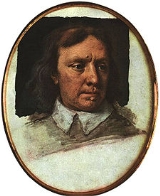
Oliver Cromwell

 
Oliver Cromwell

   Email Print
   Bookmark   Link


Oliver Cromwell


Oliver Cromwell (born April 25, 1599 Old Style, died September 3, 1658 Old Style) was an English
English people

The English are a nation and ethnic group native to England who speak English language in England. The English identity as a people is of early medieval origin, when they were known in Old English as the Anglecynn....
 military
Military history of the United Kingdom

The military history of the United Kingdom covers the period from the birth of the united Kingdom of Great Britain in 1707, with the political union of England and Scotland, to the present day....
 and political
Politics of England

The Politics of England form part of the wider politics of the United Kingdom, with England one of the constituent countries of the United Kingdom....
 leader best known for his involvement in making England
England

native_name =|conventional_long_name = England|common_name = England|image_flag = Flag of England.svg|image_coat = England COA.svg|symbol_type = Royal Coat of Arms...
 into a republic
Republic

A republic is a state or country that is not led by a hereditary monarch but in which the people have an impact on its government. The word originates from the Latin term res publica....
an Commonwealth
Commonwealth

The England noun commonwealth dates from the fifteenth century. The original phrase "common-wealth" or "the common weal" comes from the old meaning of "wealth," which is "well-being." The term literally meant "common well-being." Thus commonwealth originally meant a state or nation-state governed for the common good as opposed to an autho...
 and for his later role as Lord Protector
Lord Protector

Lord Protector is a particular British title for Heads of State, with two meanings at different periods of history.Feudal royal regent ...
 of England, Scotland
Scotland

conventional_long_name = ScotlandAlba|common_name= Scotland|image_flag = Flag of Scotland.svg|flag_width = 130px...
, and Ireland
Ireland

Ireland is the List of islands by area in Europe, and the twentieth-largest island in the world. It lies to the north-west of continental Europe and is surrounded by hundreds of islands and islet....
. He was one of the commanders of the New Model Army
New Model Army

The New Model Army was formed in 1645 by the roundhead in the English Civil War. It differed from other armies in the same conflict in that it was intended as an army liable for service anywhere in the country, rather than being tied to a single area or garrison....
 which defeated the royalists
Cavalier

Cavalier was the name used by Roundheads for a Royalist supporter of Charles I of England during the English Civil War . Prince Rupert of the Rhine, commander of much of Charles I's cavalry, is often considered an archetypical Cavalier....
 in the English Civil War
English Civil War

The English Civil War was a series of armed conflicts and political machinations between Roundhead and Cavalier. The First English Civil War and Second English Civil War civil wars pitted the supporters of Charles I of England against the supporters of the Long Parliament, while the Third English Civil War saw fighting between supporters...
. After the execution of King Charles I
Charles I of England

Charles I was List of English monarchs, List of monarchs of Scotland and King of Ireland from 27 March 1625 until his capital punishment on 30 January 1649....
 in 1649, Cromwell dominated the short-lived Commonwealth of England
Commonwealth of England

The Commonwealth of England was the republic which ruled first Kingdom of England and Wales, and then Kingdom of Ireland and Kingdom of Scotland from 1649 to 1660....
, conquered Ireland and Scotland, and ruled as Lord Protector from 1653 until his death in 1658.

Cromwell was born into the ranks of the middle gentry
Gentry

Gentry generally refers to people of high social class, especially in the past. The word derives from the Latin gentis, meaning a clan or extended family....
, and remained relatively obscure for the first 40 years of his life, at times his lifestyle resembling that of a yeoman
Yeoman

Yeoman is a noun used to indicate a variety of positions or social classes and is also used as a complimentary adjective in reference to a diligent, dependable worker or the work of such a person....
 farmer until his finances were boosted thanks to an inheritance from his uncle.


Discussion
Ask a question about 'Oliver Cromwell'
Start a new discussion about 'Oliver Cromwell'
Answer questions from other users
Full Discussion Forum


Recent Posts


Timeline

1599   Born

1649   Admiral Robert Blake blockades Prince Rupert to allow Oliver Cromwell to land in Dublin and begin the Cromwellian conquest of Ireland

1653   End of the first period of republican government called the Commonwealth of England. The Rump Parliament was disbanded by Oliver Cromwell. See also the Long Parliament and Southamptonshire.

1653   John Thurloe becomes the head of intelligence for Oliver Cromwell's Protectorate

1653   Oliver Cromwell expels the Long Parliament.

1653   Oliver Cromwell becomes Lord Protector of England, Scotland and Ireland.

1654   In the Rump Parliament, the republican party questions Cromwell's pre-eminence

1654   Oliver Cromwell orders the exclusion of the members of Parliament who are hostile to him.

1655   Oliver Cromwell divides England into districts under major-generals

1656   Jews are readmitted to England by Oliver Cromwell.


Quotations


A few honest men are better than numbers.

Letter to Sir William Spring (September 1643)

Cruel necessity.

On the execution of Charles I (January 1649)

God made them as stubble to our swords.

Letter to Colonel Valentine Walton (5 July 1644)

I am neither heir nor executor to Charles Stuart.

Repudiating a royal debt (August 1651)

I need pity. I know what I feel. Great place and business in the world is not worth looking after.

Letter to Richard Mayor (July 1650)

Since providence and necessity has cast them upon it, he should pray God to bless their counsels.

On the trial of Charles I (December 1648)


Encyclopedia


Oliver Cromwell (born April 25, 1599 Old Style, died September 3, 1658 Old Style) was an English
English people

The English are a nation and ethnic group native to England who speak English language in England. The English identity as a people is of early medieval origin, when they were known in Old English as the Anglecynn....
 military
Military history of the United Kingdom

The military history of the United Kingdom covers the period from the birth of the united Kingdom of Great Britain in 1707, with the political union of England and Scotland, to the present day....
 and political
Politics of England

The Politics of England form part of the wider politics of the United Kingdom, with England one of the constituent countries of the United Kingdom....
 leader best known for his involvement in making England
England

native_name =|conventional_long_name = England|common_name = England|image_flag = Flag of England.svg|image_coat = England COA.svg|symbol_type = Royal Coat of Arms...
 into a republic
Republic

A republic is a state or country that is not led by a hereditary monarch but in which the people have an impact on its government. The word originates from the Latin term res publica....
an Commonwealth
Commonwealth

The England noun commonwealth dates from the fifteenth century. The original phrase "common-wealth" or "the common weal" comes from the old meaning of "wealth," which is "well-being." The term literally meant "common well-being." Thus commonwealth originally meant a state or nation-state governed for the common good as opposed to an autho...
 and for his later role as Lord Protector
Lord Protector

Lord Protector is a particular British title for Heads of State, with two meanings at different periods of history.Feudal royal regent ...
 of England, Scotland
Scotland

conventional_long_name = ScotlandAlba|common_name= Scotland|image_flag = Flag of Scotland.svg|flag_width = 130px...
, and Ireland
Ireland

Ireland is the List of islands by area in Europe, and the twentieth-largest island in the world. It lies to the north-west of continental Europe and is surrounded by hundreds of islands and islet....
. He was one of the commanders of the New Model Army
New Model Army

The New Model Army was formed in 1645 by the roundhead in the English Civil War. It differed from other armies in the same conflict in that it was intended as an army liable for service anywhere in the country, rather than being tied to a single area or garrison....
 which defeated the royalists
Cavalier

Cavalier was the name used by Roundheads for a Royalist supporter of Charles I of England during the English Civil War . Prince Rupert of the Rhine, commander of much of Charles I's cavalry, is often considered an archetypical Cavalier....
 in the English Civil War
English Civil War

The English Civil War was a series of armed conflicts and political machinations between Roundhead and Cavalier. The First English Civil War and Second English Civil War civil wars pitted the supporters of Charles I of England against the supporters of the Long Parliament, while the Third English Civil War saw fighting between supporters...
. After the execution of King Charles I
Charles I of England

Charles I was List of English monarchs, List of monarchs of Scotland and King of Ireland from 27 March 1625 until his capital punishment on 30 January 1649....
 in 1649, Cromwell dominated the short-lived Commonwealth of England
Commonwealth of England

The Commonwealth of England was the republic which ruled first Kingdom of England and Wales, and then Kingdom of Ireland and Kingdom of Scotland from 1649 to 1660....
, conquered Ireland and Scotland, and ruled as Lord Protector from 1653 until his death in 1658.

Cromwell was born into the ranks of the middle gentry
Gentry

Gentry generally refers to people of high social class, especially in the past. The word derives from the Latin gentis, meaning a clan or extended family....
, and remained relatively obscure for the first 40 years of his life, at times his lifestyle resembling that of a yeoman
Yeoman

Yeoman is a noun used to indicate a variety of positions or social classes and is also used as a complimentary adjective in reference to a diligent, dependable worker or the work of such a person....
 farmer until his finances were boosted thanks to an inheritance from his uncle. After undergoing a religious conversion
Religious conversion

Religious conversion is the adoption of a new religion identity, or a change from one religious identity to another. This typically entails the sincere avowal of a new belief system, but may also present itself in other ways, such as adoption into an identity group or spiritual lineage....
 during the same decade, he made an Independent
Independent (religion)

In England church history, Independents advocated local congregationalism of religious and church matters, without any wider geographical hierarchy, either ecclesiastical or political....
 style of Puritan
Puritan

A Puritan of 16th and 17th century England was an associate of any number of religious groups advocating for more "purity" of worship and doctrine, as well as personal and group pietism....
ism a core tenet of his life. Cromwell was elected Member of Parliament
Member of Parliament

A Member of Parliament, or MP, is a representative of the voters to a parliament. In many countries the term applies specifically to members of the lower house, as upper houses often have a unique title, such as senate, and thus also have unique titles for its members, such as senators....
 (MP) for Cambridge
Cambridge

The city status in the United Kingdom of Cambridge is a College town and the administrative centre of the county of Cambridgeshire, England. It lies about 50 miles north of London....
 in the Short
Short Parliament

The Short Parliament of King Charles I of England is so called because it lasted only three weeks.After eleven years of attempting personal rule, Charles recalled Parliament in 1640, under the advice of Lord Wentworth, recently created Thomas Wentworth, 1st Earl of Strafford....
 (1640) and Long (1640-49) Parliaments
Long Parliament

The Long Parliament is the name of the List of Parliaments of England called by Charles I of England, on 3 November 1640, following the Bishops' Wars....
, and later entered the English Civil War
English Civil War

The English Civil War was a series of armed conflicts and political machinations between Roundhead and Cavalier. The First English Civil War and Second English Civil War civil wars pitted the supporters of Charles I of England against the supporters of the Long Parliament, while the Third English Civil War saw fighting between supporters...
 on the side of the "Roundheads" or Parliamentarians.

An effective soldier (nicknamed "Old Ironsides
Ironside (cavalry)

Ironside was the name given to a trooper in the Roundhead cavalry formed by England political leader Oliver Cromwell in the 17th century, during the English Civil War....
") he rose from leading a single cavalry
Cavalry

The Cavalry is the second oldest of the Combat Arms, and as soldiers or warriors who fought mounted on horseback in combat, it represents the mobility and offensive power of the armed forces....
 troop to command of the entire army
British Army

The British Army is the Army branch of the British Armed Forces. It came into being with the unification of the Kingdoms of Kingdom of England and Kingdom of Scotland into the Kingdom of Great Britain in 1707....
. Cromwell was the third person to sign Charles I's
Charles I of England

Charles I was List of English monarchs, List of monarchs of Scotland and King of Ireland from 27 March 1625 until his capital punishment on 30 January 1649....
 death warrant in 1649 and was an MP
Member of Parliament

A Member of Parliament, or MP, is a representative of the voters to a parliament. In many countries the term applies specifically to members of the lower house, as upper houses often have a unique title, such as senate, and thus also have unique titles for its members, such as senators....
 in the Rump Parliament
Rump Parliament

The Rump Parliament was the name of the English Parliament after Pride's Purge purged the Long Parliament on 6 December 1648 of those Members of Parliament hostile to the Grandee intention to try King Charles I of England for high treason....
 (1649-1653), being chosen by the Rump to take command of the English campaign in Ireland
Ireland

Ireland is the List of islands by area in Europe, and the twentieth-largest island in the world. It lies to the north-west of continental Europe and is surrounded by hundreds of islands and islet....
 during 1649-50. He then led a campaign against the Scottish
Scotland

conventional_long_name = ScotlandAlba|common_name= Scotland|image_flag = Flag of Scotland.svg|flag_width = 130px...
 army between 1650-51. On April 20, 1653 he dismissed the Rump Parliament by force, setting up a short-lived nominated assembly known as the Barebones Parliament
Barebones Parliament

Barebone's Parliament, also known as the Nominated Assembly and the Parliament of Saints, came into being on 4 July 1653, and was the last attempt of the English Commonwealth of England to find a stable political form before the installation of Oliver Cromwell as The Protectorate....
 before being made Lord Protector of England
England

native_name =|conventional_long_name = England|common_name = England|image_flag = Flag of England.svg|image_coat = England COA.svg|symbol_type = Royal Coat of Arms...
, Scotland, and Ireland on 16 December 1653 until his death. He was buried in Westminster Abbey
Westminster Abbey

The Collegiate Church of St Peter at Westminster, which is almost always referred to popularly and informally as Westminster Abbey, is a large, mainly Gothic architecture Church , in Westminster, London, just to the west of the Palace of Westminster....
, but when the Royalists returned to power
English Restoration

The English Restoration, or simply The Restoration began in 1660 when the English monarchy, Scottish monarchy and Irish monarchy were restored under Charles II of England after the Interregnum that followed the English Civil War....
 in 1660, his corpse was dug up, hung in chains, and beheaded
Posthumous execution

Posthumous execution is the ritual or ceremonial execution of an already dead body....
.

Cromwell has been a very controversial figure in the history of the British Isles
History of the British Isles

The history of the British Isles has witnessed intermittent periods of competition and cooperation between the people that occupy the various parts of Great Britain, Ireland, and the smaller adjacent islands, which together make up the British Isles, as well as with France, Germany, the Low Countries, Denmark, Scandinavia, etc....
 – a regicidal
Regicide

The broad definition of regicide is the deliberate killing of a monarch, or the person responsible for the killing of a monarch. In a narrower sense, in the United Kingdom tradition, it refers to the judicial execution of a king after alleged due process of law....
 dictator
Dictator

A dictator is an authoritarian ruler who assumes sole and absolute power without hereditary ascension such as an absolute monarch. When other states call the head of state of a particular state a dictator, that state is called a dictatorship....
 to some historians (such as David Hume
David Hume

David Hume was a Scotland philosopher, economist, historian and a key figure in the history of Western philosophy and the Scottish Enlightenment....
 and Christopher Hill
Christopher Hill (historian)

John Edward Christopher Hill, usually known simply as Christopher Hill, February 6, 1912–February 23, 2003 was an England Marxist historian and author of many history textbooks....
) and a hero of liberty
Liberty

Liberty, the freedom to act or believe without being stopped by unnecessary force, is generally considered in modern time to be a concept of political philosophy and identifies the condition in which an individual has the right to act according to his or her own free will....
 to others (such as Thomas Carlyle
Thomas Carlyle

Thomas Carlyle was a Scotland satire writer, essayist, historian and teacher during the Victorian era.He called economics the "dismal science", wrote articles for the Edinburgh Encyclopedia, and became a controversial social commentator....
 and Samuel Rawson Gardiner
Samuel Rawson Gardiner

Samuel Rawson Gardiner was an England historian.The son of Rawson Boddam Gardiner, he was born near New Alresford. He was educated at Winchester College and Christ Church, Oxford, where he obtained a first class in Literae Humaniores....
). In Britain he was elected as one of the Top 10 Britons of all time
100 Greatest Britons

100 Greatest Britons was broadcast in 2002 by the BBC. The programme was the result of a vote conducted to determine whom the United Kingdom public considers the greatest British people have been in history....
 in a 2002 BBC poll. His measures against Irish Catholics have been characterized by some historians as genocidal
Genocide

Genocide is the deliberate and systematic destruction, in whole or in part, of an ethnic, racial, religious, or national group.While precise genocide definitions, a legal definition is found in the 1948 United Nations Convention on the Prevention and Punishment of the Crime of Genocide ....
 or near-genocidal,[The Act of Settlement of Ireland], and the parliamentary legislation which succeeded it the following year, is the nearest thing on paper in the English, and more broadly British, domestic record, to a programme of state-sanctioned and systematic ethnic cleansing
Ethnic cleansing

Ethnic cleansing is a euphemism referring to the persecution through imprisonment, expulsion, or killing of members of an ethnic minority by a majority to achieve ethnic homogeneity in majority-controlled territory....
 of another people. The fact that it did not include 'total' genocide in its remit, or that it failed to put into practice the vast majority of its proposed expulsions, ultimately, however, says less about the lethal determination of its makers and more about the political, structural and financial weakness of the early modern English state. For instance, though the Act begins rather ominously by claiming that it was not its intention to extirpate the whole Irish nation, it then goes on to list five categories of people who, as participators in or alleged supporters of the 1641 rebellion and its aftermath, would automatically be forfeit of their lives. It has been suggested that as many as 100,000 people would have been liable under these headings. A further five categories - by implication an even larger body of 'passive' supporters of the rebellion - were to be spared their lives but not their property."
  • Levene, Mark. 2005. Genocide in the Age of the Nation State: Volume 2. Page 55, 56 & 57. A sample quote describes the Cromwellian campaign and settlement as "a conscious attempt to reduce a distinct ethnic population". ISBN-13: 978-1845110574
  • Levene, Mark and Roberts Penny. 1999, The Massacre in History, Berghahn Books: Oxford: "Further evidence for a massacre-ridden civil war in Ireland appears to come from population figures. Though military and civilian deaths from civil war were not light in England or in Scotland, in neither country did war inflict a clear drop in population level. It was otherwise in Ireland. Up to 1641 the population had risen steadily: one million in 1500, 1.4 in 1600, 2.1 in 1641; but then there occurred a sharp fall so that numbers stood at 1.7 million by 1672. After this, renewed growth took the population to 2.2 million in 1687, and 2.8 in 1712. By far the greater part of this massive decline - some four hundred thousand people or 19% of the 1641 population - took place in the 1640s and 1650, and was the direct or indirect result of over a decade of warfare. Ireland's civil war death toll is comparable to the devastation suffered during the Second World War by countries such as the Soviet Union, Poland, or Yugoslavia, and suggests that the war-time massacres which so contributed to these horrific modern figures, also occurred in mid-seventeenth-century Ireland."
  • Lutz,James M and Lutz Brenda J, 2004. Global Terrorism, Routledge, London, p.193: "The draconian laws applied by Oliver Cromwell in Ireland were an early version of ethnic cleansing
    Ethnic cleansing

    Ethnic cleansing is a euphemism referring to the persecution through imprisonment, expulsion, or killing of members of an ethnic minority by a majority to achieve ethnic homogeneity in majority-controlled territory....
    . The Catholic Irish were to be expelled to the northwestern areas of the island. Relocation rather than extermination was the goal."


  • O'Leary, Brendan, Callaghy Thomas M., Ian S. Lustick, 2001, Right-Sizing the State: The Politics of Moving Borders, Oxford University Press: "Ethnic expulsion is a right-peopling strategy, the intended, direct or indirect, forcible movement by state officials, or sanctioned paramilitaries, of the whole or part of a community from its current homeland, usually beyond the sovereign borders of the state. A population can also be forcibly 'repatriated', or pushed back towards its alleged 'homeland', as happened to blacks during the high tide of apartheid in South Africa. We may distinguish two paradigm forms: creating 'Serbian exiles', that is coerced transfers within a state or empire, and 'creating refugees', that is, the expulsion of populations beyond the sovereign border. Examples of the former include the treatment of indigenous peoples throughout the world; the Irish Catholics moved by Oliver Cromwell to Connaught during 1649-50 and after; and national minorities within the Soviet Union."
  • Stewart, Frances. War and Underdevelopment: Economic and Social Consequences of Conflict v. 1, (Queen Elizabeth House Series in Development Studies), Oxford University Press. 2000. "Faced with the prospect of an Irish alliance with Charles II, Cromwell carried out a series of massacres to subdue the Irish. Then, once Cromwell had returned to England, the English Commissary, General Henry Ireton, adopted a deliberate policy of crop burning and starvation, which was responsible for the majority of an estimated 600,000 deaths out of a total Irish population of 1,400,000."*, Website (Based in the Netherlands), "Roman Catholic Irish were subdued to ethnic cleansing policy by Oliver Cromwell. After his suppression of a rebellion against the English in 1649 he ordered that the Irish were allowed to live west of the Shannon river only. During guerrilla warfare that followed thousands of Irish died or were sold as slaves to America. Cromwell had promised Irish land to the business investors and soldiers who had helped him perform his expeditions. The 'Act for the Attainder of the Rebels in Ireland' of 17 September 1656 is part of this programme. The land of rebels is attained and 'rebels' are defined in such a way that all Catholics match. By the end of 1656 four fifths of the Irish land was in Protestant hands." and in Ireland
    Ireland

    Ireland is the List of islands by area in Europe, and the twentieth-largest island in the world. It lies to the north-west of continental Europe and is surrounded by hundreds of islands and islet....
     itself he is widely hated.


Early years: 1599–1640

Relatively few sources survive which tell us about the first forty years of Oliver Cromwell's life. He was born at Cromwell House in Huntingdon
Huntingdon

Huntingdon is a town in the county of Cambridgeshire in East Anglia, England. The town was town charter in 1205. It was formerly the county town of Huntingdonshire, and is currently the seat of the Huntingdonshire non-metropolitan district....
 on 25 April 1599, to Robert (c.1560-1617) and Elizabeth Steward. He was descended from Catherine Cromwell (born circa 1482), an older sister of Tudor
Tudor period

The Tudor period usually refers to the period between 1485 and 1603, specifically in relation to the history of England. This coincides with the rule of the Tudor dynasty in England whose first monarch was Henry VII of England ....
 statesman Thomas Cromwell
Thomas Cromwell, 1st Earl of Essex

Thomas Cromwell, 1st Earl of Essex was an England statesman who served as Henry VIII of England's chief minister from 1532 to 1540....
. Catherine was married to Morgan ap Williams, son of William ap Yevan of Wales
Wales

native_name = Cymru|conventional_long_name = Wales|common_name = Wales|image_flag = Flag of Wales 2.svg|national_motto = ...
 and Joan Tudor (reportedly a granddaughter of Owen Tudor
Owen Tudor

Owain ap Meredydd, or Meredudd was a Welsh soldier and courtier, descended from the Welsh prince Rhys ap Gruffudd, "The Lord Rhys"....
, which would make Oliver Cromwell a distant cousin of his Stuart foes). The family line continued through Richard Cromwell (c. 1500–1544), Henry Cromwell (c. 1524–6 January 1603), then to Oliver's father Robert Cromwell (c. 1560–1617), who married Elizabeth Steward or Stewart (1564–1654) on the day of Oliver Cromwell's birth. Thomas thus was Oliver's great-great-great-uncle.

The social status of Cromwell's family at his birth was relatively low within the gentry class. His father was a younger son, and one of 10 siblings who survived into adulthood. As a result, Robert's inheritance was limited to a house at Huntingdon and a small amount of land. This land would have generated an income of up to £300 a year, near the bottom of the range of gentry incomes. Cromwell himself, much later in 1654, said "I was by birth a gentleman, living neither in considerable height, nor yet in obscurity".

Records survive of Cromwell's baptism
Baptism

In Christianity, baptism is the ritual act, with the use of water, by which one is admitted as a full member of the Christian Church and, in the view of some, as a member of the particular Church in which the baptism is administered....
 on 29 April 1599 at St. John's Church, and his attendance at Huntingdon Grammar School
Hinchingbrooke School

Hinchingbrooke School is a large school situated on the outskirts of Huntingdon in Cambridgeshire. Originally all of the surrounding land - including what is now Huntingdon Town - comprised the grounds of Hinchingbrooke House....
. He went on to study at Sidney Sussex College, Cambridge
Sidney Sussex College, Cambridge

Sidney Sussex College was founded in 1596 and named after its foundress, Frances Sidney, Countess of Sussex. It is one of the 31 Colleges that make up the University of Cambridge....
, which was then a recently founded college with a strong puritan
Puritan

A Puritan of 16th and 17th century England was an associate of any number of religious groups advocating for more "purity" of worship and doctrine, as well as personal and group pietism....
 ethos. He left in June 1617 without taking a degree, immediately after the death of his father. Early biographers claim he then attended Lincoln's Inn
Lincoln's Inn

The Honourable Society of Lincoln's Inn is one of four Inns of Court in London to which barristers of England and Wales belong and where they are Call to the bar....
, but there is no record of him in the Inn's archives. He is more likely to have returned home to Huntingdon, for his mother was widowed and his seven sisters were unmarried, and he, therefore, was needed to help his family.

On 22 August 1620 at St.Giles's church, Cripplegate, London, Cromwell married Elizabeth Bourchier
Elizabeth Bourchier

Elizabeth Bourchier was the wife of Oliver Cromwell, Lord Protector of England, Scotland and Ireland. She is sometimes referred to as the Lady Protectress or Protectress Joan....
 (1598–1665). They had nine children:
  • Robert (1621-1639), died while away at school.
  • Oliver (1622-1644), died of typhoid fever
    Typhoid fever

    Typhoid fever, also known as enteric fever, or commonly just typhoid, is an illness caused by the bacterium Salmonella typhi. Common worldwide, it is transmitted by the ingestion of food or water contaminated with feces from an infected person....
     while serving as a Parliamentarian
    Roundhead

    "Roundheads" was the nickname given to the Puritan supporters of Parliament of England during the English Civil War. Also known as Parliamentarians, they were the supporters of Oliver Cromwell against Charles I of England ....
     officer.
  • Bridget (1624-1681), married (1) Henry Ireton
    Henry Ireton

    Henry Ireton , was an England general in the army of Parliament of England during the English Civil War. He was the son-in-law of Oliver Cromwell....
    , (2) Charles Fleetwood
    Charles Fleetwood

    Charles Fleetwood , was an England Parliamentary soldier and politician, Lord Deputy of Ireland from 1652-55, where he enforced the Cromwellian Settlement....
    .
  • Richard
    Richard Cromwell

    Richard Cromwell was the third son of Oliver Cromwell, and was the second Lord Protector#Cromwellian_republican_Commonwealth of England, Scotland and Ireland, for just under nine months, from 3 September 1658 until 25 May 1659....
     (1626-1712), his father's successor as Lord Protector.
  • Henry
    Henry Cromwell

    Henry Cromwell was the fourth son of Oliver Cromwell and Elizabeth Bourchier, and an important figure in the Parliamentarian regime in Ireland....
     (1628-1674), later Lord Deputy of Ireland
    Lord Deputy of Ireland

    The Lord Deputy was the King's representative and head of the Irish executive during the Kingdom of Ireland.*Gerald FitzGerald, 8th Earl of Kildare ...
    .
  • Elizabeth (1629-1658), married John Claypole.
  • James (b. & d. 1632), died in infancy.
  • Mary (1637-1713), married Thomas Belasyse, 1st Earl Fauconberg
    Thomas Belasyse, 1st Earl Fauconberg

    Thomas Belasyse, 1st Earl Fauconberg Privy Council of England was an British peerage and the grandson of Thomas Belasyse, 1st Viscount Fauconberg....
    .
  • Frances (1638-1720), married (1) Robert Rich, (2) Sir John Russell, 4th Baronet.


Elizabeth's father, Sir James Bourchier, was a London
London

London is the capital of both England and the United Kingdom, and the most populous municipality in the European Union. An important settlement for two millennia, History of London goes back to its founding by the Roman Empire....
 leather merchant who owned extensive land in Essex
Essex

Essex is a counties of England in the East of England England. The county town is Chelmsford, and the highest point of the county is Chrishall Common near the village of Langley, Essex, close to the Hertfordshire border, which reaches ....
 and had strong connections with puritan gentry families there. The marriage brought Cromwell into contact with Oliver St John
Oliver St John

Oliver St John , was an England statesman and judge....
 and also with leading members of the London merchant community, and behind them the influence of the earls of Warwick
Robert Rich

Robert Rich may refer to:*Robert Rich , American ambient musician*Dalton Trumbo, American screenwriter and novelist, used pen name Robert Rich because of blacklisting...
 and Holland
Henry Rich, 1st Earl of Holland

Henry Rich, 1st Earl of Holland was an English aristocrat, courtier and soldier....
. Membership in this influential network would prove crucial to Cromwell’s military and political career. At this stage, though, there is little evidence of Cromwell’s own religion. His letter in 1626 to Henry Downhall, an Arminian minister, suggests that Cromwell had yet to be influenced by radical puritanism. However, there is evidence that Cromwell went through a period of personal crisis during the late 1620s and early 1630s. He sought treatment for valde melancolicus (depression
Clinical depression

Major depressive disorder is a mental disorder characterized by a pervasive depression , low self-esteem, and anhedonia in normally enjoyable activities....
) from London doctor Theodore de Mayerne in 1628. He was also caught up in a fight among the gentry of Huntingdon over a new charter for the town, as a result of which he was called before the Privy Council
Privy council

A privy council is a body that advises the head of state of a nation on how to exercise their Executive , typically, but not always, in the context of a monarchy....
 in 1630.

In 1631 Cromwell sold most of his properties in Huntingdon — probably as a result of the dispute — and moved to a farmstead in St Ives
St Ives, Cambridgeshire

St Ives is a market town in Cambridgeshire, England, around north-west of the city of Cambridge and north of London. It lies within the Historic counties of England of Huntingdonshire....
. This was a major step down in society compared to his previous position, and seems to have had a major emotional and spiritual impact. A 1638 letter survives from Cromwell to the wife of Oliver St John, and gives an account of his spiritual awakening. The letter outlines how, having been the "the chief of sin
Sin

Sin is a term used mainly in a religion context to describe an act that violates a morality rule, or the state of having committed such a violation....
ners", Cromwell had been called to be among "the congregation of the firstborn". The language of this letter, which is saturated with biblical quotations and which represents Cromwell as having been saved from sin by God's mercy, places his faith firmly within the Independent
Independent (religion)

In England church history, Independents advocated local congregationalism of religious and church matters, without any wider geographical hierarchy, either ecclesiastical or political....
 beliefs that the Reformation
Protestant Reformation

The Protestant Reformation was a Christian reform movement in Europe. It is thought to have begun in 1517 with Martin Luther's Ninety-Five Theses and may be considered to have ended with the Peace of Westphalia in 1648....
 had not gone far enough, that much of England was still living in sin, and that Catholic
Catholic

Catholic is an adjective derived from the Greek language adjective , meaning "whole" or "complete". In the context of Christianity ecclesiology, it has a rich history and several usages....
 beliefs and practices needed to be fully removed from the church.

In 1636, Cromwell inherited control of various properties in Ely
Ely

Ely is a cathedral city in Cambridgeshire, England. It is 14 miles north-northeast of Cambridge.Ely has been informally accounted a city by virtue of being the seat of a diocese....
 from his uncle on his mother's side, as well as that uncle's job as tithe
Tithe

A tithe is a one-tenth part of something, paid as a voluntary contribution or as a tax or levy, usually to support a Christian religious organization....
 collector for Ely Cathedral. As a result, his income is likely to have risen to around £300-400 per year; and, by the end of the 1630s, Cromwell had returned to the ranks of acknowledged gentry. He had become a committed puritan and had also established important family links to leading families in London and Essex
Essex

Essex is a counties of England in the East of England England. The county town is Chelmsford, and the highest point of the county is Chrishall Common near the village of Langley, Essex, close to the Hertfordshire border, which reaches ....
.

Member of Parliament: 1628–1629 and 1640–1642

Cromwell became the Member of Parliament for Huntingdon
Huntingdon (UK Parliament constituency)

Huntingdon is a constituency represented in the British House of Commons of the Parliament of the United Kingdom. It elects one Member of Parliament by the first past the post system of election....
 in the Parliament of 1628–1629, as a client of the Montagus. He made little impression: records for the Parliament show only one speech (against the Arminian
Arminianism

Arminianism is a school of Soteriology thought within Protestant Christianity based on the Christian theology ideas of the Netherlands Dutch Reformed theologian Jacobus Arminius and his historic followers, the Remonstrants....
 Bishop Richard Neile
Richard Neile

Richard Neile was an England churchman, bishop of several English dioceses and Archbishop of York from 1631 until his death.He was educated at Westminster School and at St John's College, Cambridge....
), which was poorly received. After dissolving this Parliament, Charles I
Charles I of England

Charles I was List of English monarchs, List of monarchs of Scotland and King of Ireland from 27 March 1625 until his capital punishment on 30 January 1649....
 ruled without a Parliament for the next eleven years. When Charles faced the Scottish rebellion known as the Bishops' Wars
Bishops' Wars

The Bishops? Wars ? Bella Episcoporum ? refers to two armed encounters between Charles I of England and the Scottish Covenanter in 1639 and 1640, which helped to set the stage for the English Civil War and the subsequent Wars of the Three Kingdoms...
, shortage of funds forced him to call a Parliament again in 1640. Cromwell was returned to this Parliament as member for Cambridge
Cambridge (UK Parliament constituency)

Cambridge is a constituency represented in the British House of Commons of the Parliament of the United Kingdom....
, but it lasted for only three weeks and became known as the Short Parliament
Short Parliament

The Short Parliament of King Charles I of England is so called because it lasted only three weeks.After eleven years of attempting personal rule, Charles recalled Parliament in 1640, under the advice of Lord Wentworth, recently created Thomas Wentworth, 1st Earl of Strafford....
.

A second Parliament was called later the same year. This was to become known as the Long Parliament
Long Parliament

The Long Parliament is the name of the List of Parliaments of England called by Charles I of England, on 3 November 1640, following the Bishops' Wars....
. Cromwell was again returned to this Parliament as member for Cambridge. As with the Parliament of 1628-9, it is likely that Cromwell owed his position to the patronage of others, which would explain the fact that in the first week of the Parliament he was in charge of presenting a petition for the release of John Lilburne
John Lilburne

John Lilburne , also known as Freeborn John, was an agitator in England before, during and after the English Civil Wars of 1642–1650....
, who had become a puritan martyr
Martyr

The term martyr is most commonly used today to describe an individual who sacrifices his or her life in order to further a cause or belief for many....
 after being arrested for importing religious tracts from Holland. Otherwise it is unlikely that a relatively unknown member would have been given this task. For the first two years of the Long Parliament, Cromwell was linked to the godly group of aristocrats in the House of Lords
House of Lords

The House of Lords is the second house of the Parliament of the United Kingdom and is also commonly referred to as "the Lords". The Parliament comprises the British monarchy, the British House of Commons , and the Lords....
 and MPs in the Commons with which he had already established familial and religious links in the 1630s, such as the earls of Essex
Robert Devereux, 3rd Earl of Essex

Robert Devereux, 3rd Earl of Essex was an English Member of Parliament and soldier during the first half of the seventeenth century. With the start of the English Civil War in 1642 he became the first Captain-General and Chief Commander of the Parliamentarian army, also known as the Roundheads....
, Warwick
Robert Rich

Robert Rich may refer to:*Robert Rich , American ambient musician*Dalton Trumbo, American screenwriter and novelist, used pen name Robert Rich because of blacklisting...
 and Bedford
Francis Russell, 4th Earl of Bedford

Francis Russell, 4th Earl of Bedford Privy Council of England was an England politician. He was the only son of William Russell, 1st Baron Russell of Thornhaugh, to which barony he succeeded in August 1613....
, Oliver St John, and Viscount Saye and Sele
William Fiennes, 1st Viscount Saye and Sele

William Fiennes, 1st Viscount Saye and Sele , was born at the family home of Broughton Castle near Banbury, in Oxfordshire. He was the only son of Richard Fiennes, 7th Baron Saye and Sele, seventh Baron Saye and Sele....
. At this stage, the group had an agenda of godly reformation: the executive checked by regular parliaments, and the moderate extension of liberty of conscience. Cromwell appears to have taken a role in some of this group's political manoeuvres. In May 1641, for example, it was Cromwell who put forward the second reading of the Annual Parliaments Bill, and who later took a role in drafting the Root and Branch Bill for the abolition of episcopacy..

Oliver Cromwellut

Military commander: 1642–1646

Failure to resolve the issues before the Long Parliament led to armed conflict between Parliament and Charles I in the autumn of 1642. Before joining Parliament's forces, Cromwell's only military experience was in the trained bands, the local county militia. Now 43 years old, he recruited a cavalry troop in Cambridgeshire after blocking a shipment of silver from Cambridge colleges that was meant for the king. Cromwell and his troop then fought at the indecisive Battle of Edgehill
Battle of Edgehill

The Battle of Edgehill was the first pitched battle of the First English Civil War. It was fought near Edge Hill, Warwickshire and Kineton in southern Warwickshire on Sunday 23 October, 1642....
 in October 1642. The troop was recruited to be a full regiment in the winter of 1642/43, making up part of the Eastern Association
Eastern Association

The Eastern Association of counties was a Parliamentarian or 'Roundhead' army during the English Civil War. It was formed from a number of pro-Parliamentary militias in the east of England in 1642, including a troop of cavalry led by Oliver Cromwell....
 under the Earl of Manchester
Edward Montagu, 2nd Earl of Manchester

Edward Montagu, 2nd Earl of Manchester Knight of the Garter, Knight of the Bath, Fellow of the Royal Society was an important commander of Parliamentary forces in the First English Civil War, and for a time Oliver Cromwell's superior....
. Cromwell gained experience and victories in a number of successful actions in East Anglia
East Anglia

East Anglia is a region of eastern England. It was named after one of the ancient Heptarchy, the Kingdom of the East Angles, which was in turn named after the homeland of the Angles, Angeln, in northern Germany....
 in 1643, notably at the Battle of Gainsborough
Battle of Gainsborough

The Battle of Gainsborough was a battle in the English Civil War.On 20 July 1643 Francis Willoughby, 5th Baron Willoughby of Parham captured Gainsborough, Lincolnshire in Lincolnshire for Parliament Roundheads from the Earl of Kingston in a night attack....
 on 28 July. After this he was made governor of Ely and made a colonel in the Eastern Association.

By the time of the Battle of Marston Moor
Battle of Marston Moor

The Battle of Marston Moor was fought on 2 July 1644, during the First English Civil War of 1642–1646. The combined forces of the Scottish people Covenanters under the Alexander Leslie, 1st Earl of Leven and the Parliament of Englands under Ferdinando Fairfax, 2nd Lord Fairfax of Cameron and the Edward Montagu, 2nd Earl of Manchester de...
 in July 1644, Cromwell had risen to the rank of Lieutenant General of horse in Manchester's army. The success of his cavalry in breaking the ranks of the Royalist horse and then attacking their infantry from the rear at Marston Moor was a major factor in the Parliamentarian victory in the battle. Cromwell fought at the head of his troops in the battle and was wounded in the head. Cromwell's nephew, Valentine Walton
Valentine Walton

Valentine Walton , was one of the regicides of King Charles I of England.Valentine Walton was a prominent Parliament army officer in the English Civil War....
, was killed at Marston Moor, and Cromwell wrote a famous letter
Valentine Walton

Valentine Walton , was one of the regicides of King Charles I of England.Valentine Walton was a prominent Parliament army officer in the English Civil War....
 to the soldier's father, Cromwell's brother-in-law, telling him of the soldier's death. Marston Moor secured the north of England for the Parliamentarians, but failed to end Royalist resistance.

The indecisive outcome of the second Battle of Newbury
Second Battle of Newbury

The Second Battle of Newbury was a battle of the English Civil War fought on 27 October 1644, in Speen, Berkshire, adjoining Newbury, Berkshire in Berkshire....
 in October meant that by the end of 1644, the war still showed no signs of ending. Cromwell's experience at Newbury, where Manchester had let the King's army slip out of an encircling manoeuvre, led to a serious dispute with Manchester, whom he believed to be less than enthusiastic in his conduct of the war. Manchester later accused Cromwell of recruiting men of "low birth" as officers in the army, to which he replied: "If you choose godly honest men to be captains of horse, honest men will follow them... I would rather have a plain russet-coated captain who knows what he fights for and loves what he knows than that which you call a gentleman and is nothing else". At this time, Cromwell also fell into dispute with Major-General Lawrence Crawford
Lawrence Crawford

Lawrence Crawford was a Kingdom of Scotland soldier who fought in England or other armies on the continent of Europe. However, his motives were not mercenary, as he fought only for Presbyterian principles or causes....
, a Scottish Covenanter
Covenanter

The Covenanters formed an important movement in the Religion in Scotland and Politics of Scotland of Scotland in the 17th century. In religion the movement is most associated with the promotion and development of Presbyterianism as a form of church government favoured by the people, as opposed to Scottish Episcopal Church, favoured by Mon...
 Presbyterian attached to Manchester's army, who objected to Cromwell's encouragement of unorthodox Independents and Anabaptists. Cromwell's differences with the Scots, at that time allies of the Parliament, would later develop into outright enmity in 1648 and in 1650-51.

Partly in response to the failure to capitalise on their victory at Marston Moor, Parliament passed the Self-Denying Ordinance
Self-denying Ordinance

The first Self-denying Ordinance was a bill moved on December 9, 1644 to deprive members of the Parliament of England from holding command in the army or the navy during the English Civil War....
 in early 1645. This forced members of the House of Commons and the Lords
House of Lords

The House of Lords is the second house of the Parliament of the United Kingdom and is also commonly referred to as "the Lords". The Parliament comprises the British monarchy, the British House of Commons , and the Lords....
, such as Manchester
Manchester

Manchester is a city and metropolitan borough of Greater Manchester, England. Manchester was granted City status in the United Kingdom in 1853....
, to choose between civil office and military command. All of them — with the exception of Cromwell, whose commission was given continued extensions and was allowed to remain an MP — chose to renounce their military positions. The Ordinance also decreed that the army be "remodeled" on a national basis, replacing the old county associations. In April 1645 the New Model Army
New Model Army

The New Model Army was formed in 1645 by the roundhead in the English Civil War. It differed from other armies in the same conflict in that it was intended as an army liable for service anywhere in the country, rather than being tied to a single area or garrison....
 finally took to the field, with Sir Thomas Fairfax in command and Cromwell as Lieutenant-General of cavalry, and second-in-command. By this time, the Parliamentarian's field army outnumbered the King's by roughly two to one. At the Battle of Naseby
Battle of Naseby

The Battle of Naseby was the key battle of the First English Civil War English Civil War. On 14 June 1645, the main army of Charles I of England was destroyed by the Roundhead New Model Army under Thomas Fairfax, 3rd Lord Fairfax of Cameron and Oliver Cromwell....
 in June 1645, the New Model smashed the King's major army. Cromwell led his wing with great success at Naseby, again routing the Royalist cavalry. At the Battle of Langport
Battle of Langport

The Battle of Langport was a Parliament of England victory late in the English Civil War, which destroyed the last Cavalier field army, and ultimately gave Parliament control of the West of England, which had hitherto been a major source of manpower, raw materials and imports for the Royalists....
 on 10 July, Cromwell participated in the defeat of the last sizable Royalist field army. Naseby and Langport effectively ended the King's hopes of victory and the subsequent Parliamentarian campaigns involved taking the remaining fortified Royalist positions in the west of England. In October 1645, Cromwell besieged and took Basing House
Basing House

Basing House, Hampshire, was a major England Tudor period palace and castle that once rivalled Hampton Court Palace in its size and opulence. Today only its foundations and earthworks remain....
, later to be accused of killing a hundred of its three-hundred-man Royalist garrison there after its surrender. Cromwell also took part in sieges at Bridgwater
Bridgwater

Bridgwater in Somerset, England, is a market town, the administrative centre of the Sedgemoor Districts of England, and the leading industrial town in the Metropolitan and non-metropolitan counties of England....
, Sherborne
Sherborne

Sherborne is an affluent market town in north west Dorset, England. It's situated on the River Yeo and A30 road, on the edge of the Blackmore Vale six miles east of Yeovil....
, Bristol
Bristol

Bristol is a City status in the United Kingdom, unitary authority area and Ceremonial counties of England in South West England, west of London, and east of Cardiff....
, Devizes
Devizes

Devizes is a small market town and civil parish in the heart of the England county of Wiltshire, in the southern United Kingdom....
, and Winchester
Winchester

Winchester is the county town of Hampshire, in South East England. It lies at the heart of the wider City of Winchester, a local government district, and is located at the western end of the South Downs, along the course of the River Itchen, Hampshire....
, then spent the first half of 1646 mopping up resistance in Devon and Cornwall. Charles I surrendered to the Scots on 5 May 1646, effectively ending the First English Civil War
First English Civil War

The First English Civil War commenced the series of three wars known as the English Civil War . "The English Civil War" was a series of armed conflicts and political machinations which took place between Roundhead and Cavaliers from 1642 until 1651, and includes the Second English Civil War and the Third English Civil War ....
. Cromwell and Fairfax took the formal surrender of the Royalists at Oxford
Oxford

Oxford is a City status in the United Kingdom, and the county town of Oxfordshire, in South East England. It has a population of 151,000. The rivers River Cherwell and River Thames run through Oxford and meet south of the city centre....
 in June.

Cromwell had no formal training in military tactics, and followed the common practice of ranging his cavalry
Cavalry

The Cavalry is the second oldest of the Combat Arms, and as soldiers or warriors who fought mounted on horseback in combat, it represents the mobility and offensive power of the armed forces....
 in three ranks and pressing forward. This method relied on impact rather than firepower. His strengths were in an instinctive ability to lead and train his men, and in his moral authority. In a war fought mostly by amateurs, these strengths were significant and are likely to have contributed to the discipline of his cavalry.

Politics: 1647–1649

In February 1647 Cromwell suffered from an illness that kept him out of political life for over a month. By the time of his recovery, the Parliamentarians were split over the issue of the king. A majority in both Houses pushed for a settlement that would pay off the Scottish army, disband much of the New Model Army, and restore Charles I in return for a Presbyterian settlement of the Church. Cromwell rejected the Scottish model of Presbyterianism, which threatened to replace one authoritarian hierarchy with another. The New Model Army, radicalised by the failure of the Parliament to pay the wages it was owed, petitioned against these changes, but the Commons declared the petition unlawful. During May 1647, Cromwell was sent to the army's headquarters in Saffron Walden
Saffron Walden

Saffron Walden is a medium-sized market town in the Uttlesford district of Essex, England. It is located 12 miles north of Bishop's Stortford, 15 miles south of Cambridge and approx 35 miles north of London....
 to negotiate with them, but failed to reach agreement. In June 1647, a troop of cavalry under Cornet George Joyce seized the king from Parliament's imprisonment. Although Cromwell is known to have met with Joyce on 31 May, it is impossible to be sure what Cromwell's role in this event was.

Cromwell and Henry Ireton then drafted a manifesto
Manifesto

A manifestom is a public declaration of principles and intentions, often Politics in nature, but may also be life stance related. However, manifestos relating to religious belief are rather referred to as credo....
 — the "Heads of Proposals
Heads of Proposals

The Heads Of Proposals was a set of propositions intended to be a basis for a constitutional settlement after Charles I of England was defeated in the first English Civil War....
" — designed to check the powers of the executive, set up regularly elected parliaments, and restore a non-compulsory Episcopalian
Episcopal polity

Episcopal polity is a form of Ecclesiastical polity which is hierarchical in structure with the chief authority over a local Christian church resting in a bishop ....
 settlement. Many in the army, such as the Levellers
Levellers

The Levellers were members of a mid 17th century England political movement, who came to prominence during the English Civil Wars. They were not a political party in the modern sense of the word, and did not all conform to any specific manifesto....
 led by John Lilburne
John Lilburne

John Lilburne , also known as Freeborn John, was an agitator in England before, during and after the English Civil Wars of 1642–1650....
, thought this was insufficient, demanding full political equality for all men, leading to tense debates in Putney during the autumn of 1647 between Fairfax, Cromwell and Ireton on the one hand, and radical Levellers like Colonel Rainsborough
Thomas Rainsborough

Thomas Rainsborough , or Rainborough or Raineborough or Rainborowe or Rainbow or Rainborow, was a prominent figure in the English Civil War, and was the leading spokesperson of the Levellers in the Putney Debates....
 on the other. The Putney Debates
Putney Debates

The Putney Debates were a series of discussions between members of the New Model Army, a number of the participants were Levellers, concerning the makeup of a new constitution for England....
 ultimately broke up without reaching a resolution. The debates, and the escape of Charles I from Hampton Court on 12 November, are likely to have hardened Cromwell's resolve against the king.

The failure to conclude a political agreement with the king eventually led to the outbreak of the Second English Civil War
Second English Civil War

The Second English Civil War was the second of three wars known as the English Civil War which refers to the series of armed conflicts and political machinations which took place between Parliament of England and Cavaliers from 1642 until 1652 and include the First English Civil War and the Third English Civil War ....
 in 1648, when the King tried to regain power by force of arms. Cromwell first put down a Royalist uprising in south Wales led by Rowland Laugharne
Rowland Laugharne

Major General Rowland Laugharne was a soldier in the English Civil War.His family came from St. Brides House, Pembrokeshire, Wales.Major-General Laugharne, Parliament's commander in south Wales during the First Civil War, sided with the insurgents and took command of the rebel army....
, winning back Chepstow Castle
Chepstow Castle

Chepstow Castle , located in Chepstow, Monmouthshire in Wales, on top of cliffs overlooking the River Wye, is the oldest surviving stone fortification in Britain....
 on May 25 and six days later forcing the surrender of Tenby
Tenby

Tenby is a walled seaside town in Pembrokeshire, south-west Wales, lying on Carmarthen Bay, and is a popular seaside holiday resort.Attractions in Tenby include four kilometres of sandy beaches, the 13th century medieval town walls including the Five Arches barbican gate, 15th-century St....
. The castle at Carmarthen
Carmarthen

Carmarthen is the county town of Carmarthenshire, Wales. It is sited on the River Towy and lays claim to being the oldest town in Wales. In 2001, the combined population of the town's three wards was 13,760....
 was destroyed by burning. The much stronger castle at Pembroke
Pembroke Castle

Pembroke Castle is a medieval castle in Pembroke, Wales....
, however, fell only after a siege of eight weeks. Cromwell dealt leniently with the ex-royalist soldiers, less so with those who had previously been members of the parliamentary army, with John Poyer
John Poyer

John Poyer was a soldier in the Parliamentary army during the English Civil War in South Wales. He later rebelled and was executed for treason....
 eventually being executed in London after the drawing of lots.

Cromwell then marched north to deal with a pro-Royalist Scottish army (the Engagers
Engagers

The Engagers were a faction of the Scotland Covenanters, who made "The Engagement" with King Charles I of England in December 1647 while he was imprisoned in Carisbrooke Castle by the English Parliamenterians after his defeat in the First English Civil War....
) who had invaded England. At Preston
Battle of Preston (1648)

The Battle of Preston was the major battle of the Second English Civil War. It resulted in a victory by the troops of Oliver Cromwell over the English Cavaliers and Scottish "Engagers" commanded by the James Hamilton, 3rd Marquess and 1st Duke of Hamilton....
, Cromwell, in sole command for the first time with an army of 9,000, won a brilliant victory against an army twice that size.

During 1648, Cromwell's letters and speeches started to become heavily based on biblical imagery, many of them meditations on the meaning of particular passages. For example, after the battle of Preston, study of Psalms 17 and 105 led him to tell Parliament that "they that are implacable and will not leave troubling the land may be speedily destroyed out of the land". A letter to Oliver St John in September 1648 urged him to read Isaiah
Book of Isaiah

The Book of Isaiah is a book of the Bible traditionally attributed to the Prophet Isaiah, who lived in the second half of the 8th century BC. In the first 39 chapters, Isaiah prophesies doom for a sinful Judah and for all the nations of the world that oppose God....
 8, in which the kingdom falls and only the godly survive. This letter suggests that it was Cromwell's faith, rather than a commitment to radical politics, coupled with Parliament's decision to engage in negotiations with the king at the Treaty of Newport
Treaty of Newport

The Treaty of Newport was a failed treaty between Parliament and King Charles I of England, intended to bring an end to the hostilities of the English Civil War....
, that convinced him that God had spoken against both the king and Parliament as lawful authorities. For Cromwell, the army was now God's chosen instrument. The episode shows Cromwell’s firm belief in "Providentialism
Providentialism

Providentialism is a belief that God's will is evident in all occurrences. It can further be described as a belief that the power of God is so complete that humans cannot equal his abilities, or fully understand his plan....
"—that God was actively directing the affairs of the world, through the actions of "chosen people" (whom God had "provided" for such purposes). Cromwell believed, during the Civil Wars, that he was one of these people, and he interpreted victories as indications of God's approval of his actions, and defeats as signs that God was directing him in another direction.

In December 1648, those MPs who wished to continue negotiations with the king were prevented from sitting by a troop of soldiers headed by Colonel Thomas Pride
Thomas Pride

Thomas Pride was a roundhead general in the English Civil War, and best known as the instigator of "Pride's Purge".Pride is stated to have been brought up by the parish of St Bride's, London but is thought to have been born in Somerset....
, an episode soon to be known as Pride's Purge
Pride's Purge

Pride?s Purge took place in December 1648, when troops under the command of Colonel Thomas Pride forcibly removed from the British House of Commons all those who were not supporters of the Grandee s in the New Model Army and the Independents....
. Thus gerrymandered, the remaining body of MPs, known as the Rump
Rump Parliament

The Rump Parliament was the name of the English Parliament after Pride's Purge purged the Long Parliament on 6 December 1648 of those Members of Parliament hostile to the Grandee intention to try King Charles I of England for high treason....
, agreed that Charles should be tried on a charge of treason. Cromwell was still in the north of England, dealing with Royalist resistance when these events took place. However, after he returned to London, on the day after Pride's Purge, he became a determined supporter of those pushing for the king's trial and execution. He believed that killing Charles was the only way to bring the civil wars to an end. The death warrant for Charles was eventually signed by 59 of the trying court's members, including Cromwell (who was the third to sign it); Fairfax conspicuously refused to sign. Charles was executed on 30 January 1649.

Establishment of the Commonwealth: 1649

After the execution of the King, a republic was declared, known as the Commonwealth of England
Commonwealth of England

The Commonwealth of England was the republic which ruled first Kingdom of England and Wales, and then Kingdom of Ireland and Kingdom of Scotland from 1649 to 1660....
. The Rump Parliament exercised both executive and legislative powers, with a smaller Council of State
English Council of State

The English Council of State, later also known as the Protector's Privy Council, was first appointed by the Rump Parliament on 14 February 1649 after the execution of King Charles I of England....
 also having some executive functions. Cromwell remained a member of the Rump and was appointed a member of the Council. In the early months after the execution of Charles I, Cromwell tried but failed to unite the original group of 'Royal Independents' centred around St John and Saye and Sele, which had fractured during 1648. Cromwell had been connected to this group since before the outbreak of war in 1642 and had been closely associated with them during the 1640s. However only St John was persuaded to retain his seat in Parliament. The Royalists, meanwhile, had regrouped in Ireland
Ireland

Ireland is the List of islands by area in Europe, and the twentieth-largest island in the world. It lies to the north-west of continental Europe and is surrounded by hundreds of islands and islet....
, having signed a treaty with the Irish Confederate Catholics
Confederate Ireland

Confederate Ireland refers to the period of Irish self-government between the Irish Rebellion of 1641 and the Cromwellian conquest of Ireland in 1649....
. In March, Cromwell was chosen by the Rump to command a campaign against them. Preparations for an invasion of Ireland occupied Cromwell in the subsequent months. After quelling Leveller mutinies within the English army at Andover
Andover, Hampshire

Andover is a town in the England county of Hampshire. The town is situated on the River Anton some 18.5 miles west of the town of Basingstoke, 18.5 miles north-west of the city of Winchester and 25 miles north of the city of Southampton....
 and Burford
Burford

Burford is a Cotswolds town in Oxfordshire, England. It lies about 30 kilometres west of Oxford on the River Windrush and is a popular centre for tourists who visit the Cotswolds, with many antique shops on the main street....
 in May, Cromwell departed for Ireland from Bristol
Bristol

Bristol is a City status in the United Kingdom, unitary authority area and Ceremonial counties of England in South West England, west of London, and east of Cardiff....
 at the end of July.

Irish Campaign: 1649–1650

See also: Irish Confederate Wars
Irish Confederate Wars

This article is concerned with the military history of Ireland from 1641-53. For the political context of this conflict, see Confederate Ireland....
 and Cromwellian conquest of Ireland
Cromwellian conquest of Ireland

The Cromwellian conquest of Ireland refers to the re-conquest of Ireland by the forces of the English Parliament, led by Oliver Cromwell during the Wars of the Three Kingdoms....


Cromwell led a Parliamentary invasion of Ireland from 1649–50. Parliament's key opposition was the military threat posed by the alliance of the Irish Confederate Catholics
Confederate Ireland

Confederate Ireland refers to the period of Irish self-government between the Irish Rebellion of 1641 and the Cromwellian conquest of Ireland in 1649....
 and English royalists (signed in 1649). The Confederate-Royalist alliance was judged to be the biggest single threat facing the Commonwealth. However, the political situation in Ireland in 1649 was extremely fractured: there were also separate forces of Irish Catholics who were opposed to the royalist alliance, and Protestant royalist forces that were gradually moving towards Parliament. Cromwell said in a speech to the army Council on 23 March that "I had rather be overthrown by a Cavalierish interest than a Scotch interest; I had rather be overthrown by a Scotch interest than an Irish interest and I think of all this is the most dangerous".

Cromwell's hostility to the Irish was religious as well as political. He was passionately opposed to the Roman Catholic Church
Roman Catholic Church

The Roman Catholic Church, officially known as the Catholic Church is the world's largest Christianity Ecclesia , representing over half of all Christians and one-sixth of the world population....
, which he saw as denying the primacy of the Bible in favour of papal and clerical authority, and which he blamed for suspected tyranny and persecution of Protestants in Europe. Cromwell's association of Catholicism with persecution was deepened with the Irish Rebellion of 1641
Irish Rebellion of 1641

The Irish Rebellion of 1641 began as an attempted coup d'?tat by Irish Roman Catholic Church gentry, but developed into inter communal violence between native Irish people and England and Scotland Protestant settlers, starting a conflict known as the Irish Confederate Wars....
. This rebellion was marked by execution of English and Scottish Protestant settlers by native Irish Catholic
Irish Catholic

Irish Catholics is a term used to describe people of Catholic or Roman Catholic background who are Irish people or of Irish descent.The term is of note due to Irish immigration to many countries of the English speaking world, particularly as a result of the Irish Famine in the 1840s - 1850s, following which the population declined by over...
s in Ireland (these settlers had settled on land seized from former, native Catholic owners to make way for the non-native Protestants). These factors contributed to Cromwell's harshness in his military campaign in Ireland.

Parliament had planned to re-conquer Ireland since 1641 and had already sent an invasion force there in 1647. Cromwell's invasion of 1649 was much larger and, with the civil war in England over, could be regularly reinforced and re-supplied. His nine month military campaign was brief and effective, though it did not end the war in Ireland. Before his invasion, Parliamentarian forces held only outposts in Dublin
Dublin

Dublin is both the largest city and capital of Republic of Ireland. It is located near the midpoint of Ireland's east coast, at the mouth of the River Liffey and at the centre of the Dublin Region....
 and Derry
Derry

Derry or Londonderry , often called the Maiden City, is a City status in the United Kingdom in Northern Ireland....
. When he departed Ireland, they occupied most of the eastern and northern parts of the country. After his landing at Dublin on 15 August 1649 (itself only recently secured for the Parliament at the battle of Rathmines
Battle of Rathmines

The Battle of Rathmines was fought in and around what is now the Dublin suburb of Rathmines in August 1649, during the Irish Confederate Wars, the Irish theatre of the Wars of the Three Kingdoms....
), Cromwell took the fortified port towns of Drogheda
Drogheda

Drogheda is an industrial and port town in County Louth on the east coast of Republic of Ireland, 56 km north of Dublin. Drogheda is the largest town in Ireland, recently surpassing its neighbour Dundalk....
 and Wexford
Wexford

Wexford is the county town of County Wexford in Republic of Ireland. It is situated near the south-eastern tip of Ireland, close to Rosslare Europort....
 to secure logistical supply from England. At the siege of Drogheda
Siege of Drogheda

Drogheda, a town in eastern Ireland, was besieged twice in the 1640s, during the Irish Confederate Wars and the Irish theatre of the Wars of the Three Kingdoms....
 in September 1649, Cromwell's troops massacred nearly 3,500 people after the town's capture—comprising around 2,700 Royalist soldiers and all the men in the town carrying arms, including some civilians, prisoners, and Roman Catholic priests. At the Siege of Wexford in October, another massacre took place under confused circumstances. While Cromwell himself was trying to negotiate surrender terms, some of his soldiers broke into the town, killed 2,000 Irish troops and up to 1,500 civilians, and burned much of the town.

After the fall of Drogheda, Cromwell sent a column north to Ulster
Ulster

Ulster is one of the four Provinces of Ireland of Ireland, in addition to Connacht, Munster and Leinster. The name is sometimes informally used as a synonym for Northern Ireland, one of the countries of the United Kingdom, although Northern Ireland covers only two thirds of Ulster....
 to secure the north of the country and went on to besiege Waterford
Siege of Waterford

The city of Waterford in south eastern Ireland was besieged from 1649?50 during the Cromwellian conquest of Ireland. The town was held by Irish Confederate Ireland and English Royalist troops under general Thomas Preston, 1st Viscount Tara....
, Kilkenny
Kilkenny

Kilkenny, , is the county seat of County Kilkenny in Republic of Ireland. It is situated on both banks of the River Nore, at the centre of County Kilkenny in the Provinces of Ireland of Leinster in the south-east of Ireland....
 and Clonmel
Clonmel

Clonmel , in County Tipperary is the county seat of South Tipperary County Council. The town lies mainly on the northern bank of the River Suir with a smaller section south of the river....
 in Ireland's south-east. Kilkenny surrendered on terms, as did many other towns like New Ross
New Ross

New Ross is a town located in southwest County Wexford, in the southeast of Republic of Ireland. In 2006 it had a population of 7,709 people, making it the third largest town in the county after Wexford and Enniscorthy....
 and Carlow
Carlow

Carlow is an inland town in the south-east of Republic of Ireland in County Carlow, 84 km from Dublin. The town numbers about 20,000 people, 3,000 of whom are students....
, but Cromwell failed to take Waterford
Waterford

Waterford is the primary city of the South East region. Founded in 914 in Ireland AD, by the Vikings, it is Ireland's oldest city. It is the fifth largest city in the country of Republic of Ireland....
 and at the siege of Clonmel
Siege of Clonmel

The Siege of Clonmel took place in April - May 1650 during the Cromwellian conquest of Ireland when the town of Clonmel in County Tipperary, Ireland was besieged by Oliver Cromwell?s New Model Army....
 in May 1650, he lost up to 2,000 men in abortive assaults before the town surrendered. One of his major victories in Ireland was diplomatic rather than military. With the help of Roger Boyle, 1st Earl of Orrery
Roger Boyle, 1st Earl of Orrery

Roger Boyle, 1st Earl of Orrery , United Kingdom soldier, statesman and dramatist He was the third surviving son of Richard Boyle, 1st Earl of Cork and Richard's second wife, Catherine Fenton....
, Cromwell persuaded the Protestant Royalist troops in Cork
Cork (city)

Cork is the second largest city in the Republic of Ireland and the Ireland third most populous city after Dublin and Belfast. It is the principal city and administrative centre of County Cork and the largest city in the Provinces of Ireland of Munster....
 to change sides and fight with the Parliament At this point, word reached Cromwell that Charles II
Charles II of England

Charles II was the Monarchy of Kingdom of England, Kingdom of Scotland, and Kingdom of Ireland.His father Charles I of England Regicide#The regicide of Charles I of England at Palace of Whitehall on 30 January 1649, at the climax of the English Civil War....
 had landed in Scotland and been proclaimed king by the Covenanter
Covenanter

The Covenanters formed an important movement in the Religion in Scotland and Politics of Scotland of Scotland in the 17th century. In religion the movement is most associated with the promotion and development of Presbyterianism as a form of church government favoured by the people, as opposed to Scottish Episcopal Church, favoured by Mon...
 regime. Cromwell therefore returned to England from Youghal
Youghal

Youghal is a seaport in County Cork, Republic of Ireland. Youghal is located on the estuary of the River Blackwater, Ireland, and in the past was militarily and economically important....
 on 26 May 1650 to counter this threat.

The Parliamentarian conquest of Ireland dragged on for almost three years after Cromwell's departure. The campaigns under Cromwell's successors Henry Ireton
Henry Ireton

Henry Ireton , was an England general in the army of Parliament of England during the English Civil War. He was the son-in-law of Oliver Cromwell....
 and Edmund Ludlow
Edmund Ludlow

Edmund Ludlow was an England Parliament of England, best known for his involvement in the execution of Charles I of England, and for his Memoirs, which were published posthumously in a rewritten form and which have become a major source for historians of the Wars of the Three Kingdoms....
 mostly consisted of long sieges of fortified cities and guerrilla warfare in the countryside. The last Catholic held town, Galway
Galway

Galway is the fourth largest city in the Republic of Ireland and the only city in the province of Connacht in Republic of Ireland. The city is located on the west coast of Ireland....
, surrendered in April 1652 and the last Irish troops capitulated in April of the following year.

In the wake of the Commonwealth's conquest, the public practice of Catholicism was banned and Catholic priests were murdered when captured. In addition, roughly 12,000 Irish people were sold into slavery under the Commonwealth. All Catholic-owned land was confiscated in the Act for the Settlement of Ireland 1652
Act for the Settlement of Ireland 1652

The Act for the Settlement of Ireland imposed penalties including death and land confiscation against participants and bystanders of the Irish Rebellion of 1641 and subsequent unrest....
 and given to Scottish and English settlers, the Parliament's financial creditors and Parliamentary soldiers. The remaining Catholic landowners were allocated poorer land in the province of Connacht
Connacht

Connacht is the western Provinces of Ireland of Ireland, comprising counties County Galway, County Leitrim, County Mayo, County Roscommon, County Sligo....
 - this led to the Cromwellian attributed phrase "To hell or to Connacht". Under the Commonwealth, Catholic landownership dropped from 60% of the total to just 8%.

Debate over Cromwell's effect on Ireland

The extent of Cromwell's brutality in Ireland has been strongly debated. Cromwell never accepted that he was responsible for the killing of civilians in Ireland, claiming that he had acted harshly, but only against those "in arms". In September 1649, he justified his sack of Drogheda as revenge for the massacres of Protestant settlers in Ulster
Ulster

Ulster is one of the four Provinces of Ireland of Ireland, in addition to Connacht, Munster and Leinster. The name is sometimes informally used as a synonym for Northern Ireland, one of the countries of the United Kingdom, although Northern Ireland covers only two thirds of Ulster....
 in 1641, calling the massacre "the righteous judgement of God on these barbarous wretches, who have imbued their hands with so much innocent blood." However, Drogheda had never been held by the rebels in 1641—many of its garrison were in fact English royalists. On the other hand, the worst atrocities committed in Ireland, such as mass evictions, killings and deportation of over 50,000 men, women and children for indentured labour to Bermuda
Bermuda

Bermuda is a British overseas territory in the Atlantic Ocean. Located off the east coast of the United States, it is situated around 1770 kilometres northeast of Miami, Florida, and 1350 kilometres south of Halifax Regional Municipality, Canada....
 and Barbados
Barbados

Barbados , situated just east of the Caribbean Sea, is an independent Continental Island-island nation in the western Atlantic Ocean. Located at roughly 13? North of the equator and 59? West of the prime meridian, it is considered a part of the Lesser Antilles....
, were carried out under the command of other generals after Cromwell had left for England. On entering Ireland, Cromwell demanded that no supplies were to be seized from the civilian inhabitants, and that everything should be fairly purchased; "I do hereby warn....all Officers, Soldiers and others under my command not to do any wrong or violence toward Country People or any persons whatsoever, unless they be actually in arms or office with the enemy.....as they shall answer to the contrary at their utmost peril." Several English soldiers were hanged for disobeying these orders.

While the massacres at Drogheda and Wexford were in some ways typical of the day, especially in the context of the recently ended Thirty Years War which reduced the male population of Germany by up to half, there are few comparable incidents during Parliament's campaigns in England or Scotland. One possible comparison is Cromwell's siege of Basing House
Basing House

Basing House, Hampshire, was a major England Tudor period palace and castle that once rivalled Hampton Court Palace in its size and opulence. Today only its foundations and earthworks remain....
 in 1645 - the seat of the prominent Catholic the Marquess of Winchester - which resulted in about 300 of the garrison of 1,200 being killed after being refused quarter. Contemporaries also reported civilian casualties. However, the scale of the deaths at Basing House was much smaller. Cromwell himself said of the slaughter at Drogheda in his first letter back to the Council of State: "I believe we put to the sword the whole number of the defendants. I do not think thirty of the whole number escaped with their lives." Cromwell's orders — "in the heat of the action, I forbade them to spare any that were in arms in the town" — followed a request for surrender at the start of the siege, which was refused. The military protocol of the day was that a town or garrison that rejected the chance to surrender was not entitled to quarter
No Quarter

No quarter is when a victor shows no clemency or mercy and refuses to spare the life in return for the unconditional surrender of a vanquished opponent...
. The refusal of the garrison at Drogheda to do this, even after the walls had been breached, was to Cromwell justification for the massacre. Where Cromwell negotiated the surrender of fortified towns, as at Carlow, New Ross, and Clonmel, he respected the terms of surrender and protected the lives and property of the townspeople. At Wexford, Cromwell again began negotiations for surrender. However, the captain of Wexford castle surrendered during the middle of the negotiations, and in the confusion some of his troops began indiscriminate killing and looting. Amateur Irish historian (and Drogheda native) Tom Reilly
Tom Reilly (author)

Tom Reilly is an Ireland author and newspaper columnist , who has written books on Oliver Cromwell and on God and religion, as well as a book based on his own newspaper columns among others....
 has taken this argument further, claiming that the accepted versions of the campaigns in Drogheda and Wexford in which wholesale killings of civilians on Cromwell's orders took place "were a 19th century fiction". However, Reilly's conclusions have been rejected by some other scholars.

Although Cromwell's time spent on campaign in Ireland was limited, and although he did not take on executive powers until 1653, he is often the central focus of wider debates about whether, as historians such as Mark Levene and John Morrill
John Morrill (historian)

John Morrill is a British historian. He specialises in the political, religious, social and cultural histories of early-modern Britain.He is Professor of British and Irish history at Cambridge University, Fellow of Selwyn College, Cambridge, Cambridge, and a British Academy....
 suggest, the Commonwealth conducted a deliberate programme of ethnic cleansing
Ethnic cleansing

Ethnic cleansing is a euphemism referring to the persecution through imprisonment, expulsion, or killing of members of an ethnic minority by a majority to achieve ethnic homogeneity in majority-controlled territory....
 in Ireland. By the end, of the Cromwellian campaign and settlement there had been extensive dispossession of landowners who were Catholic, and a huge, drop in population.

The sieges of Drogheda and Wexford have been prominently mentioned in histories and literature up to the present day. James Joyce
James Joyce

James Augustine Aloysius Joyce was an Ireland expatriate author of the 20th century. He is best known for his landmark novel Ulysses and its controversial successor Finnegans Wake , as well as the short story collection Dubliners and the semi-autobiographical novel A Portrait of the Artist as a Young Man ....
, for example, mentioned Drogheda in his novel Ulysses
Ulysses (novel)

Ulysses is a novel by James Joyce, first serialized in parts in the American journal The Little Review from March 1918 to December 1920, then published in its entirety by Sylvia Beach on February 2, 1922, in Paris....
: "What about sanctimonious Cromwell and his ironsides that put the women and children of Drogheda to the sword with the bible
Bible

The Bible is the central religious text of Judaism and Christianity. The exact Books of the Bible is dependent on the religious traditions of specific denominations....
 text God is love pasted round the mouth of his cannon?" Similarly, Winston Churchill
Winston Churchill

Sir Winston Leonard Spencer-Churchill, Order of the Garter, Order of Merit, Order of the Companions of Honour, Territorial Decoration, Fellow of the Royal Society, Her Majesty's Most Honourable Privy Council, Queen's Privy Council for Canada was a Politics of the United Kingdom known chiefly for his leadership of the United King...
 described the impact of Cromwell on Anglo-Irish relations: "upon all of these Cromwell's record was a lasting bane. By an uncompleted process of terror, by an iniquitous land settlement, by the virtual proscription of the Catholic religion, by the bloody deeds already described, he cut new gulfs between the nations and the creeds. 'Hell or Connaught' were the terms he thrust upon the native inhabitants, and they for their part, across three hundred years, have used as their keenest expression of hatred 'The Curse of Cromwell on you.' ... Upon all of us there still lies 'the curse of Cromwell'." Cromwell is still a figure of hatred in Ireland, his name being associated with massacre, religious persecution, and mass dispossession of the Catholic community there. A traditional Irish curse was malacht Cromail ort or "the curse of Cromwell upon you".

The key surviving statement of Cromwell's own views on the conquest of Ireland is his Declaration of the lord lieutenant of Ireland for the undeceiving of deluded and seduced people of January 1650. In this he was scathing about Catholicism, saying that "I shall not, where I have the power... suffer the exercise of the Mass." However, he also declared that: "as for the people, what thoughts they have in the matter of religion in their own breasts I cannot reach; but I shall think it my duty, if they walk honestly and peaceably, not to cause them in the least to suffer for the same." Private soldiers who surrendered their arms "and shall live peaceably and honestly at their several homes, they shall be permitted so to do." As with many incidents in Cromwell's career, there is debate about the extent of his sincerity in making these public statements: the Rump Parliament's later Act of Settlement
Act for the Settlement of Ireland 1652

The Act for the Settlement of Ireland imposed penalties including death and land confiscation against participants and bystanders of the Irish Rebellion of 1641 and subsequent unrest....
 of 1652 set out a much harsher policy of execution and confiscation of property of anyone who had supported the uprisings.

Scottish Campaign: 1650–1651

Cromwell left Ireland in May 1650 and several months later, invaded Scotland after the Scots had proclaimed Charles I's son as Charles II
Charles II of England

Charles II was the Monarchy of Kingdom of England, Kingdom of Scotland, and Kingdom of Ireland.His father Charles I of England Regicide#The regicide of Charles I of England at Palace of Whitehall on 30 January 1649, at the climax of the English Civil War....
. Cromwell was much less hostile to Scottish Presbyterians, some of whom had been his allies in the First English Civil War, than he was to Irish Catholics. He described the Scots as a people fearing His [God's] name, though deceived". He made a famous appeal to the General Assembly of the Church of Scotland
Church of Scotland

The Church of Scotland , known informally by its Scots language name, The Kirk, is the national church of Scotland. It is a Presbyterianism church , decisively shaped by the Scottish Reformation....
, urging them to see the error of the royal alliance—"I beseech you, in the bowels of Christ, think it possible you may be mistaken." The Scots' reply was robust: "would you have us to be sceptics in our religion?" This decision to negotiate with Charles II led Cromwell to believe that war was necessary.

His appeal rejected, Cromwell's veteran troops went on to invade Scotland. At first, the campaign went badly, as Cromwell's men were short of supplies and held up at fortifications manned by Scottish troops under David Leslie. Cromwell was on the brink of evacuating his army by sea from Dunbar
Dunbar

Dunbar is a town in East Lothian on the southeast coast of Scotland, approximately 30 miles east of Edinburgh and 28 miles from the English Border at Berwick-upon-Tweed....
. However, on 3 September 1650, in an unexpected battle, Cromwell smashed the main Covenanter army at the Battle of Dunbar
Battle of Dunbar (1650)

The Battle of Dunbar was a battle of the Third English Civil War. The English Parliamentary forces under Oliver Cromwell defeated a Scottish army commanded by David Leslie which was loyal to King Charles II of England, who had been proclaimed King in Scotland on 5 February 1649....
, killing 4,000 Scottish soldiers, taking another 10,000 prisoner and then capturing the Scottish capital of Edinburgh
Edinburgh

Edinburgh ; is the Capital city of Scotland, a position it has held since 1437. It is the seventh largest city in the United Kingdom and the second largest Scottish City status in the United Kingdom after Glasgow....
. The victory was of such a magnitude that Cromwell called it, "A high act of the Lord's Providence to us [and] one of the most signal mercies God hath done for England and His people". The following year, Charles II and his Scottish allies made a desperate attempt to invade England and capture London while Cromwell was engaged in Scotland. Cromwell followed them south and caught them at Worcester
Worcester

Worcester is a City status in the United Kingdom and county town of Worcestershire, in the West Midlands of England. Worcester is situated some 30 miles southwest of Birmingham, 29 miles north of Gloucester, and has an estimated population of 94,300 people....
 on 3 September 1651. At the subsequent Battle of Worcester
Battle of Worcester

The Battle of Worcester took place on 3 September 1651 at Worcester, England and was the final battle of the English Civil War. Oliver Cromwell and the Parliament of England defeated the Cavalier, predominantly Scotland, forces of King Charles II of England....
, Cromwell's forces destroyed the last major Scottish Royalist army. Many of the Scottish prisoners of war taken in the campaigns died of disease, and others were sent to penal colonies in Barbados
Barbados

Barbados , situated just east of the Caribbean Sea, is an independent Continental Island-island nation in the western Atlantic Ocean. Located at roughly 13? North of the equator and 59? West of the prime meridian, it is considered a part of the Lesser Antilles....
. In the final stages of the Scottish campaign, Cromwell's men, under George Monck, sacked the town of Dundee
Dundee

Dundee is the fourth-largest City status in the United Kingdom in Scotland and, fully named as Dundee City, one of Scotland's 32 Local government in Scotland Council areas of Scotland....
, killing up to 2,000 of its population of 12,000 and destroying the 60 ships in the city's harbour. During the Commonwealth, Scotland was ruled from England, and was kept under military occupation, with a line of fortifications sealing off the Highlands
Scottish Highlands

The Scottish Highlands include the rugged and mountainous regions of Scotland north and west of the Highland Boundary Fault, although the exact boundaries are not clearly defined, particularly to the east....
, which had provided manpower for Royalist armies in Scotland, from the rest of the country. The north west Highlands was the scene of another pro-royalist uprising in 1653-55, which was only put down with deployment of 6,000 English troops there. Presbyterianism
Presbyterianism

Presbyterianism is a group of Christian congregations adhering to the Calvinism theological tradition within Protestantism. Presbyterian theology typically emphasizes the sovereignty of God, the authority of the Bible and the necessity of Divine grace through faith in Christ....
 was allowed to be practised as before, but the Kirk
Kirk

Kirk can mean "church " in general or the Church of Scotland in particular. Many place names and personal names are also derived from it....
 (the Scottish church) did not have the backing of the civil courts to impose its rulings, as it had previously.

Cromwell's conquest, unwelcome as it was, left no significant lasting legacy of bitterness in Scotland. The rule of the Commonwealth and Protectorate was, the Highlands aside, largely peaceful. Moreover, there was no wholesale confiscations of land or property. Three out of every four Justices of the Peace in Commonwealth Scotland were Scots and the country was governed jointly by the English military authorities and a Scottish Council of State. Although not often favourably regarded, Cromwell's name rarely meets the hatred in Scotland that it does in Ireland.

Return to England and dissolution of the Rump Parliament
Rump Parliament

The Rump Parliament was the name of the English Parliament after Pride's Purge purged the Long Parliament on 6 December 1648 of those Members of Parliament hostile to the Grandee intention to try King Charles I of England for high treason....
: 1651-53

From the middle of 1649 until 1651, Cromwell was away on campaign. In the meantime, with the king gone (and with him their common cause), the various factions in Parliament began to engage in infighting. On his return, Cromwell tried to galvanise the Rump into setting dates for new elections, uniting the three kingdoms under one polity, and to put in place a broad-brush, tolerant national church. However, the Rump vacillated in setting election dates, and although it put in place a basic liberty of conscience, it failed to produce an alternative for tithes or dismantle other aspects of the existing religious settlement. In frustration, in April 1653 Cromwell demanded that the Rump establish a caretaker government of 40 members (drawn both from the Rump and the army) and then abdicate. However, the Rump returned to debating its own bill for a new government. Cromwell was so angered by this that on 20 April 1653, supported by about forty musketeers, he cleared the chamber and dissolved the Parliament by force. Several accounts exist of this incident: in one, Cromwell is supposed to have said "you are no Parliament, I say you are no Parliament; I will put an end to your sitting". At least two accounts agree that Cromwell snatched up the mace
Ceremonial mace

The ceremonial mace is a highly ornamented staff of metal and wood, carried before a Head of state or other high official in civic ceremonies by a mace-bearer, intended to represent the official's authority....
, symbol of Parliament's power, and demanded that the "bauble" be taken away. Cromwell's troops were commanded by Charles Worsley
Charles Worsley

Charles Worsley, 1622-56, was a Major General during the English Civil War and an ardent supporter of Oliver Cromwell....
, later one of his Major Generals and one of his most trusted advisors, to whom he entrusted the mace.

The establishment of Barebones Parliament: 1653

After the dissolution of the Rump, power passed temporarily to a council that debated what form the constitution should take. They took up the suggestion of Major-General Thomas Harrison
Thomas Harrison

Thomas Harrison was a Puritan soldier and later a leader of the Fifth Monarchists....
 for a "sanhedrin
Sanhedrin

The Sanhedrin was an assembly of twenty-three judges appointed in every city in the Land of Israel.The Great Sanhedrin was the supreme court of ancient Israel....
" of saint
Saint

A saint in Christianity is a human being who has been called to holiness. The term is used differently by various denominations, with some, such as the Anglicans, Methodists, and Lutherans distinguishing between Saints and saints....
s. Although Cromwell did not subscribe to Harrison's apocalyptic
Apocalypse

Apocalypse is a term applied to the disclosure to certain privileged persons of something hidden from the majority of humankind. Today the term is often used to refer to the Doomsday event, which may be a shortening of the phrase apokalupsis eschaton which literally means "revelation at the end of the ?on, or age"....
, Fifth Monarchist
Fifth Monarchists

The Fifth Monarchists or Fifth Monarchy Men were active from 1649 to 1661 during the Interregnum , following the English Civil Wars of the 17th century....
 beliefs – which saw a sanhedrin as the starting point for Christ
Christ

Christ is the English language term for the Greek meaning "the anointing", which is a title given to the Reigning Messiah in the given age of the Zodiac....
's rule on earth – he was attracted by the idea of an assembly made up of men chosen for their religious credentials. In his speech at the opening of the assembly on 4 July 1653, Cromwell thanked God’s providence that he believed had brought England to this point and set out their divine mission: “truly God hath called you to this work by, I think, as wonderful providences as ever passed upon the sons of men in so short a time”. Sometimes known as the Parliament of Saints or more commonly the Nominated Assembly, it was also called the Barebone's Parliament after one of its members, Praise-God Barbon. The assembly was tasked with finding a permanent constitutional and religious settlement (Cromwell was invited to be a member but declined). However, the revelation that a considerably larger segment of the membership than had been believed were the radical Fifth Monarchists led to its members voting to dissolve it on 12 December 1653, out of fear of what the radicals might do if they took control of the Assembly.

The Protectorate: 1653-1658


After the dissolution of the Barebones Parliament, John Lambert
John Lambert (general)

General John Lambert served as an England Parliament of England general in the English Civil War....
 put forward a new constitution known as the Instrument of Government, closely modelled on the Heads of Proposals
Heads of Proposals

The Heads Of Proposals was a set of propositions intended to be a basis for a constitutional settlement after Charles I of England was defeated in the first English Civil War....
. It made Cromwell Lord Protector for life to undertake “the chief magistracy and the administration of government”. Cromwell was sworn in as Lord Protector on 16 December 1653, with a ceremony in which he wore plain black clothing, rather than any monarchical regalia. However, from this point on Cromwell signed his name 'Oliver P', standing for Oliver Protector - in a similar style to that used by English monarchs - and it soon became the norm for others to address him as "Your highness". As Protector, he had the power to call and dissolve parliaments but was obliged under the Instrument to seek the majority vote of a Council of State. Nevertheless, Cromwell's power was buttressed by his continuing popularity among the army. As the Lord Protector he was paid £100,000 a year.

Cromwell had two key objectives as Lord Protector. The first was "healing and settling" the nation after the chaos of the civil wars and the regicide, which meant establishing a stable form for the new government to take Although Cromwell declared to the first Protectorate Parliament that, "Government by one man and a parliament is fundamental," in practice social priorities took precedence over forms of government. Such forms were, he said, "but... dross and dung in comparison of Christ". The social priorities did not, despite the revolutionary nature of the government, include any meaningful attempt to reform the social order. Cromwell declared, "A nobleman, a gentleman, a yeoman; the distinction of these: that is a good interest of the nation, and a great one!", Small-scale reform such as that carried out on the judicial system
Judiciary

In law, the judiciary is the system of courts which administer justice in the name of the Sovereignty or state, a mechanism for the dispute resolution....
 were outweighed by attempts to restore order to English politics. Direct taxation was reduced slightly and peace was made with the Dutch
Dutch people

The Dutch are the people native to the Netherlands, a country in north-western Europe.Dutch people, or descendants of Dutch people, are also found in migrant communities world wide,See the Dutch #Dutch diaspora. and form a mentionable part of the population of Canada,Australia, South Africa and the United States....
, ending the First Anglo-Dutch War
First Anglo-Dutch War

The First Anglo?Dutch War was the first of the four Anglo-Dutch Wars. It was fought entirely at sea between the navies of the Commonwealth of England and the United Provinces of the Netherlands....
.

England's American colonies in this period consisted of the New England Confederation
New England Confederation

The United Colonies of New England, commonly known as the New England Confederation, was a political and military alliance of the United Kingdom colony of Massachusetts Bay Colony, Plymouth Colony, Connecticut Colony, and New Haven Colony....
, the Virginia Colony and the Maryland Colony. Cromwell soon secured the submission of these and largely left them to their own affairs, intervening only to curb his fellow Puritans who were usurping control over the Maryland Colony
Battle of the Severn

The Battle of the Severn was a skirmish fought on March 25, 1655 on the Severn River at Horn Point, across Spa Creek from Annapolis, Maryland in what at that time was referred to as "Providence", in what is now the neighborhood of Eastport....
, by his confirming the former Catholic proprietorship and edict of tolerance there. Of all the English dominions, Virginia was the most resentful of Cromwell's rule, and Cavalier emigration there mushroomed during the Protectorate.

Cromwell famously stressed the quest to restore order in his speech to the first Protectorate parliament
First Protectorate Parliament

The First Protectorate Parliament was summoned by the Lord Protector Oliver Cromwell under the terms of the Instrument of Government . It sat for one term from 3 September 1654 until 22 January 1655 with William Lenthall as the Speaker of the British House of Commons....
 at its inaugural meeting on 3 September 1654. He declared that "healing and settling" were the "great end of your meeting". However, the Parliament was quickly dominated by those pushing for more radical, properly republican reforms. After some initial gestures approving appointments previously made by Cromwell, the Parliament began to work on a radical programme of constitutional reform. Rather than opposing Parliament’s bill, Cromwell dissolved them on 22 January 1655.

Cromwell's second objective was spiritual and moral reform. He aimed to restore liberty of conscience and promote both outward and inly godliness throughout England. During the early months of the Protectorate, a set of "triers" was established to assess the suitability of future parish ministers, and a related set of "ejectors" was set up dismiss ministers and schoolmasters who were deemed unsuitable for office. The triers and the ejectors were intended to be at the vanguard of Cromwell's reform of parish worship. This second objective is also the context in which to see the constitutional experiment of the Major Generals
Rule of the Major-Generals

The Rule of the Major-Generals from August 1655 – January 1657, was a period of direct military government during Oliver Cromwell's The Protectorate....
 that followed the dissolution of the first Protectorate Parliament. After a royalist uprising
Penruddock uprising

The Penruddock uprising was one of a series of coordinated uprisings planned by the Sealed Knot for a Royalist insurrection to start in March 1655 during the Protectorate of the Lord Protector Oliver Cromwell....
 in March 1655, led by Sir John Penruddock
John Penruddock

Sir John Penruddocke was an England Cavalier during the English Civil War and the English Interregnum who led the Penruddock uprising of 1655....
, Cromwell (influenced by Lambert) divided England into military districts ruled by Army Major Generals who answered only to him. The 15 major generals and deputy major generals — called "godly governors" — were central not only to national security
National security

The late political scientist Hans Morgenthau, author of Politics Among Nations, defines national security as the integrity of the national territory and its institutions....
, but Cromwell's crusade to reform the nation's morals. The generals not only supervised militia
Militia

The term militia is commonly used today to refer to a military force composed of ordinary citizens to provide defense, emergency law enforcement, or paramilitary service, in times of emergency without being paid a regular salary or committed to a fixed term of service....
 forces and security commissions, but collected taxes and ensured support for the government in the English and Welsh
Wales

native_name = Cymru|conventional_long_name = Wales|common_name = Wales|image_flag = Flag of Wales 2.svg|national_motto = ...
 provinces. Commissioners for securing the peace of the commonwealth were appointed to work with them in every county. While a few of these commissioners were career politicians, most were zealous puritans who welcomed the major-generals with open arms and embraced their work with enthusiasm. However, the major-generals lasted less than a year. Many feared they threatened their reform efforts and authority. Their position was further harmed by a tax proposal by Major General John Desborough to provide financial backing for their work, which the second Protectorate parliament
Second Protectorate Parliament

The Second Protectorate Parliament in England sat for two sessions from 17 September 1656 until 4 February 1658, with Thomas Widdrington as the Speaker of the British House of Commons....
—instated in September 1656—voted down for fear of a permanent military state. Ultimately, however, Cromwell's failure to support his men, sacrificing them to his opponents, caused their demise. Their activities between November 1655 and September 1656 had, however, reopened the wounds of the 1640s and deepened antipathies to the regime.

Cromwellcoin
As Lord Protector, Cromwell was aware of the contribution the Jewish community made to the economic success of Holland
Holland

Holland is a name in common usage given to two regions in the western part of Netherlands. The name 'Holland' is also often mistakenly used to refer to the whole of The Netherlands....
, now England's leading commercial rival. It was this—allied to Cromwell’s toleration of the right to private worship of those who fell outside evangelical puritanism—that led to his encouraging Jews to return to England
Resettlement of the Jews in England

The Resettlement of the Jews in England was a historic commercial policy dealing with Jews in England in the 17th century, and forms a prominent part of the History of the Jews in England....
 in 1657, over 350 years after their banishment by Edward I
Edward I of England

Edward I , popularly known as Longshanks, the English Justinian, and the Hammer of the Scots , was a House of Plantagenet King of England who achieved historical fame by conquering large parts of Wales and almost succeeding in doing the same to Scotland....
, in the hope that they would help speed up the recovery of the country after the disruption of the Civil Wars.

In 1657, Cromwell was offered the crown by Parliament as part of a revised constitutional settlement, presenting him with a dilemma, since he had been "instrumental" in abolishing the monarchy. Cromwell agonised for six weeks over the offer. He was attracted by the prospect of stability it held out, but in a speech on 13 April 1657 he made clear that God's providence had spoken against the office of king: “I would not seek to set up that which Providence hath destroyed and laid in the dust, and I would not build Jericho
Jericho

Jericho is a city located near the Jordan River in the West Bank of the Palestinian territories. It is the capital of the Jericho Governorate, and has a population of over 20,000 Arabs....
 again”. The reference to Jericho harks back to a previous occasion on which Cromwell had wrestled with his conscience when the news reached England of the defeat of an expedition against the Spanish-held island of Hispaniola
Hispaniola

Hispaniola is the second-largest and most populous island of the Antilles, lying between the islands of Cuba to the west, and Puerto Rico to the east....
 in the West Indies in 1655 — comparing himself to Achan
Achan (Bible)

Achan - called also Achar - is a figure mentioned by the Book of Joshua in connection with the fall of Jericho and conquest of Ai .According to the narrative of the text, Achan pillaged an ingot of gold, a quantity of silver, and a costly garment, from Jericho; the text states "But all the silver, and gold, and vessels of brass and i...
, who had brought the Israelites defeat after bringing plunder back to camp after the capture of Jericho
Jericho

Jericho is a city located near the Jordan River in the West Bank of the Palestinian territories. It is the capital of the Jericho Governorate, and has a population of over 20,000 Arabs....
. Instead, Cromwell was ceremonially re-installed as Lord Protector on 26 June 1657 (with greater powers than had previously been granted him under this title) at Westminster Hall, sitting upon King Edward's Chair
King Edward's Chair

King Edward's Chair, sometimes known as St Edward's Chair or The Coronation Chair, is the throne on which the British monarch sits for the Coronation of the British Monarch....
 which was specially moved from Westminster Abbey
Westminster Abbey

The Collegiate Church of St Peter at Westminster, which is almost always referred to popularly and informally as Westminster Abbey, is a large, mainly Gothic architecture Church , in Westminster, London, just to the west of the Palace of Westminster....
 for the occasion. The event in part echoed a coronation
Coronation

A coronation is a ceremony marking the investiture of a monarch with regal power, specifically involving the placement of a coronation crown upon his or her head, and the presentation of other items of regalia....
, utilising many of its symbols and regalia, such as a purple ermine-lined robe, a sword of justice and a sceptre (but not a crown or an orb). But, most notably, the office of Lord Protector was still not to become hereditary, though Cromwell was now able to nominate his own successor. Cromwell's new rights and powers were laid out in the Humble Petition and Advice
Humble Petition and Advice

The Humble Petition and Advice was the second, and last, codified constitution of England after the Instrument of Government . It came about largely as a result of the rise of the New Cromwellians....
, a legislative instrument which replaced the Instrument of Government. Despite failing to restore the Crown, this new constitution did set up many of the vestiges of the ancient constitution including a pseudo-House of Lords known as the 'Other House' of Parliament. Furthermore, Oliver Cromwell increasingly took on more of the trappings of monarchy. In particular, he created two baronages after the acceptance of the Humble Petition and Advice- Charles Howard was made Viscount Morpeth and Baron Gisland in July 1657 and Edmund Dunch was created Baron Burnell of East Wittenham in April 1658. Cromwell himself, however, was at pains to minimise his role, describing himself as a constable or watchman.

Death and posthumous execution

Cromwell is thought to have suffered from malaria
Malaria

Malaria is a Vector -borne infectious disease caused by protozoan parasites. It is widespread in Tropics and subtropical regions, including parts of the Americas, Asia, and Africa....
 (probably first contracted while on campaign in Ireland) and from "stone
Kidney stone

Kidney stones, also called renal Calculus , are solid concretions of dissolved dietary mineral in urine; calculi typically form inside the kidneys or bladder....
", a common term for urinary/kidney
Kidney

The kidneys are Organ that have numerous biological roles. Their primary role is to maintain the homeostasis balance of bodily fluids by filtering and secreting Metabolomics#Metabolitess and minerals from the blood and excreting them, along with water , as urine....
 infections. In 1658 he was struck by a sudden bout of malarial fever, followed directly by an attack of urinary/kidney symptoms. A Venetian
Venice

Venice is a city in northern Italy, the capital city of the Italian regions Veneto, a population of 271,251 . Together with Padua, Italy, the city is included in the Padua-Venice Metropolitan Area ....
 physician tracked Cromwell's final illness, saying Cromwell's personal physicians were mismanaging his health, leading to a rapid decline and death. The decline may also have been hastened by the death of his favourite daughter, Elizabeth Claypole, in August at the age of 29. He died at Whitehall on Friday 3 September 1658, the anniversary of his great victories at Dunbar
Dunbar

Dunbar is a town in East Lothian on the southeast coast of Scotland, approximately 30 miles east of Edinburgh and 28 miles from the English Border at Berwick-upon-Tweed....
 and Worcester
Worcester

Worcester is a City status in the United Kingdom and county town of Worcestershire, in the West Midlands of England. Worcester is situated some 30 miles southwest of Birmingham, 29 miles north of Gloucester, and has an estimated population of 94,300 people....
. The most likely cause of Cromwell's death was septicaemia
Sepsis

Sepsis, is a serious medicine condition characterized by a whole-body Inflammation state and the presence of a known or suspected infection.
 following his urinary infection. He was buried with great ceremony, with an elaborate funeral based on that of James I, at Westminster Abbey
Westminster Abbey

The Collegiate Church of St Peter at Westminster, which is almost always referred to popularly and informally as Westminster Abbey, is a large, mainly Gothic architecture Church , in Westminster, London, just to the west of the Palace of Westminster....
, his daughter Elizabeth also being buried there.

He was succeeded as Lord Protector by his son Richard. Although Richard was not entirely without ability, he had no power base in either Parliament or the Army, and was forced to resign in May 1659, bringing the Protectorate to an end. There was no clear leadership from the various factions that jostled for power during the short lived reinstated Commonwealth, so George Monck, the English governor of Scotland, at the head of New Model Army regiments was able to march on London, and restore the Long Parliament
Long Parliament

The Long Parliament is the name of the List of Parliaments of England called by Charles I of England, on 3 November 1640, following the Bishops' Wars....
. Under Monck's watchful eye the necessary constitutional adjustments were made so that in 1660 Charles II
Charles II of England

Charles II was the Monarchy of Kingdom of England, Kingdom of Scotland, and Kingdom of Ireland.His father Charles I of England Regicide#The regicide of Charles I of England at Palace of Whitehall on 30 January 1649, at the climax of the English Civil War....
 could be invited back from exile to be king under a restored
English Restoration

The English Restoration, or simply The Restoration began in 1660 when the English monarchy, Scottish monarchy and Irish monarchy were restored under Charles II of England after the Interregnum that followed the English Civil War....
 monarchy.

In 1661, Oliver Cromwell's body was exhumed from Westminster Abbey, and was subjected to the ritual of a posthumous execution
Posthumous execution

Posthumous execution is the ritual or ceremonial execution of an already dead body....
, as were the remains of John Bradshaw
John Bradshaw (judge)

John Bradshaw was an English judge. He is most notable for his role in the High Court of Justice for the trial of Charles I....
 and Henry Ireton
Henry Ireton

Henry Ireton , was an England general in the army of Parliament of England during the English Civil War. He was the son-in-law of Oliver Cromwell....
. (The body of Cromwell's daughter was allowed to remain buried in the Abbey.) Symbolically, this took place on 30 January; the same date that Charles I had been executed. His body was hanged in chains at Tyburn
Tyburn, London

Tyburn was a village in the county of Middlesex close to the current location of Marble Arch. It took its name from the Tyburn , a tributary of the River Thames which is now completely covered over between its source and its outfall into the Thames....
. Finally, his disinterred body was thrown into a pit, while his severed head was displayed on a pole outside Westminster Hall until 1685. Afterwards the head changed hands several times, including the sale in 1814 to a man named Josiah Henry Wilkinson, before eventually being buried in the grounds of Sidney Sussex College, Cambridge
Sidney Sussex College, Cambridge

Sidney Sussex College was founded in 1596 and named after its foundress, Frances Sidney, Countess of Sussex. It is one of the 31 Colleges that make up the University of Cambridge....
, in 1960.

Posthumous reputation

During his lifetime, some tracts painted him as a hypocrite motivated by power — for example, The Machiavilian Cromwell and The Juglers Discovered, both part of an attack on Cromwell by the Levellers
Levellers

The Levellers were members of a mid 17th century England political movement, who came to prominence during the English Civil Wars. They were not a political party in the modern sense of the word, and did not all conform to any specific manifesto....
 after 1647, present him as a Machiavellian figure. More positive contemporary assessments — for instance, John Spittlehouse in A Warning Piece Discharged — typically compared him to Moses
Moses

Moses is a Hebrew Bible Hebrews religious leader, lawgiver, prophet, to whom the Mosaic authorship of the Torah is traditionally attributed. Also called Moshe Rabbeinu in Hebrew , he is the most important prophet in Judaism, and also an important prophet of Christianity, Islam, the Bah?'? Faith, Rastafari movement, Chrislam and many ot...
, rescuing the English by taking them safely through the Red Sea
Red Sea

The Red Sea is a salt water inlet of the Indian Ocean between Africa and Asia. The connection to the ocean is in the south through the Bab el Mandeb sound and the Gulf of Aden....
 of the civil wars. Several biographies were published soon after his death. An example is The Perfect Politician, which described how Cromwell "loved men more than books" and gave a nuanced assessment of him as an energetic campaigner for liberty of conscience
Conscience

Conscience is an ability or a Power that distinguishes whether one's actions are right or wrong. It leads to feelings of remorse when one does things that go against his/her moral values, and to feelings of rectitude or integrity when one's actions conform to our moral values....
 brought down by pride and ambition. An equally nuanced but less positive assessment was published in 1667 by Edward Hyde, 1st Earl of Clarendon
Edward Hyde, 1st Earl of Clarendon

Edward Hyde, 1st Earl of Clarendon was an England historian and statesman, and grandfather of two British monarchs, Mary II of England and Anne of Great Britain....
, in his History of the Rebellion and Civil Wars in England. Clarendon famously declared that Cromwell "will be looked upon by posterity as a brave bad man". He argued that Cromwell's rise to power had been helped not only by his great spirit and energy, but also by his ruthlessness. Clarendon was not one of Cromwell's confidantes, and his account was written after the Restoration
English Restoration

The English Restoration, or simply The Restoration began in 1660 when the English monarchy, Scottish monarchy and Irish monarchy were restored under Charles II of England after the Interregnum that followed the English Civil War....
 of the monarchy.

During the early eighteenth century, Cromwell’s image began to be adopted and reshaped by the Whigs
British Whig Party

The Whigs are often described as one of two political party in Kingdom of England and later the United Kingdom from the late 17th to the mid-19th centuries....
, as part of a wider project to give their political objectives historical legitimacy. A version of Edmund Ludlow
Edmund Ludlow

Edmund Ludlow was an England Parliament of England, best known for his involvement in the execution of Charles I of England, and for his Memoirs, which were published posthumously in a rewritten form and which have become a major source for historians of the Wars of the Three Kingdoms....
’s Memoirs, re-written by John Toland
John Toland

John Toland was an Ireland philosopher....
 to excise the radical Puritanical elements and replace them with a Whiggish brand of republicanism, presented the Cromwellian Protectorate as a military tyranny. Through Ludlow, Toland portrayed Cromwell as a despot
Despot

Despot may refer to:* Despot , Byzantine court title* Despotism, form of government where power is concentrated in the hands of an individual or a small group...
 who crushed the beginnings of democratic
Democracy

Democracy is a form of government in which power is held directly or indirectly by citizens under a free electoral system. It is derived from the Greek language d?????at?a , "popular government" which was coined from d???? , "people" and ???t?? , "rule, strength" in the middle of the 5th-4th century BC to denote the political syst...
 rule in the 1640s.

During the early nineteenth century, Cromwell began to be adopted by Romantic
Romanticism

Romanticism is a complex artistic, literary, and intellectual movement that originated in the second half of the 18th century in Western Europe, and gained strength during the Industrial Revolution....
 artists and poets. Victor Hugo
Victor Hugo

Victor-Marie Hugo was a France poet, playwright, novelist, essayist, visual artist, statesman, human rights activist and exponent of the Romanticism movement in France....
's 1827 play Cromwell
Cromwell (play)

Cromwell is a play by Victor Hugo written in 1827. It was a result of the creation of the literary circle created by Victor Hugo. This literary circle was called the Romanticism and they were against the Classicism....
 is often considered to be symbolic of the French romantic movement, and represents Cromwell as a ruthless yet dynamic Romantic hero. A similar impression of a world-changing individual with a strong will
Will (philosophy)

Will, or willpower, is a philosophy concept that is defined in several different ways....
 and personality was provided in 1831 by a picture painted by the Frenchman Hippolyte Delaroche
Hippolyte Delaroche

Hippolyte Delaroche, commonly known as Paul Delaroche was a France Painting born in Paris.Delaroche was born into a wealthy family and was trained by Antoine-Jean, Baron Gros, who then painted life-size histories and had many students....
, who depicted the legend of Cromwell visiting the body of Charles I after his execution. Thomas Carlyle
Thomas Carlyle

Thomas Carlyle was a Scotland satire writer, essayist, historian and teacher during the Victorian era.He called economics the "dismal science", wrote articles for the Edinburgh Encyclopedia, and became a controversial social commentator....
 continued this reassessment of Cromwell in the 1840s by presenting him as a hero in the battle between good and evil and a model for restoring morality to an age that Carlyle believed to have been dominated by timidity, meaningless rhetoric, and moral compromise. Cromwell's actions, including his campaigns in Ireland and his dissolution of the Long Parliament, according to Carlyle, had to be appreciated and praised as a whole.

In Westminster Abbey
Westminster Abbey

The Collegiate Church of St Peter at Westminster, which is almost always referred to popularly and informally as Westminster Abbey, is a large, mainly Gothic architecture Church , in Westminster, London, just to the west of the Palace of Westminster....
 the site of Cromwell's burial was marked by a floor stone, laid in what is now the Air Force Chapel, reading "THE BURIAL PLACE OF OLIVER CROMWELL 1658 - 1661"

By the late nineteenth century, Carlyle’s portrayal of Cromwell, stressing the centrality of puritan morality and earnestness, had become assimilated into Whig
Whig history

Whig history presents the past as an inevitable progression towards ever greater liberty and enlightenment, culminating in modern forms of liberal democracy and constitutional monarchy....
 and Liberal
Liberal Party (UK)

The Liberal Party was one of the two major British political parties from the early 19th century until the rise of the Labour Party in the 1920s, and a third party of varying strength and importance up to 1988, when it merged with the Social Democratic Party to form a new party which would become known as the Liberal Democrats....
 historiography
Historiography

Historiography is the aspect of semiotics that is the study of how knowledge of the past, recent or distant, is obtained and transmitted. Broadly speaking, historiography examines the writing of history and the use of historical methods, drawing upon such elements such as authorship, sourcing, interpretation, style, bias, and audience....
. The Oxford
University of Oxford

The University of Oxford , located in the city of Oxford, Oxfordshire, England, is the List of oldest universities in continuous operation in the English-speaking world....
 civil war historian Samuel Rawson Gardiner
Samuel Rawson Gardiner

Samuel Rawson Gardiner was an England historian.The son of Rawson Boddam Gardiner, he was born near New Alresford. He was educated at Winchester College and Christ Church, Oxford, where he obtained a first class in Literae Humaniores....
 concluded that "the man — it is ever so with the noblest — was greater than his work". Gardiner stressed Cromwell’s dynamic and mercurial character, and his role in dismantling absolute monarchy
Absolutism

The term Absolutism may refer to:* Absolute idealism, an ontologically monistic philosophy attributed to G.W.F. Hegel. It is Hegel's account of how being is ultimately comprehensible as an all-inclusive whole....
, while underestimating Cromwell’s religious conviction. Cromwell’s foreign policy
Foreign policy

A state's foreign policy, also called the international relations policy, is a set of goals outlining how the country will interact with other countries economically, politically, socially and militarily, and to a lesser extent, how the country will interact with non-state actors....
 also provided an attractive forerunner of Victorian
Victorian era

The Victorian Era of the United Kingdom of Great Britain and Ireland was the period of Victoria of the United Kingdom reign from June 1837 to January 1901....
 imperial expansion
Imperialism

Imperialism has two meanings; one describing an action and the other describing an attitude.#Action: Imperialism is the practice of extending the power, control or rule by one country over areas outside its borders....
, with Gardiner stressing his “constancy of effort to make England great by land and sea”.

In 1875, a statue of Cromwell by Matthew Noble
Matthew Noble

Matthew Noble was a British sculptor.Noble was born in Hackness, near Scarborough, North Yorkshire, as the son of a stonemason, and served his apprenticeship under his father....
 was erected in Manchester outside the cathedral, a gift to the city by Mrs Abel Heywood in memory of her first husband. It was the first such large-scale statue to be erected in the open anywhere in England and was a realistic likeness, based the painting by Peter Lely
Peter Lely

Sir Peter Lely was a painter of Netherlands origin. He was the most popular portrait artist in England from soon after he arrived in the country in the 1640s to his death....
 and showing Cromwell in battledress with drawn sword and leather body armour. The statue was unpopular with the local Conservatives and with the large Irish immigrant population alike. When Queen Victoria was invited to open the new Manchester Town Hall
Manchester Town Hall

Manchester Town Hall is a building in Manchester, England that houses Manchester City Council. Completed by architect Alfred Waterhouse in 1877, it is a fine example of Victorian era Gothic revival, featuring imposing murals by Ford Madox Brown....
, she is alleged to have consented on condition that the statue of Cromwell be removed. The statue remained; Victoria declined; and the Town Hall was opened by the Lord Mayor. During the 1980s the statue was more appropriately relocated outside Wythenshawe Hall
Wythenshawe Hall

Wythenshawe Hall is a 16th century medieval timber-framed historic house and a former stately home in Wythenshawe, Manchester, England. It is located east of Altrincham and south of Stretford, five miles south of Manchester city centre, in Wythenshawe Park....
, which had been occupied by Cromwell and his troops.

Oliver Cromwell   Statue   Palace of Westminster   London   240404
During the 1890s plans to erect a statue of Cromwell outside Parliament caused considerable controversy. Pressure from the Irish Nationalist Party
Nationalist Party (Ireland)

The Nationalist Party was a term commonly used to describe a number of parliamentary political parties and constituency organisations supportive of Irish Home Rule Bill from 1874 to 1922....
 forced the withdrawal of a motion to seek public funding for the project and eventually it was funded privately by Lord Rosebery. In 2008 the statue was restored in time for the 350th anniversary of Cromwell's death.

A statue of Cromwell also stands outside The Academy in Bridge Street, Warrington
Warrington

Warrington is a large town, borough status in the United Kingdom and unitary authority area in Cheshire, England. It stands on the banks of the River Mersey, which is tidal to the west of the weir at Howley....
 , a historic building which is now home to the Warrington Guardian newspaper. Cromwell fought the battle of Warrington Bridge against Scottish Royalists in the town in 1648.

During the first half of the twentieth century, Cromwell's reputation was often influenced by the rise of fascism
Fascism

Fascism is a Political radicalism, Authoritarianism Nationalism ideology that aims to create a single-party state with a government led by a dictator who seeks national unity and development by requiring individuals to subordinate self-interest to the collective interest of the nation or Race ....
 in Germany
Nazi Germany

Nazi Germany and the Third Reich are the colloquial English names for Germany under the regime of Adolf Hitler and the Nazi Party , which established a Totalitarianism dictatorship that existed from 1933 to 1945....
 and Italy
Italian Fascism

The term Italian Fascism denotes the Authoritarianism Nationalism Fascismo political movement that ruled Kingdom of Italy from 1922 until 1943 under leader Benito Mussolini....
. Wilbur Cortez Abbott
Wilbur Cortez Abbott

Wilbur Cortez Abbott was an United States historian and educator, born at Kokomo, Indiana, and graduated from Wabash College in 1892. Afterward, he studied at Cornell University ...
, for example — a Harvard historian — devoted much of his career to compiling and editing a multi-volume collection of Cromwell's letters and speeches. In the course of this work, which was published between 1937 and 1947, Abbott began to argue that Cromwell was a proto-fascist. However, subsequent historians such as John Morrill
John Morrill (historian)

John Morrill is a British historian. He specialises in the political, religious, social and cultural histories of early-modern Britain.He is Professor of British and Irish history at Cambridge University, Fellow of Selwyn College, Cambridge, Cambridge, and a British Academy....
 have criticised both Abbott's interpretation of Cromwell and his editorial approach. Ernest Barker
Ernest Barker

Sir Ernest Barker was a British political scientist who served as Principal of King's College London from 1920 to 1927.Barker was educated at Manchester Grammar School and Balliol College, Oxford....
 similarly compared the Independents to the Nazis. Nevertheless, not all historical comparisons made at this time drew on contemporary military dictators.

Late twentieth century historians have re-examined the nature of Cromwell’s faith and of his authoritarian regime. Austin Woolrych explored the issue of "dictatorship" in depth, arguing that Cromwell was subject to two conflicting forces: his obligation to the army and his desire to achieve a lasting settlement by winning back the confidence of the political nation as a whole. Woolrych argued that the dictatorial elements of Cromwell's rule stemmed not so much from its military origins or the participation of army officers in civil government, as from his constant commitment to the interest of the people of God and his conviction that suppressing vice and encouraging virtue constituted the chief end of government.

Historians such as John Morrill, Blair Worden and J.C. Davis have developed this theme, revealing the extent to which Cromwell’s writing and speeches are suffused with biblical references, and arguing that his radical actions were driven by his zeal for godly reformation.

Footnotes


External links


Books About Oliver Cromwell Available Online

  • by John Oldmixon
    John Oldmixon

    John Oldmixon was an England historian.He was a son of John Oldmixon of Oldmixon, near Bridgwater in Somerset. His first writings were poetry and dramas, among them being Amores Britannici; Epistles historical and gallant ; and a tragedy, The Governor of Cyprus....
     (1730)
  • by Sir James Burrow
    James Burrow

    Sir James Burrow Fellow of the Royal Society Society of Antiquaries of London, , was a Legal Reporter at Inner Temple, London, and was Vice President and twice briefly President of the Royal Society....
     (1763)
  • The History of Remarkable Events in the Kingdom of Ireland by Thomas Leland
    Thomas Leland

    Thomas Leland was an Irish historian and academic and the author of the early gothic novel "Longsword, Earl of Salisbury: An Historical Romance", published in 1765....
     (1781): ,
  • by John Prestwich (1787)
  • An Historical and Critical Account of the Lives and Writings of James I and Charles I, and the Lives of Oliver Cromwell and Charles II by William Harris (1814): , , , ,
  • Memoirs of the Protector, Oliver Cromwell, and of His Sons Richard and Henry by Oliver Cromwell, Esq., A Descendant of the Family (1821): ,
  • Diary of Thomas Burton, Esq.
    Thomas Burton (politician)

    Thomas Burton , of Brampton Hall, Westmorland, was MP for Westmorland from 1656 to 1659. His diary, the six manuscript volumes of which reside in the British Library, is a key record of proceedings in the Parliaments of 1656-9....
    , Member in the Parliaments of Oliver and Richard Cromwell
    , ed. John Towill Rutt (1828): ,
  • Life of Oliver Cromwell by Michael Russell (1833): ,
  • The Protectorate of Oliver Cromwell, and the State of Europe During the Early Part of the Reign of Louis XIV by Robert Vaughan
    Robert Vaughan

    Robert Vaughan was a Minister of religion of the Congregational church communion, Professor of History in the University of London, 1830-43, and President of the Independent College, Manchester, 1843-57....
     (1838): ,
  • Oliver Cromwell: An Historical Romance by Henry William Herbert
    Henry William Herbert

    Henry William Herbert , was an England novelist and writer on sport....
     (1840): , ,
  • by Matthew Arnold
    Matthew Arnold

    Matthew Arnold was an England poet, and cultural critic who worked as an inspector of schools. He was the son of Thomas Arnold, the famed headmaster of Rugby School, and brother to both Tom Arnold , literary professor, and William Delafield Arnold, novelist and colonial administrator....
     (1843)
  • by Robert Southey
    Robert Southey

    Robert Southey was an English poet of the Romantic poetry school, one of the so-called "Lake Poets", and Poet Laureate for 30 years from 1813 to his death in 1843....
     (1845)
  • by Jean-Henri Merle d'Aubigné
    Jean-Henri Merle d'Aubigné

    Jean-Henri Merle d'Aubign? was a Switzerland Protestant Minister of religion and historian of the Protestant Reformation.He was born at Eaux Vives, a neighbourhood of Geneva....
     (1847)
  • Oliver Cromwell's Letters and Speeches: With Elucidations by Thomas Carlyle
    Thomas Carlyle

    Thomas Carlyle was a Scotland satire writer, essayist, historian and teacher during the Victorian era.He called economics the "dismal science", wrote articles for the Edinburgh Encyclopedia, and became a controversial social commentator....
     (1850): , , ,
  • by Sherman B. Canfield (1850)
  • by Joel T. Headley
    Joel T. Headley

    Joel Tyler Headley was an United States clergyman, historian, Author, newspaper editor and politician who served as Secretary of State of New York....
     (1851)
  • by Joseph Denham Smith (1851)
  • History of Oliver Cromwell and the English Commonwealth: From the Execution of Charles the First to the Death of Cromwell by François Guizot
    François Guizot

    Fran?ois Pierre Guillaume Guizot was a France historian, orator, and statesman. Guizot was a dominant figure in French politics prior to the Revolution of 1848, actively opposing as a liberal the reactionary King Charles X before his overthrow in the July Revolution of 1830, then in government service to the "citizen king" Louis-Philippe of...
     (1854): ,
  • by John Forster
    John Forster

    John Forster , was an England biographer and critic....
     (1860)
  • Ecclesiastical History of England: From the Opening of the Long Parliament to the Death of Oliver Cromwell by John Stoughton
    John Stoughton

    John Stoughton , England Nonconformist divine, was born at Norwich.His father was an Anglicanism, his mother a member of the Religious Society of Friends....
     (1867): ,
  • by Alfred Bate Richards
    Alfred Bate Richards

    Alfred Bate Richards was an England journalist and author. He turned from law to literature and was the author of a number of popular dramas, volumes of poetrys, essays, etc....
     (1873)
  • by David Masson
    David Masson

    David Masson , was a Scotland writer.He was born in Aberdeen, Scotland, and educated at Aberdeen Grammar School and at Marischal College, University of Aberdeen....
     (1875)
  • by Francis Warre Warre-Cornish
    Francis Warre Warre-Cornish

    Francis Warre Warre-Cornish was a British scholar and writer. He was educated at Eton College and King's College, Cambridge. He was a master and subsequently Vice-Provost of Eton, from 1893 to 1916....
     (1882)
  • by James Allanson Picton (1883)
  • by Edwin Paxton Hood (1883)
  • by Denis Murphy (1885)
  • by Alphonse de Lamartine
    Alphonse de Lamartine

    Alphonse Marie Louis de Prat de Lamartine was a France writer, poet and politician.Born in M?con, Burgundy into French provincial nobility, he spent his youth at the family property at Milly-Lamartine....
     (1886)
  • by Moritz Brosch
    Moritz Brosch

    Moritz Brosch was a Germany historian. He was born at Prague in the modern-day Czech republic 7 April 1829, educated at Prague and Vienna, and became a journalist....
     (1886)
  • by Frederic Harrison
    Frederic Harrison

    Frederic Harrison was a United Kingdom jurist and historian.He was born in London although members of his family had been lessees of Sutton Place, Guildford, of which he wrote an interesting account ....
     (c. 1888, published 1919)
  • by Sir Reginald Palgrave
    Reginald Palgrave

    Sir Reginald Francis Douce Palgrave Knight Commander of the Order of the Bath was an English clerk of the House of Commons of the United Kingdom....
     (1890)
  • by G. Holden Pike (1890)
  • by James Waylen (1890)
  • by George Henry Clark (1895)
  • by Samuel Rawson Gardiner
    Samuel Rawson Gardiner

    Samuel Rawson Gardiner was an England historian.The son of Rawson Boddam Gardiner, he was born near New Alresford. He was educated at Winchester College and Christ Church, Oxford, where he obtained a first class in Literae Humaniores....
     (1897)
  • by W. S. Douglas (1898)
  • by Sir Richard Tangye
    Richard Tangye

    Sir Richard Trevithick Tangye was a United Kingdom manufacturer of engines and other heavy equipment.He was born at Illogan, near Redruth, Cornwall, the son of a small farmer....
     (1899)
  • by Samuel Harden Church (1900)
  • by John Morley, 1st Viscount Morley of Blackburn
    John Morley, 1st Viscount Morley of Blackburn

    John Morley, 1st Viscount Morley of Blackburn, Order of Merit, Privy Council of the United Kingdom was a United Kingdom Liberal Party statesman, writer and newspaper editor....
     (1900)
  • by Jakob N. Bowman (1900)
  • by Samuel Rawson Gardiner
    Samuel Rawson Gardiner

    Samuel Rawson Gardiner was an England historian.The son of Rawson Boddam Gardiner, he was born near New Alresford. He was educated at Winchester College and Christ Church, Oxford, where he obtained a first class in Literae Humaniores....
     (1901)
  • by William Alfred Quayle
    William Alfred Quayle

    William Alfred Quayle was an United States Bishop of the Methodist Episcopal Church, elected in 1908....
     (1902)
  • by Theodore Roosevelt
    Theodore Roosevelt

    Theodore Roosevelt , also known as T.R., and to the public as Teddy, was the List of Presidents of the United States President of the United States....
     (1902)
  • by Henrietta Elizabeth Marshall
    Henrietta Elizabeth Marshall

    Henrietta Elizabeth Marshall was a British author, particularly well known for her works of popular national history for children.She was born in Bo'ness, Scotland, and her father was John Marshall Justice of the Peace, an earthenware manufacturer....
     (1912)
  • by John Drinkwater (1921)


Other links

  • at Internet Archive
    Internet Archive

    The Internet Archive is a nonprofit organization dedicated to building and maintaining a free and openly accessible online digital library, including an archive site of the World Wide Web....
     (scanned books original editions color illustrated)
  • Vallely, Paul. , The Independant 4 September 2008.*