

Battle of the Imjin River

Encyclopedia
- For the similarly named battle during the Seven-Year War, see Battle of Imjin River (1592)Battle of Imjin River (1592)The Battle of Imjin River was a battle during the Japanese invasions of Korea . It resulted in a Japanese victory.-The Retreat of the King and surrender of Hanseong:...
.
The Battle of the Imjin River, also known as the Battle of Kumgul-san, P'ap'yong-san and Solma-ri or the Battle of Xuemali , took place 22–25 April 1951 during the Korean War
Korean War
The Korean War was a conventional war between South Korea, supported by the United Nations, and North Korea, supported by the People's Republic of China , with military material aid from the Soviet Union...
. Forces from People’s Republic of China attacked UN positions on the lower Imjin River
Imjin River
The Imjin River is a river of North and South Korea. It flows from North to South, crossing the Demilitarized Zone and joining the Han River downstream of Seoul, very near the Yellow Sea.- History :...
in an attempt to achieve a breakthrough and recapture the South Korean capital Seoul
Seoul
Seoul , officially the Seoul Special City, is the capital and largest metropolis of South Korea. A megacity with a population of over 10 million, it is the largest city proper in the OECD developed world...
. The attack was part of the Chinese Fifth Phase Campaign, also known as the Chinese Spring Offensive, whose aim it was to regain the initiative on the battlefield after a successful UN counter-offensive in March 1951 had allowed UN forces to establish themselves past the 38th parallel
38th parallel north
The 38th parallel north is a circle of latitude that is 38 degrees north of the Earth's equatorial plane. It crosses Europe, the Mediterranean Sea, Asia, the Pacific Ocean, North America, and the Atlantic Ocean...
at Line Kansas.
The section of the UN line where the battle of the Imjin River took place was defended primarily by British forces
British Army
The British Army is the land warfare branch of Her Majesty's Armed Forces in the United Kingdom. It came into being with the unification of the Kingdom of England and Scotland into the Kingdom of Great Britain in 1707. The new British Army incorporated Regiments that had already existed in England...
of 29th Infantry Brigade. 29th Infantry Brigade consisted of three British and one Belgian infantry
Infantry
Infantrymen are soldiers who are specifically trained for the role of fighting on foot to engage the enemy face to face and have historically borne the brunt of the casualties of combat in wars. As the oldest branch of combat arms, they are the backbone of armies...
battalion
Battalion
A battalion is a military unit of around 300–1,200 soldiers usually consisting of between two and seven companies and typically commanded by either a Lieutenant Colonel or a Colonel...
supported by tank
Tank
A tank is a tracked, armoured fighting vehicle designed for front-line combat which combines operational mobility, tactical offensive, and defensive capabilities...
s and artillery
Artillery
Originally applied to any group of infantry primarily armed with projectile weapons, artillery has over time become limited in meaning to refer only to those engines of war that operate by projection of munitions far beyond the range of effect of personal weapons...
. Despite facing a numerically superior enemy, 29th Infantry Brigade held its positions for 3 days. When the units of 29th Infantry Brigade were ultimately forced to fall back, their actions in the Battle of the Imjin River together with those of other UN forces, for example in the Battle of Kapyong
Battle of Kapyong
The Battle of Kapyong , also known as the Battle of Jiaping , was fought during the Korean War between United Nations forces—primarily Australian and Canadian—and the Chinese communist People's Volunteer Army...
, had blunted the impetus of the Chinese offensive and allowed UN forces to retreat to prepared defensive positions north of Seoul where the Chinese were halted.
“Though minor in scale, the battle's ferocity caught the imagination of the world”, especially the fate of the 1st Battalion, The Gloucestershire Regiment which was outnumbered and eventually surrounded by Chinese forces on Hill 235, a feature which became known as Gloster Hill
Gloster Hill
The Gloucester Valley Battle Monument is a memorial in South Korea that commemorates the actions of the Gloucestershire Regiment during the Battle of the Imjin River in 1951.-Hill 235:...
. The last stand of the Gloucestershire battalion together with other actions of 29th Brigade in the Battle of the Imjin River have become an important part of British military history and tradition.
Background
The battle took place during the Chinese Spring Offensive, an offensive aimed at recapturing Seoul. The Commander-in-ChiefCommander-in-Chief
A commander-in-chief is the commander of a nation's military forces or significant element of those forces. In the latter case, the force element may be defined as those forces within a particular region or those forces which are associated by function. As a practical term it refers to the military...
of the Chinese and North Korea
North Korea
The Democratic People’s Republic of Korea , , is a country in East Asia, occupying the northern half of the Korean Peninsula. Its capital and largest city is Pyongyang. The Korean Demilitarized Zone serves as the buffer zone between North Korea and South Korea...
n Communist Forces in the Field, General
General
A general officer is an officer of high military rank, usually in the army, and in some nations, the air force. The term is widely used by many nations of the world, and when a country uses a different term, there is an equivalent title given....
Peng Dehuai
Peng Dehuai
Peng Dehuai was a prominent military leader of the Communist Party of China, and China's Defence Minister from 1954 to 1959. Peng was an important commander during the Second Sino-Japanese War, the Chinese civil war and was also the commander-in-chief of People's Volunteer Army in the Korean War...
, issued an operational directive that summarizes the initial objectives of the offensive as follows:
“First of all, we will mass our forces to wipe out the 6th Division of the Puppet Army, the British 27th Brigade, the American 3rd Division, the Turkish Brigade, the British 29th Brigade and the 1st Division of the Puppet Army [...].”
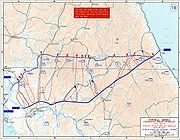
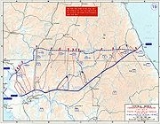
Army group
An army group is a military organization consisting of several field armies, which is self-sufficient for indefinite periods. It is usually responsible for a particular geographic area...
s which had a combined strength of around 270,000 men. XIX Army Group was positioned on the left flank of the UN line. Its 63rd and 64th Army
Army
An army An army An army (from Latin arma "arms, weapons" via Old French armée, "armed" (feminine), in the broadest sense, is the land-based military of a nation or state. It may also include other branches of the military such as the air force via means of aviation corps...
were to cross the Imjin on a twelve mile front and then to attack southeast towards Seoul. Three divisions
Division (military)
A division is a large military unit or formation usually consisting of between 10,000 and 20,000 soldiers. In most armies, a division is composed of several regiments or brigades, and in turn several divisions typically make up a corps...
of 63rd Army, the 187th, 188th and 189th Division, were involved in the attack on the British 29th Infantry Brigade’s positions on the Imjin river from 22–25 April 1951. 25 miles further to the east, other Chinese forces were involved in an attack on UN forces which included 27th British Commonwealth Brigade. That battle became known as the Battle of Kapyong
Battle of Kapyong
The Battle of Kapyong , also known as the Battle of Jiaping , was fought during the Korean War between United Nations forces—primarily Australian and Canadian—and the Chinese communist People's Volunteer Army...
.
At the time of the Chinese attack, 29th Infantry Brigade (commanded by Brigadier
Brigadier
Brigadier is a senior military rank, the meaning of which is somewhat different in different military services. The brigadier rank is generally superior to the rank of colonel, and subordinate to major general....
Tom Brodie
Thomas Brodie
-External links:*...
) consisted of the 1st Battalion, The Gloucestershire Regiment (also called "The Glosters"), under Lieutenant-Colonel James P. Carne
James Carne
Colonel James Power Carne VC DSO was an English recipient of the Victoria Cross, the highest and most prestigious award for gallantry in the face of the enemy that can be awarded to British and Commonwealth forces.-Early life:...
, the 1st Battalion, The Royal Northumberland Fusiliers
Royal Northumberland Fusiliers
The Royal Northumberland Fusiliers was an infantry regiment of the British Army. Originally raised in 1674, the regiment was amalgamated with three other fusilier regiments in 1968 to form the Royal Regiment of Fusiliers.-Origins:...
(RNF) under Lieutenant-Colonel Kingsley Foster, the 1st Battalion, The Royal Ulster Rifles
Royal Ulster Rifles
The Royal Ulster Rifles was a British Army infantry regiment. It saw service in the Second Boer War, Great War, the Second World War and the Korean War, before being amalgamated into the Royal Irish Rangers in 1968.-History:...
(RUR) under the temporary command of Major
Major
Major is a rank of commissioned officer, with corresponding ranks existing in almost every military in the world.When used unhyphenated, in conjunction with no other indicator of rank, the term refers to the rank just senior to that of an Army captain and just below the rank of lieutenant colonel. ...
Gerald Rickord and the Belgian battalion under Lieutenant-Colonel Albert Crahay (700 men) to which Luxembourg's contribution to the UN forces was attached. The British soldiers were a mixture of regular soldiers, reservist
Reservist
A reservist is a person who is a member of a military reserve force. They are otherwise civilians, and in peacetime have careers outside the military. Reservists usually go for training on an annual basis to refresh their skills. This person is usually a former active-duty member of the armed...
s and conscripted
Conscription in the United Kingdom
Conscription in the United Kingdom has existed for two periods in modern times. The first was from 1916 to 1919, the second was from 1939 to 1960, with the last conscripted soldiers leaving the service in 1963...
National servicemen
National service
National service is a common name for mandatory government service programmes . The term became common British usage during and for some years following the Second World War. Many young people spent one or more years in such programmes...
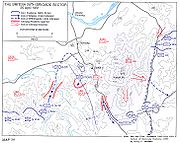
. Their supporting units included artillery and tanks which were attached to the brigade. 29th Brigade was under the command of U.S. I Corps and one of several UN formations responsible for holding the western flank on the lower Imjin river, the others being the 1st Republic of Korea (ROK) Division and the US 3rd Infantry Division (see map). The right flank of the ROK 12th Regiment, the nearest position of the ROK 1st Division, was a mile to the southwest of the Gloucestershire Regiment while the US 3rd Infantry Division stood east of 29th Brigade.
The deployment of UN forces meant that 29th Brigade with its four battalions had to cover a front of twelve miles. As a consequence, gaps between units had to be accepted because there was no possibility of forming a continuous line with the forces available. As a result, “Brigadier Brodie determined to deploy his men in separate unit positions, centred upon key hill features”. On the left flank, the Glosters were guarding a ford over the Imjin, known as Gloster crossing; the RNF were deployed near the centre, around two miles northeast of the Glosters; the Belgians on the right were the only element of 29th Brigade north of the river, occupying a feature called Hill 194. Their connection with the rest of the brigade depended on two pontoon bridge
Pontoon bridge
A pontoon bridge or floating bridge is a bridge that floats on water and in which barge- or boat-like pontoons support the bridge deck and its dynamic loads. While pontoon bridges are usually temporary structures, some are used for long periods of time...
s about half a mile apart from each other. These bridges connected the Belgians with Route 11, 29th Brigade’s main line of supply and communication and thus made vehicular movement between the north and the south bank of the river possible. The Royal Ulster Rifles served as the brigade’s reserve and were deployed along Route 11 (see map showing the situation at 9 a.m., 25 April below for different routes in the area).
The scattered deployment was one aspect which complicated the defense of 29th Brigade’s position. Another aspect was the lack of heavy artillery. Fire support was provided by 45 Field Regiment, RA
Royal Artillery
The Royal Regiment of Artillery, commonly referred to as the Royal Artillery , is the artillery arm of the British Army. Despite its name, it comprises a number of regiments.-History:...
, equipped with 25 pounder
Ordnance QF 25 pounder
The Ordnance QF 25 pounder, or more simply, 25-pounder or 25-pdr, was introduced into service just before World War II, during which it served as the major British field gun/howitzer. It was considered by many to be the best field artillery piece of the war, combining high rates of fire with a...
s under the command of Lieutenant-Colonel M. T. Young and by 4.2 inch mortars
Mortar (weapon)
A mortar is an indirect fire weapon that fires explosive projectiles known as bombs at low velocities, short ranges, and high-arcing ballistic trajectories. It is typically muzzle-loading and has a barrel length less than 15 times its caliber....
of 170 Heavy Mortar Battery
Artillery battery
In military organizations, an artillery battery is a unit of guns, mortars, rockets or missiles so grouped in order to facilitate better battlefield communication and command and control, as well as to provide dispersion for its constituent gunnery crews and their systems...
, RA. No heavier artillery support was available. Further support was provided by Centurion tank
Centurion tank
The Centurion, introduced in 1945, was the primary British main battle tank of the post-World War II period. It was a successful tank design, with upgrades, for many decades...
s of C Squadron, 8th Hussars, under the command of Major Henry Huth and by 55 Squadron, Royal Engineers
Royal Engineers
The Corps of Royal Engineers, usually just called the Royal Engineers , and commonly known as the Sappers, is one of the corps of the British Army....
. However, defensive preparations were not carried out very extensively because the British expected to hold the position for only a short time. As a result, neither minefields
Land mine
A land mine is usually a weight-triggered explosive device which is intended to damage a target—either human or inanimate—by means of a blast and/or fragment impact....
, deeply dug shelters nor extensive wire obstacle
Wire obstacle
In the military science of fortification, wire obstacles are defensive obstacles made from barbed wire, barbed tape or concertina wire. They are designed to disrupt, delay and generally slow down an attacking enemy...
s existed. The British position on the Imjin river "was deemed safe" but vulnerable in case of an attack.
The first night of attacks
The battle opened on the night of 22 April 1951. A Chinese patrol on the north bank of the river moved around the Belgians on Hill 194 and continued to advance east towards the two bridges on which the Belgians depended. Elements of 29th Brigade’s reserve, the 1st RUR, were deployed forward at about 10 p.m. in order to secure the crossing but were soon engaged by Chinese forces trying to cross the river. The Royal Ulster Rifles were unable to secure the bridges. This development meant that the Belgian battalion on the north bank of the river was in danger of being isolated from all other elements of 29th Brigade.Chinese forces following the initial patrol either attacked the Belgian positions on Hill 194 or continued their advance towards the bridges. Those who were able to cross the Imjin attacked the Fusiliers’ right rear company, Z company
Company (military unit)
A company is a military unit, typically consisting of 80–225 soldiers and usually commanded by a Captain, Major or Commandant. Most companies are formed of three to five platoons although the exact number may vary by country, unit type, and structure...
, on Hill 257, a position close to the river and almost directly south of the crossings. Further downstream, Chinese forces managed to ford the Imjin and attacked the Fusiliers’ left forward company, X company, on Hill 152. The retreat of X company from Hill 152 had serious consequences for Y company which occupied the right forward position of what can be described as a squarish fusilier position marked out by four widely spaced company perimeters at the corners. Although Y company was not attacked directly, Chinese forces threatened its flanks by forcing Z and X company from their positions. After unsuccessful British attempts to regain those lost positions on Hill 257 and 194, Y company’s position was abandoned, the retreat being covered by C Squadron, 8th Hussars.
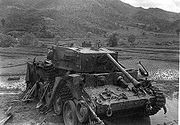
The Glosters' withdrawal to Hill 235
On 23 April, attempts by the Fusiliers and American forces from the 3rd Infantry Division's reserve to regain control of areas lost during the night failed. A U.S. attack by the 1st Battalion, 7th Infantry7th Infantry Regiment (United States)
The United States Army's 7th Infantry Regiment, known as "The Cottenbalers" from an incident that occurred during the Battle of New Orleans, while under the command of Andrew Jackson, when soldiers of the 7th Infantry Regiment held positions behind a breastwork of bales of cotton during the...
on Communist forces near Hill 257 was ordered to support the Belgian withdrawal from the north bank of the Imjin River. Despite losing seven vehicles, the Belgian battalion successfully executed its withdrawal which was coordinated with the beginning of the American attack on Hill 257. The Belgians escaped to the east and took up new positions south of the Glosters and the Fusiliers before they moved to the vicinity of 29th Brigade's command post.
At around 8.30 p.m. on 23 April, the forward companies of the Glosters were withdrawn from their positions after suffering heavy casualties. Apart from A and D company, C company under Major Paul Mitchell retreated as well but because of enemy pressure it was impossible for B company under Major Denis Harding to disengage and join the battalion’s remaining elements on and near Hill 235, a position between the Imjin and the Seolmacheon
Seolmacheon
The Seolmacheon in South Korea is a tributary of the Imjin River, which it joins at Jeokseong, and it was on Gloster Hill, between the two rivers, that the British Gloucestershire Regiment suffered defeat at the hands of the Chinese in the Battle of the Imjin River, a major event in the Korean War,...
stream that became known as Gloster Hill
Gloster Hill
The Gloucester Valley Battle Monument is a memorial in South Korea that commemorates the actions of the Gloucestershire Regiment during the Battle of the Imjin River in 1951.-Hill 235:...
. The men of B company (including a young Lofty Large
Lofty Large
Donald "Lofty" Large was a British soldier and author.Having joined the Army as a boy, Large fought in the Korean War and was wounded and taken prisoner at the Battle of Imjin. He spent two years in a prisoner-of-war camp, where his injuries went untreated and he lost more than a third of his body...
) were able to drive off seven Chinese assaults on their position before they were also able to withdraw to Hill 235 the next morning. Only 17 men of B company remained in action after reaching the remainder of the battalion.
During the night in which the Glosters’ B company faced numerous attacks, the Chinese 188th Division crossed the Imjin and attacked the Fusiliers and the Royal Ulster Rifles on the right of the brigade’s line. The 187th Division also engaged the brigade’s battalions on the right, while the 189th Division kept up the pressure on the left. Most dangerous for the unity of 29th Brigade was the Chinese penetration of the line between the Gloucestershire Regiment and the Northumberland Fusiliers. As a result of this deep penetration, the Glosters were cut off. In order to have additional forces available to counter the Chinese attack and to protect the Glosters from being completely surrounded, the Philippine
Philippines
The Philippines , officially known as the Republic of the Philippines , is a country in Southeast Asia in the western Pacific Ocean. To its north across the Luzon Strait lies Taiwan. West across the South China Sea sits Vietnam...
10th Battalion Combat Team (BCT) was temporarily attached to 29th Brigade. A combined force of M-24
M24 Chaffee
The Light Tank M24 was an American light tank used during World War II and in postwar conflicts including the Korean War and with the French in the War in Algeria and First Indochina War. In British service it was given the service name Chaffee, after the United States Army General Adna R...
tanks of the 10th BCT and Centurions of the 8th Hussars supported by infantry reached a point 2000 yards from Hill 235 on 24 April. However, the column failed to make contact when the lead tank was hit by Chinese fire and knocked out, blocking the route and making any further advance against heavy resistance impossible. At this point, according to an official American narrative of operations, "the brigade commander considered it unwise to continue the effort to relieve the Gloucester Battalion and withdrew the relief force".
The retreat of 29th Brigade
65th Infantry Regiment (United States)
The 65th Infantry Regiment, nicknamed "The Borinqueneers," was an all-volunteer Puerto Rican regiment of the United States Army. Its motto was Honor et Fidelitas, Latin for Honor and Fidelity. It participated in World War I, World War II, and the Korean War...
to relieve the Glosters. When two further attempts by a tank platoon to link up with the Glosters failed, Brigadier Brodie left the decision whether to attempt a break out or to surrender to Lieutenant-Colonel Carne. No further attempts to relieve the Glosters were undertaken because at 8 a.m. on 25 April, I Corps issued the order to execute Plan Golden A which called for a withdrawal of all forces to a new defensive position further south.
In accordance with orders issued by I Corps and supported by C Squadron, 8th Hussars, and 55 Squadron, Royal Engineers
Royal Engineers
The Corps of Royal Engineers, usually just called the Royal Engineers , and commonly known as the Sappers, is one of the corps of the British Army....
, the 1st Battalion, the Royal Northumberland Fusiliers, the 1st Battalion, the Royal Ulster Rifles, and the Belgian battalion tried to reach the safety of the next UN position. The Belgians occupied blocking positions west and southwest of 29th Brigade's command post in order to allow the other units of 29th Brigade which were still further north along Route 11, the main line of retreat, to fall back through the battalion’s positions (see map). However, the withdrawal while being under intense enemy pressure was made even more difficult by the fact that Chinese forces dominated parts of the high ground along the line of retreat and were thus able not only to observe any movements by elements of 29th Brigade but also to inflict heavy casualties on the retreating units. Among those killed was the CO
Commanding officer
The commanding officer is the officer in command of a military unit. Typically, the commanding officer has ultimate authority over the unit, and is usually given wide latitude to run the unit as he sees fit, within the bounds of military law...
of the Fusiliers, Lieutenant-Colonel Foster, who died when his jeep was hit by Chinese mortar
Mortar (weapon)
A mortar is an indirect fire weapon that fires explosive projectiles known as bombs at low velocities, short ranges, and high-arcing ballistic trajectories. It is typically muzzle-loading and has a barrel length less than 15 times its caliber....
fire. In the words of Major Henry Huth of the 8th Hussars, the retreat was "one long bloody ambush". When B company of the Ulsters which had acted as rear guard during the retreat reached the safety of the next UN line, all elements of 29th Brigade except for the Glosters had completed the withdrawal.
The Glosters on Hill 235
The Glosters' situation on Hill 235 made it impossible for them to join the rest of 29th Brigade after it had received the order to retreat. Even before the failed attempts to relieve the battalion on 24 April, B and C company had already suffered such heavy casualties that they were merged to form one company. Attempts to supply the battalion by air drop were unsuccessful. Despite their difficult situation, the Glosters held the positions on Hill 235 throughout 24 April and the night of 24/25 April. In the morning of 25 April, 45 Field Regiment could no longer provide artillery support for the Glosters. Since Brigadier Brodie had left the decision whether to attempt a break out or to surrender to Lieutenant-Colonel Carne, the Glosters' COCommanding officer
The commanding officer is the officer in command of a military unit. Typically, the commanding officer has ultimate authority over the unit, and is usually given wide latitude to run the unit as he sees fit, within the bounds of military law...
"gave the order to his company commanders to make for the British lines as best as they could" on the morning of 25 April. Only the remains of D company under the command of Major Mike Harvey escaped successfully from Gloster Hill and reached the safety of friendly lines after several days. The rest of the battalion was taken prisoner
Prisoner of war
A prisoner of war or enemy prisoner of war is a person, whether civilian or combatant, who is held in custody by an enemy power during or immediately after an armed conflict...
, including Lieutenant-Colonel Carne.
Importance of the battle
Had the Chinese achieved a breakthrough in the initial stages of their assault, they would have been able to outflank the 1st ROK Division to the west and the U.S. 3rd Infantry Division to the east of 29th Brigade. Such a development would have threatened the stability of the UN line and increased the likelihood of success for a Chinese advance on Seoul. Although the Chinese benefited from 29th Brigade's scattered deployment and a lack of defensive preparations, they were nevertheless unable to overcome the positions before UN forces could check further advances. In three days of fighting, the determined resistance of 29th Brigade severely disrupted the Chinese offensive, causing it to lose momentum and allowed UN forces in the area to withdraw to the No-Name Line, a defensible position north of Seoul, where the Chinese were halted.Casualties and memorial
According to a memorandum presented to the British cabinet on 26 June 1951, 29th Brigade suffered 1,091 casualties, including 34 officers and 808 other ranks missing. These casualties represented 20 to 25 per cent of the brigade’s strength on the eve of battle. Of the 1,091 soldiers killed, wounded or missing, 620 were from the Gloucestershire Regiment, which could muster 217 men on 27 April. 522 soldiers of the Gloucestershire Regiment became prisoners of war. Of those taken prisoner, 180 were wounded and a further 34 died while in captivity. 59 soldiers of the Gloucestershire Regiment were killed in action.Based on estimates, Chinese casualties in the Battle of the Imjin River can be put at around 10,000. As a result of the casualties suffered during the battle, the Chinese 63rd Army, which had begun the offensive with three divisions and approximately 27,000 men, had lost over a third of its strength and was pulled out of the front line.
The Gloucester Valley Battle Monument was later built at the Gloster Hill 37.944198°N 126.936035°W, beside the Seolmacheon
Seolmacheon
The Seolmacheon in South Korea is a tributary of the Imjin River, which it joins at Jeokseong, and it was on Gloster Hill, between the two rivers, that the British Gloucestershire Regiment suffered defeat at the hands of the Chinese in the Battle of the Imjin River, a major event in the Korean War,...
stream and the British Embassy in Seoul
Seoul
Seoul , officially the Seoul Special City, is the capital and largest metropolis of South Korea. A megacity with a population of over 10 million, it is the largest city proper in the OECD developed world...
organises services for veterans on every anniversary of the battle. The annual service is officially called the Gloster Valley Memorial Service by the British embassy. In 2008, it took place on 19 April as part of formal commemoration ceremonies that were held throughout the period 14–20 April. The outline of the commemorations in 2008 encompassed a service of commemoration, including the laying of wreaths and the presentations of Gloster Valley Scholarships as well as a picnic lunch which offered visitors the possibility to mingle with veterans. About 70 British veterans as well as the British ambassador to South Korea took part in the event.
Image:Gloster Bridge.JPG|Gloster Bridge
Image:Veterans on Gloster Bridge.JPG|Veterans on Gloster Bridge
Image:Australian military attache on Gloster Bridge.JPG|Australian military attaché on Gloster Bridge
Image:British military attache and other officers on Gloster Bridge.JPG|British military attaché and other officers on Gloster Bridge
Image:Korean veterans with a New Zealand veteran by Seolmacheon.JPG|Korean veterans with a New Zealand veteran
Image:Gloster Memorial by Seolmacheon.jpg|Gloster Memorial
Image:South Korean troops at Gloster Memorial by Seolmacheon.JPG|South Korean troops at Gloster Memorial
Image:British veterans march by Seolmacheon.JPG|British veterans march by
Image:Colours paraded by Seolmacheon.JPG|Colours paraded at Gloster Memorial
Image:Colours at the Gloster monument by Seolmacheon.JPG|Colours at Gloster Memorial
Image:Veterans by Gloster monument by Seolmacheon.JPG|Veterans at Gloster monument
Image:Flags flying by Gloster Memorial by Seolmacheon.JPG|Flags flying at Gloster Memorial
Individual awards
In the Battle of the Imjin River two Victoria CrossVictoria Cross
The Victoria Cross is the highest military decoration awarded for valour "in the face of the enemy" to members of the armed forces of various Commonwealth countries, and previous British Empire territories....
es and one George Cross
George Cross
The George Cross is the highest civil decoration of the United Kingdom, and also holds, or has held, that status in many of the other countries of the Commonwealth of Nations...
were awarded to soldiers of the Gloucestershire Regiment:
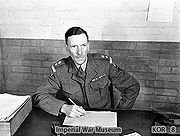
- Lieutenant-Colonel Carne, who commanded the battalion, was awarded the Victoria Cross. He was also awarded the U.S. Army's Distinguished Service CrossDistinguished Service Cross (United States)The Distinguished Service Cross is the second highest military decoration that can be awarded to a member of the United States Army, for extreme gallantry and risk of life in actual combat with an armed enemy force. Actions that merit the Distinguished Service Cross must be of such a high degree...
. - Lieutenant Curtis, who had recently learnt of his wife's death and who died in a lone counter-attack on enemy machine-guns, was posthumously awarded the Victoria Cross.
- Lieutenant WatersTerence Edward WatersLieutenant Terence Edward Waters GC was a British soldier who was awarded the George Cross in recognition of gallant and distinguished services whilst a prisoner of war of North Korea, having been captured at the Battle of the Imjin River during the Korean War...
, who died in captivity, was awarded a posthumous George CrossGeorge CrossThe George Cross is the highest civil decoration of the United Kingdom, and also holds, or has held, that status in many of the other countries of the Commonwealth of Nations...
for his conduct shortly after capture.
In addition, several soldiers were awarded the Distinguished Service Order
Distinguished Service Order
The Distinguished Service Order is a military decoration of the United Kingdom, and formerly of other parts of the British Commonwealth and Empire, awarded for meritorious or distinguished service by officers of the armed forces during wartime, typically in actual combat.Instituted on 6 September...
:
- Captain Anthony Farrar-HockleyAnthony Farrar-HockleyGeneral Sir Anthony Heritage Farrar-Hockley GBE, KCB, DSO & Bar, MC , affectionately known as 'Farrar the Para' , was a British soldier and a military historian who distinguished himself in a number of British conflicts...
, 1st Battalion, Gloucestershire Regiment - Major Henry Huth, Officer CommandingOfficer CommandingThe Officer Commanding is the commander of a sub-unit or minor unit , principally used in the United Kingdom and Commonwealth. In other countries, the term Commanding Officer is applied to commanders of minor as well as major units.Normally an Officer Commanding is a company, squadron or battery...
, C Squadron, 8th King's Royal Irish Hussars8th King's Royal Irish HussarsThe 8th King's Royal Irish Hussars was a cavalry regiment in the British Army, first raised in 1693. It saw service for three centuries, before being amalgamated into The Queen's Royal Irish Hussars in 1958.... - Major John Winn, Officer Commanding, Z Company, Royal Northumberland Fusiliers
The Military Cross
Military Cross
The Military Cross is the third-level military decoration awarded to officers and other ranks of the British Armed Forces; and formerly also to officers of other Commonwealth countries....
was awarded to:
- Captain Mike Harvey, 1st Battalion, the Gloucestershire Regiment, for his leadership of a group of 5 officers and 41 men of D Company who escaped and evaded the Chinese encirclement.
- Captain Peter Ormrod, 8th King's Royal Irish Hussars
- Lieutenant Guy Temple, for his actions when a platoon from C Company, 1st Battalion, Gloucestershire Regiment stopped four attempts by Chinese Communist Forces to cross the river on 22 April, only withdrawing when the platoon ran short of ammunition.
Lieutenant-Colonel Albert Crahay received the U.S. Army's Distinguished Service Cross for his leadership of the Belgian battalion during the battle.
Unit citations
Three Commonwealth Regiments were awarded the United States Distinguished Unit CitationPresidential Unit Citation (US)
The Presidential Unit Citation, originally called the Distinguished Unit Citation, is awarded to units of the Armed Forces of the United States and allies for extraordinary heroism in action against an armed enemy on or after 7 December 1941...
for their part in the Battle of the Imjin River and the Battle of Kapyong:
- The 1st Battalion Gloucestershire Regiment, together with C Troop, 170 Heavy Mortar Battery, Royal Artillery
- The 3rd Battalion Royal Australian RegimentRoyal Australian RegimentThe Royal Australian Regiment is the parent regiment for regular infantry battalions of the Australian Army and is the senior infantry regiment of the Royal Australian Infantry Corps...
, (Battle of KapyongBattle of KapyongThe Battle of Kapyong , also known as the Battle of Jiaping , was fought during the Korean War between United Nations forces—primarily Australian and Canadian—and the Chinese communist People's Volunteer Army...
22–25 April 1951). - The 2nd Battalion of Princess Patricia's Canadian Light Infantry RegimentPrincess Patricia's Canadian Light InfantryPrincess Patricia's Canadian Light Infantry is one of the three regular force infantry regiments of the Canadian Army. The regiment is composed of four battalions including a primary reserve battalion, for a total of 2,000 soldiers...
. (Battle of Kapyong 22–25 April 1951)
On 8 May 1951, by the command of U.S. President Harry S. Truman
Harry S. Truman
Harry S. Truman was the 33rd President of the United States . As President Franklin D. Roosevelt's third vice president and the 34th Vice President of the United States , he succeeded to the presidency on April 12, 1945, when President Roosevelt died less than three months after beginning his...
, General James Van Fleet
James Van Fleet
James Alward Van Fleet was a U.S. Army officer during World War I, World War II and the Korean War. Van Fleet was a native of New Jersey, who was raised in Florida and graduated from the U.S. Military Academy. He served as a regimental, divisional and corps commander during World War II and as...
presented the President's Distinguished Unit Citation to the Glosters, together with C Troop 170 Heavy Mortar Battery, which had given invaluable support throughout the battle. The citation says:
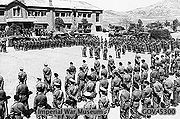
The Belgian United Nations Command, which was attached to the British 29th Brigade and replaced the 900 men of the Royal Ulster Rifles on 20 April 1951, initially held the brigade's right flank on the north bank of the river. It also included a Luxembourg platoon. It fought the Chinese there and then conducted a fighting withdrawal, supported by U.S. forces, before taking position in the center of the brigade's line, ahead of brigade headquarters, for the attempts to relieve the Glosters. The Belgian battalion was awarded the United States Distinguished Unit Citation
Presidential Unit Citation (US)
The Presidential Unit Citation, originally called the Distinguished Unit Citation, is awarded to units of the Armed Forces of the United States and allies for extraordinary heroism in action against an armed enemy on or after 7 December 1941...
and the Republic of Korea Presidential Unit Citation for their conduct during the battle.
Sources
Further reading
- The National Archives: American Presidential Citation, Catalogue reference: WO 32/14248 no.1B (8 May 1951).
- The National Archives: Memorandum to the British Cabinet, Catalogue reference: CAB 21/1985 (26 June 1950).
- The National Archives: American actions during the Battle of Imjin River. Precis of 3d Infantry Division Command Report, April 1951, Section III, Narrative of Operations. Catalogue reference: WO 308/47 p. 1—4 (April 1951).
- Citations for non-US recipients of the Distinguished Service Cross.
- The TimesThe TimesThe Times is a British daily national newspaper, first published in London in 1785 under the title The Daily Universal Register . The Times and its sister paper The Sunday Times are published by Times Newspapers Limited, a subsidiary since 1981 of News International...
"Colonel Peter Ormrod—Tank commander who won the Military Cross for his bravery in the face of overwhelming Chinese odds in Korea", 1 November 2007. - Barclay, Cyril Nelson. The First Commonwealth Division: The Story of British Commonwealth Land Forces in Korea, 1950–1953. Aldershot U.K.: Gale & PoldenGale & PoldenGale and Polden was a British printer and publisher. Founded in Brompton, near Chatham, Kent in 1868, the business subsequently moved to Aldershot, where they were based until closure in November 1981 after the company had been bought by media mogul Robert Maxwell.-Early years:The firm of Gale and...
, 1954. - Catchpole, Brian. The Korean War. London: Constance and Roninson Ltd, 2000. ISBN 1-84119-413-1
- Cunningham-Boothe, Ashley, and Farrar, Peter (eds). British Forces in the Korean War. London: The British Korean Veterans Association, 1988.
- Farrar-Hockley, Anthony. The Edge of the Sword. London: Frederick Muller, 2007.
- Fehrenbach, T. R. This Kind of War: The Classic Korean War History Brassey's US; 50 anniversary ed ISBN 1574883343, 2001.
- Green, David. Captured at the Imjin River: The Korean War Memoirs of a Gloster. Pen & Sword Books Ltd, 2003.
- Harding, E.D.The Imjin Roll. 3rd edition 2001.
- Holles, Robert Owen. Now Thrive The Armourers. White Lion Publishing, 1972.
- Kahn, Ely Jacques. The Gloucesters: An Account of the Epic Stand of the Gloucestershire Regiment in Korea. London: Central Office of Information, 1951.
- Large, LoftyLofty LargeDonald "Lofty" Large was a British soldier and author.Having joined the Army as a boy, Large fought in the Korean War and was wounded and taken prisoner at the Battle of Imjin. He spent two years in a prisoner-of-war camp, where his injuries went untreated and he lost more than a third of his body...
. Soldier Against the Odds: From Korean War to SAS. Mainstream Publishing, 1999. ISBN 978-1-84018-346-7 - Rottman, Gordon. Korean War Order of Battle. United States, United Nations and Communist Ground, Naval and Air Forces, 1950–1953. Praeger/Greenwood, 2002.
- Salmon, Andrew. To The Last Round – The Epic British Stand on the Imjin River, Korea 1951. London: Aurum Press, 2009. ISBN 1-84513-408-2
External links
- The National Archives web page on the Korean War and the Imjin battle in particular, including documents, maps and images.
- The British Embassy’s web page on the Korean War in general and the British involvement in particular.
- The British Embassy’s web page about the Battle of the Imjin River including a map showing the deployment of 29th Brigade’s units.
- The Soldiers of Gloucestershire Museum which holds the archives of the Gloucestershire Regiment including documents and artefacts related to the battle.
- Royal Engineers Museum Royal Engineers and the Cold War (Korean War)
- Royal Engineers Museum Royal Engineer pictures of the Korean War
- Obituary of Bernard Leroy Martin (one of three Bermudian Glosters at Imjin) in the Royal Gazette.
- The Philippine contingent during the Korean War including their efforts to relieve the Gloucestershire Regiment.
- The complete story of the Belgian United Nations Contingent with reports of the battles they participated in, unit awards and personal decorations.