
All Topics  
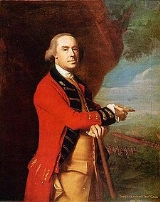
Thomas Gage

 
Thomas Gage

   Email Print
   Bookmark   Link


Thomas Gage


Thomas Gage (1719 – April 2, 1787) was a British
Great Britain

Great Britain is an island lying to the northwest of Continental Europe. It is the List of islands by area, and the largest in Europe. With a population of 58.9 million people it is List of islands by population....
 general, best known for his role in the early days of the American Revolution
American Revolution

The American Revolution refers to the political upheaval during the last half of the 18th century in which the Thirteen Colonies of North America overthrew the governance of the British Empire and then rejected the British monarchy to become the sovereign United States of America....
.

Born to a noble family in England, he entered military service, seeing action in the French and Indian War
French and Indian War

The French and Indian War was the North American chapter of the Seven Years' War, known in Canada as the War of the Conquest. The name refers to the two main enemies of the British: the royal French forces and the various Indigenous peoples of the Americas forces allied with them....
, where he served alongside a future opponent, George Washington
George Washington

George Washington was the leader of the Continental Army in the American Revolutionary War and served as the List of Presidents of the United States President of the United States of the United States of Americas ....
. After the fall of Montreal in 1760, he was named the military governor there, where he administered the frontier forts and directed military actions in Pontiac's Rebellion
Pontiac's Rebellion

Pontiac's Rebellion was a war launched in 1763 by North American First Nations who were dissatisfied with Kingdom of Great Britain policies in the Great Lakes region after the British victory in the French and Indian War/Seven Years' War ....
.


Discussion
Ask a question about 'Thomas Gage'
Start a new discussion about 'Thomas Gage'
Answer questions from other users
Full Discussion Forum


Encyclopedia


Thomas Gage (1719 – April 2, 1787) was a British
Great Britain

Great Britain is an island lying to the northwest of Continental Europe. It is the List of islands by area, and the largest in Europe. With a population of 58.9 million people it is List of islands by population....
 general, best known for his role in the early days of the American Revolution
American Revolution

The American Revolution refers to the political upheaval during the last half of the 18th century in which the Thirteen Colonies of North America overthrew the governance of the British Empire and then rejected the British monarchy to become the sovereign United States of America....
.

Born to a noble family in England, he entered military service, seeing action in the French and Indian War
French and Indian War

The French and Indian War was the North American chapter of the Seven Years' War, known in Canada as the War of the Conquest. The name refers to the two main enemies of the British: the royal French forces and the various Indigenous peoples of the Americas forces allied with them....
, where he served alongside a future opponent, George Washington
George Washington

George Washington was the leader of the Continental Army in the American Revolutionary War and served as the List of Presidents of the United States President of the United States of the United States of Americas ....
. After the fall of Montreal in 1760, he was named the military governor there, where he administered the frontier forts and directed military actions in Pontiac's Rebellion
Pontiac's Rebellion

Pontiac's Rebellion was a war launched in 1763 by North American First Nations who were dissatisfied with Kingdom of Great Britain policies in the Great Lakes region after the British victory in the French and Indian War/Seven Years' War ....
. During this time he did not distinguish himself militarily, but proved himself to be a competent administrator.

From 1763 to 1775 he served as commander in chief of the North American forces. In 1774 he was also appointed the military governor of the Province of Massachusetts Bay
Province of Massachusetts Bay

The Province of Massachusetts Bay was a British overseas territories chartered October 7, 1691 in North America by William and Mary, the joint monarchs of the Kingdom of England and the Kingdom of Scotland....
, where his actions contributed to the sparking of the American Revolutionary War
American Revolutionary War

The American Revolutionary War , also known as the American War of Independence, began as a war between the Kingdom of Great Britain and Thirteen Colonies on the North America, and ended in a global war between several European great powers....
 in April 1775. After his failure to resolve the Siege of Boston
Siege of Boston

}|-||}The Siege of Boston was the opening phase of the American Revolutionary War, in which New England militiamen?who later became part of the Continental Army?surrounded the town of Boston, Massachusetts, to prevent movement by the British Army garrisoned within....
 he was replaced by General Howe
William Howe, 5th Viscount Howe

William Howe, 5th Viscount Howe, Order of the Bath, Privy Council of Great Britain was a United Kingdom General who was Commander-in-Chief of British forces during the American Revolutionary War, one of the three Howe brothers....
 in October 1775, and returned to England.

Biography


Early life

Thomas Gage was born at Firle Place
Firle Place

Firle Place is a Manor house in Firle, East Sussex, United Kingdom and is the family seat of Nicolas Gage, 8th Viscount Gage, whose family the Viscount Gage have owned the land at Firle for centuries since acquiring it from the Levett family in the fifteenth century....
, Firle
Firle

For the suburb of Adelaide, South Australia, see Firle, South Australia.Firle is a village and civil parish in the Lewes of East Sussex, England....
, East Sussex
East Sussex

East Sussex is a Counties of England in South East England England. It is bordered by the counties of Kent, Surrey, Brighton and Hove and West Sussex, and to the south by the English Channel....
, where the Gage family had been seated since the 15th century. His father, also Thomas Gage
Thomas Gage, 1st Viscount Gage

Thomas Gage, 1st Viscount Gage Baronet was the son of Joseph Gage of Sherborne Castle and Elizabeth Penruddock.He married Benedicta Maria Theresa Hall in 1717....
, was a noted nobleman given titles in Ireland
Ireland

Ireland is the List of islands by area in Europe, and the twentieth-largest island in the world. It lies to the north-west of continental Europe and is surrounded by hundreds of islands and islet....
. Thomas Gage had three children. In 1728, Gage began attending the prestigious Westminster School
Westminster School

The Royal College of St. Peter in Westminster, almost always known as Westminster School, is one of Britain's leading independent schools, with the highest Oxbridge acceptance rate of any secondary school or college....
 where he met such figures as John Burgoyne
John Burgoyne

General John Burgoyne was a Kingdom of Great Britain army officer, politician and dramatist. During the American War of Independence, on October 17, 1777, at the Battle of Saratoga he surrendered his Convention Army....
, Richard Howe, Francis Bernard
Francis Bernard

Sir Francis Bernard, 1st Baronet was a Great Britain colonial administrator who served as Governor in New Jersey and Massachusetts.Francis was born in Brightwell-cum-Sotwell, Oxfordshire, England to the Rev....
, and George Sackville
George Germain, 1st Viscount Sackville

George Germain, 1st Viscount Sackville Privy Council of Great Britain , also known previously first as Lord George Sackville and then Lord George Germain, was a Great Britain soldier and politician who was Secretary of State for America in Frederick North's cabinet during the American Revolution....
. Upon graduation, Gage joined the British Army
British Army

The British Army is the Army branch of the British Armed Forces. It came into being with the unification of the Kingdoms of Kingdom of England and Kingdom of Scotland into the Kingdom of Great Britain in 1707....
, ensign
Ensign (rank)

Ensign is a junior rank of Officer #Commissioned officers in the militaries of some countries, normally in the infantry or navy. As the junior officer in an infantry regiment was traditionally the carrier of the ensign, the rank itself acquired the name....
 before purchasing the rank of lieutenant
Lieutenant

Lieutenant is a military, naval, paramilitary, fire service, emergency medical services or police commissioned officer military rank.Lieutenant may also appear as part of a title used in various other organisations with a codified command structure....
 in the 1st Northampton Regiment on January 30, 1741.

Gage received promotion to captain
Captain (British Army and Royal Marines)

File:UK-Army-OF2.gifCaptain is a junior officer rank of the British Army and Royal Marines. It ranks above Lieutenant and below Major and has a NATO ranking code of OF-2....
 in 1743 and served as aide-de-camp
Aide-de-camp

An aide-de-camp is a personal assistant, secretary, or adjutant to a person of high rank, usually a senior military officer or a head of state....
 to the Earl of Albemarle
Earl of Albemarle

Earl of Albemarle is a title created several times. The word Albemarle is an early variant of the French Aumale , other forms being Aubemarle and Aumerle, and is described in the patent of nobility granted in 1697 by William III of England to Arnold Joost van Keppel, 1st Earl of Albemarle as "a town and territory in the duchy of Normandy...
 in the Battle of Fontenoy
Battle of Fontenoy

The Battle of Fontenoy of 11 May 1745 was a French victory over the Anglo-Dutch-Hanoverian "Pragmatic Army"in the War of Austrian Succession....
 and in the campaign of Culloden
Battle of Culloden

The Battle of Culloden was the final clash between the French-supported Jacobitism and the House of Hanover British Government in the 1745 Jacobite Rising#The 'Forty-Five'....
. From 1747 to 1748, Gage saw action in the Low Countries
Low Countries

The Low Countries, the historical region of de Nederlanden, are the country on low-lying land around the river delta of the Rhine, Scheldt, and Meuse River rivers....
, purchasing the rank of Major
Major

In many European languages, the term Major refers to a military rank, denoting seniority at one of usually various levels of rank, for example: "Sergeant-Major" denoting the most senior ranking sergeant of a large military unit; "Captain-Major", denoting a mid-level command status Officer ...
 in 1748. He transferred to the 55th Foot Regiment (later re-numbered the 44th) and was promoted to lieutenant colonel
Lieutenant Colonel

Lieutenant colonel is a rank of commissioned officer in the army and most Marine and air forces of the world, typically ranking above a major and below a colonel....
 in March 1751.

French and Indian War


In 1755 Gage, was sent to America as part of General Braddock's
Edward Braddock

General Edward Braddock was a British soldier and commander-in-chief for North America during the actions at the start of the French and Indian War ....
 expeditionary force
Braddock expedition

The Braddock expedition, also called Braddock's campaign or, more commonly, Braddock's Defeat, was a failed Great Britain attempt to capture the France Fort Duquesne in the summer of 1755 during the French and Indian War that ended with the #Battle of the Monongahela....
. Future military foe George Washington
George Washington

George Washington was the leader of the Continental Army in the American Revolutionary War and served as the List of Presidents of the United States President of the United States of the United States of Americas ....
 served with Gage in the same expedition. In July 1755, the 44th Regiment's commander, Colonel Sir Peter Halkett, was shot and killed during the Battle of the Monongahela
Battle of the Monongahela

The Battle of the Monongahela took place on July 9 1755 in the vicinity of what later became Pittsburgh, Pennsylvania during the French and Indian Wars....
. Gage took command of the regiment and was slightly wounded during the fighting. The regiment was decimated, and Captain Robert Orme (General Braddock's aide-de-camp at the time) levelled charges that poor field tactics on the part of Gage had led to the defeat. Orme resigned his army commission the next year, but his accusations led to Gage being denied permanent command of the 44th Regiment.

Gage spent 1756 as second-in-command of a failed expedition of the Mohawk River
Mohawk River

The Mohawk River is a long river in the U.S. state of New York. It is the largest tributary of the Hudson River and it meets it in the Capital Region, a few miles north of the city of Albany, New York....
. The following year, he was assigned to Captain-General John Campbell Loudoun
John Campbell, 4th Earl of Loudoun

John Campbell, 4th Earl of Loudoun was a Scotland nobleman and military leader.Campbell inherited the peerage on the death of his father in 1731, becoming Lord Loudoun....
 in Halifax
City of Halifax

The City of Halifax was the capital of the province of Nova Scotia and county seat of Halifax County, Nova Scotia, and was the largest city in Atlantic Canada until it was amalgamated into Halifax Regional Municipality in 1996....
, Nova Scotia
Nova Scotia

Nova Scotia is a Canadian Provinces and territories of Canada located on Canada's southeastern coast. It is the most populous province in Atlantic Canada....
, where Gage commanded the 80th Regiment and finally received promotion to full colonel
Colonel

Colonel is a military rank of a commissioned officer, with corresponding ranks existing in almost every country in the world. It is also used in some police forces and other paramilitary rank structures....
. Gage was wounded again in 1758 during a disastrous attempt
Battle of Carillon

The Battle of Carillon was fought near Fort Ticonderoga , on the shore of Lake Champlain on what was then the border between the then British colony of Province of New York, and French colony of Canada, New France , July 6?8, 1758, during the French and Indian War ....
 to capture Fort Ticonderoga
Fort Ticonderoga

Fort Ticonderoga is a large eighteenth-century fort built at a narrows at the south end of Lake Champlain where a short traverse gives access to the north end of Lake George in the state of New York....
. Despite this loss, Gage was promoted to brigadier general
Brigadier General

Brigadier General is the lowest ranking General Officer in some countries, usually sitting between the ranks of Colonel and Major General.The rank can be traced back to the militaries of Europe where a brigadier general, or simply a brigadier, would command a brigade in the field....
, largely through the political maneuvering of his brother, Lord Gage. While recruiting locals for his new regiment, Gage met and later married Margaret Kemble of Brunswick, New Jersey
New Jersey

New Jersey is a state in the Mid-Atlantic States and Northeastern United States regions of the United States. It is bordered on the north by New York, on the east by the Hudson River and the Atlantic Ocean, on the southwest by Delaware, and on the west by Pennsylvania....
--the daughter of a friend from Westminster School who now served on the New Jersey council. The two were wed in December 1758. Their first son, the future 3rd Viscount Gage
Henry Gage, 3rd Viscount Gage

Henry Gage, 3rd Viscount Gage was a British Army officer .Henry was the eldest son of Thomas Gage, military leader of British Army at the beginning of the American Revolutionary War....
, was born in 1761. Margaret Kemble was the granddaughter of New York
New York

The State of New York is a U.S. state in the Mid-Atlantic States and Northeastern United States regions of the United States and is the nation's List of U.S....
 Mayor Stephanus Van Cortlandt
Stephanus Van Cortlandt

Stephanus van Cortlandt was the first native-born mayor of New York City, a position which he held from 1677 to 1678 and from 1686 to 1688. He was the patroon of Cortlandt Manor, New York and was on the governor's executive council from 1691 to 1700....
.

The new general was placed in command of the Albany
Albany, New York

Albany is the Capital of the state of New York and the county seat of Albany County, New York. Albany is roughly 136 miles north of the city of New York City, and slightly south of the confluence of the Mohawk River and Hudson Rivers....
 post, serving under Major General
Major General

Major General or Major-General is a military rank used in many countries. It is derived from the older rank of Sergeant Major General. A Major General is a high-ranking officer, normally subordinate to the rank of Lieutenant General and senior to the ranks of Brigadier and Brigadier General....
 Jeffrey Amherst
Jeffrey Amherst, 1st Baron Amherst

Field Marshal Jeffery Amherst, 1st Baron Amherst of Montreal Order of the Bath served as an officer in the British Army and as Commander-in-Chief of the Forces....
. In 1759, Amherst ordered Gage to march against the French and seize Fort la Présentation (sometimes known as Fort La Galette) and then capture Montreal
Montreal

Montreal, or Montr?al, is the largest city in the Provinces and territories of Canada of Quebec and the List of largest cities and second largest cities by country List of the 100 largest municipalities in Canada by population....
. Gage disagreed with Amherst, suggesting instead that his own forces be used to reinforce Niagara
Fort Niagara

Fort Niagara is a fortification originally built to protect the interests of New France in North America. It is located near Youngstown, New York, on the eastern bank of the Niagara River at its mouth, on Lake Ontario....
 and Oswego
Fort Oswego

Fort Oswego was an important frontier post for Kingdom of Great Britain traders in the 18th century. A trading post was established in 1722 with a log palisade, and List of Colonial Governors of New York William Burnet ordered a fort built at the site in 1727....
 while Amherst led forces against Montreal. Gage wound up earning the displeasure of his commanding officer and being placed in charge of Fort Albany until Amherst himself was ready to attack Montreal in 1760 (at which time Gage led Amherst's rear guard).

Thomas Gage

Early Governorship

After the French surrendered, Gage, was named military governor of Montreal. In 1761, he was promoted to major general and placed in command of the 22nd Regiment. When Amherst returned to England in August 1763, Gage assumed command of the British forces in America. Though the British were now at peace with France, Gage's new command inherited a Native American uprising already in progress on the western frontier.

In May 1763 Ottawa
Ottawa (tribe)

The Odawa or Ottawa, said to mean "traders," are a Native Americans in the United States and First Nations people. They are one of the Anishinaabeg, related to but distinct from the Ojibwa nation....
 leader Chief Pontiac's
Chief Pontiac

Pontiac or Obwandiyag , was an Ottawa leader who became famous for his role in Pontiac's Rebellion , an North American Indian struggle against the Kingdom of Great Britain military occupation of the Great Lakes region following the British victory in the French and Indian War....
 forces attacked Fort Detroit, in the first action of what would come to be known as Pontiac's War
Pontiac's Rebellion

Pontiac's Rebellion was a war launched in 1763 by North American First Nations who were dissatisfied with Kingdom of Great Britain policies in the Great Lakes region after the British victory in the French and Indian War/Seven Years' War ....
.

Hoping to end the conflict diplomatically, Gage ordered Colonel John Bradstreet
John Bradstreet

Major General John Bradstreet was a British Army officer during the French and Indian War. He was born in Nova Scotia to a British Army Lieutenant and an Acadian mother....
 and Colonel Henry Bouquet
Henry Bouquet

Henry Bouquet was a prominent British Army officer in the French and Indian War and Pontiac's War. Bouquet is best known for his victory over Native Americans in the United States at the Battle of Bushy Run, lifting the siege of Fort Pitt during Pontiac?s War....
 out on military expeditions and then ordered Sir William Johnson to establish peace negotiations. Colonel Bouquet negotiated a cease-fire of sorts in October 1764. Even then, Gage was left with just two remaining forts from the original nine the tribes had taken. In 1765, Gage finally got the 42nd Royal Highland Regiment through to retake Fort Cavendish
Fort de Chartres

Fort de Chartres was a France fortification first built in 1720 on the east bank of the Mississippi River in present-day Illinois. The Fort de Chartres name was also applied to the two successive fortifications built nearby during the 1700s in the era of French colonial control over Louisiana and the Illinois Country....
.

Gage established a new three-district command across the western, southern, and northern areas of the frontier. That same summer, Gage ordered Johnson's office to send a representative through to Pontiac. The conflict would not be fully resolved until Pontiac himself travelled to Fort Ontario
Fort Ontario

Fort Ontario is an historic fort situated by the Oswego, New York, in Oswego County, New York, New York in the United States.Fort Ontario was one of several forts erected by the British to protect the area around the east end of Lake Ontario....
 and signed a formal treaty with Johnson in July 1766.

During Gage's administration political tensions rose throughout the American colonies. As a result, Gage began withdrawing troops from the frontier to fortify urban centres like New York City and Boston. As the number of soldiers stationed in cities grew, the need to provide adequate food and housing for these troops became urgent. Parliament
Parliament of Great Britain

The Parliament of Great Britain was formed in 1707 following the ratification of the Act of Union 1707 by both the Parliament of England and Parliament of Scotland....
 passed the Quartering Act
Quartering Act

Quartering Act is the name of at least two Act of Parliament of the Parliament of Great Britain. The Quartering Acts were used by the British forces in the American colonies to ensure that British troops had adequate housing and provisions....
 of 1765, permitting British troops to be quartered in private residences. Gage personally traveled to Boston and spent six weeks there making quartering arrangements for the new soldiers in 1768. The military occupation of Boston eventually led to the Boston Massacre
Boston Massacre

The Boston Massacre refers to an incident involving the deaths of five civilians at the hands of British Army on March 5, 1770, the legal aftermath of which helped spark the rebellion in some of the British colonies in America, which culminated in the American Revolution....
 of 1770. That same year, Gage was promoted to lieutenant general
Lieutenant General

Lieutenant General is a military rank used in many countries. The rank traces its origins to the Middle Ages where the title of Lieutenant General was held by the second in command on the battlefield, who was normally subordinate to a Captain General....
. Late that year he wrote "America is a mere bully, from one end to the other, and the Bostonians by far the greatest bullies."

Pre-Revolutionary Boston

Gage returned to England in June 1773 with his family and missed the Boston Tea Party
Boston Tea Party

The Boston Tea Party was an act of direct action protest by the American colonists against the Kingdom of Great Britain in which they destroyed many crates of tea belonging to the British East India Company and dumped it into the Boston Harbor....
 in December of that year. The British Parliament
Parliament of the United Kingdom

The Parliament of the United Kingdom of Great Britain and Northern Ireland is the supreme legislature in the United Kingdom and British overseas territories....
 passed a series of measures known in the colonies as the Intolerable Acts
Intolerable Acts

The Intolerable Acts or the Coercive Acts are names used to describe a series of laws passed by the Parliament of Great Britain in 1774 relating to Britain's colonies in North America....
 as a way to punish the colonies, and specifically the Province of Massachusetts Bay
Province of Massachusetts Bay

The Province of Massachusetts Bay was a British overseas territories chartered October 7, 1691 in North America by William and Mary, the joint monarchs of the Kingdom of England and the Kingdom of Scotland....
, for this and other acts of protest against British colonial policy.

Massachusetts
Massachusetts

The Commonwealth of Massachusetts is a U.S. state located in the New England region of the Northeastern United States United States. It borders Rhode Island and Connecticut to the south, New York to the west, and Vermont and New Hampshire to the north....
 governor Thomas Hutchinson was 62 years old at the time and the lieutenant governor (Andrew Oliver
Andrew Oliver

Andrew Oliver was a merchant and public official in colonial Massachusetts.Born in Boston, he was the son of Daniel Oliver, a merchant, and Elizabeth Belcher Oliver, daughter of Governor Jonathan Belcher....
), a hated Tory
Tory

In the political tradition of some List of countries where English is an official language, the term Tory may refer to a variety of Political party and creeds since it was originally used in the late 17th century to describe opponents to the Whig Party ....
, was 67. Still in his early 50's and with significant military experience in America, Gage was deemed the best man to handle the brewing crisis, and to enforce the Parliamentary acts.

In early 1774, he was appointed military
Martial law

Martial law is the system of rules that takes effect when the military takes control of the normal administration of justice.Martial law is sometimes imposed during wars or occupied territory in the absence of any other civil government....
 Royal governor, or commander-in-chief, of Massachusetts, replacing the civilian governor Thomas Hutchinson. He arrived from England in early May, first stopping at Castle William
Castle William

Castle William may refer to:*Fort Independence , generally known as "Castle William" before the American Revolution*A castle in Budby, England in the Sherwood Forest...
 on Castle Island in Boston's Harbor. He then arrived in Boston on May 13, 1774, having been carried there by the HMS Lively (1754)
HMS Lively (1754)

HMS Lively was a 20-gun Sixth rate ship of the Royal Navy, launched at Bursledon, Hampshire on 10 August 1756.Lively was commissioned in August 1756 under Captain Francis Wyatt, and after completion sailed for Jamaica on 31 January 1757....
. His arrival was met with little pomp and circumstance, but was generally well received at first as Bostonians were happy to see Hutchinson go. In that capacity, he was entrusted with carrying into effect the Boston Port Act
Boston Port Act

The Boston Port Act is an Act of Parliament of the Parliament of Great Britain which became law on March 30, 1774, and is one of the measures that were designed to secure Great Britain's jurisdictions over her Colonial American dominions....
 and the Massachusetts Government Act
Massachusetts Government Act

The Massachusetts Government Act was passed by the Parliament of Great Britain and became a law on May 20, 1774. The act is one of the Intolerable Acts or the Repressive Acts, or the Coercive Acts, designed to suppress dissent and restore order in the Province of Massachusetts Bay....
. General Gage also sought to strictly enforce the confiscation of war-making materials.

In September 1774, he ordered a mission to remove provincial gunpowder from a magazine in what is now Somerville, Massachusetts
Somerville, Massachusetts

Somerville is a city in Middlesex County, Massachusetts, Massachusetts, just north of Boston. As of the 2000 census, the city had a total population of 77,478 and was the most densely populated municipality in New England....
. Known as the Powder Alarm
Powder Alarm

The Powder Alarm was a massive popular reaction to the removal of gunpowder from a Magazine by Kingdom of Great Britain soldiers under orders from General Thomas Gage, royal governor of the Province of Massachusetts Bay, on September 1, 1774....
, this action, while successful, caused a huge popular reaction that prevented Gage from successfully executing other raids. This was in large part due to Paul Revere
Paul Revere

Paul Revere was an American silversmith and a Patriot in the American Revolution.He was glorified after his death for his role as a messenger in the battles of Lexington and Concord, and Revere's name and his "midnight ride" are well-known in the United States as a patriotic symbol....
 and the Sons of Liberty
Sons of Liberty

The Sons of Liberty was a secret organization of Patriot which originated in the Thirteen Colonies during the American Revolution. Kingdom of Great Britain authorities and their supporters known as Loyalist considered the Sons of Liberty as seditious rebels, referring to them as "Sons of Violence" and "Sons of Iniquity." Patriots attacked t...
. The Sons of Liberty kept careful watch over Gage's activities after this point and successfully warned others of future actions before Gage could mobilise his British regulars
Red coat (British army)

Red Coat or Redcoat is a term often used to refer to a soldier of the historical British Army, because of the colour of the military uniforms formerly worn by the majority of regiments....
 to execute them.

Gage found himself criticized by his own men for allowing groups like the Sons of Liberty to exist. One of his officers, Hugh Percy
Hugh Percy, 2nd Duke of Northumberland

Lieutenant-General Hugh Percy, 2nd Duke of Northumberland, Fellow of the Royal Society , born Hugh Smithson, was the eldest son of the Hugh Percy, 1st Duke of Northumberland....
 remarked, "The general's great lenity and moderation serve only to make them (the Americans) more daring and insolent." Gage himself wrote, "If force is to be used at length, it must be a considerable one, and foreign troops must be hired, for to begin with small numbers will encourage resistance, and not terrify; and will in the end cost more blood and treasure." Edmund Burke
Edmund Burke

Edmund Burke was an Irish statesman, author, orator, political theorist, and philosophy who, after relocating to Great Britain, served for many years in the British House of Commons as a member of the British Whig Party party....
 described Gage's conflicted relationship by saying in Parliament
Parliament of the United Kingdom

The Parliament of the United Kingdom of Great Britain and Northern Ireland is the supreme legislature in the United Kingdom and British overseas territories....
, "An Englishman is the unfittest person on Earth to argue another Englishman into slavery."

American Revolution

At Concord
Concord, Massachusetts

Concord is a town in Middlesex County, Massachusetts, Massachusetts, in the United States. As of the 2000 Census, the town population was about 17,000....
, on the night of April 18, 1775, Gage ordered 700 British regulars from elite flank companies (Light Infantry and Grenadiers) to march from Boston to Concord to confiscate military supplies the colonists had stored there. A brief skirmish in Lexington
Lexington, Massachusetts

Lexington is a town in Middlesex County, Massachusetts, Massachusetts, United States. The population was 30,355 at the 2000 census.The town is famous for being the site of the opening shots of the American Revolution, in the Battles of Lexington and Concord on April 19, 1775....
 scattered colonial militia forces gathered there, but in a later standoff in Concord, a portion of the British force was routed by a stronger colonial militia contingent. When the British left Concord following their search (which was largely unsuccessful, as the colonists, with advance warning of the action, had removed most of the supplies), arriving colonial militia engaged the British column in a running battle all the way back to Charlestown
Charlestown, Massachusetts

Charlestown is a part of the city of Boston, Massachusetts, Massachusetts located on a peninsula north of Boston proper. Charlestown was originally a separate town and the first capital of the Massachusetts Bay Colony; it became a city in 1847 and was annexed by Boston on January 5, 1874....
.

Margaret Kemble Gage
The Battle of Lexington and Concord resulted in 273 total casualties for the British and 95 for the American rebels. In June, Gage issued a proclamation granting a general pardon to all who would demonstrate loyalty to the crown--with the notable exceptions of Hancock and Adams.

Following Lexington, the American rebels followed the British back to Boston, and occupied the neck of land extending to the peninsula the city stood on. This began the Siege of Boston
Siege of Boston

}|-||}The Siege of Boston was the opening phase of the American Revolutionary War, in which New England militiamen?who later became part of the Continental Army?surrounded the town of Boston, Massachusetts, to prevent movement by the British Army garrisoned within....
. Initially, the 6,000 to 8,000 rebels (led mainly by General Artemas Ward
Artemas Ward

Artemas Ward was an United States Major general in the American Revolutionary War and a United States Congress from Massachusetts. President John Adams described him as "...universally esteemed, beloved and confided in by his army and his country." Ward was much more effective as a political leader than as a soldier....
) faced some 4,000 of General Gage’s British regulars, bottled up in the city. British Admiral Samuel Graves
Samuel Graves

Admiral Samuel Graves Royal Navy was a United Kingdom Admiral who is probably best known for his role early in the American Revolutionary War....
 commanded the fleet that continued to control the harbour. On May 25, Gage received about 4,500 reinforcements and three new Generals - Major General William Howe
William Howe, 5th Viscount Howe

William Howe, 5th Viscount Howe, Order of the Bath, Privy Council of Great Britain was a United Kingdom General who was Commander-in-Chief of British forces during the American Revolutionary War, one of the three Howe brothers....
 and Brigadiers John Burgoyne
John Burgoyne

General John Burgoyne was a Kingdom of Great Britain army officer, politician and dramatist. During the American War of Independence, on October 17, 1777, at the Battle of Saratoga he surrendered his Convention Army....
 and Henry Clinton
Henry Clinton (American War of Independence)

General Sir Henry Clinton Order of the Bath was a Kingdom of Great Britain army officer and politician who is best known for his service as a general during the American Revolutionary War, during most of which he was the British Commander-in-Chief, North America in North America....
.

Gage started work with his new generals on a plan to break the grip of the besieging forces. They would use an amphibious assault to remove the Americans from the Dorchester Heights
Dorchester Heights

Dorchester Heights is the central area of South Boston. It is the highest area in the neighborhood and commands a view of both Boston Harbor and downtown....
 or take their headquarters at Cambridge
Cambridge, Massachusetts

Cambridge is a city in the Greater Boston area of Massachusetts, United States. It was named in honor of the University of Cambridge in England....
. To thwart these plans, General Ward gave orders to General Israel Putnam
Israel Putnam

Israel Putnam was an American army general who fought with distinction at the Battle of Bunker Hill during the American Revolutionary War . Although Putnam never quite attained the national renown of more famous heroes such as Davy Crockett or Daniel Boone, in his own time his reckless courage and fighting spirit were known far beyond Con...
 to fortify Bunker Hill. On June 17, 1775, British forces under General Howe seized the Charlestown peninsula at the Battle of Bunker Hill
Battle of Bunker Hill

The Battle of Bunker Hill took place on June 17, 1775 on Breed's Hill, as part of the Siege of Boston during the American Revolutionary War. General Israel Putnam was in charge of the revolutionary forces, while Major-General William Howe, 5th Viscount Howe commanded the Kingdom of Great Britain forces....
. They did take their objective, but didn't break out because the Americans held the ground at the base of the peninsula. Gage called it, "A dear bought victory, another such would have ruined us." British losses were so heavy that from this point, the siege essentially became a stalemate. (The siege ended in March 1776, after Gage returned to England, when the colonists fortified the Dorchester Heights
Fortification of Dorchester Heights

The Fortification of Dorchester Heights was a decisive action early in the American Revolutionary War that precipitated the end of the siege of Boston and the withdrawal of British troops from that city....
, prompting the British forces to evacuate the city.)

Return to England


On October 10, 1775, Gage was recalled to England; Major General Howe replaced him as acting Commander-in-Chief of the British Army in the American colonies. Gage's report to the cabinet repeated his earlier warnings that "a large army must at length be employed to reduce these people" and would require "the hiring of foreign troops." In April 1776, George Sackville Germain, British Secretary of State for America, formally transferred command from Gage to Howe.

Gage was reactivated to duty, in April 1781, when Amherst appointed him to mobilise troops for a possible French invasion. The next year, Gage assumed command (as a colonel) of the 17th Light Dragoons. He was finally promoted to full general
General

A General officer is an Officer of high military rank. The term or equivalent is used by nearly every country in the world. General can be used as a generic term for all grades of general officer, or it can specifically refer to a single rank that is just called general....
 on November 20, 1782, and later transferred to command the 11th Dragoons. Though he was recognized as a general
General

A General officer is an Officer of high military rank. The term or equivalent is used by nearly every country in the world. General can be used as a generic term for all grades of general officer, or it can specifically refer to a single rank that is just called general....
 months in advance. Gage died on the Isle of Portland
Isle of Portland

The Isle of Portland is a limestone tied island, long by wide, in the English Channel. Portland is south of the resort of Weymouth, Dorset, forming the southernmost point of the county of Dorset, England....
 on April 2, 1787, his wife surviving him by almost 37 years. He was also survived by Henry Gage, 3rd Viscount Gage
Henry Gage, 3rd Viscount Gage

Henry Gage, 3rd Viscount Gage was a British Army officer .Henry was the eldest son of Thomas Gage, military leader of British Army at the beginning of the American Revolutionary War....
 and another Thomas Gage
Thomas Gage (botanist)

Sir Thomas Gage was an England botanist, one of the famous Viscount Gage family of Firle, Sussex. The woodland flower Gagea is named in his honour....
, a young relative who would go on to achieve modest fame in the field of botany.

External links