


Great Uprising

Encyclopedia
The 1936–1939 Arab revolt in Palestine or Great Arab Revolt was a nationalist uprising by Palestinian Arabs in Mandate Palestine against British colonial rule and mass Jewish immigration
.
The revolt consisted of two distinct phases. The first phase was directed primarily by the urban and elitist Higher Arab Committee
(HAC) and was focused mainly on strikes and other forms of political protest. By October 1936, this phase had been defeated by the British civil administration
using a combination of political concessions, international diplomacy (involving the rulers of Iraq
, Saudi Arabia
, Transjordan
and Yemen
) and the threat of martial law
. The second phase, which began late in 1937, was a violent and peasant-led resistance movement that increasingly targeted British forces. During this phase, the rebellion was brutally suppressed by the British Army
and the Palestine Police Force
using repressive measures that were intended to intimidate the Arab population and undermine popular support for the revolt.
According to official British figures covering the whole revolt, the army and police killed more than 2,000 Arabs in combat, 108 were hanged, and 961 died because of ‘gang and terrorist activities’. In an analysis of the British statistics, Walid Khalidi
estimates 19,792 casualties for the Arabs, with 5,032 dead: 3,832 killed by the British and 1,200 dead because of ‘terrorism’, and 14,760 wounded. Over ten percent of the adult male Palestinian Arab population between 20 and 60 was killed, wounded, imprisoned or exiled. Estimates of the number of Palestinian Jews killed range from 91 to 'several hundred'.
Although the 1936–1939 Arab revolt in Palestine was unsuccessful, its consequences affected the outcome of the 1948 Arab-Israeli war
.
organized and established the Black Hand, an anti-Zionist and anti-British militant organisation. He recruited and arranged military training for peasants and by 1935 he had enlisted between 200 and 800 men. The cells were equipped with bombs and firearms, which they used to murder Jewish settlers in the area, as well as engaging in a campaign of vandalizing trees planted by settlers and British-constructed rail lines. In November 1935, two of his men engaged in a firefight with a Palestine police patrol hunting fruit thieves and a policeman was killed. Following the incident, British police launched a manhunt and surrounded al-Qassam in a cave near Ya'bad
. In the ensuing battle, al-Qassam was killed.
The death of the al-Qassam generated widespread outrage in the Arab community. Huge crowds accompanied Qassam's body to his grave in Haifa
.
The dissent in Palestine was influenced also by the discovery in October 1935 at the port of Jaffa
of a large arms shipment
destined for the Haganah
, sparking Arab fears of a Jewish military takeover of Palestine, Jewish immigration also peaked in 1935, just months before Palestinian Arabs began a full-scale, nation-wide revolt. In the four years between 1933 and 1936
more than 164,000 Jewish immigrants arrived in Palestine, and between 1931 and 1936 the Jewish population more than doubled from 175,000 to 370,000 people, increasing the Jewish population share from 17 to 27 per cent, bringing about a significant deterioration in relations between Palestinian Arabs and Jews.
The uprising began with an attack on 15 April 1936 on a convoy of trucks on the Nablus
to Tulkarm
road during which the (probably Qassamite) assailants shot two Jewish drivers, Israel Khazan, who was killed instantly, and Zvi Dannenberg, who died five days later. The next day Jewish (Irgun
) gunmen shot and killed two Arab workers sleeping in a hut near Petah Tikva
in a revenge attack, and the funeral for Khazan in Tel Aviv
on 17 April became a turbulent nationalist event during which Jewish rioters beat Arab children and destroyed property. Between 19 and 22 April disturbances in Jaffa and Tel Aviv left 16 Jews and 5 Arabs dead. An Arab general strike and revolt ensued that lasted until October 1936.
During the summer of that year, thousands of Jewish-farmed acres and orchards were destroyed, Jewish civilians were attacked and murdered, and some Jewish communities, such as those in Beisan and Acre
, fled to safer areas.
s in Jaffa and Haifa where they found succour and encouragement in the teachings of the charismatic preacher Izz ad-Din al-Qassam who worked among the poor in Haifa. The revolt was thus a popular uprising that produced its own leaders and developed into a national revolt.
World War I left Palestine, especially the countryside, deeply impoverished. The Ottoman
and then the Mandate authorities levied high taxes on farming and agricultural produce and during the 1920s and 1930s this together with a fall in prices, cheap imports, natural disasters and paltry harvests all contributed to the increasing indebtedness of the fellahin. The rents paid by tenant fellah increased sharply, owing to increased population density, and transfer of land from Arabs to the Jewish settlement agencies, such as the Jewish National Fund
, increased the number of fellahin evicted while also removing the land as a future source of livelihood. By 1931 the 106,400 dunums
of low-lying Category A farming land in Arab possession supported a farming population of 590,000 whereas the 102,000 dunums of such land in Jewish possession supported a farming population of only 50,000. The problem of 'landless' Arabs grew particularly grave after 1931, causing High Commissioner Wauchope to warn that this 'social peril... would serve as a focus of discontent and might even result in serious disorders.'
Although the Mandatory government introduced measures to limit the transfer of land from Arabs to Jews these were easily circumvented by willing buyers and sellers. The failure of the authorities to invest in economic growth and healthcare and the Zionist policy of ensuring that their investments were directed only to facilitate expansion of the Yishuv further compounded matters. The government did, however, set the minimum wage for Arab workers below that for Jewish workers, which meant that those making capital investments in the Yishuv's economic infrastructure, such as Haifa's electricity plant, the Shemen oil and soap factory, the Grands Moulins flour mills and the Nesher cement factory, could take advantage of cheap Arab labour pouring in from the countryside. After 1935 the slump in the construction boom and further concentration by the Yishuv on an exclusivist Hebrew labour programme removed most of the sources of employment for rural migrants. By 1935 only 12,000 Arabs (5% of the workforce) worked in the Jewish sector, half of these in agriculture, whereas 32,000 worked for the Mandate authorities and 211,000 were either self-employed or worked for Arab employers.
The ongoing disruption of agrarian life in Palestine, which had been continuing since Ottoman times, thus created a large population of landless peasant farmers who subsequently became mobile wage workers who were increasingly marginalised and impoverished; these became willing participants in nationalist rebellion.
Youth organisations proliferated at this time; these included the Young Men's Muslim Association
, which from 1931 agitated for armed resistance against the Zionists, the Youth Congress Party
, which expressed pan-Arab sentiments, and the Palestinian Boy Scout Movement
, founded early in 1936, which became active in the general strike.
Women's organisations, which had been active in social matters, became politically involved from the end of the 1920s, with an Arab Women's Congress held in Jerusalem in 1929 attracting 200 participants, and an Arab Women's Association (later Arab Women's Union) being established at the same time, both organised by feminist Tarab Abdul Hadi
.
From the beginning of the 1930s new political parties began to appear, including the Independence Party
, which called for an Indian Congress Party
-style boycott of the British, the pro-Nashashibi
National Defence Party, the pro-Husayni Palestinian Arab Party the pro-Khalidi Arab-Palestinian Reform Party
, and the National Bloc, based mainly around Nablus.
A few militant secret societies, which advocated armed struggle were formed; these included the Green Hand, which was active in the hills around Safad, but eliminated by the British in 1931, the Organization for Holy Struggle, led by Abd al-Qadir al-Husayni
and active in the Hebron area, which was later to play an important role in the 1948 Palestine War
, and the Young Rebels or Avenging Youth, active in the Tulkarm
and Qalqilyah
area from 1935.
Traditional feasts such as Nebi Musa began to acquire a political and nationalist dimension and new national memorial days were introduced or gained new significance; among them Balfour Day (2 November, marking the Balfour Declaration of 1917), the anniversary of the Battle of Hattin
(4 July, marking Saladin
's recapture of Jerusalem), and beginning in 1930 May 16 was celebrated as Palestine Day.
The expansion of education, the development of civil society
and of transportation, communications, and especially of broadcasting and other media, all facilitated these changes.
In Syria a general strike took place from 20 January to 6 March 1936 spreading to all the major towns, and political demonstrations held throughout the country gave fresh momentum to the Syrian national movement. Although French reprisals were harsh the government agreed on 2 March to the formation of a Syrian delegation to travel to Paris to negotiate a Franco-Syrian Treaty of Independence
. This demonstrated that determined economic and political pressure could challenge a fragile imperial administration.
In Egypt
on 2 March 1936 a series of formal negotiations between the United Kingdom and Egypt began leading to the Anglo-Egyptian Treaty of 1936
, which granted independence to Egypt, but allowed the British to keep forces in the Suez Canal Zone
.
In Iraq a general strike in July 1931, accompanied by organised demonstrations in the streets, led to independence for the former British mandate territory under prime minister Nuri as-Said
, and full membership of the League of Nations
in October 1932.
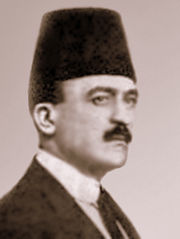 The strike began on 19 April in Nablus, where an Arab National Committee was formed, and by the end of the month National Committees had been formed in all of the towns and some of the larger villages. On 21 April the leaders of the five main parties accepted the decision at Nablus and called for a general strike of all Arabs engaged in labour, transport and shopkeeping for the following day.
While the strike was initially organised by workers and local committees under pressure from below political leaders became involved to help with co-ordination. This led to the formation on 25 April 1936 of the Higher Arab Committee
or HAC. The Committee resolved "to continue the general strike until the British Government changes its present policy in a fundamental manner"; the demands were threefold: (1) the prohibition of Jewish immigration; (2) the prohibition of the transfer of Arab land to Jews; (3) the establishment of a National Government responsible to a representative council.
 About one month after the general strike started, the leadership group declared a general non-payment of taxes in explicit opposition to Jewish immigration. In the countryside, armed insurrection started sporadically, becoming more organised with time. One particular target of the rebels was the oil pipeline of the Iraq Petroleum Company constructed only a few years earlier to Haifa from a point on the Jordan River south of Lake Tiberias. This was repeatedly bombed at various points along its length. Other attacks were on railways (including trains) and on civilian targets such as Jewish settlements, secluded Jewish neighbourhoods in the mixed cities, and Jews, both individually and in groups.
The measures taken against the strike were harsh at the beginning and grew harsher as it went along involving house searches without warrants, night raids, preventive detention, caning, flogging, deportation, confiscation of property, and torture. As early as May 1936 the British formed armed Jewish units equipped with armoured vehicles to serve as auxiliary police.
The British government in Palestine was convinced that the strike had the full support of the Palestinian Arabs and they could see "no weakening in the will and spirit of the Arab people." Air Vice-Marshall Richard Peirse
, commander of British forces in Palestine and Transjordan from 1933 to 1936, reported that because the rebel armed bands were supported by villagers,
In reality the measures created a sense of solidarity between the villagers and the rebels. The pro-Government Mayor of Nablus complained to the High Commissioner that, "During the last searches effected in villages properties were destroyed, jewels stolen, and the Holy Qu'ran torn, and this has increased the excitement of the fellahin." However, Moshe Shertok of the Jewish Agency even suggested that all villages in the area of an incident should be punished.
On 2 June an attempt by rebels to derail a train bringing the 2nd Battalion Bedfordshire and Hertfordshire Regiment
from Egypt led to the railways being put under guard, placing a great strain on the security forces. In response to this situation on 4 June the government rounded up a large number of Palestinian leaders and sent them to a detention camp at Auja al-Hafir in the Negev
desert.
During July, Arab volunteers from Syria and Transjordan
, led by Fawzi al-Qawukji, helped the rebels to divide their formations into four fronts, each led by a District Commander who had armed platoons of 150–200 fighters, each commanded by a platoon leader.
A Statement of Policy issued by the Colonial Office in London on 7 September declared the situation a: "direct challenge to the authority of the British Government in Palestine" and announced the appointment of Lieutenant-General John Dill
as supreme military commander. By the end of September British troops in Palestine were deployed to "round up Arab bands".
In June 1936 the British involved their clients in Transjordan, Iraq, Saudi Arabia and Egypt in an attempt to pacify the Palestinian Arabs and on 9 October the rulers made an appeal for the strike to be ended. A more pressing concern may have been the approaching citrus harvest and the soaring prices that were available because of the disruption caused to the Spanish citrus harvest by the Spanish Civil War
.
The strike was called off on 11 October 1936 and the violence abated for about a year while the Peel Commission
deliberated. The Royal Commission was announced on 18 May 1936 and its members were appointed on 29 July, but the Commission did not arrive in Palestine until 11 November.
The Commission, which concluded that 1,000 Arab rebels had been killed during the strike, later described the disturbances as "an open rebellion of the Palestinian Arabs, assisted by fellow-Arabs from other countries, against Mandatory rule" and noted two unprecedented features of the revolt: the support of all senior Arab officials in the political and technical departments in the Palestine administration (including all of the Arab judges) and the "interest and sympathy of the neighbouring Arab peoples", which had resulted in support for the rebellion in the form of volunteers from Syria
and Iraq
.
 In the early 1920s the first High Commissioner of Palestine, Herbert Samuel, failed to create a unified political structure embracing both Palestinian Arabs and Palestinian Jews in constitution
al government with joint political institutions. This failure facilitated internal institutional partition in which the Jewish Agency exercised a degree of autonomous control over the Jewish settlement and the Supreme Muslim Council
performed a comparable role for Muslims. Thus, well before Lord Peel arrived in Palestine on 11 November 1936, the groundwork for territorial partition as proposed by the Royal Commission
in its report on 7 July 1937 had already been done.
Peel's main recommendation was for partition of Palestine into a small Jewish state (based on current Jewish land ownership population and incorporating the country's most productive agricultural land), a residual Mandatory area, and a larger Arab state linked to Transjordan
. A second and more radical proposal was for transfer of 225,000 Palestinian Arabs from the Jewish state to the Arab state and Transjordan. It is likely that Zionist leaders played a role in persuading Peel to accept the notion of transfer, which had been a strand of Zionist ideology from its inception. The Arab Higher Committee rejected the recommendations immediately, as did the Revisionists
, the religious Zionists
, some of the General Zionists
, and sections of the Labour Zionist
movement. However, Chaim Weizmann
and David Ben-Gurion
accepted the proposals in principle, and Ben-Gurion was delighted by the Peel Commission's support for transfer, which he viewed as the foundation of "national consolidation in a free homeland." A majority at the Zionist Congress
subsequently accepted the proposals as the basis for negotiation, subject to substantial enlargement of the proposed area of the Jewish state.
A technical committee known as the Woodhead Commission
concluded in 1938 that partition could not be implemented because neither the Jews nor the Arabs wanted it.
With the failure of the Peel Commission's proposals the revolt resumed during the autumn of 1937 marked by the assassination on 26 September of Acting District Commissioner of the Galilee Lewis Andrews
by Arab gunmen in Nazareth. On 1 October five Arab leaders were arrested and deported to the Seychelles
, the Arab Higher Committee was outlawed, all frontiers with Palestine were closed, telephone connections to neighbouring countries were withdrawn, press censorship
was introduced and a special concentration camp was opened near Acre.
Violence continued throughout 1938 and eventually petered out in 1939 with the approaching war in Europe.
In the final fifteen months of the revolt alone there were 936 murders and 351 attempted murders; 2,125 incidents of sniping; 472 bombs thrown and detonated; 364 cases of armed robbery; 1,453 cases of sabotage against government and commercial property; 323 people abducted; 72 cases of intimidation; 236 Jews killed by Arabs and 435 Arabs killed by Jews, mostly while defending settlements; 1,200 rebels killed by the police and military and 535 wounded.
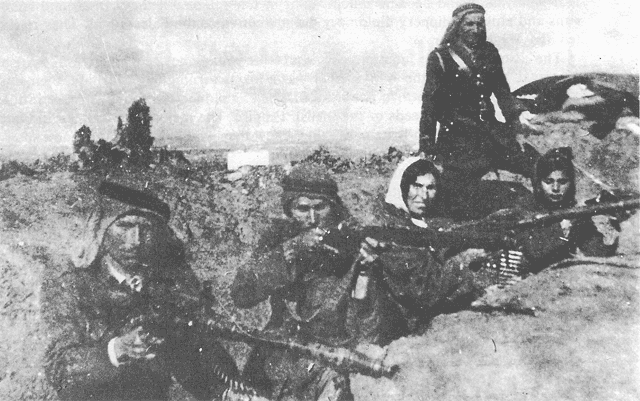
 Military law allowed swift prison sentences to be passed. Thousands of Arabs were held in administrative detention
, without trial, and without proper sanitation
, in overcrowded prison camps.
The British had already formalised the principle of collective punishment in Palestine in the 1924–1925 Collective Responsibility and Punishment Ordinances and updated these ordinances in 1936 with the Collective Fines Ordinance. These collective fines (amounting to £1,000,000 over the revolt) eventually became a heavy burden for poor Palestinian villagers, especially when the army also confiscated livestock, destroyed properties, imposed long curfews and established police posts, demolished houses and detained some or all of the Arab men in distant detention camps.
Full martial law
was not introduced but in a series of Orders in Council and Emergency Regulations
, 1936–37 ‘statutory’ martial law, a stage between semi-military rule under civil powers and full martial law under military powers, and one in which the army and not the civil High Commissioner was pre-eminent was put in place. Following the Arab capture of the Old City of Jerusalem in October 1938, the army effectively took over Jerusalem and then all of Palestine.
The main form of collective punishment employed by the British forces was destruction of property. Sometimes entire villages were reduced to rubble, as happened to Mi'ar
in October 1938; more often several prominent houses were blown up and others were trashed inside. The biggest single act of destruction occurred in Jaffa
on 16 June 1936, when large gelignite
charges were used to cut long pathways through the old city, destroying 220–240 buildings and rendering up to 6,000 Arabs homeless. Scathing criticism for this action from Palestine Chief Justice
Sir Michael McDonnell
was not well-received by the administration and the judge was soon removed from the country. Villages were also frequently punished by fines and confiscation of livestock. The British even used sea mines from the battleship HMS Malaya to destroy houses.
In addition to actions against property, a large amount of brutality by the British forces occurred, including beatings, torture and extrajudicial killings. A surprisingly large number of prisoners were "shot while trying to escape". Several incidents involved serious atrocities, such as massacres at al-Bassa
and Halhul
. Desmond Woods, an officer of the Royal Ulster Rifles
, described the massacre at al-Bassa:
As well as destroying the village the RUR and men from the Royal Engineers
collected around fifty men from al-Bassa and blew some of them up with explosion under a bus. Harry Arrigonie, a policeman who was present said that about twenty men were put onto a bus; those who tried to escape were shot and then the driver of the bus was forced to drive over a powerful land mine buried by the soldiers which completely destroyed the bus, scattering the mutilated bodies of the prisoners everywhere. The other villagers were then forced to bury the bodies in a pit.
Despite these measures Lieutenant-General Haining, the General Officer Commanding, reported secretly to the Cabinet on 1 December 1938 that "practically every village in the country harbours and supports the rebels and will assist in concealing their identity from the Government Forces." Haining reported the method for searching villages:
The report was issued in response to growing concern at the severity of the military measures amongst the general public in Great Britain, among members of the British Government, and among governments in countries neighbouring Palestine.
In addition to actions against villages the British Army also conducted punitive actions in the cities. In Nablus
in August 1938 almost 5,000 men were held in a cage for two days and interrogated one after another. During their detention the city was searched and then each of the detainees was marked with a rubber stamp on his release. At one point a night curfew was imposed on most of the cities.
It was common British army practice to make local Arabs ride with military convoys to prevent mine attacks and sniping incidents: soldiers would tie the hostages to the bonnets of lorries, or put them on small flatbeds on the front of trains. The army told the unfortunate victims that any of them who tried to run away would be shot. On the lorries, some soldiers would brake hard at the end of a journey and then casually drive over the hostage, killing or maiming him, as Arthur Lane, a Manchester Regiment private recalled:
British troops also left Arab wounded on the battlefield to die and maltreated Arab fighters taken in battle, so much so that the rebels tried to remove their wounded or dead from the field of battle. Sometimes, soldiers would occupy villages, expel all of the inhabitants and remain for months. The Army even burned the bodies of "terrorists" to prevent their funerals becoming the focus of protests.
Nevertheless, it has been argued that British behaviour overall was good compared to most other examples where a foreign army suppressed a popular insurgency.
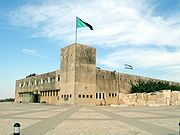 Sir Charles Tegart
was a senior police officer
brought into Palestine from the colonial force of British India on 21 October 1937. Tegart advised the Inspector-General to build a large number of reinforced concrete police stations each with a number of defence towers and armoured doors as defence against attack. These structures became known as Tegart fort
s.
Tegart and his deputy David Petrie
(later head of MI5
) advised a greater emphasis on foreign intelligence gathering and closure of Palestine's borders. Accordingly, from 1938 Gilbert Mackereth
, the British Consul in Damascus, corresponded with Syrian and Transjordan authorities regarding border control and security to counteract arms smuggling and "terrorist" infiltration and produced a report for Tegart on the activities of the Palestine Defence Committee in Damascus.
Tegart recommended the construction of a frontier road with a barbed wire fence along the borders with Lebanon
and Syria
(Tegart's wall
) to help prevent the flow of insurgents, goods and weapons. Tegart encouraged close co-operation with the Jewish Agency. He commissioned the Histadrut
's construction company Solel Boneh
to build the border fences and forts. The total cost was £2 million. The Army forced the fellahin to work on the roads without pay.
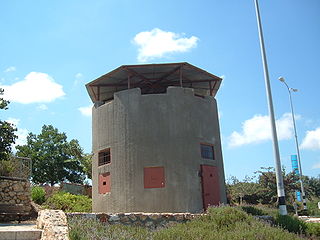 Tegart was responsible for introducing torture centres, which were known euphemistically as "Arab Investigation Centres
". Here prisoners were subjected to very harsh treatment, including beatings, foot whipping
, electric shocks, denailing
and what is now known as "waterboarding
". Tegart also imported Doberman Pinschers from South Africa and set up a special centre in Jerusalem to train interrogators in torture.
developed close air support
into its then most refined form during the Arab Revolt. Air patrols had been found effective in keeping convoys and trains free from attack, but this did not help to expose insurgents to battle conditions likely to cause their defeat. From the middle of June 1936 wireless vehicles accompanied all convoys and patrols. During rebel attacks these vehicles could issue emergency "XX calls" (XX with a coded location), which were given priority over all other radio traffic, to summon aerial reinforcements. Bombers, which were usually airborne within five minutes, could then either attack insurgents directly or "fix" their position for infantry troops. Forty-seven such XX calls were issued during the revolt, causing heavy losses to the rebels.
This use of air power was so successful that the British were able to reduce the regular garrison.
In 1936 an Air Staff Officer in Middle East Command
based in Egypt
, Arthur Harris
, known as an advocate of "air policing", commented on the revolt saying that "one 250 lb. or 500 lb. bomb in each village that speaks out of turn" would satisfactorily solve the problem. In 1937 Harris was promoted to Air Commodore
and in 1938 he was posted to Palestine and Trans-Jordan as Air Officer Commanding
the RAF contingent in the region until September 1939. "Limited" bombing attacks on Arab villages were carried out by the RAF, although at times this involved razing whole villages to the ground. Harris described the system by which recalcitrant villages were kept under control by aerial bombardment
as "Air-Pin".
Aircraft
of the RAF were also used to drop propaganda
leaflets over Palestinian towns and villages telling the fellahin that they were the main sufferers of the rebellion and threatening an increase in taxes.
Low flying RAF squadrons were able to produce detailed intelligence on the location of road blocks, sabotaged bridges, railways and pipelines. RAF aerial photographs were also used to build up a detailed map of Arab population distribution.
Although the British Army was responsible for setting up the Arab counter-insurgent forces (known as the peace bands) and supplying them with arms and money these were operated by RAF Intelligence
, commanded by Patrick Domville.
At the beginning of the revolt RAF assets in the region comprised a bomber flight at RAF Ramleh, an RAF armoured car flight
at Ramleh, fourteen bomber squadrons at RAF Amman, and a RAF armoured car company at Ma'an
.
s were used to carry out tasks ashore, manning two howitzer
s and naval lorries equipped with QF 2 pounder naval gun
s and searchlights used to disperse Arab snipers. From the end of June two destroyer
s were used to patrol the coast of Palestine in a bid to prevent gun running. These searched as many as 150 vessels per week and were an effective preventive measure. At the request of the Army additional naval platoons landed in July to help protect Haifa and Jewish settlements in the surrounding countryside. The Navy also relieved the Army of duties in Haifa by using nine naval platoons to form the Haifa Town Force and in August three naval platoons were landed to support the police.
Following publication of the Peel Commission's report in July 1937 HMS Repulse
sailed to Haifa where landing parties were put ashore to maintain calm. Various other naval vessels continued with this role until the end of the revolt.
Following the Irgun's detonation of a large bomb in a market in Haifa on 6 July 1938 the High Commissioner signalled the Commander-in-Chief of the Mediterranean Fleet
, Admiral Sir Dudley Pound
, requesting the assistance of naval vessels capable of providing landing parties. Pound dispatched HMS Repulse and diverted HMS Emerald
to Haifa, which arrived the same day and landed five platoons, one to each police district. HMS Repulse relieved HMS Emerald the following day and after another bomb was detonated on 10 July five platoons from the ship, made up of sailors and Royal Marines
, dispersed mobs and patrolled the city.
On 11 July provision of three platoons from Repulse released men of the West Kent Regiment
for a punitive mission against Arabs who had attacked a Jewish colony near Haifa. By 17 July the Repulse established a Company Headquarters where seamen and Royal Marines manned a 3.7-inch howitzer. Sailors, Royal Marines, and men of the Suffolk Regiment
, who had embarked on the Repulse, accompanied foot patrols of the Palestine Police Force
.
The Repulse, HMS Hood
and HMS Warspite provided howitzer crews which were sent ashore to combat gun running near the border with Lebanon
. Detained Arabs were used to build emplacements and the howitzers were moved quickly between these positions by day and night in order to confuse bandits as to the likely direction of fire. Periodically, the guns were used to fire warning rounds close to the vicinity of villages believed to have rebel sympathies.
, in December 1939.
These facilities enhanced the strategic importance of Palestine and of Haifa in particular in Britain's control of the eastern Mediterranean. The threat to British control of the region posed by the Italian invasion of Abyssinia in October 1935 and the deteriorating situation in Europe toward the end of the 1930s probably made British policy makers more willing to make concessions to Arab governments on the Palestine issue following the furore over the recommendations of the Peel Commission.
control in Palestine as the revolt had demonstrated to the British authorities how a popular rebellion
could undermine intelligence gathering operations and thereby impair their ability to predict and respond to inter-communal disorder. The rebellion had brought together urban nationalism and peasant economic grievances arising from rural poverty and landlessness, which was blamed on British misrule. Accordingly, the Palestinian revolt targeted the political and economic apparatus of the British colonial state
, including the communications network, pipelines, police stations, army outposts and British personnel. It was this aspect of the revolt, rather than attacks on Jews or violence between rivals for leadership of the national movement, that most concerned the high commissioner. The mandate authorities were further disturbed by the unity of purpose displayed during the six-month general strike
and by the resurgence of pan-Arab
nationalism as evidenced by the rise of the Istiqlal Party
.
In response to these challenges the British army command ("I" Branch) and battalion headquarters across Palestine issued a daily intelligence bulletin every afternoon detailing political developments. Special Service Officers (SSOs) assigned to intelligence gathering reported directly to their local command headquarters and their cars were equipped with wireless transmitters so that high grade intelligence could be reported directly to "I" Branch immediately. These sources of intelligence gradually became more important than those of the C.I.D.
in Palestine, which had been dependent on Arab informers, and which were no longer reliable.
In September 1937 the Jewish Agency appointed Reuven Zaslany
liaison officer for intelligence and security affairs between the Political Department of the Jewish Agency and the intelligence arms of the Royal Air Force and the C.I.D. Zaslany sifted through intelligence collected by Jewish-controlled field operatives and forwarded it to the British military. He was a frequent visitor at the headquarters of British intelligence and the army, the police and C.I.D. and he also travelled to Damascus
to liaise with the Arab opposition's peace bands and with the British Consul
in Iraq. Colonel Frederick Kisch
, a British army officer and Zionist leader, was appointed chief liaison officer between the British army and the Jewish Agency Executive with Zaslany as his deputy. Zaslany also worked as interpreter for Patrick Domville, head of RAF Intelligence
in Palestine (who was described by Haganah leader Dov Hos as the "best Zionist informer on the English"), until the latter was posted to Iraq in 1938, and through him became acquainted with many of the British intelligence officers.
In 1937 the Jewish Agency's intelligence groups were responsible for bugging the Peel Commission hearings in Palestine. Eventually, the Arab Revolt convinced the Agency that a central intelligence service was required and this led to the formation of a counter-intelligence agency known as the Ran
(headed by Yehuda Arazi, who also helped to smuggle rifles, machine guns and ammunition from Poland to Palestine) and thereafter in 1940 to the creation of SHAI, the forerunner of Mossad
.
(Hebrew
for "defence"), a Jewish paramilitary organisation, actively supported British efforts to suppress the uprising, which reached 10,000 Arab fighters at their peak during the summer and fall of 1938. Although the British administration did not officially recognise the Haganah, the British security forces cooperated with it by forming the Jewish Settlement Police
, Jewish Supernumerary Police
, and Special Night Squads
. The Special Night Squads engaged in activities described by colonial administrator Sir Hugh Foot, as 'extreme and cruel' involving torture, whipping, abuse and execution of Arabs.
The British authorities maintained, financed and armed the Jewish police from this point onward until the end of the Mandate, and by the end of September 1939 around 20,000 Jewish policeman, supernumeraries and settlement guards had been authorised to carry arms by the government, which also distributed weapons to outlying Jewish settlements, and allowed the Haganah to acquire arms. Independently of the British, Ta'as
, the Haganah's clandestine munitions industry, developed an 81-mm mortar and manufactured mines and grenades, 17,500 of the latter being produced for use during the revolt.
In June 1937 the British imposed the death penalty for unauthorised possession of weapons, ammunition, and explosives, but since many Jews had permission to carry weapons and store ammunition for defence this order was directed primarily against Palestinian Arabs and most of the 112 executed in Acre Prison
were hanged for illegal possession of arms.
In principle all of the joint units functioned as part of the British administration, but in practice they were under the command of the Jewish Agency and "intended to form the backbone of a Jewish military force set up under British sponsorship in preparation for the inevitable clash with the Arabs." The Agency and the Mandate authorities shared the costs of the new units equally. The administration also provided security services to Jewish commercial concerns at cost.
Jewish and British officials worked together to coordinate manhunts and collective actions against villages and also discussed the imposition of penalties and sentences. Overall, the Jewish Agency was successful in making "the point that the Zionist movement and the British Empire
were standing shoulder to shoulder against a common enemy, in a war in which they had common goals."
The rebellion also inspired the Jewish Agency to expand the intelligence-gathering of its Political Department and especially of its Arab Division, with the focus changing from political to military intelligence. The Arab Division set up a network of Jewish controllers and Arab agents around the country. Some of the intelligence gathered was shared with the British administration, the exchange of information sometimes being conducted by Moshe Shertok
, then head of the Jewish Agency, directly with the high commissioner himself. Shertok also advised the administration on political affairs, on one occasion convincing the high commissioner not to arrest Professor Joseph Klausner
, a Revisionist Maximalist
activist who had played a key role in the riots of 1929
, because of the likely negative consequences.
† Ta'as and Rekhesh were developed and expanded during the Arab Revolt but already existed before 1936 and of course the Haganah had been in operation from the earliest days of the Mandate.
, which was staffed by Jews who were Arab-speaking and Arab-looking; Rekhesh, the arms procurement service, which had its own intelligence gathering capabilities, and likewise the Mossad LeAliyah Bet, the illegal immigration service. In mid-1939 the effort to coordinate the activities of these groups was led by Shaul Avigur
and Moshe Shertok
.
organisation (or Etzel). The organisation took its orders from Revisionist leader Ze'ev Jabotinsky who was at bitter loggerheads with the dominant Labour Zionist
movement led by David Ben-Gurion. The rift between the two Zionist movements further deteriorated in 1933 when two Revisionists were blamed for the murder of Haim Arlosoroff, who had negotiated the Haavara Agreement
between the Jewish Agency and Nazi Germany
. The agreement brought 52,000 German Jews to Palestine between 1933 and 1939, and generated $30,000,000 for the then almost bankrupt Jewish Agency, but in addition to the difficulties with the Revisionists, who advocated a boycott of Germany, it caused the Yishuv to be isolated from the rest of world Jewry.
Ultimately, however, the events of the Arab Revolt blurred the differences between the gradualist approach of Ben-Gurion and the Maximalist Iron Wall
approach of Jabotinsky and turned militarist patriotism into a bipartisan philosophy. Indeed, Ben-Gurion's own Special Operations Squads
conducted a punitive operation in the Arab village of Lubya
firing weapons into a room through a window killing two men and one woman and injuring three people, including two children.
From October 1937 the Irgun instituted a wave of bombings against Arab crowds and buses. For the first time in the conflict massive bombs were placed in crowded Arab public places, killing and maiming dozens. These attacks substantially increased Arab casualties and sowed terror among the population. The first attack was on 11 November 1937, killing two Arabs at the bus depot near Jaffa Street
in Jerusalem and then on 14 November, a day later commemorated as the "Day of the Breaking of the Havlagah
(restraint)," Arabs were killed in simultaneous attacks around Palestine. More deadly attacks followed: on 6 July 1938 21 Arabs were killed and 52 wounded by a bomb in a Haifa market; on 25 July a second market bomb in Haifa killed at least 39 Arabs and injured 70; a bomb in Jaffa's vegetable market on 26 August killed 24 Arabs and wounded 39. The attacks were condemned by the Jewish Agency.
Ironically, the Arab leader Mohammad Amin al-Husayni and his associates also received funding from Fascist Italy during the revolt as the Italians were in dispute with the United Kingdom over Abyssinia
and wished not only to disrupt the British rear but also to extend Italian influence in the region.
units" were made up of disaffected Arab peasants recruited by the British administration and the Nashashibis in late 1938 to battle against Arab rebels during the revolt. Despite their peasant origins the bands were representative mainly of the interests of landlords and rural notables. Some peace bands also sprang up in the Nablus area, on Mount Carmel
(a stronghold of the Druze
who largely opposed the rebellion after 1937), and around Nazareth
without connection to the Nashashibi-Husayni
power struggle.
From December 1937 the main opposition figures among the Arabs approached the Jewish Agency for funding and assistance. In October 1937, shortly after Mohammad Amin al-Husayni
, the leader of the Arab Higher Committee, had fled from Palestine to escape British retribution, Raghib al-Nashashibi
had written to Moshe Shertok stating his full willingness to cooperate with the Jewish Agency and to agree with whatever policy it proposed. From early in 1938 the Nashashibis received funding specifically to conduct anti-rebel operations, with Raghib al-Nashashibi himself receiving £5,000. The British also supplied funding to the peace bands and sometimes directed their operations.
Fakhri Nashashibi was particularly successful in recruiting peace bands in the Hebron hills
, on one occasion in December 1938 gathering 3,000 villagers for a rally in Yata, also attended by the British military commander of the Jerusalem District General Richard O'Connor
.
Just two months earlier, on 15 October 1938, rebels had seized the Old City and barricaded the gates. O'Connor had planned the operation by which men of the Coldstream Guards
, Royal Northumberland Fusiliers
and Black Watch
recaptured the Old City, killing 19 rebels. He was later to win fame as the field commander for Operation Compass
in World War II, in which his forces completely destroyed a much larger Italian army—a victory which nearly drove the Axis
from Africa, and in turn, led Adolf Hitler
to send the German Africa Corps under Erwin Rommel
to try to reverse the situation.
Towards the end of the revolt in May 1939 the authorities dissolved the peace bands and confiscated their arms. However, because members of the bands had become tainted in the eyes of the Palestinian Arabs, and some were under sentence of death, they had little choice but to continue the battle against the national movement's leadership, which they did with the continuing help of the Zionist movement.
and was thus a significant adversary of the Mandate and Jewish settlement authorities. He was trapped by British troops in a major engagement on 2 October 1938 and was killed whilst trying to lead his men to safety.
area, was born in Silat al-Harithiya
and before becoming a rebel worked as a Gazoz vendor. He was said to be a narrow-minded man who thrived on extortion and cruelty and thus became greatly feared. Yusuf Hamdan was Durra's more respected lieutenant and later a leader of his own unit; he was killed by an army patrol in 1939 and buried in Lajjun
. Durra himself was apprehended by the Arab Legion
in Transjordan
on 25 July 1939 and subsequently hanged.
Fakhri Abdul Hadi (Fakhri 'Abd al-Hadi) of the village of Arrabah
worked closely with Fawzi al-Qawukji during 1936 but later defected to the British authorities. He bargained for a pardon by offering to collaborate with the British on countering rebel propaganda. Once on the payroll of the British consul in Damascus (Gilbert Mackereth
) he carried out many attacks against the rebels in 1938–1939 as leader of his own "peace band".
Abdul Rahim al Hajj Mohammed ('Abd al-Rahim al-Hajj Muhammad) in the Tulkarm
area was a deeply religious, intellectual man and as a fervent anti-Zionist was deeply committed to the revolt. He was regarded second to Qawukji in terms of leadership ability and maintained his independence from the exiled rebel leadership in Damascus. He is still related by Palestinian Arabs as a hero and martyr and is regarded as a metonym "for a national movement that was popular, honourable, religious, and lofty in its aims and actions." He was shot by an army patrol near Sanur on 27 March 1939.
Aref Abdul Razzik (Arif 'Abd al-Raziq) of Tayibe
village, who was responsible for the area south of Tulkarm, was known for seemingly being able to vanish into thin air whilst being pursued by the security forces. He signed his bulletins 'The Ghost of Sheikh Qassam'. Razzik assumed a place in British army folklore and the troops sang a song about him. Razzik was capable and daring and gained a reputation as one of the army's problem heroes.
Mohammad Mahmoud Rana'an of Jaba'
village was noted for his courage but lacked in intellect.
The hostilities contributed to further disengagement of the Jewish and Arab economies in Palestine, which were intertwined to some extent until that time. Development of the economy and infrastructure accelerated. For example, whereas the Jewish city of Tel Aviv
relied on the nearby Arab seaport of Jaffa
, hostilities dictated the construction of a separate Jewish-run seaport for Tel Aviv, inspiring the delighted Ben-Gurion to note in his diary "we ought to reward the Arabs for giving us the impetus for this great creation." Metal works were established to produce armoured sheeting for vehicles and a rudimentary arms industry was founded. The settlement's transportation capabilities were enhanced and Jewish unemployment was relieved owing to the employment of police officers, and replacement of striking Arab labourers, employees, craftsman and farmers by Jewish workers. Most of the important industries in Palestine were owned by Jews and in trade and the banking sector they were much better placed than the Arabs.
As a result of collaboration with the British colonial authorities and security forces many thousands of young men had their first experience of military training, which Moshe Shertok
and Haganah leader Eliyahu Golomb
cited as one of the fruits of the Haganah
's policy of havlagah
(restraint).
Although the Jewish settlement in Palestine was dismayed by the publication of the 1939 White Paper restricting Jewish immigration David Ben-Gurion remained undeterred, believing that the policy would not be implemented, and in fact Neville Chamberlain had told him that the policy would last at the very most only for the duration of the war. In the event the White Paper quotas were exhausted only in December 1944, over five and a half years later, and in the same period the United Kingdom absorbed 50,000 Jewish refugees and the British Commonwealth (Australia, Canada and South Africa) took many thousands more. During the War over 30,000 Jews joined the British forces and even the Irgun ceased operations against the British.
and was thus counterproductive. During the uprising, British authorities attempted to confiscate all weapons from the Arab population. This, and the destruction of the main Arab political leadership in the revolt, greatly hindered their military efforts in the 1948 Palestine war
, where imbalances between the Jewish and Arab economic performance, social cohesion, political organisation and military capability became apparent. The flight of wealthy Arabs, which occurred during the revolt, was also replicated in 1947–49.
 Thousands of Palestinian houses were destroyed, and massive financial costs were incurred because of the general strike and the devastation of fields, crops and orchards. The economic boycott further damaged the fragile Palestinian Arab economy through loss of sales and goods and increased unemployment.
Clearly, the revolt did not achieve its goals, although it is "credited with signifying the birth of the Arab Palestinian identity." It is generally credited with forcing the issuance of the White Paper of 1939
in which Britain retreated from the partition arrangements proposed by the Peel Commission in favour of the creation of a binational state within ten years, a move regarded by many as incompatible with the commitment to a Jewish National Home in Palestine, as proclaimed in the 1917 Balfour Declaration.
approached, British policy makers concluded that although they could rely on the support of the Jewish population in Palestine, who had no alternative but to support Britain, the support of Arab governments and populations in an area of great strategic importance for the British Empire
was not assured. Prime Minister Neville Chamberlain
concluded "if we must offend one side, let us offend the Jews rather than the Arabs."
In February 1939 Secretary of State for Dominion Affairs Malcolm MacDonald
called together a conference of Arab and Zionist leaders on the future of Palestine at St. James's Palace
in London but the discussions ended without agreement on 27 March. The government's new policy as published in White Paper of 17 May had been determined already and despite Jewish protests and Irgun attacks the British remained resolute.
There was a growing feeling among British officials that there was nothing left for them to do in Palestine.
Perhaps the ultimate achievement of the Arab Revolt was to make the British sick of Palestine. Major-General Bernard "Monty" Montgomery concluded, "the Jew murders the Arab and the Arab murders the Jew. This is what is going on in Palestine now. And it will go on for the next 50 years in all probability."
i historiography on Palestine, and even progressive Western scholars have little to say about the anti-colonial
struggle of the Palestinian Arab people against the British Empire.
The Zionist version of Israeli history acknowledges only one authentic national movement: the struggle for Jewish self-determination
that resulted in the Israeli Declaration of Independence in May 1948. This narrative has no room for an anticolonial and anti-British Palestinian national revolt. In conventional Zionist history the revolt is often described as a series of "events" (Hebrew
מאורעות תרצ"ו-תרצ"ט) "riots", or "happenings". The appropriate description was even debated by Jewish Agency officials, who were keen not to give a negative impression of Palestine to prospective immigrants. In private, however, David Ben-Gurion
was unequivocal, the Arabs, he said, were "fighting dispossession... The fear is not of losing land, but of losing the homeland of the Arab people, which others want to turn into the homeland of the Jewish people."
Aliyah
Aliyah is the immigration of Jews to the Land of Israel . It is a basic tenet of Zionist ideology. The opposite action, emigration from Israel, is referred to as yerida . The return to the Holy Land has been a Jewish aspiration since the Babylonian exile...
.
The revolt consisted of two distinct phases. The first phase was directed primarily by the urban and elitist Higher Arab Committee
Arab Higher Committee
The Arab Higher Committee was the central political organ of the Arab community of Mandate Palestine. It was established on 25 April 1936, on the initiative of Hajj Amin al-Husayni, the Grand Mufti of Jerusalem, and comprised the leaders of Palestinian Arab clans under the mufti's...
(HAC) and was focused mainly on strikes and other forms of political protest. By October 1936, this phase had been defeated by the British civil administration
High Commissioners of Palestine
High Commissioners of Palestine were the highest ranking authority representing the United Kingdom in the British Mandate of Palestine. They were based in Jerusalem...
using a combination of political concessions, international diplomacy (involving the rulers of Iraq
Iraq
Iraq ; officially the Republic of Iraq is a country in Western Asia spanning most of the northwestern end of the Zagros mountain range, the eastern part of the Syrian Desert and the northern part of the Arabian Desert....
, Saudi Arabia
Saudi Arabia
The Kingdom of Saudi Arabia , commonly known in British English as Saudi Arabia and in Arabic as as-Sa‘ūdiyyah , is the largest state in Western Asia by land area, constituting the bulk of the Arabian Peninsula, and the second-largest in the Arab World...
, Transjordan
Transjordan
The Emirate of Transjordan was a former Ottoman territory in the Southern Levant that was part of the British Mandate of Palestine...
and Yemen
Yemen
The Republic of Yemen , commonly known as Yemen , is a country located in the Middle East, occupying the southwestern to southern end of the Arabian Peninsula. It is bordered by Saudi Arabia to the north, the Red Sea to the west, and Oman to the east....
) and the threat of martial law
Martial law
Martial law is the imposition of military rule by military authorities over designated regions on an emergency basis— only temporary—when the civilian government or civilian authorities fail to function effectively , when there are extensive riots and protests, or when the disobedience of the law...
. The second phase, which began late in 1937, was a violent and peasant-led resistance movement that increasingly targeted British forces. During this phase, the rebellion was brutally suppressed by the British Army
British Army
The British Army is the land warfare branch of Her Majesty's Armed Forces in the United Kingdom. It came into being with the unification of the Kingdom of England and Scotland into the Kingdom of Great Britain in 1707. The new British Army incorporated Regiments that had already existed in England...
and the Palestine Police Force
Palestine Police Force
The Palestine Police Force was a British colonial police service established in the British Mandate for Palestine on 1 July 1920, when High Commissioner Herbert Samuel's civil administration took over responsibility for security from General Allenby's Occupied Enemy Territory Administration...
using repressive measures that were intended to intimidate the Arab population and undermine popular support for the revolt.
According to official British figures covering the whole revolt, the army and police killed more than 2,000 Arabs in combat, 108 were hanged, and 961 died because of ‘gang and terrorist activities’. In an analysis of the British statistics, Walid Khalidi
Walid Khalidi
Walid Khalidi is an Oxford University-educated Palestinian historian who has written extensively on the Palestinian exodus. He is General Secretary and co-founder of the Institute for Palestine Studies, established in Beirut in December 1963 as an independent research and publishing center...
estimates 19,792 casualties for the Arabs, with 5,032 dead: 3,832 killed by the British and 1,200 dead because of ‘terrorism’, and 14,760 wounded. Over ten percent of the adult male Palestinian Arab population between 20 and 60 was killed, wounded, imprisoned or exiled. Estimates of the number of Palestinian Jews killed range from 91 to 'several hundred'.
Although the 1936–1939 Arab revolt in Palestine was unsuccessful, its consequences affected the outcome of the 1948 Arab-Israeli war
1948 Arab-Israeli War
The 1948 Arab–Israeli War, known to Israelis as the War of Independence or War of Liberation The war commenced after the termination of the British Mandate for Palestine and the creation of an independent Israel at midnight on 14 May 1948 when, following a period of civil war, Arab armies invaded...
.
Origins
In 1930 Sheikh Izz ad-Din al-QassamIzz ad-Din al-Qassam
Sheikh Muhammad Izz ad-Din al-Qassam was a Tijani Sufi who led militant activities against British, French, and Zionist organizations in the Levant in the 1920's and 1930's.-Early life:...
organized and established the Black Hand, an anti-Zionist and anti-British militant organisation. He recruited and arranged military training for peasants and by 1935 he had enlisted between 200 and 800 men. The cells were equipped with bombs and firearms, which they used to murder Jewish settlers in the area, as well as engaging in a campaign of vandalizing trees planted by settlers and British-constructed rail lines. In November 1935, two of his men engaged in a firefight with a Palestine police patrol hunting fruit thieves and a policeman was killed. Following the incident, British police launched a manhunt and surrounded al-Qassam in a cave near Ya'bad
Ya'bad
Ya'bad is a Palestinian town in the northern West Bank, 20 kilometers west of Jenin in the Jenin Governorate. It is a major agricultural town with most of its land covered with olive groves and grain fields. According to the Palestinian Central Bureau of Statistics, the town had a population of...
. In the ensuing battle, al-Qassam was killed.
The death of the al-Qassam generated widespread outrage in the Arab community. Huge crowds accompanied Qassam's body to his grave in Haifa
Haifa
Haifa is the largest city in northern Israel, and the third-largest city in the country, with a population of over 268,000. Another 300,000 people live in towns directly adjacent to the city including the cities of the Krayot, as well as, Tirat Carmel, Daliyat al-Karmel and Nesher...
.
The dissent in Palestine was influenced also by the discovery in October 1935 at the port of Jaffa
Jaffa
Jaffa is an ancient port city believed to be one of the oldest in the world. Jaffa was incorporated with Tel Aviv creating the city of Tel Aviv-Yafo, Israel. Jaffa is famous for its association with the biblical story of the prophet Jonah.-Etymology:...
of a large arms shipment
Cement Incident
The Cement Incident took place in the port of Jaffa in Palestine on 16 October 1935. While Arab dockers were unloading a consignment of 537 drums of White-Star cement from the Belgian cargo ship Leopold II, which were destined for a Jewish merchant called J. Katan in Tel Aviv, one drum accidentally...
destined for the Haganah
Haganah
Haganah was a Jewish paramilitary organization in what was then the British Mandate of Palestine from 1920 to 1948, which later became the core of the Israel Defense Forces.- Origins :...
, sparking Arab fears of a Jewish military takeover of Palestine, Jewish immigration also peaked in 1935, just months before Palestinian Arabs began a full-scale, nation-wide revolt. In the four years between 1933 and 1936
more than 164,000 Jewish immigrants arrived in Palestine, and between 1931 and 1936 the Jewish population more than doubled from 175,000 to 370,000 people, increasing the Jewish population share from 17 to 27 per cent, bringing about a significant deterioration in relations between Palestinian Arabs and Jews.
The uprising began with an attack on 15 April 1936 on a convoy of trucks on the Nablus
Nablus
Nablus is a Palestinian city in the northern West Bank, approximately north of Jerusalem, with a population of 126,132. Located in a strategic position between Mount Ebal and Mount Gerizim, it is the capital of the Nablus Governorate and a Palestinian commercial and cultural center.Founded by the...
to Tulkarm
Tulkarm
Tulkarem or Tulkarm is a Palestinian city in the northern Samarian mountain range in the Tulkarm Governorate in the extreme northwestern West Bank adjacent to the Netanya and Haifa districts to the west, the Nablus and Jenin Districts to the east...
road during which the (probably Qassamite) assailants shot two Jewish drivers, Israel Khazan, who was killed instantly, and Zvi Dannenberg, who died five days later. The next day Jewish (Irgun
Irgun
The Irgun , or Irgun Zevai Leumi to give it its full title , was a Zionist paramilitary group that operated in Mandate Palestine between 1931 and 1948. It was an offshoot of the earlier and larger Jewish paramilitary organization haHaganah...
) gunmen shot and killed two Arab workers sleeping in a hut near Petah Tikva
Petah Tikva
Petah Tikva known as Em HaMoshavot , is a city in the Center District of Israel, east of Tel Aviv.According to the Central Bureau of Statistics, at the end of 2009, the city's population stood at 209,600. The population density is approximately...
in a revenge attack, and the funeral for Khazan in Tel Aviv
Tel Aviv
Tel Aviv , officially Tel Aviv-Yafo , is the second most populous city in Israel, with a population of 404,400 on a land area of . The city is located on the Israeli Mediterranean coastline in west-central Israel. It is the largest and most populous city in the metropolitan area of Gush Dan, with...
on 17 April became a turbulent nationalist event during which Jewish rioters beat Arab children and destroyed property. Between 19 and 22 April disturbances in Jaffa and Tel Aviv left 16 Jews and 5 Arabs dead. An Arab general strike and revolt ensued that lasted until October 1936.
During the summer of that year, thousands of Jewish-farmed acres and orchards were destroyed, Jewish civilians were attacked and murdered, and some Jewish communities, such as those in Beisan and Acre
Acre, Israel
Acre , is a city in the Western Galilee region of northern Israel at the northern extremity of Haifa Bay. Acre is one of the oldest continuously inhabited sites in the country....
, fled to safer areas.
Economic background
Economic factors played a major role in the outbreak of the Arab revolt. Palestine's fellahin, the country's peasant farmers, comprised over two-thirds of the indigenous Arab population and from the 1920s onwards they were pushed off the land in increasingly large numbers into urban environments where they often encountered only poverty and social marginalisation. Many were crowded into shanty townShanty town
A shanty town is a slum settlement of impoverished people who live in improvised dwellings made from scrap materials: often plywood, corrugated metal and sheets of plastic...
s in Jaffa and Haifa where they found succour and encouragement in the teachings of the charismatic preacher Izz ad-Din al-Qassam who worked among the poor in Haifa. The revolt was thus a popular uprising that produced its own leaders and developed into a national revolt.
World War I left Palestine, especially the countryside, deeply impoverished. The Ottoman
Ottoman Empire
The Ottoman EmpireIt was usually referred to as the "Ottoman Empire", the "Turkish Empire", the "Ottoman Caliphate" or more commonly "Turkey" by its contemporaries...
and then the Mandate authorities levied high taxes on farming and agricultural produce and during the 1920s and 1930s this together with a fall in prices, cheap imports, natural disasters and paltry harvests all contributed to the increasing indebtedness of the fellahin. The rents paid by tenant fellah increased sharply, owing to increased population density, and transfer of land from Arabs to the Jewish settlement agencies, such as the Jewish National Fund
Jewish National Fund
The Jewish National Fund was founded in 1901 to buy and develop land in Ottoman Palestine for Jewish settlement. The JNF is a quasi-governmental, non-profit organisation...
, increased the number of fellahin evicted while also removing the land as a future source of livelihood. By 1931 the 106,400 dunums
Dunam
A dunam or dönüm, dunum, donum, dynym, dulum was a non-SI unit of land area used in the Ottoman Empire and representing the amount of land that can be plowed in a day; its value varied from 900–2500 m²...
of low-lying Category A farming land in Arab possession supported a farming population of 590,000 whereas the 102,000 dunums of such land in Jewish possession supported a farming population of only 50,000. The problem of 'landless' Arabs grew particularly grave after 1931, causing High Commissioner Wauchope to warn that this 'social peril... would serve as a focus of discontent and might even result in serious disorders.'
Although the Mandatory government introduced measures to limit the transfer of land from Arabs to Jews these were easily circumvented by willing buyers and sellers. The failure of the authorities to invest in economic growth and healthcare and the Zionist policy of ensuring that their investments were directed only to facilitate expansion of the Yishuv further compounded matters. The government did, however, set the minimum wage for Arab workers below that for Jewish workers, which meant that those making capital investments in the Yishuv's economic infrastructure, such as Haifa's electricity plant, the Shemen oil and soap factory, the Grands Moulins flour mills and the Nesher cement factory, could take advantage of cheap Arab labour pouring in from the countryside. After 1935 the slump in the construction boom and further concentration by the Yishuv on an exclusivist Hebrew labour programme removed most of the sources of employment for rural migrants. By 1935 only 12,000 Arabs (5% of the workforce) worked in the Jewish sector, half of these in agriculture, whereas 32,000 worked for the Mandate authorities and 211,000 were either self-employed or worked for Arab employers.
The ongoing disruption of agrarian life in Palestine, which had been continuing since Ottoman times, thus created a large population of landless peasant farmers who subsequently became mobile wage workers who were increasingly marginalised and impoverished; these became willing participants in nationalist rebellion.
Political and socio-cultural background
Initially, the conflict with Zionism helped to make Palestinian Arab society more conservative in cultural, social, religious and political affairs because people were highly motivated to preserve their distinct heritage and identity against the dual impact of British colonialism and Jewish innovation. Traditionally, the Arabs had an elite, but not a real leadership. Both of these things changed over the course of the 1930s. During this period new political organisations and new types of activist began to appear, marking the involvement of a far broader cross-section of the population; in particular, nationalism, which had been long-rooted in rural society began to take hold in urban society.Youth organisations proliferated at this time; these included the Young Men's Muslim Association
Young Men's Muslim Association
The Young Men's Muslim Association was founded in Egypt in 1928, with the start of the Muslim Brotherhood. By the end of the decade it had around 15,000 members. The leader of YMMA in Palestine was Izz al-din Qassam....
, which from 1931 agitated for armed resistance against the Zionists, the Youth Congress Party
Youth Congress Party
The Youth Congress Party was established by Yaqub al-Ghusayn in the British Mandate of Palestine in 1932. The party was generally pro-Husayni.-References:...
, which expressed pan-Arab sentiments, and the Palestinian Boy Scout Movement
Palestinian Scout Association
The Scout movement started in Palestine in 1912. The Palestinian Scout Association was recognized by the World Scout Bureau in 1945, however recognition was withdrawn in 1949. Official recognition was restored by the World Scout Conference in 1996, and the Palestinian Scout Association serves...
, founded early in 1936, which became active in the general strike.
Women's organisations, which had been active in social matters, became politically involved from the end of the 1920s, with an Arab Women's Congress held in Jerusalem in 1929 attracting 200 participants, and an Arab Women's Association (later Arab Women's Union) being established at the same time, both organised by feminist Tarab Abdul Hadi
Tarab Abdul Hadi
Tarab Abdul Hadi was a Palestinian Muslim activist and feminist. In the late 1920s, she co-founded the Palestine Arab Women's Congress , the first women's organization in British Mandate Palestine, and was an active organizer in its sister group, the Arab Women's Association .-Political...
.
From the beginning of the 1930s new political parties began to appear, including the Independence Party
Independence Party (Palestine)
The Independence Party was an Arab nationalist party established on 13 August, 1932, in Palestine during the British mandate. Its origins lay in the Istiqlal movement associated with the short-lived Sharifian government in Damascus....
, which called for an Indian Congress Party
Indian National Congress
The Indian National Congress is one of the two major political parties in India, the other being the Bharatiya Janata Party. It is the largest and one of the oldest democratic political parties in the world. The party's modern liberal platform is largely considered center-left in the Indian...
-style boycott of the British, the pro-Nashashibi
Nashashibi
Nashashibi is the name of a prominent Palestinian family based in Jerusalem. Many of its members held senior positions in the government of Jerusalem. Raghib al-Nashashibi was Mayor of Jerusalem .- History :...
National Defence Party, the pro-Husayni Palestinian Arab Party the pro-Khalidi Arab-Palestinian Reform Party
Reform Party (Palestine)
The Reform Party was established by Husayin al-Khalidi in Palestine on 23 June 1935....
, and the National Bloc, based mainly around Nablus.
A few militant secret societies, which advocated armed struggle were formed; these included the Green Hand, which was active in the hills around Safad, but eliminated by the British in 1931, the Organization for Holy Struggle, led by Abd al-Qadir al-Husayni
Abd al-Qadir al-Husayni
Abd al-Qadir al-Husayni was a Palestinian Arab nationalist and fighter who in late 1933 founded the secret militant group known as the Organization for Holy Struggle, , which he and Hasan Salama commanded as the Army of the Holy War during the 1936-1939 Arab Revolt and during the 1948...
and active in the Hebron area, which was later to play an important role in the 1948 Palestine War
1948 Palestine war
The 1948 Palestine war refers to the events in the British Mandate of Palestine between the United Nations vote on the partition plan on November 30, 1947, to the end of the first Arab-Israeli war on July 20, 1949.The war is divided into two phases:...
, and the Young Rebels or Avenging Youth, active in the Tulkarm
Tulkarm
Tulkarem or Tulkarm is a Palestinian city in the northern Samarian mountain range in the Tulkarm Governorate in the extreme northwestern West Bank adjacent to the Netanya and Haifa districts to the west, the Nablus and Jenin Districts to the east...
and Qalqilyah
Qalqilyah
-Bibliography: p. -External links:**...
area from 1935.
Traditional feasts such as Nebi Musa began to acquire a political and nationalist dimension and new national memorial days were introduced or gained new significance; among them Balfour Day (2 November, marking the Balfour Declaration of 1917), the anniversary of the Battle of Hattin
Battle of Hattin
The Battle of Hattin took place on Saturday, July 4, 1187, between the Crusader Kingdom of Jerusalem and the forces of the Ayyubid dynasty....
(4 July, marking Saladin
Saladin
Ṣalāḥ ad-Dīn Yūsuf ibn Ayyūb , better known in the Western world as Saladin, was an Arabized Kurdish Muslim, who became the first Sultan of Egypt and Syria, and founded the Ayyubid dynasty. He led Muslim and Arab opposition to the Franks and other European Crusaders in the Levant...
's recapture of Jerusalem), and beginning in 1930 May 16 was celebrated as Palestine Day.
The expansion of education, the development of civil society
Civil society
Civil society is composed of the totality of many voluntary social relationships, civic and social organizations, and institutions that form the basis of a functioning society, as distinct from the force-backed structures of a state , the commercial institutions of the market, and private criminal...
and of transportation, communications, and especially of broadcasting and other media, all facilitated these changes.
Regional political background
A number of political changes in neighbouring Arab countries illustrated to the Palestinian Arabs what could be achieved in a Western colony through political pressure and negotiating skill.In Syria a general strike took place from 20 January to 6 March 1936 spreading to all the major towns, and political demonstrations held throughout the country gave fresh momentum to the Syrian national movement. Although French reprisals were harsh the government agreed on 2 March to the formation of a Syrian delegation to travel to Paris to negotiate a Franco-Syrian Treaty of Independence
Franco-Syrian Treaty of Independence (1936)
The Franco-Syrian Treaty of Independence was a treaty negotiated between France and Syria to provide for Syrian independence from French authority, which had been imposed under a League of Nations Mandate.- Explanation :...
. This demonstrated that determined economic and political pressure could challenge a fragile imperial administration.
In Egypt
Egypt
Egypt , officially the Arab Republic of Egypt, Arabic: , is a country mainly in North Africa, with the Sinai Peninsula forming a land bridge in Southwest Asia. Egypt is thus a transcontinental country, and a major power in Africa, the Mediterranean Basin, the Middle East and the Muslim world...
on 2 March 1936 a series of formal negotiations between the United Kingdom and Egypt began leading to the Anglo-Egyptian Treaty of 1936
Anglo-Egyptian Treaty of 1936
The Anglo-Egyptian Treaty of 1936 was a treaty signed between the United Kingdom and the Kingdom of Egypt; it is officially known as The Treaty of Alliance Between His Majesty, in Respect of the United Kingdom, and His Majesty, the King of Egypt...
, which granted independence to Egypt, but allowed the British to keep forces in the Suez Canal Zone
Suez Canal
The Suez Canal , also known by the nickname "The Highway to India", is an artificial sea-level waterway in Egypt, connecting the Mediterranean Sea and the Red Sea. Opened in November 1869 after 10 years of construction work, it allows water transportation between Europe and Asia without navigation...
.
In Iraq a general strike in July 1931, accompanied by organised demonstrations in the streets, led to independence for the former British mandate territory under prime minister Nuri as-Said
Nuri as-Said
Nuri Pasha al-Said was an Iraqi politician during the British Mandate and during the Kingdom of Iraq. He served in various key cabinet positions, and served seven terms as Prime Minister of Iraq....
, and full membership of the League of Nations
League of Nations
The League of Nations was an intergovernmental organization founded as a result of the Paris Peace Conference that ended the First World War. It was the first permanent international organization whose principal mission was to maintain world peace...
in October 1932.
The General Strike and the Peel Commission
While the strike was initially organised by workers and local committees under pressure from below political leaders became involved to help with co-ordination. This led to the formation on 25 April 1936 of the Higher Arab Committee
Arab Higher Committee
The Arab Higher Committee was the central political organ of the Arab community of Mandate Palestine. It was established on 25 April 1936, on the initiative of Hajj Amin al-Husayni, the Grand Mufti of Jerusalem, and comprised the leaders of Palestinian Arab clans under the mufti's...
or HAC. The Committee resolved "to continue the general strike until the British Government changes its present policy in a fundamental manner"; the demands were threefold: (1) the prohibition of Jewish immigration; (2) the prohibition of the transfer of Arab land to Jews; (3) the establishment of a National Government responsible to a representative council.
The measures taken against the strike were harsh at the beginning and grew harsher as it went along involving house searches without warrants, night raids, preventive detention, caning, flogging, deportation, confiscation of property, and torture. As early as May 1936 the British formed armed Jewish units equipped with armoured vehicles to serve as auxiliary police.
The British government in Palestine was convinced that the strike had the full support of the Palestinian Arabs and they could see "no weakening in the will and spirit of the Arab people." Air Vice-Marshall Richard Peirse
Richard Peirse
Air Chief Marshal Sir Richard Edmund Charles Peirse KCB DSO AFC , was a senior Royal Air Force commander.-RAF career:...
, commander of British forces in Palestine and Transjordan from 1933 to 1936, reported that because the rebel armed bands were supported by villagers,
It was quickly evident that the only way to regain the initiative from the rebels was by initiating measures against the villagers from which the rebels and saboteurs came... I therefore initiated, in co-operation with the Inspector-General of Police R. G. B. Spicer, village searches. Ostensibly, these searches were undertaken to find arms and wanted persons, actually the measures adopted by the Police on the lines of similar Turkish methods, were punitive and effective.
In reality the measures created a sense of solidarity between the villagers and the rebels. The pro-Government Mayor of Nablus complained to the High Commissioner that, "During the last searches effected in villages properties were destroyed, jewels stolen, and the Holy Qu'ran torn, and this has increased the excitement of the fellahin." However, Moshe Shertok of the Jewish Agency even suggested that all villages in the area of an incident should be punished.
On 2 June an attempt by rebels to derail a train bringing the 2nd Battalion Bedfordshire and Hertfordshire Regiment
Bedfordshire and Hertfordshire Regiment
The Bedfordshire and Hertfordshire Regiment was the final title of an infantry regiment of the line in the British Army originally formed in 1688...
from Egypt led to the railways being put under guard, placing a great strain on the security forces. In response to this situation on 4 June the government rounded up a large number of Palestinian leaders and sent them to a detention camp at Auja al-Hafir in the Negev
Negev
The Negev is a desert and semidesert region of southern Israel. The Arabs, including the native Bedouin population of the region, refer to the desert as al-Naqab. The origin of the word Neghebh is from the Hebrew root denoting 'dry'...
desert.
During July, Arab volunteers from Syria and Transjordan
Transjordan
The Emirate of Transjordan was a former Ottoman territory in the Southern Levant that was part of the British Mandate of Palestine...
, led by Fawzi al-Qawukji, helped the rebels to divide their formations into four fronts, each led by a District Commander who had armed platoons of 150–200 fighters, each commanded by a platoon leader.
A Statement of Policy issued by the Colonial Office in London on 7 September declared the situation a: "direct challenge to the authority of the British Government in Palestine" and announced the appointment of Lieutenant-General John Dill
John Dill
Field Marshal Sir John Greer Dill, GCB, CMG, DSO was a British commander in World War I and World War II. From May 1940 to December 1941 he was the Chief of the Imperial General Staff, the professional head of the British Army, and subsequently in Washington, as Chief of the British Joint Staff...
as supreme military commander. By the end of September British troops in Palestine were deployed to "round up Arab bands".
In June 1936 the British involved their clients in Transjordan, Iraq, Saudi Arabia and Egypt in an attempt to pacify the Palestinian Arabs and on 9 October the rulers made an appeal for the strike to be ended. A more pressing concern may have been the approaching citrus harvest and the soaring prices that were available because of the disruption caused to the Spanish citrus harvest by the Spanish Civil War
Spanish Civil War
The Spanish Civil WarAlso known as The Crusade among Nationalists, the Fourth Carlist War among Carlists, and The Rebellion or Uprising among Republicans. was a major conflict fought in Spain from 17 July 1936 to 1 April 1939...
.
The strike was called off on 11 October 1936 and the violence abated for about a year while the Peel Commission
Peel Commission
The Peel Commission of 1936-1937, formally known as the Palestine Royal Commission, was a British Royal Commission of Inquiry set out to propose changes to the British Mandate of Palestine following the outbreak of the 1936-1939 Arab revolt in Palestine...
deliberated. The Royal Commission was announced on 18 May 1936 and its members were appointed on 29 July, but the Commission did not arrive in Palestine until 11 November.
The Commission, which concluded that 1,000 Arab rebels had been killed during the strike, later described the disturbances as "an open rebellion of the Palestinian Arabs, assisted by fellow-Arabs from other countries, against Mandatory rule" and noted two unprecedented features of the revolt: the support of all senior Arab officials in the political and technical departments in the Palestine administration (including all of the Arab judges) and the "interest and sympathy of the neighbouring Arab peoples", which had resulted in support for the rebellion in the form of volunteers from Syria
Syria
Syria , officially the Syrian Arab Republic , is a country in Western Asia, bordering Lebanon and the Mediterranean Sea to the West, Turkey to the north, Iraq to the east, Jordan to the south, and Israel to the southwest....
and Iraq
Iraq
Iraq ; officially the Republic of Iraq is a country in Western Asia spanning most of the northwestern end of the Zagros mountain range, the eastern part of the Syrian Desert and the northern part of the Arabian Desert....
.
Institutional and geographical separation
Constitution
A constitution is a set of fundamental principles or established precedents according to which a state or other organization is governed. These rules together make up, i.e. constitute, what the entity is...
al government with joint political institutions. This failure facilitated internal institutional partition in which the Jewish Agency exercised a degree of autonomous control over the Jewish settlement and the Supreme Muslim Council
Supreme Muslim Council
The Supreme Muslim Council was the highest body in charge of Muslim community affairs in Mandate Palestine under British control. It was established to create an advisory body composed of Muslims and Christians with whom the High Commissioner could consult...
performed a comparable role for Muslims. Thus, well before Lord Peel arrived in Palestine on 11 November 1936, the groundwork for territorial partition as proposed by the Royal Commission
Royal Commission
In Commonwealth realms and other monarchies a Royal Commission is a major ad-hoc formal public inquiry into a defined issue. They have been held in various countries such as the United Kingdom, Australia, Canada, New Zealand, and Saudi Arabia...
in its report on 7 July 1937 had already been done.
Peel's main recommendation was for partition of Palestine into a small Jewish state (based on current Jewish land ownership population and incorporating the country's most productive agricultural land), a residual Mandatory area, and a larger Arab state linked to Transjordan
Transjordan
The Emirate of Transjordan was a former Ottoman territory in the Southern Levant that was part of the British Mandate of Palestine...
. A second and more radical proposal was for transfer of 225,000 Palestinian Arabs from the Jewish state to the Arab state and Transjordan. It is likely that Zionist leaders played a role in persuading Peel to accept the notion of transfer, which had been a strand of Zionist ideology from its inception. The Arab Higher Committee rejected the recommendations immediately, as did the Revisionists
Revisionist Zionism
Revisionist Zionism is a nationalist faction within the Zionist movement. It is the founding ideology of the non-religious right in Israel, and was the chief ideological competitor to the dominant socialist Labor Zionism...
, the religious Zionists
Mizrachi (Religious Zionism)
The Mizrachi is the name of the religious Zionist organization founded in 1902 in Vilnius at a world conference of religious Zionists called by Rabbi Yitzchak Yaacov Reines. Bnei Akiva, which was founded in 1929, is the youth movement associated with Mizrachi...
, some of the General Zionists
General Zionists
The General Zionists were centrists within the Zionist movement and a political party in Israel. Their political arm is an ancestor of the modern-day Likud.-History:...
, and sections of the Labour Zionist
Labor Zionism
Labor Zionism can be described as the major stream of the left wing of the Zionist movement. It was, for many years, the most significant tendency among Zionists and Zionist organizational structure...
movement. However, Chaim Weizmann
Chaim Weizmann
Chaim Azriel Weizmann, , was a Zionist leader, President of the Zionist Organization, and the first President of the State of Israel. He was elected on 1 February 1949, and served until his death in 1952....
and David Ben-Gurion
David Ben-Gurion
' was the first Prime Minister of Israel.Ben-Gurion's passion for Zionism, which began early in life, led him to become a major Zionist leader and Executive Head of the World Zionist Organization in 1946...
accepted the proposals in principle, and Ben-Gurion was delighted by the Peel Commission's support for transfer, which he viewed as the foundation of "national consolidation in a free homeland." A majority at the Zionist Congress
World Zionist Organization
The World Zionist Organization , or WZO, was founded as the Zionist Organization , or ZO, in 1897 at the First Zionist Congress, held from August 29 to August 31 in Basel, Switzerland...
subsequently accepted the proposals as the basis for negotiation, subject to substantial enlargement of the proposed area of the Jewish state.
A technical committee known as the Woodhead Commission
Woodhead Commission
The Woodhead Commission, properly known as the Palestine Partition Commission, was established in 1938 in the British Mandate of Palestine to investigate the implementation of the Peel Commission's plan for a partition of Palestine....
concluded in 1938 that partition could not be implemented because neither the Jews nor the Arabs wanted it.
With the failure of the Peel Commission's proposals the revolt resumed during the autumn of 1937 marked by the assassination on 26 September of Acting District Commissioner of the Galilee Lewis Andrews
Lewis Yelland Andrews
Lewis Yelland Andrews . He was a son of A.E. Andrews from Sydney. Andrews had fought in World War I for the Australian Imperial Forces. He later served as British district commissioner for Galilee. His assassination on 26 September 1937, caused Britain to respond by outlawing the Arab Higher...
by Arab gunmen in Nazareth. On 1 October five Arab leaders were arrested and deported to the Seychelles
Seychelles
Seychelles , officially the Republic of Seychelles , is an island country spanning an archipelago of 115 islands in the Indian Ocean, some east of mainland Africa, northeast of the island of Madagascar....
, the Arab Higher Committee was outlawed, all frontiers with Palestine were closed, telephone connections to neighbouring countries were withdrawn, press censorship
Censorship
thumb|[[Book burning]] following the [[1973 Chilean coup d'état|1973 coup]] that installed the [[Military government of Chile |Pinochet regime]] in Chile...
was introduced and a special concentration camp was opened near Acre.
Violence continued throughout 1938 and eventually petered out in 1939 with the approaching war in Europe.
In the final fifteen months of the revolt alone there were 936 murders and 351 attempted murders; 2,125 incidents of sniping; 472 bombs thrown and detonated; 364 cases of armed robbery; 1,453 cases of sabotage against government and commercial property; 323 people abducted; 72 cases of intimidation; 236 Jews killed by Arabs and 435 Arabs killed by Jews, mostly while defending settlements; 1,200 rebels killed by the police and military and 535 wounded.
The role of the Mandate Government and the British Army
Administrative detention
Administrative detention is arrest and detention of individuals by the state without trial, usually for security reasons. A large number of countries, both democratic and undemocratic, resort to administrative detention as a means to combat terrorism, control illegal immigration, or to protect the...
, without trial, and without proper sanitation
Sanitation
Sanitation is the hygienic means of promoting health through prevention of human contact with the hazards of wastes. Hazards can be either physical, microbiological, biological or chemical agents of disease. Wastes that can cause health problems are human and animal feces, solid wastes, domestic...
, in overcrowded prison camps.
The British had already formalised the principle of collective punishment in Palestine in the 1924–1925 Collective Responsibility and Punishment Ordinances and updated these ordinances in 1936 with the Collective Fines Ordinance. These collective fines (amounting to £1,000,000 over the revolt) eventually became a heavy burden for poor Palestinian villagers, especially when the army also confiscated livestock, destroyed properties, imposed long curfews and established police posts, demolished houses and detained some or all of the Arab men in distant detention camps.
Full martial law
Martial law
Martial law is the imposition of military rule by military authorities over designated regions on an emergency basis— only temporary—when the civilian government or civilian authorities fail to function effectively , when there are extensive riots and protests, or when the disobedience of the law...
was not introduced but in a series of Orders in Council and Emergency Regulations
Defence (Emergency) Regulations
The Defence Regulations are an expansive set of regulations that were first enacted by the Mandatory authorities in British Mandate Palestine on 27 September 1945...
, 1936–37 ‘statutory’ martial law, a stage between semi-military rule under civil powers and full martial law under military powers, and one in which the army and not the civil High Commissioner was pre-eminent was put in place. Following the Arab capture of the Old City of Jerusalem in October 1938, the army effectively took over Jerusalem and then all of Palestine.
The main form of collective punishment employed by the British forces was destruction of property. Sometimes entire villages were reduced to rubble, as happened to Mi'ar
Mi'ar
Mi'ar was a Palestinian village located 17.5 kilometers east of Acre, depopulated during the 1948 Arab-Israeli War.-History:...
in October 1938; more often several prominent houses were blown up and others were trashed inside. The biggest single act of destruction occurred in Jaffa
Jaffa
Jaffa is an ancient port city believed to be one of the oldest in the world. Jaffa was incorporated with Tel Aviv creating the city of Tel Aviv-Yafo, Israel. Jaffa is famous for its association with the biblical story of the prophet Jonah.-Etymology:...
on 16 June 1936, when large gelignite
Gelignite
Gelignite, also known as blasting gelatin or simply jelly, is an explosive material consisting of collodion-cotton dissolved in either nitroglycerine or nitroglycol and mixed with wood pulp and saltpetre .It was invented in 1875 by Alfred Nobel, who had earlier invented dynamite...
charges were used to cut long pathways through the old city, destroying 220–240 buildings and rendering up to 6,000 Arabs homeless. Scathing criticism for this action from Palestine Chief Justice
Chief Justice
The Chief Justice in many countries is the name for the presiding member of a Supreme Court in Commonwealth or other countries with an Anglo-Saxon justice system based on English common law, such as the Supreme Court of Canada, the Constitutional Court of South Africa, the Court of Final Appeal of...
Sir Michael McDonnell
Michael McDonnell
Sir Michael Francis Joseph McDonnell was Chief Justice of Palestine between 1927 and 1936. McDonnell attended the public St. Paul's school, London . He went on to read medicine and then law at St. John's College, Cambridge, where he also served as president of the Cambridge Union Society...
was not well-received by the administration and the judge was soon removed from the country. Villages were also frequently punished by fines and confiscation of livestock. The British even used sea mines from the battleship HMS Malaya to destroy houses.
In addition to actions against property, a large amount of brutality by the British forces occurred, including beatings, torture and extrajudicial killings. A surprisingly large number of prisoners were "shot while trying to escape". Several incidents involved serious atrocities, such as massacres at al-Bassa
Al-Bassa
al-Bassa was a Palestinian Arab village in the British Mandate of Palestine's District of Acre. It was situated close to the Lebanese border, north of the district capital, Akko , and above sea level.-Name:...
and Halhul
Halhul
Halhul is a Palestinian city located in the southern West Bank, north of Hebron in the Hebron Governorate. According to the Palestinian Central Bureau of Statistics, the city had a population of 22,108 mostly Muslim inhabitants in 2007.- History :...
. Desmond Woods, an officer of the Royal Ulster Rifles
Royal Ulster Rifles
The Royal Ulster Rifles was a British Army infantry regiment. It saw service in the Second Boer War, Great War, the Second World War and the Korean War, before being amalgamated into the Royal Irish Rangers in 1968.-History:...
, described the massacre at al-Bassa:
Now I will never forget this incident .... We were at al-Malikiyya, the other frontier base and word came through about 6 o'clock in the morning that one of our patrols had been blown up and Millie Law [the dead officer] had been killed. Now Gerald Whitfeld [Lieutenant-Colonel G.H.P. Whitfeld, the battalion commander] had told these mukhtars that if any of this sort of thing happened he would take punitive measures against the nearest village to the scene of the mine. Well the nearest village to the scene of the mine was a place called al-Bassa and our Company C were ordered to take part in punitive measures. And I will never forget arriving at al-Bassa and seeing the Rolls Royce armoured carsRolls-Royce Armoured CarThe Rolls-Royce armoured car was a British armoured car developed in 1914 and used in World War I and in the early part of World War II.-Production history:...
of the 11th Hussars11th HussarsThe 11th Hussars was a cavalry regiment of the British Army.-History:The regiment was founded in 1715 as Colonel Philip Honeywood's Regiment of Dragoons and was known by the name of its Colonel until 1751 when it became the 11th Regiment of Dragoons...
peppering Bassa with machine gun fire and this went on for about 20 minutes and then we went in and I remembered we had lighted braziers and we set the houses on fire and we burnt the village to the ground... Monty had him [the battalion commander] up and he asked him all about it and Gerald Whitfeld explained to him. He said "Sir, I have warned the mukhtarMukhtarMukhtar meaning "chosen" in Arabic, refers to the head of a village or mahalle in many Arab countries as well as in Turkey and Cyprus. The name refers to the fact that mukhtars are usually selected by some consensual or participatory method, often involving an election. Mukhtar is also a common...
s in these villages that if this happened to any of my officers or men, I would take punitive measures against them and I did this and I would've lost control of the frontier if I hadn't." Monty said "All right but just go a wee bit easier in the future."
As well as destroying the village the RUR and men from the Royal Engineers
Royal Engineers
The Corps of Royal Engineers, usually just called the Royal Engineers , and commonly known as the Sappers, is one of the corps of the British Army....
collected around fifty men from al-Bassa and blew some of them up with explosion under a bus. Harry Arrigonie, a policeman who was present said that about twenty men were put onto a bus; those who tried to escape were shot and then the driver of the bus was forced to drive over a powerful land mine buried by the soldiers which completely destroyed the bus, scattering the mutilated bodies of the prisoners everywhere. The other villagers were then forced to bury the bodies in a pit.
Despite these measures Lieutenant-General Haining, the General Officer Commanding, reported secretly to the Cabinet on 1 December 1938 that "practically every village in the country harbours and supports the rebels and will assist in concealing their identity from the Government Forces." Haining reported the method for searching villages:
A cordon round the area to be searched is first established either by troops or aircraft and the inhabitants are warned that anybody trying to break through the cordon is likely to be shot. As literally hundreds of villages have been searched, in some cases more than once, during the past six months this procedure is well-known and it can be safely assumed that cordon-breakers have good reasons for wishing to avoid the troops. A number of such cordon-breakers have been shot during searches and it is probable that such cases form the basis of the propaganda that Arab prisoners are shot in cold blood and reported as "killed while trying to escape".After the cordon is established the troops enter the village and all male inhabitants are collected for identification and interrogation.
The report was issued in response to growing concern at the severity of the military measures amongst the general public in Great Britain, among members of the British Government, and among governments in countries neighbouring Palestine.
In addition to actions against villages the British Army also conducted punitive actions in the cities. In Nablus
Nablus
Nablus is a Palestinian city in the northern West Bank, approximately north of Jerusalem, with a population of 126,132. Located in a strategic position between Mount Ebal and Mount Gerizim, it is the capital of the Nablus Governorate and a Palestinian commercial and cultural center.Founded by the...
in August 1938 almost 5,000 men were held in a cage for two days and interrogated one after another. During their detention the city was searched and then each of the detainees was marked with a rubber stamp on his release. At one point a night curfew was imposed on most of the cities.
It was common British army practice to make local Arabs ride with military convoys to prevent mine attacks and sniping incidents: soldiers would tie the hostages to the bonnets of lorries, or put them on small flatbeds on the front of trains. The army told the unfortunate victims that any of them who tried to run away would be shot. On the lorries, some soldiers would brake hard at the end of a journey and then casually drive over the hostage, killing or maiming him, as Arthur Lane, a Manchester Regiment private recalled:
... when you'd finished your duty you would come away nothing had happened no bombs or anything and the driver would switch his wheel back and to make the truck waver and the poor wog on the front would roll off into the deck. Well if he was lucky he'd get away with a broken leg but if he was unlucky the truck behind coming up behind would hit him. But nobody bothered to pick up the bits they were left. You know we were there we were the masters we were the bosses and whatever we did was right .... Well you know you don't want him anymore. He's fulfilled his job. And that's when Bill Usher [the commanding officer] said that it had to stop because before long they'd be running out of bloody rebels to sit on the bonnet.
British troops also left Arab wounded on the battlefield to die and maltreated Arab fighters taken in battle, so much so that the rebels tried to remove their wounded or dead from the field of battle. Sometimes, soldiers would occupy villages, expel all of the inhabitants and remain for months. The Army even burned the bodies of "terrorists" to prevent their funerals becoming the focus of protests.
Nevertheless, it has been argued that British behaviour overall was good compared to most other examples where a foreign army suppressed a popular insurgency.
Charles Tegart and the Tegart forts
Charles Tegart
Sir Charles Augustus Tegart KCIE KPM , the second son of Rev. Joseph Poulter Tegart, was a colonial police officer in India and Mandatory Palestine, variously earning praise for his industry and efficiency, and notoriety for his brutality and use of torture.-Early Life:Tegart was the son of a...
was a senior police officer
Police officer
A police officer is a warranted employee of a police force...
brought into Palestine from the colonial force of British India on 21 October 1937. Tegart advised the Inspector-General to build a large number of reinforced concrete police stations each with a number of defence towers and armoured doors as defence against attack. These structures became known as Tegart fort
Tegart fort
A Tegart fort is a style of militarized police "fortress" constructed throughout Palestine during the British Mandatory period.The forts are named after British police officer and engineer Sir Charles Tegart, who designed them in 1938 based on his experiences in the Indian insurgency.Tens of the...
s.
Tegart and his deputy David Petrie
David Petrie
Sir David Petrie, KCMG, CIE, CVO, CBE, KPM was director general of MI5, the United Kingdom's internal security service, from 1941 to 1946...
(later head of MI5
MI5
The Security Service, commonly known as MI5 , is the United Kingdom's internal counter-intelligence and security agency and is part of its core intelligence machinery alongside the Secret Intelligence Service focused on foreign threats, Government Communications Headquarters and the Defence...
) advised a greater emphasis on foreign intelligence gathering and closure of Palestine's borders. Accordingly, from 1938 Gilbert Mackereth
Gilbert Mackereth
Sir Gilbert Mackereth KCMG MC was a decorated British Army officer of the First World War who subsequently served as a British diplomat, most notably as Ambassador to Colombia from 1947 to 1953....
, the British Consul in Damascus, corresponded with Syrian and Transjordan authorities regarding border control and security to counteract arms smuggling and "terrorist" infiltration and produced a report for Tegart on the activities of the Palestine Defence Committee in Damascus.
Tegart recommended the construction of a frontier road with a barbed wire fence along the borders with Lebanon
Lebanon
Lebanon , officially the Republic of LebanonRepublic of Lebanon is the most common term used by Lebanese government agencies. The term Lebanese Republic, a literal translation of the official Arabic and French names that is not used in today's world. Arabic is the most common language spoken among...
and Syria
Syria
Syria , officially the Syrian Arab Republic , is a country in Western Asia, bordering Lebanon and the Mediterranean Sea to the West, Turkey to the north, Iraq to the east, Jordan to the south, and Israel to the southwest....
(Tegart's wall
Tegart's wall
Tegart's Wall was a barbed wire fence erected in 1938 by British Mandatory authorities on the northern border of Palestine in order to keep militants from infiltrating from Syria and Lebanon to join the 1936–1939 Arab revolt in Palestine.-History:...
) to help prevent the flow of insurgents, goods and weapons. Tegart encouraged close co-operation with the Jewish Agency. He commissioned the Histadrut
Histadrut
HaHistadrut HaKlalit shel HaOvdim B'Eretz Yisrael , known as the Histadrut, is Israel's organization of trade unions. Established in December 1920 during the British Mandate for Palestine, it became one of the most powerful institutions of the State of Israel.-History:The Histadrut was founded in...
's construction company Solel Boneh
Solel Boneh
Solel Boneh is the oldest, and one of the largest, construction and civil engineering companies in Israel.-History:Solel Boneh was founded in 1921 during the first conference of the General Histadrut, under the name of Batz , an acronym of Binyan veAvodot Tziburiot . Its first project was to pave...
to build the border fences and forts. The total cost was £2 million. The Army forced the fellahin to work on the roads without pay.
Arab Investigation Centres
Arab Investigation Centres were torture centres established by the British administration during the 1936-1939 Great Arab Revolt in Mandate Palestine....
". Here prisoners were subjected to very harsh treatment, including beatings, foot whipping
Foot whipping
Foot whipping, variously known as bastinado, falanga , and falaka , is a form of corporal punishment in which the soles of the feet are beaten with an object such as a cane, rod or club, a stout leather bullwhip, or a flexible bat of heavy rubber...
, electric shocks, denailing
Denailing
Denailing—the forcible extraction of the fingernails or toenails—was a favorite method of medieval torture that retains its popularity in the 21st century...
and what is now known as "waterboarding
Waterboarding
Waterboarding is a form of torture in which water is poured over the face of an immobilized captive, thus causing the individual to experience the sensation of drowning...
". Tegart also imported Doberman Pinschers from South Africa and set up a special centre in Jerusalem to train interrogators in torture.
The role of the Royal Air Force
The Royal Air ForceRoyal Air Force
The Royal Air Force is the aerial warfare service branch of the British Armed Forces. Formed on 1 April 1918, it is the oldest independent air force in the world...
developed close air support
Close air support
In military tactics, close air support is defined as air action by fixed or rotary winged aircraft against hostile targets that are close to friendly forces, and which requires detailed integration of each air mission with fire and movement of these forces.The determining factor for CAS is...
into its then most refined form during the Arab Revolt. Air patrols had been found effective in keeping convoys and trains free from attack, but this did not help to expose insurgents to battle conditions likely to cause their defeat. From the middle of June 1936 wireless vehicles accompanied all convoys and patrols. During rebel attacks these vehicles could issue emergency "XX calls" (XX with a coded location), which were given priority over all other radio traffic, to summon aerial reinforcements. Bombers, which were usually airborne within five minutes, could then either attack insurgents directly or "fix" their position for infantry troops. Forty-seven such XX calls were issued during the revolt, causing heavy losses to the rebels.
This use of air power was so successful that the British were able to reduce the regular garrison.
In 1936 an Air Staff Officer in Middle East Command
Middle East Command
The Middle East Command was a British Army Command established prior to the Second World War in Egypt. Its primary role was to command British land forces and co-ordinate with the relevant naval and air commands to defend British interests in the Middle East and eastern Mediterranean region.The...
based in Egypt
Egypt
Egypt , officially the Arab Republic of Egypt, Arabic: , is a country mainly in North Africa, with the Sinai Peninsula forming a land bridge in Southwest Asia. Egypt is thus a transcontinental country, and a major power in Africa, the Mediterranean Basin, the Middle East and the Muslim world...
, Arthur Harris
Sir Arthur Harris, 1st Baronet
Marshal of the Royal Air Force Sir Arthur Travers Harris, 1st Baronet GCB OBE AFC , commonly known as "Bomber" Harris by the press, and often within the RAF as "Butcher" Harris, was Air Officer Commanding-in-Chief of RAF Bomber Command during the latter half of World War...
, known as an advocate of "air policing", commented on the revolt saying that "one 250 lb. or 500 lb. bomb in each village that speaks out of turn" would satisfactorily solve the problem. In 1937 Harris was promoted to Air Commodore
Air Commodore
Air commodore is an air-officer rank which originated in and continues to be used by the Royal Air Force...
and in 1938 he was posted to Palestine and Trans-Jordan as Air Officer Commanding
Air Officer Commanding
Air Officer Commanding is a title given in the air forces of Commonwealth nations to an air officer who holds a command appointment. Thus, an air vice marshal might be the AOC 38 Group...
the RAF contingent in the region until September 1939. "Limited" bombing attacks on Arab villages were carried out by the RAF, although at times this involved razing whole villages to the ground. Harris described the system by which recalcitrant villages were kept under control by aerial bombardment
Aerial bombing of cities
A species of strategic bombing, the aerial bombing of cities began in 1915 during World War I, grew to a vast scale in World War II, and continues to the present day. The development of aerial bombardment marked an increased capacity of armed forces to deliver explosive weapons in populated areas...
as "Air-Pin".
Aircraft
Aircraft
An aircraft is a vehicle that is able to fly by gaining support from the air, or, in general, the atmosphere of a planet. An aircraft counters the force of gravity by using either static lift or by using the dynamic lift of an airfoil, or in a few cases the downward thrust from jet engines.Although...
of the RAF were also used to drop propaganda
Propaganda
Propaganda is a form of communication that is aimed at influencing the attitude of a community toward some cause or position so as to benefit oneself or one's group....
leaflets over Palestinian towns and villages telling the fellahin that they were the main sufferers of the rebellion and threatening an increase in taxes.
Low flying RAF squadrons were able to produce detailed intelligence on the location of road blocks, sabotaged bridges, railways and pipelines. RAF aerial photographs were also used to build up a detailed map of Arab population distribution.
Although the British Army was responsible for setting up the Arab counter-insurgent forces (known as the peace bands) and supplying them with arms and money these were operated by RAF Intelligence
RAF Intelligence
Intelligence services in the Royal Air Force is delivered by Officers of the Royal Air Force Operations Support Intelligence Branch and Airmen from the Intelligence Analyst Trade and Intelligence Analyst Trade...
, commanded by Patrick Domville.
At the beginning of the revolt RAF assets in the region comprised a bomber flight at RAF Ramleh, an RAF armoured car flight
RAF Regiment
The Royal Air Force Regiment is a specialist airfield defence corps founded by Royal Warrant in 1942. After a 32 week trainee gunner course, its members are trained and equipped to prevent a successful enemy attack in the first instance; minimise the damage caused by a successful attack; and...
at Ramleh, fourteen bomber squadrons at RAF Amman, and a RAF armoured car company at Ma'an
Ma'an
Ma'an is a town in southern Jordan 218 km away from the capital Amman. It is the capital of Ma'an Governorate. Ma'an has a population of around 50,000. The city had a population of 22,989 in the 1992 census and is estimated as being about 50,000 as of 2007 according to the Ma'an Municipality...
.
The role of the Royal Navy
At the beginning of the Revolt crew from the Haifa Naval Force's two cruiserCruiser
A cruiser is a type of warship. The term has been in use for several hundreds of years, and has had different meanings throughout this period...
s were used to carry out tasks ashore, manning two howitzer
Howitzer
A howitzer is a type of artillery piece characterized by a relatively short barrel and the use of comparatively small propellant charges to propel projectiles at relatively high trajectories, with a steep angle of descent...
s and naval lorries equipped with QF 2 pounder naval gun
QF 2 pounder naval gun
The 2-pounder gun, officially designated the QF 2-pounder and universally known as the pom-pom, was a 1.575 inch British autocannon, used famously as an anti-aircraft gun by the Royal Navy. The name came from the sound that the original models make when firing...
s and searchlights used to disperse Arab snipers. From the end of June two destroyer
Destroyer
In naval terminology, a destroyer is a fast and maneuverable yet long-endurance warship intended to escort larger vessels in a fleet, convoy or battle group and defend them against smaller, powerful, short-range attackers. Destroyers, originally called torpedo-boat destroyers in 1892, evolved from...
s were used to patrol the coast of Palestine in a bid to prevent gun running. These searched as many as 150 vessels per week and were an effective preventive measure. At the request of the Army additional naval platoons landed in July to help protect Haifa and Jewish settlements in the surrounding countryside. The Navy also relieved the Army of duties in Haifa by using nine naval platoons to form the Haifa Town Force and in August three naval platoons were landed to support the police.
Following publication of the Peel Commission's report in July 1937 HMS Repulse
HMS Repulse (1916)
HMS Repulse was a Renown-class battlecruiser of the Royal Navy built during the First World War. She was originally laid down as an improved version of the s. Her construction was suspended on the outbreak of war on the grounds she would not be ready in a timely manner...
sailed to Haifa where landing parties were put ashore to maintain calm. Various other naval vessels continued with this role until the end of the revolt.
Following the Irgun's detonation of a large bomb in a market in Haifa on 6 July 1938 the High Commissioner signalled the Commander-in-Chief of the Mediterranean Fleet
Mediterranean Fleet
Several countries have or have had a Mediterranean Fleet in their navy. See:* Mediterranean Fleet * French Mediterranean Fleet* Mediterranean Squadron * United States Sixth Fleet...
, Admiral Sir Dudley Pound
Dudley Pound
Admiral of the Fleet Sir Alfred Dudley Pickman Rogers Pound GCB OM GCVO RN was a British naval officer who served as First Sea Lord, professional head of the Royal Navy from June 1939 to September 1943.- Early life :...
, requesting the assistance of naval vessels capable of providing landing parties. Pound dispatched HMS Repulse and diverted HMS Emerald
HMS Emerald (D66)
HMS Emerald was an Emerald-class light cruiser of the Royal Navy. She was built by Armstrong , with the keel being laid down on 23 September 1918...
to Haifa, which arrived the same day and landed five platoons, one to each police district. HMS Repulse relieved HMS Emerald the following day and after another bomb was detonated on 10 July five platoons from the ship, made up of sailors and Royal Marines
Royal Marines
The Corps of Her Majesty's Royal Marines, commonly just referred to as the Royal Marines , are the marine corps and amphibious infantry of the United Kingdom and, along with the Royal Navy and Royal Fleet Auxiliary, form the Naval Service...
, dispersed mobs and patrolled the city.
On 11 July provision of three platoons from Repulse released men of the West Kent Regiment
The Queen's Own Royal West Kent Regiment
The Queen's Own Royal West Kent Regiment was an infantry regiment of the British Army from 1881 to 1961. It was formed as The Queen's Own as part of the Childers Reforms by the amalgamation of the 50th Regiment of Foot and the 97th Regiment of Foot...
for a punitive mission against Arabs who had attacked a Jewish colony near Haifa. By 17 July the Repulse established a Company Headquarters where seamen and Royal Marines manned a 3.7-inch howitzer. Sailors, Royal Marines, and men of the Suffolk Regiment
Suffolk Regiment
The Suffolk Regiment was an infantry regiment of the line in the British Army with a history dating back to 1685. It saw service for three centuries, before being amalgamated with the Royal Norfolk Regiment as the 1st East Anglian Regiment in 1959...
, who had embarked on the Repulse, accompanied foot patrols of the Palestine Police Force
Palestine Police Force
The Palestine Police Force was a British colonial police service established in the British Mandate for Palestine on 1 July 1920, when High Commissioner Herbert Samuel's civil administration took over responsibility for security from General Allenby's Occupied Enemy Territory Administration...
.
The Repulse, HMS Hood
HMS Hood (51)
HMS Hood was the last battlecruiser built for the Royal Navy. One of four s ordered in mid-1916, her design—although drastically revised after the Battle of Jutland and improved while she was under construction—still had serious limitations. For this reason she was the only ship of her class to be...
and HMS Warspite provided howitzer crews which were sent ashore to combat gun running near the border with Lebanon
Lebanon
Lebanon , officially the Republic of LebanonRepublic of Lebanon is the most common term used by Lebanese government agencies. The term Lebanese Republic, a literal translation of the official Arabic and French names that is not used in today's world. Arabic is the most common language spoken among...
. Detained Arabs were used to build emplacements and the howitzers were moved quickly between these positions by day and night in order to confuse bandits as to the likely direction of fire. Periodically, the guns were used to fire warning rounds close to the vicinity of villages believed to have rebel sympathies.
Strategic importance of Haifa
Britain had completed the modern deep-sea port in Haifa in 1933 and finished laying a pipeline from the Iraqi oilfields to Haifa in 1935, shortly before the outbreak of the revolt. A refinery for processing oil from the pipeline was completed by Consolidated Refineries Ltd, a company jointly owned by British Petroleum and Royal Dutch ShellRoyal Dutch Shell
Royal Dutch Shell plc , commonly known as Shell, is a global oil and gas company headquartered in The Hague, Netherlands and with its registered office in London, United Kingdom. It is the fifth-largest company in the world according to a composite measure by Forbes magazine and one of the six...
, in December 1939.
These facilities enhanced the strategic importance of Palestine and of Haifa in particular in Britain's control of the eastern Mediterranean. The threat to British control of the region posed by the Italian invasion of Abyssinia in October 1935 and the deteriorating situation in Europe toward the end of the 1930s probably made British policy makers more willing to make concessions to Arab governments on the Palestine issue following the furore over the recommendations of the Peel Commission.
The role of the British intelligence services
The Arab Revolt was the last major test of Britain's security services in the Middle East before World War II. The development and deployment of intelligence-led counterinsurgency strategies was integral to the restoration of British imperialBritish Empire
The British Empire comprised the dominions, colonies, protectorates, mandates and other territories ruled or administered by the United Kingdom. It originated with the overseas colonies and trading posts established by England in the late 16th and early 17th centuries. At its height, it was the...
control in Palestine as the revolt had demonstrated to the British authorities how a popular rebellion
Revolution
A revolution is a fundamental change in power or organizational structures that takes place in a relatively short period of time.Aristotle described two types of political revolution:...
could undermine intelligence gathering operations and thereby impair their ability to predict and respond to inter-communal disorder. The rebellion had brought together urban nationalism and peasant economic grievances arising from rural poverty and landlessness, which was blamed on British misrule. Accordingly, the Palestinian revolt targeted the political and economic apparatus of the British colonial state
Colony
In politics and history, a colony is a territory under the immediate political control of a state. For colonies in antiquity, city-states would often found their own colonies. Some colonies were historically countries, while others were territories without definite statehood from their inception....
, including the communications network, pipelines, police stations, army outposts and British personnel. It was this aspect of the revolt, rather than attacks on Jews or violence between rivals for leadership of the national movement, that most concerned the high commissioner. The mandate authorities were further disturbed by the unity of purpose displayed during the six-month general strike
Palestinian general strike
The Palestinian general strike lasted from April–October 1936 in the British Mandate of Palestine and was part of the 1936–1939 Arab revolt in Palestine....
and by the resurgence of pan-Arab
Pan-Arabism
Pan-Arabism is an ideology espousing the unification--or, sometimes, close cooperation and solidarity against perceived enemies of the Arabs--of the countries of the Arab world, from the Atlantic Ocean to the Arabian Sea. It is closely connected to Arab nationalism, which asserts that the Arabs...
nationalism as evidenced by the rise of the Istiqlal Party
Independence Party (Palestine)
The Independence Party was an Arab nationalist party established on 13 August, 1932, in Palestine during the British mandate. Its origins lay in the Istiqlal movement associated with the short-lived Sharifian government in Damascus....
.
In response to these challenges the British army command ("I" Branch) and battalion headquarters across Palestine issued a daily intelligence bulletin every afternoon detailing political developments. Special Service Officers (SSOs) assigned to intelligence gathering reported directly to their local command headquarters and their cars were equipped with wireless transmitters so that high grade intelligence could be reported directly to "I" Branch immediately. These sources of intelligence gradually became more important than those of the C.I.D.
Criminal Investigation Department
The Crime Investigation Department is the branch of all Territorial police forces within the British Police and many other Commonwealth police forces, to which plain clothes detectives belong. It is thus distinct from the Uniformed Branch and the Special Branch.The Metropolitan Police Service CID,...
in Palestine, which had been dependent on Arab informers, and which were no longer reliable.
In September 1937 the Jewish Agency appointed Reuven Zaslany
Reuven Shiloah
Reuven Shiloah was the first Director of the Mossad from 1949 to 1952. Born in Ottoman ruled Jerusalem as Reuven Zaslanski, he would later shorten his last name to Zaslani and use the codeword Shiloah. From an Orthodox Jewish family and with a rabbi for a father, Shiloah abandoned the religious...
liaison officer for intelligence and security affairs between the Political Department of the Jewish Agency and the intelligence arms of the Royal Air Force and the C.I.D. Zaslany sifted through intelligence collected by Jewish-controlled field operatives and forwarded it to the British military. He was a frequent visitor at the headquarters of British intelligence and the army, the police and C.I.D. and he also travelled to Damascus
Damascus
Damascus , commonly known in Syria as Al Sham , and as the City of Jasmine , is the capital and the second largest city of Syria after Aleppo, both are part of the country's 14 governorates. In addition to being one of the oldest continuously inhabited cities in the world, Damascus is a major...
to liaise with the Arab opposition's peace bands and with the British Consul
British Consul
British Consul may refer to:-*The Consul who represents Great Britain in various foreign countries, a tanker sunk during the Second World War...
in Iraq. Colonel Frederick Kisch
Frederick Kisch
Frederick Kisch was a British Army officer and Zionist leader.-Biography:Frederick Kisch was born in India in 1888, and served in the British Army Royal Engineers...
, a British army officer and Zionist leader, was appointed chief liaison officer between the British army and the Jewish Agency Executive with Zaslany as his deputy. Zaslany also worked as interpreter for Patrick Domville, head of RAF Intelligence
RAF Intelligence
Intelligence services in the Royal Air Force is delivered by Officers of the Royal Air Force Operations Support Intelligence Branch and Airmen from the Intelligence Analyst Trade and Intelligence Analyst Trade...
in Palestine (who was described by Haganah leader Dov Hos as the "best Zionist informer on the English"), until the latter was posted to Iraq in 1938, and through him became acquainted with many of the British intelligence officers.
In 1937 the Jewish Agency's intelligence groups were responsible for bugging the Peel Commission hearings in Palestine. Eventually, the Arab Revolt convinced the Agency that a central intelligence service was required and this led to the formation of a counter-intelligence agency known as the Ran
Ran
-Organizations:* Rainforest Action Network* Russian Academy of Sciences * The Royal Australian Navy-People:* Nissim of Gerona, Rabbi Nissim ben Reuven...
(headed by Yehuda Arazi, who also helped to smuggle rifles, machine guns and ammunition from Poland to Palestine) and thereafter in 1940 to the creation of SHAI, the forerunner of Mossad
Mossad
The Mossad , short for HaMossad leModi'in uleTafkidim Meyuchadim , is the national intelligence agency of Israel....
.
British and Jewish co-operation
The HaganahHaganah
Haganah was a Jewish paramilitary organization in what was then the British Mandate of Palestine from 1920 to 1948, which later became the core of the Israel Defense Forces.- Origins :...
(Hebrew
Hebrew language
Hebrew is a Semitic language of the Afroasiatic language family. Culturally, is it considered by Jews and other religious groups as the language of the Jewish people, though other Jewish languages had originated among diaspora Jews, and the Hebrew language is also used by non-Jewish groups, such...
for "defence"), a Jewish paramilitary organisation, actively supported British efforts to suppress the uprising, which reached 10,000 Arab fighters at their peak during the summer and fall of 1938. Although the British administration did not officially recognise the Haganah, the British security forces cooperated with it by forming the Jewish Settlement Police
Jewish Settlement Police
The Jewish Settlement Police were a division of the Notrim established in Mandatory Palestine in 1936, during the Arab Revolt.-History:...
, Jewish Supernumerary Police
Jewish Supernumerary Police
The Jewish Supernumerary Police were a branch of the Guards set up by the British in Mandate Palestine in June 1936. Around 22,000 Notrim were appointed, armed and equipped by the British to act as a protective militia for Jewish settlements...
, and Special Night Squads
Special Night Squads
The Special Night Squads were a joint British-Jewish counter-insurgency unit, established by Captain Orde Wingate in Palestine in 1938, during the 1936-1939 Arab revolt. The SNS comprised British infantry soldiers and Jewish Supernumerary Police...
. The Special Night Squads engaged in activities described by colonial administrator Sir Hugh Foot, as 'extreme and cruel' involving torture, whipping, abuse and execution of Arabs.
The British authorities maintained, financed and armed the Jewish police from this point onward until the end of the Mandate, and by the end of September 1939 around 20,000 Jewish policeman, supernumeraries and settlement guards had been authorised to carry arms by the government, which also distributed weapons to outlying Jewish settlements, and allowed the Haganah to acquire arms. Independently of the British, Ta'as
Ta'as
Ta'as, an abbreviation of the Hebrew for "Military Industry" , was the clandestine arms industry of the Jewish settlement in Mandate Palestine. In the 1930s it was headed by Yisrael Amir. Ta'as was based on a number of small workshops and factories, the first one being hidden in a tannery on the...
, the Haganah's clandestine munitions industry, developed an 81-mm mortar and manufactured mines and grenades, 17,500 of the latter being produced for use during the revolt.
In June 1937 the British imposed the death penalty for unauthorised possession of weapons, ammunition, and explosives, but since many Jews had permission to carry weapons and store ammunition for defence this order was directed primarily against Palestinian Arabs and most of the 112 executed in Acre Prison
Acre Prison
In the time of the British Mandate the citadel in the old city of Acre was used as a prison in which many Arabs were imprisoned as criminals or for participating in the 1936–1939 Arab revolt in Palestine...
were hanged for illegal possession of arms.
In principle all of the joint units functioned as part of the British administration, but in practice they were under the command of the Jewish Agency and "intended to form the backbone of a Jewish military force set up under British sponsorship in preparation for the inevitable clash with the Arabs." The Agency and the Mandate authorities shared the costs of the new units equally. The administration also provided security services to Jewish commercial concerns at cost.
Jewish and British officials worked together to coordinate manhunts and collective actions against villages and also discussed the imposition of penalties and sentences. Overall, the Jewish Agency was successful in making "the point that the Zionist movement and the British Empire
British Empire
The British Empire comprised the dominions, colonies, protectorates, mandates and other territories ruled or administered by the United Kingdom. It originated with the overseas colonies and trading posts established by England in the late 16th and early 17th centuries. At its height, it was the...
were standing shoulder to shoulder against a common enemy, in a war in which they had common goals."
The rebellion also inspired the Jewish Agency to expand the intelligence-gathering of its Political Department and especially of its Arab Division, with the focus changing from political to military intelligence. The Arab Division set up a network of Jewish controllers and Arab agents around the country. Some of the intelligence gathered was shared with the British administration, the exchange of information sometimes being conducted by Moshe Shertok
Moshe Sharett
Moshe Sharett on 15 October 1894, died 7 July 1965) was the second Prime Minister of Israel , serving for a little under two years between David Ben-Gurion's two terms.-Early life:...
, then head of the Jewish Agency, directly with the high commissioner himself. Shertok also advised the administration on political affairs, on one occasion convincing the high commissioner not to arrest Professor Joseph Klausner
Joseph Klausner
Joseph Gedaliah Klausner , , was a Jewish historian and professor of Hebrew Literature. He was the chief redactor of The Hebrew Encyclopedia...
, a Revisionist Maximalist
Revisionist Maximalism
Revisionist Maximalism was a Jewish fascist ideology which was part of the Brit HaBirionim faction of the Zionist Revisionist Movement created by Abba Ahimeir. Revisionist Maximalists strongly supported the Italian fascist regime of Benito Mussolini and wanted the creation of an Israel based on...
activist who had played a key role in the riots of 1929
Pro-Wailing Wall Committee
The Pro–Wailing Wall Committee was established in Palestine on 24 July 1929, by Joseph Klausner, Professor of Modern Hebrew Literature at the Hebrew University, to promote Jewish rights at the Western Wall....
, because of the likely negative consequences.
Forces of the Jewish settlement
Table 1: Security forces and infrastructure created during the Arab revolt Joint British-Yishuv Independent Yishuv Other Yishuv defence infrastructure Jewish Supernumerary Police Jewish Supernumerary PoliceThe Jewish Supernumerary Police were a branch of the Guards set up by the British in Mandate Palestine in June 1936. Around 22,000 Notrim were appointed, armed and equipped by the British to act as a protective militia for Jewish settlements...
Mobile units Mobile units (Haganah unit)The Mobile units "Nomads" or "Wanderers" was a detachment of the Haganah Jewish self-defense force in Mandate Palestine set up during the 1936–1939 Arab revolt in Palestine as a mobile field-intelligence corps. The purpose of the Nodedot was to locate and defeat organised Arab resistance groups...
(mobile arm of the Haganah)Ta'as Ta'asTa'as, an abbreviation of the Hebrew for "Military Industry" , was the clandestine arms industry of the Jewish settlement in Mandate Palestine. In the 1930s it was headed by Yisrael Amir. Ta'as was based on a number of small workshops and factories, the first one being hidden in a tannery on the...
† (weapons manufacture)Jewish Settlement Police Jewish Settlement PoliceThe Jewish Settlement Police were a division of the Notrim established in Mandatory Palestine in 1936, during the Arab Revolt.-History:...
Fosh (field companies) Rekhesh RekheshRekhesh was the arms and munitions procurement branch of the Haganah Jewish defence force in Mandate Palestine.Rekhesh stole arms from British and Allied military bases, bought weapons on the black market and imported them from legitimate suppliers.The organisation was expert at modifying,...
† (arms procurement)Mobile Guards Mobile GuardsThe Mobile Guards , also known as the Manim from the initials of the Hebrew words, were a branch of the Notrim in Mandatory Palestine established at the beginning of the 1936-1939 Arab revolt in Palestine to ambush Arab rebels and to protect Jewish settlements and workers in their orchards and...
(mobile arm of the Settlement Police)Hish HISHThe Hish was a corps formed by the Haganah in the British Mandate of Palestine in 1939 following the disbandment of the smaller mobilized force known as the Fosh. It was the Haganah's main surface corps, alongside Him and the Palmach....
(field corps)Ran Ran (Haganah unit)Ran was the counter-intelligence service of the Jewish settlement in Mandate Palestine. It was established by Shaul Avigur and Yehuda Arazi , the latter a member of the Palestine Police Force...
(counter intelligence)Special Night Squads Special Night SquadsThe Special Night Squads were a joint British-Jewish counter-insurgency unit, established by Captain Orde Wingate in Palestine in 1938, during the 1936-1939 Arab revolt. The SNS comprised British infantry soldiers and Jewish Supernumerary Police...
Special Operations Squads Peulot MeyuhadotThe Peulot Meyuhadot were three highly secret special operations squads set up in Palestine by Yitzhak Sadeh on David Ben Gurion's orders early in 1939, towards the end of the 1936–1939 Arab revolt in Palestine...
Community ransom Community ransomThe Community ransom , or "Yishuv ransom" was a tax imposed by the Jewish National Council in Mandate Palestine to finance central security operations and increase the size of the self-defence force known as the Haganah...
(defence tax)Tegart fort Tegart fortA Tegart fort is a style of militarized police "fortress" constructed throughout Palestine during the British Mandatory period.The forts are named after British police officer and engineer Sir Charles Tegart, who designed them in 1938 based on his experiences in the Indian insurgency.Tens of the...
s and Tegart's wallTegart's wallTegart's Wall was a barbed wire fence erected in 1938 by British Mandatory authorities on the northern border of Palestine in order to keep militants from infiltrating from Syria and Lebanon to join the 1936–1939 Arab revolt in Palestine.-History:...
Guards Guard Corps (Haganah)The Guard Corps , also Guard Force, was the stationary military unit of the Haganah, a Jewish paramilitary organization in Mandatory Palestine. It was responsible for guarding the Jewish villages from attacks, especially by Arab gangs....
Tower and stockade Tower and stockadeTower and stockade was a settlement method used by Zionist settlers in the British Mandate of Palestine during the 1936–39 Arab revolt, when the establishment of new Jewish settlements was restricted by the Mandatory authorities...
settlement
† Ta'as and Rekhesh were developed and expanded during the Arab Revolt but already existed before 1936 and of course the Haganah had been in operation from the earliest days of the Mandate.
Haganah intelligence services
There was no single body within the Jewish settlement capable of coordinating intelligence gathering before 1939. Until then there were four separate organisations without any regular or formal liaison. These were an underground militia, forerunner of the first official information service, Sherut Yediot (Shai); the Arab Platoon of the PalmachPalmach
The Palmach was the elite fighting force of the Haganah, the underground army of the Yishuv during the period of the British Mandate of Palestine. The Palmach was established on May 15, 1941...
, which was staffed by Jews who were Arab-speaking and Arab-looking; Rekhesh, the arms procurement service, which had its own intelligence gathering capabilities, and likewise the Mossad LeAliyah Bet, the illegal immigration service. In mid-1939 the effort to coordinate the activities of these groups was led by Shaul Avigur
Shaul Avigur
Shaul Avigur was a founder of the Israeli Intelligence Community.-Biography:Avigur was born in Dvinsk under the name Saul Meyeroff , but when his son Gur Meyeroff was killed in the 1948 Arab-Israeli War, he changed it to Avigur, meaning "Father of Gur"...
and Moshe Shertok
Moshe Sharett
Moshe Sharett on 15 October 1894, died 7 July 1965) was the second Prime Minister of Israel , serving for a little under two years between David Ben-Gurion's two terms.-Early life:...
.
The role of the Revisionist Zionists
In 1931, a Revisionist underground splinter group broke off from Haganah, calling itself the IrgunIrgun
The Irgun , or Irgun Zevai Leumi to give it its full title , was a Zionist paramilitary group that operated in Mandate Palestine between 1931 and 1948. It was an offshoot of the earlier and larger Jewish paramilitary organization haHaganah...
organisation (or Etzel). The organisation took its orders from Revisionist leader Ze'ev Jabotinsky who was at bitter loggerheads with the dominant Labour Zionist
Mapai
Mapai was a left-wing political party in Israel, and was the dominant force in Israeli politics until its merger into the Israeli Labor Party in 1968...
movement led by David Ben-Gurion. The rift between the two Zionist movements further deteriorated in 1933 when two Revisionists were blamed for the murder of Haim Arlosoroff, who had negotiated the Haavara Agreement
Haavara Agreement
The Haavara Agreement was signed on 25 August 1933 after three months of talks by the Zionist Federation of Germany , the Anglo-Palestine Bank and the economic authorities of Nazi Germany...
between the Jewish Agency and Nazi Germany
Nazi Germany
Nazi Germany , also known as the Third Reich , but officially called German Reich from 1933 to 1943 and Greater German Reich from 26 June 1943 onward, is the name commonly used to refer to the state of Germany from 1933 to 1945, when it was a totalitarian dictatorship ruled by...
. The agreement brought 52,000 German Jews to Palestine between 1933 and 1939, and generated $30,000,000 for the then almost bankrupt Jewish Agency, but in addition to the difficulties with the Revisionists, who advocated a boycott of Germany, it caused the Yishuv to be isolated from the rest of world Jewry.
Ultimately, however, the events of the Arab Revolt blurred the differences between the gradualist approach of Ben-Gurion and the Maximalist Iron Wall
Iron Wall (essay)
The Iron Wall is an essay written by Ze'ev Jabotinsky in 1923. It was originally published in Russian, the language in which Jabotinsky wrote for the Russian press....
approach of Jabotinsky and turned militarist patriotism into a bipartisan philosophy. Indeed, Ben-Gurion's own Special Operations Squads
Peulot Meyuhadot
The Peulot Meyuhadot were three highly secret special operations squads set up in Palestine by Yitzhak Sadeh on David Ben Gurion's orders early in 1939, towards the end of the 1936–1939 Arab revolt in Palestine...
conducted a punitive operation in the Arab village of Lubya
Lubya
Lubya was a Palestinian Arab town located ten kilometers west of Tiberias that was captured and destroyed by Israel during the 1948 Arab-Israeli War...
firing weapons into a room through a window killing two men and one woman and injuring three people, including two children.
From October 1937 the Irgun instituted a wave of bombings against Arab crowds and buses. For the first time in the conflict massive bombs were placed in crowded Arab public places, killing and maiming dozens. These attacks substantially increased Arab casualties and sowed terror among the population. The first attack was on 11 November 1937, killing two Arabs at the bus depot near Jaffa Street
Jaffa Road
Jaffa Road is one of the longest and oldest streets in Jerusalem. It crosses the city from east to west, from the Old City walls to downtown Jerusalem, the western portal of Jerusalem and the Jerusalem-Tel Aviv highway. It is lined with shops, businesses and restaurants...
in Jerusalem and then on 14 November, a day later commemorated as the "Day of the Breaking of the Havlagah
Havlagah
HaHavlagah was a strategic policy used by the Haganah members with regard to actions taken against Arab groups who were attacking the Jewish settlement during the British Mandate of Palestine. Its core principles were fortification and abstention from taking revenge on Arabs by attacking innocent...
(restraint)," Arabs were killed in simultaneous attacks around Palestine. More deadly attacks followed: on 6 July 1938 21 Arabs were killed and 52 wounded by a bomb in a Haifa market; on 25 July a second market bomb in Haifa killed at least 39 Arabs and injured 70; a bomb in Jaffa's vegetable market on 26 August killed 24 Arabs and wounded 39. The attacks were condemned by the Jewish Agency.
Ironically, the Arab leader Mohammad Amin al-Husayni and his associates also received funding from Fascist Italy during the revolt as the Italians were in dispute with the United Kingdom over Abyssinia
Ethiopian Empire
The Ethiopian Empire also known as Abyssinia, covered a geographical area that the present-day northern half of Ethiopia and Eritrea covers, and included in its peripheries Zeila, Djibouti, Yemen and Western Saudi Arabia...
and wished not only to disrupt the British rear but also to extend Italian influence in the region.
The role of the "Peace bands"
The "peace bands" (fasa'il al-salam) or "NashashibiNashashibi
Nashashibi is the name of a prominent Palestinian family based in Jerusalem. Many of its members held senior positions in the government of Jerusalem. Raghib al-Nashashibi was Mayor of Jerusalem .- History :...
units" were made up of disaffected Arab peasants recruited by the British administration and the Nashashibis in late 1938 to battle against Arab rebels during the revolt. Despite their peasant origins the bands were representative mainly of the interests of landlords and rural notables. Some peace bands also sprang up in the Nablus area, on Mount Carmel
Mount Carmel
Mount Carmel ; , Kármēlos; , Kurmul or جبل مار إلياس Jabal Mar Elyas 'Mount Saint Elias') is a coastal mountain range in northern Israel stretching from the Mediterranean Sea towards the southeast. Archaeologists have discovered ancient wine and oil presses at various locations on Mt. Carmel...
(a stronghold of the Druze
Druze
The Druze are an esoteric, monotheistic religious community, found primarily in Syria, Lebanon, Israel, and Jordan, which emerged during the 11th century from Ismailism. The Druze have an eclectic set of beliefs that incorporate several elements from Abrahamic religions, Gnosticism, Neoplatonism...
who largely opposed the rebellion after 1937), and around Nazareth
Nazareth
Nazareth is the largest city in the North District of Israel. Known as "the Arab capital of Israel," the population is made up predominantly of Palestinian Arab citizens of Israel...
without connection to the Nashashibi-Husayni
Al-Husayni
Husayni is the name of a prominent Palestinian Arab clan formerly based in Jerusalem. Several members of the clan held important political positions such as Mayor and Grand Mufti of Jerusalem and founded and led many Palestinian Arab Islamist groups such as the Holy War Army, the Palestine Arab...
power struggle.
From December 1937 the main opposition figures among the Arabs approached the Jewish Agency for funding and assistance. In October 1937, shortly after Mohammad Amin al-Husayni
Mohammad Amin al-Husayni
Haj Mohammed Effendi Amin el-Husseini was a Palestinian Arab nationalist and Muslim leader in the British Mandate of Palestine. From as early as 1920, in order to secure the independence of Palestine as an Arab state he actively opposed Zionism, and was implicated as a leader of a violent riot...
, the leader of the Arab Higher Committee, had fled from Palestine to escape British retribution, Raghib al-Nashashibi
Raghib al-Nashashibi
Raghib al-Nashashibi was a wealthy landowner and public figure during the Ottoman Empire, the British Mandate and the Jordanian administration. He was mayor of Jerusalem in 1920–1934.-Background:...
had written to Moshe Shertok stating his full willingness to cooperate with the Jewish Agency and to agree with whatever policy it proposed. From early in 1938 the Nashashibis received funding specifically to conduct anti-rebel operations, with Raghib al-Nashashibi himself receiving £5,000. The British also supplied funding to the peace bands and sometimes directed their operations.
Fakhri Nashashibi was particularly successful in recruiting peace bands in the Hebron hills
Mount Hebron
Mount Hebron is a geographic region and geologic formation in the southern West Bank, with its western foothills extending into Israel. The area was in biblical times a center of the Israelite and Hasmonean kingdoms. The region lends its name to the Mount Hebron Regional Council....
, on one occasion in December 1938 gathering 3,000 villagers for a rally in Yata, also attended by the British military commander of the Jerusalem District General Richard O'Connor
Richard O'Connor
General Sir Richard Nugent O'Connor KT, GCB, DSO & Bar, MC, ADC was a British Army general who commanded the Western Desert Force in the early years of World War II...
.
Just two months earlier, on 15 October 1938, rebels had seized the Old City and barricaded the gates. O'Connor had planned the operation by which men of the Coldstream Guards
Coldstream Guards
Her Majesty's Coldstream Regiment of Foot Guards, also known officially as the Coldstream Guards , is a regiment of the British Army, part of the Guards Division or Household Division....
, Royal Northumberland Fusiliers
Royal Northumberland Fusiliers
The Royal Northumberland Fusiliers was an infantry regiment of the British Army. Originally raised in 1674, the regiment was amalgamated with three other fusilier regiments in 1968 to form the Royal Regiment of Fusiliers.-Origins:...
and Black Watch
Black Watch
The Black Watch, 3rd Battalion, Royal Regiment of Scotland is an infantry battalion of the Royal Regiment of Scotland. The unit's traditional colours were retired in 2011 in a ceremony led by Queen Elizabeth II....
recaptured the Old City, killing 19 rebels. He was later to win fame as the field commander for Operation Compass
Operation Compass
Operation Compass was the first major Allied military operation of the Western Desert Campaign during World War II. British and Commonwealth forces attacked Italian forces in western Egypt and eastern Libya in December 1940 to February 1941. The attack was a complete success...
in World War II, in which his forces completely destroyed a much larger Italian army—a victory which nearly drove the Axis
Axis Powers
The Axis powers , also known as the Axis alliance, Axis nations, Axis countries, or just the Axis, was an alignment of great powers during the mid-20th century that fought World War II against the Allies. It began in 1936 with treaties of friendship between Germany and Italy and between Germany and...
from Africa, and in turn, led Adolf Hitler
Adolf Hitler
Adolf Hitler was an Austrian-born German politician and the leader of the National Socialist German Workers Party , commonly referred to as the Nazi Party). He was Chancellor of Germany from 1933 to 1945, and head of state from 1934 to 1945...
to send the German Africa Corps under Erwin Rommel
Erwin Rommel
Erwin Johannes Eugen Rommel , popularly known as the Desert Fox , was a German Field Marshal of World War II. He won the respect of both his own troops and the enemies he fought....
to try to reverse the situation.
Towards the end of the revolt in May 1939 the authorities dissolved the peace bands and confiscated their arms. However, because members of the bands had become tainted in the eyes of the Palestinian Arabs, and some were under sentence of death, they had little choice but to continue the battle against the national movement's leadership, which they did with the continuing help of the Zionist movement.
The role of the rebel leaders
At least 282 rebel leaders took part in the Arab Revolt and of these only four were Christians. Some of the principal leaders among them, often known as "brigands' in the Jewish press and as "bandits", "terrorists", "rebels" or "insurgents", but never as "nationalists," to the British are described below. The Arabs themselves used the term Ursabi meaning gang and the leader of an armed band was a Qaid al Ursabi. The plural form Ursabat spawned the British soldiers' nickname for all rebels, which was Oozlebart.Nazareth area
Abdul Khallik was an effective peasant leader appointed by Fawzi al-Qawukji who caused great damage and loss of life in the Nazareth DistrictNorth District (Israel)
The Northern District is one of Israel's six administrative districts. The Northern District has a land area of 4,478 km², which increases to 4,638 km² when both land and water are included...
and was thus a significant adversary of the Mandate and Jewish settlement authorities. He was trapped by British troops in a major engagement on 2 October 1938 and was killed whilst trying to lead his men to safety.
Nablus area
Yusuf Said Abu Durra, a Qassamite leader in the JeninJenin
Jenin is the largest town in the Northern West Bank, and the third largest city overall. It serves as the administrative center of the Jenin Governorate and is a major agricultural center for the surrounding towns. In 2007, the city had a population of 120,004 not including the adjacent refugee...
area, was born in Silat al-Harithiya
Silat al-Harithiya
Silat al Harithiya is a Palestinian village in the West Bank, located 10 km Northwest of the city of Jenin in the northern West Bank. According to the Palestinian Central Bureau of Statistics, the town had a population of 9,840 inhabitants in mid-year 2006....
and before becoming a rebel worked as a Gazoz vendor. He was said to be a narrow-minded man who thrived on extortion and cruelty and thus became greatly feared. Yusuf Hamdan was Durra's more respected lieutenant and later a leader of his own unit; he was killed by an army patrol in 1939 and buried in Lajjun
Lajjun
Lajjun was a Palestinian Arab village of nearly 1,300 people located northwest of Jenin. The village along with nearby Umm al-Fahm and seven hamlets, had a total land area of 77,242 dunams or , of which were built-up, while the rest was used for agricultural purposes...
. Durra himself was apprehended by the Arab Legion
Arab Legion
The Arab Legion was the regular army of Transjordan and then Jordan in the early part of the 20th century.-Creation:...
in Transjordan
Transjordan
The Emirate of Transjordan was a former Ottoman territory in the Southern Levant that was part of the British Mandate of Palestine...
on 25 July 1939 and subsequently hanged.
Fakhri Abdul Hadi (Fakhri 'Abd al-Hadi) of the village of Arrabah
Arrabah
Arraba, , a Palestinian village in the northern West Bank located 13 kilometers southwest of Jenin. The village is 350 meters above sea level and lies near Sahl Arrabah, a plain that lies between Mount Carmel and Nablus...
worked closely with Fawzi al-Qawukji during 1936 but later defected to the British authorities. He bargained for a pardon by offering to collaborate with the British on countering rebel propaganda. Once on the payroll of the British consul in Damascus (Gilbert Mackereth
Gilbert Mackereth
Sir Gilbert Mackereth KCMG MC was a decorated British Army officer of the First World War who subsequently served as a British diplomat, most notably as Ambassador to Colombia from 1947 to 1953....
) he carried out many attacks against the rebels in 1938–1939 as leader of his own "peace band".
Abdul Rahim al Hajj Mohammed ('Abd al-Rahim al-Hajj Muhammad) in the Tulkarm
Tulkarm
Tulkarem or Tulkarm is a Palestinian city in the northern Samarian mountain range in the Tulkarm Governorate in the extreme northwestern West Bank adjacent to the Netanya and Haifa districts to the west, the Nablus and Jenin Districts to the east...
area was a deeply religious, intellectual man and as a fervent anti-Zionist was deeply committed to the revolt. He was regarded second to Qawukji in terms of leadership ability and maintained his independence from the exiled rebel leadership in Damascus. He is still related by Palestinian Arabs as a hero and martyr and is regarded as a metonym "for a national movement that was popular, honourable, religious, and lofty in its aims and actions." He was shot by an army patrol near Sanur on 27 March 1939.
Aref Abdul Razzik (Arif 'Abd al-Raziq) of Tayibe
Tayibe
Tayibe is an Israeli Arab city in central Israel, 12 kilometers east of Kfar Saba. In 2007, it had a population of 36,800. Tayibe is part of the Triangle.-History:...
village, who was responsible for the area south of Tulkarm, was known for seemingly being able to vanish into thin air whilst being pursued by the security forces. He signed his bulletins 'The Ghost of Sheikh Qassam'. Razzik assumed a place in British army folklore and the troops sang a song about him. Razzik was capable and daring and gained a reputation as one of the army's problem heroes.
Mohammad Mahmoud Rana'an of Jaba'
Jaba'
Jaba' was a Palestinian Arab village in the District of Haifa. It was depopulated during the 1948 Arab-Israeli War on July 24, 1948 as part of Operation Shoter. It was located 18.5 km south of Haifa....
village was noted for his courage but lacked in intellect.
Jerusalem area
Issa Battat was a peasant leader in the southern hills below Jerusalem who caused enormous damage to security patrols in his area. He was killed by a patrol of armed police in a battle near Hebron in 1937.Outcome
Despite the intervention of up to 50,000 British troops and 15,000 Haganah men, the uprising continued for over three years. By the time it concluded in September 1939, more than 5,000 Arabs, over 300 Jews, and 262 Britons had been killed and at least 15,000 Arabs were wounded.Impact on the Jewish settlement
In the overall context of the Jewish settlement's development in the 1930s the physical losses endured during the revolt were relatively insignificant. Although hundreds were killed and property was damaged no Jewish settlement was captured or destroyed and several dozen new ones were established. Over 50,000 new Jewish immigrants arrived in Palestine. In 1936 Jews made up about one third of the population.The hostilities contributed to further disengagement of the Jewish and Arab economies in Palestine, which were intertwined to some extent until that time. Development of the economy and infrastructure accelerated. For example, whereas the Jewish city of Tel Aviv
Tel Aviv
Tel Aviv , officially Tel Aviv-Yafo , is the second most populous city in Israel, with a population of 404,400 on a land area of . The city is located on the Israeli Mediterranean coastline in west-central Israel. It is the largest and most populous city in the metropolitan area of Gush Dan, with...
relied on the nearby Arab seaport of Jaffa
Jaffa
Jaffa is an ancient port city believed to be one of the oldest in the world. Jaffa was incorporated with Tel Aviv creating the city of Tel Aviv-Yafo, Israel. Jaffa is famous for its association with the biblical story of the prophet Jonah.-Etymology:...
, hostilities dictated the construction of a separate Jewish-run seaport for Tel Aviv, inspiring the delighted Ben-Gurion to note in his diary "we ought to reward the Arabs for giving us the impetus for this great creation." Metal works were established to produce armoured sheeting for vehicles and a rudimentary arms industry was founded. The settlement's transportation capabilities were enhanced and Jewish unemployment was relieved owing to the employment of police officers, and replacement of striking Arab labourers, employees, craftsman and farmers by Jewish workers. Most of the important industries in Palestine were owned by Jews and in trade and the banking sector they were much better placed than the Arabs.
As a result of collaboration with the British colonial authorities and security forces many thousands of young men had their first experience of military training, which Moshe Shertok
Moshe Sharett
Moshe Sharett on 15 October 1894, died 7 July 1965) was the second Prime Minister of Israel , serving for a little under two years between David Ben-Gurion's two terms.-Early life:...
and Haganah leader Eliyahu Golomb
Eliyahu Golomb
Eliyahu Golomb was the leader of the Jewish defense effort in Mandate Palestine and chief architect of the Haganah, the underground military organization for defense of the Yishuv between 1920 and 1948.-Early life:...
cited as one of the fruits of the Haganah
Haganah
Haganah was a Jewish paramilitary organization in what was then the British Mandate of Palestine from 1920 to 1948, which later became the core of the Israel Defense Forces.- Origins :...
's policy of havlagah
Havlagah
HaHavlagah was a strategic policy used by the Haganah members with regard to actions taken against Arab groups who were attacking the Jewish settlement during the British Mandate of Palestine. Its core principles were fortification and abstention from taking revenge on Arabs by attacking innocent...
(restraint).
Although the Jewish settlement in Palestine was dismayed by the publication of the 1939 White Paper restricting Jewish immigration David Ben-Gurion remained undeterred, believing that the policy would not be implemented, and in fact Neville Chamberlain had told him that the policy would last at the very most only for the duration of the war. In the event the White Paper quotas were exhausted only in December 1944, over five and a half years later, and in the same period the United Kingdom absorbed 50,000 Jewish refugees and the British Commonwealth (Australia, Canada and South Africa) took many thousands more. During the War over 30,000 Jews joined the British forces and even the Irgun ceased operations against the British.
Impact on the Palestinian Arabs
The revolt mortally weakened the Palestinian Arabs in advance of their ultimate confrontation with the Jewish settlement in the 1947–1948 Civil War in Mandatory Palestine1947–1948 Civil War in Mandatory Palestine
The 1947–1948 Civil War in Mandatory Palestine lasted from 30 November 1947, the date of the United Nations vote in favour of the termination of the British Mandate for Palestine and the UN Partition Plan, to the termination of the British Mandate itself on 14 May 1948.This period constitutes the...
and was thus counterproductive. During the uprising, British authorities attempted to confiscate all weapons from the Arab population. This, and the destruction of the main Arab political leadership in the revolt, greatly hindered their military efforts in the 1948 Palestine war
1948 Palestine war
The 1948 Palestine war refers to the events in the British Mandate of Palestine between the United Nations vote on the partition plan on November 30, 1947, to the end of the first Arab-Israeli war on July 20, 1949.The war is divided into two phases:...
, where imbalances between the Jewish and Arab economic performance, social cohesion, political organisation and military capability became apparent. The flight of wealthy Arabs, which occurred during the revolt, was also replicated in 1947–49.
Clearly, the revolt did not achieve its goals, although it is "credited with signifying the birth of the Arab Palestinian identity." It is generally credited with forcing the issuance of the White Paper of 1939
White Paper of 1939
The White Paper of 1939, also known as the MacDonald White Paper after Malcolm MacDonald, the British Colonial Secretary who presided over it, was a policy paper issued by the British government under Neville Chamberlain in which the idea of partitioning the Mandate for Palestine, as recommended in...
in which Britain retreated from the partition arrangements proposed by the Peel Commission in favour of the creation of a binational state within ten years, a move regarded by many as incompatible with the commitment to a Jewish National Home in Palestine, as proclaimed in the 1917 Balfour Declaration.
Impact on the British Empire
As the inevitable war with Nazi GermanyNazi Germany
Nazi Germany , also known as the Third Reich , but officially called German Reich from 1933 to 1943 and Greater German Reich from 26 June 1943 onward, is the name commonly used to refer to the state of Germany from 1933 to 1945, when it was a totalitarian dictatorship ruled by...
approached, British policy makers concluded that although they could rely on the support of the Jewish population in Palestine, who had no alternative but to support Britain, the support of Arab governments and populations in an area of great strategic importance for the British Empire
British Empire
The British Empire comprised the dominions, colonies, protectorates, mandates and other territories ruled or administered by the United Kingdom. It originated with the overseas colonies and trading posts established by England in the late 16th and early 17th centuries. At its height, it was the...
was not assured. Prime Minister Neville Chamberlain
Neville Chamberlain
Arthur Neville Chamberlain FRS was a British Conservative politician who served as Prime Minister of the United Kingdom from May 1937 to May 1940. Chamberlain is best known for his appeasement foreign policy, and in particular for his signing of the Munich Agreement in 1938, conceding the...
concluded "if we must offend one side, let us offend the Jews rather than the Arabs."
In February 1939 Secretary of State for Dominion Affairs Malcolm MacDonald
Malcolm MacDonald
Malcolm John MacDonald OM, PC was a British politician and diplomat.-Background:MacDonald was the son of Prime Minister Ramsay MacDonald and Margaret MacDonald. Like his father he was born in Lossiemouth, Moray...
called together a conference of Arab and Zionist leaders on the future of Palestine at St. James's Palace
St. James's Palace
St. James's Palace is one of London's oldest palaces. It is situated in Pall Mall, just north of St. James's Park. Although no sovereign has resided there for almost two centuries, it has remained the official residence of the Sovereign and the most senior royal palace in the UK...
in London but the discussions ended without agreement on 27 March. The government's new policy as published in White Paper of 17 May had been determined already and despite Jewish protests and Irgun attacks the British remained resolute.
There was a growing feeling among British officials that there was nothing left for them to do in Palestine.
Perhaps the ultimate achievement of the Arab Revolt was to make the British sick of Palestine. Major-General Bernard "Monty" Montgomery concluded, "the Jew murders the Arab and the Arab murders the Jew. This is what is going on in Palestine now. And it will go on for the next 50 years in all probability."
Historiography
The Great Arab Revolt has been and still is marginalised in both Western and IsraelIsrael
The State of Israel is a parliamentary republic located in the Middle East, along the eastern shore of the Mediterranean Sea...
i historiography on Palestine, and even progressive Western scholars have little to say about the anti-colonial
Anti-imperialism
Anti-imperialism, strictly speaking, is a term that may be applied to a movement opposed to any form of colonialism or imperialism. Anti-imperialism includes opposition to wars of conquest, particularly of non-contiguous territory or people with a different language or culture; it also includes...
struggle of the Palestinian Arab people against the British Empire.
The Zionist version of Israeli history acknowledges only one authentic national movement: the struggle for Jewish self-determination
Self-determination
Self-determination is the principle in international law that nations have the right to freely choose their sovereignty and international political status with no external compulsion or external interference...
that resulted in the Israeli Declaration of Independence in May 1948. This narrative has no room for an anticolonial and anti-British Palestinian national revolt. In conventional Zionist history the revolt is often described as a series of "events" (Hebrew
Hebrew language
Hebrew is a Semitic language of the Afroasiatic language family. Culturally, is it considered by Jews and other religious groups as the language of the Jewish people, though other Jewish languages had originated among diaspora Jews, and the Hebrew language is also used by non-Jewish groups, such...
מאורעות תרצ"ו-תרצ"ט) "riots", or "happenings". The appropriate description was even debated by Jewish Agency officials, who were keen not to give a negative impression of Palestine to prospective immigrants. In private, however, David Ben-Gurion
David Ben-Gurion
' was the first Prime Minister of Israel.Ben-Gurion's passion for Zionism, which began early in life, led him to become a major Zionist leader and Executive Head of the World Zionist Organization in 1946...
was unequivocal, the Arabs, he said, were "fighting dispossession... The fear is not of losing land, but of losing the homeland of the Arab people, which others want to turn into the homeland of the Jewish people."
See also
- 1938 Tiberias massacre1938 Tiberias massacreThe Tiberias pogrom took place on October 2, 1938 during the 1936–1939 Arab revolt in Palestine, in the city of Tiberias. Tiberias was then located in the British Mandate of Palestine and today is located in the State of Israel.-History:...
- 1929 Palestine riots1929 Palestine riotsThe 1929 Palestine riots, also known as the Western Wall Uprising, the 1929 Massacres, , or the Buraq Uprising , refers to a series of demonstrations and riots in late August 1929 when a long-running dispute between Muslims and Jews over access to the Western Wall in Jerusalem escalated into violence...
- 1941 Iraqi coup d'état
- Palestinian nationalismPalestinian nationalismPalestinian nationalism is the national movement of the Palestinian people. It has roots in Pan-Arabism and other movements rejecting colonialism and calling for national independence. More recently, Palestinian Nationalism is expressed through the Israeli–Palestinian conflict...
- Army of Shadows, Palestinian Collaboration with Zionism, 1917-1948Army of Shadows, Palestinian Collaboration with Zionism, 1917-1948Army of Shadows: Palestinian Collaboration with Zionism, 1917–1948 is a book published in 2004 by Hillel Cohen about the sale of land and other cooperation between Arabs and Jews in Palestine before the establishment of the State of Israel.-Overview:...
- Charles TegartCharles TegartSir Charles Augustus Tegart KCIE KPM , the second son of Rev. Joseph Poulter Tegart, was a colonial police officer in India and Mandatory Palestine, variously earning praise for his industry and efficiency, and notoriety for his brutality and use of torture.-Early Life:Tegart was the son of a...
- Mandate for PalestinePalestine (mandate)The British Mandate for Palestine, also known as the Palestine Mandate, The British Mandate of Palestine and the Mandate for Palestine, was a legal commission for the administration of Palestine, the draft of which was formally confirmed by the Council of the League of Nations on 24 July 1922 and...
- Woodhead CommissionWoodhead CommissionThe Woodhead Commission, properly known as the Palestine Partition Commission, was established in 1938 in the British Mandate of Palestine to investigate the implementation of the Peel Commission's plan for a partition of Palestine....
- List of modern conflicts in the Middle East
- List of conflicts in the Middle East
External links
- The Arab Revolt in Palestine—A Zionist point of view
- The 1936–1939 Revolt in Palestine—A Palestinian point of view by Ghassan Kanafani.
- The First Intifada: Rebellion in Palestine 1936 – 1939—A view from British historian Charles TownshendCharles TownshendCharles Townshend was a British politician. He was born at his family's seat of Raynham Hall in Norfolk, England, the second son of Charles Townshend, 3rd Viscount Townshend, and Audrey , daughter and heiress of Edward Harrison of Ball's Park, near Hertford, a lady who rivalled her son in...
.