
All Topics  
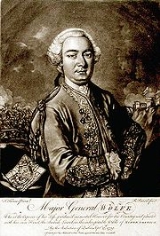
James Wolfe

 
James Wolfe

   Email Print
   Bookmark   Link


James Wolfe


General James Wolfe (2 January, 1727 – 13 September, 1759) was a British Army
British Army

The British Army is the Army branch of the British Armed Forces. It came into being with the unification of the Kingdoms of Kingdom of England and Kingdom of Scotland into the Kingdom of Great Britain in 1707....
 officer, known for his training reforms but remembered chiefly for his victory over the French in Canada
Canada

Canada is a country occupying most of northern North America, extending from the Atlantic Ocean in the east to the Pacific Ocean in the west and northward into the Arctic Ocean....
 and establishing British rule there. Because of this he has been regarded as a hero by many Canadians.

s Peter Wolfe was born in Westerham
Westerham

Westerham is a town and civil parish in the Sevenoaks of Kent, England with 5000 people. The parish is south of the North Downs, ten miles west of Sevenoaks....
, Kent
Kent

Kent is a Counties of England in southeast England, and is one of the home counties. It borders East Sussex, Surrey and Greater London and has a defined boundary with Essex in the middle of the River Thames estuary....
, England
England

native_name =|conventional_long_name = England|common_name = England|image_flag = Flag of England.svg|image_coat = England COA.svg|symbol_type = Royal Coat of Arms...
, the older of two sons of Colonel (later Lieutenant General) Edward Wolfe and the former Henrietta Thompson (his childhood home in Westerham has been preserved in his memory under the name Quebec House
Quebec House

Quebec House is the birthplace of General James Wolfe on what is now known as Quebec Square in Westerham, Kent. It is named after his victory at the Battle of Quebec , and the house's coach-house contains an exhibition on the battle and on Wolfe's life....
).

In York, a fine timber framed house called 'The Black Swan' remains well preserved, and was the home of Edward Thompson MP Lord Mayor of York and his daughter Henrietta Wolfe (mother of Gen.James Wolfe)

Around 1738, the family moved to Greenwich, in London
London

London is the capital of both England and the United Kingdom, and the most populous municipality in the European Union. An important settlement for two millennia, History of London goes back to its founding by the Roman Empire....
.


Discussion
Ask a question about 'James Wolfe'
Start a new discussion about 'James Wolfe'
Answer questions from other users
Full Discussion Forum


Encyclopedia


General James Wolfe (2 January, 1727 – 13 September, 1759) was a British Army
British Army

The British Army is the Army branch of the British Armed Forces. It came into being with the unification of the Kingdoms of Kingdom of England and Kingdom of Scotland into the Kingdom of Great Britain in 1707....
 officer, known for his training reforms but remembered chiefly for his victory over the French in Canada
Canada

Canada is a country occupying most of northern North America, extending from the Atlantic Ocean in the east to the Pacific Ocean in the west and northward into the Arctic Ocean....
 and establishing British rule there. Because of this he has been regarded as a hero by many Canadians.

Early life (1727-1740)

James Peter Wolfe was born in Westerham
Westerham

Westerham is a town and civil parish in the Sevenoaks of Kent, England with 5000 people. The parish is south of the North Downs, ten miles west of Sevenoaks....
, Kent
Kent

Kent is a Counties of England in southeast England, and is one of the home counties. It borders East Sussex, Surrey and Greater London and has a defined boundary with Essex in the middle of the River Thames estuary....
, England
England

native_name =|conventional_long_name = England|common_name = England|image_flag = Flag of England.svg|image_coat = England COA.svg|symbol_type = Royal Coat of Arms...
, the older of two sons of Colonel (later Lieutenant General) Edward Wolfe and the former Henrietta Thompson (his childhood home in Westerham has been preserved in his memory under the name Quebec House
Quebec House

Quebec House is the birthplace of General James Wolfe on what is now known as Quebec Square in Westerham, Kent. It is named after his victory at the Battle of Quebec , and the house's coach-house contains an exhibition on the battle and on Wolfe's life....
).

In York, a fine timber framed house called 'The Black Swan' remains well preserved, and was the home of Edward Thompson MP Lord Mayor of York and his daughter Henrietta Wolfe (mother of Gen.James Wolfe)

Around 1738, the family moved to Greenwich, in London
London

London is the capital of both England and the United Kingdom, and the most populous municipality in the European Union. An important settlement for two millennia, History of London goes back to its founding by the Roman Empire....
. From his earliest years, Wolfe was destined for a military career, entering his father's 1st Marine
Royal Marines

The Royal Marines are the marine and amphibious warfare infantry of the United Kingdom and, along with the Royal Navy and Royal Fleet Auxiliary, form the Naval Service....
 regiment as a volunteer at the age of 13.

Illness, however, prevented him from taking part in a large expedition against Spanish-held Cartagena
Cartagena, Colombia

Cartagena de Indias , is a port city on the northern coast of Colombia and capital of Bol?var Department. The metropolitan area has a population of 1,240,000, and the city proper 1,090,000 ....
 in 1740, and his father sent him home a few months later. He was fortunate to miss what proved to be a disaster for the British forces at the Battle of Cartagena
Battle of Cartagena de Indias

The Battle of Cartagena de Indias was the decisive battle of a massive amphibious warfare expedition by the forces of Kingdom of Great Britain under Vice-Admiral Edward Vernon against Spain under Admiral Blas de Lezo, taking place at the city of Cartagena, Colombia, in present day Colombia, starting in March 1741....
 during the War of Jenkins' Ear
War of Jenkins' Ear

The War of Jenkins' Ear was a conflict between Kingdom of Great Britain and Spain that lasted from 1739 to 1742. Its unusual name relates to Robert Jenkins , captain of a British merchant ship, who exhibited his severed ear in Parliament of the United Kingdom following the boarding of his vessel by Spanish coast guards in 1731....
.

War of the Austrian Succession (1740-48)


European War

In 1740 the War of the Austrian Succession
War of the Austrian Succession

The War of the Austrian Succession involved nearly all the Power in international relations of Europe. The war began under the pretext that Maria Theresa of Austria was ineligible to succeed to the House of Habsburg throne, because Salic law precluded royal inheritance by a woman, though in reality this was a convenient excuse put forward by...
 broke out. Wolfe, initially unable to travel to the continent with his regiment due to his seasickness, transferred to the 12th Regiment of Foot, a British Army
British Army

The British Army is the Army branch of the British Armed Forces. It came into being with the unification of the Kingdoms of Kingdom of England and Kingdom of Scotland into the Kingdom of Great Britain in 1707....
 infantry
Infantry

Infantry are soldiers who are primarily trained for the role of fighting on foot. A soldier in the infantry is known as an infantryman. Infantry units have more physically demanding training than other branches of armies, and place a greater emphasis on fitness, physical strength and aggression....
 regiment, and set sail for Flanders
Flanders

Flanders is a geographical region located in parts of present-day Belgium, France, and the Netherlands. Over the course of history, the geographical territory that was called "Flanders" has varied....
 some months later. Here, he was promoted to lieutenant
Lieutenant

Lieutenant is a military, naval, paramilitary, fire service, emergency medical services or police commissioned officer military rank.Lieutenant may also appear as part of a title used in various other organisations with a codified command structure....
 and made adjutant
Adjutant

Adjutant is a military rank or appointment. In some armies it is an Officer who assists a more senior officer, while in other armies it is a rank, which normally corresponds roughly to a Commonwealth Staff Sergeant or Warrant Officer....
 of his battalion
Battalion

A battalion is a military unit of around 500-1500 men usually consisting of between two and seven company and typically commanded by a Lieutenant Colonel....
. He took part in an offensive launched by the British. In 1743, Wolfe fought at the Battle of Dettingen
Battle of Dettingen

The Battle of Dettingen took place on 27 June 1743 at Karlstein am Main in Bavaria during the War of the Austrian Succession. It was the last time that a British monarch, George II of Great Britain, personally led his troops into battle....
, where his activities came under the favourable notice of the Duke of Cumberland. A year later, he became a captain of the 45th Regiment of Foot
45th (Nottinghamshire) Regiment of Foot

The 45th Regiment of Foot was a British Army line infantry regiment. During the Childers Reforms it was united with the 95th Regiment of Foot to form the The Sherwood Foresters ....
.

Jacobite Rising

In 1745, Wolfe's regiment was recalled to Britain to deal with the Jacobite rising
Jacobite rising

The Jacobite Risings were a series of uprisings, rebellions, and wars in the kingdoms of Kingdom of England, Kingdom of Scotland , and Kingdom of Ireland occurring between 1688 and 1746....
. Wolfe served in Scotland
Scotland

conventional_long_name = ScotlandAlba|common_name= Scotland|image_flag = Flag of Scotland.svg|flag_width = 130px...
 in 1746 as aide-de-camp
Aide-de-camp

An aide-de-camp is a personal assistant, secretary, or adjutant to a person of high rank, usually a senior military officer or a head of state....
 under General Henry Hawley
Henry Hawley

Lieutenant-general Henry Hawley was a Great Britain Army officer who entered the army, it is said, in 1694.He saw service in the War of Spanish Succession as a captain of Erie's Foot....
 in the campaign to defeat the Jacobite
Jacobitism

Jacobitism was the political movement dedicated to the restoration of the House of Stuart kings to the thrones of Kingdom of England, Kingdom of Scotland, and Kingdom of Ireland....
 forces of Charles Edward Stuart
Charles Edward Stuart

Charles Edward Stuart was the exiled Jacobitism claimant to the thrones of England, Scotland, and Kingdom of Ireland. He is commonly known in English and Scots language as Bonnie Prince Charlie....
. In this capacity, Wolfe participated in the Battle of Falkirk
Battle of Falkirk (1746)

During the Jacobite Rising, the Battle of Falkirk Muir was the last noteworthy Jacobitism success....
 and the Battle of Culloden
Battle of Culloden

The Battle of Culloden was the final clash between the French-supported Jacobitism and the House of Hanover British Government in the 1745 Jacobite Rising#The 'Forty-Five'....
. At Culloden, he famously refused to carry out an order of the Duke of Cumberland to shoot a wounded Highlander by stating that his honour was worth more than his commission. This act may have been a cause for his later popularity among the Royal Highland Fusiliers
Royal Highland Fusiliers

The Royal Highland Fusiliers was a regular Scottish line infantry regiment of the British Army, part of the Scottish Division, and abbreviated as 'The RHF'....
, whom he would later command.

Return to the Continent

Wolfe returned to Germany
Germany

Germany , officially the Federal Republic of Germany , is a country in Central Europe. It is bordered to the north by the North Sea, Denmark, and the Baltic Sea; to the east by Poland and the Czech Republic; to the south by Austria and Switzerland; and to the west by France, Luxembourg, Belgium, and the Netherlands....
 and the War of the Austrian Succession
War of the Austrian Succession

The War of the Austrian Succession involved nearly all the Power in international relations of Europe. The war began under the pretext that Maria Theresa of Austria was ineligible to succeed to the House of Habsburg throne, because Salic law precluded royal inheritance by a woman, though in reality this was a convenient excuse put forward by...
, serving under Sir John Mordaunt. He participated in the Battle of Lauffeld
Battle of Lauffeld

The Battle of Lauffeld took place on 2 July 1747, during the French invasion of the Netherlands. It was part of the War of the Austrian Succession....
, where he was wounded and received an official commendation. In 1748, at just 21 years of age and with service in seven campaigns, Wolfe returned to Britain following the Treaty of Aix-la-Chapelle
Treaty of Aix-la-Chapelle

There were three Treaties of Aix-la-Chapelle. Although "Aix-la-Chapelle" is the now rarely used French name of the German city of Aachen, the name Treaty of Aachen is rarely used....
 which ended the war.

Peacetime Service (1748-1756)


Scottish garrison


Once home, he was posted to Scotland and garrison duty, and a year later was made a major
Major

In many European languages, the term Major refers to a military rank, denoting seniority at one of usually various levels of rank, for example: "Sergeant-Major" denoting the most senior ranking sergeant of a large military unit; "Captain-Major", denoting a mid-level command status Officer ...
, in which rank he assumed command of the 20th Regiment, stationed at Stirling
Stirling

Stirling is a City status in the United Kingdom and former ancient burgh in Scotland, and is at the heart of the wider Stirling .The city is clustered around a large Stirling Castle and medi?val old-town....
. In 1750, Wolfe—then 22—was confirmed as lieutenant colonel
Lieutenant Colonel

Lieutenant colonel is a rank of commissioned officer in the army and most Marine and air forces of the world, typically ranking above a major and below a colonel....
 of the regiment. During the eight years Wolfe remained in Scotland, he wrote military pamphlets and became proficient in French, as a result of several trips to Paris
Paris

Paris is the Capital of France and the country's largest city. It is situated on the river Seine, in northern France, at the heart of the ?le-de-France Regions of France ....
. Despite struggling with bouts of ill health suspected to be tuberculosis
Tuberculosis

Tuberculosis is a common and often deadly infectious disease caused by mycobacterium, mainly Mycobacterium tuberculosis . Tuberculosis usually attacks the lungs but can also affect the central nervous system, the lymphatic system, the circulatory system, the genitourinary system, the gastrointestinal system, bones, joints, and even the...
, he also tried to keep himself mentally fit by teaching himself Latin
Latin

Latin is an Italic language, historically spoken in Latium and Ancient Rome. Through the Military history of the Roman Empire, Latin spread throughout the Mediterranean and a large part of Europe....
 and mathematics
Mathematics

Mathematics is the study of quantity, structure, space, change, and related topics of pattern and form. Mathematicians seek out patterns whether found in numbers, space, natural science, computers, imaginary abstractions, or elsewhere....
.

Seven Years War (1756-59)

In 1756, with the outbreak of open hostilities with France, Wolfe was promoted to colonel and participated in the failed British amphibious assault
Amphibious warfare

Amphibious warfare is the utilization of naval firepower, logistics and strategy to project military power ashore. In previous eras it stood as the primary method of delivering troops to non-contiguous enemy-held terrain....
 on Rochefort
Rochefort, Charente-Maritime

Rochefort is a commune in France in western France, a seaport on the Atlantic Ocean. It is a sous-pr?fecture of the Charente-Maritime D?partements of France....
, a seaport on the French Atlantic coast, a year later. Nonetheless, Wolfe was one of the few military leaders who had distinguished himself in the raid. As a result, Wolfe was brought to the notice of the prime minister, William Pitt, the Elder
William Pitt, 1st Earl of Chatham

William Pitt, 1st Earl of Chatham, Kent Privy Council of Great Britain was a Kingdom of Great Britain British Whig Party statesman who achieved his greatest fame as a Secretary of State during the Seven Years' War, as known in Great Britain and Asia and who was later Prime Minister of the United Kingdom....
. Pitt had determined that the best gains in the war were to be made in North America, and planned to launch an assault on French Canada
French Canada

French Canada is a term to distinguish the French-speaking population of Canada from English Canada....
.

Louisbourg

On 23 January, 1758 James Wolfe was appointed as a brigadier general
Brigadier General

Brigadier General is the lowest ranking General Officer in some countries, usually sitting between the ranks of Colonel and Major General.The rank can be traced back to the militaries of Europe where a brigadier general, or simply a brigadier, would command a brigade in the field....
, and sent with Major General Jeffrey Amherst
Jeffrey Amherst, 1st Baron Amherst

Field Marshal Jeffery Amherst, 1st Baron Amherst of Montreal Order of the Bath served as an officer in the British Army and as Commander-in-Chief of the Forces....
 to lay siege to Fortress of Louisbourg
Fortress of Louisbourg

The Fortress of Louisbourg is a Canada National Historic Site and the location of a partial reconstruction of an 18th century France fortress at Louisbourg, Nova Scotia, Nova Scotia....
 in New France
New France

The Viceroyalty of New France was the area French colonization of the Americas by France in North America during a period extending from the exploration of the Saint Lawrence River, by Jacques Cartier in 1534, to the cession of New France to Spain and Kingdom of Great Britain in 1763....
 (located in present-day Cape Breton Island, Nova Scotia). Wolfe's distinguished himself in preparations for the assault, the initial landing and in the aggressive advance of siege batteries. The French capitulated in June of that year.
Benjamin West 005

Quebec

As Wolfe had comported himself admirably at Louisbourg, William Pitt the Elder chose him to lead the British assault on Quebec City
Quebec City

Qu?bec or Quebec, also Quebec City or Qu?bec City , is the Capital of the Canada Provinces and territories of Canada of Quebec and is located within the Capitale-Nationale region....
 the following year, with the rank of major general
Major General

Major General or Major-General is a military rank used in many countries. It is derived from the older rank of Sergeant Major General. A Major General is a high-ranking officer, normally subordinate to the rank of Lieutenant General and senior to the ranks of Brigadier and Brigadier General....
. The British army laid siege
Siege

A siege is a military blockade of a city or fortress with the intent of conquering by Battle of attrition and/or assault. The term derives from sedere, Latin for "to sit." A siege occurs when an attacker encounters a city or fortress that cannot be easily taken by a coup de main and refuses to surrender ....
 to the city for three months. During that time, Wolfe issued a written document, known as Wolfe's Manifesto
Wolfe's Manifesto

The British Empire advances in 1758 into the colony of New France instilled fear into the Canadiens' hearts. The inhabitants of the France colony were "terror-stricken"....
, to the French-Canadian (Québécois
Québécois

The French language word 'Qu?b?cois' I would now like to ask you about your ethnic ancestry, heritage or background. What were the ethnic or cultural origins of your ancestors? 2) In addition to "Canadian", what were the other ethnic or cultural origins of your ancestors on first coming to North America?" This survey did not list possibl...
) civilians, as a part of his strategy of psychological intimidation. In March 1759, prior to arriving at Quebec, Wolfe had written to Amherst: "If, by accident in the river, by the enemy’s resistance, by sickness or slaughter in the army, or, from any other cause, we find that Quebec is not likely to fall into our hands (persevering however to the last moment), I propose to set the town on fire with shells, to destroy the harvest, houses and cattle, both above and below, to send off as many Canadians as possible to Europe and to leave famine and desolation behind me; but we must teach these scoundrels to make war in a more gentleman like manner."

After an extensive yet inconclusive bombardment of the city, Wolfe then led 200 ships with 9,000 soldiers and 18,000 sailors on a very bold and risky amphibious landing at the base of the cliffs west of Quebec along the St. Lawrence River. His army, with two small cannons, scaled the cliffs early on the morning of September 13, 1759, surprising the French under the command of the Marquis de Montcalm
Louis-Joseph de Montcalm

Louis-Joseph de Montcalm-Gozon, Marquis de Saint-Veran was the commander of the France forces in North America during the Seven Years' War . He is most remembered for his role in the Battle of the Plains of Abraham, and remains a controversial figure....
, who thought the cliffs would be unclimbable. It must be noted however that Wolfe himself favored an attack on the northern bank of Quebec, an attack that was doomed to failure by the superior concentration of French forces. He reluctantly agreed to an attack via the southern bank after his three brigadiers vehemently opposed the northern route. Faced with the possibility that the British would haul more cannons up the cliffs and knock down the city's remaining walls, the French fought the British on the Battle of the Plains of Abraham
Battle of the Plains of Abraham

The Battle of the Plains of Abraham, also known as the Battle of Quebec, was a pivotal battle in the Seven Years' War . The confrontation, which began on 12 September 1759, was fought between the British Army and Royal Navy, and the French Army, on a plateau just outside the walls of Quebec City....
. They were defeated after fifteen minutes of battle, but when Wolfe began to move forward, he was shot in the chest four times. He reportedly heard cries of "They run," and thus died content that the victory had been achieved.

Historian Francis Parkman
Francis Parkman

Francis Parkman was an American historian, best known as author of The Oregon Trail: Sketches of Prairie and Rocky-Mountain Life and his monumental seven volume France and England in North America. These works are still valued as history and especially as literature, although the biases of his work have met with criticism....
 describes the death of Wolfe:

They asked him [Wolfe] if he would have a surgeon; but he shook his head, and answered that all was over with him. His eyes closed with the torpor of approaching death, and those around sustained his fainting form. Yet they could not withhold their gaze from the wild turmoil before them, and the charging ranks of their companions rushing though the line of sire and smoke.

"See how they run." one of the officers exclaimed, as the French fled in confusion before the leveled bayonets.

"Who run?" demanded Wolfe, opening his eyes like a man aroused from sleep.

"The enemy, sire," was the reply; "they give way everywhere."

"Then," said the dying general, "tell Colonel River, to cut off their retreat from the bridge. Now, God be praised, I will die in peace," he murmured; and, turning on his side, he calmly breathed his last.


The Battle of the Plains of Abraham
Battle of the Plains of Abraham

The Battle of the Plains of Abraham, also known as the Battle of Quebec, was a pivotal battle in the Seven Years' War . The confrontation, which began on 12 September 1759, was fought between the British Army and Royal Navy, and the French Army, on a plateau just outside the walls of Quebec City....
 is notable for causing the deaths of the top military commander on each side: Montcalm died the next day from his wounds. Wolfe's victory at Quebec enabled an assault on the French at Montreal
Montreal

Montreal, or Montr?al, is the largest city in the Provinces and territories of Canada of Quebec and the List of largest cities and second largest cities by country List of the 100 largest municipalities in Canada by population....
 the following year. With the fall of that city, French rule in North America, outside of the tiny islands of Saint-Pierre and Miquelon
Saint-Pierre and Miquelon

The Territorial Collectivity of Saint Pierre and Miquelon is a group of small French islands in the North Atlantic Ocean, the main ones being Saint Pierre and Miquelon, south of Newfoundland , Canada....
, came to an end.

Wolfe's body was returned to Britain
Kingdom of Great Britain

The Kingdom of Great Britain, also known as the United Kingdom of Great Britain, was a country in North-West Europe, in existence from 1707 to 1801....
 and interred in the family vault in St Alfege Church, Greenwich alongside his father (who had died in March 1759).

Character

Wolfe Statue
Wolfe was renowned by his troops for being demanding on himself and on them. Although he was prone to illness, Wolfe was an active and restless figure. Amherst was to report that Wolfe seemed to be everywhere at once. There was a story that when someone in the British Court branded the young Brigadier mad, King George II
George II of Great Britain

George II was King of Great Britain and King of Ireland, Duke of Brunswick-L?neburg and Prince-elector#High Offices and Prince-Elector of the Holy Roman Empire from 11 June 1727 until his death....
 retorted, "Mad, is he? Then I hope he will bite some of my other generals."

Legacy

The inscription on the obelisk at Quebec City, erected to commemorate the battle on the Plains of Abraham once read: "Here Died Wolfe Victorious." Now it simply reads: "Here Died Wolfe." Wolfe's defeat of the French led to the British capture of the New France
New France

The Viceroyalty of New France was the area French colonization of the Americas by France in North America during a period extending from the exploration of the Saint Lawrence River, by Jacques Cartier in 1534, to the cession of New France to Spain and Kingdom of Great Britain in 1763....
 department of Canada
Canada, New France

Canada was the name of the French colonization of the Americas that once stretched along the Saint Lawrence River; the other colonies of New France were Acadia, Louisiana and Colony of Newfoundland....
, and his "hero's death" made him a legend in his homeland. The Wolfe legend led to the famous painting The Death of General Wolfe
The Death of General Wolfe

The Death of General Wolfe is a well-known 1771 painting by Anglo-American artist Benjamin West depicting the final moments of British General James Wolfe during the 1759 Battle of the Plains of Abraham....
  Wolfe" (sometimes known as "Bold Wolfe"), and the opening line of the patriotic Canadian anthem, "The Maple Leaf Forever
The Maple Leaf Forever

"The Maple Leaf Forever" is a Canadian song written by Alexander Muir in 1867, the year of Canada's Canadian Confederation.Muir was said to have been inspired to write this song by a huge maple tree which stood on his property: Maple Cottage, a house at Memory Lane and Laing Street in Toronto....
."

The site where Wolfe purportedly fell is marked by a column surmounted by a helmet and sword. An inscription at its base reads, in French and English, "Here died Wolfe - September 13th, 1759." It replaces a large stone which had been placed there by British troops to mark the spot. There is a memorial to Wolfe in Westminster Abbey
Westminster Abbey

The Collegiate Church of St Peter at Westminster, which is almost always referred to popularly and informally as Westminster Abbey, is a large, mainly Gothic architecture Church , in Westminster, London, just to the west of the Palace of Westminster....
 by Joseph Wilton
Joseph Wilton

Joseph Wilton was an England sculpture and one of the founding members of the Royal Academy in 1768 .Born to a wealthy family in London, Wilton trained in Flanders, Paris, Rome and Florence....
 and a statue of him overlooks the Royal Naval College in Greenwich. A statue also graces the green in his native Westerham, Kent, alongside one of that village's other famous resident, Sir Winston Churchill
Winston Churchill

Sir Winston Leonard Spencer-Churchill, Order of the Garter, Order of Merit, Order of the Companions of Honour, Territorial Decoration, Fellow of the Royal Society, Her Majesty's Most Honourable Privy Council, Queen's Privy Council for Canada was a Politics of the United Kingdom known chiefly for his leadership of the United King...
. At Stowe Landscape Gardens in Buckinghamshire there is an obelisk, known as Wolfe's obelisk, built by the family that owned Stowe as Wolfe spent his last night in England at the mansion. Wolfe is buried under the Church of St Alfege, Greenwich, where there are four memorials to him: a replica of his coffin plate in the floor; The Death of Wolfe, a painting completed in 1762 by Edward Peary; a wall tablet; and a stained glass window. In addition the local primary school is named after him.

In 1761, as a perpetual memorial to Wolfe, George Warde
George Warde

General George Warde was a British Army officer.He was the second son of John Warde Esq of Squerryes Court, Westerham, also know as General George Warde....
, a friend of Wolfe's from boyhood and the second son of John Warde Esq of Squerryes Court, Westerham
Westerham

Westerham is a town and civil parish in the Sevenoaks of Kent, England with 5000 people. The parish is south of the North Downs, ten miles west of Sevenoaks....
, instituted the Wolfe Society, which to this day meets annually in Westerham for the Wolfe Dinner to his "Pious and Immortal Memory".

There are several institutions, localities, thoroughfares, and landforms named in honour of him in Canada. Significant monuments to Wolfe in Canada exist on the Plains of Abraham where he fell, and near Parliament Hill
Parliament Hill

File:Model of Parliament Hill.jpgParliament Hill is an area of Crown land on the southern banks of the Ottawa River in downtown Ottawa, Ontario....
 in Ottawa
Ottawa

Ottawa is the Capital of Canada. The city has population of 812,000, the List of the 100 largest municipalities in Canada by population municipality in the country and second largest in Ontario....
. Ontario Governor John Graves Simcoe named Wolfe Island (Ontario)
Wolfe Island (Ontario)

Wolfe Island is an island located at the entrance to the Saint Lawrence River in Lake Ontario near Kingston, Ontario. Wolfe Island is part of Frontenac County, Ontario....
 an island near the Royal Military College of Canada
Royal Military College of Canada

The Royal Military College of Canada , is the military academy of the Canadian Forces, and is a degree-granting university. RMC is the only federal institution in Canada with degree granting powers....
 in General James Wolfe's honour in 1792. On Sept. 13, 2009, the Wolfe Island Historical Society will lead celebrations on the occasion of the 250th anniversary of James Wolfe's victory at Quebec. A life-size statue in Wolfe's likeness is to be sculpted.

A senior girls house at the Duke of York's Royal Military School
Duke of York's Royal Military School

The Duke of York?s Royal Military School was founded in 1803 by Prince Frederick Augustus, Duke of York and Albany, son of George III of the United Kingdom and Queen Charlotte and Commander-in-Chief of the British Army....
 is named after Wolfe, where all houses are named after prominent figures of the military.

External links

  • Unknown. "", in World History Database
  • New Brunswick Museum. "", in New Brunswick Museum (Web site), 2003
  • NBC. , Government of Canada. (National Battlefields Commission)
  • NBC. , Virtual Museum Canada, The National Battlefields Commission, 2005