


Pashtun people

Encyclopedia
Pashtuns or Pathans , also known as ethnic Afghans , are an Eastern Iranic
ethnic group
with populations primarily between the Hindu Kush
mountains in Afghanistan
and the Indus River
in Pakistan
. The Pashtuns are typically characterised by their usage of the Pashto language
and practice of Pashtunwali
, which is a traditional set of ethics guiding individual and communal
conduct. Their origins are unclear but historians have come across references to various ancient peoples called Paktha
(Pactyans
) between the 2nd
and the 1st millennium BC
, who may be the early ancestors of Pashtuns. Since the 3rd century AD and onward, they are mostly referred to by the ethnonym
"Afghan".
Often characterised as a warrior and martial race, they have a tumultuous past, especially after their conversion to the faith of Islam. Their turbulent history is spread amongst various countries of South, Central and West Asia, centred around the medieval state of Afghanistan
, which has been their traditional seat of power. During the Delhi Sultanate
era, many Pashtun emperors (sultans) ruled the Indian subcontinent. Other Pashtuns defeated the Safavid Persians
and the Mughal Empire
before obtaining an independent
state
in the early-18th century, which began with a successful revolution by the Hotaki dynasty followed by conquests
by Ahmad Shah Durrani
. Pashtuns played a vital role during the Great Game
from the 19th century to the 20th century as they were caught between the imperialist designs of the British
and Russian
empires. Pashtuns are the largest ethnic group in Afghanistan
; for over 300 years, they have reign
ed as the dominant ethno-linguistic group, with nearly all rulers being Pashtun. More recently, the Pashtuns gained global attention during the 1980s Soviet war in Afghanistan
and with the rise of the Taliban
, since they are the main ethnic contingent in the movement. Pashtuns are also an important community in Pakistan, which has the largest Pashtun population and where they constitute the second-largest ethnic group
, having attained presidency
and high positions in the armed forces.
The Pashtuns are the world's largest (patriarchal) segmentary lineage
ethnic group. According to Ethnologue
, the total population of the group is estimated to be around 50 million but an accurate count remains elusive due to the lack of an official census in Afghanistan since 1979. Estimates of the number of Pashtun tribes and clans
range from about 350 to over 400.
, stretching between the Hindu Kush
mountains in Afghanistan and west of the Indus River
in Pakistan, which includes Khyber-Pakhtunkhwa, Federally Administered Tribal Areas
(FATA) and part of Balochistan
. Additional Pashtun communities are located in western and northern Afghanistan, the Gilgit-Baltistan and Kashmir
regions and northern Punjab province of Pakistan, as well as in the Khorasan province of Iran
. There are also sizeable Muslim communities
in India, which are of largely putative Pashtun ancestry. Throughout the Indian subcontinent, excluding Pashtun-dominated regions, they are often referred to as Pathans. Smaller Pashtun communities
are found in the countries of the Arabian Peninsula
, Europe and the Americas, particularly in North America.
Important metropolitan centres of Pashtun culture
include Kandahar
, Quetta
, Peshawar
, Jalalabad
, Kunduz
and Swat. Kabul
and Ghazni
are home to around 25% Pashtun population while Herat
and Mazar-i-Sharif each has at least 10%. With as high as 7 million by some estimates, the city of Karachi
in Pakistan may have the largest concentration of urban Pashtuns in the world. In addition, Rawalpindi
, Islamabad
, and Lahore
also have sizeable Pashtun populations.
Pashtuns comprise roughly 15.4% of Pakistan's 174 million population
. In Afghanistan
, they make up an estimated 42% of the 29 million population
according to the CIA World Factbook
. Some sources give 50–60% because the exact figure remains uncertain in Afghanistan, and are affected by the 1.7 million Afghan refugees
that remain in Pakistan
a majority of which are Pashtuns. Another 937,600 Afghans live in Iran
according to the United Nations High Commissioner for Refugees
(UNHCR). A cumulative population assessment suggests a total of around 49 million individuals all across the world.
, cities in the region now inhabited by Pashtuns have seen invasions and migrations, including by Ancient Iranian peoples
, the Median and Persian
empires of antiquity, Greeks
, Mauryas
, Kushans
, Hephthalite
s, Sassanids
, Arab Muslims, Turks
, Mongols
, Palas
and others. In recent age, people of the Western world have explored the area as well.
There are many conflicting theories about the origin of Pashtuns, some modern and others archaic, both among historians and the Pashtuns themselves. According to most historians and experts, the true origin of the Pashtuns is some what unclear.
s similar to Pukhtun have been hypothesized as possible ancestors of modern Pashtuns. The Rigveda
(1700–1100 BC) mentions a tribe called Paktha
inhabiting eastern Afghanistan
and academics have proposed their connection with today's Pakhtun people. Furthermore, the Greek
historian Herodotus
mentioned a people called Pactyans
living in the same area (Achaemenid
's Arachosia
Satrap
y) as early as the 1st millennium BCE. It is believed that these may have been the ancient ancestors of Pashtuns.
Some modern-day Pashtun tribes have also been identified living in ancient Gandhara
(i.e. Alexander's historians mentioned "Aspasii" in 330 BC and that may refer to today's Afridi
s). Herodotus has mentioned the same Afridi tribe as "Apridai" over a century earlier. Strabo
, who lived between 64 BC and 24 CE
, explains that the tribes inhabiting the lands west of the Indus River
were part of Ariana
and to their east was India.
In the Middle Ages
until the advent of modern Afghanistan in the 18th century and the division of Pashtun territory
by the 1893 Durand Line
, Pashtuns were often referred to as ethnic "Afghans". The earliest mention of the name Afghan (Abgân) is by Shapur I
of the Sassanid Empire
during the 3rd century CE, which is later recorded in the 6th century CE in the form of "Avagānā" by the Indian astronomer Varāha Mihira
in his Brihat-samhita. It was used to refer to a common legendary ancestor known as "Afghana
", propagated to be grandson of King Saul of Israel
. Hiven Tsiang
, a Chinese pilgrim, visiting the Afghanistan area several times between 630 to 644 CE also speaks about them. In Shahnameh
1–110 and 1–116, it is written as Awgaan. Ancestors of many of today's Turkic
-speaking Afghans settled in the Hindu Kush
area and began to assimilate
much of the culture and language of the Pashtun tribes already present there. Among these were the Khalaj people
which are known today as Ghilzai
. According to several scholars such as V. Minorsky
, the name "Afghan" is documented several times in the 982 CE Hudud-al-Alam.
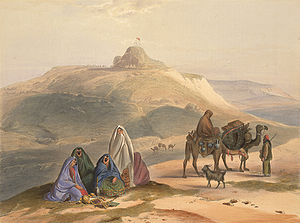 The village of Saul was probably located near Gardez, Afghanistan. Hudud ul-'alam also speaks of a king in Ninhar (Nangarhar
), who had Muslim, Afghan and Hindu wives. Al-Biruni
wrote about Afghans in the 11th century as various tribes living in the western mountains of India and extending to the region of Sind
, which would be the Sulaiman Mountains
area between Khorasan
and Hindustan
. It was reported that between 1039 and 1040 CE Mas'ud I
of the Ghaznavid Empire sent his son to subdue a group of rebel Afghans near Ghazni
. An army of Arabs
, Afghans, Khiljis
and others was assembled by Arslan Shah Ghaznavid in 1119 CE. Another army of Afghans and Khiljis was assembled by Bahram Shah Ghaznavid in 1153 CE. Muhammad of Ghor
, ruler of the Ghorids, also had Afghans in his army along with others. A famous Moroccan
travelling scholar, Ibn Battuta
, visiting Afghanistan following the era of the Khilji dynasty
in early 1300s gives his description of the Afghans.
Muhammad Qasim Hindu Shah
(Ferishta), writes about Afghans and their country called Afghanistan
in the 16th century.
One historical account connects the Pakhtuns of Pakistan to a possible Ancient Egypt
ian past but this lacks supporting evidence.
Additionally, although this too is unsubstantiated, some Afghan historians have maintained that Pashtuns are linked to the ancient Israelites.
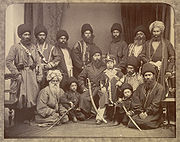 Some anthropologists lend credence to the oral tradition
s of the Pashtun tribes themselves. For example, according to the Encyclopaedia of Islam
, the theory of Pashtun descent from Israelites is traced to Maghzan-e-Afghani
who compiled a history for Khan-e-Jehan Lodhi in the reign of Mughal
Emperor Jehangir in the 17th century.
Another book that corresponds with Pashtun historical records, Taaqati-Nasiri, states that in the 7th century BC a people called the Bani Israel settled in the Ghor region of Afghanistan and migrated later to the southeast areas. These references to Bani Israel agree with the commonly held view by Pashtuns that when the twelve tribes of Israel were dispersed (see Israel and Judah
and Ten Lost Tribes
), the tribe of Joseph
, among other Hebrew tribes, settled in the region. This oral tradition is widespread among the Pashtuns. There have been many legends over the centuries of descent from the Ten Lost Tribes after groups converted to Christianity and Islam. Hence the tribal name Yusufzai in Pashto translates to the "son of Joseph". A similar story is told by the 16th century Persian historian, Ferishta
.
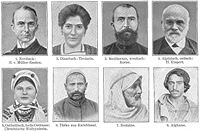 One conflicting issue in the belief that the Pashtuns descend from the Israelites is that the Ten Lost Tribes were exiled by the ruler of Assyria
, while Maghzan-e-Afghani says they were permitted by the ruler to go east to Afghanistan. This inconsistency can be explained by the fact that Persia acquired the lands of the ancient Assyrian Empire when it conquered the Empire of the Medes
and Chaldean Babylonia
, which had conquered Assyria decades earlier. But no ancient author mentions such a transfer of Israelites further east, or no ancient extra-Biblical texts refer to the Ten Lost Tribes at all.
Other Pashtun tribes claim descent from Arabs, including some even claiming to be descendants of the Islamic prophet Muhammad
(referred to as Sayyid
s). Some groups from Peshawar
and Kandahar
claim to be descended from Ancient Greeks that arrived with Alexander the Great.
In terms of race, the Pashtuns are classified as Caucasians
of the Mediterranean variant
. Their Pashto language
is classified under the Eastern Iranian
sub-branch of the Iranian
branch of the Indo-European
family of languages
.
Early precursors to the Pashtuns were old Iranian tribes that spread throughout the eastern Iranian plateau
. According to the Russian scholar Yu. V. Gankovsky, the Pashtuns probably began as a "union of largely East-Iranian tribes which became the initial ethnic stratum of the Pashtun ethnogenesis, dates from the middle of the first millennium CE and is connected with the dissolution of the Epthalite (White Huns)
confederacy." He proposes Kushan-o-Ephthalite origin for Pashtuns.
Those who speak a dialect of Pashto in the Kandahar region refer to themselves as Pashtuns, while those who speak a Peshawari dialect call themselves Pukhtuns. These native people compose the core of ethnic Pashtuns who are found in southeastern Afghanistan and western Pakistan. The Pashtuns have oral and written accounts of their family tree. The elders transfer the knowledge to the younger generation. Lineage is considered very important and is a vital consideration in marital business.
is a new way to explore historical movements of populations by studying their genetic make-up.
Various Genetic studies have been carried out by different sources. The latest studies indicate a multi match for certain haplotypes that include in particular haplogroups J2, G1, G2c and subtypes.
The Gs include G1, G2c (Y-STR haplotype 731),2,3,5 from various studies:
Some genetic genealogy
studies also indicate a minor contribution to the Pashtun DNA from Iranian, Arab, Turkish and Greek peoples.
The theory of Pashtun descent from Israelites
is currently being studied by Navras Aafreedi and Shahnaz Ali of India. Israel
is planning to fund this rare genetic study to determine whether there is a link between the lost tribes of Israel and the Pashtuns.
Mitochondrial DNA
analysis on a 2500 year-old skeleton excavated from a Scythian kurgan
at the Kizil site in the Altai Republic
casts doubt on the theory of Pashtun descent from Scythians. Results showed the remains to be a member of haplogroup N1a. This haplogroup is spread widely across Eurasia and northeast Africa in low frequencies but is not currently identified in Pashtuns. Precise matches to the Scythian skeleton are found in Yemen, Armenia, Egypt, Germany, and Estonia. Additionally:
from the 7th to 10th centuries, Pashtun ghazis
(warriors) invaded and conquered much of the Indian subcontinent
during the Ghaznavids (963–1187), Ghurid dynasty (1148–1215), Khilji dynasty
(1290–1321), Lodhi dynasty
(1451–1526) and Suri dynasty (1540–1556). Their modern past stretches back to the Hotaki dynasty (1709–1738) and the Durrani Empire
. The Hotakis were Ghilzai
tribesmen, who defeated the Persian
Safavids
and seized control over much of Persia from 1722 to 1738. This was followed by the conquests of Ahmad Shah Durrani
who was a former high-ranking military commander under Nader Shah
of Khorasan
. He created the last Afghan empire
that covered most of what is today Afghanistan, Pakistan, Kashmir, Indian Punjab
, as well as the Kohistan
and Khorasan provinces of Iran. After the decline of the Durrani dynasty in the first half of the 19th century under Shuja Shah Durrani
, the Barakzai dynasty
took control of the empire. Specifically, the Mohamedzai
subclan held Afghanistan's monarchy from around 1826 to the end of Zahir Shah
's reign in 1973. This legacy continues into modern times as the state
is led by the Karzai administration under President Hamid Karzai
, who is from the Popalzai
tribe of Kandahar
.
The Pashtuns in Afghanistan resisted British
designs upon their territory and kept the Russians
at bay during the so-called Great Game
. By playing the two super powers against each other, Afghanistan remained an independent sovereign state and maintained some autonomy (see the Siege of Malakand
). But during the reign of Abdur Rahman Khan
(1880–1901), Pashtun regions
were politically divided by the Durand Line
, and what is today western Pakistan was claimed by British
in 1893. In the 20th century, many politically-active Pashtun leaders living under British rule of undivided India supported Indian independence
, including Ashfaqulla Khan
, Abdul Samad Khan Achakzai
, Ajmal Khattak
, Bacha Khan
and his son Wali Khan (both members of the Khudai Khidmatgar
, popularly referred to as the Surkh posh or "the Red shirts"), and were inspired by Mohandas Gandhi's non-violent
method of resistance. Some Pashtuns also worked in the Muslim League to fight for an independent Pakistan, including Yusuf Khattak
and Abdur Rab Nishtar who was a close associate of Muhammad Ali Jinnah
.
The Pashtuns of Afghanistan attained complete independence from British intervention during the reign of King Amanullah Khan
, following the Third Anglo-Afghan War. The Afghan monarchy ended when President Daoud Khan
seized control of Afghanistan from his cousin King Zahir Shah in 1973. This opened the door to Soviet
intervention and the rise of Afghan Marxists
, who assassinated Daoud Khan along with his family and relatives in the 1978 Marxist revolution
. After this, many Pashtuns began joining the mujahideen
opposition against the 1979 Soviet invasion of Afghanistan
. This included famous figures such as Mullah Omar
, Gulbuddin Hekmatyar
and Jalaluddin Haqqani
, who are currently waging a jihad
against the US
-led NATO forces
and the Islamic republic of Afghanistan
. In the meantime, millions of them began fleeing their native land to live among other Afghan diaspora
in neighbouring Pakistan
and Iran
, while thousands of them proceeded to North America, the European Union
, the Middle East, Australia and other parts of the world.
In the late 1990s, they became known for being the primary ethnic group that comprised the Taliban
, which was a religious government based on Islamic sharia
law formed to end the civil war
. On the other hand, the Taliban opposition
also included Pashtuns. Among them were Abdul Qadir
and his brother Abdul Haq
, Abdul Rasul Sayyaf
, Gul Agha Sherzai
, the Karzai
s, Abdullah Abdullah
, Asadullah Khalid and many others. The Taliban were ousted in late 2001 during the US-led Operation Enduring Freedom and replaced with the current Karzai administration, which is dominated by Pashtun ministers
. Some of these include: Foreign Minister
Zalmay Rasoul, Defense Minister Abdul Rahim Wardak, Finance Minister Omar Zakhilwal
, Education Minister Ghulam Farooq Wardak, Commerce Minister Anwar ul-Haq Ahady, Agriculture Minister Mohammad Asef Rahimi
and Communication Minister Amirzai Sangin
. The list of current governors of Afghanistan, as well as the parliamentarian
s in the House of the People
and House of Elders
, include large percentage of Pashtuns. The Chief of staff
of the Afghan National Army
, Sher Mohammad Karimi, and Commander
of the Afghan Air Force
, Mohammad Dawran
, as well as Chief Justice of Afghanistan
Abdul Salam Azimi
and Attorney General Mohammad Ishaq Aloko
also belong to the Pashtun ethnic group. Several prominent Pashtun families include the Tarzi
s, Gilani
s, and the Karzai
s.
They not only played an important role in South Asia but also in Central Asia, including the Middle East. The Afghan royal family
, which was represented by king Zahir Shah
, is of ethnic Pashtun origin. Other prominent Pashtuns include the 17th-century poets Khushal Khan Khattak
and Rahman Baba
, and in contemporary era Afghan Astronaut Abdul Ahad Mohmand
, former U.S. Ambassador to the United Nations Zalmay Khalilzad
, Ashraf Ghani Ahmadzai, Ali Ahmad Jalali
, Hedayat Amin Arsala and Mirwais Ahmadzai
among many others.
Ethnic Pashtuns of Pakistan, notably Ayub Khan, Yahya Khan
and Ghulam Ishaq Khan
, attained the Presidency. Ghulam Mohammad became the Governor-General of Pakistan
from 1951 to 1955. Many more held high government posts, such as Army Chief Gul Hassan Khan
, Abdul Waheed Kakar, Interior Minister Aftab Ahmad Sherpao, and so on. Others became famous in sports (i.e. Shahid Afridi
, Imran Khan
, Jahangir Khan
, and Jansher Khan
) and literature (i.e. Ghani Khan, Ameer Hamza Shinwari
, Munir Niazi
, and Omer Tarin
). The Awami National Party
(ANP) of Pakistan is represented by Pashtun nationalist Asfandyar Wali Khan
, grandson of Bacha Khan, while the chairman of the Pakhtunkhwa Milli Awami Party
(PMAP) is Mahmood Khan Achakzai
, son of Abdul Samad Khan Achakzai.
One of India
's former presidents, Zakir Hussain
, had Pashtun origin of the Afridi tribe who came from an upper middle class Pashtun family settled in Farrukhabad
. Mohammad Yunus
, India's former ambassador to Algeria and advisor to Indira Gandhi
, is an ethnic Pashtun related to the legendary Bacha Khan.
These three definitions may be described as the ethno-linguistic definition, the religious-cultural definition, and the patrilineal definition, respectively.
in Kandahar
. These criteria tend to be used by most Pashtuns in Pakistan and Afghanistan.
codes. This is the most prevalent view among orthodox and conservative tribesmen, who refuse to recognise any non-Muslim as a Pashtun. Pashtun intellectuals and academics, however, tend to be more flexible and sometimes define who is Pashtun based on other criteria. Pashtun society is not homogenous by religion: the overwhelming majority of them are Sunni Muslims
, with a tiny Shia community (the Turi and partially the Bangash
tribe) in the Kurram and Orakzai
agencies of FATA, Pakistan. Pakistani Jews and Afghan Jews, once numbering in the thousands, have largely relocated to Israel
and the United States.
, Urdu or Hindi
rather than Pashto. Claimants of Pashtun heritage in South Asia have mixed with local Muslim populations and refer to themselves as "Pathan
", the Hindi-Urdu
variant of Pashtun. These communities are usually partial Pashtun, to varying degrees, and often trace their Pashtun ancestry putatively through a paternal lineage. The Pathans in India
have lost both the language and presumably many of the ways of their putative ancestors, but trace their fathers' ethnic heritage to the Pashtun tribes. Many Bollywood
superstars are prime examples of this, especially Shahrukh Khan
who is a non-Pashto-speaking Indian of ethnic Afghan (Pashtun) descent.
Small number of Pashtuns have adopted Hindko
, Seraiki and other local Pakistani languages. These languages are often found in areas such as Abbottabad
, Peshawar
, Mardan
, Attock
, Multan
and Dera Ismail Khan
. After migration or establishing contacts in these areas, Pashtuns began adding new languages to their existing Pashto. This group of people are bilingual in Hindko and Pashto, as well as Urdu and English in many caes. They are a large minority in major cities such as Peshawar, Kohat
, Mardan, and Dera Ismail Khan, including in the mixed districts of Haripur
, Abbottabad
and Attock
.
Some Indians claim descent from ethnic Afghan soldiers who settled in India by marrying local women during the Muslim conquest in the Indian subcontinent
. No specific population figures exist, as claimants of ethnic Afghan (Pashtun) descent are spread throughout the country. Notably, the Rohilla
s, after their defeat by the British, are known to have settled in parts of North India
and intermarried with local ethnic groups. They are believed to have been bilingual in Pashto and Urdu until the mid-19th century. Some Urdu-speaking Muslims (Muhajir people
) claiming descent from Pashtuns began moving to Pakistan after independence in 1947.
In Bangladesh
(erstwhile East Pakistan
), an unknown number of ethnic Pashtuns (together with at the later stage numbers of Iranian-speakers, these often secondary migrants from north India) settled among Bengalis from the 12th century to mid 18th century. These ethnic Afghans assimilated into Bengali culture, and intermarried with native Bengali Muslims to provide a component of the modern Bengali Muslim meme and biological identity, most prominently among the older wealthy classes of Bangladeshi Muslims. Historical structures built by Afghan descendants can still be found there. For example, the mosque of Musa Khan still remains intact in Bangladesh. He was an ethnic Pashtun and a descendant of the great Suleiman Khan, who was born in the Suleiman Mountains but moved to Bengal.
During the 19th century, when the British were accepting peasants from British India as indentured servants to work in the Caribbean
, South Africa and other far away places, some Pashtuns from areas constituting Afghanistan and modern-day Pakistan were sent to places as far as Trinidad
, Surinam, Guyana, and Fiji
, to work with other Indians on the sugarcane fields and perform manual labour. Many of these immigrants stayed there and formed unique communities of their own. Some of them assimilated
with the other South Asian Muslim nationalities to form a common Indian Muslim community in tandem with the larger Indian community, losing their distinctive heritage. Their descendants mostly speak English and other local languages. Some ethnic Afghans travelled to as far away as Australia during the same, see Afghan (Australia)
.
and the use or understanding of the Pashto language
. Pre-Islamic traditions, dating back to Alexander's defeat of the Persian Empire
in 330 BC, possibly survived in the form of traditional dances
, while literary styles and music reflect influence from the Persian tradition
and regional musical instrument
s fused with localised variants and interpretation. Pashtun culture is a unique blend of native customs with some influences from South
and Western Asia.
as their native tongue
, which is an Indo-European language
. Spoken by up to 60 million people, it belongs to the Iranian sub-group
of the Indo-Iranian
branch. It can be further delineated within Eastern Iranian
and Southeastern Iranian. Pashto is written in the Pashto-Arabic script
and is divided into two main dialects, the southern "Pashto" and the northern "Pakhtu".
Pashto has ancient origins and bears similarities to extinct language
s such as Avestan
and Bactrian
. Its closest modern relatives include Pamir languages
, such as Shughni
and Wakhi
, and Ossetic
. Pashto has an ancient legacy of borrowing vocabulary from neighbouring languages including Persian
and Vedic Sanskrit
. Invaders have left vestiges as well; as Pashto has borrowed words from Ancient Greek
, Arabic
and Turkic
. Modern borrowings come primarily from the English language.
Fluency in Pashto is often the main determinant of group acceptance as to who is considered a Pashtun. Pashtun nationalism emerged following the rise of Pashto poetry that linked language and ethnic identity. Pashto has national status
in Afghanistan and regional status
in Pakistan. In addition to their native tongue, many Pashtuns are fluent in Urdu
, Dari (Persian)
, and English.
Throughout their history, poets, prophets, kings and warriors have been among the most revered members of Pashtun society. Early written records of Pashto began to appear by the 16th century. The earliest describes Sheikh Mali's conquest of Swat. Pir Roshan
is believed to have written a number of Pashto books while fighting the Mughals. Pashtun scholars such as Abdul Hai Habibi and others believe that the earliest Pashto work dates back to Amir Kror Suri
in the eighth century, and they use the writings found in Pata Khazana
as proof. However, this is disputed by several European experts due to lack of strong evidence.
The advent of poetry helped transition Pashto to the modern period. Pashto literature gained significant prominence in the 20th century, with poetry by Ameer Hamza Shinwari
who developed Pashto Ghazals. In 1919, during the expanding of mass media, Mahmud Tarzi
published Seraj-al-Akhbar, which became the first Pashto newspaper in Afghanistan. Some notable poets include Khushal Khan Khattak
, Rahman Baba
, Nazo Anaa, Ahmad Shah Durrani
, Timur Shah Durrani
, Shuja Shah Durrani
, Ghulam Muhammad Tarzi
, Afzal Khan
, and Khan Abdul Ghani Khan.
Pashto media outlets play a major role in the everyday life of Pashtuns. Several Pashto TV channels are available in the Pashtun regions, which also broadcast internationally. The leading one is AVT Khyber
, helping to promote the Pashtun culture with their daily programs. Viewers around the world are informed about the day to day issues in their region and amused with their entertaining shows, such as the show with Amanullah Kaker which is based on educating Pashtuns by using messages in Pashto poetry. International news sources that provide Pashto programs include BBC and Voice of America.
Recently, Pashto literature has received increased patronage, but many Pashtuns continue to rely on oral tradition
due to relatively low literacy rates. Pashtun males continue to meet at Hujras, to listen and relate various oral tales of valor and history. Despite the general male dominance of Pashto oral story-telling, Pashtun society is also marked by some matriarchal
tendencies. Folktales involving reverence for Pashtun mothers and matriarchs are common and are passed down from parent to child, as is most Pashtun heritage, through a rich oral tradition that has survived the ravages of time.
(or Pakhtunwali). Pashtunwali governs and regulates nearly all aspects of Pashtun life ranging from tribal affairs to individual "honor" (nang) and behaviour.
Numerous intricate tenets of Pashtunwali influence Pashtun social behaviour. One of the better known tenets is Melmastia, hospitality and asylum to all guests seeking help. Perceived injustice calls for Badal, swift revenge
. A popular Pashtun saying, "Revenge is a dish best served cold", was borrowed by the British and popularised in the West. Men are expected to protect Zan, Zar, Zameen (women, gold and land). Some aspects promote peaceful co-existence, such as Nanawati, the humble admission of guilt for a wrong committed, which should result in automatic forgiveness from the wronged party. Other aspects of Pashtunwali have attracted some criticism, particularly with respect to its influence on women's rights. These and other basic precepts of Pashtunwali continue to be followed by many Pashtuns, especially in rural areas.
A prominent institution of the Pashtun people is the intricate system of tribes. The Pashtuns remain a predominantly tribal people, but the worldwide trend of urbanisation has begun to alter Pashtun society as cities such as Peshawar and Quetta have grown rapidly due to the influx of rural Pashtuns and Afghan refugees. Despite this trend of urbanisation, many people still identify themselves with various clan
s.
The tribal system has several levels of organisation: the tribe, tabar, is divided into kinship groups called khels, in turn divided into smaller groups (pllarina or plarganey), each consisting of several extended families called kahols. Pashtun tribes are divided into four 'greater' tribal groups: Sarbans
, Batians, Ghurghusht
and Karlan
s.
Another prominent Pashtun institution is the Jirga
or 'Senate' of elected elder
men. Most decisions in tribal life are made by members of the Jirga, which is the main institution of authority that the largely egalitarian Pashtuns willingly acknowledge as a viable governing body.
Pashtun celebrations and special events are also often national holidays in Pakistan and Afghanistan. A common Turko-Iranian
New Year called Nouruz
is often observed by Pashtuns. Most prominent are Muslim holidays
including Ramadan
and Eid al-Fitr
. Muslim holidays tend to be the most widely observed and commercial activity can come to a halt as large extended families
gather in what is often both a religious duty and a festive celebration.
, belonging to the Hanafi
school of thought. A tiny Shi'a community of Pashtuns exists in the northeastern section of Paktia province
of Afghanistan and in neighbouring Kurram Agency of FATA, Pakistan. The Shias belong to the Turi tribe while the Bangash
tribe is approximately 50% Shia and the rest Sunni, who live mainly in Kohat
and the Orakzai Agency of FATA, Pakistan.
Studies conducted among the Ghilzai
reveal strong links between tribal affiliation and membership in the larger ummah
(Islamic community). Afghan historians believe that Pashtuns are descendants of Qais Abdur Rashid
, who is purported to have been an early convert to Islam and thus bequeathed the faith to the early Pashtun population. The legend says that after Qais heard of the new religion of Islam, he travelled to meet Muhammad
in Medina
and returned to Afghanistan as a Muslim. He purportedly had four children: Sarban, Batan, Ghourghusht and Karlan. It is believed that some Pashtuns may have been Buddhists
, Zoroastrians
, Hindus and Jews before Islam was introduced to them
in the 7th century. However, these theories remain without conclusive evidence.
A legacy of Sufi
activity may be found in some Pashtun regions, especially in the Khyber Pakhtunkhwa area, as evident in songs and dances. Many Pashtuns are prominent Ulema
, Islamic scholars, such as Muhammad Muhsin Khan
who has helped translate the Noble Quran
, Sahih Al-Bukhari
and many other books to the English language. Jamal-al-Din al-Afghani was a 19th century Islamic ideologist and one of the founders of Islamic modernism. Although his ethnicity is disputed by some, he is widely accepted in the Afghanistan-Pakistan region as well as in the Arab world, as a Pashtun from the Kunar Province
of Afghanistan. Like other non Arabic-speaking Muslims, many Pashtuns are able to read the Quran but not understand the Arabic language implicit in the holy text itself. Translations, especially in English, are scarcely far and in between understood or distributed. This paradox has contributed to the spread of different versions of religious practices and Wahabism, as well as political Islamism
(including movements such as the Taliban) having a key presence in Pashtun society. In order to counter radicalisation and fundamentalism, the United States began English classes in Afghanistan so that Pashtuns will be able to read the English translation of Quran instead of trusting in religious scholars. Many Pashtuns want to reclaim their identity from being lumped in with the Taliban and international terrorism, which is not directly linked with Pashtun culture and history.
Lastly, little information is available on non-Muslim Pashtuns as there is limited data regarding irreligious
groups and minorities, especially since many of the Hindu
and Sikh
Pashtuns migrated from Pakhtunkhwa
after the partition of India
and later, after the rise of the Taliban. There is, however, an affirmed community of Sikh
Pashtuns residing in Peshawar, Parachinar
, and Orakzai Agency of FATA, Pakistan. The origins of the Sikh Pashtuns are unclear. Various speculations about their origins state that they are either the descendants of Pashtun converts made by the 16th century Sikh missionary, Bhai Gurdas
during his travels to Kabul, offspring of those Pashtuns whom Guru Nanak met on his voyages west of the Indus River
, or the legacy of Maharaja Ranjit Singh
’s huge 19th century empire, which in his own words, extended to the ‘limits of the Afghans’.
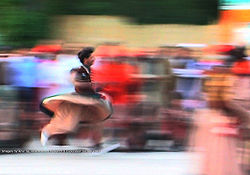 One of the most prominent dances is Attan, which has ancient roots possibly Greek
. A rigorous exercise, Attan is performed as musicians play various native instruments including the dhol
(drums), tabla
s (percussions), rubab (a bowed
string instrument
), and toola (wooden flute). With a rapid circular motion, dancers perform until no one is left dancing, similar to Sufi
whirling dervishes
. Numerous other dances are affiliated with various tribes notably from Pakistan including the Khattak Wal Atanrh (eponymously named after the Khattak
tribe), Mahsood Wal Atanrh (which, in modern times, involves the juggling of loaded rifles), and Waziro Atanrh among others. A sub-type of the Khattak Wal Atanrh known as the Braghoni involves the use of up to three swords and requires great skill. Young women and girls often entertain at weddings with the Tumbal (tambourine).
Traditional Pashtun music has ties to Klasik
(traditional Afghan music
heavily inspired by Hindustani classical music
), Iranian musical
traditions, and other various forms found in South Asia. Popular forms include the ghazal
(sung poetry) and Sufi qawwali
music. Themes revolve around love and religious introspection. Modern Pashto music is centred around the city of Peshawar
due to the wars in Afghanistan, and tends to combine indigenous techniques and instruments with Iranian-inspired Persian music and Indian Filmi
music prominent in Bollywood
. Some well known Pashto singers include Nashenas, Ubaidullah Jan Kandaharai
, Sardar Ali Takkar
, Naghma
, Rahim Shah, Farhad Darya
, Nazia Iqbal
, and a number of others.
Other modern Pashtun media include an established Pashto-language film and television industry that is based in Pakistan. Producers based in Lahore
have created Pashto-language films since the 1970s. Pashto films were once popular, but have declined both commercially and critically in recent years. Past films such as Yusuf Khan Sherbano dealt with serious subject matter, traditional stories, and legends. Pashtun lifestyle and issues have been raised by Western and Pashtun expatriate film-makers in recent years. One such film is In This World
by British film-maker Michael Winterbottom
, which chronicles the struggles of two Afghan youths who leave their refugee camp
s in Pakistan and try to move to the United Kingdom in search of a better life. Another is the British mini-series Traffik
, re-made as the American film Traffic
, which featured a Pashtun man (played by Jamal Shah
) struggling to survive in a world with few opportunities outside the drug trade.
, which was introduced to South Asia during the early 18th century with the arrival of the British. Many Pashtuns have become prominent international cricketers in the Pakistan National Cricket Team for the last several decades, such as Shahid Afridi
, Imran Khan
, Majid Khan
, Misbah-ul-Haq
, Umar Gul
, Junaid Khan
and Younis Khan
. Also the two Indian brothers Yusuf Pathan
and Irfan Pathan
claim to have had Pathan Ancestary. It has spread from Pakistan into Afghanistan in recent years, with many stadiums being built there. The Afghanistan national cricket team is dominated by Pashtun players.
Football (soccer) is considered the second most popular sport among the Pashtuns. The current captain of Pakistan national football team
, Muhammad Essa
, is an ethnic Pashtun from the Balochistan province
. Another top player from the same area was Abdul Wahid Durrani
, who scored 15 international goals in 13 games and became the captain of the team. The Afghanistan national football team
includes a number of Pashtun players.
Some Pashtuns participate in various other sports, which may include: basketball, golf, field hockey
, track and field, volleyball, handball
, bodybuilding
, weightlifting
, wrestling
(pehlwani
), martial arts, boxing
, skating
, bowling
, snooker
and chess
. Traditional sports include naiza bazi, which involves horsemen who compete in spear throwing. Pashtuns living in the northern regions of Afghanistan engage in Buzkashi
, which is another ancient central Asian sport played by riding on horses. In recent decades Hayatullah Khan Durrani
, Pride of Performance
caving
legend from Quetta
, has been promoting mountaineering
, rock climbing
and caving in Pakistan.
Squash
is a sport in which Pashtuns from Pakistan became legend in. Jahangir Khan
and Jansher Khan
are former world champions of squash, making it to the Guinness World Records
. They are considered to be the greatest professional squash players of all time. Although now retired, they are engaged in promoting the sport through the Pakistan Squash Federation.
Snooker
and billiards
are played by young Pashtun men, mainly in urban areas where snooker clubs are found. Several prominent international recognised snooker players
are from the Pashtun area, including Saleh Mohammed
. Children's games include a form of marbles
called buzul-bazi, which is played with the knucklebones of sheep. Although traditionally very less involved in sports than boys, young Pashtun girls often play volleyball, basketball, football
, and cricket, especially in urban areas. A favourite game of the Pashtuns in southwestern Pakistan is yanda, mainly in and around Pishin
.
with someone from the same ethnicity, but not necessarily from the same tribe. Dating, such as boyfriend
and girlfriend
, is more rare in Pashtun culture than in neighboring cultures but is spreading now among the elite urbanite Pashtuns due to the rapid increase of internet and mobile phone
usage.
Arranged marriage
s are usually the only choice for the rural people but also very common among those living in urban areas, although few select their own spouses. Wedding
s are often three days events, starting with the 'henna
party' on the first day, followed by the main wedding day, and ending with a gifts party on the third day. A day before the wedding, dinner is prepared for the ceremony, and the women often dye their hands with henna. Wealthy Pashtuns often rent a wedding hall inside well known hotel for three days, whilst less wealthy families usually host their weddings inside the house or build a large tent outside; in most weddings, males and females sit separately. In most cases the couples getting married are young, the groom usually in the early 20s and the bride in her teens.
. Nazo Anaa was a prominent 17th century Pashto poet and an educated Pashtun woman who eventually became the "Mother of Afghan Nationalism" after gaining authority through her poetry and upholding of the Pashtunwali code. She used the Pashtunwali law to unite the Pashtun tribes against their Persian enemies. Her cause was picked up in the early 18th century by Zarghona Anaa, the mother of Ahmad Shah Durrani.
The lives of Pashtun women vary from those who reside in conservative rural areas, such as the tribal belt
, to those found in relatively freer urban centres. At the village level, the female village leader is called "qaryadar". Her duties may include witnessing women's ceremonies, mobilising women to practice religious festivals, preparing the female dead for burial, and performing services for deceased women. She also arranges marriages for her own family and arbitrates conflicts for men and women. Though many Pashtun women remain tribal and illiterate, others have become educated and gainfully employed.
The decades war and the rise of the Taliban caused considerable hardship among Pashtun women, as many of their rights were curtailed by a rigid and inaccurate interpretation of Islamic law
. The difficult lives of Afghan female refugees gained considerable notoriety with the iconic image of the so-called "Afghan Girl" (Sharbat Gula) depicted on the June 1985 cover of National Geographic
magazine. The male-dominated code of Pashtunwali often constrains women and forces them into designated traditional roles that separate the genders.
Modern social reform for Pashtun women began in the early 20th century, when Queen Soraya Tarzi
of Afghanistan made rapid reforms to improve women's lives and their position in the family. Her advocacy of social reforms for women led to widespread protest and contributed to the ultimate demise of King Amanullah
's reign. Civil rights
remained an important issue during the 1970s, as feminist leader Meena Keshwar Kamal
campaigned for women's rights and founded the Revolutionary Association of the Women of Afghanistan
(RAWA) in the 1977.
Today, Pashtun women vary from the traditional housewives who live in seclusion to urban workers, some of whom seek or have attained parity with men. But due to numerous social hurdles, the literacy rate remains considerably lower for Pashtun females than for males. Abuse against women is present and increasingly being challenged by women's rights organisations which find themselves struggling with conservative religious groups as well as government officials in both Pakistan and Afghanistan. According to researcher Benedicte Grima's book Performance of Emotion Among Paxtun Women, "a powerful ethic of forbearance severely limits the ability of traditional Pashtun women to mitigate the suffering they acknowledge in their lives."
Pashtun women often have their legal rights curtailed in favour of their husbands or male relatives. For example, though women are officially allowed to vote
in Afghanistan and Pakistan, some have been kept away from ballot box
es by males. Traditionally, Pashtun women have few inheritance rights and are often charged with taking care of large extended families of their spouses. Another tradition that persists is swara, the giving of a female relative to someone in order to rectify a dispute. It was declared illegal in Pakistan in 2000 but continues in tribal regions.
Despite obstacles, many Pashtun women have begun a process of slow change. A rich oral tradition and resurgence of poetry has inspired many Pashtun women seeking to learn to read and write. Further challenging the status quo, Vida Samadzai
was selected as Miss Afghanistan
in 2003, a feat that was received with a mixture of support from those who back the individual rights of women and those who view such displays as anti-traditionalist and un-Islamic. Some Pashtun women have attained high political office in Pakistan. In Afghanistan, following recent elections, the proportion of female political representatives is one of the highest in the world. A number of Pashtun women are found as TV hosts, journalists, actors and singers on several TV outlets, especially at AVT Khyber
. A Pashtun woman, Khatol Mohammadzai, recently became a paratrooper
in the Afghan National Army Air Force, another one became a fighter pilot
in the Pakistan Air Force
. Some notable Pashtun women of Afghanistan include Suhaila Seddiqi
, Shukria Barakzai
, Fauzia Gailani
, Zeenat Karzai
, Malalai Kakar
, Naghma
, and Najiba Faiz.
Substantial work remains for Pashtun women to gain equal rights
with men, who remain disproportionately dominant in most aspects of Pashtun society. Human rights organisations continue to struggle for greater women's rights, such as the Afghan Women's Network
and the Aurat Foundation
in Pakistan which aims to protect women from domestic violence
. Due to recent reforms in the higher education commission (HEC) of Pakistan, a number of competent Pashtun female scholars have been able to earn Masters and PhD scholarships. Most of them have proceeded to USA, UK and other developed countries with support from their families.
Eastern Iranian languages
The Eastern Iranian languages are a subgroup of the Iranian languages emerging in Middle Iranian times .The Avestan language is often classified as early Eastern Iranian. The largest living Eastern Iranian language is Pashto, with some 50 million speakers between the Hindu Kush mountains in...
ethnic group
Iranian peoples
The Iranian peoples are an Indo-European ethnic-linguistic group, consisting of the speakers of Iranian languages, a major branch of the Indo-European language family, as such forming a branch of Indo-European-speaking peoples...
with populations primarily between the Hindu Kush
Hindu Kush
The Hindu Kush is an mountain range that stretches between central Afghanistan and northern Pakistan. The highest point in the Hindu Kush is Tirich Mir in the Chitral region of Khyber-Pakhtunkhwa, Pakistan.It is the westernmost extension of the Pamir Mountains, the Karakoram Range, and is a...
mountains in Afghanistan
Afghanistan
Afghanistan , officially the Islamic Republic of Afghanistan, is a landlocked country located in the centre of Asia, forming South Asia, Central Asia and the Middle East. With a population of about 29 million, it has an area of , making it the 42nd most populous and 41st largest nation in the world...
and the Indus River
Indus River
The Indus River is a major river which flows through Pakistan. It also has courses through China and India.Originating in the Tibetan plateau of western China in the vicinity of Lake Mansarovar in Tibet Autonomous Region, the river runs a course through the Ladakh district of Jammu and Kashmir and...
in Pakistan
Pakistan
Pakistan , officially the Islamic Republic of Pakistan is a sovereign state in South Asia. It has a coastline along the Arabian Sea and the Gulf of Oman in the south and is bordered by Afghanistan and Iran in the west, India in the east and China in the far northeast. In the north, Tajikistan...
. The Pashtuns are typically characterised by their usage of the Pashto language
Pashto language
Pashto , known as Afghani in Persian and Pathani in Punjabi , is the native language of the indigenous Pashtun people or Afghan people who are found primarily between an area south of the Amu Darya in Afghanistan and...
and practice of Pashtunwali
Pashtunwali
Pashtunwali or Pakhtunwali is a non-written ethical code and traditional lifestyle which the indigenous Pashtun people from Afghanistan and Pakistan follow. Some in the Indian subcontinent refer to it as "Pathanwali". Its meaning may also be interpreted as "the way of the Pashtuns" or "the code of...
, which is a traditional set of ethics guiding individual and communal
Community
The term community has two distinct meanings:*a group of interacting people, possibly living in close proximity, and often refers to a group that shares some common values, and is attributed with social cohesion within a shared geographical location, generally in social units larger than a household...
conduct. Their origins are unclear but historians have come across references to various ancient peoples called Paktha
Pakthas
For the present-day Afghan provinces of , see Paktia Province, Paktika Province and Khost Province.Pakthas are an ancient people, that find reference in Sanskrit and Greek sources and as a people living in the areas now in Afghanistan, as well as the Khyber Pakhtunkhwa of Pakistan...
(Pactyans
Pakthas
For the present-day Afghan provinces of , see Paktia Province, Paktika Province and Khost Province.Pakthas are an ancient people, that find reference in Sanskrit and Greek sources and as a people living in the areas now in Afghanistan, as well as the Khyber Pakhtunkhwa of Pakistan...
) between the 2nd
2nd millennium BC
The 2nd millennium BC marks the transition from the Middle to the Late Bronze Age.Its first half is dominated by the Middle Kingdom of Egypt and Babylonia. The alphabet develops. Indo-Iranian migration onto the Iranian plateau and onto the Indian subcontinent propagates the use of the chariot...
and the 1st millennium BC
1st millennium BC
The 1st millennium BC encompasses the Iron Age and sees the rise of many successive empires, and spanned from 1000 BC to 1 BC.The Neo-Assyrian Empire, followed by the Achaemenids. In Greece, Classical Antiquity begins with the colonization of Magna Graecia and peaks with the rise of Hellenism. The...
, who may be the early ancestors of Pashtuns. Since the 3rd century AD and onward, they are mostly referred to by the ethnonym
Ethnonym
An ethnonym is the name applied to a given ethnic group. Ethnonyms can be divided into two categories: exonyms and autonyms or endonyms .As an example, the ethnonym for...
"Afghan".
Often characterised as a warrior and martial race, they have a tumultuous past, especially after their conversion to the faith of Islam. Their turbulent history is spread amongst various countries of South, Central and West Asia, centred around the medieval state of Afghanistan
Durrani Empire
The Durrani Empire was a Pashtun dynasty centered in Afghanistan and included northeastern Iran, the Kashmir region, the modern state of Pakistan, and northwestern India. It was established at Kandahar in 1747 by Ahmad Shah Durrani, an Afghan military commander under Nader Shah of Persia and chief...
, which has been their traditional seat of power. During the Delhi Sultanate
Delhi Sultanate
The Delhi Sultanate is a term used to cover five short-lived, Delhi based kingdoms or sultanates, of Turkic origin in medieval India. The sultanates ruled from Delhi between 1206 and 1526, when the last was replaced by the Mughal dynasty...
era, many Pashtun emperors (sultans) ruled the Indian subcontinent. Other Pashtuns defeated the Safavid Persians
Safavid dynasty
The Safavid dynasty was one of the most significant ruling dynasties of Iran. They ruled one of the greatest Persian empires since the Muslim conquest of Persia and established the Twelver school of Shi'a Islam as the official religion of their empire, marking one of the most important turning...
and the Mughal Empire
Mughal Empire
The Mughal Empire , or Mogul Empire in traditional English usage, was an imperial power from the Indian Subcontinent. The Mughal emperors were descendants of the Timurids...
before obtaining an independent
Independence
Independence is a condition of a nation, country, or state in which its residents and population, or some portion thereof, exercise self-government, and usually sovereignty, over its territory....
state
Sovereign state
A sovereign state, or simply, state, is a state with a defined territory on which it exercises internal and external sovereignty, a permanent population, a government, and the capacity to enter into relations with other sovereign states. It is also normally understood to be a state which is neither...
in the early-18th century, which began with a successful revolution by the Hotaki dynasty followed by conquests
Conquest (military)
Conquest is the act of military subjugation of an enemy by force of arms. One example is the Norman conquest of England, which provided the subjugation of the Kingdom of England and the acquisition of the English crown by William the Conqueror in 1066...
by Ahmad Shah Durrani
Ahmad Shah Durrani
Ahmad Shah Durrani , also known as Ahmad Shāh Abdālī and born as Ahmad Khān, was the founder of the Durrani Empire in 1747 and is regarded by many to be the founder of the modern state of Afghanistan.Ahmad Khan enlisted as a young soldier in the military of the Afsharid kingdom and quickly rose...
. Pashtuns played a vital role during the Great Game
The Great Game
The Great Game or Tournament of Shadows in Russia, were terms for the strategic rivalry and conflict between the British Empire and the Russian Empire for supremacy in Central Asia. The classic Great Game period is generally regarded as running approximately from the Russo-Persian Treaty of 1813...
from the 19th century to the 20th century as they were caught between the imperialist designs of the British
British Raj
British Raj was the British rule in the Indian subcontinent between 1858 and 1947; The term can also refer to the period of dominion...
and Russian
Russian Empire
The Russian Empire was a state that existed from 1721 until the Russian Revolution of 1917. It was the successor to the Tsardom of Russia and the predecessor of the Soviet Union...
empires. Pashtuns are the largest ethnic group in Afghanistan
Ethnic groups in Afghanistan
Afghanistan is a multiethnic society. The population of the country is divided into a wide variety of ethnolinguistic groups. The ethnic groups of the country are as follow: Pashtun, Tajik, Hazara, Uzbek, Aimak, Turkmen, Baloch, Pashai, Nuristani, Arab, Brahui, Pamiri and some others.-Ethnic...
; for over 300 years, they have reign
Reign
A reign is the term used to describe the period of a person's or dynasty's occupation of the office of monarch of a nation or of a people . In most hereditary monarchies and some elective monarchies A reign is the term used to describe the period of a person's or dynasty's occupation of the office...
ed as the dominant ethno-linguistic group, with nearly all rulers being Pashtun. More recently, the Pashtuns gained global attention during the 1980s Soviet war in Afghanistan
Soviet war in Afghanistan
The Soviet war in Afghanistan was a nine-year conflict involving the Soviet Union, supporting the Marxist-Leninist government of the Democratic Republic of Afghanistan against the Afghan Mujahideen and foreign "Arab–Afghan" volunteers...
and with the rise of the Taliban
Islamic Emirate of Afghanistan
The Islamic Emirate of Afghanistan was founded in 1996 when the Taliban began their rule of Afghanistan and ended with their fall from power in 2001...
, since they are the main ethnic contingent in the movement. Pashtuns are also an important community in Pakistan, which has the largest Pashtun population and where they constitute the second-largest ethnic group
Ethnic groups in Pakistan
About 98% of languages spoken in Pakistan are Indo-Iranian , a branch of Indo-European family of languages. Most languages of Pakistan are written in the Perso-Arabic script, with significant vocabulary derived from Arabic and Persian. Punjabi , Seraiki, Sindhi, Pashto, Urdu, Balochi, Kashmiri , etc...
, having attained presidency
President of Pakistan
The President of Pakistan is the head of state, as well as figurehead, of the Islamic Republic of Pakistan. Recently passed an XVIII Amendment , Pakistan has a parliamentary democratic system of government. According to the Constitution, the President is chosen by the Electoral College to serve a...
and high positions in the armed forces.
The Pashtuns are the world's largest (patriarchal) segmentary lineage
Segmentary lineage
A segmentary lineage society is characterized by the organization of the society into segments; what is often referred to as a tribal society....
ethnic group. According to Ethnologue
Ethnologue
Ethnologue: Languages of the World is a web and print publication of SIL International , a Christian linguistic service organization, which studies lesser-known languages, to provide the speakers with Bibles in their native language and support their efforts in language development.The Ethnologue...
, the total population of the group is estimated to be around 50 million but an accurate count remains elusive due to the lack of an official census in Afghanistan since 1979. Estimates of the number of Pashtun tribes and clans
Pashtun tribes
The Pashtun people are the largest ethnic group in Afghanistan and the second largest in Pakistan. Pashtun, tribes are divided into four supertribal confederacies: the Arbanee , Betanee , Gharghasht, and Karlanee .Traditionally, according to folklore, all Pashtuns are said to have descended, at...
range from about 350 to over 400.
Geographic distribution
The vast majority of Pashtuns are found in the traditional Pashtun homelandPashtunistan
Pakhtunistan or Pashtunistan, meaning the "land of Pakhtuns" or "land of Pashtuns", is a modern term used for the historical region inhabited by the native Afghans or Pashtun since at least the 1st millennium BC...
, stretching between the Hindu Kush
Hindu Kush
The Hindu Kush is an mountain range that stretches between central Afghanistan and northern Pakistan. The highest point in the Hindu Kush is Tirich Mir in the Chitral region of Khyber-Pakhtunkhwa, Pakistan.It is the westernmost extension of the Pamir Mountains, the Karakoram Range, and is a...
mountains in Afghanistan and west of the Indus River
Indus River
The Indus River is a major river which flows through Pakistan. It also has courses through China and India.Originating in the Tibetan plateau of western China in the vicinity of Lake Mansarovar in Tibet Autonomous Region, the river runs a course through the Ladakh district of Jammu and Kashmir and...
in Pakistan, which includes Khyber-Pakhtunkhwa, Federally Administered Tribal Areas
Federally Administered Tribal Areas
The Federally Administered Tribal Areas are a semi-autonomous tribal region in the northwest of Pakistan, lying between the province of Khyber Pakhtunkhwa, Balochistan, and the neighboring country of Afghanistan. The FATA comprise seven Agencies and six FRs...
(FATA) and part of Balochistan
Balochistan (Pakistan)
Balochistan is one of the four provinces or federating units of Pakistan. With an area of 134,051 mi2 or , it is the largest province of Pakistan, constituting approximately 44% of the total land mass of Pakistan. According to the 1998 population census, Balochistan had a population of...
. Additional Pashtun communities are located in western and northern Afghanistan, the Gilgit-Baltistan and Kashmir
Kashmir
Kashmir is the northwestern region of the Indian subcontinent. Until the mid-19th century, the term Kashmir geographically denoted only the valley between the Great Himalayas and the Pir Panjal mountain range...
regions and northern Punjab province of Pakistan, as well as in the Khorasan province of Iran
Iran
Iran , officially the Islamic Republic of Iran , is a country in Southern and Western Asia. The name "Iran" has been in use natively since the Sassanian era and came into use internationally in 1935, before which the country was known to the Western world as Persia...
. There are also sizeable Muslim communities
Islam in India
Islam is the second-most practiced religion in the Republic of India after Hinduism, with more than 13.4% of the country's population ....
in India, which are of largely putative Pashtun ancestry. Throughout the Indian subcontinent, excluding Pashtun-dominated regions, they are often referred to as Pathans. Smaller Pashtun communities
Pashtun diaspora
Pashtuns , also called Pathans have many communities around the world. Pukhtuns have long history to conquer and colonizing several regions especially the ancient regions of Sub-continent in duration of past few centuries...
are found in the countries of the Arabian Peninsula
Arabian Peninsula
The Arabian Peninsula is a land mass situated north-east of Africa. Also known as Arabia or the Arabian subcontinent, it is the world's largest peninsula and covers 3,237,500 km2...
, Europe and the Americas, particularly in North America.
Important metropolitan centres of Pashtun culture
Pashtun culture
Pashtun culture is based on Pashtunwali, which is an ancient way of life, as well as speaking of the Pashto language and wearing Pashtun dress. The culture of the Pashtun people is highlighted since at least the time of Herodotus or Alexander the Great, when he explored the Afghanistan and...
include Kandahar
Kandahar
Kandahar is the second largest city in Afghanistan, with a population of about 512,200 as of 2011. It is the capital of Kandahar Province, located in the south of the country at about 1,005 m above sea level...
, Quetta
Quetta
is the largest city and the provincial capital of the Balochistan Province of Pakistan. Known as the "Fruit Garden of Pakistan" due to the diversity of its plant and animal wildlife, Quetta is home to the Hazarganji Chiltan National Park, which contains some of the rarest species of wildlife in the...
, Peshawar
Peshawar
Peshawar is the capital of Khyber-Pakhtunkhwa and the administrative center and central economic hub for the Federally Administered Tribal Areas of Pakistan....
, Jalalabad
Jalalabad
Jalalabad , formerly called Adinapour, as documented by the 7th century Hsüan-tsang, is a city in eastern Afghanistan. Located at the junction of the Kabul River and Kunar River near the Laghman valley, Jalalabad is the capital of Nangarhar province. It is linked by approximately of highway with...
, Kunduz
Kunduz
Kunduz also known as Kundûz, Qonduz, Qondûz, Konduz, Kondûz, Kondoz, or Qhunduz is a city in northern Afghanistan, the capital of Kunduz Province. It is linked by highways with Mazari Sharif to the west, Kabul to the south and Tajikistan's border to the north...
and Swat. Kabul
Kabul
Kabul , spelt Caubul in some classic literatures, is the capital and largest city of Afghanistan. It is also the capital of the Kabul Province, located in the eastern section of Afghanistan...
and Ghazni
Ghazni
For the Province of Ghazni see Ghazni ProvinceGhazni is a city in central-east Afghanistan with a population of about 141,000 people...
are home to around 25% Pashtun population while Herat
Herat
Herāt is the capital of Herat province in Afghanistan. It is the third largest city of Afghanistan, with a population of about 397,456 as of 2006. It is situated in the valley of the Hari River, which flows from the mountains of central Afghanistan to the Karakum Desert in Turkmenistan...
and Mazar-i-Sharif each has at least 10%. With as high as 7 million by some estimates, the city of Karachi
Karachi
Karachi is the largest city, main seaport and the main financial centre of Pakistan, as well as the capital of the province of Sindh. The city has an estimated population of 13 to 15 million, while the total metropolitan area has a population of over 18 million...
in Pakistan may have the largest concentration of urban Pashtuns in the world. In addition, Rawalpindi
Rawalpindi
Rawalpindi , locally known as Pindi, is a city in the Pothohar region of Pakistan near Pakistan's capital city of Islamabad, in the province of Punjab. Rawalpindi is the fourth largest city in Pakistan after Karachi, Lahore and Faisalabad...
, Islamabad
Islamabad
Islamabad is the capital of Pakistan and the tenth largest city in the country. Located within the Islamabad Capital Territory , the population of the city has grown from 100,000 in 1951 to 1.7 million in 2011...
, and Lahore
Lahore
Lahore is the capital of the Pakistani province of Punjab and the second largest city in the country. With a rich and fabulous history dating back to over a thousand years ago, Lahore is no doubt Pakistan's cultural capital. One of the most densely populated cities in the world, Lahore remains a...
also have sizeable Pashtun populations.
Pashtuns comprise roughly 15.4% of Pakistan's 174 million population
Demographics of Pakistan
This article is about the demographic features of the population of Pakistan, including population density, ethnicity, education level, health of the populace, economic status, religious affiliations and other aspects of the population....
. In Afghanistan
Demographics of Afghanistan
The population of Afghanistan is around 29,835,392 as of the year 2011, which is unclear if the refugees living outside the country are included or not. The nation is composed of a multi-ethnic and multi-lingual society, reflecting its location astride historic trade and invasion routes between...
, they make up an estimated 42% of the 29 million population
Demography of Afghanistan
The population of Afghanistan is around 29,835,392 as of the year 2011, which is unclear if the refugees living outside the country are included or not. The nation is composed of a multi-ethnic and multi-lingual society, reflecting its location astride historic trade and invasion routes between...
according to the CIA World Factbook
The World Factbook
The World Factbook is a reference resource produced by the Central Intelligence Agency of the United States with almanac-style information about the countries of the world. The official paper copy version is available from the National Technical Information Service and the Government Printing Office...
. Some sources give 50–60% because the exact figure remains uncertain in Afghanistan, and are affected by the 1.7 million Afghan refugees
Afghan diaspora
Afghan diaspora or Afghan immigrants are citizens of Afghanistan who have emigrated to other countries, or people of Afghan origin who are born outside Afghanistan.-List of countries:...
that remain in Pakistan
Afghans in Pakistan
Afghans in Pakistan are mostly refugees who fled Afghanistan during the 1980s Soviet war as well as diplomats, traders, businesspersons, workers, exchange students, tourists and other visitors. As of March 2009, some 1.7 million registered Afghan nationals were reported to be living in Pakistan,...
a majority of which are Pashtuns. Another 937,600 Afghans live in Iran
Afghans in Iran
Afghans in Iran are mostly refugees who fled Afghanistan during the 1980s Soviet war as well as diplomats, traders, businesspersons, workers, exchange students, tourists and other visitors. As of March 2009, nearly 1 million Afghan nationals were reported to be living in Iran...
according to the United Nations High Commissioner for Refugees
United Nations High Commissioner for Refugees
The Office of the United Nations High Commissioner for Refugees , also known as The UN Refugee Agency is a United Nations agency mandated to protect and support refugees at the request of a government or the UN itself and assists in their voluntary repatriation, local integration or resettlement to...
(UNHCR). A cumulative population assessment suggests a total of around 49 million individuals all across the world.
History and origins
The history of the Pashtun people is ancient and much of it is not fully researched. Since the 2nd millennium BC2nd millennium BC
The 2nd millennium BC marks the transition from the Middle to the Late Bronze Age.Its first half is dominated by the Middle Kingdom of Egypt and Babylonia. The alphabet develops. Indo-Iranian migration onto the Iranian plateau and onto the Indian subcontinent propagates the use of the chariot...
, cities in the region now inhabited by Pashtuns have seen invasions and migrations, including by Ancient Iranian peoples
Ancient Iranian peoples
Iranian peoples first appear in Assyrian records in the 9th century BCE. In Classical Antiquity they were found primarily in Scythia and Persia...
, the Median and Persian
Achaemenid Empire
The Achaemenid Empire , sometimes known as First Persian Empire and/or Persian Empire, was founded in the 6th century BCE by Cyrus the Great who overthrew the Median confederation...
empires of antiquity, Greeks
Greco-Bactrian Kingdom
The Greco-Bactrian Kingdom was the easternmost part of the Hellenistic world, covering Bactria and Sogdiana in Central Asia from 250 to 125 BC...
, Mauryas
Maurya Empire
The Maurya Empire was a geographically extensive Iron Age historical power in ancient India, ruled by the Mauryan dynasty from 321 to 185 BC...
, Kushans
Kushan Empire
The Kushan Empire originally formed in the early 1st century AD under Kujula Kadphises in the territories of ancient Bactria on either side of the middle course of the Oxus in what is now northern Afghanistan, Pakistan, and southern Tajikistan and Uzbekistan.During the 1st and early 2nd centuries...
, Hephthalite
Hephthalite
The Hephthalites or Hephthalite is a pre-Islamic Greek term for local Abdali Afghans, who's famous ruler was Nazak Abdali . Hephthalites were a Central Asian nomadic confederation of the AD 5th-6th centuries whose precise origins and composition remain obscure...
s, Sassanids
Sassanid Empire
The Sassanid Empire , known to its inhabitants as Ērānshahr and Ērān in Middle Persian and resulting in the New Persian terms Iranshahr and Iran , was the last pre-Islamic Persian Empire, ruled by the Sasanian Dynasty from 224 to 651...
, Arab Muslims, Turks
Turkic peoples
The Turkic peoples are peoples residing in northern, central and western Asia, southern Siberia and northwestern China and parts of eastern Europe. They speak languages belonging to the Turkic language family. They share, to varying degrees, certain cultural traits and historical backgrounds...
, Mongols
Mongol Empire
The Mongol Empire , initially named as Greater Mongol State was a great empire during the 13th and 14th centuries...
, Palas
Pala Empire
The Pāla Empire was one of the major middle kingdoms of India existed from 750–1174 CE. It was ruled by a Buddhist dynasty from Bengal in the eastern region of the Indian subcontinent, all the rulers bearing names ending with the suffix Pala , which means protector. The Palas were often described...
and others. In recent age, people of the Western world have explored the area as well.
There are many conflicting theories about the origin of Pashtuns, some modern and others archaic, both among historians and the Pashtuns themselves. According to most historians and experts, the true origin of the Pashtuns is some what unclear.
Ancient references
A variety of ancient groups with eponymEponym
An eponym is the name of a person or thing, whether real or fictitious, after which a particular place, tribe, era, discovery, or other item is named or thought to be named...
s similar to Pukhtun have been hypothesized as possible ancestors of modern Pashtuns. The Rigveda
Rigveda
The Rigveda is an ancient Indian sacred collection of Vedic Sanskrit hymns...
(1700–1100 BC) mentions a tribe called Paktha
Pakthas
For the present-day Afghan provinces of , see Paktia Province, Paktika Province and Khost Province.Pakthas are an ancient people, that find reference in Sanskrit and Greek sources and as a people living in the areas now in Afghanistan, as well as the Khyber Pakhtunkhwa of Pakistan...
inhabiting eastern Afghanistan
Pashtunistan
Pakhtunistan or Pashtunistan, meaning the "land of Pakhtuns" or "land of Pashtuns", is a modern term used for the historical region inhabited by the native Afghans or Pashtun since at least the 1st millennium BC...
and academics have proposed their connection with today's Pakhtun people. Furthermore, the Greek
Ancient Greek
Ancient Greek is the stage of the Greek language in the periods spanning the times c. 9th–6th centuries BC, , c. 5th–4th centuries BC , and the c. 3rd century BC – 6th century AD of ancient Greece and the ancient world; being predated in the 2nd millennium BC by Mycenaean Greek...
historian Herodotus
Herodotus
Herodotus was an ancient Greek historian who was born in Halicarnassus, Caria and lived in the 5th century BC . He has been called the "Father of History", and was the first historian known to collect his materials systematically, test their accuracy to a certain extent and arrange them in a...
mentioned a people called Pactyans
Pakthas
For the present-day Afghan provinces of , see Paktia Province, Paktika Province and Khost Province.Pakthas are an ancient people, that find reference in Sanskrit and Greek sources and as a people living in the areas now in Afghanistan, as well as the Khyber Pakhtunkhwa of Pakistan...
living in the same area (Achaemenid
Achaemenid Empire
The Achaemenid Empire , sometimes known as First Persian Empire and/or Persian Empire, was founded in the 6th century BCE by Cyrus the Great who overthrew the Median confederation...
's Arachosia
Arachosia
Arachosia is the Latinized form of the Greek name of an Achaemenid and Seleucid governorate in the eastern part of their respective empires, around modern-day southern Afghanistan. The Greek term "Arachosia" corresponds to the Iranian land of Harauti which was between Kandahar in Afghanistan and...
Satrap
Satrap
Satrap was the name given to the governors of the provinces of the ancient Median and Achaemenid Empires and in several of their successors, such as the Sassanid Empire and the Hellenistic empires....
y) as early as the 1st millennium BCE. It is believed that these may have been the ancient ancestors of Pashtuns.
Some modern-day Pashtun tribes have also been identified living in ancient Gandhara
Gandhara
Gandhāra , is the name of an ancient kingdom , located in northern Pakistan and eastern Afghanistan. Gandhara was located mainly in the vale of Peshawar, the Potohar plateau and on the Kabul River...
(i.e. Alexander's historians mentioned "Aspasii" in 330 BC and that may refer to today's Afridi
Afridi
Afridi of rough hilly area in the eastern Safed Koh range, west of the Peshawar Valley and east of Torkham, and Maidan in Tirah, which can be accessed by the Kajurhi plains and the valleys of Bara and Churah in Pakistan...
s). Herodotus has mentioned the same Afridi tribe as "Apridai" over a century earlier. Strabo
Strabo
Strabo, also written Strabon was a Greek historian, geographer and philosopher.-Life:Strabo was born to an affluent family from Amaseia in Pontus , a city which he said was situated the approximate equivalent of 75 km from the Black Sea...
, who lived between 64 BC and 24 CE
Common Era
Common Era ,abbreviated as CE, is an alternative designation for the calendar era originally introduced by Dionysius Exiguus in the 6th century, traditionally identified with Anno Domini .Dates before the year 1 CE are indicated by the usage of BCE, short for Before the Common Era Common Era...
, explains that the tribes inhabiting the lands west of the Indus River
Indus River
The Indus River is a major river which flows through Pakistan. It also has courses through China and India.Originating in the Tibetan plateau of western China in the vicinity of Lake Mansarovar in Tibet Autonomous Region, the river runs a course through the Ladakh district of Jammu and Kashmir and...
were part of Ariana
Ariana
Ariana was a region of the eastern countries of ancient Iran, next to India.Ariana may also refer to:* Ariana In places:*Ariana Governorate, a governorate in Tunisia*Ariana, Tunisia*Lake Ariana, a lake in Sofia, Bulgaria...
and to their east was India.
In the Middle Ages
Middle Ages
The Middle Ages is a periodization of European history from the 5th century to the 15th century. The Middle Ages follows the fall of the Western Roman Empire in 476 and precedes the Early Modern Era. It is the middle period of a three-period division of Western history: Classic, Medieval and Modern...
until the advent of modern Afghanistan in the 18th century and the division of Pashtun territory
Pashtunistan
Pakhtunistan or Pashtunistan, meaning the "land of Pakhtuns" or "land of Pashtuns", is a modern term used for the historical region inhabited by the native Afghans or Pashtun since at least the 1st millennium BC...
by the 1893 Durand Line
Durand Line
The Durand Line refers to the porous international border between Pakistan and Afghanistan, which has divided the ethnic Pashtuns . This poorly marked line is approximately long...
, Pashtuns were often referred to as ethnic "Afghans". The earliest mention of the name Afghan (Abgân) is by Shapur I
Shapur I
Shapur I or also known as Shapur I the Great was the second Sassanid King of the Second Persian Empire. The dates of his reign are commonly given as 240/42 - 270/72, but it is likely that he also reigned as co-regent prior to his father's death in 242 .-Early years:Shapur was the son of Ardashir I...
of the Sassanid Empire
Sassanid Empire
The Sassanid Empire , known to its inhabitants as Ērānshahr and Ērān in Middle Persian and resulting in the New Persian terms Iranshahr and Iran , was the last pre-Islamic Persian Empire, ruled by the Sasanian Dynasty from 224 to 651...
during the 3rd century CE, which is later recorded in the 6th century CE in the form of "Avagānā" by the Indian astronomer Varāha Mihira
Varahamihira
Varāhamihira , also called Varaha or Mihira, was an Indian astronomer, mathematician, and astrologer who lived in Ujjain...
in his Brihat-samhita. It was used to refer to a common legendary ancestor known as "Afghana
Afghana
Afghana or Avagana is considered in Afghan folklore a tribal chief or prince of Bani Israel origin and a progenitor of modern-day Pashtuns , the largest ethnic group in Afghanistan and second largest in Pakistan...
", propagated to be grandson of King Saul of Israel
Saul
-People:Saul is a given/first name in English, the Anglicized form of the Hebrew name Shaul from the Hebrew Bible:* Saul , including people with this given namein the Bible:* Saul , a king of Edom...
. Hiven Tsiang
Xuanzang
Xuanzang was a famous Chinese Buddhist monk, scholar, traveler, and translator who described the interaction between China and India in the early Tang period...
, a Chinese pilgrim, visiting the Afghanistan area several times between 630 to 644 CE also speaks about them. In Shahnameh
Shahnameh
The Shahnameh or Shah-nama is a long epic poem written by the Persian poet Ferdowsi between c.977 and 1010 AD and is the national epic of Iran and related societies...
1–110 and 1–116, it is written as Awgaan. Ancestors of many of today's Turkic
Turkic languages
The Turkic languages constitute a language family of at least thirty five languages, spoken by Turkic peoples across a vast area from Eastern Europe and the Mediterranean to Siberia and Western China, and are considered to be part of the proposed Altaic language family.Turkic languages are spoken...
-speaking Afghans settled in the Hindu Kush
Hindu Kush
The Hindu Kush is an mountain range that stretches between central Afghanistan and northern Pakistan. The highest point in the Hindu Kush is Tirich Mir in the Chitral region of Khyber-Pakhtunkhwa, Pakistan.It is the westernmost extension of the Pamir Mountains, the Karakoram Range, and is a...
area and began to assimilate
Pashtunization
Pashtunization is a process of cultural or linguistic change in which something non-Pashtun becomes Pashtun Pashtunization (also called Afghanization) is a process of cultural or linguistic change in which something non-Pashtun becomes Pashtun Pashtunization (also called Afghanization) is a...
much of the culture and language of the Pashtun tribes already present there. Among these were the Khalaj people
Khalaj people
The Khalaj people are a Turkic people that speak the Khalaj language which is thought to be one of the closest languages to old Turkic language.- External links :* * *...
which are known today as Ghilzai
Ghilzai
Ghilzai are the largest Pashtun tribal confederacy found in Afghanistan and Pakistan. They are also known historically as Ghilji, Khilji, Ghalji, Ghilzye, and possibly Gharzai...
. According to several scholars such as V. Minorsky
Vladimir Fedorovich Minorsky
Vladimir Fedorovich Minorsky was a Russian Orientalist best known for his contributions to Kurdish and Persian history, geography, literature, and culture.-Life and career:...
, the name "Afghan" is documented several times in the 982 CE Hudud-al-Alam.
Nangarhar Province
Nangarhar is one of the 34 provinces of Afghanistan in the east of the country. Its capital is the city of Jalalabad. The population of the province is 1,334,000, which consists mainly of ethnic Pashtuns with a sizable community of Arabs and Pashais....
), who had Muslim, Afghan and Hindu wives. Al-Biruni
Al-Biruni
Abū al-Rayḥān Muḥammad ibn Aḥmad al-BīrūnīArabic spelling. . The intermediate form Abū Rayḥān al-Bīrūnī is often used in academic literature...
wrote about Afghans in the 11th century as various tribes living in the western mountains of India and extending to the region of Sind
Hindu Kush
The Hindu Kush is an mountain range that stretches between central Afghanistan and northern Pakistan. The highest point in the Hindu Kush is Tirich Mir in the Chitral region of Khyber-Pakhtunkhwa, Pakistan.It is the westernmost extension of the Pamir Mountains, the Karakoram Range, and is a...
, which would be the Sulaiman Mountains
Sulaiman Mountains
The Sulaiman Mountains are a major geological feature of southeastern Afghanistan and northern Balochistan province of Pakistan. In Pakistan, it forms the eastern edge of the Iranian plateau where the Indus River separates it from the Asian Subcontient...
area between Khorasan
Greater Khorasan
Greater Khorasan or Ancient Khorasan is a historical region of Greater Iran mentioned in sources from Sassanid and Islamic eras which "frequently" had a denotation wider than current three provinces of Khorasan in Iran...
and Hindustan
Hindustan
Hindustan or Indostan, literal translation "Land of River Sindhu ", is one of the popular names of South Asia. It can also mean "the land of the Hindus"...
. It was reported that between 1039 and 1040 CE Mas'ud I
Mas'ud I of Ghazni
Mas'ud I seized the throne of the Ghaznavid Empire upon the death of his father Mahmud from his younger twin Mohammad who had been nominated as the heir upon the death of their father Mahmud of Ghazni. His twin was blinded and imprisoned...
of the Ghaznavid Empire sent his son to subdue a group of rebel Afghans near Ghazni
Ghazni
For the Province of Ghazni see Ghazni ProvinceGhazni is a city in central-east Afghanistan with a population of about 141,000 people...
. An army of Arabs
History of Arabs in Afghanistan
The history of Arabs in Afghanistan spans over one millennium, from the 7th century Islamic conquest when Arab ghazis arrived with their Islamic mission until recently when others from the Arab world arrived to defend fellow Muslims from the Soviet followed by their liberation by NATO forces...
, Afghans, Khiljis
Khilji dynasty
The Khilji Sultanate was a dynasty of Turko-Afghan Khalaj origin who ruled large parts of South Asia from 1290 - 1320. They were the second dynasty to rule the Delhi Sultanate of India...
and others was assembled by Arslan Shah Ghaznavid in 1119 CE. Another army of Afghans and Khiljis was assembled by Bahram Shah Ghaznavid in 1153 CE. Muhammad of Ghor
Muhammad of Ghor
Sultan Shahāb-ud-Din Muhammad Ghori , originally called Mu'izzuddīn Muḥammad Bin Sām , was a ruler of the Ghurid dynasty who reigned over a territory spanning present-day Afghanistan, Pakistan and northern India.Shahabuddin Ghori reconquered the city of Ghazna Sultan Shahāb-ud-Din Muhammad Ghori...
, ruler of the Ghorids, also had Afghans in his army along with others. A famous Moroccan
Morocco
Morocco , officially the Kingdom of Morocco , is a country located in North Africa. It has a population of more than 32 million and an area of 710,850 km², and also primarily administers the disputed region of the Western Sahara...
travelling scholar, Ibn Battuta
Ibn Battuta
Abu Abdullah Muhammad Ibn Battuta , or simply Ibn Battuta, also known as Shams ad–Din , was a Muslim Moroccan Berber explorer, known for his extensive travels published in the Rihla...
, visiting Afghanistan following the era of the Khilji dynasty
Khilji dynasty
The Khilji Sultanate was a dynasty of Turko-Afghan Khalaj origin who ruled large parts of South Asia from 1290 - 1320. They were the second dynasty to rule the Delhi Sultanate of India...
in early 1300s gives his description of the Afghans.
Muhammad Qasim Hindu Shah
Firishta
Firishta or Ferishta, full name Muhammad Qasim Hindu Shah , was born in 1560 and died in 1620 and he was a Persian historian. The name Firishta means angel or one who is sent in Persian.-Life:...
(Ferishta), writes about Afghans and their country called Afghanistan
Name of Afghanistan
The name of Afghanistan is believed to be as old as the ethnonym Afghan, which is documented in a 10th century geography book called Hudud ul-'alam focusing on territories south of the Hindu Kush around the Sulaiman Mountains. The root name "Afghan" has been used historically in reference to the...
in the 16th century.
One historical account connects the Pakhtuns of Pakistan to a possible Ancient Egypt
Ancient Egypt
Ancient Egypt was an ancient civilization of Northeastern Africa, concentrated along the lower reaches of the Nile River in what is now the modern country of Egypt. Egyptian civilization coalesced around 3150 BC with the political unification of Upper and Lower Egypt under the first pharaoh...
ian past but this lacks supporting evidence.
Additionally, although this too is unsubstantiated, some Afghan historians have maintained that Pashtuns are linked to the ancient Israelites.
Anthropology and oral traditions
Oral tradition
Oral tradition and oral lore is cultural material and traditions transmitted orally from one generation to another. The messages or testimony are verbally transmitted in speech or song and may take the form, for example, of folktales, sayings, ballads, songs, or chants...
s of the Pashtun tribes themselves. For example, according to the Encyclopaedia of Islam
Encyclopaedia of Islam
The Encyclopaedia of Islam is an encyclopaedia of the academic discipline of Islamic studies. It embraces articles on distinguished Muslims of every age and land, on tribes and dynasties, on the crafts and sciences, on political and religious institutions, on the geography, ethnography, flora and...
, the theory of Pashtun descent from Israelites is traced to Maghzan-e-Afghani
Nimat Allah al-Harawi
Ni'mat Allah al-Harawi is the author of a Persian language epic history of the Afghans while serving as a chronicler at the court of the Mughal Emperor Jehangir...
who compiled a history for Khan-e-Jehan Lodhi in the reign of Mughal
Mughal Empire
The Mughal Empire , or Mogul Empire in traditional English usage, was an imperial power from the Indian Subcontinent. The Mughal emperors were descendants of the Timurids...
Emperor Jehangir in the 17th century.
Another book that corresponds with Pashtun historical records, Taaqati-Nasiri, states that in the 7th century BC a people called the Bani Israel settled in the Ghor region of Afghanistan and migrated later to the southeast areas. These references to Bani Israel agree with the commonly held view by Pashtuns that when the twelve tribes of Israel were dispersed (see Israel and Judah
History of ancient Israel and Judah
Israel and Judah were related Iron Age kingdoms of ancient Palestine. The earliest known reference to the name Israel in archaeological records is in the Merneptah stele, an Egyptian record of c. 1209 BCE. By the 9th century BCE the Kingdom of Israel had emerged as an important local power before...
and Ten Lost Tribes
Ten Lost Tribes
The Ten Lost Tribes of Israel refers to those tribes of ancient Israel that formed the Kingdom of Israel and which disappeared from Biblical and all other historical accounts after the kingdom was destroyed in about 720 BC by ancient Assyria...
), the tribe of Joseph
Tribe of Joseph
The Tribe of Joseph was one of the Tribes of Israel, though since Ephraim and Manasseh together traditionally constituted the tribe of Joseph, it was often not listed as one of the tribes, in favour of Ephraim and Manasseh being listed in its place; consequently it was often termed the House of...
, among other Hebrew tribes, settled in the region. This oral tradition is widespread among the Pashtuns. There have been many legends over the centuries of descent from the Ten Lost Tribes after groups converted to Christianity and Islam. Hence the tribal name Yusufzai in Pashto translates to the "son of Joseph". A similar story is told by the 16th century Persian historian, Ferishta
Firishta
Firishta or Ferishta, full name Muhammad Qasim Hindu Shah , was born in 1560 and died in 1620 and he was a Persian historian. The name Firishta means angel or one who is sent in Persian.-Life:...
.
Assyria
Assyria was a Semitic Akkadian kingdom, extant as a nation state from the mid–23rd century BC to 608 BC centred on the Upper Tigris river, in northern Mesopotamia , that came to rule regional empires a number of times through history. It was named for its original capital, the ancient city of Assur...
, while Maghzan-e-Afghani says they were permitted by the ruler to go east to Afghanistan. This inconsistency can be explained by the fact that Persia acquired the lands of the ancient Assyrian Empire when it conquered the Empire of the Medes
Medes
The MedesThe Medes...
and Chaldean Babylonia
Babylonia
Babylonia was an ancient cultural region in central-southern Mesopotamia , with Babylon as its capital. Babylonia emerged as a major power when Hammurabi Babylonia was an ancient cultural region in central-southern Mesopotamia (present-day Iraq), with Babylon as its capital. Babylonia emerged as...
, which had conquered Assyria decades earlier. But no ancient author mentions such a transfer of Israelites further east, or no ancient extra-Biblical texts refer to the Ten Lost Tribes at all.
Other Pashtun tribes claim descent from Arabs, including some even claiming to be descendants of the Islamic prophet Muhammad
Muhammad
Muhammad |ligature]] at U+FDF4 ;Arabic pronunciation varies regionally; the first vowel ranges from ~~; the second and the last vowel: ~~~. There are dialects which have no stress. In Egypt, it is pronounced not in religious contexts...
(referred to as Sayyid
Sayyid
Sayyid is an honorific title, it denotes males accepted as descendants of the Islamic prophet Muhammad through his grandsons, Hasan ibn Ali and Husain ibn Ali, sons of the prophet's daughter Fatima Zahra and his son-in-law Ali ibn Abi Talib.Daughters of sayyids are given the titles Sayyida,...
s). Some groups from Peshawar
Peshawar
Peshawar is the capital of Khyber-Pakhtunkhwa and the administrative center and central economic hub for the Federally Administered Tribal Areas of Pakistan....
and Kandahar
Kandahar
Kandahar is the second largest city in Afghanistan, with a population of about 512,200 as of 2011. It is the capital of Kandahar Province, located in the south of the country at about 1,005 m above sea level...
claim to be descended from Ancient Greeks that arrived with Alexander the Great.
In terms of race, the Pashtuns are classified as Caucasians
Caucasian race
The term Caucasian race has been used to denote the general physical type of some or all of the populations of Europe, North Africa, the Horn of Africa, Western Asia , Central Asia and South Asia...
of the Mediterranean variant
Mediterranean race
The Mediterranean race was one of the three sub-categories into which the Caucasian race and the people of Europe were divided by anthropologists in the late nineteenth and early twentieth centuries, following the publication of William Z. Ripley's book The Races of Europe...
. Their Pashto language
Pashto language
Pashto , known as Afghani in Persian and Pathani in Punjabi , is the native language of the indigenous Pashtun people or Afghan people who are found primarily between an area south of the Amu Darya in Afghanistan and...
is classified under the Eastern Iranian
Eastern Iranian languages
The Eastern Iranian languages are a subgroup of the Iranian languages emerging in Middle Iranian times .The Avestan language is often classified as early Eastern Iranian. The largest living Eastern Iranian language is Pashto, with some 50 million speakers between the Hindu Kush mountains in...
sub-branch of the Iranian
Iranian languages
The Iranian languages form a subfamily of the Indo-Iranian languages which in turn is a subgroup of Indo-European language family. They have been and are spoken by Iranian peoples....
branch of the Indo-European
Indo-European languages
The Indo-European languages are a family of several hundred related languages and dialects, including most major current languages of Europe, the Iranian plateau, and South Asia and also historically predominant in Anatolia...
family of languages
Language family
A language family is a group of languages related through descent from a common ancestor, called the proto-language of that family. The term 'family' comes from the tree model of language origination in historical linguistics, which makes use of a metaphor comparing languages to people in a...
.
Early precursors to the Pashtuns were old Iranian tribes that spread throughout the eastern Iranian plateau
Iranian plateau
The Iranian plateau, or Iranic plateau, is a geological formation in Southwest Asia. It is the part of the Eurasian Plate wedged between the Arabian and Indian plates, situated between the Zagros mountains to the west, the Caspian Sea and the Kopet Dag to the north, the Hormuz Strait and Persian...
. According to the Russian scholar Yu. V. Gankovsky, the Pashtuns probably began as a "union of largely East-Iranian tribes which became the initial ethnic stratum of the Pashtun ethnogenesis, dates from the middle of the first millennium CE and is connected with the dissolution of the Epthalite (White Huns)
Hephthalite
The Hephthalites or Hephthalite is a pre-Islamic Greek term for local Abdali Afghans, who's famous ruler was Nazak Abdali . Hephthalites were a Central Asian nomadic confederation of the AD 5th-6th centuries whose precise origins and composition remain obscure...
confederacy." He proposes Kushan-o-Ephthalite origin for Pashtuns.
Those who speak a dialect of Pashto in the Kandahar region refer to themselves as Pashtuns, while those who speak a Peshawari dialect call themselves Pukhtuns. These native people compose the core of ethnic Pashtuns who are found in southeastern Afghanistan and western Pakistan. The Pashtuns have oral and written accounts of their family tree. The elders transfer the knowledge to the younger generation. Lineage is considered very important and is a vital consideration in marital business.
Genetics
Research into human DNAGenealogical DNA test
A genealogical DNA test examines the nucleotides at specific locations on a person's DNA for genetic genealogy purposes. The test results are not meant to have any informative medical value and do not determine specific genetic diseases or disorders ; they are intended only to give genealogical...
is a new way to explore historical movements of populations by studying their genetic make-up.
Various Genetic studies have been carried out by different sources. The latest studies indicate a multi match for certain haplotypes that include in particular haplogroups J2, G1, G2c and subtypes.
The Gs include G1, G2c (Y-STR haplotype 731),2,3,5 from various studies:
- Table 3 in the study by Sengupta et al. (2006) Pakistani (n=176), Y chromosome lineages. ncbi.nlm.nih.gov
- Firasat et al. and Sengupta et al. (2006)
- The YHRD European forensic database has several haplotypes from Pakistan that are very likely to be G2c
| Population and Location | n | Status | DYS393 | DYS390 | DYS19 | DYS391 | DYS385 | DYS426 | DYS388 | DYS439 | DYS392 | DYS389 | DYS438 | DYS461 = add 2 to DYSA7.2 |
|
|---|---|---|---|---|---|---|---|---|---|---|---|---|---|---|---|
| Ashkenazi Jews Poland-Lithuania Western Germany Sicilians |
300 | confirmed | 12 13 |
22 23 24 |
15 16 |
9 10 11 |
13,15 13,16 14,16 |
11 | 12 | 11 12 |
11 | 13,30 13,31 13,32 13,33 14,31 14,32 14,33 15,33 |
10 | 12 | |
| Pathans | 1 | confirmed | 13 | 23 | 16 | 11 | 13,16 | 11 | 12 | 11 | 11 | 13,30 | |||
| Pathans | 6 | confirmed | 13 | 23 | 17 | 10 | 11 | 12 | 11 | 11 | 13,30 |
Some genetic genealogy
Genetic genealogy
Genetic genealogy is the application of genetics to traditional genealogy. Genetic genealogy involves the use of genealogical DNA testing to determine the level of genetic relationship between individuals.-History:...
studies also indicate a minor contribution to the Pashtun DNA from Iranian, Arab, Turkish and Greek peoples.
The theory of Pashtun descent from Israelites
Theory of Pashtun descent from Israelites
The theory that the Pashtun people originate from the exiled Lost Tribes of Israel was first debated by Western historians after the 19th century...
is currently being studied by Navras Aafreedi and Shahnaz Ali of India. Israel
Israel
The State of Israel is a parliamentary republic located in the Middle East, along the eastern shore of the Mediterranean Sea...
is planning to fund this rare genetic study to determine whether there is a link between the lost tribes of Israel and the Pashtuns.
Mitochondrial DNA
Mitochondrial DNA
Mitochondrial DNA is the DNA located in organelles called mitochondria, structures within eukaryotic cells that convert the chemical energy from food into a form that cells can use, adenosine triphosphate...
analysis on a 2500 year-old skeleton excavated from a Scythian kurgan
Kurgan
Kurgan is the Turkic term for a tumulus; mound of earth and stones raised over a grave or graves, originating with its use in Soviet archaeology, now widely used for tumuli in the context of Eastern European and Central Asian archaeology....
at the Kizil site in the Altai Republic
Altai Republic
Altai Republic is a federal subject of Russia . Its capital is the town of Gorno-Altaysk. The area of the republic is . Population: -Geography:...
casts doubt on the theory of Pashtun descent from Scythians. Results showed the remains to be a member of haplogroup N1a. This haplogroup is spread widely across Eurasia and northeast Africa in low frequencies but is not currently identified in Pashtuns. Precise matches to the Scythian skeleton are found in Yemen, Armenia, Egypt, Germany, and Estonia. Additionally:
- Mitochondrial DNA extracted from two Scytho-Siberian skeletons (Altai Republic (Russia) dating back 2,500 years) show characteristics "of mixed Euro-Mongoloid origin". ("European" in this context means Western Eurasian). One of the individuals was found to carry the F2a maternal lineage, and the other the D lineage, both of which are characteristic of East Eurasian populations.
- Maternal genetic analysis (of Saka period male and female skeletal remains, Beral site Kazakhstan) determined an HV1 mitochondrial sequence in the male (most frequent in European populations) and the HV1 sequence of the female to be of an Asian origin. It was suggested that the female may have derived from either mtDNA X or D.
- Y-Chromosome DNA testing (ancient Scythian skeletons dated to the 5th century BCE, Sebÿstei site) exhibited the R1a1 haplogroup. A search in the YHRD database as well as the researching scientists' own database revealed close matches were found for a haplotype found at high frequency in Altaians & among eastern Europeans and Central Anatolia. Other haplotype matches closely matched types in Poland, Germany, Anatolia, Armenia, Nepal and India.
Modern era
The Pashtuns are intimately tied to the history of modern Afghanistan, Pakistan and northern India. Following Muslim conquestsIslamic conquest of Afghanistan
The Islamic conquest of Afghanistan began in the middle of the 7th century after the Islamic conquest of Persia was completed, when Arab Muslims defeated the Sassanid Empire at the battles of Walaja, al-Qādisiyyah and Nahavand. The Muslim Arabs then began to move towards the lands east of Persia...
from the 7th to 10th centuries, Pashtun ghazis
Ghazw
Ghazi or ghazah is an Arabic term that means "to raid/foray." From it evolved the word "Ghazwa" which specifically refers to a battle led by the Islamic prophet Muhammad.In English language literature the word often appears as razzia, deriving from French, although it probably...
(warriors) invaded and conquered much of the Indian subcontinent
Indian subcontinent
The Indian subcontinent, also Indian Subcontinent, Indo-Pak Subcontinent or South Asian Subcontinent is a region of the Asian continent on the Indian tectonic plate from the Hindu Kush or Hindu Koh, Himalayas and including the Kuen Lun and Karakoram ranges, forming a land mass which extends...
during the Ghaznavids (963–1187), Ghurid dynasty (1148–1215), Khilji dynasty
Khilji dynasty
The Khilji Sultanate was a dynasty of Turko-Afghan Khalaj origin who ruled large parts of South Asia from 1290 - 1320. They were the second dynasty to rule the Delhi Sultanate of India...
(1290–1321), Lodhi dynasty
Lodhi dynasty
Lodi Dynasty was a Pashtun dynasty that was the last dynasty to rule the Delhi Sultanate. The dynasty founded by Bahlul Lodi ruled from 1451 to 1526...
(1451–1526) and Suri dynasty (1540–1556). Their modern past stretches back to the Hotaki dynasty (1709–1738) and the Durrani Empire
Durrani Empire
The Durrani Empire was a Pashtun dynasty centered in Afghanistan and included northeastern Iran, the Kashmir region, the modern state of Pakistan, and northwestern India. It was established at Kandahar in 1747 by Ahmad Shah Durrani, an Afghan military commander under Nader Shah of Persia and chief...
. The Hotakis were Ghilzai
Ghilzai
Ghilzai are the largest Pashtun tribal confederacy found in Afghanistan and Pakistan. They are also known historically as Ghilji, Khilji, Ghalji, Ghilzye, and possibly Gharzai...
tribesmen, who defeated the Persian
Persian people
The Persian people are part of the Iranian peoples who speak the modern Persian language and closely akin Iranian dialects and languages. The origin of the ethnic Iranian/Persian peoples are traced to the Ancient Iranian peoples, who were part of the ancient Indo-Iranians and themselves part of...
Safavids
Safavid dynasty
The Safavid dynasty was one of the most significant ruling dynasties of Iran. They ruled one of the greatest Persian empires since the Muslim conquest of Persia and established the Twelver school of Shi'a Islam as the official religion of their empire, marking one of the most important turning...
and seized control over much of Persia from 1722 to 1738. This was followed by the conquests of Ahmad Shah Durrani
Ahmad Shah Durrani
Ahmad Shah Durrani , also known as Ahmad Shāh Abdālī and born as Ahmad Khān, was the founder of the Durrani Empire in 1747 and is regarded by many to be the founder of the modern state of Afghanistan.Ahmad Khan enlisted as a young soldier in the military of the Afsharid kingdom and quickly rose...
who was a former high-ranking military commander under Nader Shah
Nader Shah
Nāder Shāh Afshār ruled as Shah of Iran and was the founder of the Afsharid dynasty. Because of his military genius, some historians have described him as the Napoleon of Persia or the Second Alexander...
of Khorasan
Greater Khorasan
Greater Khorasan or Ancient Khorasan is a historical region of Greater Iran mentioned in sources from Sassanid and Islamic eras which "frequently" had a denotation wider than current three provinces of Khorasan in Iran...
. He created the last Afghan empire
Durrani Empire
The Durrani Empire was a Pashtun dynasty centered in Afghanistan and included northeastern Iran, the Kashmir region, the modern state of Pakistan, and northwestern India. It was established at Kandahar in 1747 by Ahmad Shah Durrani, an Afghan military commander under Nader Shah of Persia and chief...
that covered most of what is today Afghanistan, Pakistan, Kashmir, Indian Punjab
Punjab (India)
Punjab ) is a state in the northwest of the Republic of India, forming part of the larger Punjab region. The state is bordered by the Indian states of Himachal Pradesh to the east, Haryana to the south and southeast and Rajasthan to the southwest as well as the Pakistani province of Punjab to the...
, as well as the Kohistan
Quhistan
Quhistan or Kohistan was a region of medieval Persia, essentially the southern part of Greater Khorasan. Its boundaries appear to have been indeterminate, and the term generally seems to have been applied loosely....
and Khorasan provinces of Iran. After the decline of the Durrani dynasty in the first half of the 19th century under Shuja Shah Durrani
Shuja Shah Durrani
Shuja Shah Durrani was ruler of the Durrani Empire from 1803 to 1809. He then ruled from 1839 until his death in 1842. Shuja Shah was of the Sadozai line of the Abdali group of Pashtuns...
, the Barakzai dynasty
Barakzai dynasty
The Barakzai dynasty ruled Afghanistan from 1826 until 1929 or 1973 when the monarchy rule finally ended under Mohammad Zahir Shah. The Barakzai dynasty was established by Dost Mohammad Khan after the Durrani dynasty of Ahmad Shah Durrani was removed from power...
took control of the empire. Specifically, the Mohamedzai
Mohamedzai
Mohammadzai is the name of several Pashtun tribes found in Afghanistan, Pakistan and Iran....
subclan held Afghanistan's monarchy from around 1826 to the end of Zahir Shah
Mohammed Zahir Shah
Mohammed Zahir Shah was the last King of Afghanistan, reigning for four decades, from 1933 until he was ousted by a coup in 1973...
's reign in 1973. This legacy continues into modern times as the state
Sovereign state
A sovereign state, or simply, state, is a state with a defined territory on which it exercises internal and external sovereignty, a permanent population, a government, and the capacity to enter into relations with other sovereign states. It is also normally understood to be a state which is neither...
is led by the Karzai administration under President Hamid Karzai
Hamid Karzai
Hamid Karzai, GCMG is the 12th and current President of Afghanistan, taking office on 7 December 2004. He became a dominant political figure after the removal of the Taliban regime in late 2001...
, who is from the Popalzai
Popalzai
Popalzai or Popalzay are Durrani Pashtuns.-Origin:According to Hyat Khan's history of Afghanistan, from their progenitor Bor Tareen, otherwise known as Abdal, are descended two main divisions: the Zirak and the Panjpai...
tribe of Kandahar
Kandahar
Kandahar is the second largest city in Afghanistan, with a population of about 512,200 as of 2011. It is the capital of Kandahar Province, located in the south of the country at about 1,005 m above sea level...
.
The Pashtuns in Afghanistan resisted British
British Empire
The British Empire comprised the dominions, colonies, protectorates, mandates and other territories ruled or administered by the United Kingdom. It originated with the overseas colonies and trading posts established by England in the late 16th and early 17th centuries. At its height, it was the...
designs upon their territory and kept the Russians
Russian Empire
The Russian Empire was a state that existed from 1721 until the Russian Revolution of 1917. It was the successor to the Tsardom of Russia and the predecessor of the Soviet Union...
at bay during the so-called Great Game
The Great Game
The Great Game or Tournament of Shadows in Russia, were terms for the strategic rivalry and conflict between the British Empire and the Russian Empire for supremacy in Central Asia. The classic Great Game period is generally regarded as running approximately from the Russo-Persian Treaty of 1813...
. By playing the two super powers against each other, Afghanistan remained an independent sovereign state and maintained some autonomy (see the Siege of Malakand
Siege of Malakand
The Siege of Malakand was the 26 July – 2 August 1897 siege of the British garrison in the Malakand region of colonial British India's North West Frontier Province...
). But during the reign of Abdur Rahman Khan
Abdur Rahman Khan
Abdur Rahman Khan was Emir of Afghanistan from 1880 to 1901.The third son of Mohammad Afzal Khan, and grandson of Dost Mohammad Khan, Abdur Rahman Khan was considered a strong ruler who re-established the writ of the Afghan government in Kabul after the disarray that followed the second...
(1880–1901), Pashtun regions
Pashtunistan
Pakhtunistan or Pashtunistan, meaning the "land of Pakhtuns" or "land of Pashtuns", is a modern term used for the historical region inhabited by the native Afghans or Pashtun since at least the 1st millennium BC...
were politically divided by the Durand Line
Durand Line
The Durand Line refers to the porous international border between Pakistan and Afghanistan, which has divided the ethnic Pashtuns . This poorly marked line is approximately long...
, and what is today western Pakistan was claimed by British
British Raj
British Raj was the British rule in the Indian subcontinent between 1858 and 1947; The term can also refer to the period of dominion...
in 1893. In the 20th century, many politically-active Pashtun leaders living under British rule of undivided India supported Indian independence
Indian independence movement
The term Indian independence movement encompasses a wide area of political organisations, philosophies, and movements which had the common aim of ending first British East India Company rule, and then British imperial authority, in parts of South Asia...
, including Ashfaqulla Khan
Ashfaqulla Khan
Ashfaqulla Khan was a Muslim freedom fighter in the Indian independence movement who had given away his life along with Ram Prasad Bismil. Bismil and Ashfaq, both were good friends and Urdu poets...
, Abdul Samad Khan Achakzai
Abdul Samad Khan Achakzai
Abdul Samad Khan Achakzai was a Pashtun nationalist and political leader from Quetta, Pakistan. Known as "Khan Shaheed", he became the founder and head of Anjuman-i-Watan, Wror Pashtoon and Pakhtunkhwa National Awami Party...
, Ajmal Khattak
Ajmal Khattak
Ajmal Khattak was a Pakistani politician, writer, Pashtun poet, Khudai Khidmatgar, former President of Awami National Party and close friend of the late Khan Wali Khan....
, Bacha Khan
Khan Abdul Ghaffar Khan
Khan Abdul Ghaffar Khan was an Afghan, Pashtun political and spiritual leader known for his non-violent opposition to British Rule in India...
and his son Wali Khan (both members of the Khudai Khidmatgar
Khudai Khidmatgar
Khudai Khidmatgar literally translates as the servants of God, represented a non-violent freedom struggle against the British Empire by the Pashtuns of the North-West Frontier Province....
, popularly referred to as the Surkh posh or "the Red shirts"), and were inspired by Mohandas Gandhi's non-violent
Nonviolence
Nonviolence has two meanings. It can refer, first, to a general philosophy of abstention from violence because of moral or religious principle It can refer to the behaviour of people using nonviolent action Nonviolence has two (closely related) meanings. (1) It can refer, first, to a general...
method of resistance. Some Pashtuns also worked in the Muslim League to fight for an independent Pakistan, including Yusuf Khattak
Yusuf Khattak
Muhamad Yusuf Khan Khattak was a Pakistan movement activist. A scion of one of the most influential families in Khyber-Pakhtunkhwa, he was a son of Khan Bahadur Kuli Khan Khattak, and brother to former Governor Aslam Khattak, Lt Gen Habibullah Khan and Kulsom Saifullah Khan, Yusuf Khattak was a...
and Abdur Rab Nishtar who was a close associate of Muhammad Ali Jinnah
Muhammad Ali Jinnah
Muhammad Ali Jinnah was a Muslim lawyer, politician, statesman and the founder of Pakistan. He is popularly and officially known in Pakistan as Quaid-e-Azam and Baba-e-Qaum ....
.
The Pashtuns of Afghanistan attained complete independence from British intervention during the reign of King Amanullah Khan
Amanullah Khan
Amanullah Khan was the King of the Emirate of Afghanistan from 1919 to 1929, first as Amir and after 1926 as Shah. He led Afghanistan to independence over its foreign affairs from the United Kingdom, and his rule was marked by dramatic political and social change...
, following the Third Anglo-Afghan War. The Afghan monarchy ended when President Daoud Khan
Mohammed Daoud Khan
Sardar Mohammed Daoud Khan or Daud Khan was Prime Minister of Afghanistan from 1953 to 1963 and later becoming the President of Afghanistan...
seized control of Afghanistan from his cousin King Zahir Shah in 1973. This opened the door to Soviet
Soviet Union
The Soviet Union , officially the Union of Soviet Socialist Republics , was a constitutionally socialist state that existed in Eurasia between 1922 and 1991....
intervention and the rise of Afghan Marxists
People's Democratic Party of Afghanistan
The People's Democratic Party of Afghanistan was a communist party established on the 1 January 1965. While a minority, the party helped former president of Afghanistan, Mohammed Daoud Khan, to overthrow his cousin, Mohammed Zahir Shah, and established Daoud's Republic of Afghanistan...
, who assassinated Daoud Khan along with his family and relatives in the 1978 Marxist revolution
Saur Revolution
The Saur Revolution is the name given to the Communist People's Democratic Party of Afghanistan takeover of political power from the government of Afghanistan on 28 April 1978. The word 'Saur', i.e...
. After this, many Pashtuns began joining the mujahideen
Mujahideen
Mujahideen are Muslims who struggle in the path of God. The word is from the same Arabic triliteral as jihad .Mujahideen is also transliterated from Arabic as mujahedin, mujahedeen, mudžahedin, mudžahidin, mujahidīn, mujaheddīn and more.-Origin of the concept:The beginnings of Jihad are traced...
opposition against the 1979 Soviet invasion of Afghanistan
Soviet war in Afghanistan
The Soviet war in Afghanistan was a nine-year conflict involving the Soviet Union, supporting the Marxist-Leninist government of the Democratic Republic of Afghanistan against the Afghan Mujahideen and foreign "Arab–Afghan" volunteers...
. This included famous figures such as Mullah Omar
Mohammed Omar
Mullah Mohammed Omar , often simply called Mullah Omar, is the leader of the Taliban movement that operates in Afghanistan. He was Afghanistan's de facto head of state from 1996 to late 2001, under the official title "Head of the Supreme Council"...
, Gulbuddin Hekmatyar
Gulbuddin Hekmatyar
Gulbuddin Hekmatyar is an Afghan Mujahideen leader who is the founder and leader of the Hezb-e Islami political party and paramilitary group. Hekmatyar was a rebel military commander during the 1980s Soviet war in Afghanistan and was one of the key figures in the civil war that followed the...
and Jalaluddin Haqqani
Jalaluddin Haqqani
Mawlawi Jalaluddin Haqqani is the leader of the Haqqani network, an insurgent group fighting against US-led NATO forces and the government of Afghanistan. He also fought in the 1980s Soviet war in Afghanistan, including in the Operation Magistral...
, who are currently waging a jihad
Jihad
Jihad , an Islamic term, is a religious duty of Muslims. In Arabic, the word jihād translates as a noun meaning "struggle". Jihad appears 41 times in the Quran and frequently in the idiomatic expression "striving in the way of God ". A person engaged in jihad is called a mujahid; the plural is...
against the US
United States armed forces
The United States Armed Forces are the military forces of the United States. They consist of the Army, Navy, Marine Corps, Air Force, and Coast Guard.The United States has a strong tradition of civilian control of the military...
-led NATO forces
International Security Assistance Force
The International Security Assistance Force is a NATO-led security mission in Afghanistan established by the United Nations Security Council on 20 December 2001 by Resolution 1386 as envisaged by the Bonn Agreement...
and the Islamic republic of Afghanistan
Politics of Afghanistan
The politics of Afghanistan consists of the Council of Ministers and the National Assembly, with a president serving as the head of state and commander-in-chief of the military. The nation is currently led by the Karzai administration under President Hamid Karzai who is backed by two vice...
. In the meantime, millions of them began fleeing their native land to live among other Afghan diaspora
Afghan diaspora
Afghan diaspora or Afghan immigrants are citizens of Afghanistan who have emigrated to other countries, or people of Afghan origin who are born outside Afghanistan.-List of countries:...
in neighbouring Pakistan
Afghans in Pakistan
Afghans in Pakistan are mostly refugees who fled Afghanistan during the 1980s Soviet war as well as diplomats, traders, businesspersons, workers, exchange students, tourists and other visitors. As of March 2009, some 1.7 million registered Afghan nationals were reported to be living in Pakistan,...
and Iran
Afghans in Iran
Afghans in Iran are mostly refugees who fled Afghanistan during the 1980s Soviet war as well as diplomats, traders, businesspersons, workers, exchange students, tourists and other visitors. As of March 2009, nearly 1 million Afghan nationals were reported to be living in Iran...
, while thousands of them proceeded to North America, the European Union
European Union
The European Union is an economic and political union of 27 independent member states which are located primarily in Europe. The EU traces its origins from the European Coal and Steel Community and the European Economic Community , formed by six countries in 1958...
, the Middle East, Australia and other parts of the world.
In the late 1990s, they became known for being the primary ethnic group that comprised the Taliban
Islamic Emirate of Afghanistan
The Islamic Emirate of Afghanistan was founded in 1996 when the Taliban began their rule of Afghanistan and ended with their fall from power in 2001...
, which was a religious government based on Islamic sharia
Sharia
Sharia law, is the moral code and religious law of Islam. Sharia is derived from two primary sources of Islamic law: the precepts set forth in the Quran, and the example set by the Islamic prophet Muhammad in the Sunnah. Fiqh jurisprudence interprets and extends the application of sharia to...
law formed to end the civil war
Civil war in Afghanistan
The Afghan civil war began when the communist People's Democratic Party of Afghanistan took power in a military coup, known as the Saur Revolution, on 27 April 1978. Most of Afghanistan subsequently experienced uprisings against the unpopular Marxist-Leninist PDPA government. The Soviet Union...
. On the other hand, the Taliban opposition
Northern Alliance
The Afghan Northern Alliance is a military-political umbrella organization created by the Islamic State of Afghanistan in 1996.Northern Alliance may also refer to:*Northern Alliance , a Canadian white supremacist group...
also included Pashtuns. Among them were Abdul Qadir
Abdul Qadir (Afghan leader)
Hajji Abdul Qadir Arsala was a former anti-Taliban leader in the United Islamic Front in Afghanistan...
and his brother Abdul Haq
Abdul Haq (Afghan leader)
Abdul Haq was an Afghan Pashtun mujahideen commander who fought against the Soviets and Afghan communists during the Soviet-Afghan War...
, Abdul Rasul Sayyaf
Abdul Rasul Sayyaf
Ustad Abdul Rab Rasul Sayyaf is an Afghan Islamist politician. He took part in the war against the PDPA government in the 1980s, leading the Mujahedin faction Islamic Union for the Liberation of Afghanistan....
, Gul Agha Sherzai
Gul Agha Sherzai
Gul Agha Sherzai is the current Governor of Nangarhar province in Afghanistan.He previously served as Governor of Kandahar province, in the early 1990s and from 2001 until 2003.-Biography:...
, the Karzai
Karzai
Karzai may refer to:*Abdul Ahad Karzai, father of Hamid Karzai*Ahmed Wali Karzai, half-brother of Hamid Karzai*Habibullah Karzai, uncle of Hamid Karzai*Hamid Karzai, President of Afghanistan*Hekmat Karzai, cousin of Hamid Karzai...
s, Abdullah Abdullah
Abdullah Abdullah
Abdullah Abdullah is an Afghan politician and a doctor of medicine. He was an adviser and friend to Ahmad Shah Massoud, legendary anti-Taliban leader and commander known as the "Lion of Panjshir". After the fall of the Taliban regime, Dr. Abdullah served as Afghanistan's Foreign Minister from 2001...
, Asadullah Khalid and many others. The Taliban were ousted in late 2001 during the US-led Operation Enduring Freedom and replaced with the current Karzai administration, which is dominated by Pashtun ministers
Afghan Cabinet of Ministers
The Cabinet of Afghanistan is made of the heads of all the government ministries. The president selects the members of cabinet with the approval of the National Assembly of the country.-Current cabinet of ministers:...
. Some of these include: Foreign Minister
Ministry of Foreign Affairs (Afghanistan)
The Afghan Ministry of Foreign Affairs - MFA - is the Government of Afghanistan Cabinet officer responsible for managing the Foreign relations of Afghanistan.-Foreign Ministers of Afghanistan:-External links:*...
Zalmay Rasoul, Defense Minister Abdul Rahim Wardak, Finance Minister Omar Zakhilwal
Omar Zakhilwal
Dr. Omar Zakhilwal , is an economist and a prominent politician in Afghanistan. He is the current Finance Minister as well as the Chief Economic Advisor to the President of Afghanistan. He is also the president of the Afghanistan Cricket Board.-Early life:...
, Education Minister Ghulam Farooq Wardak, Commerce Minister Anwar ul-Haq Ahady, Agriculture Minister Mohammad Asef Rahimi
Mohammad Asef Rahimi
Mohammad Asef Rahimi is a politician in Afghanistan, currently serving as Minister of Agriculture. An ethnic Pashtun, he was born in 1959 and raised in Kabul, and obtained a degree from Kabul University before completing post-graduate studies at Omaha University in Nebraska...
and Communication Minister Amirzai Sangin
Amirzai Sangin
Amirzai Sangin is a politician in Afghanistan, currently serving as the Minister of Communications. An ethnic Pashtun, he was born in the Urgun District of Paktika Province in Afghanistan.-Early life and education:...
. The list of current governors of Afghanistan, as well as the parliamentarian
Member of Parliament
A Member of Parliament is a representative of the voters to a :parliament. In many countries with bicameral parliaments, the term applies specifically to members of the lower house, as upper houses often have a different title, such as senate, and thus also have different titles for its members,...
s in the House of the People
House of the People (Afghanistan)
The House of the People or Wolesi Jirga , abbreviated WJ, is the lower house of the bicameral National Assembly of Afghanistan, alongside the House of Elders....
and House of Elders
House of Elders
Mesherano Jirga or the House of Elders, is the upper house of the bicameral National Assembly of Afghanistan, alongside the Wolesi Jirga .It has 102 members...
, include large percentage of Pashtuns. The Chief of staff
Chief of Staff
The title, chief of staff, identifies the leader of a complex organization, institution, or body of persons and it also may identify a Principal Staff Officer , who is the coordinator of the supporting staff or a primary aide to an important individual, such as a president.In general, a chief of...
of the Afghan National Army
Afghan National Army
The Afghan National Army is a service branch of the military of Afghanistan, which is currently trained by the coalition forces to ultimately take the role in land-based military operations in Afghanistan. , the Afghan National Army is divided into seven regional Corps. The strength of the Afghan...
, Sher Mohammad Karimi, and Commander
Commander
Commander is a naval rank which is also sometimes used as a military title depending on the individual customs of a given military service. Commander is also used as a rank or title in some organizations outside of the armed forces, particularly in police and law enforcement.-Commander as a naval...
of the Afghan Air Force
Afghan Air Force
The Afghan Air Force , formerly the Afghan National Army Air Corps and Afghan National Army Air Force , is one of seven "corps" of the military of Afghanistan, responsible for air defense and air warfare. It was officially established in 1924 and for most of its history has functioned as a small...
, Mohammad Dawran
Mohammad Dawran
Major General Mohammad Dawran Masoomi is Commander of the Afghan National Army Air Force, which is the sixth corps of the Afghan National Army. He was promoted to the post in 2005 by Afghan Defense Minister Abdul Rahim Wardak and the Afghan Commander-in-Chief, Bismillah Khan Mohammadi...
, as well as Chief Justice of Afghanistan
Chief Justice of Afghanistan
The Chief Justice of Afghanistan is the head of the Afghan Supreme Court. The incumbent chief justice is Abdul Salam Azimi.-List of Chief Justices, 2001-present:*Faisal Ahmad Shinwari , was member of the Islamic Dawah Organisation of Afghanistan...
Abdul Salam Azimi
Abdul Salam Azimi
Abdul Salam Azimi Abdul Salam Azimi Abdul Salam Azimi (Pashtu:عبدالسلام عظیمی (born: 1936, in Farah Province) is the Chief Justice of Afghanistan and, as such, the head of the Afghan Supreme Court since May 2006....
and Attorney General Mohammad Ishaq Aloko
Mohammad Ishaq Aloko
Mohammad Ishaq Aloko ) is the Attorney General of Afghanistan since Ausgust 2008. He was appointed by President Hamid Karzai after Abdul Jabar Sabit was forced to resign from the post. An ethnic Pashtun, he was born in Kandahar, Afghanistan....
also belong to the Pashtun ethnic group. Several prominent Pashtun families include the Tarzi
Tarzi
The Tarzi family is a branch of the Pashtun, Mohamedzai tribe of Afghanistan . Although a smaller branch of the Barakzai ruling dynasty, the Tarzi family has produced some of the most famous and affluent members...
s, Gilani
Gilani
Gilani or Jilani or Kilani may refer to:* a gentilic of Gilan, Iran* MV Gilani, an Empire F type coaster which sank at Montreal on 22 April 1972.* Gillani Railway Station, a neighbourhood in Karachi, Pakistan....
s, and the Karzai
Karzai
Karzai may refer to:*Abdul Ahad Karzai, father of Hamid Karzai*Ahmed Wali Karzai, half-brother of Hamid Karzai*Habibullah Karzai, uncle of Hamid Karzai*Hamid Karzai, President of Afghanistan*Hekmat Karzai, cousin of Hamid Karzai...
s.
They not only played an important role in South Asia but also in Central Asia, including the Middle East. The Afghan royal family
Royal family
A royal family is the extended family of a king or queen regnant. The term imperial family appropriately describes the extended family of an emperor or empress, while the terms "ducal family", "grand ducal family" or "princely family" are more appropriate to describe the relatives of a reigning...
, which was represented by king Zahir Shah
Mohammed Zahir Shah
Mohammed Zahir Shah was the last King of Afghanistan, reigning for four decades, from 1933 until he was ousted by a coup in 1973...
, is of ethnic Pashtun origin. Other prominent Pashtuns include the 17th-century poets Khushal Khan Khattak
Khushal Khan Khattak
Khushal Khan Khattak was a prominent Pashtun malik, poet, warrior,A charismatic personality and tribal chief of the Khattak tribe. He wrote a huge collection of Pashto poems during the Mughal Empire in the 17th century, and admonished Pashtuns to forsake their divisive tendencies and unite...
and Rahman Baba
Rahman Baba
Abdul Rahman Baba is popularly known as Rahman Baba , was a Pashtun Muslim poet from Peshawar in modern-day Pakistan who remains the most popular poet among the Pashtuns...
, and in contemporary era Afghan Astronaut Abdul Ahad Mohmand
Abdul Ahad Mohmand
Abdul Ahad Momand is a former Afghan Air Force aviator who became the first Afghan in space when he spent nine days aboard the Mir space station in 1988 as a Intercosmos Research Cosmonaut...
, former U.S. Ambassador to the United Nations Zalmay Khalilzad
Zalmay Khalilzad
Zalmay Mamozy Khalilzad is a counselor at the Center for Strategic and International Studies and president of Khalilzad Associates, an international business consulting firm based in Washington, DC. He was the United States Ambassador to the United Nations under President George W. Bush...
, Ashraf Ghani Ahmadzai, Ali Ahmad Jalali
Ali Ahmad Jalali
Ali Ahmad Jalali is an Afghan American and a Distinguished Professor at the Near East South Asia Center for Strategic Studies of the United States' National Defense University. He is also a former Interior Minister of Afghanistan, serving in that position from January 2003 to September 2005.Jalali...
, Hedayat Amin Arsala and Mirwais Ahmadzai
Mirwais Ahmadzaï
Mirwais Ahmadzaï, more commonly known as Mirwais, is a Paris based record producer and songwriter. He was born in Switzerland to an Afghan father and an Italian mother. He is a leader in the French style of progressive electronic dance music and progressive electronica...
among many others.
Ethnic Pashtuns of Pakistan, notably Ayub Khan, Yahya Khan
Yahya Khan
General Agha Mohammad Yahya Khan Qizilbash, H.Pk, HJ, S.Pk, psc was the third President of Pakistan from 1969 to 1971, following the resignation of Ayub Khan...
and Ghulam Ishaq Khan
Ghulam Ishaq Khan
Ghulam Ishaq Khan , abbreviated as GIK, was the seventh President of Pakistan from August 17, 1988 until July 18, 1993 and a career statesman from the start to the end of cold war...
, attained the Presidency. Ghulam Mohammad became the Governor-General of Pakistan
Governor-General of Pakistan
The Governor-General of Pakistan was the representative in Pakistan of the Crown from the country's independence in 1947. When Pakistan was proclaimed a republic in 1956 the connection with the British monarchy ended, and the office of Governor-General was abolished.-History:Pakistan gained...
from 1951 to 1955. Many more held high government posts, such as Army Chief Gul Hassan Khan
Gul Hassan Khan
Lieutenant-General Gul Hassan Khan , was a former three star general and the last Army Commander-in-Chief of Pakistan Army from December 20, 1971 – March 3, 1972...
, Abdul Waheed Kakar, Interior Minister Aftab Ahmad Sherpao, and so on. Others became famous in sports (i.e. Shahid Afridi
Shahid Afridi
Sahibzada Mohammad Shahid Khan Afridi , popularly known as Shahid Afridi , is a Pakistani cricketer. Between 1996 and 2011, Afridi played 27 Tests, 325 One Day Internationals, and 43 Twenty20 Internationals for the Pakistani national team...
, Imran Khan
Imran Khan
Imran Khan Niazi is a Pakistani politician and former Pakistani cricketer, playing international cricket for two decades in the late twentieth century. After retiring, he entered politics...
, Jahangir Khan
Jahangir Khan
Jahangir Khan, HI, is a former World No. 1 professional squash player from Pakistan, who is considered by many to be the greatest player in the history of the game. During his career he won the World Open six times and the British Open a record ten times...
, and Jansher Khan
Jansher Khan
Jansher Khan is a former World No. 1 professional squash player from Pakistan, who is widely considered to be one of the greatest squash players of all time. During his career he won the World Open a record eight times, and the British Open six times.Jansher is of Peshwari ethnicity. He came from...
) and literature (i.e. Ghani Khan, Ameer Hamza Shinwari
Ameer Hamza Shinwari
Ameer Hamza Shinwari , born in Landi Kotal in the year 1907 and died in February 1994, was a famous Pashtun poet. He Belonged to the Shinwari tribe of the ethnic Pashtuns. Ameer Hamza's work is considered a fusion between classic and modern poetry...
, Munir Niazi
Munir Niazi
Munir Ahmad, better known as Munir Niazi, SI was an Urdu poet from Pakistan who also produced poetry in the Panjabi language.Niazi was born in Khanpur on 19 April 1928, a village near Hoshiarpur, India. He was from the Niazi tribe...
, and Omer Tarin
Omer Tarin
Omer Tarin , born March 1967, is a well-known Pakistani poet in English, research scholar, and social activist...
). The Awami National Party
Awami National Party
The Awami National Party is an Pashtun nationalist, socialist, centre-left political party in Pakistan affiliated with Socialist International...
(ANP) of Pakistan is represented by Pashtun nationalist Asfandyar Wali Khan
Asfandyar Wali Khan
Asfandyar Wali Khan is a democratic socialist and the current the President of the Awami National Party in Pakistan.His father, Khan Abdul Wali Khan, was the party's first President...
, grandson of Bacha Khan, while the chairman of the Pakhtunkhwa Milli Awami Party
Pakhtun-khwa Milli Awami Party
Pukhtunkhwa Milli Awami Party / ) is a Pashtun democratic political party in Pakistan. The moto of PkMAP is to unite Pushtuns of Balochistan, Sindh, Punjab and Khyber Pukhtunkhwa provinces of Pakistan.Mahmood Khan Achakzai is the current party chairman...
(PMAP) is Mahmood Khan Achakzai
Mahmood Khan Achakzai
Mahmood Khan Achakzai is a Pakistani politician and chairman of the Pakhtunkhwa Milli Awami Party, an Afghan Pashtun nationalist party based in the pashtun belt of Pakistan. The son of activist Abdul Samad Khan Achakzai, Achakzai remained a member of the National Assembly of Pakistan three times...
, son of Abdul Samad Khan Achakzai.
One of India
India
India , officially the Republic of India , is a country in South Asia. It is the seventh-largest country by geographical area, the second-most populous country with over 1.2 billion people, and the most populous democracy in the world...
's former presidents, Zakir Hussain
Zakir Hussain (politician)
Dr. Zakir Hussain , was the third President of India from 13 May 1967 until his death on 3 May 1969. He was the first elected Muslim president of India....
, had Pashtun origin of the Afridi tribe who came from an upper middle class Pashtun family settled in Farrukhabad
Farrukhabad District
Farrukhabad district is a district of Uttar Pradesh state in northern India. The town of Fatehgarh is the district headquarters. The district is part of Kanpur Division....
. Mohammad Yunus
Mohammad Yunus (diplomat)
Mohammad Yunus was a close associate and advisor to Indira Gandhi. As a member of the foreign service he served as India’s ambassador to Turkey, Indonesia, Iraq and Spain.He promoted Trade between India and the rest of the world through regular Trade Fairs and the establishment of the Pragati...
, India's former ambassador to Algeria and advisor to Indira Gandhi
Indira Gandhi
Indira Priyadarshini Gandhara was an Indian politician who served as the third Prime Minister of India for three consecutive terms and a fourth term . She was assassinated by Sikh extremists...
, is an ethnic Pashtun related to the legendary Bacha Khan.
Pashtuns defined
Among historians, anthropologists, and the Pashtuns themselves, there is some debate as to who exactly qualifies as a Pashtun. The most prominent views are:- Pashtuns are predominantly an Eastern Iranian peopleIranian peoplesThe Iranian peoples are an Indo-European ethnic-linguistic group, consisting of the speakers of Iranian languages, a major branch of the Indo-European language family, as such forming a branch of Indo-European-speaking peoples...
, speakers of the Pashto languagePashto languagePashto , known as Afghani in Persian and Pathani in Punjabi , is the native language of the indigenous Pashtun people or Afghan people who are found primarily between an area south of the Amu Darya in Afghanistan and...
, and live in a contiguous geographic location across Afghanistan and Pakistan. This is the generally accepted academic view. - They are SunniSunni IslamSunni Islam is the largest branch of Islam. Sunni Muslims are referred to in Arabic as ʾAhl ūs-Sunnah wa āl-Ǧamāʿah or ʾAhl ūs-Sunnah for short; in English, they are known as Sunni Muslims, Sunnis or Sunnites....
Muslims, follow PashtunwaliPashtunwaliPashtunwali or Pakhtunwali is a non-written ethical code and traditional lifestyle which the indigenous Pashtun people from Afghanistan and Pakistan follow. Some in the Indian subcontinent refer to it as "Pathanwali". Its meaning may also be interpreted as "the way of the Pashtuns" or "the code of...
and meet other criteria. - In accordance with the legend of Qais Abdur RashidQais Abdur RashidQais Abdur Rashid Khan , also known as Kesh, Kish, Qesh and Imraul Qais is a legendary ancestor of the Pashtun race, claimed to be the first ethnic Pashtun who travelled to Mecca and Medina in Saudi Arabia during the early days of Islam.) He is believed to be the 37th descendent of King Saul .He...
, the figure traditionally regarded as their progenitor, Pashtuns are those whose related patrilineal descentPatrilinealityPatrilineality is a system in which one belongs to one's father's lineage. It generally involves the inheritance of property, names or titles through the male line as well....
may be traced back to legendary times.
These three definitions may be described as the ethno-linguistic definition, the religious-cultural definition, and the patrilineal definition, respectively.
Ethnic definition
The ethno-linguistic definition is the most prominent and accepted view as to who is and is not a Pashtun. Generally, this most common view holds that Pashtuns are defined within the parameters of having mainly eastern Iranian ethnic origins, sharing a common language, culture and history, living in relatively close geographic proximity to each other, and acknowledging each other as kinsmen. Thus, tribes that speak disparate yet mutually intelligible dialects of Pashto acknowledge each other as ethnic Pashtuns and even subscribe to certain dialects as "proper", such as the Pukhtu spoken by the Yousafzai and the Pashto spoken by the DurraniDurrani
Durrani or Abdali is the name of a chief Pashtun tribal confederation in Afghanistan and Pakistan. Originally known by their ancient name Abdali later as Durrani they have been called Durrani since the beginning of the Durrani Empire in 1747. The number of Durranis are estimated to be roughly 16%...
in Kandahar
Kandahar
Kandahar is the second largest city in Afghanistan, with a population of about 512,200 as of 2011. It is the capital of Kandahar Province, located in the south of the country at about 1,005 m above sea level...
. These criteria tend to be used by most Pashtuns in Pakistan and Afghanistan.
Cultural definition
The religious and cultural definition requires Pashtuns to be Muslim and adhere to PashtunwaliPashtunwali
Pashtunwali or Pakhtunwali is a non-written ethical code and traditional lifestyle which the indigenous Pashtun people from Afghanistan and Pakistan follow. Some in the Indian subcontinent refer to it as "Pathanwali". Its meaning may also be interpreted as "the way of the Pashtuns" or "the code of...
codes. This is the most prevalent view among orthodox and conservative tribesmen, who refuse to recognise any non-Muslim as a Pashtun. Pashtun intellectuals and academics, however, tend to be more flexible and sometimes define who is Pashtun based on other criteria. Pashtun society is not homogenous by religion: the overwhelming majority of them are Sunni Muslims
Sunni Islam
Sunni Islam is the largest branch of Islam. Sunni Muslims are referred to in Arabic as ʾAhl ūs-Sunnah wa āl-Ǧamāʿah or ʾAhl ūs-Sunnah for short; in English, they are known as Sunni Muslims, Sunnis or Sunnites....
, with a tiny Shia community (the Turi and partially the Bangash
Bangash
Bangash is the name of a Pashtun clan. The Bangash clan inhabit regions within the Federally Administered Tribal Areas , the Kurram Agency, the Miranzai Valley bordering the Samana Range, Naryab, Tirah, Kohat and Peshawar within the Sarhad province...
tribe) in the Kurram and Orakzai
Orakzai Agency
Orakzai Agency is one of the Federally Administered Tribal Areas of Pakistan. It has a population of 450,000 and an area of .- History :The Orakzai tribes take their name, which literally means the lost son , from a romantic legend about their ancestor, Sikandar Shah, who was a prince from Iran,...
agencies of FATA, Pakistan. Pakistani Jews and Afghan Jews, once numbering in the thousands, have largely relocated to Israel
Israel
The State of Israel is a parliamentary republic located in the Middle East, along the eastern shore of the Mediterranean Sea...
and the United States.
Ancestral definition
The patrilineal definition is based on an important orthodox law of Pashtunwali which mainly requires that only those who have a Pashtun father are Pashtun. This law has maintained the tradition of exclusively patriarchal tribal lineage. This definition places less emphasis on what language one speaks, such as Pashto, Persian, Urdu or English.Putative ancestry
There are various communities who claim ethnic Afghan descent but are largely found among other ethnic groups in the south and central Asian region who generally do not speak the Pashto language. These communities are often considered overlapping groups or are simply assigned to the ethno-linguistic group that corresponds to their geographic location and mother tongue. They include some who often speak Dari (Persian)Dari (Persian)
Dari or Fārsī-ye Darī in historical terms refers to the Persian court language of the Sassanids. In contemporary usage, the term refers to the dialects of modern Persian language spoken in Afghanistan, and hence known as Afghan Persian in some Western sources. It is the term officially recognized...
, Urdu or Hindi
Hindi
Standard Hindi, or more precisely Modern Standard Hindi, also known as Manak Hindi , High Hindi, Nagari Hindi, and Literary Hindi, is a standardized and sanskritized register of the Hindustani language derived from the Khariboli dialect of Delhi...
rather than Pashto. Claimants of Pashtun heritage in South Asia have mixed with local Muslim populations and refer to themselves as "Pathan
Pathan
Pathan may refer to a member of the:*Pashtun people; an ethnic group native to Pakistan and Afghanistan*Pathans of Punjab*Pathans of Rajasthan*Pathans of Uttar Pradesh*Pathans of Bihar*Pathans of Gujarat*Rohilla...
", the Hindi-Urdu
Hindustani language
Hindi-Urdu is an Indo-Aryan language and the lingua franca of North India and Pakistan. It is also known as Hindustani , and historically, as Hindavi or Rekhta...
variant of Pashtun. These communities are usually partial Pashtun, to varying degrees, and often trace their Pashtun ancestry putatively through a paternal lineage. The Pathans in India
India
India , officially the Republic of India , is a country in South Asia. It is the seventh-largest country by geographical area, the second-most populous country with over 1.2 billion people, and the most populous democracy in the world...
have lost both the language and presumably many of the ways of their putative ancestors, but trace their fathers' ethnic heritage to the Pashtun tribes. Many Bollywood
Bollywood
Bollywood is the informal term popularly used for the Hindi-language film industry based in Mumbai , Maharashtra, India. The term is often incorrectly used to refer to the whole of Indian cinema; it is only a part of the total Indian film industry, which includes other production centers producing...
superstars are prime examples of this, especially Shahrukh Khan
Shahrukh Khan
Shahrukh Khan , often credited as Shah Rukh Khan, is an Indian film actor, as well as a film producer and television host. Often referred to as "the King of Bollywood", Khan has acted in over 70 Hindi films....
who is a non-Pashto-speaking Indian of ethnic Afghan (Pashtun) descent.
Small number of Pashtuns have adopted Hindko
Hindko language
Hindko , also Hindku, or Hinko, is the sixth main regional language of Pakistan. It forms a subgroup of Indo-Aryan languages spoken by Hindkowans in Pakistan and northern India, some Pashtun tribes in Pakistan, as well as by the Hindki people of Afghanistan...
, Seraiki and other local Pakistani languages. These languages are often found in areas such as Abbottabad
Abbottabad
Abbottabad is a city located in the Hazara region of the Khyber Pakhtunkhwa province, in Pakistan. The city is situated in the Orash Valley, northeast of the capital Islamabad and east of Peshawar at an altitude of and is the capital of the Abbottabad District...
, Peshawar
Peshawar
Peshawar is the capital of Khyber-Pakhtunkhwa and the administrative center and central economic hub for the Federally Administered Tribal Areas of Pakistan....
, Mardan
Mardan
Mardan , known as The city of hospitality, is a city and headquarters of Mardan District in Khyber Pakhtunkhwa Province, Pakistan. It is the de facto headquarters of the Yousafzai tribe and the second most populous city in the province, located at 34°12'0N 72°1'60E and an altitude of in the south...
, Attock
Attock
Attock is a city located in the northern border of the Punjab province of Pakistan and the headquarters of Attock District...
, Multan
Multan
Multan , is a city in the Punjab Province of Pakistan and capital of Multan District. It is located in the southern part of the province on the east bank of the Chenab River, more or less in the geographic centre of the country and about from Islamabad, from Lahore and from Karachi...
and Dera Ismail Khan
Dera Ismail Khan
Dera Ismail Khan is a city in Khyber-Pakhtunkhwa Province, Pakistan. It is situated on the west bank of the Indus River, west of Lahore and northwest of Multan. The city is the capital of the district and tehsil of the same name. In Pakistan, its name is often abbreviated to D. I...
. After migration or establishing contacts in these areas, Pashtuns began adding new languages to their existing Pashto. This group of people are bilingual in Hindko and Pashto, as well as Urdu and English in many caes. They are a large minority in major cities such as Peshawar, Kohat
Kohat
Kohat is a medium sized town in Khyber Pakhtunkhwa province of Pakistan. It is located at 33°35'13N 71°26'29E with an altitude of 489 metres and is the capital of Kohat District. The town centres around a British-era fort, various bazaars, and a military cantonment. A British-built narrow gauge...
, Mardan, and Dera Ismail Khan, including in the mixed districts of Haripur
Haripur District
Haripur is a district in the Hazara region of Khyber-Pukhtunkhwa, province of Pakistan with an altitude of around above sea level. Haripur District has the highest Human Development Index of all the districts in the Hazara....
, Abbottabad
Abbottabad District
Abbottabad is a district in the Khyber Pakhtunkhwa province of Pakistan. The district covers an area of 1,969 km with the city of Abbottabad being the principal town...
and Attock
Attock District
Attock District is a district in the north-west Punjab Province of Pakistan.The district was created in April 1904 by the merger of Talagang Tehsil in the Jhelum District with the Pindigheb, Fatehjang and Attock tehsils from Rawalpindi District of the Punjab province of British India.Attock...
.
Some Indians claim descent from ethnic Afghan soldiers who settled in India by marrying local women during the Muslim conquest in the Indian subcontinent
Muslim conquest in the Indian subcontinent
Muslim conquest in South Asia mainly took place from the 13th to the 16th centuries, though earlier Muslim conquests made limited inroads into the region, beginning during the period of the ascendancy of the Rajput Kingdoms in North India, from the 7th century onwards.However, the Himalayan...
. No specific population figures exist, as claimants of ethnic Afghan (Pashtun) descent are spread throughout the country. Notably, the Rohilla
Rohilla
The Rohilla are a community of Hindi-speaking Pashtun also known as Pathan, historically found in the state of Uttar Pradesh, in North India. Most are now also found in Pakistan where they are now part of the Mohajir community. At one time, they form one of the largest Pashtun diaspora community...
s, after their defeat by the British, are known to have settled in parts of North India
North India
North India, known natively as Uttar Bhārat or Shumālī Hindustān , is a loosely defined region in the northern part of India. The exact meaning of the term varies by usage...
and intermarried with local ethnic groups. They are believed to have been bilingual in Pashto and Urdu until the mid-19th century. Some Urdu-speaking Muslims (Muhajir people
Muhajir people
Muhajir [literally – migrants] is a term commonly used especially by Pakistanis to describe the Muslim immigrants who chose to settle in Pakistan and shifted their domicile after partition of British India into Pakistan and India. Some had participated in the movement for creation of Pakistan in...
) claiming descent from Pashtuns began moving to Pakistan after independence in 1947.
In Bangladesh
Bangladesh
Bangladesh , officially the People's Republic of Bangladesh is a sovereign state located in South Asia. It is bordered by India on all sides except for a small border with Burma to the far southeast and by the Bay of Bengal to the south...
(erstwhile East Pakistan
East Pakistan
East Pakistan was a provincial state of Pakistan established in 14 August 1947. The provincial state existed until its declaration of independence on 26 March 1971 as the independent nation of Bangladesh. Pakistan recognized the new nation on 16 December 1971. East Pakistan was created from Bengal...
), an unknown number of ethnic Pashtuns (together with at the later stage numbers of Iranian-speakers, these often secondary migrants from north India) settled among Bengalis from the 12th century to mid 18th century. These ethnic Afghans assimilated into Bengali culture, and intermarried with native Bengali Muslims to provide a component of the modern Bengali Muslim meme and biological identity, most prominently among the older wealthy classes of Bangladeshi Muslims. Historical structures built by Afghan descendants can still be found there. For example, the mosque of Musa Khan still remains intact in Bangladesh. He was an ethnic Pashtun and a descendant of the great Suleiman Khan, who was born in the Suleiman Mountains but moved to Bengal.
During the 19th century, when the British were accepting peasants from British India as indentured servants to work in the Caribbean
Caribbean
The Caribbean is a crescent-shaped group of islands more than 2,000 miles long separating the Gulf of Mexico and the Caribbean Sea, to the west and south, from the Atlantic Ocean, to the east and north...
, South Africa and other far away places, some Pashtuns from areas constituting Afghanistan and modern-day Pakistan were sent to places as far as Trinidad
Trinidad and Tobago
Trinidad and Tobago officially the Republic of Trinidad and Tobago is an archipelagic state in the southern Caribbean, lying just off the coast of northeastern Venezuela and south of Grenada in the Lesser Antilles...
, Surinam, Guyana, and Fiji
Fiji
Fiji , officially the Republic of Fiji , is an island nation in Melanesia in the South Pacific Ocean about northeast of New Zealand's North Island...
, to work with other Indians on the sugarcane fields and perform manual labour. Many of these immigrants stayed there and formed unique communities of their own. Some of them assimilated
Assimilation
Assimilation may refer to:*Assimilation , a linguistic process by which a sound becomes similar to an adjacent sound...
with the other South Asian Muslim nationalities to form a common Indian Muslim community in tandem with the larger Indian community, losing their distinctive heritage. Their descendants mostly speak English and other local languages. Some ethnic Afghans travelled to as far away as Australia during the same, see Afghan (Australia)
Afghan (Australia)
The Afghans or Ghans were camel drivers who worked in outback Australia from the 1860s to the 1930s. While called Afghans, not all of them were from Afghanistan; some came from the northern regions of British India, areas that now constitute modern-day Pakistan...
.
Culture
Pashtun culture is mostly based on PashtunwaliPashtunwali
Pashtunwali or Pakhtunwali is a non-written ethical code and traditional lifestyle which the indigenous Pashtun people from Afghanistan and Pakistan follow. Some in the Indian subcontinent refer to it as "Pathanwali". Its meaning may also be interpreted as "the way of the Pashtuns" or "the code of...
and the use or understanding of the Pashto language
Pashto language
Pashto , known as Afghani in Persian and Pathani in Punjabi , is the native language of the indigenous Pashtun people or Afghan people who are found primarily between an area south of the Amu Darya in Afghanistan and...
. Pre-Islamic traditions, dating back to Alexander's defeat of the Persian Empire
Achaemenid Empire
The Achaemenid Empire , sometimes known as First Persian Empire and/or Persian Empire, was founded in the 6th century BCE by Cyrus the Great who overthrew the Median confederation...
in 330 BC, possibly survived in the form of traditional dances
Khattak Dance
Khattak is a swift martial sword-dance performed by the tribesmen from the egile Khattak tribe of Pashtuns in Afghanistan and Pakistan.It was performed by Khattak warriors before going to war with enemy tribes in the time of Malik Shahbaz Khan Khattak and then Khushal Khan Khattak.It was called a...
, while literary styles and music reflect influence from the Persian tradition
Culture of Iran
To best understand Iran, Afghanistan, their related societies and their people, one must first attempt to acquire an understanding of their culture. It is in the study of this area where the Persian identity optimally expresses itself...
and regional musical instrument
Musical instrument
A musical instrument is a device created or adapted for the purpose of making musical sounds. In principle, any object that produces sound can serve as a musical instrument—it is through purpose that the object becomes a musical instrument. The history of musical instruments dates back to the...
s fused with localised variants and interpretation. Pashtun culture is a unique blend of native customs with some influences from South
South Asia
South Asia, also known as Southern Asia, is the southern region of the Asian continent, which comprises the sub-Himalayan countries and, for some authorities , also includes the adjoining countries to the west and the east...
and Western Asia.
Pashto literature, poetry and media
The Pashtuns speak PashtoPashto language
Pashto , known as Afghani in Persian and Pathani in Punjabi , is the native language of the indigenous Pashtun people or Afghan people who are found primarily between an area south of the Amu Darya in Afghanistan and...
as their native tongue
First language
A first language is the language a person has learned from birth or within the critical period, or that a person speaks the best and so is often the basis for sociolinguistic identity...
, which is an Indo-European language
Indo-European languages
The Indo-European languages are a family of several hundred related languages and dialects, including most major current languages of Europe, the Iranian plateau, and South Asia and also historically predominant in Anatolia...
. Spoken by up to 60 million people, it belongs to the Iranian sub-group
Iranian languages
The Iranian languages form a subfamily of the Indo-Iranian languages which in turn is a subgroup of Indo-European language family. They have been and are spoken by Iranian peoples....
of the Indo-Iranian
Indo-Iranian languages
The Indo-Iranian language group constitutes the easternmost extant branch of the Indo-European family of languages. It consists of three language groups: the Indo-Aryan, Iranian and Nuristani...
branch. It can be further delineated within Eastern Iranian
Eastern Iranian languages
The Eastern Iranian languages are a subgroup of the Iranian languages emerging in Middle Iranian times .The Avestan language is often classified as early Eastern Iranian. The largest living Eastern Iranian language is Pashto, with some 50 million speakers between the Hindu Kush mountains in...
and Southeastern Iranian. Pashto is written in the Pashto-Arabic script
Pashto alphabet
The Pashto alphabet is a modified form of the Arabic alphabet with letters added to accommodate phonemes used in Pashto that are not found in Arabic.-History:...
and is divided into two main dialects, the southern "Pashto" and the northern "Pakhtu".
Pashto has ancient origins and bears similarities to extinct language
Extinct language
An extinct language is a language that no longer has any speakers., or that is no longer in current use. Extinct languages are sometimes contrasted with dead languages, which are still known and used in special contexts in written form, but not as ordinary spoken languages for everyday communication...
s such as Avestan
Avestan language
Avestan is an East Iranian language known only from its use as the language of Zoroastrian scripture, i.e. the Avesta, from which it derives its name...
and Bactrian
Bactrian language
The Bactrian language is an extinct Eastern Iranian language which was spoken in the Central Asian region of Bactria. Linguistically, it is classified as belonging to the middle period of the East Iranian branch...
. Its closest modern relatives include Pamir languages
Pamir languages
The Pamir languages are a group of the Eastern Iranian languages, spoken by numerous people in the Pamir Mountains, primarily along the Panj River and its tributaries. This includes the Badakhshan Province of northeastern Afghanistan and the Gorno-Badakhshan Autonomous Province of eastern Tajikistan...
, such as Shughni
Shughni language
Shughni is one of the Pamir languages of the Southeastern Iranian language group. Its distribution is in the Gorno-Badakhshan Autonomous Province in Tajikistan and Badakhshan Province in Afghanistan....
and Wakhi
Wakhi language
Wakhi is an Indo-European language in the branch of Eastern Iranian language family and is intimately related to other Southeastern Iranian languages in the Pamir languages group.-Classification and Distribution:...
, and Ossetic
Ossetic language
Ossetian , also sometimes called Ossete, is an East Iranian language spoken in Ossetia, a region on the slopes of the Caucasus Mountains....
. Pashto has an ancient legacy of borrowing vocabulary from neighbouring languages including Persian
Persian language
Persian is an Iranian language within the Indo-Iranian branch of the Indo-European languages. It is primarily spoken in Iran, Afghanistan, Tajikistan and countries which historically came under Persian influence...
and Vedic Sanskrit
Vedic Sanskrit
Vedic Sanskrit is an old Indo-Aryan language. It is an archaic form of Sanskrit, an early descendant of Proto-Indo-Iranian. It is closely related to Avestan, the oldest preserved Iranian language...
. Invaders have left vestiges as well; as Pashto has borrowed words from Ancient Greek
Ancient Greek
Ancient Greek is the stage of the Greek language in the periods spanning the times c. 9th–6th centuries BC, , c. 5th–4th centuries BC , and the c. 3rd century BC – 6th century AD of ancient Greece and the ancient world; being predated in the 2nd millennium BC by Mycenaean Greek...
, Arabic
Arabic language
Arabic is a name applied to the descendants of the Classical Arabic language of the 6th century AD, used most prominently in the Quran, the Islamic Holy Book...
and Turkic
Turkic languages
The Turkic languages constitute a language family of at least thirty five languages, spoken by Turkic peoples across a vast area from Eastern Europe and the Mediterranean to Siberia and Western China, and are considered to be part of the proposed Altaic language family.Turkic languages are spoken...
. Modern borrowings come primarily from the English language.
Fluency in Pashto is often the main determinant of group acceptance as to who is considered a Pashtun. Pashtun nationalism emerged following the rise of Pashto poetry that linked language and ethnic identity. Pashto has national status
National language
A national language is a language which has some connection—de facto or de jure—with a people and perhaps by extension the territory they occupy. The term is used variously. A national language may for instance represent the national identity of a nation or country...
in Afghanistan and regional status
Regional language
A regional language is a language spoken in an area of a nation state, whether it be a small area, a federal state or province, or some wider area....
in Pakistan. In addition to their native tongue, many Pashtuns are fluent in Urdu
Urdu
Urdu is a register of the Hindustani language that is identified with Muslims in South Asia. It belongs to the Indo-European family. Urdu is the national language and lingua franca of Pakistan. It is also widely spoken in some regions of India, where it is one of the 22 scheduled languages and an...
, Dari (Persian)
Dari (Persian)
Dari or Fārsī-ye Darī in historical terms refers to the Persian court language of the Sassanids. In contemporary usage, the term refers to the dialects of modern Persian language spoken in Afghanistan, and hence known as Afghan Persian in some Western sources. It is the term officially recognized...
, and English.
Throughout their history, poets, prophets, kings and warriors have been among the most revered members of Pashtun society. Early written records of Pashto began to appear by the 16th century. The earliest describes Sheikh Mali's conquest of Swat. Pir Roshan
Pir Roshan
Bayazid Khan known as Pir Roshan or Pir Rokhan was a Pashtun warrior poet and intellectual of the Barak/Urmar tribe who wrote in Pashto, Persian and Arabic. His mother tongue was Ormuri and he also spoke Pashto...
is believed to have written a number of Pashto books while fighting the Mughals. Pashtun scholars such as Abdul Hai Habibi and others believe that the earliest Pashto work dates back to Amir Kror Suri
Amir Kror Suri
Amir Kror Suri , also known as Jahan Pahlawan, is a legendary character in Pashtun national history and is claimed to have become the governor of Mandesh in Ghor.- Description in Pashtun folklore :...
in the eighth century, and they use the writings found in Pata Khazana
Pata Khazana
Pata Khazāna is the title of a disputed manuscript written in Pashto language...
as proof. However, this is disputed by several European experts due to lack of strong evidence.
The advent of poetry helped transition Pashto to the modern period. Pashto literature gained significant prominence in the 20th century, with poetry by Ameer Hamza Shinwari
Ameer Hamza Shinwari
Ameer Hamza Shinwari , born in Landi Kotal in the year 1907 and died in February 1994, was a famous Pashtun poet. He Belonged to the Shinwari tribe of the ethnic Pashtuns. Ameer Hamza's work is considered a fusion between classic and modern poetry...
who developed Pashto Ghazals. In 1919, during the expanding of mass media, Mahmud Tarzi
Mahmud Tarzi
Mahmūd Bēg Tarzī was one of Afghanistan's greatest intellectuals. He is known as the father of Afghan journalism...
published Seraj-al-Akhbar, which became the first Pashto newspaper in Afghanistan. Some notable poets include Khushal Khan Khattak
Khushal Khan Khattak
Khushal Khan Khattak was a prominent Pashtun malik, poet, warrior,A charismatic personality and tribal chief of the Khattak tribe. He wrote a huge collection of Pashto poems during the Mughal Empire in the 17th century, and admonished Pashtuns to forsake their divisive tendencies and unite...
, Rahman Baba
Rahman Baba
Abdul Rahman Baba is popularly known as Rahman Baba , was a Pashtun Muslim poet from Peshawar in modern-day Pakistan who remains the most popular poet among the Pashtuns...
, Nazo Anaa, Ahmad Shah Durrani
Ahmad Shah Durrani
Ahmad Shah Durrani , also known as Ahmad Shāh Abdālī and born as Ahmad Khān, was the founder of the Durrani Empire in 1747 and is regarded by many to be the founder of the modern state of Afghanistan.Ahmad Khan enlisted as a young soldier in the military of the Afsharid kingdom and quickly rose...
, Timur Shah Durrani
Timur Shah Durrani
Timur Shah Durrani , was the second ruler of the Durrani Empire from October 16, 1772, until his death in 1793. An ethnic Pashtun, he was the second and eldest son of Ahmad Shah Durrani.- Early life :...
, Shuja Shah Durrani
Shuja Shah Durrani
Shuja Shah Durrani was ruler of the Durrani Empire from 1803 to 1809. He then ruled from 1839 until his death in 1842. Shuja Shah was of the Sadozai line of the Abdali group of Pashtuns...
, Ghulam Muhammad Tarzi
Ghulam Muhammad Tarzi
Sardar Ghulam Muhammad Khan Tarzi son of Sardar Rahim Dil Khan, was the ruler of Kandahar and Baluchistan. He is often given credit for developing the family name "Tarzi", which would go on to play critical roles in the history of Afghanistan...
, Afzal Khan
Afzal Khan Khattak
Afzal Khan Khattak was a Pashtun chief of the Khattak tribe, Pashtoon poet, and author of Tarikh-e-morassa was the eldest son of Ashraf Khan "Hejri"...
, and Khan Abdul Ghani Khan.
Pashto media outlets play a major role in the everyday life of Pashtuns. Several Pashto TV channels are available in the Pashtun regions, which also broadcast internationally. The leading one is AVT Khyber
AVT Khyber
AVT Khyber or Khyber TV is a Pakistani-operated Pashto satellite television station in Pakistan, which was launched in July 2004. The channel broadcasts 24 hours a day, providing educational, news, variety of shows, dramas, and entertaining programs to the Pashtun population of Pakistan and...
, helping to promote the Pashtun culture with their daily programs. Viewers around the world are informed about the day to day issues in their region and amused with their entertaining shows, such as the show with Amanullah Kaker which is based on educating Pashtuns by using messages in Pashto poetry. International news sources that provide Pashto programs include BBC and Voice of America.
Recently, Pashto literature has received increased patronage, but many Pashtuns continue to rely on oral tradition
Oral tradition
Oral tradition and oral lore is cultural material and traditions transmitted orally from one generation to another. The messages or testimony are verbally transmitted in speech or song and may take the form, for example, of folktales, sayings, ballads, songs, or chants...
due to relatively low literacy rates. Pashtun males continue to meet at Hujras, to listen and relate various oral tales of valor and history. Despite the general male dominance of Pashto oral story-telling, Pashtun society is also marked by some matriarchal
Matriarchy
A matriarchy is a society in which females, especially mothers, have the central roles of political leadership and moral authority. It is also sometimes called a gynocratic or gynocentric society....
tendencies. Folktales involving reverence for Pashtun mothers and matriarchs are common and are passed down from parent to child, as is most Pashtun heritage, through a rich oral tradition that has survived the ravages of time.
Pashtunwali and tribalism
The term "Pakhto" or "Pashto" from which the Pashtuns derive their name is not merely the name of their language, but is synonymous with a pre-Islamic honour code formally known as PashtunwaliPashtunwali
Pashtunwali or Pakhtunwali is a non-written ethical code and traditional lifestyle which the indigenous Pashtun people from Afghanistan and Pakistan follow. Some in the Indian subcontinent refer to it as "Pathanwali". Its meaning may also be interpreted as "the way of the Pashtuns" or "the code of...
(or Pakhtunwali). Pashtunwali governs and regulates nearly all aspects of Pashtun life ranging from tribal affairs to individual "honor" (nang) and behaviour.
Numerous intricate tenets of Pashtunwali influence Pashtun social behaviour. One of the better known tenets is Melmastia, hospitality and asylum to all guests seeking help. Perceived injustice calls for Badal, swift revenge
Revenge
Revenge is a harmful action against a person or group in response to a grievance, be it real or perceived. It is also called payback, retribution, retaliation or vengeance; it may be characterized, justly or unjustly, as a form of justice.-Function in society:Some societies believe that the...
. A popular Pashtun saying, "Revenge is a dish best served cold", was borrowed by the British and popularised in the West. Men are expected to protect Zan, Zar, Zameen (women, gold and land). Some aspects promote peaceful co-existence, such as Nanawati, the humble admission of guilt for a wrong committed, which should result in automatic forgiveness from the wronged party. Other aspects of Pashtunwali have attracted some criticism, particularly with respect to its influence on women's rights. These and other basic precepts of Pashtunwali continue to be followed by many Pashtuns, especially in rural areas.
A prominent institution of the Pashtun people is the intricate system of tribes. The Pashtuns remain a predominantly tribal people, but the worldwide trend of urbanisation has begun to alter Pashtun society as cities such as Peshawar and Quetta have grown rapidly due to the influx of rural Pashtuns and Afghan refugees. Despite this trend of urbanisation, many people still identify themselves with various clan
Clan
A clan is a group of people united by actual or perceived kinship and descent. Even if lineage details are unknown, clan members may be organized around a founding member or apical ancestor. The kinship-based bonds may be symbolical, whereby the clan shares a "stipulated" common ancestor that is a...
s.
The tribal system has several levels of organisation: the tribe, tabar, is divided into kinship groups called khels, in turn divided into smaller groups (pllarina or plarganey), each consisting of several extended families called kahols. Pashtun tribes are divided into four 'greater' tribal groups: Sarbans
Sarbans
Sarbans or Sarbani are the largest tribal group of Pashtuns. They are situated in Afghanistan and Pakistan. The Sarbans include many Pashtun tribes, among whom the most numerous are the Durrani, Tareen and Miani tribes.-Name origin:...
, Batians, Ghurghusht
Ghourghushti
Gharghasht refers to the Pashtun sub-tribes that are descended from Gharghasht, one of Qais Abdur Rashid's sons.-Sub-tribes:*Babai* Daavi* Jadoon* Kakar* khudadi* Ludin* Mando* Mashwanis* Naghar* Safi...
and Karlan
Karlan
Karlan or Kalanai is said to have been a direct descendant of Ghurghusht the second son of the legendary Qais Abdur Rashid, the folklorish ancestor of the Pashtun people. He was the son of Burhan himself the son of Ghurghusht. Because of the numerous tribes associated with his name, he is sometimes...
s.
Another prominent Pashtun institution is the Jirga
Jirga
A jirga is a tribal assembly of elders which takes decisions by consensus, particularly among the Pashtun people but also in other ethnic groups near them; they are most common in Afghanistan and among the Pashtuns in Pakistan near its border with Afghanistan...
or 'Senate' of elected elder
Elder (administrative title)
The term Elder is used in several different countries and organizations to indicate a position of authority...
men. Most decisions in tribal life are made by members of the Jirga, which is the main institution of authority that the largely egalitarian Pashtuns willingly acknowledge as a viable governing body.
Pashtun celebrations and special events are also often national holidays in Pakistan and Afghanistan. A common Turko-Iranian
Turko-Persian tradition
The composite Turko-Persian tradition was a variant of Islamic culture. It was Persianate in that it was centered on a lettered tradition of Iranian origin; it was Turkic insofar as it was for many generations patronized by rulers of Turkic background; it was Islamic in that Islamic notions of...
New Year called Nouruz
Norouz
Nowrūz is the name of the Iranian New Year in Iranian calendars and the corresponding traditional celebrations. Nowruz is also widely referred to as the Persian New Year....
is often observed by Pashtuns. Most prominent are Muslim holidays
Muslim holidays
There are two main holidays in Islam, Eid Al-Fitr and Eid Al-Adha. The way that holidays are recognized can vary across cultures, as well as across sects of Islam, Sunni and Shia. Muslim holidays generally follow the lunar calendar, and thus move each year relative to the solar calendar. The...
including Ramadan
Ramadan
Ramadan is the ninth month of the Islamic calendar, which lasts 29 or 30 days. It is the Islamic month of fasting, in which participating Muslims refrain from eating, drinking, smoking and sex during daylight hours and is intended to teach Muslims about patience, spirituality, humility and...
and Eid al-Fitr
Eid ul-Fitr
Eid ul-Fitr, Eid al-Fitr, Id-ul-Fitr, or Id al-Fitr , often abbreviated to Eid, is a Muslim holiday that marks the end of Ramadan, the Islamic holy month of fasting . Eid is an Arabic word meaning "festivity," while Fiṭr means "breaking the fast"...
. Muslim holidays tend to be the most widely observed and commercial activity can come to a halt as large extended families
Extended family
The term extended family has several distinct meanings. In modern Western cultures dominated by nuclear family constructs, it has come to be used generically to refer to grandparents, uncles, aunts, and cousins, whether they live together within the same household or not. However, it may also refer...
gather in what is often both a religious duty and a festive celebration.
Religion
The overwhelming majority of Pashtuns follow Sunni IslamSunni Islam
Sunni Islam is the largest branch of Islam. Sunni Muslims are referred to in Arabic as ʾAhl ūs-Sunnah wa āl-Ǧamāʿah or ʾAhl ūs-Sunnah for short; in English, they are known as Sunni Muslims, Sunnis or Sunnites....
, belonging to the Hanafi
Hanafi
The Hanafi school is one of the four Madhhab in jurisprudence within Sunni Islam. The Hanafi madhhab is named after the Persian scholar Abu Hanifa an-Nu‘man ibn Thābit , a Tabi‘i whose legal views were preserved primarily by his two most important disciples, Abu Yusuf and Muhammad al-Shaybani...
school of thought. A tiny Shi'a community of Pashtuns exists in the northeastern section of Paktia province
Paktia Province
Paktia , is one of the thirty-four provinces of Afghanistan, in the east of the country. Its capital is Gardez. The population is predominantly Pashtun.- History:...
of Afghanistan and in neighbouring Kurram Agency of FATA, Pakistan. The Shias belong to the Turi tribe while the Bangash
Bangash
Bangash is the name of a Pashtun clan. The Bangash clan inhabit regions within the Federally Administered Tribal Areas , the Kurram Agency, the Miranzai Valley bordering the Samana Range, Naryab, Tirah, Kohat and Peshawar within the Sarhad province...
tribe is approximately 50% Shia and the rest Sunni, who live mainly in Kohat
Kohat
Kohat is a medium sized town in Khyber Pakhtunkhwa province of Pakistan. It is located at 33°35'13N 71°26'29E with an altitude of 489 metres and is the capital of Kohat District. The town centres around a British-era fort, various bazaars, and a military cantonment. A British-built narrow gauge...
and the Orakzai Agency of FATA, Pakistan.
Studies conducted among the Ghilzai
Ghilzai
Ghilzai are the largest Pashtun tribal confederacy found in Afghanistan and Pakistan. They are also known historically as Ghilji, Khilji, Ghalji, Ghilzye, and possibly Gharzai...
reveal strong links between tribal affiliation and membership in the larger ummah
Ummah
Ummah is an Arabic word meaning "community" or "nation." It is commonly used to mean either the collective nation of states, or the whole Arab world...
(Islamic community). Afghan historians believe that Pashtuns are descendants of Qais Abdur Rashid
Qais Abdur Rashid
Qais Abdur Rashid Khan , also known as Kesh, Kish, Qesh and Imraul Qais is a legendary ancestor of the Pashtun race, claimed to be the first ethnic Pashtun who travelled to Mecca and Medina in Saudi Arabia during the early days of Islam.) He is believed to be the 37th descendent of King Saul .He...
, who is purported to have been an early convert to Islam and thus bequeathed the faith to the early Pashtun population. The legend says that after Qais heard of the new religion of Islam, he travelled to meet Muhammad
Muhammad
Muhammad |ligature]] at U+FDF4 ;Arabic pronunciation varies regionally; the first vowel ranges from ~~; the second and the last vowel: ~~~. There are dialects which have no stress. In Egypt, it is pronounced not in religious contexts...
in Medina
Medina
Medina , or ; also transliterated as Madinah, or madinat al-nabi "the city of the prophet") is a city in the Hejaz region of western Saudi Arabia, and serves as the capital of the Al Madinah Province. It is the second holiest city in Islam, and the burial place of the Islamic Prophet Muhammad, and...
and returned to Afghanistan as a Muslim. He purportedly had four children: Sarban, Batan, Ghourghusht and Karlan. It is believed that some Pashtuns may have been Buddhists
Buddhism
Buddhism is a religion and philosophy encompassing a variety of traditions, beliefs and practices, largely based on teachings attributed to Siddhartha Gautama, commonly known as the Buddha . The Buddha lived and taught in the northeastern Indian subcontinent some time between the 6th and 4th...
, Zoroastrians
Zoroastrianism
Zoroastrianism is a religion and philosophy based on the teachings of prophet Zoroaster and was formerly among the world's largest religions. It was probably founded some time before the 6th century BCE in Greater Iran.In Zoroastrianism, the Creator Ahura Mazda is all good, and no evil...
, Hindus and Jews before Islam was introduced to them
Islamic conquest of Afghanistan
The Islamic conquest of Afghanistan began in the middle of the 7th century after the Islamic conquest of Persia was completed, when Arab Muslims defeated the Sassanid Empire at the battles of Walaja, al-Qādisiyyah and Nahavand. The Muslim Arabs then began to move towards the lands east of Persia...
in the 7th century. However, these theories remain without conclusive evidence.
A legacy of Sufi
Sufism
Sufism or ' is defined by its adherents as the inner, mystical dimension of Islam. A practitioner of this tradition is generally known as a '...
activity may be found in some Pashtun regions, especially in the Khyber Pakhtunkhwa area, as evident in songs and dances. Many Pashtuns are prominent Ulema
Ulema
Ulama , also spelt ulema, refers to the educated class of Muslim legal scholars engaged in the several fields of Islamic studies. They are best known as the arbiters of shari‘a law...
, Islamic scholars, such as Muhammad Muhsin Khan
Muhammad Muhsin Khan
Muhammad Muhsin Khan born 1345 Al-Hijri is a contemporary Islamic scholar of ethnic Afghan origin, most notable for his renowned English translations of Sahih Bukhari and the Qur'an, entitled The Noble Qur'an, which he completed along with Muhammad Taqi-ud-Din al-Hilali.-Biography:Muhammad Muhsin...
who has helped translate the Noble Quran
Noble Qur'an (Hilali-Khan)
The Noble Qur'an, also informally known as the Hilali-Khan translation, is a translation of the Qur'an by contemporary Pakistani Dr. Muhammad Muhsin Khan , a man of Afghan Khattak heritage, and Dr...
, Sahih Al-Bukhari
Sahih Bukhari
Ṣaḥīḥ al-Bukhārī , as it is commonly referred to, is one of the six canonical hadith collections of Islam. These prophetic traditions, or hadith, were collected by the Persian Muslim scholar Muhammad ibn Ismail al-Bukhari, after being transmitted orally for generations. Muslims view this as one of...
and many other books to the English language. Jamal-al-Din al-Afghani was a 19th century Islamic ideologist and one of the founders of Islamic modernism. Although his ethnicity is disputed by some, he is widely accepted in the Afghanistan-Pakistan region as well as in the Arab world, as a Pashtun from the Kunar Province
Kunar Province
Kunar is one of the 34 provinces of Afghanistan, located in the northeastern part of the country. Its capital is Asadabad. It is one of the four "N2KL" provinces...
of Afghanistan. Like other non Arabic-speaking Muslims, many Pashtuns are able to read the Quran but not understand the Arabic language implicit in the holy text itself. Translations, especially in English, are scarcely far and in between understood or distributed. This paradox has contributed to the spread of different versions of religious practices and Wahabism, as well as political Islamism
Islamism
Islamism also , lit., "Political Islam" is set of ideologies holding that Islam is not only a religion but also a political system. Islamism is a controversial term, and definitions of it sometimes vary...
(including movements such as the Taliban) having a key presence in Pashtun society. In order to counter radicalisation and fundamentalism, the United States began English classes in Afghanistan so that Pashtuns will be able to read the English translation of Quran instead of trusting in religious scholars. Many Pashtuns want to reclaim their identity from being lumped in with the Taliban and international terrorism, which is not directly linked with Pashtun culture and history.
Lastly, little information is available on non-Muslim Pashtuns as there is limited data regarding irreligious
Irreligion
Irreligion is defined as an absence of religion or an indifference towards religion. Sometimes it may also be defined more narrowly as hostility towards religion. When characterized as hostility to religion, it includes antitheism, anticlericalism and antireligion. When characterized as...
groups and minorities, especially since many of the Hindu
Hindu
Hindu refers to an identity associated with the philosophical, religious and cultural systems that are indigenous to the Indian subcontinent. As used in the Constitution of India, the word "Hindu" is also attributed to all persons professing any Indian religion...
and Sikh
Sikh
A Sikh is a follower of Sikhism. It primarily originated in the 15th century in the Punjab region of South Asia. The term "Sikh" has its origin in Sanskrit term शिष्य , meaning "disciple, student" or शिक्ष , meaning "instruction"...
Pashtuns migrated from Pakhtunkhwa
Pakhtunkhwa
The Pakistani province of Khyber Pakhtunkhwa has been known by a number of names during its existence. In addition to North-West Frontier Province, the official name by which it was known from 1901 to 2010, other names used or proposed for the province include Afghania, Pakhtunistan, Pashtunistan,...
after the partition of India
Partition of India
The Partition of India was the partition of British India on the basis of religious demographics that led to the creation of the sovereign states of the Dominion of Pakistan and the Union of India on 14 and 15...
and later, after the rise of the Taliban. There is, however, an affirmed community of Sikh
Sikh
A Sikh is a follower of Sikhism. It primarily originated in the 15th century in the Punjab region of South Asia. The term "Sikh" has its origin in Sanskrit term शिष्य , meaning "disciple, student" or शिक्ष , meaning "instruction"...
Pashtuns residing in Peshawar, Parachinar
Parachinar
Parachinar is the capital of Kurram Agency, FATA of Pakistan. It is about 290 km west of the capital, Islamabad...
, and Orakzai Agency of FATA, Pakistan. The origins of the Sikh Pashtuns are unclear. Various speculations about their origins state that they are either the descendants of Pashtun converts made by the 16th century Sikh missionary, Bhai Gurdas
Bhai Gurdas
Bhai Gurdas was a Punjabi Sikh writer, historian, preacher and religious figure. He was the original scribe of the Guru Granth Sahib and a companion of four of the Sikh Gurus.-Early life:...
during his travels to Kabul, offspring of those Pashtuns whom Guru Nanak met on his voyages west of the Indus River
Indus River
The Indus River is a major river which flows through Pakistan. It also has courses through China and India.Originating in the Tibetan plateau of western China in the vicinity of Lake Mansarovar in Tibet Autonomous Region, the river runs a course through the Ladakh district of Jammu and Kashmir and...
, or the legacy of Maharaja Ranjit Singh
Ranjit Singh
Maharaja Ranjit Singh Ji was the first Maharaja of the Sikh Empire.-Early life:...
’s huge 19th century empire, which in his own words, extended to the ‘limits of the Afghans’.
Performing arts
Pashtun performers remain avid participants in various physical forms of expression including dance, sword fighting, and other physical feats. Perhaps the most common form of artistic expression can be seen in the various forms of Pashtun dances.Ancient Greek
Ancient Greek is the stage of the Greek language in the periods spanning the times c. 9th–6th centuries BC, , c. 5th–4th centuries BC , and the c. 3rd century BC – 6th century AD of ancient Greece and the ancient world; being predated in the 2nd millennium BC by Mycenaean Greek...
. A rigorous exercise, Attan is performed as musicians play various native instruments including the dhol
Dhol
Dhol can refer to any one of a number of similar types of double-headed drum widely used, with regional variations, throughout the Indian subcontinent and nearby regions. Its range of distribution in India and Pakistan primarily includes northern areas such as the Assam Valley, Bengal, Gujarat,...
(drums), tabla
Tabla
The tabla is a popular Indian percussion instrument used in Hindustani classical music and in popular and devotional music of the Indian subcontinent. The instrument consists of a pair of hand drums of contrasting sizes and timbres...
s (percussions), rubab (a bowed
Bow (music)
In music, a bow is moved across some part of a musical instrument, causing vibration which the instrument emits as sound. The vast majority of bows are used with string instruments, although some bows are used with musical saws and other bowed idiophones....
string instrument
String instrument
A string instrument is a musical instrument that produces sound by means of vibrating strings. In the Hornbostel-Sachs scheme of musical instrument classification, used in organology, they are called chordophones...
), and toola (wooden flute). With a rapid circular motion, dancers perform until no one is left dancing, similar to Sufi
Sufism
Sufism or ' is defined by its adherents as the inner, mystical dimension of Islam. A practitioner of this tradition is generally known as a '...
whirling dervishes
Mevlevi
The Mevlevi Order, or the Mevlevilik or Mevleviye are a Sufi order founded in Konya by the followers of Jalal ad-Din Muhammad Balkhi-Rumi, a 13th century Persian poet, Islamic jurist, and theologian. They are also known as the Whirling Dervishes due to their famous practice of whirling as a form...
. Numerous other dances are affiliated with various tribes notably from Pakistan including the Khattak Wal Atanrh (eponymously named after the Khattak
Khattak
Khattak or Khatak , is the name of an Afghan tribe. speaking a variant of the Kandahari Pashto. They are accorded the status of being one of the original and true Afghans. The tribe is settled along the western bank of the river Indus from as north upwards as Sammah; modern day Lund Khwar & Sher...
tribe), Mahsood Wal Atanrh (which, in modern times, involves the juggling of loaded rifles), and Waziro Atanrh among others. A sub-type of the Khattak Wal Atanrh known as the Braghoni involves the use of up to three swords and requires great skill. Young women and girls often entertain at weddings with the Tumbal (tambourine).
Traditional Pashtun music has ties to Klasik
Klasik
The classical music of Afghanistan is called klasik, which includes both instrumental and vocal forms . Many ustad, or professional musicians, are descended from Indian artists who emigrated to the royal court in Kabul in the 1860s upon the invitation of Amir Sher Ali Khan.These north Indian...
(traditional Afghan music
Music of Afghanistan
The music of Afghanistan has existed for a long time, but since the late 1970s the country has been involved in constant wars and people were less concerned about music...
heavily inspired by Hindustani classical music
Hindustani classical music
Hindustani classical music is the Hindustani or North Indian style of Indian classical music found throughout the northern Indian subcontinent. The style is sometimes called North Indian Classical Music or Shāstriya Sangeet...
), Iranian musical
Music of Iran
The music of Iran has thousands of years of history, as seen in the archeological documents of Elam, one of the earliest world cultures,which was located in southwestern Iran...
traditions, and other various forms found in South Asia. Popular forms include the ghazal
Ghazal
The ghazal is a poetic form consisting of rhyming couplets and a refrain, with each line sharing the same meter. A ghazal may be understood as a poetic expression of both the pain of loss or separation and the beauty of love in spite of that pain. The form is ancient, originating in 6th century...
(sung poetry) and Sufi qawwali
Qawwali
Qawwali is a form of Sufi devotional music popular in South Asia, particularly in the Punjab and Sindh regions of Pakistan, Hyderabad, Delhi, and other parts of northern India...
music. Themes revolve around love and religious introspection. Modern Pashto music is centred around the city of Peshawar
Peshawar
Peshawar is the capital of Khyber-Pakhtunkhwa and the administrative center and central economic hub for the Federally Administered Tribal Areas of Pakistan....
due to the wars in Afghanistan, and tends to combine indigenous techniques and instruments with Iranian-inspired Persian music and Indian Filmi
Filmi
Filmi is Indian popular music as written and performed for Indian cinema. Music directors make up the main body of composers; the songs are performed by playback singers and it makes up 72% of the music sales in India....
music prominent in Bollywood
Bollywood
Bollywood is the informal term popularly used for the Hindi-language film industry based in Mumbai , Maharashtra, India. The term is often incorrectly used to refer to the whole of Indian cinema; it is only a part of the total Indian film industry, which includes other production centers producing...
. Some well known Pashto singers include Nashenas, Ubaidullah Jan Kandaharai
Ubaidullah Jan
Ubaidullah Jan Kandaharai, or simply known as Obaidullah Jan, was a prominent Pashto singer from Kandahar, Afghanistan. He was popular among the Pashtuns in southern Afghanistan and in Quetta, Pakistan. He brought some new style to traditional Pashto music and was considered a classical singer...
, Sardar Ali Takkar
Sardar Ali Takkar
Sardar Ali Takkar is a Pashto music singer, who is mostly famous for singing the revolutionary poetry of Ghani Khan. A mechanical engineer by profession, Takkar is a graduate of the University of Engineering and Technology in Peshwar, Pakistan...
, Naghma
Naghma
Naghma is a prominent Afghan singer who started in the early 1970s. She and her ex-husband, Mangal, were a popular musical duo who dominated Afghan music scene during the 1970s and early 1990s. Naghma sings in Pashto and Dari...
, Rahim Shah, Farhad Darya
Farhad Darya
Farhad 'Darya' Nasher is an Afghan singer and composer, as well as a highly acclaimed music producer, and Good Will and Peace Ambassador for Afghanistan to the United Nations. Widely popular, he has earned affection for not only his music but also patriotism...
, Nazia Iqbal
Nazia Iqbal
Nazia Iqbal is a popular Pashto singer. She was born in Swat valley, Pakistan. She has fan base stretching from Khyber Pakhtunkhwa, Pashtun areas of Balochistan, Pakistan to most parts of Afghanistan, and has achieved much recognition...
, and a number of others.
Other modern Pashtun media include an established Pashto-language film and television industry that is based in Pakistan. Producers based in Lahore
Lahore
Lahore is the capital of the Pakistani province of Punjab and the second largest city in the country. With a rich and fabulous history dating back to over a thousand years ago, Lahore is no doubt Pakistan's cultural capital. One of the most densely populated cities in the world, Lahore remains a...
have created Pashto-language films since the 1970s. Pashto films were once popular, but have declined both commercially and critically in recent years. Past films such as Yusuf Khan Sherbano dealt with serious subject matter, traditional stories, and legends. Pashtun lifestyle and issues have been raised by Western and Pashtun expatriate film-makers in recent years. One such film is In This World
In This World
In This World is a 2002 British docudrama directed by Michael Winterbottom. The film follows two young Afghan refugees, Jamal Udin Torabi and Enayatullah, as they leave a refugee camp in Pakistan for a better life in London. Since their journey is illegal, it is fraught with danger, and they must...
by British film-maker Michael Winterbottom
Michael Winterbottom
Michael Winterbottom is a prolific English filmmaker who has directed seventeen feature films in the past fifteen years. He began his career working in British television before moving into features...
, which chronicles the struggles of two Afghan youths who leave their refugee camp
Refugee camp
A refugee camp is a temporary settlement built to receive refugees. Hundreds of thousands of people may live in any one single camp. Usually they are built and run by a government, the United Nations, or international organizations, or NGOs.Refugee camps are generally set up in an impromptu...
s in Pakistan and try to move to the United Kingdom in search of a better life. Another is the British mini-series Traffik
Traffik
Traffik is a 1989 British television serial about the illegal drugs trade. Its three stories are interwoven, with arcs told from the perspectives of Pakistani growers and manufacturers, German dealers, and British users. It was nominated for six BAFTA Awards, winning three...
, re-made as the American film Traffic
Traffic (2000 film)
Traffic is a 2000 American crime drama film directed by Steven Soderbergh and written by Stephen Gaghan. It explores the illegal drug trade from a number of perspectives: a user, an enforcer, a politician and a trafficker. Their stories are edited together throughout the film, although some of the...
, which featured a Pashtun man (played by Jamal Shah
Jamal Shah
Jamal Shah is an actor, a director, a painter, and a social worker. He was born in 1956 in Quetta, Balochistan, Pakistan.-Education and career:...
) struggling to survive in a world with few opportunities outside the drug trade.
Sports
The most popular sport among the Pashtuns is cricketCricket
Cricket is a bat-and-ball game played between two teams of 11 players on an oval-shaped field, at the centre of which is a rectangular 22-yard long pitch. One team bats, trying to score as many runs as possible while the other team bowls and fields, trying to dismiss the batsmen and thus limit the...
, which was introduced to South Asia during the early 18th century with the arrival of the British. Many Pashtuns have become prominent international cricketers in the Pakistan National Cricket Team for the last several decades, such as Shahid Afridi
Shahid Afridi
Sahibzada Mohammad Shahid Khan Afridi , popularly known as Shahid Afridi , is a Pakistani cricketer. Between 1996 and 2011, Afridi played 27 Tests, 325 One Day Internationals, and 43 Twenty20 Internationals for the Pakistani national team...
, Imran Khan
Imran Khan
Imran Khan Niazi is a Pakistani politician and former Pakistani cricketer, playing international cricket for two decades in the late twentieth century. After retiring, he entered politics...
, Majid Khan
Majid Khan
Majid Khan may refer to:*Majid Khan , former Pakistan cricketer*Majid Khan , transferred to Guantanamo in 2006...
, Misbah-ul-Haq
Misbah-ul-Haq
Misbah-ul-Haq Khan Niazi is a Pakistani cricketer and the captain of the Pakistan national cricket team for s and s...
, Umar Gul
Umar Gul
Umar Gul is a Pakistani right arm fast medium bowler in cricket who has played Test matches, One Day Internationals and Twenty20 Internationals for the Pakistani cricket team...
, Junaid Khan
Junaid Khan
Mohammad Junaid Khan commonly known as Junaid Khan is a Pakistani international cricketer who bowls left arm medium-fast. He is the first player from Swabi to make it into the Pakistan national cricket team. After an injury to Sohail Tanvir on the eve of the World Cup, Khan was called up as...
and Younis Khan
Younis Khan
Mohammad Younus Khan is a Pakistani cricketer and former captain of the Pakistan national cricket team. Younus' name is often spelled Younis Khan, but he has been quoted as saying, "My name is Younus Khan...
. Also the two Indian brothers Yusuf Pathan
Yusuf Pathan
Yusuf Pathan is an Indian cricketer. Pathan made his debut in first-class cricket in 2001/02. He is a powerful and aggressive batsman and a right-arm offbreak bowler. His brother Irfan Pathan is also an Indian cricketer...
and Irfan Pathan
Irfan Pathan
Irfan Pathan is an Indian cricketer who made his debut for India in late-2003 and was a core member of the national team until a decline in form set in during 2006, forcing him out of the team...
claim to have had Pathan Ancestary. It has spread from Pakistan into Afghanistan in recent years, with many stadiums being built there. The Afghanistan national cricket team is dominated by Pashtun players.
Football (soccer) is considered the second most popular sport among the Pashtuns. The current captain of Pakistan national football team
Pakistan national football team
The Pakistan national football team is controlled by the Pakistan Football Federation and is a member of the Asian Football Confederation . The team has not yet qualified for either the FIFA World Cup or Asian Cup championships. Twice they have finished third in the South Asian Football Federation...
, Muhammad Essa
Muhammad Essa
Muhammad Essa Khan is a Pakistani footballer playing currently for KRL FC. The striker is also the captain of Pakistan national football team and is one of the most talented football players Pakistan has seen in recent times...
, is an ethnic Pashtun from the Balochistan province
Balochistan (Pakistan)
Balochistan is one of the four provinces or federating units of Pakistan. With an area of 134,051 mi2 or , it is the largest province of Pakistan, constituting approximately 44% of the total land mass of Pakistan. According to the 1998 population census, Balochistan had a population of...
. Another top player from the same area was Abdul Wahid Durrani
Abdul Wahid Durrani
Abdul Wahid Khan Durrani born in Quetta, Balochistan, Pakistan on 30 June 1917, was a former Pakistani international footballer.He has had an illustrious and exemplary career as one of the greatest footballers of the South Asia...
, who scored 15 international goals in 13 games and became the captain of the team. The Afghanistan national football team
Afghanistan national football team
The Afghanistan national football team is the national team of Afghanistan and is controlled by the Afghanistan Football Federation. The national team was founded in 1922 that joined FIFA in 1948 and the AFC in 1954...
includes a number of Pashtun players.
Some Pashtuns participate in various other sports, which may include: basketball, golf, field hockey
Field hockey
Field Hockey, or Hockey, is a team sport in which a team of players attempts to score goals by hitting, pushing or flicking a ball into an opposing team's goal using sticks...
, track and field, volleyball, handball
Team handball
Handball is a team sport in which two teams of seven players each pass a ball to throw it into the goal of the other team...
, bodybuilding
Bodybuilding
Bodybuilding is a form of body modification involving intensive muscle hypertrophy. An individual who engages in this activity is referred to as a bodybuilder. In competitive and professional bodybuilding, bodybuilders display their physiques to a panel of judges, who assign points based on their...
, weightlifting
Weightlifting
Olympic Weightlifting, also called Olympic-style weightlifting, or weightlifting, is an athletic discipline in the modern Olympic programme in which participants attempt a maximum-weight single lift of a barbell loaded with weight plates....
, wrestling
Wrestling
Wrestling is a form of grappling type techniques such as clinch fighting, throws and takedowns, joint locks, pins and other grappling holds. A wrestling bout is a physical competition, between two competitors or sparring partners, who attempt to gain and maintain a superior position...
(pehlwani
Pehlwani
Pehlwani or Pahlavani or Kushti is a Persian style of wrestling popular in Iran, India, Pakistan, Afghanistan and Bangladesh. It was developed in the Mughal era through a synthesis of Indian malla-yuddha and Persian Varzesh-e Bastani....
), martial arts, boxing
Boxing
Boxing, also called pugilism, is a combat sport in which two people fight each other using their fists. Boxing is supervised by a referee over a series of between one to three minute intervals called rounds...
, skating
Skating
Skating may refer to:*Freestyle slalom skating*Ice skating and various sub-forms:**Figure skating**Speed skating**Tour skating*Inline skating and sub-forms:**Aggressive inline skating**Inline speed skating*Road skating*Roller skating...
, bowling
Bowling
Bowling Bowling Bowling (1375–1425; late Middle English bowle, variant of boule Bowling (1375–1425; late Middle English bowle, variant of boule...
, snooker
Snooker
Snooker is a cue sport that is played on a green baize-covered table with pockets in each of the four corners and in the middle of each of the long side cushions. A regular table is . It is played using a cue and snooker balls: one white , 15 worth one point each, and six balls of different :...
and chess
Chess
Chess is a two-player board game played on a chessboard, a square-checkered board with 64 squares arranged in an eight-by-eight grid. It is one of the world's most popular games, played by millions of people worldwide at home, in clubs, online, by correspondence, and in tournaments.Each player...
. Traditional sports include naiza bazi, which involves horsemen who compete in spear throwing. Pashtuns living in the northern regions of Afghanistan engage in Buzkashi
Buzkashi
Buzkashi or Kok-boru or Oglak Tartis or Ulak Tartysh is a traditional Central Asian...
, which is another ancient central Asian sport played by riding on horses. In recent decades Hayatullah Khan Durrani
Hayatullah Khan Durrani
Hayatullah Khan Durrani is a Pakistani cave explorer, mountaineer, environmentalist, organizer, and a rescuer. He is also a part-time sports anchor actor in Pakistani Television shows. He played a significant role in the promotion of mountaineering and caving adventure sports in Pakistan,...
, Pride of Performance
Pride of Performance
Pride of Performance , is one of the highest civil award given and conferred by the Pakistan Government to Pakistan's citizens in recognition of distinguished merit in the fields of Literature, Arts, Sports, Medicines, and Science for civilians in most particular cases.The announcement of civil...
caving
Caving
Caving—also occasionally known as spelunking in the United States and potholing in the United Kingdom—is the recreational pastime of exploring wild cave systems...
legend from Quetta
Quetta
is the largest city and the provincial capital of the Balochistan Province of Pakistan. Known as the "Fruit Garden of Pakistan" due to the diversity of its plant and animal wildlife, Quetta is home to the Hazarganji Chiltan National Park, which contains some of the rarest species of wildlife in the...
, has been promoting mountaineering
Mountaineering
Mountaineering or mountain climbing is the sport, hobby or profession of hiking, skiing, and climbing mountains. While mountaineering began as attempts to reach the highest point of unclimbed mountains it has branched into specialisations that address different aspects of the mountain and consists...
, rock climbing
Rock climbing
Rock climbing also lightly called 'The Gravity Game', is a sport in which participants climb up, down or across natural rock formations or artificial rock walls. The goal is to reach the summit of a formation or the endpoint of a pre-defined route without falling...
and caving in Pakistan.
Squash
Squash (sport)
Squash is a high-speed racquet sport played by two players in a four-walled court with a small, hollow rubber ball...
is a sport in which Pashtuns from Pakistan became legend in. Jahangir Khan
Jahangir Khan
Jahangir Khan, HI, is a former World No. 1 professional squash player from Pakistan, who is considered by many to be the greatest player in the history of the game. During his career he won the World Open six times and the British Open a record ten times...
and Jansher Khan
Jansher Khan
Jansher Khan is a former World No. 1 professional squash player from Pakistan, who is widely considered to be one of the greatest squash players of all time. During his career he won the World Open a record eight times, and the British Open six times.Jansher is of Peshwari ethnicity. He came from...
are former world champions of squash, making it to the Guinness World Records
Guinness World Records
Guinness World Records, known until 2000 as The Guinness Book of Records , is a reference book published annually, containing a collection of world records, both human achievements and the extremes of the natural world...
. They are considered to be the greatest professional squash players of all time. Although now retired, they are engaged in promoting the sport through the Pakistan Squash Federation.
Snooker
Snooker
Snooker is a cue sport that is played on a green baize-covered table with pockets in each of the four corners and in the middle of each of the long side cushions. A regular table is . It is played using a cue and snooker balls: one white , 15 worth one point each, and six balls of different :...
and billiards
Billiards
Cue sports , also known as billiard sports, are a wide variety of games of skill generally played with a cue stick which is used to strike billiard balls, moving them around a cloth-covered billiards table bounded by rubber .Historically, the umbrella term was billiards...
are played by young Pashtun men, mainly in urban areas where snooker clubs are found. Several prominent international recognised snooker players
International Billiards and Snooker Federation
The International Billiards & Snooker Federation is the organisation that governs non-professional snooker and English billiards around the world . The organization is presently headquartered in Reims, France.-History:...
are from the Pashtun area, including Saleh Mohammed
Saleh Mohammed
Saleh Mohammed is a Pakistani amateur snooker player. He turned pro in 1995 and his highest break is 141. In the 2003 IBSF World Championship in China he lost to Indian Pankaj Advani in the final...
. Children's games include a form of marbles
Marbles
A marble is a small spherical toy usually made from glass, clay, steel, or agate. These balls vary in size. Most commonly, they are about ½ inch in diameter, but they may range from less than ¼ inch to over 3 inches , while some art glass marbles fordisplay purposes are over 12 inches ...
called buzul-bazi, which is played with the knucklebones of sheep. Although traditionally very less involved in sports than boys, young Pashtun girls often play volleyball, basketball, football
Afghanistan Women's National Football Team
Afghanistan Woman's National Football Team was created in 2007 directed by the Afghanistan Olympic Committee. The National side was established from the selected school girls in Kabul. That year, the team played for the first time against ISAF Women Football Team. The result was 5-0 in favor of...
, and cricket, especially in urban areas. A favourite game of the Pashtuns in southwestern Pakistan is yanda, mainly in and around Pishin
Pishin District
Pishin was a part of Quetta Pishin district. In 1975 it was separated from Quetta for administrative reasons. It derives its name from the locality Pishin. Pishin is a modernised form of ‘Pushang’, which is old Persian for the Arabic Fushang. Myth attributes the origin of the name to a son of the...
.
Social life and other issues
In Pashtun culture, it is often considered preferable to establish interpersonal relationshipInterpersonal relationship
An interpersonal relationship is an association between two or more people that may range from fleeting to enduring. This association may be based on limerence, love, solidarity, regular business interactions, or some other type of social commitment. Interpersonal relationships are formed in the...
with someone from the same ethnicity, but not necessarily from the same tribe. Dating, such as boyfriend
Boyfriend
A boyfriend is a person's regular male companion in a romantic or sexual relationship, although normally not in long-term committed relationships, where other titles A boyfriend is a person's regular male companion in a romantic or sexual relationship, although normally not in long-term committed...
and girlfriend
Girlfriend
Girlfriend is a term that can refer to either a female partner in a non-marital romantic relationship or a female non-romantic friend that is closer than other friends....
, is more rare in Pashtun culture than in neighboring cultures but is spreading now among the elite urbanite Pashtuns due to the rapid increase of internet and mobile phone
Mobile phone
A mobile phone is a device which can make and receive telephone calls over a radio link whilst moving around a wide geographic area. It does so by connecting to a cellular network provided by a mobile network operator...
usage.
Arranged marriage
Arranged marriage
An arranged marriage is a practice in which someone other than the couple getting married makes the selection of the persons to be wed, meanwhile curtailing or avoiding the process of courtship. Such marriages had deep roots in royal and aristocratic families around the world...
s are usually the only choice for the rural people but also very common among those living in urban areas, although few select their own spouses. Wedding
Afghan wedding
Afghan weddings are unique and modern celebrations of the Afghan people. It's a tradition in which, like majesty Amanullah Khan and Queen Soraya Tarzi, the bride and groom are respected as King and Queen of the night...
s are often three days events, starting with the 'henna
Henna
Henna is a flowering plant used since antiquity to dye skin, hair, fingernails, leather and wool. The name is also used for dye preparations derived from the plant, and for the art of temporary tattooing based on those dyes...
party' on the first day, followed by the main wedding day, and ending with a gifts party on the third day. A day before the wedding, dinner is prepared for the ceremony, and the women often dye their hands with henna. Wealthy Pashtuns often rent a wedding hall inside well known hotel for three days, whilst less wealthy families usually host their weddings inside the house or build a large tent outside; in most weddings, males and females sit separately. In most cases the couples getting married are young, the groom usually in the early 20s and the bride in her teens.
Women
In Pashtun society there are three levels of women's leadership and legislative authority: the national level, the village level, and the family level. The national level includes women such as Nazo Tokhi (Nazo Anaa), Zarghona Anaa, and Malalai of MaiwandMalalai Anaa
Malalai of Maiwand , also known as Malalai or Malalai Anaa is a national folk hero of Afghanistan who rallied the Pashtun army against the British troops at the 1880 Battle of Maiwand...
. Nazo Anaa was a prominent 17th century Pashto poet and an educated Pashtun woman who eventually became the "Mother of Afghan Nationalism" after gaining authority through her poetry and upholding of the Pashtunwali code. She used the Pashtunwali law to unite the Pashtun tribes against their Persian enemies. Her cause was picked up in the early 18th century by Zarghona Anaa, the mother of Ahmad Shah Durrani.
The lives of Pashtun women vary from those who reside in conservative rural areas, such as the tribal belt
Federally Administered Tribal Areas
The Federally Administered Tribal Areas are a semi-autonomous tribal region in the northwest of Pakistan, lying between the province of Khyber Pakhtunkhwa, Balochistan, and the neighboring country of Afghanistan. The FATA comprise seven Agencies and six FRs...
, to those found in relatively freer urban centres. At the village level, the female village leader is called "qaryadar". Her duties may include witnessing women's ceremonies, mobilising women to practice religious festivals, preparing the female dead for burial, and performing services for deceased women. She also arranges marriages for her own family and arbitrates conflicts for men and women. Though many Pashtun women remain tribal and illiterate, others have become educated and gainfully employed.
The decades war and the rise of the Taliban caused considerable hardship among Pashtun women, as many of their rights were curtailed by a rigid and inaccurate interpretation of Islamic law
Sharia
Sharia law, is the moral code and religious law of Islam. Sharia is derived from two primary sources of Islamic law: the precepts set forth in the Quran, and the example set by the Islamic prophet Muhammad in the Sunnah. Fiqh jurisprudence interprets and extends the application of sharia to...
. The difficult lives of Afghan female refugees gained considerable notoriety with the iconic image of the so-called "Afghan Girl" (Sharbat Gula) depicted on the June 1985 cover of National Geographic
National Geographic Magazine
National Geographic, formerly the National Geographic Magazine, is the official journal of the National Geographic Society. It published its first issue in 1888, just nine months after the Society itself was founded...
magazine. The male-dominated code of Pashtunwali often constrains women and forces them into designated traditional roles that separate the genders.
Modern social reform for Pashtun women began in the early 20th century, when Queen Soraya Tarzi
Soraya Tarzi
Soraya Tarzi, known mostly as Queen Soraya, was the Queen of Afghanistan in the early 20th century and the wife of King Amanullah Khan. She is the only woman to appear on the list of rulers in Afghanistan, although wife of King Amanullah Khan...
of Afghanistan made rapid reforms to improve women's lives and their position in the family. Her advocacy of social reforms for women led to widespread protest and contributed to the ultimate demise of King Amanullah
Amanullah Khan
Amanullah Khan was the King of the Emirate of Afghanistan from 1919 to 1929, first as Amir and after 1926 as Shah. He led Afghanistan to independence over its foreign affairs from the United Kingdom, and his rule was marked by dramatic political and social change...
's reign. Civil rights
Civil rights
Civil and political rights are a class of rights that protect individuals' freedom from unwarranted infringement by governments and private organizations, and ensure one's ability to participate in the civil and political life of the state without discrimination or repression.Civil rights include...
remained an important issue during the 1970s, as feminist leader Meena Keshwar Kamal
Meena Keshwar Kamal
Meena Keshwar Kamal , commonly known as Meena, was an Afghan feminist, women's rights activist and founder of RAWA, who was assassinated in 1987.-Biography:...
campaigned for women's rights and founded the Revolutionary Association of the Women of Afghanistan
Revolutionary Association of the Women of Afghanistan
The Revolutionary Association of the Women of Afghanistan is a women's organization based in Quetta, Pakistan, that promotes women's rights and secular democracy...
(RAWA) in the 1977.
Today, Pashtun women vary from the traditional housewives who live in seclusion to urban workers, some of whom seek or have attained parity with men. But due to numerous social hurdles, the literacy rate remains considerably lower for Pashtun females than for males. Abuse against women is present and increasingly being challenged by women's rights organisations which find themselves struggling with conservative religious groups as well as government officials in both Pakistan and Afghanistan. According to researcher Benedicte Grima's book Performance of Emotion Among Paxtun Women, "a powerful ethic of forbearance severely limits the ability of traditional Pashtun women to mitigate the suffering they acknowledge in their lives."
Pashtun women often have their legal rights curtailed in favour of their husbands or male relatives. For example, though women are officially allowed to vote
Women's suffrage
Women's suffrage or woman suffrage is the right of women to vote and to run for office. The expression is also used for the economic and political reform movement aimed at extending these rights to women and without any restrictions or qualifications such as property ownership, payment of tax, or...
in Afghanistan and Pakistan, some have been kept away from ballot box
Ballot box
A ballot box is a temporarily sealed container, usually square box though sometimes a tamper resistant bag, with a narrow slot in the top sufficient to accept a ballot paper in an election but which prevents anyone from accessing the votes cast until the close of the voting period...
es by males. Traditionally, Pashtun women have few inheritance rights and are often charged with taking care of large extended families of their spouses. Another tradition that persists is swara, the giving of a female relative to someone in order to rectify a dispute. It was declared illegal in Pakistan in 2000 but continues in tribal regions.
Despite obstacles, many Pashtun women have begun a process of slow change. A rich oral tradition and resurgence of poetry has inspired many Pashtun women seeking to learn to read and write. Further challenging the status quo, Vida Samadzai
Vida Samadzai
Vida Samadzai is Miss Afghanistan 2003. Although, the Republic of Afghanistan never recognized Samadzai as Miss Afghanistan...
was selected as Miss Afghanistan
Miss Afghanistan
Miss Afghanistan may refer to:*Zohra Daoud, the first and only official Miss Afghanistan ever crowned*Vida Samadzai, candidate in Miss Earth 2003*Zallascht Sadat, Miss Afghanistan Germany 2008...
in 2003, a feat that was received with a mixture of support from those who back the individual rights of women and those who view such displays as anti-traditionalist and un-Islamic. Some Pashtun women have attained high political office in Pakistan. In Afghanistan, following recent elections, the proportion of female political representatives is one of the highest in the world. A number of Pashtun women are found as TV hosts, journalists, actors and singers on several TV outlets, especially at AVT Khyber
AVT Khyber
AVT Khyber or Khyber TV is a Pakistani-operated Pashto satellite television station in Pakistan, which was launched in July 2004. The channel broadcasts 24 hours a day, providing educational, news, variety of shows, dramas, and entertaining programs to the Pashtun population of Pakistan and...
. A Pashtun woman, Khatol Mohammadzai, recently became a paratrooper
Paratrooper
Paratroopers are soldiers trained in parachuting and generally operate as part of an airborne force.Paratroopers are used for tactical advantage as they can be inserted into the battlefield from the air, thereby allowing them to be positioned in areas not accessible by land...
in the Afghan National Army Air Force, another one became a fighter pilot
Aviator
An aviator is a person who flies an aircraft. The first recorded use of the term was in 1887, as a variation of 'aviation', from the Latin avis , coined in 1863 by G. de la Landelle in Aviation Ou Navigation Aérienne...
in the Pakistan Air Force
Pakistan Air Force
The Pakistan Air Force is the leading air arm of the Pakistan Armed Forces and is primarily tasked with the aerial defence of Pakistan with a secondary role of providing air support to the Pakistan Army and the Pakistan Navy. The PAF also has a tertiary role of providing strategic air transport...
. Some notable Pashtun women of Afghanistan include Suhaila Seddiqi
Suhaila Seddiqi
General Suhaila Seddiqi , often referred to as General Suhaila, is a retired politcian from Afghanistan. She served as the Minister of Public Health from December 2001 to around 2008. Prior to that she worked as a surgeon general in the military of Afghanistan.As a government minister, she is...
, Shukria Barakzai
Shukria Barakzai
Shukria Barakzai is an Afghan politician, journalist and entrepreneur, and a prominent Muslim feminist.-Early life:She was born in 1972 in Kabul, Afghanistan...
, Fauzia Gailani
Fauzia Gailani
Fauzia Gailani was elected to represent Herat Province in Afghanistan's Wolesi Jirga, the lower house of its National Legislature, in 2005.She won almost 16,885 votes, more than any other candidate in Herat....
, Zeenat Karzai
Zeenat Karzai
Dr. Zenat Quraishi Karzai is the wife of Afghan President Hamid Karzai and the current First Lady of Afghanistan. She is an ethnic Pashtun and approximately 39 years old. Originally from the city of Kandahar, she moved to Kabul where she currently lives at the Presidential Palace with her husband...
, Malalai Kakar
Malalai Kakar
Malalai Kakar was the most high-profile policewoman in Afghanistan after the ousting of the Taliban in 2001. A Lieutenant Colonel, she was the head of Kandahar's department of crimes against women...
, Naghma
Naghma
Naghma is a prominent Afghan singer who started in the early 1970s. She and her ex-husband, Mangal, were a popular musical duo who dominated Afghan music scene during the 1970s and early 1990s. Naghma sings in Pashto and Dari...
, and Najiba Faiz.
Substantial work remains for Pashtun women to gain equal rights
Social equality
Social equality is a social state of affairs in which all people within a specific society or isolated group have the same status in a certain respect. At the very least, social equality includes equal rights under the law, such as security, voting rights, freedom of speech and assembly, and the...
with men, who remain disproportionately dominant in most aspects of Pashtun society. Human rights organisations continue to struggle for greater women's rights, such as the Afghan Women's Network
Afghan Women's Network
The Afghan Women's Network is a non-governmental organization which was created in 1996 by Afghan women following the World Conference on Women in Beijing and works to, "empower women and ensure their equal participation in Afghan society." The organization one of hundreds of its kind in...
and the Aurat Foundation
Aurat Foundation
Aurat Foundation is a women's rights organization based in Islamabad, Pakistan. Aurat Foundation does active lobbying and advocacy on behalf of women. It also holds demonstrations and public-awareness campaigns....
in Pakistan which aims to protect women from domestic violence
Domestic violence
Domestic violence, also known as domestic abuse, spousal abuse, battering, family violence, and intimate partner violence , is broadly defined as a pattern of abusive behaviors by one or both partners in an intimate relationship such as marriage, dating, family, or cohabitation...
. Due to recent reforms in the higher education commission (HEC) of Pakistan, a number of competent Pashtun female scholars have been able to earn Masters and PhD scholarships. Most of them have proceeded to USA, UK and other developed countries with support from their families.
See also
- PakthasPakthasFor the present-day Afghan provinces of , see Paktia Province, Paktika Province and Khost Province.Pakthas are an ancient people, that find reference in Sanskrit and Greek sources and as a people living in the areas now in Afghanistan, as well as the Khyber Pakhtunkhwa of Pakistan...
- Theory of Pashtun descent from RajputsTheory of Pashtun descent from Rajputs-The theory:Contrary to the theory of Pashtun descent from Israelites, the British doctor and authority on oriental languages, Henry Walter Bellew, accredited for writing the first Pushtu dictionary, suggested that the Pashtuns are actually a mixture of the Greek and Indian Rajput peoples...
- Nimat Allah al-HarawiNimat Allah al-HarawiNi'mat Allah al-Harawi is the author of a Persian language epic history of the Afghans while serving as a chronicler at the court of the Mughal Emperor Jehangir...
Author of Tarikh-i-Khan Jahani Makhzan-i-Afghani (The History of the Afghans)
External links
- Is One of the Lost Tribes the Taliban? (April 2007)
- Taliban may have origin in ancient tribe of Israel – (October 2001)