

Jacobitism

Encyclopedia
.svg.png)
House of Stuart
The House of Stuart is a European royal house. Founded by Robert II of Scotland, the Stewarts first became monarchs of the Kingdom of Scotland during the late 14th century, and subsequently held the position of the Kings of Great Britain and Ireland...
kings to the thrones of England
Kingdom of England
The Kingdom of England was, from 927 to 1707, a sovereign state to the northwest of continental Europe. At its height, the Kingdom of England spanned the southern two-thirds of the island of Great Britain and several smaller outlying islands; what today comprises the legal jurisdiction of England...
, Scotland
Kingdom of Scotland
The Kingdom of Scotland was a Sovereign state in North-West Europe that existed from 843 until 1707. It occupied the northern third of the island of Great Britain and shared a land border to the south with the Kingdom of England...
, later the Kingdom of Great Britain
Kingdom of Great Britain
The former Kingdom of Great Britain, sometimes described as the 'United Kingdom of Great Britain', That the Two Kingdoms of Scotland and England, shall upon the 1st May next ensuing the date hereof, and forever after, be United into One Kingdom by the Name of GREAT BRITAIN. was a sovereign...
, and the Kingdom of Ireland
Kingdom of Ireland
The Kingdom of Ireland refers to the country of Ireland in the period between the proclamation of Henry VIII as King of Ireland by the Crown of Ireland Act 1542 and the Act of Union in 1800. It replaced the Lordship of Ireland, which had been created in 1171...
. The movement took its name from Jacobus, the Latin
Latin
Latin is an Italic language originally spoken in Latium and Ancient Rome. It, along with most European languages, is a descendant of the ancient Proto-Indo-European language. Although it is considered a dead language, a number of scholars and members of the Christian clergy speak it fluently, and...
for James.
Jacobitism was a response to the deposing of James II and VII
James II of England
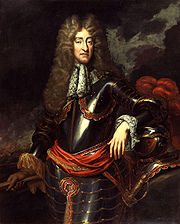
James II & VII was King of England and King of Ireland as James II and King of Scotland as James VII, from 6 February 1685. He was the last Catholic monarch to reign over the Kingdoms of England, Scotland, and Ireland...
in 1688 when he was replaced by his daughter Mary II
Mary II of England
Mary II was joint Sovereign of England, Scotland, and Ireland with her husband and first cousin, William III and II, from 1689 until her death. William and Mary, both Protestants, became king and queen regnant, respectively, following the Glorious Revolution, which resulted in the deposition of...
jointly with her husband and first cousin William III
William III of England
William III & II was a sovereign Prince of Orange of the House of Orange-Nassau by birth. From 1672 he governed as Stadtholder William III of Orange over Holland, Zeeland, Utrecht, Guelders, and Overijssel of the Dutch Republic. From 1689 he reigned as William III over England and Ireland...
. The Stuarts lived in exile on the European mainland after that, occasionally attempting to regain the throne with the aid of France and Spain. The primary seats of Jacobitism were Scotland
Scotland
Scotland is a country that is part of the United Kingdom. Occupying the northern third of the island of Great Britain, it shares a border with England to the south and is bounded by the North Sea to the east, the Atlantic Ocean to the north and west, and the North Channel and Irish Sea to the...
, particularly the Scottish Highlands
Scottish Highlands
The Highlands is an historic region of Scotland. The area is sometimes referred to as the "Scottish Highlands". It was culturally distinguishable from the Lowlands from the later Middle Ages into the modern period, when Lowland Scots replaced Scottish Gaelic throughout most of the Lowlands...
, and Ireland. In England, Jacobitism was strongest in the north
Northern England
Northern England, also known as the North of England, the North or the North Country, is a cultural region of England. It is not an official government region, but rather an informal amalgamation of counties. The southern extent of the region is roughly the River Trent, while the North is bordered...
, and some support also existed in Wales
Wales
Wales is a country that is part of the United Kingdom and the island of Great Britain, bordered by England to its east and the Atlantic Ocean and Irish Sea to its west. It has a population of three million, and a total area of 20,779 km²...
.
Many embraced Jacobitism because they believed parliamentary interference with monarchical succession to be illegitimate, and many Catholics hoped the Stuarts would end discriminatory penal laws in England
Penal law
In the most general sense, penal is the body of laws that are enforced by the State in its own name and impose penalties for their violation, as opposed to civil law that seeks to redress private wrongs...
and Ireland
Penal Laws (Ireland)
The term Penal Laws in Ireland were a series of laws imposed under English and later British rule that sought to discriminate against Roman Catholics and Protestant dissenters in favour of members of the established Church of Ireland....
. Still other people of various allegiances became involved in the military campaigns for all sorts of motives. In Scotland the Jacobite cause became entangled in the last throes of the warrior clan system
Scottish clan
Scottish clans , give a sense of identity and shared descent to people in Scotland and to their relations throughout the world, with a formal structure of Clan Chiefs recognised by the court of the Lord Lyon, King of Arms which acts as an authority concerning matters of heraldry and Coat of Arms...
, and became a lasting romantic memory.
The emblem of the Jacobites is the White Rose of York
White Rose of York
The White Rose of York , a white heraldic rose, is the symbol of the House of York and has since been adopted as a symbol of Yorkshire as a whole.-History:...
. White Rose Day is celebrated on 10 June, the anniversary of the birth of the Old Pretender
James Francis Edward Stuart
James Francis Edward, Prince of Wales was the son of the deposed James II of England...
in 1688.
Political background
From the second half of the 17th century onwards, a time of political and religious turmoil existed in the kingdoms. The CommonwealthCommonwealth of England
The Commonwealth of England was the republic which ruled first England, and then Ireland and Scotland from 1649 to 1660. Between 1653–1659 it was known as the Commonwealth of England, Scotland and Ireland...
ended with the Restoration of Charles II
Charles II of England
Charles II was monarch of the three kingdoms of England, Scotland, and Ireland.Charles II's father, King Charles I, was executed at Whitehall on 30 January 1649, at the climax of the English Civil War...
. During his reign the Church of England
Church of England
The Church of England is the officially established Christian church in England and the Mother Church of the worldwide Anglican Communion. The church considers itself within the tradition of Western Christianity and dates its formal establishment principally to the mission to England by St...
was re-established, and episcopal church government
Scottish Episcopal Church
The Scottish Episcopal Church is a Christian church in Scotland, consisting of seven dioceses. Since the 17th century, it has had an identity distinct from the presbyterian Church of Scotland....
was restored in Scotland. The latter move was particularly contentious, causing many, especially in the south-west of Scotland, to abandon the official church, attending illegal field assemblies known as conventicles in preference. The authorities attempted some accommodation with Presbyterian dissidents, introducing official 'Indulgences' in 1669 and 1672, meeting with some limited success. Towards the end of Charles' reign those with more radical Presbyterian opinions, known as the Covenanters, who favoured rejecting all compromise with the state, began to move away from religious dissent to outright political sedition. This was particularly true of the followers of the Reverend Richard Cameron
Richard Cameron (religious leader)
Richard Cameron was a leader of the Presbyterians who resisted the Stuart monarchs in their attempts to control the affairs of the Church of Scotland, acting through Bishops. His followers took his name, the Cameronians, which ultimately formed the nucleus of the later Scottish regiment of the...
, soon to be known as the Cameronian
Cameronian
Cameronian was a name given to a section of the Scottish Covenanters who followed the teachings of Richard Cameron, and who were composed principally of those who signed the Sanquhar Declaration in 1680...
s. The government increasingly resorted to force in its attempts to stamp out the Cameronians and the other Society Men, in a period subsequently labelled as the Killing Time
The Killing Time
thumb|240px|[[Margaret Wilson |Margaret Wilson]], one of the 'Wigtown Martyrs', executed by drowning in the incoming tide of the Solway Firth ....
.
Since the late Middle Ages
Middle Ages
The Middle Ages is a periodization of European history from the 5th century to the 15th century. The Middle Ages follows the fall of the Western Roman Empire in 476 and precedes the Early Modern Era. It is the middle period of a three-period division of Western history: Classic, Medieval and Modern...
the Kingdoms of England and Scotland had been evolving towards a quasi-oligarchical or collegiate form of government in which the monarch was held to rule with the consensus of the land-owning upper classes.
The reigns of the last three Stuart Kings – Charles I
Charles I of England
Charles I was King of England, King of Scotland, and King of Ireland from 27 March 1625 until his execution in 1649. Charles engaged in a struggle for power with the Parliament of England, attempting to obtain royal revenue whilst Parliament sought to curb his Royal prerogative which Charles...
, Charles II and James II and VII – were marked by growing Royal resistance to this developing consensual model of government. In part the Kings were inspired by the development of Royal Absolutism in contemporary Europe (see Louis XIV). In part, however, the apologists of royal authority based their claims on a just assessment of the powers claimed by England and Scotland's medieval monarchs.
In 1685 Charles II was succeeded by his Roman Catholic brother, James II and VII
James II of England
James II & VII was King of England and King of Ireland as James II and King of Scotland as James VII, from 6 February 1685. He was the last Catholic monarch to reign over the Kingdoms of England, Scotland, and Ireland...
. In addition to sharing his family's absolutist views of government, James tried to introduce religious tolerance of Roman Catholics and Protestant Dissenters. In Seventeenth-century Europe, being a religious outsider meant being a political and social outsider as well. James tried to encourage the participation in public life of Roman Catholics, Protestant Dissenters, and Quakers such as William Penn
William Penn
William Penn was an English real estate entrepreneur, philosopher, and founder of the Province of Pennsylvania, the English North American colony and the future Commonwealth of Pennsylvania. He was an early champion of democracy and religious freedom, notable for his good relations and successful...
the Younger. Such attempts to broaden his basis of support succeeded in antagonising members of the Anglican establishment.
In Ireland, James's viceroy, Richard Talbot, 1st Earl of Tyrconnell, was the first Catholic viceroy since the Reformation
English Reformation
The English Reformation was the series of events in 16th-century England by which the Church of England broke away from the authority of the Pope and the Roman Catholic Church....
and acted to reduce Protestant ascendancy and to have strong points in Ireland controlled by garrisons loyal to the views of James.
In England and Scotland, James attempted to impose religious toleration, which helped the Catholic minority but alarmed the religious and political establishment. William of Orange
William III of England
William III & II was a sovereign Prince of Orange of the House of Orange-Nassau by birth. From 1672 he governed as Stadtholder William III of Orange over Holland, Zeeland, Utrecht, Guelders, and Overijssel of the Dutch Republic. From 1689 he reigned as William III over England and Ireland...
, building alliances
Grand Alliance
The Grand Alliance was a European coalition, consisting of Austria, Bavaria, Brandenburg, the Dutch Republic, England, the Holy Roman Empire, Ireland, the Palatinate of the Rhine, Portugal, Savoy, Saxony, Scotland, Spain and Sweden...
against France, lobbied the English political élite to have James replaced by William's wife Mary
Mary II of England
Mary II was joint Sovereign of England, Scotland, and Ireland with her husband and first cousin, William III and II, from 1689 until her death. William and Mary, both Protestants, became king and queen regnant, respectively, following the Glorious Revolution, which resulted in the deposition of...
who was James's daughter and next in line to the throne, but they were reluctant to rush a succession expected to happen in due course. Then in 1688 James's second wife had a boy, bringing the prospect of a Catholic dynasty, and the "Immortal Seven" invited William and Mary to depose James. On 4 November 1688 William arrived at Torbay
Torbay
Torbay is an east-facing bay and natural harbour, at the western most end of Lyme Bay in the south-west of England, situated roughly midway between the cities of Exeter and Plymouth. Part of the ceremonial county of Devon, Torbay was made a unitary authority on 1 April 1998...
, England and, when he landed the next day, at Brixham
Brixham
Brixham is a small fishing town and civil parish in the county of Devon, in the south-west of England. Brixham is at the southern end of Torbay, across the bay from Torquay, and is a fishing port. Fishing and tourism are its major industries. At the time of the 2001 census it had a population of...
, James fled to France: in February 1689 the Glorious Revolution
Glorious Revolution
The Glorious Revolution, also called the Revolution of 1688, is the overthrow of King James II of England by a union of English Parliamentarians with the Dutch stadtholder William III of Orange-Nassau...
formally changed England's monarch, but many Catholics, Episcopalians and Tory
Tory
Toryism is a traditionalist and conservative political philosophy which grew out of the Cavalier faction in the Wars of the Three Kingdoms. It is a prominent ideology in the politics of the United Kingdom, but also features in parts of The Commonwealth, particularly in Canada...
royalists still supported James as the constitutionally legitimate monarch.
Scotland was slow to accept William, who summoned a Convention of the Estates which met on 14 March 1689 in Edinburgh
Edinburgh
Edinburgh is the capital city of Scotland, the second largest city in Scotland, and the eighth most populous in the United Kingdom. The City of Edinburgh Council governs one of Scotland's 32 local government council areas. The council area includes urban Edinburgh and a rural area...
and considered a conciliatory letter from William and a haughty one from James. Forces of Cameronian
Cameronian
Cameronian was a name given to a section of the Scottish Covenanters who followed the teachings of Richard Cameron, and who were composed principally of those who signed the Sanquhar Declaration in 1680...
s as well as Clan Campbell
Clan Campbell
Clan Campbell is a Highland Scottish clan. Historically one of the largest, most powerful and most successful of the Highland clans, their lands were in Argyll and the chief of the clan became the Earl and later Duke of Argyll.-Origins:...
highlanders led by the Earl of Argyll
Archibald Campbell, 1st Duke of Argyll
Archibald Campbell, 1st Duke of Argyll, 10th Earl of Argyll was a Scottish peer.-Biography:The eldest son of Archibald Campbell, 9th Earl of Argyll and Mary Stuart, daughter of James Stuart, 4th Earl of Moray, Campbell sought to recover his father's estates...
had come to bolster William's support. On James's side a more modest force of a troop of fifty horsemen gathered by John Graham of Claverhouse, Viscount Dundee was in town, and he attended the convention at the start but withdrew four days later when support for William became evident. The convention set out its terms and William and Mary were proclaimed at Edinburgh on 11 April 1689, then had their coronation in London in May.
Religion
While Jacobitism was closely linked with Catholicism from the outset, particularly in Ireland, elsewhere in Britain Catholics were a small minority by 1689 and the bulk of Jacobite support came from other groups. Catholics formed about 75% of the population of Ireland. In England, however, not more than 2–3 percent of the population could have been "practising Catholics," though in the north and south of England, "at least one half of the population outside the towns were Catholic in some degree." By this definition, Catholics would have numbered "10–15 percent of the total English population." Catholics survived most strongly among the nobility, of whom "15–20 percent clung to the old faith...." In Scotland (excluding the Highlands and the Isles), about two percent.Ireland
Irish support for James II was mostly from Catholics, though by taking the French side against the League of Augsburg, James was siding against the Papacy politically. William was allied to many Catholic states, including the Holy Roman EmpireHoly Roman Empire
The Holy Roman Empire was a realm that existed from 962 to 1806 in Central Europe.It was ruled by the Holy Roman Emperor. Its character changed during the Middle Ages and the Early Modern period, when the power of the emperor gradually weakened in favour of the princes...
, and his elite force the Dutch Blue Guards
Dutch Blue Guards
The Dutch Blue Guards were an elite infantry unit of the army of the United Provinces of the Netherlands. Notable campaigns where they fought included the Nine Years' War , where they distinguished themselves at the battle of the Boyne, battle of Fleurus and the siege of Limerick .From 1688 to...
had the papal banner with them. The war in Ireland was predominantly a Catholic uprising, and after its defeat in 1691, the Catholics' only military contribution to Jacobite support came from the Irish Brigade
Irish Brigade (French)
The Irish Brigade was a brigade in the French army composed of Irish exiles, led by Robert Reid. It was formed in May 1690 when five Jacobite regiments were sent from Ireland to France in return for a larger force of French infantry who were sent to fight in the Williamite war in Ireland...
of the French army.
Jacobitism in Ireland had its roots in Irish support for the Stuart dynasty dating back to the accession of James I to the throne in 1603. Gaelic poets in Ireland lauded James as the first "Irish" king of the Three Kingdoms of England, Scotland and Ireland, because of his family's Gaelic
Gaels
The Gaels or Goidels are speakers of one of the Goidelic Celtic languages: Irish, Scottish Gaelic, and Manx. Goidelic speech originated in Ireland and subsequently spread to western and northern Scotland and the Isle of Man....
ancestry. James and his successors were also viewed as being less hostile to Catholicism than the Tudors. In the Wars of the Three Kingdoms
Wars of the Three Kingdoms
The Wars of the Three Kingdoms formed an intertwined series of conflicts that took place in England, Ireland, and Scotland between 1639 and 1651 after these three countries had come under the "Personal Rule" of the same monarch...
of the 1640s, Irish Catholics organised in Confederate Ireland
Confederate Ireland
Confederate Ireland refers to the period of Irish self-government between the Rebellion of 1641 and the Cromwellian conquest of Ireland in 1649. During this time, two-thirds of Ireland was governed by the Irish Catholic Confederation, also known as the "Confederation of Kilkenny"...
pledged allegiance to Charles I and Charles II against the English Parliament. As a result, most Catholic landowners had their lands confiscated after Parliament's victory and the Catholic Church suffered harsh repression. James II, the first openly Catholic king of England in over a century, was therefore viewed as a saviour by Irish Catholics. James appointed an Irish Catholic Tyrconnell as Lord Deputy of Ireland
Lord Deputy of Ireland
The Lord Deputy was the King's representative and head of the Irish executive under English rule, during the Lordship of Ireland and later the Kingdom of Ireland...
, re-admitted Catholics into the army and militia and introduced toleration for the Catholic religion. During the Williamite war in Ireland
Williamite war in Ireland
The Williamite War in Ireland—also called the Jacobite War in Ireland, the Williamite-Jacobite War in Ireland and in Irish as Cogadh an Dá Rí —was a conflict between Catholic King James II and Protestant King William of Orange over who would be King of England, Scotland and Ireland...
, he also reluctantly agreed to proclaim the autonomy of the Irish Parliament from the English one and the restitution of lands confiscated from Catholics after the Cromwellian conquest of Ireland
Cromwellian conquest of Ireland
The Cromwellian conquest of Ireland refers to the conquest of Ireland by the forces of the English Parliament, led by Oliver Cromwell during the Wars of the Three Kingdoms. Cromwell landed in Ireland with his New Model Army on behalf of England's Rump Parliament in 1649...
. The demands of religious toleration, legislative autonomy and land ownership were the three key elements of Irish Jacobitism, which remained influential until the mid eighteenth century.
England and Scotland
In lowland Scotland, the Catholics tended to come from the gentry and formed the most ideologically committed supporters, drawing on almost two centuries of subterfuge as a minority persecuted by the state and rallying enthusiastically to Jacobite armies as well as contributing financial support to the court in exile. Some Scottish Highland clans such as the Clan Macdonald of Clanranald remained Catholic, but they were exceptions.Just as much dedicated support in England came from the Nonjuring
Nonjuring schism
The nonjuring schism was a split in the Church of England in the aftermath of the Glorious Revolution of 1688, over whether William of Orange and his wife Mary could legally be recognised as King and Queen of England....
Anglicans, which started with Church of England
Church of England
The Church of England is the officially established Christian church in England and the Mother Church of the worldwide Anglican Communion. The church considers itself within the tradition of Western Christianity and dates its formal establishment principally to the mission to England by St...
clergy who refused on principle to take the oath of allegiance to William and Mary while James still lived, and developed into an Episcopalian schism of the church with small congregations in all the English cities. In many respects, Jacobites perceived themselves as the heirs of the Royalists or Cavaliers of the English Civil War
English Civil War
The English Civil War was a series of armed conflicts and political machinations between Parliamentarians and Royalists...
era, who had fought for James II's father Charles I and for the Established Church against the Parliamentarians – who stood for the primacy of Parliament and for religious dissent. Jacobite supporters displayed pictures of both Cavalier and Jacobite heroes in their homes.
Scottish Episcopalians
Scottish Episcopal Church
The Scottish Episcopal Church is a Christian church in Scotland, consisting of seven dioceses. Since the 17th century, it has had an identity distinct from the presbyterian Church of Scotland....
provided over half of the Jacobite forces in Britain, and although Dundee's rising in 1689 came mostly from the western Highlands, in later risings Episcopalians came roughly equally from the north-east Scottish Lowlands
Scottish Lowlands
The Scottish Lowlands is a name given to the Southern half of Scotland.The area is called a' Ghalldachd in Scottish Gaelic, and the Lawlands ....
north of the River Tay
River Tay
The River Tay is the longest river in Scotland and the seventh-longest in the United Kingdom. The Tay originates in western Scotland on the slopes of Ben Lui , then flows easterly across the Highlands, through Loch Dochhart, Loch Lubhair and Loch Tay, then continues east through Strathtay , in...
and from the Highland clans. They too were described as Nonjurors. As Protestants they could take part in Scottish politics, but were in a minority and were repeatedly discriminated against in legislation favouring the established Church of Scotland
Church of Scotland
The Church of Scotland, known informally by its Scots language name, the Kirk, is a Presbyterian church, decisively shaped by the Scottish Reformation....
. The clergy could even be imprisoned, as occurred in the Stonehaven Tolbooth
Stonehaven Tolbooth
The Stonehaven Tolbooth is a late 16th century stone building originally used as a courthouse and a prison in the town of Stonehaven, Aberdeenshire, Scotland...
after three clergymen held services at the chapel at Muchalls Castle
Muchalls Castle
Muchalls Castle stands overlooking the North Sea in the countryside of Kincardine and Mearns, Aberdeenshire, Scotland. The lower course is a well preserved double groined 13th century towerhouse structure, built by the Frasers of Muchalls. Upon this structure, the 17th century castle was begun by...
. However, many Episcopalians were quiet about any Jacobite sympathies and were able to accommodate themselves to the new regime. About half of the Episcopalians supporting the Jacobite cause came from the Lowlands, but this was obscured in the risings by their tendency to wear Highland dress as a kind of Jacobite uniform.
The Scottish Highlands
To the Gaelic-speaking Scottish Highland clans, to whom the supporters of Jacobitism were known as Seumasaich, the conflict was more about inter-clan politics than about religion, and a significant factor was resistance to the territorial ambitions of the (Presbyterian) CampbellsClan Campbell
Clan Campbell is a Highland Scottish clan. Historically one of the largest, most powerful and most successful of the Highland clans, their lands were in Argyll and the chief of the clan became the Earl and later Duke of Argyll.-Origins:...
of Argyll
Argyll
Argyll , archaically Argyle , is a region of western Scotland corresponding with most of the part of ancient Dál Riata that was located on the island of Great Britain, and in a historical context can be used to mean the entire western coast between the Mull of Kintyre and Cape Wrath...
. There was a precedent for post 1689 Jacobitism during the period of the Wars of the Three Kingdoms
Wars of the Three Kingdoms
The Wars of the Three Kingdoms formed an intertwined series of conflicts that took place in England, Ireland, and Scotland between 1639 and 1651 after these three countries had come under the "Personal Rule" of the same monarch...
, when clans from the western Highlands had fought for James's father Charles I against the Campbells and the Covenanters. Another factor in Highland Jacobitism was James VII's sympathetic treatment of the Highland clans. Whereas previous monarchs since the late 16th century had been antagonistic to the Gaelic Highland way of life, James had worked sympathetically with the clan chieftains in the Commission for Pacifying the Highlands. Some Highland chieftains therefore viewed Jacobitism as a means of resisting hostile government intrusion into their territories. The significance of their support for the Stuarts was that the Highlands was the only part of Britain which still maintained private armies, in the form of clan levies. During the Jacobite Rising
Jacobite rising
The Jacobite Risings were a series of uprisings, rebellions, and wars in Great Britain and Ireland occurring between 1688 and 1746. The uprisings were aimed at returning James VII of Scotland and II of England, and later his descendants of the House of Stuart, to the throne after he was deposed by...
s, they provided the bulk of Jacobite manpower.
Opportunists and Adventurers
Another source of Jacobite support came from those dissatisfied with political developments. Some WhigsBritish Whig Party
The Whigs were a party in the Parliament of England, Parliament of Great Britain, and Parliament of the United Kingdom, who contested power with the rival Tories from the 1680s to the 1850s. The Whigs' origin lay in constitutional monarchism and opposition to absolute rule...
, most obviously the Earl of Mar
John Erskine, 22nd Earl of Mar
John Erskine, 22nd and de jure 6th Earl of Mar, KT , Scottish Jacobite, was the eldest son of the 21st Earl of Mar , from whom he inherited estates that were heavily loaded with debt. By modern reckoning he was 22nd Earl of Mar of the first creation and de jure 6th Earl of Mar of the seventh...
, reacted to political disappointments by joining the Jacobites, but while others were courted from 1692 onwards and indicated support, mostly this was just reinsurance in case the Jacobites came out on top.
The Tories
Tory
Toryism is a traditionalist and conservative political philosophy which grew out of the Cavalier faction in the Wars of the Three Kingdoms. It is a prominent ideology in the politics of the United Kingdom, but also features in parts of The Commonwealth, particularly in Canada...
were a more likely source of support given their commitment to church and king, but many were reluctant to trust the Church of England
Church of England
The Church of England is the officially established Christian church in England and the Mother Church of the worldwide Anglican Communion. The church considers itself within the tradition of Western Christianity and dates its formal establishment principally to the mission to England by St...
to a Catholic king. At times such as 1715–1722 when the Hanoverians appeared to be dismantling Anglican dominance and 1743–1745 when Whig dealings denied the Tories parliamentary victory they would coalesce and turn to the Jacobites, but they were reluctant when it came to serious action. Nevertheless this gave hopes that large numbers of Tories would support a Jacobite rising with a serious prospect of winning, particularly when helped by foreign intervention. The rise and fall of the earlier Tory alliance with the Jacobites forms a major part of the background for Sir Walter Scott's Bride of Lammermoor.
Other Jacobite recruits could be described as adventurers – desperate men who saw the cause as a solution to their (usually financial) problems. Although small in number and varying from unemployed weavers looking for excitement to impoverished gentry like William Boyd, 4th Earl of Kilmarnock
William Boyd, 4th Earl of Kilmarnock
William Boyd , 4th Earl of Kilmarnock, was a Scottish nobleman.William Boyd was educated at Glasgow. Like his father in the rebellion of 1715, William initially supported the Government side, but in the rebellion of 1745, owing either to a personal affront or to the influence of his wife or to his...
who served Charles as a colonel and became a general after the Battle of Falkirk
Battle of Falkirk (1746)
During the Second Jacobite Rising, the Battle of Falkirk Muir was the last noteworthy Jacobite success.-Background:...
, they contributed significantly to the daring that brought the Jacobites a prospect of success in their campaigns. However, other such mercenaries often became spies and informers.
Jacobite ideology
Jacobite ideology comprised four main tenets: The divine right of kingsDivine Right of Kings
The divine right of kings or divine-right theory of kingship is a political and religious doctrine of royal and political legitimacy. It asserts that a monarch is subject to no earthly authority, deriving his right to rule directly from the will of God...
, the "accountability of Kings to God alone", inalienable hereditary right, and the "unequivocal scriptural injunction of non-resistance and passive obedience", though these positions were not unique to the Jacobites. What distinguished Jacobites from Whigs was their adherence to 'right' as the basis for the law, whereas the Whigs held to the idea of 'possession' as the basis of the law. However, such distinctions became less clear over time, with an increase in the use of contract theory
Social contract
The social contract is an intellectual device intended to explain the appropriate relationship between individuals and their governments. Social contract arguments assert that individuals unite into political societies by a process of mutual consent, agreeing to abide by common rules and accept...
by some Jacobite writers during the reign of George I.
Jacobites contended that James II had not been legally deprived of his throne, that the Convention Parliament and its successors were not legal. Scottish Jacobites resisted the Act of Union 1707, while not recognising Parliamentary Great Britain Jacobites recognised their monarchs as Kings of Great Britain.
Jacobite community and policy
- Further developments are mentioned under "Jacobitism in England" below.
From its religious roots, Jacobite ideology was passed on through committed families of the nobility and gentry who would have pictures of the exiled royal family and of Cavalier and Jacobite martyrs, and take part in like minded networks. Even today, some Highland clans and regiments pass their drink over a glass of water during the Loyal Toast – to the King Over the Water. More widely, commoners developed communities in areas where they could fraternise in Jacobite alehouses, inns and taverns, singing seditious songs, collecting for the cause and on occasion being recruited for risings. At government attempts to close such places they simply transferred to another venue. In these neighbourhoods Jacobite wares such as inscribed glassware, brooches with hidden symbols and tartan waistcoats were popular. The criminal activity of smuggling became associated with Jacobitism throughout Britain, partly because of the advantage of dealing through exiled Jacobites in France.
Official policy of the court in exile initially reflected the uncompromising intransigence that got James into trouble in the first place. With the powerful support of the French they saw no need to accommodate the concerns of his Protestant subjects, and effectively issued a summons for them to return to their duty. In 1703 Louis pressed James into a more accommodating stance in the hopes of detaching England from the Grand Alliance, essentially promising to maintain the status quo. This policy soon changed, and increasingly Jacobitism ostensibly identified itself with causes of the alienated and dispossessed.
Military campaigns and Jacobitism
This section focuses on the political context. For military aspects of these campaigns see the Williamite war in IrelandWilliamite war in Ireland
The Williamite War in Ireland—also called the Jacobite War in Ireland, the Williamite-Jacobite War in Ireland and in Irish as Cogadh an Dá Rí —was a conflict between Catholic King James II and Protestant King William of Orange over who would be King of England, Scotland and Ireland...
and Jacobite Rising
Jacobite rising
The Jacobite Risings were a series of uprisings, rebellions, and wars in Great Britain and Ireland occurring between 1688 and 1746. The uprisings were aimed at returning James VII of Scotland and II of England, and later his descendants of the House of Stuart, to the throne after he was deposed by...
s.
Jacobite war in Ireland
James II and VII had his viceroy Tyrconnell take action to secure Ireland for the Catholic cause, culminating in the Siege of DerrySiege of Derry
The Siege of Derry took place in Ireland from 18 April to 28 July 1689, during the Williamite War in Ireland. The city, a Williamite stronghold, was besieged by a Jacobite army until it was relieved by Royal Navy ships...
which began on 7 December 1688. By then the deposed James had fled to France, and with support from Louis XIV, who was already at war
War of the Grand Alliance
The Nine Years' War – often called the War of the Grand Alliance, the War of the Palatine Succession, or the War of the League of Augsburg – was a major war of the late 17th century fought between King Louis XIV of France, and a European-wide coalition, the Grand Alliance, led by the Anglo-Dutch...
with William of Orange.
James landed in Ireland on 12 March 1689. Having taken Dublin and joined the Siege of Derry, he reluctantly agreed to the demands of a now almost all Catholic Irish Parliament (the Patriot Parliament
Patriot Parliament
The Patriot Parliament is the name given to the session of the Irish Parliament called by King James II of Ireland during the War of the Two Kings in 1689. The parliament met in one session, from 7 May 1689 to 20 July 1689, and was the only session of the Irish Parliament under King James II.The...
) for an act declaring that the Parliament of England had no right to pass laws for Ireland, toleration of Catholicism and a reversal of the Cromwellian confiscations. Williamite forces relieved the siege of Derry in August, 1689 and cleared most of Ulster
Ulster
Ulster is one of the four provinces of Ireland, located in the north of the island. In ancient Ireland, it was one of the fifths ruled by a "king of over-kings" . Following the Norman invasion of Ireland, the ancient kingdoms were shired into a number of counties for administrative and judicial...
of Jacobites. Skirmishes continued across the country until winter set in, hitting the Williamite army particularly hard.
In light of the little progress, William decided to take charge in person and arrived at Belfast Lough on 14 June 1690. The following 1 July, William and James met, accompanied by 50,000 of their men, at the Battle of the Boyne
Battle of the Boyne
The Battle of the Boyne was fought in 1690 between two rival claimants of the English, Scottish and Irish thronesthe Catholic King James and the Protestant King William across the River Boyne near Drogheda on the east coast of Ireland...
. The Jacobite army retreated, incurring little damage under cavalry, but demoralised by defeat. Despite leaving the field relatively unscathed, James fled to France, leaving the Irish to fight on and acquiring the nickname Séamus an chaca (James, the shite) in Irish folk memory. A year later on 12 July 1691, over 7,000 died at the Battle of Aughrim
Battle of Aughrim
The Battle of Aughrim was the decisive battle of the Williamite War in Ireland. It was fought between the Jacobites and the forces of William III on 12 July 1691 , near the village of Aughrim in County Galway....
. This defeat saw the effective end of the Jacobite cause in Ireland although the city of Limerick
Limerick
Limerick is the third largest city in the Republic of Ireland, and the principal city of County Limerick and Ireland's Mid-West Region. It is the fifth most populous city in all of Ireland. When taking the extra-municipal suburbs into account, Limerick is the third largest conurbation in the...
held out under siege until October (see the Siege of Limerick) eventually negotiating a treaty. Under the terms, 14,000 Jacobite soldiers chose to continue fighting the Jacobite cause on the Continent, the so-called Flight of the Wild Geese
Flight of the Wild Geese
The Flight of the Wild Geese refers to the departure of an Irish Jacobite army under the command of Patrick Sarsfield from Ireland to France, as agreed in the Treaty of Limerick on October 3, 1691, following the end of the Williamite War in Ireland...
(1,000 more chose to join the Williamite cause and 2,000 more chose to return to their homes). The treaty also contained provision for religious tolerance in Ireland. These latter terms were not upheld and following the conclusion of the war in Ireland a return to the Anglican-dominated parliament saw the provisions of the Patriot Parliament declared null and void, and as a series of Penal Laws subsequently enacted.
Jacobitism lingered on for another century in the ideology of nationalist secret societies, but did not play an overt role again in Ireland.
Dundee's rising
Dundee
Dundee is the fourth-largest city in Scotland and the 39th most populous settlement in the United Kingdom. It lies within the eastern central Lowlands on the north bank of the Firth of Tay, which feeds into the North Sea...
Law with fewer than fifty men in support. At that time he was known as Bluidy Clavers for his part in dealing with Covenanter
Covenanter
The Covenanters were a Scottish Presbyterian movement that played an important part in the history of Scotland, and to a lesser extent in that of England and Ireland, during the 17th century...
s, but nowadays he is sometimes remembered as Bonnie Dundee
Bonnie Dundee
Bonnie Dundee is a poem and a song about John Graham, 7th Laird of Claverhouse, 1st Viscount Dundee who was known by this nickname. The song has been used as a regimental march by several Scottish regiments in the British Army and was adapted by Confederate troops in the American Civil...
from the words of a sentimental popular song written by the Romantic novelist, Walter Scott
Walter Scott
Sir Walter Scott, 1st Baronet was a Scottish historical novelist, playwright, and poet, popular throughout much of the world during his time....
, in 1830. At first he had difficulty in raising many supporters, but after the Williamite commander had proved ineffective and 200 Irish troops had landed at Kintyre
Kintyre
Kintyre is a peninsula in western Scotland, in the southwest of Argyll and Bute. The region stretches approximately 30 miles , from the Mull of Kintyre in the south, to East Loch Tarbert in the north...
he gained support from Catholic and Episcopalian Highland clans, though not from the Episcopal bishops of the Scots nobility.
Victory for the Jacobite Highlanders at the Battle of Killiecrankie
Battle of Killiecrankie
-References:*Reid, Stuart, The Battle of Kiellliecrankkie -External links:* *...
on 27 July 1689 was marred when Dundee was killed in the fighting. A series of government expeditions to subdue the Highlands eventually led to Jacobite defeat in May 1690 and lingering hopes faded with news of the Battle of the Boyne
Battle of the Boyne
The Battle of the Boyne was fought in 1690 between two rival claimants of the English, Scottish and Irish thronesthe Catholic King James and the Protestant King William across the River Boyne near Drogheda on the east coast of Ireland...
. A year later the Jacobites were forced to agree to a truce while the clan chiefs sent requests to the exiled James VII and II for permission to submit to William, and in January 1692 the Jacobite clans formally surrendered to the government.
William's main interest was in the War of the Grand Alliance in the Low Countries against the French and he paid little attention to Scotland, trying to bribe or coerce the clan leaders. His demands that each chief put in writing the submission authorised by James resulted in the Massacre of Glencoe
Massacre of Glencoe
Early in the morning of 13 February 1692, in the aftermath of the Glorious Revolution and the Jacobite uprising of 1689 led by John Graham of Claverhouse, an infamous massacre took place in Glen Coe, in the Highlands of Scotland. This incident is referred to as the Massacre of Glencoe, or in...
on 13 February 1692.
James Francis Edward's attempted invasion
In 1701 James II and VII died. He was succeeded in his claims by his son, James Francis Edward StuartJames Francis Edward Stuart
James Francis Edward, Prince of Wales was the son of the deposed James II of England...
. He was recognised as King James III of England and King James VIII of Scotland by the courts of France, Spain, and Modena, and by the Pope. To his detractors he was eventually to be known as the Old Pretender, while his supporters referred to him as the King Across the Water.
After a brief peace, the War of the Spanish Succession
War of the Spanish Succession
The War of the Spanish Succession was fought among several European powers, including a divided Spain, over the possible unification of the Kingdoms of Spain and France under one Bourbon monarch. As France and Spain were among the most powerful states of Europe, such a unification would have...
renewed French support for the Jacobites and in 1708 James Francis set out with French troops, but the French fleet was chased away by the Royal Navy
Royal Navy
The Royal Navy is the naval warfare service branch of the British Armed Forces. Founded in the 16th century, it is the oldest service branch and is known as the Senior Service...
and retreated round the north of Scotland back to France.
Hanoverians
In March 1702 William died and the throne passed to Mary's sister AnneAnne of Great Britain
Anne ascended the thrones of England, Scotland and Ireland on 8 March 1702. On 1 May 1707, under the Act of Union, two of her realms, England and Scotland, were united as a single sovereign state, the Kingdom of Great Britain.Anne's Catholic father, James II and VII, was deposed during the...
, the last of James II and VII's children to sit upon the thrones of England and Scotland. Scotland's economy was faltering and the English parliament used trade sanctions to force the Scottish parliament towards union. One Scottish politician who thrived in these unpopular negotiations was the Earl of Mar who, despite his Episcopalian background, ably supported the Scottish Revolution interest and after being a signatory to the Act of Union of 1707 was rewarded by Queen Anne and rose in the new British parliament to a key role in running Scottish affairs, a position formalised in 1713 when the post of Secretary of State for Scotland
Secretary of State for Scotland
The Secretary of State for Scotland is the principal minister of Her Majesty's Government in the United Kingdom with responsibilities for Scotland. He heads the Scotland Office , a government department based in London and Edinburgh. The post was created soon after the Union of the Crowns, but was...
was revived for him.
In that year he was part of the ministry that negotiated the Treaty of Utrecht which ended hostilities between France and Britain, in a deal unpopular with Hanoverians and Whigs.
Widespread discontent gave the Jacobites increasing hopes that James Francis Edward Stuart
James Francis Edward Stuart
James Francis Edward, Prince of Wales was the son of the deposed James II of England...
would gain power when the popular Anne died leaving no immediate successor. However, the Act of Settlement 1701
Act of Settlement 1701
The Act of Settlement is an act of the Parliament of England that was passed in 1701 to settle the succession to the English throne on the Electress Sophia of Hanover and her Protestant heirs. The act was later extended to Scotland, as a result of the Treaty of Union , enacted in the Acts of Union...
required the monarch to be Protestant while James Francis was a devout Catholic. The crown therefore passed to Anne's second cousin the Elector of Hanover, great grandson of James I of England and VI of Scotland, who thus became George I
George I of Great Britain
George I was King of Great Britain and Ireland from 1 August 1714 until his death, and ruler of the Duchy and Electorate of Brunswick-Lüneburg in the Holy Roman Empire from 1698....
. The Whigs
British Whig Party
The Whigs were a party in the Parliament of England, Parliament of Great Britain, and Parliament of the United Kingdom, who contested power with the rival Tories from the 1680s to the 1850s. The Whigs' origin lay in constitutional monarchism and opposition to absolute rule...
acted quickly to bring in the new king, forestalling possible arguments. George I spoke poor English, but was a proven soldier and statesman and extremely popular with his subjects, who constructed their own images of his kingship in the absence of a centrally-driven propaganda campaign of the sort undertaken by Louis XIV of France and the later Stuart kings. George favoured the Whigs, and in the spring of 1715 the Tories
Tory
Toryism is a traditionalist and conservative political philosophy which grew out of the Cavalier faction in the Wars of the Three Kingdoms. It is a prominent ideology in the politics of the United Kingdom, but also features in parts of The Commonwealth, particularly in Canada...
lost the general election to the Whigs, who then impeached Tory leaders for their part in the peace negotiations with France. Tory fears for themselves and for the high Church of England led to conspiracy for armed rebellion, but when the time came their leaders were paralysed with fear and indecision and an alerted government ordered the arrest of the major players. At the day for the rising in the south-west a large number of Tory gentry turned up for "a race meeting" at Bath, but on receiving a letter from their leader (who was in hiding) saying that all was lost, they went home.
The 'Fifteen'
In Scotland years of famine and hardship provided fertile ground for what is often referred to as the First Jacobite Rising (or Rebellion).Mar had found himself identified with the previous government, which thwarted his attempts to continue in office in the incoming Hanoverian
House of Hanover
The House of Hanover is a deposed German royal dynasty which has ruled the Duchy of Brunswick-Lüneburg , the Kingdom of Hanover, the Kingdom of Great Britain, the Kingdom of Ireland and the United Kingdom of Great Britain and Ireland...
government of King George I, and fearing impeachment, he turned his loyalty to James, justifying his nickname Bobbin' John.
James Francis corresponded with Mar from France as part of widespread Jacobite plotting, and in the summer of 1715 he called on Mar to raise the clans without further delay. Mar, realising that the government had found out about his part in the conspiracy, rushed from London to Braemar
Braemar
Braemar is a village in Aberdeenshire, Scotland, around west of Aberdeen in the Highlands. It is the closest significantly-sized settlement to the upper course of the River Dee sitting at an altitude of ....
and summoned clan leaders to "a grand hunting-match" on 27 August 1715 where he announced his change of allegiance. On 6 September he proclaimed James as "their lawful sovereign" and raised the old Scottish standard, whereupon (ominously) the gold ball fell off the top of the flagpole. Mar's proclamation called on men to fight "for the relief of our native country from oppression and a foreign yoke too heavy for us or our posterity to bear."
While Mar succeeded in raising an alliance of clans and northern Lowlanders, he turned out to be an indifferent and indecisive general. Planned risings in Wales
Wales
Wales is a country that is part of the United Kingdom and the island of Great Britain, bordered by England to its east and the Atlantic Ocean and Irish Sea to its west. It has a population of three million, and a total area of 20,779 km²...
and Devon
Devon
Devon is a large county in southwestern England. The county is sometimes referred to as Devonshire, although the term is rarely used inside the county itself as the county has never been officially "shired", it often indicates a traditional or historical context.The county shares borders with...
were forestalled by government arrests. A rising in the north of England joined forces with a rising in the south of Scotland and with a contingent from Mar marched into England, but did not meet the expected welcome and surrendered after a brief siege at the Battle of Preston (1715)
Battle of Preston (1715)
The Battle of Preston , also referred to as the Preston Fight, was fought during the Jacobite Rising of 1715 ....
.
Mar's forces in Scotland were unable to defeat government forces. A ship from France belatedly brought James Francis to Peterhead
Peterhead
Peterhead is a town in Aberdeenshire, Scotland. It is Aberdeenshire's biggest settlement , with a population of 17,947 at the 2001 Census and estimated to have fallen to 17,330 by 2006....
, but he was too consumed by melancholy and fits of fever to inspire his followers. After briefly setting up court at Scone, Perthshire then retreating to the coast, he withdrew to France with Mar on 4 February 1716, leaving a message advising his Highland followers to shift for themselves.
Jacobitism in Britain
George remained popular with the majority of his subjects, but over the next five years, and to a reduced extent afterwards, a significant section of the British crowd asserted loyalism in Jacobite forms, including songs, symbolic oak leaves and white roses worn on anniversaries, attacks on Whigs and hanging or burning effigies of George with cuckold's horns. They derided his marital problems and alleged mistresses (who got nicknames like the Goose and the Elephant) with songs (preserved in Jacobite ReliquesJacobite Reliques
Hogg's Jacobite Reliques is a collection of songs related to the Jacobite risings, compiled by James Hogg on commission from the Highland Society of London in 1817. Most of the songs in the collection are Jacobite, and a minority are Whig...
) like Cam Ye O'er Frae France
Cam Ye O'er Frae France
Cam ye o'er frae France is a Scots mocking folk song from the time of the Jacobite Revolution in the 18th century.-Background:After the death of Queen Anne the British crown passed on to George, the Elector of Hanover...
which includes the words "Saw ye Geordie's grace, riding on a goosie?". Roman Catholic liturgical
Liturgy
Liturgy is either the customary public worship done by a specific religious group, according to its particular traditions or a more precise term that distinguishes between those religious groups who believe their ritual requires the "people" to do the "work" of responding to the priest, and those...
books were often decorated with Jacobite floral imagery, and the texts had coded Jacobite meanings, one example being the hymn Adeste Fideles
Adeste Fideles
"Adeste Fideles" is a hymn tune attributed to English hymnist John Francis Wade . The text itself has unclear beginnings, and may have been written in the 13th century by John of Reading, though it has been concluded that Wade was probably the author.The original four verses of the hymn were...
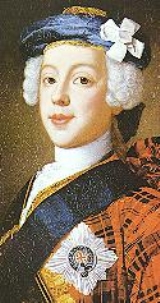
(also known as O Come All Ye Faithful), a birth ode to Bonnie Prince Charlie
Charles Edward Stuart
Prince Charles Edward Louis John Casimir Sylvester Severino Maria Stuart commonly known as Bonnie Prince Charlie or The Young Pretender was the second Jacobite pretender to the thrones of Great Britain , and Ireland...
replete with secret references decipherable by the "faithful" – the followers of the Pretender, James Francis Edward Stuart
James Francis Edward Stuart
James Francis Edward, Prince of Wales was the son of the deposed James II of England...
.
In the minds of many, the "King over the Water" (whom the Jacobites' opponents called the Old Pretender) became a mythical Arthurian
King Arthur
King Arthur is a legendary British leader of the late 5th and early 6th centuries, who, according to Medieval histories and romances, led the defence of Britain against Saxon invaders in the early 6th century. The details of Arthur's story are mainly composed of folklore and literary invention, and...
figure, a good king who would one day return and put things right. There was also a developing myth of Jacobite martyrs, praising the brave defiance of Jacobites at the scaffold and treasuring relics in an almost religious way. This inspired their supporters, but for most people these hangings merely showed that the Jacobites were on the losing side.
Spanish support of Jacobite invasion
The failure of the 'Fifteen convinced the Jacobites that to overthrow the Hanoverians they needed the support of a major European power, and in an age when the Habsburg empire was collapsing and armies becoming professionalised this gave a lever to any country in dispute with Britain.With France still at peace, the Jacobites found a new ally in Spain's Minister to the King, Cardinal Giulio Alberoni
Giulio Alberoni
Giulio Alberoni was an Italian cardinal andstatesman in the service of Philip V of Spain.-Early years:He was born near Piacenza, probably at the village of Fiorenzuola d'Arda in the Duchy of Parma....
, but an invasion force which set sail in 1719 failed to reach England and the party of Jacobites and Spanish soldiers which reached Scotland met only lukewarm support and the Spanish soldiers were forced to surrender at the Battle of Glen Shiel
Battle of Glen Shiel
The Battle of Glen Shiel was a battle in Glen Shiel, in the West Highlands of Scotland on 10 June 1719, between British government troops and an alliance of Jacobites and Spaniards, resulting in a victory for the government forces. It was the last close engagement of British and foreign troops on...
.
The Atterbury plot
Francis AtterburyFrancis Atterbury
Francis Atterbury was an English man of letters, politician and bishop.-Early life:He was born at Milton Keynes in Buckinghamshire, where his father was rector. He was educated at Westminster School and Christ Church, Oxford, where he became a tutor...
, Bishop of Rochester and a passionate High Tory, conspired with Mar who had been appointed "Secretary of State" by James Francis in France, for a rising to coincide with the general election in 1722 aiming to exploit public anger over the South Sea Bubble. English Tories out in their constituencies were to summon their kinsmen, friends and tenants to secure their localities and march on London, while volunteers from the Irish Brigade were to land in the south to join them. While the French were sympathetic, an official request for assistance from the Jacobite court in exile meant that they could no longer turn a blind eye
Turn a blind eye
The idiom turning a blind eye is used to describe the process of ignoring unpopular orders or inconvenient facts or activities.The phrase to turn a blind eye is attributed to an incident in the life of Admiral Horatio Nelson....
so they informed the English ambassador and posted the Irish Brigade out of temptation's way. Mar was bullied into betraying the conspiracy, which collapsed with arrests, denunciations and flights abroad.
Aftermath of the 'Fifteen' in Scotland
In the aftermath of the 'Fifteen, the Disarming Act and the Clan Act made ineffectual attempts to subdue the Scottish HighlandsScottish Highlands
The Highlands is an historic region of Scotland. The area is sometimes referred to as the "Scottish Highlands". It was culturally distinguishable from the Lowlands from the later Middle Ages into the modern period, when Lowland Scots replaced Scottish Gaelic throughout most of the Lowlands...
, and efforts at "rooting out of the Irish language" (Gaelic
Scottish Gaelic language
Scottish Gaelic is a Celtic language native to Scotland. A member of the Goidelic branch of the Celtic languages, Scottish Gaelic, like Modern Irish and Manx, developed out of Middle Irish, and thus descends ultimately from Primitive Irish....
) were renewed. Government garrisons were built or extended and linked to the south by the Wade roads constructed for Major-General George Wade
George Wade
Field Marshal George Wade served as a British military commander and Commander-in-Chief of the Forces.-Early career:Wade, born in Kilavally, Westmeath in Ireland, was commissioned into the Earl of Bath's Regiment in 1690 and served in Flanders in 1692, during the Nine Years War, earning a...
. Jacobitism lingered on amid resentment of economic hardship and the Whig government, and Catholic missionaries increased their influence with some clans, but, generally Jacobitism became more of a secretive game with the glasses of claret being waved over water before the Loyal Toast so that it became a toast to "the King (over the water)".
In 1725 Wade raised the independent companies of the Black Watch
Black Watch
The Black Watch, 3rd Battalion, Royal Regiment of Scotland is an infantry battalion of the Royal Regiment of Scotland. The unit's traditional colours were retired in 2011 in a ceremony led by Queen Elizabeth II....
as a militia to keep peace in the unruly Highlands, but in 1743 they were moved to fight the French in Flanders
Flanders
Flanders is the community of the Flemings but also one of the institutions in Belgium, and a geographical region located in parts of present-day Belgium, France and the Netherlands. "Flanders" can also refer to the northern part of Belgium that contains Brussels, Bruges, Ghent and Antwerp...
.
The Cornbury plot
Robert WalpoleRobert Walpole
Robert Walpole, 1st Earl of Orford, KG, KB, PC , known before 1742 as Sir Robert Walpole, was a British statesman who is generally regarded as having been the first Prime Minister of Great Britain....
's Excise Scheme of 1733 caused a crisis with public disorders, and Lord Cornbury
Henry Hyde, Viscount Cornbury
Henry Hyde, Viscount Cornbury , styled Viscount Hyde from 1711 until 1723 and Viscount Cornbury thereafter, also 5th Baron Hyde in his own right, was a British author and politician....
, heir to the Earl of Clarendon
Henry Hyde, 4th Earl of Clarendon
Henry Hyde, 4th Earl of Clarendon and 2nd Earl of Rochester, PC was an English nobleman and politician. He was styled Lord Hyde from 1682 to 1711.-Life:...
, convinced the French ambassador in London and the French secretary of state in Paris that the Hanoverian regime was crumbling and proposed a French invasion matched with Jacobite risings. The French cabinet considered the scheme then rejected it, their officials were demoted and Cornbury abandoned politics.
1744 French invasion attempt
Anglo-French relations gradually worsened and the Jacobites tried proposing further schemes, starting in 1737 with John Gordon of Glenbucket suggesting a Highland rising backed by French invasion and continued with lobbying by Lord Semphill as "official" Jacobite agent at the French court.During 1743 the War of the Austrian Succession
War of the Austrian Succession
The War of the Austrian Succession – including King George's War in North America, the Anglo-Spanish War of Jenkins' Ear, and two of the three Silesian wars – involved most of the powers of Europe over the question of Maria Theresa's succession to the realms of the House of Habsburg.The...
drew Britain and France into open, though unofficial, hostilities against each other. Through Semphill, English Jacobites made a formal request to France for armed intervention. The French king's Master of Horse toured southern England meeting Tories and discussing their proposals, and in November 1743 Louis XV of France
Louis XV of France
Louis XV was a Bourbon monarch who ruled as King of France and of Navarre from 1 September 1715 until his death. He succeeded his great-grandfather at the age of five, his first cousin Philippe II, Duke of Orléans, served as Regent of the kingdom until Louis's majority in 1723...
authorised a large-scale invasion of southern England in February 1744. Charles Edward Stuart
Charles Edward Stuart
Prince Charles Edward Louis John Casimir Sylvester Severino Maria Stuart commonly known as Bonnie Prince Charlie or The Young Pretender was the second Jacobite pretender to the thrones of Great Britain , and Ireland...
(later known as Bonnie Prince Charlie or the Young Pretender) who was in exile in Rome with his father (James Francis) was invited to accompany the expedition and rushed to France, but a storm destroyed the attempt. The British lodged strong diplomatic objections to the presence of Charles, and France declared war but abandoned ideas of Jacobite risings and gave Charles no more encouragement.
The 'Forty-Five'
Early in 1744 a small number of Scottish Highland clan chiefs had sent Charles a message that they would rise if he arrived with as few as 3,000 French troops, and even against later cautions from his advisers he was determined not to turn back. He secretively borrowed funds, pawned his mother's jewellery and made preparations with a consortium of privateers. He set out for Scotland on 22 June 1745 with two ships, but the larger ship with 700 volunteers from the Irish Brigade and supplies of armaments was forced back. Charles landed with his seven men of MoidartMoidart
Moidart is a district in Lochaber, Highland, Scotland.Moidart lies to the west of Fort William and is very remote. Loch Shiel cuts off the south-east boundary of the district. Moidart includes the townships of Dorlin, Mingarry, Kinlochmoidart and Glenuig. At Dorlin is located the ancient fortress...
on the island of Eriskay
Eriskay
Eriskay , from the Old Norse for "Eric's Isle", is an island and community council area of the Outer Hebrides in northern Scotland. It lies between South Uist and Barra and is connected to South Uist by a causeway which was opened in 2001. In the same year Eriskay became the ferry terminal for...
in the Outer Hebrides
Outer Hebrides
The Outer Hebrides also known as the Western Isles and the Long Island, is an island chain off the west coast of Scotland. The islands are geographically contiguous with Comhairle nan Eilean Siar, one of the 32 unitary council areas of Scotland...
on 23 July 1745, and though Scottish clans initially showed little enthusiasm Charles went on to lead the Second Jacobite Rising in his father's name, taking Perth
Perth, Scotland
Perth is a town and former city and royal burgh in central Scotland. Located on the banks of the River Tay, it is the administrative centre of Perth and Kinross council area and the historic county town of Perthshire...
and Edinburgh
Edinburgh
Edinburgh is the capital city of Scotland, the second largest city in Scotland, and the eighth most populous in the United Kingdom. The City of Edinburgh Council governs one of Scotland's 32 local government council areas. The council area includes urban Edinburgh and a rural area...
almost unopposed.
The small Hanoverian army in Scotland under Sir John Cope chased round the Highlands, and eventually encountered Charles near Edinburgh where they were routed by a surprise attack at the Battle of Prestonpans
Battle of Prestonpans
The Battle of Prestonpans was the first significant conflict in the Jacobite Rising of 1745. The battle took place at 4 am on 21 September 1745. The Jacobite army loyal to James Francis Edward Stuart and led by his son Charles Edward Stuart defeated the government army loyal to the Hanoverian...
, as celebrated in the Jacobite song "Hey, Johnnie Cope, Are Ye Waking Yet?
Hey, Johnnie Cope, Are Ye Waking Yet?
Hey, Johnnie Cope, are Ye Waking Yet?, also Hey Johnnie Cope, are you awake yet?, Heigh! Johnnie Cowp, are ye wauken yet?, or simply "Johnny Cope" is a Scottish folk song....
". There was alarm in England, and in London a patriotic song was performed including the defiant verse:
- Lord grant that Marshal Wade
- Shall by thy mighty aid
- Victory bring
- May he sedition hush,
- And like a torrent rush
- Rebellious Scots to crush
- God save the King.
This song was widely adopted and was to become the National Anthem
God Save the Queen
"God Save the Queen" is an anthem used in a number of Commonwealth realms and British Crown Dependencies. The words of the song, like its title, are adapted to the gender of the current monarch, with "King" replacing "Queen", "he" replacing "she", and so forth, when a king reigns...
(but never since sung with that verse).
After Charles held court at Holyrood Palace for five weeks he overcame Lord George Murray
Lord George Murray (general)
Lord George Murray was a Scottish Jacobite general, most noted for his 1745 campaign under Bonnie Prince Charlie into England...
's caution by declaring that he had Tory assurances of an English rising and the Jacobite army set for England. Under Murray's command they successfully manoeuvred past government armies to reach Derby on 4 December, only 125 miles (200 km) from a panicking London, with a resentful Charles barely on speaking terms with his general. By then Charles was advised of progress on the French invasion fleet which was then assembling at Dunkirk, but at his council of war his previous lies about assurances were exposed. The Jacobite general, Lord George Murray, and the council of war insisted on returning to join their growing force in Scotland. On 6 December 1745 they withdrew, with Charles Edward Stuart leaving command to Murray. The Jacobites defeated a Hanoverian British army of superior numbers at the Battle of Falkirk
Battle of Falkirk (1746)
During the Second Jacobite Rising, the Battle of Falkirk Muir was the last noteworthy Jacobite success.-Background:...
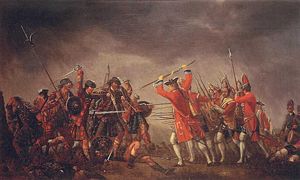
17 January 1746. Charles refused to take any part in running the campaign until he insisted on fighting an orthodox defensive action at the Battle of Culloden
Battle of Culloden
The Battle of Culloden was the final confrontation of the 1745 Jacobite Rising. Taking place on 16 April 1746, the battle pitted the Jacobite forces of Charles Edward Stuart against an army commanded by William Augustus, Duke of Cumberland, loyal to the British government...
on 16 April 1746 where they suffered a crushing defeat.
Charles fled to France blaming everything on the treachery of his officers and making a dramatic if humiliating escape disguised as Flora MacDonald's "lady's maid". Cumberland's forces crushed the rebellion and effectively ended Jacobitism as a serious political force in Britain but at the cost of abandoning the field in Flanders to France.
Decline of Jacobitism
Jacobitism entered permanent decline after the "Forty-Five" rebellion.The French made every effort to rescue Jacobite chieftains as well as Charles, and gave him a hero's welcome back to France, but soon tired of his badgering them to provide a renewed assault on the Hanoverians. After French victories knocked the Netherlands out of the war, the British offered reasonable peace terms and made the expulsion of Charles from France a precondition of negotiations. Charles ignored the French court's order to depart, continued to demand military action and support for his extravagant lifestyle and flaunted his presence around Paris as peace negotiations for the Treaty of Aix-la-Chapelle
Treaty of Aix-la-Chapelle (1748)
The Treaty of Aix-la-Chapelle of 1748 ended the War of the Austrian Succession following a congress assembled at the Imperial Free City of Aachen—Aix-la-Chapelle in French—in the west of the Holy Roman Empire, on 24 April 1748...
got under way. After British complaints the French government lost patience with Charles and in December 1748 he was seized on his way to the Opéra and briefly gaoled before being expelled.
Elibank plot
From 1749 to 1751 Charles laid the groundwork for a rising in England including a visit to London in 1750 when he conferred with the Jacobite leaders and considered an assault on the Tower of LondonTower of London
Her Majesty's Royal Palace and Fortress, more commonly known as the Tower of London, is a historic castle on the north bank of the River Thames in central London, England. It lies within the London Borough of Tower Hamlets, separated from the eastern edge of the City of London by the open space...
as well as converting to Anglicanism. The English Jacobites were clear that they would not move without foreign assistance, and Charles turned to Frederick II of Prussia
Frederick II of Prussia
Frederick II was a King in Prussia and a King of Prussia from the Hohenzollern dynasty. In his role as a prince-elector of the Holy Roman Empire, he was also Elector of Brandenburg. He was in personal union the sovereign prince of the Principality of Neuchâtel...
. While Frederick was indifferent to the Jacobite cause he made diplomatic use of the opportunity, and appointed the Earl Marischal
Earl Marischal
The title of Earl Marischal was created in the peerage of Scotland for William Keith, the Great Marischal of Scotland.The office of "Marischal of Scotland" had been held heritably by the senior member of the Keith family since Hervey de Keith, who held the office of Marischal under Malcolm IV and...
as his ambassador to Paris, in a position to keep him informed and veto any plans. Andrew Murray of Elibank, the liaison between Charles and the plotters, finally realised there was no hope of foreign assistance and ended the conspiracy, but by then Charles had sent two exiled Scots as agents to prepare the clans. They were betrayed by Alistair Ruadh MacDonell of Glengarry, a spy in Charles' entourage, and while one was arrested, the other barely escaped. Charles responded to the failure by denouncing his comrades, and continuing with his by now routine drunkenness and abuse of his mistress. Finally, in a dispute with Marischal and the English conspirators in 1754, a drunken Charles threatened to publish their names for having "betrayed" him, finally causing his supporters to abandon the Jacobite cause.
Loss of French support
In 1759 French naval defeats at LagosBattle of Lagos
The naval Battle of Lagos between Britain and France took place on August 19, 1759 during the Seven Years' War off the coasts of Spain and Portugal, and is named after Lagos, Portugal. For the British, it was part of the Annus Mirabilis of 1759.-Origins:...
and Quiberon Bay
Battle of Quiberon Bay
The naval Battle of Quiberon Bay took place on 20 November 1759 during the Seven Years' War in Quiberon Bay, off the coast of France near St. Nazaire...
forced them to abandon a planned invasion of Britain
Planned French Invasion of Britain (1759)
A French invasion of Great Britain was planned to take place in 1759 during the Seven Years' War, but due to various factors including naval defeats at the Battle of Lagos and the Battle of Quiberon Bay was never launched. The French planned to land 100,000 French soldiers in Britain to end British...
, which would have placed Charles on the throne. It is often considered the last realistic chance for the Jacobites. With its passing, Charles collapsed yet further into alcoholism and was soon entirely abandoned by the French government, who saw little further use for him. The English Jacobites stopped sending funds and by 1760 Charles had returned to Catholicism and was relying on the Papacy to support his lifestyle in Rome.
In 1766, when Old Pretender James (VIII/III) Edward Stuart died, the Holy See
Holy See
The Holy See is the episcopal jurisdiction of the Catholic Church in Rome, in which its Bishop is commonly known as the Pope. It is the preeminent episcopal see of the Catholic Church, forming the central government of the Church. As such, diplomatically, and in other spheres the Holy See acts and...
refused to recognise "Bonnie" Prince Charles as the lawful sovereign of Great Britain, thus losing his most powerful support, the French support being long gone. In 1788, the Scottish Catholics swore allegiance to the Hanover Dynasty, and resolved two years later to pray for King George by name.
Crushing of the clans
In an effort to prevent further trouble in the Scottish Highlands, the government outlawed many cultural practices in order to destroy the warrior clan systemScottish clan
Scottish clans , give a sense of identity and shared descent to people in Scotland and to their relations throughout the world, with a formal structure of Clan Chiefs recognised by the court of the Lord Lyon, King of Arms which acts as an authority concerning matters of heraldry and Coat of Arms...
. The Act of Proscription
Act of Proscription 1746
The Act of Proscription was an Act of the Parliament of Great Britain, which came into effect in Scotland on 1 August 1746. It was part of a series of efforts to assimilate the Scottish Highlands, ending their ability to revolt, and the first of the 'King's laws' which sought to crush the Clan...
incorporating the Disarming Act
Disarming Act
After the Jacobite Rising of 1715 ended it was evident that the most effective supporters of the Jacobites were Scottish clans in the Scottish Highlands and the Disarming Act attempted to remove this threat....
and the Dress Act required all swords to be surrendered to the government and prohibited wearing of tartan
Tartan
Tartan is a pattern consisting of criss-crossed horizontal and vertical bands in multiple colours. Tartans originated in woven wool, but now they are made in many other materials. Tartan is particularly associated with Scotland. Scottish kilts almost always have tartan patterns...
s or kilt
Kilt
The kilt is a knee-length garment with pleats at the rear, originating in the traditional dress of men and boys in the Scottish Highlands of the 16th century. Since the 19th century it has become associated with the wider culture of Scotland in general, or with Celtic heritage even more broadly...
s. The Tenures Abolition Act ended the feudal bond of military service and the Heritable Jurisdictions Act
Heritable Jurisdictions Act
The Heritable Jurisdictions Act, 1746 was an Act of Parliament passed by the Parliament of Great Britain in 1746. It abolished the traditional rights of jurisdiction afforded to a Scottish clan chief...
removed the virtually sovereign power the chiefs had over their clan. The extent of enforcement of the prohibitions was variable and sometimes related to a clan's
Scottish clan
Scottish clans , give a sense of identity and shared descent to people in Scotland and to their relations throughout the world, with a formal structure of Clan Chiefs recognised by the court of the Lord Lyon, King of Arms which acts as an authority concerning matters of heraldry and Coat of Arms...
support of the government during the rebellion.
Government troops were stationed in the Highlands and built more roads and barracks
Barracks
Barracks are specialised buildings for permanent military accommodation; the word may apply to separate housing blocks or to complete complexes. Their main object is to separate soldiers from the civilian population and reinforce discipline, training and esprit de corps. They were sometimes called...
to better control the region, with a new fortress at Fort George to the east of Inverness
Inverness
Inverness is a city in the Scottish Highlands. It is the administrative centre for the Highland council area, and is regarded as the capital of the Highlands of Scotland...
which still serves as a base for Highland Regiments of the British Army. Highland clans found a way back to legitimacy by providing regiments to the British Army, many of whom served with distinction in the subsequent Seven Years War.
Henry IX
When Charles died in 1788 the Stuart claim to the throne passed to his younger brother HenryHenry Benedict Stuart
Henry Benedict Stuart was a Roman Catholic Cardinal, as well as the fourth and final Jacobite heir to publicly claim the thrones of England, Scotland, and Ireland. Unlike his father, James Francis Edward Stuart, and brother, Charles Edward Stuart, Henry made no effort to seize the throne...
, who had become a Cardinal, and who now styled himself King Henry IX of England. After falling into financial difficulty during the French Revolution
French Revolution
The French Revolution , sometimes distinguished as the 'Great French Revolution' , was a period of radical social and political upheaval in France and Europe. The absolute monarchy that had ruled France for centuries collapsed in three years...
, he was granted a stipend by George III
George III of the United Kingdom
George III was King of Great Britain and King of Ireland from 25 October 1760 until the union of these two countries on 1 January 1801, after which he was King of the United Kingdom of Great Britain and Ireland until his death...
. However, he never actually surrendered his claims to the throne, though all former supporters of Jacobitism had stopped funding.
Following the death of Henry in 1807, the Jacobite claims passed to those excluded by the Act of Settlement
Act of Settlement 1701
The Act of Settlement is an act of the Parliament of England that was passed in 1701 to settle the succession to the English throne on the Electress Sophia of Hanover and her Protestant heirs. The act was later extended to Scotland, as a result of the Treaty of Union , enacted in the Acts of Union...
: initially to the House of Savoy
House of Savoy
The House of Savoy was formed in the early 11th century in the historical Savoy region. Through gradual expansion, it grew from ruling a small county in that region to eventually rule the Kingdom of Italy from 1861 until the end of World War II, king of Croatia and King of Armenia...
(1807–1840), then to the Modenese branch of the House of Habsburg-Lorraine
Habsburg
The House of Habsburg , also found as Hapsburg, and also known as House of Austria is one of the most important royal houses of Europe and is best known for being an origin of all of the formally elected Holy Roman Emperors between 1438 and 1740, as well as rulers of the Austrian Empire and...
(1840–1919), and finally to the House of Bavaria (1919–present). Franz, Duke of Bavaria
Franz, Duke of Bavaria
Franz Bonaventura Adalbert Maria Herzog von Bayern , styled as His Royal Highness The Duke of Bavaria, is head of the Wittelsbach family, the former ruling family of the Kingdom of Bavaria...
is the current Jacobite heir. Neither he nor any of his predecessors since 1807 have pursued their claim. Henry, Charles and James are memorialised in the Monument to the Royal Stuarts
Monument to the Royal Stuarts
The Monument to the Royal Stuarts is a memorial in St. Peter's Basilica, in the Vatican in Rome. It commemorates the last three members of the Royal House of Stuart: James Francis Edward Stuart, his elder son Charles Edward Stuart, and his younger son, Henry Benedict Stuart...
in the Vatican.
Outcome
What began with the English parliament asserting a new authority and William looking to expand alliances against France quickly developed into a major distraction, with William being forced to focus attention on Ireland and Scotland, and parliament having to fund the armies needed to overcome the Jacobites. This distraction helped keep Britain from intervening on the continent and contributed to twenty years of peace in Europe, while continuing unrest forced the British state to develop repressive strategies with networks of spies and informers as well as increasing its standing army. While Jacobitism increasingly appealed to the disaffected, it inherently bowed to higher authority and thus reinforced the social order. It left the British state strengthened to deal with the more revolutionary movements that developed later in the 18th century.Romantic revival
Bonnie Charlie
"Bonnie Charlie", commonly known as "Will ye no come back again?", is a Scots poem by Carolina Oliphant which celebrates Jacobitism, set to a traditional Scottish folk tune...
" remains popular). Additionally, it has became the subject of romantic poetry and literature, notably the work of Robert Burns
Robert Burns
Robert Burns was a Scottish poet and a lyricist. He is widely regarded as the national poet of Scotland, and is celebrated worldwide...
and Sir Walter Scott.
Walter Scott, author of Waverley
Waverley (novel)
Waverley is an 1814 historical novel by Sir Walter Scott. Initially published anonymously in 1814 as Scott's first venture into prose fiction, Waverley is often regarded as the first historical novel. It became so popular that Scott's later novels were advertised as being "by the author of...
, a story of the 1745 rebellion, combined romantic Jacobitism with an appreciation of the practical benefits of the Hanoverian
House of Hanover
The House of Hanover is a deposed German royal dynasty which has ruled the Duchy of Brunswick-Lüneburg , the Kingdom of Hanover, the Kingdom of Great Britain, the Kingdom of Ireland and the United Kingdom of Great Britain and Ireland...
government, and in 1822 he arranged a pageantry of reinvented Scottish traditions for the visit of King George IV to Scotland
Visit of King George IV to Scotland
The 1822 visit of King George IV to Scotland was the first visit of a reigning monarch to Scotland since 1650. Government ministers had pressed the King to bring forward a proposed visit to Scotland, to divert him from diplomatic intrigue at the Congress of Verona.The visit increased his popularity...
when George IV
George IV of the United Kingdom
George IV was the King of the United Kingdom of Great Britain and Ireland and also of Hanover from the death of his father, George III, on 29 January 1820 until his own death ten years later...
visited Edinburgh
Edinburgh
Edinburgh is the capital city of Scotland, the second largest city in Scotland, and the eighth most populous in the United Kingdom. The City of Edinburgh Council governs one of Scotland's 32 local government council areas. The council area includes urban Edinburgh and a rural area...
and dressed as a tubby kilt
Kilt
The kilt is a knee-length garment with pleats at the rear, originating in the traditional dress of men and boys in the Scottish Highlands of the 16th century. Since the 19th century it has become associated with the wider culture of Scotland in general, or with Celtic heritage even more broadly...
ed successor to his distant relative the Young Pretender. The tartan
Tartan
Tartan is a pattern consisting of criss-crossed horizontal and vertical bands in multiple colours. Tartans originated in woven wool, but now they are made in many other materials. Tartan is particularly associated with Scotland. Scottish kilts almost always have tartan patterns...
pageantry was immensely popular and the kilt became Scotland's National Dress
Scottish national identity
Scottish national identity is a term referring to the sense of national identity and common culture of Scottish people and is shared by a considerable majority of the people of Scotland....
.
In the late nineteenth century, there was a brief revival of political Jacobitism, with the creation of a number of Jacobite clubs and societies such as the Order of the White Rose and the Legitimist Jacobite League of Great Britain and Ireland. These came to an end with the first World War and are now represented by the Royal Stuart Society
Royal Stuart Society
The Royal Stuart Society, founded in 1926, is the senior monarchist organisation and the foremost Jacobite and Legitimist body in the United Kingdom...
.
In popular culture
Jacobitism has been a popular subject for speculative and humorous fiction.In the 1920s, D. K. Broster
D. K. Broster
Dorothy Kathleen Broster , usually known as D.K. Broster was a British novelist and short-story writer, born in Garston, Liverpool at Devon Lodge , which lies in Grassendale Park on the banks of the River Mersey. Educated at Cheltenham Ladies' College and St...
wrote the Jacobite Trilogy of novels featuring the dashing hero Ewen Cameron.
Science Fiction writer John Whitbourn
John Whitbourn
John Whitbourn is an author and tenth-generation inhabitant of southern England's Downs Country. He has produced a variety of novels and short stories focusing on alternative histories set in a 'Catholic' universe...
described his 1998 book, The Royal Changeling as "The first work of Jacobite propaganda for several centuries".
Among the political entities sharing a future human-settled galaxy depicted by A. Bertram Chandler
A. Bertram Chandler
Arthur Bertram Chandler was a British-Australian science fiction author. He also wrote under the pseudonyms George Whitley, George Whitely, Andrew Dunstan, and S.H.M....
is "The Jacobite Kingdom of Waverly". One of Chandler's stories mentions "the coronation of King James XIV", held with great pomp and broadcast throughout the Galaxy.
Joan Aiken
Joan Aiken
Joan Delano Aiken MBE was an English novelist. She was born in Rye, East Sussex, into a family of writers, including her father, American poet Conrad Aiken , her sister, Jane Aiken Hodge and her brother John Aiken Joan Delano Aiken MBE (4 September 1924 – 4 January 2004) was an English novelist....
's Wolves Chronicles have as background an alternative history of England, in which King James III, a Stuart, is on the throne, and the Hanoverians plot to overthrow him.
In an episode of The Avengers
The Avengers (TV series)
The Avengers is a spy-fi British television series set in the 1960s Britain. The Avengers initially focused on Dr. David Keel and his assistant John Steed . Hendry left after the first series and Steed became the main character, partnered with a succession of assistants...
TV series, "Esprit de Corps," originally broadcast 14 March 1964, a Scottish general plots a coup using Cathy Gale
Cathy Gale
Dr Cathy Gale was a fictional character, played by Honor Blackman, on the 1960s British series The Avengers. She was the first regular female partner of John Steed following the departure of Steed's original male co-star, Dr David Keel...
as the Stuart heir, whom he wishes to enthrone as Queen Anne II.
Garrison Keillor
Garrison Keillor
Gary Edward "Garrison" Keillor is an American author, storyteller, humorist, and radio personality. He is known as host of the Minnesota Public Radio show A Prairie Home Companion Gary Edward "Garrison" Keillor (born August 7, 1942) is an American author, storyteller, humorist, and radio...
told one of his Lake Wobegon
Lake Wobegon
Lake Wobegon is a fictional town in the U.S. state of Minnesota, said to have been the boyhood home of Garrison Keillor, who reports the News from Lake Wobegon on the radio show A Prairie Home Companion....
stories, "The Royal Family," about a poor Minnesota family who are persuaded that they are the long-lost Stuart heirs. They dream of returning to Edinburgh
Edinburgh
Edinburgh is the capital city of Scotland, the second largest city in Scotland, and the eighth most populous in the United Kingdom. The City of Edinburgh Council governs one of Scotland's 32 local government council areas. The council area includes urban Edinburgh and a rural area...
and taking their rightful place on the throne of Scotland.
A fictional account is given of the Jacobite/Hanoverian conflict in The Long Shadow, The Chevalier and The Maiden, Volumes 6–8 of The Morland Dynasty
The Morland Dynasty
The Morland Dynasty is a series of historical novels by Cynthia Harrod-Eagles, based around the Morland family of York, England and their national and international relatives and associates.There are currently thirty-two books in the series...
, a series of historical novels by author Cynthia Harrod-Eagles
Cynthia Harrod-Eagles
Cynthia Harrod-Eagles is a prolific and successful British novelist, best known for her Morland Dynasty series.Cynthia Harrod-Eagles was born in Shepherd's Bush, London and educated at Burlington School. Her first successful novel was The Waiting Game , and she became a full-time writer in...
. Insight is given through the eyes of the Morland family into the religious, political and emotional issues at the heart of the struggle.
In the movie King Ralph
King Ralph
King Ralph is a 1991 American comedy film starring John Goodman in the title role of Ralph Jones. The movie also stars Peter O'Toole as the King's private secretary, Sir Cedric Willingham, Camille Coduri as Ralph's girlfriend Miranda Greene, and John Hurt as the British peer Percival Graves, who...
, Ralph Jones, an American, becomes King of the United Kingdom when he is believed to be the only surviving member of the current Royal Family. Lord Percival Graves, the current heir to the throne under the Stuart line of succession, tries to have King Ralph deposed so he can take his place.
Jacobite claimants to the thrones of England, Scotland, (France), and Ireland
- James II and VIIJames II of EnglandJames II & VII was King of England and King of Ireland as James II and King of Scotland as James VII, from 6 February 1685. He was the last Catholic monarch to reign over the Kingdoms of England, Scotland, and Ireland...
(6 February 1685 16 September 1701). - James III and VIIIJames Francis Edward StuartJames Francis Edward, Prince of Wales was the son of the deposed James II of England...
(16 September 1701 1 January 1766), James Francis Edward Stuart, also known as the Chevalier de St. George, the King over the Water, or the Old Pretender. - Charles IIICharles Edward StuartPrince Charles Edward Louis John Casimir Sylvester Severino Maria Stuart commonly known as Bonnie Prince Charlie or The Young Pretender was the second Jacobite pretender to the thrones of Great Britain , and Ireland...
(1 January 1766 31 January 1788), Charles Edward Stuart, also known as Bonnie Prince Charlie, the Young Chevalier, or the Young Pretender. - Henry IX and IHenry Benedict StuartHenry Benedict Stuart was a Roman Catholic Cardinal, as well as the fourth and final Jacobite heir to publicly claim the thrones of England, Scotland, and Ireland. Unlike his father, James Francis Edward Stuart, and brother, Charles Edward Stuart, Henry made no effort to seize the throne...
(31 January 1788 13 July 1807), Henry Benedict Stuart, also known as the Cardinal King.
Since Henry's death, none of the Jacobite heirs have claimed the English or Scottish thrones.
Franz, Duke of Bavaria
Franz, Duke of Bavaria
Franz Bonaventura Adalbert Maria Herzog von Bayern , styled as His Royal Highness The Duke of Bavaria, is head of the Wittelsbach family, the former ruling family of the Kingdom of Bavaria...
is the current heir general of King Charles I
Charles I of England
Charles I was King of England, King of Scotland, and King of Ireland from 27 March 1625 until his execution in 1649. Charles engaged in a struggle for power with the Parliament of England, attempting to obtain royal revenue whilst Parliament sought to curb his Royal prerogative which Charles...
and so the present heir to the Jacobite claim.
See also
- LowlandLowland ClearancesThe Lowland Clearances in Scotland were one of the results of the British Agricultural Revolution, which changed the traditional system of agriculture which had existed in Lowland Scotland in the seventeenth century...
and Highland ClearancesHighland ClearancesThe Highland Clearances were forced displacements of the population of the Scottish Highlands during the 18th and 19th centuries. They led to mass emigration to the sea coast, the Scottish Lowlands, and the North American colonies... - JamesJames (name)The name James is derived from the same Hebrew name as Jacob, meaning "Supplanter" ....
(for the relationship between the names James and Jacob) - Jacobite peerageJacobite peerageAfter the deposition by the English parliament in February 1689 of King James II and VII from the thrones of England and Ireland , he and his successors continued to create peers and baronets, which they believed was their right...
- Louisa Maria Teresa StuartLouisa Maria Teresa StuartLouisa Maria Teresa Stuart , known to Jacobites as The Princess Royal, was the last child of James II and VII , the deposed king of England, Scotland, and Ireland, and of his queen, Mary of Modena...
- British military historyBritish military historyThe Military history of Britain, including the military history of the United Kingdom and the military history of the island of Great Britain, is discussed in the following articles:...
- List of movements that dispute the legitimacy of a reigning monarch
- McGillicuddy Serious PartyMcGillicuddy Serious PartyThe McGillicuddy Serious Party operated as a satirical political party in New Zealand politics during the late 20th century. Between 1984 and 1999, McGillicuddy Serious provided "colour" to New Zealand politics to ensure that citizens not take the political process too seriously...
A satirical political party in New Zealand which has advanced a Jacobite claim
External links
- The Jacobites
- The Jacobite Heritage
- Defenders Of Scotland
- BBC-Interactive Timeline of British History
- General History of the Highlands
- The University of Guelph Library, Archival and Special Collections, has more than 500 Jacobite pamphlets, histories, and literature in its rare books section introduced at http://www.lib.uoguelph.ca/resources/archival_&_special_collections/the_collections/digital_collections/scottish/Jacobite_site_0.htm
- Ascanius; or, the Young Adventurer