
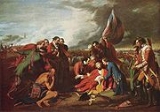
The
Battle of the Plains of Abraham, also known as the
Battle of Quebec, (
Bataille des Plaines d'Abraham or
Première bataille de Québec in French) was a pivotal battle in the
Seven Years' WarThe Seven Years' War was a global military war between 1756 and 1763, involving most of the great powers of the time and affecting Europe, North America, Central America, the West African coast, India, and the Philippines...
(referred to as the
French and Indian WarThe French and Indian War is the common American name for the war between Great Britain and France in North America from 1754 to 1763. In 1756, the war erupted into the world-wide conflict known as the Seven Years' War and thus came to be regarded as the North American theater of that war...
in the United States). The battle, which began on 13 September 1759, was fought between the British Army and Navy, and the French Army, on a
plateauIn geology and earth science, a plateau , also called a high plain or tableland, is an area of highland, usually consisting of relatively flat terrain. A highly eroded plateau is called a dissected plateau...
just outside the walls of
Quebec CityQuebec , also Québec, Quebec City or Québec City is the capital of the Canadian province of Quebec and is located within the Capitale-Nationale region. It is the second most populous city in Quebec after Montreal, which is about to the southwest...
, on land that was originally owned by a farmer named Abraham Martin, hence the name of the battle.
The battle involved fewer than 10,000 troops between both sides, but proved to be a deciding moment in the conflict between France and
BritainThe former Kingdom of Great Britain, sometimes described as the 'United Kingdom of Great Britain', That the Two Kingdoms of Scotland and England, shall upon the 1st May next ensuing the date hereof, and forever after, be United into One Kingdom by the Name of GREAT BRITAIN. was a sovereign...
over the fate of New France, influencing the later creation of Canada.
The culmination of a three-month
siegeA siege is a military blockade of a city or fortress with the intent of conquering by attrition or assault. The term derives from sedere, Latin for "to sit". Generally speaking, siege warfare is a form of constant, low intensity conflict characterized by one party holding a strong, static...
by the British, the battle lasted about 15 minutes. British troops commanded by General
James WolfeMajor General James P. Wolfe was a British Army officer, known for his training reforms but remembered chiefly for his victory over the French in Canada...
successfully resisted the
columnA military column is a formation of soldiers marching together in one or more files in which the file is significantly longer than the width of ranks in the formation...
advance of French troops and Canadian military under
Louis-Joseph, Marquis de MontcalmLouis-Joseph de Montcalm-Gozon, Marquis de Saint-Veran was a French soldier best known as the commander of the forces in North America during the Seven Years' War .Montcalm was born near Nîmes in France to a noble family, and entered military service...
, using new tactics that proved extremely effective against standard military formations used in most large European conflicts. Both generals were mortally wounded during the battle; Wolfe received a blow that would end his life within only a few minutes of engagement and Montcalm died the next morning after receiving a bullet wound just below his ribs. In the wake of the battle, France's remaining military force in Canada and the rest of North America came under increasing pressure from British forces.
While the French forces continued to fight and prevailed in several battles after Quebec was captured, the British did not relinquish their hold on the fortress. That tenacity carried over to other areas in North America; within four years, most of France's possessions in eastern North America would be ceded to Great Britain.
Overview
As the
Seven Years' WarThe Seven Years' War was a global military war between 1756 and 1763, involving most of the great powers of the time and affecting Europe, North America, Central America, the West African coast, India, and the Philippines...
entered its later stages through 1758 and 1759, French forces and colonies in northeastern North America came under renewed attacks from British troops. In 1758 after defeat in July at the
Battle of CarillonThe Battle of Carillon, also known as the 1758 Battle of Ticonderoga, was fought on July 8, 1758, during the French and Indian War...
, the British took
LouisbourgThe Siege of Louisbourg was a pivotal battle of the Seven Years' War in 1758 which ended the French colonial era in Atlantic Canada and led directly to the loss of Quebec in 1759 and the remainder of French North America the following year.-Background:The British government realized that with the...
in August, causing Atlantic Canada to fall into British hands, and opening the sea route to attack Quebec.
Fort FrontenacFort Frontenac was a French trading post and military fort built in 1673 in Kingston, Ontario, Canada. It was positioned at the mouth of the Cataraqui River where the St. Lawrence River leaves Lake Ontario , in a location traditionally known as Cataraqui...
fell to the British in the same month, costing the French supplies for the Ohio Valley campaign. When some of the
IndianThe indigenous peoples of the Americas are the pre-Columbian inhabitants of North and South America, their descendants and other ethnic groups who are identified with those peoples. Indigenous peoples are known in Canada as Aboriginal peoples, and in the United States as Native Americans...
supporters of the French made peace with the British, France was forced to draw its troops back. French leadership, specifically Governor
de VaudreuilPierre François de Rigaud, Marquis de Vaudreuil-Cavagnal was a Canadian-born French colonial governor in North America...
and General
MontcalmLouis-Joseph de Montcalm-Gozon, Marquis de Saint-Veran was a French soldier best known as the commander of the forces in North America during the Seven Years' War .Montcalm was born near Nîmes in France to a noble family, and entered military service...
, were unsettled by the British successes. However, Quebec was still able to protect itself as the British prepared a three-pronged attack for 1759.
James WolfeMajor General James P. Wolfe was a British Army officer, known for his training reforms but remembered chiefly for his victory over the French in Canada...
expected to lead 12,000 men, but was greeted by only approximately 400
officersAn officer is a member of an armed force or uniformed service who holds a position of authority. Commissioned officers derive authority directly from a sovereign power and, as such, hold a commission charging them with the duties and responsibilities of a specific office or position...
, 7,000 regular troops, 300 gunners, and Marines. Wolfe's troops were supported by a fleet of 49 ships and 140 smaller craft led by Admiral
Charles SaundersAdmiral Sir Charles Saunders, KB was a Royal Navy officer in the Royal Navy during the Seven Years' War and later served as First Lord of the Admiralty. He was appointed to the Privy Council in 1766.-Early career:...
.
In preparation for the fleet's approach to Quebec,
James CookCaptain James Cook, FRS, RN was a British explorer, navigator and cartographer who ultimately rose to the rank of captain in the Royal Navy...
surveyed a large portion of the river, including a dangerous channel known as The Traverse. Cook's ship was one of the first ships up the river, sounding the channel and guiding the fleet as it moved up, eventually landing Wolfe and his men on the
Île d'OrléansÎle d'Orléans is located in the Saint Lawrence River about east of downtown Quebec City, Quebec, Canada. The island was one of the first parts of the province to be colonized by the French, and a large percentage of French Canadians can trace ancestry to early residents of the island...
on 28 June. The French attempted to attack the fleet by sending seven fire ships downriver to disrupt the landing, but the ships fired too early and British sailors in longboats were able to pull the flaming craft clear of the fleet.
The following day, Wolfe's troops landed on the south bank of the river at
Point LevisLévis is a city in eastern Quebec, Canada. It is located on the south shore of the St. Lawrence River, opposite Quebec City. A ferry links Old Quebec with Old Lévis, and two bridges, the Quebec Bridge and the Pierre Laporte Bridge, connect western Lévis with Quebec City. The Société de transport de...
, nearly directly across the river from Quebec; an
artilleryOriginally applied to any group of infantry primarily armed with projectile weapons, artillery has over time become limited in meaning to refer only to those engines of war that operate by projection of munitions far beyond the range of effect of personal weapons...
battery was established there in early July that nearly leveled the lower town by
bombardmentA bombardment is an attack by artillery fire directed against fortifications, troops or towns and buildings.Prior to World War I the term term was only applied to the bombardment of defenceless or undefended objects, houses, public buildings, it was only loosely employed to describe artillery...
.
Despite an air of
defeatismDefeatism is acceptance of defeat without struggle. In everyday use, defeatism has negative connotation and is often linked to treason and pessimism, or even a hopeless situation such as a Catch-22...
among the leadership, the professional French troops and New French militia defenders focused preparations for the British attacks on the Beauport Shore. Montcalm and his staff, Major-General François de Gaston, Chevalier de Lévis, Colonel
Louis Antoine de BougainvilleLouis-Antoine, Comte de Bougainville was a French admiral and explorer. A contemporary of James Cook, he took part in the French and Indian War and the unsuccessful French attempt to defend Canada from Britain...
, and Lieutenant-Colonel de Sennezergue, distributed some 12,000 troops in a nine-kilometre long collection of fortified
redoubtA redoubt is a fort or fort system usually consisting of an enclosed defensive emplacement outside a larger fort, usually relying on earthworks, though others are constructed of stone or brick. It is meant to protect soldiers outside the main defensive line and can be a permanent structure or a...
s and batteries from the
Saint-Charles RiverSaint-Charles River is a river of Quebec , and the main river in Quebec City. Its huron-wendat name is Akiawenrahk.-Geography:It springs from Saint-Charles Lake, follows a course of approximately 33 km and ends into Saint Lawrence River...
to the
Montmorency FallsThe Montmorency Falls are a large waterfall on the Montmorency River in Quebec, Canada. The falls are located on the boundary between the borough of Beauport, Quebec City, and Boischatel, about 12 km from the heart of old Quebec City...
, along the shallows of the river in areas that had previously been targeted by British attempts to land. Prior to the arrival of the British, a small fleet of supply ships had arrived in Quebec with much-needed supplies. Those supplies, along with 500 reinforcements, were likely behind the lengthened siege.
Wolfe, on surveying the town of Beauport, found that the houses there had been barricaded and organized to allow for musket fire from within; they were built in an unbroken line along the road, providing a formidable barrier. In addition, a screen of trees along the Montmorency River made an approach on that route dangerous. On 31 July, the first serious attempt by Wolfe's troops to land on the northern shore led to the
Battle of BeauportThe Battle of Beauport, also known as the Battle of Montmorency, fought on 31 July 1759, was an important confrontation between the British and French Armed Forces during the Seven Years' War of the French province of Canada...
, also known as the Battle of Montmorency. Approximately 3,500 troops, supported by a heavy bombardment, attempted to land, but were caught under fire in the river shallows. Members of the
Louisbourg GrenadiersThe Louisbourg Grenadiers was a temporary unit of grenadiers formed by General James Wolfe in 1759 to serve with British Army forces in the Quebec campaign of the Seven Years' War....
, who reached the beach, attempted a generally undisciplined charge on the French positions, but came under heavy fire; a thunderstorm ended the fight and allowed Wolfe to pull his troops back after taking some 450 casualties to Montcalm's 60.
Some French officers felt the Montmorency defeat would be the last British attack; Vaudreuil wrote afterwards that "I have no more anxiety about Quebec. Wolfe, I assure you, will make no progress… He contented himself with losing about five hundred of his best soldiers." He predicted another attack would come within days. Others in the French camp felt the campaign was over.
For the remainder of the summer, Wolfe's focus changed, possibly due to frustration with Montcalm's tactics. His troops, along with American Rangers, attacked and destroyed small French settlements along the St. Lawrence. An estimated 1,400 stone houses and manors were destroyed, and many colonists killed. The effort was likely an attempt to force Montcalm's army out of its fortifications, but was unsuccessful. However, the attacks did reduce the amount of supplies available to the French, especially as the British navy, unable to control the St. Lawrence entirely, was successfully blockading the ports in France.
Preparations
Through the summer siege, illness spread through the British camps. In August, Wolfe himself was bedridden, causing already low morale to slump even further among the British troops. With many men in camp hospitals, British fighting numbers were thinned, and Wolfe personally felt that a new attack was needed by the end of September, or Britain's opportunity would be lost. In addition, his frustration with Montcalm's defensive stance continued to grow. In a letter to his mother, Wolfe wrote, "The Marquis of Montcalm is at the head of a great number of bad soldiers, and I am at the head of a small number of good ones that wish for nothing so much as to fight him; but the wary old fellow avoids an action, doubtful of the behaviour of his army." Montcalm also expressed frustration over the long siege, relating that he and his troops slept clothed and booted, and his horse was always saddled in preparation for an attack.
After considering and rejecting a number of plans for landings on the north shore, a decision was made in late August by Wolfe and his brigadiers to land upriver of the city. If successful, such a landing would force Montcalm to fight, as a British force on the north shore of the St. Lawrence would cut his supply lines to Montreal. Initial suggestions for landing sites ranged as far as 32 kilometres (19.9 mi) up the St. Lawrence, which would have given the French troops one or two days to prepare for the attack. Following the failed British assault on
MontmorencyThe Battle of Beauport, also known as the Battle of Montmorency, fought on 31 July 1759, was an important confrontation between the British and French Armed Forces during the Seven Years' War of the French province of Canada...
, Montcalm altered his deployment, sending
BougainvilleLouis-Antoine, Comte de Bougainville was a French admiral and explorer. A contemporary of James Cook, he took part in the French and Indian War and the unsuccessful French attempt to defend Canada from Britain...
and a column of approximately 1,500 regular troops, 200 cavalry, and a group of New French militia—some 3,000 men in all—upriver to
Cap-RougeCap-Rouge is located in central Quebec, Canada on the Saint Lawrence River within Quebec City. Originally a town on its own, Cap-Rouge was incorporated within Québec on January 1, 2002 and is now part of the Borough Sainte-Foy–Sillery–Cap-Rouge.-History:...
to monitor the British ships upstream. He further strengthened his defences of the Beauport shore following the abandonment of the British camp at Montmorency, which he regarded as preparations for a descent on Beauport. In spite of warnings from local commanders, he did not view an upstream landing as a serious possibility.
The British, meanwhile, prepared for their risky deployment upstream. Troops had already been aboard landing ships and drifting up and down the river for several days when Wolfe on 12 September, made a final decision on the British landing site, selecting L'
Anse-au-FoulonL'Anse au Foulon is a small cove about one and one-half miles above Quebec City. It is also referred to by the name Wolfe's Cove. It was at L'Anse au Foulon that the British forces commanded by James Wolfe landed prior to proceeding to the Plains of Abraham where they engaged and defeated the...
. L'Anse-au-Foulon is a cove situated southwest of the city, three kilometres upstream from Cap Diamant. It lies at the bottom of a 53 metres (173.9 ft) high cliff leading to the plateau above, and was protected by a battery of guns. It is not known why Wolfe selected Foulon, as the original landing site was to be further up the river, in a position where the British would be able to develop a foothold and strike at Bougainville's force to draw Montcalm out of Quebec and onto the plains. Brigadier-General
George TownshendField Marshal George Townshend, 1st Marquess Townshend, PC , known as The Viscount Townshend from 1764 to 1787, was a British soldier who reached the rank of field marshal.-Early life:...
wrote that "by some intelligence the General had, he has changed his mind as to the place he intended to land." In his final letter, dated , 8:30 p.m. 12 September, Wolfe wrote:
Wolfe's plan of attack depended on secrecy and surprise. His plan required that a small party of men should land by night on the north shore, climb the tall cliff, seize a small road, and overpower the garrison that protected it, allowing the bulk of his army (5,000 men) to ascend the cliff by the small road and then deploy for battle on the plateau. Even if the first landing party succeeded in their mission and the army was able to follow, such a deployment would still leave his forces inside the French line of defense with no immediate retreat but the river. It is possible that Wolfe's decision to change the landing site was owing less to a desire for secrecy and more to his general disdain for his brigadiers (a feeling that was reciprocated); it is also possible that he was still suffering the effects of his illness and the
opiateIn medicine, the term opiate describes any of the narcotic opioid alkaloids found as natural products in the opium poppy plant.-Overview:Opiates are so named because they are constituents or derivatives of constituents found in opium, which is processed from the latex sap of the opium poppy,...
s he used as painkillers.
Landing
Bougainville, tasked with the defence of the large area between Cap Diamant and Cap Rouge, was upstream with his troops at Cap Rouge on the night of 12 September, and missed seeing numerous British ships moving downstream. A camp of approximately 100 militia led by Captain
Louis Du Pont Duchambon de VergorLouis Du Pont Duchambon de Vergor was a French military officer who served as a member of the French Army during the Seven Years' War....
, who had unsuccessfully faced the British four years previously at
Fort BeauséjourFort Beauséjour, was built during Father Le Loutre's War from 1751-1755; it is located at the Isthmus of Chignecto in present-day Aulac, New Brunswick, Canada...
, had been assigned to watch the narrow road at L'Anse-au-Foulon which followed a streambank, the
CouléeCoulee is applied rather loosely to different landforms, all of which refer to a kind of valley or drainage zone.The word coulee comes from the Canadian French coulée, from French word couler meaning "to flow"....
Saint-Denis. On the night of 12 September and morning of 13 September, however, the camp may have contained as few as 40 men, as others were off harvesting. Vaudreuil and others had expressed their concern at the possibility of L'Anse-au-Foulon being vulnerable, but Montcalm dismissed them, saying 100 men would hold off the army until daylight, remarking, "It is not to be supposed that the enemies have wings so that they can in the same night cross the river, disembark, climb the obstructed acclivity, and scale the walls, for which last operation they would have to carry ladders."
Sentries did detect boats moving along the river that morning, but they were expecting a French supply
convoyA convoy is a group of vehicles, typically motor vehicles or ships, traveling together for mutual support and protection. Often, a convoy is organized with armed defensive support, though it may also be used in a non-military sense, for example when driving through remote areas.-Age of Sail:Naval...
to pass that night—a plan that had been changed without Vergor being notified. When the boats, loaded with the first wave of British troops, were challenged, a French-speaking officer, either a Captain Fraser or Captain Donald McDonald of the
78th Fraser HighlandersThe 78th Regiment, Regiment of Foot otherwise known as the 78th Fraser Highlanders was a British infantry regiment of the line unit raised in Scotland in 1757, to fight in the French and Indian War.-History:...
, was able to answer the challenge in excellent French, allaying suspicion.
The boats, however, had drifted slightly off course: instead of landing at the base of the road, many soldiers found themselves at the base of a slope. A group of 24 volunteers led by Colonel
William HoweWilliam Howe, 5th Viscount Howe, KB, PC was a British army officer who rose to become Commander-in-Chief of British forces during the American War of Independence...
with fixed
bayonetA bayonet is a knife, dagger, sword, or spike-shaped weapon designed to fit in, on, over or underneath the muzzle of a rifle, musket or similar weapon, effectively turning the gun into a spear...
s were sent to clear the picket along the road, and climbed the slope, a manoeuvre that allowed them to come up behind Vergor's camp and capture it quickly. Wolfe followed an hour later when he could use an easy access road to climb to the plain. Thus, by the time the sun rose over the Plains of Abraham, Wolfe's army had a solid foothold at the top of the cliffs.
Battle
The plateau was undefended save for Vergor's camp, as Vaudreuil had ordered one of the French regiments to relocate to the east of the city not long before the landing. Had the immediate defenders been more numerous, the British might have been unable to deploy or even been pushed back. An officer who would normally have patrolled the cliffs regularly through the night was unable to on the night of the 12th because one of his horses had been stolen and his two others were lame. The first notice of the landing came from a runner who had fled from Vergor's camp, but one of Montcalm's aides felt the man was mad and sent him away, then went back to bed.
SaundersAdmiral Sir Charles Saunders, KB was a Royal Navy officer in the Royal Navy during the Seven Years' War and later served as First Lord of the Admiralty. He was appointed to the Privy Council in 1766.-Early career:...
had staged a diversionary action off Montmorency, firing on the shore emplacements through the night and loading boats with troops, many of them taken from
field hospitalA field hospital is a large mobile medical unit that temporarily takes care of casualties on-site before they can be safely transported to more permanent hospital facilities...
s; this preoccupied Montcalm.
Montcalm was taken aback to learn of the British deployment, and his response has been regarded as precipitate. Though he might have awaited reinforcement by Bougainville's column (allowing simultaneous frontal and rear attacks on the British position) or avoided battle while he concentrated his forces, or even yielded the city to Wolfe, he instead elected to confront Wolfe's force directly. Had he waited, the British would have been entirely cut off—they had nowhere to go but back down the Foulon, and would have been under fire the entire way. To an artillery officer named Montbelliard, Montcalm explained his decision thus: "We cannot avoid action; the enemy is entrenching, he already has two pieces of cannon. If we give him time to establish himself, we shall never be able to attack him with the troops we have."
First engagements
In total, Montcalm had 13,390 regular troops,
Troupes de la MarineSee also Troupes de Marine for later history of same Corps.The Troupes de la Marine , also known as independent companies of the navy and colonial regulars, were under the authority of the French Minister of Marine, who was also responsible for the French navy, overseas trade, and French...
, and
militiaThe term militia is commonly used today to refer to a military force composed of ordinary citizens to provide defense, emergency law enforcement, or paramilitary service, in times of emergency without being paid a regular salary or committed to a fixed term of service. It is a polyseme with...
available in Quebec City and along the Beauport shore, as well as 200
cavalryCavalry or horsemen were soldiers or warriors who fought mounted on horseback. Cavalry were historically the third oldest and the most mobile of the combat arms...
, 200 artillery (including the guns of Quebec), 300
native warriorsFirst Nations is a term that collectively refers to various Aboriginal peoples in Canada who are neither Inuit nor Métis. There are currently over 630 recognised First Nations governments or bands spread across Canada, roughly half of which are in the provinces of Ontario and British Columbia. The...
(including many
OdawaThe Odawa or Ottawa, said to mean "traders," are a Native American and First Nations people. They are one of the Anishinaabeg, related to but distinct from the Ojibwe nation. Their original homelands are located on Manitoulin Island, near the northern shores of Lake Huron, on the Bruce Peninsula in...
under Charles de Langlade), and 140
AcadiaAcadia was the name given to lands in a portion of the French colonial empire of New France, in northeastern North America that included parts of eastern Quebec, the Maritime provinces, and modern-day Maine. At the end of the 16th century, France claimed territory stretching as far south as...
n
volunteersA military volunteer is a person who enlists in military service by free will, and is not a mercenary or a foreign legionaire. Volunteers often enlist to fight in the armed forces of a foreign country. Military volunteers are essential for the operation of volunteer militaries.Many armies,...
, but most of these troops did not participate in the action. Many of militia were inexperienced; the Acadian, Canadian, and indigenous irregulars were more used to guerilla warfare. By contrast, the British troops were almost all regulars.
On the morning of 13 September, Wolfe's army formed a line first with their backs to the river, then spread out across the Plains with its right anchored by the bluff along the St. Lawrence and its left by a bluff and thick wood above the St. Charles River. While the regular French forces were approaching from Beauport and Quebec, the Canadian militia and native sharpshooters engaged the British left flank, sheltering in the trees and scrub; the militia held these positions throughout the battle and fell back on this line during the general retreat, eventually holding the bridge over the St. Charles River.
The British troops, numbering approximately 3,300, formed into a shallow
horseshoeA horseshoe, is a fabricated product, normally made of metal, although sometimes made partially or wholly of modern synthetic materials, designed to protect a horse's hoof from wear and tear. Shoes are attached on the palmar surface of the hooves, usually nailed through the insensitive hoof wall...
formation that stretched across the width of the Plains, the main firing line being roughly one kilometre long. In order to cover the entire plain, Wolfe was forced to array his soldiers two ranks deep, rather than the more conventional three ranks. On the left wing, regiments under Townshend exchanged fire with the militia in the scrub and captured a small collection of houses and
gristmillThe terms gristmill or grist mill can refer either to a building in which grain is ground into flour, or to the grinding mechanism itself.- Early history :...
to anchor the line. The defenders pushed the British from one house, but were repelled and, in retreat, lit several houses on fire to keep them out of enemy hands. Smoke from these fires wound up masking the British left, and may have confused Montcalm as to the width of the lines. As Wolfe's men waited for the defenders, the steady fire became intense enough that Wolfe ordered his men to lie down amid the high grass and brush.

As French troops arrived from Beauport, Montcalm, one of few mounted men on the field, decided that a swift assault was the only way to dislodge the British from their position. Accordingly, he deployed the forces immediately available in and near Quebec City and prepared an immediate attack, without waiting for further reinforcements from the Beauport shore. He arrayed his approximately 3,500 soldiers into place, his best regulars three deep, others six deep and his poorest regiment in column. At approximately 10 a.m., Montcalm, riding his dark horse and waving his sword to encourage his men, ordered a general advance on the British line.
As a European-trained military leader, Montcalm's instinct was for large, set-piece battles in which regiments and soldiers moved in precise order. Such actions required a disciplined soldiery, painstakingly drilled for as long as 18 months on the parade ground, trained to march in time, change formation at a word, and retain cohesion in the face of bayonet charges and musket volleys. Though his regular regiments (the "troupes de terre" or "metropolitans") were adept at such formal warfare, in the course of the campaign their ranks had been replenished by less professional militiamen, whose talents at forest warfare emphasised the individual: they tended to fire early and then drop to the ground to reload, thus reducing the effect of concentrated fire at close range.
The Battle on the plains
As the French approached, the British lines held their fire. Wolfe had devised a firing method for stopping French column advances in 1755 that called for the centre—in this case, the
43rdThe 43rd Regiment of Foot was an infantry regiment of the British Army. It was raised as Thomas Fowke's Regiment of Foot in 1741 with its headquarters at Winchester. The regiment was numbered 54th Foot until 1748 when it became the 43rd Foot...
and 47th Foot regiments—to hold fire while waiting for the advancing force to approach within 30 yards (27.4 m), then open fire at close range.
The French held their fire and both armies waited for two or three minutes. The French finally fired two disorganized volleys.
Wolfe had ordered his soldiers to charge their muskets with two balls each in preparation for the engagement. Captain John Knox, serving with the 43rd Foot, wrote in his journal that as the French came within range, the regiments "gave them, with great calmness, as remarkable a close and heavy discharge as I ever saw." After the first volley, the British lines marched forward a few paces towards the shocked French force and fired a second general volley that shattered the attackers and sent them into retreat.
Wolfe, positioned with the
28th FootThe 28th Regiment of Foot was a British infantry regiment from 1782 to 1881.For their conduct at the Battle of Alexandria in 1801 the 28th were given the unique honour of wearing a badge on both the front and rear of their head dress.. They served throughout the Peninsula War including the battles...
and the Louisbourg Grenadiers, had moved to a rise to observe the battle; he had been struck in the wrist early in the fight, but had wrapped the injury and continued on. Volunteer James Henderson, with the Louisbourg Grenadiers, had been tasked with holding the hill, and reported afterwards that within moments of the command to fire, Wolfe was struck with two shots, one low in the stomach and the second, a mortal wound in the chest. Knox wrote that one of the soldiers near Wolfe shouted "They run, see how they run." Wolfe, upon being told that the French had broken, gave several orders, then turned on his side and said "Now, God be praised, I will die in peace", and died.
With Wolfe dead and several other key officers injured, British troops fell into a disorganised pursuit of the retreating French troops. The
78th Fraser HighlandersThe 78th Regiment, Regiment of Foot otherwise known as the 78th Fraser Highlanders was a British infantry regiment of the line unit raised in Scotland in 1757, to fight in the French and Indian War.-History:...
were ordered by Brigadier-General
James MurrayJames Murray FRS was a British soldier, whose lengthy career included service as colonial administrator and governor of the Province of Quebec and later as Governor of Minorca from 1778 to 1782.-Early life:He was a younger son of Alexander Murray, 4th Lord Elibank, and his wife Elizabeth...
to pursue the French with their
swordA sword is a bladed weapon used primarily for cutting or thrusting. The precise definition of the term varies with the historical epoch or the geographical region under consideration...
s, but were met near the city by a heavy fire from a floating battery covering the bridge over the St. Charles River as well as militia that remained in the trees. The 78th took the highest number of casualties of all British units in the battle.
An eyewitness with the 78th Highlanders (Dr. Robert Macpherson) wrote three days after the battle:
The Highlanders pursued them to the very Sally Port of the town. The Highlanders returned towards the main body. When the highlanders were gathered together, they lay'd on a separate attack against a large body of Canadians on our flank that were posted in a small village and a Bush of woods. Here, after a wonderful escape all day, we suffered great loss both in Officers and men but at last drove them under the cover of their cannon which likeways did us considerable loss."
Townshend took charge of the British forces and realised that Bougainville's column was approaching from the British rear, having taken some time to arrive from Cap Rouge. He quickly formed up two battalions from the confused troops on the field and turned them to meet the oncoming French, a day-saving manoeuvre; instead of attacking with a well-rested and ready force, Bougainville retreated while the rest of Montcalm's army slipped back across the St. Charles.
During the retreat, Montcalm, still mounted, was struck by either
canister shotCanister shot is a kind of anti-personnel ammunition used in cannons. It was similar to the naval grapeshot, but fired smaller and more numerous balls, which did not have to punch through the wooden hull of a ship...
from the British artillery or repeated musket fire, suffering injuries to the lower abdomen and thigh. He was able to make it back into the city, but his wounds were mortal and he died early the next morning. He was buried in a shell crater left in the floor of the Ursuline chapel by a British shell. The battle resulted in similar numbers of casualties on both sides of the field; the French had 644 men killed or injured, while the British were left with 658 killed or wounded.
Aftermath
In the wake of the battle, a state of confusion spread through the French troops. Vaudreuil, who later wrote to his government and put the full blame for the French rout on the deceased Montcalm, decided to abandon Quebec and the Beauport shore, ordering all of his forces to march west and eventually join up with Bougainville, leaving the garrison in Quebec under the command of Jean-Baptiste-Nicolas-Roch de Ramezay.
Meanwhile, the British, first under the command of Townshend and later with Murray in charge, settled in to besiege the city in conjunction with
Saunders'Admiral Sir Charles Saunders, KB was a Royal Navy officer in the Royal Navy during the Seven Years' War and later served as First Lord of the Admiralty. He was appointed to the Privy Council in 1766.-Early career:...
fleet. Within days, on 18 September, de Ramezay, Townshend and Saunders signed the
Articles of Capitulation of QuebecThe Articles of Capitulation of Quebec were agreed upon between Jean-Baptiste-Nicolas-Roch de Ramezay, King's Lieutenant, Admiral Sir Charles Saunders, and General George Townshend on behalf the French and British crowns during the Seven Years' War...
and the city was turned over to British control. The remaining French forces positioned themselves on the
Jacques-Cartier RiverThe Jacques-Cartier River is a river in the province of Quebec, Canada. It is 161 km long and its source is Jacques-Cartier Lake in Laurentides Wildlife Reserve, and flows in a predominantly southern direction before ending in the Saint Lawrence River at Donnacona, about 30 km upstream...
west of the city.
The British Navy was forced to leave the St. Lawrence shortly after the capture of Quebec due to pack ice closing the mouth of the river. Before the ice left the rivers in April, the Chevalier de Lévis, Montcalm's successor as French commander, marched his 7,000 troops to Quebec. James Murray, the British commander, had experienced a terrible winter, in which scurvy had reduced his garrison to only 4,000. On 28 April 1760, Lévis' forces met and defeated the British at the
Battle of Sainte-FoyThe Battle of Sainte-Foy, sometimes called the Battle of Quebec, was fought on April 28, 1760 near the British-held town of Quebec in the French province of Canada during the Seven Years' War . It was a victory for the French under the Chevalier de Lévis over the British army under General Murray...
, immediately west of the city (near the site of
Université LavalLaval University is the oldest centre of education in Canada and was the first institution in North America to offer higher education in French...
today). This battle proved bloodier than that of the Plains of Abraham, with about 850 casualties on the French side and 1,100 on the British side. The British were defeated in the battle, but were able to withdraw within the walls of Quebec, which was now under siege. A lack of artillery and ammunition, combined with British improvements to the fortifications, meant that the French were unable to take the city before the arrival of the British fleet in mid-May. A naval battle fought at
Quiberon BayThe naval Battle of Quiberon Bay took place on 20 November 1759 during the Seven Years' War in Quiberon Bay, off the coast of France near St. Nazaire...
, just off the coast of France, proved the decisive battle for this part of New France. The Royal Navy destroyed the French Fleet, meaning France could not send a reserve force to save New France. The success of the French army's offensive against Quebec in the spring of 1760 depended on the dispatch of a French armada, with fresh troops and supplies.
At Montréal that September, Lévis and 2,000 troops confronted 17,000 British and American troops. The French capitulated on 8 September 1760, and the British took possession of Montreal. The
Treaty of ParisThe Treaty of Paris, often called the Peace of Paris, or the Treaty of 1763, was signed on 10 February 1763, by the kingdoms of Great Britain, France and Spain, with Portugal in agreement. It ended the French and Indian War/Seven Years' War...
was signed in 1763 to end the war and gave possession of parts of
New FranceNew France was the area colonized by France in North America during a period beginning with the exploration of the Saint Lawrence River by Jacques Cartier in 1534 and ending with the cession of New France to Spain and Great Britain in 1763...
to Great Britain, including Canada and the eastern half of
French LouisianaThe term French Louisiana refers to two distinct regions:* first, to colonial French Louisiana, comprising the massive, middle section of North America claimed by France; and,...
—lying between the
Mississippi RiverThe Mississippi River is the largest river system in North America. Flowing entirely in the United States, this river rises in western Minnesota and meanders slowly southwards for to the Mississippi River Delta at the Gulf of Mexico. With its many tributaries, the Mississippi's watershed drains...
and the
Appalachian MountainsThe Appalachian Mountains #Whether the stressed vowel is or ,#Whether the "ch" is pronounced as a fricative or an affricate , and#Whether the final vowel is the monophthong or the diphthong .), often called the Appalachians, are a system of mountains in eastern North America. The Appalachians...
.
Legacy of the Plains
Today, while much of the foreshore along the base of the cliffs that were scaled by
William HoweWilliam Howe, 5th Viscount Howe, KB, PC was a British army officer who rose to become Commander-in-Chief of British forces during the American War of Independence...
's men the morning of the battle has been taken over by industry, the
Plains of AbrahamThe Plains of Abraham is a historic area within The Battlefields Park in Quebec City, Quebec, that was originally grazing land, but became famous as the site of the Battle of the Plains of Abraham, which took place on 13 September 1759. Though written into the history books, housing and minor...
themselves are preserved within one of Canada's National Urban Parks. There is a
monumentA monument is a type of structure either explicitly created to commemorate a person or important event or which has become important to a social group as a part of their remembrance of historic times or cultural heritage, or simply as an example of historic architecture...
on the site of the Battle of Sainte-Foy.
In 2009, a number of activities were proposed to commemorate the 250th anniversary of the Battle of the Plains of Abraham. A plan to hold a reenactment of the battle itself (as well as a reenactment of the subsequent French victory of 1760 at the
Battle of Sainte-FoyThe Battle of Sainte-Foy, sometimes called the Battle of Quebec, was fought on April 28, 1760 near the British-held town of Quebec in the French province of Canada during the Seven Years' War . It was a victory for the French under the Chevalier de Lévis over the British army under General Murray...
) was cancelled due to threats of public disorder. Leaders of separatist parties described the event as a slap in the face for Quebecers of French ancestry and as an insult for the francophone majority. Some sovereignist groups threatened or made indirect threats by stating that if the event took place, there could be violence. The movement against re-enactment and these threats of violence led the National Battlefields Commission to cancel the event.
Another commemorative event was proposed for the anniversary, the
Moulin à paroles. Thousands gathered on the Plains of Abraham to listen to recitations of 140 significant texts from Quebec history, including the 1970
FLQ ManifestoThe FLQ Manifesto was a key document of the terrorist group the Front de libération du Québec. On 8 October 1970, during the October Crisis, it was broadcast by CBC/Radio-Canada television as one of many demands required for the release of kidnapped British Trade Commissioner James Cross.-External...
. The inclusion of that document in the event led to condemnations and a boycott from federalist politicians and the withdrawal of some government funding for the event. The
Moulin à paroles took place without incident.
External links