

Kilt

Encyclopedia
The kilt is a knee-length garment with pleat
s at the rear, originating in the traditional dress of men and boys in the Scottish Highlands
of the 16th century. Since the 19th century it has become associated with the wider culture of Scotland
in general, or with Celtic (and more specifically Gaelic
) heritage even more broadly. It is most often made of wool
len cloth in a tartan
pattern.
Although the kilt is most often worn on formal occasions and at Highland games
and sports events, it has also been adapted as an item of fashionable informal male clothing in recent years, returning to its roots as an everyday garment.
draped over the shoulder, or brought up over the head. The philibeg or small kilt, also known as the walking kilt (similar to the modern kilt) was invented by an English Quaker from Lancashire called Thomas Rawlinson sometime in the 1720s for the use of the Highlanders he and Ian MacDonnell, chief of the MacDonnells of Inverness employed in logging, charcoal manufacture and iron smelting, for which the belted plaid was "cumbrous and unwieldy".
According to the Oxford English Dictionary
, the noun derives from a verb to kilt, originally meaning "to gird up; to tuck up (the skirts) round the body", itself of Scandinavian
origin.
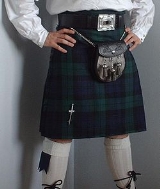
A kilt covers the body from the waist down to the centre of the knees. The overlapping layers in front are called "aprons" and are flat; the single layer of fabric around the sides and back is pleated. A kilt pin
is fastened to the front apron on the free corner (but is not passed through the layer below, as its function is to add weight). Underwear may or may not be worn, as the wearer prefers, although tradition has it that a "true Scotsman
" should wear nothing under his kilt. The Scottish Tartans Authority, however, has described the practice as childish and unhygienic.
Organizations that sanction and grade the competitions in Highland dancing
and bagpiping
all have rules governing acceptable attire for the competitors. These rules specify that kilts are to be worn (except that in the national dances, the female competitors will be wearing the Aboyne dress
).
woven worsted
wool
. The twill weave used for kilts is a "2–2 type", meaning that each weft
thread passes over and under two warp
threads at a time. The result is a distinctive diagonal-weave pattern in the fabric which is called the twill line. This kind of twill, when woven according to a given sett or written colour pattern, (see below), is called tartan. In contrast kilts worn by Irish pipers are made from solid-colour cloth, with saffron
or green being the most widely used colours.
Kilting fabric weights are given in ounces per yard and run from the very-heavy, regimental worsted of approximately 18–22 oz (510.3–623.7 ) down to a light worsted of about 10–11 oz (283.5–311.8 ). The most common weights for kilts are 13 ounces (368.5 g) and 16 ounces (453.6 g). The heavier weights are more appropriate for cooler weather, while the lighter weights would tend to be selected for warmer weather or for active use, such as Highland dancing. Some patterns are available in only a few weights.
A modern kilt for a typical adult uses about 6–8 yards of single-width (about 26–30 inches) or about 3–4 yards of double-width (about 54–60 inches) tartan fabric. Double-width fabric is woven so that the pattern exactly matches on the selvage
. Kilts are usually made without a hem because a hem would make the garment too bulky and cause it to hang incorrectly. The exact amount of fabric needed depends upon several factors including the size of the sett, the number of pleats put into the garment, and the size of the person. For a full kilt, 8 yards of fabric would be used regardless of size and the number of pleats and depth of pleat would be adjusted according to their size. For a very large waist, it may be necessary to use 9 yards of cloth.
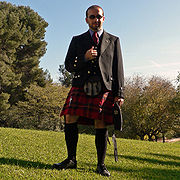 One of the most-distinctive features of the authentic Scots kilt is the tartan pattern, the sett, it exhibits. The association of particular patterns with individual clans and families can be traced back perhaps one or two centuries. It was only in the 19th-century Victorian era
that the system of named tartans known today began to be systematically recorded and formalized, mostly by weaving companies for mercantile purposes. Up until this point, Highland tartans held regional associations rather than being identified with any particular clan.
Today there are also tartans for districts, counties, societies and corporations. There are also setts for states and provinces; schools and universities; sporting activities; individuals; and commemorative and simple generic patterns that anybody can wear. (See History of the kilt
for the process by which these associations came about.)
Setts are always arranged horizontally and vertically, never diagonally (except when adapted for ladies' skirts). They are specified by their thread counts, the sequence of colours and their units of width. As an example, the Wallace
tartan has a thread count given as "K4 R32 K32 Y4" (K is black, R is red, and Y is yellow). This means that 4 units of black thread will be succeeded by 32 units of red, etc., in both the warp and the weft. Typically, the units are the actual number of threads, but as long as the proportions are maintained, the resulting pattern will be the same. This thread count also includes a pivot point indicated by the slash between the colour and thread number. The weaver is supposed to reverse the weaving sequence at the pivot point to create a mirror image of the pattern. This is called a symmetrical tartan. Some tartans, like Buchanan
, are asymmetrical, which means they do not have a pivot point. The weaver weaves the sequence all the way through and then starts at the beginning again for the next sett.
Setts are further characterized by their size, the number of inches (or centimetres) in one full repeat. The size of a given sett depends not only on the number of threads in the repeat, but also on the weight of the fabric. This is because the heavier the fabric the thicker the threads will be, and thus the same number of threads of a heavier-weight fabric will occupy more space. The colours given in the thread count are specified as in heraldry
, although tartan patterns are not heraldic. The exact shade which is used is a matter of artistic freedom and will vary from one fabric
mill to another as well as in dye
lot to another within the same mill.
Tartans are commercially woven in four standard colour variations that describe the overall tone. "Ancient" or "Old" colours may be characterized by a slightly faded look intended to resemble the vegetable dyes
that were once used, although in some cases "Old" simply identifies a tartan that was in use before the current one. Ancient greens and blues are lighter while reds appear orange. "Modern" colours are bright and show off modern aniline
dyeing methods. The colours are bright red, dark hunter green, and usually navy blue. "Weathered" or "Reproduction" colours simulate the look of older cloth weathered by the elements. Greens turn to light brown, blues become gray, and reds are a deeper wine colour. The last colour variation is "Muted" which tends toward earth tone
s. The greens are olive, blues are slate blue, and red is an even deeper wine colour. This means that of the approximately 3,500 registered tartans available in the Scottish Tartans Authority
database as of 2004 there are four possible colour variations for each, resulting in around 14,000 recognised tartan choices.
Setts may be registered with the International Tartan Index (ITI) of the charitable organisation Scottish Tartans Authority
(STA), which maintains a collection of fabric samples characterized by name and thread count, for free, and/or registered with the Scottish Register of Tartans (SRT) of the statutory body the National Archives of Scotland
(NAS), if the tartan meets NAS's criteria, for UK₤70
as of 2010. Although many tartans are added every year, most of the registered patterns available today were created in the 19th century onward by commercial weavers who worked with a large variety of colours. The rise of Highland romanticism and the growing Anglicisation
of Scottish culture by the Victorians at the time led to registering tartans with clan names. Before that, most of these patterns were more connected to geographical regions than to any clan. There is therefore nothing symbolic about the colours, and nothing about the patterns is a reflection of the status of the wearer.
 Although ready-to-wear
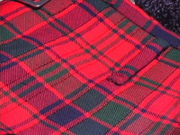
kilts can be obtained in standard sizes, a custom kilt is tailored to the individual proportions of the wearer. At least three measurements, the waist, hips, and length of the kilt, are usually required. Sometimes the rise (distance above the waist) or the fell (distance from waistline to the widest part of the hips) is also required.
A properly made kilt, when buckled on the tightest holes of the straps, is not so loose that the wearer can easily twist the kilt around their body, nor so tight that it causes "scalloping" of the fabric where it is buckled. Additionally, the length of the kilt when buckled at the waist reaches a point no lower than halfway across the kneecap and no higher than about an inch above it.
 A kilt can be pleated with either box or knife pleats. A knife pleat is a simple fold, while the box pleat is bulkier, consisting of two knife pleats back-to-back. Knife pleats are the most common in modern civilian kilts. Regimental traditions vary. The Argyll and Sutherland Highlanders
use box pleats, while the Black Watch
make their kilts of the same tartan with knife pleats. These traditions were also passed on to affiliated regiments in the Commonwealth
, and were retained in successor battalion
s to these regiments in the amalgamated Royal Regiment of Scotland.
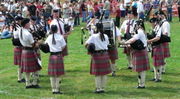
Pleats can be arranged relative to the pattern in two ways. In pleating to the stripe, one of the vertical stripes in the tartan is selected and the fabric is then folded so that this stripe runs down the center of each pleat. The result is that along the pleated section of the kilt (the back and sides) the pattern appears different from the unpleated front, often emphasisng the horizontal bands rather than creating a balance between horizontal and vertical. This is often called military pleating because it is the style adopted by many military regiments. It is also widely used by pipe bands.
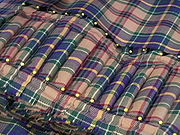 In pleating to the sett the fabric is folded so that the pattern of the sett is maintained and is repeated all around the kilt. This is done by taking up one full sett in each pleat, or two full setts if they are small. This causes the pleated sections to have the same pattern as the unpleated front.
Any pleat is characterized by depth and width. The portion of the pleat that protrudes under the overlying pleat is the size or width. The pleat width is selected based on the size of the sett and the amount of fabric to be used in constructing the kilt, and will generally vary from about 1/2" to about 3/4".
The depth is the part of the pleat which is folded under the overlying pleat. It depends solely on the size of the tartan sett even when pleating to the stripe, since the sett determines the spacing of the stripes.
The number of pleats used in making kilts depends upon how much material is to be used in constructing the garment and upon the size of the sett.
The pleats across the fell are tapered slightly since the wearer's waist is usually narrower than the hips and the pleats are usually stitched down either by machine or by hand.
 In Highland dancing, it is easy to see the effect of the stitching on the action of a kilt. The kilt hugs the dancer's body from the waist down to the hipline and, from there, in response to the dancer's movements, it breaks sharply out. The way the kilt moves in response to the dance steps is an important part of the dance. If the pleats were not stitched down in this portion of the kilt, the action, or movement, would be quite different.
(Gaelic for "purse": a type of pouch), which hangs around the waist from a chain or leather strap. This may be plain or embossed leather, or decorated with sealskin, fur, or polished metal plating.
Other common accessories, depending on the formality of the context, include:
regard kilts as formal dress or national dress. Although there are still a few people who wear a kilt daily, it is generally owned or hired to be worn at weddings or other formal occasions, much the same way as tuxedos in America, and may be worn by anyone regardless of nationality or descent. For formal wear, kilts are usually worn with a Prince Charlie or an Argyll jacket. (Commercial suppliers have now produced equivalent jackets with Irish and Welsh themed styling.)
Kilts are also used for parades by groups such as the Scouts
, and in many places kilts are seen in force at Highland games
and pipe band
championships as well as being worn at Scottish country dance
s and ceilidh
s.
Certain regiments/units of the British Army
and armies of other Commonwealth
nations (including Australia
, Canada
, New Zealand
and South Africa
) with a Scottish lineage or heritage still continue to wear kilts as part of dress or duty uniform, though they have not been used in combat since 1940. Uniforms in which kilts are worn include Ceremonial Dress, Service Dress, and Barracks Dress. Kilts are considered appropriate for ceremonial parades, office duties, less formal parades, walking out, mess dinners, and classroom instruction/band practice. Ceremonial kilts have also been developed for the U.S. Marine Corps
, and the pipe and drum bands of the U.S. Military Academy
, U.S. Coast Guard
and the U.S. Air Force
.
In recent years, kilts have also become increasingly common in Scotland and around the world for casual wear, for example with the Jacobite shirt. It is not uncommon to see kilts worn at Irish pubs in the United States, and it is becoming somewhat less rare to see them in the workplace. Casual use of kilts dressed down with lace-up boots or moccasins, and with t-shirts or golf shirts, is becoming increasingly more familiar at Highland Games. The kilt is associated with a sense of Scottish national pride and will often be seen being worn, along with a football top
, when members of the Tartan Army
are watching a football or rugby
match. The small ornamental Sgian Dubh
knife is often omitted where security concerns are paramount (for example, they are not allowed on commercial aircraft). For the same reasons, the traditional Sgian Dubh is sometimes substituted by a wooden or plastic alternative, as its use is now largely ornamental (with only the hilt showing over the top of the hose).
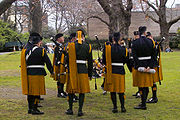 Though the origins of the Irish kilt continue to be a subject of debate, current evidence suggests that kilts originated in the Scottish
Highlands
and Isles and were adopted by Irish nationalists at the turn of the 20th century as a symbol of Celtic identity.
A garment that has often been mistaken for kilts in early depictions is the Irish 'Lein-croich', a long tunic traditionally made from solid colour cloth, with black, saffron and green being the most widely used colours. Solid coloured kilts were first adopted for use by Irish nationalists and thereafter by Irish regiments serving in the British Army, but they could often be seen in late 19th and early 20th century photos in Ireland especially at political and musical gatherings, as the kilt was re-adopted as a symbol of Gaelic nationalism in Ireland
during this period.
Within the world of Irish dancing boy's kilts have been largely abandoned, especially since the worldwide popularity of Riverdance
and the revival and interest in Irish dancing generally.
as a sign of Celtic identity. Kilts and tartans can therefore also be seen in Wales
, Cornwall
, the Isle of Man
, Brittany
, Galicia in Spain
, the Tras-os-Montes
region in the North of Portugal
, and Normandy
, as well as parts of England, particularly the North East
.
The St. David's tartan (Welsh
: brithwe Dewi Sant) is one of the most popular tartans in Wales, but individual family tartans are being produced, despite there being no evidence that the Welsh traditionally used tartan to identify families. Edwards, Williams, Jones, Thomas, Evans, and Davies are among the most popular tartans and common names in Wales. The Welsh National tartan was designed by D. M. Richards in 1967 to demonstrate Wales's connection with the greater Celtic world. Its colours (green, red, and white) are the colours of the Welsh national flag
. Nowadays with Welsh nationalism
national pride on the rise, there has been an increase in the number of people wearing a kilt (Welsh
: cilt), most often seen in formal settings like weddings, to rugby
or football matches, paired with a jersey rather than a formal jacket.
There are currently sixteen Breton tartans officially recorded in the Scottish tartan registries. The Breton tartans are: Brittany National (Breton National), Brittany Walking, Lead it Of, and a further nine county tartans (Kerne, Leon, Tregor, Gwened, Dol, St. Malo, Rennes, Nantes, St. Brieuc).Others have been recently created for smaller areas in Brittany (Ushent, Bro Vigoudenn and Menez Du "Black Mountain"
There are two Galician tartans recorded in the Scottish registries: Galicia and "Gallaecia - Galician National". There is historical evidence of the use of tartan and kilt in Galicia up to the 18th century.
, worn by Pharaohs and warriors in Ancient Egypt, is often called a kilt (and can be considered as such) as it is a piece of pleated linen wrapped around the body at the waist.
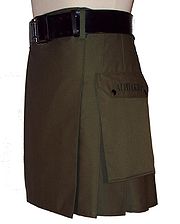 Contemporary kilts (also known as modern kilts and, especially in the United States, utility kilts) have appeared in the clothing marketplace in Scotland, the US and Canada in a range of fabrics, including leather
, denim
, corduroy
, and cotton
. They may be designed for formal or casual dress, for use in sports or outdoor recreation, or as white or blue collar workwear. Some are closely modelled on traditional Scottish kilts, but others are similar only in being knee-length skirt-like garments for men. They may have box pleats, symmetrical knife pleats, or no pleats at all, and be fastened by studs or velcro instead of buckles. Many are designed to be worn without a sporran, and may have pockets or tool belts attached.
In 2008, a USPS letter carrier, Dean Peterson, made a formal proposal that the kilt be approved as an acceptable postal uniform—for reasons of comfort. The proposal was defeated at the convention of the 220,000-member National Association of Letter Carriers
.
Female athletes, especially lacrosse
players, often wear kilts during games. They will typically wear compression shorts
or spandex
under their kilts to avoid exposing their underwear. Kilts are popular among many levels of lacrosse, from youth leagues to college leagues, although some teams are replacing kilts with the more streamlined athletic skirt
.
Men's kilts are seen in many places in popular contemporary media. For example, in the Syfy
series Tin Man
, side characters are shown wearing kilts as working peasant clothes. Trends in everyday fashion, especially in the Gothic subculture, have led to a popularization of the kilt as an alternative to more conventional legwear. Some of these, marketed by companies like Utilikilt
, Freedomkilt, Lip Service, and Tripp NYC, are made of PVC
or cotton-polyester blends, making them more affordable.
Pleat
A pleat is a type of fold formed by doubling fabric back upon itself and securing it in place. It is commonly used in clothing and upholstery to gather a wide piece of fabric to a narrower circumference....
s at the rear, originating in the traditional dress of men and boys in the Scottish Highlands
Scottish Highlands
The Highlands is an historic region of Scotland. The area is sometimes referred to as the "Scottish Highlands". It was culturally distinguishable from the Lowlands from the later Middle Ages into the modern period, when Lowland Scots replaced Scottish Gaelic throughout most of the Lowlands...
of the 16th century. Since the 19th century it has become associated with the wider culture of Scotland
Scotland
Scotland is a country that is part of the United Kingdom. Occupying the northern third of the island of Great Britain, it shares a border with England to the south and is bounded by the North Sea to the east, the Atlantic Ocean to the north and west, and the North Channel and Irish Sea to the...
in general, or with Celtic (and more specifically Gaelic
Gaels
The Gaels or Goidels are speakers of one of the Goidelic Celtic languages: Irish, Scottish Gaelic, and Manx. Goidelic speech originated in Ireland and subsequently spread to western and northern Scotland and the Isle of Man....
) heritage even more broadly. It is most often made of wool
Wool
Wool is the textile fiber obtained from sheep and certain other animals, including cashmere from goats, mohair from goats, qiviut from muskoxen, vicuña, alpaca, camel from animals in the camel family, and angora from rabbits....
len cloth in a tartan
Tartan
Tartan is a pattern consisting of criss-crossed horizontal and vertical bands in multiple colours. Tartans originated in woven wool, but now they are made in many other materials. Tartan is particularly associated with Scotland. Scottish kilts almost always have tartan patterns...
pattern.
Although the kilt is most often worn on formal occasions and at Highland games
Highland games
Highland games are events held throughout the &Highland games are events held throughout the &Highland games are events held throughout the &(-è_çà in Scotland and other countries as a way of celebrating Scottish and Celtic culture and heritage, especially that of the Scottish Highlands. Certain...
and sports events, it has also been adapted as an item of fashionable informal male clothing in recent years, returning to its roots as an everyday garment.
History
The kilt first appeared as the great kilt, the breacan or belted plaid, during the 16th century and is Highland Gaelic in origin, a full-length garment whose upper half could be worn as a cloakCloak
A cloak is a type of loose garment that is worn over indoor clothing and serves the same purpose as an overcoat; it protects the wearer from the cold, rain or wind for example, or it may form part of a fashionable outfit or uniform. Cloaks are as old as human history; there has nearly always been...
draped over the shoulder, or brought up over the head. The philibeg or small kilt, also known as the walking kilt (similar to the modern kilt) was invented by an English Quaker from Lancashire called Thomas Rawlinson sometime in the 1720s for the use of the Highlanders he and Ian MacDonnell, chief of the MacDonnells of Inverness employed in logging, charcoal manufacture and iron smelting, for which the belted plaid was "cumbrous and unwieldy".
Variants
The name "kilt" is applied to a range of garments:- The traditional garment, either in its historical form, or in the modern adaptation now usual in Scotland (see History of the kiltHistory of the kiltThe History of the Kilt stretches back to at least the end of the 16th century. The kilt first appeared as the belted plaid or great kilt, a full length garment whose upper half could be worn as a cloak draped over the shoulder, or brought up over head as a cloak...
), usually in a tartan pattern - The kilts worn by Irish pipe bands are based on the traditional Scottish garment but now in a single (solid) colour
- Variants of the Scottish kilt adopted in other Celtic nations, such as the Welsh cilt and the Cornish cilt
- Other skirt-like garments designed for men, but more or less different in structure from the Scottish kilt, including contemporary kilts
- Certain types of pleated wrapover skirt worn as school uniformSchool uniformA school uniform is an outfit—a set of standardized clothes—worn primarily for an educational institution. They are common in primary and secondary schools in various countries . When used, they form the basis of a school's dress code.Traditionally school uniforms have been largely subdued and...
by girls.
According to the Oxford English Dictionary
Oxford English Dictionary
The Oxford English Dictionary , published by the Oxford University Press, is the self-styled premier dictionary of the English language. Two fully bound print editions of the OED have been published under its current name, in 1928 and 1989. The first edition was published in twelve volumes , and...
, the noun derives from a verb to kilt, originally meaning "to gird up; to tuck up (the skirts) round the body", itself of Scandinavian
North Germanic languages
The North Germanic languages or Scandinavian languages, the languages of Scandinavians, make up one of the three branches of the Germanic languages, a sub-family of the Indo-European languages, along with the West Germanic languages and the extinct East Germanic languages...
origin.
Scottish kilt
The Scottish kilt displays uniqueness of design, construction, and convention which differentiate it from other garments fitting the general description. It is a tailored garment that is wrapped around the wearer's body at the natural waist (between the lowest rib and the hip) starting from one side (usually the wearer's left), around the front and back and across the front again to the opposite side. The fastenings consist of straps and buckles on both ends, the strap on the inside end usually passing through a slit in the waistband to be buckled on the outside; alternatively it may remain inside the waistband and be buckled inside.A kilt covers the body from the waist down to the centre of the knees. The overlapping layers in front are called "aprons" and are flat; the single layer of fabric around the sides and back is pleated. A kilt pin
Kilt pin
The kilt pin is a piece of jewellery that is usually worn on the lower corner of the outer apron of a kilt. Its function is to prevent the apron falling or blowing open, by adding weight to the outer apron. It does not pin the outer apron to the inner fabric....
is fastened to the front apron on the free corner (but is not passed through the layer below, as its function is to add weight). Underwear may or may not be worn, as the wearer prefers, although tradition has it that a "true Scotsman
True Scotsman
True Scotsman is a humorous term used in Scotland for a man wearing a kilt without undergarments. Though the tradition originated in the military, it has entered Scottish lore as a rite, an expression of light-hearted curiosity about the custom, even as a subversive gesture.-Background:Kilts have...
" should wear nothing under his kilt. The Scottish Tartans Authority, however, has described the practice as childish and unhygienic.
Organizations that sanction and grade the competitions in Highland dancing
Scottish highland dance
The term Highland dance or Highland dancing is used today to refer to a style of athletic solo dancing which developed in the Gaelic Highlands of Scotland...
and bagpiping
Bagpipes
Bagpipes are a class of musical instrument, aerophones, using enclosed reeds fed from a constant reservoir of air in the form of a bag. Though the Scottish Great Highland Bagpipe and Irish uilleann pipes have the greatest international visibility, bagpipes of many different types come from...
all have rules governing acceptable attire for the competitors. These rules specify that kilts are to be worn (except that in the national dances, the female competitors will be wearing the Aboyne dress
Aboyne dress
The Aboyne dress is the name given to the prescribed attire for females in the Scottish national dances, such as the Flora MacDonald, the Highland lilt, and others. There are actually two versions of the Aboyne dress in use.- Description :...
).
Fabrics
The typical kilt as seen at modern Highland games events is made of twillTwill
Twill is a type of textile weave with a pattern of diagonal parallel ribs . This is done by passing the weft thread over one or more warp threads and then under two or more warp threads and so on, with a "step" or offset between rows to create the characteristic diagonal pattern. Because of this...
woven worsted
Worsted
Worsted , is the name of a yarn, the cloth made from this yarn, and a yarn weight category. The name derives from the village of Worstead in the English county of Norfolk...
wool
Wool
Wool is the textile fiber obtained from sheep and certain other animals, including cashmere from goats, mohair from goats, qiviut from muskoxen, vicuña, alpaca, camel from animals in the camel family, and angora from rabbits....
. The twill weave used for kilts is a "2–2 type", meaning that each weft
Weft
In weaving, weft or woof is the yarn which is drawn through the warp yarns to create cloth. In North America, it is sometimes referred to as the "fill" or the "filling yarn"....
thread passes over and under two warp
Warp (weaving)
In weaving cloth, the warp is the set of lengthwise yarns that are held in tension on a frame or loom. The yarn that is inserted over-and-under the warp threads is called the weft, woof, or filler. Each individual warp thread in a fabric is called a warp end or end. Warp means "that which is thrown...
threads at a time. The result is a distinctive diagonal-weave pattern in the fabric which is called the twill line. This kind of twill, when woven according to a given sett or written colour pattern, (see below), is called tartan. In contrast kilts worn by Irish pipers are made from solid-colour cloth, with saffron
Saffron (color)
Saffron is a color that is a tone of golden yellow resembling the color of the tip of the saffron crocus thread, from which the spice saffron is derived.The first recorded use of saffron as a color name in English was in 1200...
or green being the most widely used colours.
Kilting fabric weights are given in ounces per yard and run from the very-heavy, regimental worsted of approximately 18–22 oz (510.3–623.7 ) down to a light worsted of about 10–11 oz (283.5–311.8 ). The most common weights for kilts are 13 ounces (368.5 g) and 16 ounces (453.6 g). The heavier weights are more appropriate for cooler weather, while the lighter weights would tend to be selected for warmer weather or for active use, such as Highland dancing. Some patterns are available in only a few weights.
A modern kilt for a typical adult uses about 6–8 yards of single-width (about 26–30 inches) or about 3–4 yards of double-width (about 54–60 inches) tartan fabric. Double-width fabric is woven so that the pattern exactly matches on the selvage
Selvage
The selvage or selvedge is the term for the self-finished edges of fabric. The selvages keep the fabric from unraveling or fraying. The selvages are a result of how the fabric is created...
. Kilts are usually made without a hem because a hem would make the garment too bulky and cause it to hang incorrectly. The exact amount of fabric needed depends upon several factors including the size of the sett, the number of pleats put into the garment, and the size of the person. For a full kilt, 8 yards of fabric would be used regardless of size and the number of pleats and depth of pleat would be adjusted according to their size. For a very large waist, it may be necessary to use 9 yards of cloth.
Setts
Victorian era
The Victorian era of British history was the period of Queen Victoria's reign from 20 June 1837 until her death on 22 January 1901. It was a long period of peace, prosperity, refined sensibilities and national self-confidence...
that the system of named tartans known today began to be systematically recorded and formalized, mostly by weaving companies for mercantile purposes. Up until this point, Highland tartans held regional associations rather than being identified with any particular clan.
Today there are also tartans for districts, counties, societies and corporations. There are also setts for states and provinces; schools and universities; sporting activities; individuals; and commemorative and simple generic patterns that anybody can wear. (See History of the kilt
History of the kilt
The History of the Kilt stretches back to at least the end of the 16th century. The kilt first appeared as the belted plaid or great kilt, a full length garment whose upper half could be worn as a cloak draped over the shoulder, or brought up over head as a cloak...
for the process by which these associations came about.)
Setts are always arranged horizontally and vertically, never diagonally (except when adapted for ladies' skirts). They are specified by their thread counts, the sequence of colours and their units of width. As an example, the Wallace
Clan Wallace
-Origins of the clan:The Wallace family first came to Scotland with a Norman family in the 11th century. King David was eager to extend the benefits of Norman influence and gave grants to the nobles of the south. Among them was Walter Fitzallan, who the Scottish king appointed his Steward in 1136...
tartan has a thread count given as "K4 R32 K32 Y4" (K is black, R is red, and Y is yellow). This means that 4 units of black thread will be succeeded by 32 units of red, etc., in both the warp and the weft. Typically, the units are the actual number of threads, but as long as the proportions are maintained, the resulting pattern will be the same. This thread count also includes a pivot point indicated by the slash between the colour and thread number. The weaver is supposed to reverse the weaving sequence at the pivot point to create a mirror image of the pattern. This is called a symmetrical tartan. Some tartans, like Buchanan
Clan Buchanan
Clan Buchanan is an Armigerous Scottish clan whose origins are said to lie in the 1225 grant of lands on the eastern shore of Loch Lomond to clergyman Sir Absalon of Buchanan by the Earl of Lennox.-Origins:...
, are asymmetrical, which means they do not have a pivot point. The weaver weaves the sequence all the way through and then starts at the beginning again for the next sett.
Setts are further characterized by their size, the number of inches (or centimetres) in one full repeat. The size of a given sett depends not only on the number of threads in the repeat, but also on the weight of the fabric. This is because the heavier the fabric the thicker the threads will be, and thus the same number of threads of a heavier-weight fabric will occupy more space. The colours given in the thread count are specified as in heraldry
Heraldry
Heraldry is the profession, study, or art of creating, granting, and blazoning arms and ruling on questions of rank or protocol, as exercised by an officer of arms. Heraldry comes from Anglo-Norman herald, from the Germanic compound harja-waldaz, "army commander"...
, although tartan patterns are not heraldic. The exact shade which is used is a matter of artistic freedom and will vary from one fabric
Fabric
A fabric is a textile material, short for "textile fabric".Fabric may also refer to:*Fabric , the spatial and geometric configuration of elements within a rock*Fabric , a nightclub in London, England...
mill to another as well as in dye
Dye
A dye is a colored substance that has an affinity to the substrate to which it is being applied. The dye is generally applied in an aqueous solution, and requires a mordant to improve the fastness of the dye on the fiber....
lot to another within the same mill.
Tartans are commercially woven in four standard colour variations that describe the overall tone. "Ancient" or "Old" colours may be characterized by a slightly faded look intended to resemble the vegetable dyes
Traditional dyes of the Scottish Highlands
Traditional dyes of the Scottish Highlands are thenative vegetable dyes used in Scottish Gaeldom.The following are the principal dyestuffs with the colours they produce. Several of the tints are very bright, but have now been superseded by various mineral dyes. The Latin names are given where known...
that were once used, although in some cases "Old" simply identifies a tartan that was in use before the current one. Ancient greens and blues are lighter while reds appear orange. "Modern" colours are bright and show off modern aniline
Aniline
Aniline, phenylamine or aminobenzene is an organic compound with the formula C6H5NH2. Consisting of a phenyl group attached to an amino group, aniline is the prototypical aromatic amine. Being a precursor to many industrial chemicals, its main use is in the manufacture of precursors to polyurethane...
dyeing methods. The colours are bright red, dark hunter green, and usually navy blue. "Weathered" or "Reproduction" colours simulate the look of older cloth weathered by the elements. Greens turn to light brown, blues become gray, and reds are a deeper wine colour. The last colour variation is "Muted" which tends toward earth tone
Earth tone
Earth tone is a color scheme that draws from a color palette of browns, tans, greys, greens, oranges, whites, and some reds. The colors in an earth tone scheme are muted and flat in an emulation of the natural colors found in soil, moss, trees and rocks. Many earth tones originate from clay earth...
s. The greens are olive, blues are slate blue, and red is an even deeper wine colour. This means that of the approximately 3,500 registered tartans available in the Scottish Tartans Authority
Scottish Tartans Authority
The Scottish Tartans Authority is a Scottish based organisation dedicated to promoting the knowledge of Scottish tartans. It was first formed in 1995 by former members of the Scottish Tartans Society. The Scottish Tartans Authority maintains a database, called the International Tartan Index, with...
database as of 2004 there are four possible colour variations for each, resulting in around 14,000 recognised tartan choices.
Setts may be registered with the International Tartan Index (ITI) of the charitable organisation Scottish Tartans Authority
Scottish Tartans Authority
The Scottish Tartans Authority is a Scottish based organisation dedicated to promoting the knowledge of Scottish tartans. It was first formed in 1995 by former members of the Scottish Tartans Society. The Scottish Tartans Authority maintains a database, called the International Tartan Index, with...
(STA), which maintains a collection of fabric samples characterized by name and thread count, for free, and/or registered with the Scottish Register of Tartans (SRT) of the statutory body the National Archives of Scotland
National Archives of Scotland
Based in Edinburgh, the National Archives of Scotland are the national archives of Scotland. The NAS claims to have one of the most varied collection of archives in Europe...
(NAS), if the tartan meets NAS's criteria, for UK₤70
Pound sterling
The pound sterling , commonly called the pound, is the official currency of the United Kingdom, its Crown Dependencies and the British Overseas Territories of South Georgia and the South Sandwich Islands, British Antarctic Territory and Tristan da Cunha. It is subdivided into 100 pence...
as of 2010. Although many tartans are added every year, most of the registered patterns available today were created in the 19th century onward by commercial weavers who worked with a large variety of colours. The rise of Highland romanticism and the growing Anglicisation
Anglicisation
Anglicisation, or anglicization , is the process of converting verbal or written elements of any other language into a form that is more comprehensible to an English speaker, or, more generally, of altering something such that it becomes English in form or character.The term most often refers to...
of Scottish culture by the Victorians at the time led to registering tartans with clan names. Before that, most of these patterns were more connected to geographical regions than to any clan. There is therefore nothing symbolic about the colours, and nothing about the patterns is a reflection of the status of the wearer.
Measurements
Ready-to-wear
Ready-to-wear or prêt-à-porter is the term for factory-made clothing, sold in finished condition, in standardized sizes, as distinct from made to measure or bespoke clothing tailored to a particular person's frame. Off-the-peg is sometimes used for items which are not clothing.Ready-to-wear has...
kilts can be obtained in standard sizes, a custom kilt is tailored to the individual proportions of the wearer. At least three measurements, the waist, hips, and length of the kilt, are usually required. Sometimes the rise (distance above the waist) or the fell (distance from waistline to the widest part of the hips) is also required.
A properly made kilt, when buckled on the tightest holes of the straps, is not so loose that the wearer can easily twist the kilt around their body, nor so tight that it causes "scalloping" of the fabric where it is buckled. Additionally, the length of the kilt when buckled at the waist reaches a point no lower than halfway across the kneecap and no higher than about an inch above it.
Pleating and stitching
Argyll and Sutherland Highlanders
The Argyll and Sutherland Highlanders, 5th Battalion The Royal Regiment of Scotland is an infantry battalion of the Royal Regiment of Scotland....
use box pleats, while the Black Watch
Black Watch
The Black Watch, 3rd Battalion, Royal Regiment of Scotland is an infantry battalion of the Royal Regiment of Scotland. The unit's traditional colours were retired in 2011 in a ceremony led by Queen Elizabeth II....
make their kilts of the same tartan with knife pleats. These traditions were also passed on to affiliated regiments in the Commonwealth
Commonwealth of Nations
The Commonwealth of Nations, normally referred to as the Commonwealth and formerly known as the British Commonwealth, is an intergovernmental organisation of fifty-four independent member states...
, and were retained in successor battalion
Battalion
A battalion is a military unit of around 300–1,200 soldiers usually consisting of between two and seven companies and typically commanded by either a Lieutenant Colonel or a Colonel...
s to these regiments in the amalgamated Royal Regiment of Scotland.
Pleats can be arranged relative to the pattern in two ways. In pleating to the stripe, one of the vertical stripes in the tartan is selected and the fabric is then folded so that this stripe runs down the center of each pleat. The result is that along the pleated section of the kilt (the back and sides) the pattern appears different from the unpleated front, often emphasisng the horizontal bands rather than creating a balance between horizontal and vertical. This is often called military pleating because it is the style adopted by many military regiments. It is also widely used by pipe bands.
Any pleat is characterized by depth and width. The portion of the pleat that protrudes under the overlying pleat is the size or width. The pleat width is selected based on the size of the sett and the amount of fabric to be used in constructing the kilt, and will generally vary from about 1/2" to about 3/4".
The depth is the part of the pleat which is folded under the overlying pleat. It depends solely on the size of the tartan sett even when pleating to the stripe, since the sett determines the spacing of the stripes.
The number of pleats used in making kilts depends upon how much material is to be used in constructing the garment and upon the size of the sett.
The pleats across the fell are tapered slightly since the wearer's waist is usually narrower than the hips and the pleats are usually stitched down either by machine or by hand.
Accessories
The Scottish kilt is usually worn with kilt hose (woollen socks), turned down at the knee, often with garter flashes, and a sporranSporran
The Sporran is a traditional part of male Scottish Highland dress. It is a pouch that performs the same function as pockets on the pocketless Scottish kilt....
(Gaelic for "purse": a type of pouch), which hangs around the waist from a chain or leather strap. This may be plain or embossed leather, or decorated with sealskin, fur, or polished metal plating.
Other common accessories, depending on the formality of the context, include:
- A belt (usually with embossed buckle)
- A jacket (of various traditional designs)
- A kilt pin
- A sgian dubhSgian DubhThe sgian-dubh is a small, singled-edged knife worn as part of traditional Scottish Highland dress along with the kilt. It is worn tucked into the top of the kilt hose with only the upper portion of the hilt visible...
(Gaelic: "black knife": a small sheathed knife worn in the top of the hose) - Ghillie broguesBroguesThe Brogue is a style of low-heeled shoe or boot traditionally characterized by multiple-piece, sturdy leather uppers with decorative perforations and serration along the pieces' visible edges...
- Occasionally worn with a Ghillie shirtGhillie shirtA Ghillie shirt, also known as Jacobean or Jacobite, is an informal traditional shirt usually worn with a kilt. The term Ghillie refers to the criss-crossed lacing style as also seen on the Ghillie Brogue. Ghillie shirts are considered to be more casual than their shirt and waist-coat counterpart...
, although this is more casual
Styles of kilt wear
Today most ScotsmenScottish people
The Scottish people , or Scots, are a nation and ethnic group native to Scotland. Historically they emerged from an amalgamation of the Picts and Gaels, incorporating neighbouring Britons to the south as well as invading Germanic peoples such as the Anglo-Saxons and the Norse.In modern use,...
regard kilts as formal dress or national dress. Although there are still a few people who wear a kilt daily, it is generally owned or hired to be worn at weddings or other formal occasions, much the same way as tuxedos in America, and may be worn by anyone regardless of nationality or descent. For formal wear, kilts are usually worn with a Prince Charlie or an Argyll jacket. (Commercial suppliers have now produced equivalent jackets with Irish and Welsh themed styling.)
Kilts are also used for parades by groups such as the Scouts
Scouting
Scouting, also known as the Scout Movement, is a worldwide youth movement with the stated aim of supporting young people in their physical, mental and spiritual development, that they may play constructive roles in society....
, and in many places kilts are seen in force at Highland games
Highland games
Highland games are events held throughout the &Highland games are events held throughout the &Highland games are events held throughout the &(-è_çà in Scotland and other countries as a way of celebrating Scottish and Celtic culture and heritage, especially that of the Scottish Highlands. Certain...
and pipe band
Pipe band
A pipe band is a musical ensemble consisting of pipers and drummers. The term used by military pipe bands, pipes and drums, is also common....
championships as well as being worn at Scottish country dance
Scottish country dance
A Scottish country dance is a form of social dance involving groups of mixed couples of dancers tracing progressive patterns according to a predetermined choreography...
s and ceilidh
Céilidh
In modern usage, a céilidh or ceilidh is a traditional Gaelic social gathering, which usually involves playing Gaelic folk music and dancing. It originated in Ireland, but is now common throughout the Irish and Scottish diasporas...
s.
Certain regiments/units of the British Army
British Army
The British Army is the land warfare branch of Her Majesty's Armed Forces in the United Kingdom. It came into being with the unification of the Kingdom of England and Scotland into the Kingdom of Great Britain in 1707. The new British Army incorporated Regiments that had already existed in England...
and armies of other Commonwealth
Commonwealth of Nations
The Commonwealth of Nations, normally referred to as the Commonwealth and formerly known as the British Commonwealth, is an intergovernmental organisation of fifty-four independent member states...
nations (including Australia
Australia
Australia , officially the Commonwealth of Australia, is a country in the Southern Hemisphere comprising the mainland of the Australian continent, the island of Tasmania, and numerous smaller islands in the Indian and Pacific Oceans. It is the world's sixth-largest country by total area...
, Canada
Canada
Canada is a North American country consisting of ten provinces and three territories. Located in the northern part of the continent, it extends from the Atlantic Ocean in the east to the Pacific Ocean in the west, and northward into the Arctic Ocean...
, New Zealand
New Zealand
New Zealand is an island country in the south-western Pacific Ocean comprising two main landmasses and numerous smaller islands. The country is situated some east of Australia across the Tasman Sea, and roughly south of the Pacific island nations of New Caledonia, Fiji, and Tonga...
and South Africa
South Africa
The Republic of South Africa is a country in southern Africa. Located at the southern tip of Africa, it is divided into nine provinces, with of coastline on the Atlantic and Indian oceans...
) with a Scottish lineage or heritage still continue to wear kilts as part of dress or duty uniform, though they have not been used in combat since 1940. Uniforms in which kilts are worn include Ceremonial Dress, Service Dress, and Barracks Dress. Kilts are considered appropriate for ceremonial parades, office duties, less formal parades, walking out, mess dinners, and classroom instruction/band practice. Ceremonial kilts have also been developed for the U.S. Marine Corps
United States Marine Corps
The United States Marine Corps is a branch of the United States Armed Forces responsible for providing power projection from the sea, using the mobility of the United States Navy to deliver combined-arms task forces rapidly. It is one of seven uniformed services of the United States...
, and the pipe and drum bands of the U.S. Military Academy
United States Military Academy
The United States Military Academy at West Point is a four-year coeducational federal service academy located at West Point, New York. The academy sits on scenic high ground overlooking the Hudson River, north of New York City...
, U.S. Coast Guard
United States Coast Guard
The United States Coast Guard is a branch of the United States Armed Forces and one of the seven U.S. uniformed services. The Coast Guard is a maritime, military, multi-mission service unique among the military branches for having a maritime law enforcement mission and a federal regulatory agency...
and the U.S. Air Force
United States Air Force
The United States Air Force is the aerial warfare service branch of the United States Armed Forces and one of the American uniformed services. Initially part of the United States Army, the USAF was formed as a separate branch of the military on September 18, 1947 under the National Security Act of...
.
In recent years, kilts have also become increasingly common in Scotland and around the world for casual wear, for example with the Jacobite shirt. It is not uncommon to see kilts worn at Irish pubs in the United States, and it is becoming somewhat less rare to see them in the workplace. Casual use of kilts dressed down with lace-up boots or moccasins, and with t-shirts or golf shirts, is becoming increasingly more familiar at Highland Games. The kilt is associated with a sense of Scottish national pride and will often be seen being worn, along with a football top
Kit (football)
In association football, as in a number of sports, kit refers to the standard equipment and attire worn by players. The term "kit" should be distinguished from a "strip" , which refers to just the shirt, shorts and socks, although the terms are sometimes used interchangeably...
, when members of the Tartan Army
Tartan Army
The Tartan Army is a name given to fans of the Scotland national football team. They have won awards from several organisations for their friendly behaviour and charitable work...
are watching a football or rugby
Rugby football
Rugby football is a style of football named after Rugby School in the United Kingdom. It is seen most prominently in two current sports, rugby league and rugby union.-History:...
match. The small ornamental Sgian Dubh
Sgian Dubh
The sgian-dubh is a small, singled-edged knife worn as part of traditional Scottish Highland dress along with the kilt. It is worn tucked into the top of the kilt hose with only the upper portion of the hilt visible...
knife is often omitted where security concerns are paramount (for example, they are not allowed on commercial aircraft). For the same reasons, the traditional Sgian Dubh is sometimes substituted by a wooden or plastic alternative, as its use is now largely ornamental (with only the hilt showing over the top of the hose).
Kilts in Ireland
Scotland
Scotland is a country that is part of the United Kingdom. Occupying the northern third of the island of Great Britain, it shares a border with England to the south and is bounded by the North Sea to the east, the Atlantic Ocean to the north and west, and the North Channel and Irish Sea to the...
Highlands
Scottish Highlands
The Highlands is an historic region of Scotland. The area is sometimes referred to as the "Scottish Highlands". It was culturally distinguishable from the Lowlands from the later Middle Ages into the modern period, when Lowland Scots replaced Scottish Gaelic throughout most of the Lowlands...
and Isles and were adopted by Irish nationalists at the turn of the 20th century as a symbol of Celtic identity.
A garment that has often been mistaken for kilts in early depictions is the Irish 'Lein-croich', a long tunic traditionally made from solid colour cloth, with black, saffron and green being the most widely used colours. Solid coloured kilts were first adopted for use by Irish nationalists and thereafter by Irish regiments serving in the British Army, but they could often be seen in late 19th and early 20th century photos in Ireland especially at political and musical gatherings, as the kilt was re-adopted as a symbol of Gaelic nationalism in Ireland
Ireland
Ireland is an island to the northwest of continental Europe. It is the third-largest island in Europe and the twentieth-largest island on Earth...
during this period.
Within the world of Irish dancing boy's kilts have been largely abandoned, especially since the worldwide popularity of Riverdance
Riverdance
Riverdance is a theatrical show consisting of traditional Irish stepdancing, notable for its rapid leg movements while body and arms are kept largely stationary. It originated as an interval performance during the 1994 Eurovision Song Contest, a moment that is still considered a significant...
and the revival and interest in Irish dancing generally.
Other Celtic nations
Although not a traditional component of national dress outside Scotland, kilts have become recently popular in the other Celtic nationsCeltic nations
The Celtic nations are territories in North-West Europe in which that area's own Celtic languages and some cultural traits have survived.The term "nation" is used in its original sense to mean a people who share a common traditional identity and culture and are identified with a traditional...
as a sign of Celtic identity. Kilts and tartans can therefore also be seen in Wales
Wales
Wales is a country that is part of the United Kingdom and the island of Great Britain, bordered by England to its east and the Atlantic Ocean and Irish Sea to its west. It has a population of three million, and a total area of 20,779 km²...
, Cornwall
Cornwall
Cornwall is a unitary authority and ceremonial county of England, within the United Kingdom. It is bordered to the north and west by the Celtic Sea, to the south by the English Channel, and to the east by the county of Devon, over the River Tamar. Cornwall has a population of , and covers an area of...
, the Isle of Man
Isle of Man
The Isle of Man , otherwise known simply as Mann , is a self-governing British Crown Dependency, located in the Irish Sea between the islands of Great Britain and Ireland, within the British Isles. The head of state is Queen Elizabeth II, who holds the title of Lord of Mann. The Lord of Mann is...
, Brittany
Brittany
Brittany is a cultural and administrative region in the north-west of France. Previously a kingdom and then a duchy, Brittany was united to the Kingdom of France in 1532 as a province. Brittany has also been referred to as Less, Lesser or Little Britain...
, Galicia in Spain
Spain
Spain , officially the Kingdom of Spain languages]] under the European Charter for Regional or Minority Languages. In each of these, Spain's official name is as follows:;;;;;;), is a country and member state of the European Union located in southwestern Europe on the Iberian Peninsula...
, the Tras-os-Montes
Trás-os-Montes (region)
Trás-os-Montes was one of the 13 regions of continental Portugal identified by geographer Amorim Girão, in a study published between 1927 and 1930.Together with Alto Douro it formed Trás-os-Montes e Alto Douro Province.- See also :...
region in the North of Portugal
Portugal
Portugal , officially the Portuguese Republic is a country situated in southwestern Europe on the Iberian Peninsula. Portugal is the westernmost country of Europe, and is bordered by the Atlantic Ocean to the West and South and by Spain to the North and East. The Atlantic archipelagos of the...
, and Normandy
Normandy
Normandy is a geographical region corresponding to the former Duchy of Normandy. It is in France.The continental territory covers 30,627 km² and forms the preponderant part of Normandy and roughly 5% of the territory of France. It is divided for administrative purposes into two régions:...
, as well as parts of England, particularly the North East
Northumbria
Northumbria was a medieval kingdom of the Angles, in what is now Northern England and South-East Scotland, becoming subsequently an earldom in a united Anglo-Saxon kingdom of England. The name reflects the approximate southern limit to the kingdom's territory, the Humber Estuary.Northumbria was...
.
The St. David's tartan (Welsh
Welsh language
Welsh is a member of the Brythonic branch of the Celtic languages spoken natively in Wales, by some along the Welsh border in England, and in Y Wladfa...
: brithwe Dewi Sant) is one of the most popular tartans in Wales, but individual family tartans are being produced, despite there being no evidence that the Welsh traditionally used tartan to identify families. Edwards, Williams, Jones, Thomas, Evans, and Davies are among the most popular tartans and common names in Wales. The Welsh National tartan was designed by D. M. Richards in 1967 to demonstrate Wales's connection with the greater Celtic world. Its colours (green, red, and white) are the colours of the Welsh national flag
Flag of Wales
The Flag of Wales consists of a red dragon passant on a green and white field. As with many heraldic charges, the exact representation of the dragon is not standardised and many renderings exist....
. Nowadays with Welsh nationalism
Welsh nationalism
Welsh nationalism emphasises the distinctiveness of Welsh language, culture, and history, and calls for more self-determination for Wales, which may include more Devolved powers for the Welsh Assembly or full independence from the United Kingdom.-Conquest:...
national pride on the rise, there has been an increase in the number of people wearing a kilt (Welsh
Welsh language
Welsh is a member of the Brythonic branch of the Celtic languages spoken natively in Wales, by some along the Welsh border in England, and in Y Wladfa...
: cilt), most often seen in formal settings like weddings, to rugby
Rugby football
Rugby football is a style of football named after Rugby School in the United Kingdom. It is seen most prominently in two current sports, rugby league and rugby union.-History:...
or football matches, paired with a jersey rather than a formal jacket.
There are currently sixteen Breton tartans officially recorded in the Scottish tartan registries. The Breton tartans are: Brittany National (Breton National), Brittany Walking, Lead it Of, and a further nine county tartans (Kerne, Leon, Tregor, Gwened, Dol, St. Malo, Rennes, Nantes, St. Brieuc).Others have been recently created for smaller areas in Brittany (Ushent, Bro Vigoudenn and Menez Du "Black Mountain"
There are two Galician tartans recorded in the Scottish registries: Galicia and "Gallaecia - Galician National". There is historical evidence of the use of tartan and kilt in Galicia up to the 18th century.
Ancient Egypt
The shendytShendyt
The shendyt is a garment which was made of cloth and was worn around the waist, typically extending to above the knees, in ancient Egyptian society...
, worn by Pharaohs and warriors in Ancient Egypt, is often called a kilt (and can be considered as such) as it is a piece of pleated linen wrapped around the body at the waist.
Contemporary kilt
Leather
Leather is a durable and flexible material created via the tanning of putrescible animal rawhide and skin, primarily cattlehide. It can be produced through different manufacturing processes, ranging from cottage industry to heavy industry.-Forms:...
, denim
Denim
Denim is a rugged cotton twill textile, in which the weft passes under two or more warp threads. This produces the familiar diagonal ribbing identifiable on the reverse of the fabric, which distinguishes denim from cotton duck. Denim has been in American usage since the late 18th century...
, corduroy
Corduroy
Corduroy is a textile composed of twisted fibers that, when woven, lie parallel to one another to form the cloth's distinct pattern, a "cord." Modern corduroy is most commonly composed of tufted cords, sometimes exhibiting a channel between the tufts...
, and cotton
Cotton
Cotton is a soft, fluffy staple fiber that grows in a boll, or protective capsule, around the seeds of cotton plants of the genus Gossypium. The fiber is almost pure cellulose. The botanical purpose of cotton fiber is to aid in seed dispersal....
. They may be designed for formal or casual dress, for use in sports or outdoor recreation, or as white or blue collar workwear. Some are closely modelled on traditional Scottish kilts, but others are similar only in being knee-length skirt-like garments for men. They may have box pleats, symmetrical knife pleats, or no pleats at all, and be fastened by studs or velcro instead of buckles. Many are designed to be worn without a sporran, and may have pockets or tool belts attached.
In 2008, a USPS letter carrier, Dean Peterson, made a formal proposal that the kilt be approved as an acceptable postal uniform—for reasons of comfort. The proposal was defeated at the convention of the 220,000-member National Association of Letter Carriers
National Association of Letter Carriers
The National Association of Letter Carriers is an American labor union, representing non-rural letter carriers employed by the United States Postal Service...
.
Female athletes, especially lacrosse
Lacrosse
Lacrosse is a team sport of Native American origin played using a small rubber ball and a long-handled stick called a crosse or lacrosse stick, mainly played in the United States and Canada. It is a contact sport which requires padding. The head of the lacrosse stick is strung with loose mesh...
players, often wear kilts during games. They will typically wear compression shorts
Compression shorts
Compression shorts are undergarments usually worn by athletes. They are form-fitting garments and when worn cover the athlete's waist to mid or lower thigh. These garments are often made from a spandex-type material, similar to cycling shorts....
or spandex
Spandex
Spandex or elastane is a synthetic fibre known for its exceptional elasticity. It is strong, but less durable than natural Latex, its major non-synthetic competitor. It is a polyurethane-polyurea copolymer that was co-invented in 1959 by chemists C. L. Sandquist and Joseph Shivers at DuPont's...
under their kilts to avoid exposing their underwear. Kilts are popular among many levels of lacrosse, from youth leagues to college leagues, although some teams are replacing kilts with the more streamlined athletic skirt
Skirt
A skirt is a tube- or cone-shaped garment that hangs from the waist and covers all or part of the legs.In the western world, skirts are usually considered women's clothing. However, there are exceptions...
.
Men's kilts are seen in many places in popular contemporary media. For example, in the Syfy
Syfy
Syfy , formerly known as the Sci-Fi Channel and SCI FI, is an American cable television channel featuring science fiction, supernatural, fantasy, reality, paranormal, wrestling, and horror programming. Launched on September 24, 1992, it is part of the entertainment conglomerate NBCUniversal, a...
series Tin Man
Tin Man (TV miniseries)
Tin Man is a 2007 four and a half hour miniseries co-produced by RHI Entertainment and Sci Fi Channel original pictures that was broadcast in the United States on the Sci Fi Channel in three parts. The first part aired on December 2, and the remaining two parts airing on the following nights...
, side characters are shown wearing kilts as working peasant clothes. Trends in everyday fashion, especially in the Gothic subculture, have led to a popularization of the kilt as an alternative to more conventional legwear. Some of these, marketed by companies like Utilikilt
The utilikilts company
The Utilikilts Company is an American kilt company that was founded by Steven Villegas and Megan Haas in April 2000. Villegas created his first unbifurcated garment in the late 90's as a comfortable alternative to pants meant to offer the most freedom of movement while working on his motorcycle...
, Freedomkilt, Lip Service, and Tripp NYC, are made of PVC
PVC
Polyvinyl chloride is a plastic.PVC may also refer to:*Param Vir Chakra, India's highest military honor*Peripheral venous catheter, a small, flexible tube placed into a peripheral vein in order to administer medication or fluids...
or cotton-polyester blends, making them more affordable.
See also
- Fly plaidFly plaidA fly plaid is an added form of a pleated cloth in the same tartan as the kilt, cast over the left shoulder and fastened in front of the shoulder with a plaid brooch...
- Full plaidFull plaidA full plaid is a long piece of tartan fabric, traditionally worn as part of a full highland dress uniform. It usually matches the tartan of the kilt. A full plaid is pleated the whole way, with half of its length sewn shut...
- History of the kiltHistory of the kiltThe History of the Kilt stretches back to at least the end of the 16th century. The kilt first appeared as the belted plaid or great kilt, a full length garment whose upper half could be worn as a cloak draped over the shoulder, or brought up over head as a cloak...
- FustanellaFustanellaFustanella is a traditional skirt-like garment worn by men of many nations in the Balkans, similar to the kilt. In modern times, the fustanella is part of Balkan folk dresses...
- Scottish dress
- TartanTartanTartan is a pattern consisting of criss-crossed horizontal and vertical bands in multiple colours. Tartans originated in woven wool, but now they are made in many other materials. Tartan is particularly associated with Scotland. Scottish kilts almost always have tartan patterns...
- FlannelFlannelFlannel is a soft woven fabric, of various fineness. Flannel was originally made from carded wool or worsted yarn, but is now often made from either wool, cotton, or synthetic fibre. Flannel may be brushed to create extra softness or remain unbrushed. The brushing process is a mechanical process...
- Check (fabric)Check (fabric)A check is a pattern consisting of crossed horizontal and vertical lines forming squares.-Etymology:...
- Madras (cloth)Madras (cloth)Madras is a lightweight cotton fabric with typically patterned texture and plaid design, used primarily for summer clothing—pants, shorts, dresses and jackets. The fabric takes its name from the former English name of the city of Chennai, India...
- Argyle (pattern)Argyle (pattern)The argyle pattern is made of diamonds or lozenges. The word is sometimes used to refer to an individual diamond in the design but more commonly refers to the overall pattern. Most argyle layouts contain layers of overlapping motifs, adding a sense of three-dimensionality, movement, and texture...
- TrewsTrewsTrews are men's clothing for the legs and lower abdomen, a traditional form of tartan trousers from Scottish apparel...
- Lava-lavaLava-lavaA lava-lava is an article of daily clothing traditionally worn by Polynesians and other Oceanic peoples. It consists of a single rectangular cloth worn as a skirt. The term lava-lava is both singular and plural in the Samoan language.-Customary use:...
- LungiLungiThe Lungi , also known as a sarong , is a traditional garment worn around the waist in India, Pakistan, Bangladesh, Sri Lanka, Burma, Brunei, Indonesia, Malaysia, Singapore, the Horn of Africa and the southern Arabian Peninsula...
- SarongSarongA sarong or sarung is a large tube or length of fabric, often wrapped around the waist and worn as a kilt by men and as a skirt by women throughout much of South Asia, Southeast Asia, the Arabian Peninsula, the Horn of Africa, and on many Pacific islands. The fabric most often has woven plaid or...