

World war

Encyclopedia
A world war is a war
affecting the majority of the world's most powerful and populous nations. World wars span multiple countries
on multiple continent
s, with battles fought in multiple theaters
.
The term has usually been applied to two conflicts of unprecedented scale that occurred during the 20th century, World War I
(1914–1918) and World War II
(1939–1945), although in retrospect a number of earlier conflicts may be regarded as "world wars". The other most common usage of the term is in the context of World War III
, a phrase usually used to describe any hypothetical future global conflict.
cites the first known usage in the English language as being in April 1909, in the pages of the Westminster Gazette
.
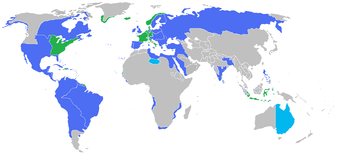
It was recognized that the complex system of opposing alliances—the German Empire
, Austria-Hungary
, and the Ottoman Empire
vs. the French Third Republic
, the Russian Empire
, and the British Empire
was likely to lead to a global conflict in the event of war breaking out. The fact that the powers involved had large overseas empires virtually guaranteed that a conflict would be global, as the colonies' resources would be a crucial strategic factor. The same strategic considerations also ensured that the combatants would strike at each others' colonies, thus spreading the fighting far more widely than in the pre-colonial era.
Other languages have also adopted the "World War" terminology; for instance, in French
, the two World Wars are the Guerres mondiales; in German
, the Erste und Zweite Weltkrieg (World War I was only known or commonly recognized in public as der Weltkrieg in Germany when it was over, while prior the word was rather used in the more abstract meaning of "a global conflict"); in Russian
the мировые войны (miroviye voyni); in Spanish
the Guerra Mundial and so on.
 The term First World War was used in the book The First World War: A Photographic History, edited by playwright and war veteran Laurence Stallings
and published in 1933. The term "World War I
" was invented by Time
magazine in its issue of June 12, 1939. In that same issue, the term World War II
was first used speculatively by Time magazine to describe the upcoming war. The first use for the actual war came in its issue of September 11, 1939.
leading to the Mongol Empire
, which spanned Eurasia
from China
, Japan
, and Korea
to Persia, Mesopotamia
, the Balkans
, Hungary
and Russia
; the Ottoman-Habsburg wars
during the 16th century; and the Dutch–Portuguese War from the 1580s to the 1650s, which was fought throughout the Atlantic, Brazil
, West Africa
, Southern Africa
, the Indian Ocean
, Malaysia, India
and Indonesia
.
Other wars in earlier periods that saw conflict across the world have been considered world wars by some:
Prior to the late 19th century, the concept of a world war would not have had much meaning. The Asian powers of India
, China
and Japan
did not act outside their own territory. India was an early target of the creation of trade colonies due to its strategic importance on the maritime equivalent of the Silk Road to the East Indies
and China while both China and Japan were able to remain mostly isolationist until the 19th century. The European conflicts of earlier centuries were essentially quarrels between powers which took place in fairly limited, though sometimes far-flung, theatres of conflict.
Where native inhabitants of other continents were involved, they generally participated as local auxiliaries rather than as allies of equal status, fighting in multiple theatres. For instance, in Britain's wars against France, Native American
s assisted both European powers on their own ground rather than being shipped to continental Europe to serve as allied troops there. By contrast, during the World Wars, millions of troops from Africa, Asia, North America, South America and Australasia served alongside the colonial powers in Europe and other theatres of war.
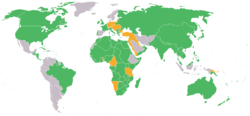
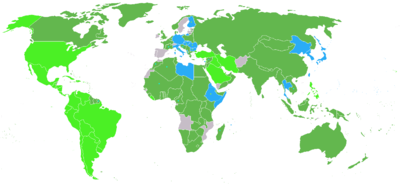
" spanning the period 1914–1945. However, this concept overlooks the war in the Far East
caused by Japan's programme of territorial expansion, which started independently of events in Europe.
The World Wars were made possible, above all else, by a combination of fast communications (such as the telegraph
and radio
) and fast transportation (the steam ship and railroad). This enabled military action to be coordinated rapidly over a very wide area and permitted troops to be transported quickly in large numbers on a global scale.
The outcome of the World Wars had a profound effect on the course of world history. The old European empires collapsed or were dismantled as a direct result of the wars' crushing costs and in some cases the defeat of imperial powers. The United States was firmly established as the dominant global power, along with its ideological foe, the Soviet Union, in close competition. These two "superpowers" exerted political influence over most of the world's other nations for decades after the conclusion of World War II (ending in the late 1980s in the Soviet Union). The modern international security, economic and diplomatic system was created in the aftermath of the wars. Institutions such as NATO, the United Nations
and the European Union
were established to "collectivise" international affairs, with the explicit aim of preventing another outbreak of general war. The wars also greatly changed the course of daily life. Technologies developed during wartime had a profound effect on peacetime life as well—for instance, jet aircraft
, penicillin
, nuclear energy
, and electronic computer
s.
Since the atomic bombings of Hiroshima and Nagasaki
during World War II, there has been a widespread and prolonged fear of a Third World War between nuclear-armed superpower
s.
is a hypothetical successor to World War II and is often suggested to be nuclear, devastating in nature and likely exceedingly more violent than both WW1 and WW2. This war is anticipated and planned for by military and civil authorities, and explored in fiction
in many countries. Concepts range from purely conventional scenarios or a limited use of nuclear weapons to the destruction of the planet. World War IV is sometimes mentioned as a hypothetical successor to World War III or as a plot element in books, movies or video games.
Former government officials, politicians and authors have attempted to apply the labels of WW III, WW IV, and WW V to various military engagements and diplomatic stand-offs since the close of WW II, such as the Korean War
or the War on Terror
. Among these are
former American and French government officials James Woolsey
and Alexandre de Marenches
,
author Elliot Cohen and zapatist
leader Subcomandante Marcos
. Despite their efforts, none of these wars are commonly considered world wars.
The Second Congo War
has been called "Africa's World War" for the number of countries involved.
War
War is a state of organized, armed, and often prolonged conflict carried on between states, nations, or other parties typified by extreme aggression, social disruption, and usually high mortality. War should be understood as an actual, intentional and widespread armed conflict between political...
affecting the majority of the world's most powerful and populous nations. World wars span multiple countries
Country
A country is a region legally identified as a distinct entity in political geography. A country may be an independent sovereign state or one that is occupied by another state, as a non-sovereign or formerly sovereign political division, or a geographic region associated with a previously...
on multiple continent
Continent
A continent is one of several very large landmasses on Earth. They are generally identified by convention rather than any strict criteria, with seven regions commonly regarded as continents—they are : Asia, Africa, North America, South America, Antarctica, Europe, and Australia.Plate tectonics is...
s, with battles fought in multiple theaters
Theater (warfare)
In warfare, a theater, is defined as an area or place within which important military events occur or are progressing. The entirety of the air, land, and sea area that is or that may potentially become involved in war operations....
.
The term has usually been applied to two conflicts of unprecedented scale that occurred during the 20th century, World War I
World War I
World War I , which was predominantly called the World War or the Great War from its occurrence until 1939, and the First World War or World War I thereafter, was a major war centred in Europe that began on 28 July 1914 and lasted until 11 November 1918...
(1914–1918) and World War II
World War II
World War II, or the Second World War , was a global conflict lasting from 1939 to 1945, involving most of the world's nations—including all of the great powers—eventually forming two opposing military alliances: the Allies and the Axis...
(1939–1945), although in retrospect a number of earlier conflicts may be regarded as "world wars". The other most common usage of the term is in the context of World War III
World War III
World War III denotes a successor to World War II that would be on a global scale, with common speculation that it would be likely nuclear and devastating in nature....
, a phrase usually used to describe any hypothetical future global conflict.
Origins of the term
The term World War was coined speculatively in the early 20th century, some years before the first World War broke out, probably as a literal translation of the German word Weltkrieg. German writer August Wilhelm Otto Niemann had used the word in the title of his anti-British novel Der Weltkrieg: Deutsche Träume ("The World War: German Dreams") as early as 1904, published in English as The coming conquest of England. The Oxford English DictionaryOxford English Dictionary
The Oxford English Dictionary , published by the Oxford University Press, is the self-styled premier dictionary of the English language. Two fully bound print editions of the OED have been published under its current name, in 1928 and 1989. The first edition was published in twelve volumes , and...
cites the first known usage in the English language as being in April 1909, in the pages of the Westminster Gazette
Westminster Gazette
The Westminster Gazette was an influential Liberal newspaper based in London. It was known for publishing sketches and short stories, including early works by Raymond Chandler, Anthony Hope and Saki, and travel writing by Rupert Brooke. One of its editors was caricaturist and political cartoonist...
.
It was recognized that the complex system of opposing alliances—the German Empire
German Empire
The German Empire refers to Germany during the "Second Reich" period from the unification of Germany and proclamation of Wilhelm I as German Emperor on 18 January 1871, to 1918, when it became a federal republic after defeat in World War I and the abdication of the Emperor, Wilhelm II.The German...
, Austria-Hungary
Austria-Hungary
Austria-Hungary , more formally known as the Kingdoms and Lands Represented in the Imperial Council and the Lands of the Holy Hungarian Crown of Saint Stephen, was a constitutional monarchic union between the crowns of the Austrian Empire and the Kingdom of Hungary in...
, and the Ottoman Empire
Ottoman Empire
The Ottoman EmpireIt was usually referred to as the "Ottoman Empire", the "Turkish Empire", the "Ottoman Caliphate" or more commonly "Turkey" by its contemporaries...
vs. the French Third Republic
French Third Republic
The French Third Republic was the republican government of France from 1870, when the Second French Empire collapsed due to the French defeat in the Franco-Prussian War, to 1940, when France was overrun by Nazi Germany during World War II, resulting in the German and Italian occupations of France...
, the Russian Empire
Russian Empire
The Russian Empire was a state that existed from 1721 until the Russian Revolution of 1917. It was the successor to the Tsardom of Russia and the predecessor of the Soviet Union...
, and the British Empire
British Empire
The British Empire comprised the dominions, colonies, protectorates, mandates and other territories ruled or administered by the United Kingdom. It originated with the overseas colonies and trading posts established by England in the late 16th and early 17th centuries. At its height, it was the...
was likely to lead to a global conflict in the event of war breaking out. The fact that the powers involved had large overseas empires virtually guaranteed that a conflict would be global, as the colonies' resources would be a crucial strategic factor. The same strategic considerations also ensured that the combatants would strike at each others' colonies, thus spreading the fighting far more widely than in the pre-colonial era.
Other languages have also adopted the "World War" terminology; for instance, in French
French language
French is a Romance language spoken as a first language in France, the Romandy region in Switzerland, Wallonia and Brussels in Belgium, Monaco, the regions of Quebec and Acadia in Canada, and by various communities elsewhere. Second-language speakers of French are distributed throughout many parts...
, the two World Wars are the Guerres mondiales; in German
German language
German is a West Germanic language, related to and classified alongside English and Dutch. With an estimated 90 – 98 million native speakers, German is one of the world's major languages and is the most widely-spoken first language in the European Union....
, the Erste und Zweite Weltkrieg (World War I was only known or commonly recognized in public as der Weltkrieg in Germany when it was over, while prior the word was rather used in the more abstract meaning of "a global conflict"); in Russian
Russian language
Russian is a Slavic language used primarily in Russia, Belarus, Uzbekistan, Kazakhstan, Tajikistan and Kyrgyzstan. It is an unofficial but widely spoken language in Ukraine, Moldova, Latvia, Turkmenistan and Estonia and, to a lesser extent, the other countries that were once constituent republics...
the мировые войны (miroviye voyni); in Spanish
Spanish language
Spanish , also known as Castilian , is a Romance language in the Ibero-Romance group that evolved from several languages and dialects in central-northern Iberia around the 9th century and gradually spread with the expansion of the Kingdom of Castile into central and southern Iberia during the...
the Guerra Mundial and so on.
Laurence Stallings
Laurence Tucker Stallings was an American playwright, screenwriter, lyricist, literary critic, journalist, novelist, and photographer...
and published in 1933. The term "World War I
World War I
World War I , which was predominantly called the World War or the Great War from its occurrence until 1939, and the First World War or World War I thereafter, was a major war centred in Europe that began on 28 July 1914 and lasted until 11 November 1918...
" was invented by Time
Time (magazine)
Time is an American news magazine. A European edition is published from London. Time Europe covers the Middle East, Africa and, since 2003, Latin America. An Asian edition is based in Hong Kong...
magazine in its issue of June 12, 1939. In that same issue, the term World War II
World War II
World War II, or the Second World War , was a global conflict lasting from 1939 to 1945, involving most of the world's nations—including all of the great powers—eventually forming two opposing military alliances: the Allies and the Axis...
was first used speculatively by Time magazine to describe the upcoming war. The first use for the actual war came in its issue of September 11, 1939.
Earlier worldwide conflicts
Other examples suitable to be classified as world wars in terms of their intercontinental and intercultural scope are the Mongol invasionsMongol invasions
Mongol invasions progressed throughout the 13th century, resulting in the vast Mongol Empire which covered much of Asia and Eastern Europe by 1300....
leading to the Mongol Empire
Mongol Empire
The Mongol Empire , initially named as Greater Mongol State was a great empire during the 13th and 14th centuries...
, which spanned Eurasia
Eurasia
Eurasia is a continent or supercontinent comprising the traditional continents of Europe and Asia ; covering about 52,990,000 km2 or about 10.6% of the Earth's surface located primarily in the eastern and northern hemispheres...
from China
China
Chinese civilization may refer to:* China for more general discussion of the country.* Chinese culture* Greater China, the transnational community of ethnic Chinese.* History of China* Sinosphere, the area historically affected by Chinese culture...
, Japan
Japan
Japan is an island nation in East Asia. Located in the Pacific Ocean, it lies to the east of the Sea of Japan, China, North Korea, South Korea and Russia, stretching from the Sea of Okhotsk in the north to the East China Sea and Taiwan in the south...
, and Korea
Korea
Korea ) is an East Asian geographic region that is currently divided into two separate sovereign states — North Korea and South Korea. Located on the Korean Peninsula, Korea is bordered by the People's Republic of China to the northwest, Russia to the northeast, and is separated from Japan to the...
to Persia, Mesopotamia
Mesopotamia
Mesopotamia is a toponym for the area of the Tigris–Euphrates river system, largely corresponding to modern-day Iraq, northeastern Syria, southeastern Turkey and southwestern Iran.Widely considered to be the cradle of civilization, Bronze Age Mesopotamia included Sumer and the...
, the Balkans
Balkans
The Balkans is a geopolitical and cultural region of southeastern Europe...
, Hungary
Hungary
Hungary , officially the Republic of Hungary , is a landlocked country in Central Europe. It is situated in the Carpathian Basin and is bordered by Slovakia to the north, Ukraine and Romania to the east, Serbia and Croatia to the south, Slovenia to the southwest and Austria to the west. The...
and Russia
Russia
Russia or , officially known as both Russia and the Russian Federation , is a country in northern Eurasia. It is a federal semi-presidential republic, comprising 83 federal subjects...
; the Ottoman-Habsburg wars
Ottoman-Habsburg wars
The Ottoman–Habsburg wars refers to the military conflicts between the Ottoman Empire and the Habsburg dynasties of the Austrian Empire, Habsburg Spain and in certain times, the Holy Roman Empire and the Kingdom of Hungary. The war would be dominated by land campaigns in Hungary and present day...
during the 16th century; and the Dutch–Portuguese War from the 1580s to the 1650s, which was fought throughout the Atlantic, Brazil
Brazil
Brazil , officially the Federative Republic of Brazil , is the largest country in South America. It is the world's fifth largest country, both by geographical area and by population with over 192 million people...
, West Africa
West Africa
West Africa or Western Africa is the westernmost region of the African continent. Geopolitically, the UN definition of Western Africa includes the following 16 countries and an area of approximately 5 million square km:-Flags of West Africa:...
, Southern Africa
Southern Africa
Southern Africa is the southernmost region of the African continent, variably defined by geography or geopolitics. Within the region are numerous territories, including the Republic of South Africa ; nowadays, the simpler term South Africa is generally reserved for the country in English.-UN...
, the Indian Ocean
Indian Ocean
The Indian Ocean is the third largest of the world's oceanic divisions, covering approximately 20% of the water on the Earth's surface. It is bounded on the north by the Indian Subcontinent and Arabian Peninsula ; on the west by eastern Africa; on the east by Indochina, the Sunda Islands, and...
, Malaysia, India
India
India , officially the Republic of India , is a country in South Asia. It is the seventh-largest country by geographical area, the second-most populous country with over 1.2 billion people, and the most populous democracy in the world...
and Indonesia
Indonesia
Indonesia , officially the Republic of Indonesia , is a country in Southeast Asia and Oceania. Indonesia is an archipelago comprising approximately 13,000 islands. It has 33 provinces with over 238 million people, and is the world's fourth most populous country. Indonesia is a republic, with an...
.
Other wars in earlier periods that saw conflict across the world have been considered world wars by some:
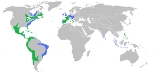
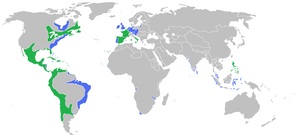
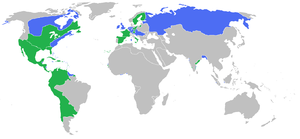
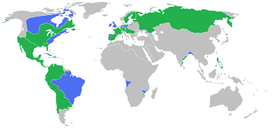
- War of the Spanish SuccessionWar of the Spanish SuccessionThe War of the Spanish Succession was fought among several European powers, including a divided Spain, over the possible unification of the Kingdoms of Spain and France under one Bourbon monarch. As France and Spain were among the most powerful states of Europe, such a unification would have...
(1701–1713) - War of the Austrian SuccessionWar of the Austrian SuccessionThe War of the Austrian Succession – including King George's War in North America, the Anglo-Spanish War of Jenkins' Ear, and two of the three Silesian wars – involved most of the powers of Europe over the question of Maria Theresa's succession to the realms of the House of Habsburg.The...
(1740-1748) - Seven Years' WarSeven Years' WarThe Seven Years' War was a global military war between 1756 and 1763, involving most of the great powers of the time and affecting Europe, North America, Central America, the West African coast, India, and the Philippines...
(1756–1763), which Winston ChurchillWinston ChurchillSir Winston Leonard Spencer-Churchill, was a predominantly Conservative British politician and statesman known for his leadership of the United Kingdom during the Second World War. He is widely regarded as one of the greatest wartime leaders of the century and served as Prime Minister twice...
called "the first world war" in A History of the English-Speaking PeoplesA History of the English-Speaking PeoplesA History of the English-Speaking Peoples is a four-volume history of Britain and its former colonies and possessions throughout the world, written by Winston Churchill, covering the period from Caesar's invasions of Britain to the beginning of the First World War... - The American Revolutionary War, fought between Britain and her colonies, drew in the help of many powers such as Spain and France.
- French Revolutionary WarsFrench Revolutionary WarsThe French Revolutionary Wars were a series of major conflicts, from 1792 until 1802, fought between the French Revolutionary government and several European states...
(1792–1802) and the Napoleonic WarsNapoleonic WarsThe Napoleonic Wars were a series of wars declared against Napoleon's French Empire by opposing coalitions that ran from 1803 to 1815. As a continuation of the wars sparked by the French Revolution of 1789, they revolutionised European armies and played out on an unprecedented scale, mainly due to...
(1803–1815).
Prior to the late 19th century, the concept of a world war would not have had much meaning. The Asian powers of India
India
India , officially the Republic of India , is a country in South Asia. It is the seventh-largest country by geographical area, the second-most populous country with over 1.2 billion people, and the most populous democracy in the world...
, China
China
Chinese civilization may refer to:* China for more general discussion of the country.* Chinese culture* Greater China, the transnational community of ethnic Chinese.* History of China* Sinosphere, the area historically affected by Chinese culture...
and Japan
Japan
Japan is an island nation in East Asia. Located in the Pacific Ocean, it lies to the east of the Sea of Japan, China, North Korea, South Korea and Russia, stretching from the Sea of Okhotsk in the north to the East China Sea and Taiwan in the south...
did not act outside their own territory. India was an early target of the creation of trade colonies due to its strategic importance on the maritime equivalent of the Silk Road to the East Indies
East Indies
East Indies is a term used by Europeans from the 16th century onwards to identify what is now known as Indian subcontinent or South Asia, Southeastern Asia, and the islands of Oceania, including the Malay Archipelago and the Philippines...
and China while both China and Japan were able to remain mostly isolationist until the 19th century. The European conflicts of earlier centuries were essentially quarrels between powers which took place in fairly limited, though sometimes far-flung, theatres of conflict.
Where native inhabitants of other continents were involved, they generally participated as local auxiliaries rather than as allies of equal status, fighting in multiple theatres. For instance, in Britain's wars against France, Native American
Native Americans in the United States
Native Americans in the United States are the indigenous peoples in North America within the boundaries of the present-day continental United States, parts of Alaska, and the island state of Hawaii. They are composed of numerous, distinct tribes, states, and ethnic groups, many of which survive as...
s assisted both European powers on their own ground rather than being shipped to continental Europe to serve as allied troops there. By contrast, during the World Wars, millions of troops from Africa, Asia, North America, South America and Australasia served alongside the colonial powers in Europe and other theatres of war.
Characteristics of the World Wars
The two World Wars of the 20th century took place on almost every populated continent on Earth. Many of the nations who fought in the First World War also fought in the Second, although not always on the same sides. Some historians have characterized the World Wars as a single "European civil warEuropean Civil War
The European Civil War is a term that is used to characterise both World War I and World War II and the inter-war period as a protracted civil war taking place in Europe. It is used in referring to the repeated confrontations that occurred during the first-half of the 20th century...
" spanning the period 1914–1945. However, this concept overlooks the war in the Far East
Pacific War
The Pacific War, also sometimes called the Asia-Pacific War refers broadly to the parts of World War II that took place in the Pacific Ocean, its islands, and in East Asia, then called the Far East...
caused by Japan's programme of territorial expansion, which started independently of events in Europe.
The World Wars were made possible, above all else, by a combination of fast communications (such as the telegraph
Telegraphy
Telegraphy is the long-distance transmission of messages via some form of signalling technology. Telegraphy requires messages to be converted to a code which is known to both sender and receiver...
and radio
Radio
Radio is the transmission of signals through free space by modulation of electromagnetic waves with frequencies below those of visible light. Electromagnetic radiation travels by means of oscillating electromagnetic fields that pass through the air and the vacuum of space...
) and fast transportation (the steam ship and railroad). This enabled military action to be coordinated rapidly over a very wide area and permitted troops to be transported quickly in large numbers on a global scale.
Effects of the World Wars
The two World Wars of the 20th century caused unprecedented casualties and destruction across the theatres of conflict. The numbers killed in the wars are estimated at between 60 and 100 million people. Civilians suffered as badly as or worse than soldiers, and the distinction between combatants and civilians was often erased. The Nazis and Soviets both were responsible for massive genocides during the war, and the Allied and Axis bombing killed millions of civilians as well.| World War I World War I World War I , which was predominantly called the World War or the Great War from its occurrence until 1939, and the First World War or World War I thereafter, was a major war centred in Europe that began on 28 July 1914 and lasted until 11 November 1918... |
World War II World War II World War II, or the Second World War , was a global conflict lasting from 1939 to 1945, involving most of the world's nations—including all of the great powers—eventually forming two opposing military alliances: the Allies and the Axis... |
|
|---|---|---|
| Deaths | 24 M | 60 M |
| Injured | 10 M | 20 M |
| Conscripts | 65 M | 90 M |
| Battlefield Size | 3 M km² | 17 M km² |
The outcome of the World Wars had a profound effect on the course of world history. The old European empires collapsed or were dismantled as a direct result of the wars' crushing costs and in some cases the defeat of imperial powers. The United States was firmly established as the dominant global power, along with its ideological foe, the Soviet Union, in close competition. These two "superpowers" exerted political influence over most of the world's other nations for decades after the conclusion of World War II (ending in the late 1980s in the Soviet Union). The modern international security, economic and diplomatic system was created in the aftermath of the wars. Institutions such as NATO, the United Nations
United Nations
The United Nations is an international organization whose stated aims are facilitating cooperation in international law, international security, economic development, social progress, human rights, and achievement of world peace...
and the European Union
European Union
The European Union is an economic and political union of 27 independent member states which are located primarily in Europe. The EU traces its origins from the European Coal and Steel Community and the European Economic Community , formed by six countries in 1958...
were established to "collectivise" international affairs, with the explicit aim of preventing another outbreak of general war. The wars also greatly changed the course of daily life. Technologies developed during wartime had a profound effect on peacetime life as well—for instance, jet aircraft
Jet aircraft
A jet aircraft is an aircraft propelled by jet engines. Jet aircraft generally fly much faster than propeller-powered aircraft and at higher altitudes – as high as . At these altitudes, jet engines achieve maximum efficiency over long distances. The engines in propeller-powered aircraft...
, penicillin
Penicillin
Penicillin is a group of antibiotics derived from Penicillium fungi. They include penicillin G, procaine penicillin, benzathine penicillin, and penicillin V....
, nuclear energy
Nuclear power
Nuclear power is the use of sustained nuclear fission to generate heat and electricity. Nuclear power plants provide about 6% of the world's energy and 13–14% of the world's electricity, with the U.S., France, and Japan together accounting for about 50% of nuclear generated electricity...
, and electronic computer
Computer
A computer is a programmable machine designed to sequentially and automatically carry out a sequence of arithmetic or logical operations. The particular sequence of operations can be changed readily, allowing the computer to solve more than one kind of problem...
s.
Since the atomic bombings of Hiroshima and Nagasaki
Atomic bombings of Hiroshima and Nagasaki
During the final stages of World War II in 1945, the United States conducted two atomic bombings against the cities of Hiroshima and Nagasaki in Japan, the first on August 6, 1945, and the second on August 9, 1945. These two events are the only use of nuclear weapons in war to date.For six months...
during World War II, there has been a widespread and prolonged fear of a Third World War between nuclear-armed superpower
Superpower
A superpower is a state with a dominant position in the international system which has the ability to influence events and its own interests and project power on a worldwide scale to protect those interests...
s.
Subsequent world wars
World War IIIWorld War III
World War III denotes a successor to World War II that would be on a global scale, with common speculation that it would be likely nuclear and devastating in nature....
is a hypothetical successor to World War II and is often suggested to be nuclear, devastating in nature and likely exceedingly more violent than both WW1 and WW2. This war is anticipated and planned for by military and civil authorities, and explored in fiction
World War III in popular culture
World War III is a common theme in popular culture. Since the 1940s, countless books, films, and television programmes have used the theme of nuclear weapons and a third global war. The presence of the Soviet Union as an international rival armed with nuclear weapons created a persistent fear in...
in many countries. Concepts range from purely conventional scenarios or a limited use of nuclear weapons to the destruction of the planet. World War IV is sometimes mentioned as a hypothetical successor to World War III or as a plot element in books, movies or video games.
Former government officials, politicians and authors have attempted to apply the labels of WW III, WW IV, and WW V to various military engagements and diplomatic stand-offs since the close of WW II, such as the Korean War
Korean War
The Korean War was a conventional war between South Korea, supported by the United Nations, and North Korea, supported by the People's Republic of China , with military material aid from the Soviet Union...
or the War on Terror
War on Terror
The War on Terror is a term commonly applied to an international military campaign led by the United States and the United Kingdom with the support of other North Atlantic Treaty Organisation as well as non-NATO countries...
. Among these are
former American and French government officials James Woolsey
and Alexandre de Marenches
Alexandre de Marenches
Count Alexandre de Marenches was a French military officer.During the Second World War, Count de Marenches was aide de camp to General Juin...
,
author Elliot Cohen and zapatist
Zapatista Army of National Liberation
The Zapatista Army of National Liberation is a revolutionary leftist group based in Chiapas, the southernmost state of Mexico....
leader Subcomandante Marcos
Subcomandante Marcos
Subcomandante Marcos is the spokesperson for the Zapatista Army of National Liberation , a Mexican rebel movement. In January 1994, he led an army of Mayan farmers into the eastern parts of the Mexican state of Chiapas protesting against the Mexican government's treatment of indigenous...
. Despite their efforts, none of these wars are commonly considered world wars.
The Second Congo War
Second Congo War
The Second Congo War, also known as Coltan War and the Great War of Africa, began in August 1998 in the Democratic Republic of the Congo , and officially ended in July 2003 when the Transitional Government of the Democratic Republic of the Congo took power; however, hostilities continue to this...
has been called "Africa's World War" for the number of countries involved.
External links
- This is the Fourth World War, an interview with philosopher Jean Baudrillard