


First Indochina War

Encyclopedia
The First Indochina War (also known as the French Indochina
War, Anti-French War, Franco-Vietnamese War, Franco-Vietminh War, Indochina War, Dirty War in France, and Anti-French Resistance War in contemporary Vietnam
) was fought in French Indochina
from December 19, 1946, until August 1, 1954, between the French Union
's French Far East Expeditionary Corps
, led by France
and supported by Emperor Bảo Đại
's Vietnamese National Army
against the Việt Minh
, led by Hồ Chí Minh
and Võ Nguyên Giáp
. Most of the fighting took place in Tonkin
in Northern Vietnam, although the conflict engulfed the entire country and also extended into the neighboring French Indochina protectorate
s of Laos
and Cambodia
.
Following the reoccupation of Indochina by the French following the end of World War II, the area having fallen to the Japanese
, the Việt Minh launched a rebellion against the French authority governing the colonies of French Indochina. The first few years of the war involved a low-level rural insurgency against French authority. However, after the Chinese communists reached the Northern border of Vietnam in 1949, the conflict turned into a conventional war between two armies equipped with modern weapons supplied by the United States and the Soviet Union.
French Union forces included colonial troops from the whole former empire (Moroccan, Algerian, Tunisian, Laotian, Cambodian, and Vietnamese ethnic minorities), French professional troops and units of the French Foreign Legion
. The use of metropolitan
recruits was forbidden by the governments to prevent the war from becoming even more unpopular at home. It was called the "dirty war" (la sale guerre) by supporters of the Left
intellectuals in France (including Sartre
) during the Henri Martin Affair
in 1950.
While the strategy of pushing the Việt Minh into attacking a well defended base in a remote part of the country at the end of their logistical trail was validated at the Battle of Na San
, the lack of construction materials (especially concrete), tanks (because of lack of road access and difficulty in the jungle terrain), and air cover precluded an effective defense.
After the war, the Geneva Conference
on July 21, 1954, made a provisional division of Vietnam at the 17th parallel
, with control of the north given to the Việt Minh as the Democratic Republic of Vietnam
under Hồ Chí Minh, and the south becoming the State of Vietnam
under Emperor Bảo Đại
, in order to prevent Hồ Chí Minh from gaining control of the entire country. A year later, Bảo Đại would be deposed by his prime minister, Ngô Đình Diệm
, creating the Republic of Vietnam
. Diem's refusal to enter into negotiations with North Vietnam about holding nationwide elections in 1956, as had been stipulated by the Geneva Conference, would eventually lead to war breaking out again in South Vietnam in 1959 – the Second Indochina War
.
in stages between 1858 and 1887 with European influence and education. Nationalism grew until World War II provided a break in French control. Early Vietnamese resistance centered on the intellectual Phan Bội Châu
. Chau looked to Japan, which had modernized and was one of the few Asian nations to resist European colonization. With Prince Cường Để, Châu started two organizations in Japan, the Duy Tân Hội (Modernistic Association) and Vietnam Cong Hien Hoi. Due to French pressure, Japan deported Phan Bội Châu to China. Witnessing Sun Yat-sen
's 1911 nationalist revolution
, Chau was inspired to commence the Việt Nam Quang Phục Hội movement in Guangzhou
. From 1914 to 1917, he was imprisoned by Yuan Shi Kai's
counterrevolutionary government. In 1925, he was captured by French agents in Shanghai and spirited to Vietnam. Due to his popularity, Châu was spared from execution and placed under house arrest until his death in 1940.
In September 1940, shortly after Phan Bội Châu's death, Japan launched the First French Indochina Campaign and invaded French Indochina
, mirroring their ally Germany's conquest of metropolitan France
. Keeping the French colonial administration, the Japanese ruled from behind the scenes in a parallel of Vichy France
. As far as Vietnamese nationalists were concerned, this was a double-puppet government. Emperor Bảo Đại
collaborated with the Japanese, just as he had with the French, ensuring his lifestyle could continue.
From October 1940 to May 1941, during the French-Thai War
, the Vichy French in Indochina were involved with defending their colony in a border conflict which saw the forces of Thailand
invade, while the Japanese sat on the sidelines. Thai military successes were limited to the Cambodian border area, and in January 1941 Vichy France's modern naval forces soundly defeated the inferior Thai naval forces in the Battle of Koh Chang
. The war ended in May, with the French agreeing to minor territorial revisions which restored formerly Thai areas to Thailand.
In March 1945, Japan launched the Second French Indochina Campaign
and ousted the Vichy French
and formally installed Emperor Bảo Đại
in the short-lived Empire of Vietnam
.
In August 1945, when Japanese forces surrendered in Vietnam, they allowed the Việt Minh and other nationalist groups to take over public buildings and weapons without resistance, which began the August Revolution
. After their defeat the Japanese Army gave weapons to the Vietnamese. In order to further help the nationalists, the Japanese kept Vichy French officials and military officers imprisoned for a month after the surrender. The Việt Minh had recruited more than 600 Japanese soldiers and given them roles to train or command Vietnamese soldiers.
Hồ Chí Minh claimed in a speech in September 1945 that due to a combination of ruthless Japanese exploitation and poor weather, a famine
occurred in which approximately 2 million Vietnamese died. The Việt Minh arranged a relief effort in the north and won wide support there as a result.
American President Franklin D. Roosevelt
and General Joseph Stilwell
privately made it adamantly clear that the French were not to reacquire French Indochina
(modern day Vietnam, Cambodia and Laos) after the war was over. Roosevelt offered Chiang Kai-shek
to place all of Indochina under Chinese rule. Chiang Kai-shek supposedly replied: "Under no circumstances!".
After the war, 200,000 Chinese troops sent by Chiang Kai-shek under General Lu Han
entered Indochina north of the 16th parallel to accept the surrender of Japanese occupying forces. They remained there until 1946. The Chinese used the VNQDD, the Vietnamese branch of the Chinese Kuomintang
, to increase their influence in Indochina and put pressure on their opponents. In February 1946 the French forced the Chinese to leave Indochina but agreed to renounce French extraterritorial privileges in China itself. French troops then reoccupied the region starting in March 1946.
Hồ Chí Minh was able to persuade Emperor Bảo Đại to abdicate
on August 25, 1945. Bảo Đại was appointed "supreme adviser" to the new Vietminh-led government in Hanoi
, which asserted independence on September 2. Deliberately borrowing from the Declaration of Independence of the United States of America, Ho Chi Minh proclaimed on September 2: "We hold the truth that all men are created equal, that they are endowed by their Creator with certain unalienable rights, among them life, liberty and the pursuit of happiness."
With the fall of the short lived Japanese colony of the Empire of Vietnam
, the Provisional Government of the French Republic
wanted to restore its colonial rule in French Indochina as the final step of the Liberation of France. An armistice was signed between Japan and the United States on August 20. CEFEO Expeditionary Corps
leader General Leclerc
signed the armistice with Japan onboard the USS Missouri
on behalf of France, on September 2.
On September 13, a Franco
-British task force
landed in Java
, main island of the Dutch East Indies
(for which independence was being sought by Sukarno
), and Saigon, capital of Cochinchina (southern part of French Indochina), both being occupied by the Japanese
and ruled by Field Marshal Hisaichi Terauchi, Commander-in-Chief of Japan's Southern Expeditionary Army Group
based in Saigon. Allied
troops in Saigon were an airborne detachment, two British companies of the 20th Hindi Division and the French 5th Colonial Infantry Regiment, with British General Sir Douglas Gracey as supreme commander. The latter proclaimed martial law
on September 21. The following night the Franco-British troops took control of Saigon.
Almost immediately afterward, the Chinese Government
, as agreed to at the Potsdam Conference
, occupied French Indochina as far south as the 16th parallel in order to supervise the disarming and repatriation of the Japanese Army
. This effectively ended Hồ Chí Minh's nominal government in Hanoi.
General Leclerc arrived in Saigon on October 9, with him was French Colonel Massu
's March Group (Groupement de marche). Leclerc's primary objectives were to restore public order in south Vietnam and to militarize Tonkin (north Vietnam). Secondary objectives were to wait for French backup in view to take back Chinese occupied Hanoi, then to negotiate with the Viet Minh officials.
after a conflict of interest in import duty at the port between the Viet Minh
government and the French. On November 23, 1946 the French fleet began a naval bombardment of the city that killed over 6,000 Vietnamese civilians in one afternoon according to one source or over 2,000 according to another. The Việt Minh quickly agreed to a cease-fire and left the cities. There was never any intention among the Vietnamese to give up, as General Vo Nguyen Giap
soon brought up 30,000 men to attack the city. Although the French were outnumbered, their superior weaponry and naval support made any Việt Minh attack impossible. In December, hostilities also broke out in Hanoi
between the Việt Minh and the French, and Hồ Chí Minh was forced to evacuate the capital in favor of remote mountain areas. Guerrilla warfare ensued, with the French controlling most of the country except far-flung areas.
moved his command to Tân Trào. The French sent military expeditions to attack his bases, but Giáp refused to meet them head-on in battle. Wherever the French troops went, the Việt Minh disappeared. Late in the year the French launched Operation Lea
to take out the Việt Minh communications center at Bac Kan. They failed to capture Hồ Chí Minh and his key lieutenants as intended, but 9,000 Việt Minh soldiers were killed during the campaign which was a major blow for the insurgency.
. They began negotiations with the former Vietnamese emperor Bảo Đại
to lead an "autonomous" government within the French Union
of nations, the State of Vietnam
. Two years before, the French had refused Hồ's proposal of a similar status (albeit with some restrictions on French power and the latter's eventual withdrawal from Vietnam); however, they were willing to give it to Bảo Ðại as he had freely collaborated with French rule of Vietnam in the past and was in no position to seriously negotiate or impose demands (Bảo Ðại had no military of his own, but soon he would have one).
as an associated state
within the French Union
under Bảo Ðại. However, France still controlled all foreign relations and every defense issue as Vietnam was only nominally an independent state within the French Union
. The Việt Minh quickly denounced the government and stated that they wanted "real independence, not Bảo Ðại independence". Later on, as a concession to this new government and a way to increase their numbers, France agreed to the formation of the Vietnamese National Army
to be commanded by Vietnamese officers. These troops were used mostly to garrison quiet sectors so French forces would be available for combat. Private Cao Dai
, Hoa Hao
and the Binh Xuyen
gangster armies were used in the same way. The Vietnamese Communists in return obtained outside support in 1949 when Chairman Mao Zedong
succeeded in taking control of China
by defeating the Kuomintang
, thus gaining a major political ally and supply area just across the border. In the same year, the French also granted independence (within the framework of the French Union
) to the other two nations in Indochina
, the Kingdoms of Laos
and Cambodia
.
The United States recognized the South Vietnamese state, but many other nations viewed it as simply a French puppet regime and would not deal with it at all . The United States began to give military aid to France in the form of weaponry and military observers. By then with almost unlimited Chinese military supplies entering Vietnam, General Giáp re-organized his local irregular forces into five full conventional infantry
divisions, the 304th, 308th, 312th, 316th and the 320th. The war began to intensify when Giáp went on the offensive, attacking isolated French bases along the Chinese border.
in Tonkin just south of the border with China. Then, on May 25, he attacked the garrison of Cao Bang manned by 4,000 French-controlled Vietnamese troops, but his forces were repulsed. Giáp launched his second offense again against Cao Bang as well as Dong Khe
on September 15. Dong Khe fell on September 18, and Cao Bang finally fell on October 3. Lang Son
, with its 4,000-strong French Foreign Legion
garrison, was attacked immediately after. The retreating French on Route 4
, together with the relief force coming from That Khe, were attacked all the way by ambushing Việt Minh forces. The French air-dropped a paratroop battalion south of Dong Khe to act as diversion only to see it surrounded and destroyed. On October 17, Lang Son, after a week of intense fighting, finally fell. By the time the remains of the garrisons reached the safety of the Red River Delta
, 4,800 French troops had been killed, captured or missing in action and 2,000 wounded out of a total garrison force of over 10,000. Also lost were 13 artillery pieces, 125 mortars, 450 trucks, 940 machine guns, 1,200 submachine guns and 8,000 rifles destroyed or captured during the fighting. China and the Soviet Union recognized Hồ Chí Minh as the legitimate ruler of Vietnam and sent him more and more supplies and material aid. The year 1950 also marked the first time that napalm
was ever used in Vietnam (this type of weapon was supplied by the U.S. for the use of the French Aeronovale at the time).
The military situation improved for France when their new commander, General Jean Marie de Lattre de Tassigny
, built a fortified line from Hanoi
to the Gulf of Tonkin
, across the Red River Delta, to hold the Việt Minh in place and use his troops to smash them against this barricade, which became known as the "De Lattre Line". This led to a period of success for the French.
, 20 miles (32.2 km) northwest of Hanoi which was manned by the 6,000 strong 9th Foreign Legion Brigade. The Việt Minh entered a trap. Caught for the first time in the open and actually forced to fight the French head-on, without the ability to quickly hide and retreat, they were mowed down by concentrated French artillery and machine gun fire. By January 16, Giap was forced to withdraw, having lost over 6,000 killed, 8,000 wounded and 500 captured. The Battle of Vinh Yen
had been a catastrophe.
On March 23, Giap tried again, launching an attack against Mao Khe
, 20 miles (32.2 km) north of Haiphong
. The 316th Division, composed of 11,000 men, with the partly rebuilt 308th and 312th Divisions in reserve, went forward and were beaten in bitter hand-to-hand fighting against French troops. Giap, having lost over 3,000 dead and wounded by March 28, withdrew.
Giap launched yet another attack on May 29 with the 304th Division at Phu Ly, the 308th Division at Ninh Binh
, and the main attack delivered by the 320th Division at Phat Diem south of Hanoi. The attacks fared no better and the three divisions lost heavily. Taking advantage of this, de Lattre mounted his counter offensive against the demoralized Việt Minh, driving them back into the jungle and eliminating the enemy pockets in the Red River Delta by June 18 costing the Việt Minh over 10,000 killed.
Every effort by Vo Nguyen Giap to break the line failed and every attack he made was answered by a French counter-attack that destroyed his forces. Việt Minh casualties rose alarmingly during this period, leading some to question the leadership of the Communist government, even within the party. However, any benefit this may have reaped for France was negated by the increasing domestic opposition to the war in France.
On July 31, French General Chanson was assassinated during a kamikaze
attentat
at Sa Đéc in South Vietnam that was blamed on the Việt Minh although it was argued in some quarters that Cao Dai
nationalist Trinh Minh The
could have been involved in its planning.
On November 14, 1951, the French seized Hòa Bình
, 25 miles (40.2 km) west of the De Lattre line, by a parachute drop and expanded their perimeter.
 Việt Minh launched attacks on Hòa Binh forcing the French to withdraw back to their main positions on the De Lattre line by February 22, 1952. Each side lost nearly 5,000 men in this campaign and it showed that the war was far from over. In January, General de Lattre fell ill from cancer and had to return to France for treatment; he died there shortly thereafter and was replaced by General Raoul Salan
as the overall commander of French forces in Indochina. Within that year, throughout the war theater, the Việt Minh cut French supply lines and began to seriously wear down the resolve of the French forces. There were continued raids, skirmishes and guerrilla attacks, but through most of the rest of the year each side withdrew to prepare itself for larger operations. Starting on October 2, the Battle of Na San
saw the first use of the French commanders "hedgehog
" tactics consisting in setting up a well defended outpost to get the Việt Minh out of the jungle and force it to fight a conventional battle instead of ambushes. At first this strategy was successful for the French Union but it ended with a fiasco in 1954.
On October 17, 1952, Giáp launched attacks against the French garrisons along Nghia Lo
, northwest of Hanoi, and overran much of the Black River valley, except for the airfield of Na San where a strong French garrison entrenched. Giáp by now had control over most of Tonkin beyond the De Lattre line. Raoul Salan, seeing the situation as critical, launched Operation Lorraine
along the Clear river to force Giáp to relieve pressure on the Nghia Lo outposts. On October 29, 1952, in the largest operation in Indochina to date, 30,000 French Union soldiers moved out from the De Lattre line to attack the Việt Minh supply dumps at Phu Yen. Salan took Phu Tho
on November 5, and Phu Doan on November 9 by a parachute
drop, and finally Phu Yen on November 13. Giáp at first did not react to the French offensive. He planned to wait until their supply lines were over extended and then cut them off from the Red River Delta. Salan correctly guessed what the Việt Minh were up to and cancelled the operation on November 14, beginning to withdraw back to the de Lattre line. The only major fighting during the operation came during the withdrawal, when the Việt Minh ambushed the French column at Chan Muong on November 17. The road was cleared after a bayonet charge by the Indochinese March Battalion and the withdrawal could continue. Though the operation was partially successful, it proved that although the French could strike out at any target outside the De Lattre line, it failed to divert the Việt Minh offensive or seriously damage its logistical network.
 On April 9, 1953, Giáp, after having failed repeatedly in direct attacks on French positions in Vietnam, changed strategy and began to pressure the French by invading Laos
, surrounding and defeating several French outposts such as Muong Khoua
. The only real change came in May when General Navarre
replaced General Salan
as supreme commander in Indochina. He reported to the government "…that there was no possibility of winning the war in Indo-China" saying that the best the French could hope for was a stalemate. Navarre, in response to the Việt Minh attacking Laos, concluded that "hedgehog" centers of defense were the best plan. Looking at a map of the area, Navarre chose the small town of Ðiện Biên Phủ
, located about 10 miles (16.1 km) north of the Lao border and 175 miles (281.6 km) west of Hanoi as a target to block the Việt Minh from invading Laos. Ðiện Biên Phủ had a number of advantages; it was on a Việt Minh supply route into Laos on the Nam Yum River, it had an old airstrip for supply and it was situated in the T'ai
hills where the T'ai tribesmen, still loyal to the French, operated. Operation Castor
was launched on November 20, 1953 with 1,800 men of the French 1st and 2nd Airborne Battalions dropping into the valley of Ðiện Biên Phủ and sweeping aside the local Việt Minh garrison. The paratroopers gained control of a heart-shaped valley 12 miles (19.3 km) long and eight miles (13 km) wide surrounded by heavily wooded hills. Encountering little opposition, the French and T'ai units operating from Lai Châu to the north patrolled the hills. The operation was a tactical success for the French. However, Giáp, seeing the weakness of the French position, started moving most of his forces from the De Lattre line to Ðiện Biên Phủ. By mid-December, most of the French and T'ai patrols in the hills around the town were wiped out by Việt Minh ambushes. The fight for control of this position would be the longest and hardest battle for the French Far East Expeditionary Corps
and would be remembered by the veterans as "57 Days of Hell".
 By 1954, despite official propaganda presenting the war as a "crusade against communism", the war in Indochina was still growing unpopular with the French public. The political stagnation of the Fourth Republic
meant that France was unable to extract itself from the conflict. The United States initially sought to remain neutral, viewing the conflict as chiefly a decolonization
war.
The Battle of Dien Bien Phu
occurred in 1954 between Viet Minh
forces under Vo Nguyen Giap
supported by China and the Soviet Union and the French Union
's French Far East Expeditionary Corps
supported by Indochinese allies. The battle was fought near the village of Dien Bien Phu
in northern Vietnam and became the last major battle between the French and the Vietnamese in the First Indochina War.
The battle began on March 13 when preemptive Việt Minh attack surprised the French with heavy artillery. Their supply lines interrupted, the French position became untenable, particularly when the advent of the monsoon
season made dropping supplies and reinforcements by parachute difficult. With defeat imminent, the French sought to hold on till the opening of the Geneva peace meeting
on April 26. The last French offensive took place on May 4, but it was ineffective. The Việt Minh then began to hammer the outpost with newly supplied Russian Katyusha rockets along with all the other inventions and implements now being turned against the French. .
The final fall took two days, May 6 and 7, during which the French fought on but were eventually overrun by a huge frontal assault. General Cogny based in Hanoi ordered General de Castries, who was commanding the outpost to cease fire at 5:30 pm and to destroy all material (weapons, transmissions, etc.) to deny their use to the enemy. A formal order was given to not use the white flag
so that it would not be considered to be a surrender but a ceasefire. Much of the fighting ended on May 7; however, a ceasefire was not respected on Isabelle, the isolated southern position, where the battle lasted until May 8 1:00 am. At least 2,200 members of the 20,000-strong French forces died, and another 1,729 were reported missing after the battle. Of the 50,000 or so Vietnamese soldiers thought to be involved, there were an estimated 4,800 to 8,000 killed and another 9,000-15,000 wounded. The prisoners taken at Dien Bien Phu were the greatest number the Việt Minh had ever captured: one-third of the total captured during the entire war.
One month after Dien Bien Phu, the composite Groupe Mobile 100 (GM100) of the French Union forces evacuated the An Khe
outpost and was ambushed by a larger Việt Minh force at the Battle of Mang Yang Pass
from June 24 to July 17. On the same time, Giap launched some offensives against the delta but they all failed. The Việt Minh victory at Dien Bien Phu heavily influenced the outcome of the 1954 Geneva accords
that took place on July 21. In August began Operation Passage to Freedom
consisting of the evacuation of Catholic and loyalist Vietnamese civilians from communist North Vietnamese persecution.
. During this time the French Union and the Việt Minh were fighting the most epic battle of the war at Dien Bien Phu. In France, Pierre Mendès-France
, opponent of the war since 1950, had been invested as Prime Minister on June 17, 1954, on a promise to put an end to the war, reaching a ceasefire
in four months:
The Geneva Conference
on July 21, 1954, recognized the 17th parallel
as a "provisional military demarcation line
" temporarily dividing the country into two zones, Communist North Vietnam
and pro-Western South Vietnam
.
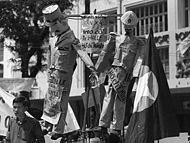 The Geneva Accords promised elections in 1956 to determine a national government for a united Vietnam. However, the United States and the State of Vietnam
refused to sign the document. From his home in France, Emperor Bảo Đại
appointed Ngô Ðình Diệm
as Prime Minister of South Vietnam. With American support, in 1955 Diệm used a referendum to remove the former Emperor and declare himself the president
of the Republic of Vietnam
.
When the elections were prevented from happening by the Americans and the South, Việt Minh cadres who stayed behind in South Vietnam were activated and started to fight the government. North Vietnam also invaded and occupied portions of Laos to assist in supplying the guerilla fighting National Liberation Front
in South Vietnam. The war gradually escalated into the Second Indochina War
, more commonly known as the Vietnam War in the West and the American War in Vietnam.
, China. From 1925–26, he organized the 'Youth Education Classes' and occasionally gave lectures at the famous Whampoa Military Academy
on the revolutionary movement in Indochina. He stayed there in Hong Kong as a representative of the Communist International
organization. In June 1931, he was arrested and incarcerated by British police until his release in 1933. He then made his way back to the Soviet Union, where he spent several years recovering from tuberculosis. In 1938, he returned to China and served as an adviser with the Chinese Communist armed forces.
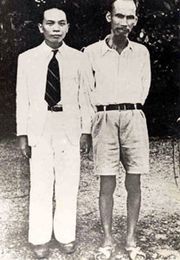 In 1941, Ho Chi Minh
, seeing communist revolution as the path to freedom, returned to Vietnam and formed the Việt Nam Độc Lập Đồng Minh Hội (Allied Association of Independent Vietnam), better known as the Việt Minh
. He spent many years in Moscow and participated in the International Comintern
. At the direction of Moscow, he combined the various Vietnamese communist groups into the Indochinese Communist Party
in Hong Kong in 1930. Hồ Chí Minh created the Viet Minh as an umbrella organization
for all the nationalist resistance movements, de-emphasizing his communist social revolutionary background. Late in the war, the Japanese created a nominally independent government of Vietnam under the overall leadership of Bảo Đại. Around the same time, the Japanese arrested and imprisoned most of the French officials and military officers left in the country. After the French army and other officials were freed from Japanese prisons in Vietnam, they began reasserting their authority over parts of the country. At the same time, the French government began negotiations with both the Việt Minh and the Chinese for a return of the French army to Vietnam north of the 16th parallel. The Việt Minh were willing to accept French rule to end Chinese occupation. Hồ Chí Minh and others had fears of the Chinese, based on China's historic domination and occupation of Vietnam. The French negotiated a deal with the Chinese where pre-war French concessions in Chinese ports such as Shanghai were traded for Chinese cooperation in Vietnam. The French landed a military force at Haiphong in early 1946. Negotiations then took place about the future for Vietnam as a state within the French Union
. These talks eventually failed and the Việt Minh fled into the countryside to wage guerrilla war. In 1946, Vietnam created its first constitution.
 The British had supported the French in fighting the Viet Minh, armed militias from the religious Cao Dai
and Hoa Hao
sects and the Binh Xuyen
organized crime groups which were all individually seeking power in the country. In 1948, as part of a post-colonial solution, the French re-installed Bảo Ðại as head of state
of Vietnam under the French Union. The Viet Minh were militarily ineffective in the first few years of the war and could do little more than harass the French in remote areas of Indochina. In 1949, the war changed with the triumph of the communists in China
on Vietnam's northern border. China was able to give almost unlimited support in terms of weapons and supplies to the Việt Minh which transformed itself into a conventional army. After World War II, the United States and the USSR
entered into the Cold War
. The Korean War
broke out in 1950 between communist North Korea
(DPRK) supported by China and the Soviet Union, and South Korea
(ROK) supported by the United States and its allies in the UN. The Cold War was now turning 'hot' in East Asia, and the American government feared communist domination of the entire region would have deep implications for American interests. The US became strongly opposed to the government of Hồ Chí Minh, in part, because it was supported and supplied by China. Hồ's government gained recognition from China and the Soviet Union by January 1950 in response to Western support for the State of Vietnam
that the French had proposed as an associate state within the French Union. In the French-controlled areas of Vietnam, in the same year, the government of Bảo Đại gained recognition
by the United States and the United Kingdom.
(1946–1958) made France a Parliamentary republic
. Because of the political context, it could find stability only by an alliance between the three dominant
parties: the Christian Democratic Popular Republican Movement
(MRP), the French Communist Party
(PCF) and the socialist French Section of the Workers' International (SFIO). Known as tripartisme
, this alliance briefly lasted until the May 1947 crisis, with the expulsion from Paul Ramadier
's SFIO government of the PCF ministers, marking the official start of the Cold War
in France. This had the effect of weakening the regime, with the two most significant movements of this period, Communism and Gaullism
, in opposition.
Unlikely alliances had to be made between left and right-wing parties in order to form a government invested by the National Assembly, which resulted in strong parliamentary unstability
. Hence, France had fourteen prime ministers
in succession between the creation of the Fourth Republic in 1947 and the Battle of Dien Bien Phu
in 1954. The rapid turnover of governments (there were 17 different governments during the war) left France unable to prosecute the war with any consistent policy according to veteran General René de Biré (Lieutenant at Dien Bien Phu).
France was increasingly unable to afford the costly conflict in Indochina and, by 1954, the United States was paying 80% of France's war effort which was $3,000,000 per day in 1952.
A strong anti-war
movement came into existence in France driven mostly by the then powerful French Communist Party (outpowering the socialists) and its young militant associations, major trade unions like the General Confederation of Labour
as well as notable leftist intellectuals. The first occurrence was probably at the National Assembly on March 21, 1947 when the communist deputees refused to back the military credits for Indochina. The following year a pacifist event was organized, the "1st Worldwide Congress of Peace Partisans
" (1er Congrès Mondial des Partisans de la Paix, the World Peace Council
's predecessor) which took place from March 25 to March 28, 1948 in Paris, with the French communist Nobel laureate atomic physicist Frédéric Joliot-Curie
as president. Later on April 28, 1950, Joliot-Curie would be dismissed from the military and civilian Atomic Energy Commission
for political reasons. Young communist militants (UJRF) were also accused of sabotage actions like the famous Henri Martin Affair
and the case of Raymonde Dien who was jailed one year for having blocked an ammunition train, with the help of other militants, in order to prevent the supply of French forces in Indochina in February 1950. Similar actions against trains occurred in Roanne
, Charleville
, Marseille
, and Paris. Even ammunition sabotage by PCF agents have been reported, such as grenades exploding in the hands of legionaries. These actions became such a cause for concern by 1950 that the French Assembly voted a law against sabotage from March 2 to 8. At this session tension was so high between politicians that fighting ensued in the assembly following communist deputees speeches against the Indochinese policy. This month saw the French navy mariner and communist militant Henri Martin
arrested by military police and jailed for five years for sabotage and propaganda operations in Toulon
's arsenal. On May 5 communist Ministers were dismissed from the government, marking the end of Tripartism
. A few months later on November 11, 1950, the French Communist Party leader Maurice Thorez
went to Moscow.
Some military officers involved in the Revers Report scandal (Rapport Revers) like General Salan
were very pessimistic about the way the war was being conducted, with multiple political-military scandals all happening during the war, starting with the Generals' Affair
(Affaire des Généraux) from September 1949 to November 1950.
As a result, General Revers was dismissed in December 1949 and socialist Defense Ministry Jules Moch
(SFIO) was brought on court by the National Assembly on November 28, 1950. Emerging media played their role. The scandal started the commercial success of the first French news magazine L'Express
created in 1953.
The third scandal was a financial-political scandal, concerning military corruption, money and arms trading involving both the French Union army and the Viet Minh, known as the Piastres Affair
.
The US Communist Party
was outlawed in 1954. The war ended that year but its sequel started in French Algeria
where the French Communist Party played an even stronger role by supplying the National Liberation Front
(FLN) rebels with intelligence documents and financial aids. They were called "the suitcase carriers
" (les porteurs de valises).
In the French news, the Indochina War was presented as a direct continuation of the Korean War
where France had fought as a UN French battalion then incorporated in a U.S. unit, which was later involved in the terrible Battle of Mang Yang Pass
of June and July 1954. In an interview taped in May 2004, General Bigeard
(6th BPC) argues that "one of the deepest mistakes done by the French during the war was the propaganda telling you are fighting for Freedom, you are fighting against Communism", hence the sacrifice of volunteers during the climactic battle of Dien Bien Phu. In the latest days of the siege, 652 non-paratrooper soldiers from all army corps from cavalry to infantry to artillery dropped for the first and last time of their life to support their comrades. The Cold War excuse was later used by General Challe
through his famous "Do you want Mers El Kébir & Algiers
to become soviet bases as soon as tomorrow?", during the Generals' putsch (Algerian War) of 1961, with limited effect though. The same propaganda existed in the United States with local newsreels using French news footage, probably supplied by the army's cinematographic service. Occurring during the Red Scare
years, propaganda was necessary both to justify financial aid and at the same time to promote the American effort in the ongoing Korean War. A few hours after the French Union defeat at Dien Bien Phu in May 1954, United States Secretary of State
John Foster Dulles
made an official speech depicting the "tragic event" and "its defense for fifty seven days and nights will remain in History as one of the most heroic of all time." Later on, he denounced Chinese aid to the Việt Minh, explained that the United States could not act openly because of international pressure, and concluded with the call to "all concerned nations" concerning the necessity of "a collective defense" against "the communist aggression".
(CEFEO) was created in March 1945. The Union gathered combatants from almost all French territories made of colonies, protectorates and associated states (Madagascar
, Senegal, Tunisia
, etc.) to fight in French Indochina, which was then occupied by the Japanese. About 325,000 of the 500,000 French troops were Indochinese, almost all of whom were used in conventional units
.
The Afrique Occidentale Française
(AOF) was a federation of African colonies. Senegalese and other African troops were sent to fight in Indochina. Some African alumni were trained in the Infantry Instruction Center no.2 (Centre d'Instruction de l'Infanterie no.2) located in southern Vietnam. Senegalese of the Colonial Artillery fought at the siege of Dien Bien Phu. As a French colony (later a full province), French Algeria sent local troops to Indochina including several RTA (Régiment de Tirailleurs Algériens) light infantry
battalions. Morocco
was a French protectorate and sent troops to support the French effort in Indochina. Moroccan troops were part of light infantry RTMs (Régiment de Tirailleur
s Marocains) for "Moroccan Sharpshooters
Regiment".
As a French protectorate, Bizerte
, Tunisia, was a major French base. Tunisian troops, mostly RTT (Régiment de Tirailleurs Tunisiens), were sent to Indochina. Part of French Indochina, then part of the French Union and later an associated state, Laos
fought the communists along with French forces. The role played by Laotian troops in the conflict was depicted by veteran Pierre Schoendoerffer's famous 317th Platoon released in 1964. The French Indochina state of Cambodia played a significant role during the Indochina War through its infantrymen and paratroopers.
While Bảo Đại's State of Vietnam
(formerly Annam, Tonkin, Cochinchine) had the Vietnamese National Army
supporting the French forces, some minorities were trained and organized as regular battalions (mostly infantry tirailleur
s) that fought with French forces against the Việt Minh. The Tai
Battalion 2 (BT2, 2e Bataillon Thai) is famous for its desertion during the siege of Dien Bien Phu. Propaganda leaflets written in Tai and French sent by the Việt Minh were found in the deserted positions and trenches. Such deserters were called the Nam Yum rats by Bigeard during the siege, as they hid close to the Nam Yum river during the day and searched at night for supply drops. Another allied minority was the Muong people
(Mường). The 1st Muong Battalion (1er Bataillon Muong) was awarded the Croix de guerre des TOE
after the victorious battle of Vinh Yen
in 1951. In the 1950s, the French established secret commando groups based on loyal montagnard
ethnic minorities referred as "partisan
s" or "maquisards", called the Groupement de Commandos Mixtes Aéroportés
(Composite Airborne Commando Group or GCMA), later renamed Groupement Mixte d'Intervention
(GMI, or Mixed Intervention Group), directed by the SDECE
counter-intelligence service. The SDECE's "Service Action" GCMA used both commando and guerrilla techniques and operated in intelligence and secret missions from 1950 to 1955. Declassified information about the GCMA include the name of its commander, famous Colonel Roger Trinquier
, and a mission on April 30, 1954, when Jedburgh
veteran Captain Sassi
led the Mèo partisans of the GCMA Malo-Servan
in Operation Condor
during the siege of Dien Bien Phu. In 1951, Adjutant-Chief Vandenberghe from the 6th Colonial Infantry Regiment (6e RIC) created the "Commando Vanden" (aka "Black Tigers", aka "North Vietnam Commando
#24") based in Nam Dinh
. Recruits were volunteers from the Thổ people
, Nung people
and Miao people
. This commando unit wore Việt Minh black uniforms to confuse the enemy and used techniques of the experienced Bo doi (Bộ đội, regular army) and Du Kich (guerrilla unit). Việt Minh prisoners were recruited in POW camps. The commando was awarded the Croix de guerre des TOE with palm in July 1951, however Vandenberghe was betrayed by a Việt Minh recruit, commander Nguien Tinh Khoi (308th Division's 56th Regiment), who assassinated him (and his Vietnamese fiancee) with external help on the night of January 5, 1952. Coolie
s and POW
s known as PIM (Prisonniers Internés Militaires which is basically the same as POW) were civilians used by the army as logistical support personnel. During the battle of Dien Bien Phu, coolies were in charge of burying the corpses – the first days only, after they were abandoned hence a terrible smell according to veterans – and they had the dangerous job of gathering supply packets delivered in drop zones while the Việt Minh artillery was firing hard to destroy the crates. The Việt Minh also used thousands of coolies to carry the Chu-Luc (regional units) supplies and ammunition during assaults. The PIM were civilian males old enough to join Bảo Đại's army. They were captured in enemy controlled villages, and those who refused to join the State of Vietnam's army were considered prisoners or used as coolies to support a given regiment.
_lublin-51.jpg) One point that neither the Americans nor the French seemed to grasp, was the concept of sanctuary. As long as the revolutionaries who are fighting a guerilla war have a sanctuary, in which they can hide out, recoup after losses, and store supplies, it is almost impossible for any foreign enemy to ever destroy them. In the early 1950s, southern China was used as a sanctuary by Việt Minh guerrillas. Several hit and run ambushes were successfully operated against French Union convoys along the neighboring Route Coloniale 4
One point that neither the Americans nor the French seemed to grasp, was the concept of sanctuary. As long as the revolutionaries who are fighting a guerilla war have a sanctuary, in which they can hide out, recoup after losses, and store supplies, it is almost impossible for any foreign enemy to ever destroy them. In the early 1950s, southern China was used as a sanctuary by Việt Minh guerrillas. Several hit and run ambushes were successfully operated against French Union convoys along the neighboring Route Coloniale 4
(RC 4) which was a major supply way in Tonkin (northern Vietnam). One of the most famous attack of this kind was the battle of Cao Bang
. China supplied the Việt Minh guerrillas with food (thousands of tons of rice), money, medics, arms, ammunitions, artillery (24 guns were used at Dien Bien Phu) and other military equipment including a large part of material captured from Chiang Kai-shek
's National Revolutionary Army
during the Chinese Civil War
. Evidences of the Chinese secret aid were found in caves during Operation Hirondelle
in July 1953. 2,000 Chinese and Soviet Union military advisors trained the Việt Minh guerrilla to turn it into a full range army. On top of this China sent two artillery battalions at the siege of Dien Bien Phu on May 6, 1954. One operated 12 x 6 Katyusha rockets China and the Soviet Union were the first nations to recognize North Vietnam.
The Soviet Union was the other ally of the Việt Minh supplying GAZ
trucks, truck engines, fuel, tires, arms (thousands of Skoda
light machine guns), all kind of ammunitions, anti-aircraft guns (4 x 37 mm type) and cigarettes. During Operation Hirondelle, the French Union paratroopers captured and destroyed tons of Soviet supply in the Ky Lua area. According to General Giap, the Viet Minh used 400 GAZ-51
soviet-built trucks at the battle of Dien Bien Phu. Using highly effective camouflage, the French Union reconnaissance planes were not able to notice them. On May 6, 1954 during the siege, Katyusha were successfully used against the outpost. Together with China, the Soviet Union sent 2,000 military advisors to train the Viet Minh and turn it into a fully organized army. The Soviet Union and China the were first nations to recognize Ho Chi Minh's North Vietnam.
 At the beginning of the war, the U.S. was neutral in the conflict because of opposition to imperialism
and consequently to help colonial empires regain their power and influence, because the Việt Minh had recently been their allies, and because most of its attention was focused on Europe where Winston Churchill
argued an Iron Curtain
had fallen.
Then the U.S. government gradually began supporting the French in their war effort, primarily through Mutual Defense Assistance Act
, as a means of stabilizing the French Fourth Republic
in which the French Communist Party
was a significant political force. A dramatic shift occurred in American policy after the victory of Mao Zedong
's Communist Party of China
in the Chinese Civil War
. By 1949, however, the United States became concerned about the spread of communism in Asia, particularly following the end of the Chinese Civil War
, and began to strongly support the French as the two countries were bound by the Cold War Mutual Defense Programme. After the Moch
–Marshall
meeting of September 23, 1950, in Washington, the United States started to support the French Union effort politically, logistically and financially. Officially, US involvement did not include use of armed force. However, recently it has been discovered that undercover (CAT
) -or not- US Air Force
pilots flew to support the French during Operation Castor
in November 1953. Two US pilots were killed in action during the siege of Dien Bien Phu
the following year. These facts were declassified and made public more than 50 years after the events, in 2005 during the Légion d'honneur
award ceremony by the French ambassador in Washington.
In May 1950, after the capture of Hainan
island by Chinese Communist forces, U.S. President Harry S. Truman
began covertly authorizing direct financial assistance to the French, and on June 27, 1950, after the outbreak of the Korean War
, announced publicly that the U.S. was doing so. It was feared in Washington
that if Ho were to win the war, with his ties to the Soviet Union, he would establish a puppet state
with Moscow with the Soviets ultimately controlling Vietnamese affairs. The prospect of a communist dominated Southeast Asia was enough to spur the U.S. to support France, so that the spread of Soviet-allied communism could be contained.
On June 30, 1950, the first U.S. supplies for Indochina were delivered. In September, Truman sent the Military Assistance Advisory Group
(MAAG) to Indochina to assist the French. Later, in 1954, U.S. President Dwight D. Eisenhower
explained the escalation
risk, introducing what he referred to as the "domino principle", which eventually became the concept of Domino theory
. During the Korean War, the conflict in Vietnam was also seen as part of a broader proxy war with China and the USSR in Asia.
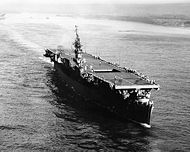 The delivered Grumman F8F Bearcat
fighter aircraft to Saigon on January 26, 1951.
On March 2 of that year, the United States Navy transferred the (LST 490) to the French navy in Indochina in accordance with the MAAG-led MAP. Renamed RFS Vulcain (A-656), she was used in Operation Hirondelle in 1953. The carrier delivered Grumman F8F Bearcat aircraft to Saigon on March 26, 1951. During September 1953, the (renamed Bois Belleau) was lent to France and sent to French Indochina to replace the Arromanches. She was used to support delta defenders in the Halong Bay
operation in May 1954. In August, she joined the Franco-American evacuation operation called "Passage to Freedom".
The same month, the United States delivered additional aircraft, again using the USS Windham Bay. On April 18, 1954, during the siege of Dien Bien Phu, the delivered 25 Korean War AU-1 Corsair
aircraft for use by the French Aeronavale in supporting the besieged garrison.
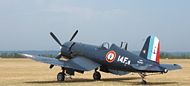 A total of 94 F4U-7s were built for the Aeronavale
in 1952, with the last of the batch, the final Corsair built, rolled out in December 1952. The F4U-7s were actually purchased by the U.S. Navy and passed on to the Aeronavale through the U.S. Military Assistance Program (MAP). They were supplemented by 25 ex-U.S.MC AU-1s (previously used in the Korean War) and moved from Yokosuka, Japan to Tourane
Air Base (Da Nang
), Vietnam in April 1952. US Air Force
assistance followed in November 1953 when the French commander in Indochina, General Navarre
, asked General McCarty, commander of the Combat Cargo Division, for 12 Fairchild C-119
for Operation Castor
at Dien Bien Phu. The USAF also provided C-124 Globemasters
to transport French paratroop reinforcements to Indochina.
On March 3, 1954, twelve C-119s of the 483rd Troop Carrier Wing ("Packet Rats") based at Ashiya
, Japan, were painted with France's insignia and loaned to France with 24 CIA pilots for short term use. Maintenance was carried out by the US Air Force and airlift operations were commanded by McCarty.
 Twenty four CIA (CAT
) pilots supplied the French Union garrison during the siege of Dien Bien Phu by airlifting paratroopers, ammunition, artillery pieces, tons of barbed wire, medics and other military material. With the reducing DZ
areas, night operations and anti-aircraft artillery assaults, many of the "packets" fell into Việt Minh hands. The 37 CIA pilots completed 682 airdrops under anti-aircraft fire between March 13 and May. 6 Two CAT pilots, Wallace Bufford and James B. McGovern, Jr. were killed in action when their Fairchild C-119 Flying Boxcar was shot down on May 6, 1954 . The ceasefire began on May 7 at 5:00 pm under Hanoi-based General Cogny's orders. On February 25, 2005, the French ambassador to the United States, Jean-David Levitte
, awarded the seven remaining CIA pilots with the Légion d'honneur
.
and sent hundreds of ships, including USS Montague
, in order to evacuate non-communist – especially Catholic Vietnamese refugees from North Vietnam
following the July 20, 1954 armistice and partition of Vietnam
. Around 450,000 Vietnamese civilians were transported from North to South during this period, with around one tenth of that number moving in the opposite direction.
Famous Communist propagandist Roman Karmen
was in charge of the media exploitation of the battle of Dien Bien Phu. In his documentary, Vietnam (Вьетнам, 1955), he staged the famous scene with the raising of the Viet Minh flag over de Castries' bunker which is similar to the one he staged over the Berlin Reichstag roof during World War II (Берлин, 1945) and the "S" shaped POW column marching after the battle, where he used the same optical technique he experimented before when he staged the German prisoners after the Siege of Leningrad
(Ленинград в борьбе, 1942) and the Battle of Moscow
(Разгром немецких войск под Москвой, 1942).
Hollywood made a film about Dien Bien Phu
in 1955, Jump Into Hell
, directed by David Butler and scripted by Irving Wallace
, before his fame as a bestselling novelist. Hollywood also made several films about the war, Robert Florey
's Rogues' Regiment
(1948). Samuel Fuller
's China Gate
(1957). and James Clavell
's Five Gates to Hell (1959).
The first French movie about the war, Shock Patrol (Patrouille de Choc) aka Patrol Without Hope (Patrouille Sans Espoir) by Claude Bernard-Aubert, came out in 1956. The French censor cut some violent scenes and made the director change the end of his movie which was seen as "too pessismistic". Léo Joannon
's film Fort du Fou (Fort of the Mad) /Outpost in Indochina was released in 1963. Another film was The 317th Platoon
(La 317ème Section) was released in 1964, it was directed by Indochina War (and siege of Dien Bien Phu) veteran Pierre Schoendoerffer
. Schoendoerffer has since become a media specialist about the Indochina War and has focused his production on realistic war movies. He was cameraman for the army ("Cinematographic Service of the Armies", SCA) during his duty time, moreover as he had covered the Vietnam War
he released The Anderson Platoon
, which won the Academy Award for Documentary Feature
.
Graham Greene
's novel The Quiet American
takes place during this war.
Indochina
The Indochinese peninsula, is a region in Southeast Asia. It lies roughly southwest of China, and east of India. The name has its origins in the French, Indochine, as a combination of the names of "China" and "India", and was adopted when French colonizers in Vietnam began expanding their territory...
War, Anti-French War, Franco-Vietnamese War, Franco-Vietminh War, Indochina War, Dirty War in France, and Anti-French Resistance War in contemporary Vietnam
Vietnam
Vietnam – sometimes spelled Viet Nam , officially the Socialist Republic of Vietnam – is the easternmost country on the Indochina Peninsula in Southeast Asia. It is bordered by China to the north, Laos to the northwest, Cambodia to the southwest, and the South China Sea –...
) was fought in French Indochina
French Indochina
French Indochina was part of the French colonial empire in southeast Asia. A federation of the three Vietnamese regions, Tonkin , Annam , and Cochinchina , as well as Cambodia, was formed in 1887....
from December 19, 1946, until August 1, 1954, between the French Union
French Union
The French Union was a political entity created by the French Fourth Republic to replace the old French colonial system, the "French Empire" and to abolish its "indigenous" status.-History:...
's French Far East Expeditionary Corps
French Far East Expeditionary Corps
The French Far East Expeditionary Corps was a colonial expeditionary force of the French Union Army sent in French Indochina in 1945 during the Pacific War.-Pacific War :...
, led by France
French Fourth Republic
The French Fourth Republic was the republican government of France between 1946 and 1958, governed by the fourth republican constitution. It was in many ways a revival of the Third Republic, which was in place before World War II, and suffered many of the same problems...
and supported by Emperor Bảo Đại
Bảo Đài
Bảo Đài is a commune and village in Lục Nam District, Bac Giang Province, in northeastern Vietnam.-References:...
's Vietnamese National Army
Vietnamese National Army
On March 8, 1949, after the Elysee accords, the State of Vietnam was recognized by France as an independent country ruled by Vietnamese Emperor Bảo Đại. The Vietnamese National Army or Vietnam National Army was the State of Vietnam's military force created shortly after that. It was commanded by...
against the Việt Minh
Viet Minh
Việt Minh was a national independence coalition formed at Pac Bo on May 19, 1941. The Việt Minh initially formed to seek independence for Vietnam from the French Empire. When the Japanese occupation began, the Việt Minh opposed Japan with support from the United States and the Republic of China...
, led by Hồ Chí Minh
Ho Chi Minh
Hồ Chí Minh , born Nguyễn Sinh Cung and also known as Nguyễn Ái Quốc, was a Vietnamese Marxist-Leninist revolutionary leader who was prime minister and president of the Democratic Republic of Vietnam...
and Võ Nguyên Giáp
Vo Nguyen Giap
Võ Nguyên Giáp is a retired Vietnamese officer in the Vietnam People’s Army and a politician. He was a principal commander in two wars: the First Indochina War and the Vietnam War...
. Most of the fighting took place in Tonkin
Tonkin
Tonkin , also spelled Tongkin, Tonquin or Tongking, is the northernmost part of Vietnam, south of China's Yunnan and Guangxi Provinces, east of northern Laos, and west of the Gulf of Tonkin. Locally, it is known as Bắc Kỳ, meaning "Northern Region"...
in Northern Vietnam, although the conflict engulfed the entire country and also extended into the neighboring French Indochina protectorate
Protectorate
In history, the term protectorate has two different meanings. In its earliest inception, which has been adopted by modern international law, it is an autonomous territory that is protected diplomatically or militarily against third parties by a stronger state or entity...
s of Laos
Laos
Laos Lao: ສາທາລະນະລັດ ປະຊາທິປະໄຕ ປະຊາຊົນລາວ Sathalanalat Paxathipatai Paxaxon Lao, officially the Lao People's Democratic Republic, is a landlocked country in Southeast Asia, bordered by Burma and China to the northwest, Vietnam to the east, Cambodia to the south and Thailand to the west...
and Cambodia
Cambodia
Cambodia , officially known as the Kingdom of Cambodia, is a country located in the southern portion of the Indochina Peninsula in Southeast Asia...
.
Following the reoccupation of Indochina by the French following the end of World War II, the area having fallen to the Japanese
Empire of Japan
The Empire of Japan is the name of the state of Japan that existed from the Meiji Restoration on 3 January 1868 to the enactment of the post-World War II Constitution of...
, the Việt Minh launched a rebellion against the French authority governing the colonies of French Indochina. The first few years of the war involved a low-level rural insurgency against French authority. However, after the Chinese communists reached the Northern border of Vietnam in 1949, the conflict turned into a conventional war between two armies equipped with modern weapons supplied by the United States and the Soviet Union.
French Union forces included colonial troops from the whole former empire (Moroccan, Algerian, Tunisian, Laotian, Cambodian, and Vietnamese ethnic minorities), French professional troops and units of the French Foreign Legion
French Foreign Legion
The French Foreign Legion is a unique military service wing of the French Army established in 1831. The foreign legion was exclusively created for foreign nationals willing to serve in the French Armed Forces...
. The use of metropolitan
Metropolitan France
Metropolitan France is the part of France located in Europe. It can also be described as mainland France or as the French mainland and the island of Corsica...
recruits was forbidden by the governments to prevent the war from becoming even more unpopular at home. It was called the "dirty war" (la sale guerre) by supporters of the Left
Left-wing politics
In politics, Left, left-wing and leftist generally refer to support for social change to create a more egalitarian society...
intellectuals in France (including Sartre
Jean-Paul Sartre
Jean-Paul Charles Aymard Sartre was a French existentialist philosopher, playwright, novelist, screenwriter, political activist, biographer, and literary critic. He was one of the leading figures in 20th century French philosophy, particularly Marxism, and was one of the key figures in literary...
) during the Henri Martin Affair
Henri Martin Affair
The Henri Martin Affair was a political-military scandal that happened under the French Fourth Republic during the First Indochina War. It lasted from March 1950 to September 1953....
in 1950.
While the strategy of pushing the Việt Minh into attacking a well defended base in a remote part of the country at the end of their logistical trail was validated at the Battle of Na San
Battle of Na San
The Battle of Nà Sản was fought between French Union forces and the communist forces of the Việt Minh at Nà Sản, Sơn La Province, during the First Indochina War for control of the T’ai region ....
, the lack of construction materials (especially concrete), tanks (because of lack of road access and difficulty in the jungle terrain), and air cover precluded an effective defense.
After the war, the Geneva Conference
Geneva Conference (1954)
The Geneva Conference was a conference which took place in Geneva, Switzerland, whose purpose was to attempt to find a way to unify Korea and discuss the possibility of restoring peace in Indochina...
on July 21, 1954, made a provisional division of Vietnam at the 17th parallel
Vietnamese Demilitarized Zone
The Vietnamese Demilitarized Zone was established as a dividing line between North and South Vietnam as a result of the First Indochina War.During the Second Indochina War , it became important as the battleground demarcation separating North Vietnamese territory from South Vietnamese territory.-...
, with control of the north given to the Việt Minh as the Democratic Republic of Vietnam
North Vietnam
The Democratic Republic of Vietnam , was a communist state that ruled the northern half of Vietnam from 1954 until 1976 following the Geneva Conference and laid claim to all of Vietnam from 1945 to 1954 during the First Indochina War, during which they controlled pockets of territory throughout...
under Hồ Chí Minh, and the south becoming the State of Vietnam
South Vietnam
South Vietnam was a state which governed southern Vietnam until 1975. It received international recognition in 1950 as the "State of Vietnam" and later as the "Republic of Vietnam" . Its capital was Saigon...
under Emperor Bảo Đại
Bảo Đài
Bảo Đài is a commune and village in Lục Nam District, Bac Giang Province, in northeastern Vietnam.-References:...
, in order to prevent Hồ Chí Minh from gaining control of the entire country. A year later, Bảo Đại would be deposed by his prime minister, Ngô Đình Diệm
Ngo Dinh Diem
Ngô Đình Diệm was the first president of South Vietnam . In the wake of the French withdrawal from Indochina as a result of the 1954 Geneva Accords, Diệm led the effort to create the Republic of Vietnam. Accruing considerable U.S. support due to his staunch anti-Communism, he achieved victory in a...
, creating the Republic of Vietnam
South Vietnam
South Vietnam was a state which governed southern Vietnam until 1975. It received international recognition in 1950 as the "State of Vietnam" and later as the "Republic of Vietnam" . Its capital was Saigon...
. Diem's refusal to enter into negotiations with North Vietnam about holding nationwide elections in 1956, as had been stipulated by the Geneva Conference, would eventually lead to war breaking out again in South Vietnam in 1959 – the Second Indochina War
Vietnam War
The Vietnam War was a Cold War-era military conflict that occurred in Vietnam, Laos, and Cambodia from 1 November 1955 to the fall of Saigon on 30 April 1975. This war followed the First Indochina War and was fought between North Vietnam, supported by its communist allies, and the government of...
.
Background
Vietnam was absorbed into French IndochinaFrench Indochina
French Indochina was part of the French colonial empire in southeast Asia. A federation of the three Vietnamese regions, Tonkin , Annam , and Cochinchina , as well as Cambodia, was formed in 1887....
in stages between 1858 and 1887 with European influence and education. Nationalism grew until World War II provided a break in French control. Early Vietnamese resistance centered on the intellectual Phan Bội Châu
Phan Boi Chau
Phan Bội Châu was a pioneer of Vietnamese 20th century nationalism. In 1903, he formed a revolutionary organization called the “Reformation Society” ....
. Chau looked to Japan, which had modernized and was one of the few Asian nations to resist European colonization. With Prince Cường Để, Châu started two organizations in Japan, the Duy Tân Hội (Modernistic Association) and Vietnam Cong Hien Hoi. Due to French pressure, Japan deported Phan Bội Châu to China. Witnessing Sun Yat-sen
Sun Yat-sen
Sun Yat-sen was a Chinese doctor, revolutionary and political leader. As the foremost pioneer of Nationalist China, Sun is frequently referred to as the "Father of the Nation" , a view agreed upon by both the People's Republic of China and the Republic of China...
's 1911 nationalist revolution
Xinhai Revolution
The Xinhai Revolution or Hsinhai Revolution, also known as Revolution of 1911 or the Chinese Revolution, was a revolution that overthrew China's last imperial dynasty, the Qing , and established the Republic of China...
, Chau was inspired to commence the Việt Nam Quang Phục Hội movement in Guangzhou
Guangzhou
Guangzhou , known historically as Canton or Kwangchow, is the capital and largest city of the Guangdong province in the People's Republic of China. Located in southern China on the Pearl River, about north-northwest of Hong Kong, Guangzhou is a key national transportation hub and trading port...
. From 1914 to 1917, he was imprisoned by Yuan Shi Kai's
Yuan Shikai
Yuan Shikai was an important Chinese general and politician famous for his influence during the late Qing Dynasty, his role in the events leading up to the abdication of the last Qing Emperor of China, his autocratic rule as the second President of the Republic of China , and his short-lived...
counterrevolutionary government. In 1925, he was captured by French agents in Shanghai and spirited to Vietnam. Due to his popularity, Châu was spared from execution and placed under house arrest until his death in 1940.
In September 1940, shortly after Phan Bội Châu's death, Japan launched the First French Indochina Campaign and invaded French Indochina
French Indochina
French Indochina was part of the French colonial empire in southeast Asia. A federation of the three Vietnamese regions, Tonkin , Annam , and Cochinchina , as well as Cambodia, was formed in 1887....
, mirroring their ally Germany's conquest of metropolitan France
Metropolitan France
Metropolitan France is the part of France located in Europe. It can also be described as mainland France or as the French mainland and the island of Corsica...
. Keeping the French colonial administration, the Japanese ruled from behind the scenes in a parallel of Vichy France
Vichy France
Vichy France, Vichy Regime, or Vichy Government, are common terms used to describe the government of France that collaborated with the Axis powers from July 1940 to August 1944. This government succeeded the Third Republic and preceded the Provisional Government of the French Republic...
. As far as Vietnamese nationalists were concerned, this was a double-puppet government. Emperor Bảo Đại
Bảo Đài
Bảo Đài is a commune and village in Lục Nam District, Bac Giang Province, in northeastern Vietnam.-References:...
collaborated with the Japanese, just as he had with the French, ensuring his lifestyle could continue.
From October 1940 to May 1941, during the French-Thai War
French-Thai War
The Franco-Thai War was fought between Thailand and Vichy France over certain areas of French Indochina that had once belonged to Thailand....
, the Vichy French in Indochina were involved with defending their colony in a border conflict which saw the forces of Thailand
Thailand
Thailand , officially the Kingdom of Thailand , formerly known as Siam , is a country located at the centre of the Indochina peninsula and Southeast Asia. It is bordered to the north by Burma and Laos, to the east by Laos and Cambodia, to the south by the Gulf of Thailand and Malaysia, and to the...
invade, while the Japanese sat on the sidelines. Thai military successes were limited to the Cambodian border area, and in January 1941 Vichy France's modern naval forces soundly defeated the inferior Thai naval forces in the Battle of Koh Chang
Battle of Koh Chang
The Battle of Koh Chang took place on 17 January 1941 during the French-Thai War and resulted in a decisive victory by the French over the Royal Thai Navy. During the battle, a flotilla of French warships attacked a smaller force of Thai vessels, including a coastal battleship.In the end, Thailand...
. The war ended in May, with the French agreeing to minor territorial revisions which restored formerly Thai areas to Thailand.
In March 1945, Japan launched the Second French Indochina Campaign
Second French Indochina Campaign
The Second French Indochina Campaign, also known as the Japanese coup of March 1945, was a Japanese military operation in Cambodia, Laos and Vietnam, then a French colony and known as French Indochina, during the final months of the Second World War. Vietnam was not a real colony at this time. The...
and ousted the Vichy French
Vichy France
Vichy France, Vichy Regime, or Vichy Government, are common terms used to describe the government of France that collaborated with the Axis powers from July 1940 to August 1944. This government succeeded the Third Republic and preceded the Provisional Government of the French Republic...
and formally installed Emperor Bảo Đại
Bảo Đài
Bảo Đài is a commune and village in Lục Nam District, Bac Giang Province, in northeastern Vietnam.-References:...
in the short-lived Empire of Vietnam
Empire of Vietnam
The Empire of Vietnam was a short-lived puppet state of Imperial Japan governing the whole of Vietnam between March 11 and August 23, 1945.-History:...
.
In August 1945, when Japanese forces surrendered in Vietnam, they allowed the Việt Minh and other nationalist groups to take over public buildings and weapons without resistance, which began the August Revolution
August Revolution
On August 19, 1945, the Việt Minh under Hồ Chí Minh began the August General Uprising Tổng Khởi Nghĩa, which was soon renamed the August Revolution . Whether or not this series of events should be called a "revolution" is disputable; what is clear is that, from August 19 onwards, demonstrations and...
. After their defeat the Japanese Army gave weapons to the Vietnamese. In order to further help the nationalists, the Japanese kept Vichy French officials and military officers imprisoned for a month after the surrender. The Việt Minh had recruited more than 600 Japanese soldiers and given them roles to train or command Vietnamese soldiers.
Hồ Chí Minh claimed in a speech in September 1945 that due to a combination of ruthless Japanese exploitation and poor weather, a famine
Vietnamese Famine of 1945
The Vietnamese Famine of 1945 was a famine that occurred in northern Vietnam from October 1944 to May 1945, during the Japanese occupation of French Indochina in World War II. Between 400,000 and 2 million people are estimated to have starved to death during this time.-Causes:There were many...
occurred in which approximately 2 million Vietnamese died. The Việt Minh arranged a relief effort in the north and won wide support there as a result.
American President Franklin D. Roosevelt
Franklin D. Roosevelt
Franklin Delano Roosevelt , also known by his initials, FDR, was the 32nd President of the United States and a central figure in world events during the mid-20th century, leading the United States during a time of worldwide economic crisis and world war...
and General Joseph Stilwell
Joseph Stilwell
General Joseph Warren Stilwell was a United States Army four-star General known for service in the China Burma India Theater. His caustic personality was reflected in the nickname "Vinegar Joe"...
privately made it adamantly clear that the French were not to reacquire French Indochina
French Indochina
French Indochina was part of the French colonial empire in southeast Asia. A federation of the three Vietnamese regions, Tonkin , Annam , and Cochinchina , as well as Cambodia, was formed in 1887....
(modern day Vietnam, Cambodia and Laos) after the war was over. Roosevelt offered Chiang Kai-shek
Chiang Kai-shek
Chiang Kai-shek was a political and military leader of 20th century China. He is known as Jiǎng Jièshí or Jiǎng Zhōngzhèng in Mandarin....
to place all of Indochina under Chinese rule. Chiang Kai-shek supposedly replied: "Under no circumstances!".
After the war, 200,000 Chinese troops sent by Chiang Kai-shek under General Lu Han
Lu Han
Lu Han was a KMT general of Yi ethnicity.-Life:His alma matter was Yunnan military academy. He was commander of the First Group Army in the Second Sino-Japanese War....
entered Indochina north of the 16th parallel to accept the surrender of Japanese occupying forces. They remained there until 1946. The Chinese used the VNQDD, the Vietnamese branch of the Chinese Kuomintang
Kuomintang
The Kuomintang of China , sometimes romanized as Guomindang via the Pinyin transcription system or GMD for short, and translated as the Chinese Nationalist Party is a founding and ruling political party of the Republic of China . Its guiding ideology is the Three Principles of the People, espoused...
, to increase their influence in Indochina and put pressure on their opponents. In February 1946 the French forced the Chinese to leave Indochina but agreed to renounce French extraterritorial privileges in China itself. French troops then reoccupied the region starting in March 1946.
Hồ Chí Minh was able to persuade Emperor Bảo Đại to abdicate
Abdication
Abdication occurs when a monarch, such as a king or emperor, renounces his office.-Terminology:The word abdication comes derives from the Latin abdicatio. meaning to disown or renounce...
on August 25, 1945. Bảo Đại was appointed "supreme adviser" to the new Vietminh-led government in Hanoi
Hanoi
Hanoi , is the capital of Vietnam and the country's second largest city. Its population in 2009 was estimated at 2.6 million for urban districts, 6.5 million for the metropolitan jurisdiction. From 1010 until 1802, it was the most important political centre of Vietnam...
, which asserted independence on September 2. Deliberately borrowing from the Declaration of Independence of the United States of America, Ho Chi Minh proclaimed on September 2: "We hold the truth that all men are created equal, that they are endowed by their Creator with certain unalienable rights, among them life, liberty and the pursuit of happiness."
With the fall of the short lived Japanese colony of the Empire of Vietnam
Empire of Vietnam
The Empire of Vietnam was a short-lived puppet state of Imperial Japan governing the whole of Vietnam between March 11 and August 23, 1945.-History:...
, the Provisional Government of the French Republic
Provisional Government of the French Republic
The Provisional Government of the French Republic was an interim government which governed France from 1944 to 1946, following the fall of Vichy France and prior to the Fourth French Republic....
wanted to restore its colonial rule in French Indochina as the final step of the Liberation of France. An armistice was signed between Japan and the United States on August 20. CEFEO Expeditionary Corps
French Far East Expeditionary Corps
The French Far East Expeditionary Corps was a colonial expeditionary force of the French Union Army sent in French Indochina in 1945 during the Pacific War.-Pacific War :...
leader General Leclerc
Philippe Leclerc de Hauteclocque
Philippe François Marie, comte de Hauteclocque, then Leclerc de Hauteclocque, by a 1945 decree that incorporated his French Resistance alias Jacques-Philippe Leclerc to his name, , was a French general during World War II...
signed the armistice with Japan onboard the USS Missouri
USS Missouri (BB-63)
|USS Missouri is a United States Navy Iowa-class battleship, and was the fourth ship of the U.S. Navy to be named in honor of the U.S. state of Missouri...
on behalf of France, on September 2.
On September 13, a Franco
French Fourth Republic
The French Fourth Republic was the republican government of France between 1946 and 1958, governed by the fourth republican constitution. It was in many ways a revival of the Third Republic, which was in place before World War II, and suffered many of the same problems...
-British task force
Task force
A task force is a unit or formation established to work on a single defined task or activity. Originally introduced by the United States Navy, the term has now caught on for general usage and is a standard part of NATO terminology...
landed in Java
Java
Java is an island of Indonesia. With a population of 135 million , it is the world's most populous island, and one of the most densely populated regions in the world. It is home to 60% of Indonesia's population. The Indonesian capital city, Jakarta, is in west Java...
, main island of the Dutch East Indies
Dutch East Indies
The Dutch East Indies was a Dutch colony that became modern Indonesia following World War II. It was formed from the nationalised colonies of the Dutch East India Company, which came under the administration of the Netherlands government in 1800....
(for which independence was being sought by Sukarno
Sukarno
Sukarno, born Kusno Sosrodihardjo was the first President of Indonesia.Sukarno was the leader of his country's struggle for independence from the Netherlands and was Indonesia's first President from 1945 to 1967...
), and Saigon, capital of Cochinchina (southern part of French Indochina), both being occupied by the Japanese
Japanese Occupation of Indonesia
The Japanese Empire occupied Indonesia, known then as the Dutch East Indies, during World War II from March 1942 until after the end of War in 1945...
and ruled by Field Marshal Hisaichi Terauchi, Commander-in-Chief of Japan's Southern Expeditionary Army Group
Southern Expeditionary Army Group
The was a army group of the Imperial Japanese Army during World War II. It was responsible for all military operations in South East Asian and South West Pacific campaigns of World War II....
based in Saigon. Allied
Allies of World War II
The Allies of World War II were the countries that opposed the Axis powers during the Second World War . Former Axis states contributing to the Allied victory are not considered Allied states...
troops in Saigon were an airborne detachment, two British companies of the 20th Hindi Division and the French 5th Colonial Infantry Regiment, with British General Sir Douglas Gracey as supreme commander. The latter proclaimed martial law
Martial law
Martial law is the imposition of military rule by military authorities over designated regions on an emergency basis— only temporary—when the civilian government or civilian authorities fail to function effectively , when there are extensive riots and protests, or when the disobedience of the law...
on September 21. The following night the Franco-British troops took control of Saigon.
Almost immediately afterward, the Chinese Government
Kuomintang
The Kuomintang of China , sometimes romanized as Guomindang via the Pinyin transcription system or GMD for short, and translated as the Chinese Nationalist Party is a founding and ruling political party of the Republic of China . Its guiding ideology is the Three Principles of the People, espoused...
, as agreed to at the Potsdam Conference
Potsdam Conference
The Potsdam Conference was held at Cecilienhof, the home of Crown Prince Wilhelm Hohenzollern, in Potsdam, occupied Germany, from 16 July to 2 August 1945. Participants were the Soviet Union, the United Kingdom, and the United States...
, occupied French Indochina as far south as the 16th parallel in order to supervise the disarming and repatriation of the Japanese Army
Imperial Japanese Army
-Foundation:During the Meiji Restoration, the military forces loyal to the Emperor were samurai drawn primarily from the loyalist feudal domains of Satsuma and Chōshū...
. This effectively ended Hồ Chí Minh's nominal government in Hanoi.
General Leclerc arrived in Saigon on October 9, with him was French Colonel Massu
Jacques Massu
Jacques Émile Massu was a French general who fought in World War II, the First Indochina War, the Algerian War and the Suez crisis.-Early life:Jacques Massu was born in Châlons-sur-Marne to a family of military officers; his father was an artillery officer...
's March Group (Groupement de marche). Leclerc's primary objectives were to restore public order in south Vietnam and to militarize Tonkin (north Vietnam). Secondary objectives were to wait for French backup in view to take back Chinese occupied Hanoi, then to negotiate with the Viet Minh officials.
Campaign of 1946
Fighting broke out in HaiphongHaiphong
, also Haiphong, is the third most populous city in Vietnam. The name means, "coastal defence".-History:Hai Phong was originally founded by Lê Chân, the female general of a Vietnamese revolution against the Chinese led by the Trưng Sisters in the year 43 C.E.The area which is now known as Duong...
after a conflict of interest in import duty at the port between the Viet Minh
Viet Minh
Việt Minh was a national independence coalition formed at Pac Bo on May 19, 1941. The Việt Minh initially formed to seek independence for Vietnam from the French Empire. When the Japanese occupation began, the Việt Minh opposed Japan with support from the United States and the Republic of China...
government and the French. On November 23, 1946 the French fleet began a naval bombardment of the city that killed over 6,000 Vietnamese civilians in one afternoon according to one source or over 2,000 according to another. The Việt Minh quickly agreed to a cease-fire and left the cities. There was never any intention among the Vietnamese to give up, as General Vo Nguyen Giap
Vo Nguyen Giap
Võ Nguyên Giáp is a retired Vietnamese officer in the Vietnam People’s Army and a politician. He was a principal commander in two wars: the First Indochina War and the Vietnam War...
soon brought up 30,000 men to attack the city. Although the French were outnumbered, their superior weaponry and naval support made any Việt Minh attack impossible. In December, hostilities also broke out in Hanoi
Hanoi
Hanoi , is the capital of Vietnam and the country's second largest city. Its population in 2009 was estimated at 2.6 million for urban districts, 6.5 million for the metropolitan jurisdiction. From 1010 until 1802, it was the most important political centre of Vietnam...
between the Việt Minh and the French, and Hồ Chí Minh was forced to evacuate the capital in favor of remote mountain areas. Guerrilla warfare ensued, with the French controlling most of the country except far-flung areas.
Campaign of 1947
In 1947, General Võ Nguyên GiápVo Nguyen Giap
Võ Nguyên Giáp is a retired Vietnamese officer in the Vietnam People’s Army and a politician. He was a principal commander in two wars: the First Indochina War and the Vietnam War...
moved his command to Tân Trào. The French sent military expeditions to attack his bases, but Giáp refused to meet them head-on in battle. Wherever the French troops went, the Việt Minh disappeared. Late in the year the French launched Operation Lea
Operation Lea
Operation Léa was French Union military operation between 7 October and 22 December 1947 during the First Indochina War. It was an attempt by the French General Valluy to crush the Viet Minh...
to take out the Việt Minh communications center at Bac Kan. They failed to capture Hồ Chí Minh and his key lieutenants as intended, but 9,000 Việt Minh soldiers were killed during the campaign which was a major blow for the insurgency.
Campaign of 1948
In 1948, France started looking for means of opposing the Việt Minh politically, with an alternative government in SaigonHo Chi Minh City
Ho Chi Minh City , formerly named Saigon is the largest city in Vietnam...
. They began negotiations with the former Vietnamese emperor Bảo Đại
Bảo Đài
Bảo Đài is a commune and village in Lục Nam District, Bac Giang Province, in northeastern Vietnam.-References:...
to lead an "autonomous" government within the French Union
French Union
The French Union was a political entity created by the French Fourth Republic to replace the old French colonial system, the "French Empire" and to abolish its "indigenous" status.-History:...
of nations, the State of Vietnam
State of Vietnam
The State of Vietnam was a state that claimed authority over all of Vietnam during the First Indochina War, and replaced the Provisional Central Government of Vietnam . The provisional government was a brief transitional administration between colonial Cochinchina and an independent state...
. Two years before, the French had refused Hồ's proposal of a similar status (albeit with some restrictions on French power and the latter's eventual withdrawal from Vietnam); however, they were willing to give it to Bảo Ðại as he had freely collaborated with French rule of Vietnam in the past and was in no position to seriously negotiate or impose demands (Bảo Ðại had no military of his own, but soon he would have one).
Campaign of 1949
In 1949, France officially recognized the "independence" of the State of VietnamState of Vietnam
The State of Vietnam was a state that claimed authority over all of Vietnam during the First Indochina War, and replaced the Provisional Central Government of Vietnam . The provisional government was a brief transitional administration between colonial Cochinchina and an independent state...
as an associated state
Associated state
An associated state is the minor partner in a formal, free relationship between a political territory with a degree of statehood and a nation, for which no other specific term, such as protectorate, is adopted...
within the French Union
French Union
The French Union was a political entity created by the French Fourth Republic to replace the old French colonial system, the "French Empire" and to abolish its "indigenous" status.-History:...
under Bảo Ðại. However, France still controlled all foreign relations and every defense issue as Vietnam was only nominally an independent state within the French Union
French Union
The French Union was a political entity created by the French Fourth Republic to replace the old French colonial system, the "French Empire" and to abolish its "indigenous" status.-History:...
. The Việt Minh quickly denounced the government and stated that they wanted "real independence, not Bảo Ðại independence". Later on, as a concession to this new government and a way to increase their numbers, France agreed to the formation of the Vietnamese National Army
Vietnamese National Army
On March 8, 1949, after the Elysee accords, the State of Vietnam was recognized by France as an independent country ruled by Vietnamese Emperor Bảo Đại. The Vietnamese National Army or Vietnam National Army was the State of Vietnam's military force created shortly after that. It was commanded by...
to be commanded by Vietnamese officers. These troops were used mostly to garrison quiet sectors so French forces would be available for combat. Private Cao Dai
Cao Dai
Cao Đài is a syncretistic, monotheistic religion, officially established in the city of Tay Ninh, southern Vietnam, in 1926. Đạo Cao Đài is the religion's shortened name, the full name is Đại Đạo Tam Kỳ Phổ Độ...
, Hoa Hao
Hoa Hao
Hòa Hảo is a religious tradition, based on Buddhism, founded in 1939 by Huỳnh Phú Sổ, a native of the Mekong River Delta region of southern Vietnam. Adherents consider Sổ to be a prophet, and Hòa Hảo a continuation of a 19th-century Buddhist ministry known as Bửu Sơn Kỳ Hương...
and the Binh Xuyen
Binh Xuyen
Bình Xuyên, often linked to its infamous leader, General Le van "Bay" Vien, was an independent military force within the Vietnamese National Army whose leaders once had lived outside the law and had sided with the Viet Minh...
gangster armies were used in the same way. The Vietnamese Communists in return obtained outside support in 1949 when Chairman Mao Zedong
Mao Zedong
Mao Zedong, also transliterated as Mao Tse-tung , and commonly referred to as Chairman Mao , was a Chinese Communist revolutionary, guerrilla warfare strategist, Marxist political philosopher, and leader of the Chinese Revolution...
succeeded in taking control of China
People's Republic of China
China , officially the People's Republic of China , is the most populous country in the world, with over 1.3 billion citizens. Located in East Asia, the country covers approximately 9.6 million square kilometres...
by defeating the Kuomintang
Kuomintang
The Kuomintang of China , sometimes romanized as Guomindang via the Pinyin transcription system or GMD for short, and translated as the Chinese Nationalist Party is a founding and ruling political party of the Republic of China . Its guiding ideology is the Three Principles of the People, espoused...
, thus gaining a major political ally and supply area just across the border. In the same year, the French also granted independence (within the framework of the French Union
French Union
The French Union was a political entity created by the French Fourth Republic to replace the old French colonial system, the "French Empire" and to abolish its "indigenous" status.-History:...
) to the other two nations in Indochina
Indochina
The Indochinese peninsula, is a region in Southeast Asia. It lies roughly southwest of China, and east of India. The name has its origins in the French, Indochine, as a combination of the names of "China" and "India", and was adopted when French colonizers in Vietnam began expanding their territory...
, the Kingdoms of Laos
Laos
Laos Lao: ສາທາລະນະລັດ ປະຊາທິປະໄຕ ປະຊາຊົນລາວ Sathalanalat Paxathipatai Paxaxon Lao, officially the Lao People's Democratic Republic, is a landlocked country in Southeast Asia, bordered by Burma and China to the northwest, Vietnam to the east, Cambodia to the south and Thailand to the west...
and Cambodia
Cambodia
Cambodia , officially known as the Kingdom of Cambodia, is a country located in the southern portion of the Indochina Peninsula in Southeast Asia...
.
The United States recognized the South Vietnamese state, but many other nations viewed it as simply a French puppet regime and would not deal with it at all . The United States began to give military aid to France in the form of weaponry and military observers. By then with almost unlimited Chinese military supplies entering Vietnam, General Giáp re-organized his local irregular forces into five full conventional infantry
Infantry
Infantrymen are soldiers who are specifically trained for the role of fighting on foot to engage the enemy face to face and have historically borne the brunt of the casualties of combat in wars. As the oldest branch of combat arms, they are the backbone of armies...
divisions, the 304th, 308th, 312th, 316th and the 320th. The war began to intensify when Giáp went on the offensive, attacking isolated French bases along the Chinese border.
Campaign of 1950
In February 1950, Giáp seized the vulnerable 150-strong French garrison at Lai KheLai Khe
Lai Khê is a small settlement in Vietnam, to the northwest of Ho Chi Minh City and about 20 km north of Thủ Dầu Một. During the Vietnam War it was a garrison town as the 5th Division of the Army of the Republic of Vietnam was based there for most of the 1960s and 1970s.Tucker, pp. 526–533...
in Tonkin just south of the border with China. Then, on May 25, he attacked the garrison of Cao Bang manned by 4,000 French-controlled Vietnamese troops, but his forces were repulsed. Giáp launched his second offense again against Cao Bang as well as Dong Khe
Battle of Dong Khe
The Battle of Dong Khe was a major battle of the First Indochina War. The fight began on 15 September 1950 and ended on 18 September with a French defeat...
on September 15. Dong Khe fell on September 18, and Cao Bang finally fell on October 3. Lang Son
Lang Son
Lạng Sơn , sometimes Langson, is a city in far northern Vietnam, is the capital of Lang Son province. It is accessible by road and rail from Hanoi, the Vietnamese capital, and it is the northernmost point on National Road 1A.-History:...
, with its 4,000-strong French Foreign Legion
French Foreign Legion
The French Foreign Legion is a unique military service wing of the French Army established in 1831. The foreign legion was exclusively created for foreign nationals willing to serve in the French Armed Forces...
garrison, was attacked immediately after. The retreating French on Route 4
Battle of Route Coloniale 4
The Battle of Route Coloniale 4 was a battle of the First Indochina War. The battle lasted from 30 September to 18 October 1950...
, together with the relief force coming from That Khe, were attacked all the way by ambushing Việt Minh forces. The French air-dropped a paratroop battalion south of Dong Khe to act as diversion only to see it surrounded and destroyed. On October 17, Lang Son, after a week of intense fighting, finally fell. By the time the remains of the garrisons reached the safety of the Red River Delta
Red River Delta
The Red River Delta is the flat plain formed by the Red River and its distributaries joining in the Thai Binh River in northern Vietnam. The delta measuring some 15,000 square km is well protected by a network of dikes. It is an agriculturally rich area and densely populated...
, 4,800 French troops had been killed, captured or missing in action and 2,000 wounded out of a total garrison force of over 10,000. Also lost were 13 artillery pieces, 125 mortars, 450 trucks, 940 machine guns, 1,200 submachine guns and 8,000 rifles destroyed or captured during the fighting. China and the Soviet Union recognized Hồ Chí Minh as the legitimate ruler of Vietnam and sent him more and more supplies and material aid. The year 1950 also marked the first time that napalm
Napalm
Napalm is a thickening/gelling agent generally mixed with gasoline or a similar fuel for use in an incendiary device, primarily as an anti-personnel weapon...
was ever used in Vietnam (this type of weapon was supplied by the U.S. for the use of the French Aeronovale at the time).
The military situation improved for France when their new commander, General Jean Marie de Lattre de Tassigny
Jean de Lattre de Tassigny
Jean Joseph Marie Gabriel de Lattre de Tassigny, GCB, MC was a French military hero of World War II and commander in the First Indochina War.-Early life:...
, built a fortified line from Hanoi
Hanoi
Hanoi , is the capital of Vietnam and the country's second largest city. Its population in 2009 was estimated at 2.6 million for urban districts, 6.5 million for the metropolitan jurisdiction. From 1010 until 1802, it was the most important political centre of Vietnam...
to the Gulf of Tonkin
Gulf of Tonkin
The Gulf of Tonkin is an arm of the South China Sea, lying off the coast of northeastern Vietnam.-Etymology:The name Tonkin, written "東京" in Hán tự and Đông Kinh in romanised Vietnamese, means "Eastern Capital", and is the former toponym for Hanoi, the capital of Vietnam...
, across the Red River Delta, to hold the Việt Minh in place and use his troops to smash them against this barricade, which became known as the "De Lattre Line". This led to a period of success for the French.
Campaign of 1951
On January 13, 1951, Giap moved the 308th and 312th Divisions, made up of over 20,000 men, to attack Vinh YenVinh Yên
Vĩnh Yên is the capital of Vinh Phuc province, in the Red River Delta region of northern Vietnam. The population is 76,650 people, the area is 50.87 km²....
, 20 miles (32.2 km) northwest of Hanoi which was manned by the 6,000 strong 9th Foreign Legion Brigade. The Việt Minh entered a trap. Caught for the first time in the open and actually forced to fight the French head-on, without the ability to quickly hide and retreat, they were mowed down by concentrated French artillery and machine gun fire. By January 16, Giap was forced to withdraw, having lost over 6,000 killed, 8,000 wounded and 500 captured. The Battle of Vinh Yen
Battle of Vinh Yen
The Battle of Vĩnh Yên , which occurred from 13 to 17 January 1951, was a major engagement in the First Indochina War between the French Union and the Việt Minh. The French Union forces, led by World War II hero Jean de Lattre de Tassigny, inflicted a decisive defeat on the Việt Minh forces, which...
had been a catastrophe.
On March 23, Giap tried again, launching an attack against Mao Khe
Battle of Mao Khe
The Battle of Mạo Khê , occurring from March 23 to March 28, 1951, was a significant engagement in the First Indochina War between the French Union and the Việt Minh. The French Union forces, led by World War II hero Jean de Lattre de Tassigny, inflicted a defeat on Việt Minh forces, which were...
, 20 miles (32.2 km) north of Haiphong
Haiphong
, also Haiphong, is the third most populous city in Vietnam. The name means, "coastal defence".-History:Hai Phong was originally founded by Lê Chân, the female general of a Vietnamese revolution against the Chinese led by the Trưng Sisters in the year 43 C.E.The area which is now known as Duong...
. The 316th Division, composed of 11,000 men, with the partly rebuilt 308th and 312th Divisions in reserve, went forward and were beaten in bitter hand-to-hand fighting against French troops. Giap, having lost over 3,000 dead and wounded by March 28, withdrew.
Giap launched yet another attack on May 29 with the 304th Division at Phu Ly, the 308th Division at Ninh Binh
Ninh Bình
Ninh Bình is a city in the Red River Delta of northern Vietnam. It is the capital of Ninh Binh province.-Geography:Ninh Binh city located in the southernmost plains north Vietnam...
, and the main attack delivered by the 320th Division at Phat Diem south of Hanoi. The attacks fared no better and the three divisions lost heavily. Taking advantage of this, de Lattre mounted his counter offensive against the demoralized Việt Minh, driving them back into the jungle and eliminating the enemy pockets in the Red River Delta by June 18 costing the Việt Minh over 10,000 killed.
Every effort by Vo Nguyen Giap to break the line failed and every attack he made was answered by a French counter-attack that destroyed his forces. Việt Minh casualties rose alarmingly during this period, leading some to question the leadership of the Communist government, even within the party. However, any benefit this may have reaped for France was negated by the increasing domestic opposition to the war in France.
On July 31, French General Chanson was assassinated during a kamikaze
Kamikaze
The were suicide attacks by military aviators from the Empire of Japan against Allied naval vessels in the closing stages of the Pacific campaign of World War II, designed to destroy as many warships as possible....
attentat
Propaganda of the deed
Propaganda of the deed is a concept that refers to specific political actions meant to be exemplary to others...
at Sa Đéc in South Vietnam that was blamed on the Việt Minh although it was argued in some quarters that Cao Dai
Cao Dai
Cao Đài is a syncretistic, monotheistic religion, officially established in the city of Tay Ninh, southern Vietnam, in 1926. Đạo Cao Đài is the religion's shortened name, the full name is Đại Đạo Tam Kỳ Phổ Độ...
nationalist Trinh Minh The
Trinh Minh The
Trình Minh Thế was a Vietnamese nationalist and military leader during the end of the First Indochina War and the beginning of the Vietnam War.-Biography:...
could have been involved in its planning.
On November 14, 1951, the French seized Hòa Bình
Battle of Hoa Binh
The Battle of Hòa Bình was fought during the First Indochina War. It occurred from 10 November 1951 to 25 February 1952, when French Union forces attempted to lure the Việt Minh out in the open and to fight on French terms.-Prelude:...
, 25 miles (40.2 km) west of the De Lattre line, by a parachute drop and expanded their perimeter.
Campaign of 1952
Raoul Salan
Raoul Albin Louis Salan was a French Army general and the fourth French commanding general during the First Indochina War. Salan was one of four generals who organized the 1961 Algiers Putsch operation and then founded the Organisation de l'armée secrète....
as the overall commander of French forces in Indochina. Within that year, throughout the war theater, the Việt Minh cut French supply lines and began to seriously wear down the resolve of the French forces. There were continued raids, skirmishes and guerrilla attacks, but through most of the rest of the year each side withdrew to prepare itself for larger operations. Starting on October 2, the Battle of Na San
Battle of Na San
The Battle of Nà Sản was fought between French Union forces and the communist forces of the Việt Minh at Nà Sản, Sơn La Province, during the First Indochina War for control of the T’ai region ....
saw the first use of the French commanders "hedgehog
Hedgehog
A hedgehog is any of the spiny mammals of the subfamily Erinaceinae and the order Erinaceomorpha. There are 17 species of hedgehog in five genera, found through parts of Europe, Asia, Africa, and New Zealand . There are no hedgehogs native to Australia, and no living species native to the Americas...
" tactics consisting in setting up a well defended outpost to get the Việt Minh out of the jungle and force it to fight a conventional battle instead of ambushes. At first this strategy was successful for the French Union but it ended with a fiasco in 1954.
On October 17, 1952, Giáp launched attacks against the French garrisons along Nghia Lo
Nghia Lo
Nghia Lo is a town district of Yen Bai Province, in the northeastern region of Vietnam.In 1951, the Viet Minh 312 Division fought French forces in the area as part of the First Indochina War....
, northwest of Hanoi, and overran much of the Black River valley, except for the airfield of Na San where a strong French garrison entrenched. Giáp by now had control over most of Tonkin beyond the De Lattre line. Raoul Salan, seeing the situation as critical, launched Operation Lorraine
Operation Lorraine
Operation Lorraine was a French military operation of the First Indochina War.The main objective for the French was to lure the Viet Minh into open battle and inflict a crushing defeat on them. Giap failed to take the bait and Salan canceled the operation and the French withdraw to the de Lattre...
along the Clear river to force Giáp to relieve pressure on the Nghia Lo outposts. On October 29, 1952, in the largest operation in Indochina to date, 30,000 French Union soldiers moved out from the De Lattre line to attack the Việt Minh supply dumps at Phu Yen. Salan took Phu Tho
Phu Tho Province
Phú Thọ is a province in northeastern Vietnam. The province's name derives from Sino-Vietnamese and its capital is Viet Tri City, which is away from Hanoi and from the Noi Bai International Airport...
on November 5, and Phu Doan on November 9 by a parachute
Parachute
A parachute is a device used to slow the motion of an object through an atmosphere by creating drag, or in the case of ram-air parachutes, aerodynamic lift. Parachutes are usually made out of light, strong cloth, originally silk, now most commonly nylon...
drop, and finally Phu Yen on November 13. Giáp at first did not react to the French offensive. He planned to wait until their supply lines were over extended and then cut them off from the Red River Delta. Salan correctly guessed what the Việt Minh were up to and cancelled the operation on November 14, beginning to withdraw back to the de Lattre line. The only major fighting during the operation came during the withdrawal, when the Việt Minh ambushed the French column at Chan Muong on November 17. The road was cleared after a bayonet charge by the Indochinese March Battalion and the withdrawal could continue. Though the operation was partially successful, it proved that although the French could strike out at any target outside the De Lattre line, it failed to divert the Việt Minh offensive or seriously damage its logistical network.
Campaign of 1953
Laos
Laos Lao: ສາທາລະນະລັດ ປະຊາທິປະໄຕ ປະຊາຊົນລາວ Sathalanalat Paxathipatai Paxaxon Lao, officially the Lao People's Democratic Republic, is a landlocked country in Southeast Asia, bordered by Burma and China to the northwest, Vietnam to the east, Cambodia to the south and Thailand to the west...
, surrounding and defeating several French outposts such as Muong Khoua
Battle of Muong Khoua
The Battle of Muong Khoua took place between April 13 and May 18, 1953, in northern Laos during the French Indochina War. A garrison of a dozen French and 300 Laotian troops occupied a fortified outpost in the hills above the village of Muong Khoua, across the border from Điện Biên Phủ...
. The only real change came in May when General Navarre
Henri Navarre
Henri Eugène Navarre was a French Army general. He fought during World War I, World War II and was the seventh commander of French Far East Expeditionary Corps during the First Indochina War...
replaced General Salan
Raoul Salan
Raoul Albin Louis Salan was a French Army general and the fourth French commanding general during the First Indochina War. Salan was one of four generals who organized the 1961 Algiers Putsch operation and then founded the Organisation de l'armée secrète....
as supreme commander in Indochina. He reported to the government "…that there was no possibility of winning the war in Indo-China" saying that the best the French could hope for was a stalemate. Navarre, in response to the Việt Minh attacking Laos, concluded that "hedgehog" centers of defense were the best plan. Looking at a map of the area, Navarre chose the small town of Ðiện Biên Phủ
Dien Bien Phu
Điện Biên Phủ is a city in northwestern Vietnam. It is the capital of Dien Bien province, and is known for the events there during the First Indochina War, the Battle of Dien Bien Phu, during which the region was a breadbasket for the Việt Minh.-Population:...
, located about 10 miles (16.1 km) north of the Lao border and 175 miles (281.6 km) west of Hanoi as a target to block the Việt Minh from invading Laos. Ðiện Biên Phủ had a number of advantages; it was on a Việt Minh supply route into Laos on the Nam Yum River, it had an old airstrip for supply and it was situated in the T'ai
Tai peoples
The Tai ethnicity refers collectively to the ethnic groups of southern China and Southeast Asia, stretching from Hainan to eastern India and from southern Sichuan to Laos, Thailand, and parts of Vietnam, which speak languages in the Tai family and share similar traditions and festivals, including...
hills where the T'ai tribesmen, still loyal to the French, operated. Operation Castor
Operation Castor
Opération Castor was a French airborne operation in the First Indochina War. The operation established a fortified airhead in Dien Bien Province, in the north-west corner of Vietnam. Commanded by Brigadier General Jean Gilles, Castor was the largest airborne operation since World War II...
was launched on November 20, 1953 with 1,800 men of the French 1st and 2nd Airborne Battalions dropping into the valley of Ðiện Biên Phủ and sweeping aside the local Việt Minh garrison. The paratroopers gained control of a heart-shaped valley 12 miles (19.3 km) long and eight miles (13 km) wide surrounded by heavily wooded hills. Encountering little opposition, the French and T'ai units operating from Lai Châu to the north patrolled the hills. The operation was a tactical success for the French. However, Giáp, seeing the weakness of the French position, started moving most of his forces from the De Lattre line to Ðiện Biên Phủ. By mid-December, most of the French and T'ai patrols in the hills around the town were wiped out by Việt Minh ambushes. The fight for control of this position would be the longest and hardest battle for the French Far East Expeditionary Corps
French Far East Expeditionary Corps
The French Far East Expeditionary Corps was a colonial expeditionary force of the French Union Army sent in French Indochina in 1945 during the Pacific War.-Pacific War :...
and would be remembered by the veterans as "57 Days of Hell".
Campaign of 1954
French Fourth Republic
The French Fourth Republic was the republican government of France between 1946 and 1958, governed by the fourth republican constitution. It was in many ways a revival of the Third Republic, which was in place before World War II, and suffered many of the same problems...
meant that France was unable to extract itself from the conflict. The United States initially sought to remain neutral, viewing the conflict as chiefly a decolonization
Decolonization
Decolonization refers to the undoing of colonialism, the unequal relation of polities whereby one people or nation establishes and maintains dependent Territory over another...
war.
The Battle of Dien Bien Phu
Battle of Dien Bien Phu
The Battle of Dien Bien Phu was the climactic confrontation of the First Indochina War between the French Union's French Far East Expeditionary Corps and Viet Minh communist revolutionaries. The battle occurred between March and May 1954 and culminated in a comprehensive French defeat that...
occurred in 1954 between Viet Minh
Viet Minh
Việt Minh was a national independence coalition formed at Pac Bo on May 19, 1941. The Việt Minh initially formed to seek independence for Vietnam from the French Empire. When the Japanese occupation began, the Việt Minh opposed Japan with support from the United States and the Republic of China...
forces under Vo Nguyen Giap
Vo Nguyen Giap
Võ Nguyên Giáp is a retired Vietnamese officer in the Vietnam People’s Army and a politician. He was a principal commander in two wars: the First Indochina War and the Vietnam War...
supported by China and the Soviet Union and the French Union
French Union
The French Union was a political entity created by the French Fourth Republic to replace the old French colonial system, the "French Empire" and to abolish its "indigenous" status.-History:...
's French Far East Expeditionary Corps
French Far East Expeditionary Corps
The French Far East Expeditionary Corps was a colonial expeditionary force of the French Union Army sent in French Indochina in 1945 during the Pacific War.-Pacific War :...
supported by Indochinese allies. The battle was fought near the village of Dien Bien Phu
Dien Bien Phu
Điện Biên Phủ is a city in northwestern Vietnam. It is the capital of Dien Bien province, and is known for the events there during the First Indochina War, the Battle of Dien Bien Phu, during which the region was a breadbasket for the Việt Minh.-Population:...
in northern Vietnam and became the last major battle between the French and the Vietnamese in the First Indochina War.
The battle began on March 13 when preemptive Việt Minh attack surprised the French with heavy artillery. Their supply lines interrupted, the French position became untenable, particularly when the advent of the monsoon
Monsoon
Monsoon is traditionally defined as a seasonal reversing wind accompanied by corresponding changes in precipitation, but is now used to describe seasonal changes in atmospheric circulation and precipitation associated with the asymmetric heating of land and sea...
season made dropping supplies and reinforcements by parachute difficult. With defeat imminent, the French sought to hold on till the opening of the Geneva peace meeting
Geneva Conference (1954)
The Geneva Conference was a conference which took place in Geneva, Switzerland, whose purpose was to attempt to find a way to unify Korea and discuss the possibility of restoring peace in Indochina...
on April 26. The last French offensive took place on May 4, but it was ineffective. The Việt Minh then began to hammer the outpost with newly supplied Russian Katyusha rockets along with all the other inventions and implements now being turned against the French. .
The final fall took two days, May 6 and 7, during which the French fought on but were eventually overrun by a huge frontal assault. General Cogny based in Hanoi ordered General de Castries, who was commanding the outpost to cease fire at 5:30 pm and to destroy all material (weapons, transmissions, etc.) to deny their use to the enemy. A formal order was given to not use the white flag
White flag
White flags have had different meanings throughout history and depending on the locale.-Flag of temporary truce in order to parley :...
so that it would not be considered to be a surrender but a ceasefire. Much of the fighting ended on May 7; however, a ceasefire was not respected on Isabelle, the isolated southern position, where the battle lasted until May 8 1:00 am. At least 2,200 members of the 20,000-strong French forces died, and another 1,729 were reported missing after the battle. Of the 50,000 or so Vietnamese soldiers thought to be involved, there were an estimated 4,800 to 8,000 killed and another 9,000-15,000 wounded. The prisoners taken at Dien Bien Phu were the greatest number the Việt Minh had ever captured: one-third of the total captured during the entire war.
One month after Dien Bien Phu, the composite Groupe Mobile 100 (GM100) of the French Union forces evacuated the An Khe
An Khe
"An Khe" is the 102nd The West Wing episode and 14th of the fifth season. It originally aired on NBC February 18, 2004. Events circle around the rescue of five US pilots shot down over North Korea. Written by John Wells and directed by Alex Graves, the episode contains guest appearances by Philip...
outpost and was ambushed by a larger Việt Minh force at the Battle of Mang Yang Pass
Battle of Mang Yang Pass
The Battle of Mang Yang Pass was the last official battle of the First Indochina War. It was one of the bloodiest defeats of the French Union together with the battle of Dien Bien Phu in 1954 and the battle of Cao Bang in 1950.-Background:Groupement Mobile No. 100 The Battle of Mang Yang Pass...
from June 24 to July 17. On the same time, Giap launched some offensives against the delta but they all failed. The Việt Minh victory at Dien Bien Phu heavily influenced the outcome of the 1954 Geneva accords
Geneva Conference (1954)
The Geneva Conference was a conference which took place in Geneva, Switzerland, whose purpose was to attempt to find a way to unify Korea and discuss the possibility of restoring peace in Indochina...
that took place on July 21. In August began Operation Passage to Freedom
Operation Passage to Freedom
Operation Passage to Freedom was the term used by the United States Navy to describe its transportation in 1954–55 of 310,000 Vietnamese civilians, soldiers and non-Vietnamese members of the French Army from communist North Vietnam to South Vietnam...
consisting of the evacuation of Catholic and loyalist Vietnamese civilians from communist North Vietnamese persecution.
Geneva Conference and Partition
Negotiations between France and the Việt Minh started in Geneva in April 1954 at the Geneva ConferenceGeneva Conference (1954)
The Geneva Conference was a conference which took place in Geneva, Switzerland, whose purpose was to attempt to find a way to unify Korea and discuss the possibility of restoring peace in Indochina...
. During this time the French Union and the Việt Minh were fighting the most epic battle of the war at Dien Bien Phu. In France, Pierre Mendès-France
Pierre Mendès-France
Pierre Mendès France was a French politician. He descended from a Portuguese Jewish family that moved to France in the sixteenth century.-Third Republic and World War II:...
, opponent of the war since 1950, had been invested as Prime Minister on June 17, 1954, on a promise to put an end to the war, reaching a ceasefire
Ceasefire
A ceasefire is a temporary stoppage of a war in which each side agrees with the other to suspend aggressive actions. Ceasefires may be declared as part of a formal treaty, but they have also been called as part of an informal understanding between opposing forces...
in four months:
"Today it seems we can be reunited in a will for peace that may express the aspirations of our country... Since already several years, a compromise peace, a peace negotiated with the opponent seemed to me commanded by the facts, while it commanded, in return, to put back in order our finances, the recovery of our economy and its expansion. Because this war placed on our country an unbearable burden. And here appears today a new and formidable threat: if the Indochina conflict is not resolved — and settled very fast — it is the risk of war, of international war and maybe atomicNuclear warfareNuclear warfare, or atomic warfare, is a military conflict or political strategy in which nuclear weaponry is detonated on an opponent. Compared to conventional warfare, nuclear warfare can be vastly more destructive in range and extent of damage...
, that we must foresee. It is because I wanted a better peace that I wanted it earlier, when we had more assets. But even now there is some renouncings or abandons that the situation does not comprise. France does not have to accept and will not accept settlement which would be incompatible with its more vital interests [applauding on certain seats of the AssemblyNational AssemblyNational Assembly is either a legislature, or the lower house of a bicameral legislature in some countries. The best known National Assembly, and the first legislature to be known by this title, was that established during the French Revolution in 1789, known as the Assemblée nationale...
on the left and at the extreme right]. France will remain present in Far-Orient. Neither our allies, nor our opponents must conserve the least doubt on the signification of our determination. A negotiation has been engaged in Geneva... I have longly studied the report... consulted the most qualified military and diplomatic experts. My conviction that a pacific settlement of the conflict is possible has been confirmed. A "cease-fire" must henceforth intervene quickly. The government which I will form will fix itself — and will fix to its opponents — a delay of 4 weeks to reach it. We are today on 17th of June. I will present myself before you before the 20th of July... If no satisfying solution has been reached at this date, you will be freed from the contract which would have tied us together, and my government will give its dismissal to Mr. the President of the Republic."
The Geneva Conference
Geneva Conference (1954)
The Geneva Conference was a conference which took place in Geneva, Switzerland, whose purpose was to attempt to find a way to unify Korea and discuss the possibility of restoring peace in Indochina...
on July 21, 1954, recognized the 17th parallel
Circle of latitude
A circle of latitude, on the Earth, is an imaginary east-west circle connecting all locations that share a given latitude...
as a "provisional military demarcation line
Vietnamese Demilitarized Zone
The Vietnamese Demilitarized Zone was established as a dividing line between North and South Vietnam as a result of the First Indochina War.During the Second Indochina War , it became important as the battleground demarcation separating North Vietnamese territory from South Vietnamese territory.-...
" temporarily dividing the country into two zones, Communist North Vietnam
North Vietnam
The Democratic Republic of Vietnam , was a communist state that ruled the northern half of Vietnam from 1954 until 1976 following the Geneva Conference and laid claim to all of Vietnam from 1945 to 1954 during the First Indochina War, during which they controlled pockets of territory throughout...
and pro-Western South Vietnam
South Vietnam
South Vietnam was a state which governed southern Vietnam until 1975. It received international recognition in 1950 as the "State of Vietnam" and later as the "Republic of Vietnam" . Its capital was Saigon...
.
State of Vietnam
The State of Vietnam was a state that claimed authority over all of Vietnam during the First Indochina War, and replaced the Provisional Central Government of Vietnam . The provisional government was a brief transitional administration between colonial Cochinchina and an independent state...
refused to sign the document. From his home in France, Emperor Bảo Đại
Bảo Đài
Bảo Đài is a commune and village in Lục Nam District, Bac Giang Province, in northeastern Vietnam.-References:...
appointed Ngô Ðình Diệm
Ngo Dinh Diem
Ngô Đình Diệm was the first president of South Vietnam . In the wake of the French withdrawal from Indochina as a result of the 1954 Geneva Accords, Diệm led the effort to create the Republic of Vietnam. Accruing considerable U.S. support due to his staunch anti-Communism, he achieved victory in a...
as Prime Minister of South Vietnam. With American support, in 1955 Diệm used a referendum to remove the former Emperor and declare himself the president
Leaders of South Vietnam
This is a list of leaders of South Vietnam, since the establishment of the Autonomous Republic of Cochinchina in 1946 until the fall of the Republic of Vietnam in 1975.-Autonomous Republic of Cochinchina :-Republic of South Vietnam :...
of the Republic of Vietnam
South Vietnam
South Vietnam was a state which governed southern Vietnam until 1975. It received international recognition in 1950 as the "State of Vietnam" and later as the "Republic of Vietnam" . Its capital was Saigon...
.
When the elections were prevented from happening by the Americans and the South, Việt Minh cadres who stayed behind in South Vietnam were activated and started to fight the government. North Vietnam also invaded and occupied portions of Laos to assist in supplying the guerilla fighting National Liberation Front
National Front for the Liberation of South Vietnam
The Vietcong , or National Liberation Front , was a political organization and army in South Vietnam and Cambodia that fought the United States and South Vietnamese governments during the Vietnam War . It had both guerrilla and regular army units, as well as a network of cadres who organized...
in South Vietnam. The war gradually escalated into the Second Indochina War
Vietnam War
The Vietnam War was a Cold War-era military conflict that occurred in Vietnam, Laos, and Cambodia from 1 November 1955 to the fall of Saigon on 30 April 1975. This war followed the First Indochina War and was fought between North Vietnam, supported by its communist allies, and the government of...
, more commonly known as the Vietnam War in the West and the American War in Vietnam.
Ho Chi Minh
In 1923, Hồ Chí Minh moved to GuangzhouGuangzhou
Guangzhou , known historically as Canton or Kwangchow, is the capital and largest city of the Guangdong province in the People's Republic of China. Located in southern China on the Pearl River, about north-northwest of Hong Kong, Guangzhou is a key national transportation hub and trading port...
, China. From 1925–26, he organized the 'Youth Education Classes' and occasionally gave lectures at the famous Whampoa Military Academy
Whampoa Military Academy
The Nationalist Party of China Army Officer Academy , commonly known as the Whampoa Military Academy , was a military academy in the Republic of China that produced many prestigious commanders who fought in many of China's conflicts in the 20th century, notably the Northern Expedition, the Second...
on the revolutionary movement in Indochina. He stayed there in Hong Kong as a representative of the Communist International
Comintern
The Communist International, abbreviated as Comintern, also known as the Third International, was an international communist organization initiated in Moscow during March 1919...
organization. In June 1931, he was arrested and incarcerated by British police until his release in 1933. He then made his way back to the Soviet Union, where he spent several years recovering from tuberculosis. In 1938, he returned to China and served as an adviser with the Chinese Communist armed forces.
Ho Chi Minh
Hồ Chí Minh , born Nguyễn Sinh Cung and also known as Nguyễn Ái Quốc, was a Vietnamese Marxist-Leninist revolutionary leader who was prime minister and president of the Democratic Republic of Vietnam...
, seeing communist revolution as the path to freedom, returned to Vietnam and formed the Việt Nam Độc Lập Đồng Minh Hội (Allied Association of Independent Vietnam), better known as the Việt Minh
Viet Minh
Việt Minh was a national independence coalition formed at Pac Bo on May 19, 1941. The Việt Minh initially formed to seek independence for Vietnam from the French Empire. When the Japanese occupation began, the Việt Minh opposed Japan with support from the United States and the Republic of China...
. He spent many years in Moscow and participated in the International Comintern
Comintern
The Communist International, abbreviated as Comintern, also known as the Third International, was an international communist organization initiated in Moscow during March 1919...
. At the direction of Moscow, he combined the various Vietnamese communist groups into the Indochinese Communist Party
Communist Party of Vietnam
The Communist Party of Vietnam , formally established in 1930, is the governing party of the nation of Vietnam. It is today the only legal political party in that country. Describing itself as Marxist-Leninist, the CPV is the directing component of a broader group of organizations known as the...
in Hong Kong in 1930. Hồ Chí Minh created the Viet Minh as an umbrella organization
Umbrella organization
An umbrella organization is an association of institutions, who work together formally to coordinate activities or pool resources. In business, political, or other environments, one group, the umbrella organization, provides resources and often an identity to the smaller organizations...
for all the nationalist resistance movements, de-emphasizing his communist social revolutionary background. Late in the war, the Japanese created a nominally independent government of Vietnam under the overall leadership of Bảo Đại. Around the same time, the Japanese arrested and imprisoned most of the French officials and military officers left in the country. After the French army and other officials were freed from Japanese prisons in Vietnam, they began reasserting their authority over parts of the country. At the same time, the French government began negotiations with both the Việt Minh and the Chinese for a return of the French army to Vietnam north of the 16th parallel. The Việt Minh were willing to accept French rule to end Chinese occupation. Hồ Chí Minh and others had fears of the Chinese, based on China's historic domination and occupation of Vietnam. The French negotiated a deal with the Chinese where pre-war French concessions in Chinese ports such as Shanghai were traded for Chinese cooperation in Vietnam. The French landed a military force at Haiphong in early 1946. Negotiations then took place about the future for Vietnam as a state within the French Union
French Union
The French Union was a political entity created by the French Fourth Republic to replace the old French colonial system, the "French Empire" and to abolish its "indigenous" status.-History:...
. These talks eventually failed and the Việt Minh fled into the countryside to wage guerrilla war. In 1946, Vietnam created its first constitution.
Cao Dai
Cao Đài is a syncretistic, monotheistic religion, officially established in the city of Tay Ninh, southern Vietnam, in 1926. Đạo Cao Đài is the religion's shortened name, the full name is Đại Đạo Tam Kỳ Phổ Độ...
and Hoa Hao
Hoa Hao
Hòa Hảo is a religious tradition, based on Buddhism, founded in 1939 by Huỳnh Phú Sổ, a native of the Mekong River Delta region of southern Vietnam. Adherents consider Sổ to be a prophet, and Hòa Hảo a continuation of a 19th-century Buddhist ministry known as Bửu Sơn Kỳ Hương...
sects and the Binh Xuyen
Binh Xuyen
Bình Xuyên, often linked to its infamous leader, General Le van "Bay" Vien, was an independent military force within the Vietnamese National Army whose leaders once had lived outside the law and had sided with the Viet Minh...
organized crime groups which were all individually seeking power in the country. In 1948, as part of a post-colonial solution, the French re-installed Bảo Ðại as head of state
Head of State
A head of state is the individual that serves as the chief public representative of a monarchy, republic, federation, commonwealth or other kind of state. His or her role generally includes legitimizing the state and exercising the political powers, functions, and duties granted to the head of...
of Vietnam under the French Union. The Viet Minh were militarily ineffective in the first few years of the war and could do little more than harass the French in remote areas of Indochina. In 1949, the war changed with the triumph of the communists in China
People's Republic of China
China , officially the People's Republic of China , is the most populous country in the world, with over 1.3 billion citizens. Located in East Asia, the country covers approximately 9.6 million square kilometres...
on Vietnam's northern border. China was able to give almost unlimited support in terms of weapons and supplies to the Việt Minh which transformed itself into a conventional army. After World War II, the United States and the USSR
Soviet Union
The Soviet Union , officially the Union of Soviet Socialist Republics , was a constitutionally socialist state that existed in Eurasia between 1922 and 1991....
entered into the Cold War
Cold War
The Cold War was the continuing state from roughly 1946 to 1991 of political conflict, military tension, proxy wars, and economic competition between the Communist World—primarily the Soviet Union and its satellite states and allies—and the powers of the Western world, primarily the United States...
. The Korean War
Korean War
The Korean War was a conventional war between South Korea, supported by the United Nations, and North Korea, supported by the People's Republic of China , with military material aid from the Soviet Union...
broke out in 1950 between communist North Korea
North Korea
The Democratic People’s Republic of Korea , , is a country in East Asia, occupying the northern half of the Korean Peninsula. Its capital and largest city is Pyongyang. The Korean Demilitarized Zone serves as the buffer zone between North Korea and South Korea...
(DPRK) supported by China and the Soviet Union, and South Korea
South Korea
The Republic of Korea , , is a sovereign state in East Asia, located on the southern portion of the Korean Peninsula. It is neighbored by the People's Republic of China to the west, Japan to the east, North Korea to the north, and the East China Sea and Republic of China to the south...
(ROK) supported by the United States and its allies in the UN. The Cold War was now turning 'hot' in East Asia, and the American government feared communist domination of the entire region would have deep implications for American interests. The US became strongly opposed to the government of Hồ Chí Minh, in part, because it was supported and supplied by China. Hồ's government gained recognition from China and the Soviet Union by January 1950 in response to Western support for the State of Vietnam
State of Vietnam
The State of Vietnam was a state that claimed authority over all of Vietnam during the First Indochina War, and replaced the Provisional Central Government of Vietnam . The provisional government was a brief transitional administration between colonial Cochinchina and an independent state...
that the French had proposed as an associate state within the French Union. In the French-controlled areas of Vietnam, in the same year, the government of Bảo Đại gained recognition
Diplomatic recognition
Diplomatic recognition in international law is a unilateral political act with domestic and international legal consequences, whereby a state acknowledges an act or status of another state or government in control of a state...
by the United States and the United Kingdom.
French domestic situation
The 1946 Constitution creating the Fourth RepublicFrench Fourth Republic
The French Fourth Republic was the republican government of France between 1946 and 1958, governed by the fourth republican constitution. It was in many ways a revival of the Third Republic, which was in place before World War II, and suffered many of the same problems...
(1946–1958) made France a Parliamentary republic
Parliamentary republic
A parliamentary republic or parliamentary constitutional republic is a type of republic which operates under a parliamentary system of government - meaning a system with no clear-cut separation of powers between the executive and legislative branches. There are a number of variations of...
. Because of the political context, it could find stability only by an alliance between the three dominant
parties: the Christian Democratic Popular Republican Movement
Popular Republican Movement
The Popular Republican Movement was a French Christian democratic party of the Fourth Republic...
(MRP), the French Communist Party
French Communist Party
The French Communist Party is a political party in France which advocates the principles of communism.Although its electoral support has declined in recent decades, the PCF retains a large membership, behind only that of the Union for a Popular Movement , and considerable influence in French...
(PCF) and the socialist French Section of the Workers' International (SFIO). Known as tripartisme
Three-parties
The Three-Parties Alliance was a coalition which governed in France from 1944 to 1947, and was composed of the French Communist Party , the French Section of the Workers' International and the Christian Democrat Popular Republican Movement , which to begin with contained the regrouped Gaullists...
, this alliance briefly lasted until the May 1947 crisis, with the expulsion from Paul Ramadier
Paul Ramadier
Paul Ramadier was a prominent French politician of the Third and Fourth Republics. Mayor of Decazeville starting in 1919, he served as the first Prime Minister of the Fourth Republic in 1947. On 10 July 1940, he voted against the granting of the full powers to Marshal Philippe Pétain, who...
's SFIO government of the PCF ministers, marking the official start of the Cold War
Cold War
The Cold War was the continuing state from roughly 1946 to 1991 of political conflict, military tension, proxy wars, and economic competition between the Communist World—primarily the Soviet Union and its satellite states and allies—and the powers of the Western world, primarily the United States...
in France. This had the effect of weakening the regime, with the two most significant movements of this period, Communism and Gaullism
Gaullism
Gaullism is a French political ideology based on the thought and action of Resistance leader then president Charles de Gaulle.-Foreign policy:...
, in opposition.
Unlikely alliances had to be made between left and right-wing parties in order to form a government invested by the National Assembly, which resulted in strong parliamentary unstability
Minority government
A minority government or a minority cabinet is a cabinet of a parliamentary system formed when a political party or coalition of parties does not have a majority of overall seats in the parliament but is sworn into government to break a Hung Parliament election result. It is also known as a...
. Hence, France had fourteen prime ministers
Prime Minister of France
The Prime Minister of France in the Fifth Republic is the head of government and of the Council of Ministers of France. The head of state is the President of the French Republic...
in succession between the creation of the Fourth Republic in 1947 and the Battle of Dien Bien Phu
Battle of Dien Bien Phu
The Battle of Dien Bien Phu was the climactic confrontation of the First Indochina War between the French Union's French Far East Expeditionary Corps and Viet Minh communist revolutionaries. The battle occurred between March and May 1954 and culminated in a comprehensive French defeat that...
in 1954. The rapid turnover of governments (there were 17 different governments during the war) left France unable to prosecute the war with any consistent policy according to veteran General René de Biré (Lieutenant at Dien Bien Phu).
France was increasingly unable to afford the costly conflict in Indochina and, by 1954, the United States was paying 80% of France's war effort which was $3,000,000 per day in 1952.
A strong anti-war
Anti-war
An anti-war movement is a social movement, usually in opposition to a particular nation's decision to start or carry on an armed conflict, unconditional of a maybe-existing just cause. The term can also refer to pacifism, which is the opposition to all use of military force during conflicts. Many...
movement came into existence in France driven mostly by the then powerful French Communist Party (outpowering the socialists) and its young militant associations, major trade unions like the General Confederation of Labour
Confédération générale du travail
The General Confederation of Labour is a national trade union center, the first of the five major French confederations of trade unions.It is the largest in terms of votes , and second largest in terms of membership numbers.Its membership decreased to 650,000 members in 1995-96 The General...
as well as notable leftist intellectuals. The first occurrence was probably at the National Assembly on March 21, 1947 when the communist deputees refused to back the military credits for Indochina. The following year a pacifist event was organized, the "1st Worldwide Congress of Peace Partisans
World Peace Council
The World Peace Council is an international organization that advocates universal disarmament, sovereignty and independence and peaceful co-existence, and campaigns against imperialism, weapons of mass destruction and all forms of discrimination...
" (1er Congrès Mondial des Partisans de la Paix, the World Peace Council
World Peace Council
The World Peace Council is an international organization that advocates universal disarmament, sovereignty and independence and peaceful co-existence, and campaigns against imperialism, weapons of mass destruction and all forms of discrimination...
's predecessor) which took place from March 25 to March 28, 1948 in Paris, with the French communist Nobel laureate atomic physicist Frédéric Joliot-Curie
Frédéric Joliot-Curie
Jean Frédéric Joliot-Curie , born Jean Frédéric Joliot, was a French physicist and Nobel laureate.-Early years:...
as president. Later on April 28, 1950, Joliot-Curie would be dismissed from the military and civilian Atomic Energy Commission
Commissariat à l'Énergie Atomique
The Commissariat à l'énergie atomique et aux énergies alternatives or CEA, is a French “public establishment related to industrial and commercial activities” whose mission is to develop all applications of nuclear power, both civilian and military...
for political reasons. Young communist militants (UJRF) were also accused of sabotage actions like the famous Henri Martin Affair
Henri Martin Affair
The Henri Martin Affair was a political-military scandal that happened under the French Fourth Republic during the First Indochina War. It lasted from March 1950 to September 1953....
and the case of Raymonde Dien who was jailed one year for having blocked an ammunition train, with the help of other militants, in order to prevent the supply of French forces in Indochina in February 1950. Similar actions against trains occurred in Roanne
Roanne
Roanne is a commune in the Loire department in central France.It is located northwest of Lyon on the Loire River.-Economy:...
, Charleville
Charleville-Mézières
Charleville-Mézières is a commune in northern France, capital of the Ardennes department in the Champagne-Ardenne region. Charleville-Mézières is located on the banks of the Meuse River.-History:...
, Marseille
Marseille
Marseille , known in antiquity as Massalia , is the second largest city in France, after Paris, with a population of 852,395 within its administrative limits on a land area of . The urban area of Marseille extends beyond the city limits with a population of over 1,420,000 on an area of...
, and Paris. Even ammunition sabotage by PCF agents have been reported, such as grenades exploding in the hands of legionaries. These actions became such a cause for concern by 1950 that the French Assembly voted a law against sabotage from March 2 to 8. At this session tension was so high between politicians that fighting ensued in the assembly following communist deputees speeches against the Indochinese policy. This month saw the French navy mariner and communist militant Henri Martin
Henri Martin (politician)
Henri Martin is a militant of the French Communist Party famous for having been in the heart of the sabotage scandal Henri Martin Affair during the First Indochina War.- See also :* Henri Martin Affair* Generals' Affair...
arrested by military police and jailed for five years for sabotage and propaganda operations in Toulon
Toulon
Toulon is a town in southern France and a large military harbor on the Mediterranean coast, with a major French naval base. Located in the Provence-Alpes-Côte-d'Azur region, Toulon is the capital of the Var department in the former province of Provence....
's arsenal. On May 5 communist Ministers were dismissed from the government, marking the end of Tripartism
Tripartism
Tripartism refers to economic corporatism based on tripartite contracts of business, labour, and state affiliations within the economy. Each is to act as a social partner to create economic policy through cooperation, consultation, negotiation, and compromise...
. A few months later on November 11, 1950, the French Communist Party leader Maurice Thorez
Maurice Thorez
thumb|A Soviet stamp depicting Maurice Thorez.Maurice Thorez was a French politician and longtime leader of the French Communist Party from 1930 until his death. He also served as vice premier of France from 1946 to 1947....
went to Moscow.
Some military officers involved in the Revers Report scandal (Rapport Revers) like General Salan
Raoul Salan
Raoul Albin Louis Salan was a French Army general and the fourth French commanding general during the First Indochina War. Salan was one of four generals who organized the 1961 Algiers Putsch operation and then founded the Organisation de l'armée secrète....
were very pessimistic about the way the war was being conducted, with multiple political-military scandals all happening during the war, starting with the Generals' Affair
Generals' Affair
The Generals' Affair was a political-military scandal that happened under the French Fourth Republic during the First Indochina War...
(Affaire des Généraux) from September 1949 to November 1950.
As a result, General Revers was dismissed in December 1949 and socialist Defense Ministry Jules Moch
Jules Moch
Jules Salvador Moch was a French politician.-Biography:...
(SFIO) was brought on court by the National Assembly on November 28, 1950. Emerging media played their role. The scandal started the commercial success of the first French news magazine L'Express
L'Express (France)
L'Express is a French weekly news magazine. When founded in 1953 during the First Indochina War, it was modelled on the US magazine TIME.-History:...
created in 1953.
The third scandal was a financial-political scandal, concerning military corruption, money and arms trading involving both the French Union army and the Viet Minh, known as the Piastres Affair
Piastres Affair
The Piastres Affair also known as Piastres Scandal and Piastres Trade was a financial-political scandal of the French Fourth Republic that broke out in 1950 during the First Indochina War.-See also:*French Indochinese piastre*Generals' Affair*Henri Martin Affair*First Indochina...
.
The US Communist Party
Communist Party USA
The Communist Party USA is a Marxist political party in the United States, established in 1919. It has a long, complex history that is closely related to the histories of similar communist parties worldwide and the U.S. labor movement....
was outlawed in 1954. The war ended that year but its sequel started in French Algeria
French Algeria
French Algeria lasted from 1830 to 1962, under a variety of governmental systems. From 1848 until independence, the whole Mediterranean region of Algeria was administered as an integral part of France, much like Corsica and Réunion are to this day. The vast arid interior of Algeria, like the rest...
where the French Communist Party played an even stronger role by supplying the National Liberation Front
National Liberation Front (Algeria)
The National Liberation Front is a socialist political party in Algeria. It was set up on November 1, 1954 as a merger of other smaller groups, to obtain independence for Algeria from France.- Anticolonial struggle :...
(FLN) rebels with intelligence documents and financial aids. They were called "the suitcase carriers
Jeanson network
The Jeanson network was a group of French communist militants led by Francis Jeanson who helped Algerian National Liberation Front agents operating in the French metropolitan territory during the Algerian War. They were mainly involved in carrying money and papers for the Algerians and were...
" (les porteurs de valises).
In the French news, the Indochina War was presented as a direct continuation of the Korean War
Korean War
The Korean War was a conventional war between South Korea, supported by the United Nations, and North Korea, supported by the People's Republic of China , with military material aid from the Soviet Union...
where France had fought as a UN French battalion then incorporated in a U.S. unit, which was later involved in the terrible Battle of Mang Yang Pass
Battle of Mang Yang Pass
The Battle of Mang Yang Pass was the last official battle of the First Indochina War. It was one of the bloodiest defeats of the French Union together with the battle of Dien Bien Phu in 1954 and the battle of Cao Bang in 1950.-Background:Groupement Mobile No. 100 The Battle of Mang Yang Pass...
of June and July 1954. In an interview taped in May 2004, General Bigeard
Marcel Bigeard
Marcel "Bruno" Bigeard was a French military officer who fought in World War II, Indochina and Algeria. He was one of the commanders in the Battle of Dien Bien Phu and is thought by many to have been a dominating influence on French 'unconventional' warfare thinking from that time onwards...
(6th BPC) argues that "one of the deepest mistakes done by the French during the war was the propaganda telling you are fighting for Freedom, you are fighting against Communism", hence the sacrifice of volunteers during the climactic battle of Dien Bien Phu. In the latest days of the siege, 652 non-paratrooper soldiers from all army corps from cavalry to infantry to artillery dropped for the first and last time of their life to support their comrades. The Cold War excuse was later used by General Challe
Maurice Challe
Maurice Challe was a French general during the Algerian War, one of four generals who took part in the Algiers putsch...
through his famous "Do you want Mers El Kébir & Algiers
Algiers
' is the capital and largest city of Algeria. According to the 1998 census, the population of the city proper was 1,519,570 and that of the urban agglomeration was 2,135,630. In 2009, the population was about 3,500,000...
to become soviet bases as soon as tomorrow?", during the Generals' putsch (Algerian War) of 1961, with limited effect though. The same propaganda existed in the United States with local newsreels using French news footage, probably supplied by the army's cinematographic service. Occurring during the Red Scare
Red Scare
Durrell Blackwell Durrell Blackwell The term Red Scare denotes two distinct periods of strong Anti-Communism in the United States: the First Red Scare, from 1919 to 1920, and the Second Red Scare, from 1947 to 1957. The First Red Scare was about worker revolution and...
years, propaganda was necessary both to justify financial aid and at the same time to promote the American effort in the ongoing Korean War. A few hours after the French Union defeat at Dien Bien Phu in May 1954, United States Secretary of State
United States Secretary of State
The United States Secretary of State is the head of the United States Department of State, concerned with foreign affairs. The Secretary is a member of the Cabinet and the highest-ranking cabinet secretary both in line of succession and order of precedence...
John Foster Dulles
John Foster Dulles
John Foster Dulles served as U.S. Secretary of State under President Dwight D. Eisenhower from 1953 to 1959. He was a significant figure in the early Cold War era, advocating an aggressive stance against communism throughout the world...
made an official speech depicting the "tragic event" and "its defense for fifty seven days and nights will remain in History as one of the most heroic of all time." Later on, he denounced Chinese aid to the Việt Minh, explained that the United States could not act openly because of international pressure, and concluded with the call to "all concerned nations" concerning the necessity of "a collective defense" against "the communist aggression".
War crimes & re-education camps
- The Boudarel Affair. Georges BoudarelGeorges BoudarelGeorges Boudarel was a French academic and Communist militant. He was accused of torturing French prisoners for the Viet Minh during the First Indochina War.-Biography:...
was a French communist militant who used brainwashing and torture against French Union POWs in Việt Minh reeducation camps. The French national association of POWs brought Boudarel to court for a war crimeWar crimeWar crimes are serious violations of the laws applicable in armed conflict giving rise to individual criminal responsibility...
charge. Most of the French Union prisoners died in the Việt Minh camps and many POWs from the Vietnamese National ArmyVietnamese National ArmyOn March 8, 1949, after the Elysee accords, the State of Vietnam was recognized by France as an independent country ruled by Vietnamese Emperor Bảo Đại. The Vietnamese National Army or Vietnam National Army was the State of Vietnam's military force created shortly after that. It was commanded by...
were missing. - Passage to Freedom was a Franco-American operation to evacuate refugees. Loyal Indochinese evacuated to metropolitan France were kept in detention camps.
- In 1957, the French Chief of Staff with Raoul Salan would use the POWs experience with the Viet Minh reeducation camps to create two "Instruction Center for Pacification and Counter-Insurgency" (Centre d'Instruction à la Pacification et à la Contre-Guérilla aka CIPCG) and train thousands of officers during the Algerian War.
Other countries' involvement
By 1946, France headed the French Union. As successive governments had forbidden the sending of metropolitan troops, the French Far East Expeditionary CorpsFrench Far East Expeditionary Corps
The French Far East Expeditionary Corps was a colonial expeditionary force of the French Union Army sent in French Indochina in 1945 during the Pacific War.-Pacific War :...
(CEFEO) was created in March 1945. The Union gathered combatants from almost all French territories made of colonies, protectorates and associated states (Madagascar
Madagascar
The Republic of Madagascar is an island country located in the Indian Ocean off the southeastern coast of Africa...
, Senegal, Tunisia
Tunisia
Tunisia , officially the Tunisian RepublicThe long name of Tunisia in other languages used in the country is: , is the northernmost country in Africa. It is a Maghreb country and is bordered by Algeria to the west, Libya to the southeast, and the Mediterranean Sea to the north and east. Its area...
, etc.) to fight in French Indochina, which was then occupied by the Japanese. About 325,000 of the 500,000 French troops were Indochinese, almost all of whom were used in conventional units
Conventional warfare
Conventional warfare is a form of warfare conducted byusing conventional military weapons and battlefield tactics between two or more states in open confrontation. The forces on each side are well-defined, and fight using weapons that primarily target the opposing army...
.
The Afrique Occidentale Française
French West Africa
French West Africa was a federation of eight French colonial territories in Africa: Mauritania, Senegal, French Sudan , French Guinea , Côte d'Ivoire , Upper Volta , Dahomey and Niger...
(AOF) was a federation of African colonies. Senegalese and other African troops were sent to fight in Indochina. Some African alumni were trained in the Infantry Instruction Center no.2 (Centre d'Instruction de l'Infanterie no.2) located in southern Vietnam. Senegalese of the Colonial Artillery fought at the siege of Dien Bien Phu. As a French colony (later a full province), French Algeria sent local troops to Indochina including several RTA (Régiment de Tirailleurs Algériens) light infantry
Light infantry
Traditionally light infantry were soldiers whose job was to provide a skirmishing screen ahead of the main body of infantry, harassing and delaying the enemy advance. Light infantry was distinct from medium, heavy or line infantry. Heavy infantry were dedicated primarily to fighting in tight...
battalions. Morocco
Morocco
Morocco , officially the Kingdom of Morocco , is a country located in North Africa. It has a population of more than 32 million and an area of 710,850 km², and also primarily administers the disputed region of the Western Sahara...
was a French protectorate and sent troops to support the French effort in Indochina. Moroccan troops were part of light infantry RTMs (Régiment de Tirailleur
Tirailleur
Tirailleur literally means a shooting skirmisher in French from tir—shot. The term dates back to the Napoleonic period where it was used to designate light infantry trained to skirmish ahead of the main columns...
s Marocains) for "Moroccan Sharpshooters
Marksman
A marksman is a person who is skilled in precision, or a sharpshooter shooting, using projectile weapons, such as with a rifle but most commonly with a sniper rifle, to shoot at long range targets...
Regiment".
As a French protectorate, Bizerte
Bizerte
Bizerte or Benzert , is the capital city of Bizerte Governorate in Tunisia and the northernmost city in Africa. It has a population of 230,879 .-History:...
, Tunisia, was a major French base. Tunisian troops, mostly RTT (Régiment de Tirailleurs Tunisiens), were sent to Indochina. Part of French Indochina, then part of the French Union and later an associated state, Laos
Laos
Laos Lao: ສາທາລະນະລັດ ປະຊາທິປະໄຕ ປະຊາຊົນລາວ Sathalanalat Paxathipatai Paxaxon Lao, officially the Lao People's Democratic Republic, is a landlocked country in Southeast Asia, bordered by Burma and China to the northwest, Vietnam to the east, Cambodia to the south and Thailand to the west...
fought the communists along with French forces. The role played by Laotian troops in the conflict was depicted by veteran Pierre Schoendoerffer's famous 317th Platoon released in 1964. The French Indochina state of Cambodia played a significant role during the Indochina War through its infantrymen and paratroopers.
While Bảo Đại's State of Vietnam
State of Vietnam
The State of Vietnam was a state that claimed authority over all of Vietnam during the First Indochina War, and replaced the Provisional Central Government of Vietnam . The provisional government was a brief transitional administration between colonial Cochinchina and an independent state...
(formerly Annam, Tonkin, Cochinchine) had the Vietnamese National Army
Vietnamese National Army
On March 8, 1949, after the Elysee accords, the State of Vietnam was recognized by France as an independent country ruled by Vietnamese Emperor Bảo Đại. The Vietnamese National Army or Vietnam National Army was the State of Vietnam's military force created shortly after that. It was commanded by...
supporting the French forces, some minorities were trained and organized as regular battalions (mostly infantry tirailleur
Tirailleur
Tirailleur literally means a shooting skirmisher in French from tir—shot. The term dates back to the Napoleonic period where it was used to designate light infantry trained to skirmish ahead of the main columns...
s) that fought with French forces against the Việt Minh. The Tai
Tai peoples
The Tai ethnicity refers collectively to the ethnic groups of southern China and Southeast Asia, stretching from Hainan to eastern India and from southern Sichuan to Laos, Thailand, and parts of Vietnam, which speak languages in the Tai family and share similar traditions and festivals, including...
Battalion 2 (BT2, 2e Bataillon Thai) is famous for its desertion during the siege of Dien Bien Phu. Propaganda leaflets written in Tai and French sent by the Việt Minh were found in the deserted positions and trenches. Such deserters were called the Nam Yum rats by Bigeard during the siege, as they hid close to the Nam Yum river during the day and searched at night for supply drops. Another allied minority was the Muong people
Muong people
The Mường is the third largest of Vietnam’s 53 minority groups, with an estimated population of 1.2 million. The Muong people inhabit the mountainous region of northern Vietnam, concentrated in Hoa Binh Province and the mountainous districts of Thanh Hoa Province. They are most closely related to...
(Mường). The 1st Muong Battalion (1er Bataillon Muong) was awarded the Croix de guerre des TOE
Croix de guerre
The Croix de guerre is a military decoration of France. It was first created in 1915 and consists of a square-cross medal on two crossed swords, hanging from a ribbon with various degree pins. The decoration was awarded during World War I, again in World War II, and in other conflicts...
after the victorious battle of Vinh Yen
Battle of Vinh Yen
The Battle of Vĩnh Yên , which occurred from 13 to 17 January 1951, was a major engagement in the First Indochina War between the French Union and the Việt Minh. The French Union forces, led by World War II hero Jean de Lattre de Tassigny, inflicted a decisive defeat on the Việt Minh forces, which...
in 1951. In the 1950s, the French established secret commando groups based on loyal montagnard
The Mountain
The Mountain refers in the context of the history of the French Revolution to a political group, whose members, called Montagnards, sat on the highest benches in the Assembly...
ethnic minorities referred as "partisan
Partisan (military)
A partisan is a member of an irregular military force formed to oppose control of an area by a foreign power or by an army of occupation by some kind of insurgent activity...
s" or "maquisards", called the Groupement de Commandos Mixtes Aéroportés
Groupement de Commandos Mixtes Aéroportés
The Groupement de Commandos Mixtes Aéroportés commonly referred as just GCMA, was the "Action Service" of the SDECE French counter-intelligence service active during the Cold War...
(Composite Airborne Commando Group or GCMA), later renamed Groupement Mixte d'Intervention
Groupement de Commandos Mixtes Aéroportés
The Groupement de Commandos Mixtes Aéroportés commonly referred as just GCMA, was the "Action Service" of the SDECE French counter-intelligence service active during the Cold War...
(GMI, or Mixed Intervention Group), directed by the SDECE
Service de Documentation Extérieure et de Contre-Espionnage
The Service de Documentation Extérieure et de Contre-Espionnage was France's external intelligence agency from 6 November 1944 to 2 April 1982 when it was replaced by the Direction Générale de la Sécurité Extérieure...
counter-intelligence service. The SDECE's "Service Action" GCMA used both commando and guerrilla techniques and operated in intelligence and secret missions from 1950 to 1955. Declassified information about the GCMA include the name of its commander, famous Colonel Roger Trinquier
Roger Trinquier
Roger Trinquier was a French Army officer during World War II, the First Indochina War and the Algerian War, serving mainly in airborne and Special forces units...
, and a mission on April 30, 1954, when Jedburgh
Operation Jedburgh
Operation Jedburgh was a clandestine operation during World War II, in which personnel of the British Special Operations Executive, the U.S...
veteran Captain Sassi
Jean Sassi
Jean Sassi was a French Army colonel and intelligence service officer, former "Jedburgh" of France and Far East. Commando chief of the SDECE's 11th Shock Parachutist Regiment...
led the Mèo partisans of the GCMA Malo-Servan
Groupement de Commandos Mixtes Aéroportés
The Groupement de Commandos Mixtes Aéroportés commonly referred as just GCMA, was the "Action Service" of the SDECE French counter-intelligence service active during the Cold War...
in Operation Condor
Operation Condor (1954)
Operation Condor a.k.a. Operation D was the name of the French intelligence agency SDECE's special service GCMA secret operation against the Viet Minh supply column...
during the siege of Dien Bien Phu. In 1951, Adjutant-Chief Vandenberghe from the 6th Colonial Infantry Regiment (6e RIC) created the "Commando Vanden" (aka "Black Tigers", aka "North Vietnam Commando
Groupement de Commandos Mixtes Aéroportés
The Groupement de Commandos Mixtes Aéroportés commonly referred as just GCMA, was the "Action Service" of the SDECE French counter-intelligence service active during the Cold War...
#24") based in Nam Dinh
Nam Dinh
Nam Định is a big city in the Red River Delta of northern Vietnam. It is the capital of Nam Dinh Province and capital of the South of Red River Delta. Nam Dinh province was, at one time, part of Ha Nam Ninh province until it was split up again in 1996 to return to being two separate provinces,...
. Recruits were volunteers from the Thổ people
Tho people
The Thổ ethnic group inhabits the mountainous regions of northern Vietnam, mainly Nghệ An province southwest of Hanoi. They speak the Tho language, which is closely related to Vietnamese...
, Nung people
Nung people
The Nùng are an ethnic minority in Vietnam. In China, the Nùng, together with the Tày, are classified as Zhuang people.-Description:The population of the Nùng is estimated to be more than 700,000...
and Miao people
Miao people
The Miao or ม้ง ; ) is an ethnic group recognized by the government of the People's Republic of China as one of the 55 official minority groups. Miao is a Chinese term and does not reflect the self-designations of the component nations of people, which include Hmong, Hmu, A Hmao, and Kho Xiong...
. This commando unit wore Việt Minh black uniforms to confuse the enemy and used techniques of the experienced Bo doi (Bộ đội, regular army) and Du Kich (guerrilla unit). Việt Minh prisoners were recruited in POW camps. The commando was awarded the Croix de guerre des TOE with palm in July 1951, however Vandenberghe was betrayed by a Việt Minh recruit, commander Nguien Tinh Khoi (308th Division's 56th Regiment), who assassinated him (and his Vietnamese fiancee) with external help on the night of January 5, 1952. Coolie
Coolie
Historically, a coolie was a manual labourer or slave from Asia, particularly China, India, and the Phillipines during the 19th century and early 20th century...
s and POW
Prisoner of war
A prisoner of war or enemy prisoner of war is a person, whether civilian or combatant, who is held in custody by an enemy power during or immediately after an armed conflict...
s known as PIM (Prisonniers Internés Militaires which is basically the same as POW) were civilians used by the army as logistical support personnel. During the battle of Dien Bien Phu, coolies were in charge of burying the corpses – the first days only, after they were abandoned hence a terrible smell according to veterans – and they had the dangerous job of gathering supply packets delivered in drop zones while the Việt Minh artillery was firing hard to destroy the crates. The Việt Minh also used thousands of coolies to carry the Chu-Luc (regional units) supplies and ammunition during assaults. The PIM were civilian males old enough to join Bảo Đại's army. They were captured in enemy controlled villages, and those who refused to join the State of Vietnam's army were considered prisoners or used as coolies to support a given regiment.
Battle of Route Coloniale 4
The Battle of Route Coloniale 4 was a battle of the First Indochina War. The battle lasted from 30 September to 18 October 1950...
(RC 4) which was a major supply way in Tonkin (northern Vietnam). One of the most famous attack of this kind was the battle of Cao Bang
Battle of Cao Bang
The Battle of Cao Bằng was an ongoing campaign in northern Indochina during the First Indochina War, between the French Far East Expeditionary Corps and the Việt Minh, which began in October 1947 and culminated on September 3, 1949...
. China supplied the Việt Minh guerrillas with food (thousands of tons of rice), money, medics, arms, ammunitions, artillery (24 guns were used at Dien Bien Phu) and other military equipment including a large part of material captured from Chiang Kai-shek
Chiang Kai-shek
Chiang Kai-shek was a political and military leader of 20th century China. He is known as Jiǎng Jièshí or Jiǎng Zhōngzhèng in Mandarin....
's National Revolutionary Army
National Revolutionary Army
The National Revolutionary Army , pre-1928 sometimes shortened to 革命軍 or Revolutionary Army and between 1928-1947 as 國軍 or National Army was the Military Arm of the Kuomintang from 1925 until 1947, as well as the national army of the Republic of China during the KMT's period of party rule...
during the Chinese Civil War
Chinese Civil War
The Chinese Civil War was a civil war fought between the Kuomintang , the governing party of the Republic of China, and the Communist Party of China , for the control of China which eventually led to China's division into two Chinas, Republic of China and People's Republic of...
. Evidences of the Chinese secret aid were found in caves during Operation Hirondelle
Operation Hirondelle
Operation Hirondelle took place during the French Indochina War in July 1953. It was an airborne raid on Viet Minh supply depots near Lang Son, involving parachute units of the French and Vietnamese National Armies...
in July 1953. 2,000 Chinese and Soviet Union military advisors trained the Việt Minh guerrilla to turn it into a full range army. On top of this China sent two artillery battalions at the siege of Dien Bien Phu on May 6, 1954. One operated 12 x 6 Katyusha rockets China and the Soviet Union were the first nations to recognize North Vietnam.
The Soviet Union was the other ally of the Việt Minh supplying GAZ
GAZ
GAZ or Gorkovsky Avtomobilny Zavod , translated as Gorky Automobile Plant , started in 1932 as NAZ, a cooperation between Ford and the Soviet Union. It is one of the largest companies in the Russian automotive industry....
trucks, truck engines, fuel, tires, arms (thousands of Skoda
Škoda Works
Škoda Works was the largest industrial enterprise in Austro-Hungary and later in Czechoslovakia, one of its successor states. It was also one of the largest industrial conglomerates in Europe in the 20th century...
light machine guns), all kind of ammunitions, anti-aircraft guns (4 x 37 mm type) and cigarettes. During Operation Hirondelle, the French Union paratroopers captured and destroyed tons of Soviet supply in the Ky Lua area. According to General Giap, the Viet Minh used 400 GAZ-51
GAZ-51
The GAZ-51 is the best known, most popular, and longest produced Soviet truck. Its first prototypes were produced before the end of World War II, and mass production started in 1946....
soviet-built trucks at the battle of Dien Bien Phu. Using highly effective camouflage, the French Union reconnaissance planes were not able to notice them. On May 6, 1954 during the siege, Katyusha were successfully used against the outpost. Together with China, the Soviet Union sent 2,000 military advisors to train the Viet Minh and turn it into a fully organized army. The Soviet Union and China the were first nations to recognize Ho Chi Minh's North Vietnam.
Mutual Defense Assistance Act (1950–1954)
Imperialism
Imperialism, as defined by Dictionary of Human Geography, is "the creation and/or maintenance of an unequal economic, cultural, and territorial relationships, usually between states and often in the form of an empire, based on domination and subordination." The imperialism of the last 500 years,...
and consequently to help colonial empires regain their power and influence, because the Việt Minh had recently been their allies, and because most of its attention was focused on Europe where Winston Churchill
Winston Churchill
Sir Winston Leonard Spencer-Churchill, was a predominantly Conservative British politician and statesman known for his leadership of the United Kingdom during the Second World War. He is widely regarded as one of the greatest wartime leaders of the century and served as Prime Minister twice...
argued an Iron Curtain
Iron Curtain
The concept of the Iron Curtain symbolized the ideological fighting and physical boundary dividing Europe into two separate areas from the end of World War II in 1945 until the end of the Cold War in 1989...
had fallen.
Then the U.S. government gradually began supporting the French in their war effort, primarily through Mutual Defense Assistance Act
Mutual Defense Assistance Act
The Mutual Defense Assistance Act was a United States Act of Congress signed by President Harry S. Truman on 6 October 1949. For US Foreign policy, it was the first U.S. military foreign aid legislation of the Cold War era, and initially to Europe...
, as a means of stabilizing the French Fourth Republic
French Fourth Republic
The French Fourth Republic was the republican government of France between 1946 and 1958, governed by the fourth republican constitution. It was in many ways a revival of the Third Republic, which was in place before World War II, and suffered many of the same problems...
in which the French Communist Party
French Communist Party
The French Communist Party is a political party in France which advocates the principles of communism.Although its electoral support has declined in recent decades, the PCF retains a large membership, behind only that of the Union for a Popular Movement , and considerable influence in French...
was a significant political force. A dramatic shift occurred in American policy after the victory of Mao Zedong
Mao Zedong
Mao Zedong, also transliterated as Mao Tse-tung , and commonly referred to as Chairman Mao , was a Chinese Communist revolutionary, guerrilla warfare strategist, Marxist political philosopher, and leader of the Chinese Revolution...
's Communist Party of China
Communist Party of China
The Communist Party of China , also known as the Chinese Communist Party , is the founding and ruling political party of the People's Republic of China...
in the Chinese Civil War
Chinese Civil War
The Chinese Civil War was a civil war fought between the Kuomintang , the governing party of the Republic of China, and the Communist Party of China , for the control of China which eventually led to China's division into two Chinas, Republic of China and People's Republic of...
. By 1949, however, the United States became concerned about the spread of communism in Asia, particularly following the end of the Chinese Civil War
Chinese Civil War
The Chinese Civil War was a civil war fought between the Kuomintang , the governing party of the Republic of China, and the Communist Party of China , for the control of China which eventually led to China's division into two Chinas, Republic of China and People's Republic of...
, and began to strongly support the French as the two countries were bound by the Cold War Mutual Defense Programme. After the Moch
Jules Moch
Jules Salvador Moch was a French politician.-Biography:...
–Marshall
George Marshall
George Catlett Marshall was an American military leader, Chief of Staff of the Army, Secretary of State, and the third Secretary of Defense...
meeting of September 23, 1950, in Washington, the United States started to support the French Union effort politically, logistically and financially. Officially, US involvement did not include use of armed force. However, recently it has been discovered that undercover (CAT
Civil Air Transport
Civil Air Transport was a Chinese airline, later owned by the CIA, that supported United States covert operations throughout East and Southeast Asia...
) -or not- US Air Force
United States Air Force
The United States Air Force is the aerial warfare service branch of the United States Armed Forces and one of the American uniformed services. Initially part of the United States Army, the USAF was formed as a separate branch of the military on September 18, 1947 under the National Security Act of...
pilots flew to support the French during Operation Castor
Operation Castor
Opération Castor was a French airborne operation in the First Indochina War. The operation established a fortified airhead in Dien Bien Province, in the north-west corner of Vietnam. Commanded by Brigadier General Jean Gilles, Castor was the largest airborne operation since World War II...
in November 1953. Two US pilots were killed in action during the siege of Dien Bien Phu
Battle of Dien Bien Phu
The Battle of Dien Bien Phu was the climactic confrontation of the First Indochina War between the French Union's French Far East Expeditionary Corps and Viet Minh communist revolutionaries. The battle occurred between March and May 1954 and culminated in a comprehensive French defeat that...
the following year. These facts were declassified and made public more than 50 years after the events, in 2005 during the Légion d'honneur
Légion d'honneur
The Legion of Honour, or in full the National Order of the Legion of Honour is a French order established by Napoleon Bonaparte, First Consul of the Consulat which succeeded to the First Republic, on 19 May 1802...
award ceremony by the French ambassador in Washington.
In May 1950, after the capture of Hainan
Hainan
Hainan is the smallest province of the People's Republic of China . Although the province comprises some two hundred islands scattered among three archipelagos off the southern coast, of its land mass is Hainan Island , from which the province takes its name...
island by Chinese Communist forces, U.S. President Harry S. Truman
Harry S. Truman
Harry S. Truman was the 33rd President of the United States . As President Franklin D. Roosevelt's third vice president and the 34th Vice President of the United States , he succeeded to the presidency on April 12, 1945, when President Roosevelt died less than three months after beginning his...
began covertly authorizing direct financial assistance to the French, and on June 27, 1950, after the outbreak of the Korean War
Korean War
The Korean War was a conventional war between South Korea, supported by the United Nations, and North Korea, supported by the People's Republic of China , with military material aid from the Soviet Union...
, announced publicly that the U.S. was doing so. It was feared in Washington
Washington, D.C.
Washington, D.C., formally the District of Columbia and commonly referred to as Washington, "the District", or simply D.C., is the capital of the United States. On July 16, 1790, the United States Congress approved the creation of a permanent national capital as permitted by the U.S. Constitution....
that if Ho were to win the war, with his ties to the Soviet Union, he would establish a puppet state
Puppet state
A puppet state is a nominal sovereign of a state who is de facto controlled by a foreign power. The term refers to a government controlled by the government of another country like a puppeteer controls the strings of a marionette...
with Moscow with the Soviets ultimately controlling Vietnamese affairs. The prospect of a communist dominated Southeast Asia was enough to spur the U.S. to support France, so that the spread of Soviet-allied communism could be contained.
On June 30, 1950, the first U.S. supplies for Indochina were delivered. In September, Truman sent the Military Assistance Advisory Group
Military Assistance Advisory Group
Military Assistance Advisory Group is a designation for American military advisers sent to assist in the training of conventional armed forces of Third World countries. Before and during the Vietnam War, there were three of these groups operating in Southeast Asia...
(MAAG) to Indochina to assist the French. Later, in 1954, U.S. President Dwight D. Eisenhower
Dwight D. Eisenhower
Dwight David "Ike" Eisenhower was the 34th President of the United States, from 1953 until 1961. He was a five-star general in the United States Army...
explained the escalation
Escalation
Escalation is the phenomenon of something getting more intense step by step, for example a quarrel, or, notably, a war between states possessing weapons of mass destruction. Compare to escalator, a device that lifts something to a higher level...
risk, introducing what he referred to as the "domino principle", which eventually became the concept of Domino theory
Domino theory
The domino theory was a reason for war during the 1950s to 1980s, promoted at times by the government of the United States, that speculated that if one state in a region came under the influence of communism, then the surrounding countries would follow in a domino effect...
. During the Korean War, the conflict in Vietnam was also seen as part of a broader proxy war with China and the USSR in Asia.
US Navy assistance (1951–1954)
F8F Bearcat
The Grumman F8F Bearcat was an American single-engine naval fighter aircraft of the 1940s. It went on to serve into the mid-20th century in the United States Navy and other air forces, and would be the company's final piston engined fighter aircraft...
fighter aircraft to Saigon on January 26, 1951.
On March 2 of that year, the United States Navy transferred the (LST 490) to the French navy in Indochina in accordance with the MAAG-led MAP. Renamed RFS Vulcain (A-656), she was used in Operation Hirondelle in 1953. The carrier delivered Grumman F8F Bearcat aircraft to Saigon on March 26, 1951. During September 1953, the (renamed Bois Belleau) was lent to France and sent to French Indochina to replace the Arromanches. She was used to support delta defenders in the Halong Bay
Halong Bay
Ha Long Bay is a UNESCO World Heritage Site, and a popular travel destination, located in Quang Ninh province, Vietnam. Administratively, the bay belongs to Hạ Long City, Cẩm Phả town, and part of Van Don district. The bay features thousands of limestone karsts and isles in various sizes and shapes...
operation in May 1954. In August, she joined the Franco-American evacuation operation called "Passage to Freedom".
The same month, the United States delivered additional aircraft, again using the USS Windham Bay. On April 18, 1954, during the siege of Dien Bien Phu, the delivered 25 Korean War AU-1 Corsair
F4U Corsair
The Vought F4U Corsair was a carrier-capable fighter aircraft that saw service primarily in World War II and the Korean War. Demand for the aircraft soon overwhelmed Vought's manufacturing capability, resulting in production by Goodyear and Brewster: Goodyear-built Corsairs were designated FG and...
aircraft for use by the French Aeronavale in supporting the besieged garrison.
US Air Force assistance (1952–1954)
Aviation Navale
French Naval Aviation of the French Navy includes 206 aircraft and 6,800 men, both civilians and military personnel. They operate from six airbases, five of them in Metropolitan France and one overseas....
in 1952, with the last of the batch, the final Corsair built, rolled out in December 1952. The F4U-7s were actually purchased by the U.S. Navy and passed on to the Aeronavale through the U.S. Military Assistance Program (MAP). They were supplemented by 25 ex-U.S.MC AU-1s (previously used in the Korean War) and moved from Yokosuka, Japan to Tourane
Da Nang
Đà Nẵng , occasionally Danang, is a major port city in the South Central Coast of Vietnam, on the coast of the South China Sea at the mouth of the Han River. It is the commercial and educational center of Central Vietnam; its well-sheltered, easily accessible port and its location on the path of...
Air Base (Da Nang
Da Nang
Đà Nẵng , occasionally Danang, is a major port city in the South Central Coast of Vietnam, on the coast of the South China Sea at the mouth of the Han River. It is the commercial and educational center of Central Vietnam; its well-sheltered, easily accessible port and its location on the path of...
), Vietnam in April 1952. US Air Force
United States Air Force
The United States Air Force is the aerial warfare service branch of the United States Armed Forces and one of the American uniformed services. Initially part of the United States Army, the USAF was formed as a separate branch of the military on September 18, 1947 under the National Security Act of...
assistance followed in November 1953 when the French commander in Indochina, General Navarre
Henri Navarre
Henri Eugène Navarre was a French Army general. He fought during World War I, World War II and was the seventh commander of French Far East Expeditionary Corps during the First Indochina War...
, asked General McCarty, commander of the Combat Cargo Division, for 12 Fairchild C-119
C-119 Flying Boxcar
The Fairchild C-119 Flying Boxcar was an American military transport aircraft developed from the World War II-era Fairchild C-82 Packet, designed to carry cargo, personnel, litter patients, and mechanized equipment, and to drop cargo and troops by parachute...
for Operation Castor
Operation Castor
Opération Castor was a French airborne operation in the First Indochina War. The operation established a fortified airhead in Dien Bien Province, in the north-west corner of Vietnam. Commanded by Brigadier General Jean Gilles, Castor was the largest airborne operation since World War II...
at Dien Bien Phu. The USAF also provided C-124 Globemasters
C-124 Globemaster II
The Douglas C-124 Globemaster II, nicknamed "Old Shakey", was a heavy-lift cargo aircraft built by the Douglas Aircraft Company in Long Beach, California....
to transport French paratroop reinforcements to Indochina.
On March 3, 1954, twelve C-119s of the 483rd Troop Carrier Wing ("Packet Rats") based at Ashiya
Ashiya, Fukuoka
is a town located in Onga District, Fukuoka, Japan.As of 2003, the town has an estimated population of 16,125 and a density of 1,412.00 persons per km². The total area is 11.42 km²....
, Japan, were painted with France's insignia and loaned to France with 24 CIA pilots for short term use. Maintenance was carried out by the US Air Force and airlift operations were commanded by McCarty.
Central Intelligence Agency covert operations (1954)
Civil Air Transport
Civil Air Transport was a Chinese airline, later owned by the CIA, that supported United States covert operations throughout East and Southeast Asia...
) pilots supplied the French Union garrison during the siege of Dien Bien Phu by airlifting paratroopers, ammunition, artillery pieces, tons of barbed wire, medics and other military material. With the reducing DZ
Drop zone
A drop zone is a place where parachutists or parachuted supplies land. It can be an area targeted for landing by paratroopers, or a base from which recreational parachutists and skydivers take off in aircraft and land under parachutes...
areas, night operations and anti-aircraft artillery assaults, many of the "packets" fell into Việt Minh hands. The 37 CIA pilots completed 682 airdrops under anti-aircraft fire between March 13 and May. 6 Two CAT pilots, Wallace Bufford and James B. McGovern, Jr. were killed in action when their Fairchild C-119 Flying Boxcar was shot down on May 6, 1954 . The ceasefire began on May 7 at 5:00 pm under Hanoi-based General Cogny's orders. On February 25, 2005, the French ambassador to the United States, Jean-David Levitte
Jean-David Levitte
Jean-David Levitte is a French diplomat, formerly the French ambassador to the United States, and currently diplomatic advisor and sherpa to President Nicolas Sarkozy. He has also been named head of the future National Security Council....
, awarded the seven remaining CIA pilots with the Légion d'honneur
Légion d'honneur
The Legion of Honour, or in full the National Order of the Legion of Honour is a French order established by Napoleon Bonaparte, First Consul of the Consulat which succeeded to the First Republic, on 19 May 1802...
.
Operation Passage to Freedom (1954)
In August 1954, in support to the French navy and the merchant navy, the U.S. Navy launched Operation Passage to FreedomOperation Passage to Freedom
Operation Passage to Freedom was the term used by the United States Navy to describe its transportation in 1954–55 of 310,000 Vietnamese civilians, soldiers and non-Vietnamese members of the French Army from communist North Vietnam to South Vietnam...
and sent hundreds of ships, including USS Montague
USS Montague (AKA-98)
USS Montague was an named after a county in Texas. She served as a commissioned ship for 10 years and 7 months.Montague , was built under Maritime Commission contract by the Federal Shipbuilding and Drydock Co., Kearny, N.J.; launched on 12 February 1945; sponsored by Mrs. Irving S. Olds; and...
, in order to evacuate non-communist – especially Catholic Vietnamese refugees from North Vietnam
North Vietnam
The Democratic Republic of Vietnam , was a communist state that ruled the northern half of Vietnam from 1954 until 1976 following the Geneva Conference and laid claim to all of Vietnam from 1945 to 1954 during the First Indochina War, during which they controlled pockets of territory throughout...
following the July 20, 1954 armistice and partition of Vietnam
Partition of Vietnam
The Partition of Vietnam was the establishment of the 17th parallel as the Vietnamese Demilitarized Zone in 1954, splitting Vietnam into halves after the First Indochina War.The Geneva Conference was held at the conclusion of the First Indochina War...
. Around 450,000 Vietnamese civilians were transported from North to South during this period, with around one tenth of that number moving in the opposite direction.
Popular culture
Although a kind of taboo in France, "the dirty war" has been featured in various films, books and songs. Since its declasification in the 2000s television documentaries have been released using new perspectives about the U.S. covert involvement and open critics about the French propaganda used during wartime.Famous Communist propagandist Roman Karmen
Roman Karmen
Roman Lazarevich Karmen was a Soviet war camera-man and film director and one of the most influential figures in documentary film making; insofar as his propaganda is concerned he could be considered USSR's answer to Leni Riefenstahl, though the comparison is by no means absolute.-Communist...
was in charge of the media exploitation of the battle of Dien Bien Phu. In his documentary, Vietnam (Вьетнам, 1955), he staged the famous scene with the raising of the Viet Minh flag over de Castries' bunker which is similar to the one he staged over the Berlin Reichstag roof during World War II (Берлин, 1945) and the "S" shaped POW column marching after the battle, where he used the same optical technique he experimented before when he staged the German prisoners after the Siege of Leningrad
Siege of Leningrad
The Siege of Leningrad, also known as the Leningrad Blockade was a prolonged military operation resulting from the failure of the German Army Group North to capture Leningrad, now known as Saint Petersburg, in the Eastern Front theatre of World War II. It started on 8 September 1941, when the last...
(Ленинград в борьбе, 1942) and the Battle of Moscow
Battle of Moscow
The Battle of Moscow is the name given by Soviet historians to two periods of strategically significant fighting on a sector of the Eastern Front during World War II. It took place between October 1941 and January 1942. The Soviet defensive effort frustrated Hitler's attack on Moscow, capital of...
(Разгром немецких войск под Москвой, 1942).
Hollywood made a film about Dien Bien Phu
Battle of Dien Bien Phu
The Battle of Dien Bien Phu was the climactic confrontation of the First Indochina War between the French Union's French Far East Expeditionary Corps and Viet Minh communist revolutionaries. The battle occurred between March and May 1954 and culminated in a comprehensive French defeat that...
in 1955, Jump Into Hell
Jump Into Hell
Jump into Hill is a 1955 film directed by David Butler. It stars Jacques Sernas and Kurt Kasznar.-Cast:*Jacques Sernas as Captain Guy Bertrand*Kurt Kasznar as Captain Jean Calluox*Arnold Moss as General Christian De Castries...
, directed by David Butler and scripted by Irving Wallace
Irving Wallace
Irving Wallace was an American best-selling author and screenwriter. Wallace was known for his heavily researched novels, many with a sexual theme. One critic described him "as the most successful of all the many exponents of junk fiction perhaps because he took it all so seriously, not so say...
, before his fame as a bestselling novelist. Hollywood also made several films about the war, Robert Florey
Robert Florey
Robert Florey was a French screenwriter, director of short films, and actor who moved to Hollywood in 1921. In 1950, Florey was made a knight in the French Légion d'honneur....
's Rogues' Regiment
Rogues' Regiment
Rogues' Regiment is a black-and-white 1948 Universal-International then topical exploitation film adventure starring Dick Powell and directed and co-written by Robert Florey...
(1948). Samuel Fuller
Samuel Fuller
Samuel Michael Fuller was an American screenwriter, novelist, and film director known for low-budget genre movies with controversial themes.-Personal life:...
's China Gate
China Gate
China Gate may refer to:* China Gate , a Hindi film directed by Rajkumar Santoshi* China Gate , a Hollywood film directed by Samuel Fuller and starring Gene Barry and Angie Dickinson...
(1957). and James Clavell
James Clavell
James Clavell, born Charles Edmund DuMaresq Clavell was an Australian-born, British novelist, screenwriter, director and World War II veteran and prisoner of war...
's Five Gates to Hell (1959).
The first French movie about the war, Shock Patrol (Patrouille de Choc) aka Patrol Without Hope (Patrouille Sans Espoir) by Claude Bernard-Aubert, came out in 1956. The French censor cut some violent scenes and made the director change the end of his movie which was seen as "too pessismistic". Léo Joannon
Léo Joannon
Léo Joannon was a French writer and film director. Born in Aix-en-Provence, Joannon was originally a law student who became a novelist and journalist before entering the film industry in the 1920s as a cameraman....
's film Fort du Fou (Fort of the Mad) /Outpost in Indochina was released in 1963. Another film was The 317th Platoon
The 317th Platoon
The 317th Platoon is a 1965 French war film during the French Vietnam war directed by Pierre Schoendoerffer. It was entered into the 1965 Cannes Film Festival where it won the award for Best Screenplay.-Cast:...
(La 317ème Section) was released in 1964, it was directed by Indochina War (and siege of Dien Bien Phu) veteran Pierre Schoendoerffer
Pierre Schoendoerffer
Pierre Schoendoerffer is a French film director, a screenwriter, a writer, a war reporter, a war cameraman, a renowned First Indochina War veteran, a cinema academician and since 2001 the President of the Académie des Beaux-Arts.-Family:...
. Schoendoerffer has since become a media specialist about the Indochina War and has focused his production on realistic war movies. He was cameraman for the army ("Cinematographic Service of the Armies", SCA) during his duty time, moreover as he had covered the Vietnam War
Vietnam War
The Vietnam War was a Cold War-era military conflict that occurred in Vietnam, Laos, and Cambodia from 1 November 1955 to the fall of Saigon on 30 April 1975. This war followed the First Indochina War and was fought between North Vietnam, supported by its communist allies, and the government of...
he released The Anderson Platoon
The Anderson Platoon
The Anderson Platoon is a documentary feature by Pierre Schoendoerffer about the Vietnam War. Two decades later, a sequel was released as Reminiscence.-Background:...
, which won the Academy Award for Documentary Feature
Academy Award for Documentary Feature
The Academy Award for Documentary Feature is among the most prestigious awards for documentary films.- Winners and nominees:Following the Academy's practice, films are listed below by the award year...
.
Graham Greene
Graham Greene
Henry Graham Greene, OM, CH was an English author, playwright and literary critic. His works explore the ambivalent moral and political issues of the modern world...
's novel The Quiet American
The Quiet American
The Quiet American is an anti-war novel by British author Graham Greene, first published in United Kingdom in 1955 and in the United States in 1956. It was adapted into films in 1958 and 2002. The book draws on Greene's experiences as a war correspondent for The Times and Le Figaro in French...
takes place during this war.
See also
- Japanese Invasion of French Indochina
- French-Thai WarFrench-Thai WarThe Franco-Thai War was fought between Thailand and Vichy France over certain areas of French Indochina that had once belonged to Thailand....
- Second Japanese Campaign in French IndochinaSecond French Indochina CampaignThe Second French Indochina Campaign, also known as the Japanese coup of March 1945, was a Japanese military operation in Cambodia, Laos and Vietnam, then a French colony and known as French Indochina, during the final months of the Second World War. Vietnam was not a real colony at this time. The...
- Indochina WarsIndochina WarsThe Indochina Wars were a series of wars fought in Southeast Asia from 1947 until 1979, between nationalist Vietnamese against French, American, and Chinese forces. The term "Indochina" originally referred to French Indochina, which included the current states of Vietnam, Laos and Cambodia. In...
- North Vietnamese invasion of LaosNorth Vietnamese invasion of LaosThe North Vietnamese invaded Laos between 1958–1959.Souvanna Phouma announced that with the holding of elections the Royal Lao Government had fulfilled the political obligations it had assumed at Geneva, and the International Control Commission adjourned sine die...
- Second Indochina WarVietnam WarThe Vietnam War was a Cold War-era military conflict that occurred in Vietnam, Laos, and Cambodia from 1 November 1955 to the fall of Saigon on 30 April 1975. This war followed the First Indochina War and was fought between North Vietnam, supported by its communist allies, and the government of...
- Third Indochina WarSino-Vietnamese WarThe Sino–Vietnamese War , also known as the Third Indochina War, known in the PRC as and in Vietnam as Chiến tranh chống bành trướng Trung Hoa , was a brief but bloody border war fought in 1979 between the People's Republic of China and the Socialist Republic of Vietnam...
- Cambodian-Vietnamese WarCambodian-Vietnamese WarThe Cambodian–Vietnamese War was an armed conflict between the Socialist Republic of Vietnam and Democratic Kampuchea. The war began with isolated clashes along the land and maritime boundaries of Vietnam and Kampuchea between 1975 and 1977, occasionally involving division-sized military formations...
- Pathet LaoPathet LaoThe Pathet Lao was a communist political movement and organization in Laos, formed in the mid-20th century. The group was ultimately successful in assuming political power after the Laotian Civil War. The Pathet Lao were always closely associated with Vietnamese communists...
- United Issarak FrontUnited Issarak FrontThe United Issarak Front was a Cambodian anti-colonial movement 1950–1954., organized by the left-wing members of the Khmer Issarak movement. The UIF coordinated the efforts of the movement as of 1950, and waged war against the French Union forces...
External links
- Pentagon Papers, Chapter 2
- Vietnam: The Impossible War
- Fall, Bernard BBernard B. FallBernard B. Fall was a prominent war correspondent, historian, political scientist, and expert on Indochina during the 1950s and 1960s...
. Street Without Joy: The French Debacle In Indochina - ANAPI's official website (National Association of Former POWs in Indochina)
- Hanoi upon the army's return in victory (bicycles demystified) Viet Nam Portal Photos about the First War of Indochina (French Defense Archives) (ECPAD)