
All Topics  
War Office

 
War Office

   Email Print
   Bookmark   Link


War Office


The War Office was a former department of the British Government, responsible for the administration of the British Army
British Army

The British Army is the Army branch of the British Armed Forces. It came into being with the unification of the Kingdoms of Kingdom of England and Kingdom of Scotland into the Kingdom of Great Britain in 1707....
 between the 17th century and 1963, when its functions were transferred to the Ministry of Defence
Ministry of Defence (United Kingdom)

The Ministry of Defence is the Departments of the United Kingdom Government responsible for implementation of government defence policy and is the headquarters of the British Armed Forces....
. The name "War Office" is also often given to the former home of the department, the Old War Office Building on Horse Guards Avenue, London
London

London is the capital of both England and the United Kingdom, and the most populous municipality in the European Union. An important settlement for two millennia, History of London goes back to its founding by the Roman Empire....
.

History
The War Office developed from the Council of War
Council of war

A council of war is a term in military science that describes a meeting held to decide on a course of action, usually in the midst of a battle....
, an ad hoc grouping of the King and his senior military commanders which oversaw England
England

native_name =|conventional_long_name = England|common_name = England|image_flag = Flag of England.svg|image_coat = England COA.svg|symbol_type = Royal Coat of Arms...
's frequent wars and campaigns.


Discussion
Ask a question about 'War Office'
Start a new discussion about 'War Office'
Answer questions from other users
Full Discussion Forum


Recent Posts


Encyclopedia


Old War Office
The War Office was a former department of the British Government, responsible for the administration of the British Army
British Army

The British Army is the Army branch of the British Armed Forces. It came into being with the unification of the Kingdoms of Kingdom of England and Kingdom of Scotland into the Kingdom of Great Britain in 1707....
 between the 17th century and 1963, when its functions were transferred to the Ministry of Defence
Ministry of Defence (United Kingdom)

The Ministry of Defence is the Departments of the United Kingdom Government responsible for implementation of government defence policy and is the headquarters of the British Armed Forces....
. The name "War Office" is also often given to the former home of the department, the Old War Office Building on Horse Guards Avenue, London
London

London is the capital of both England and the United Kingdom, and the most populous municipality in the European Union. An important settlement for two millennia, History of London goes back to its founding by the Roman Empire....
.

History


The War Office developed from the Council of War
Council of war

A council of war is a term in military science that describes a meeting held to decide on a course of action, usually in the midst of a battle....
, an ad hoc grouping of the King and his senior military commanders which oversaw England
England

native_name =|conventional_long_name = England|common_name = England|image_flag = Flag of England.svg|image_coat = England COA.svg|symbol_type = Royal Coat of Arms...
's frequent wars and campaigns. A number of older institutions, notably the Board of Ordnance
Board of Ordnance

The Board of Ordnance was a United Kingdom government body responsible for the supply of armaments and munitions to the Royal Navy and British Army....
 (which dates from the 15th century), were merged to form the War Office. It worked alongside the Admiralty
Admiralty

The Admiralty was formerly the authority in the United Kingdom responsible for the command of the Royal Navy. Originally exercised by a single person, the office of Lord High Admiral was from the 18th century onward almost invariably put "in commission", and was exercised by a Board of Admiralty....
, responsible for the Royal Navy
Royal Navy

The Royal Navy of the United Kingdom is the oldest of the British Armed Forces . From the mid-18th century until well into the 20th century, it was the most powerful navy in the world, playing a key part in establishing the British Empire as the dominant world power from 1815 until the early 1940s....
, and the (much later) Air Ministry
Air Ministry

The Air Ministry was formerly a department of the British Government with the responsibility of managing the affairs of the Royal Air Force....
, which oversaw the Royal Air Force
Royal Air Force

The Royal Air Force is the United Kingdom's air force, the oldest independent air force in the world. Formed on 1 April 1918, the RAF has taken a significant role in British military history ever since, playing a large part in World War II and in more recent conflicts....
. Its foundation has traditionally been ascribed to William Blathwayt
William Blathwayt

William Blathwayt was a civil servant and politician who established the War Office as a department of the British Government and played an important part in administering the Thirteen Colonies of North America....
, who on his appointment as Secretary at War
Secretary at War

File:Henry Pelham.jpgThe Secretary at War was a political position in the UK government with some responsibility over the administration and organization of the British army, but not over military policy....
 in 1684 greatly expanded the remit of his office to cover general day-to-day administration of the Army.

The department had several London homes until it settled at Horse Guards
Horse Guards (building)

Horse Guards is a large grade I listed building in the Palladian style between Whitehall and Horse Guards Parade in London, England. It was built between 1751-1753 by John Vardy to a design by William Kent....
 in Whitehall
Whitehall

Whitehall is a road in Westminster in London, England. It is the main artery running north from Parliament Square, towards traditional Charing Cross, now at the southern end of Trafalgar Square and marked by the statue of Charles I of England, which is often regarded as the heart of London....
 in 1722, where it was to remain until 1858. Horse Guards and the War Office became virtually synonymous (indeed, Horse Guards is still the official headquarters of the Army). The War Office moved to Cumberland House
Cumberland House

Cumberland House was a mansion on the south side of Pall Mall in London, England. It was built in the 1760s by Matthew Brettingham for Prince Edward, Duke of York and Albany and was originally called York House....
, Pall Mall
Pall Mall, London

Pall Mall is a street in the City of Westminster, London, situated in London SW1 and parallel to The Mall , from St. James's Street across Waterloo Place to the Haymarket; while Pall Mall East continues into Trafalgar Square....
 for the last half of the 19th century before finally moving to purpose-built accommodation in what is now known as the Old War Office Building
War Office

The War Office was a former department of the British Government, responsible for the administration of the British Army between the 17th century and 1963, when its functions were transferred to the Ministry of Defence ....
.

The management of the War Office was initially headed by the curiously-named Secretary at War
Secretary at War

File:Henry Pelham.jpgThe Secretary at War was a political position in the UK government with some responsibility over the administration and organization of the British army, but not over military policy....
, whose role had originated under King Charles II of England
Charles II of England

Charles II was the Monarchy of Kingdom of England, Kingdom of Scotland, and Kingdom of Ireland.His father Charles I of England Regicide#The regicide of Charles I of England at Palace of Whitehall on 30 January 1649, at the climax of the English Civil War....
 as the secretary to the Commander-in-Chief
Commander-in-Chief

A commander-in-chief is the commander of a nation's military forces or significant element of those forces. In the latter case, the force element may be defined as those forces within a particular region or those forces which are associated by function....
 of the British Army. The first War Office Secretary at War is usually said to have been William Blathwayt, though he had two predecessors in the post. It was, however, a fairly minor government post which dealt with the minutiae of administration rather than grand strategy. Issues of strategic policy during wartime were managed by the Northern
Northern Department

The Northern Department was a department of the government of England and later the United Kingdom, responsible for dealing with government business in the northern part of Europe....
 and Southern Department
Southern Department

The Southern Department was a former department of the government of England and later the United Kingdom. It had a variety of responsibilities, including domestic and Irish policy, colonial policy and foreign affairs concerning southern European powers such as France, Spain, Portugal, Switzerland, Italy and the Ottoman Empire....
s (the predecessors of today's Foreign Office and Home Office
Home Office

The Home Office is the United Kingdom government department responsible for immigration control, security and order. As such it is responsible for the police, United Kingdom Borders Agency and MI5....
).

From 1704 to 1855, the post of Secretary was filled by a minister of the second rank, although he occasionally sat in the Cabinet. Many of the responsibilities were transferred to the Secretary of State for War
Secretary of State for War

The position of Secretary of State for War, commonly called War Secretary, was a United Kingdom Cabinet -level position, first applied to Henry Dundas ....
 following the creation of that more senior post in 1794. The post of Secretary at War was merged with that of the Secretary of State for War in 1855 and was abolished altogether in 1863. The Secretary of State for War was also responsible, between 1801 and 1854, for Britain's colonies (when the post was known as the Secretary of State for War and Colonies). This responsibility ceased with the establishment of the Colonial Office
Colonial Office

Colonial Office is the government agency which serves to oversee and supervise their colony* Colonial Office - The British Government department...
.

The disastrous campaigns of the Crimean War
Crimean War

The Crimean War, also known in Russia as the Oriental War was fought between the Russian Empire on one side and an alliance of France, the United Kingdom of Great Britain and Ireland, the Kingdom of Sardinia, and the Ottoman Empire on the other....
 led to the consolidation of all administrative duties in 1855 under the Secretary of State for War, a Cabinet post. He was not, however, solely responsible for the Army; the Commander-in-Chief held a virtually equal level of responsibility. This was reduced in theory by the reforms
Cardwell Reforms

The Cardwell Reforms refer to a series of reforms of the British Army undertaken by Secretary of State for War Edward Cardwell, 1st Viscount Cardwell between 1868 and 1874....
 introduced by Edward Cardwell
Edward Cardwell, 1st Viscount Cardwell

Edward Cardwell, 1st Viscount Cardwell, Privy Council of the United Kingdom was a prominent United Kingdom politician in the Peelite and Liberal Party parties during the middle of the 19th century....
 in 1870, which subordinated the Commander-in-Chief to the Secretary for War. In practice, however, a huge amount of influence was retained by the exceedingly conservative Commander-in-Chief Field Marshal Prince George, 2nd Duke of Cambridge, who held the post between 1856–1895. His resistance to reform caused military efficiency to lag well behind Britain's rivals, a problem which became painfully obvious during the Second Boer War
Second Boer War

The Second Boer War , commonly referred to as The Boer War and also known as the South African War , the Anglo-Boer War and in Afrikaans as the Boereoorlog or Tweede Vryheidsoorlog , was fought from 11 October 1899 until 31 May 1902, between the British Empire and the two independent Boer republics of the Orange Fre...
.

The situation was only remedied in 1904 when the post of Commander-in-Chief was abolished and replaced with that of the Chief of the General Staff
Chief of the General Staff

The Chief of the General Staff is a post in many Military, the head of the Staff .See also:*Chief of the General Staff *Chief of the General Staff ...
 and in turn was replaced by the position of Chief of the Imperial General Staff
Chief of the Imperial General Staff

Chief of the Imperial General Staff was the title of the professional commander of the British Army from 1908 until 1964.From the The Restoration in 1660, the Sovereign was able to wrest considerable control of the armed forces from Parliament with the appointment of a "General in Chief Command" of the Army....
 in 1908. An Army Council
Army Council (1904)

The Army Council was created in 1904 with other the institutional changes made in that year to the British Army.The disastrous campaigns of the Crimean War led to the consolidation of all administrative duties in 1855 under the Secretary of State for War, a Cabinet post....
 was created along similar lines to the Board of Admiralty, chaired by the Secretary of State for War, and an Imperial General Staff was established to coordinate Army administration.

The management of the War Office was undermined by persistent clashes between the civilian and military sides of the organisation. The government of Herbert Asquith attempted to resolve this during the First World War by appointing Lord Kitchener as Secretary for War, making him the first and only soldier to hold the post. This did not prove a happy experience; under his tenure, the Imperial General Staff was virtually dismantled. Its role was effectively replaced by the Committee of Imperial Defence, established in 1902 to discuss wider defence issues.

The War Office declined greatly in importance after the First World War, a fact illustrated by the drastic reductions in its staff numbers during the inter-war period. On 1 April 1920, it employed 7,434 civilian staff; this had shrunk to 3,872 by 1 April 1930. Its responsibilities and funding were also reduced. In 1936, the government of Neville Chamberlain
Neville Chamberlain

Arthur Neville Chamberlain was a British Conservative Party politician and Prime Minister of the United Kingdom from 1937 to 1940. Chamberlain is best known for appeasement foreign policy, in particular regarding his signing of the Munich Agreement in 1938, conceding the Sudetenland region of Czechoslovakia to Germany, and for his "containm...
 appointed a Minister for Co-ordination of Defence, who worked outside of the War Office. When Winston Churchill
Winston Churchill

Sir Winston Leonard Spencer-Churchill, Order of the Garter, Order of Merit, Order of the Companions of Honour, Territorial Decoration, Fellow of the Royal Society, Her Majesty's Most Honourable Privy Council, Queen's Privy Council for Canada was a Politics of the United Kingdom known chiefly for his leadership of the United King...
 became Prime Minister in 1940, he bypassed the War Office altogether and appointed himself Minister of Defence (though there was, curiously, no ministry of defence until 1964).

Clement Attlee
Clement Attlee

Clement Richard Attlee, 1st Earl Attlee, Order of the Garter, Order of Merit, Order of the Companions of Honour, Her Majesty's Most Honourable Privy Council, Fellow of the Royal Society was a British people politician, who served as Prime Minister of the United Kingdom from 1945 to 1951, and leader of the Labour Party from 1935 to 1955....
 continued this arrangement when he came to power in 1945 but appointed a Minister of Defence for the first time in 1947. In 1964, the Ministry of Defence was established, unifying the War Office, Admiralty, and Air Ministry.

The records of the War Office are kept by The National Archives under their code WO.

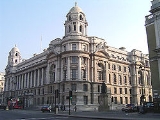
Old War Office Building

Owo Whitehall South
Between 1906 and its abolition in 1964, the War Office was based in a massive neo-Baroque
Baroque architecture

Baroque architecture, starting in the early 17th century in Italy, took the humanist Roman vocabulary of Renaissance architecture and used it in a new rhetorical, theatrical, sculptural fashion, expressing the triumph of absolutist church and state....
 building, completed in 1906, located on Horse Guards Avenue in Whitehall
Whitehall

Whitehall is a road in Westminster in London, England. It is the main artery running north from Parliament Square, towards traditional Charing Cross, now at the southern end of Trafalgar Square and marked by the statue of Charles I of England, which is often regarded as the heart of London....
, London
London

London is the capital of both England and the United Kingdom, and the most populous municipality in the European Union. An important settlement for two millennia, History of London goes back to its founding by the Roman Empire....
. It contains about a thousand rooms across seven floors, linked by 2½ miles of corridors. The construction of the War Office building took five years to complete at what was then a huge cost of over £1.2 million.

The building is somewhat oddly shaped, forming a trapezium
Trapezium

The word trapezium has several meanings:* - a trapezoid .* - a quadrilateral with no parallel sides * Trapezium , a bone in the wrist* Trapezium , a group of stars in the Orion Nebula...
 shape in order to maximise the usage of the irregularly shaped plot of land on which it was built. Its four distinctive domes were designed as a decorative means of disguising the building's shape.

The building is still used by the Ministry of Defence
Ministry of Defence (United Kingdom)

The Ministry of Defence is the Departments of the United Kingdom Government responsible for implementation of government defence policy and is the headquarters of the British Armed Forces....
 and is not currently open to the public.

War Office Departments


  • Office of the Secretary of State
    Secretary of State for War

    The position of Secretary of State for War, commonly called War Secretary, was a United Kingdom Cabinet -level position, first applied to Henry Dundas ....
    • Military Secretary's Department
      Military Secretary

      The Military Secretary is the senior military assistant to the United Kingdom Secretary of State for Defence and formerly to the Secretary of State for War....
       (1870–1964)


  • Department of the Parliamentary Under-Secretary
    • Directorate-General of Lands (?–1923)
    • Directorate of Lands (1923– )
    • Directorate-General of the Territorial and Volunteer Forces (?–1921)
    • Directorate-General of the Territorial Army (1921– )


  • Central Department (Department of the Secretary)
    • Department of the Chaplain-General
    • Department of the Judge Advocate-General
    • Publicity Section/Information Section


  • Department of the Financial and Parliamentary Secretary (Finance Department)
    • Directorate of Army Contracts (1924– )


  • Imperial General Staff
    Chief of the Imperial General Staff

    Chief of the Imperial General Staff was the title of the professional commander of the British Army from 1908 until 1964.From the The Restoration in 1660, the Sovereign was able to wrest considerable control of the armed forces from Parliament with the appointment of a "General in Chief Command" of the Army....
    • Directorate of Military Intelligence
      Directorate of Military Intelligence

      The Directorate of Military Intelligence was a department of the United Kingdom War Office until that was subsumed into the Ministry of Defence in 1964....
       (?–1922)
    • Directorate of Military Operations (?–1922)
    • Directorate of Military Operations and Intelligence (1922– )
    • Directorate of Military Training (1922– )
    • Directorate of Army Staff Duties


  • Department of the Adjutant-General
    Adjutant-General to the Forces

    The Adjutant-General to the Forces, commonly just referred to as the Adjutant-General , is one of the most senior officers in the British Army....
    • Directorate-General of Graves Registration and Enquiries (?–1921)
    • Directorate-General of Army Medical Services
    • Directorate of Mobilisation
    • Directorate of Organisation
    • Directorate of Army Personal Services
    • Directorate of Prisoners of War (?–1921)
    • Directorate of Recruiting and Organisation


  • Department of the Quartermaster-General
    Quartermaster-General to the Forces

    In the United Kingdom, the Quartermaster-General to the Forces is one of the most senior generals in the British Army.The present holder of the post is Lieutenant General RAD Applegate...
    • Directorate of Equipment and Ordnance Stores (?–1927)
    • Directorate of Movements
    • Directorate of Quartering
    • Directorate of Remounts
    • Directorate of Supplies and Transport
    • Department of the Controller of Surplus Stores and Salvage
    • Department of the Surveyor-General of Supply (?–1921)
    • Directorate-General of Army Veterinary Services
    • Directorate of Works (1927– )


  • Department of the Master-General of the Ordnance
    Master-General of the Ordnance

    The Master-General of the Ordnance was a very senior United Kingdom military position before 1855, when the Board of Ordnance was abolished. Usually held by a serving General , the Master-General of the Ordnance was responsible for all British artillery, military engineers, fortifications, military supplies, transport, field hospitals and mu...
    • Directorate of Artillery
    • Directorate of Factories
    • Directorate of Fortifications and Works (?–1927)
    • Directorate of Ordnance Services (1927– )
    • Department of the Chief Technical Examiner for Works Services


See also

  • United States Department of War
    United States Department of War

    The United States Department of War, sometimes also called the War Office, was the department of the United States Federal government of the United States's Federal government of the United States#Executive branch responsible for the operation and maintenance of land Military of the United States from 1789 until September 18, 1947,...


External links