

Wehrmacht

Encyclopedia
The Wehrmacht (ˈveːɐ̯maxt (literally, defensive might, or more accurately, defense forces) – from , to defend and , the might/power) were the unified armed forces
of Nazi Germany
from 1935 to 1945. It consisted of the Heer (army
), the Kriegsmarine
(navy
) and the Luftwaffe
(air force
).
, establishing that: Der Reichspräsident hat den Oberbefehl über die gesamte Wehrmacht des Reiches (“The National President holds supreme command of all armed forces of the nation”). From 1919, Germany’s national defence force was known as the Reichswehr
, until its renaming as Wehrmacht in 1935.
After World War II
(1939–45), the Allies abolished the Wehrmacht. In 1955, when the western Federal Republic of Germany
(FRG) remilitarized, its armed forces were named the Bundeswehr
("Federal Defence"). In 1956, upon formal establishment, the armed forces of the Communist, east German Democratic Republic
(GDR) were named the Nationale Volksarmee (National People's Army
), some of whom, with matériel, were incorporated to the Bundeswehr when the German reunification
consolidated the two Germanies in 1990.
In German
and English usage, Wehrmacht denotes the armed forces
of Nazi Germany. Using Wehrmacht to denote only the Heer
(land forces) is inaccurate; nevertheless, it is a misusage common in English writing.
For branch-of-service identification, Wehrmacht vehicles bore alpha-numeric identity licence plates: WH for the Heer
, WL for the Luftwaffe
, WM for the Kriegsmarine. SS vehicles bore the identity licence prefix SS, always depicted with the double Sigrunen of the force.
, the combat branch of the SS
(the Nazi Party's paramilitary organization), became the de facto fourth branch of the Wehrmacht, as it expanded from three regiments to 38 divisions by 1945. Although the SS was autonomous and existed in parallel to the Wehrmacht, the Waffen-SS field units were placed under the operational control of the Supreme High Command of the Armed Forces (Oberkommando der Wehrmacht, OKW) or the Supreme High Command of the Army (Oberkommando des Heeres, OKH).
Competence struggles
hampered organization in the German armed forces, as OKW, OKH, OKL ( had its own ground forces, including tank divisions) and often worked concurrently and not as a joint command.
ended with the armistice of 11 November 1918
, the armed forces were dubbed Friedensheer (peace army) in January 1919. In March 1919, the national assembly passed a law founding a 420,000 strong preliminary army as Vorläufige Reichswehr. The terms of the Treaty of Versailles
were announced in May, and in June Germany was forced to sign the treaty which, among other terms, imposed severe constraints on the size of Germany's armed forces. The army was limited to one hundred thousand men with an additional fifteen thousand in the navy. The fleet was to consist of at most six battleship
s, six cruiser
s, and twelve destroyer
s. Submarine
s, tank
s and heavy artillery
were forbidden and the air force was dissolved. A new post-war military (the Reichswehr
) was established on 23 March 1921. General conscription
was abolished under another mandate of the Versailles treaty.
By 1922, Germany had begun covertly circumventing these conditions. A secret collaboration with the Soviet Union
began after the treaty of Rapallo
. Major-General Otto Hasse traveled to Moscow
in 1923 to further negotiate the terms. Germany helped the Soviet Union with industrialization and Soviet officers were to be trained in Germany. German tank and air force specialists could exercise in the Soviet Union and German chemical weapons research and manufacture would be carried out there along with other projects. Around 300 German pilots received training at Lipetsk
, some tank training took place near Kazan
and toxic gas was developed at Saratov
for the German army.
on 2 August 1934, Hitler assumed the office of Reichspräsident, and thus became commander in chief. All officers and soldiers of the German armed forces had to swear a personal oath
of loyalty to the Führer, as Adolf Hitler
now was called. By 1935, Germany was openly flouting the military restrictions set forth in the Versailles Treaty, and conscription
was reintroduced on 16 March 1935.
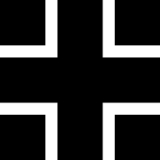
While the size of the standing army was to remain at about the 100,000-man mark decreed by the treaty, a new group of conscripts equal to this size would receive training each year. The conscription law introduced the name Wehrmacht, so not only can this be regarded as its founding date, but the organization and authority of the Wehrmacht can be viewed as Nazi creations regardless of the political affiliations of its high command (who nevertheless all swore the same personal oath of loyalty to Hitler). The insignia was a simpler version of the Iron Cross
(the straight-armed so-called Balkenkreuz or beamed cross) that had been used as an aircraft
and tank marking in late World War I
, beginning in March and April of 1918. The existence of the Wehrmacht was officially announced on 15 October 1935.
of the Wehrmacht was Adolf Hitler in his capacity as Germany's head of state
, a position he gained after the death of President
Paul von Hindenburg
in August 1934. In the reshuffle in 1938, Hitler became the Supreme Commander of the Armed Forces and retained that position until his suicide on 30 April 1945. Administration and military authority initially lay with the war ministry under Generalfeldmarschall
Werner von Blomberg
. After von Blomberg resigned in the course of the Blomberg-Fritsch Affair
(1938), the ministry was dissolved and the Armed Forces High Command (Oberkommando der Wehrmacht
or OKW) under Generalfeldmarschall Wilhelm Keitel
was put in its place. It was headquartered in Wünsdorf near Zossen
, and a field echelon (Feldstaffel) was stationed wherever the Führers headquarters were situated at a given time. Army work was also coordinated by the German General Staff
, an institution that had been developing for more than a century and which had sought to institutionalize military perfection.
The OKW coordinated all military activities but Keitel's sway over the three branches of service (army, air force, and navy) was rather limited. Each had its own High Command, known as Oberkommando des Heeres
(OKH, army), Oberkommando der Marine
(OKM, navy), and Oberkommando der Luftwaffe
(OKL, air force). Each of these high commands had its own general staff. In practice the OKW had operational authority over the Western Front whereas the Eastern Front was under the operational authority of the OKH.
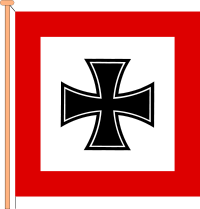
(!) Promotion to field marshal was considered as something which is only done in wartime.
The OKW was also given the task of central economic planning and procurement, but the authority and influence of the OKW's war economy office (Wehrwirtschaftsamt) was challenged by the procurement offices (Waffenämter) of the single branches of service as well as by the Ministry for Armament and Munitions (Reichsministerium für Bewaffnung und Munition), into which it was merged after the ministry was taken over by Albert Speer
in early 1942.
 The German Army furthered concepts pioneered during World War I
, combining ground (Heer) and Air Force (Luftwaffe) assets into combined arms
teams. Coupled with traditional war fighting methods such as encirclement
s and the "battle of annihilation
", the German military managed many lightning quick victories in the first year of World War II, prompting foreign journalists to create a new word for what they witnessed: Blitzkrieg
.
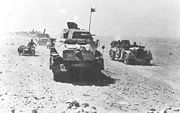
The Heer entered the war with a minority of its formations motorized
; infantry remained approximately 90% foot-borne throughout the war, and artillery was primarily horse-drawn
. The motorized formations received much attention in the world press in the opening years of the war, and were cited as the reason for the success of the invasions of Poland
(September 1939), Norway and Denmark
(April 1940), Belgium, France and Netherlands
(May 1940), Yugoslavia and Greece (April 1941) and the early campaigns in the Soviet Union
(June 1941).
After Hitler declared war on the United States in December 1941, Germany and other Axis powers
found themselves engaged in campaigns against three major industrial powers. At this critical juncture, Hitler assumed personal control of the Wehrmacht high command, and his personal failings as a military commander arguably contributed to major defeats in early 1943, at Stalingrad
and Tunis
in North Africa
.
 The Germans' military strength was managed through mission-based tactics
(rather than order-based tactics) and an almost proverbial discipline. In public opinion, the German Army was, and sometimes still is, seen as a high-tech army. However, such advanced equipment, while featured much in propaganda, was often only available in small numbers or late in the war, as overall supplies of raw materials and armaments ran low. For example, only 40% of all units were motorized, baggage trains often relied on horse-drawn trailers and many soldiers went by foot or used bicycles (Radfahrtruppen
).
Some historians, such as British author and ex-newspaper editor Max Hastings
, consider that "... there's no doubt that man for man, the German army was the greatest fighting force of the second world war". Similar views were also expressed in his book Overlord: D-Day and the battle for Normandy, while in the book World War II : An Illustrated Miscellany, Anthony Evans writes: "The German soldier was very professional and well trained, aggressive in attack and stubborn in defence. He was always adaptable, particularly in the later years when shortages of equipment were being felt". However, their integrity was compromised by war crimes, especially those committed on the eastern front. They were over-extended and out-maneuvered before Moscow
in 1941, and in North Africa and Stalingrad in 1942, and from 1942-1943 onward, were in constant retreat. Other Axis powers fought with them, especially Hungary
and Romania
, as well as many volunteers from other nations.
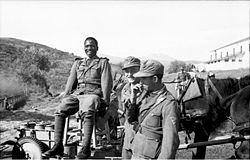
Among the foreign volunteers who served in the Heer during World War II
were ethnic Germans, Dutch, and Scandinavians along with people from the Baltic states and the Balkans. Russians fought in the Russian Liberation Army
or as Hilfswilliger
. Non-Russians from the Soviet Union formed the Ostlegionen
. These units were all commanded by General Ernst August Köstring and represented about five percent of the forces under the OKH.
(German Air Force), led by Hermann Göring
, was a key element in the early Blitzkrieg
campaigns (Poland, France 1940, USSR 1941). The Luftwaffe concentrated on fighters and (small) tactical bombers, like the Messerschmitt Bf 109
fighter and the Junkers Ju 87
(Stuka) dive bomber.
The planes cooperated closely with the ground forces. Massive numbers of fighters assured air supremacy, and the bombers would attack command- and supply lines, depots, and other support targets close to the front. They soon achieved an aura of invincibility and terror, where both civilians and soldiers were struck with fear, and started fleeing as soon as the planes were spotted. This caused confusion and disorganisation behind enemy lines, and in conjunction with the "ghost" Panzer Division
s that seemed to be able to appear anywhere, made the Blitzkrieg campaigns highly effective.
As the war progressed, Germany's enemies drastically increased their aircraft production, air supremacy was lost and allied forces gradually gained air superiority, particularly in the West of the theatre of operations. In the second half of the war, the Luftwaffe was reduced to insignificance. As the Western allies started a strategic bombing campaign against German industrial targets they established air supremacy over Germany which the Luftwaffe was unable to contest, leaving German cities open to Allied carpet bombing and massive destruction.

(paratroops) conquered the vital Belgian Fort Eben-Emael
and took part in the airborne invasion of Norway, but after suffering heavy losses in the Battle of Crete
, large scale airdrops were discontinued. Operating as crack infantry, the 1st Fallschirmjäger Division
fought in all the theatres of the war. Notable actions include the bloody Monte Cassino
, the last ditch defence of Tunisia
and numerous key battles on the eastern front
. A Fallschirmjäger armored division—the Fallschirm-Panzer Division 1 Hermann Göring
—was also formed and was heavily engaged in Sicily
and at Salerno.
Separate from the elite
Fallschirmjäger, the Luftwaffe also fielded regular infantry in the Luftwaffe Field Division
s. These units were basic infantry formations formed from Luftwaffe personnel. Due to a lack of competent officers and unhappiness by the recruits at having been forced into an infantry role, morale was low in these units. By Göring's personal order they were intended to be restricted to defensive duties in quieter sectors to free up front line troops for combat.
The Luftwaffe—being in charge of Germany's anti-aircraft defence
s—also used thousands of teenage Luftwaffenhelfer
to support the Flak units.
fleet arm was eventually defeated due to Allied technological innovations like sonar, radar, and the breaking of the Enigma
code. Large surface vessels were few in number due to construction limitations by international treaties prior to 1935. The "pocket battleships" and were important as commerce raiders only in the opening year of the war. No aircraft carrier
was operational, as German leadership lost interest in the which had been launched in 1938. Following the loss of the in 1941, with Allied air superiority threatening the remaining battlecruisers in French Atlantic harbors, the ships were ordered to make the Channel Dash back to German ports. Operating from fjords of Norway, which had been occupied in 1940, convoys from the U.S. to the Soviet port of Murmansk could be intercepted even though the spent most of her career as Fleet in being
. After the appointment of Karl Doenitz as Grand Admiral of the Kriegsmarine, Germany stopped constructing battleships and cruisers in favor of U-boats.
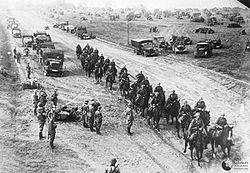 The Wehrmacht directed combat operations
during World War II (from 1 September 1939-8 May 1945) as the German Reich's Armed Forces umbrella command organization. After 1941 the OKH became the de facto Eastern Theatre higher echelon command organization for the Wehrmacht, excluding Waffen-SS
except for operational and tactical combat purposes. The OKW conducted operations in the Western Theater.
For a time, the Axis Mediterranean Theater
and the North African Campaign
was conducted as a joint campaign
with the Italian Army
, and may be considered a separate theatre
.
The operations by the Kriegsmarine in the North and Mid-Atlantic can also be considered as separate theaters considering the size of the area of operations and their remoteness from other theaters.
However, Hitler demanded that the Wehrmacht had to fight on other fronts, sometimes three simultaneously, thus stretching its resources too thin. By 1944, even the defence of Germany became impossible.
According to Frank Biess, "German casualties took a sudden jump with the defeat of the Sixth Army at Stalingrad in January 1943, when 180,310 soldiers were killed in one month. Among the 5.3 million Wehrmacht casualties during the Second World War, more than 80 percent died during the last two years of the war. Approximately three-quarters of these losses occurred on the Eastern front (2.7 million) and during the final stages of the war between January and May 1945 (1.2 million)." Jeffrey Herf
wrote that:
 Due to the constitution of the Weimar Republic
, no soldier of the Reichswehr was allowed to be a member of a political party nor to vote in an election. This was because in theory there was a strict separation between politics and the armed forces. The same theory applied later to the Wehrmacht. In the 1920s, the military did not accept the democratic Weimar Republic as legitimate, and so the Reichswehr under the leadership of Hans von Seeckt
became a “state within the state” that operated largely outside the control of politicians. Reflecting this position as a “state within the state”, the Reichswehr created the Ministeramt or Office of the Ministerial Affairs in 1928 under Kurt von Schleicher
to lobby
the politicians. German historian Eberhard Kolb
wrote that:
and thus ensure that Germany did not lose the next war. As such, what both the Nazis and the German Army wanted to see was Germany remade into a totally militarized Volksgemeinschaft
that would be ruthlessly purged of those considered to be internal enemies, such as the Jews
who were believed to have "stabbed" Germany in "the back" in 1918. By 1931, Germany's reserves of experienced reservists were coming to an end, because Part V of the Treaty of Versailles
forbade conscription
and existing reservists were aging. General Kurt von Schleicher
worried that unless conscription was restored soon, German military power would be destroyed forever. So, Schleicher and the rest of the Reichswehr leadership were determined that Germany must end Versailles, and in the meantime saw the SA and the other right-wing paramilitary groups as the best substitute for conscription. Schleicher and other Reichswehr generals made a secret contract with the SA starting in 1931. Like the rest of the Reichswehr leadership, Schleicher viewed democracy as a great impediment to military power, and firmly believed that only a dictatorship could make Germany a great military power again. Thus Schleicher worked to replace the democracy with a dictatorship headed by himself. Thus, he played a key role in the downfall of the Weimar Republic and unintentionally helped to bring about Nazi Germany.
Many officers too in the early 1930s started to express admiration for National Socialism, which they saw as a the best way of creating the much desired Wehrstaat (defence state). An important sign of the sympathy for National Socialism within the military came in September–October 1930, with the trial in Leipzig
of three junior officers, Lieutenant Richard Scheringer, Hans Friedrich Wendt and Hans Ludin
. The three men were charged with membership in the Nazi Party; at that time membership in political parties was forbidden for members of the Reichswehr. The three officers openly admitted to Nazi Party membership, and used as their defence the claim that the Nazi Party membership should not be forbidden to Reichswehr personnel. When the three officers were caught red-handed
distributing Nazi literature at their base, their commanding officer, General Ludwig Beck
(of the 5th Artillery
Regiment based in Ulm
), was furious at their arrest, and argued that since the Nazi Party was a force for good, Reichswehr personnel should be allowed to join the Party. At the Leipzig trial of Ludin and Scheringer, Beck and other officers testified about the good character of the accused, described the Nazi Party as a positive force in German life, and proclaimed his belief that the Reichswehr ban on Nazi Party membership should be rescinded. The trial in Leipzig caused a media sensation and Hitler himself testified at the trial about how much Nazi and Reichswehr values were one and the same. After the trial, many Reichswehr officers started to favour the NSDAP.
British historian A.J. Nicholls wrote that the popular stereotype of the German military in the 1920s-1930s as old-fashioned reactionary Junkers is incorrect, and a disproportionate number of officers had a technocratic bent, and instead of looking back to the Second Reich looked with confidence towards a new dynamic, high-tech and revolutionary future dominated by men like themselves. Israeli historian Omer Bartov
wrote that most officers were National Socialists "because they believed had it not been for [Hitler] they would never have been able to realize their dreams of a highly modern, total war of expansion". Bartov wrote:
Because of these conceptions of Germany remade into a totalitarian Wehrstaat, the leadership of the military welcomed and embraced the National Socialist regime. The German historian Jürgen Förster wrote that it was wrong as many historians have to dismiss the Wehrmacht's self-proclaimed role as one of the "twin pillars" of Nazi Germany (the other pillar being the NSDAP). General Ludwig Beck
welcomed the coming of the Nazi regime in 1933, writing "I have wished for years for the political revolution, and now my wishes have come true. It is the first ray of hope since 1918.". (Ironically, Beck was later executed for opposing National Socialism.) In addition, many soldiers had previously been in the Hitler Youth and Reichsarbeitsdienst and had thus been subjected to intensive Nazi indoctrination; as a result, many newly commissioned officers were committed Nazis. In general, the Luftwaffe (airforce) was heavily Nazi-influenced, as was the navy and army to a lesser degree, through that was only relative. On December 8, 1938, the OKW had instructed all officers in all three services to be thoroughly versed in National Socialism and to apply its values in all situations. Starting in February 1939, pamphlets were issued that were made required reading in the military. The content can be gauged by the titles: "The Officer and Politics", "Hitler's World Historical Mission", "The Army in the Third Reich", "The Battle for German Living Space", "Hands off Danzig!", and "The Final Solution of the Jewish Question in the Third Reich". In the last essay, the author, C.A. Holberg wrote:
Anti-Semitic attitudes like the views expressed above coloured all the instructions that came to Wehrmacht during the summer of 1939 as part of the preparations for the invasion of Poland. The war against the Soviet Union was presented as a war of extermination right from the start. In 1989, the British historian Richard J. Evans
wrote that right from the beginning of the war against the Soviet Union on June 22, 1941, the Wehrmacht waged a genocidal war of "extreme brutality and barbarism". Evans wrote that Wehrmacht officers regarded the Russians as "sub-human", were from the time of the invasion of Poland in 1939 telling their troops the war was caused by "Jewish vermin" and explained to the troops that the war against the Soviet Union was a war to wipe out what were variously called "Jewish Bolshevik subhumans", the "Mongol hordes", the "Asiatic flood" and the "red beast", language clearly intended to produce war crimes by reducing the enemy to something less than human. Such views helped to explain why 3,300,000 of the 5,700,000 Soviet POWs taken by the Germans died in captivity. On May 19, 1941, the OKW issued the "Guidelines for the Conduct of the Troops in Russia" which began by declaring that "Judeo-Bolshevism" to be the most deadly enemy of the German nation and that "It is against this destructive ideology and its adherents that Germany is waging war". The "Guidelines" urged "ruthless and vigorous measures against Bolshevik inciters, guerillas, saboteurs, Jews and the complete elimination of all active and passive resistance"". Reflecting the influence of the guidelines, in a directive sent out to the troops under his command, General Erich Hoepner
of the Panzer Group 4 proclaimed:
As a result of the very intense anti-Semitic and anti-Slavic propaganda
before and during Barbarossa, most Army officers and soldiers tended to regard the war against the Soviet Union in Nazi terms, seeing their Soviet opponents as so much sub-human trash deserving to be destroyed without mercy. One German soldier wrote home to his father on August 4, 1941 that:
The overwhelming majority of the German Army worked enthusiastically with the SS in murdering Jews in the Soviet Union
. The British historian Richard J. Evans
wrote that junior officers in the Army were inclinced to be especially zealous National Socialists with a third of them having joined the Nazi Party by 1941. Among higher ranking officers, 29.2% were NSDAP members by 1941. The Wehrmacht obeyed Hitler's criminal orders for Barbarossa not because of obedience to orders, but because they, like Hitler, believed that the Soviet Union was run by Jews, and that Germany must completely destroy "Judeo-Bolshevism". German historian Jürgen Förster wrote that most Wehrmacht officers genuinely believed that most Red Army commissars were Jews who in turn were what kept the Red Army going, and that the best way to bring about victory against the Soviet Union was to exterminate the commissars so as to deprive the Russian soldiers of their Jewish leaders.
From 1943 onwards, the influx of officers and conscripts who had been mainly educated under the Nazis, began to further increase the National Socialism in the army. Political influence in the military command began to increase later in the war when Hitler's flawed strategic decisions began showing up as serious defeats for the German Army and tensions mounted between the military and the government. When Hitler appointed unqualified personnel such as Hermann Göring
to lead his Air Force, failure ensued.
 In World War II, the Wehrmacht was involved in a number of war crimes. While the principal perpetrators of the civil suppression behind the front lines amongst German armed forces were the Nazi German
"political" armies (the SS-Totenkopfverbände
and particularly the Einsatzgruppen
), the traditional armed forces represented by the Wehrmacht committed and ordered (e.g. the Commissar Order
) war crimes of their own, particularly during the invasion of Poland in 1939
and later in the war against the Soviet Union
. The Army's Chief of Staff General Franz Halder
in a directive declared that in the event of guerrila attacks, German troops were to impose "collective measures of force" by massacring entire villages. Hundreds of thousands, perhaps millions, of Soviet civilians died from starvation
as the Germans requisitioned food for their armies and fodder for their draft horses.
While the Wehrmacht's prisoner-of-war camps for inmates from the west generally satisfied the humanitarian requirement prescribed by international law, prisoners from Poland (which never capitulated) and the USSR were incarcerated under significantly worse conditions. Between the launching of Operation Barbarossa in the summer of 1941 and the following spring, 2.8 million of the 3.2 million Soviet prisoners
taken died while in German hands.
The Nuremberg Trials
of the major war criminals at the end of World War II found that the Wehrmacht was not an inherently criminal organization, but that it had committed crimes in the course of the war. Several high ranked members of the Wehrmacht like Wilhelm Keitel
and Alfred Jodl
were convicted for their involvement in war crimes. Among German historians, the view that the Wehrmacht had participated in war time atrocities, particularly on the Eastern Front
, grew in the late 1970s and the 1980s. In the 1990s, public conception in Germany was influenced by controversial reactions and debates about the exhibition of war crime issues. More recently, the judgement of Nuremberg has come under question. The Israeli historian Omer Bartov
, a leading expert on the Wehrmacht wrote in 2003 that the Wehrmacht was a willing instrument of genocide, and that it is untrue that the Wehrmacht was an apolitical, professional fighting force that had only a few "bad apples". Bartov argues that far from being the "untarnished shield", as successive German apologists stated after the war, the Wehrmacht was a criminal organization. Likewise, the British historian Richard J. Evans
, a leading expert on modern German history wrote that the Wehrmacht was a genocidal organization. British historian Ian Kershaw
wrote that:
 From all groups of German Resistance
, those within the Wehrmacht were the most condemned by the NSDAP. There were several attempts by resistance members like Henning von Tresckow
, Erich Hoepner
or Friedrich Olbricht
to assassinate Hitler as an ignition of a coup d'état
. Rudolf Christoph Freiherr von Gersdorff
and Axel Freiherr von dem Bussche-Streithorst
even tried to do so by suicide bombing. Those and many other officers in the Heer and Kriegsmarine such as Erwin Rommel
, Claus Schenk Graf von Stauffenberg and Wilhelm Canaris
opposed the atrocities of the Hitler regime. Combined with Hitler's problematic military leadership, this also culminated in the famous 20 July plot (1944), when a group of German Army officers led by von Stauffenberg tried again to kill Hitler and overthrow his regime. Following this attempt, every officer who approached Hitler was searched from head to foot by his SS guards. As a special degradation all German military personnel were ordered to replace the standard military salute with the Hitler salute
from this date on. To what extent the German military forces opposed or supported the Hitler regime is nevertheless highly disputed amongst historians up to the present day.
Some members of the Wehrmacht did save Jews and non-Jews from the concentration camps and/or mass executions. Anton Schmid
—a sergeant in the army—helped 250 Jewish men, women, and children escape from the Vilnius ghetto and provided them with forged passports so that they could get to safety. He was court-martialed and executed as a consequence. Albert Battel
, a reserve officer stationed near the Przemysl ghetto, blocked an SS detachment from entering it. He then evacuated up to 100 Jews and their families to the barracks of the local military command, and placed them under his protection. Wilm Hosenfeld
—an army captain in Warsaw—helped, hid, or rescued several Poles, including Jews, in occupied Poland. Most notably, he helped the Polish Jewish composer Władysław Szpilman, who was hiding among the city's ruins, by supplying him with food and water, and did not betray him to the Nazi authorities. Hosenfeld later died in a Soviet POW camp.
), or under Allied command as police forces. By the end of August 1945, these units were dissolved, and a year later on 20 August 1946, the Allied Control Council
declared the Wehrmacht as officially abolished (Kontrollratsgesetz No. 34). While Germany was forbidden to have an army, Allied forces took advantage of the knowledge of Wehrmacht members like Reinhard Gehlen
.
It was over ten years before the tensions of the Cold War
led to the creation of separate military forces in the Federal Republic of Germany
and the socialist German Democratic Republic
. The West German military, officially created on 5 May 1955, took the name Bundeswehr
, meaning Federal Defence Forces, which pointed back to the old Reichswehr
. Its East German counterpart—created on 1 March 1956—took the name National People's Army
(Nationale Volksarmee). Both organizations employed many former Wehrmacht members, particularly in their formative years.
Armed forces
The armed forces of a country are its government-sponsored defense, fighting forces, and organizations. They exist to further the foreign and domestic policies of their governing body, and to defend that body and the nation it represents from external aggressors. In some countries paramilitary...
of Nazi Germany
Nazi Germany
Nazi Germany , also known as the Third Reich , but officially called German Reich from 1933 to 1943 and Greater German Reich from 26 June 1943 onward, is the name commonly used to refer to the state of Germany from 1933 to 1945, when it was a totalitarian dictatorship ruled by...
from 1935 to 1945. It consisted of the Heer (army
Army
An army An army An army (from Latin arma "arms, weapons" via Old French armée, "armed" (feminine), in the broadest sense, is the land-based military of a nation or state. It may also include other branches of the military such as the air force via means of aviation corps...
), the Kriegsmarine
Kriegsmarine
The Kriegsmarine was the name of the German Navy during the Nazi regime . It superseded the Kaiserliche Marine of World War I and the post-war Reichsmarine. The Kriegsmarine was one of three official branches of the Wehrmacht, the unified armed forces of Nazi Germany.The Kriegsmarine grew rapidly...
(navy
Navy
A navy is the branch of a nation's armed forces principally designated for naval and amphibious warfare; namely, lake- or ocean-borne combat operations and related functions...
) and the Luftwaffe
Luftwaffe
Luftwaffe is a generic German term for an air force. It is also the official name for two of the four historic German air forces, the Wehrmacht air arm founded in 1935 and disbanded in 1946; and the current Bundeswehr air arm founded in 1956....
(air force
Air force
An air force, also known in some countries as an air army, is in the broadest sense, the national military organization that primarily conducts aerial warfare. More specifically, it is the branch of a nation's armed services that is responsible for aerial warfare as distinct from an army, navy or...
).
Origin and use of the term
Before the National Socialist German Workers' Party assumed control of the German government in 1933, the term Wehrmacht generically described a nation’s “home defence” forces, analogous to the German Streitmacht foreign war forces, thus, Britische Wehrmacht denoted “British defence forces.” The term Wehrmacht is in Article 47 of the 1919 Weimar ConstitutionWeimar constitution
The Constitution of the German Reich , usually known as the Weimar Constitution was the constitution that governed Germany during the Weimar Republic...
, establishing that: Der Reichspräsident hat den Oberbefehl über die gesamte Wehrmacht des Reiches (“The National President holds supreme command of all armed forces of the nation”). From 1919, Germany’s national defence force was known as the Reichswehr
Reichswehr
The Reichswehr formed the military organisation of Germany from 1919 until 1935, when it was renamed the Wehrmacht ....
, until its renaming as Wehrmacht in 1935.
After World War II
World War II
World War II, or the Second World War , was a global conflict lasting from 1939 to 1945, involving most of the world's nations—including all of the great powers—eventually forming two opposing military alliances: the Allies and the Axis...
(1939–45), the Allies abolished the Wehrmacht. In 1955, when the western Federal Republic of Germany
West Germany
West Germany is the common English, but not official, name for the Federal Republic of Germany or FRG in the period between its creation in May 1949 to German reunification on 3 October 1990....
(FRG) remilitarized, its armed forces were named the Bundeswehr
Bundeswehr
The Bundeswehr consists of the unified armed forces of Germany and their civil administration and procurement authorities...
("Federal Defence"). In 1956, upon formal establishment, the armed forces of the Communist, east German Democratic Republic
German Democratic Republic
The German Democratic Republic , informally called East Germany by West Germany and other countries, was a socialist state established in 1949 in the Soviet zone of occupied Germany, including East Berlin of the Allied-occupied capital city...
(GDR) were named the Nationale Volksarmee (National People's Army
National People's Army
The National People’s Army were the armed forces of the German Democratic Republic .The NVA was established in 1956 and disestablished in 1990. There were frequent reports of East German advisors with Communist African countries during the Cold War...
), some of whom, with matériel, were incorporated to the Bundeswehr when the German reunification
German reunification
German reunification was the process in 1990 in which the German Democratic Republic joined the Federal Republic of Germany , and when Berlin reunited into a single city, as provided by its then Grundgesetz constitution Article 23. The start of this process is commonly referred by Germans as die...
consolidated the two Germanies in 1990.
In German
German language
German is a West Germanic language, related to and classified alongside English and Dutch. With an estimated 90 – 98 million native speakers, German is one of the world's major languages and is the most widely-spoken first language in the European Union....
and English usage, Wehrmacht denotes the armed forces
Armed forces
The armed forces of a country are its government-sponsored defense, fighting forces, and organizations. They exist to further the foreign and domestic policies of their governing body, and to defend that body and the nation it represents from external aggressors. In some countries paramilitary...
of Nazi Germany. Using Wehrmacht to denote only the Heer
Heer
Heer is German for "army". Generally, its use as "army" is not restricted to any particular country, so "das britische Heer" would mean "the British army".However, more specifically it can refer to:*An army of Germany:...
(land forces) is inaccurate; nevertheless, it is a misusage common in English writing.
For branch-of-service identification, Wehrmacht vehicles bore alpha-numeric identity licence plates: WH for the Heer
Heer
Heer is German for "army". Generally, its use as "army" is not restricted to any particular country, so "das britische Heer" would mean "the British army".However, more specifically it can refer to:*An army of Germany:...
, WL for the Luftwaffe
Luftwaffe
Luftwaffe is a generic German term for an air force. It is also the official name for two of the four historic German air forces, the Wehrmacht air arm founded in 1935 and disbanded in 1946; and the current Bundeswehr air arm founded in 1956....
, WM for the Kriegsmarine. SS vehicles bore the identity licence prefix SS, always depicted with the double Sigrunen of the force.
Waffen-SS and Wehrmacht
The Waffen-SSWaffen-SS
The Waffen-SS was a multi-ethnic and multi-national military force of the Third Reich. It constituted the armed wing of the Schutzstaffel or SS, an organ of the Nazi Party. The Waffen-SS saw action throughout World War II and grew from three regiments to over 38 divisions, and served alongside...
, the combat branch of the SS
Schutzstaffel
The Schutzstaffel |Sig runes]]) was a major paramilitary organization under Adolf Hitler and the Nazi Party. Built upon the Nazi ideology, the SS under Heinrich Himmler's command was responsible for many of the crimes against humanity during World War II...
(the Nazi Party's paramilitary organization), became the de facto fourth branch of the Wehrmacht, as it expanded from three regiments to 38 divisions by 1945. Although the SS was autonomous and existed in parallel to the Wehrmacht, the Waffen-SS field units were placed under the operational control of the Supreme High Command of the Armed Forces (Oberkommando der Wehrmacht, OKW) or the Supreme High Command of the Army (Oberkommando des Heeres, OKH).
Competence struggles
Interservice rivalry
Interservice rivalry is a military term referring to rivalries that can arise between different branches of a country's armed forces, such as between a nation's land forces , naval and air forces. It also applies to the rivalries between a country's intelligence services, Central Intelligence...
hampered organization in the German armed forces, as OKW, OKH, OKL ( had its own ground forces, including tank divisions) and often worked concurrently and not as a joint command.
History
After World War IWorld War I
World War I , which was predominantly called the World War or the Great War from its occurrence until 1939, and the First World War or World War I thereafter, was a major war centred in Europe that began on 28 July 1914 and lasted until 11 November 1918...
ended with the armistice of 11 November 1918
Armistice with Germany (Compiègne)
The armistice between the Allies and Germany was an agreement that ended the fighting in the First World War. It was signed in a railway carriage in Compiègne Forest on 11 November 1918 and marked a victory for the Allies and a complete defeat for Germany, although not technically a surrender...
, the armed forces were dubbed Friedensheer (peace army) in January 1919. In March 1919, the national assembly passed a law founding a 420,000 strong preliminary army as Vorläufige Reichswehr. The terms of the Treaty of Versailles
Treaty of Versailles
The Treaty of Versailles was one of the peace treaties at the end of World War I. It ended the state of war between Germany and the Allied Powers. It was signed on 28 June 1919, exactly five years after the assassination of Archduke Franz Ferdinand. The other Central Powers on the German side of...
were announced in May, and in June Germany was forced to sign the treaty which, among other terms, imposed severe constraints on the size of Germany's armed forces. The army was limited to one hundred thousand men with an additional fifteen thousand in the navy. The fleet was to consist of at most six battleship
Battleship
A battleship is a large armored warship with a main battery consisting of heavy caliber guns. Battleships were larger, better armed and armored than cruisers and destroyers. As the largest armed ships in a fleet, battleships were used to attain command of the sea and represented the apex of a...
s, six cruiser
Cruiser
A cruiser is a type of warship. The term has been in use for several hundreds of years, and has had different meanings throughout this period...
s, and twelve destroyer
Destroyer
In naval terminology, a destroyer is a fast and maneuverable yet long-endurance warship intended to escort larger vessels in a fleet, convoy or battle group and defend them against smaller, powerful, short-range attackers. Destroyers, originally called torpedo-boat destroyers in 1892, evolved from...
s. Submarine
Submarine
A submarine is a watercraft capable of independent operation below the surface of the water. It differs from a submersible, which has more limited underwater capability...
s, tank
Tank
A tank is a tracked, armoured fighting vehicle designed for front-line combat which combines operational mobility, tactical offensive, and defensive capabilities...
s and heavy artillery
Artillery
Originally applied to any group of infantry primarily armed with projectile weapons, artillery has over time become limited in meaning to refer only to those engines of war that operate by projection of munitions far beyond the range of effect of personal weapons...
were forbidden and the air force was dissolved. A new post-war military (the Reichswehr
Reichswehr
The Reichswehr formed the military organisation of Germany from 1919 until 1935, when it was renamed the Wehrmacht ....
) was established on 23 March 1921. General conscription
Conscription
Conscription is the compulsory enlistment of people in some sort of national service, most often military service. Conscription dates back to antiquity and continues in some countries to the present day under various names...
was abolished under another mandate of the Versailles treaty.
By 1922, Germany had begun covertly circumventing these conditions. A secret collaboration with the Soviet Union
Soviet Union
The Soviet Union , officially the Union of Soviet Socialist Republics , was a constitutionally socialist state that existed in Eurasia between 1922 and 1991....
began after the treaty of Rapallo
Treaty of Rapallo, 1922
The Treaty of Rapallo was an agreement signed at the Hotel Imperiale in the Italian town of Rapallo on 16 April, 1922 between Germany and Soviet Russia under which each renounced all territorial and financial claims against the other following the Treaty of Brest-Litovsk and World War I.The two...
. Major-General Otto Hasse traveled to Moscow
Moscow
Moscow is the capital, the most populous city, and the most populous federal subject of Russia. The city is a major political, economic, cultural, scientific, religious, financial, educational, and transportation centre of Russia and the continent...
in 1923 to further negotiate the terms. Germany helped the Soviet Union with industrialization and Soviet officers were to be trained in Germany. German tank and air force specialists could exercise in the Soviet Union and German chemical weapons research and manufacture would be carried out there along with other projects. Around 300 German pilots received training at Lipetsk
Lipetsk
Lipetsk is a city and the administrative center of Lipetsk Oblast, Russia, located on the banks of the Voronezh River in the Don basin, southeast of Moscow.-History:...
, some tank training took place near Kazan
Kazan
Kazan is the capital and largest city of the Republic of Tatarstan, Russia. With a population of 1,143,546 , it is the eighth most populous city in Russia. Kazan lies at the confluence of the Volga and Kazanka Rivers in European Russia. In April 2009, the Russian Patent Office granted Kazan the...
and toxic gas was developed at Saratov
Saratov
-Modern Saratov:The Saratov region is highly industrialized, due in part to the rich in natural and industrial resources of the area. The region is also one of the more important and largest cultural and scientific centres in Russia...
for the German army.
Hitler and reinstatement of conscription
After the death of President Paul von HindenburgPaul von Hindenburg
Paul Ludwig Hans Anton von Beneckendorff und von Hindenburg , known universally as Paul von Hindenburg was a Prussian-German field marshal, statesman, and politician, and served as the second President of Germany from 1925 to 1934....
on 2 August 1934, Hitler assumed the office of Reichspräsident, and thus became commander in chief. All officers and soldiers of the German armed forces had to swear a personal oath
Hitler oath
The term Hitler oath refers to the oaths of allegiance sworn by German Wehrmacht officers and soldiers as well as civil servants during the Third Reich between the years 1934 and 1945...
of loyalty to the Führer, as Adolf Hitler
Adolf Hitler
Adolf Hitler was an Austrian-born German politician and the leader of the National Socialist German Workers Party , commonly referred to as the Nazi Party). He was Chancellor of Germany from 1933 to 1945, and head of state from 1934 to 1945...
now was called. By 1935, Germany was openly flouting the military restrictions set forth in the Versailles Treaty, and conscription
Conscription
Conscription is the compulsory enlistment of people in some sort of national service, most often military service. Conscription dates back to antiquity and continues in some countries to the present day under various names...
was reintroduced on 16 March 1935.
While the size of the standing army was to remain at about the 100,000-man mark decreed by the treaty, a new group of conscripts equal to this size would receive training each year. The conscription law introduced the name Wehrmacht, so not only can this be regarded as its founding date, but the organization and authority of the Wehrmacht can be viewed as Nazi creations regardless of the political affiliations of its high command (who nevertheless all swore the same personal oath of loyalty to Hitler). The insignia was a simpler version of the Iron Cross
Iron Cross
The Iron Cross is a cross symbol typically in black with a white or silver outline that originated after 1219 when the Kingdom of Jerusalem granted the Teutonic Order the right to combine the Teutonic Black Cross placed above a silver Cross of Jerusalem....
(the straight-armed so-called Balkenkreuz or beamed cross) that had been used as an aircraft
Luftstreitkräfte
The Deutsche Luftstreitkräfte , known before October 1916 as Die Fliegertruppen des deutschen Kaiserreiches , or simply Die Fliegertruppen, was the air arm of the Imperial German Army during World War I...
and tank marking in late World War I
World War I
World War I , which was predominantly called the World War or the Great War from its occurrence until 1939, and the First World War or World War I thereafter, was a major war centred in Europe that began on 28 July 1914 and lasted until 11 November 1918...
, beginning in March and April of 1918. The existence of the Wehrmacht was officially announced on 15 October 1935.
Numbers
The total number of soldiers who served in the Wehrmacht during its existence from 1935-1945 is believed to have approached 18.2 million. This figure was put forward by historian Rüdiger Overmans and represents the total number of people who ever served in the Wehrmacht, and not the force strength of the Wehrmacht at any point.Command structure
Legally, the Commander-in-ChiefCommander-in-Chief
A commander-in-chief is the commander of a nation's military forces or significant element of those forces. In the latter case, the force element may be defined as those forces within a particular region or those forces which are associated by function. As a practical term it refers to the military...
of the Wehrmacht was Adolf Hitler in his capacity as Germany's head of state
Head of State
A head of state is the individual that serves as the chief public representative of a monarchy, republic, federation, commonwealth or other kind of state. His or her role generally includes legitimizing the state and exercising the political powers, functions, and duties granted to the head of...
, a position he gained after the death of President
President
A president is a leader of an organization, company, trade union, university, or country.Etymologically, a president is one who presides, who sits in leadership...
Paul von Hindenburg
Paul von Hindenburg
Paul Ludwig Hans Anton von Beneckendorff und von Hindenburg , known universally as Paul von Hindenburg was a Prussian-German field marshal, statesman, and politician, and served as the second President of Germany from 1925 to 1934....
in August 1934. In the reshuffle in 1938, Hitler became the Supreme Commander of the Armed Forces and retained that position until his suicide on 30 April 1945. Administration and military authority initially lay with the war ministry under Generalfeldmarschall
Generalfeldmarschall
Field Marshal or Generalfeldmarschall in German, was a rank in the armies of several German states and the Holy Roman Empire; in the Austrian Empire, the rank Feldmarschall was used...
Werner von Blomberg
Werner von Blomberg
Werner Eduard Fritz von Blomberg was a German Generalfeldmarschall, Minister of War and Commander-in-Chief of the Armed Forces until January 1938.-Early life:...
. After von Blomberg resigned in the course of the Blomberg-Fritsch Affair
Blomberg-Fritsch Affair
The Blomberg–Fritsch Affair were two related scandals in early 1938 that resulted in the subjugation of the German Armed Forces to dictator Adolf Hitler...
(1938), the ministry was dissolved and the Armed Forces High Command (Oberkommando der Wehrmacht
Oberkommando der Wehrmacht
The Oberkommando der Wehrmacht was part of the command structure of the armed forces of Nazi Germany during World War II.- Genesis :...
or OKW) under Generalfeldmarschall Wilhelm Keitel
Wilhelm Keitel
Wilhelm Bodewin Gustav Keitel was a German field marshal . As head of the Oberkommando der Wehrmacht and de facto war minister, he was one of Germany's most senior military leaders during World War II...
was put in its place. It was headquartered in Wünsdorf near Zossen
Zossen
Zossen is a German town in the district of Teltow-Fläming in Brandenburg, south of Berlin, and next to the B96 highway. Zossen consists of several smaller municipalities, which were grouped together in 2003 to form the city.-Geography:...
, and a field echelon (Feldstaffel) was stationed wherever the Führers headquarters were situated at a given time. Army work was also coordinated by the German General Staff
German General Staff
The German General Staff was an institution whose rise and development gave the German armed forces a decided advantage over its adversaries. The Staff amounted to its best "weapon" for nearly a century and a half....
, an institution that had been developing for more than a century and which had sought to institutionalize military perfection.
The OKW coordinated all military activities but Keitel's sway over the three branches of service (army, air force, and navy) was rather limited. Each had its own High Command, known as Oberkommando des Heeres
Oberkommando des Heeres
The Oberkommando des Heeres was Nazi Germany's High Command of the Army from 1936 to 1945. The Oberkommando der Wehrmacht commanded OKH only in theory...
(OKH, army), Oberkommando der Marine
Oberkommando der Marine
The Oberkommando der Marine was Nazi Germany's Naval High Command and the highest administrative and command authority of the Kriegsmarine. It was officially formed from the Marineleitung of the Reichswehr on 11 January 1936. In 1937 it was combined with the newly formed Seekriegsleitung...
(OKM, navy), and Oberkommando der Luftwaffe
Oberkommando der Luftwaffe
The Oberkommando der Luftwaffe was the air force High Command of the Third Reich.Air Force Commanders-in-Chief* Reich Marshal Hermann Göring * Field Marshal Robert Ritter von Greim -History:...
(OKL, air force). Each of these high commands had its own general staff. In practice the OKW had operational authority over the Western Front whereas the Eastern Front was under the operational authority of the OKH.
- Supreme High Command of the Armed Forces (OKWOberkommando der WehrmachtThe Oberkommando der Wehrmacht was part of the command structure of the armed forces of Nazi Germany during World War II.- Genesis :...
)- Supreme Commander of the Armed Forces
- FührerFührerFührer , alternatively spelled Fuehrer in both English and German when the umlaut is not available, is a German title meaning leader or guide now most associated with Adolf Hitler, who modelled it on Benito Mussolini's title il Duce, as well as with Georg von Schönerer, whose followers also...
and Reichskanzler Adolf Hitler (1935–1945) - Großadmiral Karl DönitzKarl DönitzKarl Dönitz was a German naval commander during World War II. He started his career in the German Navy during World War I. In 1918, while he was in command of , the submarine was sunk by British forces and Dönitz was taken prisoner...
(1945)
- Führer
- Commander-in-chief of the Armed Forces
- GeneralfeldmarschallGeneralfeldmarschallField Marshal or Generalfeldmarschall in German, was a rank in the armies of several German states and the Holy Roman Empire; in the Austrian Empire, the rank Feldmarschall was used...
Paul von HindenburgPaul von HindenburgPaul Ludwig Hans Anton von Beneckendorff und von Hindenburg , known universally as Paul von Hindenburg was a Prussian-German field marshal, statesman, and politician, and served as the second President of Germany from 1925 to 1934....
(1933–1934), President of the ReichReichspräsidentThe Reichspräsident was the German head of state under the Weimar constitution, which was officially in force from 1919 to 1945. In English he was usually simply referred to as the President of Germany... - Führer and Reichskanzler Adolf Hitler (1934 to 1935)
- Generaloberst Werner von BlombergWerner von BlombergWerner Eduard Fritz von Blomberg was a German Generalfeldmarschall, Minister of War and Commander-in-Chief of the Armed Forces until January 1938.-Early life:...
(1935 to 1938), Minister for War, promoted Generalfeldmarschall (1936)- vested into the Supreme Commander (theoretically) and the Chief of the Supreme High Command (practically)
- Generalfeldmarschall
- Vice Commander-in-chief of the Armed Forces
- General Werner von Blomberg (1933–1935), promoted Generaloberst 1933
- Chief of the Armed Forces Supreme High Command—Generalfeldmarschall Wilhelm KeitelWilhelm KeitelWilhelm Bodewin Gustav Keitel was a German field marshal . As head of the Oberkommando der Wehrmacht and de facto war minister, he was one of Germany's most senior military leaders during World War II...
(1938–1945) - Chief of the Operations Staff (Wehrmachtführungsstab)—Generaloberst Alfred JodlAlfred JodlAlfred Josef Ferdinand Jodl was a German military commander, attaining the position of Chief of the Operations Staff of the Armed Forces High Command during World War II, acting as deputy to Wilhelm Keitel...
- Supreme Commander of the Armed Forces
- Supreme High Command of the Army (OKHOberkommando des HeeresThe Oberkommando des Heeres was Nazi Germany's High Command of the Army from 1936 to 1945. The Oberkommando der Wehrmacht commanded OKH only in theory...
)- Army Commanders-in-Chief
- Generaloberst Werner von FritschWerner von FritschWerner Thomas Ludwig Freiherr von Fritsch was a prominent Wehrmacht officer, member of the German High Command, and the second German general to be killed during World War II.-Early life:...
(1935–1938) - Generaloberst Walther von BrauchitschWalther von BrauchitschHeinrich Alfred Hermann Walther von Brauchitsch was a German field marshal and the Oberbefehlshaber des Heeres in the early years of World War II.-Biography:...
(1938–1941), promoted to Generalfeldmarschall 1940 - Führer and Reichskanzler Adolf Hitler (1941–1945)
- Generalfeldmarschall Ferdinand SchörnerFerdinand SchörnerFerdinand Schörner was a General and later Field Marshal in the German Army during World War II.-Early life:Schörner was born in Munich, Bavaria...
(1945)
- Generaloberst Werner von Fritsch
- Chiefs of Staff of the German Army
- General Ludwig BeckLudwig BeckGeneraloberst Ludwig August Theodor Beck was a German general and Chief of the German General Staff during the early years of the Nazi regime in Germany before World War II....
(1935–1938) - General Franz HalderFranz HalderFranz Halder was a German General and the head of the Army General Staff from 1938 until September, 1942, when he was dismissed after frequent disagreements with Adolf Hitler.-Early life:...
(1938–1942) - General Kurt ZeitzlerKurt ZeitzlerKurt Zeitzler was an officer in the German Reichswehr and its successor the Wehrmacht, most prominent for being the Chief of the Army General Staff from 1942 to 1944.- World War I and after :...
(1942–1944) - Generaloberst Heinz GuderianHeinz GuderianHeinz Wilhelm Guderian was a German general during World War II. He was a pioneer in the development of armored warfare, and was the leading proponent of tanks and mechanization in the Wehrmacht . Germany's panzer forces were raised and organized under his direction as Chief of Mobile Forces...
(1944–1945) - General Hans KrebsHans Krebs (general)Hans Krebs was a German Army general of infantry who served during World War II.-Early life:Krebs was born in Helmstedt. He volunteered for service in the Imperial German Army in 1914, was promoted to lieutenant in 1915, and to first lieutenant in 1925...
(1945, committed suicide in the Führerbunker)
- General Ludwig Beck
- Army Commanders-in-Chief
- Supreme High Command of the Navy (OKMOberkommando der MarineThe Oberkommando der Marine was Nazi Germany's Naval High Command and the highest administrative and command authority of the Kriegsmarine. It was officially formed from the Marineleitung of the Reichswehr on 11 January 1936. In 1937 it was combined with the newly formed Seekriegsleitung...
)- War Navy Commanders-in-Chief
- AdmiralAdmiralAdmiral is the rank, or part of the name of the ranks, of the highest naval officers. It is usually considered a full admiral and above vice admiral and below admiral of the fleet . It is usually abbreviated to "Adm" or "ADM"...
Erich RaederErich RaederErich Johann Albert Raeder was a naval leader in Germany before and during World War II. Raeder attained the highest possible naval rank—that of Großadmiral — in 1939, becoming the first person to hold that rank since Alfred von Tirpitz...
(1928–1943), promoted to Generaladmiral 1936, Großadmiral 1940 - Großadmiral Karl DönitzKarl DönitzKarl Dönitz was a German naval commander during World War II. He started his career in the German Navy during World War I. In 1918, while he was in command of , the submarine was sunk by British forces and Dönitz was taken prisoner...
(1943–1945) - Generaladmiral Hans-Georg von FriedeburgHans-Georg von FriedeburgHans-Georg von Friedeburg was the deputy commander of the U-Boat Forces of Nazi Germany and the last Commanding Admiral of the Kriegsmarine....
(1945)
- Admiral
- "Admiral Inspector": Großadmiral Erich Raeder (1943–1945) (sinecureSinecureA sinecure means an office that requires or involves little or no responsibility, labour, or active service...
)
- War Navy Commanders-in-Chief
- Supreme High Command of the Air Force (OKLOberkommando der LuftwaffeThe Oberkommando der Luftwaffe was the air force High Command of the Third Reich.Air Force Commanders-in-Chief* Reich Marshal Hermann Göring * Field Marshal Robert Ritter von Greim -History:...
)- Air Force Commanders-in-Chief
- General Hermann GöringHermann GöringHermann Wilhelm Göring, was a German politician, military leader, and a leading member of the Nazi Party. He was a veteran of World War I as an ace fighter pilot, and a recipient of the coveted Pour le Mérite, also known as "The Blue Max"...
(1935 to 1945), promoted Generaloberst 1936, Generalfeldmarschal 1938 (!), ReichsmarschallReichsmarschallReichsmarschall literally in ; was the highest rank in the armed forces of Nazi Germany during World War II after the position of Supreme Commander held by Adolf Hitler....
(singularily) 1940 - Generalfeldmarschall Robert Ritter von GreimRobert Ritter von GreimRobert Ritter von Greim was a German Field Marshal, pilot, army officer, and the last commander of the Luftwaffe during the Second World War.-Early years:...
(1945)
- General Hermann Göring
- Air Force Commanders-in-Chief
(!) Promotion to field marshal was considered as something which is only done in wartime.
The OKW was also given the task of central economic planning and procurement, but the authority and influence of the OKW's war economy office (Wehrwirtschaftsamt) was challenged by the procurement offices (Waffenämter) of the single branches of service as well as by the Ministry for Armament and Munitions (Reichsministerium für Bewaffnung und Munition), into which it was merged after the ministry was taken over by Albert Speer
Albert Speer
Albert Speer, born Berthold Konrad Hermann Albert Speer, was a German architect who was, for a part of World War II, Minister of Armaments and War Production for the Third Reich. Speer was Adolf Hitler's chief architect before assuming ministerial office...
in early 1942.
Army
World War I
World War I , which was predominantly called the World War or the Great War from its occurrence until 1939, and the First World War or World War I thereafter, was a major war centred in Europe that began on 28 July 1914 and lasted until 11 November 1918...
, combining ground (Heer) and Air Force (Luftwaffe) assets into combined arms
Combined arms
Combined arms is an approach to warfare which seeks to integrate different branches of a military to achieve mutually complementary effects...
teams. Coupled with traditional war fighting methods such as encirclement
Encirclement
Encirclement is a military term for the situation when a force or target is isolated and surrounded by enemy forces. The German term for this is Kesselschlacht ; a comparable English term might be "in the bag"....
s and the "battle of annihilation
Battle of annihilation
A battle of annihilation is a military strategy where an attacking army seeks to destroy the military capacity of the opposing army in a single planned pivotal battle...
", the German military managed many lightning quick victories in the first year of World War II, prompting foreign journalists to create a new word for what they witnessed: Blitzkrieg
Blitzkrieg
For other uses of the word, see: Blitzkrieg Blitzkrieg is an anglicized word describing all-motorised force concentration of tanks, infantry, artillery, combat engineers and air power, concentrating overwhelming force at high speed to break through enemy lines, and, once the lines are broken,...
.
The Heer entered the war with a minority of its formations motorized
Armoured warfare
Armoured warfare or tank warfare is the use of armoured fighting vehicles in modern warfare. It is a major component of modern methods of war....
; infantry remained approximately 90% foot-borne throughout the war, and artillery was primarily horse-drawn
Horses in World War II
Horses in World War II were used by the belligerent nations for transportation of troops, artillery, materiel, and, to a lesser extent, in mobile cavalry troops. The role of horses for each nation depended on its military strategy and state of economy and was most pronounced in German and Soviet...
. The motorized formations received much attention in the world press in the opening years of the war, and were cited as the reason for the success of the invasions of Poland
Invasion of Poland (1939)
The Invasion of Poland, also known as the September Campaign or 1939 Defensive War in Poland and the Poland Campaign in Germany, was an invasion of Poland by Germany, the Soviet Union, and a small Slovak contingent that marked the start of World War II in Europe...
(September 1939), Norway and Denmark
Norwegian Campaign
The Norwegian Campaign was a military campaign that was fought in Norway during the Second World War between the Allies and Germany, after the latter's invasion of the country. In April 1940, the United Kingdom and France came to Norway's aid with an expeditionary force...
(April 1940), Belgium, France and Netherlands
Battle of France
In the Second World War, the Battle of France was the German invasion of France and the Low Countries, beginning on 10 May 1940, which ended the Phoney War. The battle consisted of two main operations. In the first, Fall Gelb , German armoured units pushed through the Ardennes, to cut off and...
(May 1940), Yugoslavia and Greece (April 1941) and the early campaigns in the Soviet Union
Operation Barbarossa
Operation Barbarossa was the code name for Germany's invasion of the Soviet Union during World War II that began on 22 June 1941. Over 4.5 million troops of the Axis powers invaded the USSR along a front., the largest invasion in the history of warfare...
(June 1941).
After Hitler declared war on the United States in December 1941, Germany and other Axis powers
Axis Powers
The Axis powers , also known as the Axis alliance, Axis nations, Axis countries, or just the Axis, was an alignment of great powers during the mid-20th century that fought World War II against the Allies. It began in 1936 with treaties of friendship between Germany and Italy and between Germany and...
found themselves engaged in campaigns against three major industrial powers. At this critical juncture, Hitler assumed personal control of the Wehrmacht high command, and his personal failings as a military commander arguably contributed to major defeats in early 1943, at Stalingrad
Battle of Stalingrad
The Battle of Stalingrad was a major battle of World War II in which Nazi Germany and its allies fought the Soviet Union for control of the city of Stalingrad in southwestern Russia. The battle took place between 23 August 1942 and 2 February 1943...
and Tunis
Tunisia Campaign
The Tunisia Campaign was a series of battles that took place in Tunisia during the North African Campaign of the Second World War, between Axis and Allied forces. The Allies consisted of British Imperial Forces, including Polish and Greek contingents, with American and French corps...
in North Africa
North African campaign
During the Second World War, the North African Campaign took place in North Africa from 10 June 1940 to 13 May 1943. It included campaigns fought in the Libyan and Egyptian deserts and in Morocco and Algeria and Tunisia .The campaign was fought between the Allies and Axis powers, many of whom had...
.
Mission-type tactics
Mission-type tactics , have been a central component of the tactics of German armed forces since the 19th century. The term Auftragstaktik was coined by opponents of the development of mission-type tactics...
(rather than order-based tactics) and an almost proverbial discipline. In public opinion, the German Army was, and sometimes still is, seen as a high-tech army. However, such advanced equipment, while featured much in propaganda, was often only available in small numbers or late in the war, as overall supplies of raw materials and armaments ran low. For example, only 40% of all units were motorized, baggage trains often relied on horse-drawn trailers and many soldiers went by foot or used bicycles (Radfahrtruppen
Bicycle infantry
Bicycle infantry are infantry soldiers who maneuver on battlefields using bicycles. The term dates from the late 19th century, when the "safety bicycle" became popular in Europe, the United States and Australia. Historically, bicycles lessened the need for horses, fuel and vehicle maintenance...
).
Some historians, such as British author and ex-newspaper editor Max Hastings
Max Hastings
Sir Max Hugh Macdonald Hastings, FRSL is a British journalist, editor, historian and author. He is the son of Macdonald Hastings, the noted British journalist and war correspondent and Anne Scott-James, sometime editor of Harper's Bazaar.-Life and career:Hastings was educated at Charterhouse...
, consider that "... there's no doubt that man for man, the German army was the greatest fighting force of the second world war". Similar views were also expressed in his book Overlord: D-Day and the battle for Normandy, while in the book World War II : An Illustrated Miscellany, Anthony Evans writes: "The German soldier was very professional and well trained, aggressive in attack and stubborn in defence. He was always adaptable, particularly in the later years when shortages of equipment were being felt". However, their integrity was compromised by war crimes, especially those committed on the eastern front. They were over-extended and out-maneuvered before Moscow
Battle of Moscow
The Battle of Moscow is the name given by Soviet historians to two periods of strategically significant fighting on a sector of the Eastern Front during World War II. It took place between October 1941 and January 1942. The Soviet defensive effort frustrated Hitler's attack on Moscow, capital of...
in 1941, and in North Africa and Stalingrad in 1942, and from 1942-1943 onward, were in constant retreat. Other Axis powers fought with them, especially Hungary
Hungary
Hungary , officially the Republic of Hungary , is a landlocked country in Central Europe. It is situated in the Carpathian Basin and is bordered by Slovakia to the north, Ukraine and Romania to the east, Serbia and Croatia to the south, Slovenia to the southwest and Austria to the west. The...
and Romania
Romania
Romania is a country located at the crossroads of Central and Southeastern Europe, on the Lower Danube, within and outside the Carpathian arch, bordering on the Black Sea...
, as well as many volunteers from other nations.
Among the foreign volunteers who served in the Heer during World War II
World War II
World War II, or the Second World War , was a global conflict lasting from 1939 to 1945, involving most of the world's nations—including all of the great powers—eventually forming two opposing military alliances: the Allies and the Axis...
were ethnic Germans, Dutch, and Scandinavians along with people from the Baltic states and the Balkans. Russians fought in the Russian Liberation Army
Russian Liberation Army
Russian Liberation Army was a group of predominantly Russian forces subordinated to the Nazi German high command during World War II....
or as Hilfswilliger
Hiwi (volunteer)
Hiwi is a German abbreviation. It has two meanings, "voluntary assistant" and "assistant scientist" .- :...
. Non-Russians from the Soviet Union formed the Ostlegionen
Ostlegionen
Ostlegionen or Osttruppen were conscripts and volunteers from the occupied eastern territories recruited into the German Army of the Third Reich during the Second World War....
. These units were all commanded by General Ernst August Köstring and represented about five percent of the forces under the OKH.
Air Force
The LuftwaffeLuftwaffe
Luftwaffe is a generic German term for an air force. It is also the official name for two of the four historic German air forces, the Wehrmacht air arm founded in 1935 and disbanded in 1946; and the current Bundeswehr air arm founded in 1956....
(German Air Force), led by Hermann Göring
Hermann Göring
Hermann Wilhelm Göring, was a German politician, military leader, and a leading member of the Nazi Party. He was a veteran of World War I as an ace fighter pilot, and a recipient of the coveted Pour le Mérite, also known as "The Blue Max"...
, was a key element in the early Blitzkrieg
Blitzkrieg
For other uses of the word, see: Blitzkrieg Blitzkrieg is an anglicized word describing all-motorised force concentration of tanks, infantry, artillery, combat engineers and air power, concentrating overwhelming force at high speed to break through enemy lines, and, once the lines are broken,...
campaigns (Poland, France 1940, USSR 1941). The Luftwaffe concentrated on fighters and (small) tactical bombers, like the Messerschmitt Bf 109
Messerschmitt Bf 109
The Messerschmitt Bf 109, often called Me 109, was a German World War II fighter aircraft designed by Willy Messerschmitt and Robert Lusser during the early to mid 1930s...
fighter and the Junkers Ju 87
Junkers Ju 87
The Junkers Ju 87 or Stuka was a two-man German ground-attack aircraft...
(Stuka) dive bomber.
The planes cooperated closely with the ground forces. Massive numbers of fighters assured air supremacy, and the bombers would attack command- and supply lines, depots, and other support targets close to the front. They soon achieved an aura of invincibility and terror, where both civilians and soldiers were struck with fear, and started fleeing as soon as the planes were spotted. This caused confusion and disorganisation behind enemy lines, and in conjunction with the "ghost" Panzer Division
Panzer Division
A panzer division was an armored division in the army and air force branches of the Wehrmacht as well as the Waffen-SS of Nazi Germany during World War II....
s that seemed to be able to appear anywhere, made the Blitzkrieg campaigns highly effective.
As the war progressed, Germany's enemies drastically increased their aircraft production, air supremacy was lost and allied forces gradually gained air superiority, particularly in the West of the theatre of operations. In the second half of the war, the Luftwaffe was reduced to insignificance. As the Western allies started a strategic bombing campaign against German industrial targets they established air supremacy over Germany which the Luftwaffe was unable to contest, leaving German cities open to Allied carpet bombing and massive destruction.
Air Force units in a ground role
The Luftwaffe contributed many units of ground forces to the war in Russia as well as the Normandy front. In 1940, the FallschirmjägerFallschirmjäger
are German paratroopers. Together with the Gebirgsjäger they are perceived as the elite infantry units of the German Army....
(paratroops) conquered the vital Belgian Fort Eben-Emael
Fort Eben-Emael
Fort Eben-Emael is an inactive Belgian fortress located between Liège and Maastricht, on the Belgian-Dutch border, near the Albert Canal, and designed to defend Belgium from a German attack across the narrow belt of Dutch territory in the region. Constructed in 1931–1935, it was reputed to be...
and took part in the airborne invasion of Norway, but after suffering heavy losses in the Battle of Crete
Battle of Crete
The Battle of Crete was a battle during World War II on the Greek island of Crete. It began on the morning of 20 May 1941, when Nazi Germany launched an airborne invasion of Crete under the code-name Unternehmen Merkur...
, large scale airdrops were discontinued. Operating as crack infantry, the 1st Fallschirmjäger Division
1st Parachute Division (Germany)
The German 1st Parachute Division was a German elite military parachute-landing Division that fought during World War II. A division of paratroopers was termed a Fallschirmjäger Division...
fought in all the theatres of the war. Notable actions include the bloody Monte Cassino
Battle of Monte Cassino
The Battle of Monte Cassino was a costly series of four battles during World War II, fought by the Allies against Germans and Italians with the intention of breaking through the Winter Line and seizing Rome.In the beginning of 1944, the western half of the Winter Line was being anchored by Germans...
, the last ditch defence of Tunisia
Tunisia
Tunisia , officially the Tunisian RepublicThe long name of Tunisia in other languages used in the country is: , is the northernmost country in Africa. It is a Maghreb country and is bordered by Algeria to the west, Libya to the southeast, and the Mediterranean Sea to the north and east. Its area...
and numerous key battles on the eastern front
Eastern Front (World War II)
The Eastern Front of World War II was a theatre of World War II between the European Axis powers and co-belligerent Finland against the Soviet Union, Poland, and some other Allies which encompassed Northern, Southern and Eastern Europe from 22 June 1941 to 9 May 1945...
. A Fallschirmjäger armored division—the Fallschirm-Panzer Division 1 Hermann Göring
Fallschirm-Panzer Division 1 Hermann Göring
The Fallschirm-Panzer-Division 1. Hermann Göring was an élite German Luftwaffe armoured division. The HG saw action in North Africa, Sicily, Italy and on the Eastern front...
—was also formed and was heavily engaged in Sicily
Allied invasion of Sicily
The Allied invasion of Sicily, codenamed Operation Husky, was a major World War II campaign, in which the Allies took Sicily from the Axis . It was a large scale amphibious and airborne operation, followed by six weeks of land combat. It launched the Italian Campaign.Husky began on the night of...
and at Salerno.
Separate from the elite
Elite
Elite refers to an exceptional or privileged group that wields considerable power within its sphere of influence...
Fallschirmjäger, the Luftwaffe also fielded regular infantry in the Luftwaffe Field Division
Luftwaffe Field Division
The Luftwaffe Field Divisions were German military formations which fought during World War II.-History:...
s. These units were basic infantry formations formed from Luftwaffe personnel. Due to a lack of competent officers and unhappiness by the recruits at having been forced into an infantry role, morale was low in these units. By Göring's personal order they were intended to be restricted to defensive duties in quieter sectors to free up front line troops for combat.
The Luftwaffe—being in charge of Germany's anti-aircraft defence
Anti-aircraft warfare
NATO defines air defence as "all measures designed to nullify or reduce the effectiveness of hostile air action." They include ground and air based weapon systems, associated sensor systems, command and control arrangements and passive measures. It may be to protect naval, ground and air forces...
s—also used thousands of teenage Luftwaffenhelfer
Luftwaffenhelfer
Luftwaffenhelfer are terms commonly used for German students deployed as child soldiers during World War II....
to support the Flak units.
Navy
The German Navy (Kriegsmarine) played a major role in World War II as control over the commerce routes in the Atlantic was crucial for Germany, Britain and later the Soviet Union. In the Battle of the Atlantic, the initially successful German U-boatU-boat
U-boat is the anglicized version of the German word U-Boot , itself an abbreviation of Unterseeboot , and refers to military submarines operated by Germany, particularly in World War I and World War II...
fleet arm was eventually defeated due to Allied technological innovations like sonar, radar, and the breaking of the Enigma
Enigma machine
An Enigma machine is any of a family of related electro-mechanical rotor cipher machines used for the encryption and decryption of secret messages. Enigma was invented by German engineer Arthur Scherbius at the end of World War I...
code. Large surface vessels were few in number due to construction limitations by international treaties prior to 1935. The "pocket battleships" and were important as commerce raiders only in the opening year of the war. No aircraft carrier
Aircraft carrier
An aircraft carrier is a warship designed with a primary mission of deploying and recovering aircraft, acting as a seagoing airbase. Aircraft carriers thus allow a naval force to project air power worldwide without having to depend on local bases for staging aircraft operations...
was operational, as German leadership lost interest in the which had been launched in 1938. Following the loss of the in 1941, with Allied air superiority threatening the remaining battlecruisers in French Atlantic harbors, the ships were ordered to make the Channel Dash back to German ports. Operating from fjords of Norway, which had been occupied in 1940, convoys from the U.S. to the Soviet port of Murmansk could be intercepted even though the spent most of her career as Fleet in being
Fleet in being
In naval warfare, a fleet in being is a naval force that extends a controlling influence without ever leaving port. Were the fleet to leave port and face the enemy, it might lose in battle and no longer influence the enemy's actions, but while it remains safely in port the enemy is forced to...
. After the appointment of Karl Doenitz as Grand Admiral of the Kriegsmarine, Germany stopped constructing battleships and cruisers in favor of U-boats.
Theaters and campaigns
Military operation
Military operation is the coordinated military actions of a state in response to a developing situation. These actions are designed as a military plan to resolve the situation in the state's favor. Operations may be of combat or non-combat types, and are referred to by a code name for the purpose...
during World War II (from 1 September 1939-8 May 1945) as the German Reich's Armed Forces umbrella command organization. After 1941 the OKH became the de facto Eastern Theatre higher echelon command organization for the Wehrmacht, excluding Waffen-SS
Waffen-SS
The Waffen-SS was a multi-ethnic and multi-national military force of the Third Reich. It constituted the armed wing of the Schutzstaffel or SS, an organ of the Nazi Party. The Waffen-SS saw action throughout World War II and grew from three regiments to over 38 divisions, and served alongside...
except for operational and tactical combat purposes. The OKW conducted operations in the Western Theater.
For a time, the Axis Mediterranean Theater
Battle of the Mediterranean
The Battle of the Mediterranean was the name given to the naval campaign fought in the Mediterranean Sea during World War II, from 10 June 1940-2 May 1945....
and the North African Campaign
North African campaign
During the Second World War, the North African Campaign took place in North Africa from 10 June 1940 to 13 May 1943. It included campaigns fought in the Libyan and Egyptian deserts and in Morocco and Algeria and Tunisia .The campaign was fought between the Allies and Axis powers, many of whom had...
was conducted as a joint campaign
Military campaign
In the military sciences, the term military campaign applies to large scale, long duration, significant military strategy plan incorporating a series of inter-related military operations or battles forming a distinct part of a larger conflict often called a war...
with the Italian Army
Italian Army
The Italian Army is the ground defence force of the Italian Armed Forces. It is all-volunteer force of active-duty personnel, numbering 108,355 in 2010. Its best-known combat vehicles are the Dardo infantry fighting vehicle, the Centauro tank destroyer and the Ariete tank, and among its aircraft...
, and may be considered a separate theatre
Theater (warfare)
In warfare, a theater, is defined as an area or place within which important military events occur or are progressing. The entirety of the air, land, and sea area that is or that may potentially become involved in war operations....
.
- North African CampaignNorth African campaignDuring the Second World War, the North African Campaign took place in North Africa from 10 June 1940 to 13 May 1943. It included campaigns fought in the Libyan and Egyptian deserts and in Morocco and Algeria and Tunisia .The campaign was fought between the Allies and Axis powers, many of whom had...
in Libya, Tunisia and Egypt between the UK and Commonwealth (and later, U.S.) forces and the Axis forces. - The Italian "Theater" (1943–45) was in fact a continuation of the Axis defeat in North Africa, and was a Campaign for defence of ItalyItalian Campaign (World War II)The Italian Campaign of World War II was the name of Allied operations in and around Italy, from 1943 to the end of the war in Europe. Joint Allied Forces Headquarters AFHQ was operationally responsible for all Allied land forces in the Mediterranean theatre, and it planned and commanded the...
.
The operations by the Kriegsmarine in the North and Mid-Atlantic can also be considered as separate theaters considering the size of the area of operations and their remoteness from other theaters.
Eastern theater
The Eastern Wehrmacht campaigns included:- Czechoslovakian campaign
- Austrian AnschlussAnschlussThe Anschluss , also known as the ', was the occupation and annexation of Austria into Nazi Germany in 1938....
campaign - Battle of PolandInvasion of Poland (1939)The Invasion of Poland, also known as the September Campaign or 1939 Defensive War in Poland and the Poland Campaign in Germany, was an invasion of Poland by Germany, the Soviet Union, and a small Slovak contingent that marked the start of World War II in Europe...
campaign (Fall Weiss)—a joint invasion by Germany, the Soviet Union and Slovakia. - Balkans and Greece (Operation Marita)
- Operation BarbarossaOperation BarbarossaOperation Barbarossa was the code name for Germany's invasion of the Soviet Union during World War II that began on 22 June 1941. Over 4.5 million troops of the Axis powers invaded the USSR along a front., the largest invasion in the history of warfare...
Campaign, also known as the Eastern FrontEastern Front (World War II)The Eastern Front of World War II was a theatre of World War II between the European Axis powers and co-belligerent Finland against the Soviet Union, Poland, and some other Allies which encompassed Northern, Southern and Eastern Europe from 22 June 1941 to 9 May 1945...
, was the largest and most lethal campaign that the Wehrmacht Heer fought in during World War II. The Campaign against the Soviet Union was strategically the most crucial for Germany and its allies during World War II because of the economic and political repercussions defeat of the Soviet Union would have had on the outcome of the war, including that of the conflict with the UK and the U.S. in the Western Theater. The Eastern Front was also the Theater that demanded more resources than any other Theater throughout the war. The large area covered by the Eastern Front necessitated the division of the Theatre in to four separate Strategic Directions overseen by the Army Group NorthArmy Group NorthArmy Group North was a German strategic echelon formation commanding a grouping of Field Armies subordinated to the OKH during World War II. The army group coordinated the operations of attached separate army corps, reserve formations, rear services and logistics.- Formation :The Army Group North...
, Army Group CentreArmy Group CentreArmy Group Centre was the name of two distinct German strategic army groups that fought on the Eastern Front in World War II. The first Army Group Centre was created on 22 June 1941, as one of three German Army formations assigned to the invasion of the Soviet Union...
, Army Group SouthArmy Group SouthArmy Group South was the name of a number of German Army Groups during World War II.- Poland campaign :Germany used two army groups to invade Poland in 1939: Army Group North and Army Group South...
, and the Army Norway. These commands would conduct their own interdependent strategic campaignMilitary campaignIn the military sciences, the term military campaign applies to large scale, long duration, significant military strategy plan incorporating a series of inter-related military operations or battles forming a distinct part of a larger conflict often called a war...
s within the theater. - Battle of the CaucasusBattle of the CaucasusThe Battle of Caucasus is a name given to a series of German and Soviet operations in the Caucasus area during the Soviet-German War.-1941 operations:...
. - A subset of the Eastern Front was a number of anti-partisan operations against guerrilla units and counter-insurgency operations largely by Waffen-SS units behind Axis lines.
However, Hitler demanded that the Wehrmacht had to fight on other fronts, sometimes three simultaneously, thus stretching its resources too thin. By 1944, even the defence of Germany became impossible.
Western theatre
- Phony WarPhony WarThe Phoney War was a phase early in World War II – in the months following Britain and France's declaration of war on Germany in September 1939 and preceding the Battle of France in May 1940 – that was marked by a lack of major military operations by the Western Allies against the German Reich...
(Sitzkrieg). - The Denmark campaign as Operation WeserübungOperation WeserübungOperation Weserübung was the code name for Germany's assault on Denmark and Norway during the Second World War and the opening operation of the Norwegian Campaign...
- The Norwegian CampaignNorwegian CampaignThe Norwegian Campaign was a military campaign that was fought in Norway during the Second World War between the Allies and Germany, after the latter's invasion of the country. In April 1940, the United Kingdom and France came to Norway's aid with an expeditionary force...
. - The largest campaign in the Western Theatre involving combat was conducted against the Netherlands, Belgium, etc.Battle of the NetherlandsThe Battle of the Netherlands was part of Case Yellow , the German invasion of the Low Countries and France during World War II. The battle lasted from 10 May 1940 until 14 May 1940 when the main Dutch forces surrendered...
and FranceBattle of FranceIn the Second World War, the Battle of France was the German invasion of France and the Low Countries, beginning on 10 May 1940, which ended the Phoney War. The battle consisted of two main operations. In the first, Fall Gelb , German armoured units pushed through the Ardennes, to cut off and...
(Fall Gelb) in 1940. This predominantly land campaign evolved into two subsequent campaigns, one by the LuftwaffeBattle of BritainThe Battle of Britain is the name given to the World War II air campaign waged by the German Air Force against the United Kingdom during the summer and autumn of 1940...
against the UK, and the other by the Kriegsmarine against the strategic supply routes linking the UK to the rest of the World. - The Western FrontWestern Front (World War II)The Western Front of the European Theatre of World War II encompassed, Denmark, Norway, Luxembourg, Belgium, the Netherlands, France, and West Germany. The Western Front was marked by two phases of large-scale ground combat operations...
resumed in 1944 against the Allied forces with the Battle of NormandyOperation OverlordOperation Overlord was the code name for the Battle of Normandy, the operation that launched the invasion of German-occupied western Europe during World War II by Allied forces. The operation commenced on 6 June 1944 with the Normandy landings...
. - The strategic air campaigns the Luftwaffe won in 1939 and 1940 in Poland and France ended with the Battle of BritainBattle of BritainThe Battle of Britain is the name given to the World War II air campaign waged by the German Air Force against the United Kingdom during the summer and autumn of 1940...
. From 1941 to the end of 1943, the Luftwaffe entered a long and bloody air battle with the Red Air Force that affected its participation in the campaign against the RAF. Allied air forces enjoyed aerial superiority on all three Theaters by the summer of 1944. In respect to the Battle of Britain, had the Luftwaffe pursued its early goal of bombing the RAF airfields and fighting a war of attritionWar of AttritionThe international community and both countries attempted to find a diplomatic solution to the conflict. The Jarring Mission of the United Nations was supposed to ensure that the terms of UN Security Council Resolution 242 would be observed, but by late 1970 it was clear that this mission had been...
, it is likely they would have been victorious. However, in response to a string of events beginning with a small-scale air raid on Berlin by British bombers, Hitler ordered the Luftwaffe bomber forces to attack British cities. These reprisal attacks shifted the weight of the Luftwaffe away from the RAF and onto British civilians, allowing the RAF to rebuild its fighting strength and, within a few short months, turn the tide against the Luftwaffe in the skies above England.
- The Battle of the Atlantic resulted in early Kriegsmarine successes that forced Winston Churchill to confide after the war that the only real threat he felt to Britain's survival was the "U-Boat peril."
Casualties
The number of wounded during the entire conflict surpasses 6,000,000, and the number of prisoners of war reaches 11,000,000. In all, approximately 5,533,000 soldiers from Germany and other nationalities fighting for the German armed forces—including the Waffen-SS—are estimated to have been killed in action, died of wounds, died in custody or gone missing in World War II. Included in this number are 215,000 Soviet citizens conscripted by Germany.According to Frank Biess, "German casualties took a sudden jump with the defeat of the Sixth Army at Stalingrad in January 1943, when 180,310 soldiers were killed in one month. Among the 5.3 million Wehrmacht casualties during the Second World War, more than 80 percent died during the last two years of the war. Approximately three-quarters of these losses occurred on the Eastern front (2.7 million) and during the final stages of the war between January and May 1945 (1.2 million)." Jeffrey Herf
Jeffrey Herf
Jeffrey Herf is a professor of history at the University of Maryland. His specialty is in 20th century European intellectual history, especially in Germany....
wrote that:
Politics of the Wehrmacht
Weimar Republic
The Weimar Republic is the name given by historians to the parliamentary republic established in 1919 in Germany to replace the imperial form of government...
, no soldier of the Reichswehr was allowed to be a member of a political party nor to vote in an election. This was because in theory there was a strict separation between politics and the armed forces. The same theory applied later to the Wehrmacht. In the 1920s, the military did not accept the democratic Weimar Republic as legitimate, and so the Reichswehr under the leadership of Hans von Seeckt
Hans von Seeckt
Johannes Friedrich "Hans" von Seeckt was a German military officer noted for his organization of the German Army during the Weimar Republic.-Early life:...
became a “state within the state” that operated largely outside the control of politicians. Reflecting this position as a “state within the state”, the Reichswehr created the Ministeramt or Office of the Ministerial Affairs in 1928 under Kurt von Schleicher
Kurt von Schleicher
Kurt von Schleicher was a German general and the last Chancellor of Germany during the era of the Weimar Republic. Seventeen months after his resignation, he was assassinated by order of his successor, Adolf Hitler, in the Night of the Long Knives....
to lobby
Lobby
Lobby may refer to:* Lobby , an entranceway or foyer in a building* Lobbying, the action or the group used to influence a viewpoint to politicians* Lobby , a thick stew made in North Staffordshire, not unlike Lancashire Hotpot...
the politicians. German historian Eberhard Kolb
Eberhard Kolb
Professor Eberhard Kolb is one of Germany's foremost authorities on German history of the nineteenth and twentieth centuries.- Biography :...
wrote that:
“…from the mid-1920s onwards the Army leaders had developed and propagated new social conceptions of a militarist kind, tending towards a fusion of the military and civilian sectors and ultimately a totalitarian military state (Wehrstaat)”.What the German military wanted to see above all was the Wiederwehraftmachung of Germany, namely the total militarization of German society in order to fight a total war
Total war
Total war is a war in which a belligerent engages in the complete mobilization of fully available resources and population.In the mid-19th century, "total war" was identified by scholars as a separate class of warfare...
and thus ensure that Germany did not lose the next war. As such, what both the Nazis and the German Army wanted to see was Germany remade into a totally militarized Volksgemeinschaft
Volksgemeinschaft
Volksgemeinschaft is a German expression meaning "people's community". Originally appearing during World War I as Germans rallied behind the war, it derived its popularity as a means to break down elitism and class divides...
that would be ruthlessly purged of those considered to be internal enemies, such as the Jews
Jews
The Jews , also known as the Jewish people, are a nation and ethnoreligious group originating in the Israelites or Hebrews of the Ancient Near East. The Jewish ethnicity, nationality, and religion are strongly interrelated, as Judaism is the traditional faith of the Jewish nation...
who were believed to have "stabbed" Germany in "the back" in 1918. By 1931, Germany's reserves of experienced reservists were coming to an end, because Part V of the Treaty of Versailles
Treaty of Versailles
The Treaty of Versailles was one of the peace treaties at the end of World War I. It ended the state of war between Germany and the Allied Powers. It was signed on 28 June 1919, exactly five years after the assassination of Archduke Franz Ferdinand. The other Central Powers on the German side of...
forbade conscription
Conscription
Conscription is the compulsory enlistment of people in some sort of national service, most often military service. Conscription dates back to antiquity and continues in some countries to the present day under various names...
and existing reservists were aging. General Kurt von Schleicher
Kurt von Schleicher
Kurt von Schleicher was a German general and the last Chancellor of Germany during the era of the Weimar Republic. Seventeen months after his resignation, he was assassinated by order of his successor, Adolf Hitler, in the Night of the Long Knives....
worried that unless conscription was restored soon, German military power would be destroyed forever. So, Schleicher and the rest of the Reichswehr leadership were determined that Germany must end Versailles, and in the meantime saw the SA and the other right-wing paramilitary groups as the best substitute for conscription. Schleicher and other Reichswehr generals made a secret contract with the SA starting in 1931. Like the rest of the Reichswehr leadership, Schleicher viewed democracy as a great impediment to military power, and firmly believed that only a dictatorship could make Germany a great military power again. Thus Schleicher worked to replace the democracy with a dictatorship headed by himself. Thus, he played a key role in the downfall of the Weimar Republic and unintentionally helped to bring about Nazi Germany.
Many officers too in the early 1930s started to express admiration for National Socialism, which they saw as a the best way of creating the much desired Wehrstaat (defence state). An important sign of the sympathy for National Socialism within the military came in September–October 1930, with the trial in Leipzig
Leipzig
Leipzig Leipzig has always been a trade city, situated during the time of the Holy Roman Empire at the intersection of the Via Regia and Via Imperii, two important trade routes. At one time, Leipzig was one of the major European centres of learning and culture in fields such as music and publishing...
of three junior officers, Lieutenant Richard Scheringer, Hans Friedrich Wendt and Hans Ludin
Hanns Ludin
Hanns Elard Ludin was a German diplomat.Born in Freiburg to Friedrich and Johanna Ludin, Ludin began his Nazi affiliation in 1930 by joining the party, and was arrested for his political activities the same year...
. The three men were charged with membership in the Nazi Party; at that time membership in political parties was forbidden for members of the Reichswehr. The three officers openly admitted to Nazi Party membership, and used as their defence the claim that the Nazi Party membership should not be forbidden to Reichswehr personnel. When the three officers were caught red-handed
In flagrante delicto
In flagrante delicto or sometimes simply in flagrante is a legal term used to indicate that a criminal has been caught in the act of committing an offence...
distributing Nazi literature at their base, their commanding officer, General Ludwig Beck
Ludwig Beck
Generaloberst Ludwig August Theodor Beck was a German general and Chief of the German General Staff during the early years of the Nazi regime in Germany before World War II....
(of the 5th Artillery
Artillery
Originally applied to any group of infantry primarily armed with projectile weapons, artillery has over time become limited in meaning to refer only to those engines of war that operate by projection of munitions far beyond the range of effect of personal weapons...
Regiment based in Ulm
Ulm
Ulm is a city in the federal German state of Baden-Württemberg, situated on the River Danube. The city, whose population is estimated at 120,000 , forms an urban district of its own and is the administrative seat of the Alb-Donau district. Ulm, founded around 850, is rich in history and...
), was furious at their arrest, and argued that since the Nazi Party was a force for good, Reichswehr personnel should be allowed to join the Party. At the Leipzig trial of Ludin and Scheringer, Beck and other officers testified about the good character of the accused, described the Nazi Party as a positive force in German life, and proclaimed his belief that the Reichswehr ban on Nazi Party membership should be rescinded. The trial in Leipzig caused a media sensation and Hitler himself testified at the trial about how much Nazi and Reichswehr values were one and the same. After the trial, many Reichswehr officers started to favour the NSDAP.
British historian A.J. Nicholls wrote that the popular stereotype of the German military in the 1920s-1930s as old-fashioned reactionary Junkers is incorrect, and a disproportionate number of officers had a technocratic bent, and instead of looking back to the Second Reich looked with confidence towards a new dynamic, high-tech and revolutionary future dominated by men like themselves. Israeli historian Omer Bartov
Omer Bartov
Omer Bartov is the John P. Birkelund Distinguished Professor of European History and Professor of History and Professor of German Studies at Brown University....
wrote that most officers were National Socialists "because they believed had it not been for [Hitler] they would never have been able to realize their dreams of a highly modern, total war of expansion". Bartov wrote:
"The combined gratification of personal ambitions, technological obsessions and nationalist aspirations greatly enhanced their identification with Hitler's regime as individuals, professionals, representatives of a casteCasteCaste is an elaborate and complex social system that combines elements of endogamy, occupation, culture, social class, tribal affiliation and political power. It should not be confused with race or social class, e.g. members of different castes in one society may belong to the same race, as in India...
and leaders of a vast conscript army. Men such as Beck and Guderian, Manstein and Rommel, Doentiz and Kesserlring, Milch and Udet cannot be described as mere soldiers strictly devoted to their profession, rearmament and the autonomy of the military establishment while remaining indifferent to and detached from Nazi rule and ideology. The many points of contact between Hitler and his young generals were thus important elements in the integration of the Wehrmacht into the Third Reich, in stark contradication of its image as a "haven" from Nazism".
Because of these conceptions of Germany remade into a totalitarian Wehrstaat, the leadership of the military welcomed and embraced the National Socialist regime. The German historian Jürgen Förster wrote that it was wrong as many historians have to dismiss the Wehrmacht's self-proclaimed role as one of the "twin pillars" of Nazi Germany (the other pillar being the NSDAP). General Ludwig Beck
Ludwig Beck
Generaloberst Ludwig August Theodor Beck was a German general and Chief of the German General Staff during the early years of the Nazi regime in Germany before World War II....
welcomed the coming of the Nazi regime in 1933, writing "I have wished for years for the political revolution, and now my wishes have come true. It is the first ray of hope since 1918.". (Ironically, Beck was later executed for opposing National Socialism.) In addition, many soldiers had previously been in the Hitler Youth and Reichsarbeitsdienst and had thus been subjected to intensive Nazi indoctrination; as a result, many newly commissioned officers were committed Nazis. In general, the Luftwaffe (airforce) was heavily Nazi-influenced, as was the navy and army to a lesser degree, through that was only relative. On December 8, 1938, the OKW had instructed all officers in all three services to be thoroughly versed in National Socialism and to apply its values in all situations. Starting in February 1939, pamphlets were issued that were made required reading in the military. The content can be gauged by the titles: "The Officer and Politics", "Hitler's World Historical Mission", "The Army in the Third Reich", "The Battle for German Living Space", "Hands off Danzig!", and "The Final Solution of the Jewish Question in the Third Reich". In the last essay, the author, C.A. Holberg wrote:
Anti-Semitic attitudes like the views expressed above coloured all the instructions that came to Wehrmacht during the summer of 1939 as part of the preparations for the invasion of Poland. The war against the Soviet Union was presented as a war of extermination right from the start. In 1989, the British historian Richard J. Evans
Richard J. Evans
Richard John Evans is a British academic and historian, prominently known for his history of Germany.-Life:Evans was born in London, of Welsh parentage, and is now Regius Professor of Modern History at the University of Cambridge and President of Wolfson College...
wrote that right from the beginning of the war against the Soviet Union on June 22, 1941, the Wehrmacht waged a genocidal war of "extreme brutality and barbarism". Evans wrote that Wehrmacht officers regarded the Russians as "sub-human", were from the time of the invasion of Poland in 1939 telling their troops the war was caused by "Jewish vermin" and explained to the troops that the war against the Soviet Union was a war to wipe out what were variously called "Jewish Bolshevik subhumans", the "Mongol hordes", the "Asiatic flood" and the "red beast", language clearly intended to produce war crimes by reducing the enemy to something less than human. Such views helped to explain why 3,300,000 of the 5,700,000 Soviet POWs taken by the Germans died in captivity. On May 19, 1941, the OKW issued the "Guidelines for the Conduct of the Troops in Russia" which began by declaring that "Judeo-Bolshevism" to be the most deadly enemy of the German nation and that "It is against this destructive ideology and its adherents that Germany is waging war". The "Guidelines" urged "ruthless and vigorous measures against Bolshevik inciters, guerillas, saboteurs, Jews and the complete elimination of all active and passive resistance"". Reflecting the influence of the guidelines, in a directive sent out to the troops under his command, General Erich Hoepner
Erich Hoepner
Erich Hoepner was a German general in World War II. A successful panzer leader, Hoepner was executed after the failed 20 July Plot in 1944.- Life :Hoepner was born in Frankfurt an der Oder, Brandenburg...
of the Panzer Group 4 proclaimed:
"The war against Russia is an important chapter in the German nation's struggle for existence. It is the old battle of the Germanic against the Slavic people, of the defense of European culture against Muscovite-Asiatic inundation and of the repluse of Jewish Bolshevism. The objective of this battle must be the demolition of present-day Russia and must therefore be conducted with unprecedented severity. Every military action must be guided in planning and execution by an iron resolution to exterminate the enemy remorselessy and totally. In particular no adherents of the contemporary Russian Bolshevik system are to be spared".Very typical of the German Army propaganda as part of the preparations for Barbarossa was the following passage from a pamphlet issued in June 1941:
As a result of the very intense anti-Semitic and anti-Slavic propaganda
Propaganda
Propaganda is a form of communication that is aimed at influencing the attitude of a community toward some cause or position so as to benefit oneself or one's group....
before and during Barbarossa, most Army officers and soldiers tended to regard the war against the Soviet Union in Nazi terms, seeing their Soviet opponents as so much sub-human trash deserving to be destroyed without mercy. One German soldier wrote home to his father on August 4, 1941 that:
The overwhelming majority of the German Army worked enthusiastically with the SS in murdering Jews in the Soviet Union
Soviet Union
The Soviet Union , officially the Union of Soviet Socialist Republics , was a constitutionally socialist state that existed in Eurasia between 1922 and 1991....
. The British historian Richard J. Evans
Richard J. Evans
Richard John Evans is a British academic and historian, prominently known for his history of Germany.-Life:Evans was born in London, of Welsh parentage, and is now Regius Professor of Modern History at the University of Cambridge and President of Wolfson College...
wrote that junior officers in the Army were inclinced to be especially zealous National Socialists with a third of them having joined the Nazi Party by 1941. Among higher ranking officers, 29.2% were NSDAP members by 1941. The Wehrmacht obeyed Hitler's criminal orders for Barbarossa not because of obedience to orders, but because they, like Hitler, believed that the Soviet Union was run by Jews, and that Germany must completely destroy "Judeo-Bolshevism". German historian Jürgen Förster wrote that most Wehrmacht officers genuinely believed that most Red Army commissars were Jews who in turn were what kept the Red Army going, and that the best way to bring about victory against the Soviet Union was to exterminate the commissars so as to deprive the Russian soldiers of their Jewish leaders.
From 1943 onwards, the influx of officers and conscripts who had been mainly educated under the Nazis, began to further increase the National Socialism in the army. Political influence in the military command began to increase later in the war when Hitler's flawed strategic decisions began showing up as serious defeats for the German Army and tensions mounted between the military and the government. When Hitler appointed unqualified personnel such as Hermann Göring
Hermann Göring
Hermann Wilhelm Göring, was a German politician, military leader, and a leading member of the Nazi Party. He was a veteran of World War I as an ace fighter pilot, and a recipient of the coveted Pour le Mérite, also known as "The Blue Max"...
to lead his Air Force, failure ensued.
War crimes
Nazi Germany
Nazi Germany , also known as the Third Reich , but officially called German Reich from 1933 to 1943 and Greater German Reich from 26 June 1943 onward, is the name commonly used to refer to the state of Germany from 1933 to 1945, when it was a totalitarian dictatorship ruled by...
"political" armies (the SS-Totenkopfverbände
SS-Totenkopfverbände
SS-Totenkopfverbände , meaning "Death's-Head Units", was the SS organization responsible for administering the Nazi concentration camps for the Third Reich....
and particularly the Einsatzgruppen
Einsatzgruppen
Einsatzgruppen were SS paramilitary death squads that were responsible for mass killings, typically by shooting, of Jews in particular, but also significant numbers of other population groups and political categories...
), the traditional armed forces represented by the Wehrmacht committed and ordered (e.g. the Commissar Order
Commissar Order
The Commissar Order was a written order given by Adolf Hitler on 6 June 1941, prior to Operation Barbarossa. Its official name was Guidelines for the Treatment of Political Commissars...
) war crimes of their own, particularly during the invasion of Poland in 1939
Invasion of Poland (1939)
The Invasion of Poland, also known as the September Campaign or 1939 Defensive War in Poland and the Poland Campaign in Germany, was an invasion of Poland by Germany, the Soviet Union, and a small Slovak contingent that marked the start of World War II in Europe...
and later in the war against the Soviet Union
Operation Barbarossa
Operation Barbarossa was the code name for Germany's invasion of the Soviet Union during World War II that began on 22 June 1941. Over 4.5 million troops of the Axis powers invaded the USSR along a front., the largest invasion in the history of warfare...
. The Army's Chief of Staff General Franz Halder
Franz Halder
Franz Halder was a German General and the head of the Army General Staff from 1938 until September, 1942, when he was dismissed after frequent disagreements with Adolf Hitler.-Early life:...
in a directive declared that in the event of guerrila attacks, German troops were to impose "collective measures of force" by massacring entire villages. Hundreds of thousands, perhaps millions, of Soviet civilians died from starvation
Starvation
Starvation is a severe deficiency in caloric energy, nutrient and vitamin intake. It is the most extreme form of malnutrition. In humans, prolonged starvation can cause permanent organ damage and eventually, death...
as the Germans requisitioned food for their armies and fodder for their draft horses.
While the Wehrmacht's prisoner-of-war camps for inmates from the west generally satisfied the humanitarian requirement prescribed by international law, prisoners from Poland (which never capitulated) and the USSR were incarcerated under significantly worse conditions. Between the launching of Operation Barbarossa in the summer of 1941 and the following spring, 2.8 million of the 3.2 million Soviet prisoners
Nazi crimes against Soviet POWs
The Nazi crimes against Soviet Prisoners of War relate to the deliberately genocidal policies taken towards the captured soldiers of the Soviet Union by Nazi Germany...
taken died while in German hands.
The Nuremberg Trials
Nuremberg Trials
The Nuremberg Trials were a series of military tribunals, held by the victorious Allied forces of World War II, most notable for the prosecution of prominent members of the political, military, and economic leadership of the defeated Nazi Germany....
of the major war criminals at the end of World War II found that the Wehrmacht was not an inherently criminal organization, but that it had committed crimes in the course of the war. Several high ranked members of the Wehrmacht like Wilhelm Keitel
Wilhelm Keitel
Wilhelm Bodewin Gustav Keitel was a German field marshal . As head of the Oberkommando der Wehrmacht and de facto war minister, he was one of Germany's most senior military leaders during World War II...
and Alfred Jodl
Alfred Jodl
Alfred Josef Ferdinand Jodl was a German military commander, attaining the position of Chief of the Operations Staff of the Armed Forces High Command during World War II, acting as deputy to Wilhelm Keitel...
were convicted for their involvement in war crimes. Among German historians, the view that the Wehrmacht had participated in war time atrocities, particularly on the Eastern Front
Eastern Front (World War II)
The Eastern Front of World War II was a theatre of World War II between the European Axis powers and co-belligerent Finland against the Soviet Union, Poland, and some other Allies which encompassed Northern, Southern and Eastern Europe from 22 June 1941 to 9 May 1945...
, grew in the late 1970s and the 1980s. In the 1990s, public conception in Germany was influenced by controversial reactions and debates about the exhibition of war crime issues. More recently, the judgement of Nuremberg has come under question. The Israeli historian Omer Bartov
Omer Bartov
Omer Bartov is the John P. Birkelund Distinguished Professor of European History and Professor of History and Professor of German Studies at Brown University....
, a leading expert on the Wehrmacht wrote in 2003 that the Wehrmacht was a willing instrument of genocide, and that it is untrue that the Wehrmacht was an apolitical, professional fighting force that had only a few "bad apples". Bartov argues that far from being the "untarnished shield", as successive German apologists stated after the war, the Wehrmacht was a criminal organization. Likewise, the British historian Richard J. Evans
Richard J. Evans
Richard John Evans is a British academic and historian, prominently known for his history of Germany.-Life:Evans was born in London, of Welsh parentage, and is now Regius Professor of Modern History at the University of Cambridge and President of Wolfson College...
, a leading expert on modern German history wrote that the Wehrmacht was a genocidal organization. British historian Ian Kershaw
Ian Kershaw
Sir Ian Kershaw is a British historian of 20th-century Germany whose work has chiefly focused on the period of the Third Reich...
wrote that:
Resistance to the Nazi regime
German Resistance
The German resistance was the opposition by individuals and groups in Germany to Adolf Hitler or the National Socialist regime between 1933 and 1945. Some of these engaged in active plans to remove Adolf Hitler from power and overthrow his regime...
, those within the Wehrmacht were the most condemned by the NSDAP. There were several attempts by resistance members like Henning von Tresckow
Henning von Tresckow
Generalmajor Herrmann Karl Robert "Henning" von Tresckow was a Major General in the German Wehrmacht who organized German resistance against Adolf Hitler. He attempted to assassinate Hitler in March 1943 and drafted the Valkyrie plan for a coup against the German government...
, Erich Hoepner
Erich Hoepner
Erich Hoepner was a German general in World War II. A successful panzer leader, Hoepner was executed after the failed 20 July Plot in 1944.- Life :Hoepner was born in Frankfurt an der Oder, Brandenburg...
or Friedrich Olbricht
Friedrich Olbricht
General Friedrich Olbricht was a German general and one of the plotters involved in the attempt to assassinate Adolf Hitler at the Wolfsschanze in East Prussia on 20 July 1944.-Early life:...
to assassinate Hitler as an ignition of a coup d'état
Coup d'état
A coup d'état state, literally: strike/blow of state)—also known as a coup, putsch, and overthrow—is the sudden, extrajudicial deposition of a government, usually by a small group of the existing state establishment—typically the military—to replace the deposed government with another body; either...
. Rudolf Christoph Freiherr von Gersdorff
Rudolf Christoph Freiherr von Gersdorff
Rudolf Christoph Freiherr von Gersdorff was a military officer in Germany’s Weimar-period Reichswehr and Nazi-period Wehrmacht. He attempted to assassinate Adolf Hitler by suicide bombing in March 1943; the plan failed but he was undetected. In April 1943 he discovered the mass graves of the...
and Axel Freiherr von dem Bussche-Streithorst
Axel Freiherr von dem Bussche-Streithorst
Axel Freiherr von dem Bussche-Streithorst , usually referred to as Axel von dem Bussche in English, was a German nobleman, professional Army officer and member of the German Resistance...
even tried to do so by suicide bombing. Those and many other officers in the Heer and Kriegsmarine such as Erwin Rommel
Erwin Rommel
Erwin Johannes Eugen Rommel , popularly known as the Desert Fox , was a German Field Marshal of World War II. He won the respect of both his own troops and the enemies he fought....
, Claus Schenk Graf von Stauffenberg and Wilhelm Canaris
Wilhelm Canaris
Wilhelm Franz Canaris was a German admiral, head of the Abwehr, the German military intelligence service, from 1935 to 1944 and member of the German Resistance.- Early life and World War I :...
opposed the atrocities of the Hitler regime. Combined with Hitler's problematic military leadership, this also culminated in the famous 20 July plot (1944), when a group of German Army officers led by von Stauffenberg tried again to kill Hitler and overthrow his regime. Following this attempt, every officer who approached Hitler was searched from head to foot by his SS guards. As a special degradation all German military personnel were ordered to replace the standard military salute with the Hitler salute
Hitler salute
The Nazi salute, or Hitler salute , was a gesture of greeting in Nazi Germany usually accompanied by saying, Heil Hitler! ["Hail Hitler!"], Heil, mein Führer ["Hail, my leader!"], or Sieg Heil! ["Hail victory!"]...
from this date on. To what extent the German military forces opposed or supported the Hitler regime is nevertheless highly disputed amongst historians up to the present day.
Some members of the Wehrmacht did save Jews and non-Jews from the concentration camps and/or mass executions. Anton Schmid
Anton Schmid
Anton Schmid was a German sergeant who, during World War II in Vilnius, Lithuania, was executed by his superiors for helping 250 Jewish men, women, and children escape from extermination by the Nazi SS during the European Jewish Holocaust...
—a sergeant in the army—helped 250 Jewish men, women, and children escape from the Vilnius ghetto and provided them with forged passports so that they could get to safety. He was court-martialed and executed as a consequence. Albert Battel
Albert Battel
Dr. Albert Battel was a German Wehrmacht army lieutenant and lawyer recognized for his resistance during World War II to the Nazi plans for the 1942 liquidation of the Przemyśl Jewish ghetto. He was posthumously recognized as Righteous Among the Nations in 1981.-Biography:Battel was born in...
, a reserve officer stationed near the Przemysl ghetto, blocked an SS detachment from entering it. He then evacuated up to 100 Jews and their families to the barracks of the local military command, and placed them under his protection. Wilm Hosenfeld
Wilm Hosenfeld
Wilhelm Adalbert Hosenfeld , originally a teacher, was a German Army officer who rose to the rank of Hauptmann by the end of the war. He helped to hide or rescue several Poles, including Jews, in Nazi-occupied Poland, and is perhaps most remembered for helping Polish-Jewish pianist and composer...
—an army captain in Warsaw—helped, hid, or rescued several Poles, including Jews, in occupied Poland. Most notably, he helped the Polish Jewish composer Władysław Szpilman, who was hiding among the city's ruins, by supplying him with food and water, and did not betray him to the Nazi authorities. Hosenfeld later died in a Soviet POW camp.
Prominent members
Prominent German officers from the Wehrmacht era include:- Hans-Jürgen von ArnimHans-Jürgen von ArnimHans-Jürgen Bernhard Theodor von Arnim was a German Generaloberst who served during World War II. He was also a recipient of the Knight's Cross of the Iron Cross...
– Commander of Army Group Africa after Erwin Rommel - Ludwig BeckLudwig BeckGeneraloberst Ludwig August Theodor Beck was a German general and Chief of the German General Staff during the early years of the Nazi regime in Germany before World War II....
– Chief of the General Staff of the Heer from 1933 to 1938 - Fedor von BockFedor von BockFedor von Bock was a German Generalfeldmarshall who served in the Wehrmacht during the Second World War. As a leader who lectured his soldiers about the honor of dying for the German Fatherland, he was nicknamed "Der Sterber"...
– Commander of the failed Operation Typhoon - Walther von BrauchitschWalther von BrauchitschHeinrich Alfred Hermann Walther von Brauchitsch was a German field marshal and the Oberbefehlshaber des Heeres in the early years of World War II.-Biography:...
– Commander-in-Chief of the Heer from 1938 to 1941 - Wilhelm Franz Canaris – Head of the AbwehrAbwehrThe Abwehr was a German military intelligence organisation from 1921 to 1944. The term Abwehr was used as a concession to Allied demands that Germany's post-World War I intelligence activities be for "defensive" purposes only...
, a Wehrmacht intelligence service - Otto CariusOtto CariusLieutenant Otto Carius was a German Heer tank commander during World War II and is credited with destroying more than 150 tanks. He is also a recipient of the Knight's Cross of the Iron Cross with Oak Leaves...
- Panzer ace - Karl DönitzKarl DönitzKarl Dönitz was a German naval commander during World War II. He started his career in the German Navy during World War I. In 1918, while he was in command of , the submarine was sunk by British forces and Dönitz was taken prisoner...
– Grand Admiral of the Kriegsmarine and architect of the U-boat force; last President of the Third Reich following Hitler's suicide - Nikolaus von FalkenhorstNikolaus von FalkenhorstNikolaus von Falkenhorst was a German General who planned Operation Weserübung, the invasion of Denmark and Norway in 1940...
– Commander of German ground forces during Operation WeserübungOperation WeserübungOperation Weserübung was the code name for Germany's assault on Denmark and Norway during the Second World War and the opening operation of the Norwegian Campaign... - Adolf GallandAdolf GallandAdolf "Dolfo" Joseph Ferdinand Galland was a German Luftwaffe General and flying ace who served throughout World War II in Europe. He flew 705 combat missions, and fought on the Western and the Defence of the Reich fronts...
, the longest-serving General der Jagdflieger in the Luftwaffe, supporter of the Messerschmitt Me 262Messerschmitt Me 262The Messerschmitt Me 262 Schwalbe was the world's first operational jet-powered fighter aircraft. Design work started before World War II began, but engine problems prevented the aircraft from attaining operational status with the Luftwaffe until mid-1944...
's primary use as a jet fighter - Reinhard GehlenReinhard GehlenReinhard Gehlen was a General in the German Army during World War II, who served as chief of intelligence-gathering on the Eastern Front. After the war, he was recruited by the United States military to set up a spy ring directed against the Soviet Union , and eventually became head of the West...
- Chief of military intelligence on the Eastern Front; first head of the postwar Federal Intelligence Service (BNDBundesnachrichtendienstThe Bundesnachrichtendienst [ˌbʊndəsˈnaːχʁɪçtnˌdiːnst] is the foreign intelligence agency of Germany, directly subordinated to the Chancellor's Office. Its headquarters are in Pullach near Munich, and Berlin . The BND has 300 locations in Germany and foreign countries...
) - Hermann GöringHermann GöringHermann Wilhelm Göring, was a German politician, military leader, and a leading member of the Nazi Party. He was a veteran of World War I as an ace fighter pilot, and a recipient of the coveted Pour le Mérite, also known as "The Blue Max"...
– Commander-in-Chief of the Luftwaffe, Hitler's designated successor until April 1945 - Heinz GuderianHeinz GuderianHeinz Wilhelm Guderian was a German general during World War II. He was a pioneer in the development of armored warfare, and was the leading proponent of tanks and mechanization in the Wehrmacht . Germany's panzer forces were raised and organized under his direction as Chief of Mobile Forces...
– Panzer commander and architect of the BlitzkriegBlitzkriegFor other uses of the word, see: Blitzkrieg Blitzkrieg is an anglicized word describing all-motorised force concentration of tanks, infantry, artillery, combat engineers and air power, concentrating overwhelming force at high speed to break through enemy lines, and, once the lines are broken,...
strategy - Franz HalderFranz HalderFranz Halder was a German General and the head of the Army General Staff from 1938 until September, 1942, when he was dismissed after frequent disagreements with Adolf Hitler.-Early life:...
– Chief of the General Staff of the Heer from 1938 to 1942 - Kurt von Hammerstein-EquordKurt von Hammerstein-EquordKurt Gebhard Adolf Philipp Freiherr von Hammerstein-Equord was a German general who served for a period as Commander-in-Chief of the Reichswehr...
– Commander-in-Chief of the ReichswehrReichswehrThe Reichswehr formed the military organisation of Germany from 1919 until 1935, when it was renamed the Wehrmacht ....
and opponent of Hitler - Erich HartmannErich HartmannErich Alfred Hartmann , nicknamed "Bubi" by his comrades and "The Black Devil" by his Soviet enemies, was a German World War II fighter pilot and is the highest-scoring fighter ace in the history of aerial warfare...
- Highest-scoring fighter ace of World War II, and of all time (352 victories) - Hermann HothHermann HothHermann "Papa" Hoth was an officer in the German military from 1903 to 1945. He attained the rank of Generaloberst during World War II. He fought in France, but is most noted for his later exploits as a panzer commander on the Eastern Front...
– Panzer commander on the Eastern Front - Alfred JodlAlfred JodlAlfred Josef Ferdinand Jodl was a German military commander, attaining the position of Chief of the Operations Staff of the Armed Forces High Command during World War II, acting as deputy to Wilhelm Keitel...
– Chief of the Operations Staff of the OKW - Wilhelm KeitelWilhelm KeitelWilhelm Bodewin Gustav Keitel was a German field marshal . As head of the Oberkommando der Wehrmacht and de facto war minister, he was one of Germany's most senior military leaders during World War II...
– Commander-in-Chief of the OKW - Albert KesselringAlbert KesselringAlbert Kesselring was a German Luftwaffe Generalfeldmarschall during World War II. In a military career that spanned both World Wars, Kesselring became one of Nazi Germany's most skilful commanders, being one of 27 soldiers awarded the Knight's Cross of the Iron Cross with Oak Leaves, Swords...
– An Air Marshal of the Luftwaffe; overall commander of the Mediterranean theaterMediterranean Theatre of World War IIThe African, Mediterranean and Middle East theatres encompassed the naval, land, and air campaigns fought between the Allied and Axis forces in the Mediterranean Basin, the Middle East and Africa... - Ewald von KleistPaul Ludwig Ewald von KleistPaul Ludwig Ewald von Kleist was a leading German field marshal during World War II. He was also a recipient of the Knight's Cross of the Iron Cross with Oak Leaves and Swords...
– A Field Marshal of the Heer - Hans Günther von Kluge – Field Marshal and Commander of Oberbefehlshaber West
- Wilhelm Ritter von LeebWilhelm Ritter von LeebWilhelm Josef Franz Ritter von Leeb was a German Field Marshal during World War II. - Youth :...
– Commander of Army Group C during the Battle of FranceBattle of FranceIn the Second World War, the Battle of France was the German invasion of France and the Low Countries, beginning on 10 May 1940, which ended the Phoney War. The battle consisted of two main operations. In the first, Fall Gelb , German armoured units pushed through the Ardennes, to cut off and... - Hans von LuckHans von LuckHans-Ulrich von Luck und Witten , usually shortened to Hans von Luck, was a Colonel in the German Armored Forces during World War II. He served with the 7th Panzer Division and 21st Panzer Division, seeing action in Poland, France, North Africa, Italy and Russia...
– Panzer commander - Günther LütjensGünther LütjensGünther Lütjens was a German Admiral whose military service spanned almost 30 years. Lütjens is best known for his actions during World War II, primarily his service as admiral of the squadron comprising and her consort, , during the Operation Rheinübung sortie.-Early career:Günther Lütjens was...
– Admiral and Fleet Commander of the Bismarck flotilla - Erich von MansteinErich von MansteinErich von Manstein was a field marshal in World War II. He became one of the most prominent commanders of Germany's World War II armed forces...
– Field Marshal, military strategist, and prominent proponent of the Blitzkrieg - Walter ModelWalter ModelOtto Moritz Walter Model was a German general and later field marshal during World War II. He is noted for his defensive battles in the latter half of the war, mostly on the Eastern Front but also in the west, and for his close association with Adolf Hitler and Nazism...
– Field Marshal, Commanded the defence of the Eastern Front from the Soviet counterattack - Friedrich PaulusFriedrich PaulusFriedrich Wilhelm Ernst Paulus was an officer in the German military from 1910 to 1945. He attained the rank of Generalfeldmarschall during World War II, and is best known for having commanded the Sixth Army's assault on Stalingrad during Operation Blue in 1942...
– Commander of German forces at StalingradBattle of StalingradThe Battle of Stalingrad was a major battle of World War II in which Nazi Germany and its allies fought the Soviet Union for control of the city of Stalingrad in southwestern Russia. The battle took place between 23 August 1942 and 2 February 1943... - Erich RaederErich RaederErich Johann Albert Raeder was a naval leader in Germany before and during World War II. Raeder attained the highest possible naval rank—that of Großadmiral — in 1939, becoming the first person to hold that rank since Alfred von Tirpitz...
- Grand Admiral of the Kriegsmarine, credited with building the Kriegsmarine - Walther von ReichenauWalther von ReichenauWalter von Reichenau was a German Generalfeldmarschall during World War II.-History:Reichenau was born in Karlsruhe to a Prussian general and joined the German Army in 1903. During World War I he served on the Western Front...
– Commander of the 6th Army - Wolfram Freiherr von Richthofen - Field Marshal in command of the Stuka forces of the Luftwaffe for a time during the war, relative of the The Red BaronManfred von RichthofenManfred Albrecht Freiherr von Richthofen , also widely known as the Red Baron, was a German fighter pilot with the Imperial German Army Air Service during World War I...
of World War I - Robert Ritter von GreimRobert Ritter von GreimRobert Ritter von Greim was a German Field Marshal, pilot, army officer, and the last commander of the Luftwaffe during the Second World War.-Early years:...
– Field Marshal, Commander-in-Chief of the Luftwaffe in the last days of the war - Erwin RommelErwin RommelErwin Johannes Eugen Rommel , popularly known as the Desert Fox , was a German Field Marshal of World War II. He won the respect of both his own troops and the enemies he fought....
– Field Marshal, the "Desert Fox", commander of the Afrikakorps - Hans-Ulrich RudelHans-Ulrich RudelHans-Ulrich Rudel was a Stuka dive-bomber pilot during World War II and a member of the Nazi party. The most highly decorated German serviceman of the war, Rudel was one of only 27 military men to be awarded the Knight's Cross of the Iron Cross with Oak Leaves, Swords and Diamonds, and the only...
- Stuka dive bomber pilot and most decorated German serviceman - Gerd von RundstedtGerd von RundstedtKarl Rudolf Gerd von Rundstedt was a Generalfeldmarschall of the German Army during World War II. He held some of the highest field commands in all phases of the war....
– Generalfeldmarschall, held amongst the highest commands throughout World War II - Claus Schenk Graf von StauffenbergClaus Schenk Graf von StauffenbergClaus Philipp Maria Justinian Schenk Graf von Stauffenberg commonly referred to as Claus Schenk Graf von Stauffenberg was a German army officer and Catholic aristocrat who was one of the leading members of the failed 20 July plot of 1944 to assassinate Adolf Hitler and remove the Nazi Party from...
– generally recognized as the leader of the 20 July plot - Kurt StudentKurt StudentKurt Student was a German Luftwaffe general who fought as a fighter pilot during the First World War and as the commander of German Fallschirmjäger during the Second World War.-Biography:...
– founder and commander of Germany's FallschirmjägerFallschirmjägerare German paratroopers. Together with the Gebirgsjäger they are perceived as the elite infantry units of the German Army....
airborne troops - Walther WeverWalther Wever (general)Walther Wever was a pre-World War II Luftwaffe Commander.-Early life:Walther Wever was born on 11 November 1887 in Wilhelmsort in the county of Bromberg . He was the son of Arnold Wever, the one-time director of a Berlin bank and the grandson of the Prussian Prosecutor-General Dr...
- the prime exponent of strategic bombingStrategic bombingStrategic bombing is a military strategy used in a total war with the goal of defeating an enemy nation-state by destroying its economic ability and public will to wage war rather than destroying its land or naval forces...
in the pre-war Luftwaffe, died in June 1936 - Erwin von WitzlebenErwin von WitzlebenJob-Wilhelm Georg Erdmann Erwin von Witzleben was a German army officer and in the Second World War an Army commander and a conspirator in the July 20 Plot.-Early years:...
– prominent conspirator of the 20 July plot
After World War II
Following the unconditional surrender of the Wehrmacht, which went into effect on 8 May 1945, some Wehrmacht units remained active, either independently (e.g. in NorwayNorway
Norway , officially the Kingdom of Norway, is a Nordic unitary constitutional monarchy whose territory comprises the western portion of the Scandinavian Peninsula, Jan Mayen, and the Arctic archipelago of Svalbard and Bouvet Island. Norway has a total area of and a population of about 4.9 million...
), or under Allied command as police forces. By the end of August 1945, these units were dissolved, and a year later on 20 August 1946, the Allied Control Council
Allied Control Council
The Allied Control Council or Allied Control Authority, known in the German language as the Alliierter Kontrollrat and also referred to as the Four Powers , was a military occupation governing body of the Allied Occupation Zones in Germany after the end of World War II in Europe...
declared the Wehrmacht as officially abolished (Kontrollratsgesetz No. 34). While Germany was forbidden to have an army, Allied forces took advantage of the knowledge of Wehrmacht members like Reinhard Gehlen
Reinhard Gehlen
Reinhard Gehlen was a General in the German Army during World War II, who served as chief of intelligence-gathering on the Eastern Front. After the war, he was recruited by the United States military to set up a spy ring directed against the Soviet Union , and eventually became head of the West...
.
It was over ten years before the tensions of the Cold War
Cold War
The Cold War was the continuing state from roughly 1946 to 1991 of political conflict, military tension, proxy wars, and economic competition between the Communist World—primarily the Soviet Union and its satellite states and allies—and the powers of the Western world, primarily the United States...
led to the creation of separate military forces in the Federal Republic of Germany
West Germany
West Germany is the common English, but not official, name for the Federal Republic of Germany or FRG in the period between its creation in May 1949 to German reunification on 3 October 1990....
and the socialist German Democratic Republic
German Democratic Republic
The German Democratic Republic , informally called East Germany by West Germany and other countries, was a socialist state established in 1949 in the Soviet zone of occupied Germany, including East Berlin of the Allied-occupied capital city...
. The West German military, officially created on 5 May 1955, took the name Bundeswehr
Bundeswehr
The Bundeswehr consists of the unified armed forces of Germany and their civil administration and procurement authorities...
, meaning Federal Defence Forces, which pointed back to the old Reichswehr
Reichswehr
The Reichswehr formed the military organisation of Germany from 1919 until 1935, when it was renamed the Wehrmacht ....
. Its East German counterpart—created on 1 March 1956—took the name National People's Army
National People's Army
The National People’s Army were the armed forces of the German Democratic Republic .The NVA was established in 1956 and disestablished in 1990. There were frequent reports of East German advisors with Communist African countries during the Cold War...
(Nationale Volksarmee). Both organizations employed many former Wehrmacht members, particularly in their formative years.
See also
- Afrika KorpsAfrika KorpsThe German Africa Corps , or the Afrika Korps as it was popularly called, was the German expeditionary force in Libya and Tunisia during the North African Campaign of World War II...
- German General StaffGerman General StaffThe German General Staff was an institution whose rise and development gave the German armed forces a decided advantage over its adversaries. The Staff amounted to its best "weapon" for nearly a century and a half....
(Großer Generalstab) - German ResistanceGerman ResistanceThe German resistance was the opposition by individuals and groups in Germany to Adolf Hitler or the National Socialist regime between 1933 and 1945. Some of these engaged in active plans to remove Adolf Hitler from power and overthrow his regime...
- Glossary of German military terms
- Glossary of Nazi Germany
- History of Germany during World War IIHistory of Germany during World War IIThe history of Germany during World War II closely parallels that of Nazi Germany under Adolf Hitler. He came to power in Germany in 1933. From that point onward, Germany followed a policy of rearmament and confrontation with other countries...
- List of Nazi Party leaders and officials
- Military of Germany
- Panzer Army AfricaPanzer Army AfricaAs the number of German armed forces committed to the North Africa Campaign of World War II grew from the initial commitment of a small corps the Germans developed a more elaborate command structure and placed the now larger Afrika Korps, with Italian units under this new German command structure,...
- ReichswehrReichswehrThe Reichswehr formed the military organisation of Germany from 1919 until 1935, when it was renamed the Wehrmacht ....
- Third Reich
- Waffen-SSWaffen-SSThe Waffen-SS was a multi-ethnic and multi-national military force of the Third Reich. It constituted the armed wing of the Schutzstaffel or SS, an organ of the Nazi Party. The Waffen-SS saw action throughout World War II and grew from three regiments to over 38 divisions, and served alongside...
- World War IIWorld War IIWorld War II, or the Second World War , was a global conflict lasting from 1939 to 1945, involving most of the world's nations—including all of the great powers—eventually forming two opposing military alliances: the Allies and the Axis...
- World War II German Army Ranks and InsigniaWorld War II German Army Ranks and InsigniaThe German Army of the Nazi regime inherited its uniforms and rank structure from the Reichsheer of the Weimar republic , many of whose traditions went back to the Imperial Army of the German Empire and beyond. The Reichsheer was renamed Wehrmacht Heer in May 1935...
- World War II German uniformWorld War II German uniformThe Wehrmacht went through a large overhaul during the 1930s as its size grew once the Nazis came to power. The following is a general overview of Germany's main uniforms, though there were so many specialist uniforms and variations that not all can be included...
- covers the uniforms worn by the Wehrmachts three services - Uniforms and insignia of the KriegsmarineUniforms and insignia of the KriegsmarineThe Kriegsmarine was the navy of Nazi Germany prior to and during World War II. Kriegsmarine uniform design followed that of the preexisting Reichsmarine, itself based on that of the 1st World War Kaiserliche Marine...
- WehrbauerWehrbauerWehrbauer was a concept used by the Schutzstaffel of the Nazi Party to refer to soldiers designated as setters for the lands conquered during the German invasions of the the Soviet Union and Poland....
External links
- Extensive history and information about German armed forces from 1919 to 1945
- The Wehrmacht, the Holocaust, and War Crimes
- The Wehrmacht: A Criminal Organization? A review of Hannes Heer and Klaus Naumann work on the subject
- Afrikakorps.org, Allied and Axis North Africa and the Mediterranean Theater of Operations Research Group with largest collections of North African Campaign and MTO photographs on the internet
- Examples of, and information about, camouflage uniforms used by the Wehrmacht Heer, Wehrmacht Luftwaffe and Waffen-SS during the Second World War
- Archives of the German military manuals including secret manuals of Enigma and Cryptography
- Deutsche Welle article about Wehrmacht veterans
- Georgische legion - Units and photos
- Over 2,000 original German WWII soldier photographs from the Eastern Front
- 'Extension 720 with Milt Rosenberg', WGN Radio Chicago – including a link to the interview with Max Hastings (29/11/04)