


History of Wales

Encyclopedia
The history of Wales begins with the arrival of human beings in the region thousands of years ago. Neanderthal
s lived in what is now Wales
, or Cymru in Welsh
, at least 230,000 years ago, while Homo sapiens arrived by about 29,000 years ago. However, continuous habitation by modern humans dates from the period after the end of the last ice age
around 9000 BC, and Wales has many remains from the Mesolithic
, Neolithic
, and Bronze Age
. During the Iron Age
the region, like all of Britain south of the Firth of Forth
, was dominated by the Celtic Britons
and the British language. The Romans
, who began their conquest of Britain
in AD 43, first campaigned in what is now northeast Wales in 48 against the Deceangli
, and gained total control of the region with their defeat of the Ordovices
in 79. The Romans departed from Britain in the 5th century, opening the door for the Anglo-Saxon invasion. Thereafter British language and culture began to splinter, and several distinct groups formed. The Welsh people
were the largest of these groups, and are generally discussed independently of the other surviving Brythonic
-speaking peoples after the 11th century.
A number of kingdoms formed in the area now called Wales in the post-Roman
period. While the most powerful ruler was acknowledged as King of the Britons
(later Tywysog Cymru
: Leader or Prince of Wales), and some rulers extended their control over other Welsh territories and into western England, none were able to unite Wales for long. Internecine struggles and external pressure from the English and later, the Norman
conquerors of England, led to the Welsh kingdoms coming gradually under the sway of the English crown. In 1282, the death of Llywelyn the Last
led to the conquest of the Principality of Wales
by King Edward I of England; afterwards, the heir apparent
to the English monarch has borne the title "Prince of Wales
". The Welsh launched several revolts against English rule, the last significant one being that led by Owain Glyndŵr
in the early 15th century. In the 16th century Henry VIII
, himself of Welsh extraction, passed the Laws in Wales Acts aiming to fully incorporate Wales into the Kingdom of England
. Under England's authority, Wales became part of the Kingdom of Great Britain
in 1707 and then the United Kingdom in 1801. Yet, the Welsh retained their language and culture in spite of heavy English dominance. The publication of the extremely significant first Welsh translation of the Bible
by William Morgan
in 1588 greatly advanced the position of Welsh as a literary language
.
The 18th century saw the beginnings of two changes that would greatly affect Wales, the Welsh Methodist revival
, which led the country to turn increasingly nonconformist
in religion, and the Industrial Revolution
. During the 19th century southeast Wales in particular experienced rapid industrialisation and a dramatic rise in population as a result of the explosion of the coal
and iron industries. These industries declined in the 20th century, while nationalist
sentiment and interest in self-determination rose. The Labour Party
replaced the Liberal Party
as the dominant political force in the 1940s, while the nationalist party Plaid Cymru
gained momentum in the 1960s. In a 1997 referendum Welsh voters approved the devolution
of governmental responsibility to a National Assembly for Wales
, which first met in 1999.
jawbone, found at the Bontnewydd Palaeolithic site
in the valley of the River Elwy
in North Wales
, whose owner lived about 230,000 years ago in the Lower Palaeolithic period. The Red Lady of Paviland
, a human skeleton dyed in red ochre, was discovered in 1823 in one of the Paviland limestone
caves of the Gower Peninsula
in Swansea
, South Wales. Despite the name, the skeleton is that of a young man who lived about 29,000 years ago at the end of the Upper Paleolithic
Period (old stone age
). He is considered to be the oldest known ceremonial burial in Western Europe
. The skeleton was found along with jewellery made from ivory
and seashells and a mammoth
's skull.
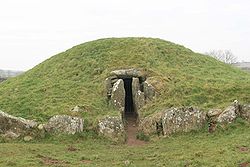 Following the last ice age
, Wales became roughly the shape it is today by about 8000 BC and was inhabited by Mesolithic
hunter-gatherer
s. The earliest farming communities are now believed to date from about 4000 BC, marking the beginning of the Neolithic
period. This period saw the construction of many chambered tombs particularly dolmen
s or cromlech
s. The most notable examples of megalithic tombs include Bryn Celli Ddu
and Barclodiad y Gawres
on Anglesey, Pentre Ifan
in Pembrokeshire
, and Tinkinswood Burial Chamber
in the Vale of Glamorgan
.
Metal tools first appeared in Wales about 2500 BC, initially copper
followed by bronze
. The climate during the Early Bronze Age
(c. 2500-1400 BC) is thought to have been warmer than at present, as there are many remains from this period in what are now bleak uplands. The Late Bronze Age (c. 1400-750 BC) saw the development of more advanced bronze implements. Much of the copper for the production of bronze probably came from the copper mine on the Great Orme
, where prehistoric mining on a very large scale dates largely from the middle Bronze Age.
The earliest iron implement found in Wales is a sword from Llyn Fawr
at the head of the Rhondda Valley
, which is thought to date to about 600 BC. The British Iron Age
saw the building of hillforts which are particularly numerous in Wales, examples being Pen Dinas
near Aberystwyth
and Tre'r Ceiri on the Lleyn peninsula. A particularly significant find from this period was made in 1943 at Llyn Cerrig Bach
on Anglesey, when the ground was being prepared for the construction of a Royal Air Force
base. The cache included weapons, shields, chariot
s along with their fittings and harnesses, and slave chains and tools. Many had been deliberately broken and seem to have been votive offering
s.
Until recently, the prehistory of Wales was portrayed as a series of successive migrations. The present tendency is to stress population continuity; the Encyclopedia of Wales suggests that Wales had received the greater part of its original stock of peoples by c.2000 BC. Recent studies in population genetics
have argued for genetic continuity from the Upper Paleolithic
, Mesolithic
or Neolithic
eras. The introduction of Celtic language in the Bronze Age may have been a result of immigration on a smaller scale.
east of the Gower Peninsula
, where there is a legacy of Romanisation. The only town in Wales founded by the Romans, Caerwent
, is located in South Wales. Both Caerwent and Carmarthen
, also in southern Wales, would become Roman civitates
. During the occupation both the region that would become Wales and its people were a mostly anonymous part of Roman Britain
.
By AD 47 Rome had invaded and conquered all of southernmost and southeastern Britain under the first Roman governor
of Britain. As part of the Roman conquest of Britain
, a series of campaigns to conquer Wales was launched by his successor in 48 and would continue intermittently under successive governors until the conquest was completed in 78. It is these campaigns of conquest that are the most widely known feature of Wales during the Roman era
due to the spirited but unsuccessful defense of their homelands by two native tribes, the Silures
and the Ordovices
.
The Demetae
of southwestern Wales seem to have quickly made their peace with the Romans, as there is no indication of war with Rome, and their homeland was not heavily planted with forts nor overlaid with roads. The Demetae would be the only Welsh tribe to emerge from Roman rule with their homeland and tribal name intact.
Wales was a rich source of mineral wealth and the Romans used their engineering
technology
to extract large amounts of gold
, copper
, and lead
, as well as modest amounts of some other metals such as zinc
and silver
. When the mines were no longer practical or profitable, they were abandoned. Roman economic development was concentrated in southeastern Britain, with no significant industries located in Wales. This was largely a matter of circumstance, as Wales had none of the needed materials in suitable combination, and the forested, mountainous countryside was not amenable to industrialisation.
The year 383 denotes a significant point in Welsh history, remembered in literature and considered to be the foundation point of several medieval royal dynasties. In that year the Roman general Magnus Maximus
would strip all of western and northern Britain of troops and senior administrators and launch a successful bid for imperial power, continuing to rule Britain from Gaul
as emperor. Having left with the troops and Roman administrators, and planning to continue as the ruler of Britain in the future, his practical course was to transfer local authority to local rulers. Welsh legend provides a mythic story that says he did exactly that.
In the story of Breuddwyd Macsen Wledig (The Dream of Emperor Maximus), he is Emperor of Rome and marries a wondrous British woman, telling her that she may name her desires, to be received as a wedding portion. She asks that her father be given sovereignty over Britain, thus formalising the transfer of authority from Rome back to the Britons themselves. The marriage also makes possible British descendants, a point not lost on medieval kings. The earliest Welsh genealogies give Maximus the role of founding father for several royal dynasties, including those of Powys and Gwent, a role he also played for the rulers of medieval Galloway
in Scotland
, home to the Roman-era Novantae
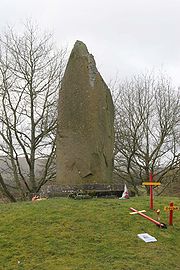
whose territory was also made independent of Roman rule by Maximus. He is given as the ancestor of a Welsh king on the Pillar of Eliseg
, erected nearly 500 years after he left Britain, and he figures in lists of the Fifteen Tribes of Wales
.
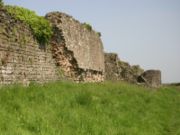 Tradition holds that following the Roman departure, Roman customs held on into the 5th century in southern Wales, and that is true in part. Caerwent continued to be occupied, while Carmarthen was probably abandoned in the late 4th century. In addition, southwestern Wales was the tribal territory of the Demetae, who had never become thoroughly Romanised. An influx of settlers from southeastern Ireland
had taken place in the late 4th century, both in northern Wales and in the entire region of southernmost and southwestern Wales under circumstances that are still poorly understood, and it seems far-fetched to suggest that they were ever Romanised.
Indeed, aside from the many Roman-related finds along the southern coast and the fully romanized area around Caerwent, Roman archaeological remains in Wales consist almost entirely of military roads and fortifications.
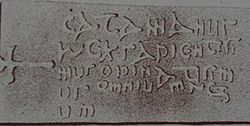
s is provided by an inscribed stone from Gwynedd
dated between the late 5th century and mid 6th century commemorating a certain Cantiorix who was described as a citizen (cives) of Gwynedd and a cousin of Maglos the magistrate
(magistratus). There was considerable Irish
colonization in Dyfed in south-west Wales, where there are many stones with Ogham
inscriptions. Wales had become Christian
, and the "age of the saints" (approximately 500–700) was marked by the establishment of monastic settlements throughout the country, by religious leaders such as Saint David
, Illtud
and Teilo.
One of the reasons for the Roman withdrawal was the pressure put upon the empire's military resources by the incursion of barbarian tribes from the east. These tribes, including the Angles
and Saxons
, who later became the English, were unable to make inroads into Wales except possibly along the Severn Valley as far as Llanidloes
. However they gradually conquered eastern and southern Britain. At the Battle of Chester
in 616, the forces of Powys and other British kingdoms were defeated by the Northumbrians under Æthelfrith
, with king Selyf ap Cynan
among the dead. It has been suggested that this battle finally severed the land connection between Wales and the kingdoms of the Hen Ogledd
("Old North"), the Brythonic-speaking regions of what is now southern Scotland
and northern England
, including Rheged
, Strathclyde
, Elmet
and Gododdin
, where Old Welsh was also spoken. From the 8th century on, Wales was by far the largest of the three remnant Brython
ic areas in Britain, the other two being the Hen Ogledd and Cornwall
.
 Wales was divided into a number of separate kingdoms, the largest of these being Gwynedd
in northwest Wales and Powys in east Wales. Gwynedd was the most powerful of these kingdoms in the 6th century and 7th century, under rulers such as Maelgwn Gwynedd (died 547) and Cadwallon ap Cadfan
(died 634/5) who in alliance with Penda of Mercia
was able to lead his armies as far as Northumbria
and control it for a period. Following Cadwallon's death in battle the following year, his successor Cadafael ap Cynfeddw
also allied himself with Penda against Northumbria but thereafter Gwynedd, like the other Welsh kingdoms, was mainly engaged in defensive warfare against the growing power of Mercia
.
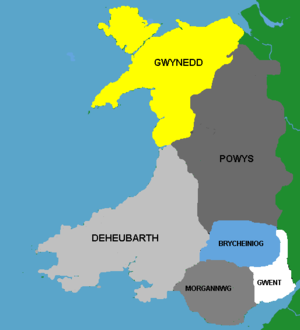 Powys as the easternmost of the major kingdoms of Wales came under the most pressure from the English in Cheshire
, Shropshire
and Herefordshire
. This kingdom originally extended east into areas now in England, and its ancient capital, Pengwern
, has been variously identified as modern Shrewsbury
or a site north of Baschurch
. These areas were lost to the kingdom of Mercia
. The construction of the earthwork known as Offa's Dyke
(usually attributed to Offa
, King of Mercia
in the 8th century) may have marked an agreed border.
For a single man to rule the whole country during this period was rare. This is often ascribed to the inheritance system practiced in Wales. All sons received an equal share of their father's property (including illegitimate sons), resulting in the division of territories. However, the Welsh law
s prescribe this system of division for land in general, not for kingdoms, where there is provision for a single heir to the kingdom to be chosen, usually by the king. Any son, legitimate or illegitimate, could be chosen as edling and there were frequently disappointed candidates prepared to challenge the chosen heir.
The first to rule a considerable part of Wales was Rhodri Mawr (Rhodri The Great), originally king of Gwynedd
during the 9th century, who was able to extend his rule to Powys
and Ceredigion
. On his death his realms were divided between his sons. Rhodri's grandson, Hywel Dda
(Hywel the Good), formed the kingdom of Deheubarth by joining smaller kingdoms in the southwest and had extended his rule to most of Wales by 942. He is traditionally associated with the codification of Welsh law
at a council which he called at Whitland
, the laws from then on usually being called the "Laws of Hywel". Hywel followed a policy of peace with the English. On his death in 949 his sons were able to keep control of Deheubarth but lost Gwynedd
to the traditional dynasty of this kingdom.
Wales was now coming under increasing attack by Viking
raiders, particularly Danish raids in the period between 950 and 1000. According to the chronicle Brut y Tywysogion
, Godfrey Haroldson
carried off two thousand captives from Anglesey
in 987, and the king of Gwynedd, Maredudd ab Owain
is reported to have redeemed many of his subjects from slavery by paying the Danes a large ransom.
Gruffydd ap Llywelyn
was the next ruler to be able to unite most of the Welsh kingdoms under his rule. Originally king of Gwynedd, by 1055 he was ruler of almost all of Wales and had annexed parts of England around the border. However, he was defeated by Harold Godwinson
in 1063 and killed by his own men. His territories were again divided into the traditional kingdoms.
conquest of England in 1066, the dominant ruler in Wales was Bleddyn ap Cynfyn
, who was king of Gwynedd
and Powys
. The initial Norman successes were in the south, where William Fitz Osbern
overran Gwent before 1070. By 1074 the forces of the Earl of Shrewsbury
were ravaging Deheubarth.
The killing of Bleddyn ap Cynfyn in 1075 led to civil war and gave the Normans
an opportunity to seize lands in North Wales
. In 1081 Gruffydd ap Cynan
, who had just won the throne of Gwynedd from Trahaearn ap Caradog
at the Battle of Mynydd Carn
was enticed to a meeting with the Earl of Chester
and Earl of Shrewsbury
and promptly seized and imprisoned, leading to the seizure of much of Gwynedd by the Normans. In the south William the Conqueror advanced into Dyfed
founding castles and mints at St David's
and Cardiff
. Rhys ap Tewdwr
of Deheubarth was killed in 1093 in Brycheiniog
, and his kingdom was seized and divided between various Norman lordships. The Norman conquest of Wales appeared virtually complete.
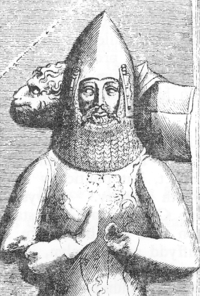 In 1094 however there was a general Welsh revolt against Norman rule, and gradually territories were won back. Gruffydd ap Cynan
was eventually able to build a strong kingdom in Gwynedd
. His son, Owain Gwynedd
, allied with Gruffydd ap Rhys
of Deheubarth won a crushing victory over the Normans at the Battle of Crug Mawr
in 1136 and annexed Ceredigion
. Owain followed his father on the throne of Gwynedd the following year and ruled until his death in 1170. He was able to profit from disunity in England, where Stephen of Blois
and the Empress Matilda
were engaged in a struggle for the throne, to extend the borders of Gwynedd further east than ever before.
Powys also had a strong ruler at this time in Madog ap Maredudd
, but when his death in 1160 was quickly followed by the death of his heir, Llywelyn ap Madog, Powys was split into two parts and never subsequently reunited. In the south, Gruffydd ap Rhys
was killed in 1137, but his four sons, who all ruled Deheubarth in turn, were eventually able to win back most of their grandfather's kingdom from the Normans. The youngest of the four, Rhys ap Gruffydd
(The Lord Rhys) ruled from 1155 to 1197. In 1171 Rhys met King Henry II
and came to an agreement with him whereby Rhys had to pay a tribute but was confirmed in all his conquests and was later named Justiciar of South Wales. Rhys held a festival of poetry and song at his court at Cardigan
over Christmas
1176 which is generally regarded as the first recorded Eisteddfod. Owain Gwynedd's death led to the splitting of Gwynedd between his sons, while Rhys made Deheubarth dominant in Wales for a time.
 Out of the power struggle in Gwynedd eventually arose one of the greatest of Welsh leaders, Llywelyn ab Iorwerth, also known as Llywelyn Fawr (the Great), who was sole ruler of Gwynedd by 1200 and by his death in 1240 was effectively ruler of much of Wales. Llywelyn made his 'capital' and headquarters at Abergwyngregyn
on the north coast, overlooking the Menai Strait
. His son Dafydd ap Llywelyn
followed him as ruler of Gwynedd, but king Henry III of England
would not allow him to inherit his father's position elsewhere in Wales. War broke out in 1241 and then again in 1245, and the issue was still in the balance when Dafydd died suddenly at Abergwyngregyn, without leaving an heir in early 1246. Llywelyn the Great's other son, Gruffudd had been killed trying to escape from the Tower of London
in 1244. Gruffudd had left four sons, and a period of internal conflict between three of these ended in the rise to power of Llywelyn ap Gruffydd
(also known as Llywelyn the Last Leader). The Treaty of Montgomery
in 1267 confirmed Llywelyn in control, directly or indirectly, over a large part of Wales. However, Llywelyn's claims in Wales conflicted with Edward I of England
, and war followed in 1277. Llywelyn was obliged to seek terms, and the Treaty of Aberconwy
greatly restricted his authority. War broke out again when Llywelyn's brother Dafydd ap Gruffudd attacked Hawarden Castle
on Palm Sunday
1282. On 11 December 1282, Llywelyn was lured into a meeting in Builth Wells
castle
with unknown Marchers, where he was killed and his army subsequently destroyed. His brother Dafydd ap Gruffudd continued an increasingly forlorn resistance. He was captured in June 1283 and was hanged, drawn and quartered
at Shrewsbury
. In effect Wales became England's first colony until it was finally annexed through the Laws in Wales Acts 1535-1542
.
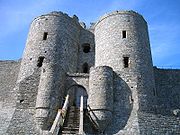 After passing the Statute of Rhuddlan
which restricted Welsh laws, King Edward's ring of impressive stone castle
s assisted the domination of Wales, and he crowned his conquest by giving the title Prince of Wales
to his son and heir in 1301. Wales became, effectively, part of England, even though its people spoke a different language and had a different culture. English kings appointed a Council of Wales, sometimes presided over by the heir to the throne. This Council normally sat in Ludlow
, now in England but at that time still part of the disputed border area in the Welsh Marches
. Welsh literature, particularly poetry
, continued to flourish however, with the lesser nobility now taking over from the princes as the patrons of the poets. Dafydd ap Gwilym
who flourished in the middle of the 14th century is considered by many to be the greatest of the Welsh poets.
There were a number of rebellions including ones led by Madog ap Llywelyn
in 1294–1295 and by Llywelyn Bren
, Lord of Senghenydd, in 1316–1318. In the 1370s the last representative in the male line of the ruling house of Gwynedd
, Owain Lawgoch
, twice planned an invasion of Wales with French support. The English government responded to the threat by sending an agent to assassinate Owain in Poitou
in 1378.
In 1400, a Welsh nobleman, Owain Glyndŵr
(or Owen Glendower), revolted against King Henry IV of England
. Owain inflicted a number of defeats on the English forces and for a few years controlled most of Wales. Some of his achievements included holding the first ever Welsh Parliament at Machynlleth
and plans for two universities. Eventually the king's forces were able to regain control of Wales and the rebellion died out, but Owain himself was never captured. His rebellion caused a great upsurge in Welsh identity and he was widely supported by Welsh people throughout the country.
As a response to Glyndŵr's rebellion, the English parliament passed the Penal Laws in 1402. These prohibited the Welsh from carrying arms, from holding office and from dwelling in fortified towns. These prohibitions also applied to Englishmen who married Welsh women. These laws remained in force after the rebellion, although in practice they were gradually relaxed.
 In the Wars of the Roses
which began in 1455 both sides made considerable use of Welsh troops. The main figures in Wales were the two Earls of Pembroke
, the Yorkist Earl William Herbert
and the Lancastrian Jasper Tudor
. In 1485 Jasper's nephew, Henry Tudor, landed in Wales with a small force to launch his bid for the throne of England. Henry was of Welsh descent, counting princes such as Rhys ap Gruffydd (The Lord Rhys) among his ancestors, and his cause gained much support in Wales. Henry defeated King Richard III of England
at the Battle of Bosworth with an army containing many Welsh soldiers and gained the throne as King Henry VII of England
.
Under his son, Henry VIII of England
, the Laws in Wales Acts 1535-1542
were passed, integrating Wales with England in legal terms, abolishing the Welsh legal system, and banning the Welsh language
from any official role or status, but it did for the first time define the England-Wales border and allowed members representing constituencies in Wales to be elected to the English Parliament. They also abolished any legal distinction between the Welsh and the English, thereby effectively ending the Penal Code although this was not formally repealed.
's break with Rome and the Pope
, Wales for the most part followed England in accepting Anglicanism
, although a number of Catholics were active in attempting to counteract this and produced some of the earliest books printed in Welsh. In 1588 William Morgan
produced the first complete translation of the Welsh Bible
. Morgan's Bible is one of the most significant books in the Welsh language, and its publication greatly increased the stature and scope of the Welsh language and literature
.
Wales was overwhelmingly Royalist
in the Wars of the Three Kingdoms
in the early 17th century though there were some notable exceptions such as John Jones Maesygarnedd
and the Puritan
writer Morgan Llwyd
. Wales was an important source of men for the armies of King Charles I of England
, though no major battles took place in Wales. The Second English Civil War
began when unpaid Parliamentarian troops in Pembrokeshire
changed sides in early 1648. Colonel Thomas Horton
defeated the Royalist rebels at the battle of St. Fagans
in May and the rebel leaders surrendered to Cromwell on July 11 after the protracted two month siege of Pembroke
.
Education in Wales was at a very low ebb in this period, with the only education available being in English while the majority of the population spoke only Welsh. In 1731 Griffith Jones
started circulating schools in Carmarthenshire
, held in one location for about three months before moving (or "circulating") to another location. The language of instruction in these schools was Welsh. By Griffith Jones' death, in 1761, it is estimated that up to 250,000 people had learnt to read in schools throughout Wales.
The 18th century also saw the Welsh Methodist revival
, led by Daniel Rowland
, Howell Harris
and William Williams Pantycelyn
. In the early 19th century the Welsh Methodists broke away from the Anglican church and established their own denomination, now the Presbyterian Church of Wales
. This also led to the strengthening of other nonconformist denominations, and by the middle of the 19th century Wales was largely Nonconformist in religion. This had considerable implications for the Welsh language as it was the main language of the nonconformist churches in Wales. The Sunday schools which became an important feature of Welsh life made a large part of the population literate in Welsh, which was important for the survival of the language as it was not taught in the schools.
The end of the 18th century saw the beginnings of the Industrial Revolution
, and the presence of iron ore, limestone
and large coal
deposits in south-east Wales meant that this area soon saw the establishment of ironworks
and coal mines, notably the Cyfarthfa Ironworks
and the Dowlais Ironworks
at Merthyr Tydfil
.
valleys from the 1840s, led to a increase in population. The social effects of industrialisation
resulted in armed uprisings against the mainly English owners. Socialism
developed in South Wales in the latter part of the century, accompanied by the increasing politicisation of religious Nonconformism
. The first Labour
MP, Keir Hardie
, was elected as junior member for the Welsh constituency of Merthyr Tydfil
and Aberdare
in 1900.
The first decade of the 20th century was the period of the coal boom in South Wales, when population growth exceeded 20 per cent. Demographic changes affected the language frontier; the proportion of Welsh speakers in the Rhondda valley fell from 64 per cent in 1901 to 55 per cent ten years later, and similar trends were evident elsewhere in South Wales. The Labour Party
replaced the Liberals as the dominant party in Wales after the First World War, particularly in the industrial valleys of South Wales
. Plaid Cymru
was formed in 1925 but initially its growth was slow and it gained few votes at parliamentary elections. Industries, particularly the coal industry, declined after the Second World War. By the early 1990s there was only one deep pit still working in Wales. There was a similar decline in the steel
industry, and the Welsh economy, like that of other developed societies, became increasingly based on the expanding service sector.
The results of the 2001 Census
showed an increase in the number of Welsh speakers to 21% of the population aged 3 and older, compared with 18.7% in 1991 and 19.0% in 1981. This compares with a pattern of steady decline indicated by census results during the 20th century.
Neanderthal
The Neanderthal is an extinct member of the Homo genus known from Pleistocene specimens found in Europe and parts of western and central Asia...
s lived in what is now Wales
Wales
Wales is a country that is part of the United Kingdom and the island of Great Britain, bordered by England to its east and the Atlantic Ocean and Irish Sea to its west. It has a population of three million, and a total area of 20,779 km²...
, or Cymru in Welsh
Welsh language
Welsh is a member of the Brythonic branch of the Celtic languages spoken natively in Wales, by some along the Welsh border in England, and in Y Wladfa...
, at least 230,000 years ago, while Homo sapiens arrived by about 29,000 years ago. However, continuous habitation by modern humans dates from the period after the end of the last ice age
Ice age
An ice age or, more precisely, glacial age, is a generic geological period of long-term reduction in the temperature of the Earth's surface and atmosphere, resulting in the presence or expansion of continental ice sheets, polar ice sheets and alpine glaciers...
around 9000 BC, and Wales has many remains from the Mesolithic
Mesolithic
The Mesolithic is an archaeological concept used to refer to certain groups of archaeological cultures defined as falling between the Paleolithic and the Neolithic....
, Neolithic
Neolithic
The Neolithic Age, Era, or Period, or New Stone Age, was a period in the development of human technology, beginning about 9500 BC in some parts of the Middle East, and later in other parts of the world. It is traditionally considered as the last part of the Stone Age...
, and Bronze Age
Bronze Age Britain
Bronze Age Britain refers to the period of British history that spanned from c. 2,500 until c. 800 BC. Lasting for approximately 1700 years, it was preceded by the era of Neolithic Britain and was in turn followed by the era of Iron Age Britain...
. During the Iron Age
British Iron Age
The British Iron Age is a conventional name used in the archaeology of Great Britain, referring to the prehistoric and protohistoric phases of the Iron-Age culture of the main island and the smaller islands, typically excluding prehistoric Ireland, and which had an independent Iron Age culture of...
the region, like all of Britain south of the Firth of Forth
Firth of Forth
The Firth of Forth is the estuary or firth of Scotland's River Forth, where it flows into the North Sea, between Fife to the north, and West Lothian, the City of Edinburgh and East Lothian to the south...
, was dominated by the Celtic Britons
Britons (historical)
The Britons were the Celtic people culturally dominating Great Britain from the Iron Age through the Early Middle Ages. They spoke the Insular Celtic language known as British or Brythonic...
and the British language. The Romans
Ancient Rome
Ancient Rome was a thriving civilization that grew on the Italian Peninsula as early as the 8th century BC. Located along the Mediterranean Sea and centered on the city of Rome, it expanded to one of the largest empires in the ancient world....
, who began their conquest of Britain
Roman conquest of Britain
The Roman conquest of Britain was a gradual process, beginning effectively in AD 43 under Emperor Claudius, whose general Aulus Plautius served as first governor of Britannia. Great Britain had already frequently been the target of invasions, planned and actual, by forces of the Roman Republic and...
in AD 43, first campaigned in what is now northeast Wales in 48 against the Deceangli
Deceangli
The Deceangli or Deceangi were one of the Celtic tribes living in Britain, prior to the Roman invasion of the island. The tribe lived mainly in what is now north-east Wales, though it is uncertain whether their territory covered only the modern counties of Flintshire, Denbighshire and part of...
, and gained total control of the region with their defeat of the Ordovices
Ordovices
The Ordovices were one of the Celtic tribes living in Great Britain, before the Roman invasion of Britain. Its tribal lands were located in present day Wales and England between the Silures to the south and the Deceangli to the north-east...
in 79. The Romans departed from Britain in the 5th century, opening the door for the Anglo-Saxon invasion. Thereafter British language and culture began to splinter, and several distinct groups formed. The Welsh people
Welsh people
The Welsh people are an ethnic group and nation associated with Wales and the Welsh language.John Davies argues that the origin of the "Welsh nation" can be traced to the late 4th and early 5th centuries, following the Roman departure from Britain, although Brythonic Celtic languages seem to have...
were the largest of these groups, and are generally discussed independently of the other surviving Brythonic
Brythonic languages
The Brythonic or Brittonic languages form one of the two branches of the Insular Celtic language family, the other being Goidelic. The name Brythonic was derived by Welsh Celticist John Rhys from the Welsh word Brython, meaning an indigenous Briton as opposed to an Anglo-Saxon or Gael...
-speaking peoples after the 11th century.
A number of kingdoms formed in the area now called Wales in the post-Roman
Sub-Roman Britain
Sub-Roman Britain is a term derived from an archaeological label for the material culture of Britain in Late Antiquity: the term "Sub-Roman" was invented to describe the potsherds in sites of the 5th century and the 6th century, initially with an implication of decay of locally-made wares from a...
period. While the most powerful ruler was acknowledged as King of the Britons
King of the Britons
The Britons or Brythons were the Celtic-speaking people of what is now England, Wales and southern Scotland, whose ethnic identity is today maintained by the Welsh, Cornish and Bretons...
(later Tywysog Cymru
Tywysog
Tywysog , in modern Welsh, means "Prince", although historically it referred to a broader category of rulers. The feminine form is Tywysoges. The work Brut y Tywysogion is the Annals of the Princes of Wales and is a historical narrative of the deeds of the various rulers of the kingdoms, large and...
: Leader or Prince of Wales), and some rulers extended their control over other Welsh territories and into western England, none were able to unite Wales for long. Internecine struggles and external pressure from the English and later, the Norman
Normans
The Normans were the people who gave their name to Normandy, a region in northern France. They were descended from Norse Viking conquerors of the territory and the native population of Frankish and Gallo-Roman stock...
conquerors of England, led to the Welsh kingdoms coming gradually under the sway of the English crown. In 1282, the death of Llywelyn the Last
Llywelyn the Last
Llywelyn ap Gruffydd or Llywelyn Ein Llyw Olaf , sometimes rendered as Llywelyn II, was the last prince of an independent Wales before its conquest by Edward I of England....
led to the conquest of the Principality of Wales
Principality of Wales
The Principality of Wales existed between 1216 and 1542, encompassing two-thirds of modern Wales.It was formally founded in 1216 at the Council of Aberdyfi, and later recognised by the 1218 Treaty of Worcester between Llywelyn the Great of Wales and Henry III of England...
by King Edward I of England; afterwards, the heir apparent
Heir apparent
An heir apparent or heiress apparent is a person who is first in line of succession and cannot be displaced from inheriting, except by a change in the rules of succession....
to the English monarch has borne the title "Prince of Wales
Prince of Wales
Prince of Wales is a title traditionally granted to the heir apparent to the reigning monarch of the United Kingdom of Great Britain and Northern Ireland and the 15 other independent Commonwealth realms...
". The Welsh launched several revolts against English rule, the last significant one being that led by Owain Glyndŵr
Owain Glyndwr
Owain Glyndŵr , or Owain Glyn Dŵr, anglicised by William Shakespeare as Owen Glendower , was a Welsh ruler and the last native Welshman to hold the title Prince of Wales...
in the early 15th century. In the 16th century Henry VIII
Henry VIII of England
Henry VIII was King of England from 21 April 1509 until his death. He was Lord, and later King, of Ireland, as well as continuing the nominal claim by the English monarchs to the Kingdom of France...
, himself of Welsh extraction, passed the Laws in Wales Acts aiming to fully incorporate Wales into the Kingdom of England
Kingdom of England
The Kingdom of England was, from 927 to 1707, a sovereign state to the northwest of continental Europe. At its height, the Kingdom of England spanned the southern two-thirds of the island of Great Britain and several smaller outlying islands; what today comprises the legal jurisdiction of England...
. Under England's authority, Wales became part of the Kingdom of Great Britain
Kingdom of Great Britain
The former Kingdom of Great Britain, sometimes described as the 'United Kingdom of Great Britain', That the Two Kingdoms of Scotland and England, shall upon the 1st May next ensuing the date hereof, and forever after, be United into One Kingdom by the Name of GREAT BRITAIN. was a sovereign...
in 1707 and then the United Kingdom in 1801. Yet, the Welsh retained their language and culture in spite of heavy English dominance. The publication of the extremely significant first Welsh translation of the Bible
Welsh Bible
Bible translations into Welsh have existed since at least the 15th century, but the most widely used translation of the Bible into Welsh for several centuries was the 1588 translation by William Morgan, as revised in 1620...
by William Morgan
William Morgan (Bible translator)
William Morgan was Bishop of Llandaff and of St Asaph, and the translator of the first version of the whole Bible into Welsh from Greek and Hebrew.-Life:...
in 1588 greatly advanced the position of Welsh as a literary language
Literary language
A literary language is a register of a language that is used in literary writing. This may also include liturgical writing. The difference between literary and non-literary forms is more marked in some languages than in others...
.
The 18th century saw the beginnings of two changes that would greatly affect Wales, the Welsh Methodist revival
Welsh Methodist revival
The Welsh Methodist revival was an evangelical revival that revitalised Christianity in Wales during the 18th century. Methodist preachers such as Griffith Jones, William Williams and Howell Harris were such powerful speakers that they converted thousands of people back to the church...
, which led the country to turn increasingly nonconformist
Nonconformism
Nonconformity is the refusal to "conform" to, or follow, the governance and usages of the Church of England by the Protestant Christians of England and Wales.- Origins and use:...
in religion, and the Industrial Revolution
Industrial Revolution
The Industrial Revolution was a period from the 18th to the 19th century where major changes in agriculture, manufacturing, mining, transportation, and technology had a profound effect on the social, economic and cultural conditions of the times...
. During the 19th century southeast Wales in particular experienced rapid industrialisation and a dramatic rise in population as a result of the explosion of the coal
Coal
Coal is a combustible black or brownish-black sedimentary rock usually occurring in rock strata in layers or veins called coal beds or coal seams. The harder forms, such as anthracite coal, can be regarded as metamorphic rock because of later exposure to elevated temperature and pressure...
and iron industries. These industries declined in the 20th century, while nationalist
Welsh nationalism
Welsh nationalism emphasises the distinctiveness of Welsh language, culture, and history, and calls for more self-determination for Wales, which may include more Devolved powers for the Welsh Assembly or full independence from the United Kingdom.-Conquest:...
sentiment and interest in self-determination rose. The Labour Party
Labour Party (UK)
The Labour Party is a centre-left democratic socialist party in the United Kingdom. It surpassed the Liberal Party in general elections during the early 1920s, forming minority governments under Ramsay MacDonald in 1924 and 1929-1931. The party was in a wartime coalition from 1940 to 1945, after...
replaced the Liberal Party
Liberal Party (UK)
The Liberal Party was one of the two major political parties of the United Kingdom during the 19th and early 20th centuries. It was a third party of negligible importance throughout the latter half of the 20th Century, before merging with the Social Democratic Party in 1988 to form the present day...
as the dominant political force in the 1940s, while the nationalist party Plaid Cymru
Plaid Cymru
' is a political party in Wales. It advocates the establishment of an independent Welsh state within the European Union. was formed in 1925 and won its first seat in 1966...
gained momentum in the 1960s. In a 1997 referendum Welsh voters approved the devolution
Devolution
Devolution is the statutory granting of powers from the central government of a sovereign state to government at a subnational level, such as a regional, local, or state level. Devolution can be mainly financial, e.g. giving areas a budget which was formerly administered by central government...
of governmental responsibility to a National Assembly for Wales
National Assembly for Wales
The National Assembly for Wales is a devolved assembly with power to make legislation in Wales. The Assembly comprises 60 members, who are known as Assembly Members, or AMs...
, which first met in 1999.
Prehistoric Wales
The earliest known human remain discovered in modern-day Wales is a NeanderthalNeanderthal
The Neanderthal is an extinct member of the Homo genus known from Pleistocene specimens found in Europe and parts of western and central Asia...
jawbone, found at the Bontnewydd Palaeolithic site
Bontnewydd Palaeolithic site
The Bontnewydd Palaeolithic site is an archaeological site in Wales which has yielded the earliest known remains of Neanderthals in the region. It is located on the River Elwy, near the hamlet of Bontnewydd, Denbighshire.-Palaeolithic site:...
in the valley of the River Elwy
River Elwy
The River Elwy is a river in North Wales and is a tributary of the River Clwyd. The source of the river is sometimes said to be on the northern flank of Moel Seisiog, south-east of Llanrwst, at Ordnance Survey grid reference SH853593...
in North Wales
North Wales
North Wales is the northernmost unofficial region of Wales. It is bordered to the south by the counties of Ceredigion and Powys in Mid Wales and to the east by the counties of Shropshire in the West Midlands and Cheshire in North West England...
, whose owner lived about 230,000 years ago in the Lower Palaeolithic period. The Red Lady of Paviland
Red Lady of Paviland
The Red Lady of Paviland is a fairly complete Upper Paleolithic-era human male skeleton dyed in red ochre. It was the first human fossil to have been found anywhere in the world and is also the oldest ceremonial burial anywhere in Western Europe so far discovered. The bones were discovered between...
, a human skeleton dyed in red ochre, was discovered in 1823 in one of the Paviland limestone
Limestone
Limestone is a sedimentary rock composed largely of the minerals calcite and aragonite, which are different crystal forms of calcium carbonate . Many limestones are composed from skeletal fragments of marine organisms such as coral or foraminifera....
caves of the Gower Peninsula
Gower Peninsula
Gower or the Gower Peninsula is a peninsula in south Wales, jutting from the coast into the Bristol Channel, and administratively part of the City and County of Swansea. Locally it is known as "Gower"...
in Swansea
Swansea
Swansea is a coastal city and county in Wales. Swansea is in the historic county boundaries of Glamorgan. Situated on the sandy South West Wales coast, the county area includes the Gower Peninsula and the Lliw uplands...
, South Wales. Despite the name, the skeleton is that of a young man who lived about 29,000 years ago at the end of the Upper Paleolithic
Paleolithic
The Paleolithic Age, Era or Period, is a prehistoric period of human history distinguished by the development of the most primitive stone tools discovered , and covers roughly 99% of human technological prehistory...
Period (old stone age
Stone Age
The Stone Age is a broad prehistoric period, lasting about 2.5 million years , during which humans and their predecessor species in the genus Homo, as well as the earlier partly contemporary genera Australopithecus and Paranthropus, widely used exclusively stone as their hard material in the...
). He is considered to be the oldest known ceremonial burial in Western Europe
Western Europe
Western Europe is a loose term for the collection of countries in the western most region of the European continents, though this definition is context-dependent and carries cultural and political connotations. One definition describes Western Europe as a geographic entity—the region lying in the...
. The skeleton was found along with jewellery made from ivory
Ivory
Ivory is a term for dentine, which constitutes the bulk of the teeth and tusks of animals, when used as a material for art or manufacturing. Ivory has been important since ancient times for making a range of items, from ivory carvings to false teeth, fans, dominoes, joint tubes, piano keys and...
and seashells and a mammoth
Mammoth
A mammoth is any species of the extinct genus Mammuthus. These proboscideans are members of Elephantidae, the family of elephants and mammoths, and close relatives of modern elephants. They were often equipped with long curved tusks and, in northern species, a covering of long hair...
's skull.
Ice age
An ice age or, more precisely, glacial age, is a generic geological period of long-term reduction in the temperature of the Earth's surface and atmosphere, resulting in the presence or expansion of continental ice sheets, polar ice sheets and alpine glaciers...
, Wales became roughly the shape it is today by about 8000 BC and was inhabited by Mesolithic
Mesolithic
The Mesolithic is an archaeological concept used to refer to certain groups of archaeological cultures defined as falling between the Paleolithic and the Neolithic....
hunter-gatherer
Hunter-gatherer
A hunter-gatherer or forage society is one in which most or all food is obtained from wild plants and animals, in contrast to agricultural societies which rely mainly on domesticated species. Hunting and gathering was the ancestral subsistence mode of Homo, and all modern humans were...
s. The earliest farming communities are now believed to date from about 4000 BC, marking the beginning of the Neolithic
Neolithic
The Neolithic Age, Era, or Period, or New Stone Age, was a period in the development of human technology, beginning about 9500 BC in some parts of the Middle East, and later in other parts of the world. It is traditionally considered as the last part of the Stone Age...
period. This period saw the construction of many chambered tombs particularly dolmen
Dolmen
A dolmen—also known as a portal tomb, portal grave, dolmain , cromlech , anta , Hünengrab/Hünenbett , Adamra , Ispun , Hunebed , dös , goindol or quoit—is a type of single-chamber megalithic tomb, usually consisting of...
s or cromlech
Cromlech
Cromlech is a Brythonic word used to describe prehistoric megalithic structures, where crom means "bent" and llech means "flagstone". The term is now virtually obsolete in archaeology, but remains in use as a colloquial term for two different types of megalithic monument.In English it usually...
s. The most notable examples of megalithic tombs include Bryn Celli Ddu
Bryn Celli Ddu
Bryn Celli Ddu is a prehistoric site on the Welsh island of Anglesey located near Llanddaniel Fab. Its name means 'the mound in the dark grove'. It was plundered in 1699 and archaeologically excavated between 1928 and 1929....
and Barclodiad y Gawres
Barclodiad y Gawres
Barclodiad y Gawres is a Neolithic burial chamber on the coast of the island of Anglesey in North Wales. It is an example of a cruciform passage grave, a notable feature being its decorated stones...
on Anglesey, Pentre Ifan
Pentre Ifan
Pentre Ifan is the name of an ancient manor in the civil parish of Nevern, in North Pembrokeshire, West Wales. It contains the largest and best preserved neolithic dolmen in Wales.-History:...
in Pembrokeshire
Pembrokeshire
Pembrokeshire is a county in the south west of Wales. It borders Carmarthenshire to the east and Ceredigion to the north east. The county town is Haverfordwest where Pembrokeshire County Council is headquartered....
, and Tinkinswood Burial Chamber
Tinkinswood
Tinkinswood or its full name Tinkinswood Burial Chamber , also known as Castell Carreg, Llech-y-Filiast and Maes-y-Filiast, is a megalithic burial chamber, built around 6,000 BP , during the Neolithic period, in the Vale of Glamorgan, near Cardiff, Wales.The structure is called a dolmen, which was...
in the Vale of Glamorgan
Vale of Glamorgan
The Vale of Glamorgan is a county borough in Wales; an exceptionally rich agricultural area, it lies in the southern part of Glamorgan, South Wales...
.
Metal tools first appeared in Wales about 2500 BC, initially copper
Copper
Copper is a chemical element with the symbol Cu and atomic number 29. It is a ductile metal with very high thermal and electrical conductivity. Pure copper is soft and malleable; an exposed surface has a reddish-orange tarnish...
followed by bronze
Bronze
Bronze is a metal alloy consisting primarily of copper, usually with tin as the main additive. It is hard and brittle, and it was particularly significant in antiquity, so much so that the Bronze Age was named after the metal...
. The climate during the Early Bronze Age
Bronze Age
The Bronze Age is a period characterized by the use of copper and its alloy bronze as the chief hard materials in the manufacture of some implements and weapons. Chronologically, it stands between the Stone Age and Iron Age...
(c. 2500-1400 BC) is thought to have been warmer than at present, as there are many remains from this period in what are now bleak uplands. The Late Bronze Age (c. 1400-750 BC) saw the development of more advanced bronze implements. Much of the copper for the production of bronze probably came from the copper mine on the Great Orme
Great Orme
The Great Orme is a prominent limestone headland on the north coast of Wales situated in Llandudno. It is referred to as Cyngreawdr Fynydd in a poem by the 12th century poet Gwalchmai ap Meilyr...
, where prehistoric mining on a very large scale dates largely from the middle Bronze Age.
The earliest iron implement found in Wales is a sword from Llyn Fawr
Llyn Fawr
Llyn Fawr is a lake in the Cynon Valley , South Wales, best known as the site of an important hoard of weapons and tools from the late Bronze Age and early Iron Age...
at the head of the Rhondda Valley
River Rhondda
The River Rhondda is a river in the Rhondda Valley, South Wales which has two major tributaries; the Rhondda Fawr and the Rhondda Fach .- Description :...
, which is thought to date to about 600 BC. The British Iron Age
British Iron Age
The British Iron Age is a conventional name used in the archaeology of Great Britain, referring to the prehistoric and protohistoric phases of the Iron-Age culture of the main island and the smaller islands, typically excluding prehistoric Ireland, and which had an independent Iron Age culture of...
saw the building of hillforts which are particularly numerous in Wales, examples being Pen Dinas
Pen Dinas
Pen Dinas is the name of a hill south of Aberystwyth on the coast of Ceredigion, Wales, upon which an extensive Iron Age hill fort is situated....
near Aberystwyth
Aberystwyth
Aberystwyth is a historic market town, administrative centre and holiday resort within Ceredigion, Wales. Often colloquially known as Aber, it is located at the confluence of the rivers Ystwyth and Rheidol....
and Tre'r Ceiri on the Lleyn peninsula. A particularly significant find from this period was made in 1943 at Llyn Cerrig Bach
Llyn Cerrig Bach
Llyn Cerrig Bach is a small lake in the north-west of the island of Anglesey, Wales. Its main claim to fame is the large hoard of Iron Age materials discovered there in 1942, apparently placed in the lake as votive offerings...
on Anglesey, when the ground was being prepared for the construction of a Royal Air Force
Royal Air Force
The Royal Air Force is the aerial warfare service branch of the British Armed Forces. Formed on 1 April 1918, it is the oldest independent air force in the world...
base. The cache included weapons, shields, chariot
Chariot
The chariot is a type of horse carriage used in both peace and war as the chief vehicle of many ancient peoples. Ox carts, proto-chariots, were built by the Proto-Indo-Europeans and also built in Mesopotamia as early as 3000 BC. The original horse chariot was a fast, light, open, two wheeled...
s along with their fittings and harnesses, and slave chains and tools. Many had been deliberately broken and seem to have been votive offering
Votive offering
A votive deposit or votive offering is one or more objects displayed or deposited, without the intention of recovery or use, in a sacred place for broadly religious purposes. Such items are a feature of modern and ancient societies and are generally made in order to gain favor with supernatural...
s.
Until recently, the prehistory of Wales was portrayed as a series of successive migrations. The present tendency is to stress population continuity; the Encyclopedia of Wales suggests that Wales had received the greater part of its original stock of peoples by c.2000 BC. Recent studies in population genetics
Genetic history of the British Isles
The genetic history of the British Isles is the subject of research within the larger field of human population genetics. It has developed in parallel with DNA testing technologies capable of identifying genetic similarities and differences between populations...
have argued for genetic continuity from the Upper Paleolithic
Upper Paleolithic
The Upper Paleolithic is the third and last subdivision of the Paleolithic or Old Stone Age as it is understood in Europe, Africa and Asia. Very broadly it dates to between 40,000 and 10,000 years ago, roughly coinciding with the appearance of behavioral modernity and before the advent of...
, Mesolithic
Mesolithic
The Mesolithic is an archaeological concept used to refer to certain groups of archaeological cultures defined as falling between the Paleolithic and the Neolithic....
or Neolithic
Neolithic
The Neolithic Age, Era, or Period, or New Stone Age, was a period in the development of human technology, beginning about 9500 BC in some parts of the Middle East, and later in other parts of the world. It is traditionally considered as the last part of the Stone Age...
eras. The introduction of Celtic language in the Bronze Age may have been a result of immigration on a smaller scale.
Wales in the Roman era
The Roman conquest of Wales began in AD 48 and was completed in 78, with Roman rule lasting until 383. Roman rule in Wales was a military occupation, save for the southern coastal region of South WalesSouth Wales
South Wales is an area of Wales bordered by England and the Bristol Channel to the east and south, and Mid Wales and West Wales to the north and west. The most densely populated region in the south-west of the United Kingdom, it is home to around 2.1 million people and includes the capital city of...
east of the Gower Peninsula
Gower Peninsula
Gower or the Gower Peninsula is a peninsula in south Wales, jutting from the coast into the Bristol Channel, and administratively part of the City and County of Swansea. Locally it is known as "Gower"...
, where there is a legacy of Romanisation. The only town in Wales founded by the Romans, Caerwent
Caerwent
Caerwent is a village and community in Monmouthshire, Wales. It is located about five miles west of Chepstow and eleven miles east of Newport, and was founded by the Romans as the market town of Venta Silurum, an important settlement of the Brythonic Silures tribe. The modern village is built...
, is located in South Wales. Both Caerwent and Carmarthen
Carmarthen
Carmarthen is a community in, and the county town of, Carmarthenshire, Wales. It is sited on the River Towy north of its mouth at Carmarthen Bay. In 2001, the population was 14,648....
, also in southern Wales, would become Roman civitates
Civitas
In the history of Rome, the Latin term civitas , according to Cicero in the time of the late Roman Republic, was the social body of the cives, or citizens, united by law . It is the law that binds them together, giving them responsibilities on the one hand and rights of citizenship on the other...
. During the occupation both the region that would become Wales and its people were a mostly anonymous part of Roman Britain
Roman Britain
Roman Britain was the part of the island of Great Britain controlled by the Roman Empire from AD 43 until ca. AD 410.The Romans referred to the imperial province as Britannia, which eventually comprised all of the island of Great Britain south of the fluid frontier with Caledonia...
.
By AD 47 Rome had invaded and conquered all of southernmost and southeastern Britain under the first Roman governor
Roman governor
A Roman governor was an official either elected or appointed to be the chief administrator of Roman law throughout one or more of the many provinces constituting the Roman Empire...
of Britain. As part of the Roman conquest of Britain
Roman conquest of Britain
The Roman conquest of Britain was a gradual process, beginning effectively in AD 43 under Emperor Claudius, whose general Aulus Plautius served as first governor of Britannia. Great Britain had already frequently been the target of invasions, planned and actual, by forces of the Roman Republic and...
, a series of campaigns to conquer Wales was launched by his successor in 48 and would continue intermittently under successive governors until the conquest was completed in 78. It is these campaigns of conquest that are the most widely known feature of Wales during the Roman era
Roman Empire
The Roman Empire was the post-Republican period of the ancient Roman civilization, characterised by an autocratic form of government and large territorial holdings in Europe and around the Mediterranean....
due to the spirited but unsuccessful defense of their homelands by two native tribes, the Silures
Silures
The Silures were a powerful and warlike tribe of ancient Britain, occupying approximately the counties of Monmouthshire, Breconshire and Glamorganshire of present day South Wales; and possibly Gloucestershire and Herefordshire of present day England...
and the Ordovices
Ordovices
The Ordovices were one of the Celtic tribes living in Great Britain, before the Roman invasion of Britain. Its tribal lands were located in present day Wales and England between the Silures to the south and the Deceangli to the north-east...
.
The Demetae
Demetae
The Demetae were a Celtic people of Iron Age Britain who inhabited modern Pembrokeshire and Carmarthenshire in south-west Wales, and gave their name to the county of Dyfed.-Classical mention:...
of southwestern Wales seem to have quickly made their peace with the Romans, as there is no indication of war with Rome, and their homeland was not heavily planted with forts nor overlaid with roads. The Demetae would be the only Welsh tribe to emerge from Roman rule with their homeland and tribal name intact.
Wales was a rich source of mineral wealth and the Romans used their engineering
Roman engineering
Romans are famous for their advanced engineering accomplishments, although some of their own inventions were improvements on older ideas, concepts and inventions. Technology for bringing running water into cities was developed in the east, but transformed by the Romans into a technology...
technology
Roman technology
Roman technology is the engineering practice which supported Roman civilization and made the expansion of Roman commerce and Roman military possible over nearly a thousand years....
to extract large amounts of gold
Gold
Gold is a chemical element with the symbol Au and an atomic number of 79. Gold is a dense, soft, shiny, malleable and ductile metal. Pure gold has a bright yellow color and luster traditionally considered attractive, which it maintains without oxidizing in air or water. Chemically, gold is a...
, copper
Copper
Copper is a chemical element with the symbol Cu and atomic number 29. It is a ductile metal with very high thermal and electrical conductivity. Pure copper is soft and malleable; an exposed surface has a reddish-orange tarnish...
, and lead
Lead
Lead is a main-group element in the carbon group with the symbol Pb and atomic number 82. Lead is a soft, malleable poor metal. It is also counted as one of the heavy metals. Metallic lead has a bluish-white color after being freshly cut, but it soon tarnishes to a dull grayish color when exposed...
, as well as modest amounts of some other metals such as zinc
Zinc
Zinc , or spelter , is a metallic chemical element; it has the symbol Zn and atomic number 30. It is the first element in group 12 of the periodic table. Zinc is, in some respects, chemically similar to magnesium, because its ion is of similar size and its only common oxidation state is +2...
and silver
Silver
Silver is a metallic chemical element with the chemical symbol Ag and atomic number 47. A soft, white, lustrous transition metal, it has the highest electrical conductivity of any element and the highest thermal conductivity of any metal...
. When the mines were no longer practical or profitable, they were abandoned. Roman economic development was concentrated in southeastern Britain, with no significant industries located in Wales. This was largely a matter of circumstance, as Wales had none of the needed materials in suitable combination, and the forested, mountainous countryside was not amenable to industrialisation.
The year 383 denotes a significant point in Welsh history, remembered in literature and considered to be the foundation point of several medieval royal dynasties. In that year the Roman general Magnus Maximus
Magnus Maximus
Magnus Maximus , also known as Maximianus and Macsen Wledig in Welsh, was Western Roman Emperor from 383 to 388. As commander of Britain, he usurped the throne against Emperor Gratian in 383...
would strip all of western and northern Britain of troops and senior administrators and launch a successful bid for imperial power, continuing to rule Britain from Gaul
Gaul
Gaul was a region of Western Europe during the Iron Age and Roman era, encompassing present day France, Luxembourg and Belgium, most of Switzerland, the western part of Northern Italy, as well as the parts of the Netherlands and Germany on the left bank of the Rhine. The Gauls were the speakers of...
as emperor. Having left with the troops and Roman administrators, and planning to continue as the ruler of Britain in the future, his practical course was to transfer local authority to local rulers. Welsh legend provides a mythic story that says he did exactly that.
In the story of Breuddwyd Macsen Wledig (The Dream of Emperor Maximus), he is Emperor of Rome and marries a wondrous British woman, telling her that she may name her desires, to be received as a wedding portion. She asks that her father be given sovereignty over Britain, thus formalising the transfer of authority from Rome back to the Britons themselves. The marriage also makes possible British descendants, a point not lost on medieval kings. The earliest Welsh genealogies give Maximus the role of founding father for several royal dynasties, including those of Powys and Gwent, a role he also played for the rulers of medieval Galloway
Galloway
Galloway is an area in southwestern Scotland. It usually refers to the former counties of Wigtownshire and Kirkcudbrightshire...
in Scotland
Scotland
Scotland is a country that is part of the United Kingdom. Occupying the northern third of the island of Great Britain, it shares a border with England to the south and is bounded by the North Sea to the east, the Atlantic Ocean to the north and west, and the North Channel and Irish Sea to the...
, home to the Roman-era Novantae
Novantae
The Novantae were a people of the late 2nd century who lived in what is now Galloway and Carrick, in southwestern-most Scotland. They are mentioned briefly in Ptolemy's Geography The Novantae were a people of the late 2nd century who lived in what is now Galloway and Carrick, in southwestern-most...
whose territory was also made independent of Roman rule by Maximus. He is given as the ancestor of a Welsh king on the Pillar of Eliseg
Pillar of Eliseg
The Pillar of Eliseg also known as Elise's Pillar or Croes Elisedd in Welsh, stands near Valle Crucis Abbey, Denbighshire, Wales, at . It was erected by Cyngen ap Cadell , king of Powys in honour of his great-grandfather Elisedd ap Gwylog...
, erected nearly 500 years after he left Britain, and he figures in lists of the Fifteen Tribes of Wales
Fifteen Tribes of Wales
The five royal tribes of Wales and The fifteen tribes of Gwynedd refer to a class of genealogical lists which were compiled by Welsh bards in the mid-15th century. These lists were constructed on the premise that many of the leading Welsh families of their time could trace their descent to the...
.
Ireland
Ireland is an island to the northwest of continental Europe. It is the third-largest island in Europe and the twentieth-largest island on Earth...
had taken place in the late 4th century, both in northern Wales and in the entire region of southernmost and southwestern Wales under circumstances that are still poorly understood, and it seems far-fetched to suggest that they were ever Romanised.
Indeed, aside from the many Roman-related finds along the southern coast and the fully romanized area around Caerwent, Roman archaeological remains in Wales consist almost entirely of military roads and fortifications.
Post-Roman Wales and the Age of the Saints: 411–700
When the Roman garrison of Britain was withdrawn in 410, the various British states were left self-governing. Evidence for a continuing Roman influence after the departure of the Roman legionRoman legion
A Roman legion normally indicates the basic ancient Roman army unit recruited specifically from Roman citizens. The organization of legions varied greatly over time but they were typically composed of perhaps 5,000 soldiers, divided into maniples and later into "cohorts"...
s is provided by an inscribed stone from Gwynedd
Gwynedd
Gwynedd is a county in north-west Wales, named after the old Kingdom of Gwynedd. Although the second biggest in terms of geographical area, it is also one of the most sparsely populated...
dated between the late 5th century and mid 6th century commemorating a certain Cantiorix who was described as a citizen (cives) of Gwynedd and a cousin of Maglos the magistrate
Magistrate
A magistrate is an officer of the state; in modern usage the term usually refers to a judge or prosecutor. This was not always the case; in ancient Rome, a magistratus was one of the highest government officers and possessed both judicial and executive powers. Today, in common law systems, a...
(magistratus). There was considerable Irish
Irish people
The Irish people are an ethnic group who originate in Ireland, an island in northwestern Europe. Ireland has been populated for around 9,000 years , with the Irish people's earliest ancestors recorded having legends of being descended from groups such as the Nemedians, Fomorians, Fir Bolg, Tuatha...
colonization in Dyfed in south-west Wales, where there are many stones with Ogham
Ogham
Ogham is an Early Medieval alphabet used primarily to write the Old Irish language, and occasionally the Brythonic language. Ogham is sometimes called the "Celtic Tree Alphabet", based on a High Medieval Bríatharogam tradition ascribing names of trees to the individual letters.There are roughly...
inscriptions. Wales had become Christian
Christianity
Christianity is a monotheistic religion based on the life and teachings of Jesus as presented in canonical gospels and other New Testament writings...
, and the "age of the saints" (approximately 500–700) was marked by the establishment of monastic settlements throughout the country, by religious leaders such as Saint David
Saint David
Saint David was a Welsh Bishop during the 6th century; he was later regarded as a saint and as the patron saint of Wales. David was a native of Wales, and a relatively large amount of information is known about his life. However, his birth date is still uncertain, as suggestions range from 462 to...
, Illtud
Illtud
Illtyd , was a Welsh saint, founder and abbot of Llanilltud Fawr in the Welsh county of Glamorgan...
and Teilo.
One of the reasons for the Roman withdrawal was the pressure put upon the empire's military resources by the incursion of barbarian tribes from the east. These tribes, including the Angles
Angles
The Angles is a modern English term for a Germanic people who took their name from the ancestral cultural region of Angeln, a district located in Schleswig-Holstein, Germany...
and Saxons
Saxons
The Saxons were a confederation of Germanic tribes originating on the North German plain. The Saxons earliest known area of settlement is Northern Albingia, an area approximately that of modern Holstein...
, who later became the English, were unable to make inroads into Wales except possibly along the Severn Valley as far as Llanidloes
Llanidloes
Llanidloes is a town along the A470 road and B4518 road in Powys, within the historic county boundaries of Montgomeryshire , Mid Wales.It is the first town on the River Severn...
. However they gradually conquered eastern and southern Britain. At the Battle of Chester
Battle of Chester
The Battle of Chester was a major victory for the Anglo Saxons over the native Britons near the city of Chester, England in the early 7th century. Æthelfrith of Northumbria annihilated a combined force from the Welsh kingdoms of Powys, Rhôs and possibly Mercia...
in 616, the forces of Powys and other British kingdoms were defeated by the Northumbrians under Æthelfrith
Æthelfrith of Northumbria
Æthelfrith was King of Bernicia from c. 593 until c. 616; he was also, beginning c. 604, the first Bernician king to also rule Deira, to the south of Bernicia. Since Deira and Bernicia were the two basic components of what would later be defined as Northumbria, Æthelfrith can be considered, in...
, with king Selyf ap Cynan
Selyf ap Cynan
Selyf ap Cynan appears in Old Welsh genealogies as an early 7th century King of Powys, the son of Cynan Garwyn....
among the dead. It has been suggested that this battle finally severed the land connection between Wales and the kingdoms of the Hen Ogledd
Hen Ogledd
Yr Hen Ogledd is a Welsh term used by scholars to refer to those parts of what is now northern England and southern Scotland in the years between 500 and the Viking invasions of c. 800, with particular interest in the Brythonic-speaking peoples who lived there.The term is derived from heroic...
("Old North"), the Brythonic-speaking regions of what is now southern Scotland
Scotland
Scotland is a country that is part of the United Kingdom. Occupying the northern third of the island of Great Britain, it shares a border with England to the south and is bounded by the North Sea to the east, the Atlantic Ocean to the north and west, and the North Channel and Irish Sea to the...
and northern England
Northern England
Northern England, also known as the North of England, the North or the North Country, is a cultural region of England. It is not an official government region, but rather an informal amalgamation of counties. The southern extent of the region is roughly the River Trent, while the North is bordered...
, including Rheged
Rheged
Rheged is described in poetic sources as one of the kingdoms of the Hen Ogledd , the Brythonic-speaking region of what is now northern England and southern Scotland, during the Early Middle Ages...
, Strathclyde
Kingdom of Strathclyde
Strathclyde , originally Brythonic Ystrad Clud, was one of the early medieval kingdoms of the celtic people called the Britons in the Hen Ogledd, the Brythonic-speaking parts of what is now southern Scotland and northern England. The kingdom developed during the post-Roman period...
, Elmet
Elmet
Elmet was an independent Brythonic kingdom covering a broad area of what later became the West Riding of Yorkshire during the Early Middle Ages, between approximately the 5th century and early 7th century. Although its precise boundaries are unclear, it appears to have been bordered by the River...
and Gododdin
Gododdin
The Gododdin were a Brittonic people of north-eastern Britain in the sub-Roman period, the area known as the Hen Ogledd or Old North...
, where Old Welsh was also spoken. From the 8th century on, Wales was by far the largest of the three remnant Brython
Brython
The Britons were the Celtic people culturally dominating Great Britain from the Iron Age through the Early Middle Ages. They spoke the Insular Celtic language known as British or Brythonic...
ic areas in Britain, the other two being the Hen Ogledd and Cornwall
Cornwall
Cornwall is a unitary authority and ceremonial county of England, within the United Kingdom. It is bordered to the north and west by the Celtic Sea, to the south by the English Channel, and to the east by the county of Devon, over the River Tamar. Cornwall has a population of , and covers an area of...
.
Kingdom of Gwynedd
Gwynedd was one petty kingdom of several Welsh successor states which emerged in 5th-century post-Roman Britain in the Early Middle Ages, and later evolved into a principality during the High Middle Ages. It was based on the former Brythonic tribal lands of the Ordovices, Gangani, and the...
in northwest Wales and Powys in east Wales. Gwynedd was the most powerful of these kingdoms in the 6th century and 7th century, under rulers such as Maelgwn Gwynedd (died 547) and Cadwallon ap Cadfan
Cadwallon ap Cadfan
Cadwallon ap Cadfan was the King of Gwynedd from around 625 until his death in battle. The son and successor of Cadfan ap Iago, he is best remembered as the King of the Britons who invaded and conquered Northumbria, defeating and killing its king, Edwin, prior to his own death in battle against...
(died 634/5) who in alliance with Penda of Mercia
Penda of Mercia
Penda was a 7th-century King of Mercia, the Anglo-Saxon kingdom in what is today the English Midlands. A pagan at a time when Christianity was taking hold in many of the Anglo-Saxon kingdoms, Penda took over the Severn Valley in 628 following the Battle of Cirencester before participating in the...
was able to lead his armies as far as Northumbria
Northumbria
Northumbria was a medieval kingdom of the Angles, in what is now Northern England and South-East Scotland, becoming subsequently an earldom in a united Anglo-Saxon kingdom of England. The name reflects the approximate southern limit to the kingdom's territory, the Humber Estuary.Northumbria was...
and control it for a period. Following Cadwallon's death in battle the following year, his successor Cadafael ap Cynfeddw
Cadafael Cadomedd ap Cynfeddw
Cadafael ap Cynfeddw was King of Gwynedd . He came to the throne when his predecessor, King Cadwallon ap Cadfan, was killed in battle, and his primary notability is in having gained the disrespectful sobriquet Cadafael Cadomedd .Unusual for the era, King Cadafael was not a member of one the...
also allied himself with Penda against Northumbria but thereafter Gwynedd, like the other Welsh kingdoms, was mainly engaged in defensive warfare against the growing power of Mercia
Mercia
Mercia was one of the kingdoms of the Anglo-Saxon Heptarchy. It was centred on the valley of the River Trent and its tributaries in the region now known as the English Midlands...
.
Early Medieval Wales: 700–1066
see also 11th Century GwyneddCheshire
Cheshire is a ceremonial county in North West England. Cheshire's county town is the city of Chester, although its largest town is Warrington. Other major towns include Widnes, Congleton, Crewe, Ellesmere Port, Runcorn, Macclesfield, Winsford, Northwich, and Wilmslow...
, Shropshire
Shropshire
Shropshire is a county in the West Midlands region of England. For Eurostat purposes, the county is a NUTS 3 region and is one of four counties or unitary districts that comprise the "Shropshire and Staffordshire" NUTS 2 region. It borders Wales to the west...
and Herefordshire
Herefordshire
Herefordshire is a historic and ceremonial county in the West Midlands region of England. For Eurostat purposes it is a NUTS 3 region and is one of three counties that comprise the "Herefordshire, Worcestershire and Gloucestershire" NUTS 2 region. It also forms a unitary district known as the...
. This kingdom originally extended east into areas now in England, and its ancient capital, Pengwern
Pengwern
Pengwern was a Brythonic settlement of sub-Roman Britain situated in what is now the English county of Shropshire, adjoining the modern Welsh border. It is generally regarded as being the early seat of the kings of Powys before its establishment at Mathrafal, further west, but the theory that it...
, has been variously identified as modern Shrewsbury
Shrewsbury
Shrewsbury is the county town of Shropshire, in the West Midlands region of England. Lying on the River Severn, it is a civil parish home to some 70,000 inhabitants, and is the primary settlement and headquarters of Shropshire Council...
or a site north of Baschurch
Baschurch
Baschurch is a large village and civil parish in Shropshire, England. It lies in North Shropshire, north of Shrewsbury. Population: 1,475 . The village has strong links to Shrewsbury to the south-east, Oswestry to the north-west, and Wem to the north-east. Baschurch is twinned with the town of Giat...
. These areas were lost to the kingdom of Mercia
Mercia
Mercia was one of the kingdoms of the Anglo-Saxon Heptarchy. It was centred on the valley of the River Trent and its tributaries in the region now known as the English Midlands...
. The construction of the earthwork known as Offa's Dyke
Offa's Dyke
Offa's Dyke is a massive linear earthwork, roughly followed by some of the current border between England and Wales. In places, it is up to wide and high. In the 8th century it formed some kind of delineation between the Anglian kingdom of Mercia and the Welsh kingdom of Powys...
(usually attributed to Offa
Offa
Offa may refer to:Two kings of the Angles, who are often confused:*Offa of Angel , on the continent*Offa of Mercia , in Great BritainA king of Essex:*Offa of Essex A town in Nigeria:* Offa, Nigeria...
, King of Mercia
Mercia
Mercia was one of the kingdoms of the Anglo-Saxon Heptarchy. It was centred on the valley of the River Trent and its tributaries in the region now known as the English Midlands...
in the 8th century) may have marked an agreed border.
For a single man to rule the whole country during this period was rare. This is often ascribed to the inheritance system practiced in Wales. All sons received an equal share of their father's property (including illegitimate sons), resulting in the division of territories. However, the Welsh law
Welsh law
Welsh law was the system of law practised in Wales before the 16th century. According to tradition it was first codified by Hywel Dda during the period between 942 and 950 when he was king of most of Wales; as such it is usually called Cyfraith Hywel, the Law of Hywel, in Welsh...
s prescribe this system of division for land in general, not for kingdoms, where there is provision for a single heir to the kingdom to be chosen, usually by the king. Any son, legitimate or illegitimate, could be chosen as edling and there were frequently disappointed candidates prepared to challenge the chosen heir.
The first to rule a considerable part of Wales was Rhodri Mawr (Rhodri The Great), originally king of Gwynedd
Gwynedd
Gwynedd is a county in north-west Wales, named after the old Kingdom of Gwynedd. Although the second biggest in terms of geographical area, it is also one of the most sparsely populated...
during the 9th century, who was able to extend his rule to Powys
Powys
Powys is a local-government county and preserved county in Wales.-Geography:Powys covers the historic counties of Montgomeryshire and Radnorshire, most of Brecknockshire , and a small part of Denbighshire — an area of 5,179 km², making it the largest county in Wales by land area.It is...
and Ceredigion
Ceredigion
Ceredigion is a county and former kingdom in mid-west Wales. As Cardiganshire , it was created in 1282, and was reconstituted as a county under that name in 1996, reverting to Ceredigion a day later...
. On his death his realms were divided between his sons. Rhodri's grandson, Hywel Dda
Hywel Dda
Hywel Dda , was the well-thought-of king of Deheubarth in south-west Wales, who eventually came to rule Wales from Prestatyn to Pembroke. As a descendant of Rhodri Mawr, through his father Cadell, Hywel was a member of the Dinefwr branch of the dynasty and is also named Hywel ap Cadell...
(Hywel the Good), formed the kingdom of Deheubarth by joining smaller kingdoms in the southwest and had extended his rule to most of Wales by 942. He is traditionally associated with the codification of Welsh law
Welsh law
Welsh law was the system of law practised in Wales before the 16th century. According to tradition it was first codified by Hywel Dda during the period between 942 and 950 when he was king of most of Wales; as such it is usually called Cyfraith Hywel, the Law of Hywel, in Welsh...
at a council which he called at Whitland
Whitland
Whitland is a small town in Carmarthenshire, south-west Wales, lying on the River Tâf. Whitland is home to the elusive "Whitland Trout" noted for its eggs and oily scales.- History :...
, the laws from then on usually being called the "Laws of Hywel". Hywel followed a policy of peace with the English. On his death in 949 his sons were able to keep control of Deheubarth but lost Gwynedd
Gwynedd
Gwynedd is a county in north-west Wales, named after the old Kingdom of Gwynedd. Although the second biggest in terms of geographical area, it is also one of the most sparsely populated...
to the traditional dynasty of this kingdom.
Wales was now coming under increasing attack by Viking
Viking
The term Viking is customarily used to refer to the Norse explorers, warriors, merchants, and pirates who raided, traded, explored and settled in wide areas of Europe, Asia and the North Atlantic islands from the late 8th to the mid-11th century.These Norsemen used their famed longships to...
raiders, particularly Danish raids in the period between 950 and 1000. According to the chronicle Brut y Tywysogion
Brut y Tywysogion
Brut y Tywysogion is one of the most important primary sources for Welsh history. It is an annalistic chronicle that serves as a continuation of Geoffrey of Monmouth’s Historia Regum Britanniae. Brut y Tywysogion has survived as several Welsh translations of an original Latin version, which has...
, Godfrey Haroldson
Gofraid mac Arailt
Gofraid mac Arailt , in Old Norse Guðrøðr Haraldsson, was a Scandinavian or Norse-Gael king. He and his brother Maccus were active in the lands around the Irish Sea in the 970s and 980s.-Origins:...
carried off two thousand captives from Anglesey
Anglesey
Anglesey , also known by its Welsh name Ynys Môn , is an island and, as Isle of Anglesey, a county off the north west coast of Wales...
in 987, and the king of Gwynedd, Maredudd ab Owain
Maredudd ab Owain
Maredudd ab Owain was a King of Deheubarth, and through conquest also of Gwynedd and Powys, kingdoms in medieval Wales.Maredudd was the son of Owain ap Hywel and the grandson of Hywel Dda. His father was king of Deheubarth before him. As Owain grew too old to lead in battle his son Maredudd took...
is reported to have redeemed many of his subjects from slavery by paying the Danes a large ransom.
Gruffydd ap Llywelyn
Gruffydd ap Llywelyn
Gruffydd ap Llywelyn was the ruler of all Wales from 1055 until his death, the only Welsh monarch able to make this boast...
was the next ruler to be able to unite most of the Welsh kingdoms under his rule. Originally king of Gwynedd, by 1055 he was ruler of almost all of Wales and had annexed parts of England around the border. However, he was defeated by Harold Godwinson
Harold Godwinson
Harold Godwinson was the last Anglo-Saxon King of England.It could be argued that Edgar the Atheling, who was proclaimed as king by the witan but never crowned, was really the last Anglo-Saxon king...
in 1063 and killed by his own men. His territories were again divided into the traditional kingdoms.
Wales and the Normans: 1067–1283
At the time of the NormanNormans
The Normans were the people who gave their name to Normandy, a region in northern France. They were descended from Norse Viking conquerors of the territory and the native population of Frankish and Gallo-Roman stock...
conquest of England in 1066, the dominant ruler in Wales was Bleddyn ap Cynfyn
Bleddyn ap Cynfyn
Bleddyn ap Cynfyn was a Prince of the Welsh Kingdoms of Gwynedd and of Powys.- Lineage :Bleddyn was the son of Princess Angharad ferch Maredudd with her second husband Cynfyn ap Gwerstan, a Powys Lord, about whom little is now known...
, who was king of Gwynedd
Gwynedd
Gwynedd is a county in north-west Wales, named after the old Kingdom of Gwynedd. Although the second biggest in terms of geographical area, it is also one of the most sparsely populated...
and Powys
Powys
Powys is a local-government county and preserved county in Wales.-Geography:Powys covers the historic counties of Montgomeryshire and Radnorshire, most of Brecknockshire , and a small part of Denbighshire — an area of 5,179 km², making it the largest county in Wales by land area.It is...
. The initial Norman successes were in the south, where William Fitz Osbern
William Fitzosbern, 1st Earl of Hereford
William FitzOsbern , Lord of Breteuil, in Normandy, was a relative and close counsellor of William the Conqueror and one of the great magnates of early Norman England...
overran Gwent before 1070. By 1074 the forces of the Earl of Shrewsbury
Earl of Shrewsbury
Earl of Shrewsbury is a hereditary title of nobility created twice in the peerage of England.-First creation, 1074:The first creation occurred in 1074 for Roger de Montgomerie, one of William the Conqueror's principal counselors...
were ravaging Deheubarth.
The killing of Bleddyn ap Cynfyn in 1075 led to civil war and gave the Normans
Normans
The Normans were the people who gave their name to Normandy, a region in northern France. They were descended from Norse Viking conquerors of the territory and the native population of Frankish and Gallo-Roman stock...
an opportunity to seize lands in North Wales
North Wales
North Wales is the northernmost unofficial region of Wales. It is bordered to the south by the counties of Ceredigion and Powys in Mid Wales and to the east by the counties of Shropshire in the West Midlands and Cheshire in North West England...
. In 1081 Gruffydd ap Cynan
Gruffydd ap Cynan
Gruffydd ap Cynan was a King of Gwynedd. In the course of a long and eventful life, he became a key figure in Welsh resistance to Norman rule, and was remembered as King of all Wales...
, who had just won the throne of Gwynedd from Trahaearn ap Caradog
Trahaearn ap Caradog
- Accession:On the death of Bleddyn ap Cynfyn in 1075, it appears that none of his sons were old enough to claim the throne, and Bleddyn's cousin Trahaearn ap Caradog, seized power...
at the Battle of Mynydd Carn
Battle of Mynydd Carn
The Battle of Mynydd Carn took place in 1081, as part of a dynastic struggle for control of the Welsh kingdoms of Gwynedd and Deheubarth. The result of the battle had a radical effect on the history of Wales....
was enticed to a meeting with the Earl of Chester
Earl of Chester
The Earldom of Chester was one of the most powerful earldoms in medieval England. Since 1301 the title has generally been granted to heirs-apparent to the English throne, and from the late 14th century it has been given only in conjunction with that of Prince of Wales.- Honour of Chester :The...
and Earl of Shrewsbury
Earl of Shrewsbury
Earl of Shrewsbury is a hereditary title of nobility created twice in the peerage of England.-First creation, 1074:The first creation occurred in 1074 for Roger de Montgomerie, one of William the Conqueror's principal counselors...
and promptly seized and imprisoned, leading to the seizure of much of Gwynedd by the Normans. In the south William the Conqueror advanced into Dyfed
Dyfed
Dyfed is a preserved county of Wales. It was created on 1 April 1974 under the terms of the Local Government Act 1972, and covered approximately the same geographic extent as the ancient Principality of Deheubarth, although excluding the Gower Peninsula and the area west of the River Tawe...
founding castles and mints at St David's
St David's
St Davids , is a city and community in Pembrokeshire, Wales. Lying on the River Alun on St David's Peninsula, it is Britain's smallest city in terms of both size and population, the final resting place of Saint David, the country's patron saint, and the de facto ecclesiastical capital of...
and Cardiff
Cardiff
Cardiff is the capital, largest city and most populous county of Wales and the 10th largest city in the United Kingdom. The city is Wales' chief commercial centre, the base for most national cultural and sporting institutions, the Welsh national media, and the seat of the National Assembly for...
. Rhys ap Tewdwr
Rhys ap Tewdwr
Rhys ap Tewdwr was a Prince of Deheubarth in south-west Wales and member of the Dinefwr dynasty, a branch descended from Rhodri the Great...
of Deheubarth was killed in 1093 in Brycheiniog
Brycheiniog
Brycheiniog was a small independent petty kingdom in South Wales in the Early Middle Ages. It often acted as a buffer state between England to the east and the powerful south Welsh kingdom of Deheubarth to the west. It was conquered and pacified by the Normans between 1088 and 1095, though it...
, and his kingdom was seized and divided between various Norman lordships. The Norman conquest of Wales appeared virtually complete.
Gruffydd ap Cynan
Gruffydd ap Cynan was a King of Gwynedd. In the course of a long and eventful life, he became a key figure in Welsh resistance to Norman rule, and was remembered as King of all Wales...
was eventually able to build a strong kingdom in Gwynedd
Gwynedd
Gwynedd is a county in north-west Wales, named after the old Kingdom of Gwynedd. Although the second biggest in terms of geographical area, it is also one of the most sparsely populated...
. His son, Owain Gwynedd
Owain Gwynedd
Owain Gwynedd ap Gruffydd , in English also known as Owen the Great, was King of Gwynedd from 1137 until his death in 1170. He is occasionally referred to as "Owain I of Gwynedd"; and as "Owain I of Wales" on account of his claim to be King of Wales. He is considered to be the most successful of...
, allied with Gruffydd ap Rhys
Gruffydd ap Rhys
Gruffydd ap Rhys was Prince of Deheubarth, in Wales. His sister was the Princess Nest ferch Rhys.-Early life:Following the death of Gruffydd's father Rhys ap Tewdwr in 1093, Deheubarth was taken over by the Normans, and Gruffydd spent much of his early years in exile in Ireland.In 1113 Gruffydd...
of Deheubarth won a crushing victory over the Normans at the Battle of Crug Mawr
Battle of Crug Mawr
The Battle of Crug Mawr took place in September or October 1136, as part of a struggle for control of Ceredigion which had been captured by the Normans....
in 1136 and annexed Ceredigion
Ceredigion
Ceredigion is a county and former kingdom in mid-west Wales. As Cardiganshire , it was created in 1282, and was reconstituted as a county under that name in 1996, reverting to Ceredigion a day later...
. Owain followed his father on the throne of Gwynedd the following year and ruled until his death in 1170. He was able to profit from disunity in England, where Stephen of Blois
Stephen of England
Stephen , often referred to as Stephen of Blois , was a grandson of William the Conqueror. He was King of England from 1135 to his death, and also the Count of Boulogne by right of his wife. Stephen's reign was marked by the Anarchy, a civil war with his cousin and rival, the Empress Matilda...
and the Empress Matilda
Empress Matilda
Empress Matilda , also known as Matilda of England or Maude, was the daughter and heir of King Henry I of England. Matilda and her younger brother, William Adelin, were the only legitimate children of King Henry to survive to adulthood...
were engaged in a struggle for the throne, to extend the borders of Gwynedd further east than ever before.
Powys also had a strong ruler at this time in Madog ap Maredudd
Madog ap Maredudd
Madog ap Maredudd was the last Prince of the entire Kingdom of Powys, Wales and for a time held the Fitzalan Lordship of Oswestry.Madog was the son of Maredudd ap Bleddyn and grandson of Bleddyn ap Cynfyn. He followed his father on the throne of Powys in 1132...
, but when his death in 1160 was quickly followed by the death of his heir, Llywelyn ap Madog, Powys was split into two parts and never subsequently reunited. In the south, Gruffydd ap Rhys
Gruffydd ap Rhys
Gruffydd ap Rhys was Prince of Deheubarth, in Wales. His sister was the Princess Nest ferch Rhys.-Early life:Following the death of Gruffydd's father Rhys ap Tewdwr in 1093, Deheubarth was taken over by the Normans, and Gruffydd spent much of his early years in exile in Ireland.In 1113 Gruffydd...
was killed in 1137, but his four sons, who all ruled Deheubarth in turn, were eventually able to win back most of their grandfather's kingdom from the Normans. The youngest of the four, Rhys ap Gruffydd
Rhys ap Gruffydd
Rhys ap Gruffydd or ap Gruffudd was the ruler of the kingdom of Deheubarth in south Wales. He is commonly known as The Lord Rhys, in Welsh Yr Arglwydd Rhys, but this title may not have been used in his lifetime...
(The Lord Rhys) ruled from 1155 to 1197. In 1171 Rhys met King Henry II
Henry II of England
Henry II ruled as King of England , Count of Anjou, Count of Maine, Duke of Normandy, Duke of Aquitaine, Duke of Gascony, Count of Nantes, Lord of Ireland and, at various times, controlled parts of Wales, Scotland and western France. Henry, the great-grandson of William the Conqueror, was the...
and came to an agreement with him whereby Rhys had to pay a tribute but was confirmed in all his conquests and was later named Justiciar of South Wales. Rhys held a festival of poetry and song at his court at Cardigan
Cardigan, Ceredigion
Cardigan is a town in the county of Ceredigion in Mid Wales. It lies on the estuary of the River Teifi at the point where Ceredigion meets Pembrokeshire. It was the county town of the pre-1974 county of Cardiganshire. It is the second largest town in Ceredigion. The town's population was 4,203...
over Christmas
Christmas
Christmas or Christmas Day is an annual holiday generally celebrated on December 25 by billions of people around the world. It is a Christian feast that commemorates the birth of Jesus Christ, liturgically closing the Advent season and initiating the season of Christmastide, which lasts twelve days...
1176 which is generally regarded as the first recorded Eisteddfod. Owain Gwynedd's death led to the splitting of Gwynedd between his sons, while Rhys made Deheubarth dominant in Wales for a time.
Abergwyngregyn
Abergwyngregyn is a village of historical note in Gwynedd, a county and principal area in Wales. Under its historic name of Aber Garth Celyn it was the seat of Llywelyn ap Gruffudd....
on the north coast, overlooking the Menai Strait
Menai Strait
The Menai Strait is a narrow stretch of shallow tidal water about long, which separates the island of Anglesey from the mainland of Wales.The strait is bridged in two places - the main A5 road is carried over the strait by Thomas Telford's elegant iron suspension bridge, the first of its kind,...
. His son Dafydd ap Llywelyn
Dafydd ap Llywelyn
Dafydd ap Llywelyn was Prince of Gwynedd from 1240 to 1246. He was for a time recognised as Prince of Wales.- Descent :...
followed him as ruler of Gwynedd, but king Henry III of England
Henry III of England
Henry III was the son and successor of John as King of England, reigning for 56 years from 1216 until his death. His contemporaries knew him as Henry of Winchester. He was the first child king in England since the reign of Æthelred the Unready...
would not allow him to inherit his father's position elsewhere in Wales. War broke out in 1241 and then again in 1245, and the issue was still in the balance when Dafydd died suddenly at Abergwyngregyn, without leaving an heir in early 1246. Llywelyn the Great's other son, Gruffudd had been killed trying to escape from the Tower of London
Tower of London
Her Majesty's Royal Palace and Fortress, more commonly known as the Tower of London, is a historic castle on the north bank of the River Thames in central London, England. It lies within the London Borough of Tower Hamlets, separated from the eastern edge of the City of London by the open space...
in 1244. Gruffudd had left four sons, and a period of internal conflict between three of these ended in the rise to power of Llywelyn ap Gruffydd
Llywelyn the Last
Llywelyn ap Gruffydd or Llywelyn Ein Llyw Olaf , sometimes rendered as Llywelyn II, was the last prince of an independent Wales before its conquest by Edward I of England....
(also known as Llywelyn the Last Leader). The Treaty of Montgomery
Treaty of Montgomery
By means of the Treaty of Montgomery , Llywelyn ap Gruffydd was acknowledged as Prince of Wales by the English king Henry III, the only time in history that an English ruler would recognise the right of a ruler of Gwynedd over Wales...
in 1267 confirmed Llywelyn in control, directly or indirectly, over a large part of Wales. However, Llywelyn's claims in Wales conflicted with Edward I of England
Edward I of England
Edward I , also known as Edward Longshanks and the Hammer of the Scots, was King of England from 1272 to 1307. The first son of Henry III, Edward was involved early in the political intrigues of his father's reign, which included an outright rebellion by the English barons...
, and war followed in 1277. Llywelyn was obliged to seek terms, and the Treaty of Aberconwy
Treaty of Aberconwy
The Treaty of Aberconwy was signed in 1277 by King Edward I of England and Llewelyn the Last of modern-day Wales, who had fought each other on and off for years over control of the Welsh countryside...
greatly restricted his authority. War broke out again when Llywelyn's brother Dafydd ap Gruffudd attacked Hawarden Castle
Hawarden Castle
Hawarden Old Castle is a medieval castle near Hawarden, Flintshire, Wales.Its oldest origins are indeterminate and the oldest fortifications on this site may date back to the Iron Age, later being used as a Norman Motte-and-bailey castle which was reportedly destroyed and replaced in a short...
on Palm Sunday
Palm Sunday
Palm Sunday is a Christian moveable feast that falls on the Sunday before Easter. The feast commemorates Jesus' triumphal entry into Jerusalem, an event mentioned in all four Canonical Gospels. ....
1282. On 11 December 1282, Llywelyn was lured into a meeting in Builth Wells
Builth Wells
Builth Wells is a town in the county of Powys, within the historic boundaries of Brecknockshire, mid Wales, lying at the confluence of the River Wye and the River Irfon, in the Welsh of the Wye Valley. It has a population of 2,352....
castle
Castle
A castle is a type of fortified structure built in Europe and the Middle East during the Middle Ages by European nobility. Scholars debate the scope of the word castle, but usually consider it to be the private fortified residence of a lord or noble...
with unknown Marchers, where he was killed and his army subsequently destroyed. His brother Dafydd ap Gruffudd continued an increasingly forlorn resistance. He was captured in June 1283 and was hanged, drawn and quartered
Hanged, drawn and quartered
To be hanged, drawn and quartered was from 1351 a penalty in England for men convicted of high treason, although the ritual was first recorded during the reigns of King Henry III and his successor, Edward I...
at Shrewsbury
Shrewsbury
Shrewsbury is the county town of Shropshire, in the West Midlands region of England. Lying on the River Severn, it is a civil parish home to some 70,000 inhabitants, and is the primary settlement and headquarters of Shropshire Council...
. In effect Wales became England's first colony until it was finally annexed through the Laws in Wales Acts 1535-1542
Laws in Wales Acts 1535-1542
The Laws in Wales Acts 1535 and 1542 were parliamentary measures by which the legal system of Wales was annexed to England and the norms of English administration introduced. The intention was to create a single state and a single legal jurisdiction; frequently referred to as England and Wales...
.
Conquest: from the Statute of Rhuddlan to the Laws in Wales Acts 1283 - 1542
Statute of Rhuddlan
The Statute of Rhuddlan , also known as the Statutes of Wales or as the Statute of Wales provided the constitutional basis for the government of the Principality of North Wales from 1284 until 1536...
which restricted Welsh laws, King Edward's ring of impressive stone castle
Castle
A castle is a type of fortified structure built in Europe and the Middle East during the Middle Ages by European nobility. Scholars debate the scope of the word castle, but usually consider it to be the private fortified residence of a lord or noble...
s assisted the domination of Wales, and he crowned his conquest by giving the title Prince of Wales
Prince of Wales
Prince of Wales is a title traditionally granted to the heir apparent to the reigning monarch of the United Kingdom of Great Britain and Northern Ireland and the 15 other independent Commonwealth realms...
to his son and heir in 1301. Wales became, effectively, part of England, even though its people spoke a different language and had a different culture. English kings appointed a Council of Wales, sometimes presided over by the heir to the throne. This Council normally sat in Ludlow
Ludlow
Ludlow is a market town in Shropshire, England close to the Welsh border and in the Welsh Marches. It lies within a bend of the River Teme, on its eastern bank, forming an area of and centred on a small hill. Atop this hill is the site of Ludlow Castle and the market place...
, now in England but at that time still part of the disputed border area in the Welsh Marches
Welsh Marches
The Welsh Marches is a term which, in modern usage, denotes an imprecisely defined area along and around the border between England and Wales in the United Kingdom. The precise meaning of the term has varied at different periods...
. Welsh literature, particularly poetry
Poetry
Poetry is a form of literary art in which language is used for its aesthetic and evocative qualities in addition to, or in lieu of, its apparent meaning...
, continued to flourish however, with the lesser nobility now taking over from the princes as the patrons of the poets. Dafydd ap Gwilym
Dafydd ap Gwilym
Dafydd ap Gwilym , is regarded as one of the leading Welsh poets and amongst the great poets of Europe in the Middle Ages. Dafydd ap Gwilym (c. 1315/1320 – c. 1350/1370), is regarded as one of the leading Welsh poets and amongst the great poets of Europe in the Middle Ages. Dafydd ap Gwilym...
who flourished in the middle of the 14th century is considered by many to be the greatest of the Welsh poets.
There were a number of rebellions including ones led by Madog ap Llywelyn
Madog ap Llywelyn
Madog ap Llywelyn, or Prince Madoc, was from a junior branch of the House of Aberffraw and a distant relation of Llywelyn ap Gruffudd, the last recognised native Prince of Wales.-Lineage:...
in 1294–1295 and by Llywelyn Bren
Llywelyn Bren
Llywelyn Bren , or Llywelyn ap Gruffudd ap Rhys or Llywelyn of the Woods , was a nobleman who led a revolt in Wales during the reign of King Edward II of England in 1316. The revolt would be the last serious challenge to English rule in Wales until the attempts of Owain Lawgoch to invade Wales with...
, Lord of Senghenydd, in 1316–1318. In the 1370s the last representative in the male line of the ruling house of Gwynedd
Gwynedd
Gwynedd is a county in north-west Wales, named after the old Kingdom of Gwynedd. Although the second biggest in terms of geographical area, it is also one of the most sparsely populated...
, Owain Lawgoch
Owain Lawgoch
Owain Lawgoch, , full name Owain ap Thomas ap Rhodri , was a Welsh soldier who served in Spain, France, Alsace and Switzerland. He led a Free Company fighting for the French against the English in the Hundred Years' War...
, twice planned an invasion of Wales with French support. The English government responded to the threat by sending an agent to assassinate Owain in Poitou
Poitou
Poitou was a province of west-central France whose capital city was Poitiers.The region of Poitou was called Thifalia in the sixth century....
in 1378.
In 1400, a Welsh nobleman, Owain Glyndŵr
Owain Glyndwr
Owain Glyndŵr , or Owain Glyn Dŵr, anglicised by William Shakespeare as Owen Glendower , was a Welsh ruler and the last native Welshman to hold the title Prince of Wales...
(or Owen Glendower), revolted against King Henry IV of England
Henry IV of England
Henry IV was King of England and Lord of Ireland . He was the ninth King of England of the House of Plantagenet and also asserted his grandfather's claim to the title King of France. He was born at Bolingbroke Castle in Lincolnshire, hence his other name, Henry Bolingbroke...
. Owain inflicted a number of defeats on the English forces and for a few years controlled most of Wales. Some of his achievements included holding the first ever Welsh Parliament at Machynlleth
Machynlleth
Machynlleth is a market town in Powys, Wales. It is in the Dyfi Valley at the intersection of the A487 and the A489 roads.Machynlleth was the seat of Owain Glyndŵr's Welsh Parliament in 1404, and as such claims to be the "ancient capital of Wales". However, it has never held any official...
and plans for two universities. Eventually the king's forces were able to regain control of Wales and the rebellion died out, but Owain himself was never captured. His rebellion caused a great upsurge in Welsh identity and he was widely supported by Welsh people throughout the country.
As a response to Glyndŵr's rebellion, the English parliament passed the Penal Laws in 1402. These prohibited the Welsh from carrying arms, from holding office and from dwelling in fortified towns. These prohibitions also applied to Englishmen who married Welsh women. These laws remained in force after the rebellion, although in practice they were gradually relaxed.
Wars of the Roses
The Wars of the Roses were a series of dynastic civil wars for the throne of England fought between supporters of two rival branches of the royal House of Plantagenet: the houses of Lancaster and York...
which began in 1455 both sides made considerable use of Welsh troops. The main figures in Wales were the two Earls of Pembroke
Earl of Pembroke
Earl of Pembroke is a title created ten times, all in the Peerage of England. It was first created in the 12th century by King Stephen of England. The title is associated with Pembroke, Pembrokeshire in West Wales, which is the site of Earldom's original seat Pembroke Castle...
, the Yorkist Earl William Herbert
William Herbert, 1st Earl of Pembroke (1423-1469)
William Herbert, 1st Earl of Pembroke KG , known as "Black William", was the son of William ap Thomas founder of Raglan Castle and Gwladys ferch Dafydd Gam, and grandson of Dafydd Gam, an adherent of King Henry V of England....
and the Lancastrian Jasper Tudor
Jasper Tudor, 1st Duke of Bedford
Jasper Tudor, 1st Duke of Bedford, 1st Earl of Pembroke, KG was the uncle of King Henry VII of England and the architect of his successful conquest of England and Wales in 1485...
. In 1485 Jasper's nephew, Henry Tudor, landed in Wales with a small force to launch his bid for the throne of England. Henry was of Welsh descent, counting princes such as Rhys ap Gruffydd (The Lord Rhys) among his ancestors, and his cause gained much support in Wales. Henry defeated King Richard III of England
Richard III of England
Richard III was King of England for two years, from 1483 until his death in 1485 during the Battle of Bosworth Field. He was the last king of the House of York and the last of the Plantagenet dynasty...
at the Battle of Bosworth with an army containing many Welsh soldiers and gained the throne as King Henry VII of England
Henry VII of England
Henry VII was King of England and Lord of Ireland from his seizing the crown on 22 August 1485 until his death on 21 April 1509, as the first monarch of the House of Tudor....
.
Under his son, Henry VIII of England
Henry VIII of England
Henry VIII was King of England from 21 April 1509 until his death. He was Lord, and later King, of Ireland, as well as continuing the nominal claim by the English monarchs to the Kingdom of France...
, the Laws in Wales Acts 1535-1542
Laws in Wales Acts 1535-1542
The Laws in Wales Acts 1535 and 1542 were parliamentary measures by which the legal system of Wales was annexed to England and the norms of English administration introduced. The intention was to create a single state and a single legal jurisdiction; frequently referred to as England and Wales...
were passed, integrating Wales with England in legal terms, abolishing the Welsh legal system, and banning the Welsh language
Welsh language
Welsh is a member of the Brythonic branch of the Celtic languages spoken natively in Wales, by some along the Welsh border in England, and in Y Wladfa...
from any official role or status, but it did for the first time define the England-Wales border and allowed members representing constituencies in Wales to be elected to the English Parliament. They also abolished any legal distinction between the Welsh and the English, thereby effectively ending the Penal Code although this was not formally repealed.
Early modern period
Following Henry VIIIHenry VIII of England
Henry VIII was King of England from 21 April 1509 until his death. He was Lord, and later King, of Ireland, as well as continuing the nominal claim by the English monarchs to the Kingdom of France...
's break with Rome and the Pope
Pope
The Pope is the Bishop of Rome, a position that makes him the leader of the worldwide Catholic Church . In the Catholic Church, the Pope is regarded as the successor of Saint Peter, the Apostle...
, Wales for the most part followed England in accepting Anglicanism
Anglicanism
Anglicanism is a tradition within Christianity comprising churches with historical connections to the Church of England or similar beliefs, worship and church structures. The word Anglican originates in ecclesia anglicana, a medieval Latin phrase dating to at least 1246 that means the English...
, although a number of Catholics were active in attempting to counteract this and produced some of the earliest books printed in Welsh. In 1588 William Morgan
William Morgan (Bible translator)
William Morgan was Bishop of Llandaff and of St Asaph, and the translator of the first version of the whole Bible into Welsh from Greek and Hebrew.-Life:...
produced the first complete translation of the Welsh Bible
Welsh Bible
Bible translations into Welsh have existed since at least the 15th century, but the most widely used translation of the Bible into Welsh for several centuries was the 1588 translation by William Morgan, as revised in 1620...
. Morgan's Bible is one of the most significant books in the Welsh language, and its publication greatly increased the stature and scope of the Welsh language and literature
Literature of Wales (Welsh language)
After literature written in the classical languages literature in the Welsh language is the oldest surviving literature in Europe. The Welsh literary tradition stretches from the 6th century to the twenty-first. Its fortunes have fluctuated over the centuries, in line with those of the Welsh...
.
Wales was overwhelmingly Royalist
Cavalier
Cavalier was the name used by Parliamentarians for a Royalist supporter of King Charles I and son Charles II during the English Civil War, the Interregnum, and the Restoration...
in the Wars of the Three Kingdoms
Wars of the Three Kingdoms
The Wars of the Three Kingdoms formed an intertwined series of conflicts that took place in England, Ireland, and Scotland between 1639 and 1651 after these three countries had come under the "Personal Rule" of the same monarch...
in the early 17th century though there were some notable exceptions such as John Jones Maesygarnedd
John Jones Maesygarnedd
Colonel John Jones was a Welsh military leader, politician and one of the regicides of King Charles I. A brother-in-law of Oliver Cromwell, Jones was born at Llanbedr in North Wales and is often surnamed Jones Maesygarnedd after the location of his Merionethshire estate. Jones spoke Welsh with his...
and the Puritan
Puritan
The Puritans were a significant grouping of English Protestants in the 16th and 17th centuries. Puritanism in this sense was founded by some Marian exiles from the clergy shortly after the accession of Elizabeth I of England in 1558, as an activist movement within the Church of England...
writer Morgan Llwyd
Morgan Llwyd
Morgan Llwyd , was a Welsh Puritan preacher, poet and prose writer.- Biography :...
. Wales was an important source of men for the armies of King Charles I of England
Charles I of England
Charles I was King of England, King of Scotland, and King of Ireland from 27 March 1625 until his execution in 1649. Charles engaged in a struggle for power with the Parliament of England, attempting to obtain royal revenue whilst Parliament sought to curb his Royal prerogative which Charles...
, though no major battles took place in Wales. The Second English Civil War
Second English Civil War
The Second English Civil War was the second of three wars known as the English Civil War which refers to the series of armed conflicts and political machinations which took place between Parliamentarians and Royalists from 1642 until 1652 and also include the First English Civil War and the...
began when unpaid Parliamentarian troops in Pembrokeshire
Pembrokeshire
Pembrokeshire is a county in the south west of Wales. It borders Carmarthenshire to the east and Ceredigion to the north east. The county town is Haverfordwest where Pembrokeshire County Council is headquartered....
changed sides in early 1648. Colonel Thomas Horton
Thomas Horton
Thomas Horton was an English soldier in the parliamentary army during the English Civil War....
defeated the Royalist rebels at the battle of St. Fagans
Battle of St. Fagans
The Battle of St. Fagans was a pitched battle in the Second English Civil War in 1648. A detachment from the New Model Army defeated an army of former Parliamentarian soldiers who had rebelled and were now fighting against Parliament.-Background:...
in May and the rebel leaders surrendered to Cromwell on July 11 after the protracted two month siege of Pembroke
Siege of Pembroke
The Siege of Pembroke took place in 1648 during the Second English Civil War.- Background :In April 1648, Parliamentarian troops in Wales, who had not been paid for a long time, staged a Royalist rebellion under the command of the Colonel John Poyer, the Parliamentarian Governor of Pembroke Castle...
.
Education in Wales was at a very low ebb in this period, with the only education available being in English while the majority of the population spoke only Welsh. In 1731 Griffith Jones
Griffith Jones (Llanddowror)
Griffith Jones was a minister of the Church of England famous for his work in organising circulating schools in Wales. His name is usually associated with that of Llanddowror, Carmarthenshire....
started circulating schools in Carmarthenshire
Carmarthenshire
Carmarthenshire is a unitary authority in the south west of Wales and one of thirteen historic counties. It is the 3rd largest in Wales. Its three largest towns are Llanelli, Carmarthen and Ammanford...
, held in one location for about three months before moving (or "circulating") to another location. The language of instruction in these schools was Welsh. By Griffith Jones' death, in 1761, it is estimated that up to 250,000 people had learnt to read in schools throughout Wales.
The 18th century also saw the Welsh Methodist revival
Welsh Methodist revival
The Welsh Methodist revival was an evangelical revival that revitalised Christianity in Wales during the 18th century. Methodist preachers such as Griffith Jones, William Williams and Howell Harris were such powerful speakers that they converted thousands of people back to the church...
, led by Daniel Rowland
Daniel Rowland
Daniel Rowland —sometimes spelt as Rowlands—was one of the foremost leaders of the Welsh Calvinistic Methodist revival along with Howell Harris and William Williams. For most of his life he served as curate in the parishes of Nantcwnlle and Llangeitho, Ceredigion...
, Howell Harris
Howell Harris
Hywel Harris was one of the main leaders of the Welsh Methodist revival in the 18th century, along with Daniel Rowland and William Williams Pantycelyn.-Life:...
and William Williams Pantycelyn
William Williams Pantycelyn
William Williams Pantycelyn , also known as Williams Pantycelyn and Pantycelyn, is generally acknowledged as Wales' most famous hymn writer. He was also one of the key leaders of the 18th century Welsh Methodist revival, along with Daniel Rowland and Howell Harris. As a poet and prose writer he is...
. In the early 19th century the Welsh Methodists broke away from the Anglican church and established their own denomination, now the Presbyterian Church of Wales
Presbyterian Church of Wales
The Presbyterian Church of Wales , also known as The Calvinistic Methodist Church , is a denomination of Protestant Christianity. It was born out of the Welsh Methodist revival and the preaching of Hywel Harris Howell Harris in the 18th century and seceded from the Church of England in 1811...
. This also led to the strengthening of other nonconformist denominations, and by the middle of the 19th century Wales was largely Nonconformist in religion. This had considerable implications for the Welsh language as it was the main language of the nonconformist churches in Wales. The Sunday schools which became an important feature of Welsh life made a large part of the population literate in Welsh, which was important for the survival of the language as it was not taught in the schools.
The end of the 18th century saw the beginnings of the Industrial Revolution
Industrial Revolution
The Industrial Revolution was a period from the 18th to the 19th century where major changes in agriculture, manufacturing, mining, transportation, and technology had a profound effect on the social, economic and cultural conditions of the times...
, and the presence of iron ore, limestone
Limestone
Limestone is a sedimentary rock composed largely of the minerals calcite and aragonite, which are different crystal forms of calcium carbonate . Many limestones are composed from skeletal fragments of marine organisms such as coral or foraminifera....
and large coal
Coal
Coal is a combustible black or brownish-black sedimentary rock usually occurring in rock strata in layers or veins called coal beds or coal seams. The harder forms, such as anthracite coal, can be regarded as metamorphic rock because of later exposure to elevated temperature and pressure...
deposits in south-east Wales meant that this area soon saw the establishment of ironworks
Ironworks
An ironworks or iron works is a building or site where iron is smelted and where heavy iron and/or steel products are made. The term is both singular and plural, i.e...
and coal mines, notably the Cyfarthfa Ironworks
Cyfarthfa Ironworks
The Cyfarthfa Ironworks was a major 18th century and 19th century ironworks located in Cyfarthfa, on the north-western edge of Merthyr Tydfil, in South Wales.-The beginning:...
and the Dowlais Ironworks
Dowlais Ironworks
The Dowlais Ironworks was a major ironworks and steelworks located at Dowlais near Merthyr Tydfil, in Wales. Founded in the 18th century, it operated until the end of the 20th, at one time in the 19th century being the largest steel producer in the UK...
at Merthyr Tydfil
Merthyr Tydfil
Merthyr Tydfil is a town in Wales, with a population of about 30,000. Although once the largest town in Wales, it is now ranked as the 15th largest urban area in Wales. It also gives its name to a county borough, which has a population of around 55,000. It is located in the historic county of...
.
Modern history
The modern history of Wales starts in the 19th century when South Wales became heavily industrialised with ironworks; this, along with the spread of coal mining to the Cynon and RhonddaRhondda
Rhondda , or the Rhondda Valley , is a former coal mining valley in Wales, formerly a local government district, consisting of 16 communities built around the River Rhondda. The valley is made up of two valleys, the larger Rhondda Fawr valley and the smaller Rhondda Fach valley...
valleys from the 1840s, led to a increase in population. The social effects of industrialisation
Industrialisation
Industrialization is the process of social and economic change that transforms a human group from an agrarian society into an industrial one...
resulted in armed uprisings against the mainly English owners. Socialism
Socialism
Socialism is an economic system characterized by social ownership of the means of production and cooperative management of the economy; or a political philosophy advocating such a system. "Social ownership" may refer to any one of, or a combination of, the following: cooperative enterprises,...
developed in South Wales in the latter part of the century, accompanied by the increasing politicisation of religious Nonconformism
Nonconformism
Nonconformity is the refusal to "conform" to, or follow, the governance and usages of the Church of England by the Protestant Christians of England and Wales.- Origins and use:...
. The first Labour
Labour Party (UK)
The Labour Party is a centre-left democratic socialist party in the United Kingdom. It surpassed the Liberal Party in general elections during the early 1920s, forming minority governments under Ramsay MacDonald in 1924 and 1929-1931. The party was in a wartime coalition from 1940 to 1945, after...
MP, Keir Hardie
Keir Hardie
James Keir Hardie, Sr. , was a Scottish socialist and labour leader, and was the first Independent Labour Member of Parliament elected to the Parliament of the United Kingdom...
, was elected as junior member for the Welsh constituency of Merthyr Tydfil
Merthyr Tydfil
Merthyr Tydfil is a town in Wales, with a population of about 30,000. Although once the largest town in Wales, it is now ranked as the 15th largest urban area in Wales. It also gives its name to a county borough, which has a population of around 55,000. It is located in the historic county of...
and Aberdare
Aberdare
Aberdare is an industrial town in Rhondda Cynon Taf, Wales, situated at the confluence of the Rivers Dare and Cynon. The population at the census was 31,705...
in 1900.
The first decade of the 20th century was the period of the coal boom in South Wales, when population growth exceeded 20 per cent. Demographic changes affected the language frontier; the proportion of Welsh speakers in the Rhondda valley fell from 64 per cent in 1901 to 55 per cent ten years later, and similar trends were evident elsewhere in South Wales. The Labour Party
Labour Party (UK)
The Labour Party is a centre-left democratic socialist party in the United Kingdom. It surpassed the Liberal Party in general elections during the early 1920s, forming minority governments under Ramsay MacDonald in 1924 and 1929-1931. The party was in a wartime coalition from 1940 to 1945, after...
replaced the Liberals as the dominant party in Wales after the First World War, particularly in the industrial valleys of South Wales
South Wales
South Wales is an area of Wales bordered by England and the Bristol Channel to the east and south, and Mid Wales and West Wales to the north and west. The most densely populated region in the south-west of the United Kingdom, it is home to around 2.1 million people and includes the capital city of...
. Plaid Cymru
Plaid Cymru
' is a political party in Wales. It advocates the establishment of an independent Welsh state within the European Union. was formed in 1925 and won its first seat in 1966...
was formed in 1925 but initially its growth was slow and it gained few votes at parliamentary elections. Industries, particularly the coal industry, declined after the Second World War. By the early 1990s there was only one deep pit still working in Wales. There was a similar decline in the steel
Steel
Steel is an alloy that consists mostly of iron and has a carbon content between 0.2% and 2.1% by weight, depending on the grade. Carbon is the most common alloying material for iron, but various other alloying elements are used, such as manganese, chromium, vanadium, and tungsten...
industry, and the Welsh economy, like that of other developed societies, became increasingly based on the expanding service sector.
The results of the 2001 Census
Census
A census is the procedure of systematically acquiring and recording information about the members of a given population. It is a regularly occurring and official count of a particular population. The term is used mostly in connection with national population and housing censuses; other common...
showed an increase in the number of Welsh speakers to 21% of the population aged 3 and older, compared with 18.7% in 1991 and 19.0% in 1981. This compares with a pattern of steady decline indicated by census results during the 20th century.
See also
- British military historyBritish military historyThe Military history of Britain, including the military history of the United Kingdom and the military history of the island of Great Britain, is discussed in the following articles:...
- History of the United KingdomHistory of the United KingdomThe history of the United Kingdom as a unified sovereign state began with the political union of the kingdoms of England, which included Wales, and Scotland on 1 May 1707 in accordance with the Treaty of Union, as ratified by the Acts of Union 1707...
- List of Anglo-Welsh Wars
- Red Dragon (magazine)Red Dragon (magazine)Red Dragon was a magazine founded by Charles Wilkins in 1882, as a monthly periodical. It was an English language periodical, which was mostly aimed at the people of South Wales. It published articles on the history of Wales , biographies, poetry and serial novels...