


Lord Lieutenant

Encyclopedia
Monarch
A monarch is the person who heads a monarchy. This is a form of government in which a state or polity is ruled or controlled by an individual who typically inherits the throne by birth and occasionally rules for life or until abdication...
's personal representatives in the United Kingdom
United Kingdom
The United Kingdom of Great Britain and Northern IrelandIn the United Kingdom and Dependencies, other languages have been officially recognised as legitimate autochthonous languages under the European Charter for Regional or Minority Languages...
, usually in a county or similar circumscription, with varying tasks throughout history. Usually a retired local notable, senior military officer, peer
Peerage
The Peerage is a legal system of largely hereditary titles in the United Kingdom, which constitute the ranks of British nobility and is part of the British honours system...
or business person is given the post honorarily. Both men and women are eligible for the post. The office can be considered viceregal, but not equivalent to that of a Governor-General
Governor-General
A Governor-General, is a vice-regal person of a monarch in an independent realm or a major colonial circonscription. Depending on the political arrangement of the territory, a Governor General can be a governor of high rank, or a principal governor ranking above "ordinary" governors.- Current uses...
, as Lord Lieutenants have virtually no role in local government, nor are they responsible for promulgating local ordinances in the monarch's name.
England and Wales
In England and Wales and in Ireland, the lord lieutenant was the principal officer of his county. The office's creation dates from the Tudors.Lieutenants were first appointed to a number of English historic counties
Historic counties of England
The historic counties of England are subdivisions of England established for administration by the Normans and in most cases based on earlier Anglo-Saxon kingdoms and shires...
by Henry VIII
Henry VIII of England
Henry VIII was King of England from 21 April 1509 until his death. He was Lord, and later King, of Ireland, as well as continuing the nominal claim by the English monarchs to the Kingdom of France...
in the 1540s, when the military functions of the sheriff
Sheriff
A sheriff is in principle a legal official with responsibility for a county. In practice, the specific combination of legal, political, and ceremonial duties of a sheriff varies greatly from country to country....
were handed over to him. He raised and was responsible for the efficiency of the local militia
Militia
The term militia is commonly used today to refer to a military force composed of ordinary citizens to provide defense, emergency law enforcement, or paramilitary service, in times of emergency without being paid a regular salary or committed to a fixed term of service. It is a polyseme with...
units of the county, and afterwards of the yeomanry
Yeomanry
Yeomanry is a designation used by a number of units or sub-units of the British Territorial Army, descended from volunteer cavalry regiments. Today, Yeomanry units may serve in a variety of different military roles.-History:...
, and volunteers. He was commander of these forces, whose officers he appointed. These commissions were originally of temporary duration, and only when the situation required the local militia to be specially supervised and well prepared — often where invasion by Scotland
Scotland
Scotland is a country that is part of the United Kingdom. Occupying the northern third of the island of Great Britain, it shares a border with England to the south and is bounded by the North Sea to the east, the Atlantic Ocean to the north and west, and the North Channel and Irish Sea to the...
or France
France
The French Republic , The French Republic , The French Republic , (commonly known as France , is a unitary semi-presidential republic in Western Europe with several overseas territories and islands located on other continents and in the Indian, Pacific, and Atlantic oceans. Metropolitan France...
might be expected.
Lieutenancies soon became more organised, probably in the reign of his successor Edward VI
Edward VI of England
Edward VI was the King of England and Ireland from 28 January 1547 until his death. He was crowned on 20 February at the age of nine. The son of Henry VIII and Jane Seymour, Edward was the third monarch of the Tudor dynasty and England's first monarch who was raised as a Protestant...
, their establishment being approved by the English parliament in 1550. However, it was not until the threat of invasion by the forces of Spain
Spain
Spain , officially the Kingdom of Spain languages]] under the European Charter for Regional or Minority Languages. In each of these, Spain's official name is as follows:;;;;;;), is a country and member state of the European Union located in southwestern Europe on the Iberian Peninsula...
in 1585 that lieutenants were appointed to all counties and counties corporate
County corporate
A county corporate or corporate county was a type of subnational division used for local government in England, Ireland and Wales.Counties corporate were created during the Middle Ages, and were effectively small self-governing counties...
and became in effect permanent. Although some counties were left without lieutenants during the 1590s, following the defeat of the Spanish Armada
Spanish Armada
This article refers to the Battle of Gravelines, for the modern navy of Spain, see Spanish NavyThe Spanish Armada was the Spanish fleet that sailed against England under the command of the Duke of Medina Sidonia in 1588, with the intention of overthrowing Elizabeth I of England to stop English...
, the office continued to exist, and was retained by James I even after the end of the war against Spain in 1604.
The office was abolished under the Commonwealth
Commonwealth of England
The Commonwealth of England was the republic which ruled first England, and then Ireland and Scotland from 1649 to 1660. Between 1653–1659 it was known as the Commonwealth of England, Scotland and Ireland...
, but was re-established following the Restoration under An Act for ordering the Forces in the several Counties of this Kingdom of 1662. The act declared that:
[T]he King's most Excellent Majesty, his Heirs and Successors, shall and may from Time to Time, as Occasion shall require, issue forth several Commissions of Lieutenancy to such Persons as his Majesty, his Heirs and Successors, shall think fit to be his Majesty's Lieutenants for the several and respective Counties, Cities and Places of England and Dominion of Wales, and Town of Berwick upon Tweed.
Although not explicitly stated, from that date lieutenants were appointed to "counties at large", with their jurisdiction including the counties corporate within the parent county. For example, lieutenants of Devon in the seventeenth and eighteenth centuries appointed deputy lieutenants to the City of Exeter, and were sometimes described as the "Lieutenant of Devon and Exeter" The one exception was Haverfordwest
Haverfordwest
Haverfordwest is the county town of Pembrokeshire, Wales and serves as the County's principal commercial and administrative centre. Haverfordwest is the most populous urban area in Pembrokeshire, with a population of 13,367 in 2001; though its community boundaries make it the second most populous...
, to which a lieutenant continued to be appointed until 1974. The origin of this anomaly may have lain in the former palatine
County palatine
A county palatine or palatinate is an area ruled by an hereditary nobleman possessing special authority and autonomy from the rest of a kingdom or empire. The name derives from the Latin adjective palatinus, "relating to the palace", from the noun palatium, "palace"...
status of Pembrokeshire.
The City of London
City of London
The City of London is a small area within Greater London, England. It is the historic core of London around which the modern conurbation grew and has held city status since time immemorial. The City’s boundaries have remained almost unchanged since the Middle Ages, and it is now only a tiny part of...
was uniquely given a commission of lieutenancy, and was exempt from the authority of the lieutenant of Middlesex. The Constable of the Tower of London and the Warden of the Cinque Ports were ex-officio lieutenants for the Tower Hamlets
Tower division
The Tower Division was a liberty, a historical form of local government, in the ancient county of Middlesex, England. It was also known as the Tower Hamlets, and took its name from being under the special jurisdiction of the Constable of the Tower of London...
and Cinque Ports
Cinque Ports
The Confederation of Cinque Ports is a historic series of coastal towns in Kent and Sussex. It was originally formed for military and trade purposes, but is now entirely ceremonial. It lies at the eastern end of the English Channel, where the crossing to the continent is narrowest...
respectively, which were treated as counties in legislation regarding lieutenancy and militia affairs.
The official title of the office at this time was His or Her Majesty's "lieutenant for the county of x", but as almost all office-holders were peers they were referred to as "lord lieutenant".
Ireland
An Act to make the Militia of this Kingdom more useful (Geo 2, c.9) was passed by the Parliament of IrelandParliament of Ireland
The Parliament of Ireland was a legislature that existed in Dublin from 1297 until 1800. In its early mediaeval period during the Lordship of Ireland it consisted of either two or three chambers: the House of Commons, elected by a very restricted suffrage, the House of Lords in which the lords...
in 1715. This provided for the issuing of commissions to appoint persons as "his Majesty's lieutenant or lieutenants, governor or governors, and commissioners of array for the several and respective counties, cities, and places of Ireland". The lieutenants were empowered to embody militia regiments.
Northern Ireland
In 1921, with the establishment of Northern Ireland, lord-lieutenants continued to be appointed through the Governor of Northern Ireland to the six counties and two county boroughs. In 1973 the counties and county boroughs were abolished as local government units in Northern Ireland, and lord-lieutenants are now appointed directly by the Queen to "counties and county boroughs... as defined for local government purposes immediately before 1 October 1973".Scotland
Royal Warrant
Royal warrants of appointment have been issued for centuries to those who supply goods or services to a royal court or certain royal personages. The warrant enables the supplier to advertise the fact that they supply to the royal family, so lending prestige to the supplier...
. By the Militia Act 1797, the lieutenants appointed "for the Counties, Stewartries, Cities, and Places" were given powers to raise and command county militia units.
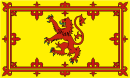
While in their lieutenancies, lord lieutenants are among the few individuals in Scotland officially permitted to fly the banner of the Royal Arms of Scotland, or Lion Rampant of Scotland
Royal Standard of Scotland
The Royal Standard of Scotland, , also known as the Banner of the King of Scots, or more commonly the Lion Rampant of Scotland, is the Scottish Royal Banner of Arms...
as it is more commonly known.
19th century
The Militia Act 1802 provided for the appointment of lieutenants to "Lieutenants for the Counties, Ridings, and Places" in England and Wales, and gave them command of the county militia. In the case of towns or cities which were counties of themselvesCounty corporate
A county corporate or corporate county was a type of subnational division used for local government in England, Ireland and Wales.Counties corporate were created during the Middle Ages, and were effectively small self-governing counties...
, the "chief magistrate" (meaning the mayor, chief bailiff or other head of the corporation) had the authority to appoint deputy lieutenants in the absence of an appointment of a lieutenant by the crown.
The Regulation of the Forces Act 1871 removed the lieutenant as head of the county militia, as the jurisdiction, duties and command exercised by the lieutenant were revested in the crown, but the power of recommending for first appointments was reserved to the lieutenant.
The Militia Act 1882 revested the jurisdiction of the lieutenants in the crown.
The lieutenancies were reestablished on a new basis by Section 29 of the 1882 Act which stated that "Her Majesty shall from time to time appoint lieutenants for the several counties in the United Kingdom". Counties for lieutenancy purposes were also redefined as "a county at large, with the exception that each riding of the county of York
Yorkshire
Yorkshire is a historic county of northern England and the largest in the United Kingdom. Because of its great size in comparison to other English counties, functions have been increasingly undertaken over time by its subdivisions, which have also been subject to periodic reform...
shall be a separate county". The text of the letters patent
Letters patent
Letters patent are a type of legal instrument in the form of a published written order issued by a monarch or president, generally granting an office, right, monopoly, title, or status to a person or corporation...
appointing lieutenants under the act stated they were to be:
...Our Lieutenant of and in the County of X and of all cities boroughs liberties places incorporated and privileged and other places whatsoever within the said county and the limits and precincts of the same.
This was a formal recognition of the situation that had existed since 1662 that the lieutenancies for the majority of counties corporate in England were held jointly with their associated county - for example a lieutenant was now appointed for "the County of Gloucester, and the City and County of Gloucester, and the City and County of City of Bristol".
Haverfordwest was permitted to retain a lieutenant while the Tower Hamlets and Cinque Ports were to be continue to be regarded as counties for lieutenancy purposes.
From 1889 lieutenancy counties in England
England
England is a country that is part of the United Kingdom. It shares land borders with Scotland to the north and Wales to the west; the Irish Sea is to the north west, the Celtic Sea to the south west, with the North Sea to the east and the English Channel to the south separating it from continental...
and Wales
Wales
Wales is a country that is part of the United Kingdom and the island of Great Britain, bordered by England to its east and the Atlantic Ocean and Irish Sea to its west. It has a population of three million, and a total area of 20,779 km²...
were to correspond to groupings of administrative counties
Administrative county
An administrative county was an administrative division in England and Wales and Ireland used for the purposes of local government. They are now abolished, although in Northern Ireland their former areas are used as the basis for lieutenancy....
and county boroughs established by the Local Government Act 1888
Local Government Act 1888
The Local Government Act 1888 was an Act of the Parliament of the United Kingdom, which established county councils and county borough councils in England and Wales...
. The creation of a new County of London
County of London
The County of London was a county of England from 1889 to 1965, corresponding to the area known today as Inner London. It was created as part of the general introduction of elected county government in England, by way of the Local Government Act 1888. The Act created an administrative County of...
also led to the ending of the Tower Hamlets
Tower division
The Tower Division was a liberty, a historical form of local government, in the ancient county of Middlesex, England. It was also known as the Tower Hamlets, and took its name from being under the special jurisdiction of the Constable of the Tower of London...
lieutenancy. The Act also extinguished the lieutenancy of the Cinque Ports.
Section 69 of the Local Government (Ireland) Act 1898
Local Government (Ireland) Act 1898
The Local Government Act 1898 was an Act of the Parliament of the United Kingdom that established a system of local government in Ireland similar to that already created for England, Wales and Scotland by legislation in 1888 and 1889...
realigned the lieutenancy counties with the new administrative counties created by the Act. The one exception was County Tipperary
County Tipperary
County Tipperary is a county of Ireland. It is located in the province of Munster and is named after the town of Tipperary. The area of the county does not have a single local authority; local government is split between two authorities. In North Tipperary, part of the Mid-West Region, local...
, which although administered by two county council
County council
A county council is the elected administrative body governing an area known as a county. This term has slightly different meanings in different countries.-United Kingdom:...
s, was to remain united for lieutenancy. In contrast to the legislation in England and Wales, each county borough
County borough
County borough is a term introduced in 1889 in the United Kingdom of Great Britain and Ireland , to refer to a borough or a city independent of county council control. They were abolished by the Local Government Act 1972 in England and Wales, but continue in use for lieutenancy and shrievalty in...
was to have its own lieutenant, and those counties corporate
County corporate
A county corporate or corporate county was a type of subnational division used for local government in England, Ireland and Wales.Counties corporate were created during the Middle Ages, and were effectively small self-governing counties...
not made county boroughs were abolished. The effect of this was to create a lieutenant for the county boroughs of Belfast
Lord Lieutenant of Belfast
The Lord Lieutenant of Belfast is the official representative of the Queen for the 'County Borough of Belfast', Northern Ireland. The current Lord Lieutenant is Dame Mary Peters who was appointed in August 2009. The position was first created in 1900 and was held by the Marquess of Londonderry...
and Londonderry, and to abolish those for the city of Kilkenny
Kilkenny
Kilkenny is a city and is the county town of the eponymous County Kilkenny in Ireland. It is situated on both banks of the River Nore in the province of Leinster, in the south-east of Ireland...
, borough of Drogheda
Drogheda
Drogheda is an industrial and port town in County Louth on the east coast of Ireland, 56 km north of Dublin. It is the last bridging point on the River Boyne before it enters the Irish Sea....
and town of Galway
Galway
Galway or City of Galway is a city in County Galway, Republic of Ireland. It is the sixth largest and the fastest-growing city in Ireland. It is also the third largest city within the Republic and the only city in the Province of Connacht. Located on the west coast of Ireland, it sits on the...
.
The office of lieutenant was honorary, and held during the royal pleasure, but virtually for life. Appointment to the office is by letters-patent under the great seal
Great Seal
- Countries :* Great Seal of Canada** Great Seal of Ontario* Great Seal of France* Seal of the President of Ireland* Great Seal of the Realm ** Great Seal of Northern Ireland** Great Seal of Scotland**Welsh Seal* Great Seal of the State...
. Usually, though not necessarily, the person appointed lieutenant was also appointed custos rotulorum
Custos rotulorum
Custos rotulorum is the keeper of an English county's records and, by virtue of that office, the highest civil officer in the county...
or keeper of the rolls. Appointments to the county bench of magistrate
Magistrate
A magistrate is an officer of the state; in modern usage the term usually refers to a judge or prosecutor. This was not always the case; in ancient Rome, a magistratus was one of the highest government officers and possessed both judicial and executive powers. Today, in common law systems, a...
s were usually made on the recommendation of the lieutenant.
20th century
The Territorial and Reserve Forces Act 1907Territorial and Reserve Forces Act 1907
The Territorial and Reserve Forces Act 1907 was an Act of the Parliament of the United Kingdom that reformed the auxiliary forces of the British Army by transferring existing Volunteer and Yeomanry units into a new Territorial Force ; and disbanding the Militia to form a new Special Reserve of the...
established County Territorial Force Associations, of which the lieutenant was to be head, styled president of the county association. It restated the combination of counties and counties corporate as lieutenancy counties.
In 1921, with the establishment of Northern Ireland
Northern Ireland
Northern Ireland is one of the four countries of the United Kingdom. Situated in the north-east of the island of Ireland, it shares a border with the Republic of Ireland to the south and west...
, lieutenants continued to be appointed through the Governor of Northern Ireland
Governor of Northern Ireland
The Governor of Northern Ireland was the principal officer and representative in Northern Ireland of the British monarch. The office was established on 9 December 1922 and abolished on 18 July 1973.-Overview:...
to the six counties and two county boroughs. The creation of the Irish Free State
Irish Free State
The Irish Free State was the state established as a Dominion on 6 December 1922 under the Anglo-Irish Treaty, signed by the British government and Irish representatives exactly twelve months beforehand...
in the following year saw the remaining county lieutenancies in Ireland
Ireland
Ireland is an island to the northwest of continental Europe. It is the third-largest island in Europe and the twentieth-largest island on Earth...
abolished. In 1973 the counties and county boroughs were abolished as local government units in Northern Ireland
Northern Ireland
Northern Ireland is one of the four countries of the United Kingdom. Situated in the north-east of the island of Ireland, it shares a border with the Republic of Ireland to the south and west...
, and lord-lieutenants are now appointed directly by the Queen to "counties and county boroughs... as defined for local government purposes immediately before 1 October 1973". In 1975 the term lord-lieutenant officially replaced that of lieutenant.
Local Government reform in England
England
England is a country that is part of the United Kingdom. It shares land borders with Scotland to the north and Wales to the west; the Irish Sea is to the north west, the Celtic Sea to the south west, with the North Sea to the east and the English Channel to the south separating it from continental...
in 1965 led to the appointment of lieutenants to Greater London
Greater London
Greater London is the top-level administrative division of England covering London. It was created in 1965 and spans the City of London, including Middle Temple and Inner Temple, and the 32 London boroughs. This territory is coterminate with the London Government Office Region and the London...
and Huntingdon and Peterborough
Huntingdon and Peterborough
Huntingdon and Peterborough was a short-lived administrative county in East Anglia in the United Kingdom. It existed from 1965 to 1974, when it became part of Cambridgeshire.-Formation:...
, and the abolition of those of the County of London
County of London
The County of London was a county of England from 1889 to 1965, corresponding to the area known today as Inner London. It was created as part of the general introduction of elected county government in England, by way of the Local Government Act 1888. The Act created an administrative County of...
, Middlesex
Middlesex
Middlesex is one of the historic counties of England and the second smallest by area. The low-lying county contained the wealthy and politically independent City of London on its southern boundary and was dominated by it from a very early time...
and Huntingdonshire
Huntingdonshire
Huntingdonshire is a local government district of Cambridgeshire, covering the area around Huntingdon. Traditionally it is a county in its own right...
.
A more fundamental reform of local government throughout England
England
England is a country that is part of the United Kingdom. It shares land borders with Scotland to the north and Wales to the west; the Irish Sea is to the north west, the Celtic Sea to the south west, with the North Sea to the east and the English Channel to the south separating it from continental...
and Wales
Wales
Wales is a country that is part of the United Kingdom and the island of Great Britain, bordered by England to its east and the Atlantic Ocean and Irish Sea to its west. It has a population of three million, and a total area of 20,779 km²...
(outside Greater London
Greater London
Greater London is the top-level administrative division of England covering London. It was created in 1965 and spans the City of London, including Middle Temple and Inner Temple, and the 32 London boroughs. This territory is coterminate with the London Government Office Region and the London...
) created a new structure of metropolitan, non-metropolitan and Welsh counties in 1974. Section 218 of the Local Government Act 1972
Local Government Act 1972
The Local Government Act 1972 is an Act of Parliament in the United Kingdom that reformed local government in England and Wales on 1 April 1974....
that established the new system stated: "Her Majesty shall appoint a lord-lieutenant for each county in England and Wales and for Greater London..." The Act appears to be the first statutory use of the term "lord-lieutenant" for lieutenants to counties.
Existing lord lieutenants were assigned to one of the corresponding new counties wherever possible. Where this could not be done, the existing office-holder became a lieutenant of a county, junior to the lord-lieutenant. For example, the Lord Lieutenant of Montgomeryshire
Lord Lieutenant of Montgomeryshire
The following is a list of people that have held the title of Lord Lieutenant of Montgomeryshire. After 1761, all Lord Lieutenants were also Custos Rotulorum of Montgomeryshire...
was appointed Lord Lieutenant of Powys
Lord Lieutenant of Powys
This is an incomplete list of people who have served as Lord Lieutenant for Powys. Prior to 1974, the Monarch was represented in the area by the Lord Lieutenant of Montgomeryshire, the Lord Lieutenant of Radnorshire and the Lord Lieutenant of Brecknockshire....
, with those of Breconshire and Radnorshire each being designated as simply "Lieutenant of Powys". This measure was temporary, and no lieutenants have been appointed in this way since 1974, although the power still exists.
In 1975 counties ceased to be used for local government purposes in Scotland
Scotland
Scotland is a country that is part of the United Kingdom. Occupying the northern third of the island of Great Britain, it shares a border with England to the south and is bounded by the North Sea to the east, the Atlantic Ocean to the north and west, and the North Channel and Irish Sea to the...
. The Local Government (Scotland) Act 1973
Local Government (Scotland) Act 1973
The Local Government Act 1973 is an Act of the Parliament of the United Kingdom, that reformed local government in Scotland, on May 16, 1975....
replaced the counties with regions, and each region was to have one or more lord-lieutenants appointed. The areas to which they were appointed approximated to the counties and were based and were defined in terms of the new local government districts.
Present day
Lieutenancy areas of Scotland
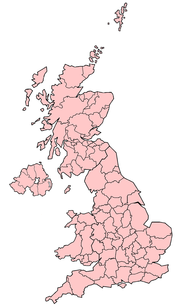
The lieutenancy areas of Scotland are the areas used for the ceremonial lord-lieutenants, the monarch's representatives, in Scotland. They are different from the local government council areas, the committee areas, the sheriffdoms, the registration counties, the former regions and districts, the...
.
Partial reform of local government in England
England
England is a country that is part of the United Kingdom. It shares land borders with Scotland to the north and Wales to the west; the Irish Sea is to the north west, the Celtic Sea to the south west, with the North Sea to the east and the English Channel to the south separating it from continental...
since 1995 has led to the creation of so-called ceremonial counties
Ceremonial counties of England
The ceremonial counties are areas of England to which are appointed a Lord Lieutenant, and are defined by the government as counties and areas for the purposes of the Lieutenancies Act 1997 with reference to the metropolitan and non-metropolitan counties of England and Lieutenancies Act 1997...
to which lord-lieutenants are now appointed. The Lieutenancies Act 1997
Lieutenancies Act 1997
The Lieutenancies Act 1997 is an Act of Parliament in the United Kingdom, that defines areas that Lord-Lieutenants are appointed to in Great Britain. It came into force on July 1, 1997.-Creation of modern local government:...
is the most recent piece of primary legislation dealing with Lieutenancies in England and includes the definitive list of the current areas used. Ceremonial counties may comprise combinations of county council areas and unitary authorities.
Since the local government re-organisation of 1996 in Wales
Wales
Wales is a country that is part of the United Kingdom and the island of Great Britain, bordered by England to its east and the Atlantic Ocean and Irish Sea to its west. It has a population of three million, and a total area of 20,779 km²...
, lord-lieutenants are now appointed to preserved counties
Preserved counties of Wales
The preserved counties of Wales are the current areas used in Wales for the ceremonial purposes of Lieutenancy and Shrievalty. They are based on the counties created by the Local Government Act 1972 and used for local government and other purposes between 1974 and 1996.-Usage:The Local Government ...
.
The City of London
City of London
The City of London is a small area within Greater London, England. It is the historic core of London around which the modern conurbation grew and has held city status since time immemorial. The City’s boundaries have remained almost unchanged since the Middle Ages, and it is now only a tiny part of...
was unaffected by changes introduced since 1882. It has a Commission of Lieutenancy rather than a single lord-lieutenant. The head of the commission is the Lord Mayor of the City of London.
Lord-lieutenants are the monarch's representatives in their lieutenancy. It is their foremost duty to uphold the dignity of the Crown, and in so doing they seek to promote a spirit of co-operation and good atmosphere by the time they give to voluntary and benevolent organisations and by the interest they take in the business and social life of their counties.
The modern responsibilities of lord-lieutenants include:
- Arranging visits of members of the Royal familyBritish Royal FamilyThe British Royal Family is the group of close relatives of the monarch of the United Kingdom. The term is also commonly applied to the same group of people as the relations of the monarch in her or his role as sovereign of any of the other Commonwealth realms, thus sometimes at variance with...
and escorting royal visitors; - Presenting medals and awards on behalf of the Sovereign, and advising on HonoursBritish honours systemThe British honours system is a means of rewarding individuals' personal bravery, achievement, or service to the United Kingdom and the British Overseas Territories...
nominations; - Participating in civic, voluntary and social activities within the lieutenancy;
- Liaising with local units of the Royal NavyRoyal NavyThe Royal Navy is the naval warfare service branch of the British Armed Forces. Founded in the 16th century, it is the oldest service branch and is known as the Senior Service...
, Royal MarinesRoyal MarinesThe Corps of Her Majesty's Royal Marines, commonly just referred to as the Royal Marines , are the marine corps and amphibious infantry of the United Kingdom and, along with the Royal Navy and Royal Fleet Auxiliary, form the Naval Service...
, ArmyBritish ArmyThe British Army is the land warfare branch of Her Majesty's Armed Forces in the United Kingdom. It came into being with the unification of the Kingdom of England and Scotland into the Kingdom of Great Britain in 1707. The new British Army incorporated Regiments that had already existed in England...
, Royal Air ForceRoyal Air ForceThe Royal Air Force is the aerial warfare service branch of the British Armed Forces. Formed on 1 April 1918, it is the oldest independent air force in the world...
and their associated cadet forces; - Leading the local magistracyMagistrateA magistrate is an officer of the state; in modern usage the term usually refers to a judge or prosecutor. This was not always the case; in ancient Rome, a magistratus was one of the highest government officers and possessed both judicial and executive powers. Today, in common law systems, a...
as chairman of the Advisory Committee on Justices of the PeaceJustice of the PeaceA justice of the peace is a puisne judicial officer elected or appointed by means of a commission to keep the peace. Depending on the jurisdiction, they might dispense summary justice or merely deal with local administrative applications in common law jurisdictions...
; and - Chairing the local Advisory Committee for the Appointment of the General Commissioners of Income TaxIncome taxAn income tax is a tax levied on the income of individuals or businesses . Various income tax systems exist, with varying degrees of tax incidence. Income taxation can be progressive, proportional, or regressive. When the tax is levied on the income of companies, it is often called a corporate...
, a tribunal which hears appeals against decisions made by the HM Revenue and Customs on a variety of different tax related matters.
As the sovereign's representative in his or her county, the lord-lieutenant remains non-political and does not hold office in any political party. They are appointed for life, although the customary age of retirement is 75 and the sovereign may remove them.
The lord-lieutenant is supported by a vice lord-lieutenant and deputy lieutenants that he or she appoints. The vice lord-lieutenant takes over when the lord-lieutenant is abroad, ill, or otherwise incapacitated. The lord-lieutenant appoints between 30 to 40 deputy lieutenants depending on the county's population size.
They are unpaid, but receive minimal allowances for secretarial help, mileage allowance and a driver. Male lord-lieutenants receive an allowance for the ceremonial uniform, worn when receiving members of the royal family and on other formal occasions.
There is no uniform for a female lord-lieutenant, but there is a badge which can be worn on ceremonial occasions. Male lord-lieutenants wear a dark blue uniform in the style of an Army No. 1 dress along with a cap and sword with a steel scabbard. The uniform for a male vice lord-lieutenant and for deputy lieutenants is of a similar style, but with features to distinguish it from that of a lord-lieutenant.
Lord Lieutenant of Ireland
The Lord Lieutenant of IrelandLord Lieutenant of Ireland
The Lord Lieutenant of Ireland was the British King's representative and head of the Irish executive during the Lordship of Ireland , the Kingdom of Ireland and the United Kingdom of Great Britain and Ireland...
was the head of the British administration in Ireland
Ireland
Ireland is an island to the northwest of continental Europe. It is the third-largest island in Europe and the twentieth-largest island on Earth...
until the foundation of the Irish Free State
Irish Free State
The Irish Free State was the state established as a Dominion on 6 December 1922 under the Anglo-Irish Treaty, signed by the British government and Irish representatives exactly twelve months beforehand...
in 1922.
Correct forms of address for the Lord-Lieutenant
- Written: '(Title and name), Her Majesty's Lord-Lieutenant'
- Salutation: 'Dear Lord-Lieutenant'
- In a Speech: 'My Lord-Lieutenant'
- In conversation: '(Title and name)' or 'Lord-Lieutenant'.
- Plural: 'Lord-Lieutenants'
See also
- Deputy LieutenantDeputy LieutenantIn the United Kingdom, a Deputy Lieutenant is one of several deputies to the Lord Lieutenant of a lieutenancy area; an English ceremonial county, Welsh preserved county, Scottish lieutenancy area, or Northern Irish county borough or county....
- Ceremonial counties of EnglandCeremonial counties of EnglandThe ceremonial counties are areas of England to which are appointed a Lord Lieutenant, and are defined by the government as counties and areas for the purposes of the Lieutenancies Act 1997 with reference to the metropolitan and non-metropolitan counties of England and Lieutenancies Act 1997...
- High SheriffHigh SheriffA high sheriff is, or was, a law enforcement officer in the United Kingdom, Canada and the United States.In England and Wales, the office is unpaid and partly ceremonial, appointed by the Crown through a warrant from the Privy Council. In Cornwall, the High Sheriff is appointed by the Duke of...
- Lieutenancy areas of ScotlandLieutenancy areas of ScotlandThe lieutenancy areas of Scotland are the areas used for the ceremonial lord-lieutenants, the monarch's representatives, in Scotland. They are different from the local government council areas, the committee areas, the sheriffdoms, the registration counties, the former regions and districts, the...
- Preserved counties of WalesPreserved counties of WalesThe preserved counties of Wales are the current areas used in Wales for the ceremonial purposes of Lieutenancy and Shrievalty. They are based on the counties created by the Local Government Act 1972 and used for local government and other purposes between 1974 and 1996.-Usage:The Local Government ...
- Lists of Lord Lieutenancies
- List of the Lord Lieutenants of the United Kingdom