

Royal Irish Rangers

Encyclopedia
The Royal Irish Rangers (abbreviated as "R IRISH") was a regular infantry
regiment
of the British Army
.
infantry regiments of the British Army
:
The date was initially known as Vesting Day (and then Rangers Day), emphasising that the traditions of the old regiments were vested in the new large regiment. 1 July is also Somme Day
; a preeminent day in military history for the whole island of Ireland.
Soon after creation in December 1968, and as part of a general reduction in the Army, the 3rd Battalion (former Royal Irish Fusiliers) was disbanded.
The three regiments had old and differing traditions (Rifle & Fusilier) and to avoid favouring one above another, a unique designation Rangers was adopted. The title had not existed in the British Army since 1922. The title is also used by the US Army
, Canada
, Ireland
and Pakistan
.
With the creation of the Divisions of Infantry, the Royal Irish Rangers became part of the King's Division
, along with regiments from the north of England. This continued until 1992 and Options for Change
. The Ulster Defence Regiment
and The Royal Irish Rangers amalgamated to form The Royal Irish Regiment.
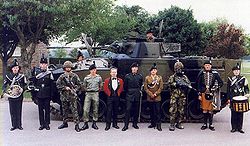
to form the new The Royal Irish Regiment (27th (Inniskilling) 83rd and 87th and Ulster Defence Regiment).
:
Historically, in the lst. Battalion (Connaught Rangers), formerly the 88th, a favourite march tune was "Brian Boru" played when marching through a town - often after a hot and heavy march. On such occasions, and at a time given by the Sergeant Major, the Band would pause and all ranks would give a "Connaught Yell". The march became popular among the other Irish Regiments and various other sets of lyrics were devised (see Killaloe
page)
Killaloe is unique. It is the only march the soldiers join in with. On parade they give a spine-tingling "Ranger Yell"; this continues with the Royal Irish Regiment.
The first known recording of Killaloe was made by Richard Dimbleby
when serving as a BBC
war correspondent in Northern France shortly before Dunkirk
. The "Famous Irish Regiment" Dimbleby reports playing as they march past is not named, but would have been either the Royal Irish Fusiliers or the Royal Inniskilling Fusiliers.
Again in 1944, the BBC recorded The 1st. Battalion, Royal Inniskilling Fusiliers Pipes & Drums playing Killaloe, by then adopted unofficially as the march of the 38th (Irish) Brigade
, during the approach to Monte Cassino
.
Killaloe was adopted by The Royal Irish Rangers on its formation and again later by the Royal Irish Regiment on its amalgamation in 1992.
The soldiers had their own words to the tune which would be sung, sotto voce, as they marched:
To hear the tune visit: Ranger website
. It is available as sheet-music. The lyrics.:
The song uses anglicised versions of Irish words
For example the first line should read: "Eileen a leanbh, Eileen a stór" ("a leanbh" and "a stór" in the song's context, are Irish phrases for "my love" or "my dear").
Similarly the line "Eileen Alannah, Augus Asthore" is the anglicised version of "Eileen a leanbh agus a stór".
"Agus" is the Irish word for "and"; "Mavourneen" is an anglicised spelling of "mo mhuirnín" which in Irish means "my darling"; and "colleen" is the anglicised word for "cailín", which is Irish for "girl".
in 1989, the Irish Rangers were able to parade a combined band from 1 & 2 R IRISH together with the Bugles, Pipers & Drums from both.
| align="center" colspan="4"|Lineage
|-
| width="25%" rowspan="6" align="center"| The Royal Irish Rangers (27th (Inniskilling) 83rd and 87th)
| width="25%" rowspan="2" align="center"| The Royal Inniskilling Fusiliers
| width="25%" align="center"| The 27th (Inniskilling) Regiment of Foot
|-
| width="25%" align="center"| The 108th Regiment of Foot (Madras Infantry)
|-
| width="25%" rowspan="2" align="center"| The Royal Ulster Rifles
| width="25%" align="center"| 83rd (County of Dublin) Regiment of Foot
|-
| width="25%" align="center"| The 86th (Royal County Down) Regiment of Foot
|-
| width="25%" rowspan="2" align="center"| The Royal Irish Fusiliers (Princess Victoria's)
| width="25%" align="center"| The 87th (Royal Irish Fusiliers) Regiment of Foot
|-
| width="25%" align="center"| The 89th (The Princess Victoria's) Regiment of Foot
Infantry
Infantrymen are soldiers who are specifically trained for the role of fighting on foot to engage the enemy face to face and have historically borne the brunt of the casualties of combat in wars. As the oldest branch of combat arms, they are the backbone of armies...
regiment
Regiment
A regiment is a major tactical military unit, composed of variable numbers of batteries, squadrons or battalions, commanded by a colonel or lieutenant colonel...
of the British Army
British Army
The British Army is the land warfare branch of Her Majesty's Armed Forces in the United Kingdom. It came into being with the unification of the Kingdom of England and Scotland into the Kingdom of Great Britain in 1707. The new British Army incorporated Regiments that had already existed in England...
.
Creation
The Royal Irish Rangers came into being on 1 July 1968 through the amalgamation of the three remaining IrishIreland
Ireland is an island to the northwest of continental Europe. It is the third-largest island in Europe and the twentieth-largest island on Earth...
infantry regiments of the British Army
British Army
The British Army is the land warfare branch of Her Majesty's Armed Forces in the United Kingdom. It came into being with the unification of the Kingdom of England and Scotland into the Kingdom of Great Britain in 1707. The new British Army incorporated Regiments that had already existed in England...
:
- The Royal Inniskilling FusiliersRoyal Inniskilling FusiliersThe Royal Inniskilling Fusiliers was a Irish infantry regiment of the British Army formed in 1881 by the amalgamation of the 27th Regiment of Foot and the 108th Regiment of Foot...
- The Royal Ulster RiflesRoyal Ulster RiflesThe Royal Ulster Rifles was a British Army infantry regiment. It saw service in the Second Boer War, Great War, the Second World War and the Korean War, before being amalgamated into the Royal Irish Rangers in 1968.-History:...
- The Royal Irish FusiliersRoyal Irish FusiliersThe Royal Irish Fusiliers was an Irish infantry regiment of the British Army, formed by the amalgamation of the 87th Regiment of Foot and the 89th Regiment of Foot in 1881. The regiment's first title in 1881 was Princess Victoria's , changed in 1920 to The Royal Irish Fusiliers...
The date was initially known as Vesting Day (and then Rangers Day), emphasising that the traditions of the old regiments were vested in the new large regiment. 1 July is also Somme Day
First day on the Somme
The first day on the Somme, 1 July 1916, was the opening day of the Battle of Albert, which was the first phase of the British and French offensive that became known as the Battle of the Somme...
; a preeminent day in military history for the whole island of Ireland.
Soon after creation in December 1968, and as part of a general reduction in the Army, the 3rd Battalion (former Royal Irish Fusiliers) was disbanded.
The three regiments had old and differing traditions (Rifle & Fusilier) and to avoid favouring one above another, a unique designation Rangers was adopted. The title had not existed in the British Army since 1922. The title is also used by the US Army
United States Army Rangers
United States Army Rangers are elite members of the United States Army. Rangers have served in recognized U.S. Army Ranger units or have graduated from the U.S. Army's Ranger School...
, Canada
Canadian Rangers
The Canadian Rangers are a sub-component of the Canadian Forces reserve that provide a military presence in Canada's sparsely settled northern, coastal, and isolated areas. Formally established on May 23, 1947, a primary role of this part-time force is to conduct surveillance or sovereignty...
, Ireland
Irish Army Rangers
The Army Ranger Wing is the special forces unit of the Irish Defence Forces.The ARW trains and operates with many international special operations units worldwide, including the US Army Rangers, Delta Force, French GIGN, German GSG 9, Polish GROM, Swedish SSG, Italian COMSUBIN, Australian SAS,...
and Pakistan
Pakistan Rangers
The Pakistan Rangers are part of the Paramilitary forces of Pakistan, and consists of members of the Pakistan Army under the direct control of the Ministry of the Interior of the Pakistan Government. The Rangers are an internal security force with the prime objective to provide and maintain...
.
With the creation of the Divisions of Infantry, the Royal Irish Rangers became part of the King's Division
King's Division
The King's Division is a British Army command, training and administrative apparatus designated for infantry regiments in the North of England. The King's Division was formed in 1968 with the union of the Lancastrian Brigade, Yorkshire Brigade and North Irish Brigade...
, along with regiments from the north of England. This continued until 1992 and Options for Change
Options for Change
Options for Change was a restructuring of the British Armed Forces in 1990, aimed at cutting defence spending following the end of the Cold War....
. The Ulster Defence Regiment
Ulster Defence Regiment
The Ulster Defence Regiment was an infantry regiment of the British Army which became operational in 1970, formed on similar lines to other British reserve forces but with the operational role of defence of life or property in Northern Ireland against armed attack or sabotage...
and The Royal Irish Rangers amalgamated to form The Royal Irish Regiment.
Uniform
Accommodating the traditions of the three regiments required compromise:- The caubeenCaubeenThe caubeen is an Irish beret. It was formerly worn by peasants; however, it has since been adopted as the headdress of the Irish regiments of the British and Commonwealth armies, where its formal name is the "Bonnet, Irish, Green".-Name:...
was adopted as the headdress for the new Regiment as all the former regiments had worn it - The green hackleHackleThe hackle is a clipped feather plume that is attached to a military headdress.In the British Army and the armies of some Commonwealth countries the hackle is worn by some infantry regiments, especially those designated as fusilier regiments and those with Scottish and Northern Irish origins. The...
was formerly worn by the Royal Irish Fusiliers - The Castle collar badges had been worn by the Royal Inniskilling Fusiliers
- The black buttons had been worn by the Royal Ulster Rifles
- The brown cross belt was a compromise between the brown Sam Browne beltSam Browne beltThe Sam Browne belt is a wide belt, usually leather, which is supported by a strap going diagonally over the right shoulder. It is most often seen as part of a military or police uniform.-Origins:...
s worn by the Fusiliers and the black cross belt worn in the Rifles - The Great Irish WarpipesGreat Irish WarpipesThe Great Irish Warpipes are an instrument that in modern practice is identical, and historically was analogous or identical to the Great Highland Bagpipe. "Warpipes" is an English term; The first use of the Gaelic term in Ireland is recorded in a poem by John O'Naughton , in which the bagpipes...
carried by the Royal Ulster RiflesRoyal Ulster RiflesThe Royal Ulster Rifles was a British Army infantry regiment. It saw service in the Second Boer War, Great War, the Second World War and the Korean War, before being amalgamated into the Royal Irish Rangers in 1968.-History:...
pipers and the Brian Boru PipesBrian Boru bagpipesThe Brian Boru bagpipe was invented and patented in 1908 by Henry Starck, an instrument maker , in London, in consultation with William O'Duane. The name was chosen in honour of the Irish king Brian Boru , though this bagpipe is not a recreation of any pipes that were played at the time of his reign...
carried by The Royal Inniskilling Fusiliers pipers were abandoned in favour of the Great Highland BagpipeGreat Highland BagpipeThe Great Highland Bagpipe is a type of bagpipe native to Scotland. It has achieved widespread recognition through its usage in the British military and in pipe bands throughout the world. It is closely related to the Great Irish Warpipes....
, which thus became standardised throughout the British Army. - The badges of the three regiments were worn on the kilts of the regimental pipers.
Service
The Rangers served in, inter alia, the following places:- Northern Ireland. 1 R IRISH first in 1989 and 2 R IRISH in 1991. This overcame resistance to the Regiment serving in Northern Ireland at the height of the troubles although most officers and many NCOsNon-commissioned officerA non-commissioned officer , called a sub-officer in some countries, is a military officer who has not been given a commission...
had traditionally completed operational tours with other regiments. - BAOR. At amalgamation 1 R IRISH was in OsnabrückOsnabrückOsnabrück is a city in Lower Saxony, Germany, some 80 km NNE of Dortmund, 45 km NE of Münster, and some 100 km due west of Hanover. It lies in a valley penned between the Wiehen Hills and the northern tip of the Teutoburg Forest...
and 2 R IRISH in LemgoLemgoLemgo is a city in the Lippe district of North Rhine-Westphalia, Germany, with a population of c. 42,000.It was founded in the 12th century by Bernhard II at the crossroad of two merchant routes. Lemgo was a member of the Hanseatic League, a medieval trading association of free cities in several...
. - USA. Including a visit in the mid-1970s to Washington, D.C.Washington, D.C.Washington, D.C., formally the District of Columbia and commonly referred to as Washington, "the District", or simply D.C., is the capital of the United States. On July 16, 1790, the United States Congress approved the creation of a permanent national capital as permitted by the U.S. Constitution....
when one Ranger with a knowledge of military history recalled the last visit in 1812War of 1812The War of 1812 was a military conflict fought between the forces of the United States of America and those of the British Empire. The Americans declared war in 1812 for several reasons, including trade restrictions because of Britain's ongoing war with France, impressment of American merchant...
when Irish ancestors had burned the White HouseWhite HouseThe White House is the official residence and principal workplace of the president of the United States. Located at 1600 Pennsylvania Avenue NW in Washington, D.C., the house was designed by Irish-born James Hoban, and built between 1792 and 1800 of white-painted Aquia sandstone in the Neoclassical...
down. - Bosnia and HerzegovinaBosnia and HerzegovinaBosnia and Herzegovina , sometimes called Bosnia-Herzegovina or simply Bosnia, is a country in Southern Europe, on the Balkan Peninsula. Bordered by Croatia to the north, west and south, Serbia to the east, and Montenegro to the southeast, Bosnia and Herzegovina is almost landlocked, except for the...
. As part of the first UK deploymentBosnian WarThe Bosnian War or the War in Bosnia and Herzegovina was an international armed conflict that took place in Bosnia and Herzegovina between April 1992 and December 1995. The war involved several sides...
and as reinforcements to the Cheshire RegimentCheshire RegimentThe Cheshire Regiment was an infantry regiment of the British Army, part of the Prince of Wales' Division.The regiment was created in 1881 as part of the Childers reforms by the linking of the 22nd Regiment of Foot and the militia and rifle volunteers of Cheshire...
. - The Falkland Islands. Immediately after the 1982 warFalklands WarThe Falklands War , also called the Falklands Conflict or Falklands Crisis, was fought in 1982 between Argentina and the United Kingdom over the disputed Falkland Islands and South Georgia and the South Sandwich Islands...
; no line infantryLine infantryLine infantry is a type of infantry which composed the basis of European land armies from the middle of the 17th century to the middle of the 19th century....
regiments fought in the conflict.
Options for Change
Under this reorganisation, the Royal Irish Rangers were amalgamated with the Ulster Defence RegimentUlster Defence Regiment
The Ulster Defence Regiment was an infantry regiment of the British Army which became operational in 1970, formed on similar lines to other British reserve forces but with the operational role of defence of life or property in Northern Ireland against armed attack or sabotage...
to form the new The Royal Irish Regiment (27th (Inniskilling) 83rd and 87th and Ulster Defence Regiment).
Territorial Army
The name of the Royal Irish Rangers was maintained through the Territorial Army battalion in Northern Ireland, which nominally exists to augment the Royal Irish Regiment's ORBAT, but can be deployed in support of any regular unit. In 2007, following the disbanding of the Home Service Battalions of the Royal Irish Regiment, the Royal Irish Rangers TA were renamed as the new 2nd Battalion Royal Irish Regiment.Post 1968
- 1972. Ranger William J Best – 1 R IRISH. A 19 year old on leave from Germany, abducted from his mother's home in the CregganCregganCreggan can refer to:*Creggan, County Armagh, a small village in Northern Ireland*Creggan, County Tyrone, a townland in Northern Ireland*Creggan, Derry, a large housing estate in Derry, Northern Ireland...
, DerryDerryDerry or Londonderry is the second-biggest city in Northern Ireland and the fourth-biggest city on the island of Ireland. The name Derry is an anglicisation of the Irish name Doire or Doire Cholmcille meaning "oak-wood of Colmcille"...
and killed by the OIRAOfficial IRAThe Official Irish Republican Army or Official IRA is an Irish republican paramilitary group whose goal was to create a "32-county workers' republic" in Ireland. It emerged from a split in the Irish Republican Army in December 1969, shortly after the beginning of "The Troubles"...
. - 19 July 1972. Staff SergeantStaff SergeantStaff sergeant is a rank of non-commissioned officer used in several countries.The origin of the name is that they were part of the staff of a British army regiment and paid at that level rather than as a member of a battalion or company.-Australia:...
Talaiasi Labalaba BEMBEMBEM may refer to:* Brotherhood of Evil Mutants, an organization in the fictional X-Men universe* Bug-eyed monster, a stock character in science fiction* Birdseye maple, a type of wood* Black-eared Miner, an endangered bird species from Australia...
, MID – 2 R IRISH (attached 22 SASSpecial Air ServiceSpecial Air Service or SAS is a corps of the British Army constituted on 31 May 1950. They are part of the United Kingdom Special Forces and have served as a model for the special forces of many other countries all over the world...
). During Battle of MirbatBattle of MirbatThe Battle of Mirbat took place on 19 July 1972 during the Dhofar Rebellion in Oman, which was supported by Communist guerrillas from South Yemen...
. - MajorMajorMajor is a rank of commissioned officer, with corresponding ranks existing in almost every military in the world.When used unhyphenated, in conjunction with no other indicator of rank, the term refers to the rank just senior to that of an Army captain and just below the rank of lieutenant colonel. ...
D P Farrell MBEMBEMBE can stand for:* Mail Boxes Etc.* Management by exception* Master of Bioethics* Master of Bioscience Enterprise* Master of Business Engineering* Master of Business Economics* Mean Biased Error...
– 1 R IRISH (Retired). Shot dead by the OIRA when he was walking his dog near his home in TyroneTyroneThe name Tyrone can refer to:*County Tyrone, a county in Northern Ireland, roughly corresponding to the ancient kingdom of Tír Eogain*An Earl of Tyrone*A small steam train which runs between Bushmills and the Giant's Causeway in Northern Ireland-Places:...
. - 12 April 1974. CaptainCaptain (OF-2)The army rank of captain is a commissioned officer rank historically corresponding to command of a company of soldiers. The rank is also used by some air forces and marine forces. Today a captain is typically either the commander or second-in-command of a company or artillery battery...
S Garthwaite MID - attached 22 SASSpecial Air ServiceSpecial Air Service or SAS is a corps of the British Army constituted on 31 May 1950. They are part of the United Kingdom Special Forces and have served as a model for the special forces of many other countries all over the world...
. OmanDhofar RebellionThe Dhofar Rebellion was launched in the province of Dhofar against the Sultanate of Muscat and Oman, which had British support, from 1962 to 1976. It ended with the defeat of the rebels, but the state of Oman had to be radically reformed and modernised to cope with the campaign.-Background:In...
. - 6 December 1977. Ranger Charles George McLaughlin and Ranger Hugh Thompson - 1 R IRISH. Died on Fire Fighting duties in Manchester during the firemen's strike (Operation BURBERRY).
- 28 December 1980. Warrant Officer Class 2 Hugh McGinn – 5 (V) R IRISH. Shot by the Irish National Liberation ArmyIrish National Liberation ArmyThe Irish National Liberation Army or INLA is an Irish republican socialist paramilitary group that was formed on 8 December 1974. Its goal is to remove Northern Ireland from the United Kingdom and create a socialist united Ireland....
at the door of his home in ArmaghArmaghArmagh is a large settlement in Northern Ireland, and the county town of County Armagh. It is a site of historical importance for both Celtic paganism and Christianity and is the seat, for both the Roman Catholic Church and the Church of Ireland, of the Archbishop of Armagh...
. - SergeantSergeantSergeant is a rank used in some form by most militaries, police forces, and other uniformed organizations around the world. Its origins are the Latin serviens, "one who serves", through the French term Sergent....
Trevor A Elliot - 5(V) R IRISH. Shot by Provisional Irish Republican ArmyProvisional Irish Republican ArmyThe Provisional Irish Republican Army is an Irish republican paramilitary organisation whose aim was to remove Northern Ireland from the United Kingdom and bring about a socialist republic within a united Ireland by force of arms and political persuasion...
(PIRA) in KeadyKeadyKeady is a town in County Armagh, Northern Ireland. It is situated south of Armagh city and very close to the border with the Republic of Ireland. The town had a population of 2,960 people in the 2001 Census.... - 9 May 1984. CorporalCorporalCorporal is a rank in use in some form by most militaries and by some police forces or other uniformed organizations. It is usually equivalent to NATO Rank Code OR-4....
Trevor May - 4(V) R IRISH. Killed in NewryNewryNewry is a city in Northern Ireland. The River Clanrye, which runs through the city, formed the historic border between County Armagh and County Down. It is from Belfast and from Dublin. Newry had a population of 27,433 at the 2001 Census, while Newry and Mourne Council Area had a population...
when an Improvised explosive deviceImprovised explosive deviceAn improvised explosive device , also known as a roadside bomb, is a homemade bomb constructed and deployed in ways other than in conventional military action...
placed under a car exploded. - 9 October 1989. Lance CorporalLance CorporalLance corporal is a military rank, used by many armed forces worldwide, and also by some police forces and other uniformed organizations. It is below the rank of corporal, and is typically the lowest non-commissioned officer, usually equivalent to the NATO Rank Grade OR-3.- Etymology :The presumed...
Tommy Gibson – 4(V) R IRISH. Killed by PIRA in KilreaKilreaKilrea is a village and townland in County Londonderry, Northern Ireland. It is near the River Bann, which marks the boundary between County Londonderry and County Antrim...
. - 24 October 1990. Ranger Cyril J Smith QGM - 2 R IRISH. Killed when attempting to release a man tied to a proxy bombProxy BombThe proxy bomb was a tactic used by the Provisional Irish Republican Army for a short time in the early 1990s, whereby members of the British security forces or British Army employees were forced to drive car bombs into British military targets, after taking their families as hostages. It has...
- his car - driven into a Border checkpointBorder checkpointA border checkpoint is a place, generally between two countries, where travellers and/or goods are inspected. Authorization often is required to enter a country through its borders. Access-controlled borders often have a limited number of checkpoints where they can be crossed without legal...
at KilleenKilleen-Places:* Killeen, County Armagh - a village in County Armagh, Northern Ireland* Killeen, County Cork - a village in County Cork, Ireland* Killeen, County Down - a townland in County Down, Northern Ireland...
near NewryNewryNewry is a city in Northern Ireland. The River Clanrye, which runs through the city, formed the historic border between County Armagh and County Down. It is from Belfast and from Dublin. Newry had a population of 27,433 at the 2001 Census, while Newry and Mourne Council Area had a population...
. The man's family were held hostage in their home. - 17 January 1992. Ranger Robert Dunseath – 4 R IRISH. Killed in a land mineLand mineA land mine is usually a weight-triggered explosive device which is intended to damage a target—either human or inanimate—by means of a blast and/or fragment impact....
attack at TeebaneThe Troubles in Cookstown (Tyrone)The Troubles in Cookstown recounts incidents during, and the effects of, The Troubles in Cookstown, County Tyrone, Northern Ireland.Incidents in Cookstown during the Troubles resulting in fatalities:-1976:...
Crossroads, near CookstownCookstownCookstown may refer to either of the following:*Cookstown, County Tyrone, Northern Ireland*Cookstown, Ontario, Canada*Cookstown, New Jersey, United States...
, County TyroneCounty TyroneHistorically Tyrone stretched as far north as Lough Foyle, and comprised part of modern day County Londonderry east of the River Foyle. The majority of County Londonderry was carved out of Tyrone between 1610-1620 when that land went to the Guilds of London to set up profit making schemes based on...
.
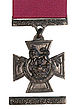
Victoria Cross (pre-1968 Regiments)
Recipients of the Victoria CrossVictoria Cross
The Victoria Cross is the highest military decoration awarded for valour "in the face of the enemy" to members of the armed forces of various Commonwealth countries, and previous British Empire territories....
:
- Lieutenant Hugh Stewart CochraneHugh Stewart CochraneColonel Hugh Stewart Cochrane VC was a recipient of the Victoria Cross for his actions, as a 28 year old lieutenant, during the Indian Mutiny. He later achieved the rank of Colonel and commanded the 43rd Foot and its successor, the 1st Battalion, Oxfordshire and Buckinghamshire Light Infantry...
. 86th (Royal County Down) Regiment of Foot86th (Royal County Down) Regiment of FootThe 86th Regiment of Foot was an infantry regiment of the British Army, formed in 1793 and amalgamated into The Royal Irish Rifles following the Childers Reforms in 1881....
. 1858. JhansiJhansiJhansi Hindi:झाँसी, , Marathi: झाशी, is a historical city of India. Jhansi is the administrative headquarters of Jhansi District and Jhansi Division. The original walled city grew up around its stone fort, which crowns a neighboring rock. This district is on the bank of river Betwa.The National...
(Indian Mutiny). - Captain H E JeromeHenry Edward JeromeMajor General Henry Edward Jerome was a recipient of the Victoria Cross, the highest and most prestigious award for gallantry in the face of the enemy that can be awarded to British and Commonwealth forces.-Career:...
. 86th (Royal County Down) Regiment of Foot86th (Royal County Down) Regiment of FootThe 86th Regiment of Foot was an infantry regiment of the British Army, formed in 1793 and amalgamated into The Royal Irish Rifles following the Childers Reforms in 1881....
. 1858. JhansiJhansiJhansi Hindi:झाँसी, , Marathi: झाशी, is a historical city of India. Jhansi is the administrative headquarters of Jhansi District and Jhansi Division. The original walled city grew up around its stone fort, which crowns a neighboring rock. This district is on the bank of river Betwa.The National...
(Indian Mutiny). - Private James ByrneJames ByrneJames Byrne may refer to:*James Byrne of Clone, County Wexford* James Byrne , Irish recipient of the Victoria Cross...
. 86th (Royal County Down) Regiment of Foot86th (Royal County Down) Regiment of FootThe 86th Regiment of Foot was an infantry regiment of the British Army, formed in 1793 and amalgamated into The Royal Irish Rifles following the Childers Reforms in 1881....
. 1858. JhansiJhansiJhansi Hindi:झाँसी, , Marathi: झाशी, is a historical city of India. Jhansi is the administrative headquarters of Jhansi District and Jhansi Division. The original walled city grew up around its stone fort, which crowns a neighboring rock. This district is on the bank of river Betwa.The National...
(Indian Mutiny). - Private James Pearson. 86th (Royal County Down) Regiment of Foot86th (Royal County Down) Regiment of FootThe 86th Regiment of Foot was an infantry regiment of the British Army, formed in 1793 and amalgamated into The Royal Irish Rifles following the Childers Reforms in 1881....
. 1858. JhansiJhansiJhansi Hindi:झाँसी, , Marathi: झाशी, is a historical city of India. Jhansi is the administrative headquarters of Jhansi District and Jhansi Division. The original walled city grew up around its stone fort, which crowns a neighboring rock. This district is on the bank of river Betwa.The National...
(Indian Mutiny). - Private Robert MorrowRobert MorrowRobert Morrow VC was born in Newmills, Dungannon, County Tyrone, Ireland and was an Irish recipient of the Victoria Cross, the highest and most prestigious award for gallantry in the face of the enemy that can be awarded to British and Commonwealth forces.-Details:He was 23 years old, and a...
. 1st Bn Royal Irish FusiliersRoyal Irish FusiliersThe Royal Irish Fusiliers was an Irish infantry regiment of the British Army, formed by the amalgamation of the 87th Regiment of Foot and the 89th Regiment of Foot in 1881. The regiment's first title in 1881 was Princess Victoria's , changed in 1920 to The Royal Irish Fusiliers...
. 1915. MessinesBattle of MessinesThe Battle of Messines was a battle of the Western front of the First World War. It began on 7 June 1917 when the British Second Army under the command of General Herbert Plumer launched an offensive near the village of Mesen in West Flanders, Belgium...
. - Captain Gerald Robert O'SullivanGerald Robert O'SullivanGerald Robert O'Sullivan VC was an Irish recipient of the Victoria Cross, the highest and most prestigious award for gallantry in the face of the enemy that can be awarded to British and Commonwealth forces.He was 26 years old, and a captain in the 1st Battalion, Royal Inniskilling Fusiliers,...
. 1st Bn Royal Inniskilling FusiliersRoyal Inniskilling FusiliersThe Royal Inniskilling Fusiliers was a Irish infantry regiment of the British Army formed in 1881 by the amalgamation of the 27th Regiment of Foot and the 108th Regiment of Foot...
. 1915 GallipoliBattle of GallipoliThe Gallipoli Campaign, also known as the Dardanelles Campaign or the Battle of Gallipoli, took place at the peninsula of Gallipoli in the Ottoman Empire between 25 April 1915 and 9 January 1916, during the First World War...
. - Sergeant James SomersJames SomersJames Somers VC was an Irish recipient of the Victoria Cross, the highest and most prestigious award for gallantry in the face of the enemy that can be awarded to British and Commonwealth forces.-Biography:...
. 1st Bn Royal Inniskilling FusiliersRoyal Inniskilling FusiliersThe Royal Inniskilling Fusiliers was a Irish infantry regiment of the British Army formed in 1881 by the amalgamation of the 27th Regiment of Foot and the 108th Regiment of Foot...
. 1915 GallipoliBattle of GallipoliThe Gallipoli Campaign, also known as the Dardanelles Campaign or the Battle of Gallipoli, took place at the peninsula of Gallipoli in the Ottoman Empire between 25 April 1915 and 9 January 1916, during the First World War...
. - Captain Edward William Derrington BellEdward William Derrington BellMajor General Edward William Derrington Bell VC CB was a recipient of the Victoria Cross, the highest and most prestigious award for gallantry in the face of the enemy that can be awarded to British and Commonwealth forces....
. 1st Bn Royal Inniskilling FusiliersRoyal Inniskilling FusiliersThe Royal Inniskilling Fusiliers was a Irish infantry regiment of the British Army formed in 1881 by the amalgamation of the 27th Regiment of Foot and the 108th Regiment of Foot...
. 1916 Thiepval. - Rifleman William McFadzeanWilliam Frederick McFadzeanWilliam Frederick "Billy" McFadzean VC was born in Lurgan, County Armagh. From Ulster, he was a Northern Irish recipient of the Victoria Cross, the highest and most prestigious award for gallantry in the face of the enemy that can be awarded to British and Commonwealth forces.-Details:McFadzean...
. 1st Bn Royal Irish Rifles. 1916. Thiepval. - Rifleman Robert QuiggRobert QuiggRobert Quigg VC was a recipient of the Victoria Cross for his bravery in the Battle of the Somme in the First World War.-Youth:...
. 12th Bn Royal Irish Rifles. 1916. HamelHamelHamel may refer to:* Hamel, Western Australia, town* Hamel, Nord, a commune of the Nord département, in northern France* Beaumont-Hamel, a commune of the Somme département, in northern France...
, Somme. - Lieutenant Geoffrey St George Shillington Cather. 9th Bn Royal Irish FusiliersRoyal Irish FusiliersThe Royal Irish Fusiliers was an Irish infantry regiment of the British Army, formed by the amalgamation of the 87th Regiment of Foot and the 89th Regiment of Foot in 1881. The regiment's first title in 1881 was Princess Victoria's , changed in 1920 to The Royal Irish Fusiliers...
. 1916. HamelHamelHamel may refer to:* Hamel, Western Australia, town* Hamel, Nord, a commune of the Nord département, in northern France* Beaumont-Hamel, a commune of the Somme département, in northern France...
, Somme. - Lieutenant Colonel John Sherwood-KellyJohn Sherwood-KellyJohn Sherwood Kelly VC CMG DSO was a South African recipient of the Victoria Cross, the highest and most prestigious award for gallantry in the face of the enemy that can be awarded to British and Commonwealth forces...
CMGOrder of St Michael and St GeorgeThe Most Distinguished Order of Saint Michael and Saint George is an order of chivalry founded on 28 April 1818 by George, Prince Regent, later George IV of the United Kingdom, while he was acting as Prince Regent for his father, George III....
DSODistinguished Service OrderThe Distinguished Service Order is a military decoration of the United Kingdom, and formerly of other parts of the British Commonwealth and Empire, awarded for meritorious or distinguished service by officers of the armed forces during wartime, typically in actual combat.Instituted on 6 September...
. 1st Bn Royal Inniskilling FusiliersRoyal Inniskilling FusiliersThe Royal Inniskilling Fusiliers was a Irish infantry regiment of the British Army formed in 1881 by the amalgamation of the 27th Regiment of Foot and the 108th Regiment of Foot...
. 1917. Marcoing, Cambrai. - Second Lieutenant J S EmersonJames Samuel EmersonJames Samuel Emerson VC was a British Army officer, and posthumous recipient of the Victoria Cross, the highest award of the British Commonwealth for gallantry "in the face of the enemy", during the First World War.-Biography:...
. 9th Bn Royal Inniskilling FusiliersRoyal Inniskilling FusiliersThe Royal Inniskilling Fusiliers was a Irish infantry regiment of the British Army formed in 1881 by the amalgamation of the 27th Regiment of Foot and the 108th Regiment of Foot...
. 1917. Cambrai. - Private James DuffyJames Duffy (VC)James Duffy was a British Army soldier during the First World War, and an Irish recipient of the Victoria Cross.Duffy was born on 17 November 1889 in Gweedore , County Donegal, Ireland....
. 6th Bn Royal Inniskilling FusiliersRoyal Inniskilling FusiliersThe Royal Inniskilling Fusiliers was a Irish infantry regiment of the British Army formed in 1881 by the amalgamation of the 27th Regiment of Foot and the 108th Regiment of Foot...
. 1917. Kareina PeakSinai and Palestine CampaignThe Sinai and Palestine Campaigns took place in the Middle Eastern Theatre of World War I. A series of battles were fought between British Empire, German Empire and Ottoman Empire forces from 26 January 1915 to 31 October 1918, when the Armistice of Mudros was signed between the Ottoman Empire and...
. - Second Lieutenant Edmund De WindEdmund De WindEdmund De Wind, VC was a British Army officer during the First World War, and posthumous recipient of the Victoria Cross, the highest award of the British Commonwealth for gallantry "in the face of the enemy"....
. 15th Bn Royal Irish Rifles. 1918. Grugies, France. - Lance Corporal Ernest SeamanErnest SeamanErnest Seaman VC MM was an English recipient of the Victoria Cross, the highest and most prestigious award for gallantry in the face of the enemy that can be awarded to British and Commonwealth forces....
. 2nd Bn Royal Inniskilling FusiliersRoyal Inniskilling FusiliersThe Royal Inniskilling Fusiliers was a Irish infantry regiment of the British Army formed in 1881 by the amalgamation of the 27th Regiment of Foot and the 108th Regiment of Foot...
. 1918. TerhandTerhandTerhand is a tiny hamlet approximately 12 km east of Ypres in Belgium.The village consists of about 40 houses with a small street running through the middle of them. The road from Ypres is lined with fields but very few trees, most of them were destroyed in the First World War....
, Belgium. - Private Norman HarveyNorman HarveyNorman Harvey VC was an English recipient of the Victoria Cross, the highest and most prestigious award for gallantry in the face of the enemy that can be awarded to British and Commonwealth forces...
. 1st Bn Royal Inniskilling FusiliersRoyal Inniskilling FusiliersThe Royal Inniskilling Fusiliers was a Irish infantry regiment of the British Army formed in 1881 by the amalgamation of the 27th Regiment of Foot and the 108th Regiment of Foot...
. 1918. Ingoyghem Belgium.
Regimental Quick March
The Regimental Quick March is Killaloe. It was written around 1887 by an Irish composer, Robert Martin, for the London Musical "Miss Esmeralda". The lyrics relate the story of a French teacher attempting to make himself understood to a difficult Killaloe class. Originally in 2/4 time, it was made well known in military circles by a cousin of the composer - Lt. Charles Martin of the 88th Connaught Rangers (The Devil's Own). He composed new lyrics, in 6/8 time, celebrating his Regiment's fame. No mention is made of the tune in the Regimental history, but there is an explanation that may account for the shout or yell in the military version of Killaloe.Historically, in the lst. Battalion (Connaught Rangers), formerly the 88th, a favourite march tune was "Brian Boru" played when marching through a town - often after a hot and heavy march. On such occasions, and at a time given by the Sergeant Major, the Band would pause and all ranks would give a "Connaught Yell". The march became popular among the other Irish Regiments and various other sets of lyrics were devised (see Killaloe
Killaloe March
Killaloe is the Regimental Quick March of the British Army regiment, The Royal Irish Regiment...
page)
Killaloe is unique. It is the only march the soldiers join in with. On parade they give a spine-tingling "Ranger Yell"; this continues with the Royal Irish Regiment.
The first known recording of Killaloe was made by Richard Dimbleby
Richard Dimbleby
Richard Dimbleby CBE was an English journalist and broadcaster widely acknowledged as one of the greatest figures in British broadcasting history.-Early life:...
when serving as a BBC
BBC
The British Broadcasting Corporation is a British public service broadcaster. Its headquarters is at Broadcasting House in the City of Westminster, London. It is the largest broadcaster in the world, with about 23,000 staff...
war correspondent in Northern France shortly before Dunkirk
Operation Dynamo
The Dunkirk evacuation, commonly known as the Miracle of Dunkirk, code-named Operation Dynamo by the British, was the evacuation of Allied soldiers from the beaches and harbour of Dunkirk, France, between 26 May and the early hours of 3 June 1940, because the British, French and Belgian troops were...
. The "Famous Irish Regiment" Dimbleby reports playing as they march past is not named, but would have been either the Royal Irish Fusiliers or the Royal Inniskilling Fusiliers.
Again in 1944, the BBC recorded The 1st. Battalion, Royal Inniskilling Fusiliers Pipes & Drums playing Killaloe, by then adopted unofficially as the march of the 38th (Irish) Brigade
38th (Irish) Infantry Brigade (United Kingdom)
The 38th Infantry Brigade was a British Army unit formed initially after the start of World War I, without the title 'Irish'.-History:...
, during the approach to Monte Cassino
Battle of Monte Cassino
The Battle of Monte Cassino was a costly series of four battles during World War II, fought by the Allies against Germans and Italians with the intention of breaking through the Winter Line and seizing Rome.In the beginning of 1944, the western half of the Winter Line was being anchored by Germans...
.
Killaloe was adopted by The Royal Irish Rangers on its formation and again later by the Royal Irish Regiment on its amalgamation in 1992.
The soldiers had their own words to the tune which would be sung, sotto voce, as they marched:
To hear the tune visit: Ranger website
Regimental Slow March
Previously the March of the Royal Innskilling Fusiliers, Eileen Alannah is an Irish balladBallad
A ballad is a form of verse, often a narrative set to music. Ballads were particularly characteristic of British and Irish popular poetry and song from the later medieval period until the 19th century and used extensively across Europe and later the Americas, Australia and North Africa. Many...
. It is available as sheet-music. The lyrics.:
The song uses anglicised versions of Irish words
For example the first line should read: "Eileen a leanbh, Eileen a stór" ("a leanbh" and "a stór" in the song's context, are Irish phrases for "my love" or "my dear").
Similarly the line "Eileen Alannah, Augus Asthore" is the anglicised version of "Eileen a leanbh agus a stór".
"Agus" is the Irish word for "and"; "Mavourneen" is an anglicised spelling of "mo mhuirnín" which in Irish means "my darling"; and "colleen" is the anglicised word for "cailín", which is Irish for "girl".
Tercentenary
At the Tercentenary parade celebrated in OsnabrückOsnabrück
Osnabrück is a city in Lower Saxony, Germany, some 80 km NNE of Dortmund, 45 km NE of Münster, and some 100 km due west of Hanover. It lies in a valley penned between the Wiehen Hills and the northern tip of the Teutoburg Forest...
in 1989, the Irish Rangers were able to parade a combined band from 1 & 2 R IRISH together with the Bugles, Pipers & Drums from both.
Recorded music
The Band, Bugles, Pipes & Drums have released CDs including Pipes & Drums of Ireland and Heritage Of IrelandLineage
|-style="text-align: center; background: #c4df9b;"| align="center" colspan="4"|Lineage
|-
| width="25%" rowspan="6" align="center"| The Royal Irish Rangers (27th (Inniskilling) 83rd and 87th)
| width="25%" rowspan="2" align="center"| The Royal Inniskilling Fusiliers
Royal Inniskilling Fusiliers
The Royal Inniskilling Fusiliers was a Irish infantry regiment of the British Army formed in 1881 by the amalgamation of the 27th Regiment of Foot and the 108th Regiment of Foot...
| width="25%" align="center"| The 27th (Inniskilling) Regiment of Foot
27th (Inniskilling) Regiment of Foot
The 27th Regiment of Foot was an Irish infantry regiment of the British Army, formed in 1689 and amalgamated into The Royal Inniskilling Fusiliers in 1881.- History :...
|-
| width="25%" align="center"| The 108th Regiment of Foot (Madras Infantry)
108th Regiment of Foot (Madras Infantry)
The 108th Regiment of Foot was an infantry regiment of the British Army from 1862 to 1881, when it was amalgamated into The Royal Inniskilling Fusiliers....
|-
| width="25%" rowspan="2" align="center"| The Royal Ulster Rifles
Royal Ulster Rifles
The Royal Ulster Rifles was a British Army infantry regiment. It saw service in the Second Boer War, Great War, the Second World War and the Korean War, before being amalgamated into the Royal Irish Rangers in 1968.-History:...
| width="25%" align="center"| 83rd (County of Dublin) Regiment of Foot
|-
| width="25%" align="center"| The 86th (Royal County Down) Regiment of Foot
86th (Royal County Down) Regiment of Foot
The 86th Regiment of Foot was an infantry regiment of the British Army, formed in 1793 and amalgamated into The Royal Irish Rifles following the Childers Reforms in 1881....
|-
| width="25%" rowspan="2" align="center"| The Royal Irish Fusiliers (Princess Victoria's)
Royal Irish Fusiliers
The Royal Irish Fusiliers was an Irish infantry regiment of the British Army, formed by the amalgamation of the 87th Regiment of Foot and the 89th Regiment of Foot in 1881. The regiment's first title in 1881 was Princess Victoria's , changed in 1920 to The Royal Irish Fusiliers...
| width="25%" align="center"| The 87th (Royal Irish Fusiliers) Regiment of Foot
87th (Royal Irish Fusiliers) Regiment of Foot
The 87th Regiment of Foot was an infantry regiment of the British Army, formed in 1793 and amalgamated into the Princess Victoria's in 1881....
|-
| width="25%" align="center"| The 89th (The Princess Victoria's) Regiment of Foot