
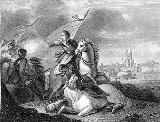
The
Battle of Worcester took place on 3 September 1651 at Worcester, England and was the final battle of the
English Civil WarThe English Civil War was a series of armed conflicts and political machinations between Parliamentarians and Royalists...
.
Oliver CromwellOliver Cromwell was an English military and political leader who overthrew the English monarchy and temporarily turned England into a republican Commonwealth, and served as Lord Protector of England, Scotland, and Ireland....
and the
ParliamentariansThe Parliament of England was the legislature of the Kingdom of England. In 1066, William of Normandy introduced a feudal system, by which he sought the advice of a council of tenants-in-chief and ecclesiastics before making laws...
defeated the
RoyalistCavalier was the name used by Parliamentarians for a Royalist supporter of King Charles I and son Charles II during the English Civil War, the Interregnum, and the Restoration...
, predominantly
ScottishScotland is a country that is part of the United Kingdom. Occupying the northern third of the island of Great Britain, it shares a border with England to the south and is bounded by the North Sea to the east, the Atlantic Ocean to the north and west, and the North Channel and Irish Sea to the...
, forces of King
Charles IICharles II was monarch of the three kingdoms of England, Scotland, and Ireland.Charles II's father, King Charles I, was executed at Whitehall on 30 January 1649, at the climax of the English Civil War...
. The 16,000 Royalist forces were overwhelmed by the 28,000 strong "
New Model ArmyThe New Model Army of England was formed in 1645 by the Parliamentarians in the English Civil War, and was disbanded in 1660 after the Restoration...
" of Cromwell.
Invasion of England
The king was aided by Scottish allies and was attempting to regain the throne that had been lost when his father
Charles ICharles I was King of England, King of Scotland, and King of Ireland from 27 March 1625 until his execution in 1649. Charles engaged in a struggle for power with the Parliament of England, attempting to obtain royal revenue whilst Parliament sought to curb his Royal prerogative which Charles...
was
executedThe broad definition of regicide is the deliberate killing of a monarch, or the person responsible for the killing of a monarch. In a narrower sense, in the British tradition, it refers to the judicial execution of a king after a trial...
. The commander of the Scots, Sir David Leslie, supported the plan of fighting in
ScotlandScotland is a country that is part of the United Kingdom. Occupying the northern third of the island of Great Britain, it shares a border with England to the south and is bounded by the North Sea to the east, the Atlantic Ocean to the north and west, and the North Channel and Irish Sea to the...
, where royal support was strongest. Charles, however, insisted on making war in
EnglandEngland is a country that is part of the United Kingdom. It shares land borders with Scotland to the north and Wales to the west; the Irish Sea is to the north west, the Celtic Sea to the south west, with the North Sea to the east and the English Channel to the south separating it from continental...
. He calculated that Cromwell's campaign north of the
River ForthThe River Forth , long, is the major river draining the eastern part of the central belt of Scotland.The Forth rises in Loch Ard in the Trossachs, a mountainous area some west of Stirling...
would allow the main Scottish Royalist army which was south of the Forth to steal the march on the Roundhead
New Model ArmyThe New Model Army of England was formed in 1645 by the Parliamentarians in the English Civil War, and was disbanded in 1660 after the Restoration...
in a race to London. He hoped to rally not merely the old faithful Royalists, but also the overwhelming numerical strength of the English Presbyterians to his standard. He calculated that his alliance with the Scottish Presbyterian
CovenanterThe Covenanters were a Scottish Presbyterian movement that played an important part in the history of Scotland, and to a lesser extent in that of England and Ireland, during the 17th century...
s and his signing of the
Solemn League and CovenantThe Solemn League and Covenant was an agreement between the Scottish Covenanters and the leaders of the English Parliamentarians. It was agreed to in 1643, during the First English Civil War....
would encourage English Presbyterians to support him against the English Independent faction which had grown in power over the last few years. The Royalist army was kept well in hand, no excesses were allowed, and in a week the Royalists covered 150 miles in marked contrast to the
Duke of Hamilton's General Sir James Hamilton, 1st Duke of Hamilton KG was a Scottish nobleman and influential Civil war military leader.-Young Arran:...
ill-fated expedition of 1648. On 8 August the troops were given a well-earned rest between
PenrithPenrith was an urban district between 1894 and 1974, when it was merged into Eden District.The authority's area was coterminous with the civil parish of Penrith although when the council was abolished Penrith became an unparished area....
and
KendalKendal, anciently known as Kirkby in Kendal or Kirkby Kendal, is a market town and civil parish within the South Lakeland District of Cumbria, England...
.
But the Royalists were mistaken in supposing that the enemy was taken aback by their new move. Everything had been foreseen both by Cromwell and by the
Council of StateThe English Council of State, later also known as the Protector's Privy Council, was first appointed by the Rump Parliament on 14 February 1649 after the execution of King Charles I....
in
WestminsterThe Palace of Westminster, also known as the Houses of Parliament or Westminster Palace, is the meeting place of the two houses of the Parliament of the United Kingdom—the House of Lords and the House of Commons...
. The latter had called out the greater part of the militia on 7 August. Lieutenant-General
Charles FleetwoodCharles Fleetwood was an English Parliamentary soldier and politician, Lord Deputy of Ireland from 1652–55, where he enforced the Cromwellian Settlement. At the Restoration he was included in the Act of Indemnity as among the twenty liable to penalties other than capital, and was finally...
began to draw together the midland contingents at
BanburyBanbury is a market town and civil parish on the River Cherwell in the Cherwell District of Oxfordshire. It is northwest of London, southeast of Birmingham, south of Coventry and north northwest of the county town of Oxford...
. The London-trained bands turned out for field service no fewer than 14,000 strong. Every suspected Royalist was closely watched, and the magazines of arms in the country-houses of the gentry were for the most part removed into the strong places. On his part Cromwell had quietly made his preparations.
PerthPerth is a town and former city and royal burgh in central Scotland. Located on the banks of the River Tay, it is the administrative centre of Perth and Kinross council area and the historic county town of Perthshire...
passed into his hands on 22 August and he brought back his army to
Leith-South Leith v. North Leith:Up until the late 16th century Leith , comprised two separate towns on either side of the river....
by 5 August. Thence he dispatched Lieutenant-General
John Lambert John Lambert was an English Parliamentary general and politician. He fought during the English Civil War and then in Oliver Cromwell's Scottish campaign , becoming thereafter active in civilian politics until his dismissal by Cromwell in 1657...
with a cavalry corps to harass the invaders. Major-General Thomas Harrison was already at Newcastle picking the best of the county mounted-troops to add to his own regulars. On 9 August, Charles was at
KendalKendal, anciently known as Kirkby in Kendal or Kirkby Kendal, is a market town and civil parish within the South Lakeland District of Cumbria, England...
, Lambert hovering in his rear, and Harrison marching swiftly to bar his way at the
MerseyMersey may refer to:* River Mersey, in northwest England* Mersea Island, off the coast of Essex in England * Mersey River in the Australian state* Electoral division of Mersey in the state of Tasmania, Australian...
.
Thomas FairfaxThomas Fairfax, 3rd Lord Fairfax of Cameron was a general and parliamentary commander-in-chief during the English Civil War...
emerged for a moment from his retirement to organize the
YorkshireYorkshire is a historic county of northern England and the largest in the United Kingdom. Because of its great size in comparison to other English counties, functions have been increasingly undertaken over time by its subdivisions, which have also been subject to periodic reform...
levies, and the best of these as well as of the
LancashireLancashire is a non-metropolitan county of historic origin in the North West of England. It takes its name from the city of Lancaster, and is sometimes known as the County of Lancaster. Although Lancaster is still considered to be the county town, Lancashire County Council is based in Preston...
,
CheshireCheshire is a ceremonial county in North West England. Cheshire's county town is the city of Chester, although its largest town is Warrington. Other major towns include Widnes, Congleton, Crewe, Ellesmere Port, Runcorn, Macclesfield, Winsford, Northwich, and Wilmslow...
and
StaffordshireStaffordshire is a landlocked county in the West Midlands region of England. For Eurostat purposes, the county is a NUTS 3 region and is one of four counties or unitary districts that comprise the "Shropshire and Staffordshire" NUTS 2 region. Part of the National Forest lies within its borders...
militias were directed upon
WarringtonWarrington is a town, borough and unitary authority area of Cheshire, England. It stands on the banks of the River Mersey, which is tidal to the west of the weir at Howley. It lies 16 miles east of Liverpool, 19 miles west of Manchester and 8 miles south of St Helens...
, which Harrison reached on 15 August, a few hours in front of Charles's advanced guard. Lambert too, slipping round the left flank of the enemy, joined Harrison, and the English fell back (16 August), slowly and without letting themselves be drawn into a fight, along the London road.
Worcester campaign
Cromwell meanwhile, leaving George Monck with the least efficient regiments to carry on the war in Scotland, had reached the
river TyneThe River Tyne is a river in North East England in Great Britain. It is formed by the confluence of two rivers: the North Tyne and the South Tyne. These two rivers converge at Warden Rock near Hexham in Northumberland at a place dubbed 'The Meeting of the Waters'.The North Tyne rises on the...
in seven days, and thence, marching 20 miles a day in extreme heat with the country people carrying their arms and equipment the regulars entered
FerrybridgeFerrybridge is a village in West Yorkshire, England at a historically important crossing of the River Aire. It is linked to other communities by the A1, which follows the route of the Great North Road....
on 19 August, at which date Lambert, Harrison and the north-western militia were about
CongletonCongleton is a town and civil parish in the unitary authority of Cheshire East and the ceremonial county of Cheshire, England, on the banks of the River Dane, to the west of the Macclesfield Canal and 21 miles south of Manchester. It has a population of 25,750.-History:The first settlements in...
. It seemed probable that a great battle would take place between
LichfieldLichfield is a cathedral city, civil parish and district in Staffordshire, England. One of eight civil parishes with city status in England, Lichfield is situated roughly north of Birmingham...
and
CoventryCoventry is a city and metropolitan borough in the county of West Midlands in England. Coventry is the 9th largest city in England and the 11th largest in the United Kingdom. It is also the second largest city in the English Midlands, after Birmingham, with a population of 300,848, although...
on or just after 25 August and that Cromwell, Harrison, Lambert and Fleetwood would all take part in it. But the scene and the date of the denouement were changed by the enemy's movements. Shortly after leaving Warrington the young king had resolved to abandon the direct march on London and to make for the Severn valley, where his father had found the most constant and the most numerous adherents in the first war, and which had been the centre of gravity of the English Royalist movement of 1648. Sir Edward Massey, formerly the Parliamentary governor of
GloucesterGloucester is a city, district and county town of Gloucestershire in the South West region of England. Gloucester lies close to the Welsh border, and on the River Severn, approximately north-east of Bristol, and south-southwest of Birmingham....
, was now with Charles, and it was hoped that he would induce his fellow Presbyterians to take arms. The military quality of the Welsh border Royalists was well proved, that of the
GloucestershireGloucestershire is a county in South West England. The county comprises part of the Cotswold Hills, part of the flat fertile valley of the River Severn, and the entire Forest of Dean....
Presbyterians not less so, and, in basing himself on Gloucester and Worcester as his father had done on Oxford, Charles II hoped, naturally, to deal with the Independent faction minority of the English people more effectually than Charles I had earlier dealt with the majority of the people of England who had supported the Parliamentary cause. But even the pure Royalism which now ruled in the invading army could not alter the fact that it was a foreign, Scottish, army, and it was not merely an Independent faction but all England that united against it.
Charles arrived at Worcester on 22 August and spent five days in resting the troops, preparing for further operations, and gathering and arming the few recruits who came in. The delay was to prove fatal; it was a necessity of the case foreseen and accepted when the march to Worcester had been decided upon, and had the other course, that of marching on London via
LichfieldLichfield is a cathedral city, civil parish and district in Staffordshire, England. One of eight civil parishes with city status in England, Lichfield is situated roughly north of Birmingham...
, been taken the battle would have been fought three days earlier with the same result.
Cromwell, the lord general, had during his march south thrown out successively two flying columns under Colonel
Robert Lilburnethumb|right|Robert LilburneColonel Robert Lilburne was the older brother of John Lilburne, the well known Leveller, but unlike his brother who severed his relationship with Oliver Cromwell, Robert Lilburne remained in the army...
to deal with the Lancashire Royalists under the
Earl of DerbyJames Stanley, 7th Earl of Derby KG was a supporter of the Royalist cause in the English Civil War.Born at Knowsley, he is sometimes styled the Great Earl of Derby, eldest son of William Stanley, 6th Earl of Derby and Lady Elizabeth de Vere. During his father's life he was known as Lord Strange...
. Lilburne entirely routed a Lancashire detachment of the enemy on their way to join the main Royalist army at the
Battle of Wigan LaneThe Battle of Wigan Lane was fought on 25 August 1651 during the Third English Civil War, between Royalists under the command of the Earl of Derby and elements of the New Model Army under the command of Colonel Robert Lilburne...
on 25 August and as affairs turned out Cromwell merely shifted the area of his concentration two marches to the south-west, to Evesham. Early on 28 August, Lambert surprised the passage of the Severn at
UptonUpton-upon-Severn is a small town and civil parish in the Malvern Hills District of Worcestershire, England, on the River Severn. According to the national census 2001 it had a population of 2,859. Located from Malvern, the bridge at Upton is the only one across the river Severn between Worcester...
, 6 miles below Worcester, and in the action which followed Massey was severely wounded. Fleetwood followed Lambert. The enemy was now only 16,000 strong and disheartened by the apathy with which they had been received in districts formerly all their own. Cromwell, for the only time in his military career, had a two-to-one numerical superiority.
On 30 August Cromwell delayed the start of the battle to give time for two
pontoon bridgeA pontoon bridge or floating bridge is a bridge that floats on water and in which barge- or boat-like pontoons support the bridge deck and its dynamic loads. While pontoon bridges are usually temporary structures, some are used for long periods of time...
s to be constructed one over the Severn and the other over the Teme close to their confluence. The delay allowed Cromwell to launch his attack on 3 September one year to the day since his victory at the
Battle of DunbarThe Battle of Dunbar was a battle of the Third English Civil War. The English Parliamentarian forces under Oliver Cromwell defeated a Scottish army commanded by David Leslie which was loyal to King Charles II, who had been proclaimed King of Scots on 5 February 1649.-Background:The English...
.
The battle
Cromwell took his measures deliberately. Lilburne from Lancashire and
Major MercerMajor Mercer, the commander of the Worcestershire horse, played a significant part in the Battle of Worcester in 1651, but although mentioned in primary sources his full name is not given in them...
with the Worcestershire horse were to secure
Bewdley BridgeBewdley Bridge is a three-span masonry arch bridge over the River Severn at Bewdley, Worcestershire. The two side spans are each , with the central span . The central arch rises . Smaller flood arches on the bank bridge the towpath. The bridge is wide....
, 20 miles (32 km) north of Worcester and on the enemy's line of retreat. Fleetwood was to force his way across the
TemeThe River Teme rises in Mid Wales, south of Newtown in Powys, and flows through Knighton where it crosses the border into England down to Ludlow in Shropshire, then to the north of Tenbury Wells on the Shropshire/Worcestershire border there, on its way to join the River Severn south of Worcester...
and attack St John's, the western suburb of Worcester. While Lambert commanded the Eastern Flank of the Army which would advance and encircle the Eastern walls of Worcester. Cromwell would lead the attack on the southern ramparts of the city.
The assault started on the morning of 3 September and initially the initiative lay with the Parliamentarians. Fleetwood forced the passage of the Teme over the pontoon bridges against Royalists under the command of Major General Montgomery. Colonel Richard Dean's initial attempts to cross the Powick Bridge (where
Prince Rupert of the RhineRupert, Count Palatine of the Rhine, Duke of Bavaria, 1st Duke of Cumberland, 1st Earl of Holderness , commonly called Prince Rupert of the Rhine, KG, FRS was a noted soldier, admiral, scientist, sportsman, colonial governor and amateur artist during the 17th century...
had won the
Battle of Powick BridgeThe Battle of Powick Bridge, fought on 23 September 1642, was the first major cavalry engagement of the English Civil War and it was a victory for the Royalists who overthrew the Parliamentary cavalry. According to Hugh Peters it was "where England's sorrows began".-Prelude:King Charles I of...
his first victory in 1642) failed against stubborn resistance by the Royalists (many of whom were battle-hardened Scottish Highlanders) commanded by Colonel Keith. By force of arms and numbers the Royalist army was pushed backward by the
New Model ArmyThe New Model Army of England was formed in 1645 by the Parliamentarians in the English Civil War, and was disbanded in 1660 after the Restoration...
with Cromwell on the eastern bank of the Severn and Fleetwood on the western sweeping in a semicircle four miles long up toward Worcester.
The Royalists contested every hedgerow around Powick meadows. This stubborn resistance on the west bank of the Severn north of the Teme was becoming a serious problem for the Parliamentarians, so Cromwell led Parliamentary reinforcements from the eastern side of the town over the Severn pontoon bridge to aid Fleetwood. Charles II from his vantage point on top of
Worcester cathedral'sWorcester Cathedral is an Anglican cathedral in Worcester, England; situated on a bank overlooking the River Severn. It is the seat of the Anglican Bishop of Worcester. Its official name is The Cathedral Church of Christ and the Blessed Mary the Virgin of Worcester...
tower realised that an opportunity existed to attack the now-exposed eastern flank of the Parliamentary army. As the defenders on the Western side of the city retreated in good order into the city (although during this maneuver Keith was captured and Montgomery was badly wounded), Charles ordered two
sortieSortie is a term for deployment or dispatch of one military unit, be it an aircraft, ship, or troops from a strongpoint. The sortie, whether by one or more aircraft or vessels, usually has a specific mission....
s to attack the Parliamentary forces east of the city. The north-eastern sortie through St. Martin's Gate was commanded by the
Duke of HamiltonWilliam Hamilton, 2nd Duke of Hamilton KG was a Scottish nobleman who supported both Royalist and Presbyterian causes during the Wars of the Three Kingdoms....
and attacked the Parliamentary lines at Perry Wood. The south-eastern one through Sidbury Gate was led by Charles II and attacked
Red HillRed Hill is an area of Worcester, Worcestershire, England. It is in the south-east of the city on the A44. It has historically been used as high ground to attack the city and as a place of execution.-History:...
. The Royalist cavalry under the command of David Leslie that was gathered on Pitchcroft meadow on the northern side of the city did not receive orders to aid the sorties and Leslie chose not to do so under his own initiative. Cromwell seeing the difficulty that his east flank was under rushed back over the Severn pontoon bridge with three brigades of troops to reinforce the flank.
Although they were pushed back, the Parliamentarians under Lambert were too numerous and experienced to be defeated by such a move. After an hour in which the Parliamentarians initially retreated under the unexpected attack, when reinforced by Cromwell's three brigades, they in turn forced the Royalists to retreat back toward the city.
The Royalist retreat turned into a
routA rout is commonly defined as a chaotic and disorderly retreat or withdrawal of troops from a battlefield, resulting in the victory of the opposing party, or following defeat, a collapse of discipline, or poor morale. A routed army often degenerates into a sense of "every man for himself" as the...
in which Parliamentarian and Royalist forces intermingled and skirmished up to and into the city. The Royalist position became untenable when the Essex militia stormed and captured
Fort RoyalFort Royal Hill, is in a park in Worcester, England, and the site of the remains of an English Civil War fort.-History:Fort Royal was a Civil War redoubt on a small hill to the southeast of Worcester overlooking the Sidbury Gate...
, (a
redoubtA redoubt is a fort or fort system usually consisting of an enclosed defensive emplacement outside a larger fort, usually relying on earthworks, though others are constructed of stone or brick. It is meant to protect soldiers outside the main defensive line and can be a permanent structure or a...
on a small hill to the south-east of Worcester overlooking the Sidbury gate), turning the Royalist guns to fire on Worcester.
Once in the city, Charles II removed his armour and found a fresh mount; he attempted to rally his troops but it was to no avail. A desperate Royalist cavalry charge down Sidbury Street and High Street, led by the
Earl of ClevelandThomas Wentworth, 1st Earl of Cleveland was a Cavalier general who fought for Charles I during the English Civil War.He was the eldest son of Henry Wentworth, 3rd Baron Wentworth and Anne Hopton. His paternal grandfather was Thomas Wentworth, 2nd Baron Wentworth, the last Englishman to hold Calais...
and
Major CarelessColonel William Careless was a Royalist officer of the English Civil War. It has been estimated that he was born c. 1620, however, it is more likely that he was born c. 1610. He was the second son of John Careless of Broom Hall, Brewood, Staffordshire...
amongst others, allowed King Charles to escape the city by St. Martin's Gate. This cavalry force was composed of the few Midland English Royalists who had rallied to Charles II, and largely consisted of
Lord TalbotFrancis Talbot, 11th Earl of Shrewsbury, 11th Earl of Waterford was an English peer, the second son of the 10th Earl of Shrewsbury....
's troop of horse.
The defences of the city were stormed from three different directions as darkness came on, regulars and militia fighting with equal gallantry. Most of the few thousands of the Royalists who escaped during the night were easily captured by Lilburne and Mercer, or by the militia which watched every road in Yorkshire and Lancashire. Even the country people brought in scores of prisoners, for officers and men alike, stunned by the suddenness of the disaster, offered no resistance.
Aftermath
About 3,000 men were killed during the battle and a further 10,000 were taken prisoner at Worcester or soon afterwards. The
Earl of DerbyJames Stanley, 7th Earl of Derby KG was a supporter of the Royalist cause in the English Civil War.Born at Knowsley, he is sometimes styled the Great Earl of Derby, eldest son of William Stanley, 6th Earl of Derby and Lady Elizabeth de Vere. During his father's life he was known as Lord Strange...
was executed, while the other English prisoners were conscripted into the
New Model ArmyThe New Model Army of England was formed in 1645 by the Parliamentarians in the English Civil War, and was disbanded in 1660 after the Restoration...
and sent to Ireland. Around 8,000 Scottish prisoners were deported to
New EnglandNew England is a region in the northeastern corner of the United States consisting of the six states of Maine, New Hampshire, Vermont, Massachusetts, Rhode Island, and Connecticut...
,
BermudaBermuda is a British overseas territory in the North Atlantic Ocean. Located off the east coast of the United States, its nearest landmass is Cape Hatteras, North Carolina, about to the west-northwest. It is about south of Halifax, Nova Scotia, Canada, and northeast of Miami, Florida...
, and the West Indies to work for landowners as indentured labourers. Parliamentary casualties numbered in the low hundreds.
Charles II escapedThe Escape of Charles II from England in 1651 is a key episode in his life. Although it took only six weeks, it had a major effect on his attitudes for the rest of his life.-The fugitive king:...
after many adventures, including one famous incident where he hid from a Parliamentarian patrol in an oak tree in the grounds of
Boscobel HouseBoscobel House is a building in the parish of Boscobel in Shropshire, as is clear from all Ordnance Survey maps, although the boundary of the property is contiguous with the county's boundary with Staffordshire, and it has a Stafford post code. It is near the city of Wolverhampton...
.
After the battle, Cromwell returned to
AylesburyAylesbury is the county town of Buckinghamshire in South East England. However the town also falls into a geographical region known as the South Midlands an area that ecompasses the north of the South East, and the southern extremities of the East Midlands...
,
BuckinghamshireBuckinghamshire is a ceremonial and non-metropolitan home county in South East England. The county town is Aylesbury, the largest town in the ceremonial county is Milton Keynes and largest town in the non-metropolitan county is High Wycombe....
, one of the
parliamentarianThe Parliament of England was the legislature of the Kingdom of England. In 1066, William of Normandy introduced a feudal system, by which he sought the advice of a council of tenants-in-chief and ecclesiastics before making laws...
strongholds and close to the seat of his late cousin the civil war hero
John HampdenJohn Hampden was an English politician, the eldest son of William Hampden, of Hampden House, Great Hampden in Buckinghamshire, John Hampden (ca. 15951643) was an English politician, the eldest son of William Hampden, of Hampden House, Great Hampden in Buckinghamshire, John Hampden (ca. 15951643)...
. He stayed at the aptly named
King's Head Inn, AylesburyThe King's Head Inn is notable as being one of the oldest public houses with a coaching yard in the south of England. It is located in the Market Square, Aylesbury, Buckinghamshire....
and it was here that he received the thanks of Parliament for his final defeat of the Royalists.
The result of the battle was, in brief, one of those rare victories in which a pursuit is superfluous. Cromwell thought the victory was the greatest of all the favours, or mercies, given to him by God. He famously wrote to
William LenthallWilliam Lenthall was an English politician of the Civil War period. He served as Speaker of the House of Commons.-Early life:...
, the Speaker of the House of Commons "The dimensions of this mercy are above my thoughts. It is, for aught I know, a crowning mercy". The phase "Crowning Mercy" is frequently linked to the battle, descriptive of the complete destruction of the last Royalist army and the end of the English Civil War.
The Parliamentary militia were sent home within a week. Cromwell, who had ridiculed "such stuff" six months ago, knew them better now. "Your new raised forces," he wrote to the
Rump ParliamentThe Rump Parliament is the name of the English Parliament after Colonel Pride purged the Long Parliament on 6 December 1648 of those members hostile to the Grandees' intention to try King Charles I for high treason....
, "did perform singular good service, for which they deserve a very high estimation and acknowledgement". The New England preacher
Hugh PetersHugh Peters [or Peter] was an English preacher.-Early life:He was baptized on 29 June 1598 in Fowey, and was educated at Trinity College, Cambridge....
gave the militia a rousing farewell sermon "when their wives and children should ask them where they had been and what news, they should say they had been at Worcester, where England's sorrows began, and where they were happily ended", referring to the first clash of the Royalist and Parliamentarian Armies at the
Battle of Powick BridgeThe Battle of Powick Bridge, fought on 23 September 1642, was the first major cavalry engagement of the English Civil War and it was a victory for the Royalists who overthrew the Parliamentary cavalry. According to Hugh Peters it was "where England's sorrows began".-Prelude:King Charles I of...
on 23 September 1642, almost exactly nine years before.
Before the battle King Charles II contracted the Worcester Clothiers to outfit his army with uniforms but was unable to pay the £453.3s bill. In June 2008
Charles, Prince of WalesPrince Charles, Prince of Wales is the heir apparent and eldest son of Queen Elizabeth II and Prince Philip, Duke of Edinburgh. Since 1958 his major title has been His Royal Highness The Prince of Wales. In Scotland he is additionally known as The Duke of Rothesay...
paid off the 357 year old debt.
Legacy
In early April 1786,
John AdamsJohn Adams was an American lawyer, statesman, diplomat and political theorist. A leading champion of independence in 1776, he was the second President of the United States...
and
Thomas JeffersonThomas Jefferson was the principal author of the United States Declaration of Independence and the Statute of Virginia for Religious Freedom , the third President of the United States and founder of the University of Virginia...
visited
Fort Royal HillFort Royal Hill, is in a park in Worcester, England, and the site of the remains of an English Civil War fort.-History:Fort Royal was a Civil War redoubt on a small hill to the southeast of Worcester overlooking the Sidbury Gate...
at the battlefield at Worcester. John Adams wrote that he was "deeply moved" but disappointed at the locals' lack of knowledge of the battle, and gave the townspeople an "impromptu lecture":
See also
- Siege of Worcester
- Third English Civil War
The Third English Civil War was the last of the English Civil Wars , a series of armed conflicts and political machinations between Parliamentarians and Royalists....
- Wars of the Three Kingdoms
The Wars of the Three Kingdoms formed an intertwined series of conflicts that took place in England, Ireland, and Scotland between 1639 and 1651 after these three countries had come under the "Personal Rule" of the same monarch...
- The Proscribed Royalist, 1651
The Proscribed Royalist, 1651 is a painting by John Everett Millais which depicts a young Puritan woman protecting a fleeing Royalist after the Battle of Worcester in 1651, the decisive defeat of King Charles II by Oliver Cromwell. The Royalist is hiding in a hollow tree, a reference to a famous...
(painting)
Further reading