
All Topics  
Battle of Culloden

 
Battle of Culloden

   Email Print
   Bookmark   Link


Battle of Culloden


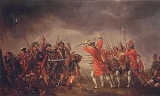
The Battle of Culloden (16 April 1746) was the final clash between the French-supported Jacobites
Jacobitism

Jacobitism was the political movement dedicated to the restoration of the House of Stuart kings to the thrones of Kingdom of England, Kingdom of Scotland, and Kingdom of Ireland....
 and the Hanoverian
House of Hanover

The House of Hanover is a Germanic peoples Royal family dynasty which has ruled the Duchy of Brunswick-L?neburg , the Kingdom of Hanover and the Kingdom of Great Britain and the Kingdom of Ireland....
 British Government in the 1745 Jacobite Rising
Jacobite rising

The Jacobite Risings were a series of uprisings, rebellions, and wars in the kingdoms of Kingdom of England, Kingdom of Scotland , and Kingdom of Ireland occurring between 1688 and 1746....
. Culloden dealt the Jacobite cause—to restore the House of Stuart
House of Stuart

The House of Stuart, also known as the House of Stewart is an important European royal house. Founded by Robert II of Scotland, the Stewarts first became monarchs of the Kingdom of Scotland during the late 14th century....
 to the throne of the Kingdom of Great Britain
Kingdom of Great Britain

The Kingdom of Great Britain, also known as the United Kingdom of Great Britain, was a country in North-West Europe, in existence from 1707 to 1801....
—a decisive defeat.

The Jacobites, the majority of them Highland Scots
Scottish Highlands

The Scottish Highlands include the rugged and mountainous regions of Scotland north and west of the Highland Boundary Fault, although the exact boundaries are not clearly defined, particularly to the east....
, supported the claim of James Francis Edward Stuart
James Francis Edward Stuart

Prince James, Prince of Wales was the son of the deposed James II of England. As such, he claimed the English, Scottish and Irish thrones from the death of his father in 1701, when he was proclaimed king of England, Scotland and Ireland by his cousin Louis XIV of France....
 (the "Old Pretender") to the throne. The government army, under the Duke of Cumberland, younger son of the Hanoverian
House of Hanover

The House of Hanover is a Germanic peoples Royal family dynasty which has ruled the Duchy of Brunswick-L?neburg , the Kingdom of Hanover and the Kingdom of Great Britain and the Kingdom of Ireland....
 sovereign, King George II
George II of Great Britain

George II was King of Great Britain and King of Ireland, Duke of Brunswick-L?neburg and Prince-elector#High Offices and Prince-Elector of the Holy Roman Empire from 11 June 1727 until his death....
, supported his father's cause.


Discussion
Ask a question about 'Battle of Culloden'
Start a new discussion about 'Battle of Culloden'
Answer questions from other users
Full Discussion Forum


Encyclopedia


The Battle of Culloden (16 April 1746) was the final clash between the French-supported Jacobites
Jacobitism

Jacobitism was the political movement dedicated to the restoration of the House of Stuart kings to the thrones of Kingdom of England, Kingdom of Scotland, and Kingdom of Ireland....
 and the Hanoverian
House of Hanover

The House of Hanover is a Germanic peoples Royal family dynasty which has ruled the Duchy of Brunswick-L?neburg , the Kingdom of Hanover and the Kingdom of Great Britain and the Kingdom of Ireland....
 British Government in the 1745 Jacobite Rising
Jacobite rising

The Jacobite Risings were a series of uprisings, rebellions, and wars in the kingdoms of Kingdom of England, Kingdom of Scotland , and Kingdom of Ireland occurring between 1688 and 1746....
. Culloden dealt the Jacobite cause—to restore the House of Stuart
House of Stuart

The House of Stuart, also known as the House of Stewart is an important European royal house. Founded by Robert II of Scotland, the Stewarts first became monarchs of the Kingdom of Scotland during the late 14th century....
 to the throne of the Kingdom of Great Britain
Kingdom of Great Britain

The Kingdom of Great Britain, also known as the United Kingdom of Great Britain, was a country in North-West Europe, in existence from 1707 to 1801....
—a decisive defeat.

The Jacobites, the majority of them Highland Scots
Scottish Highlands

The Scottish Highlands include the rugged and mountainous regions of Scotland north and west of the Highland Boundary Fault, although the exact boundaries are not clearly defined, particularly to the east....
, supported the claim of James Francis Edward Stuart
James Francis Edward Stuart

Prince James, Prince of Wales was the son of the deposed James II of England. As such, he claimed the English, Scottish and Irish thrones from the death of his father in 1701, when he was proclaimed king of England, Scotland and Ireland by his cousin Louis XIV of France....
 (the "Old Pretender") to the throne. The government army, under the Duke of Cumberland, younger son of the Hanoverian
House of Hanover

The House of Hanover is a Germanic peoples Royal family dynasty which has ruled the Duchy of Brunswick-L?neburg , the Kingdom of Hanover and the Kingdom of Great Britain and the Kingdom of Ireland....
 sovereign, King George II
George II of Great Britain

George II was King of Great Britain and King of Ireland, Duke of Brunswick-L?neburg and Prince-elector#High Offices and Prince-Elector of the Holy Roman Empire from 11 June 1727 until his death....
, supported his father's cause. It too included Highland Scots, as well as Scottish Lowlanders and English troops.

The aftermath of the battle was brutal and earned the victorious general the nickname "Butcher" Cumberland. Charles Edward Stuart
Charles Edward Stuart

Charles Edward Stuart was the exiled Jacobitism claimant to the thrones of England, Scotland, and Kingdom of Ireland. He is commonly known in English and Scots language as Bonnie Prince Charlie....
 eventually left Britain and went to Rome
Rome

Rome is the capital city of Italy and Lazio, and is Italy's largest and most populous city, with 2,724,347 residents in an urban area of some ....
, never to attempt to take the throne again. Civil penalties were severe with new laws that attacked the Highlanders' clan
Clan

A clan is a group of people united by kinship and descent, which is defined by actual or perceived descent from a common ancestor. Even if actual lineage patterns are unknown, clan members may nonetheless recognize a founding member or apical ancestor....
 system. Highland dress was now to be restricted to use by the British Army.

Background

For further detail see Jacobite Rising
Jacobite rising

The Jacobite Risings were a series of uprisings, rebellions, and wars in the kingdoms of Kingdom of England, Kingdom of Scotland , and Kingdom of Ireland occurring between 1688 and 1746....
.


Charles Edward Stuart

Charles Edward Stuart was the exiled Jacobitism claimant to the thrones of England, Scotland, and Kingdom of Ireland. He is commonly known in English and Scots language as Bonnie Prince Charlie....
, known as "Bonnie Prince Charlie" or the "Young Pretender", successfully raised forces, mainly of Scottish Highland
Scottish Highlands

The Scottish Highlands include the rugged and mountainous regions of Scotland north and west of the Highland Boundary Fault, although the exact boundaries are not clearly defined, particularly to the east....
 clansmen
Scottish clan

Scottish clans , give a sense of identity and shared descent to people in Scotland and to their relations throughout the world, with a formal structure of Scottish clan chiefs officially registered with the court of the Lord Lyon, King of Arms which controls the heraldry and Coat of Arms....
 and defeated the Hanoverian
Hanoverian

The adjective Hanoverian is used to describe:* British monarchs or supporters of the House of Hanover, the dynasty which ruled the United Kingdom from 1714 to 1901....
 Army stationed in Scotland
Scotland

conventional_long_name = ScotlandAlba|common_name= Scotland|image_flag = Flag of Scotland.svg|flag_width = 130px...
 at the Battle of Prestonpans
Battle of Prestonpans

The Battle of Prestonpans was the first significant conflict in the second Jacobite Rising. The battle took place at 4am on 21 September 1745. The Jacobitism army loyal to James Francis Edward Stuart and led by his son Charles Edward Stuart defeated the army loyal to the Hanoverian George II of England led by John Cope ....
. The city of Edinburgh
Edinburgh

Edinburgh ; is the Capital city of Scotland, a position it has held since 1437. It is the seventh largest city in the United Kingdom and the second largest Scottish City status in the United Kingdom after Glasgow....
 was occupied, but the castle held out and most of the Scottish population remained hostile to the rebels. The British government recalled forces from the war with France in Flanders
War of the Austrian Succession

The War of the Austrian Succession involved nearly all the Power in international relations of Europe. The war began under the pretext that Maria Theresa of Austria was ineligible to succeed to the House of Habsburg throne, because Salic law precluded royal inheritance by a woman, though in reality this was a convenient excuse put forward by...
 to deal with the rebellion.

After a lengthy wait, Charles persuaded his generals that English Jacobites would stage an uprising in support of his cause. He was convinced that France would launch an invasion of England as well. His army of around 5000 invaded England on 8 November 1745. They advanced through Carlisle and Manchester
Manchester

Manchester is a city and metropolitan borough of Greater Manchester, England. Manchester was granted City status in the United Kingdom in 1853....
 to Derby and a position where they appeared to threaten London
London

London is the capital of both England and the United Kingdom, and the most populous municipality in the European Union. An important settlement for two millennia, History of London goes back to its founding by the Roman Empire....
. It is often alleged that King George II made plans to decamp to Hanover
Hanover

Hanover or Hannover#Definitions , on the river Leine, is the capital city of the Federal states of Germany of Lower Saxony , Germany and was once by personal union the family seat of the House of Hanover, in their dignities as the dukes of Brunswick-L?neburg ....
, but there is absolutely no evidence for this and the king is on record as stating that he would lead the troops against the rebels himself if they approached London. The Jacobites met only token resistance. There was, however, little support from English Jacobites, and the French invasion fleet was still being assembled. The armies of General George Wade
George Wade

Field Marshal George Wade served as a British military commander and Commander-in-Chief of the Forces....
 and of William Augustus, Duke of Cumberland, were approaching. In addition to the militia, London was defended by nearly 6,000 foot, 700 horse and 33 artillery pieces and the Jacobites received (fictitious) reports of a third army closing on them. The Jacobite general, Lord George Murray
Lord George Murray (general)

Lord George Murray was a Scottish Jacobitism general, most noted for his 1745 campaign under Bonnie Prince Charlie into England. Lord George was the fifth son of John Murray, 1st Duke of Atholl, who was the chief of Clan Murray, by his first wife, Catherine, daughter of the William Douglas-Hamilton, Duke of Hamilton....
, and the Council of War insisted on returning to join their growing force in Scotland. On 6 December 1745, they withdrew, with Charles Edward Stuart petulantly leaving command to Murray.

On the long march back to Scotland, the Highland Army wore out its boots and demanded all the boots and shoes of the townspeople of Dumfries
Dumfries

Dumfries is a town and former royal burgh within the Dumfries and Galloway council area of Scotland and is situated close to the Solway Firth, near the mouth of the River Nith....
 as well as money and hospitality. The Jacobites reached Glasgow
Glasgow

Glasgow is the largest city in Scotland and List of largest United Kingdom settlements by population in the United Kingdom. The city is situated on the River Clyde in the country's Scottish Lowlands....
 on 25 December. There they reprovisioned, having threatened to sack the city, and were joined by a few thousand additional men. They then defeated the forces of General Henry Hawley
Henry Hawley

Lieutenant-general Henry Hawley was a Great Britain Army officer who entered the army, it is said, in 1694.He saw service in the War of Spanish Succession as a captain of Erie's Foot....
 at the Battle of Falkirk
Battle of Falkirk (1746)

During the Jacobite Rising, the Battle of Falkirk Muir was the last noteworthy Jacobitism success....
. The Duke of Cumberland arrived in Edinburgh on 30 January to take over command of the government army from General Hawley. He then marched north along the coast, with the army being supplied by sea. Six weeks were spent at Aberdeen
Aberdeen

Aberdeen is Scotland's third most populous City status in the United Kingdom and one of Scotland's 32 Local government in Scotland Council areas of Scotland....
 training.

The King's forces continued to pressure Charles. He retired north, losing men and failing to take Stirling Castle
Stirling Castle

Stirling Castle, located in Stirling, is one of the largest and most important castles, both historically and architecturally, in Scotland. The Castle sits atop the Castle Hill, a volcanic Crag and tail, which forms part of the Stirling Sill geological formation....
 or Fort William
Fort William, Scotland

Fort William is the largest town in the Scottish Highlands of Scotland and second largest settlement behind the city of Inverness.Fort William is a major tourist centre with Glen Coe just to the south, and Glenfinnan to the west, on the Road to the Isles....
. But he invested Fort Augustus and Fort George in Invernessshire in early April. Charles then took command again, and insisted on fighting a defensive action.

Hugh (Rose of Kilravock), 16th Baron, entertained Charles Edward Stuart and the Duke of Cumberland respectively on 14 and 15 April 1746, before the Battle of Culloden. On the occasion, Charles Edward Stuart's manners and deportment were described by his host as most engaging. Having walked out with Mr. Rose, before sitting down, he observed several persons engaged in planting trees. He remarked, "How happy, Sir, you must feel, to be thus peaceably employed in adorning your mansion, whilst all the country round is in such commotion." Kilravock was a firm supporter of the house of Hanover, but his adherence was not solicited, nor were his preferences alluded to. The next day, the Duke of Cumberland called at the castle gate, and when Kilravock went to receive him, he bluffly observed, "So you had my cousin Charles here yesterday." Kilravock replied, "What am I to do, I am Scottish", to which Cumberland replied, "You did perfectly right."

Opposing forces


Jacobite Army


Highland Soldier 1744
The bulk of the Jacobite Army was made up of Highlanders. A large number of men in the Jacobite Army were volunteers. These men made up the gentlemen (officers), cavalry and lowland units, and as such, did much of the fighting during the campaign. The clans which supported the Jacobite cause tended to be Roman Catholic and Scottish Episcopalian
Scottish Episcopal Church

The Scottish Episcopal Church is a Christian denomination in Scotland and a member of the Anglican Communion, although it itself has pre-Anglican origins....
, while clans which tended to be Presbyterian sided more with the British government. Nearly three quarters of the Jacobite army was composed of highland clansmen, the majority of them being Roman Catholic, with the rest of the Highlanders usually of Episcopalian faith. The Highlanders served in the clan regiments which were recruited largely from the western highlands of Scotland. The bulk of these men were forced to join by their clan chiefs, landlords or feudal superiors. In consequence, it mattered little whether the average clansmen believed in the Jacobite cause or not. Because of recruiting in this manner, when the campaign began to fizzle out in the lead up to the battle, desertion was a major problem in the Highland regiments within the Jacobite army.

One of the fundamental problems with the Jacobite army was the lack of trained officers. The lack of professionalism and training was readily apparent; even the colonels of the Macdonald regiments of Clanranald and Keppoch considered their men to be uncontrollable. A typical clan regiment was made up of a small minority of gentlemen (tacksmen
Tacksman

A tacksman was a land-holder of intermediate legal and social status in Scottish Highlands society....
) who would bear the "clan name", and under them the common soldiers or "clansmen" who bore a mixed bag of names. The clan gentlemen formed the front ranks of the unit and were more heavily armed than their impoverished tenants who made up the bulk of the regiment. Because they served in the front ranks, the gentlemen suffered higher proportional casualties than the common clansman. The gentlemen of the Appin Regiment suffered one quarter of those killed, and one third of those wounded from their regiment. The Jacobites started the campaign poorly armed. At the Battle of Prestonpans, some only had swords, Lochaber axes, pitchforks and scythes. Even though popular lore attributes a common highlander equipped with a broadsword, targe
Targe

Targe was a general word for shield in late Old English language. Its diminutive, target, came to mean an object to be aimed at in the 18th century....
 and pistol - it was only an officer or gentleman who was equipped this way. Further illustrating this point, following the conclusion of the battle, Cumberland reported that there were 2,320 firelocks recovered from the battlefield, but only 190 broadswords. From this, it can be determined that of the roughly 1,000 Jacobites killed at Culloden, only one in five carried a sword. As the campaign progressed, the Jacobites improved their equipment considerably. For instance, 1,500–1,600 stack of arms were landed in October. In consequence, by the time of the Battle of Culloden, the Jacobite army was equipped with .69 calibre French and Spanish firelocks.

During the later stage of the campaign, the Jacobites were reinforced with several units of French regulars. These units, like Fitzjames' Horse, and the Irish Picquets, were drawn from the Irish Brigade
Irish Brigade (French)

The Irish Brigade was a brigade in the France army composed of Ireland exiles. It was formed in May 1690 when five Jacobitism regiments were sent from Ireland to France in return for a larger force of French infantry who were sent to fight in the Williamite war in Ireland, and served until 1792....
 (Irish units in French service). Another unit was the Royal Écossois ("Royal Scots"), which was a Scottish unit in French service. A high proportion of these units were made up of mercenaries and "turned" prisoners of war. In fact, Fitzjames' Horse was mostly made up of English troops, not Irish, and also included a number of merchant sailors. Also, almost half of the Irish Picquets who fought in the battle had been press-ganged
Impressment

Impressment is the act of compelling people to serve in the military, usually by force and without notice. Unlike "shanghaiing", impressment is carried out by law, or under color #Color of law, and forces the impressed person into military rather than commercial sea service....
 from 6th (Guise's) Foot at Fort Augustus. The Royal Écossois also contained deserters, and the commander, Drummond, attempted to raise a second battalion after the unit had arrived in Scotland. The Jacobite artillery has been generally regarded as being ineffective in the battle. Several modern accounts claim that the Jacobite artillery suffered from having several cannon with different calibres of shot. In fact, all but one of the Jacobite cannon were 3-pounders.

British Army


The British army at the Battle of Culloden was made up of infantry, cavalry, and artillery. Of the army's 16 infantry battalions present, four were Scottish units. The officers of the infantry were from the upper classes and aristocracy, while the rank and file were made up of poor agricultural workers. On the outbreak of the Jacobite rising, extra incentives were given to lure recruits to fill the ranks of depleted units. For instance, on 6 September 1745, every new recruit who joined the Guards before 24 September were given £6, and those who joined in the last days of the month were given £4. Regiments were named after their Colonel. In theory, an infantry regiment would comprise up to ten companies of up to 70 men. They would then be 815 strong, including officers. However, regiments were rarely anywhere near this large, and at the Battle of Culloden, the regiments were not much larger than about 400 men.

The British cavalry arrived in Scotland in January 1746. They were not combat experienced, having spent the last several years in service in anti-smuggling duties. A standard cavalryman had a Land Service pistol and a carbine. However, the main weapon used by the British cavalry was a sword with a 35-inch blade.

The Royal Artillery vastly out performed their Jacobite counterparts during the Battle of Culloden. However, up until this point in the campaign, the British artillery had performed dismally. The main weapon of the artillery was the 3-pounder. This weapon had a range of and fire two kinds of shot: round iron and canister. The other weapon utilised was the Coehorn mortar. These had a calibre of 4 inches (11 cm).

Lead up to battle

On 30 January, the Duke of Cumberland arrived in Scotland to take command of the government forces after the previous failures by Cope and Hawley. Cumberland decided to wait out the winter, and moved his troops northwards to Aberdeen
Aberdeen

Aberdeen is Scotland's third most populous City status in the United Kingdom and one of Scotland's 32 Local government in Scotland Council areas of Scotland....
. Around this time, the army was increased by 5,000 Hessian troops. The Hessian force, led by Prince Frederick of Hesse, took up position to the south to cut off any path of retreat for the Jacobites. The weather had improved to such an extent by 8 April that Cumberland again resumed the campaign. The government army reached Cullen
Cullen

Cullen is a village and former royal burgh in Moray, Scotland, on the North Sea coast 20 miles east of Elgin, Moray. The village now has a population of 1,327 Cullen is noticeably busier in summer than winter due to the number of holiday homes owned....
 on 11 April, where it was joined by six battalions and two cavalry regiments. Days later, the government army approached the River Spey
River Spey

The River Spey is a river in the northeast of Scotland, the second longest and the fastest flowing river in Scotland. It is important for salmon fishing and Scotch whisky production....
, which was guarded by a Jacobite force of 2,000, made up of the Jacobite cavalry, the Lowland regiments and over half of the army's French regulars. The Jacobites quickly turned and fled, first towards Elgin
Elgin, Moray

Elgin is a former cathedral city and a former Royal Burgh in Moray, Scotland and is the administrative and commercial centre for Moray. The town originated to the south of the River Lossie on the higher ground above the flood plain....
 and then to Nairn
Nairn

Nairn is a town and former burgh in the Highland Council areas of Scotland of Scotland. It is an ancient fishing port and market town around east of Inverness....
. By 14 April, the Jacobites had evacuated Nairn, and Cumberland camped his army at Balblair just west of the town.

The Jacobite forces of about 5,400 left their base at Inverness
Inverness

Inverness is a City status in the United Kingdom in northern Scotland. The city is the administrative centre for the Highland Council areas of Scotland, and it is promoted as the capital of the Scottish Highlands....
, leaving most of their supplies, and assembled 5 miles (8 km) to the east near Drummossie, around 12 miles (19 km) before Nairn. Charles Edward Stuart had decided to personally command his forces and took the advice of his adjutant general, Secretary O’Sullivan, who chose to stage a defensive action at Drummossie Moor, a stretch of open moorland enclosed between the walled Culloden
Culloden, Scotland

Culloden is the name of a village three miles east of Inverness, Scotland and the surrounding area . Three miles south of the village is Drummossie Moor , site of the Battle of Culloden ....
 enclosures to the North and the walls of Culloden Park to the South . Lord George Murray
Lord George Murray (general)

Lord George Murray was a Scottish Jacobitism general, most noted for his 1745 campaign under Bonnie Prince Charlie into England. Lord George was the fifth son of John Murray, 1st Duke of Atholl, who was the chief of Clan Murray, by his first wife, Catherine, daughter of the William Douglas-Hamilton, Duke of Hamilton....
 "did not like the ground" and with other senior officers pointed out the unsuitability of the rough moorland terrain which was highly advantageous to the Duke with the marsh
Marsh

In geography, a marsh, or morass, is a type of wetland which is subject to frequent or continuous flood . Typically the water is shallow and features Poaceaees, Juncaceaees, Phragmites, typhas, Cyperaless, and other herbaceous plants....
y and uneven ground making the famed Highland charge
Highland charge

The Highland charge was a battlefield tactic used by the Scottish clans of the Scottish Highlands in the 17th and 18th century. It was developed as a response to the evolution of firearms....
 somewhat more difficult while remaining open to Cumberland’s powerful artillery. They had argued for a guerrilla campaign, but Charles Edward Stuart refused to change his mind.

Night attack at Nairn

On 15 April, the government army celebrated Cumberland's twenty-fifth birthday by issuing two gallons of brandy
Brandy

Brandy is a distilled_beverage produced by Distillation wine, the wine having first been produced by Fermentation grapes. Brandy contains 36%?60% alcohol by volume and is typically taken as an after-dinner drink....
 to each regiment. At Murray's suggestion, the Jacobites tried that evening to repeat the success of Prestonpans by carrying out a night attack on the government encampment. Murray proposed that they set off at dusk and march to Nairn
Nairn

Nairn is a town and former burgh in the Highland Council areas of Scotland of Scotland. It is an ancient fishing port and market town around east of Inverness....
. Murray planned to have the right wing of the first line attack Cumberland's rear, while Perth with the left wing would attack the government's front. In support of Perth, Charles Edward Stuart would bring up the second line. The Jacobite force however started out well after dark at about 20:00. Murray led the force cross country with the intention of avoiding government outposts. This however led to very slow going in the dark. Murray's one time aide-de-camp
Aide-de-camp

An aide-de-camp is a personal assistant, secretary, or adjutant to a person of high rank, usually a senior military officer or a head of state....
, James Chevalier de Johnstone
Chevalier de Johnstone

James Johnstone, also known as Chevalier de Johnstone, and who sometimes signed himself as Johnstone de Moffatt was an army officer who took part in the Jacobite Rising and the Seven Years' War....
 later wrote, "this march across country in a dark night which did not allow us to follow any track, and accompanied with confusion and disorder". By the time the leading troop had reached Culraick, still from where Murray's wing was to cross the River Nairn and encircle the town, there was only one hour left before dawn. After a heated council with other officers, Murray concluded that there was not enough time to mount a surprise attack and that the offensive should be aborted. Sullivan went to inform Charles Edward Stuart of the change of plan, but missed the prince in the dark. Meanwhile, instead of retracing his path back, Murray led his men left, down the Inverness road. In the darkness, while Murray led one-third of the Jacobite forces back to camp, the other two-thirds continued towards their original objective, unaware of the change in plan. One account of that night even records that Perth and Drummond made contact with government troops before realising the rest of the Jacobite force had turned home. Not long after the exhausted Jacobite forces had made it back to Culloden, reports came of the advancing government troops. By then, many Jacobite soldiers had dispersed in search of food, while others were asleep in ditches and outbuildings.

Battle on Culloden Moor

Early on a rainy 16 April, the well rested Government army struck camp and at about 05:00 set had off towards the moorland around Culloden and Drummossie. Jacobite pickets
Picket (military)

In military terminology, a picket refers to soldiers or troops placed on a line forward of a position to warn against an enemy advance. It can also refer to any unit performing a similar function....
 first sighted the Government advance guard at about 08:00, when the advancing army came within of Drummossie. Cumberland's informers alerted him that the Jacobite army was forming up about from Culloden House—upon Culloden Moor. At about 11:00 the two armies were within sight of one another other with about of open moorland
Moorland

File:Pennine scenery.jpgMoorland or moor is a type of Habitat found in upland areas, characterised by low growing vegetation on acidic soils....
 between them. As the Government forces steadily advanced across the moor, the driving rain and sleet
Rain and snow mixed

Rain and snow mixed is precipitation composed of rain and partially melted snow. This precipitation can occur where the temperature in the lower part of the atmosphere is slightly above the freezing point ....
 blew from the north-east into the faces of the exhausted Jacobite army.

Opening moves


The Jacobite army was originally arrayed between the corners of Culloden and Culwhiniac parks (from left to right): the three Macdonald battalions; a small one of Chisholms
Clan Chisholm

File:Clan member crest badge - Clan Chisholm.svgClan Chisholm is a Scottish clan. The clan had its origin outside Scotland. The first Chisholm to appear in the records of Scotland was Alexander de Chesholme, who witnessed a charter in 1248/49....
; another small one of Macleans
Clan MacLean

Clan Maclean is a highland Scottish clan....
 and Maclachlans
Clan MacLachlan

Clan Maclachlan, also known as Clan Lachlan, is a Scottish Highlands Scottish clan that historically centred on the lands of Strathlachlan on Loch Fyne, Argyll on the west coast of Scotland....
; Lady Mackintosh and Manaltrie's regiments; Lord Lovat's Regiment; Ardsheal's Appin Stewarts; Lochiel's Regiment; and three battalions of the Atholl Brigade. Murray who commanded the right wing, however became aware of the Leanach enclosure
Enclosure

Enclosure or inclosure is the process by which common land is taken into fully private ownership and use. Common land is land which is owned by one person, but over which other people have certain traditional rights, such as arable farming, mowing meadows for hay, or grazing livestock....
 that lay ahead of him would become an obstacle in the event of a Jacobite advance. Without any consultation he then moved the brigade down the moor and formed into into three columns
Column (formation)

A military column is a tactical formation of that can be applied to individual soldiers marching together in one or more file s in which the file is significantly longer than the width of rank in the formation....
. It seems probable that Murray intended to shift the axis of the Jacobite advance to a more northerly direction, thus having the right wing clear the Leanach enclosure and possibly taking advantage the downward slope of the moor to the north. However the Duke of Perth seems to have misinterpreted Murray's actions as only a general advance, and the Macdonalds on the far right simply ignored him. The result was the skewing of the Jacobite front line, with the (left wing) Macdonalds still rooted on the Culloden Parks wall and the (right wing) Atholl Brigade halfway down the Culwhiniac Parks wall. In consequence, large gaps immediately appeared in the severally over-stretched Jacobite lines. A shocked Sullivan had no choice but to position the meagre 'second line' to fill the gaps. This second line was (left to right): the Irish Picquets; the Duke of Perth's Regiment; Glenbuchat's; Lord Kilmarnock's Footguards; John Roy Stuart's Regiment; two battalions of Lord Ogilvy's Regiment; the Royal Écossois; two battalions of Lord Lewis Gordon's Regiment. Further back were several cavalry units. On the left were: Lord Strathallan's Horse Bagot's Hussars and possibly Balmerino's Lifeguards. On the right were Lord Elcho's Lifeguards and Fitzjames's Horse. And in the centre was Charles Edward Stuart's tiny escort
Retinue

A retinue is a body of persons "retained" in the service of a nobility or royal family personage, a suite of "retainers."...
 made up of Fitzjames's Horse and Lifeguards. When Sullivan's redeployment was completed Perth's and Glenbuchat's regiments were standing on the extreme left wing and John Roy Stuart's was standing beside Ardsheal's.

Cumberland brought forward the 13th and 62nd to extend his first and second lines. At the same time, two squadrons of Kingston's Horse were brought forward to cover the right flank. These were then joined by two troops of Cobham's 10th Dragoons. While this was taking place, Hawley began making his way through the Culwhiniac Parks intending to outflank the Jacobite right wing. Anticipating this, the two battalions of Lord Lewis Gordon's regiment had lined the wall. However since the Government dragoons stayed out of range, and the Jacobites were partly in dead ground they moved back and formed up on a re-entrant
Salients, re-entrants and pockets

In military terms, a salient is a battlefield feature that projects into enemy territory. Therefore, the salient is surrounded by the enemy on three sides, making the troops occupying the salient vulnerable....
 at Culchunaig, facing south and covering the army's rear. Once Hawley had led the dragoons through the Parks he deployed them in two lines beneath the Jacobite guarded re-entrant. By this time the Jacobites were guarding the re-entrant from above with four battalions of Lord Lewis Gordon's and Lord Ogilvy's regiments, and the combined squadron of Fitzjames's Horse and Elcho's Lifeguards. Unable to see behind the Jacobites above him, Hawley had his men stand and face the enemy.

Over the next twenty minutes, Cumberland's superior artillery battered the Jacobite lines, while Charles, moved for safety out of sight of his own forces, waited for the Government forces to move. Inexplicably, he left his forces arrayed under Government fire for over half an hour. Although the marshy terrain minimized casualties, the morale of the Jacobites began to suffer. Several clan leaders, angry at the lack of action, pressured Charles to issue the order to charge. The Clan Chattan was first away, but an area of boggy ground in front of them forced them to veer right so that they obstructed the following regiments and the attack was pushed towards the wall. The Highlanders advanced on the left flank of the Government troops, but were subjected to several volleys of musket fire and the artillery which had switched from roundshot to grapeshot
Grapeshot

Grapeshot is a type of Anti-personnel weapon ammunition used in cannons. Instead of solid shot, a mass of loosely packed metal slugs is loaded into a canvas bag....
.

Jacobite charge

Despite this, a large number of Jacobites reached the Government lines, and for the first time a battle was decided by a direct clash between charging highlanders and formed redcoats equipped with muskets and socket bayonets. The brunt of the Jacobite impact was taken by only two Government regiments—Barrell's 4th Foot and Dejean's 37th Foot. In a matter of minutes Barrell's regiment lost 17 and suffered 108 wounded, out of a total of 373 officers and men. Dejean's lost 14 and had 68 wounded, with this unit's left wing taking a disproportionately higher amount of casualties. Barrell's regiment was smashed apart, temporally losing its colours
Regimental colours

Regimental colours are the ceremonial flags of military regiments. Historically, their roots can be traced back at least as far as the Roman Empire....
. Dejean's was pushed aside, and Sgt. Bristoe's gun detachment, which was placed between the two regiments was easily overrun. Major-General Huske
John Huske

John Huske was a British Army general known for his leadership at the Battle of Falkirk and the Battle of Culloden during the Jacobite Rebellion of 1745....
, who was in command of the Government second line, quickly organised the counter attack. Huske ordered forward all of Lord Sempill's Fourth Brigade which had a combined total of 1,078 men (Sempill's 25th Foot, Conway's 59th Foot
48th (Northamptonshire) Regiment of Foot

The 48th Regiment of Foot was a regiment of the British Army.The regiment was first raised in 1741 as James Cholmondeley's Regiment of Foot in Norwich, England during the War of Austrian Succession....
, and Wolfe's 8th Foot). Also sent forward to plug the gap was Bligh's 20th Foot, which took up position between Sempill's 25th and Dejean's 37th. Huske's counter formed a five battalion strong horseshoe
Horseshoe

File:Horseshoes.JPGA horseshoe is a U-shaped item made of metal or of modern synthetic materials, nail ed or Polymethyl methacrylated to the hooves of horses and some other draught animals....
-shaped formation which trapped
Encirclement

Encirclement is a military term for the situation when a force or target is isolated and surrounded by enemy forces.This situation is highly dangerous for the encircled force: at the military strategy level, because it cannot receive supplies or reinforcements, and on the military tactics level, because the units in the force can be subject...
 the Jacobite right wing on three sides.

Located on the Jacobite extreme left wing were the Macdonald regiments. Popular legend has it that these regiments refused to charge when ordered to do so, due to the perceived insult of being placed on the left wing. Even so, due to the skewing of the Jacobite front lines, the left wing had a further of much boggier ground to cover than the right. When the Macdonalds charged, their progress was much slower than that of the rest of the Jacobite forces. Standing on the right of these regiments were the much smaller units of Chisholms and the combined unit of Macleans and Maclachlans. Every officer in the Chisholm unit was killed or wounded and Col. Lachlan Maclachlan, who led the combined unit of Macleans and Maclachlans, was gruesomely killed by a cannon shot. As the Macdonalds suffered casualties they began to give way. Immediately Cumberland then pressed the advantage, ordering two troops of Cobham's 10th Dragoons to ride them down. The boggy ground however impeded the cavalry and they turned to engage the Irish Picquets whom Sullivan had brought up in an attempt to stabilise the deteriorating Jacobite left flank.

Jacobite collapse and rout

With the the collapse of the left wing, Murray brought up the Royal Écossois and Kilmarnock's Footguards who were still at this time un-engaged. However, by the time they had been brought into position, the Jacobite army was in rout
Rout

A rout is commonly defined as a chaotic and disorderly withdrawal or Withdrawal of troops from a battlefield, resulting in the victory of the opposing party, or following defeat, a collapse of discipline, or poor morale....
. The Royal Écossois exchanged musket fire with Campbell's 21st and commenced an orderly retreat, moving along the Culwhiniac enclosure in order to shield themselves from artillery fire. Immediately the half battalion of Highland militia commanded by Captain Colin Campbell of Ballimore which had stood inside the enclosure ambushed the Royal Écossois. Hawley had previously left this Highland unit behind the enclosure, with orders to avoid contact with the Jacobites, to limit any chance of a blue on blue
Blue On Blue

Blue On Blue is Leigh Nash's debut solo album. Nash began working on the album a year after Sixpence None the Richer disbanded. Produced by Pierre Marchand who is famous for his collaborations with Sarah McLachlan, the album consists of pop songs....
 incident. In the encounter Campbell of Ballimore was killed along with five of his men. The result was that the Royal Écossois and Kilmarnock's Footguards were forced out into the open moor and were rushed at by three squadrons of Kerr's 11th Dragoons. The fleeing Jacobites must have put up a fight for Kerr's 11th recorded at least 16 horses killed during the entirety of the battle. The Royal Écossois appear to have retired from the field in two wings. One part of the regiment surrendered upon the field after suffering 50 killed or wounded, however their colours were not taken and a large number of them retired from the field with the Lowland regiments. This stand by the Royal Écossois may have given Charles Edward Stuart the time to make his escape. At the time when the Macdonald regiments were crumbling and fleeing the field, Stuart seems to have been rallying Perth's and Glenbuchat's regiments when Sullivan rode up to Captain Shea who commanded Stuart's bodyguard: "Yu see all is going to pot. Yu can be of no great succor, so before a general deroute wch will soon be, Sieze upon the Prince & take him off...". Shea then led Stuart from the field along with Perth's and Glenbuchat's regiments. From this point on the fleeing Jacobite forces were split into two groups: the Lowland regiments retired in order southwards, making their way to Ruthven Barracks
Ruthven Barracks

Ruthven Barracks near Ruthven, Highland in Scotland are the smallest but best preserved of the four barracks built in 1719 after the 1715 Jacobitism rising, set on an old castle mound....
; the Highland regiments however were cut off by the Government cavalry, and forced to retreat down the road to Inverness. The result was that they were a perfect target for the Government dragoons. Bland led the charge against the fleeing Highlanders, giving "Quarter to None
No Quarter

No quarter is when a victor shows no clemency or mercy and refuses to spare the life in return for the unconditional surrender of a vanquished opponent...
 but about Fifty French Officers and Soldiers He picked up in his Pursuit".

Conclusion: casualties and prisoners


The total number of Jacobite casualties during the battle has been estimated at about 1,500–2,000 killed or wounded. Cumberland's official list of prisoners taken includes 154 Jacobites and 222 "French" prisoners (men from the 'foreign units' in the French service). Added to the official list of those apprehended were 172 of the Earl of Cromartie's men, who captured after a brief engagement the day before at Dunrobin. In striking contrast to the Jacobite losses, the Government forces suffered 50 dead and 259 wounded, although a high proportion of those recorded as wounded are likely to have died of their wounds. For example, only 29 out of 104 wounded from Barrell's 4th Foot survived to claim pensions. All six of the artillerymen recorded as wounded died. The only Government casualty of high rank was Lord Robert Kerr, the son of William Kerr, 3rd Marquess of Lothian
William Kerr, 3rd Marquess of Lothian

William Kerr, 3rd Marquess of Lothian Order of the Thistle was a Scottish nobleman.He was the son of Sir William Kerr, 2nd Marquess of Lothian and Lady Jane Campbell....
.

Aftermath


Collapse of the Jacobite campaign

As the first of the fleeing Highlanders approached Inverness they were met with a battalion of Frasers led by the Master of Lovat. Tradition states that the Master of Lovat immediately about-turned his men and marched down the road back towards Inverness, with pipes playing and colours flying. There are however varying traditions as to what happened at the bridge which spans the River Ness
River Ness

The River Ness is a river flowing from Loch Ness in Scotland, north to Inverness and the Moray Firth.See also*Rivers of Scotland...
. One tradition is that the Master of Lovat intended to hold the bridge until he was persuaded against it. Another is that the bridge was seized by a party of Argyll Militia who were involved in a skirmish when blocking the crossing of retreating Jacobites. While it is almost certain there was a skirmish upon the bridge, it has been proposed that the Master of Lovat shrewdly switched sides and turned upon the fleeing Jacobites. Such an act would explain his remarkable rise in fortune in the years that followed.

Following the battle the Lowland units headed south, towards Corrybrough and made their way to Ruthven Barracks. The Highland units headed north, towards Inverness and on though to Fort Augustus. There they were joined by Barisdale's Macdonalds and a small battalion of MacGregors. The roughly 1,500 men that assembled at Ruthven Barracks received orders from Charles Edward Stuart to the effect that all was lost and to "shift for himself as best he could". Similar orders must have been received by the Highland units at Fort Augustus. By 18 April the Jacobite army was disbanded. Several officers and men of the units in the French service made for Inverness, where they surrendered as prisoners of war on 19 April. The rest of the army broke up, with men heading for home or attempting to escape abroad.

A number of ranking Jacobites made their way to Loch nan Uamh, where Charles Edward Stuart had first landed at the outset of the campaign in 1745. Here on 30 April they were met by the two French frigate
Frigate

A frigate is a warship. The term has been used for warships of many sizes and roles over the past few centuries.In the 18th century, the term referred to ships which were as long as a ship-of-the-line and were square rig on all three masts , but were faster and with lighter armament, used for patrolling and escort....
s—the Mars and Bellone. Two days later the French warships were spotted and attacked by the smaller Royal Navy
Royal Navy

The Royal Navy of the United Kingdom is the oldest of the British Armed Forces . From the mid-18th century until well into the 20th century, it was the most powerful navy in the world, playing a key part in establishing the British Empire as the dominant world power from 1815 until the early 1940s....
 sloops—the Greyhound
HMS Greyhound

Sixteen different ships of the British Royal Navy have been named HMS Greyhound, after the greyhound, a breed of dog notable for its speed....
, Baltimore, and Terror
HMS Terror

Nine ships of the Royal Navy have borne the name HMS Terror:*HMS Terror was a 4-gun bomb vessel launched in 1696, and captured and burnt by the French in 1704....
. The result was the last real battle in the campaign. During the six hours in which the ferocious sea-battle raged the Jacobites recovered cargo on the beach which had been landed by the French ships. In all £35,000 of gold was recovered along with supplies. Invigorated by the vast amounts of loot and visible proof that the French had not deserted them, the group of Highland chiefs decided to prolong the campaign. On 8 May, nearby at Murlaggan, Lochiel, Lochgarry, Clanranald and Barisdale all agreed to rendezvous at Invermallie on 18 May. The plan was that there they would be joined by the what remained of Keppoch's men and Cluny Macpherson's regiment (which did not take part in the battle at Culloden). However things did not go as planned. After about a month of relative inactivity, Cumberland moved his regulars into the Highlands. On 17 May three battalions of regulars and eight Highland companies reoccupied Fort Augustus. The same day the Macphersons surrendered. On the day of the panned rendezvous, Clanranald never appeared and Lochgarry and Barisdale only showed up with about 300 combined (most of whom immediately dispersed in search of food). Lochiel, who commanded possibly the strongest Jacobite unit at Culloden, was only able to muster about 300. The following morning Lochiel was alerted that a body of Highlanders were approaching. Assuming they were Barisdale's Macdonalds, Locheil waited until they were identified as Loudoun's by the "red crosses in their bonnets". Locheil's men dispersed without fighting however the damage was done and Cumberland had an excuse to venture deep into the Scottish Highlands. The following week the Government launched punitive expeditions into the Highlands which continued on throughout the summer.

Following his flight from the battle, Charles Edward Stuart and a number of his supporters made their way towards the Hebrides
Hebrides

The Hebrides comprise a widespread and diverse archipelago off the west coast of Scotland. There are two main groups, the Inner and Outer Hebrides....
. By 20 April Stuart reached Arisaig
Arisaig

Arisaig is a small village in Lochaber, Invernessshire, on the west coast of the Scottish Highlands. It lies on the Road to the Isles, the A830 road which leads to Mallaig to the north and Fort William, Highland to the east....
 on the west coast of Scotland. After spending a few days with his close associates, Stuart left the majority of them in a small boat and made way to the island of Benbecula
Benbecula

Benbecula is an island of the Outer Hebrides in the Atlantic Ocean off the west coast of Scotland. In the 2001 census it had a usually resident population of 1,249, the majority of which are Roman Catholic....
 in the Outer Hebrides
Outer Hebrides

The Outer Hebrides, comprise an Archipelago off the west coast of Scotland. The local government area is one of the 32 unitary council areas of Scotland....
. From there he travelled to Scalpay
Scalpay, Outer Hebrides

Scalpay is an island in the Outer Hebrides of Scotland....
, between the islands Harris and Lewis
Lewis

Lewis is the northern part of Lewis and Harris, the largest island of the Western Isles or Outer Hebrides of Scotland. The total area of Lewis is ....
, and from there made his way to Stornoway
Stornoway

Stornoway is a burgh on the Lewis, in the Outer Hebrides of Scotland.The town's population is approximately 8,055, out of a total population of 26,370 for the whole of the Western Isles....
. For five months Stuart crissed-crossed across the Hebrides, constantly pursued by Government supporters and under threat from local laird
Laird

A Laird is a member of the Gentry and a hereditary title in Scotland. The title of Laird may carry certain local or feudal rights, though unlike a Lord of Parliament, a Lairdship has never carried voting rights, either in the historic Parliament of Scotland or, after unification with the Kingdom of England, in the Great Britain House of Lord...
s who were tempted to betray him for the £30,000 upon his head. During this time he met Flora Macdonald, who famously aided him in a near escape to Skye
Skye

Skye or the Isle of Skye , is the largest and most northerly island in the Inner Hebrides of Scotland. The island's peninsulas radiate out from a mountainous centre dominated by the Cuillin hills....
. Finally on 19 September Stuart reached Borrodale
Borrodale

Borrodale is a village in Scottish Highlands, Scotland....
 in Skye where he and several followers boarded two small French ships which ferried them to France. He never returned to Scotland.

Reprecutions and persecution

The morning following the Battle of Culloden, Cumberland issued a written order reminding his men of "the public orders of the rebels yesterday was to give us no quarter". Cumberland alluded to the belief that such orders had been found upon the bodies of fallen Jacobites. In the days and weeks that followed, several versions of the alleged orders were published in the Newcastle Journal and the Gentleman's Journal. Today only one copy of the alleged order to "give no quarters" exists. It is however considered to be nothing but a poor attempt of forgery, for it is neither written nor signed by Murray, and it appears on the bottom half of a copy of a declaration published in 1745. In any event, Cumberland's order was not carried out for two days, after which contemporary accounts report then that for the next two days the moor was searched and all those wounded were put to death. In the aftermath of the battle, Government troops felt justified in giving no quarter to the wounded lying upon the moor. The Jacobites' aborted night attack in the early hours of 16 April would no doubt have been as merciless. Jacobite officers ordered their men to use only swords, dirks and bayonets, to overturn tents locate "a swelling or bulge in the fallen tent, there to strike and push vigorously". Indiscriminate killing is said to have gone on for several days, with all men bearing arms hanged on location and their women raped. Families fled from their scorched hovels and were left to starve. In total, over 20,000 head of livestock, sheep, and goats were driven off and sold at Fort Augustus, where the soldiers split the profits.

While in Inverness, Cumberland emptied the gaols that were full people imprisoned by Jacobite supporters, replacing them with Jacobites themselves. A number of prisoners were taken south to England to stand trial for high treason
High treason

High treason is criminal disloyalty to one's country. Participating in a war against one's country, attempting to overthrow its government, spying on its military, its diplomats, or its secret services for a hostile and foreign power, or attempting to kill its head of state are perhaps the best-known examples of high treason....
. Many were held on hulks
Prison ship

A prison ship, historically sometimes called a prison Hulk , is a vessel used as a prison, often to hold convicts awaiting transportation to penal colonies....
 on the Thames or in Tilbury Fort
Tilbury Fort

Tilbury Fort is on the north, Essex, bank of the River Thames in England and was built to defend London from attack from the sea, particularly during the Spanish Armada and the Anglo-Dutch Wars....
, and executions took place in Carlisle
Carlisle

Carlisle is in the City of Carlisle, a district of Cumbria in North West England. It is located at the confluence of the rivers River Eden, Cumbria, River Caldew and River Petteril, south of the Anglo-Scottish border....
, York
York

York is a walled city, sited at the confluence of the rivers River Ouse, Yorkshire and River Foss in North Yorkshire, England. The city status in the United Kingdom is noted for its rich heritage and it has played an important role throughout much of its almost 2,000 year existence....
 and Kennington Common
Kennington Park

Kennington Park is in Kennington, London, England, in London SE11, and lies between Kennington Park Road and St Agnes Place. It was opened in 1854....
. The common Jacobite supporters fared better than the ranking individuals. In total, 120 common men were executed, one third of them being deserters from the British Army. The common prisoners drew lots
Sortition

Sortition, also known as allotment, is an equal-chance method of selection by some form of lottery such as drawing coloured pebbles from a bag....
 amongst themselves and only one of out of twenty actually came to trial. Although most those who did stand trial were sentenced to death, almost all of these had their sentences commuted to transportation to the British colonies for life. In all, 936 men were thus transported, and 222 more were banished
Exile

Exile means to be away from one's home while either being explicitly refused permission to return and/or being threatened by prison or death upon return....
. Even so, 905 prisoners were actually released under the Act of Indemnity which was passed in June 1747. Another 382 obtained their freedom by being exchanged for prisoners of war who were held by France. Of the total 3,471 prisoners recorded nothing is known of the fate of 648. The high ranking "rebel lords" were executed in on Tower Hill
Tower Hill

Tower Hill is an elevated spot north-west of the Tower of London, just outside the limits of the City of London in the London Borough of Tower Hamlets....
 in London
London

London is the capital of both England and the United Kingdom, and the most populous municipality in the European Union. An important settlement for two millennia, History of London goes back to its founding by the Roman Empire....
. It was for his insistence that these aristocrats should not be pardoned, not for his actions in Scotland, that Cumberland was nickname
Nickname

A nickname is a descriptive name given in place of or in addition to the official name of a person, place or thing. Another class of nickname is the familiar or truncated form of the proper name, such as Bob, Bobby, Rob, Robbie, and Bert for Robert, more properly called a short name....
d "Butcher" by some. To most Scots, other Britons and inhabitants of the British colonies he was "Sweet William", and received, amongst other tokens of thanks, an honorary doctorate from the University of Glasgow
University of Glasgow

The University of Glasgow was founded in 1451, in Glasgow, Scotland, and, along with its contemporary institution, the University of St Andrews, it formed the Kingdom of Scotland's equivalent to Oxbridge....
 and the gift of a house and garden from the Committee of Perth.

Following up on the military success won by their forces, the British Government enacted several laws to incorporate Scotland—specifically the Scottish Highlands—within the rest of Britain. Members of the Episcopalian
Scottish Episcopal Church

The Scottish Episcopal Church is a Christian denomination in Scotland and a member of the Anglican Communion, although it itself has pre-Anglican origins....
 clergy were required to gives oaths of allegiance to the reigning Hanoverian dynasty
House of Hanover

The House of Hanover is a Germanic peoples Royal family dynasty which has ruled the Duchy of Brunswick-L?neburg , the Kingdom of Hanover and the Kingdom of Great Britain and the Kingdom of Ireland....
. The Abolition of Heritable Jurisdictions Act of 1747
Heritable Jurisdictions Act

The Heritable Jurisdictions Act, 1746 was an Act of Parliament passed by the Parliament of Great Britain in 1746. It abolished the traditional rights of jurisdiction afforded to a Scottish clan chief....
 ended the hereditary right of landowners to govern justice upon their estates through barony courts. Previous to this act, feudal lords
Feudal baron

ScotlandThe Scotland have a quite distinct Scots Law within the United Kingdom. Historically, in the Kingdom of Scotland, the Lord Lyon King of Arms, as the Sovereign?s Minister in matters armorial is at once Herald and Judge....
 (which included clan chiefs) had considerable judicial and military power over their followers—such as the oft quoted power of "pit and gallows". Lords who were loyal to the Government were greatly compensated for the loss of these traditional powers, for example the Duke of Argyll
Duke of Argyll

The title Duke of Argyll was created in the British Peerage of Scotland in 1701 and in the Peerage of the United Kingdom in 1892. The Earls, Marquesses, and Dukes of Argyll were for several centuries among the most powerful, if not the most powerful, noble family in Scotland....
 was given £21,000. The estates of those lords and clan chiefs who had supported the Jacobite rebellion were stripped from them and then sold with the profits used to further trade and agriculture in Scotland
Agriculture in Scotland

Agriculture in Scotland employs around 5% of the workforce of the rural regions and contribute to around 1.3% of the Gross value added. Other studies suggest the employment rate to be around 8% of the total rural population, and in terms of numbers the estimates indicate that around 68,000 people are directly employed or self-employed in agri...
. In consequence the forfeited estates were under the management of much more efficient factor
Factor (Scotland)

In Scotland a Factor is a person or firm charged with superintending or managing properties and estates -- sometimes where the owner or landlord is unable to or uninterested in attending to such details personally, or in tenements in which several owners of individual flats contribute to the factoring of communal areas....
s than a hereditary chief could ever have been. Anti-clothing measures
Dress Act 1746

The Dress Act was part of the Act of Proscription which came into force on 1 August 1746 and made wearing "the Highland Dress" including tartan or a kilt illegal in Scotland as well as reiterating the Disarming Act....
 were taking against the highland dress by an Act of Parliament
Act of Parliament

An act of Parliament is a statute wikt:enacted as primary legislation by a national or sub-national parliament. It is broadly equivalent to an act of Congress in the United States....
 in 1746. The result was that the wearing of tartan
Tartan

Tartan is a pattern consisting of criss-crossed horizontal and vertical bands in multiple colours. Tartans originated in woven cloth, now used in many other materials....
 was banned from everyone in Scotland except as a uniform for officers and soldiers in the British Army and later landed men
Landed gentry

Landed gentry is a term traditionally applied in United Kingdom to those people of a certain type and education who possess land in the form of country estates, often made up of tenanted farms....
 and their sons. Government troops were stationed in the Highlands and built more roads and barracks to better control the region, adding to the Wade roads constructed for Major-General George Wade
George Wade

Field Marshal George Wade served as a British military commander and Commander-in-Chief of the Forces....
 after the 'Fifteen rising, as well a new fortress at Fort George to the east of Inverness.

Culloden battlefield today


Today, a visitor centre is located near the the site of the battle. This centre was first opened in December 2007, with the intention of preserving the battlefield in a condition similar to how it was on 16 April 1746. One difference is that current battlefield is covered in shrubs and heather
Ericaceae

The plant family Ericaceae are mostly calcium oxide-hating plants that thrive in acid soils. Many well-known plants of the Ericaceae live in temperate climates, such as cranberry, blueberry, Erica, Calluna vulgaris, huckleberry, azalea and rhododendron....
, however during the 18th century the area was used a common grazing
Grazing

Grazing generally describes a type of predation in which a herbivore feeds on plants , or more broadly on a multicellular autotrophs . Grazing differs from true predation because the organism being eaten is not death, and it differs from parasitism as the two organisms do not symbiosis, nor is the grazer necessarily so limited in what it can...
 ground mainly for tenants of the Culloden estate. Those visiting can walk the site by way of footpaths on the ground and also by viewing from above on a raised platform. Possibly the most recognisable feature of the battlefield today is the tall memorial cairn
Cairn

A cairn is a manmade pile of stones, often in a conical form. They are usually found in Upland and lowland , on moorland, on mountaintops or near waterways....
, erected by Duncan Forbes in 1881. Forbes also erected headstones the same year, to mark the mass graves of the clans. The thatched roofed farmhouse of Leanach which stands today dates from about 1760. It however stands on the same location as the turf
Sod

Sod or turf is grass and the part of the soil beneath it held together by the roots, or a piece of this material.The term sod may be used to mean turf grown and cut specifically for the establishment of lawns....
-walled cottage which existed at the time of the battle, and which likely served as a field hospital
Field hospital

A field hospital is a large mobile medical unit that temporarily takes care of casualties on-site before they can be safely transported to more permanent hospital facilities....
 to Government troops following the battle. A stone, known as "The English Stone", is situated west of the Old Leanach cottage and is said to mark the burial place of the Government dead. West of this site lies another stone, erected by Forbes, marking the place where Alexander McGillivray of Dunmaglass's body was found after the battle. On the eastern side of the battlefield a stone lies that is supposed to mark the spot where Cumberland directed the battle.

Since 2001 the site of the battle has undergone several topographic, geophysical, and metal detector
Metal detector

Metal detectors use electromagnetic induction to detect metal. Uses include de-mining , the detection of weapons such as knives and guns, especially at airport security, geophysics, archaeology and treasure hunting....
 surveys in addition to archaeological excavations. Several interesting finds have been made in the areas where the fiercest fighting occurred on the Government left wing (particularly where Barrell's and Dejean's regiments stood). For example a large number of pistol balls and pieces of shattered muskets have been uncovered here which indicate close quarter fighting, as pistols were only used at close range and the musket pieces appear to have been smashed by pistol/musket balls or heavy broadswords. Finds of musket balls appear to mirror the lines of men who stood and fought. Some balls appear to have been dropped without being fired, some missed their targets, while others are distorted from hitting human bodies. It has also been thought possible in some cases to identify whether the Jacobites or Government soldiers fired certain rounds. This is because the Jacobite forces are known to have been in possession of large a quantity of French muskets which fired a slightly smaller calibre shot than that of the British Army's Brown Bess
Brown Bess

Brown Bess is a nickname of uncertain origin for the British Army's Land Pattern Musket and its derivatives. This musket was used in the era of the expansion of the British Empire and acquired symbolic importance at least as significant as its physical importance....
. Analysis of the finds confirms that the Jacobites used muskets in greater numbers than has traditionally been thought. Not far from where the hand-to-hand fighting took place, several fragments of mortar shells have also been found. Though Forbe's headstones mark the graves of the Jacobites, the location of the graves of about sixty Government soldiers is unknown. The recent discovery of a 1752 silver Thaler
Thaler

The Thaler was a silver coin used throughout Europe for almost four hundred years. Its name lives on in various currencies as the dollar or Slovenian tolar....
, from the Duchy of Mecklenburg-Schwerin, may however lead archaeologists to these graves. A geophysical survey, directly beneath the spot where the coin was found, seems to indicate the existence of a large rectangular burial pit. It is thought possible that the coin was dropped by a soldier, who once served on the continent, while he visited the graves of his fallen comrades.

Order of Battle: Culloden, 16 April 1746


Jacobite Army

Charles Edward Stuart
Colonel John William Sullivan

Division Unit Notes
Escort TroopFitzjames' Horse: 16 men.
Lifeguards: 16 men.
Commanded by Capt O'Shea. This unit was the prince's escort.
Lord George Murray's DivisionAtholl Brigade: 500 men (3 battalions).Raised not as a clan but as a feudal levy. Possibly consisted of 3 regiments. Suffered badly from desertion.
Cameron of Lochiel's Regiment: abt 650–700 men.Led by Donald Cameron of Lochiel
Donald Cameron of Lochiel

Sir Donald Cameron of Lochiel , the "Gentle Lochiel" of Scottish folklore, was the 19th chief of Clan Cameron and the eldest son of the 18th chief John Cameron of Lochiel....
. Regarded as one of the strongest Jacobite units, and as elite.
Stewarts of Appin or Appin Regiment: 250 men.Led by Charles Stuart of Ardsheal. The regiment suffered from desertion. During the campaign it suffered 90 killed, 65 wounded.
Lord John Drummond's Division.Lord Lovat's Regiment: abt 300 men.Led at Culloden by Charles Fraser of Inverallochie
Frasers of Inverallochy

The Frasers of Inverallochy descend from Simon Fraser, 6th Lord Lovat , and are one branch of the Clan Fraser, who hail from Inverallochy. Simon was Sheriff of Inverness, and married twice....
, whose battalion was numbered at about 300. The Master of Lovat's battalion missed the battle by several hours.
Lady Mackintosh's Regiment: abt 350 men.Sometimes referred to in secondary sources as Clan Chattan Regiment. A composite unit, like the Athole Brigate. Led by Alexander McGillivray of Dunmaglass. Lost most of its officers at Culloden.
Farquharson of Monaltrie's Battalion: 150 men.Consisted of mostly Highlanders but not all. Described by James Logie as "dressed in highland clothes mostly". Included a party of MacGregors.
Maclachlans and Macleans: abt 200 men.Commanded by Lachlan Maclachlan
Clan MacLachlan

Clan Maclachlan, also known as Clan Lachlan, is a Scottish Highlands Scottish clan that historically centred on the lands of Strathlachlan on Loch Fyne, Argyll on the west coast of Scotland....
 of Castle Lachlan and Maclean of Drimmin (who served as Lt Col). The unit campaigned as part of the Athole Brigade, though fought at Culloden for the first time as a stand alone unit.
Chisholms of Strathglass: abt 80 men.This very small unit was led by Roderick Og Chisholm
Clan Chisholm

File:Clan member crest badge - Clan Chisholm.svgClan Chisholm is a Scottish clan. The clan had its origin outside Scotland. The first Chisholm to appear in the records of Scotland was Alexander de Chesholme, who witnessed a charter in 1248/49....
. Suffered very heavy casualties at Culloden.
Duke of Perth's Division.MacDonald of Keppoch's Regiment. 200 men.Commanded by Alexander MacDonald of Keppoch. This small regiment consisted of MacDonalds of Keppoch
Clan MacDonald of Keppoch

Clan MacDonald of Keppoch, also known as Clan Ranald of Lochaber, is a Scottish Clan....
, MacDonalds of Glencoe
Clan MacDonald of Glencoe

The MacDonalds of Glencoe also known as Clan Iain Arbrach are a branch of Clan Donald....
,
Mackinnons
Clan MacKinnon

Clan Mackinnon or Clan Fingon is a Scottish Highlands Scottish clan associated with the islands of Isle of Mull and Skye, in the Inner Hebrides....
 and several MacGregors.
MacDonald of Clanranald's Regiment: 200 men.Commanded by MacDonald of Clanranald, younger, who was wounded during the battle. Disbanded at Fort Augustus about 18 April 1746.
MacDonnell of Glengarry's Regiment: 500 men.Commanded by Donald MacDonnell of Lochgarry. This regiment included a unit of Grants of Glenmoriston and Glen Urquhart.
John Roy Stuart's Division (reserve)Lord Lewis Gordon's RegimentJohn Gordon of Avochie's Battalion: 300 men.Commanded by John Gordon of Avochie.
Moir of Stonywood's Battalion: 200 men.Commanded by James Moir of Stonywood. The unit, unlike the others of this regiment, was made up largely of volunteers.
1/Lord Ogilvy's Regiment: 200 men.Commanded by Thomas Blair of Glassclune.
2/Lord Ogilvy's Regiment: 300 men.Commanded by Sir James Kinloch.
John Roy Stuart's Regiment: abt 200 men.Commanded by Maj Patrick Stewart. Also known as the Edinburgh Regiment, because of where it was raised.
Footguards. abt 200 men.Commanded by William, Lord Kilmarnock
William Boyd, 4th Earl of Kilmarnock

William Boyd , 4th Earl of Kilmarnock, was a Scotland nobleman.William Boyd was educated at Glasgow. Like his father in the Jacobite rising of 1715, William initially supported the Government side, but in the rebellion of 1745, owing either to a personal affront or to the influence of his wife or to his straitened circumstances he deserte...
. A composite unit.
Glenbuchet's Regiment. 200 men.Commanded by John Gordon of Glenbuchat.
Duke of Perth's Regiment: 300 men.James Drummond, Master of Strathallan. The unit included a party of MacGregors.
Irish Brigade.Garde Écossaise
Garde Écossaise

The Scots Guards or Garde ?cossaise was an elite Kingdom of Scotland military unit founded in 1418 by the Valois Charles VII of France, to be personal bodyguards to the French monarchy....
: 350 men.
Commanded by Lieutenant-Colonel Lord Lewis Drummond.
Irish Picquets: 302 men.Commanded by Lieutenant-Colonel Walter Stapleton.
Cavalry
(Commanded by Sir John MacDonald [Fitzjames' Horse])
Right SquadronFitzjames' Horse: 70 men.Commanded by Capt William Bagot.
Lifeguards: 30 men.Commanded by David, Lord Elcho
David Wemyss, 6th Earl of Wemyss

David Wemyss, de jure 6th Earl of Wemyss , generally known as Lord Elcho even after his father's death, was a Scotland peer and Jacobitism army officer....
.
Left SquadronScotch Hussars: 36 men.Commanded by Maj John Bagot.
Strathallan's Horse: 30 men.Commanded by William, Lord Strathallan
William Drummond, 4th Viscount Strathallan

William Drummond, 4th Viscount Strathallan was a Jacobitism army officer and fourth son of Sir John Drummond of Machany and Margaret, daughter of Sir William Stewart of Innernytie....
.
Artillery.11 x 3-pounders.Commanded by Capt John Finlayson.
1 x 4-pounders.Commanded by Capt du Saussay.


British Army


Captain-General: HRH Duke of Cumberland
Commander-in-Chief North Britain: Lieutenant-General Henry Hawley

Division Unit Notes
Escort TroopDuke of Cumberland's Hussars: abt 20 men.Made up of Austrians and Germans.
Advance Guard
(Commanded by Maj-Gen Humphrey Bland
Humphrey Bland

Sir Humphrey Bland was a British Army general who commanded the cavalry at the Battle of Culloden.Bland received his first commission in 1704 and was Quartermaster-General in 1742....
)
10th (Cobham's) Dragoons: 276 officers & men. Commanded by Maj Peter Chaban.
11th (Kerr's) Dragoons
11th Hussars

The 11th Hussars was a Cavalry regiments of the British Army of the British Army....
: 267 officers & men.
Commanded by Lt Col William, Lord Ancram
William Kerr, 4th Marquess of Lothian

William Henry Kerr, 4th Marquess of Lothian Order of the Thistle was a Scottish nobleman, soldier and politician.He was a Captain in the 1st regiment of Foot Guards from 1741 and present at the Battle of Fontenoy and at the Battle of Culloden in 1746, as an aide-de-camp to the Prince William Augustus, Duke of Cumberland....
.
Highland Battalion: abt 300 rank and file. Commanded by Lt Col Campbell of Mamore
John Campbell, 5th Duke of Argyll

Field Marshal John Campbell, 5th Duke of Argyll , styled Marquess of Lorne from 1761 to 1770, was a Scotland soldier and nobleman.He was the son of John Campbell, 4th Duke of Argyll and Mary Bellenden, the daughter of John Bellenden, 2nd Lord Bellenden of Broughton....
 64th Highlanders.
Front Line (1st Division)
(Maj-Gen. William Anne, Earl of Albermarle
Willem van Keppel, 2nd Earl of Albemarle

Lieutenant-General Willem Anne van Keppel, 2nd Earl of Albemarle Order of the Garter, Order of the Bath, Privy Council of Great Britain, Aide-de-camp was a Kingdom of Great Britain diplomat and an Thirteen Colonies colonist....
)
First Brigade2/1st (Royal) Regiment: 401 rank & file.Commanded by Lt Col John Ramsay.
34th (Cholmondley's) Foot: 339 rank & file.Commanded by Lt Col Charles Jeffreys.
14th (Price's) Foot: 304 rank & file.Commanded by Lt Col John Grey.
Third Brigade21st (North British) Fusiliers: 358 rank & file.Commanded by Maj Hon. Charles Colvill.
37th (Dejean's) Foot: 426 rank & file.Commanded by Col Louis Dejean.
4th (Barrell's) Foot: 325 rank & file.Commanded by Lt Col Robert Rich.
Second Line
(Commanded by Gen John Huske
John Huske

John Huske was a British Army general known for his leadership at the Battle of Falkirk and the Battle of Culloden during the Jacobite Rebellion of 1745....
)
Second Brigade3rd Foot (Buffs): 413 rank & file.Commanded by Lt Col George Howard.
36th (Fleming's) Foot: 350 rank & file.Commanded by Lt Col George Jackson.
20th (Sackville's) Foot: 412 rank & file.Commanded by Col Lord George Sackville
George Germain, 1st Viscount Sackville

George Germain, 1st Viscount Sackville Privy Council of Great Britain , also known previously first as Lord George Sackville and then Lord George Germain, was a Great Britain soldier and politician who was Secretary of State for America in Frederick North's cabinet during the American Revolution....
.
Fourth Brigade25th (Sempill's) Foot: 429 rank & file.Commanded by Lt Col David Cunynghame.
59th (Conway's) Foot
48th (Northamptonshire) Regiment of Foot

The 48th Regiment of Foot was a regiment of the British Army.The regiment was first raised in 1741 as James Cholmondeley's Regiment of Foot in Norwich, England during the War of Austrian Succession....
: 325 rank & file.
Commanded by Col Hon. Henry Conway
Henry Seymour Conway

Field Marshal Henry Seymour Conway was a British general and statesman. A brother of the Francis Seymour-Conway, 1st Marquess of Hertford, and cousin of Horace Walpole he began his military career in the War of the Austrian Succession, and eventually rose to the rank of Field Marshal ....
.
8th (Edward Wolfe's) Foot: 324 rank & file.Commanded by Lt Col Edward Martin.
ReserveDuke of Kingston's 10th Horse: 211 officers & men.Commanded by Lt Col Hon. John Mordaunt
John Mordaunt (MP)

John Mordaunt , British soldier and politician, was the second son of John Mordaunt, Viscount Mordaunt and Frances Powlett.He was a cornet in the Royal Horse Guards from 1726 to 1736....
.
Fifth Brigade
(Brig John Mordaunt
John Mordaunt (British Army officer)

General Sir John Mordaunt, Order of the Bath was an English soldier and British Whig Party politician, the son of Lieutenant-General Harry Mordaunt and Margaret Spencer....
)
13th (Pulteney's) Foot: 510 rank & file.Commanded by Lt Col Thomas Cockayne.
62nd (Batereau's) Foot: 354 rank & file.Commanded by Col John Batereau.
27th (Blakeney's) Foot: 300 rank & file.Commanded by Lt Col Francis Leighton.
Artillery106 NCOs & Gunners
10 x 3-pounder cannon
6 x Coehorn mortars
Commanded by Commander Royal Artillery (CRA): Maj William Belford and Captain-Lieutenant John Godwin.
See the following reference for source of tables

British Army casualties


Regiment Killed Wounded
1st (Royal) Regiment04
3rd Foot (Buffs) 12
4th (Barrell's) Foot17108
8th (Wolfe's) Foot01
13th (Pulteney's) Foot00
14th (Price's) Foot19
20th (Sackville's) Foot 417
21st (North British) Fusiliers 07
25th (Sempill's) Foot113
13th (Pulteney's) Foot00
34th (Cholmondley's) Foot12
36th (Fleming's) Foot06
37th (Dejean's) Foot1468
59th (Conway's) Foot
48th (Northamptonshire) Regiment of Foot

The 48th Regiment of Foot was a regiment of the British Army.The regiment was first raised in 1741 as James Cholmondeley's Regiment of Foot in Norwich, England during the War of Austrian Succession....
 
15
62nd (Batereau's) Foot03
64th (Loudon's) Foot
Loudon's Highlanders

Loudon's Highlanders, or the Earl of Loudon's Regiment of Foot, was an infantry regiment of the British Army.The great bravery of the 42nd Regiment of Foot and the admirable service which they rendered at the Battle of Fontenoy in 1745, made the Government anxious to avail themselves still further of the military qualities of the High...
63
Argyll Militia01
Royal Artillery06
Duke of Kingston's 10th Horse0
Horses: 2
1
Horses: 1
10th (Cobham's) Dragoons1
Horses: 4
0
Horses: 5
11th (Kerr's) Dragoons3
Horses: 4
3
Horses: 15
See following reference for source of table

Footnotes


Bibliography

  • *********
Film and documentaries*

External links

  • .
Maps
  • , by Daniel Paterson, 1746
  • , by Anon, ca 1748
  • , by Jasper Leigh Jones, 1746
  • , by John[?] Finlayson, 1746[?]