
All Topics  
Battle of Saratoga


   Email Print
   Bookmark   Link


Battle of Saratoga


BackgroundThe British plan, and Howe's blunderThe original conception of the campaign had been for Burgoyne, with some eight thousand men, to advance south via Lake Champlain and Lake George to the Hudson River and then to AlbanyAlbany, New York

official_name = City of Albany, New York...
. There he would meet Colonel Barry St. LegerBarry St. Leger

Barrimore Matthew St. Leger was a British Colonel who led an invasion force during the American Revolutionary War....
 coming east along the Mohawk RiverMohawk River

The Mohawk River is a major waterway in north-central New York, United States....
 valley with a mixed force of about 600 Tories, Canadians and 1,000 IroquoisIroquois Overview

The Confederacy is a group of First Nations/Native Americans.It was made up of these five tribes: the Mohawks, the Oneidas...
 Indians. At the same time, William HoweWilliam Howe

William Howe may refer to:* William Howe ...
, commanding the main British army in New York CityNew York City

New York City is the largest city in the United States and the twelfth largest city in the world, making it a major global c...
, would march north, taking control of the lower Hudson and joining Burgoyne in Albany. This would cut off the New England states from the rest of America. However, Howe decided instead to make a strategically irrelevant assault on the American capital of Philadelphia.


Discussion
Ask a question about 'Battle of Saratoga'
Start a new discussion about 'Battle of Saratoga'
Answer questions from other users
Full Discussion Forum


Recent Posts


Timeline

1777   American Revolutionary War: First Battle of Saratoga/Battle of Freeman's Farm/Battle of Bemis Heights.

1777   American Revolutionary War: Battle of Saratoga - American troops defeat the British.


Encyclopedia


Background

The British plan, and Howe's blunder

The original conception of the campaign had been for Burgoyne, with some eight thousand men, to advance south via Lake Champlain and Lake George to the Hudson River and then to AlbanyAlbany, New York

official_name = City of Albany, New York...
. There he would meet Colonel Barry St. LegerBarry St. Leger

Barrimore Matthew St. Leger was a British Colonel who led an invasion force during the American Revolutionary War....
 coming east along the Mohawk RiverMohawk River

The Mohawk River is a major waterway in north-central New York, United States....
 valley with a mixed force of about 600 Tories, Canadians and 1,000 IroquoisIroquois Overview

The Confederacy is a group of First Nations/Native Americans.It was made up of these five tribes: the Mohawks, the Oneidas...
 Indians. At the same time, William HoweWilliam Howe

William Howe may refer to:* William Howe ...
, commanding the main British army in New York CityNew York City

New York City is the largest city in the United States and the twelfth largest city in the world, making it a major global c...
, would march north, taking control of the lower Hudson and joining Burgoyne in Albany. This would cut off the New England states from the rest of America. However, Howe decided instead to make a strategically irrelevant assault on the American capital of Philadelphia. In addition, Howe chose to approach the city by sailing the army to Chesapeake BayChesapeake Bay

The Chesapeake Bay is the largest estuary in the United States....
 rather than marching overland across New Jersey, rendering his army totally unable to come to Burgoyne's aid. On July 23, 1777, Howe and his army set sail and did not return to the mainland until August 25. Howe succeeded in taking Philadelphia, winning victories at BrandywineBattle of Brandywine

The Battle of Brandywine was a battle of the American Revolutionary War fought on September 11, 1777, near Chadds Ford on Br...
 on September 11 and GermantownBattle of Germantown

The Battle of Germantown was a battle in the American Revolutionary War fought on October 4, 1777....
 on October 4, but the Continental CongressContinental Congress

The Continental Congress is the label given to three successive bodies of representatives of the inhabitants of the Thirteen...
 simply retreated to York, PennsylvaniaYork, Pennsylvania

York, known as the White Rose City, is a city located in south-central Pennsylvania....
, and evaded capture. Because of the slow and difficult communications of the period, Burgoyne did not hear of this change in Howe's plans for several weeks; by then it was too late.

Burgoyne heads south

Burgoyne set out with about 3,000 red-coatedRed coat (British army)

Red coat is a term often used to refer to a soldier of the historical British Army....
 British regulars, 3,900 blue-coated German Hessian mercenaries from Duchy of Brunswick-LüneburgHouse of Hanover

The House of Hanover were a German royal dynasty of Lombard descent which succeeded the House of Stuart as kings of Great Br...
, and 650 Canadians, ToriesLoyalist (American Revolution)

Loyalists were British North American colonists who remained loyal subjects of the British crown during the American Revolut...
 and Indians from CanadaCanada

Canada is the world's second-largest country by total area, occupying most of northern North America....
 in June. The British advance beyond the southern ends of Lake ChamplainLake Champlain

Lake Champlain is a large lake in North America, mostly within the borders of the United States but partially situated acr...
 and Lake GeorgeLake George (New York)

Lake George, also known as the Queen of American Lakes, is a long narrow lake at the southeast base of the Adirondack Mo...
 went without a hitch up until July 6, when the British took possession of Fort TiconderogaFacts About Fort Ticonderoga

Fort Ticonderoga is a large 18th century fort built at a strategically important narrows in Lake Champlain where a short tra...
, the main American fortress on the chain of lakes. However, the American garrison inside Ticonderoga was able to escape and retreat south, remaining as a source of resistance. The next day Burgoyne's force fought a pitched battle with the retreating Americans, the Battle of HubbardtonBattle of Hubbardton

The Battle of Hubbardton was an engagement in the Saratoga campaign of the American Revolutionary War....
, which ended in another British victory and the surviving American force in full flight. After the victory at Hubbardton, Burgoyne made a decision which has been greatly criticized ever since: instead of taking the water route south via Lake GeorgeLake George

Lake George is a placename that has been used variously for cities, towns, and bodies of water:...
 and then over a short portagePortage

Portage refers to the practice of carrying a canoe or other boat over land to avoid an obstacle on the water route, or betwe...
 to the Hudson River and Albany, he elected to travel overland via Fort AnneFort Anne

Fort Anne is a typical star fort built to protect the harbour of Annapolis Royal, Nova Scotia. ...
 and Fort EdwardFort Edward

Fort Edward could refer to:* Fort Edward, New York...
. This allowed the exhausted, fleeing Americans time to rest and recover and slow the pace of Burgoyne's advance to a few miles per day by chopping down trees to block the forest route.

British setbacks at Bennington and Fort Stanwix

When, on August 1, 1777, Burgoyne's forces finally reached the Hudson River at Fort Edward, he was running out of supplies. On August 11, he detached some 1200 mostly German troops to obtain cattle, horses and other supplies from the farms near Bennington, Vermont. The detachment was met and destroyed by aroused American militia on August 16 at the Battle of BenningtonBattle of Bennington

The Battle of Bennington was a battle of the American Revolutionary War, taking place on August 16, 1777, not at its namesa...
. Almost all of the Germans were killed or captured. Burgoyne had suffered a severe setback that cost him 15% of his invasion force, a major loss for an army that was deep in enemy country without hope of reinforcement. Meanwhile, on August 3, he finally received a letter from Howe with the very bad news that Howe was sailing out of New York and heading for Philadelphia rather than marching north to meet Burgoyne's force.

Although Burgoyne would not find out for some time, another setback had come a few days before Bennington. St. Leger's force—about 1,000 Iroquois Indians and 600 LoyalistsLoyalist (American Revolution)

Loyalists were British North American colonists who remained loyal subjects of the British crown during the American Revolut...
 advancing down the Mohawk RiverMohawk River

The Mohawk River is a major waterway in north-central New York, United States....
 valley—were unable to reach Burgoyne. St. Leger's column reached Fort StanwixFort Stanwix

Fort Stanwix was a colonial fort erected in 1758 by British General John Stanwix, at the location of present-day Rome, New Y...
 near Rome, New YorkRome, New York

Rome is a city in Oneida County, New York, United States....
 and laid siege to the fort. The Loyalists, who were part of the British army, defeated a PatriotPatriot (American Revolution)

Patriots were British North American colonists who rebelled against the British monarchy during the American Revolution and ...
 relief force, that consisted of Americans, at the Battle of OriskanyBattle of Oriskany

The Battle of Oriskany was one of the bloodiest battles in the American Revolutionary War and a significant engagement of th...
 on August 6, but while this was taking place the Stanwix garrison marched out and raided the Loyalist camp, capturing most of their supplies. Finally, news of the imminent arrival of General Benedict Arnold and 1,000 reinforcements broke the stalemate, as the British forces besieging Stanwix retreated. St. Leger and his forces fell back up the Mohawk valley to Canada. Burgoyne would not hear of this second setback until August 28, when his army was approaching the American main body. Thus it was that at almost the same time a large number of the troops in Burgoyne's command were destroyed at Bennington while his only source of reinforcement had to turn back and retreat from Fort Stanwix. The odds were beginning to turn against the British and Germans.

Washington sends reinforcements

Knowing a battle was shaping up, George WashingtonGeorge Washington

George Washington commanded the American colonies' Continental Army during the American Revolutionary War , and was the fir...
, even though he had no idea of where and when Howe intended to land his army, took the risk and sent aid north. He first dispatched Major General Benedict ArnoldFacts About Benedict Arnold

Benedict Arnold was a general in the Continental Army during the American Revolutionary War....
, his most aggressive field commander, and Major General Benjamin LincolnBenjamin Lincoln

Benjamin Lincoln was a major general in the Continental Army during the American Revolutionary War....
, a Massachusetts man noted for his influence with the New England militia. He ordered 750 men from Israel PutnamIsrael Putnam

Israel Putnam was an American army general who fought with distinction at the Battle of Bunker Hill during the American Re...
's force in the New York highlands to the Northern DepartmentDepartments of the Continental Army

The overall Continental Army of the American Revolutionary War was organized into six departments for command and administrative p...
. Then he put the word out for any available militia groups to join the forces opposing Burgoyne. In mid-August he detached forces under Colonel Daniel MorganDaniel Morgan

Daniel Morgan was an American pioneer, soldier, and United States Representative from Virginia....
 of the 11th Virginia Regiment11th Virginia Regiment

Sorry, no overview for this topic
 with over 400 specially selected Virginia riflemen, chosen for their sharpshooting ability. These were some of the best troops in Washington's army, and Washington knew that Howe could move on him at any time, but still he sent them north. Militia from all over New York and the New England states, responding to Washington's call, were making their way to the American camp as Burgoyne drew closer. While the British invasion force was being steadily reduced by battle casualties and the need to leave behind garrisons at the forts along the way, the American army was growing.

Meanwhile, as matters were coming to a head, the Americans got a new commander. Congress, angry at the evacuation of Fort TiconderogaBattle of Ticonderoga (1777)

The Battle of Ticonderoga on July 5 and July 6, 1777 was more a battle of maneuver than a direct conflict in the American Re...
 without a fight, relieved General Philip SchuylerPhilip Schuyler

Philip John Schuyler was a general in the American Revolution and a United States Senator from New York....
 and gave command of the Northern Department to Horatio GatesHoratio Gates

Horatio Gates was an American general during the Revolutionary War....
. Gates assumed command on August 19. He had never led troops in battle before.

Burgoyne continued south and crossed to the west side of the Hudson on September 13 at Saratoga (now SchuylervilleSchuylerville, New York

Schuylerville is a village in Saratoga County, New York, USA....
). He marched another 9 miles down the Hudson but was eventually blocked on the 16th at StillwaterStillwater (town), New York

Stillwater is a town in Saratoga County, New York, USA....
 by regular soldiers and militia under Gates. Over the course of the summer the American forces had grown to roughly 15,000 men as militia poured in from VermontVermont

Vermont is a state in the New England region of the United States, located in the northeastern part of the country....
, New HampshireNew Hampshire

The State of New Hampshire is a state in the New England region of the northeastern United States....
, ConnecticutConnecticut

Connecticut is a state in the New England region of the United States, located in the northeastern part of the country....
, MassachusettsFacts About Massachusetts

The Commonwealth of Massachusetts is a state in the New England region of the northeastern United States....
, New YorkNew York

New York is a state in the northeastern United States....
 and as far as Virginia. Now they were dug in and waiting for him.

First Saratoga: Battle of Freeman's Farm (Sept. 19)

}
|-
|
|-
|
|}
The Americans had fortified the elevation known as Bemis Heights, 10 miles south of Saratoga. The way south to Albany was blocked. Burgoyne faced a series of undesirable options: attack the now numerically superior American forces, attempt a crossing to the opposite bank of the Hudson under hostile American fire, or admit defeat and withdraw north. He chose to attack. However, rather than assault the American fortifications directly, he would send his troops around the British right, through a clearing where a Loyalist named John Freeman kept a farm, and to the heights on the American left, where he would take them in flank. Freeman's farm was between the two armies, off to the American left (British right). It gave its name to the battle to follow.

The American forces were not particularly well organized or prepared for this engagement. Benedict ArnoldBenedict Arnold

Benedict Arnold was a general in the Continental Army during the American Revolutionary War....
 nominally had command of the left wing, but he and Gates hated each other. On the day of the battle, Gates' plan was to do nothing, and wait in his fortifications for the British attack he knew was coming. Arnold correctly predicted that the British would try to hit the American left, and asked Gates to let him send a force through Freeman's farm to meet them. Gates grudgingly agreed to a reconnaissance-in-force to see if the British and Germans really were coming through the farm to the heights.

The British advanced in three columns toward the heights 2 miles (3 km) to their south. Major General RiedeselBaron von Riedesel

Friedrich Adolph Riedesel, Freiherr zu Eisenbach was the commander of a regiment of soldiers from the Duchy of Brunswick amo...
 led the left column of Brunswickers on the river road, bringing the main artillery and guarding supplies and the boats on the river. General James Inglis HamiltonJames Inglis Hamilton

James Inglis Hamilton was a Major General in the British Army, and Laird of Murdostoun....
 commanded the center which would attack the heights. General Simon Fraser led the right wing with his 24th Regiment of Foot and both the light infantryLight infantry

Rifle regiment redirects here. See also The Light Infantry and The Rifles, regiments in the British Army....
 and grenadierGrenadier

Grenadier may refer to:* A grenadier, originally a specialized assault soldier for siege operations, later an honorif...
 battalions, to turn the American left flankFlanking maneuver

In military tactics, a flanking maneuver, also called a attack, is an attack on the sides of an opposing force....
. The American right was anchored by the Hudson RiverHudson River

The Hudson River, called Muh-he-kun-ne-tuk in Mahican, is a river running mainly through New York State but partly...
.

The British did not get an early start. They had very little knowledge of the American forces or their arrangement, and a morning fog limited their vision. By noon it had burned off, and they got underway.

Arnold, meanwhile, had ridden out to the far left flank and asked Colonel Daniel MorganDaniel Morgan

Daniel Morgan was an American pioneer, soldier, and United States Representative from Virginia....
's men to stop Fraser's advance. Both Morgan and Arnold preferred to strike while the British were in columns moving through the woods. Arnold took advantage of his earlier orders—which would permit an in-force reconnaissance—to order Morgan's and Henry DearbornHenry Dearborn

Henry Dearborn was an American physician, statesman and veteran of both the American Revolutionary War and the War of 1812....
's light infantry battalion forward. As Morgan's VirginiaVirginia

The Commonwealth of Virginia is one of the original thirteen colonies of the United States that revolted against British ru...
 riflemen came up to the clearing at Freeman's Farm, they found the advance party of Fraser's column in the field. The first shots dropped every officer in the advance and threw the others into retreat.

When they saw this, Morgan's men charged recklessly forward. Supported by Dearborn's fire, they managed to drive Fraser's light infantry back into the center column of General Hamilton. But this enthusiasm broke when they ran into the grenadierGrenadier

Grenadier may refer to:* A grenadier, originally a specialized assault soldier for siege operations, later an honorif...
 battalion's bayonetFacts About Bayonet

A bayonet is a knife- or dagger-shaped weapon designed to fit on or over the muzzle of a rifle barrel or similar weapon....
s, and the American advance became a quick retreat. This set the pattern for the remainder of the battle.

Morgan was working hard to reform his regiment south of the field. Knowing that Morgan was in trouble, Arnold ordered Enoch PoorEnoch Poor

Enoch Poor was a brigadier general in the Continental Army in the American Revolutionary War....
's brigade of New YorkNew York

New York is a state in the northeastern United States....
 and New HampshireNew Hampshire

The State of New Hampshire is a state in the New England region of the northeastern United States....
 regulars with ConnecticutConnecticut

Connecticut is a state in the New England region of the United States, located in the northeastern part of the country....
 militia to extend the American left shaft.
He also ordered General Ebenezer LearnedEbenezer Learned

Ebenezer Learned was a Brigadier General in the American Continental Army during the Revolutionary War....
 with four regiments of the Continental ArmyContinental Army Overview

The Continental Army was the unified command structure of the thirteen colonies fighting Great Britain during the American R...
 to support Morgan toward the center.
Burgoyne was not idle and ordered both Fraser and Hamilton to form up using the farm's fields as their rallying point.

As the British gathered in the field, massed fire from Poor's regiments drove them back, with serious losses. Again, the British repulsed an American charge. Arnold himself led a charge toward the center with five regiments but could not succeed in separating Fraser's wing from Burgoyne's other forces. Three times Arnold rode back to headquarters, begging Gates to attack or give him enough men to break the British.
His only response was an order to release Alexander ScammelAlexander Scammel

Alexander Scammel sometimes Scammell was born in Mendon, Massachusetts and as a young man was a graduate of Harvard Co...
's 3rd New Hampshire Regiment to guard headquarters, and finally an order removing Arnold from the battle.

The final stroke of the battle belonged to the British. Burgoyne ordered Riedesel to leave a light guard with the column and advance on Freeman's farm. Riedesel led his Brunswickers, with artillery support through a ravine that the Americans had thought impassable. This additional force allowed the British to succeed in claiming the fields and the farm.

Burgoyne had taken the farm but suffered nearly 600 casualties, most of them to Hamilton's center column. Not only could he ill afford the men and equipment lost, he had lost the initiative. American losses were nearly 300 killed and seriously wounded. The British and Brunswick forces constructed redoubtRedoubt

A redoubt is a fort or fort system usually consisting of an enclosed defensive emplacement outside a larger fort....
s on the farm and fortified their original crossing point of the Hudson.

At the end of the battle, both sides were dug in about 2 miles (3 km) apart. Burgoyne's force was down to about 6,000 effective fighters and was short on supplies and rations. Gates still had about 7,000, with more militia arriving daily.

Burgoyne waits; Arnold relieved of command

Burgoyne had won a victory of sorts, having taken the heights around Freeman's farm, but his army had been weakened by some six hundred irreplaceable casualties, his food stores continued to decrease, and the strategic situation had not changed. Meanwhile, the American army continued to grow as more and more militia arrived. Time was against him. Yet he decided to wait. The reason for this decision was a letter dated Sept. 12 from Henry ClintonHenry Clinton

Henry Clinton may refer to a British officer during the American War of Independence or either of his two sons....
, commanding the remaining British troops in New York City. In the letter, which Burgoyne received on the 21st, Clinton suggested that he could "make a push at [Fort] Montgomery in about ten days." (Fort Montgomery was an American post on the Hudson River, in the New York Highlands south of Saratoga). If Clinton left New York on Sept. 22, "about ten days" later, he still could not hope to arrive in the vicinity of Saratoga before the end of the month. Thus Burgoyne, running low on men and food, was still in a very difficult position. Still he decided to wait in the hope that Clinton would arrive to save his army. As it happened, Clinton did not leave New York until October 3, and he never attempted to move past the Highlands forts and come to Burgoyne's aid.

Meanwhile, in the Patriot camp, the mutual resentment between Horatio Gates and Benedict Arnold exploded into open hostility. Gates quickly reported the action of September 19 to the CongressContinental Congress

The Continental Congress is the label given to three successive bodies of representatives of the inhabitants of the Thirteen...
 and New York's governor. While the field commanders and men universally credited Arnold for their success--almost all the troops involved were from Arnold's command and in fact Arnold was the one directing the battle while Gates sat in his tent--Gates did not even mention Arnold's name in his dispatch. Arnold protested, and the dispute escalated into a shouting argument which ended with Gates relieving Arnold of his command and giving it to Benjamin Lincoln. Arnold asked permission to leave for Philadelphia, which was granted, but instead of leaving he remained in his tent. Thus Gates' best commander had no troops to command as another battle approached.

As September passed into October it became clear that Clinton was not coming to help Burgoyne. Burgoyne called a council of war on October 4, and decided to conduct an assault on the American left flank with two thousand men, that by now being two-fifths of his army, on October 7.

Second Saratoga: Battle of Bemis Heights (Oct. 7)

}
|-
|
|-
|
|}

The American forces had been growing during the time between battles. Burgoyne's attack on the American left now faced Major General Benjamin LincolnBenjamin Lincoln Overview

Benjamin Lincoln was a major general in the Continental Army during the American Revolutionary War....
's division. The division had General Ebenezer LearnedEbenezer Learned

Ebenezer Learned was a Brigadier General in the American Continental Army during the Revolutionary War....
's and Enoch PoorFacts About Enoch Poor

Enoch Poor was a brigadier general in the Continental Army in the American Revolutionary War....
's brigades, Colonel Henry DearbornHenry Dearborn

Henry Dearborn was an American physician, statesman and veteran of both the American Revolutionary War and the War of 1812....
's light infantryLight infantry Overview

Rifle regiment redirects here. See also The Light Infantry and The Rifles, regiments in the British Army....
 battalion, and Colonel Daniel MorganDaniel Morgan

Daniel Morgan was an American pioneer, soldier, and United States Representative from Virginia....
's riflemenRifle

A rifle is a firearm with a stock and a barrel that has a spiral groove or grooves cut into its interior....
.
Expanded by militiaMilitia

A militia is a group of citizens organized to provide paramilitary service....
 units, the division now had about 3,800 men with another 1,200 militia available for immediate support.

Burgoyne's plan was to use three assault elements. Brigadier Simon Fraser was to slide past the Americans on their left and secure the positions for the artillery. Since he was going through woodlands, he had the light infantry, along with the CanadianCanada Overview

Canada is the world's second-largest country by total area, occupying most of northern North America....
 militia and ranger forces and Indian allies, for a total of about 700 men. Major General RiedeselBaron von Riedesel

Friedrich Adolph Riedesel, Freiherr zu Eisenbach was the commander of a regiment of soldiers from the Duchy of Brunswick amo...
's Brunswickers would make the main attack to occupy the American left, with about 1,100 men and supporting artillery. Meanwhile, Major General William PhillipsWilliam Phillips (General)

William Phillips was an artilleryman and general officer in the British Army who served as a major-general in the American R...
 would attack in a left hook to separate the left from the main American forces positioned at Bemis Heights overlooking the Hudson RiverHudson River

The Hudson River, called Muh-he-kun-ne-tuk in Mahican, is a river running mainly through New York State but partly...
. Phillip's force was just over 400 men of GrenadierGrenadier

Grenadier may refer to:* A grenadier, originally a specialized assault soldier for siege operations, later an honorif...
 Battalion under Major John Dyke AclandJohn Dyke Acland

Major John Dyke Acland, son of the 3rd Baronet, was a British officer, who was wounded and taken prisoner at the Battle of B...
 and the Royal Artillery under Major Williams.

General Lincoln's men were extended northwest from Gates' fortifications on Bemis Heights. On the far left or western end were Colonels Morgan and Dearborn with a total of about 600 men. In his center was General Learned's brigade, expanded by militia to about 1,800 men. Tying his forces to the main positions was General Poor's brigade of just over 1,400. Behind Learned, Brigadier General Abraham Ten BroeckAbraham Ten Broeck Overview

Abraham Ten Broeck was a New York politician, businessman, and militia Brigadier General....
 led 1,200 New York militia in reserve.

Having learned from the battle two weeks before, the attack started in the early afternoon. This would allow Burgoyne to withdraw at nightfall if necessary. The opening fire came from the Grenadiers' advance on Lincoln's right. Poor's men held fire, and the terrain made the shooting largely ineffective. When Major Acland led a bayonet charge on their position, the Americans finally began shooting at close range. Acland fell, shot in both legs, and many of the Grenadiers also went down. Their column was in a total rout, and Poor's men advanced to take both force leaders prisoner and capture their artillery. Those that escaped returned to the Breymann and Balcarres RedoubtsFacts About Redoubt

A redoubt is a fort or fort system usually consisting of an enclosed defensive emplacement outside a larger fort....
 at Freeman's Farm, which together anchored the British right.

On the western end, things were also not going well for the British. Morgan's men swept aside the Canadians and Indians to engage Fraser's regulars. Although slightly outnumbered, Morgan managed to break up several British attempts to move west. Meanwhile, at Gates' headquarters, Benedict ArnoldBenedict Arnold

Benedict Arnold was a general in the Continental Army during the American Revolutionary War....
 paced nervously at the sounds of battle. He had been removed from command, and Gates refused to see him. Finally, he leapt to his horse and rode towards the firing. Gates' only reaction was to send Major Armstrong out to order his return, but Armstrong could not catch up with him.

Arnold went to the light battalions on the west of the line. When he saw Fraser rally his men repeatedly, he told Morgan that the man was worth a regiment. Morgan reacted by ordering him shot, and a marksmanMarksman

A marksman is mostly to be found in a military context....
 named Timothy MurphyTimothy Murphy Summary

Timothy Murphy was a sniper in the American Revolutionary War....
 obliged. He shot Fraser at 275mFraser fell mortally wounded, and his advance fell apart.

Next, Arnold rode to the central action. Learned's men were having a rough time handling the HessianHessian

The term Hessian refers to the inhabitants of the German state of Hesse....
 advance and were yielding ground. Arnold helped to rally them, and with Learned he led their counter attack. When Morgan, Dearborn, and Poor began to close on their sides, the Hessians also withdrew to their starting positions.

After just about an hour of heavy fighting, the British were back to their starting position. Not content with stopping the British advance, Arnold led Learned and his men in a charge on the Breymann Redoubt on the right flank of the British fortifications. Arnold, leading the charge personally on horseback, was shot in the same leg he had earlier injured during the invasion of CanadaInvasion of Canada (1775)

The Invasion of Canada in 1775 was the first major military initiative by the United States during the American Revolutionar...
. Then his horse fell on him and broke that same leg. Arnold was out of the battle, but Learned's brigade carried the redoubt.

Even though his injury kept him from combat, Arnold went to Brigadier General John Paterson's brigade to encourage him to support the earlier attacks. But here, Gates' orders caught up with him and removed him from action. Darkness ended the battle and saved Burgoyne from further defeat.

Burgoyne's surrender

Burgoyne, already outnumbered 3 to 1, had lost 1,000 men total including the casualties sustained during the Battle of Freeman's Farm, while American losses came to about 500 killed and wounded.
He had lost several of his most effective leaders. The maneuver had failed, and his forward line was now breached. That night he lit fires at his remaining forward positions and withdrew under the cover of darkness. So on the morning of October 8, he was back in the fortified positions he had held on September 16.

In the cover of darkness, the British forces retreated north, but their attempted retreat to Fort TiconderogaFort Ticonderoga

Fort Ticonderoga is a large 18th century fort built at a strategically important narrows in Lake Champlain where a short tra...
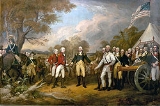
 was blocked by American forces under the command of General Gates. The British were attempting to cross back over to the east side of the Hudson at Saratoga, the same point they had crossed in August, but by then they were surrounded and badly outnumbered. Forty miles (60 km) south of Fort Ticonderoga, with supplies dwindling and winter not far off, Burgoyne had little option. He set up camp at Saratoga and decided to open discussions with the Americans.

At first Gates demanded unconditional surrender, which the British general flatly turned down, declaring he would sooner fight to the death. Gates eventually agreed to a "treaty of convention," whereby the British would technically not surrender nor be taken as prisoners but be marched to Boston and returned to England on the condition that they were not to serve again in America. Gates was concerned that a fight to the death with Burgoyne could still prove costly, and he was also concerned about reports of General Sir Henry ClintonHenry Clinton (American War of Independence)

General Sir Henry Clinton, KB, was a British officer during the American War of Independence, or revolutionary war....
 advancing from New YorkNew York

New York is a state in the northeastern United States....
 to relieve his compatriots stranded at Saratoga. Resplendent in full ceremonial uniform, General Burgoyne led his troops out from his camp on October 17, 1777, and was greeted with formal cordiality by General Gates. Others lay wounded or were helping the large contingent of officers' wives prepare for captivity.

In the grounding of arms at Saratoga, 5,791 men were surrendered. Riedesel had stated that not more than 4,000 of these were fit for duty. The number of Germans surrendering is set down by Eelking at 2,431 men, and of Germans killed, wounded, captured or missing down to October 6, at 1,122 including the losses at BenningtonBattle of Bennington

The Battle of Bennington was a battle of the American Revolutionary War, taking place on August 16, 1777, not at its namesa...
. The total loss of the British and their German auxiliaries, in killed, wounded, prisoners, and deserters, during the campaign, was 9,000 men.

Convention Army

Burgoyne's troops were disarmed and should have been paroled (returned to Britain on the condition that they engage in no further conflict with America), a common 18th century military practice. Instead, the Continental Congress, believing correctly that the British Government would simply replace the Saratoga troops with soldiers in Britain who would be sent to America, refused to ratify the "convention" of surrender agreed to by Gates and Burgoyne. Though some of the British and German officers were eventually exchanged for captured American officers, most of the enlisted men in the "Convention ArmyConvention Army Overview

The Convention Army were the British and allied troops captured after the Battle of Saratoga in the American Revolutionary W...
," as it became known, were held captive in camps in New England, Virginia, and Pennsylvania, until the end of the war.

Another serious difficulty encountered was that Charles I, Duke of Brunswick, did not want his soldiers back, fearing they would hinder future recruitment. The Brunswickers did not appreciate this and deserted in large numbers; of 5,723 Brunswick troops, only 3,015 returned in 1783. Most settled in the colonies, eventually becoming American citizens.

Legacy


The importance of the battles of Saratoga and the surrender of Burgoyne's army cannot be overstated. The French, who had been providing covert aid to the American rebels for some time, now decided that the Americans were a good bet to win. France and the United States signed a treaty of mutual allianceTreaty of Alliance (1778)

The Treaty of Alliance of 1778 was a treaty between France and the United States, that was signed in Paris by American and F...
 in February 1778 and France's declaration of war on Britain followed soon after. The presence of France in the war as a belligerent not only threatened the British Isles directly but also menaced Britain's colonies all over the world--Canada, the West Indies, GibraltarFacts About Gibraltar

Gibraltar is a British overseas territory....
, IndiaIndia

India , officially the Republic of India, is a country in South Asia....
. Thus the English, faced with much more territory at risk, ended all offensive operations in the northern American colonies. William Howe, who had gone to such trouble to capture Philadelphia in September 1777 while Burgoyne was headed to disaster, had to evacuate that city less than a year later, retiring to New York. The new British offensives would be in the southern colonies, Georgia and the Carolinas, where Loyalists were believed to be more numerous. The English had many successes from 1778 to 1780, conquering Georgia and most of South Carolina, but the tide turned in 1780-81 with American victories at King's Mountain and CowpensBattle of Cowpens

The Battle of Cowpens was an overwhelming victory by American revolutionary forces under Brigadier General Daniel Morgan. ...
, until the United States and its new French ally won the war by capturing another British army at YorktownSiege of Yorktown

Headline text The Siege of Yorktown was a victory by a combined American and French force led by General George Washington...
.

Horatio Gates in fact had done little to bring about the victory at Saratoga. The overall campaign strategy of drawing the British into the wilderness while scorching the earth to deny them supplies was Philip Schuyler's. Also, Gates had done almost nothing to influence the battles of Sept. 19 and Oct. 7 other than send off reinforcements from time to time. It was the valor of the American soldiers and the leadership of officers actually in the fighting, such as Arnold, that won the day.

However that did not stop Gates, as commanding general of the army that had won by far the biggest victory of the war, from getting most of the credit. There was even a movement to replace WashingtonConway Cabal

The Conway Cabal refers to a conspiracy in late 1777 and 1778 designed to remove George Washington as commander of the Conti...
 with Gates. Instead, Gates got command of the principal American army in the South as the focus of the war shifted to the southern colonies. He led that army to a disastrous defeat at the Battle of CamdenBattle of Camden

The Battle of Camden was an important battle in the Southern Theatre of the American Revolutionary War....
 in 1780. Worse, as his army collapsed Gates fled the field, getting on his horse and not stopping until he was 60 miles away from the scene of battle. He never commanded troops in the field again.

Benedict Arnold's brave charge on the Breymann Redoubt on Oct. 7 was the climax of over two years of brilliant service for the American cause all over the northern theater. His leg wound would leave him bedridden for the better part of a year. After that, when he was walking with a cane but still not fit for field service, Washington made him military governor of Philadelphia. It was there that Arnold, resentful over Congress' failure to promote him, angry at (true) charges that he was using his office for war profiteering, and influenced by his new Loyalist wifePeggy Shippen

Peggy Shippen, or Margaret Shippen was the second wife of General Benedict Arnold....
, entered into treasonous correspondence with the British. By 1780, when he was ready to take the field again, Washington offered Arnold command of half of the Continental ArmyContinental Army

The Continental Army was the unified command structure of the thirteen colonies fighting Great Britain during the American R...
. Instead Arnold asked for the fort at West PointUnited States Military Academy

The United States Military Academy, also known as West Point, or simply USMA , is a United States Army fort and ...
, which he was plotting to hand over to the enemy. Later that year his treason was exposed and Arnold fled to the British to avoid arrest.

Arnold's name is nowhere to be found on the statues and monuments at the Saratoga battlefield. The Saratoga Monument obelisk has niches which hold statues of three American generals on three of its sides: Gates, Schuyler, and Morgan. The fourth side, where Arnold's would go, is empty. A more dramatic memorial to his heroism is the Boot MonumentBoot Monument

The Boot Monument is an American Revolutionary War memorial erected in Saratoga National Historical Park and dedicated to Be...
. The Boot Monument, donated by General John Watts de PeysterJohn Watts de Peyster

John Watts de Peyster was a Brigadier General in the New York State Militia during the American Civil War and philanthropois...
, shows a boot with spurs and the stars of a major general. It stands at the spot where Arnold was shot on October 7 charging the Breymann Redoubt. The monument is dedicated to "the most brilliant soldier of the Continental Army". Like the obelisk, it does not include his name.

According to legend, Arnold, as a British general, asked an American captive in Virginia what the Americans would do with him. The reply was:

"We would cut your leg off and bury it with full military honors for your work at Quebec and Saratoga. The rest of you we would hang."

Further reading

  • Creasy, Sir Edward; The Fifteen Decisive Battles of the World
  • Ketchum, Richard M.; Saratoga: Turning Point of America's Revolutionary War; 1997, Henry Holt & Company, ISBN 0-8050-4681-X; (Paperback ISBN 0-8050-6123-1)
  • Luzader, John; Saratoga: A Military History of the Decisive Campaign of the American Revolution; Savas Beatie LLC, 2008, ISBN 978-1-932714-44-9;
  • Mintz, Max M.; The Generals of Saratoga: John Burgoyne and Horatio Gates; 1990, Yale University Press, ISBN 0-300-04778-9;
  • Nickerson, Hoffman; The Turning Point of the Revolution: Or, Burgoyne in America
  • Patterson, Samuel White; Horatio Gates: Defender of American Liberties
  • Savas, Theodore P., and Dameron, J. David; A Guide to the Battles of the American Revolution; Savas Beatie LLC, 2005, ISBN 1-932714-12-X

External links


Links to sites that discuss the Hessian soldiers—some with pictures
  • , , ,