


Acts of Union 1707

Encyclopedia
The Acts of Union were two Parliamentary Acts
- the Union with Scotland Act passed in 1706 by the Parliament of England
, and the Union with England Act passed in 1707 by the Parliament of Scotland
- which put into effect the terms of the Treaty of Union
that had been agreed on 22 July 1706, following negotiation between commissioners representing the parliaments of the two countries. The Acts joined the Kingdom of England
and the Kingdom of Scotland
(previously separate state
s, with separate legislatures but with the same monarch
) into a single, united kingdom named "Great Britain
".
The two countries had shared a monarch since the Union of the Crowns
in 1603, when King James VI of Scotland inherited the English throne from his double first cousin twice removed, Queen Elizabeth I. Although described as a Union of Crowns, until 1707 there were in fact two separate Crowns resting on the same head (as opposed to the implied creation of a single Crown and a single Kingdom, exemplified by the later Kingdom of Great Britain
) . There had been three attempts in 1606, 1667, and 1689 to unite the two countries by Acts of Parliament, but it was not until the early 18th century that both political establishments came to support the idea, albeit for different reasons.
The Acts took effect on 1 May 1707. On this date, the Scottish Parliament and the English Parliament united to form the Parliament of Great Britain
, based in the Palace of Westminster
in London
, the home of the English Parliament. Hence, the Acts are referred to as the Union of the Parliaments. On the Union, historian Simon Schama
said "What began as a hostile merger, would end in a full partnership in the most powerful going concern in the world ... it was one of the most astonishing transformations in European history."
). The first attempts at Union surrounded the foreseen unification of the Royal lines of Scotland and England. In pursuing the English throne in the 1560s, Mary, Queen of Scots pledged herself to a peaceful union between the two kingdoms.
England and Scotland were ruled by the same king for the first time in 1603 when James VI of Scotland also became the king of England. However they remained two separate states until 1 May 1707.
.svg.png) The first attempt to unite the parliaments of England and Scotland was by Mary's son, King James VI and I
The first attempt to unite the parliaments of England and Scotland was by Mary's son, King James VI and I
. On his accession to the English throne in 1603 King James announced his intention to unite his two realms so that he would not be "guilty of bigamy". James used his Royal prerogative
powers to take the style of 'King of Great Britain' and to give an explicitly British character to his court and person. Whilst James assumed the creation of a full union was a foregone conclusion, the Parliament of England
was concerned that the formation of a new state would deprive England of its ancient liberties, taking on the more absolutist
monarchical structure which James had previously enjoyed in Scotland. In the meantime, James declared that Great Britain be viewed 'as presently united, and as one realm and kingdom, and the subjects of both realms as one people'.
The Scottish and English parliaments established a commission to negotiate a union, formulating an instrument of union between the two countries. A latent unpopularity of the union remained, however, and when James dropped his policy of a speedy union the topic quietly disappeared from the legislative agenda. When the House of Commons attempted to revive the proposal in 1610, it was met with a more open hostility.
 The Solemn League and Covenant
1643 sought a forced union of the Church of England
into the Church of Scotland
, and although the covenant referred repeatedly to union between the three kingdoms of England, Scotland, and Ireland, a political union was not spelled out.
In the aftermath of the Civil War
, in which the Covenanter
s had fought for the King, Oliver Cromwell
conquered Scotland and began a process of creating a 'Godly Britannic' Union between the former Kingdoms. In 1651, the Parliament of England issued the Tender of Union
declaration supporting Scotland's incorporation into the Commonwealth and sent Commissioners to Scotland with the express purpose of securing support for Union, which was assented to by the Commissioners (Members of Parliament) in Scotland. On 12 April 1654, Cromwell – styling himself Lord Protector
of England, Scotland and Ireland – enacted An Ordinance by the Protector for the Union of England and Scotland which created 'one Commonwealth and under one Government' to be known as the Commonwealth of England, Scotland and Ireland
. The ordinance was ratified by the Second Protectorate Parliament
, as an Act of Union
, on 26 June 1657. One united Parliament sat in Westminster, with 30 representatives from Scotland and 30 from Ireland joining the existing members from England. Whilst free trade was brought about amongst the new Commonwealth, the economic benefits were generally not felt as a result of heavy taxation used to fund Cromwell's New Model Army
.
This republican union was dissolved automatically with the restoration
of King Charles II
to the thrones of England and Scotland. Scottish members expelled from the Commonwealth Parliament
petitioned unsuccessfully for a continuance of the union. Cromwell's union had simultaneously raised interest in and suspicion of the concept of union and when Charles II
attempted to recreate the union and fulfil the work of his grandfather in 1669, negotiations between Commissioners ground to a halt.
Following the Glorious Revolution
in 1689, the records of the Parliament of Scotland show much discussion of possible union. William and Mary
, whilst supportive of the idea, had no interest in allowing it to delay their enthronement. Impetus for this incorporating union came almost entirely from the direction of Scotland. In the 1690s, however, the economic position of Scotland worsened and the relations between Scotland and England became strained. By the 18th century, however, union became a significant matter on the political agenda.
and the Duke of Argyll
. Most favoured union, and about half were government ministers and other officials. At the head of the list was Queensberry, and the Lord Chancellor of Scotland
, the Earl of Seafield
.
Other commissioners were businessmen and bankers, including two directors of the Bank of Scotland
, and a director of the Company of Scotland
, and local leaders such as Sir James Smollet (Dumbarton), and Sir Patrick Johnston
, the provost of Edinburgh. The Scottish Parliament was also well-represented.
There were an equivalent number of English commissioners, including government ministers and officers of state, such as Lord Godolphin, and the two secretaries of state, Sir Charles Hedges
and Robert Harley, and a large number of Whigs who supported union. Tories were not in favour of union and were not represented on the commission.
Negotiations between the English and Scottish commissioners began in April 1706 at the Cockpit, a government building in London. The sessions opened with speeches from William Cowper
, the English Lord Keeper, and Lord Seafield, the Scottish Lord Chancellor, each describing the significance of the task. Each side had its own particular concerns. Within a few days, England gained a guarantee that the Hanoverian royal dynasty would succeed Queen Anne to the Scottish crown, and the Scots received some much-desired access to English colonial markets, which would help to strengthen their economy.
After negotiations ended in July 1706, the acts had to be ratified by both Parliaments. In Scotland, about 100 of the 227 members of the Parliament of Scotland
were members of the Court Party, meaning that they supported the Queen and union. For extra votes the pro-court side could rely on about 25 members of the Squadrone Volante
, led by the Marquess of Montrose
and the Duke of Roxburghe
. Opponents of the court were generally known as the Country party
, and included various factions and individuals such as the Duke of Hamilton
, Lord Belhaven and Andrew Fletcher of Saltoun, who spoke forcefully and passionately against the union. The Court party had greater party discipline and thus gained a steady majority.
In Scotland, the Duke of Queensberry
was largely responsible for the successful passage of the Union act by the Scottish Parliament
. In Scotland, he received much criticism from local residents, but in England he was cheered for his action. In April 1707, he travelled to London in order to attend celebrations at the royal court, and was greeted by groups of noblemen and gentry lined along the road. From Barnet
, the route was lined with crowds of cheering people, and once he reached London a huge crowd had formed. On 17 April, the Duke was gratefully received by the Queen at Kensington Palace
.
, which ensured that the monarch of England would be a Protestant member of the House of Hanover
. Until the Union of Parliaments, the Scots could choose their own successor to Queen Anne: the Scottish Act of Security 1704
explicitly required a choice different from the English monarch.
through English assistance and the lifting of measures put in place through the Alien Act to force the Scottish Parliament into compliance with the Act of Settlement.
The ultimate securing of the treaty in the unicameral Scottish Parliament
is attributed by some to the weakness and lack of cohesion between the various opposition groups in the House, rather than to the strength of pro-incorporationists. The combined votes of the Court party with a majority of the Squadrone Volante
were sufficient to ensure the final passage of the treaty through the House.
Personal financial interests were also allegedly involved. Many Commissioners had invested heavily in the Darien Scheme and they believed that they would receive compensation for their losses; Article 15, the Equivalent granted £
398,085 10s
sterling to Scotland to offset future liability towards the English national debt. In essence, it was also used as a means of compensation for investors in the Darien Scheme
.
Even more direct bribery was also said to be a factor. £20,000 (£240,000 Scots
) was dispatched to Scotland for distribution by the Earl of Glasgow
. James Douglas, 2nd Duke of Queensberry
, the Queen's Commissioner in Parliament, received £12,325, the majority of the funding. (Some contend that all of this money was properly accounted for as compensation for loss of office, pensions and so forth not outwith the usual run of government. It is perhaps a debate that will never be set to rest. However, modern research has shown that payments were made to supporters of union that appear not to have been overdue salaries. At least four payments were made to people who were not even members of the Scottish Parliament.) Robert Burns
referred to this:
Some of the money was used to hire spies
, such as Daniel Defoe
; his first reports were of vivid descriptions of violent demonstrations against the Union. "A Scots rabble is the worst of its kind," he reported, "for every Scot in favour there is 99 against". Years later John Clerk of Penicuik
, originally a leading Unionist, wrote in his memoirs that,
was a spy among us, but not known as such, otherwise the Mob of Edinburgh would pull him to pieces.
Defoe recalls that he was hired by Robert Harley
.
The Treaty could be considered unpopular in Scotland: Sir George Lockhart of Carnwath
, the only member of the Scottish negotiating team against union, noted that "The whole nation appears against the Union" and even Sir John Clerk of Penicuik
, an ardent pro-unionist and Union negotiator, observed that the treaty was "contrary to the inclinations of at least three-fourths of the Kingdom". Public opinion against the Treaty as it passed through the Scottish Parliament was voiced through petition
s from shires, burghs, presbyteries and parishes. The Convention of Royal Burghs also petitioned against the Union and not one petition in favour of an incorporating union was received by Parliament. On the day the treaty was signed, the carillon
er in St Giles Cathedral, Edinburgh, rang the bells in the tune Why should I be so sad on my wedding day? There were also massive protests in Edinburgh
and several other Scottish burgh
s on the day it was passed by Parliament, as threats of widespread civil unrest resulted in Parliament imposing martial law
.
, the third of the "sister kingdoms", was not included in the union. It remained a separate kingdom and indeed was legally subordinate to Great Britain until 1784.
Ireland's benefits from the Union of 1707 were few. Its preferential status in trade with England now extended to Scotland. However, Ireland was left unequal and unrepresented in the Parliament of Great Britain.
In July 1707 each House of the Parliament of Ireland
passed a congratulatory address to Queen Anne, praying that "May God put it in your royal heart to add greater strength and lustre to your crown, by a still more comprehensive Union". The British government did not respond to the invitation and an equal union between Great Britain and Ireland was out of consideration until the 1790s. The union with Ireland finally came about on 1 January 1801.
, agreed between representatives of the Parliament of England
and the Parliament of Scotland
in 1706, consisted of 25 articles, 15 of which were economic in nature. In Scotland, each article was voted on separately and several clauses in articles were delegated to specialised subcommittees. Article 1 of the treaty was based on the political principle of an incorporating union and this was secured by a majority of 116 votes to 83 on 4 November 1706. In order to minimise the opposition of the Church of Scotland
, an Act was also passed to secure the Presbyterian establishment of the Church, after which the Church stopped its open opposition, although hostility remained at lower levels of the clergy. The treaty as a whole was finally ratified on 16 January 1707 by a majority of 110 votes to 69.
The two Acts incorporated provisions for Scotland to send representative peers from the Peerage of Scotland
to sit in the House of Lords
. It guaranteed that the Church of Scotland
would remain the established church in Scotland, that the Court of Session
would "remain in all time coming within Scotland", and that Scots law
would "remain in the same force as before". Other provisions included the restatement of the Act of Settlement 1701
and the ban on Roman Catholics from taking the throne. It also created a customs union
and monetary union.
The Act provided that any "laws and statutes" that were "contrary to or inconsistent with the terms" of the Act would "cease and become void."
Soon after the Union, the Act 6 Anne c.40 (later infelicitously named the "Union with Scotland (Amendment) Act 1707") united the English and Scottish Privy Council
s and decentralised Scottish administration by appointing justices of the peace in each shire to carry out administration. In effect it took the day to day government of Scotland out of the hands of politicians and into those of the College of Justice
.
, not bicameral
. Most of the pre-Union traditions of Westminster continued unchanged by becoming the Parliament of Great Britain
.
Defoe drew upon his Scottish experience to write his Tour thro' the whole Island of Great Britain, published in 1726, where he actually admitted that the increase of trade and population in Scotland, which he had predicted as a consequence of the Union, was "not the case, but rather the contrary."
Andrew Fletcher of Saltoun, a vehement critic of the Union, said in An Account of a Conversation, that Scotland suffered "... the miserable and languishing condition of all places that depend upon a remote seat of government."
However by the time Samuel Johnson
and James Boswell
made their tour in 1773, recorded in A Journey to the Western Islands of Scotland
Johnson noted that Scotland was: “a nation of which the commerce is hourly extending, and the wealth increasing”, and Glasgow
in particular had become one of the greatest cities of Britain.
Scottish Parliament
was opened after a referendum in Scotland
. The opening of the new parliament was presided over by Winifred Ewing
MSP, SNP
regional list member for the Highlands and Islands
, in her role as the oldest member and de facto Mother of the House, being first to take the parliamentary oath to Her Majesty the Queen. During the opening address which she delivered, she concluded with the words "the Scottish Parliament, adjourned on the 25th of March in the year 1707 is hereby reconvened."
As a devolved institution, the new Scottish Parliament does not affect the powers and authority of the Parliament of the United Kingdom
to make laws for Scotland, which remains a constituent country
of the UK. Whilst it has power to make laws in Scotland – in addition to the UK Parliament – over many home affairs issues, there are other reserved powers
such as defence and foreign affairs over which it has no power.
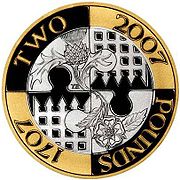 A commemorative two-pound coin was issued to mark the tercentennial—300th anniversary—of the Union, which occurred two days before the Scottish Parliament general election
on 3 May 2007.
The then-current Scottish Executive
held a number of commemorative events through the year including an education project led by the Royal Commission on the Ancient and Historical Monuments of Scotland
, an exhibition of Union-related objects and documents at the National Museums of Scotland
and an exhibition of portraits of people associated with the Union at the National Galleries of Scotland
.
Act of Parliament
An Act of Parliament is a statute enacted as primary legislation by a national or sub-national parliament. In the Republic of Ireland the term Act of the Oireachtas is used, and in the United States the term Act of Congress is used.In Commonwealth countries, the term is used both in a narrow...
- the Union with Scotland Act passed in 1706 by the Parliament of England
Parliament of England
The Parliament of England was the legislature of the Kingdom of England. In 1066, William of Normandy introduced a feudal system, by which he sought the advice of a council of tenants-in-chief and ecclesiastics before making laws...
, and the Union with England Act passed in 1707 by the Parliament of Scotland
Parliament of Scotland
The Parliament of Scotland, officially the Estates of Parliament, was the legislature of the Kingdom of Scotland. The unicameral parliament of Scotland is first found on record during the early 13th century, with the first meeting for which a primary source survives at...
- which put into effect the terms of the Treaty of Union
Treaty of Union
The Treaty of Union is the name given to the agreement that led to the creation of the united kingdom of Great Britain, the political union of the Kingdom of England and the Kingdom of Scotland, which took effect on 1 May 1707...
that had been agreed on 22 July 1706, following negotiation between commissioners representing the parliaments of the two countries. The Acts joined the Kingdom of England
Kingdom of England
The Kingdom of England was, from 927 to 1707, a sovereign state to the northwest of continental Europe. At its height, the Kingdom of England spanned the southern two-thirds of the island of Great Britain and several smaller outlying islands; what today comprises the legal jurisdiction of England...
and the Kingdom of Scotland
Kingdom of Scotland
The Kingdom of Scotland was a Sovereign state in North-West Europe that existed from 843 until 1707. It occupied the northern third of the island of Great Britain and shared a land border to the south with the Kingdom of England...
(previously separate state
Sovereign state
A sovereign state, or simply, state, is a state with a defined territory on which it exercises internal and external sovereignty, a permanent population, a government, and the capacity to enter into relations with other sovereign states. It is also normally understood to be a state which is neither...
s, with separate legislatures but with the same monarch
Personal union
A personal union is the combination by which two or more different states have the same monarch while their boundaries, their laws and their interests remain distinct. It should not be confused with a federation which is internationally considered a single state...
) into a single, united kingdom named "Great Britain
Kingdom of Great Britain
The former Kingdom of Great Britain, sometimes described as the 'United Kingdom of Great Britain', That the Two Kingdoms of Scotland and England, shall upon the 1st May next ensuing the date hereof, and forever after, be United into One Kingdom by the Name of GREAT BRITAIN. was a sovereign...
".
The two countries had shared a monarch since the Union of the Crowns
Union of the Crowns
The Union of the Crowns was the accession of James VI, King of Scots, to the throne of England, and the consequential unification of Scotland and England under one monarch. The Union of Crowns followed the death of James' unmarried and childless first cousin twice removed, Queen Elizabeth I of...
in 1603, when King James VI of Scotland inherited the English throne from his double first cousin twice removed, Queen Elizabeth I. Although described as a Union of Crowns, until 1707 there were in fact two separate Crowns resting on the same head (as opposed to the implied creation of a single Crown and a single Kingdom, exemplified by the later Kingdom of Great Britain
Kingdom of Great Britain
The former Kingdom of Great Britain, sometimes described as the 'United Kingdom of Great Britain', That the Two Kingdoms of Scotland and England, shall upon the 1st May next ensuing the date hereof, and forever after, be United into One Kingdom by the Name of GREAT BRITAIN. was a sovereign...
) . There had been three attempts in 1606, 1667, and 1689 to unite the two countries by Acts of Parliament, but it was not until the early 18th century that both political establishments came to support the idea, albeit for different reasons.
The Acts took effect on 1 May 1707. On this date, the Scottish Parliament and the English Parliament united to form the Parliament of Great Britain
Parliament of Great Britain
The Parliament of Great Britain was formed in 1707 following the ratification of the Acts of Union by both the Parliament of England and Parliament of Scotland...
, based in the Palace of Westminster
Palace of Westminster
The Palace of Westminster, also known as the Houses of Parliament or Westminster Palace, is the meeting place of the two houses of the Parliament of the United Kingdom—the House of Lords and the House of Commons...
in London
London
London is the capital city of :England and the :United Kingdom, the largest metropolitan area in the United Kingdom, and the largest urban zone in the European Union by most measures. Located on the River Thames, London has been a major settlement for two millennia, its history going back to its...
, the home of the English Parliament. Hence, the Acts are referred to as the Union of the Parliaments. On the Union, historian Simon Schama
Simon Schama
Simon Michael Schama, CBE is a British historian and art historian. He is a University Professor of History and Art History at Columbia University. He is best known for writing and hosting the 15-part BBC documentary series A History of Britain...
said "What began as a hostile merger, would end in a full partnership in the most powerful going concern in the world ... it was one of the most astonishing transformations in European history."
Previous attempts at union
England and Scotland were separate states for several centuries before eventual union, and English attempts to take over Scotland by military force in the late 13th and early 14th centuries were ultimately unsuccessful (see the Wars of Scottish IndependenceWars of Scottish Independence
The Wars of Scottish Independence were a series of military campaigns fought between the independent Kingdom of Scotland and the Kingdom of England in the late 13th and early 14th centuries....
). The first attempts at Union surrounded the foreseen unification of the Royal lines of Scotland and England. In pursuing the English throne in the 1560s, Mary, Queen of Scots pledged herself to a peaceful union between the two kingdoms.
England and Scotland were ruled by the same king for the first time in 1603 when James VI of Scotland also became the king of England. However they remained two separate states until 1 May 1707.
Early Stuart union
James I of England
James VI and I was King of Scots as James VI from 24 July 1567 and King of England and Ireland as James I from the union of the English and Scottish crowns on 24 March 1603...
. On his accession to the English throne in 1603 King James announced his intention to unite his two realms so that he would not be "guilty of bigamy". James used his Royal prerogative
Royal Prerogative (United Kingdom)
The Royal Prerogative is a body of customary authority, privilege, and immunity, recognised in the United Kingdom as the sole prerogative of the Sovereign. Many of the executive powers of British government, vested in a monarch, have been bestowed under the mandate of the Royal...
powers to take the style of 'King of Great Britain' and to give an explicitly British character to his court and person. Whilst James assumed the creation of a full union was a foregone conclusion, the Parliament of England
Parliament of England
The Parliament of England was the legislature of the Kingdom of England. In 1066, William of Normandy introduced a feudal system, by which he sought the advice of a council of tenants-in-chief and ecclesiastics before making laws...
was concerned that the formation of a new state would deprive England of its ancient liberties, taking on the more absolutist
Absolute monarchy
Absolute monarchy is a monarchical form of government in which the monarch exercises ultimate governing authority as head of state and head of government, his or her power not being limited by a constitution or by the law. An absolute monarch thus wields unrestricted political power over the...
monarchical structure which James had previously enjoyed in Scotland. In the meantime, James declared that Great Britain be viewed 'as presently united, and as one realm and kingdom, and the subjects of both realms as one people'.
The Scottish and English parliaments established a commission to negotiate a union, formulating an instrument of union between the two countries. A latent unpopularity of the union remained, however, and when James dropped his policy of a speedy union the topic quietly disappeared from the legislative agenda. When the House of Commons attempted to revive the proposal in 1610, it was met with a more open hostility.
Union during the interregnum
Solemn League and Covenant
The Solemn League and Covenant was an agreement between the Scottish Covenanters and the leaders of the English Parliamentarians. It was agreed to in 1643, during the First English Civil War....
1643 sought a forced union of the Church of England
Church of England
The Church of England is the officially established Christian church in England and the Mother Church of the worldwide Anglican Communion. The church considers itself within the tradition of Western Christianity and dates its formal establishment principally to the mission to England by St...
into the Church of Scotland
Church of Scotland
The Church of Scotland, known informally by its Scots language name, the Kirk, is a Presbyterian church, decisively shaped by the Scottish Reformation....
, and although the covenant referred repeatedly to union between the three kingdoms of England, Scotland, and Ireland, a political union was not spelled out.
In the aftermath of the Civil War
English Civil War
The English Civil War was a series of armed conflicts and political machinations between Parliamentarians and Royalists...
, in which the Covenanter
Covenanter
The Covenanters were a Scottish Presbyterian movement that played an important part in the history of Scotland, and to a lesser extent in that of England and Ireland, during the 17th century...
s had fought for the King, Oliver Cromwell
Oliver Cromwell
Oliver Cromwell was an English military and political leader who overthrew the English monarchy and temporarily turned England into a republican Commonwealth, and served as Lord Protector of England, Scotland, and Ireland....
conquered Scotland and began a process of creating a 'Godly Britannic' Union between the former Kingdoms. In 1651, the Parliament of England issued the Tender of Union
Tender of Union
The Tender of Union was a declaration of the Parliament of England during the Interregnum following the War of the Three Kingdoms stating that Scotland would cease to have an independent parliament and would join England in its emerging Commonwealth republic....
declaration supporting Scotland's incorporation into the Commonwealth and sent Commissioners to Scotland with the express purpose of securing support for Union, which was assented to by the Commissioners (Members of Parliament) in Scotland. On 12 April 1654, Cromwell – styling himself Lord Protector
Lord Protector
Lord Protector is a title used in British constitutional law for certain heads of state at different periods of history. It is also a particular title for the British Heads of State in respect to the established church...
of England, Scotland and Ireland – enacted An Ordinance by the Protector for the Union of England and Scotland which created 'one Commonwealth and under one Government' to be known as the Commonwealth of England, Scotland and Ireland
Commonwealth of England
The Commonwealth of England was the republic which ruled first England, and then Ireland and Scotland from 1649 to 1660. Between 1653–1659 it was known as the Commonwealth of England, Scotland and Ireland...
. The ordinance was ratified by the Second Protectorate Parliament
Second Protectorate Parliament
The Second Protectorate Parliament in England sat for two sessions from 17 September 1656 until 4 February 1658, with Thomas Widdrington as the Speaker of the House of Commons...
, as an Act of Union
Tender of Union
The Tender of Union was a declaration of the Parliament of England during the Interregnum following the War of the Three Kingdoms stating that Scotland would cease to have an independent parliament and would join England in its emerging Commonwealth republic....
, on 26 June 1657. One united Parliament sat in Westminster, with 30 representatives from Scotland and 30 from Ireland joining the existing members from England. Whilst free trade was brought about amongst the new Commonwealth, the economic benefits were generally not felt as a result of heavy taxation used to fund Cromwell's New Model Army
New Model Army
The New Model Army of England was formed in 1645 by the Parliamentarians in the English Civil War, and was disbanded in 1660 after the Restoration...
.
This republican union was dissolved automatically with the restoration
English Restoration
The Restoration of the English monarchy began in 1660 when the English, Scottish and Irish monarchies were all restored under Charles II after the Interregnum that followed the Wars of the Three Kingdoms...
of King Charles II
Charles II of England
Charles II was monarch of the three kingdoms of England, Scotland, and Ireland.Charles II's father, King Charles I, was executed at Whitehall on 30 January 1649, at the climax of the English Civil War...
to the thrones of England and Scotland. Scottish members expelled from the Commonwealth Parliament
Parliament of England
The Parliament of England was the legislature of the Kingdom of England. In 1066, William of Normandy introduced a feudal system, by which he sought the advice of a council of tenants-in-chief and ecclesiastics before making laws...
petitioned unsuccessfully for a continuance of the union. Cromwell's union had simultaneously raised interest in and suspicion of the concept of union and when Charles II
Charles II of England
Charles II was monarch of the three kingdoms of England, Scotland, and Ireland.Charles II's father, King Charles I, was executed at Whitehall on 30 January 1649, at the climax of the English Civil War...
attempted to recreate the union and fulfil the work of his grandfather in 1669, negotiations between Commissioners ground to a halt.
Later attempts
An abortive scheme for union occurred in Scotland in 1670.Following the Glorious Revolution
Glorious Revolution
The Glorious Revolution, also called the Revolution of 1688, is the overthrow of King James II of England by a union of English Parliamentarians with the Dutch stadtholder William III of Orange-Nassau...
in 1689, the records of the Parliament of Scotland show much discussion of possible union. William and Mary
William and Mary
The phrase William and Mary usually refers to the coregency over the Kingdoms of England, Scotland and Ireland, of King William III & II and Queen Mary II...
, whilst supportive of the idea, had no interest in allowing it to delay their enthronement. Impetus for this incorporating union came almost entirely from the direction of Scotland. In the 1690s, however, the economic position of Scotland worsened and the relations between Scotland and England became strained. By the 18th century, however, union became a significant matter on the political agenda.
Passage of Acts of 1707
Both countries appointed commissioners to handle negotiations. Scotland had 31 commissioners, mainly picked by the Duke of QueensberryJames Douglas, 2nd Duke of Queensberry
James Douglas, 2nd Duke of Queensberry and 1st Duke of Dover was a Scottish nobleman.He was the eldest son of William Douglas, 1st Duke of Queensberry and his wife Isabel Douglas, daughter of William Douglas, 1st Marquess of Douglas.Educated at the University of Glasgow, he was appointed a...
and the Duke of Argyll
Duke of Argyll
Duke of Argyll is a title, created in the Peerage of Scotland in 1701 and in the Peerage of the United Kingdom in 1892. The Earls, Marquesses, and Dukes of Argyll were for several centuries among the most powerful, if not the most powerful, noble family in Scotland...
. Most favoured union, and about half were government ministers and other officials. At the head of the list was Queensberry, and the Lord Chancellor of Scotland
Lord Chancellor of Scotland
The Lord Chancellor of Scotland was a Great Officer of State in pre-Union Scotland.Holders of the office are known from 1123 onwards, but its duties were occasionally performed by an official of lower status with the title of Keeper of the Great Seal...
, the Earl of Seafield
Earl of Seafield
Earl of Seafield is a title in the Peerage of Scotland. It was created in 1701 for James Ogilvy, who in 1711 succeeded his father as Earl of Findlater. The titles remained united until the earldom of Findlater became extinct in 1811. The earldom of Seafield is still extant, however...
.
Other commissioners were businessmen and bankers, including two directors of the Bank of Scotland
Bank of Scotland
The Bank of Scotland plc is a commercial and clearing bank based in Edinburgh, Scotland. With a history dating to the 17th century, it is the second oldest surviving bank in what is now the United Kingdom, and is the only commercial institution created by the Parliament of Scotland to...
, and a director of the Company of Scotland
Company of Scotland
The Company of Scotland Trading to Africa and the Indies, also called the Scottish Darien Company, was an overseas trading company created by an act of the Parliament of Scotland in 1695...
, and local leaders such as Sir James Smollet (Dumbarton), and Sir Patrick Johnston
Patrick Johnston
Patrick Johnston may refer to:*Patrick Johnston , Canadian administrator and former politician*Patrick Johnston , former Democratic state legislator in the State of California...
, the provost of Edinburgh. The Scottish Parliament was also well-represented.
There were an equivalent number of English commissioners, including government ministers and officers of state, such as Lord Godolphin, and the two secretaries of state, Sir Charles Hedges
Charles Hedges
Sir Charles Hedges , of Compton Bassett, Wiltshire, an English lawyer and politician, was a judge in Admiralty Court who later served as one of Queen Anne's Secretaries of State.-Life:...
and Robert Harley, and a large number of Whigs who supported union. Tories were not in favour of union and were not represented on the commission.
Negotiations between the English and Scottish commissioners began in April 1706 at the Cockpit, a government building in London. The sessions opened with speeches from William Cowper
William Cowper, 1st Earl Cowper
William Cowper, 1st Earl Cowper PC KC FRS was an English politician who became the first Lord Chancellor of Great Britain. Cowper was the son of Sir William Cowper, 2nd Baronet, of Ratling Court, Kent, a Whig member of parliament of some mark in the two last Stuart reigns...
, the English Lord Keeper, and Lord Seafield, the Scottish Lord Chancellor, each describing the significance of the task. Each side had its own particular concerns. Within a few days, England gained a guarantee that the Hanoverian royal dynasty would succeed Queen Anne to the Scottish crown, and the Scots received some much-desired access to English colonial markets, which would help to strengthen their economy.
After negotiations ended in July 1706, the acts had to be ratified by both Parliaments. In Scotland, about 100 of the 227 members of the Parliament of Scotland
Parliament of Scotland
The Parliament of Scotland, officially the Estates of Parliament, was the legislature of the Kingdom of Scotland. The unicameral parliament of Scotland is first found on record during the early 13th century, with the first meeting for which a primary source survives at...
were members of the Court Party, meaning that they supported the Queen and union. For extra votes the pro-court side could rely on about 25 members of the Squadrone Volante
Squadrone Volante (Scotland)
Squadrone Volante was the name of a political grouping in Scotland around 1700, under the leadership of the deposed Lord High Commissioner the Marquess of Tweeddale, which was influential in passing the Act of Union with England in 1707.Although the actual grouping pre-dated 1705, it received the...
, led by the Marquess of Montrose
James Graham, 1st Duke of Montrose
James Graham, 1st Duke and 4th Marquess of Montrose was a Scottish aristocratic statesman in the early eighteenth century....
and the Duke of Roxburghe
Duke of Roxburghe
The Duke of Roxburghe is a title in the peerage of Scotland created in 1707 along with the titles Marquess of Bowmont and Cessford, Earl of Kelso and Viscount Broxmouth. John Ker, 5th Earl of Roxburghe became the first holder of these titles...
. Opponents of the court were generally known as the Country party
Country Party
Country Party may refer to* Country Party of Australia, now called "National Party of Australia"* In Great Britain:** Country Party , opponents of the Court Party and the government, late 17th early 18th century** Ultra-Tories, active 1829–32...
, and included various factions and individuals such as the Duke of Hamilton
Duke of Hamilton
Duke of Hamilton is a title in the Peerage of Scotland, created in 1643. It is the senior dukedom in that Peerage , and as such its holder is the Premier Peer of Scotland, as well as being head of both the House of Hamilton and the House of Douglas...
, Lord Belhaven and Andrew Fletcher of Saltoun, who spoke forcefully and passionately against the union. The Court party had greater party discipline and thus gained a steady majority.
In Scotland, the Duke of Queensberry
James Douglas, 2nd Duke of Queensberry
James Douglas, 2nd Duke of Queensberry and 1st Duke of Dover was a Scottish nobleman.He was the eldest son of William Douglas, 1st Duke of Queensberry and his wife Isabel Douglas, daughter of William Douglas, 1st Marquess of Douglas.Educated at the University of Glasgow, he was appointed a...
was largely responsible for the successful passage of the Union act by the Scottish Parliament
Scottish Parliament
The Scottish Parliament is the devolved national, unicameral legislature of Scotland, located in the Holyrood area of the capital, Edinburgh. The Parliament, informally referred to as "Holyrood", is a democratically elected body comprising 129 members known as Members of the Scottish Parliament...
. In Scotland, he received much criticism from local residents, but in England he was cheered for his action. In April 1707, he travelled to London in order to attend celebrations at the royal court, and was greeted by groups of noblemen and gentry lined along the road. From Barnet
Barnet
High Barnet or Chipping Barnet is a place in the London Borough of Barnet, North London, England. It is a suburban development built around a twelfth-century settlement and is located north north-west of Charing Cross. Its name is often abbreviated to Barnet, which is also the name of the London...
, the route was lined with crowds of cheering people, and once he reached London a huge crowd had formed. On 17 April, the Duke was gratefully received by the Queen at Kensington Palace
Kensington Palace
Kensington Palace is a royal residence set in Kensington Gardens in the Royal Borough of Kensington and Chelsea in London, England. It has been a residence of the British Royal Family since the 17th century and is the official London residence of the Duke and Duchess of Cambridge, the Duke and...
.
Political motivations
English perspective
The English purpose of it was to ensure that Scotland would not choose a monarch different from the one on the English throne. The two countries had shared a king for much of the previous century, but the English were concerned that an independent Scotland with a different king, even if he were a Protestant, might make alliances against England. The English succession was provided for by the English Act of Settlement 1701Act of Settlement 1701
The Act of Settlement is an act of the Parliament of England that was passed in 1701 to settle the succession to the English throne on the Electress Sophia of Hanover and her Protestant heirs. The act was later extended to Scotland, as a result of the Treaty of Union , enacted in the Acts of Union...
, which ensured that the monarch of England would be a Protestant member of the House of Hanover
House of Hanover
The House of Hanover is a deposed German royal dynasty which has ruled the Duchy of Brunswick-Lüneburg , the Kingdom of Hanover, the Kingdom of Great Britain, the Kingdom of Ireland and the United Kingdom of Great Britain and Ireland...
. Until the Union of Parliaments, the Scots could choose their own successor to Queen Anne: the Scottish Act of Security 1704
Act of Security 1704
The Act of Security 1704 was a response by the Parliament of Scotland to the Parliament of England's Act of Settlement 1701. Queen Anne's last surviving child, William, Duke of Gloucester had died in 1700, and both parliaments needed to find a Protestant successor...
explicitly required a choice different from the English monarch.
Scottish perspective
In Scotland, it was claimed that union would enable Scotland to recover from the financial disaster wrought by the Darien schemeDarién scheme
The Darién scheme was an unsuccessful attempt by the Kingdom of Scotland to become a world trading nation by establishing a colony called "New Caledonia" on the Isthmus of Panama in the late 1690s...
through English assistance and the lifting of measures put in place through the Alien Act to force the Scottish Parliament into compliance with the Act of Settlement.
The ultimate securing of the treaty in the unicameral Scottish Parliament
Parliament of Scotland
The Parliament of Scotland, officially the Estates of Parliament, was the legislature of the Kingdom of Scotland. The unicameral parliament of Scotland is first found on record during the early 13th century, with the first meeting for which a primary source survives at...
is attributed by some to the weakness and lack of cohesion between the various opposition groups in the House, rather than to the strength of pro-incorporationists. The combined votes of the Court party with a majority of the Squadrone Volante
Squadrone Volante (Scotland)
Squadrone Volante was the name of a political grouping in Scotland around 1700, under the leadership of the deposed Lord High Commissioner the Marquess of Tweeddale, which was influential in passing the Act of Union with England in 1707.Although the actual grouping pre-dated 1705, it received the...
were sufficient to ensure the final passage of the treaty through the House.
Personal financial interests were also allegedly involved. Many Commissioners had invested heavily in the Darien Scheme and they believed that they would receive compensation for their losses; Article 15, the Equivalent granted £
Pound sterling
The pound sterling , commonly called the pound, is the official currency of the United Kingdom, its Crown Dependencies and the British Overseas Territories of South Georgia and the South Sandwich Islands, British Antarctic Territory and Tristan da Cunha. It is subdivided into 100 pence...
398,085 10s
Shilling
The shilling is a unit of currency used in some current and former British Commonwealth countries. The word shilling comes from scilling, an accounting term that dates back to Anglo-Saxon times where it was deemed to be the value of a cow in Kent or a sheep elsewhere. The word is thought to derive...
sterling to Scotland to offset future liability towards the English national debt. In essence, it was also used as a means of compensation for investors in the Darien Scheme
Darién scheme
The Darién scheme was an unsuccessful attempt by the Kingdom of Scotland to become a world trading nation by establishing a colony called "New Caledonia" on the Isthmus of Panama in the late 1690s...
.
Even more direct bribery was also said to be a factor. £20,000 (£240,000 Scots
Pound Scots
The pound Scots was the national unit of currency in the Kingdom of Scotland before the country entered into political and currency union with the Kingdom of England in 1707 . It was introduced by David I, in the 12th century, on the model of English and French money, divided into 20 shillings...
) was dispatched to Scotland for distribution by the Earl of Glasgow
Earl of Glasgow
Earl of Glasgow is a title in the Peerage of Scotland. It was created in 1703 for David Boyle, Lord Boyle, one of the commissioners who negotiated the Treaty of Union uniting the Kingdom of England and the Kingdom of Scotland into the United Kingdom of Great Britain...
. James Douglas, 2nd Duke of Queensberry
James Douglas, 2nd Duke of Queensberry
James Douglas, 2nd Duke of Queensberry and 1st Duke of Dover was a Scottish nobleman.He was the eldest son of William Douglas, 1st Duke of Queensberry and his wife Isabel Douglas, daughter of William Douglas, 1st Marquess of Douglas.Educated at the University of Glasgow, he was appointed a...
, the Queen's Commissioner in Parliament, received £12,325, the majority of the funding. (Some contend that all of this money was properly accounted for as compensation for loss of office, pensions and so forth not outwith the usual run of government. It is perhaps a debate that will never be set to rest. However, modern research has shown that payments were made to supporters of union that appear not to have been overdue salaries. At least four payments were made to people who were not even members of the Scottish Parliament.) Robert Burns
Robert Burns
Robert Burns was a Scottish poet and a lyricist. He is widely regarded as the national poet of Scotland, and is celebrated worldwide...
referred to this:
- We're bought and sold for English Gold,
- Sic a Parcel of Rogues in a Nation.
Some of the money was used to hire spies
Espionage
Espionage or spying involves an individual obtaining information that is considered secret or confidential without the permission of the holder of the information. Espionage is inherently clandestine, lest the legitimate holder of the information change plans or take other countermeasures once it...
, such as Daniel Defoe
Daniel Defoe
Daniel Defoe , born Daniel Foe, was an English trader, writer, journalist, and pamphleteer, who gained fame for his novel Robinson Crusoe. Defoe is notable for being one of the earliest proponents of the novel, as he helped to popularise the form in Britain and along with others such as Richardson,...
; his first reports were of vivid descriptions of violent demonstrations against the Union. "A Scots rabble is the worst of its kind," he reported, "for every Scot in favour there is 99 against". Years later John Clerk of Penicuik
John Clerk of Penicuik
Sir John Clerk of Pennycuik, 2nd Baronet was a Scottish politician, lawyer, judge, composer and architect.He was Vice-President of the Philosophical Society of Edinburgh, the pre-eminent learned society of the Scottish Enlightenment.-Early life:...
, originally a leading Unionist, wrote in his memoirs that,
was a spy among us, but not known as such, otherwise the Mob of Edinburgh would pull him to pieces.
Defoe recalls that he was hired by Robert Harley
Robert Harley, 1st Earl of Oxford and Mortimer
Robert Harley, 1st Earl of Oxford and Earl Mortimer KG was a British politician and statesman of the late Stuart and early Georgian periods. He began his career as a Whig, before defecting to a new Tory Ministry. Between 1711 and 1714 he served as First Lord of the Treasury, effectively Queen...
.
The Treaty could be considered unpopular in Scotland: Sir George Lockhart of Carnwath
George Lockhart
Sir George Lockhart of Lee , of Carnwath, South Lanarkshire, also known as Lockhart of Carnwath, was a Scottish writer, spy and politician.He was the son of Sir George Lockhart of Lee....
, the only member of the Scottish negotiating team against union, noted that "The whole nation appears against the Union" and even Sir John Clerk of Penicuik
John Clerk of Penicuik
Sir John Clerk of Pennycuik, 2nd Baronet was a Scottish politician, lawyer, judge, composer and architect.He was Vice-President of the Philosophical Society of Edinburgh, the pre-eminent learned society of the Scottish Enlightenment.-Early life:...
, an ardent pro-unionist and Union negotiator, observed that the treaty was "contrary to the inclinations of at least three-fourths of the Kingdom". Public opinion against the Treaty as it passed through the Scottish Parliament was voiced through petition
Petition
A petition is a request to do something, most commonly addressed to a government official or public entity. Petitions to a deity are a form of prayer....
s from shires, burghs, presbyteries and parishes. The Convention of Royal Burghs also petitioned against the Union and not one petition in favour of an incorporating union was received by Parliament. On the day the treaty was signed, the carillon
Carillon
A carillon is a musical instrument that is typically housed in a free-standing bell tower, or the belfry of a church or other municipal building. The instrument consists of at least 23 cast bronze, cup-shaped bells, which are played serially to play a melody, or sounded together to play a chord...
er in St Giles Cathedral, Edinburgh, rang the bells in the tune Why should I be so sad on my wedding day? There were also massive protests in Edinburgh
Edinburgh
Edinburgh is the capital city of Scotland, the second largest city in Scotland, and the eighth most populous in the United Kingdom. The City of Edinburgh Council governs one of Scotland's 32 local government council areas. The council area includes urban Edinburgh and a rural area...
and several other Scottish burgh
Burgh
A burgh was an autonomous corporate entity in Scotland and Northern England, usually a town. This type of administrative division existed from the 12th century, when King David I created the first royal burghs. Burgh status was broadly analogous to borough status, found in the rest of the United...
s on the day it was passed by Parliament, as threats of widespread civil unrest resulted in Parliament imposing martial law
Martial law
Martial law is the imposition of military rule by military authorities over designated regions on an emergency basis— only temporary—when the civilian government or civilian authorities fail to function effectively , when there are extensive riots and protests, or when the disobedience of the law...
.
Irish perspective
IrelandKingdom of Ireland
The Kingdom of Ireland refers to the country of Ireland in the period between the proclamation of Henry VIII as King of Ireland by the Crown of Ireland Act 1542 and the Act of Union in 1800. It replaced the Lordship of Ireland, which had been created in 1171...
, the third of the "sister kingdoms", was not included in the union. It remained a separate kingdom and indeed was legally subordinate to Great Britain until 1784.
Ireland's benefits from the Union of 1707 were few. Its preferential status in trade with England now extended to Scotland. However, Ireland was left unequal and unrepresented in the Parliament of Great Britain.
In July 1707 each House of the Parliament of Ireland
Parliament of Ireland
The Parliament of Ireland was a legislature that existed in Dublin from 1297 until 1800. In its early mediaeval period during the Lordship of Ireland it consisted of either two or three chambers: the House of Commons, elected by a very restricted suffrage, the House of Lords in which the lords...
passed a congratulatory address to Queen Anne, praying that "May God put it in your royal heart to add greater strength and lustre to your crown, by a still more comprehensive Union". The British government did not respond to the invitation and an equal union between Great Britain and Ireland was out of consideration until the 1790s. The union with Ireland finally came about on 1 January 1801.
Provisions of the Acts
The Treaty of UnionTreaty of Union
The Treaty of Union is the name given to the agreement that led to the creation of the united kingdom of Great Britain, the political union of the Kingdom of England and the Kingdom of Scotland, which took effect on 1 May 1707...
, agreed between representatives of the Parliament of England
Parliament of England
The Parliament of England was the legislature of the Kingdom of England. In 1066, William of Normandy introduced a feudal system, by which he sought the advice of a council of tenants-in-chief and ecclesiastics before making laws...
and the Parliament of Scotland
Parliament of Scotland
The Parliament of Scotland, officially the Estates of Parliament, was the legislature of the Kingdom of Scotland. The unicameral parliament of Scotland is first found on record during the early 13th century, with the first meeting for which a primary source survives at...
in 1706, consisted of 25 articles, 15 of which were economic in nature. In Scotland, each article was voted on separately and several clauses in articles were delegated to specialised subcommittees. Article 1 of the treaty was based on the political principle of an incorporating union and this was secured by a majority of 116 votes to 83 on 4 November 1706. In order to minimise the opposition of the Church of Scotland
Church of Scotland
The Church of Scotland, known informally by its Scots language name, the Kirk, is a Presbyterian church, decisively shaped by the Scottish Reformation....
, an Act was also passed to secure the Presbyterian establishment of the Church, after which the Church stopped its open opposition, although hostility remained at lower levels of the clergy. The treaty as a whole was finally ratified on 16 January 1707 by a majority of 110 votes to 69.
The two Acts incorporated provisions for Scotland to send representative peers from the Peerage of Scotland
Peerage of Scotland
The Peerage of Scotland is the division of the British Peerage for those peers created in the Kingdom of Scotland before 1707. With that year's Act of Union, the Kingdom of Scotland and the Kingdom of England were combined into the Kingdom of Great Britain, and a new Peerage of Great Britain was...
to sit in the House of Lords
House of Lords
The House of Lords is the upper house of the Parliament of the United Kingdom. Like the House of Commons, it meets in the Palace of Westminster....
. It guaranteed that the Church of Scotland
Church of Scotland
The Church of Scotland, known informally by its Scots language name, the Kirk, is a Presbyterian church, decisively shaped by the Scottish Reformation....
would remain the established church in Scotland, that the Court of Session
Court of Session
The Court of Session is the supreme civil court of Scotland, and constitutes part of the College of Justice. It sits in Parliament House in Edinburgh and is both a court of first instance and a court of appeal....
would "remain in all time coming within Scotland", and that Scots law
Scots law
Scots law is the legal system of Scotland. It is considered a hybrid or mixed legal system as it traces its roots to a number of different historical sources. With English law and Northern Irish law it forms the legal system of the United Kingdom; it shares with the two other systems some...
would "remain in the same force as before". Other provisions included the restatement of the Act of Settlement 1701
Act of Settlement 1701
The Act of Settlement is an act of the Parliament of England that was passed in 1701 to settle the succession to the English throne on the Electress Sophia of Hanover and her Protestant heirs. The act was later extended to Scotland, as a result of the Treaty of Union , enacted in the Acts of Union...
and the ban on Roman Catholics from taking the throne. It also created a customs union
Customs union
A customs union is a type of trade bloc which is composed of a free trade area with a common external tariff. The participant countries set up common external trade policy, but in some cases they use different import quotas...
and monetary union.
The Act provided that any "laws and statutes" that were "contrary to or inconsistent with the terms" of the Act would "cease and become void."
Soon after the Union, the Act 6 Anne c.40 (later infelicitously named the "Union with Scotland (Amendment) Act 1707") united the English and Scottish Privy Council
Privy council
A privy council is a body that advises the head of state of a nation, typically, but not always, in the context of a monarchic government. The word "privy" means "private" or "secret"; thus, a privy council was originally a committee of the monarch's closest advisors to give confidential advice on...
s and decentralised Scottish administration by appointing justices of the peace in each shire to carry out administration. In effect it took the day to day government of Scotland out of the hands of politicians and into those of the College of Justice
College of Justice
The College of Justice is a term used to describe the Supreme Courts of Scotland, and its associated bodies.The constituent bodies of the supreme courts of Scotland are the Court of Session, the High Court of Justiciary, and the Accountant of Court's Office...
.
Criticisms
The English and Scottish parliaments had evolved along different lines, and for example the former Parliament of Scotland was unicameralUnicameralism
In government, unicameralism is the practice of having one legislative or parliamentary chamber. Thus, a unicameral parliament or unicameral legislature is a legislature which consists of one chamber or house...
, not bicameral
Bicameralism
In the government, bicameralism is the practice of having two legislative or parliamentary chambers. Thus, a bicameral parliament or bicameral legislature is a legislature which consists of two chambers or houses....
. Most of the pre-Union traditions of Westminster continued unchanged by becoming the Parliament of Great Britain
Parliament of Great Britain
The Parliament of Great Britain was formed in 1707 following the ratification of the Acts of Union by both the Parliament of England and Parliament of Scotland...
.
Defoe drew upon his Scottish experience to write his Tour thro' the whole Island of Great Britain, published in 1726, where he actually admitted that the increase of trade and population in Scotland, which he had predicted as a consequence of the Union, was "not the case, but rather the contrary."
Andrew Fletcher of Saltoun, a vehement critic of the Union, said in An Account of a Conversation, that Scotland suffered "... the miserable and languishing condition of all places that depend upon a remote seat of government."
However by the time Samuel Johnson
Samuel Johnson
Samuel Johnson , often referred to as Dr. Johnson, was an English author who made lasting contributions to English literature as a poet, essayist, moralist, literary critic, biographer, editor and lexicographer...
and James Boswell
James Boswell
James Boswell, 9th Laird of Auchinleck was a lawyer, diarist, and author born in Edinburgh, Scotland; he is best known for the biography he wrote of one of his contemporaries, the English literary figure Samuel Johnson....
made their tour in 1773, recorded in A Journey to the Western Islands of Scotland
A Journey to the Western Islands of Scotland
A Journey to the Western Islands of Scotland is a travel narrative by Samuel Johnson about an eighty-three day journey through Scotland, in particular the islands of the Hebrides, in the late summer and autumn of 1773...
Johnson noted that Scotland was: “a nation of which the commerce is hourly extending, and the wealth increasing”, and Glasgow
Glasgow
Glasgow is the largest city in Scotland and third most populous in the United Kingdom. The city is situated on the River Clyde in the country's west central lowlands...
in particular had become one of the greatest cities of Britain.
A new Scottish Parliament
In 1999, after almost three centuries, a devolvedDevolution
Devolution is the statutory granting of powers from the central government of a sovereign state to government at a subnational level, such as a regional, local, or state level. Devolution can be mainly financial, e.g. giving areas a budget which was formerly administered by central government...
Scottish Parliament
Scottish Parliament
The Scottish Parliament is the devolved national, unicameral legislature of Scotland, located in the Holyrood area of the capital, Edinburgh. The Parliament, informally referred to as "Holyrood", is a democratically elected body comprising 129 members known as Members of the Scottish Parliament...
was opened after a referendum in Scotland
Scotland
Scotland is a country that is part of the United Kingdom. Occupying the northern third of the island of Great Britain, it shares a border with England to the south and is bounded by the North Sea to the east, the Atlantic Ocean to the north and west, and the North Channel and Irish Sea to the...
. The opening of the new parliament was presided over by Winifred Ewing
Winnie Ewing
Winifred Margaret 'Winnie' Ewing is a Scottish nationalist, lawyer and prominent SNP politician who was formerly a Member of Parliament , Member of the European Parliament and Member of the Scottish Parliament...
MSP, SNP
Scottish National Party
The Scottish National Party is a social-democratic political party in Scotland which campaigns for Scottish independence from the United Kingdom....
regional list member for the Highlands and Islands
Highlands and Islands (Scottish Parliament electoral region)
The Highlands and Islands is one of the eight electoral regions of the Scottish Parliament which were created in 1999. Eight of the parliament's first past the post constituencies are sub-divisions of the region and it elects seven of the 56 additional-member Members of the Scottish Parliament .The...
, in her role as the oldest member and de facto Mother of the House, being first to take the parliamentary oath to Her Majesty the Queen. During the opening address which she delivered, she concluded with the words "the Scottish Parliament, adjourned on the 25th of March in the year 1707 is hereby reconvened."
As a devolved institution, the new Scottish Parliament does not affect the powers and authority of the Parliament of the United Kingdom
Parliament of the United Kingdom
The Parliament of the United Kingdom of Great Britain and Northern Ireland is the supreme legislative body in the United Kingdom, British Crown dependencies and British overseas territories, located in London...
to make laws for Scotland, which remains a constituent country
Countries of the United Kingdom
Countries of the United Kingdom is a term used to describe England, Northern Ireland, Scotland and Wales. These four countries together form the sovereign state of the United Kingdom of Great Britain and Northern Ireland, which is also described as a country. The alternative terms, constituent...
of the UK. Whilst it has power to make laws in Scotland – in addition to the UK Parliament – over many home affairs issues, there are other reserved powers
Reserved powers
Reserved powers can refer to several powers of a central authority:*Reserved powers, or Reserved matters, are those subjects still dealt with by the United Kingdom Parliament, and not devolved to the Scottish Parliament, National Assembly for Wales or the Northern Ireland Assembly*Reserved powers,...
such as defence and foreign affairs over which it has no power.
300th anniversary
Scottish Parliament election, 2007
The 2007 Scottish Parliament election was held on Thursday 3 May 2007 to elect members to the Scottish Parliament. It was the third general election to the devolved Scottish Parliament since it was created in 1999...
on 3 May 2007.
The then-current Scottish Executive
Scottish Executive
The Scottish Government is the executive arm of the devolved government of Scotland. It was established in 1999 as the Scottish Executive, from the extant Scottish Office, and the term Scottish Executive remains its legal name under the Scotland Act 1998...
held a number of commemorative events through the year including an education project led by the Royal Commission on the Ancient and Historical Monuments of Scotland
Royal Commission on the Ancient and Historical Monuments of Scotland
The Royal Commission on the Ancient and Historical Monuments of Scotland is an executive non-departmental public body of the Scottish Government 'sponsored' [financed and with oversight] through Historic Scotland, an executive agency of the Scottish Government...
, an exhibition of Union-related objects and documents at the National Museums of Scotland
National Museums of Scotland
National Museums Scotland is the organization that runs several national museums of Scotland. It is one of the country's National Collections, and holds internationally important collections of natural sciences, decorative arts, world cultures, science and technology, and Scottish history and...
and an exhibition of portraits of people associated with the Union at the National Galleries of Scotland
National Galleries of Scotland
The National Galleries of Scotland are the five national galleries of Scotland and two partner galleries. It is one of the country's National Collections.-List of national galleries:* The National Gallery of Scotland* The Royal Scottish Academy Building...
.
See also
- Andrew Fletcher
- Daniel DefoeDaniel DefoeDaniel Defoe , born Daniel Foe, was an English trader, writer, journalist, and pamphleteer, who gained fame for his novel Robinson Crusoe. Defoe is notable for being one of the earliest proponents of the novel, as he helped to popularise the form in Britain and along with others such as Richardson,...
- History of democracyHistory of democracyThe history of democracy traces back to Athens to its re-emergence and rise from the 17th century to the present day. According to one definition, democracy is a political system in which all the members of the society have an equal share of formal political power...
- List of treaties
- MacCormick v Lord Advocate
- Parliament of the United KingdomParliament of the United KingdomThe Parliament of the United Kingdom of Great Britain and Northern Ireland is the supreme legislative body in the United Kingdom, British Crown dependencies and British overseas territories, located in London...
- Political unionPolitical unionA political union is a type of state which is composed of or created out of smaller states. Unlike a personal union, the individual states share a common government and the union is recognized internationally as a single political entity...
- Real unionReal unionReal union is a union of two or more states, which share some state institutions as in contrast to personal unions; however they are not as unified as states in a political union...
- English independenceEnglish independenceEnglish independence is a political ideal advocated by some English people that England, the largest and most populous country within the United Kingdom, should secede from the UK and become an independent sovereign state, separate from Scotland, Wales and Northern Ireland...
- Scottish independenceScottish independenceScottish independence is a political ambition of political parties, advocacy groups and individuals for Scotland to secede from the United Kingdom and become an independent sovereign state, separate from England, Wales and Northern Ireland....
- Scottish ParliamentScottish ParliamentThe Scottish Parliament is the devolved national, unicameral legislature of Scotland, located in the Holyrood area of the capital, Edinburgh. The Parliament, informally referred to as "Holyrood", is a democratically elected body comprising 129 members known as Members of the Scottish Parliament...
- Unionism in Scotland
- Welsh independenceWelsh independenceWelsh independence is a political ideal advocated by some people in Wales that would see Wales secede from the United Kingdom and become an independent sovereign state. This ideology is promoted mainly by the Welsh nationalist party, Plaid Cymru.-History:...
External links
External links
- The Treaty of Union, the Scottish ParliamentScottish ParliamentThe Scottish Parliament is the devolved national, unicameral legislature of Scotland, located in the Holyrood area of the capital, Edinburgh. The Parliament, informally referred to as "Holyrood", is a democratically elected body comprising 129 members known as Members of the Scottish Parliament...
- Articles of Union 1707 at the Parliamentary ArchivesParliamentary ArchivesThe Parliamentary Archives of the United Kingdom preserves and makes available to public the records of the House of Lords and House of Commons back to 1497, as well as some 200 other collections of Parliamentary interest...
- Image of the Treaty of Union courtesy of the National archives of ScotlandNational Archives of ScotlandBased in Edinburgh, the National Archives of Scotland are the national archives of Scotland. The NAS claims to have one of the most varied collection of archives in Europe...
, published by the Scottish councilScottish councilScottish council may refer to:* Scottish Arts Council, a Scottish public body* Scottish council, a form of local government in Scotland* Scottish Council for Development and Industry, a non-governmental, membership organisation which aims to strengthen Scotland’s economic competitiveness* Scottish...
on archives.org - Images of the Exemplification of the Act of Union 1707 courtesy National Archives of ScotlandNational Archives of ScotlandBased in Edinburgh, the National Archives of Scotland are the national archives of Scotland. The NAS claims to have one of the most varied collection of archives in Europe...
, Scottish ParliamentScottish ParliamentThe Scottish Parliament is the devolved national, unicameral legislature of Scotland, located in the Holyrood area of the capital, Edinburgh. The Parliament, informally referred to as "Holyrood", is a democratically elected body comprising 129 members known as Members of the Scottish Parliament...
website - Union with England Act and Union with Scotland Act – Full original text
- Treaty of Union and the Darien Experiment, University of Guelph, McLaughlin Library, Library and Archives Canada