
All Topics  
New Model Army

 
New Model Army

   Email Print
   Bookmark   Link


New Model Army


The New Model Army was formed in 1645 by the Parliamentarians
Roundhead

"Roundheads" was the nickname given to the Puritan supporters of Parliament of England during the English Civil War. Also known as Parliamentarians, they were the supporters of Oliver Cromwell against Charles I of England ....
 in the English Civil War
English Civil War

The English Civil War was a series of armed conflicts and political machinations between Roundhead and Cavalier. The First English Civil War and Second English Civil War civil wars pitted the supporters of Charles I of England against the supporters of the Long Parliament, while the Third English Civil War saw fighting between supporters...
. It differed from other armies in the same conflict in that it was intended as an army liable for service anywhere in the country, rather than being tied to a single area or garrison.


Discussion
Ask a question about 'New Model Army'
Start a new discussion about 'New Model Army'
Answer questions from other users
Full Discussion Forum


Encyclopedia


New Model Army   Soldier's Catechism
The New Model Army was formed in 1645 by the Parliamentarians
Roundhead

"Roundheads" was the nickname given to the Puritan supporters of Parliament of England during the English Civil War. Also known as Parliamentarians, they were the supporters of Oliver Cromwell against Charles I of England ....
 in the English Civil War
English Civil War

The English Civil War was a series of armed conflicts and political machinations between Roundhead and Cavalier. The First English Civil War and Second English Civil War civil wars pitted the supporters of Charles I of England against the supporters of the Long Parliament, while the Third English Civil War saw fighting between supporters...
. It differed from other armies in the same conflict in that it was intended as an army liable for service anywhere in the country, rather than being tied to a single area or garrison. As such, its soldier
Soldier

A soldier is a general English term that refers to a land component of national armed forces.In most societies of the world, "soldier" is also a general term for any member of the land forces including Commissioned officer and non-commissioned officers....
s became full-time professionals
Standing army

A standing army is an army composed of full-time career soldiers who 'stand over', in other words, who do not disband during times of peace. They differ from army reserves who are activated only during such times as war or natural disasters....
, rather than part-time
Military reserve force

A military reserve force is a military organization composed of citizens of a country who combine a military role or career with a civilian career....
 militia
Militia

The term militia is commonly used today to refer to a military force composed of ordinary citizens to provide defense, emergency law enforcement, or paramilitary service, in times of emergency without being paid a regular salary or committed to a fixed term of service....
. Furthermore, its officers were also intended to be professional soldiers, not having seats in either the Houses of Lords or Commons and therefore not linked to any political or religious faction among the Parliamentarians.

The New Model Army was raised partly from among veteran soldiers who already had deeply-held Puritan religious convictions, and partly from conscripts who brought with them many commonly-held beliefs about religion or society. Its common soldiers therefore held and expressed dissenting or radical views unique to any English army. Although the Army's senior officers did not share many of their soldiers' political opinions, their independence from Parliament led to the Army being used to overthrow both the Crown and Parliament's authority, and to establish a short-lived "Commonwealth", which included a period of direct military rule. Ultimately, the Army's Generals (particularly Oliver Cromwell
Oliver Cromwell

Oliver Cromwell was an English people Military history of the United Kingdom and Politics of England leader best known for his involvement in making England into a republican Commonwealth and for his later role as Lord Protector of England, Scotland, and Ireland....
) could rely both on the Army's internal discipline and its religious zeal and innate support for the "Good Old Cause
Good Old Cause

The Good Old Cause was the retrospective name given by the soldiers of the New Model Army for the complex of reasons for which they fought, on behalf of the Parliament of England....
" to maintain an essentially dictatorial rule.

Foundation

The New Model Army was formed as a result of dissatisfaction among Parliamentarians with the conduct of the Civil War in 1644. Although the Parliamentarians had a clear advantage in manpower over the Royalist
Cavalier

Cavalier was the name used by Roundheads for a Royalist supporter of Charles I of England during the English Civil War . Prince Rupert of the Rhine, commander of much of Charles I's cavalry, is often considered an archetypical Cavalier....
s, most of their forces were raised by local associations of counties, and could rarely be used very far from their homes. As early as 2 July of that year, Sir William Waller
William Waller

Sir William Waller , was an England soldier during the English Civil War. He received his education at Magdalen College, Oxford, and served in the Venice army and in the Thirty Years' War....
 wrote on discovering that his London-based units were refusing to campaign further afield, "... an army compounded of these men will never go through with your service, and till you have an army merely your own that you may command, it is in a manner impossible to do anything of importance.".

Also, there was increasing dissension among Parliament's generals in the field. Many of Parliament's senior officers, mainly Presbyterians, were suspected of being inclined to favour peace with King Charles
Charles I of England

Charles I was List of English monarchs, List of monarchs of Scotland and King of Ireland from 27 March 1625 until his capital punishment on 30 January 1649....
, and of conducting operations half-heartedly as a result. The Earl of Manchester
Edward Montagu, 2nd Earl of Manchester

Edward Montagu, 2nd Earl of Manchester Knight of the Garter, Knight of the Bath, Fellow of the Royal Society was an important commander of Parliamentary forces in the First English Civil War, and for a time Oliver Cromwell's superior....
 was perhaps the most prominent of this faction; his Lieutenant General, Oliver Cromwell
Oliver Cromwell

Oliver Cromwell was an English people Military history of the United Kingdom and Politics of England leader best known for his involvement in making England into a republican Commonwealth and for his later role as Lord Protector of England, Scotland, and Ireland....
, was the leading proponent of fighting the war to the finish, which did not make for harmonious conduct of operations. Parliament's senior commander, the Earl of Essex
Robert Devereux, 3rd Earl of Essex

Robert Devereux, 3rd Earl of Essex was an English Member of Parliament and soldier during the first half of the seventeenth century. With the start of the English Civil War in 1642 he became the first Captain-General and Chief Commander of the Parliamentarian army, also known as the Roundheads....
 was also suspected of lack of determination and was on poor terms with his subordinates. The tensions between the Parliamentarian generals became a bitter public argument after the Second Battle of Newbury
Second Battle of Newbury

The Second Battle of Newbury was a battle of the English Civil War fought on 27 October 1644, in Speen, Berkshire, adjoining Newbury, Berkshire in Berkshire....
, where King Charles's army was able to escape encirclement through perceived inaction on the part of some commanders.

On 19 November 1644, the Parliamentarian Eastern Association
Eastern Association

The Eastern Association of counties was a Parliamentarian or 'Roundhead' army during the English Civil War. It was formed from a number of pro-Parliamentary militias in the east of England in 1642, including a troop of cavalry led by Oliver Cromwell....
 of counties announced that they could no longer meet the cost of maintaining their forces, which at the time provided about half the field force available to Parliament. In response, Parliament directed the Committee of Both Kingdoms
Committee of Both Kingdoms

The Committee of Both Kingdoms was a committee set up during the English Civil War by the Parliament of England faction, to oversee the conduct of the War....
, the cabinet-like body which oversaw the conduct of the War (and which included several experienced officers), to review the whole state of Parliament's forces. Also on 19 December, the House of Commons passed the Self-denying Ordinance
Self-denying Ordinance

The first Self-denying Ordinance was a bill moved on December 9, 1644 to deprive members of the Parliament of England from holding command in the army or the navy during the English Civil War....
, which prevented all members of the Houses of Lords and Commons from holding any military office. Originally a separate matter from the establishment of the Army, it soon became intimately linked with it. Once the Self-denying Ordinance became Law, it would remove the Earls of Manchester and Essex, and other Presbyterian members of Parliament and peers from command in the field.

Thomas Fairfax
On 6 January 1645, the Committee of Both Kingdoms laid down the establishment of the New Model Army, and appointed Sir Thomas Fairfax
Thomas Fairfax, 3rd Lord Fairfax of Cameron

Thomas Fairfax, 3rd Lord Fairfax of Cameron was a general and parliamentary commander-in-chief during the English Civil War....
 as its Captain-General and Sir Philip Skippon
Philip Skippon

Philip Skippon was an England soldier, who fought in the English Civil War....
 as Sergeant-Major General of the Foot. The Self-Denying Ordinance took time to pass the House of Lords, but came into force about the same time as the New Model Army finally came into being in April. Although Oliver Cromwell handed over his command of the Army's cavalry when it was passed, leaving the post vacant, Fairfax specifically requested his services when another officer (Colonel Vermuyden) wished to emigrate, and Cromwell again became Colonel of a regiment of horse and Lieutenant-General of the Horse in June. Cromwell and his son-in-law Henry Ireton
Henry Ireton

Henry Ireton , was an England general in the army of Parliament of England during the English Civil War. He was the son-in-law of Oliver Cromwell....
 (another cavalry commander in the New Model Army, and member of parliament
Member of Parliament

A Member of Parliament, or MP, is a representative of the voters to a parliament. In many countries the term applies specifically to members of the lower house, as upper houses often have a unique title, such as senate, and thus also have unique titles for its members, such as senators....
) were two of the only four exceptions to the Self Denying Ordinance, the other two being local commanders in Cheshire and North Wales. They were allowed to serve under a series of three-month temporary commissions that were continually added to.

Parliament also decreed the consolidation of most of their other forces into two other armies, those of the Northern Association under Sydenham Poyntz and the Western Association under Edward Massey. These were locally recruited, and intended to reduce the remaining Royalist garrisons in their areas and prevent Royalist incursions. Some of their regiments were later reorganised and incorporated into the New Model Army.

Establishment and early Character


The New Model Army consisted of 22,000 soldiers, comprising 11 regiment
Regiment

A regiment is a military unit, composed of variable numbers of battalions, commanded by a Colonel. Depending on the nation, military branch, mission, and organization, a modern regiment resembles a brigade, in that both range in size from a few hundred to 5,000 soldiers ....
s of cavalry (6600 men), 12 regiments of infantry
Infantry

Infantry are soldiers who are primarily trained for the role of fighting on foot. A soldier in the infantry is known as an infantryman. Infantry units have more physically demanding training than other branches of armies, and place a greater emphasis on fitness, physical strength and aggression....
 (14,400 men) and 1 regiment of 1000 dragoon
Dragoon

A dragoon is a soldier intended primarily to fight on foot but trained also in horse riding and cavalry combat, especially during the late 17th and early 18th centuries when dragoon regiments were established in most European armies....
s. The existing Parliamentarian armies of the Earl of Essex
Robert Devereux, 3rd Earl of Essex

Robert Devereux, 3rd Earl of Essex was an English Member of Parliament and soldier during the first half of the seventeenth century. With the start of the English Civil War in 1642 he became the first Captain-General and Chief Commander of the Parliamentarian army, also known as the Roundheads....
, the Southern Association under Sir William Waller
William Waller

Sir William Waller , was an England soldier during the English Civil War. He received his education at Magdalen College, Oxford, and served in the Venice army and in the Thirty Years' War....
 and the Eastern Association under the Earl of Manchester
Edward Montagu, 2nd Earl of Manchester

Edward Montagu, 2nd Earl of Manchester Knight of the Garter, Knight of the Bath, Fellow of the Royal Society was an important commander of Parliamentary forces in the First English Civil War, and for a time Oliver Cromwell's superior....
 were broken up to provide regiments for the new army. Although the cavalry regiments were already well up to strength and there was no shortage of volunteers for them, the regiments of foot needed 7000 reinforcements. These were impressed
Impressment

Impressment is the act of compelling people to serve in the military, usually by force and without notice. Unlike "shanghaiing", impressment is carried out by law, or under color #Color of law, and forces the impressed person into military rather than commercial sea service....
 from Parliamentarian-held areas in the South and East.

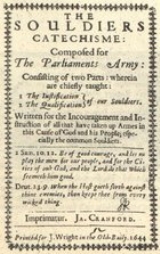
A "Soldier's catechism" dictated new regulations and drill
Parade (military)

A military parade is a formation of soldiers whose movement is restricted. The American usage is "formation or military review". The military parade is now mostly ceremonial, though soldiers from time immemorial up until the late 19th century fought in formation....
 procedures. The standard daily pay was 8 pence for infantry, 2 shilling
Shilling

The shilling is a unit of currency used in current and former Commonwealth of Nations countries, and continued to be used in countries that left the commonwealth, such as Republic of Ireland and Tanzania....
s for cavalry. The administration of the Army was more centralised and there was better guarantee of food, clothing and other provisions than before. Cavalrymen (often recruited from among yeomen, or the more well-to-do farmers) had to supply their own horses.
Oliver Cromwellut
The original founders intended that proficiency rather than social standing
Social class

Social class refers to the hierarchy distinctions between individuals or groups in societies or cultures. Usually most societies have some notion of social class , but concretely defined social classes are not found in every known type of human societies....
 or wealth should determine the Army's leadership and promotions. Many officers (often the gentlemen amateurs) of existing units merged into regiments of the New Model Army became surplus to establishment and were discharged; these reformadoes demonstrated several times in London as they sought compensation or relief. Many corporals and sergeants, particularly in the Earl of Essex's army, were also unable to find posts in the merged regiments, but were persuaded to serve as ordinary soldiers. Contemporary accounts report that this was the result of exhortation by the popular Sir Philip Skippon, but it has also been suggested that these former non-commissioned officers believed that they would be unable to find employment outside the Army.

Cromwell also preferred soldiers devoted, like himself, to Puritan ideals, and some of them sang psalms
Psalms

Psalms is a book of the Hebrew Bible , included in the collected works known as the "Writings" or Ketuvim....
 prior to battle. Even as it was being formed, the Army was viewed by some Presbyterians as a hotbed of Independents
Independent (religion)

In England church history, Independents advocated local congregationalism of religious and church matters, without any wider geographical hierarchy, either ecclesiastical or political....
, a potentially dangerous situation given that Parliament's agreement with the Scottish Covenanter
Covenanter

The Covenanters formed an important movement in the Religion in Scotland and Politics of Scotland of Scotland in the 17th century. In religion the movement is most associated with the promotion and development of Presbyterianism as a form of church government favoured by the people, as opposed to Scottish Episcopal Church, favoured by Mon...
s stipulated that Presbyterianism was to be made the established Church in England. Several prominent Presbyterian officers, mainly expatriate Scottish professional soldiers, exacerbated this situation by refusing to serve in the New Model Army.

Two Colonels (Edward Montagu and John Pickering) in particular were both stated to be fanatical Independents. Pickering went so far as to preach sermons to his troops, for which he was reprimanded by Fairfax. The Earl of Essex brought a motion in the House of Lords to prevent Montagu and Pickering, and 40 Captains who were reportedly of the same persuasion, from holding commissions, but they were allowed to serve after there was a tied vote.

Prince Rupert of the Rhine

Rupert, Count Palatine of the Rhine, Duke of Bavaria , commonly called Prince Rupert of the Rhine, , soldier, inventor and amateur artist in mezzotint, was a younger son of Frederick V, Elector Palatine and Elizabeth of Bohemia, and the nephew of King Charles I of England, who created him Duke of Cumberland and Earl of Holderness....
, an archetypal cavalier
Cavalier

Cavalier was the name used by Roundheads for a Royalist supporter of Charles I of England during the English Civil War . Prince Rupert of the Rhine, commander of much of Charles I's cavalry, is often considered an archetypical Cavalier....
 and a prominent general in the army of King Charles I, gave the New Model troops their nickname of Ironsides
Ironside (cavalry)

Ironside was the name given to a trooper in the Roundhead cavalry formed by England political leader Oliver Cromwell in the 17th century, during the English Civil War....
. This referred more to their ability to cut through opposing forces than to their armour, as sometimes claimed.

Original Order of Battle

Type Colonel Origin Notes
Horse Sir Thomas Fairfax's Lifeguard Army of the Earl of Essex
Robert Devereux, 3rd Earl of Essex

Robert Devereux, 3rd Earl of Essex was an English Member of Parliament and soldier during the first half of the seventeenth century. With the start of the English Civil War in 1642 he became the first Captain-General and Chief Commander of the Parliamentarian army, also known as the Roundheads....
Formerly Essex's Lifeguard troop
Formed extra senior troop in Fairfax's Regiment
" Sir Thomas Fairfax's Regiment Army of the Eastern Association Formerly part of Oliver Cromwell
Oliver Cromwell

Oliver Cromwell was an English people Military history of the United Kingdom and Politics of England leader best known for his involvement in making England into a republican Commonwealth and for his later role as Lord Protector of England, Scotland, and Ireland....
's double regiment of 'Ironsides
Ironside (cavalry)

Ironside was the name given to a trooper in the Roundhead cavalry formed by England political leader Oliver Cromwell in the 17th century, during the English Civil War....
'
" Edward Whalley
Edward Whalley

Edward Whalley was an England military leader during the English Civil War, and was one of the regicide#The Regicide of Charles I of England who signed the death warrant of Charles I of England....
's Regiment
Army of the Eastern Association Formerly part of Oliver Cromwell's double regiment of 'Ironsides'
" Charles Fleetwood
Charles Fleetwood

Charles Fleetwood , was an England Parliamentary soldier and politician, Lord Deputy of Ireland from 1652-55, where he enforced the Cromwellian Settlement....
's Regiment
Army of the Eastern Association Said to have many Independents in its ranks
" Nathaniel Rich
Nathaniel Rich (soldier)

Nathaniel Rich, , army officer, was the eldest son of Robert Rich of Felsted, Essex, and Elizabeth, daughter of Sir Thomas Dutton. Sir Nathaniel Rich , who was probably his uncle, left him his manor of Stondon, Essex, in 1636, at which time he was still a minor....
's Regiment
Army of the Eastern Association Formerly the Earl of Manchester
Edward Montagu, 2nd Earl of Manchester

Edward Montagu, 2nd Earl of Manchester Knight of the Garter, Knight of the Bath, Fellow of the Royal Society was an important commander of Parliamentary forces in the First English Civil War, and for a time Oliver Cromwell's superior....
's Regiment
" Bartholomew Vermuyden's Regiment Army of the Eastern Association 
" Richard Graves's Regiment Army of the Earl of Essex Formerly the Earl of Essex's Regiment
" Sir Robert Pye's Regiment Army of the Earl of Essex 
" Thomas Sheffield's Regiment Army of the Earl of Essex 
" John Butler's Regiment Army of the Southern Association Originally intended for John Middleton
John Middleton, 1st Earl of Middleton

John Middleton, 1st Earl of Middleton , belonged to a Kincardineshire family which had held lands at Middleton since the 12th century.In early life he served as a soldier in France; later he fought against Charles I of England both in England and in Scotland, being especially prominent at the Battle of Philiphaugh and in other operations ag...
" Henry Ireton's Regiment Army of the Southern Association 
" Edward Rossiter
Edward Rossiter

Colonel Sir Edward Rossiter of Somerby by Bigby, Lincolnshire, England, was a soldier in the Parliament of England army. He fought alongside Oliver Cromwell at the Battle of Naseby in 1645....
's Regiment
Newly raised Originally intended to serve in Lincolnshire
Lincolnshire

Lincolnshire is a Counties of England in the east of England. It borders Norfolk, Cambridgeshire, Rutland, Leicestershire, Nottinghamshire, South Yorkshire, and the East Riding of Yorkshire....
Dragoons John Okey
John Okey

John Okey was an England soldier, member of Parliament, and one of the regicides of King Charles I of England....
's Regiment
Mixed Later converted to a regiment of Horse
Foot Sir Thomas Fairfax's Regiment Army of the Earl of Essex Originally the Earl of Essex's Regiment but
contained some companies from the
Eastern Association
" Robert Hammond
Robert Hammond (English army officer)

Robert Hammond was an officer in the New Model Army under Oliver Cromwell during the English Civil War; he was originally from Chertsey, Surrey, the son of a physician....
's Regiment
Army of the Eastern Association Originally intended for Lawrence Crawford
Lawrence Crawford

Lawrence Crawford was a Kingdom of Scotland soldier who fought in England or other armies on the continent of Europe. However, his motives were not mercenary, as he fought only for Presbyterian principles or causes....
" Edward Montagu's Regiment Army of the Eastern Association 
" John Pickering's Regiment Army of the Eastern Association 
" Thomas Rainsborough
Thomas Rainsborough

Thomas Rainsborough , or Rainborough or Raineborough or Rainborowe or Rainbow or Rainborow, was a prominent figure in the English Civil War, and was the leading spokesperson of the Levellers in the Putney Debates....
's Regiment
Army of the Eastern Association Originally intended for Colonel Ayloff
" Sir Philip Skippon's Regiment Army of the Earl of Essex 
" Richard Fortescue's Regiment Army of the Earl of Essex 
" Edward Harley's Regiment Army of the Earl of Essex Originally intended for Colonel Harry Barclay
" Richard Ingoldsby
Richard Ingoldsby

Colonel Sir Richard Ingoldsby was an officer in the New Model Army and, as a Commissioner at the trial of King Charles I of England, signed the king's death warrant....
's Regiment
Army of the Earl of Essex 
" Walter Lloyd's Regiment Army of the Earl of Essex Originally intended for Colonel Edward Aldrich
" Hardress Waller
Hardress Waller

Sir Hardress Waller , cousin of Sir William Waller, was also an England parliamentarian of note.Born in Groombridge, Kent, and descendant of Sir Richard Waller of Groombridge Place, Waller was knighted by Charles I of England in 1629....
's Regiment
Army of the Southern Association Originally intended for James Holborne
James Holborne of Menstrie

Major General Sir James Holborne of Menstrie was a Kingdom of Scotland soldier during the years of the English Civil War. Although he initially fought on the side of the English Parliament, he later became a senior officer in the Scottish Army, fighting against Cromwell....
" Ralph Weldon's Regiment Army of the Southern Association Originally the "Kentish Regiment"


Dress, equipment and tactics


Horse

The New Model Army's elite troops were its Regiments of Horse
Cavalry

The Cavalry is the second oldest of the Combat Arms, and as soldiers or warriors who fought mounted on horseback in combat, it represents the mobility and offensive power of the armed forces....
. They were armed and equipped in the style known at the time as arquebusiers, rather than heavily armoured cuirassier
Cuirassier

Cuirassiers were mounted cavalry soldiers equipped with armour and firearms, first appearing in late 15th-century Europe. They were the successors of the medieval armoured knights....
s. They wore a back- and breastplate over a buff leather coat
Buff coat

The Buff coat was an item of leather clothing worn by both the infantry and cavalry during the 17th century, usually worn under armour. It evolved from the leather jerkins worn by soldiers during the Tudor period to a 3/4 length, close-fitting garment with long sleeves and a high collar to protect the neck and arms....
, which itself gave some protection against sword cuts, and normally a "lobster-tailed pot" helmet with a movable three-barred visor, and a bridle gauntlet on the left hand. The sleeves of the buff coats were often decorated with strips of braid, which may have been arranged in a regimental pattern. Leather "bucket-topped" riding boots gave some protection to the legs.

Although not heavily armoured, their tactics were nevertheless based on those of the Swedish army under Gustavus Adolphus, which emphasised shock action, rather than a caracole
Caracole

The caracole or caracol consists of a manoeuvre on horseback in dressage and, previously, in military tactics.Dressage caracole ...
 with their firearms. They would charge boot-to-boot and sword in hand. In battle they usually carried a mortuary sword and two loaded pistols, one of which was fired just before they came into contact with the enemy, the other was kept either to cover their own retreat or to fire at a fleeing enemy.

Regiments were organised into six troops, of one hundred troopers plus officers, non-commissioned officers and specialists (drummers, farriers etc). On the battlefield, a regiment was normally formed as two divisions of three troops, one commanded by the regiment's Colonel (or the Major, if the Colonel was not present), the other by the Lieutenant Colonel.

Their discipline was markedly superior to that of their Royalist counterparts. Cromwell specifically forbade his men to pursue a fleeing enemy, but demanded they hold the battlefield. This meant that the New Model cavalry could charge, break an enemy force, regroup and charge again at another objective, which made them a formidable force on the battlefield. On the other hand, when required to pursue, they would do so relentlessly, not breaking ranks to loot abandoned enemy baggage as Royalist horse would often do.

Dragoons

The New Model Army contained one regiment of dragoon
Dragoon

A dragoon is a soldier intended primarily to fight on foot but trained also in horse riding and cavalry combat, especially during the late 17th and early 18th centuries when dragoon regiments were established in most European armies....
s, of twelve companies each of one hundred men, under Colonel Okey. Dragoons were mounted infantry, and wore much the same uniform as musketeers although they probably wore stout cloth gaiters to protect the legs while riding. They were armed with flintlock
Flintlock

Flintlock is the general term for any firearm based on the flintlock mechanism. The term may also apply to the mechanism itself. Introduced about 1630, the flintlock rapidly replaced earlier firearm-ignition technologies, such as the matchlock and wheellock mechanisms....
 "snaphaunces" rather than the matchlock
Matchlock

The Matchlock was the first mechanism or "lock" invented to uncomplicate the firing of a hand-held firearm. This design removed the need to lower by hand a lit match into the weapon's flash pan and made it possible to have both hands free to keep a firm grip on the weapon at the moment of firing, and more importantly to keep both eyes on the...
 muskets carried by the infantry.

On the battlefield, their major function was to clear enemy musketeers from in front of their main position. At the Battle of Naseby
Battle of Naseby

The Battle of Naseby was the key battle of the First English Civil War English Civil War. On 14 June 1645, the main army of Charles I of England was destroyed by the Roundhead New Model Army under Thomas Fairfax, 3rd Lord Fairfax of Cameron and Oliver Cromwell....
, they were used to outflank enemy cavalry.

They were also useful in patrolling and scouting. In sieges, they were often used to assault breaches carrying flintlock
Flintlock

Flintlock is the general term for any firearm based on the flintlock mechanism. The term may also apply to the mechanism itself. Introduced about 1630, the flintlock rapidly replaced earlier firearm-ignition technologies, such as the matchlock and wheellock mechanisms....
 carbines and grenades. The storming party were sometimes offered cash payments, as this was a very risky job. Once the forlorn hope
Forlorn hope

Forlorn hope is a military term that comes from the Dutch language verloren hoop, literally "lost heap", and adapted as "lost troop". The Dutch word hoop is not cognate with English hope: this is an example of false folk etymology....
 had established a foothold in the enemy position, the infantry would follow them with their more cumbersome weapons of pikes and muskets.

In 1650, Okey's dragoons were converted into a regiment of horse. It appears that after that date, unregimented companies of dragoons raised from the Militia and other sources were attached to the regiments of horse and foot as required.

Foot


The Regiments of Foot consisted of musketeer
Musketeer

A musketeer was an early modern type of infantry soldier equipped with a musket. Musketeers were an important part of early modern armies, particularly in Europe....
s and pikemen. On the battlefield, the musketeers lacked protection against enemy cavalry, and the two types of foot soldier were mixed. For most siege work, or for any action in wooded or rough country, the musketeer was generally more useful and versatile. Musketeers were often detached, or "commanded", for particular tasks. They also acted as skirmishers, fighting along hedges and in sunken lanes. In the New Model Army there were always two musketeers for each pikeman, from the beginning, although depictions of battles show them as being present in equal numbers, in stylised formations which were probably never used.

Regiments consisted of ten companies, in which musketeers and pikemen were mixed, at least on the march. Seven companies consisted of one hundred soldiers, plus officers and so on, and were commanded by Captains. The other three companies were commanded by the regiment's Colonel, Lieutenant Colonel and Major, and were stronger.

The regiments of foot were provided with red uniforms. Those used by various regiments were distinguished by differently-coloured linings, which would show at the collar and the ends of the sleeves, and became in time the official "facing" colour.

Pikemen, when fully equipped, wore a pot helmet
Morion (helmet)

A morion is a type of open helmet used during the 16th and early 17th centuries, usually having a flat brim and a crest from front to back. The morion, though generally identified with Spanish conquistadors, was common among foot soldiers of European nationalities, including the English; the first were issued during Edward VI's reign....
, back- and breastplates over a buff coat, and often also armoured tassets to protect the upper legs. They carried a sixteen-foot pike, and a sword. The heavily burdened pikeman usually dictated the speed of the Army's movement. They were frequently ordered to discard the tassets, and individual soldiers were disciplined for sawing a foot or two from the butts of their pikes, although senior officers were recommended to make the men accustomed to marching with heavy loads by regular route marches. In irregular fighting in Ireland the New Model temporarily gave up the pike. In battle, the pikemen were supposed to project a solid front of spearheads, to protect the musketeers from cavalry while they reloaded. They would also lead the charge against enemy foot units, when things came to push of pike
Push of pike

The push of pike was a particular feature of late medieval and Early Modern warfare that occurred when two opposing columns of Pike collided and became locked in position along a front of interleaved pikes....
.

The musketeers wore no armour, at least by the end of the Civil War, although it is not certain that none had iron helmets at the beginning. They wore a bandolier from which were suspended twelve wooden containers each with a ball and measured charge of powder for their matchlock
Matchlock

The Matchlock was the first mechanism or "lock" invented to uncomplicate the firing of a hand-held firearm. This design removed the need to lower by hand a lit match into the weapon's flash pan and made it possible to have both hands free to keep a firm grip on the weapon at the moment of firing, and more importantly to keep both eyes on the...
 muskets. According to one source they carried 1lb of fine powder, for priming, to 2lbs of lead and 2lbs of ordinary powder, the actual charging powder, for 3lbs of lead. They were normally deployed six ranks deep, and were supposed to keep up a constant fire by means of the "countermarch", either by introduction whereby the rear rank would file to the front to fire a volley, or by "retroduction" where front rank would fire a volley then file to the rear. By the time they had reached the front rank again, they should have reloaded and been prepared to fire. At close quarters, there was often no time for musketeers to reload and they would use their musket butts as clubs. They carried swords, but these were often of inferior quality, and ruined by use for cutting firewood. At this time, musketeers did not use bayonet
Bayonet

A bayonet is a knife-, dagger-, sword-' or spike-shaped weapon designed to fit on or over the muzzle of a rifle barrel or similar weapon, effectively turning the gun into a spear....
s.

Artillery

The establishment of the New Model Army's artillery
Artillery

Artillery is a military Combat Arms which employs any apparatus, machine, an assortment of tools or instruments, a system or systems used as weapons for the discharge of large projectiles in combat as a major contribution of fire power within the overall military capability of an armed force....
 varied over time, and the artillery was administered separately from the Horse and Foot. At the Army's formation, Thomas Hammond (brother of Colonel Robert Hammond who commanded a Regiment of Foot) was appointed Lieutenant General of the Ordnance. Much of the artillery was captured from the Royalists in the aftermath of the Battle of Naseby and the storming of Bristol
Bristol

Bristol is a City status in the United Kingdom, unitary authority area and Ceremonial counties of England in South West England, west of London, and east of Cardiff....
.

The establishment of the New Model also included at least two companies of "firelocks" or fusilier
Fusilier

Fusilier was originally the name of a soldier armed with a light flintlock musket called the fusil. The word was first used around 1680, and has later developed into a regimental designation....
s, who wore "tawny coats" instead of red, commanded initially by Major John Desborough
John Desborough

John Desborough was an English soldier and politician....
. They were used to guard the guns and ammunition wagons; it was obviously undesirable to have matchlock-armed soldiers with lighted matches near the gunpowder barrels.

The artillery was used to most effect in sieges, where its role was to blast breaches in fortifications for the infantry to assault. Cromwell and the other commanders of the Army were not trained in siege warfare and generally tried to take fortified towns by storm rather than go through the complex and time-consuming process of building earthworks and trenches around it so that batteries of cannon could be brought close to the walls to pound it into surrender.

The Army generally performed well when storming fortifications, for example at the siege of Drogheda
Siege of Drogheda

Drogheda, a town in eastern Ireland, was besieged twice in the 1640s, during the Irish Confederate Wars and the Irish theatre of the Wars of the Three Kingdoms....
, but paid a heavy price at Clonmel
Siege of Clonmel

The Siege of Clonmel took place in April - May 1650 during the Cromwellian conquest of Ireland when the town of Clonmel in County Tipperary, Ireland was besieged by Oliver Cromwell?s New Model Army....
 when Cromwell ordered them to attack a well-defended breach.

Logistics

The New Model did not use tents, until they began to serve in the less populated countries of Ireland and Scotland. In 1650, their tents were each for six men, a file, who carried the tents in parts. In campaigns in Scotland, the troops carried with them 7 days rations, consisting exclusively of biscuit and cheese.

Civil War Campaigns

After an attempt to raise the Siege of Taunton
Siege of Taunton

The Siege of Taunton occurred during the English Civil War. In 1645 Parliamentary forces commanded by Colonel Robert Blake were besieged in Taunton, Somerset, the only Parliamentary enclave in the South West of the country....
 was abandoned, the Army began a Siege of Oxford
Siege of Oxford

The Siege of Oxford was a Parliament of England victory late in the First English Civil War. Whereas the title of the event may suggest a single siege, there were in fact three individual engagements....
, sending a detachment of one regiment of cavalry and four of infantry to reinforce the defenders of Taunton. After the Royalists captured Leicester
Leicester

Leicester is a city status in the United Kingdom and unitary authority area in the East Midlands of England. It is the county town of Leicestershire....
, Fairfax was ordered to leave Oxford and march north to confront the King's army. On June 14, the New Model Army destroyed King Charles' smaller but veteran army at the Battle of Naseby
Battle of Naseby

The Battle of Naseby was the key battle of the First English Civil War English Civil War. On 14 June 1645, the main army of Charles I of England was destroyed by the Roundhead New Model Army under Thomas Fairfax, 3rd Lord Fairfax of Cameron and Oliver Cromwell....
. Leaving the Scots and locally-raised forces to contain the King, the New Model Army marched into the west country, where they destroyed the remaining Royalist field army at Langport
Battle of Langport

The Battle of Langport was a Parliament of England victory late in the English Civil War, which destroyed the last Cavalier field army, and ultimately gave Parliament control of the West of England, which had hitherto been a major source of manpower, raw materials and imports for the Royalists....
 on July 10. Thereafter, they reduced the Royalist fortresses in the west of England. The last fortress in the west surrendered in early 1646, shortly before Charles surrendered himself to a Scottish army and hostilities ended.

After the end of major civil war hostilities in England, the Army was in a position to dictate the future of England, which caused a great deal of tension between the political radicals in their ranks, and their commanders such as Cromwell and Henry Ireton.

Revolutionary Politics and the "Agreement of the People"

Having won the Civil War, the soldiers became discontented with the Long Parliament
Long Parliament

The Long Parliament is the name of the List of Parliaments of England called by Charles I of England, on 3 November 1640, following the Bishops' Wars....
, for several reasons. Firstly, they had not been paid regularly and on the end of hostilities, the conservative MPs in Parliament wanted to either disband the Army or send them to fight in Ireland without receiving their back pay. Secondly the Long Parliament
Long Parliament

The Long Parliament is the name of the List of Parliaments of England called by Charles I of England, on 3 November 1640, following the Bishops' Wars....
 refused to grant the soldiers indemnity (freedom from prosecution due to crimes they had been ordered to commit in the Civil War). The soldiers demanded indemnity as several soldiers were hanged after the war for crimes such as stealing horses for use by the cavalry regiments. Thirdly, seeing that most Parliamentarians wanted to restore the King without major democratic reforms or religious freedom, many soldiers asked why they had risked their lives in the first place, a sentiment that was strongly expressed by their elected representatives.

Two representatives, called Agitators, were elected from each regiment. The Agitators, with two officers from each regiment and the Generals formed a new body called the Army Council which after a rendezvous (meeting) near Newmarket on Friday 4 June 1647 issued "A Solemne Engagement
Solemn Engagement

The Solemn Engagement was a declaration to the English British House of Commons adopted unanimously by the Army Council commanded by Thomas Fairfax at Newmarket, Suffolk on May 29th, 1647....
 of the Army, under the Command of his Excellency Sir Thomas Fairfax
" to Parliament on 8 June making their concerns known, and also the constitution of the Army Council so that Parliament would understand that the discontent was Army wide and had the support of both officers and other ranks. This Engagement was read out to the Army at a general Army rendezvous on 5 June.

Agreement of the People (1647 1649)
Having come under the influence of London radicals called the Levellers
Levellers

The Levellers were members of a mid 17th century England political movement, who came to prominence during the English Civil Wars. They were not a political party in the modern sense of the word, and did not all conform to any specific manifesto....
, the troops of the Army proposed a revolutionary new constitution named the Agreement of the People
Agreement of the People

The documents called the Agreement of the People were manifestos for constitutional changes to the English state issued between 1647 and 1649....
, which called for almost universal male suffrage, reform of electoral boundaries, power to rest with the Parliament which was to be elected every two years (by the people), religious freedom, and an end to imprisonment for debt.

Increasingly concerned at the failure to pay their wages and by political maneuverings by King Charles I and by some in Parliament, the army marched slowly towards London over the next few months. In late October and early November at the Putney Debates
Putney Debates

The Putney Debates were a series of discussions between members of the New Model Army, a number of the participants were Levellers, concerning the makeup of a new constitution for England....
 the Army debated two different proposals. The first was the Agreement of the People; the other was "The Heads of the Proposals", put forward by Henry Ireton for the Army Council. This was a constitutional manifesto which included the preservation of property rights and would maintain the privileges of the gentry. At the Putney Debates it was agreed to hold three further rendezvous.

At the first, the Corkbush Field rendezvous, the senior officers in the army, known as the Grandees, gained the agreement of most regiments to accept the Army Council's Heads of the Proposals instead of the Agreement of the People as the Army's manifesto. A mutiny by a minority of regiments was suppressed by Cromwell who had Private Richard Arnold tried for mutiny and shot on the spot as an example. At the two other rendezvous at Ruislip Heath
Ruislip

Ruislip is a place in the London Borough of London Borough of Hillingdon, in West London, England...
 and Kingston
Kingston upon Thames

Kingston upon Thames is the principal settlement of the Royal Borough of Kingston upon Thames in south-west London.It was the ancient market town where Anglo-Saxons kings were crowned and is now a suburb situated south west of Charing Cross....
 the other regiments were ordered to show support for Fairfax which they all agreed to do.

Second English Civil War

The army remained under control and intact, so it was able to take the field when in July 1648 the Second English Civil War
Second English Civil War

The Second English Civil War was the second of three wars known as the English Civil War which refers to the series of armed conflicts and political machinations which took place between Parliament of England and Cavaliers from 1642 until 1652 and include the First English Civil War and the Third English Civil War ....
 broke out. The New Model Army routed English royalist insurrections in Surrey
Surrey

Surrey is a counties of England in the South East England of England and is one of the Home Counties. The county borders Greater London, Kent, East Sussex, West Sussex, Hampshire, and Berkshire....
 and Kent
Kent

Kent is a Counties of England in southeast England, and is one of the home counties. It borders East Sussex, Surrey and Greater London and has a defined boundary with Essex in the middle of the River Thames estuary....
 and in Wales before crushing a Scottish invasion force at the battle of Preston (1648)
Battle of Preston (1648)

The Battle of Preston was the major battle of the Second English Civil War. It resulted in a victory by the troops of Oliver Cromwell over the English Cavaliers and Scottish "Engagers" commanded by the James Hamilton, 3rd Marquess and 1st Duke of Hamilton....
.

Many of the Army's radicals now called for the execution of the King, whom they called, "Charles Stuart, that man of blood". The majority of the Grandees realised that they could neither negotiate a settlement with Charles I nor trust him to refrain from raising another army to attack them, so they came reluctantly to the same conclusion as the radicals: they would have to execute him. After the Long Parliament rejected the Army's Remonstrance by 125 to 58, the Grandees decided to reconstitute Parliament so that it would agree with the Army's position. On 6 December 1648 Colonel Thomas Pride
Thomas Pride

Thomas Pride was a roundhead general in the English Civil War, and best known as the instigator of "Pride's Purge".Pride is stated to have been brought up by the parish of St Bride's, London but is thought to have been born in Somerset....
 instituted Pride's Purge
Pride's Purge

Pride?s Purge took place in December 1648, when troops under the command of Colonel Thomas Pride forcibly removed from the British House of Commons all those who were not supporters of the Grandee s in the New Model Army and the Independents....
 and forcibly removed from the House of Commons all those who were not supporters of the religious independents and the Grandees in the Army. The much-reduced Rump Parliament
Rump Parliament

The Rump Parliament was the name of the English Parliament after Pride's Purge purged the Long Parliament on 6 December 1648 of those Members of Parliament hostile to the Grandee intention to try King Charles I of England for high treason....
 passed the necessary legislation to try Charles I. He was found guilty of high treason by the 59 Commissioners
List of regicides of Charles I

Regicides of Charles I are considered to be the fifty-nine Commissioners who sat in judgement at High Court of Justice for the trial of Charles I of Charles I of England and signed his death warrant in 1649, along with other officials who participated in his trial or execution, and Hugh Peters an influential republican preacher....
 and beheaded on 30 January 1649.

Now that the twin pressures of Royalism and those in the Long Parliament who were hostile to the Army had been defeated, the divisions in the Army which had been present in the Putney Debates resurfaced. Cromwell, Ireton, Fairfax and the other Grandees were not prepared to countenance the Army agitators' proposals for a revolutionary constitutional settlement. This eventually brought the Grandees into conflict with those elements in the New Model Army who did.

During 1649 there were three mutinies over pay and political demands. The first involved three hundred infantrymen of Colonel John Hewson
John Hewson (regicide)

Colonel John Hewson was a soldier in the New Model Army and signed the death warrant of King Charles I of England, making him a regicide.When John Lilburne was his apprentice in the 1630s, he introduced Lilburne to the Puritan physician John Bastwick, an active pamphleteer who was persecuted by Archbishop William Laud....
's regiment, who declared that they would not serve in Ireland until the Levellers' programme had been realised. They were cashiered without arrears of pay, which was the threat that had been used to quell the mutiny at the Corkbush Field rendezvous.

In the Bishopsgate mutiny
Bishopsgate mutiny

The Bishopsgate mutiny occurred in April 1649 when soldiers of Colonel Edward Whalley's regiment of the New Model Army refused to obey orders and leave London....
 soldiers of the regiment of Colonel Edward Whalley
Edward Whalley

Edward Whalley was an England military leader during the English Civil War, and was one of the regicide#The Regicide of Charles I of England who signed the death warrant of Charles I of England....
 stationed in Bishopsgate
Bishopsgate

Bishopsgate is a road and Wards of the United Kingdom in the east part of the City of London, extending north from Gracechurch Street to Norton Folgate....
 London made demands similar to those of Hewson's regiment; they were ordered out of London. When they refused to go, fifteen soldiers were arrested and court martialled, of whom six were sentenced to death. Of this six, five were subsequently pardoned while Robert Lockyer
Robert Lockyer

Robert Lockyer was an English people soldier in Oliver Cromwell's New Model Army. A Leveller, he was the only soldier executed for his involvement in the Bishopsgate mutiny....
, a former Agitator, faced a firing squad on 27 April 1649.

Less than two weeks later there was a larger mutiny involving several regiments over pay and political demands. After the resolution of the pay issue the Banbury mutineers
Banbury mutiny

The Banbury mutiny was a mutiny by soldiers in the England New Model Army. The mutineers did not achieve all of their aims and some of the leaders were executed shortly afterwards on May 17, 1649....
, consisting of 400 soldiers with Leveller sympathies under the command of Captain William Thompson, continued to negotiate for their political demands. They set out for Salisbury
Salisbury

Salisbury is a city status in the United Kingdom in Wiltshire, England. The city forms the largest part of the Salisbury . It has also been called New Sarum to distinguish it from the original site of settlement at Salisbury, Old Sarum, but this alternative name is not in common use....
 in the hope of rallying support from the regiments billeted there. Cromwell launched a night attack on 13 May in which several mutineers perished, but Captain Thompson escaped only to be killed in another skirmish near the Diggers community at Wellingborough
Wellingborough

Wellingborough is a town in Northamptonshire, England situated some eleven miles from the county town of Northampton and eight miles south of Kettering....
. The rest were imprisoned in Burford
Burford

Burford is a Cotswolds town in Oxfordshire, England. It lies about 30 kilometres west of Oxford on the River Windrush and is a popular centre for tourists who visit the Cotswolds, with many antique shops on the main street....
 Church until three were shot in the Churchyard on 17 May. With the failure of this mutiny the Levellers' power base in the New Model Army was destroyed.

Ireland

Later that year the New Model Army landed in Ireland (15 August 1649) to start the Cromwellian conquest of Ireland
Cromwellian conquest of Ireland

The Cromwellian conquest of Ireland refers to the re-conquest of Ireland by the forces of the English Parliament, led by Oliver Cromwell during the Wars of the Three Kingdoms....
. Many soldiers were reluctant to serve in this campaign, and regiments had to draw lots to decide who would go on the expedition.

The politically and religiously disunited Royalist-Catholic alliance they met in Ireland were at a major disadvantage against the New Model Army. After the shock defeats at Rathmines
Battle of Rathmines

The Battle of Rathmines was fought in and around what is now the Dublin suburb of Rathmines in August 1649, during the Irish Confederate Wars, the Irish theatre of the Wars of the Three Kingdoms....
 and Drogheda
Siege of Drogheda

Drogheda, a town in eastern Ireland, was besieged twice in the 1640s, during the Irish Confederate Wars and the Irish theatre of the Wars of the Three Kingdoms....
 many of the Royalist soldiers opposing the Parliamentarian forces became demoralised, melting away at the first opportunity- the Scottish Royalist army in Ulster was badly weakened by desertion before the battle of Lisnagarvey
Battle of Lisnagarvey

The Battle of Lisnagarvey took place near Lisburn, 20 miles south of Carrickfergus, in south county Antrim, Ireland in December 1649. It was fought between the Royalists army and the Roundheads during the Wars of the Three Kingdoms....
 for example.

However, resistance by some of the native Irish Catholic forces, who were faced with land confiscations and suppression of their religion in the event of a Parliamentarian conquest, proved stubborn and protracted. Some units, notably the veteran Ulster Confederate Catholic forces, proved resilient enemies. As a result, the New Model soldiers suffered considerably in the campaign. After victories with few Parliamentary casualties at Drogheda and Wexford
Sack of Wexford

The Sack of Wexford took place in October 1649, during the Cromwellian conquest of Ireland, when the New Model Army under Oliver Cromwell took Wexford town in south-eastern Ireland....
 in 1649, the fighting became more protracted and casualties began to mount. At Kilkenny (March 1650) the town defenders skillfuly beat back numerous Parliamentarian assaults before being forced to surrender. Shortly afterwards, About 2,000 New Model soldiers died in abortive assaults against a breach defended by veteran Ulstermen in the siege of Clonmel
Siege of Clonmel

The Siege of Clonmel took place in April - May 1650 during the Cromwellian conquest of Ireland when the town of Clonmel in County Tipperary, Ireland was besieged by Oliver Cromwell?s New Model Army....
: later the same year the bloody scenes at Clonmel were repeated during the Siege of Charlemont
Siege of Charlemont

The Siege of Charlemont took place in July - August 1650 during the Cromwellian conquest of Ireland when the fortress of Charlemont in County Armagh, Ireland was besieged by Charles Coote?s Parliamentarian army, which was largely composed of soldiers of the New Model Army....
 fort. Thousands more died of disease, particularly in the long sieges of Limerick
Siege of Limerick (1650-51)

Limerick, in western Ireland was the scene of two sieges during the Irish Confederate Wars. The second and largest of these took place during the Cromwellian conquest of Ireland in 1650-51....
, Waterford
Siege of Waterford

The city of Waterford in south eastern Ireland was besieged from 1649?50 during the Cromwellian conquest of Ireland. The town was held by Irish Confederate Ireland and English Royalist troops under general Thomas Preston, 1st Viscount Tara....
 and Galway
Siege of Galway

Galway, a port city in western Ireland, was siege from August 1651 to May 1652 during the Cromwellian conquest of Ireland. Galway was the last city held by Irish Catholic forces in Ireland and its fall signalled the end to most organised resistance to the Parliamentarian conquest of the country....
. In addition, they were constantly at risk of attack by Irish guerrillas or "tories", who attacked vulnerable garrisons and supply columns. The New Model responded to this threat with forced evictions of the civilian population from certain areas and by destroying food supplies. These tactics caused a widespread famine throughout the country from 1650 onwards.

Overall, around 43,000 English soldiers fought in the Parliamentarian army in Ireland between 1649-53, in addition to some 9,000 Irish Protestants. By the end of the campaign in 1653, much of the Army's wages were still in arrears. About 12,000 veterans were awarded land confiscated from Irish Catholics in lieu of pay. Many soldiers sold these land grants to other Protestant settlers, but about 7,500 of them settled in Ireland. They were required to keep their weapons to act as a reserve in case of any future rebellions in the country. See also The Cromwellian Plantation
Plantations of Ireland

Plantations in 16th and 17th century Ireland were established throughout the country by the confiscation of lands occupied by Gaelic clans and Hiberno-Norman dynasties, but principally in the provinces of Munster and Ulster....
.

Scotland

In 1650, while the campaign in Ireland was still ongoing, part of the New Model Army was transferred to Scotland to fight Scottish Covenanters at the start of the Third English Civil War
Third English Civil War

The Third English Civil War was the last of the English Civil War , a series of armed conflicts and political machinations between Roundheads and Cavaliers....
. The Covenanters, who had been allied to the Parliament in the First English Civil War, had now crowned Charles II
Charles II of England

Charles II was the Monarchy of Kingdom of England, Kingdom of Scotland, and Kingdom of Ireland.His father Charles I of England Regicide#The regicide of Charles I of England at Palace of Whitehall on 30 January 1649, at the climax of the English Civil War....
 as King. Despite being outnumbered, Cromwell led the Army to crushing victories over the Scots at the battles of Dunbar
Battle of Dunbar (1650)

The Battle of Dunbar was a battle of the Third English Civil War. The English Parliamentary forces under Oliver Cromwell defeated a Scottish army commanded by David Leslie which was loyal to King Charles II of England, who had been proclaimed King in Scotland on 5 February 1649....
 and Inverkeithing
Battle of Inverkeithing

The Battle of Inverkeithing was a battle in the Third English Civil War. It was fought between an English Parliamentarian army under John Lambert and a Scottish force acting on behalf of Charles II of England, led by Sir John Brown of Fordell....
. Following the Scottish invasion of England led by Charles II, the New Model Army and local militia forces soundly defeated the Royalists at the Battle of Worcester
Battle of Worcester

The Battle of Worcester took place on 3 September 1651 at Worcester, England and was the final battle of the English Civil War. Oliver Cromwell and the Parliament of England defeated the Cavalier, predominantly Scotland, forces of King Charles II of England....
, the last pitched battle
Pitched battle

A pitched battle is a battle where both sides choose to fight at a chosen location and time and where either side has the option to disengage either before the battle starts, or shortly after the first armed exchanges....
 of the English Civil Wars.

Interregnum

Part of the New Model Army, under George Monck occupied Scotland during the Interregnum. They were kept busy throughout the 1650s by minor Royalist uprisings in the Scottish Highlands
Scottish Highlands

The Scottish Highlands include the rugged and mountainous regions of Scotland north and west of the Highland Boundary Fault, although the exact boundaries are not clearly defined, particularly to the east....
 and by endemic lawlessness by bandits known as moss-troopers
Moss-trooper

Moss-troopers were bandits who operated in Scotland during and after the period of the English Commonwealth.Many moss-troopers were disbanded or deserting soldiers from one of the Scottish armies of the Scotland in the Wars of the Three Kingdoms....
.

In England the New Model was involved in numerous skirmishes with a range of opponents, but they were little more than policing actions. The largest rebellion of the Protectorate
The Protectorate

In History of the British Isles, the Protectorate was the period 1653–1659 during which the Commonwealth of England was governed by a Lord Protector....
 took place when the Sealed Knot
Sealed Knot

The Sealed Knot was a secret Cavalier association which plotted for the English Restoration of the Monarchy during English Interregnum.Its original founder members were:...
 instigated an insurrection in 1655. The 1655 insurrection consisted of a series of coordinated uprisings, but only the Penruddock uprising
Penruddock uprising

The Penruddock uprising was one of a series of coordinated uprisings planned by the Sealed Knot for a Royalist insurrection to start in March 1655 during the Protectorate of the Lord Protector Oliver Cromwell....
 ended in armed conflict, and that was put down by one company of cavalry.

The major foreign entanglement of this period was the Anglo-Spanish War
Anglo-Spanish War (1654)

The Anglo-Spanish War fought between the English Commonwealth The Protectorate of Oliver Cromwell and Spain between 1654 and 1660. It was caused by commercial rivalry....
. In 1654, the English Commonwealth declared war on Spain and further regiments of the New Model Army were sent to conquer the Spanish colony of Hispaniola
Hispaniola

Hispaniola is the second-largest and most populous island of the Antilles, lying between the islands of Cuba to the west, and Puerto Rico to the east....
 in the Caribbean. They failed and sustained heavy casualties due to tropical disease, however, they did take the lightly defended island of Jamaica
Jamaica

Jamaica is an island nation of the Greater Antilles, in length and as much as in width situated in the Caribbean Sea. It is about south of Cuba, and west of the island of Hispaniola, on which Haiti and the Dominican Republic are situated....
. The English troops performed better in the European theatre of the war in Flanders
Flanders

Flanders is a geographical region located in parts of present-day Belgium, France, and the Netherlands. Over the course of history, the geographical territory that was called "Flanders" has varied....
. During the Battle of the Dunes (1658)
Battle of the Dunes (1658)

The Battle of the Dunes, fought on 14 June , 1658, is also known as the Battle of Dunkirk. It was a victory of the France army, under Henri de la Tour d'Auvergne, Vicomte de Turenne, against the Spain army, led by John of Austria the Younger and Louis II de Cond?....
, as part of Turenne's army, the red-coats of the New Model Army under the leadership of Sir William Lockhart
William Lockhart of Lee

Sir William Lockhart of Lee , after fighting on the side of Charles I of England in the English Civil War, attached himself to Oliver Cromwell, whose niece he married, and who later appointed Lockhart Lord Justice General in Scotland in 1652....
, Cromwell's ambassador at Paris, astonished both the French and Spanish armies by the stubborn ferocity of their assaults, particularly with a successful assault up a strongly defended 50-meter-high (150 feet) sandhill. The English had learnt a lot about war since two rabbles had met at the battle of Edgehill
Battle of Edgehill

The Battle of Edgehill was the first pitched battle of the First English Civil War. It was fought near Edge Hill, Warwickshire and Kineton in southern Warwickshire on Sunday 23 October, 1642....
 in 1642. Incidentally, some of the Spanish defences on the Dunes were manned by English Royalists, including James Stuart, later to be crowned James II of England
James II of England

James II and VII was List of English monarchs, List of Scottish monarchs, and King of Ireland from 6 February 1685. He was the last Roman Catholic Church monarch to reign over the Kingdoms of Kingdom of England, Kingdom of Scotland, and Kingdom of Ireland....
.

After the death of Oliver Cromwell
Oliver Cromwell

Oliver Cromwell was an English people Military history of the United Kingdom and Politics of England leader best known for his involvement in making England into a republican Commonwealth and for his later role as Lord Protector of England, Scotland, and Ireland....
, the Protectorate
The Protectorate

In History of the British Isles, the Protectorate was the period 1653–1659 during which the Commonwealth of England was governed by a Lord Protector....
 died a slow death, and the New Model army died with it. For a time in 1659 it looked as if the New Model army forces loyal to different Generals might wage war on each other. But in the end the New Model Army regiments which had been garrisoning Scotland under the command of General George Monck
George Monck, 1st Duke of Albemarle

George Monck, 1st Duke of Albemarle, Order of the Garter was an England soldier and politician and a key figure in the English Restoration of Charles II of England....
 were able to march on London, overseeing the Crowning of Charles II
Charles II of England

Charles II was the Monarchy of Kingdom of England, Kingdom of Scotland, and Kingdom of Ireland.His father Charles I of England Regicide#The regicide of Charles I of England at Palace of Whitehall on 30 January 1649, at the climax of the English Civil War....
, without significant opposition from the regiments under other Generals, in particular those of Charles Fleetwood
Charles Fleetwood

Charles Fleetwood , was an England Parliamentary soldier and politician, Lord Deputy of Ireland from 1652-55, where he enforced the Cromwellian Settlement....
 and John Lambert
John Lambert (general)

General John Lambert served as an England Parliament of England general in the English Civil War....
. With the exception of Monck's own regiment, which became the Coldstream Guards
Coldstream Guards

Her Majesty's Coldstream Regiment of Foot Guards, also known officially as the Coldstream Guards , is a regiment of the British Army, part of the Guards Division or Household Division....
, and the Regiment of Cuirassiers, which became the Royal Horse Guards
Royal Horse Guards

The Royal Horse Guards was a Cavalry regiments of the British Army of the British Army, part of the Household Cavalry.Founded August 1650 in Newcastle Upon Tyne by Sir Arthur Hesselrigge on the orders of Oliver Cromwell as the Regiment of Cuirassiers, the regiment became the Earl of Oxford's Regiment during the reign of Charles...
, the New Model Army disbanded after the Restoration
English Restoration

The English Restoration, or simply The Restoration began in 1660 when the English monarchy, Scottish monarchy and Irish monarchy were restored under Charles II of England after the Interregnum that followed the English Civil War....
 of 1660.

See also

  • Admiral Robert Blake for developments in the Navy at the time
  • British military history
    British military history

    The military history of the peoples of the British Isles is long and varied, extending from the prehistoric and ancient historic period, through the Roman invasion of Britain of Julius Caesar and Claudius, with the subsequent Roman Britain of most of the island; warfare in the Great Britain in the Middle Ages, including the invasions of the S...