

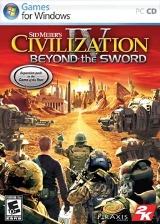
Civilization IV: Beyond the Sword

Encyclopedia
Civilization IV: Beyond the Sword is the second official expansion pack
of the turn-based strategy
video game Civilization IV
. The expansion focuses on adding content to the in-game time periods following the invention of gunpowder
, and includes more general content such as 11 new scenarios, 10 new civilizations, and 16 new leaders.
Players can block foreign corporations from operating in their cities by adopting the Mercantilism
civic, and they can block all corporations, even their own, by adopting the State Property
civic.
Currently, the following seven Corporations appear in the game. Unlike Religions, the Corporations are not directly based on real-life corporations, but some of the options are clear references to real companies such as General Mills
or Standard Oil
:
's importance in Civilization IV has been raised to compare with that of scientific research, culture, income from taxes etc. The new espionage slider allows the player to divert part of their income towards espionage activities against other civilizations. Once the player has reached certain thresholds of espionage investment, the player starts gaining some automatic intelligence benefits over rival civilizations.
The player can also send Spy units into foreign territory to gather further intelligence and to perform various missions of destruction and propaganda. Their role is a bit different, because spies are now invisible to all units, save for other spies. Great Spies are born in cities, like other Great Persons. Great Spies can perform typical functions like serving as a Specialist, starting a Golden Age, or building a unique building. Their special function allows them to infiltrate enemy cities, giving the player significant advantage in espionage against that civilization. Just like other Great Persons, they have unique names, and their appearance changes accordingly to the time period, e.g., a Great Spy in the ancient era shows up as a ninja
, just as the Industrial-Age Great Spy appears as a tuxedo-sporting James Bond
-style unit, complete with similar thematic music once a mission is performed.
Conversely, espionage has become somewhat of a hindrance in the pursuit of normal diplomatic victories. The act of catching opposing AI controlled spies will devastate your diplomatic relations with those players forcing you into a negative relationship that you cannot recover from. Even a friendly AI could potentially have a hidden -10 points from captured spies that will never allow a diplomatic victory, even through rampant generosity of resources, technology, gold, and all other attempts to negate the immense negative statistic. (This can be tested by saving an in-progress player vs CPU game and continuing it with players in place of the AI.)
-style random events from the original Civilization game, which can cause the game to swing in the player's favor or present another obstacle the player must overcome. There are more than a hundred of these events, including natural disasters, such as earthquakes that can destroy buildings, and diplomatic marriages that might suddenly turn two former rivals into friends. Together these new events give each game a completely unique flavor. In addition, each game offers players the opportunity for rewards through the completion of special events in the form of missions ("quests").
Some examples of Random Events in the game include:
, rather than simply launch. It is now also possible to build spaceships that fly faster than those of other civilizations, so that a player can achieve Space Victory, even if they finished building a spaceship after a competitor.
wonder allows the player to win an early diplomatic victory, centuries before the United Nations is due to make its appearance. The wonder is tied to the state religion of the player who built it. Depending on the influence of the Palace's religion on their civilization, players get votes to cast on decrees like holy wars, trade embargoes, or peace enforcement. It is later rebuffed by Communism
and made obsolete by Mass Media
. At this point, the more modern United Nations
takes over many of its functions.
 New content includes:
This single player scenario was designed by Firaxis' Tim McCracken featuring a Science fiction
/Horror
/Role Playing Game theme where a team of "Gravebringers" are sent to a world inhabited by human robots to retrieve research. In this squad based tactical scenario the player must fight against zombies and the undead
. This scenario is also unusual in that it does not contain many aspects of Civilization IV like leaders, cities or technologies.
Russia
is divided, and a civil war is coming. To unite the Motherland the player may purchase military units from the U.S. or promotion upgrades from the Chinese black market; conscript the Russian people or bribe enemy forces; or even deploy the ultimate doomsday weaponry: the nuclear bomb.
Some nations include:
This scenario is based on the wars fought by Frankish king and later emperor Charlemagne
in Europe during the late eighth and early ninth centuries. The scenario introduces a bevy of Medieval units such as the Mounted Infantry and the Supply Train. Players gain favor from Rome by spreading Christianity and destroying Islam. When a player gains enough favor he/she may be rewarded with the powerful Papal Pikeman.
Some leaders and nations featured include:
In CIV Defense, Civilization IV becomes a single player tower defense
in which players start with a small amount of cash to buy an advanced start and to get a single city going before the game starts. The player is confronted with 20 waves of enemies who try to capture their cities. Between each wave of attacks, the player receives gold for each city that survives, using it to acquire new units, cities and technologies.
A late medieval age scenario where the player carves out a fortune from the riches of fourteenth-century Africa, Arabia, and Persia. Victory is achieved by trading, betraying, and battling one's way towards control of the Crossroads of the World.
A plot-heavy fantasy scenario set in the world of Erebus, home of the popular Fall from Heaven public mod and made in cooperation with Firaxis staff and members of the mod team.
The scenario begins 350 years into the Age of Ice. Mulcarn, the God of Winter, reigns and the world is little more than a frozen wasteland ravaged by blizzards. Mankind has lost the knowledge gained during the previous age and has broken into small tribes fighting for survival. The player controls Kylorin, an ageless hero, who needs to recover the pieces of the legendary sword "The Godslayer", and defeat Mulcarn with it.
The Final Frontier space scenario adapts Civilization into space with a brand new tech tree, units and terrain. The sides are different extrasolar
colonies
that have now lost contact with Earth. Over the course of the scenario, clues about what happened to humanity's home planet are revealed. The focus is not on building cities, but colonizing entire star systems.
Gods of Old is the standard game, based on principles of Sumerian religion
. Each of the seven ancient Sumerian gods in the game has a special ability and can unleash calamities such as earthquakes and floods.
A futuristic sci-fi scenario with clone armies and mechanized units set in the 2050s. This scenario is available as an expansion on the Epic game as well as being a standalone scenario.
The World is divided into four huge empires: The Pan-Asiatic People Co-Operative-led by the "Glorious Leader", Qin Shi Huang
(China, Japan, Siam and East Russia), America Inc.-led by Mr. Big, George Washington
(North America, Britain, New Zealand and Australia), The Great Southern Empire-led by The Lady, Hatshepsut
(Africa, Middle East and South America) and Europa-led by His Excellency Alexander the Great (Europe, Algeria, Turkey and West Russia). You can also build Biological Bombs to destroy other empires and Nuclear bombs to do even more damage.
Nearly all standard civilizations available in Beyond the Sword are made available to play in their proper geographic and historical locations. Features such as dynamic historical city names, unique historical victories, and the new stability system enhance both the historical feel and the game play. Scripting of the AI encourages the world to develop in a similar path to real history, yet with an element of unpredictability to keep the game fresh.
Play as the Allies or Axis in the European Theater starting in either 1936 or 1939 or the Pacific Theater
starting in 1936 of the Second World War. Some of the countries playable are Germany (Vice Chancellor Von Papen), Japan (Admiral Yamamoto), The United States (President Roosevelt), France (De Gaulle), Great Britain (Churchill), and the USSR (Stalin).
For example, Rhye's and Fall of Civilization
was called "one of the most exciting and robust mods you'll ever see for any game" in Yahoo! Games review, and "a fresh new coat of paint to the core Civilization gameplay" in the Gamespot one. French magazine Cyberstratège reckoned it the best of the scenarios released in Beyond the Sword, assigning the best mark (9 of out 10) among them. Whereas the standard, epic game takes historical civilizations from different eras and locations on the planet and starts them each in 4000 BC on a random map, Rhye's and Fall of Civilization puts the civilizations into their proper time and place in human history. The mod is also notable for the addition of features meant to enhance the historical feel of the game such as a stability system (civs truly can rise and fall), plagues, historical place names, and scripted AI behavior that mirrors real Earth history. An added victory condition, the Historical Victory is also added. This victory requires the player to meet certain conditions that are unique to each civilization, for example the Americans must not allow European cities in North America by a 1900 and Arabia must spread Islam to 40% of the world in order to win.
Another notable Beyond the Sword mod
Fall From Heaven II was created by the fan-team who were involved in developing the scenario Age of Ice. It is set in a dark fantasy world directly after the scenario, at the end of an ice age and the rebirth of civilization. FfH rebalances the game to emphasize warfare with small, enduring groups instead of human waves
; adds a magic system with caster units and "mana" resources; and changes religions and civilizations from being mostly interchangeable to "wholly different experiences."
A full-length review in Pelit
magazine awarded FfH 92% describing the mod as "a clump of clichés at first sight" that turns out to be "the finest fantasy strategy since Master of Magic
and the best times of Warlords
." The reviewer further complimented a strong backstory ("for a mod") and an extensive manual and Civilopedia. He criticized technical problems with online multiplayer, problems that are largely beyond a mod's capacity to fix, some problems with sound and high system requirements.
Civilization II
and Civilization III
both included popular World War II
scenarios and Civilization IV
is no exception. Beyond the Sword introduces a fan-created mod, The Road to War. "The Road to War offers three variants - Pacific 1936, Europe 1936, and Europe 1939 - as well as a host of different scenario-specific units."
s Dirk Watch commends the game for being "addictive and its brilliant diplomatic additions".
Expansion pack
An expansion pack, expansion set, or supplement is an addition to an existing role-playing game, tabletop game or video game. These add-ons usually add new game areas, weapons, objects, and/or an extended storyline to a complete and already released game...
of the turn-based strategy
Turn-based strategy
A turn-based strategy game is a strategy game where players take turns when playing...
video game Civilization IV
Civilization IV
Sid Meier's Civilization IV is a turn-based strategy, 4X computer game released in 2005 and developed by lead designer Soren Johnson under the direction of Sid Meier and Meier's studio Firaxis Games. It is the fourth installment of the Civilization series...
. The expansion focuses on adding content to the in-game time periods following the invention of gunpowder
Gunpowder
Gunpowder, also known since in the late 19th century as black powder, was the first chemical explosive and the only one known until the mid 1800s. It is a mixture of sulfur, charcoal, and potassium nitrate - with the sulfur and charcoal acting as fuels, while the saltpeter works as an oxidizer...
, and includes more general content such as 11 new scenarios, 10 new civilizations, and 16 new leaders.
Overview
- Corporations: A new gameplay feature, similar to the ‘religion’ feature, allows players to create corporations and spread them throughout the world. Each corporation provides benefits in exchange for certain resources.
- Espionage: Now available much earlier in the game, this expanded feature offers players many new ways to spy on opponents, stir citizen unrest and defend their government’s secrets.
- Random Events: New random events such as natural disasters, pleas for help, or demands from their citizens will challenge players to overcome obstacles in order for their civilizations to prosper. Random events can also be beneficial, such as scientific breakthroughs or incidents that improve relations with a neighbor.
- Advanced Starts: When starting the game in any era, this new option allows the player to purchase components for an already-developed nation.
- Expanded Space Victory: Obtaining a space victory is now more difficult and requires more strategy and decision-making than before.
- Expanded Diplomatic Victory: It is now possible to achieve diplomatic victories much earlier in the game, and to defy resolutions.
- New Game Options: Beyond the Sword offers various new game options, like new world-types and the option to play any leader-civilization combination.
Corporations
Corporations become available with discovery of the Corporation technology. Each of the seven available Corporations requires a particular type of Great Person, a particular additional technology, and access to particular resources to build the Corporate Headquarters and found that Corporation; each of the seven Corporations can be founded only once per game. Each Corporation consumes specific resources, and supplies alternative resources or benefits in return. The more instances of resources they consume, the more food, production, commerce, or resources they supply. Corporations can be spread like religions (using the Executive unit as a missionary) to other cities, including foreign cities; any city hosting a Corporation branch must pay a maintenance fee for its services, while the owner of the Corporate Headquarters receives bonus gold for each branch.Players can block foreign corporations from operating in their cities by adopting the Mercantilism
Mercantilism
Mercantilism is the economic doctrine in which government control of foreign trade is of paramount importance for ensuring the prosperity and security of the state. In particular, it demands a positive balance of trade. Mercantilism dominated Western European economic policy and discourse from...
civic, and they can block all corporations, even their own, by adopting the State Property
Communism
Communism is a social, political and economic ideology that aims at the establishment of a classless, moneyless, revolutionary and stateless socialist society structured upon common ownership of the means of production...
civic.
Currently, the following seven Corporations appear in the game. Unlike Religions, the Corporations are not directly based on real-life corporations, but some of the options are clear references to real companies such as General Mills
General Mills
General Mills, Inc. is an American Fortune 500 corporation, primarily concerned with food products, which is headquartered in Golden Valley, Minnesota, a suburb of Minneapolis. The company markets many well-known brands, such as Betty Crocker, Yoplait, Colombo, Totinos, Jeno's, Pillsbury, Green...
or Standard Oil
Standard Oil
Standard Oil was a predominant American integrated oil producing, transporting, refining, and marketing company. Established in 1870 as a corporation in Ohio, it was the largest oil refiner in the world and operated as a major company trust and was one of the world's first and largest multinational...
:
- Standard Ethanol Company offers the player, after the use of a Great Scientist to build its headquarters, the possibility to provide oilPetroleumPetroleum or crude oil is a naturally occurring, flammable liquid consisting of a complex mixture of hydrocarbons of various molecular weights and other liquid organic compounds, that are found in geologic formations beneath the Earth's surface. Petroleum is recovered mostly through oil drilling...
in exchange for cornMaizeMaize known in many English-speaking countries as corn or mielie/mealie, is a grain domesticated by indigenous peoples in Mesoamerica in prehistoric times. The leafy stalk produces ears which contain seeds called kernels. Though technically a grain, maize kernels are used in cooking as a vegetable...
, sugar, or rice. - Cereal Mills provides additional food for a city in the form of cereal, in exchange for cornMaizeMaize known in many English-speaking countries as corn or mielie/mealie, is a grain domesticated by indigenous peoples in Mesoamerica in prehistoric times. The leafy stalk produces ears which contain seeds called kernels. Though technically a grain, maize kernels are used in cooking as a vegetable...
, riceRiceRice is the seed of the monocot plants Oryza sativa or Oryza glaberrima . As a cereal grain, it is the most important staple food for a large part of the world's human population, especially in East Asia, Southeast Asia, South Asia, the Middle East, and the West Indies...
, or wheatWheatWheat is a cereal grain, originally from the Levant region of the Near East, but now cultivated worldwide. In 2007 world production of wheat was 607 million tons, making it the third most-produced cereal after maize and rice...
. The player can build its headquarters with a Great Merchant. - Creative Constructions provides extra production and culture in exchange for obsolete strategic resources like ironIronIron is a chemical element with the symbol Fe and atomic number 26. It is a metal in the first transition series. It is the most common element forming the planet Earth as a whole, forming much of Earth's outer and inner core. It is the fourth most common element in the Earth's crust...
, copperCopperCopper is a chemical element with the symbol Cu and atomic number 29. It is a ductile metal with very high thermal and electrical conductivity. Pure copper is soft and malleable; an exposed surface has a reddish-orange tarnish...
, stoneRock (geology)In geology, rock or stone is a naturally occurring solid aggregate of minerals and/or mineraloids.The Earth's outer solid layer, the lithosphere, is made of rock. In general rocks are of three types, namely, igneous, sedimentary, and metamorphic...
, or marble. A Great Engineer can create a Creative Constructions headquarters. - Aluminum, Co. provides Aluminum in exchange for CoalCoalCoal is a combustible black or brownish-black sedimentary rock usually occurring in rock strata in layers or veins called coal beds or coal seams. The harder forms, such as anthracite coal, can be regarded as metamorphic rock because of later exposure to elevated temperature and pressure...
. Its headquarters can be created with a Great Scientist. - Civilized Jewelers requires the Mass Media tech and needs a Great Artist to create its headquarters. The corporation consumes gold, silver or gems to generate treasury income and culture.
- Mining Inc. corporation's headquarters can be built with a Great Engineer. It consumes Coal, Iron, Copper, Gold or Silver and increases a city's production.
- Sid's Sushi Co. requires the discovering of the Medicine tech and the use of a Great Merchant to build its headquarters. This corporation uses Fish, Crabs, Clam or Rice to provide extra food and culture to cities. This corporation is named for Sid MeierSid MeierSidney K. "Sid" Meier is a Canadian programmer and designer of several popular computer strategy games, most notably Civilization. He has won accolades for his contributions to the computer games industry...
, creator of the Civilization series.
Espionage
EspionageEspionage
Espionage or spying involves an individual obtaining information that is considered secret or confidential without the permission of the holder of the information. Espionage is inherently clandestine, lest the legitimate holder of the information change plans or take other countermeasures once it...
's importance in Civilization IV has been raised to compare with that of scientific research, culture, income from taxes etc. The new espionage slider allows the player to divert part of their income towards espionage activities against other civilizations. Once the player has reached certain thresholds of espionage investment, the player starts gaining some automatic intelligence benefits over rival civilizations.
The player can also send Spy units into foreign territory to gather further intelligence and to perform various missions of destruction and propaganda. Their role is a bit different, because spies are now invisible to all units, save for other spies. Great Spies are born in cities, like other Great Persons. Great Spies can perform typical functions like serving as a Specialist, starting a Golden Age, or building a unique building. Their special function allows them to infiltrate enemy cities, giving the player significant advantage in espionage against that civilization. Just like other Great Persons, they have unique names, and their appearance changes accordingly to the time period, e.g., a Great Spy in the ancient era shows up as a ninja
Ninja
A or was a covert agent or mercenary of feudal Japan specializing in unorthodox arts of war. The functions of the ninja included espionage, sabotage, infiltration, and assassination, as well as open combat in certain situations...
, just as the Industrial-Age Great Spy appears as a tuxedo-sporting James Bond
James Bond
James Bond, code name 007, is a fictional character created in 1953 by writer Ian Fleming, who featured him in twelve novels and two short story collections. There have been a six other authors who wrote authorised Bond novels or novelizations after Fleming's death in 1964: Kingsley Amis,...
-style unit, complete with similar thematic music once a mission is performed.
Conversely, espionage has become somewhat of a hindrance in the pursuit of normal diplomatic victories. The act of catching opposing AI controlled spies will devastate your diplomatic relations with those players forcing you into a negative relationship that you cannot recover from. Even a friendly AI could potentially have a hidden -10 points from captured spies that will never allow a diplomatic victory, even through rampant generosity of resources, technology, gold, and all other attempts to negate the immense negative statistic. (This can be tested by saving an in-progress player vs CPU game and continuing it with players in place of the AI.)
Random events
The Beyond the Sword expansion reintroduces Sim City- and Alpha CentauriSid Meier's Alpha Centauri
Sid Meier's Alpha Centauri is the critically acclaimed science fiction 4X turn-based strategy video game sequel to the Civilization series. Sid Meier, designer of Civilization, and Brian Reynolds, designer of Civilization II, developed Alpha Centauri after they left MicroProse to join the newly...
-style random events from the original Civilization game, which can cause the game to swing in the player's favor or present another obstacle the player must overcome. There are more than a hundred of these events, including natural disasters, such as earthquakes that can destroy buildings, and diplomatic marriages that might suddenly turn two former rivals into friends. Together these new events give each game a completely unique flavor. In addition, each game offers players the opportunity for rewards through the completion of special events in the form of missions ("quests").
Some examples of Random Events in the game include:
- TsunamiTsunamiA tsunami is a series of water waves caused by the displacement of a large volume of a body of water, typically an ocean or a large lake...
s - FloodFloodA flood is an overflow of an expanse of water that submerges land. The EU Floods directive defines a flood as a temporary covering by water of land not normally covered by water...
s - Discovery of new resourcesNatural resourceNatural resources occur naturally within environments that exist relatively undisturbed by mankind, in a natural form. A natural resource is often characterized by amounts of biodiversity and geodiversity existent in various ecosystems....
- EarthquakeEarthquakeAn earthquake is the result of a sudden release of energy in the Earth's crust that creates seismic waves. The seismicity, seismism or seismic activity of an area refers to the frequency, type and size of earthquakes experienced over a period of time...
s - Diplomatic marriages
- Plea of help from another civilization
- Unexpected demands from citizens
- HurricanesTropical cycloneA tropical cyclone is a storm system characterized by a large low-pressure center and numerous thunderstorms that produce strong winds and heavy rain. Tropical cyclones strengthen when water evaporated from the ocean is released as the saturated air rises, resulting in condensation of water vapor...
- Global warmingGlobal warmingGlobal warming refers to the rising average temperature of Earth's atmosphere and oceans and its projected continuation. In the last 100 years, Earth's average surface temperature increased by about with about two thirds of the increase occurring over just the last three decades...
- Bermuda TriangleBermuda TriangleThe Bermuda Triangle, also known as the Devil's Triangle, is a region in the western part of the North Atlantic Ocean where a number of aircraft and surface vessels allegedly disappeared under mysterious circumstances....
accidents
Advanced starts
Advanced Starts are a pre-game setup phase players use to purchase cities, improvements, buildings, technologies, and units. It works in both single-player and multi-player. The player decides what to purchase and where to place it. When everyone is done, the game starts with players controlling relatively balanced, advanced empires with a working infrastructure. This mechanism is ideal for those who want to jump right in and experience a balanced game in a further era, without having to start it from the stone age.Expanded Space Victory
To acquire a Space Victory, the game now requires the player's spaceship to reach Alpha CentauriAlpha Centauri
Alpha Centauri is the brightest star in the southern constellation of Centaurus...
, rather than simply launch. It is now also possible to build spaceships that fly faster than those of other civilizations, so that a player can achieve Space Victory, even if they finished building a spaceship after a competitor.
Expanded Diplomatic Victory
The new Apostolic PalaceApostolic Palace
The Apostolic Palace is the official residence of the Pope, which is located in Vatican City. It is also known as the Sacred Palace, the Papal Palace and the Palace of the Vatican...
wonder allows the player to win an early diplomatic victory, centuries before the United Nations is due to make its appearance. The wonder is tied to the state religion of the player who built it. Depending on the influence of the Palace's religion on their civilization, players get votes to cast on decrees like holy wars, trade embargoes, or peace enforcement. It is later rebuffed by Communism
Communism
Communism is a social, political and economic ideology that aims at the establishment of a classless, moneyless, revolutionary and stateless socialist society structured upon common ownership of the means of production...
and made obsolete by Mass Media
Mass media
Mass media refers collectively to all media technologies which are intended to reach a large audience via mass communication. Broadcast media transmit their information electronically and comprise of television, film and radio, movies, CDs, DVDs and some other gadgets like cameras or video consoles...
. At this point, the more modern United Nations
United Nations
The United Nations is an international organization whose stated aims are facilitating cooperation in international law, international security, economic development, social progress, human rights, and achievement of world peace...
takes over many of its functions.
New game options
The expansion offers various new world-types and game options. The player will have the option to play as any leader-civilization combination, therefore allowing "what-if" possibilities. Also, a new feature is the option to only trade away player researched technologies. Finally players can choose the religions founded by specific technologies, so that the same religions will not be dominant in every game.New content
- 10 new civilizations and leaders (BabyloniaBabyloniaBabylonia was an ancient cultural region in central-southern Mesopotamia , with Babylon as its capital. Babylonia emerged as a major power when Hammurabi Babylonia was an ancient cultural region in central-southern Mesopotamia (present-day Iraq), with Babylon as its capital. Babylonia emerged as...
, Byzantine EmpireByzantine EmpireThe Byzantine Empire was the Eastern Roman Empire during the periods of Late Antiquity and the Middle Ages, centred on the capital of Constantinople. Known simply as the Roman Empire or Romania to its inhabitants and neighbours, the Empire was the direct continuation of the Ancient Roman State...
, Ethiopian EmpireEthiopian EmpireThe Ethiopian Empire also known as Abyssinia, covered a geographical area that the present-day northern half of Ethiopia and Eritrea covers, and included in its peripheries Zeila, Djibouti, Yemen and Western Saudi Arabia...
, Holy Roman EmpireHoly Roman EmpireThe Holy Roman Empire was a realm that existed from 962 to 1806 in Central Europe.It was ruled by the Holy Roman Emperor. Its character changed during the Middle Ages and the Early Modern period, when the power of the emperor gradually weakened in favour of the princes...
, Khmer EmpireKhmer EmpireThe Khmer Empire was one of the most powerful empires in Southeast Asia. The empire, which grew out of the former kingdom of Chenla, at times ruled over and/or vassalized parts of modern-day Laos, Thailand, Vietnam, Burma, and Malaysia. Its greatest legacy is Angkor, the site of the capital city...
, the MayansMaya civilizationThe Maya is a Mesoamerican civilization, noted for the only known fully developed written language of the pre-Columbian Americas, as well as for its art, architecture, and mathematical and astronomical systems. Initially established during the Pre-Classic period The Maya is a Mesoamerican...
, Native AmericansNative Americans in the United StatesNative Americans in the United States are the indigenous peoples in North America within the boundaries of the present-day continental United States, parts of Alaska, and the island state of Hawaii. They are composed of numerous, distinct tribes, states, and ethnic groups, many of which survive as...
, NetherlandsNetherlandsThe Netherlands is a constituent country of the Kingdom of the Netherlands, located mainly in North-West Europe and with several islands in the Caribbean. Mainland Netherlands borders the North Sea to the north and west, Belgium to the south, and Germany to the east, and shares maritime borders...
, PortugalPortugalPortugal , officially the Portuguese Republic is a country situated in southwestern Europe on the Iberian Peninsula. Portugal is the westernmost country of Europe, and is bordered by the Atlantic Ocean to the West and South and by Spain to the North and East. The Atlantic archipelagos of the...
and SumerSumerSumer was a civilization and historical region in southern Mesopotamia, modern Iraq during the Chalcolithic and Early Bronze Age....
) - 6 new leaders for existing civilizations (Abe LincolnAbraham LincolnAbraham Lincoln was the 16th President of the United States, serving from March 1861 until his assassination in April 1865. He successfully led his country through a great constitutional, military and moral crisis – the American Civil War – preserving the Union, while ending slavery, and...
, de GaulleCharles de GaulleCharles André Joseph Marie de Gaulle was a French general and statesman who led the Free French Forces during World War II. He later founded the French Fifth Republic in 1958 and served as its first President from 1959 to 1969....
, BoudicaBoudicaBoudica , also known as Boadicea and known in Welsh as "Buddug" was queen of the British Iceni tribe who led an uprising against the occupying forces of the Roman Empire....
, Darius I, Suleiman the MagnificentSuleiman the MagnificentSuleiman I was the tenth and longest-reigning Sultan of the Ottoman Empire, from 1520 to his death in 1566. He is known in the West as Suleiman the Magnificent and in the East, as "The Lawgiver" , for his complete reconstruction of the Ottoman legal system...
and PericlesPericlesPericles was a prominent and influential statesman, orator, and general of Athens during the city's Golden Age—specifically, the time between the Persian and Peloponnesian wars...
). - 25 new units, 18 buildings and new technologies added primarily to the late game.
- 11 new scenarios.
- 6 new Wonders of the World.
- New diplomatic resolutions through the United NationsUnited NationsThe United Nations is an international organization whose stated aims are facilitating cooperation in international law, international security, economic development, social progress, human rights, and achievement of world peace...
.
| Civilization | Unique Unit | Unique Building | Leader/s | Capital |
| American United States The United States of America is a federal constitutional republic comprising fifty states and a federal district... |
Navy SEAL | Mall Shopping mall A shopping mall, shopping centre, shopping arcade, shopping precinct or simply mall is one or more buildings forming a complex of shops representing merchandisers, with interconnecting walkways enabling visitors to easily walk from unit to unit, along with a parking area — a modern, indoor version... |
Washington George Washington George Washington was the dominant military and political leader of the new United States of America from 1775 to 1799. He led the American victory over Great Britain in the American Revolutionary War as commander-in-chief of the Continental Army from 1775 to 1783, and presided over the writing of... , Lincoln Abraham Lincoln Abraham Lincoln was the 16th President of the United States, serving from March 1861 until his assassination in April 1865. He successfully led his country through a great constitutional, military and moral crisis – the American Civil War – preserving the Union, while ending slavery, and... , Roosevelt |
Washington Washington, D.C. Washington, D.C., formally the District of Columbia and commonly referred to as Washington, "the District", or simply D.C., is the capital of the United States. On July 16, 1790, the United States Congress approved the creation of a permanent national capital as permitted by the U.S. Constitution.... |
| Arabian | Camel Archer Camel archer Camel archers are marksmen wielding bows mounted on camels. They took their popularity in the Crusades, used in Arabia, Asian and Eurasian countries. Saladin, the leader of Arabia from 1174 to 1193, was known, or rather believed to use camels as a substitute for other ways of transport, such as the... |
Madrassa | Saladin Saladin Ṣalāḥ ad-Dīn Yūsuf ibn Ayyūb , better known in the Western world as Saladin, was an Arabized Kurdish Muslim, who became the first Sultan of Egypt and Syria, and founded the Ayyubid dynasty. He led Muslim and Arab opposition to the Franks and other European Crusaders in the Levant... |
Mecca Mecca Mecca is a city in the Hijaz and the capital of Makkah province in Saudi Arabia. The city is located inland from Jeddah in a narrow valley at a height of above sea level... |
| Aztec Aztec The Aztec people were certain ethnic groups of central Mexico, particularly those groups who spoke the Nahuatl language and who dominated large parts of Mesoamerica in the 14th, 15th and 16th centuries, a period referred to as the late post-classic period in Mesoamerican chronology.Aztec is the... |
Jaguar Jaguar warrior Jaguar Warriors or Jaguar Knights were members of the Aztec military. They were an elite military unit similar to the Eagle warriors. The jaguar motif was used due to the belief that the jaguar represented Tezcatlipoca, god of the night sky. Aztecs also wore these dresses at war because they... |
Sacrificial Altar Human sacrifice in Aztec culture Human sacrifice was a religious practice characteristic of pre-Columbian Aztec civilization, as well as of other mesoamerican civilizations such as the Maya and the Zapotec. The extent of the practice is debated by modern scholars... |
Montezuma Moctezuma II Moctezuma , also known by a number of variant spellings including Montezuma, Moteuczoma, Motecuhzoma and referred to in full by early Nahuatl texts as Motecuhzoma Xocoyotzin, was the ninth tlatoani or ruler of Tenochtitlan, reigning from 1502 to 1520... |
Tenochtitlan |
| Babylonian Babylonia Babylonia was an ancient cultural region in central-southern Mesopotamia , with Babylon as its capital. Babylonia emerged as a major power when Hammurabi Babylonia was an ancient cultural region in central-southern Mesopotamia (present-day Iraq), with Babylon as its capital. Babylonia emerged as... |
Bowman Mesopotamian military strategy and tactics The Mesopotamian Civilization had a surprisingly adept grasp of tactics. In fact, they are the first confirmed users of the shield wall tactic later made famous as the Roman "testudo formation"... |
Garden Garden A garden is a planned space, usually outdoors, set aside for the display, cultivation, and enjoyment of plants and other forms of nature. The garden can incorporate both natural and man-made materials. The most common form today is known as a residential garden, but the term garden has... |
Hammurabi Hammurabi Hammurabi Hammurabi Hammurabi (Akkadian from Amorite ʻAmmurāpi, "the kinsman is a healer", from ʻAmmu, "paternal kinsman", and Rāpi, "healer"; (died c... |
Babylon Babylon Babylon was an Akkadian city-state of ancient Mesopotamia, the remains of which are found in present-day Al Hillah, Babil Province, Iraq, about 85 kilometers south of Baghdad... |
| Byzantine Byzantine Empire The Byzantine Empire was the Eastern Roman Empire during the periods of Late Antiquity and the Middle Ages, centred on the capital of Constantinople. Known simply as the Roman Empire or Romania to its inhabitants and neighbours, the Empire was the direct continuation of the Ancient Roman State... |
Cataphract Cataphract A cataphract was a form of armored heavy cavalry utilised in ancient warfare by a number of peoples in Western Eurasia and the Eurasian Steppe.... |
Hippodrome Hippodrome of Constantinople The Hippodrome of Constantinople was a circus that was the sporting and social centre of Constantinople, capital of the Byzantine Empire. Today it is a square named Sultanahmet Meydanı in the Turkish city of Istanbul, with only a few fragments of the original structure surviving... |
Justinian Justinian I Justinian I ; , ; 483– 13 or 14 November 565), commonly known as Justinian the Great, was Byzantine Emperor from 527 to 565. During his reign, Justinian sought to revive the Empire's greatness and reconquer the lost western half of the classical Roman Empire.One of the most important figures of... |
Constantinople Constantinople Constantinople was the capital of the Roman, Eastern Roman, Byzantine, Latin, and Ottoman Empires. Throughout most of the Middle Ages, Constantinople was Europe's largest and wealthiest city.-Names:... |
| Carthaginian Carthaginian Republic Ancient Carthage was a civilization centered on the Phoenician city-state of Carthage, located in North Africa on the Gulf of Tunis, outside what is now Tunis, Tunisia. It was founded in 814 BC... |
Numidian Cavalry Numidian cavalry Numidian cavalry was a type of light cavalry developed by the Numidians, most notably used by Hannibal during the Second Punic War. They were described by the Roman historian Livy as "by far the best horsemen in Africa."... |
Cothon Cothon A cothon is an artificial, protected inner harbor such as that in Carthage during the Punic Wars c.200 BC.Cothons were generally found in the Phoenician world... |
Hannibal | Carthage Carthage Carthage , implying it was a 'new Tyre') is a major urban centre that has existed for nearly 3,000 years on the Gulf of Tunis, developing from a Phoenician colony of the 1st millennium BC... |
| Celts | Gallic Warrior Gauls The Gauls were a Celtic people living in Gaul, the region roughly corresponding to what is now France, Belgium, Switzerland and Northern Italy, from the Iron Age through the Roman period. They mostly spoke the Continental Celtic language called Gaulish.... |
Dun Dun Dun is now used both as a generic term for a fort and also for a specific variety of Atlantic roundhouse... |
Brennus Brennus (3rd century BC) Brennus was one of the leaders of the army of Gallic invasion of the Balkans, defeated the assembled Greeks at Thermopylae, and is popularly reputed to have sacked and looted Delphi, although the ancient sources do not support this.In 280 BC a great army, comprising about 85,000 warriors, coming... , Boudica Boudica Boudica , also known as Boadicea and known in Welsh as "Buddug" was queen of the British Iceni tribe who led an uprising against the occupying forces of the Roman Empire.... |
Bibracte Bibracte Bibracte, a Gaulish oppidum or fortified city, was the capital of the Aedui and one of the most important hillforts in Gaul. It was situated near modern Autun in Burgundy, France. The material culture of the Aedui corresponded to the Late Iron Age La Tène culture,In 58 BC, at the Battle of... |
| Chinese China Chinese civilization may refer to:* China for more general discussion of the country.* Chinese culture* Greater China, the transnational community of ethnic Chinese.* History of China* Sinosphere, the area historically affected by Chinese culture... |
Cho-Ko-Nu Repeating crossbow A repeating crossbow is a crossbow where the separate actions of stringing the bow, placing the bolt and shooting it can be accomplished with a simple one-handed movement while keeping the crossbow stationary. This allows a higher rate of fire than a normal crossbow... |
Pavilion Chinese pavilion .Chinese Pavilions are covered structures without surrounding walls and are a traditional part of Chinese architecture. While often found within temples, pavilions are not exclusively religious structures... |
Qin Shi Huang Qin Shi Huang Qin Shi Huang , personal name Ying Zheng , was king of the Chinese State of Qin from 246 BC to 221 BC during the Warring States Period. He became the first emperor of a unified China in 221 BC... , Mao Zedong Mao Zedong Mao Zedong, also transliterated as Mao Tse-tung , and commonly referred to as Chairman Mao , was a Chinese Communist revolutionary, guerrilla warfare strategist, Marxist political philosopher, and leader of the Chinese Revolution... , Taizong Taizong Taizong may refer to:*Emperor Taizong of Tang , Chinese emperor of the Tang Dynasty*Emperor Daizong of Tang , Chinese emperor of the Tang Dynasty... (in the Chinese version) |
Beijing Beijing Beijing , also known as Peking , is the capital of the People's Republic of China and one of the most populous cities in the world, with a population of 19,612,368 as of 2010. The city is the country's political, cultural, and educational center, and home to the headquarters for most of China's... |
| Dutch Netherlands The Netherlands is a constituent country of the Kingdom of the Netherlands, located mainly in North-West Europe and with several islands in the Caribbean. Mainland Netherlands borders the North Sea to the north and west, Belgium to the south, and Germany to the east, and shares maritime borders... |
East Indiaman | Dike | Willem van Oranje | Amsterdam Amsterdam Amsterdam is the largest city and the capital of the Netherlands. The current position of Amsterdam as capital city of the Kingdom of the Netherlands is governed by the constitution of August 24, 1815 and its successors. Amsterdam has a population of 783,364 within city limits, an urban population... |
| Egyptian Ancient Egypt Ancient Egypt was an ancient civilization of Northeastern Africa, concentrated along the lower reaches of the Nile River in what is now the modern country of Egypt. Egyptian civilization coalesced around 3150 BC with the political unification of Upper and Lower Egypt under the first pharaoh... |
War Chariot Chariot The chariot is a type of horse carriage used in both peace and war as the chief vehicle of many ancient peoples. Ox carts, proto-chariots, were built by the Proto-Indo-Europeans and also built in Mesopotamia as early as 3000 BC. The original horse chariot was a fast, light, open, two wheeled... |
Obelisk Obelisk An obelisk is a tall, four-sided, narrow tapering monument which ends in a pyramid-like shape at the top, and is said to resemble a petrified ray of the sun-disk. A pair of obelisks usually stood in front of a pylon... |
Hatshepsut Hatshepsut Hatshepsut also Hatchepsut; meaning Foremost of Noble Ladies;1508–1458 BC) was the fifth pharaoh of the eighteenth dynasty of Ancient Egypt... , Ramesses II Ramesses II Ramesses II , referred to as Ramesses the Great, was the third Egyptian pharaoh of the Nineteenth dynasty. He is often regarded as the greatest, most celebrated, and most powerful pharaoh of the Egyptian Empire... |
Thebes |
| English England England is a country that is part of the United Kingdom. It shares land borders with Scotland to the north and Wales to the west; the Irish Sea is to the north west, the Celtic Sea to the south west, with the North Sea to the east and the English Channel to the south separating it from continental... |
Redcoat Red coat (British army) Red coat or Redcoat is a historical term used to refer to soldiers of the British Army because of the red uniforms formerly worn by the majority of regiments. From the late 17th century to the early 20th century, the uniform of most British soldiers, , included a madder red coat or coatee... |
Stock Exchange Stock exchange A stock exchange is an entity that provides services for stock brokers and traders to trade stocks, bonds, and other securities. Stock exchanges also provide facilities for issue and redemption of securities and other financial instruments, and capital events including the payment of income and... |
Elizabeth Elizabeth I of England Elizabeth I was queen regnant of England and Ireland from 17 November 1558 until her death. Sometimes called The Virgin Queen, Gloriana, or Good Queen Bess, Elizabeth was the fifth and last monarch of the Tudor dynasty... , Victoria Victoria of the United Kingdom Victoria was the monarch of the United Kingdom of Great Britain and Ireland from 20 June 1837 until her death. From 1 May 1876, she used the additional title of Empress of India.... , Churchill Winston Churchill Sir Winston Leonard Spencer-Churchill, was a predominantly Conservative British politician and statesman known for his leadership of the United Kingdom during the Second World War. He is widely regarded as one of the greatest wartime leaders of the century and served as Prime Minister twice... |
London London London is the capital city of :England and the :United Kingdom, the largest metropolitan area in the United Kingdom, and the largest urban zone in the European Union by most measures. Located on the River Thames, London has been a major settlement for two millennia, its history going back to its... |
| Ethiopian Ethiopian Empire The Ethiopian Empire also known as Abyssinia, covered a geographical area that the present-day northern half of Ethiopia and Eritrea covers, and included in its peripheries Zeila, Djibouti, Yemen and Western Saudi Arabia... |
Oromo Warrior Oromo people The Oromo are an ethnic group found in Ethiopia, northern Kenya, .and parts of Somalia. With 30 million members, they constitute the single largest ethnic group in Ethiopia and approximately 34.49% of the population according to the 2007 census... |
Stele Stele A stele , also stela , is a stone or wooden slab, generally taller than it is wide, erected for funerals or commemorative purposes, most usually decorated with the names and titles of the deceased or living — inscribed, carved in relief , or painted onto the slab... |
Zara Yaqob Zara Yaqob Zar'a Ya`qob or Zera Yacob was of Ethiopia , and a member of the Solomonic dynasty... |
Aksum |
| French France The French Republic , The French Republic , The French Republic , (commonly known as France , is a unitary semi-presidential republic in Western Europe with several overseas territories and islands located on other continents and in the Indian, Pacific, and Atlantic oceans. Metropolitan France... |
Musketeer Musketeers of the Guard The Musketeers of the Guard were a fighting company of the military branch of the Maison du Roi, the Royal Household of the French monarchy.-History:... |
Salon Salon (gathering) A salon is a gathering of people under the roof of an inspiring host, held partly to amuse one another and partly to refine taste and increase their knowledge of the participants through conversation. These gatherings often consciously followed Horace's definition of the aims of poetry, "either to... |
Louis XIV, Napoleon, de Gaulle Charles de Gaulle Charles André Joseph Marie de Gaulle was a French general and statesman who led the Free French Forces during World War II. He later founded the French Fifth Republic in 1958 and served as its first President from 1959 to 1969.... |
Paris Paris Paris is the capital and largest city in France, situated on the river Seine, in northern France, at the heart of the Île-de-France region... |
| Germans Germany Germany , officially the Federal Republic of Germany , is a federal parliamentary republic in Europe. The country consists of 16 states while the capital and largest city is Berlin. Germany covers an area of 357,021 km2 and has a largely temperate seasonal climate... |
Panzer Panzer A Panzer is a German language word that, when used as a noun, means "tank". When it is used as an adjective, it means either tank or "armoured" .- Etymology :... |
Assembly Plant Factory A factory or manufacturing plant is an industrial building where laborers manufacture goods or supervise machines processing one product into another. Most modern factories have large warehouses or warehouse-like facilities that contain heavy equipment used for assembly line production... |
Frederick, Bismarck Otto von Bismarck Otto Eduard Leopold, Prince of Bismarck, Duke of Lauenburg , simply known as Otto von Bismarck, was a Prussian-German statesman whose actions unified Germany, made it a major player in world affairs, and created a balance of power that kept Europe at peace after 1871.As Minister President of... |
Berlin Berlin Berlin is the capital city of Germany and is one of the 16 states of Germany. With a population of 3.45 million people, Berlin is Germany's largest city. It is the second most populous city proper and the seventh most populous urban area in the European Union... |
| Greek Ancient Greece Ancient Greece is a civilization belonging to a period of Greek history that lasted from the Archaic period of the 8th to 6th centuries BC to the end of antiquity. Immediately following this period was the beginning of the Early Middle Ages and the Byzantine era. Included in Ancient Greece is the... |
Phalanx Phalanx formation The phalanx is a rectangular mass military formation, usually composed entirely of heavy infantry armed with spears, pikes, sarissas, or similar weapons... |
Odeon Odeon (building) Odeon is the name for several ancient Greek and Roman buildings built for singing exercises, musical shows and poetry competitions. They were generally small in size, especially compared with a full-size ancient Greek theatre.... |
Alexander, Pericles Pericles Pericles was a prominent and influential statesman, orator, and general of Athens during the city's Golden Age—specifically, the time between the Persian and Peloponnesian wars... |
Athens Athens Athens , is the capital and largest city of Greece. Athens dominates the Attica region and is one of the world's oldest cities, as its recorded history spans around 3,400 years. Classical Athens was a powerful city-state... |
| Holy Roman Holy Roman Empire The Holy Roman Empire was a realm that existed from 962 to 1806 in Central Europe.It was ruled by the Holy Roman Emperor. Its character changed during the Middle Ages and the Early Modern period, when the power of the emperor gradually weakened in favour of the princes... |
Landsknecht Landsknecht Landsknechte were European, predominantly German mercenary pikemen and supporting foot soldiers from the late 15th to the late 16th century, and achieved the reputation for being the universal mercenary of Early modern Europe.-Etymology:The term is from German, Land "land, country" + Knecht... |
Rathaus Rathaus Rathaus is a German word literally translating as “council house”, meaning “city hall” or “town hall”. Many specific buildings are referred to as Rathaus even when spoken about in English.Some important Rathäuser are:* Rathaus Schöneberg... |
Charlemagne Charlemagne Charlemagne was King of the Franks from 768 and Emperor of the Romans from 800 to his death in 814. He expanded the Frankish kingdom into an empire that incorporated much of Western and Central Europe. During his reign, he conquered Italy and was crowned by Pope Leo III on 25 December 800... |
Aachen Aachen Aachen has historically been a spa town in North Rhine-Westphalia, Germany. Aachen was a favoured residence of Charlemagne, and the place of coronation of the Kings of Germany. Geographically, Aachen is the westernmost town of Germany, located along its borders with Belgium and the Netherlands, ... |
| Incan | Quechua Quechuas Quechuas is the collective term for several indigenous ethnic groups in South America who speak a Quechua language , belonging to several ethnic groups in South America, especially in Peru, Ecuador, Bolivia, Chile, Colombia and Argentina.The Quechuas of Ecuador call themselves as well as their... |
Terrace Terrace (agriculture) Terraces are used in farming to cultivate sloped land. Graduated terrace steps are commonly used to farm on hilly or mountainous terrain. Terraced fields decrease erosion and surface runoff, and are effective for growing crops requiring much water, such as rice... |
Huayna Capac Huayna Capac Huayna Capac was the eleventh Sapa Inca of the Inca Empire and sixth of the Hanan dynasty. He was the successor to Tupac Inca Yupanqui.-Name:In Quechua, his name is spelled Wayna Qhapaq, and in Southern Quechua, it is Vaina Ghapakh... |
Cuzco |
| India India India , officially the Republic of India , is a country in South Asia. It is the seventh-largest country by geographical area, the second-most populous country with over 1.2 billion people, and the most populous democracy in the world... ns |
Fast Worker Caste system in India The Indian caste system is a system of social stratification and social restriction in India in which communities are defined by thousands of endogamous hereditary groups called Jātis.... |
Mausoleum Mausoleum A mausoleum is an external free-standing building constructed as a monument enclosing the interment space or burial chamber of a deceased person or persons. A monument without the interment is a cenotaph. A mausoleum may be considered a type of tomb or the tomb may be considered to be within the... |
Asoka, Mohandas K. Gandhi | Delhi Delhi Delhi , officially National Capital Territory of Delhi , is the largest metropolis by area and the second-largest by population in India, next to Mumbai. It is the eighth largest metropolis in the world by population with 16,753,265 inhabitants in the Territory at the 2011 Census... |
| Japan Japan Japan is an island nation in East Asia. Located in the Pacific Ocean, it lies to the east of the Sea of Japan, China, North Korea, South Korea and Russia, stretching from the Sea of Okhotsk in the north to the East China Sea and Taiwan in the south... ese |
Samurai Samurai is the term for the military nobility of pre-industrial Japan. According to translator William Scott Wilson: "In Chinese, the character 侍 was originally a verb meaning to wait upon or accompany a person in the upper ranks of society, and this is also true of the original term in Japanese, saburau... |
Shale Plant | Tokugawa Tokugawa Ieyasu was the founder and first shogun of the Tokugawa shogunate of Japan , which ruled from the Battle of Sekigahara in 1600 until the Meiji Restoration in 1868. Ieyasu seized power in 1600, received appointment as shogun in 1603, abdicated from office in 1605, but... |
Kyoto Kyoto is a city in the central part of the island of Honshū, Japan. It has a population close to 1.5 million. Formerly the imperial capital of Japan, it is now the capital of Kyoto Prefecture, as well as a major part of the Osaka-Kobe-Kyoto metropolitan area.-History:... |
| Khmer Khmer Empire The Khmer Empire was one of the most powerful empires in Southeast Asia. The empire, which grew out of the former kingdom of Chenla, at times ruled over and/or vassalized parts of modern-day Laos, Thailand, Vietnam, Burma, and Malaysia. Its greatest legacy is Angkor, the site of the capital city... |
Ballista Elephant War elephant A war elephant was an elephant trained and guided by humans for combat. Their main use was to charge the enemy, trampling them and breaking their ranks. A division of war elephants is known as elephantry.... |
Baray Baray A baray is an artificial body of water which is a common element of the architectural style of the Khmer Empire of Southeast Asia. The largest are the East Baray and West Baray in the Angkor area, each rectangular in shape, oriented east-west and measuring roughly five by one and a half miles.... |
Suryavarman II Suryavarman II Suryavarman II was king of the Khmer Empire from 1113 AD to 1145-1150 AD and the builder of Angkor Wat, which he dedicated to the Hindu god Vishnu... |
Yasodharapura Yasodharapura Yaśodharapura was the first capital of the Khmer empire to be built at the Angkor site. The city was built during the reign of King Yasovarman I after the palace in the previous capital at Roluos was burned during his struggle to consolidate power upon the death of the previous king, his... |
| Korea Korea Korea ) is an East Asian geographic region that is currently divided into two separate sovereign states — North Korea and South Korea. Located on the Korean Peninsula, Korea is bordered by the People's Republic of China to the northwest, Russia to the northeast, and is separated from Japan to the... n |
Hwacha Hwacha Hwacha or Hwach'a is the world's first multiple rocket launcher developed and used in Joseon Korea. It had the ability to fire up to 100 steel-tipped rockets, or 200 Singijeon flaming arrow projectiles from a range of 500 yards in multiple salvos... |
Seowon Seowon Seowon were the most common educational institution of Korea during the mid- to late Joseon Dynasty. They were private institutions, and combined the functions of a Confucian shrine and a preparatory school. In educational terms, the seowon were primarily occupied with preparing students for the... |
Wang Kon | Seoul Seoul Seoul , officially the Seoul Special City, is the capital and largest metropolis of South Korea. A megacity with a population of over 10 million, it is the largest city proper in the OECD developed world... |
| Malinese Mali Empire The Mali Empire or Mandingo Empire or Manden Kurufa was a West African empire of the Mandinka from c. 1230 to c. 1600. The empire was founded by Sundiata Keita and became renowned for the wealth of its rulers, especially Mansa Musa I... |
Skirmisher Skirmisher Skirmishers are infantry or cavalry soldiers stationed ahead or alongside a larger body of friendly troops. They are usually placed in a skirmish line to harass the enemy.-Pre-modern:... |
Mint Mint (coin) A mint is an industrial facility which manufactures coins for currency.The history of mints correlates closely with the history of coins. One difference is that the history of the mint is usually closely tied to the political situation of an era... |
Mansa Musa Mansa Musa Musa I , commonly referred to as Mansa Musa, was the tenth mansa, which translates as "king of kings" or "emperor", of the Malian Empire... |
Timbuktu Timbuktu Timbuktu , formerly also spelled Timbuctoo, is a town in the West African nation of Mali situated north of the River Niger on the southern edge of the Sahara Desert. The town is the capital of the Timbuktu Region, one of the eight administrative regions of Mali... |
| Mayan Maya civilization The Maya is a Mesoamerican civilization, noted for the only known fully developed written language of the pre-Columbian Americas, as well as for its art, architecture, and mathematical and astronomical systems. Initially established during the Pre-Classic period The Maya is a Mesoamerican... |
Holkan Maya religion The traditional Maya religion of western Honduras, Guatemala, Belize, and Mexico is a southeastern variant of Mesoamerican religion. As is the case with many other contemporary Mesoamerican religions, it results from centuries of symbiosis with Roman Catholicism... |
Ball Court Mesoamerican ballgame The Mesoamerican ballgame or Tlatchtli in Náhuatl was a sport with ritual associations played since 1,000 B.C. by the pre-Columbian peoples of Ancient Mexico and Central America... |
Pacal II | Mutal |
| Mongolian Mongol Empire The Mongol Empire , initially named as Greater Mongol State was a great empire during the 13th and 14th centuries... |
Keshik | Ger Yurt A yurt is a portable, bent wood-framed dwelling structure traditionally used by Turkic nomads in the steppes of Central Asia. The structure comprises a crown or compression wheel usually steam bent, supported by roof ribs which are bent down at the end where they meet the lattice wall... |
Genghis Khan Genghis Khan Genghis Khan , born Temujin and occasionally known by his temple name Taizu , was the founder and Great Khan of the Mongol Empire, which became the largest contiguous empire in history after his death.... , Kublai Khan Kublai Khan Kublai Khan , born Kublai and also known by the temple name Shizu , was the fifth Great Khan of the Mongol Empire from 1260 to 1294 and the founder of the Yuan Dynasty in China... |
Karakorum Karakorum Karakorum was the capital of the Mongol Empire in the 13th century, and of the Northern Yuan in the 14-15th century. Its ruins lie in the northwestern corner of the Övörkhangai Province of Mongolia, near today's town of Kharkhorin, and adjacent to the Erdene Zuu monastery... |
| Native American Native Americans in the United States Native Americans in the United States are the indigenous peoples in North America within the boundaries of the present-day continental United States, parts of Alaska, and the island state of Hawaii. They are composed of numerous, distinct tribes, states, and ethnic groups, many of which survive as... |
Dog Soldier Dog Soldiers Dog Soldiers is a 2002 British horror film written and directed by Neil Marshall, and starring Kevin McKidd, Sean Pertwee and Liam Cunningham. It was a British production, set in the highlands of Scotland, and filmed almost entirely in Luxembourg.... |
Totem Pole Totem pole Totem poles are monumental sculptures carved from large trees, mostly Western Red Cedar, by cultures of the indigenous peoples of the Pacific Northwest Coast of North America... |
Sitting Bull Sitting Bull Sitting Bull Sitting Bull Sitting Bull (Lakota: Tȟatȟáŋka Íyotake (in Standard Lakota Orthography), also nicknamed Slon-he or "Slow"; (c. 1831 – December 15, 1890) was a Hunkpapa Lakota Sioux holy man who led his people as a tribal chief during years of resistance to United States government policies... |
Cahokia Cahokia Cahokia Mounds State Historic Site is the area of an ancient indigenous city located in the American Bottom floodplain, between East Saint Louis and Collinsville in south-western Illinois, across the Mississippi River from St. Louis, Missouri. The site included 120 human-built earthwork mounds... |
| Ottoman Ottoman Empire The Ottoman EmpireIt was usually referred to as the "Ottoman Empire", the "Turkish Empire", the "Ottoman Caliphate" or more commonly "Turkey" by its contemporaries... |
Janissary Janissary The Janissaries were infantry units that formed the Ottoman sultan's household troops and bodyguards... |
Hammam Hammam A Turkish bath is the Turkish variant of a steam bath, sauna or Russian Bath, distinguished by a focus on water, as distinct from ambient steam.... |
Mehmed II Mehmed II Mehmed II , was Sultan of the Ottoman Empire for a short time from 1444 to September 1446, and later from... , Suleiman the Magnificent Suleiman the Magnificent Suleiman I was the tenth and longest-reigning Sultan of the Ottoman Empire, from 1520 to his death in 1566. He is known in the West as Suleiman the Magnificent and in the East, as "The Lawgiver" , for his complete reconstruction of the Ottoman legal system... |
Istanbul Istanbul Istanbul , historically known as Byzantium and Constantinople , is the largest city of Turkey. Istanbul metropolitan province had 13.26 million people living in it as of December, 2010, which is 18% of Turkey's population and the 3rd largest metropolitan area in Europe after London and... |
| Persians | Immortal | Apothecary Apothecary Apothecary is a historical name for a medical professional who formulates and dispenses materia medica to physicians, surgeons and patients — a role now served by a pharmacist and some caregivers.... |
Cyrus II, Darius I | Persepolis Persepolis Perspolis was the ceremonial capital of the Achaemenid Empire . Persepolis is situated northeast of the modern city of Shiraz in the Fars Province of modern Iran. In contemporary Persian, the site is known as Takht-e Jamshid... |
| Portuguese Portugal Portugal , officially the Portuguese Republic is a country situated in southwestern Europe on the Iberian Peninsula. Portugal is the westernmost country of Europe, and is bordered by the Atlantic Ocean to the West and South and by Spain to the North and East. The Atlantic archipelagos of the... |
Carrack Carrack A carrack or nau was a three- or four-masted sailing ship developed in 15th century Western Europe for use in the Atlantic Ocean. It had a high rounded stern with large aftcastle, forecastle and bowsprit at the stem. It was first used by the Portuguese , and later by the Spanish, to explore and... |
Feitoria | Joao II | Lisbon Lisbon Lisbon is the capital city and largest city of Portugal with a population of 545,245 within its administrative limits on a land area of . The urban area of Lisbon extends beyond the administrative city limits with a population of 3 million on an area of , making it the 9th most populous urban... |
| Roman Ancient Rome Ancient Rome was a thriving civilization that grew on the Italian Peninsula as early as the 8th century BC. Located along the Mediterranean Sea and centered on the city of Rome, it expanded to one of the largest empires in the ancient world.... |
Praetorian Praetorian Guard The Praetorian Guard was a force of bodyguards used by Roman Emperors. The title was already used during the Roman Republic for the guards of Roman generals, at least since the rise to prominence of the Scipio family around 275 BC... |
Forum Forum (Roman) A forum was a public square in a Roman municipium, or any civitas, reserved primarily for the vending of goods; i.e., a marketplace, along with the buildings used for shops and the stoas used for open stalls... |
Julius Caesar Julius Caesar Gaius Julius Caesar was a Roman general and statesman and a distinguished writer of Latin prose. He played a critical role in the gradual transformation of the Roman Republic into the Roman Empire.... , Augustus Caesar |
Rome Rome Rome is the capital of Italy and the country's largest and most populated city and comune, with over 2.7 million residents in . The city is located in the central-western portion of the Italian Peninsula, on the Tiber River within the Lazio region of Italy.Rome's history spans two and a half... |
| Russia Russia Russia or , officially known as both Russia and the Russian Federation , is a country in northern Eurasia. It is a federal semi-presidential republic, comprising 83 federal subjects... n |
Cossack Cossack Cossacks are a group of predominantly East Slavic people who originally were members of democratic, semi-military communities in what is today Ukraine and Southern Russia inhabiting sparsely populated areas and islands in the lower Dnieper and Don basins and who played an important role in the... |
Research Institute Research institute A research institute is an establishment endowed for doing research. Research institutes may specialize in basic research or may be oriented to applied research... |
Peter Peter I of Russia Peter the Great, Peter I or Pyotr Alexeyevich Romanov Dates indicated by the letters "O.S." are Old Style. All other dates in this article are New Style. ruled the Tsardom of Russia and later the Russian Empire from until his death, jointly ruling before 1696 with his half-brother, Ivan V... , Catherine Catherine II of Russia Catherine II, also known as Catherine the Great , Empress of Russia, was born in Stettin, Pomerania, Prussia on as Sophie Friederike Auguste von Anhalt-Zerbst-Dornburg... , Stalin Joseph Stalin Joseph Vissarionovich Stalin was the Premier of the Soviet Union from 6 May 1941 to 5 March 1953. He was among the Bolshevik revolutionaries who brought about the October Revolution and had held the position of first General Secretary of the Communist Party of the Soviet Union's Central Committee... |
Moscow Moscow Moscow is the capital, the most populous city, and the most populous federal subject of Russia. The city is a major political, economic, cultural, scientific, religious, financial, educational, and transportation centre of Russia and the continent... |
| Spanish Spain Spain , officially the Kingdom of Spain languages]] under the European Charter for Regional or Minority Languages. In each of these, Spain's official name is as follows:;;;;;;), is a country and member state of the European Union located in southwestern Europe on the Iberian Peninsula... |
Conquistador Conquistador Conquistadors were Spanish soldiers, explorers, and adventurers who brought much of the Americas under the control of Spain in the 15th to 16th centuries, following Europe's discovery of the New World by Christopher Columbus in 1492... |
Citadel Citadel A citadel is a fortress for protecting a town, sometimes incorporating a castle. The term derives from the same Latin root as the word "city", civis, meaning citizen.... |
Isabella Isabella I of Castile Isabella I was Queen of Castile and León. She and her husband Ferdinand II of Aragon brought stability to both kingdoms that became the basis for the unification of Spain. Later the two laid the foundations for the political unification of Spain under their grandson, Charles V, Holy Roman Emperor... |
Madrid Madrid Madrid is the capital and largest city of Spain. The population of the city is roughly 3.3 million and the entire population of the Madrid metropolitan area is calculated to be 6.271 million. It is the third largest city in the European Union, after London and Berlin, and its metropolitan... |
| Sumer Sumer Sumer was a civilization and historical region in southern Mesopotamia, modern Iraq during the Chalcolithic and Early Bronze Age.... ian |
Vulture Eannatum Eannatum was a Sumerian king of Lagash who established one of the first verifiable empires in history. One inscription of his, found on a boulder, states that Eannatum was his Sumerian name, while his "Tidnu" name was Lumma.-Conquest of Sumer:... |
Ziggurat Ziggurat Ziggurats were massive structures built in the ancient Mesopotamian valley and western Iranian plateau, having the form of a terraced step pyramid of successively receding stories or levels.Notable ziggurats include the Great Ziggurat of Ur near Nasiriyah, Iraq; the Ziggurat of Aqar Quf near... |
Gilgamesh Gilgamesh Gilgamesh was the fifth king of Uruk, modern day Iraq , placing his reign ca. 2500 BC. According to the Sumerian king list he reigned for 126 years. In the Tummal Inscription, Gilgamesh, and his son Urlugal, rebuilt the sanctuary of the goddess Ninlil, in Tummal, a sacred quarter in her city of... |
Uruk Uruk Uruk was an ancient city of Sumer and later Babylonia, situated east of the present bed of the Euphrates river, on the ancient dry former channel of the Euphrates River, some 30 km east of modern As-Samawah, Al-Muthannā, Iraq.Uruk gave its name to the Uruk... |
| Viking Viking The term Viking is customarily used to refer to the Norse explorers, warriors, merchants, and pirates who raided, traded, explored and settled in wide areas of Europe, Asia and the North Atlantic islands from the late 8th to the mid-11th century.These Norsemen used their famed longships to... |
Berserker Berserker Berserkers were Norse warriors who are reported in the Old Norse literature to have fought in a nearly uncontrollable, trance-like fury, a characteristic which later gave rise to the English word berserk. Berserkers are attested in numerous Old Norse sources... |
Trading Post Trading post A trading post was a place or establishment in historic Northern America where the trading of goods took place. The preferred travel route to a trading post or between trading posts, was known as a trade route.... |
Ragnar Ragnar Lodbrok Ragnar Lodbrok was a Norse legendary hero from the Viking Age who was thoroughly reshaped in Old Norse poetry and legendary sagas.-Life as recorded in the sagas:... |
Nidaros Nidaros Nidaros or Niðarós was during the Middle Ages, the old name of Trondheim, Norway . Until the Reformation, Nidaros remained the centre of the spiritual life of the country... |
| Zulu Zulu Kingdom The Zulu Kingdom, sometimes referred to as the Zulu Empire or, rather imprecisely, Zululand, was a monarchy in Southern Africa that extended along the coast of the Indian Ocean from the Tugela River in the south to Pongola River in the north.... |
Impi Impi An Impi is an isiZulu word for any armed body of men. However, in English it is often used to refer to a Zulu regiment, which is called an ibutho in Zulu. Its beginnings lie far back in historic tribal warfare customs, where groups of armed men called impis battled... |
Ikhanda History of South Africa (1815–1910) During the Napoleonic Wars, the Cape Colony was annexed by the British and officially became their colony in 1815. Britain encouraged settlers to the Cape, and in particular, sponsored the 1820 Settlers to farm in the disputed area between the colony and the Xhosa in what is now the Eastern Cape... |
Shaka Shaka Shaka kaSenzangakhona , also known as Shaka Zulu , was the most influential leader of the Zulu Kingdom.... |
Ulundi |
General changes
- Improvements in AI (Artificial Intelligence) for harder games across all difficulty levels. The AI player will attempt more ways to win than before. It is also better at warfare (particularly naval operations) and economic management.
- Early-game units now have different regional art styles and motifs.
- Colonies can split off from their motherland to form new civilizations
- The foreign advisory screen has been overhauled.
- Beyond the Sword includes some material from the previous WarlordsCivilization IV: WarlordsCivilization IV: Warlords is the first official expansion pack of the critically acclaimed turn-based strategy video game Civilization IV.-Features:Warlords added many new features to the original game...
expansion pack, specifically the core game features, but not the Warlords scenarios.
New scenarios
The expansion delivered 11 new scenarios. Some were developed by the fan community, and were critically well received. The following scenarios are included.- Afterworld
This single player scenario was designed by Firaxis' Tim McCracken featuring a Science fiction
Science fiction
Science fiction is a genre of fiction dealing with imaginary but more or less plausible content such as future settings, futuristic science and technology, space travel, aliens, and paranormal abilities...
/Horror
Horror fiction
Horror fiction also Horror fantasy is a philosophy of literature, which is intended to, or has the capacity to frighten its readers, inducing feelings of horror and terror. It creates an eerie atmosphere. Horror can be either supernatural or non-supernatural...
/Role Playing Game theme where a team of "Gravebringers" are sent to a world inhabited by human robots to retrieve research. In this squad based tactical scenario the player must fight against zombies and the undead
Undead
Undead is a collective name for fictional, mythological, or legendary beings that are deceased and yet behave as if alive. Undead may be incorporeal, such as ghosts, or corporeal, such as vampires and zombies...
. This scenario is also unusual in that it does not contain many aspects of Civilization IV like leaders, cities or technologies.
- Broken Star
Russia
Russia
Russia or , officially known as both Russia and the Russian Federation , is a country in northern Eurasia. It is a federal semi-presidential republic, comprising 83 federal subjects...
is divided, and a civil war is coming. To unite the Motherland the player may purchase military units from the U.S. or promotion upgrades from the Chinese black market; conscript the Russian people or bribe enemy forces; or even deploy the ultimate doomsday weaponry: the nuclear bomb.
Some nations include:
- Coalition General
- Rebels
- Charlemagne's Wars
This scenario is based on the wars fought by Frankish king and later emperor Charlemagne
Charlemagne
Charlemagne was King of the Franks from 768 and Emperor of the Romans from 800 to his death in 814. He expanded the Frankish kingdom into an empire that incorporated much of Western and Central Europe. During his reign, he conquered Italy and was crowned by Pope Leo III on 25 December 800...
in Europe during the late eighth and early ninth centuries. The scenario introduces a bevy of Medieval units such as the Mounted Infantry and the Supply Train. Players gain favor from Rome by spreading Christianity and destroying Islam. When a player gains enough favor he/she may be rewarded with the powerful Papal Pikeman.
Some leaders and nations featured include:
- Burgundy, led by GundobadGundobadGundobad was King of the Burgundians , succeeding his father Gundioc of Burgundy. Previous to this, he had been a Patrician of the Western Roman Empire in 472–473, succeeding his uncle Ricimer.- Early life :...
- AquitaineAquitaineAquitaine , archaic Guyenne/Guienne , is one of the 27 regions of France, in the south-western part of metropolitan France, along the Atlantic Ocean and the Pyrenees mountain range on the border with Spain. It comprises the 5 departments of Dordogne, :Lot et Garonne, :Pyrénées-Atlantiques, Landes...
, led by Eleanor of AquitaineEleanor of AquitaineEleanor of Aquitaine was one of the wealthiest and most powerful women in Western Europe during the High Middle Ages. As well as being Duchess of Aquitaine in her own right, she was queen consort of France and of England... - CharlemagneCharlemagneCharlemagne was King of the Franks from 768 and Emperor of the Romans from 800 to his death in 814. He expanded the Frankish kingdom into an empire that incorporated much of Western and Central Europe. During his reign, he conquered Italy and was crowned by Pope Leo III on 25 December 800...
- CIV Defense
In CIV Defense, Civilization IV becomes a single player tower defense
Tower defense
Tower defense is a subgenre of real-time strategy computer games.The goal of tower defense games is to try to stop enemies from crossing a map by building towers which shoot at them as they pass. Enemies and towers usually have varied abilities, costs, and ability costs...
in which players start with a small amount of cash to buy an advanced start and to get a single city going before the game starts. The player is confronted with 20 waves of enemies who try to capture their cities. Between each wave of attacks, the player receives gold for each city that survives, using it to acquire new units, cities and technologies.
- Crossroads of the World!
A late medieval age scenario where the player carves out a fortune from the riches of fourteenth-century Africa, Arabia, and Persia. Victory is achieved by trading, betraying, and battling one's way towards control of the Crossroads of the World.
- Fall from Heaven: Age of Ice
A plot-heavy fantasy scenario set in the world of Erebus, home of the popular Fall from Heaven public mod and made in cooperation with Firaxis staff and members of the mod team.
The scenario begins 350 years into the Age of Ice. Mulcarn, the God of Winter, reigns and the world is little more than a frozen wasteland ravaged by blizzards. Mankind has lost the knowledge gained during the previous age and has broken into small tribes fighting for survival. The player controls Kylorin, an ageless hero, who needs to recover the pieces of the legendary sword "The Godslayer", and defeat Mulcarn with it.
- Final Frontier
The Final Frontier space scenario adapts Civilization into space with a brand new tech tree, units and terrain. The sides are different extrasolar
Extrasolar planet
An extrasolar planet, or exoplanet, is a planet outside the Solar System. A total of such planets have been identified as of . It is now known that a substantial fraction of stars have planets, including perhaps half of all Sun-like stars...
colonies
Space colonization
Space colonization is the concept of permanent human habitation outside of Earth. Although hypothetical at the present time, there are many proposals and speculations about the first space colony...
that have now lost contact with Earth. Over the course of the scenario, clues about what happened to humanity's home planet are revealed. The focus is not on building cities, but colonizing entire star systems.
- Gods of Old
Gods of Old is the standard game, based on principles of Sumerian religion
Sumerian religion
Sumerian religion refers to the mythology, pantheon, rites and cosmology of the Sumerian civilization. The Sumerian religion influenced Mesopotamian mythology as a whole, surviving in the mythologies and religions of the Hurrians, Akkadians, Babylonians, Assyrians, and other culture...
. Each of the seven ancient Sumerian gods in the game has a special ability and can unleash calamities such as earthquakes and floods.
- Next War
A futuristic sci-fi scenario with clone armies and mechanized units set in the 2050s. This scenario is available as an expansion on the Epic game as well as being a standalone scenario.
The World is divided into four huge empires: The Pan-Asiatic People Co-Operative-led by the "Glorious Leader", Qin Shi Huang
Qin Shi Huang
Qin Shi Huang , personal name Ying Zheng , was king of the Chinese State of Qin from 246 BC to 221 BC during the Warring States Period. He became the first emperor of a unified China in 221 BC...
(China, Japan, Siam and East Russia), America Inc.-led by Mr. Big, George Washington
George Washington
George Washington was the dominant military and political leader of the new United States of America from 1775 to 1799. He led the American victory over Great Britain in the American Revolutionary War as commander-in-chief of the Continental Army from 1775 to 1783, and presided over the writing of...
(North America, Britain, New Zealand and Australia), The Great Southern Empire-led by The Lady, Hatshepsut
Hatshepsut
Hatshepsut also Hatchepsut; meaning Foremost of Noble Ladies;1508–1458 BC) was the fifth pharaoh of the eighteenth dynasty of Ancient Egypt...
(Africa, Middle East and South America) and Europa-led by His Excellency Alexander the Great (Europe, Algeria, Turkey and West Russia). You can also build Biological Bombs to destroy other empires and Nuclear bombs to do even more damage.
- Rhye's and Fall of CivilizationRhye's and Fall of CivilizationRhye's and Fall of Civilization is a "fan scenario" for the 2005 computer game Sid Meier's Civilization IV. It is an 'Earth simulator' that uses a variety of scripted events to mirror history much more closely than a typical game of Civilization...
Nearly all standard civilizations available in Beyond the Sword are made available to play in their proper geographic and historical locations. Features such as dynamic historical city names, unique historical victories, and the new stability system enhance both the historical feel and the game play. Scripting of the AI encourages the world to develop in a similar path to real history, yet with an element of unpredictability to keep the game fresh.
- World War II: Road to War
Play as the Allies or Axis in the European Theater starting in either 1936 or 1939 or the Pacific Theater
Pacific Ocean theater of World War II
The Pacific Ocean theatre was one of four major naval theatres of war of World War II, which pitted the forces of Japan against those of the United States, the British Commonwealth, the Netherlands and France....
starting in 1936 of the Second World War. Some of the countries playable are Germany (Vice Chancellor Von Papen), Japan (Admiral Yamamoto), The United States (President Roosevelt), France (De Gaulle), Great Britain (Churchill), and the USSR (Stalin).
Modding
In general, with the exception of Final Frontier, the "external mods" (official mods originally made by users, instead of by Firaxis) had the best reception: "Rounding out BtS is a selection of mods and scenarios. Some are the best of the mod scene, others Firaxis designs. Sadly for Firaxis, it's the already existing mods that shine - the excellent fantasy-set Fall from Heaven, the intriguing, history-following Rhye's and Fall of Civilizations, and WWII: The Road to War.For example, Rhye's and Fall of Civilization
Rhye's and Fall of Civilization
Rhye's and Fall of Civilization is a "fan scenario" for the 2005 computer game Sid Meier's Civilization IV. It is an 'Earth simulator' that uses a variety of scripted events to mirror history much more closely than a typical game of Civilization...
was called "one of the most exciting and robust mods you'll ever see for any game" in Yahoo! Games review, and "a fresh new coat of paint to the core Civilization gameplay" in the Gamespot one. French magazine Cyberstratège reckoned it the best of the scenarios released in Beyond the Sword, assigning the best mark (9 of out 10) among them. Whereas the standard, epic game takes historical civilizations from different eras and locations on the planet and starts them each in 4000 BC on a random map, Rhye's and Fall of Civilization puts the civilizations into their proper time and place in human history. The mod is also notable for the addition of features meant to enhance the historical feel of the game such as a stability system (civs truly can rise and fall), plagues, historical place names, and scripted AI behavior that mirrors real Earth history. An added victory condition, the Historical Victory is also added. This victory requires the player to meet certain conditions that are unique to each civilization, for example the Americans must not allow European cities in North America by a 1900 and Arabia must spread Islam to 40% of the world in order to win.
Another notable Beyond the Sword mod
Mod (computer gaming)
Mod or modification is a term generally applied to personal computer games , especially first-person shooters, role-playing games and real-time strategy games. Mods are made by the general public or a developer, and can be entirely new games in themselves, but mods are not standalone software and...
Fall From Heaven II was created by the fan-team who were involved in developing the scenario Age of Ice. It is set in a dark fantasy world directly after the scenario, at the end of an ice age and the rebirth of civilization. FfH rebalances the game to emphasize warfare with small, enduring groups instead of human waves
Human wave attack
Human wave attack, also known as human sea attack, is an offensive infantry tactic, in which an attacker conducts an unprotected frontal assault with densely concentrated infantry formations against the enemy line, intended to overrun the defenders by engaging in melee combat.-Definition:According...
; adds a magic system with caster units and "mana" resources; and changes religions and civilizations from being mostly interchangeable to "wholly different experiences."
A full-length review in Pelit
Pelit
Pelit is a Finnish video games magazine published 11 times a year by Sanoma Magazines, a division of the Sanoma Group. Being by far the largest of its kind in Finland and covering both PCs and consoles, it has for a long time lacked serious competition and is thought by many to be the magazine of...
magazine awarded FfH 92% describing the mod as "a clump of clichés at first sight" that turns out to be "the finest fantasy strategy since Master of Magic
Master of Magic
Master of Magic is a single-player, fantasy turn-based strategy computer game created by Simtex and published for MS-DOS by Microprose in . It is of the 4X genre. The player is a wizard attempting to dominate two linked worlds. From a small settlement, the player grows an empire and banishes the...
and the best times of Warlords
Warlords (game series)
Warlords is a computer game series created by Steve Fawkner, in which role-playing elements are combined with strategy in a fantasy setting. The series has been split into two different games lines, the traditional turn-based strategy Warlords series , and a newer real-time based strategy Warlords...
." The reviewer further complimented a strong backstory ("for a mod") and an extensive manual and Civilopedia. He criticized technical problems with online multiplayer, problems that are largely beyond a mod's capacity to fix, some problems with sound and high system requirements.
Civilization II
Civilization II
Sid Meier's Civilization II is a turn-based strategy computer game designed by Brian Reynolds, Douglas Caspian-Kaufman and Jeff Briggs. Although it is a sequel to Sid Meier's Civilization, neither Sid Meier nor Bruce Shelley was involved in its development.Civilization II was first released in...
and Civilization III
Civilization III
Sid Meier's Civilization III, commonly shortened to Civ III or Civ 3, is the third installment of the Sid Meier's Civilization turn-based strategy computer game series. It was preceded by Civilization II and followed by Civilization IV. The game offers very sophisticated gameplay in terms of both...
both included popular World War II
World War II
World War II, or the Second World War , was a global conflict lasting from 1939 to 1945, involving most of the world's nations—including all of the great powers—eventually forming two opposing military alliances: the Allies and the Axis...
scenarios and Civilization IV
Civilization IV
Sid Meier's Civilization IV is a turn-based strategy, 4X computer game released in 2005 and developed by lead designer Soren Johnson under the direction of Sid Meier and Meier's studio Firaxis Games. It is the fourth installment of the Civilization series...
is no exception. Beyond the Sword introduces a fan-created mod, The Road to War. "The Road to War offers three variants - Pacific 1936, Europe 1936, and Europe 1939 - as well as a host of different scenario-specific units."
Reception
HyperHyper (magazine)
Hyper is a multi-platform Australian video game magazine. Australia's longest running gaming magazine, it has been in publication since 1993, and was released the same month as the better known UK magazine Edge...
s Dirk Watch commends the game for being "addictive and its brilliant diplomatic additions".