
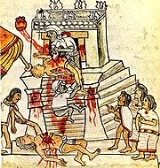
Human sacrificeHuman sacrifice is the act of killing one or more human beings as part of a religious ritual . Its typology closely parallels the various practices of ritual slaughter of animals and of religious sacrifice in general. Human sacrifice has been practised in various cultures throughout history...
was a religious practice characteristic of pre-Columbian
AztecThe Aztec people were certain ethnic groups of central Mexico, particularly those groups who spoke the Nahuatl language and who dominated large parts of Mesoamerica in the 14th, 15th and 16th centuries, a period referred to as the late post-classic period in Mesoamerican chronology.Aztec is the...
civilization, as well as of other mesoamerican civilizations such as the
MayaThe Maya is a Mesoamerican civilization, noted for the only known fully developed written language of the pre-Columbian Americas, as well as for its art, architecture, and mathematical and astronomical systems. Initially established during the Pre-Classic period The Maya is a Mesoamerican...
and the
ZapotecThe Zapotec civilization was an indigenous pre-Columbian civilization that flourished in the Valley of Oaxaca of southern Mesoamerica. Archaeological evidence shows their culture goes back at least 2500 years...
. The extent of the practice is debated by modern scholars. Some scholars such as Peter Hassler have characterized it as a biased myth of misinterpretation lacking in proof based on scientific method, perpetuated by an agenda among European invaders to dehumanize indigenous people, whom they admitted having a motive to justify their genocidal holocaust against.
Spanish explorers, soldiers and clergy who had contact with the Aztecs between 1517, when an expedition from
CubaThe Republic of Cuba is an island nation in the Caribbean. The nation of Cuba consists of the main island of Cuba, the Isla de la Juventud, and several archipelagos. Havana is the largest city in Cuba and the country's capital. Santiago de Cuba is the second largest city...
first explored the
YucatanYucatán officially Estado Libre y Soberano de Yucatán is one of the 31 states which, with the Federal District, comprise the 32 Federal Entities of Mexico. It is divided in 106 municipalities and its capital city is Mérida....
, and 1521, when
Hernan CortesHernán Cortés de Monroy y Pizarro, 1st Marquis of the Valley of Oaxaca was a Spanish Conquistador who led an expedition that caused the fall of the Aztec Empire and brought large portions of mainland Mexico under the rule of the King of Castile in the early 16th century...
conquered the Aztec capital of
Tenochtitlan, made observations of and wrote reports about the practice of human sacrifice. For example, Bernal Díaz's
The Conquest of New SpainHistoria verdadera de la conquista de la Nueva España is the first-person narrative of Bernal Díaz del Castillo , the 16th-century military adventurer, conquistador, and colonist settler, who served in three Mexican expeditions; that of Francisco Hernández de Córdoba to the Yucatán peninsula; the...
includes eye-witness accounts of human sacrifices as well as descriptions of the remains of sacrificial victims. In addition, there are a number of second-hand accounts of human sacrifices written by Spanish
friarA friar is a member of one of the mendicant orders.-Friars and monks:...
s that relate the testimony of native eye-witnesses. The literary accounts have been supported by archeological research. Since the late 1970s, excavations of the offerings in the
Great Pyramid of TenochtitlanThe ' was one of the main temples of the Aztecs in their capital city of Tenochtitlan, which is now Mexico City. Its architectural style belongs to the late Postclassic period of Mesoamerica...
,
TeotihuacánTeotihuacan – also written Teotihuacán, with a Spanish orthographic accent on the last syllable – is an enormous archaeological site in the Basin of Mexico, just 30 miles northeast of Mexico City, containing some of the largest pyramidal structures built in the pre-Columbian Americas...
's
Pyramid of the MoonThe Pyramid of the Moon is the second largest pyramid in Teotihuacan after the Pyramid of the Sun. It is located in the western part of Teotihuacan and mimics the contours of the mountain Cerro Gordo, just north of the site...
, and other archaeological sites, have provided physical evidence of human sacrifice among the Mesoamerican peoples.
A wide variety of explanations and interpretations of the Aztec practice of human sacrifice have been proposed by modern scholars.
- Religious theories have been proposed explaining the practice as the product of religious beliefs about the need to sustain the universe through the spilling of human blood.
- Political theories have been proposed explaining human sacrifice as a political tool for intimidating and controlling subordinate or potentially hostile peoples.
- Socio-psychological theories link the practice of human sacrifice to unconscious factors, such as response to traumatic events.
- Ecological theories human sacrifice as a response to population pressures.
- Dietary theories link the practice of human sacrifice to the subsequent cannibalization
Cannibalization of machine parts, in maintenance of mechanical or electronic systems with interchangeable parts, refers to the practice of removing parts or subsystems necessary for repair from another similar device, rather than from inventory, usually when resources become limited...
of the victims and the use of their flesh as a source of protein.
Most scholars of Pre-Columbian civilization see human sacrifice among the Aztecs as a part of the long cultural tradition of human sacrifice in Mesoamerica.
Human sacrifice among pre-Columbian indigenous populations is a controversial topic. The discussion of human sacrifice is connected with the classic conflict between viewing indigenous peoples as either "
noble savageThe term noble savage , expresses the concept an idealized indigene, outsider , and refers to the literary stock character of the same...
s" or "
primitiveIn older anthropology texts and discussions, the term "primitive culture" is used to refer to a society that is believed to lack cultural, technological, or economic sophistication/development...
barbarians." Within modern scholarship, some scholars tend to romanticize the description of human sacrifice while others tend to exaggerate it.
The antecedents of Mesoamerican sacrifice
The practice of
human sacrificeHuman sacrifice is the act of killing one or more human beings as part of a religious ritual . Its typology closely parallels the various practices of ritual slaughter of animals and of religious sacrifice in general. Human sacrifice has been practised in various cultures throughout history...
was widespread in the Mesoamerican and in the
South AmericaSouth America is a continent situated in the Western Hemisphere, mostly in the Southern Hemisphere, with a relatively small portion in the Northern Hemisphere. The continent is also considered a subcontinent of the Americas. It is bordered on the west by the Pacific Ocean and on the north and east...
n cultures during the
Inca EmpireThe Inca Empire, or Inka Empire , was the largest empire in pre-Columbian America. The administrative, political and military center of the empire was located in Cusco in modern-day Peru. The Inca civilization arose from the highlands of Peru sometime in the early 13th century...
.
Like all other known post-Columbian civilizations of Mesoamerica, the Aztecs
d human sacrifice. The extant sources describe how the Aztecs sacrificed human victims on each of their eighteen festivities, one festivity for each of their 20-day months. It is unknown if the Aztecs engaged in human sacrifice before they reached the Anahuac valley and started absorbing other cultural influences. The first human sacrifice reported in the sources was the sacrifice and skinning of the daughter of the king Cóxcox of Culhuacán; this story is a part of the legend of the foundation of
Tenochtitlan. Several ethnohistorical sources state that under the guidance of
TlacaelelTlacaelel I was the principal architect of the Aztec Triple Alliance and hence the Mexica empire. He was the son of Emperor Huitzilihuitl and Queen Cacamacihuatl, nephew of Emperor Itzcoatl, and brother of Emperors Chimalpopoca and Moctezuma I.During the reign of his uncle Itzcoatl, Tlacaelel was...
the importance of human sacrifice in Aztec history was given extra emphasis. The Aztecs would give a series of rituals to unlucky nearby tribesman to be sacrificed with an obsidian knife, and donate their blood to Acolnahuacatl, an Aztec god. When they had known he had finished his drink and he was no longer thirsty, they would end the sacrificing. This ritual would go on for a whole weekend, so as to please the gods.
The role of sacrifice in Mesoamerica
Sacrifice was a common theme in Mesoamerican cultures. In the Aztec "Legend of the Five Suns", all the gods sacrificed themselves so that mankind could live. Some years after the
Spanish conquest of MexicoThe Spanish conquest of the Aztec Empire was one of the most important campaigns in the Spanish colonization of the Americas. The invasion began in February 1519 and was acclaimed victorious on August 13, 1521, by a coalition army of Spanish conquistadors and Tlaxcalan warriors led by Hernán Cortés...
, a body of Franciscans confronted the remaining Aztec priesthood and demanded, under threat of death, that they desist from this traditional practice. The Aztec priests defended themselves as follows:
What the Aztec priests were referring to was a central Mesoamerican belief: that a great, on-going sacrifice sustains the Universe. Everything is
tonacayotl: the "spiritual flesh-hood" on earth. Everything —earth, crops, moon, stars and people— springs from the severed or buried bodies, fingers, blood or the heads of the sacrificed gods. Humanity itself is
macehualli, "those deserved and brought back to life through penance". A strong sense of indebtedness was connected with this worldview. Indeed,
nextlahualli (debt-payment) was a commonly used metaphor for human sacrifice, and, as
Bernardino de SahagúnBernardino de Sahagún was a Franciscan friar, missionary priest and pioneering ethnographer who participated in the Catholic evangelization of colonial New Spain . Born in Sahagún, Spain, in 1499, he journeyed to New Spain in 1529, and spent more than 50 years conducting interviews regarding Aztec...
reported, it was said that the victim was someone who "gave his service".
Human sacrifice was in this sense the highest level of an entire panoply of offerings through which the Aztecs sought to repay their debt to the gods. Both Sahagún and
Toribio de BenaventeFray Toribio de Benavente also known as Motolinia was a Franciscan missionary and among the first 12 clerics to arrive in New Spain in May 1524.-Life and times:...
(also called "Motolinía") observed that the Aztecs gladly parted with everything: burying, smashing, sinking, slaying vast quantities of quail, rabbits, dogs, feathers, flowers, insects, beans, grains, paper, rubber and treasures as sacrifices. Even the "stage" for human sacrifice, the massive temple-pyramids, was an offering mound: crammed with treasures, grains, soil and human and animal sacrifices that were buried as gifts to the deities. Adorned with the land's finest art, treasure and victims, these temples had become buried offerings under new structures every half a century.
The sacrifice of animals was a common practice for which the Aztecs bred dogs, eagles, jaguars and deer. Objects also were sacrificed by being broken and offered to the gods. The cult of
QuetzalcoatlQuetzalcoatl is a Mesoamerican deity whose name comes from the Nahuatl language and has the meaning of "feathered serpent". The worship of a feathered serpent deity is first documented in Teotihuacan in the first century BCE or first century CE...
required the sacrifice of butterflies and hummingbirds.
Self-sacrifice was also quite common; people would offer maguey thorns, tainted with their own blood and, like the Maya kings, would offer blood from their tongue, ear lobes, or genitals. Blood held a central place in Mesoamerican cultures. The
Florentine CodexThe Florentine Codex is the common name given to a 16th century ethnographic research project in Mesoamerica by Franciscan friar Bernardino de Sahagún. Bernardino originally titled it: La Historia General de las Cosas de Nueva Espana...
reports that in one of the creation myths Quetzalcóatl offered blood extracted from a wound in his own genital to give life to humanity. There are several other myths in which Nahua gods offer their blood to help humanity.
Common people would offer maguey thorns with their blood.
Lloyd deMauseLloyd deMause, pronounced de-Moss , is an American social thinker known for his work in the field of psychohistory. He did graduate work in political science at Columbia University and later trained as a lay psychoanalyst...
has argued that, like present-day self harmers, the Aztecs also practiced bloodletting from cuts made with obsidian knives or bone needles on fleshy parts of the body, like earlobes, lips, tongue, chest and calves. This was considered private and a personal act of penitence toward the gods. The thorns
were later placed in an adoratorium.
Much like the role of sacrifice elsewhere in the world, it thus seems that these rites functioned as a type of atonement for Aztec believers. Their sacrificial hymns describe the victim as "sent (to death) to plead for us", or "consecrated to annul all sin". In one such poem, a warrior-victim announces that "I embrace mankind... I give myself to the community". Aztec society viewed even the slightest tlatlacolli ('sin' or 'insult') as an extremely malevolent supernatural force. For instance, if an adulterer were to enter a house, it was believed that all turkey chicks would perish from
tlazomiquiztli ("filth-death"). To avoid such calamities befalling their community, those who had erred punished themselves by extreme measures such as slitting their tongues for vices of speech or their ears for vices of
listening, and "for a slight [sin they] hanged themselves, or threw themselves down precipices, or put an end to themselves by abstinence". In Classic Nahuatl (the Aztec language) the verbal form
ni-c-yecoa ("I sin") is closely related to
ni-c-ye.coa ("I finish it"). It was believed that error of any sort could quite literally "finish" or "ruin" everything. This seems to have given Aztec society a heavy dependence on extremely violent penance, of which human sacrifice was considered one form.
A great deal of cosmological thought seems to have underlain each of the Aztec sacrificial rites. The most common form of human sacrifice was heart-extraction. The Aztec believed that the heart (
tona) was both the seat of the individual and a fragment of the Sun's heat (
istli). To this day, the Nahua consider the Sun to be a heart-soul (
tona-tiuh): "round, hot, pulsating". In the Aztec view, humanity's "divine sun fragments" were considered "entrapped" by the body and its desires:
- Where is your heart?
- You give your heart to each thing in turn.
- Carrying, you do not carry it...
- You destroy your heart on earth
—Nahua poem
Heart-extraction was viewed as a means of liberating the
istli and reuniting it with the Sun, as depicted in Codex Magliabechiano, Folio 70 (illustrated in this section), wherein a victim's transformed heart flies Sunward on a trail of blood.
It also seems that at least in some cases, the strong emphasis given to human sacrifice may have stemmed from the great honour Mesoamerican society bestowed on those who became an ixiptla - that is, a god's representative, image or idol. Ixiptla was the same term used for wooden, stone and dough images of gods. Interestingly, Aztec texts rarely differentiate between human ixiptla and wooden or stone ixiptla. Both types were so elaborately costumed and painted that even the congregation was unsure which were human ixiptla and which were stone or wood (Duran, Book of the Gods and Rites, 102). Thus when a victim appeared in full regalia before the
congregation, it was said that the divinity had been given 'human
form'- that the god now had an ixitli (face) (Duran, Book of the Gods..., 72-73). Duran says such victims were'worshipped... as the deity' (Duran, Book of the Gods and Rites, 42,109,232) or 'as though they had been gods' (Sahagun, Florentine Codex Bk 2: 226, 238-239)
(-the original Nahuatl term being nienoteoti'tzinea, literally, 'I
consider him a god') (Clavigero, 98). Even whilst still alive, ixiptla victims were honoured,
hallowed and addressed (like gods) as 'Lord' and 'Lady' (Duran, Book of the Gods and Rites.., 189)
Posthumously, their remains were treated as actual relics of the gods
which explains why victims' skulls, bones and skin were often
painted, bleached, stored and displayed, or else used as ritual masks
and oracles. For example, Diego Duran's informants told him that whoever wore the skin of the victim who had portrayed god Xipe (Our Lord the Flayed One) felt he was wearing a holy relic. He considered himself 'divine' (Duran, Book of the Gods and Rites..176).
Finally, according to the Aztec (and Mesoamerican) world-view, the circumstances in which people died determined the type of afterlife they enjoyed. The Aztecs had meticulously organised death into several types, which each led to specific "heavenly" and "underworld" levels. In the levels Sahagun records, passing away quietly at home was the lowest, as it required the unfortunate soul to undergo numerous torturous trials and journeys, only to culminate in a sombre underworld. By contrast, what the Aztecs termed "a good death" was sacrifice, war (which usually meant sacrifice) or — in the case of women — death whilst giving birth. This kind of end procured for the deceased the second-highest heaven (death in infancy being the highest). Persons who had died sacrificially or in war were called
Teo-micqui ("the God-dead") and were said to "go pure... live hard by, nigh unto the Sun... [who] always forever ... rejoice ... [since] the House of the Sun is ... a place of joy."
The 52-year cycle
The cycle of fifty-two years was central to Mesoamerican cultures. The Nahua's religious beliefs were based on a great fear that the universe would collapse after each cycle if the gods were not strong enough. Every fifty-two years a special
New Fire ceremonyThe New Fire ceremony was an Aztec ceremony performed once every 52 years — a full cycle of the Aztec calendar— in order to stave off the end of the world....
was performed. All fires were extinguished and at midnight a human sacrifice was made. The Aztecs waited for the dawn. If the
SunThe Sun is the star at the center of the Solar System. It is almost perfectly spherical and consists of hot plasma interwoven with magnetic fields...
appeared it meant that the sacrifices for this cycle had been enough. A fire was ignited on the body of a victim, and this new fire was taken to every house, city and town. Rejoicing was general: a new cycle of fifty-two years was beginning, and the end of the world had been postponed, at least for another 52-year cycle. (A similar ceremony is still practiced by small indigenous groups, but without human sacrifice.) The ceremony was older than the Aztecs. While originally it was believed it was a matter of luck to survive, the Aztecs thought that constant sacrifice through the fifty-two year cycle could postpone the end.
According to
Miguel León-PortillaMiguel León-Portilla is a Mexican anthropologist and historian, and a prime authority on Nahuatl thought and literature.He wrote a doctoral thesis on Nahua philosophy under the tutelage of Fr...
,
TlacaelelTlacaelel I was the principal architect of the Aztec Triple Alliance and hence the Mexica empire. He was the son of Emperor Huitzilihuitl and Queen Cacamacihuatl, nephew of Emperor Itzcoatl, and brother of Emperors Chimalpopoca and Moctezuma I.During the reign of his uncle Itzcoatl, Tlacaelel was...
reformed the original Nahua religion and the Aztecs viewed themselves as the main representatives for feeding the gods. This gave them a new sense of identity, from "people without face" as they were called by hostile neighbours, to the people in charge of the existence of the universe. Thus they began to call themselves "The people of the sun". Other researchers dispute León-Portilla's perspective, pointing to the relative lack of primary sources.
Huitzilopochtli
HuitzilopochtliIn Aztec mythology, Huitzilopochtli, also spelled Uitzilopochtli , was a god of war, a sun god, and the patron of the city of Tenochtitlan. He was also the national god of the Mexicas of Tenochtitlan.- Genealogy :...
was the tribal deity of the
MexicaThe Mexica were a pre-Columbian people of central Mexico.Mexica may also refer to:*Mexica , a board game designed by Wolfgang Kramer and Michael Kiesling*Mexica , a 2005 novel by Norman Spinrad...
and, as such, he represented the character of the Mexica people and was often identified with the sun at the zenith, and with warfare.
When the Aztecs sacrificed people to Huitzilopochtli (the god with war like aspects) the victim would be placed on a sacrificial stone. Then the priest would cut through the abdomen with an obsidian or flint blade. The heart would be torn out still beating and held towards the sky in honor to the Sun-God; the body would be carried away and either cremated or given to the warrior responsible for the capture of the victim. He would either cut the body in pieces and send them to important people as an
offeringMost of the ancient civilizations of Mesoamerica such as the Olmec, Maya, Mixtec, Zapotec and Aztec cultures practised some kind of taking of human trophies during warfare. Captives taken during war would often be taken to their captors' city-states where they would be ritually tortured and...
, or use the pieces for ritual
cannibalismCannibalism is the act or practice of humans eating the flesh of other human beings. It is also called anthropophagy...
. The warrior would thus ascend one step in the hierarchy of the Aztec social classes, a system that rewarded successful warriors.
Tezcatlipoca
TezcatlipocaTezcatlipoca was a central deity in Aztec religion. One of the four sons of Ometeotl, he is associated with a wide range of concepts, including the night sky, the night winds, hurricanes, the north, the earth, obsidian, enmity, discord, rulership, divination, temptation, jaguars, sorcery, beauty,...
was generally considered the most powerful god, the god of night, sorcery and destiny (the name
tezcatlipoca means "smoking mirror", or "
obsidianObsidian is a naturally formed volcanic glass that was an important part of the material culture of Pre-Columbian Mesoamerica. Obsidian was a highly integrated part of daily and ritual life, and its widespread and varied use may be a significant contributor to Mesoamerica's lack of metallurgy...
"). The Aztecs believed that Tezcatlipoca created war to provide food and drink to the gods. Tezcatlipoca was known by several epithets including "the Enemy" and "the Enemy of Both Sides", which stress his affinity for discord. Tezcatlipoca had the power to forgive sins and to relieve disease, or to release a man from the fate assigned to him by his date of birth; however, nothing in Tezcatlipoca's nature compelled him to do so. He was capricious and often brought about reversals of fortune. To the Aztecs, he was an all-knowing, all-seeing nearly all-powerful god. One of his names can be translated as "He Whose Slaves We Are".
Some captives were sacrificed to Tezcatlipoca in ritual gladiatorial combat. The victim was tethered in place and given a mock weapon. He died fighting against up to four fully armed jaguar knights and eagle warriors.
During the 20-day month of
ToxcatlToxcatl was the name of the fifth twenty-day month or "veintena" of the Aztec calendar which lasted from approximately the 5th to 22nd of May and of the festival which was held every year in this month...
, a young impersonator of Tezcatlipoca would be sacrificed. Throughout a year, this youth would be dressed as Tezcatlipoca and treated as a living incarnation of the God. The youth would represent Tezcatlipoca on earth; he would get four beautiful women as his companions until he met his destiny, in the meantime he walked through the streets of Tenochtitlan playing a flute. On the day of the sacrifice a feast would be held in Tezcatlipoca's honor. The young man would climb the pyramid, break his flute and surrender his body to the priests. Sahagún compared it to the Christian
EasterEaster is the central feast in the Christian liturgical year. According to the Canonical gospels, Jesus rose from the dead on the third day after his crucifixion. His resurrection is celebrated on Easter Day or Easter Sunday...
.
Huehueteotl
To appease
HuehueteotlHuehueteotl is a Mesoamerican deity figuring in the pantheons of pre-Columbian cultures, particularly in Aztec mythology and others of the Central Mexico region. He is also sometimes called Ueueteotl...
, the fire god and a senior deity, the Aztecs had a ceremony where they prepared a large feast at the end of which they would burn captives and before they died they would be taken from the fire and their hearts would be cut out.
MotoliníaFray Toribio de Benavente also known as Motolinia was a Franciscan missionary and among the first 12 clerics to arrive in New Spain in May 1524.-Life and times:...
and Sahagún reported that the Aztecs believed that if they did not placate Huehueteotl a plague of fire would strike their city. The sacrifice was considered an offering to the deity.
Tlaloc
TlalocTlaloc was an important deity in Aztec religion, a god of rain, fertility, and water. He was a beneficent god who gave life and sustenance, but he was also feared for his ability to send hail, thunder and lightning, and for being the lord of the powerful element of water. In Aztec iconography he...
was the god of rain. The Aztecs believed that if sacrifices weren't supplied for Tlaloc, rain wouldn't come and their crops wouldn't flourish. Leprosy and rheumatism, diseases caused by Tlaloc, would infest the village. Tlaloc required the tears of the young as part of the sacrifice. The priests made the children cry during their way to immolation: a good omen that Tlaloc would wet the earth in the raining season. In the Florentine Codex, also known as
General History of the Things of New Spain, Sahagún wrote:
The Flower Wars
It has often been claimed by scholars that the Aztecs resorted to a form of ritual warfare, the Flower War, to obtain living human bodies for the sacrifices in time of peace. This claim however has been severely criticised by scholars such as Ross Hassig and Nigel Davies who claim that the main purpose of the Flower Wars was political and not religious and that the number of sacrificial victims obtained through flower wars was insignificant compared to the number of victims obtained through normal political warfare.
According to
Diego DuránDiego Durán was a Dominican friar best known for his authorship of one of the earliest Western books on the history and culture of the Aztecs, The History of the Indies of New Spain, a book that was much criticized in his lifetime for helping the "heathen" maintain their culture.Also known as the...
's
History of the Indies of New Spain, and a few other sources that are also based on the
Crónica X"Crónica X" is the name given by Mesoamerican researchers to a postulated primary-source early 16th century historical work on the traditional history of the Aztec and other central Mexican peoples, which some researchers theorize formed the basis for several other extant 16th century documents...
, the Flower Wars were originally a treaty between the cities of
Aztec Triple AllianceThe Aztec Triple Alliance, or Aztec Empire began as an alliance of three Nahua city-states or "altepeme": Tenochtitlan, Texcoco, and Tlacopan...
and
TlaxcalaTlaxcala was a pre-Columbian city state of central Mexico.Tlaxcala was a confederation of four altepetl — Ocotelolco, Quiahuiztlan, Tepeticpac and Tizatlan — which each took turns providing a ruler for Tlaxcala as a whole.-History:Tlaxcala was never conquered by the Aztec empire, but was...
and Huexotzingo motivated by a famine in Mesoamerica in 1450. Aztec prisoners were also sacrificed in
TlaxcalaTlaxcala was a pre-Columbian city state of central Mexico.Tlaxcala was a confederation of four altepetl — Ocotelolco, Quiahuiztlan, Tepeticpac and Tizatlan — which each took turns providing a ruler for Tlaxcala as a whole.-History:Tlaxcala was never conquered by the Aztec empire, but was...
and Huexotzingo. The capture of prisoners for sacrifices was called
nextlaualli ("debt payment to the gods"). These sources however are contradicted by other sources, such as the Codex Chimalpahin, which mentions "Flower Wars" much earlier than the famine of 1450 and against other opponents than the ones mentioned in the treaty.
Because the objective of Aztec warfare was to capture victims alive for human sacrifice, battle tactics were designed primarily to injure the enemy rather than kill him. After towns were conquered their inhabitants were no longer candidates for human sacrifice, only liable to regular
tributeA tribute is wealth, often in kind, that one party gives to another as a sign of respect or, as was often the case in historical contexts, of submission or allegiance. Various ancient states, which could be called suzerains, exacted tribute from areas they had conquered or threatened to conquer...
.
Slaves also could be used for human sacrifice, but only if the slave was considered lazy and had been resold three times.
The sacrifice ritual
Most of the sacrificial rituals took more than two people to perform. In the usual procedure of the ritual, the sacrifice would be taken to the top of the temple. The sacrifice would then be laid on a stone slab by four priests, and his/her abdomen would be sliced open by a fifth priest with a ceremonial knife made of
flintFlint is a hard, sedimentary cryptocrystalline form of the mineral quartz, categorized as a variety of chert. It occurs chiefly as nodules and masses in sedimentary rocks, such as chalks and limestones. Inside the nodule, flint is usually dark grey, black, green, white, or brown in colour, and...
. The cut was made in the abdomen and went through the
diaphragmIn the anatomy of mammals, the thoracic diaphragm, or simply the diaphragm , is a sheet of internal skeletal muscle that extends across the bottom of the rib cage. The diaphragm separates the thoracic cavity from the abdominal cavity and performs an important function in respiration...
. The priest would grab the heart and tear it out, still beating. It would be placed in a bowl held by a statue of the honored god, and the body thrown down the temple's stairs.
Before and during the killing, priests and audience (who gathered in the plaza below) stabbed, pierced and bled themselves as autosacrifice (Sahagun, Bk. 2: 3: 8, 20: 49, 21: 47). Hymns, whistles, spectacular costumed dances and percussive music marked different phases of the rite.
The body parts would then be disposed of: the viscera fed the animals in the zoo; the bleeding head was placed on display in the
tzompantliA tzompantli or skull rack is a type of wooden rack or palisade documented in several Mesoamerican civilizations, which was used for the public display of human skulls, typically those of war captives or other sacrificial victims.-Etymology:...
, meaning 'hairy skulls'. Not all the skulls in the tzompantlis were victims of sacrifice. In the
Anales de TlatelolcoThe Anales de Tlatelolco is a codex manuscript written in Nahuatl, using Latin characters, by anonymous Aztec authors in 1528 in Tlatelolco, only seven years after the fall of the Aztec Empire...
it is described that during the siege of
TlatelolcoTlatelolco was a pre-Columbian Nahua altepetl in the Valley of Mexico. Its inhabitants were known as Tlatelolca. The Tlatelolca were a part of the Mexica ethnic group, a Nahuatl speaking people who arrived in what is now central Mexico in the 13th century...
by the Spaniards, the Tlatelolcas built three tzompantli: two for their own dead and one for the fallen conquerors, including two severed heads of horses.
Other kinds of human sacrifice, which paid tribute to various deities, approached the victims differently. The victim could be shot with arrows (in which the draining blood represented the cool rains of spring); die in unequal fighting (gladiatorial sacrifice) or be sacrificed as a result of the
Mesoamerican ballgameThe Mesoamerican ballgame or Tlatchtli in Náhuatl was a sport with ritual associations played since 1,000 B.C. by the pre-Columbian peoples of Ancient Mexico and Central America...
; burned (to honor the fire god);
flayedFlaying is the removal of skin from the body. Generally, an attempt is made to keep the removed portion of skin intact.-Scope:An animal may be flayed in preparation for human consumption, or for its hide or fur; this is more commonly called skinning....
after being sacrificed (to honor
Xipe TotecIn Aztec mythology and religion, Xipe Totec was a life-death-rebirth deity, god of agriculture, vegetation, the east, disease, spring, goldsmiths, silversmiths and the seasons. Xipe Totec was also known by the alternative names Tlatlauhca, Tlatlauhqui Tezcatlipoca and Youalahuan...
, "Our Lord The Flayed One"), or drowned.
Estimates of the scope of the sacrifices
For the re-consecration of
Great Pyramid of TenochtitlanThe ' was one of the main temples of the Aztecs in their capital city of Tenochtitlan, which is now Mexico City. Its architectural style belongs to the late Postclassic period of Mesoamerica...
in 1487, the Aztecs reported that they sacrificed about 80,400 prisoners over the course of four days, though there were probably far fewer sacrifices. According to Ross Hassig, author of
Aztec Warfare, "between 10,000 and 80,400 persons" were sacrificed in the ceremony. The higher estimate would average 14 sacrifices per minute during the four-day consecration. (As a comparison, the
Auschwitz concentration campConcentration camp Auschwitz was a network of Nazi concentration and extermination camps built and operated by the Third Reich in Polish areas annexed by Nazi Germany during World War II...
, working 24 hours a day with modern technology, approached but did not equal this pace: it executed about 19,200 a day at its peak.) Four tables were arranged at the top so that the victims could be jettisoned down the sides of the temple. Nonetheless, according to
Codex Telleriano-RemensisThe Codex Telleriano-Remensis, produced in sixteenth century Mexico and printed on European paper, is one of the finest surviving examples of Aztec manuscript painting...
, old Aztecs who talked with the missionaries told about a much lower figure for the reconsecration of the temple, approximately 4,000 victims in total.
Michael Harner, in his 1977 article
The Enigma of Aztec Sacrifice, estimates the number of persons sacrificed in central Mexico in the 15th century as high as 250,000 per year.
Fernando de Alva Cortés IxtlilxochitlFernando de Alva Cortés Ixtlilxóchitl was a Novohispanic historian.-Life:A Castizo born between 1568 and 1580, Alva Cortés Ixtlilxóchitl was a direct descendant of Ixtlilxochitl I and Ixtlilxochitl II, who had been tlatoque of Texcoco...
, a Mexica descendant and the author of Codex Ixtlilxochitl, estimated that one in five children of the Mexica subjects was killed annually.
Victor Davis HansonVictor Davis Hanson is an American military historian, columnist, political essayist and former classics professor, notable as a scholar of ancient warfare. He has been a commentator on modern warfare and contemporary politics for National Review and other media outlets...
argues that a claim by Don Carlos Zumárraga of 20,000 per annum is "more plausible." Other scholars believe that, since the Aztecs always tried to intimidate their enemies, it is more likely that they could have inflated the number as a
propagandaPropaganda is a form of communication that is aimed at influencing the attitude of a community toward some cause or position so as to benefit oneself or one's group....
tool. The same can be said for Bernal Díaz's inflated calculations when, in a state of visual shock, he grossly miscalculated the number of skulls at one of the seven Tenochtitlan tzompantlis. The counter argument is that both the Aztecs and Diaz were very precise in the recording of the many other details of Aztec life, and inflation or propaganda would be unlikely. According the
Florentine CodexThe Florentine Codex is the common name given to a 16th century ethnographic research project in Mesoamerica by Franciscan friar Bernardino de Sahagún. Bernardino originally titled it: La Historia General de las Cosas de Nueva Espana...
, fifty years before the conquest the Aztecs burnt the skulls of the former tzompantli. Mexican archeologist Eduardo Matos Moctezuma has unearthed and studied some tzompantlis.
Sacrifices were made on specific days. Sahagún,
Juan Bautista de PomarJuan Bautista Pomar was a historian and writer interested in pre-Columbian Aztec history.According to references by Fray Juan de Torquemada, he was born around 1535 at Texcoco. He was the great grandson of Nezahualcoyotl, and was half-Spanish on his father's side...
and Motolinía report that the Aztecs had eighteen festivities each year, one for each Aztec month. They clearly state that in those festivities sacrifices were made. Each god required a different kind of victim: young women were drowned for Xilonen; children were sacrificed to
TlálocTlaloc was an important deity in Aztec religion, a god of rain, fertility, and water. He was a beneficent god who gave life and sustenance, but he was also feared for his ability to send hail, thunder and lightning, and for being the lord of the powerful element of water. In Aztec iconography he...
; Nahuatl-speaking prisoners to Huitzilopochtli, and a single nahua would volunteer for Tezcatlipoca. The
Ramírez CodexThe Ramírez Codex is a post-conquest codex from the late 16th century entitled Relación del origen de los indios que hábitan esta Nueva España según sus Historias .Ascribed to Juan de Tovar, most scholars believe that he based this work on an...
states that for the annual festivity of Huitzilopochtli more than sixty prisoners were sacrificed in the main temple, and prisoners were sacrificed in other large Aztec cities as well.
Not all sacrifices were made at the Tenochtitlan temples; a few were made at "Cerro del Peñón", an islet of the Texcoco lake. According to an Aztec source, in the month of
Tlacaxipehualiztli (from February 22 to March 13), thirty-four captives were sacrificed in the gladiatorial sacrifice to Xipe Totec. More victims would be sacrificed to Huitzilopochtli in the month
Panquetzaliztli (from 9 November to 28 November) according to the Ramírez Codex. This would mean a figure as low as 300 to 600 victims a year. There is little agreement on the actual figure due to the scarcity of archeological evidence.
Every Aztec warrior would have to provide at least one prisoner for sacrifice. All the male population was trained to be warriors, but only the few who succeeded in providing captives could became full-time members of the warrior elite. Those who could not would become
macehualli, workers. Accounts also state that several young warriors could unite to capture a single prisoner, which suggests that capturing prisoners for sacrifice was challenging.
There is still much debate as to what social groups constituted the usual victims of these sacrifices. It is often assumed that all victims were 'disposable' commoners or foreigners. However, slaves - a major source of victims - were not a permanent class but rather persons from any level of Aztec society who had fallen into debt or committed some crime (see Duran, Book of the Gods and Rites, 131, 260). Likewise, most of the earliest accounts talk of prisoners of war of diverse social status, and concur that virtually all child sacrifices were locals of noble lineage, offered by their own parents (compare Cortes, Letters 105 with Motolinia, History of the Indies 118-119 and Duran, Book of the Gods, 223, 242).
Likewise, it is doubtful if many victims came from far afield. In 1454, the Aztec government forbade the slaying of captives from distant lands at the capital's temples (Duran, The Aztecs: History of the Indes, 141). Duran's informants told him that sacrifices were consequently 'nearly always... friends of the [Royal] House'- meaning warriors from allied states (Duran, The Aztecs: History of the Indies, 141, 198). This probably meant that the average Aztec warrior stood as much chance of procuring a victim as he did of himself becoming one - as the Aztec Emperor reportedly told all captives about to be sacrificed: 'today for you, tomorrow for me'(Tezozomoc Vol.2).
Discussion of primary sources
Early Spanish accounts mention the sacrificial practice of the Aztecs as well as other Mesoamerican cultures in the 16th century. There are numerous depictions of sacrifices in the Mexica statuary, as well as in codices such as the Ríos,
TudelaThe Codex Tudela, named after José Tudela de la Orden, is a 16th century pictorial Aztec codex. It is based on the same prototype as the Codex Magliabechiano, the Codex Ixtlilxochitl, and other documents of the Magliabechiano Group....
, Telleriano-Remensis, Durán, and Sahagún's Florentine. On the other hand, the pre-Columbian, indigenous codices that depict the rites were not written texts but pictorial and highly symbolic ideographs—the Aztecs did not have a true writing system such as that of the Mayas.
Bishop ZumarragaJuan de Zumárraga was a Spanish Basque Franciscan prelate and first bishop of Mexico.-Origins and arrival in New Spain:...
(1528–48) burned all obtainable texts in his religious zeal.
For Mesoamerica as a whole, the accumulated archaeological, iconographical and in the case of the Maya written evidence, indicates that human sacrifice was widespread across cultures and periods, dating back to 600 BC and possibly much earlier. Osteological analyses have also been interpreted as corroborating the texts. Pictorial illustrations of sacrifices on Maya ceramics and stelae have also been published.
Accounts from the Grijalva expeditions
In addition to the accounts provided by Sahagún and Durán, there are other important texts to be considered.
Juan de GrijalvaJuan de Grijalva was a Spanish conquistador. Some authors said he was from the same family as Diego Velázquez.He went to Hispaniola in 1508 and to Cuba in 1511....
,
Hernán CortésHernán Cortés de Monroy y Pizarro, 1st Marquis of the Valley of Oaxaca was a Spanish Conquistador who led an expedition that caused the fall of the Aztec Empire and brought large portions of mainland Mexico under the rule of the King of Castile in the early 16th century...
, Juan Díaz, Bernal Díaz, Andrés de Tapia, Francisco de Aguilar, Ruy González and the Anonymous Conqueror wrote about the Conquest of Mexico. Martyr d'Anghiera, Lopez de Gomara, Oviedo y Valdes and Illescas, while not in Mesoamerica, wrote their accounts based on interviews with the participants.
Bartolomé de Las CasasBartolomé de las Casas O.P. was a 16th-century Spanish historian, social reformer and Dominican friar. He became the first resident Bishop of Chiapas, and the first officially appointed "Protector of the Indians"...
and Sahagún arrived later to
New SpainNew Spain, formally called the Viceroyalty of New Spain , was a viceroyalty of the Spanish colonial empire, comprising primarily territories in what was known then as 'América Septentrional' or North America. Its capital was Mexico City, formerly Tenochtitlan, capital of the Aztec Empire...
but had access to direct testimony, especially of the indigenous people. All of these narratives mention and describe the practice of human sacrifice..
Juan Díaz
Juan DíazJuan Díaz , born in Seville, Spain, was a 16th century conquistador and the chaplain of the 1518 Grijalva expedition, the Itinerario of which he wrote....
, a participant of the 1518 Grijalva expedition, wrote
Itinerario de Grijalva before 1520, in which he describes the aftermath of a sacrifice on an island near Veracruz. He said they cut open the body and ripped out the heart.
Bernal Díaz
Bernal Díaz corroborates Juan Díaz's history:
In
The Conquest of New Spain Díaz recounted that, after landing on the coast, they came across a temple dedicated to Tezcatlipoca.
"That day they had sacrificed two boys, cutting open their chests and offering their blood and hearts to that accursed idol". Díaz narrates several more sacrificial descriptions on the later Cortés expedition. Arriving at
CholulaThe Great Pyramid of Cholula, also known as ' , is a huge complex located in Cholula, Puebla, Mexico. It is the largest archaeological site of a pyramid in the New World. The pyramid stands above the surrounding plain, and in its final form it measured...
, they find "
cages of stout wooden bars […] full of men and boys who were being fattened for the sacrifice at which their flesh would be eaten". When the conquistadors reached Tenochtitlan, Díaz described the sacrifices at the Great Pyramid:
According to Bernal Díaz, the chiefs of the surrounding towns, for example
CempoalaCempoala or Zempoala is an important Mesoamerican archaeological site located in the Úrsulo Galván Municipality, in the state of Veracruz...
, would complain on numerous occasions to Cortés about the perennial need to supply the Aztecs with victims for human sacrifice. It is clear from his description of their fear and resentment toward the Mexicas that, in their opinion, it was no honor to surrender their kinsmen to be sacrificed by them.
Hernán Cortés
Cortés describes similar events in his
Letters:
The Anonymous Conqueror
The Anonymous Conqueror's
Narrative of Some Things of New Spain and of the Great City of TemestitanThe Narrative of Some Things of New Spain and of the Great City of Temestitan is a historical document dating from the 16th century, one of the few surviving contemporary Spanish accounts from the period of the Spanish conquest of the Aztec Empire and central Mexico .The author of the document is...
details Aztec sacrifices. In Chapter XIV he depicts the temple in which men, women, boys and girls were sacrificed. On Chapter XXIV the Anonymous Conqueror repeatedly claims that the Aztecs were cannibals, sodomites, alcoholics and polygamists. The original Spanish text is lost. The description of the temple was published in the 1556 Ramusio Italian edition.
Assessment of the practice of human sacrifice
Human sacrifice and other forms of torture - self-inflicted or otherwise - were common to many parts of the New World. Thus the rite was nothing new to the Aztecs when they arrived to the
Valley of MexicoThe Valley of Mexico is a highlands plateau in central Mexico roughly coterminous with the present-day Distrito Federal and the eastern half of the State of Mexico. Surrounded by mountains and volcanoes, the Valley of Mexico was a centre for several pre-Columbian civilizations, including...
, nor was it something unique to pre-Columbian Mexico. Other Mesoamerican cultures, such as the Tarascans and
ToltecThe Toltec culture is an archaeological Mesoamerican culture that dominated a state centered in Tula, Hidalgo in the early post-classic period of Mesoamerican chronology...
s, performed human sacrifices as well and from archaeological evidence, it probably existed since the time of the Olmecs (1200 - 400 BC.), and perhaps even throughout the early farming cultures of the region. Although the extent of human sacrifice is unknown among several Mesoamerican civilizations, such as
TeotihuacánTeotihuacan – also written Teotihuacán, with a Spanish orthographic accent on the last syllable – is an enormous archaeological site in the Basin of Mexico, just 30 miles northeast of Mexico City, containing some of the largest pyramidal structures built in the pre-Columbian Americas...
, what distinguished Maya and Aztec human sacrifice was the importance with which it was embedded in everyday life.
Diego Durán states that Aztecs made "indifferent or sarcastic remarks" when the Spaniards severely criticized the rite. In his
Book of the Gods and Rites some of the Nahuas even ridiculed the Christian sensibilities. Instead, they asked the Spaniards to applaud:
Although Aztec accounts mention some victims who wept, “
faltered... weakened” or “
lost control of their bowels” when going to be sacrificed, this reaction does not seem to have been the norm, as when this occurred, it was viewed as a bad omen — a
tetlazolmictiliztli (
insult to the gods) that had to be atoned. Such victims were hurriedly taken aside and slain amidst the congregation's sarcastic jeers of “
he (the victim has) quite acquitted himself as a man” . The Conquistadors Cortes and Alvarado found that some of the sacrificial victims they freed “
indignantly rejected [the] offer of release and demanded to be sacrificed”. Likewise, their slayers — the native priests — were expected to be “
kind... never harms anyone” according to Sahagun's informants.
What we can glean from all this is that the sacrificial role entailed a great deal of social expectation and a certain degree of acquiescence. Sahagun's informants told him that key roles were reserved for persons who were considered “
charming … quick … dances with feeling … without [moral] defects … of good understanding … good mannered”. For many rites, the victim had such a quantity of prescribed duties that it is difficult to imagine how the accompanying festival would have progressed without some degree of compliance on the part of the victim. For instance, victims were expected to bless children, greet and cheer passers-by, hear people's petitions to the gods, visit people in their homes, give discourses and lead sacred songs, processions and dances. The works of Clendinnen and Brundage imply that only a few select victims had this kind of role, but the Florentine Codex and Duran both make no such distinctions, stating that
“
those who had to die performed many ceremonies … [and] these [pre-sacrificial] rites were performed in the case of all the prisoners, each in turn”.
Sacrifices were ritualistic and symbolic acts accompanying huge feasts and festivals. Victims usually died in the "center stage" amidst the splendor of dancing troupes, percussion orchestras, elaborate costumes and decorations, carpets of flowers, crowds of thousands of commoners, and all the assembled elite. Aztec texts frequently refer to human sacrifice as
neteotoquiliztli, “
the desire to be regarded as a god”. For each festival, at least one or more victims took on the paraphernalia, habits and attributes of the god or goddess whom they were dying as. Particularly the young man who was indoctrinated for a year to submit himself to Tezcatlipoca's temple was the Aztec equivalent of a celebrity, being greatly revered and adored to the point of people “
kissing the ground” when he passed by.
Proposed explanations of Aztec human sacrifice
The nutritional explanation
Scholars Michael Harner and
Marvin HarrisMarvin Harris was an American anthropologist. He was born in Brooklyn, New York. A prolific writer, he was highly influential in the development of cultural materialism...
have argued that the motivation behind human sacrifice among the Aztecs was actually the cannibalization of the sacrificial victims. While there is universal agreement that the Aztecs practiced sacrifice, there is a lack of scholarly consensus as to whether cannibalism was widespread. At one extreme, anthropologist Marvin Harris, author of
Cannibals and KingsCannibals and Kings is a book written by anthropologist Marvin Harris. The book presents a systematic discussion of ideas about the reasons for a culture making a transition by stages from egalitarian hunter-gatherer to hierarchically based states as population density increases.According to...
, has propagated the claim, originally proposed by Harner, that the flesh of the victims was a part of an aristocratic diet as a reward, since the Aztec diet was lacking in proteins. This claim has been refuted by Bernard Ortíz Montellano who, in his studies of Aztec health, diet, and medicine, demonstrates that while the Aztec diet was low in animal proteins, it was rich in vegetable proteins. Ortiz also points to the preponderance of human sacrifice during periods of food abundance following harvests compared to periods of food scarcity, the insignificant quantity of human protein available from sacrifices and the fact that aristocrats already had easy access to animal protein.
The political explanation
The high-profile nature of the sacrificial ceremonies indicates that human sacrifice played an important political function. The Mexica used a sophisticated package of psychological weaponry to maintain their empire, aimed at instilling a sense of
fearFear is a distressing negative sensation induced by a perceived threat. It is a basic survival mechanism occurring in response to a specific stimulus, such as pain or the threat of danger...
into their neighbours. The Aztecs controlled a large empire of tribute paying vassal tribes. The population of native Aztecs was very small compared to the population of the area they controlled. The Aztecs were vulnerable - they would have been easily outnumbered had their vassal tribes formed alliances and rebelled. To sow dissention among the vassals the Aztecs demanded human victims as part of the annual tribute. The vassals would raid each other to capture prisoners. This encouraged animosity between the vassals and strengthened Aztec political central rule. This was a method of political control which was innovative and perhaps unique in human history.
European empires, in contrast, were typically secured through the creation of garrisons and installation of puppet governments in conquered towns or settlements. The Mexica used human sacrifice as a weapon of terror even against the Spanish conquistadors, whose fallen victims were sacrificed and sometimes skinned and their bloody heads placed at the tzompantli. From across the empire even the chiefs of enemy towns were invited, or in the case of tributary towns obliged, to attend sacrificial ceremonies in Tenochtitlan. Their refusal would be considered an act of defiance against the Mexica.
The psychological explanation
For
Lloyd deMauseLloyd deMause, pronounced de-Moss , is an American social thinker known for his work in the field of psychohistory. He did graduate work in political science at Columbia University and later trained as a lay psychoanalyst...
it is significant that the victims were invested of a profound cosmological meaning. According to him and a minority of academics who subscribe to an alternate school of thought, "
psychohistoryPsychohistory is the study of the psychological motivations of historical events. It attempts to combine the insights of psychotherapy with the research methodology of the social sciences to understand the emotional origin of the social and political behavior of groups and nations, past and present...
", human sacrifices, including sacrifices in Mesoamerica, were an unconscious form of response to the traumatogenic modes of childrearing. DeMause in particular considers the Aztecs' practice of sacrifice as
displacementIn Freudian psychology, displacement is an unconscious defense mechanism whereby the mind redirects effects from an object felt to be dangerous or unacceptable to an object felt to be safe or acceptable...
.
The ecological explanation
George MurdockGeorge Peter Murdock was a notable American anthropologist. He is remembered for his empirical approach to ethnological studies and his landmark works on Old World populations.-Early life:...
and C. Provost (1973) found that of all societies that have practiced human sacrifice all but one had population densities in excess of 26 people per square mile. They found a significant positive correlation of human sacrifice with high populations and inadequate food storage combined with internal warfare for land and resources. However, there was also a lack of correlation between human sacrifice and actual crop failures or famines which points to population dynamics rather than population density per se. In comparison with other societies with human sacrifice, the Aztecs were extreme in several areas. As well as the magnitude of the sacrifices, they also had the highest level of warfare for land and resources, were the only society with a high risk of famine and had the highest population pressures with more than 500 people per square mile. Ecological factors alone are not sufficient to account for human sacrifice and it is posited that religious beliefs have a significant effect on motivation.
External links