
All Topics  
Hippodrome of Constantinople

 
Hippodrome of Constantinople

   Email Print
   Bookmark   Link


Hippodrome of Constantinople


The Hippodrome of Constantinople was a horse-racing track
Race track

A race track is a purpose-built facility for racing of animals , automobiles, motorcycles or sportsperson. A race track may also feature grandstands or concourses....
 that was the sporting and social centre of Constantinople
Constantinople

Constantinople was the empire capital of the Roman Empire , the Byzantine Empire , the Latin Empire , and the Ottoman Empire . Strategically located between the Golden Horn and the Sea of Marmara at the point where Europe meets Asia, Byzantine Constantinople had been the capital of a Christendom empire, successor to ancient ancient Greece...
, capital of the Byzantine Empire
Byzantine Empire

Byzantine Empire and Eastern Roman Empire are conventional names used to describe the Roman Empire during the Middle Ages, centered on its capital of Constantinople....
 and the largest city in Europe
Europe

Europe is, conventionally, one of the world's seven continents. Comprising the westernmost peninsula of Eurasia, Europe is generally divided from Asia to its east by the water divide of the Ural Mountains, the Ural , the Caspian Sea, and by the Caucasus Mountains to the southeast....
. Today it is a square named Sultanahmet Meydani (Sultan Ahmet Square) in the Turkish
Turkey

Turkey , known officially as the Republic of Turkey , is a Eurasian country that stretches across the Anatolian peninsula in southwest Asia and Thrace in the Balkans region of Southern Europe....
 city of Istanbul
Istanbul

Istanbul is the largest city in Turkey, List of metropolitan areas in Europe by population, and List of cities proper by population in the world with a population of 12.6 million....
, with only a few fragments of the original structure surviving.


Discussion
Ask a question about 'Hippodrome of Constantinople'
Start a new discussion about 'Hippodrome of Constantinople'
Answer questions from other users
Full Discussion Forum


Recent Posts


Encyclopedia


Hippodrome of Constantinple 1
The Hippodrome of Constantinople was a horse-racing track
Race track

A race track is a purpose-built facility for racing of animals , automobiles, motorcycles or sportsperson. A race track may also feature grandstands or concourses....
 that was the sporting and social centre of Constantinople
Constantinople

Constantinople was the empire capital of the Roman Empire , the Byzantine Empire , the Latin Empire , and the Ottoman Empire . Strategically located between the Golden Horn and the Sea of Marmara at the point where Europe meets Asia, Byzantine Constantinople had been the capital of a Christendom empire, successor to ancient ancient Greece...
, capital of the Byzantine Empire
Byzantine Empire

Byzantine Empire and Eastern Roman Empire are conventional names used to describe the Roman Empire during the Middle Ages, centered on its capital of Constantinople....
 and the largest city in Europe
Europe

Europe is, conventionally, one of the world's seven continents. Comprising the westernmost peninsula of Eurasia, Europe is generally divided from Asia to its east by the water divide of the Ural Mountains, the Ural , the Caspian Sea, and by the Caucasus Mountains to the southeast....
. Today it is a square named Sultanahmet Meydani (Sultan Ahmet Square) in the Turkish
Turkey

Turkey , known officially as the Republic of Turkey , is a Eurasian country that stretches across the Anatolian peninsula in southwest Asia and Thrace in the Balkans region of Southern Europe....
 city of Istanbul
Istanbul

Istanbul is the largest city in Turkey, List of metropolitan areas in Europe by population, and List of cities proper by population in the world with a population of 12.6 million....
, with only a few fragments of the original structure surviving. It is sometimes also called Atmeydani (Horse Square) in Turkish.

The word hippodrome
Hippodrome

A Hippodrome was a Greek stadium for horse racing and chariot racing. Some present-day horse racing tracks are also called hippodromes, for example the Central Moscow Hippodrome....
 comes from the Greek hippos ('?pp??), horse, and dromos (d??µ??), path or way. Horse racing
Horse racing

Horse racing is an equestrianism sport that has been practiced over the centuries; the chariot racing of Ancient Rome are an early example, as is the contest of the steeds of the god Odin and the giant Hrungnir in Norse mythology....
 and chariot racing
Chariot racing

Chariot racing was one of the most popular Ancient Greece, Roman Empire and Byzantine empire sports. Chariot racing was often dangerous to both driver and horse?they frequently suffered serious injury and even death?but generated strong spectator enthusiasm....
 were popular pastimes in the ancient world and hippodromes were common features of Greek cities in the Hellenistic, Roman
Ancient Rome

Ancient Rome was a civilization that grew out of a small agricultural community founded on the Italian Peninsula as early as the 10th century BC....
 and Byzantine
Byzantine Empire

Byzantine Empire and Eastern Roman Empire are conventional names used to describe the Roman Empire during the Middle Ages, centered on its capital of Constantinople....
 eras.

History and use

Although the Hippodrome is usually associated with Constantinople's days of glory as an imperial capital, it actually predates that era. The first Hippodrome was built when the city was called Byzantium
Byzantium

Byzantium was an Ancient Greece city, which was founded by Greeks colonists from Megara in 667 BC and named after their king Byzas or Byzantas ....
 (???a?t???, or Byzantion in Greek), and was a provincial town of moderate importance. In 203 the Emperor Septimius Severus rebuilt the city and expanded its walls, endowing it with a hippodrome, an arena for chariot races and other entertainment.

In 324, the Emperor Constantine the Great decided to move the seat of the government from Rome
Rome

Rome is the capital city of Italy and Lazio, and is Italy's largest and most populous city, with 2,724,347 residents in an urban area of some ....
 to Byzantium, which he renamed Nova Roma (New Rome
New Rome

The term "New Rome" has been used in the following contexts.* It was a common name applied to Constantinople, the city founded by Roman Emperor Constantine the Great in 324 ....
). This name failed to impress and the city soon became known as Constantinople, the City of Constantine. Constantine greatly enlarged the city, and one of his major undertakings was the renovation of the Hippodrome. It is estimated that the Hippodrome of Constantine was about 450 metres long and 130 metres wide. Its stands were capable of holding 100,000 spectators.

The race-track at the Hippodrome was U-shaped, and the Kathisma
Kathisma

A Kathisma , literally, "seat", is a division of the Psalter, used by Eastern Orthodox Church Christians and Eastern Catholics who follow the Byzantine rite....
 (emperor's loge) was located at the eastern end of the track. The Kathisma could be accessed directly from the Great Palace
Great Palace of Constantinople

The Byzantine Empire Great Palace of Constantinople, , also known as the Sacred Palace , was a large palace complex, located in the south-eastern end of the peninsula where the city lies....
 through a passage which only the emperor or other members of the imperial family could use. The Hippodrome Boxes, which had four statues of horses in gilded copper on top, stood at the northern end; and the Sphendone (curved tribune of the U-shaped structure, the lower part of which still survives) stood at the southern end. These four gilded horses, now called the Horses of Saint Mark
Horses of Saint Mark

The Triumphal Quadriga or Horses of Mark the Evangelist is a set of Ancient Rome or Ancient Greece bronze statues of four horses, originally part of a monument depicting a quadriga ....
, whose exact Greek
Greece

Greece , officially the Hellenic Republic , is a country in southeastern Europe, situated on the southern end of the Balkans. It has borders with Albania, Bulgaria and the former Yugoslav Republic of Macedonia to the north, and Turkey to the east....
 or Roman
Ancient Rome

Ancient Rome was a civilization that grew out of a small agricultural community founded on the Italian Peninsula as early as the 10th century BC....
 ancestry has never been determined, were looted during the Fourth Crusade
Fourth Crusade

The Fourth Crusade was originally designed to conquer Islam Jerusalem by means of an invasion through Egypt. Instead, in April 1204, the Crusaders of Western Europe invaded and conquered the Christianity city of Constantinople, capital of the Byzantine Empire....
 in 1204 and installed on the façade of St Mark's Basilica
St Mark's Basilica

Saint Mark's Basilica , the cathedral of Venice, is the most famous of the city's Church and one of the best known examples of Byzantine architecture....
 in Venice
Venice

Venice is a city in northern Italy, the capital city of the Italian regions Veneto, a population of 271,251 . Together with Padua, Italy, the city is included in the Padua-Venice Metropolitan Area ....
. The track was lined with other bronze statues of famous horses and chariot drivers, none of which survive. The hippodrome was filled with statues of gods, emperors and heroes, among them some famous works, such as a Heracles
Heracles

In Greek mythology, Heracles or Herakles meaning "glory of Hera", or "Glorious through Hera" Alcides or Alcaeus " was a hero, the son of Zeus and Alcmene, foster son of Amphitryon and great-grandson of Perseus....
 by Lysippos
Lysippos

Lysippos was a Greece sculpture of the 4th century BC. Together with Scopas and Praxiteles, he is considered one of the three great sculptors of the Ancient Greece era, bringing transition into the Hellenistic period....
, Romulus
Romulus

Romulus may refer to any of these articles:...
 and Remus
Remus

Remus could refer to any of the following:* Remus, twin brother of the mythical founder of Rome, Romulus ? see Romulus and Remus* Remus , the twin of the Romulans' fictional homeworld in Star Trek...
 with their wolf and the Serpent Column
Serpent Column

Serpent Column is an ancient column at the Hippodrome of Constantinople in Sultanahmet quarter of Istanbul, Turkey. It is an Ancient Greece sacrificial tripod, originally located in Delphi and later relocated to Constantinople by Constantine I in 324....
 of the Plataean tripod
Sacrificial tripod

A sacrificial tripod was a type of altar used by the ancient Greeks. The most famous was the Delphic tripod, on which the Pythia took her seat to deliver the oracles of the deity....
. In his book De Ceremoniis
De Ceremoniis

De Ceremoniis is the Latin title of a work of compilation produced for the Byzantine emperor Constantine VII Porphyrogenitus , and partially revised or updated under Nikephoros II , perhaps under the direction of Basil Lekapenos, the imperial Parakoimomenos....
 (book II,15, 589), the emperor Constantine Porphyrogenitus
Constantine VII

Constantine VII Porphyrogennetos or Porphyrogenitus, "the Purple-born" , was the son of the Byzantine emperor Leo VI the Wise and his fourth wife Zoe Karbonopsina....
 described the decorations in the hippodrome at the occasion of the visit of Saracen
Saracen

Saracen was a term used by Europeans in the Middle Ages for Fatimids at first, then later for all who professed the religion of Islam....
 or Arab visitors, mentioning the purple hangings and rare tapestries.

Throughout the Byzantine period, the Hippodrome was the centre of the city's social life. Huge amounts were bet on chariot races, and initially four teams took part in these races, each one financially sponsored and supported by a different political party (Deme) within the Roman/Byzantine Senate: The Blues (Venetii), the Greens (Prasinoi), the Reds (Rousioi) and the Whites (Leukoi). The Reds (Rousioi) and the Whites (Leukoi) gradually weakened and were absorbed by the other two major factions (the Blues and Greens).

A total of up to eight chariots (two chariots per team), powered by four horses each, competed on the racing track of the Hippodrome. These races were not simple sporting events, but also provided some of the rare occasions in which the Emperor and the common citizens could come together in a single venue. Political discussions were often made at the Hippodrome, which could be directly accessed by the Emperor through a passage that connected the Kathisma (Emperor's Loge at the eastern tribune) with the Great Palace of Constantinople
Great Palace of Constantinople

The Byzantine Empire Great Palace of Constantinople, , also known as the Sacred Palace , was a large palace complex, located in the south-eastern end of the peninsula where the city lies....
.

The rivalry between the Blues and Greens often became mingled with political or religious rivalries, and sometimes riots, which amounted to civil wars that broke out in the city between them. The most severe of these was the Nika riots
Nika riots

The Nika riots , or Nika revolt, took place over the course of a week in Constantinople in 532. It was the most violent riot that Constantinople had ever seen to that point, with nearly half the city being burned or destroyed and tens of thousands of people killed....
 of 532
532

Events...
, in which an estimated 30,000 people were killed and many important buildings, such as the second Hagia Sophia Church, were destroyed. The current (third) Hagia Sophia
Hagia Sophia

Hagia Sophia is a former Patriarchate basilica, later a mosque, now a museum in Istanbul, Turkey. Famous in particular for its massive dome, it is considered the epitome of Byzantine architecture....
 was built by Justinian following the Nika Revolt.

Constantinople never really recovered from its sack during the Fourth Crusade
Fourth Crusade

The Fourth Crusade was originally designed to conquer Islam Jerusalem by means of an invasion through Egypt. Instead, in April 1204, the Crusaders of Western Europe invaded and conquered the Christianity city of Constantinople, capital of the Byzantine Empire....
 and even though the Byzantine Empire survived until 1453, by that time, the Hippodrome had fallen into ruin. The Ottoman Turks, who captured the city in 1453 and made it the capital of the Ottoman Empire
Ottoman Empire

The Ottoman Empire , also known by its contemporaries as the Turkish Empire or Turkey , was an empire that lasted from 1299?1923. It was Treaty of Lausanne by the Republic of Turkey, which was officially proclaimed on October 29, 1923....
, were not interested in racing and the Hippodrome was gradually forgotten, although the site was never actually built over.

The Hippodrome was used for various occasions such as the lavish and days-long circumcision
Circumcision

Male circumcision is the removal of some or all of the foreskin from the penis. The word "circumcision" comes from Latin ' and ' .Early depictions of circumcision are found in cave drawings and Ancient Egyptian tombs, though some pictures may be open to interpretation....
 ceremony of the sons of Sultan Ahmed III
Ahmed III

Ahmed III was Sultan of the Ottoman Empire and a son of Sultan Mehmed IV . His mother was Valide Sultan Mah-Para Ummatullah Rabia G?l-Nush, :tr:Emetullah Rabia G?lnus Sultan, originally named Evemia, a Greeks....
. In Ottoman miniature paintings, the Hippodrome is shown with the seats and monuments still intact. Although the structures do not exist anymore, today's Sultanahmet Square largely follows the ground plan and dimensions of the now vanished Hippodrome.

Hippodrome monuments


Serpent Column

To raise the image of his new capital, Constantine and his successors, especially Theodosius the Great, brought works of art from all over the empire to adorn it. The monuments were set up in the middle of the Hippodrome, the spina. Among these was the Tripod
Sacrificial tripod

A sacrificial tripod was a type of altar used by the ancient Greeks. The most famous was the Delphic tripod, on which the Pythia took her seat to deliver the oracles of the deity....
 of Plataea
Plataea

Plataea or Plataeae was an ancient city, located in Greece in southeastern Boeotia, south of Thebes . It was the location of the Battle of Plataea in 479 BC, in which an alliance of Greek city-states defeated the Persian Empire and ended the Persian Wars....
, now known as the Serpent Column
Serpent Column

Serpent Column is an ancient column at the Hippodrome of Constantinople in Sultanahmet quarter of Istanbul, Turkey. It is an Ancient Greece sacrificial tripod, originally located in Delphi and later relocated to Constantinople by Constantine I in 324....
, cast to celebrate the victory of the Greeks over the Persians
Battle of Plataea

The Battle of Plataea was the final land battle during the second Persian invasion of Greece. It took place in 479 BC near the city of Plataea in Boeotia, and was fought between an alliance of the Ancient Greece city-states, including Sparta, History of Athens, Corinth, Megara and others, and the Achaemenid Empire of Xerxes I....
 during the Persian Wars in the 5th century BC. Constantine ordered the Tripod to be moved from the Temple of Apollo
Apollo

In Greek mythology and Roman mythology, Apollo , is one of the most important and many-sided of the Twelve Olympians. The ideal of the kouros , Apollo has been variously recognized as a god of light and the sun; truth and prophecy; archery; medicine and healing; music, poetry, and the arts; and more....
 at Delphi
Delphi

Delphi is an archaeology site and a modern town in Greece on the south-western spur of Mount Parnassus in the valley of Phocis. Delphi was the site of the Pythia, the most important oracle in the classical Greek world, when it was a major site for the worship of the god Apollo after he slew the Python , a deity who lived there and protecte...
, and set in middle of the Hippodrome. The top was adorned with a golden bowl supported by three serpent heads. The bowl was destroyed or stolen during the Fourth Crusade. The serpent heads were destroyed as late as the end of the 17th Century, as many Ottoman miniatures show they were intact in the early centuries following the Turkish conquest of the city. Parts of the heads were recovered and are displayed at the Istanbul Archaeology Museum
Istanbul Archaeology Museum

The Istanbul Archaeology Museums is an archeological museum, located in the Emin?n? district of Istanbul, Turkey, near G?lhane Park and Topkapi Palace....
. All that remains of the Delphi Tripod today is the base, known as the "Serpentine Column".

Obelisk of Thutmose III

Another emperor to adorn the Hippodrome was Theodosius the Great
Theodosius I

Flavius Theodosius , also called Theodosius I and Theodosius the Great , was Roman Emperor from 379 to 395. Reuniting the eastern and western portions of the empire, Theodosius was the last emperor of both the Eastern Roman Empire and Western Roman Empire....
, who in 390 brought an obelisk
Obelisk

An obelisk An Obelisks is a tall, narrow, four-sided, tapering monument which ends in a pyramid like shape at the top. Ancient obelisks were made of a single piece of stone, a monolith; however, most modern obelisks are made of individual stones, and can even have interior spaces....
 from Egypt
Egypt

Egypt is a country mainly in North Africa, with the Sinai Peninsula forming a land bridge in Western Asia. Covering an area of about , Egypt borders the Mediterranean Sea to the north, the Gaza Strip and Israel to the northeast, the Red Sea to the east, Sudan to the south and Libya to the west....
 and erected it inside the racing track. Carved from pink granite, it was originally erected at the Temple of Karnak in Luxor
Luxor

Luxor is a city in Upper Egypt and the capital of Luxor Governorate. Its population numbers 376,022 , and its area is about . As the site of the ancient Egyptian city of Thebes, Egypt, Luxor has frequently been characterized as the "world's greatest open air museum", the ruins of the temple complexes at Karnak and Luxor Temple standing wi...
 during the reign of Tuthmosis III in about 1490 BC. Theodosius had the obelisk cut into three pieces and brought to Constantinople. Only the top section survives, and it stands today where Theodosius placed it, on a marble pedestal. The obelisk has survived nearly 3,500 years in astonishingly good condition.

Walled Obelisk

In the 10th century the Emperor Constantine Porphyrogenitus
Constantine VII

Constantine VII Porphyrogennetos or Porphyrogenitus, "the Purple-born" , was the son of the Byzantine emperor Leo VI the Wise and his fourth wife Zoe Karbonopsina....
 built another obelisk at the other end of the Hippodrome. It was originally covered with gilded bronze plaques, but they were sacked by Latin troops in the Fourth Crusade. The stone core of this monument also survives, known as the Walled Obelisk
Walled Obelisk

The Walled Obelisk is situated near Serpentine Column at the southern side of the Hippodrome of Constantinople . The 32 meter-high obelisk was constructed of roughly cut stones by Constantine VII....
.

Statues of Porphyrios

Seven statues were erected on the Spina of the Hippodrome in honour of Porphyrios, a legendary charioteer in his time who raced for the two parties which were called "Greens" and "Blues". None of these statues have survived. Only the bases of two of them have survived and are displayed in the Istanbul Archaeological Museum.

The Hippodrome today

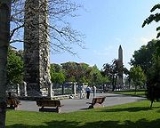
Today the area is officially called Sultan Ahmet Square, and is carefully maintained by the Turkish authorities. The course of the old racetrack has been indicated with paving, although the actual track is some two metres below the present surface. The surviving monuments of the Spina (the middle barrier of the racecourse), the two obelisks and the Serpentine Column, now sit in holes in a landscaped garden.

The German Fountain
German Fountain

The German Fountain is a gazebo styled fountain in the northern end of Hippodrome of Constantinople , Istanbul, Turkey and across from the Mausoleum of Sultan Ahmed I....
 ("The Kaiser Wilhelm Fountain"), an octagonal domed fountain in neo-byzantine style
Neo-Byzantine architecture

Neo-Byzantine architecture is an Revivalism , most frequently seen in religious, institutional and public buildings. It emerged in 1840s in Western Europe and peaked in the last quarter of 19th century in the Russian Empire; an isolated Neo-Byzantine school was active in Yugoslavia between World War I and World War II....
, which was constructed by the German government in 1900 to mark the German Emperor Wilhelm II's visit to Istanbul in 1898, is located at the northern entrance to the Hippodrome area, right in front of the Blue Mosque.

The Hippodrome has never been systematically excavated by archaeologists. A portion of the substructures of the Sphendone (the curved end) became more visible in the 1980s with the clearing of houses in the area.

In 1993 an area in front of the nearby Sultanahmet Mosque (the Blue Mosque
Sultan Ahmed Mosque

The Sultan Ahmed Mosque is the national mosque of Turkey, and is a historical mosque in Istanbul, the largest city in Turkey and the capital of the Ottoman Empire ....
) was bulldozed in order to install a public toilet, uncovering several rows of seats and some columns from the Hippodrome. Investigation did not continue further, but the seats and columns were removed and can now be seen in Istanbul's museums. It is possible that much more of the Hippodrome's remains still lie beneath the parkland of Sultanahmet.

Image gallery


External links