
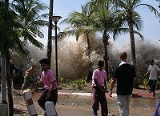
In Depth
See Also

Tsunami

A tsunami is a series of waves Ocean surface wave

Ocean surface waves are surface wave [i]s that occur at the surface of an ocean [i]. ... 

  when a body of water Water

Water is a taste [i]less, odor [i]less substance that is essential to all known forms of life [i] and i ... 

, such as an ocean Ocean

Oceans cover almost three quarters of the surface of the Earth [i], and nearly half of the world's mar ... 

 is rapidly displaced on a massive scale. Earthquake Earthquake

An earthquake is a phenomenon [i] that results from and is powered by the sudden release of stored energ ... 

s, mass movement Mass wasting

Mass wasting, also known as mass movement or slope movement, is the geomorphic [i] ... 

s above or below water, volcanic eruption Volcano

A volcano is a geological landform [i] on the surface of the Earth [i] where magma [i] from th ... 

s and other underwater explosion Underwater explosion

An underwater explosion, also known as an UNDEX, is an explosion [i] beneath the surface of water. ... 

s, and large meteorite impact Impact event

Impact events are caused by the collision [i] of large meteoroid [i]s, asteroid [i]s or comet [i]s with ... 

s all have the potential to generate a tsunami. The effects of a tsunami can range from unnoticeable to devastating. The term tsunami comes from the Japanese language Japanese language

Japanese is a language spoken by over 127 million people, mainly in Japan [i], but also by Japanese emi ... 

 meaning harbour and wave . Although in Japanese tsunami is used for both the singular and plural, in English tsunamis is often used as the plural.

Discussions

  Discussion Features

   Ask a question about 'Tsunami'

   Start a new discussion about 'Tsunami'

   Answer questions about 'Tsunami'

   'Tsunami' discussion forum

Timeline

551   Beirut Beirut

Beirut is the capital [i], largest city [i], and chief seaport [i] of Lebanon [i]. ... 

 destroyed by earthquake Earthquake

An earthquake is a phenomenon [i] that results from and is powered by the sudden release of stored energ ... 

 and tsunami.

1607   Tidal wave swept along the Bristol Channel, killing 2000 people. (Possibly tsunami)

1700   The Cascadia Earthquake Cascadia earthquake

The 1700 Cascadia Earthquake was a magnitude [i] 8.7 – 9.2 megathrust earthquake [i] ... 

, one of the largest earthquakes Earthquake

An earthquake is a phenomenon [i] that results from and is powered by the sudden release of stored energ ... 

 on record, ruptures the Cascadia subduction zone Cascadia subduction zone

The Cascadia subduction zone is a very long sloping fault [i] that stretches from mid-Vancouver Island [i] ... 

 offshore from Vancouver Island Vancouver Island

Vancouver Island is located off Canada [i]'s Pacific [i] coast and is part of the Canadian province [i] ... 

 to northern California California

California is a state [i] spanning the southern half of the west coast [i] ... 

, creating a tsunami logged in Japan Japan

is an island country [i] in East Asia [i]. ... 

 and oral traditions of the American First Nations.

1755   1755 Lisbon earthquake 1755 Lisbon earthquake

The 1755 Lisbon earthquake took place on November 1 [i], 1755 [i], at 9:20 in the morning. ... 

: In Portugal Portugal

Portugal, officially the Portuguese Republic is located in southwestern Europe [i] on the Iberian Peninsula [i] ... 

, Lisbon Lisbon

Lisbon is the capital [i] and largest city of Portugal [i]. ... 

 is destroyed by a massive earthquake Earthquake

An earthquake is a phenomenon [i] that results from and is powered by the sudden release of stored energ ... 

 and tsunami, killing 60,000 - 90,000 people.

1792   Old lava dome collapses in Kyushu Kyushu

Kyushu is the third largest island [i] of Japan [i] and most southerly and westerly of the four main is ... 

, Japan Japan

is an island country [i] in East Asia [i]. ... 

 when Mount Unzen Mount Unzen

Mount Unzen is an active volcano [i] near the city of Shimabara [i], Nagasaki Prefecture [i] ... 

 volcano Volcano

A volcano is a geological landform [i] on the surface of the Earth [i] where magma [i] from th ... 

 erupts - resulting avalanche Avalanche

An avalanche is a slide of a large snow down a mountainside, caused when a buildup of snow [i] is releas ... 

 and tsunami kills about 14300

1906   Typhoon Tropical cyclone

In meteorology [i], a tropical cyclone is a storm system fueled by the heat released when moist air rise ... 

 with tsunami kills an estimated 10,000 persons in Hong Kong Hong Kong

The Hong Kong Special Administrative Region of the People's Republic of China is one of the two special administrative regions [i] ... 

.

1929   1929 Grand Banks earthquake 1929 Grand Banks earthquake

The 1929 Grand Banks earthquake occurred on November 18 of that year. ... 

: Off the south coast of Newfoundland Newfoundland

Newfoundland is a large island off the east coast of North America [i], and the most populous part o ... 

 in the Atlantic Ocean Atlantic Ocean

The Atlantic Ocean is the second-largest ocean [i], covering approximately one-fifth of the Earth [i]'s ... 

, a Richter magnitude 7.2 submarine earthquake Earthquake

An earthquake is a phenomenon [i] that results from and is powered by the sudden release of stored energ ... 

 centered on Grand Banks Grand Banks

[i] on the [[North America]... 

, breaks 12 submarine transatlantic telegraph cable Transatlantic telegraph cable

The Transatlantic telegraph cable was a telegraph [i] cable [i] that crossed the Atlantic Ocean [i] from ... 

s and triggers a tsunami that destroys many south coast communities in the Burin Peninsula area, killing 28. As of 1997, it is Canada Canada

Canada is the world's second-largest [i] country by total area, occupying most ... 

's most lethal earthquake.

1946   14-meter high tsunami strikes Hilo, Hawaii Hilo, Hawai'i

Hilo is a coastal city in the State of Hawaii [i], and is the largest community on the island of ... 

  - 173 dead, thousands injured.

1960   May 22 — Great Chilean Earthquake Great Chilean Earthquake

The Great Chilean Earthquake or Valdivia Earthquake of May 22 [i], 1960 [i] is the largest magnit ... 

: Chile Chile

Chile, officially the Republic of Chile , is a country in South America [i] occupying a long coast ... 

's subduction fault ruptures from Talcahuano to Península de Taitao, loosing a tsunami and one of the greatest earthquake Earthquake

An earthquake is a phenomenon [i] that results from and is powered by the sudden release of stored energ ... 

s on record.

1971   A tsunami 85 m high rises over the Ryukyu Islands Ryukyu Islands

The Ryukyu Islands or more recently the , are an island [i] chain in the western Pacific Ocean [i] at th ... 

 in Japan. It throws a 750-ton block of coral Coral

Corals are marine animals of the , which include sea anemone [i]s . ... 

 2.5 km inland.

   More Events >>


Encyclopedia


A tsunami is a series of waves Ocean surface wave

Ocean surface waves are surface wave [i]s that occur at the surface of an ocean [i]. ... 

  when a body of water Water

Water is a taste [i]less, odor [i]less substance that is essential to all known forms of life [i] and i ... 

, such as an ocean Ocean

Oceans cover almost three quarters of the surface of the Earth [i], and nearly half of the world's mar ... 

 is rapidly displaced on a massive scale. Earthquake Earthquake

An earthquake is a phenomenon [i] that results from and is powered by the sudden release of stored energ ... 

s, mass movement Mass wasting

Mass wasting, also known as mass movement or slope movement, is the geomorphic [i] ... 

s above or below water, volcanic eruption Volcano

A volcano is a geological landform [i] on the surface of the Earth [i] where magma [i] from th ... 

s and other underwater explosion Underwater explosion

An underwater explosion, also known as an UNDEX, is an explosion [i] beneath the surface of water. ... 

s, and large meteorite impact Impact event

Impact events are caused by the collision [i] of large meteoroid [i]s, asteroid [i]s or comet [i]s with ... 

s all have the potential to generate a tsunami. The effects of a tsunami can range from unnoticeable to devastating.

The term tsunami comes from the Japanese language Japanese language

Japanese is a language spoken by over 127 million people, mainly in Japan [i], but also by Japanese emi ... 

 meaning harbour and wave . Although in Japanese tsunami is used for both the singular and plural, in English tsunamis is often used as the plural. The term was created by fishermen who returned to port to find the area surrounding their harbour Harbor

A harbor or harbour , or haven, is a place where ships may shelter from the weather [i] or a ... 

 devastated, although they had not been aware of any wave Wave

[i], often transferring [[energy]... 

 in the open water. A tsunami has a much smaller amplitude Amplitude

[i] measure of a [[wave]... 

  offshore, and a very long wavelength Wavelength

The wavelength is the distance between repeating units of a wave [i] pattern. ... 

 , which is why they generally pass unnoticed at sea, forming only a passing "hump" in the ocean.

Tsunamis have been historically referred to as tidal waves because as they approach land, they take on the characteristics of a violent onrushing tide Tide

The tide is the cyclic rising and falling of Earth's ocean [i] surface caused by the tidal force [i]s of ... 

 rather than the sort of cresting waves that are formed by wind action upon the ocean . However, since they are not actually related to tides the term is considered misleading and its usage discouraged by oceanographer Oceanographer

Sorry, no overview for this topic 

s.

Causes


Tsunamis can be generated when the sea floor abruptly deforms and vertically displaces the overlying water. Such large vertical movements of the Earth’s crust can occur at plate boundaries Plate tectonics

Plate tectonics is a theory [i] of geology [i] developed to explain the observed evidence for large sca ... 

. Subduction Subduction

In geology [i], a subduction zone is an area on Earth [i] where two tectonic plate [i]s... 

 earthquakes are particularly effective in generating tsunamis. As an Oceanic Plate is subducted beneath a Continental Plate, it sometimes brings down the lip of the Continental with it. Eventually, too much stress is put on the lip and it snaps back, sending shockwaves through the Earth’s crust, causing a tremor under the sea, known as an Undersea Earthquake.

Sub-marine landslide Landslide

A landslide is a geological phenomenon [i] which includes a wide range of g ... 

s as well as collapses of volcanic edifices may also disturb the overlying water column as sediment and rocks slide downslope and are redistributed across the sea floor. Similarly, a violent submarine volcanic eruption can uplift the water column and form a tsunami.

Waves are formed as the displaced water mass moves under the influence of gravity Gravitation

In physics [i], gravitation or gravity is the tendency of objects with mass [i] to accelerate [i] ... 

 and radiate across the ocean like ripples on a pond.

In the 1950s it was discovered that larger tsunamis than previously believed possible could be caused by landslides, explosive volcanic action and impact event Impact event

Impact events are caused by the collision [i] of large meteoroid [i]s, asteroid [i]s or comet [i]s with ... 

s. These phenomena rapidly displace large volumes of water, as energy from falling debris or expansion is transferred to the water into which the debris falls. Tsunamis caused by these mechanisms, unlike the ocean-wide tsunamis caused by some earthquakes, generally dissipate quickly and rarely affect coastlines distant from the source due to the small area of sea affected. These events can give rise to much larger local shock waves , such as the landslide at the head of Lituya Bay which produced a water wave estimated at 50 – 150 m and reached 524 m up local mountains. However, an extremely large landslide could generate a megatsunami Megatsunami

Megatsunami is an informal term used by popular media and popular science to describe a very large tsuna... 

 that might have ocean-wide impacts.

Characteristics

Often referred to as "tidal waves", a tsunami does not look like the popular impression of "a normal wave only much bigger". Instead it looks rather like an endlessly onrushing tide which forces its way around and through any obstacle. Most of the damage is caused by the huge mass of water behind the initial wave front, as the height of the sea keeps rising fast and floods powerfully into the coastal area. The sheer weight of water is enough to pulverise objects in its path, often reducing buildings to their foundations and scouring exposed ground to the bedrock. Large objects such as ships and boulders can be carried several miles inland before the tsunami subsides.

Tsunamis act very differently from typical surf swells: they contain immense energy, propagate at high speeds and can travel great trans-oceanic distances with little overall energy loss. A tsunami can cause damage thousands of kilometres from its origin, so there may be several hours between its creation and its impact on a coast, arriving long after the seismic wave Seismic wave

A seismic wave is a wave [i] that travels through the Earth [i], most often as the result of a tectonic ... 

 generated by the originating event arrives. Although the total or overall loss of energy is small, the total energy is spread over a larger and larger circumference as the wave travels. The energy per linear metre in the wave is proportional to the inverse of the distance from the source. This is the two-dimensional equivalent of the inverse square law Inverse-square law

In physics [i], an inverse-square law is any physical law [i] stating that some physical quantity [i] or ... 

, which is followed by waves which propagate in three dimensions .

A single tsunami event may involve a series of waves of varying heights; so the set of waves is called a train. In open water, tsunamis have extremely long periods , from minutes to hours, and long wavelengths of up to several hundred kilometres. This is very different from typical wind-generated swells on the ocean, which might have a period of about 10 seconds and a wavelength of 150 metre Metre

The metre, or meter , is a measure of length [i]. ... 

s.

The actual height of a tsunami wave in open water is often less than one metre. This is often practically unnoticeable to people on ships. Because it has such a large wavelength, the energy of a tsunami mobilizes the entire water column, down to the sea bed. Ocean waves in deep water typically cause water motion to a depth approximately equal to half their wavelength. This means, ocean surface wave motion will only reach down to a depth of a few 100 m or less. Tsunamis, by contrast behave as shallow water waves in the deep ocean , for which little attenuation of water motion occurs with depth.

The wave travels across open ocean at an average speed of 500 mph. As the wave approaches land, the sea shallows and the wave no longer travels as quickly, so it begins to 'pile-up'; the wave-front becomes steeper and taller, and there is less distance between crests. While a person at the surface of deep water would probably not even notice the tsunami, the wave can increase to a height of six stories or more as it approaches the coastline and compresses. The steepening process is analogous to the cracking of a tapered whip Whip

A whip is a tapered flexible length of either a single cord or plaited leather or other material, common... 

. As a wave goes down the whip from handle to tip, the same energy is deposited in less and less material, which then moves more violently as it receives this energy.

A wave becomes a 'shallow-water wave' when the ratio between the water depth and its wavelength gets very small, and since a tsunami has an extremely large wavelength , tsunamis act as a shallow-water wave even in deep oceanic water. Shallow-water waves move at a speed that is equal to the square root Square root

In mathematics [i], a square root of a number x is a number whose square [i] is x. ... 

 of the product of the acceleration Acceleration

In physics [i] or physical science, acceleration is defined as the rate of change of velocity [i].... 

 of gravity and the water depth. For example, in the Pacific Ocean Pacific Ocean

The Pacific Ocean is the world's largest body of water [i]. ... 

, where the typical water depth is about 4000 m, a tsunami travels at about 200 m/s with little energy loss, even over long distances. At a water depth of 40 m, the speed would be 20 m/s , which is much slower than the speed in the open ocean but the wave would still be difficult to outrun.

Tsunamis propagate outward from their source, so coasts in the "shadow" of affected land masses are usually fairly safe. However, tsunami waves can diffract Diffraction

Diffraction refers to the various phenomena associated with wave propagation, such as the bending, sprea... 

 around land masses . It's also not necessary that they are symmetrical Symmetry

Symmetry is a characteristic feature of geometrical [i] shapes, system [i]s, equation [i]s, and ... 

; tsunami waves may be much stronger in one direction than another, depending on the nature of the source and the surrounding geography Geography

Geography is the study of the Earth's features and of the distribution of life on the earth, including ... 

.

Local geographic peculiarities can lead to seiche Seiche

A seiche is a standing wave [i] in an enclosed or partially enclosed body of water. ... 

 or standing waves forming, which can amplify the onshore damage. For instance, the tsunami that hit Hawaii on April 1, 1946 had a fifteen-minute interval between wave fronts. The natural resonant period of Hilo Hilo, Hawai'i

Hilo is a coastal city in the State of Hawaii [i], and is the largest community on the island of... 

 Bay is about thirty minutes. That meant that every second wave was in phase with the motion of Hilo Bay, creating a seiche in the bay. As a result, Hilo suffered worse damage than any other place in Hawaii, with the tsunami/seiche reaching a height of 14 m and killing 159 inhabitants.

Tsunami wave


Ocean waves are normally divided into 3 groups, characterized by depth:

  • Deep water
  • Intermediate water
  • Shallow water


Even though a tsunami is generated in deep water , tsunami waves are considered shallow-water waves. As the tsunami wave approaches the shallow waters of shore, its time period remains the same, but its wavelength decreases rapidly, thus causing the water to pile up to form tremendous crests, in an effect known as "shoaling".

Signs of an approaching tsunami

The following have at various times been associated with a tsunami :
  • An earthquake may be felt.
  • Large quantities of gas may bubble to the water surface and make the sea look as if it is boiling.
  • The water in the waves may be unusually hot.
  • The water may smell of rotten eggs or of petrol or oil.
  • The water may sting the skin.
  • A thunderous boom may be heard followed by
    • a roaring noise as of a jet plane
    • or a noise akin to the periodic whop-whop of a helicopter,
    • or a whistling sound.
  • The sea may recede to a considerable distance.
  • A flash of red light might be seen near the horizon.

Warnings and prevention


Tsunamis cannot be prevented or precisely predicted, but there are some warning signs of an impending tsunami, and there are many systems being developed and in use to reduce the damage from tsunamis.

In instances where the leading edge of the tsunami wave is its trough, the sea will recede from the coast half of the wave's period before the wave's arrival. If the slope is shallow, this recession can exceed many hundreds of metres. People unaware of the danger may remain at the shore due to curiosity, or for collecting fish from the exposed sea bed.


In instances where the leading edge of the tsunami is its first peak, succeeding waves can lead to further flooding. Again, being educated about a tsunami is important, to realize that when the water level drops the first time, the danger is not yet over. In a low-lying coastal area, a strong earthquake is a major warning sign that a tsunami may be produced.

Regions with a high risk of tsunamis may use tsunami warning system Tsunami warning system

A tsunami warning system is a system to detect tsunami [i]s and issue warnings to prevent loss of life. ... 

s to detect tsunamis and warn the general population before the wave reaches land. In some communities on the west coast of the United States, which is prone to Pacific Ocean tsunamis, warning signs advise people where to run in the event of an incoming tsunami. Computer models can roughly predict tsunami arrival and impact based on information about the event that triggered it and the shape of the seafloor and coastal land .

One of the early warnings comes from nearby animals. Many animals sense danger and flee to higher ground before the water arrives. The Lisbon quake is the first documented case of such a phenomenon in Europe. The phenomenon was also noted in Sri Lanka Sri Lanka

Sri Lanka, officially the Democratic Socialist Republic of Sri Lanka , is a tropical [i] island nation [i] ... 

 in the 2004 Indian Ocean earthquake 2004 Indian Ocean earthquake

The 2004 Indian Ocean earthquake, known by the scientific community as the Sumatra-Andaman earthquake... 

 . Some scientists speculate that animals may have an ability to sense subsonic Rayleigh waves Rayleigh wave

Rayleigh waves, also known as the Rayleigh-Lamb Wave or "ground roll", are a type of surface wave [i] ... 

 from an earthquake minutes or hours before a tsunami strikes shore .

While it is not possible to prevent a tsunami, in some particularly tsunami-prone countries some measures have been taken to reduce the damage caused on shore. Japan has implemented an extensive programme of building tsunami walls of up to 4.5 m high in front of populated coastal areas. Other localities have built floodgates and channels to redirect the water from incoming tsunamis. However, their effectiveness has been questioned, as tsunamis are often higher than the barriers. For instance, the tsunami which hit the island of Hokkaido Hokkaido

Hokkaido listen , formerly known as Ezo, is the second largest island and largest prefecture [i] ... 

 on July 12, 1993 created waves as much as 30 m tall - as high as a 10-story building. The port town of Aonae was completely surrounded by a tsunami wall, but the waves washed right over the wall and destroyed all the wood-framed structures in the area. The wall may have succeeded in slowing down and moderating the height of the tsunami but it did not prevent major destruction and loss of life.

The effects of a tsunami can be mitigated by natural factors such as tree cover on the shoreline. Some locations in the path of the 2004 Indian Ocean tsunami escaped almost unscathed as a result of the tsunami's energy being sapped by a belt of trees such as coconut palm Coconut

The Coconut Palm , is a member of the Family Arecaceae [i] . ... 

s and mangrove Mangrove

Mangroves are woody tree [i]s or shrub [i]s that grow in coastal habitats or mangal, for which... 

s. In one striking example, the village of Naluvedapathy in India's Tamil Nadu Tamil Nadu

Tamil Nadu is a state [i] at the southern tip of India [i]. ... 

 region suffered minimal damage and few deaths as the wave broke up on a forest of 80,244 trees planted along the shoreline in 2002 in a bid to enter the Guinness Book of Records Guinness World Records

Guinness World Records, known until 2000 [i] as The Guinness Book of Records is a referenc... 

. Environmentalists have suggested tree planting along stretches of sea coast which are prone to tsunami risks. While it would take some years for the trees to grow to a useful size, such plantations could offer a much cheaper and longer-lasting means of tsunami mitigation than the costly and environmentally destructive method of erecting artificial barriers.

Historical tsunamis


See also List of historic tsunamis by death toll.

Tsunamis occur most frequently in the Pacific Ocean, but are a global phenomenon; they are possible wherever large bodies of water are found, including inland lakes, where they can be caused by landslides. Very small tsunamis, non-destructive and undetectable without specialized equipment, occur frequently as a result of minor earthquakes and other events.

1700 - Vancouver Island, Canada


January 26 - The Cascadia Earthquake Cascadia earthquake

The 1700 Cascadia Earthquake was a magnitude [i] 8.7 – 9.2 megathrust earthquake [i] ... 

, one of the largest earthquakes on record , ruptures the Cascadia Subduction Zone offshore from Vancouver Island to northern California, and caused massive tsunamis across the Pacific Northwest Pacific Northwest

The Pacific Northwest in its broadest definition is an area that includes part of the west coast of United States [i] ... 

 logged in Japan and oral traditions of the Native Americans.

1755 - Lisbon, Portugal


Tens of thousands of Portuguese who survived the great 1755 Lisbon earthquake 1755 Lisbon earthquake

The 1755 Lisbon earthquake took place on November 1 [i], 1755 [i], at 9:20 in the morning.... 

were killed by a tsunami which followed a half hour later. Many townspeople fled to the waterfront, believing the area safe from fires and from falling debris from aftershocks. Before the great wall of water hit the harbour, waters retreated, revealing lost cargo and forgotten shipwrecks.

The earthquake, tsunami, and subsequent fires killed more than a third of Lisbon's pre-quake population of 275,000. Historical records of explorations by Vasco da Gama Vasco da Gama

Vasco da Gama... 

 and other early navigators were lost, and countless buildings were destroyed . Europeans of the 18th century struggled to understand the disaster within religious Religion

Religion is a system of social coherence based on a common group of belief [i]s or attitudes concerning ... 

 and rational belief systems. Philosophers of the Enlightenment Age of Enlightenment

The Age of Enlightenment refers to either the eighteenth century [i] in European philosophy [i] ... 

, notably Voltaire Voltaire

Franois-Marie Arouet , better known by the pen name [i] Voltaire, was a French [i] Enlightenment [i] ... 

, wrote about the event. The philosophical Philosophy

[i]
... 

 concept of the sublime, as described by philosopher Immanuel Kant Immanuel Kant

Immanuel Kant , was a German [i] philosopher [i] from Knigsberg in East Prussia [i] . ... 

 in the Observations on the Feeling of the Beautiful and Sublime, took inspiration in part from attempts to comprehend the enormity of the Lisbon quake and tsunami.

1883 - Krakatoa Krakatoa

Krakatoa is a volcanic island [i] in the Sunda Strait [i] between Java [i] and Sumatra [i] in Indonesia [i] ... 

 explosive eruption


The island volcano of Krakatoa Krakatoa

Krakatoa is a volcanic island [i] in the Sunda Strait [i] between Java [i] and Sumatra [i] in Indonesia [i] ... 

in Indonesia exploded with devastating fury in 1883, blowing its underground magma chamber partly empty so that much overlying land and seabed collapsed into it. A series of large tsunami waves was generated from the collapse, some reaching a height of over 40 metres above sea level. Tsunami waves were observed throughout the Indian Ocean Indian Ocean

The Indian Ocean is the third largest body of water in the world, covering about 20% of the Earth's wate... 

, the Pacific Ocean Pacific Ocean

The Pacific Ocean is the world's largest body of water [i]. ... 

, the American West Coast, South America, and even as far away as the English Channel English Channel

The English Channel is the part of the Atlantic Ocean [i] that separates the island [i] of Great Britain [i] ... 

. On the facing coasts of Java Java

style="margin-left: inherit; font-size: medium;" | Java
... 

 and Sumatra Sumatra

Sumatra is the sixth largest island [i] of the world and is the largest island... 

 the sea flood went many miles inland and caused such vast loss of life that one area was never resettled but went back to the jungle Jungle

Jungle refers usually to a dense forest [i] in a hot climate.
... 

 and is now the Ujung Kulon Ujung Kulon National Park

The Ujung Kulon National Park is located at the westmost tip of Java [i], Indonesia [i]. ... 

 nature reserve Nature reserve

*Biosphere Reserve [i]
  • Conservation designation [i]

... 

.


1917 - Halifax Explosion Halifax Explosion

The Halifax Explosion occurred on Thursday December 6 [i] 1917 [i], at 9:04:35 a.m. ... 

 and Tsunami


The Halifax Explosion Halifax Explosion

The Halifax Explosion occurred on Thursday December 6 [i] 1917 [i], at 9:04:35 a.m. ... 

 occurred on Thursday, December 6, 1917 at 9:04:35 a.m. local time in Halifax Halifax Regional Municipality, Nova Scotia

Halifax Regional Municipality, commonly referred to as HRM, is a Canadian [i] regional municipality [i] ... 

, Nova Scotia Nova Scotia

Nova Scotia is a Canadian province [i] located on Canada [i]'s southeastern coast. ... 

 in Canada Canada

Canada is the world's second-largest [i] country by total area, occupying most ... 

, when the French munitions ship Mont-Blanc, bound for World War I France, collided with the Norwegian ship Imo chartered to carry Belgian relief supplies. In the aftermath of the collision, Mont-Blanc caught fire and explode Explosion

An explosion is a sudden increase in volume [i] and release of energy [i] in a violent manner, usually w ... 

d. The explosion caused a tsunami, and a pressure-wave of air.

1929 - Newfoundland tsunami


On November 18, 1929, an earthquake of magnitude 7.2 1929 Grand Banks earthquake

The 1929 Grand Banks earthquake occurred on November 18 of that year.
... 

 occurred beneath the Laurentian Slope on the Grand Banks Grand Banks

[i] on the [[North America]... 

. The quake was felt throughout the Atlantic Provinces of Canada Canada

Canada is the world's second-largest [i] country by total area, occupying most ... 

 and as far west as Ottawa, Ontario Ottawa

Ottawa is the capital [i] of Canada [i], and the country's fourth largest city [i]. ... 

 and as far south as Claymont, Delaware Claymont, Delaware

Claymont is a census-designated place [i] in New Castle County [i], Delaware [i] ... 

. The resulting tsunami measured over 7 metres in height and took about 2˝ hours to reach the Burin Peninsula on the south coast of Newfoundland Newfoundland

Newfoundland is a large island off the east coast of North America [i], and the most populous part o ... 

, where 28 people lost their lives in various communities.

1946 - Pacific tsunami


The April 1 Aleutian Island earthquake tsunami that killed 159 people on Hawaii Hawaii

Hawaii became the 50th state [i] of the United States [i] on August 21 [i], 1959 [i]. ... 

 and five in Alaska Alaska

Alaska is a U.S. state [i], located on the northwest tier [i] of North America [i] ... 

 resulted in the creation of a tsunami warning system Tsunami warning system

A tsunami warning system is a system to detect tsunami [i]s and issue warnings to prevent loss of life. ... 

 , established in 1949 for Pacific Ocean Pacific Ocean

The Pacific Ocean is the world's largest body of water [i]. ... 

 area countries. The tsunami is locally known in Hawaii as the April Fools Day Tsunami in Hawaii due to people thinking the warnings were an April Fools prank.

1960 - Chilean tsunami


The magnitude-9.5 Great Chilean Earthquake Great Chilean Earthquake

The Great Chilean Earthquake or Valdivia Earthquake of May 22 [i], 1960 [i] is the largest magnit... 

the strongest earthquake ever recorded. Its epicentre Epicenter

The epicenter or epicentre is the point on the Earth [i]'s surface that is directly above the poin ... 

 off the coast of South Central Chile Chile

Chile, officially the Republic of Chile , is a country in South America [i] occupying a long coast ... 

, generated one of the most destructive tsunamis of the 20th century.

It spread across the entire Pacific Ocean, with waves measuring up to 25 metres high. The first tsunami arrived at Hilo, Hawaii Hilo, Hawai'i

Hilo is a coastal city in the State of Hawaii [i], and is the largest community on the island of... 

 approximately 14.8 hrs after it originated off the coast of South Central Chile.

The highest wave at Hilo Bay was measured at around 10.7 m . 61 lives were lost allegedly due to people's failure to heed warning sirens. When the tsunami hit Onagawa, Japan, almost 22 hours after the quake, the wave height was 3 m above high tide. Up to 2,290 people died due to the Earthquake and tsunami.

1963 - Vajont Dam disaster


The reservoir behind the Vajont Dam Vajont Dam

Vajont Dam is a dam [i] completed in 1961 [i] under Monte Toc [i], 100 km north of Venice [i], Italy [i] ... 

in northern Italy Italy

Italy, officially the Italian Republic , is a Southern European [i] country. ... 

 was struck by an enormous landslide Landslide

A landslide is a geological phenomenon [i] which includes a wide range of g ... 

. A tsunami was triggered which swept over the top of the dam and into the valley below. Nearly 2,000 people were killed.

1964 - Good Friday tsunami


After the magnitude 9.2 Good Friday Earthquake Good Friday Earthquake

The Good Friday [i] Earthquake of Friday, March 27 [i], 1964 [i], was the most powerful earthquake [i] i ... 

, tsunamis struck Alaska Alaska

Alaska is a U.S. state [i], located on the northwest tier [i] of North America [i] ... 

, British Columbia British Columbia

British Columbia, often referred to as B.C. or BC , is the westernmost of [[Canada|Canada's]... 

, California California

California is a state [i] spanning the southern half of the west coast [i] ... 

 and coastal Pacific Northwest Pacific Northwest

The Pacific Northwest in its broadest definition is an area that includes part of the west coast of United States [i] ... 

 towns, killing 121 people. The tsunamis were up to 6 m tall, and killed 11 people as far away as Crescent City, California Crescent City, California

[i], and the only incorporated city, of [[Del Norte County, California]... 

.

1976 - Moro Gulf tsunami


On August 16, 1976 at 12:11 A.M., a devastating earthquake of 7.9 hit the island of Mindanao Mindanao

Mindanao is the second largest and easternmost island [i] in the Philippines [i] and one of the three is ... 

, Philippines Philippines

The Philippines , officially the Republic of the Philippines , is an island nation [i] located in ... 

. It created a tsunami that devastated more than 700 km of coastline bordering Moro Gulf in the North Celebes Sea. An estimated number of victims for this tragedy left 5,000 dead, 2,200 missing or presumed dead, more than 9,500 injured and a total of 93,500 people were left homeless. It devastated the cities and provinces of Pagadian City Pagadian City

Pagadian City is a 1st class city [i] in the province [i] of Zamboanga del Sur [i] ... 

, Zamboanga del Sur Zamboanga del Sur

Zamboanga del Sur is a province [i] of the Philippines [i] located in the Zamboanga Peninsula [i] ... 

, Zamboanga City Zamboanga City

The City of Zamboanga is a 1st class, highly urbanized city [i] in the Philippines [i] a... 

, Basilan Basilan

Basilan is an island province [i] of the Philippines [i] located in the Autonomous Region in Muslim Mindanao [i] ... 

, Sulu Sulu

Sulu is an island province [i] of the Philippines [i] located in the Autonomous Region in Muslim Mindanao [i]... 

, Sultan Kudarat, Maguindanao Maguindanao

Maguindanao is a province [i] of the Philippines [i] located in the Autonomous Region in Muslim Mindanao [i] ... 

, Cotabato City Cotabato City

Cotabato City is one of the cities [i] of the Philippines [i] located in Mindanao [i] ... 

, Lanao del Sur Lanao del Sur

Lanao del Sur is a province [i] of the Philippines [i] located in the Autonomous Region in Muslim Mindanao [i] ... 

 and Lanao del Norte Lanao del Norte

Lanao del Norte is a province [i] of the Philippines [i] located in the Northern Mindanao [i] ... 

.

1979 - Tumaco tsunami


A magnitude-7.9 earthquake occurred on December 12, 1979 at 7:59:4.3 along the Pacific coast of Colombia Colombia

The Republic of Colombia , is the northwesternmost country of South America [i]. ... 

 and Ecuador Ecuador

Ecuador, officially the Republic of Ecuador is a country in northwestern South America [i], bound ... 

. The earthquake and the resulting tsunami caused the destruction of at least six fishing villages and the death of hundreds of people in the Colombian province of Narińo. The earthquake was felt in Bogotá Bogotá

Bogotofficially named Bogot, D.C., also called Santa Fe de Bogotis the capital [i] of Colombia [i] ... 

, Cali Santiago de Cali

Santiago de Cali, better known as Cali, is the main city and capital of the Valle del Cauca [i] de ... 

, Popayán Popayán

[i]
[i]
[i]
... 

, Buenaventura and several other cities and towns in Colombia and in Guayaquil Guayaquil

Santiago de Guayaquil, or just Guayaquil
... 

, Esmeraldas, Quito Quito

Quito is the capital [i] city of Ecuador [i] in northwestern South America [i]. ... 

 and other parts of Ecuador. When the Tumaco Tsunami hit the coast, it caused huge destruction in the city of Tumaco, as well as in the small towns of El Charco, San Juan, Mosquera and Salahonda on the Pacific Coast of Colombia. The total number of victims of this tragedy was 259 dead, 798 wounded and 95 missing or presumed dead.

1993 - Okushiri tsunami


A devastating tsunami occurred off the coast of Hokkaido Hokkaido

Hokkaido listen , formerly known as Ezo, is the second largest island and largest prefecture [i] ... 

 in Japan as a result of a magnitude 7.8 earthquake, 80 miles offshore, on July 12, 1993. The largest waves recorded from this event were as much as 30 metres tall. As a result, 202 people on the small island of Okushiri were killed, and hundreds more were missing or injured. In addition, millions of pet birds, cats and dogs lost their lives.

2004 - Indian Ocean tsunami


The 2004 Indian Ocean earthquake 2004 Indian Ocean earthquake

The 2004 Indian Ocean earthquake, known by the scientific community as the Sumatra-Andaman earthquake... 

, which had a magnitude of 9.5, triggered a series of lethal tsunamis on December 26, 2004 that killed approximately 230,000 people , making it the deadliest tsunami in recorded history. The tsunami killed people over an area ranging from the immediate vicinity of the quake Earthquake

An earthquake is a phenomenon [i] that results from and is powered by the sudden release of stored energ ... 

 in Indonesia Indonesia

Indonesia, officially the Republic of Indonesia , is a nation of islands [i] consist ... 

, Thailand Thailand

The Kingdom of Thailand is a country in Southeast Asia [i], bordering Laos [i] and Cambodia [i] to the e ... 

 and the north-western coast of Malaysia Malaysia

Malaysia is a federation [i] of 13 states [i] in Southeast Asia [i], formed in 1963.
... 

 to thousands of kilometres away in Bangladesh Bangladesh

Bangladesh, officially the People's Republic of Bangladesh, is a country in South Asia [i]. ... 

, India India

India , officially the Republic of India, is a country in South Asia [i]. ... 

, Sri Lanka Sri Lanka

Sri Lanka, officially the Democratic Socialist Republic of Sri Lanka , is a tropical [i] island nation [i] ... 

, the Maldives Maldives

Maldives, officially the Republic of Maldives, is an island nation [i] consisting of a group of atoll [i] ... 

, and even as far as Somalia Somalia

Somalia , formerly known as the Somali Democratic Republic, is a coastal nation at the Horn of Africa [i] ... 

, Kenya Kenya

The Republic of Kenya is a country in Eastern Africa [i]. ... 

 and Tanzania Tanzania

Tanzania , officially the United Republic of Tanzania , is a country on the east coast of Africa [i] ... 

 in eastern Africa Africa

Africa is one of the greatest sized continents of the Earth.... 

. The disaster prompted a huge worldwide effort to help victims of the tragedy, with billions of dollars being raised for disaster relief.

Unlike in the Pacific Ocean Pacific Ocean

The Pacific Ocean is the world's largest body of water [i]. ... 

, there was no organized alert service covering the Indian Ocean Indian Ocean

The Indian Ocean is the third largest body of water in the world, covering about 20% of the Earth's wate... 

. This was in part due to the absence of major tsunami events since 1883 . In light of the 2004 Indian Ocean Indian Ocean

The Indian Ocean is the third largest body of water in the world, covering about 20% of the Earth's wate... 

 tsunami, UNESCO UNESCO

UNESCO is a specialized agency of the United Nations [i] established in 1945. ... 

 and other world bodies have called for a global tsunami monitoring system Tsunami warning system

A tsunami warning system is a system to detect tsunami [i]s and issue warnings to prevent loss of life. ... 

.

2006 - South of Java Island tsunami


A 7.7 magnitude earthquake shocked the Indian Ocean seabed on July 17,2006, 200 km south of Pangandaran Pangandaran

Pangandaran is a small town and a subdistrict [i] in southern Ciamis [i] regen ... 

, a beautiful beach famous to surfers for its perfect waves. This earthquake triggered tsunami whose heights varied from from 2 metres at Cilacap to 6 metres at Cimerak beach, where it swept away and flattened buildings as far as 400 metres away from the coastline. More than 600 people were reported killed, with around 150 others still missing.

Other tsunamis in South Asia


>
Tsunamis in South Asia
Date Location
1524 Near Dabhol, Maharashtra Maharashtra

Maharashtra is India [i]'s third largest state [i] in terms of area [i]... 

Arakan Coast, Myanmar Myanmar

Myanmar, officially the Union of Myanmar is the largest country in geographical area in mainland ... 

Rann of Kachchh, Gujarat Gujarat

Gujarat is the most industrialized state [i] in the Republic of India [i] ... 

, India India

India , officially the Republic of India, is a country in South Asia [i]. ... 

Great Nicobar Island, India
Car Nicobar Island, India
Krakatoa volcanic eruption Krakatoa

Krakatoa is a volcanic island [i] in the Sunda Strait [i] between Java [i] and Sumatra [i] in Indonesia [i] ... 

Mekran coast,