
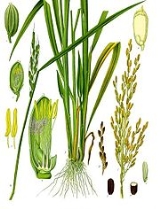
Rice is the
seedA seed is a small embryonic plant enclosed in a covering called the seed coat, usually with some stored food. It is the product of the ripened ovule of gymnosperm and angiosperm plants which occurs after fertilization and some growth within the mother plant...
of the monocot plants
Oryza sativaOryza sativa, commonly known as Asian rice, is the plant species most commonly referred to in English as rice. Oryza sativa is the cereal with the smallest genome, consisting of just 430Mb across 12 chromosomes...
(Asian rice) or
Oryza glaberrima (African rice). As a
cereal grainCereals are grasses cultivated for the edible components of their grain , composed of the endosperm, germ, and bran...
, it is the most important
staple foodA staple food is one that is eaten regularly and in such quantities that it constitutes a dominant portion of a diet, and that supplies a high proportion of energy and nutrient needs. Most people live on a diet based on one or more staples...
for a large part of the world's human population, especially in
East AsiaEast Asia or Eastern Asia is a subregion of Asia that can be defined in either geographical or cultural terms...
,
Southeast AsiaSoutheast Asia, South-East Asia, South East Asia or Southeastern Asia is a subregion of Asia, consisting of the countries that are geographically south of China, east of India, west of New Guinea and north of Australia. The region lies on the intersection of geological plates, with heavy seismic...
,
South AsiaSouth Asia, also known as Southern Asia, is the southern region of the Asian continent, which comprises the sub-Himalayan countries and, for some authorities , also includes the adjoining countries to the west and the east...
, the
Middle EastThe Middle East is a region that encompasses Western Asia and Northern Africa. It is often used as a synonym for Near East, in opposition to Far East...
, and the West Indies. It is the grain with the third-highest worldwide production, after
maizeMaize known in many English-speaking countries as corn or mielie/mealie, is a grain domesticated by indigenous peoples in Mesoamerica in prehistoric times. The leafy stalk produces ears which contain seeds called kernels. Though technically a grain, maize kernels are used in cooking as a vegetable...
(corn) and
wheatWheat is a cereal grain, originally from the Levant region of the Near East, but now cultivated worldwide. In 2007 world production of wheat was 607 million tons, making it the third most-produced cereal after maize and rice...
, according to data for 2009.
Rice is first mentioned in the Yajur Veda and then is frequently referred to in
SanskritSanskrit , is a historical Indo-Aryan language and the primary liturgical language of Hinduism, Jainism and Buddhism.Buddhism: besides Pali, see Buddhist Hybrid Sanskrit Today, it is listed as one of the 22 scheduled languages of India and is an official language of the state of Uttarakhand...
texts. In India, there is a saying that grains of rice should be like two brothers, close but not stuck together. Rice is often directly associated with prosperity and fertility, therefore there is the custom of throwing rice at weddings.
Since a large portion of maize crops are grown for purposes other than human consumption, rice is the most important grain with regard to human nutrition and caloric intake, providing more than one fifth of the
caloriesFood energy is the amount of energy obtained from food that is available through cellular respiration.Food energy is expressed in food calories or kilojoules...
consumed worldwide by the human species.
Rice is normally grown as an
annual plantAn annual plant is a plant that usually germinates, flowers, and dies in a year or season. True annuals will only live longer than a year if they are prevented from setting seed...
, although in tropical areas it can survive as a perennial and can produce a ratoon crop for up to 30 years. The rice plant can grow to 1 – tall, occasionally more depending on the variety and soil fertility. It has long, slender leaves 50 – long and 2 – broad. The small
wind-pollinatedAnemophily or wind pollination is a form of pollination whereby pollen is distributed by wind. Anemophilous plants may be either gymnosperms or angiosperms ....
flowers are produced in a branched arching to pendulous
inflorescenceAn inflorescence is a group or cluster of flowers arranged on a stem that is composed of a main branch or a complicated arrangement of branches. Strictly, it is the part of the shoot of seed plants where flowers are formed and which is accordingly modified...
30 – long. The edible seed is a grain (
caryopsisIn botany, a caryopsis is a type of simple dry fruit — one that is monocarpelate and indehiscent and resembles an achene, except that in a caryopsis the pericarp is fused with the thin seed coat....
) 5 – long and 2 – thick.
Rice cultivation is well-suited to countries and regions with low labor costs and high rainfall, as it is labor-intensive to cultivate and requires ample water. Rice can be grown practically anywhere, even on a steep hill or mountain. Although its parent species are native to South Asia and certain parts of Africa, centuries of trade and exportation have made it commonplace in many cultures worldwide.
The traditional method for cultivating rice is flooding the fields while, or after, setting the young seedlings. This simple method requires sound planning and servicing of the water damming and channeling, but reduces the growth of less robust weed and pest plants that have no submerged growth state, and deters
verminVermin is a term applied to various animal species regarded by some as pests or nuisances and especially to those associated with the carrying of disease. Since the term is defined in relation to human activities, which species are included will vary from area to area and even person to person...
. While flooding is not mandatory for the cultivation of rice, all other methods of
irrigationIrrigation may be defined as the science of artificial application of water to the land or soil. It is used to assist in the growing of agricultural crops, maintenance of landscapes, and revegetation of disturbed soils in dry areas and during periods of inadequate rainfall...
require higher effort in
weedWeed control is the botanical component of pest control, using physical and chemical methods to stop weeds from reaching a mature stage of growth when they could be harmful to domesticated plants and livestock...
and
pest controlPest control refers to the regulation or management of a species defined as a pest, usually because it is perceived to be detrimental to a person's health, the ecology or the economy.-History:...
during growth periods and a different approach for fertilizing the soil.
(The name
wild riceWild rice is four species of grasses forming the genus Zizania, and the grain which can be harvested from them. The grain was historically gathered and eaten in both North America and China...
is usually used for species of the grass genus
Zizania, both wild and domesticated, although the term may also be used for primitive or uncultivated varieties of
Oryza.)
Etymology
First attested in English in the middle of the 13th century, the word
rice derives from the
Old FrenchOld French was the Romance dialect continuum spoken in territories that span roughly the northern half of modern France and parts of modern Belgium and Switzerland from the 9th century to the 14th century...
ris, which comes from Italian
riso, in turn from the
LatinLatin is an Italic language originally spoken in Latium and Ancient Rome. It, along with most European languages, is a descendant of the ancient Proto-Indo-European language. Although it is considered a dead language, a number of scholars and members of the Christian clergy speak it fluently, and...
oriza, which derives from the
GreekGreek is an independent branch of the Indo-European family of languages. Native to the southern Balkans, it has the longest documented history of any Indo-European language, spanning 34 centuries of written records. Its writing system has been the Greek alphabet for the majority of its history;...
ὄρυζα (
oruza). The Greek word is the ultimate source of all European words (cf. Welsh
reis, Ger.
Reis, Lith.
rysai, Serbo-Cr.
riza, Pol.
ryz, Dutch
rijst, Romanian
orez).
Preparation as food
The seeds of the rice plant are first milled using a rice huller to remove the
chaffChaff is the dry, scaly protective casings of the seeds of cereal grain, or similar fine, dry, scaly plant material such as scaly parts of flowers, or finely chopped straw...
(the outer husks of the grain). At this point in the process, the product is called
brown riceBrown rice is unmilled or partly milled rice, a kind of whole, natural grain. It has a mild nutty flavor, is chewier and more nutritious than white rice, but goes rancid more quickly because the germ—which is removed to make white rice—contains fats that can spoil...
. The milling may be continued, removing the '
branBran is the hard outer layer of grain and consists of combined aleurone and pericarp. Along with germ, it is an integral part of whole grains, and is often produced as a by-product of milling in the production of refined grains. When bran is removed from grains, the grains lose a portion of their...
',
i.e., the rest of the husk and the
germThe germ of a cereal is the reproductive part that germinates to grow into a plant; it is the embryo of the seed. Along with bran, germ is often a by-product of the milling that produces refined grain products. Cereal grains and their components, such as wheat germ, rice bran, and maize may be used...
, thereby creating
white riceWhite rice is the name given to milled rice that has had its husk, bran, and germ removed. This alters the flavour, texture and appearance of the rice and helps prevent spoilage and extend its storage life. After milling, the rice is polished, resulting in a seed with a bright, white, shiny...
. White rice, which keeps longer, lacks some important nutrients; in a limited diet which does not supplement the rice, brown rice helps to prevent the disease
beriberiBeriberi is a nervous system ailment caused by a thiamine deficiency in the diet. Thiamine is involved in the breakdown of energy molecules such as glucose and is also found on the membranes of neurons...
.
White rice may also be buffed with glucose or
talcTalc is a mineral composed of hydrated magnesium silicate with the chemical formula H2Mg34 or Mg3Si4O102. In loose form, it is the widely-used substance known as talcum powder. It occurs as foliated to fibrous masses, its crystals being so rare as to be almost unknown...
powder (often called
polished rice, though this term may also refer to white rice in general),
parboiledParboiled rice is rice that has been partially boiled in the husk. The three basic steps of parboiling are soaking, steaming and drying.. These steps also make rice easier to process by hand, boost its nutritional profile and change its texture. About 50% of the world’s paddy production is parboiled...
, or processed into flour. White rice may also be enriched by adding nutrients, especially those lost during the milling process. While the cheapest method of enriching involves adding a powdered blend of nutrients that will easily wash off (in the United States, rice which has been so treated requires a label warning against rinsing), more sophisticated methods apply nutrients directly to the grain, coating the grain with a water insoluble substance which is resistant to washing.
In some countries
parboiled riceParboiled rice is rice that has been partially boiled in the husk. The three basic steps of parboiling are soaking, steaming and drying.. These steps also make rice easier to process by hand, boost its nutritional profile and change its texture. About 50% of the world’s paddy production is parboiled...
is popular. Parboiled rice is subjected to a steaming or parboiling process while still a brown ricegrains. This causes nutrients from the outer husk, especially
thiamineThiamine or thiamin or vitamin B1 , named as the "thio-vitamine" is a water-soluble vitamin of the B complex. First named aneurin for the detrimental neurological effects if not present in the diet, it was eventually assigned the generic descriptor name vitamin B1. Its phosphate derivatives are...
, to move into the grain itself. The parboil process causes a gelatinisation of the starch in the grains. The grains become less brittle, and the color of the milled grain changes from white to yellow. The rice is then dried, and can then be milled as usual or used as brown rice. Milled parboiled rice is nutritionally superior to standard milled rice. Parboiled rice has an additional benefit in that it does not stick to the pan during cooking, as happens when cooking regular white rice. This type of rice is eaten in parts of India and countries of West Africa are also accustomed to consuming parboiled rice.
Despite the hypothetical health risks of talc (such as stomach cancer), talc-coated rice remains the norm in some countries due to its attractive shiny appearance, but it has been banned in some, and is no longer widely used in others (such as the United States). Even where talc is not used, glucose, starch, or other coatings may be used to improve the appearance of the grains.
Rice bran, called
nuka in Japan, is a valuable commodity in Asia and is used for many daily needs. It is a moist, oily inner layer which is heated to produce oil. It is also used as a pickling bed in making
rice bran picklesare a type of Japanesepickle, made by fermenting vegetables in rice bran . Almost any edible vegetable may be pickled through this technique,though traditional varieties include eggplant, Japanese radish ,...
and
Takuan, also known as takuwan or takuan-zuke, is a popular traditional Japanese pickle. It is made from daikon radish. In addition to being served alongside other types of tsukemono in traditional Japanese cuisine, takuan is also enjoyed at the end of meals as it is thought to aid digestion.Takuan is...
.
Raw rice may be ground into flour for many uses, including making many kinds of beverages such as
amazakeis a traditional sweet, low-alcoholic Japanese drink made from fermented rice. Amazake dates from the Kofun period, and it is mentioned in the Nihon Shoki. It is part of the family of traditional Japanese foods made using that includes miso, soy sauce, and sake....
,
horchataHorchata or orxata is the name of several kinds of traditional beverage, made of ground almonds, sesame seeds, rice, barley, or tigernuts .-Etymology:...
,
rice milkRice milk is a kind of grain milk processed from rice. It is mostly made from brown rice and commonly unsweetened. The sweetness in most rice milk varieties is generated by a natural enzymatic process, cleaving the carbohydrates into sugars, especially glucose, similar to the Japanese amazake...
, and
rice wineRice wine is an alcoholic beverage made from rice. Unlike wine, which is made by fermentation of naturally sweet grapes and other fruit, rice "wine" results from the fermentation of rice starch converted to sugars...
. Rice flour does not contain
glutenGluten is a protein composite found in foods processed from wheat and related grain species, including barley and rye...
and is suitable for people on a
gluten-free dietA gluten-free diet is a diet that excludes foods containing gluten. Gluten is a protein found in wheat , barley, rye, malts and triticale. It is used as a food additive in the form of a flavoring, stabilizing or thickening agent, often as "dextrin"...
. Rice may also be made into various types of
noodleThe noodle is a type of food, made from any of a variety of doughs, formed into long thin ribbons, strips, curly-cues, waves, helices, pipes, tubes, strings, or other various shapes, sometimes folded. They are usually cooked in a mixture of boiling water and/or oil. Depending upon the type, noodles...
s. Raw, wild, or brown rice may also be consumed by
raw-foodistRaw foodism is the practice of consuming uncooked, unprocessed, and often organic foods as a large percentage of the diet....
or fruitarians if soaked and
sproutedSprouting is the practice of germinating seeds to be eaten either raw or cooked.They are a convenient way to have fresh vegetables for salads, or otherwise, in any season and can be germinated at home or produced industrially...
(usually 1 week to 30 days); see also
Gaba rice below.
Processed rice seeds must be boiled or steamed before eating. Boiled rice may be further fried in
cooking oilCooking oil is purified fat of plant origin, which is usually liquid at room temperature ....
or butter (known as
Fried riceFried rice is a popular component of Asian cuisine, especially Chinese food. It is made from steamed rice stir-fried in a wok, often with other ingredients such as eggs, vegetables, and meat. It is sometimes served as the penultimate dish in Chinese banquets...
), or beaten in a tub to make
mochiMochi is a Japanese rice cake made of glutinous rice pounded into paste and molded into shape. In Japan it is traditionally made in a ceremony called mochitsuki. While also eaten year-round, mochi is a traditional food for the Japanese New Year and is commonly sold and eaten during that time...
.
Rice is a good source of protein and a staple food in many parts of the world, but it is not a
complete proteinA complete protein is a source of protein that contains an adequate proportion of all nine of the essential amino acids necessary for the dietary needs of humans or other animals...
: it does not contain all of the essential amino acids in sufficient amounts for good health, and should be combined with other sources of protein, such as nuts, seeds, beans, fish, or meat.
Rice, like other cereal
grainsIn botany, a caryopsis is a type of simple dry fruit — one that is monocarpelate and indehiscent and resembles an achene, except that in a caryopsis the pericarp is fused with the thin seed coat....
, can be
puffed (or popped)Puffed rice is a type of puffed grain made from rice; usually made by heating rice kernels under high pressure in the presence of steam, though the method of manufacture varies widely.-Origin:Pori has been mentioned in various Tamil...
. This process takes advantage of the grains' water content and typically involves heating grains in a special chamber. Further puffing is sometimes accomplished by processing pre-puffed pellets in a low-
pressurePressure is the force per unit area applied in a direction perpendicular to the surface of an object. Gauge pressure is the pressure relative to the local atmospheric or ambient pressure.- Definition :...
chamber. The
ideal gas lawThe ideal gas law is the equation of state of a hypothetical ideal gas. It is a good approximation to the behavior of many gases under many conditions, although it has several limitations. It was first stated by Émile Clapeyron in 1834 as a combination of Boyle's law and Charles's law...
means that either lowering the local pressure or raising the water temperature results in an increase in
volumeVolume is the quantity of three-dimensional space enclosed by some closed boundary, for example, the space that a substance or shape occupies or contains....
prior to water
evaporationEvaporation is a type of vaporization of a liquid that occurs only on the surface of a liquid. The other type of vaporization is boiling, which, instead, occurs on the entire mass of the liquid....
, resulting in a puffy texture. Bulk raw rice density is about 0.9 g/cm³. It decreases to less than one-tenth that when puffed.
Cooking
- Further information: Steamed rice
Steamed rice refers to rice that has been cooked either by steaming or boiling.It is a staple in Japan, China, Korea, Thailand, Philippines, Brazil, India and numerous other Latin American and Asian countries. It is also used as a main ingredient in many dishes.-Preparation:Steamed rice is...
There are many varieties of rice; for many purposes the main distinction is between long-, medium-, and short-grain rice. The grains of long-grain rice (high
amyloseAmylose is a linear polymer made up of D-glucose units.This polysaccharide is one of the two components of starch, making up approximately 2-30% of the structure...
) tend to remain intact after cooking; medium-grain rice (high
amylopectinAmylopectin is a soluble polysaccharide and highly branched polymer of glucose found in plants. It is one of the two components of starch, the other being amylose.Glucose units are linked in a linear way with α glycosidic bonds...
) becomes more sticky. Medium-grain rice is used for sweet dishes, for
risottoRisotto is a class of Italian dishes of rice cooked in broth to a creamy consistency. The broth may be meat-, fish-, or vegetable-based; many kinds include Parmesan cheese, butter, and onion...
in Italy and many rice dishes, such as arròs negre, in Spain. A stickier medium-grain rice is used for
sushiis a Japanese food consisting of cooked vinegared rice combined with other ingredients . Neta and forms of sushi presentation vary, but the ingredient which all sushi have in common is shari...
; the stickiness lets the rice be moulded into a solid shape. Short-grain rice is often used for
rice puddingRice pudding is a dish made from rice mixed with water or milk and sometimes other ingredients such as cinnamon and raisins. Different variants are used for either desserts or dinners. When used as a dessert, it is commonly combined with a sweetener such as sugar.-Rice pudding around the world:Rice...
.
Rice is cooked by
boilingBoiling is the rapid vaporization of a liquid, which occurs when a liquid is heated to its boiling point, the temperature at which the vapor pressure of the liquid is equal to the pressure exerted on the liquid by the surrounding environmental pressure. While below the boiling point a liquid...
or
steamingSteaming is a method of cooking using steam. Steaming is considered a healthy cooking technique and capable of cooking almost all kinds of food.-Method:...
, and absorbs water during cooking. It can be cooked in just as much water as it absorbs (the absorption method), or in a large quantity of water which is drained before serving (the rapid-boil method). Electric
rice cookerA rice cooker or rice steamer is a container or kitchen appliance dedicated to cooking rice. Rice can also be cooked in general-purpose saucepans.-Overview:...
s, popular in Asia and Latin America, simplify the process of cooking rice. Rice (or any other grain) is sometimes quickly fried in oil or fat before boiling (for example
saffron riceSaffron rice is a dish made from saffron, white rice and also usually vegetable bouillon. Saffron rice is found in the cuisines of many countries .- India :...
or
risottoRisotto is a class of Italian dishes of rice cooked in broth to a creamy consistency. The broth may be meat-, fish-, or vegetable-based; many kinds include Parmesan cheese, butter, and onion...
); this makes the cooked rice less sticky, and is a cooking style commonly called
pilafPilaf is a dish in which rice is cooked in a seasoned broth . In some cases, the rice may also attain its brown color by being stirred with bits of cooked onion, as well as a large mix of spices...
by American chefs or
biryaniBiryani, biriani, or beriani is a set of rice-based foods made with spices, rice and meat, fish, eggs or vegetables. The name is derived from the Persian word beryā which means "fried" or "roasted"....
(Dam-pukhtak) in India, Pakistan, and Iran.
In
Arab cuisineArab cuisine is defined as the various regional cuisines spanning the Arab World, from Morocco and Tunisia to Saudi Arabia, and incorporating Levantine, Egyptian .-History:...
, rice is an ingredient of many soups and dishes with fish, poultry, and other types of meat. It is also used to stuff vegetables or is wrapped in grape leaves (
dolmaDolma is a family of stuffed vegetable dishes in the cuisines of the former Ottoman Empire and surrounding regions such as Russia, Middle East and the Caucasus and Central and South Asia. Perhaps the best-known is the grape-leaf dolma. Common vegetables to stuff include onion, zucchini, eggplant,...
). When combined with milk, sugar, and honey, it is used to make desserts. In some regions, such as Tabaristan, bread is made using rice flour. Medieval Islamic texts spoke of medical uses for the plant.
Rice may also be made into
congeeCongee is a type of rice porridge popular in many Asian countries. It can be eaten alone or served with a side dish. Names for congee are as varied as the style of its preparation...
(also called rice porridge, fawrclaab, okayu, Xifan, jook, or rice gruel) by adding more water than usual, so that the cooked rice is saturated with water, usually to the point that it disintegrates. Rice porridge is commonly eaten as a breakfast food, and is also a traditional food for the sick.
Rice may be soaked prior to cooking, which saves fuel, decreases cooking time, minimizes exposure to high temperature and thus decreases the stickiness of the rice. For some varieties, soaking improves the texture of the cooked rice by increasing expansion of the grains.
Instant riceInstant rice, also known as minute rice, is rice that has been precooked and dehydrated so that it cooks more rapidly. Regular rice requires 20-60 minutes to cook while instant rice needs anywhere between five and 10 minutes...
differs from
parboiled riceParboiled rice is rice that has been partially boiled in the husk. The three basic steps of parboiling are soaking, steaming and drying.. These steps also make rice easier to process by hand, boost its nutritional profile and change its texture. About 50% of the world’s paddy production is parboiled...
in that it is milled, fully cooked and then dried. There is a significant degradation in taste and texture.
A nutritionally superior method of preparing brown rice known as
GABA Rice or GBR (Germinated Brown Rice) may be used. This involves soaking washed brown rice for 20 hours in warm water (38 °C or 100 °F) prior to cooking it. This stimulates
germinationGermination is the process in which a plant or fungus emerges from a seed or spore, respectively, and begins growth. The most common example of germination is the sprouting of a seedling from a seed of an angiosperm or gymnosperm. However the growth of a sporeling from a spore, for example the...
, which activates various enzymes in the rice. By this method, a result of research carried out for the United Nations
International Year of RiceThe year 2004 was declared the International Year of Rice by the United Nations, noting that rice is a staple food for more than half the world's population, and affirming the need to heighten awareness of the role of rice in alleviating poverty and malnutrition.This is one of many International...
, it is possible to obtain a more complete
amino acidAmino acids are molecules containing an amine group, a carboxylic acid group and a side-chain that varies between different amino acids. The key elements of an amino acid are carbon, hydrogen, oxygen, and nitrogen...
profile, including
GABAγ-Aminobutyric acid is the chief inhibitory neurotransmitter in the mammalian central nervous system. It plays a role in regulating neuronal excitability throughout the nervous system...
.
Cooked rice can contain
Bacillus cereusBacillus cereus is an endemic, soil-dwelling, Gram-positive, rod-shaped, beta hemolytic bacterium. Some strains are harmful to humans and cause foodborne illness, while other strains can be beneficial as probiotics for animals...
spores, which produce an emetic toxin when left at 4 –
NZFSA.govt.nz. When storing cooked rice for use the next day, rapid cooling is advised to reduce the risk of toxin production. One of the
enterotoxinAn enterotoxin is a protein toxin released by a microorganism in the intestine. Enterotoxins are chromosomally encoded exotoxins that are produced and secreted from several bacterial organisms. They are often heat-stable, and are of low molecular weight and water-soluble...
s produced by
bacillus cereus is heat-resistant; reheating contaminated rice kills the bacteria, but does not destroy the toxin already present.
Rice flour and
starchStarch or amylum is a carbohydrate consisting of a large number of glucose units joined together by glycosidic bonds. This polysaccharide is produced by all green plants as an energy store...
often are used in batters and breadings to increase crispiness.
Nutrients and nutritional importance of rice
Rice is the staple food of over half the world's population. It is the predominant dietary energy source for 17 countries in Asia and the pacific, 9 countries in North and South America and 8 countries in Africa. Rice provides 20 percent of the world’s dietary energy supply, while wheat supplies 19 percent and maize 5 percent.
A detailed analysis of nutrient content of rice suggests that the nutrition value of rice varies based on a number of factors. It depends on the strain of rice, that is between white, brown, black, red and purple varieties of rice - each prevalent in different part of the world. It also depends on nutrient quality of the soil rice is grown in, whether and how the rice is polished or processed, the manner it is enriched, and how it is prepared before consumption.
An illustrative comparison between white and brown rice of protein quality, mineral and vitamin quality, carbohydrate and fat quality suggests that neither is complete nutrition source. Between the two, there is a significant difference in fiber content and minor differences in other nutrients.
Brilliantly colored rice strains such as the purple rice derives its color from anthocyanins and tocols. Scientific studies suggest that these color pigments have antioxidant properties that may be useful to human health. In purple rice bran, hydrophilic antioxidants are in greater quantity and have higher free radical scavenging activity than lipophilic antioxidants. Anthocyanins and γ-tocols in purple rice are largely located in the inner portion of purple rice bran.
Comparative nutrition studies on red, black and white varieties of rice suggest that pigments in red and black rice varieties may offer nutrition benefits. Red or black rice consumption were found to reduce or retard the progression of atherosclerotic plaque development, induced by dietary cholesterol, in mammals. White rice consumption offered no similar benefits, and the study claims this to be due to absent antioxidants of red and black varieties of rice.
Comparison of rice to other major staple foods
The following table shows the nutrient content of major staple foods in a raw form. Raw grains, however, aren't edible and can not be digested. These must be sprouted, or prepared and cooked for human consumption. In sprouted and cooked form, the relative nutritional and anti-nutritional contents of each of these grains is remarkably different from that of raw form of these grains reported in this table.
! Synopsis ~ composition: !!
CassavaCassava , also called yuca or manioc, a woody shrub of the Euphorbiaceae native to South America, is extensively cultivated as an annual crop in tropical and subtropical regions for its edible starchy tuberous root, a major source of carbohydrates...
!!
WheatWheat is a cereal grain, originally from the Levant region of the Near East, but now cultivated worldwide. In 2007 world production of wheat was 607 million tons, making it the third most-produced cereal after maize and rice...
!!
RiceRice is the seed of the monocot plants Oryza sativa or Oryza glaberrima . As a cereal grain, it is the most important staple food for a large part of the world's human population, especially in East Asia, Southeast Asia, South Asia, the Middle East, and the West Indies...
!!
SweetcornMaize known in many English-speaking countries as corn or mielie/mealie, is a grain domesticated by indigenous peoples in Mesoamerica in prehistoric times. The leafy stalk produces ears which contain seeds called kernels. Though technically a grain, maize kernels are used in cooking as a vegetable...
!!
PotatoThe potato is a starchy, tuberous crop from the perennial Solanum tuberosum of the Solanaceae family . The word potato may refer to the plant itself as well as the edible tuber. In the region of the Andes, there are some other closely related cultivated potato species...
|-
! Component (per 100g portion, raw grain) !! Amount !! Amount !! Amount !! Amount !! Amount
|-
| water (g) >
60 |
11 |
12 |
76 |
82
>-
| energy (kJ) |
667 |
1506 |
1527 |
360 |
|
>-
| protein (g)
1.4 |
23 |
7 |
3 |
|
>-
| fat (g)
0.3 |
10 |
1 |
1 |
|
>-
| carbohydrates (g)
38 |
52 |
79 |
19 |
|
>-
| fiber (g)
1.8 |
13 |
1 |
3 |
|
>-
| sugars (g)
1.7 |
<0.1 |
>0.1 |
3 |
|
>-
| iron (mg)
0.27 |
6.3 |
0.8 |
0.5 |
|
>-
| manganese (mg)
0.4 |
13.3 |
1.1 |
0.2 |
|
>-
| calcium (mg)
16 |
39 |
28 |
2 |
|
>-
| magnesium (mg)
21 |
239 |
25 |
37 |
|
>-
| phosphorus (mg)
27 |
842 |
115 |
89 |
|
>-
| potassium (mg)
271 |
892 |
115 |
270 |
|
>-
| zinc (mg)
0.3 |
12.3 |
1.1 |
0.5 |
|
>-
| pantothenic acid (mg)
0.1 |
2.3 |
1.0 |
0.7 |
|
>-
| vitB6 (mg)
0.1 |
1.3 |
0.2 |
0.1 |
|
>-
| folate (µg)
27 |
281 |
8 |
42 |
|
>-
| thiamin (mg)
0.1 |
1.9 |
0.1 |
0.2 |
|
>-
| riboflavin (mg)
<0.1 |
0.5 |
>0.1 |
0.1 |
0.1
>-
| niacin (mg) |
0.9 |
6.8 |
1.6 |
1.8 |
Rice growing ecology
Rice can be grown in different environments, depending upon water availability.
- Lowland, rainfed, which is drought prone, favors medium depth; waterlogged, submergence, and flood prone
- Lowland, irrigated, grown in both the wet season and the dry season
- Deep water or floating rice
- Coastal Wetland
- Upland rice, Upland rice
Upland rice is rice grown on dry soil. Most rice is grown in flooded rice paddies.- Introduction :Nearly 100 million people now depend on upland rice as their daily staple food. Almost two-thirds of the upland rice area is in Asia...
is also known as 'Ghaiya rice', well known for its drought tolerance
History of domestication & cultivation
Asia
The commonly accepted view is that rice was first domesticated in the region of the
Yangtze RiverThe Yangtze, Yangzi or Cháng Jiāng is the longest river in Asia, and the third-longest in the world. It flows for from the glaciers on the Tibetan Plateau in Qinghai eastward across southwest, central and eastern China before emptying into the East China Sea at Shanghai. It is also one of the...
valley in China. Morphological studies of rice
phytolithSome plants can take up silica in the soil, whereupon it is deposited within different intracellular and extracellular structures of the plant. After these plants decay, silica is redeposited in the soil in the form of phytoliths , which are rigid, microscopic structures of varying sizes and shapes...
s from the Diaotonghuan archaeological site clearly show the transition from the collection of wild rice to the cultivation of domesticated rice. The large number of wild rice phytoliths at the Diaotonghuan level dating from 12,000–11,000
BPBefore Present years is a time scale used in archaeology, geology, and other scientific disciplines to specify when events in the past occurred. Because the "present" time changes, standard practice is to use AD 1950 as the origin of the age scale, reflecting the fact that radiocarbon...
indicates that wild rice collection was part of the local means of subsistence. Changes in the morphology of Diaotonghuan phytoliths dating from 10,000–8,000 BP show that rice had by this time been domesticated. Soon afterwards the two major varieties of
indica and
Japonica rice were being grown in Central China. In the late 3rd millennium BC, there was a rapid expansion of rice cultivation into mainland Southeast Asia and westwards across India and Nepal.
In 2003, Korean archaeologists claimed to have discovered the world's oldest domesticated rice. Their 15,000 year old age challenges the accepted view that rice cultivation originated in China about 12,000 years ago. These findings were received by academia with strong skepticism, and the results and their publicizing has been cited as being driven by a combination of nationalist and regional interests. In 2011, a combined effort by the
Stanford UniversityThe Leland Stanford Junior University, commonly referred to as Stanford University or Stanford, is a private research university on an campus located near Palo Alto, California. It is situated in the northwestern Santa Clara Valley on the San Francisco Peninsula, approximately northwest of San...
,
New York UniversityNew York University is a private, nonsectarian research university based in New York City. NYU's main campus is situated in the Greenwich Village section of Manhattan...
,
Washington University in St. LouisWashington University in St. Louis is a private research university located in suburban St. Louis, Missouri. Founded in 1853, and named for George Washington, the university has students and faculty from all fifty U.S. states and more than 110 nations...
, and
Purdue UniversityPurdue University, located in West Lafayette, Indiana, U.S., is the flagship university of the six-campus Purdue University system. Purdue was founded on May 6, 1869, as a land-grant university when the Indiana General Assembly, taking advantage of the Morrill Act, accepted a donation of land and...
has provided the strongest evidence yet that there is only one single origin of domesticated rice, in the Yangtze Valley of China.
The earliest remains of rice in the
Indian subcontinentThe Indian subcontinent, also Indian Subcontinent, Indo-Pak Subcontinent or South Asian Subcontinent is a region of the Asian continent on the Indian tectonic plate from the Hindu Kush or Hindu Koh, Himalayas and including the Kuen Lun and Karakoram ranges, forming a land mass which extends...
have been found in the
Indo-Gangetic PlainThe northern Plains also known as the Indo - Gangetic Plain and The North Indian River Plain is a large and fertile plain encompassing most of northern and eastern India, the most populous parts of Pakistan, parts of southern Nepal and virtually all of Bangladesh...
and date from 7000–6000 BC though the earliest widely accepted date for cultivated rice is placed at around 3000–2500 BC with findings in regions belonging to the
Indus Valley CivilizationThe Indus Valley Civilization was a Bronze Age civilization that was located in the northwestern region of the Indian subcontinent, consisting of what is now mainly modern-day Pakistan and northwest India...
. Perennial wild rices still grow in
AssamAssam , also, rarely, Assam Valley and formerly the Assam Province , is a northeastern state of India and is one of the most culturally and geographically distinct regions of the country...
and
NepalNepal , officially the Federal Democratic Republic of Nepal, is a landlocked sovereign state located in South Asia. It is located in the Himalayas and bordered to the north by the People's Republic of China, and to the south, east, and west by the Republic of India...
. It seems to have appeared around 1400 BC in southern India after its domestication in the northern plains. It then spread to all the fertile alluvial plains watered by rivers. Cultivation and cooking methods are thought to have spread to the west rapidly and by medieval times, southern Europe saw the introduction of rice as a hearty grain.
Today, the majority of all rice produced comes from China, India,
IndonesiaIndonesia , officially the Republic of Indonesia , is a country in Southeast Asia and Oceania. Indonesia is an archipelago comprising approximately 13,000 islands. It has 33 provinces with over 238 million people, and is the world's fourth most populous country. Indonesia is a republic, with an...
, Pakistan,
BangladeshBangladesh , officially the People's Republic of Bangladesh is a sovereign state located in South Asia. It is bordered by India on all sides except for a small border with Burma to the far southeast and by the Bay of Bengal to the south...
, Vietnam,
ThailandThailand , officially the Kingdom of Thailand , formerly known as Siam , is a country located at the centre of the Indochina peninsula and Southeast Asia. It is bordered to the north by Burma and Laos, to the east by Laos and Cambodia, to the south by the Gulf of Thailand and Malaysia, and to the...
,
MyanmarBurma , officially the Republic of the Union of Myanmar , is a country in Southeast Asia. Burma is bordered by China on the northeast, Laos on the east, Thailand on the southeast, Bangladesh on the west, India on the northwest, the Bay of Bengal to the southwest, and the Andaman Sea on the south....
, Philippines, and Japan.
AsianAsian people or Asiatic people is a term with multiple meanings that refers to people who descend from a portion of Asia's population.- Central Asia :...
farmers still account for 92% of the world's total rice production.
Companion plant
One of the earliest known examples of companion planting is the growing of rice with Azolla, the mosquito fern, which covers the top of a fresh rice paddy's water, blocking out any competing plants, as well as fixing nitrogen from the atmosphere for the rice to use. The rice is planted when it is tall enough to poke out above the azolla. This method has been used for at least a thousand years.
Africa
African rice has been cultivated for 3500 years. Between 1500 and 800 BC,
Oryza glaberrima propagated from its original centre, the
Niger RiverThe Niger River is the principal river of western Africa, extending about . Its drainage basin is in area. Its source is in the Guinea Highlands in southeastern Guinea...
deltaA delta is a landform that is formed at the mouth of a river where that river flows into an ocean, sea, estuary, lake, reservoir, flat arid area, or another river. Deltas are formed from the deposition of the sediment carried by the river as the flow leaves the mouth of the river...
, and extended to
SenegalSenegal , officially the Republic of Senegal , is a country in western Africa. It owes its name to the Sénégal River that borders it to the east and north...
. However, it never developed far from its original region. Its cultivation even declined in favour of the Asian species, possibly brought to the African
continentA continent is one of several very large landmasses on Earth. They are generally identified by convention rather than any strict criteria, with seven regions commonly regarded as continents—they are : Asia, Africa, North America, South America, Antarctica, Europe, and Australia.Plate tectonics is...
by Arabs coming from the east coast between the 6th and 11th centuries CE. It helped Africa conquer its famine of 1203.
Middle East
According to Zohary and Hopf (2000, p. 91),
O. sativa was introduced to the Middle East in
HellenisticHellenistic civilization represents the zenith of Greek influence in the ancient world from 323 BCE to about 146 BCE...
times, and was familiar to both Greek and Roman writers. They report that a large sample of rice grains was recovered from a grave at
SusaSusa was an ancient city of the Elamite, Persian and Parthian empires of Iran. It is located in the lower Zagros Mountains about east of the Tigris River, between the Karkheh and Dez Rivers....
in Iran (dated to the 1st century AD) at one end of the ancient world, while at the same time rice was grown in the
PoThe Po |Ligurian]]: Bodincus or Bodencus) is a river that flows either or – considering the length of the Maira, a right bank tributary – eastward across northern Italy, from a spring seeping from a stony hillside at Pian del Re, a flat place at the head of the Val Po under the northwest face...
valley in Italy.
In
IraqIraq ; officially the Republic of Iraq is a country in Western Asia spanning most of the northwestern end of the Zagros mountain range, the eastern part of the Syrian Desert and the northern part of the Arabian Desert....
rice was grown in some areas of southern Iraq. With the rise of Islam it moved north to Nisibin, the southern shores of the
Caspian SeaThe Caspian Sea is the largest enclosed body of water on Earth by area, variously classed as the world's largest lake or a full-fledged sea. The sea has a surface area of and a volume of...
and then beyond the Muslim world into the valley of Volga. In
PalestinePalestine is a conventional name, among others, used to describe the geographic region between the Mediterranean Sea and the Jordan River, and various adjoining lands....
, rice came to be grown in the Jordan Valley. Rice is also grown in Yemen.
Europe
The Moors brought Asiatic rice to the
Iberian PeninsulaThe Iberian Peninsula , sometimes called Iberia, is located in the extreme southwest of Europe and includes the modern-day sovereign states of Spain, Portugal and Andorra, as well as the British Overseas Territory of Gibraltar...
in the 10th century. Records indicate it was grown in
ValenciaThe Valencian Community is an autonomous community of Spain located in central and south-eastern Iberian Peninsula. Its capital and largest city is Valencia...
and Majorca. In Majorca, rice cultivation seems to have stopped after the Christian conquest, although historians are not certain.
Muslims also brought rice to
SicilySicily is a region of Italy, and is the largest island in the Mediterranean Sea. Along with the surrounding minor islands, it constitutes an autonomous region of Italy, the Regione Autonoma Siciliana Sicily has a rich and unique culture, especially with regard to the arts, music, literature,...
, where it was an important crop long before it is noted in the plain of
PisaPisa is a city in Tuscany, Central Italy, on the right bank of the mouth of the River Arno on the Tyrrhenian Sea. It is the capital city of the Province of Pisa...
(1468) or in the Lombard plain (1475), where its cultivation was promoted by
Ludovico SforzaLudovico Sforza , was Duke of Milan from 1489 until his death. A member of the Sforza family, he was the fourth son of Francesco Sforza. He was famed as a patron of Leonardo da Vinci and other artists, and presided over the final and most productive stage of the Milanese Renaissance...
, Duke of Milan, and demonstrated in his model farms.
After the 15th century, rice spread throughout Italy and then France, later propagating to all the continents during the age of European exploration.
Caribbean and Latin America
Rice is not native to the Americas but was introduced to Latin America and the Caribbean by
European colonizersThe start of the European colonization of the Americas is typically dated to 1492. The first Europeans to reach the Americas were the Vikings during the 11th century, who established several colonies in Greenland and one short-lived settlement in present day Newfoundland...
at an early date with
Spanish colonizersThe Spanish Empire comprised territories and colonies administered directly by Spain in Europe, in America, Africa, Asia and Oceania. It originated during the Age of Exploration and was therefore one of the first global empires. At the time of Habsburgs, Spain reached the peak of its world power....
introducing Asian rice to Mexico in the 1520s at
VeracruzVeracruz, formally Veracruz de Ignacio de la Llave officially Estado Libre y Soberano de Veracruz de Ignacio de la Llave , is one of the 31 states that, along with the Federal District, comprise the 32 federative entities of Mexico. It is divided in 212 municipalities and its capital city is...
and the
PortugueseThe Portuguese Empire , also known as the Portuguese Overseas Empire or the Portuguese Colonial Empire , was the first global empire in history...
and their African slaves introducing it at about the same time to
Colonial BrazilIn the history of Brazil, Colonial Brazil, officially the Viceroyalty of Brazil comprises the period from 1500, with the arrival of the Portuguese, until 1815, when Brazil was elevated to kingdom alongside Portugal as the United Kingdom of Portugal, Brazil and the Algarves.During the over 300 years...
. Recent scholarship suggests that
African slavesSystems of servitude and slavery were common in many parts of Africa, as they were in much of the ancient world. In some African societies, the enslaved people were also indentured servants and fully integrated; in others, they were treated much worse...
played an active role in the establishment of rice in the
New WorldThe New World is one of the names used for the Western Hemisphere, specifically America and sometimes Oceania . The term originated in the late 15th century, when America had been recently discovered by European explorers, expanding the geographical horizon of the people of the European middle...
and that
African riceOryza glaberrima, commonly known as African rice, is a domesticated rice species. African rice is believed to have been domesticated 2,000-3,000 years ago in the inland delta of the Upper Niger river, in what is now Mali...
was an important crop from an early period. Varieties of rice and bean dishes that were a staple dish along the peoples of West Africa remained a staple among their descendants subjected to
slavery in the Spanish New World coloniesSlavery in the Spanish colonies began with the enslavement of the local indigenous peoples in their homelands by Spanish settlers. Enslavement and production quotas were used to force the local labor to bring a return on the expedition and colonization investments...
, Brazil and elsewhere in the Americas.
The Native Americans of the what is now the Eastern United States may have practiced extensive agriculture with forms of wild rice.
United States
In 1694, rice arrived in
South CarolinaSouth Carolina is a state in the Deep South of the United States that borders Georgia to the south, North Carolina to the north, and the Atlantic Ocean to the east. Originally part of the Province of Carolina, the Province of South Carolina was one of the 13 colonies that declared independence...
, probably originating from
MadagascarThe Republic of Madagascar is an island country located in the Indian Ocean off the southeastern coast of Africa...
.
In the United States, colonial South Carolina and
GeorgiaGeorgia is a state located in the southeastern United States. It was established in 1732, the last of the original Thirteen Colonies. The state is named after King George II of Great Britain. Georgia was the fourth state to ratify the United States Constitution, on January 2, 1788...
grew and amassed great wealth from the Slavery labor obtained from the Senegambia area of West Africa and from coastal Sierra Leone. At the port of Charleston, through which 40% of all American slave imports passed, slaves from this region of Africa brought the highest prices, in recognition of their prior knowledge of rice culture, which was put to use on the many rice
plantationA plantation is a long artificially established forest, farm or estate, where crops are grown for sale, often in distant markets rather than for local on-site consumption...
s around
GeorgetownGeorgetown is the third oldest city in the U.S. state of South Carolina and the county seat of Georgetown County, in the Low Country. Located on Winyah Bay at the confluence of the Great Pee Dee River, Waccamaw River, and Sampit River, Georgetown is the second largest seaport in South Carolina,...
,
CharlestonCharleston is the second largest city in the U.S. state of South Carolina. It was made the county seat of Charleston County in 1901 when Charleston County was founded. The city's original name was Charles Towne in 1670, and it moved to its present location from a location on the west bank of the...
, and
SavannahSavannah is the largest city and the county seat of Chatham County, in the U.S. state of Georgia. Established in 1733, the city of Savannah was the colonial capital of the Province of Georgia and later the first state capital of Georgia. Today Savannah is an industrial center and an important...
. From the enslaved Africans, plantation owners learned how to dyke the
marshIn geography, a marsh, or morass, is a type of wetland that is subject to frequent or continuous flood. Typically the water is shallow and features grasses, rushes, reeds, typhas, sedges, other herbaceous plants, and moss....
es and periodically flood the fields. At first the rice was milled by hand with wooden paddles, then winnowed in
sweetgrassMuhlenbergia filipes, gulf hairawn muhly or sweetgrass, and syn. Muhlenbergia capillaris , is a species of grass in the Poaceae family. It is native to the Southeastern United States.-Seminole Basketry:...
basketA basket is a container which is traditionally constructed from stiff fibres, which can be made from a range of materials, including wood splints, runners, and cane. While most baskets are made from plant materials, other materials such as horsehair, baleen, or metal wire can be used. Baskets are...
s (the making of which was another skill brought by slaves from Africa). The invention of the rice mill increased profitability of the crop, and the addition of water power for the mills in 1787 by
millwrightA millwright is a craftsman or tradesman engaged with the construction and maintenance of machinery.Early millwrights were specialist carpenters who erected machines used in agriculture, food processing and processing lumber and paper...
Jonathan Lucas was another step forward. Rice culture in the southeastern U.S. became less profitable with the loss of slave labor after the
American Civil WarThe American Civil War was a civil war fought in the United States of America. In response to the election of Abraham Lincoln as President of the United States, 11 southern slave states declared their secession from the United States and formed the Confederate States of America ; the other 25...
, and it finally died out just after the turn of the 20th century. Today, people can visit the only remaining rice plantation in South Carolina that still has the original
winnowing barnWinnowing barns were commonly found in South Carolina on antebellum rice plantations. A winnowing barn consists of a large shed on tall posts with a hole in the floor. Raw, husked rice was carried up into the barn by workers and then the grain was forced through the small hole...
and rice mill from the mid-19th century at the historic
Mansfield PlantationMansfield Plantation is a well-preserved antebellum rice plantation, established in 1718 on the banks of the Black River in historic Georgetown, South Carolina, U.S. Spanning nearly of pine forest, rice fields and cypress swamps, Mansfield Plantation was once one of the largest rice producing...
in
Georgetown, South CarolinaGeorgetown is the third oldest city in the U.S. state of South Carolina and the county seat of Georgetown County, in the Low Country. Located on Winyah Bay at the confluence of the Great Pee Dee River, Waccamaw River, and Sampit River, Georgetown is the second largest seaport in South Carolina,...
. The predominant strain of rice in the Carolinas was from Africa and was known as "Carolina Gold." The
cultivarA cultivar'Cultivar has two meanings as explained under Formal definition. When used in reference to a taxon, the word does not apply to an individual plant but to all those plants sharing the unique characteristics that define the cultivar. is a plant or group of plants selected for desirable...
has been preserved and there are current attempts to reintroduce it as a commercially grown crop.
In the southern United States, rice has been grown in southern
ArkansasArkansas is a state located in the southern region of the United States. Its name is an Algonquian name of the Quapaw Indians. Arkansas shares borders with six states , and its eastern border is largely defined by the Mississippi River...
,
LouisianaLouisiana is a state located in the southern region of the United States of America. Its capital is Baton Rouge and largest city is New Orleans. Louisiana is the only state in the U.S. with political subdivisions termed parishes, which are local governments equivalent to counties...
, and east Texas since the mid-19th century. Many
CajunCajuns are an ethnic group mainly living in the U.S. state of Louisiana, consisting of the descendants of Acadian exiles...
farmers grew rice in wet marshes and low lying prairies where they could also farm
crayfishCrayfish, crawfish, or crawdads – members of the superfamilies Astacoidea and Parastacoidea – are freshwater crustaceans resembling small lobsters, to which they are related...
when the fields were flooded. In recent years rice production has risen in North America, especially in the
Mississippi River DeltaThe Mississippi River Delta is the modern area of land built up by alluvium deposited by the Mississippi River as it slows down and enters the Gulf of Mexico...
areas in the states of
ArkansasArkansas is a state located in the southern region of the United States. Its name is an Algonquian name of the Quapaw Indians. Arkansas shares borders with six states , and its eastern border is largely defined by the Mississippi River...
and
MississippiMississippi is a U.S. state located in the Southern United States. Jackson is the state capital and largest city. The name of the state derives from the Mississippi River, which flows along its western boundary, whose name comes from the Ojibwe word misi-ziibi...
.
Rice cultivation began in California during the
California Gold RushThe California Gold Rush began on January 24, 1848, when gold was found by James W. Marshall at Sutter's Mill in Coloma, California. The first to hear confirmed information of the gold rush were the people in Oregon, the Sandwich Islands , and Latin America, who were the first to start flocking to...
, when an estimated 40,000 Chinese laborers immigrated to the state and grew small amounts of the grain for their own consumption. However, commercial production began only in 1912 in the town of
RichvaleRichvale is a small census-designated place in Butte County, California, USA, south of Chico and west of Oroville. The primary crop grown in the area surrounding Richvale is rice, irrigated from the Oroville Dam on the Feather River. Several farmers in the area are known for organic farming...
in
Butte CountyButte County is a county located in the Central Valley of the US state of California, north of the state capital of Sacramento. As of the 2010 census, it had a population of 220,000. The county seat is Oroville. Butte County is the "Land of Natural Wealth and Beauty."Butte County is watered by the...
. By 2006, California produced the second largest rice crop in the United States, after Arkansas, with production concentrated in six counties north of
SacramentoSacramento is the capital city of the U.S. state of California and the county seat of Sacramento County. It is located at the confluence of the Sacramento River and the American River in the northern portion of California's expansive Central Valley. With a population of 466,488 at the 2010 census,...
. Unlike the Mississippi Delta region, California's production is dominated by short- and medium-grain
japonicaJapanese rice, or japonica, is a short-grain variety of rice which is characterized by its unique stickiness and texture. It also comes in a variety called mochigome which is used for making mochi...
varieties, including cultivars developed for the local climate such as Calrose, which makes up as much as 85% of the state's crop.
References to wild rice in the Americas are to the unrelated
Zizania palustris
More than 100 varieties of rice are commercially produced primarily in six states (Arkansas, Texas, Louisiana, Mississippi, Missouri, and California) in the U.S.
According to estimates for the 2006 crop year, rice production in the U.S. is valued at $1.88 billion, approximately half of which is expected to be exported.
The U.S. provides about 12% of world rice trade.
The majority of domestic utilization of U.S. rice is direct food use (58%), while 16% is used in each of processed foods and beer. The remaining 10% is found in pet food.
Australia
Rice was one of the earliest crops planted in Australia by British settlers, who had experience with rice plantations in the Americas and the subcontinent.
Although attempts to grow rice in the well-watered north of Australia have been made for many years, they have consistently failed because of inherent iron and
manganeseManganese is a chemical element, designated by the symbol Mn. It has the atomic number 25. It is found as a free element in nature , and in many minerals...
toxicities in the soils and destruction by pests.
In the 1920s it was seen as a possible
irrigationIrrigation in Australia is a widespread practice to supplement low rainfall levels in Australia with water from other sources to assist in the production of crops or pasture. As the driest inhabited continent, irrigation is required in many areas for production of crops for domestic and export use...
crop on soils within the
Murray-Darling BasinThe Murray-Darling basin is a large geographical area in the interior of southeastern Australia, whose name is derived from its two major rivers, the Murray River and the Darling River. It drains one-seventh of the Australian land mass, and is currently by far the most significant agricultural...
that were too heavy for the cultivation of fruit and too infertile for wheat.
Because irrigation water, despite the extremely low runoff of temperate Australia, was (and remains) very cheap, the growing of rice was taken up by agricultural groups over the following decades. Californian varieties of rice were found suitable for the climate in the
RiverinaThe Riverina is an agricultural region of south-western New South Wales , Australia. The Riverina is distinguished from other Australian regions by the combination of flat plains, warm to hot climate and an ample supply of water for irrigation. This combination has allowed the Riverina to develop...
, and the first mill opened at
LeetonLeeton is a town in the Riverina region of New South Wales, Australia. Leeton is situated approximately 550 km west of Sydney and 450 km north of Melbourne in the productive Murrumbidgee Irrigation Area. Leeton is administered by Leeton Shire Council...
in 1951.
Even before this Australia's rice production greatly exceeded local needs, and rice exports to Japan have become a major source of foreign currency. Above-average rainfall from the 1950s to the middle 1990s encouraged the expansion of the Riverina rice industry, but its prodigious water use in a practically waterless region began to attract the attention of environmental scientists. These became severely concerned with declining flow in the
Snowy RiverThe Snowy River is a major river in south-eastern Australia. It originates on the slopes of Mount Kosciuszko, Australia's highest mainland peak, draining the eastern slopes of the Snowy Mountains in New South Wales, before flowing through the Snowy River National Park in Victoria and emptying into...
and the lower
Murray RiverThe Murray River is Australia's longest river. At in length, the Murray rises in the Australian Alps, draining the western side of Australia's highest mountains and, for most of its length, meanders across Australia's inland plains, forming the border between New South Wales and Victoria as it...
.
Although rice growing in Australia is highly profitable due to the cheapness of land, several recent years of severe drought have led many to call for its elimination because of its effects on extremely fragile aquatic ecosystems. The Australian rice industry is somewhat opportunistic, with the area planted varying significantly from season to season depending on water allocations in the
MurrayThe Murray River is Australia's longest river. At in length, the Murray rises in the Australian Alps, draining the western side of Australia's highest mountains and, for most of its length, meanders across Australia's inland plains, forming the border between New South Wales and Victoria as it...
and
MurrumbidgeeThe Murrumbidgee River is a major river in the state of New South Wales, Australia, and the Australian Capital Territory . A major tributary of the Murray River, the Murrumbidgee flows in a west-northwesterly direction from the foot of Peppercorn Hill in the Fiery Range of the Snowy Mountains,...
irrigation regions.
Production and commerce
Production
Rice is a major food staple and a mainstay for the rural population and their food security. It is mainly cultivated by small farmers in holdings of less than 1 hectare. Rice is also a wage commodity for workers in the cash crop or non-agricultural sectors. Rice is vital for the nutrition of much of the population in Asia, as well as in Latin America and the Caribbean and in Africa; it is central to the food security of over half the world population. Developing countries account for 95 percent of the total production, with China and India alone responsible for nearly half of the world output.
World production of rice has risen steadily from about 200 million tonnes of paddy rice in 1960 to over 678 million tonnes in 2009. The most productive farms for rice, in 2009, were in China producing 6.59 metric tonnes per hectare. The three largest producers of rice in 2009 were China (197 million metric tonnes), India (131 MMT), and Indonesia (64 MMT). At 44 million hectares, India had the largest farm area under rice production in 2009. The rice farm productivity in India were about 45% of the rice farm productivity in China, and about 60% of the rice farm productivity in Indonesia. If India could adopt the farming knowledge and technology in use in China and Indonesia, India could produce an additional 100 million metric tons of rice, enough staple food for about 400 million people every year, and US$50 billion in additional annual income to its rice farmers (adjusted to 2010 dollars and global rice prices per metric ton).
In addition to the gap in farming system technology and knowledge, many rice grain producing countries have significant losses post-harvest at the farm and because of poor roads, inadequate storage technologies, inefficient supply chains and farmer's inability to bring the produce into retail markets dominated by small shopkeepers. A World Bank - FAO study claims 8% to 26% of rice is lost in developing nations, on average, every year, because of post-harvest problems and poor infrastructure. Some sources claim the post-harvest losses to exceed 40%., Not only do these losses reduce food security in the world, the study claims that farmers in developing countries such as China, India and others loose approximately US$89 billion of income in preventable post-harvest farm losses, poor transport, the lack of proper storage and retail. One study claims that if these post-harvest grain losses could be eliminated with better infrastructure and retail network, in India alone enough food would be saved every year to feed 70 to 100 million people over a year.
Harvesting, drying and milling
Unmilled rice, known as paddy (Indonesia and Malaysia: padi; Philippines, palay), is usually harvested when the grains have a moisture content of around 25 percent. In most Asian countries, where rice is almost entirely the product of smallholder agriculture, harvesting is carried out manually, although there is a growing interest in mechanical harvesting. Harvesting can be carried out by the farmers themselves, but is also frequently done by seasonal labour groups. Harvesting is followed by
threshingThreshing is the process of loosening the edible part of cereal grain from the scaly, inedible chaff that surrounds it. It is the step in grain preparation after harvesting and before winnowing, which separates the loosened chaff from the grain...
, either immediately or within a day or two. Again, much threshing is still carried out by hand but there is an increasing use of mechanical threshers. Subsequently, paddy needs to be dried to bring down the moisture content to no more than 20 percent for milling. A familiar sight in several Asian countries is paddy laid out to dry along roads. However, in most countries the bulk of drying of marketed paddy takes place in mills, with village-level drying being used for paddy to be consumed by farm families. Mills either sun dry or use mechanical driers or both. Drying has to be carried out quickly to avoid the formation of moulds. Mills range from simple hullers, with a throughput of a couple of tons a day, that simply remove the outer husk, to enormous operations that can process 4,000 tons a day and produce highly polished rice. A good mill can achieve a paddy-to-rice conversion rate of up to 72 percent but smaller, inefficient mills often struggle to achieve 60 percent. These smaller mills often do not buy paddy and sell rice but only service farmers who want to mill their paddy for their own consumption.
Distribution
Because of the importance of rice to human nutrition and food security in Asia, the domestic rice markets tend to be subject to considerable state involvement. While the private sector plays a leading role in most countries, agencies such as BULOG in Indonesia, the
NFAThe Philippines' National Food Authority , abbreviated as NFA, is an agency of the Philippine government under the Department of Agriculture responsible for ensuring the food security of the Philippines and the stability of supply and price of the staple grain-rice.-History:The National Food...
in the Philippines, VINAFOOD in Vietnam and the
Food Corporation of IndiaFood Corporation of India was setup on 14th January 1965 having its first District Office at Thanjavur - rice bowl of Tamil Nadu - and headquarters at Chennai under the Food Corporations Act 1964 to implement the following objectives of the National Food Policy :# Effective price support...
are all heavily involved in purchasing of paddy from farmers or rice from mills and in distributing rice to poorer people. BULOG and NFA monopolise rice imports into their countries while VINAFOOD controls all exports from Vietnam.
Trade
World trade figures are very different to those for production, as only about 5–6% of rice produced is traded internationally. In economic terms, the global rice trade was a small fraction of 1% of world mercantile trade. Many countries consider rice as a strategic food staple, and various governments subject its trade to a wide range of controls and interventions.
Developing countries are the main players in the world rice trade, accounting for 83 percent of exports and 85 percent of imports. While there are numerous importers of rice, the exporters of rice are limited. Just five countries - Thailand, Vietnam, China, the United States and India - in decreasing order of exported quantities, accounted for about three-quarters of world rice exports in 2002.
In 2010, the three largest exporters of rice, in decreasing order of quantity exported were Thailand, Vietnam and India. Together, they accounted for nearly 70% of the world rice exports. The primary variety exported by Thailand and Vietnam were
Jasmine riceJasmine rice , sometimes known as Thai fragrant rice, is a long-grain variety of rice that has a nutty aroma and a subtle pandan-like flavor caused by 2-acetyl-1-pyrroline.Jasmine rice is originally from Thailand...
, while exports from India included aromatic
BasmatiBasmati is a variety of long grain rice grown in India, Bangladesh and Pakistan, notable for its fragrance and delicate, nuanced flavour. Its name means "the fragrant one" in Sanskrit, but it can also mean "the soft rice," and the word coincidentally means "my smile" in Arabic...
variety. China, an exporter of rice in early 2000s, was a net importer of rice in 2010.
Major importers usually include
NigeriaNigeria , officially the Federal Republic of Nigeria, is a federal constitutional republic comprising 36 states and its Federal Capital Territory, Abuja. The country is located in West Africa and shares land borders with the Republic of Benin in the west, Chad and Cameroon in the east, and Niger in...
,
IndonesiaIndonesia , officially the Republic of Indonesia , is a country in Southeast Asia and Oceania. Indonesia is an archipelago comprising approximately 13,000 islands. It has 33 provinces with over 238 million people, and is the world's fourth most populous country. Indonesia is a republic, with an...
,
BangladeshBangladesh , officially the People's Republic of Bangladesh is a sovereign state located in South Asia. It is bordered by India on all sides except for a small border with Burma to the far southeast and by the Bay of Bengal to the south...
,
Saudi ArabiaThe Kingdom of Saudi Arabia , commonly known in British English as Saudi Arabia and in Arabic as as-Sa‘ūdiyyah , is the largest state in Western Asia by land area, constituting the bulk of the Arabian Peninsula, and the second-largest in the Arab World...
,
IranIran , officially the Islamic Republic of Iran , is a country in Southern and Western Asia. The name "Iran" has been in use natively since the Sassanian era and came into use internationally in 1935, before which the country was known to the Western world as Persia...
,
IraqIraq ; officially the Republic of Iraq is a country in Western Asia spanning most of the northwestern end of the Zagros mountain range, the eastern part of the Syrian Desert and the northern part of the Arabian Desert....
,
Malaysia, the
PhilippinesThe Philippines , officially known as the Republic of the Philippines , is a country in Southeast Asia in the western Pacific Ocean. To its north across the Luzon Strait lies Taiwan. West across the South China Sea sits Vietnam...
,
BrazilBrazil , officially the Federative Republic of Brazil , is the largest country in South America. It is the world's fifth largest country, both by geographical area and by population with over 192 million people...
and some African and
Persian GulfThe Persian Gulf, in Southwest Asia, is an extension of the Indian Ocean located between Iran and the Arabian Peninsula.The Persian Gulf was the focus of the 1980–1988 Iran-Iraq War, in which each side attacked the other's oil tankers...
countries. Although China and India are the two largest producers of rice in the world, both countries consume the majority of the rice produced domestically, leaving little to be traded internationally.
Price
In late 2007 to May 2008, the price of grains rose greatly due to droughts in major producing countries (particularly Australia), increased use of grains for animal feed and US subsidies for bio-fuel production. Although there was no shortage of rice on world markets this general upward trend in grain prices led to panic buying by consumers, government rice export bans (in particular, by Vietnam and India) and inflated import orders by the Philippines marketing board, the National Food Authority. This caused significant rises in rice prices. In late April 2008, prices hit 24 US cents a
poundThe pound or pound-mass is a unit of mass used in the Imperial, United States customary and other systems of measurement...
, twice the price of seven months earlier.
On April 30, 2008,
ThailandThailand , officially the Kingdom of Thailand , formerly known as Siam , is a country located at the centre of the Indochina peninsula and Southeast Asia. It is bordered to the north by Burma and Laos, to the east by Laos and Cambodia, to the south by the Gulf of Thailand and Malaysia, and to the...
announced plans for the creation of the Organisation of Rice Exporting Countries (OREC) with the intention that this should develop into a price-fixing
cartelA cartel is a formal agreement among competing firms. It is a formal organization of producers and manufacturers that agree to fix prices, marketing, and production. Cartels usually occur in an oligopolistic industry, where there is a small number of sellers and usually involve homogeneous products...
for rice. However, little progress had been made by mid-2011 to achieve this.
Worldwide consumption
Between 1961 and 2002, per capita consumption of rice increased by 40%.
Rice is the most important crop in Asia. In
CambodiaCambodia , officially known as the Kingdom of Cambodia, is a country located in the southern portion of the Indochina Peninsula in Southeast Asia...
, for example, 90% of the total agricultural area is used for rice production.
U.S. rice consumption has risen sharply over the past 25 years, fueled in part by commercial applications such as beer production. Almost one in five adult Americans now report eating at least half a serving of white or brown rice per day.
Environmental impacts
In many countries where rice is the main
cereal cropCereals are grasses cultivated for the edible components of their grain , composed of the endosperm, germ, and bran...
, rice cultivation is responsible for most of the methane emissions. Rice requires slightly more water to produce than other grains.
If sea levels rise, rice will become more inclined to remain flooded for longer periods of time. The longer it stays in water, it cuts the soil off from atmospheric oxygen and causes fermentation of organic matter in the soil. During the wet season, rice cannot hold the carbon in anaerobic conditions. The microbes in the soil convert the carbon into methane which is then released through the respiration of the rice plant or through
diffusionMolecular diffusion, often called simply diffusion, is the thermal motion of all particles at temperatures above absolute zero. The rate of this movement is a function of temperature, viscosity of the fluid and the size of the particles...
of water. Current contributions of methane from agriculture is ~15% of anthropogenic greenhouse gases, as estimated by the
IPCCThe Intergovernmental Panel on Climate Change is a scientific intergovernmental body which provides comprehensive assessments of current scientific, technical and socio-economic information worldwide about the risk of climate change caused by human activity, its potential environmental and...
. A further rise in sea level of 10–85 centimeters would then stimulate the release of more methane into the air by rice plants.
MethaneMethane is a chemical compound with the chemical formula . It is the simplest alkane, the principal component of natural gas, and probably the most abundant organic compound on earth. The relative abundance of methane makes it an attractive fuel...
is twenty times more potent a greenhouse gas than
carbon dioxideCarbon dioxide is a naturally occurring chemical compound composed of two oxygen atoms covalently bonded to a single carbon atom...
.
A 2010 study found that, as a result of rising temperatures and decreasing solar radiation during the later years of the 20th century, the rice yield growth rate has decreased in many parts of Asia, compared to what would have been observed had the temperature and solar radiation trends not occurred. The yield growth rate had fallen 10–20% at some locations. The study was based on records from 227 farms in Thailand, Vietnam, Nepal, India, China, Bangladesh, and Pakistan. The mechanism of this falling yield was not clear but might involve increased respiration during warm nights, so expending energy without being able to photosynthesise.
Pests and diseases
Rice pests are any organisms or microbes with the potential to reduce the yield or value of the rice crop (or of rice seeds). Rice pests include weeds,
pathogenA pathogen gignomai "I give birth to") or infectious agent — colloquially, a germ — is a microbe or microorganism such as a virus, bacterium, prion, or fungus that causes disease in its animal or plant host...
s, insects, nematode, rodents, and birds. A variety of factors can contribute to pest outbreaks, including the overuse of pesticides, improper irrigation and high rates of nitrogen fertilizer application. Weather conditions also contribute to pest outbreaks. For example, rice gall midge and
army wormThe Fall Armyworm is part of the order of Lepidoptera and is the caterpillar life stage of a moth. It is regarded as a pest and can wreak havoc with crops if left to multiply. Its name is derived from its feeding habits...
outbreaks tend to follow periods of high rainfall early in the wet season, while
thripsThrips are tiny, slender insects with fringed wings . Other common names for thrips include thunderflies, thunderbugs, storm flies, thunderblights, and corn lice...
outbreaks are associated with drought.
Several
nematodeThe nematodes or roundworms are the most diverse phylum of pseudocoelomates, and one of the most diverse of all animals. Nematode species are very difficult to distinguish; over 28,000 have been described, of which over 16,000 are parasitic. It has been estimated that the total number of nematode...
species infect rice crops, causing diseases such as Ufra (Ditylenchus dipsaci), White tip disease (Aphelenchoide bessei) and root knot disease (Meloidogyne graminicola). Some nematode species such as Pratylenchus spp. are most dangerous in upland rice of all parts of the world. Rice root nematode (Hischmanniella Spp.) is a migratory endoparasite which on higher inoculum level will lead to complete destruction of a rice crop. Beyond being obligate parasites, they also decrease the vigour of plants and increase the plants' susceptibility to other pests and diseases.
Crop protectionCrop protection is the branch of horticulture concerned with protecting crops from pests, weeds, disease and theft.It encompasses:* Pesticide-based approaches such as herbicides, insecticides and fungicides...
scientists are trying to develop rice pest management techniques which are
sustainableSustainable agriculture is the practice of farming using principles of ecology, the study of relationships between organisms and their environment...
. In other words, to manage crop pests in such a manner that future crop production is not threatened. At present, rice pest management includes cultural techniques, pest-resistant rice varieties, and
pesticidePesticides are substances or mixture of substances intended for preventing, destroying, repelling or mitigating any pest.A pesticide may be a chemical unicycle, biological agent , antimicrobial, disinfectant or device used against any pest...
s (which include
insecticideAn insecticide is a pesticide used against insects. They include ovicides and larvicides used against the eggs and larvae of insects respectively. Insecticides are used in agriculture, medicine, industry and the household. The use of insecticides is believed to be one of the major factors behind...
). Increasingly, there is evidence that farmers' pesticide applications are often unnecessary, and even facilitate pest outbreaks. By reducing the populations of natural enemies of rice pests, misuse of insecticides can actually lead to pest outbreaks (Cohen et al. 1994). The
International Rice Research InstituteThe International Rice Research Institute is an international NGO. Its headquarters are in Los Baños, Laguna, Philippines, and it has offices in sixteen countries...
(IRRI) demonstrated in 1993 that a 87.5% reduction in pesticide use can lead to an overall drop in pest numbers. IRRI also conducted two campaigns in 1994 and 2003, respectively, which discouraged insecticide misuse and smarter pest management in Vietnam.
Botanicals, so-called "natural pesticides", are used by some farmers in an attempt to control rice pests. Botanicals include extracts of leaves, or a mulch of the leaves themselves. Some upland rice farmers in Cambodia spread chopped leaves of the bitter bush (
Chromolaena odorataChromolaena odorata is a species of flowering shrub in the sunflower family, Asteraceae. It is native to North America, from Florida and Texas to Mexico and the Caribbean, and has been introduced to tropical Asia, west Africa, and parts of Australia. Common names include Siam Weed, Christmas Bush,...
) over the surface of fields after planting. This practice probably helps the soil retain moisture and thereby facilitates seed germination. Farmers also claim the leaves are a natural fertilizer and helps suppress weed and insect infestations.
Among rice cultivars there are differences in the responses to, and recovery from, pest damage. Therefore, particular cultivars are recommended for areas prone to certain pest problems. The genetically based ability of a rice variety to withstand pest attacks is called resistance. Three main types of plant resistance to pests are recognized as nonpreference, antibiosis, and tolerance. Nonpreference (or antixenosis) describes host plants which insects prefer to avoid; antibiosis is where insect survival is reduced after the ingestion of host tissue; and tolerance is the capacity of a plant to produce high yield or retain high quality despite
insect infestationHome stored product entomology is the study of insects which infest foodstuffs stored in the home. It deals with the prevention, detection and eradication of the pests...
. Over time, the use of pest resistant rice varieties selects for pests that are able to overcome these mechanisms of resistance. When a rice variety is no longer able to resist pest infestations, resistance is said to have broken down. Rice varieties that can be widely grown for many years in the presence of pests, and retain their ability to withstand the pests are said to have durable resistance. Mutants of popular rice varieties are regularly screened by plant breeders to discover new sources of durable resistance.
Major rice pests include the
brown planthopperThe brown planthopper , Nilaparvata lugens , feeds on rice plants . BPH are among the most important pests of rice, and rice is the major staple crop for about half the world's population. BPH damage rice directly through feeding and also by transmitting two viruses, rice ragged stunt virus and...
, the rice gall midge, the rice bug, the
rice leafrollerThe Rice Leafroller is a species of moth of the Crambidae family. It is found in south-east Asia, including Hong Kong, Sri Lanka, Taiwan, Thailand and most of Australia.The wingspan is about 16 mm....
,
rice weevilThe rice weevil is a serious stored product pest which attacks several economically important crops, including wheat, rice, and maize.- Description :...
s,
stemborerThe Rice White Stemborer is a species of moth of the Crambidae family. It is found in Indonesia, Pakistan, the Philippines and the tropical north of Australia.The larvae are considered a pest on Oryza sativa.-External links:...
,
panicle rice miteSteneotarsonemus spinki, also known as Panicle rice mite, spinki mite and rice tarsonemid mite, is a serious rice pest in several Asian tropical regions, Central America and the Caribbean.-Identification:...
,
ratRats are various medium-sized, long-tailed rodents of the superfamily Muroidea. "True rats" are members of the genus Rattus, the most important of which to humans are the black rat, Rattus rattus, and the brown rat, Rattus norvegicus...
s, and the weed
Echinochloa crusgali.
Major rice diseases include
Rice ragged stuntRice ragged stunt virus is a plant pathogenic virus of the family Reoviridae.Family: ReoviridaeGenus: OryzavirusSpecies: Rice ragged stunt virusAcronym: RRSV...
, Sheath Blight and tungro. Rice blast, caused by the fungus
Magnaporthe grisea, is the most significant disease affecting rice cultivation. There is also an ascomycete fungus,
Cochliobolus miyabeanusCochliobolus miyabeanus is a fungus that causes brown spot disease in rice. This disease was the causal agent of the Bengal famine of 1943.It was used by the USA as a biological weapon in Japan during World War II.-Sources:...
, that causes brown spot disease in rice.
Parasitic weeds
Rice is parasitized by the weed eudicot
Striga hermonthicaStriga hermonthica, commonly known as purple witchweed, is a parasitic plant belonging to the genus Striga. It is devastating to "major crops such as sorghum and rice . In subsaharan Africa in addition to S. bicolor, and O...
. This parasitic weed is a devastating pest on the crop.
Cultivars
While most rice is bred for crop quality and productivity, there are varieties selected for characteristics such as texture, smell, and firmness. Cultivars exist that are adapted to deep flooding, and these are generally called "floating rice".
There are four major categories of rice worldwide: indica, japonica,
aromaticAromatic rice is one of the major types of rice, it is a medium to long-grained rice. It is known for its nut-like aroma and taste, which is caused by the chemical compound 2-acetyl-1-pyrroline. Varieties of aromatic rice include: basmati, jasmine, Texmati, Wehani, and wild pecan rice. When cooked,...
and
glutinousGlutinous rice is a type of short-grained Asian rice that is especially sticky when cooked. It is called glutinous Glutinous rice (Oryza sativa var. glutinosa or Oryza glutinosa; also called sticky rice, sweet rice, waxy rice, botan rice, biroin chal, mochi rice, and pearl rice, and pulut) is a...
. The different varieties of rice are not considered interchangeable, either in food preparation or agriculture, so as a result, each major variety is a completely separate market from other varieties. It is common for one variety of rice to rise in price while another one drops in price.
The largest collection of rice cultivars is at the
International Rice Research InstituteThe International Rice Research Institute is an international NGO. Its headquarters are in Los Baños, Laguna, Philippines, and it has offices in sixteen countries...
in the
PhilippinesThe Philippines , officially known as the Republic of the Philippines , is a country in Southeast Asia in the western Pacific Ocean. To its north across the Luzon Strait lies Taiwan. West across the South China Sea sits Vietnam...
, with over 100,000 rice accessions held in the International Rice Genebank. Rice
cultivarA cultivar'Cultivar has two meanings as explained under Formal definition. When used in reference to a taxon, the word does not apply to an individual plant but to all those plants sharing the unique characteristics that define the cultivar. is a plant or group of plants selected for desirable...
s are often classified by their grain shapes and texture. For example, Thai
Jasmine riceJasmine rice , sometimes known as Thai fragrant rice, is a long-grain variety of rice that has a nutty aroma and a subtle pandan-like flavor caused by 2-acetyl-1-pyrroline.Jasmine rice is originally from Thailand...
is long-grain and relatively less sticky, as long-grain rice contains less
amylopectinAmylopectin is a soluble polysaccharide and highly branched polymer of glucose found in plants. It is one of the two components of starch, the other being amylose.Glucose units are linked in a linear way with α glycosidic bonds...
than short-grain cultivars. Chinese restaurants often serve long-grain as plain unseasoned steamed rice though short-grain rice is common as well. Japanese mochi rice and Chinese sticky rice are short-grain. Chinese people use sticky rice which is properly known as "glutinous rice" (note: glutinous refer to the glue-like characteristic of rice; does not refer to "gluten") to make
zongziZongzi is a traditional Chinese food, made of glutinous rice stuffed with different fillings and wrapped in bamboo or reed leaves. They are cooked by steaming or boiling. Laotians, Thais, and Cambodians also have similar traditional dishes. In the Western world, they are also known as rice...
. The
Japanese table riceJapanese rice, or japonica, is a short-grain variety of rice which is characterized by its unique stickiness and texture. It also comes in a variety called mochigome which is used for making mochi...
is a sticky, short-grain rice. Japanese
sake rice is another kind as well.
Indian rice cultivars include long-grained and aromatic
BasmatiBasmati is a variety of long grain rice grown in India, Bangladesh and Pakistan, notable for its fragrance and delicate, nuanced flavour. Its name means "the fragrant one" in Sanskrit, but it can also mean "the soft rice," and the word coincidentally means "my smile" in Arabic...
(ਬਾਸਮਤੀ) (grown in the North), long and medium-grained
Patna ricePatna rice, a variety of the species Oryza sativa, and one of the varieties of long-grain white rice, is extensively cultivated in the Indo-gangetic plains, in and around Patna, capital of Bihar state, India. Patna rice is known for its elongated kernel with grain length greater than 6 mm, and has...
and short-grained Sona Masoori (also spelled
Sona MasuriSona Masuri is a medium-grain rice grown largely in the Indian states of Andra Pradesh and Karnataka. In Telugu, Sona Masuri rice is called Bangaru Theegalu . It is lightweight and aromatic...
). In the state of Tamil Nadu, the most prized cultivar is
ponniPonni Rice is a variety of rice developed by Tamil Nadu Agricultural University in 1986. It is widely cultivated in India and is a hybrid variety of Taichung65 and Myang Ebos 6080/2-External links:* *...
which is primarily grown in the delta regions of Kaveri River. Kaveri is also referred to as ponni in the South and the name reflects the geographic region where it is grown. In the Western Indian state of
MaharashtraMaharashtra is a state located in India. It is the second most populous after Uttar Pradesh and third largest state by area in India...
, a short grain variety called
AmbemoharAmbemohar is a rice variant from Western Maharashtra in India. The short cooked grains have a tendency to break easily and stick together. It is popular in Maharashtra due to its strong fragrance reminiscent of mango blossoms, which is noticeable when the rice is cooked...
is very popular. This rice has a characteristic fragrance of Mango blossom.
Aromatic rices have definite aromas and flavours; the most noted cultivars are Thai fragrant rice, Basmati, Patna rice, Vietnamese fragrant rice, and a hybrid cultivar from America sold under the trade name, Texmati. Both Basmati and Texmati have a mild
popcornPopcorn, or popping corn, is corn which expands from the kernel and puffs up when heated. Corn is able to pop because, like sorghum, quinoa and millet, its kernels have a hard moisture-sealed hull and a dense starchy interior. This allows pressure to build inside the kernel until an explosive...
-like aroma and flavour. In Indonesia there are also
red and
black cultivars.
High-yield cultivars of rice suitable for cultivation in Africa and other dry
ecosystemAn ecosystem is a biological environment consisting of all the organisms living in a particular area, as well as all the nonliving , physical components of the environment with which the organisms interact, such as air, soil, water and sunlight....
s called the
new rice for AfricaNew Rice for Africa is an interspecific cultivar of rice developed by the Africa Rice Center to improve the yield of African rice varieties. Although 240 million people in West Africa rely on rice as the primary source of food energy and protein in their diet, the majority of this rice is...
(NERICA) cultivars have been developed. It is hoped that their cultivation will improve
food securityFood security refers to the availability of food and one's access to it. A household is considered food-secure when its occupants do not live in hunger or fear of starvation. According to the World Resources Institute, global per capita food production has been increasing substantially for the past...
in West Africa.
Draft
genomeIn modern molecular biology and genetics, the genome is the entirety of an organism's hereditary information. It is encoded either in DNA or, for many types of virus, in RNA. The genome includes both the genes and the non-coding sequences of the DNA/RNA....
s for the two most common rice cultivars,
indica and
japonica, were published in April 2002. Rice was chosen as a
model organismA model organism is a non-human species that is extensively studied to understand particular biological phenomena, with the expectation that discoveries made in the organism model will provide insight into the workings of other organisms. Model organisms are in vivo models and are widely used to...
for the biology of grasses because of its relatively small genome (~430 mega
base pairIn molecular biology and genetics, the linking between two nitrogenous bases on opposite complementary DNA or certain types of RNA strands that are connected via hydrogen bonds is called a base pair...
s). Rice was the first crop with a complete genome sequence.
On December 16, 2002, the UN General Assembly declared the year 2004 the International Year of Rice. The declaration was sponsored by more than 40 countries.
High-yielding varieties
The High Yielding Varieties are a group of crops created intentionally during the
Green RevolutionGreen Revolution refers to a series of research, development, and technology transfer initiatives, occurring between the 1940s and the late 1970s, that increased agriculture production around the world, beginning most markedly in the late 1960s....
to increase global food production. Rice, like corn and wheat, was genetically manipulated to increase its yield. This project enabled labor markets in Asia to shift away from agriculture, and into industrial sectors. The first "Rice Car", IR8 was produced in 1966 at the
International Rice Research InstituteThe International Rice Research Institute is an international NGO. Its headquarters are in Los Baños, Laguna, Philippines, and it has offices in sixteen countries...
which is based in the Philippines at the
University of the PhilippinesThe ' is the national university of the Philippines. Founded in 1908 through Act No...
' Los Baños site. IR8 was created through a cross between an Indonesian variety named "Peta" and a Chinese variety named "Dee Geo Woo Gen."
Scientists have identified and cloned many genes involved in the
gibberellinGibberellins are plant hormones that regulate growth and influence various developmental processes, including stem elongation, germination, dormancy, flowering, sex expression, enzyme induction, and leaf and fruit senescence....
signaling pathway, including GAI1 (
GibberellinGibberellins are plant hormones that regulate growth and influence various developmental processes, including stem elongation, germination, dormancy, flowering, sex expression, enzyme induction, and leaf and fruit senescence....
Insensitive) and SLR1 (Slender Rice). Disruption of
gibberellinGibberellins are plant hormones that regulate growth and influence various developmental processes, including stem elongation, germination, dormancy, flowering, sex expression, enzyme induction, and leaf and fruit senescence....
signaling can lead to significantly reduced stem growth leading to a dwarf phenotype. Photosynthetic investment in the stem is reduced dramatically as the shorter plants are inherently more stable mechanically. Assimilates become redirected to grain production, amplifying in particular the effect of chemical fertilizers on commercial yield. In the presence of nitrogen fertilizers, and intensive crop management, these varieties increase their yield two to three times.
Future potential
As the UN Millennium Development project seeks to spread global economic development to Africa, the "Green Revolution" is cited as the model for economic development. With the intent of replicating the successful Asian boom in agronomic productivity, groups like the Earth Institute are doing research on African agricultural systems, hoping to increase productivity. An important way this can happen is the production of "New Rices for Africa" (NERICA). These rices, selected to tolerate the low input and harsh growing conditions of African agriculture are produced by the African Rice Center, and billed as technology "from Africa, for Africa". The NERICA have appeared in
The New York Times (October 10, 2007) and
International Herald Tribune (October 9, 2007), trumpeted as miracle crops that will dramatically increase rice yield in Africa and enable an economic resurgence. Ongoing research in China to develop
perennial ricePerennial rice are varieties of long-lived rice that are capable of regrowing season after season without reseeding; they are being developed by plant geneticists at several institutions...
could result in enhanced sustainability and
food securityFood security refers to the availability of food and one's access to it. A household is considered food-secure when its occupants do not live in hunger or fear of starvation. According to the World Resources Institute, global per capita food production has been increasing substantially for the past...
.
Golden rice
Rice kernels do not contain
vitamin AVitamin A is a vitamin that is needed by the retina of the eye in the form of a specific metabolite, the light-absorbing molecule retinal, that is necessary for both low-light and color vision...
, so people who obtain most of their calories from rice are at risk of
vitamin A deficiencyVitamin A deficiency is a lack of vitamin A in humans. It is common in developing countries but rarely seen in developed countries. Night blindness is one of the first signs of vitamin A deficiency. Xerophthalmia and complete blindness can also occur since Vitamin A has a major role in...
. German and Swiss researchers have
genetically engineeredGenetic engineering, also called genetic modification, is the direct human manipulation of an organism's genome using modern DNA technology. It involves the introduction of foreign DNA or synthetic genes into the organism of interest...
rice to produce
beta-caroteneβ-Carotene is a strongly-coloured red-orange pigment abundant in plants and fruits. It is an organic compound and chemically is classified as a hydrocarbon and specifically as a terpenoid , reflecting its derivation from isoprene units...
, the precursor to vitamin A, in the rice kernel. The beta-carotene turns the processed (white) rice a "gold" color, hence the name "golden rice". The beta-carotene is converted to vitamin A in humans who consume the rice. Although some rice strains produce beta-carotene in the hull, no non-genetically engineered strains have been found that produce beta-carotene in the kernel, despite the testing of thousands of strains. Additional efforts are being made to improve the quantity and quality of other nutrients in golden rice.
Expression of human proteins
Ventria BioscienceVentria Bioscience is a biotech company with a focus on human nutrition and human therapeutics. The company was established in 1993. The company's core technology is a plant-based protein production system called ExpressTec. Ventria's product pipeline is based on recombinant lactoferrin and...
has genetically modified rice to
expressGene expression is the process by which information from a gene is used in the synthesis of a functional gene product. These products are often proteins, but in non-protein coding genes such as ribosomal RNA , transfer RNA or small nuclear RNA genes, the product is a functional RNA...
lactoferrinLactoferrin , also known as lactotransferrin , is a multifunctional protein of the transferrin family. Lactoferrin is a globular glycoprotein with a molecular mass of about 80 kDa that is widely represented in various secretory fluids, such as milk, saliva, tears, and nasal secretions...
,
lysozymeLysozyme, also known as muramidase or N-acetylmuramide glycanhydrolase, are glycoside hydrolases, enzymes that damage bacterial cell walls by catalyzing hydrolysis of 1,4-beta-linkages between N-acetylmuramic acid and N-acetyl-D-glucosamine residues in a peptidoglycan and between...
, and
human serum albuminHuman serum albumin is the most abundant protein in human blood plasma. It is produced in the liver. Albumin constitutes about half of the blood serum protein...
which are
proteinProteins are biochemical compounds consisting of one or more polypeptides typically folded into a globular or fibrous form, facilitating a biological function. A polypeptide is a single linear polymer chain of amino acids bonded together by peptide bonds between the carboxyl and amino groups of...
s usually found in
breast milkBreast milk, more specifically human milk, is the milk produced by the breasts of a human female for her infant offspring...
. These proteins have
antiviralAntiviral proteins are proteins that are induced by human or animal cells to interfere with viral replication. These proteins are isolated to inhibit the virus from replicating in a host's cells and stop it from spreading to other cells...
, antibacterial, and
antifungalIn molecular biology, proteins in the antifungal protein family consist of five antiparallel beta strands which are highly twisted creating a beta barrel stabilised by four internal disulphide bridges. A cationic site adjacent to a hydrophobic stretch on the protein surface may constitute a...
effects.
Rice containing these added proteins can be used as a component in oral rehydration solutions which are used to treat
diarrheaDiarrhea , also spelled diarrhoea, is the condition of having three or more loose or liquid bowel movements per day. It is a common cause of death in developing countries and the second most common cause of infant deaths worldwide. The loss of fluids through diarrhea can cause dehydration and...
l diseases, thereby shortening their duration and reducing recurrence. Such supplements may also help reverse
anemiaAnemia is a decrease in number of red blood cells or less than the normal quantity of hemoglobin in the blood. However, it can include decreased oxygen-binding ability of each hemoglobin molecule due to deformity or lack in numerical development as in some other types of hemoglobin...
.
External links