
All Topics  
Hwacha

 
Hwacha

   Email Print
   Bookmark   Link


Hwacha


Hwacha or Hwach'a was an anti-personnel gunpowder
Gunpowder

Gunpowder, also called black powder, is an explosive mixture of sulfur, charcoal and potassium nitrate, KNO3 that burns rapidly, producing volumes of hot solids and gases which can be used as a propellant in firearms and as a pyrotechnic composition in fireworks....
 weapon developed and used in Korea
Korea

Korea is a geographic area composed of two sovereign countries, a civilization, and a former state situated on the Korean Peninsula in East Asia....
, inspired by Chinese
China

China is a Culture of China, an ancient civilization, and, depending on perspective, a national or multinational entity extending over a large area in East Asia....
 fire arrow
Fire Arrow

The Fire Arrow is a projectile weapon that uses black powder. The earliest reference to its use comes in the Collection of the Most Important Military Techniques written in 1044....
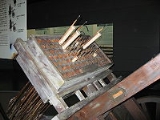
s and the cylindrical and box shaped launch platforms that fired them. Hwacha were first developed in the 1400s by Korean scientists. It is a two-wheeled cart
Cart

A cart is a vehicle or device designed for transport, using two or four wheels and normally pulled by one or a pair of draught animals. A handcart is pulled or pushed by one or more people....
 carrying a launch pad or board, filled with holes into which the ammunition is inserted. These small rockets are attached to "Gungdo bow-arrows
Gungdo

The Korean Bow is a waterbuffalo horn-based composite bow Recurve_bow#Reflex_bow bow, standardized about 1900 CE from the variety of such weapons in earlier use....
", which shoot about 100 to 200 iron spikes at one time upon detonation.


Discussion
Ask a question about 'Hwacha'
Start a new discussion about 'Hwacha'
Answer questions from other users
Full Discussion Forum


Encyclopedia


Hwacha or Hwach'a was an anti-personnel gunpowder
Gunpowder

Gunpowder, also called black powder, is an explosive mixture of sulfur, charcoal and potassium nitrate, KNO3 that burns rapidly, producing volumes of hot solids and gases which can be used as a propellant in firearms and as a pyrotechnic composition in fireworks....
 weapon developed and used in Korea
Korea

Korea is a geographic area composed of two sovereign countries, a civilization, and a former state situated on the Korean Peninsula in East Asia....
, inspired by Chinese
China

China is a Culture of China, an ancient civilization, and, depending on perspective, a national or multinational entity extending over a large area in East Asia....
 fire arrow
Fire Arrow

The Fire Arrow is a projectile weapon that uses black powder. The earliest reference to its use comes in the Collection of the Most Important Military Techniques written in 1044....
s and the cylindrical and box shaped launch platforms that fired them. Hwacha were first developed in the 1400s by Korean scientists. It is a two-wheeled cart
Cart

A cart is a vehicle or device designed for transport, using two or four wheels and normally pulled by one or a pair of draught animals. A handcart is pulled or pushed by one or more people....
 carrying a launch pad or board, filled with holes into which the ammunition is inserted. These small rockets are attached to "Gungdo bow-arrows
Gungdo

The Korean Bow is a waterbuffalo horn-based composite bow Recurve_bow#Reflex_bow bow, standardized about 1900 CE from the variety of such weapons in earlier use....
", which shoot about 100 to 200 iron spikes at one time upon detonation. During combat, the projectiles are attached to the arrows, ignited
Combustion

Combustion or burning is a complex sequence of exothermic chemical reactions between a fuel and an oxidant accompanied by the production of heat or both heat and light in the form of either a glow or flames, appearance of light flickering....
 and fired. They would travel about 500 yards and explode on contact. This ammunition
Ammunition

Ammunition, often referred to as ammo, is a generic term derived from the French language la munition which embraced all material used for war , but which in time came to refer specifically to gunpowder and artillery....
 was transported on wheelbarrow
Wheelbarrow

A wheelbarrow is a small hand-propelled vehicle, usually with just one wheel, designed to be pushed and guided by a single person using two handles to the rear or a sail may be used to guide the ancient wheelbarrow by wind....
s . Many East Asian historians
List of historians by area of study

This is a list of historians categorized by their area of study. See also List of historians....
 believe this technological breakthrough alongside the turtle ship
Turtle ship

The Turtle ship [???] was a type of large warship belonging to the Panokseon class in Korea that was used intermittently by the Joseon Navy during the Joseon Dynasty from the early 15th century up until the 19th century....
 in the mid-16th century had a distinctive effect during the Japanese invasions of Korea (1592-1598) . Today, hwacha appear in Korean museums, national parks, and popular culture.

History

Long before the development of the hwacha, China
China

China is a Culture of China, an ancient civilization, and, depending on perspective, a national or multinational entity extending over a large area in East Asia....
 imposed severe restrictions on exporting gunpowder
Gunpowder

Gunpowder, also called black powder, is an explosive mixture of sulfur, charcoal and potassium nitrate, KNO3 that burns rapidly, producing volumes of hot solids and gases which can be used as a propellant in firearms and as a pyrotechnic composition in fireworks....
 to Korea, keeping the secret of gunpowder to themselves. Yet, gunpowder weapons were key to the Koreans in maintaining a predominant navy in the Sea of Japan
Sea of Japan

The Sea of Japan is a marginal sea of the western Pacific Ocean, bordered by Japan, South Korea, North Korea and Russia. It is referred to in North Korea as the Korea East Sea and in South Korea as the East Sea....
 (East Sea) to protect Korean fishermen and merchants against the increasing numbers of Japanese Waegu pirates.

Therefore, there was an effort by Koreans to develop gunpowder on their own. Between the years of 1374 to 1376, Korea began its first productions of gunpowder. In 1377, Choe Mu-seon
Choe Mu-seon

Choe Mu-Seon was a medieval Korean scientist, inventor, and military commander during the late Goryeo Dynasty and early Joseon Dynasty. He is best known for enabling Korea to domestically produce gunpowder by obtaining a recipe for the China commodity from a Chinese merchant, as well as inventing various gunpowder-based weapons in an attemp...
, a Korean scholar, discovered a way to obtain gunpowder by extracting potassium nitrate
Potassium nitrate

Potassium nitrate is a chemical compound with the chemical formula PotassiumNitrogenOxygen3. A naturally occurring mineral source of nitrogen, KNO3 constitutes a critical oxidation component of black powder/gunpowder....
 from the soil
Soil

Soil is the naturally occurring, unconsolidated or loose covering on the Earth's surface. Soil is composed of particles of broken rock that have been altered by chemical and environmental processes including weathering and erosion....
 and subsequently made Juhwa, Korea's very first rocket. Further developments led to the birth of the family of singijeon
Singijeon

Singijeon is a multi-launch rocket system made by Korean Choe Mu-seon in 1377 near the end of the Goryeo Dynasty under U of Goryeo. These were launched by multiple means, such as the hwacha and other large-barreled guns....
s.

The hwacha was a brainchild of its predecessors, the Juhwa and the Singijeon. The first hwacha was made in 1409 during the Joseon Dynasty
Joseon Dynasty

Joseon , was a sovereign state founded by Taejo Taejo of Joseon, and lasted for approximately five centuries. It was founded in the aftermath of the overthrow of the Goryeo Kingdom at what is today the city of Kaesong....
 by several Korean scientists --including Yi Do and Choi Hae-san. It is unlikely that the hwachas made around this time participated in combat.

During the rule of Sejong the Great, hwachas were further developed and extensively made. Records shows that during this time 90 hwachas were in use. King Sejong, famous for his contribution to Hangul
Hangul

Hangul is the native alphabet of the Korean language, as distinguished from the logogram Sino-Korean vocabulary hanja system. It was created in the mid-fifteenth century, and is now the official writing system of both North Korea and South Korea, being co-official in the Yanbian Korean Autonomous Prefecture of China....
, made efforts to improve the hwacha and by the end of his rule; by the time he was through, a single hwacha could fire 200 rocket arrows at one time.

Stronger and more effective hwachas were made in 1451 under the decree of King Munjong
Munjong of Joseon

King Munjong , the fifth King of the Joseon Dynasty. ruled Korea from 1450 to 1452. He was the eldest son of King Sejong the Great, and succeeded him in 1450, but died of disease two years later....
. At the time, 50 units were deployed in Hansung (present-day Seoul), and another 80 on the northern border. By the end of 1451, hundreds of hwachas were deployed throughout the peninsula.

Role during the Japanese invasions of Korea (1592-1598)

Hwachas saw action most extensively during the Japanese invasions of Korea against the Japan
Japan

Japan is an island country in East Asia. Located in the Pacific Ocean, it lies to the east of the Sea of Japan, People's Republic of China, North Korea, South Korea and Russia, stretching from the Sea of Okhotsk in the north to the East China Sea and Taiwan in the south....
ese soldiers. They were mostly placed in fortresses or citadel
Citadel

A citadel is a Fortification for protecting a town, sometimes incorporating a castle. The term derives from the same Latin language root as the word "city", civis, meaning citizen....
s and used in defensive manners. These proved to be powerful in many battles, and were most prominent in the Battle of Haengju
Battle of Haengju

The Battle of Haengju took place on February 12, 1593 during the Japanese invasions of Korea . The Korean defenders were successful in repelling the Japanese forces....
, in which 3,400 Koreans repulsed 30,000 Japanese with the help of 40 hwachas.

Hwachas were also used in panokseon
Panokseon

Panokseon was an oar- and sail-propelled ship that was the main class of warship used by the Koreans Joseon Dynasty during the late 16th century....
s under the navy of Admiral Yi Sun-sin
Yi Sun-sin

Yi Sun-sin , also commonly transliterated Yi Soon-shin or Lee Sun-shin, Korean language: ???) was a Korean naval commander noted for his victories against the Japanese navy during the Japanese invasions of Korea during the Joseon Dynasty....
 to attack Japanese ships from a distance.

The Japanese
Japanese people

The are the predominant ethnic group of Japan. Worldwide, approximately 130 million people are of Japanese descent; of these, approximately 127 million are residents of Japan....
 samurai
Samurai

is the term for the military nobility of Pre-industrial society Japan. According to translator William Scott Wilson: "In Chinese, the character ? was originally a verb meaning to wait upon or accompany a person in the upper ranks of society, and this is also true of the original term in Japanese, saburau....
 ground troops
Infantry

Infantry are soldiers who are primarily trained for the role of fighting on foot. A soldier in the infantry is known as an infantryman. Infantry units have more physically demanding training than other branches of armies, and place a greater emphasis on fitness, physical strength and aggression....
, especially in the Battle of Haengju, typically advanced in dense formations, presenting ideal targets for the hwacha.

Components


The hwacha's structure was very similar to a hand cart with a mobile wooden launchpad on the top filled with 100 to 200 cylindrical holes, into which the ignitors like sajunchongtong were placed .

The ammunition, like the singijeon
Singijeon

Singijeon is a multi-launch rocket system made by Korean Choe Mu-seon in 1377 near the end of the Goryeo Dynasty under U of Goryeo. These were launched by multiple means, such as the hwacha and other large-barreled guns....
, a Korean variation of the Chinese fire arrow
Fire Arrow

The Fire Arrow is a projectile weapon that uses black powder. The earliest reference to its use comes in the Collection of the Most Important Military Techniques written in 1044....
, was comprised of an arrow with an iron head and a fletching
Fletching

Remember kidsPDAFletching is the ancient art of aerodynamically stabilizing arrows from materials such as feathers. The English-language surname "Fletcher" derives from this term, meaning "one who fletches." It is sometimes generally used for an arrow-maker, not only for someone restricted to this step of the process....
 section with a paper gunpowder pouch attached to it. Approximately 100 projectiles were loaded and launched in one volley, and were effective up to a range of 500 meters.

The back side of the hwacha featured two parallel arms that allowed the operator to push and pull the machine, and a vertical strip
Strip

A strip is a long, thin piece of a bigger item; strip, stripping or stripped may refer to:* Landing strip or runway, where airplanes land...
 designed for in-line attacks or stand ground-sentry
Sentry

Sentry may refer to:*A sentry is a guard at a gate or other point of passage. See General Orders for Sentries*Sentry , an automatic near-Earth asteroid collision monitoring system...
 positions.

The wagon-like wheels were usually fastened by wood pivots and iron axle
Axle

An axle is a central shaft for a rotation wheel or gear. In some cases the axle may be fixed in position with a bearing or bushing sitting inside the hole in the wheel or gear to allow the wheel or gear to rotate around the axle....
s. In order to reduce friction between the wheels and the axles, tar
Tar

Tar is modified resin produced from the wood and roots of pine by destructive distillation under pyrolysis. It is a viscosity black liquid. Production and trade in tar was a major contributor in the economies of Northern Europe and Colonial America....
 oil was used.

Hwachas were usually made of pine wood like Panokseon warships, although there are some versions made of oak
Oak

The term oak can be used as part of the common name of any of about 400 species of trees and shrubs in the genus Quercus , which are listed in the List of Quercus species, and some related genera, notably Lithocarpus....
. Ropes used within were usually made of hemp
Hemp

File:Industrialhemp.jpgHemp is the common name for plants of the entire genus Cannabis, although the term is often used to refer only to Cannabis strains cultivated for industrial use....
.

The Korean army carried siege engineers and blacksmith
Blacksmith

A blacksmith is a person who processess iron or steel by forging the metal; i.e., by using tools to hammer, bend, cut, and otherwise shape it in its non-liquid form....
s in order to make repairs to the Hwacha if poor road conditions, bad weather, or battle damaged the machinery.

Projectiles fired from Hwacha

Hwacha
Unlike cannon
Cannon

A cannon is any tubular piece of artillery, that uses gunpowder or other usually explosive-based propellants to launch a projectile over a distance....
s or mortar
Mortar (weapon)

A mortar is a Muzzleloader indirect fire weapon that fires shell at low velocities, short ranges, and high-arcing Ballistics trajectories. It typically has a barrel length less than 15 times its caliber....
s used in Western warfare during the 16th century and the Middle Ages, which required heavy iron balls, Hwacha fired arrows which were thin and light, making it an easy-to-maneuver siege weapon.

The holes in the top of the launching pad in Hwacha ranged in diameter from an inch to an inch and a half, which allowed thin Gungdo bow-like arrows
Gungdo

The Korean Bow is a waterbuffalo horn-based composite bow Recurve_bow#Reflex_bow bow, standardized about 1900 CE from the variety of such weapons in earlier use....
 to be fired and also admit Sajunchongtong class ignitor
Ignitor

Ignitor is a heavy metal music Band based in Austin, Texas, United States....
 to be placed in the back side of the shooting board.

Singijeon
Singijeon

Singijeon is a multi-launch rocket system made by Korean Choe Mu-seon in 1377 near the end of the Goryeo Dynasty under U of Goryeo. These were launched by multiple means, such as the hwacha and other large-barreled guns....
-class projectiles were designed by Korean siege engineers specifically to be used in Hwacha. They were small arrows usually shot in multiples of 200. Called (so) they possessed a pouch of black powder attached in the bottom near to the fletching
Fletching

Remember kidsPDAFletching is the ancient art of aerodynamically stabilizing arrows from materials such as feathers. The English-language surname "Fletcher" derives from this term, meaning "one who fletches." It is sometimes generally used for an arrow-maker, not only for someone restricted to this step of the process....
 section. Besides the singijeon-class projectiles, hwacha could also fire 100 steel-tipped rockets.

Because of the large numbers of arrows fired from Hwachas and the wide spread damage of its attack, a dense formation presented an ideal target for Hwachas.

Ballistics and range


The trajectory
Trajectory

Trajectory is the path of a moving object that it follows through space. The object might be a projectile or a satellite, for example. It thus includes the meaning of orbit - the path of a planet, an asteroid or a comet as it travels around a central mass....
 of the "so"-class(?) Singijeon projectiles was fairly flat and – like other spinning projectiles – experienced the Magnus effect
Magnus effect

The Magnus effect is the phenomenon whereby a spinning object flying in a fluid creates a whirlpool of fluid around itself, and experiences a force perpendicular to the line of motion and away from the direction of spin....
. Operators used to fire the weapon with an angle nearly 45 degrees
Degree (angle)

A degree , usually denoted by ? , is a measurement of plane angle, representing 1/360 of a Turn ; one degree is equivalent to p/180 radians....
 to maximise range. Adverse weather
Weather

Weather is a set of all the Phenomenon occurring in a given atmosphere at a given time. Weather phenomena lie in the hydrosphere and troposphere....
 conditions (wind, humidity, rain) during a battle generally limited their striking distance to about 100 meters.

Hwachas' range could be extended if the siege weapon was situated in elevated places like hill
Hill

A hill is a landform that extends above the surrounding terrain, in a limited area. Hills often have a distinct Summit , although in areas with Escarpment a hill may refer to a particular section of scarp slope without a well-defined summit ....
s. Singijeon arrows from that position had a range of about 500 yards.

A 15th century account from the Annals of Joseon Dynasty tells us of an experiment, in which the Singijeon fired from the Hwacha completely pierced a scarecrow armed with a suit of armour and shield, at the range of 80 paces (about 100 meters).

Usage

Hwacha 1500s Painting2
Hwachas were mostly used in defensive manners, however some Western and East Asian historians have recently concluded that in some cases they had been used offensively in sea to surface
Naval warfare

Naval warfare is combat in and on seas, oceans, or any other major bodies of water such as large lakes and wide rivers....
 attacks and in naval warfare
Naval warfare

Naval warfare is combat in and on seas, oceans, or any other major bodies of water such as large lakes and wide rivers....
 as well, particularly in the Battle of Noryang Point
Battle of Noryang Point

The Battle of Noryang, the last major battle of the Japanese invasions of Korea , was fought between the Japanese navy and the combined Naval fleet of the Joseon Dynasty and Ming Dynasty navies....
, during the Japanese invasions of Korea (1592-1598) in 1598.

Hwachas were usually carried to battle highly escorted. Once the army settled down in trench
Trench

A trench is a type of excavation or depression in the ground. Trenches are generally defined by being deeper than they are wide , and by being narrow compared to their length ....
es or base camps, the operators would disassemble the siege weapon by placing the launching pad on the top. Transporting Hwachas were similar to European trebuchet
Trebuchet

A trebuchet or trebucket is a siege engine that was employed in the Middle Ages either to smash masonry walls or to throw projectiles over them....
s and required assembling before usage. All the pieces featured similar characteristics like lego bricks
Lego

Lego, officially trademarked LEGO, is a line of construction toys manufactured by the Lego Group, a privately held company based in Billund, Denmark....
 and the mobile launching pad could be unpacked and easily placed on the wood outlet on the top of cart.

Once a hwacha was set up for combat, the operators would use the gunpowder stored on a boot-like bag
Bag

A bag is a non-Stiffness or semi-rigid container, made of paper, cloth, plastic, leather, or some other flexible material.A bag is used for packaging and/or carrying items....
 tied on each ignitor to be used for each hole on the machine. After that, the operators were able to load the Hwacha with arrows or iron spike
Spike

Spike may refer to:...
s and be ready for shooting. To do so, the operators stepped back and covered their ears, pulling the ropes that contained each ignitor thus blasting fire
Shooting

Shooting is the act or process of firing rifles, shotguns or other projectile weapons such as Bow s or crossbows. Even the firing of artillery, rockets and missiles can be called shooting....
 on its opponent.

At sea, maneuvers were slightly different and complex because the operator would need to find a proper and stable place to fire. Usually some Hwacha operators preferred to be in the rowers deck where they were able to shoot from the windows, while others preferred to be in the main deck so they could shoot to the sail
Sail

A sail is any type of surface intended to generate thrust by being placed in a wind—in essence a vertically-oriented wing. Sails are used in sailing....
s of the enemy ships. This kind of maneuvers was particularly seen in Korean Panokseon
Panokseon

Panokseon was an oar- and sail-propelled ship that was the main class of warship used by the Koreans Joseon Dynasty during the late 16th century....
 warships.

Hwacha in popular culture


The television program MythBusters built and tested a Hwacha on the October 22, 2008 episode of the show. They tested three factors: whether or not it could fire arrows over 500 yards, whether or not the arrows would explode on impact and cause fatal damage, and whether or not it could fire 200 arrows simultaneously. They demonstrated that all three were comfirmed. In their final test, the missiles overshot the target area, but still landed in a very tight group. They concluded that if the target were a large massed army, the attack would have done considerable damage. This corresponds with the historical reports of the Hwacha's effectiveness against armies in tight formations.

The Hwacha is a playable unit in Civilization 4, replacing the catapult in the early stages of the game for players who are playing the Korean empire.

The Hwacha mechanism is shown (alongside the singijeon) in a 2008 historical Korean film, "The Dvine Weapon" (???
Singijeon

Singijeon is a multi-launch rocket system made by Korean Choe Mu-seon in 1377 near the end of the Goryeo Dynasty under U of Goryeo. These were launched by multiple means, such as the hwacha and other large-barreled guns....
), which is set during Sejong's reign.

See also

  • Japanese invasions of Korea (1592-1598)
  • Sajuntongchong
  • Singijeon
    Singijeon

    Singijeon is a multi-launch rocket system made by Korean Choe Mu-seon in 1377 near the end of the Goryeo Dynasty under U of Goryeo. These were launched by multiple means, such as the hwacha and other large-barreled guns....
  • Fire Arrow
    Fire Arrow

    The Fire Arrow is a projectile weapon that uses black powder. The earliest reference to its use comes in the Collection of the Most Important Military Techniques written in 1044....
  • Ribauldequin
    Ribauldequin

    A Ribauldequin, also known as a rabauld, ribault, ribaudkin, or organ gun, was a Middle Ages volley gun with many small-caliber iron barrels set up parallel on a platform, which, when fired, were somewhat akin to machine guns of modern times, and mainly used in an anti-personnel role....
  • Huo Long Jing
  • Bigyeok Jincholle (?????, Korean Dynamite - Invented from I Jangson)
  • Zolanhwan (Korean Shotgun Shell)
  • Byeon Izung