
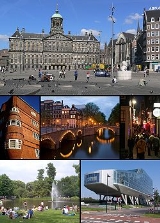
Encyclopedia
, the official
capital of the
Netherlands, lies on the banks of two bodies of water, the IJ bay and the
Amstel river. Founded in the late
12th century as a small fishing village on the banks of the
Amstel, it is now the largest city in the country and is a financial and cultural centre. As of April 1, 2006, the population of the city proper is 743,905; the population of the greater Amsterdam area is approximately 1.5 million.
Amsterdam has one of the largest historic city centres in
Europe, dating largely from the 17th century. At this time, a series of concentric, semi-circular
canals were dug around the old city centre. Along the canals houses and warehouses were built. The canals still define Amsterdam's layout and appearance today. Many fine houses and mansions are situated along the canals. Some of the narrow brick houses are gradually sinking because they are built on wooden
piles to cope with the marshy subsoil.
Although Amsterdam is officially designated as the capital of the Netherlands, it has never been , the seat of the court, government, or parliament of the Netherlands, which are all located at
The Hague. Amsterdam is also not the capital of the province in which it is located,
North Holland, whose capital is located at
Haarlem. See
capital of the Netherlands for more information.
Amsterdam is famous for its free-spirited liberalism, diversity and tolerance.
History
Amsterdam began as a fishing village in the
13th century. According to legend Amsterdam was founded by two Frisian fishermen, who landed on the shores of the Amstel in a small boat with their dog. The damming of the river
Amstel gave it its name . The traditional founding of the city of Amsterdam is October 27, 1275, when the inhabitants living around the Amstel dam were granted freedom from paying the
tolls associated with the locks and bridges of Holland. It was given city rights in 1300 or 1301. From the
14th century on, Amsterdam flourished, largely on the basis of trade with the cities of the
Hanseatic League.
In the
16th century the Dutch rebelled against
Philip II of Spain and his successors. The revolt escalated into the
Eighty Years' War which ultimately led to Dutch independence. After the break with Spain the Dutch Republic became known for its relative religious tolerance.
Jews from
Spain and
Portugal, prosperous merchants from
Antwerp ,
Huguenots from
France sought safety in Amsterdam. It was the rich, refined migrants from Flanders who set the tone and made Holland a
mercantile power.
The
17th century is considered Amsterdam's "Golden Age". In the early 17th century Amsterdam became one of the wealthiest cities in the world. Ships sailed from Amsterdam to
North America,
Africa and present-day
Indonesia and
Brazil and formed the basis of a worldwide trading network. Amsterdam's merchants had the biggest share in the
VOC and WIC. These companies acquired the overseas possessions which formed the seeds of the later Dutch colonies. Amsterdam was the most important point for the trans-shipment of goods in Europe and it was the leading financial centre of the world. Amsterdam's stock exchange was the first to trade continuously.
The population grew from slightly over 10,000 around 1500 to 30,000 around 1570, 60,000 around 1600, 105,000 in 1622 and almost 200,000 around 1700 . Thereafter, the population did not change much for another century and a half. During the century before
World War II it almost quadrupled to 800,000, but then remained fairly constant again to this day.
The 18th and early 19th centuries saw a decline in Amsterdam's prosperity. The wars of the Dutch Republic with the
United Kingdom and
France took their toll on Amsterdam. During the
Napoleonic Wars Amsterdam's fortunes reached their lowest point. However, with the establishment of the Kingdom of the Netherlands in 1815, things slowly began to improve. In Amsterdam new developments were started by people like
Samuel Sarphati who found their inspiration in Paris.
The end of the 19th century is sometimes called Amsterdam's second Golden Age. New museums, a train station, and the Concertgebouw were built. At this time the
Industrial Revolution reached Amsterdam. The
Amsterdam-Rhine Canal was dug to give Amsterdam a direct connection to the
Rhine and the
North Sea Canal to give the port a shorter connection to the
North Sea. Both projects improved communication with the rest of Europe and the world dramatically.
Joseph Conrad gives a brief description of Amsterdam, seen from the sea at this period, in
.
Shortly before the
First World War the city began expanding and new suburbs were built. During
World War I, the Netherlands remained neutral. Amsterdam suffered a food shortage and heating fuel became scarce. The shortages sparked riots in which several people were killed.
Germany invaded the Netherlands on 10 May 1940, taking control of the country after five days of fighting. The Germans installed a Nazi civilian government in Amsterdam that cooperated in the persecution of Jews. However, a minority of people in Amsterdam helped the Jews in hiding and suffered persecution themselves in doing so. More than 103-105,000
Jews were deported from the Netherlands to concentration camps, of whom perhaps the most famous was a young German girl,
Anne Frank. Only 5,000 Dutch Jews survived the war. In the last months of the war, communication with the rest of the country broke down and food and fuel became scarce. Many inhabitants of the city had to travel to the countryside to collect food. Dogs, cats and raw sugar beets were consumed to stay alive.
Most of the trees in Amsterdam were cut down for fuel and all the wood of the apartments from the Jewish people who were deported.
Coat of arms
The coat of arms of Amsterdam is composed of three
St Andrew's crosses, aligned vertically, but rotated 90 degrees for the flag. Historians believe they represent the three dangers which have traditionally plagued the city: flood, fire, and pestilence. The city's official motto,
Heldhaftig, Vastberaden, Barmhartig which is displayed on the coat of arms, was bestowed on it by
Queen Wilhelmina in 1947 in recognition of the city's bravery during World War II. The lions were added in the sixteenth century.
The
Imperial Crown of Austria was awarded to the city in 1489 by
Maximilian I, Holy Roman Emperor, out of gratitude for services and loans. The crown was a sign of imperial protection and acted as a seal of approval for Amsterdam merchants abroad. The Westertoren also features the imperial crown.
City government
As all Dutch municipalities, Amsterdam is governed by a mayor, his
aldermen, and the
municipal council. However, unlike most other Dutch municipalities, Amsterdam is subdivided into fifteen
stadsdelen , a system that was implemented in the 1980s to improve local governance. The
stadsdelen are responsible for many activities that previously had been run by the central city. Fourteen of these have their own council, chosen by a popular election. The fifteenth, Westpoort, covers the harbour of Amsterdam, has very few inhabitants, and is governed by the central municipal council. Local decisions are made at borough level, and only affairs pertaining to the whole city, such as major infrastructure projects, are handled by the central city council.
See also: List of mayors of Amsterdam
Tourist attractions
Amsterdam is noted for many outstanding museums, including the
Rijksmuseum, the Stedelijk Museum,
Rembrandt House Museum, and its world-class symphony orchestra, the Concertgebouworkest, whose home base is the
Concertgebouw. The
Van Gogh Museum houses the largest collection of Van Gogh's paintings and drawings in the world. An unlikely tourist treat is the moving story of Anne Frank at the
Anne Frank House.
Amsterdam is also notable for its
red-light district,
de Wallen. Prostitution is legal in the Netherlands. The red-light district is located in the center of the city along major canals and is clearly marked on maps.
Centred around the Wallen, but also elsewhere in the city, coffee shops sell high quality
cannabis products. This is not completely legal but is tolerated when small quantities of the drug are involved.
Nightlife
Amsterdam has a vibrant nightlife and is famous for its many clubs. It's often said to be one of the best destinations to go out in Europe together with
London,
Madrid and
Berlin. Many youngsters from all over the country and even abroad visit Hotel Arena, Escape , Powerzone, Jimmy Woo, Supperclub, Club More, Chemistry, Panama, Melkweg, Paradiso or Club 11 wich are among the most famous. These clubs are located everywhere around, but there are concentrations around Rembrantplein and Leidseplein, where you can also find many bars and restaurants.
Amsterdams title as Gay capital of Europe may not be sure anymore after some heavy competition from other great cities, the gay scene still has plenty of choice. The Reguliersbreestraat next to Rembrandtplein is the very heart of their nightlife.
The famous club iT nowadays doen't exist anymore.
Weather
Amsterdam enjoys a moderate temperate climate, with the weather patterns being strongly influenced by Amsterdam's proximity to the Atlantic Ocean to the west and the prevailing westerly winds. Winters are mild and average above freezing, although frosts are not uncommon during periods of easterly or northeasterly winds that blow from the interior of the continent. Summers are comfortably warm but seldom hot. However, although days with measurable precipitation are common, Amsterdam does not have an overly wet climate and averages less than 760 mm of precipitation annually. The amount of precipitation seems greater than it is in reality, as much of it falls as protracted drizzle or light rain. Cloudy and damp days are common, particularly in the cooler months.
Economy
Amsterdam is the financial capital of the Netherlands and repeatedly chosen the fifth most important city in Europe to do business after London, Frankfurt, Paris and Brussels. Many large dutch corporations and banks have their headquarter in Amsterdam, like
ABN Amro,
Heineken,
ING Group,
Ahold,
Akzo Nobel and
Philips.
Though many subsidiaries are located along the old canals, more and more companies decide to move to a newly build office tower outside the citycentre. The
South Axis is increasingly a banking area, and is intended to become the new business-face of the Netherlands. There the
World Trade Center also has its location.
The
Amsterdam Stock Exchange is part of
Euronext, and is the oldest stock exchange on earth. Nowadays it still is one of the most important in Europe.
Academia
Amsterdam has two universities: the
University of Amsterdam , and the
Vrije Universiteit. Other institutions for higher education include an art school, De Rietveldacademie, the Hogeschool van Amsterdam and the Amsterdamse Hogeschool voor de Kunsten. Amsterdam's International Institute of Social History is one of the world's largest documentary and research institutions concerning social history, and especially the history of the labour movement. Amsterdam's Hortus Botanicus, founded in the early 1600s, is one of the oldest
botanical gardens in the world, with many old and rare specimens, amongst which the coffee plant that served as the parent for the entire coffee culture in Central and South America.
Public transport
Public transport in Amsterdam, operated by
Gemeentelijk Vervoerbedrijf, Connexxion,
Arriva, and
Nederlandse Spoorwegen, consists of:
- national and international train connections
- 3 metro lines, 1 light rail line and 1 metro line under construction, together the Amsterdam metro
- 16 tram lines
- An express tram line
- 55 local bus lines
- regional bus lines
- several ferries for pedestrians and cyclists across the IJ
- a Fast Flying Ferry towards Velsen
[i]
[i]
...
-Zuid on the North Sea shore
A new underground line, the
North/South Line is under construction. The estimated completion date is in 2012..
As of the start of 2006 most of the regional transport is handled by
Arriva, Connexxion used to handle all of regional transport and still operates a few lines.
History
During the construction of the
Amsterdam metro, plans to demolish the entire
Jewish neighbourhood near the Nieuwmarkt led to strong protests. The metro was still built , but plans to build a highway through the neighbourhood in the centre of Amsterdam were abolished.
Private transport
Amsterdam is known as one of the most bicycle-friendly cities in the world and is a center of bicycle culture. Most main streets have bike paths.
Bike racks are ubiquitous throughout the city. There are about 700,000 bicycles in the city. Each year, about 80,000 of them are stolen and 25,000 end up in the canals. In the city centre, driving a car is discouraged, parking fees are steep and a great number of streets are closed off for cars. The A10
beltway surrounds the city and provides connections to four major highways: the A1, A2, A4 and A8, as well as quite a few exits to roads leading into the city .
Airport
Amsterdam Schiphol Airport, is less than 20 minutes by train from Amsterdam Central Station. It is the biggest airport in the Netherlands, the fourth largest in Europe and the tenth largest in the world. It handles about 42 million passengers a year and is home base to
KLM, since 2004 part of
Air France-KLM.
Sports
Amsterdam is the home town of
Ajax, a team in the Dutch Football League. Its home base is the modern stadium
Amsterdam ArenA, located in the south-east of the city. The team shares that facility with the
Amsterdam Admirals, an
American football team.
In 1928, Amsterdam hosted the
Games of the IXth Olympiad. The Olympic Stadium built for the occasion has been completely restored and is now used for cultural and sporting events.
Amsterdam also is home to a famous
ice rink, the
Jaap Eden baan. The
Amstel Tijgers play in this arena in the Dutch
ice hockey premier league. In speed skating many international championships have been fought in the 400-meter lane of this ice rink.
The city also has a
baseball team, the
Amsterdam Pirates who play in the Dutch Major League. Three
field hockey teams, Amsterdam, Pinoké and Hurley, and a
basketball team, the Amsterdam Astronauts who play in the Dutch premier division and play their games in the Sporthallen Zuid, near the Olympic Stadium.
Periodic events
...
,
Queen's day, 30 April, the former Queen's birthday
- June - The Amsterdam Roots Festival, last week of June. International music festival
- June - Holland Festival is an international festival for theater, music, dance, opera, film and art, throughout the month of June.
- August - Amsterdam Pride, first weekend of August, gay pride weekend
- August - Hartjesdag, 3rd Weekend in August.
- August - Uitmarkt, last weekend in August, the start of the cultural season
- August - Amsterdam Tournament, late August, International Football-tournament hosted by AFC Ajax
- August - Sail Amsterdam, a five-yearly event, when tall ships from all over the world can be visited. Next event 2010.
- October - Amsterdam Marathon, mid-October
- October – The Bokbier Beer Festival in the Beurs van Berlage
- October – Grachtenrace , 25km rowing race, 2nd Saturday in October.
- November – The International Documentary Filmfestival Amsterdam
- November - Cannabis Cup, mid-November annual cannabis competition, hosted by High Times.
- November – The arrival of Sinterklaas
Demography
Famous Amsterdammers
|Img = Standbeeld Hazes.jpg
...
- singer
For an overview of more famous Amsterdammers see
Notes
External links