
All Topics  
Yurt

 
Yurt

   Email Print
   Bookmark   Link


Yurt


A yurt is a portable, felt
Felt

Felt is a non-weave cloth that is produced by matting, condensing and pressing fibers. While some types of felt are very soft, some are tough enough to form construction materials....
-covered, wood lattice
Latticework

Latticework is an ornament , lattice framework consisting of a criss-crossed pattern of strips of building material, usually wood or metal, but it can be made of any building material....
-framed dwelling structure used by nomad
Nomad

Nomadic people, , also known as nomads, are communities of people who move from one place to another, rather than Settler in one location....
s in the steppe
Steppe

In physical geography, a steppe , pronounced , is a grassland plain without trees . The prairie can be considered a steppe. It may be semi-desert, or covered with Poaceae or shrubs or both, depending on the season and latitude....
s of Central Asia
Central Asia

Central Asia is a region of Asia from the Caspian Sea in the west to central China in the east, and from southern Russia in the north to northern India in the south....
.

Etymology and synonyms
The word yurt is originally from the Turkic
Turkic languages

The Turkic languages constitute a language family of some thirty languages, spoken by Turkic peoples across a vast area from Eastern Europe and the Mediterranean Sea to Siberia and Western China, and are sometimes considered to be part of the proposed Altaic languages....
 word meaning "dwelling " in the sense of "home"; the term came to be used in reference to the physical tent-like things only in other languages. In Russian
Russian language

Russian is the most geographically widespread language of Eurasia, the most widely spoken of the Slavic languages, and the largest native language in Europe....
 the structure is called "yurta", whence the word came into English.

In Kazakh
Kazakh language

Kazakh is a Turkic languages language closely related to Nogai language and Karakalpak language.Kazakh is an agglutinative language, and it employs vowel harmony....
 (and Uyghur
Uyghur language

Uyghur is a Turkic language spoken by the Uyghur people in Xinjiang Uyghur Autonomous Region, a Central Asian region administered by People's Republic of China....
) the term for the structure is kiyiz üy (???? ??, lit.


Discussion
Ask a question about 'Yurt'
Start a new discussion about 'Yurt'
Answer questions from other users
Full Discussion Forum


Encyclopedia


A yurt is a portable, felt
Felt

Felt is a non-weave cloth that is produced by matting, condensing and pressing fibers. While some types of felt are very soft, some are tough enough to form construction materials....
-covered, wood lattice
Latticework

Latticework is an ornament , lattice framework consisting of a criss-crossed pattern of strips of building material, usually wood or metal, but it can be made of any building material....
-framed dwelling structure used by nomad
Nomad

Nomadic people, , also known as nomads, are communities of people who move from one place to another, rather than Settler in one location....
s in the steppe
Steppe

In physical geography, a steppe , pronounced , is a grassland plain without trees . The prairie can be considered a steppe. It may be semi-desert, or covered with Poaceae or shrubs or both, depending on the season and latitude....
s of Central Asia
Central Asia

Central Asia is a region of Asia from the Caspian Sea in the west to central China in the east, and from southern Russia in the north to northern India in the south....
.

Etymology and synonyms


The word yurt is originally from the Turkic
Turkic languages

The Turkic languages constitute a language family of some thirty languages, spoken by Turkic peoples across a vast area from Eastern Europe and the Mediterranean Sea to Siberia and Western China, and are sometimes considered to be part of the proposed Altaic languages....
 word meaning "dwelling " in the sense of "home"; the term came to be used in reference to the physical tent-like things only in other languages. In Russian
Russian language

Russian is the most geographically widespread language of Eurasia, the most widely spoken of the Slavic languages, and the largest native language in Europe....
 the structure is called "yurta", whence the word came into English.

In Kazakh
Kazakh language

Kazakh is a Turkic languages language closely related to Nogai language and Karakalpak language.Kazakh is an agglutinative language, and it employs vowel harmony....
 (and Uyghur
Uyghur language

Uyghur is a Turkic language spoken by the Uyghur people in Xinjiang Uyghur Autonomous Region, a Central Asian region administered by People's Republic of China....
) the term for the structure is kiyiz üy (???? ??, lit. "felt home"). In Kyrgyz
Kyrgyz

The Kyrgyz are a Turkic peoples ethnic group found primarily in Kyrgyzstan....
 the term is boz üý (??? ??), literally "grey house", because of the colour of the felt. In Turkmen
Turkmen

Turkmen or Turkoman or Turkman may refer to:*Of or relating to Turkmenistan, a country in Central Asia, specifically:**Turkmen SSR, that country as a constituent republic of the former Soviet Union...
 the term is both ak öý and gara öý , literally "white house" and "black house", depending on its luxury and elegance. In Mongolian
Mongolian language

The Mongolian language is the best-known member of the Mongolic languages. It is the language of most residents of Mongolia and of many of the Mongolian residents of Inner Mongolia, totalling about 5.7 million speakers....
 it is called a ger. Afghans
Demographics of Afghanistan

The Demographics of Afghanistan are ethnically and linguistically mixed. This reflects its location astride historic trade and invasion routes leading from Central Asia into South Asia and Southwest Asia....
 call them "Kherga"/"Jirga
Jirga

A jirga is a tribal assembly of elders which takes decisions by consensus, particularly among the Pashtun but also in other ethnic groups near them; they are most common in Afghanistan and among the Pashtun in Pakistan near its border with Afghanistan and are even held by Pashtuns in Kashmir valley, India....
" or "ooee". In Pakistan
Pakistan

Pakistan , officially the Islamic Republic of Pakistan, is a country located in South Asia and borders Central Asia and the Middle East. It has a 1,046 kilometre coastline along the Arabian Sea and Gulf of Oman in the south, and is bordered by Afghanistan and Iran in the west, India in the east and People's Republic of China in th...
 it is also known as gher. In Hindi
Hindi

Standard Hindi, also known as High Hindi, Nagari Hindi or Literary Hindi is a Standard language register of Hindi. It is one of the 22 official languages of India, and is used, along with English language, for administration of the central government....
, it is called ghar, which means Home
Home

A home is a place of residence or refuge. It is usually a place in which an individual or a family can rest and be able to store personal property....
. In Persian
Persian language

name=Persian|nativename=|pronunciation=[f??r'si]|image=|caption=Farsi in Perso-Arabic script |states= Iran, Afghanistan, Tajikistan, Uzbekistan, and Bahrain....
 yurt is called xeyme, in Tajik
Tajik language

The Tajik language, or Tajik Persian, or Tajiki, is a modern variety of the Persian language spoken in Central Asia. An Indo-European languages language of the Iranian languages language group, most speakers of Tajik live in Tajikistan and Uzbekistan....
 the names are yurt, xona-i siyoh, xayma (???, ????? ????, ?????).

Construction

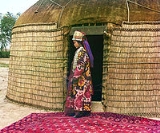
Traditional yurts consist of a circular wooden frame carrying a felt cover. The felt
Felt

Felt is a non-weave cloth that is produced by matting, condensing and pressing fibers. While some types of felt are very soft, some are tough enough to form construction materials....
 is made from the wool of the flocks of sheep that accompany the pastoralists. The timber
Timber

Timber may refer to:* Lumber, i.e. wood materials* Timber, Oregon, an unincorporated community in the U.S. state of Oregon* Timber , a 1984 arcade game by Bally Midway...
 to make the external structure is not to be found on the treeless steppes, and must be traded for in the valleys below.

The frame consists of one or more lattice
Latticework

Latticework is an ornament , lattice framework consisting of a criss-crossed pattern of strips of building material, usually wood or metal, but it can be made of any building material....
 wall-sections, a door-frame, roof poles and a crown. Some styles of yurt have one or more columns to support the crown. The (self-supporting) wood frame is covered with pieces of felt. Depending on availability, the felt is additionally covered with canvas and/or sun-covers. The frame is held together with one or more ropes or ribbons. The structure is kept under compression by the weight of the covers, sometimes supplemented by a heavy weight hung from the center of the roof. They vary regionally, with straight or bent roof-poles, different sizes, and relative weight.

A yurt is designed to be dismantled and the parts carried on camel
Camel

Camels are even-toed ungulates within the genus Camelus. The dromedary, one-humped or Arabian camel has a single hump and is well known for its healthy low fat milk, and the Bactrian camel has two humps....
s or yak
Yak

The yak is a long-haired bovine found throughout the Himalayan region of south Central Asia, the Qinghai-Tibetan Plateau and as far north as Mongolia....
s to be rebuilt on another site.

Symbolism

Image:Shangrak.JPG|shangyrak Image:Coat of arms of Kazakhstan.svg|Kazakh coat of arms Image:Flag of Kyrgyzstan.svg|Kyrgyz flag

The wooden lattice crown of the yurt (toono; , shangyraq; , tunduk; ) is itself emblematic in many Central Asian cultures. In old Kazakh
Kazakhstan

Kazakhstan, also Kazakstan , officially the Republic of Kazakhstan, is a large Eurasian country in Central Asia and Eastern Europe. Ranked as the List of countries by area as well as the world's largest landlocked country, it has a territory of 2,727,300 km? ....
 communities, the yurt itself would often be repaired and rebuilt, but the shangrak would remain intact, passed from father to son upon the father's death. A family's length of heritage could be measured by the accumulation of stains on the shangrak from decades of smoke passing through it. A stylized version of the crown is in the center of the coat of arms of Kazakhstan
Coat of arms of Kazakhstan

The coat of arms of the Republic of Kazakhstan was adopted on June 4 1992. The authors of the emblem are Zhandarbek Melibekov and Shota Ualikhanov....
, and forms the main image on the flag of Kyrgyzstan
Flag of Kyrgyzstan

File:Flag of Kyrgyzstan.svgThe flag of Kyrgyzstan was adopted on 3 March 1992 by the Supreme Council of Kyrgyzstan . It consists of a red field with a yellow sun in the center having 40 uniformly spaced rays....
.

Western yurts

Finishedyurt
Enthusiasts in other countries have taken the visual idea of the yurt -- a round, semi-permanent tent -- and have adapted it to their cultural needs. Although those structures may be copied to some extent from the originals found in Central Asia, they have been greatly changed and adapted and are in most cases very different.

In the United States
United States

The United States of America is a Federal government constitutional republic comprising U.S. state and a federal district. The country is situated mostly in central North America, where its Contiguous United States and Washington, D.C., the Capital districts and territories, lie between the Pacific Ocean and Atlantic Oceans, Borders of the U...
 and Canada
Canada

Canada is a country occupying most of northern North America, extending from the Atlantic Ocean in the east to the Pacific Ocean in the west and northward into the Arctic Ocean....
, yurts are made using hi-tech materials. They are highly engineered and built for extreme weather conditions. In addition, erecting one can take days and they are not intended to be moved often. Often the designs of these North American yurts barely resemble the originals; they are better named yurt derivations, because they are no longer round felt homes that are easy to mount, dismount and transport. North American yurts and yurt derivations were pioneered by William Coperthwaite
William Coperthwaite

William S. Coperthwaite, a native of Maine, is the first North American yurt builder.He was awarded a doctorate from Harvard University's School of Education for his work with Eskimo villagers....
 in the 1960s, after he was inspired to build them by an article about Supreme Court Justice William O. Douglas
William O. Douglas

William Orville Douglas was a United States Supreme Court Associate Justice. With a term lasting 36 years and 209 days, he is the longest-serving justice in the history of the Supreme Court....
's visit to Mongolia.

In Europe
Europe

Europe is, conventionally, one of the world's seven continents. Comprising the westernmost peninsula of Eurasia, Europe is generally divided from Asia to its east by the water divide of the Ural Mountains, the Ural , the Caspian Sea, and by the Caucasus Mountains to the southeast....
, a closer approximation to the Mongolian and Central Asian yurt is in production in several countries. These tents use local hardwood
Hardwood

The term hardwood is used to describe wood from non-monocot flowering plant trees and for those trees themselves. These are usually broad-leaved; in temperate and boreal latitudes they are mostly deciduous, but in tropics and subtropics mostly evergreen....
, and often are adapted for a wetter climate with steeper roof profiles and waterproof canvas. In essence they are yurts, but some lack the felt cover that is present in traditional yurt.

Different groups and individuals use yurts for a variety of purposes, from full-time housing to school rooms. In some provincial parks in Canada, and state parks in several US states, permanent yurts are available for camping
Camping

Camping is an outdoor recreational activity.The participants, known as campers, get away from urban areas, their home region or civilization and enjoy nature while spending one or more nights, usually at a campsite....
.

See also

  • Architecture of Mongolia
    Architecture of Mongolia

    The traditional Mongolian dwelling is known as yurt . According to Mongolian artist and art critic N. Chultem, yurts and tents were the basis for the development of traditional Mongolian architecture....
  • Flag of Kyrgyzstan
    Flag of Kyrgyzstan

    File:Flag of Kyrgyzstan.svgThe flag of Kyrgyzstan was adopted on 3 March 1992 by the Supreme Council of Kyrgyzstan . It consists of a red field with a yellow sun in the center having 40 uniformly spaced rays....
  • List of lodging types
    List of lodging types

    This is a selected list of types of lodging. Items on this list should be types of lodging, however loosely defined.* Airplane* Airport* Apartment...
  • Tent
    Tent

    A tent is a shelter consisting of sheets of textile or other material draped over or attached to a frame of poles or attached to a supporting rope....
  • Yaranga
    Yaranga

    Yaranga is a tent-like traditional mobile home of some nomadic Northern indigenous peoples of Russia, such as Chukchi people and Siberian Yupik....


External links


Background Information


Yurt Construction

  • , yurt building resources, how-to manuals and online calculator
  • by Paul King (PDF & HTML Book)
  • - Documents the complete process of building a yurt from raw materials in pictures and text
  • by Rebecca Schultz, informative video expose from Kazakh community in northwestern China.