

Standard Oil

Encyclopedia
Standard Oil was a predominant American
integrated oil
producing, transporting, refining, and marketing company. Established in 1870 as a corporation
in Ohio
, it was the largest oil refiner in the world and operated as a major company trust and was one of the world's first and largest multinational corporation
s until it was broken up by the United States
Supreme Court
in 1911.
John D. Rockefeller
was a founder, chairman and major shareholder. As it grew exponentially and engaged in business strategies, tactics and practices that were lawful but drove many smaller businesses under, Standard Oil became widely criticized in the public eye, even as it made Rockefeller the richest man in modern history. Other notable Standard Oil principals include Henry Flagler, developer of Florida
's Florida East Coast Railway
and resort cities, and Henry H. Rogers
, who built the Virginian Railway
(VGN), a well-engineered highly efficient line dedicated to shipping southern West Virginia
's bituminous coal
to port at Hampton Roads
.
partnership formed by the well-known industrialist John D. Rockefeller
, his brother William Rockefeller
, Henry Flagler, chemist Samuel Andrews, silent partner
Stephen V. Harkness
, and Oliver Burr Jennings
, who had married the sister of William Rockefeller's wife. In 1870 Rockefeller incorporated Standard Oil in Ohio. Of the initial 10,000 shares, John D. Rockefeller received 2,667; Harkness received 1,334; William Rockefeller, Flagler, and Andrews received 1,333 each; Jennings received 1,000; and the firm of Rockefeller, Andrews & Flagler
received 1,000. Using highly effective tactics, later widely criticized, it absorbed or destroyed most of its competition in Cleveland in less than two months in 1872 and later throughout the northeastern United States.
In the early years, John D. Rockefeller dominated the combine, for he was the single most important figure in shaping the new oil industry. He quickly distributed power and the tasks of policy formation to a system of committees, but always remained the largest shareholder
. Authority was centralized in the company's main office in Cleveland, but decisions in the office were made in a cooperative way.
In response to state laws trying to limit the scale of companies, Rockefeller and his associates developed innovative ways of organizing, to effectively manage their fast growing enterprise. In 1882, they combined their disparate companies, spread across dozens of states, under a single group of trustees. By a secret agreement, the existing thirty-seven stockholders conveyed their shares "in trust" to nine Trustees: John and William Rockefeller, Oliver H. Payne
, Charles Pratt
, Henry Flagler, John D. Archbold, William G. Warden, Jabez Bostwick
, and Benjamin Brewster
. This organization proved so successful that other giant enterprises adopted this "trust" form.
 The company grew by increasing sales and also through acquisitions. After purchasing competing firms, Rockefeller shut down those he believed to be inefficient and kept the others. In a seminal deal, in 1868, the Lake Shore Railroad, a part of the New York Central, gave Rockefeller's firm a going rate of one cent a gallon or forty-two cents a barrel, an effective 71% discount off of its listed rates in return for a promise to ship at least 60 carloads of oil daily and to handle the loading and unloading on its own. Smaller companies decried such deals as unfair because they were not producing enough oil to qualify for discounts.
In 1872, Rockefeller joined the South Improvement Company
which would have allowed him to receive rebates for shipping and receive drawbacks on oil his competitors shipped. But when this deal became known, competitors convinced the Pennsylvania Legislature to revoke South Improvement's charter. No oil was ever shipped under this arrangement.
Standard's actions and secret transport deals helped its kerosene
price to drop from 58 to 26 cents from 1865 to 1870. Competitors disliked the company's business practices, but consumers liked the lower prices. Standard Oil, being formed well before the discovery of the Spindletop
oil field and a demand for oil other than for heat and light, was well placed to control the growth of the oil business. The company was perceived to own and control all aspects of the trade.
In 1885, Standard Oil of Ohio
moved its headquarters from Cleveland to its permanent headquarters at 26 Broadway
in New York City
. Concurrently, the trustees of Standard Oil of Ohio chartered the Standard Oil Company of New Jersey (SOCNJ) to take advantages of New Jersey's more lenient corporate stock ownership laws.
Also in 1890, Congress passed the Sherman Antitrust Act
— the source of all American anti-monopoly laws. The law forbade every contract, scheme, deal, or conspiracy to restrain trade, though the phrase "restraint of trade" remained subjective. The Standard Oil group quickly attracted attention from antitrust
authorities leading to a lawsuit filed by Ohio Attorney General David K. Watson.
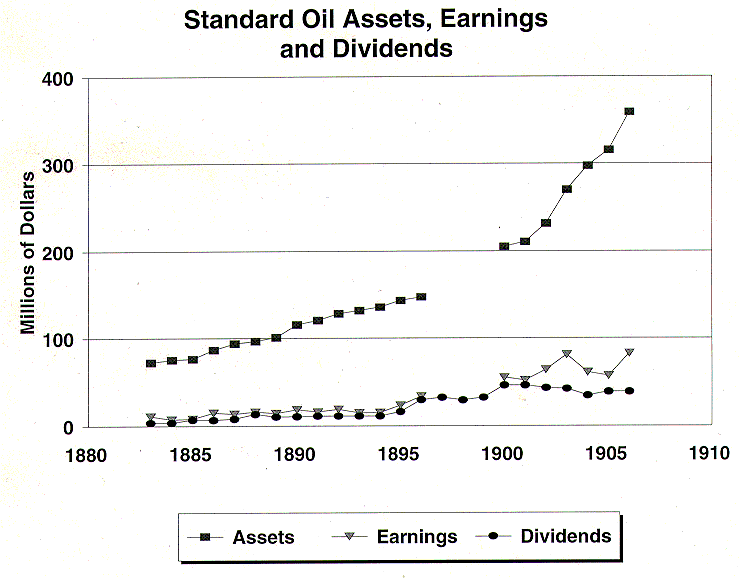
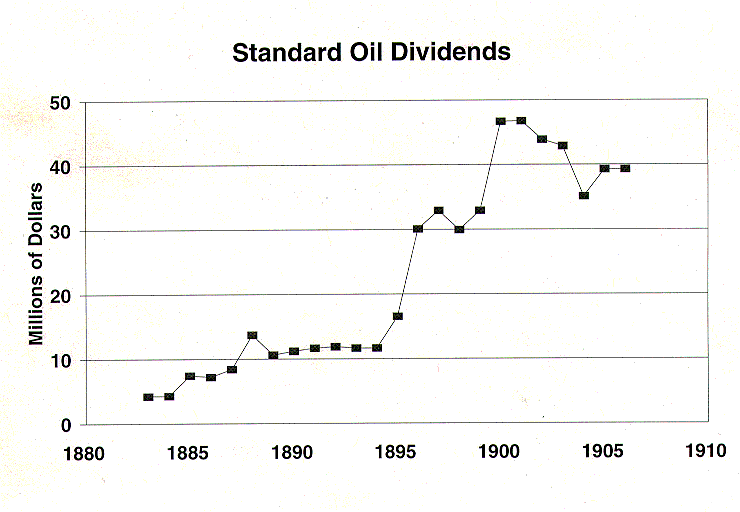
From 1882 to 1906, Standard paid out $548,436,000 in dividend
s at 65.4% payout ratio. As is common practice in business, a fraction of the profits was put back into the business, rather than being distributed to stockholders. The total net earnings from 1882 to 1906 amounted to $838,783,800, exceeding the dividends by $290,347,800. The latter amount was used for plant expansions.
 In 1897, John Rockefeller retired from the Standard Oil Company of New Jersey, the holding company of the group, but remained a major shareholder. Vice-president John Dustin Archbold
took a large part in the running of the firm. At the same time, state and federal laws sought to counter this development with "antitrust
" laws. In 1911, the US Justice Department sued the group under the federal antitrust law and ordered its breakup into 34 companies.
Standard Oil's market position was initially established through an emphasis on efficiency and responsibility. While most companies dumped gasoline
in rivers (this was before the automobile was popular), Standard used it to fuel its machines. While other companies' refineries piled mountains of heavy waste, Rockefeller found ways to sell it. For example, Standard created the first synthetic competitor for beeswax
and bought the company that invented and produced Vaseline
, the Chesebrough Manufacturing Company
, which was a Standard company only from 1908 until 1911.
One of the original "muckraker
s" was Ida M. Tarbell
, an American author and journalist. Her father was an oil producer whose business had failed due to Rockefeller's business dealings. After extensive interviews with a sympathetic senior executive of Standard Oil, Henry H. Rogers
, Tarbell's investigations of Standard Oil fueled growing public attacks on Standard Oil and on monopolies in general. Her work was published in 19 parts in McClure's
magazine from November 1902 to October 1904, then in 1904 as the book The History of the Standard Oil Company
.
The Standard Oil Trust was controlled by a small group of families. Rockefeller stated in 1910: "I think it is true that the Pratt family, the Payne-Whitney family
(which were one, as all the stock came from Colonel Payne), the Harkness-Flagler family (which came into the Company together) and the Rockefeller family
controlled a majority of the stock during all the history of the Company up to the present time".
These families reinvested most of the dividends in other industries, especially railroads. They also invested heavily in the gas and the electric lighting business (including the giant Consolidated Gas Company of New York City
). They made large purchases of stock in US Steel, Amalgamated Copper, and even Corn Products Refining Company.
Socony's North China Department operated a subsidiary called Socony River and Coastal Fleet, North Coast Division, which became the North China Division of Stanvac after that company was formed in 1933. To distribute its products, Standard Oil constructed storage tanks, canneries (bulk oil from large ocean tankers was re-packaged into 5-gallon tins), warehouses and offices in key Chinese cities. For inland distribution the Company had motor tank trucks and railway tank cars, and for river navigation it had a fleet of low draft steamers and other vessels.
Stanvac's North China Division, based in Shanghai, owned hundreds of river going vessels, including motor barges, steamers, launches, tugboats and tankers. Up to 13 tankers operated on the Yangtze River
, the largest of which were Mei Ping (1,118 gt), Mei Hsia (1,048 gt),and Mei An (934 gt). All three were destroyed in the 1937 USS Panay incident. Mei An was launched in 1901 and was the first vessel in the fleet. Other vessels included Mei Chuen, Mei Foo, Mei Hung, Mei Kiang, Mei Lu, Mei Tan, Mei Su, Mei Xia, Mei Ying, and Mei Yun. Mei Hsia, a tanker, was specially designed for river duty and was built by New Engineering and Shipbuilding Works of Shanghai, who also built the 500-ton launch Mei Foo in 1912. Mei Hsia ("Beautiful Gorges") was launched in 1926 and carried 350 tons of bulk oil in three holds, plus a forward cargo hold and space between decks for carrying general cargo or packed oil. She had a length of 206 feet (62.8 m), a beam of 32 feet (9.8 m), depth of 10 in 6 in (3.2 m) and had a bulletproof wheelhouse. Mei Ping ("Beautiful Tranquility") launched in 1927, was designed offshore but assembled and finished in Shanghai. Her oil fuel burners came from the U.S. and her water tube boilers came from England.
successfully sued Standard, compelling the dissolution of the trust in 1892. But Standard only separated off Standard Oil of Ohio and kept control of it. Eventually, the state of New Jersey
changed its incorporation laws to allow a company to hold shares in other companies in any state. So, in 1899, the Standard Oil Trust, based at 26 Broadway in New York, was legally reborn as a holding company
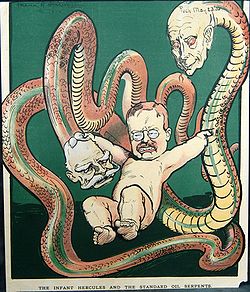
, the Standard Oil Company of New Jersey (SOCNJ), which held stock in 41 other companies, which controlled other companies, which in turn controlled yet other companies. This conglomerate was seen by the public as all-pervasive, controlled by a select group of directors, and completely unaccountable.
 In 1904, Standard controlled 91% of production and 85% of final sales. Most of its output was kerosene
, of which 55% was exported around the world. After 1900 it did not try to force competitors out of business by underpricing them. The federal Commissioner of Corporations studied Standard's operations from the period of 1904 to 1906 and concluded that "beyond question... the dominant position of the Standard Oil Company in the refining industry was due to unfair practices—to abuse of the control of pipe-lines, to railroad discriminations, and to unfair methods of competition in the sale of the refined petroleum products". Due to competition from other firms, their market share had gradually eroded to 70% by 1906 which was the year when the antitrust case was filed against Standard, and down to 64% by 1911 when Standard was ordered broken up and at least 147 refining companies were competing with Standard including Gulf, Texaco, and Shell. It did not try to monopolize the exploration and pumping of oil (its share in 1911 was 11%).
In 1909, the US Department of Justice sued Standard under federal anti-trust law, the Sherman Antitrust Act
of 1890, for sustaining a monopoly and restraining interstate commerce by:
The lawsuit argued that Standard's monopolistic practices took place in the last four years:
The government identified four illegal patterns: 1) secret and semi-secret railroad rates; (2) discriminations in the open arrangement of rates; (3) discriminations in classification and rules of shipment; (4) discriminations in the treatment of private tank cars. The government alleged:
The government said that Standard raised prices to its monopolistic customers but lowered them to hurt competitors, often disguising its illegal actions by using bogus supposedly independent companies it controlled.
On May 15, 1911, the US Supreme Court upheld the lower court judgment and declared the Standard Oil group to be an "unreasonable" monopoly
under the Sherman Antitrust Act
. It ordered Standard to break up into 34 independent companies with different boards of directors, the biggest two of the companies were Exxon
and Mobil
.
Standard's president, John Rockefeller, had long since retired from any management role. But, as he owned a quarter of the shares of the resultant companies, and those share values mostly doubled, he emerged from the dissolution as the richest man in the world.
at a climax, the Supreme Court of the United States
ruled that Standard Oil must be dissolved under the Sherman Antitrust Act
and split into 34 companies. Two of these companies were Jersey Standard ("Standard Oil Company
of New Jersey"), which eventually became Exxon
, and Socony ("Standard Oil Company of New York"), which eventually became Mobil
.
Over the next few decades, both companies grew significantly. Jersey Standard, led by Walter C. Teagle
, became the largest oil producer in the world. It acquired a 50 percent share in Humble Oil & Refining Co.
, a Texas
oil producer. Socony purchased a 45 percent interest in Magnolia Petroleum Co., a major refiner, marketer and pipeline transporter. In 1931, Socony merged with Vacuum Oil Co., an industry pioneer dating back to 1866, and a growing Standard Oil spin-off in its own right.
In the Asia-Pacific
region, Jersey Standard had oil production and refineries in Indonesia
but no marketing network. Socony-Vacuum had Asian marketing outlets supplied remotely from California. In 1933, Jersey Standard and Socony-Vacuum merged their interests in the region into a 50–50 joint venture. Standard-Vacuum Oil Co., or "Stanvac", operated in 50 countries, from East Africa
to New Zealand
, before it was dissolved in 1962.
Other Standard Oil breakup companies include "Standard Oil of Ohio" which became SOHIO, "Standard Oil of Indiana" which became Amoco
after other mergers and a name change in the 1980s, "Standard Oil of California" became the Chevron Corporation
.
and Chevron
. Some have speculated that if not for that court ruling, Standard Oil could have possibly been worth more than $1 trillion today.
Whether the breakup of Standard Oil was beneficial is a matter of some controversy.
Some economists believe that Standard Oil was not a monopoly, and also argue that the intense free market competition resulted in cheaper oil prices and more diverse petroleum products; in 1890, Rep. William Mason, arguing in favor of the Sherman Antitrust Act, said: "trusts have made products cheaper, have reduced prices; but if the price of oil, for instance, were reduced to one cent a barrel, it would not right the wrong done to people of this country by the trusts which have destroyed legitimate competition and driven honest men from legitimate business enterprise".
The Sherman Antitrust Act
prohibits the restraint of trade. Defenders of Standard Oil insist that the company did not restrain trade; they were simply superior competitors. The federal courts ruled otherwise.
Some economic historians have observed that Standard Oil was in the process of losing its monopoly at the time of its breakup in 1911. Although Standard had 90% of American refining capacity in 1880, by 1911 that had shrunk to between 60 and 65%, due to the expansion in capacity by competitors. Numerous regional competitors (such as Pure Oil
in the East, Texaco
and Gulf Oil
in the Gulf Coast, Cities Service and Sun in the Midcontinent, Union in California, and Shell
overseas) had organized themselves into competitive vertically integrated oil companies, the industry structure pioneered years earlier by Standard itself. In addition, demand for petroleum products was increasing more rapidly than the ability of Standard to expand. The result was that although in 1911 Standard still controlled most production in the older US regions of the Appalachian Basin (78% share, down from 92% in 1880), Lima-Indiana (90%, down from 95% in 1906), and the Illinois Basin
(83%, down from 100% in 1906), its share was much lower in the rapidly expanding new regions that would dominate US oil production in the 20th century. In 1911 Standard controlled only 44% of production in the Midcontinent, 29% in California, and 10% on the Gulf Coast.
Some analysts argue that the breakup was beneficial to consumers in the long run, and no one has ever proposed that Standard Oil be reassembled in pre-1911 form. ExxonMobil
, however, does represent a substantial part of the original company.
who dominated the industry worldwide for much of the twentieth century.) They include:
Other Standard Oil spin-offs:
Other companies divested in the 1911 breakup:
Note: Standard Oil of Colorado
was not a successor company; the name was used to capitalize on the Standard Oil brand in the 1930s. Standard Oil of Connecticut is a fuel oil marketer not related to the Rockefeller companies.
elected to use their respective names instead of the Standard name, and their rights would be claimed by other companies.
By the 1980s, most companies were using their individual brand names instead of the Standard name, with Amoco being the last one to have widespread use of the "Standard" name, as it gave Midwestern owners the option of using the Amoco name or Standard.
Currently, three supermajor
companies own the rights to the Standard name in the United States: ExxonMobil
, Chevron Corporation
, and BP
. BP acquired its rights through acquiring Standard Oil of Ohio
and Amoco
, and has a small handful of stations in the Midwestern United States
using the Standard name. Chevron has one station in each state it owns the rights to branded as Standard except in Kentucky
, which it withdrew from in July 2010. ExxonMobil keeps the Esso
trademark alive at stations that sell diesel fuel by selling "Esso Diesel" displayed on the pumps. ExxonMobil has full international rights to the Standard name, and continues to use the Esso name overseas.
United States
The United States of America is a federal constitutional republic comprising fifty states and a federal district...
integrated oil
Petroleum
Petroleum or crude oil is a naturally occurring, flammable liquid consisting of a complex mixture of hydrocarbons of various molecular weights and other liquid organic compounds, that are found in geologic formations beneath the Earth's surface. Petroleum is recovered mostly through oil drilling...
producing, transporting, refining, and marketing company. Established in 1870 as a corporation
Corporation
A corporation is created under the laws of a state as a separate legal entity that has privileges and liabilities that are distinct from those of its members. There are many different forms of corporations, most of which are used to conduct business. Early corporations were established by charter...
in Ohio
Ohio
Ohio is a Midwestern state in the United States. The 34th largest state by area in the U.S.,it is the 7th‑most populous with over 11.5 million residents, containing several major American cities and seven metropolitan areas with populations of 500,000 or more.The state's capital is Columbus...
, it was the largest oil refiner in the world and operated as a major company trust and was one of the world's first and largest multinational corporation
Multinational corporation
A multi national corporation or enterprise , is a corporation or an enterprise that manages production or delivers services in more than one country. It can also be referred to as an international corporation...
s until it was broken up by the United States
United States
The United States of America is a federal constitutional republic comprising fifty states and a federal district...
Supreme Court
Supreme Court of the United States
The Supreme Court of the United States is the highest court in the United States. It has ultimate appellate jurisdiction over all state and federal courts, and original jurisdiction over a small range of cases...
in 1911.
John D. Rockefeller
John D. Rockefeller
John Davison Rockefeller was an American oil industrialist, investor, and philanthropist. He was the founder of the Standard Oil Company, which dominated the oil industry and was the first great U.S. business trust. Rockefeller revolutionized the petroleum industry and defined the structure of...
was a founder, chairman and major shareholder. As it grew exponentially and engaged in business strategies, tactics and practices that were lawful but drove many smaller businesses under, Standard Oil became widely criticized in the public eye, even as it made Rockefeller the richest man in modern history. Other notable Standard Oil principals include Henry Flagler, developer of Florida
Florida
Florida is a state in the southeastern United States, located on the nation's Atlantic and Gulf coasts. It is bordered to the west by the Gulf of Mexico, to the north by Alabama and Georgia and to the east by the Atlantic Ocean. With a population of 18,801,310 as measured by the 2010 census, it...
's Florida East Coast Railway
Florida East Coast Railway
The Florida East Coast Railway is a Class II railroad operating in the U.S. state of Florida; in the past, it has been a Class I railroad.Built primarily in the last quarter of the 19th century and the first decade of the 20th century, the FEC was a project of Standard Oil principal Henry Morrison...
and resort cities, and Henry H. Rogers
Henry H. Rogers
Henry Huttleston Rogers was a United States capitalist, businessman, industrialist, financier, and philanthropist. He made his fortune in the oil refinery business, becoming a leader at Standard Oil....
, who built the Virginian Railway
Virginian Railway
The Virginian Railway was a Class I railroad located in Virginia and West Virginia in the United States. The VGN was created to transport high quality "smokeless" bituminous coal from southern West Virginia to port at Hampton Roads....
(VGN), a well-engineered highly efficient line dedicated to shipping southern West Virginia
West Virginia
West Virginia is a state in the Appalachian and Southeastern regions of the United States, bordered by Virginia to the southeast, Kentucky to the southwest, Ohio to the northwest, Pennsylvania to the northeast and Maryland to the east...
's bituminous coal
Bituminous coal
Bituminous coal or black coal is a relatively soft coal containing a tarlike substance called bitumen. It is of higher quality than lignite coal but of poorer quality than Anthracite...
to port at Hampton Roads
Hampton Roads
Hampton Roads is the name for both a body of water and the Norfolk–Virginia Beach metropolitan area which surrounds it in southeastern Virginia, United States...
.
Early years
Standard Oil began as an OhioOhio
Ohio is a Midwestern state in the United States. The 34th largest state by area in the U.S.,it is the 7th‑most populous with over 11.5 million residents, containing several major American cities and seven metropolitan areas with populations of 500,000 or more.The state's capital is Columbus...
partnership formed by the well-known industrialist John D. Rockefeller
John D. Rockefeller
John Davison Rockefeller was an American oil industrialist, investor, and philanthropist. He was the founder of the Standard Oil Company, which dominated the oil industry and was the first great U.S. business trust. Rockefeller revolutionized the petroleum industry and defined the structure of...
, his brother William Rockefeller
William Rockefeller
William Avery Rockefeller, Jr. , American financier, was a co-founder with his older brother John D. Rockefeller of the prominent United States Rockefeller family. He was the son of William Avery Rockefeller, Sr. and Eliza Rockefeller.-Youth, education:Rockefeller was born in Richford, New York,...
, Henry Flagler, chemist Samuel Andrews, silent partner
Silent partner
Silent partner may refer to:*An anonymous member of a business partnership, or one uninvolved in management*The Silent Partner, the name of several films*Silent partner , a piece of climbing equipment...
Stephen V. Harkness
Stephen V. Harkness
Stephen Vanderburgh Harkness was an American businessman from Cleveland, Ohio, who invested as a silent partner with oil titan John D. Rockefeller, Sr. in the founding of Standard Oil.-Biography:...
, and Oliver Burr Jennings
Oliver Burr Jennings
Oliver Burr Jennings was an American businessman and one of the original stockholders in Standard Oil.-Early life and family:...
, who had married the sister of William Rockefeller's wife. In 1870 Rockefeller incorporated Standard Oil in Ohio. Of the initial 10,000 shares, John D. Rockefeller received 2,667; Harkness received 1,334; William Rockefeller, Flagler, and Andrews received 1,333 each; Jennings received 1,000; and the firm of Rockefeller, Andrews & Flagler
Rockefeller, Andrews & Flagler
Rockefeller, Andrews & Flagler was a business concern formed in 1867 in Cleveland, Ohio which was a predecessor of the Standard Oil Company. The principals and namesakes were John D. Rockefeller, William Rockefeller, Samuel Andrews, and Henry M. Flagler. Flagler’s wife’s uncle, Stephen V...
received 1,000. Using highly effective tactics, later widely criticized, it absorbed or destroyed most of its competition in Cleveland in less than two months in 1872 and later throughout the northeastern United States.
In the early years, John D. Rockefeller dominated the combine, for he was the single most important figure in shaping the new oil industry. He quickly distributed power and the tasks of policy formation to a system of committees, but always remained the largest shareholder
Shareholder
A shareholder or stockholder is an individual or institution that legally owns one or more shares of stock in a public or private corporation. Shareholders own the stock, but not the corporation itself ....
. Authority was centralized in the company's main office in Cleveland, but decisions in the office were made in a cooperative way.
In response to state laws trying to limit the scale of companies, Rockefeller and his associates developed innovative ways of organizing, to effectively manage their fast growing enterprise. In 1882, they combined their disparate companies, spread across dozens of states, under a single group of trustees. By a secret agreement, the existing thirty-seven stockholders conveyed their shares "in trust" to nine Trustees: John and William Rockefeller, Oliver H. Payne
Oliver Hazard Payne
Oliver Hazard Payne was an American businessman, organizer of the American Tobacco trust, and assisted with the formation of U.S. Steel, and was affiliated with Standard Oil. He is considered one of the 100 wealthiest Americans, having left an enormous fortune. His estate at Esopus, New York,...
, Charles Pratt
Charles Pratt
Charles Pratt was a United States capitalist, businessman and philanthropist.Pratt was a pioneer of the U.S. petroleum industry, and established his kerosene refinery Astral Oil Works in Brooklyn, New York. An advertising slogan was "The holy lamps of Tibet are primed with Astral Oil." He...
, Henry Flagler, John D. Archbold, William G. Warden, Jabez Bostwick
Jabez A. Bostwick
Jabez Abel Bostwick was an American businessman who was a founding partner of Standard Oil.-Biography:...
, and Benjamin Brewster
Benjamin Brewster (financier)
Benjamin Brewster was an American industrialist, financier, and one of the original trustees of Standard Oil.-Early life:...
. This organization proved so successful that other giant enterprises adopted this "trust" form.
In 1872, Rockefeller joined the South Improvement Company
South Improvement Company
The South Improvement Company was a Pennsylvania corporation in 1871-1872. It was created by major railroad interests, but was widely seen as part of John D. Rockefeller's early efforts to organize and control the oil and natural gas industries in the United States which eventually became Standard...
which would have allowed him to receive rebates for shipping and receive drawbacks on oil his competitors shipped. But when this deal became known, competitors convinced the Pennsylvania Legislature to revoke South Improvement's charter. No oil was ever shipped under this arrangement.
Standard's actions and secret transport deals helped its kerosene
Kerosene
Kerosene, sometimes spelled kerosine in scientific and industrial usage, also known as paraffin or paraffin oil in the United Kingdom, Hong Kong, Ireland and South Africa, is a combustible hydrocarbon liquid. The name is derived from Greek keros...
price to drop from 58 to 26 cents from 1865 to 1870. Competitors disliked the company's business practices, but consumers liked the lower prices. Standard Oil, being formed well before the discovery of the Spindletop
Spindletop
Spindletop is a salt dome oil field located in the southern portion of Beaumont, Texas in the United States. The Spindletop dome was derived from the Louann Salt evaporite layer of the Jurassic geologic period. On January 10, 1901, a well at Spindletop struck oil . The new oil field soon produced...
oil field and a demand for oil other than for heat and light, was well placed to control the growth of the oil business. The company was perceived to own and control all aspects of the trade.
In 1885, Standard Oil of Ohio
Standard Oil of Ohio
Standard Oil of Ohio or Sohio was an American oil company that was acquired by British Petroleum, now called BP.It was one of the successor companies to Standard Oil after the antitrust breakup in 1911. Standard Oil of Ohio was the original Standard Oil company founded by John D. Rockefeller. It...
moved its headquarters from Cleveland to its permanent headquarters at 26 Broadway
26 Broadway
26 Broadway is a 31-story, 159 m, 520 ft New York City Designated Landmark at the southern tip of Manhattan at Bowling Green...
in New York City
New York City
New York is the most populous city in the United States and the center of the New York Metropolitan Area, one of the most populous metropolitan areas in the world. New York exerts a significant impact upon global commerce, finance, media, art, fashion, research, technology, education, and...
. Concurrently, the trustees of Standard Oil of Ohio chartered the Standard Oil Company of New Jersey (SOCNJ) to take advantages of New Jersey's more lenient corporate stock ownership laws.
Also in 1890, Congress passed the Sherman Antitrust Act
Sherman Antitrust Act
The Sherman Antitrust Act requires the United States federal government to investigate and pursue trusts, companies, and organizations suspected of violating the Act. It was the first Federal statute to limit cartels and monopolies, and today still forms the basis for most antitrust litigation by...
— the source of all American anti-monopoly laws. The law forbade every contract, scheme, deal, or conspiracy to restrain trade, though the phrase "restraint of trade" remained subjective. The Standard Oil group quickly attracted attention from antitrust
Antitrust
The United States antitrust law is a body of laws that prohibits anti-competitive behavior and unfair business practices. Antitrust laws are intended to encourage competition in the marketplace. These competition laws make illegal certain practices deemed to hurt businesses or consumers or both,...
authorities leading to a lawsuit filed by Ohio Attorney General David K. Watson.
From 1882 to 1906, Standard paid out $548,436,000 in dividend
Dividend
Dividends are payments made by a corporation to its shareholder members. It is the portion of corporate profits paid out to stockholders. When a corporation earns a profit or surplus, that money can be put to two uses: it can either be re-invested in the business , or it can be distributed to...
s at 65.4% payout ratio. As is common practice in business, a fraction of the profits was put back into the business, rather than being distributed to stockholders. The total net earnings from 1882 to 1906 amounted to $838,783,800, exceeding the dividends by $290,347,800. The latter amount was used for plant expansions.
1895–1911
John Dustin Archbold
John Dustin Archbold was an American capitalist and one of the United States' earliest oil refiners. He was the grandfather of zoologist Richard Archbold.-Biography:...
took a large part in the running of the firm. At the same time, state and federal laws sought to counter this development with "antitrust
Antitrust
The United States antitrust law is a body of laws that prohibits anti-competitive behavior and unfair business practices. Antitrust laws are intended to encourage competition in the marketplace. These competition laws make illegal certain practices deemed to hurt businesses or consumers or both,...
" laws. In 1911, the US Justice Department sued the group under the federal antitrust law and ordered its breakup into 34 companies.
Standard Oil's market position was initially established through an emphasis on efficiency and responsibility. While most companies dumped gasoline
Gasoline
Gasoline , or petrol , is a toxic, translucent, petroleum-derived liquid that is primarily used as a fuel in internal combustion engines. It consists mostly of organic compounds obtained by the fractional distillation of petroleum, enhanced with a variety of additives. Some gasolines also contain...
in rivers (this was before the automobile was popular), Standard used it to fuel its machines. While other companies' refineries piled mountains of heavy waste, Rockefeller found ways to sell it. For example, Standard created the first synthetic competitor for beeswax
Beeswax
Beeswax is a natural wax produced in the bee hive of honey bees of the genus Apis. It is mainly esters of fatty acids and various long chain alcohols...
and bought the company that invented and produced Vaseline
Vaseline
Vaseline is a brand of petroleum jelly based products owned by Anglo-Dutch company Unilever. Products include plain petroleum jelly and a selection of skin creams, soaps, lotions, cleansers, deodorants and personal lubricants....
, the Chesebrough Manufacturing Company
Chesebrough Manufacturing Company
Chesebrough Manufacturing Company was an oil business which produced petroleum jelly or vaseline, which was marketed with the brand name Luxor. It was founded in 1859. Robert Augustus Chesebrough, a chemist who started the company, was interested in marketing oil products for medicinal needs. He...
, which was a Standard company only from 1908 until 1911.
One of the original "muckraker
Muckraker
The term muckraker is closely associated with reform-oriented journalists who wrote largely for popular magazines, continued a tradition of investigative journalism reporting, and emerged in the United States after 1900 and continued to be influential until World War I, when through a combination...
s" was Ida M. Tarbell
Ida M. Tarbell
Ida Minerva Tarbell was an American teacher, author and journalist. She was known as one of the leading "muckrakers" of the progressive era, work known in modern times as "investigative journalism". She wrote many notable magazine series and biographies...
, an American author and journalist. Her father was an oil producer whose business had failed due to Rockefeller's business dealings. After extensive interviews with a sympathetic senior executive of Standard Oil, Henry H. Rogers
Henry H. Rogers
Henry Huttleston Rogers was a United States capitalist, businessman, industrialist, financier, and philanthropist. He made his fortune in the oil refinery business, becoming a leader at Standard Oil....
, Tarbell's investigations of Standard Oil fueled growing public attacks on Standard Oil and on monopolies in general. Her work was published in 19 parts in McClure's
McClure's
McClure's or McClure's Magazine was an American illustrated monthly periodical popular at the turn of the 20th century. The magazine is credited with creating muckraking journalism. Ida Tarbell's series in 1902 exposing the monopoly abuses of John D...
magazine from November 1902 to October 1904, then in 1904 as the book The History of the Standard Oil Company
The History of the Standard Oil Company
The History of the Standard Oil Company is a book written by journalist Ida Tarbell in 1904. It was an exposé of the Standard Oil Company, run at that time by oil tycoon John D. Rockefeller, the richest figure in America's history...
.
The Standard Oil Trust was controlled by a small group of families. Rockefeller stated in 1910: "I think it is true that the Pratt family, the Payne-Whitney family
Whitney family
The Whitney family is an American family notable for their social prominence, wealth, business enterprises and philanthropy, founded by John Whitney who came from London, England to Watertown, Massachusetts in 1635.-Rise to prominence:...
(which were one, as all the stock came from Colonel Payne), the Harkness-Flagler family (which came into the Company together) and the Rockefeller family
Rockefeller family
The Rockefeller family , the Cleveland family of John D. Rockefeller and his brother William Rockefeller , is an American industrial, banking, and political family of German origin that made one of the world's largest private fortunes in the oil business during the late 19th and early 20th...
controlled a majority of the stock during all the history of the Company up to the present time".
These families reinvested most of the dividends in other industries, especially railroads. They also invested heavily in the gas and the electric lighting business (including the giant Consolidated Gas Company of New York City
Consolidated Edison
Consolidated Edison, Inc. is one of the largest investor-owned energy companies in the United States, with approximately $14 billion in annual revenues and $36 billion in assets...
). They made large purchases of stock in US Steel, Amalgamated Copper, and even Corn Products Refining Company.
Standard Oil In China
Standard Oil's production increased so rapidly it soon exceeded US demand and the company began viewing export markets. In the 1890s, Standard Oil began marketing kerosene to China's large population of close to 400 million as lamp fuel. For its Chinese trademark and brand Standard Oil adopted the name "Mei Foo", translating roughly as beautiful and trustworthy or beautiful confidence. Mei Foo also became the name of the tin lamp that Standard Oil produced and gave away or sold cheaply to Chinese peasants, encouraging them to switch from vegetable oil to kerosene. Response was positive, sales boomed and China became Standard Oil's largest market in Asia. Prior to Pearl Harbor, Stanvac was the largest single US investment in SE Asia.Socony's North China Department operated a subsidiary called Socony River and Coastal Fleet, North Coast Division, which became the North China Division of Stanvac after that company was formed in 1933. To distribute its products, Standard Oil constructed storage tanks, canneries (bulk oil from large ocean tankers was re-packaged into 5-gallon tins), warehouses and offices in key Chinese cities. For inland distribution the Company had motor tank trucks and railway tank cars, and for river navigation it had a fleet of low draft steamers and other vessels.
Stanvac's North China Division, based in Shanghai, owned hundreds of river going vessels, including motor barges, steamers, launches, tugboats and tankers. Up to 13 tankers operated on the Yangtze River
Yangtze River
The Yangtze, Yangzi or Cháng Jiāng is the longest river in Asia, and the third-longest in the world. It flows for from the glaciers on the Tibetan Plateau in Qinghai eastward across southwest, central and eastern China before emptying into the East China Sea at Shanghai. It is also one of the...
, the largest of which were Mei Ping (1,118 gt), Mei Hsia (1,048 gt),and Mei An (934 gt). All three were destroyed in the 1937 USS Panay incident. Mei An was launched in 1901 and was the first vessel in the fleet. Other vessels included Mei Chuen, Mei Foo, Mei Hung, Mei Kiang, Mei Lu, Mei Tan, Mei Su, Mei Xia, Mei Ying, and Mei Yun. Mei Hsia, a tanker, was specially designed for river duty and was built by New Engineering and Shipbuilding Works of Shanghai, who also built the 500-ton launch Mei Foo in 1912. Mei Hsia ("Beautiful Gorges") was launched in 1926 and carried 350 tons of bulk oil in three holds, plus a forward cargo hold and space between decks for carrying general cargo or packed oil. She had a length of 206 feet (62.8 m), a beam of 32 feet (9.8 m), depth of 10 in 6 in (3.2 m) and had a bulletproof wheelhouse. Mei Ping ("Beautiful Tranquility") launched in 1927, was designed offshore but assembled and finished in Shanghai. Her oil fuel burners came from the U.S. and her water tube boilers came from England.
Monopoly charges and anti-trust litigation
By 1890, Standard Oil controlled 88% of the refined oil flows in the United States. The state of OhioOhio
Ohio is a Midwestern state in the United States. The 34th largest state by area in the U.S.,it is the 7th‑most populous with over 11.5 million residents, containing several major American cities and seven metropolitan areas with populations of 500,000 or more.The state's capital is Columbus...
successfully sued Standard, compelling the dissolution of the trust in 1892. But Standard only separated off Standard Oil of Ohio and kept control of it. Eventually, the state of New Jersey
New Jersey
New Jersey is a state in the Northeastern and Middle Atlantic regions of the United States. , its population was 8,791,894. It is bordered on the north and east by the state of New York, on the southeast and south by the Atlantic Ocean, on the west by Pennsylvania and on the southwest by Delaware...
changed its incorporation laws to allow a company to hold shares in other companies in any state. So, in 1899, the Standard Oil Trust, based at 26 Broadway in New York, was legally reborn as a holding company
Holding company
A holding company is a company or firm that owns other companies' outstanding stock. It usually refers to a company which does not produce goods or services itself; rather, its purpose is to own shares of other companies. Holding companies allow the reduction of risk for the owners and can allow...
, the Standard Oil Company of New Jersey (SOCNJ), which held stock in 41 other companies, which controlled other companies, which in turn controlled yet other companies. This conglomerate was seen by the public as all-pervasive, controlled by a select group of directors, and completely unaccountable.
Kerosene
Kerosene, sometimes spelled kerosine in scientific and industrial usage, also known as paraffin or paraffin oil in the United Kingdom, Hong Kong, Ireland and South Africa, is a combustible hydrocarbon liquid. The name is derived from Greek keros...
, of which 55% was exported around the world. After 1900 it did not try to force competitors out of business by underpricing them. The federal Commissioner of Corporations studied Standard's operations from the period of 1904 to 1906 and concluded that "beyond question... the dominant position of the Standard Oil Company in the refining industry was due to unfair practices—to abuse of the control of pipe-lines, to railroad discriminations, and to unfair methods of competition in the sale of the refined petroleum products". Due to competition from other firms, their market share had gradually eroded to 70% by 1906 which was the year when the antitrust case was filed against Standard, and down to 64% by 1911 when Standard was ordered broken up and at least 147 refining companies were competing with Standard including Gulf, Texaco, and Shell. It did not try to monopolize the exploration and pumping of oil (its share in 1911 was 11%).
In 1909, the US Department of Justice sued Standard under federal anti-trust law, the Sherman Antitrust Act
Sherman Antitrust Act
The Sherman Antitrust Act requires the United States federal government to investigate and pursue trusts, companies, and organizations suspected of violating the Act. It was the first Federal statute to limit cartels and monopolies, and today still forms the basis for most antitrust litigation by...
of 1890, for sustaining a monopoly and restraining interstate commerce by:
"Rebates, preferences, and other discriminatory practices in favor of the combination by railroad companies; restraint and monopolization by control of pipe lines, and unfair practices against competing pipe lines; contracts with competitors in restraint of trade; unfair methods of competition, such as local price cutting at the points where necessary to suppress competition; [and] espionage of the business of competitors, the operation of bogus independent companies, and payment of rebates on oil, with the like intent."
The lawsuit argued that Standard's monopolistic practices took place in the last four years:
"The general result of the investigation has been to disclose the existence of numerous and flagrant discriminations by the railroads in behalf of the Standard Oil Company and its affiliated corporations. With comparatively few exceptions, mainly of other large concerns in California, the Standard has been the sole beneficiary of such discriminations. In almost every section of the country that company has been found to enjoy some unfair advantages over its competitors, and some of these discriminations affect enormous areas."
The government identified four illegal patterns: 1) secret and semi-secret railroad rates; (2) discriminations in the open arrangement of rates; (3) discriminations in classification and rules of shipment; (4) discriminations in the treatment of private tank cars. The government alleged:
"Almost everywhere the rates from the shipping points used exclusively, or almost exclusively, by the Standard are relatively lower than the rates from the shipping points of its competitors. Rates have been made low to let the Standard into markets, or they have been made high to keep its competitors out of markets. Trifling differences in distances are made an excuse for large differences in rates favorable to the Standard Oil Company, while large differences in distances are ignored where they are against the Standard. Sometimes connecting roads prorate on oil—that is, make through rates which are lower than the combination of local rates; sometimes they refuse to prorate; but in either case the result of their policy is to favor the Standard Oil Company. Different methods are used in different places and under different conditions, but the net result is that from Maine to California the general arrangement of open rates on petroleum oil is such as to give the Standard an unreasonable advantage over its competitors"
The government said that Standard raised prices to its monopolistic customers but lowered them to hurt competitors, often disguising its illegal actions by using bogus supposedly independent companies it controlled.
"The evidence is, in fact, absolutely conclusive that the Standard Oil Company charges altogether excessive prices where it meets no competition, and particularly where there is little likelihood of competitors entering the field, and that, on the other hand, where competition is active, it frequently cuts prices to a point which leaves even the Standard little or no profit, and which more often leaves no profit to the competitor, whose costs are ordinarily somewhat higher."
On May 15, 1911, the US Supreme Court upheld the lower court judgment and declared the Standard Oil group to be an "unreasonable" monopoly
Monopoly
A monopoly exists when a specific person or enterprise is the only supplier of a particular commodity...
under the Sherman Antitrust Act
Sherman Antitrust Act
The Sherman Antitrust Act requires the United States federal government to investigate and pursue trusts, companies, and organizations suspected of violating the Act. It was the first Federal statute to limit cartels and monopolies, and today still forms the basis for most antitrust litigation by...
. It ordered Standard to break up into 34 independent companies with different boards of directors, the biggest two of the companies were Exxon
Exxon
Exxon is a chain of gas stations as well as a brand of motor fuel and related products by ExxonMobil. From 1972 to 1999, Exxon was the corporate name of the company previously known as Standard Oil Company of New Jersey or Jersey Standard....
and Mobil
Mobil
Mobil, previously known as the Socony-Vacuum Oil Company, was a major American oil company which merged with Exxon in 1999 to form ExxonMobil. Today Mobil continues as a major brand name within the combined company, as well as still being a gas station sometimes paired with their own store or On...
.
Standard's president, John Rockefeller, had long since retired from any management role. But, as he owned a quarter of the shares of the resultant companies, and those share values mostly doubled, he emerged from the dissolution as the richest man in the world.
Breakup
By 1911, with public outcryMoral panic
A moral panic is the intensity of feeling expressed in a population about an issue that appears to threaten the social order. According to Stanley Cohen, author of Folk Devils and Moral Panics and credited creator of the term, a moral panic occurs when "[a] condition, episode, person or group of...
at a climax, the Supreme Court of the United States
Supreme Court of the United States
The Supreme Court of the United States is the highest court in the United States. It has ultimate appellate jurisdiction over all state and federal courts, and original jurisdiction over a small range of cases...
ruled that Standard Oil must be dissolved under the Sherman Antitrust Act
Sherman Antitrust Act
The Sherman Antitrust Act requires the United States federal government to investigate and pursue trusts, companies, and organizations suspected of violating the Act. It was the first Federal statute to limit cartels and monopolies, and today still forms the basis for most antitrust litigation by...
and split into 34 companies. Two of these companies were Jersey Standard ("Standard Oil Company
Petroleum industry
The petroleum industry includes the global processes of exploration, extraction, refining, transporting , and marketing petroleum products. The largest volume products of the industry are fuel oil and gasoline...
of New Jersey"), which eventually became Exxon
Exxon
Exxon is a chain of gas stations as well as a brand of motor fuel and related products by ExxonMobil. From 1972 to 1999, Exxon was the corporate name of the company previously known as Standard Oil Company of New Jersey or Jersey Standard....
, and Socony ("Standard Oil Company of New York"), which eventually became Mobil
Mobil
Mobil, previously known as the Socony-Vacuum Oil Company, was a major American oil company which merged with Exxon in 1999 to form ExxonMobil. Today Mobil continues as a major brand name within the combined company, as well as still being a gas station sometimes paired with their own store or On...
.
Over the next few decades, both companies grew significantly. Jersey Standard, led by Walter C. Teagle
Walter C. Teagle
Walter Clark Teagle , was responsible for leading Standard Oil to the forefront of the oil industry and significantly expanding the company's presence in the petrochemical field.-Biography:...
, became the largest oil producer in the world. It acquired a 50 percent share in Humble Oil & Refining Co.
Humble Oil
Humble Oil and Refining Co. was founded in 1911. The company would later consolidate with Standard Oil of New Jersey to become Exxon.-Early history:...
, a Texas
Texas
Texas is the second largest U.S. state by both area and population, and the largest state by area in the contiguous United States.The name, based on the Caddo word "Tejas" meaning "friends" or "allies", was applied by the Spanish to the Caddo themselves and to the region of their settlement in...
oil producer. Socony purchased a 45 percent interest in Magnolia Petroleum Co., a major refiner, marketer and pipeline transporter. In 1931, Socony merged with Vacuum Oil Co., an industry pioneer dating back to 1866, and a growing Standard Oil spin-off in its own right.
In the Asia-Pacific
Asia-Pacific
Asia-Pacific or Asia Pacific is the part of the world in or near the Western Pacific Ocean...
region, Jersey Standard had oil production and refineries in Indonesia
Indonesia
Indonesia , officially the Republic of Indonesia , is a country in Southeast Asia and Oceania. Indonesia is an archipelago comprising approximately 13,000 islands. It has 33 provinces with over 238 million people, and is the world's fourth most populous country. Indonesia is a republic, with an...
but no marketing network. Socony-Vacuum had Asian marketing outlets supplied remotely from California. In 1933, Jersey Standard and Socony-Vacuum merged their interests in the region into a 50–50 joint venture. Standard-Vacuum Oil Co., or "Stanvac", operated in 50 countries, from East Africa
East Africa
East Africa or Eastern Africa is the easterly region of the African continent, variably defined by geography or geopolitics. In the UN scheme of geographic regions, 19 territories constitute Eastern Africa:...
to New Zealand
New Zealand
New Zealand is an island country in the south-western Pacific Ocean comprising two main landmasses and numerous smaller islands. The country is situated some east of Australia across the Tasman Sea, and roughly south of the Pacific island nations of New Caledonia, Fiji, and Tonga...
, before it was dissolved in 1962.
Other Standard Oil breakup companies include "Standard Oil of Ohio" which became SOHIO, "Standard Oil of Indiana" which became Amoco
Amoco
Amoco Corporation, originally Standard Oil Company , was a global chemical and oil company, founded in 1889 around a refinery located in Whiting, Indiana, United States....
after other mergers and a name change in the 1980s, "Standard Oil of California" became the Chevron Corporation
Chevron Corporation
Chevron Corporation is an American multinational energy corporation headquartered in San Ramon, California, United States and active in more than 180 countries. It is engaged in every aspect of the oil, gas, and geothermal energy industries, including exploration and production; refining,...
.
Legacy and criticism of breakup
The U.S. Supreme Court ruled in 1911 that antitrust law required Standard Oil to be broken into smaller, independent companies. Among the "baby Standards" that still exist are ExxonMobilExxonMobil
Exxon Mobil Corporation or ExxonMobil, is an American multinational oil and gas corporation. It is a direct descendant of John D. Rockefeller's Standard Oil company, and was formed on November 30, 1999, by the merger of Exxon and Mobil. Its headquarters are in Irving, Texas...
and Chevron
Chevron Corporation
Chevron Corporation is an American multinational energy corporation headquartered in San Ramon, California, United States and active in more than 180 countries. It is engaged in every aspect of the oil, gas, and geothermal energy industries, including exploration and production; refining,...
. Some have speculated that if not for that court ruling, Standard Oil could have possibly been worth more than $1 trillion today.
Whether the breakup of Standard Oil was beneficial is a matter of some controversy.
Some economists believe that Standard Oil was not a monopoly, and also argue that the intense free market competition resulted in cheaper oil prices and more diverse petroleum products; in 1890, Rep. William Mason, arguing in favor of the Sherman Antitrust Act, said: "trusts have made products cheaper, have reduced prices; but if the price of oil, for instance, were reduced to one cent a barrel, it would not right the wrong done to people of this country by the trusts which have destroyed legitimate competition and driven honest men from legitimate business enterprise".
The Sherman Antitrust Act
Sherman Antitrust Act
The Sherman Antitrust Act requires the United States federal government to investigate and pursue trusts, companies, and organizations suspected of violating the Act. It was the first Federal statute to limit cartels and monopolies, and today still forms the basis for most antitrust litigation by...
prohibits the restraint of trade. Defenders of Standard Oil insist that the company did not restrain trade; they were simply superior competitors. The federal courts ruled otherwise.
Some economic historians have observed that Standard Oil was in the process of losing its monopoly at the time of its breakup in 1911. Although Standard had 90% of American refining capacity in 1880, by 1911 that had shrunk to between 60 and 65%, due to the expansion in capacity by competitors. Numerous regional competitors (such as Pure Oil
Pure Oil
Pure Oil Company was an American petroleum company founded in 1914 and sold to what is now Union Oil Company of California in 1965. The Pure Oil name returned in 1993 as a cooperative which has grown to supply 350 members in 10 Southern states.-History:Three companies operating in the United...
in the East, Texaco
Texaco
Texaco is the name of an American oil retail brand. Its flagship product is its fuel "Texaco with Techron". It also owns the Havoline motor oil brand....
and Gulf Oil
Gulf Oil
Gulf Oil was a major global oil company from the 1900s to the 1980s. The eighth-largest American manufacturing company in 1941 and the ninth-largest in 1979, Gulf Oil was one of the so-called Seven Sisters oil companies...
in the Gulf Coast, Cities Service and Sun in the Midcontinent, Union in California, and Shell
Royal Dutch Shell
Royal Dutch Shell plc , commonly known as Shell, is a global oil and gas company headquartered in The Hague, Netherlands and with its registered office in London, United Kingdom. It is the fifth-largest company in the world according to a composite measure by Forbes magazine and one of the six...
overseas) had organized themselves into competitive vertically integrated oil companies, the industry structure pioneered years earlier by Standard itself. In addition, demand for petroleum products was increasing more rapidly than the ability of Standard to expand. The result was that although in 1911 Standard still controlled most production in the older US regions of the Appalachian Basin (78% share, down from 92% in 1880), Lima-Indiana (90%, down from 95% in 1906), and the Illinois Basin
Illinois Basin
The Illinois Basin is a Paleozoic depositional and structural basin in the United States, centered in and underlying most of the state of Illinois, and extending into southwestern Indiana and western Kentucky...
(83%, down from 100% in 1906), its share was much lower in the rapidly expanding new regions that would dominate US oil production in the 20th century. In 1911 Standard controlled only 44% of production in the Midcontinent, 29% in California, and 10% on the Gulf Coast.
Some analysts argue that the breakup was beneficial to consumers in the long run, and no one has ever proposed that Standard Oil be reassembled in pre-1911 form. ExxonMobil
ExxonMobil
Exxon Mobil Corporation or ExxonMobil, is an American multinational oil and gas corporation. It is a direct descendant of John D. Rockefeller's Standard Oil company, and was formed on November 30, 1999, by the merger of Exxon and Mobil. Its headquarters are in Irving, Texas...
, however, does represent a substantial part of the original company.
Successor companies
The successor companies from Standard Oil's breakup form the core of today's US oil industry. (Several of these companies were considered among the Seven SistersSeven Sisters (oil companies)
The "Seven Sisters" was a term coined in the 1950s by businessman Enrico Mattei, then-head of the Italian state oil company Eni, to describe the seven oil companies which formed the "Consortium for Iran" and dominated the global petroleum industry from the mid-1940s to the 1970s...
who dominated the industry worldwide for much of the twentieth century.) They include:
- Standard Oil of New Jersey (SONJ) - or EssoEssoEsso is an international trade name for ExxonMobil and its related companies. Pronounced , it is derived from the initials of the pre-1911 Standard Oil, and as such became the focus of much litigation and regulatory restriction in the United States. In 1972, it was largely replaced in the U.S. by...
(S.O.) – renamed ExxonExxonExxon is a chain of gas stations as well as a brand of motor fuel and related products by ExxonMobil. From 1972 to 1999, Exxon was the corporate name of the company previously known as Standard Oil Company of New Jersey or Jersey Standard....
, now part of ExxonMobilExxonMobilExxon Mobil Corporation or ExxonMobil, is an American multinational oil and gas corporation. It is a direct descendant of John D. Rockefeller's Standard Oil company, and was formed on November 30, 1999, by the merger of Exxon and Mobil. Its headquarters are in Irving, Texas...
. Standard Trust companies Carter Oil, Imperial OilImperial OilImperial Oil Limited is Canada's largest petroleum company. The company is engaged in the exploration, production and sale of crude oil and natural gas. It is controlled by US based ExxonMobil, which owns 69.6% of its stock...
(Canada), and Standard of Louisiana were kept as part of Standard Oil of New Jersey after the breakup. - Standard Oil of New York – or Socony, merged with VacuumVacuum Oil CompanyVacuum Oil Company was an American oil company known for their Gargoyle 600-W Steam Cylinder Oil. Vacuum Oil merged with Socony Oil to form Socony-Vacuum Oil Company, and is now a part of ExxonMobil.-History:...
– renamed MobilMobilMobil, previously known as the Socony-Vacuum Oil Company, was a major American oil company which merged with Exxon in 1999 to form ExxonMobil. Today Mobil continues as a major brand name within the combined company, as well as still being a gas station sometimes paired with their own store or On...
, now part of ExxonMobilExxonMobilExxon Mobil Corporation or ExxonMobil, is an American multinational oil and gas corporation. It is a direct descendant of John D. Rockefeller's Standard Oil company, and was formed on November 30, 1999, by the merger of Exxon and Mobil. Its headquarters are in Irving, Texas...
. - Standard Oil of California – or Socal – renamed ChevronChevron CorporationChevron Corporation is an American multinational energy corporation headquartered in San Ramon, California, United States and active in more than 180 countries. It is engaged in every aspect of the oil, gas, and geothermal energy industries, including exploration and production; refining,...
, became ChevronTexaco, but returned to Chevron. - Standard Oil of Indiana - or Stanolind, renamed AmocoAmocoAmoco Corporation, originally Standard Oil Company , was a global chemical and oil company, founded in 1889 around a refinery located in Whiting, Indiana, United States....
(American Oil Co.) – now part of BPBPBP p.l.c. is a global oil and gas company headquartered in London, United Kingdom. It is the third-largest energy company and fourth-largest company in the world measured by revenues and one of the six oil and gas "supermajors"...
. - Standard's AtlanticAtlantic PetroleumAtlantic Petroleum was an oil company in the Eastern United States headquartered in Philadelphia, and a direct descendant of the Standard Oil Trust. It was also one of the companies that merged with Richfield Oil to form ARCO, now part of BP...
and the independent company Richfield merged to form Atlantic Richfield or ARCOARCOAtlantic Richfield Company is an oil company with operations in the United States as well as in Indonesia, the North Sea, and the South China Sea. It has more than 1,300 gas stations in the western part of the United States. ARCO was originally formed by the merger of East Coast-based Atlantic...
, now part of BPBPBP p.l.c. is a global oil and gas company headquartered in London, United Kingdom. It is the third-largest energy company and fourth-largest company in the world measured by revenues and one of the six oil and gas "supermajors"...
. Atlantic operations were spun off and bought by SunocoSunocoSunoco Inc. is an American petroleum and petrochemical manufacturer headquartered in Philadelphia, Pennsylvania, United States, formerly known as Sun Company Inc. and Sun Oil Co. ....
. - Standard Oil of KentuckyStandard Oil of KentuckyThe Standard Oil Company of Kentucky or Kyso was an oil company and gasoline distributor that operated in the southeastern United States from 1886 until it was acquired by Chevron Oil Company in 1960...
– or Kyso was acquired by Standard Oil of California - currently ChevronChevron CorporationChevron Corporation is an American multinational energy corporation headquartered in San Ramon, California, United States and active in more than 180 countries. It is engaged in every aspect of the oil, gas, and geothermal energy industries, including exploration and production; refining,...
. - Continental Oil Company – or Conoco now part of ConocoPhillipsConocoPhillipsConocoPhillips Company is an American multinational energy corporation with its headquarters located in the Energy Corridor district of Houston, Texas in the United States...
. - Standard Oil of OhioStandard Oil of OhioStandard Oil of Ohio or Sohio was an American oil company that was acquired by British Petroleum, now called BP.It was one of the successor companies to Standard Oil after the antitrust breakup in 1911. Standard Oil of Ohio was the original Standard Oil company founded by John D. Rockefeller. It...
– or Sohio, acquired by BPBPBP p.l.c. is a global oil and gas company headquartered in London, United Kingdom. It is the third-largest energy company and fourth-largest company in the world measured by revenues and one of the six oil and gas "supermajors"...
in 1987. - The Ohio Oil Company – or The Ohio, and marketed gasoline under the Marathon name. The company is now known as Marathon Oil Company, and was often a rival with the in-state Standard spinoff, Sohio.
Other Standard Oil spin-offs:
- Standard Oil of IowaStandard Oil of IowaStandard Oil Company of Iowa was created in 1885 as a subsidiary of the Standard Oil Trust to handle marketing along the Pacific Coast states of Idaho, Oregon, Washington, California, and Arizona. Though named for the midwestern state, it never included Iowa as one of its primary marketing areas...
– pre-1911 – became Standard Oil of California. - Standard Oil of Minnesota – pre-1911 – bought by Standard Oil of Indiana.
- Standard Oil of Illinois - pre-1911 - bought by Standard Oil of Indiana.
- Standard Oil of Kansas – refining only, eventually bought by Indiana Standard.
- Standard Oil of Missouri – pre-1911 – dissolved.
- Standard Oil of LouisianaStandard Oil of LouisianaStandard Oil of Louisiana of Shreveport, Louisiana was created in 1909 as a subsidiary of Standard Oil of New Jersey , a part of the Standard Oil trust. It was known as Stanocola until 1924. In 1944 Standard Oil of Louisiana was absorbed into its parent company.-References:*Droz, R.V. . ....
– always owned by Standard Oil of New Jersey (now ExxonMobil). - Standard Oil of Brazil – always owned by Standard Oil of New Jersey (now ExxonMobil).
Other companies divested in the 1911 breakup:
- Anglo-American Oil Co. – acquired by Jersey Standard in 1930, now Esso UK.
- Buckeye Pipe LineBuckeye Pipe LineBuckeye Partners, L.P., headquartered in Breinigsville, Pennsylvania in the Lehigh Valley region of Pennsylvania, United States, is one of the primary distributors of petroleum in the eastern and mid-western portions of the United States. Buckeye manages over of petroleum pipeline distribution...
Co. - Borne-Scrymser Co. (chemicals)
- Chesebrough Manufacturing (now UnileverUnileverUnilever is a British-Dutch multinational corporation that owns many of the world's consumer product brands in foods, beverages, cleaning agents and personal care products....
) - Colonial Oil.
- Crescent Pipeline Co.
- Cumberland Pipe Line Co.
- Eureka Pipe Line Co.
- Galena-Signal Oil Co.
- Indiana Pipe Line Co.
- National Transit Co.
- New York Transit Co.
- Northern Pipe Line Co.
- Prairie Oil & Gas.
- Solar Refining.
- Southern Pipe Line Co.
- South Penn Oil Co. – eventually became PennzoilPennzoilPennzoil is an American oil company founded in Los Angeles, California in 1913. In 1955, it was acquired by Oil City, Pennsylvania company South Penn Oil, a former branch of Standard Oil. In 1963, South Penn Oil merged with Zapata Petroleum; the merged company took the Pennzoil name. During the...
, now part of ShellRoyal Dutch ShellRoyal Dutch Shell plc , commonly known as Shell, is a global oil and gas company headquartered in The Hague, Netherlands and with its registered office in London, United Kingdom. It is the fifth-largest company in the world according to a composite measure by Forbes magazine and one of the six...
. - Southwest Pennsylvania Pipe Line Co.
- Swan and Finch.
- Union Tank Lines.
- Washington Oil Co.
- Waters-Pierce.
Note: Standard Oil of Colorado
Standard Oil of Colorado
Standard Oil of Colorado was chartered in Denver, Colorado in 1922. It was eventually rechartered under the name Standard Oil Company of Colorado in 1927 and began to sell stock in 1930. Standard Oil of Colorado was not related the real Standard Oil company and did not own any wells, refineries, or...
was not a successor company; the name was used to capitalize on the Standard Oil brand in the 1930s. Standard Oil of Connecticut is a fuel oil marketer not related to the Rockefeller companies.
Rights to the name
Of the 34 "Baby Standards", 11 were given rights to the Standard Oil name, based on the state they were in. Conoco and AtlanticAtlantic Petroleum
Atlantic Petroleum was an oil company in the Eastern United States headquartered in Philadelphia, and a direct descendant of the Standard Oil Trust. It was also one of the companies that merged with Richfield Oil to form ARCO, now part of BP...
elected to use their respective names instead of the Standard name, and their rights would be claimed by other companies.
By the 1980s, most companies were using their individual brand names instead of the Standard name, with Amoco being the last one to have widespread use of the "Standard" name, as it gave Midwestern owners the option of using the Amoco name or Standard.
Currently, three supermajor
Supermajor
Supermajor is a name commonly used to describe the world's five largest publicly owned oil and gas companies.-Composition:Trading under various names around the world, the supermajors are considered to be:* BP p.l.c...
companies own the rights to the Standard name in the United States: ExxonMobil
ExxonMobil
Exxon Mobil Corporation or ExxonMobil, is an American multinational oil and gas corporation. It is a direct descendant of John D. Rockefeller's Standard Oil company, and was formed on November 30, 1999, by the merger of Exxon and Mobil. Its headquarters are in Irving, Texas...
, Chevron Corporation
Chevron Corporation
Chevron Corporation is an American multinational energy corporation headquartered in San Ramon, California, United States and active in more than 180 countries. It is engaged in every aspect of the oil, gas, and geothermal energy industries, including exploration and production; refining,...
, and BP
BP
BP p.l.c. is a global oil and gas company headquartered in London, United Kingdom. It is the third-largest energy company and fourth-largest company in the world measured by revenues and one of the six oil and gas "supermajors"...
. BP acquired its rights through acquiring Standard Oil of Ohio
Standard Oil of Ohio
Standard Oil of Ohio or Sohio was an American oil company that was acquired by British Petroleum, now called BP.It was one of the successor companies to Standard Oil after the antitrust breakup in 1911. Standard Oil of Ohio was the original Standard Oil company founded by John D. Rockefeller. It...
and Amoco
Amoco
Amoco Corporation, originally Standard Oil Company , was a global chemical and oil company, founded in 1889 around a refinery located in Whiting, Indiana, United States....
, and has a small handful of stations in the Midwestern United States
Midwestern United States
The Midwestern United States is one of the four U.S. geographic regions defined by the United States Census Bureau, providing an official definition of the American Midwest....
using the Standard name. Chevron has one station in each state it owns the rights to branded as Standard except in Kentucky
Kentucky
The Commonwealth of Kentucky is a state located in the East Central United States of America. As classified by the United States Census Bureau, Kentucky is a Southern state, more specifically in the East South Central region. Kentucky is one of four U.S. states constituted as a commonwealth...
, which it withdrew from in July 2010. ExxonMobil keeps the Esso
Esso
Esso is an international trade name for ExxonMobil and its related companies. Pronounced , it is derived from the initials of the pre-1911 Standard Oil, and as such became the focus of much litigation and regulatory restriction in the United States. In 1972, it was largely replaced in the U.S. by...
trademark alive at stations that sell diesel fuel by selling "Esso Diesel" displayed on the pumps. ExxonMobil has full international rights to the Standard name, and continues to use the Esso name overseas.
See also
- The History of the Standard Oil CompanyThe History of the Standard Oil CompanyThe History of the Standard Oil Company is a book written by journalist Ida Tarbell in 1904. It was an exposé of the Standard Oil Company, run at that time by oil tycoon John D. Rockefeller, the richest figure in America's history...
(book) - History of the United States (1865-1918)
- Standard Oil Gasoline StationStandard Oil Gasoline StationThe Standard Oil Gasoline Station is a historic gas station in Odell, Illinois, that lies along historic U.S. Route 66. Before the days of the interstate highway system the station served patrons along the highway's cross country jaunt...
- Wamsutta Oil RefineryWamsutta Oil RefineryWamsutta Oil Refinery was established around 1861 in McClintocksville in Venango County near Oil City, Pennsylvania, in the United States. It was the first business enterprise of Henry Huttleston Rogers , who became a famous capitalist, businessman, industrialist, financier, and philanthropist.-...
External links
- The Dismantling of The Standard Oil Trust
- Educate Yourself- Standard Oil -- Part I
- Witch-hunting for Robber Barons: The Standard Oil Story by Lawrence W. Reed—argues Standard Oil was not a coercive monopoly.
- The Truth About the "Robber Barons"—arguing that Stand Oil was not a monopoly.
- Google Books: Dynastic America and Those Who Own It, 2003 (1921), by Henry H. Klein
- Standard Oil Trust original Stock Certificate signed by John. D. Rockefeller, William Rockefeller, Henry M. Flagler and Jabez Abel Bostwick - 1882
- Whatever happened to Standard Oil?: Pre-1911 and Post-1911—Timeline of the various subsidiaries
- Standard Oil around the World: Post-1911