
All Topics  
Peter I of Russia


Peter I of Russia


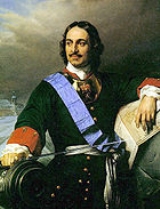
Peter I the Great or Pyotr Alexeyevich Romanov () (–) ruled RussiaRussia

Russia , also the Russian Federation , is a country that stretches over a vast expanse of Eurasia....
 and later the Russian EmpireRussian Empire

The Russian Empire was a state that existed from 1721 until it was declared a republic in August 1917....
 from until his death, jointly ruling before 1696 with his weak and sickly half-brother, Ivan VIvan V of Russia

Ivan V Alekseyevich was a joint tsar of Russia who co-reigned between 1682 and 1696....
. Peter carried out a policy of WesternizationWesternization

Westernization is a process whereby traditional, long-established societies come under the influence of Western culture ...
 and expansion that transformed the Tsardom of RussiaFacts About Tsardom of Russia

The Tsardom of Rus' was the official name for the Russian state between Ivan IV's assumption of the title of Tsar in 1547 ...
 into the 3-billion acre Russian EmpireRussian Empire

The Russian Empire was a state that existed from 1721 until it was declared a republic in August 1917....
, a major EuropeEurope

Europe is one of the seven traditional continents of the Earth....
an power.
Biography
Peter was born in 1672 in MoscowMoscow Overview

Moscow is the capital of Russia and the country's principal political, economic, financial, educational, and transportation...
 to Alexis I of RussiaAlexis I of Russia

Alexei Mikhailovich Romanov ]] - January 29, 1676 ) was a Tsar of Russia during some of the most eventful decades of the mid...
 and his second wife Nataliya Kyrillovna Naryshkina, within the walls of the KremlinMoscow Kremlin

The Moscow Kremlin is a historic fortified complex at the very heart of Moscow, overlooking the Moskva River, Red Square and...
.


Alexis I, the then-current TsarTsar

Tsar , occasionally spelled Czar or Tzar and sometimes Csar or Zar in English, is a Slavonic term des...
 died on January 29, 1676 and Peter's half-brother, Feodor III became Tsar.


Discussion
Ask a question about 'Peter I of Russia'
Start a new discussion about 'Peter I of Russia'
Answer questions from other users
Full Discussion Forum


Timeline

1672   Born

1688   A group of 1500 Old Believers immolated themselves to avoid capture when troops of the tsar laid siege to their monastery on Lake Onega.

1696   Peter the Great becomes sole tsar of Russia.

1697   Peter the Great travels in Europe officially as "artilleryman Pjotr Mikhailov"

1698   Peter the Great arrives back to Moscow - general Patrick Gordon has already crushed the streltsy rebellion - 341 rebels sentenced to be decapitated. Tradition holds that tsar Peter decapitated some of them himself

1698   In an effort to move his people away from Asiatic customs, Tsar Peter I of Russia imposes a tax on beards; All men except priests and peasants, are required to pay a tax of one hundred rubles a year and the commoners had to pay one kopek each

1700   Great Northern War: Battle of Narva - King Charles XII of Sweden defeats the army of Tsar Peter the Great at Narva.

1708   Peter the Great defeats the Swedes at the Battle of Lesnaya.

1709   June 28 (Old Style)- Peter the Great defeats Charles XII of Sweden at the Battle of Poltava, thus effectively ending Sweden's role as a major power in Europe(see below)

1709   Battle of Poltava - In the Ukraine, Peter I of Russia defeats Charles XII of Sweden at Poltava (see above)


Encyclopedia


Peter I the Great or Pyotr Alexeyevich Romanov () (–) ruled RussiaRussia

Russia , also the Russian Federation , is a country that stretches over a vast expanse of Eurasia....
 and later the Russian EmpireRussian Empire

The Russian Empire was a state that existed from 1721 until it was declared a republic in August 1917....
 from until his death, jointly ruling before 1696 with his weak and sickly half-brother, Ivan VIvan V of Russia

Ivan V Alekseyevich was a joint tsar of Russia who co-reigned between 1682 and 1696....
. Peter carried out a policy of WesternizationWesternization

Westernization is a process whereby traditional, long-established societies come under the influence of Western culture ...
 and expansion that transformed the Tsardom of RussiaFacts About Tsardom of Russia

The Tsardom of Rus' was the official name for the Russian state between Ivan IV's assumption of the title of Tsar in 1547 ...
 into the 3-billion acre Russian EmpireRussian Empire

The Russian Empire was a state that existed from 1721 until it was declared a republic in August 1917....
, a major EuropeEurope

Europe is one of the seven traditional continents of the Earth....
an power.

Biography


Peter was born in 1672 in MoscowMoscow Overview

Moscow is the capital of Russia and the country's principal political, economic, financial, educational, and transportation...
 to Alexis I of RussiaAlexis I of Russia

Alexei Mikhailovich Romanov ]] - January 29, 1676 ) was a Tsar of Russia during some of the most eventful decades of the mid...
 and his second wife Nataliya Kyrillovna Naryshkina, within the walls of the KremlinMoscow Kremlin

The Moscow Kremlin is a historic fortified complex at the very heart of Moscow, overlooking the Moskva River, Red Square and...
.


Alexis I, the then-current TsarTsar

Tsar , occasionally spelled Czar or Tzar and sometimes Csar or Zar in English, is a Slavonic term des...
 died on January 29, 1676 and Peter's half-brother, Feodor III became Tsar. He died six years later in 1682. As Feodor did not leave any children, a dispute arose between the NaryshkinNaryshkina

Naryshkina may refer to:* Maria Naryshkina...
 and MiloslavskyMaria Miloslavskaya

Maria Ilyinichna Miloslavskaya was the first wife of tzar Alexis I of Russia and mother of the tzars Feodor III of Russia an...
 families over who should inherit the throne. Peter's other half-brother, Ivan V, was the next for the throne, but he was chronically ill and of infirm mind. Consequently, the Boyar DumaBoyar Overview

A boyar or bolyarin was a member of the highest rank of the feudal Russian, Romanian and Bulgarian aristocracy, sec...
 (a council of Russian nobles) chose the ten-year old Peter to become Tzar, his mother becoming regent. But one of Alexei's daughters from his first marriage, Sophia AlekseyevnaSophia Alekseyevna

Sofia Alekseyevna was a regent of Russia who allied herself with a singularly capable courtier and politician, Prince Vasily...
, led a rebellion of the StreltsyStreltsy

Streltsy, the units of Russian guardsmen in the 16th - early 18th centuries, armed with firearms....
 (Russia's elite military corps). In the subsequent conflict, some of Peter's relatives and friends were murdered, and Peter witnessed some of these acts of political violence.

The Streltsy uprising of April-May 1682 made it possible for Sophia, the Miloslavskys (the clan of Ivan), and their allies, to insist that Peter and Ivan be proclaimed joint Tsars, with Ivan being acclaimed as the senior of the two. Sophia acted as regent during the minority of the two sovereigns and exercised all power. Peculiarly, a large hole was cut in the back of the dual-seated throne used by Ivan and Peter. Sophia would sit behind the throne and listen as Peter conversed with nobles, also feeding him information and giving him responses to questions and problems. This throne can be seen in the Kremlin museum in Moscow. For seven years, she ruled as an autocrat.

Peter was not particularly concerned that others ruled in his own name. He engaged in such pastimes as shipbuilding and sailing, as well as mock battles with his toy armyToy army of Peter I

The toy army of Peter I was initially called and was a collection of young Peter's playmates, sons of noblemen and attend...
. Peter's mother sought to force him to adopt a more conventional approach and arranged his marriage to Eudoxia LopukhinaEudoxia Lopukhina

Tsarina Evdokiya Feodorovna Lopukhina/ was the first wife of Peter I of Russia....
 in 1689. The marriage was a failure, and ten years later Peter forced her to become a nun and thus freed himself from the union.

By the summer of 1689, Peter planned to take power from his half-sister Sophia, whose position had been weakened by two unsuccessful CrimeaCrimea

Crimea /kra?'mia/ or the Autonomous Republic of Crimea is an autonomous republic of Ukraine on the northern coast of ...
n campaigns. When she learned of his designs, Sophia began to conspire with the leaders of the streltsy, who continually aroused disorder and dissent of the tsar's rule. Unfortunately for Sophia, Peter, warned by the Streltsy, escaped in the middle of the night to the impenetrable monastery of TroitskyTroitse-Sergiyeva Lavra

The Trinity Lavra of St. Sergius is the most important Russian monastery and the spiritual centre of the Russian Orthod...
; there he slowly gathered his adherents and others, who perceived he would win the power struggle. She was therefore overthrown, with Peter I and Ivan V continuing to act as co-tsars. Peter forced Sophia to enter a convent, where she gave up her name and position as a member of the royal family.

Still, Peter could not acquire actual control over Russian affairs. Power was instead exercised by his mother, Nataliya Naryshkina. It was only when Nataliya died in 1694 that Peter became an independent sovereign. Formally, Ivan V remained a co-ruler with Peter, although he was still ineffective. Peter became the sole ruler when Ivan died in 1696.


Peter grew to be quite tall as an adult, especially for the time period. Standing at nearly seven feet in height, the Russian tsar was literally head and shoulders above his contemporaries both in Russia and throughout Europe. Peter, however, lacked the overall proportional heft and bulk generally found in a man that size. Both Peter's hands and feet were small, and his shoulders narrow for his height; likewise, his head was also small for his tall body. Added to this were Peter's noticeable facial tics, and, judging by descriptions handed down, he may have suffered from petit malAbsence seizure

In medicine, there are many kinds of generalized seizures....
, a form of epilepsyEpilepsy

Epilepsy is a common chronic neurological condition that is characterized by recurrent unprovoked epileptic seizures....
.

Filippo Baltari, a young Italian visitor to Peter's court, wrote:
"Tsar Peter was tall and thin, rather than stout.
His hair was thick, short, and dark brown; he had
large eyes, black with long lashes, a well-shaped mouth, but the lower
lip was slightly disfigured...For his great height, his feet seemed very narrow. His head was sometimes tugged to the right by convulsions."


Otherwise, judging by documents—or lack thereof—that have managed to survive to the present day, few contemporaries, either in or outside of Russia, commented on Peter's great height or appearance.

Early reign

Peter implemented sweeping reforms aimed at modernizingModernization Overview

Modernization is a concept in the sphere of social sciences that refers to process in which society goes through industriali...
 Russia. Heavily influenced by his western advisors, Peter reorganized the Russian army along European lines and dreamed of making Russia a maritime power. He faced much opposition to these policies at home, but brutally suppressed any and all rebellions against his authority, the rebelling of streltsy, BashkirsBashkirs

The Bashkirs, a Turkic people, live in Russia, mostly in the republic of Bashkortostan....
, AstrakhanAstrakhan

Astrakhan, a major city in southern European Russia and the administrative center of Astrakhan Oblast....
 and including the greatest civil uprising of his reign, the Bulavin RebellionBulavin Rebellion Summary

The Bulavin Rebellion, also called the Astrakhan Rebellion, is the name given to a violent civil uprising in Imperial ...
. Further, Peter implemented social westernization in an absolute manner by requiring courtiers, state officials, and the military to shave their beards and adopt Western clothing styles.

To improve his nation's position on the seas, Peter sought to gain more maritime outlets. His only outlet at the time was the White SeaWhite Sea

The White Sea is an inlet of the Barents Sea on the northwest coast of Russia....
 at ArkhangelskArkhangelsk

Arkhangelsk, formerly called Archangel in English , is a city in and the administrative center of Arkhangelsk Oblast, ...
. The Baltic SeaBaltic Sea

The Baltic Sea is located in Northern Europe, from 53N to 66N latitude and from 20E to 26E longitude....
 was at the time controlled by SwedenSweden

The Kingdom of Sweden is a Nordic country in Scandinavia....
 in the north, while the Black SeaBlack Sea

The Black Sea is an inland sea between southeastern Europe and Anatolia that is actually a distant arm of the Atlantic Ocean...
 was controlled by the Ottoman EmpireOttoman Empire

The Ottoman Empire , is also sometimes known in the West as the Turkish Empire....
 in the south. Peter attempted to acquire control of the Black Sea, but to do so he would have to expel the TatarsTatars

Tatars , often misspelled Tartar, is a collective name applied to the Turkic speaking people of Eastern Europe and Cen...
 from the surrounding areas. He was forced, as part of an agreement with PolandPoland

Poland , officially the Republic of Poland , is a country located in Central Europe....
, which ceded KievKiev

Kiev, also written as Kyiv is the capital and the largest city of Ukraine, located in the north central part of the co...
 to Russia, to wage war against the CrimeaCrimea

Crimea /kra?'mia/ or the Autonomous Republic of Crimea is an autonomous republic of Ukraine on the northern coast of ...
n Khan and against the Khan's overlord, the Ottoman Sultan. Peter's primary objective became the capture of the Ottoman fortress of AzovAzov

Azov is a town in Rostov Oblast, Russia, situated on the Don River just three kilometers from the Sea of Azov, which derives...
, near the Don River. In the summer of 1695 Peter organized the Azov campaignsAzov campaigns

Azov campaigns of 1695-1696, two Russian military campaigns during the Russo-Turkish War of 1686-1700, led by Peter the Grea...
 in order to take the fortress, but his attempts ended in failure. Peter returned to Moscow in November of that year, and promptly began building a large navy. He launched about thirty ships against the Ottomans in 1696, capturing Azov in July of that year. On September 12, 1698, Peter The Great officially founded the first Russian NavyRussian Navy

The Russian Navy is the naval arm of the Russian armed forces....
 base, TaganrogTaganrog

Taganrog is a seaport city located on Taganrog Bay in Rostov Oblast, Russia....
.

Peter knew that Russia could not face the Ottoman Empire alone. In 1697, he traveled incognito to Europe on an 18-month journey with a large Russian delegationDelegation

Delegation is the handing of a task over to another person, usually a subordinate....
–the so-called "Grand Embassy"Grand Embassy of Peter I Overview

The Grand Embassy was a Russian diplomatic mission, sent to Western Europe in 1697-1698 by Peter the Great....
—to seek the aid of the European monarchs. Peter's hopes were dashed; FranceFrance

France, officially the French Republic, is a country whose metropolitan territory is located in Western Europe and whi...
 was a traditional ally of the Ottoman Sultan, and AustriaAustria

Austria is a landlocked country in central Europe....
 was eager to maintain peace in the east whilst conducting its own wars in the west. Peter, furthermore, had chosen the most inopportune moment; the Europeans at the time were more concerned about who would succeed the childless Spanish King Charles IICharles II of Spain

Charles II of Spain was king of Spain, Naples, and Sicily, nearly all of Italy, and Spain's overseas Empire, stretching from...
 than about fighting the Ottoman Sultan.

The "Great Embassy", although failing to complete the mission of creating an anti-Ottoman alliance, still continued to travel across Europe. In visiting HollandHolland

Holland is a region in the central-western part of the Netherlands....
, Peter learned much about Western culture. He studied shipbuilding in ZaandamZaandam

Zaandam is a town in the Dutch province of North Holland....
 and AmsterdamAmsterdam

', the official capital of the Netherlands, lies on the banks of two bodies of water, the IJ bay and the Amstel river....
. Thanks to the mediation of Nicolaas WitsenNicolaas Witsen

Nicolaas Witsen was born to a family of successful Dutch businessmen and rapidly became a key figure in the political, econo...
, mayor of Amsterdam and expert on Russia par excellence, the Tsar was given the opportunity to gain practical experience in the largest shipyard in the world, belonging to the Dutch East India CompanyDutch East India Company

The Dutch East India Company was established on March 20, 1602, when the Estates-General of the Netherlands granted it a 21...
, for a period of four months. The Tsar helped with the construction of an East Indiaman especially laid down for him: Peter and Paul. During his stay the tsar engaged many skilled workers such as builders of locksLock (water transport) Overview

On navigable waterways, a lock is a particular type of device for raising or lowering boats between stretches of water at di...
, fortresses, shipwrights and seamen. Cornelis Cruys, a vice-admiral who became under Franz LefortFranz Lefort

Franz Lefort, 1699, Moscow) was a Russian military figure of Swiss origin, admiral, and close associate of Peter the Great....
 the Tsar's advisor in maritime affairs. Besides Peter paid a visit to Frederik RuyschFrederik Ruysch

Frederik Ruysch was a Dutch doctor and anatomist, remembered for his developments in anatomical preservation and the creatio...
, who taught him how to draw teeth and catch butterflies. Also Ludolf Bakhuysen, a painter of seascapes and Jan van der HeydenJan van der Heyden

Jan van der Heyden, Dutch painter, was born at Gorcum in 1637, and died at Amsterdam....
 the inventor of the fire hose, received Peter, who was keen on learning and bringing home what he had seen. On January 16 1698 Peter organized his farewell party and invited Johan Huydecoper van MaarsseveenJoan Huydecoper II

Joan Huydecoper van Maarsseveen II was the eldest son of burgomaster Joan Huydecoper van Maarsseveen I and the brother-in-l...
, who had to sit between Lefort and the tsar and drink.


In England he met with King William IIIWilliam III of England

William III of England was a Dutch aristocrat and a Protestant Prince of Orange from his birth, Stadtholder of the United N...
, visited GreenwichGreenwich Summary

Greenwich is a town, now part of the south eastern urban sprawl of London, on the south bank of the River Thames in the Lond...
, OxfordOxford

Oxford is a city and local government district in Oxfordshire, England, with a population of 134,248 ....
, was painted by sir Godfrey KnellerGodfrey Kneller

; and ten "beauties" of the court of [[Willem III of Orange|William III]...
 and saw a Fleet Review, Royal NavyFleet Review, Royal Navy

Fleet Review redirects here. For Fleet Review of US Navy see Naval Review, and for Fleet Reviews of other nations' navies see R...
 in Deptford. He also travelled to the fledgling city of Manchester to learn the techniques of city building he would later use to great effect at Saint Petersburg. Then the Embassy went to LeipzigLeipzig

Leipzig [] is the largest city in the federal state of Saxony in Germany with a population of 502,000....
, DresdenDresden

Dresden is the capital city of the German Federal State of Saxony and situated in a valley on the River Elbe....
 and ViennaVienna

Vienna is the capital of Austria, and also one of the nine States of Austria....
. He spoke with August the Strong and Leopold I, Holy Roman EmperorLeopold I, Holy Roman Emperor

Leopold I Habsburg, Holy Roman emperor, was the second son of the emperor Ferdinand III and his first wife Maria Anna of Spa...
. The Embassy did not make it to VeniceVenice

Venice is the capital of the region of Veneto and the province of the same name in Italy....
. The visit of Peter was cut short in 1698, when he was forced to rush home by a rebellion of the streltsyStreltsy Uprising

Streltsy Uprising of 1698 was an uprising of the Moscow Streltsy regiments....
. The rebellion was, however, easily crushed before Peter returned home from EnglandEngland Summary

England is the largest and most populous constituent country of the United Kingdom....
; of the Tsar's troops, only one was killed. Peter nevertheless acted ruthlessly towards the mutineers. Over 1200 of the rebels were tortured and executed, and Peter ordered that their bodies be publicly exhibited as a warning to future conspirators. The streltsy were disbanded, and the individual they sought to put on the Throne—Peter's half-sister Sophia—was forced to become a nunNun Summary

In general, a nun is a female ascetic who chooses to voluntarily leave mainstream society and live her life in prayer and co...
.

Also, upon his return from his European tourGrand Tour

The Grand Tour was a European travel itinerary that flourished from about 1660 until the arrival of mass rail transit in the...
, Peter sought to end his unhappy marriage. He divorced the TsaritsaTsaritsa

Tsaritsa, formerly spelled czaritsa, is the title of Tsar's wife or a female autocratic ruler of Russia or Bulgaria....
, Eudoxia Lopukhina. The Tsaritsa had borne Peter three children, although only one—the TsarevichTsarevich

Tsarevich is a Slavic term for the Tsar's son....
 Alexei—had survived past his childhood.

In 1698, Peter sent a delegation to MaltaMalta

Malta, officially the Republic of Malta, is a small and densely populated island nation consisting of an archipelago o...
 under boyar Boris Petrovich Sheremetyev, to observe the training and abilities of the Knights of Malta and their fleet. Sheremetyev also investigated the possibility of future joint ventures with the Knights, including action against the Turks and the possibility of a future Russian naval base.

Peter's visits to the West impressed upon him the notion that European customs were in several respects superior to Russian traditions. He commanded all of his courtiers and officials to cut off their long beards—causing his Boyars, who were very fond of their beards, great upset—and wear European clothing. Boyars who sought to retain their beards were required to pay an annual beard tax of one hundred rublesRussian ruble

The ruble or rouble is the name of the currency of the Russian Federation and the two self-proclaimed republics, Abkha...
. He also sought to end arranged marriages, which were the norm among the Russian nobility, because he thought such a practice was not only barbaric but also led to domestic violence since the partners usually resented each other in this forced union.

In 1699, Peter also changed the celebration of new year from 1st September to 1 January. Traditionally, the years were reckoned from the purported creation of the World, but after Peter's reforms, they were to be counted from the birth of ChristAnno Domini

Anno Domini , abbreviated as AD, defines an epoch based on the traditionally-reckoned year of the birth of Jesus o...
.

Great Northern War

Peter made a temporary peace with the Ottoman EmpireOttoman Empire

The Ottoman Empire , is also sometimes known in the West as the Turkish Empire....
 that allowed him to keep the captured fort of Azov, and turned his attention to Russian maritime supremacy. He sought to acquire control of the Baltic Sea, which had been taken by SwedenSwedish Empire

Sweden between the years 1611 and 1718 was one of the great powers of Europe....
 a half-century earlier. Peter declared war on Sweden, which was at the time led by King Charles XIIFacts About Charles XII of Sweden

Carl XII, Karl XII or Carolus Rex,, the Alexander of the North, nicknamed in Turkish as Demirbas Sarl, was a...
. Sweden was also opposed by Denmark-NorwayDenmark-Norway

Denmark-Norway is the historiographical name for a former political entity, union, consisting of the kingdoms of Denmark and...
, SaxonyElectorate of Saxony

The Electorate of Saxony was an independent hereditary electorate of the Holy Roman Empire from 1356–1806....
, and the Polish-Lithuanian CommonwealthPolish-Lithuanian Commonwealth

The Polish-Lithuanian Commonwealth, also known as the "Republic of the Two Nations" or "Commonwealth of Both Nations...
.


Russia turned out to be ill-prepared to fight the Swedes, and their first attempt at seizing the Baltic coast ended in disaster at the Battle of Narva in 1700. In the conflict, the forces of Charles XII used a blinding snowstorm to their advantage. After the battle, Charles XII decided to concentrate his forces against the Polish-Lithuanian Commonwealth, giving Peter I time to reorganize the Russian army.

As the Poles and Lithuanians on one side and Swedes on the other fought each other, Peter founded the city of Saint PetersburgSaint Petersburg

Saint Petersburg listen is a city located in northwestern Russia on the delta of the Neva River at the east end of the Gulf...
 in IzhoraIngria

Historically Ingria comprises the area along the basin of the river Neva, between the Gulf of Finland, the Narva River, Lake...
 (which he had re-captured from Sweden) in 1703. He forbade the building of stone edifices outside Saint Petersburg — which he intended to become Russia's capital — so that all the stonemasons could participate in the construction of the new city. He also took Martha Skavronskaya as a mistress. Martha converted to the Russian Orthodox ChurchRussian Orthodox Church

The Russian Orthodox Church , also known as the Orthodox Catholic Church of Russia, is that body of Christians who are ...
 and took the name Catherine, allegedly marrying Peter in secret in 1707. In any case Peter valued Catherine and proceeded to marry her again (this time officially) at Saint Isaac's CathedralSaint Isaac's Cathedral

St. Isaac's Cathedral in St. Petersburg, Russia is the largest cathedral in the city and was the largest church in Russia wh...
 in Saint PetersburgSaint Petersburg

Saint Petersburg listen is a city located in northwestern Russia on the delta of the Neva River at the east end of the Gulf...
 on 9 February 1712.

Following several defeats, the Polish King August II abdicated in 1706. Charles XII turned his attention to Russia, invading it in 1708. After crossing into Russia, Charles defeated Peter at GolovchinBattle of Holowczyn

The Battle of Holowczyn was fought between the Russian army, led by Field Marshal Sheremetyev, and the Swedish army, led by ...
 in July. In the Battle of LesnayaBattle of Lesnaya Summary

The Battle of Lesnaya was one of the decisive battles of the Great Northern War....
, however, Charles suffered his first loss after Peter crushed a group of Swedish reinforcements marching from RigaRiga

Riga , the capital of Latvia, is situated on the Baltic Sea coast on the mouth of the River Daugava, at ....
. Deprived of this aid, Charles was forced to abandon his proposed march on MoscowMoscow

Moscow is the capital of Russia and the country's principal political, economic, financial, educational, and transportation...
.


Charles XII refused to retreat to PolandPoland

Poland , officially the Republic of Poland , is a country located in Central Europe....
 or back to SwedenSweden

The Kingdom of Sweden is a Nordic country in Scandinavia....
, instead invading UkraineUkraine

Ukraine is a country in Eastern Europe....
. Peter withdrew his army southward, destroying any property that could assist the Swedes along the way. Deprived of local supplies, the Swedish army was forced to halt its advance in the winter of 1708–1709. In the summer of 1709, they nevertheless resumed their efforts to capture Ukraine, culminating in the Battle of PoltavaFacts About Battle of Poltava

The Battle of Poltava was a battle between the armies of Peter I of Russia and Charles XII of Sweden on 28 June 1709, the mo...
 on 27 June. The battle was a decisive defeat for Swedish forces, ending Charles' campaign in Ukraine and forcing him into exile in the Ottoman EmpireOttoman Empire Summary

The Ottoman Empire , is also sometimes known in the West as the Turkish Empire....
. In Poland, August II was restored as King.

Peter, overestimating the support he would receive from Balkan allies, attacked the Ottoman Empire in 1711. Normally, the Boyar Duma would have exercised power during his absence. Peter, however, mistrusted the boyars; he instead abolished the Duma and created a Senate of ten members. Peter's campaign in the Ottoman Empire was disastrous, and in the ensuing peace treaty, Peter was forced to return the Black Sea ports he had seized in 1697. In return, the Sultan expelled Charles XII, but Russia was forced to guarantee safe passage to the Swedish king.

Peter's northern armies took the Swedish province of LivoniaSwedish Livonia

Livonia was a dominion of Sweden from the 1620s until 1721....
 (the northern half of modern LatviaLatvia

Latvia, officially the Republic of Latvia , is a country in Eastern Europe....
, and the southern half of modern EstoniaEstonia

Estonia, officially the Republic of Estonia , is a country in Northern Europe....
), driving the Swedes back into Finland. In 1714 the Russian fleet won the Battle of GangutBattle of Gangut

The naval Battle of Gangut took place on July 27 1714 during the Great Northern War, in the waters north of the Hanko Penins...
. Most of Finland was occupied by the RussiansGreater Wrath

The Greater Wrath is a term used in Finnish history for the Russian invasion and subsequent military occupation from 1714 u...
. In 1716 and 1717, the Tsar revisited the Netherlands, and went to see Herman BoerhaaveHerman Boerhaave

Herman Boerhaave was a Dutch humanist and physician of European fame....
. He continued his travel to the Austrian Netherlands and France. The Tsar's navy was so powerful that the Russians could penetrate Sweden. Peter also obtained the assistance of the Electorate of HanoverElectorate of Hanover

The Electorate of Hanover became the ninth Electorate of the Holy Roman Empire in 1692, when the Holy Roman Emperor, Leopol...
 and the Kingdom of PrussiaKingdom of Prussia

The Kingdom of Prussia was a kingdom from 1701 to 1918 and, from 1871, was the leading state of the German Empire, comprisin...
. Still, Charles XII refused to yield, and not until his death in battle in 1718 did peace become feasible. After the battle near ÅlandÅland

The land Islands, or Landskapet land in Swedish, or Ahvenanmaan maakunta/Ahvenanmaa in Finnish are an archipelago at...
 Sweden made peace with all powers but Russia by 1720. In 1721, the Treaty of NystadTreaty of Nystad

The Treaty of Nystad, signed at the present-day Finnish town of Uusikaupunki, ended the Great Northern War, in which Russia ...
 ended what became known as the Great Northern WarGreat Northern War

The Great Northern War was the war fought between a coalition of Russia, Denmark-Norway, and Saxony-Poland on one side and ...
. Russia acquired IngriaIngria

Historically Ingria comprises the area along the basin of the river Neva, between the Gulf of Finland, the Narva River, Lake...
, EstoniaReval Governorate

Reval Governorate was a governorate of the Russian Empire....
, LivoniaRiga Governorate

Riga Governorate was a governorate of the Russian Empire....
 and a substantial portion of KareliaOld Finland Overview

Old Finland is a name used for the areas that Russia gained from Sweden in the Great Northern War and in the Russo-Swedish W...
. In turn, Russia paid two million Riksdaler and surrendered most of Finland. The Tsar was, however, permitted to retain some Finnish lands close to Saint Petersburg, which he had made his capital in 1712. He gained access to a warm-water-port during his reign for easier trading with the Western world.

Later years


Peter I's last years were marked by further reform in Russia. On 22 October, 1721, soon after peace was made with Sweden, he was acclaimed Emperor of All Russia. Some proposed that he take the title Emperor of the East, but he refused. Gavrila Golovkin, the State Chancellor, was the first to add "the Great, Father of His Country, Emperor of All the Russias" to Peter's traditional title TsarFacts About Tsar

Tsar , occasionally spelled Czar or Tzar and sometimes Csar or Zar in English, is a Slavonic term des...
 following a speech by the archbishop of PskovPskov

Pskov is an ancient city, located in the north-west of Russia about 20 km east from the Estonian border, on the river V...
 in 1721.

Peter's imperial title was recognized by Augustus II of Poland, Frederick William I of PrussiaFrederick William I of Prussia

Frederick William I of the House of Hohenzollern, was the King in Prussia from 1713 until his death....
 and Frederick I of SwedenFrederick I of Sweden

Frederick I, was King of Sweden from 1720 and Landgrave of Hesse-Kassel from 1730 until his death. ...
, but not by the other European monarchs. In the minds of many, the word emperor connoted superiority or pre-eminence over "mere" kings. Several rulers feared that Peter would claim authority over them, just as the Holy Roman Emperor had once claimed suzerainty over all Christian nations.

Peter also reformed the government of the Russian Orthodox ChurchRussian Orthodox Church

The Russian Orthodox Church , also known as the Orthodox Catholic Church of Russia, is that body of Christians who are ...
. The traditional leader of the Church was the Patriarch of MoscowList of Metropolitans and Patriarchs of Moscow

The following is a list of The Russian Orthodox metropolitans of Moscow and Patriarchs of Moscow and all Russia along with w...
. In 1700, when the office fell vacant, Peter had refused to name a replacement, allowing the Patriarch's Coadjutor (or deputy) to discharge the duties of the office. Twenty-one years later, in 1721, Peter followed the advice of Feofan ProkopovichFeofan Prokopovich

Feofan/Theophan Prokopovich was a Ukrainian archbishop and statesman, who elaborated and implemented Peter the Great's refor...
 and erected the Holy SynodHoly Synod

In several of the autocephalous Eastern Orthodox churches, the patriarch or head bishop is elected by a group of bishops called th...
, a council of ten clergymen, to take the place of the Patriarch and Coadjutor. Peter also implemented a law which stipulated that no Russian man could join a monastery before the age of 50. He felt that too many able Russian men were being wasted away by clerical work when they could be joining his new and improved army. And in 18th century Russia, few people (men and women) lived to over a half century, therefore very few men became monks during Peter's reign, much to the dismay of the Russian Church.

In 1722, Peter created a new order of precedenceOrder of precedence

An order of precedence is a sequential hierarchy of nominal importance of people; it is used by many organizations and gover...
, known as the Table of Ranks. Formerly, precedence had been determined by birth. In order to deprive the Boyars of their high positions, Peter directed that precedence should be determined by merit and service to the Emperor. The Table of Ranks continued to remain in effect until the Russian monarchy was overthrown in 1917. In addition, Peter decided that all of the children of the nobility should have some early education, especially in the areas of sciences. Therefore, on February 28 1714, he introduced the decree on compulsory education which dictated that all Russian children of the nobility, of government clerks and even lesser ranked officials between the ages of 10 and 15 must learn basic mathematics and geometry and that they should be tested on it at the end of their studies.

Peter also introduced new taxes to fund improvements in Saint Petersburg. He abolished the land tax and household tax, and replaced them with a capitation. The taxes on land on households were payable only by individuals who owned property or maintained families; the new head taxes, however, were payable by serfSERF Overview

A spin-exchange relaxation-free magnetometer achieves very high magnetic field sensitivity by monitoring a high density vapor of ...
s and paupers.

In 1724, Peter had his second wife, CatherineCatherine I of Russia

Catherine I , the second wife of Peter the Great, reigned as Empress of Russia from 1725 until her death....
, crowned as Empress, although he remained Russia's actual ruler. All of Peter's male children had died—the eldest son, AlexeiTsarevich Alexei Petrovich of Russia

Alexei Petrovich , a Russian tsarevich....
, had been tortured and killed on Peter's orders in 1718 because he had disobeyed his father and opposed official policies. At the same time, Alexei's mother Eudalso been punished; she was dragged from her home and tried on false charges of adultery. A similar fate befell Peter's beautiful mistress, Anna MonsAnna Mons

Anna Mons was a Dutch noblewoman who almost succeeded in marrying Tsar Peter the Great....
, in 1704.

In 1725, construction of PeterhofPeterhof

Peterhof is a series of palaces and gardens, laid out on the orders of Peter the Great, and sometimes called the "Russian V...
, a palace near Saint Petersburg, was completed. Peterhof was a grand residence, becoming known as the "Russian VersaillesPalace of Versailles

The Chteau de Versailles or simply Versailles is a royal chteau, in Versailles, France....
".

Death

In the winter of 1723, Peter, whose overall health was never robust, began having problems with his urinary tract and bladderUrinary bladder

In the anatomy of mammals, the urinary bladder is the organ that collects urine excreted by the kidneys prior to disposal by...
. In the summer of 1724 a team of doctors performed the necessary surgery releasing upwards of four pounds of blocked urine. Peter remained bedridden till late autumn. Then in the first week of October, restless and certain he was cured, Peter began a lengthy inspection tour of various projects. According to legend, it was in November, while at Lakhta along the Finnish Gulf to inspect some ironworks, that Peter saw a group of soldiers drowning not far from shore and, wading out into near-waist deep water, came to their rescue.


This icy water rescue is said to have exacerbated Peter's bladder problems and caused his death on February 8, 1725. The story, however, has been viewed with skepticism by some historians, pointing out that the German chronicler Jacob von Stählin is the only source for the story, and it seems unlikely that no one else would have documented such an act of heroism. This, plus the interval of time between these actions and Peter's death seems to preclude any direct link. However, the story may still, in part, contain some grain of truth.

In early January 1725, Peter was struck once again with uremiaUremia

Uremia is a toxic condition resulting from renal failure, when kidney function is compromised and urea, a waste product norm...
. Legend has it that before lapsing into unconsciousness Peter asked for a paper and pen and scrawled an unfinished note that read: "Leave all to...." and then, exhausted by the effort, asked for his daughter Anna to be summoned.

Peter died between four and five in the morning February 8, 1725. An autopsyAutopsy Overview

An autopsy, also known as a post-mortem examination or an obduction, is a medical procedure that consists of a thoro...
 revealed his bladder to be infected with gangreneGangrene

Gangrene is necrosis and subsequent decay of body tissues caused by infection or thrombosis or lack of blood flow....
. He was fifty-two years, seven months old when he died, having reigned forty-two years.


Peter inherited an uneducated, untrained, uncivilized and superstitious country that excluded itself from European society, economy, and politics. In large measure, Peter exchanged tradition in favor of modernization. Peter the Great prodded a relatively backwards Muscovy state into a modernized Russia that competed with other European powers.

Peter I in popular culture

Peter has been featured in many books, plays and films, including poems The Bronze HorsemanThe Bronze Horseman (poem)

The Bronze Horseman is a poem written by Aleksandr Pushkin in 1833 about the equestrian statue of Peter the Great in Saint...
and Poltava and the unfinished novel Peter the Great's NegroPeter the Great's Negro

Peter the Great's Negro is an unfinished historical novel by Alexander Pushkin....
by Alexander Pushkin. The former dealt with a famous The Bronze Horseman, raised in Peter's honour. Alexey Nikolayevich Tolstoy wrote a biographical historical novel about him, named "Petr I", in 1930's, which, along with its adaptations, became a major influence on Peter's subsequent portrayals.

There is a 1976 film, Skaz pro to, kak tsar Pyotr arapa zhenil (How Tsar Peter the Great Married Off His Moor), starring Aleksey Petrenko as Peter, and Vladimir VysotskyVladimir Vysotsky

Vladimir Semyonovich Vysotsky was a Russian singer, song-writer, poet, and actor, whose career has had an immense and enduri...
 as Abram Petrovich GannibalAbram Petrovich Gannibal

Major-General Abram Petrovich Gannibal, also Hannibal or Ganibal, was an African slave who was brought to Russia...
. Much of the film shows Peter's attempt to build the Baltic FleetBaltic Fleet

The Baltic Fleet is located at the Baltic Sea and headquartered in Kaliningrad, the other major base is at Kronstadt, locate...
.

Peter was played by Maximilian SchellMaximilian Schell

Maximilian Schell is an Austrian actor....
 in Peter the Great (TV Series)Peter the Great (TV Series)

Peter the Great is a 1986 NBC television mini-series starring Maximilian Schell as Russian leader Peter the Great, and b...
(1986) an NBC mini-series. The series also featured Vanessa RedgraveVanessa Redgrave

Vanessa Redgrave, CBE is an Academy Award winning English actress and member of the Redgrave family, one of the enduring th...
, Trevor HowardTrevor Howard

Trevor Howard, CBE, born Trevor Wallace Howard-Smith, was an English movie and television actor. ...
, Omar SharifFacts About Omar Sharif

Omar Sharif, also known as Omar al-Sharif, is an Egyptian-born actor who has starred in many Hollywood films....
 and Sir Laurence Olivier.

The 2007 film, Sluga Gosudarev, depicts the unsavoury, brutal side of Peter during the PoltavaPoltava

name = ???????Poltava| coa = Poltav s.gif...
 campaign.

Peter is also featured in the computer game Civilization IVCivilization IV

Sid Meier's Civilization IV is a turn-based strategy computer game released between October 25 and November 4, 2005 in N...
 as one of the leaders of the Russian EmpireRussian Empire

The Russian Empire was a state that existed from 1721 until it was declared a republic in August 1917....
.

See also

  • Tsars of Russia family tree
  • Russian history, 1682-1796Russian history, 1682-1796 Overview

    Sorry, no overview for this topic
  • CaesaropapismCaesaropapism Summary

    Caesaropapism is the concept of combining the power of secular government with, or making it supreme to, the spiritual autho...
  • History of the administrative division of RussiaHistory of the administrative division of Russia

    This article covers the history of the administrative division of Russia from 1708 to 1744....
  • Government reform of Peter IGovernment reform of Peter I

    The government reform of Peter I refers to a set of reforms introduced in Russian political and administrative system during...
  • Peter the Great reformations in Russia
  • Abram Petrovich GannibalAbram Petrovich Gannibal

    Major-General Abram Petrovich Gannibal, also Hannibal or Ganibal, was an African slave who was brought to Russia...
  • Other Tsars of Russia
  • RFS Pyotr VelikiyRFS Pyotr Velikiy

    The RFS Pyotr Velikiy is a Kirov class battlecruiser of the Russian Navy, originally named Yuri Andropov....
    , a Russian Navy battlecruiser named after Peter the Great


>
i>