
Encyclopedia
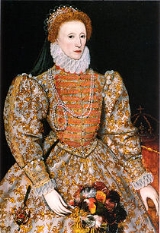
Elizabeth I was
Queen of England, Queen of France , and
Queen of Ireland from 17 November 1558 until her death. Sometimes referred to as
The Virgin Queen, as she never married,
Gloriana, or
Good Queen Bess, and immortalised by
Edmund Spenser as the
Faerie Queene. Elizabeth I was the fifth and final monarch of the
Tudor dynasty . She reigned for 45 years, during a period marked by increases in English power and influence worldwide and great religious turmoil within
England.
Elizabeth's reign is referred to as the
Elizabethan era or the
Golden Age of Elizabeth. Playwrights
William Shakespeare,
Christopher Marlowe, and
Ben Jonson all flourished during this era;
Francis Drake became the first Englishman to
circumnavigate the globe;
Francis Bacon laid out his philosophical and political views; and English colonisation of
North America took place under
Sir Walter Raleigh and
Sir Humphrey Gilbert. Elizabeth was a short-tempered and sometimes indecisive ruler. A favourite motto for her was
video et taceo . This last quality, viewed with impatience by her counsellors, often saved her from political and marital misalliances. Like her father
Henry VIII, she was a writer and poet. She granted Royal Charters to several famous organisations, including
Trinity College, Dublin in 1592 and the
British East India Company .
Her reign was marked by prudence in the granting of honours and dignities. In nearly forty-five years, only nine peerage dignities, one
earldom and seven baronies in the Peerage of England, and one barony in the Peerage of Ireland, were created. She also reduced the number of Privy Counsellors from thirty-nine to nineteen, and later to fourteen.
Virginia, an English
colony in North America and afterwards one of
America's original 13 states, was named after Elizabeth I, the "
Virgin Queen".
Early life
Elizabeth was the only surviving child of King
Henry VIII of England by his second wife,
Anne Boleyn, Marchioness of Pembroke. Boleyn was a former lady-in-waiting of Henry's first wife, Queen
Catherine of Aragon, and sister of Henry's mistress Mary Boleyn. Henry and Anne Boleyn were secretly married sometime between the winter of 1532 and late January of 1533. Elizabeth was born in the
Palace of Placentia in
Greenwich, on September 7, 1533. Upon her birth, Elizabeth was the heir presumptive to the throne of England despite having an older half sister,
Mary. Because Henry annulled his marriage to first wife, the Spanish princess
Catherine of Aragon, Mary was not considered to be a legitimate heir.
Elizabeth's surviving paternal aunts included
Margaret Tudor and Mary Tudor. Her maternal aunt was
Lady Mary Boleyn, who had previously been one of Henry VIII's mistresses. Her maternal uncle was George Boleyn, Viscount Rochford.
Henry would have preferred a son to ensure the Tudor succession, but Queen Anne failed to produce a male heir. Henry had her executed on charges of treason ,
incest with her older brother, George Boleyn and
witchcraft. Elizabeth, then two years old, was declared illegitimate and lost the title of Princess. Thereafter she was addressed as Lady Elizabeth and lived apart from her father as he married his succession of wives. Henry's last wife
Catherine Parr helped reconcile the King with Elizabeth, and she, along with her half-sister, Mary, was reinstated in the line of succession after
Prince Edward, Henry's son by his third wife,
Jane Seymour, under the Act of Succession 1544.
Elizabeth's first governess was Lady Margaret Bryan, a baroness whom Elizabeth called "Muggie". At the age of four, Elizabeth acquired a new governess,
Katherine Champernowne, who she often referred to as "Kat". Champernowne developed a close relationship with Elizabeth and remained her confidante and good friend for life.
Matthew Parker, her mother's favourite priest, took a special interest in Elizabeth's well-being, particularly because a fearful Anne had entrusted her daughter's spiritual welfare to Parker before her death. Parker later become Elizabeth's first Archbishop of
Canterbury after she became queen in 1558. One companion, to whom she referred with affection throughout her life, was the Irishman Thomas Butler, later 3rd Earl of Ormonde .
In terms of personality, Elizabeth was resourceful, determined and exceedingly intelligent. She loved learning for its own sake. Like her mother she was flirtatious and charismatic.
Henry VIII died in 1547 and was succeeded by
Edward VI. Catherine Parr married
Thomas Seymour, 1st Baron Seymour of Sudeley, Edward VI's uncle, and took Elizabeth into her household. It is believed that Seymour made advances towards Elizabeth while she lived in his household. There, Elizabeth received her education under
Roger Ascham. She came to speak and read six languages: her native
English, as well as
French,
Italian,
Spanish, Greek, and
Latin. Under the influence of Catherine Parr and Ascham, Elizabeth was raised a Protestant.
As long as her Protestant half-brother remained on the throne, Elizabeth's own position remained secure. In 1553, however, Edward died at the age of fifteen, after suffering ill health from birth and having left a will which purported to supersede his father's will. Disregarding the Act of Succession 1544, it excluded both Mary and Elizabeth from succeeding to the throne and declared
Lady Jane Grey, ward of Thomas Seymour, to be his heiress. The plot was formed by Thomas and
John Dudley, 1st Duke of Northumberland who married his son, Guilford Dudley to Jane. Lady Jane ascended the throne, but was deposed less than two weeks later. Armed with popular support, Mary rode triumphantly into London, her half-sister Elizabeth at her side.
Mary I contracted a marriage with King
Philip II of Spain, seeking to strengthen the Catholic influence in England. Wyatt's Rebellion in 1554 sought to prevent Mary from marrying Philip and, after its failure, Elizabeth was imprisoned in the
Tower of London for her alleged involvement in it. There were demands for Elizabeth's execution, but few Englishmen wished to put a member of the popular Tudor dynasty to death. The Lord Chancellor Stephen Gardiner wanted to remove Elizabeth from the line of succession, but neither Mary nor Parliament would allow it. After two months in the Tower, Elizabeth was put under house arrest under the guard of Sir Henry Bedingfield.
Following a moderate start to her reign, the
Catholic Mary opted for a hard line against Protestants, whom she regarded as heretics and a threat to her authority. In the ensuing persecution she came to be known as "Bloody Mary". She urged Elizabeth to change to the
Roman Catholic faith, but the princess, instead of converting, kept up a skilful show of allegiance to suit her own conscience and ambitions. By the end of that year, when Mary was falsely rumoured to be pregnant, Elizabeth was allowed to return to court at Philip's behest. He worried that his wife might die in childbirth, in which case he preferred Lady Elizabeth, under his tutelage, to succeed rather than her next-closest relative,
Mary I of Scotland.
Mary I of Scotland, who was openly hostile to Spanish interests, would be able to count on substantial French support, being a member of the
Guise family.
Early reign
In November 1558, upon Mary I's death, Elizabeth ascended the throne. She was far more popular than Mary, and it is said that after the death of her half-sister the people rejoiced in the streets. It is also said that Elizabeth first received the news of her sister's death when she was reading the Bible sitting under a tree at
Hatfield. A manservant approached to her and breathlessly said, "Your Majesty . . .". Elizabeth quoted Psalm 118 in response: "This is the Lord's doing, and it is marvellous in our eyes".
During her procession to the
Tower of London, she was welcomed wholeheartedly by the common people, who performed plays and read poetry exclaiming her beauty and intelligence. Elizabeth's coronation was on 15 January 1559. There was no
Archbishop of Canterbury at the time;
Reginald Cardinal Pole, the last Catholic holder of the office, had died shortly after Mary I. Since the senior bishops declined to participate in the
coronation because Elizabeth was illegitimate under both canon law and
statute and because she was a Protestant, the relatively unknown Owen Oglethorpe,
Bishop of Carlisle crowned her. The
communion was celebrated not by Oglethorpe, but by the Queen's personal chaplain, to avoid the usage of the Roman rites. Elizabeth I's coronation was the last one during which the Latin service was used; future coronations except for that of
George I used the English service. She later persuaded her mother's chaplain,
Matthew Parker, to become Archbishop.
One of the most important concerns during Elizabeth's early reign was religion. She relied primarily on
Sir William Cecil for advice on the matter. The Act of Uniformity 1559, which she passed shortly after ascending the throne, required the use of the Protestant
Book of Common Prayer is the foundational prayer book of the Church of England [i] which was on ...
in church services. Communion with the Catholic Church had been reinstated under Mary I, but was ended by Elizabeth. The Queen assumed the title "
Supreme Governor of the Church of England", rather than "Supreme Head", primarily because several
bishops and many members of the public felt that a woman could not be the head of the Church.
In addition, the Act of Supremacy 1559 was passed requiring public officials to take an oath acknowledging the Sovereign's control over the Church or face severe punishment. Many bishops were unwilling to conform to the Elizabethan religious policy. Those bishops were removed from the ecclesiastical bench and replaced by appointees who would agree with the Queen's decision. She also appointed an entirely new Privy Council, removing many Catholic counsellors in the process. Under Elizabeth, factionalism in the Council and conflicts at court were greatly diminished. Elizabeth's chief advisors were Sir William Cecil, as her Secretary of State, and
Sir Nicholas Bacon, the Lord Keeper of the Great Seal.
Elizabeth ratified the treaty of Cateau-Cambresis established on April 3, 1559, bringing peace with France. She adopted a principle of "England for the English". Her other realm,
Ireland, never benefited from such a philosophy. The enforcement of English customs in Ireland proved unpopular with its inhabitants, as did the Queen's religious policies.
Soon after her accession, many questioned whom Elizabeth would marry. Her reason for never marrying is unclear. She may have felt repulsed by the mistreatment of Henry VIII's wives, her mother's death always in her mind, or perhaps psychologically scarred by her rumoured childhood relationship with
Lord Thomas Seymour while in his household. Contemporary gossip was that she had suffered from a physical defect that she was afraid to reveal, perhaps scarring from
smallpox. There were also rumours that she would only marry one man,
Robert Dudley, 1st Earl of Leicester, with whom she was deeply in love and who she appointed her Master of the Queen's Horse. However, her council refused to sanction the marriage because of his status and his family's participation in the
Lady Jane Grey matter . Some believe Elizabeth decided that if she could not have him, she would not marry at all. The most likely cause, however, was probably her reluctance to share the power of the Crown with another and her fear that a marriage with a foreigner would provoke the same hostility as that of her sister Mary's disastrous marriage to Philip II. She also did not want to risk making England a foreign vassal and possibly involving it in the unprofitable and unpopular wars that Mary's marriage had done, while marriage to a high-born Englishman would involve England in factional dispute at court. Given the unstable political situation, Elizabeth could have feared an armed struggle among aristocratic factions if she married someone not seen as equally favourable to all factions. What is known for certain is that marrying anyone would have cost Elizabeth large amounts of money and independence as all of the estates and incomes Elizabeth inherited from her father,
Henry VIII, were only hers until she wed.
Conflict with France and Scotland
The Queen found a dangerous rival in her cousin, the Catholic
Mary Stuart, Queen of Scotland and wife of the
French King
Francis II. In 1559, Mary had declared herself Queen of England with French support. In Scotland, Mary Stuart's mother,
Mary of Guise attempted to cement French influence by providing for army fortification against English aggression. A group of Scottish lords allied to Elizabeth deposed Mary of Guise and, under pressure from the English, Mary's representatives signed the Treaty of Edinburgh, which led to the withdrawal of French troops. Though Mary vehemently refused to ratify the treaty, it had the desired effect, and French influence was greatly reduced in Scotland.
Upon the death of her husband Francis II, Mary Stuart had returned to Scotland. In France, meanwhile, conflict between the Catholics and the
Huguenots led to the outbreak of the French Wars of Religion. Elizabeth secretly gave aid to the Huguenots. She made peace with France in 1564; she agreed to give up her claims to the last English possession on the French mainland,
Calais, after the defeat of an English expedition at
Le Havre. Elizabeth, however, did not give up her claim to the French Crown, which had been maintained since the reign of
Edward III during the period of the
Hundred Years' War in the
fourteenth century, and was not renounced until the reign of
George III during the
eighteenth century.
Elizabeth and the 1559 Religious Settlement
Catholicism had been restored under Mary I, but Elizabeth herself was a Protestant, and thus was keen to create a Protestant Church.
Parliament was summoned in 1559 to consider the Reformation Bill and create a new Church. The Reformation Bill defined the
Communion as a consubstantial celebration as opposed to a transubstantial celebration, included abuse of the
Pope in the litany, and ordered that ministers should not wear the
surplice or other Catholic vestments. It allowed ministers to marry, banned images from churches, and confirmed Elizabeth as Supreme Head of the
Church of England. The Bill met massive resistance in the
House of Lords, as Catholic
bishops as well as the lay peers voted against it. They butchered much of the Bill, changed the litany to allow for a transubstantial belief in the Communion and refused to grant Elizabeth the title of Supreme Head of the Church.
Parliament was prorogued over Easter, and when it resumed, the government entered two new bills into the Houses — the Act of Supremacy and the Act of Uniformity. The Bill of Supremacy confirmed Elizabeth as Supreme
Governor of the Church of England, as opposed to the Supreme
Head. Supreme Governor was a suitably equivocal phrasing that made Elizabeth head of the church without ever saying she was, important because in the
sixteenth century, it was felt that women could not rule a church.
The Bill of Uniformity was more cautious than the initial Reformation Bill. It revoked the harsh laws against Catholics, removed the abuse of the Pope from the litany and kept the wording that allowed for both consubstantial and transubstantial belief in the Communion.
After Parliament was dismissed, Elizabeth, along with
William Cecil, drafted what are known as the Royal Injunctions. These were additions to the Settlement, and largely stressed a continuity with the Catholic past — ministers were ordered to wear the surplice. Wafers, as opposed to ordinary baker's bread, were to be used as the bread at Communion. There had been opposition to the Settlement in the shires, which for the most part were largely Catholic, so the changes were made in order to allow for acceptance to the Settlement.
Elizabeth never changed the Religious Settlement despite Protestant pressure to do so and it is in fact the 1559 Settlement that forms much of the basis of today's
Church of England.
Plots and rebellions
At the end of 1562, Elizabeth fell ill with
smallpox, but later recovered. In 1563, alarmed by the Queen's near-fatal illness, Parliament asked that she marry or nominate an heir to prevent civil war upon her death. She refused to do either, and in April, she prorogued Parliament. Parliament did not reconvene until Elizabeth needed its assent to raise taxes in 1566. The
House of Commons threatened to withhold funds until the Queen agreed to provide for the succession. On 19 October 1566,
Sir Robert Bell boldly pursued Elizabeth for the royal answer despite her command to leave it alone; in her own words "Mr. Bell with his complices must needs prefer their speeches to the upper house to have you my lords, consent with them, whereby you were seduced, and of simplicity did assent unto it."
Different lines of succession were considered during Elizabeth's reign. One possible line was that of
Margaret Tudor, Henry VIII's elder sister, which led to Mary I, Queen of Scots. The alternative line descended from Henry VIII's younger sister, Mary Tudor, Duchess of Suffolk; the heir in this line would be the Lady Catherine Grey,
Lady Jane Grey's sister. An even more distant possible successor was Henry Hastings, 3rd Earl of Huntingdon, who could claim descent only from
Edward III, who reigned during the fourteenth century. Each possible heir had his or her disadvantages: Mary I was a Catholic, Lady Catherine Grey had married without the Queen's consent and the Puritan Lord Huntingdon was unwilling to accept the Crown.
Mary, Queen of Scots, had to suffer her own troubles in Scotland. Elizabeth had suggested that if she married the Protestant
Robert Dudley, 1st Earl of Leicester, then Elizabeth would "proceed to the inquisition of her right and title to be our next cousin and heir." Mary chose her own course, and in 1565 married a Catholic, who also had a claim to the English throne,
Henry Stuart, Lord Darnley. Lord Darnley was murdered in 1567 after the couple had become estranged. Darnley was a heavy drinker and had approved the murder of Mary's secretary
David Rizzio, with whom he wrongly suspected her of having an affair. Mary then married
James Hepburn, 4th Earl of Bothwell, who was widely believed to be responsible for Darnley's murder. Scottish nobles then rebelled, imprisoning Mary and forcing her to abdicate in favour of her infant son, who consequently became
James VI.
In 1568, the last viable English heir to the throne, Catherine Grey, died. She had left two sons, but they were deemed illegitimate, owing to the absence of any living witnesses to the marriage, or to any clergy who could attest to having performed it. Her heiress was her sister, the Lady Mary Grey, a hunchbacked dwarf. Elizabeth was once again forced to consider a Scottish successor, from the line of her father's sister, Margaret Tudor, Queen of Scots. Mary I, however, was unpopular in Scotland, where she had been imprisoned. She later escaped from her prison and fled to England, where she was captured by English forces. Elizabeth was faced with a conundrum: sending her back to the Scottish nobles was deemed too cruel; sending her to France would put a powerful pawn in the hands of the French king; forcibly restoring her to the Scottish throne may have been seen as an heroic gesture, but would cause too much conflict with the Scots; and imprisoning her in England would allow her to participate in plots against the Queen. Elizabeth chose the last option: Mary was kept confined for eighteen years, much of it in
Sheffield Castle and
Sheffield Manor in the custody of
George Talbot, 6th Earl of Shrewsbury, and his redoubtable wife
Bess of Hardwick.
In 1569, Elizabeth faced a major uprising, known as the Northern Rebellion, instigated by
Thomas Howard, 4th Duke of Norfolk, Charles Neville, 6th Earl of Westmorland and Thomas Percy, 7th Earl of Northumberland.
Pope Pius V aided the Catholic Rebellion by excommunicating Elizabeth and declaring her deposed in a
papal bull. The Bull of Deposition,
Regnans in Excelsis was a papal bull [i] issued on February 25 [i], 1570 [i] by Pope Pius V [i] decl ...
, was only issued in 1570, arriving after the Rebellion had been put down. After the Bull of Deposition was issued, however, Elizabeth chose not to continue her policy of religious toleration. She instead began the persecution of her religious enemies, giving impetus to various conspiracies to remove her from the throne. She also permitted the Church of England to take a more explicitly Protestant line by allowing Parliament to pass the largely
Calvinist 39 Articles in 1571 which acted as a declaration of Church of England faith.
Elizabeth then found a new enemy in her brother-in-law,
Philip II, King of Spain. After Philip had launched a surprise attack on the English privateers Sir
Francis Drake and
John Hawkins in 1568, Elizabeth assented to the detention of a Spanish treasure ship in 1569. Philip was already involved in putting down a rebellion in the
Spanish Netherlands, and could not afford to declare war on England.
Philip II participated in some conspiracies to remove Elizabeth, albeit reluctantly. The 4th Duke of Norfolk was also involved in the first of these plots, the Ridolfi Plot of 1571. After the Catholic Ridolfi Plot was discovered and foiled, the Duke of Norfolk was executed and Mary lost the little liberty she had remaining. Spain, which had been friendly to England since Philip's marriage to Elizabeth's predecessor, ceased to be on cordial terms.
In 1571, Sir William Cecil was created Baron Burghley; a wise and humorous man, who always advised caution in international relations, he had been Elizabeth's chief advisor from the earliest days, and he remained so until his death in 1598. In 1572, Burghley was raised to the powerful position of
Lord High Treasurer; his post as Secretary of State was taken up by the head of Elizabeth's spy network,
Sir Francis Walsingham.
Also in 1572, Elizabeth made an alliance with
France. The
St Bartholomew's Day Massacre, in which thousands of French Protestants were killed, strained the alliance but did not break it. Elizabeth even began marriage negotiations with
Henry, Duke of Anjou , and afterwards with his younger brother
François, Duke of Anjou and Alençon. During the latter's visit in 1581, it is said that Elizabeth "drew off a ring from her finger and put it upon the Duke of Anjou's upon certain conditions betwixt them two". The Spanish Ambassador reported that she actually declared that the Duke of Anjou would be her husband. However, Anjou, who was reportedly scarred and hunch-backed, returned to France and died in 1584 before he could be married.
Conflict with Spain and Ireland
In 1579, the
Second Desmond Rebellion began in Ireland with the arrival of an invasion force funded by
Pope Gregory XIII; but by 1583, the rebellion had been put down after a brutal campaign waged by fire, sword and famine, in which a large part of the population of the then County Desmond, the north-western part of the province of Munster died; chilling, albeit approving, observations on the campaign are set out in
A View of the Present State of Ireland by the poet,
Edmund Spenser .
Also in 1580, Philip II annexed
Portugal, and with the Portuguese throne came the command of the high seas. After the assassination of the Dutch
Stadholder William I, England began to side openly with the
United Provinces of the Netherlands, who were at the time rebelling against Spanish rule. This, together with economic conflict with Spain and English piracy against
Spanish colonies , led to the outbreak of the Anglo-Spanish War in 1585 and in 1586 the Spanish ambassador was expelled from England for his participation in conspiracies against Elizabeth. Fearing such conspiracies, Parliament had passed the Act of Association 1584, under which anyone associated with a plot to murder the Sovereign would be excluded from the line of succession. However, a further scheme against Elizabeth, the
Babington Plot, was revealed by Sir Francis Walsingham, who headed the English spy network. Having put the court on full proof of the charge, Mary Stuart was convicted of complicity in the plot on foot of disputed evidence and executed at
Fotheringhay Castle on February 8, 1587.
In her will, Mary had left Philip her claim to the English throne; under force of the threat from Elizabeth's policies in the
Netherlands and the East
Atlantic, Philip set out his plans for an invasion of England. In April 1587, Sir
Francis Drake burned part of the Spanish fleet at
Cádiz, delaying Philip's plans. In July 1588, the
Spanish Armada, a grand fleet of 130 ships bearing over 30,000 men, set sail in the expectation of conveying a Spanish invasion force under the command of the
Duke of Parma across the
English Channel from the Netherlands. Elizabeth encouraged her troops with a notable speech, known as the Speech to the Troops at Tilbury, in which she famously declared, "I know I have the body but of a weak and feeble woman; but I have the heart and stomach of a King, and of a King of England too! And I think it foul scorn that Spain or Parma or any prince of Europe should dare invade the borders of my realm". Thus the legend of
Good Queen Bess was born.
The Spanish attempt was defeated by the English fleet under
Charles Howard, 2nd Baron Howard of Effingham and Drake, aided by bad weather. The Armada was forced to return to Spain, with appalling losses on the North and West coasts of Ireland. The victory tremendously increased Elizabeth's popularity, but it proved far from decisive, and an ambitious strike against Spain in the following year ended in complete failure. The war continued in the Netherlands, where the Dutch Estates were seeking independence from Spain. The English government also involved itself in the conflict in France, where the throne was claimed by a Protestant heir, Henry . Elizabeth sent 20,000 troops and subsidies of over £300,000 to Henry, and 8,000 troops and subsidies of over £1,000,000 to the Dutch.
English privateers continued to attack Spanish treasure ships from the
Americas. The most famous privateers included
Sir John Hawkins