

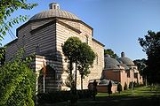
Hammam

Encyclopedia

Turkish people
Turkish people, also known as the "Turks" , are an ethnic group primarily living in Turkey and in the former lands of the Ottoman Empire where Turkish minorities had been established in Bulgaria, Cyprus, Bosnia and Herzegovina, Georgia, Greece, Kosovo, Macedonia, and Romania...
variant of a steam bath, sauna
Sauna
A sauna is a small room or house designed as a place to experience dry or wet heat sessions, or an establishment with one or more of these and auxiliary facilities....
or Russian Bath, distinguished by a focus on water, as distinct from ambient steam.
In Western Europe
Western Europe
Western Europe is a loose term for the collection of countries in the western most region of the European continents, though this definition is context-dependent and carries cultural and political connotations. One definition describes Western Europe as a geographic entity—the region lying in the...
, the 'Turkish bath' as a method of cleansing and relaxation became popular during the Victorian era
Victorian era
The Victorian era of British history was the period of Queen Victoria's reign from 20 June 1837 until her death on 22 January 1901. It was a long period of peace, prosperity, refined sensibilities and national self-confidence...
. The process involved in taking a Turkish bath is similar to that of a sauna, but is more closely related to ancient Greek and ancient Roman bathing
Ancient Roman bathing
Bathing played a major part in ancient Roman culture and society.Bathing was one of the most common daily activities in Roman culture, and was practiced across a wide variety of social classes. Though many contemporary cultures see bathing as a very private activity conducted in the home, bathing...
practices.
A person taking a Turkish bath first relaxes in a room (known as the warm room) that is heated by a continuous flow of hot, dry air allowing the bather to perspire freely. Bathers may then move to an even hotter room (known as the hot room) before splashing themselves with cold water. After performing a full body wash and receiving a massage
Massage
Massage is the manipulation of superficial and deeper layers of muscle and connective tissue to enhance function, aid in the healing process, and promote relaxation and well-being. The word comes from the French massage "friction of kneading", or from Arabic massa meaning "to touch, feel or handle"...
, bathers finally retire to the cooling-room for a period of relaxation.
Architecture
Anatolia
Anatolia is a geographic and historical term denoting the westernmost protrusion of Asia, comprising the majority of the Republic of Turkey...
, the Roman thermae
Thermae
In ancient Rome, thermae and balnea were facilities for bathing...
and Eastern Roman baths, with the central Asian Turkish tradition of steam bathing
Bathing
Bathing is the washing or cleansing of the body in a fluid, usually water or an aqueous solution. It may be practised for personal hygiene, religious ritual or therapeutic purposes or as a recreational activity....
, ritual cleansing and respect of water. It is also known that Arabs built versions of the Greek-Roman baths that they encountered following their conquest of Alexandria
Alexandria
Alexandria is the second-largest city of Egypt, with a population of 4.1 million, extending about along the coast of the Mediterranean Sea in the north central part of the country; it is also the largest city lying directly on the Mediterranean coast. It is Egypt's largest seaport, serving...
in Egypt. However, the Turkish bath has improved style and functionality that emerged as annex buildings of mosques or as re-use of the Eastern Roman baths.
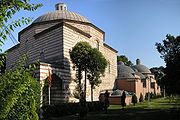
After the Ottomans took over the Eastern Roman Empire their Hammams were originally structures annexed to mosques. However they quickly evolved into institutions unto themselves and eventually, with the works of the Ottoman architect Sinan, into monumental structural complexes, the finest example being the "Çemberlitaş Hamamı" in Istanbul, built in 1584.
Like its Roman predecessor a typical hammam consists of three basic, interconnected rooms: the sıcaklık (or hararet -caldarium), which is the hot room; the warm room (tepidarium), which is the intermediate room; and the soğukluk, which is the cool room (frigidarium).
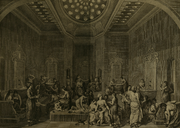
The sıcaklık usually has a large dome decorated with small glass windows that create a half-light; it also contains a large marble stone called göbek taşı (tummy stone) at the center that the customers lie on, and niches with fountains in the corners. This room is for soaking up steam and getting scrub massages. The warm room is used for washing up with soap and water and the soğukluk is to relax, dress up, have a refreshing drink, sometimes tea, and, where available, a nap in a private cubicle after the massage. A few of the hamams in Istanbul also contain mikvehs, ritual cleansing baths for Jewish women.
The hamam, like its precursors, is not exclusive to men. Hamam complexes usually contain separate quarters for men and women; or males and females are admitted at separate times. Because they were social centers as well as baths hamams became numerous during the time of the Ottoman Empire and were built in almost every Ottoman city. On many occasions they became places of entertainment (e.g. dancing and food, especially in the women's quarters) and ceremonies, such as before weddings, high-holidays, celebrating newborns, beauty trips.
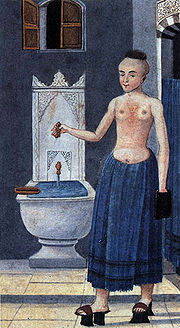
Several accessories from Roman times survive in modern hamams, such as the peştemal (a special cloth of silk
Silk
Silk is a natural protein fiber, some forms of which can be woven into textiles. The best-known type of silk is obtained from the cocoons of the larvae of the mulberry silkworm Bombyx mori reared in captivity...
and/or cotton
Cotton
Cotton is a soft, fluffy staple fiber that grows in a boll, or protective capsule, around the seeds of cotton plants of the genus Gossypium. The fiber is almost pure cellulose. The botanical purpose of cotton fiber is to aid in seed dispersal....
to cover the body, like a pareo), nalın (wooden clogs that prevent slipping on the wet floor, or mother-of-pearl), kese (a rough mitt for massage), and sometimes jewel boxes, gilded soap boxes, mirrors, henna
Henna
Henna is a flowering plant used since antiquity to dye skin, hair, fingernails, leather and wool. The name is also used for dye preparations derived from the plant, and for the art of temporary tattooing based on those dyes...
bowls, and perfume bottles.
Tellak (Staff)
Dhimmi
A , is a non-Muslim subject of a state governed in accordance with sharia law. Linguistically, the word means "one whose responsibility has been taken". This has to be understood in the context of the definition of state in Islam...
of the Turkish empire as such work was seen as below the dignity of a Muslim.
They also worked as sex workers
Prostitution
Prostitution is the act or practice of providing sexual services to another person in return for payment. The person who receives payment for sexual services is called a prostitute and the person who receives such services is known by a multitude of terms, including a "john". Prostitution is one of...
. From the Dellâkname-i Dilküşâ, eighteenth century work by Dervish
Dervish
A Dervish or Darvesh is someone treading a Sufi Muslim ascetic path or "Tariqah", known for their extreme poverty and austerity, similar to mendicant friars in Christianity or Hindu/Buddhist/Jain sadhus.-Etymology:The Persian word darvīsh is of ancient origin and descends from a Proto-Iranian...
, Ismail Agha; Ottoman archives, Süleymaniye, Istanbul).: "We know today, by texts left by Ottoman authors, who they were, their prices, how many times they could bring their customers to orgasm
Orgasm
Orgasm is the peak of the plateau phase of the sexual response cycle, characterized by an intense sensation of pleasure...
, and the details of their sexual practices."
At times the relationship between a tellak and his client became intensely personal. It is recorded that in the mid-18th century, a janissary
Janissary
The Janissaries were infantry units that formed the Ottoman sultan's household troops and bodyguards...
had a tellak for a lover. When the latter was kidnapped by the men of another regiment and given over to the use of their commander, a days-long battle between the two janissary regiments ensued, which was brought to an end only when the Sultan ordered the tellak hanged.
After the defeat and dismemberment of the Ottoman army in the early 20th century, the role of tellak boys was filled by adult attendants that scrub and give massages.
Operating Examples
CyprusCyprus
Cyprus , officially the Republic of Cyprus , is a Eurasian island country, member of the European Union, in the Eastern Mediterranean, east of Greece, south of Turkey, west of Syria and north of Egypt. It is the third largest island in the Mediterranean Sea.The earliest known human activity on the...
Dating back to Frankish occupation and located in the heart of Nicosia in Cyprus is Hamam Omerye - a true working example of Cyprus's rich culture and diversity, hard struggle, yet sense of freedom and flexibility. The site's history dates back to the 14th century, when it stood as an Augustinian church of St. Mary. Stone-built, with small domes, it is chronologically placed at around the time of Frankish and Venetian
Republic of Venice
The Republic of Venice or Venetian Republic was a state originating from the city of Venice in Northeastern Italy. It existed for over a millennium, from the late 7th century until 1797. It was formally known as the Most Serene Republic of Venice and is often referred to as La Serenissima, in...
occupation, approximately the same time that the city acquired its Venetian walls.
In 1571 the Ottoman Turkish ruler Mustapha Pasha converted the church into a mosque
Mosque
A mosque is a place of worship for followers of Islam. The word is likely to have entered the English language through French , from Portuguese , from Spanish , and from Berber , ultimately originating in — . The Arabic word masjid literally means a place of prostration...
, believing that this was where the Khalifa Omar rested during his visit to Lefkosia.
Most of the original building was destroyed by Ottoman
Ottoman Empire
The Ottoman EmpireIt was usually referred to as the "Ottoman Empire", the "Turkish Empire", the "Ottoman Caliphate" or more commonly "Turkey" by its contemporaries...
artillery, although the door of the main entrance still belongs to the 14th century Lusignan building, whilst remains of a later Renaissance
Renaissance
The Renaissance was a cultural movement that spanned roughly the 14th to the 17th century, beginning in Italy in the Late Middle Ages and later spreading to the rest of Europe. The term is also used more loosely to refer to the historical era, but since the changes of the Renaissance were not...
phase can be seen at the north-eastern side of the monument. In 2003 the [EU] funded a bi-communal UNDP/UNOPS project, "Partnership for the Future", in collaboration with Nicosia Municipality and Nicosia Master Plan.
Egypt
Cairo
Cairo
Cairo , is the capital of Egypt and the largest city in the Arab world and Africa, and the 16th largest metropolitan area in the world. Nicknamed "The City of a Thousand Minarets" for its preponderance of Islamic architecture, Cairo has long been a centre of the region's political and cultural life...
, Egypt
Egypt
Egypt , officially the Arab Republic of Egypt, Arabic: , is a country mainly in North Africa, with the Sinai Peninsula forming a land bridge in Southwest Asia. Egypt is thus a transcontinental country, and a major power in Africa, the Mediterranean Basin, the Middle East and the Muslim world...
like most of the countries in the Middle East and the Arab world is no exception. Egypt was part of the Ottoman Empire, and the Hammams of Cairo and other major cities like Alexandria
Alexandria
Alexandria is the second-largest city of Egypt, with a population of 4.1 million, extending about along the coast of the Mediterranean Sea in the north central part of the country; it is also the largest city lying directly on the Mediterranean coast. It is Egypt's largest seaport, serving...
are evidence of this unique Ottoman legacy. There used to be as many as 300 Hammams in Cairo, but in this day, there only remains 7 (seven of them). Two of them, located in El Hussien or Khan El Khalili district are closed. The other five are located in different areas. See the Hammams of Egypt article for more details about their locations, procedures, and operating hours. The article is available in English, Arabic, German, and Russian.
Hungary
Budapest
Budapest
Budapest is the capital of Hungary. As the largest city of Hungary, it is the country's principal political, cultural, commercial, industrial, and transportation centre. In 2011, Budapest had 1,733,685 inhabitants, down from its 1989 peak of 2,113,645 due to suburbanization. The Budapest Commuter...
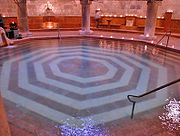
has four working Turkish Baths, all from the 16th century: Rudas Baths
Rudas Baths
Rudas Bath or Rudas fürdő is a thermal and medicinal bath in Budapest, Hungary. It was first built in 1550, during the time of Ottoman rule. To date, it retains many of the key elements of a Turkish bath, exemplified by its Turkish dome and octagonal pool. It is located at Döbrentei tér 9 on the...
and Király Baths
Király Baths
Király Bath or Király fürdő is a thermal bath that was first built in Hungary in the second half of the sixteenth century, during the time of Ottoman rule....
are open to the public; while Racz Thermal Bath
Racz Thermal Bath
The Rácz Thermal Spa, located in Budapest, Hungary, is an 8000 m2 bath and is renowned for its Turkish Bath dating back to the 16th century and also its Imperial pools and Shower Corridor built in the age of the Austro-Hungarian Monarchy...
is being reconstructed, opening 2010, and the Császár Spa Bath is not a public thermal bath.
Introduction of Turkish baths to Western Europe
David Urquhart
David Urquhart was a Scottish diplomat and writer.. He was a Member of Parliament 1847-52.-Early life and family:...
, diplomat and sometime Member of Parliament
Member of Parliament
A Member of Parliament is a representative of the voters to a :parliament. In many countries with bicameral parliaments, the term applies specifically to members of the lower house, as upper houses often have a different title, such as senate, and thus also have different titles for its members,...
for Stafford
Stafford
Stafford is the county town of Staffordshire, in the West Midlands region of England. It lies approximately north of Wolverhampton and south of Stoke-on-Trent, adjacent to the M6 motorway Junction 13 to Junction 14...
, who for political and personal reasons wished to popularize Turkish culture. In 1850 he wrote The Pillars of Hercules, a book about his travels in 1848 through Spain
Spain
Spain , officially the Kingdom of Spain languages]] under the European Charter for Regional or Minority Languages. In each of these, Spain's official name is as follows:;;;;;;), is a country and member state of the European Union located in southwestern Europe on the Iberian Peninsula...
and Morocco
Morocco
Morocco , officially the Kingdom of Morocco , is a country located in North Africa. It has a population of more than 32 million and an area of 710,850 km², and also primarily administers the disputed region of the Western Sahara...
. He described the system of dry hot-air baths used there and in the Ottoman Empire that had changed little since Roman times. In 1856 Richard Barter
Richard Barter
Richard Barter was an Irish physician and proponent of hydropathy. He collaborated with David Urquhart on the introduction of Turkish baths into the United Kingdom. Barter founded St Ann's Hydro, Ireland's first hydropathic establishment at St Ann's Hill, located near Cork.-Bibliography:...
read Urquhart's book and worked with him to construct a bath. They opened the first modern Turkish bath in the British Isles at St Ann's Hydropathic Establishment near Blarney
Blarney
Blarney is a town and townland in County Cork, Ireland. It lies north-west of Cork and is famed as the site of Blarney Castle, home of the legendary Blarney Stone.-Tourism:Blarney town is a major tourist attraction in County Cork...
, County Cork
County Cork
County Cork is a county in Ireland. It is located in the South-West Region and is also part of the province of Munster. It is named after the city of Cork . Cork County Council is the local authority for the county...
, Ireland
Ireland
Ireland is an island to the northwest of continental Europe. It is the third-largest island in Europe and the twentieth-largest island on Earth...
. The following year, the first bath of its type to be built in mainland Britain since Roman times was opened in Manchester
Manchester
Manchester is a city and metropolitan borough in Greater Manchester, England. According to the Office for National Statistics, the 2010 mid-year population estimate for Manchester was 498,800. Manchester lies within one of the UK's largest metropolitan areas, the metropolitan county of Greater...
, and the idea spread rapidly. It reached London
London
London is the capital city of :England and the :United Kingdom, the largest metropolitan area in the United Kingdom, and the largest urban zone in the European Union by most measures. Located on the River Thames, London has been a major settlement for two millennia, its history going back to its...
in July 1860, when Roger Evans
Roger Evans
Jeremy Roger Evans is a Conservative Party politician and member of the London Assembly for Havering and Redbridge. He is a former councillor and leader of the Conservative group in the London Borough of Waltham Forest....
, a member of one of Urquhart's Foreign Affairs Committees, opened a Turkish bath at 5 Bell Street, near Marble Arch
Marble Arch
Marble Arch is a white Carrara marble monument that now stands on a large traffic island at the junction of Oxford Street, Park Lane, and Edgware Road, almost directly opposite Speakers' Corner in Hyde Park in London, England...
.
During the following 150 years over 600 Turkish baths opened in Britain, while similar baths opened in other parts of the British Empire
British Empire
The British Empire comprised the dominions, colonies, protectorates, mandates and other territories ruled or administered by the United Kingdom. It originated with the overseas colonies and trading posts established by England in the late 16th and early 17th centuries. At its height, it was the...
. Dr. John Le Gay Brereton, who had given medical advice to bathers in a Foreign Affairs Committee-owned Turkish bath in Bradford
Bradford
Bradford lies at the heart of the City of Bradford, a metropolitan borough of West Yorkshire, in Northern England. It is situated in the foothills of the Pennines, west of Leeds, and northwest of Wakefield. Bradford became a municipal borough in 1847, and received its charter as a city in 1897...
, travelled to Sydney, Australia, and opened a Turkish bath there in Spring Street in 1859, even before such baths had reached London. Canada
Canada
Canada is a North American country consisting of ten provinces and three territories. Located in the northern part of the continent, it extends from the Atlantic Ocean in the east to the Pacific Ocean in the west, and northward into the Arctic Ocean...
had one by 1869, and the first in New Zealand
New Zealand
New Zealand is an island country in the south-western Pacific Ocean comprising two main landmasses and numerous smaller islands. The country is situated some east of Australia across the Tasman Sea, and roughly south of the Pacific island nations of New Caledonia, Fiji, and Tonga...
was opened in 1874. Urquhart's influence was felt outside the Empire when in 1863 Dr. Charles Shepard opened the first Turkish bath in the United States
United States
The United States of America is a federal constitutional republic comprising fifty states and a federal district...
at 63 Columbia Street, Brooklyn Heights
Brooklyn Heights, Brooklyn
Brooklyn Heights is a culturally diverse neighborhood within the New York City borough of Brooklyn. Originally referred to as 'Brooklyn Village', it has been a prominent area of Brooklyn since 1834. As of 2000, Brooklyn Heights sustained a population of 22,594 people. The neighborhood is part of...
, Brooklyn
Brooklyn
Brooklyn is the most populous of New York City's five boroughs, with nearly 2.6 million residents, and the second-largest in area. Since 1896, Brooklyn has had the same boundaries as Kings County, which is now the most populous county in New York State and the second-most densely populated...
. Later municipal authorities introduced turkish baths as part of swimming pool complexes, taking advantage of the fact that water-heating boilers were already on site. In the East End of London, following the influx of Jews from Europe the authorities built six Turkish baths, the last of which, at York Hall was converted in 2007 to a beauty spa.
As of February 2011 there were just sixteen Turkish baths remaining open in Britain; but hot-air baths still thrive in the form of Russian steambaths and the Finnish sauna
Finnish sauna
The Finnish sauna is a substantial part of Finnish culture. There are five million inhabitants and over two million saunas in Finland - an average of one per household. For Finnish people the sauna is a place to relax in with friends and family, and a place for physical and mental relaxation as...
.
See also
- AlhamaAlhamaAlhama can refer to:* Alhama de Almería, a town in the province of Almería in Spain* Alhama de Aragón, a town in the province of Zaragoza in Spain* Alhama de Granada, a town in the province of Granada in Spain...
(Spanish placename) and AlfamaAlfamaAlfama is the oldest district of Lisbon, spreading on the slope between the Castle of Lisbon and the Tejo river. Its name comes from the Arabic Al-hamma, meaning fountains or baths...
(Portuguese placename) derive from the Arabic word. - Bath housePublic bathingPublic baths originated from a communal need for cleanliness. The term public may confuse some people, as some types of public baths are restricted depending on membership, gender, religious affiliation, or other reasons. As societies have changed, public baths have been replaced as private bathing...
- Culture of the Ottoman EmpireCulture of the Ottoman EmpireThe culture of the Ottoman Empire evolved over several centuries as the ruling administration of the Turks absorbed, adapted and modified the cultures of conquered lands and their peoples...
- Gellért BathsGellért BathsGellért Thermal Baths and Swimming Pool, also called Gellért fürdő or Gellért Baths, are a bath complex in Budapest, Hungary, built between 1912 and 1918 in the Art Nouveau style. They were damaged during World War II, but then rebuilt. References to healing waters in this location are found from...
- Hamam Omerye BathsHamam Omerye BathsHamam Omerye in Nicosia, Cyprus is a 14th Century building restored to operate once again as a hammam.Dating back to French rule and located in the heart of Nicosia's old town is .-History of Hamam Omerye:...
- HaremHaremHarem refers to the sphere of women in what is usually a polygynous household and their enclosed quarters which are forbidden to men...
- Haseki Hürrem Sultan HamamıHaseki Hürrem Sultan HamamiThe Haseki Hürrem Sultan Hamamı is a Turkish hamam that was commissioned by Sultan Suleiman I's consort Roxelana and constructed by Mimar Sinan during the 16th century in Istanbul...
- JjimjilbangJjimjilbangA Jjimjilbang is a large, gender-segregated public bathhouse in Korea, furnished with hot tubs, showers, Finnish-style saunas, and massage tables, similar to a Korean sauna or mogyoktang. Jjimjil is derived from the words meaning heated bath...
, the Korean equivalent - Király BathsKirály BathsKirály Bath or Király fürdő is a thermal bath that was first built in Hungary in the second half of the sixteenth century, during the time of Ottoman rule....
- KöçekKöçekThe köçek phenomenon is one of the significant features of Ottoman Empire culture...
- BaccháBaccháBacha Bazi , also known as bacchá or bacha bereesh is sexual slavery and child prostitution in which prepubescent and adolescent boys are sold to wealthy or powerful men for entertainment...
- OnsenOnsenAn is a term for hot springs in the Japanese language, though the term is often used to describe the bathing facilities and inns around the hot springs. As a volcanically active country, Japan has thousands of onsen scattered along its length and breadth...
and sentōSentois a type of Japanese communal bath house where customers pay for entrance. Traditionally these bath houses have been quite utilitarian, with one large room separating the sexes by a tall barrier, and on both sides, usually a minimum of lined up faucets and a single large bath for the already...
, the Japanese equivalents - SoaplandSoaplandA ' is a Japanglish and indicates a paradise for men in Japanese. It is said, since in Japan prostitution is officially prohibited by the government, that it is a type of brothel in Japan where male clients can engage in sexual activity with female prostitutes, although officially the clubs do...
- Incorrect usage for Turkish bath from misinterpretation in Japan. - Steam ShowerSteam showerA steam shower is a type of bathing where a humidifying steam generator produces water vapor that is dispersed around a person's body. A steam shower is essentially a steam room that offers the typical features of a bathroom shower...
- Süleymaniye hamamSüleymaniye hamamSuleymaniye Hamam is an historic Turkish bath in İstanbul, Turkey. The building, situated on a hill facing the Golden Horn, was built in 1557 by Turkish architect Mimar Sinan; it was named for Süleyman the Magnificent. It is part of the Suleymaniye mosque complex.The hamam was commissioned by...
External links
Hamam HistoryPhotos of Hamams in Muslim and Arabic countries
- Baths in Syria, Iran, Turkey, Morocco, Yemen...
- The last public bathhouses of Cairo : photos by Pascal Meunier
- Hammaming in the Sham: A Journey through the Turkish Baths of Damascus, Aleppo and Beyond
Introduction of Turkish baths to Europe
Other
- Michael PalinMichael PalinMichael Edward Palin, CBE FRGS is an English comedian, actor, writer and television presenter best known for being one of the members of the comedy group Monty Python and for his travel documentaries....
at Turkish baths in Istanbul - BBC (From Pole to PolePole to PolePole to Pole is an eight-part television documentary travel series made for the BBC and released in 1992. The presenter is Michael Palin, this being the second of Palin's major journeys for the BBC. The trip from the North Pole to the South Pole went via Scandinavia, the Soviet Union, parts of...
) Uploaded by BBCWorldwideBBCThe British Broadcasting Corporation is a British public service broadcaster. Its headquarters is at Broadcasting House in the City of Westminster, London. It is the largest broadcaster in the world, with about 23,000 staff...
to YoutubeYouTubeYouTube is a video-sharing website, created by three former PayPal employees in February 2005, on which users can upload, view and share videos.... - How To Bathe In A Turkish Bath: A Guide For Foreigners
- The Guide Of Istanbul Hammams and Every Aspect of Turkish Bath