


Isabella I of Castile

Encyclopedia
Isabella I (22 April 1451 – 26 November 1504) was Queen of Castile and León. She and her husband Ferdinand II of Aragon
brought stability to both kingdoms that became the basis for the unification of Spain. Later the two laid the foundations for the political unification of Spain under their grandson, Charles V, Holy Roman Emperor
. After a struggle to claim her right to the throne, she reorganized the governmental system, brought the crime rate to the lowest it had been in years, and pulled the kingdom out of the enormous debt her brother had left behind. Her reforms and those she made with her husband had an influence that extended well beyond the borders of their united kingdoms. Isabella and Ferdinand are known for completing the Reconquista
, ordering conversion or exile of their Muslim and Jewish subjects and financing Christopher Columbus
's 1492 voyage that led to the opening of the "New World
".
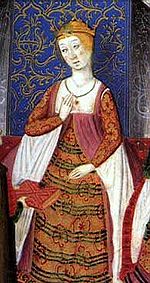 Isabella was born in Madrigal de las Altas Torres
, Ávila
to John II of Castile
and Isabella of Portugal on April 22, 1451. She was the granddaughter of Henry III of Castile
and Catherine of Lancaster
. At the time of her birth, her older half brother Enrique (Henry) was in line for the throne before her. Enrique, referred to as the English version of his name Henry, was twenty-six years old at that time and married, but he was childless. Her younger brother Alfonso
was born two years later on 17 November 1453 and displaced her in the line of succession. When her father, John II of Castile
, died in 1454, Henry became King Henry IV
. Isabella and Alfonso were left in Henry's care. Her brother Alfonso, mother, and she then moved to Arévalo
.
These were times of turmoil for Isabella. Isabella lived with her brother and her mother in a castle in poor conditions where they also suffered from shortage of money. Although her father arranged in his will for his children to be financially well taken care of, her half-brother Henry did not comply with their father's wishes, either from a desire to keep his half-siblings restricted or ineptitude. Even though the living conditions were lackluster, under the careful eye of her mother, Isabella was instructed in lessons of practical piety and in the deep reverence for religion.
When King Henry's wife, Queen Joan of Portugal
, was about to give birth, Isabella and her brother were summoned to court (Segovia) and taken away from their mother to be under more control and direct supervision by the king and finish their educations. Alfonso was put under the care of a tutor while Isabella became part of the Queen's household.
Conditions of Isabella's life improved in Segovia. She always had food and clothing and lived in a castle that was adorned with gold and silver. Isabella's basic education consisted of reading, spelling, writing, grammar, mathematics, art, chess, dancing, embroidery, music, and religious instruction. She and her ladies-in-waiting entertained themselves with art, embroidery, and music. She lived a relaxed lifestyle, but she rarely left Segovia as Henry forbade her from doing so. Her brother was keeping her from the political turmoils going on in the kingdom, though Isabella had full knowledge of what was going on and her role in the feuds.
The noblemen who were anxious for power confronted the King, demanding that his younger half brother Infante Alfonso be named his successor. They even went as far as to ask Alfonso to seize the throne. The nobles, now in control of Alfonso and claiming him to be the true heir, clashed with Henry
's forces at the Second Battle of Olmedo
in 1467. The battle was a draw. Henry agreed to make Alfonso his heir, provided Alfonso would marry his daughter, Joanna. Soon after Alfonso was created Prince of Asturias
, the title given to the heir of Castile and Leon, he died, likely of the plague. The nobles who had supported him suspected poisoning. As she had been named in her brother's will as his successor, the nobles asked Isabella to take his place as champion of the rebellion. However, support for the rebels had begun to wane, and Isabella preferred a negotiated settlement to continuing the war. She met with Henry and, at Toros de Guisando, they reached a compromise: the war would stop, Henry would name Isabella his heir instead of Joanna, and Isabella would not marry without Henry's consent but he would not be able to force her to marry against her will. Isabella's side came out with most of what they desired, though they did not go so far as to officially depose Henry: they were not powerful enough to do so, and Isabella did not want to jeopardize the principle of fair inherited succession, since it was upon this idea that she had based her argument for legitimacy as heir.
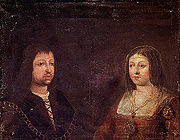 From an extremely early age, Isabella was forced into several betrothals by her brother Henry, all of which were beneficial to his political needs of the time. By the age of sixteen, Isabella made her debut in the matrimonial market with a betrothal to Ferdinand
the son of John II of Aragon
(whose family was a cadet branch of the House of Trastámara). At the time the two kings, Henry and John, were eager to show their mutual love and confidence and they believed that this double alliance would make their eternal friendship obvious to the world. This arrangement, however, did not last long.
When Alfonso V
died in 1458, all of his territories, including the island of Sicily, were left to his brother John II. John now had a stronger position than ever before and no longer needed the security of Henry's friendship. Henry was now in need of a new alliance. He saw the chance for this much needed new friendship in Charles IV of Navarre, another son of John II of Aragon. Charles was constantly in dispute with his father and because of this he secretly entered into an alliance with Henry IV of Castile. A major part of the alliance was that a marriage was to be arranged between Charles and Isabella. The fact that Isabella was only ten years old and Charles was nearly forty was never considered an issue. When John II learned of this arranged marriage he was outraged. Isabella had been destined for his favorite son, Ferdinand, and in his eyes this alliance was still valid. John II had his son Charles thrown in prison with charges of plotting against his father's life and the marriage never came to be.
In 1464 an attempt was made to marry Isabella to Alfonso V of Portugal, Henry's brother-in-law. Through the medium of the Queen and Count of Ledesma, a Portuguese alliance was made. Isabella, however, was wary of the marriage and refused to consent.
A civil war broke out in Castile over King Henry's inability to act as sovereign. Henry now needed a quick way to please the rebels of the kingdom. As part of an agreement to restore peace, Isabel was to be betrothed to Pedro Giron, Maestre de Calatrava and brother to the King’s favorite Don Juan Pacheco. In return the Master would pay into the impoverished royal treasury an enourmous sum of money. Seeing little other choice to find the peace he desperately needed, Henry agreed to the marriage. Isabella was aghast and prayed to God for the marriage to never come to pass. Her prayers were answered when Don Pedro suddenly fell ill and died while on his way to meet his fiancée.
When Henry recognized Isabella as his heir on 19 September 1468, he also promised that his sister should not be compelled to marry against her will, while she in return agreed to obtain his consent. It seemed that finally the years of failed attempts at political marriages were over. There was talk of a marriage to a brother of Edward IV of England
but this alliance was never seriously considered. Once again in 1468, a marriage proposal arrived from Alfonso V of Portugal. Going against his promises made in September, Henry tried to make the marriage a reality. If Isabella married Alfonso, Henry's daughter Joanna would marry Alfonso's son John II
and thus, after the death of the old king, John and Joanna could inherit Portugal and Castile. Isabella refused and made a secret promise to marry her cousin and very first betroth, Ferdinand of Aragon.
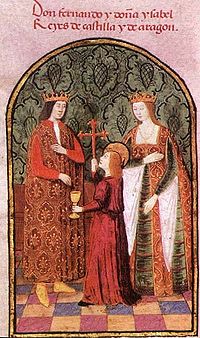 After this failed attempt Henry once again went against his promises and tried to marry Isabella to Louis XI
’s brother Charles, Duke of Berry
. In Henry's eyes this alliance would cement the friendship of Castile and France as well as remove Isabella from Castilian affairs. Isabella once again refused the proposal. Meanwhile John II of Aragon negotiated in secret with Isabella a wedding to his son Ferdinand.
On 18 October 1469, the formal betrothal took place. Because Isabella and Ferdinand were second cousins they stood within the prohibited degrees of consanguinity and the marriage would not be legal unless a dispensation from the Pope was granted. With the help of Rodrigo Borgia (later Alexander VI
) Isabella and Ferdinand were presented with a supposed Papal Bull by Pius II
authorizing Ferdinand to marry within the third degree of consanguinity, making their marriage legal. Isabella escaped the court of Henry with the excuse of visiting her brother Alfonso's tomb in Ávila. Ferdinand, on the other hand, crossed Castile in secret disguised as a merchant. Finally, on 19 October 1469 they married in the Palacio de los Vivero
in the city of Valladolid
.
See also: Battle of Guinea
See also: War of the Castilian Succession
Isabella’s reign was off to a rocky start from the very beginning. Because of her brother's choice to name Isabella as his successor, when she ascended to the throne in 1474, there were already several plots against her. The Marquis of Villena and his followers maintained that the Infanta Joanna, daughter of Henry IV, was the rightful queen. Shortly after the Marquis made his claim, a long time supporter of Isabella, the Archbishop of Toledo
left court to plot with his great-nephew the Marquis. The Archbishop and Marquis made plans to have the Infanta Joanna marry her uncle, King Alfonso V of Portugal and invade Castile to claim the throne for themselves.
In May of 1475, Alfonso and his army crossed into Spain and advanced to Plasencia
and here he married the young Joanna. A long and bloody war for the Castilian succession took place hereafter. The war went back and forth for almost a year until 1 March of 1476 when the Battle of Toro
took place. A battle where both sides claimed and celebrated the victory: the troops of Afonso V were won by the Castilian centre-left commanded by the Duke of Alba and Cardinal Mendoza while the forces led by Prince John of Portugal
defeated the Castilian right wing and remained in possession of the battlefield.
But despite its uncertain outcome, the Battle of Toro
represented a great political victory for the Catholic Kings, assuring them the throne since the supporters of Juana disbanded and the Portuguese army, without allies, left Castile.
As summarized by the historian Justo L. González
: "Both armies faced each other at the camps of Toro resulting in an indecisive battle. But while the Portuguese King reorganized his troops, Ferdinand sent news to all the cities of Castile and to several foreign kingdoms informing them about a huge victory where the Portuguese were crushed. Faced with these news, the party of “la Beltraneja"[Juana] was dissolved and the Portuguese were forced to return to their kingdom."
With great political vision, Isabella took advantage of the moment and convoked courts at Madrigal (April, 1476) where her daughter was sworn heiress of Castile's crown. That was equivalent to legitimizing Isabella’s own throne.
In August of the same year, Isabella proved her abilities as a powerful ruler on her own. A rebellion broke out in Segovia
and Isabella rode out to suppress it, as her husband was off fighting at the time. Going against the better judgment of her male advisors, Isabella rode by herself into the city to negotiate with the rebels. She was successful and the rebellion was quickly brought to an end. Two years later, Isabella also secured her place as ruler a bit more with the birth of her son John, Prince of Asturias on June 30, 1478. To many, the presence of a male heir legitimized her place as ruler.
Meanwhile the Castilian and Portuguese fleets fought for the hegemony in the Atlantic ocean and for the wealth of Guinea (Gold and Slaves) where was fought the decisive naval Battle of Guinea
.
. The war dragged on for another three years. and ended with a Castilian victory on land and a Portuguese victory on the sea. The four separated peace treaties signed at Alcáçovas
(4 September of 1479) reflected that result: Portugal gave up the throne of Castile in favour of Isabella at the exchange of a very favourable share of the Atlantic territories disputed with Castile (they all were to Portugal with the exception of the Canary islands
: Guinea
with its mines of Gold, Cape Verde
, Madeira
, Azores
and the right of conquest over the kingdom of Fez
) plus a big war compensation: 106.676 dobles of gold. The Catholic kings also had to accept that Juana remained in Portugal instead of Spain and to pardon all rebellious subjects who had supported Joanna and Alfonzo. . And the Catholic monarchs - who had proclaimed themselves kings of Portugal and donated lands to noblemen inside this country - had to give up the Portuguese crown.
At Alcáçovas, Isabella and Ferdinand had conquered the throne but the Portuguese exclusive right of navigation and commerce in all the Atlantic ocean south of the Canary caused that Spain stayed practically "out" of the Atlantic and deprived from the Gold of Guinea, which induced anger in Andaluzia.
Spanish academic António Rumeu de Armas stated that with the Peace treaty of Alcáçovas,1479, the Catholic monarchs "... buy the peace at an excessively expensive price... and historian Mª Monserrat Léon Guerrero added that they " find themselves forced to abandon their expansion by the Atlantic... "
It would be Columbus who would free Castile from this difficult situation of blocked overseas expansion, because his New World discovery led to a new and much more balanced sharing of the Atlantic at Tordesilhas in 1494. The orders received by Columbus in his first voyage (1492) are elucidative: “…[the Catholic Monarchs] have always in mind that the limits signed in the “share” of Alcáçovas should not be overcome, and thus they insist with Columbus to sail along the parallel of Canary.”
Thus, when sponsoring the Columbine adventure to the West the Monarchs were trying the only remaining way of expansion. As it is known, they would be extremely successful on this issue.
Isabella had proven herself to be a fighter and tough monarch from the start. Now that she had succeeded in securing her place on the Castilian throne, she could now begin to make the reforms that the kingdom desperately needed.
La Santa Hermandad
Isabella’s first major reform came during the cortes of Madrigal in 1476 in the form of a police force, La Santa Hermandad (the Holy Brotherhood). While 1476 was not the first time that Castile had seen the Hermandad, it was however the first time that the police force was used by the crown. During the late medieval period, the expression hermandad had been used to describe groups of men who came together of their own accord to regulate law and order by patrolling the roads and countryside and punishing malefactors. These brotherhoods, however, had usually been suppressed by the monarch.
Before 1476, the justice system in most parts of the country was effectively under the control of dissident members of the nobility rather than royal officials. To fix this problem, during the Cortes of 1476, a general Hermandad was established for Castile, Leon, and Asturias. The police force was to be made up of locals who were to regulate the crime occurring in the kingdom. It was to be paid for by a tax of 1800 mavedus on every one hundred households. In 1477, Isabella visited Estremadura and Andalusia to introduce this more efficient police force there as well.
Keeping with her reformation of the regulation of laws, in 1481 Isabella charged two officials with restoring peace in Galicia. This turbulent province had been the prey of tyrant nobles since the days of Isabella’s father, John II. Robbers infested the highways and oppressed the smaller towns and villages. These officials set off with the Herculean task of restoring peace for the province. The officials were successful. They succeeded in driving over 1,500 robbers from Galicia.
Another issue of money was the over production of coinage and the abundance of mints in the kingdom. During Henry’s reign the number of mints regularly producing money had increased from just five to one hundred and fifty. Much of the coinage produced in these mints was nearly worthless. During the first year of her reign Isabella established a monopoly over the royal mints and fixed a legal standard to which the coinage must approximate. By shutting down many of the mints and taking royal control over the production of money, Isabella restored the confidence of the public in the crown’s ability to handle the kingdom’s finance.
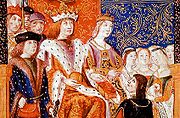 It has been noted that both Isabella and Ferdinand established very few new governmental and administrative institutions in their respective kingdoms. Especially in Castile, the main achievement was to use more effectively the institutions that had existed in during the reigns of John II and Henry IV. Historically, the center of the Castilian government had been the royal household, together with its surrounding court. The household was traditionally divided into two overlapping bodies. The first body was made up of household officials, mainly people of the nobility, who carried out governmental and political functions for which they received special payment. The second body was made up of some 200 permanent servants or continos who performed a wide range of confidential functions on behalf of the of the rulers. By the 1470s when Isabella began to take a firm grip on the royal administration, the senior offices of the royal household were simply honorary titles and held strictly by the nobility. The positions of a more secretarial nature were often held by senior churchmen. Substantial revenues were attached to such offices and were therefore enjoyed greatly, on an effectively hereditary basis, by the great Castilian houses of nobility. While the nobles held the titles, those individuals of lesser breeding did the real work.
Traditionally, the main advisory body to the rulers of Castile was the Royal Council
. The Council, under the monarch, had full power to resolve all legal and political disputes. The Council was responsible for supervising all senior administrative officials, such as the Crown representatives in all of the major towns. It was also the supreme judicial tribunal of the kingdom. In 1480, during the Cortes of Toledo, Isabella made many reforms to the Royal Council. Previously there had been two distinct yet overlapping categories of royal councilor. One formed a group which possessed both judicial and administrative responsibilities. This portion consisted of some bishops, some nobles, and an increasingly important element of professional administrators with legal training known as letrados. The second category of traditional councilor had a less formal role. This role depended greatly on the individuals’ political influence and personal influence with the monarch. During Isabella’s reign, the role of this second category was completely eliminated. As mentioned previously, Isabella had little care for personal bribes or favors. Because of this, this second type of councilor, usually of the nobility, was only allowed to attend the council of Castile as an observer.
Isabella began to rely more on the professional administrators than ever before. These men were mostly of the bourgeoisie or lesser nobility. The Council was also rearranged and it was officially settled that one bishop, three caballeros, and eight or nine lawyers would serve on the council at a time. While the nobles were no longer directly involved in the matters of state, they were welcome to attend the meetings. Isabel hoped by forcing the nobility to choose whether to participate or not would weed out those who were not dedicated to the state and its cause.
Isabella also saw the need to provide a personal relationship between herself as the monarch and her subjects. Therefore, Isabella and Ferdinand set aside a time every Friday during which they themselves would sit and allow people to come to them with complaints. This was a new form of personal justice that Castile had not seen before. The Council of State was reformed and presided over by the King and Queen. This department of public affairs dealt mainly with foreign negotiations, hearing embassies, and transacting business with the Court of Rome. In addition to these departments, there was also a Supreme Court of the Santa Hermandad, a Council of Finance, and a Council for settling purely Aragonese matters. Although Isabella made many reforms that seem to have made the Cortes stronger, in actuality the Cortes lost political power during the reigns of Isabella and Ferdinand. Isabella and her husband moved in the direction of a non-parliamentary government and the Cortes became an almost passive advisory body, giving automatic assent to legislation which had been drafted by the royal administration.
After the reforms of the Cortes of Toledo, the Queen ordered a noted jurist, Alfonso Diaz de Montalvo, to undertake the task of clearing away legal rubbish and compiling what remained into a comprehensive code. Within four years the work stood completed in eight bulky volumes and the Ordenanzas Reales took their place on legal bookshelves.
, only Granada was left for Isabella and Ferdinand to conquer. The Emirate of Granada
had been held by the Muslim Nasrid emirate since the mid-thirteenth century. Protected by natural barriers and fortified towns, it had withstood the long process of the reconquista
. On 1 February 1482, the king and queen reached Medina del Campo
and this is generally considered the beginning of the war for Granada. While Isabella's and Ferdinand's involvement in the war was apparent from the start, Granada's leadership was divided and never able to present united front. However, it still took ten years to conquer Granada, culminating in 1492.
The Spanish monarchs recruited soldiers from many European countries and improved their artillery with the latest and best cannons. Systematically, they proceeded to take the kingdom piece by piece. In 1485 they laid siege to Ronda
, which surrendered after only a fortnight due to extensive bombardment. The following year, Loja
was taken, and again Muhammad XII was captured and released. One year later, with the fall of Málaga
, the western part of the Muslim Nasrid kingdom had fallen into Spanish hands. The eastern province succumbed after the fall of Baza
in 1489. The siege of Granada began in the spring of 1491 and at the end of the year, Muhammad XII surrendered. On 2 January 1492 Isabella and Ferdinand entered Granada to receive the keys of the city and the principal mosque was reconsecrated as a church. The Treaty of Granada signed later that year was to assure religious rights to the Muslims, which did not last.
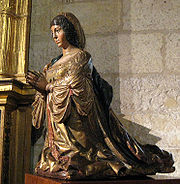 During the war, Isabella noted the abilities and energy of Gonzalo Fernández de Córdoba
and made him one of the two commissoners for the negotiations. Under her patronage, De Córdoba went on to an extraordinary military career that revolutionized the organization and tactics of the emerging Spanish military; changing the nature of warfare and altering the European balance of power.
on an expedition to reach the Indies
by sailing west (2000 miles, according to Columbus). The crown agreed to pay a sum of money as a concession from monarch to subject.
On 3 August 1492 his expedition departed and arrived in what is now known as Watling Island
on October 12. He named it San Salvador, after Jesus the Savior. He returned the next year and presented his findings to the monarchs, bringing natives and gold under a hero's welcome. Although Columbus was sponsored by the Castilian queen, treasury accounts show no royal payments to him until 1493, after his first voyage was complete. Spain entered a Golden Age
of exploration
and colonization
, the period of the Spanish Empire
. The Portuguese did not recognize that South America belonged to the Spanish because it was on Portugal's sphere of influence and the Portuguese King John II threatened to send an army to claim the land for the Portuguese. In 1494, by the Treaty of Tordesillas
, Isabella and Ferdinand agreed to divide the Earth, outside of Europe, with king John II
of Portugal
.
as the first Inquisitor General, the Catholic Monarchs pursued a policy of religious unity. Though Isabella opposed taking harsh measures against Jews on economic grounds, Torquemada was able to convince Ferdinand. On 31 March 1492, the Alhambra Decree
for the expulsion of the Jews was issued (See main article on Inquisition
). The Jews had until the end of July, three months, to leave the country and they were not to take with them gold, silver, money, arms, or horses. Traditionally, it had been claimed that as many as 200,000 Jews left Spain, but recent historians have shown that such figures are exaggerated: Henry Kamen has shown that out of a total population of 80,000 Jews, a maximum of 40,000 left and the rest converted. Hundreds of those that remained came under the Inquisition's investigations into relapsed conversos (Marranos) and the Judaizers who had been abetting them.
by Pope Alexander VI
, a pope of whose behaviour and involvement in secular matters Isabella did not approve. Along with the physical unification of Spain, Isabella and Ferdinand embarked on a process of spiritual unification, trying to bring the country under one faith (Roman Catholicism
). As part of this process, the Inquisition became institutionalized. After a Muslim uprising in 1499, and further troubles thereafter, the Treaty of Granada was broken in 1502, and Muslims were ordered to either become Christians or to leave. Isabella's confessor, Cisneros, was named Archbishop of Toledo
. He was instrumental in a program of rehabilitation of the religious institutions of Spain, laying the groundwork for the later Counter-Reformation
. As Chancellor, he exerted more and more power.
Isabella and her husband had created an empire
and in later years were consumed with administration and politics; they were concerned with the succession and worked to link the Spanish crown to the other rulers in Europe. By early 1497 all the pieces seemed to be in place: John, Prince of Asturias, married Archduchess Margaret of Austria, establishing the connection to the Habsburg
s. The eldest daughter, Isabella, married Manuel I of Portugal
, and Joanna
was married to another Habsburg prince, Philip of Burgundy
. However, Isabella's plans for her children did not work out. John died shortly after his marriage. Isabella, Princess of Asturias, died in childbirth and her son Miguel died at the age of two. Queen Isabella I's crowns passed to her daughter, Joanna of Castile
, and her son-in-law, Philip of Habsburg
.
Isabella officially withdrew from governmental affairs on 14 September 1504 and she died that same year on 26 November in Medina del Campo
, but it is said that she had truly been in decline since the death of her son Prince John in 1497. She is entombed in Granada
in the Capilla Real
, which was built by her grandson, Charles V, Holy Roman Emperor
(Carlos I of Spain), alongside her husband Ferdinand, her daughter Joanna and Joanna's husband Philip; and Isabella's 2-year old grandson, Miguel (the son of Isabella's daughter, also named Isabella, and King Manuel I of Portugal). The museum next to the Capilla Real holds her crown
and scepter.
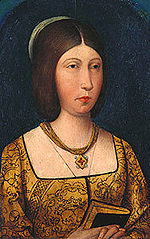 Isabella was short but of strong stocky build, of a very fair complexion, and had blue eyes, and had a hair color
that was between reddish
-blond
e and auburn; these were typical in members of the Trastámara
family who were descendants of Peter I of Castile. Her daughters, Joanna and Catherine, were thought to resemble her the most. Isabella maintained an austere, temperate lifestyle, and her religious spirit influenced her the most in life. In spite of her hostility towards the Muslims in Andalusia
which now is Spain and Portugal, Isabella developed a taste for Moorish decor and style. Of her, contemporaries said:
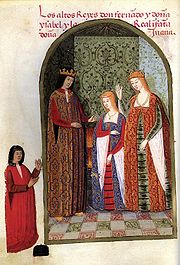 Isabella and Ferdinand had five surviving children, four daughters and one son. They also suffered a miscarried son and a stillborn daughter:
Towards the end of her life family tragedies overwhelmed her, although she met these reverses with grace and fortitude. The death of her beloved son and heir and the miscarriage of his wife, the death of her daughter Isabella and Isabella's son Miguel (who could have united the kingdoms of the Catholic Monarchs
with that of Portugal), the supposed madness of her daughter Joanna (that defied her in public in Medina del Campo) and the indifference of Philip the Handsome, and the uncertainty Catherine was in after the death of her husband
submerged her in profound sadness that made her dress in black for the rest of her lifetime. Her strong spirituality is well understood from the words she said after hearing of her son’s death: “The Lord gave him to me, the Lord hath taken him from me, glory be His holy name.”
, also in celebration of Columbus. She appears in the 'Columbus soliciting aid of Isabella', 5-cent issue, and on the Spanish court scene replicated on the 15-cent Columbian, and on the $4 issue, in full portrait, side by side with Columbus.
The $4 stamp is the only stamp of that denomination ever issued and one which collectors prize not only for its rarity (only 30,000 were printed) but its beauty, an exquisite carmine with some copies having a crimson hue. Mint specimens of this commemorative have been sold for more than $20,000. Isabella was also the first named woman to appear on a United States coin, an 1893 commemorative
quarter, celebrating the 400th anniversary of Columbus
's first voyage.
Isabella of Castille was the name of A song written by the Portland band Starfucker
.
Ferdinand II of Aragon
Ferdinand the Catholic was King of Aragon , Sicily , Naples , Valencia, Sardinia, and Navarre, Count of Barcelona, jure uxoris King of Castile and then regent of that country also from 1508 to his death, in the name of...
brought stability to both kingdoms that became the basis for the unification of Spain. Later the two laid the foundations for the political unification of Spain under their grandson, Charles V, Holy Roman Emperor
Charles V, Holy Roman Emperor
Charles V was ruler of the Holy Roman Empire from 1519 and, as Charles I, of the Spanish Empire from 1516 until his voluntary retirement and abdication in favor of his younger brother Ferdinand I and his son Philip II in 1556.As...
. After a struggle to claim her right to the throne, she reorganized the governmental system, brought the crime rate to the lowest it had been in years, and pulled the kingdom out of the enormous debt her brother had left behind. Her reforms and those she made with her husband had an influence that extended well beyond the borders of their united kingdoms. Isabella and Ferdinand are known for completing the Reconquista
Reconquista
The Reconquista was a period of almost 800 years in the Middle Ages during which several Christian kingdoms succeeded in retaking the Muslim-controlled areas of the Iberian Peninsula broadly known as Al-Andalus...
, ordering conversion or exile of their Muslim and Jewish subjects and financing Christopher Columbus
Christopher Columbus
Christopher Columbus was an explorer, colonizer, and navigator, born in the Republic of Genoa, in northwestern Italy. Under the auspices of the Catholic Monarchs of Spain, he completed four voyages across the Atlantic Ocean that led to general European awareness of the American continents in the...
's 1492 voyage that led to the opening of the "New World
New World
The New World is one of the names used for the Western Hemisphere, specifically America and sometimes Oceania . The term originated in the late 15th century, when America had been recently discovered by European explorers, expanding the geographical horizon of the people of the European middle...
".
Early years
Madrigal de las Altas Torres
Madrigal de las Altas Torres is a municipality located in the province of Ávila, Castile and León, Spain. According to the 2005 census , the municipality has a population of 1,825 inhabitants. In this village, Isabella I of Castille was born in 1451....
, Ávila
Ávila (province)
Ávila is a province of central-western Spain, in the southern part of the autonomous community of Castile and León. It is bordered on the south by the provinces of Toledo and Cáceres, on the west by Salamanca, on the north by Valladolid, and on the east by Segovia and Madrid. Ávila has a...
to John II of Castile
John II of Castile
John II was King of Castile from 1406 to 1454.He was the son of Henry III of Castile and his wife Catherine of Lancaster, daughter of John of Gaunt, 1st Duke of Lancaster by Constance of Castile, daughter of King Peter of Castile.-Regency:He succeeded his father on 25 December 1406, at the age of...
and Isabella of Portugal on April 22, 1451. She was the granddaughter of Henry III of Castile
Henry III of Castile
Henry III KG , sometimes known as Henry the Sufferer or Henry the Infirm , was the son of John I and Eleanor of Aragon, and succeeded him as King of the Castilian Crown in 1390....
and Catherine of Lancaster
Catherine of Lancaster
-Coat of arms:The following are Armorials of the House of Lancaster under her father, John of Gaunt.-References:* Anthony Goodman: "Katherine of Lancaster" in Oxford Dictionary of National Biography. Vol. 30 , p. 890-891....
. At the time of her birth, her older half brother Enrique (Henry) was in line for the throne before her. Enrique, referred to as the English version of his name Henry, was twenty-six years old at that time and married, but he was childless. Her younger brother Alfonso
Alfonso of Castile, Prince of Asturias
Alfonso, Prince of Asturias was the figurehead of rebelling magnates against his brother Henry IV of Castile....
was born two years later on 17 November 1453 and displaced her in the line of succession. When her father, John II of Castile
John II of Castile
John II was King of Castile from 1406 to 1454.He was the son of Henry III of Castile and his wife Catherine of Lancaster, daughter of John of Gaunt, 1st Duke of Lancaster by Constance of Castile, daughter of King Peter of Castile.-Regency:He succeeded his father on 25 December 1406, at the age of...
, died in 1454, Henry became King Henry IV
Henry IV of Castile
Henry IV , King of the Crown of Castile, nicknamed the Impotent , was the last of the weak late medieval kings of Castile...
. Isabella and Alfonso were left in Henry's care. Her brother Alfonso, mother, and she then moved to Arévalo
Arévalo
Arévalo is a municipality in Spain, it is situated in the province of Ávila and is part of the autonomous community of Castile and León. The name came from Celtic word arevalon, meaning "place near the wall."-Regional importance:...
.
These were times of turmoil for Isabella. Isabella lived with her brother and her mother in a castle in poor conditions where they also suffered from shortage of money. Although her father arranged in his will for his children to be financially well taken care of, her half-brother Henry did not comply with their father's wishes, either from a desire to keep his half-siblings restricted or ineptitude. Even though the living conditions were lackluster, under the careful eye of her mother, Isabella was instructed in lessons of practical piety and in the deep reverence for religion.
When King Henry's wife, Queen Joan of Portugal
Joan of Portugal
Joan of Portugal was Queen consort of Castile as the second wife of King Henry IV of Castile and a Portuguese infanta, the posthumous daughter of King Edward of Portugal and his wife Eleanor of Aragon...
, was about to give birth, Isabella and her brother were summoned to court (Segovia) and taken away from their mother to be under more control and direct supervision by the king and finish their educations. Alfonso was put under the care of a tutor while Isabella became part of the Queen's household.
Conditions of Isabella's life improved in Segovia. She always had food and clothing and lived in a castle that was adorned with gold and silver. Isabella's basic education consisted of reading, spelling, writing, grammar, mathematics, art, chess, dancing, embroidery, music, and religious instruction. She and her ladies-in-waiting entertained themselves with art, embroidery, and music. She lived a relaxed lifestyle, but she rarely left Segovia as Henry forbade her from doing so. Her brother was keeping her from the political turmoils going on in the kingdom, though Isabella had full knowledge of what was going on and her role in the feuds.
The noblemen who were anxious for power confronted the King, demanding that his younger half brother Infante Alfonso be named his successor. They even went as far as to ask Alfonso to seize the throne. The nobles, now in control of Alfonso and claiming him to be the true heir, clashed with Henry
Henry IV of Castile
Henry IV , King of the Crown of Castile, nicknamed the Impotent , was the last of the weak late medieval kings of Castile...
's forces at the Second Battle of Olmedo
Second Battle of Olmedo
The Second Battle of Olmedo was fought on 20 August 1467 near Olmedo in Castile as part of the succession conflict between Henry IV of Castile and his half-brother Alfonso, Prince of Asturias....
in 1467. The battle was a draw. Henry agreed to make Alfonso his heir, provided Alfonso would marry his daughter, Joanna. Soon after Alfonso was created Prince of Asturias
Prince of Asturias
Prince of Asturias is the historical title given to the heir to the Spanish throne. It was also the title under the earlier Kingdom of Castile. The current Prince of Asturias is Felipe, son of King Juan Carlos of Spain and Queen Sofía...
, the title given to the heir of Castile and Leon, he died, likely of the plague. The nobles who had supported him suspected poisoning. As she had been named in her brother's will as his successor, the nobles asked Isabella to take his place as champion of the rebellion. However, support for the rebels had begun to wane, and Isabella preferred a negotiated settlement to continuing the war. She met with Henry and, at Toros de Guisando, they reached a compromise: the war would stop, Henry would name Isabella his heir instead of Joanna, and Isabella would not marry without Henry's consent but he would not be able to force her to marry against her will. Isabella's side came out with most of what they desired, though they did not go so far as to officially depose Henry: they were not powerful enough to do so, and Isabella did not want to jeopardize the principle of fair inherited succession, since it was upon this idea that she had based her argument for legitimacy as heir.
Marriage for political gain
Ferdinand II of Aragon
Ferdinand the Catholic was King of Aragon , Sicily , Naples , Valencia, Sardinia, and Navarre, Count of Barcelona, jure uxoris King of Castile and then regent of that country also from 1508 to his death, in the name of...
the son of John II of Aragon
John II of Aragon
John II the Faithless, also known as the Great was the King of Aragon from 1458 until 1479, and jure uxoris King of Navarre from 1425 until his death. He was the son of Ferdinand I and his wife Eleanor of Alburquerque...
(whose family was a cadet branch of the House of Trastámara). At the time the two kings, Henry and John, were eager to show their mutual love and confidence and they believed that this double alliance would make their eternal friendship obvious to the world. This arrangement, however, did not last long.
When Alfonso V
Alfonso V of Aragon
Alfonso the Magnanimous KG was the King of Aragon , Valencia , Majorca, Sardinia and Corsica , and Sicily and Count of Barcelona from 1416 and King of Naples from 1442 until his death...
died in 1458, all of his territories, including the island of Sicily, were left to his brother John II. John now had a stronger position than ever before and no longer needed the security of Henry's friendship. Henry was now in need of a new alliance. He saw the chance for this much needed new friendship in Charles IV of Navarre, another son of John II of Aragon. Charles was constantly in dispute with his father and because of this he secretly entered into an alliance with Henry IV of Castile. A major part of the alliance was that a marriage was to be arranged between Charles and Isabella. The fact that Isabella was only ten years old and Charles was nearly forty was never considered an issue. When John II learned of this arranged marriage he was outraged. Isabella had been destined for his favorite son, Ferdinand, and in his eyes this alliance was still valid. John II had his son Charles thrown in prison with charges of plotting against his father's life and the marriage never came to be.
In 1464 an attempt was made to marry Isabella to Alfonso V of Portugal, Henry's brother-in-law. Through the medium of the Queen and Count of Ledesma, a Portuguese alliance was made. Isabella, however, was wary of the marriage and refused to consent.
A civil war broke out in Castile over King Henry's inability to act as sovereign. Henry now needed a quick way to please the rebels of the kingdom. As part of an agreement to restore peace, Isabel was to be betrothed to Pedro Giron, Maestre de Calatrava and brother to the King’s favorite Don Juan Pacheco. In return the Master would pay into the impoverished royal treasury an enourmous sum of money. Seeing little other choice to find the peace he desperately needed, Henry agreed to the marriage. Isabella was aghast and prayed to God for the marriage to never come to pass. Her prayers were answered when Don Pedro suddenly fell ill and died while on his way to meet his fiancée.
When Henry recognized Isabella as his heir on 19 September 1468, he also promised that his sister should not be compelled to marry against her will, while she in return agreed to obtain his consent. It seemed that finally the years of failed attempts at political marriages were over. There was talk of a marriage to a brother of Edward IV of England
Edward IV of England
Edward IV was King of England from 4 March 1461 until 3 October 1470, and again from 11 April 1471 until his death. He was the first Yorkist King of England...
but this alliance was never seriously considered. Once again in 1468, a marriage proposal arrived from Alfonso V of Portugal. Going against his promises made in September, Henry tried to make the marriage a reality. If Isabella married Alfonso, Henry's daughter Joanna would marry Alfonso's son John II
John II of Portugal
John II , the Perfect Prince , was the thirteenth king of Portugal and the Algarves...
and thus, after the death of the old king, John and Joanna could inherit Portugal and Castile. Isabella refused and made a secret promise to marry her cousin and very first betroth, Ferdinand of Aragon.
Louis XI of France
Louis XI , called the Prudent , was the King of France from 1461 to 1483. He was the son of Charles VII of France and Mary of Anjou, a member of the House of Valois....
’s brother Charles, Duke of Berry
Charles de Valois, Duc de Berry
Charles de Valois, Duke of Berry was a son of Charles VII, King of France. He spent most of his life in conflict with his elder brother, King Louis XI of France.-Life:...
. In Henry's eyes this alliance would cement the friendship of Castile and France as well as remove Isabella from Castilian affairs. Isabella once again refused the proposal. Meanwhile John II of Aragon negotiated in secret with Isabella a wedding to his son Ferdinand.
On 18 October 1469, the formal betrothal took place. Because Isabella and Ferdinand were second cousins they stood within the prohibited degrees of consanguinity and the marriage would not be legal unless a dispensation from the Pope was granted. With the help of Rodrigo Borgia (later Alexander VI
Pope Alexander VI
Pope Alexander VI , born Roderic Llançol i Borja was Pope from 1492 until his death on 18 August 1503. He is one of the most controversial of the Renaissance popes, and his Italianized surname—Borgia—became a byword for the debased standards of the Papacy of that era, most notoriously the Banquet...
) Isabella and Ferdinand were presented with a supposed Papal Bull by Pius II
Pope Pius II
Pope Pius II, born Enea Silvio Piccolomini was Pope from August 19, 1458 until his death in 1464. Pius II was born at Corsignano in the Sienese territory of a noble but decayed family...
authorizing Ferdinand to marry within the third degree of consanguinity, making their marriage legal. Isabella escaped the court of Henry with the excuse of visiting her brother Alfonso's tomb in Ávila. Ferdinand, on the other hand, crossed Castile in secret disguised as a merchant. Finally, on 19 October 1469 they married in the Palacio de los Vivero
Royal Audiencia and Chancillería of Valladolid
The Royal Audiencia and Chancellería of Valladolid was a Spanish judicial institution set up in Valladolid in 1371, with jurisdiction over all of the territories of the Crown of Castile. It was the first Spanish audiencia to be established...
in the city of Valladolid
Valladolid
Valladolid is a historic city and municipality in north-central Spain, situated at the confluence of the Pisuerga and Esgueva rivers, and located within three wine-making regions: Ribera del Duero, Rueda and Cigales...
.
War with Portugal
See also: Battle of ToroBattle of Toro
The Battle of Toro was a Royal battle from the War of the Castilian Succession, fought on 1 March 1476, near the city of Toro, between the Castilian troops of the Catholic Monarchs and the Portuguese-Castilian forces of Afonso V and Prince John....
See also: Battle of Guinea
Battle of Guinea
The Battle of Guinea took place on the Gulf of Guinea, in western Africa, 1478, between a Portuguese fleet and a Castilian fleet on the context of the War of the Castilian Succession....
See also: War of the Castilian Succession
War of the Castilian Succession
The War of the Castilian Succession was the military conflict contested from 1475 to 1479 for the succession of the Crown of Castile fought between the supporters of Juana la Beltraneja, daughter of the late monarch Henry IV of Castile, and those of Henry's half sister, Isabella, who was ultimately...
Isabella’s reign was off to a rocky start from the very beginning. Because of her brother's choice to name Isabella as his successor, when she ascended to the throne in 1474, there were already several plots against her. The Marquis of Villena and his followers maintained that the Infanta Joanna, daughter of Henry IV, was the rightful queen. Shortly after the Marquis made his claim, a long time supporter of Isabella, the Archbishop of Toledo
Alfonso Carillo de Acuña
Alfonso Carrillo de Acuña was a Spanish politician and Roman Catholic archbishop.-Life:...
left court to plot with his great-nephew the Marquis. The Archbishop and Marquis made plans to have the Infanta Joanna marry her uncle, King Alfonso V of Portugal and invade Castile to claim the throne for themselves.
In May of 1475, Alfonso and his army crossed into Spain and advanced to Plasencia
Plasencia
Plasencia is a walled market city in the province of Cáceres, Extremadura, Western Spain. , it had a population of 41,447.Situated on the bank of the Jerte River, Plasencia has a historic quarter that is a consequence of the city's strategic location along the Silver Route, or Ruta de la Plata...
and here he married the young Joanna. A long and bloody war for the Castilian succession took place hereafter. The war went back and forth for almost a year until 1 March of 1476 when the Battle of Toro
Battle of Toro
The Battle of Toro was a Royal battle from the War of the Castilian Succession, fought on 1 March 1476, near the city of Toro, between the Castilian troops of the Catholic Monarchs and the Portuguese-Castilian forces of Afonso V and Prince John....
took place. A battle where both sides claimed and celebrated the victory: the troops of Afonso V were won by the Castilian centre-left commanded by the Duke of Alba and Cardinal Mendoza while the forces led by Prince John of Portugal
John II of Portugal
John II , the Perfect Prince , was the thirteenth king of Portugal and the Algarves...
defeated the Castilian right wing and remained in possession of the battlefield.
But despite its uncertain outcome, the Battle of Toro
Battle of Toro
The Battle of Toro was a Royal battle from the War of the Castilian Succession, fought on 1 March 1476, near the city of Toro, between the Castilian troops of the Catholic Monarchs and the Portuguese-Castilian forces of Afonso V and Prince John....
represented a great political victory for the Catholic Kings, assuring them the throne since the supporters of Juana disbanded and the Portuguese army, without allies, left Castile.
As summarized by the historian Justo L. González
Justo Gonzalez
Justo L. González is a Cuban-American Methodist historian, theologian, a prolific author, and an influential contributor in the development of Latino/Latina [Hispanic] theology.-Education:...
: "Both armies faced each other at the camps of Toro resulting in an indecisive battle. But while the Portuguese King reorganized his troops, Ferdinand sent news to all the cities of Castile and to several foreign kingdoms informing them about a huge victory where the Portuguese were crushed. Faced with these news, the party of “la Beltraneja"
With great political vision, Isabella took advantage of the moment and convoked courts at Madrigal (April, 1476) where her daughter was sworn heiress of Castile's crown. That was equivalent to legitimizing Isabella’s own throne.
In August of the same year, Isabella proved her abilities as a powerful ruler on her own. A rebellion broke out in Segovia
Segovia
Segovia is a city in Spain, the capital of Segovia Province in the autonomous community of Castile and León. It is situated north of Madrid, 30 minutes by high speed train. The municipality counts some 55,500 inhabitants.-Etymology:...
and Isabella rode out to suppress it, as her husband was off fighting at the time. Going against the better judgment of her male advisors, Isabella rode by herself into the city to negotiate with the rebels. She was successful and the rebellion was quickly brought to an end. Two years later, Isabella also secured her place as ruler a bit more with the birth of her son John, Prince of Asturias on June 30, 1478. To many, the presence of a male heir legitimized her place as ruler.
Meanwhile the Castilian and Portuguese fleets fought for the hegemony in the Atlantic ocean and for the wealth of Guinea (Gold and Slaves) where was fought the decisive naval Battle of Guinea
Battle of Guinea
The Battle of Guinea took place on the Gulf of Guinea, in western Africa, 1478, between a Portuguese fleet and a Castilian fleet on the context of the War of the Castilian Succession....
.
. The war dragged on for another three years. and ended with a Castilian victory on land and a Portuguese victory on the sea. The four separated peace treaties signed at Alcáçovas
Treaty of Alcaçovas
The Treaty of Alcáçovas put an end to the War of the Castilian Succession in favor of Isabella I of Castile, and confirmed Castilian control of the Canary Islands and Portuguese control of the Madeira , Azores and Cape Verde islands , all in the Atlantic Ocean The Treaty of Alcáçovas (also known...
(4 September of 1479) reflected that result: Portugal gave up the throne of Castile in favour of Isabella at the exchange of a very favourable share of the Atlantic territories disputed with Castile (they all were to Portugal with the exception of the Canary islands
Canary Islands
The Canary Islands , also known as the Canaries , is a Spanish archipelago located just off the northwest coast of mainland Africa, 100 km west of the border between Morocco and the Western Sahara. The Canaries are a Spanish autonomous community and an outermost region of the European Union...
: Guinea
Gulf of Guinea
The Gulf of Guinea is the northeasternmost part of the tropical Atlantic Ocean between Cape Lopez in Gabon, north and west to Cape Palmas in Liberia. The intersection of the Equator and Prime Meridian is in the gulf....
with its mines of Gold, Cape Verde
Cape Verde
The Republic of Cape Verde is an island country, spanning an archipelago of 10 islands located in the central Atlantic Ocean, 570 kilometres off the coast of Western Africa...
, Madeira
Madeira
Madeira is a Portuguese archipelago that lies between and , just under 400 km north of Tenerife, Canary Islands, in the north Atlantic Ocean and an outermost region of the European Union...
, Azores
Azores
The Archipelago of the Azores is composed of nine volcanic islands situated in the middle of the North Atlantic Ocean, and is located about west from Lisbon and about east from the east coast of North America. The islands, and their economic exclusion zone, form the Autonomous Region of the...
and the right of conquest over the kingdom of Fez
Kingdom of Fez
The Kingdom of Fez or Wattasid sultanate was the name given to the northern part of Morocco between 1472 and 1554 with its capital at Fez.The Wattasid are a branch of the Zenete, a Berber clan whose origins lie in what is now modern day Libya....
) plus a big war compensation: 106.676 dobles of gold. The Catholic kings also had to accept that Juana remained in Portugal instead of Spain and to pardon all rebellious subjects who had supported Joanna and Alfonzo. . And the Catholic monarchs - who had proclaimed themselves kings of Portugal and donated lands to noblemen inside this country - had to give up the Portuguese crown.
At Alcáçovas, Isabella and Ferdinand had conquered the throne but the Portuguese exclusive right of navigation and commerce in all the Atlantic ocean south of the Canary caused that Spain stayed practically "out" of the Atlantic and deprived from the Gold of Guinea, which induced anger in Andaluzia.
Spanish academic António Rumeu de Armas stated that with the Peace treaty of Alcáçovas,1479, the Catholic monarchs "... buy the peace at an excessively expensive price... and historian Mª Monserrat Léon Guerrero added that they " find themselves forced to abandon their expansion by the Atlantic... "
It would be Columbus who would free Castile from this difficult situation of blocked overseas expansion, because his New World discovery led to a new and much more balanced sharing of the Atlantic at Tordesilhas in 1494. The orders received by Columbus in his first voyage (1492) are elucidative: “…
Thus, when sponsoring the Columbine adventure to the West the Monarchs were trying the only remaining way of expansion. As it is known, they would be extremely successful on this issue.
Isabella had proven herself to be a fighter and tough monarch from the start. Now that she had succeeded in securing her place on the Castilian throne, she could now begin to make the reforms that the kingdom desperately needed.
Regulation of crime
When Isabella came to the throne in 1474, Castile was in a state of despair thanks to her brother Henry’s reign. It was not unknown that Henry IV was a big spender and did little to enforce the laws of his kingdom. It was even said by one Castilian citizen of the time that murder, rape, and robbery happened without punishment Because of this, Isabel needed desperately to find a way to reform her kingdom.La Santa HermandadHermandadHermandad, literally "brotherhood" in Spanish, was a peacekeeping association of armed individuals, which became characteristic of municipal life in medieval Spain, especially in Castile....
Isabella’s first major reform came during the cortes of Madrigal in 1476 in the form of a police force, La Santa Hermandad (the Holy Brotherhood). While 1476 was not the first time that Castile had seen the Hermandad, it was however the first time that the police force was used by the crown. During the late medieval period, the expression hermandad had been used to describe groups of men who came together of their own accord to regulate law and order by patrolling the roads and countryside and punishing malefactors. These brotherhoods, however, had usually been suppressed by the monarch.
Before 1476, the justice system in most parts of the country was effectively under the control of dissident members of the nobility rather than royal officials. To fix this problem, during the Cortes of 1476, a general Hermandad was established for Castile, Leon, and Asturias. The police force was to be made up of locals who were to regulate the crime occurring in the kingdom. It was to be paid for by a tax of 1800 mavedus on every one hundred households. In 1477, Isabella visited Estremadura and Andalusia to introduce this more efficient police force there as well.
Other criminal reforms
Keeping with her reformation of the regulation of laws, in 1481 Isabella charged two officials with restoring peace in Galicia. This turbulent province had been the prey of tyrant nobles since the days of Isabella’s father, John II. Robbers infested the highways and oppressed the smaller towns and villages. These officials set off with the Herculean task of restoring peace for the province. The officials were successful. They succeeded in driving over 1,500 robbers from Galicia.
Finances
From the very beginning of her reign, Isabella fully grasped the importance of restoring the Crown's finances. The reign of Henry IV had left the kingdom of Castile in great debt. Upon examination, it was found that the chief cause of the nation’s poverty was the wholesale alienation of royal estates during Henry’s reign. In order to make money, Henry had sold off royal estates at prices well below their value. The Cortes of Toledo of 1480 came to the conclusion that the only hope of lasting financial reform lay in a resumption of these alienated lands and rents. This decision was warmly approved by many leading nobles of the Court but Isabella was reluctant to take such large actions. It was decided that the Cardinal of Spain would hold an enquiry into the tenure of estates and rents acquired during Henry IV’s reign. Those that had not been granted as a reward for services were to be restored without compensation; while those that had been sold at a price far below their real value were to be brought back at the same sum. While many of the nobility were forced to pay large sums of money for their estates, the royal treasury became ever richer. Isabella’s one stipulation was that there would be no revocation of gifts made to churches, hospitals, or the poor.Another issue of money was the over production of coinage and the abundance of mints in the kingdom. During Henry’s reign the number of mints regularly producing money had increased from just five to one hundred and fifty. Much of the coinage produced in these mints was nearly worthless. During the first year of her reign Isabella established a monopoly over the royal mints and fixed a legal standard to which the coinage must approximate. By shutting down many of the mints and taking royal control over the production of money, Isabella restored the confidence of the public in the crown’s ability to handle the kingdom’s finance.
Government
Traditionally, the main advisory body to the rulers of Castile was the Royal Council
Council of Castile
The Council of Castile , known earlier as the Royal Council , was a ruling body and key part of the domestic government of the Crown of Castile, second only to the monarch himself. It was established under Queen Isabella I in 1480 as the chief body dealing with administrative and judicial matters...
. The Council, under the monarch, had full power to resolve all legal and political disputes. The Council was responsible for supervising all senior administrative officials, such as the Crown representatives in all of the major towns. It was also the supreme judicial tribunal of the kingdom. In 1480, during the Cortes of Toledo, Isabella made many reforms to the Royal Council. Previously there had been two distinct yet overlapping categories of royal councilor. One formed a group which possessed both judicial and administrative responsibilities. This portion consisted of some bishops, some nobles, and an increasingly important element of professional administrators with legal training known as letrados. The second category of traditional councilor had a less formal role. This role depended greatly on the individuals’ political influence and personal influence with the monarch. During Isabella’s reign, the role of this second category was completely eliminated. As mentioned previously, Isabella had little care for personal bribes or favors. Because of this, this second type of councilor, usually of the nobility, was only allowed to attend the council of Castile as an observer.
Isabella began to rely more on the professional administrators than ever before. These men were mostly of the bourgeoisie or lesser nobility. The Council was also rearranged and it was officially settled that one bishop, three caballeros, and eight or nine lawyers would serve on the council at a time. While the nobles were no longer directly involved in the matters of state, they were welcome to attend the meetings. Isabel hoped by forcing the nobility to choose whether to participate or not would weed out those who were not dedicated to the state and its cause.
Isabella also saw the need to provide a personal relationship between herself as the monarch and her subjects. Therefore, Isabella and Ferdinand set aside a time every Friday during which they themselves would sit and allow people to come to them with complaints. This was a new form of personal justice that Castile had not seen before. The Council of State was reformed and presided over by the King and Queen. This department of public affairs dealt mainly with foreign negotiations, hearing embassies, and transacting business with the Court of Rome. In addition to these departments, there was also a Supreme Court of the Santa Hermandad, a Council of Finance, and a Council for settling purely Aragonese matters. Although Isabella made many reforms that seem to have made the Cortes stronger, in actuality the Cortes lost political power during the reigns of Isabella and Ferdinand. Isabella and her husband moved in the direction of a non-parliamentary government and the Cortes became an almost passive advisory body, giving automatic assent to legislation which had been drafted by the royal administration.
After the reforms of the Cortes of Toledo, the Queen ordered a noted jurist, Alfonso Diaz de Montalvo, to undertake the task of clearing away legal rubbish and compiling what remained into a comprehensive code. Within four years the work stood completed in eight bulky volumes and the Ordenanzas Reales took their place on legal bookshelves.
Granada
At the end of the ReconquistaReconquista
The Reconquista was a period of almost 800 years in the Middle Ages during which several Christian kingdoms succeeded in retaking the Muslim-controlled areas of the Iberian Peninsula broadly known as Al-Andalus...
, only Granada was left for Isabella and Ferdinand to conquer. The Emirate of Granada
Emirate of Granada
The Emirate of Granada , also known as the Nasrid Kingdom of Granada , was an emirate established in 1238 following the defeat of Muhammad an-Nasir of the Almohad dynasty by an alliance of Christian kingdoms at the Battle of Las Navas de Tolosa in 1212...
had been held by the Muslim Nasrid emirate since the mid-thirteenth century. Protected by natural barriers and fortified towns, it had withstood the long process of the reconquista
Reconquista
The Reconquista was a period of almost 800 years in the Middle Ages during which several Christian kingdoms succeeded in retaking the Muslim-controlled areas of the Iberian Peninsula broadly known as Al-Andalus...
. On 1 February 1482, the king and queen reached Medina del Campo
Medina del Campo
Medina del Campo is a town located in the middle of the Spanish Meseta Central, in the province of Valladolid, Castile-Leon autonomous region, 45 km from Valladolid. It is the capital of a farming area, far away from the great economic centres.-History:...
and this is generally considered the beginning of the war for Granada. While Isabella's and Ferdinand's involvement in the war was apparent from the start, Granada's leadership was divided and never able to present united front. However, it still took ten years to conquer Granada, culminating in 1492.
The Spanish monarchs recruited soldiers from many European countries and improved their artillery with the latest and best cannons. Systematically, they proceeded to take the kingdom piece by piece. In 1485 they laid siege to Ronda
Ronda
Ronda is a city in Spanish province of Málaga. It is located about West from the city of Málaga, within the autonomous community of Andalusia. Its population is approximately 35,000 inhabitants.-History:...
, which surrendered after only a fortnight due to extensive bombardment. The following year, Loja
Loja, Granada
Loja is a town in southern Spain, situated at the western limit of the province of Granada. It is surrounded by the so-called Sierras de Loja, of which the highest peak, Sierra Gorda, stands 1,671 metres above sea-level....
was taken, and again Muhammad XII was captured and released. One year later, with the fall of Málaga
Málaga
Málaga is a city and a municipality in the Autonomous Community of Andalusia, Spain. With a population of 568,507 in 2010, it is the second most populous city of Andalusia and the sixth largest in Spain. This is the southernmost large city in Europe...
, the western part of the Muslim Nasrid kingdom had fallen into Spanish hands. The eastern province succumbed after the fall of Baza
Baza, Granada
Baza is a town in the province of Granada in southern Spain. It has 21,000 inhabitants . It is situated at 844 m above sea level, in the Hoya de Baza, a valley of the Sierra Nevada, not far from the Gallego River. This town gives its name to the Sierra de Baza...
in 1489. The siege of Granada began in the spring of 1491 and at the end of the year, Muhammad XII surrendered. On 2 January 1492 Isabella and Ferdinand entered Granada to receive the keys of the city and the principal mosque was reconsecrated as a church. The Treaty of Granada signed later that year was to assure religious rights to the Muslims, which did not last.
Gonzalo Fernández de Córdoba
Gonzalo Fernández de Córdoba known as The Great Captain, Duke of Terranova and Santangelo, Andria, Montalto and Sessa, also known as Gonzalo de Córdoba, Italian: Gonsalvo or Consalvo Ernandes di Cordova was a Spanish general fighting in the times of the Conquest of Granada and the Italian Wars...
and made him one of the two commissoners for the negotiations. Under her patronage, De Córdoba went on to an extraordinary military career that revolutionized the organization and tactics of the emerging Spanish military; changing the nature of warfare and altering the European balance of power.
Columbus and Portuguese relations
Just three months after entering Granada, Queen Isabella agreed to sponsor Christopher ColumbusChristopher Columbus
Christopher Columbus was an explorer, colonizer, and navigator, born in the Republic of Genoa, in northwestern Italy. Under the auspices of the Catholic Monarchs of Spain, he completed four voyages across the Atlantic Ocean that led to general European awareness of the American continents in the...
on an expedition to reach the Indies
Indies
The Indies is a term that has been used to describe the lands of South and Southeast Asia, occupying all of the present India, Pakistan, Bangladesh, Myanmar, Nepal, Sri Lanka, the Maldives, and also Thailand, Cambodia, Laos, Vietnam, Brunei, Singapore, the Philippines, East Timor, Malaysia and...
by sailing west (2000 miles, according to Columbus). The crown agreed to pay a sum of money as a concession from monarch to subject.
On 3 August 1492 his expedition departed and arrived in what is now known as Watling Island
San Salvador Island
San Salvador Island, also known as Watlings Island, is an island and district of the Bahamas. Until 1986, when the National Geographic Society suggested Samana Cay, it was widely believed that during his first expedition to the New World, San Salvador Island was the first land sighted and visited...
on October 12. He named it San Salvador, after Jesus the Savior. He returned the next year and presented his findings to the monarchs, bringing natives and gold under a hero's welcome. Although Columbus was sponsored by the Castilian queen, treasury accounts show no royal payments to him until 1493, after his first voyage was complete. Spain entered a Golden Age
Golden Age (metaphor)
A golden age is a period in a field of endeavour when great tasks were accomplished. The term originated from early Greek and Roman poets who used to refer to a time when mankind lived in a better time and was pure .-Golden Age in society:...
of exploration
Age of Discovery
The Age of Discovery, also known as the Age of Exploration and the Great Navigations , was a period in history starting in the early 15th century and continuing into the early 17th century during which Europeans engaged in intensive exploration of the world, establishing direct contacts with...
and colonization
Spanish colonization of the Americas
Colonial expansion under the Spanish Empire was initiated by the Spanish conquistadores and developed by the Monarchy of Spain through its administrators and missionaries. The motivations for colonial expansion were trade and the spread of the Christian faith through indigenous conversions...
, the period of the Spanish Empire
Spanish Empire
The Spanish Empire comprised territories and colonies administered directly by Spain in Europe, in America, Africa, Asia and Oceania. It originated during the Age of Exploration and was therefore one of the first global empires. At the time of Habsburgs, Spain reached the peak of its world power....
. The Portuguese did not recognize that South America belonged to the Spanish because it was on Portugal's sphere of influence and the Portuguese King John II threatened to send an army to claim the land for the Portuguese. In 1494, by the Treaty of Tordesillas
Treaty of Tordesillas
The Treaty of Tordesillas , signed at Tordesillas , , divided the newly discovered lands outside Europe between Spain and Portugal along a meridian 370 leagueswest of the Cape Verde islands...
, Isabella and Ferdinand agreed to divide the Earth, outside of Europe, with king John II
John II of Portugal
John II , the Perfect Prince , was the thirteenth king of Portugal and the Algarves...
of Portugal
Kingdom of Portugal
The Kingdom of Portugal was Portugal's general designation under the monarchy. The kingdom was located in the west of the Iberian Peninsula, Europe and existed from 1139 to 1910...
.
Expulsion of the Jews
With the institution of the Roman Catholic Inquisition in Spain, and with the Dominican friar Tomás de TorquemadaTomás de Torquemada
Tomás de Torquemada, O.P. was a fifteenth century Spanish Dominican friar, first Inquisitor General of Spain, and confessor to Isabella I of Castile. He was described by the Spanish chronicler Sebastián de Olmedo as "The hammer of heretics, the light of Spain, the saviour of his country, the...
as the first Inquisitor General, the Catholic Monarchs pursued a policy of religious unity. Though Isabella opposed taking harsh measures against Jews on economic grounds, Torquemada was able to convince Ferdinand. On 31 March 1492, the Alhambra Decree
Alhambra decree
The Alhambra Decree was an edict issued on 31 March 1492 by the joint Catholic Monarchs of Spain ordering the expulsion of Jews from the Kingdom of Spain and its territories and possessions by 31 July of that year.The edict was formally revoked on 16 December 1968, following the Second...
for the expulsion of the Jews was issued (See main article on Inquisition
Spanish Inquisition
The Tribunal of the Holy Office of the Inquisition , commonly known as the Spanish Inquisition , was a tribunal established in 1480 by Catholic Monarchs Ferdinand II of Aragon and Isabella I of Castile. It was intended to maintain Catholic orthodoxy in their kingdoms, and to replace the Medieval...
). The Jews had until the end of July, three months, to leave the country and they were not to take with them gold, silver, money, arms, or horses. Traditionally, it had been claimed that as many as 200,000 Jews left Spain, but recent historians have shown that such figures are exaggerated: Henry Kamen has shown that out of a total population of 80,000 Jews, a maximum of 40,000 left and the rest converted. Hundreds of those that remained came under the Inquisition's investigations into relapsed conversos (Marranos) and the Judaizers who had been abetting them.
Later years
Isabella received with her husband the title of Catholic MonarchCatholic Monarchs
The Catholic Monarchs is the collective title used in history for Queen Isabella I of Castile and King Ferdinand II of Aragon. They were both from the House of Trastámara and were second cousins, being both descended from John I of Castile; they were given a papal dispensation to deal with...
by Pope Alexander VI
Pope Alexander VI
Pope Alexander VI , born Roderic Llançol i Borja was Pope from 1492 until his death on 18 August 1503. He is one of the most controversial of the Renaissance popes, and his Italianized surname—Borgia—became a byword for the debased standards of the Papacy of that era, most notoriously the Banquet...
, a pope of whose behaviour and involvement in secular matters Isabella did not approve. Along with the physical unification of Spain, Isabella and Ferdinand embarked on a process of spiritual unification, trying to bring the country under one faith (Roman Catholicism
Roman Catholic Church
The Catholic Church, also known as the Roman Catholic Church, is the world's largest Christian church, with over a billion members. Led by the Pope, it defines its mission as spreading the gospel of Jesus Christ, administering the sacraments and exercising charity...
). As part of this process, the Inquisition became institutionalized. After a Muslim uprising in 1499, and further troubles thereafter, the Treaty of Granada was broken in 1502, and Muslims were ordered to either become Christians or to leave. Isabella's confessor, Cisneros, was named Archbishop of Toledo
Toledo, Spain
Toledo's Alcázar became renowned in the 19th and 20th centuries as a military academy. At the outbreak of the Spanish Civil War in 1936 its garrison was famously besieged by Republican forces.-Economy:...
. He was instrumental in a program of rehabilitation of the religious institutions of Spain, laying the groundwork for the later Counter-Reformation
Counter-Reformation
The Counter-Reformation was the period of Catholic revival beginning with the Council of Trent and ending at the close of the Thirty Years' War, 1648 as a response to the Protestant Reformation.The Counter-Reformation was a comprehensive effort, composed of four major elements:#Ecclesiastical or...
. As Chancellor, he exerted more and more power.
Isabella and her husband had created an empire
Spanish Empire
The Spanish Empire comprised territories and colonies administered directly by Spain in Europe, in America, Africa, Asia and Oceania. It originated during the Age of Exploration and was therefore one of the first global empires. At the time of Habsburgs, Spain reached the peak of its world power....
and in later years were consumed with administration and politics; they were concerned with the succession and worked to link the Spanish crown to the other rulers in Europe. By early 1497 all the pieces seemed to be in place: John, Prince of Asturias, married Archduchess Margaret of Austria, establishing the connection to the Habsburg
Habsburg
The House of Habsburg , also found as Hapsburg, and also known as House of Austria is one of the most important royal houses of Europe and is best known for being an origin of all of the formally elected Holy Roman Emperors between 1438 and 1740, as well as rulers of the Austrian Empire and...
s. The eldest daughter, Isabella, married Manuel I of Portugal
Manuel I of Portugal
Manuel I , the Fortunate , 14th king of Portugal and the Algarves was the son of Infante Ferdinand, Duke of Viseu, , by his wife, Infanta Beatrice of Portugal...
, and Joanna
Joanna of Castile
Joanna , nicknamed Joanna the Mad , was the first queen regnant to reign over both the Crown of Castile and the Crown of Aragon , a union which evolved into modern Spain...
was married to another Habsburg prince, Philip of Burgundy
Philip I of Castile
Philip I , known as Philip the Handsome or the Fair, was the first Habsburg King of Castile...
. However, Isabella's plans for her children did not work out. John died shortly after his marriage. Isabella, Princess of Asturias, died in childbirth and her son Miguel died at the age of two. Queen Isabella I's crowns passed to her daughter, Joanna of Castile
Joanna of Castile
Joanna , nicknamed Joanna the Mad , was the first queen regnant to reign over both the Crown of Castile and the Crown of Aragon , a union which evolved into modern Spain...
, and her son-in-law, Philip of Habsburg
Philip I of Castile
Philip I , known as Philip the Handsome or the Fair, was the first Habsburg King of Castile...
.
Isabella officially withdrew from governmental affairs on 14 September 1504 and she died that same year on 26 November in Medina del Campo
Medina del Campo
Medina del Campo is a town located in the middle of the Spanish Meseta Central, in the province of Valladolid, Castile-Leon autonomous region, 45 km from Valladolid. It is the capital of a farming area, far away from the great economic centres.-History:...
, but it is said that she had truly been in decline since the death of her son Prince John in 1497. She is entombed in Granada
Granada
Granada is a city and the capital of the province of Granada, in the autonomous community of Andalusia, Spain. Granada is located at the foot of the Sierra Nevada mountains, at the confluence of three rivers, the Beiro, the Darro and the Genil. It sits at an elevation of 738 metres above sea...
in the Capilla Real
Capilla real
with small text capilla real:* One of the musical Chapel Royals serving the kings of Spainwith capitalized text Capilla Real:* Royal Chapel of Granada, a mausoleum...
, which was built by her grandson, Charles V, Holy Roman Emperor
Charles V, Holy Roman Emperor
Charles V was ruler of the Holy Roman Empire from 1519 and, as Charles I, of the Spanish Empire from 1516 until his voluntary retirement and abdication in favor of his younger brother Ferdinand I and his son Philip II in 1556.As...
(Carlos I of Spain), alongside her husband Ferdinand, her daughter Joanna and Joanna's husband Philip; and Isabella's 2-year old grandson, Miguel (the son of Isabella's daughter, also named Isabella, and King Manuel I of Portugal). The museum next to the Capilla Real holds her crown
Crown (headgear)
A crown is the traditional symbolic form of headgear worn by a monarch or by a deity, for whom the crown traditionally represents power, legitimacy, immortality, righteousness, victory, triumph, resurrection, honour and glory of life after death. In art, the crown may be shown being offered to...
and scepter.
Appearance and personality
Hair color
Hair color is the pigmentation of hair follicles due to two types of melanin: eumelanin and pheomelanin. Generally, if more melanin is present, the color of the hair is darker; if less melanin is present, the hair is lighter...
that was between reddish
Red hair
Red hair occurs on approximately 1–2% of the human population. It occurs more frequently in people of northern or western European ancestry, and less frequently in other populations...
-blond
Blond
Blond or blonde or fair-hair is a hair color characterized by low levels of the dark pigment eumelanin. The resultant visible hue depends on various factors, but always has some sort of yellowish color...
e and auburn; these were typical in members of the Trastámara
Trastámara
The House of Trastámara was a dynasty of kings in the Iberian Peninsula, which first governed in Castile beginning in 1369 before expanding its rule into Aragón, Navarre and Naples.They were a cadet illegitimate line of the House of Burgundy....
family who were descendants of Peter I of Castile. Her daughters, Joanna and Catherine, were thought to resemble her the most. Isabella maintained an austere, temperate lifestyle, and her religious spirit influenced her the most in life. In spite of her hostility towards the Muslims in Andalusia
Andalusia
Andalusia is the most populous and the second largest in area of the autonomous communities of Spain. The Andalusian autonomous community is officially recognised as a nationality of Spain. The territory is divided into eight provinces: Huelva, Seville, Cádiz, Córdoba, Málaga, Jaén, Granada and...
which now is Spain and Portugal, Isabella developed a taste for Moorish decor and style. Of her, contemporaries said:
- Fernández de Oviedo: "To see her speak was divine."
- Andrés Bernáldez: "She was an endeavored woman, very powerful, very prudent, wise, very honest, chaste, devout, discreet, truthful, clear, without deceit. Who could count the excellences of this very Catholic and happy Queen, always very worthy of praises."
- Hernando del Pulgar: "A very good woman; exemplary, of good and commendable customs... nothing incomplete was ever seen in her personality... her works were never badly done, her words were never poor ones" ; "She had great moderation in her movements and in the expression of her emotions... her self-control extended to dissemble the pain of labor, to not say nor show the grief that in that hour women feel and show" ; "Very chaste, full of honesty, never demonstrating dishonesty."
- Ferdinand, in his testament, declared that "she was exemplary in all acts of virtue and of fear of God."
- Fray Francisco Jiménez de Cisneros, her confessor, praised "her purity of heart, her big heart and the grandness of her soul".
Family
- Isabella (1470–1498) married firstly to Alfonso, Prince of Portugal, no issue. Married secondly to Manuel I of PortugalManuel I of PortugalManuel I , the Fortunate , 14th king of Portugal and the Algarves was the son of Infante Ferdinand, Duke of Viseu, , by his wife, Infanta Beatrice of Portugal...
, had issue. - Miscarried son. Miscarried on 31 May 1475 in CebrerosCebrerosCebreros is a municipality in the Ávila province, Castile-Leon in Spain. As of 2002 it had a population of 3,223 and an area of 137 km².Cebreros is known for being the birthplace of Adolfo Suárez, Spain's first democratically elected prime minister...
- JohnJuan, Prince of AsturiasJohn, Prince of Asturias, was the only son of Queen Isabella I of Castile and King Ferdinand II of Aragon who survived to adulthood.-Early life:...
(1478–1497), Prince of AsturiasPrince of AsturiasPrince of Asturias is the historical title given to the heir to the Spanish throne. It was also the title under the earlier Kingdom of Castile. The current Prince of Asturias is Felipe, son of King Juan Carlos of Spain and Queen Sofía...
. Married Archduchess Margaret of Austria, no issue. - JuanaJoanna of CastileJoanna , nicknamed Joanna the Mad , was the first queen regnant to reign over both the Crown of Castile and the Crown of Aragon , a union which evolved into modern Spain...
(1479–1555), Queen of Castile. Married Philip the HandsomePhilip I of CastilePhilip I , known as Philip the Handsome or the Fair, was the first Habsburg King of Castile...
, had issue. - Maria (1482–1517), married Manuel I of PortugalManuel I of PortugalManuel I , the Fortunate , 14th king of Portugal and the Algarves was the son of Infante Ferdinand, Duke of Viseu, , by his wife, Infanta Beatrice of Portugal...
, her sister's widower, had issue. - Stillborn daughter. Identical twin sister of Maria. Born 1 July 1482
- CatherineCatherine of AragonCatherine of Aragon , also known as Katherine or Katharine, was Queen consort of England as the first wife of King Henry VIII of England and Princess of Wales as the wife to Arthur, Prince of Wales...
(1485–1536), married firstly to Arthur, Prince of WalesArthur, Prince of WalesArthur Tudor, Prince of Wales was the first son of King Henry VII of England and Elizabeth of York, and therefore, heir to the throne of England. As he predeceased his father, Arthur never became king...
, no issue. Married his younger brother, Henry VIII of EnglandHenry VIII of EnglandHenry VIII was King of England from 21 April 1509 until his death. He was Lord, and later King, of Ireland, as well as continuing the nominal claim by the English monarchs to the Kingdom of France...
and was mother of Mary I of EnglandMary I of EnglandMary I was queen regnant of England and Ireland from July 1553 until her death.She was the only surviving child born of the ill-fated marriage of Henry VIII and his first wife Catherine of Aragon. Her younger half-brother, Edward VI, succeeded Henry in 1547...
.
Towards the end of her life family tragedies overwhelmed her, although she met these reverses with grace and fortitude. The death of her beloved son and heir and the miscarriage of his wife, the death of her daughter Isabella and Isabella's son Miguel (who could have united the kingdoms of the Catholic Monarchs
Catholic Monarchs
The Catholic Monarchs is the collective title used in history for Queen Isabella I of Castile and King Ferdinand II of Aragon. They were both from the House of Trastámara and were second cousins, being both descended from John I of Castile; they were given a papal dispensation to deal with...
with that of Portugal), the supposed madness of her daughter Joanna (that defied her in public in Medina del Campo) and the indifference of Philip the Handsome, and the uncertainty Catherine was in after the death of her husband
Arthur, Prince of Wales
Arthur Tudor, Prince of Wales was the first son of King Henry VII of England and Elizabeth of York, and therefore, heir to the throne of England. As he predeceased his father, Arthur never became king...
submerged her in profound sadness that made her dress in black for the rest of her lifetime. Her strong spirituality is well understood from the words she said after hearing of her son’s death: “The Lord gave him to me, the Lord hath taken him from me, glory be His holy name.”
Isabella commemorated
Isabella was the first woman to be featured on U.S. postage stamps, namely on three stamps of the Columbian IssueColumbian Issue
The Columbian Issue, often simply called the Columbians, is a set of 16 postage stamps issued by the United States to mark the 1893 World Columbian Exposition held in Chicago...
, also in celebration of Columbus. She appears in the 'Columbus soliciting aid of Isabella', 5-cent issue, and on the Spanish court scene replicated on the 15-cent Columbian, and on the $4 issue, in full portrait, side by side with Columbus.
The $4 stamp is the only stamp of that denomination ever issued and one which collectors prize not only for its rarity (only 30,000 were printed) but its beauty, an exquisite carmine with some copies having a crimson hue. Mint specimens of this commemorative have been sold for more than $20,000. Isabella was also the first named woman to appear on a United States coin, an 1893 commemorative
United States commemorative coin
Commemorative coinage of the United States consists of coins that have been minted to commemorate a particular person, place, event, or institution. They are legal tender but are not intended for general circulation....
quarter, celebrating the 400th anniversary of Columbus
Christopher Columbus
Christopher Columbus was an explorer, colonizer, and navigator, born in the Republic of Genoa, in northwestern Italy. Under the auspices of the Catholic Monarchs of Spain, he completed four voyages across the Atlantic Ocean that led to general European awareness of the American continents in the...
's first voyage.
Isabella of Castille was the name of A song written by the Portland band Starfucker
Starfucker
Starfucker is an electronica band from Portland, Oregon formed in 2007, initially started as a solo project for Joshua Hodges.Members include Joshua Hodges , Shawn Glassford , and Keil Corcoran...
.
Ancestry
External links
- Isabella I in the Catholic Encyclopedia
- Medieval Sourcebook: Columbus' letter to King and Queen of Spain, 1494
- Music at Isabella's court
- University of Hull: Genealogy information on Isabella I
- El obispo judío que bloquea a la "santa". A report in Spanish about the beatification in El MundoEl Mundo (Spain)El Mundo is the second largest printed and the largest digital daily newspaper in Spain and one of the newspapers of record in that country, with a daily circulation topping 300,000 readers for the printed edition and 24 million unique web visitors per month for the...
|-