
All Topics  
Hatshepsut

 
Hatshepsut

   Email Print
   Bookmark   Link


Hatshepsut


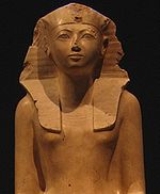
Hatshepsut (or Hatchepsut, ), meaning, Foremost of Noble Ladies, was the fifth pharaoh
Pharaoh

Pharaoh is a title used in many modern discussions of the ancient Egyptian rulers of all periods. In antiquity this title began to be used for the ruler who was the religious and political leader of united ancient Egypt, only during the New Kingdom, specifically, during the middle of the Eighteenth dynasty of Egypt....
 of the eighteenth dynasty
Eighteenth dynasty of Egypt

The Eighteenth Dynasty is perhaps the best known of all the dynasties of ancient Egypt. As well as a number of Egypt's most powerful pharaohs, it included Tutankhamun, whose tomb, uncovered by Howard Carter in 1922, was one of the greatest of all archaeological discoveries, being completely undisturbed by tomb robbers....
 of Ancient Egypt
Ancient Egypt

Ancient Egypt was an Ancient history civilization in eastern North Africa, concentrated along the lower reaches of the Nile in what is now the modern nation of Egypt....
. She is generally regarded by Egyptologists as one of the most successful pharaohs, reigning longer than any other woman of an indigenous
Indigenous peoples

File:Kaiapos.jpegThe term indigenous peoples or autochthonous peoples can be used to describe any ethnic group of people who inhabit a geographic region with which they have the earliest known historical connection, alongside immigrants which have populated the region and which are greater in number....
 Egyptian dynasty
Dynasty

A dynasty is a succession of rulers who belong to the same family for generations. A dynasty is also often called a "Royal House", e.g. the House of Saud or House of Habsburg....
.

Although contemporary records of her reign are documented in diverse ancient sources, Hatshepsut was described by early modern scholars as only having served as a co-regent from about 1479 to 1458 B.C.
Hatshepsut

Hatshepsut , meaning, Foremost of Noble Ladies, was the fifth pharaoh of the Eighteenth dynasty of Egypt of Ancient Egypt. She is generally regarded by Egyptologists as one of the most successful pharaohs, reigning longer than any other woman of an Indigenous peoples Egyptian dynasty....
, during years seven to twenty-one of the reign previously identified as that of Thutmose III
Thutmose III

Thutmose III was the sixth Pharaoh of the Eighteenth dynasty of Egypt. During the first twenty-two years of Thutmose's reign he was co-regent with his aunt, Hatshepsut, who was named the pharaoh....
.


Discussion
Ask a question about 'Hatshepsut'
Start a new discussion about 'Hatshepsut'
Answer questions from other users
Full Discussion Forum


Recent Posts


Quotations


Here ye, all persons! Ye people as many as ye are! I have done things according to the design of my heart...

I have restored that which was in ruins, I have raised up that which was unfinished since the (invasion of) Asiatics...

To look upon her (Hatshepsut) was more beautiful than anything; her splendor and her form were divine; she was a maiden, beautiful and blooming.

I am his (Ammun-Ra) daughter in very truth, who works for him and knows what he desires. My reward from my father is life, stability, dominion upon the Horus throne of all the Living, like Ra, forever.

My command stands firm like mountains, and the sun's disk shines and spreads rays overy the titulary of my august person, and my falcon rises high above the kingly banner unto all eternity.

Now my heart turns this way and that, as I think what the people say. Those who shall see my monuments in years to come and who shall speak of what I have done. Category:Heads of state


Encyclopedia


Hatshepsut (or Hatchepsut, ), meaning, Foremost of Noble Ladies, was the fifth pharaoh
Pharaoh

Pharaoh is a title used in many modern discussions of the ancient Egyptian rulers of all periods. In antiquity this title began to be used for the ruler who was the religious and political leader of united ancient Egypt, only during the New Kingdom, specifically, during the middle of the Eighteenth dynasty of Egypt....
 of the eighteenth dynasty
Eighteenth dynasty of Egypt

The Eighteenth Dynasty is perhaps the best known of all the dynasties of ancient Egypt. As well as a number of Egypt's most powerful pharaohs, it included Tutankhamun, whose tomb, uncovered by Howard Carter in 1922, was one of the greatest of all archaeological discoveries, being completely undisturbed by tomb robbers....
 of Ancient Egypt
Ancient Egypt

Ancient Egypt was an Ancient history civilization in eastern North Africa, concentrated along the lower reaches of the Nile in what is now the modern nation of Egypt....
. She is generally regarded by Egyptologists as one of the most successful pharaohs, reigning longer than any other woman of an indigenous
Indigenous peoples

File:Kaiapos.jpegThe term indigenous peoples or autochthonous peoples can be used to describe any ethnic group of people who inhabit a geographic region with which they have the earliest known historical connection, alongside immigrants which have populated the region and which are greater in number....
 Egyptian dynasty
Dynasty

A dynasty is a succession of rulers who belong to the same family for generations. A dynasty is also often called a "Royal House", e.g. the House of Saud or House of Habsburg....
.

Although contemporary records of her reign are documented in diverse ancient sources, Hatshepsut was described by early modern scholars as only having served as a co-regent from about 1479 to 1458 B.C.
Hatshepsut

Hatshepsut , meaning, Foremost of Noble Ladies, was the fifth pharaoh of the Eighteenth dynasty of Egypt of Ancient Egypt. She is generally regarded by Egyptologists as one of the most successful pharaohs, reigning longer than any other woman of an Indigenous peoples Egyptian dynasty....
, during years seven to twenty-one of the reign previously identified as that of Thutmose III
Thutmose III

Thutmose III was the sixth Pharaoh of the Eighteenth dynasty of Egypt. During the first twenty-two years of Thutmose's reign he was co-regent with his aunt, Hatshepsut, who was named the pharaoh....
. Today it is generally recognized that Hatshepsut assumed the position of pharaoh and the length of her reign usually is given as twenty-two years, since she was assigned a reign of twenty-one years and nine months by the third-century B.C. historian, Manetho
Manetho

Manetho was an Egyptian historian and priest from Sebennytos who lived during the Ptolemaic dynasty, ca. 3rd century BC. Manetho wrote the Aegyptiaca ....
, who had access to many records that now are lost. Her death is known to have occurred in 1458 B.C., which implies that she became pharaoh circa 1479 B.C.

Comparison with other female rulers

Although it was uncommon for Egypt to be ruled by a woman, the situation was not unprecedented. As a regent
Regent

A regent, from the Latin regens "reigning", is a person selected to act as head of state because the ruler is a minor, not present or debilitated....
 Hatshepsut was preceded by Merneith
Merneith

Merneith was a Queen consort, a regent, and possibly, the fourth pharaoh of Ancient Egypt during the First Dynasty of Egypt. Her rule was in the 30th century BC, for an undetermined period of time....
 of the first dynasty
First dynasty of Egypt

The first dynasty of Ancient Egypt is often combined with the Second dynasty of Egypt under the group title, Early Dynastic Period of Egypt. At that time the capital was Thinis....
, who was buried with the full honors of a pharaoh and may have ruled in her own right. Nimaethap
Nimaethap

Nimaethap was probably the wife of Khasekhemwy and the first Dowager Queen of Egypt that is known with certainty to have acted as regent for her son, Djoser, during the Third dynasty of Egypt....
 of the third dynasty
Third dynasty of Egypt

Third Dynasty The Third Dynasty of ancient Egypt is the first dynasty of the Old Kingdom. Other dynasties of the Old Kingdom include the Fourth dynasty of Egypt, Fifth dynasty of Egypt and Sixth dynasty of Egypt....
 may have been the dowager
Dowager

A dowager is a widow who holds a title or property, or dower, derived from her deceased husband. As an adjective, "Dowager" usually appears in association with monarchy and aristocracy titles....
 of Khasekhemwy
Khasekhemwy

Khasekhemwy was the fifth and final Pharaoh of the Second dynasty of Egypt. Little is known of Khasekhemwy, other than that he led several significant military campaigns and built several monuments, still extant, mentioning war against the Northerners....
, but certainly acted as regent
Regent

A regent, from the Latin regens "reigning", is a person selected to act as head of state because the ruler is a minor, not present or debilitated....
 for her son, Djoser
Djoser

Netjerikhet or Djoser is the best-known pharaoh of the Third dynasty of Egypt. He commissioned his official, Imhotep , to build the first of the pyramids, a step pyramid for him at Saqqara....
, and may have reigned as pharaoh
Pharaoh

Pharaoh is a title used in many modern discussions of the ancient Egyptian rulers of all periods. In antiquity this title began to be used for the ruler who was the religious and political leader of united ancient Egypt, only during the New Kingdom, specifically, during the middle of the Eighteenth dynasty of Egypt....
 in her own right. Queen Sobekneferu
Sobekneferu

Sobekneferu was an ancient Egypt female pharaoh of the Twelfth dynasty of Egypt. Her name meant "the beauties of Sobek." She was the daughter of Pharaoh Amenemhat III....
 of the Twelfth Dynasty
Twelfth dynasty of Egypt

The Eleventh , Twelfth, Thirteenth and Fourteenth Dynasties of ancient Egypt are often combined under the group title, Middle Kingdom of Egypt....
 is known to have assumed formal power as ruler of "Upper and Lower Egypt" three centuries earlier than Hatshepsut. Ahhotep I
Ahhotep I

Ahhotep I , was an Ancient Egyptian queen who lived circa 1560s BC- 1530s BC BC, during the early New Kingdom. A member of the Seventeenth dynasty of Egypt, she was the daughter of Queen Tetisheri and Tao I the Elder, and was likely the sister, as well as, the wife of pharaoh Seqenenre Tao II....
, lauded as a warrior
Warrior

According to the Random House Dictionary, the term warrior has two meanings. The first Literal and figurative language use refers to "a person engaged or experienced in warfare." The second Literal and figurative language use refers to "a person who shows or has shown great vigor, courage, or aggressiveness, as in politics or athletics...
 queen, may have been a regent
Regent

A regent, from the Latin regens "reigning", is a person selected to act as head of state because the ruler is a minor, not present or debilitated....
 between the reigns of two of her sons, Kamose
Kamose

Kamose was the last king of the Thebes, Egypt Seventeenth dynasty of Egypt. He was probably the son of Tao II the Brave and Ahhotep I and the full brother of Ahmose I, founder of the Eighteenth dynasty of Egypt....
 and Ahmose I
Ahmose I

Ahmose I was a pharaoh of ancient Egypt and the founder of the Eighteenth dynasty of Egypt. He was a member of the Thebes, Egypt royal house, the son of pharaoh Tao II the Brave and brother of the last pharaoh of the Seventeenth dynasty of Egypt, King Kamose....
, at the end of the seventeenth dynasty and the beginning of Hatshepsut's own eighteenth dynasty. Amenhotep I
Amenhotep I

Amenhotep I was the second Pharaoh of the Eighteenth dynasty of Egypt of History of Ancient Egypt. His reign is Amenhotep I#Dates and length of reign....
, also preceding Hatshepsut in the eighteenth dynasty, probably came to power while a young child and his mother, Ahmose-Nefertari
Ahmose-Nefertari

Ahmose-Nefertari of Ancient Egypt was the royal sister and the Great Royal Wife of pharaoh, Ahmose I. Upon the death of Ahmose I, their heir, Kamose, became pharaoh, but was killed in war....
, is thought to have been a regent
Regent

A regent, from the Latin regens "reigning", is a person selected to act as head of state because the ruler is a minor, not present or debilitated....
 for him. Other women whose possible reigns as pharaohs are under study include Akhenaten
Akhenaten

Akhenaten , was a Pharaoh of the Eighteenth dynasty of Egypt, who died 1336 BC or 1334 BC. He is especially noted for attempting to compel the Egyptian population in the monotheism worship of Aten, although there are doubts as to how successful he was at this....
's possible female co-regent/successor
Smenkhkare

Smenkhkare is an ephemeral Pharaoh of the late Eighteenth dynasty of Egypt of whom very little is know for certain. Traditionally he is seen as Akhenaten's co-regent and immediate successor and predecessor of Tutankhamun and is assumed to be a close, male relative of those two kings ....
 (usually identified as either Nefertiti
Nefertiti

Nefertiti was the Great Royal Wife of the Egyptian Pharaoh Akhenaten. Nefertiti and her husband were known for changing Egypt's religion from a polytheistic religion to a monotheistic religion....
 or Meritaten
Meritaten

Meritaten also spelled Merytaten or Meryetaten was an Ancient Egypt queen of the 18th dynasty, who held the position of Great Royal Wife to Pharaoh Smenkhkare, who may have been a brother or son of Akhenaten....
) and Twosret
Twosret

Queen Twosret was the last known female king of Egypt of a local indigenous dynasty and the final Pharaoh of the Nineteenth Dynasty. She is recorded in Manetho's Epitome as a certain Thuoris who ruled Egypt for seven years, but this figure included the nearly six year reign of Siptah, her predecessor....
. Among the later, non-indigenous Egyptian dynasties, the most notable example of another woman who became pharaoh was Cleopatra VII, the last pharaoh of Ancient Egypt.

In comparison with other female pharaohs, Hatshepsut's reign was long and prosperous. She was successful in war
War

...
fare early in her reign, but generally is considered to be a pharaoh who inaugurated a long peaceful era. She re-established trading relationships
International trade

International trade is exchange of Capital , goods, and services across international borders or territories. In most countries, it represents a significant share of gross domestic product ....
 lost during a foreign occupation and brought great wealth to Egypt. That wealth enabled Hatshepsut to initiate building projects that raised the calibre of Ancient Egyptian architecture to a standard, comparable to classical architecture
Classical architecture

Classical architecture is the set of building styles and techniques of Classical Greece, as used in ancient Greece, the Hellenistic period, and the Roman empire....
, that would not be rivaled by any other culture for a thousand years.

Family and early life


Hatshepsut was the elder daughter of Thutmose I and Queen Ahmose
Queen Ahmose

Queen Ahmose was the Ancient Egypt royal queen of pharaoh, Thutmose I, and the mother of queen and later, pharaoh, Hatshepsut. Ahmose was the Great Royal Wife of Thutmose I, a military general whose rise to pharaoh was likely assured because of her marriage to him....
, the first king and queen of the Thutmoside clan of the eighteenth dynasty. Thutmose I and Ahmose are known to have had only one other child, a daughter, Akhbetneferu (Neferubity), who died as a youth. Thutmose I also married Mutnofret
Mutnofret

Mutnofret was a queen during the Eighteenth dynasty of Egypt. She was a secondary wife of Thutmose I and the mother of Thutmose II.Based on her titles of King's Daughter and King's Sister, she is likely to have been a daughter of Ahmose I and a sister of Amenhotep I, although the chief wife of Thutmose I was not Mutnofret, but Queen Ah...
, possibly a daughter of Ahmose I, and produced several half-brothers to Hatshepsut: Wadjmose, Amenose, Thutmose II
Thutmose II

Thutmose II was the fourth Pharaoh of the Eighteenth dynasty of Egypt. He built some minor monuments and initiated at least two minor campaigns but did little else during his rule and was probably strongly influenced by his wife, Hatshepsut....
, and possibly Ramose, through that secondary union. Both Wadjmose and Amenose were prepared to succeed their father, but neither lived beyond adolescence.

Upon the death of her father in 1493 B.C., Hatshepsut married her half-brother, Thutmose II, and assumed the title of Great Royal Wife
Great Royal Wife

File:Ah hotep.jpgGreat Royal Wife or Chief King's Wife is the term used to refer to the chief wife of a male pharaoh of Ancient Egypt on the day of his coronation, as her status in the royal lineage was essential to gaining the position of pharaoh....
. Thutmose II ruled Egypt for either three or thirteen years. Royal women also played a pivotal role in the religion of ancient Egypt. Often a queen officiated at the rites in the temples, as priestess, in a culture where religion was inexorably interwoven with the roles of the rulers. In Hatshepsut's time the royal daughter acted in such a role as the god's Wife
God's Wife

God's Wife is a term which was often allocated to royal women during the 18th Dynasty of Egypt. The term indicates an inherited sacral role, in which the role of God's Wife passed from mother to daughter....
 (?mt n?r), which is a sacred role usually occupied by royal women during the eighteenth Dynasty.

Hatshepsut had one daughter with Thutmose II, Neferure
Neferure

Neferure was an Ancient Egypt princess of the Eighteenth dynasty of Egypt. She was the daughter of two pharaohs, Hatshepsut and Thutmose II.....
. Some scholars hold that Hatshepsut and Thutmose II groomed Neferure as the heir apparent
Heir apparent

An heir apparent is an heir who cannot be displaced from inheriting; the term is used in contrast to heir presumptive, the term for a conditional heir who is currently in line to inherit but could be displaced at any time in the future....
, commissioning official portraits of their daughter wearing the false beard of royalty and the sidelock of youth
Youth side lock

A youth side lock was a plaited lock of hair, which pre-pubescent ancient Egyptian youths, particularly boys, wore on the side of their shaven heads....
 as seen in remaining sculptures, reliefs, and drawings. There are many images of her with her nurse and tutors in museums.

When Thutmose II died, he left behind only one son, a young Thutmose III
Thutmose III

Thutmose III was the sixth Pharaoh of the Eighteenth dynasty of Egypt. During the first twenty-two years of Thutmose's reign he was co-regent with his aunt, Hatshepsut, who was named the pharaoh....
 to succeed him. The latter was born as the son of Isis, a lesser wife of Thutmose II, rather than of the Great Royal Wife, Hatshepsut, as Neferure was. Due to the relative youth of Thutmose III, he was not eligible to assume the expected tasks of a pharaoh. Instead, Hatshepsut became the regent of Egypt at this time, assumed the responsibilities of state, and was recognized by the leadership in the temple. At this time, her daughter, Neferure, took over the roles Hatshepsut had played as queen in official and religious ceremonies. This political arrangement is detailed in the tomb autobiography of Ineni
Ineni

Ineni was an History of Ancient Egypt architect and government official of the Eighteenth dynasty of Egypt, responsible for major construction projects under the pharaohs Amenhotep I, Thutmose I of Egypt, Thutmose II of Egypt and the joint reigns of Hatshepsut of Egypt and Thutmose III of Egypt....
, a high official at court:

Thus, while Thutmose III was designated as a co-regent of Egypt, the royal court recognised Hatshepsut as the pharaoh on the throne until she died. It is believed that Neferure predeceased her mother Hatshepsut as representations of her disappear prior to the end of this female pharaoh's reign.

Thutmose III ruled as pharaoh for more than thirty years after the death of Hatshepsut. This relationship between Neferure and Amenemhat is debated among authors, but since Neferure is depicted in her mother's funeral temple, there are some who believe that Neferure still was alive in the first few years of the rule by Thutmose III as pharaoh, that his eldest son, Amenemhat, was her child, and that he thereby was the heir to the throne of Thutmose III until he died.

Rule


Dates and length of reign

Hatshepsut was given a reign of about twenty-two years by ancient authors. Josephus
Josephus

Josephus , also known as Yosef Ben Matityahu and, after he became a Roman citizenship, as Titus Flavius Josephus, was a first-century Jewish historian and apologist of priestly and royal ancestry who survived and recorded the destruction of Jerusalem in AD 70....
 writes that she reigned for twenty-one years and nine months, while Africanus
Sextus Julius Africanus

Sextus Julius Africanus, was a Christian traveller and historian of the early 3rd century AD. He was possibly born in Libya, though he calls himself a native of Jerusalem, which some scholars take as his hometown....
 states her reign lasted twenty-two years, both of whom were quoting Manetho
Manetho

Manetho was an Egyptian historian and priest from Sebennytos who lived during the Ptolemaic dynasty, ca. 3rd century BC. Manetho wrote the Aegyptiaca ....
. At this point in the histories, records of the reign of Hatshepsut end, since the first major foreign campaign of Thutmose III
Thutmose III

Thutmose III was the sixth Pharaoh of the Eighteenth dynasty of Egypt. During the first twenty-two years of Thutmose's reign he was co-regent with his aunt, Hatshepsut, who was named the pharaoh....
 was dated to his twenty-second year, which also would have been Hatshepsut's twenty-second year as pharaoh. Dating the beginning of her reign is more difficult, however. Her father's reign began in either 1506 or 1526 BC according to the low and high chronologies, respectively. The length of the reigns of Thutmose I and Thutmose II, however, cannot be determined with absolute certainty. With short reigns, Hatshepsut would have ascended the throne fourteen years after the coronation of Thutmose I, her father. Longer reigns would put her ascension twenty-five years after Thutmose I's coronation. Thus, Hatshepsut could have assumed power as early as 1512 BC, or, as late as 1479 BC.

The earliest attestation of Hatshepsut as pharaoh occurs in the tomb of Senenmut's parents
Ramose and Hatnofer: Senenmut's parents

Ramose was the father and Hatnofer the mother of Senenmut, one of the most important state officials under the reign of the Egyptian queen Hatshepsut in the 18th dynasty of Egypt's New Kingdom....
 where a collection of grave goods contained a single pottery jar or amphorae from the tomb's chamber--which was stamped with the date Year 7. Another jar from the same tomb--which was discovered in situ by a 1935-1936 Metropolitan Museum of Art expedition on a hillside near Thebes--was stamped with the seal of the 'God's Wife Hatshepsut' while two jars bore the seal of ' The Good Goddess Maatkare. ' The dating of the amphorae, "sealed into the [tomb's] burial chamber by the debris from Senenmut's own tomb," is undisputed which means that Hatshepsut was acknowledged as the king of Egypt by Year 7 of her reign.

Modern chronologists, however, tend to agree that Hatshepsut reigned as pharaoh from 1479 to 1458 BC, but there is no definitive proof of the beginning date. These dates are derived from the closeness of length of her reign, related in the ancient records of Manetho, Africanus, and Josephus and counting backward from the date of her death, which is quite certain. or January 16, 1458 BC.

Major accomplishments

Hatshepsut reestablished the trade network
Trade route

A trade route is a Logistics identified as a series of pathways and stoppages used for the commercial transport of cargo. Allowing Good s to reach distant markets, a single trade route contains long distance Arterial road which may further be connected to several smaller networks of commercial and non commercial transportation....
s that had been disrupted during the Hyksos
Hyksos

The Hyksos were an Asiatic people who invaded the eastern Nile Delta, in the Twelfth dynasty of Egypt initiating the Second Intermediate Period of Ancient Egypt....
 occupation of Egypt during the Second Intermediate Period, thereby building the wealth of the eighteenth dynasty.

She oversaw the preparations and funding for a mission to the Land of Punt
Land of Punt

The Land of Punt, also called Pwenet, or Pwene by the ancient Egyptians, at times synonymous with Ta netjer, the "land of the god", was a fabled site in the Horn of Africa and was known for producing and exporting gold, aromatic resins, African Blackwood, ebony, ivory, slaves and wild animals....
. The expedition set out in her name with five ships, each measuring 70 feet (21 m) long bearing several sails and accommodating 210 men that included sailors and 30 rowers. Many trade goods were bought in Punt, notably myrrh
Myrrh

Myrrh is a reddish-brown resinous material, the dried Plant sap of a number of trees, but primarily from Commiphora myrrha, native to Yemen, Somalia, the eastern parts of Ethiopia and Commiphora gileadensis, native to Jordan....
.

Most notably, however, the Egyptians returned from the voyage bearing thirty-one live frankincense
Frankincense

Frankincense, also called olibanum , is an Aroma compound resin obtained from trees of the genus Boswellia, particularly Boswellia sacra ....
 trees, the roots of which were carefully kept in baskets for the duration of the voyage. This was the first recorded attempt to transplant foreign tree
TREE

TREE was a Boston hardcore punk band formed in the summer of 1990. They were active in the Boston music scene until disbanding in 2002....
s. It is reported that Hatshepsut had these trees planted in the courts of her Deir el Bahri mortuary temple complex. Egyptians also returned with living Puntites (people of Punt). This trading expedition to Punt was roughly during Hatshepsut's nineteenth year of reign.

She had the expedition commemorated in relief at Deir el-Bahri
Deir el-Bahri

Deir el-Bahri is a complex of mortuary temples and tombs located on the west bank of the Nile, opposite the city of Luxor, Egypt.In 1997, 58 tourists and 4 Egyptians were massacred here by Islamic terrorists from Al-Gama'a al-Islamiyya in what has become to be known as The 'Luxor massacre'....
, which also is famous for its realistic depiction of the Queen of the Land of Punt
Land of Punt

The Land of Punt, also called Pwenet, or Pwene by the ancient Egyptians, at times synonymous with Ta netjer, the "land of the god", was a fabled site in the Horn of Africa and was known for producing and exporting gold, aromatic resins, African Blackwood, ebony, ivory, slaves and wild animals....
, Queen Iti, who appears to have had a genetic trait called steatopygia
Steatopygia

is a high degree of Adipose_fat accumulation in and around the buttocks. The deposit of fat is not confined to the gluteal regions, but extends to the outside and front of the thighs, forming a thick layer reaching sometimes to the knee....
. Hatshepsut also sent raiding expeditions to Byblos and Sinai shortly after the Punt expedition. Very little is known about these expeditions. Although many Egyptologists have claimed that her foreign policy
Foreign policy

A state's foreign policy, also called the international relations policy, is a set of goals outlining how the country will interact with other countries economically, politically, socially and militarily, and to a lesser extent, how the country will interact with non-state actors....
 was mainly peaceful, there is evidence that Hatshepsut led successful military campaign
Military campaign

In the military sciences, a military campaign is a term applied to Scale , long duration, significant military strategy Military plan incorporating a series of inter-related military operations or battles forming a distinct part of a larger conflict often called a war....
s in Nubia
Nubia

Nubia is a region in Southern Egypt along the Nile and in what is now northern Sudan. Most of Nubia is situated in Sudan with about a quarter of its territory in Egypt....
, the Levant
Levant

The Levant describes, traditionally, the Eastern Mediterranean at large, but can be used as a geographical term that denotes a large area in Western Asia formed by the lands bordering the Eastern shores of the Mediterranean, roughly bounded on the north by the Taurus Mountains, on the south by the Arabian Desert, and on the west by the M...
, and Syria
Syria

Syria , officially the Syrian Arab Republic , is an Arab-majority country in Southwest Asia, bordering Lebanon and the Mediterranean Sea to the west, Israel to the southwest, Jordan to the south, Iraq to the east, and Turkey to the north....
 early in her career.

Building projects


Hatshepsut was one of the most prolific builders in ancient Egypt, commissioning hundreds of construction projects throughout both Upper
Upper Egypt

File:Ancient Egypt map-en.svgUpper Egypt is a narrow strip of land that extends from the Cataracts of the Nile section of Upper Egypt, between El-Ayait and Asyut is sometimes known as Middle Egypt....
 and Lower Egypt
Lower Egypt

Lower Egypt is the northern-most section of Egypt. It refers to the Fertile Crescent Nile Delta region, which stretches from the area between El-Aiyat and Zawyet Dahshur, south of modern-day Cairo, and the Mediterranean Sea....
, that were grander and more numerous than those of any of her Middle Kingdom
Middle Kingdom

The Middle Kingdom may refer to*China*The Middle Kingdom of Egypt*A group of midwest U.S. states associated with the Society for Creative Anachronism...
 predecessors. Later pharaohs attempted to claim some of her projects as theirs.

She employed the great architect Ineni
Ineni

Ineni was an History of Ancient Egypt architect and government official of the Eighteenth dynasty of Egypt, responsible for major construction projects under the pharaohs Amenhotep I, Thutmose I of Egypt, Thutmose II of Egypt and the joint reigns of Hatshepsut of Egypt and Thutmose III of Egypt....
, who also had worked for her father, her husband, and for the royal steward
Vizier (Ancient Egypt)

The vizier was the highest official in Ancient Egypt to serve the king, or pharaoh during the Old, Middle, and New Kingdoms. Vizier is the generally accepted rendering of ancient Egyptian tjati, tjaty etc, among Egyptologists....
 Senemut
Senemut

Senenmut was an Eighteenth dynasty of Egypt History of Ancient Egypt architecture and government official. He may also have been the lover of the female Pharaoh Hatshepsut of Egypt although this is speculative....
. During her reign, so much statuary was produced that almost every major museum in the world has Hatshepsut statuary among their collections; for instance, the Hatshepsut Room in New York City
New York City

The City of New York is the List of United States cities by population in the United States, while the New York metropolitan area ranks among the List of urban areas by population....
's Metropolitan Museum of Art
Metropolitan Museum of Art

The Metropolitan Museum of Art is an art museum located on the eastern edge of Central Park, along what is known as Museum Mile, New York City in New York City, USA....
 is dedicated solely to some of these pieces.

Following the tradition of most pharaohs, Hatshepsut had monuments constructed at the Temple of Karnak
Karnak

The Karnak temple complex, universally known only as Karnak, describes a vast conglomeration of ruined temples, chapels, pylons and other buildings....
. She also restored the original Precinct of Mut
Precinct of Mut

The Precinct of Mut, located near Luxor, Egypt, is one of the four main enclosed areas that make up the immense Karnak and occupies some 150,000 m?....
, the ancient great goddess of Egypt
Mut

Mut, which meant mother in the ancient Egyptian language, was an ancient Egyptian mother goddess with multiple aspects that changed over the thousands of years of the culture....
, at Karnak that had been ravaged by the foreign rulers during the Hyksos
Hyksos

The Hyksos were an Asiatic people who invaded the eastern Nile Delta, in the Twelfth dynasty of Egypt initiating the Second Intermediate Period of Ancient Egypt....
 occupation. She had twin obelisk
Obelisk

An obelisk An Obelisks is a tall, narrow, four-sided, tapering monument which ends in a pyramid like shape at the top. Ancient obelisks were made of a single piece of stone, a monolith; however, most modern obelisks are made of individual stones, and can even have interior spaces....
s, at the time the tallest in the world, erected at the entrance to the temple. One still stands, as the tallest surviving ancient obelisk on Earth; the other has broken in two and toppled.

Another project, Karnak's Red Chapel, or Chapelle Rouge
Chapelle Rouge

The Red Chapel of Hatshepsut or the Chapelle Rouge originally was constructed as a Barque during the reign of Hatshepsut. She was the fifth pharaoh of the Eighteenth Dynasty of Egypt of Ancient Egypt and ruled from approximately 1479 to 1458 BC....
, was intended as a barque
Barque

A barque, barc, or bark is a type of sailing vessel....
 shrine and originally, may have stood between her two obelisks. She later ordered the construction of two more obelisks to celebrate her sixteenth year as pharaoh; one of the obelisks broke during construction, and thus, a third was constructed to replace it. The broken obelisk was left at its quarrying site in Aswan
Aswan

Aswan , Egyptian language: Swenet , Coptic language: Swan; Greek language: Syene; ) is a city in the south of Egypt, the capital of the Aswan Governorate....
, where it still remains. Known as The Unfinished Obelisk
Unfinished obelisk

The unfinished obelisk is the largest known ancient obelisk, located in the northern region of the stone quarries of ancient Egypt in Aswan , Egypt....
, it demonstrates how obelisks were quarried.

The Temple of Pakhet
Pakhet

In Egyptian mythology, Pakhet, Egyptian language P?.t , meaning she who tears is considered a synthesis of Bast and Sekhmet, ancient deities in the two Egypts who were similar lioness war goddess, one for Upper Egypt and the other for Lower Egypt....
 was built by Hatshepsut at Beni Hasan
Beni Hasan

Beni Hasan Beni Hasan is a cemetery site located in the region known as Middle Egypt, which is the area between Asyut and Memphis.[1] While there are some Old Kingdom burials at the site, it was primarily used during the Middle Kingdom period which spanned from 2040 to 1640 BCE.[2] To the south of the cemetery is Speos Artemidos a...
 in the Minya Governorate
Minya Governorate

Minya Governorate is one of the governorates of Egypt of Upper Egypt. The name originates from the chief city of the governorate, originally known in Coptic language as Tmoone and in Bohairic as Thmone , meaning ?the residence?, in reference to a monastery formerly in the area....
 south of Al Minya
Al Minya

Al Minya may mean:* Minya Governorate in Egypt* Minya, Egypt, capital city of the Minya Governorate* Netron Menya a Russian steam battleship, see the List of Russian steam battleships...
. The name, Pakhet was a synthesis that occurred by combining Bast
Bast

Bast may refer to:* Bastet , a goddess in Egyptian mythology* Bast , a type of plant fiber*Bast, Afghanistan* Bast , Marvel Comics depiction of the goddess...
 and Sekhmet
Sekhmet

In Egyptian mythology, Sekhmet , was originally the warrior goddess of Upper Egypt. She is depicted as a lion, the fiercest hunter known to the Egyptians....
, who were similar lioness war goddesses, in an area that bordered the north and south division of their cults. The cavernous underground temple, cut into the rock cliffs on the eastern side of the Nile
Nile

The Nile is a major north-flowing river in Africa, generally regarded as the List of rivers by length in the world.The Nile has two major tributary, the White Nile and Blue Nile, the latter being the source of most of the Nile's water and silt, but the former being the longer of the two....
, was admired and called the Speos Artemidos
Speos Artemidos

The Speos Artemidos is an archaeological site in Egypt. It is located about 2 kilometre south of the Middle Kingdom of Egypt tombs at Beni Hasan, and about 28 km south of Al Minya, Egypt....
 by the Greeks during their occupation of Egypt, known as the Ptolemaic Dynasty
Ptolemaic dynasty

The Ptolemaic dynasty was a Hellenistic Macedonian royal family which ruled the Ptolemaic Empire in Egypt for nearly 300 years, from 305 BC to 30 BC....
. They saw the goddess as a parallel to their hunter goddess Artemis. The temple is thought to have been built alongside much more ancient ones that have not survived. This temple has an architrave with a long dedicatory text bearing Hatshepsut's famous denunciation of the Hyksos
Hyksos

The Hyksos were an Asiatic people who invaded the eastern Nile Delta, in the Twelfth dynasty of Egypt initiating the Second Intermediate Period of Ancient Egypt....
 that has been translated by James P. Allen. They had occupied Egypt and cast it into a cultural decline that persisted until a revival brought about by her policies and innovations. This temple was altered later and some of its inside decorations were usurped by Seti I
Seti I

Menmaatre Seti I was a Pharaoh of Ancient Egypt , the son of Ramesses I and Queen Sitre, and the father of Ramesses II. As with all dates in Ancient Egypt, the actual dates of his reign are unclear, and various historians claim different dates, with 1294 BC – 1279 BC and 1290 BC to 1279 BC being the most commonly used by scholars today...
, in the nineteenth dynasty
Nineteenth dynasty of Egypt

The Eighteenth, Nineteenth, and Twentieth Dynasties of ancient Egypt are often combined under the group title, New Kingdom....
, attempting to have his name replace that of Hatshepsut.

Following the tradition of many pharaohs, the masterpiece of Hatshepsut's building projects was her mortuary temple
Mortuary temple

Mortuary temples were temples constructed adjacent to, or in the vicinity of, royal tombs in the Middle Kingdom of Egypt and New Kingdom periods of Ancient Egypt....
. She built hers in a complex at Deir el-Bahri
Deir el-Bahri

Deir el-Bahri is a complex of mortuary temples and tombs located on the west bank of the Nile, opposite the city of Luxor, Egypt.In 1997, 58 tourists and 4 Egyptians were massacred here by Islamic terrorists from Al-Gama'a al-Islamiyya in what has become to be known as The 'Luxor massacre'....
. It was designed and implemented by Senemut at a site on the West Bank
Thebes, Egypt

Thebes was a city in Ancient Egypt located about 800 km south of the Mediterranean, on the east bank of the river Nile . It was the capital of Waset, the fourth Upper Egyptian Nome ....
 of the Nile River near the entrance to what now is called the Valley of the Kings
Valley of the Kings

The Valley of the Kings is a valley in Egypt where, for a period of nearly 500 years from the 16th century BC to 11th century BC, tombs were constructed for the Pharaoh and powerful nobles of the Conventional Egyptian chronology#New Kingdom ....
 because of all the pharaohs who later chose to associate their complexes with the grandeur of hers. Her buildings were the first grand ones planned for that location. The focal point was the Djeser-Djeseru or "the Sublime of Sublimes", a colonnade
Colonnade

In classical architecture, a colonnade denotes a long sequence of columns joined by their entablature, often free-standing, as in the famous elliptically curving colonnades that Bernini added to the fa?ade of The apostel Peter's Basilica in Rome, which embrace and define the Piazza....
d structure of perfect harmony nearly one thousand years before the Parthenon
Parthenon

The Parthenon is a Greek temple of the Greek gods Athena, built in the 5th century BC on the Acropolis of Athens. It is the most important surviving building of Classical Greece, generally considered to be the culmination of the development of the Doric order....
 was built. Djeser-Djeseru sits atop a series of terraces
Terrace (agriculture)

In agriculture, a terrace is a leveled section of a hilly cultivated area, designed as a method of soil conservation to slow or prevent the rapid surface runoff of irrigation water....
 that once were graced with lush garden
Garden

A garden is a planned space, usually outdoors, set aside for the display, cultivation, and enjoyment of plants and other forms of nature. The garden can incorporate both natural and man-made materials....
s. Djeser-Djeseru is built into a cliff
Cliff

In geography and geology, a cliff is a significant vertical, or near vertical, rock exposure. Cliffs are formed as erosion landforms due to the processes of erosion and weathering that produce them....
 face that rises sharply above it. Djeser-Djeseru and the other buildings of Hatshepsut's Deir el-Bahri complex are considered to be significant advances in architecture. Another one of her great accomplishments is the Hatshepsut needle (also known as the granite
Granite

Granite is a common and widely occurring type of Intrusion , felsic, igneous rock rock . Granite has a medium to coarse texture, occasionally with some individual crystals larger than the groundmass forming a rock known as Porphyry ....
 obelisks).

Official lauding


Hyperbole
Hyperbole

Hyperbole comes from ancient Greek "?pe?????" and is a figure of speech in which statements are exaggerated. It may be used to evoke strong feelings or to create a strong impression, but is rarely meant to be taken literally....
 is common, virtually, to all royal inscriptions of Egyptian history. While all ancient leaders used it to laud their achievements, Hatshepsut has been called the most accomplished pharaoh at promoting her accomplishments. This may have resulted from the extensive building executed during her time as pharaoh, in comparison to many others. It afforded her with many opportunities to laud herself, but it also reflects the wealth that her policies and administration brought to Egypt, enabling her to finance such projects. Aggrandizement of their achievements was traditional when pharaohs built temples and their tombs.

Women had a high status in ancient Egypt and enjoyed the legal right to own, inherit, or will property. A woman becoming pharaoh was rare, however, only Khentkaues, Sobeknefru, and possibly Nitocris
Nitocris

Nitocris has been claimed to have been the last pharaoh of the Sixth dynasty of Egypt. Her name is found in the Histories of Herodotus and writings of Manetho but her historicity is questionable....
 preceded her in known records as ruling solely in their own name. The latter's existence is disputed and is likely a mis-translation of a male king. Twosret
Twosret

Queen Twosret was the last known female king of Egypt of a local indigenous dynasty and the final Pharaoh of the Nineteenth Dynasty. She is recorded in Manetho's Epitome as a certain Thuoris who ruled Egypt for seven years, but this figure included the nearly six year reign of Siptah, her predecessor....
, a female king and the last pharaoh of the nineteenth dynasty, may have been the only woman to succeed her among the indigenous rulers. In Egyptian history, there was no word for a "queen regnant" and by the time of her reign, pharaoh had become the name for the ruler. Hatshepsut is not unique, however, in taking the title of king. Sobekneferu, ruling six dynasties prior to Hatshepsut, also did so when she ruled Egypt. Hatshepsut had been well trained in her duties as the daughter of the pharaoh. During her father's reign she held the powerful office of God's Wife
God's Wife

God's Wife is a term which was often allocated to royal women during the 18th Dynasty of Egypt. The term indicates an inherited sacral role, in which the role of God's Wife passed from mother to daughter....
. She had taken a strong role as queen to her husband and was well experienced in the administration of her kingdom by the time she became pharaoh. There is no indication of challenges to her leadership and, until her death, her co-regent remained in a secondary role, quite amicably heading her powerful army—which would have given him the power necessary to overthrow a usurper of his rightful place, if that had been the case.

Hatshepsut assumed all of the regalia
Regalia

Regalia is Latin plurale tantum for the privileges and the insignia characteristic of a Sovereignty.The word stems from the Latin substantivation of the adjective regalis, 'regal', itself from Rex, 'king'....
 and symbols of the pharaonic office in official representations: the Khat
Khat (apparel)

The khat was a head cloth worn by the nobility of Ancient Egypt. Simpler than the Nemes headdress, it did not have pleats or stripes, and hung down open in the back rather than being tied together....
 head cloth, topped with the uraeus
Uraeus

The Uraeus is the stylized, upright form of an Egyptian spitting Egyptian cobra , used as a symbol of sovereignty, Royal family, deity, and divine authority in ancient Egypt....
, the traditional false beard
Beard

A beard is the hair that grows on a person's chin, cheeks, neck, and the area above the upper lip. Typically, only males going through puberty, or post-pubescent males are able to grow beards....
, and shendyt
Shendyt

The shendyt is a garment which was made of cloth and was worn around the waist, typically extending to above the knees, in Ancient Egypt society....
 kilt. Many existing statues alternatively show her in typically feminine attire as well as those that depict her in the royal ceremonial attire. Statues portraying Sobekneferu also combine elements of traditional male and female iconography
Iconography

Iconography is the branch of art history which studies the identification, description, and the interpretation of the content of images. The word iconography literally means "image writing", and comes from the Ancient Greek e???? and ??afe?? ....
 and, by tradition, may have served as inspiration for these works commissioned by Hatshepsut. After this period of transition ended, however, most formal depictions of Hatshepsut as pharaoh showed her in the royal attire, with all of the pharaonic regalia.

At her mortuary temple, in Osirian statues that regaled the transportation of the pharaoh to the world of the dead, the symbols of the pharaoh as Osiris were the reason for the attire and they were much more important to be displayed traditionally, her breasts are obscured behind her crossed arms holding the regal staff
Staff

Staff may refer to:* Staff , a stick or pole to assist with walking, or sometimes used as a weapon* Staff , artificial stone product used as ornament...
s of the two kingdoms she ruled. This became a pointed concern among writers who sought reasons for the generic style of the shrouded statues and led to misinterpretations. Understanding of the religious symbolism was required to interpret the statues correctly. Interpretations by these early scholars varied and often, were baseless conjectures of their own contemporary values. The possible reasons for her breasts not being emphasized in the most formal statues, were debated among some early Egyptologists, who failed to take into account the fact that many women and goddesses portrayed in ancient Egyptian art often lack delineation of breasts, and that the physical aspect of the gender of pharaohs was never stressed the art. With few exceptions, subjects were idealized. Modern scholars, however, have theorized that by assuming the typical symbols of pharaonic power, Hatshepsut was asserting her claim to be the sovereign rather than a "King's Great Wife" or queen consort. The gender of pharaohs was never stressed in official depictions; even the men were depicted with the highly-stylized false beard associated with their position in the society.

Moreover, the Osirian statues of Hatshepsut—as with other pharaohs—depict the dead pharaoh as Osiris
Osiris

Osiris was an Egyptian mythology, usually called the god of the Afterlife.Osiris is one of the oldest gods for whom records have been found; one of the oldest known attestations of his name is on the Palermo Stone of around 2500 BC....
, with the body and regalia of that deity. All of the statues of Hatshepsut at her tomb follow that tradition. The promise of resurrection after death was a tenet of the cult of Osiris. Since many statues of Hatshepsut depicted in this fashion have been put on display in museums and those images have been widely published, viewers who lack an understanding of the religious significance of these depictions have been misled.

Most of the official statues commissioned of Hatshepsut show her less symbolically and more naturally, as a woman in typical dresses of the nobility of her day. Notably, even after assuming the formal regalia, Hatshepsut still described herself as a beautiful woman, often as the most beautiful of women, and although she assumed almost all of her father's titles, she declined to take the title "The Strong Bull" (the full title being, The Strong Bull of his Mother), which tied the pharaoh to the goddesses Isis
ISIS

ISIS is an industry standard interface for technologies, developed by Pixel Translations in 1990 .ISIS is an open standard for scanner control and a complete image-processing framework....
, the throne, and Hathor
Hathor

In Egyptian mythology, Hathor was originally a personification of the Milky Way, which was seen as the milk that flowed from the udders of a heavenly cow....
, (the cow who gave birth to and protected the pharaohs)—by being her son sitting on her throne—an unnecessary title for her, since Hatshepsut became allied with the goddesses, herself, which no male pharaoh could. Rather than the strong bull, Hatshepsut, having served as a very successful warrior
Warrior

According to the Random House Dictionary, the term warrior has two meanings. The first Literal and figurative language use refers to "a person engaged or experienced in warfare." The second Literal and figurative language use refers to "a person who shows or has shown great vigor, courage, or aggressiveness, as in politics or athletics...
 during the early portion of her reign as pharaoh, associated herself with the lioness image of Sekhmet
Sekhmet

In Egyptian mythology, Sekhmet , was originally the warrior goddess of Upper Egypt. She is depicted as a lion, the fiercest hunter known to the Egyptians....
, the major war
War

...
 deity
List of war deities

"War Gods" redirects here. For the video game, see War Gods .The following is a list of war deities....
 in the Egyptian pantheon
Egyptian pantheon

Most Egyptologists today side with Sir Flinders Petrie that Egyptian religion was strictly polytheistic. His contemporary adversary, E. A. Wallis Budge, however, thought Egyptian religion to be primarily monotheistic where all the gods and goddesses were aspects of the God Ra, similar to the Trinity in Christianity and devas in Hinduism....
.

Religious concepts were tied into all of these symbols and titles. By the time of Hatshepsut's reign, the merger of some aspects of these two goddesses provided that they would both have given birth to, and were the protectors of, the pharaohs. They became interchangeable at times. Hatshepsut also traced her lineage to Mut
Mut

Mut, which meant mother in the ancient Egyptian language, was an ancient Egyptian mother goddess with multiple aspects that changed over the thousands of years of the culture....
, a primal mother goddess of the Egyptian pantheon
Egyptian pantheon

Most Egyptologists today side with Sir Flinders Petrie that Egyptian religion was strictly polytheistic. His contemporary adversary, E. A. Wallis Budge, however, thought Egyptian religion to be primarily monotheistic where all the gods and goddesses were aspects of the God Ra, similar to the Trinity in Christianity and devas in Hinduism....
, which gave her another ancestor who was a deity as well as her father and grandfathers, pharaohs who would have become deified upon death.

While Hatshepsut was depicted in official art wearing regalia of a pharaoh, such as the false beard that male pharaohs also wore, it is most unlikely that she ever wore such ceremonial decorations, just as it is unlikely that the male pharaohs did. Statues such as those at the Metropolitan Museum of Art, depicting her seated wearing a tight-fitting dress and the nemes
Nemes

The nemes was the striped headcloth worn by pharaohs in ancient Egypt. It covered the whole crown and back of the head and nape of the neck and had two large flaps which hung down behind the ears and in front of both shoulders....
 crown, are thought to be a more accurate representation of how she would have presented herself at court.

As a notable exception, only one male pharaoh abandoned the rigid symbolic depiction that had become the style of the most official artwork representing the ruler, Pharaoh Amenhotep IV (later Akhenaten) of the same eighteenth dynasty, whose wife, Nefertiti
Nefertiti

Nefertiti was the Great Royal Wife of the Egyptian Pharaoh Akhenaten. Nefertiti and her husband were known for changing Egypt's religion from a polytheistic religion to a monotheistic religion....
, also may have ruled in her own right following the death of her husband.

One of the most famous examples of the legends about Hatshepsut is a myth about her birth. In this myth, Amun
Amun

Amun, reconstructed Egyptian language Yamanu , was the name of a deity in Egyptian mythology who gradually rose from being an abstract concept to the patron deity of Thebes, Egypt and one of the most important deities in Ancient Egypt before fading into obscurity....
 goes to Ahmose in the form of Thutmose I and awakens her with pleasant odors. At this point Amun places the ankh
Ankh

The ankh was the Egyptian hieroglyphic character that read "eternal life", a triliteral sign for the consonants Ayin-Nun -?a'. Egyptian gods are often portrayed carrying it by its loop, or bearing one in each hand, arms crossed over their chest....
, a symbol of life, to Ahmose's nose, and Hatshepsut is conceived by Ahmose. Khnum, the god who forms the bodies of human children, is then instructed to create a body and ka, or corporal presence/life force, for Hatshepsut. Heket, the goddess of life and fertility, and Khnum then lead Ahmose along to a lioness bed where she gives birth to Hatshepsut. Reliefs depicting each step in these events are at Karnak and in her mortuary temple.

The Oracle of Amun
Oracle

An oracle is a person or agency considered to be a source of wise counsel or prophecy opinion; an infallible authority, usually Spirituality in nature....
 proclaimed that it was the will of Amun that Hatshepsut be pharaoh, further strengthening her position. She reiterated Amun's support by having these proclamations by the god Amun carved on her monuments:

Hatshepsut claimed that she was her father's intended heir and that he made her the heir apparent of Egypt. Almost all scholars today view this as historical revisionism
Historical revisionism (negationism)

Historical revisionism is either the legitimate scholastic correction of existing knowledge about an historical event, or the illegitimate distortion of the historical record such that certain events appear in a more favourable light....
, or prolepsis
Prolepsis

Prolepsis can be:#A figure of speech in which a future event is referred to in anticipation. For example, a character who is about to die might be described as "the dead man" before he is actually dead....
, on Hatshepsut's part since it was Thutmose II
Thutmose II

Thutmose II was the fourth Pharaoh of the Eighteenth dynasty of Egypt. He built some minor monuments and initiated at least two minor campaigns but did little else during his rule and was probably strongly influenced by his wife, Hatshepsut....
—a son of Thutmose I by Mutnofret
Mutnofret

Mutnofret was a queen during the Eighteenth dynasty of Egypt. She was a secondary wife of Thutmose I and the mother of Thutmose II.Based on her titles of King's Daughter and King's Sister, she is likely to have been a daughter of Ahmose I and a sister of Amenhotep I, although the chief wife of Thutmose I was not Mutnofret, but Queen Ah...
—who was her father's heir. Moreover, Thutmose I could not have foreseen that his daughter Hatshepsut would outlive his son within his own lifetime. Thutmose II soon married Hatshepsut and the latter became both his senior royal wife and the most powerful woman at court. Biographer Evelyn Wells
Evelyn Wells

Evelyn Wells was a 20th century biographer and author most known for her biographies of the List of ancient Egyptians royals of the Eighteenth dynasty of Egypt, Nefertiti and Hatshepsut....
, however, accepts Hatshepsut's claim that she was her father's intended successor. Once she became pharaoh herself, Hatshepsut supported her assertion that she was her father's designated successor with inscriptions on the walls of her mortuary temple:

American humorist Will Cuppy
Will Cuppy

William Jacob "Will" Cuppy was an United States humorist and literary criticism, known for his satire books about nature and historical figures....
 wrote an essay on Hatshepsut which was published after his death in the book The Decline and Fall of Practically Everybody. Regarding one of her wall inscriptions, he wrote,

Death

Hatshepsut died as she was approaching, what we would consider middle age
Middle age

Middle age is the period of life beyond Young adult hood but before the onset of old age. Various attempts have been made to define this age, which is around the third quarter of the average life span of human beings....
 given typical contemporary lifespans, in her twenty-second regnal year. The precise date of Hatshepsut's death—and the time when Thutmose III became pharaoh of Egypt—is considered to be Year 22, II Peret day 10 of their joint rule, as recorded on a single stela erected at Armant or January 16, 1458 BC. This information validates the basic reliability of Manetho's kinglist records since Thutmose III and Hatshepsut's known accession date was I Shemu day 4. (ie: Hatshepsut died 9 months into her 22nd year as Manetho writes in his Epitome for a reign of 21 years and 9 months) No mention of the cause of her death has survived. If the recent identification of her mummy in KV60
KV60

Tomb KV60 in Egypt's Valley of the Kings is one of the more perplexing tombs of the Thebes Necropolis, due to the uncertainty over the identity of one female mummy found there , thought by some, such as the noted Egyptologist Elizabeth Thomas , to be that of 18th dynasty Pharaoh Hatshepsut....
 is correct, however, computed tomography
Computed tomography

Computed tomography is a medical imaging method employing tomography. Geometry Processing is used to generate a stereoscopy of the inside of an object from a large series of two-dimensional X-ray images taken around a single axis of rotation....
 would indicate that she died of blood infection while she was in her fifties. It also would suggest that she had arthritis, bad teeth, and probably had diabetes.

Identification of mummy

For a long time, Hatshepsut's mummy
Mummy

A mummy is a corpse whose skin and organs have been preserved by either intentional or incidental exposure to chemicals, extreme coldness, very high humidity, or lack of air when bodies are submerged in bogs....
 was believed to be missing from DB320
DB320

Tomb DB320 is located next to Deir el-Bahri, in the Theban Necropolis, opposite modern Luxor contained an extraordinary cache of mummified remains and funeral equipment of more than 50 kings, queens, royals and various nobility....
. An unidentified female mummy—found with Hatshepsut's wet nurse, Sitire-Re, one of whose arms was posed in the traditional burial style of pharaohs—led to the theory that this unidentified mummy in KV60
KV60

Tomb KV60 in Egypt's Valley of the Kings is one of the more perplexing tombs of the Thebes Necropolis, due to the uncertainty over the identity of one female mummy found there , thought by some, such as the noted Egyptologist Elizabeth Thomas , to be that of 18th dynasty Pharaoh Hatshepsut....
 might be Hatshepsut.

In March 2006, Zahi Hawass
Zahi Hawass

Zahi Hawass is an Egyptians archaeology and List of Egyptologists and the current Secretary General of the Egyptian Supreme Council of Antiquities....
, the Secretary General of Egypt
Egypt

Egypt is a country mainly in North Africa, with the Sinai Peninsula forming a land bridge in Western Asia. Covering an area of about , Egypt borders the Mediterranean Sea to the north, the Gaza Strip and Israel to the northeast, the Red Sea to the east, Sudan to the south and Libya to the west....
's Supreme Council of Antiquities
Supreme Council of Antiquities

The Supreme Council of Antiquities is part of the Egypt Ministry of Culture and is responsible for the conservation, protection and regulation of all antiquities and archaeological excavations in Egypt....
, claimed to have located the mummy of Hatshepsut, which was misplaced on the third floor of the Cairo Museum. In June 2007, it was announced that Egyptologists believed they had identified Hatshepsut's mummy in the Valley of the Kings
Valley of the Kings

The Valley of the Kings is a valley in Egypt where, for a period of nearly 500 years from the 16th century BC to 11th century BC, tombs were constructed for the Pharaoh and powerful nobles of the Conventional Egyptian chronology#New Kingdom ....
. Conclusive evidence includes the possession of a molar with one root that fit the mummy's jaw; the row of teeth in the jaw had a missing tooth which had had only one root as well. This molar was found inside a small wooden box inscribed with Hatshepsut's name and cartouche
Cartouche

In Egyptian hieroglyphs, a cartouche is an oblong inclosure with a horizontal line at one end, indicating that the text enclosed is a pharaoh name, coming into use during the beginning of the Fourth dynasty of Egypt under Pharaoh Sneferu....
; the CAT scan by Hawass' revealed that this tooth
Tooth

Teeth are small whitish structures found in the jaws of many vertebrates that are used to tear, scrape, and chew food. Some animals, particularly carnivores, also use teeth for hunting or defense....
 had been removed from the mummy's mouth: it fit exactly into the corresponding empty socket in the mummy's jawbone.. Further evidence supporting this identification includes the results of a DNA
DNA

Deoxyribonucleic acid is a nucleic acid that contains the genetics instructions used in the development and functioning of all known living organisms and some viruses....
 comparison with the mummy of Ahmose Nefertari, Hatshepsut's great-grandmother and the matriarch of the eighteenth dynasty. Egyptologists not involved in the project, however, have reserved acceptance of the findings until further testing is undertaken.

The CAT scans of the mummy believed to be Hatshepsut suggest she was about fifty years old when she died from a ruptured abscess after removal of a tooth. Although this was the cause, it is quite possible she would not have lived much longer; there are signs in her mummy of metastatic
Metastasis

Metastasis , or Metastatic disease, sometimes abbreviated mets, is the spread of a disease from one Organ or part to another non-adjacent organ or part....
 bone cancer
Bone tumor

Bone tumor is an inexact term, which can be used for both benign and malignant abnormal growths found in bone, but is most commonly used for primary tumors of bone, such as osteosarcoma ....
, as well as possible liver cancer
Liver cancer

Hepatic tumors are tumors or growths on or in the liver . These growths can be benign or malignant . They may be discovered on medical imaging , or may be present in patients as an abdominal mass, hepatomegaly, abdominal pain, jaundice, or some other liver dysfunction....
 and diabetes mellitus
Diabetes mellitus

Diabetes mellitus , often referred to simply as diabetes , is a syndrome of disordered metabolism, usually due to a combination of genetic disorder and environmental causes, resulting in abnormally high blood sugar levels ....
.

Burial complex


Hatshepsut had begun construction of a tomb when she was the Great Royal Wife of Thutmose II, but the scale of this was not suitable for a pharaoh, so once she became the ruler, a second tomb was built. This was KV20
KV20

KV20 is a tomb in the Valley of the Kings . It was probably the first royal tomb to be constructed in the valley. KV20 was the original burial place of Thutmose I and was later adapted by his daughter Hatshepsut to accommodate both herself and her father....
, which possibly was the first grand tomb complex to be constructed in the Valley of the Kings
Valley of the Kings

The Valley of the Kings is a valley in Egypt where, for a period of nearly 500 years from the 16th century BC to 11th century BC, tombs were constructed for the Pharaoh and powerful nobles of the Conventional Egyptian chronology#New Kingdom ....
. The original intention seems to have been to hew a long tunnel that would lead underneath her mortuary temple, but the quality of the limestone bedrock was poor and her architect must have realized that this goal would not be possible. As a result, a large burial chamber was created instead. At some point, it was decided to dis-inter her father, Thutmose I, from his original tomb in KV38
KV38

Tomb KV38, located in the Valley of the Kings in Egypt, was used for the burial of Pharaoh Thutmose I of the Eighteenth dynasty of Egypt, and was where his body was removed to by Thutmose III....
 and place his mummy in a new chamber below hers. Her original red-quartzite sarcophagus was altered to accommodate her father instead, and a new one was made for her. It is likely that when she died (no later than the twenty-second year of her reign), she was interred in this tomb along with her father.

The tomb was opened in antiquity, the first time during the end of the reign of Hatshepsut's successor, Thutmose III, by that time a co-regent with his son. They may have re-interred his grandfather, Thutmose I, in his original tomb and may have moved Hatshepsut's mummy into the tomb of her wet nurse, Sitre-Re, in KV60
KV60

Tomb KV60 in Egypt's Valley of the Kings is one of the more perplexing tombs of the Thebes Necropolis, due to the uncertainty over the identity of one female mummy found there , thought by some, such as the noted Egyptologist Elizabeth Thomas , to be that of 18th dynasty Pharaoh Hatshepsut....
. It is possible that Amenhotep II
Amenhotep II

Amenhotep II was the seventh Pharaoh of the Eighteenth dynasty of Egypt of History of Ancient Egypt. Amenhotep inherited a vast kingdom from his father Thutmose III, and held it by means of a few military campaigns in Syria; however, he fought much less than his father, and his reign saw the effective cessation of hostilities between Egypt a...
, son to Thutmose III by a secondary wife, was the one motivating these actions in an attempt to assure his own succession. Although her tomb largely had been cleared (save for both sarcophagi still present when the tomb was cleared fully by Howard Carter
Howard Carter

Howard Carter may refer to:* Howard Carter , English archaeologist who discovered Tutankhamun's tomb* Howard O'Neal Carter , American basketball player...
 in 1903) some grave furnishings have been identified as belonging to Hatshepsut, including a lioness "throne" (bedstead is a better description), a senet
Senet

Senet , a Board game from Predynastic Egypt and Ancient Egypt, is the oldest board game whose ancient existence has been confirmed, dating to circa 3500 BC....
 game board with carved lioness-headed, red-jasper game pieces bearing her pharaonic title, a signet ring, and a partial ushabti
Ushabti

The ushabti funerary figurines were placed in tombs among the grave goods and were intended to act as substitutes for the deceased, should he/she be called upon to do manual labor in the afterlife....
 figurine bearing her name. In the Royal Mummy Cache at DB320
DB320

Tomb DB320 is located next to Deir el-Bahri, in the Theban Necropolis, opposite modern Luxor contained an extraordinary cache of mummified remains and funeral equipment of more than 50 kings, queens, royals and various nobility....
 an ivory canopic coffer was found that was inscribed with the name of Hatshepsut and contained a mummified liver. However, there was a royal lady of the twenty-first dynasty of the same name, and this could belong to her instead.

Changing recognition


Toward the end of the reign of Thutmose III
Thutmose III

Thutmose III was the sixth Pharaoh of the Eighteenth dynasty of Egypt. During the first twenty-two years of Thutmose's reign he was co-regent with his aunt, Hatshepsut, who was named the pharaoh....
 and into the reign of his son, an attempt was made to remove Hatshepsut from certain historical and pharaonic records. This elimination was carried out in the most literal way possible. Her cartouches and images were chiselled off some stone walls, leaving very obvious Hatshepsut-shaped gaps in the artwork.

At the Deir el-Bahri
Deir el-Bahri

Deir el-Bahri is a complex of mortuary temples and tombs located on the west bank of the Nile, opposite the city of Luxor, Egypt.In 1997, 58 tourists and 4 Egyptians were massacred here by Islamic terrorists from Al-Gama'a al-Islamiyya in what has become to be known as The 'Luxor massacre'....
 temple, Hatshepsut's numerous statues were torn down and in many cases, smashed or disfigured before being buried in a pit. At Karnak, there even was an attempt to wall up her obelisks. While it is clear that much of this rewriting of Hatshepsut's history occurred only during the close of Thutmose III's reign, it is not clear why it happened, other than the typical pattern of self-promotion that existed among the pharaohs and their administrators, or perhaps saving money by not building new monuments for the burial of Thutmose III and instead, using the grand structures built by Hatshepsut.

Amenhotep II
Amenhotep II

Amenhotep II was the seventh Pharaoh of the Eighteenth dynasty of Egypt of History of Ancient Egypt. Amenhotep inherited a vast kingdom from his father Thutmose III, and held it by means of a few military campaigns in Syria; however, he fought much less than his father, and his reign saw the effective cessation of hostilities between Egypt a...
, who became a co-regent of Thutmose III before his death, however, would have had a motive because his position in the royal lineage was not so strong to assure his elevation to pharaoh. He is suspected by some as being the defacer during the end of the reign of a very old pharaoh. He is documented, further, as having usurped many of Hatshepsut's accomplishments during his own reign. His reign is marked with attempts to break the royal lineage as well, not recording the names of his queens and eliminating the powerful titles and official roles of royal women such as, God's Wife of Amun.

For many years, presuming that it was Thutmouse III acting out of resentment once he became pharaoh, early modern Egyptologists presumed that the erasures were similar to the Roman damnatio memoriae
Damnatio memoriae

Damnatio memoriae is the Latin language literally meaning "damnation of memory", in the sense of removed from the remembrance. It was a form of dishonor that could be passed by the Roman Senate upon treachery or others who brought discredit to the Roman State....
. This appeared to make sense when thinking that Thutmose might have been an unwilling co-regent for years. This assessment of the situation probably is too simplistic, however. It is highly unlikely that the determined and focused Thutmose—not only Egypt's most successful general, but an acclaimed athlete, author, historian, botanist, and architect—would have brooded for two decades of his own reign before attempting to avenge himself on his stepmother and aunt. According to renowned Egyptologist Donald Redford:

Hatshepsut, Defaced
The erasures were sporadic and haphazard, with only the more visible and accessible images of Hatshepsut being removed; had it been more complete, we would not now have so many images of Hatshepsut. Thutmose III may have died before these changes were finished and it may be that he never intended a total obliteration of her memory. In fact, we have no evidence to support the assumption that Thutmose hated or resented Hatshepsut during her lifetime. Had that been true, as head of the army, in a position given to him by Hatshepsut (who was clearly not worried about her co-regent's loyalty), he surely could have led a successful coup, but he made no attempt to challenge her authority during her reign and, her accomplishments and images remained featured on all of the public buildings she built for twenty years after her death.

Writers such as Joyce Tyldesley
Joyce Tyldesley

Joyce Ann Tyldesley is a United Kingdom Archaeology, academic, and freelance writer. She was Honorary Research Fellow at the School of Archaeology, Classics, and Oriental Studies at Liverpool University and lecturer of Egyptology....
 hypothesized that it is possible that Thutmose III, lacking any sinister motivation, decided toward the end of his life, to relegate Hatshepsut to her expected place as the regent--which was the traditional role of powerful women in Egypt's court as the example of Queen Ahhotep
Ahhotep II

Ahhotep II was believed to have been the wife of Kamose.References...
 attests--rather than king. By eliminating the more obvious traces of Hatshepsut's monuments as pharaoh and reducing her status to that of his co-regent, Thutmose III could claim that the royal succession ran directly from Thutmose II to Thutmose III without any interference from his aunt.

The deliberate erasures or mutilations of the numerous public celebrations of her accomplishments, but not the rarely seen ones, would be all that was necessary to obscure Hatshepsut's accomplishments. Moreover, by the latter half of Thutmose III's reign, the more prominent high officials who had served Hatshepsut would have died, thereby eliminating the powerful religious and bureaucratic resistance to a change in direction in a highly stratified culture. Hatshepsut's highest official and closest supporter, Senenmut seems either to have retired abruptly or died around Years 16 and 20 of Hatshepsut's reign and, was never interred in either of his carefully prepared tombs. According to Tyldesley, the enigma of Senenmut's sudden disappearance "teased Egyptologists for decades" given the lack of solid archaeological or textual evidence" and permitted "the vivid imagination of Senenmut-scholars to run wild" resulting in a variety of strongly held solutions "some of which would do credit to any fictional murder/mystery plot." Newer court officials, appointed by Thutmose III, also would have had an interest in promoting the many achievements of their master in order to assure the continued success of their own families.

Tyldesley also put forth a hypothesis about Hatshepsut suggesting that Thutmose III's erasures and defacement of Hatshepsut's monuments were a cold but rational attempt on Thutmose's part to extinguish the memory of an "unconventional female king whose reign might possibly be interpreted by future generations as a grave offence against Ma'at, and whose unorthodox coregency" could "cast serious doubt upon the legitimacy of his own right to rule. Hatshepsut's crime need not be anything more than the fact that she was a woman." He asserted that Thutmose III may have considered the possibility that the example of a successful female king in Egyptian history could set a dangerous precedent since it demonstrated that a woman was as capable at governing Egypt as a traditional male king. This event could, theoretically, persuade "future generations of potentially strong female kings" to not "remain content with their traditional lot as wife, sister and eventual mother of a king" instead and assume the crown. While Queen Sobekneferu
Sobekneferu

Sobekneferu was an ancient Egypt female pharaoh of the Twelfth dynasty of Egypt. Her name meant "the beauties of Sobek." She was the daughter of Pharaoh Amenemhat III....
 of Egypt's Middle Kingdom had enjoyed a short c.4 year reign, she ruled "at the very end of a fading [12th dynasty] Dynasty, and from the very start of her reign the odds had been stacked against her. She was, therefore, acceptable to conservative Egyptians as a patriotic 'Warrior Queen' who had failed" to rejuvenate Egypt's fortunes--a result which underlined what Tyldesley described as the traditional Egyptian view that a woman was incapable of holding the throne in her own right, ; hence, few Egyptians would desire to repeat the experiment of a female monarch.

In contrast, Hatshepsut's glorious reign was a completely different case: she demonstrated that women were as capable as men of ruling the two lands since she successfully presided over a prosperous Egypt for more than two decades. If Thutmose III's intent here was to forestall the possibility of a woman assuming the throne, he failed since Twosret and Neferneferuaten (possibly), a female co-regent or successor of Akhenaten, assumed the throne during the New Kingdom after his reign. Unlike Hatshepsut, however, these later rulers enjoyed only brief and short-lived reigns.

The erasure of Hatshepsut's name, whatever the reason or the person ordering it, almost caused her to disappear from Egypt's archaeological and written records. When nineteenth-century Egyptologists started to interpret the texts on the Deir el-Bahri
Deir el-Bahri

Deir el-Bahri is a complex of mortuary temples and tombs located on the west bank of the Nile, opposite the city of Luxor, Egypt.In 1997, 58 tourists and 4 Egyptians were massacred here by Islamic terrorists from Al-Gama'a al-Islamiyya in what has become to be known as The 'Luxor massacre'....
 temple walls (which were illustrated with two seemingly male kings) their translations made no sense. Jean-Francois Champollion
Jean-François Champollion

Jean-Fran?ois Champollion was a France classical academia, philology and orientalism.Champollion deciphered the Egyptian hieroglyphs with the help of groundwork laid by his predecessors: Athanasius Kircher, Silvestre de Sacy, Johan David Akerblad, Thomas Young , and William John Bankes....
, the French
French people

French people can refer to:* The legal residents and citizens of France, regardless of ancestry. For a legal discussion, see French nationality law....
 decoder of hieroglyphs, was not alone in feeling confused by the obvious conflict between words and pictures:

Thutmose Iii and Hatshepsut
The 2006 discovery of a foundation deposit
Foundation deposit

Foundation deposits are ritual mudbrick lined pits or holes dug at specific points under Ancient Egypt temples or tombs, which were filled with ceremonial objects, usually amulets, scarabs, food, or ritual miniature tools, and were supposed to prevent the building from falling into ruin....
 including nine golden cartouches bearing the names of both Hatshepsut and Thutmose III in Karnak
Karnak

The Karnak temple complex, universally known only as Karnak, describes a vast conglomeration of ruined temples, chapels, pylons and other buildings....
 may shed additional light on the eventual attempt by Thutmose III and his son Amenhotep II to erase Hatshepsut from the historical record and the correct nature of their relationships and her role as pharaoh.

Records of her reign, documented in diverse ancient sources, failed to generate much research about this pharaoh by early modern Egyptologists and Hatshepsut went from being one of the most obscure leaders of Egypt at the beginning of the twentieth century—to one of its most famous, by the century's end. Archaeological discoveries of the early twentieth century provided information that had been missing from those records and, technical advances later in the century, enabled better identifications to make contemporary historical records more complete. In the twenty-first century, DNA
DNA

Deoxyribonucleic acid is a nucleic acid that contains the genetics instructions used in the development and functioning of all known living organisms and some viruses....
 analysis confirmed the identity of her remains and her genetic relationship to those of her great-grandmother.

See also

  • Hatshepsut problem
    Hatshepsut problem

    The Hatshepsut problem was a major issue in late 19th century and early 20th century Egyptology, centering on confusion and disagreement on the order of succession of early Eighteenth dynasty of Egypt pharaohs....
  • History of ancient Egypt
    History of Ancient Egypt

    The History of ancient Egypt spans the period from the early Predynastic Egypt settlements of the northern Nile Valley to the History of Roman Egypt in 30 BC....
  • Eighteenth dynasty of Egypt Family Tree
  • List of Pharaohs
    List of pharaohs

    This article contains a list of the pharaohs of Ancient Egypt, from the Early Dynastic Period of Egypt before 3000 BC through to the end of the Ptolemaic dynasty, when Egypt became a province of Ancient Rome under Augustus Caesar in 30 BC....
  • Hatshepsut's temple
  • November 1997 Luxor massacre


External links