

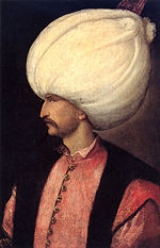
Suleiman the Magnificent

Encyclopedia
Suleiman I was the tenth and longest-reigning Sultan
of the Ottoman Empire
, from 1520 to his death in 1566. He is known in the West
as Suleiman the Magnificent and in the East
, as "The Lawgiver" , for his complete reconstruction of the Ottoman legal system. Suleiman became a prominent monarch of 16th century Europe, presiding over the apex of the Ottoman Empire's military, political and economic power. Suleiman personally led Ottoman armies to conquer the Christian strongholds of Belgrade
, Rhodes
, and most of Hungary
before his conquests were checked at the Siege of Vienna
in 1529. He annexed most of the Middle East
in his conflict with the Safavids
and large swathes of North Africa
as far west as Algeria
. Under his rule, the Ottoman fleet
dominated the seas from the Mediterranean to the Red Sea
and the Persian Gulf
.
At the helm of an expanding empire, Suleiman personally instituted legislative changes relating to society, education, taxation, and criminal law. His canonical law (or the Kanuns) fixed the form of the empire for centuries after his death. Not only was Suleiman a distinguished poet and goldsmith
in his own right; he also became a great patron of culture, overseeing the golden age of the Ottoman Empire's artistic
, literary and architectural development. He spoke four languages: Ottoman Turkish
, Arabic
, Chagatai
(a dialect of Turkic languages
and related to Uyghur
), and Persian
.
In a break with Ottoman tradition, Suleiman married a harem
girl, Roxelana
, who became Hürrem Sultan; her intrigues as queen in the court and power over the Sultan made her quite renowned. Their son, Selim II
, succeeded Suleiman following his death in 1566 after 46 years of rule.
along the coast of the Black Sea
, probably on 6 November 1494. His mother was Valide Sultan Aishe Hafsa Sultan
or Hafsa Hatun Sultan, who died in 1534. At the age of seven, he was sent to study science
, history
, literature
, theology
, and military tactics
in the schools of the Topkapı Palace
in Constantinople
. As a young man, he befriended Pargalı Ibrahim
, a slave who later became one of his most trusted advisers. From the age of seventeen, young Suleiman was appointed as the governor of first Kaffa (Theodosia), then Sarukhan (Manisa
) with a brief tenure at Adrianople (now Edirne
). Upon the death of his father, Selim I
(1465–1520), Suleiman entered Constantinople and acceded to the throne as the tenth Ottoman Sultan. An early description of Suleiman, a few weeks following his accession, was provided by the Venetian
envoy Bartolomeo Contarini
: "He is twenty-six years of age, tall, but wiry, and of a delicate complexion. His neck is a little too long, his face thin, and his nose aquiline. He has a shade of a moustache and a small beard; nevertheless he has a pleasant mien, though his skin tends to pallor. He is said to be a wise Lord, fond of study, and all men hope for good from his rule." Some historians claim that in his youth Suleiman had an admiration for Alexander the Great. He was influenced by Alexander's vision of building a world empire that would encompass the east and the west, and this created a drive for his subsequent military campaigns in Asia and in Africa, as well as in Europe.
in 1521. Suleiman soon made preparations for the conquest of Belgrade from the Kingdom of Hungary
—something his great-grandfather Mehmed II
had failed to achieve. Its capture was vital in eliminating the Hungarians who, following the defeats of the Serbs
, Bulgarians
and Byzantines
, remained the only formidable force who could block further Ottoman gains in Europe. Suleiman encircled Belgrade
and began a series of heavy bombardments from an island in the Danube
. With a garrison of only 700 men, and receiving no aid from Hungary, Belgrade fell in August 1521.
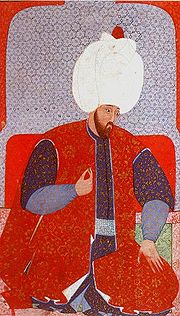 News of the conquest of one of Christendom's major strongholds spread fear across Europe. As the ambassador of the Holy Roman Empire to Istanbul
was to note, "The capture of Belgrade was at the origin of the dramatic events which engulfed Hungary. It led to the death of King Louis, the capture of Buda
, the occupation of Transylvania
, the ruin of a flourishing kingdom and the fear of neighbouring nations that they would suffer the same fate..."
The road to Hungary and Austria
lay open, but Suleiman diverted his attention to the Eastern Mediterranean island of Rhodes
, the home base of the Knights Hospitaller
, whose activities as pirates near Asia Minor
and the Levant
had posed a perennial problem to Ottoman interests. In the summer of 1522, taking advantage of the navy he inherited from his father, Suleiman dispatched an armada of some 400 ships while personally leading an army of 100,000 across Asia Minor to a point opposite the island. Following a siege
of five months with brutal encounters, Rhodes capitulated and Suleiman allowed the Knights of Rhodes to depart. They eventually formed their new base in Malta.
As relations between Hungary and the Ottoman Empire deteriorated, Suleiman resumed his campaign in Eastern Europe and on 29 August 1526, he defeated Louis II of Hungary (1506–26) at the Battle of Mohács
. In its wake, Hungarian resistance collapsed and the Ottoman Empire became the pre-eminent power in Eastern Europe. Upon encountering the lifeless body of King Louis, Suleiman is said to have lamented: "I came indeed in arms against him; but it was not my wish that he should be thus cut off while he scarcely tasted the sweets of life and royalty."
Under Charles V
and his brother Ferdinand, Archduke of Austria, the Habsburgs reoccupied Buda and took Hungary. As a result, in 1529, Suleiman once again marched through the valley of the Danube and regained control of Buda and in the following autumn laid siege to Vienna
. It was to be the Ottoman Empire's most ambitious expedition and the apogee of its drive towards the West. With a reinforced garrison of 16,000 men, the Austrians inflicted upon Suleiman his first defeat, sowing the seeds of a bitter Ottoman-Habsburg rivalry which lasted until the 20th century. A second attempt to conquer Vienna failed in 1532, with Suleiman retreating before reaching the city. In both cases, the Ottoman army was plagued by bad weather (forcing them to leave behind essential siege equipment) and was hobbled by overstretched supply lines.
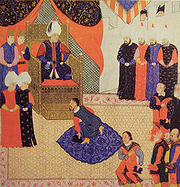 By the 1540s a renewal of the conflict in Hungary presented Suleiman with the opportunity to avenge the defeat suffered at Vienna. Some Hungarian nobles proposed that Ferdinand, Archduke of Austria
(1519–64), who was ruler of neighbouring Austria
and tied to Louis II's family by marriage, be King of Hungary, citing previous agreements that the Habsburgs would take the Hungarian throne if Louis died without heirs. However, other nobles turned to the nobleman John Zápolya
who, being supported by Suleiman, remained unrecognized by the Christian powers of Europe.
In 1541 the Habsburgs once again engaged in conflict with the Ottomans, attempting to lay siege to Buda. With their efforts repulsed, and more Habsburg fortresses captured as a result, Ferdinand and his brother Charles V were forced to conclude a humiliating five-year treaty with Suleiman. Ferdinand renounced his claim to the Kingdom of Hungary and was forced to pay a fixed yearly sum to the Sultan for the Hungarian lands he continued to control. Of more symbolic importance, the treaty referred to Charles V not as 'Emperor', but in rather plainer terms as the 'King of Spain', leading Suleiman to consider himself the true 'Caesar'.
With his main European rivals subdued, Suleiman had assured the Ottoman Empire a powerful role in the political landscape of Europe.
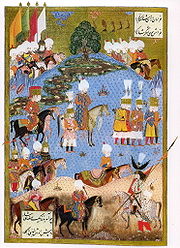 As Suleiman stabilized his European frontiers, he now turned his attention to the ever present threat posed by the Shi'a Safavid dynasty
of Persia (Iran
). Two events in particular were to precipitate a recurrence of tensions. First, Shah
Tahmasp
had the Baghdad
governor loyal to Suleiman killed and replaced with an adherent of the Shah, and second, the governor of Bitlis had defected and sworn allegiance to the Safavids. As a result, in 1533, Suleiman ordered his Grand Vizier Pargalı Ibrahim Pasha to lead an army into Asia where he retook Bitlis
and occupied Tabriz
without resistance. Having joined Ibrahim in 1534, Suleiman made a push towards Persia, only to find the Shah sacrificing territory instead of facing a pitched battle, resorting to harassment of the Ottoman army as it proceeded along the harsh interior. When in the following year Suleiman and Ibrahim made a grand entrance into Baghdad
, its commander surrendered the city, thereby confirming Suleiman as the leader of the Islamic world and the legitimate successor to the Abbasid
Caliphs.
Attempting to defeat the Shah once and for all, Suleiman embarked upon a second campaign in 1548–1549. As in the previous attempt, Tahmasp avoided confrontation with the Ottoman army and instead chose to retreat, torching Persian Armenia
in the process and exposing the Ottoman army to the harsh winter of the Caucasus
. Suleiman abandoned the campaign with temporary Ottoman gains in Tabriz and the Armenian/ region of Iran, a lasting presence in the province of Van
, and some forts in Georgia
.
In 1553 Suleiman began his third and final campaign against the Shah. Having initially lost territories in Erzurum
to the Shah's son, Suleiman retaliated by recapturing Erzurum, crossing the Upper Euphrates
and laying waste to parts of Persia. The Shah's army continued its strategy of avoiding the Ottomans, leading to a stalemate from which neither army made any significant gain. In 1554, a settlement was signed which was to conclude Suleiman's Asian campaigns. It included the return of Tabriz, but secured Baghdad, lower Mesopotamia
, the mouths of the river Euphrates and Tigris
, as well as part of the Persian Gulf
. The Shah also promised to cease all raids into Ottoman territory.
, Suleiman led several naval campaigns against the Portuguese
in an attempt to remove them and reestablish trade with India
. Aden
in Yemen
was captured by the Ottomans in 1538, in order to provide an Ottoman base for raids against Portuguese possessions on the western coast of modern Pakistan
and India
. Sailing on to India, the Ottomans failed against the Portuguese at the Siege of Diu
in September 1538, but then returned to Aden where they fortified the city with 100 pieces of artillery. From this base, Sulayman Pasha managed to take control of the whole country of Yemen, also taking Sa'na. Aden rose against the Ottomans however and invited the Portuguese instead, so that the Portuguese were in control of the city until its seizure by Piri Reis
in the Capture of Aden (1548)
.
With its strong control of the Red Sea
, Suleiman successfully managed to dispute control of the Indian trade routes to the Portuguese and maintained a significant level of trade with the Mughal Empire
of South Asia
throughout the 16th century. His admiral Piri Reis
led an Ottoman fleet in the Indian Ocean
, achieving the Capture of Muscat
in 1552.
In 1564, Suleiman received an embassy from Aceh
(modern Indonesia
), requesting Ottoman support against the Portuguese. As a result an Ottoman expedition to Aceh
was launched, which was able to provide extensive military support to the Acehnese.
.jpg) Having consolidated his conquests on land, Suleiman was greeted with the news that the fortress of Koroni
Having consolidated his conquests on land, Suleiman was greeted with the news that the fortress of Koroni
in Morea
(the modern Peloponnese
) had been lost to Charles V's
admiral, Andrea Doria
. The presence of the Spanish in the Eastern Mediterranean concerned Suleiman, who saw it as an early indication of Charles V's intention to rival Ottoman dominance in the region. Recognizing the need to reassert the navy's preeminence in the Mediterranean, Suleiman appointed an exceptional naval commander in the form of Khair ad Din, known to Europeans as Barbarossa. Once appointed admiral-in-chief, Barbarossa was charged with rebuilding the Ottoman fleet, to such an extent that the Ottoman navy equalled in number those of all other Mediterranean countries put together. In 1535 Charles V won an important victory against the Ottomans at Tunis
, which together with the war against Venice
the following year, led Suleiman to accept proposals from Francis I of France
to form an alliance against Charles
. In 1538, the Spanish fleet was defeated by Barbarossa at the Battle of Preveza
, securing the eastern Mediterranean for the Turks for 33 years until the defeat at the Battle of Lepanto
in 1571.
East of Morocco
, huge territories in North Africa
were annexed. The Barbary States of Tripolitania
, Tunisia
, and Algeria
became autonomous provinces of the Empire, serving as the leading edge of Suleiman's conflict with Charles V, whose attempt to drive out the Turks failed in 1541. The piracy carried on thereafter by the Barbary pirates of North Africa can be seen in the context of the wars against Spain. For a short period Ottoman expansion secured naval dominance in the Mediterranean. Ottoman navies also controlled the Red Sea
, and held the Persian Gulf
until 1554, when their ships were defeated by the navy of the Portuguese Empire
. The Portuguese had taken Ormus
(in the Strait of Hormuz
) in 1515 and would continue to vie with Suleiman's forces for control of Aden
, in present-day Yemen
.
 In 1542, facing a common Habsburg enemy, Francis I sought to renew the Franco-Ottoman alliance
. As a result, Suleiman dispatched 100 galleys under Barbarossa to assist the French in the western Mediterranean. Barbarossa pillaged the coast of Naples
and Sicily
before reaching France where Francis made Toulon
the Ottoman admirals naval headquarters. The same campaign had seen Barbarossa attack and capture Nice in 1543
. By 1544, a peace between Francis I and Charles V had put a temporary end to the alliance between France and the Ottoman Empire.
Elsewhere in the Mediterranean, when the Knights Hospitallers were re-established as the Knights of Malta
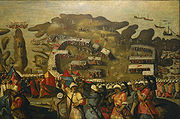
in 1530, their actions against Muslim navies quickly drew the ire of the Ottomans who assembled another massive army in order to dislodge the Knights from Malta. The Ottomans invaded in 1565, undertaking the Great Siege of Malta
, which began on May 18 and lasted until September 8, and is portrayed vividly in the frescoes of Matteo Perez d'Aleccio
in the Hall of St. Michael and St. George. At first it seemed that this would be a repeat of the battle on Rhodes
, with most of Malta's cities destroyed and half the Knights killed in battle; but a relief force from Spain
entered the battle, resulting in the loss of 30,000 Ottoman troops and the victory of the local Maltese citizenry.
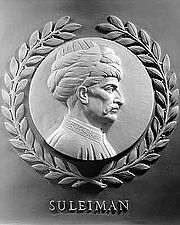 While Sultan Suleiman was known as "the Magnificent" in the West, he was always Kanuni Suleiman or "The Lawgiver" to his own Ottoman subjects. As the historian Lord Kinross notes, "Not only was he a great military campaigner, a man of the sword, as his father and great-grandfather had been before him. He differed from them in the extent to which he was also a man of the pen. He was a great legislator, standing out in the eyes of his people as a high-minded sovereign and a magnanimous exponent of justice". The overriding law of the empire was the Shari'ah, or Sacred Law, which as the divine law of Islam
was outside of the Sultan's powers to change. Yet an area of distinct law known as the Kanuns (canonical legislation) was dependent on Suleiman's will alone, covering areas such as criminal law, land tenure and taxation. He collected all the judgments that had been issued by the nine Ottoman Sultans who preceded him. After eliminating duplications and choosing between contradictory statements, he issued a single legal code, all the while being careful not to violate the basic laws of Islam. It was within this framework that Suleiman, supported by his Grand Mufti
Ebussuud
, sought to reform the legislation to adapt to a rapidly changing empire. When the Kanun laws attained their final form, the code of laws became known as the kanun‐i Osmani, or the "Ottoman laws". Suleiman's legal code was to last more than three hundred years.
Suleiman gave particular attention to the plight of the rayas
, Christian subjects who worked the land of the Sipahi
s. His Kanune Raya, or "Code of the Rayas", reformed the law governing levies and taxes to be paid by the rayas, raising their status above serfdom to the extent that Christian serfs would migrate to Turkish territories to benefit from the reforms. The Sultan also played a role in protecting the Jewish subjects of his empire for centuries to come. In late 1553 or 1554, on the suggestion of his favorite doctor and dentist, the Spanish Jew Moses Hamon
, the Sultan issued a firman formally denouncing blood libels
against the Jews. Furthermore, Suleiman enacted new criminal and police legislation, prescribing a set of fines for specific offences, as well as reducing the instances requiring death or mutilation. In the area of taxation, taxes were levied on various goods and produce, including animals, mines, profits of trade, and import-export duties. In addition to taxes, officials who had fallen into disrepute were likely to have their land and property confiscated by the Sultan.
Education was another important area for the Sultan. Schools attached to mosques and funded by religious foundations provided a largely free education to Muslim boys in advance of the Christian countries of the time. In his capital, Suleiman increased the number of mektebs (primary schools) to fourteen, teaching children to read and write as well as the principles of Islam. Children wishing further education could proceed to one of eight medreses
(colleges), whose studies included grammar, metaphysics, philosophy, astronomy, and astrology. Higher medreses provided education of university status, whose graduates became imams or teachers. Educational centers were often one of many buildings surrounding the courtyards of mosques, others included libraries, refectories, fountains, soup kitchens and hospitals for the benefit of the public.

 Under Suleiman's patronage, the Ottoman empire entered the golden age of its cultural development
. Hundreds of imperial artistic societies (called the Ehl-i Hiref, "Community of the Talented") were administered at the Imperial seat, the Topkapı Palace
. After an apprenticeship, artists and craftsmen could advance in rank within their field and were paid commensurate wages in quarterly annual installments. Payroll registers that survive testify to the breadth of Suleiman's patronage of the arts, the earliest of documents dating from 1526 list 40 societies with over 600 members. The Ehl-i Hiref attracted the empire's most talented artisans to the Sultan's court, both from the Islamic world and recently conquered territories in Europe, resulting in a blend of Islamic, Turkish and European cultures. Artisans in service of the court included painters, book binders, furriers, jewellers and goldsmiths. Whereas previous rulers had been influenced by Persian culture (Suleiman's father, Selim I, wrote poetry in Persian), Suleiman's patronage of the arts had seen the Ottoman Empire assert its own artistic legacy.
Suleiman himself was an accomplished poet, writing in Persian and Turkish under the nom de plume Muhibbi (Lover). Some of Suleiman's verses have become Turkish proverbs, such as the well-known Everyone aims at the same meaning, but many are the versions of the story. When his young son Mehmed died in 1543, he composed a moving chronogram
to commemorate the year: Peerless among princes, my Sultan Mehmed. In addition to Suleiman's own work, many great talents enlivened the literary world during Suleiman's rule, including Fuzuli
and Baki
. The literary historian E. J. W. Gibb observed that "at no time, even in Turkey, was greater encouragement given to poetry than during the reign of this Sultan". Suleiman's most famous verse is:
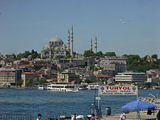 Suleiman also became renowned for sponsoring a series of monumental architectural developments within his empire. The Sultan sought to turn Constantinople into the center of Islamic civilization by a series of projects, including bridges, mosques, palaces and various charitable and social establishments. The greatest of these were built by the Sultan's chief architect, Mimar Sinan, under whom Ottoman architecture reached its zenith. Sinan became responsible for over three hundred monuments throughout the empire, including his two masterpieces, the Süleymaniye and Selimiye mosques—the latter built in Adrianople (now Edirne
) in the reign of Suleiman's son Selim II
. Suleiman also restored the Dome of the Rock
in Jerusalem and the Jerusalem city walls (which are the current walls of the Old City of Jerusalem), renovated the Kaaba
in Mecca
, and constructed a complex in Damascus.
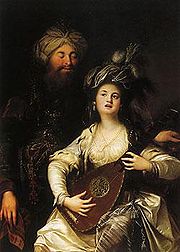 Suleiman was infatuated with Hürrem Sultan
, a harem girl of Ruthenian
origin, then part of Poland
. In the West foreign diplomats, taking notice of the palace gossip about her, called her "Russelazie" or "Roxelana", referring to her Slavic origins. The daughter of an Orthodox
Ukrainian
priest, she was enslaved and rose through the ranks of the Harem to become Suleiman's favourite
. Breaking with two centuries of Ottoman tradition, a former concubine had thus become the legal wife of the Sultan, much to the astonishment of observers in the palace and the city. He also allowed Hürrem Sultan to remain with him at court for the rest of her life, breaking another tradition—that when imperial heirs came of age, they would be sent along with the imperial concubine who bore them to govern remote provinces of the Empire, never to return unless their progeny succeeded to the throne.
Under his pen name, Muhibbi, Suleiman composed this poem for Roxelana:
was the boyhood friend of Suleiman. Ibrahim was originally Greek Orthodox
and when young was educated at the Palace School
under the devshirme system. Suleiman made him the royal falconer
, then promoted him to first officer of the Royal Bedchamber. Ibrahim Pasha rose to Grand Vizier
in 1523 and commander-in-chief of all the armies. Suleiman also conferred upon Ibrahim Pasha the honor of beylerbey of Rumelia
, granting Ibrahim authority over all Turkish territories in Europe, as well as command of troops residing within them in times of war. According to a 17th century chronicler, Ibrahim had asked Suleiman not to promote him to such high positions, fearing for his safety; to which Suleiman replied that under his reign no matter what the circumstance, Ibrahim would never be put to death.
Yet Ibrahim eventually fell from grace with the Sultan. During his thirteen years as Grand Vizier, his rapid rise to power and vast accumulation of wealth had made Ibrahim many enemies among the Sultan's court. Reports had reached the Sultan of Ibrahim's impudence during a campaign against the Persian Safavid empire: in particular his adoption of the title serasker sultan was seen as a grave affront to Suleiman.
Suleiman's suspicion of Ibrahim was worsened by a quarrel between the latter and the Minister of Finance Iskender Chelebi. The dispute ended in the disgrace of Chelebi on charges of intrigue, with Ibrahim convincing Suleiman to sentence the Minister to death. Before his death however, Chelebi's last words were to accuse Ibrahim of conspiracy against the Sultan. These dying words convinced Suleiman of Ibrahim's disloyalty, and on 15 March 1536 Ibrahim's lifeless body was discovered in the Topkapi Palace.
, Selim
, Bayezid, and Jihangir. Of these, only Mustafa was not Hürrem Sultan's son, but rather Mahidevran Gülbahar Sultan
's ("Rose of Spring"), and therefore preceded Hürrem's children in the order of succession. Hürrem was aware that should Mustafa become Sultan her own children would be strangled. Yet Mustafa was recognised as the most talented of all the brothers and was supported by Pargalı İbrahim Pasha
, who was by this time Suleiman's Grand Vizier
. The Austrian ambassador Busbecq
would note "Suleiman has among his children a son called Mustafa, marvellously well educated and prudent and of an age to rule, since he is 24 or 25 years old; may God never allow a Barbary of such strength to come near us", going on to talk of Mustafa's "remarkable natural gifts".
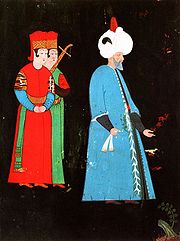
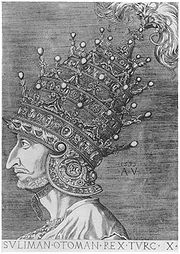 Hürrem is usually held at least partly responsible for the intrigues in nominating a successor. Although she was Suleiman's wife, she exercised no official public role. This did not, however, prevent Hürrem from wielding powerful political influence. Since the Empire lacked any formal means of nominating a successor, succession usually involved the death of competing princes in order to avert civil unrest and rebellions. In attempting to avoid the execution of her sons, Hürrem used her influence to eliminate those who supported Mustafa's accession to the throne.
Thus in power struggles apparently instigated by Hürrem, Suleiman had Ibrahim murdered and replaced with her sympathetic son-in-law, Rüstem Pasha
. By 1552, when the campaign against Persia had begun with Rustem appointed commander-in-chief of the expedition, intrigues against Mustafa began. Rustem sent one of Suleiman's most trusted men to report that since Suleiman was not at the head of the army, the soldiers thought the time had come to put a younger prince on the throne; at the same time he spread rumors that Mustafa had proved receptive to the idea. Angered by what he came to believe were Mustafa's plans to claim the throne, the following summer upon return from his campaign in Persia, Suleiman summoned him to his tent in the Ereğli valley, stating he would "be able to clear himself of the crimes he was accused of and would have nothing to fear if he came".
Mustafa was confronted with a choice: either he appeared before his father at the risk of being killed; or, if he refused to attend, he would be accused of betrayal. In the end, Mustafa chose to enter his father's tent, confident that the support of the army would protect him. Busbecq, who claims to have received an account from an eyewitness, describes Mustafa's final moments. As Mustafa entered his father's tent, Suleiman's Eunuch
s attacked Mustafa, with the young prince putting up a brave defence. Suleiman, separated from the struggle only by the linen hangings of the tent, peered through the chamber of his tent and "directed fierce and threatening glances upon the mutes, and by menacing gestures sternly rebuked their hesitation. Thereupon, the mutes in their alarm, redoubling their efforts, hurled Mustafa to the ground and, throwing the bowstring round his neck, strangled him."
Jihangir is said to have died of grief a few months after the news of his half-brother's murder. The two surviving brothers, Bayezid and Selim, were given command in different parts of the empire. Within a few years, however, civil war broke out between the brothers, each supported by his loyal forces. With the aid of his father's army, Selim defeated Bayezid in Konya
in 1559, leading the latter to seek refuge with the Safavids along with his four sons. Following diplomatic exchanges, the Sultan demanded from the Safavid Shah
that Bayezid be either extradited or executed. In return for large amounts of gold, the Shah allowed a Turkish executioner to strangle Bayezid and his four sons in 1561, clearing the path for Selim's succession to the throne seven years later. On 5/6 September 1566, Suleiman, who had set out from Constantinople to command an expedition to Hungary, died before an Ottoman victory at the Battle of Szigetvár
in Hungary.
cities (Mecca
, Medina
, Jerusalem, Damascus
, and Baghdad
), many Balkan provinces (reaching present day Croatia
and Austria
), and most of North Africa
. His expansion into Europe had given the Ottoman Turks a powerful presence in the European balance of power. Indeed, such was the perceived threat of the Ottoman Empire under the reign of Suleiman that ambassador Busbecq
warned of Europe's imminent conquest: "On [the Turks'] side are the resources of a mighty empire, strength unimpaired, habituation to victory, endurance of toil, unity, discipline, frugality and watchfulness... Can we doubt what the result will be?...When the Turks have settled with Persia, they will fly at our throats supported by the might of the whole East; how unprepared we are I dare not say."
Even thirty years after his death "Sultan Solyman" was quoted by the English playwright William Shakespeare
as a military prodigy in The Merchant of Venice (Act 2, Scene 1).
Suleiman's legacy was not, however, merely in the military field. The French traveler Jean de Thévenot
a century later bears witness to the "strong agricultural base of the country, the well being of the peasantry, the abundance of staple foods, and the pre-eminence of organization in Suleiman's government". The administrative and legal reforms which earned him the name Law Giver ensured the Empire's survival long after his death, an achievement which "took many generations of decadent heirs to undo".
Through his personal patronage, Suleiman also presided over the Golden Age of the Ottoman Empire, representing the pinnacle of the Ottoman Turks' cultural achievement in the realm of architecture, literature, art, theology and philosophy. Today the skyline of the Bosphorus, and of many cities in modern Turkey and the former Ottoman provinces, are still adorned with the architectural works of Mimar Sinan. One of these, the Süleymaniye Mosque, is the final resting place of Suleiman and Herenzaltan: they are buried in separate domed mausoleums attached to the mosque.
Sultan
Sultan is a title with several historical meanings. Originally, it was an Arabic language abstract noun meaning "strength", "authority", "rulership", and "dictatorship", derived from the masdar سلطة , meaning "authority" or "power". Later, it came to be used as the title of certain rulers who...
of the Ottoman Empire
Ottoman Empire
The Ottoman EmpireIt was usually referred to as the "Ottoman Empire", the "Turkish Empire", the "Ottoman Caliphate" or more commonly "Turkey" by its contemporaries...
, from 1520 to his death in 1566. He is known in the West
Western world
The Western world, also known as the West and the Occident , is a term referring to the countries of Western Europe , the countries of the Americas, as well all countries of Northern and Central Europe, Australia and New Zealand...
as Suleiman the Magnificent and in the East
Eastern world
__FORCETOC__The term Eastern world refers very broadly to the various cultures or social structures and philosophical systems of Eastern Asia or geographically the Eastern Culture...
, as "The Lawgiver" , for his complete reconstruction of the Ottoman legal system. Suleiman became a prominent monarch of 16th century Europe, presiding over the apex of the Ottoman Empire's military, political and economic power. Suleiman personally led Ottoman armies to conquer the Christian strongholds of Belgrade
Belgrade
Belgrade is the capital and largest city of Serbia. It is located at the confluence of the Sava and Danube rivers, where the Pannonian Plain meets the Balkans. According to official results of Census 2011, the city has a population of 1,639,121. It is one of the 15 largest cities in Europe...
, Rhodes
Rhodes
Rhodes is an island in Greece, located in the eastern Aegean Sea. It is the largest of the Dodecanese islands in terms of both land area and population, with a population of 117,007, and also the island group's historical capital. Administratively the island forms a separate municipality within...
, and most of Hungary
Hungary
Hungary , officially the Republic of Hungary , is a landlocked country in Central Europe. It is situated in the Carpathian Basin and is bordered by Slovakia to the north, Ukraine and Romania to the east, Serbia and Croatia to the south, Slovenia to the southwest and Austria to the west. The...
before his conquests were checked at the Siege of Vienna
Siege of Vienna
The Siege of Vienna in 1529 was the first attempt by the Ottoman Empire, led by Suleiman the Magnificent, to capture the city of Vienna, Austria. The siege signalled the pinnacle of the Ottoman Empire's power, the maximum extent of Ottoman expansion in central Europe, and was the result of a...
in 1529. He annexed most of the Middle East
Middle East
The Middle East is a region that encompasses Western Asia and Northern Africa. It is often used as a synonym for Near East, in opposition to Far East...
in his conflict with the Safavids
Safavid dynasty
The Safavid dynasty was one of the most significant ruling dynasties of Iran. They ruled one of the greatest Persian empires since the Muslim conquest of Persia and established the Twelver school of Shi'a Islam as the official religion of their empire, marking one of the most important turning...
and large swathes of North Africa
North Africa
North Africa or Northern Africa is the northernmost region of the African continent, linked by the Sahara to Sub-Saharan Africa. Geopolitically, the United Nations definition of Northern Africa includes eight countries or territories; Algeria, Egypt, Libya, Morocco, South Sudan, Sudan, Tunisia, and...
as far west as Algeria
Algeria
Algeria , officially the People's Democratic Republic of Algeria , also formally referred to as the Democratic and Popular Republic of Algeria, is a country in the Maghreb region of Northwest Africa with Algiers as its capital.In terms of land area, it is the largest country in Africa and the Arab...
. Under his rule, the Ottoman fleet
Ottoman Navy
The Ottoman Navy was established in the early 14th century. During its long existence it was involved in many conflicts; refer to list of Ottoman sieges and landings and list of Admirals in the Ottoman Empire for a brief chronology.- Pre-Ottoman:...
dominated the seas from the Mediterranean to the Red Sea
Red Sea
The Red Sea is a seawater inlet of the Indian Ocean, lying between Africa and Asia. The connection to the ocean is in the south through the Bab el Mandeb strait and the Gulf of Aden. In the north, there is the Sinai Peninsula, the Gulf of Aqaba, and the Gulf of Suez...
and the Persian Gulf
Persian Gulf
The Persian Gulf, in Southwest Asia, is an extension of the Indian Ocean located between Iran and the Arabian Peninsula.The Persian Gulf was the focus of the 1980–1988 Iran-Iraq War, in which each side attacked the other's oil tankers...
.
At the helm of an expanding empire, Suleiman personally instituted legislative changes relating to society, education, taxation, and criminal law. His canonical law (or the Kanuns) fixed the form of the empire for centuries after his death. Not only was Suleiman a distinguished poet and goldsmith
Goldsmith
A goldsmith is a metalworker who specializes in working with gold and other precious metals. Since ancient times the techniques of a goldsmith have evolved very little in order to produce items of jewelry of quality standards. In modern times actual goldsmiths are rare...
in his own right; he also became a great patron of culture, overseeing the golden age of the Ottoman Empire's artistic
Culture of the Ottoman Empire
The culture of the Ottoman Empire evolved over several centuries as the ruling administration of the Turks absorbed, adapted and modified the cultures of conquered lands and their peoples...
, literary and architectural development. He spoke four languages: Ottoman Turkish
Ottoman Turkish language
The Ottoman Turkish language or Ottoman language is the variety of the Turkish language that was used for administrative and literary purposes in the Ottoman Empire. It borrows extensively from Arabic and Persian, and was written in a variant of the Perso-Arabic script...
, Arabic
Arabic language
Arabic is a name applied to the descendants of the Classical Arabic language of the 6th century AD, used most prominently in the Quran, the Islamic Holy Book...
, Chagatai
Chagatai language
The Chagatai language is an extinct Turkic language which was once widely spoken in Central Asia, and remained the shared literary language there until the early twentieth century...
(a dialect of Turkic languages
Turkic languages
The Turkic languages constitute a language family of at least thirty five languages, spoken by Turkic peoples across a vast area from Eastern Europe and the Mediterranean to Siberia and Western China, and are considered to be part of the proposed Altaic language family.Turkic languages are spoken...
and related to Uyghur
Uyghur language
Uyghur , formerly known as Eastern Turk, is a Turkic language with 8 to 11 million speakers, spoken primarily by the Uyghur people in the Xinjiang Uyghur Autonomous Region of Western China. Significant communities of Uyghur-speakers are located in Kazakhstan and Uzbekistan, and various other...
), and Persian
Persian language
Persian is an Iranian language within the Indo-Iranian branch of the Indo-European languages. It is primarily spoken in Iran, Afghanistan, Tajikistan and countries which historically came under Persian influence...
.
In a break with Ottoman tradition, Suleiman married a harem
Harem
Harem refers to the sphere of women in what is usually a polygynous household and their enclosed quarters which are forbidden to men...
girl, Roxelana
Roxelana
Haseki Hürrem Sultan was the wife of Süleyman the Magnificent of the Ottoman Empire.-Names:Sixteenth-century sources are silent as to her maiden name, but much later traditions, for example Ukrainian folk traditions first recorded in the 19th century, give it as "Anastasia" , and Polish...
, who became Hürrem Sultan; her intrigues as queen in the court and power over the Sultan made her quite renowned. Their son, Selim II
Selim II
Selim II Sarkhosh Hashoink , also known as "Selim the Sot " or "Selim the Drunkard"; and as "Sarı Selim" or "Selim the Blond", was the Sultan of the Ottoman Empire from 1566 until his death in 1574.-Early years:He was born in Constantinople a son of Suleiman the...
, succeeded Suleiman following his death in 1566 after 46 years of rule.
Early life
Suleiman was born in TrabzonTrabzon
Trabzon is a city on the Black Sea coast of north-eastern Turkey and the capital of Trabzon Province. Trabzon, located on the historical Silk Road, became a melting pot of religions, languages and culture for centuries and a trade gateway to Iran in the southeast and the Caucasus to the northeast...
along the coast of the Black Sea
Black Sea
The Black Sea is bounded by Europe, Anatolia and the Caucasus and is ultimately connected to the Atlantic Ocean via the Mediterranean and the Aegean seas and various straits. The Bosphorus strait connects it to the Sea of Marmara, and the strait of the Dardanelles connects that sea to the Aegean...
, probably on 6 November 1494. His mother was Valide Sultan Aishe Hafsa Sultan
Ayse Hafsa Sultan
Ayşe Hafsa Sultan, or in short, Hafsa Sultan , sometimes also transcribed as "A'ishā Hâfize Sultana" in strict transliteration, was the first Valide Sultan of the Ottoman Empire, wife of Selim I and mother of Suleiman the Magnificent...
or Hafsa Hatun Sultan, who died in 1534. At the age of seven, he was sent to study science
Science
Science is a systematic enterprise that builds and organizes knowledge in the form of testable explanations and predictions about the universe...
, history
History
History is the discovery, collection, organization, and presentation of information about past events. History can also mean the period of time after writing was invented. Scholars who write about history are called historians...
, literature
Literature
Literature is the art of written works, and is not bound to published sources...
, theology
Theology
Theology is the systematic and rational study of religion and its influences and of the nature of religious truths, or the learned profession acquired by completing specialized training in religious studies, usually at a university or school of divinity or seminary.-Definition:Augustine of Hippo...
, and military tactics
Military tactics
Military tactics, the science and art of organizing an army or an air force, are the techniques for using weapons or military units in combination for engaging and defeating an enemy in battle. Changes in philosophy and technology over time have been reflected in changes to military tactics. In...
in the schools of the Topkapı Palace
Topkapi Palace
The Topkapı Palace is a large palace in Istanbul, Turkey, that was the primary residence of the Ottoman Sultans for approximately 400 years of their 624-year reign....
in Constantinople
Constantinople
Constantinople was the capital of the Roman, Eastern Roman, Byzantine, Latin, and Ottoman Empires. Throughout most of the Middle Ages, Constantinople was Europe's largest and wealthiest city.-Names:...
. As a young man, he befriended Pargalı Ibrahim
Pargali Ibrahim Pasha
Pargali Ibrahim Pasha , also known as Frenk Ibrahim Pasha , Makbul Ibrahim Pasha , and referred to him as Maktul Ibrahim Pasha after his murder in the Topkapı Palace, was the first Grand Vizier in the Ottoman Empire appointed by Suleiman the Magnificent...
, a slave who later became one of his most trusted advisers. From the age of seventeen, young Suleiman was appointed as the governor of first Kaffa (Theodosia), then Sarukhan (Manisa
Manisa
Manisa is a large city in Turkey's Aegean Region and the administrative seat of Manisa Province.Modern Manisa is a booming center of industry and services, advantaged by its closeness to the international port city and the regional metropolitan center of İzmir and by its fertile hinterland rich in...
) with a brief tenure at Adrianople (now Edirne
Edirne
Edirne is a city in Eastern Thrace, the northwestern part of Turkey, close to the borders with Greece and Bulgaria. Edirne served as the capital city of the Ottoman Empire from 1365 to 1453, before Constantinople became the empire's new capital. At present, Edirne is the capital of the Edirne...
). Upon the death of his father, Selim I
Selim I
Selim I, Yavuz Sultân Selim Khan, Hâdim-ül Haramain-ish Sharifain , nicknamed Yavuz "the Stern" or "the Steadfast", but often rendered in English as "the Grim" , was the Sultan of the Ottoman Empire from 1512 to...
(1465–1520), Suleiman entered Constantinople and acceded to the throne as the tenth Ottoman Sultan. An early description of Suleiman, a few weeks following his accession, was provided by the Venetian
Republic of Venice
The Republic of Venice or Venetian Republic was a state originating from the city of Venice in Northeastern Italy. It existed for over a millennium, from the late 7th century until 1797. It was formally known as the Most Serene Republic of Venice and is often referred to as La Serenissima, in...
envoy Bartolomeo Contarini
Bartolomeo Contarini
Bartolomeo Contarini was a Venetian businessman who married the widowed duchess of Athens Chiara Zorzi in 1453 and governed the duchy in the name of her infant son, Francesco I....
: "He is twenty-six years of age, tall, but wiry, and of a delicate complexion. His neck is a little too long, his face thin, and his nose aquiline. He has a shade of a moustache and a small beard; nevertheless he has a pleasant mien, though his skin tends to pallor. He is said to be a wise Lord, fond of study, and all men hope for good from his rule." Some historians claim that in his youth Suleiman had an admiration for Alexander the Great. He was influenced by Alexander's vision of building a world empire that would encompass the east and the west, and this created a drive for his subsequent military campaigns in Asia and in Africa, as well as in Europe.
Conquests in Europe
Upon succeeding his father, Suleiman began a series of military conquests, eventually suppressing a revolt led by the Ottoman-appointed governor of DamascusDamascus
Damascus , commonly known in Syria as Al Sham , and as the City of Jasmine , is the capital and the second largest city of Syria after Aleppo, both are part of the country's 14 governorates. In addition to being one of the oldest continuously inhabited cities in the world, Damascus is a major...
in 1521. Suleiman soon made preparations for the conquest of Belgrade from the Kingdom of Hungary
Kingdom of Hungary
The Kingdom of Hungary comprised present-day Hungary, Slovakia and Croatia , Transylvania , Carpatho Ruthenia , Vojvodina , Burgenland , and other smaller territories surrounding present-day Hungary's borders...
—something his great-grandfather Mehmed II
Mehmed II
Mehmed II , was Sultan of the Ottoman Empire for a short time from 1444 to September 1446, and later from...
had failed to achieve. Its capture was vital in eliminating the Hungarians who, following the defeats of the Serbs
Serbs
The Serbs are a South Slavic ethnic group of the Balkans and southern Central Europe. Serbs are located mainly in Serbia, Montenegro and Bosnia and Herzegovina, and form a sizable minority in Croatia, the Republic of Macedonia and Slovenia. Likewise, Serbs are an officially recognized minority in...
, Bulgarians
Bulgarians
The Bulgarians are a South Slavic nation and ethnic group native to Bulgaria and neighbouring regions. Emigration has resulted in immigrant communities in a number of other countries.-History and ethnogenesis:...
and Byzantines
Byzantine Empire
The Byzantine Empire was the Eastern Roman Empire during the periods of Late Antiquity and the Middle Ages, centred on the capital of Constantinople. Known simply as the Roman Empire or Romania to its inhabitants and neighbours, the Empire was the direct continuation of the Ancient Roman State...
, remained the only formidable force who could block further Ottoman gains in Europe. Suleiman encircled Belgrade
Belgrade
Belgrade is the capital and largest city of Serbia. It is located at the confluence of the Sava and Danube rivers, where the Pannonian Plain meets the Balkans. According to official results of Census 2011, the city has a population of 1,639,121. It is one of the 15 largest cities in Europe...
and began a series of heavy bombardments from an island in the Danube
Danube
The Danube is a river in the Central Europe and the Europe's second longest river after the Volga. It is classified as an international waterway....
. With a garrison of only 700 men, and receiving no aid from Hungary, Belgrade fell in August 1521.
Istanbul
Istanbul , historically known as Byzantium and Constantinople , is the largest city of Turkey. Istanbul metropolitan province had 13.26 million people living in it as of December, 2010, which is 18% of Turkey's population and the 3rd largest metropolitan area in Europe after London and...
was to note, "The capture of Belgrade was at the origin of the dramatic events which engulfed Hungary. It led to the death of King Louis, the capture of Buda
Buda
For detailed information see: History of Buda CastleBuda is the western part of the Hungarian capital Budapest on the west bank of the Danube. The name Buda takes its name from the name of Bleda the Hun ruler, whose name is also Buda in Hungarian.Buda comprises about one-third of Budapest's...
, the occupation of Transylvania
Transylvania
Transylvania is a historical region in the central part of Romania. Bounded on the east and south by the Carpathian mountain range, historical Transylvania extended in the west to the Apuseni Mountains; however, the term sometimes encompasses not only Transylvania proper, but also the historical...
, the ruin of a flourishing kingdom and the fear of neighbouring nations that they would suffer the same fate..."
The road to Hungary and Austria
Austria
Austria , officially the Republic of Austria , is a landlocked country of roughly 8.4 million people in Central Europe. It is bordered by the Czech Republic and Germany to the north, Slovakia and Hungary to the east, Slovenia and Italy to the south, and Switzerland and Liechtenstein to the...
lay open, but Suleiman diverted his attention to the Eastern Mediterranean island of Rhodes
Rhodes
Rhodes is an island in Greece, located in the eastern Aegean Sea. It is the largest of the Dodecanese islands in terms of both land area and population, with a population of 117,007, and also the island group's historical capital. Administratively the island forms a separate municipality within...
, the home base of the Knights Hospitaller
Knights Hospitaller
The Sovereign Military Hospitaller Order of Saint John of Jerusalem of Rhodes and of Malta , also known as the Sovereign Military Order of Malta , Order of Malta or Knights of Malta, is a Roman Catholic lay religious order, traditionally of military, chivalrous, noble nature. It is the world's...
, whose activities as pirates near Asia Minor
Asia Minor
Asia Minor is a geographical location at the westernmost protrusion of Asia, also called Anatolia, and corresponds to the western two thirds of the Asian part of Turkey...
and the Levant
Levant
The Levant or ) is the geographic region and culture zone of the "eastern Mediterranean littoral between Anatolia and Egypt" . The Levant includes most of modern Lebanon, Syria, Jordan, Israel, the Palestinian territories, and sometimes parts of Turkey and Iraq, and corresponds roughly to the...
had posed a perennial problem to Ottoman interests. In the summer of 1522, taking advantage of the navy he inherited from his father, Suleiman dispatched an armada of some 400 ships while personally leading an army of 100,000 across Asia Minor to a point opposite the island. Following a siege
Siege of Rhodes (1522)
The Siege of Rhodes of 1522 was the second and ultimately successful attempt by the Ottoman Empire to expel the Knights of Rhodes from their island stronghold and thereby secure Ottoman control of the Eastern Mediterranean. The first siege, in 1480, had been unsuccessful.-Setting:The Knights of St...
of five months with brutal encounters, Rhodes capitulated and Suleiman allowed the Knights of Rhodes to depart. They eventually formed their new base in Malta.
As relations between Hungary and the Ottoman Empire deteriorated, Suleiman resumed his campaign in Eastern Europe and on 29 August 1526, he defeated Louis II of Hungary (1506–26) at the Battle of Mohács
Battle of Mohács
The Battle of Mohács was fought on August 29, 1526 near Mohács, Hungary. In the battle, forces of the Kingdom of Hungary led by King Louis II of Hungary and Bohemia were defeated by forces of the Ottoman Empire led by Sultan Suleiman the Magnificent....
. In its wake, Hungarian resistance collapsed and the Ottoman Empire became the pre-eminent power in Eastern Europe. Upon encountering the lifeless body of King Louis, Suleiman is said to have lamented: "I came indeed in arms against him; but it was not my wish that he should be thus cut off while he scarcely tasted the sweets of life and royalty."
Under Charles V
Charles V, Holy Roman Emperor
Charles V was ruler of the Holy Roman Empire from 1519 and, as Charles I, of the Spanish Empire from 1516 until his voluntary retirement and abdication in favor of his younger brother Ferdinand I and his son Philip II in 1556.As...
and his brother Ferdinand, Archduke of Austria, the Habsburgs reoccupied Buda and took Hungary. As a result, in 1529, Suleiman once again marched through the valley of the Danube and regained control of Buda and in the following autumn laid siege to Vienna
Siege of Vienna
The Siege of Vienna in 1529 was the first attempt by the Ottoman Empire, led by Suleiman the Magnificent, to capture the city of Vienna, Austria. The siege signalled the pinnacle of the Ottoman Empire's power, the maximum extent of Ottoman expansion in central Europe, and was the result of a...
. It was to be the Ottoman Empire's most ambitious expedition and the apogee of its drive towards the West. With a reinforced garrison of 16,000 men, the Austrians inflicted upon Suleiman his first defeat, sowing the seeds of a bitter Ottoman-Habsburg rivalry which lasted until the 20th century. A second attempt to conquer Vienna failed in 1532, with Suleiman retreating before reaching the city. In both cases, the Ottoman army was plagued by bad weather (forcing them to leave behind essential siege equipment) and was hobbled by overstretched supply lines.
Ferdinand I, Holy Roman Emperor
Ferdinand I was Holy Roman Emperor from 1558 and king of Bohemia and Hungary from 1526 until his death. Before his accession, he ruled the Austrian hereditary lands of the Habsburgs in the name of his elder brother, Charles V, Holy Roman Emperor.The key events during his reign were the contest...
(1519–64), who was ruler of neighbouring Austria
Austria
Austria , officially the Republic of Austria , is a landlocked country of roughly 8.4 million people in Central Europe. It is bordered by the Czech Republic and Germany to the north, Slovakia and Hungary to the east, Slovenia and Italy to the south, and Switzerland and Liechtenstein to the...
and tied to Louis II's family by marriage, be King of Hungary, citing previous agreements that the Habsburgs would take the Hungarian throne if Louis died without heirs. However, other nobles turned to the nobleman John Zápolya
John Zápolya
John Zápolya was King of Hungary from 1526 to 1540. His rule was disputed by Archduke Ferdinand I, who also claimed the title King of Hungary between 1526 and 1540. He was the voivode of Transylvania before his coronation.- Biography :...
who, being supported by Suleiman, remained unrecognized by the Christian powers of Europe.
In 1541 the Habsburgs once again engaged in conflict with the Ottomans, attempting to lay siege to Buda. With their efforts repulsed, and more Habsburg fortresses captured as a result, Ferdinand and his brother Charles V were forced to conclude a humiliating five-year treaty with Suleiman. Ferdinand renounced his claim to the Kingdom of Hungary and was forced to pay a fixed yearly sum to the Sultan for the Hungarian lands he continued to control. Of more symbolic importance, the treaty referred to Charles V not as 'Emperor', but in rather plainer terms as the 'King of Spain', leading Suleiman to consider himself the true 'Caesar'.
With his main European rivals subdued, Suleiman had assured the Ottoman Empire a powerful role in the political landscape of Europe.
Ottoman–Safavid War
Safavid dynasty
The Safavid dynasty was one of the most significant ruling dynasties of Iran. They ruled one of the greatest Persian empires since the Muslim conquest of Persia and established the Twelver school of Shi'a Islam as the official religion of their empire, marking one of the most important turning...
of Persia (Iran
Iran
Iran , officially the Islamic Republic of Iran , is a country in Southern and Western Asia. The name "Iran" has been in use natively since the Sassanian era and came into use internationally in 1935, before which the country was known to the Western world as Persia...
). Two events in particular were to precipitate a recurrence of tensions. First, Shah
Shah
Shāh is the title of the ruler of certain Southwest Asian and Central Asian countries, especially Persia , and derives from the Persian word shah, meaning "king".-History:...
Tahmasp
Tahmasp I
Tahmasp or Tahmasb I was an influential Shah of Iran, who enjoyed the longest reign of any member of the Safavid dynasty...
had the Baghdad
Baghdad
Baghdad is the capital of Iraq, as well as the coterminous Baghdad Governorate. The population of Baghdad in 2011 is approximately 7,216,040...
governor loyal to Suleiman killed and replaced with an adherent of the Shah, and second, the governor of Bitlis had defected and sworn allegiance to the Safavids. As a result, in 1533, Suleiman ordered his Grand Vizier Pargalı Ibrahim Pasha to lead an army into Asia where he retook Bitlis
Bitlis
Bitlis is a town in eastern Turkey and the capital of Bitlis Province. The town is located at an elevation of 1,400 metres, 15 km from Lake Van, in the steep-sided valley of the Bitlis River, a tributary of the Tigris. The local economy is mainly based on agricultural products which include...
and occupied Tabriz
Tabriz
Tabriz is the fourth largest city and one of the historical capitals of Iran and the capital of East Azerbaijan Province. Situated at an altitude of 1,350 meters at the junction of the Quri River and Aji River, it was the second largest city in Iran until the late 1960s, one of its former...
without resistance. Having joined Ibrahim in 1534, Suleiman made a push towards Persia, only to find the Shah sacrificing territory instead of facing a pitched battle, resorting to harassment of the Ottoman army as it proceeded along the harsh interior. When in the following year Suleiman and Ibrahim made a grand entrance into Baghdad
Baghdad
Baghdad is the capital of Iraq, as well as the coterminous Baghdad Governorate. The population of Baghdad in 2011 is approximately 7,216,040...
, its commander surrendered the city, thereby confirming Suleiman as the leader of the Islamic world and the legitimate successor to the Abbasid
Abbasid
The Abbasid Caliphate or, more simply, the Abbasids , was the third of the Islamic caliphates. It was ruled by the Abbasid dynasty of caliphs, who built their capital in Baghdad after overthrowing the Umayyad caliphate from all but the al-Andalus region....
Caliphs.
Attempting to defeat the Shah once and for all, Suleiman embarked upon a second campaign in 1548–1549. As in the previous attempt, Tahmasp avoided confrontation with the Ottoman army and instead chose to retreat, torching Persian Armenia
Armenia
Armenia , officially the Republic of Armenia , is a landlocked mountainous country in the Caucasus region of Eurasia...
in the process and exposing the Ottoman army to the harsh winter of the Caucasus
Caucasus
The Caucasus, also Caucas or Caucasia , is a geopolitical region at the border of Europe and Asia, and situated between the Black and the Caspian sea...
. Suleiman abandoned the campaign with temporary Ottoman gains in Tabriz and the Armenian/ region of Iran, a lasting presence in the province of Van
Van Province
Van Province is a province in eastern Turkey, between Lake Van and the Iranian border. It is 19,069 km2 in area and had a population of 1,035,418 at the end of 2010....
, and some forts in Georgia
Georgia (country)
Georgia is a sovereign state in the Caucasus region of Eurasia. Located at the crossroads of Western Asia and Eastern Europe, it is bounded to the west by the Black Sea, to the north by Russia, to the southwest by Turkey, to the south by Armenia, and to the southeast by Azerbaijan. The capital of...
.
In 1553 Suleiman began his third and final campaign against the Shah. Having initially lost territories in Erzurum
Erzurum
Erzurum is a city in Turkey. It is the largest city, the capital of Erzurum Province. The city is situated 1757 meters above sea level. Erzurum had a population of 361,235 in the 2000 census. .Erzurum, known as "The Rock" in NATO code, served as NATO's southeastern-most air force post during the...
to the Shah's son, Suleiman retaliated by recapturing Erzurum, crossing the Upper Euphrates
Euphrates
The Euphrates is the longest and one of the most historically important rivers of Western Asia. Together with the Tigris, it is one of the two defining rivers of Mesopotamia...
and laying waste to parts of Persia. The Shah's army continued its strategy of avoiding the Ottomans, leading to a stalemate from which neither army made any significant gain. In 1554, a settlement was signed which was to conclude Suleiman's Asian campaigns. It included the return of Tabriz, but secured Baghdad, lower Mesopotamia
Mesopotamia
Mesopotamia is a toponym for the area of the Tigris–Euphrates river system, largely corresponding to modern-day Iraq, northeastern Syria, southeastern Turkey and southwestern Iran.Widely considered to be the cradle of civilization, Bronze Age Mesopotamia included Sumer and the...
, the mouths of the river Euphrates and Tigris
Tigris
The Tigris River is the eastern member of the two great rivers that define Mesopotamia, the other being the Euphrates. The river flows south from the mountains of southeastern Turkey through Iraq.-Geography:...
, as well as part of the Persian Gulf
Persian Gulf
The Persian Gulf, in Southwest Asia, is an extension of the Indian Ocean located between Iran and the Arabian Peninsula.The Persian Gulf was the focus of the 1980–1988 Iran-Iraq War, in which each side attacked the other's oil tankers...
. The Shah also promised to cease all raids into Ottoman territory.
Campaigns in the Indian Ocean and India
In the Indian OceanIndian Ocean
The Indian Ocean is the third largest of the world's oceanic divisions, covering approximately 20% of the water on the Earth's surface. It is bounded on the north by the Indian Subcontinent and Arabian Peninsula ; on the west by eastern Africa; on the east by Indochina, the Sunda Islands, and...
, Suleiman led several naval campaigns against the Portuguese
Portugal
Portugal , officially the Portuguese Republic is a country situated in southwestern Europe on the Iberian Peninsula. Portugal is the westernmost country of Europe, and is bordered by the Atlantic Ocean to the West and South and by Spain to the North and East. The Atlantic archipelagos of the...
in an attempt to remove them and reestablish trade with India
India
India , officially the Republic of India , is a country in South Asia. It is the seventh-largest country by geographical area, the second-most populous country with over 1.2 billion people, and the most populous democracy in the world...
. Aden
Aden
Aden is a seaport city in Yemen, located by the eastern approach to the Red Sea , some 170 kilometres east of Bab-el-Mandeb. Its population is approximately 800,000. Aden's ancient, natural harbour lies in the crater of an extinct volcano which now forms a peninsula, joined to the mainland by a...
in Yemen
Yemen
The Republic of Yemen , commonly known as Yemen , is a country located in the Middle East, occupying the southwestern to southern end of the Arabian Peninsula. It is bordered by Saudi Arabia to the north, the Red Sea to the west, and Oman to the east....
was captured by the Ottomans in 1538, in order to provide an Ottoman base for raids against Portuguese possessions on the western coast of modern Pakistan
Pakistan
Pakistan , officially the Islamic Republic of Pakistan is a sovereign state in South Asia. It has a coastline along the Arabian Sea and the Gulf of Oman in the south and is bordered by Afghanistan and Iran in the west, India in the east and China in the far northeast. In the north, Tajikistan...
and India
India
India , officially the Republic of India , is a country in South Asia. It is the seventh-largest country by geographical area, the second-most populous country with over 1.2 billion people, and the most populous democracy in the world...
. Sailing on to India, the Ottomans failed against the Portuguese at the Siege of Diu
Siege of Diu
The Siege of Diu occurred when an Ottoman imperial fleet attempted to capture the Indian city of Diu in 1538, then held by the Portuguese.It ended with a Portuguese victory.-Background:...
in September 1538, but then returned to Aden where they fortified the city with 100 pieces of artillery. From this base, Sulayman Pasha managed to take control of the whole country of Yemen, also taking Sa'na. Aden rose against the Ottomans however and invited the Portuguese instead, so that the Portuguese were in control of the city until its seizure by Piri Reis
Piri Reis
Piri Reis was an Turkish Ottoman admiral, geographer and cartographer born between 1465 and 1470 and died in 1554 or 1555....
in the Capture of Aden (1548)
Capture of Aden (1548)
The Capture of Aden of 1548 was accomplished when Ottomans under Piri Reis managed to take the harbour of Aden in Yemen from the Portuguese on 26 February 1548....
.
With its strong control of the Red Sea
Red Sea
The Red Sea is a seawater inlet of the Indian Ocean, lying between Africa and Asia. The connection to the ocean is in the south through the Bab el Mandeb strait and the Gulf of Aden. In the north, there is the Sinai Peninsula, the Gulf of Aqaba, and the Gulf of Suez...
, Suleiman successfully managed to dispute control of the Indian trade routes to the Portuguese and maintained a significant level of trade with the Mughal Empire
Mughal Empire
The Mughal Empire , or Mogul Empire in traditional English usage, was an imperial power from the Indian Subcontinent. The Mughal emperors were descendants of the Timurids...
of South Asia
South Asia
South Asia, also known as Southern Asia, is the southern region of the Asian continent, which comprises the sub-Himalayan countries and, for some authorities , also includes the adjoining countries to the west and the east...
throughout the 16th century. His admiral Piri Reis
Piri Reis
Piri Reis was an Turkish Ottoman admiral, geographer and cartographer born between 1465 and 1470 and died in 1554 or 1555....
led an Ottoman fleet in the Indian Ocean
Indian Ocean
The Indian Ocean is the third largest of the world's oceanic divisions, covering approximately 20% of the water on the Earth's surface. It is bounded on the north by the Indian Subcontinent and Arabian Peninsula ; on the west by eastern Africa; on the east by Indochina, the Sunda Islands, and...
, achieving the Capture of Muscat
Capture of Muscat (1552)
The Capture of Muscat occurred in 1552, when an Ottoman fleet under Piri Reis attacked Muscat, modern Oman, and seized the town from the Portuguese...
in 1552.
In 1564, Suleiman received an embassy from Aceh
Aceh
Aceh is a special region of Indonesia, located on the northern tip of the island of Sumatra. Its full name is Daerah Istimewa Aceh , Nanggroë Aceh Darussalam and Aceh . Past spellings of its name include Acheh, Atjeh and Achin...
(modern Indonesia
Indonesia
Indonesia , officially the Republic of Indonesia , is a country in Southeast Asia and Oceania. Indonesia is an archipelago comprising approximately 13,000 islands. It has 33 provinces with over 238 million people, and is the world's fourth most populous country. Indonesia is a republic, with an...
), requesting Ottoman support against the Portuguese. As a result an Ottoman expedition to Aceh
Ottoman expedition to Aceh
The Ottoman expedition to Aceh was started from around 1565 when the Ottoman Empire endeavoured to support the Aceh Sultanate in its fight against the Portuguese Empire in Malacca...
was launched, which was able to provide extensive military support to the Acehnese.
Mediterranean and North Africa
Koroni
Koroni or Coroni is a town and a former municipality in Messenia, Peloponnese, Greece. Since the 2011 local government reform it is part of the municipality Pylos-Nestoras, of which it is a municipal unit. Known as Corone by the Venetians and Ottomans, the town of Koroni Koroni or Coroni is a...
in Morea
Morea
The Morea was the name of the Peloponnese peninsula in southern Greece during the Middle Ages and the early modern period. It also referred to a Byzantine province in the region, known as the Despotate of Morea.-Origins of the name:...
(the modern Peloponnese
Peloponnese
The Peloponnese, Peloponnesos or Peloponnesus , is a large peninsula , located in a region of southern Greece, forming the part of the country south of the Gulf of Corinth...
) had been lost to Charles V's
Charles V, Holy Roman Emperor
Charles V was ruler of the Holy Roman Empire from 1519 and, as Charles I, of the Spanish Empire from 1516 until his voluntary retirement and abdication in favor of his younger brother Ferdinand I and his son Philip II in 1556.As...
admiral, Andrea Doria
Andrea Doria
Andrea Doria was an Italian condottiere and admiral from Genoa.-Early life:Doria was born at Oneglia from the ancient Genoese family, the Doria di Oneglia branch of the old Doria, de Oria or de Auria family. His parents were related: Ceva Doria, co-lord of Oneglia, and Caracosa Doria, of the...
. The presence of the Spanish in the Eastern Mediterranean concerned Suleiman, who saw it as an early indication of Charles V's intention to rival Ottoman dominance in the region. Recognizing the need to reassert the navy's preeminence in the Mediterranean, Suleiman appointed an exceptional naval commander in the form of Khair ad Din, known to Europeans as Barbarossa. Once appointed admiral-in-chief, Barbarossa was charged with rebuilding the Ottoman fleet, to such an extent that the Ottoman navy equalled in number those of all other Mediterranean countries put together. In 1535 Charles V won an important victory against the Ottomans at Tunis
Tunis
Tunis is the capital of both the Tunisian Republic and the Tunis Governorate. It is Tunisia's largest city, with a population of 728,453 as of 2004; the greater metropolitan area holds some 2,412,500 inhabitants....
, which together with the war against Venice
Republic of Venice
The Republic of Venice or Venetian Republic was a state originating from the city of Venice in Northeastern Italy. It existed for over a millennium, from the late 7th century until 1797. It was formally known as the Most Serene Republic of Venice and is often referred to as La Serenissima, in...
the following year, led Suleiman to accept proposals from Francis I of France
Francis I of France
Francis I was King of France from 1515 until his death. During his reign, huge cultural changes took place in France and he has been called France's original Renaissance monarch...
to form an alliance against Charles
Franco-Ottoman alliance
The Franco-Ottoman alliance, also Franco-Turkish alliance, was an alliance established in 1536 between the king of France Francis I and the Turkish ruler of the Ottoman Empire Suleiman the Magnificent. The alliance has been called "the first non-ideological diplomatic alliance of its kind between a...
. In 1538, the Spanish fleet was defeated by Barbarossa at the Battle of Preveza
Battle of Preveza
The naval Battle of Preveza took place on 28 September 1538 near Preveza in northwestern Greece between an Ottoman fleet and that of a Christian alliance assembled by Pope Paul III.-Background:...
, securing the eastern Mediterranean for the Turks for 33 years until the defeat at the Battle of Lepanto
Battle of Lepanto (1571)
The Battle of Lepanto took place on 7 October 1571 when a fleet of the Holy League, a coalition of Catholic maritime states, decisively defeated the main fleet of the Ottoman Empire in five hours of fighting on the northern edge of the Gulf of Patras, off western Greece...
in 1571.
East of Morocco
Morocco
Morocco , officially the Kingdom of Morocco , is a country located in North Africa. It has a population of more than 32 million and an area of 710,850 km², and also primarily administers the disputed region of the Western Sahara...
, huge territories in North Africa
North Africa
North Africa or Northern Africa is the northernmost region of the African continent, linked by the Sahara to Sub-Saharan Africa. Geopolitically, the United Nations definition of Northern Africa includes eight countries or territories; Algeria, Egypt, Libya, Morocco, South Sudan, Sudan, Tunisia, and...
were annexed. The Barbary States of Tripolitania
Tripolitania
Tripolitania or Tripolitana is a historic region and former province of Libya.Tripolitania was a separate Italian colony from 1927 to 1934...
, Tunisia
Tunisia
Tunisia , officially the Tunisian RepublicThe long name of Tunisia in other languages used in the country is: , is the northernmost country in Africa. It is a Maghreb country and is bordered by Algeria to the west, Libya to the southeast, and the Mediterranean Sea to the north and east. Its area...
, and Algeria
Algeria
Algeria , officially the People's Democratic Republic of Algeria , also formally referred to as the Democratic and Popular Republic of Algeria, is a country in the Maghreb region of Northwest Africa with Algiers as its capital.In terms of land area, it is the largest country in Africa and the Arab...
became autonomous provinces of the Empire, serving as the leading edge of Suleiman's conflict with Charles V, whose attempt to drive out the Turks failed in 1541. The piracy carried on thereafter by the Barbary pirates of North Africa can be seen in the context of the wars against Spain. For a short period Ottoman expansion secured naval dominance in the Mediterranean. Ottoman navies also controlled the Red Sea
Red Sea
The Red Sea is a seawater inlet of the Indian Ocean, lying between Africa and Asia. The connection to the ocean is in the south through the Bab el Mandeb strait and the Gulf of Aden. In the north, there is the Sinai Peninsula, the Gulf of Aqaba, and the Gulf of Suez...
, and held the Persian Gulf
Persian Gulf
The Persian Gulf, in Southwest Asia, is an extension of the Indian Ocean located between Iran and the Arabian Peninsula.The Persian Gulf was the focus of the 1980–1988 Iran-Iraq War, in which each side attacked the other's oil tankers...
until 1554, when their ships were defeated by the navy of the Portuguese Empire
Portuguese Empire
The Portuguese Empire , also known as the Portuguese Overseas Empire or the Portuguese Colonial Empire , was the first global empire in history...
. The Portuguese had taken Ormus
Ormus
The Kingdom of Ormus was a 10th to 17th century kingdom located within the Persian Gulf and extending as far as the Strait of Hormuz...
(in the Strait of Hormuz
Strait of Hormuz
The Strait of Hormuz is a narrow, strategically important waterway between the Gulf of Oman in the southeast and the Persian Gulf. On the north coast is Iran and on the south coast is the United Arab Emirates and Musandam, an exclave of Oman....
) in 1515 and would continue to vie with Suleiman's forces for control of Aden
Aden
Aden is a seaport city in Yemen, located by the eastern approach to the Red Sea , some 170 kilometres east of Bab-el-Mandeb. Its population is approximately 800,000. Aden's ancient, natural harbour lies in the crater of an extinct volcano which now forms a peninsula, joined to the mainland by a...
, in present-day Yemen
Yemen
The Republic of Yemen , commonly known as Yemen , is a country located in the Middle East, occupying the southwestern to southern end of the Arabian Peninsula. It is bordered by Saudi Arabia to the north, the Red Sea to the west, and Oman to the east....
.
Franco-Ottoman alliance
The Franco-Ottoman alliance, also Franco-Turkish alliance, was an alliance established in 1536 between the king of France Francis I and the Turkish ruler of the Ottoman Empire Suleiman the Magnificent. The alliance has been called "the first non-ideological diplomatic alliance of its kind between a...
. As a result, Suleiman dispatched 100 galleys under Barbarossa to assist the French in the western Mediterranean. Barbarossa pillaged the coast of Naples
Naples
Naples is a city in Southern Italy, situated on the country's west coast by the Gulf of Naples. Lying between two notable volcanic regions, Mount Vesuvius and the Phlegraean Fields, it is the capital of the region of Campania and of the province of Naples...
and Sicily
Sicily
Sicily is a region of Italy, and is the largest island in the Mediterranean Sea. Along with the surrounding minor islands, it constitutes an autonomous region of Italy, the Regione Autonoma Siciliana Sicily has a rich and unique culture, especially with regard to the arts, music, literature,...
before reaching France where Francis made Toulon
Toulon
Toulon is a town in southern France and a large military harbor on the Mediterranean coast, with a major French naval base. Located in the Provence-Alpes-Côte-d'Azur region, Toulon is the capital of the Var department in the former province of Provence....
the Ottoman admirals naval headquarters. The same campaign had seen Barbarossa attack and capture Nice in 1543
Siege of Nice
The Siege of Nice occurred in 1543 and was part of the Italian War of 1542–46 in which Francis I and Suleiman the Magnificent collaborated in a Franco-Ottoman alliance against the Holy Roman Emperor Charles V, and Henry VIII of England. At that time, Nice was under the control of Charles III, Duke...
. By 1544, a peace between Francis I and Charles V had put a temporary end to the alliance between France and the Ottoman Empire.
Elsewhere in the Mediterranean, when the Knights Hospitallers were re-established as the Knights of Malta
Knights Hospitaller
The Sovereign Military Hospitaller Order of Saint John of Jerusalem of Rhodes and of Malta , also known as the Sovereign Military Order of Malta , Order of Malta or Knights of Malta, is a Roman Catholic lay religious order, traditionally of military, chivalrous, noble nature. It is the world's...
in 1530, their actions against Muslim navies quickly drew the ire of the Ottomans who assembled another massive army in order to dislodge the Knights from Malta. The Ottomans invaded in 1565, undertaking the Great Siege of Malta
Siege of Malta (1565)
The Siege of Malta took place in 1565 when the Ottoman Empire invaded the island, then held by the Knights Hospitaller .The Knights, together with between 4-5,000 Maltese men,...
, which began on May 18 and lasted until September 8, and is portrayed vividly in the frescoes of Matteo Perez d'Aleccio
Matteo Perez d'Aleccio
Matteo Perez d'Aleccio was an Italian painter of devotional, historical and maritime subjects during the Mannerist period. He was also known as Matteo da Lecce or Leccio by virtue of his hometown of Lecce....
in the Hall of St. Michael and St. George. At first it seemed that this would be a repeat of the battle on Rhodes
Rhodes
Rhodes is an island in Greece, located in the eastern Aegean Sea. It is the largest of the Dodecanese islands in terms of both land area and population, with a population of 117,007, and also the island group's historical capital. Administratively the island forms a separate municipality within...
, with most of Malta's cities destroyed and half the Knights killed in battle; but a relief force from Spain
Spain
Spain , officially the Kingdom of Spain languages]] under the European Charter for Regional or Minority Languages. In each of these, Spain's official name is as follows:;;;;;;), is a country and member state of the European Union located in southwestern Europe on the Iberian Peninsula...
entered the battle, resulting in the loss of 30,000 Ottoman troops and the victory of the local Maltese citizenry.
Administrative reforms
Islam
Islam . The most common are and . : Arabic pronunciation varies regionally. The first vowel ranges from ~~. The second vowel ranges from ~~~...
was outside of the Sultan's powers to change. Yet an area of distinct law known as the Kanuns (canonical legislation) was dependent on Suleiman's will alone, covering areas such as criminal law, land tenure and taxation. He collected all the judgments that had been issued by the nine Ottoman Sultans who preceded him. After eliminating duplications and choosing between contradictory statements, he issued a single legal code, all the while being careful not to violate the basic laws of Islam. It was within this framework that Suleiman, supported by his Grand Mufti
Grand Mufti
The title of Grand Mufti refers to the highest official of religious law in a Sunni or Ibadi Muslim country. The Grand Mufti issues legal opinions and edicts, fatwā, on interpretations of Islamic law for private clients or to assist judges in deciding cases...
Ebussuud
Mehmet Ebussuud el-Imadi
Ebussuud Efendi , also called "El-İmâdî", because the origin of their family was in İmâdiyye and Kurdish, "Abū s-Su'ūd" or "Hoca Çelebi", was a Hanafi Ottoman jurist and Qur'an exegete.He was the son of İskilipli Sheikh Muhiddin Mehmed Efendi...
, sought to reform the legislation to adapt to a rapidly changing empire. When the Kanun laws attained their final form, the code of laws became known as the kanun‐i Osmani, or the "Ottoman laws". Suleiman's legal code was to last more than three hundred years.
Suleiman gave particular attention to the plight of the rayas
Rayah
A rayah or reaya was a member of the tax-paying lower class of Ottoman society, in contrast to the askeri and kul...
, Christian subjects who worked the land of the Sipahi
Sipahi
Sipahi was the name of several Ottoman cavalry corps...
s. His Kanune Raya, or "Code of the Rayas", reformed the law governing levies and taxes to be paid by the rayas, raising their status above serfdom to the extent that Christian serfs would migrate to Turkish territories to benefit from the reforms. The Sultan also played a role in protecting the Jewish subjects of his empire for centuries to come. In late 1553 or 1554, on the suggestion of his favorite doctor and dentist, the Spanish Jew Moses Hamon
Moses Hamon
Moses Hamon was the son of Joseph Hamon, born in Spain. Going with his father to Constantinople, he became physician to Sultan Sulaiman I...
, the Sultan issued a firman formally denouncing blood libels
Blood Libels
Blood Libels is the third full-length album by French black metal band Antaeus.-Track listing:# Rot - 5:36# Cyklik Torture - 3:40# Control and Abuse - 5:34# Colliding in Ashes - 5:10# Words as Weapons - 6:27# Here is Punishment - 3:29...
against the Jews. Furthermore, Suleiman enacted new criminal and police legislation, prescribing a set of fines for specific offences, as well as reducing the instances requiring death or mutilation. In the area of taxation, taxes were levied on various goods and produce, including animals, mines, profits of trade, and import-export duties. In addition to taxes, officials who had fallen into disrepute were likely to have their land and property confiscated by the Sultan.
Education was another important area for the Sultan. Schools attached to mosques and funded by religious foundations provided a largely free education to Muslim boys in advance of the Christian countries of the time. In his capital, Suleiman increased the number of mektebs (primary schools) to fourteen, teaching children to read and write as well as the principles of Islam. Children wishing further education could proceed to one of eight medreses
Madrasah
Madrasah is the Arabic word for any type of educational institution, whether secular or religious...
(colleges), whose studies included grammar, metaphysics, philosophy, astronomy, and astrology. Higher medreses provided education of university status, whose graduates became imams or teachers. Educational centers were often one of many buildings surrounding the courtyards of mosques, others included libraries, refectories, fountains, soup kitchens and hospitals for the benefit of the public.
Cultural achievements
Culture of the Ottoman Empire
The culture of the Ottoman Empire evolved over several centuries as the ruling administration of the Turks absorbed, adapted and modified the cultures of conquered lands and their peoples...
. Hundreds of imperial artistic societies (called the Ehl-i Hiref, "Community of the Talented") were administered at the Imperial seat, the Topkapı Palace
Topkapi Palace
The Topkapı Palace is a large palace in Istanbul, Turkey, that was the primary residence of the Ottoman Sultans for approximately 400 years of their 624-year reign....
. After an apprenticeship, artists and craftsmen could advance in rank within their field and were paid commensurate wages in quarterly annual installments. Payroll registers that survive testify to the breadth of Suleiman's patronage of the arts, the earliest of documents dating from 1526 list 40 societies with over 600 members. The Ehl-i Hiref attracted the empire's most talented artisans to the Sultan's court, both from the Islamic world and recently conquered territories in Europe, resulting in a blend of Islamic, Turkish and European cultures. Artisans in service of the court included painters, book binders, furriers, jewellers and goldsmiths. Whereas previous rulers had been influenced by Persian culture (Suleiman's father, Selim I, wrote poetry in Persian), Suleiman's patronage of the arts had seen the Ottoman Empire assert its own artistic legacy.
Suleiman himself was an accomplished poet, writing in Persian and Turkish under the nom de plume Muhibbi (Lover). Some of Suleiman's verses have become Turkish proverbs, such as the well-known Everyone aims at the same meaning, but many are the versions of the story. When his young son Mehmed died in 1543, he composed a moving chronogram
Chronogram
A chronogram is a sentence or inscription in which specific letters, interpreted as numerals, stand for a particular date when rearranged. The word, meaning "time writing", derives from the Greek words chronos and gramma . In the pure chronogram each word contains a numeral, the natural chronogram...
to commemorate the year: Peerless among princes, my Sultan Mehmed. In addition to Suleiman's own work, many great talents enlivened the literary world during Suleiman's rule, including Fuzuli
Fuzûlî
Fużūlī was the pen name of the Azerbaijani or the Bayat branch of Oghuz Turkish and Ottoman poet, writer and thinker Muhammad bin Suleyman...
and Baki
Bâkî
Bâḳî was the pen name of the Ottoman Turkish poet Mahmud Abdülbâkî...
. The literary historian E. J. W. Gibb observed that "at no time, even in Turkey, was greater encouragement given to poetry than during the reign of this Sultan". Suleiman's most famous verse is:
Edirne
Edirne is a city in Eastern Thrace, the northwestern part of Turkey, close to the borders with Greece and Bulgaria. Edirne served as the capital city of the Ottoman Empire from 1365 to 1453, before Constantinople became the empire's new capital. At present, Edirne is the capital of the Edirne...
) in the reign of Suleiman's son Selim II
Selim II
Selim II Sarkhosh Hashoink , also known as "Selim the Sot " or "Selim the Drunkard"; and as "Sarı Selim" or "Selim the Blond", was the Sultan of the Ottoman Empire from 1566 until his death in 1574.-Early years:He was born in Constantinople a son of Suleiman the...
. Suleiman also restored the Dome of the Rock
Dome of the Rock
The Dome of the Rock is a shrine located on the Temple Mount in the Old City of Jerusalem. The structure has been refurbished many times since its initial completion in 691 CE at the order of Umayyad Caliph Abd al-Malik...
in Jerusalem and the Jerusalem city walls (which are the current walls of the Old City of Jerusalem), renovated the Kaaba
Kaaba
The Kaaba is a cuboid-shaped building in Mecca, Saudi Arabia, and is the most sacred site in Islam. The Qur'an states that the Kaaba was constructed by Abraham, or Ibraheem, in Arabic, and his son Ishmael, or Ismaeel, as said in Arabic, after he had settled in Arabia. The building has a mosque...
in Mecca
Mecca
Mecca is a city in the Hijaz and the capital of Makkah province in Saudi Arabia. The city is located inland from Jeddah in a narrow valley at a height of above sea level...
, and constructed a complex in Damascus.
Hürrem Sultan
Roxelana
Haseki Hürrem Sultan was the wife of Süleyman the Magnificent of the Ottoman Empire.-Names:Sixteenth-century sources are silent as to her maiden name, but much later traditions, for example Ukrainian folk traditions first recorded in the 19th century, give it as "Anastasia" , and Polish...
, a harem girl of Ruthenian
Ruthenians
The name Ruthenian |Rus']]) is a culturally loaded term and has different meanings according to the context in which it is used. Initially, it was the ethnonym used for the East Slavic peoples who lived in Rus'. Later it was used predominantly for Ukrainians...
origin, then part of Poland
Poland
Poland , officially the Republic of Poland , is a country in Central Europe bordered by Germany to the west; the Czech Republic and Slovakia to the south; Ukraine, Belarus and Lithuania to the east; and the Baltic Sea and Kaliningrad Oblast, a Russian exclave, to the north...
. In the West foreign diplomats, taking notice of the palace gossip about her, called her "Russelazie" or "Roxelana", referring to her Slavic origins. The daughter of an Orthodox
Eastern Orthodox Church
The Orthodox Church, officially called the Orthodox Catholic Church and commonly referred to as the Eastern Orthodox Church, is the second largest Christian denomination in the world, with an estimated 300 million adherents mainly in the countries of Belarus, Bulgaria, Cyprus, Georgia, Greece,...
Ukrainian
Ukrainians
Ukrainians are an East Slavic ethnic group native to Ukraine, which is the sixth-largest nation in Europe. The Constitution of Ukraine applies the term 'Ukrainians' to all its citizens...
priest, she was enslaved and rose through the ranks of the Harem to become Suleiman's favourite
Favourite
A favourite , or favorite , was the intimate companion of a ruler or other important person. In medieval and Early Modern Europe, among other times and places, the term is used of individuals delegated significant political power by a ruler...
. Breaking with two centuries of Ottoman tradition, a former concubine had thus become the legal wife of the Sultan, much to the astonishment of observers in the palace and the city. He also allowed Hürrem Sultan to remain with him at court for the rest of her life, breaking another tradition—that when imperial heirs came of age, they would be sent along with the imperial concubine who bore them to govern remote provinces of the Empire, never to return unless their progeny succeeded to the throne.
Under his pen name, Muhibbi, Suleiman composed this poem for Roxelana:
"Throne of my lonely nicheMihrabA mihrab is semicircular niche in the wall of a mosque that indicates the qibla; that is, the direction of the Kaaba in Mecca and hence the direction that Muslims should face when praying...
, my wealth, my love, my moonlight.
My most sincere friend, my confidant, my very existence, my Sultan, my one and only love.
The most beautiful among the beautiful...
My springtime, my merry faced love, my daytime, my sweetheart, laughing leaf...
My plants, my sweet, my rose, the one only who does not distress me in this world...
My Constantinople, my CaramanKaramanKaraman is a town in south central Turkey, located north of the Taurus Mountains, about south of Konya. It is the capital district of the Karaman Province. According to 2000 census, the population of the province is 231 872 of which 132,064 live in the town of Karaman. The district covers an area...
, the earth of my AnatoliaAnatoliaAnatolia is a geographic and historical term denoting the westernmost protrusion of Asia, comprising the majority of the Republic of Turkey...
My BadakhshanBadakhshanBadakhshan is an historic region comprising parts of what is now northeastern Afghanistan and southeastern Tajikistan. The name is retained in Badakhshan Province which is one of the thirty-four provinces of Afghanistan, in the far northeast of Afghanistan, and contains the Wakhan Corridor...
, my BaghdadBaghdadBaghdad is the capital of Iraq, as well as the coterminous Baghdad Governorate. The population of Baghdad in 2011 is approximately 7,216,040...
and KhorasanGreater KhorasanGreater Khorasan or Ancient Khorasan is a historical region of Greater Iran mentioned in sources from Sassanid and Islamic eras which "frequently" had a denotation wider than current three provinces of Khorasan in Iran...
My woman of the beautiful hair, my love of the slanted brow, my love of eyes full of mischief...
I'll sing your praises always
I, lover of the tormented heart, Muhibbi of the eyes full of tears, I am happy."
Pargalı Ibrahim Pasha
Pargalı Ibrahim PashaPargali Ibrahim Pasha
Pargali Ibrahim Pasha , also known as Frenk Ibrahim Pasha , Makbul Ibrahim Pasha , and referred to him as Maktul Ibrahim Pasha after his murder in the Topkapı Palace, was the first Grand Vizier in the Ottoman Empire appointed by Suleiman the Magnificent...
was the boyhood friend of Suleiman. Ibrahim was originally Greek Orthodox
Greek Orthodox Church
The Greek Orthodox Church is the body of several churches within the larger communion of Eastern Orthodox Christianity sharing a common cultural tradition whose liturgy is also traditionally conducted in Koine Greek, the original language of the New Testament...
and when young was educated at the Palace School
Palace school
The Palace school was part of the House of Osman's system, designated to educate the Ottoman Empire's governing elite. It consisted of two distinct branches. The Madrasa for the Muslims, which educated the scholars and the state officials in accordance with Islamic tradition...
under the devshirme system. Suleiman made him the royal falconer
Falconry
Falconry is "the taking of wild quarry in its natural state and habitat by means of a trained raptor". There are two traditional terms used to describe a person involved in falconry: a falconer flies a falcon; an austringer flies a hawk or an eagle...
, then promoted him to first officer of the Royal Bedchamber. Ibrahim Pasha rose to Grand Vizier
Grand Vizier
Grand Vizier, in Turkish Vezir-i Azam or Sadr-ı Azam , deriving from the Arabic word vizier , was the greatest minister of the Sultan, with absolute power of attorney and, in principle, dismissable only by the Sultan himself...
in 1523 and commander-in-chief of all the armies. Suleiman also conferred upon Ibrahim Pasha the honor of beylerbey of Rumelia
Rumelia
Rumelia was an historical region comprising the territories of the Ottoman Empire in Europe...
, granting Ibrahim authority over all Turkish territories in Europe, as well as command of troops residing within them in times of war. According to a 17th century chronicler, Ibrahim had asked Suleiman not to promote him to such high positions, fearing for his safety; to which Suleiman replied that under his reign no matter what the circumstance, Ibrahim would never be put to death.
Yet Ibrahim eventually fell from grace with the Sultan. During his thirteen years as Grand Vizier, his rapid rise to power and vast accumulation of wealth had made Ibrahim many enemies among the Sultan's court. Reports had reached the Sultan of Ibrahim's impudence during a campaign against the Persian Safavid empire: in particular his adoption of the title serasker sultan was seen as a grave affront to Suleiman.
Suleiman's suspicion of Ibrahim was worsened by a quarrel between the latter and the Minister of Finance Iskender Chelebi. The dispute ended in the disgrace of Chelebi on charges of intrigue, with Ibrahim convincing Suleiman to sentence the Minister to death. Before his death however, Chelebi's last words were to accuse Ibrahim of conspiracy against the Sultan. These dying words convinced Suleiman of Ibrahim's disloyalty, and on 15 March 1536 Ibrahim's lifeless body was discovered in the Topkapi Palace.
Succession
Suleiman's two wives had borne him eight sons, four of whom survived past the 1550s. They were MustafaSehzade Mustafa
Şehzade Mustafa Muhlisi , the prince of Manisa from 1533 to 1541 and the prince of Amasya from 1541 to 1553, was Suleiman the Magnificent's first born son by Mahidevran . He was the apparent heir to the Turkish throne.- Life :Mustafa experienced problems in his relations with his father...
, Selim
Selim II
Selim II Sarkhosh Hashoink , also known as "Selim the Sot " or "Selim the Drunkard"; and as "Sarı Selim" or "Selim the Blond", was the Sultan of the Ottoman Empire from 1566 until his death in 1574.-Early years:He was born in Constantinople a son of Suleiman the...
, Bayezid, and Jihangir. Of these, only Mustafa was not Hürrem Sultan's son, but rather Mahidevran Gülbahar Sultan
Mahidevran
Mahidevran Gülbahar Haseki Sultan or Gülbahar , , was one of the concubines of Ottoman sultan Süleyman I the Magnificent...
's ("Rose of Spring"), and therefore preceded Hürrem's children in the order of succession. Hürrem was aware that should Mustafa become Sultan her own children would be strangled. Yet Mustafa was recognised as the most talented of all the brothers and was supported by Pargalı İbrahim Pasha
Pargali Ibrahim Pasha
Pargali Ibrahim Pasha , also known as Frenk Ibrahim Pasha , Makbul Ibrahim Pasha , and referred to him as Maktul Ibrahim Pasha after his murder in the Topkapı Palace, was the first Grand Vizier in the Ottoman Empire appointed by Suleiman the Magnificent...
, who was by this time Suleiman's Grand Vizier
Grand Vizier
Grand Vizier, in Turkish Vezir-i Azam or Sadr-ı Azam , deriving from the Arabic word vizier , was the greatest minister of the Sultan, with absolute power of attorney and, in principle, dismissable only by the Sultan himself...
. The Austrian ambassador Busbecq
Ogier Ghiselin de Busbecq
Ogier Ghiselin de Busbecq was a 16th century Flemish writer, herbalist and diplomat in the employ of three generations of Austrian monarchs...
would note "Suleiman has among his children a son called Mustafa, marvellously well educated and prudent and of an age to rule, since he is 24 or 25 years old; may God never allow a Barbary of such strength to come near us", going on to talk of Mustafa's "remarkable natural gifts".
Thus in power struggles apparently instigated by Hürrem, Suleiman had Ibrahim murdered and replaced with her sympathetic son-in-law, Rüstem Pasha
Rüstem Pasha
Rüstem Pasha Opukovic was a Croat who became an Ottoman general and statesman. He served as the Grand Vizier of Suleiman the Magnificent. Rüstem Pasha is also known as Damat Rüstem Pasha and Rüstem Paşa .-Biography:Rüstem Pasha was born in Skradin, Croatia...
. By 1552, when the campaign against Persia had begun with Rustem appointed commander-in-chief of the expedition, intrigues against Mustafa began. Rustem sent one of Suleiman's most trusted men to report that since Suleiman was not at the head of the army, the soldiers thought the time had come to put a younger prince on the throne; at the same time he spread rumors that Mustafa had proved receptive to the idea. Angered by what he came to believe were Mustafa's plans to claim the throne, the following summer upon return from his campaign in Persia, Suleiman summoned him to his tent in the Ereğli valley, stating he would "be able to clear himself of the crimes he was accused of and would have nothing to fear if he came".
Mustafa was confronted with a choice: either he appeared before his father at the risk of being killed; or, if he refused to attend, he would be accused of betrayal. In the end, Mustafa chose to enter his father's tent, confident that the support of the army would protect him. Busbecq, who claims to have received an account from an eyewitness, describes Mustafa's final moments. As Mustafa entered his father's tent, Suleiman's Eunuch
Eunuch
A eunuch is a person born male most commonly castrated, typically early enough in his life for this change to have major hormonal consequences...
s attacked Mustafa, with the young prince putting up a brave defence. Suleiman, separated from the struggle only by the linen hangings of the tent, peered through the chamber of his tent and "directed fierce and threatening glances upon the mutes, and by menacing gestures sternly rebuked their hesitation. Thereupon, the mutes in their alarm, redoubling their efforts, hurled Mustafa to the ground and, throwing the bowstring round his neck, strangled him."
Jihangir is said to have died of grief a few months after the news of his half-brother's murder. The two surviving brothers, Bayezid and Selim, were given command in different parts of the empire. Within a few years, however, civil war broke out between the brothers, each supported by his loyal forces. With the aid of his father's army, Selim defeated Bayezid in Konya
Konya
Konya is a city in the Central Anatolia Region of Turkey. The metropolitan area in the entire Konya Province had a population of 1,036,027 as of 2010, making the city seventh most populous in Turkey.-Etymology:...
in 1559, leading the latter to seek refuge with the Safavids along with his four sons. Following diplomatic exchanges, the Sultan demanded from the Safavid Shah
Tahmasp I
Tahmasp or Tahmasb I was an influential Shah of Iran, who enjoyed the longest reign of any member of the Safavid dynasty...
that Bayezid be either extradited or executed. In return for large amounts of gold, the Shah allowed a Turkish executioner to strangle Bayezid and his four sons in 1561, clearing the path for Selim's succession to the throne seven years later. On 5/6 September 1566, Suleiman, who had set out from Constantinople to command an expedition to Hungary, died before an Ottoman victory at the Battle of Szigetvár
Battle of Szigetvár
The Siege of Szigetvár or Battle of Szigeth was a siege of the Szigeth Fortress in Baranya which blocked Suleiman's line of advance towards Vienna in 1566 AD...
in Hungary.
Legacy
At the time of Suleiman's death, the Ottoman Empire was one of the world's foremost powers. Suleiman's conquests had brought under the control of the Empire the major MuslimMuslim
A Muslim, also spelled Moslem, is an adherent of Islam, a monotheistic, Abrahamic religion based on the Quran, which Muslims consider the verbatim word of God as revealed to prophet Muhammad. "Muslim" is the Arabic term for "submitter" .Muslims believe that God is one and incomparable...
cities (Mecca
Mecca
Mecca is a city in the Hijaz and the capital of Makkah province in Saudi Arabia. The city is located inland from Jeddah in a narrow valley at a height of above sea level...
, Medina
Medina
Medina , or ; also transliterated as Madinah, or madinat al-nabi "the city of the prophet") is a city in the Hejaz region of western Saudi Arabia, and serves as the capital of the Al Madinah Province. It is the second holiest city in Islam, and the burial place of the Islamic Prophet Muhammad, and...
, Jerusalem, Damascus
Damascus
Damascus , commonly known in Syria as Al Sham , and as the City of Jasmine , is the capital and the second largest city of Syria after Aleppo, both are part of the country's 14 governorates. In addition to being one of the oldest continuously inhabited cities in the world, Damascus is a major...
, and Baghdad
Baghdad
Baghdad is the capital of Iraq, as well as the coterminous Baghdad Governorate. The population of Baghdad in 2011 is approximately 7,216,040...
), many Balkan provinces (reaching present day Croatia
Croatia
Croatia , officially the Republic of Croatia , is a unitary democratic parliamentary republic in Europe at the crossroads of the Mitteleuropa, the Balkans, and the Mediterranean. Its capital and largest city is Zagreb. The country is divided into 20 counties and the city of Zagreb. Croatia covers ...
and Austria
Austria
Austria , officially the Republic of Austria , is a landlocked country of roughly 8.4 million people in Central Europe. It is bordered by the Czech Republic and Germany to the north, Slovakia and Hungary to the east, Slovenia and Italy to the south, and Switzerland and Liechtenstein to the...
), and most of North Africa
North Africa
North Africa or Northern Africa is the northernmost region of the African continent, linked by the Sahara to Sub-Saharan Africa. Geopolitically, the United Nations definition of Northern Africa includes eight countries or territories; Algeria, Egypt, Libya, Morocco, South Sudan, Sudan, Tunisia, and...
. His expansion into Europe had given the Ottoman Turks a powerful presence in the European balance of power. Indeed, such was the perceived threat of the Ottoman Empire under the reign of Suleiman that ambassador Busbecq
Ogier Ghiselin de Busbecq
Ogier Ghiselin de Busbecq was a 16th century Flemish writer, herbalist and diplomat in the employ of three generations of Austrian monarchs...
warned of Europe's imminent conquest: "On [the Turks'] side are the resources of a mighty empire, strength unimpaired, habituation to victory, endurance of toil, unity, discipline, frugality and watchfulness... Can we doubt what the result will be?...When the Turks have settled with Persia, they will fly at our throats supported by the might of the whole East; how unprepared we are I dare not say."
Even thirty years after his death "Sultan Solyman" was quoted by the English playwright William Shakespeare
William Shakespeare
William Shakespeare was an English poet and playwright, widely regarded as the greatest writer in the English language and the world's pre-eminent dramatist. He is often called England's national poet and the "Bard of Avon"...
as a military prodigy in The Merchant of Venice (Act 2, Scene 1).
Suleiman's legacy was not, however, merely in the military field. The French traveler Jean de Thévenot
Jean de Thévenot
Jean de Thévenot was a French traveller in the East, who wrote extensively about his journeys. He was also a linguist, natural scientist and botanist....
a century later bears witness to the "strong agricultural base of the country, the well being of the peasantry, the abundance of staple foods, and the pre-eminence of organization in Suleiman's government". The administrative and legal reforms which earned him the name Law Giver ensured the Empire's survival long after his death, an achievement which "took many generations of decadent heirs to undo".
Through his personal patronage, Suleiman also presided over the Golden Age of the Ottoman Empire, representing the pinnacle of the Ottoman Turks' cultural achievement in the realm of architecture, literature, art, theology and philosophy. Today the skyline of the Bosphorus, and of many cities in modern Turkey and the former Ottoman provinces, are still adorned with the architectural works of Mimar Sinan. One of these, the Süleymaniye Mosque, is the final resting place of Suleiman and Herenzaltan: they are buried in separate domed mausoleums attached to the mosque.
Full Style
Television
- The 2003 Star TV series Hürrem Sultan (TV series), starring Ali SürmeliAli Sürmeli-Selected filmography:-External links:*...
as Suleiman the Magnificent. - The 2011 Show TVShow TVSHOW TV is a nation-wide television channel in Turkey owned by Çukurova Holding. The channel was established by the Turkish businessmen Erol Aksoy and Haldun Simavi on March 1, 1992. During the last years, Show TV extended its range of viewers by adding more channels like Show Plus, Show Max and...
series Muhteşem YüzyılMuhteşem YüzyılMuhteşem Yüzyıl is a Turkish prime time historical soap opera television series broadcast on Turkey's Show TV network. It is based on the life of Süleyman I , the longest reigning Sultan of the Ottoman Empire, and Hürrem Muhteşem Yüzyıl is a Turkish prime time historical soap opera television...
, starring Halit ErgençHalit ErgençHalit Ergenç is a Turkish actor.-Biography:Halit Ergenç was born as the son of actor Sait Ergenç on 30 April 1970 in İstanbul. He completed his secondary education at Beşiktaş Atatürk High School in 1989 and entered İstanbul Technical University to study Marine Engineering...
as Suleiman the Magnificent.
Literature
There are many books about the Suleiman the Magnificent. Some of them are listed below.- Suleiman the Magnificent by Harold LambHarold LambHarold Albert Lamb was an American historian, screenwriter, short story writer, and novelist.Lamb was born in Alpine, New Jersey. He attended Columbia University, where his interest in the peoples and history of Asia began. Lamb's tutors at Columbia included Carl Van Doren andJohn Erskine. ...
. - Suleyman the Magnificent, Sultan of the Ottomans by Fairfax DowneyFairfax DowneyFairfax Davis Downey, 1893–1990, was a writer and military historian. Fairfax Downey graduated from Yale and served in the U.S. Army as a Captain of the 12th Field Artillery in World War 1. He was a recipient of the Silver Star for gallantry during the Battle of Belleau Wood. During the Second...
. - Kanuni Sultan Süleyman'ın Liderlik Sırları by Tarık Altaylı.
- Kanuni Sultan Süleyman by Yılmaz Öztuna
- Kanuni Sultan Süleyman by Feridun Fazıl Tülbentçi.
- Kanuni Muhteşem Yüzyıl'ın Mimarı Sultan Süleyman by Nazım Tektaş
- The Shadow of God by Anthony A. GoodmanAnthony A. GoodmanAnthony A. Goodman is currently an Adjunct Professor of Medicine in the Medical Sciences and the Microbiology departments at Montana State University in the United States. He was a general surgeon for nearly thirty years, specializing in the surgical treatment of cancer...
- The Government of the Ottoman Empire in the Time of Suleiman the Magnificent by Albert Howe LybyerAlbert Howe LybyerAlbert Howe Lybyer was a scholar of the history of the Middle East and the Balkans. Lybyer taught medieval and modern European history at Oberlin College from 1909 to 1913, and also held teaching positions at Robert College of Istanbul , Harvard University and the University of Illinois...
- Soliman Le Magnifique, by Andre ClotAndré ClotAndré Clot was a French historian and essayist.Clot worked from 1936 to 1942 for the news agency Agence Havas, from 1943 to 1945 for Radio-Brazzaville and finally from 1945 up to his superannuation for the Agence France-Presse.He lived for many years in Turkey and the countries of the Near and...
- Muhteşem Süleyman ve Hürrem Sultan, by Erhan Afyoncu
- The Sultan's Harem, by Colin Falconer
Games
- Suleiman the Magnificent
- Assassin's Creed: RevelationsAssassin's Creed: RevelationsAssassin's Creed: Revelations is a video game in the Assassin's Creed franchise developed and published by Ubisoft Montreal. The game was released for PlayStation 3 and Xbox 360 on November 15, 2011. For Microsoft Windows, the game is delayed until December 2, 2011...
- Age of Empires IIIAge of Empires IIIAge of Empires III is a real-time strategy game developed by Microsoft Corporation's Ensemble Studios and published by Microsoft Game Studios. The Mac version was ported over and developed by Destineer's MacSoft Games and published by Destineer and MacSoft Games...
- Civilization 5
Further reading
- André ClotAndré ClotAndré Clot was a French historian and essayist.Clot worked from 1936 to 1942 for the news agency Agence Havas, from 1943 to 1945 for Radio-Brazzaville and finally from 1945 up to his superannuation for the Agence France-Presse.He lived for many years in Turkey and the countries of the Near and...
Soliman Le Magnifique, Fayard, Paris, 1983, 469 p. ISBN 2213012601