

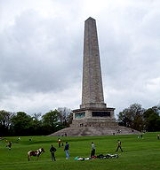
Obelisk

Encyclopedia
Pylon (architecture)
Pylon is the Greek term for a monumental gateway of an Egyptian temple It consists of two tapering towers, each surmounted by a cornice, joined by a less elevated section which enclosed the entrance between them. The entrance was generally about half the height of the towers...
. Ancient obelisks were often monolith
Monolith
A monolith is a geological feature such as a mountain, consisting of a single massive stone or rock, or a single piece of rock placed as, or within, a monument...
ic, whereas most modern obelisks are made of several stones and can have interior spaces.
The term stele
Stele
A stele , also stela , is a stone or wooden slab, generally taller than it is wide, erected for funerals or commemorative purposes, most usually decorated with the names and titles of the deceased or living — inscribed, carved in relief , or painted onto the slab...
(plural: stelae) is generally used for other monumental standing inscribed sculpted stones.
Egyptian
Obelisks were prominent in the architecture of the ancient EgyptAncient Egypt
Ancient Egypt was an ancient civilization of Northeastern Africa, concentrated along the lower reaches of the Nile River in what is now the modern country of Egypt. Egyptian civilization coalesced around 3150 BC with the political unification of Upper and Lower Egypt under the first pharaoh...
ians, who placed them in pairs at the entrance of temples
Egyptian temple
Egyptian temples were built for the official worship of the gods and commemoration of pharaohs in Ancient Egypt and in regions under Egyptian control. These temples were seen as houses for the gods or kings to whom they were dedicated...
. The word "obelisk" as used in English today is of Greek rather than Egyptian origin because Herodotus
Herodotus
Herodotus was an ancient Greek historian who was born in Halicarnassus, Caria and lived in the 5th century BC . He has been called the "Father of History", and was the first historian known to collect his materials systematically, test their accuracy to a certain extent and arrange them in a...
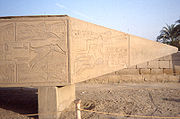
, the Greek traveller, was one of the first classical writers to describe the objects. A number of ancient Egyptian obelisks are known to have survived, plus the "Unfinished Obelisk
Unfinished obelisk
The unfinished obelisk is the largest known ancient obelisk, located in the northern region of the stone quarries of ancient Egypt in Aswan , Egypt. It is unknown which pharaoh created this structure. It is nearly one third larger than any ancient Egyptian obelisk ever erected...
" found partly hewn from its quarry at Aswan
Aswan
Aswan , formerly spelled Assuan, is a city in the south of Egypt, the capital of the Aswan Governorate.It stands on the east bank of the Nile at the first cataract and is a busy market and tourist centre...
. These obelisks are now dispersed around the world, and fewer than half of them remain in Egypt.
The earliest temple
Temple
A temple is a structure reserved for religious or spiritual activities, such as prayer and sacrifice, or analogous rites. A templum constituted a sacred precinct as defined by a priest, or augur. It has the same root as the word "template," a plan in preparation of the building that was marked out...
obelisk still in its original position is the 20.7 m / 68 ft high 120 tons red granite Obelisk of Senusret I
Senusret I
Senusret I was the second pharaoh of the Twelfth Dynasty of Egypt. He ruled from 1971 BC to 1926 BC, and was one of the most powerful kings of this Dynasty. He was the son of Amenemhat I and his wife Nefertitanen. His wife and sister was Neferu. She was also the mother of the successor Amenemhat II...
of the XIIth
Twelfth dynasty of Egypt
The twelfth dynasty of ancient Egypt is often combined with Dynasties XI, XIII and XIV under the group title Middle Kingdom.-Rulers:Known rulers of the twelfth dynasty are as follows :...
Dynasty at Al-Matariyyah
Al-Matariyyah
Al-Matariyyah, Mataria or El Matariya is a district in the northern region of Greater Cairo, east of the Nile, in Egypt. The district is unrelated to the El Matareya coastal region in the Dakahlia Governorate...
part of Heliopolis
Heliopolis (ancient)
Heliopolis was one of the oldest cities of ancient Egypt, the capital of the 13th Lower Egyptian nome that was located five miles east of the Nile to the north of the apex of the Nile Delta...
.
The obelisk symbolized the sun god Ra, and during the brief religious reformation of Akhenaten
Akhenaten
Akhenaten also spelled Echnaton,Ikhnaton,and Khuenaten;meaning "living spirit of Aten") known before the fifth year of his reign as Amenhotep IV , was a Pharaoh of the Eighteenth dynasty of Egypt who ruled for 17 years and died perhaps in 1336 BC or 1334 BC...
was said to be a petrified ray of the Aten
Aten
Aten is the disk of the sun in ancient Egyptian mythology, and originally an aspect of Ra. The deified Aten is the focus of the monolatristic, henotheistic, or monotheistic religion of Atenism established by Amenhotep IV, who later took the name Akhenaten in worship in recognition of Aten...
, the sundisk. It was also thought that the god existed within the structure.
It is hypothesized by New York University
New York University
New York University is a private, nonsectarian research university based in New York City. NYU's main campus is situated in the Greenwich Village section of Manhattan...
Egyptologist Patricia Blackwell Gary and Astronomy
Astronomy (magazine)
Astronomy is a monthly American magazine about astronomy. Targeting amateur astronomers for its readers, it contains columns on sky viewing, reader-submitted astrophotographs, and articles on astronomy and astrophysics that are readable by nonscientists....
senior editor Richard Talcott that the shapes of the ancient Egypt
Ancient Egypt
Ancient Egypt was an ancient civilization of Northeastern Africa, concentrated along the lower reaches of the Nile River in what is now the modern country of Egypt. Egyptian civilization coalesced around 3150 BC with the political unification of Upper and Lower Egypt under the first pharaoh...
ian pyramid
Pyramid
A pyramid is a structure whose outer surfaces are triangular and converge at a single point. The base of a pyramid can be trilateral, quadrilateral, or any polygon shape, meaning that a pyramid has at least three triangular surfaces...
and obelisk were derived from natural phenomena associated with the sun (the sun-god Ra
Ra
Ra is the ancient Egyptian sun god. By the Fifth Dynasty he had become a major deity in ancient Egyptian religion, identified primarily with the mid-day sun...
being the Egyptians' greatest deity). The pyramid
Pyramid
A pyramid is a structure whose outer surfaces are triangular and converge at a single point. The base of a pyramid can be trilateral, quadrilateral, or any polygon shape, meaning that a pyramid has at least three triangular surfaces...
and obelisk might have been inspired by previously overlooked astronomical phenomena connected with sunrise
Sunrise
Sunrise is the instant at which the upper edge of the Sun appears above the horizon in the east. Sunrise should not be confused with dawn, which is the point at which the sky begins to lighten, some time before the sun itself appears, ending twilight...
and sunset
Sunset
Sunset or sundown is the daily disappearance of the Sun below the horizon in the west as a result of Earth's rotation.The time of sunset is defined in astronomy as the moment the trailing edge of the Sun's disk disappears below the horizon in the west...
: the zodiacal light
Zodiacal light
Zodiacal light is a faint, roughly triangular, whitish glow seen in the night sky which appears to extend up from the vicinity of the sun along the ecliptic or zodiac. Caused by sunlight scattered by space dust in the zodiacal cloud, it is so faint that either moonlight or light pollution renders...
and sun pillars respectively.
The tallest Egyptian obelisk is in the square in front of the Lateran Basilica in Rome at 105.6 feet tall and a weight of 455 tons.
Not all the Egyptian obelisks in the Roman Empire were set up at Rome. Herod the Great
Herod the Great
Herod , also known as Herod the Great , was a Roman client king of Judea. His epithet of "the Great" is widely disputed as he is described as "a madman who murdered his own family and a great many rabbis." He is also known for his colossal building projects in Jerusalem and elsewhere, including his...
imitated his Roman patrons and set up a red granite Egyptian obelisk in the hippodrome of his new city Caesarea in northern Judea
Judea
Judea or Judæa was the name of the mountainous southern part of the historic Land of Israel from the 8th century BCE to the 2nd century CE, when Roman Judea was renamed Syria Palaestina following the Jewish Bar Kokhba revolt.-Etymology:The...
. This one is about 40 feet tall and weighs about 100 tons. It was discovered by archaeologists and has been re-erected at its former site.
In Constantinople
Constantinople
Constantinople was the capital of the Roman, Eastern Roman, Byzantine, Latin, and Ottoman Empires. Throughout most of the Middle Ages, Constantinople was Europe's largest and wealthiest city.-Names:...
, the Eastern Emperor Theodosius shipped an obelisk in AD 390 and had it set up in his hippodrome
Hippodrome
A hippodrome was a Greek stadium for horse racing and chariot racing. The name is derived from the Greek words "hippos and "dromos"...
, where it has weathered Crusaders and Seljuks and stands in the Hippodrome square
Hippodrome of Constantinople
The Hippodrome of Constantinople was a circus that was the sporting and social centre of Constantinople, capital of the Byzantine Empire. Today it is a square named Sultanahmet Meydanı in the Turkish city of Istanbul, with only a few fragments of the original structure surviving...
in modern Istanbul
Istanbul
Istanbul , historically known as Byzantium and Constantinople , is the largest city of Turkey. Istanbul metropolitan province had 13.26 million people living in it as of December, 2010, which is 18% of Turkey's population and the 3rd largest metropolitan area in Europe after London and...
. This one stood 95 feet tall, weighing 380 tons. Its lower half reputedly also once stood in Istanbul but is now lost. The Istanbul obelisk is 65 feet tall.
Rome is the obelisk capital of the world. The most prominent is the 25.5 m/83.6 ft high 331 ton obelisk at Saint Peter's Square
Saint Peter's Square
Saint Peter's Square is located directly in front of St. Peter's Basilica in Vatican City, the papal enclave within Rome .-History of St...
in Rome. The obelisk had stood since AD 37 on its site on the wall of the Circus of Nero
Circus of Nero
The Circus of Nero or Circus of Caligula was a circus in ancient Rome.-Construction:It was begun by Caligula on the property of his mother Agrippina on the Ager Vaticanus , and finished by Nero...
, flanking St Peter's Basilica:
- "The elder PlinyPliny the ElderGaius Plinius Secundus , better known as Pliny the Elder, was a Roman author, naturalist, and natural philosopher, as well as naval and army commander of the early Roman Empire, and personal friend of the emperor Vespasian...
in his Natural History refers to the obelisk's transportation from Egypt to Rome by order of the Emperor Gaius (Caligula) as an outstanding event. The barge that carried it had a huge mast of fir wood which four men's arms could not encircle. One hundred and twenty bushels of lentils were needed for ballast. Having fulfilled its purpose, the gigantic vessel was no longer wanted. Therefore, filled with stones and cement, it was sunk to form the foundations of the foremost quay of the new harbour at OstiaOstia AnticaOstia Antica is a large archeological site, close to the modern suburb of Ostia , that was the location of the harbour city of ancient Rome, which is approximately 30 km to the northeast. "Ostia" in Latin means "mouth". At the mouth of the River Tiber, Ostia was Rome's seaport, but, due to...
."
Re-erecting the obelisk had daunted even Michelangelo
Michelangelo
Michelangelo di Lodovico Buonarroti Simoni , commonly known as Michelangelo, was an Italian Renaissance painter, sculptor, architect, poet, and engineer who exerted an unparalleled influence on the development of Western art...
, but Sixtus V was determined to erect it in front of St Peter's, of which the nave was yet to be built. He had a full-sized wooden mock-up erected within months of his election. Domenico Fontana
Domenico Fontana
Domenico Fontana was a Swiss-born Italian architect of the late Renaissance.-Biography:200px|thumb|Fountain of Moses in Rome....
, the assistant of Giacomo Della Porta
Giacomo della Porta
Giacomo della Porta was an Italian architect and sculptor, who worked on many important buildings in Rome, including St. Peter's Basilica. He was born at Porlezza, Lombardy and died in Rome.-Biography:...
in the Basilica's construction, presented the Pope with a little model crane of wood and a heavy little obelisk of lead, which Sixtus himself was able to raise by turning a little winch with his finger. Fontana was given the project.
The obelisk, half-buried in the debris of the ages, was first excavated as it stood; then it took from April 30 to May 17, 1586 to move it on rollers to the Piazza: it required nearly 1000 men, 140 carthorses, 47 cranes. The re-erection, scheduled for September 14, the Feast of the Exaltation of the Cross, was watched by a large crowd. It was a famous feat of engineering, which made the reputation of Fontana, who detailed it in a book illustrated with copperplate etchings, Della Trasportatione dell'Obelisco Vaticano et delle Fabriche di Nostro Signore Papa Sisto V (1590), which itself set a new standard in communicating technical information and influenced subsequent architectural publications by its meticulous precision. Before being re-erected the obelisk was exorcised. It is said that Fontana had teams of relay horses to make his getaway if the enterprise failed. When Carlo Maderno
Carlo Maderno
Carlo Maderno was a Swiss-Italian architect, born in Ticino, who is remembered as one of the fathers of Baroque architecture. His façades of Santa Susanna, St. Peter's Basilica and Sant'Andrea della Valle were of key importance in the evolution of the Italian Baroque...
came to build the Basilica's nave, he had to put the slightest kink in its axis, to line it precisely with the obelisk.
An obelisk stands in front of the church of Trinità dei Monti
Trinità dei Monti
The church of the Santissima Trinità dei Monti is a late Renaissance titular church in Rome, central Italy. It is best known for its commanding position above the Spanish Steps which lead down to the Piazza di Spagna...
, at the head of the Spanish Steps
Spanish Steps
The Spanish Steps are a set of steps in Rome, Italy, climbing a steep slope between the Piazza di Spagna at the base and Piazza Trinità dei Monti, dominated by the Trinità dei Monti church at the top. The Scalinata is the widest staircase in Europe...
. Another obelisk in Rome is sculpted as carried on the back of an elephant
Elephant
Elephants are large land mammals in two extant genera of the family Elephantidae: Elephas and Loxodonta, with the third genus Mammuthus extinct...
. Rome lost one of its obelisks, which had decorated the temple of Isis, where it was uncovered in the 16th century. The Medici claimed it for the Villa Medici
Villa Medici
The Villa Medici is a mannerist villa and an architectural complex with a garden contiguous with the larger Borghese gardens, on the Pincian Hill next to Trinità dei Monti in Rome, Italy. The Villa Medici, founded by Ferdinando I de' Medici, Grand Duke of Tuscany and now property of the French...
, but in 1790 they moved it to the Boboli Gardens
Boboli Gardens
The Boboli Gardens are a park in Florence, Italy, that is home to a collection of sculptures dating from the 16th through the 18th centuries, with some Roman antiquities.-History and layout:...
attached to the Palazzo Pitti
Palazzo Pitti
The Palazzo Pitti , in English sometimes called the Pitti Palace, is a vast mainly Renaissance palace in Florence, Italy. It is situated on the south side of the River Arno, a short distance from the Ponte Vecchio...
in Florence
Florence
Florence is the capital city of the Italian region of Tuscany and of the province of Florence. It is the most populous city in Tuscany, with approximately 370,000 inhabitants, expanding to over 1.5 million in the metropolitan area....
, and left a replica in its stead.
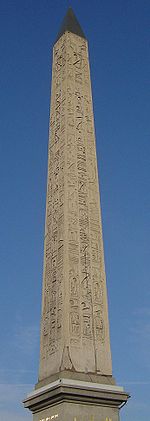
Several more Egyptian obelisks have been re-erected elsewhere. The best-known examples outside Rome are the pair of 21 m/68 ft Cleopatra's Needle
Cleopatra's Needle
Cleopatra's Needle is the popular name for each of three Ancient Egyptian obelisks re-erected in London, Paris, and New York City during the nineteenth century. The London and New York ones are a pair, while the Paris one comes from a different original site where its twin remains...
s in London(69 feet 187 tons) and New York City(70 feet 193 tons) and the 23 m/75 ft 227 ton obelisk at
Luxor Obelisk
The Luxor Obelisk is a 23 metres high Egyptian obelisk standing at the center of the Place de la Concorde in Paris, France...
the Place de la Concorde
Place de la Concorde
The Place de la Concorde in area, it is the largest square in the French capital. It is located in the city's eighth arrondissement, at the eastern end of the Champs-Élysées.- History :...
in Paris.

- Egypt – 9
- Pharaoh Thutmosis I, Karnak TempleKarnakThe Karnak Temple Complex—usually called Karnak—comprises a vast mix of decayed temples, chapels, pylons, and other buildings, notably the Great Temple of Amun and a massive structure begun by Pharaoh Ramses II . Sacred Lake is part of the site as well. It is located near Luxor, some...
, LuxorLuxorLuxor is a city in Upper Egypt and the capital of Luxor Governorate. The population numbers 487,896 , with an area of approximately . As the site of the Ancient Egyptian city of Thebes, Luxor has frequently been characterized as the "world's greatest open air museum", as the ruins of the temple... - Pharaoh Ramses II, Luxor TempleLuxor TempleLuxor Temple is a large Ancient Egyptian temple complex located on the east bank of the River Nile in the city today known as Luxor and was founded in 1400 BCE.,...
- Pharaoh HatshepsutHatshepsutHatshepsut also Hatchepsut; meaning Foremost of Noble Ladies;1508–1458 BC) was the fifth pharaoh of the eighteenth dynasty of Ancient Egypt...
, Karnak Temple, Luxor - Pharaoh Senusret ISenusret ISenusret I was the second pharaoh of the Twelfth Dynasty of Egypt. He ruled from 1971 BC to 1926 BC, and was one of the most powerful kings of this Dynasty. He was the son of Amenemhat I and his wife Nefertitanen. His wife and sister was Neferu. She was also the mother of the successor Amenemhat II...
, Al-Masalla area of Al-MatariyyahAl-MatariyyahAl-Matariyyah, Mataria or El Matariya is a district in the northern region of Greater Cairo, east of the Nile, in Egypt. The district is unrelated to the El Matareya coastal region in the Dakahlia Governorate...
district in HeliopolisHeliopolis (ancient)Heliopolis was one of the oldest cities of ancient Egypt, the capital of the 13th Lower Egyptian nome that was located five miles east of the Nile to the north of the apex of the Nile Delta...
, CairoCairoCairo , is the capital of Egypt and the largest city in the Arab world and Africa, and the 16th largest metropolitan area in the world. Nicknamed "The City of a Thousand Minarets" for its preponderance of Islamic architecture, Cairo has long been a centre of the region's political and cultural life... - Pharaoh Ramses III, Luxor MuseumLuxor MuseumLuxor Museum is located in the Egyptian city of Luxor . It stands on the corniche, overlooking the west bank of the River Nile, in the central part of the city.Inaugurated in 1975, the museum is housed in a small, purpose-built building...
- Pharaoh Ramses II, Gezira Island, Cairo, 20.4 m
- Pharaoh Ramses II, Cairo International AirportCairo International AirportCairo International Airport is the busiest airport in Egypt and the primary hub for Star Alliance member EgyptAir. The airport is located to the north-east of the city around from the business area of the city.The airport is administered by the Egyptian Holding Co...
, 16.97 m - Pharaoh Seti IISeti IISeti II , was the fifth ruler of the Nineteenth dynasty of Egypt and reigned from 1203 BC to 1197 BC. His throne name, Userkheperure Setepenre, meant "Powerful are the Manifestations of Re, Chosen by Re.' He was the son of Merneptah and wife Isisnofret and sat on the throne during a...
, Karnak Temple, Luxor, 7 m - Pharaoh Senusret ISenusret ISenusret I was the second pharaoh of the Twelfth Dynasty of Egypt. He ruled from 1971 BC to 1926 BC, and was one of the most powerful kings of this Dynasty. He was the son of Amenemhat I and his wife Nefertitanen. His wife and sister was Neferu. She was also the mother of the successor Amenemhat II...
, Faiyum (ancient site of CrocodilopolisCrocodilopolisCrocodilopolis or Krokodilopolis or Ptolemais Euergetis or Arsinoe or Krialon was an ancient city in the Heptanomis, Egypt, the capital of Arsinoites nome, on the western bank of the Nile, between the river and the Lake Moeris, southwest of Memphis, in lat. 29° N...
), 12.9 m
- Pharaoh Thutmosis I, Karnak Temple
- France – 1
- Pharaoh Ramses II, Luxor ObeliskLuxor ObeliskThe Luxor Obelisk is a 23 metres high Egyptian obelisk standing at the center of the Place de la Concorde in Paris, France...
, in Place de la ConcordePlace de la ConcordeThe Place de la Concorde in area, it is the largest square in the French capital. It is located in the city's eighth arrondissement, at the eastern end of the Champs-Élysées.- History :...
, Paris
- Pharaoh Ramses II, Luxor Obelisk
- Israel – 1
- Caesarea obeliskCaesarea obeliskThe Caesarea obelisk is a red granite Obelisk 12 meters high , which was erected in the hippodrome of Herod the Great's new-built capital of Judea, Caesarea Maritima. The obelisk seems to have been erected after Herod's time, in the 2nd century CE...
- Caesarea obelisk
- Italy – 11 (includes the only one located in the Vatican CityVatican CityVatican City , or Vatican City State, in Italian officially Stato della Città del Vaticano , which translates literally as State of the City of the Vatican, is a landlocked sovereign city-state whose territory consists of a walled enclave within the city of Rome, Italy. It has an area of...
)- Rome — 8 ancient Egyptian obelisks (see List of obelisks in Rome)
- Piazza del Duomo, CataniaCataniaCatania is an Italian city on the east coast of Sicily facing the Ionian Sea, between Messina and Syracuse. It is the capital of the homonymous province, and with 298,957 inhabitants it is the second-largest city in Sicily and the tenth in Italy.Catania is known to have a seismic history and...
(SicilySicilySicily is a region of Italy, and is the largest island in the Mediterranean Sea. Along with the surrounding minor islands, it constitutes an autonomous region of Italy, the Regione Autonoma Siciliana Sicily has a rich and unique culture, especially with regard to the arts, music, literature,...
) - Boboli GardensBoboli GardensThe Boboli Gardens are a park in Florence, Italy, that is home to a collection of sculptures dating from the 16th through the 18th centuries, with some Roman antiquities.-History and layout:...
(FlorenceFlorenceFlorence is the capital city of the Italian region of Tuscany and of the province of Florence. It is the most populous city in Tuscany, with approximately 370,000 inhabitants, expanding to over 1.5 million in the metropolitan area....
) - UrbinoUrbinoUrbino is a walled city in the Marche region of Italy, south-west of Pesaro, a World Heritage Site notable for a remarkable historical legacy of independent Renaissance culture, especially under the patronage of Federico da Montefeltro, duke of Urbino from 1444 to 1482...
- Poland – 1
- Ramses II, Poznań Archaeological Museum, PoznańPoznanPoznań is a city on the Warta river in west-central Poland, with a population of 556,022 in June 2009. It is among the oldest cities in Poland, and was one of the most important centres in the early Polish state, whose first rulers were buried at Poznań's cathedral. It is sometimes claimed to be...
(on loan from Ägyptisches Museum und Papyrussammlung, Berlin)
- Ramses II, Poznań Archaeological Museum, Poznań
- Turkey – 1
- Pharaoh Tuthmosis III, in Square of HorsesHippodrome of ConstantinopleThe Hippodrome of Constantinople was a circus that was the sporting and social centre of Constantinople, capital of the Byzantine Empire. Today it is a square named Sultanahmet Meydanı in the Turkish city of Istanbul, with only a few fragments of the original structure surviving...
, IstanbulIstanbulIstanbul , historically known as Byzantium and Constantinople , is the largest city of Turkey. Istanbul metropolitan province had 13.26 million people living in it as of December, 2010, which is 18% of Turkey's population and the 3rd largest metropolitan area in Europe after London and...
- Pharaoh Tuthmosis III, in Square of Horses
- United Kingdom – 4
- Pharaoh Tuthmosis III, "Cleopatra's NeedleCleopatra's NeedleCleopatra's Needle is the popular name for each of three Ancient Egyptian obelisks re-erected in London, Paris, and New York City during the nineteenth century. The London and New York ones are a pair, while the Paris one comes from a different original site where its twin remains...
", on Victoria EmbankmentVictoria EmbankmentThe Victoria Embankment is part of the Thames Embankment, a road and river walk along the north bank of the River Thames in London. Victoria Embankment extends from the City of Westminster into the City of London.-Construction:...
, London - Pharaoh Amenhotep IIAmenhotep IIAmenhotep II was the seventh Pharaoh of the 18th dynasty of Egypt. Amenhotep inherited a vast kingdom from his father Thutmose III, and held it by means of a few military campaigns in Syria; however, he fought much less than his father, and his reign saw the effective cessation of hostilities...
, in the Oriental Museum, University of Durham - Pharaoh Ptolemy IX, Philae obeliskPhilae obeliskThe Philae obelisk was one of two obelisks found at Philae in Upper Egypt in 1815 and soon afterwards acquired by William John Bankes. He noted two inscriptions on it, one in Egyptian hieroglyphs the other in ancient Greek...
, at Kingston LacyKingston LacyKingston Lacy is a country house and estate near Wimborne Minster, Dorset, England, now owned by the National Trust. From the 17th to the late 20th centuries it was the family seat of the Bankes family, who had previously resided nearby at Corfe Castle until its destruction in the English Civil War...
, near Wimborne MinsterWimborne MinsterWimborne Minster is a market town in the East Dorset district of Dorset in South West England, and the name of the Church of England church in that town...
, DorsetDorsetDorset , is a county in South West England on the English Channel coast. The county town is Dorchester which is situated in the south. The Hampshire towns of Bournemouth and Christchurch joined the county with the reorganisation of local government in 1974... - Pharaoh Nectanebo IINectanebo IINectanebo II was the third and last pharaoh of the Thirtieth dynasty, as well as the last native ruler of Ancient Egypt. Under Nectanebo II Egypt prospered...
, British MuseumBritish MuseumThe British Museum is a museum of human history and culture in London. Its collections, which number more than seven million objects, are amongst the largest and most comprehensive in the world and originate from all continents, illustrating and documenting the story of human culture from its...
, London (pair of obelisks)
- Pharaoh Tuthmosis III, "Cleopatra's Needle
- United States – 1
- Pharaoh Tuthmosis III, "Cleopatra's NeedleCleopatra's NeedleCleopatra's Needle is the popular name for each of three Ancient Egyptian obelisks re-erected in London, Paris, and New York City during the nineteenth century. The London and New York ones are a pair, while the Paris one comes from a different original site where its twin remains...
", in Central ParkCentral ParkCentral Park is a public park in the center of Manhattan in New York City, United States. The park initially opened in 1857, on of city-owned land. In 1858, Frederick Law Olmsted and Calvert Vaux won a design competition to improve and expand the park with a plan they entitled the Greensward Plan...
, New YorkNew YorkNew York is a state in the Northeastern region of the United States. It is the nation's third most populous state. New York is bordered by New Jersey and Pennsylvania to the south, and by Connecticut, Massachusetts and Vermont to the east...
- Pharaoh Tuthmosis III, "Cleopatra's Needle
Assyrian
Obelisk monuments are also known from the AssyriaAssyria
Assyria was a Semitic Akkadian kingdom, extant as a nation state from the mid–23rd century BC to 608 BC centred on the Upper Tigris river, in northern Mesopotamia , that came to rule regional empires a number of times through history. It was named for its original capital, the ancient city of Assur...
n civilisation, where they were erected as public monuments that commemorated the achievements of the Assyrian king.
The British Museum
British Museum
The British Museum is a museum of human history and culture in London. Its collections, which number more than seven million objects, are amongst the largest and most comprehensive in the world and originate from all continents, illustrating and documenting the story of human culture from its...
possesses three Assyrian obelisks:
The White Obelisk (named due to its colour), was discovered by Hormuzd Rassam
Hormuzd Rassam
Hormuzd Rassam , was a native Assyrian Assyriologist, British diplomat and traveller who made a number of important discoveries, including the clay tablets that contained the Epic of Gilgamesh, the world's oldest literature...
in 1853 at Nineveh
Nineveh
Nineveh was an ancient Assyrian city on the eastern bank of the Tigris River, and capital of the Neo Assyrian Empire. Its ruins are across the river from the modern-day major city of Mosul, in the Ninawa Governorate of Iraq....
. The obelisk was erected by either Ashurnasirpal I (1050-1031 BC) or Ashurnasirpal II (883-859 BC). The obelisk bears an inscription that refers to the king’s seizure of goods, people and herds, which he carried back to the city of Ashur. The reliefs of the Obelisk depict military campaigns, hunting, victory banquets and scenes of tribute bearing.
The Rassam Obelisk, named after its discoverer Hormuzd Rassam
Hormuzd Rassam
Hormuzd Rassam , was a native Assyrian Assyriologist, British diplomat and traveller who made a number of important discoveries, including the clay tablets that contained the Epic of Gilgamesh, the world's oldest literature...
, was found on the citadel of Nimrud
Nimrud
Nimrud is an ancient Assyrian city located south of Nineveh on the river Tigris in modern Ninawa Governorate Iraq. In ancient times the city was called Kalḫu. The Arabs called the city Nimrud after the Biblical Nimrod, a legendary hunting hero .The city covered an area of around . Ruins of the city...
(ancient Kalhu). It was erected by Ashurnasirpal II, though only survives in fragments. The surviving parts of the reliefs depict scenes of tribute bearing to the king from Syria and the west.
The Black Obelisk
Black Obelisk
The "Black Obelisk of Shalmaneser III" is a black limestone Neo-Assyrian bas-relief sculpture from Nimrud , in northern Iraq, commemorating the deeds of King Shalmaneser III . It is the most complete Assyrian obelisk yet discovered, and is historically significant because it displays the earliest...
was discovered by Sir Austen Henry Layard in 1846 on the citadel of Kalhu. The obelisk was erected by Shalmaneser III
Shalmaneser III
Shalmaneser III was king of Assyria , and son of the previous ruler, Ashurnasirpal II....
and the reliefs depict scenes of tribute bearing as well as the depiction of two subdued rulers, Jehu
Jehu
Jehu was a king of Israel. He was the son of Jehoshaphat, and grandson of Nimshi.William F. Albright has dated his reign to 842-815 BC, while E. R. Thiele offers the dates 841-814 BC...
the Israelite and Sua the Gilzanean, giving gestures of submission to the king. The reliefs on the obelisk have accompanying epigraphs, but besides these the obelisk also possesses a longer inscription that records one of the latest versions of Shalmaneser III’s annals, covering the period from his accessional year to his 33rd regnal year.
Axumite/Ethiopian
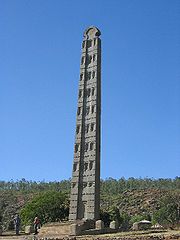
Ethiopia
Ethiopia , officially known as the Federal Democratic Republic of Ethiopia, is a country located in the Horn of Africa. It is the second-most populous nation in Africa, with over 82 million inhabitants, and the tenth-largest by area, occupying 1,100,000 km2...
. Together with (21 m high) King Ezana's Stele
King Ezana's Stele
King Ezana's Stele is the central obelisk still standing in the Northern Stelae Park in the ancient city of Axum, in modern-day Ethiopia. This stele is probably the last erected one and the biggest of those remained unbroken...
, the last erected one and the only unbroken, the most famous example of axumite obelisk is the so-called (24 m high) Obelisk of Axum
Obelisk of Axum
The Obelisk of Axum is a 1,700-year-old, 24-metres tall granite stele/obelisk, weighing 160 tonnes, in the city of Axum in Ethiopia. It is decorated with two false doors at the base, and decorations resembling windows on all sides...
. It was carved around the 4th century AD and, in the course of time, it collapsed and broke into three parts. In these conditions it was found by Italian soldiers in 1935, after the Second Italo-Abyssinian War
Second Italo-Abyssinian War
The Second Italo–Abyssinian War was a colonial war that started in October 1935 and ended in May 1936. The war was fought between the armed forces of the Kingdom of Italy and the armed forces of the Ethiopian Empire...
, looted and taken to Rome in 1937, where it stood in the Piazza di Porta Capena
Porta Capena
The Porta Capena was a gate in the Servian Wall near the Caelian Hill, in Rome, Italy according to Roman tradition the sacred grove where Numa Pompilius and the nymph Egeria used to meet. It was one of the main entries to the city of Rome, since it opened on the Appian Way...
. Italy agreed in a 1947 UN agreement to return the obelisk but did not affirm its agreement until 1997, after years of pressure and various controversial settlements. In 2003 the Italian government made the first steps toward its return, and in 2008 it was finally re-erected.
The largest known obelisk, the Great Stele at Axum
Axum
Axum or Aksum is a city in northern Ethiopia which was the original capital of the eponymous kingdom of Axum. Population 56,500 . Axum was a naval and trading power that ruled the region from ca. 400 BC into the 10th century...
, now fallen, at 33 m high and 3 by 2 metres at the base (520 tons) is one of the largest single pieces of stone ever worked in human history (the largest is either at Baalbek
Baalbek
Baalbek is a town in the Beqaa Valley of Lebanon, altitude , situated east of the Litani River. It is famous for its exquisitely detailed yet monumentally scaled temple ruins of the Roman period, when Baalbek, then known as Heliopolis, was one of the largest sanctuaries in the Empire...
or the Ramesseum
Ramesseum
The Ramesseum is the memorial temple of Pharaoh Ramesses II . It is located in the Theban necropolis in Upper Egypt, across the River Nile from the modern city of Luxor...
) and probably fell during erection or soon after, destroying a large part of the massive burial chamber underneath it. The obelisks, properly termed stelae or the native hawilt or hawilti as they do not end in a pyramid, were used to mark graves and underground burial chambers. The largest of the grave markers were for royal burial chambers and were decorated with multi-storey false windows and false doors, while nobility would have smaller less decorated ones. While there are only a few large ones standing, there are hundreds of smaller ones in "stelae fields".
Ancient Roman
The Romans commissioned obelisks in an ancient Egyptian style. Examples include:- Arles, France —the Arles Obelisk, in Place de la République, a 4th century obelisk of RomanAncient RomeAncient Rome was a thriving civilization that grew on the Italian Peninsula as early as the 8th century BC. Located along the Mediterranean Sea and centered on the city of Rome, it expanded to one of the largest empires in the ancient world....
origin - BeneventoBeneventoBenevento is a town and comune of Campania, Italy, capital of the province of Benevento, 50 km northeast of Naples. It is situated on a hill 130 m above sea-level at the confluence of the Calore Irpino and Sabato...
, Italy — three Roman obelisks - Munich — obelisk of Titus Sextius Africanus, Staatliches Museum Ägyptischer Kunst, KunstarealKunstarealThe Kunstareal is a museum quarter in the city centre of Munich, Germany.It consists of the three "Pinakotheken" galleries , the Glyptothek, the Staatliche Antikensammlung , the Lenbachhaus, the Museum Brandhorst and...
, 1st century AD, 5.80 m - Rome — there are five ancient Roman obelisks in Rome. See List of obelisks in Rome.
Byzantine
- Walled ObeliskWalled ObeliskThe Walled Obelisk is situated near the Serpentine Column at the southern side of the Hippodrome of Constantinople .- History :...
, Hippodrome of Constantinople. Built by Constantine VIIConstantine VIIConstantine VII Porphyrogennetos or Porphyrogenitus, "the Purple-born" was the fourth Emperor of the Macedonian dynasty of the Byzantine Empire, reigning from 913 to 959...
Porphyrogenitus (905–959) and originally covered with gilded bronze plaques.
Keralian
The obelisk stone (rock) crosses of KeralaKerala
or Keralam is an Indian state located on the Malabar coast of south-west India. It was created on 1 November 1956 by the States Reorganisation Act by combining various Malayalam speaking regions....
form another category of obelisks. The Syrian Christians or St. Thomas Christians of Malabar on the west coast of India had close contacts with the Egyptian and Assyrian worlds, the original habitat of obelisks. The "Ray of the Sun" and Horus concepts are to be found in the idea of Christ and in the orientation of the churches East-West. The use of the cylinder and socket method is found in both structures.
Pre-Columbian
The prehistoric Tello Obelisk, found in 1919 at Chavín de HuantarChavín de Huantar
Chavín de Huántar is an archaeological site containing ruins and artifacts constructed beginning at least by 1200 BCE and occupied by later cultures until around 400-500 BCE by the Chavín, a major pre-Inca culture. The site is located north of Lima, Peru, at an elevation of , east of the...
in Peru
Peru
Peru , officially the Republic of Peru , is a country in western South America. It is bordered on the north by Ecuador and Colombia, on the east by Brazil, on the southeast by Bolivia, on the south by Chile, and on the west by the Pacific Ocean....
, is a monolith stele with obelisk-like proportions. It was carved in a design of low relief with Chavín symbols, such as bands of teeth and animal heads. Long housed in the Museo Nacional de Arqueología, Antropología e Historia del Perú in Lima
Lima
Lima is the capital and the largest city of Peru. It is located in the valleys of the Chillón, Rímac and Lurín rivers, in the central part of the country, on a desert coast overlooking the Pacific Ocean. Together with the seaport of Callao, it forms a contiguous urban area known as the Lima...
, it was relocated to the Museo Nacional de Chavín, which opened in July 2008. The obelisk was named for the archeologist Julio C. Tello
Julio C. Tello
Julio César Tello was a Peruvian archaeologist. Tello is considered the "father of Peruvian archeology" and was America's first indigenous archaeologist...
, who discovered it and was considered the "father of Peruvian archeology." He was America's first indigenous
Indigenous peoples of the Americas
The indigenous peoples of the Americas are the pre-Columbian inhabitants of North and South America, their descendants and other ethnic groups who are identified with those peoples. Indigenous peoples are known in Canada as Aboriginal peoples, and in the United States as Native Americans...
archeologist.
Obelisk-erecting experiments
In late summer 1999, Roger Hopkins and Mark LehnerMark Lehner
Mark Lehner PhD is an American archaeologist with more than 30 years of experience excavating in Egypt. His approach, as director of Ancient Egypt Research Associates , is to conduct interdisciplinary archaeological investigation. Every excavated object is examined by specialists to create an...
teamed up with a NOVA (TV series)
NOVA (TV series)
Nova is a popular science television series from the U.S. produced by WGBH Boston. It can be seen on the Public Broadcasting Service in the United States, and in more than 100 other countries...
crew to erect a 25-ton obelisk. This was the third attempt to erect a 25-ton obelisk; the first two, in 1994 and 1999, ended in failure. There were also two successful attempts to raise a two-ton obelisk and a nine-ton obelisk. Finally in Aug–Sep of 1999, after learning from their experiences, they were able to erect one successfully.
First Hopkins and Rais Abdel Aleem organized an experiment to tow a block of stone weighing about 25 tons. They prepared a path by embedding wooden rails into the ground and placing a sledge on them bearing a megalith weighing about 25 tons. Initially they used more than 100 people to try to tow it but were unable to budge it. Finally, with well over 130 people pulling at once and an additional dozen using levers to prod the sledge forward, they moved it. Over the course of a day, the workers towed it 10 to 20 feet. Despite problems with broken ropes, they proved the monument could be moved this way. Additional experiments were done in Egypt and other locations to tow megalithic stone with ancient technologies, some of which are listed here.
One experiment was to transport a small obelisk on a barge in the Nile River. The barge was built based on ancient Egyptian designs. It had to be very wide to handle the obelisk, with a 2 to 1 ratio length to width, and it was at least twice as long as the obelisk. The obelisk was about 10 feet long and no more than 5 tons. A barge big enough to transport the largest Egyptian obelisks with this ratio would have had to be close to 200 feet long and 100 feet wide. The workers used ropes that were wrapped around a guide that enabled them to pull away from the river while they were towing it onto the barge. The barge was successfully launched into the Nile.
The final and successful erection event was organized by Rick Brown, Hopkins, Lehner and Gregg Mullen in a Massachusetts quarry. The preparation work was done with modern technology, but experiments have proven that with enough time and people, it could have been done with ancient technology. To begin, the obelisk was lying on a gravel and stone ramp. A pit in the middle was filled with dry sand. Previous experiments showed that wet sand would not flow as well. The ramp was secured by stone walls. Men raised the obelisk by slowly removing the sand while three crews of men pulled on ropes to control its descent into the pit. The back wall was designed to guide the obelisk into its proper place. The obelisk had to catch a turning groove which would prevent it from sliding. They used brake ropes to prevent it from going too far. Such turning grooves had been found on the ancient pedestals. Gravity did most of the work until the final 15° had to be completed by pulling the obelisk forward. They used brake ropes again to make sure it did not fall forward. On September 12 they completed the project.
This experiment has been used to explain how the obelisks may have been erected in Luxor and other locations. It seems to have been supported by a 3,000-year-old papyrus
Papyrus
Papyrus is a thick paper-like material produced from the pith of the papyrus plant, Cyperus papyrus, a wetland sedge that was once abundant in the Nile Delta of Egypt....
scroll
Scroll
A scroll is a roll of parchment, papyrus, or paper, which has been drawn or written upon.Scroll may also refer to:*Scroll , the decoratively curved end of the pegbox of string instruments such as violins...
in which one scribe taunts another to erect a monument for "thy lord". The scroll reads "Empty the space that has been filled with sand beneath the monument of thy Lord." To erect the obelisks at Luxor with this method would have involved using over a million cubic meters of stone, mud brick and sand for both the ramp and the platform used to lower the obelisk. The largest obelisk successfully erected in ancient times weighed 455 tons. A 520-ton stele was found in Axum
Axum
Axum or Aksum is a city in northern Ethiopia which was the original capital of the eponymous kingdom of Axum. Population 56,500 . Axum was a naval and trading power that ruled the region from ca. 400 BC into the 10th century...
, but researchers believe it was broken while attempting to erect it.
17th century
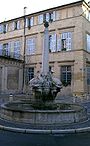
- Aix-en-ProvenceAix-en-ProvenceAix , or Aix-en-Provence to distinguish it from other cities built over hot springs, is a city-commune in southern France, some north of Marseille. It is in the region of Provence-Alpes-Côte d'Azur, in the département of Bouches-du-Rhône, of which it is a subprefecture. The population of Aix is...
– Fontaine des Quatre Dauphins, 1667
18th century
- St Luke Old Street (church)St Luke Old Street (church)St Luke is a historic Anglican church building in the London Borough of Islington. It is now a music centre operated by the London Symphony Orchestra and known as LSO St Luke's. It is the home of the LSO's community and music education programme LSO Discovery...
, London, spire by Nicholas HawksmoorNicholas HawksmoorNicholas Hawksmoor was a British architect born in Nottinghamshire, probably in East Drayton.-Life:Hawksmoor was born in Nottinghamshire in 1661, into a yeoman farming family, almost certainly in East Drayton, Nottinghamshire. On his death he was to leave property at nearby Ragnall, Dunham and a...
circa 1727-33. - Mamhead obeliskMamheadMamhead is a rural village and civil parish near Dawlish and Kenton in Devon, South West England, in the Teignbridge local authority area.On high ground on the Haldon Hills, dense woodlands open out into views of the coast and the estuary of the River Exe....
, one hundred feet, built 1742-1745 as an aid to shipping. - Stowe SchoolStowe SchoolStowe School is an independent school in Stowe, Buckinghamshire. It was founded on 11 May 1923 by J. F. Roxburgh, initially with 99 male pupils. It is a member of the Rugby Group and Headmasters' and Headmistresses' Conference. The school is also a member of the G20 Schools Group...
, BuckinghamshireBuckinghamshireBuckinghamshire is a ceremonial and non-metropolitan home county in South East England. The county town is Aylesbury, the largest town in the ceremonial county is Milton Keynes and largest town in the non-metropolitan county is High Wycombe....
– General Wolfe's Obelisk, 1754 - Montreal Park Obelisk, Riverhead, Sevenoaks, Kent - Lord Jeffery Amherst's Obelisk, 1761.
- Kagul ObeliskKagul ObeliskThe Kagul Obelisk in Tsarskoye Selo is one of several such structures erected on behest of Catherine II of Russia in 1772 to commemorate Pyotr Rumyantsev's victory in the Battle of Kagul...
in Tsarskoe Selo, 1772 - ChesmaBattle of ChesmaThe naval Battle of Chesma took place on 5 -7 July 1770 near and in Çeşme Bay, in the area between the western tip of Anatolia and the island of Chios, which was the site of a number of past naval battles between the Ottoman Empire and the Republic of Venice...
Obelisk in GatchinaGatchinaGatchina is a town and the administrative center of Gatchinsky District of Leningrad Oblast, Russia, located south of St. Petersburg by the road leading to Pskov...
, 1775 - Villa MediciVilla MediciThe Villa Medici is a mannerist villa and an architectural complex with a garden contiguous with the larger Borghese gardens, on the Pincian Hill next to Trinità dei Monti in Rome, Italy. The Villa Medici, founded by Ferdinando I de' Medici, Grand Duke of Tuscany and now property of the French...
, Rome – a 19th century copy of the Egyptian obelisk moved to the Boboli Gardens in Florence in 1790. - Rumyantsev Obelisk in St Petersburg, 1799
- Obelisk at SlottsbackenObelisk at SlottsbackenThe Obelisk at Slottsbacken adjacent to the southern entrances of the Royal Palace in Stockholm Old Town is considered to be the very centre point of the Swedish capital Stockholm.The granite Obelisk is 22 m high, including the pedestal of 5 m...
, StockholmStockholmStockholm is the capital and the largest city of Sweden and constitutes the most populated urban area in Scandinavia. Stockholm is the most populous city in Sweden, with a population of 851,155 in the municipality , 1.37 million in the urban area , and around 2.1 million in the metropolitan area...
, erected 1800
19th century
- Nelson memorial, Springfield ParkSpringfield Park, LiverpoolSpringfield Park is a park in Liverpool, England.It is located in the suburb of Knotty Ash, and lies to the north of Prescot Road. It is bounded on its north side by Alder Hey Children's Hospital, to the west by the track of the disused Cheshire Lines railway, and to the east by the buildings on...
, LiverpoolLiverpoolLiverpool is a city and metropolitan borough of Merseyside, England, along the eastern side of the Mersey Estuary. It was founded as a borough in 1207 and was granted city status in 1880...
, circa 1805. - "Brightling Needle", BrightlingBrightlingBrightling is a village and civil parish in the Rother District of East Sussex, England. It is located on the Weald eight miles north-west of Battle and four miles west of Robertsbridge....
, East SussexEast SussexEast Sussex is a county in South East England. It is bordered by the counties of Kent, Surrey and West Sussex, and to the south by the English Channel.-History:...
(65 ft), circa 1815. - Patriots' Grave, Old Burying Ground, Arlington, MassachusettsJason Russell HouseThe Jason Russell House is a historic house in Arlington, Massachusetts, the site of the bloodiest fighting on the first day of the Revolutionary War, April 19, 1775...
(1818). - Captain Cook's Monument, Easby Moor, Great AytonGreat AytonGreat Ayton is a village and civil parish in the Hambleton district of North Yorkshire on the edge of the North York Moors in England. The name Great Ayton is thought to derive from Ea-tun, tun meaning farm and 'ea' meaning river. It has a population of 4,570....
, North YorkshireNorth YorkshireNorth Yorkshire is a non-metropolitan or shire county located in the Yorkshire and the Humber region of England, and a ceremonial county primarily in that region but partly in North East England. Created in 1974 by the Local Government Act 1972 it covers an area of , making it the largest...
, 1827 (15.5m, 51 ft). - Groton MonumentGroton MonumentThe Groton Monument, sometimes called the Fort Griswold Monument is a granite monument in Groton, Connecticut.It is dedicated to the defenders who fell during the Battle of Groton Heights on September 6, 1781. Built between 1826 and 1830, the Monument stands 135 feet tall with 166 steps...
at (Fort GriswoldFort GriswoldFort Griswold is a former American military base in Groton, Connecticut. Named after then Deputy Governor Matthew Griswold, the fort played a key role in the early stages of the American Revolutionary War...
), Groton, ConnecticutGroton, ConnecticutGroton is a town located on the Thames River in New London County, Connecticut, United States. The population was 39,907 at the 2000 census....
, 1830, (41.15m, 135 ft) - Bunker Hill MonumentBunker Hill Monument-External links:****: cultural context**...
, Charlestown, MassachusettsCharlestown, MassachusettsCharlestown is a neighborhood of Boston, Massachusetts, United States, and is located on a peninsula north of downtown Boston. Charlestown was originally a separate town and the first capital of the Massachusetts Bay Colony; it became a city in 1847 and was annexed by Boston on January 5, 1874...
– built between 1827 and 1843. - Obelisk of LionsCopou ParkThe Copou Park is a historic park located in the Copou Hill neighborhood, Iaşi, Romania. A landmark of Iaşi, with centuries old trees, Copou Park is one of the first Romanian coordinated public parks.-History:...
, in IașiIasiIași is the second most populous city and a municipality in Romania. Located in the historical Moldavia region, Iași has traditionally been one of the leading centres of Romanian social, cultural, academic and artistic life...
, Romania, 1834. - Villa TorloniaVilla Torlonia (Rome)Villa Torlonia is a villa and surrounding gardens in Rome, Italy, formerly belonging to the Torlonia family. It is entered from via Nomentana....
, Rome – two obelisks erected 1842. - Reggio EmiliaReggio EmiliaReggio Emilia is an affluent city in northern Italy, in the Emilia-Romagna region. It has about 170,000 inhabitants and is the main comune of the Province of Reggio Emilia....
obelisk, commemorates marriage of Francis V, Duke of ModenaFrancis V, Duke of ModenaFrancesco Ferdinando Geminiano von Habsburg-Lothringen, known as Francis V of Modena , Archduke of Austria-Este, Royal Prince of Hungary and Bohemia, was Duke of Modena, Reggio, and Mirandola, Duke of Guastalla , Duke of Massa and Prince of Carrara from 1846 to 1859...
to princess Adelgunde of Bavaria, built 1842. - Rutherford's Monument near AnwothAnwothAnwoth is a settlement near the Solway Firth in the Stewarty of Kirkcudbright, in South West Scotland, within a parish of the same name in the Vale of Fleet, Dumfries and Galloway. Anwoth lies a mile to the west of Gatehouse of Fleet....
, ScotlandScotlandScotland is a country that is part of the United Kingdom. Occupying the northern third of the island of Great Britain, it shares a border with England to the south and is bounded by the North Sea to the east, the Atlantic Ocean to the north and west, and the North Channel and Irish Sea to the...
erected in 1842 as a memorial to Samuel RutherfordSamuel RutherfordSamuel Rutherford was a Scottish Presbyterian theologian and author, and one of the Scottish Commissioners to the Westminster Assembly.-Life:...
. - The Political Martyrs monument, EdinburghThe Political Martyrs monument, EdinburghThe Political Martyrs Monument is a Category A listed memorial to the Scottish Martyrs to Liberty and stands in the Old Calton Cemetery on Calton Hill, Edinburgh...
, erected 1844 as a memorial to the "Scottish Martyrs to Liberty". - Lansdowne Monument, near the Cherhill White HorseCherhill White HorseThe Cherhill White Horse is a hill figure on Cherhill Down, 3.5 miles east of Calne in Wiltshire, England. Dating from the late 18th century, it is the third oldest of several such white horses in Great Britain, with only the Uffington White Horse and the Westbury White Horse being older...
, WiltshireWiltshireWiltshire is a ceremonial county in South West England. It is landlocked and borders the counties of Dorset, Somerset, Hampshire, Gloucestershire, Oxfordshire and Berkshire. It contains the unitary authority of Swindon and covers...
, 1845, 38 metres, erected by the 3rd Marquess of LansdowneHenry Petty-FitzMaurice, 3rd Marquess of LansdowneHenry Petty-Fitzmaurice, 3rd Marquess of Lansdowne KG, PC, FRS , known as Lord Henry Petty from 1784 to 1809 and then as The Earl of Kerry to 1818, was a British statesman...
to commemorate Sir William PettyWilliam PettySir William Petty FRS was an English economist, scientist and philosopher. He first became prominent serving Oliver Cromwell and Commonwealth in Ireland. He developed efficient methods to survey the land that was to be confiscated and given to Cromwell's soldiers...
. - Newcastle, New South WalesNewcastle, New South WalesThe Newcastle metropolitan area is the second most populated area in the Australian state of New South Wales and includes most of the Newcastle and Lake Macquarie Local Government Areas...
– "The Obelisk", built 1850. - Wellington MonumentWellington Monument, SomersetThe Wellington Monument is a high triangular tower located on the highest point of the Blackdown Hills, south of Wellington, Somerset, England. It has been designated by English Heritage as a grade II* listed building....
, Wellington, SomersetWellington, SomersetWellington is a small industrial town in rural Somerset, England, situated south west of Taunton in the Taunton Deane district, near the border with Devon, which runs along the Blackdown Hills to the south of the town...
, completed 1854, (53.34m, 175 ft). - Stoodley PikeStoodley PikeStoodley Pike is a hill in the south Pennines, noted for the 121 foot Stoodley Pike Monument at its summit, which dominates the moors above Todmorden in West Yorkshire...
, Todmorden, West Yorkshire, built 1856. - Obelisk of FontenoyBattle of Fontenay (841)The three year Carolingian Civil War culminated in the decisive Battle of Fontenay-en-Puisaye, also called the Battle of Fontenoy, fought at Fontenoy, near Auxerre, on the 25 June 841...
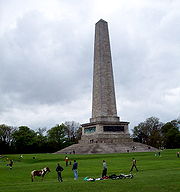
, 1860. - Wellington MonumentWellington Monument, DublinThe Wellington Monument is an obelisk located in the Phoenix Park, Dublin, Ireland.The testimonial is situated at the southeast end of the Park, overlooking Kilmainham and the River Liffey...
, 1861, (62m, 205 ft), Phoenix ParkPhoenix ParkPhoenix Park is an urban park in Dublin, Ireland, lying 2–4 km west of the city centre, north of the River Liffey. Its 16 km perimeter wall encloses , one of the largest walled city parks in Europe. It includes large areas of grassland and tree-lined avenues, and since the seventeenth...
, Dublin, Ireland. - Lincoln's Tomb in Springfield, IllinoisSpringfield, IllinoisSpringfield is the third and current capital of the US state of Illinois and the county seat of Sangamon County with a population of 117,400 , making it the sixth most populated city in the state and the second most populated Illinois city outside of the Chicago Metropolitan Area...
, 1865, (35.66m, 117 ft). - Nicholson's obeliskNicholson's obeliskNicholson's obelisk is a monument in Pakistan, erected in 1868 in honour of one of the British Empire's greatest military heroes—Brigadier-General John Nicholson....
, Margalla HillsMargalla HillsThe Margalla Hills—the foothills of the Himalayas—are a series of small-elevation hills located north of Islamabad, Pakistan. Margalla Range has an area of 12,605 hectares. The hill range nestles between an elevation of 685 meters at the western end and 1,604 meters on its east.- Etymology :Two...
, PakistanPakistanPakistan , officially the Islamic Republic of Pakistan is a sovereign state in South Asia. It has a coastline along the Arabian Sea and the Gulf of Oman in the south and is bordered by Afghanistan and Iran in the west, India in the east and China in the far northeast. In the north, Tajikistan...
1868. - Captain Cook Obelisk, Kurnell, New South WalesKurnell, New South WalesKurnell is a suburb in southern Sydney, in the state of New South Wales, Australia. Kurnell is located south of the Sydney central business district, in the local government area of the Sutherland Shire....
, 1870. - The Dauphin County Veteran's Memorial ObeliskDauphin County Veteran's Memorial ObeliskInspired by the classic Roman/Egyptian obelisk form, Dauphin County Veteran's Memorial Obelisk was originally erected in the middle of a park located at the North Second and State Streets intersection of downtown Harrisburg, Pennsylvania from 1866 to 1876 as a tribute to Dauphin County’s Civil War...
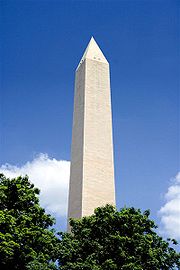
in Harrisburg, PA, completed 1876, (33.52m, 110 ft). - The Washington MonumentWashington MonumentThe Washington Monument is an obelisk near the west end of the National Mall in Washington, D.C., built to commemorate the first U.S. president, General George Washington...
in Washington DC, USA, measuring 555 feet 5.5 inches (169.29 m) in height, is the world's tallest true obelisk; completed in 1884. - The Oriskany Battlefield monument in Rome, NY, dedicated in 1884 as a memorial to the Revolutionary War battle in 1777.
- The Bennington Battle MonumentBennington Battle MonumentThe Bennington Battle Monument is a 306 ft stone obelisk located at 15 Monument Circle, in Bennington, Vermont. The monument commemorates the Battle of Bennington during the Revolutionary War....
in Bennington, Vermont, 1889. - Dalhousie ObeliskDalhousie ObeliskThe Dalhousie Obelisk is a memorial obelisk in the Civic District of Singapore, located on the north bank of the Singapore River in the Downtown Core, within the Central Area in Singapore's central business district....
, in Raffles PlaceRaffles PlaceRaffles Place is a geographical location in Singapore, south of the mouth of the Singapore River. Located in the Downtown Core and the Central Area, it features some of the tallest buildings and landmarks of the country.-History:...
, SingaporeSingaporeSingapore , officially the Republic of Singapore, is a Southeast Asian city-state off the southern tip of the Malay Peninsula, north of the equator. An island country made up of 63 islands, it is separated from Malaysia by the Straits of Johor to its north and from Indonesia's Riau Islands by the...
, 1891. - The Obelisk, University Park campus of Penn State University, 1896.
20th century
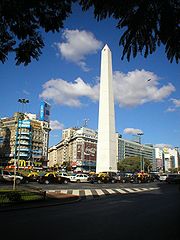
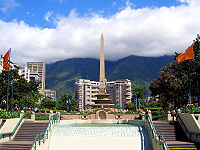
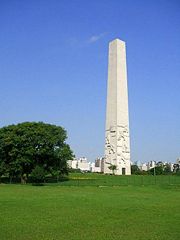
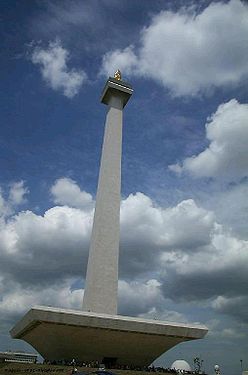
- The William Dudley ChipleyWilliam Dudley ChipleyWilliam Dudley Chipley was an American railroad tycoon and statesman. He created two railroads in the Florida Panhandle and served one term as mayor of Pensacola, Florida and in the Florida State Senate.-Early life:...
Memorial, in the Plaza Ferdinand VIIPlaza Ferdinand VIIThe Plaza Ferdinand VII is an outdoor garden and park in the historic district of Pensacola, Florida. It is located on Palafox Street between Government and Zaragoza Streets. It was named after Ferdinand VII of Spain, the King of Spain between 1813 and 1833....
, Pensacola, FloridaPensacola, FloridaPensacola is the westernmost city in the Florida Panhandle and the county seat of Escambia County, Florida, United States of America. As of the 2000 census, the city had a total population of 56,255 and as of 2009, the estimated population was 53,752...
, 1901. - The Sergeant Floyd MonumentSergeant Floyd MonumentThe Sergeant Floyd Monument is a monument on the bank of the Missouri River at Floyd's Bluff in what is now Sioux City, Iowa, USA. The monument honors Charles Floyd, a member of the Lewis and Clark Expedition, who died on the upstream voyage in 1804 and was buried here.The monument is the first...
, on US Highway 75, Sioux City, IowaSioux City, IowaSioux City is a city in Plymouth and Woodbury counties in the western part of the U.S. state of Iowa. The population was 82,684 in the 2010 census, a decline from 85,013 in the 2000 census, which makes it currently the fourth largest city in the state....
, 1901. - Joseph Smith Birthplace MemorialJoseph Smith Birthplace MemorialJoseph Smith Birthplace Memorial is a granite obelisk on a hill in the White River Valley near Sharon and South Royalton, Vermont that marks the spot where Joseph Smith, Jr. was born on 23 December 1805. The monument was erected by The Church of Jesus Christ of Latter-day Saints , which recognizes...
, South Royalton, Vermont, 1905. - McKinley MonumentMcKinley MonumentFor the McKinley Monument in Canton, Ohio, see McKinley National Memorial.The McKinley Monument is a tall obelisk in Niagara Square, Buffalo, New York...
, Niagara Square, Buffalo, New YorkBuffalo, New YorkBuffalo is the second most populous city in the state of New York, after New York City. Located in Western New York on the eastern shores of Lake Erie and at the head of the Niagara River across from Fort Erie, Ontario, Buffalo is the seat of Erie County and the principal city of the...
, 1907, (96 ft / 29 m). - The Veterans' Monument, Elizabethton, TennesseeElizabethton, TennesseeElizabethton is the county seat of Carter County, Tennessee, United States. Elizabethton is also the historical site both of the first independent American government located west of both the Eastern Continental Divide and the original thirteen British American colonies.Elizabethton is also the...
, dedicated in 1904 to American Civil WarAmerican Civil WarThe American Civil War was a civil war fought in the United States of America. In response to the election of Abraham Lincoln as President of the United States, 11 southern slave states declared their secession from the United States and formed the Confederate States of America ; the other 25...
veterans from Carter County, TennesseeCarter County, TennesseeCarter County is a county located in the U.S. state of Tennessee. As of 2010, the population was 57,424. Its county seat is Elizabethton.Carter County is part of the Johnson City Metropolitan Statistical Area, which is a component of the Johnson City–Kingsport–Bristol, TN-VA Combined...
. - The Chalmette Monument, in Chalmette, LouisianaChalmette, LouisianaChalmette is a census-designated place in and the parish seat of St. Bernard Parish, Louisiana, United States. The population was 32,069 at the 2000 census. It is part of the New Orleans–Metairie–Kenner Metropolitan Statistical Area...
, commemorating the Battle of New OrleansBattle of New OrleansThe Battle of New Orleans took place on January 8, 1815 and was the final major battle of the War of 1812. American forces, commanded by Major General Andrew Jackson, defeated an invading British Army intent on seizing New Orleans and the vast territory the United States had acquired with the...
, 1908. - The Victory Memorial, Fort RecoveryFort RecoveryFort Recovery was a United States Army fort begun in late 1793 and completed in March 1794 under orders by General "Mad" Anthony Wayne. It was located on the site of the present-day village of Fort Recovery, Ohio, United States, on the Wabash River within two miles of the boundary with...
, Ohio, completed in 1913. - The National Women's MonumentNational Women's MonumentThe Women's Monument or Vrouemonument in Bloemfontein, South Africa, is a monument commemorating the suffering of some 27,000 Boer women and children who died in British concentration camps during the Boer War. The Monument is a Provincial Heritage Site in the Free State.The monument was designed...
in Bloemfontein, South Africa, It was erected in 1913. - The Henry M. Flagler obelisk located on Flagler Monument IslandFlagler Monument IslandFlagler Memorial Island is an artificial island that was built in 1920 along with the other Venetian Islands of Miami and Miami Beach, Florida, complete with a monument visible from the Flamingo Hotel in Miami Beach. A high obelisk with allegorical sculptures at its base stands as a monument to...
in Miami Beach, FloridaMiami Beach, FloridaMiami Beach is a coastal resort city in Miami-Dade County, Florida, United States, incorporated on March 26, 1915. The municipality is located on a barrier island between the Atlantic Ocean and Biscayne Bay, the latter which separates the Beach from Miami city proper...
was built in 1920. - The War Memorial in London Square, SouthportSouthportSouthport is a seaside town in the Metropolitan Borough of Sefton in Merseyside, England. During the 2001 census Southport was recorded as having a population of 90,336, making it the eleventh most populous settlement in North West England...
, LancashireLancashireLancashire is a non-metropolitan county of historic origin in the North West of England. It takes its name from the city of Lancaster, and is sometimes known as the County of Lancaster. Although Lancaster is still considered to be the county town, Lancashire County Council is based in Preston...
, England, designed by Grayson and Barnish, 1923. It is flanked by two colonnades each supported by Doric columns, all constructed of Portland stone. - Jefferson DavisJefferson DavisJefferson Finis Davis , also known as Jeff Davis, was an American statesman and leader of the Confederacy during the American Civil War, serving as President for its entire history. He was born in Kentucky to Samuel and Jane Davis...
Monument at Jefferson Davis State Historic SiteJefferson Davis State Historic Site-External links:***...
in Fairview, KentuckyFairview, Christian County, KentuckyFairview is a small unincorporated community on the boundary between Christian and Todd Counties in the U.S. state of Kentucky. It is about halfway between the cities of Hopkinsville and Elkton. It was founded about 1793 by Samuel Davis who opened a post office in 1802 and called it Davistown; it...
, (351 ft / 107 m) tall, mostly concrete, 1924. - A large obelisk with the world's largest apple on top stands at Cornelia, GeorgiaCornelia, GeorgiaCornelia is a city in Habersham County, Georgia, United States. The population was 3,834 at the 2010 census. It is home to one of the world's largest apple sculptures, which is displayed on top of an obelisk shaped monument...
. It was erected in 1925. - The Foshay TowerFoshay TowerThe Foshay Tower, now the W Minneapolis – The Foshay hotel, is a skyscraper in Minneapolis, Minnesota. Modeled after the Washington Monument, the building was completed in 1929, months before the stock market crash in October of that year. It has 32 floors and stands high, plus an antenna mast...
, in Minneapolis, MinnesotaMinneapolis, MinnesotaMinneapolis , nicknamed "City of Lakes" and the "Mill City," is the county seat of Hennepin County, the largest city in the U.S. state of Minnesota, and the 48th largest in the United States...
, modeled after the Washington MonumentWashington MonumentThe Washington Monument is an obelisk near the west end of the National Mall in Washington, D.C., built to commemorate the first U.S. president, General George Washington...
, 1929. - Obelisk of MontevideoObelisk of MontevideoThe Obelisk of Montevideo, officially listed as the Obelisco a los Constituyentes de 1830, is a monument, work of the sculptor José Luis Zorrilla de San Martín . It is a three sided obelisk made of granite, 40 meters tall with 3 bronze statues on its sides, representing "Law", "Liberty" and "Force"...
, UruguayUruguayUruguay ,officially the Oriental Republic of Uruguay,sometimes the Eastern Republic of Uruguay; ) is a country in the southeastern part of South America. It is home to some 3.5 million people, of whom 1.8 million live in the capital Montevideo and its metropolitan area...
, 1930. - High Point Monument, Montague, New Jersey. A (220 ft /67 m) obelisk on top of New Jersey's highest point, 1803 ft (549.6 m) above sea level, 1930.
- Foro ItalicoForo ItalicoForo Italico is a sports complex in Rome, Italy. It was built between 1928 and 1938 as the Foro Mussolini under the design of Enrico Del Debbio and, later, Luigi Moretti...
, Rome (on Lungotevere Maresciallo Diaz), erected to honour Benito MussoliniBenito MussoliniBenito Amilcare Andrea Mussolini was an Italian politician who led the National Fascist Party and is credited with being one of the key figures in the creation of Fascism....
, 1932. - Obelisk of Buenos AiresObelisk of Buenos AiresThe Obelisk of Buenos Aires is a national historic monument and icon of Buenos Aires. Located in the Plaza de la República, in the intersection of avenues Corrientes and 9 de Julio, it was built to commemorate the fourth centenary of the first foundation of the city.In order to enrich the...
, ArgentinaArgentinaArgentina , officially the Argentine Republic , is the second largest country in South America by land area, after Brazil. It is constituted as a federation of 23 provinces and an autonomous city, Buenos Aires...
, 1936. - San Jacinto MonumentSan Jacinto MonumentThe San Jacinto Monument is a high column located on the Houston Ship Channel in unincorporated Harris County, Texas near the city of La Porte. The monument is topped with a 220-ton star that commemorates the site of the Battle of San Jacinto, the decisive battle of the Texas Revolution...
in Deer Park, TexasDeer Park, TexasDeer Park is a city in the U.S. state of Texas within the Houston–Sugar Land–Baytown metropolitan area. The city is located in Harris County and is situated in Southeast Texas. As of the 2010 U.S. Census, the population of Deer Park was 32,010....
commemorating the Texan army's victory at the Battle of San JacintoBattle of San JacintoThe Battle of San Jacinto, fought on April 21, 1836, in present-day Harris County, Texas, was the decisive battle of the Texas Revolution. Led by General Sam Houston, the Texian Army engaged and defeated General Antonio López de Santa Anna's Mexican forces in a fight that lasted just eighteen...
and thus gained independence over Mexico, 1939. - Trylon and Perisphere, 1939 New York World's Fair1939 New York World's FairThe 1939–40 New York World's Fair, which covered the of Flushing Meadows-Corona Park , was the second largest American world's fair of all time, exceeded only by St. Louis's Louisiana Purchase Exposition of 1904. Many countries around the world participated in it, and over 44 million people...
, FlushingFlushing, QueensFlushing, founded in 1645, is a neighborhood in the north central part of the City of New York borough of Queens, east of Manhattan.Flushing was one of the first Dutch settlements on Long Island. Today, it is one of the largest and most diverse neighborhoods in New York City...
, New YorkNew YorkNew York is a state in the Northeastern region of the United States. It is the nation's third most populous state. New York is bordered by New Jersey and Pennsylvania to the south, and by Connecticut, Massachusetts and Vermont to the east...
; not a true obelisk, but an art deco variant, (700 ft / 213 m), 1939. - The Obelisk on One Tree HillOne Tree Hill, New ZealandOne Tree Hill is a 182 metre volcanic peak located in Auckland, New Zealand. It is an important memorial place for both Māori and other New Zealanders...
in AucklandAucklandThe Auckland metropolitan area , in the North Island of New Zealand, is the largest and most populous urban area in the country with residents, percent of the country's population. Auckland also has the largest Polynesian population of any city in the world...
, New ZealandNew ZealandNew Zealand is an island country in the south-western Pacific Ocean comprising two main landmasses and numerous smaller islands. The country is situated some east of Australia across the Tasman Sea, and roughly south of the Pacific island nations of New Caledonia, Fiji, and Tonga...
, 1940. - Manzanar Obelisk, Independence, CA Monument to honor Japanese interned during WWII, 1943.
- Plaza FranciaAltamira (Caracas)thumb|250px|right|Plaza FranciaAltamira is a neighborhood located in the Chacao municipality of Caracas, Venezuela. It has its own Metro Station, many hotels and restaurants, and is an important business and residential center of the city...
obelisk in CaracasCaracasCaracas , officially Santiago de León de Caracas, is the capital and largest city of Venezuela; natives or residents are known as Caraquenians in English . It is located in the northern part of the country, following the contours of the narrow Caracas Valley on the Venezuelan coastal mountain range...
, VenezuelaVenezuelaVenezuela , officially called the Bolivarian Republic of Venezuela , is a tropical country on the northern coast of South America. It borders Colombia to the west, Guyana to the east, and Brazil to the south...
, 1944. - Memorial in SafedSafedSafed , is a city in the Northern District of Israel. Located at an elevation of , Safed is the highest city in the Galilee and of Israel. Due to its high elevation, Safed experiences warm summers and cold, often snowy, winters...
, IsraelIsraelThe State of Israel is a parliamentary republic located in the Middle East, along the eastern shore of the Mediterranean Sea...
to soldiers who died in the Israel War of Independence. - Obelisk of São PauloObelisk of São PauloObelisk of São Paulo is an obelisk in Ibirapuera Park in the city of São Paulo, Brazil.This monument is a symbol of the Constitutionalist Revolution of 1932, and the biggest monument of the city of São Paulo. The height of the monument is 72 meters...
, BrazilBrazilBrazil , officially the Federative Republic of Brazil , is the largest country in South America. It is the world's fifth largest country, both by geographical area and by population with over 192 million people...
, 1954. - Abolition ParkAbolition ParkParque de la Abolicion is a city park in Ponce, Puerto Rico. The park is the only park in the Caribbean dedicated to commemorating the abolition of slavery.-Location and features:...
in Ponce, Puerto RicoPonce, Puerto RicoPonce is both a city and a municipality in the southern part of Puerto Rico. The city is the seat of the municipal government.The city of Ponce, the fourth most populated in Puerto Rico, and the most populated outside of the San Juan metropolitan area, is named for Juan Ponce de León y Loayza, the...
, 1956. - Trujillo Obelisk, Santo DomingoSanto DomingoSanto Domingo, known officially as Santo Domingo de Guzmán, is the capital and largest city in the Dominican Republic. Its metropolitan population was 2,084,852 in 2003, and estimated at 3,294,385 in 2010. The city is located on the Caribbean Sea, at the mouth of the Ozama River...
, Dominican RepublicDominican RepublicThe Dominican Republic is a nation on the island of La Hispaniola, part of the Greater Antilles archipelago in the Caribbean region. The western third of the island is occupied by the nation of Haiti, making Hispaniola one of two Caribbean islands that are shared by two countries...
, 1960, (137 ft / 42 m). - Obelisk of La Paz, BoliviaBoliviaBolivia officially known as Plurinational State of Bolivia , is a landlocked country in central South America. It is the poorest country in South America...
- DemidovDemidovThe Demidov family, also Demidoff, were an influential Russian merchant, industrialist and later chivalry family, possibly second only to the Tsar himself in wealth during the late 18th and early 19th centuries.-History:...
Column in BarnaulBarnaul-Russian Empire:Barnaul was one of the earlier cities established in Siberia. Originally chosen for its proximity to the mineral-rich Altai Mountains and its location on a major river, the site was founded by the wealthy Demidov family in the 1730s. In addition to the copper which had originally...
, Siberia, Russia. - Victory Obelisk in Moscow
- Obelisk of the War Memorial of Brest FortressBrest FortressBrest Fortress , formerly known as Brest-Litovsk Fortress , is a 19th century Russian fortress in Brest, Belarus. It is one of the most important Soviet World War II war monuments commemorating the Soviet resistance against the German invasion on June 22, 1941...
in Brest, BelarusBrest, BelarusBrest , formerly also Brest-on-the-Bug and Brest-Litovsk , is a city in Belarus at the border with Poland opposite the city of Terespol, where the Bug River and Mukhavets rivers meet...
, 100 m, 1971 - A small obelisk stands at Trinity siteTrinity testTrinity was the code name of the first test of a nuclear weapon. This test was conducted by the United States Army on July 16, 1945, in the Jornada del Muerto desert about 35 miles southeast of Socorro, New Mexico, at the new White Sands Proving Ground, which incorporated the Alamogordo Bombing...
, the location of the first atomic bomb explosion. - Rugby, North DakotaRugby, North DakotaRugby is a city in Pierce County, North Dakota in the United States. It is the county seat of Pierce County. The population was 2,876 at the 2010 census. Rugby was founded in 1886.Rugby is often billed as being the geographic center of North America....
, the geographical center of North America (Mexico, USA and Canada). - Pirulito da Praça Sete in Belo HorizonteBelo HorizonteBelo Horizonte is the capital of and largest city in the state of Minas Gerais, located in the southeastern region of Brazil. It is the third largest metropolitan area in the country...
, BrazilBrazilBrazil , officially the Federative Republic of Brazil , is the largest country in South America. It is the world's fifth largest country, both by geographical area and by population with over 192 million people...
. - In Las Vegas, Nevada, U.S., an obelisk stands in front of the Luxor HotelLuxor HotelLuxor Las Vegas is a hotel and casino located on the Las Vegas Strip in Paradise, Nevada. The 30-story hotel, which is operated by MGM Resorts International, features a casino floor that includes over 2,000 slot machines and 87 table games....
, a pyramid-shaped hotel along The Strip. - An obelisk stands in front of radio talk show host Clint Ferro's boyhood home, EndicottEndicott, New YorkEndicott is a village in Broome County, New York, United States. The population was 13,038 at the 2000 census. It is part of the Binghamton Metropolitan Statistical Area. The village is named after Henry B...
, New YorkNew YorkNew York is a state in the Northeastern region of the United States. It is the nation's third most populous state. New York is bordered by New Jersey and Pennsylvania to the south, and by Connecticut, Massachusetts and Vermont to the east...
, 1975. - Monumen Nasional, symbolizing the fight for the independence of IndonesiaIndonesiaIndonesia , officially the Republic of Indonesia , is a country in Southeast Asia and Oceania. Indonesia is an archipelago comprising approximately 13,000 islands. It has 33 provinces with over 238 million people, and is the world's fourth most populous country. Indonesia is a republic, with an...
, at Merdeka SquareMerdeka Square, JakartaMerdeka Square is a large square located in the center of Jakarta, Indonesia. The square is surrounded by important government buildings such as the Merdeka Palace, the Supreme Court and various governmental ministries. At its center stands the National Monument...
, JakartaJakartaJakarta is the capital and largest city of Indonesia. Officially known as the Special Capital Territory of Jakarta, it is located on the northwest coast of Java, has an area of , and a population of 9,580,000. Jakarta is the country's economic, cultural and political centre...
, 1975. - A large obelisk stands in North Korea called the Juche TowerJuche TowerThe Juche Tower is a monument in Pyongyang, North Korea. The tower is named after the principle of Juche, developed by Kim Il Sung as a blend of autarky, self-reliance, nationalism, isolationism, Korean traditionalism, and Marxism-Leninism.Completed in 1982, it is sited on the eastern bank of the...
, 1982. - Memorial to Egypt's fallen soldiers in the 1948 Arab-Israeli War1948 Arab-Israeli WarThe 1948 Arab–Israeli War, known to Israelis as the War of Independence or War of Liberation The war commenced after the termination of the British Mandate for Palestine and the creation of an independent Israel at midnight on 14 May 1948 when, following a period of civil war, Arab armies invaded...
, at Ad HalomAd HalomAd Halom is a site at the eastern entrance to the city of Ashdod, Israel.-Battle:Ad Halom refers to the northernmost point reached by the Egyptian army in Operation Pleshet, one of the battles of the 1948 Arab–Israeli War....
, IsraelIsraelThe State of Israel is a parliamentary republic located in the Middle East, along the eastern shore of the Mediterranean Sea...
. - Avis Obelisk, Avis Farms Office Park, Pittsfield Township, Michigan, 1998
21st century
- Capas National ShrineCapas National ShrineThe Capas National Shrine in Barangay Navy Capas, Tarlac, The Philippines was built by the Philippine government as a memorial to the Filipino and American soldiers who died in Camp O'Donnell at the end of the Bataan Death March...
in Tarlac province, PhilippinesPhilippinesThe Philippines , officially known as the Republic of the Philippines , is a country in Southeast Asia in the western Pacific Ocean. To its north across the Luzon Strait lies Taiwan. West across the South China Sea sits Vietnam...
, a 70-meter obelisk erected in 2003. - Pond and white obelisk monument in the main square of Vigan CityVigan CityThe City of Vigan is a 5th class city in the province of Ilocos Sur, Philippines. It is the capital of the Province of Ilocos Sur...
in the Philippines. - Obelisco Novecento, Rome, 2004. Sculpture by Arnaldo PomodoroArnaldo PomodoroArnaldo Pomodoro is an Italian sculptor. He was born on 23 June 1926, in Morciano, Romagna, Italy. He currently lives and works in Milan. His brother, Giò Pomodoro was also a sculptor....
. - Cyclisk is a 65-foot-high obelisk made of 350 bicycles erected in Santa Rosa, CaliforniaSanta Rosa, CaliforniaSanta Rosa is the county seat of Sonoma County, California, United States. The 2010 census reported a population of 167,815. Santa Rosa is the largest city in California's Wine Country and fifth largest city in the San Francisco Bay Area, after San Jose, San Francisco, Oakland, and Fremont and 26th...
.
Further reading
- Curran, Brian A., Anthony Grafton, Pamela O. Long, and Benjamin Weiss. Obelisk: A History. Cambridge, MA: MIT Press, 2009. ISBN 978-0-262-51270-1.
- Wirsching, Armin. Obelisken transportieren und aufrichten in Aegypten und in Rom. Norderstedt: Books on Demand 2007 (2nd ed. 2010), ISBN 978-3 8334-8513-8
- Chaney, Edward, "Roma Britannica and the Cultural Memory of Egypt: Lord Arundel and the Obelisk of Domitian", in Roma Britannica: Art Patronage and Cultural Exchange in Eighteenth-Century Rome, eds. D. Marshall, K. Wolfe and S. Russell, British School at Rome, 2011, pp. 147-70.
External links
- Obelisk of the World (Shoji Okamoto)
- History of the Egyptian obelisks
- Obelisks in Rome (Andrea Pollett)
- Obelisks of Rome (series of articles in Platner's Topographical Dictionary of Ancient Rome)
- History of the obelisk of Arles (in French)
- Octavo Edition of Domenico Fontana's book depicting how he erected the Vatican obelisk in 1586.
- National Geographic: "Researchers Lift Obelisk With Kite to Test Theory on Ancient Pyramids"
- Obelisk of Psametik II from Heliopolis, removed and reerected by Augustus in the northern Campus Martius, Rome