
All Topics  
Conquistador


   Email Print
   Bookmark   Link


Conquistador


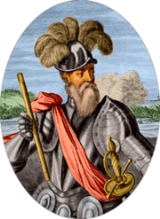
Conquistador ( or in English; "conqueror") is the name given to the Spanish soldiers, leaders, explorers
List of explorers

This list of explorers is sorted by surname. See also the links #See also.A B C D E F G ...
, and adventurers involved in the conquest of the Americas
Americas

The Americas are the region of the Western hemisphere that consists of the continents of North America and South America with their associated islands and regions....
 following the discovery of the New World
New World

The New World is one of the names used for the non-Eurasian/non-African parts of the Earth, specifically the Americas and Australasia. When the term originated in the late 15th century, the Americas were new to the Europeans, who previously thought of the world as consisting only of Europe, Asia, and Africa ....
 by Christopher Columbus
Christopher Columbus

Christopher Columbus was a Republic of Genoa navigator, colonialist and explorer whose voyages across the Atlantic Ocean?funded by Queen Isabella of Spain?led to general European awareness of the America in the Western Hemisphere....
 in 1492. The leaders of the conquest of the Aztec Empire were Hernan Cortes
Hernán Cortés

Hern?n Cort?s de Monroy y Pizarro, 1st Marqu?s del Valle de Oaxaca was a Spain conquistador who led an expedition that caused the conquest of the Aztec Empire and brought large portions of mainland Mexico under the Crown of Castile, in the early 16th century....
 and Pedro de Alvarado y Contreras. Francisco Pizarro
Francisco Pizarro

Francisco Pizarro Gonz?lez, 1st Marqu?s de los Atabillos was a Spain conquistador, conqueror of the Incan Empire and founder of Lima, the modern-day capital of Peru....
 led the conquest of the Incan Empire.

captains of the company were not conquering old people and adolescents as the rest of the host.


Discussion
Ask a question about 'Conquistador'
Start a new discussion about 'Conquistador'
Answer questions from other users
Full Discussion Forum


Recent Posts


Encyclopedia


Conquistador ( or in English; "conqueror") is the name given to the Spanish soldiers, leaders, explorers
List of explorers

This list of explorers is sorted by surname. See also the links #See also.A B C D E F G ...
, and adventurers involved in the conquest of the Americas
Americas

The Americas are the region of the Western hemisphere that consists of the continents of North America and South America with their associated islands and regions....
 following the discovery of the New World
New World

The New World is one of the names used for the non-Eurasian/non-African parts of the Earth, specifically the Americas and Australasia. When the term originated in the late 15th century, the Americas were new to the Europeans, who previously thought of the world as consisting only of Europe, Asia, and Africa ....
 by Christopher Columbus
Christopher Columbus

Christopher Columbus was a Republic of Genoa navigator, colonialist and explorer whose voyages across the Atlantic Ocean?funded by Queen Isabella of Spain?led to general European awareness of the America in the Western Hemisphere....
 in 1492. The leaders of the conquest of the Aztec Empire were Hernan Cortes
Hernán Cortés

Hern?n Cort?s de Monroy y Pizarro, 1st Marqu?s del Valle de Oaxaca was a Spain conquistador who led an expedition that caused the conquest of the Aztec Empire and brought large portions of mainland Mexico under the Crown of Castile, in the early 16th century....
 and Pedro de Alvarado y Contreras. Francisco Pizarro
Francisco Pizarro

Francisco Pizarro Gonz?lez, 1st Marqu?s de los Atabillos was a Spain conquistador, conqueror of the Incan Empire and founder of Lima, the modern-day capital of Peru....
 led the conquest of the Incan Empire.

Characteristics of the conquistadors

"The captains of the company were not conquering old people and adolescents as the rest of the host. They were usually mature men, who fought in earlier battles with the Muslims in southern Spain. Conquistadors were more mercenaries than actual soldiers. They had to buy their armor, sword, and horses. The warlords of the conquest of Mexico (Cortes
Hernán Cortés

Hern?n Cort?s de Monroy y Pizarro, 1st Marqu?s del Valle de Oaxaca was a Spain conquistador who led an expedition that caused the conquest of the Aztec Empire and brought large portions of mainland Mexico under the Crown of Castile, in the early 16th century....
, Alvarado) were, on average, 34 years old. Francisco Pizarro, the oldest of all, was called "El Viejo"(Old) by the Spaniards and "Apu Machu" by the Incas. The authority of the captain was assured by being granted a royal commission, by his experience and by the fact that he controlled the spoils. On some occasions, captains resorted to extreme measures to maintain their authority, as when Hernán Cortés
Hernán Cortés

Hern?n Cort?s de Monroy y Pizarro, 1st Marqu?s del Valle de Oaxaca was a Spain conquistador who led an expedition that caused the conquest of the Aztec Empire and brought large portions of mainland Mexico under the Crown of Castile, in the early 16th century....
 ordered his men to burn their ships or when Francisco Pizarro
Francisco Pizarro

Francisco Pizarro Gonz?lez, 1st Marqu?s de los Atabillos was a Spain conquistador, conqueror of the Incan Empire and founder of Lima, the modern-day capital of Peru....
 charted the bay with his sword on the island of Gallo. Due in part to these types of actions, the soldiers began to see the conquistador captains as heroes and legendary figures. In the case of the conquest of Peru, discipline was maintained until the spoils were split among the men. Once the strict discipline was relaxed, murders and even armed uprisings against the captains resulted.

Another feature of the conquistadors was the relatively low percentage to come from nobility compared with other contemporary military ventures. Julio R. Villanueva Sotomayor suggests that only 30% of conquistadors were noblemen. Commoners made up the bulk of the Spanish forces. Joining a conquistador company was a very attractive method of social advancement in a rigidly stratified society, and a particularly enticing one for un-employed veterans and mercenaries.

The conquest of the Americas by Spain

Main article Spanish colonization of the Americas
Spanish colonization of the Americas

The Spanish colonization of the Americas was Spain's conquest, settlement, and rule over much of the western hemisphere. Beginning with the arrival of Christopher Columbus in 1492, over three centuries the Spanish Empire expanded from early small settlements in the Caribbean to include Central America, most of South America, Mexico, what toda...
.
Fundacion De Santiago
Spanish chroniclers have traditionally characterized the conquest of the Americas as an impressive feat that occurred at an unprecedented pace. The stated purposes of these conquests were equally to spread the word of God and to bring civilization to the most obscure parts of the world. It accomplished this goal with astounding ability, quickly expanding its borders far into other territories. On the contrary, the testimony of some indigenous peoples as well as some contemporary Spanish humanists, clergymen and other writers have presented the Spanish Conquest of Americas as a series of unfortunate and morally questionable acts driven by greed for gold and resulted in the destruction of several native civilizations. It is noteable however, that many of these cultures were themselves unmatched in brutality and human sacrifice, in particular the Aztecs. But the first group of Conquistadors that went with Cortes went for the sole reason to find wealth in the New World.

Historians have highlighted the short time required for the Spanish conquest of vast populations in the Americas. Exposure of these previously unexposed populations to European diseases caused many more fatalities than the wars themselves, and severely weakened the natives' social structures. The people in the Americas were not previously exposed to several European diseases which resulted in their much higher fatality rate than that of European populations. The diseases moved much faster than invading armies. When the Spanish conquistadors arrived in the Inca empire, a large portion of the population, including the emperor, had already been killed by a smallpox
Smallpox

Smallpox is an infectious disease unique to humans, caused by either of two virus variants, Variola major and Variola minor. The disease is also known by the Latin names Variola or Variola vera, which is a derivative of the Latin varius, meaning spotted, or varus, meaning "pimple"....
 epidemic.

The Laws of Burgos, 1512-1513 were the first codified set of law
LAW

LAW may refer to:* Anti-tank warfare, e.g. the US Army M72 LAW or the British Army LAW 80*Palestinian Society for the Protection of Human Rights ...
s governing the behavior of Spanish settlers in America, particularly with regards to native Indians. They forbade the maltreatment of natives, and endorsed their conversion to Catholicism
Catholicism

Catholicism is a broad term for the body of the Catholic faith, its Theology and doctrines, its Catholic liturgy, Ethics, spiritual, and behavioral characteristics, as well as a religious people as a whole....
. In the 16th century perhaps 240,000 Europeans entered American ports. By the late 16th century American silver
Silver

Silver is a chemical element with the chemical symbol Ag and atomic number 47. A soft, white, lustrous transition metal, it has the highest electrical conductivity of any element and the highest thermal conductivity of any metal....
 accounted for one-fifth of Spain's total budget.

Factors

While technological and cultural factors played an important role in the victories and defeats of the conquistadors, one decisive factor was the disease brought from Europe, especially smallpox
Smallpox

Smallpox is an infectious disease unique to humans, caused by either of two virus variants, Variola major and Variola minor. The disease is also known by the Latin names Variola or Variola vera, which is a derivative of the Latin varius, meaning spotted, or varus, meaning "pimple"....
, which in many cases annihilated entire nations before the arrival of the Spaniards. Another key factor was the ability of the conquistadors to manipulate the political situation between indigenous peoples, either by supporting one side of a civil war, as in the case of the Inca
Inca

The Inca civilization began as a tribe in the Cuzco area, where the legendary first Sapa Inca, Manco Capac founded the Kingdom of Cuzco around 1200....
 Empire, or allying with natives who had been subjugated by more powerful neighboring tribes and kingdoms, as in the case of the Aztec empire.

The great conquistador is not mentioned anywhere else. Militarily, conquistadors had several advantages over native peoples, most notably firearms and steel. While the indigenous peoples had the advantage of established settlements, determination to remain independent and sheer numerical superiority, which in many cases was a decisive factor in the defeat of the conquistadors, the European diseases combined with the European's advanced military technology and divide-and-conquer tactics ultimately overcame the native populations.

Throughout the conquest, the numbers of people within the indigenous nations greatly exceeded the Spanish conquistadors; on average the Spanish population never exceeded 2% of the native population. The Spanish conquistadors commonly allied with natives to bolster their numerically inferior ranks with thousands of indigenous auxiliaries. The army with which Hernán Cortés
Hernán Cortés

Hern?n Cort?s de Monroy y Pizarro, 1st Marqu?s del Valle de Oaxaca was a Spain conquistador who led an expedition that caused the conquest of the Aztec Empire and brought large portions of mainland Mexico under the Crown of Castile, in the early 16th century....
 besieged Tenochtitlan was composed of 200,000 soldiers, of which less than 1% were Spaniards.

Although many American civilizations had developed sophisticated methods for working metals including gold
Gold

Gold is a chemical element with the symbol Au and atomic number 79. It is a highly sought-after precious metal, having been used as money, as a store of value, in jewelry, in sculpture, and for ornamentation since the beginning of recorded history....
, silver
Silver

Silver is a chemical element with the chemical symbol Ag and atomic number 47. A soft, white, lustrous transition metal, it has the highest electrical conductivity of any element and the highest thermal conductivity of any metal....
, bronze
Bronze

Bronze is a metal alloy consisting primarily of copper, usually with tin as the main additive, but sometimes with other chemical element such as phosphorus, manganese, aluminium, or silicon....
, tin
Tin

Tin is a chemical element with the symbol Sn and atomic number 50. Tin is obtained chiefly from the mineral cassiterite, where it occurs as an oxide, SnO2....
 and copper
Copper

Copper is a chemical element with the symbol Cu and atomic number 29.It is a ductile metal with very high thermal and electrical conductivity....
, this knowledge was applied mainly to the development of religious and artistic objects, as well as some household utensils for everyday use. Few metals were used by native populations for military applications. One exception was that the Quechuas and P'urhépecha
P'urhépecha

The P'urh?pecha, sometimes referred to as Tarascan or Pur?pecha are an indigenous peoples of Mexico people centered in the northwestern region of the Mexico States of Mexico Michoac?n, principally in the area of the cities of Uruapan and Patzcuaro....
 developed weapons of copper, but these could not match the hardness or durability of iron and steel. Most cultures used weapons of wood, flint
Flint

Flint is a hard, sedimentary rock cryptocrystalline form of the mineral quartz, categorized as a variety of chert. It occurs chiefly as Nodule s and masses in sedimentary rocks, such as chalks and limestones....
 and obsidian
Obsidian

Obsidian is a naturally occurring glass formed as an extrusive igneous rock. It is produced when felsic lava extruded from a volcano cools without crystal growth....
. The iron armor and helmets used by the Spanish were an important factor in their success. However, the refined textile technology of Andean civilizations, allowing tissues up to 500 threads per inch structured in successive layers, enabled them to develop efficient armor that was eventually adopted by the Spaniards, replacing their metal helmets and breastplates, as these were not suitable for tropical climates. The high heat and humidity of Central and South America made wearing such heavy iron and steel items impractical, and the humidity caused a significantly faster rate of corrosion than in Europe.

In their first contacts with native peoples, firearms and especially arquebuses were very effective in battles and made a great impression on morale because of the noise, light and smoke. But their military effectiveness was limited, partially due to their limited availability. The weapons and armor of steel and iron proved to be much more effective militarily. For this reason, when they took control of a nation the conquistadors usually banned possession of iron weapons by the subjugated peoples.

Animals were another military factor. On the one hand, the introduction of the horse to the American continents by the Spaniards in some cases allowed them to move quickly to a battlefield and to maneuver quickly once armies were engaged. But in mountains and jungles, the Spaniards were less technologically adapted than the Amerindian cultures, which had adapted techniques to build roads and bridges through such terrain. In some cases native peoples, mainly in South America, in places such as the pampas and Patagonia, appropriated and developed techniques of horse training and riding such that they soon exceeded the skills of the Spaniards. This became a decisive factor in the native resistance to the Spanish. The Spaniards also used dogs to track and attack indigenous people and slaves in the jungle and forests. Horses and war dogs both were more effective as psychological weapons than physical ones against the natives who in many cases had never seen dogs, and none of whom had seen horses before. They both caused a great deal of terror amongst the natives.

The Spaniards' methods of war were similar to those of most Europeans, which were more bloody than Native American warriors were accustomed to. In addition, some native peoples did not carry out mass killing of enemies on the battlefield, but instead caught and held them for occasions of ritual sacrifices.

The main decisive factor in the defeat of Amerindian civilizations was their demographic collapse. Among researchers there is no consensus as to the cause of that collapse; some give genocide as the main cause, others attribute it to the introduction of new diseases and a still others to a combination of both factors. Scholars now believe that, among the various contributing factors, epidemic disease
List of epidemics

This article is a list of major epidemics....
 was the overwhelming cause of the population decline of the Native Americans because of their lack of immunity
Immunity (medical)

Immunity is a medical term that describes a state of having sufficient biological defenses to avoid infection, disease, or other unwanted biological invasion....
 to new diseases brought from Europe. The American researcher HF Dobyns has estimated that 95% of the total population of Americas died in the first 130 years after the arrival of Columbus. Cook and Borak of the University of Berkeley claim that the population in Mexico declined from 25.2 million in 1518 to 700 thousand people in 1623, less than 3% of the original population. In 1492 Spain and Portugal populations did not exceed 10 million people. There is some consensus that the demographic collapse of the original population of Americas was the main cause of its military defeat. Disease decimating the population is commonly listed as the reason for this decline in population. This happened with the Inca Empire, defeated by Francisco Pizarro
Francisco Pizarro

Francisco Pizarro Gonz?lez, 1st Marqu?s de los Atabillos was a Spain conquistador, conqueror of the Incan Empire and founder of Lima, the modern-day capital of Peru....
 in 1531. The first epidemic of smallpox was recorded in 1529 and killed the emperor Huayna Capac
Huayna Capac

Huayna Capac was the eleventh Sapa Inca of the Inca Empire and sixth of the Hanan dynasty. He was the successor to Tupac Inca Yupanqui. His legitimate wife was Coya Cusirimay....
, the father of Atahualpa
Atahualpa

Atahualpa, Atahuallpa, Atabalipa, or Atawallpa , was the last sovereign emperor of the Tahuantinsuyu, or the Inca Empire. He became emperor upon defeating his older half-brother Hu?scar in a civil war sparked by the death of their father, Inca Huayna Capac, from an infectious disease thought to be smallpox....
, as well as a large portion of the population. New epidemics of smallpox broke out in 1533, 1535, 1558 and 1565, as well as typhus in 1546, influenza in 1558, diphtheria in 1614 and measles in 1618. Dobyns estimated that 90% of the population of the Inca Empire died in these epidemics.

Finally, Jared Diamond summarizes the causes of the Pizarro's victory as "military technology based on firearms and steel and horses, infectious diseases endemic in Eurasia, European maritime technology, centralized political organization of States Europeans, and in writing". The significance of writing is attributed to the errors of judgement Atahualpa and Moctezuma, which led them to be deceived by the Spaniards since they belonged to a literate society. This allowed them to have at their disposal a huge body of knowledge about human behavior and its history, something that no native nations possessed.

See also

  • Adelantado
    Adelantado

    Adelantado was a military title held by some Spain Conquistadors of the 15th, 16th and 17th centuries. Adelantados were charter directly by the Monarch the right to become governors and judge of a specific region, which they charged with conquering, in exchange for funding and organizing the initial explorations, settlements and pacif...
  • Encomienda
    Encomienda

    The encomienda system is a trusteeship labor system that was employed by the Spanish crown during the Spanish colonization of the Americas. The etymology of encomienda and encomendero lies in the Spanish verb encomendar, "to entrust"......
  • List of conquistadors
    List of conquistadors

    A* Jer?nimo de Aliaga* Diego de Almagro* Pedro de Alvarado* Pedro Arias de ?vila* Lucas V?zquez de Ayll?n...
  • New Laws
    New Laws

    The New Laws of 1542 , also known as the "New Laws of the Indies for the Good Treatment and Presevation of the Indians" were created to prevent the exploitation of the indigenous people by the Encomienda, or landowners, by strictly limiting their power, during the Spanish colonization of the Americas....
  • Reconquista
    Reconquista

    The Reconquista was a period of 800 years in the Middle Ages during which several Christian kingdoms of the Iberian Peninsula succeeded in retaking the Iberian Peninsula from the Muslims....
  • Repartimiento
    Repartimiento

    The Repartimiento de Labor was a colonial Unfree labour system imposed upon the indigenous peoples of the Americas and the Spanish East Indies. In concept it was similar to other tribute-labor systems, such as the mita of the Inca Empire or the corv?e of Ancien R?gime in France: the natives were forced to do low-paid or unpaid labor for...
  • Spanish colonization of the Americas
    Spanish colonization of the Americas

    The Spanish colonization of the Americas was Spain's conquest, settlement, and rule over much of the western hemisphere. Beginning with the arrival of Christopher Columbus in 1492, over three centuries the Spanish Empire expanded from early small settlements in the Caribbean to include Central America, most of South America, Mexico, what toda...
  • Spanish Empire
    Spanish Empire

    The Spanish Empire was one of the largest empires in world history, and one of the first global empires. It included territories and colonies ruled by Spain in Europe, the Americas, Africa, Asia and Oceania between the 15th and late 19th centuries....
  • Valladolid debate
    Valladolid debate

    The Valladolid debate concerned the treatment of Indigenous people of the Americas of the New World. Held in the Spain city of Valladolid, it opposed two main attitudes towards the European colonization of the Americas....
  • Booke captain of Aroraboreialis

Bibliography

  • Conquistadores, Michael Wood (BBC Books, 2000). Pathfinder, Michael Wood (BBC Books, 2000).
  • Los Conquistadores, Hammond Innes (Penguin, 2002). The Pathfinder, Hammond Innes (Penguin, 2002).
  • Born In Blood And Fire: Concise History of Latin America Summary of the History of Latin America, John Charles Chasteen,