


Urheimat

Encyclopedia
Urheimat is a linguistic
term denoting the original homeland of the speakers of a proto-language
. The homelands of many, but not all, major language families are summarized in this article.
, to which the term Urheimat is most frequently applied. Possibly relevant geographical indicators are common words for "beech
" and "salmon
" (while there is no common word for "lion", for example—the fact so many European words for "lion" are similar-looking cognate
s is due to more recent borrowings
). Many hypotheses for an Urheimat have been proposed, and said, “One does not ask ‘where is the Indo-European homeland?’ but rather ‘where do they put it now?’”
states that current discussion of the Indo-European homeland problem is largely confined to four basic models, with variations; these are, in chronological order:
Another theory for the Indo European homeland states that the original home land was in India
, and later spread outwards. This theory contrasts with the mainstream model, but is widespread among Hindu nationalists.
Other, less-widely accepted models include the Armenian hypothesis
(suggested by Soviet scholars in the 1980s), the Paleolithic Continuity Theory
(suggested by Italian "paleolinguist" Mario Alinei
in the 1990s), and the Out of India theory
(historically suggested by Friedrich Schlegel).
and early 2nd millennia BC
.
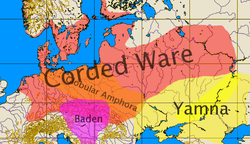
The Slavic homeland likely corresponds to the distribution of the oldest recognisably-Slavic
hydronym
s, found in northern and western Ukraine
and southern Belarus
.
The history of the Daco-Thracian/Thraco-Illyrian
dialects of the Balkans is obscure, in part, because the written record of these languages is fragmentary. One of these languages may have been the language that evolved into the modern Albanian language
.
The Phrygian
, Macedonian
, and Greek proto-languages likely also originate in the Balkans. Proto-Armenian may also be Balkans (Greco-Phrygian) derived, or at least strongly influenced by a Phrygian substrate. The Phrygian influence on [pre-]Proto-Armenian would date to about the 7th century BC, in the context of the declining kingdom of Urartu
.
The Proto-Celtic homeland is usually located in the Early Iron Age Hallstatt culture
of northern Austria
. There is a broad consensus that the center of the La Tène culture
lay on the northwest edges of the Hallstatt culture. Pre-La Tène (6th to 5th century BC) Celtic expansions reached Great Britain
and Ireland
(Insular Celtic) and Gaul
. La Tène groups expanded in the 4th century BC to Hispania
, the Po Valley
, the Balkans
, and even as far as Galatia
in Asia Minor
, in the course of several major migrations.
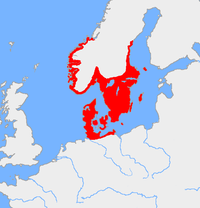
Pre-Germanic cultures were the bearers of the Nordic Bronze Age
. Proto-Germanic proper is hypothesized by some to have developed in the Jastorf culture
of the Pre-Roman Iron Age
.
Candidates for the first introduction of Proto-Italic speakers to Italy are the Terramare culture
(1500 BC) or the Villanovan culture
(1100 BC), although the latter is now usually identified with the non-Italic (indeed, non-Indo-European) Etruscan civilisation. Both are culturally derived from or strongly influenced by the Urnfield culture
and its predecessor, the Tumulus culture
of Central Europe (1600 BC), so that the latter is a likely candidate for the homeland of an Italo-Celtic
proto-language or dialect continuum.
The Romance languages
are all derivative of Latin
, a member of this Indo-European language subfamily, which was the common language of the Western Roman Empire
that had its roots in Italic dialect spoken in and around the capital, Rome
, until the empire collapsed in the 5th century CE.
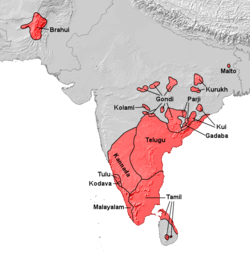 The Dravidian languages have been found mainly in South India since at least the second century BCE (inscriptions, ed. I. Mahadevan 2003). It is, however, a widely held hypothesis that Dravidian speakers may have been more widespread throughout India, including the northwest region before the arrival of Indo-European speakers. A map showing where Dravidian languages are spoken today appears to the left.
Historical records suggest that the South Dravidian language group had separated from a Proto-Dravidian
language no later than 700 BCE, linguistic evidence suggests that they probably became distinctive around 1,100 BCE, and some scholars using linguistic methods put the deepest divisions in the language group at roughly 3,000 BCE. Russian linguist M.S. Andronov puts the split between Tamil (a written Southern Dravidian language) and Telugu (a written Northern Dravidian language) at 1,500 BCE to 1,000 BCE.
Southworth identifies late Proto-Dravidian with the Southern Neolithic culture in the lower Godavari River basin of South Central India, which first appeared ca. 2,500 BCE, based upon its agricultural vocabulary, while noting that this "would not preclude the possibility that speakers of an earlier stage of Dravidian entered the subcontinent from western or central Asia, as has often been suggested."
Speculations regarding the original homeland have centered on the Indus Valley Civilization
, or on Elam
, whose language
was spoken in the hills to the east of the ancient Sumerian civilization with whom the Indus Valley Civilization traded and shared domesticated species) in an Elamo-Dravidian hypothesis, but results have not been convincing. The possibility that the language is indigenous to the Dravidian area and is a true language isolate has also not been ruled out.
 Prof. Asko Parpola (University of Helsinki), the Jesuit priest Father Heras in the 1930s and other scholars (such as Indian and early Tamil expert Iravatham Mahadevan and Prof. Walter A. Fairservis Jr.) conclude that the Indus sign system represented an ancient Dravidian language, a view that they assume is supported by Tamil artifacts discovered in 2006. Thus, in Parpola's view, the urheimat of Dravidian would be in the Indus River Valley. However, Harvard Indologist Michael Witzel takes the view that has received serious academic consideration (ca. 2004 CE), which is critical of an Indus Valley Civilization Dravidian homeland and of the widely held view that the inscriptions of the Indus Valley Civilization even constitute a written language. In the essay "Substrate Languages in Old Indo-Aryan" (with RV in this context referring to Rigvedic, i.e. Indo-Aryan), Witzel says "As we can no longer reckon with Dravidian influence on the early RV, this means that the language of the pre-Rigvedic Indus civilization, at least in the Panjab
, was of (Para-) Austro-Asiatic nature." There are no written examples of Austro-Asiatic languages being spoken further West than Central India during the recent historical era (i.e. in the era for which we have written records).
Recent studies of the distribution of alleles on the Y chromosome, microsatellite DNA, and mitochondrial DNA in India have cast doubt for a biological Dravidian "race" distinct from non-Dravidians in the Indian subcontinent ; other recent genetic studies have found evidence of Aryan, Dravidian and pre-Dravidian (original Asian) strata in South Asian populations. Geneticist Luigi Luca Cavalli-Sforza proposes that a Dravidian people were preceded in India by Austro-Asiatic people, and were present prior to the arrival of Indo-Aryan language speakers in India.
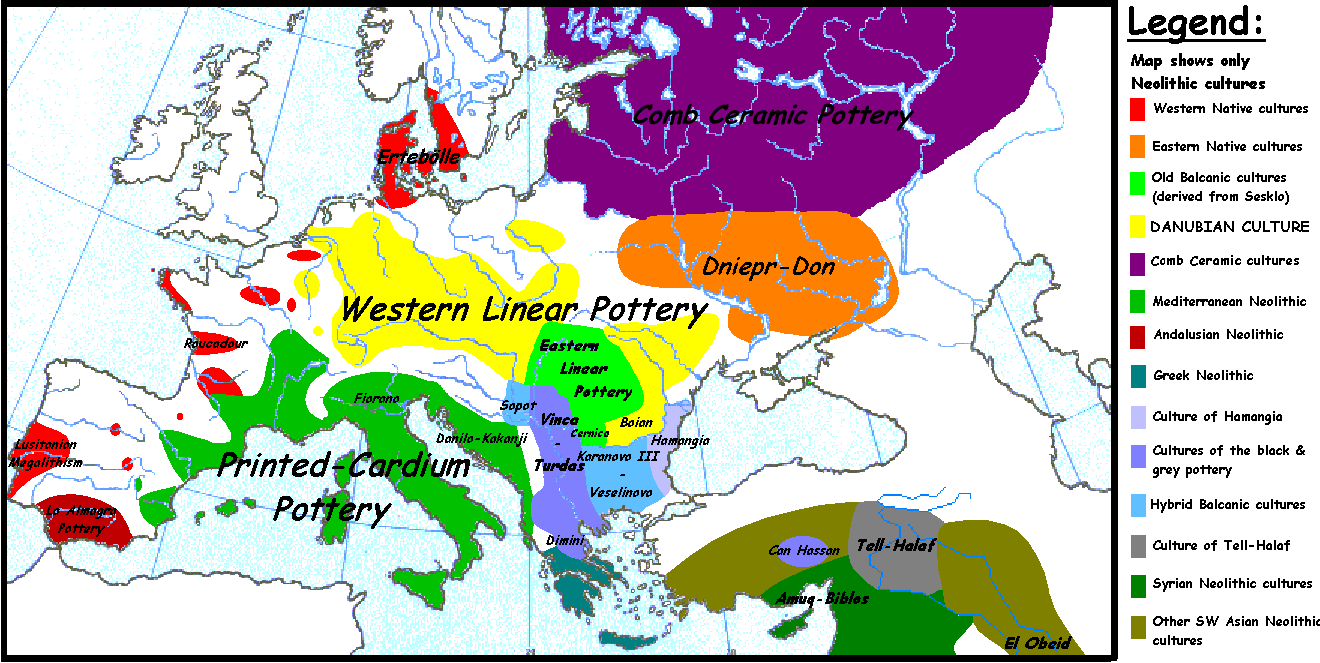 The Uralic homeland is unknown. A possible locus is the Comb Ceramic Culture of ca 4200 – ca 2000 BC (shown on the map to the right). This is suggested by the high language diversity around the middle Volga River
, where three highly distinct branches of the Uralic family, Mordvinic
, Mari
, and Permic
, are located. Reconstructed plant and animal names (including spruce
, Siberian pine
, Siberian Fir
, Siberian larch
, brittle willow, elm
, and hedgehog
) are consistent with this location. This is adjacent to the proposed homeland for Proto-Indo-European under the Kurgan hypothesis.
French anthropologist Bernard Sergent
, in La Genèse de l'Inde (1997), argued that Finno-Ugric (Uralic) may have a genetic source or have borrowed significantly from proto-Dravidian or a predecessor language of West African origins. Some linguists see Uralic (Hungarian, Finnish) as having a linguistic relationship to both Altaic (Turkic, Mongol) language groups (as in the outdated Ural-Altaic
hypothesis) and Dravidian languages. The theory that the Dravidian languages display similarities with the Uralic
language group, suggesting a prolonged period of contact in the past, is popular amongst Dravidian linguists and has been supported by a number of scholars, including Robert Caldwell
, Thomas Burrow
, Kamil Zvelebil, and Mikhail Andronov This theory has, however, been rejected by some specialists in Uralic languages, and has in recent times also been criticised by other Dravidian linguists like Bhadriraju Krishnamurti
.
As noted below, many notable linguists have proposed that the Eskimo-Aleut languages
and Uralic languages
have a common origin, although there is not a consensus that this connection is genuine.
that is held by its proponents to include the Turkic
, Mongolic
, Tungusic
, and sometimes the Japonic language families and the Korean language isolate. Mongolic languages are spoken in Mongolia
, Inner Mongolia
and regions close to its border such as Xinjiang
, Gansu
, Qinghai
(China
); Buryatia
and Kalmykia
(Russian Federation). Tungistic languages are spoken by Tungusic peoples
in Eastern Siberia
and Manchuria
. The proposed linguistic group is named after the Altai Mountains, a mountain range in Central Asia.
Prior to the last 2000 years or so, the Turkic, Mongolic, and Tungusic languages which form the proposed core of the Altaic languages would all have been found only in Eastern Siberia and Manchuria, in the areas North and West of the early Chinese dynasties.
Turkic peoples started to expand sometimes after that probably reaching Europe by the 4th century, in the form of the Huns, as more fully discussed below.
The Mongols expanded into present day Mongolia sometime after the demise of the Karasuk culture
(1500-300 BC), an Indo-European and according to ancient DNA, a genetically Western Eurasian population. Genghis Khan
, starting around 1206 CE, waged a series of military campaigns that together with campaigns by his successors stretched from present-day Poland
in the west to Korea
in the east, and from Siberia in the north to the Gulf of Oman
and Vietnam
in the south, after which the empire ultimately collapsed with little long lasting linguistic impact outside the core Mongolian area.
The Tungusic peoples never expanded far beyond Eastern Siberia and Manchuria.
The core three populations in the Altaic classification show autosomal population genetic commonalities. These core three populations also show lexical affinities in their languages.
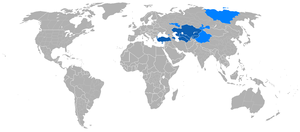 There is considerable dispute over the time and place of origin of the Turkic languages, but it is undisputed that their origins are not in or near the country named after the language, Turkey
, a.k.a. Anatolia
. The people of Anatolia spoke Indo-European language family languages from at least the time of the Hittite
Empire (whose expansion to most of Anatolia started ca. 2000 BCE), which is the earliest evidence of Indo-European languages in the region attested historically (some non-Indo-European languages were spoken in at least some parts of Anatolia for some substantial periods of time prior to the Hittite empire), until the Persian Sassanid Empire
collapsed in 651 CE.
The Turkic languages are now spoken in Turkey, Central Asia and Siberia. As noted in the wikipedia article on Turkic migration
, the Turkic peoples originated in "the Far East
including North China
, especially Xinjiang Province and Inner Mongolia
with parts of Mongolia
and Siberia
possibly as far west as Lake Baikal
and the Altai Mountains. They may have been among the peoples of the multi-ethnic historical Saka
known as early as the Greek writer Herodotus
. Certainly identified Turkic tribes were known by the 6th century and by the 10th century most of Central Asia, formerly dominated by Iranian peoples, was settled by Turkic tribes. The Seljuk Turks from the 11th century invaded Anatolia, ultimately resulting in permanent Turkic settlement there and the establishment of the nation of Turkey."
The first possibly Turkic peoples to arrive in Europe were the Huns
, who were at war with the Roman Empire in the 4th century CE. Confusingly, the Hungarian language
is not a Turkic language (it is a Uralic language related to languages like the Finnish language
and Estonian language
) and was not spoken by the Huns.
Prior to the Turkic migration
, Indo-European languages were spoken in Anatolia and Central Asia as far as the Tarim Basin
.
The inferred population genetic contributions of Turkic populations show a cline from a high point in the East to the a low point in the West. In Turkey, the Turkic contribution to the local population genetic mix is about 6%.
The deeper origins of the Turkic language in connection with other language families, and in time and place, is deeply disputed. The lack of written records prior to the earliest Chinese accounts, and the fact that the early Turkic peoples were nomadic pastoralists, and hence mobile, makes localizing and dating the earliest homeland of the Turkic language difficult. The divide in linguistics is currently between those who see Turkic languages as a top level language family without any further established linguistic origins, and those who see it as part of an Altaic language family with its roots among neighboring "barbarian" peoples in Manchuria and in other areas beyond the span of Chinese rule.
click
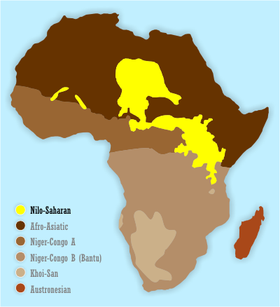
languages of Africa
do not form a language family and so do not, as a family, have a homeland. However, limited genetic
evidence from some Khoisan-language speakers in southern Africa suggest an origin "along the African rift
and a possible wider East Africa
n range."
The limited area of the Afro-Asiatic
Sprachraum (prior to its expansion to new areas in the historic era) has limited the potential areas where the that family's Urheimat could be. Generally speaking, two proposals have been developed: that Afro-Asiatic arose in a Semitic
Urheimat in the Middle East aka Southwest Asia, or that Afro-Asiatic languages arose in northeast Africa (generally, either between Darfur
and Tibesti or in Ethiopia
and the other countries of the Horn of Africa
). The African hypothesis is considered to be rather more likely at the present time, because of the greater diversity of languages with more distant relationships to each other there.
subfamily of Afro-Asiatic languages, again with the Horn of Africa and Southwest Asia—specifically the Levant
—being the most common proposals. The large number of Semitic languages present in the Horn of Africa seems at first glance to support the hypothesis that the Semitic homeland lies there, the Semitic languages in the Horn of Africa all belong to the South Semitic subfamily, while the East
and Central Semitic languages
are native solely to Asia. These features, and the presence of certain common Semitic lexical items referring to items that did not arrive in Africa until after the arrival of the Semitic languages in Ethiopia, have lent weight to the Levantine theory.
Hebrew is found in Europe due to the Jewish diaspora after the fall of the Second Temple in 70 CE that marked the beginning of Rabbinic Judaism. The Maltese language
, the other Semitic language of Europe, is a derivative of the Arabic language as it was spoken in Sicily starting in the couple of centuries after the commencement of the Islamic empire in North Africa.
before 6000 BCE, with subsequent migration events northward to the eastern Sahara, westward to the Chad Basin, and southeastward into Kenya
and Tanzania
.
Linguist Roger Blench has suggested that the Nilo-Saharan languages and the Niger–Congo languages may be branches of the same macro-language family. Earlier proposals along this line were made by linguist Edgar Gregersen in 1972. These proposals have not reached a linguistic consensus, however, and this connection presupposes that all of the Nilo-Saharan languages are actually related in a single family, which has not been definitively established.
Razib Khan, based on analysis of the autosomal genetics of the Tutsi
ethnic group of Africa, suggests that "the Tutsi were in all likelihood once a Nilotic speaking population, who switched to the language of the Bantus amongst whom they settled."
languages, is not known in time or place, beyond the fact that it probably originated in or near the area where these languages were spoken prior to Bantu expansion (i.e. West Africa or Central Africa) and probably predated the Bantu expansion of ca. 3000 BCE by many thousands of years. Its expansion may have been associated with the expansion of Sahel agriculture in the African Neolithic period.
According to linguist Roger Blench
, as of 2004, all specialists in Niger–Congo languages believe the languages to have a common origin, rather than merely constituting a typological classification, for reasons including their shared noun-class system, their shared verbal extensions and their shared basic lexicon. Similar classifications have been made ever since Diedrich Westermann made it in 1922. Joseph Greenberg
continued that tradition making it the starting point for modern linguistic classification in Africa, with some of his most notable publications going to press starting in the 1960s. But, there has been active debate for many decades over the appropriate subclassifications of the languages in that language family, which is a key tool used in localizing a language's place of origin. No definitive "Proto-Niger-Congo" lexicon or grammar has been developed for the language family as a whole.
An important unresolved issue in determining the time and place where the Niger-Congo languages originated and their range prior to recorded history is this language family's relationship to the Kordofanian languages
spoken now spoken in the Nuba mountains of Sudan
, which is not contiguous with the remainder of the Niger-Congo language speaking region and is at the northeasternmost extent of the current Niger-Congo linguistic region. The current prevailing linguistic view is that Kordofanian languages are part of the Niger-Congo linguistic family, and that these may be the first of the many languages still spoken in that region to have been spoken in the region. The evidence is insufficient to determine if this outlier group of Niger-Congo language speakers represent a prehistoric range of a Niger-Congo linguistic region that has since contracted as other languages have intruded, or if instead, this represents a group of Niger-Congo language speakers who migrated to the area at some point in prehistory where they were an isolated linguistic community from the beginning.
The prehistoric range for the Niger-Congo languages has implications, not just for the history of the Niger-Congo languages, but for the origins of the Afro-Asiatic languages and Nilo-Saharan languages whose homelands have been hypothesized by some to overlap with the Niger-Congo linguistic range prior to recorded history. If the consensus view regarding the origins of the Nilo-Saharan languages which came to East Africa is adopted, and a North African or Southeast Asian origin for Afro-Asiatic languages is assumed, the linguistic affiliation of East Africa prior to the arrival of Nilo-Saharan and Afro-Asiatic languages is left open. The overlap between the potential areas of origin for these languages in East Africa is particularly notable because includes the regions from which the Proto-Eurasians who brought anatomically modern humans Out of Africa, and presumably their original proto-language or languages originated.
However, there is more agreement regarding the place of origin of the Benue–Congo subfamily of languages, which is the largest subfamily of the group, and the place of origin of the Bantu languages and the time at which it started to expand is known with great specificity.
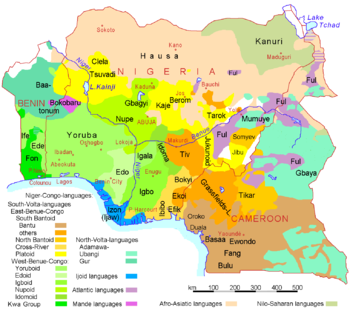 Roger Blench
, relying particularly on prior work by Professor Kay Williamson
of the University of Port Harcourt, and the linguist P. De Wolf, who each took the same position, has argued that a Benue–Congo linguistic subfamily of the Niger–Congo language family, which includes the Bantu languages and other related languages and would be the largest branch of Niger–Congo, is an empirically supported grouping which probably originated at the confluence of the Beneu and Congo Rivers in Central Nigeria. These estimates of the place of origin of the Beneu-Congo language family do not fix a date for the start of that expansion other than that it must have been sufficiently prior to the Bantu expansion to allow for the diversification of the languages within this language family that includes Bantu.
There is a widespread consensus among linguistic scholars that Bantu languages
of the Niger–Congo family have a homeland near the coastal boundary of Nigeria
and Cameroon
, prior to a rapid expansion from that homeland starting about 3000 BCE.
Linguisic, archeological and genetic evidence also indicates that this expansion included "independent waves of migration of western African and East African Bantu-speakers into southern Africa occurred." In some places, Bantu language, genetic evidence suggests that Bantu language expansion was largely a result of substantial population replacement. In other places, Bantu language expansion, like many other languages, has been documented with population genetic evidence to have occurred by means other than complete or predominant population replacement (e.g. via language shift and admixture of incoming and existing populations). For example, one study found this to be the case in Bantu language speakers who are African Pygmies or are in Mozambique
, while another population genetic study found this to be the case in the Bantu language speaking Lemba of Zimbabwe
. Where Bantu was adopted via language shift of existing populations, prior African languages, probably from African language families that are now lost, except as substrate influences of local Bantu languages (such as click sounds in local Bantu languages).
of Madagascar
is not related to nearby African languages, instead being the westernmost member of the Malayo-Polynesian branch of the Austronesian
language family (whose origins are described separately in this Article), a fact noted as long ago as 1708 by the Dutch scholar Adriaan van Reeland. It is related to the Malayo-Polynesian languages of Indonesia
, Malaysia, and the Philippines
, and more closely with the Southeast Barito group of languages
spoken in Borneo
except for its Polynesian morphophonemics. Malagasy shares much of its basic vocabulary with the Ma'anyan language
, a language from the region of the Barito River
in southern Borneo
. This indicates that Madagascar was first settled by Austronesian people
from the Malay Archipelago
who had passed through Borneo. This happened approximately 0 CE to 500 CE, before which the island of Madagascar lacked human inhabitants. Later, the original Austronesian settlers must have mixed with East Africans and Arabs, amongst others. The Malagasy language also includes some borrowings from Arabic
, and Bantu languages
(notably Swahili
). Limited sample size whole genome analysis of Malgasy individuals show that the African component of the Malagasy genome is most similar to modern Bantu language speaking East African populations.
 According to the Sino-Tibetan Etymological Dictionary and Thesaurus project of the University of California at Berkeley (the reference to ST is to the Sino-Tibetan
language family):
Some scholars place the Tibeto-Burman homeland in the area encompassing western Sichuan
, northern Yunnan
and eastern Tibet
.
Population genetic evidence, favors an origin for Proto-Sino-Tibetan languages in the upper and middle Yellow River basin, with part of that source population branching off to settle in the Himalayas, with the split of the population that would provide the genesis of the Chinese language from the population that would provide the genesis of the larger Sino-Tibetan language family in the East Asian Neolithic era:
One of the earliest Neolithic cultures of China in the upper to middle Yellow River basin was the Peiligang culture
of 7000 BCE to 5000 BCE, so the population genetic reference in the quoted material is to a date on or after this time period. The Neolithic era concluded in the Yellow River around 1500 BCE. This is not inconsistent with the linguistically based estimate from the Sino-Tibetan Etymological Dictionary and Thesaurus project. The origin of the Chinese
branch of the Sino-Tibetan language family is associated with the early and middle Zhou Dynasty
(1122 BCE–256 BCE) in Northern China
where the Chinese language spoken in the Zhou court became the standardized dialect of that language for that kingdom.
In contrast, the other main language families of East Asia and Southeast Asia outside the Sino-Tibetan language family including Austro-Asiatic
, Austronesian
, Hmong–Mien and Tai–Kadai are generally believed to have at origins at some stage of their development in Southern China.
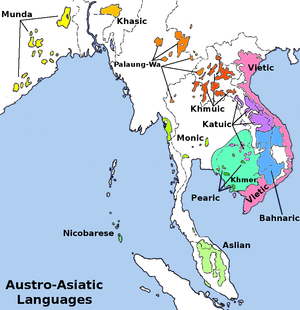
languages (e.g. Vietnamese
, Cambodian) which are found from Southeast Asia
to India
is hypothesized to be located "the hills of southern Yunnan
in China
," between 4000 BCE and 2000 BCE, with influences from Aryan
and Dravidian
languages at the Western edge of its expanse in India, and influence from Chinese
at the Eastern edge of the regions were it is found. The disjoint distribution of Austro-Asiatic languages suggest that they were once spoken in most of the areas where the Tai–Kadai languages are now dominant.
However, Paul Sidwell
has recently advocated a homeland in Southeast Asia instead, preferring a late date of dispersal of about 2000 BCE.
There is a strong correlation between the population genetic distribution Y-Chromosomal haplogroup O2b-M95 and the distribution of Austro-Asiatic language speakers.
and Mekong rivers, but speakers of these languages may have migrated from Central China either as part of the Han Chinese
expansion or as a result of exile from an original homeland by Han Chinese. Migration of people speaking these languages from South China to Southeast Asia
took place ca. 1600-1700 CE. Ancient DNA
evidence suggests that the ancestors of the speakers of the Hmong–Mien languages were a population genetically distinct from that of the Tai–Kadai and Austronesian language source populations at a location on the Yangtze River
. Recent Y-DNA phylogeny evidence supports the proposition that people who speak the Hmong-Mien languages are descended from the population that now speaks Austro-Asiatic Mon-Khmer languages.
is Taiwan
. On this island the deepest divisions in Austronesian are found, among the families of the native Formosan languages
. According to , the Formosan languages form nine of the ten primary branches of the Austronesian language family. Comrie
(2001:28) noted this when he wrote:
Archaeological evidence (e.g.) suggests that speakers of pre-Proto-Austronesian spread from the South Chinese
mainland to Taiwan at some time around 6000 BCE. Evidence from historical linguistics
suggests that it is from this island that seafaring peoples migrated, perhaps in distinct waves separated by millennia, to the entire region encompassed by the Austronesian languages . It is believed that this migration began around 4000 BCE . However, evidence from historical linguistics cannot bridge the gap between those two periods.
The specific origins of most far flung member of this language family, the Malagasy language
of Madagascar
off the coast of Africa, are described above in the part of this article concerning African languages.
The Austro-Tai hypothesis suggests a common origin for the Austronesian languages and the Tai–Kadai languages whose hypothesized place of origin is geographically close to Taiwan.
There is a consensus that the Tai–Kadai languages have their origins in Southern China or on major nearby islands (such as Taiwan
or Hainan
).
The leading hypothesis is that the likely homeland of proto-Tai–Kadai was coastal Fujian
or Guangdong
as part of the neolithic Longshan culture
(of 3000 BCE – 2000 BCE). The spread of the Tai–Kadai peoples may have been aided by agriculture
, but any who remained near the coast were eventually absorbed by the Chinese
. Weera Ostapirat is one academic who articulates this position.
Laurent Sagart
, on the other hand, holds that Tai–Kadai is a branch of Austronesian which migrated back to the mainland from northeastern Formosa
(i.e. Taiwan) long after Formosa was settled, but probably before the expansion of Malayo-Polynesian
out of Formosa. The language was then largely relexified
from what he believes may have been an Austro-Asiatic
language. Sagart suggests that Austro-Tai
is ultimately related to the Sino-Tibetan languages
and has its origin in the Neolithic
communities of the coastal regions of prehistoric
North China
or East China
.
Ostapirat, by contrast, sees connections with the Austro-Asiatic languages (in Austric
), as has Benedict. Reid notes that the two approaches are not incompatible, if Austric is valid and can be connected to Sino-Tibetan.
Robert Blust
(1999) suggests that proto-Tai–Kadai speakers originated in the northern Philippines
and migrated from there to Hainan (hence the diversity of Tai–Kadai languages on that island), and were radically restructured following contact with Hmong–Mien and Sinitic
. However, Ostapirat maintains that Tai–Kadai could not descend from Malayo-Polynesian in the Philippines, and likely not from the languages of eastern Formosa either. His evidence is in the Tai–Kadai sound correspondences, which reflect Austronesian distinctions that were lost in Malayo-Polynesian and even Eastern Formosan.
Genetic evidence coroborates evidence from Kadai speaking people's oral traditions that puts a Kadai homeland on Hainan. Ancient DNA
evidence also shows a connection between speakers of Tai–Kadai speaking populations and Austronesian language speaking populations, and a genetically distinct population at a different location on the Yangtze River
as a possible source of Hmong–Mien languages.
There were multiple languages spoken in Manchuria and the Korean Peninsula prior to Korea's unification, and there is dispute over which of those languages gave rise to modern Korean sometime in the first millennium CE, and what relationship that proto-language may have had to the proposed family of Altaic languages
.
There is also dispute over the extent, if any, to which one of those multiple languages of the Korean peninsula prior to its unification gave rise to the Japanese language, and if so, which of those languages was the language of the Yaoyi part of the founding group of modern Japan. The Yaoyi may also have had linguistic influences from China. Japanese links to Altaic languages, if they exist, could have arisen via an Altaic source for a Korean peninsula language spoken by the Yaoyi, and/or via Altaic influences on the Ainu languages via contacts between the Ainu people and Siberia.
The Ainu language or another extinct language of the indigenous people of Japan called the Jomon may have also been a formative element in the Japanese language as the Yaoyi people and the Jomon people merged into a common Japanese ethnicity around 2300 years ago.
Both the Koreans and the Japanese make use of Chinese ideograms in their written language, whose Chinese origins are not disputed. But, neither of these spoken languages is closely related to the spoken Chinese language, and need not be because ideograms do not code phonetic versions of the ideas that they describe.
 The Korean language is spoken in Korea and among emigrants from Korea. Conservative historical linguists tend to classify the Korean language
as a language isolate
, although other suggest a relationship to Altaic languages or to Japonic languages.
Old Korean
is attested in Chinese histories, in the Three Kingdoms period of Korea (ca. 0 to 900 CE), when the Silla
Kingdom (in Eastern Korea), Baekje
Kingdom (in Southwestern Korea), and Goguryeo
Kingdom (in Northern Korea) were simultaneously present on the Korean peninsula, although Korean was not a literary language until later; the hangul script of Korean was invented in the 15th century CE (an earlier Idu script dates to the 6th century CE).
There was a group of similar languages called the Buyeo languages
in the northern Korean Peninsula and southern Manchuria and possibly Japan, which included, according to Chinese records, the languages of Buyeo
, Goguryeo
, Baekje
, Dongye
, Okjeo
, —and possibly Gojoseon
and possibly was a sister language family to that of the Xianbei
in Manchuria and Eastern Mongolia, but was different from ancient Manchu languages like Mohe language. Gojoseon
was a kingdom in Northern Korea that is said by tradition to have been founded in 2333 BC (archaeological evidence and Chinese histories support a cultural civilization from around 1500 BCE and a kingdom fused from a federation of smaller states around the 7th century BCE), that was conquered by Han Dynasty China in 108 BC, and re-emereged from Chinese rule as the Kingdom Buyeo. The Three Kingdoms era kingdoms of Goguryeo
and Baekje
were successors to the Kingdom of Buyeo. Dongye was a vassal state of Goguryeo in Northeast Korea founded in the 3rd-century BCE that was eventually absorbed by Goguryeo around the 5th century CE. Okjeo was a minor state in Northern Korea to the North of Dongye that was a subordinate unit of Gojoseon from the 3rd century BCE to 108 BCE, then came under Han rule, and then was a subordinate state of Goguryeo. None of these Buyeo language family kingdoms ever included the Kingdom of Silla, which was just a small kingdom on the Southern coast of Korea until the Three Kingdoms period during which it expanded and conquered the other two kingdoms.
Linguists including Christopher Beckwith
argue for Japanese as a descendant of Goguryeo, and for Korean as a descendant of the Silla language, based on lexical similarities between Goguryeo and Japanese, and based upon Silla's ultimate triumph in the quest for political control of Korea. Other linguistists, including Kim Banghan, Alexander Vovin
, and J. Marshall Unger
argue that Japanese is related to the pre-Goguryeo language of the central and southern part of Korean peninsula, including what would become the Kingdom of Silla, and that Old Korean is Goguryeo with a pre-Goguryeo Japonic substrate, in part, because Japanese-like toponyms found in the historical homeland of Silla were also distributed in southern part of Korean peninsula, and are not found in the northern part of Korean peninsula or south-western Manchuria. None of the extinct languages is attested in writing well enough to reach definitive conclusions resolving the debate.
s as a language family of their own.
There are similarities between the Japanese language and the Korean language
in lexicon and grammatical features, but there is dispute over whether these denote a common origin, or mere linguistic borrowing due to a sprachbund
of neighboring languages that are adjacent to each other. Samuel E. Martin, Roy Andrew Miller
, and Sergei Starostin
are linguists who have argued that they have common origins. In contrast, Alexander Vovin
has argued for a regional borrowing model to explain the linguistic similarities.
The Wikipedia article on Classification of Japonic which notes that one "hypothesis proposes that Japanese is a relative of the extinct languages spoken by the Buyeo-Goguryeo cultures of Korea, southern Manchuria, and Liaodong" of which the best attested is the extinct language Goguryeo
.
This proposal is attributed to Shinmura Izuru
, who proposed it in 1916. Modern Korean, in contrast, according to proponents of this hypothesis, appears to have stronger connnections the Silla language
, spoken in the ancient kingdom of Silla
(57 BC – AD 935), one of the Three Kingdoms of Korea, whose similarity to the Goguryeo language is not clearly established.
The earliest Chinese historical records concerning the "Wa" in Japan indicate that they were fractured into many warring states. But, modern Japanese dialects show a common origin, rather than a "bushy" one. So, it is possible that there were many Yayoi dialects in the period before Old Japanese emerged, of which the dialect of the warring states that ended up prevailing politically as the Japanese state was unified superseded other early Yayoi languages or dialects.
As noted in the Wikipedia article on the Ainu people
: "After a new wave of immigration, probably from the Korean Peninsula some 2,300 years ago, of the Yayoi people, the Jōmon were pushed into northern Japan. Genetic data suggest that modern Japanese are descended from both the Yayoi and the Jōmon." Tradition, as documented by the Nihon Shoki
, a legendary account of Japan's history, puts the date of the Yayoi arrival in Japan at 660 BCE. Chinese historical records mention the existence of the Yayoi (called "Wa") starting in 57 BCE. The existing Japanese language has its origins at approximately this point in time, if not earlier (to the extent that Japanese derives primarily from either the language of the Bronze Age Yayoi people, as it existed prior to their arrival in Japan, or derives primarily from a language of the Jomon at that point of time, rather than being a creole of some sort). Skeletal remains suggests that the two cultures had fused into a group with a homogeneous physical appearance in Southern Japan by 250 CE. It is possible that the Japanese language has roots related to the Ainu language, the historical language of the Yayoi, whatever that may have been, or could have been a creole of both. It is also possible the Japanese has roots in a language spoken in Southern Japan that is lost and now unknown.
The Ainu people
are genetic descendants of the Jomon, with some contribution from the Okhotsk people. The Ainu languages
that are now spoken by Ainu minorities in Hokkaidō; and were formerly spoken in southern and central Sakhalin, and the Kuril Islands (an area also known as Ezo
), and perhaps northern Honshū island by the Emishi
people (until approximately 1000 CE), are associated with the founding Jomon people of Japan from than 14,000 years ago or earlier, and the Satsumon culture
of Hokkaidō, although the Ainu also had contact with the Paleo-Siberian Okhotsk culture
whose modern descendants include the Nivkh people (whose original homeland was mostly occupied by the Tungusic people), which could have linguistically influenced the Ainu language. Thus, as a result of this important outside cultural influence, it is impossible to know with certainty how similar the language of the original language of the Jomon people was to that spoken by the Aniu people today. Some linguists have suggested other language family connections for the Ainu language: Shafer has suggested a distant connection to the Austro-Asiatic languages. Vovin, had viewed that suggestion as merely preliminary. Japanese linguist Shichirō Murayama
tried to link Ainu to the Austronesian languages, which include the languages of the Philippines, Taiwan, and Indonesia through both vocabulary and cultural comparisons. There is no consensus, however, that the Ainu languages have sources in any other known language, and the unique population genetics of the Ainu people support the hypothesis that they were largely isolated from the rest of the world for many thousands of years.
The Yayoi people had strong physical, genetic and cultural similarities to the Chinese during the Han Dynasty
(202 BCE-8) in the Jiangsu
province on China's Eastern Coast. The Yayoi also have strong cultural similarities to the Koreans of that time period.
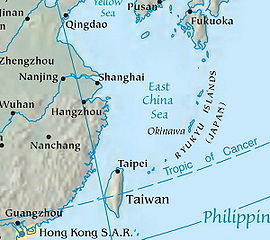 Some linguists, such as Turchin, see a connection between Japanese and Korean and an Altaic language family or similar larger grouping of languages, with those speakers coming from an area North of Korea, based in part upon similarities in lexical roots. The statistical method used by Turchin, however, would not discriminate between Jomon and Yaoyi sources for any Altaic linguistic affinities. Turchin's analysis also did not look at the various proposed ancient predecessors of the Korean language in Korea or the relationship of those languages to any of the proto-Altaic languages, despite the fact that the hypothesis would require one of those ancient Korean peninsular languages to be intermediate between Japanese and one of the proto-Altaic languages. Old Japanese when first attested had eight vowels, rather than the current five (which were lost within a century of the oldest preserved writings) which was close to the vowel system seen in Uralic and Altaic languages. Old Japanese also had more grammatical similarity to Altaic languages than modern Japanese.
These classifications of the origins of Japanese language origins ignore significant borrowing from other languages in recent times. Current estimates are that "wago" (i.e. words attributable to the original Yaoyi language) make up 33.8% of the Japanese lexicon, that "knago" (i.e. words with roots borrowed from Chinese since the 5th century CE) make up 49.1% of Japanese words (and in addition, the Chinese ideograms used in the Japanese written language), that foreign words called gairaigo make up 8.8% of Japanese words, and that 8.3% of Japanese words are konshugo that draw upon multiple languages. This account attributes only a small number of words in modern Japanese to Ainu roots.
The six Ryukyuan languages
spoken in the islands to the South of Japan, are descended from Japanese but are not mutually intelligble with Japanese with which they share about 72% of their words (or each other) and started to diverge from Japanese around the 7th century CE. these islands were united in a Ryukyuan kingdom from 1429 CE (prior to that there were multiple divided kingdoms which were tributary states of China after 1372 CE); the kingdom was a tributary state of China until 1609 when it became a vassal state of Japan, until it was annexed by Japan in 1879. These languages were then suppressed and while they have about a million native speakers, there are relatively few native speakers under the age of twenty. They are effectively minority languages in their own countries at this point.
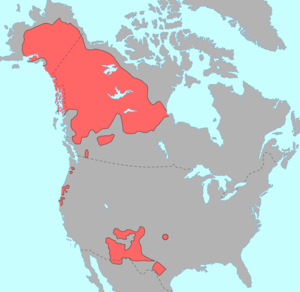 The Na-Dene languages have been linked linguistically to the Yeniseian languages
of the Ket people
of central Siberia, suggesting a homeland in Siberia
or a back migration of Na-Dene speakers from Beringia. Na-Dene languages are spoken by Native Alaskans and some people from the First Nations
of Western Canada
, in the Pacific Northwest, and also includes the Southern Athabaskan languages
spoken in the American Southwest (e.g. the Apache language and Navajo language
). The consensus is that Na-Dene language speaking people migrated from the Pacific Northwest to the American Southwest around 1000 CE.
There is dispute concerning the time at which the Yeniseian languages separated from the Na-Dene languages. One possibility is to assume that the link is contemporaneous with the initial population of the Americas. But, linguistic evidence alone does not rule out a more recent connection. In general, languages evolve too rapidly to see clear relationships between languages at a time depth of 14,000 or more years.
and Canada
and Greenland
, generally to the North of Na-Dene linguistic areas (shown on the map on the left).
Current ancient and modern DNA scholarship and archaeology supports a three-layer paradigm in which first the Saqqaq
(Arctic Paleo-Eskimo
s) which was present 2000 BCE, then the Dorset
(second wave Arctic Paleo-Eskimos), and finally the Thule
(proto-Inuit) from ca. 500 CE – 1000 CE, successively sweep Arctic North America while having little genetic impact on Native American populations further South, that presumably have origins that date back to the initial colonization of the Americas by modern humans from Asia (who are the first hominins to live there), and ancient DNA shows genetic continuity from the Thule to modern Inuits (whose genetics are remarkably homogeneous), dominated by the A2a, A2b, and D3 mtDNA haplotypes, while "Haplotype D2 (3%), found among modern Aleut and Siberian Eskimos, was identified at a low frequency in the modern samples but not the ancient. This haplotype was recently identified in an ancient Paleo-Eskimo Saqqaq individual from western Greenland. . . . Whole genomic sequencing of the 4,000 year old PaleoEskimo, "Inuk," indicated that the Saqqaq sequences clustered with the Chukchi and Koryaks of Siberia-suggesting an earlier migration from Siberia along the northern slope of Alaska to Greenland." Evidence such as bronze artifacts produced in East Asia from ca. 1000 CE, further supports a proto-Eskimo-Aleut arrival in the polar regions of North America ca. 500 CE – 1000 CE.
The proto-Eskimo-Aleut migration to North America was much recent than the initial human population of North America, which took place more than 14,000 years ago, and the modern Inuit
populations are genetically distinct from other indigenous populations of the Americas. Thus, evidence from genetics and archaeology strongly supports an East Asian origin for Eskimo-Aleut languages sometime in the last 1500 years that is distinct from most other indigenous languages of the Americas. But there is no linguistic consensus on any particular languages of East Asia with which this family of North American languages is associated. It is entirely possible that Eastern Siberian languages most closely ancestral to Eskimo-Aleut are extinct. Many indigenous languages and cultures of this region have died in the face of expanded Russian cultural and national influence starting in the 18th century.
 Michael Fortescue
in 1998 proposed a group of Uralo-Siberian languages
, in which Uralic languages
like Finnish
were related to Eskimo-Aleut languages supported by lexical correspondences and grammatical similarities, expanding upon a proposal of Morris Swadesh
in 1962 that itself reiterates similarities that have been noted since at least 1746. Fortescue argues that the Uralo-Siberian proto-language (or a complex of related proto-languages) may have been spoken by Mesolithic
hunting and fishing people in south-central Siberia (roughly, from the upper Yenisei river to Lake Baikal
) between 8000 and 6000 BC, and that the proto-languages of the derived families may have been carried northward out of this homeland in several successive waves down to about 4000 BC, leaving the Samoyedic branch of Uralic in occupation of the Urheimat thereafter.
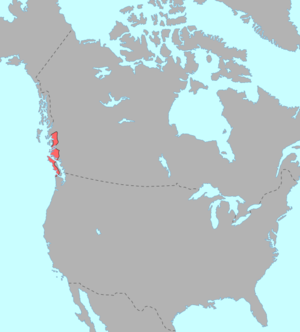
A 2005 proposal by Holst, also reiterating a proposal of Swadesh from 1962, suggests that the Wakashan languages
(map on right) spoken in British Columbia around and on Vancouver Island, are part of the same linguistic family as the Eskimo-Aleut languages. This proposal, if accurate, would suggest that Na-Dene languages may have arrived in North America after (although not long after) Eskimo-Aleut languages.
Phonologically, the Eskimo–Aleut languages resemble other languages of northern North America and far eastern Siberia.
did, or to identify many smaller language families with no clear relationship to each other. Population genetic evidence suggests that the non-circumpolar indigenous peoples of the Americas have origins in a common founder population, and there is no evidence of any enduring outside linguistic influence in the Americas prior to the arrival of Columbus in the Americas in 1492 CE. But, linguists have not been able to piece together a common origin for the indigenous languages of the Americas, mostly because of the time-depth involved, and there is no way to know if the founding population(s) of the Americas spoke only one or more than one language. Genetic evidence that the founding population of the Americas was quite small, possibly in the hundreds on a census basis (as opposed to the genetic concept of an "effective population size") suggests that there could not have been many languages spoken by members of the founding population of the Americas, realistically, one to three of them.
theory of human origins marshals archeological, genetic, and ancient climate evidence to suggest a common origin for all modern humans in Africa about 70,000 years ago and an origin for farming and herding about 8,000 to 10,000 years ago.
We also have some idea about the time death of these languages. For example, the Urheimats in which the proto-languages of the subfamilies are the Indo-European language family necessarily arose more recently than the Proto-Indo-European language family. Similarly, a language superfamily's proto-language must have been spoken in an Urheimat not more recent than the time depth of the oldest language in the language family. The time and place of the Urheimats of various language family proto-languages spoken by most people alive today is in many cases much more recent than either the Out of Africa date or the origin of farming and herding. The relatively young time depth of modern language families can arise from at least two factors: prior languages went extinct as other languages expanded, and some language families may have deeper connections at a greater time depth.
It will probably never be possible to know with any great confidence what the linguistic landscape of the world looked like 18,000 years ago, and even determining what the linguistic landscape of the world looked like 8,000 years ago is a profound challenge and highly controversial undertaking. It is unlikely that it is possible to reconstruct a historical Tower of Babel
linguistic community in which all humans spoke a common language (although we can say with confidence that large stone edifices built by large organized communities of people, which date to the Neolithic era at the earliest, weren't built by any culture on Earth until at least many tens of thousands of years after there was a hypothetical common language of all humans, or even of all Eurasians), or to gain very specific insight about what the language the original proto-Eurasians or the earliest modern humans spoke, although the lack of instances of writing more than about 5,500 years ago, despite the extensive recovery of earlier artifacts and art from prehistory, makes it unlikely that earlier humans had anything approaching a complete written language. Proto-linguistic markings used in trade are only a few thousand years older.
Evidence from pre-Columbian languages in the Americas and from places like Papua New Guinea and Australia that were isolated during periods of linguistic consolidation in the rest of the world, suggest that pre-Neolithic revolution societies had a great many languages relative to their populations, most of which are now irrevocably lost.
The expansion of particular major language families is frequently associated with the adoption of superior food production, military technologies or social organization by a particular group of people that allowed them to expand and exert dominance over neighborhoring societies, either ruling them or replacing them. For example, the domestication of horses is frequently associated with the expansion of the Indo-European language family (other linguists see an earlier expansion date which they attribute to the expansion to farming and herding), the expansion of the Chinese language is sometimes associated first with millet and later with rice farming, and the development of crops and domesticated animals that can thrive in tropical environments may have been one factor in Bantu expansion. Some of the examples of this, such as the expansions of the Hungarian, Turkish, Arabic and Chinese languages, are historically documented. Other language replacement events are lost to history and must be inferred.
This is not always the case. For example, creole language
s are hybrids of separate languages that sometimes do not belong to the same language family and have similarities that arise from shared aspects of the creole formation process, rather than from a common origin. For example, a creole language will often lack significant inflectional morphology, lack tone on monosyllabic words, and lack semantically opaque word formatiom, even if these features are found in all of the parent languages.
Other circumstances can also complicate the matter. For example, in places where language families meet, like the interface of the Nilo-Saharan and Afro-Asiatic language family in Western Ethiopia, the relationship between a group that speaks a language and the Urheimat for that language is complicated by "processes of migration, language shift and group absorption are documented by linguists and ethnographers" in groups that are themselves "transient and plastic."
Also, over a sufficient period of time, in the absence of evidence of intermediary steps in the process, it may be impossible to observe linkages between languages that have a shared urheimat. This general concern is a manifestation of the larger issue of "time depth" in historical linguistics. For example, while the evidence from genetics, archeology and historical climate change strongly points to a relatively small number of waves in a fairly short time period from Asia to the Americas, there continues to be intense controversy regarding the classification of the indigenous languages of the Americas, for which there is little direct evidence because all but a couple of those languages were not written in the pre-Columbian era, and in Australia and New Guinea, whose history of human migration and contact is also well documented, in which there were thousands of languages none of which were written prior to European contact. Given enough time, natural change in isolated language can obliterate any meaningful linguistic evidence of a known common genetic source for the languages.
Some languages have no well accepted linguistic family connection and disputed origins and are not treated in this article. An important example is the Basque language
that is now spoken mostly in Northern Spain.
Linguistics
Linguistics is the scientific study of human language. Linguistics can be broadly broken into three categories or subfields of study: language form, language meaning, and language in context....
term denoting the original homeland of the speakers of a proto-language
Proto-language
A proto-language in the tree model of historical linguistics is the common ancestor of the languages that form a language family. Occasionally, the German term Ursprache is used instead.Often the proto-language is not known directly...
. The homelands of many, but not all, major language families are summarized in this article.
Indo-European homeland
Scholars have tried to identify the homeland of the Proto-Indo-European languageProto-Indo-European language
The Proto-Indo-European language is the reconstructed common ancestor of the Indo-European languages, spoken by the Proto-Indo-Europeans...
, to which the term Urheimat is most frequently applied. Possibly relevant geographical indicators are common words for "beech
Beech
Beech is a genus of ten species of deciduous trees in the family Fagaceae, native to temperate Europe, Asia and North America.-Habit:...
" and "salmon
Salmon
Salmon is the common name for several species of fish in the family Salmonidae. Several other fish in the same family are called trout; the difference is often said to be that salmon migrate and trout are resident, but this distinction does not strictly hold true...
" (while there is no common word for "lion", for example—the fact so many European words for "lion" are similar-looking cognate
Cognate
In linguistics, cognates are words that have a common etymological origin. This learned term derives from the Latin cognatus . Cognates within the same language are called doublets. Strictly speaking, loanwords from another language are usually not meant by the term, e.g...
s is due to more recent borrowings
Loanword
A loanword is a word borrowed from a donor language and incorporated into a recipient language. By contrast, a calque or loan translation is a related concept where the meaning or idiom is borrowed rather than the lexical item itself. The word loanword is itself a calque of the German Lehnwort,...
). Many hypotheses for an Urheimat have been proposed, and said, “One does not ask ‘where is the Indo-European homeland?’ but rather ‘where do they put it now?’”
states that current discussion of the Indo-European homeland problem is largely confined to four basic models, with variations; these are, in chronological order:
- BalticBaltic languagesThe Baltic languages are a group of related languages belonging to the Balto-Slavic branch of the Indo-European language family and spoken mainly in areas extending east and southeast of the Baltic Sea in Northern Europe...
: MesolithicMesolithicThe Mesolithic is an archaeological concept used to refer to certain groups of archaeological cultures defined as falling between the Paleolithic and the Neolithic.... - AnatoliaAnatolian hypothesisThe Anatolian hypothesis is also called Renfrew's Neolithic Discontinuity Theory ; it proposes that the dispersal of Proto-Indo-Europeans originated in Neolithic Anatolia...
: Early NeolithicNeolithicThe Neolithic Age, Era, or Period, or New Stone Age, was a period in the development of human technology, beginning about 9500 BC in some parts of the Middle East, and later in other parts of the world. It is traditionally considered as the last part of the Stone Age...
, circa 6th to 5th millennia BC - Central Europe-BalkansAnatolian hypothesisThe Anatolian hypothesis is also called Renfrew's Neolithic Discontinuity Theory ; it proposes that the dispersal of Proto-Indo-Europeans originated in Neolithic Anatolia...
: Early NeolithicNeolithicThe Neolithic Age, Era, or Period, or New Stone Age, was a period in the development of human technology, beginning about 9500 BC in some parts of the Middle East, and later in other parts of the world. It is traditionally considered as the last part of the Stone Age...
, c. 5th millennium BC - Pontic-CaspianKurgan hypothesisThe Kurgan hypothesis is one of the proposals about early Indo-European origins, which postulates that the people of an archaeological "Kurgan culture" in the Pontic steppe were the most likely speakers of the Proto-Indo-European language...
(aka the Kurgan hypothesis): Eneolithic, c. 5th to 4th millennia BC
Another theory for the Indo European homeland states that the original home land was in India
India
India , officially the Republic of India , is a country in South Asia. It is the seventh-largest country by geographical area, the second-most populous country with over 1.2 billion people, and the most populous democracy in the world...
, and later spread outwards. This theory contrasts with the mainstream model, but is widespread among Hindu nationalists.
- Indian subcontinentIndian subcontinentThe Indian subcontinent, also Indian Subcontinent, Indo-Pak Subcontinent or South Asian Subcontinent is a region of the Asian continent on the Indian tectonic plate from the Hindu Kush or Hindu Koh, Himalayas and including the Kuen Lun and Karakoram ranges, forming a land mass which extends...
: Indian Urheimat Theory - Indigenous AryansIndigenous AryansThe notion of Indigenous Aryans posits that speakers of Indo-Aryan languages are "indigenous" to the Indian subcontinent.The "Indigenous Aryans" position may entail an Indian origin of Indo-European languages, and in recent years, the concept has been increasingly conflated with an "Out of India"...
Other, less-widely accepted models include the Armenian hypothesis
Armenian hypothesis
The Armenian hypothesis of the Proto-Indo-European Urheimat, based on the Glottalic theory suggests that the Proto-Indo-European language was spoken during the 4th millennium BC in the Armenian Highland or Aryan Highland. It is an Indo-Hittite model and does not include the Anatolian languages in...
(suggested by Soviet scholars in the 1980s), the Paleolithic Continuity Theory
Paleolithic Continuity Theory
The Paleolithic Continuity Theory , since 2010 relabelled as the Paleolithic Continuity Paradigm , is a hypothesis suggesting that the Proto-Indo-European language can be traced back to the Upper Paleolithic, several millennia earlier than the Chalcolithic or at the most Neolithic estimates in other...
(suggested by Italian "paleolinguist" Mario Alinei
Mario Alinei
Mario Alinei is Professor Emeritus at the University of Utrecht, where he taught from 1959 to 1987, currently living in Impruneta, Italy. He is founder and editor of Quaderni di semantica, a journal of theoretical and applied semantics...
in the 1990s), and the Out of India theory
Out of India theory
The Out of India theory is the proposition that the Indo-European language family originated in the Indian subcontinent and spread to the remainder of the Indo-European region through a series of migrations...
(historically suggested by Friedrich Schlegel).
Indo-Iranian homeland
The Proto-Indo-Iranians are widely identified with the bearers of the Andronovo horizon of the late 3rd3rd millennium BC
The 3rd millennium BC spans the Early to Middle Bronze Age.It represents a period of time in which imperialism, or the desire to conquer, grew to prominence, in the city states of the Middle East, but also throughout Eurasia, with Indo-European expansion to Anatolia, Europe and Central Asia. The...
and early 2nd millennia BC
2nd millennium BC
The 2nd millennium BC marks the transition from the Middle to the Late Bronze Age.Its first half is dominated by the Middle Kingdom of Egypt and Babylonia. The alphabet develops. Indo-Iranian migration onto the Iranian plateau and onto the Indian subcontinent propagates the use of the chariot...
.
Balto-Slavic homeland
The Balto-Slavic homeland largely corresponds to the historical distribution of Baltic and Slavic, Proto-Baltic likely emerging in the eastern parts of the Corded Ware horizon.The Slavic homeland likely corresponds to the distribution of the oldest recognisably-Slavic
Slavic languages
The Slavic languages , a group of closely related languages of the Slavic peoples and a subgroup of Indo-European languages, have speakers in most of Eastern Europe, in much of the Balkans, in parts of Central Europe, and in the northern part of Asia.-Branches:Scholars traditionally divide Slavic...
hydronym
Hydronym
A hydronym is a proper name of a body of water. Hydronymy is the study of hydronyms and of how bodies of water receive their names and how they are transmitted through history...
s, found in northern and western Ukraine
Ukraine
Ukraine is a country in Eastern Europe. It has an area of 603,628 km², making it the second largest contiguous country on the European continent, after Russia...
and southern Belarus
Belarus
Belarus , officially the Republic of Belarus, is a landlocked country in Eastern Europe, bordered clockwise by Russia to the northeast, Ukraine to the south, Poland to the west, and Lithuania and Latvia to the northwest. Its capital is Minsk; other major cities include Brest, Grodno , Gomel ,...
.
Balkans dialects
The following languages are reported to have been spoken on the Balkan Peninsula by Ancient Greek and Roman writers: Ancient Greek, Ancient Macedonian, Dacian, Illyrian, Liburnian, Messapic, Paeonian, Phrygian, Thracian, and VeneticThe history of the Daco-Thracian/Thraco-Illyrian
Thraco-Illyrian
Thraco-Illyrian refers to a hypothesis that the Thraco-Dacian and Illyrian languages comprise a distinct branch of Indo-European. Thraco-Illyrian is also used as a term merely implying a Thracian-Illyrian interference, mixture or sprachbund, or as a shorthand way of saying that it is not...
dialects of the Balkans is obscure, in part, because the written record of these languages is fragmentary. One of these languages may have been the language that evolved into the modern Albanian language
Albanian language
Albanian is an Indo-European language spoken by approximately 7.6 million people, primarily in Albania and Kosovo but also in other areas of the Balkans in which there is an Albanian population, including western Macedonia, southern Montenegro, southern Serbia and northwestern Greece...
.
The Phrygian
Phrygian language
The Phrygian language was the Indo-European language of the Phrygians, spoken in Asia Minor during Classical Antiquity .Phrygian is considered to have been closely related to Greek....
, Macedonian
Ancient Macedonian language
Ancient Macedonian was the language of the ancient Macedonians. It was spoken in the kingdom of Macedon during the 1st millennium BCE and it belongs to the Indo-European group of languages...
, and Greek proto-languages likely also originate in the Balkans. Proto-Armenian may also be Balkans (Greco-Phrygian) derived, or at least strongly influenced by a Phrygian substrate. The Phrygian influence on [pre-]Proto-Armenian would date to about the 7th century BC, in the context of the declining kingdom of Urartu
Urartu
Urartu , corresponding to Ararat or Kingdom of Van was an Iron Age kingdom centered around Lake Van in the Armenian Highland....
.
Celtic homeland
The Proto-Celtic homeland is usually located in the Early Iron Age Hallstatt culture
Hallstatt culture
The Hallstatt culture was the predominant Central European culture from the 8th to 6th centuries BC , developing out of the Urnfield culture of the 12th century BC and followed in much of Central Europe by the La Tène culture.By the 6th century BC, the Hallstatt culture extended for some...
of northern Austria
Austria
Austria , officially the Republic of Austria , is a landlocked country of roughly 8.4 million people in Central Europe. It is bordered by the Czech Republic and Germany to the north, Slovakia and Hungary to the east, Slovenia and Italy to the south, and Switzerland and Liechtenstein to the...
. There is a broad consensus that the center of the La Tène culture
La Tène culture
The La Tène culture was a European Iron Age culture named after the archaeological site of La Tène on the north side of Lake Neuchâtel in Switzerland, where a rich cache of artifacts was discovered by Hansli Kopp in 1857....
lay on the northwest edges of the Hallstatt culture. Pre-La Tène (6th to 5th century BC) Celtic expansions reached Great Britain
Great Britain
Great Britain or Britain is an island situated to the northwest of Continental Europe. It is the ninth largest island in the world, and the largest European island, as well as the largest of the British Isles...
and Ireland
Ireland
Ireland is an island to the northwest of continental Europe. It is the third-largest island in Europe and the twentieth-largest island on Earth...
(Insular Celtic) and Gaul
Gaul
Gaul was a region of Western Europe during the Iron Age and Roman era, encompassing present day France, Luxembourg and Belgium, most of Switzerland, the western part of Northern Italy, as well as the parts of the Netherlands and Germany on the left bank of the Rhine. The Gauls were the speakers of...
. La Tène groups expanded in the 4th century BC to Hispania
Hispania
Another theory holds that the name derives from Ezpanna, the Basque word for "border" or "edge", thus meaning the farthest area or place. Isidore of Sevilla considered Hispania derived from Hispalis....
, the Po Valley
Po Valley
The Po Valley, Po Plain, Plain of the Po, or Padan Plain is a major geographical feature of Italy. It extends approximately in an east-west direction, with an area of 46,000 km² including its Venetic extension not actually related to the Po River basin; it runs from the Western Alps to the...
, the Balkans
Balkans
The Balkans is a geopolitical and cultural region of southeastern Europe...
, and even as far as Galatia
Galatia
Ancient Galatia was an area in the highlands of central Anatolia in modern Turkey. Galatia was named for the immigrant Gauls from Thrace , who settled here and became its ruling caste in the 3rd century BC, following the Gallic invasion of the Balkans in 279 BC. It has been called the "Gallia" of...
in Asia Minor
Asia Minor
Asia Minor is a geographical location at the westernmost protrusion of Asia, also called Anatolia, and corresponds to the western two thirds of the Asian part of Turkey...
, in the course of several major migrations.
Germanic homeland
Pre-Germanic cultures were the bearers of the Nordic Bronze Age
Nordic Bronze Age
The Nordic Bronze Age is the name given by Oscar Montelius to a period and a Bronze Age culture in Scandinavian pre-history, c. 1700-500 BC, with sites that reached as far east as Estonia. Succeeding the Late Neolithic culture, its ethnic and linguistic affinities are unknown in the absence of...
. Proto-Germanic proper is hypothesized by some to have developed in the Jastorf culture
Jastorf culture
The Jastorf culture is an Iron Age material culture in what is now north Germany, spanning the 6th to 1st centuries BC, forming the southern part of the Pre-Roman Iron Age. The culture evolved out of the Nordic Bronze Age, through influence from the Halstatt culture farther south...
of the Pre-Roman Iron Age
Pre-Roman Iron Age
The Pre-Roman Iron Age of Northern Europe designates the earliest part of the Iron Age in Scandinavia, northern Germany, and the Netherlands north of the Rhine River. These regions feature many extensive archaeological excavation sites, which have yielded a wealth of artifacts...
.
Italic homeland
Candidates for the first introduction of Proto-Italic speakers to Italy are the Terramare culture
Terramare culture
Terramare, Terramara or Terremare is a technology complex mainly of the central Po valley, in Emilia, northern Italy, dating to the Middle and Late Bronze Age ca. 1700-1150 BC. It takes its name from the "black earth" residue of settlement mounds. Terramare is from terra marna, "marl-earth", where...
(1500 BC) or the Villanovan culture
Villanovan culture
The Villanovan culture was the earliest Iron Age culture of central and northern Italy, abruptly following the Bronze Age Terramare culture and giving way in the 7th century BC to an increasingly orientalizing culture influenced by Greek traders, which was followed without a severe break by the...
(1100 BC), although the latter is now usually identified with the non-Italic (indeed, non-Indo-European) Etruscan civilisation. Both are culturally derived from or strongly influenced by the Urnfield culture
Urnfield culture
The Urnfield culture was a late Bronze Age culture of central Europe. The name comes from the custom of cremating the dead and placing their ashes in urns which were then buried in fields...
and its predecessor, the Tumulus culture
Tumulus culture
The Tumulus culture dominated Central Europe during the Middle Bronze Age .It was the descendant of the Unetice culture. Its heartland the area previously occupied by the Unetice culture besides Bavaria and Württemberg...
of Central Europe (1600 BC), so that the latter is a likely candidate for the homeland of an Italo-Celtic
Italo-Celtic
In historical linguistics, Italo-Celtic is a grouping of the Italic and Celtic branches of the Indo-European language family on the basis of features shared by these two branches and no others. These are usually considered to be innovations, which are likely to have developed after the breakup of...
proto-language or dialect continuum.
The Romance languages
Romance languages
The Romance languages are a branch of the Indo-European language family, more precisely of the Italic languages subfamily, comprising all the languages that descend from Vulgar Latin, the language of ancient Rome...
are all derivative of Latin
Latin
Latin is an Italic language originally spoken in Latium and Ancient Rome. It, along with most European languages, is a descendant of the ancient Proto-Indo-European language. Although it is considered a dead language, a number of scholars and members of the Christian clergy speak it fluently, and...
, a member of this Indo-European language subfamily, which was the common language of the Western Roman Empire
Roman Empire
The Roman Empire was the post-Republican period of the ancient Roman civilization, characterised by an autocratic form of government and large territorial holdings in Europe and around the Mediterranean....
that had its roots in Italic dialect spoken in and around the capital, Rome
Rome
Rome is the capital of Italy and the country's largest and most populated city and comune, with over 2.7 million residents in . The city is located in the central-western portion of the Italian Peninsula, on the Tiber River within the Lazio region of Italy.Rome's history spans two and a half...
, until the empire collapsed in the 5th century CE.
Dravidian homeland
Historical records suggest that the South Dravidian language group had separated from a Proto-Dravidian
Proto-Dravidian
Proto-Dravidian is the proto-language of the Dravidian languages. It is thought to have differentiated into Proto-North Dravidian, Proto-Central Dravidian and Proto-South Dravidian around 500 BC, although some linguists have argued that the degree of differentiation between the sub-families points...
language no later than 700 BCE, linguistic evidence suggests that they probably became distinctive around 1,100 BCE, and some scholars using linguistic methods put the deepest divisions in the language group at roughly 3,000 BCE. Russian linguist M.S. Andronov puts the split between Tamil (a written Southern Dravidian language) and Telugu (a written Northern Dravidian language) at 1,500 BCE to 1,000 BCE.
Southworth identifies late Proto-Dravidian with the Southern Neolithic culture in the lower Godavari River basin of South Central India, which first appeared ca. 2,500 BCE, based upon its agricultural vocabulary, while noting that this "would not preclude the possibility that speakers of an earlier stage of Dravidian entered the subcontinent from western or central Asia, as has often been suggested."
Speculations regarding the original homeland have centered on the Indus Valley Civilization
Indus Valley Civilization
The Indus Valley Civilization was a Bronze Age civilization that was located in the northwestern region of the Indian subcontinent, consisting of what is now mainly modern-day Pakistan and northwest India...
, or on Elam
Elam
Elam was an ancient civilization located in what is now southwest Iran. Elam was centered in the far west and the southwest of modern-day Iran, stretching from the lowlands of Khuzestan and Ilam Province, as well as a small part of southern Iraq...
, whose language
Elamite language
Elamite is an extinct language spoken by the ancient Elamites. Elamite was the primary language in present day Iran from 2800–550 BCE. The last written records in Elamite appear about the time of the conquest of the Persian Empire by Alexander the Great....
was spoken in the hills to the east of the ancient Sumerian civilization with whom the Indus Valley Civilization traded and shared domesticated species) in an Elamo-Dravidian hypothesis, but results have not been convincing. The possibility that the language is indigenous to the Dravidian area and is a true language isolate has also not been ruled out.
Punjab region
The Punjab , also spelled Panjab |water]]s"), is a geographical region straddling the border between Pakistan and India which includes Punjab province in Pakistan and the states of the Punjab, Haryana, Himachal Pradesh, Chandigarh and some northern parts of the National Capital Territory of Delhi...
, was of (Para-) Austro-Asiatic nature." There are no written examples of Austro-Asiatic languages being spoken further West than Central India during the recent historical era (i.e. in the era for which we have written records).
Recent studies of the distribution of alleles on the Y chromosome, microsatellite DNA, and mitochondrial DNA in India have cast doubt for a biological Dravidian "race" distinct from non-Dravidians in the Indian subcontinent ; other recent genetic studies have found evidence of Aryan, Dravidian and pre-Dravidian (original Asian) strata in South Asian populations. Geneticist Luigi Luca Cavalli-Sforza proposes that a Dravidian people were preceded in India by Austro-Asiatic people, and were present prior to the arrival of Indo-Aryan language speakers in India.
Uralic homeland
Volga River
The Volga is the largest river in Europe in terms of length, discharge, and watershed. It flows through central Russia, and is widely viewed as the national river of Russia. Out of the twenty largest cities of Russia, eleven, including the capital Moscow, are situated in the Volga's drainage...
, where three highly distinct branches of the Uralic family, Mordvinic
Mordvinic languages
The Mordvinic languages, alternatively Mordvin languages, or Mordvinian languages, are a subgroup of the Uralic languages, comprising the closely related Erzya language and Moksha language.Previously considered a single "Mordvin language",...
, Mari
Mari language
The Mari language , spoken by more than 600,000 people, belongs to the Uralic language family. It is spoken primarily in the Mari Republic of the Russian Federation as well as in the area along the Vyatka river basin and eastwards to the Urals...
, and Permic
Permic languages
Permic languages are a branch of the Uralic language family. They are spoken in the foothills of the Ural Mountains of Russia.* Komi** Komi-Permyak** Komi-Yodzyak ** Komi-Zyryan...
, are located. Reconstructed plant and animal names (including spruce
Spruce
A spruce is a tree of the genus Picea , a genus of about 35 species of coniferous evergreen trees in the Family Pinaceae, found in the northern temperate and boreal regions of the earth. Spruces are large trees, from tall when mature, and can be distinguished by their whorled branches and conical...
, Siberian pine
Siberian Pine
The Siberian Pine, Pinus sibirica, in the family Pinaceae is a species of pine tree that occurs in Siberia from 58°E in the Ural Mountains east to 126°E in the Stanovoy Range in southern Sakha Republic, and from Igarka at 68°N in the lower Yenisei valley, south to 45°N in central...
, Siberian Fir
Siberian Fir
Abies sibirica, the Siberian Fir, is a coniferous evergreen tree native to the taiga east of the Volga River and south of 67°40' North latitude in Siberia through Turkestan, northeast Xinjiang, Mongolia and Heilongjiang.-Distribution:...
, Siberian larch
Siberian Larch
The Siberian Larch or Russian Larch is a frost-hardy tree native to western Russia, from close to the Finnish border east to the Yenisei valley in central Siberia, where it hybridises with the Dahurian Larch L...
, brittle willow, elm
Elm
Elms are deciduous and semi-deciduous trees comprising the genus Ulmus in the plant family Ulmaceae. The dozens of species are found in temperate and tropical-montane regions of North America and Eurasia, ranging southward into Indonesia. Elms are components of many kinds of natural forests...
, and hedgehog
Hedgehog
A hedgehog is any of the spiny mammals of the subfamily Erinaceinae and the order Erinaceomorpha. There are 17 species of hedgehog in five genera, found through parts of Europe, Asia, Africa, and New Zealand . There are no hedgehogs native to Australia, and no living species native to the Americas...
) are consistent with this location. This is adjacent to the proposed homeland for Proto-Indo-European under the Kurgan hypothesis.
French anthropologist Bernard Sergent
Bernard Sergent
Bernard Sergent is a French ancient historian and comparative mythologist. He is researcher of the CNRS and president of the Société de mythologie française.- Publications :...
, in La Genèse de l'Inde (1997), argued that Finno-Ugric (Uralic) may have a genetic source or have borrowed significantly from proto-Dravidian or a predecessor language of West African origins. Some linguists see Uralic (Hungarian, Finnish) as having a linguistic relationship to both Altaic (Turkic, Mongol) language groups (as in the outdated Ural-Altaic
Ural-Altaic languages
Ural–Altaic or Uralo-Altaic is a former language-family proposal uniting the Uralic and Altaic languages.Originally suggested in the 19th century, the hypothesis enjoyed wide acceptance among linguists into the mid 20th century. Since the 1960s, it has been controversial and widely rejected...
hypothesis) and Dravidian languages. The theory that the Dravidian languages display similarities with the Uralic
Uralic languages
The Uralic languages constitute a language family of some three dozen languages spoken by approximately 25 million people. The healthiest Uralic languages in terms of the number of native speakers are Hungarian, Finnish, Estonian, Mari and Udmurt...
language group, suggesting a prolonged period of contact in the past, is popular amongst Dravidian linguists and has been supported by a number of scholars, including Robert Caldwell
Robert Caldwell
Bishop Robert Caldwell was an Evangelist missionary and linguist, who academically established the Dravidian family of languages. He served as Assistant Bishop of Tirunelveli from 1877. He was described in The Hindu as a 'pioneering champion of the downtrodden' and an 'avant-garde social reformer'...
, Thomas Burrow
Thomas Burrow
Thomas Burrow was an Indologist and the Boden Professor of Sanskrit at the University of Oxford from 1944 to 1976. His work includes Dravidian Etymological Dictionary, The Problem of Shwa in Sanskrit and The Sanskrit Language....
, Kamil Zvelebil, and Mikhail Andronov This theory has, however, been rejected by some specialists in Uralic languages, and has in recent times also been criticised by other Dravidian linguists like Bhadriraju Krishnamurti
Bhadriraju Krishnamurti
Bhadriraju Krishnamurti ; IAST: ) is an eminent Dravidianist and the most respected Indian linguist of his generation. He was born in Ongole on June 19, 1928...
.
As noted below, many notable linguists have proposed that the Eskimo-Aleut languages
Eskimo-Aleut languages
Eskimo–Aleut is a language family native to Alaska, the Canadian Arctic, Nunavik, Nunatsiavut, Greenland, and the Chukchi Peninsula on the eastern tip of Siberia...
and Uralic languages
Uralic languages
The Uralic languages constitute a language family of some three dozen languages spoken by approximately 25 million people. The healthiest Uralic languages in terms of the number of native speakers are Hungarian, Finnish, Estonian, Mari and Udmurt...
have a common origin, although there is not a consensus that this connection is genuine.
Altaic homeland
Some linguists recognize a proposed language family called the Altaic languagesAltaic languages
Altaic is a proposed language family that includes the Turkic, Mongolic, Tungusic, and Japonic language families and the Korean language isolate. These languages are spoken in a wide arc stretching from northeast Asia through Central Asia to Anatolia and eastern Europe...
that is held by its proponents to include the Turkic
Turkic languages
The Turkic languages constitute a language family of at least thirty five languages, spoken by Turkic peoples across a vast area from Eastern Europe and the Mediterranean to Siberia and Western China, and are considered to be part of the proposed Altaic language family.Turkic languages are spoken...
, Mongolic
Mongolic languages
The Mongolic languages are a group of languages spoken in East-Central Asia, mostly in Mongolia and surrounding areas plus in Kalmykia. The best-known member of this language family, Mongolian, is the primary language of most of the residents of Mongolia and the Mongolian residents of Inner...
, Tungusic
Tungusic languages
The Tungusic languages form a language family spoken in Eastern Siberia and Manchuria by Tungusic peoples. Many Tungusic languages are endangered, and the long-term future of the family is uncertain...
, and sometimes the Japonic language families and the Korean language isolate. Mongolic languages are spoken in Mongolia
Mongolia
Mongolia is a landlocked country in East and Central Asia. It is bordered by Russia to the north and China to the south, east and west. Although Mongolia does not share a border with Kazakhstan, its western-most point is only from Kazakhstan's eastern tip. Ulan Bator, the capital and largest...
, Inner Mongolia
Inner Mongolia
Inner Mongolia is an autonomous region of the People's Republic of China, located in the northern region of the country. Inner Mongolia shares an international border with the countries of Mongolia and the Russian Federation...
and regions close to its border such as Xinjiang
Xinjiang
Xinjiang is an autonomous region of the People's Republic of China. It is the largest Chinese administrative division and spans over 1.6 million km2...
, Gansu
Gansu
' is a province located in the northwest of the People's Republic of China.It lies between the Tibetan and Huangtu plateaus, and borders Mongolia, Inner Mongolia, and Ningxia to the north, Xinjiang and Qinghai to the west, Sichuan to the south, and Shaanxi to the east...
, Qinghai
Qinghai
Qinghai ; Oirat Mongolian: ; ; Salar:) is a province of the People's Republic of China, named after Qinghai Lake...
(China
China
Chinese civilization may refer to:* China for more general discussion of the country.* Chinese culture* Greater China, the transnational community of ethnic Chinese.* History of China* Sinosphere, the area historically affected by Chinese culture...
); Buryatia
Buryatia
The Republic of Buryatia is a federal subject of Russia . Its capital is the city of Ulan-Ude. Its area is with a population of 972,658 .-Geography:...
and Kalmykia
Kalmykia
The Republic of Kalmykia is a federal subject of Russia . Population: It is the only Buddhist region in Europe. It has also become well-known as an international chess mecca because its former President, Kirsan Ilyumzhinov, is the head of the International Chess Federation .-Geography:*Area:...
(Russian Federation). Tungistic languages are spoken by Tungusic peoples
Tungusic peoples
Tungusic peoples are the peoples who speak Tungusic languages. The word originated in Tunguska, an ill-defined region of Siberia.-Peoples:Tungusic peoples are:*Evenks*Evens*Jurchens *Manchu*Negidals...
in Eastern Siberia
Siberia
Siberia is an extensive region constituting almost all of Northern Asia. Comprising the central and eastern portion of the Russian Federation, it was part of the Soviet Union from its beginning, as its predecessor states, the Tsardom of Russia and the Russian Empire, conquered it during the 16th...
and Manchuria
Manchuria
Manchuria is a historical name given to a large geographic region in northeast Asia. Depending on the definition of its extent, Manchuria usually falls entirely within the People's Republic of China, or is sometimes divided between China and Russia. The region is commonly referred to as Northeast...
. The proposed linguistic group is named after the Altai Mountains, a mountain range in Central Asia.
Prior to the last 2000 years or so, the Turkic, Mongolic, and Tungusic languages which form the proposed core of the Altaic languages would all have been found only in Eastern Siberia and Manchuria, in the areas North and West of the early Chinese dynasties.
Turkic peoples started to expand sometimes after that probably reaching Europe by the 4th century, in the form of the Huns, as more fully discussed below.
The Mongols expanded into present day Mongolia sometime after the demise of the Karasuk culture
Karasuk culture
The Karasuk culture describes a group of Bronze Age societies who ranged from the Aral Sea or the Volga River to the upper Yenisei catchment, ca. 1500–800 BC, preceded by the Afanasevo culture. The remains are minimal and entirely of the mortuary variety. At least 2000 burials are known. The...
(1500-300 BC), an Indo-European and according to ancient DNA, a genetically Western Eurasian population. Genghis Khan
Genghis Khan
Genghis Khan , born Temujin and occasionally known by his temple name Taizu , was the founder and Great Khan of the Mongol Empire, which became the largest contiguous empire in history after his death....
, starting around 1206 CE, waged a series of military campaigns that together with campaigns by his successors stretched from present-day Poland
Poland
Poland , officially the Republic of Poland , is a country in Central Europe bordered by Germany to the west; the Czech Republic and Slovakia to the south; Ukraine, Belarus and Lithuania to the east; and the Baltic Sea and Kaliningrad Oblast, a Russian exclave, to the north...
in the west to Korea
Korea
Korea ) is an East Asian geographic region that is currently divided into two separate sovereign states — North Korea and South Korea. Located on the Korean Peninsula, Korea is bordered by the People's Republic of China to the northwest, Russia to the northeast, and is separated from Japan to the...
in the east, and from Siberia in the north to the Gulf of Oman
Gulf of Oman
The Gulf of Oman or Sea of Oman is a strait that connects the Arabian Sea with the Strait of Hormuz, which then runs to the Persian Gulf. It is generally included as a branch of the Persian Gulf, not as an arm of the Arabian Sea. On the north coast is Pakistan and Iran...
and Vietnam
Vietnam
Vietnam – sometimes spelled Viet Nam , officially the Socialist Republic of Vietnam – is the easternmost country on the Indochina Peninsula in Southeast Asia. It is bordered by China to the north, Laos to the northwest, Cambodia to the southwest, and the South China Sea –...
in the south, after which the empire ultimately collapsed with little long lasting linguistic impact outside the core Mongolian area.
The Tungusic peoples never expanded far beyond Eastern Siberia and Manchuria.
The core three populations in the Altaic classification show autosomal population genetic commonalities. These core three populations also show lexical affinities in their languages.
Turkic homeland
Turkey
Turkey , known officially as the Republic of Turkey , is a Eurasian country located in Western Asia and in East Thrace in Southeastern Europe...
, a.k.a. Anatolia
Anatolia
Anatolia is a geographic and historical term denoting the westernmost protrusion of Asia, comprising the majority of the Republic of Turkey...
. The people of Anatolia spoke Indo-European language family languages from at least the time of the Hittite
Hittites
The Hittites were a Bronze Age people of Anatolia.They established a kingdom centered at Hattusa in north-central Anatolia c. the 18th century BC. The Hittite empire reached its height c...
Empire (whose expansion to most of Anatolia started ca. 2000 BCE), which is the earliest evidence of Indo-European languages in the region attested historically (some non-Indo-European languages were spoken in at least some parts of Anatolia for some substantial periods of time prior to the Hittite empire), until the Persian Sassanid Empire
Sassanid Empire
The Sassanid Empire , known to its inhabitants as Ērānshahr and Ērān in Middle Persian and resulting in the New Persian terms Iranshahr and Iran , was the last pre-Islamic Persian Empire, ruled by the Sasanian Dynasty from 224 to 651...
collapsed in 651 CE.
The Turkic languages are now spoken in Turkey, Central Asia and Siberia. As noted in the wikipedia article on Turkic migration
Turkic migration
The Turkic migration as defined in this article was the expansion of the Turkic peoples across most of Central Asia into Europe and the Middle East between the 6th and 11th centuries AD . Tribes less certainly identified as Turkic began their expansion centuries earlier as the predominant element...
, the Turkic peoples originated in "the Far East
Far East
The Far East is an English term mostly describing East Asia and Southeast Asia, with South Asia sometimes also included for economic and cultural reasons.The term came into use in European geopolitical discourse in the 19th century,...
including North China
China
Chinese civilization may refer to:* China for more general discussion of the country.* Chinese culture* Greater China, the transnational community of ethnic Chinese.* History of China* Sinosphere, the area historically affected by Chinese culture...
, especially Xinjiang Province and Inner Mongolia
Inner Mongolia
Inner Mongolia is an autonomous region of the People's Republic of China, located in the northern region of the country. Inner Mongolia shares an international border with the countries of Mongolia and the Russian Federation...
with parts of Mongolia
Mongolia
Mongolia is a landlocked country in East and Central Asia. It is bordered by Russia to the north and China to the south, east and west. Although Mongolia does not share a border with Kazakhstan, its western-most point is only from Kazakhstan's eastern tip. Ulan Bator, the capital and largest...
and Siberia
Siberia
Siberia is an extensive region constituting almost all of Northern Asia. Comprising the central and eastern portion of the Russian Federation, it was part of the Soviet Union from its beginning, as its predecessor states, the Tsardom of Russia and the Russian Empire, conquered it during the 16th...
possibly as far west as Lake Baikal
Lake Baikal
Lake Baikal is the world's oldest at 30 million years old and deepest lake with an average depth of 744.4 metres.Located in the south of the Russian region of Siberia, between Irkutsk Oblast to the northwest and the Buryat Republic to the southeast, it is the most voluminous freshwater lake in the...
and the Altai Mountains. They may have been among the peoples of the multi-ethnic historical Saka
Saka
The Saka were a Scythian tribe or group of tribes....
known as early as the Greek writer Herodotus
Herodotus
Herodotus was an ancient Greek historian who was born in Halicarnassus, Caria and lived in the 5th century BC . He has been called the "Father of History", and was the first historian known to collect his materials systematically, test their accuracy to a certain extent and arrange them in a...
. Certainly identified Turkic tribes were known by the 6th century and by the 10th century most of Central Asia, formerly dominated by Iranian peoples, was settled by Turkic tribes. The Seljuk Turks from the 11th century invaded Anatolia, ultimately resulting in permanent Turkic settlement there and the establishment of the nation of Turkey."
The first possibly Turkic peoples to arrive in Europe were the Huns
Huns
The Huns were a group of nomadic people who, appearing from east of the Volga River, migrated into Europe c. AD 370 and established the vast Hunnic Empire there. Since de Guignes linked them with the Xiongnu, who had been northern neighbours of China 300 years prior to the emergence of the Huns,...
, who were at war with the Roman Empire in the 4th century CE. Confusingly, the Hungarian language
Hungarian language
Hungarian is a Uralic language, part of the Ugric group. With some 14 million speakers, it is one of the most widely spoken non-Indo-European languages in Europe....
is not a Turkic language (it is a Uralic language related to languages like the Finnish language
Finnish language
Finnish is the language spoken by the majority of the population in Finland Primarily for use by restaurant menus and by ethnic Finns outside Finland. It is one of the two official languages of Finland and an official minority language in Sweden. In Sweden, both standard Finnish and Meänkieli, a...
and Estonian language
Estonian language
Estonian is the official language of Estonia, spoken by about 1.1 million people in Estonia and tens of thousands in various émigré communities...
) and was not spoken by the Huns.
Prior to the Turkic migration
Turkic migration
The Turkic migration as defined in this article was the expansion of the Turkic peoples across most of Central Asia into Europe and the Middle East between the 6th and 11th centuries AD . Tribes less certainly identified as Turkic began their expansion centuries earlier as the predominant element...
, Indo-European languages were spoken in Anatolia and Central Asia as far as the Tarim Basin
Tarim Basin
The Tarim Basin is a large endorheic basin occupying an area of about . It is located in the Xinjiang Uyghur Autonomous Region in China's far west. Its northern boundary is the Tian Shan mountain range and its southern is the Kunlun Mountains on the northern edge of the Tibetan Plateau. The...
.
The inferred population genetic contributions of Turkic populations show a cline from a high point in the East to the a low point in the West. In Turkey, the Turkic contribution to the local population genetic mix is about 6%.
The deeper origins of the Turkic language in connection with other language families, and in time and place, is deeply disputed. The lack of written records prior to the earliest Chinese accounts, and the fact that the early Turkic peoples were nomadic pastoralists, and hence mobile, makes localizing and dating the earliest homeland of the Turkic language difficult. The divide in linguistics is currently between those who see Turkic languages as a top level language family without any further established linguistic origins, and those who see it as part of an Altaic language family with its roots among neighboring "barbarian" peoples in Manchuria and in other areas beyond the span of Chinese rule.
Language families predominantly found in Africa and Southwest Asia
Khoisan homeland
The Khoisan languagesKhoisan languages
The Khoisan languages are the click languages of Africa which do not belong to other language families. They include languages indigenous to southern and eastern Africa, though some, such as the Khoi languages, appear to have moved to their current locations not long before the Bantu expansion...
click
Click consonant
Clicks are speech sounds found as consonants in many languages of southern Africa, and in three languages of East Africa. Examples of these sounds familiar to English speakers are the tsk! tsk! or tut-tut used to express disapproval or pity, the tchick! used to spur on a horse, and the...
languages of Africa
Africa
Africa is the world's second largest and second most populous continent, after Asia. At about 30.2 million km² including adjacent islands, it covers 6% of the Earth's total surface area and 20.4% of the total land area...
do not form a language family and so do not, as a family, have a homeland. However, limited genetic
Genetics
Genetics , a discipline of biology, is the science of genes, heredity, and variation in living organisms....
evidence from some Khoisan-language speakers in southern Africa suggest an origin "along the African rift
Great Rift Valley
The Great Rift Valley is a name given in the late 19th century by British explorer John Walter Gregory to the continuous geographic trench, approximately in length, that runs from northern Syria in Southwest Asia to central Mozambique in South East Africa...
and a possible wider East Africa
East Africa
East Africa or Eastern Africa is the easterly region of the African continent, variably defined by geography or geopolitics. In the UN scheme of geographic regions, 19 territories constitute Eastern Africa:...
n range."
Afro-Asiatic homeland
The Afro-Asiatic languages include Arabic, Hebrew, Berber, and a variety of other languages now found mostly in Northeast Africa, although the exact boundaries of this language family are disputed.The limited area of the Afro-Asiatic
Afro-Asiatic languages
The Afroasiatic languages , also known as Hamito-Semitic, constitute one of the world's largest language families, with about 375 living languages...
Sprachraum (prior to its expansion to new areas in the historic era) has limited the potential areas where the that family's Urheimat could be. Generally speaking, two proposals have been developed: that Afro-Asiatic arose in a Semitic
Semitic languages
The Semitic languages are a group of related languages whose living representatives are spoken by more than 270 million people across much of the Middle East, North Africa and the Horn of Africa...
Urheimat in the Middle East aka Southwest Asia, or that Afro-Asiatic languages arose in northeast Africa (generally, either between Darfur
Darfur
Darfur is a region in western Sudan. An independent sultanate for several hundred years, it was incorporated into Sudan by Anglo-Egyptian forces in 1916. The region is divided into three federal states: West Darfur, South Darfur, and North Darfur...
and Tibesti or in Ethiopia
Ethiopia
Ethiopia , officially known as the Federal Democratic Republic of Ethiopia, is a country located in the Horn of Africa. It is the second-most populous nation in Africa, with over 82 million inhabitants, and the tenth-largest by area, occupying 1,100,000 km2...
and the other countries of the Horn of Africa
Horn of Africa
The Horn of Africa is a peninsula in East Africa that juts hundreds of kilometers into the Arabian Sea and lies along the southern side of the Gulf of Aden. It is the easternmost projection of the African continent...
). The African hypothesis is considered to be rather more likely at the present time, because of the greater diversity of languages with more distant relationships to each other there.
Semitic homeland
There has been speculation regarding the specific SemiticSemitic languages
The Semitic languages are a group of related languages whose living representatives are spoken by more than 270 million people across much of the Middle East, North Africa and the Horn of Africa...
subfamily of Afro-Asiatic languages, again with the Horn of Africa and Southwest Asia—specifically the Levant
Levant
The Levant or ) is the geographic region and culture zone of the "eastern Mediterranean littoral between Anatolia and Egypt" . The Levant includes most of modern Lebanon, Syria, Jordan, Israel, the Palestinian territories, and sometimes parts of Turkey and Iraq, and corresponds roughly to the...
—being the most common proposals. The large number of Semitic languages present in the Horn of Africa seems at first glance to support the hypothesis that the Semitic homeland lies there, the Semitic languages in the Horn of Africa all belong to the South Semitic subfamily, while the East
East Semitic languages
The East Semitic languages are one of five fairly uncontroversial divisions of the Semitic languages, the others being Northwest Semitic, Arabian, South Arabian, and Ethiopic. The East Semitic group is attested by two distinct languages, Akkadian and Eblaite, both of which have been long extinct...
and Central Semitic languages
Central Semitic languages
The Central Semitic languages are a proposed intermediate group of Semitic languages, comprising Arabic and the Northwest Semitic languages ....
are native solely to Asia. These features, and the presence of certain common Semitic lexical items referring to items that did not arrive in Africa until after the arrival of the Semitic languages in Ethiopia, have lent weight to the Levantine theory.
Hebrew is found in Europe due to the Jewish diaspora after the fall of the Second Temple in 70 CE that marked the beginning of Rabbinic Judaism. The Maltese language
Maltese language
Maltese is the national language of Malta, and a co-official language of the country alongside English,while also serving as an official language of the European Union, the only Semitic language so distinguished. Maltese is descended from Siculo-Arabic...
, the other Semitic language of Europe, is a derivative of the Arabic language as it was spoken in Sicily starting in the couple of centuries after the commencement of the Islamic empire in North Africa.
Nilo-Saharan homeland
Genetic studies of Nilo-Saharan-speaking populations are in general agreement with archaeological evidence and linguistic studies that argue for a Nilo-Saharan homeland in eastern SudanSudan
Sudan , officially the Republic of the Sudan , is a country in North Africa, sometimes considered part of the Middle East politically. It is bordered by Egypt to the north, the Red Sea to the northeast, Eritrea and Ethiopia to the east, South Sudan to the south, the Central African Republic to the...
before 6000 BCE, with subsequent migration events northward to the eastern Sahara, westward to the Chad Basin, and southeastward into Kenya
Kenya
Kenya , officially known as the Republic of Kenya, is a country in East Africa that lies on the equator, with the Indian Ocean to its south-east...
and Tanzania
Tanzania
The United Republic of Tanzania is a country in East Africa bordered by Kenya and Uganda to the north, Rwanda, Burundi, and the Democratic Republic of the Congo to the west, and Zambia, Malawi, and Mozambique to the south. The country's eastern borders lie on the Indian Ocean.Tanzania is a state...
.
Linguist Roger Blench has suggested that the Nilo-Saharan languages and the Niger–Congo languages may be branches of the same macro-language family. Earlier proposals along this line were made by linguist Edgar Gregersen in 1972. These proposals have not reached a linguistic consensus, however, and this connection presupposes that all of the Nilo-Saharan languages are actually related in a single family, which has not been definitively established.
Razib Khan, based on analysis of the autosomal genetics of the Tutsi
Tutsi
The Tutsi , or Abatutsi, are an ethnic group in Central Africa. Historically they were often referred to as the Watussi or Watusi. They are the second largest caste in Rwanda and Burundi, the other two being the Hutu and the Twa ....
ethnic group of Africa, suggests that "the Tutsi were in all likelihood once a Nilotic speaking population, who switched to the language of the Bantus amongst whom they settled."
Niger–Congo homeland
The homeland of the Niger–Congo languages, which has as its subfamily the Benue–Congo languages, which in turn includes the BantuBantu languages
The Bantu languages constitute a traditional sub-branch of the Niger–Congo languages. There are about 250 Bantu languages by the criterion of mutual intelligibility, though the distinction between language and dialect is often unclear, and Ethnologue counts 535 languages...
languages, is not known in time or place, beyond the fact that it probably originated in or near the area where these languages were spoken prior to Bantu expansion (i.e. West Africa or Central Africa) and probably predated the Bantu expansion of ca. 3000 BCE by many thousands of years. Its expansion may have been associated with the expansion of Sahel agriculture in the African Neolithic period.
According to linguist Roger Blench
Roger Blench
Roger Blench is a British linguist, ethnomusicologist and development anthropologist. He has an M.A. and a Ph.D. from the University of Cambridge and remains based in Cambridge, England...
, as of 2004, all specialists in Niger–Congo languages believe the languages to have a common origin, rather than merely constituting a typological classification, for reasons including their shared noun-class system, their shared verbal extensions and their shared basic lexicon. Similar classifications have been made ever since Diedrich Westermann made it in 1922. Joseph Greenberg
Joseph Greenberg
Joseph Harold Greenberg was a prominent and controversial American linguist, principally known for his work in two areas, linguistic typology and the genetic classification of languages.- Early life and career :...
continued that tradition making it the starting point for modern linguistic classification in Africa, with some of his most notable publications going to press starting in the 1960s. But, there has been active debate for many decades over the appropriate subclassifications of the languages in that language family, which is a key tool used in localizing a language's place of origin. No definitive "Proto-Niger-Congo" lexicon or grammar has been developed for the language family as a whole.
An important unresolved issue in determining the time and place where the Niger-Congo languages originated and their range prior to recorded history is this language family's relationship to the Kordofanian languages
Kordofanian languages
The Kordofanian languages are a geographic grouping of three to five language families spoken in the Nuba Mountains of Kordofan Province, Sudan. In 1963 Joseph Greenberg added them to the Niger–Congo family, creating his Niger–Kordofanian proposal...
spoken now spoken in the Nuba mountains of Sudan
Sudan
Sudan , officially the Republic of the Sudan , is a country in North Africa, sometimes considered part of the Middle East politically. It is bordered by Egypt to the north, the Red Sea to the northeast, Eritrea and Ethiopia to the east, South Sudan to the south, the Central African Republic to the...
, which is not contiguous with the remainder of the Niger-Congo language speaking region and is at the northeasternmost extent of the current Niger-Congo linguistic region. The current prevailing linguistic view is that Kordofanian languages are part of the Niger-Congo linguistic family, and that these may be the first of the many languages still spoken in that region to have been spoken in the region. The evidence is insufficient to determine if this outlier group of Niger-Congo language speakers represent a prehistoric range of a Niger-Congo linguistic region that has since contracted as other languages have intruded, or if instead, this represents a group of Niger-Congo language speakers who migrated to the area at some point in prehistory where they were an isolated linguistic community from the beginning.
The prehistoric range for the Niger-Congo languages has implications, not just for the history of the Niger-Congo languages, but for the origins of the Afro-Asiatic languages and Nilo-Saharan languages whose homelands have been hypothesized by some to overlap with the Niger-Congo linguistic range prior to recorded history. If the consensus view regarding the origins of the Nilo-Saharan languages which came to East Africa is adopted, and a North African or Southeast Asian origin for Afro-Asiatic languages is assumed, the linguistic affiliation of East Africa prior to the arrival of Nilo-Saharan and Afro-Asiatic languages is left open. The overlap between the potential areas of origin for these languages in East Africa is particularly notable because includes the regions from which the Proto-Eurasians who brought anatomically modern humans Out of Africa, and presumably their original proto-language or languages originated.
However, there is more agreement regarding the place of origin of the Benue–Congo subfamily of languages, which is the largest subfamily of the group, and the place of origin of the Bantu languages and the time at which it started to expand is known with great specificity.
Beneu-Congo homeland
Roger Blench
Roger Blench is a British linguist, ethnomusicologist and development anthropologist. He has an M.A. and a Ph.D. from the University of Cambridge and remains based in Cambridge, England...
, relying particularly on prior work by Professor Kay Williamson
Kay Williamson
Kay Williamson , born Ruth Margaret Williamson was a linguist who specialised in the study of African languages, particularly those of the Niger Delta in Nigeria, where she lived for nearly fifty years. Her many publications include a grammar and dictionary of the Ijo language, a dictionary of Igbo...
of the University of Port Harcourt, and the linguist P. De Wolf, who each took the same position, has argued that a Benue–Congo linguistic subfamily of the Niger–Congo language family, which includes the Bantu languages and other related languages and would be the largest branch of Niger–Congo, is an empirically supported grouping which probably originated at the confluence of the Beneu and Congo Rivers in Central Nigeria. These estimates of the place of origin of the Beneu-Congo language family do not fix a date for the start of that expansion other than that it must have been sufficiently prior to the Bantu expansion to allow for the diversification of the languages within this language family that includes Bantu.
Bantu homeland
There is a widespread consensus among linguistic scholars that Bantu languages
Bantu languages
The Bantu languages constitute a traditional sub-branch of the Niger–Congo languages. There are about 250 Bantu languages by the criterion of mutual intelligibility, though the distinction between language and dialect is often unclear, and Ethnologue counts 535 languages...
of the Niger–Congo family have a homeland near the coastal boundary of Nigeria
Nigeria
Nigeria , officially the Federal Republic of Nigeria, is a federal constitutional republic comprising 36 states and its Federal Capital Territory, Abuja. The country is located in West Africa and shares land borders with the Republic of Benin in the west, Chad and Cameroon in the east, and Niger in...
and Cameroon
Cameroon
Cameroon, officially the Republic of Cameroon , is a country in west Central Africa. It is bordered by Nigeria to the west; Chad to the northeast; the Central African Republic to the east; and Equatorial Guinea, Gabon, and the Republic of the Congo to the south. Cameroon's coastline lies on the...
, prior to a rapid expansion from that homeland starting about 3000 BCE.
Linguisic, archeological and genetic evidence also indicates that this expansion included "independent waves of migration of western African and East African Bantu-speakers into southern Africa occurred." In some places, Bantu language, genetic evidence suggests that Bantu language expansion was largely a result of substantial population replacement. In other places, Bantu language expansion, like many other languages, has been documented with population genetic evidence to have occurred by means other than complete or predominant population replacement (e.g. via language shift and admixture of incoming and existing populations). For example, one study found this to be the case in Bantu language speakers who are African Pygmies or are in Mozambique
Mozambique
Mozambique, officially the Republic of Mozambique , is a country in southeastern Africa bordered by the Indian Ocean to the east, Tanzania to the north, Malawi and Zambia to the northwest, Zimbabwe to the west and Swaziland and South Africa to the southwest...
, while another population genetic study found this to be the case in the Bantu language speaking Lemba of Zimbabwe
Zimbabwe
Zimbabwe is a landlocked country located in the southern part of the African continent, between the Zambezi and Limpopo rivers. It is bordered by South Africa to the south, Botswana to the southwest, Zambia and a tip of Namibia to the northwest and Mozambique to the east. Zimbabwe has three...
. Where Bantu was adopted via language shift of existing populations, prior African languages, probably from African language families that are now lost, except as substrate influences of local Bantu languages (such as click sounds in local Bantu languages).
Malagasy language homeland
The Malagasy languageMalagasy language
Malagasy is the national language of Madagascar, a member of the Austronesian family of languages. Most people in Madagascar speak it as a first language as do some people of Malagasy descent elsewhere.-History:...
of Madagascar
Madagascar
The Republic of Madagascar is an island country located in the Indian Ocean off the southeastern coast of Africa...
is not related to nearby African languages, instead being the westernmost member of the Malayo-Polynesian branch of the Austronesian
Austronesian languages
The Austronesian languages are a language family widely dispersed throughout the islands of Southeast Asia and the Pacific, with a few members spoken on continental Asia that are spoken by about 386 million people. It is on par with Indo-European, Niger-Congo, Afroasiatic and Uralic as one of the...
language family (whose origins are described separately in this Article), a fact noted as long ago as 1708 by the Dutch scholar Adriaan van Reeland. It is related to the Malayo-Polynesian languages of Indonesia
Indonesia
Indonesia , officially the Republic of Indonesia , is a country in Southeast Asia and Oceania. Indonesia is an archipelago comprising approximately 13,000 islands. It has 33 provinces with over 238 million people, and is the world's fourth most populous country. Indonesia is a republic, with an...
, Malaysia, and the Philippines
Philippines
The Philippines , officially known as the Republic of the Philippines , is a country in Southeast Asia in the western Pacific Ocean. To its north across the Luzon Strait lies Taiwan. West across the South China Sea sits Vietnam...
, and more closely with the Southeast Barito group of languages
Barito languages
The Barito languages are a score of Dayak languages of Borneo, and most famously Malagasy, the national language of Madagascar. They are named after the Barito River....
spoken in Borneo
Borneo
Borneo is the third largest island in the world and is located north of Java Island, Indonesia, at the geographic centre of Maritime Southeast Asia....
except for its Polynesian morphophonemics. Malagasy shares much of its basic vocabulary with the Ma'anyan language
Ma'anyan language
Ma'anyan or Ma'anjan or Maanyak Dayak is an Austronesian language belonging to the East Barito languages. It is spoken by about 150,000 Ma'anyan people living in the central Kalimantan, Indonesia. It is closely related to Malagasy languages spoken in Madagascar...
, a language from the region of the Barito River
Barito River
Barito is a 890 km long river, located in South Kalimantan, Indonesia. It originates in the Muller Mountain Range from where it flows southward into the Java Sea...
in southern Borneo
Borneo
Borneo is the third largest island in the world and is located north of Java Island, Indonesia, at the geographic centre of Maritime Southeast Asia....
. This indicates that Madagascar was first settled by Austronesian people
Austronesian people
The Austronesian-speaking peoples are various populations in Oceania and Southeast Asia that speak languages of the Austronesian family. They include Taiwanese aborigines; the majority ethnic groups of East Timor, Indonesia, Malaysia, the Philippines, Brunei, Madagascar, Micronesia, and Polynesia,...
from the Malay Archipelago
Malay Archipelago
The Malay Archipelago refers to the archipelago between mainland Southeastern Asia and Australia. The name was derived from the anachronistic concept of a Malay race....
who had passed through Borneo. This happened approximately 0 CE to 500 CE, before which the island of Madagascar lacked human inhabitants. Later, the original Austronesian settlers must have mixed with East Africans and Arabs, amongst others. The Malagasy language also includes some borrowings from Arabic
Arabic language
Arabic is a name applied to the descendants of the Classical Arabic language of the 6th century AD, used most prominently in the Quran, the Islamic Holy Book...
, and Bantu languages
Bantu languages
The Bantu languages constitute a traditional sub-branch of the Niger–Congo languages. There are about 250 Bantu languages by the criterion of mutual intelligibility, though the distinction between language and dialect is often unclear, and Ethnologue counts 535 languages...
(notably Swahili
Swahili language
Swahili or Kiswahili is a Bantu language spoken by various ethnic groups that inhabit several large stretches of the Mozambique Channel coastline from northern Kenya to northern Mozambique, including the Comoro Islands. It is also spoken by ethnic minority groups in Somalia...
). Limited sample size whole genome analysis of Malgasy individuals show that the African component of the Malagasy genome is most similar to modern Bantu language speaking East African populations.
Sino-Tibetan homeland
Sino-Tibetan languages
The Sino-Tibetan languages are a language family comprising, at least, the Chinese and the Tibeto-Burman languages, including some 250 languages of East Asia, Southeast Asia and parts of South Asia. They are second only to the Indo-European languages in terms of the number of native speakers...
language family):
"The Proto-Sino-Tibetan (PST) homeland seems to have been somewhere on the HimalayanHimalayasThe Himalaya Range or Himalaya Mountains Sanskrit: Devanagari: हिमालय, literally "abode of snow"), usually called the Himalayas or Himalaya for short, is a mountain range in Asia, separating the Indian subcontinent from the Tibetan Plateau...
plateau, where the great rivers of EastEast AsiaEast Asia or Eastern Asia is a subregion of Asia that can be defined in either geographical or cultural terms...
and SoutheastSoutheast AsiaSoutheast Asia, South-East Asia, South East Asia or Southeastern Asia is a subregion of Asia, consisting of the countries that are geographically south of China, east of India, west of New Guinea and north of Australia. The region lies on the intersection of geological plates, with heavy seismic...
AsiaAsiaAsia is the world's largest and most populous continent, located primarily in the eastern and northern hemispheres. It covers 8.7% of the Earth's total surface area and with approximately 3.879 billion people, it hosts 60% of the world's current human population...
(including the YellowYellow RiverThe Yellow River or Huang He, formerly known as the Hwang Ho, is the second-longest river in China and the sixth-longest in the world at the estimated length of . Originating in the Bayan Har Mountains in Qinghai Province in western China, it flows through nine provinces of China and empties into...
, YangtzeYangtze RiverThe Yangtze, Yangzi or Cháng Jiāng is the longest river in Asia, and the third-longest in the world. It flows for from the glaciers on the Tibetan Plateau in Qinghai eastward across southwest, central and eastern China before emptying into the East China Sea at Shanghai. It is also one of the...
, Mekong, BrahmaputraBrahmaputra RiverThe Brahmaputra , also called Tsangpo-Brahmaputra, is a trans-boundary river and one of the major rivers of Asia. It is the only Indian river that is attributed the masculine gender and thus referred to as a in Indo-Aryan languages and languages with Indo-Aryan influence...
, SalweenSalween RiverThe Salween is a river, about long, that flows from the Tibetan Plateau into the Andaman Sea in Southeast Asia. It drains a narrow and mountainous watershed of that extends into the countries China, Burma and Thailand. Steep canyon walls line the swift, powerful and undammed Salween, one of the...
, and Irrawaddy) have their sourceSource (river or stream)The source or headwaters of a river or stream is the place from which the water in the river or stream originates.-Definition:There is no universally agreed upon definition for determining a stream's source...
. The time of hypothetical ST unity, when the Proto-Han (= Proto-ChineseSinitic languagesThe Sinitic languages, often called the Chinese languages or the Chinese language, are a language family frequently postulated as one of two primary branches of Sino-Tibetan...
) and Proto-Tibeto-BurmanTibeto-Burman languagesThe Tibeto-Burman languages are the non-Chinese members of the Sino-Tibetan language family, over 400 of which are spoken thoughout the highlands of southeast Asia, as well as lowland areas in Burma ....
(PTB) peoples formed a relatively undifferentiated linguistic community, must have been at least as remote as the Proto-Indo-EuropeanProto-Indo-European languageThe Proto-Indo-European language is the reconstructed common ancestor of the Indo-European languages, spoken by the Proto-Indo-Europeans...
period, perhaps around 4000 B.C."
Some scholars place the Tibeto-Burman homeland in the area encompassing western Sichuan
Sichuan
' , known formerly in the West by its postal map spellings of Szechwan or Szechuan is a province in Southwest China with its capital in Chengdu...
, northern Yunnan
Yunnan
Yunnan is a province of the People's Republic of China, located in the far southwest of the country spanning approximately and with a population of 45.7 million . The capital of the province is Kunming. The province borders Burma, Laos, and Vietnam.Yunnan is situated in a mountainous area, with...
and eastern Tibet
Tibet
Tibet is a plateau region in Asia, north-east of the Himalayas. It is the traditional homeland of the Tibetan people as well as some other ethnic groups such as Monpas, Qiang, and Lhobas, and is now also inhabited by considerable numbers of Han and Hui people...
.
Population genetic evidence, favors an origin for Proto-Sino-Tibetan languages in the upper and middle Yellow River basin, with part of that source population branching off to settle in the Himalayas, with the split of the population that would provide the genesis of the Chinese language from the population that would provide the genesis of the larger Sino-Tibetan language family in the East Asian Neolithic era:
"[T]he closest relatives of the Tibetans are the Yi peopleYi peopleThe Yi or Lolo people are an ethnic group in China, Vietnam, and Thailand. Numbering 8 million, they are the seventh largest of the 55 ethnic minority groups officially recognized by the People's Republic of China...
, who live in the Hengduan Mountains and were originally formed through fusion with natives along their migration routes into the mountains. The Tibetan and Yi languages belong to the Tibeto-Bruman language group and their ancestries can be traced back to an ancient tribe, the Di-Qiang . . . After the ancestors of Sino-Tibetans reached the upper and middle Yellow River basin, they divided into two subgroups: Proto-Tibeto-Burman and Proto-Chinese. . . . The ancestral component which was dominant in Tibetan and Yi arose from the Proto-Tibeto-Burman subgroup, which marched on to south-west China and later, through one of its branches, became the ancestor of modern Tibetans. Proto-Tibeto-Burmans also spread over the Hengduan Mountains where the Yi have lived for hundreds of generations. Taking the optimal living condition and the easiest migration route into account, we favor the single-route hypothesis; it is more likely that their migration into the Tibetan Plateau through the Hengduan Mountain valleys occurred after Tibetan ancestors separated from the other Proto-Tibeto-Burman groups and diverged to form the modern Tibetan population."
One of the earliest Neolithic cultures of China in the upper to middle Yellow River basin was the Peiligang culture
Peiligang culture
The Peiligang culture is a name given by archaeologists to a group of Neolithic communities in the Yi-Luo river basin in Henan Province, China. The culture existed from 7000 BC to 5000 BC. Over 70 sites have been identified with the Peiligang culture. The culture is named after the site discovered...
of 7000 BCE to 5000 BCE, so the population genetic reference in the quoted material is to a date on or after this time period. The Neolithic era concluded in the Yellow River around 1500 BCE. This is not inconsistent with the linguistically based estimate from the Sino-Tibetan Etymological Dictionary and Thesaurus project. The origin of the Chinese
Chinese language
The Chinese language is a language or language family consisting of varieties which are mutually intelligible to varying degrees. Originally the indigenous languages spoken by the Han Chinese in China, it forms one of the branches of Sino-Tibetan family of languages...
branch of the Sino-Tibetan language family is associated with the early and middle Zhou Dynasty
Zhou Dynasty
The Zhou Dynasty was a Chinese dynasty that followed the Shang Dynasty and preceded the Qin Dynasty. Although the Zhou Dynasty lasted longer than any other dynasty in Chinese history, the actual political and military control of China by the Ji family lasted only until 771 BC, a period known as...
(1122 BCE–256 BCE) in Northern China
Northern China
Northern China or North China may mean:* North China* North China Plain* Northern and southern China - rough geographic regions in China* North China * Northeast China * Northeast China Plain* Northwest China...
where the Chinese language spoken in the Zhou court became the standardized dialect of that language for that kingdom.
In contrast, the other main language families of East Asia and Southeast Asia outside the Sino-Tibetan language family including Austro-Asiatic
Austro-Asiatic languages
The Austro-Asiatic languages, in recent classifications synonymous with Mon–Khmer, are a large language family of Southeast Asia, also scattered throughout India and Bangladesh. The name Austro-Asiatic comes from the Latin words for "south" and "Asia", hence "South Asia"...
, Austronesian
Austronesian languages
The Austronesian languages are a language family widely dispersed throughout the islands of Southeast Asia and the Pacific, with a few members spoken on continental Asia that are spoken by about 386 million people. It is on par with Indo-European, Niger-Congo, Afroasiatic and Uralic as one of the...
, Hmong–Mien and Tai–Kadai are generally believed to have at origins at some stage of their development in Southern China.
Austro-Asiatic homeland
The homeland of the Austro-AsiaticAustro-Asiatic languages
The Austro-Asiatic languages, in recent classifications synonymous with Mon–Khmer, are a large language family of Southeast Asia, also scattered throughout India and Bangladesh. The name Austro-Asiatic comes from the Latin words for "south" and "Asia", hence "South Asia"...
languages (e.g. Vietnamese
Vietnamese language
Vietnamese is the national and official language of Vietnam. It is the mother tongue of 86% of Vietnam's population, and of about three million overseas Vietnamese. It is also spoken as a second language by many ethnic minorities of Vietnam...
, Cambodian) which are found from Southeast Asia
Southeast Asia
Southeast Asia, South-East Asia, South East Asia or Southeastern Asia is a subregion of Asia, consisting of the countries that are geographically south of China, east of India, west of New Guinea and north of Australia. The region lies on the intersection of geological plates, with heavy seismic...
to India
India
India , officially the Republic of India , is a country in South Asia. It is the seventh-largest country by geographical area, the second-most populous country with over 1.2 billion people, and the most populous democracy in the world...
is hypothesized to be located "the hills of southern Yunnan
Yunnan
Yunnan is a province of the People's Republic of China, located in the far southwest of the country spanning approximately and with a population of 45.7 million . The capital of the province is Kunming. The province borders Burma, Laos, and Vietnam.Yunnan is situated in a mountainous area, with...
in China
China
Chinese civilization may refer to:* China for more general discussion of the country.* Chinese culture* Greater China, the transnational community of ethnic Chinese.* History of China* Sinosphere, the area historically affected by Chinese culture...
," between 4000 BCE and 2000 BCE, with influences from Aryan
Indo-Aryan languages
The Indo-Aryan languages constitutes a branch of the Indo-Iranian languages, itself a branch of the Indo-European language family...
and Dravidian
Dravidian languages
The Dravidian language family includes approximately 85 genetically related languages, spoken by about 217 million people. They are mainly spoken in southern India and parts of eastern and central India as well as in northeastern Sri Lanka, Pakistan, Nepal, Bangladesh, Afghanistan, Iran, and...
languages at the Western edge of its expanse in India, and influence from Chinese
Sinitic languages
The Sinitic languages, often called the Chinese languages or the Chinese language, are a language family frequently postulated as one of two primary branches of Sino-Tibetan...
at the Eastern edge of the regions were it is found. The disjoint distribution of Austro-Asiatic languages suggest that they were once spoken in most of the areas where the Tai–Kadai languages are now dominant.
However, Paul Sidwell
Paul Sidwell
Paul Sidwell is a researcher and director at the Centre for Research in computational Linguistics and the Australian National University. Sidwell is a leading specialist in Mon-Khmer languages, especially the Katuic and Bahnaric branches.-Publications:...
has recently advocated a homeland in Southeast Asia instead, preferring a late date of dispersal of about 2000 BCE.
There is a strong correlation between the population genetic distribution Y-Chromosomal haplogroup O2b-M95 and the distribution of Austro-Asiatic language speakers.
Hmong–Mien homeland
The most likely homeland of the Hmong–Mien languages (aka Miao–Yao languages) is in Southern China between the YangtzeYangtze River
The Yangtze, Yangzi or Cháng Jiāng is the longest river in Asia, and the third-longest in the world. It flows for from the glaciers on the Tibetan Plateau in Qinghai eastward across southwest, central and eastern China before emptying into the East China Sea at Shanghai. It is also one of the...
and Mekong rivers, but speakers of these languages may have migrated from Central China either as part of the Han Chinese
Han Chinese
Han Chinese are an ethnic group native to China and are the largest single ethnic group in the world.Han Chinese constitute about 92% of the population of the People's Republic of China , 98% of the population of the Republic of China , 78% of the population of Singapore, and about 20% of the...
expansion or as a result of exile from an original homeland by Han Chinese. Migration of people speaking these languages from South China to Southeast Asia
Southeast Asia
Southeast Asia, South-East Asia, South East Asia or Southeastern Asia is a subregion of Asia, consisting of the countries that are geographically south of China, east of India, west of New Guinea and north of Australia. The region lies on the intersection of geological plates, with heavy seismic...
took place ca. 1600-1700 CE. Ancient DNA
DNA
Deoxyribonucleic acid is a nucleic acid that contains the genetic instructions used in the development and functioning of all known living organisms . The DNA segments that carry this genetic information are called genes, but other DNA sequences have structural purposes, or are involved in...
evidence suggests that the ancestors of the speakers of the Hmong–Mien languages were a population genetically distinct from that of the Tai–Kadai and Austronesian language source populations at a location on the Yangtze River
Yangtze River
The Yangtze, Yangzi or Cháng Jiāng is the longest river in Asia, and the third-longest in the world. It flows for from the glaciers on the Tibetan Plateau in Qinghai eastward across southwest, central and eastern China before emptying into the East China Sea at Shanghai. It is also one of the...
. Recent Y-DNA phylogeny evidence supports the proposition that people who speak the Hmong-Mien languages are descended from the population that now speaks Austro-Asiatic Mon-Khmer languages.
Austronesian homeland
The homeland of the Austronesian languagesAustronesian languages
The Austronesian languages are a language family widely dispersed throughout the islands of Southeast Asia and the Pacific, with a few members spoken on continental Asia that are spoken by about 386 million people. It is on par with Indo-European, Niger-Congo, Afroasiatic and Uralic as one of the...
is Taiwan
Taiwan
Taiwan , also known, especially in the past, as Formosa , is the largest island of the same-named island group of East Asia in the western Pacific Ocean and located off the southeastern coast of mainland China. The island forms over 99% of the current territory of the Republic of China following...
. On this island the deepest divisions in Austronesian are found, among the families of the native Formosan languages
Formosan languages
The Formosan languages are the languages of the indigenous peoples of Taiwan. Taiwanese aborigines currently comprise about 2% of the island's population. However, far fewer can still speak their ancestral language, after centuries of language shift...
. According to , the Formosan languages form nine of the ten primary branches of the Austronesian language family. Comrie
Bernard Comrie
Bernard Comrie is a British-born linguist. Comrie is a specialist in linguistic typology and linguistic universals, and on Caucasian languages....
(2001:28) noted this when he wrote:
Archaeological evidence (e.g.) suggests that speakers of pre-Proto-Austronesian spread from the South Chinese
Northern and southern China
Northern China and southern China are two approximate regions within China. The exact boundary between these two regions has never been precisely defined...
mainland to Taiwan at some time around 6000 BCE. Evidence from historical linguistics
Historical linguistics
Historical linguistics is the study of language change. It has five main concerns:* to describe and account for observed changes in particular languages...
suggests that it is from this island that seafaring peoples migrated, perhaps in distinct waves separated by millennia, to the entire region encompassed by the Austronesian languages . It is believed that this migration began around 4000 BCE . However, evidence from historical linguistics cannot bridge the gap between those two periods.
The specific origins of most far flung member of this language family, the Malagasy language
Malagasy language
Malagasy is the national language of Madagascar, a member of the Austronesian family of languages. Most people in Madagascar speak it as a first language as do some people of Malagasy descent elsewhere.-History:...
of Madagascar
Madagascar
The Republic of Madagascar is an island country located in the Indian Ocean off the southeastern coast of Africa...
off the coast of Africa, are described above in the part of this article concerning African languages.
The Austro-Tai hypothesis suggests a common origin for the Austronesian languages and the Tai–Kadai languages whose hypothesized place of origin is geographically close to Taiwan.
Tai–Kadai homeland
Many scholars have addressed the question of the origins of the Tai–Kadai languages.There is a consensus that the Tai–Kadai languages have their origins in Southern China or on major nearby islands (such as Taiwan
Taiwan
Taiwan , also known, especially in the past, as Formosa , is the largest island of the same-named island group of East Asia in the western Pacific Ocean and located off the southeastern coast of mainland China. The island forms over 99% of the current territory of the Republic of China following...
or Hainan
Hainan
Hainan is the smallest province of the People's Republic of China . Although the province comprises some two hundred islands scattered among three archipelagos off the southern coast, of its land mass is Hainan Island , from which the province takes its name...
).
The leading hypothesis is that the likely homeland of proto-Tai–Kadai was coastal Fujian
Fujian
' , formerly romanised as Fukien or Huguing or Foukien, is a province on the southeast coast of mainland China. Fujian is bordered by Zhejiang to the north, Jiangxi to the west, and Guangdong to the south. Taiwan lies to the east, across the Taiwan Strait...
or Guangdong
Guangdong
Guangdong is a province on the South China Sea coast of the People's Republic of China. The province was previously often written with the alternative English name Kwangtung Province...
as part of the neolithic Longshan culture
Longshan culture
The Longshan culture was a late Neolithic culture in China, centered on the central and lower Yellow River and dated from about 3000 BC to 2000 BC...
(of 3000 BCE – 2000 BCE). The spread of the Tai–Kadai peoples may have been aided by agriculture
Agriculture
Agriculture is the cultivation of animals, plants, fungi and other life forms for food, fiber, and other products used to sustain life. Agriculture was the key implement in the rise of sedentary human civilization, whereby farming of domesticated species created food surpluses that nurtured the...
, but any who remained near the coast were eventually absorbed by the Chinese
Chinese people
The term Chinese people may refer to any of the following:*People with Han Chinese ethnicity ....
. Weera Ostapirat is one academic who articulates this position.
Laurent Sagart
Laurent Sagart
Laurent Sagart is a director of research at the Centre de recherches linguistiques sur l'Asie orientale unit of the Centre National de la Recherche Scientifique . Born at Paris in 1951, he earned his Ph.D. in 1977 at the University of Paris 7 and his Doctorat d'Etat in 1990 at University of...
, on the other hand, holds that Tai–Kadai is a branch of Austronesian which migrated back to the mainland from northeastern Formosa
Formosa
Formosa or Ilha Formosa is a Portuguese historical name for Taiwan , literally meaning, "Beautiful Island". The term may also refer to:-Places:* Formosa Strait, another name for the Taiwan Strait...
(i.e. Taiwan) long after Formosa was settled, but probably before the expansion of Malayo-Polynesian
Malayo-Polynesian languages
The Malayo-Polynesian languages are a subgroup of the Austronesian languages, with approximately 385.5 million speakers. These are widely dispersed throughout the island nations of Southeast Asia and the Pacific Ocean, with a smaller number in continental Asia...
out of Formosa. The language was then largely relexified
Relexification
Relexification is a term in linguistics used to describe the mechanism of language change by which one language replaces much or all of its lexicon, including basic vocabulary, with that of another language, without drastic change to its grammar. It is principally used to describe pidgins, creoles,...
from what he believes may have been an Austro-Asiatic
Austro-Asiatic languages
The Austro-Asiatic languages, in recent classifications synonymous with Mon–Khmer, are a large language family of Southeast Asia, also scattered throughout India and Bangladesh. The name Austro-Asiatic comes from the Latin words for "south" and "Asia", hence "South Asia"...
language. Sagart suggests that Austro-Tai
Austro-Tai languages
Austro-Tai is a hypothesis that the Tai–Kadai and Austronesian language families of southern China and the Pacific are genealogically related. Related proposals include Austric and Sino-Austronesian .-Origins:...
is ultimately related to the Sino-Tibetan languages
Sino-Tibetan languages
The Sino-Tibetan languages are a language family comprising, at least, the Chinese and the Tibeto-Burman languages, including some 250 languages of East Asia, Southeast Asia and parts of South Asia. They are second only to the Indo-European languages in terms of the number of native speakers...
and has its origin in the Neolithic
Neolithic
The Neolithic Age, Era, or Period, or New Stone Age, was a period in the development of human technology, beginning about 9500 BC in some parts of the Middle East, and later in other parts of the world. It is traditionally considered as the last part of the Stone Age...
communities of the coastal regions of prehistoric
Prehistory
Prehistory is the span of time before recorded history. Prehistory can refer to the period of human existence before the availability of those written records with which recorded history begins. More broadly, it refers to all the time preceding human existence and the invention of writing...
North China
North China
thumb|250px|Northern [[People's Republic of China]] region.Northern China or North China is a geographical region of China. The heartland of North China is the North China Plain....
or East China
East China
East China is a geographical and a loosely-defined cultural region that covers the eastern coastal area of China.Although an intangible and loosely defined concept, for administrative and governmental purposes, the region is defined by the government of the People's Republic of China to include...
.
Ostapirat, by contrast, sees connections with the Austro-Asiatic languages (in Austric
Austric languages
The Austric language superfamily is a large hypothetical grouping of languages primarily spoken in Southeast Asia, the Pacific, and the eastern Indian subcontinent. It includes the Austronesian language family of Taiwan, the Malay Archipelago, Pacific Islands, and Madagascar, as well as the...
), as has Benedict. Reid notes that the two approaches are not incompatible, if Austric is valid and can be connected to Sino-Tibetan.
Robert Blust
Robert Blust
Robert A. Blust is a prominent linguist in several areas, including historical linguistics, lexicography and ethnology. Blust specializes in the Austronesian languages and has made major contributions to the field of Austronesian linguistics....
(1999) suggests that proto-Tai–Kadai speakers originated in the northern Philippines
Philippines
The Philippines , officially known as the Republic of the Philippines , is a country in Southeast Asia in the western Pacific Ocean. To its north across the Luzon Strait lies Taiwan. West across the South China Sea sits Vietnam...
and migrated from there to Hainan (hence the diversity of Tai–Kadai languages on that island), and were radically restructured following contact with Hmong–Mien and Sinitic
Sinitic languages
The Sinitic languages, often called the Chinese languages or the Chinese language, are a language family frequently postulated as one of two primary branches of Sino-Tibetan...
. However, Ostapirat maintains that Tai–Kadai could not descend from Malayo-Polynesian in the Philippines, and likely not from the languages of eastern Formosa either. His evidence is in the Tai–Kadai sound correspondences, which reflect Austronesian distinctions that were lost in Malayo-Polynesian and even Eastern Formosan.
Genetic evidence coroborates evidence from Kadai speaking people's oral traditions that puts a Kadai homeland on Hainan. Ancient DNA
DNA
Deoxyribonucleic acid is a nucleic acid that contains the genetic instructions used in the development and functioning of all known living organisms . The DNA segments that carry this genetic information are called genes, but other DNA sequences have structural purposes, or are involved in...
evidence also shows a connection between speakers of Tai–Kadai speaking populations and Austronesian language speaking populations, and a genetically distinct population at a different location on the Yangtze River
Yangtze River
The Yangtze, Yangzi or Cháng Jiāng is the longest river in Asia, and the third-longest in the world. It flows for from the glaciers on the Tibetan Plateau in Qinghai eastward across southwest, central and eastern China before emptying into the East China Sea at Shanghai. It is also one of the...
as a possible source of Hmong–Mien languages.
Japanese and Korean language homelands
Today, there is one Korean language spoken in Korea, and a small family of related languages called Japonic spoken in Japan. There is also an Ainu language spoken by an ethnic minority in Northern Japan.There were multiple languages spoken in Manchuria and the Korean Peninsula prior to Korea's unification, and there is dispute over which of those languages gave rise to modern Korean sometime in the first millennium CE, and what relationship that proto-language may have had to the proposed family of Altaic languages
Altaic languages
Altaic is a proposed language family that includes the Turkic, Mongolic, Tungusic, and Japonic language families and the Korean language isolate. These languages are spoken in a wide arc stretching from northeast Asia through Central Asia to Anatolia and eastern Europe...
.
There is also dispute over the extent, if any, to which one of those multiple languages of the Korean peninsula prior to its unification gave rise to the Japanese language, and if so, which of those languages was the language of the Yaoyi part of the founding group of modern Japan. The Yaoyi may also have had linguistic influences from China. Japanese links to Altaic languages, if they exist, could have arisen via an Altaic source for a Korean peninsula language spoken by the Yaoyi, and/or via Altaic influences on the Ainu languages via contacts between the Ainu people and Siberia.
The Ainu language or another extinct language of the indigenous people of Japan called the Jomon may have also been a formative element in the Japanese language as the Yaoyi people and the Jomon people merged into a common Japanese ethnicity around 2300 years ago.
Both the Koreans and the Japanese make use of Chinese ideograms in their written language, whose Chinese origins are not disputed. But, neither of these spoken languages is closely related to the spoken Chinese language, and need not be because ideograms do not code phonetic versions of the ideas that they describe.
Korean
Korean language
Korean is the official language of the country Korea, in both South and North. It is also one of the two official languages in the Yanbian Korean Autonomous Prefecture in People's Republic of China. There are about 78 million Korean speakers worldwide. In the 15th century, a national writing...
as a language isolate
Language isolate
A language isolate, in the absolute sense, is a natural language with no demonstrable genealogical relationship with other languages; that is, one that has not been demonstrated to descend from an ancestor common with any other language. They are in effect language families consisting of a single...
, although other suggest a relationship to Altaic languages or to Japonic languages.
Old Korean
Old Korean
Old Korean corresponds to the Korean language from the beginning of Three Kingdoms of Korea to the latter part of the Unified Silla, of which period is roughly from 1 AD to 1000 AD. There are many theories to differentiate the Korean language histories. It is distinct from Proto-Korean , which is...
is attested in Chinese histories, in the Three Kingdoms period of Korea (ca. 0 to 900 CE), when the Silla
Silla
Silla was one of the Three Kingdoms of Korea, and one of the longest sustained dynasties in...
Kingdom (in Eastern Korea), Baekje
Baekje
Baekje or Paekche was a kingdom located in southwest Korea. It was one of the Three Kingdoms of Korea, together with Goguryeo and Silla....
Kingdom (in Southwestern Korea), and Goguryeo
Goguryeo
Goguryeo or Koguryŏ was an ancient Korean kingdom located in present day northern and central parts of the Korean Peninsula, southern Manchuria, and southern Russian Maritime province....
Kingdom (in Northern Korea) were simultaneously present on the Korean peninsula, although Korean was not a literary language until later; the hangul script of Korean was invented in the 15th century CE (an earlier Idu script dates to the 6th century CE).
There was a group of similar languages called the Buyeo languages
Buyeo languages
Buyeo or Fuyu languages are a hypothetical language family that consists of ancient languages of the northern Korean Peninsula and southern Manchuria and possibly Japan. According to Chinese records, the languages of Buyeo, Goguryeo, Dongye, Okjeo, Baekje—and possibly Gojoseon—were similar...
in the northern Korean Peninsula and southern Manchuria and possibly Japan, which included, according to Chinese records, the languages of Buyeo
Buyeo
Buyeo can mean:*Buyeo kingdom, a kingdom located in today's North Korea and southern Manchuria from around the 2nd century BC to 494 AD*Buyeo County, a county in South Chungcheong Province, South Korea, and one-time capital of the ancient kingdom of Baekje...
, Goguryeo
Goguryeo
Goguryeo or Koguryŏ was an ancient Korean kingdom located in present day northern and central parts of the Korean Peninsula, southern Manchuria, and southern Russian Maritime province....
, Baekje
Baekje
Baekje or Paekche was a kingdom located in southwest Korea. It was one of the Three Kingdoms of Korea, together with Goguryeo and Silla....
, Dongye
Dongye
Dongye, which means the Eastern Ye, was a Korean chiefdom which occupied portions of the northeastern Korean peninsula from roughly 3rd-century BCE to around early 5th-century. It bordered Goguryeo and Okjeo to the north, Jinhan to the south, and China's Lelang Commandery to the west...
, Okjeo
Okjeo
Okjeo was Korean tribal state which arose in the northern Korean peninsula from perhaps 2nd century BCE to 5th century CE.Dong-okjeo occupied roughly the area of the Hamgyŏng provinces of North Korea, and Buk-okjeo occupied the Duman River region.Dong-okjeo was often simply called Okjeo, while...
, —and possibly Gojoseon
Gojoseon
Gojoseon was an ancient Korean kingdom. Go , meaning "ancient," distinguishes it from the later Joseon Dynasty; Joseon, as it is called in contemporaneous writings, is also romanized as Chosŏn....
and possibly was a sister language family to that of the Xianbei
Xianbei
The Xianbei were a significant Mongolic nomadic people residing in Manchuria, Inner Mongolia and eastern Mongolia. The title “Khan” was first used among the Xianbei.-Origins:...
in Manchuria and Eastern Mongolia, but was different from ancient Manchu languages like Mohe language. Gojoseon
Gojoseon
Gojoseon was an ancient Korean kingdom. Go , meaning "ancient," distinguishes it from the later Joseon Dynasty; Joseon, as it is called in contemporaneous writings, is also romanized as Chosŏn....
was a kingdom in Northern Korea that is said by tradition to have been founded in 2333 BC (archaeological evidence and Chinese histories support a cultural civilization from around 1500 BCE and a kingdom fused from a federation of smaller states around the 7th century BCE), that was conquered by Han Dynasty China in 108 BC, and re-emereged from Chinese rule as the Kingdom Buyeo. The Three Kingdoms era kingdoms of Goguryeo
Goguryeo
Goguryeo or Koguryŏ was an ancient Korean kingdom located in present day northern and central parts of the Korean Peninsula, southern Manchuria, and southern Russian Maritime province....
and Baekje
Baekje
Baekje or Paekche was a kingdom located in southwest Korea. It was one of the Three Kingdoms of Korea, together with Goguryeo and Silla....
were successors to the Kingdom of Buyeo. Dongye was a vassal state of Goguryeo in Northeast Korea founded in the 3rd-century BCE that was eventually absorbed by Goguryeo around the 5th century CE. Okjeo was a minor state in Northern Korea to the North of Dongye that was a subordinate unit of Gojoseon from the 3rd century BCE to 108 BCE, then came under Han rule, and then was a subordinate state of Goguryeo. None of these Buyeo language family kingdoms ever included the Kingdom of Silla, which was just a small kingdom on the Southern coast of Korea until the Three Kingdoms period during which it expanded and conquered the other two kingdoms.
Linguists including Christopher Beckwith
Christopher Beckwith
Christopher I. Beckwith is a professor of Central Eurasian Studies at Indiana University in Bloomington, Indiana.He received his Ph.D. degree from Indiana University in Uralic and Altaic Studies ....
argue for Japanese as a descendant of Goguryeo, and for Korean as a descendant of the Silla language, based on lexical similarities between Goguryeo and Japanese, and based upon Silla's ultimate triumph in the quest for political control of Korea. Other linguistists, including Kim Banghan, Alexander Vovin
Alexander Vovin
Alexander V. Vovin is an American linguist and philologist in the Department of East Asian Languages and Literatures at the University of Hawai’i at Mānoa, where he is a Professor of East Asian Languages and the acting chair of the department from August 1, 2009.Alexander Vovin earned his M.A...
, and J. Marshall Unger
J. Marshall Unger
James Marshall Unger, , is a professor of Japanese at Ohio State University who specializes in historical linguistics and the writing systems of East Asia.- Works :...
argue that Japanese is related to the pre-Goguryeo language of the central and southern part of Korean peninsula, including what would become the Kingdom of Silla, and that Old Korean is Goguryeo with a pre-Goguryeo Japonic substrate, in part, because Japanese-like toponyms found in the historical homeland of Silla were also distributed in southern part of Korean peninsula, and are not found in the northern part of Korean peninsula or south-western Manchuria. None of the extinct languages is attested in writing well enough to reach definitive conclusions resolving the debate.
Japanese
Japanese language family languages are spoken in Japan and among emigrants from Japan and is attested in Japanese language writing from the 8th century CE, and in imperfect Chinese transcriptions from the late 5th century CE. Conservative historical linguists tend to classify a small number of Japanese languageJapanese language
is a language spoken by over 130 million people in Japan and in Japanese emigrant communities. It is a member of the Japonic language family, which has a number of proposed relationships with other languages, none of which has gained wide acceptance among historical linguists .Japanese is an...
s as a language family of their own.
There are similarities between the Japanese language and the Korean language
Korean language
Korean is the official language of the country Korea, in both South and North. It is also one of the two official languages in the Yanbian Korean Autonomous Prefecture in People's Republic of China. There are about 78 million Korean speakers worldwide. In the 15th century, a national writing...
in lexicon and grammatical features, but there is dispute over whether these denote a common origin, or mere linguistic borrowing due to a sprachbund
Sprachbund
A Sprachbund – also known as a linguistic area, convergence area, diffusion area or language crossroads – is a group of languages that have become similar in some way because of geographical proximity and language contact. They may be genetically unrelated, or only distantly related...
of neighboring languages that are adjacent to each other. Samuel E. Martin, Roy Andrew Miller
Roy Andrew Miller
Roy Andrew Miller is a linguist notable for his advocacy of Korean and Japanese as members of the Altaic group of languages....
, and Sergei Starostin
Sergei Starostin
Dr. Sergei Anatolyevich Starostin was a Russian historical linguist and scholar, best known for his work with hypothetical proto-languages, including his work on the reconstruction of the Proto-Borean language, the controversial theory of Altaic languages and the formulation of the Dené–Caucasian...
are linguists who have argued that they have common origins. In contrast, Alexander Vovin
Alexander Vovin
Alexander V. Vovin is an American linguist and philologist in the Department of East Asian Languages and Literatures at the University of Hawai’i at Mānoa, where he is a Professor of East Asian Languages and the acting chair of the department from August 1, 2009.Alexander Vovin earned his M.A...
has argued for a regional borrowing model to explain the linguistic similarities.
The Wikipedia article on Classification of Japonic which notes that one "hypothesis proposes that Japanese is a relative of the extinct languages spoken by the Buyeo-Goguryeo cultures of Korea, southern Manchuria, and Liaodong" of which the best attested is the extinct language Goguryeo
Goguryeo
Goguryeo or Koguryŏ was an ancient Korean kingdom located in present day northern and central parts of the Korean Peninsula, southern Manchuria, and southern Russian Maritime province....
.
This proposal is attributed to Shinmura Izuru
Shinmura Izuru
was a Japanese linguist and essayist. His is best known for his many contributions to Japanese linguistics and lexicography. In honor of him, Shinmura Izuru Prize is annually awarded to contributions to Linguistics.- Background :...
, who proposed it in 1916. Modern Korean, in contrast, according to proponents of this hypothesis, appears to have stronger connnections the Silla language
Silla language
The Silla language, was spoken in the ancient kingdom of Silla , one of the Three Kingdoms of Korea.It is unclear if Silla was related to other languages of the Korean peninsula, such as Baekje and Goguryeo, which are sometimes grouped together as the Buyeo languages...
, spoken in the ancient kingdom of Silla
Silla
Silla was one of the Three Kingdoms of Korea, and one of the longest sustained dynasties in...
(57 BC – AD 935), one of the Three Kingdoms of Korea, whose similarity to the Goguryeo language is not clearly established.
The earliest Chinese historical records concerning the "Wa" in Japan indicate that they were fractured into many warring states. But, modern Japanese dialects show a common origin, rather than a "bushy" one. So, it is possible that there were many Yayoi dialects in the period before Old Japanese emerged, of which the dialect of the warring states that ended up prevailing politically as the Japanese state was unified superseded other early Yayoi languages or dialects.
As noted in the Wikipedia article on the Ainu people
Ainu people
The , also called Aynu, Aino , and in historical texts Ezo , are indigenous people or groups in Japan and Russia. Historically they spoke the Ainu language and related varieties and lived in Hokkaidō, the Kuril Islands, and much of Sakhalin...
: "After a new wave of immigration, probably from the Korean Peninsula some 2,300 years ago, of the Yayoi people, the Jōmon were pushed into northern Japan. Genetic data suggest that modern Japanese are descended from both the Yayoi and the Jōmon." Tradition, as documented by the Nihon Shoki
Nihon Shoki
The , sometimes translated as The Chronicles of Japan, is the second oldest book of classical Japanese history. It is more elaborate and detailed than the Kojiki, the oldest, and has proven to be an important tool for historians and archaeologists as it includes the most complete extant historical...
, a legendary account of Japan's history, puts the date of the Yayoi arrival in Japan at 660 BCE. Chinese historical records mention the existence of the Yayoi (called "Wa") starting in 57 BCE. The existing Japanese language has its origins at approximately this point in time, if not earlier (to the extent that Japanese derives primarily from either the language of the Bronze Age Yayoi people, as it existed prior to their arrival in Japan, or derives primarily from a language of the Jomon at that point of time, rather than being a creole of some sort). Skeletal remains suggests that the two cultures had fused into a group with a homogeneous physical appearance in Southern Japan by 250 CE. It is possible that the Japanese language has roots related to the Ainu language, the historical language of the Yayoi, whatever that may have been, or could have been a creole of both. It is also possible the Japanese has roots in a language spoken in Southern Japan that is lost and now unknown.
The Ainu people
Ainu people
The , also called Aynu, Aino , and in historical texts Ezo , are indigenous people or groups in Japan and Russia. Historically they spoke the Ainu language and related varieties and lived in Hokkaidō, the Kuril Islands, and much of Sakhalin...
are genetic descendants of the Jomon, with some contribution from the Okhotsk people. The Ainu languages
Ainu languages
The Ainu languages were a small language family spoken on the northern Japanese island of Hokkaidō, the southern half of the island of Sakhalin, and the Kuril Islands, an island chain that stretches from Hokkaidō to the southern tip of the Kamchatka Peninsula. They are alternately considered a...
that are now spoken by Ainu minorities in Hokkaidō; and were formerly spoken in southern and central Sakhalin, and the Kuril Islands (an area also known as Ezo
Ezo
is a Japanese name which historically referred to the lands to the north of Japan. It was used in various senses, sometimes meaning the northern Japanese island of Hokkaidō, and sometimes meaning lands and waters further north in the Sea of Okhotsk, like Sakhalin and the Kuril Islands...
), and perhaps northern Honshū island by the Emishi
Emishi
The constituted a group of people who lived in northeastern Honshū in the Tōhoku region. They are referred to as in contemporary sources. Some Emishi tribes resisted the rule of the Japanese Emperors during the late Nara and early Heian periods...
people (until approximately 1000 CE), are associated with the founding Jomon people of Japan from than 14,000 years ago or earlier, and the Satsumon culture
Satsumon culture
The is a post-Jomon partially agricultural archeological culture of northern Honshu and southern Hokkaido that has been identified as the Emishi, as a Japanese-Emishi mixed culture, as the incipient modern Ainu, or with all three synonymously. It may have arisen as a merger of the Yayoi–Kofun and...
of Hokkaidō, although the Ainu also had contact with the Paleo-Siberian Okhotsk culture
Okhotsk culture
The Okhotsk culture is an archeological coastal fishing and hunter-gatherer culture of the lands surrounding the Sea of Okhotsk : the Amur River basin, Sakhalin, northern Hokkaido, the Kuril Islands, and Kamchatka...
whose modern descendants include the Nivkh people (whose original homeland was mostly occupied by the Tungusic people), which could have linguistically influenced the Ainu language. Thus, as a result of this important outside cultural influence, it is impossible to know with certainty how similar the language of the original language of the Jomon people was to that spoken by the Aniu people today. Some linguists have suggested other language family connections for the Ainu language: Shafer has suggested a distant connection to the Austro-Asiatic languages. Vovin, had viewed that suggestion as merely preliminary. Japanese linguist Shichirō Murayama
Shichiro Murayama
was a Japanese linguist who started his career lecturing at Juntendo University, and went on to become full professor at Kyoto Sangyo University. One of the world’s foremost authorities on the Altaic languages, he later made important contributions to the mixed-language theory of the origins of...
tried to link Ainu to the Austronesian languages, which include the languages of the Philippines, Taiwan, and Indonesia through both vocabulary and cultural comparisons. There is no consensus, however, that the Ainu languages have sources in any other known language, and the unique population genetics of the Ainu people support the hypothesis that they were largely isolated from the rest of the world for many thousands of years.
The Yayoi people had strong physical, genetic and cultural similarities to the Chinese during the Han Dynasty
Han Dynasty
The Han Dynasty was the second imperial dynasty of China, preceded by the Qin Dynasty and succeeded by the Three Kingdoms . It was founded by the rebel leader Liu Bang, known posthumously as Emperor Gaozu of Han. It was briefly interrupted by the Xin Dynasty of the former regent Wang Mang...
(202 BCE-8) in the Jiangsu
Jiangsu
' is a province of the People's Republic of China, located along the east coast of the country. The name comes from jiang, short for the city of Jiangning , and su, for the city of Suzhou. The abbreviation for this province is "苏" , the second character of its name...
province on China's Eastern Coast. The Yayoi also have strong cultural similarities to the Koreans of that time period.
These classifications of the origins of Japanese language origins ignore significant borrowing from other languages in recent times. Current estimates are that "wago" (i.e. words attributable to the original Yaoyi language) make up 33.8% of the Japanese lexicon, that "knago" (i.e. words with roots borrowed from Chinese since the 5th century CE) make up 49.1% of Japanese words (and in addition, the Chinese ideograms used in the Japanese written language), that foreign words called gairaigo make up 8.8% of Japanese words, and that 8.3% of Japanese words are konshugo that draw upon multiple languages. This account attributes only a small number of words in modern Japanese to Ainu roots.
The six Ryukyuan languages
Ryukyuan languages
The Ryukyuan languages are spoken in the Ryukyu Islands, and make up a subgroup of the Japonic, itself controversially a subgroup of Altaic....
spoken in the islands to the South of Japan, are descended from Japanese but are not mutually intelligble with Japanese with which they share about 72% of their words (or each other) and started to diverge from Japanese around the 7th century CE. these islands were united in a Ryukyuan kingdom from 1429 CE (prior to that there were multiple divided kingdoms which were tributary states of China after 1372 CE); the kingdom was a tributary state of China until 1609 when it became a vassal state of Japan, until it was annexed by Japan in 1879. These languages were then suppressed and while they have about a million native speakers, there are relatively few native speakers under the age of twenty. They are effectively minority languages in their own countries at this point.
Na-Dene
Yeniseian languages
The Yeniseian language family is spoken in central Siberia.-Family division:0. Proto-Yeniseian...
of the Ket people
Ket people
Kets are a Siberian people who speak the Ket language. In Imperial Russia they were called Ostyaks, without differentiating them from several other Siberian peoples. Later they became known as Yenisey ostyaks, because they lived in the middle and lower basin of the Yenisei River in the Krasnoyarsk...
of central Siberia, suggesting a homeland in Siberia
Siberia
Siberia is an extensive region constituting almost all of Northern Asia. Comprising the central and eastern portion of the Russian Federation, it was part of the Soviet Union from its beginning, as its predecessor states, the Tsardom of Russia and the Russian Empire, conquered it during the 16th...
or a back migration of Na-Dene speakers from Beringia. Na-Dene languages are spoken by Native Alaskans and some people from the First Nations
First Nations
First Nations is a term that collectively refers to various Aboriginal peoples in Canada who are neither Inuit nor Métis. There are currently over 630 recognised First Nations governments or bands spread across Canada, roughly half of which are in the provinces of Ontario and British Columbia. The...
of Western Canada
Canada
Canada is a North American country consisting of ten provinces and three territories. Located in the northern part of the continent, it extends from the Atlantic Ocean in the east to the Pacific Ocean in the west, and northward into the Arctic Ocean...
, in the Pacific Northwest, and also includes the Southern Athabaskan languages
Southern Athabaskan languages
Southern Athabaskan is a subfamily of Athabaskan languages spoken primarily in the North American Southwest with two outliers in Oklahoma and Texas...
spoken in the American Southwest (e.g. the Apache language and Navajo language
Navajo language
Navajo or Navaho is an Athabaskan language spoken in the southwestern United States. It is geographically and linguistically one of the Southern Athabaskan languages .Navajo has more speakers than any other Native American language north of the...
). The consensus is that Na-Dene language speaking people migrated from the Pacific Northwest to the American Southwest around 1000 CE.
There is dispute concerning the time at which the Yeniseian languages separated from the Na-Dene languages. One possibility is to assume that the link is contemporaneous with the initial population of the Americas. But, linguistic evidence alone does not rule out a more recent connection. In general, languages evolve too rapidly to see clear relationships between languages at a time depth of 14,000 or more years.
Eskimo-Aleut
The Eskimo–Aleut languages are spoken by native peoples of the Arctic regions of AlaskaAlaska
Alaska is the largest state in the United States by area. It is situated in the northwest extremity of the North American continent, with Canada to the east, the Arctic Ocean to the north, and the Pacific Ocean to the west and south, with Russia further west across the Bering Strait...
and Canada
Canada
Canada is a North American country consisting of ten provinces and three territories. Located in the northern part of the continent, it extends from the Atlantic Ocean in the east to the Pacific Ocean in the west, and northward into the Arctic Ocean...
and Greenland
Greenland
Greenland is an autonomous country within the Kingdom of Denmark, located between the Arctic and Atlantic Oceans, east of the Canadian Arctic Archipelago. Though physiographically a part of the continent of North America, Greenland has been politically and culturally associated with Europe for...
, generally to the North of Na-Dene linguistic areas (shown on the map on the left).
Current ancient and modern DNA scholarship and archaeology supports a three-layer paradigm in which first the Saqqaq
Saqqaq
Saqqaq is a settlement in the Qaasuitsup municipality, in western Greenland. Founded in 1755, it had 188 inhabitants in 2010. The name of the village means "the sunny side" in Greenlandic.- Geography :...
(Arctic Paleo-Eskimo
Paleo-Eskimo
The Paleo-Eskimo were the peoples who inhabited the Arctic region from Chukotka in present-day Russia across North America to Greenland prior to the rise of the modern Inuit and/or Eskimo and related cultures...
s) which was present 2000 BCE, then the Dorset
Dorset culture
The Dorset culture was a Paleo-Eskimo culture that preceded the Inuit culture in Arctic North America. It has been defined as having four phases, with distinct technology related to the people's hunting and tool making...
(second wave Arctic Paleo-Eskimos), and finally the Thule
Thule
Thule Greek: Θούλη, Thoulē), also spelled Thula, Thila, or Thyïlea, is, in classical European literature and maps, a region in the far north. Though often considered to be an island in antiquity, modern interpretations of what was meant by Thule often identify it as Norway. Other interpretations...
(proto-Inuit) from ca. 500 CE – 1000 CE, successively sweep Arctic North America while having little genetic impact on Native American populations further South, that presumably have origins that date back to the initial colonization of the Americas by modern humans from Asia (who are the first hominins to live there), and ancient DNA shows genetic continuity from the Thule to modern Inuits (whose genetics are remarkably homogeneous), dominated by the A2a, A2b, and D3 mtDNA haplotypes, while "Haplotype D2 (3%), found among modern Aleut and Siberian Eskimos, was identified at a low frequency in the modern samples but not the ancient. This haplotype was recently identified in an ancient Paleo-Eskimo Saqqaq individual from western Greenland. . . . Whole genomic sequencing of the 4,000 year old PaleoEskimo, "Inuk," indicated that the Saqqaq sequences clustered with the Chukchi and Koryaks of Siberia-suggesting an earlier migration from Siberia along the northern slope of Alaska to Greenland." Evidence such as bronze artifacts produced in East Asia from ca. 1000 CE, further supports a proto-Eskimo-Aleut arrival in the polar regions of North America ca. 500 CE – 1000 CE.
The proto-Eskimo-Aleut migration to North America was much recent than the initial human population of North America, which took place more than 14,000 years ago, and the modern Inuit
Inuit
The Inuit are a group of culturally similar indigenous peoples inhabiting the Arctic regions of Canada , Denmark , Russia and the United States . Inuit means “the people” in the Inuktitut language...
populations are genetically distinct from other indigenous populations of the Americas. Thus, evidence from genetics and archaeology strongly supports an East Asian origin for Eskimo-Aleut languages sometime in the last 1500 years that is distinct from most other indigenous languages of the Americas. But there is no linguistic consensus on any particular languages of East Asia with which this family of North American languages is associated. It is entirely possible that Eastern Siberian languages most closely ancestral to Eskimo-Aleut are extinct. Many indigenous languages and cultures of this region have died in the face of expanded Russian cultural and national influence starting in the 18th century.
Michael Fortescue
Michael David Fortescue is a British-born linguist specializing in Arctic and native North American languages, including Kalaallisut, Inuktun, Chukchi and Nitinaht. He is professor of General Linguistics at the University of Copenhagen and chairman of the Linguistic Circle of Copenhagen...
in 1998 proposed a group of Uralo-Siberian languages
Uralo-Siberian languages
Uralo-Siberian is a hypothetical language family consisting of Uralic, Yukaghir, Chukotko-Kamchatkan and Eskimo–Aleut. It was proposed in 1998 by Michael Fortescue, an expert in Eskimo–Aleut and Chukotko-Kamchatkan, in his book Language Relations across Bering Strait...
, in which Uralic languages
Uralic languages
The Uralic languages constitute a language family of some three dozen languages spoken by approximately 25 million people. The healthiest Uralic languages in terms of the number of native speakers are Hungarian, Finnish, Estonian, Mari and Udmurt...
like Finnish
Finnish language
Finnish is the language spoken by the majority of the population in Finland Primarily for use by restaurant menus and by ethnic Finns outside Finland. It is one of the two official languages of Finland and an official minority language in Sweden. In Sweden, both standard Finnish and Meänkieli, a...
were related to Eskimo-Aleut languages supported by lexical correspondences and grammatical similarities, expanding upon a proposal of Morris Swadesh
Morris Swadesh
Morris Swadesh was an influential and controversial American linguist. In his work, he applied basic concepts in historical linguistics to the Indigenous languages of the Americas...
in 1962 that itself reiterates similarities that have been noted since at least 1746. Fortescue argues that the Uralo-Siberian proto-language (or a complex of related proto-languages) may have been spoken by Mesolithic
Mesolithic
The Mesolithic is an archaeological concept used to refer to certain groups of archaeological cultures defined as falling between the Paleolithic and the Neolithic....
hunting and fishing people in south-central Siberia (roughly, from the upper Yenisei river to Lake Baikal
Lake Baikal
Lake Baikal is the world's oldest at 30 million years old and deepest lake with an average depth of 744.4 metres.Located in the south of the Russian region of Siberia, between Irkutsk Oblast to the northwest and the Buryat Republic to the southeast, it is the most voluminous freshwater lake in the...
) between 8000 and 6000 BC, and that the proto-languages of the derived families may have been carried northward out of this homeland in several successive waves down to about 4000 BC, leaving the Samoyedic branch of Uralic in occupation of the Urheimat thereafter.
A 2005 proposal by Holst, also reiterating a proposal of Swadesh from 1962, suggests that the Wakashan languages
Wakashan languages
Wakashan is a family of languages spoken in British Columbia around and on Vancouver Island, and in the northwestern corner of the Olympic Peninsula of Washington state, on the south side of the Strait of Juan de Fuca....
(map on right) spoken in British Columbia around and on Vancouver Island, are part of the same linguistic family as the Eskimo-Aleut languages. This proposal, if accurate, would suggest that Na-Dene languages may have arrived in North America after (although not long after) Eskimo-Aleut languages.
Phonologically, the Eskimo–Aleut languages resemble other languages of northern North America and far eastern Siberia.
Other Indigenous Languages of North and South America
Other than Na-Dene, no indigenous languages of North America or South America have been convincingly linked to languages of Eurasia, Africa, or other parts of the world. Many American indigenous languages are currently classified as language isolates, and linguistics tend to either lump the bulk of the language of the Americas into one family, as Joseph GreenbergJoseph Greenberg
Joseph Harold Greenberg was a prominent and controversial American linguist, principally known for his work in two areas, linguistic typology and the genetic classification of languages.- Early life and career :...
did, or to identify many smaller language families with no clear relationship to each other. Population genetic evidence suggests that the non-circumpolar indigenous peoples of the Americas have origins in a common founder population, and there is no evidence of any enduring outside linguistic influence in the Americas prior to the arrival of Columbus in the Americas in 1492 CE. But, linguists have not been able to piece together a common origin for the indigenous languages of the Americas, mostly because of the time-depth involved, and there is no way to know if the founding population(s) of the Americas spoke only one or more than one language. Genetic evidence that the founding population of the Americas was quite small, possibly in the hundreds on a census basis (as opposed to the genetic concept of an "effective population size") suggests that there could not have been many languages spoken by members of the founding population of the Americas, realistically, one to three of them.
Implications of current research
The Out of AfricaOut of Africa
Out of Africa is a 1985 romantic drama film directed and produced by Sydney Pollack, and starring Robert Redford and Meryl Streep. The film is based loosely on the autobiographical book Out of Africa written by Isak Dinesen , which was published in 1937, with additional material from Dinesen's book...
theory of human origins marshals archeological, genetic, and ancient climate evidence to suggest a common origin for all modern humans in Africa about 70,000 years ago and an origin for farming and herding about 8,000 to 10,000 years ago.
We also have some idea about the time death of these languages. For example, the Urheimats in which the proto-languages of the subfamilies are the Indo-European language family necessarily arose more recently than the Proto-Indo-European language family. Similarly, a language superfamily's proto-language must have been spoken in an Urheimat not more recent than the time depth of the oldest language in the language family. The time and place of the Urheimats of various language family proto-languages spoken by most people alive today is in many cases much more recent than either the Out of Africa date or the origin of farming and herding. The relatively young time depth of modern language families can arise from at least two factors: prior languages went extinct as other languages expanded, and some language families may have deeper connections at a greater time depth.
It will probably never be possible to know with any great confidence what the linguistic landscape of the world looked like 18,000 years ago, and even determining what the linguistic landscape of the world looked like 8,000 years ago is a profound challenge and highly controversial undertaking. It is unlikely that it is possible to reconstruct a historical Tower of Babel
Tower of Babel
The Tower of Babel , according to the Book of Genesis, was an enormous tower built in the plain of Shinar .According to the biblical account, a united humanity of the generations following the Great Flood, speaking a single language and migrating from the east, came to the land of Shinar, where...
linguistic community in which all humans spoke a common language (although we can say with confidence that large stone edifices built by large organized communities of people, which date to the Neolithic era at the earliest, weren't built by any culture on Earth until at least many tens of thousands of years after there was a hypothetical common language of all humans, or even of all Eurasians), or to gain very specific insight about what the language the original proto-Eurasians or the earliest modern humans spoke, although the lack of instances of writing more than about 5,500 years ago, despite the extensive recovery of earlier artifacts and art from prehistory, makes it unlikely that earlier humans had anything approaching a complete written language. Proto-linguistic markings used in trade are only a few thousand years older.
Evidence from pre-Columbian languages in the Americas and from places like Papua New Guinea and Australia that were isolated during periods of linguistic consolidation in the rest of the world, suggest that pre-Neolithic revolution societies had a great many languages relative to their populations, most of which are now irrevocably lost.
The expansion of particular major language families is frequently associated with the adoption of superior food production, military technologies or social organization by a particular group of people that allowed them to expand and exert dominance over neighborhoring societies, either ruling them or replacing them. For example, the domestication of horses is frequently associated with the expansion of the Indo-European language family (other linguists see an earlier expansion date which they attribute to the expansion to farming and herding), the expansion of the Chinese language is sometimes associated first with millet and later with rice farming, and the development of crops and domesticated animals that can thrive in tropical environments may have been one factor in Bantu expansion. Some of the examples of this, such as the expansions of the Hungarian, Turkish, Arabic and Chinese languages, are historically documented. Other language replacement events are lost to history and must be inferred.
Limitations of the concept of Urheimat
It is only meaningful to describe a language or language family as having an Urheimat when it has a single genetic source in a particular population where a proto-language for that language family was spoken from which there has been divergence of isolated populations speaking the language over time.This is not always the case. For example, creole language
Creole language
A creole language, or simply a creole, is a stable natural language developed from the mixing of parent languages; creoles differ from pidgins in that they have been nativized by children as their primary language, making them have features of natural languages that are normally missing from...
s are hybrids of separate languages that sometimes do not belong to the same language family and have similarities that arise from shared aspects of the creole formation process, rather than from a common origin. For example, a creole language will often lack significant inflectional morphology, lack tone on monosyllabic words, and lack semantically opaque word formatiom, even if these features are found in all of the parent languages.
Other circumstances can also complicate the matter. For example, in places where language families meet, like the interface of the Nilo-Saharan and Afro-Asiatic language family in Western Ethiopia, the relationship between a group that speaks a language and the Urheimat for that language is complicated by "processes of migration, language shift and group absorption are documented by linguists and ethnographers" in groups that are themselves "transient and plastic."
Also, over a sufficient period of time, in the absence of evidence of intermediary steps in the process, it may be impossible to observe linkages between languages that have a shared urheimat. This general concern is a manifestation of the larger issue of "time depth" in historical linguistics. For example, while the evidence from genetics, archeology and historical climate change strongly points to a relatively small number of waves in a fairly short time period from Asia to the Americas, there continues to be intense controversy regarding the classification of the indigenous languages of the Americas, for which there is little direct evidence because all but a couple of those languages were not written in the pre-Columbian era, and in Australia and New Guinea, whose history of human migration and contact is also well documented, in which there were thousands of languages none of which were written prior to European contact. Given enough time, natural change in isolated language can obliterate any meaningful linguistic evidence of a known common genetic source for the languages.
Some languages have no well accepted linguistic family connection and disputed origins and are not treated in this article. An important example is the Basque language
Basque language
Basque is the ancestral language of the Basque people, who inhabit the Basque Country, a region spanning an area in northeastern Spain and southwestern France. It is spoken by 25.7% of Basques in all territories...
that is now spoken mostly in Northern Spain.