

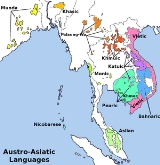
Austro-Asiatic languages

Encyclopedia
The Austro-Asiatic languages, in recent classifications synonymous with Mon–Khmer, are a large language family
of Southeast Asia
, also scattered throughout India
and Bangladesh
. The name Austro-Asiatic comes from the Latin
words for "south" and "Asia
", hence "South Asia
". Among these languages, only Khmer
, Vietnamese
, and Mon
have a long-established recorded history, and only Vietnamese and Khmer have official status (in Vietnam and Cambodia, respectively). The rest of the languages are spoken by minority groups. Ethnologue
identifies 168 Austro-Asiatic languages. These are traditionally divided into two families, Mon–Khmer and Munda
. Several recent classifications have abandoned Mon–Khmer as a valid node, or made it synonymous with the larger family (Diffloth 2005, Sidwell 2009).
Austro-Asiatic languages have a disjunct distribution across India, Bangladesh and Southeast Asia, separated by regions where other languages are spoken. It is widely believed that the Austro-Asiatic languages are the autochthonous languages of Southeast Asia and the eastern Indian subcontinent
, and that the other languages of the region, including the Indo-European
, Tai–Kadai, Dravidian
, Austronesian
, and Sino-Tibetan languages
, are the result of later migrations of people
.
plus a full syllable. Many of them also have infix
es.
's Mon–Khmer Comparative Dictionary. However, very little work has been done on Proto-Austro-Asiatic itself, since the Munda languages
are not well documented. If Mon–Khmer is not a valid taxon, as some recent classifications would have it, then Proto-Mon–Khmer becomes synonymous with Proto-Austro-Asiatic.
Sidwell (2005) reconstructs the consonant inventory of Proto-Mon–Khmer as follows:
This is identical to earlier reconstructions except for *ʄ. *ʄ is better preserved in the Katuic languages
, which Sidwell has specialized in. Sidwell (2007, 2009) suggests that the likely homeland of Austro-Asiatic/Mon–Khmer is near central Vietnam, and that the family is not as old as frequently assumed.
and the Nicobar Islands
, and the Munda languages of East
and Central India and parts of Bangladesh. However, no evidence for this classification has ever been published.
Each of the families that is written in boldface type below is accepted as a valid clade. By contrast, the relationships between these families within Austro-Asiatic is debated. In addition to the traditional classification, two recent proposals are given, neither of which accept traditional "Mon–Khmer" as a valid unit. However, little of the data used for competing classifications has ever been published, and therefore cannot be evaluated by peer review.
compares reconstructions of various clades, and attempts to classify them based on shared innovations, though like other classifications the evidence has not been published. As a schematic, we have:
Or in more detail,
This family tree is consistent with recent studies of migration of Y-Chromosomal haplogroup O2b-M95. However, the dates obtained from DNA studies are several times older than that given by linguists. The route map of the people with haplogroup O2b, speaking this language can be seen in this link.http://www.biomedcentral.com/1471-2148/7/47/figure/F1
classification, based on percentages of shared vocabulary. This means that a language may appear to be more distantly related than it actually is due to language contact
. Indeed, when Sidwell (2009a) replicated Peiros's study with languages known well enough to account for loans, he did not find the internal (branching) structure below.
's widely cited original classification, now abandoned by Diffloth himself, is used in Encyclopædia Britannica
and—except for the breakup of Southern Mon–Khmer—in Ethnologue.
Language family
A language family is a group of languages related through descent from a common ancestor, called the proto-language of that family. The term 'family' comes from the tree model of language origination in historical linguistics, which makes use of a metaphor comparing languages to people in a...
of Southeast Asia
Southeast Asia
Southeast Asia, South-East Asia, South East Asia or Southeastern Asia is a subregion of Asia, consisting of the countries that are geographically south of China, east of India, west of New Guinea and north of Australia. The region lies on the intersection of geological plates, with heavy seismic...
, also scattered throughout India
India
India , officially the Republic of India , is a country in South Asia. It is the seventh-largest country by geographical area, the second-most populous country with over 1.2 billion people, and the most populous democracy in the world...
and Bangladesh
Bangladesh
Bangladesh , officially the People's Republic of Bangladesh is a sovereign state located in South Asia. It is bordered by India on all sides except for a small border with Burma to the far southeast and by the Bay of Bengal to the south...
. The name Austro-Asiatic comes from the Latin
Latin
Latin is an Italic language originally spoken in Latium and Ancient Rome. It, along with most European languages, is a descendant of the ancient Proto-Indo-European language. Although it is considered a dead language, a number of scholars and members of the Christian clergy speak it fluently, and...
words for "south" and "Asia
Asia
Asia is the world's largest and most populous continent, located primarily in the eastern and northern hemispheres. It covers 8.7% of the Earth's total surface area and with approximately 3.879 billion people, it hosts 60% of the world's current human population...
", hence "South Asia
South Asia
South Asia, also known as Southern Asia, is the southern region of the Asian continent, which comprises the sub-Himalayan countries and, for some authorities , also includes the adjoining countries to the west and the east...
". Among these languages, only Khmer
Khmer language
Khmer , or Cambodian, is the language of the Khmer people and the official language of Cambodia. It is the second most widely spoken Austroasiatic language , with speakers in the tens of millions. Khmer has been considerably influenced by Sanskrit and Pali, especially in the royal and religious...
, Vietnamese
Vietnamese language
Vietnamese is the national and official language of Vietnam. It is the mother tongue of 86% of Vietnam's population, and of about three million overseas Vietnamese. It is also spoken as a second language by many ethnic minorities of Vietnam...
, and Mon
Mon language
The Mon language is an Austroasiatic language spoken by the Mon, who live in Burma and Thailand. Mon, like the related language Cambodian—but unlike most languages in Mainland Southeast Asia—is not tonal. Mon is spoken by more than a million people today. In recent years, usage of Mon has...
have a long-established recorded history, and only Vietnamese and Khmer have official status (in Vietnam and Cambodia, respectively). The rest of the languages are spoken by minority groups. Ethnologue
Ethnologue
Ethnologue: Languages of the World is a web and print publication of SIL International , a Christian linguistic service organization, which studies lesser-known languages, to provide the speakers with Bibles in their native language and support their efforts in language development.The Ethnologue...
identifies 168 Austro-Asiatic languages. These are traditionally divided into two families, Mon–Khmer and Munda
Munda languages
-Anderson :Gregory Anderson's 1999 proposal is as follows. Individual languages are highlighted in italics.*North Munda **Korku**Kherwarian***Santhali***Mundari*South Munda **Kharia–Juang***Juang***Kharia...
. Several recent classifications have abandoned Mon–Khmer as a valid node, or made it synonymous with the larger family (Diffloth 2005, Sidwell 2009).
Austro-Asiatic languages have a disjunct distribution across India, Bangladesh and Southeast Asia, separated by regions where other languages are spoken. It is widely believed that the Austro-Asiatic languages are the autochthonous languages of Southeast Asia and the eastern Indian subcontinent
Indian subcontinent
The Indian subcontinent, also Indian Subcontinent, Indo-Pak Subcontinent or South Asian Subcontinent is a region of the Asian continent on the Indian tectonic plate from the Hindu Kush or Hindu Koh, Himalayas and including the Kuen Lun and Karakoram ranges, forming a land mass which extends...
, and that the other languages of the region, including the Indo-European
Indo-European languages
The Indo-European languages are a family of several hundred related languages and dialects, including most major current languages of Europe, the Iranian plateau, and South Asia and also historically predominant in Anatolia...
, Tai–Kadai, Dravidian
Dravidian languages
The Dravidian language family includes approximately 85 genetically related languages, spoken by about 217 million people. They are mainly spoken in southern India and parts of eastern and central India as well as in northeastern Sri Lanka, Pakistan, Nepal, Bangladesh, Afghanistan, Iran, and...
, Austronesian
Austronesian languages
The Austronesian languages are a language family widely dispersed throughout the islands of Southeast Asia and the Pacific, with a few members spoken on continental Asia that are spoken by about 386 million people. It is on par with Indo-European, Niger-Congo, Afroasiatic and Uralic as one of the...
, and Sino-Tibetan languages
Sino-Tibetan languages
The Sino-Tibetan languages are a language family comprising, at least, the Chinese and the Tibeto-Burman languages, including some 250 languages of East Asia, Southeast Asia and parts of South Asia. They are second only to the Indo-European languages in terms of the number of native speakers...
, are the result of later migrations of people
Human migration
Human migration is physical movement by humans from one area to another, sometimes over long distances or in large groups. Historically this movement was nomadic, often causing significant conflict with the indigenous population and their displacement or cultural assimilation. Only a few nomadic...
.
Morphology
The Austro-Asiatic languages are well known for having a "sesqui-syllabic" pattern, with basic nouns and verbs consisting of a reduced minor syllableMinor syllable
Minor syllable is a term used primarily in the description of Mon-Khmer languages, where a word typically consists of a reduced syllable followed by a full tonic or stressed syllable...
plus a full syllable. Many of them also have infix
Infix
An infix is an affix inserted inside a word stem . It contrasts with adfix, a rare term for an affix attached to the end of a stem, such as a prefix or suffix.-Indonesian:...
es.
Proto-language
Much work has been done on the reconstruction of Proto-Mon–Khmer in Harry L. ShortoHarry L. Shorto
Harry L. Shorto was a British expert in comparative Mon-Khmer studies.-Life:Shorto was Professor of Mon-Khmer Studies at the University of London until hisretirement in 1984.-Contributions:...
's Mon–Khmer Comparative Dictionary. However, very little work has been done on Proto-Austro-Asiatic itself, since the Munda languages
Munda languages
-Anderson :Gregory Anderson's 1999 proposal is as follows. Individual languages are highlighted in italics.*North Munda **Korku**Kherwarian***Santhali***Mundari*South Munda **Kharia–Juang***Juang***Kharia...
are not well documented. If Mon–Khmer is not a valid taxon, as some recent classifications would have it, then Proto-Mon–Khmer becomes synonymous with Proto-Austro-Asiatic.
Sidwell (2005) reconstructs the consonant inventory of Proto-Mon–Khmer as follows:
| *p | *t | *c | *k | *ʔ |
| *b | *d | *ɟ | *ɡ | |
| *ɓ | *ɗ | *ʄ | ||
| *m | *n | *ɲ | *ŋ | |
| *w | *l, *r | *j | ||
| *s | *h |
This is identical to earlier reconstructions except for *ʄ. *ʄ is better preserved in the Katuic languages
Katuic languages
The fifteen Katuic languages form a branch of the Austroasiatic languages spoken by about 1.3 million people in Southeast Asia. People who speak Katuic languages are called the Katuic peoples. Paul Sidwell is the leading specialist on the Katuic languages...
, which Sidwell has specialized in. Sidwell (2007, 2009) suggests that the likely homeland of Austro-Asiatic/Mon–Khmer is near central Vietnam, and that the family is not as old as frequently assumed.
Classification
Linguists traditionally recognize two primary divisions of Austro-Asiatic: the Mon–Khmer languages of Southeast Asia, Northeast IndiaNorth-East India
Northeast India refers to the easternmost region of India consisting of the contiguous Seven Sister States, Sikkim, and parts of North Bengal...
and the Nicobar Islands
Nicobar Islands
The Nicobar Islands are an archipelagic island chain in the eastern Indian Ocean...
, and the Munda languages of East
East India
East India is a region of India consisting of the states of West Bengal, Bihar, Jharkhand, and Orissa. The states of Orissa and West Bengal share some cultural and linguistic characteristics with Bangladesh and with the state of Assam. Together with Bangladesh, West Bengal formed the...
and Central India and parts of Bangladesh. However, no evidence for this classification has ever been published.
Each of the families that is written in boldface type below is accepted as a valid clade. By contrast, the relationships between these families within Austro-Asiatic is debated. In addition to the traditional classification, two recent proposals are given, neither of which accept traditional "Mon–Khmer" as a valid unit. However, little of the data used for competing classifications has ever been published, and therefore cannot be evaluated by peer review.
Sidwell (2009)
Sidwell (2009a), in a lexicostatistical comparison of 36 languages which are well-known enough to exclude loan words, finds little evidence for internal branching, though he did find an area of increased contact between the Bahnaric and Katuic languages, such that languages of all branches apart from the geographically distant Munda and Nicobarese show greater similarity to Bahnaric and Katuic the closer they are to those branches, without any noticeable innovations common to Bahnaric and Katuic. He therefore takes the conservative view that the thirteen branches of Austro-Asiatic should be treated as equidistant on current evidence.Gérard Diffloth (2005)
DifflothGérard Diffloth
Gérard Diffloth is a retired Austro-Asiatic Languages professor, formerly of the University of Chicago, Chicago, Illinois, and Cornell University, Ithaca, New York. He received his Ph.D...
compares reconstructions of various clades, and attempts to classify them based on shared innovations, though like other classifications the evidence has not been published. As a schematic, we have:
Or in more detail,
- Munda languagesMunda languages-Anderson :Gregory Anderson's 1999 proposal is as follows. Individual languages are highlighted in italics.*North Munda **Korku**Kherwarian***Santhali***Mundari*South Munda **Kharia–Juang***Juang***Kharia...
(India) - Koraput: 7 languages
- Core Munda languages
-
-
- Kharian–Juang: 2 languages
- North Munda languages
- KorkuKorku languageThe Korku language is the language of the Korku tribe of central India. It belongs to the Kolarian or Munda family, isolated in the midst of a Dravidian population. The Korkus are also closely associated with the Nihali people, many of whom have traditionally lived in special quarters of Korku...
- Kherwarian: 12 languages
-
- Khasi–Khmuic languages (Northern Mon–Khmer)
- KhasianKhasic languagesThe Khasic or Khasian languages are a family of Austro-Asiatic languages. They consist of Khasi, Pnar, War, and Lyngngam.-External links:*...
: 3 languages of eastern India and Bangladesh - Palaungo-Khmuic languages
-
-
- KhmuicKhmuic languagesKhmuic languages are a subgroup of the Mon–Khmer languages.*Khao: Khao, Bit *Mlabri: Mlabri, Yumbri*Xinh Mul: Khang, Phong-Kniang, Puoc...
: 13 languages of Laos and Thailand
- Khmuic
-
-
-
- Palaungo-Pakanic languages
- Pakanic or PalyuPakanic languagesThe Pakanic languages, also known as Palyu and Mangic, are a tentative recently identified branch of endangered Austro-Asiatic languages...
: 4 or 5 languages of southern China and Vietnam - PalaungicPalaungic languagesThe nearly thirty Palaungic or Palaung–Wa languages form a branch of the Austro-Asiatic languages.Most of the Palaungic languages lost the contrastive voicing of the ancestral Austro-Asiatic consonants, with the distinction often shifting to the following vowel...
: 21 languages of Burma, southern China, and Thailand
-
- Nuclear Mon–Khmer languages
- Khmero-Vietic languages (Eastern Mon–Khmer)
-
-
- Vieto-Katuic languages ?
- VieticVietic languagesThe Vietic languages are a branch of the Austro-Asiatic language family. The branch was once referred to by the terms Việt–Mường, Annam–Muong, and Vietnamuong, but today these are understood as referring to a sub-branch of Vietic containing only the Vietnamese and Mường languages.-Origins:Based on...
: 10 languages of Vietnam and Laos, including the Vietnamese languageVietnamese languageVietnamese is the national and official language of Vietnam. It is the mother tongue of 86% of Vietnam's population, and of about three million overseas Vietnamese. It is also spoken as a second language by many ethnic minorities of Vietnam...
, which has the most speakers of any Austro-Asiatic language. These are the only Austro-Asiatic languages to have highly developed tone systems. - KatuicKatuic languagesThe fifteen Katuic languages form a branch of the Austroasiatic languages spoken by about 1.3 million people in Southeast Asia. People who speak Katuic languages are called the Katuic peoples. Paul Sidwell is the leading specialist on the Katuic languages...
: 19 languages of Laos, Vietnam, and Thailand.
-
-
-
- Khmero-Bahnaric languages
-
- BahnaricBahnaric languagesThe Bahnaric languages are a group of about thirty Mon–Khmer languages spoken by about 700,000 people in Vietnam, Cambodia, and Laos. Paul Sidwell notes that Austroasiatic/Mon–Khmer languages are lexically more similar to Bahnaric and Katuic the closer they are geographically, independently of...
: 40 languages of Vietnam, Laos, and Cambodia. - Khmeric languages
- The KhmerKhmer languageKhmer , or Cambodian, is the language of the Khmer people and the official language of Cambodia. It is the second most widely spoken Austroasiatic language , with speakers in the tens of millions. Khmer has been considerably influenced by Sanskrit and Pali, especially in the royal and religious...
dialects of Cambodia, Thailand, and Vietnam. - PearicPearic languagesThe Pearic languages are a group of endangered languages of the Eastern Mon–Khmer branch of the Austroasiatic language family, spoken by Pear people living in western Cambodia and southeastern Thailand....
: 6 languages of Cambodia.
- Bahnaric
-
- Nico-Monic languages (Southern Mon–Khmer)
-
-
- NicobareseNicobarese languagesThe Nicobarese languages form an isolated group of half a dozen closely related Austro-Asiatic languages, spoken by the majority of the inhabitants of the Nicobar Islands of India. They have a total of about 30,000 speakers...
: 6 languages of the Nicobar IslandsNicobar IslandsThe Nicobar Islands are an archipelagic island chain in the eastern Indian Ocean...
, a territory of India.
- Nicobarese
-
-
-
- Asli-Monic languages
- AslianAslian languagesThe Aslian languages are the original languages of the Orang Asli, the aboriginal inhabitants of Malaya and peninsular Thailand, and a branch of the Mon–Khmer languages, in the Austro-Asiatic language family...
: 19 languages of peninsular Malaysia and Thailand. - MonicMonic languagesThe Monic languages are a branch of the Austro-Asiatic language family descended from the Old Monic language of the kingdom of Dvaravati in what is now central Thailand...
: 2 languages, the Mon languageMon languageThe Mon language is an Austroasiatic language spoken by the Mon, who live in Burma and Thailand. Mon, like the related language Cambodian—but unlike most languages in Mainland Southeast Asia—is not tonal. Mon is spoken by more than a million people today. In recent years, usage of Mon has...
of Burma and the Nyahkur languageNyah Kur languageThe Nyah Kur language is an Austroasiatic language spoken by a remnant of the Mon people of Dvaravati, the Nyah Kur people, who live in present-day Thailand...
of Thailand.
-
This family tree is consistent with recent studies of migration of Y-Chromosomal haplogroup O2b-M95. However, the dates obtained from DNA studies are several times older than that given by linguists. The route map of the people with haplogroup O2b, speaking this language can be seen in this link.http://www.biomedcentral.com/1471-2148/7/47/figure/F1
Ilia Peiros (2004)
Peiros is a lexicostatisticLexicostatistics
Lexicostatistics is an approach to comparative linguistics that involves quantitative comparison of lexical cognates. Lexicostatistics is related to the comparative method but does not reconstruct a proto-language...
classification, based on percentages of shared vocabulary. This means that a language may appear to be more distantly related than it actually is due to language contact
Language contact
Language contact occurs when two or more languages or varieties interact. The study of language contact is called contact linguistics.Multilingualism has likely been common throughout much of human history, and today most people in the world are multilingual...
. Indeed, when Sidwell (2009a) replicated Peiros's study with languages known well enough to account for loans, he did not find the internal (branching) structure below.
- NicobareseNicobarese languagesThe Nicobarese languages form an isolated group of half a dozen closely related Austro-Asiatic languages, spoken by the majority of the inhabitants of the Nicobar Islands of India. They have a total of about 30,000 speakers...
- Munda–Khmer
- MundaMunda languages-Anderson :Gregory Anderson's 1999 proposal is as follows. Individual languages are highlighted in italics.*North Munda **Korku**Kherwarian***Santhali***Mundari*South Munda **Kharia–Juang***Juang***Kharia...
- Mon–Khmer
- KhasiKhasi languageKhasi is an Austro-Asiatic language spoken primarily in Meghalaya state in India by the Khasi people. Khasi is part of the Austroasiatic family of languages, and is fairly closely related to the Munda branch of that family, which is spoken in east&endash;central India.Although most of the 865,000...
- Nuclear Mon–Khmer
- MangicPakanic languagesThe Pakanic languages, also known as Palyu and Mangic, are a tentative recently identified branch of endangered Austro-Asiatic languages...
(MangMang languageMang is an Austro-Asiatic language of Vietnam and across the border in China....
+ PalyuBolyu languageThe Bolyu language is an Austro-Asiatic language of the Pakanic branch . In 1984, Bolyu was first studied by Liang Min of the Nationalities Research Institute in Beijing...
) (perhaps in Northern MK) - VieticVietic languagesThe Vietic languages are a branch of the Austro-Asiatic language family. The branch was once referred to by the terms Việt–Mường, Annam–Muong, and Vietnamuong, but today these are understood as referring to a sub-branch of Vietic containing only the Vietnamese and Mường languages.-Origins:Based on...
(perhaps in Northern MK) - Northern Mon–Khmer
- PalaungicPalaungic languagesThe nearly thirty Palaungic or Palaung–Wa languages form a branch of the Austro-Asiatic languages.Most of the Palaungic languages lost the contrastive voicing of the ancestral Austro-Asiatic consonants, with the distinction often shifting to the following vowel...
- KhmuicKhmuic languagesKhmuic languages are a subgroup of the Mon–Khmer languages.*Khao: Khao, Bit *Mlabri: Mlabri, Yumbri*Xinh Mul: Khang, Phong-Kniang, Puoc...
- Palaungic
- Central Mon–Khmer
- KhmerKhmer languageKhmer , or Cambodian, is the language of the Khmer people and the official language of Cambodia. It is the second most widely spoken Austroasiatic language , with speakers in the tens of millions. Khmer has been considerably influenced by Sanskrit and Pali, especially in the royal and religious...
dialects - PearicPearic languagesThe Pearic languages are a group of endangered languages of the Eastern Mon–Khmer branch of the Austroasiatic language family, spoken by Pear people living in western Cambodia and southeastern Thailand....
- Asli-Bahnaric
- AslianAslian languagesThe Aslian languages are the original languages of the Orang Asli, the aboriginal inhabitants of Malaya and peninsular Thailand, and a branch of the Mon–Khmer languages, in the Austro-Asiatic language family...
- Mon–Bahnaric
- MonicMonic languagesThe Monic languages are a branch of the Austro-Asiatic language family descended from the Old Monic language of the kingdom of Dvaravati in what is now central Thailand...
- Katu–Bahnaric
- KatuicKatuic languagesThe fifteen Katuic languages form a branch of the Austroasiatic languages spoken by about 1.3 million people in Southeast Asia. People who speak Katuic languages are called the Katuic peoples. Paul Sidwell is the leading specialist on the Katuic languages...
- BahnaricBahnaric languagesThe Bahnaric languages are a group of about thirty Mon–Khmer languages spoken by about 700,000 people in Vietnam, Cambodia, and Laos. Paul Sidwell notes that Austroasiatic/Mon–Khmer languages are lexically more similar to Bahnaric and Katuic the closer they are geographically, independently of...
- Katuic
- Monic
- Aslian
- Khmer
- Mangic
- Khasi
- Munda
Diffloth (1974)
DifflothGérard Diffloth
Gérard Diffloth is a retired Austro-Asiatic Languages professor, formerly of the University of Chicago, Chicago, Illinois, and Cornell University, Ithaca, New York. He received his Ph.D...
's widely cited original classification, now abandoned by Diffloth himself, is used in Encyclopædia Britannica
Encyclopædia Britannica
The Encyclopædia Britannica , published by Encyclopædia Britannica, Inc., is a general knowledge English-language encyclopaedia that is available in print, as a DVD, and on the Internet. It is written and continuously updated by about 100 full-time editors and more than 4,000 expert...
and—except for the breakup of Southern Mon–Khmer—in Ethnologue.
- MundaMunda languages-Anderson :Gregory Anderson's 1999 proposal is as follows. Individual languages are highlighted in italics.*North Munda **Korku**Kherwarian***Santhali***Mundari*South Munda **Kharia–Juang***Juang***Kharia...
- North Munda
- Korku
- Kherwarian
- South Munda
- Kharia–Juang
- Koraput Munda
- North Munda
- Mon–Khmer
- Eastern Mon–Khmer
- KhmerKhmer languageKhmer , or Cambodian, is the language of the Khmer people and the official language of Cambodia. It is the second most widely spoken Austroasiatic language , with speakers in the tens of millions. Khmer has been considerably influenced by Sanskrit and Pali, especially in the royal and religious...
(Cambodian) - PearicPearic languagesThe Pearic languages are a group of endangered languages of the Eastern Mon–Khmer branch of the Austroasiatic language family, spoken by Pear people living in western Cambodia and southeastern Thailand....
- BahnaricBahnaric languagesThe Bahnaric languages are a group of about thirty Mon–Khmer languages spoken by about 700,000 people in Vietnam, Cambodia, and Laos. Paul Sidwell notes that Austroasiatic/Mon–Khmer languages are lexically more similar to Bahnaric and Katuic the closer they are geographically, independently of...
- KatuicKatuic languagesThe fifteen Katuic languages form a branch of the Austroasiatic languages spoken by about 1.3 million people in Southeast Asia. People who speak Katuic languages are called the Katuic peoples. Paul Sidwell is the leading specialist on the Katuic languages...
- VieticVietic languagesThe Vietic languages are a branch of the Austro-Asiatic language family. The branch was once referred to by the terms Việt–Mường, Annam–Muong, and Vietnamuong, but today these are understood as referring to a sub-branch of Vietic containing only the Vietnamese and Mường languages.-Origins:Based on...
(includes Vietnamese)
- Khmer
- Northern Mon–Khmer
- KhasiKhasi languageKhasi is an Austro-Asiatic language spoken primarily in Meghalaya state in India by the Khasi people. Khasi is part of the Austroasiatic family of languages, and is fairly closely related to the Munda branch of that family, which is spoken in east&endash;central India.Although most of the 865,000...
(MeghalayaMeghalayaMeghalaya is a state in north-eastern India. The word "Meghalaya" literally means the Abode of Clouds in Sanskrit and other Indic languages. Meghalaya is a hilly strip in the eastern part of the country about 300 km long and 100 km wide, with a total area of about 8,700 sq mi . The...
, IndiaIndiaIndia , officially the Republic of India , is a country in South Asia. It is the seventh-largest country by geographical area, the second-most populous country with over 1.2 billion people, and the most populous democracy in the world...
) - PalaungicPalaungic languagesThe nearly thirty Palaungic or Palaung–Wa languages form a branch of the Austro-Asiatic languages.Most of the Palaungic languages lost the contrastive voicing of the ancestral Austro-Asiatic consonants, with the distinction often shifting to the following vowel...
- KhmuicKhmuic languagesKhmuic languages are a subgroup of the Mon–Khmer languages.*Khao: Khao, Bit *Mlabri: Mlabri, Yumbri*Xinh Mul: Khang, Phong-Kniang, Puoc...
- Khasi
- Southern Mon–Khmer
- MonMon languageThe Mon language is an Austroasiatic language spoken by the Mon, who live in Burma and Thailand. Mon, like the related language Cambodian—but unlike most languages in Mainland Southeast Asia—is not tonal. Mon is spoken by more than a million people today. In recent years, usage of Mon has...
- AslianAslian languagesThe Aslian languages are the original languages of the Orang Asli, the aboriginal inhabitants of Malaya and peninsular Thailand, and a branch of the Mon–Khmer languages, in the Austro-Asiatic language family...
(MalayaPeninsular MalaysiaPeninsular Malaysia , also known as West Malaysia , is the part of Malaysia which lies on the Malay Peninsula. Its area is . It shares a land border with Thailand in the north. To the south is the island of Singapore. Across the Strait of Malacca to the west lies the island of Sumatra...
) - NicobareseNicobarese languagesThe Nicobarese languages form an isolated group of half a dozen closely related Austro-Asiatic languages, spoken by the majority of the inhabitants of the Nicobar Islands of India. They have a total of about 30,000 speakers...
(Nicobar IslandsNicobar IslandsThe Nicobar Islands are an archipelagic island chain in the eastern Indian Ocean...
)
- Mon
- Eastern Mon–Khmer