
All Topics  
Afro-Asiatic languages


   Email Print
   Bookmark   Link


Afro-Asiatic languages


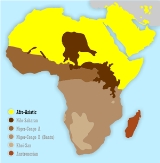
The Afro-Asiatic languages constitute a language family
Language family

A language family is a group of languages related Genetic from a common ancestor, called the proto-language of that family.As with Alpha taxonomy, the evidence of relationship is observable shared characteristics....
 with about 375 living languages (SIL
SIL International

SIL International is a United States, worldwide Evangelicalism non-profit organization, whose main purpose is to study, develop and document lesser-known languages, in order to expand linguistics knowledge, promote literacy and aid minority language development....
 estimate) and more than 300 million speakers spread throughout North Africa
North Africa

North Africa or Northern Africa is the northernmost region of the African continent, separated by the Sahara from Sub-Saharan Africa.Geopolitically, the United Nations subregion of Northern Africa includes the following seven countries or territories:...
, the Horn of Africa
Horn of Africa

The Horn of Africa is a peninsula in East Africa that juts for hundreds of kilometers into the Arabian Sea, and lies along the southern side of the Gulf of Aden....
, and Southwest Asia
Southwest Asia

Southwest Asia or Southwestern Asia is the southwestern subregion of Asia. The term West Asia is sometimes used in the United Nations subregion geoscheme and in writings about the archeology and the late prehistory of the region....
 (including some 200 million speakers of Arabic
Arabic language

Arabic is a Central Semitic language, thus related to and classified alongside other Semitic languages languages such as Hebrew language and Aramaic language....
). Afro-Asiatic also includes several ancient languages, such as Ancient Egyptian
Egyptian language

Egyptian is a branch of the Afro-Asiatic languages language family along with the Chadic languages, Berber languages, Semitic languages, Cushitic languages and possibly Omotic languages languages....
, Biblical Hebrew, and Akkadian
Akkadian language

Akkadian or Assyrian-Babylonian is a Semitic language that was spoken in ancient Mesopotamia. The earliest attested Semitic language, it used the cuneiform writing system derived ultimately from ancient Sumerian language, an unrelated language isolate....
 (the language of the Babylonians
Babylonia

Babylonia was a state in Lower Mesopotamia , Babylon as its franklin. Babylonia emerged when Hammurabi created an empire out of the territories of the former kingdoms of Sumer and Akkad....
 and Assyrians
Assyria

Assyria was a political state centered on the Upper Tigris river, in Mesopotamia , that came to rule regional empires a number of times in history....
).

The term "Afroasiatic" was coined by Maurice Delafosse
Maurice Delafosse

Maurice Delafosse was a France ethnography and colonial official who also worked in the field of the languages of Africa. In a review of his daughter's autobiography of him he was described as "one of the most outstanding French colonial administrators and ethnologists of his time." Delafosse had disagreements with the French government ove...
 (1914). It did not come into general use until it was adopted by Joseph Greenberg
Joseph Greenberg

Joseph Harold Greenberg was a prominent and controversial American linguistics, principally known for his work in two areas, linguistic typology and the genetic relationship of languages....
 (1950) to replace the earlier term "Hamito-Semitic", following his demonstration that Hamitic
Hamitic

Hamitic is a historical term for the peoples supposedly descended from Noah's son Ham, son of Noah, paralleling Semitic and Japhetic.It used to be used for grouping the non-Semitic Afro-Asiatic languages , but since, unlike the Semitic branch, these have not been shown to form a phylogenetic unity, the term is obsolete in this sense....
 is not a valid language family.


Discussion
Ask a question about 'Afro-Asiatic languages'
Start a new discussion about 'Afro-Asiatic languages'
Answer questions from other users
Full Discussion Forum


Recent Posts


Encyclopedia


The Afro-Asiatic languages constitute a language family
Language family

A language family is a group of languages related Genetic from a common ancestor, called the proto-language of that family.As with Alpha taxonomy, the evidence of relationship is observable shared characteristics....
 with about 375 living languages (SIL
SIL International

SIL International is a United States, worldwide Evangelicalism non-profit organization, whose main purpose is to study, develop and document lesser-known languages, in order to expand linguistics knowledge, promote literacy and aid minority language development....
 estimate) and more than 300 million speakers spread throughout North Africa
North Africa

North Africa or Northern Africa is the northernmost region of the African continent, separated by the Sahara from Sub-Saharan Africa.Geopolitically, the United Nations subregion of Northern Africa includes the following seven countries or territories:...
, the Horn of Africa
Horn of Africa

The Horn of Africa is a peninsula in East Africa that juts for hundreds of kilometers into the Arabian Sea, and lies along the southern side of the Gulf of Aden....
, and Southwest Asia
Southwest Asia

Southwest Asia or Southwestern Asia is the southwestern subregion of Asia. The term West Asia is sometimes used in the United Nations subregion geoscheme and in writings about the archeology and the late prehistory of the region....
 (including some 200 million speakers of Arabic
Arabic language

Arabic is a Central Semitic language, thus related to and classified alongside other Semitic languages languages such as Hebrew language and Aramaic language....
). Afro-Asiatic also includes several ancient languages, such as Ancient Egyptian
Egyptian language

Egyptian is a branch of the Afro-Asiatic languages language family along with the Chadic languages, Berber languages, Semitic languages, Cushitic languages and possibly Omotic languages languages....
, Biblical Hebrew, and Akkadian
Akkadian language

Akkadian or Assyrian-Babylonian is a Semitic language that was spoken in ancient Mesopotamia. The earliest attested Semitic language, it used the cuneiform writing system derived ultimately from ancient Sumerian language, an unrelated language isolate....
 (the language of the Babylonians
Babylonia

Babylonia was a state in Lower Mesopotamia , Babylon as its franklin. Babylonia emerged when Hammurabi created an empire out of the territories of the former kingdoms of Sumer and Akkad....
 and Assyrians
Assyria

Assyria was a political state centered on the Upper Tigris river, in Mesopotamia , that came to rule regional empires a number of times in history....
).

The term "Afroasiatic" was coined by Maurice Delafosse
Maurice Delafosse

Maurice Delafosse was a France ethnography and colonial official who also worked in the field of the languages of Africa. In a review of his daughter's autobiography of him he was described as "one of the most outstanding French colonial administrators and ethnologists of his time." Delafosse had disagreements with the French government ove...
 (1914). It did not come into general use until it was adopted by Joseph Greenberg
Joseph Greenberg

Joseph Harold Greenberg was a prominent and controversial American linguistics, principally known for his work in two areas, linguistic typology and the genetic relationship of languages....
 (1950) to replace the earlier term "Hamito-Semitic", following his demonstration that Hamitic
Hamitic

Hamitic is a historical term for the peoples supposedly descended from Noah's son Ham, son of Noah, paralleling Semitic and Japhetic.It used to be used for grouping the non-Semitic Afro-Asiatic languages , but since, unlike the Semitic branch, these have not been shown to form a phylogenetic unity, the term is obsolete in this sense....
 is not a valid language family. The name is now most often spelled "Afro-Asiatic", though both spellings are in use. Some replace "Afro-Asiatic" with "Afrasian". Individual scholars have called the family "Erythraean" (Tucker 1966) and "Lisramic" (Hodge 1972). The term "Hamito-Semitic" remains in use in the academic traditions of some European countries.

The Afro-Asiatic language family is usually considered to include the following branches:

  • Semitic
    Semitic languages

    File:Amarna Akkadian letter.pngThe Semitic languages are a group of related languages whose living representatives are spoken by more than 467 million people across much of the Middle East, North Africa and the Horn of Africa....
  • Egyptian
    Egyptian language

    Egyptian is a branch of the Afro-Asiatic languages language family along with the Chadic languages, Berber languages, Semitic languages, Cushitic languages and possibly Omotic languages languages....
  • Berber
    Berber languages

    The Berber languages are a group of closely related languages spoken in Morocco, Algeria, Tunisia, Libya, Egypt, as well as by Berber people communities in parts of Niger and Mali....
  • Chadic
    Chadic languages

    The Chadic languages constitute a language family spoken across northern Nigeria, Niger, Chad, Central African Republic and Cameroon, belonging to the Afro-Asiatic languages....
  • Cushitic
    Cushitic languages

    The Cushitic languages are a branch of the Afro-Asiatic languages language family spoken in the Horn of Africa. They are named after the Biblical figure Cush by analogy with Shem being the eponym origin of Semitic languages....
  • Omotic
    Omotic languages

    The Omotic languages are a branch of the Afro-Asiatic family spoken in southwestern Ethiopia. The Ge'ez alphabet is used to write some Omotic languages, the Roman alphabet for some others....


While there is general agreement on these six families, there are some points of disagreement among linguists
Linguistics

Linguistics is the science study of natural language. Linguistics encompasses a number of sub-fields. An important topical division is between the study of language structure and the study of Meaning ....
 who study Afro-Asiatic. In particular:

  • Most of them consider Omotic to represent the oldest split in the Afro-Asiatic family, while others have raised doubts about it being part of Afro-Asiatic at all, and a few retain it in Cushitic, where it was initially placed by Greenberg.


  • The Afro-Asiatic identity of the Ongota
    Ongota language

    Ongota is a moribund language of southwest Ethiopia. In 2008, it was said to be in a state of decline with only 6 elderly native speakers, the rest of their small village on the west bank of the Weito River having adopted the Tsamai language instead....
     language is broadly questioned, as is its position within Afro-Asiatic among those who accept it, due to the "mixed" appearance of the language and a paucity of research and data. Harold Fleming
    Harold C. Fleming

    Harold C. Fleming is an anthropology and historical linguistics. As an adherent of the Anthropology#The "four field" approach of American anthropology he stresses the integration of biological anthropology, linguistics, archaeology, and cultural anthropology in solving anthropological problems....
     tentatively suggested some years ago that Ongota constitutes a separate branch of Afro-Asiatic. He has recently strongly confirmed this position (Fleming 2006), based in part on newly available data.


  • The Beja
    Beja language

    Beja is an Afro-Asiatic languages of the southern coast of the Red Sea, spoken by about two million nomads, the Beja people, in parts of Egypt, Sudan, and Eritrea....
     language is sometimes listed as a separate branch of Afro-Asiatic but is more often included in the Cushitic branch, which has a high degree of internal diversity.


  • Whether the various branches of Cushitic actually form a language family is sometimes questioned.


  • There is no consensus on the interrelationships of the five non-Omotic branches of Afro-Asiatic (see "Overview of classifications" below). This situation is not unusual, even among long-established language families: there are also many disagreements concerning the internal classification of the Indo-European languages
    Indo-European languages

    The Indo-European languages are a Language family of several hundred related languages and dialects, including most major languages of Europe, the Iranian plateau , Central Asia and the Indian subcontinent ....
    , for instance.

Classification history


Medieval scholars sometimes linked two or more branches of Afro-Asiatic together. As early as the 9th century, the Hebrew grammarian Judah ibn Quraysh
Judah ibn Kuraish

Judah ibn Kuraish, Hebrew grammarian and lexicographer; born at Tahort, in North Africa; flourished in the eighth and ninth centuries. In his grammatical work he advanced little beyond his predecessors, but his contributions to comparative philology are of great value....
 of Tiaret in Algeria
Algeria

Algeria , officially the People's Democratic Republic of Algeria, is a country located in North Africa. It is the largest country of the Mediterranean sea, second largest in the Arab World, and the second largest on the African continent and the eleventh-largest country in the world in terms of land area....
 perceived a relationship between Berber and Semitic. He knew of Semitic through Arabic, Hebrew, and Aramaic.

In the course of the 19th century, Europeans also began suggesting such relationships. In 1844, Theodor Benfey
Theodor Benfey

Theodor Benfey was a Germany philologist and the son of a Jewish trader from N?rten, near G?ttingen.Although originally destined for the medical profession, Benfey's taste for philology was awakened by a careful instruction in Hebrew language which he received from his father....
 suggested a language family consisting of Semitic, Berber, and Cushitic (calling the latter "Ethiopic"). In the same year, T.N. Newman suggested a relationship between Semitic and Hausa, but this would long remain a topic of dispute and uncertainty.

Friedrich Müller
Friedrich Müller (linguist)

Friedrich M?ller was a German linguistics who originated the term Afro-Asiatic languages, in relation with Afro-Asiatic languages.The prominent German zoologist Ernst Haeckel mentioned M?ller when he formulated his own theory about higher and lower races:...
 named the traditional "Hamito-Semitic" family in 1876 in his Grundriss der Sprachwissenschaft. He defined it as consisting of a Semitic group plus a "Hamitic" group containing Egyptian, Berber, and Cushitic; he excluded the Chadic group. These classifications relied in part on non-linguistic anthropological and racial arguments (see Hamitic hypothesis).

Leo Reinisch (1909) proposed linking Cushitic and Chadic, while urging a more distant affinity to Egyptian and Semitic, thus foreshadowing Greenberg, but his suggestion found little resonance.

Marcel Cohen
Marcel Cohen

Marcel Samuel Rapha?l Cohen was a French linguist. He was an important scholar of Semitic languages and especially of Ethiopian languages. He studied the French language and contributed much to general linguistics....
 (1924) rejected the idea of a distinct Hamitic subgroup and included Hausa (a Chadic language) in his comparative Hamito-Semitic vocabulary.

Joseph Greenberg
Joseph Greenberg

Joseph Harold Greenberg was a prominent and controversial American linguistics, principally known for his work in two areas, linguistic typology and the genetic relationship of languages....
 (1950) strongly confirmed Cohen's rejection of "Hamitic", added (and sub-classified) the Chadic branch, and proposed the new name "Afroasiatic" for the family. Nearly all scholars have accepted Greenberg's classification.

In 1969, Harold Fleming
Harold C. Fleming

Harold C. Fleming is an anthropology and historical linguistics. As an adherent of the Anthropology#The "four field" approach of American anthropology he stresses the integration of biological anthropology, linguistics, archaeology, and cultural anthropology in solving anthropological problems....
 proposed that what had previously been known as Western Cushitic is an independent branch of Afro-Asiatic, suggesting for it the new name Omotic
Omotic languages

The Omotic languages are a branch of the Afro-Asiatic family spoken in southwestern Ethiopia. The Ge'ez alphabet is used to write some Omotic languages, the Roman alphabet for some others....
. This proposal and name have met with widespread acceptance.

Several scholars, including Harold Fleming and Robert Hetzron
Robert Hetzron

Robert Hetzron, born Herzog , was a Hungarian linguistics who focused primarily on Afro-Asiatic languages, especially those in Ethiopia and Gurage Ethiopian Semitic languages....
, have since questioned the traditional inclusion of Beja in Cushitic, but this view has yet to gain general acceptance.

Subgrouping


Little agreement exists on the subgrouping
Subgrouping (linguistics)

Subgrouping in linguistics is the division of a language family into its constituent branches....
 of the five or six branches of Afro-Asiatic — Berber, Chadic, Egyptian, Semitic, Cushitic, and Omotic (if Omotic is not included in Cushitic). However, Christopher Ehret
Christopher Ehret

Christopher Ehret , a professor of African History at UCLA since 1968, is a major figure in African history and African historical linguistics, particularly known for his efforts to correlate linguistic taxonomy and reconstruction with the archaeological record....
 (1979), Harold Fleming (1981), and Joseph Greenberg (1981) all agree that the Omotic branch split from the rest first.

Otherwise:

  • Paul Newman (1980) groups Berber with Chadic and Egyptian with Semitic, while questioning the inclusion of Omotic in Afro-Asiatic. Rolf Theil (2006) concurs with the exclusion of Omotic, but does not otherwise address the structure of the family.


  • Harold Fleming (1981) divides non-Omotic Afro-Asiatic, or "Erythraean", into three groups, Cushitic, Semitic, and Chadic-Berber-Egyptian. He later added Semitic and Beja to Chadic-Berber-Egyptian and tentatively proposed Ongota
    Ongota language

    Ongota is a moribund language of southwest Ethiopia. In 2008, it was said to be in a state of decline with only 6 elderly native speakers, the rest of their small village on the west bank of the Weito River having adopted the Tsamai language instead....
     as a new third branch of Erythraean. He thus divided Afro-Asiatic into two major branches, Omotic and Erythraean, with Erythraean consisting of three sub-branches, Cushitic, Chadic-Berber-Egyptian-Semitic-Beja, and Ongota.


  • Vladimir Orel and Olga Stolbova (1995) group Berber with Semitic and Chadic with Egyptian. They split up Cushitic into five or more independent branches of Afro-Asiatic, viewing Cushitic as a Sprachbund
    Sprachbund

    A Sprachbund , from the German language word for ?language union?, also known as a linguistic area, convergence area, diffusion area or language crossroads, is a group of languages that have become similar in some way because of geographical proximity and language contact....
     rather than a language family
    Language family

    A language family is a group of languages related Genetic from a common ancestor, called the proto-language of that family.As with Alpha taxonomy, the evidence of relationship is observable shared characteristics....
    .


  • Christopher Ehret (1995) groups Egyptian, Berber, and Semitic together in a "North Afro-Asiatic" subgroup.


  • Igor M. Diakonoff (1996) subdivides Afro-Asiatic in two, grouping Berber, Cushitic, and Semitic together as East-West Afrasian (ESA), and Chadic with Egyptian as North-South Afrasian (NSA). He excludes Omotic from Afro-Asiatic.


  • Lionel Bender
    Lionel Bender (linguist)

    Marvin Lionel Bender was an United States author and co-author of several books, publications and essays regarding African languages, particularly from Ethiopia and Sudan....
     (1997) groups Berber, Cushitic, and Semitic together as "Macro-Cushitic". He regards Chadic and Omotic as the branches of Afro-Asiatic most remote from the others.


  • Alexander Militarev (2000), on the basis of lexicostatistics
    Lexicostatistics

    Lexicostatistics is an approach to comparative linguistics that involves quantitative comparison of lexical cognates. Lexicostatistics is related to the comparative method but does not reconstruct a proto-language....
    , groups Berber with Chadic and both more distantly with Semitic, as against Cushitic and Omotic.


Overview of classifications

Greenberg
(1963)
Newman
(1980)
Fleming
(post-1981)
Ehret
(1995)
Orel & Stobova
(1995)
Diakonoff
(1996)
Bender
(1997)
Militarev
(2000)
• Egyptian
• Berber

    • Western Cushitic

• Berber-Chadic
• Egypto-Semitic
• Cushitic (excludes Omotic)
• Erythraean:
    • Cushitic
    • Ongota

        • Chadic
        • Berber
        • Egyptian
        • Semitic
        • Beja
• Cushitic
• Chadic

    • Egyptian
    • Berber
    • Semitic

• Omotic
• Beja
• Agaw
• Sidamic

• Rift
    • Berber
    • Cushitic
    • Semitic

    • Chadic
    • Egyptian

(excludes Omotic)
• Chadic

    • Berber
    • Cushitic
    • Semitic
    • African North Afrasian:
        • Chado-Berber
        • Egyptian
    • Semitic

    • Omotic
    • Cushitic


Position among the world's languages


Afro-Asiatic is one of the four language families of Africa identified by Joseph Greenberg in his book The Languages of Africa
The Languages of Africa

The Languages of Africa is a 1963 book of essays by Joseph Greenberg, in which he sets forth a genetic classification of African languages that, with some changes, continues to be the most commonly used one today....
 (1963). It is the only one that extends outside of Africa, via the Semitic branch.

There are no generally accepted relations between Afro-Asiatic and any other language family. However, several proposals grouping Afro-Asiatic with one or more other language families have been made. The best-known of these are the following:

  • Hermann Möller
    Hermann Möller

    Hermann M?ller was a Denmark linguist noted for his work in favor of a genetic relationship between the Indo-European languages and Semitic languages language family....
     (1906) argued for a relation between Semitic
    Semitic languages

    File:Amarna Akkadian letter.pngThe Semitic languages are a group of related languages whose living representatives are spoken by more than 467 million people across much of the Middle East, North Africa and the Horn of Africa....
     and the Indo-European languages
    Indo-European languages

    The Indo-European languages are a Language family of several hundred related languages and dialects, including most major languages of Europe, the Iranian plateau , Central Asia and the Indian subcontinent ....
    . This proposal was accepted by some linguists (e.g. Holger Pedersen
    Holger Pedersen

    Holger Pedersen may refer to:* Holger Pedersen - Danish linguist * Holger Pedersen - Danish astronomer , at the European Southern Observatory....
     and Louis Hjelmslev
    Louis Hjelmslev

    Louis Hjelmslev was a Denmark linguistics whose ideas formed the basis of the The Copenhagen school of linguistics. Born into an academic family, Hjelmslev studied comparative linguistics in Copenhagen, Prague and Paris ....
    ) but has little currency today.


  • Apparently influenced by Möller (a colleague of his at the University of Copenhagen
    University of Copenhagen

    The University of Copenhagen is the oldest and largest university and research institution in Denmark. Founded in 1479, it has more than 37,000 students, a majority of whom are female , and more than 7,000 employees....
    ), Holger Pedersen
    Holger Pedersen

    Holger Pedersen may refer to:* Holger Pedersen - Danish linguist * Holger Pedersen - Danish astronomer , at the European Southern Observatory....
     included Hamito-Semitic (the term replaced by Afro-Asiatic) in his proposed Nostratic
    Nostratic languages

    The Nostratic languages constitute a proposed language family that includes many of the indigenous language families of Europe, Asia, Africa, and North America....
     language family (cf. Pedersen 1931:336-338), which also included the Indo-European, Finno-Ugric
    Finno-Ugric languages

    Finno-Ugric is a group of languages in the Uralic languages family, comprising Finnish language, Estonian language, Hungarian language and related languages....
    , Samoyed, Turkish
    Turkic languages

    The Turkic languages constitute a language family of some thirty languages, spoken by Turkic peoples across a vast area from Eastern Europe and the Mediterranean Sea to Siberia and Western China, and are sometimes considered to be part of the proposed Altaic languages....
    , Mongolian
    Mongolic languages

    The Mongolic languages are a group of languages spoken in Central Asia. Some linguists propose the grouping of Mongolic with Turkic languages and Tungusic languages as Altaic languages, but this hypothesis is not universally agreed upon....
    , Manchu
    Tungusic languages

    The Tungusic languages are spoken in Eastern Siberia and Manchuria. Although it is a very debated subject, many linguists consider them to be part of the Altaic languages language phylum, which, if it actually exists as a genetic entity, also includes the Turkic languages and Mongolic languages language families....
    , Yukaghir
    Yukaghir languages

    The 'Yukaghir languages' are a small family of two closely related languages spoken in the Russian Far East by the Yukaghir, an indigenous people in Eastern Siberia, living in the basin of the Kolyma River....
    , and Eskimo
    Eskimo-Aleut languages

    Eskimo-Aleut is a language family native to Alaska, the Northern Canada, Nunavik, Nunatsiavut, Greenland, and the Chukchi Peninsula on the eastern tip of Siberia....
     languages. This inclusion was retained by subsequent Nostraticists, starting with Vladislav Illich-Svitych
    Vladislav Illich-Svitych

    Vladislav Markovich Illich-Svitych was a founding father of comparative Nostratic linguistics.Of Ukrainian descent, he was born in Kiev but later moved to work in Moscow....
     and Aharon Dolgopolsky
    Aharon Dolgopolsky

    Aharon Dolgopolsky is a Russian-born Israelis comparative linguistics and one of the modern founders of comparative Nostratic linguistics.Born in Moscow, he arrived at the long-forgotten Nostratic hypothesis in the 1960s, at around the same time but independently of Vladislav Illich-Svitych....
    . Like all aspects of the Nostratic hypothesis, it is highly controversial.


  • Joseph Greenberg (2000-2002) did not reject a relationship of Afro-Asiatic to these other languages, but he considered it more distantly related to them than they were to each other, grouping instead these other languages in a separate language family, which he called Eurasiatic
    Eurasiatic languages

    Eurasiatic is a hypothetical language family proposed by Joseph Greenberg that groups all of the language families historically spoken in northern Eurasia into a single higher-order family, with the sole exception of the Yeniseian languages, spoken in part of Siberia, but including the Eskimo-Aleut languages, spoken in northernmost North Amer...
    , and to which he added Chukotian
    Chukotko-Kamchatkan languages

    The Chukotko-Kamchatkan languages are a Language families and languages of northeastern Siberia. The family is also known as Chukchi-Kamchatkan....
    , Gilyak
    Nivkh language

    Nivkh or Gilyak is a language spoken in Outer Manchuria, in the basin of the Amgun River , along the lower reaches of the Amur itself, and on the northern half of Sakhalin....
    , Aleut
    Aleut language

    Aleut is a language of the Eskimo-Aleut language family. It is the tongue of the Aleut people living in the Aleutian Islands, Pribilof Islands, and Commander Islands....
    , Korean
    Korean language

    Korean is the official language of North Korea and South Korea. It is also one of the two official languages in the Yanbian Korean Autonomous Prefecture in People's Republic of China....
    , Japanese-Ryukyuan
    Japonic languages

    Japonic or Japanese-Ryukyuan is a language family composed of Japanese language and Ryukyuan languages. Their common ancestral language is known as Proto-Japonic or Proto-Japanese-Ryukyuan. The essential feature of this classification is that the first split in the family resulted in the separation of all dialects of Japane...
    , and Ainu
    Ainu languages

    The Ainu languages were a small language family spoken on the northern Japanese island of Hokkaido, the southern half of the island of Sakhalin, and the Kuril Islands, an island chain that stretches from Hokkaido to the southern tip of the Kamchatka Peninsula....
    .


Original homeland and date


No agreement exists on where Proto-Afro-Asiatic
Proto-Afro-Asiatic

Proto-Afro-Asiatic is the hypothetical proto-language from which modern Afro-Asiatic languages are descended.Ilya Yabonovich and other linguists, in examining the differences between the various members of the Afro-Asiatic family have realised that all of the old etymologies for this group were inherently semitocentric....
 speakers lived (i.e. the Afro-Asiatic Urheimat
Urheimat

Urheimat is a Linguistics term denoting the original homeland of the speakers of a proto-language....
), though the language is generally believed to have originated in Northeast Africa. Some scholars (such as Igor Diakonoff and Lionel Bender
Lionel Bender

Lionel Bender may refer to:*Lionel Bender , American author and co-author of several books, publications and essays regarding African languages...
) have proposed Ethiopia
Ethiopia

Ethiopia , officially the Federal Democratic Republic of Ethiopia, is a landlocked country situated in the Horn of Africa. Ethiopia is bordered by Eritrea to the north, Sudan to the west, Kenya to the south, Somalia to the east and Djibouti to the northeast....
, because it includes the majority of the diversity of the Afro-Asiatic language family and has very diverse groups in close geographic proximity, often considered a telltale sign for a linguistic geographic origin. Other researchers (such as Christopher Ehret
Christopher Ehret

Christopher Ehret , a professor of African History at UCLA since 1968, is a major figure in African history and African historical linguistics, particularly known for his efforts to correlate linguistic taxonomy and reconstruction with the archaeological record....
) have put forward the western Red Sea
Red Sea

The Red Sea is a salt water inlet of the Indian Ocean between Africa and Asia. The connection to the ocean is in the south through the Bab el Mandeb sound and the Gulf of Aden....
 coast and the Sahara
Sahara

The Sahara is the world's largest hot desert. At over 9,000,000 square kilometers , it covers most of Northern Africa, making it almost as large as the United States or the continent of Europe....
. A minority suggests a linguistic homeland in the Levant
Levant

The Levant describes, traditionally, the Eastern Mediterranean at large, but can be used as a geographical term that denotes a large area in Western Asia formed by the lands bordering the Eastern shores of the Mediterranean, roughly bounded on the north by the Taurus Mountains, on the south by the Arabian Desert, and on the west by the M...
 (for instance Alexander Militarev; specifically, he identifies Afro-Asiatic with the Natufian culture
Natufian culture

The Natufian culture existed in the Mediterranean region of the Levant. It was a Mesolithic culture, but unusual in that it was sedentary, or semi-sedentary, before the introduction of agriculture....
), with Semitic being the only branch to stay put. . This is in someway supported by fact that Afro Asiatic terms dominate the nouns for early livestock and crops from Anatolia and Iran, and from the probable Asian origin of Semitic languages around 4,600 BP to 4,800 BP.

The Semitic languages are the only branch of Afro-Asiatic attested outside of Africa
Africa

Africa is the world's second-largest and second most-populous continent, after Asia. At about 30.2 million km? including adjacent islands, it covers 6% of the Earth's total surface area and 20.4% of the total land area....
. Some scholars believe that, in historical or near-historical times, Semitic speakers crossed from South Arabia back into Eritrea
Eritrea

Eritrea , officially the Country of Eritrea, is a country in Northeast Africa. It is bordered by Sudan in the west, Ethiopia in the south, and Djibouti in the southeast....
. Others, such as A. Murtonen, dispute this view, suggesting that the Semitic branch may have originated in Ethiopia. A third view, based upon similarities between Semitic and Ancient Egyptian, is that the two languages developed from a common ancestral tongue along the Nile, crossing the Sinai with the dry phase from 6000-5800 BCE, at the end of the Pre-Pottery Neolithic B
Pre-Pottery Neolithic B

Pre-Pottery Neolithic B is a division of the Neolithic developed by Dame Kathleen Kenyon during her archaeological excavations at Jericho in the southern Levant region....
 phase in the Levant . Hunter-gatherers of the El-Harif Mesolithic
Mesolithic

The Mesolithic or Middle Stone Age was a period in the development of human technology in between the Paleolithic or Old Stone Age and the Neolithic or New Stone Age....
 culture, crossing the Sinai and from Northern Egypt, and adopting animal domestication but not agriculture, could then have created what Juris Yarins calls the Syro-Arabian nomadic pastoralism
Nomadic pastoralism

Nomadic pastoralism or nomadic transhumance is a form of agriculture where livestock are herding either seasonally or continuously in order to find fresh pastures on which to graze....
 complex, spreading south along the shores of the Red Sea and northeast around the edge of the "Fertile Crescent
Fertile Crescent

The Fertile Crescent is a region in the Near East, incorporating the Levant and Mesopotamia, and often extended to Lower Egypt. Mesopotamia is considered the Cradle of civilization and saw the development of the earliest human civilizations and is the History_of_writing#Bronze_Age_writing and Wheel#History....
". In the Levant this development appears as the Minhata culture and later as the Yarmoukian culture, which came from the same semi-arid zone as the later Ghassulian
Ghassulian

Ghassulian refers to a culture and an archaeological stage dating to the Middle Chalcolithic Period in southern Palestine . Considered to correspond to the Halafian culture of North Syria and Mesopotamia, its type-site, Tulaylat al-Ghassul, is located in the Jordan Valley near the Dead Sea in modern Jordan and was excavated in the 1930...
 and Semitic Amorite cultures. However, regarding resemblances among language subgroups, recent "research into the lexicon would seem to suggest a closer relationship between Chadic and ancient Egyptian" .

Roger Blench says of the apparent greater diversity of Semitic in Africa compared to Asia:

The survival of epigraphic languages can be misleading; Semitic in the near East was probably once more diverse, with many languages never written and subsequently eliminated by the spread of Arabic. Some of that diversity is attested to in the records of Sabaean, the epigraphic languages of Yemen and the south Semitic languages spoken all along the coast of the Arabian peninsula and of Socotra.


Linguistic evidence for proto Semitic also does not support an African origin. It contains nouns for horse, camel, oak, pistachio, almond, ice, naphtha, bitumen and vineyards; all resources, flora or fauna not native to Africa. Camels and horses don't arrive in Africa until two thousand years after Semitic languages are being written in Mesopotamia
Mesopotamia

Mesopotamia is the area of the Tigris-Euphrates river system, along the Tigris and Euphrates rivers, largely corresponding to modern Iraq, as well as some parts of northeastern Syria, some parts of southeastern Turkey, and some parts of the Khuzestan Province of southwestern Iran....
.

Given the high diversity within the Afro-Asiatic family and the absence of a common vocabulary for agricultural items, it is suggested that the languages dispersed before the commencement of the Neolithic. Ehret suggests that early Afro-Asiatic languages were involved in the domestication of Ethiopian food crops, but this is disputed by others who suggest that the words concerned are found only in the Cushitic and possibly Omotic families and that common cognates for agriculture are not present.

The finding of a common vocabulary for pottery containers, however, suggests that this technology was known. For example: Proto-Semitic *k'ad-ah- 'vessel', found in Arabic kadah 'drinking bowl, cup, goblet, glass, tumbler'; Sabaean m-kdh(m,n) 'cup'; Ethiopic / Geez kadho 'vessel, gourd', ma-kdeht 'jar, jug, bucket'; Lowland East Cushitic *k'adad- 'vessel, gourd'; Oromo k'odaa 'vessel, gourd'; Egyptian qd 'pot'; Lowland East Cushitic *k'od- 'receptacle'; Oromo k'odaa 'receptacle'; West Chadic *k'wad- 'calabash'; Dangla koda 'pot' (Bomhard 1996). Bomhard reconstructs these forms to a Proto-Afro-Asiatic *k'ud- / *k'od- 'vessel, pot'.

Given that wavy-line pottery is found widely in the Sahara from 8000 BCE, and that the Neolithic agricultural technologies arrived around 5000 BCE, this sets a possible context for Proto-Afro-Asiatic dispersal. As it is known that the Ethiopian farmers moved into the highlands from the direction of Nubian Sudan, and attempts to translate the Meroitic script
Meroitic script

The Meroitic script is an alphabetic script originally derived from Egyptian hieroglyphs, used to write the Meroitic language of the Kingdom of Meroe/Kush....
 found in this area show significant Afro-Asiatic characteristics, Lionel Bender suggests that this area of the Southern Nile was the centre from which the Afro-Asiatic languages dispersed. The dates of pottery and agriculture set approximate early and late dates for this linguistic dispersal. The date of Proto-Afro-Asiatic would thus lie somewhere between ca. 8000 and ca. 5000 BCE or, expressed differently, between 7,000 and 10,000 years ago.

Climatically this was the time of a "wet Sahara" phase with large rivers and lakes. The dispersal of Afro-Asiatic may thus have been a response to the recent operation of the "Sahara pump
Sahara pump theory

The Sahara Pump Theory explains how Floristic province and Biomes left Africa to penetrate the Middle East and beyond to Europe and Asia. African pluvial periods are associated with a "wet Sahara" phase during which larger lakes and more rivers exist....
".

Some scholars argue that Afro-Asiatic is considerably older than this. Carleton T. Hodge (1991:141) states:

Archeological evidence indicates that the time depth of the proto-language involved is over 16,000 years, possibly 20,000 (Munson 1977, Hodge 1978). The proportion of items attested as having survived over 4,000 years within Egyptian (Hodge 1975) gives us confidence in the relatability of languages at the greater time depth (Swadesh 1959: 27).


According to Christopher Ehret (1997):

Afroasiatic is a family of much greater time depth than even most of its students realize; its first divergences trace back probably at least 15,000 years ago, not just 8,000 or 9,000 as many believe. This last point imparts a ... general lesson for historical linguists: the historical comparative method, in fact, works very well farther back in time than scholars have generally allowed, provided the family in question contains a sufficiently large number of languages from which evidence can still be obtained.


Common features


Common features of the Afro-Asiatic languages include:

  • a two-gender
    Grammatical gender

    In linguistics, grammatical genders, sometimes also called noun classes, are classes of nouns reflected in the behavior of associated words; every noun must belong to one of the classes and there should be very few which belong to several classes at once....
     system in the singular, with the feminine marked by the /t/ sound,
  • VSO
    Verb Subject Object

    Verb Subject Object is a term in linguistic typology. It represents one type of languages when classifying languages according to the sequence of these constituents in neutral expressions: Ate Sam oranges....
     typology
    Linguistic typology

    Linguistic typology is a subfield of linguistics that studies and classifies languages according to their structural features. Its aim is to describe and explain the structural diversity of the world's languages....
     with SVO tendencies,
  • a set of emphatic consonant
    Emphatic consonant

    Emphatic consonant is a term widely used in Semitic languages linguistics to describe one of a series of obstruent consonants which originally contrasted with series of both voiced and voiceless obstruents....
    s, variously realized as glottalized, pharyngealized, or implosive, and
  • a templatic morphology
    Morphology (linguistics)

    Morphology is the identification, analysis and description of structure of words . While words are generally accepted as being the smallest units of syntax, it is clear that in most languages, words can be related to other words by rules....
     in which words inflect by internal changes as well as with prefixes and suffixes.


In the verbal system, Semitic, Berber, and Cushitic (including Beja) all provide evidence for a prefix conjugation:
English Arabic (Semitic) Kabyle
Kabyle language

Kabyle is a Berber language spoken by the Kabyle people. In 1995, there were 7,123,000 speakers worldwide, the majority in Algeria, where there were more than 4,500,000....
 (Berber)
Somali
Somali

Somali can refer to:* Somali people, ethnic group who inhabit the Horn of Africa * Somali language* Somali clan, social grouping of the Somali people...
 (Cushitic)
Beja
Beja language

Beja is an Afro-Asiatic languages of the southern coast of the Red Sea, spoken by about two million nomads, the Beja people, in parts of Egypt, Sudan, and Eritrea....
 (verb is "arrive")
Hausa
Hausa language

Hausa is the Chadic languages with the largest number of speakers, spoken as a first language by about 24 million people, and as a second language by about 15 million more....
 (Chadic)
he dies yamuutu yemmut wudimta iktim yamutu
she dies tamuutu temmut wedimata tiktim tamutu
they (m.) die yamuutuun mmuten wedimtan iktimna sunmutu
you (m. sg.) die tamuutu temmute? wadimate tiktima kamutu
you (m. pl.) die tamuutuun temmutem wadimatan tiktimna sunmutu
I die ?amuutu mmute? wadimta aktim namutu
we die namuutu nemmut wadimana niktim munmutu


All Afro-Asiatic subfamilies show evidence of a causative affix s, but a similar suffix also appears in other groups, such as the Niger-Congo languages
Niger-Congo languages

The Niger?Congo languages constitute one of the world's major Language family, and Africa's largest in terms of geographical area, number of speakers, and number of distinct languages....
.

Semitic, Berber, Cushitic (including Beja), and Chadic support possessive suffix
Possessive suffix

In linguistics, a possessive suffix is a suffix attached to a noun to indicate its possession , much in the manner of possessive adjectives. Possessive suffixes do not exist in all languages; they do exist in some Uralic languages, Semitic languages, and Indo-European languages languages....
es.

Tonal language
Tonal language

A tonal language is a language that uses tone to distinguish words. Tone is a Phonology common to many languages around the world . Various Chinese language languages such as Mandarin, Min Nan/Taiwanese Minnan and Cantonese are perhaps the most well-known of such languages....
s appear in the Omotic, Chadic, and Cushitic branches of Afro-Asiatic, according to Ehret (1996). The Semitic, Berber, and Egyptian branches do not use tones phonemically
Phoneme

In human language, a phoneme is the smallest posited linguistically distinctive unit of sound. Phonemes carry no semantic content themselves. In theoretical terms, phonemes are not the physical segment s themselves, but cognitive abstractions or categorizations of them....
.

Cognates


Some important Afro-Asiatic cognate
Cognate

Cognates in linguistics are words that have a common etymology origin.An example of cognates within the same language would be English shirt vs....
s are:

  • b-n- 'build' (Ehret: *bin), attested in Chadic, Semitic (*bny), Cushitic (*min/*man 'house'), Berber (*bn) and Omotic (Dime bin- 'build, create').
  • m-t 'die' (Ehret: *maaw), attested in Chadic (for example, Hausa mutu), Egyptian (mwt *muwt, mt, Coptic mu), Berber (mmet, pr. yemmut), Semitic (*mwt), and Cushitic (Proto-Somali *umaaw/*-am-w(t)- 'die'). Also Mot, Canaanite god of death. (The Proto-Indo-European root *mor-/mr- 'die' is similar, evidence in favor of the classification of both Afro-Asiatic and Indo-European in the hypothetical Nostratic family.)
  • s-n 'know', attested in Chadic, Berber, Egyptian and Semitic (Hebrew š-n 'learn, study').
  • l-s 'tongue' (Ehret: *lis' 'to lick'), attested in Semitic (*lasaan/lisaan), Egyptian (ns *ls, Coptic las), Berber (ils), Chadic (for example, Hausa harshe), and possibly Omotic (Dime lits'- 'lick').
  • s-m 'name' (Ehret: *sum / *sim), attested in Semitic (*sm), Berber (ism), Chadic (for example, Hausa suna), Cushitic, and Omotic (though some see the Berber form, ism, and the Omotic form, sunts, as Semitic loanwords.) The Egyptian smi 'report, announce' offers another possible cognate.
  • d-m 'blood' (Ehret: *dîm / *dâm), attested in Berber (idammen), Semitic (*dam), Chadic, and arguably Omotic. Compare Cushitic *dîm/*dâm, 'red'.


See also

  • Nostratic languages
    Nostratic languages

    The Nostratic languages constitute a proposed language family that includes many of the indigenous language families of Europe, Asia, Africa, and North America....
  • African languages
    African languages

    There are an estimated 2,000 languages spoken in Africa. They fall into four major language family:*Afro-Asiatic languages stretches from North Africa to the Horn of Africa and Southwest Asia....
  • Asian languages
    Languages of Asia

    There is a wide variety of languages spoken throughout Asia, comprising a number of families and some unrelated isolates. Many languages have a long tradition of writing....


Etymological bibliography


Some of the main sources for Afro-Asiatic etymologies include:

  • Cohen, Marcel. 1947. Essai comparatif sur le vocabulaire et la phonétique du chamito-sémitique. Paris: Champion.


  • Diakonoff, Igor M. et al. 1993-1997. "Historical-comparative vocabulary of Afrasian", St. Petersburg Journal of African Studies 2-6.


  • Ehret, Christopher. 1996. Reconstructing Proto-Afroasiatic (Proto-Afrasian): Vowels, Tone, Consonants, and Vocabulary (University of California Publications in Linguistics 126). Berkeley, California.


  • Orel, Vladimir E. and Olga V. Stolbova. 1995. Hamito-Semitic Etymological Dictionary: Materials for a Reconstruction. Leiden: Brill. ISBN 90-04-10051-2.


Literature


  • Barnett, William and John Hoopes (editors). 1995. The Emergence of Pottery. Washington, DC: Smithsonian Institution Press. ISBN 1-56098-517-8


  • Bender, Lionel et al. 2003. Selected Comparative-Historical Afro-Asiatic Studies in Memory of Igor M. Diakonoff. LINCOM.


  • Bomhard, Alan R. 1996. Indo-European and the Nostratic Hypothesis. Signum.


  • Diakonoff, Igor M. 1996. "Some reflections on the Afrasian linguistic macrofamily." Journal of Near Eastern Studies 55, 293.


  • Diakonoff, Igor M. 1998. "The earliest Semitic society: Linguistic data." Journal of Semitic Studies 43, 209.


  • Ehret, Christopher. 1997. of "The lessons of deep-time historical-comparative reconstruction in Afroasiatic: reflections on Reconstructing Proto-Afroasiatic: Vowels, Tone, Consonants, and Vocabulary (U.C. Press, 1995)", paper delivered at the Twenty-fifth Annual Meeting of the North American Conference on Afro-Asiatic Linguistics, held in Miami, Florida on March 21-23, 1997.


  • Fleming, Harold C. 2006. Ongota: A Decisive Language in African Prehistory. Wiesbaden: Otto Harrassowitz.


  • Greenberg, Joseph H. 1950. Southwestern Journal of Anthropology 6, 47-63.


  • Greenberg, Joseph H. 1955. Studies in African Linguistic Classification. New Haven: Compass Publishing Company. (Photo-offset reprint of the SJA articles with minor corrections.)


  • Greenberg, Joseph H. 1963. The Languages of Africa. Bloomington: Indiana University. (Heavily revised version of Greenberg 1955.)


  • Greenberg, Joseph H. 1966. The Languages of Africa (2nd ed. with additions and corrections). Bloomington: Indiana University.


  • Greenberg, Joseph H. 1981. "African linguistic classification." General History of Africa, Volume 1: Methodology and African Prehistory, edited by Joseph Ki-Zerbo, 292-308. Berkeley and Los Angeles: University of California Press.


  • Greenberg, Joseph H. 2000-2002. Indo-European and Its Closest Relatives: The Eurasiatic Language Family, Volume 1: Grammar, Volume 2: Lexicon. Stanford: Stanford University Press.


  • Heine, Bernd and Derek Nurse. 2000. African Languages, Chapter 4. Cambridge University Press.


  • Hodge, Carleton T. (editor). 1971. Afroasiatic: A Survey. The Hague - Paris: Mouton.


  • Hodge, Carleton T. 1991. "Indo-European and Afro-Asiatic." In Sydney M. Lamb and E. Douglas Mitchell (editors), Sprung from Some Common Source: Investigations into the Prehistory of Languages, Stanford, California: Stanford University Press, 141-165.


  • Huehnergard, John. 2004. "Afro-Asiatic." In R.D. Woodard (editor), The Cambridge Encyclopedia of the World’s Ancient Languages, Cambridge - New York, 2004, 138-159.


  • Militarev, Alexander. "Towards the genetic affiliation of Ongota, a nearly-extinct language of Ethiopia," 60 pp. In Orientalia et Classica: Papers of the Institute of Oriental and Classical Studies, Issue 5. ?oscow. (Forthcoming.)


  • Ruhlen, Merritt. 1991. A Guide to the World's Languages. Stanford, California: Stanford University Press.


External links


  • from Roger Blench
    Roger Blench

    Roger Blench is a British linguistics, ethnomusicology and development anthropologist. He has an M.A. and a Ph.D. from the University of Cambridge and remains based in Cambridge, England....
    's website


  • at Ethnologue.com


  • , presented by Alexander Militarev at his talk "Genealogical classification of Afro-Asiatic languages according to the latest data" at the conference on the 70th anniversary of V.M. Illich-Svitych, Moscow, 2004;


  • by Rolf Theil (2006)


  • The North American Conference on Afroasiatic Linguistics, now in its 35th year