
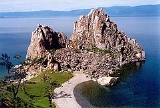
Lake Baikal is the world's oldest at 30 million years old and deepest lake with an average depth of 744.4 metres.
Located in the south of the
RussiaRussia or , officially known as both Russia and the Russian Federation , is a country in northern Eurasia. It is a federal semi-presidential republic, comprising 83 federal subjects...
n region of
SiberiaSiberia is an extensive region constituting almost all of Northern Asia. Comprising the central and eastern portion of the Russian Federation, it was part of the Soviet Union from its beginning, as its predecessor states, the Tsardom of Russia and the Russian Empire, conquered it during the 16th...
, between
Irkutsk OblastIrkutsk Oblast is a federal subject of Russia , located in southeastern Siberia in the basins of Angara River, Lena, and Nizhnyaya Tunguska Rivers. The administrative center is the city of Irkutsk. Population: -History:...
to the northwest and the Buryat Republic to the southeast, it is the most voluminous
freshwaterFresh water is naturally occurring water on the Earth's surface in ice sheets, ice caps, glaciers, bogs, ponds, lakes, rivers and streams, and underground as groundwater in aquifers and underground streams. Fresh water is generally characterized by having low concentrations of dissolved salts and...
lake in the world, containing roughly 20% of the world's unfrozen surface fresh water.
At 1642 metres (5,387.1 ft), Lake Baikal is the deepest and among the clearest of all lakes in the world. Similarly to
Lake TanganyikaLake Tanganyika is an African Great Lake. It is estimated to be the second largest freshwater lake in the world by volume, and the second deepest, after Lake Baikal in Siberia; it is also the world's longest freshwater lake...
, Lake Baikal was formed as an ancient
rift valleyA rift valley is a linear-shaped lowland between highlands or mountain ranges created by the action of a geologic rift or fault. This action is manifest as crustal extension, a spreading apart of the surface which is subsequently further deepened by the forces of erosion...
, having the typical long crescent shape with a surface area of 31722 km² (12,247.9 sq mi), less than that of
Lake SuperiorLake Superior is the largest of the five traditionally-demarcated Great Lakes of North America. It is bounded to the north by the Canadian province of Ontario and the U.S. state of Minnesota, and to the south by the U.S. states of Wisconsin and Michigan. It is the largest freshwater lake in the...
or
Lake VictoriaLake Victoria is one of the African Great Lakes. The lake was named for Queen Victoria of the United Kingdom, by John Hanning Speke, the first European to discover this lake....
. Baikal is home to more than 1,700 species of plants and animals, two thirds of which can be found nowhere else in the world and was declared a
UNESCOThe United Nations Educational, Scientific and Cultural Organization is a specialized agency of the United Nations...
World Heritage SiteA UNESCO World Heritage Site is a place that is listed by the UNESCO as of special cultural or physical significance...
in 1996. It is also home to
BuryatThe Buryats or Buriyads , numbering approximately 436,000, are the largest ethnic minority group in Siberia and are mainly concentrated in their homeland, the Buryat Republic, a federal subject of Russia...
tribes who reside on the eastern side of Lake Baikal, rearing goats, camels, cattle and sheep, where the regional temperatures vary from a minimum of -19 C in winter to maximum of 14 °C (57.2 °F) in summer.
Lake Baikal is nicknamed "Older sister of Sister Lakes (Lake Khövsgöl and Lake Baikal)".
Geography and hydrography
Lake Baikal was known as the "North Sea" in
historicalChinese civilization originated in various regional centers along both the Yellow River and the Yangtze River valleys in the Neolithic era, but the Yellow River is said to be the Cradle of Chinese Civilization. With thousands of years of continuous history, China is one of the world's oldest...
ChineseChinese civilization may refer to:* China for more general discussion of the country.* Chinese culture* Greater China, the transnational community of ethnic Chinese.* History of China* Sinosphere, the area historically affected by Chinese culture...
texts. It was situated in the then
Xiongnu territoryThe Xiongnu were ancient nomadic-based people that formed a state or confederation north of the agriculture-based empire of the Han Dynasty. Most of the information on the Xiongnu comes from Chinese sources...
. Little was known to Europeans about the lake until Russia expanded into the area in the 17th century. The first Russian explorer to reach Lake Baikal was
Kurbat IvanovKurbat Afanasyevich Ivanov was among the greatest Cossack explorers of Siberia. He was the first Russian to discover Lake Baikal, and to create the first map of the Russian Far East...
in 1643.
The
Trans-Siberian railwayThe Trans-Siberian Railway is a network of railways connecting Moscow with the Russian Far East and the Sea of Japan. It is the longest railway in the world...
was built between 1896 and 1902. The
scenic railway around the southwestern end of Lake BaikalThe Circum-Baikal Railway is a historical railway in Irkutsk region of Russia. It runs along the Northern shore of the Southern extremity of the lake from the town of Slyudyanka to the Baikal settlement. Until the middle of the 20th century Circum-Baikal railway was part of the main line of...
required 200 bridges and 33 tunnels; until its completion, a
train ferryA train ferry is a ship designed to carry railway vehicles. Typically, one level of the ship is fitted with railway tracks, and the vessel has a door at the front and/or rear to give access to the wharves. In the United States, train ferries are sometimes referred to as "car ferries", as...
transported railcars across the lake (from Port Baikal to Mysovaya) for a number of years. At times during winter freezes, the lake could be crossed on foot—though at risk of frostbite and deadly hypothermia from the cold wind moving unobstructed across flat expanses of ice. A mass-crossing of military-historical significance (which did indeed leave many dead from cold-exposure) was the 1920
Great Siberian Ice MarchThe Great Siberian Ice march was the winter retreat of Vladimir Kappel's White Russian Army in the course of the Russian Civil War in January–February 1920....
. Beginning in 1956, the impounding of the Irkutsk Dam on the
Angara RiverThe Angara River is a long river in Irkutsk Oblast and Krasnoyarsk Krai, south-east Siberia, Russia. It is the only river flowing out of Lake Baikal, and is the headwater tributary of the Yenisei River....
raised the level of the lake by 1.4 m (4.6 ft).
As the railway was built, a large hydro-geographical expedition headed by F.K. Drizhenko produced the first detailed contour map of the lake bed.
Lake Baikal is in a
rift valleyA rift valley is a linear-shaped lowland between highlands or mountain ranges created by the action of a geologic rift or fault. This action is manifest as crustal extension, a spreading apart of the surface which is subsequently further deepened by the forces of erosion...
, created by the
Baikal Rift ZoneThe Baikal Rift Zone is a divergent plate boundary centered beneath Lake Baikal in southeastern Russia. To its west is the Eurasian Plate and to its east is the Amur Plate which is moving away from the rift toward Japan at about 4 mm per year....
, where the Earth's crust pulls apart. At 636 kilometres (395.2 mi) long and 79 km (49.1 mi) wide, Lake Baikal has the largest surface area of any freshwater lake in
AsiaAsia is the world's largest and most populous continent, located primarily in the eastern and northern hemispheres. It covers 8.7% of the Earth's total surface area and with approximately 3.879 billion people, it hosts 60% of the world's current human population...
(31722 km² (12,247.9 sq mi)) and is the deepest lake in the world (1642 m (5,387.1 ft)). The bottom of the lake is 1186.5 metres (3,892.7 ft) below sea level, but below this lies some 7 km (4.3 mi) of
sedimentSediment is naturally occurring material that is broken down by processes of weathering and erosion, and is subsequently transported by the action of fluids such as wind, water, or ice, and/or by the force of gravity acting on the particle itself....
, placing the rift floor some 8–11 km (5–6.8 ) below the surface: the deepest continental
riftIn geology, a rift or chasm is a place where the Earth's crust and lithosphere are being pulled apart and is an example of extensional tectonics....
on
EarthEarth is the third planet from the Sun, and the densest and fifth-largest of the eight planets in the Solar System. It is also the largest of the Solar System's four terrestrial planets...
. In geological terms, the rift is young and active—it widens about two cm per year. The fault zone is also seismically active; there are hot springs in the area and notable earthquakes every few years. The lake is divided into three basins: North, Central, and South, with depths of about 900, 1600, and 1400 m, respectively. Fault-controlled accommodation zones rising to depths of about 300 m separate the basins. The North and Central basins are separated by
Academician RidgeAcademician Ridge is an underwater, structural high separating two of Lake Baikal's three basins, the Central and North basins. Situated in the central part of the Baikal Rift, it serves as an "accommodation zone", transferring "motion between faults of similar displacement but different orientation"...
while the area around the Selenga Delta and the Buguldeika Saddle separates the Central and South basins. The lake drains into the
AngaraThe Angara River is a long river in Irkutsk Oblast and Krasnoyarsk Krai, south-east Siberia, Russia. It is the only river flowing out of Lake Baikal, and is the headwater tributary of the Yenisei River....
tributary of the Yenisei.
Its age is estimated at 25–30 million years, making it one of the most
ancient lakeAn ancient lake is a lake that carried water uninterruptedly for more than one million years. The vast majority of lakes, including very large ones such as the Great Lakes, are of much more recent origin...
s in
geologicalGeology is the science comprising the study of solid Earth, the rocks of which it is composed, and the processes by which it evolves. Geology gives insight into the history of the Earth, as it provides the primary evidence for plate tectonics, the evolutionary history of life, and past climates...
history. It is unique among large, high-latitude lakes, in that its
sedimentSediment is naturally occurring material that is broken down by processes of weathering and erosion, and is subsequently transported by the action of fluids such as wind, water, or ice, and/or by the force of gravity acting on the particle itself....
s have not been scoured by overriding continental ice sheets. U.S. and Russian studies of core sediment in the 1990s provide a detailed record of climatic variation over the past 250,000 years. Longer and deeper sediment cores are expected in the near future. Lake Baikal is furthermore the only confined fresh water lake in which direct and indirect evidence of gas hydrates exists.
The lake is completely surrounded by mountains. The
Baikal Mountainsthumb|right|300px|The mountains and lake in the summer, as seen from [[Bolshiye Koty]] on the southwest shoreThe Baikal Mountains or Baikal Range rise steeply over the northwestern shore of Lake Baikal in southern Siberia, Russia...
on the north shore and the
taigaTaiga , also known as the boreal forest, is a biome characterized by coniferous forests.Taiga is the world's largest terrestrial biome. In North America it covers most of inland Canada and Alaska as well as parts of the extreme northern continental United States and is known as the Northwoods...
are technically protected as a national park. It contains 27 islands; the largest,
OlkhonOlkhon is the third-largest lake-bound island in the world. It is by far the largest island in Lake Baikal in eastern Siberia, with an area of . Structurally, it acts as the southwestern margin of Academician Ridge....
, is 72 km (44.7 mi) long and is the third-largest
lake-bound island in the world. The lake is fed by as many as three hundred and thirty inflowing rivers. The main ones draining directly into Baikal are the Selenga River, the Barguzin River, the Upper Angara River, the Turka River, the
Sarma RiverSarma is a river in Irkutsk Oblast, Russia. It runs from the Baikal Range into the Small Sea Strait of Lake Baikal.The valley and estuary of Sarma is the source of the strongest of Baikal winds, the Sarma wind. Its speed may exceed 40 meters per second....
and the Snezhnaya River. It is drained through a single outlet, the
Angara RiverThe Angara River is a long river in Irkutsk Oblast and Krasnoyarsk Krai, south-east Siberia, Russia. It is the only river flowing out of Lake Baikal, and is the headwater tributary of the Yenisei River....
.
Despite its great depth, the lake's waters are well-mixed and well-oxygenated throughout the water column, compared to the
stratificationWater stratification occurs when water masses with different properties - salinity , oxygenation , density , temperature - form layers that act as barriers to water mixing...
that occurs in such bodies of water as
Lake TanganyikaLake Tanganyika is an African Great Lake. It is estimated to be the second largest freshwater lake in the world by volume, and the second deepest, after Lake Baikal in Siberia; it is also the world's longest freshwater lake...
and the
Black SeaThe Black Sea is bounded by Europe, Anatolia and the Caucasus and is ultimately connected to the Atlantic Ocean via the Mediterranean and the Aegean seas and various straits. The Bosphorus strait connects it to the Sea of Marmara, and the strait of the Dardanelles connects that sea to the Aegean...
.
Wildlife and vegetation
Lake Baikal is rich in
biodiversityBiodiversity is the degree of variation of life forms within a given ecosystem, biome, or an entire planet. Biodiversity is a measure of the health of ecosystems. Biodiversity is in part a function of climate. In terrestrial habitats, tropical regions are typically rich whereas polar regions...
. It hosts 1,085 species of plants and 1,550 species and varieties of animals. More than 80% of the animals are
endemicEndemism is the ecological state of being unique to a defined geographic location, such as an island, nation or other defined zone, or habitat type; organisms that are indigenous to a place are not endemic to it if they are also found elsewhere. For example, all species of lemur are endemic to the...
.
Epischura baikalensisEpischura baikalensis is a species of copepod in family Temoridae. It is endemic to Lake Baikal, being dominating zooplankton species there: 80%–90% of total biomass....
is endemic to Lake Baikal and the dominating
zooplanktonZooplankton are heterotrophic plankton. Plankton are organisms drifting in oceans, seas, and bodies of fresh water. The word "zooplankton" is derived from the Greek zoon , meaning "animal", and , meaning "wanderer" or "drifter"...
species there, making up 80 to 90 percent of total
biomassBiomass, in ecology, is the mass of living biological organisms in a given area or ecosystem at a given time. Biomass can refer to species biomass, which is the mass of one or more species, or to community biomass, which is the mass of all species in the community. It can include microorganisms,...
. The Baikal Seal or nerpa (
Pusa sibirica) is found throughout Lake Baikal. It is one of only three entirely freshwater seal populations in the world, the other two being subspecies of
Ringed SealThe ringed seal , also known as the jar seal and as netsik or nattiq by the Inuit, is an earless seal inhabiting the Arctic and sub-Arctic regions...
. Perhaps the most important local species is the
omulThe omul, Coregonus migratorius, also known as Baikal omul , is a whitefish species of the salmon family endemic to Lake Baikal in Siberia, Russia. It is considered a delicacy and is the object of one of the largest commercial fisheries on Lake Baikal...
(
Coregonus autumnalis migratorius), a smallish endemic salmonid. It is caught, smoked and then sold widely in markets around the lake.
Of particular note are the two species of
golomyankaThe golomyankas or Baikal oilfish are two species of peculiar sculpin-like fishes endemic to Lake Baikal in Russia.-Description:...
or Baikal oil fish (
Comephorus baicalensis and
C. dybowskii). These long-finned, translucent fish normally live in depths of 200–500 m (650–1,600 ft) and are the primary prey of the Baikal seal, representing the largest fish biomass in the lake. The Baikal
graylingThymallus is a genus of freshwater fish in the salmon family of order Salmoniformes; it is the only genus of subfamily Thymallinae. The type species is T. thymallus, the grayling. The genus's five distinct species are generically called graylings, but without qualification this also refers...
(
Thymallus arcticus baicalensis), a fast swimming
salmonidSalmonidae is a family of ray-finned fish, the only living family currently placed in the order Salmoniformes. It includes salmon, trout, chars, freshwater whitefishes and graylings...
, popular among anglers and the
Baikal sturgeonThe Baikal sturgeon, Acipenser baerii baicalensis, is a sturgeon indigenous to Lake Baikal in Siberia, Russia. It is a subspecies of the widely distributed Siberian sturgeon . It resides primarily in the northern end of the lake, making considerable movements along the shore, and migrating up the...
(
Acipenser baerri baicalensis), are both important endemic species with commercial value. The lake also hosts rich endemic fauna of invertebrates. Among them
turbellariaThe Turbellaria are one of the traditional sub-divisions of the phylum Platyhelminthes , and include all the sub-groups that are not exclusively parasitic. There are about 4,500 species, which range from to in length...
n worms,
snailSnail is a common name applied to most of the members of the molluscan class Gastropoda that have coiled shells in the adult stage. When the word is used in its most general sense, it includes sea snails, land snails and freshwater snails. The word snail without any qualifier is however more often...
s and amphipod crustaceans are particularly diverse.
The watershed of Lake Baikal has numerous flora species represented. The marsh thistle,
Cirsium palustreCirsium palustre, the marsh thistle or European swamp thistle, is a herbaceous biennial species of the genus Cirsium. It is a tall thistle which reaches up to in height. The strong stems have few branches and are covered in small spines...
, is found here at the eastern limit of its geographic range.
Research
Several organizations are carrying out natural research projects on Lake Baikal. Most of them are governmental or associated with governmental organizations. The Baikal Research Centre is an independent research organization carrying out environmental educational and research projects at Lake Baikal.
In July 2008, Russia sent two small submersibles, Mir-1 and Mir-2, to descend 1592 m (5,223.1 ft) to the bottom of Lake Baikal to conduct geological and biological tests on its unique ecosystem. Although originally reported as being successful, they did not set a world record for the deepest fresh water dive, reaching a depth of only 1580 m (5,183.7 ft). That record is currently held by
Anatoly SagalevichAnatoly Mikhailovich Sagalevich is a Russian explorer, who works at the Shirshov Institute of Oceanology of the Russian Academy of Sciences since 1965....
, at 1637 m (5,370.7 ft) (also in Lake Baikal aboard a Pisces submersible in 1990).
Russian scientist and federal politician,
Artur ChilingarovArtur Nikolayevich Chilingarov is a Russian polar explorer. He is a corresponding member of the Russian Academy of Sciences, was awarded the title Hero of the Soviet Union in 1986 and the title Hero of the Russian Federation in 2008. Chilingarov is also a member of State Duma from Nenets...
, the leader of the mission, also took part in the Mir dives.
Russian exploration and conquest
Russian expansion into the Buryat area around Lake Baikal in 1628–1658 was part of the
Russian conquest of SiberiaThe Russian conquest of Siberia took place in the 16th and 17th centuries, when the Siberian Khanate had become a loose political structure of vassalages which were becoming undermined by the activities of Russian explorers who, though numerically outnumbered, pressured the various family-based...
. It was done first by following the
Angara RiverThe Angara River is a long river in Irkutsk Oblast and Krasnoyarsk Krai, south-east Siberia, Russia. It is the only river flowing out of Lake Baikal, and is the headwater tributary of the Yenisei River....
upstream from
YeniseyskYeniseysk is a town in Krasnoyarsk Krai, Russia, located on the Yenisei River. Population: 20,000 .Yeniseysk was founded in 1619 as a stockaded town—the first town on the Yenisei River. It played an important role in Russian colonization of East Siberia in the 17th–18th centuries...
(founded 1619) and later by moving south from the
Lena RiverThe Lena is the easternmost of the three great Siberian rivers that flow into the Arctic Ocean . It is the 11th longest river in the world and has the 9th largest watershed...
. Russians first heard of the Buryats in 1609 at Tomsk. According to folktales related a century after the fact, in 1623,
Demid PyandaDemid Sofonovich Pyanda or, according to some sources, Panteley Demidovich Pyanda , also spelled Penda was among the first and most important Russian explorers of Siberia...
, who may have been the first Russian to reach the Lena, crossed from the upper Lena to the Angara and arrived at Yeniseysk. Vikhor Savin (1624) and
Maksim PerfilyevMaksim Perfilyev was a Cossack explorer of Eastern Siberia and the first Russian to reach Transbaikalia. He was renowned for his diplomatic skills in negotiations with Tunguses, Mongols and Chinese....
(1626 and 1627–1628) explored
TungusThe Evenks are a Tungusic people of Northern Asia. In Russia, the Evenks are recognized as one of the Indigenous peoples of the Russian North, with a population of 35,527...
country on the lower Angara. To the west,
KrasnoyarskKrasnoyarsk is a city and the administrative center of Krasnoyarsk Krai, Russia, located on the Yenisei River. It is the third largest city in Siberia, with the population of 973,891. Krasnoyarsk is an important junction of the Trans-Siberian Railway and one of Russia's largest producers of...
on the upper Yenisei was founded in 1627. There were a number of ill-documented expeditions eastward from Krasnoyarsk. In 1628
Pyotr BeketovPyotr Beketov was a prominent Cossack explorer of Siberia and founder of many cities such as Yakutsk, Chita, and Nerchinsk.Beketov started his military service as a guardsman in 1624 and was sent to Siberia in 1627. He was appointed Enisei voevoda and proceeded on his first voyage in order to...
first encountered a group of Buryats and collected
yasakYasak or yasaq, sometimes iasak, is a Turkic word for "tribute" that was used in Imperial Russia to designate fur tribute exacted from the indigenous peoples of Siberia.- Origin :...
from them at the future site of
BratskBratsk is a city in Irkutsk Oblast, Russia, located on the Angara River near the vast Bratsk Reservoir. Population: Although the name sounds like the Russian word for 'brother' , it actually comes from 'bratskiye lyudi', an old name for the Buryats.-History:The first Europeans in the area arrived...
. In 1629 Yakov Khripunov set off from Tomsk to find a rumored silver mine. His men soon began plundering both Russians and natives. They were joined by another band of rioters from Krasnoyarsk but left the Buryat country when they ran short of food. This made it difficult for other Russians to enter the area. In 1631 Maksim Perfilyev built an
ostrogOstrog was a Russian term for a small fort, typically wooden and often non-permanently manned. Ostrogs were encircled by 4-6 metres high palisade walls made from sharpened trunks. The name derives from the Russian word строгать , "to shave the wood". Ostrogs were smaller and exclusively military...
at Bratsk. The pacification was moderately successful, but in 1634 Bratsk was destroyed and its garrison killed. (The story goes that the Buryats did not know how to use firearms, so they decided to burn the muskets along with the dead Cossacks. The fire caused the guns to go off, killing a few people which made the Buryats think that the Russians were still fighting after they were dead.) In 1635 Bratsk was restored by a punitive expedition under Radukovskii. In 1638 it was besieged unsuccessfully.
In 1638 Perfilyev crossed from the Angara over the Ilim portage to the
Lena RiverThe Lena is the easternmost of the three great Siberian rivers that flow into the Arctic Ocean . It is the 11th longest river in the world and has the 9th largest watershed...
and went downstream as far as
OlyokminskOlyokminsk is a town and the administrative center of Olyokminsky District of the Sakha Republic, Russia, located on the left bank of the Lena River, southwest of Yakutsk. Population: -History:...
. Returning, he sailed up the
Vitim RiverVitim River is a major tributary of the Lena River. With its source east of Lake Baikal, the Vitim flows 1,978 km north through the Transbaykalian Mountains and the town of Bodaybo. The river peaks in June and freezes from November to May. It is navigable from the Lena to Bodaybo. Upstream,...
into the area east of Lake Baikal (1640) where he heard reports of the Amur country. In 1641 Verkholensk was founded on the upper Lena. In 1643
Kurbat IvanovKurbat Afanasyevich Ivanov was among the greatest Cossack explorers of Siberia. He was the first Russian to discover Lake Baikal, and to create the first map of the Russian Far East...
went further up the Lena and became the first Russian to see Lake Baikal and Olkhon Island. Half his party under Skorokhodov remained on the lake, reached the
Upper AngaraThe Upper Angara River is a river in Siberia to the north of Lake Baikal. It is 320 km long and rises north-east of Lake Baikal, flowing south-west through the Buryat Republic and eventually into the lake. It is partly navigable...
at its northern tip and wintered on the Barguzin River on the northeast side. In 1644 Ivan Pokhabov went up the Angara to Baikal, becoming perhaps the first Russian to use this route which is difficult because of the rapids. He crossed the lake and explored the lower Selenge River. About 1647 he repeated the trip, obtained guides and visited a 'Tsetsen Khan' near Ulan Bator. In 1648 Ivan Galkin built an
ostrogOstrog may refer to:* Ostrog, Slovenia, a settlement in Šentjernej municipality in Slovenia* Ostrog monastery, a Serbian Orthodox Christian monastery in Montenegro* Ostroh, a historic town in Ukraine* Ostrog, a Russian term for a small fortress...
on the Barguzin River which became a center for eastward expansion. In 1652 Vasily Kolesnikov reported from Barguzin that one could reach the Amur country by following the Selenga, Uda and Khilok Rivers to the future sites of
Chita-Places:* Chita, Aichi, a city in Aichi Prefecture, Japan* Chita District, Aichi, in Aichi Prefecture, Japan* Chita Peninsula, in Aichi Prefecture, Japan* Chita, Zabaykalsky Krai, a city in Russia...
and
NerchinskNerchinsk is a town and the administrative center of Nerchinsky District of Zabaykalsky Krai, Russia, located east of Lake Baikal, east of Chita, and about west of the Chinese border on the left bank of the Nercha River, above its confluence with the Shilka River, which flows into the Amur...
. In 1653
Pyotr BeketovPyotr Beketov was a prominent Cossack explorer of Siberia and founder of many cities such as Yakutsk, Chita, and Nerchinsk.Beketov started his military service as a guardsman in 1624 and was sent to Siberia in 1627. He was appointed Enisei voevoda and proceeded on his first voyage in order to...
took Kolesnikov's route to Lake Irgen west of Chita and that winter his man Urasov founded
NerchinskNerchinsk is a town and the administrative center of Nerchinsky District of Zabaykalsky Krai, Russia, located east of Lake Baikal, east of Chita, and about west of the Chinese border on the left bank of the Nercha River, above its confluence with the Shilka River, which flows into the Amur...
. Next spring he tried to occupy Nerchensk, but was forced by his men to join
StephanovThe Russian–Manchu border conflicts were a series of intermittent skirmishes between the Manchus and the Cossacks in which the Cossacks tried and failed to gain the land north of the Amur River...
on the Amur. Nerchinsk was destroyed by the local Tungus but restored in 1658.
Baikal Deep Underwater Neutrino Telescope
Since 1993,
neutrinoA neutrino is an electrically neutral, weakly interacting elementary subatomic particle with a half-integer spin, chirality and a disputed but small non-zero mass. It is able to pass through ordinary matter almost unaffected...
research has been conducted at the
Baikal Deep Underwater Neutrino TelescopeSince 1993, neutrino research has been conducted at the Baikal Deep Underwater Neutrino Telescope which is located 1.1 km below the surface of Lake Baikal....
(BDUNT). The Baikal Neutrino Telescope NT-200 is being deployed in Lake Baikal, 3.6 km (2.2 mi) from shore at a depth of 1.1 km (0.683510010314787 mi). It consists of 192 optical modules (OMs).
Tourism
The lake, called "
the Pearl of Siberia", drew investors from the tourist industry as energy revenues sparked an economic boom. Viktor Grigorov's Grand Baikal in
IrkutskIrkutsk is a city and the administrative center of Irkutsk Oblast, Russia, one of the largest cities in Siberia. Population: .-History:In 1652, Ivan Pokhabov built a zimovye near the site of Irkutsk for gold trading and for the collection of fur taxes from the Buryats. In 1661, Yakov Pokhabov...
is one of the investors, who planned to build three hotels creating 570 jobs. In 2007, the Russian government declared the Baikal region a
special economic zoneA Special Economic Zone is a geographical region that has economic and other laws that are more free-market-oriented than a country's typical or national laws...
. The popular
resortA resort is a place used for relaxation or recreation, attracting visitors for holidays or vacations. Resorts are places, towns or sometimes commercial establishment operated by a single company....
of Listvyanka is home to the seven-story Hotel Mayak. At the northern part of the lake Baikalplan (a German NGO) built together with Russians in 2009 the
Frolikha Adventure Coastline TrackThe ' is a 100 km Long-distance trail at the Northern part of Lake Baikal in Siberia .The trail was built by Russians and Germans in 2009 to encourage local tourism with concepts for the sustainable development of the region. F.A.C.T. runs along the shoreline as well as old hunting and deer...
a 100 km long
Long-distance trailLong-distance trails are the longer recreational trails mainly through rural areas, used for non-motorised recreational travelling ....
as example for a sustainable development of the region. Baikal was also declared a
UNESCOThe United Nations Educational, Scientific and Cultural Organization is a specialized agency of the United Nations...
World Heritage site in 1996.
Rosatom plans to build a
laboratoryA laboratory is a facility that provides controlled conditions in which scientific research, experiments, and measurement may be performed. The title of laboratory is also used for certain other facilities where the processes or equipment used are similar to those in scientific laboratories...
in Baikal, in conjunction with an international
uraniumUranium is a silvery-white metallic chemical element in the actinide series of the periodic table, with atomic number 92. It is assigned the chemical symbol U. A uranium atom has 92 protons and 92 electrons, of which 6 are valence electrons...
plant and to invest $2.5 bn in the region and create 2,000 jobs in the city of
AngarskAngarsk is a city in Irkutsk Oblast, Russia, situated on the Angara River, from Moscow. It serves as the administrative center of Angarsky District, although it is not administratively a part of it. Population:...
.
Irkutsk
IrkutskIrkutsk is a city and the administrative center of Irkutsk Oblast, Russia, one of the largest cities in Siberia. Population: .-History:In 1652, Ivan Pokhabov built a zimovye near the site of Irkutsk for gold trading and for the collection of fur taxes from the Buryats. In 1661, Yakov Pokhabov...
is on the
Angara RiverThe Angara River is a long river in Irkutsk Oblast and Krasnoyarsk Krai, south-east Siberia, Russia. It is the only river flowing out of Lake Baikal, and is the headwater tributary of the Yenisei River....
which flows out from the southern tip of Lake Baikal. It has the international Irkutsk Airport and is a major stop on the
Trans-Siberian RailwayThe Trans-Siberian Railway is a network of railways connecting Moscow with the Russian Far East and the Sea of Japan. It is the longest railway in the world...
(
MoscowMoscow is the capital, the most populous city, and the most populous federal subject of Russia. The city is a major political, economic, cultural, scientific, religious, financial, educational, and transportation centre of Russia and the continent...
-
NovosibirskNovosibirsk is the third-largest city in Russia, after Moscow and Saint Petersburg, and the largest city of Siberia, with a population of 1,473,737 . It is the administrative center of Novosibirsk Oblast as well as of the Siberian Federal District...
-Taishet-Irkutsk-
VladivostokThe city is located in the southern extremity of Muravyov-Amursky Peninsula, which is about 30 km long and approximately 12 km wide.The highest point is Mount Kholodilnik, the height of which is 257 m...
) and of the
Trans-Siberian HighwayThe Trans-Siberian Highway is the unofficial name for a network of federal highways that span the width of Russia from the Baltic Sea of the Atlantic Ocean to the Japan Sea of the Pacific Ocean. In the Asian Highway Network, the route is known as AH6. It stretches over from St. Petersburg to...
.
Severobaikalsk
Severobaikalsk on the northern tip of Lake Baikal is a relatively new town, on Baikal-Amur Mainline railway (Taishet-Severobaikalsk-Komsomolsk-na-Amure-
Sovetskaya GavanSovetskaya Gavan is a town in Khabarovsk Krai, Russia, and a port on the Strait of Tartary which connects the Sea of Okhotsk on the north with the Sea of Japan on the south. Population: 29,100 ; The name of the town is often informally abbreviated to "Sovgavan".-History:The bay on which...
). Its airport is
Nizhneangarsk AirportNizhneangarsk Airport is an airport in Russia located 4 km northeast of Nizhneangarsk and 26 km northeast of Severobaykalsk. It is located at the northern tip of Lake Baikal. It handles small transport aircraft and has a well-maintained runway....
in its adjacent town of
NizhneangarskNizhneangarsk is an urban locality and the administrative center of Severo-Baykalsky District of the Republic of Buryatia, Russia, located at the northern tip of Lake Baikal, north of Severobaykalsk...
.
Ulan-Ude
Ulan-UdeUlan-Ude is the capital city of the Republic of Buryatia, Russia, located about southeast of Lake Baikal on the Uda River at its confluence with the Selenga...
is about 100 km (62.1 mi) east of Lake Baikal, but one can stop on the southern shore of the lake on the way to Irkutsk along Trans-Siberian Railway or Trans-Siberian Highway, or on the eastern shore on the way north to
Novy UoyanNovy Uoyan is an urban locality in Severo-Baykalsky District of the Republic of Buryatia, Russia, located in the basin of the Upper Angara River, from Ulan-Ude and from Nizhneangarsk...
along a major road.
Baykalsk pulp and paper mill
Baykalsk Pulp and Paper Mill (BPPM) was constructed in 1966, directly on the shore line, bleaching paper with
chlorineChlorine is the chemical element with atomic number 17 and symbol Cl. It is the second lightest halogen, found in the periodic table in group 17. The element forms diatomic molecules under standard conditions, called dichlorine...
and discharging waste into Baikal. After decades of protest, the plant was closed in November 2008 due to unprofitability. In March 2009 the plant owner announced the paper mill would never reopen. However, on 4 January 2010 the production was resumed. On 13 January 2010
Vladimir PutinVladimir Vladimirovich Putin served as the second President of the Russian Federation and is the current Prime Minister of Russia, as well as chairman of United Russia and Chairman of the Council of Ministers of the Union of Russia and Belarus. He became acting President on 31 December 1999, when...
introduced changes in the legislation legalising the operation of the mill, which brought about a wave of protests of ecologists and local residents. This was based on Putin's visual verification from a mini-submarine "I could see with my own eyes — and scientists can confirm — Baikal is in good condition and there is practically no pollution".
Planned East Siberia-Pacific Ocean oil pipeline
Russian oil pipelines state company
TransneftTransneft is a Russian state-owned business responsible for the national oil pipelines. It was founded in 1993 and owns the largest oil pipeline system in the world, with a total network length of almost...
was planning to build a trunk pipeline that would have come within 800 metres (2,624.7 ft) of the lake shore in a zone of substantial seismic activity. Environmental activists in Russia, Greenpeace, Baikal pipeline opposition and local citizens were strongly opposed to these plans, due to the possibility of an accidental oil spill that might cause significant damage to the environment. According to the Transneft's president, numerous meetings with ordinary citizens were held in towns along the route, especially in
IrkutskIrkutsk is a city and the administrative center of Irkutsk Oblast, Russia, one of the largest cities in Siberia. Population: .-History:In 1652, Ivan Pokhabov built a zimovye near the site of Irkutsk for gold trading and for the collection of fur taxes from the Buryats. In 1661, Yakov Pokhabov...
. However, it was not until Russian president
Vladimir PutinVladimir Vladimirovich Putin served as the second President of the Russian Federation and is the current Prime Minister of Russia, as well as chairman of United Russia and Chairman of the Council of Ministers of the Union of Russia and Belarus. He became acting President on 31 December 1999, when...
ordered the company to consider an alternative route 40 kilometres (24.9 mi) to the north to avoid such ecological risks that Transneft agreed to alter its plans. Transneft has since decided to move the pipeline away from Lake Baikal, so that it will not pass through any federal or republic natural reserves. Work began on the pipeline, two days after President Putin agreed to changing the route away from Lake Baikal.
Proposed nuclear plant
In 2006, the Russian government announced plans to build the world's first International Uranium Enrichment Centre at an existing nuclear facility in Angarsk, 95 km (59 mi) from the lake's shores. However, critics argue it would be a disaster for the region and are urging the government to reconsider.
After enrichment, only 10 percent of the uranium-derived radioactive material would be exported to international customers, leaving 90 percent in the Lake Baikal region for storage.
Uranium tailingsRadioactive wastes are wastes that contain radioactive material. Radioactive wastes are usually by-products of nuclear power generation and other applications of nuclear fission or nuclear technology, such as research and medicine...
contain radioactive and toxic materials, which if improperly stored are potentially dangerous to humans and can contaminate rivers and lakes.
Historical traditions
The first European to reach the lake is said to be
Kurbat IvanovKurbat Afanasyevich Ivanov was among the greatest Cossack explorers of Siberia. He was the first Russian to discover Lake Baikal, and to create the first map of the Russian Far East...
in 1643.
In the past, the Baikal was respectfully referred to by many Russians as the "Baikal Sea" , rather than merely "Lake Baikal" .
This usage is attested already on the late-17th century maps by
Semyon RemezovSemyon Ulyanovich Remezov was a Russian historian, architect and geographer of Siberia.He is known as the compiler of the Remezov Chronicle, and as the author of some of the earliest extant maps of Siberia, including the , 1667 and , the originals of which are both part of the Houghton Library...
.
To these days, the strait between the western shore of the Lake and the
OlkhonOlkhon is the third-largest lake-bound island in the world. It is by far the largest island in Lake Baikal in eastern Siberia, with an area of . Structurally, it acts as the southwestern margin of Academician Ridge....
Island is called
Maloye More (Малое Море), i.e. "the
Little SeaThe Small Sea Strait is a strait of Lake Baikal, Russia. It separates the Olkhon Island from the Western shore of Baikal. Its length is about 8 km, width is about 1.7 km and maximal depth is 200m.The Small Sea is known to be rich in fish...
".
According to 19th century traveler T. W. Atkinson, locals in the Lake Baikal Region had the tradition that Christ visited the area:
The people have a tradition in connection with this region which they implicitly believe. They say "that Christ visited this part of Asia and ascended this summit, whence he looked down on all the region around. After blessing the country to the northward, he turned towards the south, and looking across the Baikal, he waved his hand, exclaiming 'Beyond this there is nothing.'" Thus they account for the sterility of Daouria, where it is said "no corn will grow."
Folk songs
Lake Baikal has been celebrated in several Russian folk songs. Two of these songs are well known in Russia and its neighboring countries, such as Japan.
- The Glorious Sea - Sacred Baikal (in ) is about a katorga
Katorga was a system of penal servitude of the prison farm type in Tsarist Russia...
fugitive. The lyrics as documented and edited in the 19th century by Dmitriy P. Davydov (1811–1888). See "Barguzin River" for sample lyrics.
- The Wanderer
Po dikim stepyam Zabaikalya translated Along the wild steppes of Transbaikalia is a Russian folk song. The song is also known as Brodyaga - The wanderer. It was composed by convicts in Siberia, but at the beginning of the 20 century it was published and recorded...
(in ) is about a convict who had escaped from jail and was attempting to return home from Transbaikalia. The lyrics were collected and edited in the 20th century by Ivan KondratyevIvan Kuzmich Kondratyev was a Russian poet. There are few data about his biography. Writer Ivan Alekseyevich Belousov states that Kondratyev, was a member of Vasily Surikov’s circle...
.
The latter song was a secondary theme song for the Soviet Union's second color film,
Ballad of SiberiaThe Ballad of Siberia from Mosfilm is Soviet Union's second color film , directed by Ivan Pyryev, starring Vladimir Druzhnikov and Marina Ladynina....
(in ).
External links